The patriotism of killing and being killed

Why are patriotism and war so intertwined in U.S. media and politics?

By Norman Solomon

Source: Nation of Change

The Fourth of July—the ultimate patriotic holiday—is approaching again. Politicians orate, American Flags proliferate and, even more than usual, many windows on the world are tinted red, white and blue. But an important question remains unasked: Why are patriotism and war so intertwined in U.S. media and politics?

The highest accolades often go to those who died for their country. But when a war is based on deception with horrific results, as became clear during the massive bloodshed in Vietnam, realism and cynicism are apt to undermine credulity. “War’s good business so give your son,” said a Jefferson Airplane song in 1967. “And I’d rather have my country die for me.”

Government leaders often assert that participating in war is the most laudable of patriotic services rendered. And even if the fighters don’t know what they’re fighting for, the pretense from leadership is that they do. When President Lyndon Johnson delivered a speech to U.S. troops at Cam Ranh Bay in South Vietnam, he proclaimed that “you know what you are doing, and you know why you are doing it—and you are doing it.”

Five decades later, long after sending U.S. troops to invade Panama in 1989 and fight the 1991 Gulf War, former President George H.W. Bush tweeted that he was “forever grateful not only to those patriots who made the ultimate sacrifice for our Nation—but also the Gold Star families whose heritage is imbued with their honor and heroism.” Such lofty rhetoric is routine.

Official flattery elevates the warriors and the war, no matter how terrible the consequences. In March 2010, making his first presidential visit to Afghanistan, Barack Obama told the assembled troops at Bagram Air Base that they “represent the virtues and the values that America so desperately needs right now: sacrifice and selflessness, honor and decency.”

From there, Obama went on to a theme of patriotic glory in death: “I’ve been humbled by your sacrifice in the solemn homecoming of flag-draped coffins at Dover, to the headstones in section 60 at Arlington, where the fallen from this war rest in peace alongside the fellow heroes of America’s story.” Implicit in such oratory is the assumption that “America’s story” is most heroic and patriotic on military battlefields.

A notable lack of civic imagination seems to assume that there is no higher calling for patriotism than to kill and be killed. It would be an extremely dubious notion even if U.S. wars from Vietnam to Afghanistan and Iraq had not been based on deception—underscoring just how destructive the conflation of patriotism and war can be.

From Vietnam to Iraq and beyond, the patriotism of U.S. troops—and their loved ones as well as the general public back home—has been exploited and manipulated by what outgoing President Dwight Eisenhower called the “military-industrial complex.” Whether illuminated by the Pentagon Papers in 1971 or the absence of the proclaimed Iraqi weapons of mass destruction three decades later, the falsehoods provided by the White House, State Department and Pentagon have been lethal forms of bait-and-switch.

Often lured by genuine love of country and eagerness to defend the United States of America, many young people have been drawn into oiling the gears of a war machine—vastly profitable for Pentagon contractors and vastly harmful to human beings trapped in warfare.

Yet, according to top officials in Washington and compliant media, fighting and dying in U.S. wars are the utmost proof of great patriotism.

We’re encouraged to closely associate America’s wars with American patriotism in large part because of elite interest in glorifying militarism as central to U.S. foreign policy. Given the destructiveness of that militarism, a strong argument can be made that true patriotism involves preventing and stopping wars instead of starting and continuing them.

If such patriotism can ever prevail, the Fourth of July will truly be a holiday to celebrate.

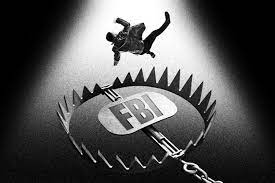
FBI Make-Work Entrapment Schemes: Creating Criminals in Order to Arrest Them

By John & Nisha Whitehead

Source: The Rutherford Institute

“Whoever fights monsters should see to it that in the process he does not become a monster.”— Friedrich Nietzsche

We’re not dealing with a government that exists to serve its people, protect their liberties and ensure their happiness.

Rather, we are the unfortunate victims of the diabolical machinations of a make-works program carried out on an epic scale whose only purpose is to keep the powers-that-be permanently (and profitably) employed.

Case in point: the FBI.

The government’s henchmen have become the embodiment of how power, once acquired, can be so easily corrupted and abused. Indeed, far from being tough on crime, FBI agents are also among the nation’s most notorious lawbreakers.

Whether the FBI is planting undercover agents in churches, synagogues and mosques; issuing fake emergency letters to gain access to Americans’ phone records; using intimidation tactics to silence Americans who are critical of the government, or persuading impressionable individuals to plot acts of terror and then entrapping them, the overall impression of the nation’s secret police force is that of a well-dressed thug, flexing its muscles and doing the boss’ dirty work.

Clearly, this is not a government agency that appears to understand, let alone respect, the limits of the Constitution.

Indeed, this same government agency has a pattern and practice of entrapment that involves targeting vulnerable individuals, feeding them with the propaganda, know-how and weapons intended to turn them into terrorists, and then arresting them as part of an elaborately orchestrated counterterrorism sting.

Basically, it works like this: in order to justify their crime-fighting superpowers, the FBI manufactures criminals by targeting vulnerable individuals and feeding them anti-government propaganda; then, undercover agents and informants equip the targeted individuals with the training and resources to challenge what they’ve been indoctrinated into believing is government corruption; and finally, the FBI arrests the targeted individuals for engaging in anti-government, terrorist activities.

This is what passes for the government’s perverse idea of being tough on crime.

For example, undercover FBI agents pretending to be associated with ISIS have been accused of seeking out online and befriending a 16-year-old with brain development issues, persuading him to secretly send them small cash donations in the form of gift cards, and then the moment Mateo Ventura, turned 18, arresting him for providing financial support to an Islamic terrorist group.

If convicted, the teenager could spend up to 10 years in prison.

Yet as The Intercept explains, “the only ‘terrorist’ he is accused of ever being in contact with was an undercover FBI agent who befriended him online as a 16-year-old… This law enforcement tactic has been criticized by national security researchers who have scrutinized the FBI’s role in manufacturing terrorism cases using vulnerable people who would have been unable to commit crimes without prolonged government assistance and encouragement… the Ventura case may indicate that authorities are still open to conjuring terrorists where none existed.”

In another incident, the FBI used an undercover agent/informant to seek out and groom an impressionable young man, cultivating his friendship, gaining his sympathy, stoking his outrage over injustices perpetrated by the U.S. government, then enlisting his help to blow up the Herald Square subway station. Despite the fact that Shahawar Matin Siraj ultimately refused to plant a bomb at the train station, he was arrested for conspiring to do so at the urging of his FBI informant and used to bolster the government’s track record in foiling terrorist plots. Of course, no mention was made of the part the government played in fabricating the plot, recruiting a would-be bomber, and setting him up to take the fall.

These are Machiavellian tactics with far-reaching consequences for every segment of the population, no matter what one’s political leanings, but it is especially dangerous for anyone whose views could in any way be characterized as anti-government.

As Rozina Ali writes for The New York Times Magazine, “The government’s approach to counterterrorism erodes constitutional protections for everyone, by blurring the lines between speech and action and by broadening the scope of who is classified as a threat.”

For instance, it was reported that the FBI had been secretly carrying out an entrapment scheme in which it used a front company, ANOM, to sell purportedly hack-proof phones to organized crime syndicates and then used those phones to spy on them as they planned illegal drug shipments, plotted robberies and put out contracts for killings using those boobytrapped phones.

All told, the FBI intercepted 27 million messages over the course of 18 months.

What this means is that the FBI was also illegally spying on individuals using those encrypted phones who may not have been involved in any criminal activity whatsoever.

Even reading a newspaper article is now enough to get you flagged for surveillance by the FBI. The agency served a subpoena on USA Today / Gannett to provide the internet addresses and mobile phone information for everyone who read a news story online on a particular day and time about the deadly shooting of FBI agents.

This is the danger of allowing the government to carry out widespread surveillance, sting and entrapment operations using dubious tactics that sidestep the rule of law: “we the people” become suspects and potential criminals, while government agents, empowered to fight crime using all means at their disposal, become indistinguishable from the corrupt forces they seek to vanquish.  

To go after terrorists, they become terrorists.

To go after drug smugglers, they become drug smugglers.

To go after thieves, they become thieves.

For instance, when the FBI raided a California business that was suspected of letting drug dealers anonymously stash guns, drugs and cash in its private vaults, agents seized the contents of all the  safety deposit boxes and filed forfeiture motions to keep the contents, which include millions of dollars’ worth of valuables owned by individuals not accused of any crime whatsoever.

It’s hard to say whether we’re dealing with a kleptocracy (a government ruled by thieves), a kakistocracy (a government run by unprincipled career politicians, corporations and thieves that panders to the worst vices in our nature and has little regard for the rights of American citizens), or if we’ve gone straight to an idiocracy

This certainly isn’t a constitutional democracy, however.

Some days, it feels like the FBI is running its own crime syndicate complete with mob rule and mafia-style justice.

In addition to creating certain crimes in order to then “solve” them, the FBI also gives certain informants permission to break the law, “including everything from buying and selling illegal drugs to bribing government officials and plotting robberies,” in exchange for their cooperation on other fronts.

USA Today estimates that agents have authorized criminals to engage in as many as 15 crimes a day (5600 crimes a year). Some of these informants are getting paid astronomical sums: one particularly unsavory fellow, later arrested for attempting to run over a police officer, was actually paid $85,000 for his help laying the trap for an entrapment scheme.

In a stunning development reported by The Washington Post, a probe into misconduct by an FBI agent resulted in the release of at least a dozen convicted drug dealers from prison.

In addition to procedural misconduct, trespassing, enabling criminal activity, and damaging private property, the FBI’s laundry list of crimes against the American people includes surveillance, disinformation, blackmail, entrapment, intimidation tactics, and harassment.

For example, the Associated Press lodged a complaint with the Dept. of Justice after learning that FBI agents created a fake AP news story and emailed it, along with a clickable link, to a bomb threat suspect in order to implant tracking technology onto his computer and identify his location. Lambasting the agency, AP attorney Karen Kaiser railed, “The FBI may have intended this false story as a trap for only one person. However, the individual could easily have reposted this story to social networks, distributing to thousands of people, under our name, what was essentially a piece of government disinformation.”

Then again, to those familiar with COINTELPRO, an FBI program created to “disrupt, misdirect, discredit, and neutralize” groups and individuals the government considers politically objectionable, it should come as no surprise that the agency has mastered the art of government disinformation.

The FBI has been particularly criticized in the wake of the 9/11 terrorist attacks for targeting vulnerable individuals and not only luring them into fake terror plots but actually equipping them with the organization, money, weapons and motivation to carry out the plots—entrapment—and then jailing them for their so-called terrorist plotting. This is what the FBI characterizes as “forward leaning—preventative—prosecutions.”

The FBI has also repeatedly sought to expand its invasive hacking powers to allow agents to hack into any computer, anywhere in the world.

Suffice it to say that when and if a true history of the FBI is ever written, it will not only track the rise of the American police state but it will also chart the decline of freedom in America: how a nation that once abided by the rule of law and held the government accountable for its actions has steadily devolved into a police state where justice is one-sided, a corporate elite runs the show, representative government is a mockery, police are extensions of the military, surveillance is rampant, privacy is extinct, and the law is little more than a tool for the government to browbeat the people into compliance.

This is how tyranny rises and freedom falls.

The powers-that-be are not acting in our best interests.

Almost every tyranny being perpetrated by the U.S. government against the citizenry—purportedly to keep us safe and the nation secure—has come about as a result of some threat manufactured in one way or another by our own government.

Think about it.

Cyberwarfare. Terrorism. Bio-chemical attacks. The nuclear arms race. Surveillance. The drug wars. Domestic extremism. The COVID-19 pandemic.

In almost every instance, the U.S. government (often spearheaded by the FBI) has in its typical Machiavellian fashion sown the seeds of terror domestically and internationally in order to expand its own totalitarian powers.

Consider that this very same government has taken every bit of technology sold to us as being in our best interests—GPS devices, surveillance, nonlethal weapons, etc.—and used it against us, to track, control and trap us.

Are you getting the picture yet?

The U.S. government isn’t protecting us from threats to our freedoms.

The U.S. government is creating the threats to our freedoms. It is, as I make clear in my book Battlefield America: The War on the American People and in its fictional counterpart The Erik Blair Diaries, the source of the threats to our freedoms.

Bono Is Doing Illustrations For The Atlantic Now, Because Everything’s Fake And Stupid

By Caitlin Johnstone

Source: CaitlinJohnstone.com

So U2 singer Bono is literally just doing illustrations for the imperialist propaganda rag The Atlantic now, because that’s the sort of thing that happens in a dystopian civilization during the death throes of a globe-spanning empire.

A Washington Post article titled “Bono likes to sketch Atlantic covers, so the magazine hired him” reports that “Bono is into Atlantic cover fanfic — so much so that he was invited to illustrate the magazine’s June cover featuring Ukrainian President Volodymyr Zelensky.” 

Bono’s latest contribution to the mountain of cringe-inducing Zelensky moments we’ve been seeing for the past year provides a cover image for an article by lifelong war propagandists Anne Applebaum and Jeffrey Goldberg. The article endorses a Ukrainian offensive to recapture Crimea, which experts largely agree would be the move most likely to trigger a nuclear war in this conflict.

Here’s a paragraph from Applebaum and Goldberg’s article, just to give you a taste of the infantile “Good Guys vs Bad Guys” framing that western liberals are being fed by mass media war propagandists these days:

“Sometimes, the war is described as a battle between autocracy and democracy, or between dictatorship and freedom. In truth, the differences between the two opponents are not merely ideological, but also sociological. Ukraine’s struggle against Russia pits a heterarchy against a hierarchy. An open, networked, flexible society—one that is both stronger at the grassroots level and more deeply integrated with Washington, Brussels, and Silicon Valley than anyone realized—is fighting a very large, very corrupt, top-down state. On one side, farmers defend their land and 20‑something engineers build eyes in the sky, using tools that would be familiar to 20‑something engineers anywhere else. On the other side, commanders send waves of poorly armed conscripts to be slaughtered—just as Stalin once sent shtrafbats, penal battalions, against the Nazis—under the leadership of a dictator obsessed with ancient bones. ‘The choice,’ Zelensky told us, ‘is between freedom and fear.’”

Many westerners felt their first stirrings of youthful rebellious passions while listening to U2 songs like “Sunday Bloody Sunday” and “Pride (In the Name of Love)”, but nowadays Bono’s voice is heard saying that he has “grown very fond” of war criminal George W Bush, praising capitalism at the World Economic Forum, teaming up with warmonger Lindsey Graham to promote US empire narratives about Syria, and  singing “Stand by Ukraine” in support of US empire narratives in a Kyiv subway. And just when it looks like he can’t become any more of a tool of the empire, he gets hired by one of the world’s worst militarist smut rags to draw a cover image of Zelensky.

Because that’s just how things go in a highly controlled society where mainstream culture is designed to serve the powerful. A society where the minds of the public are continually being shaped by mass-scale psychological manipulation to ensure that they keep thinking, speaking, working, consuming and voting in ways which serve the rich and powerful. Everything that gets elevated to the top of mainstream attention facilitates this agenda (or is at least harmless to it), and as soon as it becomes potentially threatening to this agenda it is either corrected or marginalized away from mainstream attention.

This dynamic can cause some truly jaw-dropping flotsam and jetsam to surface in the roilings of our cultural waters, like Simpsons characters waving Ukrainian flags, or an opera about a drone operator sponsored by General Dynamics.

Here’s Responsible Statecraft’s Connor Echols on that last one:

This fall, DC denizens will be treated to the world premiere of “Grounded,” an opera following an Air Force ace named Jess whose unexpected pregnancy forces her to leave behind her beloved F-16 and join the “chair force.”

Throughout the show, the “hot shot” pilot wrestles with the mental impact of firing rockets from a drone in Afghanistan from a trailer in Las Vegas. “As Jess tracks terrorists by day and rocks her daughter to sleep by night, the boundary between her worlds becomes dangerously permeable,” an ad tells us.

The production is brought to you by presenting sponsor General Dynamics, one of the world’s largest weapons companies (and, wouldn’t you know it, the maker of Jess’s favorite plane). Playwright George Brant wrote the libretto, which will be brought to life by mezzo-soprano Emily D’Angelo and Tony-winning composer Jeanine Tesori.

You’ll also see things like “humanitarian intervention” champion Samantha Power enthusiastically tweeting about the collaboration between the Sesame Street franchise and the CIA cutout USAID in Iraq:

You see things like this all the time under the shadow of the US empire, and individually they don’t look like much, but once you start noticing them you come to recognize them as symptoms of the profoundly diseased civilization that we are living in. One where our heart strings are pulled in the most obnoxious ways imaginable to get us to support capitalism, empire and oligarchy, where we are manipulated into espousing values systems which benefit powerful sociopaths under the cover of noble-sounding causes. Where we are trained like rats to support systems that are driving our species toward extinction because our rulers gave lip service to humanitarianism and waved a rainbow flag.

This is what dystopia looks like. Like a bunch of thought-controlled automatons mindlessly marching toward ecocide and omnicide to a beat played out by screens who tell them every day and in every way that there is no higher purpose than this. Like military industrial complex-funded feminist rock operas about drone operators and Cookie Monster helping Samantha Power psychologically colonize Iraqi children. Like Bono coming home from singing a heartfelt number about the assassination of Martin Luther King Jr to illustrate a cover for a war propaganda piece in The Atlantic.

It’s like they’re pouring concrete over our hearts. Sewing blindfolds over our souls. Numbing us, distracting us, sedating us, so that the local riff raff won’t interfere in the workings of the imperial machine. They’re killing off something beautiful and sacred in humanity, and they’re doing it to roll out some of the ugliest visions this planet has ever seen.

The Warmongering U.S. Empire Is Crashing, the Lying Western Media’s Days Are Numbered

The Western mainstream media have never been so blatant in their propaganda for the U.S. empire

By Finian Cunningham

Source: Strategic Culture Foundation

The Western mainstream media have never been so blatant in their propaganda for the U.S. empire.

The pretensions are threadbare. As the warmongering U.S. government/regime and its Western/NATO imperialist lackeys are becoming more exposed and desperate to maintain credibility, so too are their media tools. The likes of the New York Times, BBC, CNN – and many more – are a contemptible joke on the public. They are an insult to common intelligence.

Fake news has been around for centuries, but it’s now becoming glaringly obvious and self-destructive. In the same way that the U.S. warmongering empire is becoming glaringly obvious and self-destructive.

The disconnect with reality and degradation of supposed independent journalism is reflected in record levels of distrust among the Western public toward the mainstream, corporate-controlled news media.

In this interview, U.S.-based writers Bruce Gagnon and Daniel Lazare demolish the pretensions of Western media.

The systematic cover-up of the Nord Stream sabotage by the United States and its NATO allies – an act of war and state terrorism – demonstrates the servile function of Western media outlets that claim to be pillars of independent news and freedom of information.

Media outlets like the New York Times, Washington Post, and the British state-owned BBC, among many others, have been exposed as pathetic propaganda tools for the United States and other NATO imperialist regimes.

All Western media outlets have ignored credible investigative reporting by Seymour Hersh (and others) who have very plausibly implicated the sabotage of Nord Stream by the U.S., carried out under the instructions of American President Joe Biden.

Another touchstone subject is the vile persecution of Julian Assange. Western media have again covered up what are a shocking violation of Assange’s rights and principled publishing through the whistleblower organization Wikileaks. Julian Assange’s only “crime” is that he revealed the war crimes committed by the U.S. and its imperialist lackeys.

Assange’s appalling mistreatment, indeed torture – four years in British solitary confinement awaiting extradition to the U.S. over spurious “spying charges” – is a vicious attack on journalism and the public’s right to know. Yet supposed self-declared Western media defenders of “truth” and “fact-based” objective information – have conspired to be silent and permit Assange’s persecution. Western media are shown to be complicit in destroying the very principles of journalism that they claim to uphold.

As Bruce Gagnon and Daniel Lazare point out, it is a crime to tell the truth and Western media stand exposed in their odious dereliction of duty to report independently. They are seen more than ever as out-and-out tools of empire.

A proper understanding of the Nord Stream sabotage and the case of Julian Assange would give the Western public a critical insight into the imperialist nature of their governments – regimes that serve warmongering capitalist interests. Critical mass must be thwarted at all costs by the Empire’s media foot-servants.

From the point of view of U.S.-led Western imperialist power, it is imperative and absolutely vital to cover up the scandals of the Nord Stream attack and Julian Assange, among others. If the public were to become more widely cognizant then the whole edifice of Western governments implodes. This is why the Western media are more blatant than ever to cover up. But the truth will win out.

The war in Ukraine is becoming more evident as a war-racket and imperialist proxy war against Russia. That war is in desperate danger of spiraling into an all-out world war that could unleash a nuclear catastrophe.

The same Western media cover-up is at work with regard to the U.S.-led NATO aggression toward China. Again, the Western media are spinning imperialist propaganda of alleged Chinese menace in order to justify what is an insane warmongering agenda to confront China and prop up American hegemonic ambitions.

A tantalizing positive prospect is that critical, independent media are gradually and relentlessly breaking the monopoly of Western propaganda media. The internet and global communications are seeing to that – albeit against sinister censorship by Western regimes.

Nevertheless, the establishment Western media are increasingly held in distrust and contempt by the Western public and globally.

We are living in an exemplary time of the fabled Emperor With No Clothes. The false image of dominant Western regimes and their lying corporate media has never been so degraded but also never so fragile. The Western lie machine’s days are numbered. It only has itself to blame because of its abject disservice to the public interest.

Western state-complicit media claim to be “free”. Laughably, they are “free” to be slaves of lies and propaganda.

A crash is long overdue.

Democracy Rising 28: AI, Gossip, and Our Epistemological Crisis

By Tom Prugh

Source: resilience

The other day I joined the rush to explore ChatGPT, signing up at the OpenAI website. I gave it my full legal name and correct birth date, and asked it to pretend I had died and to write my obituary. The result was 300 words describing a somewhat boring paragon of a man.

Except maybe for the boring part, I am not that man, much less that paragon.

The obit wasn’t completely wrong, but it did nothing to undermine ChatGPT’s reputation for “uneven factual accuracy.” It said I was born in Ohio (true), but in Cleveland (false) in 1957 (false). It said I was a “committed environmentalist” (true; I worked for the late lamented Worldwatch Institute for the best part of my career), and that I was an active member of “several environmental organizations” (somewhat true, off and on). It described me as an “avid cyclist” (kind of true, but the last time I did a century ride was 1987).

So much for the hits. The misses include accounts of me as:

  • A “devoted husband” to my wife of 40 years, Mary (my marriage, to a fine woman not named Mary, lasted 26 years) and a “loving father” to two children (one, in fact)
  • A “brilliant engineer” with a degree in electrical engineering from Ohio State University who worked for Boeing, General Electric, and SpaceX (wrong on all counts)
  • Someone who “was instrumental in the development of several renewable energy projects” (my wife and I put a few solar panels on our garage roof, but that’s it)
  • An “active member” of a church who spent “many hours volunteering at the food bank” (I am neither very religious nor, it shames me to admit, very generous with my personal time)

The obituary proclaimed that my “death” had “left a deep void in the lives of his family, friends, and colleagues” and that I would be “deeply missed by all who knew him.” Well, that would be gratifying—if there is a me to be gratified—but I’ll settle for a drunken wake where somebody plays “Won’t Get Fooled Again.”

Maybe everyone should try this. You too might be amused and/or appalled by the plausible distortions and lies a quasi-intelligent computer program can gin up by accessing the petabytes of data (“data”?) on the Internet—accounts of people and events that are bogus but increasingly, and seamlessly, hard to tell  from reality.

I am not a tech nerd and my grasp of what ChatGPT does is rudimentary. But I find it disturbing that this expression of artificial intelligence will instantly fabricate a profile and populate it with—not questions, or blanks to be filled in—but invented factoids tailored to fit a particular format. And this reservation isn’t just me being PO’d about my obit (I’m actually grateful my Internet footprint isn’t bigger); prominent tech geeks also have misgivings. Here’s Farhad Manjoo, for instance:

ChatGPT and other chatbots are known to make stuff up or otherwise spew out incorrect information. They’re also black boxes. Not even ChatGPT’s creators fully know why it suggests some ideas over others, or which way its biases run, or the myriad other ways it may screw up.  …[T]hink of ChatGPT as a semi-reliable source.

Likewise Twitter and other social media, whose flaws and dangers are well known by now, and feared by some of the experts who know them best. The most recent book from revered tech guru and virtual reality pioneer Jaron Lanier is called Ten Arguments for Deleting Your Social Media Accounts Right Now. Chapter titles include “Quitting Social Media Is the Most Finely Targeted Way to Resist the Insanity of Our Time,” “Social Media Is Making You into an Asshole,” “Social Media Is Undermining Truth,” and “Social Media Is Making Politics Impossible.”

About those politics: ChatGPT and its successors and rivals, whatever their virtues, are the latest agents in the corruption of the public sphere by digital technology, threatening to extend and deepen the misinformation, fabulism, and division stoked by Twitter and other digital media. Once again, a powerful new technology is out the door and running wild while society and regulators struggle to understand and tame it.

It’s hard to see how this can end well.

An earlier post in this series (DR5) looked at recent archaeological evidence suggesting that humans have explored lots of different means of governing ourselves over the last several thousand years. Eventually, for several reasons, we seem to have ended up with large, top-down, hierarchical organizations. These have lots of problems that won’t be reviewed here, but neuroscientist and philosopher Eric Hoel argues that at least they freed us from the “gossip trap.”

Hoel thinks the main reason small prehistoric human groups didn’t evolve hierarchical governing systems is because of “raw social power,” i.e., gossip:

[Y]ou don’t need a formal chief, nor an official council, nor laws or judges. You just need popular people and unpopular people.

After all, who sits with who is something that comes incredibly naturally to humans—it is our point of greatest anxiety and subject to our constant management. This is extremely similar to the grooming hierarchies of primates, and, presumably, our hominid ancestors.

“So,” Hoel says, “50,000 BC might be a little more like a high school than anything else.”

Hoel believes that raw social power was a major obstacle to cultural development for tens of thousands of years. When civilization did finally arise, it created “a superstructure that levels leveling mechanisms, freeing us from the gossip trap.”

But now, Hoel says, the explosion of digital media and their functions have resurrected it:

[I]f we lived in a gossip trap for the majority of our existence as humans, then what would it be, mentally, to atavistically return to that gossip trap?

Well, it sure would look a lot like Twitter.

I’m serious. It would look a lot like Twitter. For it’s on social media that gossip and social manipulation are unbounded, infinitely transmittable.

…Of course we gravitate to cancel culture—it’s our innate evolved form of government.

Allowing the gossip trap to resume its influence on human affairs—and turbocharging it the way digital media are doing—seems like a terrible way to run a PTA or a garden club, let alone a community or a nation.

The industrialization of made-to-order opinions, “facts,” and “data” via AI and social media, despite efforts to harness them for constructive ends, is plunging us into an epistemological crisis: “How do you know?” is becoming the most fraught question of our time. T.S. Eliot said that “humankind cannot bear very much reality,” but now we are well into an era when we can’t even tell what it is—or in which we simply make it up to please ourselves. The more convincing these applications become, the less anchored we are to the “fact-based” world.

We’ve struggled with this for centuries. Deception is built into nature as an evolutionary strategy, and humans are pretty good at it, both individually and at scale by means of propaganda, advertising, public relations, and spin. These all prey on human social and cognitive vulnerabilities (see DR4).

Humans can only perceive the world partially and indirectly. It starts with our senses, which ignore all but a tiny fraction of the vast amount of data that’s out there. (Sight, for instance, captures only a sliver of the electromagnetic spectrum.) In addition, we’re social creatures and our perceptions of what’s real are powerfully shaped by other people. And now comes the digital mediation of inputs, in which information and data come from the ether via often faceless and anonymous sources and are cloaked or manipulated in ways we may never detect or suspect.

Digital media curate our information about reality, like all media do. But things have changed in the last few decades, and especially in the last few years. It’s been only a generation or so since the old days when Walter, or Chet and David, or any of hundreds of daily newspapers told us what was going on in the world. In those days the curation was handled by a relatively small number of individuals with high profiles. We knew, or could learn, something about who they were and where their biases lay. They were professionals, which also counted for something. There’s no perfect system and this one wasn’t either, but its chain of information custody was a far cry from the distant, anonymized, chat-botted, and algorithm-driven inputs flooding the public sphere now.

One liberal pundit recently noted that the increasing ideological specialization of media outlets “compels customers who care about getting a full and nuanced picture not to buy from just one merchant … .” That’s good advice. But you don’t have to force yourself, teeth clenched, to watch Fox News or MSNBC to get a different point of view; just sit down with your neighbors for a civil chat. In fact, getting away from our TVs and into a room with other people now and then would be good for all of us.

This being a blog about deliberative democracy, I default to deliberation in response to many of our political ills. Deliberation can’t fix everything, and no doubt we will get fooled again—but the tools of democratic deliberation can be used to mitigate the seemingly ubiquitous attempts at manipulation and deceit that surround us. Humans have struggled for a long time to build institutions to check our worst tendencies and have had some success. Digitally mediated information poses a fresh threat and we need institutions to meet these new circumstances.

Deliberative settings built for shaping community action should be among those new institutions. At the very least, they will outperform the social processes seen in high school cafeterias. The methods and structures of deliberative democracy can shorten the chain of information custody as well as restore and nurture the direct human presence of neighbors and fellow citizens: they’re sitting around the same table, and you will see them later at the local school or grocery store. Like them or not (or vice versa), they remain a potent element of our daily lives—a source of influence that can work for good or ill. Deliberation channels normal human interactions in ways that can benefit the community, help check the kinds of fantasist catastrophes so prevalent in digital media, and ground our perceptions of reality in the shared concerns of a community of people who may be less than friends but far more than strangers.

A State of Never-Ending Crisis: The Government Is Fomenting Mass Hysteria

By John & Nisha Whitehead

Source: The Rutherford Institute

This country has been having a nationwide nervous breakdown since 9/11. A nation of people suddenly broke, the market economy goes to shit, and they’re threatened on every side by an unknown, sinister enemy. But I don’t think fear is a very effective way of dealing with things—of responding to reality. Fear is just another word for ignorance.”—Hunter S. Thompson, gonzo journalist

We have become guinea pigs in a ruthlessly calculated, carefully orchestrated, chillingly cold-blooded experiment in how to control a population and advance a political agenda without much opposition from the citizenry.

This is mind-control in its most sinister form.

With alarming regularity, the nation is being subjected to a spate of violence that terrorizes the public, destabilizes the country, and gives the government greater justifications to crack down, lock down, and institute even more authoritarian policies for the so-called sake of national security without many objections from the citizenry.

Take this latest shooting in Nashville, Tenn.

The 28-year-old shooter (a clearly troubled transgender individual in possession of several military-style weapons) opened fire in a Christian elementary school, killing three children and three adults.

Already, fingers are being pointed and battle lines are being drawn.

Those who want safety at all costs are clamoring for more gun control measures (if not at an outright ban on assault weapons for non-military, non-police personnel), widespread mental health screening of the general population, more threat assessments and behavioral sensing warnings, more CCTV cameras with facial recognition capabilities, more “See Something, Say Something” programs aimed at turning Americans into snitches and spies, more metal detectors and whole-body imaging devices at soft targets, more roaming squads of militarized police empowered to do random bag searches, more fusion centers to centralize and disseminate information to law enforcement agencies, and more surveillance of what Americans say and do, where they go, what they buy and how they spend their time.

This is all part of the Deep State’s master plan.

Ask yourselves: why are we being bombarded with crises, distractions, fake news and reality TV politics? We’re being conditioned like lab mice to subsist on a steady diet of bread-and-circus politics and an endless spate of crises.

Caught up in this “crisis of the now,” the average person has a hard time keeping up with and remembering all of the “events,” manufactured or otherwise, which occur like clockwork in order to keep us distracted, deluded, amused, and insulated from reality.

As investigative journalist Mike Adams points out:

“This psychological bombardment is waged primarily via the mainstream media which assaults the viewer by the hour with images of violence, war, emotions and conflict. Because the human nervous system is hard wired to focus on immediate threats accompanied by depictions of violence, mainstream media viewers have their attention and mental resources funneled into the never-ending ‘crisis of the NOW’ from which they can never have the mental breathing room to apply logic, reason or historical context.”

Professor Jacques Ellul studied this phenomenon of overwhelming news, short memories and the use of propaganda to advance hidden agendas. “One thought drives away another; old facts are chased by new ones,” wrote Ellul.

All the while, the government continues to amass more power and authority over the citizenry.

When we’re being bombarded with wall-to-wall news coverage and news cycles that change every few days, it’s difficult to stay focused on one thing—namely, holding the government accountable to abiding by the rule of law—and the powers-that-be understand this.

Yet as John Lennon reminds us, “nothing is real,” especially not in the world of politics.

In other words, it’s all fake, i.e., manufactured, i.e., manipulated to distort reality.

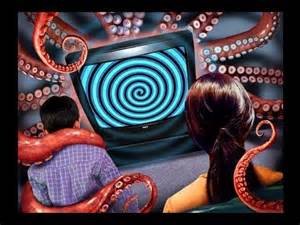
Much like the fabricated universe in Peter Weir’s 1998 film The Truman Show, in which a man’s life is the basis for an elaborately staged television show aimed at selling products and procuring ratings, the political scene in the United States has devolved over the years into a carefully calibrated exercise in how to manipulate, polarize, propagandize and control a population.

This is the magic of the reality TV programming that passes for politics today.

As long as we are distracted, entertained, occasionally outraged, always polarized but largely uninvolved and content to remain in the viewer’s seat, we’ll never manage to present a unified front against tyranny (or government corruption and ineptitude) in any form.

The more that is beamed at us, the more inclined we are to settle back in our comfy recliners and become passive viewers rather than active participants as unsettling, frightening events unfold.

Reality and fiction merge as everything around us becomes entertainment fodder.

We don’t even have to change the channel when the subject matter becomes too monotonous. That’s taken care of for us by the programmers (the corporate media).

“Living is easy with eyes closed,” says Lennon, and that’s exactly what reality TV that masquerades as American politics programs the citizenry to do: navigate the world with their eyes shut.

As long as we’re viewers, we’ll never be doers.

Studies suggest that the more reality TV people watch—and I would posit that it’s all reality TV, entertainment news included—the more difficult it becomes to distinguish between what is real and what is carefully crafted farce.

“We the people” are watching a lot of TV.

On average, Americans spend five hours a day watching television. By the time we reach age 65, we’re watching more than 50 hours of television a week, and that number increases as we get older. And reality TV programming consistently captures the largest percentage of TV watchers every season by an almost 2-1 ratio.

This doesn’t bode well for a citizenry able to sift through masterfully-produced propaganda in order to think critically about the issues of the day, whether it’s fake news peddled by government agencies or foreign entities.

Those who watch reality shows tend to view what they see as the “norm.” Thus, those who watch shows characterized by lying, aggression and meanness not only come to see such behavior as acceptable and entertaining but also mimic the medium.

This holds true whether the reality programming is about the antics of celebrities in the White House, in the board room, or in the bedroom.

It’s a phenomenon called “humilitainment.”

A term coined by media scholars Brad Waite and Sara Booker, “humilitainment” refers to the tendency for viewers to take pleasure in someone else’s humiliation, suffering and pain.

Humilitainment” largely explains not only why American TV watchers are so fixated on reality TV programming but how American citizens, largely insulated from what is really happening in the world around them by layers of technology, entertainment, and other distractions, are being programmed to accept the brutality, surveillance and dehumanizing treatment of the American police state as things happening to other people.

The ramifications for the future of civic engagement, political discourse and self-government are incredibly depressing and demoralizing.

This is what happens when an entire nation—bombarded by reality TV programming, government propaganda and entertainment news—becomes systematically desensitized and acclimated to the trappings of a government that operates by fiat and speaks in a language of force.

Ultimately, the reality shows, the entertainment news, the surveillance society, the militarized police, and the political spectacles have one common objective: to keep us divided, distracted, imprisoned, and incapable of taking an active role in the business of self-government.

Look behind the political spectacles, the reality TV theatrics, the sleight-of-hand distractions and diversions, and the stomach-churning, nail-biting drama, and you will find there is a method to the madness.

How do you change the way people think? You start by changing the words they use.

In totalitarian regimes—a.k.a. police states—where conformity and compliance are enforced at the end of a loaded gun, the government dictates what words can and cannot be used.

In countries where the police state hides behind a benevolent mask and disguises itself as tolerance, the citizens censor themselves, policing their words and thoughts to conform to the dictates of the mass mind.

Even when the motives behind this rigidly calibrated reorientation of societal language appear well-intentioned—discouraging racism, condemning violence, denouncing discrimination and hatred—inevitably, the end result is the same: intolerance, indoctrination, infantilism, the chilling of free speech and the demonizing of viewpoints that run counter to the cultural elite.

Labelling something as “fake news” is a masterful way of dismissing truth that may run counter to the ruling power’s own narrative.

As George Orwell recognized, “In times of universal deceit, telling the truth is a revolutionary act.”

Orwell understood only too well the power of language to manipulate the masses. In Orwell’s 1984, Big Brother does away with all undesirable and unnecessary words and meanings, even going so far as to routinely rewrite history and punish “thoughtcrimes.”

In this dystopian vision of the future, the Thought Police serve as the eyes and ears of Big Brother, while the Ministry of Peace deals with war and defense, the Ministry of Plenty deals with economic affairs (rationing and starvation), the Ministry of Love deals with law and order (torture and brainwashing), and the Ministry of Truth deals with news, entertainment, education and art (propaganda). The mottos of Oceania: WAR IS PEACE, FREEDOM IS SLAVERY, and IGNORANCE IS STRENGTH.

Orwell’s Big Brother relied on Newspeak to eliminate undesirable words, strip such words as remained of unorthodox meanings and make independent, non-government-approved thought altogether unnecessary.

Where we stand now is at the juncture of Oldspeak (where words have meanings, and ideas can be dangerous) and Newspeak (where only that which is “safe” and “accepted” by the majority is permitted).

Truth is often lost when we fail to distinguish between opinion and fact, and that is the danger we now face as a society. Anyone who relies exclusively on television/cable news hosts and political commentators for actual knowledge of the world is making a serious mistake.

Unfortunately, since Americans have by and large become non-readers, television has become their prime source of so-called “news.” This reliance on TV news has given rise to such popular news personalities who draw in vast audiences that virtually hang on their every word.

In our media age, these are the new powers-that-be.

Yet while these personalities often dispense the news like preachers used to dispense religion, with power and certainty, they are little more than conduits for propaganda and advertisements delivered in the guise of entertainment and news.

Given the preponderance of news-as-entertainment programming, it’s no wonder that viewers have largely lost the ability to think critically and analytically and differentiate between truth and propaganda, especially when delivered by way of fake news criers and politicians.

The bottom line is simply this: Americans should beware of letting others—whether they be television news hosts, political commentators or media corporations—do their thinking for them.

A populace that cannot think for themselves is a populace with its backs to the walls: mute in the face of elected officials who refuse to represent us, helpless in the face of police brutality, powerless in the face of militarized tactics and technology that treat us like enemy combatants on a battlefield, and naked in the face of government surveillance that sees and hears all.

As I make clear in my book Battlefield America: The War on the American People and in its fictional counterpart The Erik Blair Diaries, it’s time to change the channel, tune out the reality TV show, and push back against the real menace of the police state.

If not, if we continue to sit back and lose ourselves in political programming, we will remain a captive audience to a farce that grows more absurd by the minute.

“Facing Clear Evidence of Peril” in a Country of Lies

By Edward Curtin

Source: Behind the Curtain

“In my seventy-plus years from 1946 to now, the chorus of fear-mongering bullshit has never ceased – only grown louder. The joke is on us. Ha Ha Ha.”

– Oliver Stone, Chasing the Light

Perhaps silence is the best response to the endless cavalcade of official lies that is United States history. The Internet and digital technology have allowed those lies to increase exponentially in number and frequency with the result that people’s minds have become like 7-Eleven stores, open 24/7 for snack-crap “news.”

But once you become conscious that it’s lies night and day, it sets your head aswirl and plunges your soul into depths of despair.  You are tempted to retreat from such knowledge and talk of trees and trivia.  But you are ashamed of your country.  It’s hard to laugh.  You feel you are drowning.  You flounder and gasp for air.  You look around and wonder why most people are able to go their merry ways believing the lies and whistling in the dark.  Junk news nation, indeed.

Yes, there are alternative voices who tell the truth, but their audiences and monetary support are very small or non-existent compared to the corporate mainstream media and those who shout and scream across the Internet as they take in a lot of money from naive followers. The recent revelations about Alex Jones’s wealth probably don’t bother his diehard fans, but they should.  Likewise, the funding sources for websites and writers of various persuasions are important to know, for they reveal possible biases in their work.  Snake oil salesmen are commonplace, and there are many naive customers lining up for their wares.

Wealth and power are the main drivers of the media chicanery that has captured so many minds. Writers, of course, should be fairly paid for their work, but in this Internet age, most are not.  As with the movies and book publishing, the income gap between the big names – the celebrity stars – and less well-known writers, even if their work is excellent, is huge.

Some sites and writers make a lot of money, but who they are is a guessing game.  No one’s talking.  Some regularly tell their readers that if they don’t receive enough contributions, they will be unable to continue to write or publish, even when the sites do not pay their contributors.  Whether this is good marketing or income-by-threat is up for grabs.  Whichever it is, it seems to work, as far as I can tell, for these writers and websites don’t disappear.

Money is the dirty secret of all news and commentary.  To paraphrase someone: It is very difficult to get truth from writers whose income is dependent on pleasing those who fund them.

You may have noticed how many former military officers, CIA agents, mainstream journalists, pharmaceutical company executives, and sundry other government and corporate bigwigs appear in the mainstream and alternative media to support or oppose government policies.  The mainstream ones doing the propaganda they always did, while the alternative ones appear as converts to the dissident faith.  No one ever explains how and by whom these people are financed or how their lucrative pensions affect their consciences.  “Former” is a funny word.  Ha Ha Ha.

Confidence “men” come in all shapes and sizes with no one talking money.

So let me fess up.  I received about $200 in support last year for edwardcurtin.com, my website.  Nothing before that and not a cent over the last 5-6 years for many hundreds of articles that have appeared very widely across the Internet.  Before the Internet, publications paid for work, mine and others.  Not now, at least for me.  How much money writers are receiving, and who is supporting their sites, is a taboo subject.

So I am thinking about selling mugs at my site with my name and mug shot on them and a line of supplements that will increase one’s testosterone and estrogen in equal measure to make sure no one takes offense in this era of delicate feelings.  Ha Ha Ha.  Yes, the joke is on us.  I identify as a man since I am one.  Don’t be offended.

Jokes aside, as Leonard Cohen sang:

“Oh, like a bird on the wire
Like a drunk in a midnight choir
I have tried in my way to be free”

If you are stubborn enough and have the good fortune to find inspiration from those brave dissidents who have gone before us and those who continue to lead us on, you realize silence is betrayal and that you must speak, even if all seems hopeless at times. Even when no one is paying you, or maybe more accurately, because no one is paying you. Even though it is hopeless, even though it isn’t.  This is another secret.  There are many.

It’s been twenty years since the U.S. brutally invaded Iraq.  When George W. Bush, at a staged pseudo-event in Cincinnati on October 7, 2002, as he set Americans up for the invasion of Iraq in March 2003, said, “Facing clear evidence of peril, we cannot wait for the final proof, the smoking gun, that could come in the form of a mushroom cloud,” no one laughed him out of the house.  His claim was simply an evil joke that was reported as truth.  It was all predictable, blatant deception.  And the media played along with such an absurdity, which is their job and what they always do.  I pointed it out at the time in a newspaper column, but who listened to a hick writer in a regional newspaper.

Iraq obviously had no nuclear weapons or the slightest capability to deliver even a firecracker on the U.S.  But the mainstream media, Senator Joe Biden, politicians galore, celebrities like Oprah Winfrey with her guest, the eventually disgraced Judith Miller of the New York Times, the despicable Tony Blair, et al., all supported Bush’s blatant lies.  Soon Colin Powell, the “hero” of George H. W. Bush’s 1991 made-for-TV Gulf War of aggression against Iraq, would do his Pinocchio act at the United Nations and the U.S. military was off to get Saddam Hussein, Osama bin Laden’s evil twin, both the latest Hitlers until Vladimir Putin replaced them.  I guess I skipped some others such as Muammar Gaddafi and Bashar Al-Assad.  New Hitlers proliferate so fast it’s hard to keep track of them.  Ha Ha Ha.  The joke is on us.

As everyone knows, or should, more than a million Iraqis died because of George W. Bush, but how many cared?  How many cared when once Bush was gone, Barack Obama, aided and abetted by the cackling Hilary Clinton, destroyed Libya and ignited the war against Syria?  You want examples?  There are too many to name here.  But let it be said these lies span all American administrations, whether it’s Bill Clinton continuously bombing Iraq and Serbia through Trump bombing Syria and Somalia, up to the present day with Biden attacking Russia via Ukraine, etc.  All these presidents are liars, but their followers treat them otherwise.  Biden says Jimmy Carter asked him to deliver his eulogy.  What does that tell you?  Shall we laugh?  Sing?

On the clear understanding
That this kind of thing can happen
Shall we laugh?
Shall we laugh?
Shall we laugh?

Shall we laugh harder if I mention the Covid-19 propaganda and all those writers who have failed to even address it, as they have failed to question 9/11 and other obvious official lies?  Is it not evident that if they did so, their money flows might dry up?  Here and no further is a widespread rule, for they must adhere to the boundaries imposed by “responsible thought” and the “no go” zones with which they tie their own hands in order to keep their wallets full.

If you are lucky, as I was, when you are young you discover how fearful of free thought and how corrupt our institutional authorities are.  You don’t spend decades feasting off the spoils of those institutions only to “wake up” once you have made your name and secured your fortune, which seems to be the way of so many wise luminaries of the Internet Age who are either trying to ease their consciences as they get ready to kick the bucket or are perhaps putting us on.

When I was twenty-four years-old, I accepted my first teaching job at a small Catholic college where I taught theology.  I had been trained in the latest and best scholarly work of the most renown international theologians.  Rather than indoctrinating my students with rote learning, I taught them to read widely and think deeply in the tradition of a liberal arts education.  To seek out the best scholarship.

But doing so became quickly apparent to the college and Church authorities who were stuck in the inquisitorial age of obedience or else and no thinking allowed.   Although my students loved my courses and felt freed up for the first time to think about their spiritual lives, I was hounded to correct my heretical teaching, which of course I refused to do.

At one point when I was at lunch in the cafeteria, a nun who was a professor, stole my brief case with my notes and left the cafeteria.  One of my students saw her do this and chased her into the ladies’ room where the nun hid in a stall.  The nun kept flushing the toilet to scare the student away, but the student wouldn’t let her out until she returned the briefcase.  Ha Ha Ha.  It sounds funny to recount but was an example of my experience at this college.  Someone vandalized my office door and ripped down anti-war posters that were on it.  I was gone from that college soon thereafter.  It taught me a lot.  Obey or else.

Heresy: The Latin word is from Greek hairesis, a taking or choosing for oneself, a choice.

At another teaching job a year or so later, I had a more chilling experience.  I was known as an anti-war activist, a conscientious objector from the Marines, etc., and one day, a late Friday afternoon when few were around, an administrator asked to meet me on a deserted stairwell where he proceeded in hushed tones to try to convince me to join him in Army Intelligence to spy on others.  He said I would be perfect for the job since I was known as an anti-war dissident.  I told him to fuck off, but I was shocked by his double life and his request.

I have since learned that this guy the spy was not an anomaly, for government confidence men are widespread.

I’ve had many other such early experiences for which I am very grateful, even though when I was fired from jobs and lost income it was traumatic at the time.  By my thirtieth year, I knew the system was corrupt to its core and subsequent experience has only ratified that conclusion.  I got the joke.

I recount these incidents not because my experiences are singular and I’m special, for others have suffered the same youthful fate.  But such good fortune can fortify you for life or break your spirit.  If the former, you don’t wait to retire to push back against all the lies or regret your past.  You find that it’s all good and life has set you on the heretic’s path of freedom and choice. You realize that what you went through is absolutely nothing compared to people around the world who have and continue to suffer at the hands of the U.S. military industrial complex.  You realize your experiences are trivial in the larger scope of things and that your government’s conduct is beyond condemnation.  It is an abomination.  You feel ashamed to live in a land where killing is a game.

The sociologist Peter Berger puts it well in his little classic, Invitation to Sociology, when he discusses experiences that lead to seeing through the play-acting nature of social life:

Experiences such as these may lead to a sudden reversal in one’s view of society – from an awe-inspiring vision of an edifice made of massive granite to the picture of a toy-house precariously put together with papier mâché. While such metamorphosis may be disturbing to people who have hitherto had great confidence in the stability and rightness of society, it can also have a very liberating effect on those more inclined to look upon the latter as a giant sitting on top of them, and not necessarily a friendly giant at that. It is reassuring to discover that the giant is afflicted with a nervous tick.

Notice the giant George W. Bush’s clicking eyes as he delivers his “facing clear evidence of peril” lies for the invasion of Iraq.  He and his presidential good friends are cardboard cartoon characters whose eyes reveal their evil intentions.  “It’s a Barnum and Bailey world/Just as phony as it can be,” but it would all fall to pieces if it weren’t for you and me failing to see through all the bad actors, not just presidents but the whole cast of characters that populate the Spectacle of news and opinion.

The Russians are coming!  Ha Ha Ha.  Yes, Oliver, the joke’s on us.

But it’s not really funny, except in the most sardonic and dark way, for we now do really face clear evidence of peril as a result of Biden and his crazy predecessors who have run U.S. foreign policy for so long. They have brought us to the edge of nuclear war with Russia by surrounding Russia with NATO bases and nuclear weapons, while doing the same to China.

Bertolt Brecht was right in his poem “To Those Born After”:

Truly I live in dark times!

Frank speech is naïve. A smooth forehead

Suggests insensitivity. The man who laughs

Has simply not yet heard

The terrible news.

What kind of times are these, when

To talk about trees is almost a crime

Because it implies silence about so many horrors?

When the man over there calmly crossing the street

Is already perhaps beyond the reach of his friends

Who are in need?

Reality Tunnels: How to Control & Re-Program Your Mind

By Jack Fox-Williams

Source: Waking Times

When I was in secondary school, a teacher showed me an animated optical illusion in which a dancer appears to be spinning in one direction. I was adamant that the dancer was spinning clockwise, while my teacher insisted it was spinning counterclockwise. She then told me that you could change the direction of the dancer by focusing on the feet. I gazed with meditative fixation, and suddenly, to my amazement, the dancer started spinning counterclockwise! My teacher explained that since there are no visual cues for three-dimensional depth, your mind can determine what direction the dancer spins.

At that moment, I realised that reality is a construct of the mind, and we all potentially see the same world differently. I may have put it in less eloquent terms than that (considering I was only a teenager), but there was a fundamental shift in my understanding. The illusion made me realise that the notion of ‘objective truth’ was essentially arbitrary since our subjective beliefs mediate sensory experience.

My teacher and I could have argued for hours, days or weeks as to which direction the dancer was spinning; science couldn’t have proven either of us correct since it was a matter of perception rather than ‘truth’. In ‘reality’, the dancer was spinning in both directions, but since the brain has a natural tendency to classify, categorise and catalogue information in binary terms (up/down, left/right, black/white, clockwise/counterclockwise), the animated optical illusion appears monodirectional.

There are numerous examples of this in our day-to-day lives, like when we fail to appreciate other people’s viewpoints because we perceive the world differently. We believe we are right despite the multiple (if not infinite) interpretations about the nature of reality.

What are Reality Tunnels?

The countercultural guru Timothy Leary coined the term ‘reality-tunnel’ to describe our filtered perceptions of the world. Robert Anton Wilson later developed the concept to describe “pre-composed patterns of thinking which limit and distort the perception of reality by reducing complexity and options.”1 According to Wilson, reality-tunnels shape our phenomenological sense of self, editing out experiences that do not support our beliefs while focusing on those which do.2

An advocate for capitalism, for example, will gather facts to support the view that capitalism is the most effective socioeconomic model, discarding any information that runs contrary to this viewpoint. Similarly, a Marxist will construct arguments based on select information to support the view that communism is the best system, often neglecting evidence that contradicts their position.

As the psychedelic scholar Ido Hartogsohn states, “all of us harbour established ideas about minorities, religions, nationalities, the sexes, the right ways to think, act, feel govern, eat, drink, and what not. Reality tunnels act to help us fortify these ideas against challenging information.”3 In this sense, there is a crossover between the concept of reality-tunnels and confirmation bias, the latter described as the “human tendency to notice and assign significance to observations that confirm existing beliefs while filtering out or rationalising away observations that do not fit with prior beliefs and expectations.”4 The phenomenon of confirmation bias helps explain why people who ascribe to a reality-tunnel are oblivious. Most people believe their worldview corresponds to the “one true objective reality,” however, Wilson emphasises that many reality tunnels are artistic creations, a culmination of biological, cultural and environmental inputs.5

The notion that reality is shaped by the conditions of the human mind is not new. The 18th-century German philosopher Immanuel Kant proposed in his Critique of Pure Reason that experience is based “on the perception of external objects and a priori knowledge.”6 We receive information about the external world through our five senses, which is then processed by the brain, allowing us to conceptualise its contents. When I look at an object, such as a chair or a table, I have no understanding of its external nature. The qualities that enable me to denote the meaning of the object, such as shape, colour, size etc., have no objective existence; they are merely by-products of the brain.

The French psychoanalyst and psychiatrist Jacques Lacan proposed his theory distinguishing between ‘The Real’ and the ‘Symbolic’. Lacan argued that ‘The Real’ is the “imminent unified reality which is mediated through symbols that allow it to be parsed into intelligible and differentiated segments.”7 However, the ‘Symbolic’, which is primarily subconscious, is “further abstracted into the imaginary (our actual beliefs and understandings of reality). These two orders ultimately shape how we come to understand reality.”8

The Harvard sociologist, Talcott Parsons, uses the word gloss to describe how our minds come to perceive reality. According to Parsons, we are taught how to “put the world” together by others who subscribe to a consensus reality based on shared beliefs, norms and associations.9 A gloss constitutes a total system of language and/or perception. For example, the word ‘house’ is a gloss since we lump together a series of isolated phenomena – floor, ceiling, window, lights, rugs, etc. – and turn it into a totality of meaning.

The author and anthropologist Carlos Castaneda commented on this notion, stating, “we have to be taught to put the world together in this way. A child reconnoitres the world with few preconceptions until he is taught to see things in a way that corresponds to the descriptions everybody agrees on. The world is an agreement. The system of glossing seems to be somewhat like walking… we learn we are subject to the syntax of language and the mode of perception it contains.”10

The French philosopher Jacques Derrida stated that our understanding of objects (and the words which denote them) are only understood in relation to how they are contextually related to other objects (and denotive words).11

We can break free from prescribed reality-tunnels by using objects and language in unusual or disjointed ways, thereby creating new discursive meanings, associations and connotations. This was the aim and outcome of certain art movements such as Dadaism and Surrealism, as well as Brion Gysin and William Burroughs’ cut-up method.12

The famous ethnobotanist and psychonaut, Terence McKenna, argued that ideology and culture are tools “which give other people control over one’s experience and identity since they lead individuals to shape their identity according to pre-conceived forms. If a person identifies with commercial brands or with popular ideas of what is beautiful, true or important, they give away their power to other people.”13 McKenna once said that you should not see “culture and ideology as your friends,” implying that you should understand reality on your own terms rather than buying into “pre-packaged ideological and cultural ideals” such as communism, capitalism, democracy or some form of totalitarianism.14 Belief in itself, argued McKenna, was “limiting to the individual, because every time you believe in something you are automatically precluded from believing its opposite. By believing something, you are virtually shutting yourself from all contradictory information, thus once again performing the sin of imposing a rigid simplified structure upon an infinitely complex reality.”15

Much like McKenna, Wilson recommends that a “fully functioning human ought to be aware of their reality tunnel and be able to keep it flexible enough to accommodate and, to some degree, empathise with different ‘game rules’, different cultures.”16 According to Wilson, constructivist thinking, which considers how social and cultural processes determine our perception of the world, constitutes an exercise in metacognition, enabling us to become aware of how reality tunnels are never truly objective, thereby decreasing the “chance that we will confuse our map of the world with the actual world.”17

How Your Reality Tunnel Is Formed

The constraints of human biology partially limit our models of reality. As Wilson states, our DNA “evolved from standard primate DNA and still has a 98% similarity to chimpanzee (and 85% similarity to the DNA of the South American Spider Monkey). We have the same gross anatomy as other primates, the same nervous system and the same sense organs. While our highly developed pre-frontal cortex enables us to perform ‘higher’, more complex mental tasks than other primates, our perceptions remain largely within the primate norm.”18

The neural apparatus produced by our genetic coding helps create what ethologists call the umwelt, or “world-field.” Birds, reptiles and insects occupy a separate umwelt or reality-tunnel to primates (ourselves, included). For example, bees are able to perceive floral patterns in ultraviolet light, which we cannot (unless certain technologies are utilised). Canine, feline and primate reality-tunnels remain similar enough that friendship and communication can occur between these different species, however, a snake (for example) occupies such a different reality tunnel that their behaviour appears entirely alien.

As Wilson argues, the belief that human umwelt reveals “reality” or “deep-reality” is as “naïve as the notion that a yardstick shows more reality than a voltmeter or that ‘my religion is better than your religion’. Neurogenetic chauvinism has no more scientific justification than national or sexual chauvinisms.”19 He goes so far as to suggest that “no animal, including the domesticated primate, can smugly assume the world created by its senses and brain equal in all respects the ‘real world’ or the ‘only real world’.”20

Reality-tunnels are also influenced by “imprint vulnerability,” periods in our lives when early childhood/adolescent experiences “bond neurons into reflex networks which remain for life.”21 The psychological researchers, Lorenz and Tinbergen, won a Nobel Prize in 1973 for their research into imprinting, which demonstrated that “the statistically normal snow-goose imprints its mother, as distinct from any other goose, shortly after birth. This imprint creates a ‘bond’ and the gosling attaches itself to the mother in every possible way.”22 These imprints can be imposed onto literally anything. Lorenz observed a case in which a gosling, in the absence of its mother, imprinted a ping-pong ball. It followed the ping-pong ball around and, on reaching adulthood, “attempted to mount the ball sexually.”23

Wilson estimates that the age at which we are imprinted with language determines lifelong programs of “cleverness” (verbal intelligence) and “dumbness” (verbal unintelligence), since linguistic models enable us to articulate mental processing, evaluate complex ideas and communicate with those around us.24 Furthermore, how and when our first sexual experiences are imprinted can “determine lifelong programs of heterosexuality, brash promiscuity or monogamy etc.”25 In more obscure imprints, such as celibacy, foot-fetishism and sadomasochism, the “bounded brain circuitry seems quite as mechanical as the imprint which bounded the gosling to the ping-pong ball.”26

These examples suggest that experiences during childhood, when the brain exhibits optimal ‘neuroplasticity’ (a term used to refer to malleability of neural networks in the brain), can shape our reality tunnels far into adulthood. As Sigmund Freud proposed, many “rational” thoughts and behaviours are typically the result of “repressed” memories, impulses and desires, which dwell in the murky depths of the unconscious mind.27

Furthermore, reality-tunnels are shaped by social conditioning, the “sociological process of training in a society to respond in a manner generally approved by the society in general and peer groups within society.”28 Manifestations of social conditioning are multifarious but include nationalism, education, employment, entertainment, popular culture, spirituality and family life. Unlike imprinting, which usually requires only one powerful experience to set permanently into the neural networks of the brain, conditioning requires “many repetitions of the same experience and does not set permanently.”29

The processes of social conditioning vary greatly, depending on the cultural environment to which one is exposed. For example, an individual born in a Muslim country (such as Saudi Arabia) will likely believe in the teachings of the Quran and adhere to certain religious norms, customs and traditions. However, individuals born in a Western capitalist/consumerist country, or an Eastern country with Hindu or Buddhist traditions, will adhere to different cultural and behavioural codes.

Reality-tunnels are also formed through the process of learning. Much like conditioning, learning requires repetition, but it also requires motivation. Therefore, it plays “less of a role in human perception and belief than genetics and imprinting and even less than conditioning does.”30 Learning marks a major difference between how mammals, reptiles, insects and birds perceive the world. For example, snakes share the same reality tunnel since they merely act on biologically determined reflexes, with only minor imprinted differences. Mammals show “more conditioned and learned differences in their reality tunnels.”31

Humans demonstrate a higher aptitude for learning due to our highly developed cortex and frontal lobes as well as our prolonged infancy. This variability functions as “the greatest evolutionary strength of the human race” since it enables us to pass down knowledge from one generation to the next. But it also means that we can become brainwashed and label other people who do not share our beliefs as “mad,” “anti-social,” or “blasphemous.” In fact, it could be said that the majority of all wars are the result of two (or more) opposing reality tunnels fighting for supremacy. This is particularly evident in the case of religious conflict, where people kill each other in the name of “God.”

Tunnel Vision: The Politicisation of Reality

The rise of “identity politics” in the 21st century perfectly demonstrates how reality-tunnels prevent us from considering alternative perspectives and viewpoints. During the last decade, the political domain has become increasingly polarised as the left and right engage in a battle for cultural supremacy. Such polarisation was apparent in the Brexit referendum of 2016, in which 51.9% of the British public voted to leave the European Union while 48.1% voted to remain.32 The marginal success of the ‘leave’ campaign highlighted the strong division between both sides of the political spectrum. The former stressed the importance of the Union in promoting social and economic stability, while the latter emphasised the importance of national identity, sovereignty and independence.

The rhetoric employed by both the ‘leave’ and ‘remain’ campaign was so binary in its articulation that neither side engaged in meaningful dialogue; instead, the referendum became a series of baseless slogans, mottos and catchphrases – an advertising campaign designed to appeal to target demographics. The referendum was more about two separate reality-tunnels competing for ideological supremacy than a balanced analysis of benefits and risks.

The US presidential election of 2016 was a similar drama of competing reality-tunnels, shaped by masterful spin doctors and hidden persuaders who exploited modern advertising techniques to capture specific demographics based on class, age, sex, religion, geographical location and other criteria.

Donald Trump was well-known for his campaign slogan ‘Make America Great Again’ and other catchphrases that employed a lexicon of patriotism, populism and protectionism to appeal to those on the right. On the other hand, Hillary Clinton used the slogan ‘Stronger Together’ to evoke feelings of unity, compassion, and solidarity. The election became a battle between two contrasting reality-tunnels, grounded in meaningless rhetoric and hyperbole.

Another example of politicisation is the Covid-19 crisis, with the public divided into two camps – those who supported measures such as lockdowns versus the other side that rejected many of these same measures. Political polarisation demolished a sane balanced approach to the crisis, exacerbated and intensified by the ongoing political divide across the media landscape.

‘Echo Chambers’ & Identity Politics

Social media has fuelled identity politics by enabling groups and movements to generate an online presence and have real-world impacts. According to independent scholar and author Ilaria Bifarini, this results in the emergence of ‘echo chambers’ in which internet users “find information that validates their pre-existing opinions and activates confirmation bias.”33 This mechanism, says Bifarini, “strengthens one’s beliefs and radicalises them, without adding anything to information and knowledge. The result is the ideological extremism that we are observing today and in which we are taking part, where political debates have been replaced by supporters and verbal violence.”34

Another way this happens, for example, is how Google’s online video sharing and social media platform YouTube utilises algorithmic data to show users similar content to their prior engagements – content they are likely to engage with in the future, thus creating a feedback loop in which they are exposed to media reinforcing their political preferences.35 As media scholars Brooke E. Auxier and Jessica Vitak state, “many social media platforms structure their content-feeds based on what an algorithm determines to be the ‘top’ or most ‘relevant’ stories. While these tools may help users control their information and news environments – making consumption more manageable and mitigating information overload – it is possible that these tailoring tools will expose users to redundant information and singular viewpoints.”36

Both sides of the political spectrum fail to engage in meaningful discussion when they are entrapped in a single reality-tunnel, the stability of which is threatened by competing narratives. Instead, political dialogue becomes characterised by inflammatory insults, name-calling and defamation.

Loaded language – such as ‘virtue signallers’, ‘snowflakes’, ‘racist’, ‘transphobic’, ‘Islamophobic’, ‘hetero-normative’, ‘privileged’ – enables identity groups to protect the integrity of their reality-tunnel by excluding those who hold a different opinion. In the same way that religious cult leaders isolate their members from the outside world, so too do identity groups orientate themselves around a closed belief system, which is immune to criticism, contention or challenge.

In order to facilitate a more meaningful discussion, it is important that both sides learn to break free from the constraints of their reality-tunnel.

Rising Above the Fray

In his book Prometheus Rising, Robert Anton Wilson provides various techniques for challenging dominant reality tunnels. Writing in the early 1980s, Wilson suggested that “if you are a liberal, subscribe to the [conservative magazine] National Review… Each month try to enter their reality-tunnel for a few hours while reading their articles. If you are a conservative, subscribe to New York Review of Books for a year and try to get into their headspace for a few hours a month. If you are a rationalist, subscribe to Fate Magazine for a year. If you are an occultist, join the Committee for the Scientific Investigation of Claims of the Paranormal and read their journal, The Sceptical Inquirer, for a year.”37

To put a modern ‘spin’ on this exercise, if you follow conservative thinkers online such as Jordan Peterson or Ben Shapiro, expose yourself to leftist thinkers such as Slavoj Zizek or Noam Chomsky, and do the opposite if you are on the left. Subscribe to internet channels that do not align with your reality-tunnel. By performing this exercise, you will find that you can think about political issues in a more balanced, neutral and multidimensional way, free from the constraints of ideological dogma.

You can use the same technique with religion. In one exercise, Wilson says, “become a pious Roman Catholic. Explain in three pages why the Church is still infallible and holy despite Popes like Alexander VI (the Borgia Pope), Pious XII (ally of Hitler), etc.”38 Then explain why the Church is an immoral and outdated institution; also write three pages detailing why you believe this to be the case. If you have the time, you can perform the same exercise with other religions such as Hinduism, Buddhism, and even Satanism. Explain why these religions hold the key to the ‘true’ nature of ‘reality’ and then refute yourself by providing a counterargument.

You can use the same technique to become more conspiratorial in your thinking. In one exercise, Wilson says, “start collecting evidence that your phone is bugged. Everyone gets a letter occasionally that is slightly damaged. Assume that somebody is opening your mail and clumsily revealing it. Look around for evidence that your co-workers or neighbours think you’re a bit queer and are planning to have you committed to a mental hospital.”39 Observe how these assumptions influence your perception of other people and their behaviour – it won’t be long before you find evidence to support your paranoid thinking!

Once you have sufficiently experimented with this reality-tunnel, “try living a whole week with the program, ‘Everybody likes me and tries to help me achieve all of my goals’.”40 Then try living a whole month with the program, “I have chosen to be aware of this particular reality.”41 Then try living a day with the program, “I am God playing at being a human being. I created every reality I notice.”42 Then try living forever with the metaprogram, “Everything works out more perfectly than I plan it.”43 By adopting these different reality-tunnels, you will notice how malleable your perceptual faculties really are – the world can become a place of conspiracy and collusion or a place of benevolence and positivity, depending on how you view it.

Wilson provides another interesting exercise to expand the boundaries of consciousness, in which you “list at least 15 similarities between New York (or any large city) and an insect colony, such as a bee-hive or termite hill. Contemplate the information in the DNA loop, which created both of these enclaves of high coherence and organisation, in primate and insect societies.”44 Then, “Read the Upanishads and every time you see the word ‘Atman’ or ‘World Soul’, translate it as DNA blueprint. See if it makes sense to you that way.”45 According to Wilson, “Contemplating these issues usually triggers Jungian synchronicities. See how long after reading this chapter you encounter an amazing coincidence – e.g., seeing DNA on a license plate, having a copy of the Upanishads given to you unexpectedly…”46

Experimenting with different reality tunnels is a necessary practice if one wishes to challenge dominant narratives, perspectives and viewpoints and expand the boundaries of human consciousness. As we find ourselves in a post-modern ‘information age’, where an increasing number of political factions compete for informational authority, we are exposed to the hidden forces of propaganda more than ever before.

Every time we log into Facebook, Twitter, Instagram and YouTube, we allow ourselves to be manipulated by a complex system of algorithms that generates content based on our likes, dislikes, and even our differences. In order to escape the trappings of ideological dogma, we must become conscious of our biological, social and environmental conditioning and adopt a more multidimensional way of thinking.

Understanding about ‘reality-tunnels’ becomes instrumental in achieving true inner liberation since it enables us to think about the mind as a form of technological software that can be continually updated and reorganised. We achieve a state of metacognition, an awareness of one’s thought processes and an understanding of the patterns behind them. It is what the pioneering mind explorer John Lilly called our capacity for “metaprogramming,” the creation, revision, and reorganisation of mental programs.47

Although we are constrained by the limitations of biological programming (to a certain extent), the creativity of human consciousness is infinite, a maze of endless possibilities and potentialities waiting to be explored. As the Buddha said, “All that we are is the result of all that we have thought. It is founded on thought. It is based on thought.”48

Footnotes

1. Hartogsohn, I. (2015). The Psychedelic Society Revisited: On Reducing Valves, Reality Tunnels and the Question of Psychedelic Culture, Psychedelic Press, 3
2. ultrafeel.tv/reality-tunnel-how-beliefs-and-expectations-create-what-you-experience-in-life
3. Op cit., Hartogsohn, I. (2015), 4
4. en.wikipedia.org/wiki/Confirmation_bias 
5. Anton Wilson, R. (1983). Prometheus Rising, Tempe, Arizona: New Falcon
6. en.wikipedia.org/wiki/Immanuel_Kant
7. en.wikipedia.org/wiki/Reality_tunnel
8. Ibid
9. Parsons, T. (1951). The Social System, Glencoe, Illinois: The Free Press, 1951
10. Sam Keen, Castaneda interview, Psychology Today, December 1972
11. Derrida, J. (1978). ‘Genesis’ and ‘Structure’ and Phenomenology, in Writing and Difference, Routledge.
12. en.wikipedia.org/wiki/Dada
13. Op cit., Hartogsohn, I. (2015), 1
14. Ibid, 2
15. Anton Wilson, R. (1990). Quantum Psychology: How Brain Software Programs You & Your World, New Falcon Publications
16. en.wikipedia.org/wiki/Reality_tunnel 
17. Quantum Psychology, 74
18. Ibid, 74
19. Ibid, 75
20-24. Ibid, 76
25-26. Ibid, 76-77
27. Wollheim, R. (1971). Freud, Fontana Press
28. en.wikipedia.org/wiki/Social_conditioning 
29. Quantum Psychology, 77
30. Ibid
32. Ibid
33. Bifarini, I. Cognitive bias and echo chambers: The social media trap, www.academia.edu/40650380/Cognitive_bias_and_echo_chambers_The_social_media_trap
34. Ibid
35. Nguyen, C. Echo Chamber and Epistemic Bubbles, www.academia.edu/36634677/Echo_Chambers_and_Epistemic_Bubbles 
36. Auxier, B. and Vitak (2019). Factors Motivating Customization and Echo Chamber Creation Within Digital News Environments. Social Media and Society, April-June 2019
37. Prometheus Rising, 83
38. Ibid, 159
39. Ibid, 241
40-43. Ibid, 242
44-46. Ibid, 190
47. Lilly, John C. Programming & Metaprogramming in the Human Biocomputer, New York: The Julian Press, Inc., 1967
48. The Dhammapada