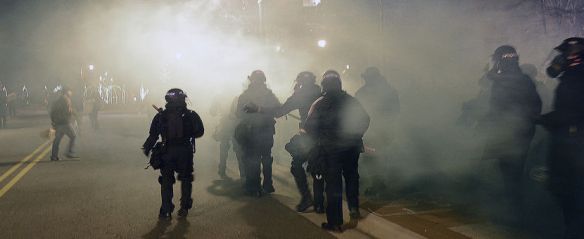
A dystopia in real time

By Dave Lefcourt

Source: OpEdNews.com

Let’s come straight out with it, to the US government, We the People are the enemy.

If you’ve read John W. Whitehead [1] regularly you’re already aware of that.

The tell-tale sign: surveillance camera’s seemingly everywhere. On most street intersections, photo enforced streets, roads by all schools, airports, railway stations, toll roads and all commercial stores.

Then there’s the ubiquitous, “If you see something, say something” heard in Metro subway stations, airports and railway stations. It’s portrayed as a necessary given for our “safety and protection” make us fearful of would be terrorists and other bad guys out to harm us.

But really ALL meant for the authorities to keep close tabs on us everywhere. Combined with electronic surveillance of our cell phones and computers-whether on or off-and the NSA pretty much has us under its constant surveillance.

Of course it’s all against the 4th Amendments strictures against “unreasonable searches and seizures” and without “probable cause” making it all illegal. Yet most Americans apparently don’t care taking the foolish “I haven’t done anything wrong so why worry about it” mantra.

It appears the public has been so propagandized and indoctrinated, they’ve accepted these illegal surveillance intrusions into their everyday lives.

But think about it: If the public absolutely objected to their governments spying on them these illegal intrusions could be severely curtailed, limited only to court ordered warrants for specific instances of suspected criminal activities-as legally specified in the Constitution.

The reason the government has become so paranoid of the people? They know we’re the many and they’re the few and if our police and military realized they were protecting and defending the indefensible, against the Constitution they’ve sworn to uphold, against all enemies, foreign and domestic, the party would all be over.

And that necessary “revolution” returning the government to and for the people could soon be realized.

Then all our illegal wars and occupations ended, the military downsized to defend only against an imminent attack, the billions spent on unnecessary defense industry weaponry eliminated, nuclear weapons eliminated and peace in the world realized.

So our government knows its biggest enemy is its own people, not terrorists, Russia, China, Iran or North Korea.

It’s us, you and me they’re really afraid of. That’s why they take the measures they do. Why they infiltrate peaceful protests and demonstrations with agent provocateurs who initiate violence giving the authorities the pretext to interfere and shut it down. It’s how “Occupy” was shut down in 2011 with government authorities acting in coordination nationwide.

It’s why the National Guard was called out to intervene in the summer of 2014 after police shot an unarmed Michael Brown in the streets of Ferguson, MO. when citizen protests erupted.

Now protests at political conventions are cordoned off far from the convention sites fearing a repeat of the protests and demonstrations at the 1968 Democratic convention.

It’s also why the military draft was eliminated specifically to get a compliant, all volunteer army of draft age men and women who were a significant part of those 1968 protests.

All governments propagandize and indoctrinate its people. In the US it starts with standing to recite the “Pledge of Allegiance” in our schools, the standing for the “Star Spangled Banner”, saluting the flag, belief in our “supposed” free elections, extolling the military as our “heroes”, the Navy a “force for good”, military flyovers at professional athletic events, spotlighting service men and women in the stands eliciting a standing ovation, playing “America the Beautiful” during the 7th inning stretch.

It’s all part of the indoctrination process.

When this past season professional quarterback Colin Kaepernick was ostracized refusing to stand for the national anthem before an NFL game he was condemned in the MSM as un-American, ungrateful and a traitor to his country. Though what he did was not illegal and protected under the Constitution.

Standing for and singing the national anthem is voluntary and not required. But long standing tradition has made it “appear” as required behavior.

It’s hard to know whether Americans are the most propagandized people ever. We certainly are obedient and compliant people accepting illegal government intrusions and generally accepting the governments explanations (propaganda?) of all significant national and international incidents.

It’s almost certain the government knows with a population generally compliant to its strictures it can and will do anything with impunity knowing it will not be held accountable for its actions.

That’s why “official” Washington represents the most dangerous, rogue state entity in the world and seen by most people worldwide as the primary threat to peace in the world.

Yet to most Americans we’re the beacon on the hill embracing freedom and democracy.

In America “official” lies have been taken on a whole new meaning, become the natural order of things; a dystopia in real time.

[1] John W. Whitehead, “Battlefield America: The War on the American People” and “A Government of Wolves: The Emerging American Police State”

The Government Is Still the Enemy of Freedom

By John W. Whitehead

Source: The Rutherford Institute

“Rights aren’t rights if someone can take them away. They’re privileges. That’s all we’ve ever had in this country, is a bill of temporary privileges. And if you read the news even badly, you know that every year the list gets shorter and shorter. Sooner or later, the people in this country are gonna realize the government … doesn’t care about you, or your children, or your rights, or your welfare or your safety… It’s interested in its own power. That’s the only thing. Keeping it and expanding it wherever possible.”— George Carlin

My friends, we’re being played for fools.

On paper, we may be technically free.

In reality, however, we are only as free as a government official may allow.

We only think we live in a constitutional republic, governed by just laws created for our benefit.

Truth be told, we live in a dictatorship disguised as a democracy where all that we own, all that we earn, all that we say and do—our very lives—depends on the benevolence of government agents and corporate shareholders for whom profit and power will always trump principle. And now the government is litigating and legislating its way into a new framework where the dictates of petty bureaucrats carry greater weight than the inalienable rights of the citizenry.

We’re in trouble, folks.

Freedom no longer means what it once did.

This holds true whether you’re talking about the right to criticize the government in word or deed, the right to be free from government surveillance, the right to not have your person or your property subjected to warrantless searches by government agents, the right to due process, the right to be safe from soldiers invading your home, the right to be innocent until proven guilty and every other right that once reinforced the founders’ belief that this would be “a government of the people, by the people and for the people.”

Not only do we no longer have dominion over our bodies, our families, our property and our lives, but the government continues to chip away at what few rights we still have to speak freely and think for ourselves.

If the government can control speech, it can control thought and, in turn, it can control the minds of the citizenry.

The unspoken freedom enshrined in the First Amendment is the right to think freely and openly debate issues without being muzzled or treated like a criminal.

In other words, if we no longer have the right to tell a Census Worker to get off our property, if we no longer have the right to tell a police officer to get a search warrant before they dare to walk through our door, if we no longer have the right to stand in front of the Supreme Court wearing a protest sign or approach an elected representative to share our views, if we no longer have the right to protest unjust laws by voicing our opinions in public or on our clothing or before a legislative body—no matter how misogynistic, hateful, prejudiced, intolerant, misguided or politically incorrect they might be—then we do not have free speech.

What we have instead is regulated, controlled speech, and that’s a whole other ballgame.

Protest laws, free speech zones, bubble zones, trespass zones, anti-bullying legislation, zero tolerance policies, hate crime laws and a host of other legalistic maladies dreamed up by politicians and prosecutors are conspiring to corrode our core freedoms purportedly for our own good.

For instance, the protest laws being introduced across the country—in 18 states so far—are supposedly in the name of “public safety and limiting economic damage.”

Don’t fall for it.

No matter how you package these laws, no matter how well-meaning they may sound, no matter how much you may disagree with the protesters or sympathize with the objects of the protest, these proposed laws are aimed at one thing only: discouraging dissent.

In Arizona, police would be permitted to seize the assets of anyone involved in a protest that at some point becomes violent.

In Minnesota, protesters would be forced to pay for the cost of having police on hand to “police” demonstrations.

Oregon lawmakers want to “require public community colleges and universities to expel any student convicted of participating in a violent riot.”

A proposed North Dakota law would give drivers the green light to “accidentally” run over protesters who are blocking a public roadway. Florida and Tennessee are entertaining similar laws.

Pushing back against what it refers to as “economic terrorism,” Washington wants to increase penalties for protesters who block access to highways and railways.

Anticipating protests over the Keystone Pipeline, South Dakota wants to apply the governor’s emergency response authority to potentially destructive protests, create new trespassing penalties and make it a crime to obstruct highways.

In Iowa, protesters who block highways with speeds posted above 55 mph could spend five years in prison, plus a fine of up to $7,500. Obstruct traffic in Mississippi and you could be facing a $10,000 fine and a five-year prison sentence.

A North Carolina law would make it a crime to heckle state officials. Under this law, shouting at a former governor would constitute a crime.

Indiana lawmakers wanted to authorize police to use “any means necessary” to breakup mass gatherings that block traffic. That legislation has since been amended to merely empower police to issue fines for such behavior.

Georgia is proposing harsh penalties and mandatory sentencing laws for those who obstruct public passages or throw bodily fluids on “public safety officers.”

Virginia wants to subject protesters who engage in an “unlawful assembly” after “having been lawfully warned to disperse” with up to a year of jail time and a fine of up to $2,500.

Missouri wants to make it illegal for anyone participating in an “unlawful assembly” to intentionally conceal “his or her identity by the means of a robe, mask, or other disguise.”

Colorado wants to lock up protesters for up to 18 months who obstruct or tamper with oil and gas equipment and charge them with up to $100,000 in fines.

Oklahoma wants to create a sliding scale for protesters whose actions impact or impede critical infrastructure. The penalties would range from $1,000 and six months in a county jail to $100,000 and up to 10 years in prison. And if you’re part of an organization, that fine goes as high as $1,000,000.

Michigan hopes to make it easier for courts to shut down “mass picketing” demonstrations and fine protesters who block entrances to businesses, private residences or roadways up to $1,000 a day. That fine jumps to $10,000 a day for unions or other organizing groups.

Ask yourself: if there are already laws on the books in all of the states that address criminal or illegal behavior such as blocking public roadways or trespassing on private property—because such laws are already on the books—then why does the government need to pass laws criminalizing activities that are already outlawed?

What’s really going on here?

No matter what the politicians might say, the government doesn’t care about our rights, our welfare or our safety.

How many times will we keep falling for the same tricks?

Every despotic measure used to control us and make us cower and fear and comply with the government’s dictates has been packaged as being for our benefit, while in truth benefiting only those who stand to profit, financially or otherwise, from the government’s transformation of the citizenry into a criminal class.

Remember, the Patriot Act didn’t make us safer. It simply turned American citizens into suspects and, in the process, gave rise to an entire industry—private and governmental—whose profit depends on its ability to undermine our Fourth Amendment rights.

Placing TSA agents in our nation’s airports didn’t make us safer. It simply subjected Americans to invasive groping, ogling and bodily searches by government agents. Now the TSA plans to subject travelers to even more “comprehensive” patdowns.

So, too, these protest laws are not about protecting the economy or private property or public roads. Rather, they are intended to muzzle discontent and discourage anyone from challenging government authority.

These laws are the shot across the bow.

They’re intended to send a strong message that in the American police state, you’re either a patriot who marches in lockstep with the government’s dictates or you’re a pariah, a suspect, a criminal, a troublemaker, a terrorist, a radical, a revolutionary.

Yet by muzzling the citizenry, by removing the constitutional steam valves that allow people to speak their minds, air their grievances and contribute to a larger dialogue that hopefully results in a more just world, the government is deliberately stirring the pot, creating a climate in which violence becomes inevitable.

When there is no steam valve—when there is no one to hear what the people have to say, because government representatives have removed themselves so far from their constituents—then frustration builds, anger grows and people become more volatile and desperate to force a conversation.

Then again, perhaps that was the government’s plan all along.

As John F. Kennedy warned in March 1962, “Those who make peaceful revolution impossible will make violent revolution inevitable.”

The government is making violent revolution inevitable.

How do you lock down a nation?

You sow discontent and fear among the populace. You terrorize the people into believing that radicalized foreigners are preparing to invade. You teach them to be non-thinkers who passively accept whatever is told them, whether it’s delivered by way of the corporate media or a government handler. You brainwash them into believing that everything the government does is for their good and anyone who opposes the government is an enemy. You acclimate them to a state of martial law, carried out by soldiers disguised as police officers but bearing the weapons of war. You polarize them so that they can never unite and stand united against the government. You create a climate in which silence is golden and those who speak up are shouted down. You spread propaganda and lies. You package the police state in the rhetoric of politicians.

And then, when and if the people finally wake up to the fact that the government is not and has never been their friend, when it’s too late for peaceful protests and violence is all that remains to them as a recourse against tyranny, you use all of the tools you’ve been so carefully amassing—the criminal databases and surveillance and identification systems and private prisons and protest laws—and you shut them down for good.

As I make clear in my book Battlefield America: The War on the American People, once a government assumes power—unconstitutional or not—it does not relinquish it. The militarized police are not going to stand down. The NSA will continue to collect electronic files on everything we do. More and more Americans are going to face jail time for offenses that prior generations did not concern themselves with.

The government—at all levels—could crack down on virtually anyone at any time.

Martin Luther King saw it coming: both the “spontaneous explosion of anger by various citizen groups” and the ensuing crackdown by the government.

“Police, national guard and other armed bodies are feverously preparing for repression,” King wrote shortly before he was assassinated. “They can be curbed not by unorganized resort to force…but only by a massive wave of militant nonviolence….It also may be the instrument of our national salvation.”

Militant nonviolent resistance.

“A nationwide nonviolent movement is very important,” King wrote. “We know from past experience that Congress and the President won’t do anything until you develop a movement around which people of goodwill can find a way to put pressure on them… This means making the movement powerful enough, dramatic enough, morally appealing enough, so that people of goodwill, the churches, laborers, liberals, intellectuals, students, poor people themselves begin to put pressure on congressmen to the point that they can no longer elude our demands.

“It must be militant, massive nonviolence,” King emphasized.

In other words, besides marches and protests, there would have to be civil disobedience. Civil disobedience forces the government to expend energy in many directions, especially if it is nonviolent, organized and is conducted on a massive scale. This is, as King knew, the only way to move the beast. It is the way to effect change without resorting to violence. And it is exactly what these protest laws are attempting to discourage

We are coming to a crossroads. Either we gather together now and attempt to restore freedom or all will be lost. As King cautioned, “everywhere, ‘time is winding up,’ in the words of one of our spirituals, corruption in the land, people take your stand; time is winding up.”

 

ABOUT JOHN W. WHITEHEAD

Constitutional attorney and author John W. Whitehead is founder and president of The Rutherford Institute. His new book Battlefield America: The War on the American People (SelectBooks, 2015) is available online at http://www.amazon.com. Whitehead can be contacted at johnw@rutherford.org.


4 Ways to Throw a Monkey Wrench into the War Machine

By Gary ‘Z’ McGee

Source: Waking Times

“When a public is stressed and confused, a big lie told repeatedly and unchallenged can become accepted truth.” ~George Orwell

One of the biggest lies told is the false notion that in order to maintain peace, we must have war. Orwellian logic.

As ridiculous as it sounds, the majority of naïve statists believe this notion to be true. This is due, in no small part, to statist conditioning and state-driven propaganda that capitalizes on a blind, patriotic whimsy. And so the war machine continues to rage on, destroying lives, while fattening the pockets of the fat cats at Lockheed Martin and Boeing, not to mention all the other companies which directly and indirectly profit from war. It’s an all-too-common tragedy. But what can you expect when living within an oligarchic plutocracy disguised as a democratic republic? Rhetorical questions aside, there must be ways in which we can, as courageous individuals, throw a monkey wrench into the war machine and thus stop it in its violent tracks.

Here are four ways to do precisely that.

1. Teach Military Members to Disobey Immoral Orders

“The surest way to corrupt a youth is to instruct him to hold in higher esteem those who think alike than those who think differently.” ~Friedrich Nietzsche

The military chain of command is an antiquated system of leadership that is, unfortunately still in use today. It’s the epitome of a human centipede. Everything just rolls downhill. Like lemmings hell-bent on going over whatever cliff the “higher ranking” lemmings tell them to, the military chain of command is a blatant case of “the blind leading the blind.” Leadership is nothing more than ad hoc authoritarianism disguising a greedy race to the next rank or pay raise. They are not trained to be true leaders who think for themselves; they are brainwashed to be obedient followers that follow orders without question. The entire system is set upon blind obedience.

One way to toss a wrench into the war machine is to teach its members how to courageously and strategically disobey orders, especially immoral ones. Teach them how to put their foot down, how to be a real leader who leads by example, which may, at times, seem like a “bad” example according to the corrupt chain of command, but a “good” example according to health, sustainability, morality, justice, liberty, and truth. Teach them how to be self-empowered human beings first and military members second. Teach them how all things are relative to the observer, especially regarding truth and power. Like Nietzsche said, “All things are subject to interpretation; whichever interpretation prevails at a given time is a function of power and not truth.”

2. Question the Statist Chain of Obedience

“Our scientific power has outrun our spiritual power. We have guided missiles and misguided men.” ~Martin Luther King, Jr. 

In today’s day and age, wars exist because of disagreeable nation states, when they could probably be resolved by reasonable men. The problem is most men are made unreasonable by being unwitting, prideful statists with nationalism and patriotism muddying their logic. As Nietzsche said, “In individuals, insanity is rare; but in groups, parties, and epochs, it is the rule.”

In order not to get caught up in the insanity that ends up leading to war, we must, as individuals, question the state-driven chain of obedience being shoved down our throats by the system. The problem is too many people blindly obey, even at the expense of their own freedom and liberty. There’s too much apathy and indifference and not enough logic and reasoning. We’re a nation of misguided statists propagandized and brainwashed to no end. It’s time to upset the rotten-apple cart. It’s time to turn the tables on insanity. It’s time to put the horse of spiritual power (morality), back in front of the cart of scientific power (military). In short: It’s time to disobey.

3. Transform Statist Patriotism into Worldly Patriotism

“Every transformation demands as it’s pre-condition the ending of a world-the collapse of an old philosophy of life.” ~Carl Jung

Patriotism is a tricky thing. It pulls at our heartstrings. It tugs at our pride like puppet strings. And before we know it, we’re a blind patriot, knee-jerk reacting to the prideful boasts of other blind patriots. And suddenly we’re at war. But there is a way out of this unthinking emotional bias: redefine patriotism itself by becoming an interdependent worldly patriot instead of a codependent statist patriot. All it takes is a little imagination, a little logic and reasoning toward the way everything is connected. Then we rise above the statist condition, think outside the statist box, and embrace the world-as-self/self-as-world dynamic as our patriotic start.

Becoming a worldly patriot is perhaps the most effective way to toss a wrench into the war machine, because the war machine feeds upon the statist patriotic whimsy of the masses; but it chokes on a worldly patriotism, which understands – war anywhere, is a war against ourselves as an interdependent whole.

4. Become An Anti-War Warrior

“The most useful piece of learning for the uses of life is to unlearn what is untrue.” ~Antisthenes

An anti-war warrior has unlearned what is untrue, and has become an anti-war activist par excellence. Anti-war warriors are peaceful warriors who know when to go Tiananman Square on the war machine. They have made an art form out of civil disobedience, strategic and intelligent with their anti-war activism. When the war machine rears it’s ugly head, anti-war warriors know how to ninjaneer inside and outside the belly of the beast, using the pen just as mightily as the sword to strategically transform statist mindsets and dismantle the machine itself.

At the end of the day, the war machine is still a very real menace that cannot be ignored. We can no longer remain silent to the atrocities of the corrupt nation states that “govern” us. Their wicked war machines have been running rampant over our precious planet for far too long. It’s time we challenged it. It’s time we countered it with logic, reasoning, and thinking outside the statist box. We do this by disobeying all immoral orders passed down from both the chain of command and the chain of obedience. We do it by becoming worldly patriots and anti-war activists with the courage it takes to change the world.

“The greatest threat to our planet is the belief that someone else will save it.” -Unknown

Cycle of Insurgency: How the US military is expected to put down an insurrection

Suspect Death

By Justin King

Source: The Fifth Column

One of the overriding questions when discussing an insurgency within the United States has always been the debate over how the military would respond. Those who hope for the military to break ranks and join the resistance will be disappointed. Those who would believe the military will employ surgical strikes to remove dissidents through technology will be surprised. The American people don’t have to guess how the US military would respond any longer. Two respected academics chose to war game a scenario using the United States Operating Concept (2010) as a guide.

The first thing to understand about an insurrection is that it isn’t terrorism. The terms are often used interchangeably by the media, but there is a significant difference.

As pointed out throughout this series, insurgencies that matured through the cycle of insurgency win. Always. There is a reason for this. Insurgencies, though typically weaker militarily, have great advantages over their adversaries. One of the greatest small unit commanders and unconventional warfare experts in modern times, Richard Marcinko, described three things needed to win in combat: speed, surprise, and violence of action. When transferred to the strategic and operational levels, the insurgency possesses these attributes. The greatest advantages of the insurgency are:

Mobility: The refusal to stay in a static location negates technologically advanced weapons systems.
Initiative: The insurgency is able to choose the time and place of most of the battles they fight.
Surprise: Because the insurgents have the ability to choose the time and place of the fight, they can select moments when the opposition is weakest.
Camouflage: The insurgent does not wear a uniform. As the father of modern insurgency, Michael Collins, said: “Our uniform will be that of the man on the street and the peasant in the field.” This makes distinguishing between friend and foe difficult for the opposition.
Unpredictability: A force that is unpredictable on a battlefield is dangerous. Field commanders train to fight conventional wars, in which both sides attempt to take and hold territory, the insurgent seeks destabilization of the opposition’s government, not land. Tactics designed to defeat a conventional army are useless against an enemy that doesn’t seek to hold territory. The value of remaining unpredictable has created an adage in military circles: “Professional soldiers are predictable, but the world is full of amateurs.” The implied meaning is that the amateur is more dangerous.
Factional divides: In a conventional military setting, a force should function like a well-oiled machine and have clear command and control. Insurgencies typically operate with loose alliances between factions who follow a particular commander. Sometimes they work together, sometimes they don’t. Just when the opposition gains a feel for the tactics and strategy of an insurgent commander, a new one arises. This leads to unpredictable actions being taken by the various factions, which increases their overall effectiveness.
Civilian sympathies: Insurgencies typically maintain a great deal of support from the local populace, which means the opposition can’t move without information detailing those moves reaching the insurgents. In a conventional conflict, the lines of battle hinder civilians from collecting intelligence and passing it to the opposing force. It can be done, but it is difficult. Insurgencies have no front lines.

Insurgencies maintain several other key advantages, but they are more nuanced and are beyond the scope of this article.

The US Army has adopted a doctrine of “Full Spectrum Operations”. Loosely it means the combination of offensive, defensive, and either stability operations overseas or civil support operations on U.S. soil. It’s a concept developed for conventional wars, with little application in unconventional conflicts. To produce a desired outcome (a US military win), the scenario has to be carefully crafted. The academics who published Full Spectrum Operations in the Homeland: A “Vision” of the Future were able to accomplish that. The scenario they present is:

The Great Recession of the early twenty-first century lasts far longer than anyone anticipated.  After a change in control of the White House and Congress in 2012, the governing party cuts off all funding that had been dedicated to boosting the economy or toward relief.  The United States economy has flatlined, much like Japan’s in the 1990s, for the better part of a decade.  By 2016, the economy shows signs of reawakening, but the middle and lower-middle classes have yet to experience much in the way of job growth or pay raises.  Unemployment continues to hover perilously close to double digits, small businesses cannot meet bankers’ terms to borrow money, and taxes on the middle class remain relatively high.  A high-profile and vocal minority has directed the public’s fear and frustration at nonwhites and immigrants.  After almost ten years of race-baiting and immigrant-bashing by right-wing demagogues, nearly one in five Americans reports being vehemently opposed to immigration, legal or illegal, and even U.S.-born nonwhites have become occasional targets for mobs of angry whites.

In May 2016 an extremist militia motivated by the goals of the “tea party” movement takes over the government of Darlington, South Carolina, occupying City Hall, disbanding the city council, and placing the mayor under house arrest.  Activists remove the chief of police and either disarm local police and county sheriff departments or discourage them from interfering.  In truth, this is hardly necessary.  Many law enforcement officials already are sympathetic to the tea party’s agenda, know many of the people involved, and have made clear they will not challenge the takeover.  The militia members are organized and have a relatively well thought-out plan of action.

With Darlington under their control, militia members quickly move beyond the city limits to establish “check points” – in reality, something more like choke points — on major transportation lines.  Traffic on I-95, the East Coast’s main north-south artery; I-20; and commercial and passenger rail lines are stopped and searched, allegedly for “illegal aliens.”  Citizens who complain are immediately detained.  Activists also collect “tolls” from drivers, ostensibly to maintain public schools and various city and county programs, but evidence suggests the money is actually going toward quickly increasing stores of heavy weapons and ammunition.  They also take over the town web site and use social media sites to get their message out unrestricted.

The scenario continues with descriptions of the activities of politicians prior to the military being involved, but the actions of the “insurgent” already guarantee a US military victory. In the presented scenario, the insurgents surrender every single advantage they have. They attempt to hold territory, losing the advantages of mobility, surprise, initiative, and unpredictability. Because they are operating openly and in a defined area, they have lost the advantage of camouflage. The battle lines established by the insurgents themselves at the checkpoints negate the benefits of civilian sympathy. They have a unified command structure that reduces unpredictability.

In the scenario, DOD responds to this threat by establishing a “show of force” to demoralize the insurgents. They then mount offensive operations by surprise to take down the checkpoints. Towards the end of the campaign, the military seizes power and radio stations and so on. It then begins mopping up operations once the civilians of Darlington have fled.

When faced with the realities of a modern insurgency, this response is completely fictional. There can be no “show of force” to insurgents who don’t take and hold territory. Because the insurgency would operate in a loosely defined area, it would be the US military setting up checkpoints (as in Iraq) that would be ambushed, not the insurgents. Wise insurgents would use mobile communications to spread their message, not a static radio station. The power stations would have been destroyed to foster a belief in the civilian populace that the government can’t even keep the lights on, much less defeat the insurgency. The civilians that conveniently remove themselves from the battlefield in the scenario will be in the line of fire during an insurgency because there is no front line. There is nowhere to evacuate to.

The academics responsible for this scenario specifically created a simple set of conditions that allowed them to explore the logistical aspects of the doctrine on US soil, without considering the real world applications. The US counterinsurgency doctrine is fundamentally flawed. Even when practiced in a foreign country, away from the intense criticism of the US media and populace, it failed to pacify Iraq or Afghanistan. In the US, the doctrine is worthless.

In the joint publication on counterinsurgency doctrine used by all branches, even before the table of contents, it spells out the expected failure. On page iii it states:

“US counterinsurgency efforts should provide incentives to the host-nation government to undertake reforms that address the root causes of the insurgency.”

In a US-based insurgency, the United States is the “host-nation government”. While the above scenario makes for a fun read, current US doctrine is to meet the demands of domestic insurgents, while protecting as much of its credibility as possible.

Resisting Donald Trump’s Violence Strategically

american-empire

(Editor’s note: we realize the issues addressed by the article are hardly unique to Trump and his administration but as they are the puppets currently in power, their actions and those of their controllers should be of primary concern.)

By Robert J. Burrowes

It is already clearly apparent, as many predicted, that Donald Trump’s
election as president of the United States would signal the start of
what might be the final monumental assault on much of what is good in
our world. Whatever our collective gains to date to create a world in
which peace, social justice and environmental sustainability ultimately
prevail for all of Earth’s inhabitants, we stand to lose it all in the
catastrophic sequence of events that Trump is now initiating with those
who share his delusional worldview.

Starting with the appointment to his administration of individuals, such
as Steve Bannon, Rex Tillerson and Scott Pruitt, who share his warped
view of the world, and continuing with the policy decisions he is now
implementing via executive orders, Trump threatens our biosphere with
ecological catastrophe (through climate/environment-destroying decisions
and perhaps through nuclear war) – see ‘US election: Climate scientists
react to Donald Trump’s victory’ and ‘It is two and a half minutes to midnight: 2017 Doomsday Clock Statement‘ as well as ‘Trump pledges “greatest military build-up in American history“‘ – exacerbates military violence in existing war zones – see ‘Obama
Killed a 16-Year-Old American in Yemen. Trump Just Killed His 8-Year-Old
Sister’ – increases regional geopolitical tensions in ways that inflame the
possibility of political unrest and military violence in new theatres –
see ‘Worried Over Trump, China Tries to Catch up With U.S. Navy‘ – supports violent and repressive regimes against those who struggle for liberation – see ‘The Middle East “peace process” was a myth. Donald Trump ended it‘ – and is generally implementing decisions that reverse progressive outcomes from years of peace, social justice and environmental
struggles. See, for example, ‘Trump’s Immigration Crackdown Is Likely to
Bring a Flood of Lawsuits‘ and ‘One of Donald Trump’s first moves in the White House strips women of abortion rights‘ as well as ‘President Trump Breaks a Promise on Transgender Rights‘.

Moreover, Trump, and those like him, further criminalize our right to
dissent. See ‘North Dakota Senate passes bills criminalizing Dakota
Access Pipeline protests‘.

Why does Trump ignore overwhelming scientific evidence (for example, in
relation to the climate) and want to ‘lock out’ people who are desperate
to improve their lives? Why does he want to prepare for and threaten
more war and even nuclear war?

Is Donald Trump sane?

According to Dr John D. Gartner, a practising psychotherapist who taught
psychiatric residents at Johns Hopkins University Medical School,
‘Donald Trump is dangerously mentally ill and temperamentally incapable
of being president’. See ‘Temperament Tantrum: Some say President Donald
Trump’s personality isn’t just flawed, it’s dangerous‘.

Moreover, Chris Hedges argues, Trump is dangerously violent. See ‘Trump
Will Crush Dissent With Even Greater Violence and Savagery‘.

But why is Trump ‘dangerously mentally ill’ and violent?

For the same reason that any person, whether in the Trump administration
or not, ends up in this state: it is an outcome of the ‘visible’,
‘invisible’ and ‘utterly invisible’ violence that they suffered during
childhood and which unconsciously determines virtually everything they
now do. In brief, Trump is utterly terrified and full of self-hatred but
projects this as terror and hatred of women, migrants, Muslims… and this
makes him behave insanely. For a brief explanation, see ‘The Global
Elite is Insane‘. For a more comprehensive explanation of why many human beings are violent, see ‘Why Violence?‘ and ‘Fearless Psychology and Fearful Psychology: Principles and Practice‘.

So what are we to do? Well, if you are inclined to resist the diabolical
actions of Donald Trump (and his insane and violent equivalents in the
United States and other countries around the world), I invite you to
respond powerfully. This includes maintaining a large measure of empathy
for the emotionally damaged individual who is now president of the US
(and his many equivalents). It also includes recognizing that this
individual and his equivalents are the current ‘face’ of a global system
of violence and exploitation built on many long-standing structures that
we must systematically dismantle.

Here are some options for resisting and rebuilding, depending on your
circumstances.

If you wish to strike at the core of human violence, consider modifying
your treatment of children in accordance with the suggestions in the
article ‘My Promise to Children‘.

If you wish to simultaneously tackle all military, climate and
environmental threats to human existence while rebuilding human
societies in ways that enhance individual empowerment and community
self-reliance, consider joining those participating in ‘The Flame Tree
Project to Save Life on Earth‘.

If you wish to resist particular elite initiatives that threaten peace,
justice and environmental sustainability, consider planning, organizing
and implementing nonviolent strategies to do so. But I wish to emphasize
the word ‘strategies’. There is no point taking piecemeal measures or
organizing one-off events, no matter how big, to express your concern.
If you don’t plan, organize and act strategically, you will have wasted
your time and effort on something that has no impact. Remember 15
February 2003? Up to thirty million people in over 600 cities around the
world participated in rallies against the war on Iraq in what some
labeled ‘the largest protest event in human history’. Did it stop the
war?

So if you are inclined to respond powerfully by planning a nonviolent
strategy for your campaign, you might be interested in the Nonviolent
Strategy Wheel and other strategic thinking on this website – Nonviolent
Campaign Strategy – or the parallel one: Nonviolent Defense/Liberation Strategy.

And if you wish to join the worldwide movement to end violence in all of
its forms, you might also be interested in signing the online pledge of
The People’s Charter to Create a Nonviolent World‘.

Donald Trump has formidable institutional power at his disposal and he
and his officials will use it to inflict enormous damage on us and our
world in the months ahead.

What most people do not realize is that we have vastly greater power at
our disposal to stop him and the elite and their institutions he
represents. But we need to deploy our power strategically if we are to
put this world on a renewed trajectory to peace, justice and
sustainability.


Biodata: Robert J. Burrowes has a lifetime commitment to understanding and ending human violence. He has done extensive research since 1966 in an effort to understand why human beings are violent and has been a nonviolent activist since 1981. He is the author of ‘Why Violence?‘ His email address is flametree@riseup.netand his website is at http://robertjburrowes.wordpress.com

Robert J. Burrowes
P.O. Box 68
Daylesford
Victoria 3460
Australia
Email: flametree@riseup.net

Websites:
Nonviolence Charter
Flame Tree Project to Save Life on Earth
‘Why Violence?’
Nonviolent Campaign Strategy
Nonviolent Defense/Liberation Strategy
Anita: Songs of Nonviolence
Robert Burrowes
Global Nonviolence Network

Courage and Free Speech

img301

Throughout human history there have been individuals who have been ready to risk everything for their beliefs

By Timothy Garton Ash

Source: aeon

‘Nothing is more difficult,’ wrote the German political essayist Kurt Tucholsky in 1921, ‘and nothing requires more character, than to find yourself in open contradiction to your time and loudly to say: No.’ First of all, it is intellectually and psychologically difficult to step outside the received wisdom of your time and place. What has been called ‘the normative power of the given’ persuades us that what we see all around us, what everyone else seems to regard as normal, is in some sense also an ethical norm.

Numerous studies in behavioural psychology show how our individual conviction of what is true or right quails before the massed pressure of our peers. We are, as Mark Twain observed, ‘discreet sheep’. This is what John Stuart Mill picked up when he wrote in On Liberty (1859); that the same causes that make someone a churchman in London would have made him a Buddhist or a Confucian in Beijing. The same truth is gloriously captured in the humorous song ‘The Reluctant Cannibal’ (1960) by Michael Flanders and Donald Swann, in which a young cannibal revolts against the settled wisdom of his elders and declares that ‘eating people is wrong’. At the end of the song, one of the elders exclaims, to huge belly laughs all round: ‘Why, you might just as well go around saying: “Don’t fight people!”’ Then he and his colleagues cry in unison: ‘Ridiculous!’

Yet norms change even within a single lifetime, especially as we live longer. So as elderly disc jockeys are arrested for sexual harassment or abuse back in the 1960s, we should be uncomfortably aware that some other activity that people regard as fairly normal now might be viewed as aberrant and abhorrent 50 years hence.

To step outside the established wisdom of your time and place is difficult enough; openly to stand against it is more demanding still. In Freedom for the Thought that We Hate (2007), his fine book on the First Amendment tradition in the United States, Anthony Lewis quotes a 1927 opinion by the Supreme Court Justice Louis Brandeis, which Lewis says ‘many regard as the greatest judicial statement of the case for freedom of speech’.

The passage Lewis quotes begins: ‘Those who won our independence… believed liberty to be the secret of happiness and courage to be the secret of liberty.’ This is magnificent, although it also illustrates the somewhat self-referential, even self-reverential, character of the modern First Amendment tradition.

Lewis cites Brandeis, who credits this thought to the 18th-century founders of the US. But those founders would have been well aware that they got it straight from Pericles’ funeral oration during the Peloponnesian War of the fifth century BCE, as reported – if not invented, or at least much improved upon – by Thucydides. ‘For you now,’ Thucydides’ Pericles admonishes his ancient Athenian audience, after praising the heroic dead, ‘it remains to rival what they have done and, knowing the secret of happiness to be freedom and the secret of freedom a brave heart, not idly to stand aside from the enemy’s onset.’

More directly, the US tradition of courage in the defence of free speech draws on the heritage of the 17th-century English. People such as John Lilburne, for example. In 1638, while still in his early 20s, Lilburne was found guilty by the Star Chamber court of helping to smuggle into England a tract against bishops that had been printed in the Low Countries. He was tied to the back of a cart on a hot summer’s day and unremittingly whipped as he walked with a bare back all the way from the eastern end of Fleet Street to Westminster Palace Yard. One bystander reckoned that he received some 500 blows that, since the executioner wielded a three-thronged whip, made 1,500 stripes.

Lilburne’s untreated shoulders ‘swelled almost as big as a penny loafe with the bruses of the knotted Cords’, and he was then made to stand for two hours in the pillory in Palace Yard. Here, in spite of his wounds and the burning sunshine, he began loudly to tell his story and to rail against bishops. The crowd was reportedly delighted. After half an hour, there came ‘a fat lawyer’ – ah, plus ça change – who bid him stop. The man whom the people of London had already dubbed ‘Free-Born John’ refused to shut up. He was then gagged so roughly that blood spurted from his mouth. Undeterred, he thrust his hands into his pockets and scattered dissident pamphlets to the crowd. No other means of expression being left to him, Free-Born John then stamped his feet until the two hours were up.

As an Englishman, I find particular inspiration in the example of Free-Born John, and those of all our other free-born Johns: John Milton, John Wilkes, John Stuart Mill (and George Orwell, a free-born John in all but name). More broadly, there is no reason to understate, let alone to deny, a specifically Western tradition of courage in the advancement of free speech, one that can be traced from ancient Athens, through England, France and a host of other European countries, to the US, Canada and all the liberal democracies of today’s wider West. But it would be quite wrong to suggest that this habit of the heart is confined to the West. In fact, there have been rather few examples of such sturdy defiance in England in recent times, while we find them in other countries and cultures.

Consider, for instance, the Chinese dissident Liu Xiaobo. Liu was sentenced to 11 years’ imprisonment in 2009 for ‘subverting state power’. Both his written response to the charges against him and his final speech in court are, like many of his earlier writings, lucid and courageous affirmations of the central importance of free speech. He definitely does not draw only on Western traditions. For example, in his book No Enemies, No Hatred (2012), he quotes a traditional Chinese 24-character injunction: ‘Say all you know, in every detail; a speaker is blameless, because listeners can think; if the words are true, make your corrections; if they are not, just take note.’

After paying a moving tribute to his wife (‘Armed with your love, dear one, I can face the sentence that I’m about to receive with peace in my heart’), Liu looks forward to the day ‘when our country will be a land of free expression: a country where the words of each citizen will get equal respect, a country where different values, ideas, beliefs and political views can compete with one another even as they peacefully coexist’. The judge cut him short in court before he had finished speaking, but free-born Xiaobo, like free-born John, still got his message out. In his planned peroration, Liu wrote: ‘I hope that I will be the last victim in China’s long record of treating words as crimes. Free expression is the base of human rights, the root of human nature and the mother of truth. To kill free speech is to insult human rights, to stifle human nature and to suppress truth.’

Liu was by this time famous, and that great speech made him more so. He was awarded the Nobel Peace Prize in 2010. But perhaps the most inspiring examples of all come from people who are not famous at all: so-called ordinary people doing extraordinary things. People such as the Hamburg shipyard worker who, at the launch of a naval training vessel in 1936, refused to join all those around him in making the Hitler salute. The photograph only achieved wide circulation on the internet more than 60 years later. There he stands amid a forest of outstretched arms, with both his own firmly folded across his chest, a portrait of stubborn worker’s pride. His name was August Landmesser. He had been a Nazi party member but was later expelled from the party for marrying a Jewish woman, and then imprisoned for ‘dishonouring the race’. After his release, he was drafted to fight in the Second World War and never returned.

Again, such moments are emphatically not confined to the West. During the Arab Spring of 2011, a ‘day of rage’ was proclaimed by dissidents in Saudi Arabia. Faced with a massive police presence at the appointed location in the country’s capital Riyadh, almost nobody showed up. But one man, a strongly built, black-haired teacher called Khaled al-Johani, suddenly approached a group of foreign reporters. ‘We need to speak freely,’ he cried, with an explosion of pent-up passion. ‘No one must curb our freedom of expression.’ A BBC Arabic service film clip, which you can watch on YouTube, shows a tall secret policeman, in white robes, headdress and dark glasses, looming in the background as he snoops on al-Johani’s speech. A little further away, armed police mutter into their walkie-talkies. ‘What will happen to you now?’ asks one of the reporters, as they escort the teacher back to his car. ‘They will send me to prison,’ al-Johani says, adding ironically: ‘and I will be happy.’ He was subsequently condemned to 18 months’ imprisonment.

In many places, we can find monuments to the Unknown Soldier, but we should also erect them to the Unknown Speaker.

Nonviolent Action: Why and How it Works

marcha_sal3

Nonviolent action is extremely powerful.

Unfortunately, however, activists do not always understand why
nonviolence is so powerful and they design ‘direct actions’ that are
virtually powerless.

I would like to start by posing two questions. Why is nonviolent action
so powerful? And why is using it strategically so transformative?

When an activist group is working on an issue – such as a national
liberation struggle, war, the climate catastrophe, violence against
women and/or children, nuclear weapons, drone killings, rainforest
destruction, encroachments on indigenous land – they will often plan an
action that is intended to physically halt an activity, such as the
activities of a military base, the loading of a coal ship, the work of a
bulldozer, the building of an oil pipeline. Their plan might also
include using one or more of a variety of techniques such as locking
themselves to a piece of equipment (‘locking-on’) to prevent it from
being used. Separately or in addition, they might use secrecy both in
their planning and execution so that they are able to carry out the
action before police or military personnel prevent them from doing so.

Unfortunately, the focus on physical outcomes (including actions such as
‘locking-on’ and its many equivalents), and the secrecy necessary to
carry out their plan, all functionally undermine the power of their
action. Why is this? Let me explain how and why nonviolent action works
so that it is clear why any nonviolent activist who understands the
dynamics of nonviolent action is unconcerned about the immediate
physical outcome of their action (and what is necessary to achieve
that).

If you think of your nonviolent action as a physical act, then you will
tend to focus your attention on securing a physical outcome from your
planned action: to prevent the military from occupying a location, to
stop a bulldozer from knocking down trees, to halt the work at an oil
terminal or nuclear power station, to prevent construction equipment
being moved on site. Of course, it is simple enough to plan a nonviolent
action that will do any of these things for a period of time and there
are many possible actions that might achieve it.

But if you pause to consider how your nonviolent action might have
psychological and political impact that leads to lasting or even
permanent change on the issue in question but also society as a whole,
then your conception of what you might do will be both expanded and
deepened. And you will be starting to think strategically about what it
means to mobilise large numbers of people to think and behave
differently.

After all, whatever the immediate focus of your action, it is only ever
one step in the direction of more profound change. And this profound
change must include a lasting change in prevailing ideas and a lasting
change in ‘normal’ behaviour by substantial (and perhaps even vast)
numbers of people. Or you will be back tomorrow, the day after and so on
until you get tired of doing something without result, as routinely
happens in campaigns that ‘go nowhere’ (as so many do).

So why does nonviolent action work?

Fundamentally, nonviolent action works because of its capacity to create
a favourable political atmosphere (because of, for example, the way in
which activist honesty builds trust), its capacity to create a
non-threatening physical environment (because of the nonviolent
discipline of the activists), and its capacity to alter the human
psychological conditions (both innate and learned) that make people
resist new ideas in the first place. This includes its capacity to
reduce or eliminate fear and its capacity to ‘humanise’ activists in the
eyes of more conservative sections of the community. In essence,
nonviolent activists precipitate change because people are inspired by
the honesty, discipline, integrity, courage and determination of the
activists – despite arrests, beatings or imprisonment – and are thus
inclined to identify with them. Moreover, as an extension of this, they
are inclined to change their behaviour to act in solidarity.

It is for this reason too that a nonviolent action should always make
explicit what behavioural change it is asking of people. Whether
communicated in news conferences or via the various media, painted on
banners or in other ways, a nonviolent action group should clearly
communicate powerful actions that individuals can take. For example, a
climate action group should consistently convey the messages to ‘Save
the Climate: Become a Vegan/Vegetarian’, ‘Save the Climate: Boycott
Cars’ and, like a rainforest action group, ‘Don’t Buy Rainforest
Timber’. A peace group should consistently convey such messages as
‘Don’t Pay Taxes for War’ and ‘Divest from the Weapons Industry’ (among
many other possibilities). Groups resisting the nuclear fuel cycle and
fossil fuel industry in their many manifestations should consistently
convey brief messages that encourage reduced consumption and a shift to
more self-reliant renewable energies. See, for example, ‘The Flame Tree
Project to Save Life on Earth’. Groups struggling to defend or reinstate indigenous sovereignty should convey compelling messages that explain what people can do in their particular context.

It is important that these messages require powerful personal action,
not token responses. And it is important that these actions should not
be directed at elites or lobbying elites. Elites will fall into line
when we have mobilized enough people so that they are compelled to do as
we wish. And not before. At the end of the Salt March in 1930 Gandhi
picked up a handful of salt on the beach at Dandi. This was the signal
for Indians everywhere to start collecting their own salt in violation
of British law. In subsequent campaigns Gandhi called for Indians to
boycott British cloth and make their own khadi (handwoven cloth). These
actions were strategically focused because they undermined the
profitability of British colonialism in India and nurtured Indian
self-reliance.

A key reason why Mohandas K. Gandhi was that rarest of combinations – a
master nonviolent strategist and a master nonviolent tactician – was
because he understood the psychology of nonviolence and how to make it
have political impact. Let me illustrate this point by using the
nonviolent raid on the Dharasana salt works, the nonviolent action he
planned as a sequel to the more famous Salt March in 1930.

On 4 May 1930 Gandhi wrote to Lord Irwin, Viceroy of India, advising his
intention to lead a party of nonviolent activists to raid the Dharasana
Salt Works to collect salt and thus intervene against the law
prohibiting Indians from collecting their own salt. Gandhi was
immediately arrested, as were many other prominent nationalist leaders
such as Jawaharlal Nehru and Vallabhbhai Patel.

Nevertheless, having planned for this contingency, under a succession of
leaders (who were also progressively arrested) the raid went ahead as
planned with hundreds of Indian satyagrahis (nonviolent activists)
attempting to nonviolently invade the salt works. However, despite
repeated attempts by these activists to walk into the salt works during
a three week period, not one activist got a pinch of salt! Moreover,
hundreds of satyagrahis were injured, many receiving fractured skulls or
shoulders, and two were killed.

But an account of the activists’ nonviolent discipline, commitment and
courage – under the steel-tipped lathi (baton) blows of the police – was
reported in 1,350 newspapers around the world. As a result, this
nonviolent action – which ‘failed’ to achieve the stated physical
objective of seizing salt – functionally undermined support for British
imperialism in India. For an account of the salt raids at Dharasana, see
Thomas Weber. ‘”The Marchers Simply Walked Forward Until Struck Down”:
Nonviolent Suffering and Conversion’

If the activists had been preoccupied with the physical seizure of salt
and, perhaps, resorted to the use of secrecy to get it, there would have
been no chance to demonstrate their honesty, integrity, courage and
determination – and to thus inspire empathy for their cause – although
they might have got some salt! (Of course, if salt had been removed
secretly, the British government could, if they had chosen, ignored it:
after all, who would have known or cared? However, they could not afford
to let the satyagrahis take salt openly because salt removal was illegal
and failure to react would have shown the salt law – a law that
represented the antithesis of Indian independence – to be ineffective.)

In summary, nonviolent activists who think strategically understand that
strategic effectiveness is unrelated to whether or not the action is
physically successful (provided it is strategically selected,
well-designed so that it elicits one or other of the intended responses,
and sincerely attempted). Psychological, and hence political, impact is
gained by demonstrating qualities that inspire others and move them to
act personally too. For this reason, among several others, secrecy (and
the fear that drives it) is counterproductive if strategic impact is
your intention.

If you are interested in planning effective nonviolent actions, a
related article also explains the vital distinction between ‘The
Political Objective and Strategic Goal of Nonviolent Actions’.

And if you are concerned about violent military or police responses,
have a look at ‘Nonviolent Action: Minimizing the Risk of Violent
Repression’.

For those of you who are interested in planning and acting strategically
in your nonviolent struggle, whatever its focus, you might be interested
in one or the other of these two websites: Nonviolent Campaign Strategy and Nonviolent Defense/Liberation Strategy.

And if you are interested in being part of the worldwide movement to end
all violence, you are welcome to sign the online pledge of ‘The People’s
Charter to Create a Nonviolent World’.

Struggles for peace, justice, sustainability and liberation often fail.
Almost invariably, this is due to the failure to understand the
psychology, politics and strategy of nonviolence. It is not complicated
but it requires a little time to learn.


Biodata: Robert J. Burrowes has a lifetime commitment to understanding and ending human violence. He has done extensive research since 1966 in an effort to understand why human beings are violent and has been a nonviolent activist since 1981. He is the author of ‘Why Violence?‘ His email address is flametree@riseup.netand his website is at http://robertjburrowes.wordpress.com

Robert J. Burrowes
P.O. Box 68
Daylesford
Victoria 3460
Australia
Email: flametree@riseup.net

Websites:
Nonviolence Charter
Flame Tree Project to Save Life on Earth
‘Why Violence?’
Nonviolent Campaign Strategy
Nonviolent Defense/Liberation Strategy
Anita: Songs of Nonviolence
Robert Burrowes
Global Nonviolence Network

We Still Want Everything: The Politicisation of Anti-work

balestrini-we-want-everything-650

By Hans Rollman

Source: PopMatters

If there is such a thing as a ‘revolutionary novel,’ Nanni Balestrini’s We Want Everything is as good an example as any. The novel, first published in Italy in 1971, recounts in dramatic narrative form actual events that occurred in late 1969 in Italy: a massive mobilization and strike against Italian auto-maker Fiat that erupted into civil violence and came close to political revolution.

Balestrini—a poet, visual artist and writer—was himself personally involved in these struggles. In 1979, explains Rachel Kushner in an introductory essay, he had to flee the country on skis through the Alps in order to avoid arrest on charges of insurrection and terrorism, later dropped. But more than offering a dramatic recount of the events of 1969, the book offers a potent political analysis of today’s ‘mass worker’ and the struggles they face, couched in everyday language and dramatic action.

The novel offers a fast-paced first-person narrative. The language is blunt, unadorned and honest; the action sticks to key points and races along without detours from the main theme. The narrator comes from southern Italy, and like others from the region, he is lured north by the promise of easy quick cash in the newly modernising factory towns.

The context of this historical moment of capitalist development in Italy is important. For centuries Italians, particularly in the south, had lived an essentially feudal subsistence lifestyle. They eked out a living working the fields and farms of petty landlords, meeting their needs with relative ease but living in a constant state of abject poverty. They could gather food from the forests and fields around them; they could live in fairly basic housing and even sleep comfortably outdoors for much of the year. They wore simple clothing, handed down and patched up.

But then the factories arrived, luring young people off the land with the promise of cash and all that it offered: things their families had never even dreamed of. Stylish clothes, cars, modern homes of their own. At first the lure seemed attractive. But once they left their traditional lifestyles, they discovered they had new needs as well that they had never had before: the need to pay for housing, for food, for clothes for their families. To meet these needs, they had to work, and work hard; they no longer had the right to take a day off whenever they wanted to sit at the beach. To obtain the consumer goods they wanted and needed, they had to surrender to the tyranny of bosses and to the tyranny of work itself.

But they didn’t go without a fight, and that fight is the subject of Balestrini’s classic novel.

Kushner makes an important point in her introduction: the struggle depicted in the novel is predominantly depicted as a masculinist struggle. Women have very little presence in the novel and are objectified when they are. This is an ironic oversight, as Kushner notes, because women more than anyone had call to demand everything. It’s an unfortunate oversight too, she observes, since “it’s accurate to say that feminism had the most lasting and successful impact among the demands made in the revolts of 1970s Italy.”

The narrator—based loosely on a real figure, Alfonso Natella, to whom the author dedicates his work—is a happy-go-lucky southerner who comes north looking for easy cash. He gets it, drifting through a series of jobs, filling his wallet and then quitting jobs just as quickly as he gets them in order to enjoy the cash he’s earned. Then he finds new jobs, and becomes quite adept at scamming employers, as well.

The point of his continuous lies and scams is this: work is not something to be respected. He wants to have a good time, a natural human inclination, and so wants money, but sees no reason to respect the principle of work. At first his hatred of work is primal and intuitive; he has no real political analysis, just knows he wants to enjoy life and is happy to take the quickest route to get there. He’s willing to work for money—and only as long and as hard as it takes to get some—but understands there is nothing intrinsically worthy or noble about work. His views crystallize after he obtains one of the coveted jobs at Fiat, the Italian automaker. There, he eagerly joins in with students, union organizers and other activists who are vying with each other to gain adherents among the Fiat workers.

So I started stirring things up at the gates. Comrades, today we must stop work. Because we’ve fucking had it up to here with work. You’ve seen how tough work is. You’ve seen how heavy it is. You’ve seen that it’s bad for you. They’d made you believe that Fiat was the promised land, California, that we’re saved.

I’ve done all kinds of work, bricklayer, dishwasher, loading and unloading. I’ve done it all, but the most disgusting is Fiat. When I came to Fiat I believed I’d be saved. This myth of Fiat, of work at Fiat. In reality it’s shit, like all work, in fact it’s worse. Every day here they speed up the line. A lot of work and not much money. Here, little by little, you die without noticing. Which means that it is work that is shit, all jobs are shit. There’s no work that is OK, it is work itself that is shit. Here, today, if we want to get ahead, we can’t get ahead by working more. Only by the struggle, not by working more, that’s the only way we can make things better. Kick back, today we’re having a holiday.

The Politicisation of Anti-work

Gradually he comes to develop a political analysis as well. It’s not just that work is bad and pointless: it’s hypocritical as well, with arbitrary determinations of whose work is valued over others, and who gets paid what.

But organizing the workers and inciting them to go on strike is challenging at first. One of the barriers is what the narrator refers to as workers’ ‘neurosis’.

What is this neurosis? Every Fiat worker has a gate number, a corridor number, a locker room number, a locker number, a workshop number, a line number, a number for the tasks they have to do, a number for the parts of the car they have to make. In other words, it’s all numbers, your day at Fiat is divided up, organised by this series of numbers that you see and by others that you don’t see. By a series of numbered and obligatory things. Being inside there means that as you enter the gate you have to go like this with a numbered ID card, then you have to take that numbered staircase turning to the right, then that numbered corridor. And so on.

In the cafeteria for example. The workers automatically choose a place to sit, and those remain their places for ever. It’s not as if the cafeteria is organised so that everyone has to sit in the same place all the time. But in fact you always end up sitting in the same place. It’s like, this is a scientific fact, it’s strange. I always ate in the same seat, at the same table, with the same people, without anyone ever having put us together. Well this signifies neurosis, according to me. I don’t know if you can say neurosis for this, if that is the exact word. But to be inside there you have to do this, because if you don’t you can’t stay.

The narrator’s point is clear: the regimentation and routinization of work tasks generates a tendency to accept the routinization of daily life—a hesitation to question or challenge norms; an inclination toward accepting the status quo, even when there is no rule saying they have to.

We Challenge Everything

Two aspects of the workers’ struggle are impressively articulated and conveyed in We Want Everything. The first is an abject hatred of work—a clear indictment of the pointlessness and myth of work. Work is not noble, work does not contribute to the self or society; it is oppression and exploitation, pure and simple.

“Workers don’t like work, workers are forced to work. I’m not here at Fiat because I like Fiat, because there isn’t a single fucking thing about Fiat that I like, I don’t like the cars that we make, I don’t like the foremen, I don’t like you. I’m here at Fiat because I need money.”

The narrator is careful to emphasize that it’s not just manual labour, it’s not just certain kinds of work that are useless and disgusting—it’s all work. The narrator knows from the beginning, with an instinctive honesty, that he doesn’t like work, but it’s only as the novel progresses that he understands the oppressive and exploitative nature of all work, realizes the political and social nature of the demand—“Less work!”

The other refreshing dimension of We Want Everything is the perceptive critique of unions. Yes, this is a workers’ struggle, but it’s not a union struggle. The unions are portrayed as the enemy of the working class. They’re exposed as serving a mediating role for the company bosses; it’s a critique that is still appropriate to level at many unions today. The unions, in their efforts to retain their control over the workers’ movement, to ensure that they control the workers and members, connive and conspire to undermine autonomous and spontaneous workers’ struggles. They fear loss of control as much as the company bosses do. The bosses want to control the factory, and the union leaders want to control the movement.

What both fear is a spontaneous, grassroots, autonomous and democratic movement self-organized by workers themselves. Example: when the struggle starts, there are various categories of workers, each of which earns different salaries. Because the workers are demanding more money, the union and bosses negotiate the creation of new categories, to provide more pay scales. The workers reject this: they want the elimination of all the different pay scales, so that all the workers earn the same amount, and that it’s an acceptable amount for all. The narrator’s lesson is this: the unions want tangible victories to wave in the air; but the workers want a powerful united movement capable of taking on the bosses.

The Outcome of the Struggle Has Yet to Be Written

“The unions try to start the struggles one at a time, one finishing and another starting, to avoid the struggle widening and to stop the workers organising themselves in the factories from expressing their will autonomously. But the working-class struggle won’t be controlled this way. Almost every day a new struggle starts, and it’s the workers who start it. This is a big test of the working class’s strength… If workers end up divided and disorganised after the struggle, this is a defeat, even if something has been gained. If workers come out of the struggle more united and organised, this is a victory, even if some demands remain unmet.”

The narrator does a superb job of chronicling the gradual evolution of the unions’ role in the struggle: at first encouraging strikes and actions, but as the workers start organizing autonomously and making their own—often more radical—decisions, the unions begin to panic and escalate their own efforts to suppress the autonomous workers’ struggle. Eventually, they even cooperate with the bosses in this effort, each of them terrified that a system which benefits them both might actually be overthrown.

“Unionists, PCI bureaucrats, fake Marxist-Leninists, cops and fascists all have one characteristic in common. They have a total fear of the workers’ struggle, of the workers’ ability to tell the bosses and the bosses’ servants to go to hell and to organise their struggle autonomously, in the factory and outside the factory. We made them a leaflet that finished like this: Someone once said that even whales have lice. The class struggle is a whale, and cops, Party and union bureaucrats, fascists and fake revolutionaries are its lice.”

The Assembly

The varied themes come together in a workers’ assembly that takes place toward the end of the novel. Workers denounce the fact that the union, instead of fighting for equal wages for everyone, has settled for an even more convoluted hierarchy of pay. Workers point out that even though the bosses have conceded a pay increase, the price of consumer goods and housing is rising accordingly. What good is a pay increase, then? Others demand a guaranteed wage for all, regardless of whether they’re employed or unemployed.

The unions warn them against radical demands, since they could upset the country’s economic system. But the workers counter that’s precisely what they want: the destruction of an economic system that perpetually exploits them. Union reforms only strengthen that system. “We say no to the reforms that the unions and the party want us to fight for. Because we understand that those reforms only improve the system that the bosses exploit us with. Why should we care about being exploited more, with a few more apartments, a few more medicines and a few more kids at school. All of this only advances the State…”

But communism is no solution either, observe other workers—the communists are just as obsessed as the capitalists with making people work hard for no reward. What the workers want is an end to work. “Comrades, I’m from Salerno, and I have done every kind of work in the south as well as the north and I have learned one thing. That a worker has only two choices: a grueling job when things are going well or unemployment and hunger when they go badly. I don’t know which of the two is worse.”

“We started this great struggle by demanding more money and less work. Now we know that this is a call that turns everything upside-down, that sends all the bosses’ projects, capital’s entire plan, up in smoke. And now we must move from the struggle for wages to the struggle for power. Comrades, let us refuse work. We want all the power, we want all the wealth.”

The Struggle Continues

The struggle against work portrayed in the novel was sparked by a particular type of worker. Earlier in the century, Italian workers’ struggles (like elsewhere) were defined by skilled workers who could more effectively demand more wealth because of their highly specialised skills. And it was that type of worker around which left-leaning political parties and labour unions organised their strategies. But in the ‘60s a new type of worker appeared: “adept at a thousand trades because he has no trade, without a single professional quality even when he possesses a diploma, lacking a steady job and often unemployed or forced into casual service, who can’t find work and so seeks it in Turin, in Milan, in Switzerland, in Germany, anywhere in Europe. Who finds the hardest, most exhausting, most inhuman jobs, those that no one else is prepared to do.” It is on this worker, Balestrini points out, that the postwar economies of the West were built.

What is significantly different about this worker is that unlike the skilled worker of the past, who could often take pride in their sought-after technical skills, the new worker is defined by “his ideological estrangement from work and from any professional ethic, the inability to present himself as the bearer of a trade and to identify himself in it. His single obsession is the search for a source of income to be able to consume and survive… For him work and development are understood solely as money, immediately transformable into goods to consume.”

As Balestrini notes in his afterword, this worker is in many ways still the worker of today. In the ‘60s and ‘70s the state and the capitalist system hastily responded to the workers’ challenge with a series of measures which suppressed that struggle for a time—automation and robotisation of factories, outsourcing of production to the third world, co-optation of unions and where none of these strategies worked, brutal police repression. But the workers, the issues, and the struggle continues today.

It was because of this new and unpredictable type of worker—who wasn’t fooled by the notion of a ‘work ethic’ and was uninterested in the elitist machinations of unions and political parties—that unprecedented revolts broke out across Italy (and elsewhere) during this period. The novel ends with a dramatic street battle between workers and police, the end of which is left hanging. Throughout that dramatically depicted battle, which rages throughout the city, it becomes clear that the workers’ strength comes from the self-empowered, self-organised movement they have been building in the weeks and months previous.

These weren’t workers following union instructions, or students playing at textbook revolutionary. These were workers who had challenged their bosses face-to-face in the factory; who had walked off the assembly lines in solidarity when one of their fellows was fired. It was their unity that was their strength—not their union or their political ideology. And as the battle rages, they realize that this unity can bring them real power.

“People kept coming from all around. You could hear a hollow noise, continuous, the drumbeat of stones rhythmically striking the electricity pylons. They made this sound, hollow, striking, continuous. The police couldn’t surround and search the whole area, full of building sites, workshops, public housing, fields. People kept attacking, the whole population was fighting. Groups reorganised themselves, attacked at one point, came back to attack somewhere else. But now the thing that moved them more than rage was joy. The joy of finally being strong. Of discovering that your needs, your struggle, were everyone’s needs, everyone’s struggle.”

The aftermath of the battle is left hanging, uncertain. Balestrini’s message is clear: the outcome of the struggle has yet to be written. “Capital only appeared to have won a victory; it has triggered a process that leads unavoidably to a confrontation with the underlying issue, expressed clearly 30 years ago in the struggles of the mass worker with the slogan ‘refusal of work’,” writes Balestrini in his afterword.

More and more the automation of production, and also the possibility in general of trusting almost every type of work and activity to machines and computers, requires a laughably small quantity of human labour power. Therefore why shouldn’t everyone profit from the wealth produced by machines and from the time freed from labour? Today, absurdly, work that is no longer necessary continues to be imposed because only through this is it possible to conceive of the distribution of money, allowing the continuation of the cycle of production and consumption and the accumulation of capital.

It’s surely no coincidence that Balestrini’s novel is undergoing a renewed popularity, at a time of mass mobilizations by a public whose ideological estrangement from work echoes so strongly with that of the characters in his 45-year old book. As demands arise again that echo the demands of the period—less work, more pay, more leisure, guaranteed income—We Want Everything sends a stirring reminder that these are not new demands, and that although it is a new generation rising to the challenge, it is the same fundamental struggle that continues.

“A new era is waiting for humanity, when it will be freed from the blackmail and the suffering of a forced labour that is already unnecessary and the enslavement to money, which prevent the free conduct of activity according to the aptitudes and desires of each and steal and degrade from the rhythm of life, at the same time that there is the real possibility of widespread and general wellbeing. This was the meaning, and could again be the meaning today and in the future, of that old rallying cry: Vogliamo tutto!” We want everything!