Expect Increased Smearing Of Progressives As Russian Assets

By Caitlin Johnstone

Source: CaitlinJohnstone.com

After WikiLeaks documents provided irrefutable evidence that the Democratic National Committee had violated its charter by rigging its primary for Hillary Clinton against Bernie Sanders, what should have happened is this:

  • The DNC apologizing profusely to the public for violating the promises it had made to the electorate.
  • Massive, sweeping changes to bring transparency and public accountability to the DNC’s inner workings, including a complete overhaul of staff and leadership.
  • If at all possible, a complete do-over of the primary vote.
  • A dedication to attacking Trump’s right-wing policies from the left, showing the public that a progressive approach works better than a conservative one.

If this had happened Americans would not only be living in a vastly saner political landscape, but Trump probably would not have won in 2016. If the Democratic establishment had shown clearly and unequivocally that it was remorseful for its malfeasance and made an immediate overhaul that people could see for themselves, they wouldn’t have alienated nearly as many voters.

Instead, what happened was the DNC changing absolutely nothing, Nanci Pelosi saying she doesn’t see anything wrong with primary rigging, and the Democratic Party shrieking about Russia for more than two years.

Watching the establishment Russia narrative take hold of public consciousness was like watching a zombie outbreak. First it infected the slow ones, the virulent Clintonites who never had any natural defense against CIA/CNN narratives, which was disturbing and distressing but not at all surprising. Then, bit-by-bit, the Russia hysteria began to creep leftward. Progressives I’d been fighting alongside in 2016 began succumbing to the Russiagate mind virus in 2017, folding under peer pressure and aggressive mass media manipulation. Some of them held strong for a few months, then when one of the hollow but oh-so-confident-sounding “bombshell” Russiagate reports struck them in the right way at the right time they made public social media posts saying they were now convinced.

I watched them drop like flies. To this very day I still see Russia hysteria on my social media feeds from progressive Berniecrats I’d followed early on who transformed into McCarthyite cold war hawks at some point in the interim. When I post something skeptical of the establishment Russia narrative on Twitter I see accounts with red roses next to their name, a sign of support for the Democratic Socialists of America, arguing with me and accusing me of sympathizing with Trump and Putin.

Writers like Max Blumenthal and Glenn Greenwald have been warning since the outbreak of this pernicious mass manipulation that it would be used to target the left, but their warnings went unheeded as more and more progressive minds were funneled into the belief that the best way to fight Trump was to get behind the Russia hysteria bandwagon and push with all your might. And now, even as America’s 2020 presidential race is barely in its infancy, we are already beginning to see Russiagate used to smear anyone to the left of Hillary Clinton as Russian dupes.

I’d like to draw attention to a few recent social media posts which have gained a lot of traction in the last few days, not for the impact those posts have but for what they portend for the rest of the 2020 race. The first is from the Twitter account for the Russiagate documentary Active Measures, and it received thousands of shares:

“Bernie was the one Democrat not to vote to keep sanctions on Deripaska (he also voted against Russia sanctions and Magnitsky),” the post reads. “@SenSanders won’t stand up to billionaires in Russia and he wants you to to believe he’ll stand up to them in America. #fraud”

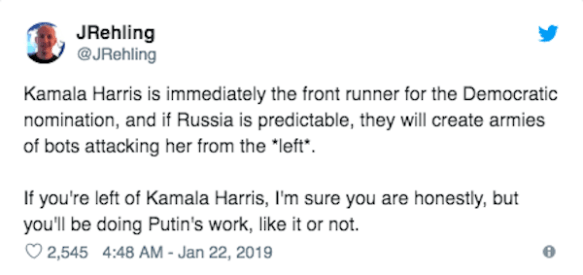
The second comes from professional linguist and engineer John Rehling, who has over 50 thousand Twitter followers, and it received hundreds of shares:

“Kamala Harris is immediately the front runner for the Democratic nomination, and if Russia is predictable, they will create armies of bots attacking her from the *left*,”  reads Rehling’s (now deleted) tweet. “If you’re left of Kamala Harris, I’m sure you are honestly, but you’ll be doing Putin’s work, like it or not.”

The third comes from Shareblue manipulator Caroline Orr, just one of many similar posts that she has made in recent days. Orr has also launched a GoFundMe to investigate Tulsi Gabbard’s imaginary Putin-Assad ties/score a free vacation to Hawaii, and is also circulating the baseless rumor that “Russian-linked accounts” are pushing for a Bernie-Tulsi 2020 ticket. Note the URL Orr highlighted in the tweet below featuring her allegation that Gabbard is “pro-Putin” and “pro-Assad”.

https://twitter.com/RVAwonk/status/1085084216726044672

In each case, posts punching left with accusations of Kremlin servitude gained traction with their followers, which means there is already an audience for this schtick. And, again, the presidential race has barely even begun. Things are likely to get a whole lot uglier between now and November 2020.

This is your life for the next two years, progressives. This is what those of you who drank the Russiagate Kool-Aid have helped buy for what passes for America’s political left today. You can expect such accusations to get far more common and far more aggressive as this thing drags on. The left can either play along with this and let centrist cold war rhetoric suck all the oxygen out of the room for the advancement of progressive policies, or they can fight back against this moronic facilitation of longstanding intelligence community agendas.

This use of Russiagate to herd the political left toward supporting America’s “center” (so-called only because it is the mainstream view, which in turn is only due to plutocratic narrative control) will actively move things further into corporatist dystopia. Supporting a “moderate” Democratic Party while the Republican Party always pushes as far to the right as it possibly can is guaranteeing a continuous overall movement to the right, which is why the gains made by the left in the early 20th century are almost gone now. If you have one person half-pulling westward on one end of a rope and another person tugging eastward with all their might, they’re going to move steadily east.

The slow, incremental changes advocated by the political “center” are code for no change whatsoever; they’re just buying time so that their corporate sponsors, who themselves never slow down, can finish shoring up control before the public forces them to scale back. If progressives don’t start attacking this “Move right or you’re a Russian agent” schtick directly and with full force, it will snuff them out completely.

Learning from Gandhi

By Robert J. Burrowes

Mohandas Karamchand Gandhi was born on 2 October 1869: 150 years ago this year.

There will be many tributes to Gandhi published in 2019 so I would like to add one of my own.

This reflects not just my belief that he gave the world inspiration, ideas and powerful strategies for tackling violence in a wide range of contexts but because my own experience in applying his ideas has proven their worth. This included his awareness that led him to declare that ‘If we are to make progress, we must not repeat history but make new history. We must add to the inheritance left by our ancestors.’ and his encouragement to reflect deeply and listen to one’s ‘inner voice’: ‘you should follow your inner voice whatever the consequences’ and ‘even at the risk of being misunderstood’.

In essence, we can productively learn from history but we can build on it too. And, vitally, this includes dealing more effectively with violence.

So how did Gandhi influence me?

Shortly after midnight on 1 July 1942, my Uncle Bob was killed when the USS Sturgeon, a U.S. submarine, fired torpedoes into the Japanese prisoner of war (POW) ship Montevideo Maru. The ship sank immediately and, along with 1,052 other POWs, Bob was killed.

Apart from his older brother, my father’s twin brother was also killed in World War II. In Tom’s case, he was shot down over Rabaul on his first (and final) mission. He was a wireless air gunner on a Beaufort Bomber. See ‘The Last Coastwatcher: My Brothers’.

My childhood is dotted with memories of Bob and Tom. The occasional remembrance service, war medals and the rare story shared by my father.

In 1966, the year I turned 14, I decided to devote my life to finding out why human beings kill each other and to work out how such killing could be ended. The good news about this ‘decision’ is that, at 14, it all felt manageable! But I wasn’t much older before my preliminary investigations proved that even understanding why humans are violent was going to be a profound challenge. And I intuitively understood that I needed this understanding if any strategy to end violence was to be effective.

In any case, as one might expect, my research into violence and strategies for addressing it led me to nonviolence. I came across virtually nothing about nonviolence during my own studies at school and university but was regularly presented with news reports of people participating in activities – such as demonstrations and strikes – that I later learned to label ‘nonviolent action’.

In 1981 I decided to seek out materials on nonviolence and nonviolent action so that I could learn more about it. I had not been reading for long when the routine reference to Mohandas K. (or Mahatma) Gandhi, about whom I had heard a little and knew of his role in leading the Indian independence struggle, forced me to pay more attention to his life and work. So I sought out his writing and started to read some of his published work. An Autobiography: The Story of My Experiments with Truth was an obvious and early book but there were many others besides. I also read many books about Gandhi, to get a clearer sense of his life as a whole, as reported by his coworkers and contemporaries, as well as documented by scholars since his death. And I spent a great many hours in a library basement poring over The Collected Works of Mahatma Gandhi.

The thing that struck me immediately about Gandhi was that his own interest in tackling violence had a comprehensive ‘feel’ about it. That is, he was not just interested in the violence that occurs when nations fight wars or one person kills or injures another. He was interested in addressing the violence that occurs when individuals and nations exploit other individuals/nations (such as when British imperialism exploited India and Indians) and the violence that occurs when a structure (such as capitalism or socialism) exploits the individuals within it. In his words: ‘exploitation is the essence of violence’. He was interested in the violence that occurs when members of one social group (say, Hindus) ‘hate’ the members of another social group (such as Muslims). He was interested in the violence that occurs when men oppress women or caste Hindus oppress ‘untouchables’. He was interested in the violence that occurs when humans destroy the environment. And he was interested in the violence that one inflicts on oneself.

This comprehensive interest resonated deeply with me because, apart from war, my own childhood and adolescence had revealed many manifestations of violence ranging from the starvation of people in developing countries to the racism in the United States (highlighted by Rev. Martin Luther King Jr. during the 1960s) to the destruction of the environment, each of which had gradually but deeply embedded itself in my consciousness. Tackling violence was a far bigger task than the large one I had originally imagined. Violence is everywhere. Most importantly, it seemed to me, there was enormous violence directed against children in the family home but little was spoken or written about this.

So how did Gandhi explain violence and what was his strategy for addressing it?

Gandhi on Conflict and Violence

For Gandhi, conflict was a perennial condition. He also viewed it positively and considered it desirable. For him, it is an important means to greater human unity precisely because their shared conflict could remind antagonists of the deeper, perhaps transcendental, unity of life, which is far more profound than the bond of their social relationship.

He viewed violence differently, however. And, as might be gleaned from the many configurations of violence that concerned him, as noted above, he considered that violence was built into social structures and not into people.

Fundamentally, as Leroy Pelton characterized it, Gandhi understood that the truth cannot be achieved through violence (‘which violates human needs and destroys life’), because violence itself is a form of injustice. In any case, violence cannot resolve conflict because it does not address the issues at stake.

To reiterate then, for Gandhi there was nothing undesirable about conflict. However, Gandhi’s preoccupation was working out how to manage conflict without violence and how to create new social arrangements free of structural violence. The essence, then, of Gandhi’s approach was to identify approaches to conflict that preserved the people while systematically demolishing the evil structure. Nevertheless, he firmly believed that structural purification alone is not enough; self-purification is also essential.

In other words, in Gandhi’s view, resolving the conflict (without violence) is only one aspect of the desired outcome. For Gandhi, success also implies the creation of a superior social structure, higher degrees of fearlessness and self-reliance on the part of both satyagrahis (nonviolent activists) and their opponents, and a greater degree of human unity at the level of social relationships.

Two Key Questions

Despite the enormous influence that Gandhi had in shaping my own conception of conflict and the precise conception of nonviolence that should be used in dealing with it, I nevertheless remained convinced that two questions remained unanswered: What is the psychological origin of the violent behavior of the individual who perpetrates it? And what theory or framework should guide the application of nonviolent action so that campaigns of all kinds are strategically effective?

The first question is important because even if someone is trapped within a social structure (such as the class system) that is violent, the individual must still choose, consciously or unconsciously, to participate (as perpetrator, collaborator or victim) in the violence perpetrated by that structure or one must choose, consciously, to resist it. Why do so many individuals perform one of the first three roles and so few, like Gandhi himself, choose the role of resister?

The second question is important because while Gandhi himself was an astonishingly intuitive strategic thinker (whose 30-year nonviolent strategy liberated India from British occupation), no one before him or since his death has demonstrated anything remotely resembling his capacity in this regard.

Hence, while nonviolence, which is inherently powerful, has chalked up some remarkable successes, vital struggles for peace (and to end war); to halt assaults on Earth’s biosphere; to secure social justice for oppressed and exploited populations; to liberate national groups from dictatorship, occupation or genocidal assault; and struggles in relation to many other just causes limp along devoid of strategy (or use one that is ill-conceived). So badly are we failing, in fact, that humans now teeter on the brink of precipitating our own extinction. See ‘Human Extinction by 2026? A Last Ditch Strategy to Fight for Human Survival’.

Anyway, having studied Gandhi extensively and learned from his strategic approach to nonviolence (elements of which I was progressively including in nonviolent campaigns in which I was involved myself), I resumed my original research to understand the fundamental origin of human violence and also decided to develop a strategic theory and framework for addressing violence in the campaign context so that Gandhi’s strategic thinking could be readily copied by other nonviolent activists.

It turned out that developing this strategic theory and strategy was simpler than the original aim (understanding violence) and I have presented this strategic thinking on two websites: Nonviolent Campaign Strategy and Nonviolent Defense/Liberation Strategy.

Despite my preliminary efforts in the 1990s to encourage fellow activists to use this framework, it soon became clear that only the rarest of activists has the capacity to think strategically about an issue, even when presented with a framework for doing so.

The Origin of Human Violence

Consequently, the vital importance of understanding the origin of human violence was starkly demonstrated to me yet again because I knew it would answer key supplementary questions such as these: Why to do so many people live in denial/delusion utterly incapable of perceiving structural violence or grappling powerfully with (military, social, political, economic and ecological) violence? Why is it that so many people, even activists, are powerless to think strategically? How can activists even believe that success can be achieved, particularly on the major issues of our time (such as the threats of nuclear war, ecological devastation and climate cataclysm), without a focused and comprehensive strategy, particularly given elite resistance to such campaigns? See ‘The Global Elite is Insane Revisited’.

Hence, in an attempt to answer questions such as these, Anita McKone and I went into seclusion in an endeavor to understand how our own minds functioned so that we might better understand the minds of others. I hoped it would take a few months. It took 14 years.

So what is the cause of violence in all contexts and which, depending on its precise configuration in each case, creates perpetrators of violence, people who collaborate with perpetrators of violence, people who are passive victims of violence, people who live in denial/delusion, people who are sexist or racist, and activists who cannot think strategically (among many other adverse outcomes)?

Each of these manifestations of human behaviour is an outcome of the adult war on children. That is, adult violence against children is the fundamental cause of all other violence.

How does this happen? It happens because each child, from birth, is socialized – more accurately, terrorized – so that they fit into their society. That is, each child is subjected to an unrelenting regime of ‘visible’, ‘invisible’ and ‘utterly invisible’ violence until they offer the obedience that every adult – parent, teacher, religious figure… – demands.

So what constitutes ‘visible’, ‘invisible’ and ‘utterly invisible’ violence?

‘Visible’ violence includes hitting, screaming at and sexually abusing a child which, sadly enough, is very common.

But the largest component of damage arises from the ‘invisible’ and ‘utterly invisible’ violence that we adults unconsciously inflict on children during the ordinary course of the day. Tragically, the bulk of this violence occurs in the family home and at school. For a full explanation, see ‘Why Violence?’ and Fearless Psychology and Fearful Psychology: Principles and Practice.

‘Invisible’ violence is the ‘little things’ we do every day, partly because we are just ‘too busy’. For example, when we do not allow time to listen to, and value, a child’s thoughts and feelings, the child learns to not listen to themSelf thus destroying their internal communication system. When we do not let a child say what they want (or ignore them when they do), the child develops communication and behavioral dysfunctionalities as they keep trying to meet their own needs (which, as a basic survival strategy, they are genetically programmed to do).

When we blame, condemn, insult, mock, embarrass, shame, humiliate, taunt, goad, guilt-trip, deceive, lie to, bribe, blackmail, moralize with and/or judge a child, we both undermine their sense of Self-worth and teach them to blame, condemn, insult, mock, embarrass, shame, humiliate, taunt, goad, guilt-trip, deceive, lie, bribe, blackmail, moralize and/or judge.

The fundamental outcome of being bombarded throughout their childhood by this ‘invisible’ violence is that the child is utterly overwhelmed by feelings of fear, pain, anger and sadness (among many others). However, mothers, fathers, teachers, religious figures and other adults also actively interfere with the expression of these feelings and the behavioral responses that are naturally generated by them and it is this ‘utterly invisible’ violence that explains why the dysfunctional behavioral outcomes actually occur.

For example, by ignoring a child when they express their feelings, by comforting, reassuring or distracting a child when they express their feelings, by laughing at or ridiculing their feelings, by terrorizing a child into not expressing their feelings (for instance, by screaming at them when they cry or get angry), and/or by violently controlling a behavior that is generated by their feelings (for example, by hitting them, restraining them or locking them into a room), the child has no choice but to unconsciously suppress their awareness of these feelings.

However, once a child has been terrorized into suppressing their awareness of their feelings (rather than being allowed to have their feelings and to act on them) the child has also unconsciously suppressed their awareness of the reality that caused these feelings. This has many outcomes that are disastrous for the individual, for society and for the biosphere because the individual will now easily suppress their awareness of the feelings that would tell them how to act most functionally in any given circumstance and they will progressively acquire a phenomenal variety of dysfunctional behaviors, including some that are violent towards themself, others and/or the Earth.

So what do we do?

Well, if you want to make an enormous contribution to our effort to end violence, you can make the commitment outlined in ‘My Promise to Children’. If you need to do some healing of your own to be able to nurture children in this way, then consider the information provided in the article ‘Putting Feelings First’.

If you want to systematically tackle violence against the biosphere, consider (accelerated) participation in the fifteen-year strategy, inspired by Gandhi, outlined in ‘The Flame Tree Project to Save Life on Earth’. This project outlines a simple plan for people to systematically reduce their consumption, by at least 80%, involving both energy and resources of every kind – water, household energy, transport fuels, metals, meat, paper and plastic – while dramatically expanding their individual and community self-reliance in 16 areas, so that all environmental concerns are effectively addressed. As Gandhi observed 100 years ago: ‘Earth provides enough for every person’s need but not for every person’s greed.’

But, critically important though he believed personal action to be, Gandhi was also an extraordinary political strategist and he knew that we needed to do more than transform our own personal lives. We need to provide opportunities that compel others to consider doing the same.

So if your passion is campaigning for change, consider doing it strategically, as Gandhi did. See Nonviolent Campaign Strategy.

And if you want to join the worldwide movement to end all violence against humans and the biosphere, you can do so by signing the online pledge of The Peoples Charter to Create a Nonviolent World.

Gandhi was assassinated on 30 January 1948. But his legacy lives on. You can learn from it too, if you wish.


Biodata: Robert J. Burrowes has a lifetime commitment to understanding and ending human violence. He has done extensive research since 1966 in an effort to understand why human beings are violent and has been a nonviolent activist since 1981. He is the author of Why Violence? His email address is flametree@riseup.net and his website is here.

Robert J. Burrowes
P.O. Box 68
Daylesford, Victoria 3460
Australia

Email: flametree@riseup.net

Websites:
Nonviolence Charter
Flame Tree Project to Save Life on Earth
‘Why Violence?’
Feelings First
Nonviolent Campaign Strategy
Nonviolent Defense/Liberation Strategy
Anita: Songs of Nonviolence
Robert Burrowes
Global Nonviolence Network

What Are We Working For? The Economic System is a Labyrinthine Trap

By Edward Curtin

Source: Global Research

One also knows from his letters that nothing appeared more sacred to Van Gogh than work.” – John Berger, “Vincent Van Gogh,” Portraits

Ever since I was a young boy, I have wondered why people do the kinds of work they do.  I sensed early on that the economic system was a labyrinthine trap devised to imprison people in work they hated but needed for survival.  It seemed like common sense to a child when you simply looked and listened to the adults around you.  Karl Marx wasn’t necessary for understanding the nature of alienated labor; hearing adults declaim “Thank God It’s Friday” spoke volumes.

In my Bronx working class neighborhood I saw people streaming to the subway in the mornings for their rides “into the city” and their forlorn trundles home in the evenings. It depressed me.  Yet I knew the goal was to “make it” and move away as one moved “up,” something that many did.  I wondered why, when some people had options, they rarely considered the moral nature of the jobs they pursued.  And why did they not also consider the cost in life (time) lost in their occupations?  Were money, status, and security the deciding factors in their choices?  Was living reserved for weekends and vacations?

I gradually realized that some people, by dint of family encouragement and schooling, had opportunities that others never received.  For the unlucky ones, work would remain a life of toil and woe in which the search for meaning in their jobs was often elusive.  Studs Terkel, in the introduction to his wonderful book of interviews, Working: People Talk About What They Do all Day and How They Feel About What They Do, puts it this way:

This book, being about work, is, by its very nature, about violence – to the spirit as well as to the body.  It is about ulcers as well as accidents, about shouting matches as well as fistfights, about nervous breakdowns as well as kicking the dog around.  It is, above all (or beneath all), about daily humiliations. To survive the day is triumph enough for the walking wounded among the great many of us.

Those words were confirmed for me when in the summer between high school and college I got a job through a relative’s auspices as a clerk for General Motors in Manhattan.  I dreaded taking it for the thought of being cooped up for the first time in an office building while a summer of my youth passed me by, but the money was too good to turn down (always the bait), and I wanted to save as much as possible for college spending money.  So I bought a summer suit and joined the long line of trudgers going to and fro, down and up and out of the underground, adjusting our eyes to the darkness and light.

It was a summer from hell. My boredom was so intense it felt like solitary confinement.  How, I kept wondering, can people do this?  Yet for me it was temporary; for the others it was a life sentence.  But if this were life, I thought, it was a living death.  All my co-workers looked forward to the mid-morning coffee wagon and lunch with a desperation so intense it was palpable.  And then, as the minutes ticked away to 5 P.M., the agitated twitching that proceeded the mad rush to the elevators seemed to synchronize with the clock’s movements.  We’re out of here!

On my last day, I was eating my lunch on a park bench in Central Park when a bird shit on my suit jacket.  The stain was apt, for I felt I had spent my days defiling my true self, and so I resolved never to spend another day of my life working in an office building in a suit for a pernicious corporation, a resolution I have kept.

“An angel is not far from someone who is sad,” says Vincent Van Gogh in the new film, At Eternity’s Gate. For some reason, recently hearing these words in the darkened theater where I was almost alone, brought me back to that summer and the sadness that hung around all the people that I worked with.  I hoped Van Gogh was right and an angel visited them from time to time. Most of them had no options.

The painter Julian Schnabel’s moving picture (moving on many levels since the film shakes and moves with its hand-held camera work and draws you into the act of drawing and painting that was Van Gogh’s work) is a meditation on work.  It asks the questions: What is work?  What is work for?  What is life for?  Why paint? What does it mean to live?  Why do you do what you do?  Are you living or are you dead?  What are you seeking through your work?

For Vincent the answer was simple: reality.  But reality is not given to us and is far from simple; we must create it in acts that penetrate the screens of clichés that wall us off from it.  As John Berger writes,

One is taught to oppose the real to the imaginary, as though the first were always at hand and the second, distant, far away.  This opposition is false.  Events are always to hand.  But the coherence of these events – which is what one means by reality – is an imaginative construction.  Reality always lies beyond – and this is as true for materialists as for idealists. For Plato, for Marx.  Reality, however one interprets it, lies beyond a screen of clichés.

These screens serve to protect the interests of the ruling classes, who devise ways to trap regular people from seeing the reality of their condition.  Yet while working can be a trap, it can also be a means of escape. For Vincent working was the way.  For him work was not a noun but a verb. He drew and he painted as he does in this film to “make people feel what it is to feel alive.”  To be alive is to act, to paint, to write.  He tells his friend Gauguin that there’s a reason it’s called the “act of painting, the “stroke of genius.”  For him painting is living and living is painting.

The actual paintings that he made are almost beside the point, as all creative artists know too well. It is the doing wherein living is found. The completed canvas, essay, or book are what is done.  They are nouns, still lifes, just as Van Gogh’s paintings have become commodities in the years since his death, dead things to be bought and sold by the rich in a culture of death where they can be hung in mausoleums isolated from the living. It is appropriate that the film ends with Vincent very still in his coffin as “viewers” pass him by and avidly now desire his paintings that encircle the room that they once rejected. The man has become a has-been and the funeral parlor the museum.

“Without painting I can’t live,” he says earlier.  He didn’t say without his paintings.

“God gave me the gift for painting,” he said.  “It’s the only gift he gave me.  I am a born painter.”  But his gift has begotten gifts that are still-births that do not circulate and live and breathe to encourage people to find work that will not, “by its very nature, [be] about violence,” as Terkel said. His works, like people, have become commodities, brands to be bought and sold in a world where the accumulation of wealth is accomplished by the infliction of pain, suffering, and death on untold numbers of victims, invisible victims that allow the wealthy to maintain their bad-faith innocence. This is often achieved in the veiled shadows of intermediaries such as stock brokers, tax consultants, and financial managers; in the liberal and conservative boardrooms of mega-corporations or law offices; and in the planning sessions of the world’s great museums. Like drone killings that distance the killers from their victims, this wealth accumulation allows the wealthy to pretend they are on the side of the angels.  It’s called success, and everyone is innocent as they sing, “Hi Ho, Hi Ho, it’s off to work we go.”

“It is not enough to tell me you worked hard to get your gold,” said Henry Thoreau, Van Gogh’s soul-mate. “So does the Devil work hard.”

A few years ago there was a major exhibit of Van Gogh’s nature paintings at the Clark Museum in Williamstown, Massachusetts – “Van Gogh and Nature” – that aptly symbolized Van Gogh in his coffin.  The paintings were exhibited encased in ornate gold frames. Van Gogh in gold. Just perfect.  I am reminded of a scene in At Eternity’s Gatewhere Vincent and Gauguin are talking about the need for a creative revolution – what we sure as hell need – and the two friends stand side by side with backs to the camera and piss into the wind.

But pseudo-innocence dies hard.  Not long ago I was sitting in a breakfast room in a bed-and-breakfast in Houston, Texas, sipping coffee and musing myself awake.  Two men came in and the three of us got to talking.  As people like to say, they were nice guys.  Very pleasant and talkative, in Houston on business. Normal Americans.  Stressed.  Both were about fifty years old with wives and children.

One sold drugs for one of the largest pharmaceutical companies that is known for its very popular anti-depressant drug and its aggressive sales pitches.  He travelled a triangular route from Corpus Christi to Austin to Houston and back again, hawking his wares.  He spoke about his work as being very lucrative and posing no ethical dilemmas.  There were so many depressed people in need of his company’s drugs, he said, as if the causes of their depression had nothing to do with inequality and the sorry state of the country as the rich rip off everyone else.  I thought of recommending a book to him – Deadly Medicines and Organized Crime: How big pharma has corrupted health care by Peter Gotzsche – but held my tongue, appreciative as I was of the small but tasteful fare we were being served and not wishing to cause my companions dyspepsia.  This guy seemed to be trying to convince me of the ethical nature of the way he panned gold, while I kept thinking of that quote attributed to Mark Twain: “Denial ain’t just a river in Egypt.”

The other guy, originally from a small town in Nebraska and now living in Baton Rouge, was a former medevac helicopter pilot who had served in the 1st Gulf War.  He worked in finance for an equally large oil company.  His attitude was a bit different, and he seemed sheepishly guilty about his work with this company as he told me how shocked he was the first time he saw so many oil, gas, and chemical plants lining the Mississippi River from Baton Rouge to New Orleans and all the oil and chemicals being shipped down the river. So many toxins that reminded him of the toxic black smoke rising from all the bombed oil wells in Iraq.  Something about it all left him uneasy, but he too said he made a very good “living” and that his wife also worked for the oil company back home.

My childish thought recurred: when people have options, why do they not choose ethical work that makes the world more beautiful and just?  Why is money and so-called success always the goal?

Having seen At Eternity’s Gate, I now see what Van Gogh was trying to tell us and Julian Schnabel conveys through this moving picture.  I see why these two perfectly normal guys I was breaking bread with in Houston are unable to penetrate the screen that lies between them and reality.  They have never developed the imaginative tools to go beyond normal modes of perception and conception. Or perhaps they lack the faith to dare, to see the futility and violence in what they are working for and what their companies’ products are doing to the world.  They think of themselves as hard at work, travelling hither and yon, doing their calculations, “making their living,” and collecting their pay.  It’s their work that has a payoff in gold, but it’s not working in the sense that painting was for Vincent, a way beyond the screen.  They are mesmerized by the spectacle, as are so many Americans.  Their jobs are perfectly logical and allow them a feeling of calm and control.

But Vincent, responding to Gauguin, a former stock broker, when he urged him to paint slowly and methodically, said, “I need to be out of control. I don’t want to calm down.”  He knew that to be fully alive was to be vulnerable, to not hold back, to always be slipping away, and to be threatened with annihilation at any moment. When painting, he was intoxicated with a creative joy that belies the popular image of him as always depressed.  “I find joy in sorrow,” he said, echoing in a paradoxical way Albert Camus, who said, “I have always felt that I lived on the high seas, threatened, at the heart of a royal happiness.”   Both rebels, one in paint, the other in words: “I rebel: therefore we exist,” was how Camus put it, expressing the human solidarity that is fundamental to genuine work in our ephemeral world. Both nostalgic in the present for the future, creating freedom through vision and disclosing the way for others.

And although my breakfast companions felt safe in their calmness on this side of the screen, it was an illusion. The only really calm ones are corpses. And perhaps that’s why when you look around, as I did as a child, you see so many of the living dead carrying on as normal.

“I paint to stop thinking and feel I am a part of everything inside and outside me,” says Vincent, a self-described exile and pilgrim.

If we could make working a form of such painting, a path to human solidarity because a mode of rebelling, what a wonderful world it might be.

That, I believe, is what working is for.

US Backs Coup in Oil-Rich Venezuela, Right-Wing Opposition Plans Mass Privatization and Hyper-Capitalism

The US has effectively declared a coup in Venezuela. Trump recognized unelected right-wing opposition leader Juan Guaidó as new “president,” who plans mass privatization and neoliberal capitalist policies.

By Ben Norton

Source: GrayZone

The United States has effectively declared a political coup d’état in Venezuela, from abroad. Trump announced on January 23 that the US recognizes the unelected, illegitimate right-wing opposition leader Juan Guaidó as the supposed new “interim president” of Venezuela’s supposed new “government.”

Venezuela’s US-backed opposition has pledged to carry out a mass privatization of state assets and to implement harsh neoliberal capitalist policies. The opposition-controlled legislatures declared in its “transition” plans that the “centralized model of controls of the economy will be replaced by a model of freedom and market based on the right of each Venezuelan to work under the guarantees of property rights and freedom of enterprise.”

The US has also hinted at violence in Venezuela. During a background briefing after Trump’s declaration, journalist Dan Cohen heard a US official declare that if the government of actual President Nicolás Maduro responds with any violence, “They have no immediate future, they have no immediate livelihood. One way or another they have their days counted.”

Trump administration officials added, “When we say all options are on the table, all options are on the table… Let’s hope Maduro and his cronies see the magnitude of the message.”

Region’s Right-Wing Countries Join US in Recognizing Coup

Canada’s Liberal government, led by Prime Minister Justin Trudeau; Brazil’s new far-right leader Jair Bolsonaro; and the overtly pro-US Organization of American States (OAS) and its Secretary General Luis Almagro have joined Trump in endorsing this diplomatic coup in Venezuela.

Likewise, the right-wing, US-allied countries in Latin America, including Argentina, Chile, Colombia, Costa Rica, and Ecuador have joined Trump in anointing Guaidó as leader.

The region’s few remaining leftist governments, Bolivia, Cuba, and Nicaragua, have continued recognizing Venezuela’s legitimate government, as has Mexico’s newly elected left-wing President Andrés Manuel López Obrador.

Bolivian President Evo Morales warned that “the claws of imperialism again seek to fatally wound the democracy and self-determination of the peoples of South America,” adding, “No longer will we be the backyard of the US.”

The US government, its right-wing allies, and an obeisant corporate media have repeatedly referred to Venezuela’s actual president, Nicolás Maduro, as an “authoritarian dictator.” What they have failed to mention is that Venezuela still has regular elections, but the US-backed right-wing opposition, which is notoriously disunited and incompetent, has chosen to boycott these elections, preferring to call for foreign-backed military coups instead.

One of the only elected officials in the US who has spoken out against the coup is left-wing California Congressman Ro Khanna. Other progressive and anti-Trump US politicians, including self-declared “democratic socialists,” have remained silent on Trump’s effective declaration of a coup in Latin America.

Opposition Plans for Privatized ‘Free Market’ Economy

While supporters of regime change in Venezuela insist this blatantly undemocratic move is necessary to “defend democracy,” make no mistake, the upheaval is clearly not motivated by resistance to authoritarianism.

Venezuela, which has the world’s largest oil reserves and has challenged the hegemony of the US dollar, has long been a target of US aggression. In 2002, the United States supported a military coup that briefly ousted democratically elected President Hugo Chávez and replaced him with the right-wing oligarch Pedro Carmona. US intervention, including crippling economic sanctions, has only continued since then.

Elements of Venezeula’s opposition have portrayed themselves to credulous foreign observers as “social democratic,” but their real intentions are very clear: The opposition-controlled legislature has demanded mass privatization of state assets and a return to a capitalist oligarch-controlled economic system built on “property rights and freedom of enterprise.”

In 2017, the Venezuelan government declared the creation of the Constituent Assembly, to rewrite the constitution. Venezuela’s opposition refused to recognize this body and boycotted the elections. The opposition instead remained in control of the National Assembly and decided to run it as a separate parallel legislature.

The opposition-controlled National Assembly drafted a “transition” law that openly outlines what policies the opposition, led by Juan Guaidó, would pursue in its illegitimate, US-recognized “government” in Venezuela. Analyst Jorge Martín, explained what this means in an article published by VenezuelaAnalysis:

The “transition law” drafted by the Assembly National (in contempt) is explicit about the central objectives of the coup in the political and economic field:

“[C]entralized controls, arbitrary measures of expropriation and other similar measures will be abolished… For these purposes, the centralized model of controls of the economy will be replaced by a model of freedom and market based on the right of each Venezuelan to work under the guarantees of property rights and freedom of enterprise.”

In other words, the nationalised companies will be returned to their former private owners (including telecommunications, electrical, SIDOR, cement, etc), as will expropriated landed estates. It is noteworthy that there is a lot of talk of property and business rights, but no mention is made of workers’ rights, which would certainly be abolished. It continues:

“Public companies will be subject to a restructuring process that ensures their efficient and transparent management, including through public-private agreements.”

What this means, in plain language, is massive dismissal of workers from state companies and the entry of private capital into them: a policy of looting which has already proved to be a disaster in all countries where it has been applied.

The model of the opposition’s new coup regime in Venezuela — backed by the US, Canada, and Brazil — is the reimposition of neoliberal capitalism and the recolonization of Latin America. Any bluster about restoring democracy is a mere pretense at this point.

Human Beings are Destroying Life on Earth but Deluding Ourselves that We are Not

By Robert J. Burrowes

It is easy to identify the ongoing and endless violence being inflicted on life on Earth. This ranges from the vast multiplicity of assaults inflicted on our children and the biosphere to the endless wars and other military violence as well as the grotesque exploitation of many peoples living in Africa, Asia and Central/South America. But for a (very incomplete) list of 40 points see ‘Reflections on 2018, Forecasting 2019’.

However, despite the obvious fact that it is human beings who are inflicting all of this violence, it is virtually impossible to get people to pay attention to this simple and incontrovertible fact and to ask why, precisely, are human beings behaving in such violent and destructive ways? And can we effectively address this cause?

Of course, one part of this problem is the existence of many competing ideas about what causes violence. For example, some ideologies attribute the cause to a particular structural manifestation of violence, such as patriarchy (which generates a gendered system of violence and exploitation) or capitalism (which generates a class system of violence and exploitation). However, none of these ideologies explains why humans participate in structures of violence and exploitation in the first place. Surely a person who was not violent and exploitative to begin with would reject such violent and exploitative structures out of hand and work to create nonviolent and egalitarian structures instead.

But most people really just accept the elite-promulgated delusion that humans are innately dysfunctional and violent and this must be contained and controlled by socialization processes, laws, legal systems, police forces and prisons or, in the international arena, by such measures as economic sanctions and military violence. It is a rare individual who perceives the blatant dysfunctionality and violence of socialization, laws, legal systems, police forces, prisons, economic sanctions and military violence, and how these institutions and their violence serve elite interests.

Hence, humans are trapped in a cycle of attempting to address the vast range of manifestations of violent human behaviour – the wars, the climate catastrophe, destruction of the environment, the economic exploitation of vast sectors of the human population (women, indigenous peoples, working peoples…), the military dictatorships and occupations – without knowing what, fundamentally, causes dysfunctional and violent human behaviours and draws many people to participate in (and benefit from) violence in whatever form it takes.

Well I, for one, find it boring to see the same manifestations of violence repeated endlessly because we do not understand or address the fundamental cause (and so even well-meaning efforts to address it in a variety of contexts are doomed to fail). How about you?

Moreover, I find it boring to listen to (or read about) people endlessly deluding themselves about the violence; that is, deluding themselves that it isn’t happening, ‘it was always like that’, ‘it isn’t as bad as it seems’, ‘nothing can be done’, ‘there is another explanation’, that I am ‘doing enough already’, and so on.

To illustrate the above let me write some more frequent examples of people deluding themselves about the cause. You may have heard delusions like these expressed yourself; you may know some of the many others.

  1. ‘The child deserved the punishment.’
  2. ‘She asked for it.’
  3. Violence is innate: it is ‘in our nature’.
  4. ‘War is inevitable.’
  5. The people in Africa/Asia/Central/South America ‘have always been poor’.
  6. ‘The weather hasn’t changed; it was like that when I was a child.’
  7. ‘We can’t control Mother Nature.’
  8. ‘Nature is abundant.’

Of course, the most common delusional state is the one in which most people are trapped: they are just not paying significant attention to critical issues and have no knowledge (and informed opinion) about them but allow themselves to be distracted from reality by the various elite channels used for doing so, such as the corporate media.

So why do most people delude themselves rather than carefully observe reality, seek out and analyze the evidence in relation to it, and then behave appropriately and powerfully in response?

Because they are (unconsciously) terrified.

‘Is that all?’ you might say. ‘Surely the explanation for dysfunctional (and violent) human behaviour is more complex than that! Besides, when people I observe doing the sorts of dysfunctional and violent behaviours you mention above, they don’t look frightened, let alone terrified.’

So let me explain why the explanation above – that most human beings live in delusion, behave dysfunctionally and violently, fail to observe and analyze reality and then behave powerfully in response to it, because they are terrified – is the complete explanation and why people who are utterly terrified don’t ‘look frightened’.

At the moment of birth, the human individual has a genetically-embedded potential to seek out and powerfully pursue their own unique destiny by progressively developing a complex set of capacities to observe and listen, to think and feel, to analyze and evaluate, to plan and strategize, and to behave with awareness and power in response to their own astute insight into reality and the guidance provided by their conscience.

However, rather than nurture this potential so that the child grows up deeply in touch with their conscience, sensing capacities, thoughts, feelings and other faculties necessary to seek out and powerfully travel their own unique path, the significant adults in the child’s life immediately start to ‘socialize’ (that is, terrorize) the child into conforming with culturally and socially-acceptable norms of thought and behaviour on the basis that one human is more-or-less identical with another (give or take some minor variations among races, languages….).

The idea that each human mind might be unique in the way that each body is unique (while conforming to a general pattern in relation to shape, height and other physical characteristics) never even occurs to anyone. The idea that their child could have the potential to be as creative, powerful and unique as Leonardo Da Vinci, Mary Wollstonecraft, Sojourner Truth, Albert Einstein, Mohandas K. Gandhi or Rosalind Franklin never enters the mind of the typical parent.

Instead, we parent and teach children to conform to an endless sequence of beliefs and behavioural norms on the basis that ‘one size fits all’ because we are literally (but unconsciously) terrified that our child might be ‘different’ or, horror of horrors, unique! And we reward most highly those individuals who do conform and can demonstrate their conformity by passing, often literally, the endless series of socially-approved tests, formal and otherwise, that we set. See, for example, ‘Do We Want School or Education?’

The last thing we want is an individual who fearlessly thinks, feels and behaves as they personally decide is best for themself, perhaps even because their conscience dictates. But when they do act out of their own volition, we punish them to ensure that behaviour that is generated by their unique ‘Self’ is, if possible, terrorized out of them.

Of course, there are ‘good reasons’ for doing this. If we want obedient students, soldiers, employees and citizens, it is the perfect formula. Terrorize the child when they are young and obedience to a set of parentally/socially-approved beliefs and behaviours is virtually guaranteed.

Equally importantly, by starting this onslaught against the child from the moment of birth, they will grow up utterly unaware of the fact that they were terrorized out of becoming their ‘True Self’ and seeking their own unique destiny so that they could be the slave of their society, performing some function, menial or even ‘professional’, after they have submitted to sufficient training. The slave who never questions their role is truly a slave. And that is what we want!

Equally importantly, the person who has fearfully surrendered their Self at the alter of physical survival cannot observe or listen to the fear expressed by anyone else, including their own children. So they simply ‘fail to notice’ it.

So what, exactly, do we do so that each human being’s individual Self is crushed and they are rendered too terrified, self-hating and powerless to pursue their own life path, to honestly observe and listen to their own children and to mindfully consider the state of our world and act powerfully in response?

We inflict enormous, ongoing violence on the child, starting immediately after their birth.

‘How?’ you might ask. ‘I don’t scream at or hit my child. And I never punish them.’

Well, if that is true, it is a good start.

But, unfortunately, it is far more complex than these obvious types of violence and, strange though it may seem, it is not just the ‘visible’ violence (such as hitting, screaming at and sexually abusing) that we normally label ‘violence’ that causes the main damage, although this is extremely damaging. The largest component of damage arises from the ‘invisible’ and ‘utterly invisible’ violence that we adults unconsciously inflict on children during the ordinary course of the day. Tragically, the bulk of this violence occurs in the family home and at school. See ‘Why Violence?’ and Fearless Psychology and Fearful Psychology: Principles and Practice.

So what is ‘invisible’ violence? It is the ‘little things’ we do every day, partly because we are just ‘too busy’. For example, when we do not allow time to listen to, and value, a child’s thoughts and feelings, the child learns to not listen to themSelf thus destroying their internal communication system. When we do not let a child say what they want (or ignore them when they do), the child develops communication and behavioral dysfunctionalities as they keep trying to meet their own needs (which, as a basic survival strategy, they are genetically programmed to do).

When we blame, condemn, insult, mock, embarrass, shame, humiliate, taunt, goad, guilt-trip, deceive, lie to, bribe, blackmail, moralize with and/or judge a child, we both undermine their sense of Self-worth and teach them to blame, condemn, insult, mock, embarrass, shame, humiliate, taunt, goad, guilt-trip, deceive, lie, bribe, blackmail, moralize and/or judge.

The fundamental outcome of being bombarded throughout their childhood by this ‘invisible’ violence is that the child is utterly overwhelmed by feelings of fear, pain, anger and sadness (among many others). However, mothers, fathers, teachers and other adults also actively interfere with the expression of these feelings and the behavioral responses that are naturally generated by them and it is this ‘utterly invisible’ violence that explains why the dysfunctional behavioral outcomes actually occur.

For example, by ignoring a child when they express their feelings, by comforting, reassuring or distracting a child when they express their feelings, by laughing at or ridiculing their feelings, by terrorizing a child into not expressing their feelings (e.g. by screaming at them when they cry or get angry), and/or by violently controlling a behavior that is generated by their feelings (e.g. by hitting them, restraining them or locking them into a room), the child has no choice but to unconsciously suppress their awareness of these feelings.

However, once a child has been terrorized into suppressing their awareness of their feelings (rather than being allowed to have their feelings and to act on them) the child has also unconsciously suppressed their awareness of the reality that caused these feelings. This has many outcomes that are disastrous for the individual, for society and for nature because the individual will now easily suppress their awareness of the feelings that would tell them how to act most functionally in any given circumstance and they will progressively acquire a phenomenal variety of dysfunctional behaviors, including some that are violent towards themself, others and/or the Earth.

From the above, it should also now be apparent that punishment should never be used. ‘Punishment’, of course, is one of the words we use to obscure our awareness of the fact that we are using violence. Violence, even when we label it ‘punishment’, scares children and adults alike and cannot elicit a functional behavioural response. See ‘Punishment is Violent and Counterproductive’.

If someone behaves dysfunctionally, they need to be listened to, deeply, so that they can start to become consciously aware of the feelings (which will always include fear and, often, terror) that drove the dysfunctional behaviour in the first place. They then need to feel and express these feelings (including any anger) in a safe way. Only then will behavioural change in the direction of functionality be possible. See ‘Nisteling: The Art of Deep Listening’.

‘But these adult behaviors you have described don’t seem that bad. Can the outcome be as disastrous as you claim?’ you might ask. The problem is that there are hundreds of these ‘ordinary’, everyday behaviors that destroy the Selfhood of the child. It is ‘death by a thousand cuts’ and most children simply do not survive as Self-aware individuals. And why do we do this? As noted above, we do it so that each child will fit into our model of ‘the perfect citizen’: that is, obedient and hardworking student, reliable and pliant employee/soldier, and submissive law-abiding citizen.

Moreover, once we destroy the Selfhood of a child, it has many flow-on effects. For example, once you terrorize a child into accepting certain information about themself, other people or the state of the world, the child becomes unconsciously fearful of dealing with new information, especially if this information is contradictory to what they have been terrorized into believing. As a result, the child will unconsciously dismiss new information out of hand.

In short, the child has been terrorized in such a way that they are no longer capable of learning (or their learning capacity is seriously diminished by excluding any information that is not a simple extension of what they already ‘know’).

Fundamentally, the child is now incapable of carefully observing reality, analyzing the evidence in relation to that reality and responding strategically so that conflicts and problems are moved closer to resolution. That is, the child is now unconsciously trapped, believing and behaving precisely within the spectrum of socially-approved beliefs and behaviours that society terrorized them into accepting, no matter how dysfunctional and violent these beliefs and behaviours might be.

In industrialized countries, for example, this will invariably include overconsuming, which is standard (but highly dysfunctional and violent) behaviour, particularly given the current state of the biosphere. See ‘Love Denied: The Psychology of Materialism, Violence and War’.


Responding Powerfully to Reality

So how do we nurture children to become the unique and powerful individual that is their birthright? Someone who is able to clearly identify what they need and what outcomes work for them, and who does not learn to progressively compromise themselves until there is nothing left of their unique identity. Someone, in short, who is so powerless, that they are incapable of considering themself, others and the state of the biosphere. Someone who lives in delusion.

Well, if you want a powerful child, you can read what is required in ‘My Promise to Children’.

If, after reading this ‘Promise’, you feel unable to nurture children properly, you might consider doing the healing necessary so that you can do so. See Putting Feelings First’.

If you already feel free of the delusions that afflict most people and able to respond powerfully to the state of our world, then consider joining those participating in the fifteen-year strategy outlined in The Flame Tree Project to Save Life on Earth and signing the online pledge of The Peoples Charter to Create a Nonviolent World.

If you are powerful enough to campaign for change against one or more of the ongoing manifestations of violence in the world, consider doing so strategically so that you have maximum impact. See Nonviolent Campaign Strategy.

And if none of the options I have offered immediately above appeals, ask yourself if you are serious about helping to end the violence or just deluding yourself like all of those people I described above.


Biodata: Robert J. Burrowes has a lifetime commitment to understanding and ending human violence. He has done extensive research since 1966 in an effort to understand why human beings are violent and has been a nonviolent activist since 1981. He is the author of Why Violence? His email address is flametree@riseup.net and his website is here.

Robert J. Burrowes
P.O. Box 68
Daylesford, Victoria 3460
Australia

Email: flametree@riseup.net

Websites:
Nonviolence Charter
Flame Tree Project to Save Life on Earth
‘Why Violence?’
Feelings First
Nonviolent Campaign Strategy
Nonviolent Defense/Liberation Strategy
Anita: Songs of Nonviolence
Robert Burrowes
Global Nonviolence Network
US plotting coups in Venezuela, Cuba and Nicaragua?

By Stephen Lendman

Source: Intrepid Report

The US wants all nations worldwide colonized, their resources looted, their people exploited as serfs, including ordinary Americans.

Sovereign independent governments everywhere are targeted for regime change—by coups d’état or wars.

That’s what imperialism is all about, a diabolical plot for unchallenged global dominance by whatever it takes for the US to achieve its aims, Republicans and undemocratic Dems allied for the same geopolitical objectives.

Humanitarian intervention, responsibility to protect, and democracy building are code words by both right wings of America’s war party for wanting fascist tyranny replacing governance of, by, and for everyone equitably everywhere—legitimate governments replaced by US-controlled puppet ones.

Post-9/11 alone, the US orchestrated coups in Haiti, Honduras, Paraguay, Brazil, Ukraine, Egypt, and elsewhere in the Middle East.

The so-called Arab spring was made in the USA. Uprisings were orchestrated. Nothing was spontaneous. CIA dirty hands were involved in replacing unpopular regimes with despotic ones considered more reliable.

Spring never bloomed, just the illusion of change for the better. It was pure deception. Everything changed in targeted countries but stayed the same.

In Egypt, Yemen and elsewhere things worsened, notably in Occupied Palestine. No spring bloomed there or anywhere else in the Middle East.

Plan Colombia was and remains all about Washington’s aim to control Latin America, eliminating opposition to regimes it controls, plotting coups against ruling authorities unwilling to bend to its will, along with pursuing anti-Sino/Russian regional policies.

Since Soviet Russia’s dissolution, the US escalated wars on humanity, using NATO as a killing machine. Republicans and Dems colluded to thirdworldize America, banana republicanize it, wrecking the economy, handing its wealth to Wall Street, war-profiteers and other corporate predators.

Both right wings of duopoly governance mock democratic values and rule of law principles they abhor, governing under a police state apparatus, hardened over time, risking global war to achieve its aims.

Venezuela, Cuba, Nicaragua, and Bolivia are the remaining sovereign independent Latin and Central American nations.

Trump regime hardliners want fascist tyranny replacing their legitimate governments. In early January, State Department deputy spokesman Robert Palladino turned truth on its head, saying the US “support[s] the people of Venezuela, Cuba and Nicaragua in restoring democratic governance and their human rights”—notions Washington abhors.

Venezuelan Bolivarian social democracy is the Trump regime’s top Latin American target for regime change. Pompeo made US intentions clear.

He turned truth on its head, saying President Nicolas Maduro is “illegitimate and the United States will continue . . . to work diligently to restore a real democracy to that country,” adding, “We are very hopeful that we can be a force for good to allow the region to come together to deliver that.”

Fact: Last May, Maduro was overwhelmingly re-elected by a two-thirds majority.

Fact: Scores of international observers from 30 countries monitored the election, judging it open, free and fair.

Fact: Venezuela’s political process is the world’s best.

Fact: It’s polar opposite America’s money-controlled system, one-party rule with two right wings, ordinary people having no say over how they’re governed.

Fact: US democracy is pure fantasy. Venezuelans have the real thing, why Republicans and Dems want its government toppled, their eyes on the prize—the world’s largest oil reserves they want handed to Big Oil.

On January 10, Maduro was inaugurated for a second six-year term, saying he’s committed to continue “fight[ing] for social and economic prosperity and to build 21st century socialism”—despite relentless US political, economic, financial, and propaganda war against the country’s social democracy.

Despite the Trump regime’s all-out efforts to mobilize international opposition to his legitimate rule, delegations from over 90 countries attended the inaugural ceremonies—including from Russia, China, Cuba, Nicaragua, Bolivia, Mexico, El Salvador, Iran, Turkey, and Ireland’s Sinn Fein.

Representatives from US colonized EU nations were absent, a spokeswoman for foreign policy chief Federica Mogherini lied saying that “the presidential elections were not free nor fair”—a falsified statement, serving US imperial interests.

Representatives from the African Union, CARICOM, the Arab League, the ALBA Bolivarian Alliance for the Peoples of Our Americas, OPEC, and the UN also attended.

In his inaugural address, Maduro said, “I tell the people. This presidential sash is yours. This power is yours. It does not belong to the oligarchy or to imperialism. It belongs to the sovereign people of Venezuela.”

He denounced the diabolical aims of “the most powerful empire in history,” urging dialogue to serve Venezuelan interests, including UN support for “peace, mutual recognition, harmony, (and) coexistence of different political visions,” adding: “I would like to sit down with the opposition, stop the sterile, useless, unnecessary conflict, talk about economic issues; with the experience of the UN we can achieve it.”

Trump regime hardliners falsely call genuine democracies dictatorships, how neocon John Bolton reacted to Maduro’s inauguration, saying the US “will not recognize” his legitimacy to rule.

The US-controlled Organization of American States (OAS), headquartered in Washington, reacted the same way. Most of its member states support longstanding US plans for regime change.

The US-controlled 13-nation Lima Group issued a statement, refusing to recognize Maduro’s legitimacy.

Caracas slammed what it called a “humiliating subordination” to US imperial interests—applying to all nations allied with Washington against Venezuela’s social democracy and sovereign independence.

On January 12, State Department deputy spokesman Palladino openly called for regime change, saying, “It is time to begin the orderly transition to a new government.”

Previous US orchestrated coup attempts failed—against Hugo Chavez and Maduro. Will the Trump regime try again in the new year?

If unable to succeed by coup d’etat, will an attempt be made to assassinate Maduro? If economic, financial, political, and other tactics fail, will military intervention be the Trump regime’s fallback option?

Will Iran be targeted the same way in the new year? Imperialism isn’t pretty.

Endless US belligerence and state-sponsored terrorism is virtually certain ahead, the way hardliners in Washington always operate—hostile to peace, stability, equity and justice at home and abroad.

“It’s Crucial to Break Up Facebook”

By Asher Schechter

Source: ProMarket

Four decades ago, writes Tim Wu in the introduction to his recent book The Curse of Bigness, the United States and other countries entered into a sweeping experiment that radically transformed their economies and politics. The experiment in question consisted of abandoning most checks on anticompetitive conduct, thus allowing concentrated corporate power to grow undisturbed.

The result: an increasingly concentrated global economy marked by historic levels of inequality and extreme concentrations of economic and political power, with disaffected voters being lured by radical far-right nationalists across the West. “We have managed to recreate both the economics and politics of a century ago—the first Gilded Age,” Wu writes.

Now, he warns, liberal democracies risk making yet another grave historical error by ignoring the well-established link between the concentration of economic power and the rise of authoritarianism. That monopolization poses an existential threat to democracy has been widely known throughout history: Louis Brandeis famously referred to this threat as the “curse of bigness”; in Germany, the rise of fascism was partly facilitated by monopolists and industrial cartels.

Yet in recent decades, explained Wu in an interview with ProMarket, much of this history has been forgotten. The legacy of Brandeis, America’s leading defender against bigness, has been “neglected, almost forgotten,” along with the greater antimonopoly tradition that has been an integral part of US politics for over 200 years. Which is why he decided to write The Curse of Bigness, a slim book that is equal parts historical polemic and urgent call to action. 

Wu, the Julius Silver Professor of Law, Science and Technology at Columbia Law School and also the author of The Attention Merchants and The Master Switch, is perhaps best known for coining the term “net neutrality.” In his interview with ProMarket, he discussed the parallels between the monopolies of today and those of the first Gilded Age and explained why breaking up dominant companies is crucial, particularly when it comes to Facebook.

[This conversation has been edited and condensed for length and clarity]

Q: I want to start with Brandeis, who famously coined the phrase “curse of bigness.” In the book, you write that Brandeis “has been done a disservice.”

Yes, I think he has been. I think his economic vision has been forgotten. There are powerful ideas in it, very appealing in our times, very appealing through much of American history. So I wanted to try to do justice to and resurrect the Brandeisian strain of thought when it comes to economic policy.

Q: You point to many parallels between Brandeis’s time and ours, but one that especially haunts the book is the rise of neo-fascist movements around the world and the potential link between large business groups and aspiring authoritarians. Did you feel a certain sense of urgency in writing this book and making this link at this particular moment in time?

There is something alarming about the rise of extremist governments around the world. It has something to do with a sense of discontent as to how the economy functions for people, and that did give the writing of this a sense of a sense of urgency and a sense of a historic moment.

It’s a dangerous moment around the world and in the United States. I don’t think we have a complete understanding of what causes fascist uprisings, but I have a strong instinct, and I think many people do too, that there are economic origins to fascism that are very important and that, among other things, we really need to understand how to prevent people from turning to fascist, neo-nationalist, and extremist answers. I would suggest that has a lot more to do with economic policy than people think.

Q: That is something many of the “big is beautiful”-type arguments about private monopolies seem to ignore: the historical precedents of concentrated economic power contributing to the rise of authoritarian regimes.

I think that’s right. Also, it ignores [the fact] that there’s more to people’s lives than their lives as customers. People are also workers, and it’s one thing to face scale when you’re buying things and another thing to face scale when you’re an employee looking for a job and in a difficult bargaining position.

To take this further: I don’t like excessive pricing or price gouging, but the vision of antitrust over the last 40 years has been that the best of all possible worlds is one where you have relatively mild reductions in prices for consumer goods. Let’s just say there’s more to life than that. It’s not always clear that economics can get at it, but the focus on price in antitrust yields very narrow results.

“I don’t like excessive pricing or price gouging, but the vision of antitrust over the last 40 years has been that the best of all possible worlds is one where you have relatively mild reductions in prices for consumer goods. Let’s just say there’s more to life than that.”

Q: Unlike many people involved in the antitrust debate, even those that support vigorous enforcement, you don’t shy away from what Robert Pitofsky called the “political content of antitrust.” In fact, you seem to embrace it. What would you say is the political role of antitrust?

Ultimately, antitrust is a kind of constitutional check on private power. You can’t understand antitrust law without understanding its relationship with power. This is the centerpiece of the book and the original soul of antitrust law. It wasn’t so concerned with the details with price. It just had a sense that there needed to be some kind of outer limit on private power, much like there’s a limit on public power set by the constitution.

Q: What do you say to criticisms that you’re leading antitrust through uncharted waters, and that reinstilling political values into antitrust risks turning antitrust into a blunt political tool, much like what Trump is threatening to do with tech platforms?

I think this is confusing two meanings of the word “political.” There’s a narrow political sense in which a law can be used to punish your opponents or save your friends—consumer welfare antitrust can be used to do that already. But there’s also the broader sense of the law informed by constitutional values or concerns about power. That is also political, but in a much broader sense. That is the best sense in which the law has been enforced in the best moments of its history—the sense that a firm has become too powerful and too dominant to be tolerated in a land which calls itself free. It’s important not to confuse those two ideas of the term “political.”

Q: You compare the first Gilded Age to our own. Where do you see parallels between the monopolists of the Gilded Age, people like John D. Rockefeller and Andrew Carnegie, and present day dominant firms? Google and Facebook are not shooting workers, after all. 

There’s some traces of the same ideology. Peter Thiel is a prominent example: He calls his [ideology] libertarianism, but it’s not much different than 19th century social Darwinism, which worships the monopoly form and holds the idea that we should see our society as a winner-take-all, survival of the fittest, “The strong shall rule, the weak shall serve them” kind of undertaking. Google and Facebook have much kinder public faces, but—particularly with Facebook—I’m not sure underlying it they think that much differently.

There are other parallels as well, particularly levels of individualized personal wealth that the world has never seen before. In the concentration of wealth is a glorification of wealth, and almost a fetishization with accumulating amounts of money that no person could spend in their lifetime. A lot of projects in Silicon Valley get bent to the need for monstrous payouts and it ends up getting in the way of what would otherwise be good projects or better ways to run companies.

Obviously, as I explore in the book, the economic structure is also similar, where you have an overall economy dominated by fewer entities and greater levels of inequality.

Q: Another parallel seems to be this belief in the goodness of monopolies and the benefits they bring humanity. The ruthless robber barons, who threatened to crush rivals who didn’t submit to their will, genuinely believed they were doing the good, moral thing, for the betterment of humankind.

That’s right. But I think this has less to do with Silicon Valley and more to do with Wall Street today, this very fragmented morality, the idea that somehow the right thing to do is not exactly what we would usually call the ethical thing: It’s right to destroy your rivals, it’s right to lie and cheat so long as you get away with it.

“If you’re looking for the one big signal failure of the last 20 years, it’s got to be merger review. There has been an inexplicable allowance of so many industries to merge down to four or three players, sometimes two, sometimes even a monopoly. Europe is as guilty of this as the United States.”

Q: You write that the priority for neo-Brandeisian antitrust would be reforming the process of merger review. Why is merger review the top priority, and how should it be reformed?

If you’re looking for the one big signal failure of the last 20 years, it’s got to be merger review. There has been an inexplicable allowance of so many industries to merge down to four or three players, sometimes two, sometimes even a monopoly. Europe is as guilty of this as the United States. In many cases, it seems like the question was not how are we going to stop this [merger], but what kind of conditions are [merging companies] going to agree to, which is not the way merger review was intended. Merger review is not intended to be a big set of commitments that companies make, but rather the actual blocking of mergers. There’s been some recovery from that, particularly in the United States near the end of the Obama administration, but merger review has been in a crisis point.

It’s possible Congress could act and reaffirm that it meant what it said when it passed the 1950 Merger Act. It’s possible you could add greater burdens for larger mergers, or mergers that pass some structural threshold. Another way would be to open merger review to more public scrutiny. I understand some of the arguments in favor of secrecy, but I think that in the case of really big blockbuster mergers there’s just too much at stake. Having more public awareness and more groups involved would be good actually, given the important political consequences.

Q: What’s interesting about European antitrust is that although they’ve taken on several big cases in recent years, in terms of mergers European competition authorities don’t put up a lot of a fight. 

I agree. I think that Europe, if anything, has been worse than the United States for the last ten years. The beer merger of Anheuser-Busch InBev and SABMiller was inexplicably approved, creating a monopoly. Telecom mergers across Europe have been allowed, bringing multiple markets down to three [competitors].They allowed the Monsanto-Bayer merger—I’m not sure what they were thinking with that one.

Overall, I think consent decrees appeal to academic economists, but they have a bad track record. One problem with consent decrees is that you have the most talented attorneys and economists negotiating these on the government side, but once they’re done, they’re given to an enforcement bureau which is typically not heavily staffed. And sometimes it can be forgotten, and certainly not enforced with any kind of vigor.

Structural separation is self-executing. The blocking of mergers is self-executing. You don’t have to have the government constantly trying to make sure the thing is working. I think Europe has really gone down the wrong path in that direction.

Q: Another solution you explore in the book is breaking up dominant companies. One company you point to in this regard is Facebook—you call for breaking up Facebook, separating it from Instagram and WhatsApp. Why single out Facebook? And what would breaking up Facebook accomplish, considering its business model is at this point shared by the majority of online platforms?

I think it’s crucial to break up Facebook, particularly from WhatsApp and Instagram. In some ways, I think the burden should be on Facebook to explain why they shouldn’t be broken up.

Will that make a difference? I think it will. I have faith in improved competition. I don’t think there’s strong evidence of great efficiencies that come from having all of the major social networks under one roof. It’s hard to see any real loss of so-called efficiencies, at least ones that matter to consumers.

People are looking for somewhere to switch, but they don’t have anywhere to go. WhatsApp can easily be that platform, and its leadership has different values, or at least had different values before they left.

“I think it’s crucial to break up Facebook, particularly from WhatsApp and Instagram. In some ways, I think the burden should be on Facebook to explain why they shouldn’t be broken up.”

Q: In a recent post in Medium, you laid out ten antitrust cases the government should be investigating. Which ones would you say are the most pressing?

Someone has to stop the T-Mobile/Sprint merger. Maybe it will be the states, but someone has to stop that merger. I already mentioned the Facebook breakup, which I think is big and symbolically important.

I think the Justice Department actually is already working on this, but the Live Nation-Ticketmaster matter has been sitting there for a long time. It’s not the biggest industry, but it’s still a case with a lot of anticompetitive conduct.

And I would like to take a look back at the airline mergers and ask whether we should consider breaking down the triopoly. The state of the airlines is really unacceptable.

Q: It’s been roughly a year since the repeal of net neutrality. You, of course, famously coined the term net neutrality. What would you say is the importance of net neutrality, in terms of competition and the bigness debate?

It’s really a parallel discussion but the same issue, which is: When you have monopolies that don’t seem to be going anywhere, should they be completely unconstrained? Or should there be some rules as to how they conduct themselves? It’s always been a parallel to this question of antitrust, but they’re part of the same discussion. For some reason, we’ve moved in the direction of extreme, radical, laissez faire [responses] for all of these questions. But people are starting to move in different directions now, and the backlash is inevitable.

State Secrets and the National-Security State

By Jacob G. Hornberger

Source: Activist Post

Inadvertently released federal documents reveal that U.S. officials have apparently secured a secret indictment against Julian Assange, the head of WikiLeaks who released secret information about the internal workings of the U.S. national-security establishment. In any nation whose government is founded on the concept of a national-security state, that is a cardinal sin, one akin to treason and meriting severe punishment.

Mind you, Assange isn’t being charged with lying or releasing false or fraudulent information about the U.S. national-security state. Everyone concedes that the WikiLeaks information was authentic. His “crime” was in disclosing to people the wrongdoing of the national-security establishment. No one is supposed to do that, even if the information is true and correct.

It’s the same with Edward Snowden, the American contractor with the CIA and the NSA who is now relegated to living in Russia. If Snowden returns home, he faces federal criminal prosecution, conviction, and incarceration for disclosing secrets of the U.S. national-security establishment. Again, his “crime” is disclosing the truth about the internal workings of the national-security establishment, not disseminating false information.

Such secrecy and the severe punishment for people who disclose the secrets to the public were among the things that came with the conversion of the federal government to a national-security state.

Recall that when the U.S. government was called into existence by the Constitution, it was a type of governmental structure known as a limited-government republic. Under that type of governmental structure, the federal government’s powers were extremely limited. The only powers that federal officials could lawfully exercise were those few that were enumerated in the Constitution itself.

Under the republic form of government, there was no enormous permanent military establishment, no CIA, and no NSA, which are the three components of America’s national-security state. The last thing Americans wanted was that type of government. In fact, if Americans had been told that the Constitution was going to bring into existence a national-security state, they never would have approved the deal and would have continued operating under the Articles of Confederation, a type of governmental system where the federal government’s powers were so few that it didn’t even have the power to tax.

Under the republic, governmental operations were transparent. There was no such thing as “state secrets” or “national security.” Except for the periodic backroom deals in which politicians would make deals, things generally were open and above-board for people to see and make judgments on.

That all changed when the federal government was converted from a limited-government republic to a national-security state after World War II. Suddenly, the federal government was vested with omnipotent powers, so long as they were being exercised by the Pentagon, the CIA, or the NSA in the name of “national security.”

Interestingly enough, the conversion of the federal government to a national-security state was not done through constitutional amendment. Nonetheless, the federal judiciary has long upheld or simply deferred to the exercise of omnipotent powers by the national-security establishment.

An implicit part of the conversion was that the Pentagon, the CIA, and the NSA would be free to exercise their omnipotent powers in secret. Secrecy has always been a core element in any government that is structured as a national-security state, especially when it involves dark, immoral, and nefarious powers that are being exercised for the sake of “national security.”

One action that oftentimes requires the utmost in secrecy involves assassination, which is really nothing more than legalized murder. Not surprisingly, many national-security officials want to keep their role in state-sponsored murder secret. Another example is coups initiated in foreign countries. U.S. officials bend over backwards to hide their role in such regime-change operations. And then there are the surveillance schemes whereby citizens are foreigners are spied up and monitored. Kidnapping, indefinite detention, and torture are still more examples.

Of course, these are the types of things that we ordinarily identify with totalitarian regimes. The reason for that is that a national-security state governmental system is inherent to totalitarian regimes. For example, the Nazi government, which was a national-security state too, had an enormous permanent military establishment and a Gestapo, which wielded the powers of assassination, indefinite detention, torture, and secret surveillance. And not surprisingly, to disclose the secrets of German’s national-security state involved severe punishment.

But it’s not just Nazi Germany. There are many other examples of totalitarian regimes that are based on the concept of national security and structured as a national-security state. Chile under Pinochet. The Soviet Union. Communist China. North Korea. Vietnam. Egypt. Pakistan. Iraq. Afghanistan. Saudi Arabia. Turkey, Myanmar. And the United States. The list goes on and on.

And every one of those totalitarian regimes has a state-secrets doctrine, the same doctrine that the Pentagon, CIA, and NSA have.

A newspaper in Vietnam, which of course is ruled by a communist regime, reported that a Vietnamese citizen named Phan Van Anh Vu was sentenced to 9 years in prison for “deliberately disclosing state secrets.”

A website for the Committee to Protect Journalists reported that the Chinese communist regime charged a Chinese journalist named Yang Xiuqiong with “illegally providing state secrets overseas.” The Chinese Reds have also charged a prominent environmental activist named Liu Shu with “revealing state secrets related to China’s counterespionage work.”

The military dictatorship in Myanmar convicted two Reuters reporters for violating the country’s law that prohibits the gathering of secret documents to help an enemy.

RT reports that the Russian military will “launch obligatory courses on the protection of state secrets starting next year.

US News reports that the regime in Turkey is seeking the extradition from Germany of Turkish journalist Can Dunbar, who was convicted of revealing state secrets.

Defenders of Assange and Snowden and other revealers of secrets of the U.S. national security state point to the principles of freedom of speech and freedom of the press to justify their disclosures.

I’ve got a better idea: Let’s just dismantle America’s decades-long, nightmarish Cold War-era experiment with the totalitarian structure known as a national-security state and restore a limited-government republic to our land.