
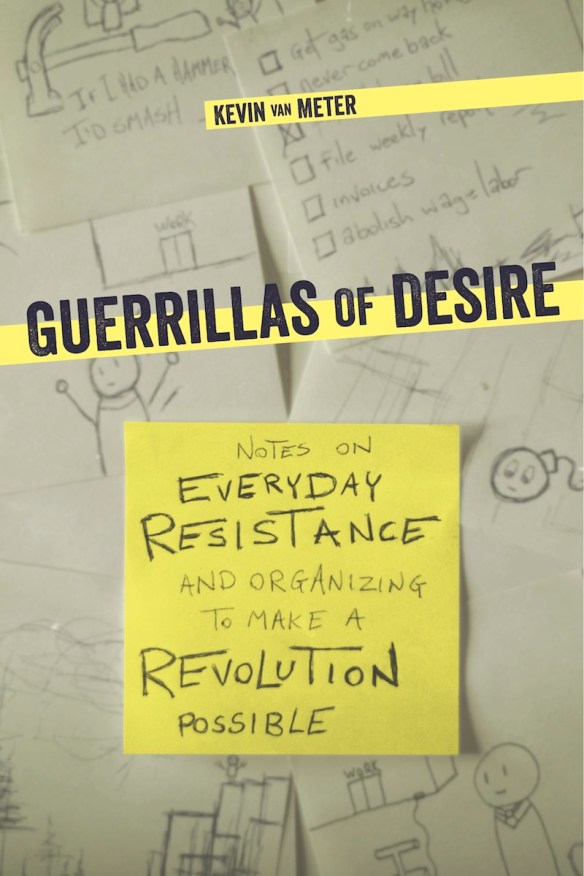
The Seeds of Anti-Capitalist Revolt Found in Everyday Resistance: A Review of Guerrillas of Desire – Notes on Everyday Resistance and Organizing to Make a Revolution Possible by Kevin Van Meter (AK Press, 2017)

By Scott Campbell

Source: Institute for Anarchist Studies

Back when I first began selling my labor for a wage in the wasteland of suburbia’s strip malls, I can recall the tedium of stocking shelves, summoning up insincere courtesy in the face of entitled customers and obnoxious bosses, comparing the stacks of money counted at the end of the day with the totals on our paychecks, and feigning adherence to whatever motivational façade management cooked up to mask the reality of our exploitation.

Yet I also remember, much more vividly and fondly, the latent and occasionally eruptive defiance among my co-workers. This included the constant collective complaining about the job, taking more and longer-than-approved breaks, working as little as possible, fudging time sheets, stealing, and the intermittent screaming matches with the boss in the middle of the store. Underpinning all these actions was an unspoken but broadly understood code of silence when it came to such transgressions and, when appropriate, expressions of support for them.

At the time, I didn’t think much about this, it was just how things happened and I’ve encountered similar experiences to varying degrees in every workplace since. Our actions weren’t guided by a political framework nor was there any attempt to organize them in a directed manner. It was more a spontaneous, innate reaction to experiencing the coercion of capitalism. I had cause to reflect upon this anew while reading Kevin Van Meter’s new book, Guerrillas of Desire: Notes on Everyday Resistance and Organizing to Make a Revolution Possible, published by AK Press and the Institute for Anarchist Studies.

In the preface, Van Meter observes that the question motivating him is not “What is to be done?” but “How do people become what they are?” Throughout the course of the book he seeks to provide an answer by locating power in the resistance of workers, apart from any political ideology or organization. Whether and how that inherently anti-capitalist refusal of work develops into revolt or rebellion are the questions he compellingly urges us to reflect and act upon.

To reach that point, Guerrillas of Desire ambitiously takes on multiple tasks that feed into and build on one another. Van Meter initiates a dialogue between anarchism and Autonomist Marxism that leads to a reconceptualization of the working class, bolstered in part by a historical accounting of workplace actions such as the ones I recounted. He labels these “everyday resistance,” committed by “guerrillas of desire,” and proposes a focus on those deeds as the entry point for organizing revolutionary resistance to capitalism. The impetus for this initiative, concisely carried out in under 160 pages, is his proposal that the current approach to organizing is conceptually flawed and therefore destined to fail. “Guerrillas of Desire offers a contentious hypothesis: the fundamental assumption underlying Left and radical organizing, including many strains of anarchism, is wrong. I do not mean organizationally dishonest, ideologically inappropriate, or immoral. I mean empirically incorrect” (13). The incorrect basis for current organizing is the assumption that the poor and working classes are unorganized and passive and that it therefore rests upon activists and organizations to educate and mobilize them for their own sakes. Van Meter instead proposes that there is in fact informal organization and resistance occurring, it is just of a sort that does not fit within the Left’s organizing vision and therefore goes unseen, unrecognized, and unincorporated into political theories, analysis, and action.

To provide a political frame for understanding the “everyday resistance” of the working class, Van Meter draws upon anarchism’s mutual aid – the material and emotional cooperation and reciprocal support that exists in societies – with Autonomist Marxism’s self-valorization – autonomous working class action that counters the state and capitalism, primarily the refusal of work in its myriad forms. Combined together and reinforcing one another, mutual aid and the refusal of work comprise the “everyday resistance” of the working class.

These phenomena also give definition to what is meant by “working class,” which Van Meter defines as “autonomous from both capitalism and the official organization of the Left, broadly including all those who work under capitalism, based in relationships between workers rather than as a structural component of the economy or sociological category” (32). Rather than being premised on income, occupation, or union membership, the working class under Van Meter’s formulation is made up of all those who must perform work under capitalism – be it waged or unwaged, in the factory, home, office, bedroom, affective, or social spheres. However, when they are not taking action in response to their subjugation under capitalism, these people are just workers. They become a class through the process of struggling against the conditions imposed upon them by capitalism. This struggle initially takes the form of everyday resistance based on mutual aid and the refusal of work. It is everyday resistance that unites individual workers as a class because such resistance, even when performed by one person, requires at a bare minimum the tacit complicity of co-workers and preferably their active collaboration.These acts and the social relationships they create and depend on lay the groundwork for the broader and overt organizing against capitalism more commonly interpreted as working class struggle. Using this framework as offered by Van Meter, we can understand the working class as composed of the relationships forged among workers actively in resistance against capitalism.Without anti-capitalist struggle, the working class does not exist.

After laying this theoretical groundwork, the bulk of the book traces the various forms of resistance by slaves, peasants, and workers in the industrial and social factories (the expansion of capitalist logic from the factory into society at large, in particular in service, immaterial, and reproductive work), creating a lineage and legacy of working class resistance against the various formations of capitalism that spans centuries. “Viewing the working class broadly to include slaves and peasants as well as students, homemakers, immigrants, and factory and office workers reveals the breadth of struggle and generalized revolt against work that continues to be imposed” (128). In doing so, Van Meter further builds the framework of the working class as being formed through its self-activity against the demands and deprivations of capitalism.

The historical survey brings the discussion into the present, where Van Meter offers a proposal to address his initial hypothesis that the Left is carrying out its organizing work in an incorrect way. His suggestion is for the organizers of today and in the future to begin their work by “reading the struggles” already underway in the form of everyday resistance. Through investigation and documentation by organizers, new relationships may be fostered with guerillas of desire that allow everyday resistance to expand into larger and more overt forms of autonomous anti-capitalist struggle. He proposes that the seeds of the new, liberatory worlds sought by anarchism and Autonomist Marxism are to be found in the everyday resistances that are already occurring rather than in the latest organizing manual or official Left strategy document..

While impressed after reading through this formulation, I was left with lingering questions. It remained unclear how, for instance, everyday resistance morphed into more overt, organized resistance and the part organizers positioning themselves as readers of struggle played in such a development. The personal anecdotes he provided on stepping back from ideological assumptions and reorienting towards the collective experiences of communities during his work in Long Island were helpful. It brought to mind the story of Marxist-Leninist intellectuals heading off to the Chiapan jungle with grand plans of starting a peasant guerrilla force. Only when they arrived, they found the population had no time or interest in their grandiose ideology. It was only when they dropped their assumptions and worked within the community to understand its needs, concerns and own history of resistance that the Zapatistas emerged. That, however, is a rather specific and exceptional example. I feel Van Meter’s proposal to begin organizing from within everyday resistance based on the notion that it will lead to more overt resistance could benefit from further articulation and direction.

Similarly, the focus on work as existing solely within the capitalist sphere left me curious as to his vision of the place of non-leisure activity under capitalism or even after capitalism. The refusal of the work that maintains capitalism is indispensable. Yet I would not advocate the refusal of work that maintains communal and personal well-being or builds autonomous organization, or writes books reviews in spare time, for example. Certainly, Van Meter would not advocate that either, but it remains a matter necessitating clarification and one that I believe extends beyond an issue of semantics.

Despite those questions, Guerrillas of Desire is aspirational in its scope and contains ideas and proposals worthy of consideration by radicals reflecting on how to engage in the current moment. In a time when mobilizing and organizing around class has fallen off the radar of many, it is a welcome reminder of the importance of paying attention to the working class and the integral role working class struggle plays in resistance to capitalism, alongside the currently more prevalent resistances to capitalist white supremacy, heteropatriarchy, colonization, environmental destruction and more.

Van Meter assists in this advocacy by accessibly presenting an updated Autonomist Marxist perspective of the working class, expanding it, breathing life into, and imbuing it with its own power, separate from both capitalism and the official Left. As such, he allows readers who may toil in a variety of ways under capitalism to see themselves within the working class, conceptualize their activities as part of a broader resistance with a rich history, and inspire them to build on that legacy.


Scott Campbell is a radical writer and translator based in California. He is part of the collectives that publish the websites El Enemigo Común and It’s Going Down. His personal site is fallingintoincandescence.com

Guerrillas of Desire is available here!


Killing the Biosphere to Fast-track Human Extinction

By Robert J. Burrowes

Several years ago in Cameroon, a country in West Africa, a Western Black Rhinoceros was killed. It was the last of its kind on Earth.

Hence, the Western Black Rhinoceros, the largest subspecies of rhinoceros which had lived for millions of years and was the second largest land mammal on Earth, no longer exists.

But while you have probably heard of the Western Black Rhinoceros, and may even have known of its extinction, did you know that on the same day that it became extinct, another 200 species of life on Earth also became extinct?

This is because the sixth mass extinction event in Earth’s history is now accelerating at an unprecedented rate with 200 species of plants, birds, animals, fish, amphibians, insects and reptiles being driven to extinction on a daily basis. And the odds are high that you have never even heard of any of them. For example, have you heard of the Christmas Island Pipistrelle, recently declared extinct? See ‘Christmas Island Pipistrelle declared extinct by IUCN’.

Apart from the 200 species extinctions each day however, and just to emphasize the catastrophic extent of this crisis, myriad local populations of many species are driven to extinction daily and millions of individual lifeforms are also killed. See ‘Biological annihilation via the ongoing sixth mass extinction signaled by vertebrate population losses and declines’.

For a taste of the vast literature on this subject touching only on impacts in relation to insects, see ‘Death and Extinction of the Bees’, ‘Insectageddon: farming is more catastrophic than climate breakdown’ and ‘“Decimated”: Germany’s birds disappear as insect abundance plummets 76%’.

Is anything being done to end this omnicide (the destruction of all life)?

Not really, although there is plenty of rhetoric and limited action in some contexts as all bar a few committed individuals and organizations ignore this onslaught while even fewer take action that addresses the underlying cause and/or fundamental drivers of this killing. Unfortunately, most effort is still wasted on lobbying elites.

For example, in the latest example of the foolishness of lobbying elites to take action in our struggle to defend Earth’s biosphere, the European Union has again just renewed Monsanto’s licence to keep poisoning (and otherwise destroying) our world – see ‘German vote swings EU decision on 5-year glyphosate renewal’ – despite the already overwhelming evidence of the catastrophic consequences of doing so. See, for example, ‘Killing Us Softly – Glyphosate Herbicide or Genocide?’ and GM Food Crops Illegally Growing in India: The Criminal Plan to Change the Genetic Core of the Nation’s Food System’.

Of course, massive poisoning of the biosphere is only one way to destroy it and while elites and their agents drive most of this destruction they nevertheless often rely on our complicity. To itemize just a few of these many techniques for destroying our biosphere in most of which we are complicit, consider the following. We destroy rainforests – see Cycles of Wealth in Brazil’s Amazon: Gold, Lumber, Cattle and Now, Energy’ – we contaminate and privatize the fresh water – see Groundwater drunk by BILLIONS of people may be contaminated by radioactive material spread across the world by nuclear testing in the 1950s’ and ‘Nestlé CEO Denies That Water is an Essential Human Right’ – we overfish and pollute the oceans – see New UN report finds marine debris harming more than 800 species, costing countries millions’ – we eat meat despite the devastating impact of animal agriculture on Earth’s biosphere – see ‘The True Environmental Cost of Eating Meat’ – we destroy the soil – see ‘Only 60 Years of Farming Left If Soil Degradation Continues’ – and we use our cars and air travel (along with our meat-eating) as key weapons in our destruction of Earth’s atmosphere and climate with atmospheric carbon dioxide, methane and nitrous oxide levels all breaking new records in 2016. See ‘Greenhouse Gas Bulletin’.

But if you think that is bad enough, did you know about the out-of-control methane releases into the atmosphere that we have triggered – see ‘7,000 underground gas bubbles poised to “explode” in Arctic’ and ‘Release of Arctic Methane “May Be Apocalyptic,” Study Warns’ – and did you know that scientists at the University of Leicester warn that we are destroying the Earth’s oxygen? See ‘Global warming disaster could suffocate life on planet Earth, research shows’ and ‘The Extinction Event Gains Momentum’.

In addition, relying on our ignorance and our complicity, elites kill vast areas of Earth’s biosphere through war and other military violence (without even considering the unique, and possibly life-ending, devastation if the recently and repeatedly threatened nuclear war eventuates) – see, for example, the Toxic Remnants of War Project and the film ‘Scarred Lands & Wounded Lives’ – subject it to uncontrolled releases of radioactive contamination – see Fukushima Radiation Has Contaminated The Entire Pacific Ocean And It’s Going To Get Worse’ – and use geoengineering to wage war on its climate, environment and ultimately ourselves. See, for example, ‘Engineered Climate Cataclysm: Hurricane Harvey’, ‘Planetary Weapons and Military Weather Modification: Chemtrails, Atmospheric Geoengineering and Environmental Warfare’, ‘Chemtrails: Aerosol and Electromagnetic Weapons in the Age of Nuclear War’ and ‘The Ultimate Weapon of Mass Destruction: “Owning the Weather” for Military Use’.

Of course, all of this is done at immediate cost to human beings, particularly indigenous peoples – see, for example, Five ways climate change harms indigenous people’ –  and those who are in the worst position to resist – see Global Poverty: How the Rich Eat the Poor and the World: The Big Lies’ – but elites know they can ignore our lobbying and occasional, tokenistic and disorganized protests while relying on the fear and powerlessness of most of us to ensure that we do nothing strategic to fight back.

And given the unrelenting criminal onslaught of the insane global elite – see ‘The Global Elite is Insane’  – directed against Earth’s biosphere, together with the elite’s many sycophantic academic, bureaucratic, business, legal, media, military, political and scientific servants who deny science and threaten human survival in the interests of short-term personal privilege, corporate profit and social control, it is long past time when those of us who are genuinely concerned should be developing and implementing a strategy that recognises the elite and its many agents as opponents to be resisted with a careful and powerful strategy.

So, in essence, the problem is this: Human beings are destroying the biosphere and driving countless lifeforms, including ourselves, to extinction. And there is little strategic resistance to this onslaught.

There is, of course, an explanation for this and this explanation needs to be understood if we are to implement a strategy to successfully halt our omnicidal assault on Earth’s biosphere in time to save ourselves and as many other species as possible in a viable ecological setting.

This is because if you want to solve a problem or resolve a conflict, then it is imperative to know and act on the truth. Otherwise you are simply acting on a delusion and whatever you do can have no desirable outcome for yourself, others, the Earth or its multitude of creatures. Of course, most people are content to live in delusion: it averts the need to courageously, intelligently and conscientiously analyse what is truly happening and respond to it powerfully. In short: it makes life ‘easier’ (that is, less frightening) even if problems keep recurring and conflicts are suppressed, to flare up periodically, rather than resolved.

And, of course, this is how elites want it. They do not want powerful individuals or organizations interfering with their scheme to (now rapidly) consolidate their militarized control over the world’s populations and resources.

This is why, for example, elites love ‘democracy’: it ensures disempowerment of the population. How so? you might ask. The fundamental flaw of democracy is that people have been deceived into surrendering their personal power to act responsibly – in relation to the important social, political, economic, environment and climate issues of the day – to elected ‘representatives’ in government who then fearfully represent the elites who actually control them (whether through financial incentives, electoral support or other means), assuming they aren’t members of the elite themselves and simply represent elite priorities out of shared interest (as does Donald Trump).

And because we delegate responsibility to those powerless politicians who fearfully (or out of shared interest) act in response to elite bidding, the best scientific information in relation to the state of the Earth is simply ignored or rejected while conservative ‘scientific warnings’ advocating ‘strategies’ that must fail are widely circulated. See, for example, ‘World Scientists’ Warning to Humanity: A Second Notice’.

So this widespread failure to respond thoughtfully and powerfully is a fundamental reason that we are killing the biosphere and destroying life on Earth. Too few humans are willing to accept personal responsibility to understand why the violence is occurring and to participate in a carefully designed strategy to avert our own extinction, let alone save countless other species from premature entry into the fossil record. It is easier to leave responsibility to others. See ‘The Delusion “I Am Not Responsible”’.

And, clearly, time is running out, unless you are gullible enough to believe the elite-sponsored delusion that promotes inaction, and maximizes corporate profits in the meantime, because we are supposed to have until ‘the end of the century’. Far from it, however. As some courageous scientists, invariably denied access to mainstream news outlets, explain it: near-term human extinction is now the most likely outcome.

One of these scientists is Professor Guy McPherson who offers compelling evidence that human beings will be extinct by 2030. For a summary of the evidence of this, which emphasizes the usually neglected synergistic impacts of many of these destructive trends (some of which are noted above) and cites many references, listen to the lecture by Professor McPherson on ‘Climate Collapse and Near Term Human Extinction’.

Why 2030? Because, according to McPherson, the ‘perfect storm’ of environmental assaults that we are now inflicting on the Earth, including the 28 self-reinforcing climate feedback loops that have already been triggered, is so far beyond the Earth’s capacity to absorb, that there will be an ongoing succession of terminal breakdowns of key ecological systems and processes – that is, habitat loss – over the next decade that it will precipitate the demise of homo sapiens sapiens.

In relation to the climate alone, another scientist, Professor Kevin Anderson, who is Deputy Director of the UK’s premier climate modelling institution, the Tyndall Centre for Climate Change Research, has warned that emissions are now out of control and we are heading for a world that is 6 degrees hotter; he pointed out that even the International Energy Agency, and conservative organisations like it, are warning that we are on track for a 4 degree increase (on the pre-industrial level) by 2040. He also accused too many climate scientists of keeping quiet about the unrealistic assessments put out by governments. See ‘What They Won’t Tell You About Climate Catastrophe’.

So be wary of putting any credence on ‘official’ explanations, targets and ‘action-plans’ in relation to the climate that are approved by large gatherings, whether governmental or scientific. Few people have the courage to tell the truth when it guarantees unpopularity and can readily manifest as career-extinction and social and scientific marginalization.

As an aside, it is perhaps worth mentioning that most people have long forgotten that a decade ago (when the global temperature was .8 degrees above the pre-industrial level) it had been suggested that a decrease in global temperature to not more than .5 degrees above the pre-industrial level was actually necessary to achieve a safe climate, with the Arctic intact (although there was no clear feasible method for humans to reduce the global temperature to this level with any speed). Sadly we have made little progress in the past decade apart from to keep raising the ‘acceptable’ limit (whether to 2 degrees or ‘only’ 1.5). Most humans love to delude themselves to avoid dealing with the truth.

Hence, for those of us committed to responding powerfully to this crisis, the fundamental question is this: Why, precisely, are human beings destroying life on Earth? Without an accurate answer to this question, any strategy to address this crisis must be based on either guesswork or ideology.

So let us briefly consider some possible answers to this question.

Some people argue that it is genetic: human beings are innately violent and, hence, destructive behaviors towards themselves, others and the Earth are ‘built-in’ to the human organism; for that reason, violence cannot be prevented or controlled and humans must endlessly destroy.

However, any argument that human beings are genetically-predisposed to inflict violence is easily refuted by the overwhelming evidence of human cooperation throughout the millennia and there are endless examples, ranging from the interpersonal to the international, of humans cooperating to resolve conflict without violence, even when these conflicts involve complex issues and powerful vested interests. There are also plentiful examples of humans, particularly indigenous communities, living in harmony with, rather than destroying, nature.

Other analysts argue that human violence and destructiveness are manifestations of political, economic and/or social structures – such as patriarchy, capitalism and the state, depending on the perspective – and while I agree that (massive) structural violence actually occurs, I do not believe that these structures, by themselves, constitute an adequate explanation of the cause of violence.

This is simply because any structural explanation cannot account for violence in all contexts (including the violence that led to creation of the structure in the first place) or explain why it doesn’t happen in some contexts where a particular perspective indicates that it should.

So is there another plausible explanation for human violence? And can we do anything about it? Let me offer an explanation and a way forward that also takes advantage of the insights of those traditions that have critiqued structural violence in its many forms.

I have been researching why human beings are violent since 1966 and the evidence has convinced me that the origin of all human violence is the violence inflicted by adults on children under the guise of what sociologists call ‘socialization’. This violence takes many forms – what I call ‘visible’, ‘invisible’ and ‘utterly invisible’ violence – and it creates enormously damaged individuals who then personally inflict violence on themselves, those around them (including their own children) and the Earth, while creating, participating in, defending and/or benefiting from structures of violence and exploitation. For a full explanation of this point, see Why Violence?’ and Fearless Psychology and Fearful Psychology: Principles and Practice.

Hence, in my view, the evidence is overwhelming that if we want to end human violence, whether inflicted on ourselves, others or the Earth, then the central feature of our strategy must be to end adult violence against children. See ‘My Promise to Children’. I claim that this must be ‘the central feature of our strategy’ for the simple reason that each damaged child grows up to become a willing and active perpetrator of violence when, if they were not so damaged, they would be powerful agents of peace, justice and sustainability committed to resisting violence and exploitation in all contexts until it is eliminated.

This profound evolutionary inheritance – to be an individual of integrity who consciously chooses and lives out their own unique, powerful and nonviolent life path – has been denied to virtually all of us because humans endlessly terrorize their children into mindless obedience and social conformity, leaving them powerless to access and live out their conscience.

And this makes it very easy for elites: By then using a combination of our existing fear, indoctrination (via the education system, corporate media and religion) and intimidation (via the police, legal and prison systems), sometimes sweetened with a few toys and trinkets, national elites maintain social control and maximize corporate profits by coercing the rest of us to waste our lives doing meaningless work, in denial of our Selfhood, in the corporate-controlled economy.

As I implied above, however, we need not be content with just working to end violence against children. We can also work to end all other manifestations of violence – including violence against women, indigenous peoples, people of color, Islamic and working class people, and violence against the Earth – but recognize that if we tackle this violence without simultaneously tackling violence at its source, we fundamentally undermine our effort to tackle these other manifestations of violence too.

Moreover, tackling structural violence (such as capitalism) by using direct violence cannot work either. Because violence always feeds off fear it will always proliferate and remanifest, whether as direct, structural, cultural or ecological violence, however beneficial any short-term outcome may appear.

Importantly then, apart from understanding and addressing the fundamental cause of this crisis, we must implement a comprehensive strategy that takes into account and addresses each and every component of it. There is no point working to achieve a single objective that might address one problem no matter how important that particular problem might be. The crisis is too far advanced to settle for piecemeal action.

Hence, if you wish to tackle all of this violence simultaneously, you might consider joining those participating in the comprehensive strategy simply explained in The Flame Tree Project to Save Life on Earth. If you wish to tackle violence in a particular context, direct, structural or otherwise, consider using the strategic approach outlined in Nonviolent Campaign Strategy or Nonviolent Defense/Liberation Strategy.

And if you would like to publicly commit yourself to participate in the effort to end all human violence, you can do so by signing the online pledge of The Peoples Charter to Create a Nonviolent World.

Killing the biosphere is the most effective way to destroy life on Earth because it destroys the ecological foundation – the vast array of incredibly diverse and interrelated habitats – on which organisms depend for their survival. And we are now very good at this killing which is why averting human extinction is already going to be extraordinarily difficult.

Hence, unless and until you make a conscious personal decision to participate strategically in the struggle to save life on Earth, you will be one of those individuals who kills the biosphere as a byproduct of living without awareness and commitment: A person who simply over-consumes their way to extinction.

So next time you ponder the fate of humanity, which is inextricably tied to the fate of the Earth, it might be worth considering the unparalleled beauty of what Earth has generated. See, for example, Two White Giraffes Seen in Kenyan Conservation Area’.

And as you do this, ask yourself how hard you are willing to fight to save life on Earth.


Biodata: Robert J. Burrowes has a lifetime commitment to understanding and ending human violence. He has done extensive research since 1966 in an effort to understand why human beings are violent and has been a nonviolent activist since 1981. He is the author of Why Violence? His email address is flametree@riseup.net and his website is here.


Robert J. Burrowes
P.O. Box 68
Daylesford
Victoria 3460
Australia

Email: flametree@riseup.net

Websites:

https://thepeoplesnonviolencecharter.wordpress.com/ (Nonviolence Charter) https://tinyurl.com/flametree (Flame Tree Project to Save Life on Earth) https://tinyurl.com/whyviolence (‘Why Violence?’) https://feelingsfirstblog.wordpress.com/ (Feelings First) https://nonviolentstrategy.wordpress.com/ (Nonviolent Campaign Strategy) https://nonviolentliberationstrategy.wordpress.com/ (Nonviolent Defense/Liberation Strategy) https://anitamckone.wordpress.com (Anita: Songs of Nonviolence) https://robertjburrowes.wordpress.com/ (Robert) https://globalnonviolencenetwork.wordpress.com/ (Global Nonviolence Network)

Newsletter: From Neoliberal Injustice To Economic Democracy

By Kevin Zeese and Margaret Flowers

Source: Dissident Voice

The work to transform society involves two parallel paths: resisting harmful systems and institutions and creating new systems and institutions to replace them. Our focus in this article is on positive work that people are doing to change current systems in ways that reduce the wealth divide, meet basic needs, ensure sustainability, create economic and racial justice and provide people with greater control over their lives.

When we and others organized the Occupation of Washington, DC in 2011, we subtitled the encampment ‘Stop the Machine, Create a New World’, to highlight both aspects of movement tasks — resistance and creation. One Popular Resistance project, It’s Our Economy, reports on economic democracy and new forms of ownership and economic development.

Throughout US history, resistance movements have coincided with the growth of economic democracy alternatives such as worker cooperatives, mutual aid and credit unions. John Curl writes about this parallel path in “For All the People,” which we summarized in “Cooperatives and Community Work are Part of American DNA.”

Mahatma Gandhi’s program of nonviolent resistance, satyagraha, had two components: obstructive resistance and constructive programs. Gandhi promoted Swaraj, a form of “self-rule” that would bring independence not just from the British Empire but also from the state through building community-based systems of self-sufficiency. He envisioned economic democracy at the village level. With his approach, economics is tied to ethics and justice — an economy that hurts the moral well-being of an individual or nation is immoral and business and industry should be measured not by shareholder profit but by their impact on people and community.

Today, we suffer from an Empire Economy. We can use Swaraj to break free from it. Many people are working to build a new economy and many cities are putting in place examples of economic democracy. One city attempting an overall transformation is Cooperation Jackson in Jackson, Mississippi.

Economic Democracy in response to neoliberalism

In his new book, Out of the Wreckage: A New Politics for an Age of Crisis, George Monbiot argues that a toxic ideology of greed and self–interest resulting in extreme competition and individualism rules the current economic and political culture. It is built on a misrepresentation of human nature. Evolutionary biology and psychology show that humans are actually supreme altruists and cooperators.  Monbiot argues that the economy and government can be radically reorganized from the bottom up, enabling people to take back control and overthrow the forces that have thwarted human ambitions for a more just and equal society.

In an interview with Mark Karlin, Monbiot describes how neolibealism arose over decades, beginning in the 1930s and 40s with John Maynard Keynes, Friedrich Hayek and others, and is now losing steam, as ideologies do. Monbiot says we need a new “Restoration Story.”

We are in the midst of writing that new story as people experience the injustice of the current system with economic and racial inequality, destruction of the environment and never ending wars. Indeed, we are further ahead in creating the new Restoration Story than we realize.

Cooperatives

New research from the University of Wisconsin–Madison’s Center for Cooperatives (UWCC) has found there are 39,594 cooperatives in the United States, excluding the housing sector, and there are 7 million employer businesses that remain “potential co-op candidates.” These cooperatives account for more than $3 trillion in assets, more than $500 billion in annual revenue and sustain nearly two million jobs. This May, the Office of Management and Budget approved including coop questions in the Economic Census so that next year the US should have more accurate figures. The massive growth of cooperatives impacts many segments of the economy including banking, food, energy, transit and housing among others.

In cooperatives, workers or consumers decide directly how their business operate and work together to achieve their goals; it is a culture change from the competitive extreme capitalist view dominated by self-interest.

In Energy Democracy: Advancing Equity in Clean Energy Solutions, editors Denise Fairchild and Al Weinrub describe energy cooperatives that are creating a new model for how we organize the production and distribution of energy, which is decentralized, multi-racial and multi-class.

Lyn Benander of Co-op Power, a network of many cooperatives in New England and New York, writes that they transform not just energy but also their communities:

First, people come together across class and race to make change in their community by using their power as investors, workers, consumers, and citizens ready to take action together. Then, they work together to build community-owned enterprises with local capital and local jobs to serve local energy needs. It’s a proven strategy for making a real difference.

In Lancaster, CA, the mayor has turned the town into a solar energy capital where they produce power not just for themselves, but also to sell to other cities. They are also moving to create manufacturing jobs in electric buses, which more cities are buying, and energy storage. Research finds that rooftop solar and net-metering programs reduce electricity prices for all utility customers, not just those with solar panels. The rapid growth of rooftop solar is creating well-paying jobs at a rate that’s 17 times faster than the total U.S. economy. Rooftop solar, built on existing structures, such as homes and schools, puts energy choices in the hands of customers rather than centralized monopolies, thereby democratizing energy.

Including housing cooperatives would greatly increase the number of cooperatives. According to the National Association of Housing Cooperatives, “Housing cooperatives offer the more than one million families who live in them several benefits such as: a collective and democratic ownership structure, limited liability, lower costs and non-profit status.”  Residents of a mobile home park in Massachusetts decided to create a housing cooperative to put the residents in charge of the community when the owner planned to sell it.

Related to this are community land trusts. A section of land is owned in a trust run as a non-profit that represents the interests of local residents and businesses. Although the land is owned by the trust, buildings can be bought and sold. The trust lowers prices and can prevent gentrification.

Universal Basic Income

Another tool gaining greater traction is a universal basic income.  James King writes in People’s Policy Project that “. . . a universal basic income (UBI) – a cash payment made to every person in the country with no strings attached – is becoming increasingly popular in experimental policy circles. . . payments  [would be] large enough to guarantee a minimum standard of living to every person independent of work. In the US, that would be roughly $12,000 per person based on the poverty line.”

The wealth divide has become so extreme in the United States that nearly half of all people are living in poverty. A small UBI would provide peace of mind, financial security and the possibility of saving money and building some wealth. A report by the Roosevelt Institute, this week, found that a conservative analysis of the impact of a UBI of $1,000 per month would grow the economy by 12.56 percent after an eight-year implementation, this translates to a total growth of $2.48 trillion.

Public Finance

Another major area of economic democracy is the finance sector. At the end of 2016 there were 2,479 credit unions with assets under 20 million dollars in the United States. Members who bank in credit unions are part of a cooperative bank where the members vote for the board and participate in other decisions.

Another economic democracy approach is a public bank where a city, state or even the national government creates a bank using public dollars such as taxes and fee revenues. Public banks save millions of dollars that are usually paid in fees to Wall Street banks, and the savings can be used to fund projects such as infrastructure, transit, housing, healthcare and education, among other social needs. Public banks can also partner with community banks or credit unions to fund local projects. This could help to offset one of the negative impacts of Dodd-Frank, which has been a reduction in community banks. In testimony, the Secretary of Treasury, Stephen Munchin, said we could “end up in a world where we have four big banks in this country.”

North Dakota is the only state with a public bank, and it has the most diverse, locally-owned banking system in the country. Stacey Mitchell writes that “North Dakota has six times as many locally owned financial institutions per person as the rest of the nation. And these local banks and credit unions control a resounding 83 percent of deposits in the state, more than twice the 30 percent market share such banks have nationally.” Public banking campaigns are making progress in many parts of the country, among them are Oakland, Los Angeles, Philadelphia, Santa Fe, and other areas.

Mutual Aid

When crises occur, no matter what their cause, people can work together cooperatively and outside of slow and unresponsive state systems to meet their needs. This is happening in Athens, Greece, which has been wracked by financial crisis and austerity for years. People have formed “networks of resistance” that meet in community assemblies organized around needs of the community, such as health care and food. They started with time banks as a base for a new non-consumer society.

Similar efforts are underway in Puerto Rico following the devastation of Hurricane Maria. A group called El Llamado is coordinating more than 20 mutual aid efforts, and providing political education and support for self-organizing at the same time.

As George Monbiot describes it, this is consistent with the truth about what human beings are:

We survived despite being weaker and slower than both our potential predators and most of our prey. We did so through developing, to an extraordinary degree, a capacity for mutual aid. As it was essential to our survival, this urge to cooperate was hard-wired into our brains through natural selection.

As we face more crises, whether in lack of access to health care, education, housing, food or economic and climate disasters, let’s remember that we have the capacity to meet our needs collectively.  In fact, every day, people are putting in place a new economic democracy that allows people to participate based on economic and racial justice as well as real democracy. As these alternatives are put in place, they may become dominant in our economy, communities and politics and bring real democracy and security to our lives.


Kevin Zeese and Margaret Flowers are co-directors of Popular Resistance. Read other articles by Kevin Zeese and Margaret Flowers.

Don’t Just Give Thanks. Pay It Forward One Act of Kindness at a Time

By John W. Whitehead

Source: The Rutherford Institute

“As we express our gratitude, we must never forget that the highest appreciation is not to utter words, but to live by them.”—John F. Kennedy

It’s been a hard, heart-wrenching, stomach-churning kind of year filled with violence and ill will.

It’s been a year of hotheads and blowhards and killing sprees and bloodshed and takedowns.

It’s been a year in which tyranny took a step forward and freedom got knocked down a few notches.

It’s been a year with an abundance of bad news and a shortage of good news.

It’s been a year of too much hate and too little kindness.

Now we find ourselves approaching that time of year when, as George Washington and Abraham Lincoln proclaimed, we’re supposed to give thanks as a nation and as individuals for our safety and our freedoms.

It’s not an easy undertaking.

How do you give thanks for freedoms that are constantly being eroded? How do you express gratitude for one’s safety when the perils posed by the American police state grow more treacherous by the day? How do you come together as a nation in thanksgiving when the powers-that-be continue to polarize and divide us into warring factions?

It’s not going to happen overnight. Or with one turkey dinner. Or with one day of thanksgiving.

Thinking good thoughts, being grateful, counting your blessings and adopting a glass-half-full mindset are fine and good, but don’t stop there.

This world requires doers, men and women (and children) who will put those good thoughts into action.

It says a lot (and nothing good) about the state of our world and the meanness that seems to have taken center stage that we now have a day (World Kindness Day) devoted to making the world more collectively human in thoughts and actions. The idea for the day started after a college president in Japan was mugged in a public place and nobody helped him.

Unfortunately, you hear about these kinds of incidents too often.

A 15-year-old girl was gang raped in a schoolyard during a homecoming dance. As many as 20 people witnessed the assault over the course of two and a half hours. No one intervened to stop it.

A 28-year-old woman was stabbed, raped and murdered outside her apartment early in the morning. Thirty-eight bystanders witnessed the attack and failed to intervene. The woman, Kitty Genovese, died from her wounds at the locked doorway to her apartment building.

A 58-year-old man waded into chest-deep water in the San Francisco Bay in an apparent suicide attempt. For an hour, Raymond Zack stood in the shallow water while 75 onlookers watched. Police and firefighters were called in but failed to intervene, citing budget cuts, a lack of training in water rescue, fear for their safety and a lack of proper equipment. The man eventually passed out and later died of hypothermia. Eventually, an onlooker volunteered to bring the body back to the beach.

A homeless man intervened to save a woman from a knife-wielding attacker. He saved the woman but was stabbed repeatedly in the process. As The Guardian reports, “For more than an hour he lay dying in a pool of his own blood as dozens walked by. Some paused to stare, others leaned in close. One even shook his body and then left, while someone else recorded a video of the entire proceeding.”

This is how evil prevails: when good men and women do nothing.

By doing nothing, the onlookers become as guilty as the perpetrator.

“If I were to remain silent, I’d be guilty of complicity,” declared Albert Einstein.

It works the same whether you’re talking about kids watching bullies torment a fellow student on a playground, bystanders watching someone dying on a sidewalk, or citizens remaining silent in the face of government atrocities.

There’s a term for this phenomenon where people stand by, watch and do nothing—even when there is no risk to their safety—while some horrific act takes place (someone is mugged or raped or bullied or left to die): it’s called the bystander effect.

Psychological researchers John Darley and Bibb Latane mounted a series of experiments to discover why people respond with apathy or indifference instead of intervening.

Their findings speak volumes about the state of our nation and why “we the people” continue to suffer such blatant abuses by the police state.

According to Darley and Latane, there are two critical factors that contribute to this moral lassitude.

First, there’s the problem of pluralistic ignorance in which individuals in a group look to others to determine how to respond. As Melissa Burkley explains in Psychology Today, “Pluralistic ignorance describes a situation where a majority of group members privately believe one thing, but assume (incorrectly) that most others believe the opposite.”

Second, there’s the problem of “diffusion of responsibility,” which is compounded by pluralistic ignorance. Basically, this means that the more people who witness a catastrophic event, the less likely any one person will do anything because each thinks someone else will take responsibility. In other words, no one acts to intervene or help because each person is waiting for someone else to do so.

Now the temptation is to label the bystanders as terrible people, monsters even.

Yet as Mahzarin Banaji, professor of psychology at Harvard University points out, “These are not monsters. These are us. This is all of us. This is not about a few monsters. This is about everybody. It says something very difficult to us. It says that perhaps had we been standing there, we ourselves, if we were not better educated about this particular effect and what it does to us, we may fall prey to it ourselves.”

Historically, this bystander syndrome in which people remain silent and disengaged—mere onlookers—in the face of abject horrors and injustice has resulted in whole populations being conditioned to tolerate unspoken cruelty toward their fellow human beings: the crucifixion and slaughter of innocents by the Romans, the torture of the Inquisition, the atrocities of the Nazis, the butchery of the Fascists, the bloodshed by the Communists, and the cold-blooded war machines run by the military industrial complex.

So what can you do about this bystander effect?

Be a hero, suggests psychologist Philip Zimbardo.

Each of us has an inner hero we can draw upon in an emergency,” Zimbardo concluded. “If you think there is even a possibility that someone needs help, act on it. You may save a life. You are the modern version of the Good Samaritan that makes the world a better place for all of us.”

Zimbardo is the psychologist who carried out the Stanford Prison Experiment which studied the impact of perceived power and authority on middleclass students who were assigned to act as prisoners and prison guards. The experiment revealed that power does indeed corrupt (the appointed guards became increasingly abusive), and those who were relegated to being prisoners acted increasingly “submissive and depersonalized, taking the abuse and saying little in protest.”

What is the antidote to group think and the bystander effect?

Be an individual. Listen to your inner voice. Take responsibility.

“If you find yourself in an ambiguous situation, resist the urge to look to others and go with your gut instinct,” says Burkley. “If you think there is even a possibility that someone is in need, act on it. At worst, you will embarrass yourself for a few minutes, but at best, you will save a life.”

“Even if people recognize that they are witnessing a crime, they may still fail to intervene if they do not take personal responsibility for helping the victim,” writes Burkley. “The problem is that the more bystanders there are, the less responsible each individual feels.”

In other words, recognize injustice. Don’t turn away from suffering.

Refuse to remain silent. Take a stand. Speak up. Speak out.

This is what Zimbardo refers to as “the power of one.” All it takes is one person breaking away from the fold to change the dynamics of a situation. “Once any one helps, then in seconds others will join in because a new social norm emerges: Do Something Helpful.”

“I swore never to be silent whenever and wherever human beings endure suffering and humiliation,” stated Holocaust Elie Wiesel in his Nobel Peace Prize acceptance speech in 1986. “We must always take sides. Neutrality helps the oppressor, never the victim. Silence encourages the tormentor, never the tormented. Sometimes we must interfere. When human lives are endangered, when human dignity is in jeopardy, national borders and sensitivities become irrelevant. Wherever men or women are persecuted because of their race, religion, or political views, that place must – at that moment – become the center of the universe.”

Unfortunately, as I make clear in my book Battlefield America: The War on the American People, too many Americans have opted to remain silent when it really matters while instead taking a stand over politics rather than human suffering.

That needs to change.

I don’t believe we’re inherently monsters. We just need to be more conscientious and engaged and helpful.

The Good Samaritans of this world don’t always get recognized, but they’re doing their part to push back against the darkness.

For instance, earlier this year in Florida, a family of six—four adults and two young boys—were swept out to sea by a powerful rip current in Panama City Beach. There was no lifeguard on duty. The police were standing by, waiting for a rescue boat. And the few people who had tried to help ended up stranded, as well.

Those on shore grouped together and formed a human chain. What started with five volunteers grew to 15, then 80 people, some of whom couldn’t swim.

One by one, they linked hands and stretched as far as their chain would go. The strongest of the volunteers swam out beyond the chain and began passing the stranded victims of the rip current down the chain.

One by one, they rescued those in trouble and pulled each other in.

There’s a moral here for what needs to happen in this country if we only can band together and prevail against the riptides that threaten to overwhelm us.

Here’s what I suggest.

Instead of just giving thanks this holiday season with words that are too soon forgotten, why not put your gratitude into action with deeds that spread a little kindness, lighten someone’s burden, and brighten some dark corner?

I’m not just talking about volunteering at a soup kitchen or making a donation to a charity that does good work, although those are fine things, too.

What I’m suggesting is something that everyone can do no matter how tight our budgets or how crowded our schedules.

Pay your blessings forward.

Engage in acts of kindness. Smile more. Fight less.

Focus on the things that unite instead of that which divides. Be a hero, whether or not anyone ever notices.

Do your part to push back against the meanness of our culture with conscious compassion and humanity. Moods are contagious, the good and the bad. They can be passed from person to person. So can the actions associated with those moods, the good and the bad.

Even holding the door for someone or giving up your seat on a crowded train are acts of benevolence that, magnified by other such acts, can spark a movement.

Imagine a world in which we all lived in peace.

John Lennon tried to imagine such a world in which there was nothing to kill or die for, no greed or hunger. He was a beautiful dreamer whose life ended with an assassin’s bullet on December 8, 1980.

Still, that doesn’t mean the dream has to die, too.

There’s something to be said for working to make that dream a reality. As Lennon reminded his listeners, “War is over, if you want it.”

The choice is ours, if we want it.

I’ve Been Banned From Facebook For Sharing An Article About False Flags

By Caitlin Johnstone

Source: OpEdNews.com

My personal Facebook account, which has the maximum 5,000 friends and an additional 5,000+ followers, has been blocked from posting for three days. My page hasn’t been blocked yet, but we’ll see; I shared the article there, too.

The reason given for this ban by the little pop-up boxes when I logged on just now was that a couple months ago I had shared an article about admitted false flag operations perpetrated by governments around the world. I don’t know what happened that made Facebook’s system decide to crack down on me now all of a sudden, but I do know I’ve been a bit naughtier than usual in my last couple of articles.

The article I got the banhammer for sharing is titled For Those Who Don’t ‘Believe’ In ‘Conspiracies’ Here Are 58 Admitted False Flag Attacks. According to the site’s ticker it has 50,667 shares as of this writing. It’s laden with hyperlinks for further reading, and lists only instances of false flag operations that insiders are on the record as having admitted to themselves. It’s a good compilation of important information. People should be allowed to share it.

The notifications say I can be permanently banned if I continue posting that sort of material. I’ve had that account since 2007.

So. Who wants to see my Barbra Streisand impression?

(Image by Caitlin Johnstone)

(Image by Caitlin Johnstone)

In a corporatist system of government, corporate censorship is state censorship. When there’s no meaningful space between corporate power and government power, it doesn’t make much difference whether the guy silencing your dissent is Mark Zuckerberg or Jeff Sessions. America most definitely has such a system.

If they’re going to get us locked down and propagandized into their vapid brain boxes, this will be how they’ll do it. Not by government censorship, but by corporate censorship. Government can’t make an overt attempt to stop a dissenting voice from speaking, but the corporations who own the venue of their speech can.

In a recent Senate Judiciary Committee hearing, plutocrat-sponsored senators spoke with top legal and security officials for Facebook, Twitter and Google in a very disturbing way about the need to silence dissenting voices.

Democratic Senator Mazie Hirono of Hawaii demanded that the companies adopt a “mission statement” declaring their commitment “to prevent the fomenting of discord.”

A former FBI agent Clint Watts kicked it up even further, saying, “Civil wars don’t start with gunshots, they start with words. America’s war with itself has already begun. We all must act now on the social media battlefield to quell information rebellions that can quickly lead to violent confrontations and easily transform us into the Divided States of America.”

“Stopping the false information artillery barrage landing on social media users comes only when those outlets distributing bogus stories are silenced”—“-silence the guns and the barrage will end,” he added.

This was on the Senate floor. Officials were speaking about the need to censor social media to prevent people from sharing dissenting ideas on the Senate floor.

World Socialist Web Site said of the hearing,

That such a statement could be made in a congressional hearing, entirely without objection, is an expression of the terminal decay of American democracy. There is no faction of the ruling class that maintains any commitment to basic democratic rights.

None of the Democrats in the committee raised any of the constitutional issues involved in asking massive technology companies to censor political speech on the Internet. Only one Republican raised concerns over censorship, but only to allege that Google had a liberal bias.

Former FBI agent says tech companies must “silence” sources of “rebellion”
US Congressional hearing: By Andre Damon 1 November 2017 Top legal and security officials for Facebook, Twitter and” www.wsws.org

I’ll admit right now that this really scares me. Ever the optimist, I’ve been reassuring my readers that the corporatocracy would never risk taking off the black hole sun mask of corporate cheerfulness and move into regular, overt totalitarianism. I’ve contended that they must remain covert in order to keep successfully manufacture consent.

But, here we are. Through a studious application of psy-ops they have their censorship and they have their consent. Remember, in the book “Fahrenheit 451” the public wasn’t unhappy about the book burnings. They cheered them on, and that’s what we have now. The herd is mindlessly clapping their approval at censorship and even volunteering to report naughty behavior like good little hall monitors for the oligarchy. I’m sure that even some of my close friends and family will silently approve of my banning and will meet my distress with the pursed lips of a church lady secretly pleased at my comeuppance.

I tried joining Gab when I saw this coming, but it’s really alt-righty there and the energy there is just gross. Finding a new social media outlet might not even matter anyway, since these creeps just target any place people gather in large numbers.

I don’t know. I always freak out a bit when the eye of corporate censorship focuses on me. I’ve recently been told by a number of people that they’ve been banned for sharing my articles, and now it’s hitting me.

I’m babbling. This is weird. I just really, really don’t want humanity to become what these people are trying to turn it into, you know? Help me make some noise about this stuff, please. Manipulators can’t do their job when there’s a big spotlight pointed at them.

______

Hey you, thanks for reading! My work is entirely reader-funded so if you enjoyed this piece please consider sharing it around, liking me on Facebook, following me on Twitter, and maybe throwing some money into my hat on Patreon or Paypal.

The War on Fake News

By Anthony Freda

Source: Cindy Sheehan’s Soapbox

As it becomes increasingly clear that yesterday’s conspiracy theories are today’s real news, the call to kill the messengers just gets more shrill and hysterical.

The attacks on free speech with high-tech censorship campaigns and old-fashioned hit pieces in the “War on Fake News” are massive and concerted.

The book burners are starting so many fires it’s impossible to stamp them all out.

What are the horrible thought crimes committed by the alternative press?

The new media has consistently exposed the lies and crimes of our corrupt and broken institutions.

Pioneers of alt media have passionately and convincingly made the case that The Patriot Act literally reversed the gains to human liberty codified in The Bill of Rights.

Independent media dismantled the lies that were presented as the pretexts to the invasion of Iraq. The same lies aggressively promoted by Bush, Hillary Clinton, CNN and The New York Times and that resulted in the death of a million people and global chaos. By contrast, how many people have died as a result of alternative media reports? The answer iszero.

The independent press interviewed NSA whistleblowers who accurately described how the U.S. government was illegally spying on its citizens and retaining our data, and how these whistleblowers were being persecuted by their own government for coming forward and refusing to break the law.

This was years before anyone heard of Edward Snowden.

Amazingly, there was very little interest in these bombshell allegations in the mainstream press.

It’s hard to believe now, but in those days, people who claimed the government was surveilling innocent citizens were dismissed as paranoid by the self-proclaimed arbiters of truth at the NYT and CNN.

Grassroots media detailed a decade ago how police forces all over America were becoming militarized and predicted that this dangerous trend would lead to racially charged conflict on the streets of the nation. What kooks!

We have also railed against; torture, needless wars, police brutality, government corruption, the two-party duopoly, the criminality of the banksters and the end of privacy.

Now the very same mainstream media hacks who promoted the lies that lead to war in Iraq and Syria and mindlessly regurgitate whichever talking point is uploaded onto their teleprompter are gleefully assassinating what they call “fake news” using edited tape and misleading hit-pieces.

While these discredited war cheerleaders lie about why our sons and daughters are sent to die, we are bravely exposing the fraudulent casus belli they traitorously and disgracefully promote.

While these corporate spokespeople work for the interests of the oil and drug companies and political forces that pay their salaries, we risk everything to expose the crimes and scams of these same broken institutions.

We have done a great public service by exposing the deceptive, psychological methods used by the ruling elite to warp historical narratives, manipulate patriotism and manufacture consent.

By helping people to recognize and suspend their belief in propaganda and therefore their own complicity in it, the alternative media is helping to create a public awareness to the tactics our enemies use to keep us divided, steal our rights and slaughter countless innocents all over the world.

I know it’s fun and easy to call us tin-foil-hat wearers, or whatever pejorative has been chosen for you today, but let’s be clear about whose dirty work some are doing. Ironically, many are using talking-points written by deep-state operatives to ridicule the idea that the deep-state exists at all!!

Alternative media is in direct competition with the mainstream media for revenue and the MSM want to control the information we are exposed to.

The MSM are waging a concerted demonization campaign aimed at destroying some of the dominant platforms exposing the lies and crimes of their corporate and deep-state masters and many are helping them do it.

The MSM is an enemy of the truth and of the people. Friends of mine have been accused of being Russian agents in The NYT because they simply told the truth about Clinton during the campaign.

The corporate press has gone from lying to the American people to lyingabout the American people.

Do we have the will and power to destroy our common enemy?

www.AnthonyFreda.com

It is no measure of health to be well adjusted to a profoundly sick society. -Jiddu Krishnamurti


Washington D.C. is Swarming With Unaccountable Parasites

By Michael Krieger

Source: Liberty Blitzkrieg

In theory, Americans should be proud of their national capital and all the important work that gets done there. In theory.

In reality, our nation’s capital is an utter cesspool of self-serving, unethical and unaccountable parasites. We all know it and, even worse, it’s probably a hundred times more grotesque than we can imagine. A distressingly high number of people attracted to this swamp don’t go there to do good public work or help the American people. They go in order to enrich themselves at our expense.

A particularly degenerate strain of D.C. cretin is the lobbyist. These people swarm into Washington to influence the purse-strings of the U.S. government and funnel as much American treasure as possible in the direction of their clients, including Wall Street oligarchs, defense contractors and barbaric foreign monarchies like Saudi Arabia. We’re told that Washington D.C. exists specifically to protect and benefit the American public, yet the average citizen is the one constituency which has virtually no actual representation there. Helping the vulnerable doesn’t pay very well.

Over the past couple of days, I’ve be reading political stories describing the “beltway buzz” in the aftermath of the Paul Manafort and Rick Gates indictments. I’ve found these articles quite instructive. The common theme is that hordes of the shady crooks who operate in D.C., and add absolutely zero value to society, are panicking that their gravy train of legalized corruption may be coming to an end.

To see what I mean, let’s examine two recently published articles. First from Politico:

Washington lobbyists who represent foreign powers have taken comfort for decades in the fact that the Justice Department rarely goes after them for potentially breaking the law. That all changed on Monday.

The two-tier justice system works quite nicely for D.C. crooks.

The news of Tony Podesta’s resignation from his namesake firm and indictment of Paul Manafort and Rick Gates sent K Street scrambling, as lobbyists rushed to make sure they’re in compliance with the rules. The developments also renewed calls for Congress to pass legislation beefing up the Justice Department’s enforcement of the law, which lawmakers in both parties have derided for lacking teeth.

“Firms are going to be even more careful than they have been in the past in the foreign lobbying arena,” said Trent Lott, the former Senate majority leader who’s now a lobbyist at Squire Patton Boggs, where his foreign clients have included Saudi Arabia and Turkey.

Prosecutions of violations of the Foreign Agents Registration Act — which requires lobbyists who represent foreign governments, political parties and other groups seeking to influence American foreign policy to register with the Justice Department — are rare. And it’s not clear whether the Justice Department will follow special counsel Robert Mueller’s lead and start cracking down on foreign lobbying violations.

The DOJ unit dedicated to enforcing FARA is small, and has focused in the past on prodding lobbyists to comply with the law voluntarily, rather than going after them by pressing criminal charges. Mueller’s willingness to indict Manafort and Gates instead of just hounding them to file has struck fear into lobbyists that they could be next.

If you’re a D.C. power player, you get asked politely to follow the law. Must be nice.

“It used to be [that the Justice Department would work with you to become compliant,” said another foreign lobbyist, who also spoke on condition of anonymity. “Now there’s a fear that they’ll just prosecute you.”

Oh, the horror. They might “just prosecute you” like a common peasant.

But the bar for criminal prosecution is high. Under the law, prosecutors can go after lobbyists only for willful violation of the law — a tough standard to prove.

“Policy makers are here to serve the interests of the American people, so we need to know when someone is pushing the priorities of a foreign interest,” Grassley said in a statement. “Unfortunately, we’ve seen time and again how lobbyists of foreign principals skirt existing disclosure laws to conceal their clients’ identities and agendas.”

But Lott said he wouldn’t hold his breath waiting for Congress to pass the legislation, especially with President Donald Trump still pushing to move a tax reform bill by the end of the year.

“There’s not much of anything happening right now in Congress, to be perfectly frank,” Lott said.

Of course not. Criminals run the place and they’re not going to prosecute themselves.

Now let’s turn to a few nuggets from a similarly themed BuzzFeed piece:

WASHINGTON – The threat of serving hard time for failing to disclose foreign lobbying work is rattling Washington’s multi-billion dollar influence industry following Monday’s 12-count indictment against Donald Trump’s former campaign chairman Paul Manafort and his deputy, Rick Gates.

And although the charges have largely been seen as a blow to the White House, Monday’s actions by special prosecutor Robert Mueller also sent shivers down the spines of Washington’s lobbyists, both Democrats and Repulicans.

“It’s a swampy place, and the swampy stink knows no partisan allegiance,” said one senior Democratic congressional aide.

A September 2016 report by the Justice Department’s inspector general identified a series of problems with how DOJ had handled FARA cases in the past. There was disagreement within the department about what types of cases should be prosecuted, the inspector general’s office found, and the FBI felt DOJ attorneys were slow in reviewing FARA cases and reluctant to sign off on criminal charges. The report also found that the FBI and local federal prosecutors reported feeling frustrated at being overruled by attorneys from the National Security Division about cases that they believed were worth pursuing.

Hold on a minute, what the heck is the “National Security Division” and why is it preventing rank and file FBI agents from prosecuting criminal lobbyists?

So that’s how the law works for D.C. lobbyists. Let’s now examine what happens if you’re a protester who happened to be in the wrong place at the wrong time during Donald’s Trump inauguration.

What follows are some very disturbing excerpts from a must read article published in The NationThe Prosecution of Inauguration-Day Protesters Is a Threat to Dissent:

Late next month, the first mass trial will be held for some of the roughly 200 people facing years—or even decades—in prison after being arrested during an anti-capitalist, anti-fascist protest that took place on the day of Donald Trump’s inauguration. The “J20” cases, as they are known, offer a glimpse at the treatment of dissent in this country, and the story they tell is one of overreach and criminalization. Defense lawyers have described the government’s approach as “unprecedented,” its indictments as “littered with fatal irremediable defects.” Sam Menefee-Libey of the DC Legal Posse, a group of activists who provide support to the defendants, was more blunt, criticizing the cases as “blatant political prosecutions” designed to “chill resistance.”

The story of the J20 protesters should frighten anyone concerned about the future of both free assembly and dissent in the United States. The charges—which include felony rioting, inciting or urging others to riot, conspiracy to riot, and property destruction—all stem from the same mass arrest, during which police indiscriminately swept up protesters, journalists, and legal observers. What makes the charges all the more troubling is that prosecutors then failed to allege that the bulk of defendants did anything specifically unlawful; rather, merely being at the protest was a crime.

A case in point: The prosecution charged all of the defendants (at one point numbering 214) with breaking the same windows. Prosecutors, of course, know that 200 people cannot break the same windows. But the logic of the case dictates that the defendants’ mere presence at a protest during which property damage occurred makes them guilty…

Few people dispute that property destruction took place during the march. Some individuals smashed windows, including those of a Bank of America branch and a limousine; prosecutors allege that there was more than $100,000 in property damage and that six police officers received minor injuries. Where things get thorny is that many of the people who have been charged did not commit property damage or violence but have been deemed guilty by their mere presence at the protest.

The problems began during the arrests themselves—arrests deemed so troubling that the ACLU has brought a lawsuit against the Metropolitan Police Department (MPD) accusing its members of using excessive force, making unconstitutional arrests, and more.

Among the controversial practices police engaged in that day, lawyers and observers say, was a tactic called “kettling.” Kettling is a form of indiscriminate mass arrest, wherein police block off a given area and arrest everyone within it. To be lawful, an arrest requires probable cause based on individual suspicion. Yet, inevitably, this heavy-handed tactic often sweeps up other protesters and bystanders whose only offense was their physical proximity to the alleged crime. Indeed, a report on the inauguration by the DC Office of Police Complaints noted that “it seems that proximity to the area where property damage occurred was a primary factor” in the arrests.

The mass arrests gave birth to the next government overreach, mass “felony riot” charges against those arrested. Felony rioting carries a penalty of up to 10 years in prison and a $25,000 fine, and applies when the alleged riot results in more than $5,000 in property damage. This is opposed to misdemeanor rioting, which can get you only 180 days in jail.

Attorneys who have long represented protesters in DC report never having encountered mass felony charges stemming from a protest before. Not the least of the reasons is that it’s difficult to produce enough evidence to sustain felony charges against dozens—or in this case, some 200—people. Yet, rather than backing down, prosecutors expanded the case by filing additional charges, and, in April, a grand jury returned a superseding indictment that added inciting or urging to riot and conspiracy to riot to the list of crimes. These new charges brought the number of felony counts up from one to eight and the amount of time defendants could face from 10 years to more than 70 years in prison.

The government’s overarching theory, then, seems to be one of guilt by association. Or that, as Assistant US Attorney Jennifer Kerkhoff asserted during a hearing about dismissing the charges, it is “the group that is the danger, the group that is criminal.” Thus one need not have committed an act of vandalism as an individual; just being present at the protest makes one guilty. (The DoJ declined to comment for this story, as the cases are currently pending.)

Among those swept up in this overbroad approach was a group of at least seven journalists who were covering the J20 protests. While prosecutors ultimately dismissed the felony rioting charges against the bulk of the journalists nearly as quickly as they were filed, two journalists remain in the crosshairs: Aaron Cantú, then a freelancer who has published with The Nation and The Intercept, and Alexei Wood, who livestreamed the event. In April a grand jury brought a superseding indictment of eight felony charges against both reporters along with the other defendants. They face as many as 70 years in prison, possibly more.

The indictment against Cantú deploys the same guilt-by-association approach that mars the entire case. Per prosecutors, Cantú moved in proximity to the march—something that would be necessary in order for him to do his job as a journalist. But prosecutors have additional evidence against Cantú: He wore the color black.

FIGHTING FOR OKINAWA — MY HOME, NOT A MILITARY BASE

By Moé Yonamine

Source: Rethinking Schools

My family moved to the United States from Okinawa when I was 7. But Okinawa is still home — and I’m hurt and angered at how the United States and Japan continue to treat Okinawa as little more than a colonial outpost. As a teacher, I’m even more dismayed at how the conventional school curriculum keeps young people in this country ignorant about the abuse, but also about the resistance, in my home islands.

“They are burying our beautiful ocean,” read the recent message from my mother in Okinawa, as though she was grieving the loss of a loved one. After decades of protest by Okinawan people to completely get rid of all U.S. military bases that occupy a fifth of the Ryukyu Island chain, the United States and Japan signed a treaty to evacuate one of the most contested bases located in the center of the main island, Futenma Marine Corps (MCAS) base. In exchange for the removal, both governments announced that they would construct a floating military base off the northeast coast of Henoko. Okinawans expressed vehement opposition, with a majority voting in a referendum for the complete removal of all bases. Still the construction continued and the people persisted in protest — marching for miles down main streets, creating human chains for peace, linking arms around military bases, elders repeatedly lying down in front of bulldozers. Governor Takeshi Onaga demanded the Japanese government terminate the heliport construction and city mayors prevented access of U.S. military construction vehicles through their districts — later overturned by federal court order last December sought by the Japanese federal government.

Today, the concrete seawalls are finished, and soon, rocks will be crushed and sand will pile high, burying the tropical, clear waters. The Japanese government and U.S. military continue to pursue the construction of the runway, despite community complaints of environmental damage and pollution, endangerment to sea life, harm to the fishing and tourism industry, as well as the ongoing threat to cultural survival and island sovereignty. On July 6th the Ryukyu Shimpo announced that the Japanese government would not return the land occupied by MCAS Futenma to the Okinawan people. The U.S. and Japan added a condition to the promise for Futenma’s removal: The Naha International Airport must be made available for the U.S. military any time they declare an emergency. When Governor Onaga rejected this demand, the U.S. military withdrew its promise to remove Futenma. Japanese Defense Minister Tomomi Inada stated, “If the requisite conditions for the return of Futenma are not met, it will not be returned.” In a surge of anger, pain and frustration, word spread quickly in Okinawa across social media.

Devastated at the sacrifice of my home, I turned to the news here in the United States, and there was not one story about Okinawa on any major network. Frustrated, I recalled my conversation with an elderly grandmother I met at a peace rally in my neighborhood when I went home last summer. When I told her I was a teacher in the United States, she told me that the best thing we as teachers can do is to teach kids about what’s happening in Okinawa and how we want a world without war. She said, “They need to know our story so they can stand up with us.”

But when I turn to a typical U.S. textbook, I see how students are ill-equipped to understand what’s happening in Okinawa. For example, in Holt McDougal’s widely used The Americans, there are a mere three paragraphs about Okinawa under the section, “The Atomic Bomb Ends the War.”

Discussion of Okinawa begins and ends with a skewed description of the Battle of Okinawa during WWII: “In April 1945, U.S. Marines invaded Okinawa,” it begins. “By the time the fighting ended on June 21, 1945, more than 7,600 Americans had died. But the Japanese paid an even greater price — 110,000 lives — in defending Okinawa.” Okinawans are completely invisible in this account of the war, the bloodiest battle in the history of the Pacific, where our islands were used as a battleground between the United States and Japan. The highest cost was in Okinawan lives, where more than a third of the population was killed within three months — almost 150,000 — and more than 92 percent were left homeless. The majority of today’s families — including mine — have experienced grief and loss of loved ones.What The Americans does not teach is that Okinawa was once an independent kingdom, was colonized by Japan, then controlled by the United States for 27 years, and finally became a Japanese prefecture. At the end of the war, the U.S. military stripped Japan of its constitution and replaced it with one that took away Japan’s right to have an offensive military. Henceforth, the United States would “protect” Japan, and create bases throughout Japanese territory. However, three-quarters of all U.S. bases on Japanese territory are on Okinawa, even though Okinawa makes up only .6 percent of Japan’s total landmass. Okinawa’s main island is just 62 miles long; and its width averages one mile.

MCAS Futenma was constructed in the middle of our skinny island — creating environmental destruction, air pollution and noise pollution, blocking direct access to roads in a densely populated community, and exposing survivors and families to the sights and sounds of war. Frequent violent crimes against women and children continue to bring hundreds of thousands of protesters together demanding justice and humanity — and the complete removal of U.S. military bases.

Not only do commercial textbooks fail to equip students to understand what’s happening in Okinawa, the mainstream school curriculum does not help students understand issues affecting island people more broadly. I have seen time and time again the shock when my high school students in Portland, Oregon, learn about the U.S. military’s long-standing nuclear testing in the Marshall Islands, the environmental damage to Vieques in Puerto Rico, or the history of U.S. military trainings on indigenous Hawaiian soil. Many of my students are confused when they learn that Guam is a “U.S. territory,” has the highest per capita U.S. military enlistment, has a huge U.S. base presence, but its people have no right to vote in U.S. elections. When I talk about the International Women’s Network Against Militarism, students wonder why women from places with high U.S. military presence — the Philippines, South Korea, Hawai’i, Puerto Rico, Guam and Okinawa — gather regularly to talk and organize.

When people say to me, “Why are Okinawans complaining? We’re there to protect you,” I want them to learn our whole history and to know our colonized story. When people ask, “Why don’t Okinawans complain to the Japanese government?” I want them to know about the history of our people’s movements to demand our rights. When people say, “So what? It’s just one little island,” I want them to know this is my home; it’s sacred — these are my loved ones. What’s more, our story of struggle today represents issues affecting so many island people.

The elderly grandmother from the peace rally told me that we must teach the children “that we have been fighting because we have always wanted peace but now we need the world to fight with us. Go back and tell our story.” Our story though, is much more than three short paragraphs in a textbook. It is a story about a people’s determination for sovereignty in the face of imperialism, resilience in midst of colonization, and perseverance for peace as survivors of war. Our story is urgent and it is a call for global action in the name of peace and justice. The history of Okinawa is a story of resistance but also a call to the world.


Moé Yonamine (moe@rethinkingschools.org) teaches at Roosevelt High School in Portland, Oregon, and is an editor of Rethinking Schools magazine. Yonamine is part of a network of Zinn Education Project teachers developing original people’s history curriculum. She is the author of “The Other Internment: Teaching the Hidden Story of Japanese Latin Americans During WWII,” “‘ANPO: Art X War’: A Film Tackles the U.S. Occupation of Japan,” a film review with teaching activities of “ANPO: Art X War,” a documentary about visual resistance to U.S. military bases in Japan, and “Uchinaaguchi: The Language of My Heart.”