Reimagining the Middle Class

In her new book, Alissa Quart chronicles what happens when capitalism and families collide

By Ann Neumann

Source: The Baffler

AS THE ECONOMIC STATUS OF MANY in the United States has declined over the past several decades, journalists have often focused on the challenges faced by the working poor. In her new book, Squeezed: Why Our Families Can’t Afford America, Alissa Quart writes about how economic inequality has also drastically changed the middle class, destabilizing what was once considered a secure class and sending families into the tailspin of debt, overwork, underemployment, and precarious financial states. Squeezed demonstrates that inequality is not just a problem of those left behind in the lowest financial brackets, but a feature of our current economic system characterized by working professionals who are unable to pay for child care, declining job salaries, shifting work hours, and unaffordable housing. Families too often wrestle with “penalizing” factors, like women’s depressed salaries and unaffordable health care, making success unattainable for a formerly comfortable, educated, and skilled demographic of society.

The book challenges us to reimagine our prior understanding of what it means to be middle class, even as legislators champion “traditional values” that contradict the needs and responsibilities of families—and erode a safety net that once supported U.S. workers. Some of the factors that have upended the middle class are obvious—declining salaries, for instance—but others remain masked by corporate and social portrayal of them as a benefit to today’s workers. The gig economy, which, we’re told, gives workers young and old more flexibility and independence, turns out to be a contributor to what Quart calls the forever clock, a twenty-four-hour schedule that has usurped family and free time by keeping workers on constant call. Squeezed recounts the lives of the teachers who work second jobs, the professional mothers who struggle to pay for day care, the paralegals and adjuncts who have to moonlight to pay the rent, the well educated who never found a job in their intended profession that provides a livable salary. And the book causes us to ask why so many suffer in isolation, too ashamed to acknowledge their economic plight and too belabored to politically address it.

Quart is executive editor of the Economic Hardship Reporting Project, a nonprofit organization founded by Barbara Ehrenreich (a contributing editor for The Baffler) that supports journalism examining economic inequality, its causes and solutions (EHRP has funded my own work and that of others published at The Baffler). Quart is the author of four previous books: BrandedRepublic of OutsidersHothouse Kids, and the poetry book Monetized. She also co-writes, with Maia Szalavitz, a column for The Guardian titled “Outclassed.”

This month, Quart stopped by The Baffler office to talk to me about Squeezed. We’ve known each other for several years and I read the book in manuscript, so our conversation was casual, touching on individuals in the book, our own squeezed lives, how we can counter economic decline, and a necessary new definition of self-help.

Ann NeumannSqueezed straddles the Trump election and very often people on the left—and the right, to be honest—are using this as a clear demarcation. I think one of the things the book does really well is point out that the mechanisms in place that harm working class families have been long in coming.

Alissa Quart: The reason Sanders and Trump could tap into anger are the numbers of those economically squeezed; it’s what I was seeing anecdotally. And you can feel that. You can feel when you go sit in people’s living rooms, when you talk to them on the phone. I went to a conference called iRelaunch that was all about helping people to start their careers over and the room just rippled with shame and fear. And acidic humor.

AN: How did the election change this book project?

AQ: I think it gave it new urgency for me. Just as it gave urgency to the Economic Hardship Reporting Project, the organization I run. I think everyone in journalism felt like we have to tell these stories. The Trump effect has made me feel like I have to keep a laser focus on the things people are ignoring and try to find a way for readers to pay attention to them. We’re all focusing on Ivanka and whether she’s the c-word or not, which is fine, there are all kinds of things happening around us and in our own lives politically that have nothing directly to do with what Trump is tweeting, but the effects of his administration and long-term trends are real and we just need to keep looking.

We just published an article at EHRP about a journalist who lives in a $17 a night Airbnb, places below what you usually scroll to. But this person was a working journalist who was getting six-figure advances fifteen or twenty years ago. There are all these human examples that constantly show this decline. Fine, maybe the job numbers are up, but how many jobs are people working and are they jobs in the professions? Are they jobs that pay enough for people to live in cities? Or they’re working three different jobs which leads us to things like, as in this book, twenty-four-hour day care.

AN: Day care centers that are open twenty-four hours to accommodate parents with nontraditional work hours or multiple jobs.

AQ: And they are growing in number. I wrote a piece on this; I called it the dystopian social net. I feel like that’s part of my life’s work. I love dystopian fiction and science fiction, probably because it seems a few clicks away from the life we’re leading. It’s a markedly different life and childhood than the one you and I had. It may be horrible, or maybe not, but we’re seeing a palpable transformation in what childhood can be in the course of twenty years.

AN: And that’s really just the decline of income?

AQ: It’s people working different hours, it’s corporations using algorithms to find out what times of day are most profitable—when they’ll have the most foot traffic in retail, for instance—and demanding that employees work those times. It’s increasing nightwork. Nontraditional could mean 11 to 3 or it could mean working in the evening, or working in different jobs, hither and thither. That alone points to a huge transformation in things like time. A lot of the issues I address in the book are really about time, how we spend it. In the twenty-four-hour day care section I use the term the forever clock. But that’s true of the upper middle class too, they feel squeezed because they’re also on a forever clock. They’re working in IT, for instance, and they’re working unusual hours and they have the expectation that they should be better paid for it. 

AN: Your work has been focused on economic inequality for a long time.

AQ: Every single one of my books is in some way about economic inequality. I used to teach at Columbia J-school and I always told my students that every writer has a central question they spend their career trying to answer and your job is to find out what your question is. It’s like a parlor game. So I think mine is: what happens when the family—or childhood—hits capitalism? What are the deformations and the formations? I read so many nineteenth-century novels as a kid that I’m fascinated by that intersection. Naturalism is ascetically but also politically and intellectually appealing to me. I think I just like the texture of family, love, money, and how they all meet.

AN: That comes out in the writing of the book because, I’ll tell you, there are economics books that I have no interest in reading because they’re a slog, a data dump. You also coin terms that give us a way to think about worker’s plights. You just mentioned the forever clock but there’s also the middle precariat.

AQ: I was trying to explain the shift in the middle class as an imaginative category. The middle class used to equal solid, fixed, stable. Temporally it was about gratification later, but your life wasn’t miserable while you were waiting for it. It wasn’t like OK, total slog, but you’re going to get that pension. We have to now think of it as a shaken category, an unstable category, and that’s a big shift. When we visualize the middle class, we’re visualizing the white picket fence, like the blue sky on the cover of the book. But it’s really this truck being squeezed between two houses.

It’s an unsettled identity, and you can fall out of it, you can barely get into it, you certainly can’t rise above it very easily. Guy Standing coined the term precariat in 2011 to describe the proletariat, which is a Marxist way of understanding the working class, crossed with precariousness. And people get that. Every time they ride an Uber or they have a gig economy Task Rabbit person come to their house they’re like, OK, that’s the precariat. But I was seeing the same thing among paralegals or those who have law degrees but were still doing temporary work.

AN: Getting a law degree can be like selling your soul to the banks.

AQ: All these people are in debt. Some of it is because they went to for-profit colleges and those colleges were really expensive and they didn’t have a good rate of placement. Which can be traced to for-profit colleges and grad schools that have very little oversight—and are sometimes indeed federally funded. It can also be traced to fewer law jobs overall and too many people imagining that law is a secure profession. This is about reimagining. Once you can reimagine a profession, even if you choose to do it—you choose to be a journalist, you choose be a lawyer—we should understand that we’re choosing something unstable. Awareness is a huge part of survival and I guess part of what I want with this book is to increase awareness. This is your self-help: Don’t blame yourself. We have to come alive to this recognition. You can still do what you love, so long as you know what it can mean.

This is a personal journey for me too. When I was younger, as a freelancer, I had some recognition that journalism was starting to fragment. It was around 2006 or 2007—but it was before that too, the’90s. The word rates used to be consistent and for freelance writers those rates became lower or stayed the same while inflation rose. I remember talking to someone and they said, “just think about us as post modern.” Now you do lots of things, it’s a hustle here and a hustle there. That person was a boomer who had a steady job, who would get social security. I remember feeling an incredible resentment.

AN: So precarious employment has been described to us as a beautiful thing. We’re not chained to a factory job, we get to think and move around, but it doesn’t pan out.

AQ: I personally came from a middle class background. As I describe in the book, my parents were college professors, originally community college professors, and they could afford to send me to a private school. They didn’t have any inheritance or anything. That’s the sort of the world I thought I’d be living in. All of us, our generation, Generation X, had an idea of the world we thought we’d be living in. The generation after us has come to understand some of these things.

AN: That they’re fucked? So do you think this is a moment in capitalism, as we watch continued market decline over the next years, when we either do something about it or devolve into a disordered society?

AQ: Yes, I think so. But this book isn’t depressing because it points to some solutions—not in a pat way, but things that will work. It’s a way to think about what kind of family safety net, federal and local, we need to make sure people aren’t falling through. For instance, a few of the people I write about in the book are on food stamps and other kinds of support, but many of them are a little above that in terms of earning power and they can’t get help. There’s a labor organizer I spoke with who tries to lower her salary to be able to get some sort of subsidized day care, some sort of health insurance program. It’s that edge: people who are middle class in terms of education, but working class in terms of earning. They’re on the edge of being working poor and not being able to access any of those services. That’s most of the people in this book. Once we understand that they’re precarious we need to find a safety net for them.

AN: What this book does is lay out the many ways that people are hurting at the moment and it kind of gives a blueprint as to how precariousness could be addressed. Subsidized day care, for instance. I had no idea about how expensive child care is.

AQ: Child care can be 30 percent of many salaries. Or more. I think for us it was 30 percent of our take-home pay.

AN: How do people do it? In the book you show us. We spend a lot of time with individuals, we get a look at their lives and there’s a revelation for a reader to think, Oh, it’s not just me. There are things that I go without, there are resources that I don’t have access to, there are crises that I lose sleep over or pray will never come my way. There’s something about this book that brings this issue to light and I wonder if that was what you thought you’d get out of the stories? Is that why you used a storytelling approach?

AQ: That’s the chick lit, soap operatic part of me. And there is something of that in these stories. You think, What’s going to happen next? Sometimes I was surprised because they did have the messy amplitude of ordinary life. The people I write about aren’t just symbolic though. Some of them I followed for years.

AN: I think of the co-parenting section where you spend time with families who are trying to come up with creative solutions. In some cases, over time, things were better; in some cases they were worse. But readers still get the sense that nothing is fixed, no one really knows what’s working.

AQ: Or like the nanny who was separated from her son when I first met her and it was one kind of story. It became a story about them reunited, but then it became a story about school choice, and then it became a story about a mixed outcome at the end. She was actually happy, but I think the reader would want her to have a more middle class life given how hard she’s worked and all the effort she’s made to make the right choices.

AN: The anxiety of her life stayed with me. There are so many things that thwart her from getting ahead. She just needs the smallest break, trying to bring her son here, trying to find an affordable place to live. She’s doing everything right and she doesn’t deserve to go through this. That’s what comes out in the story. So when you were doing this reporting, did you get a sense of relief that we’re all going through this at the same time?

AQ: I definitely did. I felt relief. I say that this book is self-help because it makes you realize that it’s not your fault. And that’s how I see self-help. I see it as awareness, really granularly understanding all the ways that systems have made it impossible for you personally to overcome financial challenges—so that you’re no longer blaming yourself.

AN: Thank God someone’s redefining self-help.

AQ: [Laughs] But that’s it. How do you not feel stigmatized, how do you not feel isolated? So many of my friends feel ashamed that they can’t figure out the school system, can’t figure out how to own their home.

AN: The various penalties—for being a woman, for having children, for having debt—stack up. Shaming has abetted this erosion of rights and financial stability.

AQ: Time, day care scheduling, and other demands mean people can’t organize. They’re ashamed of where they are and so that becomes another debilitating factor. The adjunct in one chapter feels ashamed even though she knows politically she shouldn’t. There are people like the teachers who drive for Uber, who feel ashamed even though they know they shouldn’t. And it goes on and on. I don’t want to put it back on individuals, but the personal thing that people can do is start talking openly about their monetary situation. People are startled when you do that. It can erode social norms in a weird way, but I also think it’s important that people stop fronting with one another.

I write in one chapter about the 1 percent media, about the social media where people pretend to live in more expensive places than they do. I call them wealthies, not selfies. So it’s not your imagination when you’re in any of these circumstances and you see people in a sun dappled villa. People are representing themselves in this inflated way and then you feel terrible and isolated. There are so many ways in which the stigma, the isolation, around your class position gets underlined.

AN: Has it always been shameful to be poor?

AQ: Probably.

AN: It’s not a fair question!

AQ: But let’s be clear. A lot of these people are not poor. Most of the people in this book are earning between $45,000 and $125,000. Working class is $35,000. They’re not at the poverty level.

AN: So the shame then comes from not being able to make ends meet.

AQ: The shame comes from having debt for the education that you got in order to be middle class. The shame comes from not doing as well as your peers. The shame comes from not living up to your potential. The shame comes from not owning your home, defaulting on your mortgage. Not giving your kids as good a life as you had. I’m not writing about the working poor. I’m writing about the middle poor.

AN: We still operate under the myth that as a society we can continue to lift people into middle class and lift middle class into other class brackets. We no longer have any of that upward mobility. We cannot anticipate that our children will be better off.

AQ: No, we cannot anticipate that.

AN: But that’s still the American dream, isn’t it? And that American dream has been tied to, say, home ownership or a vehicle or not having debt.

AQ: In New York it’s like what school your kid goes to. What college your kid goes to.

AN: You use the word reimagining; it’s a word that I don’t hear often enough in politics, particularly not applied to class.

AQ: I mean reimagining what it means to be successful, reimagining what it means to be middle class. In a dream scape kind of way, like, This is what we would like to see in this country. But also reimagining middle class in its truth, what it actually means now? Let’s tear the veil and not just say, Oh, it means stability or security. It doesn’t.

Once We Awaken

By Rudy Avizius

Source: OpEdNews.com

Do you get a sense, that something is wrong
like that dissonance, that does not belong

As we move through the journey of life, many people are experiencing a sense of dis-ease, that something is off-kilter, that the narratives we are receiving do not match the reality we are experiencing. There is great hope in this knowledge because once one recognizes this dissonance the process of awakening begins.

Deep down way inside, you may have suspicions
that much what we’re told, are but veiled omissions

The narratives are controlled by a small handful of people who determine what issues and discussions we should be examining. As we watch the main stream news and follow social media, the news and discussions we see are mostly spectacle designed to boost ratings with little or no coverage of the real issues such as: our wars without end, corporate and big money control of government and media, or anything critical of the powers that be. Most of the journalists we see on the main stream media are basically celebrity faces who no longer practice journalism, but are simply parroting what those in power want them to say with little effort made to investigate and corroborate the stories. There is great hope in recognizing this knowledge, as it allows one to view the narratives more critically and to filter out what does not resonate with them.

Why do we listen, to those who would divide
those who leave us empty, with our humanity denied

  • Both of the main stream political parties support the Military/Industrial/Security Complex.
  • Both of the main stream political parties support the multiple simultaneous wars and occupations of other nations.
  • Both of the main stream political parties support a foreign policy of economic and military sanctions on nations that wish to pursue paths that do not fit interests of the global central banking system.
  • Both of the main stream political parties support their corporate donors over their constituents.
  • Both of the main stream political parties voted to extend the surveillance of citizens.
  • Both of the main stream political parties have made little or no attempt to stop the flood of big money into political campaigns.

However, the powers that be are very successful at projecting that there is a real difference between the two political parties. Both political parties are successful in getting people to fight each other over social issues that in the big picture are really not the key issues. Then, as long as the people are focused on fighting each other, those who orchestrated this fight enjoy the benefits of this effective diversion, keeping people from paying attention to the criminal syndicate that has taken over the government. There is great hope in recognizing this old divide and conquer tactic because once one does recognize it, one can stop fearing or hating “the other” and recognize that we have far more in common than what is dividing us. We can stop with name calling and finger pointing, and instead engage in meaningful conversations.

Why listen to those, with so little to tell
the very same ones who, have so much to sell

So many listen to the main stream media where sensationalism such as murders, car crashes, kidnappings, sex scandals and the like dominate the content. This is the same media where 90% of the media is owned by 6 corporations. One does not need a PhD to understand that this concentration of control over the narrative that people experience is not a positive development. Those that control the news keep the masses living in fear. This fear can take many forms, but often it is physical, economic, or social.

This is the same media that now has 36% of its hourly content filled with commercials. The fact that people are recognizing this is good news because they will become more discerning about who they give their money to. They will start to question whether they really need that product or service, or do they just want it.

Once we will awaken, things won’t be the same
we will manifest, an end to their game

Once we will awaken, the angels will observe
as those with dark souls, we’ll no longer serve

Our current political system has been totally corrupted by those with vast accumulations of money. This cuts across all ideologies and political party lines. This system of legal bribery has even been ratified by the highest court in the land which opened the floodgates to even more money corroding our system. How can someone represent you when they are being paid millions to represent others? What we need now goes beyond simple reforms and enters the realm of transformational change. Many articles and videos (mostly those in the alternative media space) connect these dots so that more and more people are becoming aware. This awareness or awakening is a critical step as it opens up the possibility for transformational change to take place.

The changes we are seeking will not take place from the top down, they will take place from the bottom up. Those who benefit from the current paradigm have little motivation to implement meaningful changes. Once we are ready to accept our own roles in this process, we will realize that what needs to happen is that we have to change ourselves. Once we stop playing their game of competing with each other, we will start cooperating instead. Local, self sufficient, and resilient communities will spring up like wild flowers in a field where they grow much of their own food, start their own currencies, and their citizens will stop buying from the big corporations, instead they will patronize their local businesses.

The current system of how we create and distribute money is at the very heart of most of the problems we face. It is absolutely amazing that people will work a significant portion of their lives away to earn money, and yet have only the most elementary understanding of how our debt based monetary system works. What does debt based monetary system mean? When was the last time your main stream media covered this? When was the last time your school taught you this? Why is this information withheld?

This debt based monetary system perpetuates and amplifies the inequalities of how Earth’s abundant resources are distributed. Our very existence on this planet is being threatened as unlimited economic growth within a finite biosphere remains the current paradigm. Until we move to a totally new monetary system, we are only hacking away at branches, and not getting to the root of the problem. There can be no effective transformation of our societies until this happens.

The models for a new monetary system are already in place. However the private individuals who have been given the monopoly power to create money and are benefiting from the current system will fight to make sure that knowledge of these systems does not spread widely. Those benefiting from the current system will work hard to make sure it stays firmly entrenched. When was the last time you heard a corporate media network discuss monetary reform?

Once we have local control of moneyfood productionenergy generation,and governance, the current paradigm of corporate and big money control of our systems will simply become obsolete. It will simply fade into oblivion as it becomes less and less relevant. There will be no need to confront the system. Once we awaken and change our ways, we will “manifest an end to their game”.

Those who sell their souls, for their daily bread
may not take the time, to think of what’s ahead

There have always been those who would sell their souls and use the excuse “it’s my job” to justify their actions. From those who tortured Jesus to more modern times with concentration camp guards to even more currently the mercenaries who were hired to confront those seeking to protect their water supplies from pipeline companies.

Think about this, these mercenaries are people who left the communities they pledged to “protect and serve” to answer a call to “protect and serve” corporate interests in another community, while these same corporate interests were placing local people’s water supplies at serious risk.

These mercenaries were the tip of the spear, there were many behind the scenes who acted as enablers for their behaviors. There were the corporate executives, prosecutors, judges, minor bureaucrats, and politicians without whose support, such injustices could never take place. Those who served helping these forces have “sold their souls for their daily bread.”

“It was my job” is not an acceptable response when it curtails the access of life sustaining necessities of fellow human beings.

It is very easy to develop an “I see nothing” attitude, or to allow oneself to be silenced by monetary gain by “playing along” with those who control and manipulate the system. It is time to witness, it is time to speak up, it is time to resist when you see injustice taking place.

Those that are insatiable, always seeking moar
ever quite so willing, to send others to war

Why do we accede, to their self served schemes
rather than just simply, following our dreams

Once we awaken we will no longer serve those who think only of themselves and their own self serving schemes. YOU can start making a huge difference by the way you spend YOUR money. Think about this, when you give your money to someone or some corporation, as you are transferring some of your your power to them. Is this really something you wish to do?

Do you shop at a local merchant or do you save that 35 cents by buying from Amazon? Do you give a percentage of every purchase to the big banks by using credit cards or do you pay in cash? Do you buy animal products humanely produced? Do you buy organic food or food produced using chemicals that threaten our ecosystem (and your health?) Do you bank at a “too big to fail bank” or a local community bank or Credit Union? Sometimes the lowest price or convenience is not the best buy and can carry an even higher unseen cost.

As we develop our own resilient local communities and economies, our dependencies on the corporate model will be reduced, weakening their tight grip on us. Mother Teresa once said “I alone cannot change the world, but I can cast a stone across the waters to create many ripples.”

Once we will awaken, we will clearly see
many of the others, who’ve also broken free

This is the best part of the awakening process. It is easy to think that the problems we face are overwhelming and that nothing can be done. The powers that be want us to think that way. Yet as we awaken, it becomes very clear that there are so many more of us that feel this same way than we originally believed. Once we awaken we become aware of others who have broken free. It is very empowering once we realize we are not alone. A critical mass is forming. It turns out that it takes only 10% of a population to bring about real changes.

We live in a world of abundance. There is enough air, water, and food for every person, animal, and plant on the planet. We have the resources and ability to make our existence here a paradise, to continue to develop socially, intellectually, emotionally, and spiritually. It is within our power to create a true golden age on this blue oasis floating through space and attain wondrous levels of development on a personal, family, community, regional, and global level while creating this paradise.

The War to End War 100 Years On: An Evaluation and Reorientation of our Resistance to War


By Robert J. Burrowes

British author and social commentator H.G. Wells may have coined the expression that originally popularized World War I as The War that Will End War, as his book, based on articles written during that vast military conflict, was titled. In any case, in one version or another, the expression was one of the most common catchphrases of the Great War of 1914-1918 and has survived as an expression, often used with a grimace of sarcasm, ever since.

As we commemorate the passing of the 100th anniversary of the armistice ending ‘the war to end war’, one can only marvel at how wrong humans can be sometimes. Not content with the violence inflicted during World War I, humans used the twentieth century to systematically decimate human and other life as violence and war raged across the planet with an increasingly massive and sophisticated armory. In fact, by mid-century, in a tribute to their technological ingenuity and psychological dysfunctionality, humans had invented a weapon that could destroy life on Earth.

And by the beginning of the 21st century, humans were living in the era of perpetual war against life – see ‘Humanity has wiped out 60% of animal populations since 1970, report finds’ and Living Planet Report 2018: Aiming Higher’ – with war also the largest contributor to the climate catastrophe: ‘Not only is the Pentagon the single largest industrial consumer of fossil fuels, but fighter jets, destroyers, tanks and other weapons systems emit highly toxic, carbon-intensive emissions, not to mention the greenhouse gases that are released from the detonation of bombs. How quickly the world forgot the toxic legacy of Saddam Hussein’s oil fires!’ See War and Climate Change: Time to Connect the Dots’.

So advanced is our war against life that human extinction is now imminent. See ‘Human Extinction by 2026? A Last Ditch Strategy to Fight for Human Survival’.


Resisting war historically

Of course, the failure to end war has not been the outcome of lack of effort. And while there have been many efforts focused on ending a particular war, efforts directed at ending a particular aspect of war (such as the use of a type of weapon), and efforts aimed at preventing a type of war (such as ‘aggressive war’ or nuclear war), there have also been ongoing efforts to achieve ‘the holy grail’: to end war itself.

These attempts have included ongoing grassroots mobilization by anti-war organizations spawned by World War I (such as the Women’s International League for Peace and Freedom founded in 1915 and War Resisters’ International founded in 1921) and many equivalents since that time, official attempts to outlaw war such as the Kellogg-Briand Pact that outlawed war in 1928 but has been ignored ever since – see League of Nations ‘Treaty Series’ vol. XCIV, 1929, p. 63 – and institutional efforts to prevent it, particularly by establishment of the League of Nations in 1920 and its successor the United Nations in 1945, both also readily ignored or manipulated.

Separately from the above, however, there has been a long history of nonviolent activism to end wars and this has been conducted by individuals and groups all over the world. Undoubtedly the most effective anti-war movement in history was that undertaken in response to the US war against Vietnam, Cambodia and Laos. Inspired and supported by the nonviolent resistance of the civilian population, and building on the long history of resistance to war within the military – see, for example, The Soldiers’ Strikes of 1919 – there was widespread nonviolent resistance undertaken by US troops and conscripts to end the US war against Vietnam, Cambodia and Laos from 1968 until it ended in 1975.

If you like, you can read detailed descriptions of the systematic and ongoing resistance (nonviolent and otherwise) within the US military, in many forms, which progressively incapacitated the US Army, Marine Corps, Navy and Air Force during the last years of the war, forcing the US out of Vietnam, Cambodia and Laos. See Soldiers in Revolt: GI Resistance During the Vietnam War and Self-Destruction: The Disintegration and Decay of the United States Army during the Vietnam Era with a summary of the first book in ‘Antiwar Resistance Within the Military During the Vietnam War’ and a review of it in ‘The soldiers’ revolt in Vietnam: Rebellion in the ranks’.

For a documentary account of the conscientious objection by more than half a million US conscripts to military service in South East Asia during this period, which overwhelmed the legal system making prosecutions beyond a token few impossible and, combined with soldier resistance and civilian efforts, forced Presidents Johnson and Nixon to curtail plans to escalate the war and make plans to end it, see the forthcoming film The Boys Who Said NO!


Reanalysing the Cause of War to Reorient our Resistance

So, if we are to use this 100th anniversary to renew our struggle to end war and to work effectively to achieve that purpose, then clearly we need to reassess our analysis of the cause(s) of war so that we understand the problem more precisely, and then use this revised analysis to guide the development and implementation of a strategy that addresses the cause(s). Of course, I am not suggesting that ending war will be easy, even with a sound analysis and a comprehensive strategy. But at least it will be feasible.

Before proceeding, I would like to record my own passion for this subject. I lost two great uncles to World War I: Tom Farrell was killed in action at Gallipoli and Les Burrowes was a victim of ‘shell shock’ – later labeled post-traumatic stress disorder – after being wounded in action three times at Gallipoli and then dying prematurely some years after the war.

My father served in World War II as a coastwatcher and both of his brothers, including his twin, were killed. I am named after my father’s older brother. Bob died when the Japanese POW ship Montevideo Maru was torpedoed by the USS Sturgeon on 1 July 1942. 1,053 Australian POWs died that night. And my father’s twin, Tom, died when his Beaufort Bomber was shot down on 14 December 1943 killing the entire crew.

So my childhood is dotted with memories of occasional commemorations of war which, for me, always ended with the same question: Why? But not just ‘why war?’ Given other manifestations of violence I observed around the world during my childhood, including exploitation of peoples in Africa, Asia and Central/South America as well as destruction of the environment, the deeper question was always my focus: ‘Why violence?’

Well, despite considerable research over three decades, I was never content with any version of the answer to this question that I found. Consequently, 14 years in seclusion with Anita McKone ‘taking our own minds apart’ finally gave me the answer I wanted. In ugly detail. If you would like to read this answer, which explains the unrelenting ‘visible’, ‘invisible’ and ‘utterly invisible’ violence that adults inflict on children and the enormous lifetime damage (including the legacy of unconscious fear, self hatred and powerlessness) that this causes, you can do so in Why Violence?’ with our process described in Fearless Psychology and Fearful Psychology: Principles and Practice.

Needless to say, understanding a problem makes developing a strategy to address it far easier (which does not mean that the problem is easy to resolve). However, it is also the case that violence has many manifestations – notably including war, violence against huge sectors of the human population in various contexts (ranging from violence against women and indigenous peoples to military occupations and dictatorships), economic exploitation and destruction of the biosphere – and tackling each of these effectively requires its own sophisticated nonviolent strategy.

This is partly because certain manifestations of violence are structural – see ‘Violence, Peace, and Peace Research’ – or cultural – see ‘Cultural Violence’ – as Professor Johan Galtung describes these terms, and they originated long ago and have been recreated and ‘built-in’ over successive centuries.

However, it is important to understand that the nature of any given structure or cultural symbol/process reflects the psychology of those who create and/or maintain it. That is, it is dysfunctionalized human beings who create and maintain dysfunctional (that is, violent and/or exploitative) structures and cultures.

So, for example, while the origin of capitalism can be explained in terms of the development of economic structures and processes that took place over preceding centuries (in a particular socio-political-legal setting), fundamentally the exploitative nature of capitalism is a direct outcome of the badly damaged psychology of those men who progressively created it and now those men (and some women) who maintain it, expand it and primarily benefit from the manner in which it exploits most others.

And if those men and women were not psychologically damaged by the violence they suffered during childhood, then they would devote their efforts to creating egalitarian economic structures and processes that benefited everyone equally and nurtured the biosphere. In short, a human being who is psychologically whole regards the idea of killing or exploiting a fellow human being as deplorable. This is not a moral stance. It is a psychological outcome for the child who is parented lovingly: such parenting produces compassionate identification with others (and, in fact, everything that lives and the biosphere as a whole).

The same reasoning applies to the institution of war particularly as it has evolved and is now conducted by western nations, led by the US, and their allies such as Israel. War is a method of conducting conflict. It has a great many components including elites who promote war-for-profit by using various channels such as ‘think tanks’, the corporate media, government propaganda and education systems to call for and ‘justify’ it, political processes to order it, legal processes to defend it (including against those who take nonviolent action against it), military command, control and communication structures to plan and implement it, corporations employing a labor force to manufacture weapons and other hardware to be used in it, military personnel to deploy and fire the weapons, and citizens willing to pay taxes (or too scared to resist doing so) to finance it.

But at every level of the institution of war, and despite vast advances in peace, conflict and nonviolence theory and practice during the past 60 years, it requires individuals who were terrorized during their childhood into believing that killing fellow human beings is an appropriate way to deal with conflict (or, a variation, that killing human beings is a reasonable way to earn a wage or make a profit). And because they are so psychologically damaged and now deeply embedded within the institution of war, consideration of alternatives to violence is only tokenistically contemplated, if at all (with occasional exceptions by those whose conscience survived the childhood violence they suffered). If you like, you can read a little more about how childhood violence creates insane individuals who perpetuate violence and war in articles such as ‘The Global Elite is Insane Revisited’ but there is plenty more on that website.

In essence, if most human beings were not so psychologically damaged by the violence inflicted on them during childhood (leaving them unconsciously terrified, self-hating and powerless), there would be a mass uprising against the barbarity of war: the large-scale industrial slaughter of people like you.


So what are we to do?

Well, if we consider war as an outcome not of political and economic differences manifesting as military violence but, fundamentally, as an outcome of psychological dysfunctionality preventing intelligent resolution of conflict, then our strategy for ending war can acquire a sophistication it must otherwise lack. Put simply, by understanding the psychological roots of violence we can develop and implement a strategy that intelligently addresses these, both in the short and medium terms.

So how do we tackle, strategically, the interrelated set of problems that constitute the institution of war?

If your primary interest is focusing on war itself, check out the Nonviolent Strategy Wheel which simply illustrates the 12-point strategic framework necessary to conduct an effective nonviolent campaign and then consider the basic list of 35 strategic goals necessary to end war. Choose one or a few goals appropriate to your circumstances and conduct a strategically-oriented nonviolent campaign, as explained on the same website, to achieve those goals.

If you are concerned that you need some form of military defense against those who might attack your country, it is actually strategically superior to use a strategy of nonviolent defense, which is explained in detail in The Strategy of Nonviolent Defense: A Gandhian Approach and presented more simply in Nonviolent Defense/Liberation Strategy. In fact, this strategic framework can be used to plan and implement a nonviolent strategy to defend against a foreign invading power or a political/military coup, to liberate your country from a dictatorship or a foreign occupation, or to defeat a genocidal assault.

As an aside, if your preferred focus is the climate catastrophe, some other assault on the biosphere or a social justice campaign of any kind, the Nonviolent Strategy website will assist you to develop a comprehensive and focused strategy.

When conducting any campaign, keep in mind a clear understanding of ‘Nonviolent Action: Why and How it Works’ and remember the distinction between The Political Objective and Strategic Goal of Nonviolent Actions’. By keeping these points in mind, your campaign (including each of your tactics) will be focused for strategic impact.

If your interest in ending war is more focused on undermining it at its source, consider making ‘My Promise to Children’ and nisteling, whenever appropriate, to children too. See ‘Nisteling: The Art of Deep Listening’.

This will mean that any children in your life are supported, at least by you, to become self-loving and powerful individuals who are immune to the seductions and indoctrination of those who advocate and make war while developing the capacity to pursue life-enhancing behavioral options when dealing with conflict.

If parenting children in this manner feels beyond you, consider allowing yourself the time to heal from the violence that you have suffered throughout your life. See Putting Feelings First’.

And don’t forget: while depending on our psychological dysfunctionality to accept, finance and conduct war as a means of dealing with conflict, at its most mundane level, war is a conflict over resources, particularly fossil fuels, strategic minerals and fresh water, and it is our consumption of these, in all of those products (such as meat and cars) and services (like airline flights) that we buy, that fuels the wars conducted in our name while also destroying the biosphere in various other ways. (If you want to understand the psychological origin of this obsession with material goods, see ‘Love Denied: The Psychology of Materialism, Violence and War’.) In short, there is no point deluding ourselves that we can subvert this violent world order without substantially reducing our consumption on all fronts.

So another way you can have strategic impact in undermining the institution of war (and capitalism), while slowing destruction of the biosphere, is to join those participating in ‘The Flame Tree Project to Save Life on Earth’. The Flame Tree Project outlines a simple plan for people to progressively reduce their consumption, by at least 80%, involving both energy and resources of every kind – water, household energy, transport fuels, metals, meat, paper and plastic – while dramatically expanding their individual and community self-reliance in 16 areas.

You might also be interested in signing the online pledge of ‘The People’s Charter to Create a Nonviolent World’ where the names of many people who are working to end war (and other violence) are already listed.

Ending war is not impossible. Far from it, in fact. But it is going to take a phenomenal amount of intelligent strategic effort, courage and commitment.


Biodata: Robert J. Burrowes has a lifetime commitment to understanding and ending human violence. He has done extensive research since 1966 in an effort to understand why human beings are violent and has been a nonviolent activist since 1981. He is the author of ‘Why Violence?’ http://tinyurl.com/whyviolence His email address is flametree@riseup.net and his website is here. http://robertjburrowes.wordpress.com

Robert J. Burrowes
P.O. Box 68
Daylesford, Victoria 3460
Australia

Email: flametree@riseup.net

Websites:
Nonviolence Charter
Flame Tree Project to Save Life on Earth
‘Why Violence?’
Feelings First
Nonviolent Campaign Strategy
Nonviolent Defense/Liberation Strategy
Anita: Songs of Nonviolence
Robert Burrowes
Global Nonviolence Network

Democrats rally to defend fired Attorney General Sessions, Special Counsel Mueller

By Tom Eley

Source: WSWS.org

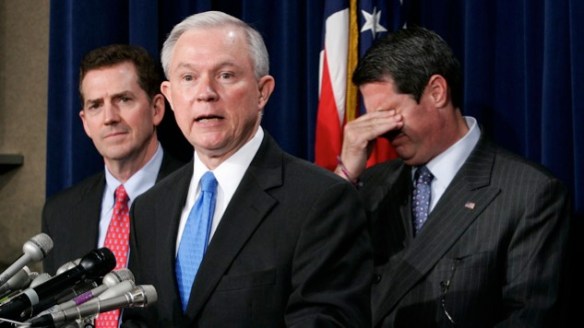
The Democrats and their fake “left” allies held war-mongering demonstrations in a number of cities on Thursday in defense of the fired far-right attorney general, Jeff Sessions, and the anti-Russia investigation being conducted by Special Counsel Robert Mueller.

Wednesday’s ouster of Sessions and his replacement by Trump ally Matthew G. Whitaker has brought forth a wave of condemnation from Democratic Party figures and their media allies, including the New York Times and Washington Post, asserting that the move is the prelude to Trump’s closing down of the Justice Department probe into allegations of Russian “meddling” in the 2016 elections and possible collusion by the Trump campaign.

Trump had repeatedly denounced Sessions for having recused himself from the Russia investigation in March of 2017, leaving Deputy Attorney General Rod Rosenstein, a defender of the investigation, in overall charge of its conduct. Whitaker, a former US attorney and now acting attorney general and therefore responsible for overseeing the Mueller probe, is on record criticizing Mueller and suggesting that the Justice Department could cut off funding for his office.

Mueller’s investigation has been at the center of a McCarthyite-style campaign against Russia spearheaded by the intelligence agencies and the Democratic Party, based on fabricated claims that Russian President Vladimir Putin interfered in the presidential election to undermine the candidacy of Democrat Hillary Clinton and boost Trump. It has been used as a weapon in the drive by the Democrats and sections of the military/intelligence establishment to force Trump to adopt a more aggressive posture against Moscow and in the war for regime-change in Syria.

To the extent that the Democrats oppose the right-wing Trump administration, it is on this entirely reactionary basis. In the lead-up to Tuesday’s midterm elections, they not only called no demonstrations, they were entirely silent on Trump’s fascistic attacks on immigrants, his deployment of troops to the border against the caravan of Central American asylum seekers, and his pledge to overturn the 14th Amendment guarantee of birthright citizenship—a cornerstone of the Bill of Rights.

Following the election, in which the Democrats won control of the House of Representatives, the party leadership called repeatedly for bipartisan unity and collaboration with Trump, underscoring their essential agreement with his policies of war, austerity and repression. It was only when Trump fired Sessions, a right-wing anti-immigrant zealot, that they swung into action, reviving their denunciations of Trump as a stooge of Putin.

The aim of shifting the Trump administration to a war footing against Russia has been achieved to the extent that there is now a substantial risk of nuclear conflict between the US and the second-leading nuclear power. War could quickly erupt in a number of flash points, especially Syria, where Russian soldiers, sailors and airmen carry out combat operations within miles of their American counterparts, as well as US-allied Islamist proxies armed by Saudi Arabia.

Though promoted in the media and sponsored by over 50 Democratic Party-linked organizations, including MoveOn.org, the rallies on Tuesday were small, reflecting the lack of support in the general population for the anti-Russia crusade. The protests were notable primarily for their unvarnished right-wing and neo-McCarthyite character.

Two of the largest were in Washington DC and New York City, which each drew roughly 1,000 demonstrators, many of whom held hammer and cycle posters with Putin’s image. Sessions began his career as a segregationist in Jim Crow Alabama and went on to become a right-wing Republican senator from the state. Mueller, for his part, was director of the FBI from 2001 to 2013, during which time he helped institute mass domestic surveillance and other sweeping attacks on democratic rights linked to the so-called “war on terror.”

At the Washington demonstration, Democratic Congressman Jamie Raskin led those in attendance in a round of applause for Sessions. Randi Weingarten, president of the American Federation of Teachers, appealed to the military against Trump, declaring, “You are the defenders of our democracy,” and led a chant of “protect Mueller.”

In defending Sessions, the Democrats and their allies are rallying around the most rightwing attorney general in American history, who, prior to joining the Trump cabinet, had won a well-earned reputation as a bitter opponent of civil rights. As attorney general, Sessions will primarily be remembered for the persecution of immigrants, most notably the separation of immigrant children from their parents and their imprisonment in detention camps built in the desert.

The task of spearheading the attack on immigrants and democratic rights will now fall, pending the installation of a permanent attorney general, to Whitaker, who has boasted that he interprets the Constitution from a biblical standpoint. His very first act as head of the Department of Justice was to issue, in conjunction with the Department of Homeland Security, a directive stripping the right to asylum from anyone who enters the US over the Mexican border and has not first gained legal status—a move that is tantamount to abolishing the right to asylum, which is guaranteed under international and US law.

This move, a new landmark in the attack on immigrants, due process and basic democratic rights, has been virtually ignored by the media and the Democratic Party. It was not mentioned in the press release calling Thursday’s demonstration, nor by speakers at the demonstrations in Washington and New York.

Has America Become a Dictatorship Disguised as a Democracy?


By John W. Whitehead

Source: The Rutherford Institute

“The poor and the underclass are growing. Racial justice and human rights are nonexistent. They have created a repressive society and we are their unwitting accomplices. Their intention to rule rests with the annihilation of consciousness. We have been lulled into a trance. They have made us indifferent to ourselves, to others. We are focused only on our own gain.”—They Live, John Carpenter

We’re living in two worlds, you and I.

There’s the world we see (or are made to see) and then there’s the one we sense (and occasionally catch a glimpse of), the latter of which is a far cry from the propaganda-driven reality manufactured by the government and its corporate sponsors, including the media.

Indeed, what most Americans perceive as life in America—privileged, progressive and free—is a far cry from reality, where economic inequality is growing, real agendas and real power are buried beneath layers of Orwellian doublespeak and corporate obfuscation, and “freedom,” such that it is, is meted out in small, legalistic doses by militarized police armed to the teeth.

All is not as it seems.

“You see them on the street. You watch them on TV. You might even vote for one this fall. You think they’re people just like you. You’re wrong. Dead wrong.”

This is the premise of John Carpenter’s film They Live, which was released 30 years ago in November 1988 and remains unnervingly, chillingly appropriate for our modern age.

Best known for his horror film Halloween, which assumes that there is a form of evil so dark that it can’t be killed, Carpenter’s larger body of work is infused with a strong anti-authoritarian, anti-establishment, laconic bent that speaks to the filmmaker’s concerns about the unraveling of our society, particularly our government.

Time and again, Carpenter portrays the government working against its own citizens, a populace out of touch with reality, technology run amok, and a future more horrific than any horror film.

In Escape from New York, Carpenter presents fascism as the future of America.

In The Thing, a remake of the 1951 sci-fi classic of the same name, Carpenter presupposes that increasingly we are all becoming dehumanized.

In Christine, the film adaptation of Stephen King’s novel about a demon-possessed car, technology exhibits a will and consciousness of its own and goes on a murderous rampage.

In In the Mouth of Madness, Carpenter notes that evil grows when people lose “the ability to know the difference between reality and fantasy.”

And then there is Carpenter’s They Live, in which two migrant workers discover that the world is not as it seems. In fact, the population is actually being controlled and exploited by aliens working in partnership with an oligarchic elite. All the while, the populace—blissfully unaware of the real agenda at work in their lives—has been lulled into complacency, indoctrinated into compliance, bombarded with media distractions, and hypnotized by subliminal messages beamed out of television and various electronic devices, billboards and the like.

It is only when homeless drifter John Nada (played to the hilt by the late Roddy Piper) discovers a pair of doctored sunglasses—Hoffman lenses—that Nada sees what lies beneath the elite’s fabricated reality: control and bondage.

When viewed through the lens of truth, the elite, who appear human until stripped of their disguises, are shown to be monsters who have enslaved the citizenry in order to prey on them.

Likewise, billboards blare out hidden, authoritative messages: a bikini-clad woman in one ad is actually ordering viewers to “MARRY AND REPRODUCE.” Magazine racks scream “CONSUME” and “OBEY.” A wad of dollar bills in a vendor’s hand proclaims, “THIS IS YOUR GOD.”

When viewed through Nada’s Hoffman lenses, some of the other hidden messages being drummed into the people’s subconscious include: NO INDEPENDENT THOUGHT, CONFORM, SUBMIT, STAY ASLEEP, BUY, WATCH TV, NO IMAGINATION, and DO NOT QUESTION AUTHORITY.

This indoctrination campaign engineered by the elite in They Live is painfully familiar to anyone who has studied the decline of American culture.

A citizenry that does not think for themselves, obeys without question, is submissive, does not challenge authority, does not think outside the box, and is content to sit back and be entertained is a citizenry that can be easily controlled.

In this way, the subtle message of They Live provides an apt analogy of our own distorted vision of life in the American police state, what philosopher Slavoj Žižek refers to as dictatorship in democracy, “the invisible order which sustains your apparent freedom.”

We’re being fed a series of carefully contrived fictions that bear no resemblance to reality.

The powers-that-be want us to feel threatened by forces beyond our control (terrorists, shootersbombers).

They want us afraid and dependent on the government and its militarized armies for our safety and well-being.

They want us distrustful of each other, divided by our prejudices, and at each other’s throats.

Most of all, they want us to continue to march in lockstep with their dictates.

Tune out the government’s attempts to distract, divert and befuddle us and tune into what’s really going on in this country, and you’ll run headlong into an unmistakable, unpalatable truth: the moneyed elite who rule us view us as expendable resources to be used, abused and discarded.

In fact, a study conducted by Princeton and Northwestern University concluded that the U.S. government does not represent the majority of American citizens. Instead, the study found that the government is ruled by the rich and powerful, or the so-called “economic elite.” Moreover, the researchers concluded that policies enacted by this governmental elite nearly always favor special interests and lobbying groups.

In other words, we are being ruled by an oligarchy disguised as a democracy, and arguably on our way towards fascism—a form of government where private corporate interests rule, money calls the shots, and the people are seen as mere subjects to be controlled.

Not only do you have to be rich—or beholden to the rich—to get elected these days, but getting elected is also a surefire way to get rich. As CBS News reports, “Once in office, members of Congress enjoy access to connections and information they can use to increase their wealth, in ways that are unparalleled in the private sector. And once politicians leave office, their connections allow them to profit even further.”

In denouncing this blatant corruption of America’s political system, former president Jimmy Carter blasted the process of getting elected—to the White House, governor’s mansion, Congress or state legislatures—as “unlimited political bribery… a subversion of our political system as a payoff to major contributors, who want and expect, and sometimes get, favors for themselves after the election is over.”

Rest assured that when and if fascism finally takes hold in America, the basic forms of government will remain: Fascism will appear to be friendly. The legislators will be in session. There will be elections, and the news media will continue to cover the entertainment and political trivia. Consent of the governed, however, will no longer apply. Actual control will have finally passed to the oligarchic elite controlling the government behind the scenes.

Sound familiar?

Clearly, we are now ruled by an oligarchic elite of governmental and corporate interests.

We have moved into “corporatism” (favored by Benito Mussolini), which is a halfway point on the road to full-blown fascism.

Corporatism is where the few moneyed interests—not elected by the citizenry—rule over the many. In this way, it is not a democracy or a republican form of government, which is what the American government was established to be. It is a top-down form of government and one which has a terrifying history typified by the developments that occurred in totalitarian regimes of the past: police states where everyone is watched and spied on, rounded up for minor infractions by government agents, placed under police control, and placed in detention (a.k.a. concentration) camps.

For the final hammer of fascism to fall, it will require the most crucial ingredient: the majority of the people will have to agree that it’s not only expedient but necessary.

But why would a people agree to such an oppressive regime?

The answer is the same in every age: fear.

Fear makes people stupid.

Fear is the method most often used by politicians to increase the power of government. And, as most social commentators recognize, an atmosphere of fear permeates modern America: fear of terrorism, fear of the police, fear of our neighbors and so on.

The propaganda of fear has been used quite effectively by those who want to gain control, and it is working on the American populace.

Despite the fact that we are 17,600 times more likely to die from heart disease than from a terrorist attack; 11,000 times more likely to die from an airplane accident than from a terrorist plot involving an airplane; 1,048 times more likely to die from a car accident than a terrorist attack, and 8 times more likely to be killed by a police officer than by a terrorist , we have handed over control of our lives to government officials who treat us as a means to an end—the source of money and power.

As the Bearded Man in They Live warns, “They are dismantling the sleeping middle class. More and more people are becoming poor. We are their cattle. We are being bred for slavery.”

In this regard, we’re not so different from the oppressed citizens in They Live.

From the moment we are born until we die, we are indoctrinated into believing that those who rule us do it for our own good. The truth is far different.

Despite the truth staring us in the face, we have allowed ourselves to become fearful, controlled, pacified zombies.

We live in a perpetual state of denial, insulated from the painful reality of the American police state by wall-to-wall entertainment news and screen devices.

Most everyone keeps their heads down these days while staring zombie-like into an electronic screen, even when they’re crossing the street. Families sit in restaurants with their heads down, separated by their screen devices and unaware of what’s going on around them. Young people especially seem dominated by the devices they hold in their hands, oblivious to the fact that they can simply push a button, turn the thing off and walk away.

Indeed, there is no larger group activity than that connected with those who watch screens—that is, television, lap tops, personal computers, cell phones and so on. In fact, a Nielsen study reports that American screen viewing is at an all-time high. For example, the average American watches approximately 151 hours of television per month.

The question, of course, is what effect does such screen consumption have on one’s mind?

Psychologically it is similar to drug addiction. Researchers found that “almost immediately after turning on the TV, subjects reported feeling more relaxed, and because this occurs so quickly and the tension returns so rapidly after the TV is turned off, people are conditioned to associate TV viewing with a lack of tension.” Research also shows that regardless of the programming, viewers’ brain waves slow down, thus transforming them into a more passive, nonresistant state.

Historically, television has been used by those in authority to quiet discontent and pacify disruptive people. “Faced with severe overcrowding and limited budgets for rehabilitation and counseling, more and more prison officials are using TV to keep inmates quiet,” according to Newsweek.

Given that the majority of what Americans watch on television is provided through channels controlled by six mega corporations, what we watch is now controlled by a corporate elite and, if that elite needs to foster a particular viewpoint or pacify its viewers, it can do so on a large scale.

If we’re watching, we’re not doing.

The powers-that-be understand this. As television journalist Edward R. Murrow warned in a 1958 speech:

We are currently wealthy, fat, comfortable and complacent. We have currently a built-in allergy to unpleasant or disturbing information. Our mass media reflect this. But unless we get up off our fat surpluses and recognize that television in the main is being used to distract, delude, amuse, and insulate us, then television and those who finance it, those who look at it, and those who work at it, may see a totally different picture too late.

This brings me back to They Live, in which the real zombies are not the aliens calling the shots but the populace who are content to remain controlled.

When all is said and done, the world of They Live is not so different from our own.

We, too, are focused only on our own pleasures, prejudices and gains. Our poor and underclasses are also growing. Racial injustice is growing. Human rights is nearly nonexistent. We too have been lulled into a trance, indifferent to others.

Oblivious to what lies ahead, we’ve been manipulated into believing that if we continue to consume, obey, and have faith, things will work out. But that’s never been true of emerging regimes. And by the time we feel the hammer coming down upon us, it will be too late.

So where does that leave us?

The characters who populate Carpenter’s films provide some insight.

Underneath their machismo, they still believe in the ideals of liberty and equal opportunity. Their beliefs place them in constant opposition with the law and the establishment, but they are nonetheless freedom fighters.

When, for example, John Nada destroys the alien hyno-transmitter in They Live, he restores hope by delivering America a wake-up call for freedom.

That’s the key right there: we need to wake up.

Stop allowing yourselves to be easily distracted by pointless political spectacles and pay attention to what’s really going on in the country.

The real battle for control of this nation is not being waged between Republicans and Democrats in the ballot box.

As I make clear in my book Battlefield America: The War on the American People, the real battle for control of this nation is taking place on roadsides, in police cars, on witness stands, over phone lines, in government offices, in corporate offices, in public school hallways and classrooms, in parks and city council meetings, and in towns and cities across this country.

The real battle between freedom and tyranny is taking place right in front of our eyes, if we would only open them.

All the trappings of the American police state are now in plain sight.

Wake up, America.

If they live (the tyrants, the oppressors, the invaders, the overlords), it is only because “we the people” sleep.

True Revolution

Artwork by Patricia Allingham Carlson

By Caitlin Johnstone

Source: CaitlinJohnstone.com

A radical change in human behavior away from its patterns of oppression, exploitation, war and ecocide will necessarily involve a drastic transformation in humanity’s relationship with thought. I’ve been saying this over and over again in different ways for a long time now, and yet I still get criticisms saying that I have useful insights but I don’t provide any plan of action.

The transformation in human consciousness is the plan of action. I really don’t know how to say it any clearer than that. And I will go so far as to say that that it is the only plan of action which will pull us out of our destructive patterns and into a healthy state of collaboration with each other and with our ecosystem. Unless we radically change the way we function above the neck, we will keep killing, consuming and destroying like a bunch of mindless automatons until everything is dead. I really don’t see any other way out of this.

I understand the criticism, though. When people read about the problem of capitalist ecocide and oligarchic strangulation, they don’t want to hear a bunch of stuff about mass ego death and spiritual enlightenment, they want to hear about nationwide demonstrations or organizing the working class or forming a new political party or cryptocurrencies or ending the Federal Reserve, or something along those lines depending on where they believe the problem is localized. In general, they want a fairy tale about people coming together to effect drastic, sweeping changes and turn the status quo on its head, which they will do because something something reasons, cough cough.

Seriously, why do people think revolution happens? Why do they believe their ideas have a chance of winning out over the existing paradigm? There are many who espouse dissident opinions more as a sort of ideological fashion statement than because they actually want to change the world, but presumably a lot of the people promoting Marxism, libertarianism, anarchism etc are doing so because they genuinely would like to see a world in which the status quo is overturned and replaced with something more wholesome. But why would that happen? Why would millions or billions of people overturn existing power structures and replace the current system with something drastically different in a world where plutocrats buy up massive amounts of media influence to convince everyone to keep everything the same?

It doesn’t seem like many proponents of revolution and change have really thought about this very much. They have a good idea, and they can envision a world in which that idea is implemented, but getting from the idea to its manifestation seems like it’s often a jumbled mess in a lot of dissidents’ minds, not unlike the “Phase 1: Collect underpants / Phase 2: ??? / Phase 3: Profit” model of the Underpants Gnomes from South Park. Most dissident voices I see are primarily interested in Phase 1, and to a much lesser extent in Phase 3. Phase 2 is what I’m interested in, and in my opinion it necessarily involves a drastic shift in human consciousness.

People are not going to deviate from their patterns and suddenly begin shrugging off ruling power structures for no reason. Revolutions historically happen for one of two reasons: (1) things get sufficiently bad to make people lash out against their government out of sheer desperation, and/or (2) people are manipulated into revolting by other powerful forces. Historically neither of these things ever lead to the creation of a stable, beneficent government that takes good care of its citizens or the world, so neither will be sufficient for creating a world in which humanity takes good care of itself and its environment, and even if that were not the case it’s unlikely that either will ever be allowed to occur by an establishment so powerful and skillful at manipulation as the US-centralized empire.

So if there is to be a people’s revolution which is effective in both (A) removing our oligarchic oppressors from power and (B) leading to the creation of a healthy, harmonious new paradigm, it will necessarily come from a place that is historically unprecedented. It will involve people rising up against existing power structures not because things got so bad they had no choice, nor because they were manipulated into it by other rival power structures, but because people realized collectively that it is in their best interests to do so.

This would require a level of wisdom and insight that the majority of human beings simply do not possess right now. Right now, most people are very easily manipulated into advancing establishment interests by plutocrat-controlled media, and until that changes there will never be an effective and beneficial revolution. For that to change, humanity is going to have to shed its ubiquitous habit of creating mental egoic patterns which make us susceptible to manipulation via fear, greed, and herd mentality.

This doesn’t mean that the existing systems of capitalism and government aren’t going to have to change; of course they’ll have to change. But they’re not going to change unless we find a way to wake up from the deeply conditioned egoic patterns which are the norm in the world we were born into. We’ll keep repeating and repeating the same old patterns in whatever way we’ve been conditioned to until we either go the way of the dinosaur or find a way to transcend our conditioning.

So yes, true revolution means abandoning the insane strategy of endless economic expansion in a world made up of finite space and resources, but it also means seeing through the illusory nature of our sense of self and ceasing to believe the babbling mental narratives which are premised upon it. Yes, true revolution means ceasing the worldwide frantic, futile scramble to do what ever it takes in order to get the right kind of numbers in our bank account so we don’t starve to death in an arbitrary economic system based on imaginary bureaucratic fiat, but it also means bringing our unconscious coping mechanisms into consciousness and healing our childhood traumas. Yes, true revolution means organizing and engaging in politics and creating new systems together, but it also means learning to really love the most tender, guarded parts of ourselves which we used to leave unattended running on autopilot in our subconscious mental processes.

I firmly believe that we are capable of such a collective awakening, and there are experts in the field of inner transformation who claim to have observed signs that such an awakening may be underway. Teachers like Eckhart TolleAdyashanti and Jac O’Keefe all say something is very different in their field of work, and individuals are now having an easier time awakening from egoic consciousness than they used to. Spontaneous shifts are becoming commonplace to the point where teachers like Tony Parsons now center their entire body of teaching around the possibility of snapping out of one’s old perceptual frame of reference without engaging in any spiritual practices at all.

Of this potential for large scale awakening, Tolle says the following:

“I see signs that it is already happening. For the first time there is a large scale awakening on our planet. Why now? Because if there is no change in human consciousness now, we will destroy ourselves and perhaps the planet. The insanity of the collective egoic mind, amplified by science and technology, is rapidly taking our species to the brink of disaster. Evolve or die: that is our only choice now. Without considering the Eastern world, my estimate is that at this time about ten percent of people in North America are already awakening. That makes thirty million Americans alone, and in addition to those people in other North American countries, about ten percent of the population of Western European countries are also awakening. This is probably enough of a critical mass to bring about a new earth. So the transformation of consciousness is truly happening even though they won’t be reporting it on tonight’s news. Is it happening fast enough? I am hopeful about humanity’s future, much more so now than when I wrote The Power of Now. In fact that is why I wrote that book. I really wasn’t sure that humanity was going to survive. Now I feel differently. I see many reasons to be hopeful.”

There aren’t many people who’d be in a position to say if human consciousness has been making a marked shift over the last few years, but Tolle, who interfaces with that information constantly as an essential part of his work as a spiritual teacher, is certainly one of them.

So there are reasons to believe it is possible for us to pull up from our omnicidal, ecocidal, exploitative trajectory and create something new together. We may pass this test yet. But even if I’m wrong about that, what the hell else are we going to do? What better chance do we have, and what more productive way is there to spend one’s time on this earth than coming to a deep and abiding insight into your true nature? From my point of view, the front lines of the revolution are in our own consciousness here and now, not as some intriguing marginal facet of the battle for humanity, but as its source, its heart, and its apex.

Know thyself, oh rebel. Know thyself and save the world.

The Psychology of Fascism

By Robert J. Burrowes

The continuing rise of fascism around the world is drawing increasing attention particularly as it takes firmer grip within national societies long seen to have rejected it.

Some recent studies have reminded us of the characteristics of fascist movements and individuals, particularly as they manifest among politically active fascists. For example, in his recent book How Fascism Works: The Politics of Us And Them Professor Jason Stanley has identified ten characteristics shared by fascists which have been simply presented in the article ‘Prof Sees Fascism Creeping In U.S.’

These characteristics, readily evident in the USA, Europe, Israel, Saudi Arabia, Myanmar and elsewhere today, include belief in a mythic (false) past, propaganda to divert attention and blame from the true source of corruption, anti-intellectualism and a belief in the ‘common man’ while deriding ‘women and racial and sexual minorities who seek basic equality as in fact seeking political and cultural domination’, promotion of elite dogma at the expense of any competing ideas (such as those in relation to freedom and equality), portrayal of the elite and its agents as victims, reliance on delusion rather than fact to justify their pursuit of power, the use of law and order ‘not to punish actual criminals, but to criminalize “out groups” like racial, ethnic, religious and sexual minorities’ which is why we are now ‘seeing criminality being written into immigration status’, and identification of “out groups” as lazy while attacking welfare systems and labor organizers, and promoting the idea that elites and their agents are hard working while exploited groups are lazy and a drain on the state.

In an earlier article ‘Fascism Anyone?’, published in the Spring 2003 issue of Free Inquiry Magazine, Professor Laurence W. Britt identified fourteen shared threads that link fascists. These include powerful and continuing expressions of nationalism, disdain for the importance of human rights, identification of enemies/scapegoats (such as communists, socialists, liberals, ethnic and racial minorities, traditional national enemies, members of other religions, secularists, homosexuals and ‘terrorists’) as a unifying cause, obsession with national security and avid identification with the military, sexism, a controlled/compliant mass media that promotes the elite agenda, a manufactured perception that opposing the power elite is tantamount to an attack on religion, corporate power protected by the political elite while the power of labor is suppressed or eliminated, disdain for intellectuals and the arts, expanded police power and prison populations in response to an obsession with the crime and punishment of ordinary citizens (while elite crimes are protected by a compliant judiciary), rampant cronyism and corruption, and fraudulent elections defended by a judiciary beholden to the power elite.

Offering a more straightforward characterization of fascism in the US context, which also highlights its violence more explicitly than the characterizations above, the eminent Norwegian peace research scholar Professor Johan Galtung explains it thus: ‘US Fascism? Yes, indeed; if by fascism we mean use of massive violence for political goals. US fascism takes three forms: global with bombing, droning and sniping all over; domestic with military weapons used across race and class faultlines; and then NSA-National Security Agency spying on everybody.’ See ‘The Fall of the US Empire – And Then What?’

Among other recent commentaries, one draws attention to a recent fascist gathering in the USA – see ‘Davos For Fascists’ – another to the ways in which fascism, under various names, is being effectively spread – see ‘How the new wave of far-right populists are using football to further their power’ – and another warns of focusing too narrowly on one issue and missing the wider threat that fascism poses. See ‘Fascism IS Here in USA’.

In any case, for those paying attention to what is happening in places like the United States, Europe, Israel, Saudi Arabia, Myanmar and elsewhere, it is easy to see that the rush to embrace fascism is accelerating.

But why? Surely, in this ‘enlightened’ age, notions such as freedom, democracy, human rights and equality are deeply embedded in our collective psyche, particularly in the West. We believe that elections should be, and are, ‘free and fair’ and not determined by corporate donations; we believe that the judiciary is independent of political and corporate influence. But are they?

Well, in fact, the evidence offered by the casual observation of events in the places mentioned above, as well as elsewhere around the world, tells us that none of this is any longer, if it ever was, the case. Let me explain why.

Fascism is a political label but, like any such label, it has a psychological foundation. That is, the political behavior of those who are fascists can be explained by understanding their psychology. Of course, all behavior can be explained by psychology but I will focus on the psychology of fascist behavior here.

There have been attempts to understand and explain the psychology of fascism, starting with the early work of Wilhelm Reich in The Mass Psychology of Fascism. So what is the psychology of individuals who are fascists?

You might not be surprised to read that the psychology of fascists is complex and is a direct outcome of the nature of the extraordinary violence to which they were subjected as children.

The Psychology of Fascists

Let me briefly identify the psychological profile of fascists and the specific violence (‘visible’, ‘invisible’ and ‘utterly invisible’) that generates a person with this psychology. For a thorough explanation and elaboration of this profile, and explanations of the terms ‘visible’, ‘invisible’ and ‘utterly invisible’ violence, see ‘Why Violence?’ and Fearless Psychology and Fearful Psychology: Principles and Practice.

First, fascists are terrified and they are particularly terrified of those individuals who perpetrated violence against them when they were a child although this terror remains unconscious to them. Second, this terror is so extreme that fascists are too terrified to consciously identify to themselves their own perpetrator (one or both parents and/or other significant adults who were supposed to love them) and to say that it is this individual or individuals who are violent and wrong.

Third, because they are terrified, they are unable to defend themselves against the original perpetrator(s) but also, as a result, they are unable to defend themselves against other perpetrators who attack them later in life. This lack of capacity to defend themselves leads to the fourth and fifth attributes – a deep sense of powerlessness and a deep sense of self-hatred. However, it is too terrifying and painful for the individual to be consciously aware of any of these feelings/attributes.

Sixth, because they are terrified of identifying that they are the victim of the violence of their own parents (and/or other significant adults from their childhood) and that this violence terrified them, fascists unconsciously delude themselves about the identity of their own perpetrator. They will unconsciously identify their ‘perpetrator’ as one or more individuals of whom they are not actually afraid from an existing ‘legitimized victim’ group such as children or people from a different gender, race, religion or class. This is also because their unconscious terror and self-hatred compels them to project onto people who are ‘controllable’ (because their original perpetrators never were). For this reason, their victims are (unconsciously) carefully chosen and are always relatively powerless by comparison.

This is easy to do because, seventh, children who become fascists have been terrorized into accepting a very narrow-minded and dogmatic belief set that excludes consideration of those in other social (including gender, racial, religious or class) groups. The idea that they might open-mindedly consider other beliefs, or the rights of those not in the ‘in-group’, is (unconsciously) terrifying to them. Moreover, because they have been terrorized into adopting their rigid belief set, fascists develop an intense fear of the truth; hence, fascists are both bigoted and self-righteous. In addition, the belief set of fascists includes a powerful and violently reinforced ‘lesson’: ‘good’ means obedient; it does not mean intrinsically good, loving and caring.

Eighth, and as a result of all of the above, fascists learn to unconsciously project their self-hatred, one outcome of their own victimhood, as hatred for those in the ‘out-groups’. This ‘justifies’ their (violent) behavior and obscures their unconscious motivation: to remain unaware of their own suppressed terror and self-hatred.

Ninth, fascists have a compulsion to be violent; that is, they are addicted to it. Why? Because the act of violence allows them to explosively release the suppressed feelings (usually some combination of fear, terror, pain, anger and powerlessness) so that they experience a brief sensation of delusional ‘relief’. Because the ‘relief’ is both brief and delusional, they are condemned to repeat their violence endlessly.

But the compulsion to be violent is reinforced by another element in their belief set, the tenth characteristic: fascists have a delusional belief in the effectiveness and morality of violence; they have no capacity to perceive its dysfunctionality and immorality.

And eleventh, the extreme social terrorization experience to which fascists have been subjected means that the feelings of love, compassion, empathy and sympathy, as well as the mental function of conscience, are prevented from developing. Devoid of conscience and these feelings, fascists can inflict violence on others, including their own children, without experiencing the feedback that conscience and these feelings would provide.

What Can We Do?

There is no simple formula for healing the badly damaged psychology of a fascist (or those who occupy a proximate ‘political space’ such as conservatives who advocate violence): it takes years of violent parental and adult treatment to create a fascist and so the path to heal one is long and painful, assuming the support for the individual to do so is available. Nevertheless, fascists can heal from the terror and self-hatred that underpin their psychology. See Putting Feelings First’. And they can be assisted to heal by someone who is skilled in the art of deep listening. See ‘Nisteling: The Art of Deep Listening’.

Unfortunately, given their cowardice, fascists are unlikely to have the courage to seek the appropriate emotional support to heal. In the meantime, those of us so inclined must resist their violence and, ideally, this should be done strategically, particularly if we want impact against fascist national leaders. See Nonviolent Campaign Strategy or Nonviolent Defense/Liberation Strategy.

The good news is that we can avoid creating fascists. If you want to nurture a child so that they become compassionate and caring, live by their conscience and act with morality and courage in all circumstances, including when resisting fascists, then consider making ‘My Promise to Children’.

You might also consider joining the worldwide movement to end all violence, fascist or otherwise, by signing the online pledge of ‘The People’s Charter to Create a Nonviolent World’.

In essence: Fascists are terrified, full of self-hatred and powerless. But, too scared to feel their own terror, self-hatred and powerlessness, they unconsciously project this as fear of, and hatred for, the people in one or more ‘legitimized victim’ groups, including their own children (thus creating the next generation of fascists). They then try to ‘feel powerful’ by seeking violent control over these people themselves or by seeking to have violent control exercised over these people by various ‘authorities’, ranging from school teachers and religious figures to the police, military and various corporate and government agencies.

No matter how much control they have over others, however, it is impossible to control their own terror, self-hatred and powerlessness. So they are unconsciously and endlessly driven to seek (delusional) ‘relief’ by violently controlling those in legitimized victim groups. It is because their own children are the most immediately available ‘uncontrollable’ target that fascism is readily perpetuated.


Biodata: Robert J. Burrowes has a lifetime commitment to understanding and ending human violence. He has done extensive research since 1966 in an effort to understand why human beings are violent and has been a nonviolent activist since 1981. He is the author of ‘Why Violence?’ http://tinyurl.com/whyviolence His email address is flametree@riseup.net and his website is here. http://robertjburrowes.wordpress.com

Robert J. Burrowes
P.O. Box 68
Daylesford, Victoria 3460
Australia

Email: flametree@riseup.net

Websites:
Nonviolence Charter
Flame Tree Project to Save Life on Earth
‘Why Violence?’
Feelings First
Nonviolent Campaign Strategy
Nonviolent Defense/Liberation Strategy
Anita: Songs of Nonviolence
Robert Burrowes
Global Nonviolence Network

FACEBOOK’S PURGE OF POLITICAL PAGES FUELS DELUSION OF INSURGENT THREATS TO DEMOCRACY

By Kevin Gosztola

Source: ShadowProof

Facebook’s purge of more than 500 pages and 250 accounts ahead of midterm elections in the United States represents a massive trend to police social media activity in ways that put freedom of expression at risk.

This trend effectively discourages users from engaging in radical politics. It may be viewed as part of a counterinsurgency effort by a powerful social media company to assure a passive majority of Americans that they are properly guarding a widely used platform from alleged threats to democracy.

On October 11, Nathaniel Gleicher, Facebook’s head of cybersecurity policy, and Oscar Rodriguez, the company’s product manager, published a press release about the purge.

“We’re removing 559 pages and 251 accounts that have consistently broken our rules against spam and coordinated inauthentic behavior,” Gleicher and Rodriguez stated. “Many were using fake accounts or multiple accounts with the same names and posted massive amounts of content across a network of groups and pages to drive traffic to their websites.”

According to Gleicher and Rodriguez, these techniques were used by groups and pages to make content “appear more popular” than it truly was on Facebook.

Both suggested some of the pages and accounts were “ad farms” that misled users into believing they were “forums for legitimate political debate.”

Unfortunately, Facebook offered minimal transparency on the action. Administrators with removed pages or accounts were apparently given no specifics other than a notice that they were shut down.

Several of the pages and accounts removed were right-wing and known for boosting President Donald Trump and his administration’s agenda. There were also dozens of progressive or left-wing pages, which were taken down.

Anti-Media, an anti-establishment independent media site with two million followers, had its page removed. Carey Wedler, editor at Anti-Media, did not lose her personal Facebook page with over 100,000 followers, but almost simultaneously, Twitter sent a notice that Wedler’s account was suspended.

The Free Thought Project, Reverb Press, Press For Truth, and Rachel Blevins, an RT America correspondent, had their pages taken down.

Pages that document abuse by police were removed—Police the Police, Filming Cops, Cop Block, and Cop Logic. Both Police the Police and Filming Cops each had over a million followers.

“There are legitimate reasons that accounts and pages coordinate with each other—it’s the bedrock of fundraising campaigns and grassroots organizations,” Gleicher and Rodriguez stated. “But the difference is that these groups are upfront about who they are, and what they’re up to.”

Yet, none of the aforementioned pages, which have protested their removal, hid their missions from followers. They were very upfront about their political motives or agendas for social justice.

Gleicher and Rodriguez concluded, “As we get better at uncovering this kind of abuse, the people behind it—whether economically or politically motivated—will change their tactics to evade detection. It’s why we continue to invest heavily, including in better technology, to prevent this kind of misuse. Because people will only share on Facebook if they feel safe and trust the connections they make here.”

The last sentences of Facebook’s press release make it clear that the company took this action to protect their brand. They were concerned about how these pages or accounts were impacting the experience of more passive, or even apathetic, users.

Administrators also recognize that politicians on Capitol Hill are watching. As Senator Dianne Feinstein told executives during a recent Senate hearing, “You’ve created these platforms, and now they are being misused. And you have to be the ones to do something about it or we will.”

On October 17, Twitter also acknowledged pressure from upcoming midterm elections to guard against alleged “influence operations.” It released a dataset it said was linked to operations during the 2016 election.

“We will continue to proactively combat nefarious attempts to undermine the integrity of Twitter, while partnering with civil society, government, our industry peers, and researchers to improve our collective understanding of coordinated attempts to interfere in the public conversation,” the social media company pledged.”

No executives at any Silicon Valley tech corporation want the government to introduce regulations. With parts of the public, especially those in the liberal establishment clamoring for action, Facebook and other companies are taking steps to supposedly fix the problem.

Cracking Down On “Influence Campaigns”

Facebook’s mass removal of pages and accounts was the company’s most extensive crackdown on “influence campaigns” since it started policing its platform. Most U.S. media outlets described the offending pages and accounts as purveyors of “political spam.”

The New York Times reported on Facebook’s purge with an article that was headlined, “Facebook Tackles Rising Threat: Americans Aping Russian Schemes to Deceive.”

Ironically, this was misinformation. At no point did the Times demonstrate that the removed pages or accounts were inspired or influenced by “Russian schemes,” which may or may not have been employed during the 2016 presidential election.

What the Times did do is conflate Russia-based activity with the operation of these accounts because those users may have wielded similar tactics to extend their reach. This is as disingenuous as suggesting someone who relies on Internet privacy tools is using terrorist tactics because terrorists want to hide their location, too.

The push to impose more control over the exchange of information on Facebook stems from a widespread belief that the Russia-based Internet Research Agency conducted a campaign through more than 400 accounts and pages that relied on ads and false information to “create discord and harm” Hillary Clinton’s presidential campaign. The content was supposedly viewed by as many as 126 million Americans.

But in a paper on the 2016 presidential election by Thomas Ferguson, Paul Jorgensen, and Jie Chen from the Institute for New Economic Thinking, they show that this number is rather paltry. Americans saw at least 33 trillion posts in their news feeds between 2015 and 2017. Facebook even said a quarter of ads may have never been viewed by anyone.

The Senate intelligence committee reported minuscule ad numbers in key battleground states. In Wisconsin, $1,979 was spent. All but $54 were spent during the primary. Pennsylvania absorbed $823 and Michigan $300. “Unless Facebook discloses some vast new trove, the conclusion has to be that this was no full court press,” the report stated.

As the authors note, a few studies labeled sites as “Russian” or “Russian-influenced” simply because they have “politically distasteful” views that perhaps align with the agenda of Russia or run counter to U.S. foreign policy. This inappropriately counted non-mainstream or so-called fringe websites as part of an alleged Russian influence operation.

A far more extensive influence operation was likely perpetrated by networks highly capable of spreading right-wing messages in sophisticated manners.

“Our clearest and most significant observation is that the American political system has seen not a symmetrical polarization of the two sides of the political map, but rather the emergence of a discrete and relatively insular right-wing media ecosystem whose shape and communications practices differ sharply from the rest of the media ecosystem, ranging from the center-right to the left,” a Harvard study [PDF] on the 2016 election concluded.

The infiltrators sowing discord were aligned with Republicans and based in the United States. Like Ferguson, Jorgensen, and Chen contend, “By 2016, the Republican right had developed internet outreach and political advertising into a fine art and on a massive scale quite on its own.”

“Large numbers of conservative websites, including many that tolerated or actively encouraged white supremacy and contempt for immigrants, African-Americans, Hispanics, Jews, or the aspirations of women had been hard at work for years stoking up ‘tensions between groups already wary of one another.’ Breitbart and other organizations were in fact going global, opening offices abroad and establishing contacts with like-minded groups elsewhere.”

“Whatever the Russians were up to, they could hardly hope to add much value to the vast Made in America bombardment already underway. Nobody sows chaos like Breitbart or the Drudge Report, as the New York Times documented in one Idaho town,” the paper added.

Recognizing the influence of right-wing messaging networks during the 2016 election is critical. In fact, a list of removed pages posted by Western Journal suggests the vast majority of pages and accounts removed were right-wing. A minority were cop watch pages or libertarian pages against government abuses. An even smaller minority were liberal or Democratic pages.

Therefore, journalists are wrong to suggest there is some kind of balance between the left-wing and right-wing when it comes to spreading “fake news” or misinformation on social media platforms.

Part Of The Counterrevolution

It is difficult to discern whether police accountability or alternative media pages, which protested their removal, were targeted for the dissenting perspectives on their pages. What is more likely is that these pages were flagged by a Facebook algorithm.

“Bad content” to Facebook includes “false news,” “hate speech,” “spam,” “graphic violence,” “clickbait,” and “links to low quality web experiences (ad farms).” Given the company’s description of an “ad farm,” a page that linked to a website cluttered with ads, which were embedded to ensure server bills were paid, could be construed as an “ad farm.”

As Emma Llansó, the director of the Free Expression Project for the Center for Democracy and Technology, told the Guardian, there are a  “lot of people who fervently believe their political views and are trying to drive traffic to their posts and ideas. They’re probably also running ads on their sites to make money off doing so. The line between spammer activity with a financial motive and spammy-looking political advocacy is incredibly hard to draw.”

Facebook’s press release demonstrated indifference to the administrators of political pages, who use “backup” or fake accounts in order defend themselves from political opponents who may campaign to have their real accounts suspended.

Reverb’s page was verified by Facebook. As the Guardian reported, Reverb editor-in-chief Edward Lynn was never contacted by anyone with the company about any violations of standards.

Similarly, Brian Kolfage, who administered the Right Wing News page, which was shut down with three other pages, emailed back and forth with a Facebook executive. There were plans for a meeting so he could better understand how to comply with policies. The company chose not to work with Kolfage.

On October 17, Facebook deleted a video featuring journalist George Monbiot on the brutal colonial legacy of Christopher Columbus. It was up more than a week and had 900,000 views before it was taken down.

Again, the social media company was completely opaque in its decision. It may have been flagged as a result of graphic images in the video, but Facebook did not bother to offer an explanation.

Facebook announced a partnership in May with an influential think tank known as the Atlantic Council to help the company detect “emerging threats” and “disinformation campaigns.”  The organization formed after the North Atlantic Treaty was signed in 1949, and it is committed to maintaining America’s global dominance.

When Facebook removed 32 “suspicious pages” that were run by activists in August, it relied on the think tank’s Digital Forensic Research Lab to “point out similarities to fake Russian pages from 2016.” However, one of the pages removed was an event page for a counter-protest against a Unite the Right rally in Washington, D.C.

In Bernard Harcourt’s book, The Counterrevolution: How Our Government Went To War Against Its Own Citizens, he outlines his theory of the current paradigm citizens live under in the United States. Counterinsurgency has been systematically domesticated, even though there is “no real insurgency or active minority.”

“The Counterrevolution” creates this illusion of an “active minority.” When it comes to social media, the “active minority” is fringe political pages that are sowing discord by spreading “fake news” or misinformation. It is remarkable that part of the crackdown involved police accountability pages because law enforcement, which perpetuates this paradigm, benefits greatly from passive Americans believing cop watch pages on Facebook are “political spam.”

Or, more sinisterly, the pages and accounts are seen as employing tactics similar to Russian influence operations, which increases the fear of doing nothing to shut them down and justifies dramatic action—even if wholly innocent pages or users are censored.

Facebook may not be silencing dissenting perspectives deliberately, but in “The Counterrevolution,” it does not have to bother with restoring pages and accounts wrongfully taken down. Those pages and accounts are collateral damage. They were not specifically targeted. The social media company can claim it never intended to crack down on political speech and defend an action that is designed to give consumers and political elites the illusion that they are guarding the internet from perceived threats.

That is not to say there are no threats to democracy in the United States. A few weeks before Election Day, there are countless reports of voter suppression. But these threats do not manifest themselves in one’s news feed on Facebook. Rather, they come from Republican officials who use state apparatuses to make it harder for citizens to challenge their destructive and discriminatory agendas.