Source: Washington’s Blog
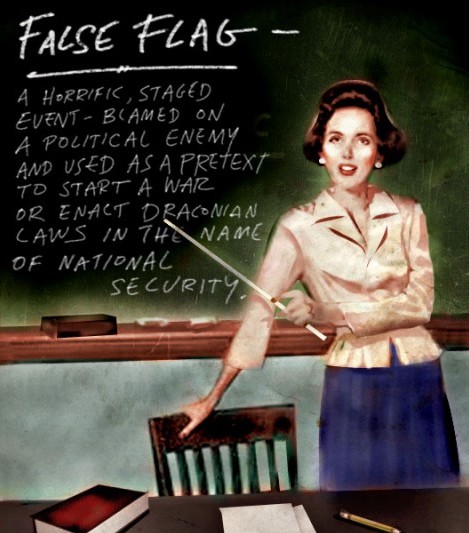
Presidents, Prime Ministers, Congressmen, Generals, Spooks, Soldiers and Police ADMIT to False Flag Terror
In the following instances, officials in the government which carried out the attack (or seriously proposed an attack) admit to it, either orally, in writing, or through photographs or videos:
(1) Japanese troops set off a small explosion on a train track in 1931, and falsely blamed it on China in order to justify an invasion of Manchuria. This is known as the “Mukden Incident” or the “Manchurian Incident”. The Tokyo International Military Tribunal found: “Several of the participators in the plan, including Hashimoto [a high-ranking Japanese army officer], have on various occasions admitted their part in the plot and have stated that the object of the ‘Incident’ was to afford an excuse for the occupation of Manchuria by the Kwantung Army ….” And see this, this and this.
(2) A major with the Nazi SS admitted at the Nuremberg trials that – under orders from the chief of the Gestapo – he and some other Nazi operatives faked several attacks on their own people and resources which they blamed on the Poles, to justify the invasion of Poland. The staged attacks included:
- The German radio station Sender Gleiwitz [details below]
- The strategic railway at POSunka Pass (Jabłonków Incident), located on the border between Poland and Czechoslovakia
- The German customs station at Hochlinden (today part of Rybnik-Stodoły)
- The forest service station in Pitschen (Byczyna)
- The communications station at Neubersteich (“Nieborowitzer Hammer” before 12 February 1936, now Kuznia Nieborowska)
- The railroad station in Alt-Eiche (Smolniki), Rosenberg in Westpreußen district
- A woman and her companion in Katowice
The details of the Gleiwitz radio station incident include:
On the night of 31 August 1939, a small group of German operatives dressed in Polish uniforms and led by Naujocks seized the Gleiwitz station and broadcast a short anti-German message in Polish (sources vary on the content of the message). The Germans’ goal was to make the attack and the broadcast look like the work of anti-German Polish saboteurs.
To make the attack seem more convincing, the Germans used human corpses to pass them off as Polish attackers. They murdered Franciszek Honiok, a 43-year-old unmarried German Silesian Catholic farmer known for sympathizing with the Poles. He had been arrested the previous day by the Gestapo. He was dressed to look like a saboteur, then killed by lethal injection, given gunshot wounds, and left dead at the scene so that he appeared to have been killed while attacking the station. His corpse was subsequently presented to the police and press as proof of the attack.
(3) The minutes of the high command of the Italian government – subsequently approved by Mussolini himself – admitted that violence on the Greek-Albanian border was carried out by Italians and falsely blamed on the Greeks, as an excuse for Italy’s 1940 invasion of Greece.
(4) Nazi general Franz Halder also testified at the Nuremberg trials that Nazi leader Hermann Goering admitted to setting fire to the German parliament building in 1933, and then falsely blaming the communists for the arson.
(5) Soviet leader Nikita Khrushchev admitted in writing that the Soviet Union’s Red Army shelled the Russian village of Mainila in 1939 – while blaming the attack on Finland – as a basis for launching the “Winter War” against Finland. Russian president Boris Yeltsin agreed that Russia had been the aggressor in the Winter War.
(6) The Russian Parliament, current Russian president Putin and former Soviet leader Gorbachev all admit that Soviet leader Joseph Stalin ordered his secret police to execute 22,000 Polish army officers and civilians in 1940, and then falsely blamed it on the Nazis.
(7) The British government admits that – between 1946 and 1948 – it bombed 5 ships carrying Jews who were Holocaust survivors attempting to flee to safety in Palestine right after World War II, set up a fake group called “Defenders of Arab Palestine”, and then had the psuedo-group falsely claim responsibility for the bombings (and see this, this and this).
(8) Israel admits that in 1954, an Israeli terrorist cell operating in Egypt planted bombs in several buildings, including U.S. diplomatic facilities, then left behind “evidence” implicating the Arabs as the culprits (one of the bombs detonated prematurely, allowing the Egyptians to identify the bombers, and several of the Israelis later confessed) (and see this and this).
The U.S. Army does not believe this is an isolated incident. For example, the U.S. Army’s School of Advanced Military Studies said of Mossad (Israel’s intelligence service):
“Ruthless and cunning. Has capability to target U.S. forces and make it look like a Palestinian/Arab act.”
(9) The CIA admits that it hired Iranians in the 1950′s to pose as Communists and stage bombings in Iran in order to turn the country against its democratically-elected prime minister.
(10) The Turkish Prime Minister admitted that the Turkish government carried out the 1955 bombing on a Turkish consulate in Greece – also damaging the nearby birthplace of the founder of modern Turkey – and blamed it on Greece, for the purpose of inciting and justifying anti-Greek violence.
(11) The British Prime Minister admitted to his defense secretary that he and American president Dwight Eisenhower approved a plan in 1957 to carry out attacks in Syria and blame it on the Syrian government as a way to effect regime change.
(12) The former Italian Prime Minister, an Italian judge, and the former head of Italian counterintelligence admit that NATO, with the help of the Pentagon and CIA, carried out terror bombings in Italy and other European countries in the 1950s through the 1980s and blamed the communists, in order to rally people’s support for their governments in Europe in their fight against communism.
As one participant in this formerly-secret program stated: “You had to attack civilians, people, women, children, innocent people, unknown people far removed from any political game. The reason was quite simple. They were supposed to force these people, the Italian public, to turn to the state to ask for greater security” … so that “a state of emergency could be declared, so people would willingly trade part of their freedom for the security” (and see this) (Italy and other European countries subject to the terror campaign had joined NATO before the bombings occurred). And watch this BBC special. They also allegedly carried out terror attacks in France, Belgium, Denmark, Germany, Greece, the Netherlands, Norway, Portugal, the UK, and other countries.
The CIA also stressed to the head of the Italian program that Italy needed to use the program to control internal uprisings.
False flag attacks carried out pursuant to this program include – by way of example only:
(13) In 1960, American Senator George Smathers suggested that the U.S. launch “a false attack made on Guantanamo Bay which would give us the excuse of actually fomenting a fight which would then give us the excuse to go in and [overthrow Castro]”.
(14) Official State Department documents show that, in 1961, the head of the Joint Chiefs and other high-level officials discussed blowing up a consulate in the Dominican Republic in order to justify an invasion of that country. The plans were not carried out, but they were all discussed as serious proposals.
(15) As admitted by the U.S. government, recently declassified documents show that in 1962, the American Joint Chiefs of Staff signed off on a plan to blow up AMERICAN airplanes (using an elaborate plan involving the switching of airplanes), and also to commit terrorist acts on American soil, and then to blame it on the Cubans in order to justify an invasion of Cuba. See the following ABC news report; the official documents; and watch this interview with the former Washington Investigative Producer for ABC’s World News Tonight with Peter Jennings.
(16) In 1963, the U.S. Department of Defense wrote a paper promoting attacks on nations within the Organization of American States – such as Trinidad-Tobago or Jamaica – and then falsely blaming them on Cuba.
(17) The U.S. Department of Defense also suggested covertly paying a person in the Castro government to attack the United States: “The only area remaining for consideration then would be to bribe one of Castro’s subordinate commanders to initiate an attack on Guantanamo.”
(18) A U.S. Congressional committee admitted that – as part of its “Cointelpro” campaign – the FBI had used many provocateurs in the 1950s through 1970s to carry out violent acts and falsely blame them on political activists.
(19) A top Turkish general admitted that Turkish forces burned down a mosque on Cyprus in the 1970s and blamed it on their enemy. He explained: “In Special War, certain acts of sabotage are staged and blamed on the enemy to increase public resistance. We did this on Cyprus; we even burnt down a mosque.” In response to the surprised correspondent’s incredulous look the general said, “I am giving an example”.
(20) A declassified 1973 CIA document reveals a program to train foreign police and troops on how to make booby traps, pretending that they were training them on how to investigate terrorist acts:
The Agency maintains liaison in varying degrees with foreign police/security organizations through its field stations ….
[CIA provides training sessions as follows:]
a. Providing trainees with basic knowledge in the uses of commercial and military demolitions and incendiaries as they may be applied in terrorism and industrial sabotage operations.
b. Introducing the trainees to commercially available materials and home laboratory techniques, likely to he used in the manufacture of explosives and incendiaries by terrorists or saboteurs.
c. Familiarizing the trainees with the concept of target analysis and operational planning that a saboteur or terrorist must employ.
d. Introducing the trainees to booby trapping devices and techniques giving practical experience with both manufactured and improvised devices through actual fabrication.
***
The program provides the trainees with ample opportunity to develop basic familiarity and use proficiently through handling, preparing and applying the various explosive charges, incendiary agents, terrorist devices and sabotage techniques.
(21) The German government admitted (and see this) that, in 1978, the German secret service detonated a bomb in the outer wall of a prison and planted “escape tools” on a prisoner – a member of the Red Army Faction – which the secret service wished to frame the bombing on.
(22) A Mossad agent admits that, in 1984, Mossad planted a radio transmitter in Gaddaffi’s compound in Tripoli, Libya which broadcast fake terrorist transmissions recorded by Mossad, in order to frame Gaddaffi as a terrorist supporter. Ronald Reagan bombed Libya immediately thereafter.
(23) The South African Truth and Reconciliation Council found that, in 1989, the Civil Cooperation Bureau (a covert branch of the South African Defense Force) approached an explosives expert and asked him “to participate in an operation aimed at discrediting the ANC [the African National Congress] by bombing the police vehicle of the investigating officer into the murder incident”, thus framing the ANC for the bombing.
(24) An Algerian diplomat and several officers in the Algerian army admit that, in the 1990s, the Algerian army frequently massacred Algerian civilians and then blamed Islamic militants for the killings (and see this video; and Agence France-Presse, 9/27/2002, French Court Dismisses Algerian Defamation Suit Against Author).
(25) In 1993, a bomb in Northern Ireland killed 9 civilians. Official documents from the Royal Ulster Constabulary (i.e. the British government) show that the mastermind of the bombing was a British agent, and that the bombing was designed to inflame sectarian tensions. And see this and this.
(26) The United States Army’s 1994 publication Special Forces Foreign Internal Defense Tactics Techniques and Procedures for Special Forces – updated in 2004 – recommends employing terrorists and using false flag operations to destabilize leftist regimes in Latin America. False flag terrorist attacks were carried out in Latin America and other regions as part of the CIA’s “Dirty Wars“. And see this.
(27) Similarly, a CIA “psychological operations” manual prepared by a CIA contractor for the Nicaraguan Contra rebels noted the value of assassinating someone on your own side to create a “martyr” for the cause. The manual was authenticated by the U.S. government. The manual received so much publicity from Associated Press, Washington Post and other news coverage that – during the 1984 presidential debate – President Reagan was confronted with the following question on national television:
At this moment, we are confronted with the extraordinary story of a CIA guerrilla manual for the anti-Sandinista contras whom we are backing, which advocates not only assassinations of Sandinistas but the hiring of criminals to assassinate the guerrillas we are supporting in order to create martyrs.
(28) A Rwandan government inquiry admitted that the 1994 shootdown and murder of the Rwandan president, who was from the Hutu tribe – a murder blamed by the Hutus on the rival Tutsi tribe, and which led to the massacre of more than 800,000 Tutsis by Hutus – was committed by Hutu soldiers and falsely blamed on the Tutis.
(29) An Indonesian government fact-finding team investigated violent riots which occurred in 1998, and determined that “elements of the military had been involved in the riots, some of which were deliberately provoked”.
(30) Senior Russian Senior military and intelligence officers admit that the KGB blew up Russian apartment buildings in 1999 and falsely blamed it on Chechens, in order to justify an invasion of Chechnya (and see this report and this discussion).
(31) As reported by the New York Times, BBC and Associated Press, Macedonian officials admit that in 2001, the government murdered 7 innocent immigrants in cold blood and pretended that they were Al Qaeda soldiers attempting to assassinate Macedonian police, in order to join the “war on terror”. They lured foreign migrants into the country, executed them in a staged gun battle, and then claimed they were a unit backed by Al Qaeda intent on attacking Western embassies”. Specifically, Macedonian authorities had lured the immigrants into the country, and then – after killing them – posed the victims with planted evidence – “bags of uniforms and semiautomatic weapons at their side” – to show Western diplomats.
(32) At the July 2001 G8 Summit in Genoa, Italy, black-clad thugs were videotaped getting out of police cars, and were seen by an Italian MP carrying “iron bars inside the police station”. Subsequently, senior police officials in Genoa subsequently admitted that police planted two Molotov cocktails and faked the stabbing of a police officer at the G8 Summit, in order to justify a violent crackdown against protesters.
(33) The U.S. falsely blamed Iraq for playing a role in the 9/11 attacks – as shown by a memo from the defense secretary – as one of the main justifications for launching the Iraq war.
Even after the 9/11 Commission admitted that there was no connection, Dick Cheney said that the evidence is “overwhelming” that al Qaeda had a relationship with Saddam Hussein’s regime, that Cheney “probably” had information unavailable to the Commission, and that the media was not ‘doing their homework’ in reporting such ties. Top U.S. government officials now admit that the Iraq war was really launched for oil … not 9/11 or weapons of mass destruction.
Despite previous “lone wolf” claims, many U.S. government officials now say that 9/11 was state-sponsored terror; but Iraq was not the state which backed the hijackers. (Many U.S. officials have allegedthat 9/11 was a false flag operation by rogue elements of the U.S. government; but such a claim is beyond the scope of this discussion. The key point is that the U.S. falsely blamed it on Iraq, when it knew Iraq had nothing to do with it.).
(Additionally, the same judge who has shielded the Saudis for any liability for funding 9/11 has awarded a default judgment against Iran for $10.5 billion for carrying out 9/11 … even though no one seriously believes that Iran had any part in 9/11.)
(34) Although the FBI now admits that the 2001 anthrax attacks were carried out by one or more U.S. government scientists, a senior FBI official says that the FBI was actually told to blame the Anthrax attacks on Al Qaeda by White House officials (remember what the anthrax letters looked like). Government officials also confirm that the white House tried to link the anthrax to Iraq as a justification for regime change in that country. And see this.
(35) According to the Washington Post, Indonesian police admit that the Indonesian military killed American teachers in Papua in 2002 and blamed the murders on a Papuan separatist group in order to get that group listed as a terrorist organization.
(36) The well-respected former Indonesian president also admits that the government probably had a role in the Bali bombings.
(37) Police outside of a 2003 European Union summit in Greece were filmed planting Molotov cocktails on a peaceful protester.
(38) In 2003, the U.S. Secretary of Defense admitted that interrogators were authorized to use the following method: “False Flag: Convincing the detainee that individuals from a country other than the United States are interrogating him.” While not a traditional false flag attack, this deception could lead to former detainees – many of whom were tortured – attacking the country falsely blamed for the interrogation and torture.
(39) Former Department of Justice lawyer John Yoo suggested in 2005 that the US should go on the offensive against al-Qaeda, having “our intelligence agencies create a false terrorist organization. It could have its own websites, recruitment centers, training camps, and fundraising operations. It could launch fake terrorist operations and claim credit for real terrorist strikes, helping to sow confusion within al-Qaeda’s ranks, causing operatives to doubt others’ identities and to question the validity of communications.”
(40) Similarly, in 2005, Professor John Arquilla of the Naval Postgraduate School – a renowned US defense analyst credited with developing the concept of ‘netwar’ – called for western intelligence services to create new “pseudo gang” terrorist groups, as a way of undermining “real” terror networks. According to Pulitzer-Prize winning journalist Seymour Hersh, Arquilla’s ‘pseudo-gang’ strategy was, Hersh reported, already being implemented by the Pentagon:
“Under Rumsfeld’s new approach, I was told, US military operatives would be permitted to pose abroad as corrupt foreign businessmen seeking to buy contraband items that could be used in nuclear-weapons systems. In some cases, according to the Pentagon advisers, local citizens could be recruited and asked to join up with guerrillas or terrorists…
The new rules will enable the Special Forces community to set up what it calls ‘action teams’ in the target countries overseas which can be used to find and eliminate terrorist organizations. ‘Do you remember the right-wing execution squads in El Salvador?’ the former high-level intelligence official asked me, referring to the military-led gangs that committed atrocities in the early nineteen-eighties. ‘We founded them and we financed them,’ he said. ‘The objective now is to recruit locals in any area we want. And we aren’t going to tell Congress about it.’ A former military officer, who has knowledge of the Pentagon’s commando capabilities, said, ‘We’re going to be riding with the bad boys.’”
(41) United Press International reported in June 2005:
U.S. intelligence officers are reporting that some of the insurgents in Iraq are using recent-model Beretta 92 pistols, but the pistols seem to have had their serial numbers erased. The numbers do not appear to have been physically removed; the pistols seem to have come off a production line without any serial numbers. Analysts suggest the lack of serial numbers indicates that the weapons were intended for intelligence operations or terrorist cells with substantial government backing. Analysts speculate that these guns are probably from either Mossad or the CIA. Analysts speculate that agent provocateurs may be using the untraceable weapons even as U.S. authorities use insurgent attacks against civilians as evidence of the illegitimacy of the resistance.
(42) In 2005, British soldiers dressed as Arabs were caught by Iraqi police after a shootout against the police. The soldiers apparently possessed explosives, and were accused of attempting to set off bombs. While none of the soldiers admitted that they were carrying out attacks, British soldiers and a column of British tanks stormed the jail they were held in, broke down a wall of the jail, and busted them out. The extreme measures used to free the soldiers – rather than have them face questions and potentially stand trial – could be considered an admission.
(43) Undercover Israeli soldiers admitted in 2005 to throwing stones at other Israeli soldiers so they could blame it on Palestinians, as an excuse to crack down on peaceful protests by the Palestinians.
(44) Quebec police admitted that, in 2007, thugs carrying rocks to a peaceful protest were actually undercover Quebec police officers (and see this).
(45) A 2008 US Army special operations field manual recommends that the U.S. military use surrogate non-state groups such as “paramilitary forces, individuals, businesses, foreign political organizations, resistant or insurgent organizations, expatriates, transnational terrorism adversaries, disillusioned transnational terrorism members, black marketers, and other social or political ‘undesirables.’” The manual specifically acknowledged that U.S. special operations can involve both counterterrorism and “Terrorism” (as well as “transnational criminal activities, including narco-trafficking, illicit arms-dealing, and illegal financial transactions.”)
(46) The former Italian Prime Minister, President, and head of Secret Services (Francesco Cossiga) advised the 2008 minister in charge of the police, on how to deal with protests from teachers and students:
He should do what I did when I was Minister of the Interior … infiltrate the movement with agents provocateurs inclined to do anything …. And after that, with the strength of the gained population consent, … beat them for blood and beat for blood also those teachers that incite them. Especially the teachers. Not the elderly, of course, but the girl teachers yes.
(47) An undercover officer admitted that he infiltrated environmental, leftwing and anti-fascist groups in 22 countries. Germany’s federal police chief admitted that – while the undercover officer worked for the German police – he acted illegally during a G8 protest in Germany in 2007 and committed arson by setting fire during a subsequent demonstration in Berlin. The undercover officer spent many years living with violent “Black Bloc” anarchists.
(48) Denver police admitted that uniformed officers deployed in 2008 to an area where alleged “anarchists” had planned to wreak havoc outside the Democratic National Convention ended up getting into a melee with two undercover policemen. The uniformed officers didn’t know the undercover officers were cops.
(49) At the G20 protests in London in 2009, a British member of parliament saw plain clothes police officers attempting to incite the crowd to violence.
(50) The oversight agency for the Royal Canadian Mounted Police admitted that – at the G20 protests in Toronto in 2010 – undercover police officers were arrested with a group of protesters. Videos and photos (see this and this, for example) show that violent protesters wore very similar boots and other gear as the police, and carried police batons. The Globe and Mail reports that the undercover officers planned the targets for violent attack, and the police failed to stop the attacks.
(51) Egyptian politicians admitted (and see this) that government employees looted priceless museum artifacts 2011 to try to discredit the protesters.
(52) Austin police admit that 3 officers infiltrated the Occupy protests in that city. Prosecutors admit that one of the undercover officers purchased and constructed illegal “lock boxes” which ended up getting many protesters arrested.
(53) In 2011, a Colombian colonel admitted that he and his soldiers had lured 57 innocent civilians and killed them – after dressing many of them in uniforms – as part of a scheme to claim that Columbia was eradicating left-wing terrorists. And see this.
(54) Rioters who discredited the peaceful protests against the swearing in of the Mexican president in 2012 admitted that they were paid 300 pesos each to destroy everything in their path. According to Wikipedia, photos also show the vandals waiting in groups behind police lines prior to the violence.
(55) On November 20, 2014, Mexican agent provocateurs were transported by army vehicles to participate in the 2014 Iguala mass kidnapping protests, as was shown by videos and pictures distributed via social networks.
(56) The highly-respected writer for the Telegraph Ambrose Evans-Pritchard says that the head of Saudi intelligence – Prince Bandar – recently admitted that the Saudi government controls “Chechen” terrorists.
(57) Two members of the Turkish parliament, high-level American sources and others admitted that the Turkish government – a NATO country – carried out the chemical weapons attacks in Syria and falsely blamed them on the Syrian government; and high-ranking Turkish government admitted on tape plans to carry out attacks and blame it on the Syrian government.
(58) The former Director of the NSA and other American government officials admit said that the U.S. is a huge supporter of terrorism. Jimmy Carter’s National Security Adviser Zbigniew Brzezinski admitted on CNN that the U.S. organized and supported Bin Laden and the other originators of “Al Qaeda” in the 1970s to fight the Soviets. The U.S. and its allies have been supporting Al Qaeda and other Islamic terrorist groups for many decades, and providing them arms, money and logistical support in Libya, Syria, Mali, Bosnia, Chechnya, Iran, and many other countries. U.S. allies are also directly responsible for creating and supplying ISIS.
It’s gotten so ridiculous that a U.S. Senator has introduced a “Stop Arming Terrorists Act”, and U.S. Congresswoman – who introduced a similar bill in the House – says: “For years, the U.S. government has been supporting armed militant groups working directly with and often under the command of terrorist groups like ISIS and al-Qaeda in their fight to overthrow the Syrian government.”
(59) The Ukrainian security chief admits that the sniper attacks which started the Ukrainian coup were carried out in order to frame others. Ukrainian officials admit that the Ukrainian snipers fired on both sides, to create maximum chaos.
(60) Speaking of snipers, in a secret recording, Venezuelan generals admit that they will deploy snipers to shoot protesters, but keep the marksmen well-hidden from demonstrator and the reporters covering the events so others would be blamed for the deaths.
(61) Burmese government officials admitted that Burma (renamed Myanmar) used false flag attacks against Muslim and Buddhist groups within the country to stir up hatred between the two groups, to prevent democracy from spreading.
(62) Israeli police were again filmed in 2015 dressing up as Arabs and throwing stones, then turning over Palestinian protesters to Israeli soldiers.
(63) Britain’s spy agency has admitted (and see this) that it carries out “digital false flag” attacks on targets, framing people by writing offensive or unlawful material … and blaming it on the target.
(64) The CIA has admitted that it uses viruses and malware from Russia and other countries to carry out cyberattacks and blame other countries.
(65) U.S. soldiers have admitted that if they kill innocent Iraqis and Afghanis, they then “drop” automatic weapons near their body so they can pretend they were militants.
(66) Similarly, police frame innocent people for crimes they didn’t commit. The practice is so well-known that the New York Times noted in 1981:
In police jargon, a throwdown is a weapon planted on a victim.
Newsweek reported in 1999:
Perez, himself a former [Los Angeles Police Department] cop, was caught stealing eight pounds of cocaine from police evidence lockers. After pleading guilty in September, he bargained for a lighter sentence by telling an appalling story of attempted murder and a “throwdown”–police slang for a weapon planted by cops to make a shooting legally justifiable. Perez said he and his partner, Officer Nino Durden, shot an unarmed 18th Street Gang member named Javier Ovando, then planted a semiautomatic rifle on the unconscious suspect and claimed that Ovando had tried to shoot themduring a stakeout.
Wikipedia notes:
As part of his plea bargain, Pérez implicated scores of officers from the Rampart Division’s anti-gang unit, describing routinely beating gang members, planting evidence on suspects, falsifying reports and covering up unprovoked shootings.
(As a side note – and while not technically false flag attacks – police have been busted framing innocent people in many other ways, as well.)
(67) A former U.S. intelligence officer recently alleged:
Most terrorists are false flag terrorists or are created by our own security services.
(68) The head and special agent in charge of the FBI’s Los Angeles office said that most terror attacks are committed by the CIA and FBI as false flags.
(69) The Director of Analytics at the interagency Global Engagement Center housed at the U.S. Department of State, also an adjunct professor at George Mason University, where he teaches the graduate course National Security Challenges in the Department of Information Sciences and Technology, a former branch chief in the CIA’s Counterterrorism Center, and an intelligence advisor to the Secretary of Homeland Security (J.D. Maddox) notes:
Provocation is one of the most basic, but confounding, aspects of warfare. Despite its sometimes obvious use, it has succeeded consistently against audiences around the world, for millennia, to compel war. A well-constructed provocation narrative mutes even the most vocal opposition.
***
The culmination of a strategic provocation operation invariably reflects a narrative of victimhood: we are the
victims of the enemy’s unforgivable atrocities.
***
In the case of strategic provocation the deaths of an aggressor’s own personnel are a core tactic of the provocation.
***
The persistent use of strategic provocation over centuries – and its apparent importance to war planners – begs the question of its likely use by the US and other states in the near term.
(70) Leaders throughout history have acknowledged the “benefits” of of false flags to justify their political agenda:
“Terrorism is the best political weapon for nothing drives people harder than a fear of sudden death”.
– Adolph Hitler
“Why of course the people don’t want war … But after all it is the leaders of the country who determine the policy, and it is always a simple matter to drag the people along, whether it is a democracy, or a fascist dictatorship, or a parliament, or a communist dictatorship … Voice or no voice, the people can always be brought to the bidding of the leaders. That is easy. All you have to do is to tell them they are being attacked, and denounce the pacifists for lack of patriotism and exposing the country to danger. It works the same in any country.”
– Hermann Goering, Nazi leader.
“The easiest way to gain control of a population is to carry out acts of terror. [The public] will clamor for such laws if their personal security is threatened”.
– Josef Stalin
Postscript 1: It is not just “modern” nations which have launched false flag attacks. For example, a Native American from one tribe (Pomunkey) murdered a white Englishwoman living in Virginia in 1697 and then falsely blamed it on second tribe (Piscataway). But he later admitted in court that he was not really Piscataway, and that he had been paid by a provocateur from a third tribe (Iroquois) to kill the woman as a way to start a war between the English and the Piscataway, thus protecting the profitable Iroquois monopoly in trade with the English.
Postscript 2: On multiple occasions, atrocities or warmongering are falsely blamed on the enemy as a justification for war … when no such event ever occurred. This is more like a “fake flag” than a “false flag”, as no actual terrorism occurred.
For example:
- The NSA admits that it lied about what really happened in the Gulf of Tonkin incident in 1964 … manipulating data to make it look like North Vietnamese boats fired on a U.S. ship so as to create a false justification for the Vietnam war
- Pulitzer prize-winning journalist Ron Suskind reported that the White House ordered the CIA to forge and backdate a document falsely linking Iraq with Muslim terrorists and 9/11 … and that the CIA complied with those instructions and in fact created the forgery, which was then used to justify war against Iraq. And see this and this
- Time magazine points out that the claim by President Bush that Iraq was attempting to buy “yellow cake” Uranium from Niger:
had been checked out — and debunked — by U.S. intelligence a year before the President repeated it.
- The “humanitarian” wars in Syria, Libya and Yugoslavia were all justified by highly exaggerated reports that the leaders of those countries were committing atrocities against their people. And see this
Afterword: The corporate media will likely never report on false flags … as it is ALWAYS pro-war.