Two for Tuesday
Reply

By Charles Hugh Smith
Source: Of Two Minds
Politicians and corporate managers have an enviable record of self-enrichment but very little to show in terms of putting the long-term interests of the citizenry above their own short-term gains.
This week’s focus is on self-reliance, a topic of increasing relevance than is more complex that it may seem.
Sociologists differentiate between high-trust and low-trust societies: in high-trust social orders, citizens tend to trust institutions and each other to conform to social norms, enabling strangers to trust a vast circle of transactions and socio-economic ties. Low-trust societies are plagued with distrust of authority and institutions and fear of getting taken advantage of by strangers, so the circles of trust are small, inhibiting social mobility and economic growth.
Economies and political systems can also be understood as high-trust or low-trust. If the political system excels at rewarding insiders and incumbents while leaving critical problems unsolved, citizens have little reason to trust the system.
The same is true of economies that greatly enrich insiders and incumbents at the expense of the citizenry via monopoly/cartel price-gouging, shrinkflation, degrading the quality of goods and services and the immiseration of standard services, forcing customers to “upgrade” from wretched to merely dismal.
Conventional pundits and economists are constantly whining that Americans “just don’t get it”: they tout our soaring per capita wealth, i.e. we’re getting richer, so everyone should be delighted, yet only 20% of the public are “satisfied with the way things are going.”
What the well-compensated pundits and economists are ignoring (or are paid to ignore) is the decay of the U.S. from a high-trust-functional to a low-trust-dysfunctional society and economy: Americans will still go out of their way to aid strangers, but their trust in institutions has plummeted to lows, as has their trust in the political-corporate elites’ leadership: politicians and corporate managers have an enviable record of self-enrichment but very little to show in terms of putting the long-term interests of the citizenry above their own short-term gains.
People understand the name of the game now is to spout all the expected optimistic PR of “innovation” and “serving the public” while maximizing their private gain at the expense of the nation. Offshoring America’s essential industrial supply chains wasn’t done to serve the nation; it was done to maximize profits, 90% of which flow to the top 10%. Pushing us into debt servitude is highly profitable, but it isn’t benefiting us or the nation.
Americans were told to trust long, hyper-globalized single-source supply chains as “efficient” (i.e. profitable) and trustworthy, yet they’ve discovered these supply chains are vulnerable and fragile. Americans were told that corporate monopolies were selling them “innovations” when in fact they were being sold highly addictive (and therefore highly profitable) goods and services.
Americans were told that their financial security was increasing even as the U.S. economy became increasingly dependent on hyper-financialized asset bubbles and central bank bailouts, the precise opposite of stability. Rather than producing more financial security for the bottom 80%, these “innovations” greatly expanded the gulf between the wealthy and the increasingly precarious bottom 80%.
Americans were told to trust that the hyper-centralization of political and financial power would benefit them, when the evidence is piling up that this hyper-centralization has increased the dysfunction of core institutions and the fragility of essential systems.
Doesn’t it ring hollow to glorify our soaring wealth while households declare bankruptcy due to medical bills, college students sign up for a lifetime of debt servitude to pay tuition and inflation has destroyed 20% of every wage earner’s paycheck just since January 2020? All that “soaring wealth” is asymmetrically distributed, but let’s not talk about that, let’s talk about statistics that mask that asymmetry.
What the well-compensated pundits and economists are paid to ignore is the concentration of the vast majority of all this new wealth and income in the top 10%. Soaring wealth only widens wealth inequality; it doesn’t benefit the nation, it weakens its foundations by accelerating the decay of trust in core institutions and systems.
What happens when high-trust decays to low-trust is the circle of reliable, trustworthy sources and people shrinks to the local, decentralized level. Rather than trust Big Ag, Big Fast-Food and supply chains of highly processed glop to feed us, we start turning to local sources of real food.
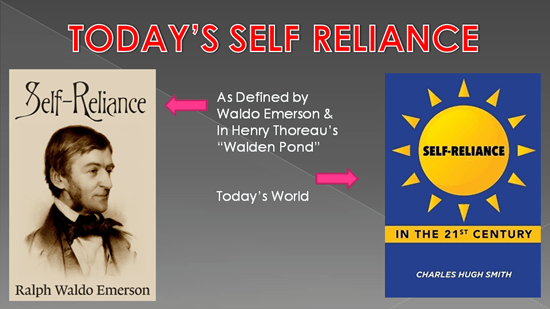
In the same way, we rediscover the value of thinking for ourselves rather than accepting self-serving memes-of-the-day. We rediscover the value of what Ralph Waldo Emerson wrote about in his 1841 essay Self-Reliance (free text, Project Gutenberg).
Emerson counsels us to “be our best selves,” and not to count property wealth above all else. (“They measure their esteem of each other by what each has, and not by what each is.”)
Emerson understood that the values of a society are the foundation of its economic order. A system lacking any principles and values other than greed and self-enrichment is a rotten structure doomed to collapse. It is not just the larger socio-economic order that needs a rock-solid value system; each individual must ground their choices and actions in a value system they have embraced on their own. (“Nothing can bring you peace but yourself. Nothing can bring you peace but the triumph of principles.”)
What Emerson is espousing is self-reliance, in thought, in values, and in economic and financial matters. In today’s world of crumbling hyper-globalization, self-reliance extends to the practical world of where our essential goods and services are coming from.
Gordon Long and I discuss these and many other aspects of Self-Reliance in the 21st Century in our wide-ranging podcast Self Reliance (45 min).
We discuss how the American economy has changed over the past 40 years, to the detriment of the nation’s values and the security of its citizenry, and what self-reliance means today– the topic of my book Self-Reliance in the 21st Century. (Read the first chapter for free.)
How can we best navigate our low-trust, increasingly dysfunctional society and economy? By strengthening our own self-reliance.
By Robert J. Burrowes
In accordance with its long-planned, detailed and comprehensive blueprint labeled ‘The Great Reset’, the Global Elite is currently implementing its program to reshape world order, kill off a substantial proportion of the human population, enclose the Commons ‘forever’, transfer all remaining wealth to the Elite and enslave those left alive in one of their technocratic ‘smart city’ prisons. See ‘We Are Being Smashed Politically, Economically, Medically and Technologically by the Elite’s “Great Reset”: Why? How Do We Fight Back Effectively?’
The methods for killing off people include the mandatory ‘Covid-19’ injection, which has killed at least 17,000,000 people worldwide so far – see ‘Global Study Links 17 Million Deaths to COVID-19 Vaccine, Reveals 0.126% Mortality Rate’ – and manipulation of the world economy, which has killed tens of millions historically, with the death rate now being dramatically accelerated as it is ransacked and dismantled. See Historical Analysis of the Global Elite: Ransacking the World Economy Until ‘You’ll Own Nothing.’
Beyond these methods, there are other more insidious killers such as electromagnetic radiation (with deaths rapidly accelerating as 5G is rolled out) – see ‘Deadly Rainbow: Will 5G Precipitate the Extinction of All Life on Earth?’ – and geoengineered disasters – see ‘Geoengineering Watch’ and the trilogy of books by Elana Freeland culminating in Geoengineered Transhumanism: How the Environment Has Been Weaponized by Chemicals, Electromagnetism & Nanotechnology for Synthetic Biology – as well as old and reliable favorites such as war and genocide currently being illustrated, respectively, by the ongoing war in Ukraine and the genocides against the Amhara in Ethiopia – see ‘We’re Still Breathing: Amhara Genocide in Ethiopia’ – and the Palestinians in Gaza.
While this article will focus on the genocide in Gaza, it is important to recognize that this genocide against the Palestinians – second only in its severity to the original Nabka in 1948 – is simply exploiting longstanding Zionist aspirations to play a key part in fulfilling a wider Elite program.
Thus, in accordance with its Dahiya Doctrine – see ‘The Dahiya Doctrine and Israel’s Use of Disproportionate Force’ – the rapidly developing technocratic state of Israel, financed and weaponized by the United States, is fulfilling its role in the Elite program by genocidally attacking the Palestinian population of Gaza to kill as many people as possible – see ‘Law for Palestine Releases Database with 500+ Instances of Israeli Incitement to Genocide – Continuously Updated’ – displace the remainder and fully technocratize Gaza.
Since long before its establishment on Palestinian land in 1948, Zionists committed to creating a Jewish homeland (‘Israel’) have wanted the entire land (and resources) of Palestine; they have never wanted the people. For brief accounts, see ‘The long history of Zionist proposals to ethnically cleanse the Gaza Strip’, ‘The War in Gaza: It’s Not About Hamas. It’s About Demographics’ and Amir Nour’s five-part series culminating in ‘The War on Gaza, Part V: How We Got to the “Monstrosity of Our Century”’.
For detailed scholarly treatments, see Professor Nur Masalha’s Expulsion Of The Palestinians: The Concept Of Transfer In Zionist Political Thought 1882-1948, Professor Walid Khalidi’s books All That Remains: The Palestinian Villages Occupied and Depopulated by Israel in 1948 and Palestine Reborn, Professor Rashid Khalidi’s The Hundred Years’ War on Palestine: A History of Settler Colonial Conquest and Resistance as well as the classic Israeli work on the subject by Professor Ilan Pappé The Ethnic Cleansing of Palestine.
If you prefer watching film, this four-part series does an excellent job with archival footage to also illustrate the long history of Zionist planning, political manipulation and imperial collusion that generated and maintains the extraordinary violence inflicted on the people of Palestine. See ‘Al-Nabka: The Palestinian catastrophe – Episodes 1-4’.
But whichever way(s) you acquire a deeper understanding of what has taken place and why it is still taking place, several things will become clear. Most notably for me was (again) perceiving the sheer terror and insanity (and thus warped worldview and predisposition to violence) of those ‘behind’ the entire enterprise from the beginning right through to those responsible for imposing it now. I have discussed this issue many times previously, including here: ‘The Global Elite is Insane Revisited’.
And if you would like to read the 23 emotional characteristics that define the psychological profile of ‘archetype perpetrators of violence’ (such as people like Israeli Prime Minister Benjamin Netanyahu, Defence Minister Yoav Gallant and the Elite figures who put people like this in place), you can do so in the document ‘Why Violence?’ pp.12-15.
This partly explains why the amount of time it takes to kill or displace the bulk of the Palestinian population is of no consequence to Elite agents, including the Israeli and US governments, despite some authors expressing concern that the death of Israeli soldiers is costing the Israeli government support for its genocidal invasion. See ‘Industrial Killing of Civilians in Gaza Won’t Defeat the Armed Insurgency’.
This is because it is neither the Israeli government nor the government of the United States orchestrating this genocide, even though it appears to constitute the latest manifestation of C19th Zionist aspirations to create a Jewish ‘homeland’ in an ethnically cleansed Palestine. Hence, what the respective electorates of Israel and the United States think of this genocide is inconsequential to their governments. The governments answer to a higher power.
Moreover, beyond killing or displacing the Palestinian population, the Israeli government will pursue one of two possible courses of action (or a combination of both): it will facilitate construction of the Ben Gurion Canal through Gaza – as discussed in ‘Will Palestine Ever Be Free? Understanding Elite Strategy in the Global Context’ – and/or it will impose the necessary ‘smart city’ technologies on the predominantly Israeli-settler population that they intend will be living in Gaza when the war is concluded – see ‘As genocide unfolds, Israel settlers plan “dream” beach house in Gaza’ and ‘Israeli company announce controversial housing project in devastated Gaza’ – and the inevitable technocratic rebuilding commences. See ‘Palestine: “Peace to Prosperity” Through Technocracy’.
Having written that, however, it is worth noting that Gaza was already significantly technocratized, with several studies documenting that fact. See ‘The Reality of Gaza Strip Cities towards the Smart City’s Concept. A Case Study: Khan Younis City’, ‘The Smart City of Gaza: Technologies of Containment and the Urban Condition’ and ‘Why The Gaza Strip May Be The City Of The Future’.
But with Elite plans for all cities extensively documented in the ‘smart city’ literature readily available, there remains much more to make Gaza, particularly following its recent substantial destruction, into the technocratic prison that Elite planners envisage for us all.
This was highlighted by Elon Musk’s latest visit to Israel to discuss ‘the operation of Starlink satellite internet in Gaza’ with Israeli officials, including Prime Minister Benjamin Netanyahu and President Isaac Herzog, during which it was made clear that deployment of the satellites – a critical foundation stone that enables creation of the new technocratic surveillance and control-oriented ‘smart cities’ – is already being planned even while the genocide is still being conducted and whatever ‘humanitarian’ slant might be attached to their deployment in the short-term. The agreement between Musk’s company SpaceX and Israel allows the company’s Starlink Internet satellites to operate in the Gaza Strip ‘with the approval of the Israeli ministry of communication’. See ‘Has Power of Starlink Turned Elon Musk Into Tech Oligarch?’ and ‘Elon Musk’s Power as Geopolitical Arbiter Signals “Decay” of US State’.
Given that Israel agreed to it and there is no record of any Palestinian being consulted on this development, it is a straightforward conclusion that the satellites will be used to enhance Israeli surveillance and control (which is already substantial) of Gaza – see ‘The Weapons Israel Tests on Palestinians Will be Used Against All of Us’ – and will, for example, presumably include deployment of AI-controlled machine guns, like those already deployed in the West Bank. See ‘Israel deploys AI-powered robot guns that can track targets in the West Bank’.
After all, even with Gaza largely populated by Israeli settlers, Elite plans to imprison us all in ‘smart’ cities means that there is no distinction between Palestinians and ‘ordinary’ Israelis when it comes to how the future population of Gaza will be treated.
If you would like to read an account of how the televised genocide in Gaza is being used to advance the Elite program – including the extensive interests of the Rothschild family – while some sections of the world (including the UN, various national leaders, some Islamic and Arabic organizations and members of the protesting public) complain powerlessly, even while Hamas and its allies within Gaza and the West Bank as well as in the Axis of Resistance (Iran, Syria, the Ansar Allah [Houthis] in Yemen, Hezbollah in Lebanon, and the Popular Mobilization Forces in Iraq) offer military resistance, you can do so in this article: ‘Will Palestine Ever Be Free? Understanding Elite Strategy in the Global Context’.
But before departing this subject, what about those who argue that Israel is already suffering, or at least facing, strategic defeat in Gaza? See ‘What Does Pentagon Chief’s Warning of Israeli “Strategic Defeat” Mean?’ and ‘Israel Headed for Strategic Defeat in Gaza’.
The problem is simple. Whether in politics or in other domains, while listening to what people say it is imperative to observe what they do. While articles such as these document a range of actors from the US Secretary of Defense Lloyd Austin, prominent actors in West Asia such as Saudi Crown Prince Mohammed bin Salman and others in key Arab and Muslim states suggesting what Israel should do to end the genocide, none of them is willing to take any action that would force Israel’s hand, such as cut off weapons supplies, or even take action that would seriously impede Israel’s genocidal assault. The unspoken message to Israel is as follows: ‘We will make ourselves look good by calling on you Israelis to take some token action to end the genocide but we won’t get in your way. So go ahead.’
And it has never troubled the Elite (and thus its agents) about what might appear to be happening. To reiterate, it is no ‘strategic defeat’ for Israel, as some commentators have argued, or even a ‘political defeat of Israel on the global stage’ because it ignored ‘the fundamental precepts of international humanitarian law’ and allowed itself ‘to be characterized as a practitioner of genocide, and its actions against Gaza as war crimes’. See ‘Israel Headed for Strategic Defeat in Gaza’.
So why don’t these issues concern the Elite and its agents? The answer is simple: As explained below, at the superficial level, the Elite knows that it cannot be held accountable (and it can protect those of its agents that it chooses for as long as it chooses). But there is a more fundamental reason which I will explain after briefly elaborating why the Elite knows it cannot be held accountable.
First, international law is a toothless tiger. Moreover, there is no national jurisdiction that can hold the Elite accountable either. The Elite is immune from prosecution in any court, anywhere.
Which means that even when international law is violated by Elite agents, efforts to prosecute them will fail. See ‘ICJ Application Instituting Proceedings by South Africa against Israel in Gaza’, ‘South Africa’s Charges of Genocide Against Israel: The World Court Judges’ Vote Is Political, Not Legal. Neither “Evidence” Nor “Law” (The Genocide Convention) Will Convict Israel’, ‘Westerners believe in international law but there’s really no such thing’ and ‘The Criminalization of International Justice [both the ICJ & the ICC], Putting an End to the Genocide against the People of Palestine. Nuremberg Principle IV. Disobey Unlawful Orders, Abandon the Battlefield under Principle IV of the Nuremberg Charter’.
Second, the United Nations is powerless to enforce its resolutions when they run counter to Elite interests. See ‘UN General Assembly votes by large majority for immediate humanitarian ceasefire [in Gaza] during emergency session’. Who is paying attention to this resolution?
Third, public opinion is worth nothing when merely expressed in the form of statements, petitions and demonstrations. See ‘The Elite Coup to Kill or Enslave Us: Why Can’t Governments, Legal Actions and Protests Stop Them?’
So don’t be impressed/deceived by governments ‘calling for a ceasefire’ or its various equivalents, UN resolutions, scholars and others signing statements, calls for accountability under international law and large numbers of people signing petitions or protesting. Whatever the level of revulsion expressed, history teaches us that such actions mean nothing but are useful in convincing the ill-informed wider public that ‘something is being done’. It isn’t.
And this brings us to the most fundamental issue: For the Elite, ‘winning’ or ‘losing’ in limited contexts such as Gaza is not important. Killing as many people as possible, enslaving those left alive (these days, technocratically), redistributing wealth and reshaping world order to enhance Elite control are the desired outcomes. As has been the case for the past 230 years at least.
This is why, for example, the United States has been engaged in perpetual war since World War II, has conducted a wide range of coups d’état (‘regime changes’) or otherwise militarily intervened in other countries. See Killing Hope: US Military and CIA Interventions Since World War II.
But it hasn’t mattered, from the Elite perspective, when the US lost, as it did in Vietnam, Iraq and Afghanistan. See ‘Despite Trillions Spent, the US Military Hasn’t Won a Real War Since 1945’.
The point is this: These wars killed millions of people (mainly civilians), enslaved many people (by forcing them into the periphery of the world economy), transferred enormous wealth to the Elite in a wide range of ways and consolidated Elite control. So it matters nought to the Elite if the US government is $34trillion dollars in debt – see US Debt Clock – and much of the US population impoverished.
But to return our attention to Gaza: If you want an accurate understanding of what is actually being done, just keep an eye out for any individual, government, international organization or other entity taking action that actually impedes the genocide and/or moves Palestine closer to liberation.
By this measure, the actions of Ansar Allah in Yemen – see ‘The Houthis Have Biden By the Shorthairs’ – and Hezbollah in Lebanon – see ‘Hezbollah Hit Israeli Gatherings on Border with Rockets, Artillery & Drones’ – constitute the forefront of solidarity action, in the military realm, being taken by third parties in defence of Palestine.
And people participating in the ongoing Palestinian Boycott, Divestment, Sanctions (BDS) movement – see ‘Act Now Against These Companies Profiting from the Genocide of the Palestinian People’ – are leading the resistance to the Israeli occupation and genocide in the nonviolent realm, although a great deal more needs to be done in this realm for it to have the strategic impact necessary to succeed.
My point is straightforward: After documenting ‘this catastrophe for the Palestinians’, long-time and highly regarded scholar Professor John Mearsheimer poses ‘one simple question for Israel’s leaders, their American defenders, and the Biden administration: have you no decency?’ See ‘Death and Destruction in Gaza’.
The answer, of course, is ‘no’. Elite agents, whether in Israel or the US (or elsewhere), do as they are directed, and morality of any kind is not a consideration. If wars and genocides throughout history, including the C20th, have taught us anything, it is that ‘decency’ is not a factor that enters into Elite deliberations when mass killing is organized and perpetrated to serve Elite ends. And anyone with a cursory knowledge of history and the capacity to analyze should know this too.
Because what other conclusion can be drawn from 5,000 years of war, genocide, human sacrifice, slavery, imperialism, colonialism, exploitation in a vast range of ways, and all of the other forms of violence? See ‘We Are Being Smashed Politically, Economically, Medically and Technologically by the Elite’s “Great Reset”: Why? How Do We Fight Back Effectively?’
The truly great tragedy is that vast numbers of ‘ordinary’ people, as emotionally-damaged as the Elite agents who ‘order them into battle’, carry out the orders they are given without reflection, as Israeli soldiers in Gaza are doing now. See ‘Why Violence?’ and ‘Fearless Psychology and Fearful Psychology: Principles and Practice’.
In essence, if the primary objectives of Hamas – notably including statehood for Palestine, the release of Palestinian prisoners from Israeli jails and an end to Israeli settler and police incursions into the al-Aqsa mosque in Jerusalem: see the Hamas document ‘Our Narrative… Operation Al-Aqsa Flood’ – are used as the measure of progress (as they should be), then the results are little short of catastrophic so far.
How even ‘winning’ the war in Gaza, assuming this ultimately occurs, achieves Palestinian statehood is problematic, to put it mildly; so far only about 240 Palestinian detainees and prisoners out of 5,000 – see ‘Statistics on Palestinians in Israeli custody’ – have been released in exchange for over 100 Israeli hostages; and there is no mention in anything I have read that suggests that any progress has been made on putting in place a protocol for ending Israeli civilian and police incursions into the al-Aqsa mosque, with the latest Good Shepherd Collective report advising ‘Settlers continue with their program to change the status quo at the Al-Aqsa Mosque, with armed incursions.’ See ‘Weekly Report’.
So the only clear tangible gain for Hamas so far (in relation to its apparent objectives) is some 240 released prisoners.
The cost, on the other hand, is in excess of 30,000 deaths (of mainly children and women), the kidnapping of nearly 3,000 Palestinian civilians – including children and women – as part of Israel’s policy of ‘enforced disappearances’, the substantial physical destruction of Gaza including much of its key infrastructure as well as sites of profound historical and cultural significance including the al-Omari (Great) Mosque (which was of comparable age to al-Aqsa), ‘the destruction of countless olive groves’, contamination of aquifers and the environmental degradation of Gaza creating an ‘unlivable hellscape’. See ‘On 100th day of Gaza genocide: 100,000 Palestinians killed, missing or wounded’, ‘1,000 children have undergone amputations without anaesthesia in Gaza’, ‘Israel required by law to reveal the fate of dozens of women arrested in Gaza, intl. community must investigate images and claims of torture, harassment’, ‘The wanton destruction of mosques and churches’, ‘Israel’s war on Gaza silences its historic mosques’, ‘The Killing of Gaza’s Environment: Or How to Create an Unlivable Hellscape on One Strip of Land’ and ‘In Gaza, Israel has turned water into a weapon of mass destruction’.
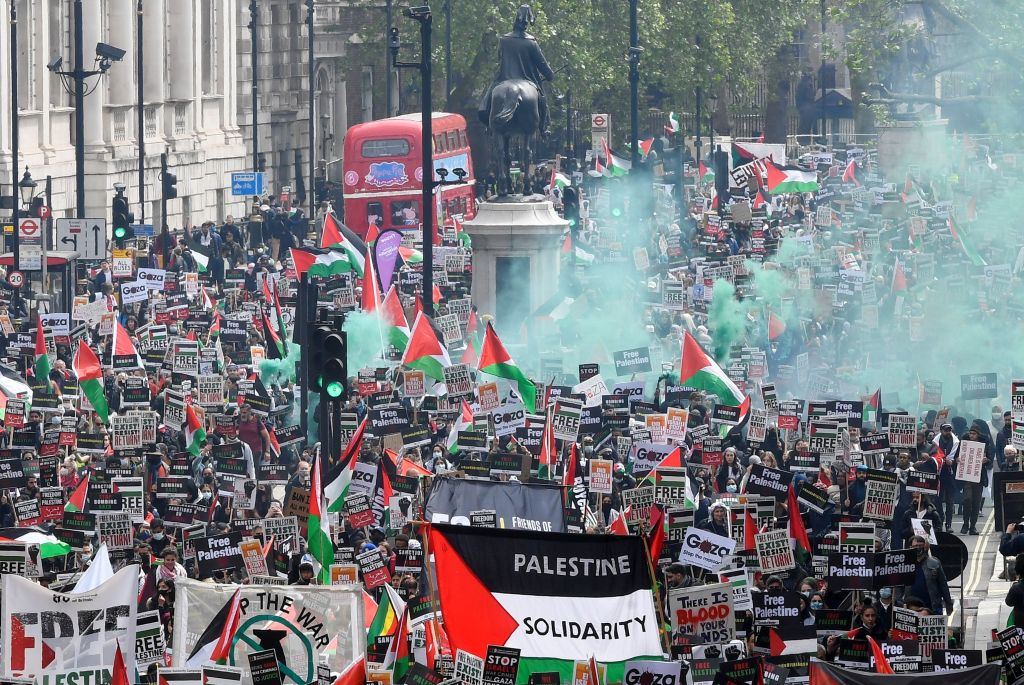
And while there is the intangible gain of considerably greater sympathy for the Palestinian plight among the general public around the world, the bulk of this support is being frittered away on appeals that will have no consequence, such as the signing of public statements directed at Elite agents – see for example, ‘Public Statement: Scholars Warn of Potential Genocide in Gaza’ and ‘International Coalition of Human Rights and Antiwar Organizations forms to Demand End to Genocide in Palestine’ – and on demonstrations, again directed at Elite agents, such as the hundreds that have occurred widely around the world already. See ‘Pro-Palestine protests held around the world as Gaza war nears 100 days’.
The strategic reality is that halting the genocide in Gaza and, ultimately, liberating Palestine while also defeating imposition of the global technocracy which this conflict is facilitating, will not be achieved by such tactics.
Similarly, the tactics articulated by various Palestinian groups such as the Popular Front for the Liberation of Palestine which called for ‘weekly global strikes’ – see ‘PFLP calls for weekly global strikes on Mondays’ – or the Gaza Coalition which called for a ‘general range of actions’ – see ‘Escalate the Struggle against 75 Days of Genocide NOW: #CeasefireNow #EndTheSiege’ – have no value, in a strategic sense, unless they also are used to mobilize strategically-oriented resistance.
And the genocide will not be halted, Palestine liberated or the advancing global technocracy impeded by those solidarity groups, such as Palestine Action in the UK, that campaign against Elbit (Israel’s largest weapons manufacturer) by encouraging secretive acts of sabotage by individuals or small ‘cells’ – see ‘The Underground Manual’ – despite occasional apparent ‘victories’. See ‘Palestine Action Campaign Leads to Fisher German Ending Ties with Elbit’.
Nor can anything worthwhile be achieved by groups such ‘It’s Going Down’ in the United States, despite their admirable intentions. See ‘Lacey, WA: Report Back From “Blockade The Genocide” Action’ and ‘Amazon Construction Site Disrupted By Pro-Palestine Activists In Central Point, Oregon’.
Halting the Genocide in Gaza and Ending the Occupation of Palestine using Nonviolent Strategy
If the genocide is to be halted and the occupation ended, it will require a substantial mobilization of people to participate in a comprehensive strategically-oriented campaign that precisely identifies the tactics to be undertaken (not just a random list of actions) and, as the historical record demonstrates, not by using secrecy and sabotage in their execution. For detailed explanations of these points, see The Strategy of Nonviolent Defense: A Gandhian Approach.
Before proceeding, if you doubt that a nonviolent strategy can halt a genocide in progress, you can read a solid account of when this has occurred historically and how it was accomplished in the section titled ‘Nonviolent Defense Against an Extremely Ruthless Opponent’ on pp.238-245 of the book just cited.
But if we are able to mobilize enough people to halt the genocide, we will be in a stronger position to keep struggling to end the occupation as well so, strategically speaking, it is useful to see these two political purposes as related.
And while defeating the attempt to impose a global technocracy on us all will require a worldwide mobilization far beyond what has even begun yet, success in Palestine could bolster these efforts. After all, what is happening in Gaza is coming to us all, one way or another, although few people are aware of this yet.
Anyway, to illustrate what both a nonviolent strategy to halt the genocidal assault by Israel against Gaza and a nonviolent strategy to liberate Palestine would entail, I have reproduced below just nineteen ‘consolidated’ strategic goals, written in a form appropriate for this particular context, taken from the comprehensive but generalized list of 50 ‘Strategic Goals for Defeating a Genocidal Assault’.
In most cases, I have also briefly explained the value of that strategic goal and perhaps offered examples, either historically or in the current context, where tactics in pursuit of that goal have been undertaken.
Identification of the strategic goals is one component of a comprehensive nonviolent strategy explained on the website Nonviolent Defense/Liberation Strategy. You can see a diagram illustrating all twelve components of a comprehensive nonviolent strategy here: Nonviolent Strategy Wheel. And you can read a brief explanation of why nonviolent action is so powerful here: ‘Nonviolent Action: Why and How it Works’.
This incomplete/consolidated list of strategic goals is based on principles not explained here but carefully elaborated on the website just identified. Needless to say, it is a straightforward task to consult the full list of strategic goals (to halt a genocide or liberate an occupied country) and reword each of the remaining goals to make it appropriate to the Palestinian situation and nominate the specific groups that should be mentioned where appropriate.
And, for example, the American Friends Service Committee has compiled a valuable resource that can be used in planning this strategy by identifying ‘The [Weapons] Companies Profiting from Israel’s 2023 Attack on Gaza’.
Thus, just nineteen strategic goals that would contribute both to defeating Israel’s genocidal assault on Gaza and liberating Palestine (which conform to the formula described on the website) are listed below (with brief explanations and historical examples where appropriate). It should be noted, however, that the list would be considerably longer as individual organizations – such as each organization involved in inciting, facilitating, organizing, conducting and/or benefiting from the genocide (for whatever reason but including national and religious groups with competing perspectives as well as corporations involved in media, banking and resource extraction) – should be specified separately.
Of course, individual groups within the defense would usually accept responsibility for focusing their work on achieving just one or two of the strategic goals. It is the responsibility of the struggle’s strategic leadership to ensure that each of the strategic goals (identified and prioritized according to local circumstances) is being addressed (or to prioritize if resource limitations require this).
If there is no identified strategic leadership, individuals and local groups should proceed to tackle those strategic goals most relevant to their circumstances, interests and capacities.
(1) To cause the people of Palestine (men, women and children) to identify their support for, and participation in, the Palestinian resistance strategy by wearing a symbol of Palestinian unity (a keffiyeh, as a head covering or scarf, or the colors of the Palestinian flag: black, white, green and red) and by boycotting all corporate/government media and social media outlets that support the genocide in Gaza and/or the occupation of Palestine.
For this item and many subsequent, see the list of possible actions in the article ‘198 Tactics of Nonviolent Action’.
(2) To cause the people of Israel (men, women and children) to identify their solidarity with the people of Palestine and opposition to the genocide and occupation by wearing a symbol of solidarity (a keffiyeh, as a head covering or scarf, or the colors of the Palestinian flag: black, white, green and red) and by boycotting all corporate/government media and social media outlets that support the genocide in Gaza and/or the occupation of Palestine.
Government and corporate media and social media have long been used to control the narrative regarding what is happening in Palestine. If you choose to boycott these outlets, in favor of outlets committed to telling you the truth, you play a valuable role in holding media that lies accountable and supporting those telling the truth who are often suppressed.
(3) To cause people elsewhere in the world (men, women and children) to identify their solidarity with the people of Palestine and opposition to the genocide and occupation by wearing a symbol of solidarity (a keffiyeh, as a head covering or scarf, or the colors of the Palestinian flag: black, white, green and red) and by boycotting all corporate/government media and social media outlets that support the genocide in Gaza and/or the occupation of Palestine.
With virtually all government and corporate media and social media owned and/or controlled by Elite agents and much of it acting on behalf of powerful Israeli interests, Gaza’s inhabitants have been treated as nonpersons for decades ‘and daily life in Gaza as non-news’. Consequently, the ‘shameful legacy of narrow, pro-Israel coverage indirectly laid the groundwork for the atrocious human suffering taking place there now.’ See ‘How Corporate Media Helped Lay the Groundwork for Israel’s Genocide in Gaza’, ‘Are social media giants censoring pro-Palestine voices amid Israel’s war?’ and, for an example, ‘Facebook Approved an Israeli Ad Calling for Assassination of Pro-Palestine Activist [in the USA]’.
(4) To cause young people in Israel to resist conscription and recruitment into the military, police, intelligence services and other forces/organizations inciting, facilitating, organizing and/or conducting the genocide or maintaining the occupation of Palestine.
This is already happening, given long-standing and significant Israeli opposition to the occupation but it would be invaluable to focus more effort in this realm. See ‘“Youth Against Dictatorship”: Meet Israel’s new class of conscientious objectors’ and watch ‘Young Israelis refuse to participate in Gaza “genocide”’.
For example, prior to the current genocide and despite four stints in prison, 19-year-old Israeli woman Hallel Rabin resolutely stood her ground, refusing to serve in the Israeli army occupying Palestine. This article includes a video of Rabin speaking eloquently about her reasons for resisting. See ‘Refusing to serve in the army is my small act of making change’.
Just recently and despite knowing he would be imprisoned, 18-year-old Tal Mitnick conscientiously chose jail rather than being responsible for killing Palestinians in Gaza. See ‘“I refuse to take part in a revenge war”: Israel jails teen for opposing army draft’.
And despite the risk of a significant jail sentence, Ariel Davidov, a 19-year-old Israeli ‘refusenik’ believes that ‘not joining the army is one of the most effective things you can do’ to ‘end the cycle of violence’. See ‘Why Israeli army refusers are crucial to ending the cycle of violence’.
These intelligent and conscientious young people are far from alone and highlight the possibilities open to those of us who choose to mobilize an effective nonviolent resistance to violence, wherever it occurs in the world.
We just need their commitment and courage.
(5) To cause soldiers, airmen, sailors, intelligence personnel, drone pilots and others in the Israeli military to refuse to obey orders that will lead to the arrest, assault, torture, shooting, bombing and other forms of harm to Palestinians, medical personnel, foreign aid workers, journalists, solidarity activists and others in Palestine.
There are precedents of conscientious objection at various levels in Israel where the human right to conscientious objection is only allowed in extremely limited circumstances. See, for example, ‘Who are the Israeli refuseniks who refuse to fight the Palestinians in Gaza’.
Of course, the right and duty to make decisions based on conscience were enshrined in international law a long time ago, including in Principle IV of the Nuremberg Charter: ‘The fact that a person acted pursuant to order of [their] Government or of a superior does not relieve [them] from responsibility under international law, provided a moral choice was in fact possible to [them]’. See ‘Principles of International Law Recognized in the Charter of the Nürnberg Tribunal and in the Judgment of the Tribunal 1950’.
The importance and potential of military personnel (and anyone involved in the genocide) making moral choices has been discussed by Professor Michel Chossudovsky as part of a review of what he identifies as ‘the criminalization of international justice’ during the US-sponsored Israeli genocide in Gaza. See ‘The Criminalization of International Justice, Putting an End to the Genocide against the People of Palestine. Nuremberg Principle IV. Disobey Unlawful Orders, Abandon the Battlefield under Principle IV of the Nuremberg Charter’.
And the historical record demonstrates that dialogue and nonviolent action designed to convince troops to disobey their orders have sometimes been successful. For example, it was a vital element of the Czechoslovakian resistance to the Warsaw Pact invasion during 1968, it was the defining feature of the nonviolent revolution in the Philippines in 1986, it was the crucial factor in thwarting the Chinese government’s first attempt to clear Tiananmen Square on 20 May 1989, and it was fundamental to the defeat of the Soviet coup in 1991. See The Strategy of Nonviolent Defense: A Gandhian Approach. pp.256-8.
Individuals in Israel who make such conscience-based choices are supported by Mesarvot, one of the organizations that supports Israeli ‘refuseniks’ in a campaign against the occupation of Palestine.
[An earlier organization – Yesh Gvul (‘There is a limit’) – was founded in 1982 ‘as a political movement aimed at supporting refuseniks and conscientious objectors’. It now appears to be inactive.]
But the potential for something more significant might be inferred from this article by Shimri Zameret, a soldier who conscientiously resisted participation in the Israeli military response to the Palestinian second Intifada, spending 21 months in prison as a result, and now comments on disquiet within the military for the anti-democratic ‘reforms’ pursued by Netanyahu in 2023. See ‘A mass wave of Israeli army refusal could be a transformative moment’.
Zameret and many others are part of another organization – the Refuser Solidarity Network – that also supports soldiers opposed to the occupation and the policies (genocidal and otherwise) that derive from it.
A version of resistance of this type – not reported as based on conscience or international law – has just occurred when ‘half the soldiers of an Israeli reserve battalion refused to fight in the Gaza Strip and were released from duty by their commander… after the army tried to send them to fight and carry out combat missions within Gaza for which they were not qualified or adequately equipped’. See ‘Israeli reserve soldiers refuse to fight in Gaza: Half a brigade was released from duty after complaining of poor training and lack of weapons before deployment to Gaza’.
In any case, there is enough evidence of disquiet among young Israeli conscripts and serving soldiers (and possibly personnel in other services, such as the intelligence services) concerned about participating in the genocide and occupation to make it strategically worthwhile for people, whether in Israel or elsewhere, to contact serving personnel with encouragement to consider their conscience about the moral path in this context and offers to listen while they deliberate.
(6) To cause the private military contractors (mercenaries) employed by the Israeli Army to refuse to participate in the genocide in Gaza and/or in maintenance of the occupation.
One way in which Israel minimizes Israeli deaths in Gaza (and conceals the extent of the overall death toll) is by employing mercenaries to fight on the front line of the genocide. See ‘Israel’s use of thousands of foreign mercenaries in attacks on Gaza sparks debate’.
According to one source, there are an estimated 28,000 mercenaries in the Israeli military. This constitutes a heavy drain on the Israeli economy, which is now being threatened by various measures. See ‘Gaza Exhausted Israel’s Economy’.
Apart from efforts to dissuade foreign soldiers from joining the Israeli military, increasing pressure on the Israeli economy will make it difficult for ordinary Israelis impacted – as Mohandas K. Gandhi understood the Indian boycott of cloth imports from Manchester in defence of the indigenous khadi industry would make it difficult for workers in England – but the Israeli leadership will endeavour to hold out against enormous pressure as it will be directed to do. Nevertheless, there are many measures that can be taken, including those outlined below, to keep this pressure building.
(7) To cause the officers in the Israeli police and Shin Bet (the security agency) in Israel to refuse to obey orders to inflict violence on Israeli nonviolent activists and to arrest, assault, torture and shoot Palestinians, medical personnel, foreign aid workers, journalists, solidarity activists and others in Palestine.
Again, there are many historical precedents around the world of police refusing orders to inflict violence on populations they police, including during the lockdowns imposed as part of the restrictions enforced under the recent Covid-19 regime. See ‘Policing the Elite’s Technocracy: How Do We Resist This Effectively?’
And there is already substantial dissatisfaction within the Israeli Police for various reasons, leading significant numbers to leave the force. A key reason for the dissatisfaction is that senior officers are often abusive of lower ranks (in various ways) and, whether in the police or Shin Bet, punishment of these officers is virtually non-existent (or trivial when it happens). See ‘Why do so many Israel Police officers quit?’
Nevertheless, there is enormous pressure on Israeli activists against the genocide and occupation with police beatings and recent bans on protests just two of the hurdles. See ‘Israel Police Bars Protests Against Gaza War, Citing Inability to Protect Public, Prevent Violence’.
Despite this, key personnel in the Israeli anti-occupation movement are not bowed as the short video of 23-year-old Gaia Dan clearly demonstrates. See ‘Police Are Beating and Arresting Anti-Zionists in Israel’s “Coexistence” Capital: Israeli authorities are trying to stamp out Haifa’s anti-occupation bloc’.
Fortunately, the long legacy of nonviolent struggle in extremely violent contexts has much to teach nonviolent activists about dealing powerfully with such situations. This article offers 20 ideas of use in both the Israeli and Palestinian contexts: ‘Nonviolent Action: Minimizing the Risk of Violent Repression’.
Not every police or Shin Bet officer will follow orders to be violent unthinkingly. Our challenge is to amplify their inclination to do what is right, irrespective of the orders they are given.
(8) To cause military personnel in the military forces of Israeli-allied countries including the United States, the United Kingdom and elsewhere to refuse deployment to the conflict zone near Israel and Palestine.
In immediate response to Israel’s attack on Gaza, the United States deployed military forces – including two aircraft carrier strike groups, a range of aircraft and troops – to the Middle East. See ‘2,000 US Troops Ordered to Prepare for Deployment in Growing Response to Israel War with Hamas’.
Since then, the United States has set up and deployed ‘Operation Prosperity Guardian’, a multinational coalition supposedly intended ‘to help protect merchant ships in the Red Sea area from drones and missiles’ fired by Yemen’s Ansar Allah against vessels perceived to be supporting, directly or indirectly, Israel’s attacks on Gaza. See ‘US unveils international force to defend Red Sea. Here’s what we know’.
But deployments of this nature increase the risk of the war escalating in Palestine or expanding into the region, as the US foreign policy elite has long planned – see ‘Expanding Middle East War. Planned US-Israeli Attack on Iran, the War on Energy, Strategic Waterways’ – and is now happening. See ‘Three Hours of Fire and Fury: How US and UK Unleashed Over 100 Missiles on More Than 60 Houthi Targets Using Jets, Warships and a Sub in Meticulously Planned Strikes on Iran-backed Rebels in Yemen’.
This can also be resisted by people, including anti-war activists, in the various countries (the United States, United Kingdom, Bahrain, Canada, France, Italy, Netherlands, Norway, Seychelles and Spain) that are deploying troops and weapons systems to the region by taking targeted nonviolent action against weapons producers and the troops facing deployment to the region. As always, see the list of possible actions in the article ‘198 Tactics of Nonviolent Action’.
(9) To cause members of trade unions and professional associations, activist groups, religious bodies, women’s organizations, student bodies, consumer groups and ethnic groups, as well as artists, musicians, intellectuals and members of other key social groups in Israel to resist the genocide and the occupation by encouraging their members to boycott all government/corporate media and social media that support the genocide or occupation and to withdraw their labor [temporarily/permanently] from any organization complicit in the genocide and/or occupation.
It is clear that there is disagreement among key Israelis about the genocide in Gaza and this is already manifesting. For example, lawyer and human rights activist Michael Sfard, ‘on behalf of a group of lawyers and Israeli public figures, sent a letter to Attorney General Gali Baharav-Miara requesting that she take measures against public figures and officials, including lawmakers, who called for the annihilation of Palestinians in Gaza and ethnic cleansing.’ See ‘Israeli judiciary accused of silence concerning incitement to violence by officials against Palestinians: Lawyer. Michael Sfard says Attorney General does not care about incitement against Palestinians’.
And while loudly condemned by most of his fellow MPs in the Israeli Knesset, Ofer Cassif had the courage to sign a petition in support of the hearing at the International Court of Justice accusing Israel of genocide in Gaza. In response to his widespread condemnation, Cassif noted ‘I will not give up the fight for our existence as a moral society. This is true patriotism…’. See ‘Balls of Steel’.
While it will clearly take stronger actions than these to halt the genocide, like the efforts of those young Israelis resisting conscription into the Israeli military, they are undertaken by those who have a conscience and the courage to live it and all movements for justice are built on such individuals.
No doubt Israel has plenty more yet and one of our tasks is to encourage Israelis to act and support them when they do. There are plenty of people in the United States and elsewhere who could usefully focus some effort on contacting Israelis they know and encouraging them to take a conscientious stand (and perhaps listen supportively while any individual considers such a course).
As mentioned above, there are trade unions, professional associations, religious bodies, women’s organizations and a great many other groups in Israel that can be approached to ask their members to boycott media supporting the genocide/occupation and to consider withdrawing their labor from organizations that are complicit.
The wider the resistance is spread, the less pressure there is on any one individual.
(10) To cause members of trade unions and professional associations, activist groups, religious bodies, women’s organizations, student bodies, consumer groups and ethnic groups, as well as artists, musicians, intellectuals and members of other key social groups in countries in which governments are complicit in the genocide (including the USA, UK, Germany and other European countries particularly) to resist the genocide and the occupation by encouraging their members to boycott all government/corporate media and social media that support the genocide or occupation and to withdraw their labor [temporarily/permanently] from any organization complicit in the genocide and/or occupation.
Just one of many examples where such noncooperation is now occurring is in the United States government where both Administration and Congressional staffers who are distressed by the genocide are clearly expressing their dissent – see ‘U.S. diplomats slam Israel policy in leaked memo’ – two have already resigned rather than be complicit ‘in Biden’s fervent support for the war’ – see ‘War on Gaza: Internal anger with Biden and Congress reaches boiling point’ – and hundreds of federal employees across 22 federal agencies were due to walkout to observe a ‘Day of Mourning’ to mark 100 days of Israel’s genocidal campaign in Gaza. See ‘US government employees plan walkout over Biden’s Gaza policies’.
The point is that this discontent is everywhere and, at some point, the more courageous will act and inspire many around them, whatever organization in which they work.
And other forms of resistance that are especially effective in that particular context can be considered. Again, for inspiration, consider ‘198 Tactics of Nonviolent Action’.
(11) To cause members of trade unions and labor organizations, activist groups, religious bodies, women’s organizations, student bodies, consumer groups and ethnic groups, as well as artists, musicians, intellectuals and members of other key social groups in countries in which governments are complicit in the genocide (including the USA, UK, Germany and other European countries particularly) to resist the genocide and the occupation by encouraging their members to boycott those products that are extracted (or produced) and exported by corporations acting in concert with the Israeli government.
Notably, in this category, Israel is using corporations such as Siemens and Chevron to extract gas from the eastern Mediterranean – see ‘Siemens and Chevron: Stop Fueling Apartheid and Climate Disaster’ – and, as some authors have explained previously, yet another part of the long-standing plan behind the current genocide is undoubtedly to enable Israeli seizure of the gigantic Leviathan maritime natural gas reserves in the Mediterranean Sea off the coast of Gaza. See ‘“Wiping Gaza Off The Map”: Big Money Agenda. Confiscating Palestine’s Maritime Natural Gas Reserves’.
While Felicity Arbuthnot, in the 2013 article just cited, nominated the interest of the BG Group in Gaza’s gas and oil reserves, in early 2016, the BG Group became part of Shell Global. See ‘Combining Shell and BG: a simpler and more profitable company’.
Of course, Shell has been a Rothschild corporation since the very early 20th century. According to the Rothschild Archive: ‘As it turned out, Rothschilds had a decisive influence in shaping Royal Dutch Shell, more so than anyone had previously imagined.’ See ‘Searching for oil in Roubaix’. But Shell does not represent the only Rothschild investment in energy supplies.
Consequently, widespread and persistent consumer boycotts that target Shell, Chevron (for which the key brand names are Texaco and Caltex) and Siemens products could play a valuable role in compelling these corporations, and their Elite owners, to reconsider their role in sponsoring the genocide and occupation.
(12) To cause people in your country to boycott Israel as a tourist destination.
The genocide in Gaza has had a significant, adverse impact on the Israeli economy. See ‘Gaza Exhausted Israel’s Economy’. Causing people to boycott Israel as a tourist destination (in favor of traveling elsewhere) is an effective way to reduce Israeli government finance available for the genocide and occupation.
An important subset of this, which focuses more on removing the apparent legitimacy attached to Israeli institutions, is advocated by the BDS Movement and involves the encouragement of academics, prominent entertainers, cultural figures (such as writers and artists) and sportspeople to boycott Israel. See ‘Academic Boycott’ and ‘Cultural Boycott’. Individuals in this category can set a powerful example for their colleagues/fans.
In her own variation on what the BDS Movement encourages, popular Bosnian author Lana Bastasic has taken a huge cut in earnings to express her solidarity with Palestine. See ‘Author’s split with German publisher over “silence on Gaza” causes her huge loss of earnings’.
(13) To cause the workers in the trade unions and professional associations that work for individual weapons corporations (such as Elbit Systems, Rafael, Lockheed Martin and Boeing) that supply weapons to the Israeli military to withdraw their labor [partially/wholly], [temporarily/permanently].
The American Friends Service Committee has compiled a valuable resource identifying ‘The [Weapons] Companies Profiting from Israel’s 2023 Attack on Gaza’.
Thus, whether in relation to an Israeli weapons corporation, such as Elbit Systems and Rafael, or a weapons corporation in the US, the UK, Germany or other countries that supply weapons to Israel, each trade union and/or professional association representing employees working for the corporation is effectively supporting individuals to participate in enabling the genocide and maintenance of the occupation.
Individuals and organizations can be encouraged to choose not to do so using a variety of means, always beginning with dialogue but then, if the issue cannot be resolved through listening and clear communication, using a range of nonviolent tactics at worksites, ranging from demonstrations and picket lines to blockades. But again, plenty of options here: ‘198 Tactics of Nonviolent Action’.
(14) To cause corporations that provide vital services/components to weapons corporations that supply weapons to Israel to cease doing so.
This could happen by campaigning against companies such as Martin-Baker, https://martin-baker.com/ the family business in Britain that supplies the ejection seats for fighter jets such as the F-35’s made by US weapons corporation Lockheed Martin and used by Israel. See ‘How One British Business Could Stop Israeli Jets Bombing Gaza: UK-made ejection seats are in the cockpit of most Western fighter jets, including Israel’s air force’.
But there are a great many possibilities as the sheer diversity of parts in military weapons means that many corporations are drawn into the staggering array of supply lines. Choosing those services and components that are more specific and critical to military impact – including command, control, communications, delivery, targeting – rather than some insignificant, generic part, will ensure strategic value derives from success in any campaign.
If this isn’t feasible (or efforts fail) in a particular context, consider the following strategic goal.
(15) To cause the workers in the relevant trade unions or labor organizations to withdraw their labor [temporarily/permanently] [partially/wholly] from those corporations that supply services/components to weapons corporations that supply weapons to Israel.
A corporation management might not have a conscience but plenty of workers do, and approaching them through their trade union or labor organization might open opportunities to discuss possible ways they can noncooperate with the genocide and occupation.
(16) To cause vessels and cargo planes engaged in transporting goods and weapons to or from Israel to cease doing so [temporarily/permanently].
This has already happened in response to the military attacks by Ansar Allah [the Houthis] in the Red Sea. See ‘Chinese Shipping Giant COSCO to Stop Visiting Israeli Ports: The decision comes despite the low chances of the Houthis attacking a Chinese vessel’.
These attacks have also caused significant disruption. See ‘Support for vessels rerouting from the Red Sea’.
And while Ansar Allah’s use of violence ‘justifies’, in the eyes of many, the violent response of the United States which has now attacked Yemen (thus paving the way for a wider war) – see ‘Major Escalation: Biden Launches War On Yemen’ and ‘Joint US-UK Assault on Houthis: Here’s the Latest’ – there are variations on delaying/halting shipping that can be achieved by nonviolent means, including by government decision such as that made in Malaysia. See ‘Global Supply Chains Falter as Malaysia Blocks Israeli Cargo Ships’.
Beyond that, however, and given that most governments won’t do this, activists working in conjunction with local trade unions can do it too. For example, starting in the late 1980s in Australia, the combined efforts of nonviolent activists and trade unionists caused significant delays in the unloading of imported rainforest timber from cargo ships. The awareness generated by these widely publicized and graphic actions was used to mobilize a massive boycott of imported rainforest timber by the Australian community, effectively eliminating the trade within three years as entire industries switched to sourcing timber from more sustainable sources. Watch ‘Time to Act’ and see ‘Nonviolent Struggle for the Rainforests’.
Of course, trade union action of this nature has a long history. For example, during the apartheid era in South Africa, Danish dock workers in 1963 decided not to unload ships carrying South African products, triggering a similar boycott in Sweden, England and elsewhere.
In relation to Palestine, the first solidarity action of this nature occurred in South Africa when the South African Transport and Allied Workers Union (SATAWU) decided not to unload an Israeli ship due to arrive in Durban on 8 February 2009. See ‘The BNC Salutes South African Dock Workers Action!’
And in 2014, the Arab Resource and Organizing Center in the United States launched Block the Boat in response to the call by the Palestinian General Federation of Trade Unions (PGFTU) and a coalition of all major Palestinian workers unions and professional associations who called on their fellow trade unionists and workers worldwide to boycott Israel and businesses that are complicit with its apartheid regime. They specifically urged a refusal to handle Israeli goods and support for union members refusing to build Israeli weapons.
Analysing the ten-year history of ‘Block the Boat’ actions in various countries, researchers Rafeef Ziadah and Katy Fox-Hodess identified some crucial variables worth addressing to make these nonviolent actions have maximum impact. Critically, this included thinking carefully about how activists could most effectively get involved in working with unions and how activists can take some of the more extreme pressures off workers, particularly when sanctions for taking solidarity action are onerous. See ‘Dockworkers and Labor Activists Can Block the Transport of Arms to Israel’.
As an adjunct to their research, they offered these downloadable documents to assist activists and workers seeking to work together: ‘Lessons on Organizing with Trade Unions to Build Solidarity Actions’ and, from Workers in Palestine this ‘Guidance Sheet for Trade Unionists on Building Solidarity with Palestine’.
Workers in Palestine has recently posted a video of nonviolent actions undertaken around the world to shut down weapons factories and disrupt weapons shipments to Israel in response to the genocide in Gaza.
This has included several delays of ships of Israel’s ZIM Integrated Shipping Services at two ports by activists and workers in Australia, as discussed here: ‘In Australia, Palestine Solidarity Activists Are Blockading ZIM Ships Owned by Israel’, ‘The Economic Incentive: Blocking Israel’s Supply Chain’ and ‘Australian police attack pro-Palestine protests blockading Israeli ship’.
If nonviolent actions of this nature in solidarity with Palestine appeal to you and other activists in your local port, you can identify the arrival of Israel’s ZIM vessels on their port schedule – see ZIM vessels Port schedule – and track their vessels on either Marine Traffic or Vessel Finder.
Similarly, nonviolent action can be undertaken to disrupt, delay or halt the movement of military weapons by air, although it will need more than just protests such as this one in Cyprus. See ‘UK’s alleged use of Cyprus bases to arm Israel and hit Yemen draw protests’.
(17) To cause consumers, including members of religious, service, sporting, business and other community organizations, to boycott those products produced by companies taking advantage of the Israeli occupation economy in Palestine.
As the BDS Movement points out, it is superior strategy for people to focus their efforts on certain companies prioritized for targeting (because of their deep complicity in the occupation) rather than dissipate effort so widely that little impact is felt anywhere. See ‘BDS Guide to Strategic Campaigning for Palestinian Rights’.
Consequently, the companies that the BDS Movement recommends for targeting are listed in ‘Act Now Against These Companies Profiting from the Genocide of the Palestinian People’.
But if you want more comprehensive lists to view other companies you can boycott, the Who Profits Research Center has compiled a list of companies to boycott because they profit from the Israeli occupation economy.
The American Friends Service Committee has also compiled a list of companies, with two sectors additional to the ‘Who Profits’ list above. See ‘Investigate: What are you invested in?’
And the United Nations High Commissioner for Refugees has compiled a comprehensive ‘A/HRC/43/71: Database of all business enterprises involved in… the Israeli settlements… throughout the Occupied Palestinian Territory, including East Jerusalem’.
Another simple option is to sign the ‘No Tech for Apartheid’ letter to Google and Amazon for providing ‘cloud technology to the Israeli government and military… to surveil Palestinians and force them off their land’. But boycotting Google and Amazon is a far more powerful option given they are spying on you too as part of their role in advancing the Elite’s technocracy.
(18) To cause the individual and organizational investors (including religious and sporting bodies) of banks, asset managers, insurance companies and pension funds in Israel and elsewhere to shift their money to ethical banks and credit unions, asset managers, insurance companies and pension funds that do not finance, invest in or are otherwise involved in supplying banking, asset management, insurance or pension services to Israel (and Israeli settlements in occupied Palestine) or to weapons corporations that supply weapons to Israel.
Don’t Buy Into Occupation has compiled a valuable list of European banks and other financial institutions to boycott in their report ‘European Financial Institutions’ Continued Complicity in the Illegal Israeli Settlement Enterprise’.
The BDS Movement specifically encourages divestment from the French multinational insurance giant AXA ‘for its investments in Israeli banks [with Bank Hapoalim, Bank Leumi, First International Bank of Israel, Israel Discount Bank, Mizrahi Tefahot Bank being the main five], which are deeply complicit in Israel’s illegal settlement enterprise on occupied Palestinian land’. See ‘AXA Divest’.
If you live outside Europe or an organization is not listed and you are in doubt, the general principle is to always seek those (invariably smaller) institutions that identify as ‘ethical’ and investigate these to see if they deserve your patronage.
As an aside, if your knowledge of the management (or membership) of a financial institution with which you deal suggests they might be willing to divest from Israel (or weapons corporations) without significant public engagement first, it may be worth your while to approach them to find out. Obviously, you do not need to boycott or organize a wider boycott of an institution that is responsive to dialogue.
(19) To cause SpaceX, which manufactures and deploys Starlink spy satellites to facilitate genocide in Gaza and the occupation of Palestine generally, to cease doing so.
One way in which pressure can be exerted is by mobilizing people, wherever they live, to boycott the Starlink service (and switch to another provider) in their area. Another less direct way is to boycott X (formerly Twitter) because it is also owned by Elon Musk (who owns SpaceX).
Summary
Not all of the strategic goals nominated above will need to be achieved for the strategy to be successful but each goal is focused in such a way that its achievement will functionally undermine the power of those conducting the genocide and the occupation.
Once the genocide is halted, this list would still constitute the foundation for a refined set of strategic goals to guide the strategy to liberate Palestine (taken from the generalized list here): ‘Strategic Goals for Removing a Military Occupation’ or, for the fullest elaboration, The Strategy of Nonviolent Defense: A Gandhian Approach.
I have reproduced the nineteen strategic goals listed above here: ‘Strategic Goals to Halt the Genocide in Gaza and Liberate Palestine’.
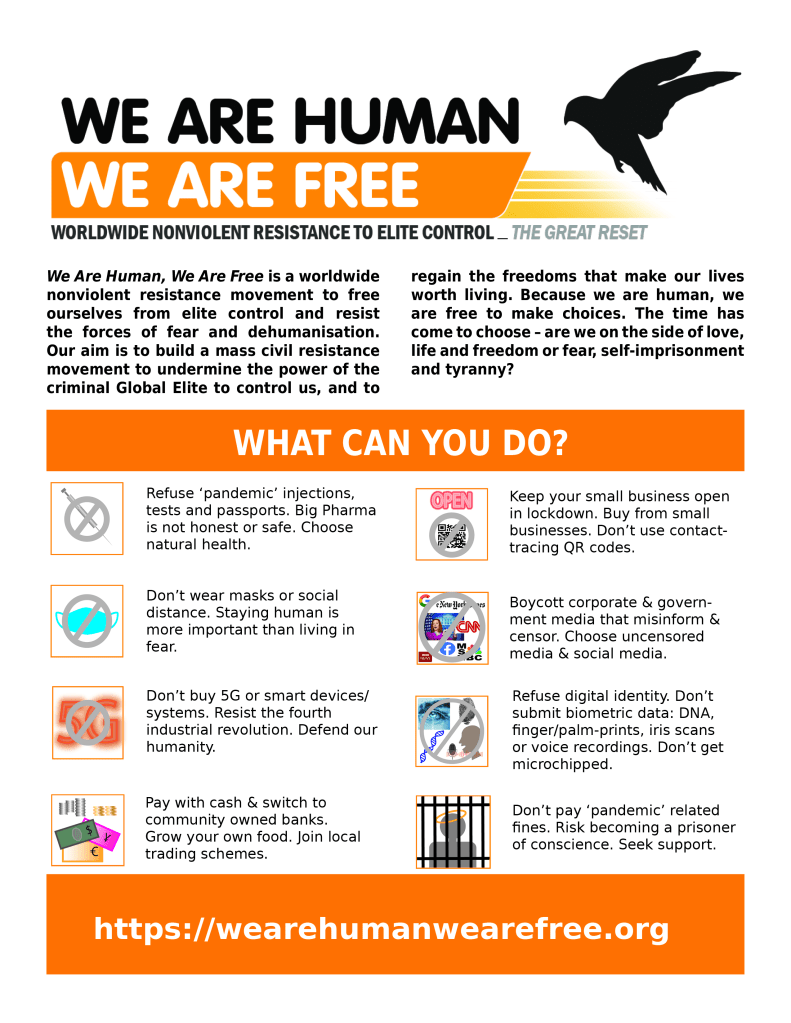
And if we are to defeat the Elite technocracy being imposed on the entire human population, with Palestine (in both the West Bank and Gaza) being used as the testing ground and incubator of so many of the technologies that will be used to kill or enslave us all, then we must resist strategically, as explained in the campaign of ‘We Are Human, We Are Free’ with one-page flyers, identifying the simplest version of the strategy, available in 23 languages.
Conclusion
The people of Palestine have the same choice we all face in relation to the Elite’s rapidly advancing technocracy.
We can do nothing, we can complain (by lobbying and petitioning governments or international organizations), we can sign public declarations, we can turn up at demonstrations, and do all of the other things that put the power to change things in the hands of others. And watch this come to nought.
According to Dr Anis Sayigh, Palestinian intellectual and chairman of the Palestine Research Center in Beirut until it was destroyed by Israel in 1983, in 1936 the Palestinians were convinced by Arab leaders in the region to end a nonviolent general strike to give Britain a chance to prove its ‘good intentions’. Dr Sayigh goes on to state: ‘Unfortunately, to this day, we are still discussing UN resolutions and American and European initiatives to give the West a chance to prove its good intentions.’ Watch episode 2 of ‘Al-Nabka: The Palestinian catastrophe – Episodes 1-4’.
The point is simple: Until we learn that the Elite and its agents – no matter who or where they are: western, Arabic, Israeli, Russian, Chinese, Indian, Christian, Jewish, Islamic, Hindu, international organization, corporation, NGO, philanthropic foundation…. – will never change a system from which they benefit enormously by exploiting us, we will continue to run the treadmill of defeat whatever the cause for which we fight.
So we have a choice: Keep doing what history clearly demonstrates does not work or plan and take strategically-focused action that makes a difference ourselves.
That choice is yours whether we are fighting to defend Palestinians in Gaza from the ongoing genocide, liberate Palestine from Israeli occupation or defend humanity from the rapidly advancing technocracy.
Biodata: Robert J. Burrowes has a lifetime commitment to understanding and ending human violence. He has done extensive research since 1966 in an effort to understand why human beings are violent and has been a nonviolent activist since 1981. He is the author of ‘Why Violence?’ His email address is flametree@riseup.net and his website is here.
Over the years many aspects of the “truth movement” have devolved into an insufferable dumpster fire. But we can still salvage it.

By Benny Wills
Source: The Free Thought Project
From 2004 – 2016, I felt like I was a part of something special. I was participating in an “awakening.” The world was changing. Consciousness was shifting. The hidden hand was being exposed and all secrets were being revealed!
Right?
Or maybe it was wishful thinking.
9/11 happened. And for the next decade and a half, people all over the world began to question the events of that day. Then, major events in general. It was the beginning of an uprising. A revolution!
Right…?
Something else emerged during that time. Social media.
Social media has its upsides and downsides. Mostly upsides. But the downsides have serious ramifications. Specifically on communication.
Social media brings us together and tears us apart.
By 2001, almost everyone was online and connected to the internet. But it was still in its infancy.
The iPhone didn’t exist. There was no YouTube, Facebook, Instagram, or Twitter. Even MySpace wasn’t around yet.
We had access to the internet, but we had no idea what we were in store for.
As the internet expanded, so did our ability to share information.
Alternative perspectives, counter-narratives, and “conspiracy theories” became more accessible. For the first time (possibly) in history, “official stories” were being challenged in real time. With evidence to support claims.
I was dubious about 9/11 as it was happening. Not because of the internet. Not because I was a conspiracy theorist. But because I hated George Bush. As a born and raised Democrat, I didn’t trust him. I was staunchly anti-war (and still am), and I knew America’s response to the attacks was going to be insane.
A few years later, someone shared a documentary with me called Loose Change. A film deconstructing the 9/11 narrative. My mind was blown, and it was off to the races.
Down, Down, Down The Rabbit Hole.
YouTube hit the scene in 2005. I used it strictly for conspiracy-related research.
Conspiracy content blew up online. A truth movement had begun. The masses were on the verge of waking up, well, en masse.
Right?!?!
Fast forward to 2024. I have good news and bad news.
The good news is that more people are questioning things than ever. Distrust in anything mainstream is at an all time high.
The bad news:
Societal division is worse than it’s ever been. In my lifetime anyway. It’s hard to even call it division because division implies splitting into two halves.
This is a direct result of thumb-typed communication. (Generation Text.)
These days, most people prefer texting, emailing, or commenting over direct engagement. We yearn for human connection, but we’ve patterned ourselves to avoid it as much as possible. (I’m speaking generally, of course.)
Confronting someone is uncomfortable. But confrontation is a necessary part of human interaction. It’s a key component in solving conflict or avoiding it altogether. But since it can be terrifying, people today have the easy-out of typing instead of speaking.
Typed communication lacks empathy. It’s indirect. Impersonal. It’s both a barrier and a shield.
So people say things to each other online that they would never say out loud. They rip each other apart over the slightest differences of opinion. Many (especially YouTube commenters) hide behind avatars and pseudonyms to say whatever they want with no accountability.
Basically, everyone has free rein to be an asshole with zero repercussions.
Worst of all, no one is listening to each other anymore.
We haven’t just been divided; we’ve been fractalized into smithereens.
The “awake” crowd is as insufferable as the “woke” one. Change my mind.
Mean-spirited mudslinging and public shaming are the online norm.
Checking the timeline on Facebook, for instance, is a disheartening experience.
It’s a daily mélange of proselytizing, bickering, and judging others. The sentiment is “my way or the highway.”
“I’m right, and you’re wrong. And not only are you wrong, you’re also a stupid idiot.”
Many on the alternative or “conspiracy” side of things have fallen into the same trap as the “sheep” they condemn.
Arrogant allegiance to ideas, beliefs, and opinions.
At the height of the truth movement in the 2010s, there was an emphasis on critical thinking. The Trivium was making a comeback.
Grammar, logic, and rhetoric
In that order.
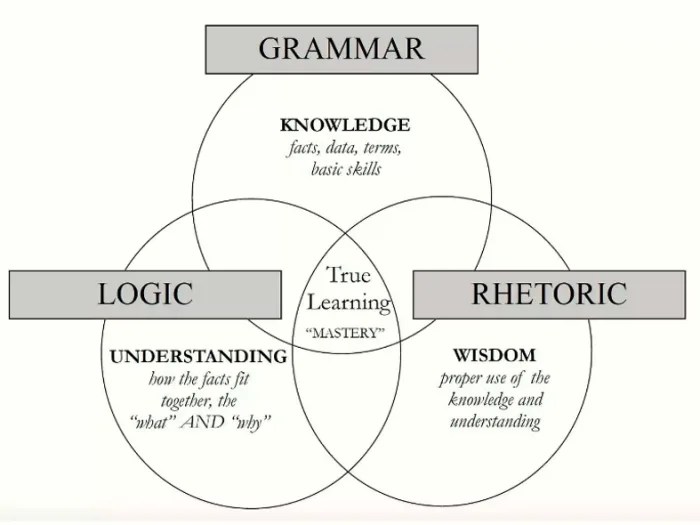
More often than not, online communication is rhetoric without grammar and logic to back it up.
Sweeping generalizations abound.
But opinions are not facts. (And you are not your opinions.)
“A great many people think they are thinking when they are merely rearranging their prejudices.” – William James
Social media algorithms are designed to keep you in a feedback loop.
A lot of people use their (typed) voice online to “speak the truth.” But they’re preaching to the choir in an echo chamber.
There’s camaraderie to be found in this. Which is good. But the likelihood of their rantings reaching those who (they feel) need to hear them is small.
The aggression that comes through many posts is ugly and derogatory.
Anger is a powerful emotion. But it’s like fire. It can warm your house or burn it down.
“Heat not a furnace for your foe so hot that it do singe yourself.” – William Shakespeare
Many people lean on anger to convey their conviction about a topic. They use it to stress the importance of something. But more often than not, it’s ineffective.
Anger is best utilized when it’s the seed preceding something more interesting.
In other words, anger alone is a weak emotion for personal expression.
When anger sparks an idea, and that idea is built upon with clarity and care, the expression of that idea has the power to shift someone’s perspective.
Many of my poems and JoyCamp videos came from an angry place. But anger is nowhere to be found in the final product.
Some think I’m too soft in my approach. Well, they’re welcome to think whatever they want. I’ve learned through trial and error that bluntly and angrily stating “the truth” is a fool’s errand. People don’t want to hear it, no matter how right or passionate you are.
Use anger like clay and sculpt it.
I tried anger in my 20s, and it got me nowhere. If anything, it only made situations worse. Speaking loudly and angrily puts more distance between your conversation partner and the point you want them to understand.
I’m committed to the truth and helping others discover it for themselves. Over the course of 15 years, I developed a nuanced approach to communication that actually works. One that I’ve taught to hundreds of people in my Parrhesia program (now called Free Your Speech).
If you didn’t pull the trigger on Parrhesia when I was offering it live, you can still purchase the course itself.
>>Free Your Speech: The Art of Communication
I’ve dropped the price to $149. It’s an election year. It’s probably worth your while.
It’s agonizing to witness your friends, family, and society at large fall into what you perceive as traps.
What’s painfully obvious to you is beyond absurd or ridiculous to them. And no matter how much you try to convince them otherwise, they double down on their commitment to the trap.
People are not logical. They’re emotional and motivated by fear, comfort, and ego.
“No one can possibly behave above his own level of understanding. Don’t expect people to do any better than they are compelled to do at their present level. Your problem is assuming that they should and could behave better. Understand this and annoyance disappears. As you gradually awaken you will feel the urge to share your discovery with others. Because you will find others in various stages of receptivity, remember this: Never give more than others can understand and appreciate in the moment. This is cosmic law. To try and give what others cannot receive is like tossing a ball against a brick wall—it bounces back to strike you. Jesus explained this law by saying that we should not cast our pearls before swine; that is, before those whose comprehension of truth makes them indifferent or hostile about it.” – François Fénelon
This is the cornerstone of my communication philosophy and approach.
There is no truth movement. There never was. There is only your journey to discovering what the truth is.
Pick your lane and choose your battles wisely.
Worry less about the world and other people’s opinions.
Concern yourself with what you’re capable of. Challenge your comfort zone. And focus your efforts on how you can help.
The most exciting rabbit hole is YOU.
Until next time.
Much love,
Benny
PS- Build Bridges

Beau Is Afraid (Film Review): A Baffling Nightmare
By Joseph Tomastik
Source: Loud and Clear
Beau is Afraid. And I’m afraid of what’s in Ari Aster’s head after watching his latest film. The director of Hereditary and Midsommar is back with Beau is Afraid, a baffling three-hour effort to make his other films look easily accessible in comparison. I love Hereditary and consider it one of the best horror films of the 2010s. I like Midsommar purely for the sensory experience of watching it, but its bare-bones, overblown story stops me from calling it good. Beau Is Afraid takes those strengths and weaknesses of Midsommar and cranks them up to eleven. And, fittingly enough, my feelings on that film are repeated twofold with this one.
Beau (Joaquin Phoenix) is an anxious man who lives in a broken-down apartment in a corrupt, violent city. He’s set to go on a trip to visit his overbearing mother (Patti LuPone), but shocking news and unfortunate events derail his trip, forcing him to cross paths with a variety of bizarre characters and surreal events. That’s as much of the plot as I’ll be revealing. Not just to avoid spoiling any surprises, but also because that’s about all I feel I’m even capable of saying. Outside of Beau being tended to along his way by a seemingly caring couple (Amy Ryan and Nathan Lane), the events of Beau is Afraid are increasingly difficult to properly wrap one’s head around.
Beau is Afraid is the kind of film that I’ve become more open to over the years. I once had the impulse to dislike any film that I didn’t instantly understand, but now I can appreciate the experience of such a baffling film if I find myself sucked into the craft, performances, visuals, or overall feel. Beau is Afraid is an unshakable 10/10 in all of those aspects. This is Aster’s most skillfully shot, visually haunting film to date. He has such an insanely perfect grasp on his directorial style that I struggle to comprehend how any human being could bring some of this film’s beauty to reality. That sounds hyperbolic, but I really was that mesmerized by what was accomplished here.
There’s so much detail in almost every single shot that you could blink and potentially miss a jarring detail. This is not only impressive, but it guarantees that no matter where or when you look, some form of misery is happening. This is especially true early on when we see what kind of environment Beau lives in. It looks like your typical city, but it feels downright alien because of how relentlessly cruel everyone is and how well the nightmare of such a place is captured. The entirety of Beau is Afraid feels like a nightmare, in fact. The are sights, sounds, and ideas are like something straight out of a David Lynch movie, and they’re never going to leave my head. And, as is typical of Aster, the whole film is effectively raw and relentlessly unpleasant. Even if you don’t always understand what’s happening or why, you feel it.
The editing emphasizes that nightmarish feel as well, not letting you skip out on a single second of the discomfort that would exist in these scenarios. There are no loud tactics or cheap jump scares here, as every dark reveal is slowly thrust upon you. The editing also gets morbidly funny. Beau is about to take a bath, he gets bad news, and a match cut shows the water spilling out onto to the floor, showing how long he’s been standing there stunned. The blocking of characters from wide shots gives so many of them the physical presence of a creeping demon, even if you don’t always know why you’re afraid of them, and the lighting outlines so many set pieces and characters in a disarming otherworldly void.
The actors are all spectacular. Phoenix is amazing as always, getting across Beau’s frightened vulnerability, uncertainty, and buried anger in a heartbreakingly sympathetic way, especially when it’s met with so much hostility. Everyone else works so well with the material they’re given. Their lines get so excessively cruel and heightened that they could easily come across as inauthentic, but every performance brings enough painfully realistic conviction to sell them.
There’s also a sequence at the center of Beau is Afraid involving a stage play that tells its own little story. This entire stretch is stunning enough to work as its own Oscar-worthy short film. It combines a variety of styles and artistry and works them into the emotion of the story being told. If other filmmakers take away anything from Beau is Afraid, it should be how innovative they can get with their own storytelling. Aster’s recurring cinematographer Pawel Pogorzelski needs to become one of the most sought-after people in his field. I’m really doing very little justice in describing what he does here.
If only that play sequence felt like it mattered in the grand scheme of things. Which leads me to where Beau is Afraid falls short: the story. I don’t know whether to classify this movie as ridiculously simple or excessively convoluted, because its story is a very long, winding road to what feels like a very basic destination. Beau is Afraid is, above all else, meant to be about a man dealing with the damage his overprotective, abuse mother inflicted onto him, and how that’s molded his paranoia and anxiety. But additionally, you’re also supposed to be trying to figure out the nature of Beau’s reality. Yet the more I think about it (without the luxury of a rewatch, I must stress), the more the story and structure begin to fall apart.
A lot of this has to do with character motivations. Beau’s are fine and understandable, but everyone else makes so many nonsensical and sporadic decisions that don’t feel baked into the well-established natures of who they are. They feel like excuses to show upsetting content or move us to the next set piece. The couple that takes care of Beau has a daughter (Kylie Rogers) who believes Beau is replacing her … and I have no idea why that is, let alone why it drives her to the drastic actions she takes. They have a veteran son (Denis Ménochet) with a severe but pointless and almost tastelessly portrayed mental illness. The parents’ outlook on Beau also eventually flips in a way that feels almost pointless in the grand scheme of things.
The play I brought up initially seems like it may connect somehow to Beau’s past, present, and future, but it really doesn’t. A character supposedly from his past soon shows up, and there are no hints as to how he got there, what he’s been doing, or even what he’s even trying to accomplish, especially after another reveal later on. Flashbacks to Beau’s childhood see him interacting with a very deranged girl whose unnatural, almost sociopathic dialogue is seemingly written that way just to be weird and off-putting.
I think I know the very, very basic nature of what’s going on … maybe. The ending and the hints of said ending definitely lead me down one road, along with a few other theories that may hold some weight when I factor in my own interpretations of other reveals. But that road still leaves a lot of other threads and sequences failing to click into place, at least in a way that contributes to whatever Aster is going for thematically … I think? I swear, there’s something here that could potentially justify a lot of what I’m unclear on. I can’t say specifically what that is, but I’m hesitant to just dismiss the whole story entirely.
By the time the ending rolls around, you understand the core of what Beau is Afraid is supposed to be about. It just stretches what little meat that core has to such an absurd degree, throwing in all kinds of self-indulgent hurdles that distract from the point of the film more than they add to it. I get that certain films are supposed to not follow conventional, natural logic. But they should still have some method to their madness. Beau is Afraid goes all over the place. It’s a few minutes short of being three hours long, and that length is partially due to the many non sequiturs and needless details that muddy up the ambiguous information that probably is relevant to the bigger picture.
To the film’s credit, I never once felt that length, I was never bored, and I never wanted the glacial pacing to speed up. I also, despite how little I can grasp the film’s intentions, still find myself feeling more positively about Beau is Afraid than negatively. I think I’ll even watch it again just to relive this astonishingly constructed fever dream. I must stress that my enjoyment is almost only due to the visceral experience of the entire nightmare playing out, and not from the meaning behind it. Ari Aster is becoming a frustrating director for me because he clearly has god-tier levels of talent behind the camera. But that talent seems to lose its focus when he’s writing, a problem he’s so far only avoided with Hereditary.
I’ll give full props to A24: they clearly don’t care whether or not all of their films make money. There’s no way in my mind they could have looked at this script with this running time and thought it was going to do well. This is the kind of film that’s destined to get a C or D grade on Cinemascore and leave many audiences at odds with the general critical praise the film is getting. In that regard, if you can see yourself enjoying a film for the same reasons I enjoyed Beau is Afraid, then you should absolutely give it a shot in theaters. The same applies if you just like weird, trippy, dark films regardless of their substance. I’m still going to see Aster’s next film, because everything he’s made has shown him to be on another level of directing. He’s one of the few filmmakers who can win me over solelywith his craft, even when his stories are lacking. I just hope he eventually regains control of that crucial other half.
____________________
Watch Beau is Afraid on Hoopla here: https://www.hoopladigital.com/movie/beau-is-afraid-joaquin-phoenix/16497118
By Eric Zuesse
Source: The Duran
The U.S. regime carries out its oppression by coercion, and by delay and outright suppression of news-reporting about the key facts of the case. It does this both in domestic matters and in international ones, as will here be exemplified first by the example of an innocent man who was framed by the U.S. regime and given a life sentence in a murder-case, and then by the example of the deeply corrupted Ukrainian nation which was grabbed by the U.S. regime in a February 2014 U.S. coup that the U.S. regime hid behind popular 2013-2014 anti-corruption demonstrations on the Maidan square in Kiev and so turned that nation into a battering-ram against the U.S. regime’s top target for conquest, which is Russia right next door to Ukraine.
In both examples — both domestic and foreign — the U.S. regime’s motivation was to increase and to intensify the power of its owners, whom it serves and who are never satisfied with the immense power that they already have but always crave to acquire yet more.
HOW IT DOES DOMESTIC OPPRESSION
On 4 May 2020, Jordan Smith headlined “MISSOURI’S ATTORNEY GENERAL IS FIGHTING FOR THE RIGHT TO KEEP AN INNOCENT MAN IN PRISON: Despite ample evidence that Lamar Johnson was wrongfully convicted, Eric Schmitt is sparing no effort to keep him locked up as the coronavirus spreads”, and reported that:
The police had nothing concrete to go on. But by the time they finally interviewed Elking, they had already latched onto a suspect: 20-year-old Lamar Johnson.
Johnson would soon be arrested and tried for the October 1994 murder on thin and troubling evidence. …
In 1995, Johnson was sentenced to life in prison without the possibility of parole. Still, he has long maintained his innocence — and now has a powerful ally in his corner: Circuit Attorney Kim Gardner, chief prosecutor for the city of St. Louis.
Gardner ran on a reform agenda and in 2016 became the first black elected prosecutor in the city’s history. She won federal funding to start a conviction integrity unit and in 2018, at the behest of the Midwest Innocence Project, began investigating Johnson’s case. A year later, she concluded that he was innocent.
In July 2019, Gardner filed a motion with Circuit Court Judge Elizabeth Hogan conceding that Johnson was wrongfully convicted. She asked the judge to grant a hearing on the matter and, ultimately, a new trial for Johnson. “When a prosecutor becomes aware of clear and convincing evidence establishing that a defendant in the prosecutor’s jurisdiction was convicted of a crime that the defendant did not commit — the position in which the circuit attorney now finds herself — the prosecutor is obligated to seek to remedy the conviction,” Gardner wrote in the court filing.
But [Judge] Hogan balked, questioning whether Gardner had the power to challenge the conviction. She called in Missouri Attorney General Eric Schmitt to see what he had to say about it. Schmitt argued that not only did Gardner lack that authority, but the court couldn’t even entertain the matter. Hogan aligned herself with Schmitt and dismissed the case without considering the evidence Gardner had uncovered.
Hogan’s decision sparked a unique legal battle that, on April 14, culminated in a video conference hearing before the Missouri Supreme Court. The question before the judges, who are working remotely amid the coronavirus crisis, is whether a prosecutor has any power to right a wrongful conviction. …
Gardner’s yearlong inquiry revealed that Johnson’s conviction had been marred by extensive police and prosecutorial misconduct. She found that police had fabricated witness statements in an effort to frame Johnson (the witnesses said they’d never told police the things that had been attributed to them) and had pressured Elking into making an identification after he’d repeatedly told them he did not know who had attacked Boyd that night. Elking said that a detective told him who to pick out of the lineup.
Elking said that a detective told him who to pick out of the lineup.
Gardner learned that Elking had been paid more than $4,000 in exchange for his testimony and that prosecutors had also fixed a string of traffic tickets for him. None of this information was turned over to Johnson’s defense. … The state also failed to tell the defense that the jailhouse informant, Mock, had an epic criminal history (some 200 pages long) and a history of testifying for the state. … There was also the fact that Johnson had an alibi: He was with his girlfriend, child, and two friends several miles away at the time of the shooting.. … On top of it all, Gardner learned that not long after Johnson was convicted, two men, Phillip Campbell and James Howard, had each separately confessed to killing [Markus] Boyd. Both insisted that Johnson had nothing to do with it. … Given the breadth of the misconduct, Gardner felt she had to find a way to make things right — after all, it was her office that was responsible for Johnson’s conviction. …
Not everyone agrees with that position. Schmitt’s office has since doubled down in opposition to Gardner with a mind-numbing array of arguments. …
No prosecutor in the state of Missouri has the power to undo a wrongful conviction, says the attorney general. … Schmitt says that Johnson can vindicate his rights by following regular post-conviction procedure: File a challenge based on the evidence Gardner has supplied and let the legal system work its ordinary, slogging magic. …
Even if Johnson’s appeal were to survive a procedural challenge, the process would only draw out his already wrongful incarceration. …
Unless the Missouri Supreme Court steps in, prosecutors in the state may remain hobbled, which is essentially what Schmitt is advocating: Keep the power to vet these claims in his hands and dismiss from the process elected prosecutors like Gardner, who vowed on the campaign trail to work toward a more equitable criminal justice system. …
Reform prosecutors across the country have faced varying degrees of backlash from the entrenched power structures they’ve challenged, and they’ve repeatedly had their discretion questioned as they’ve sought changes that upset the old guard. …
On 15 February 2023, the St. Louis Post-Dispatch bannered “Judge frees Lamar Johnson after 28 years in prison: Original murder case was ‘suspect at best’”, and reported:
Lamar Johnson walked out of the downtown courthouse Tuesday afternoon, a free man for the first time in decades.
Just hours earlier, a St. Louis Circuit judge vacated Johnson’s murder conviction, ruling he was wrongly imprisoned nearly 30 years ago and that there is clear and convincing evidence of his innocence.
The ruling by 22nd Circuit Court Judge David Mason comes roughly two months after a weeklong hearing in December during which another man confessed to the 1994 killing of Marcus Boyd — the crime that sent Johnson to prison with a life sentence.
Cheers erupted in the courtroom as Mason read his decision. …
The ruling ends Johnson’s decadeslong fight to prove his innocence. After years of being turned down on appeals and habeas corpus petitions, Johnson’s case attracted national attention in 2019 when Circuit Attorney Kim Gardner’s Conviction Integrity Unit reported misconduct by the investigation’s lead detective and other constitutional errors in the 1995 trial. …
Much of Mason’s decision centered on the main witness in Johnson’s 1995 trial, Greg Elking, who said at the December hearing that police coerced his original identification of Johnson as the man who wore a ski mask and shot Boyd. Mason described that identification as “suspect at best.”
”All Elking witnessed was the assailant’s eye, giving a new meaning to the phrase ‘eye witness,’” Mason said, describing it as “yet another serious weakness in the case against Johnson.”
Without Elking’s identification, there was no case. …
Photos: Wrongfully convicted inmate Lamar Johnson set free after serving 28 years for murder he did not commit. …
Once Lamar Johnson was freed, the national press reported the case, as being an example showing that though ‘mistakes’ can happen in American ‘justice’, they can be rectified: in this ‘democracy’, such mistakes can be rectified — the Government isn’t set up so as to produce these ‘mistakes’; it’s not set up that way so as to produce the world’s highest percentage of its population (almost all of which are poor people) being in prisons. It’s only mistakes. So, the public don’t know that it’s NOT mistakes — that it’s the way ‘our’ Government functions.
On 8 November 2022, Eric Schmitt won Missouri’s election to the U.S. Senate, and became appointed to the Senate Armed Services Committee, where he joins the other key Senators that represent the interests of U.S. armaments contractors (America’s most profitable industry), such as Boeing Corporation, which is the largest manufacturer in the state and is seeking tax-breaks from people such as Schmitt.
HOW IT DOES FOREIGN OPPRESSION
Ukraine was neutral between Russia and America until Obama’s brilliantly executed Ukrainian coup, which his Administration started planning by no later than June 2011, culminated successfully in February 2014 and promptly appointed a rabid anti-Russian to impose in regions that rejected the new anti-Russian U.S.-controlled government an “Anti-Terrorist Operation” to kill protesters, and, ultimately, to terrorize the residents in those regions in order to kill as many of them as possible and to force the others to flee into Russia so that when elections would be held, pro-Russian voters would no longer be in the electorate.
The war in Ukraine started in 2014, as both NATO’s Stoltenberg and Ukraine’s Zelensky have said; but Russia responded militarily on 24 February 2022 in order to prevent Ukraine from allowing the U.S. to place a missile there a mere 317 miles or five minutes of missile-flying-time away from The Kremlin and thus too brief for Russia to respond before its central command would already become beheaded by America’s nuclear strike.
However, even after at least $360 billion in support to Ukraine’s war against Russia after Russia’s invasion, from the U.S. and its colonies and their IMF, Ukraine’s prospects of winning against Russia have been declining not increasing throughout the course of the war and are now close to nil.
So: how did the U.S. regime carry out this oppression of the Ukrainian people? It was done by the same means as it had been done in the Lamar Johnson case: coercion, including coercion against the mind, which is deceit, and including coercion against public officials who might otherwise try to do the right thing in order to serve the public instead of to serve their masters who have been funding their political careers.
On 17 June 2015, I headlined “THE WHO’S WHO AT THE TOP OF THE COUP” in Ukraine, and focused upon Dmitriy Yarosh, whom Obama’s Victoria Nuland chose to run the Maidan demonstration in Kiev that provided cover for the Obama-Nuland-organized February 2014 coup in Ukraine; and, on 1 February 2015, I headlined “The Ideology of the New Ukraine”, and focused upon Andrei Biletsky (or Beletsky), who organized and ran the openly nazi Ukrainiani Azov Battalion and, unlike Yarosh, Biletsky didn’t equivocate about his being a Ukrainian Social Nationalist or (National Socialist) in the Hitler vein, but he aimed “to create a Third Empire [a Ukrainian Third Reich],” instead of Hitler’s German “Third Reich.” Then, on 20 March 2022, I headlined “How The Western Press Handles The Ukrainian Government’s Nazism” and presented a universally hidden-in-The-West photo of Biletsky leading his men in salute to what had been Nazi Germany’s Wolfsangel insignia.
On 27 May 2019, the OBOZREVATEL online Ukrainian news site headlined (as translated into English) “Yarosh: if Zelensky betrays Ukraine, he will lose not his position, but his life” , the transcript of their interview with Yarosh, right after Zelensky had won the Presidential election against Poroshenko, and, in that interview, Yarosh made unambiguously clear that if as President, Zelensky were to negotiate seriously with Russia, “he will lose not his position, but his life.” Yarosh — the agent of the regime in Washington DC — was sending the new Ukrainian President the very clear message, that even if the U.S. wouldn’t get rid of such a Ukrainian President, Ukraine’s nazis would. So: Zelensky (like Poroshenko before him) was being controlled not only from above, the empire’s imperial regime in Washington, but also from below, the U.S.-empowered nazis whom the U.S. regime had used in order to take over Ukraine during February 2014.
CONCLUSION
The U.S. Establishment (called “neocons” in foreign policy, and “neoliberals” or “libertarians” in domestic policy, but, in any case, America’s under-1,000 billionaires and their numerous employees and other agents) work via threats, not only against heads-of-state abroad such as Zelensky, but ALSO against domestic public officials such as the Missouri Attorney General Eric Schmitt, to turn the screws upon those down below (such as in plea-bargains to lie in court cases) in order to keep those billionaires on top, and everyone else down below; and this is the empire’s social and political and even international, “rules-based order.” Whereas Lamar Johnson, as an extremely lucky exception to the rule (or “rules-based order”) managed finally to get free in 2023 after entering prison in 1995 for a frame-up against him by the regime that he and other Americans are forced to fund with their taxes, few others are and will be so lucky, but America’s ‘news’-media won’t and don’t report this fact. For example: there is nothing to indicate that Lamar Johnson sees what happened to him as being a frame-up by the regime instead of just a bunch of tragic mistakes that the U.S. Government had made. Even the victims usually remain ignorant of the reality. — the ‘news’-media cover it up. But the whole operation — like that of any other empire — is based ultimately upon requiring the public officials to impose by raw coercion if necessary, their masters’ rule, in this “rules-based order.” It’s the way that any empire functions. And, in the world of today, the only empire that remains is the U.S. and its colonies (‘allies’).
—————
Investigative historian Eric Zuesse’s latest book, AMERICA’S EMPIRE OF EVIL: Hitler’s Posthumous Victory, and Why the Social Sciences Need to Change, is about how America took over the world after World War II in order to enslave it to U.S.-and-allied billionaires. Their cartels extract the world’s wealth by control of not only their ‘news’ media but the social ‘sciences’ — duping the public.

By Timothy Alexander Guzman
Source: Silent Crow News
Remember when the mainstream media especially FOX News was calling for an attack on Iraq because Saddam Hussein and the Bath Party was developing Weapons of Mass Destruction (WMDs)? FOX News was the main cheerleader for the US and its European allies to invade Iraq and take out Saddam Hussein. To be fair, CNN and MSNBC and other news outlets were also cheerleading for war, but FOX News was clearly, the loudest voice. Today, FOX News is at it again with other right-wing media networks who have been also calling for the US and its allies to bomb Iran to stop the Axis of Resistance that includes Hezbollah in Southern Lebanon, Syria, Iraqi resistance groups and now Yemen, with the Houthi rebels who have been launching missile attacks against Israeli and Western commercial ships in the Red Sea in support of Gaza.
Fox News senior strategic analyst, who a former General with the US Army, Jack Keane, a war hawk who served as an advisor to manage the US occupation of Iraq and a member of the Defense Policy Board Advisory Committee. Keane is also chairman of AM General, a heavy vehicle and automotive manufacturer that produces military Humvees for civilian and military use. Recently, Keane spoke on FOX News regarding the 60 + strikes conducted by US and British fighter aircraft on Yemen. The main points he made on the FOX network was that US and its British allies already had their targets pinpointed due to Centcom, the US central command, “they were likely tracking the Houthis were trying to hide some of this capability for the last few days. But we got excellent surveillance there, and likely we will, we are able to determine whether they are moving a lot of this, they will finish the assessment, believe me, I think if there is capability there, that is still significant, we should reattack and then we got to remind ourselves what’s really happening here.”
Keane went on to say that Iran is “the center of gravity”, therefore it must be attacked to stop its proxies in the region:
The center of gravity for the aggression in the Middle East that we’re experiencing is Iran. We have said this time and time and time again, and to deter the proxies themselves by hitting them will not be sufficient. We have got to go after Iran themselves by hitting them will not be sufficient. We have got to go after Iran, they are, as I mentioned, the center of gravity, Centcom has a table of targets that they have provided to the administration in how to go about doing that comprehensively to shut down their support for these proxies that has got to be high on our list. And what that really means Brian, we have got to re-set the strategy in dealing with Iran in the region and admit the fact that this thing has failed. When they came in, they removed the Trump sanctions. Iran’s flush with oil money now, as a result of it, they went after the nuclear deal. That failed
Keane is not the only psychopath who wants World War III, another frequent quest on FOX News, Lindsey Graham who is South Carolina’s Republican Senator and a Pro-Israel activist was quoted in a FOX News article, ‘Lindsey Graham calls for warning Iran of retaliation if Hamas escalates, tells ‘Squad’ to ‘shut the hell up’ reported that the “South Carolina Republican Sen. Lindsey Graham castigated the far left’s “appeasement” of Iran’s regime, which he said has not prevented attacks by Hamas against Israel, telling the Palestinian-friendly “Squad” contingent in Congress to “shut the hell up.” On America Reports, a show produced by FOX News, Graham said that “The only way you’re going to keep this war from escalating is to hold Iran accountable. How much more death and destruction do we have to take from the Iranian regime? I am confident this was planned and funded by the Iranians.”
Sounding like a far-right Israeli politician, Graham also said that “Hamas is a bunch of animals who deserve to be treated like animals” he added that “Israeli forces should use this opportunity to invade Palestinian territory and “dismantle” the militant group.” Graham used the Hitler comparison to the Hamas’ resistance as “an effort to kill Jewish people on par with that of former German Chancellor Adolf Hitler in the 1930s.”
In 2005, a few years after Iraq was already invaded and destroyed, Pew Research found that FOX News was more biased in reporting on the war in Iraq than CNN and MSNBC, “measurably more one-sided than the other networks, and Fox journalists were more opinionated on the air” and that “the news channel was also decidedly more positive in its coverage of the war in Iraq, while the others were largely neutral. At the same time, the story segments on the Fox programs studied did have more sources and shared more about them with audiences.” This does not mean CNN and MSNBC is innocent nor any better on the lead-up to the war on Iraq, but FOX News is surely on the frontline when it comes to war propaganda.
Iran is the ultimate prize for the neocons in Washington and Israel. Israel wants to get the US military into another war but this time to attack Iran. They are using the mainstream media that they control to gain support from the US population who are clueless about what is happening in the Middle East. FOX News is a major part of the propaganda machine, so they will continue to call for another major war to appease their Zionist masters in Israel.
In an article published in 2003 by The Guardian that was correctly titled, ‘Their Master’s Voice’ on Rupert Murdoch, the owner of FOX News said that “you have got to admit that Rupert Murdoch is one canny press tycoon because he has an unerring ability to choose editors across the world who think just like him.” It goes on to say how much influence Rupert Murdoch, who is a neocon at heart, has in his media empire:
Murdoch is chairman and chief executive of News Corp which owns more than 175 titles on three continents, publishes 40 million papers a week and dominates the newspaper markets in Britain, Australia, and New Zealand. His television reach is greater still, but broadcasting – even when less regulated than in Britain – is not so plainly partisan. It is newspapers which set the agenda
What was Murdoch’s agenda during the war in Iraq? In an interview in the Sydney Daily Telegraph, one of the newspapers that Murdoch owns, said that “We can’t back down now, where you hand over the whole of the Middle East to Saddam…I think Bush is acting very morally, very correctly, and I think he is going to go on with it.” He was also asked about another war criminal-at-large and former British Prime Minister, Tony Blair:
I think Tony is being extraordinarily courageous and strong… It’s not easy to do that living in a party which is largely composed of people who have a knee-jerk anti-Americanism and are sort of pacifist. But he’s shown great guts as he did, I think, in Kosovo and various problems in the old Yugoslavia”
Fox News is cheerleading for another war but this time against Iran who is not Iraq. Iran has the capabilities to hit every US base in the Middle East especially those in Iraq and Syria. It has a formidable military that is ready to defend their territorial integrity. If the US and their Israeli counterparts decide to attack Iran, rest assured, the entire Middle East would erupt and they would support Iran and that will be the end of all US bases in the region and possibly, the end of a 75-year-old occupation of Palestine.
FOX News has supported every war, it has supported every assassination of foreign military and political leaders, and it has supported every regime change operation on all corners of the globe. There is nothing “Fair and Balanced” with FOX News and their paid propagandists who basically work for Military arms manufacturers, major corporations, the right-wing part of the American and European political establishment and of course, Israel.
This is dangerous war propaganda all over again, we can call it, Iraq 2.0., but this is much worse because this coming war will involve many countries and resistance groups, especially those in the Middle East.
Deteriorating social conditions, dollarization and lack of punishment for criminals have been key aspects of Ecuadorian politics since the U.S.-led regime change in the country.
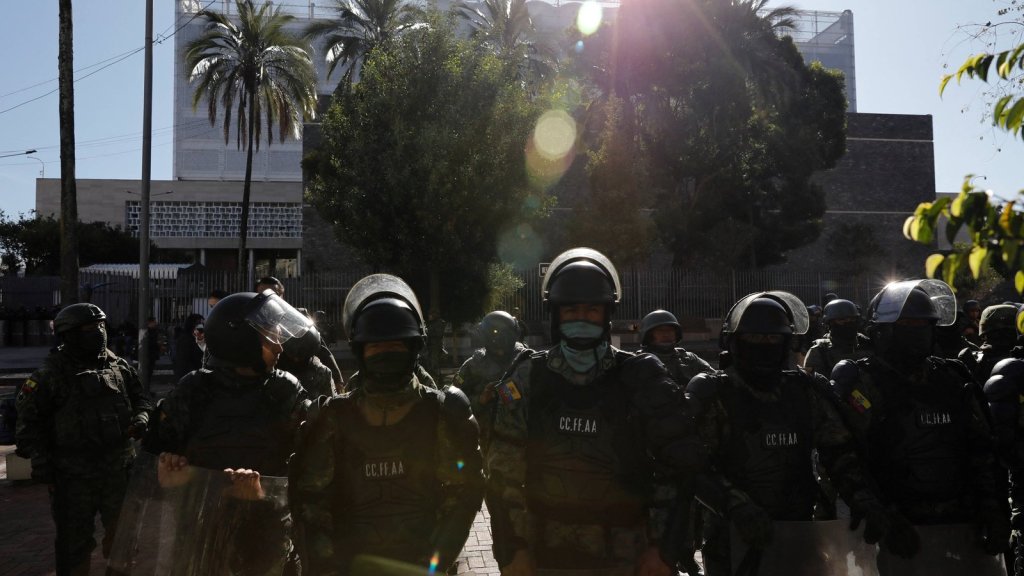
By Lucas Leiroz
Source: Strategic Culture Foundation
In South America, a new scenario of hostilities is emerging. A civil war began in Ecuador, with the local government declaring martial law and a state of “internal armed conflict” in response to several terrorist attacks carried out by drug trafficking groups. At first, this seems like a simple domestic security issue, with no major geopolitical relevance. However, analyzing the case in depth, it is possible to see that the conflict situation is a direct result of U.S. interventionist actions in Latin America.
Ecuador has been going through an extremely turbulent political and economic period over the last seven years. In 2017, Lenin Moreno was elected president in the country as an ally of Rafael Correa. Combining elements of the socialist left with Catholic conservatism, Correa was the leader of the so-called “Citizen Revolution”, having promoted important social reforms over ten years, making the country one of the most prosperous and safe in South America.
Moreno was elected with the promise of continuing Correa’s legacy, having broad popular approval due to the endorsement given to him by his predecessor. However, once coming to power, Moreno undid the legacy of the Citizen Revolution, breaking with Correa and launching a radical neoliberal wave strongly supported by the U.S. Not only that, Moreno was also a key factor in consolidating a reactionary wave across South America, having even sent weapons and war equipment to Bolivia in 2019 in order to support Jeanine Añez’s coup d’état.
The neoliberal shock policy implemented by Moreno and his successor Guillermo Lasso had a brutal social impact in Ecuador. In addition to poverty, unemployment, inflation and other problems in the economic sphere, neoliberal measures also brought with them an exponential increase in crime. The country’s safety indexes quickly dropped. The number of homicides jumped from 970 in 2017 to 4800 in 2022. The country went from being the safest in South America to becoming the most dangerous one, consolidating a drastic social change with catastrophic impacts.
During his years in government, Rafael Correa had implemented both economic measures to reduce social inequalities and strong punitive actions against criminals, halting the growth of the organized crime in the country. He, however, failed to reverse Ecuador’s economic dollarization, which had been implemented before his rise to power. Correa had plans to change Ecuador’s monetary policy, but Moreno’s “soft coup d’état” prevented such a project from being advanced.
It is known that dollarized economies are preferred by drug trafficking cartels and criminal organizations since the absence of exchange mechanisms makes it easier for illegal money to circulate in society, mainly through money laundering schemes. In this sense, since dollarization in 2000, the Ecuadorian authorities have had many difficulties in controlling the illegal economic flow in the country, and this has only gotten worse as criminal networks have gained even more power in the country since Moreno’s neoliberal shock.
Regarding the criminal scenario, Ecuador is known for being a region disputed by Colombian and Mexican cartels. Several gangs operate in Ecuador as proxies for foreign cartels. The country’s location is strategic for the drug market in the southern direction of the continent, which is why Mexican and Colombian traffickers (who control the illegal Latin American market) compete for Ecuadorian territory and back local armed militias to achieve their objectives. In addition, Ecuador is located between Peru and Colombia, which are the two largest global producers of cocaine, further increasing the strategic interest of the Ecuadorian territory for drug trafficking.
Neoliberalism in Ecuador has made the state incapable of controlling the activities of foreign groups in the country, as well as preventing local citizens – increasingly poor and vulnerable – from being co-opted by illegal networks. The result was the emergence of a brutal conflict, with the authorities completely losing control of the situation.
The current outbreak of violence began after the state reacted to the escape from prison of Adolfo Macías — known as “El Fito” — leader of the “Los Choneros” gang. The government declared a state of emergency and tried to impose a siege on the criminals, but suffered several brutal retaliations, with members of Fito’s gang capturing the University of Guayaquil, invading a live TV studio, and even bombing hospitals and public facilities. Furthermore, prisons were captured by criminals, with officers being held hostage, tortured and even hanged. The barbaric scenario led President Daniel Noboa to declare war on the “domestic enemy”, calling on the armed forces to act.
Currently, the streets of Ecuador are the scene of brutal urban warfare, with soldiers facing heavily armed narco-terrorists in intense attrition. The power acquired by criminal groups in the country is impressive, which shows how the impotence of a neoliberal state can have devastating consequences for national security.
It is important to emphasize that U.S.-born Daniel Noboa does not appear to be a skilled politician to reverse this situation completely. He came to power in a tense electoral scenario, in which gangs actively participated in political disputes, even being involved in the murder of a candidate. Noboa is a liberal politician who is extremely aligned with the U.S., and is not interested in resuming Correa’s policies, in addition to suffering a lot of pressure from criminal groups – which have a broad institutional infiltration.
However, it is desirable that at least the public situation in the country returns to normal in some way. The use of military force is the correct way to neutralize gang violence, but it is not the key to solving the drug trafficking problem. To truly undermine the power of criminal networks, it is necessary to implement illiberal policies that reduce poverty, removing ordinary citizens from the sphere of influence of drug trafficking in the country’s periphery. Furthermore, it is necessary to de-dollarize the economy and establish a sovereign currency and exchange rate policy, which make the work of drug trafficking more difficult through strict control of financial flows.
Noboa will certainly not be able to end the drug trafficking problem, as he is not willing to follow the illiberal path, but there is hope that, with the use of force, he will be able to return to normality at some point in the future. After suffering losses on the battlefield, gangs may agree to secretly negotiate a peace agreement with the government to end hostilities on both sides. This will have a positive aspect, as it will put an end to fighting, but it will also have a catastrophic characteristic, as it will definitely turn Ecuador into a Narco-State, where criminal gangs negotiate with the government and act in an institutional manner.
If the U.S. had not intervened in Correa’s Citizen Revolution, perhaps the situation in Ecuador would be different today. But, with neoliberalism and dollarization, the only possible result is a scenario like the current one.
INDIAN COUNTRY NEWS
"It is the duty of every man, as far as his ability extends, to detect and expose delusion and error"..Thomas Paine
Human in Algorithms
From the Roof Top
I See This
blog of the post capitalist transition.. Read or download the novel here + latest relevant posts
अध्ययन-अनुसन्धानको सार
 After the Crash