Julian Assange’s Day in Court

Julian Assange’s lawyers — in a final bid on Tuesday to stop his extradition — fought valiantly to poke holes in the case of the prosecution to obtain an appeal.

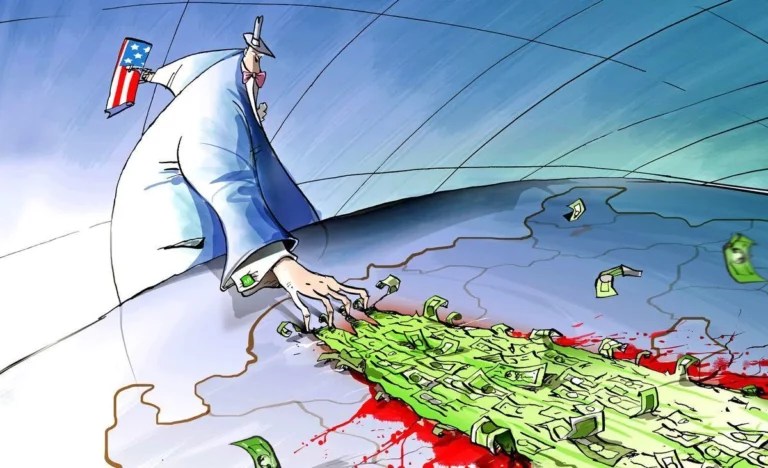
And Our Flags Are Still There – by Mr. Fish

By Chris Hedges

Source: Scheer Post

By the afternoon the video link, which would have allowed Julian Assange to follow his final U.K. appeal to prevent his extradition, had been turned off. Julian, his attorneys said, was too ill to attend, too ill even to follow the court proceedings on a link, although it was possible he was no longer interested in sitting through another judicial lynching. The rectangular screen, tucked under the black wrought iron bars that enclosed the upper left hand corner balcony of the courtroom where Julian would have been caged as a defendant, was perhaps a metaphor for the emptiness of this long and convoluted judicial pantomime. 

The arcane procedural rules — the lawyers in their curled blonde wigs and robes, the spectral figure of the two judges looking down on the court from their raised dais in their gray wigs and forked white collars, the burnished walnut paneled walls, the rows of lancet windows, the shelves on either side filled with law books in brown, green, red, crimson, blue and beige leather bindings, the defense lawyers, Edward Fitzgerald KC and Mark Summers KC, addressing the two judges, Dame Victoria Sharp and Justice Johnson, as “your lady” and “my lord” — were all dusty Victorian props employed in a modern Anglo-American show trial. It was a harbinger of a decrepit justice system that, subservient to state and corporate power, is designed to strip us of our rights by judicial fiat.

The physical and psychological disintegration of Julian, seven years trapped in the Ecuadorian Embassy in London and nearly five years held on remand in the high-security HM Prison Belmarsh, was always the point, what Nils Melzer the former U.N. Special Rapporteur on torture calls his “slow-motion execution.”  Political leaders, and their echo chambers in the media, fall all over themselves to denounce the treatment of Alexei Navalny but say little when we do the same to Julian. The legal farce grinds forward like the interminable case of Jarndyce and Jarndyce in Charles Dickens’ novel Bleak House. It will probably grind on for a few more months — one can’t expect the Biden administration to add the extradition of Julian to all its other political woes. It may take months to issue a ruling, or grant one or two appeal requests, as Julian continues to waste away in HM Prison Belmarsh. 

Julian’s nearly 15-year legal battle began in 2010 when WikiLeaks published classified military files from the wars in Iraq and Afghanistan — including footage showing a U.S. helicopter gunning down civilians, including two Reuters journalists in Baghdad. He took refuge in London’s Ecuadorian embassy, before being arrested by the Metropolitan Police in 2019 who were permitted by the Ecuadorian embassy to enter and seize him. He has been held for nearly five years in HM Prison Belmarsh.

Julian did not commit a crime. He is not a spy. He did not purloin classified documents. He did what we all do, although he did it in a far more important way. He published voluminous material, leaked to him by Chelsea Manning, which exposed U.S. war crimesliescorruptiontorture and assassinations. He ripped back the veil to expose the murderous machinery of the U.S. empire.

The two-day hearing is Julian’s last chance to appeal the extradition decision made in 2022 by the then British home secretary, Priti Patel. On Wednesday the prosecution will make its arguments. If he is denied an appeal he can request the European Court of Human Rights (ECtHR) for a stay of execution under Rule 39, which is given in “exceptional circumstances” and “only where there is an imminent risk of irreparable harm.” But the British court may order Julian’s immediate extradition prior to a Rule 39 instruction or may decide to ignore a request from the ECtHR to allow Julian to have his case heard by the court.

District Judge Vanessa Baraitser in January 2021, at Westminster Magistrates’ Court, refused to authorize the extradition request. In her 132-page ruling, she found that there was a “substantial risk” Julian would commit suicide due to the severity of the conditions he would endure in the U.S. prison system. At the same time, she accepted all the charges leveled by the U.S. against Julian as being filed in good faith. She rejected the arguments that his case was politically motivated, that he would not get a fair trial in the U.S. and that his prosecution is an assault on the freedom of the press.

Baraitser’s decision was overturned after the U.S. government appealed to the High Court in London. Although the High Court accepted Baraitser’s conclusions about Julian’s “substantial risk” of suicide if he was subjected to certain conditions within a U.S. prison, it also accepted four assurances in U.S. Diplomatic Note no. 74, given to the court in February 2021, which promised Julian would be treated well. The “assurances” state that Julian will not be subject to Special Administrative Measure. They promise that Julian, an Australian citizen, can serve his sentence in Australia if the Australian government requests his extradition. They promise he will receive adequate clinical and psychological care. They promise that, pre-trial and post-trial, Julian will not be held in the Administrative Maximum Facility in Florence, Colorado.

The defense must convince the two judges that the District Judge made serious legal errors to see an appeal granted.  

They argued that espionage is, as a matter of law, a political offense and that the extradition treaty with the U.S. prohibits extradition for political offenses. They focused on the extensive UK law, common law and international law that defines espionage as a “pure political offense” because it is directed against a state apparatus. For this reason, those charged with espionage should be protected from extradition. The lawyers spent a long time adjudicating the case of Chelsea Manning to justify her leak of documents that exposed war crimes as in the public interest, then arguing that if she was justified in leaking the documents Julian was justified in publishing them.

As the day wore on it became evident that the two judges were not well versed in the case, constantly asking for citations and expressing surprise that senior officials in the U.S., such as Mike Pompeo when he was head of the CIA, said Julian would not be protected by the First Amendment in an American court because he was not a citizen. Julian’s lawyers brought up past espionage cases, such as that of MI5 agent David Shaylerprosecuted under the Official Secrets Act 1989 for passing secret documents to The Mail on Sunday in 1997 — which included the names of agents. He also disclosed that MI5 (Britain’s domestic intelligence service) kept files on prominent politicians, including Labour ministers, and that MI6 (Britain’s foreign intelligence service) was involved in a plot to assassinate Libyan leader Colonel Momar Gaddafi. The British extradition request was rejected by the French Cour d’Appel because it was a “political offense.”  

All 18 counts filed against Julian allege that his purpose was “that such information so obtained could be used to the injury of the United States and the advantage of any foreign nation.”

The hearing was, after those in 2020 that focused on Julian’s mental and psychological health, refreshing in that it discussed the crimes committed by the U.S. and the importance of making them public. The two judges rarely interrupted, unlike other court proceedings for Julian I have attended where the judge often condescendingly cut short the defense. This may be a reflection of the broad public support, including by major media organizations, which have belatedly rallied behind Julian. Hundreds of people thronged the entrance to The Royal Courts of Justice, an expansive Victorian Gothic stone building adorned with statues of Jesus, Moses, Solomon and Alfred the Great, the celebrated pillars of the English legal tradition, to call for Julian’s freedom.

The afternoon session was different. On about a half dozen occasions the judges halted the defense to ask about how the leaks, because they were not thoroughly redacted, had endangered lives, although the U.S. has never been able to provide evidence of anyone whose life was lost as a result of the leaks. This canard has long been the cross on which U.S. officials have sought to crucify Julian. The two judges — one wonders if they had been given instructions during the lunch break — hurled these accusations at the defense lawyers until we adjourned.

“These indiscriminate disclosures were condemned by The Guardian and The New York Times,” Judge Sharp admonished the defense team. “They could have been done differently.”

This reference was especially egregious since the unredacted documents were first made public not by WikiLeaks or Julian but by the website Cryptome after reporters from The Guardian printed the password to the unredacted documents in their book.

The U.S. is officially seeking Julian’s extradition, where he potentially faces up to 175 years in prison, for the 2010 publication of the Iraq and Afghanistan war logs and US diplomatic cables. But the U.S. did not request his extradition until the release in March 2017 of the files known as Vault 7 which detailed how the CIA could hack Apple and Android smartphones and turn internet-connected televisions — even when they were off — into listening devices. Joshua Schulte, a former CIA employee, was found guilty last year of four counts each of espionage and computer hacking and one count of lying to FBI agents after handing over classified materials to WikiLeaks. He was given a forty-year sentence in February.

After the release of Vault 7 then CIA Director Mike Pompeo called WikiLeaks “a non-state hostile intelligence service.” The Attorney General at the time, Jeff Sessions, said that Julian’s arrest was a priority. By August the U.S. Senate had passed a 78-page intelligence finance bill which included a sentence declaring that “it is the sense of Congress that Wikileaks and the senior leadership of Wikileaks resemble a non-state hostile intelligence service often abetted by state actors and should be treated as such a service by the United States.” In May 2019 the Trump administration accused Julian of violating the Espionage Act and asked the UK to extradite him to stand trial in the U.S. Trump has called the allegations against Julian treason and called for “the death penalty or something.” Other politicians, including former Republican presidential candidate Mike Huckabee, have also called for Julian to be executed.

If Julian is extradited and additionally charged for the release of the Vault 7 documents, Fitzgerald told the court, “it could result in additional charges that merit the death penalty for aiding and abetting the enemy.” The U.S., he said, especially if Trump is elected again to the presidency, could easily “reformulate these charges into a capital offense.”

Summers brought up President Donald Trump’s request for “detailed options” of how to assassinate Julian when he was in the Ecuadorian Embassy. “Sketches were even drawn up,” he said, adding that the plot fell apart when the UK authorities backed down, especially over a potential shootout, in the streets of London”.

“The evidence showed that the US was prepared to go to any lengths, including misusing its own criminal justice system, to sustain impunity for US officials in respect of the torture/war crimes committed in its infamous ‘war on terror’, and to suppress those actors and courts willing and prepared to try to bring those crimes to account,” he said.

 The lawyers were right. The CIA is the driving force behind the extradition. The leak was highly embarrassing and to the CIA highly damaging. The CIA intends to make Julian pay. Schulte, who leaked Vault 7, was given a forty year sentence. Julian, if extradited, will be next. 

Let Them Eat Dirt

The final stage of Israel’s genocide in Gaza, an orchestrated mass starvation, has begun. The international community does not intend to stop it.

Let Them Eat Dirt – by Mr. Fish

By Chris Hedges

Source: Scheer Post

There was never any possibility that the Israeli government would agree to a pause in the fighting proposed by Secretary of State Antony Blinken, much less a ceasefire. Israel is on the verge of delivering the coup de grâce in its war on Palestinians in Gaza – mass starvation. When Israeli leaders use the term “absolute victory,” they mean total decimation, total elimination. The Nazis in 1942 systematically starved the 500,000 men, women and children in the Warsaw Ghetto. This is a number Israel intends to exceed. 

Israel, and its chief patron the United States, by attempting to shut down the United Nations Relief and Works Agency for Palestine Refugees in the Near East (UNRWA), which provides food and aid to Gaza, is not only committing a war crime, but is in flagrant defiance of the International Court of Justice (ICJ). The court found the charges of genocide brought by South Africa, which included statements and facts gathered by UNWRA, plausible. It ordered Israel to abide by six provisional measures to prevent genocide and alleviate the humanitarian catastrophe. The fourth provisional measure calls on Israel to secure immediate and effective steps to provide humanitarian assistance and essential services in Gaza. 

UNRWA’s reports on conditions in Gaza, which I covered as a reporter for seven years, and its documentation of indiscriminate Israeli attacks illustrate that, as UNRWA said, “unilaterally declared ‘safe zones’ are not safe at all. Nowhere in Gaza is safe.” 

UNRWA’s role in documenting the genocide, as well as providing food and aid to the Palestinians, infuriates the Israeli government. Prime Minister Benjamin Netanyahu accused UNRWA after the ruling of providing false information to the ICJ. Already an Israeli target for decades, Israel decided that UNRWA, which supports 5.9 million Palestinian refugees across the Middle East with clinics, schools and food, had to be eliminated. Israel’s destruction of UNRWA serves a political as well as material objective. 

The evidence-free Israeli accusations against UNRWA that a dozen of the 13,000 employees had links to those who carried out the attacks in Israel on Oct. 7, which saw some 1,200 Israelis killed, did the trick. It led 16 major donors, including the United States, the U.K., Germany, Italy, the Netherlands, Austria, Switzerland, Finland, Australia, Canada, Sweden, Estonia and Japan, to suspend financial support for the relief agency on which nearly every Palestinian in Gaza depends for food. Israel has killed 152 UNRWA workers and damaged 147 UNRWA installations since Oct. 7. Israel has also bombed UNRWA relief trucks. 

More than 27,708 Palestinians have been killed in Gaza, some 67,000 have been wounded and at least 7,000 are missing, most likely dead and buried under the rubble.

More than half a million Palestinians – one in four – are starving in Gaza, according to the U.N. Starvation will soon be ubiquitous. Palestinians in Gaza, at least 1.9 million of whom have been internally displaced, lack not only sufficient food, but clean water, shelter and medicine. There are few fruits or vegetables. There is little flour to make bread. Pasta, along with meat, cheese and eggs, have disappeared. Black market prices for dry goods such as lentils and beans have increased 25 times from pre-war prices. A bag of flour on the black market has risen from $8.00 to $200 dollars. The healthcare system in Gaza, with only three of Gaza’s 36 hospitals left partially functioning, has largely collapsed. Some 1.3 million displaced Palestinians live on the streets of the southern city of Rafah, which Israel designated a “safe zone,” but has begun to bomb. Families shiver in the winter rains under flimsy tarps amid pools of raw sewage. An estimated 90 percent of Gaza’s 2.3 million people have been driven from their homes.

“There is no instance since the Second World War in which an entire population has been reduced to extreme hunger and destitution with such speed,” writes Alex de Waal, executive director of the World Peace Foundation at Tufts University and the author of “Mass Starvation: The History and Future of Famine,” in the Guardian. “And there’s no case in which the international obligation to stop it has been so clear.”

The United States, formerly UNRWA’s largest contributor, provided $422 million to the agency in 2023. The severance of funds ensures that UNRWA food deliveries, already in very short supply because of blockages by Israel, will largely come to a halt by the end of February or the beginning of March. 

Israel has given the Palestinians in Gaza two choices. Leave or die.

I covered the famine in Sudan in 1988 that took 250,000 lives. There are streaks in my lungs, scars from standing amid hundreds of Sudanese who were dying of tuberculosis. I was strong and healthy and fought off the contagion. They were weak and emaciated and did not. The international community, as in Gaza, did little to intervene. 

The precursor to starvation – undernourishment – already affects most Palestinians in Gaza. Those who starve lack enough calories to sustain themselves. In desperation people begin to eat animal fodder, grass, leaves, insects, rodents, even dirt. They suffer from diarrhea and respiratory infections. They rip up tiny bits of food, often spoiled, and ration it. 

Soon, lacking enough iron to produce hemoglobin, a protein in red blood cells that carries oxygen from the lungs to the body, and myoglobin, a protein that provides oxygen to muscles, coupled with a lack of vitamin B1they become anemic. The body feeds on itself. Tissue and muscle waste away. It is impossible to regulate body temperature. Kidneys shut down. Immune systems crash. Vital organs – brain, heart, lungs, ovaries and testes — atrophy. Blood circulation slows. The volume of blood decreases. Infectious diseases such as typhoid, tuberculosis and cholera become an epidemic, killing people by the thousands.

It is impossible to concentrate. Emaciated victims succumb to mental and emotional withdrawal and apathy. They do not want to be touched or moved. The heart muscle is weakened. Victims, even at rest, are in a state of virtual heart failure. Wounds do not heal. Vision is impaired with cataracts, even among the young. Finally, wracked by convulsions and hallucinations, the heart stops. This process can last up to 40 days for an adult. Children, the elderly and the sick expire at faster rates.

I saw hundreds of skeletal figures, specters of human beings, moving forlornly at a glacial pace across the barren Sudanese landscape. Hyenas, accustomed to eating human flesh, routinely picked off small children. I stood over clusters of bleached human bones on the outskirts of villages where dozens of people, too weak to walk, had laid down in a group and never gotten up. Many were the remains of entire families. 

In the abandoned town of Mayen Abun bats dangled from the rafters of the gutted Italian mission church. The streets were overgrown with tussocks of grass. The dirt airstrip was flanked by hundreds of human bones, skulls and the remnants of iron bracelets, colored beads, baskets and tattered strips of clothing. The palm trees had been cut in half. People had eaten the leaves and the pulp inside. There had been a rumor that food would be delivered by plane. People had walked for days to the airstrip. They waited and waited and waited. No plane arrived. No one buried the dead. 

Now, from a distance, I watch this happen in another land in another time. I know the indifference that doomed the Sudanese, mostly Dinkas, and today dooms the Palestinians. The poor, especially when they are of color, do not count.  They can be killed like flies. The starvation in Gaza is not a natural disaster. It is Israel’s masterplan. 

There will be scholars and historians who will write of this genocide, falsely believing that we can learn from the past, that we are different, that history can prevent us from being, once again, barbarians. They will hold academic conferences. They will say “Never again!” They will praise themselves for being more humane and civilized. But when it comes time to speak out with each new genocide, fearful of losing their status or academic positions, they will scurry like rats into their holes. Human history is one long atrocity for the world’s poor and vulnerable. Gaza is another chapter.

Southern countries no longer trust the West

By Veniamin Popov

Source: New Eastern Outlook

The genocide perpetrated by Israel in Gaza against Palestinians under US patronage has had an enormous impact on developing countries. Four months of Israeli military action against the Palestinians had been a watershed in the attitude of the Global South towards the West: the number of civilians killed and wounded, most of them women and children, was approaching 100,000; in an enclave of nearly 2.5 million people, one third of the houses had been completely destroyed. This has not just shown the hypocrisy of the Western Powers with their constant policy of double standards. It has convinced many that the West cannot be at the mercy of the West: it will stop at nothing to impose solutions that are favourable to it.

Many in the Middle East and the Global South were struck both by the brutality of Israel’s military campaign and the unwavering support for it by Western governments. “For them this is as much a war”, wrote the Al Ahram newspaper on 30.01.2024, “as US President Joe Biden’s war as Israeli Prime Minister Benjamin Netanyahu’s, and the continued indifference to the scale of destruction has once again confirmed how cheap Arab life seems to Western leaders”.

As Fawaz Gerges, professor of international relations at the London School of Economics, argues in his book What Really Went Wrong: The West and the Collapse of Democracy in the Middle East, the United States and other Western countries, principally Britain, have for nearly a century pursued an interventionist, militaristic and anti-democratic foreign policy that has largely ignored the interests of the Middle East. After the brutal Hamas attack on 7 October, which revealed, in the words of Egypt’s Al Ahram, the folly of Biden and Netanyahu’s approach, there was no restraint or attempt to think through the consequences of the current war. Instead, Biden and his European allies supported Israel’s fatal attack on the Gaza Strip. Despite the fact that the civilian death toll is rising at an unprecedented rate, the humanitarian crisis is becoming more acute by the day, and governments around the world have called for a ceasefire, Biden has shown no willingness to intervene to prevent bloodshed.

It is no coincidence that the media of many nations published articles about Frantz Fanon, an anti-colonial activist who grew up in a black middle-class family in French colonial Martinique: more than any other writer of the time, he captured the rage generated by colonial humiliation in the hearts of colonised people, and was a remarkably astute analyst of contemporary ills – the ongoing psychological traumas of racism and oppression, the enduring power of white nationalism, and the scourge of authoritarian predatory post-colonial regimes. In Fanon’s view, the world then was split in two, which is also absolutely true of today.

The West’s current strategy has failed colossally, and the American-led Anglo-Saxon empire is also failing: the wars in Ukraine and Gaza, the Turkish Daily Sabah newspaper reported in early February, have exposed the limits of Western power and its highly duplicitous approach to international law and the laws of war. The decision by some Western states to cut off funding to the Palestinian refugee agency UNRWA “is a brazen and shameless move to starve the Palestinians and force Hamas to capitulate”.

By supporting Israel and allowing it to kill tens of thousands of civilians, Western countries are putting themselves on the opposite edge of the values and principles of multilateralism and respect for human rights, “they are going against the very foundations on which the UN was built”, the Al Jazeera website wrote on 16.01.24. Another article on the same site noted that Gaza will be the grave of the Western-led world order: by supporting Israel’s atrocities, the West has undermined what is left of its authority and brought the rules-based world order to the point of no return: the authority of the West has been irrevocably undermined.

The United States military strikes on Syria, Iraq and Yemen have caused an explosion of anti-American sentiment throughout the Arab world, once again demonstrating the aggressive nature of US policy in the Middle East and Washington’s complete disregard for the norms of international law.

According to a poll conducted in 16 Arab states on 10.01.24 – 89% of respondents opposed recognising Israel, and 77% considered the US and Israel the biggest security threat to the region.

The Saudi newspaper Arab News emphasised in mid-January this year that many Western leaders are increasingly moving away from their people. In early February, the New York Times reported that more than 800 US and EU civil servants published a protest against their governments’ support for Israel; last November, more than 500 employees of 40 US government agencies sent a letter to President Biden criticising his policies on the Gaza war.

Turkish newspapers have consistently published stories that the Global North should abandon old approaches and rethink its international policies.

Ghassan Charbel, editor-in-chief of Asharq Al-Awsat newspaper, noted on 29.01.24 that the continuation of the Gaza massacre is costing the countries of the region and the world economy dearly, it is also hitting America’s interests and image.

Recent events on the world stage are increasingly convincing the people of developing countries that their interests are at odds with those of the West, and in some issues are diametrically opposed.

2024 Is the New 1984: Big Brother and the Rise of the Security Industrial Complex

By John & Nisha Whitehead

Source: The Rutherford Institute

“Big Brother is Watching You.”―George Orwell, 1984

2024 is the new 1984.

Forty years past the time that George Orwell envisioned the stomping boot of Big Brother, the police state is about to pass off the baton to the surveillance state.

Fueled by a melding of government and corporate power—the rise of the security industrial complex—this watershed moment sounds a death knell for our privacy rights.

An unofficial fourth branch of government, the Surveillance State came into being without any electoral mandate or constitutional referendum, and yet it possesses superpowers, above and beyond those of any other government agency save the military.

It operates beyond the reach of the president, Congress and the courts, and it marches in lockstep with the corporate elite who really call the shots in Washington, DC.

This is the new face of tyranny in America: all-knowing, all-seeing and all-powerful.

Tread cautiously.

Empowered by advances in surveillance technology and emboldened by rapidly expanding public-private partnerships between law enforcement, the Intelligence Community, and the private sector, the Surveillance State is making the fictional world of 1984, Orwell’s dystopian nightmare, our looming reality.

1984 portrays a global society of total control in which people are not allowed to have thoughts that in any way disagree with the corporate state. There is no personal freedom, and advanced technology has become the driving force behind a surveillance-driven society. Snitches and cameras are everywhere. People are subject to the Thought Police, who deal with anyone guilty of thought crimes. The government, or “Party,” is headed by Big Brother who appears on posters everywhere with the words: “Big Brother is watching you.”

Indeed, in our present age of ubiquitous surveillance, there are no private lives.

Everything is increasingly public.

What we are witnessing, in the so-called name of security and efficiency, is the creation of a new class system comprised of the watched (average Americans such as you and me) and the watchers (government bureaucrats, technicians and private corporations).

We now find ourselves in the unenviable position of being monitored, managed and controlled by our technology, which answers not to us but to our government and corporate rulers.

This is the fact-is-stranger-than-fiction lesson that is being pounded into us on a daily basis.

In this way, 1984, which depicted the ominous rise of ubiquitous technology, fascism and totalitarianism, has become an operation manual for the omnipresent, modern-day surveillance state.

There are roughly one billion surveillance cameras worldwide and that number continues to grow, thanks to their wholehearted adoption by governments (especially law enforcement and military agencies), businesses, and individual consumers.

Surveillance cameras mounted on utility poles, traffic lights, businesses, and homes. Ring doorbells. GPS devices. Dash cameras. Drones. Store security cameras. Geofencing and geotracking. FitBits. Alexa. Internet-connected devices. 

Stingray devices, facial recognition technology, body cameras, automated license plate readers, gunshot detection, predictive policing software, AI-enhanced video analytics, real-time crime centers, fusion centers: all of these technologies and surveillance programs rely on public-private partnerships that together create a sticky spiderweb from which there is no escape.

With every new surveillance device we welcome into our lives, the government gains yet another toehold into our private worlds.

As the cost of these technologies becomes more affordable for the average consumer, an effort underwritten by the tech industry and encouraged by law enforcement agencies and local governing boards, which in turn benefit from access to surveillance they don’t need to include in their budgets, big cities, small towns, urban, suburban and rural communities alike are adding themselves to the surveillance state’s interconnected grid.

What this adds up to for government agencies (that is, FBI, NSA, DHS agents, etc., as well as local police) is a surveillance map that allows them to track someone’s movements over time and space, hopscotching from doorbell camera feeds and business security cameras to public cameras on utility poles, license plate readers, traffic cameras, drones, etc.

It has all but eliminated the notion of privacy enshrined in the  Fourth Amendment and radically re-drawn the line of demarcation between our public and private selves.

The police state has become particularly adept at sidestepping the Fourth Amendment, empowered by advances in surveillance technology and emboldened by rapidly expanding public-private partnerships between law enforcement, the Intelligence Community, and the private sector.

Over the past 50-plus years, surveillance has brought about a series of revolutions in how governments govern and populations are policed to the detriment of us all. Cybersecurity expert Adam Scott Wandt has identified three such revolutions.

The first surveillance revolution came about as a result of government video cameras being installed in public areas. There were a reported 51 million surveillance cameras blanketing the United States in 2022. It’s estimated that Americans are caught on camera an average of 238 times every week (160 times per week while driving; 40 times per week at work; 24 times per week while out running errands and shopping; and 14 times per week through various other channels and activities). That doesn’t even touch on the coverage by surveillance drones, which remain a relatively covert part of police spying operations.

The second revolution occurred when law enforcement agencies started forging public-private partnerships with commercial establishments like banks and drug stores and parking lots in order to gain access to their live surveillance feeds. The use of automatic license plate readers (manufactured and distributed by the likes of Flock Safety), once deployed exclusively by police and now spreading to home owners associations and gated communities, extends the reach of the surveillance state that much further afield. It’s a win-win for police budgets and local legislatures when they can persuade businesses and residential communities to shoulder the costs of the equipment and share the footage, and they can conscript the citizenry to spy on each other through crowdsourced surveillance.

The third revolution was ushered in with the growing popularity of doorbell cameras such as Ring, Amazon’s video surveillance doorbell, and Google’s Nest Cam.

Amazon has been particularly aggressive in its pursuit of a relationship with police, enlisting them in its marketing efforts, and going so far as to hosting parties for police, providing free Ring doorbells and deep discounts, sharing “active camera” maps of Ring owners, allowing access to the Law Enforcement Neighborhood Portal, which enables police to directly contact owners for access to their footage, and coaching police on how to obtain footage without a warrant.

Ring currently partners with upwards of 2,161 law enforcement agencies and 455 fire departments, and that number grows exponentially every year. As Vice reports, “Ring has also heavily pursued city discount programs and private alliances with neighborhood watch groups. When cities provide free or discounted Ring cameras, they sometimes create camera registries, and police sometimes order people to aim Ring cameras at their neighbors, or only give cameras to people surveilled by neighborhood watches.”

In November 2022, San Francisco police gained access to the live footage of privately owned internet cameras as opposed to merely being able to access recorded footage. No longer do police even have to request permission of homeowners for such access: increasingly, corporations have given police access to footage as part of their so-called criminal investigations with or without court orders.

The fourth revolutionary shift may well be the use of facial recognition software and artificial intelligence-powered programs that can track people by their biometrics, clothing, behavior and car, thereby synthesizing the many strands of surveillance video footage into one cohesive narrative, which privacy advocates refer to as 360 degree surveillance.

While the guarantee of safety afforded by these surveillance nerve centers remains dubious, at best, there is no disguising their contribution in effecting a sea change towards outright authoritarianism.

For instance, as an in-depth investigative report by the Associated Press concludes, the very same mass surveillance technologies that were supposedly so necessary to fight the spread of COVID-19 are now being used to stifle dissent, persecute activists, harass marginalized communities, and link people’s health information to other surveillance and law enforcement tools.

As the AP reports, federal officials have also been looking into how to add “‘identifiable patient data,’ such as mental health, substance use and behavioral health information from group homes, shelters, jails, detox facilities and schools,” to its surveillance toolkit.

These cameras—and the public-private eyes peering at us through them—are re-engineering a society structured around the aesthetic of fear and, in the process, empowering “people to not just watch their neighborhood, but to organize as watchers,” creating not just digital neighborhood watches but digital gated communities.

Finally, there is a repressive, suppressive effect to surveillance that not only acts as a potentially small deterrent on crime but serves to monitor and chill lawful First Amendment activity.

As Matthew Feeney warns in the New York Times, “In the past, Communists, civil rights leaders, feminists, Quakers, folk singers, war protesters and others have been on the receiving end of law enforcement surveillance. No one knows who the next target will be.

No one knows, but it’s a pretty good bet that the surveillance state will be keeping a close watch on anyone seen as a threat to the government’s chokehold on power.

After all, as I make clear in my book Battlefield America: The War on the American People and in its fictional counterpart The Erik Blair Diaries, the Surveillance State never sleeps.

Navigating The Space Between Worlds

Mastering the art of being in the world, even when we know it’s filled with heavy challenges and chaos.

By Joe Martino

Source: The Pulse

Over the last few decades, many have written about our time as a space where humanity is between worlds. On one hand, we have our current way of life which is incredibly demanding on our minds and bodies, is rather toxic, and filled with conflict and destruction. On the other hand is a vision for a world that’s slower, more connected, more natural, and more loving.

As we navigate what appears to be the dying stages of the old paradigm, the intensity of what it is seems to increase. The qualities of the old system become louder, acting as an evolutionary pressure to push things along.

Many become inspired to explore ways to bring the ‘new world’ to the here and now via their actions.

How do I live without money?
How do I exit the toxicity of our current system?
How do I not participate anymore?

If we aren’t careful, these questions can create a framing of our current world that can make it very hard to live within.

If we deeply judge the need to work, to make money, to pay taxes etc, all of it can become a heavy thing to carry. We end up waking up every day dreading going to work, and having endless conversations, thoughts and emotions about how the bad guys are ruining life for us and we’re the victims in it all.

While there may be truth to some of the observations about our society, the framing of it in our minds is disempowering many of us, and it’s making our current moment dreadful. Further, it holds us back from living and being able to solve the problem.

So how do we work with this? How do we live in the space between worlds?

What Feels Natural To Us?

Indeed, our current societal design is not supportive of human beings thriving. In that sense, it has been poorly designed. We have such an easy time as a species doing this because our higher-order thinking allows us to override what is good for our biology. Simply put: it’s easy to ignore our needs using our thinking, especially when we become so identified with life cognitively.

I have 7 alpacas. The moment they need to poop, they just do it, no thinking, no “I’ll just finish this paragraph,” they just do it. They listen to their biology. Humans on the other hand don’t always listen. In some cases we don’t because we have social structures, social norms, and brains to hold this all together. But we also don’t because we’ve learned to ignore our body, feelings, and emotions in many ways.

While our higher-order thinking is beautiful in one sense, how do we know when it begins to work against us?

I often use an example with friends and clients of a bear. The bear (a mammal like us) was likely raised by an attached parent. It learned how to ‘bear’ and how to be in its environment from that parent in its natural environment. If that bear’s ecosystem was cut down or destroyed by humans, it wouldn’t stay for too long. It would know that concrete, a lack of forest, and a lack of fresh water aren’t good for it, and it would leave to find a suitable home. The bear is simply following its connection to its biology.

We as humans know we are doing this to animals and call it ‘displacing nature/animals.’ Interestingly, we tend to see ourselves ‘outside’ of nature, conveniently ignoring how we’re ‘displacing’ ourselves.

As mentioned, humans are resilient in that we can survive in different environments. We find ways to adjust, cope, and problem solve within environments that are not natural to us. Here I’m not just talking about physical environments but also emotional ones. We find ways to survive in abusive situations for example. We know we should leave, but sometimes we feel we can’t or don’t have the capacity to.

Further, there are difficult elements to our environments like not having access to clean food, clean water, and shelter without having to work very hard to get them.

Because of our amazing thinking brains, humans can do and create incredible things, but we can also become so cognitively and mentally identified that we override our basic biology so much so that we build systems that aren’t attuned to our own well-being.

Thus, humans are currently surviving, but we are in no way thriving. And we did this to ourselves via a disconnection from ourselves.

To be clear, it’s not that we shouldn’t have roads, technology, and societal systems, it’s that they should be designed with human and natural thrivability in mind. Instead, our world is designed with economic thrivability and elite power structures in mind. All at the expense of human wellness.

The tricky part is, that the more people see and experience this truth, the more we can become angered and upset by it. This is fair. A boundary feels crossed because we living now aren’t necessarily the ones who built it or are choosing it. “Why am I subjected to a system I don’t like nor support, yet feel like I can’t escape it?”

As I stated in my essay If No One Wants This, Why Are We Doing It? our way of life doesn’t feel natural to us deep down and it’s overwhelming the challenge is we can’t change it overnight. So what do we do to live within it without driving ourselves mad?

Exploring The Art of Existing Between Worlds

Over the last 15 years exploring alternative thinking and spiritual spaces, I have discovered that it’s common for people to want to fully “exit” the system. They don’t want to integrate, use money, or do anything within the system as they feel it’s “toxic.”

As mentioned, these feelings are somewhat valid, but how we choose to navigate them is everything. Here are a few key observations.

1. Having unprocessed anger, resentment, victimhood and judgment for the system is a recipe for disaster.

If we go to work each day, pay taxes, or drive on highways with the mindset and emotional drive that we are victims and stuck, we will certainly make our lives feel more challenging. Our mental, emotional, physical, and spiritual framing at that point is that of contraction and stuckness. And it’s often built on a nervous system foundation of survival.

Everything will feel much more difficult in this state. Now, this doesn’t mean we can’t observe the state of the world, understand it, and explore how to change it, all of that can be done without getting stuck in mental and emotional traps. But we have to be careful about the general state of mind and being we are taking into our daily lives. Without being aware of this, we give all of our power away to the system and allow it to dictate how we feel.

I’ve watched people panic and freak out about not eating organic apples, yet their mindset and relationship with themselves and the world is creating more toxicity in themselves than a non-organic apple.

When this mindset goes unchecked, our locus of control for our own well-being is outside of us, not inside. (Key note, I’m not suggesting that the system doesn’t have toxic effects on us, I’m saying that there is a space where we can exist within the system with greater wellness.)

Can we begin to see work, life, and what we currently have going as an opportunity? Can we change the lens through which we see it so it doesn’t add to greater dis-ease? Can we support ourselves, our nervous system, and our emotional well-being through practice that helps us build capacity and resilience?

2. Trying to exit completely is incredibly hard, and most end up just as unhappy.

I have found a lot of people trying everything in their power to avoid working and making money. Here I’m not referring to people who are not well or injured and can’t work, I’m talking about folks who can yet have such a degree of judgment toward the system that they avoid being within it.

Often this path leaves people stuck, uninspired, unable to experience much of the world, and unable to even afford fun projects at home. Life begins to become small, and these people rarely seem truly happy.

That said, intentional communities are an interesting path for some. Although they work and exist within the system in more ways than people think. Sure, a few places are fully off grid, but for the most part money, utilities, land purchases, property tax etc, are all part of the mix.

If you don’t have a lot of money, this path is very tough. People can of course move to countries where things are very cheap and start over, but even that is tough for most people as it’s still expensive and work still needs to be found to live well into the future.

1. Exploring capacity and resilience building to exist in our current world and help solve problems within it seems a fruitful path. This includes doing small things within the system to make life more natural.

To me, this is a path that is accessible to most people and provides a meaningful balance of making a difference and enjoying life. I may also be biased toward this as this is the path I’ve chosen and have taught throughout my work since 2009.

For example, I chose to start a company and embrace the world as it was in 2009. I built my business on a foundation of creating an amazing work environment for employees to work, rest, grow, and contribute to a ‘collective evolution.’ Over time, I was able to give back by hiring 14 people to come into this environment of serving something greater than our personal ambitions, yet those were taken care of too.

We did some amazing projects around the world with excess funds, and we helped establish an internet culture of wellness, consciousness and conscious media. If I had kept the system at a distance, those benefits would not have been shared.

Humans have lived for such a long time in unnatural ways, disconnected from ourselves, and not processing our emotions and traumas, our nervous systems hold that history. It is further being re-inforced by the reality that yes, there is toxicity still in our world. It is badly designed.

But still, regulation and capacity at a deep cellular level need to be restored for most of us. We need to clear out the messy stuff. Otherwise, we will take our pains into any revolutionary systems that pops up outside the system anyway. We see this a lot with intentional communities that collapse.

This means focusing on deeply restoring physiological safety, wellbeing, emotional fluidity and regulation is foundational to living well, and it can be done even in the existing system. Even though our system is tough, this path gives us much more energy, resilience and capacity to exist within the system and make as big a difference as possible while enjoying life.

This path is work. It acknowledged that it isn’t easy to feel great in our world due to the poor design, but that it’s still within our capacity if we focus on it.

This doesn’t mean we ignore the need to change or adjust our system. But this path gives us the greatest ability to do so as we will have built the capacity and deep empowerment to actually do it, vs. being feeling stuck, tired and victimized resisting the system so heavily.

Existing in a space between worlds means building individual and collective wellbeing, and creating change along the way. The more resilient we are, the more we can make money and use it as a tool to find ways to make our lives better, less reliant on the system, and healthier.

In that space of wellness, we can have meaningful conversations and learn to hold visions of a future world that isn’t built on hating and resenting the old. If I’m honest, almost all of the successful changes and projects I’ve seen out there have come from this space of being.

In summary, taking stock of whether our observations of the world have become deep disempowering judgements is a worthwhile reflection. Being ‘awake to corruption’ doesn’t have to come with lifelong resentment toward the system, where we comment online about ‘the bad guys’ ruining things for everyone. Or that somehow Biden, Trump, Trudeau etc. are the root of the problems. I hate to say it but, this gets us nowhere.

Questioning whether we are truly living our lives in a way that promotes emotional, physical, and spiritual well-being and expansiveness is important. Without this, our foundation is weak.

The path forward I’m suggesting is one of building enough strength, well-being, and energy to live with wellness in our current system, so we have energy left over to see clearly and act upon changing what is not natural to us. Good sensemaking of our current events goes alongside this, but as you’ll note from my previous work, good sensemaking is built on a healthy nervous system.

Saturday Matinee: Sanjuro

By Brian Eggert

Source: Deep Focus Review

Answering for the violent thrills of Yojimbo, Akira Kurosawa’s sequel Sanjuro modifies its predecessor’s structure and, in a way, condemns its eponymous hero, reprised by Toshiro Mifune, by depicting his violent existence as a tarnished bushido ideal. Instead of sending up the swordfighting chambara genre as Mifune’s Sanjuro mows down gangs of grotesque, bumbling yakuza criminals, against which he appears superior and even righteous, Kurosawa places his unkempt ronin in the middle of a jidai-geki, a dramatic period piece wherein Mifune’s protagonist remains crafty and skilled in combat, but, shamefully, without nobility nor willingness to restrain his violent instincts. Redefined through introspection and eventual feelings of disgrace about his lifestyle, Kurosawa’s Sanjuro becomes a tragic figure, his mythic stature marked—or soaked, rather—by the blood of his undisciplined existence.

Along with Ryuzo Kikushima and Hideo Oguni, Kurosawa developed Sanjuro from the Shugoro Yamamoto novel Hibi Heian (A Break in the Tranquility) prior to shooting Yojimbo. Yamamoto’s tale, although similarly plotted in its broadstrokes to Kurosawa’s eventual adaptation, features a samurai protagonist without as much idiosyncrasy or skill as Sanjuro. Author of the source novels for Kurosawa’s upcoming pictures Red Beard and Dodes’ka-den, Yamamoto would be associated with Kurosawa for the rest of their careers. For this picture, Kurosawa intended for Hiromichi Horikawa to direct. Horikawa was a former assistant director for Kurosawa on Seven Samurai and Throne of Blood among others, and had become a thriving director in the mid-1950s, with many chambara films among his releases. Nevertheless, producers at Toho Company insisted that Kurosawa direct, given the popularity of Yojimbo under his headship.

Shooting began on Yojimbo in January 1961 and was completed on April 16, and because Kurosawa edited during production, the film was released four days later on April 20, 1961. And since Sanjuro required only minor rewriting to convert the earlier draft into a sequel to Yojimbo, production commenced on September 25, 1961, and ended December 20, with the finished film premiering January 1, 1962. The speed and artistic showmanship with which these films were shot, edited, and released is staggering, especially taking into consideration the detail Kurosawa integrates into his picture. The main setting—a chamberlain’s house and the pond in front, a separating wall with a compound on one side and the sanctuary house on the other—were built as open sets on Toho’s largest stage. Kurosawa oversaw every detail personally, from the vast layout down to the crucial look of camellias on the trees, which the director insisted be hand-made to make sure each one looked just right. At his prime, Kurosawa’s meticulous, even autocratic control over his productions fully justified his nickname: The Emperor.

Sanjuro opens with nine young, incompetent samurai assembled in secret at a forest shrine. Their leader, Iori Izaka (Yuzo Kayama), has recently met with his uncle, the chamberlain, with whom Izaka lobbied to permit his fellow samurai to investigate signs of corruption. The chamberlain refused, which suggested to Izaka that the chamberlain was behind the corruption. And so, Izaka turned to the superintendent for advice; the superintendent agreed to help if they all meet at the present forest shrine. All at once, Mifune’s Sanjuro yawns from the darkness, and casually steps out to offer his thoughts—that the superintendent is, in fact, the corrupt one and the chamberlain was merely being protective of his nephew. He even suspects the superintendent’s men will double-cross the young samurai at their planned meeting, which, as it turns out, takes place at the forest shrine. When Sanjuro learns this, he looks outside and confirms his suspicions are true, then hides the nine young samurai in the floorboards. The superintendent’s men call for surrender and Sanjuro emerges, shouting about the noise and knocking several soldiers down. Believing Sanjuro’s deception, the soldiers’ leader, the idealized samurai warrior Muroto (Tatsuya Nakadai, who also played the gunslinger in Yojimbo), so bound to bushido, recognizes Sanjuro’s skill and offers him a job if he wants it.

Mifune’s introduction recalls the one from Yojimbo, where the ronin is asked his name, and in response, he reveals his first name, “Sanjuro [meaning thirty years old]… going on forty.” He then scans the area and settles on some nearby plantlife for his family name. In Yojimbo, he sees a mulberry field and responds “Kuwabatake [mulberry field],” and in Sanjuro he replies “Tsubaki [camellia]”—an ironic yet apt choice given the camellia’s associations to the chamberlain’s wife and daughter later in the film. In this sequel, Mifune’s Sanjuro proves just as iconic as his performance in the preceding film, only streamlined to highlight those memorable character traits. Unless his sword is drawn, the actor’s arms rarely leave his kimono except to scratch his chin or to itch at his scalp; along with his character’s minimum of dialogue, this places our focus on Mifune’s expressions, ripe with seemingly stoic confidence interrupted by his anger and unease. Sanjuro’s disdain around the hopeless young samurai and his later discomfort around the chamberlain’s wife and daughter are always comical, making Mifune’s performance a subtly complex combination of characterized gestures and reserved emotions.

After the superintendent’s men depart the forest shrine, Sanjuro and the young samurai realize the chamberlain will probably be arrested or worse, as the superintendent has no doubt deduced that the chamberlain suspects him. They resolve to rescue the chamberlain’s wife and daughter (Takako Irie and Reiko Dan) first, before they too are taken. Contemptuous of the young samurai but impelled to assist (for some cash and food) because, as he tells them, they cannot take care of themselves, Sanjuro leads them to the chamberlain’s house, which is guarded by the superintendent’s men. Despite Sanjuro’s constant insults and berating tone, the young samurai follow his every word “like a centipede” astonished by his skill. And, after convincing a servant to get the guards drunk, they quietly take out the sentries and move the women into a nearby barn. Here, Kurosawa pauses for a scene to establish Sanjuro’s lasting themes by differentiating the film’s protagonist from everyone else onscreen. The young samurai, the mannerly women, the dignified warriors serving an upper class—they each follow a particular decorum against which Sanjuro seems incongruous.

When the women first enter their own barn turned hideout, it is a place they have never been; they remark about the lovely smell of hay, the dreamlike quality one feels when resting back on a large mound of the stuff, and reveal their sophisticated obliviousness to the danger of the situation. Their ability to see so much good in the world amid all the bloodshed and unruly politics is not meant to make them look ignorant; rather, they are elevated beyond such unnecessary concerns, achieving a level of paradoxical nescient enlightenment. The chamberlain’s wife asks with polite interest about Sanjuro, and Izaka explains he is a friend. “I hesitate to say this after you so kindly saved us,” remarks the wife, “but killing people is a bad habit. You glisten too brightly… Like a drawn sword… You’re like a sword without a sheath. You cut well, but the best sword is kept in its sheath.” Sanjuro reacts uneasily to this, knowing the wife’s assessment is accurate, but perhaps unwilling to admit it to himself, yet. Sanjuro begins to feel ashamed of his status in the presence of the refined sensibilities of these women. With this, Kurosawa deepens the character throughout the course of the film, allowing Sanjuro to learn something about himself, his eventual victory bittersweet.

One of the young samurai suggests hiding in his house and Sanjuro agrees, but their group quickly learns that the superintendent is keeping the chamberlain locked up next door, just over a compound wall. By the end, Sanjuro, who deceives his enemies by taking Muroto’s job offer to learn of the chamberlain’s exact location, calls the young samurai to rescue the chamberlain, using a downpour of camellias floating down a stream under the compound’s wall as an elegant signal to attack. With this, bloody violence begins to unfold, while on the other side of the wall, the chamberlain’s wife and daughter clap with enchantment at the beauty of the flowers on the water, a scene played both for humor and to emphasize the nonsensicality of violence against the simpler things in life—a message Sanjuro learns by the conclusion. With the chamberlain rescued, the young samurai realize Sanjuro has gone. They find him in a field, preparing to face off against the distinguished samurai Muroto, who, his honor shamed with Sanjuro’s deception, insists they duel. Sanjuro cuts down his opponent with incredible speed, and all of the young samurai, shocked, watch with enthusiasm. After a moment of silent awe, one of them declares the display “brilliant”.

The duel itself remains Sanjuro’s most memorable scene, not only because it concludes the film, but because it does so with such an unforgettable “bang”. Positioned face-to-face, Mifune and Nakadai, mirroring their final scene together in Yojimbo, standoff for a clocked 26 seconds of silence, an excruciatingly long period of suspense. The technician who controlled the pressurized pump to spray Muroto’s fake blood (a batch of chocolate syrup and carbonated water) from Nakadai’s torso worried that the effect would not please Kurosawa, and overcompensated by adding thirty pounds of pressure, so when the scene commenced filming and Mifune cuts with split-second speed, fake blood shot out like a geyser. The larger-than-life outcome, wholly staggering and uncharacteristic when compared to the violence in the rest of the film, pleased Kurosawa, as its exaggerated quality echoes the base thrill both the young samurai and the audience feel toward the spectacle, and how even for a violent film this last act of violence remains the ugliest and most horrible.

A moment later, Sanjuro, enraged by their response, scorns the young samurai for applauding such violence. “Idiots! What do you know about anything? …He was just like me. A drawn sword that wouldn’t stay in its sheath. But you know, the lady was right. The best sword is kept in its sheath. You’d better stay in yours.” Sanjuro begins to walk away and the young samurai follow. “Stop following me or I’ll kill you!” They pause, drop to their knees in honor of their master, confused and shamed by their own ignorance. Scratching, Sanjuro says curtly, “Abayo” or “Bye” and walks off, as composer Masaru Sato’s theme from Yojimbo sends the disillusioned hero on his way. Forced to cut down his opponent, Sanjuro has learned enough about himself to see a level of self-destruction in killing Muroto. Whereas Sanjuro walks away from Yojimbo unaffected by the violence he has caused, he is not so untouched by the end of this sequel.

With Sanjuro a deeper, more thoughtful hero than he was in Yojimbo, this conclusion does not come as a victory. Despite his attempts to instruct them, Sanjuro’s young students have learned nothing of honor, only the thrill of battle. They remain adolescents, swept up in the illusions of the typical jidai-geki, with all of its heroics and courtly politics and romanticized sword fights, and find themselves taken by the rapidly unfolding progression of the plot. Meanwhile, Sanjuro finds the true meaning of bushido by the end, ironically from the words of an inexperienced, naïve but ultimately astute woman whose ideals are shaped by the strictest of Japanese formality. Whereas the young samurai are clinging to their chambara-inspired tales of swordplay and violence, Sanjuro realizes he supplied their myth and feels guilty for his crimes, but in the end reaches a greater plane of wisdom, one aspiring to be more like the strict master swordsman from Seven Samurai.

Among Kurosawa’s most well-balanced films, Sanjuro resounds with equal parts artistic intent and sheer entertainment value—the quality of Kurosawa’s greatest works. An argument can be made that the sequel betters its predecessor by adding a human dimension to the mythological anti-hero from Yojimbo, who, instead of descending upon a small village like a god to unleash retribution, is brought down to earth by humbling comments from the chamberlain’s wife. An undefeatable presence between two pathetic yakuza gangs, Sanjuro stands out as a disheveled bum amid the white-collar setting of a jidai-geki, and because of this, he feels shame. Kurosawa redefines the character in his sequel, complicates his mythology, and avoids that typical sequel mistake of giving audiences more of a proven formula. An audience might walk away from Yojimbo and overlook the social implications, mistaking the picture for escapist entertainment void of commentary; but after Sanjuro, no one can deny the powerful message Kurosawa imparts.


Bibliography:

Galbraith IV, Stuart. The Emperor and the Wolf: The Lives and Films of Akira Kurosawa and Toshiro Mifune. New York: Faber and Faber, 2002.

Kurosawa, Akira. Something Like An Autobiography. New York : Knopf: distributed by Random House, 1982.

Richie, Donald. The Films of Akira Kurosawa, Third Edition, Expanded and Updated. With additional material by Joan Mellen. Berkeley, Calif.: University of California Press, 1996.

Richie, Donald; Schrader, Paul. A Hundred Years of Japanese Film: A Concise History, with a Selective Guide to DVDs and Videos. Tokyo; New York: Kodansha International: Distributed in the U.S. by Kodansha America, 2005.

How Sad It It Is to Watch America’s Abandonment of Morality and Degeneration into Evil.

By Paul Craig Roberts

Source: PaulCraigRoberts.org

To be an American today is to collect a basket full of sadness.  We have been at war forever for the profits of the military/security complex, for the hegemonic ideology of the neoconservatives, for Cold War hysteria, and for Israel.  Huge sums of money have been wasted for no benefit to the American people.  Just yesterday I was listening to a deputy sheriff tell me how frustrating it was that he cannot reach the criminal American elite and bring them home to their crimes, but has, instead, to focus on the minor crimes of their lower class victims.  

I asked him why it is the lower class that most waves the flag, and he said that patriotism is all that they have that gives them meaning.  I responded that this means that they cannot escape their victimhood, and he said “that is what is sad about it.”

Parents have not come home from Washington’s wars to their spouses, children, family, and friends.  They died for the military/security complex’s profits, for Israel, or for some dumbshit ideology.  They did not die for America, but for their deaths to have meaning, their families have to insist that they did.  With the American people trapped in this way, Washington can pile up the deaths, thanking the dead not for defending the military/security complex’s profits, but for “defending America.” In this way Washington can continue its endless wars. Dying for America is a way the lower class can find meaning in their lives. 

Now that Russia has shown that there is to be no American victory in Ukraine, Washington has renewed its war adventures in the Middle East, aligning solidly with Israel’s massacre of the Palestinians and against the Arab and Muslim countries that oppose what is an Israeli genocide of the Palestinians. Palestinian women, children, hospitals, schools, social infrastructure are being blown to tiny pieces with the American bombs and missiles that Biden is handing to Israel’s Nazi leader, Netanyahu, who is under indictment both in Israel and now in effect by the International Court of Justice.  But this means nothing to Washington, which sees itself as the exceptional, indispensable country unaccountable to any law, domestic or international.

The alleged “moral democracies,” the US, UK, EU, Japan, Canada, Australia, New Zealand, and Iceland, thumbed their noses at the International Court of Justice’s verdict against Israel by suspending their funding to the United Nations Relief and Works Agency (UNRWA), the major source of aid to the Palestinians in Gaza.  

What does this tell us about the morality of the Western World.  It tells us that it is worse than in Sodom and Gomorrah. 

How can we be Proud Americans when the suspension of funding by Washington will impact life-saving assistance for over two million civilians, over half of whom are children, who rely on UNRWA aid in Gaza? The population faces starvation and an outbreak of disease under Israel’s bombardment and blockade of aid.

This is the way that Zionist Israel, together with its Biden Regime Democrat ally, intends to accomplish its genocidal elimination of the Palestinian people. 

Israel has blockaded all water, food, electricity, and medical supplies to Gaza for the last 120 days. As a result, a half million Palestinians face starvation. 

The massive and ongoing bombing of Gaza, courtesy of the continuous shipment of US munitions to Israel, has killed and wounded at least 90,000 Palestinians, 70% of them women and children. More than 1000 children have had to undergo amputations without anesthesia. There is no medicine, no blood for transfusions, no clean water to wash wounds. And no food. Only more bombs falling from the sky each day, thanks to America.

Chris Hedges reports that the West’s alleged humanitarian and medical institutions refuse to denounce Israel’s decimation of human life in Gaza.  We are faced with the stark fact that even Western medical and humanitarian institutions are in the pocket of Israeli Zionists.  Morality cannot be found on the scene.

How is it that a tiny county, the existence of which depends entirely on American support, can force the world to accept genocide at the risk of the war widening into Nuclear Armageddon?