Another Reason Young Americans Don’t Revolt Against Being Screwed

By

Source: CounterPunch

“8 Reasons Young Americans Don’t Fight Back: How the US Crushed Youth Resistance” was originally published in 2011, then republished on several Internet sites, and has become one of my most viewed articles. The eight reasons include: student-loan debt; various pacifying effects of standard schooling; the psychopathologizing and medicating of noncompliance; surveillance; television; and fundamentalist religion and fundamentalist consumerism. Over the last seven years, many young people have told me that they appreciate that article, but they have urged me to detail a hugely important pacifying source which I had not included.

First, to be clear, not all young people are completely broken. The general state of acquiescence by young people was recently interrupted by their short-lived burst of dissent in the form of large rallies for gun control, in reaction to fears of being murdered in their classrooms. But that was an exception to the general rule of resignation to eating shit.

A longer period of dissent occurred during Occupy, in which many young people protested against their financial subjugation by the 1%. However, one lesson that young people learned from Occupy is that their rulers only pay lip service to democracy—and so mere dissent has little impact. Young people today are correct to recognize the impotence of mere dissent if it is unaccompanied by a withdrawal of cooperation with the ruling class’s capacity to turn a profit. But because young people have been broken in so many ways, decreasing numbers of them have the individual strength, class consciousness, and group cohesiveness that is required to move beyond dissent to the kind of constructive disobedience (for example, a labor strike) that can create greater justice for them.

It’s not that young people in the United States are ignorant of the reality that they are being financially screwed; they know they have been screwed, they expect to be screwed even worse, and most of them passively accept this reality.

Young people are not ignorant of their increasingly crippling student-loan debt. At last look, 70% of college students graduate with significant debt; the average student-loan debt at $37,172, and the average monthly payment at $393 (and this doesn’t include their credit card debt). Add this to the reality that many young people with student-loan debt never even graduate college; and even among those who do graduate, many of them find only low-paying jobs.

The majority of young people feel so beaten down that they have also passively accepted that they will get screwed out of Social Security benefits. A 2015 Gallup poll asked “Do you think the Social Security system will be able to pay you a benefit when you retire?” Among those 18 to 29 years of age, 64% said no. Yet, most are resigned to having money deducted from their paychecks for benefits that they believe they will never receive.

Since my 2011 article was published, many millennials have informed me that they are being broken by something that I hadn’t originally included: the Internet, which many of them tell me is the most important aspect of their lives. From these young people, I have learned how the Internet creates fears, lowers self-esteem, and divides them—all of which weakens their capacity to resist injustices.

Fear is a great way to break people, and the Internet—similar to other areas that I had previously detailed—creates fear. Facebook, Twitter, Instagram, Tumblr, Snapchat, and other so-called “social media” create the fear of permanent shame and shunning. Millennials repeatedly see how a single error in judgment on social media will not be forgotten and can haunt forever—and destroy lives. While many young students voice concern about a shooting in their school, my experience is that they are more viscerally terrified of something being posted on social media by them or about them that can damage their attractiveness to their peers or to future employers. For young people, denial over their life being ruined on social media is impossible—most never unplug from it.

The Internet heightens a fear-based consciousness. People have different private fears and, as George Orwell detailed, their greatest fears can be exploited to break them. For many young people, their greatest fear is being “doxxed”—having private information about them published on the Internet so as to hurt them. For other young people, their greatest fear is “FoMo”—the fear of missing out—which is intensified on social media where they are constantly bombarded with images of others doing “cool” stuff. One young woman recently told me, “You don’t know how crazy we are. I saw a party on Instagram that looked really cool, and I had FoMo over it, even though I know the guy who posted it always makes parties look cooler than they really are.”

Many young people tell me that the constant barrage of their peers’ self-promotions on social media makes them feel inferior; and low self-esteem—like fear—debilitates the strength to resist. One young man recently explained to me that millennials are always aware of their “digital selves” which can be measured in metrics such as “likes”; and that comparing themselves to others routinely results in low self-esteem. Of course, some young people do attempt rebellion, but effective rebellion, they tell me, requires completely extricating from social media, which would be an extremely radical action.

Not only does the Internet create fear and low self-esteem but also divides, which of course allows the 1% to more easily conquer the 99%. The Gilded Age robber barron Jay Gould reportedly bragged, “I can hire one half of the working class to kill the other half.” Millenials have educated me on the various divides among the 99% that have been created and perpetuated on the Internet.

Every millennial young man tells be about the Internet war between “social justice warriors” and “red pillers.” Young people who care about justice for historically oppressed groups (such as women, people of color, and LGBT folks) are mocked as social justice warriors by those who call themselves red pillers who feel that, today, white males are the oppressed group. In an Internet world absent of face-to-face contact, there is only mutual venom. Absent is a mutual grasping that each side is in the 99%, that each side cares about injustice, and that the financial hell for all of them has been created by the 1%—not by each other.

Screen addiction subverts the in-person contact necessary for face-to-face dialogue and solidarity, and the Internet is even more addictive than television, as young people are virtually never away from their smart phones, laptops, or other screens. Walk into any coffee shop, and you’ll often see many young people in close proximity with one another but locked into their own screens and not looking at each other.

Several of my millennial young male informants tell me that they are afraid to risk face-to-face contact, afraid to be seen as violating a woman’s privacy, afraid to be viewed as a creep. I joked with one young guy, “Are you afraid that if you walk over to some pretty young woman in a coffee shop and tell her that you like her shoes, then you’ll be accused of ‘rape-staring’ and have your life ruined on the Internet, and end up being falsely labeled all over the Internet as a sex offender?” The young man laughed and said, “I know that you are exaggerating, but that’s the kind of shit that many of us millennial guys think about, as we have become pathetic.”

Having young men and young women in the 99% being afraid of one another may be even more of a coup for the 1% than their historical successes at getting ethnic and racial groups to hate one another. With this fear and hate among the 99%, it is impossible to have the solidarity and strength necessary to effectively revolt in an organized way against the 1%.

The Internet technology need not necessarily be a pacifying force as, for example, the Internet was effectively utilized during the Arab spring to foment rebellion and organize resistance. Similarly, some of the other pacifying forces that I originally detailed need not be pacifying. Teachers could inspire resistance against illegitimate authorities rather than indoctrinate compliance to any and all authorities. And my fellow mental health professionals could embrace liberation psychology rather than pathologize and medicate rebellion.

My experience is that young people, in general, are becoming increasingly pained and weakened by multiple oppressive forces, and older people who give a damn about them can help. The 1% will always attempt to seize powerful technologies and institutions to pacify all of us—especially young people. To manage these technologies and institutions, the 1% needs technocrats, administrators, and guards; thus, what would help is what Howard Zinn called a “revolt of the guards.” However, if technicians, teachers, mental health professionals, and other guards never even admit to ourselves our societal role—as guards who maintain the status quo—then we guards will never consider a revolt. Many older people are guards, and they can choose to revolt and help young people gain the strength necessary to resist injustices.


Bruce E. Levine, a practicing clinical psychologist often at odds with the mainstream of his profession, writes and speaks about how society, culture, politics and psychology intersect. His most recent book is Resisting Illegitimate Authority: A Thinking Person’s Guide to Being an Anti-Authoritarian―Strategies, Tools, and Models(AK Press, September, 2018). His Web site is brucelevine.net

The U.S. Economy In Two Words: Asymmetric Gains

By Charles Hugh Smith

Source: Of Two Minds

The Status Quo is in trouble if the bottom 95% wake up to the asymmetric gains that are the only possible output of our hyper-financialized economy.

The core dynamic of the U.S. economy in this era is asymmetric gains: the gains in income, wealth and power are increasingly concentrated in the top slice of the economy and society, while the income, wealth and power of the majority stagnate or decline.

The Status Quo must paper over this widening gulf with threadbare narratives that no longer match reality: for example, we’re an ownership society. We sure are: the vast majority of the nation’s productive assets are owned by the top 5%.

The U.S. economy has changed, but the transformation is largely invisible to the average participant and conventional economist. The previous iteration of the economy expired in the 1970s, an era of stagflation (stagnant growth and rising inflation that eroded the purchasing power of most households), higher energy costs and increasing global competition, an era in which the “external costs” of industrial-scale pollution finally came home to roost and the early stages of digital technologies began impacting human labor.

Stocks and bonds were destroyed in the 1970s. Investing capital in industrial production no longer generated outsized profits.

The 1980s ushered in a New Economy based on financial magic: the outsized profits flowed to those with access to credit and the tools of financialization: buying assets with borrowed money, selling the assets off in the global marketplace and reaping enormous gains by producing no goods or services.

We now inhabit a hyper-financialized economy in which the only way to get ahead is to speculate. For the middle class, this means speculating in housing: if you hit the jackpot and your house soars in value, then leverage this new wealth into the cash needed to buy a second property–or extract the equity to fund a more luxe lifestyle.

Entrepreneurs seek to generate “value” only as a means of cashing out via an initial public offering or selling their company to a global corporation. The “value” sought now is the perception of value–the magic of future promise that boosts valuations into the millions, or better yet, billions.

How many entrepreneurs are looking forward to owning their company ten years hence? Very few, as “the long haul” has no value in a hyper-financialized economy. If you don’t cash out in six months, your Big Idea might be worthless, leapfrogged by some other Big Idea.

In a hyper-financialized economy, hype is the most valuable skill. Those who can raise $100 million in capital for a fancy juicer win, as do those who sell the Big Idea to global corporations desperate not to miss out on the Next Big Thing.

In a hyper-financialized economy, future income is pulled into the present and monetized to benefit the top dogs. We borrow from the future to fund the inefficiencies of today. It’s a great system, and the Status Quo has the answer to everything: the government can never go broke because all it has to do is print more money.

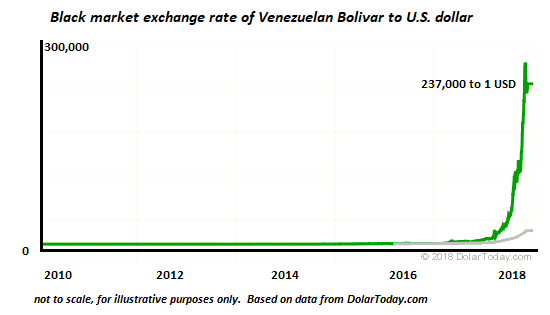
What a swell idea. Isn’t that what Venezuela has done for the past decade? And how did that work for them? If you think that destroying the purchasing power of “money” is a winner, then by all means, go on believing that the government can never go broke because all it has to do is print more money.

Here’s my favorite chart of asymmetric gains. The vast majority of the gains reaped since the 2008-09 Global Financial Meltdown have flowed to the top .1%. This is not a bug, it is a feature of hyper-financialization. Indeed, it is the only possible output of the current system.

Meanwhile, the bottom 95% live in an economy where wages go nowhere and costs are soaring. The financial media cheers when wages (supposedly) rise by 2%, but nobody dares measure the impact of rising costs in services such as healthcare and higher education.

The Status Quo is in trouble if the bottom 95% wake up to the asymmetric gains that are the only possible output of our hyper-financialized economy. Hype and propaganda are the key tools of the present era, as these are required to disconnect perception from reality. How long the disconnect will last is anyone’s guess, but when the two reconnect, all that is solid now will melt into thin air.


Why America is the World’s First Poor Rich Country

Or, How American Collapse is Made of a New Kind of Poverty

By Umair Haque

Source: Eudaimonia

Consider the following statistics. The average American can’t scrape together $500 for an emergency. A third of Americans can’t afford food, shelter, and healthcare. Healthcare for a family now costs $28k — about half of median income, which is $60k.

By themselves, of course, statistics say little. But together these facts speak volumes. The story they are beginning to tell is this.

America, it seems, is becoming something like the world’s first poor rich country. And that is the elephant in the room we aren’t quite grasping. After all, authoritarianism and extremism don’t arise in prosperous societies — but in troubled ones, which are growing impoverished, like America is today. What do I mean by all that?

Let’s begin with what I don’t mean. I don’t mean absolute poverty. Americans are not living on a few dollars a day, by and large, like people in, for example, Somalia or Bangladesh. America’s median income is still that of a rich country, around $50k, depending on how it’s counted. Nor do I really mean relative poverty — people living below median income. While that’s a growing problem in America, because the middle class is imploding, that is not really the true problem these numbers hint at, either.

America appears to be pioneering a new kind of poverty altogether. One for which we do not yet have a name. It is something like living at the knife’s edge, constantly being on the brink of ruin, one small step away from catastrophe and disaster, ever at the risk of falling through the cracks. It has two components — massive inflation for the basics of life, coupled with crushing, asymmetrical risk. I’ll come to what those mean shortly.

The average American has a relatively high income, that of a person in a nominally rich country. Only his income does not go very far. Most of it is eaten up by attempting to afford the basics of life. We’ve already seen how steep healthcare costs are. But then there is education. There is transport. There is interest and rent. There is media and communications. There is childcare and elderly care. All these things reduce the average American to constantly living right at the edge of ruin — one paycheck away from penury, one emergency away from losing it all.

But this isn’t true for America’s peers. In Europe, Canada, and even Australia, society invests in all these things — and the costs of basic necessities societies don’t provide are regulated. For example, I pay $50 dollars for broadband and TV in London — but $200 for the same thing in New York — yet in London, I get vastly more and better media for my money (even including, yes, American junk like Ancient Aliens). That’s regulation at work. And when basic goods like healthcare or elderly care or education are provided and managed at a social scale, that is when they are cheapest, and often of the best quality, too. Hence, healthcare costs far less in London, Paris, or Geneva — and life expectancy is longer, too.

So if you are earning $50k in America, it is a very different thing than earning $50k in France, Germany, or Sweden — in America, you must pay steeply for the basics of life, for basic necessities. Thus, incomes stretch much further in other countries, which enjoy a vastly higher quality of life, even though people there earn roughly the same amount, because they pay vastly less for basic necessities. Americans are rich, but only nominally — their money doesn’t buy nearly as much as their peers does, where it matters and counts most, for the basics of life.

What happens when societies don’t understand all the above? Well, a strange thing has happened to the American economy. While it’s true that things like TVs and Playstations have gotten cheaper, the costs of the basics of life have skyrocketed. All the things that really elevate people’s quality of life — healthcare, finance, education, transport, housing, and so on — have come to consume such a large share of the average household’s income that they have little left to save, invest, or spend on anything else. And what’s worse, while the basics of life have seen massive inflation, wages and incomes (not to mention savings and benefits and safety nets and opportunities) for most have stagnated. The result is an economy — and a society — that’s collapsing.

Yet all that is the straightforward effect of giving, for example, hedge funds control over drugs, or speculators control over housing, healthcare, and education — they will of course maximize profits, whereas investing in these things socially, or at least regulating them, minimizes real costs, and maximizes accessibility, affordability, and quality.

So the average American, who is left high and dry, must borrow, borrow, borrow, just to maintain a decent quality of life — because handing capitalism control of the basics of life has caused massive, skyrocketing inflation in necessities, while flatlining his income. Healthcare didn’t used to cost half of median income even a decade ago, after all — but now it does. So what happens when, in a decade or two, healthcare costs all of median income? How can an economy — let alone a society — function that way?

Well, what happens if the average American steps over the line? Misses a mortgage payment, gets ill and is unable to pay a few bills on time, can’t pay the costs of healthcare? Then they are punished severely and mercilessly. Their “credit rating” (note how banks and hedge funds don’t have them) is ruined. They can easily find themselves out on the street, without finance, without a second chance, without access to any kind of redress or support . And then they are rejected, shunned, and ostracized. They might not have an address anymore — so who will hire them? They are no longer a part of society — they have fallen through the cracks, and finding one’s way back is often next to impossible. Asymmetrical risk — corporations and lobbies and banks bear no risk at all, precisely because the average American bears them all now.

So Americans aren’t just absolutely or relatively poor, but poor in a new way entirely. First, the basics of life exploded in price, to the point that they are now unaffordable for many, maybe most, households. Second, Americans bear the risks of paying those unaffordable costs to an extreme degree, bearing the risks that institutions should, and so those risks are now ruinously high. A bank or hedge fund or corporation might go bankrupt, and liquidate its assets, and its owners stay rich — but if an American’s credit rating is ruined, loses his job, cannot pay his bills, or even if he declares bankruptcy, he falls through the cracks, hounded, embattled, institutionally black-marked. He finds himself outside society, with little way to get back in. Little wonder then that Americans work so much harder than anywhere else — they are always one step away from losing it all, from genuine ruin, but their peers in truly rich countries aren’t.

Marx probably would have called this immiseration. Neo-Marxist theorists call it precarity. And while there’s truth in both those ideas and perspectives, I think they miss three vital points.

We don’t see America as a poor country, but we should begin to. Americans live fairly abysmal lives — short, lonely, unhappy, full of work and stress and despair, compared to their peers. That is because they cannot afford better ones — predatory capitalism coupled with total economic mismanagement of social investments has made the basics of life ruinously unaffordable. In this way, it’s effectively a poor country — yes, there’s a tiny number of ultra-rich, but they are outliers now, off the map of the normal. Because it’s not just any kind of poverty, yesterday’s poverty, or even poverty as we are used to thinking about it.

America is pioneering a new kind of poverty. The kind of poverty that’s developed in America isn’t just bizarre and gruesome — it’s novel and unseen. It isn’t something that we understand well, economists, intellectuals, thinkers, because we have no good framework to think about it. It’s not absolute poverty like Somalia, and it’s not just relative poverty, like in gilded banana republics. It’s a uniquely American creation. It’s extreme capitalism meets Social Darwinism by way of rugged self-reliance crossed with puritanical cruelty.

The kind of poverty America’s pioneering today isn’t absolute, or even relative , but something more like perfectly tuned poverty, strategic poverty, basic poverty— nominally well-off people whose money doesn’t go far enough to make them actually live well, constantly living at the edge of ruin, and thus forced to choke down their bitter anger and serve the very systems which oppress and subjugate with more and more indignity and fear and servility by the year.

America’s still an innovator today. Unfortunately, what it’s innovating now is a new kind of poverty. Yet poverty is poverty. What happens in societies where poverty is growing? Authoritarianism rises, as people lose faith in democracy, which can’t seem to offer them working social contracts. Authoritarian soon enough becomes fascism — “this country, this land, its harvest — it is only for the true volk!”, the cry goes up, when there is not enough to go around. And the rest of the dark and grim story of the fall into the abyss you should know well enough by now. It ends in words we do not say.

Still, history, laughing, has told this tale to us many times. And it is telling it to tomorrow, again, in the tale of American collapse.

Neo-Liberalism and the Retreat of Democracy

By David Schultz

Source: CounterPunch

Democracy across the world is under siege. This according to the latest Freedom House report documenting that for 2017, “democracy faced its most serous crisis in decades” as seventy-one countries experienced declines in freedom or fair government, including the United States, and only thirty-five an improvement. This was the twelfth consecutive year of decline in democracy world-wide.

The question is why? Why has confidence in democracy retreated? Freedom House does not provide an answer, but there is a reason. It is democracy’s marriage to neo-liberal capitalism has fostered the conditions leading to its own undoing, similar to the way Karl Marx once described in the Communist Manifesto the “gravedigger thesis” (What the Bourgeoisie therefore produces, above all, are its own grave diggers”) where capitalism would produce the conditions that would undermine its own existence.

From the 1960s until the early 1990s democracy was in the upswing internationally. African de-colonization produced initially popularly elected governments. In South America the demise of strongmen led to a wave of democratic regimes. And the fall of the Berlin Wall in 1989 and the break up of the USSR in 1991 produced the dismantling of communist authoritarian or totalitarian governments that made it possible for Francis Fukuyama to proclaim that democracy had won and emerged as the last grand global political meta-narrative.

Yet several problems upset this rosy picture. Most prominently, it was the marriage of these new emerging democracies with free market capitalism and the victory of neo-liberalism. Internationally as post-colonial and post-communist countries emerged, international organizations such as the World Bank and the IMF forced them to adopt market reforms, often pushing them into what was then called “shock therapy.” Shock therapy involved rapid privatization of state owned enterprises and rapid dismantling of welfare states. This shock therapy was often accompanied by significant corruption as a few rich oligarchs emerged who came to own these newly privatized state enterprises.

Simultaneously, emerging democracies were rapidly pushed into what sociologist Immanuel Wallerstein would call the world-capitalist system. This system turned politically to right in the 1970s and 1980s as Margaret Thatcher in the United Kingdom and Ronald Reagan in the United States pushed neo-liberalism or market fundamentalism as an alternative to the Keynesian welfare state that had dominated the west since the 1930s. It was adopted both for ideological reasons and because of what political economist James O’Connor would call the fiscal crisis of the state tht affect economics across the world in the 1970s. This was a crisis of declining profit among private businesses and therefore declining revenue for states to fund welfare programs. Something had to give, and it was the welfare state.

Neo-liberalism is a political economic theory of the state committed to the laissez-faire market fundamentalism ideology that traces back to Adam Smith and David Ricardo. It includes a belief in comparative advantage, a minimalist state, and market freedom, and is, as articulated in the 1990s and 2000s, driven by finance capital. At the state level, neo-liberalism defines a theory of public administration. If neo-liberalism includes a commitment to market fundamentalism, then that also means that it is dedicated to a politics of limited government. This includes privatization, deregulation, and a scaling back of many traditional functions that capitalist and communist states had performed since at least World War II. But neo-liberalism as a theory transcends the state, providing also an international economic theory committed to free trade and globalism.

This emergence of neo-liberalism in the 1970s and its linkage to democracy is central to the crisis affecting the latter. As neo-liberalism retrenched the welfare state and pushed globalism it was accompanied by a dramatic increase in economic inequality in the world, as Thomas Piketty has pointed out. This occurred in the US and much of the western world. But it also impacted newly emerging democracies in Africa, Eastern Europe, and South America. Pressures for shock therapy market reforms, austerity, and open borders meant export of jobs to other countries, dismantling of social safety nets, and other economic pressures placed on governments and ruling parties.

Politically voters turned on globalism and free trade. This happened here with Trump voters in 2016, but also in Brexit in the UK. But many voters also blamed immigrants for the loss of jobs or social unrest in places ranging from France, to Italy, to Hungary. The increasing economic gap between rich and poor and, more importantly, the erosion of the economic conditions of the working class soured them on democracy. This paved the way for the emergence of strongmen as political leaders, the rise of far-right nationalist parties, and disenchantment with democracy and democratic structures to deliver the economic goods.

What we see today then in terms of the decline in support for democracy across the world is a product of its marriage to neo-liberalism. Capitalism and democracy always had an uneasy co-existence, but the neo-liberal democracy variant demonstrates the powerful contradictions in them. Either their linkage is producing outright rejection of democracy or a populist, rightist version that is merely democracy in form but not in substance.

A Zen Master Explains the Art of ‘Letting Go’, And It Isn’t What You Think

By Christina Sarich

Source: Waking Times

Thich Naht Hanh, the Zen Buddhist master, has some interesting advice about what it means to truly let go. Many people mistake detachment or non-clinging to be a form of aloofness, or emotional disconnect from others, but as Hanh explains, truly letting go often means loving someone more than you have ever loved them before.

The Buddha taught that detachment, one of the disciplines on the Noble Path, also called ariyasaavaka, is not a physical act of withdrawal or even a form of austerity. Though the Buddha teaches of a “non-action which is an integral part of the Right Way,” if it is taken out of context it can give the impression that we should develop a lack of concern for others, and that we should live without truly feeling or expressing our emotions – cutting ourselves off from life.

These type of misinterpretations are sadly common, since there are not always direct translations from the Paali language into English.

This form of “detachment” is an erroneous understanding of the Buddha’s message. Master Hanh states that to truly let go we must learn to love more completely. Non-attachment only happens when our love for another extends beyond our own personal expectations of gain, or our anticipation of a specific, desired outcome.

Hanh describes four forms of complete detachment, which surprisingly, aren’t about holing yourself up in a cave and ignoring everyone who has broken your heart, or ignoring your lust or desire for a romantic interest. This is not detachment. Letting go, means diving in. For example:

Maitri (Not the Love You Know)

Hanh describes the importance of Maitri, not love as we normally understand in a Westernized use of the word. He states,

“The first aspect of true love is maitri (metta, in Pali), the intention and capacity to offer joy and happiness. To develop that capacity, we have to practice looking and listening deeply so that we know what to do and what not to do to make others happy. If you offer your beloved something she does not need, that is not maitri. You have to see her real situation or what you offer might bring her unhappiness.”

In other words, your detachment may come in accepting that certain things you would normally do to make another person feel loved and appreciated may not be what the person you are actively loving now, needs. Instead of forcing that behavior on another person, with an egoic intent to “please” them, you simply detach from that need in yourself, and truly observe what makes another person feel comfortable, safe, and happy.

Hanh further explains,

“We have to use language more carefully. “Love” is a beautiful word; we have to restore its meaning. The word “maitri” has roots in the word mitra which means friend. In Buddhism, the primary meaning of love is friendship.”

Karuna (Compassion)

The next form of true detachment is compassion. When we let go, we don’t stop offering a compassionate touch, word, or deed to help someone who is in pain. We also don’t expect to take their hurt or pain away. Compassion contains deep concern, though. It is not aloofness It is not isolation from others.

The Buddha smiles because he understands why pain and suffering exist, and because he also knows how to transform it. You become more deeply involved in life when you become detached form the outcome, but this does not mean you don’t participate fully – even in others’ pain.

Gratitude and Joy

In truly letting go you practice gratitude. Mudita, or joy arises when we are overcome with gratitude for all that we have, such that we no longer cling to some other longed-for result. The Buddha’s definition of joy is more like “Unselfish joy.” It means that we don’t only find happiness when something good happens to us, but when others find happiness.

If you’ve ever had to say goodbye to a love or friend so that they could continue on their life’s path – one that may not have continued to intertwine with your own – you may have felt pain when they found someone new to love, or made a new friend that seemed to take your place. This is not true detachment. Joy arises when you find happiness even when others find joy – and it has little or nothing to do with you.

Upeksha (Equanimity)

Master Hanh describes the final quality of true love which sheds inordinate light on the true process of letting go.

He states,

“The fourth element of true love is upeksha, which means equanimity, non-attachment, nondiscrimination, even-mindedness, or letting go. Upa means “over,” and iksha means “to look.” You climb the mountain to be able to look over the whole situation, not bound by one side or the other. If your love has attachment, discrimination, prejudice, or clinging in it, it is not true love.


People who do not understand Buddhism sometimes think upeksha means indifference, but true equanimity is neither cold nor indifferent. If you have more than one child, they are all your children. Upeksha does not mean that you don’t love. You love in a way that all your children receive your love, without discrimination.”

Hanh explains that without this quality our love tends to become possessive – a stomping ground of the ego. We try to put our beloved in our pocket and carry them with us, when they are more like the wind, or a butterfly, or a stream, needing to move and flow, or risk dying. This is not love, this is destruction.

For love to be true love, it must have elements of compassion, joy, and equanimity – and this is truly letting go.

The Art of Letting Go is Artless

The real secret is that letting go is not an art, it is an allowing, a being. A non-attached relationship is healthy, strong and filled with effortless love, kindness and compassion. It is completely selfless because your sense of ‘self’ is no longer asserted in every situation. If you want to truly let go, you’ve got to love more, not less. This is the most common misunderstanding about this priceless teaching of the Buddha.

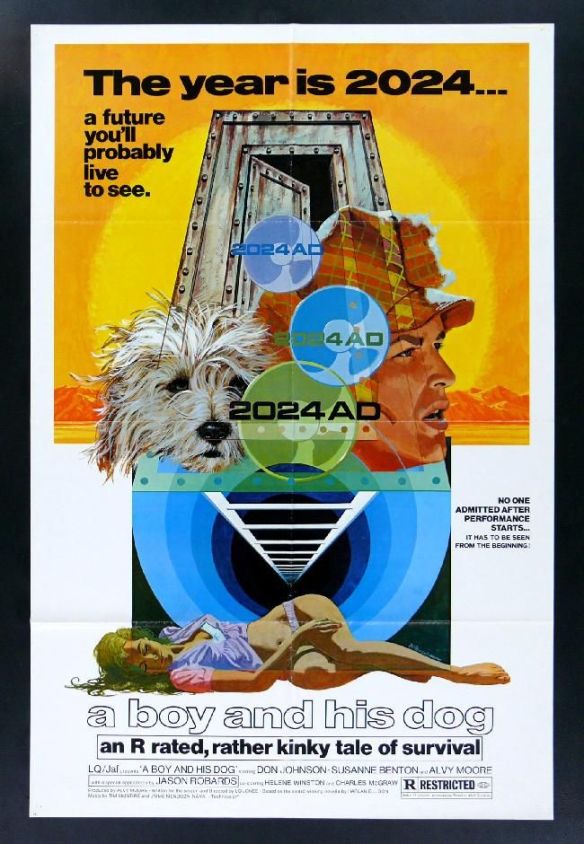
Saturday Matinee: A Boy and His Dog

The great science fiction writer Harlan Ellison recently passed away on June 27. Whether or not one is familiar with his large body of work (the majority of which are short stories), “A Boy and His Dog” (1975), is definitely worth watching. It’s the first and best feature film adaptation of one of Ellison’s stories and features Don Johnson as Vic who, with his dog Blood, struggles to survive the post-apocalyptic wasteland that the southwestern U.S. has become in 2024.

Technology giants hold censorship meeting with US intelligence agencies

By Will Morrow

Source: WSWS.org

The New York Times and Washington Post this week published reports of a private meeting last month between eight major technology and social media corporations and the US intelligence agencies, to discuss their censorship operations in the lead-up to the November 2018 mid-term elections.

The meeting was convened at Facebook’s Menlo Park, California, headquarters on May 23, and was attended by representatives from Amazon, Apple, Google, Microsoft, Snap, Twitter and Oath, which owns Yahoo and the telecommunications network Verizon, along with agents from the FBI and the Department of Homeland Security.

The Post described the meeting, organized at the request of Facebook, as a “new overture by the technology industry to develop closer ties to law enforcement.” Both articles were based on anonymous statements by individuals who attended. One attendee told the Post that the conversation was a “back-and-forth, with both sides talking about how they were thinking about the problem and how we were looking for opportunities to work together.”

The meeting is yet another testament to the increasing integration of the technology giants with the US military/intelligence apparatus. These companies, which provide a growing share of the technical infrastructure for the repressive apparatus of the state, increasingly see the censorship of left-wing, anti-war, and progressive viewpoints as an integral part of their business strategy.

Amazon, Microsoft and Google are competing to secure control over a $10 billion project to host the Pentagon’s Cloud infrastructure, a position that will literally mean hosting the communications between military units engaged in battle. Employees at the three companies have also written letters in recent months denouncing their provision of artificial intelligence technology to improve drone targeting (Google), facial recognition of civilians by police agencies (Amazon), and assisting in the operations of the Immigration and Customs Enforcement (Microsoft).

The Times and the Post are the main media voices for the campaign by the Democratic Party and intelligence agencies for Internet censorship, under the guise of opposing the spread of “misinformation” by the Russian government. This McCarthyite campaign is based on the totally unsubstantiated allegation that Russian “fake news” led to popular disillusionment with Hillary Clinton in the 2016 vote, and the subsequent election of Donald Trump. The newspapers’ synchronized reports therefore present last month’s meeting as aimed at preventing Russian interference in the mid-term elections.

But the real target of the censorship campaign is popular access to left-wing news sources not controlled by the corporate media, and the proliferation of oppositional social media content, such as videos of police killings, mass roundups of immigrants, military interventions, protests and exposures of corporate malfeasance and government criminality.

Since the beginning of the year, Facebook has rolled out a series of changes to its News Feed, including demoting political content in favor of so-called “personal moments,” and prioritizing content from so-called “trustworthy sources”—in reality pro-establishment propaganda outlets—including the Times and the Wall Street Journal. The social media giant has also changed its algorithms to reduce the spread of “viral videos,” which CEO Mark Zuckerberg declared are “not good for people’s well-being and society.”

Last Thursday, Facebook published an announcement by its Head of News Integrity Tessa Lyons, announcing a further expansion of these measures, including the introduction of “fact-checking” for videos and photos. The post also stated that Facebook is introducing “machine learning to help identify and demote foreign Pages that are likely to spread financially-motivated hoaxes to people in other countries.” These will work alongside Facebook’s army of “fact checkers”—i.e., censors—many of them former security and intelligence agents, who belong to the 20,000 people employed in its “security” and “moderation” department.

The “demotion” of what Facebook calls “false news” was codified in “community guidelines” published by the company in April. The guidelines state that because the suppression of “false news” is a “sensitive issue,” the company does not openly remove news stories, which would be easily detected by publishers and their followers, but does the same thing secretly: “significantly reduc[ing] its distribution by showing it lower on the News Feed.” (See: “Facebook codifies its censorship regime”)

Lyons repeated this line of argument in an interview with PBS’ Miles O’Brien on May 16. Admitting that “censoring and fully removing information unless it violates our community standards is not the expectation from our community,” Lyons explained that instead “we work to reduce the damage it can do” by restricting its proliferation. The Washington Post reported yesterday that while speaking at the International Fact Checkers Network conference last week, Lyons “told attendees that … [Facebook] will soon use machine learning to predict pages that are more likely to share misinformation.”

With the official ending of net neutrality this month, the financial oligarchy that controls both the search and social media monopolies and internet service providers has further tightened its grip over the freedom of expression on the internet, with ISPs given the prerogative to block and throttle internet content at will.

The expansion of internet censorship takes place amidst mounting pressure on whistleblower Julian Assange, the Wikileaks journalist who has been effectively imprisoned in the Ecuadorian embassy in London since 2012, where he was forced to take refuge to avoid being extradited to the US and charged for publishing evidence of US government crimes. The persecution of Assange for the “crime” of publishing the truth is aimed at intimidating whistleblowers and honest journalists all around the world.

Google , which attended last month’s meeting with the FBI and Department of Homeland Security, has altered its search engine algorithms to censor left-wing and anti-war websites, including the World Socialist Web Site, whose Google search traffic fell by three quarters in response to changes by the search engine in April 2017. There are indications that Google has recently intensified its censorship of the World Socialist Web Site, with search impressions falling by as much as one third over the past month.

In August 2017, the World Socialist Web Site published an open letter to Google demanding that it end its censorship of the internet, declaring, “Censorship on this scale is political blacklisting. The obvious intent of Google’s censorship algorithm is to block news that your company does not want reported and to suppress opinions with which you do not agree.”

We urge all readers of the World Socialist Web Site seeking to defend the freedom of expression online to contact us and join the struggle against internet censorship.