
By Trevor Scott FitzGibbon
Source: Consortium News
One of the most effective information-operation weapons during the 2016 presidential election was to smear political targets as “Russian bots” working on behalf of the Kremlin. Journalists were de-platformed, presidential candidates were smeared, and lives were immeasurably damaged.
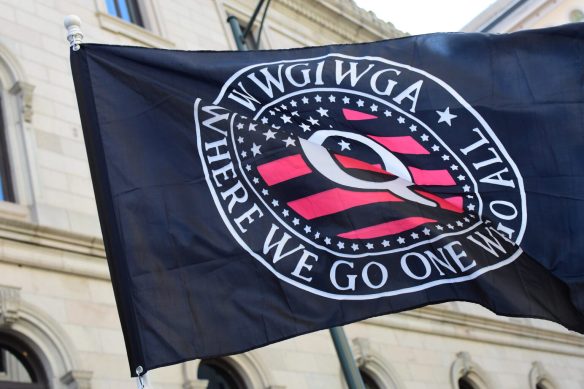
The art of attacking political targets by using open-sourced guilt-by-association is not new — nor is using Russians as foils. Joseph McCarthy and his ilk did it in the 1950s with “red-baiting” and the FBI tried to do it to Paul Robeson, Martin Luther King Jr. and others. Today that disgraceful tactic has reemerged. The smear du jour is to accuse someone of supporting the insane QAnon conspiracy — even if they don’t.
Assassinating the character of political opponents for “supporting” Q has migrated from dubious online provocateurs to television news programming. Suddenly, it seems as if every other word out of certain hosts and pundits on cable news shows begins with “Q,” and that a majority of Democrats sit around the dinner table every night discussing the conspiracy and how it is impacting Timmy’s fourth-grade class.
Ironically, according to the most recent Pew Research Center poll, while close to half the country has heard of QAnon, the majority of them are Democrats. Awareness of Q increased dramatically from 23 percent in March to 47 percent in September.
One reason for this is that the effort to hype the fringe conspiracy group has grown quickly. Increasingly, money flows to digital mercenaries to shame and cyberstalk not only individual targets but entire voting blocs.
QAnon is an idea with no structure, no chain of command and no rules. Anybody can pick up a YouTube channel or another social media account and claim to be an anonymous insider — and exploit and project whatever insane claim they want to make. With the rise of social media and recruitment of virtual reality and “gaming” technologists, these consultants have provided new mediums and taken the art of smearing to a new level. From slanderous TED Talks to inaccurate documentaries that defame individuals who have nothing to do with QAnon, the damage to the target can be severe. Often, those making the allegations are reliant on discredited sources.
But we cannot outlaw people who say crazy things. Whether it’s antifa in Portland, outrageous conspiracies from Q, or the Westboro Baptist Church protesting at funerals, the First Amendment protects problematic speech.
Increasingly, and regardless of your political affiliation, if you’re not echoing the establishment narrative, you are vulnerable to attack.
Discrediting Former Intel Members
Q character assassination has also been used in an attempt to discredit some of America’s most well-respected former members of the intelligence community, including Veteran Intelligence Professionals for Sanity. The targeting of VIPS members is strategic. One of them is former CIA analyst Ray McGovern, who chaired National Intelligence Estimates and prepared the President’s Daily Brief for Presidents Richard Nixon, Gerald Ford and Ronald Reagan. Another is former NSA technologist Bill Binney, who has also been targeted as part of the “top leadership” of Q.
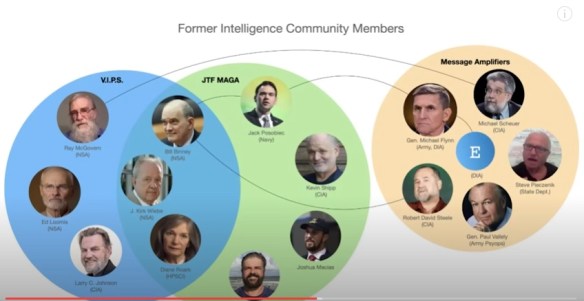
For a refresher, VIPS is the group that correctly debunked from the outset the bogus “Russiagate” narrative that permeated the Trump presidency. VIPS’ report was spotlighted in The Nation with a story headlined “A New Report Raises Big Questions About Last Year’s DNC Hack.” For that criticism, these leaders were accused of working with Russia. Fast-forward to 2021 and the exact same leaders are accused of being members of the Q brain trust.
Another troubling trend is the use of foreign operatives to drive the defamation of Americans. For example, one defamer lives in Mexico while another, who lives in Europe, is a self-described former member of a fringe group known as Anonymous. It begs the question, “Who pays them?”
And what’s the potential risk in all of this as a society? Those targeted in this way can potentially lose their business, their home, their friends. All because some misguided or politically motivated cyber-mercenary on contract from Washington, D.C., or a foreign country decides to do it.
Many of the same powerful forces who drove Russiagate are the same operatives now driving the Q smears, colluding with YouTube, Twitter and Facebook to do their bidding. I’ve spoken out publicly and repeatedly against Q because I believe it is a dangerous psychological operation that harms those brainwashed by it and the innocent affected by it.
But for the past few months on social media and cable TV, there has been a dramatic uptick of pundits and shady online operatives turning Q accusations into modern-day Salem witch trials. Q is now a talking point, and painting someone with that brush can completely discredit them — even those who are innocent of the allegation.
On some days, it seems that America has entered the sort of dystopia Aldous Huxley described in his classic novel Brave New World. If this doesn’t give you pause, it should.

By Colin Todhunter
Source: OffGuardian
According to a new report by Oxfam, ‘The Inequality Virus’, the wealth of the world’s billionaires increased by $3.9tn (trillion) between 18 March and 31 December 2020. Their total wealth now stands at $11.95tn.
The world’s 10 richest billionaires have collectively seen their wealth increase by $540bn over this period. In September 2020, Jeff Bezos could have paid all 876,000 Amazon employees a $105,000 bonus and still be as wealthy as he was before COVID.
At the same time, hundreds of millions of people will lose (have lost) their jobs and face destitution and hunger. It is estimated that the total number of people living in poverty could have increased by between 200 million and 500 million in 2020. The number of people living in poverty might not return even to its pre-crisis level for over a decade.
Mukesh Ambani, India’s richest man and head of Reliance Industries, which specialises in petrol, retail and telecommunications, doubled his wealth between March and October 2020. He now has $78.3bn. The average increase in Ambani’s wealth in just over four days represented more than the combined annual wages of all of Reliance Industries’ 195,000 employees.
The Oxfam report states that lockdown in India resulted in the country’s billionaires increasing their wealth by around 35 per cent. At the same time, 84 per cent of households suffered varying degrees of income loss. Some 170,000 people lost their jobs every hour in April 2020 alone.
The authors also noted that income increases for India’s top 100 billionaires since March 2020 was enough to give each of the 138 million poorest people a cheque for 94,045 rupees.
The report went on to state:
…it would take an unskilled worker 10,000 years to make what Ambani made in an hour during the pandemic…and three years to make what Ambani made in a second.”
During lockdown and after, hundreds of thousands of migrant workers in the cities (who had no option but to escape the country’s avoidable but deepening agrarian crisis) were left without jobs, money, food or shelter.
It is clear that COVID has been used as cover for consolidating the power of the unimaginably rich. But plans for boosting their power and wealth will not stop there. One of the most lucrative sectors for these people is agrifood.
More than 60 per cent of India’s almost 1.4 billion population rely (directly or indirectly) on agriculture for their livelihood. Aside from foreign interests, Mukesh Ambani and fellow billionaire Gautam Adani (India’s second richest person with major agribusiness interests) are set to benefit most from the recently passed farm bills that will lead to the wholesale corporatisation of the agrifood sector.
A recent article on the grain.org website, ‘Digital control: how big tech moves into food and farming (and what it means)’, describes how Amazon, Google, Microsoft, Facebook and others are closing in on the global agrifood sector while the likes of Bayer, Syngenta, Corteva and Cargill are cementing their stranglehold.
The tech giants entry into the sector will increasingly lead to a mutually beneficial integration between the companies that supply products to farmers (pesticides, seeds, fertilisers, tractors, drones, etc) and those that control the flow of data and have access to digital (cloud) infrastructure and food consumers. This system is based on corporate centralisation and concentration (monopolisation).
Grain notes that in India global corporations are also colonising the retail space through e-commerce. Walmart entered into India in 2016 by a US$3.3 billion take-over of the online retail start-up Jet.com which, in 2018, was followed by a US$16 billion take-over of India’s largest online retail platform Flipkart. Today, Walmart and Amazon now control almost two-thirds of India’s digital retail sector.
Amazon and Walmart are using predatory pricing, deep discounts and other unfair business practices to lure customers towards their online platforms. According to Grain, when the two companies generated sales of over US$3 billion in just six days during a Diwali festival sales blitz, India’s small retailers called out in desperation for a boycott of online shopping.
In 2020, Facebook and the US-based private equity concern KKR committed over US$7 billion to Reliance Jio, the digital store of one of India’s biggest retail chains. Customers will soon be able to shop at Reliance Jio through Facebook’s chat application, WhatsApp.
The plan for retail is clear: the eradication of millions of small traders and retailers and neighbourhood mom and pop shops. It is similar in agriculture.
The aim is to buy up rural land, amalgamate it and roll out a system of chemically-drenched farmerless farms owned or controlled by financial speculators, the high-tech giants and traditional agribusiness concerns. The end-game is a system of contract farming that serves the interests of big tech, big agribusiness and big retail. Smallholder peasant agriculture is regarded as an impediment to be replaced by large industrial-scale farms.
This model will be based on driverless tractors, drones, genetically engineered/lab-produced food and all data pertaining to land, water, weather, seeds and soils patented and often pirated from peasant farmers.
Farmers possess centuries of accumulated knowledge that once gone will never be got back. Corporatisation of the sector has already destroyed or undermined functioning agrarian ecosystems that draw on centuries of traditional knowledge and are increasingly recognised as valid approaches to secure food security.
And what of the hundreds of millions to be displaced in order to fill the pockets of the billionaire owners of these corporations? Driven to cities to face a future of joblessness: mere ‘collateral damage’ resulting from a short-sighted system of dispossessive predatory capitalism that destroys the link between humans, ecology and nature to boost the bottom line of the immensely rich.
India’s agrifood sector has been on the radar of global corporations for decades. With deep market penetration and near saturation having been achieved by agribusiness in the US and elsewhere, India represents an opportunity for expansion and maintaining business viability and all-important profit growth. And by teaming up with the high-tech players in Silicon Valley, multi-billion dollar data management markets are being created. From data and knowledge to land, weather and seeds, capitalism is compelled to eventually commodify (patent and own) all aspects of life and nature.
Foreign agricapital is applying enormous pressure on India to scrap its meagre (in comparison to the richer nations) agricultural subsidies. The public distribution system and publicly held buffer stocks constitute an obstacle to the profit-driven requirements of global agribusiness interests.
Such interests require India to become dependent on imports (alleviating the overproduction problem of Western agricapital – the vast stocks of grains that it already dumps on the Global South) and to restructure its own agriculture for growing crops (fruit, vegetables) that consumers in the richer countries demand. Instead of holding physical buffer stocks for its own use, India would hold foreign exchange reserves and purchase food stocks from global traders.
Successive administrations have made the country dependent on volatile flows of foreign capital via foreign direct investment (and loans). The fear of capital flight is ever present. Policies are often governed by the drive to attract and retain these inflows. This financialisation of agriculture serves to undermine the nation’s food security, placing it at the mercy of unforeseen global events (conflict, oil prices, public health crises) international commodity speculators and unstable foreign investment.
Current agricultural ‘reforms’ are part of a broader process of imperialism’s increasing capture of the Indian economy, which has led to its recolonization by foreign corporations as a result of neoliberalisation which began in 1991. By reducing public sector buffer stocks and introducing corporate-dictated contract farming and full-scale neoliberal marketisation for the sale and procurement of produce, India will be sacrificing its farmers and its own food security for the benefit of a handful of unscrupulous billionaires.
As independent cultivators are bankrupted, the aim is that land will eventually be amalgamated to facilitate large-scale industrial cultivation. Indeed, a recent piece on the Research Unit for Political Economy site, ‘The Kisans Are Right: Their Land Is At Stake‘, describes how the Indian government is ascertaining which land is owned by whom with the ultimate aim of making it easier to eventually sell it off (to foreign investors and agribusiness). Other developments are also part of the plan (such as the Karnataka Land Reform Act), which will make it easier for business to purchase agricultural land.
India could eventually see institutional investors with no connection to farming (pension funds, sovereign wealth funds, endowment funds and investments from governments, banks, insurance companies and high net worth individuals) purchasing land. This is an increasing trend globally and, again, India represents a huge potential market. The funds have no connection to farming, have no interest in food security and are involved just to make profit from land.
The recent farm bills – if not repealed – will impose the neoliberal shock therapy of dispossession and dependency, finally clearing the way to restructure the agri-food sector. The massive inequalities and injustices that have resulted from the COVID-related lockdowns are a mere taste of what is to come.
The hundreds of thousands of farmers who have been on the streets protesting against these bills are at the vanguard of the pushback – they cannot afford to fail. There is too much at stake.

By Sigmund Fraud
Source: Waking Times
“Who are the men who without our realizing it, give us our ideas, tell us whom to admire and whom to despise, what to believe about the ownership of public utilities, about the tariff, about the price of rubber, about the Dawes Plan, about immigration; who tell us how our houses should be designed, what furniture we should put in them, what menus we should serve on our table, what kind of shirts we must wear, what sports we should indulge in, what plays we should see, what charities we should support, what pictures we should admire, what slang we should affect, what jokes we should laugh at?” ~ Edward Bernays, Propaganda
Authored by Edward Bernays and published in 1928, the book Propaganda still holds its position as the gold standard for influencing and manipulating public behavior. Drawing on his expertise in psychology while using the language of manipulation, Bernays pioneered social engineering via mass media, and his work lives on in the distorted, statist, consumer world we have today.
But who are the ones behind the curtain telling us what to think by directing our attention onto the things which serve interests?
Interestingly, chapter III of Propaganda is titled, ‘The New Propagandists, and is devoted to explaining why the controls for mass manipulation are so closely guarded by a relatively tiny elite who sit in the shadows, out of the public eye, choosing what we are to see and to think, even controlling the politicians we elect to represent us.
If we set out to make a list of the men and women who, because of their position in public life, might fairly be called the molders of public opinion we could quickly arrive at an extended list of persons mentioned in “Who’s Who…”
Such a list would comprise several thousand persons. But it is well known that many of these leaders are themselves led, sometimes by persons whose names are known to few.
Such persons typify in the public mind the type of ruler associated with the phrase invisible government.
An invisible government of corporate titans and behind the scenes influencers who’s mark on culture cannot be understated today. Bernays continues:
The invisible government tends to be concentrated in the hands of the few because of the expense of manipulating the social machinery which controls the opinions and habits of the masses.
The public relations counsel, then, is the agent who, working with modern media communication and the group formation of society, brings an idea to the consciousness of the public. But he is a great deal more than that. He is concerned with courses of action, doctrines, systems and opinions, and the securing of public support for them.
Ultimately, the goal of this type of mass-produced, pop-culture propaganda is to weaken the individual’s ability to think critically, thereby creating an environment where many people look to one another for approval, always second-guessing their own faculties. When this happens, the strength of the collective group begins to take form and multiply, and ideas can be implanted into the popular culture, taking root in the form of widespread conformist behavior.
“Thinking critically means making reasoned judgments that are logical and well thought out. It is a way of thinking in which one doesn’t simply accept all arguments and conclusions to which one is exposed without questioning the arguments and conclusions. It requires curiosity, skepticism and humility. People who use critical thinking are the ones who say things such as, “How do you know that?” “Is this conclusion based on evidence or gut feelings?” and “Are there alternative possibilities when given new pieces of information?”” [Source]
The takeaway here is that not much has changed in 100 years of corporate/statist American culture, other than the technical capacity to scale this ever upward. Our lives are still heavily influenced by the likes of the described by Bernays. There is one advantage we do have now, however, as technology has given us greater access to the truth and we are now free to split from the matrix psychologically by understanding what it is and how it influences our lives. If we choose to do so, that is, if we choose to take the red pill.
In order to understand your life and your mission here on earth in the short time you have, it is imperative to learn to see the thought prison that has been built around you, and to actively circumnavigate it. Free-thinking is being stamped out by the propagandists, but our human tendency is to crave freedom, and with the aid of truth, we are more powerful than the control matrix and the invisible government.

Review by Eric D. Snider
Source: EricDSnider.com
Most of the individual components of “Visioneers” are not new, nor are the film’s ideas particularly deep. Yet somehow the combination, written and directed by brothers Jared and Brandon Drake — in their first film, amazingly — feels fresh and invigorating. It’s a high-concept comedy, but it’s down-to-earth and accessible, even a little touching. It’s a terrific start for a pair of new filmmakers.
The setting is a dystopian version of modern-day America, where the Jeffers Corporation is the most powerful entity in the world. Even the U.S. president kowtows to the monolithic company, whose employees are called “tunts” and “goobs” and work at ill-defined tasks at various bureaucratic levels. As with most firms in dystopian movies, it’s never established what, exactly, the Jeffers Corp. does, but its influence is felt everywhere. Common people greet each other with the “Jeffers salute,” which looks suspiciously like flipping the bird.
Our hero is a Level 3 tunt named George Washington Winsterhammerman (Zach Galifianakis). He’s the supervisor of a little pod of employees who work in a depressing office where an automated voice announces, every 60 seconds, how many minutes remain before the weekend. Everyone is generally disheartened and depressed, but this has been enhanced in recent weeks as citizens have been spontaneously combusting due to stress.
One way to avoid stress, of course, is to just accept things as they are. (“Forget ourselves, work together” is the Jeffers Corp. motto.) Unfortunately, George Washington Winsterhammerman has been suffering from dreams and ambitions lately, and it’s been established that this is a precursor to exploding. He has a wife, Michelle (Judy Greer), who spends all her time seeking happiness via TV products and eating a lot of butter, but he hardly loves her anymore. Instead, he looks forward to the few minutes each day that he can talk on the phone to Charisma (Mia Maestro), the Level 4 goob who supervises his department. It is the one time that George’s mood brightens.
As George worries more and more about the possibility of explosion, the film dives deeper and deeper into its satire of modern corporate-driven life, where happiness is elusive while complacency is easily achieved. It’s a simple truth that everyone wants to be happy. What separates us is how we go about looking for happiness, or whether we even look for it at all. Sometimes we try elaborate, stupid measures to produce happiness when the real solution is staring us in the face. George’s brother (James LeGros) has already found that pole-vaulting makes him happy, though his refusal to participate in the Jeffers-sanctioned programs has made him a government target.
“Visioneers” is about George’s search for meaning in his life, and comedian Zach Galifianakis plays the role with more conviction and depth than you might have expected. George is subdued and contemplative, but not boring — and that’s a fine line for an actor to walk. He earns laughs through the old-fashioned method of being the only sane person in a sea of crazies, but the filmmakers avoid overplaying the lunacy of the world they’ve created. Understatement is the rule.
And it works magnificently. Like I said, we’ve seen a lot of these ideas before. But even if it’s not reinventing the wheel, “Visioneers” still manages to be insightful, intelligent, and melancholically funny. If the Drake brothers have any more stories as good as this one, they could become an exciting new force in the film world. Let me be the first to give them a Jeffers salute, but in a good way.
Watch the film on Hoopla here: https://www.hoopladigital.com/title/11670081

Jaws (1975) | [ Universal / The Kobal Collection ]
Source: Alt-Market.us
It is a general rule that corrupt economies tend to operate on faith and not on fundamentals. And to be clear, it’s not so much about naive faith that the system is stable or functional. No, it’s more about the masses having faith that the corruption and instability will never be derailed. Most people are not as stupid as the establishment and central bankers think they are – Almost everyone knows the system is broken, they just refuse to consider the possibility that the fraud will be disrupted, or that it will be allowed to fail.
The old mantra “too big to fail” is a lie. NOTHING is too big to fail, and that includes the US economy, the dollar and the elaborate Kabuki theater that keeps them both afloat. All it takes is a single moment, an epiphany that the Ponzi scheme is unsustainable rather than unstoppable.
I’m reminded specifically of the inflationary crisis of Argentina in 2001 – 2002.
Argentina’s economy was highly dependent on foreign capital inflows, and its currency peg to the US dollar, not to mention they were precariously reliant on support from the IMF. The IMF openly validated the government of Argentina and their currency peg model, but foreign capital began to decline and the peg became unsustainable. Without tangible growth in manufacturing and a strong middle class, an economy cannot survive for long. A top down system based on illusory “financial products” and creative accounting is doomed to crash eventually.
All it took was for the IMF to criticize the policies they initially endorsed and announced that they were removing financial aid, and all hell broke loose in Argentina.
Almost overnight the Argentina peso plunged in value, interest rates spiked and inflation struck hard. People poured into the streets and civil unrest erupted. The IMF would later admit it made “errors” in its handling of the Argentina situation, but this was simply spin control designed to protect them from further scrutiny. The IMF avoided most of the blame and has been growing into a monstrous global centralization machine ever since.
I think we are witnessing the beginning of a similar end of mass faith in fraud in the US. The recent Robinhood short squeeze event as well as the current decoupling of physical silver prices from the paper ETF market have accelerated the timetable. Not surprisingly, these moves have forced the establishment to intervene to some extent to essentially stop renegade traders from freely investing. Accusations are flying and deplatforming has ensued. The idea that the system is a functional fraud is gone; The world now knows it is a dysfunctional fraud, and collapse cannot be very far behind.
Furthermore the collusion between banks, hedge funds and Big Tech is blatantly revealed. These relationships are supposed to remain hidden in the ether. They are obvious to anyone with any financial knowledge and sense, but they aren’t supposed to be wielded in the open. Conspirators aren’t supposed to admit to the conspiracy? Right?
Some people might say the establishment has been forced to unmask by activists. Maybe. But, as I have been warning for many years, when criminals start openly admitting to their crimes it is probably because they think that it’s too late for anyone to do anything about it.
The point is, bankers and globalists have ways of avoiding responsibility for the disasters they engineer. When the con-game breaks, they always have patsies to take the fall.
This sets up a bizarre dynamic in which the money elites that constructed the economy like a time-bomb are treated like victims (or heroes) and the people telling the truth about the fraud are treated like villains and criminals. Are activist stock market traders and silver market guerrillas to blame for any crisis that erupts in the near future? No, of course not, but they will be blamed anyway.
That said, propaganda narratives and scapegoats may not be enough to save the bankers this time. They will never allow a major fiscal crash to develop in a vacuum. They need more cover, and they need to have the means to lock down the public to prevent civil unrest or rebellion from spilling over into their backyards. I have long suspected that the covid pandemic is a useful tool in this regard. As I noted in my article ‘How Viral Pandemic Benefits The Globalist Agenda’, published in January of 2020:
“Even if a pandemic does not kill a large number of people, it still disrupts international travel, it disrupts exports and imports, it disrupts consumer behavior and retail sales, and it disrupts domestic trade. If it does kill a large number of people, and if the Chinese government’s response is any indication, it could result in global martial law. With many economies including the US economy already in a precarious balancing act of historic debt vs. crashing demand and useless central bank repo market intervention, there is little chance that the system can withstand such a tsunami…”
As we all know, medical martial law in the name of “public health” is being established in most countries regardless of the actual death rate. The insane globalist rantings of the World Economic Forum and Klaus Schwab have been very revealing; Schwab and other elites have even called the pandemic a “perfect opportunity” to execute there agenda for the “Great Reset”.
However, the globalists are highly fallible, and mistakes in judgment have been made. During the Event 201 pandemic wargame on a coronavirus outbreak (conveniently held two months before the real thing happened), the elites forecast at least 65 million initial deaths globally from such a virus. We are a year into the pandemic and nowhere near that kind of death rate. In fact, the death rate is so minuscule (0.26%), that the public is beginning to realize the lockdown mandates are pointless.
In the US, conservative states are moving on and keeping their economies wide open. Half the population is refusing to take the vaccines, and many members of law enforcement are refusing to implement lockdown policies. I don’t think this is what the globalists expected at all. They needed mass fear and they are getting mass defiance.
They’re going to need a bigger threat, or a bigger virus.
This is why I have been repeatedly warning that the talk of reopenings by Biden and other democrats is going to be very short lived. I have predicted that Biden will attempt a federal lockdown similar to the Level 4 lockdowns used in Europe and Australia after a couple of months of relative calm. I based this prediction on the covid “mutation” narrative being spread right now by the mainstream media and establishment cronies like Anthony Fauci. It is not hard to see where this is headed.
The globalists must have the “legal” option of restricting public movement as well as large gatherings, and they must have the option of surveillance on individuals 24/7 through contact tracing. This is the only way to prevent rebellion against the Reset and rising anger due to economic turmoil. The veil has been lifted, the conspiracy is being widely broadcast. Martial law alone would only inspire more dissent, medical tyranny in the name of “saving lives” is the ONLY play the globalists have. They have to have help from a large portion of the citizenry, so they must maintain the appearance that they are operating from the moral high ground.
The covid mutation story is clearly the next play, and Bank of America economists appear to agree with me. They recently stated that they see little optimism in terms of a reopening of the economy, and that hard lockdowns will return, possibly in March or April.
Another factor to consider is that the economic crash will have to reach a peak soon because Joe Biden now resides in the White House. If the crash happens in the near term, activist investors can be blamed, Trump can be blamed, and conservatives and liberty activists can be blamed. If the crash happens a year or two from now, only Biden and the globalists will get the blame.
Without lockdowns and scapegoats the scenario will end very badly for the globalists. It might end badly for them anyway. Be ready for more chaos by Spring; I suspect the elites are getting desperate, and if they allow America to go back to normal and for the pandemic to end with a whimper they will never get another chance at their precious Reset.

By Peter Van Buren
Source: We Meant Well
The interplay between the First Amendment and corporations like Twitter, Google, Amazon, Apple and Facebook is the most significant challenge to free speech in our lifetimes. Pretending a corporation with the reach to influence elections is just another place that sells stuff is to pretend the role of debate in a free society is outdated.
From the day the Founders wrote the 1A until very recently no entity existed that could censor at scale other than the government. It was difficult for one company, never mind one man, to silence an idea or promote a false story in America, never mind the entire world. That was the stuff of Bond villains.
The arrival of global technology controlled by mega-corporations like Twitter brought first the ability the control speech and soon after the willingness. The rules are their rules, so we see the permanent banning of a president for whom some 70 million Americans voted from tweeting to his 88 million followers (ironically the courts earlier claimed it was unconstitutional for the president to block those who wanted to follow him.) Meanwhile the same censors allowed the Iranian and Chinese governments (along with the president’s critics) to speak freely. For these companies violence in one form is a threat to democracy while similar violence is valorized under a different color flag.
The year 2020 also saw the arrival of a new tactic by global media, sending a story down the memory hole to influence an election. The contents of Hunter Biden’s laptop, which strongly suggest illegal behavior on his part and unethical behavior by his father the president, were purposefully and effectively kept from the majority of voters. It was no longer for a voter to agree or disagree, it was now know and judge yourself or remain ignorant and just vote anyway.
Try an experiment. Google “Peter Van Buren” with the quotes. Most of you will see on the first page of results articles I wrote four years ago for outlets like The Nation and Salon. Almost none of you will see the scores of columns I wrote for The American Conservative over the past four years. Google buries them.
The ability of a handful of people nobody voted for to control the mass of public discourse has never been clearer. It represents a stunning centralization of power. It is this power which negates the argument of “why not start your own web forum.” Someone did until Amazon withdrew its server support, and Apple and Google banned the Parler app.
The same thing happened to The Daily Stormer, driven offline through a coordinated effort by tech companies, and 8Chan, deplatformed by Cloudflare. Amazon partner GoDaddy deplatformed the world’s largest gun forum AR15. Tech giants have also killed off local newspapers and other forums by gobbling up ad revenues. The companies are not, in @jack’s words, “one small part of the larger public conversation.”
The tech companies’ logic in destroying Parler was particularly evil – either start censoring like we do (“moderation”) or we shut you down. Parler allowing ideas and people banned by the others is what brought its demise. Amazon, et al, brought their power to censor to another company. The tech companies also said while Section 230 says we are not publishers, we just provide the platform, if Parler did not exercise editorial control to tech’s satisfaction it was finished. Even if Parler comes back online it will live only at the pleasure of the powerful.
Since democracy was created it has required a public forum, from the Acropolis to the town square on down. That place exists today, for better or worse, across global media. It is this seriousness of the threat to free speech that requires us to move beyond platitudes like “it’s not a violation of free speech, just a breach of the terms of service!” People once said “I’d like to help you vote ladies, but the Constitution specifically refers to men, my hands are tied.” That’s the side of history some are standing on.
This new reality must be the starting point, not the end point of discussions on the First Amendment and global media. Facebook, et al, have evolved into something new which can reach beyond their own corporate borders, beyond the idea of a company that just sells soap or cereal. Never mind being beyond the vision of the Founders when they wrote the 1A, it is hard to imagine Thomas Jefferson endorsing having a college dropout determine what the president can say to millions of Americans. The magic game play of words – it’s a company so it does not matter – is no longer enough to save us from drowning.
Tech companies currently work in casual consultation with one another, taking turns being the first to ban something so the others can follow. The next step is when a decision by one company ripples instantly across to the others, and then down to their contractors and supplies as a requirement to continue business. The decision by AirBnB to ban users for their political stance could cross platforms automatically so that same person could not fly, use a credit card, etc., essentially a non-person unable to participate in society beyond taking a walk. And why not fully automate the task, destroying people who use a certain hashtag, or like an offending tweet? Perhaps create a youth organization called Twitter Jugend to watch over media 24/7 and report dangerous ideas? A nation of high school hall monitors.
Consider linkages to the surveillance technology we idolize when it helps arrest the “right” people. So with the Capitol riots we fetishize how cell phone data was used to place people on site, coupled with facial recognition run against images pulled off social media. Throw in the calls from the media for people to turn in friends and neighbors to the FBI, alongside amateur efforts across Twitter and even Bumble to “out” participants. The goal was to jail people if possible, but most loyalists seemed equally satisfied if they could cause someone to lose their job. Tech is blithely providing these tools to users it approves of, knowing full well how they will be used. Orwellian? Orwell was an amateur.
There are legal arguments to extend limited 1A protections to social media. Section 230 could be amended. However, given Democrats benefit disproportionately from corporate censorship and current Democratic control of the government, no legislative solution appears likely. Those people care far more for the rights of some of its citizens (trans people seem popular now, it used to be disabled folks) then the most basic right for all the people.
They rely on the fact it is professional suicide today to defend all speech on principle. It is easy in divided America to claim the struggle against fascism (racism, misogyny, white supremacy, whatever) overrules the old norms. And they think they can control the beast.
But imagine someone’s views, which today match @jack and Zuck’s, change. Imagine Zuck finds religion and uses all of his resources to ban legal abortion. Consider a change of technology which allows a different company, run by someone who thinks like the MyPillow Guy, replacing Google in dictating what you can read. As one former ACLU director explained “Speech restrictions are like poison gas. They seem like they’re a great weapon when you’ve got your target in sight. But then the wind shifts.”
The election of 2020, when they hid the story of Hunter Biden’s laptop from voters, and the election’s aftermath, when they banned the president and other conservative voices, was the coming-of-age moment, the proof of concept for media giants that they could operate behind the illusion of democracy.
Hope rests with the Supreme Court expanding the First Amendment to social media, as it did when it grew the 1A to cover all levels of government, down to the hometown mayor, even though the Constitution specifically only mentions Congress. The Court has long acknowledged the flexibility of the 1A in general, expanding it over the years to acts of “speech” as disparate as nudity and advertising. But don’t expect much change any time soon. Landmark decisions on speech, like those on other civil rights, tend to be more evolutionary in line with society’s changes than revolutionary.
It is sad that many of the same people who quoted that “First they came for…” poem over Trump’s Muslim Ban are now gleefully supporting social media’s censorship of conservative voices. The funny part is both Trump and Twitter claim what they did was for peoples safety. One day people will wake up and realize it doesn’t matter who is doing the censoring, the government or Amazon. It’s all just censoring.
What a sad little argument “But you violated the terms of service nyah nyah!” is going to be then.
By Caitlin Johnstone
Source: CaitlinJohnstone.com
The Google-owned video sharing platform YouTube has demonetized numerous independent media accounts, a jarring escalation in the steadily intensifying campaign against alternative news outlets online.
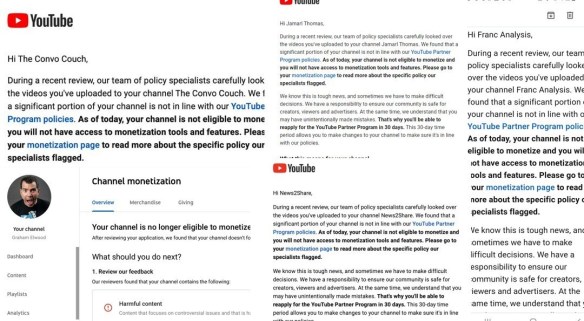
Progressive commentators Graham Elwood, The Progressive Soapbox, The Convo Couch, Franc Analysis, Hannah Reloaded and Cyberdemon531 have all received notifications from YouTube that their videos are no longer permitted to earn money through the platform’s various monetization features, as has Ford Fischer, a respected freelancer who films US political demonstrations. No explanation has been offered for this decision beyond the vague claim that “your channel is not in line with our YouTube Partner Program policies” due to “harmful content”.
Like all large online platforms, YouTube’s appeals process is notoriously opaque and unaccountable. These accounts could remain demonetized for months, or forever, without any clear explanation at all. Ford Fischer, who has been in this situation before, said on Twitter that his account was left demonetized for seven months before YouTube reversed its decision.
“Last time you demonetized my channel, I spoke out for seven months. I didn’t delete a single piece of content. You admitted you were wrong. I forgive you. Please don’t do this again,” Fischer tweeted.
“No superchats, no ad revenue, no YouTube premium money,” tweeted Elwood, who also said “I have a call with my lawyers later today.”
“You guys have destroyed my channel without legit explanation as to why,” tweeted Jamarl Thomas of Progressive Soapbox. “No videos are given – and frankly there is literally zero ‘harmful’ content on my channel. This is a radically bad error that needs to be corrected.”
The Convo Couch’s Jonathan Mayorca tweeted the notification he received from YouTube which gave the reason as “Harmful content: Content that focuses on controversial issues and that is harmful to viewers,” saying no specific video or subject was named. Nobody receiving these notifications appears to have any idea what is meant by “harmful” or “controversial” or why YouTube is mentioning them in the same breath as though these two things are connected or synonymous in some way.
YouTube has been providing template responses saying “We recommend making the needed changes to your content and reapply in 30 days” while refusing to specify what the “needed changes” even are.
Speaking for myself, I can say with absolute certainty that I would not be able to create content at anywhere near the pace I do were I not making enough money from it to do it full time. Life is far too demanding with far too much else going on for me to be able to maintain anything like daily output; being financially deplatformed and having to get another job would force me down to an essay a week in my spare time, if that. Anyone who works in independent media full time knows this, and so do the powerful people who are steadily ratcheting up the campaign to silence anyone who hasn’t passed through the gatekeepers of the plutocratic media.
Financial deplatforming is censorship. People were given an opportunity to devote themselves to the vocation of creating media outside the gatekeeping apparatus of billionaire news institutions, which is arguably the single most important vocation anyone can give themselves to in our world right now, and they built their lives around their ability to do this. Now it’s being ripped away from them; their literal jobs are being taken away. They were offered a reason to think they’d be able to make a living doing very important work, and then they were sucker punched with what amounts to political censorship.
This has been a continually escalating trend for years. The general population is herded onto huge monopolistic social media platforms offering democratization of information where your voice can be heard, and then those platforms proceed to censor an increasing amount of political speech in increasing coordination with the US government.
https://twitter.com/FordFischer/status/1357055942446223360
If the democratization of information online is successfully reversed and the mass media gatekeepers are again the sole authorities on what’s real and true, people will be locked into forming their ideas on how to think, act and vote based on what they are told by the same plutocratic media institutions which have been deceiving them into every war and manipulating them into accepting the status quo for generations.
If the door is locked to the possibility of a grassroots information rebellion against the narrative hegemony of our rulers, we will remain doomed to continue along the same ecocidal, omnicidal trajectory these bastards have us on until it reaches its inevitable conclusion. This must be resisted.
INDIAN COUNTRY NEWS
"It is the duty of every man, as far as his ability extends, to detect and expose delusion and error"..Thomas Paine
Human in Algorithms
100% Accurate Google Sheets + KDP Book Formatting | 24hr Delivery
From the Roof Top
I See This
blog of the post capitalist transition.. Read or download the novel here + latest relevant posts
अध्ययन-अनुसन्धानको सार

