
Saturday Matinee: Conquest of the Planet of the Apes

Conquest of the Planet of the Apes: The

Most Violent and Bleak of the Franchise

The fourth Apes movie, Conquest of the Planet of the Apes, showcased Caesar’s controversial and timely fight for freedom.

By Don Kaye

Source: Den of Geek

On June 30, 1972, 20th Century Fox released the fourth film in the original Planet of the Apes cycle, titled Conquest of the Planet of the Apes. It followed up the previous year’s Escape from the Planet of the Apes, the first of the Apes films to deliberately end with the promise of a sequel. In that film, two intelligent chimps from the future, Cornelius (Roddy McDowall) and Zira (Kim Hunter), traveled back to our time only to be brutally slain by the U.S. government over fears that they would plant the seeds for the apes’ eventual domination of humankind. Their baby, however, secretly survived, hidden away by the circus owner Armando (Ricardo Montalban) and already beginning to form words.

As Conquest of the Planet of the Apes opens, Armando and the child ape, now grown and named Caesar (played by McDowall), arrive at an unnamed North American city. The year is 1991 and the U.S. government has turned totalitarian. A virus from space has destroyed all the world’s cats and dogs, leading humans to turn toward apes as first pets and then slaves. When Caesar expresses outrage at the cruel treatment of an ape by police, he’s forced to flee and hide — since he was officially declared dead 20 years earlier and his very existence is a threat to humanity.

Caesar makes his way to the ape training facilities and assimilates himself there, eventually going up for auction — where he is sold to the city’s ape-hating governor Breck (Don Murray) and placed under the command of Breck’s assistant MacDonald (Hari Rhodes), who is sympathetic to the plight of the apes. But when Armando is killed while in the government’s custody, an enraged Caesar begins to plot a revolution — slowly but surely organizing his fellow apes for a violent uprising that will be the first step toward the downfall of the human race.

By the time that Conquest of the Planet of the Apes was in production, Apes producer Arthur P. Jacobs and his studio partner Fox were in truly uncharted territory. Even though Planet of the Apes (1968) was a critical success and a box office smash, sequels at the time were considered quick, disposable vehicles to milk a few more bucks out of the audience. Instead, what Jacobs did — aided by the inspired efforts of screenwriter Paul Dehn — was create an ongoing sci-fi story and intricate future history over the course of his Apes movies, the likes of which had never been attempted before in the genre.

Jacobs, however, was still up against the studio mindset that sequels had to cost less, so by the time he made Conquest the budget for the film was a third of the price of the original Planet of the Apes. He had a meager $1.7 million to visualize the ape revolution that had been discussed in the previous films, economizing by using the brand new Century City high-rise complex in Los Angeles as the exterior of the city of the future — but also skimping on the makeup budget, resulting in some clearly fake-looking ape masks.

Dehn’s third screenplay for the series, following Beneath the Planet of the Apes (1970) and Escape from the Planet of the Apes, was the most explicitly political of the series. The previous Apes films had commented obliquely on race and other social issues, but against the backdrop of ongoing racial tensions in America, Dehn crafted a story that drew directly upon the 1965 Watts riots in Los Angeles for the imagery of his ape revolution. His screenplay was also the most violent of the franchise, initially ending in a bleak standoff that found Caesar ordering the cold-blooded execution of the sadistic Governor Breck and forecasting the complete subjugation of the human race.

To direct, Jacobs hired J. Lee Thompson (Cape FearThe Guns of Navarone), who had been approached for Planet of the Apes but had to turn it down due to a previous commitment. Thompson was skilled at handling both large-scale action and low budgets, making him uniquely suited to the twin challenges of Conquest. He embraced the themes of Dehn’s screenplay with relish, giving a documentary quality to the third act’s scenes of revolution that was both realistic and unnerving in its ferocity.

As with all the Apes sequels, Conquest of the Planet of the Apes works on a very simplistic and often slapdash logic, a flaw evident in many key scenes of the film (how does Caesar, for example, know to fake being electrocuted? How does female ape Lisa magically acquire the power of speech?).

At the same time, however, Dehn’s screenplay is bolstered in a huge way by McDowall’s performance, perhaps the finest of his four in the series. His makeup similar to but also different from the appliances he wore as Cornelius, the actor makes Caesar’s transformation from frightened youth to fiery revolutionary leader believable and powerful. His climactic speech, in which he prophesizes that humanity will ultimately turn on itself and allow the apes to ascend in its place, is one of Dehn’s best pieces of writing and a haunting high point for the franchise.

That ending, as first conceived, proved controversial. The pitch-black original climax did not play well with test audiences already disturbed by the movie’s intense violence (which Thompson also trimmed to avoid a series-first R rating). With no time left for reshoots, the use of existing takes and dubbed dialogue by McDowall created a more optimistic ending, in which Caesar halts the murder of Breck and decides that it’s time for the apes to lay down their arms and find a way to live in peace with their former captors. While the idea that Caesar takes his first step toward being a true leader and not just a vengeful warrior is a sound one, the re-edited scene is clumsily handled: the timbre of McDowall’s voice is noticeably different on the new lines, and the scene uses just close-ups of his eyes or wide shots of him from a distance so that we can’t see that his mouth is not actually saying the added dialogue.

Conquest of the Planet of the Apes is a powerful film in either version (the original is available on the Blu-ray edition alongside the theatrical cut) and, despite its shortcomings, remains a riveting and frequently chilling entry. In depicting the events that launch the eventual ascendancy of the apes, it also brings the clever circular structure of the entire series dramatically into focus. The series’ 2011 reboot, Rise of the Planet of the Apes, is a loose remake of Conquest (albeit with many different plot elements) and it’s easy to see why: the ape uprising is narratively and emotionally a strong starting point from which to retell this still unique and even eccentric saga. 
Whodunnit? – Facts Related to The Sabotage Attack On The Nord Stream Pipelines

Source: Moon of Alabama

For decades the U.S. opposed European projects to receive energy from Russia. It wants Europe to buy more expensive U.S. oil and gas.

the Lemniscat @theLemniscat – 15:56 UTC · Sep 27, 2022

US plan was always to stop EU buying Russia’s gas
2014
Rice:”You want to change the structure of energy dependence. You want to depend more on the North America energy platform … to have pipelines that don’t go through Ukraine & Russia”
https://youtube.com/watch?v=aF0uYIjaTNE

Europe’s, and especially Germany’s industry, depends on cheap energy from Russia. Without it Europe will be de-industrialized and go broke.

The U.S. had threatened to disable the pipelines connecting Europe to Russia.

ABC News @ABC – 9:59pm · 7 Feb 2022

Pres. Biden: “If Russia invades…then there will be no longer a Nord Stream 2. We will bring an end to it.”
Reporter: “But how will you do that, exactly, since…the project is in Germany’s control?”
Biden: “I promise you, we will be able to do that.”
abcn.ws/3B5SScx

Currently the U.S. is winning its war on Europe’s, mainly Germany’s, industries and people. Yesterday’s sabotage attack on the Nord Stream I and II pipelines, which are supposed to bring Russian natural gas to Germany, mean that the the war on Germany has entered its hot phase.

A question remains: Whodunnit?

Russia has no motive to destroy the pipelines it owns. These are valuable, long term assets and the gas that escaped from them yesterday was on its own worth some $600 to $800 million.

A pipeline that could be turned off and on again was a leverage point for Russia that gave it some negotiation power. A destroyed pipeline gives Russia no leverage. This is truly elementary. One can not spin that away.

During the war in Ukraine Russia has not stopped to deliver gas to Europe as contractually agreed. Instead European countries, Poland, Ukraine and Germany have blocked overland and sub sea pipelines that brought gas to Germany.

German people have protested against the U.S. ordered shut down of the Nord Stream II pipeline. (Nord Stream I was recently offline because Siemens was prevented by sanctions from maintaining its compressor turbines.)

RadioGenova @RadioGenova – 18:02 UTC · Sep 26, 2022

Thousands of people in Gera in Germany against Olaf Scholz’s policy and the explosion of energy and gas prices. They demand an end to sanctions on Russia and the reopening of the Nord Stream 2 gas pipeline. Demonstrations also in other German cities but EU media censors them.
Embedded video

A day after the protests the pipelines were sabotaged:

AZ @AZmilitary1 – 12:51 UTC · Sep 27, 2022

HERE IT IS
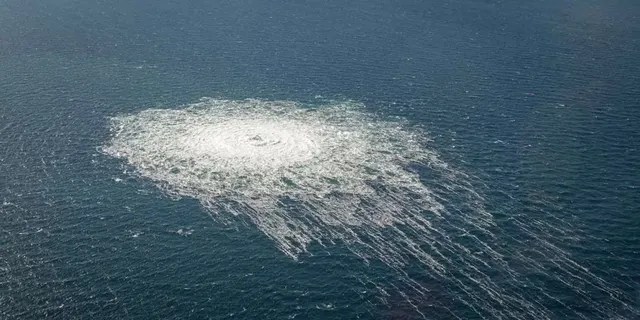
Footage from the site of a gas leak on the underwater section of the Nord Stream.
The video was published by the Danish military.
Earlier, the Kremlin said that it was most likely about sabotage.
The same opinion was expressed in the German government.
Embedded video

Yesterday’s attack on the Nord Stream system is not unprecedented:

professional hog groomer @bidetmarxman – 15:51 UTC · Sep 27, 2022

In 2015, the annual routine underwater survey of the Nord Stream 1 pipelines came across a remote operated vehicle rigged with explosives right next to one of the lines in Swedish waters.
The umbilical cable had been cut. The drone’s national origin was never disclosed. 🧵

In 2015 Pipeline Journal reported:

[T]he Swedish military has successfully cleared a remote operated vehicle (drone) rigged with explosives found near Line 2 of the Nord Stream Natural Gas offshore pipeline system.

The vehicle was discovered during a routine survey operation as part of the annual integrity assessment of the Nord Stream pipeline. Since it was within the Swedish Exclusive Economic Zone (EEZ) approximately 120 km away from the island of Gotland, the Swedes called on their armed forces to remove and ultimately disarm the object.

The national identity of the drone has not been verified so far, as many countries use Unmanned Underwater Vehicles (UUVs) of a similar construction, [Jesper Stolpe, Swedish Armed Forces spokesman,] said.

To destroy a sub sea pipeline requires more than a ROV/drone delivered shaped charge.

Javier Blas @JavierBlas – 15:18 UTC · Sep 27, 2022

How strong is a Nord Stream pipe? Quite!
The steel pipe itself has a wall of 4.1 centimeters (1.6 inches), and it’s coated with another 6-11 cm of steel-reinforced concrete. Each section of the pipe weighs 11 tonnes, which goes to 24-25 tonnes after the concrete is applied.

It wasn’t earthquakes that destroyed the pipelines. These were several well targeted and massive explosions:

A Swedish seismologist said on Tuesday he was certain the seismic activity detected at the site of the Nord Stream pipeline gas leaks in the Baltic Sea was caused by explosions and not earthquakes nor landslides.

Bjorn Lund, seismologist at the Swedish National Seismic Network at Uppsala University, said seismic data gathered by him and Nordic colleagues showed that the explosions took place in the water and not in the rock under the seabed.

The targeted explosions were not small:

Dagny Taggart @DagnyTaggart963 – 15:56 UTC · Sep 27, 2022

Swedish seismologists from Lund University noted that “at least 100 kg of TNT (perhaps more) were used to destroy the pipelines.”

Here is where the pipelines were hit:

The Baltic Sea is controlled by NATO. This from June 2022:

“BALTOPS, with the high degree of complexity, tested our collective readiness and adaptability, while also highlighting the strength of our Alliance and resolve in providing a maritime domain with freedom of navigation for all,” said Vice Adm. Gene Black, commander, U.S. Sixth Fleet and Naval Striking and Support Forces NATO (STRIKFORNATO).

Led by U.S. Sixth Fleet, BALTOPS 22 was command and controlled by STRIKFORNATO. From the staff’s headquarters in Oeiras, Portugal, Rear Adm. James Morley, STRIKFORNATO deputy commander, was responsible for ensuring participants met all training objectives.

[Rear Adm. John Menoni, commander, Expeditionary Strike Group Two,] also noted several instances in which forces stepped beyond know warfare methods to push limits with new technologies at sea and ashore. “Whether it was mine-hunting UUVs, persistent Intelligence, Surveillance, and Reconnaissance from an observable UAV, or demonstrating the value of the emerging Marine Corps concept of Expeditionary Advance Base Operations (EABO), our men and women continue to develop the tactics, techniques, and procedures that ultimately make meaningful contributions to Maritime Domain Awareness and increase the lethality of our forces.”

At sea, ships fine-tuned tactical maneuvering, anti-submarine warfare, live-fire training, mine countermeasures operations, and replenishments at sea. The Swedish submarine participating in the exercise, the U.K.’s Daring-class air-defense destroyer HMS Defender (D 36), and aircraft from other participating nations trained in anti-submarine warfare. Meanwhile, mine operations served as an ideal area of focus for testing new technology.

Scientists from five nations brought the latest advancements in Unmanned Underwater Vehicle (UUV) mine hunting technology to the Baltic Sea to demonstrate the vehicle’s effectiveness in operational scenariosThe BALTOPS Mine Counter Measure Task Group ventured throughout the Baltic region practicing ordnance location, exploitation, and disarming in critical maritime chokepoints.

While the Baltops 22 maneuver already took place in June and July of this year the U.S. Sixth Fleet left the Baltic Sea only a few days ago (in German, my translation):

Big Fleet Group From U.S. Navy Passes [German island passage] Fehmanbelt

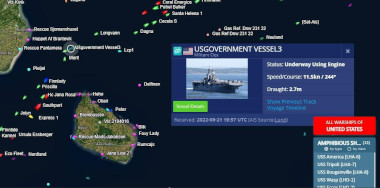
On Wednesday morning the amphibious assault ship USS Kearsarge, escorted by the Landing Ships USS Arlington and USS Gunston Hall, was en route towards west. Previously, the ships were part of US units that took part in NATO maneuvers and called at numerous ports in Germany, Scandinavia and the Baltic States.

The “USS Kearsarge”, flagship of the association and largest warship of the US Navy, which was in action in the Baltic Sea in the last 30 years, has 40 helicopters and fighter planes as well as more than 2000 soldiers on board, the escort ships about 1000. For the around 4,000 soldiers are heading back home on the east coast of the US after their six-month deployment.

Parts of the Kearsange operations in the Baltic Sea were dedicated to test special sub sea mine destruction technologies:

A significant focus of BALTOPS every year is the demonstration of NATO mine hunting capabilities, and this year the U.S. Navy continues to use the exercise as an opportunity to test emerging technology, U.S. Naval Forces Europe-Africa Public Affairs said June 14.

In support of BALTOPS, U.S. Navy 6th Fleet partnered with U.S. Navy research and warfare centers to bring the latest advancements in unmanned underwater vehicle mine hunting technology to the Baltic Sea to demonstrate the vehicle’s effectiveness in operational scenarios.

Experimentation was conducted off the coast of Bornholm, Denmark, with participants from Naval Information Warfare Center Pacific, Naval Undersea Warfare Center Newport, and Mine Warfare Readiness and Effectiveness Measuring all under the direction of U.S. 6th Fleet Task Force 68.

Off the coast of Bornholm, Denmark, is where the pipelines were hit. Just days ago the USS Kearsarge was in that area:

AZ @AZmilitary1 – 13:52 UTC · Sep 27, 2022

An expeditionary detachment of US Navy ships led by the universal amphibious assault ship USS Kearsarge days ago was in the Baltic Sea
It was 30 km from the site of the alleged sabotage on the Nord Stream-1 gas pipeline and 50 km from the threads of Nord Stream-2 gas pipeline

AZ @AZmilitary1 – 14:12 UTC · Sep 27, 2022

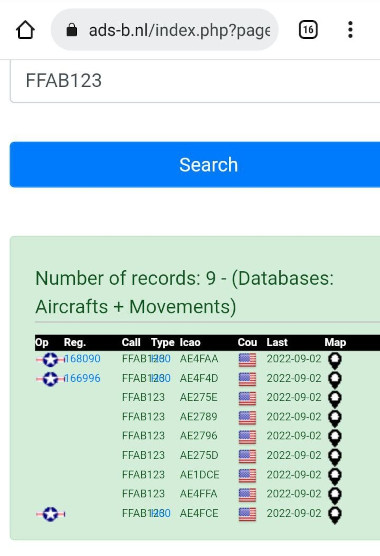
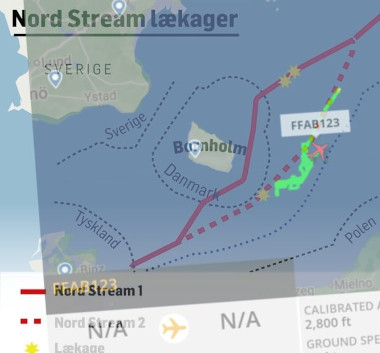
On September 2, interesting maneuvers performed by an American helicopter with the call sign FFAB123. Then it was assumed that this board was from the USS Kearsarge air wing, and today more details were looked.

According to the website ads-b.nl , this call sign was used by 6 boards that day, of which we managed to establish the side numbers of three. All of them are Sikorsky MH-60S.

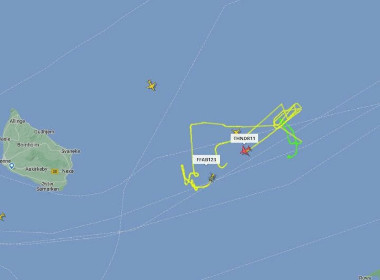
By superimposing the FFAB123 route on the scheme of yesterday’s accident, we get a rather interesting result — the helicopter either flew along the Nord Stream-2 highway, or even between the points where the accident occurred.

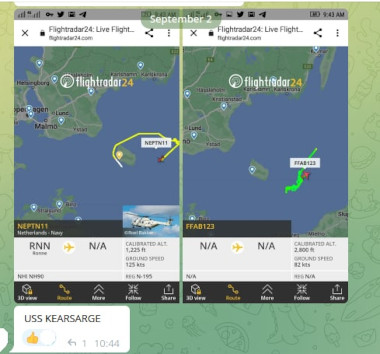
On Twitter, meanwhile, there were screenshots of other flights of American aviation — the following screenshot was taken on September 13.

The MH-60S carries big electromagnetic sensors which allows it to detect submarines, mines and – in the shallow waters of the Baltic Sea –  sub sea pipelines.

This overlay picture of two others posted above is especially of interest:

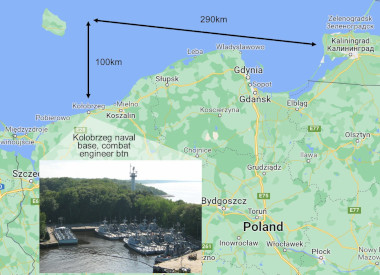
The U.S. military is not the only force that was near the area of the pipeline damage. Just a 100 kilometer south is the Polish naval base Kolobrzeg (the former German Kolberg) which harbors mine laying ships and the 8th Kołobrzeg Naval Combat Engineer Battalion. Naval combat engineers are experts in blowing up anything that is under water, be it mines or pipelines.

In 2021, while Nord Stream 2 was still being build, the Polish navy had interfered and endangered the pipe laying vessels in the very same place.

Artifaktus @bzyqer – 7:49 UTC · Sep 28, 2022

Gdy Wy mycie zęby, przebieracie się w piżamy i szykujecie do snu, jeden niestrudzony Polak wyrusza w swoją łodzią w kierunku Bornholmu mając na sercu dobro Polski a może i Niemiec …

Translated from Polish by Google
When you brush your teeth, put on your pajamas and get ready to go to sleep, one tireless Pole sets off in his boat towards Bornholm with the good of Poland and maybe Germany at heart …
Image

During the recent Ukraine crisis Poland has rejected to receive Russian gas. It closed the Yamal pipeline that transports natural gas from Russia to Germany. Poland continued to consume Russia gas. It received it from Germany which had received it through the Nord Stream I pipeline from Russia.

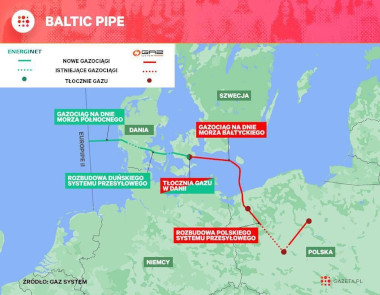
Poland and Denmark have build a new sub sea pipeline which connects it to the pipeline that brings Norwegian gas to the Netherlands and Europe.

The pipeline was opened yesterday, the very same day the Nord Stream system was sabotaged.

Chancellery of the Prime Minister of Poland @PremierRP_en – 11:25 UTC · Sep 27, 2022

🇵🇱🤝🇩🇰 The #BalticPipe is a joint Polish-Danish investment in the energy security of the region.
Image

Chancellery of the Prime Minister of Poland @PremierRP_en – 13:43 UTC · Sep 27, 2022

🎥The launching ceremony of the #BalticPipe gas pipeline with participation of PM @MorawieckiM , PM of Denmark Mette Frederiksen & @prezydentpl @AndrzejDuda.
The Baltic Pipe is a strategic infrastructure project aimed at creating a new gas supply corridor on the European market.
Video

The Baltic Pipe has a capacity of only 10 billion cubic meters per year. The Nord Stream system could carry up to 110 cubic meter per year. All of which is needed to keep Europe’s industries running.

For more on Poland’s involvement, likely in cooperation with the U.S., read these informed speculations by John Helmer:

The explosions at Bornholm are the new Polish strike for war in Europe against Chancellor Olaf Scholz. So far the Chancellery in Berlin is silent, tellingly.

The Poles should be reminded that other countries also have the capabilities to sabotage sub sea pipelines.

Radosław Sikorski is a former Minister of Defense and Foreign Minister of Poland. He is now a Member of the European Parliament. Yesterday he posted a picture of the gas escaping the damaged Nord Stream pipelines and thanked the U.S. for blowing them up.

Sikorski is married to the neoconservative writer Anne Appelbaum who is notorious for her anti-Russian and anti-German screeds widely published in U.S. media.

In 2014 during the Maidan coup in Ukraine another notorious neoconservative, Assistant Secretary of State Victoria Nuland, told the U.S. ambassador to Ukraine, Geoffrey Pyatt, who should become the new prime minister of the Ukraine. She famously expressed her opinion about European concerns: “Fuck the EU” Nuland said. She is currently the U.S. Under Secretary of State for Political Affairs.

Over the last decades Germany has financed the Euro zone with up to 1.24 trillion Euros. (See also this thread). This was possible because Germany was exporting lots of industrial products and had a yearly surplus from its trade. With Germany’s industry going down because a lack of cheap energy that surplus will vanish. Europe, all of it, will become a poor continent.

Philip Pilkington @philippilk – 21:23 UTC · Sep 27, 2022

9/ The European energy war will likely go down in history, together with the Treaty of Versailles and the trade wars of the 1930s, as one of the biggest economic policy errors in history.

10/ Another thing: when Trump was elected on a platform of milder protectionism, many people rightly pointed to the 1920s and 1930s and warned against these policies. These same people appear to have supported these much more 1920s/30s-like policies this past year. Ironic.

This does not happen by chance or fate. It is part of a long term neoconservative plan for continued U.S. supremacy over the world. The Anglo-American axis is the only party to benefit from the recent events.

The U.S. allegedly warned Germany of sabotage of the Nord Stream system (in German).

This reminds of President Joe Biden’s warning of a Russian invasion in Ukraine early this year.

It is easy to predict such events when you are the one who intends to cause them.

The U.S. knew that the Ukraine was going to launch an attack on the Donbas republics. The U.S. knew that Russia would intervene to help its brethren. Russia had said so. The Ukrainian attack started with artillery preparations on February 17. Russia intervened on February 24.

The above is a collection of the currently available facts. You can draw your own conclusions from them.

The Timing of the Pipeline Attack

Site of the Nord Stream 2 attack. (Danish Defense Ministry)

By Joe Lauria

Source: Consortium News

President Joe Biden, with German Chancellor Olaf Scholz by his side, promised a White House press conference in early February that the U.S. was “able” to shut down the German-Russian Nord Stream 2 gas pipeline in the Baltic Sea if Russia invaded Ukraine. 

A reporter asked Biden, “But how will you do that, exactly, since…the project is in Germany’s control?” Biden said: “I promise you, we will be able to do that.”

When Russia indeed invaded Ukraine on Feb. 24, Washington was able to get Berlin to suspend the pipeline project that was about to go online, even though it wasn’t in Germany’s interests. 

The pipeline has remained closed ever since. Why then did someone attack the pipeline on Monday, releasing the gas it contained into the Baltic Sea? As long as the war continues, the U.S. has what it wants regarding the pipeline.

Evidently, the fear in Washington is that the war might not continue for as long as it wants. I argued on Feb. 4, twenty days before the invasion, that the U.S. was setting a trap for Russia and needed it to invade Ukraine in order to unleash an information, economic and proxy war with the ultimate aim of regime change in Moscow. All that was confirmed by March 27.

Since then the U.S. and Britain have done everything it can to keep the war going, and the economic sanctions in place.  But those sanctions on Russia are devastating the European economy, driving energy prices up and shutting businesses down.  Ordinary Europeans are facing a winter in which they may not be able to afford to heat their homes.

This has led to growing popular unrest and pressure on European governments to end the war, lift the sanctions and save their economies.  Ending the war and lifting sanction would lead to the reopening of Nord Stream 2. 

Offer to Resume Shipments

Three weeks ago, President Vladimir Putin told a press conference in Samarkand that Russia was ready to resume supplying natural gas to Germany if Germany lifted its economic sanctions against Russia.   Putin said: 

“After all, if they need [gas] urgently, if things are so bad, just go ahead and lift sanctions against Nord Stream 2, with its 55 billion cubic metres per year – all they have to do is press the button and they will get it going. But they chose to shut it off themselves; they cannot repair one pipeline and imposed sanctions against the new Nord Stream 2 and will not open it. Are we to blame for this? Let them think hard about who is to blame and let none of them blame us for their own mistakes. Gazprom and Russia have always fulfilled and will fulfil all obligations under our agreements and contracts, with no failures ever.”

So the offer is there to return normal gas supplies to Europe if the sanctions are lifted. With the war having passed into its most dangerous phase, there is a growing urgency to stop the war, including talk of a Saudi-led peace process in which Ukraine would cede territory to Russia in exchange for peace.

If momentum grows for a peace deal of any kind it would ruin Washington’s long-term plans to weaken Russia. It would mean Nord Stream 2 would reopen, which would help Germany and Russia, but crush U.S. aims at regime change and making Europe dependent on U.S. energy.

“I promise you, we will be able” to shut down Nord Stream 2, Biden vowed. But how would the U.S. do that if Germany became poised to reopen it?

Escalation: Recent Events Suggest Mounting Economic Danger

By Brandon Smith

Source: Alt-Market.us

A common refrain from people who are critical of alternative economists is that we have been predicting crisis for so long that “eventually we will be right.” These are generally people who don’t understand the nature of economic decline – It’s like an avalanche that builds over time, then breaks and quickly escalates as it flows down the mountain. What they don’t grasp is that they are in the middle of an economic collapse RIGHT NOW, and they just can’t see it because they have been acclimated to the presence of the snow and cold.

Economic decline is a process that takes many years, and while you might get an event like the market crash of 1929 or the crash of 2008, these moments of panic are nothing more than the wreckage left behind by the great wave of tumbling ice that everyone should have seen coming far in advance, but they refused.

In 2022 the job of warning people is far easier than it used to be because we are well past the midpoint of the process of decline. But, believe it or not, I still get people today who claim that we analysts are “doom mongers.” The power of willful ignorance is truly amazing. It’s enough to make a person blind to stagflationary crisis, supply chain disruptions, quickly inflating prices, stock market carnage, bond market instability, record consumer debt, and international conflict.

At this point, I think if a person can’t see the dangers ahead they are probably a waste of time and space and are destined to be buried in the ice; there’s nothing that can be done for them. Yes, there are some people out there that don’t get exposed to the information and we have to take them into account, but my priority will be people that are awake and aware and try to give them a sense of what point in the collapse process we find ourselves.

In the past month there has been a considerable uptick in economic and geopolitical activity that suggests we are entering a new phase, and not surprisingly it’s all accumulating right before we hit October. Here are the events that I find most concerning:

The European Energy Crisis

This is an event that I have been predicting since the Russian invasion of Ukraine and now it is upon us. I wrote about it extensively in my recent article ‘Europe Is Facing Energy Disaster And It’s Going To Bleed Over Into The US’ so I won’t rehash all that information here. What I do want to point out is the complete lack of planning on the part of European officials to deal with the threat. It is as if they WANT a full spectrum disaster.

Russia has now completely cut off natural gas supplies to Europe, which represent around 40% of all EU energy resources. Europe’s benchmark natural gas prices spiked by 28% a week ago, on top of already existing inflation. Oil supplies are also in steep decline for Europe and the EU government has pledged to cut what’s left of Russian oil imports by sea at the end of the year. Sadly, they have offered very little in the way of solutions to the supply-side problem.

There has been talk of increasing imports of alternative resources from other nations, but the EU is already buying up around 75% of all liquid natural gas from the US. OPEC oil producers have indicated they will not be attempting to increase production anytime soon (probably because they can’t due to inflation in operation costs). There is NO backup energy resource for Europe; it doesn’t exist right now. They will try to buy up whatever coal, oil and gas they can find on the market while driving up prices even more for other countries. They will still come up short, which means people are going to freeze this winter.

Best case scenario is that there are mostly mild temps and people barely scrape buy with minimum heating. But EU industry is going to suffer and many manufacturers are going to cut production (which mean more stress on the global supply chain).

Core Inflation Is Still Rising

As I warned last week in my article ‘It’s A Fact That Needs Repeating: The Federal Reserve Is A Suicide Bomber,’ inflation is continuing to rise despite the Fed’s continued interest rate hikes, giving the central bank even more ammunition to justify higher rates into extreme economic weakness.

The latest CPI print showed an increase to 8.3% and was a shock to markets which universally expected a drop. This is the nature of stagflation – Even with falling demand prices continue to climb or remain high for extended periods. The stagflation event of the 1970s lasted for a decade until the Fed jacked rates to 21% and then employment crumbled in the early 1980s.

This doesn’t mean that rates will go to 21% this time; they don’t need to. All it would take is a Federal Funds Rate of around 4% – 5% to crash our current QE addicted system. A 75 bps rate hike is now widely expected at the next Fed meeting this month, with some predicting a 100 bps hike. This would put us close to crash territory for markets and for employment, though I think we still have well into 2023 before unemployment really starts to spike.

Putin’s Meeting With Xi

As I write this, Vladimir Putin is set to meet with China’s Xi Jinping and the nature of the conference is not clear. There are the obvious points of agreement such as China’s continued purchases of Russian oil and other commodities, as well as the ongoing plan to build a pipeline to China by 2025. There is also strategic cooperation which is evident in the recent naval exercises between the two nations around Japan and Taiwan.

The timing of the meeting is concerning to me, because the prime season for a potential Chinese invasion of Taiwan is fast approaching (October is the best month for naval movements to avoid typhoons). China would not necessarily need to commit to a ground invasion, either. They could simply cut off all import/export trade from any source other than China and starve Taiwan until they accept unification.

There is also the issue of Ukraine and arms sales. With the amount of propaganda coming from Ukrainian Intelligence and NATO, it’s hard to say what is actually happening, but I suspect Russia is changing strategies and repositioning to deploy missile and artillery bombardment of infrastructure, including power grids and water. This is a tactic that Russia has avoided for months (until this week), which is surprising because one of the first measures usually taken by the US during an invasion is to eliminate most key infrastructure (as we did in Iraq). You would think Russia would have done the same, but perhaps they were saving that scenario for winter when it is harder for Ukraine to cope.

This would make Ukraine essentially unlivable in the coming winter for most of the population. Putin may be seeking to ensure China remains a steady economic partner should geopolitical pressures increase. They may even be making a deal of mutual support: China takes Taiwan while Russia makes Ukraine a resource wasteland and they each support the other economically when NATO counties try to impose sanctions on China. We probably won’t know until October, but the timing of the meeting should raise eyebrows.

If the manure is about to hit the fan in Taiwan along with Ukraine, then diplomatic and economic ties will be severed and western access to China’s manufacturing will be cut. This is a problem for China’s economy, certainly, which may be why they have continued their mass covid lockdowns well after every other government has abandoned them. Could this be practice for civil controls in an impending war environment?

China’s global dominance in imports/exports gives them considerable economic leverage in trade, however. Many nations would not support sanctions against them. Also, their vast holdings of US dollars and Treasuries could be used as a weapon to damage or destroy the dollar’s world reserve status. If China invades Taiwan this year, then all bets are off – The economic decline will move swiftly from that point on.

There are many other trends which factor into the crash environment but the above factors are the most recent and hold the biggest potential for causing a domino effect globally. The question that always arises is “what can we do about it?” Not much in terms of prevention. What we can do, though, is prepare locally to weather the storm. This means stocking necessities before they rise even further in price or become non-existent. Become a producer and learn a valuable skill for survival in a depleted economy Organize with people locally who are on the same page to create security and alternative trade opportunities.

Hopefully, the aware citizenry will rise to the challenge and organization will be extensive, because the worst case scenario would be great masses of completely isolated people all vying against each other rather than working towards mutual security. Even in a slow collapse scenario this is a problem in terms of rising crime; so plan on working with others if you want to avoid inevitable third world conditions.

Silencing the Lambs — How Propaganda Works

Leni Riefenstahl said her epic films glorifying the Nazis depended on a “submissive void” in the German public. This is how propaganda is done.

By John Pilger

Source: Consortium News

In the 1970s, I met one of Hitler’s leading propagandists, Leni Riefenstahl, whose epic films glorified the Nazis. We happened to be staying at the same lodge in Kenya, where she was on a photography assignment, having escaped the fate of other friends of the Fuhrer.
She told me that the “patriotic messages” of her films were dependent not on “orders from above” but on what she called the “submissive void” of the German public.

Did that include the liberal, educated bourgeoisie? I asked.  “Yes, especially them,” she said. 

I think of this as I look around at the propaganda now consuming Western societies. 

Of course, we are very different from Germany in the 1930s. We live in information societies. We are globalists. We have never been more aware, more in touch, better connected. 

Or do we in the West live in a Media Society where brainwashing is insidious and relentless, and perception is filtered according to the needs and lies of state and corporate power? 

The United States dominates the Western world’s media. All but one of the top 10 media companies are based in North America. The internet and social media – Google, Twitter, Facebook – are mostly American owned and controlled.

In my lifetime, the United States has overthrown or attempted to overthrow more than 50 governments, mostly democracies. It has interfered in democratic elections in 30 countries. It has dropped bombs on the people of 30 countries, most of them poor and defenceless. It has attempted to murder the leaders of 50 countries.  It has fought to suppress liberation movements in 20 countries. 

The extent and scale of this carnage is largely unreported, unrecognised, and those responsible continue to dominate Anglo-American political life.

Harold Pinter Broke the Silence

In the years before he died in 2008, the playwright Harold Pinter made two extraordinary speeches, which broke a silence.

“U.S. foreign policy,” he said, is

“best defined as follows: kiss my arse or I’ll kick your head in. It is as simple and as crude as that. What is interesting about it is that it’s so incredibly successful. It possesses the structures of disinformation, use of rhetoric, distortion of language, which are very persuasive, but are actually a pack of lies. It is very successful propaganda. They have the money, they have the technology, they have all the means to get away with it, and they do.”

In accepting the Nobel Prize for Literature, Pinter said this: 

“The crimes of the United States have been systematic, constant, vicious, remorseless, but very few people have actually talked about them. You have to hand it to America. It has exercised a quite clinical manipulation of power worldwide while masquerading as a force for universal good. It’s a brilliant, even witty, highly successful act of hypnosis.”

Pinter was a friend of mine and possibly the last great political sage – that is, before dissenting politics were gentrified. I asked him if the “hypnosis” he referred to was the “submissive void” described by Leni Riefenstahl. 

“It’s the same,” he replied. “It means the brainwashing is so thorough we are programmed to swallow a pack of lies. If we don’t recognise propaganda, we may accept it as normal and believe it. That’s the submissive void.”

In our systems of corporate democracy, war is an economic necessity, the perfect marriage of public subsidy and private profit: socialism for the rich, capitalism for the poor. The day after 9/11 the stock prices of the war industry soared. More bloodshed was coming, which is great for business.

Today, the most profitable wars have their own brand. They are called “forever wars” — Afghanistan, Palestine, Iraq, Libya, Yemen and now Ukraine. All are based on a pack of lies.

Iraq is the most infamous, with its weapons of mass destruction that didn’t exist. NATO’s destruction of Libya in 2011 was justified by a massacre in Benghazi that didn’t happen. Afghanistan was a convenient revenge war for 9/11, which had nothing to do with the people of Afghanistan. 

Today, the news from Afghanistan is how evil the Taliban are —not that U.S. President Joe Biden’s theft of $7 billion of the country’s bank reserves is causing widespread suffering. Recently, National Public Radio in Washington devoted two hours to Afghanistan — and 30 seconds to its starving people.

At its summit in Madrid in June, NATO, which is controlled by the United States, adopted a strategy document that militarises the European continent, and escalates the prospect of war with Russia and China. It proposes “multi domain warfighting against nuclear-armed peer-competitor.” In other words, nuclear war.

It says: “NATO’s enlargement has been an historic success.” 

I read that in disbelief. 

The news from the war in Ukraine is mostly not news, but a one-sided litany of jingoism, distortion, omission.  I have reported a number of wars and have never known such blanket propaganda. 

In February, Russia invaded Ukraine as a response to almost eight years of killing and criminal destruction in the Russian-speaking region of Donbass on their border. 

In 2014, the United States had sponsored a coup in Kiev that got rid of Ukraine’s democratically elected, Russian-friendly president and installed a successor whom the Americans made clear was their man. 

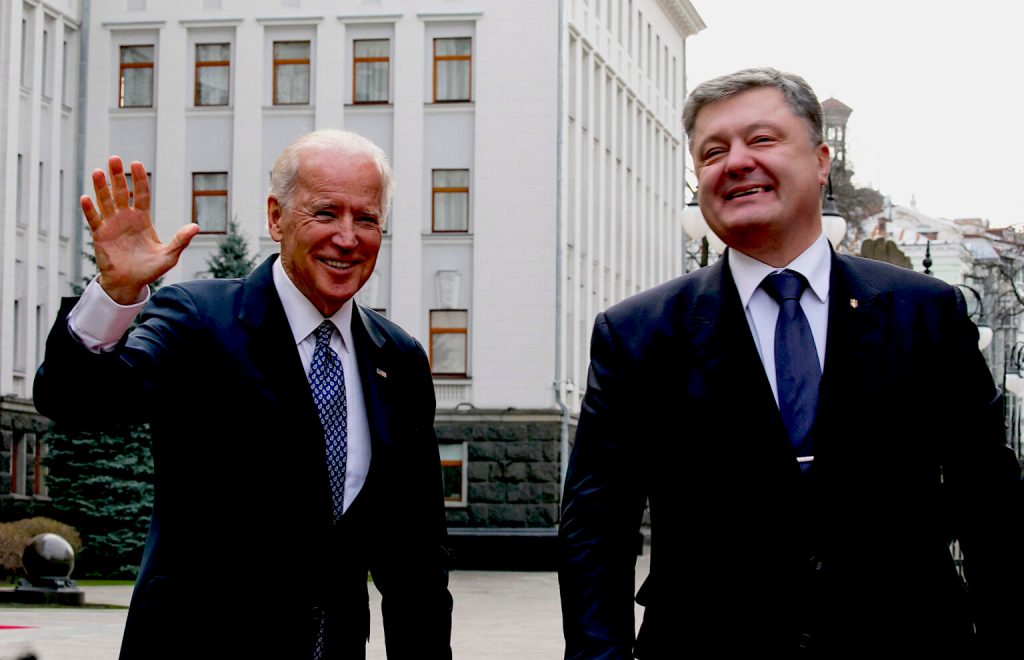
Dec. 7, 2015: U.S. Vice President Joe Biden meets with Ukrainian President Petro Poroshenko in Kiev. (U.S. Embassy Kyiv, Flickr)

In recent years, American “defender” missiles have been installed in eastern Europe, Poland, Slovenia, the Czech Republic, almost certainly aimed at Russia, accompanied by false assurances all the way back to James Baker’s “promise” to Soviet leader Mikhail Gorbachev in February 1990 that NATO would never expand beyond Germany. 

NATO on Hitler’s Borderline

Ukraine is the frontline. NATO has effectively reached the very borderland through which Hitler’s army stormed in 1941, leaving more than 23 million dead in the Soviet Union. 

Last December, Russia proposed a far-reaching security plan for Europe. This was dismissed, derided or suppressed in the Western media. Who read its step-by-step proposals? On Feb. 24, President Volodymyr Zelensky threatened to develop nuclear weapons unless America armed and protected Ukraine.  

[Related: John Pilger: War in Europe & the Rise of Raw Propaganda]

On the same day, Russia invaded — an unprovoked act of congenital infamy, according to the Western media. The history, the lies, the peace proposals, the solemn agreements on Donbass at Minsk counted for nothing. 

On April 25, U.S. Defense Secretary Lloyd Austin flew into Kiev and confirmed that America’s aim was to destroy the Russian Federation — the word he used was “weaken.” America had got the war it wanted, waged by an American bankrolled and armed proxy and expendable pawn.

Almost none of this was explained to Western audiences.

[Read:  Joe Lauria: Biden Confirms Why the US Needed This War]

Russia’s invasion of Ukraine is wanton and inexcusable. It is a crime to invade a sovereign country. There are no “buts” — except one.

When did the present war in Ukraine begin and who started it? According to the United Nations, between 2014 and this year, some 14,000 people have been killed in the Kiev regime’s civil war on the Donbass. Many of the attacks were carried out by neo-Nazis. 

Watch an ITV news report from May 2014, by the veteran reporter James Mates, who is shelled, along with civilians in the city of Mariupol, by Ukraine’s Azov (neo-Nazi) battalion.

In the same month, dozens of Russian-speaking people were burned alive or suffocated in a trade union building in Odessa besieged by fascist thugs, the followers of the Nazi collaborator and anti-Semitic fanatic Stepan Bandera.  The New York Times called the thugs “nationalists.”

“The historic mission of our nation in this critical moment,” said Andreiy Biletsky, founder of the Azov Battaltion, “is to lead the White Races of the world in a final crusade for their survival, a crusade against the Semite-led Untermenschen.”

Since February, a campaign of self-appointed “news monitors” (mostly funded by the Americans and British with links to governments) have sought to maintain the absurdity that Ukraine’s neo-Nazis don’t exist. 

Airbrushing, once associated with Stalin’s purges, has become a tool of mainstream journalism.

In less than a decade, a “good” China has been airbrushed and a “bad” China has replaced it: from the world’s workshop to a budding new Satan.  

Much of this propaganda originates in the U.S., and is transmitted through proxies and “think-tanks,” such as the notorious Australian Strategic Policy Institute, the voice of the arms industry, and by journalists such as Peter Hartcher of The Sydney Morning Herald, who has labeled those spreading Chinese influence as “rats, flies, mosquitoes and sparrows” and suggested these “pests” be “eradicated.” 

Andriy Beletsky, commanding officer of the special Ukrainian neo-Nazi police regiment Azov, with volunteers in 2014. (My News24, CC BY 3.0, Wikimedia Commons)

News about China in the West is almost entirely about the threat from Beijing. Airbrushed are the 400 American military bases that surround most of China, an armed necklace that reaches from Australia to the Pacific and south east Asia, Japan and Korea. The Japanese island of Okinawa and the Korean island of Jeju are like loaded guns aimed point blank at the industrial heart of China. A Pentagon official described this as a “noose.”

Palestine has been misreported for as long as I can remember. To the BBC, there is the “conflict” of “two narratives.” The longest, most brutal, lawless military occupation in modern times is unmentionable. 

The stricken people of Yemen barely exist. They are media unpeople.  While the Saudis rain down their American cluster bombs with British advisers working alongside the Saudi targeting officers, more than half a million children face starvation.

This brainwashing by omission is not new. The slaughter of the First World War was suppressed by reporters who were given knighthoods for their compliance.  In 1917, the editor of The Manchester Guardian, C.P. Scott, confided to Prime Minister Lloyd George: “If people really knew [the truth], the war would be stopped tomorrow, but they don’t know and can’t know.”

The refusal to see people and events as those in other countries see them is a media virus in the West, as debilitating as Covid.  It is as if we see the world through a one-way mirror, in which “we” are moral and benign and “they” are not. It is a profoundly imperial view.

The history that is a living presence in China and Russia is rarely explained and rarely understood. Vladimir Putin is Adolf Hitler. Xi Jinping is Fu Man Chu. Epic achievements, such as the eradication of abject poverty in China, are barely known. How perverse and squalid this is.

When will we allow ourselves to understand? Training journalists factory style is not the answer. Neither is the wondrous digital tool, which is a means, not an end, like the one-finger typewriter and the linotype machine.

In recent years, some of the best journalists have been eased out of the mainstream. “Defenestrated” is the word used. The spaces once open to mavericks, to journalists who went against the grain, truth-tellers, have closed.  

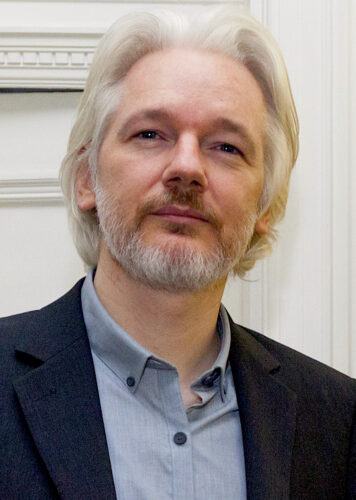
The case of Julian Assange is the most shocking.  When Julian and WikiLeaks could win readers and prizes for The GuardianThe New York Times and other self-important “papers of record,” he was celebrated. 

When the dark state objected and demanded the destruction of hard drives and the assassination of Julian’s character, he was made a public enemy. Vice President Joe Biden compared him to a “hi-tech terrorist.” Hillary Clinton asked, “Can’t we just drone this guy?” 

The ensuing campaign of abuse and vilification against Julian Assange — the U.N. rapporteur on torture called it “mobbing” — brought the liberal press to its lowest ebb. We know who they are. I think of them as collaborators: as Vichy journalists. 

When will real journalists stand up? An inspirational samizdat  already exists on the internet: Consortium News, founded by the great reporter Robert Parry, Max Blumenthal’s  The GrayzoneMint Press News, Media Lens, DeclassifiedUK, Alborada, Electronic IntifadaWSWSZNetICH, CounterPunchIndependent Australia, the work of Chris Hedges, Patrick Lawrence, Jonathan Cook, Diana Johnstone, Caitlin Johnstone and others who will forgive me for not mentioning them here. 

And when will writers stand up, as they did against the rise of fascism in the 1930s? When will film-makers stand up, as they did against the Cold War in the 1940s? When will satirists stand up, as they did a generation ago? 

Having soaked for 82 years in a deep bath of righteousness that is the official version of the last world war, isn’t it time those who are meant to keep the record straight declared their independence and decoded the propaganda? The urgency is greater than ever.

John Pilger has twice won Britain’s highest award for journalism and has been International Reporter of the Year, News Reporter of the Year and Descriptive Writer of the Year. He has made 61 documentary films and has won an Emmy, a BAFTA and the Royal Television Society prize. His ‘Cambodia Year Zero’ is named as one of the ten most important films of the 20th century. He can be contacted at www.johnpilger.com

Journalists who challenge NATO narratives are now ‘information terrorists’

By Vanessa Beeley

Source: Vanessa Beeley Substack

A US state department sponsored round table on ‘countering disinformation’ was recently held at the National Security and Defence Council of Ukraine.

“Information terrorists should know that they will have to answer to the law as war criminals” Andrii Shapovalov

According to the press release – “NGOs, mass media and international experts” took part in the round table discussions. Delegates discussed ‘disinformation methods’ used in Ukraine and abroad. On the agenda was legal and state prevention of ‘fakes and disinformation in the context of cyber security’.

Andrii Shapovalov, head of the Ukrainian Centre for Combatting Disinformation emphasized that those who ‘deliberately spread disinformation are information terrorists’. Shapovalov recommended changes to the legislation to crack down on these terrorists – reminiscent of the pre-WW2 Nazi Germany suppression of media and information channels. Shapovalov determined that ‘information terrorists should know that they will have to answer to the law as war criminals’.

It goes without saying that the crushing of dissent is essential for public support for NATO’s proxy war in Ukraine to be maintained. Russian media has already been wiped from the Western-controlled internet sphere. Ukrainian ‘kill lists’ such as the infamous Myrotvorets already include the courageous Canadian independent journalist Eva Bartlett and outspoken Pink Floyd co-founder Roger Waters.

Bartlett was also doxxed on Twitter by former UK Conservative Party MP Louise Mensch who alerted Ukrainian Special Forces to her presence in Donetsk. A few days later an attack was carried out on the hotel in Donetsk housing multiple journalists including Bartlett – coincidence?

German journalist Alina Lipp has been effectively sanctioned and threatened with prosecution by the German government for reporting on the daily atrocities committed by Ukrainian Nazi forces against civilians in Donetsk and Lughansk. Lipp told Stalkerzone:

“They just closed my bank account. Then they closed my father’s account. A month ago, I noticed that all the money disappeared from my account – 1,600 euros. I realised that something was happening in Germany. A few days ago, I received a notification from the prosecutor’s office, and a criminal case was opened against me for supporting the special operation. In Germany, special operations are considered a crime, and I am also a criminal. I face three years in prison or a huge fine.”

British journalist Graham Philips has illegally been sanctioned by the UK regime without any investigation or Philips being given a ‘right to reply’. Most mainstream media reports on this violation of his human rights describe Philips as ‘one of the most prominent pro-Kremlin online conspiracy theorists’. A familiar smear deployed by NATO-aligned media outlets to dehumanise and discredit challenging voices.

Philips like many other journalists being targeted lives in Donbass which has been threatened with brutal ethnic cleansing by the NATO proxy Ukrainian Nazi and ultra-nationalist forces since Washington’s Victoria Nuland- engineered coup in 2014.

These journalists transmit the voices of the Russian-speaking Ukrainians who have been subjected to horrendous war crimes, torture, detention and persecution for eight years and ignored by the West. For this they are now to be designated ‘information terrorists’ – because they expose terrorism sanctioned by NATO member states.

Organisations are springing up in the UK like Molfar Global whose ‘Book of Orcs’ project employs 200 alleged volunteers to identify ‘Russian (Orcs) war criminals’ and to compile a legal ‘kill list’. The ‘Orc’ terminology is another dehumanisation process, converting Russian citizens and military into fantasy science fiction monsters to soften western publics to the measures being taken to silence and punish them for…being Russian or speaking Russian. They state on their website homepage:

“Every Russian occupier must be identified and punished according to the law. War crimes and and crimes against Humanity have no statute of limitations. That is why we set ourselves the goal of finding everyone and preventing them from escaping justice”

Who determines who should be put on the list? Who determines their fate? What justice? In a country like Ukraine seeped in corruption – where executions or the disappearance of dissidents and political or media opposition is a regular occurrence – who is to be made accountable for action taken against those listed on the ‘Orc hit list’? This is lawless justice that falls under the umbrella of US “rules based global governance” – comply or die and newly furnished legislation will make your death or state-sanctioned assassination a legal one.

The organisers of the round table were the National Security Service Academy, the US State Department/Department of Defence-funded Civilian Research and Development Fund (CRDF Global Urkaine), the International Academy of Information, the US state department-linked National Cyber Security Cluster.

The tentacles of US and UK dominated intelligence agencies are spreading further and deeper into society trying to strangle kick back against their respective regime oppressive domestic policies and foreign policy perpetual war objectives. We are all under attack, we are all facing the same fate as Julian Assange if we do not break the cycle and start to fight back.

If you oppose imperialist wars, racism, Nazism, terrorism, violent extremism, global health tyranny, technocratic supremacy, predator class elitism and pharmaceutical-controlled Eugenics- you are a ‘terrorist’. We are all ‘terrorists’.

THE ELITES WHO ARE JUST SO OVER HUMANITY

The depth of anti-humanist sentiment related by Douglas Rushkoff in his latest book, Survival of the Richest, is harrowing and illuminating.

By Chris Barsanti

Source: PopMatters

Some things can be horrifying even if unsurprising. One such moment is the opening anecdote in Douglas Rushkoff’s Survival of the Richest: Escape Fantasies of the Tech Billionaires. In 2017, Rushkoff was paid an exorbitant fee to travel to a remote high-end resort where (he thought) he would do his usual thing: Talk about the future to investment bankers looking for a way to game the next trend.

What happened was far stranger. Rather than give a speech, Rushkoff sat at a conference room table with five fantastically rich guys from “the upper echelon of the tech investing and hedge fund world” and tried to answer their questions about how they could survive the impending apocalypse.

The scene is comical, in a Dr. Strangelove way. Assuming the world is racing toward an inevitable societal collapse they called “the Event”, the men thought it best to talk survival tactics with a self-described “Marxist media theorist” and professor at Queens/CUNY. Rather than acting like masters of the universe, they were nervous about being caught out when the Event came. They worried whether New Zealand or Alaska was the right location for their doomsday bunker; could their security guards keep the hungry mobs at bay; if an all-robot staff could be better. Rushkoff explains what seemed to lie behind these unnamed One Percenter preppers’ anxieties:

Taking their cue from Tesla founder Elon Musk colonizing Mars, Palantir’s Peter Thiel reversing the aging process, or artificial intelligence developers Sam Altman and Ray Kurzweil uploading their minds into supercomputers, they were preparing for a digital future that had less to do with making the world a better place than it did with transcending the human condition altogether. Their extreme wealth and privilege served only to make them obsessed with insulating themselves from the very real and present danger of climate change, rising sea levels, mass migrations, global pandemics, nativist panic, and resource depletion. For them, the future of technology is about only one thing: escape from the rest of us.– Douglass Rushkoff

Rushkoff calls this thinking “the Mindset”. He defines it as an “atheistic and materialistic scientism” that launders a desire for control and conquest through quasi-religious adherence to digital code and the power of the market. Expanding on his original article from 2018 (Medium)—which ironically led to his being swamped by requests from disaster-related industries to get in touch with the anonymous five they thought needed their services—Rushkoff spends the rest of Survival of the Richest explaining where the Mindset came from, how dangerous it is, and what he thinks should replace it.

Nothing that Rushkoff writes in this clipped, angry book should surprise most readers. Nobody who has spent any time tracking the pronouncements and feuds of the more futurist-minded tech elites would think many had a high opinion of or interest in improving the daily lot of carbon-based life forms. Though predictable and at times a bit too broadly defined, the depth of anti-humanist sentiment related by Rushkoff is still harrowing and illuminating.

The phenomenon of powerful men thinking themselves separate from the great unwashed and unbound by common morality is as old as human history. Although this of-the-moment book contains little context dating back more than three decades, Rushkoff does not try to claim everything about the Mindset is new. He points instead to how illogical power fantasies have merged with an Ayn Randian cult of the solitary hero and been nurtured by the Web’s seductive capacity for self-aggrandizing mythmaking. Given how much he may have contributed to those seductions, he is the right messenger.

Among the first public intellectuals to grapple seriously with the digital revolution as it washed over society in the 1990s, Rushkoff remains a go-to expert for Internet prognostication. Unlike many tech evangelizers, though, he later had second thoughts. Some of the more revealing sections in Survival of the Richest come from when the author turns his focus on himself.

Readers of a mindset will likely feel a certain wistfulness as Rushkoff writes about the early punk years of cyberspace. Just as underground music was bursting into the mainstream and indie bands were making real money, outlaw hackers were suddenly at the forefront of a technological revolution. In 1994, Rushkoff published two books: The GenX Reader, a heady anthology of alt-cultural tropes (part of the Slacker screenplay, Dan Clowes and Peter Bagge comics) that could already see the commodification of generational rebellion to come; and Cyberia, a quasi-utopian paean about the psychedelia-inspired confluence of programmers, Deadheads, libertarians, Wiccans, and ravers who seemed to be leading the nascent Web towards a consciousness- and freedom-expanding future. The 1996 “Declaration of Independence of Cyberspace,” announced ironically enough at the first ever World Economic Forum in Davos, proclaimed a borderless world where governments had no sovereignty.

Rushkoff looks back now with clearer eyes:

Deregulation sounded good at the time. We were just ravers and cyberpunks, paranoid about the government arresting us for drugs … We didn’t realize that banishing the government from the internet would create a free zone for corporate colonization. We hadn’t yet discovered that government and business balance each other out—a bit like fungus and bacteria. Get rid of one, and the other runs rampant.

In Rushkoff’s cultural history, the experimental tribal ethos of the Web’s heady early days was co-opted by business interests who saw a new frontier to monetize; less Mondo 2000, more AOL CD-ROMs. Online libertarianism seemed to evolve from a confederacy of rule-breaking rebels and pioneers to anger-prone grumps so dissatisfied with their fellow man that they started planning unintentionally funny “seasteading” ocean communities, taking their toys and leaving. Wealthy futurists imagine uploading themselves onto a cloud server, revealing a depressingly simplistic view of human consciousness and a grand view of themselves as transcendent immortals. As technology and behavioral science became more finely tooled at predicting consumer behavior, it also exacerbates hate and loneliness, assisting the all-too-easy COVID-19 pandemic pivot to increasingly tech-mediated relationships.

For the Mindset’s “tech titans and billionaire inventors”, per Rushkoff, there is no problem that technology cannot solve. And the problems are often human in form. Suppose that were true, and the world was spiraling towards a collapse (which the online tools superpowered by elites could be accelerating). In that case, the believers might wonder, why not use technology to scarper off to their Bond villain bunkers?

Rushkoff’s critique expands from what he calls this amoral “sociopathic” attitude toward the state of capitalism. Combining the digital-communitarian ethos of Cory Doctorow with the acerbic skepticism of Naomi Klein, Rushkoff does not trust that a more enlightened kind of capitalism can save the world. His argument against eternal economic growth has merit. But Rushkoff is on firmer ground when defining technological-sociological phenomena like the Mindset. That is not to say there is no case for a more sustainable economy, but Rushkoff breezes too quickly past the challenges resulting from that massive transition. Being necessary does not make a thing easy.

As with many jeremiads of this kind, Survival of the Richest loses some of its impact when delivering suggestions for how to push back (don’t give in to the inevitability of doom, buy local, fight for anti-monopoly laws). That is partly because it is difficult for them to seem equal to the magnitude of the problem. But for Rushkoff, the smallness of the solutions is part of the point: “We can still be individuals; we just need to define our sense of self a bit differently than the algorithms do.”