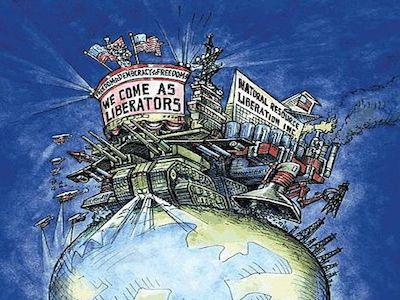
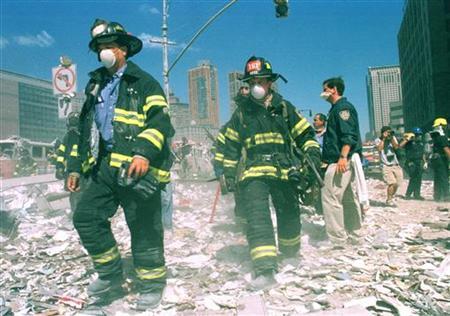
20 Years of Government-Sponsored Tyranny: The Rise of the Security-Industrial Complex from 9/11 to COVID-19

By John W. Whitehead & Nisha Whitehead

Source: The Rutherford Institute

“I tell you, freedom and human rights in America are doomed. The U.S. government will lead the American people in — and the West in general — into an unbearable hell and a choking life.”—Osama bin Laden (October 2001), as reported by CNN

What a strange and harrowing road we’ve walked since September 11, 2001, littered with the debris of our once-vaunted liberties. We have gone from a nation that took great pride in being a model of a representative democracy to being a model of how to persuade a freedom-loving people to march in lockstep with a police state.

Our losses are mounting with every passing day.

What began with the post-9/11 passage of the USA Patriot Act  has snowballed into the eradication of every vital safeguard against government overreach, corruption and abuse.

The citizenry’s unquestioning acquiescence to anything the government wants to do in exchange for the phantom promise of safety and security has resulted in a society where the nation has been locked down into a militarized, mechanized, hypersensitive, legalistic, self-righteous, goose-stepping antithesis of every principle upon which this nation was founded.

Set against a backdrop of government surveillance, militarized police, SWAT team raids, asset forfeiture, eminent domain, overcriminalization, armed surveillance drones, whole body scanners, stop and frisk searches, police violence and the like—all of which have been sanctioned by Congress, the White House and the courts—our constitutional freedoms have been steadily chipped away at, undermined, eroded, whittled down, and generally discarded.

The rights embodied in the Constitution, if not already eviscerated, are on life support.

Free speech, the right to protest, the right to challenge government wrongdoing, due process, a presumption of innocence, the right to self-defense, accountability and transparency in government, privacy, press, sovereignty, assembly, bodily integrity, representative government: all of these and more have become casualties in the government’s war on the American people, a war that has grown more pronounced since 9/11.

Indeed, since the towers fell on 9/11, the U.S. government has posed a greater threat to our freedoms than any terrorist, extremist or foreign entity ever could.

While nearly 3,000 people died in the 9/11 attacks, the U.S. government and its agents have easily killed at least ten times that number of civilians in the U.S. and abroad since 9/11 through its police shootings, SWAT team raids, drone strikes and profit-driven efforts to police the globe, sell weapons to foreign nations (which too often fall into the hands of terrorists), and foment civil unrest in order to keep the security industrial complex gainfully employed.

The American people have been treated like enemy combatants, to be spied on, tracked, scanned, frisked, searched, subjected to all manner of intrusions, intimidated, invaded, raided, manhandled, censored, silenced, shot at, locked up, denied due process, and killed.

In allowing ourselves to be distracted by terror drills, foreign wars, color-coded warnings, pandemic lockdowns and other carefully constructed exercises in propaganda, sleight of hand, and obfuscation, we failed to recognize that the U.S. government—the government that was supposed to be a “government of the people, by the people, for the people”—has become the enemy of the people.

Consider that the government’s answer to every problem has been more government—at taxpayer expense—and less individual liberty.

Every crisis—manufactured or otherwise—since the nation’s early beginnings has become a make-work opportunity for the government to expand its reach and its power at taxpayer expense while limiting our freedoms at every turn: The Great Depression. The World Wars. The 9/11 terror attacks. The COVID-19 pandemic.

Viewed in this light, the history of the United States is a testament to the old adage that liberty decreases as government (and government bureaucracy) grows. Or, to put it another way, as government expands, liberty contracts.

This is how the emergency state operates, after all, and we should know: after all, we have spent the past 20 years in a state of emergency.

From 9/11 to COVID-19, “we the people” have acted the part of the helpless, gullible victims desperately in need of the government to save us from whatever danger threatens. In turn, the government has been all too accommodating and eager while also expanding its power and authority in the so-called name of national security.

This is a government that has grown so corrupt, greedy, power-hungry and tyrannical over the course of the past 240-plus years that our constitutional republic has since given way to idiocracy, and representative government has given way to a kleptocracy (a government ruled by thieves) and a kakistocracy (a government run by unprincipled career politicians, corporations and thieves that panders to the worst vices in our nature and has little regard for the rights of American citizens).

What this really amounts to is a war on the American people, fought on American soil, funded with taxpayer dollars, and waged with a single-minded determination to use national crises, manufactured or otherwise, in order to transform the American homeland into a battlefield.

Indeed, the government’s (mis)management of various states of emergency in the past 20 years has spawned a massive security-industrial complex the likes of which have never been seen before. According to the National Priorities Project at the progressive Institute for Policy Studies, since 9/11, the United States has spent $21 trillion on “militarization, surveillance, and repression.”

Clearly, this is not a government that is a friend to freedom.

Rather, this is a government that, in conjunction with its corporate partners, views the citizenry as consumers and bits of data to be bought, sold and traded.

This is a government that spies on and treats its people as if they have no right to privacy, especially in their own homes while the freedom to be human is being erased.

This is a government that is laying the groundwork to weaponize the public’s biomedical data as a convenient means by which to penalize certain “unacceptable” social behaviors. Incredibly, a new government agency HARPA (a healthcare counterpart to the Pentagon’s research and development arm DARPA) will take the lead in identifying and targeting “signs” of mental illness or violent inclinations among the populace by using artificial intelligence to collect data from Apple Watches, Fitbits, Amazon Echo and Google Home.

This is a government that routinely engages in taxation without representation, whose elected officials lobby for our votes only to ignore us once elected.

This is a government comprised of petty bureaucrats, vigilantes masquerading as cops, and faceless technicians.

This is a government that railroads taxpayers into financing government programs whose only purpose is to increase the power and wealth of the corporate elite.

This is a government—a warring empire—that forces its taxpayers to pay for wars abroad that serve no other purpose except to expand the reach of the military industrial complex.

This is a government that subjects its people to scans, searches, pat downs and other indignities by the TSA and VIPR raids on so-called “soft” targets like shopping malls and bus depots by black-clad, Darth Vader look-alikes.

This is a government that uses fusion centers, which represent the combined surveillance efforts of federal, state and local law enforcement, to track the citizenry’s movements, record their conversations, and catalogue their transactions.

This is a government whose wall-to-wall surveillance has given rise to a suspect society in which the burden of proof has been reversed such that Americans are now assumed guilty until or unless they can prove their innocence.

This is a government that treats its people like second-class citizens who have no rights, and is working overtime to stigmatize and dehumanize any and all who do not fit with the government’s plans for this country.

This is a government that uses free speech zones, roving bubble zones and trespass laws to silence, censor and marginalize Americans and restrict their First Amendment right to speak truth to power.

This is a government that persists in renewing the National Defense Authorization Act (NDAA), which allows the president and the military to arrest and detain American citizens indefinitely based on the say-so of the government.

This is a government that saddled us with the Patriot Act, which opened the door to all manner of government abuses and intrusions on our privacy.

This is a government that, in direct opposition to the dire warnings of those who founded our country, has allowed the Department of Homeland Security (DHS) to establish a standing army by way of programs that transfer surplus military hardware to local and state police.

This is a government that has militarized American’s domestic police, equipping them with military weapons such as “tens of thousands of machine guns; nearly 200,000 ammunition magazines; a million hollow-point bullets; thousands of pieces of camouflage and night-vision equipment; and hundreds of silencers, armored cars and aircraft,” in addition to armored vehicles, sound cannons and the like.

This is a government that has provided cover to police when they shoot and kill unarmed individuals just for standing a certain way, or moving a certain way, or holding something—anything—that police could misinterpret to be a gun, or igniting some trigger-centric fear in a police officer’s mind that has nothing to do with an actual threat to their safety.

This is a government that has created a Constitution-free zone within 100 miles inland of the border around the United States, paving the way for Border Patrol agents to search people’s homes, intimately probe their bodies, and rifle through their belongings, all without a warrant. Nearly 66% of Americans (2/3 of the U.S. population, 197.4 million people) now live within that 100-mile-deep, Constitution-free zone.

This is a government that treats public school students as if they were prison inmates, enforcing zero tolerance policies that criminalize childish behavior, and indoctrinating them with teaching that emphasizes rote memorization and test-taking over learning, synthesizing and critical thinking.

This is a government that is operating in the negative on every front: it’s spending far more than what it makes (and takes from the American taxpayers) and it is borrowing heavily (from foreign governments and Social Security) to keep the government operating and keep funding its endless wars abroad. Meanwhile, the nation’s sorely neglected infrastructure—railroads, water pipelines, ports, dams, bridges, airports and roads—is rapidly deteriorating.

This is a government that has empowered police departments to make a profit at the expense of those they have sworn to protect through the use of asset forfeiture laws, speed traps, and red light cameras.

This is a government whose gun violence—inflicted on unarmed individuals by battlefield-trained SWAT teams, militarized police, and bureaucratic government agents trained to shoot first and ask questions later—poses a greater threat to the safety and security of the nation than any mass shooter. There are now reportedly more bureaucratic (non-military) government agents armed with high-tech, deadly weapons than U.S. Marines.

This is a government that has allowed the presidency to become a dictatorship operating above and beyond the law, regardless of which party is in power.

This is a government that treats dissidents, whistleblowers and freedom fighters as enemies of the state.

This is a government that has in recent decades unleashed untold horrors upon the world—including its own citizenry—in the name of global conquest, the acquisition of greater wealth, scientific experimentation, and technological advances, all packaged in the guise of the greater good.

This is a government that allows its agents to break laws with immunity while average Americans get the book thrown at them.

This is a government that speaks in a language of force. What is this language of force? Militarized police. Riot squads. Camouflage gear. Black uniforms. Armored vehicles. Mass arrests. Pepper spray. Tear gas. Batons. Strip searches. Surveillance cameras. Kevlar vests. Drones. Lethal weapons. Less-than-lethal weapons unleashed with deadly force. Rubber bullets. Water cannons. Stun grenades. Arrests of journalists. Crowd control tactics. Intimidation tactics. Brutality. Contempt of cop charges.

This is a government that justifies all manner of government tyranny and power grabs in the so-called name of national security, national crises and national emergencies.

This is a government that exports violence worldwide, with one of this country’s most profitable exports being weapons. Indeed, the United States, the world’s largest exporter of arms, has been selling violence to the world in order to prop up the military industrial complex and maintain its endless wars abroad.

This is a government that is consumed with squeezing every last penny out of the population and seemingly unconcerned if essential freedoms are trampled in the process.

This is a government that routinely undermines the Constitution and rides roughshod over the rights of the citizenry, eviscerating individual freedoms so that its own powers can be expanded.

This is a government that believes it has the authority to search, seize, strip, scan, spy on, probe, pat down, taser, and arrest any individual at any time and for the slightest provocation, the Constitution be damned.

In other words, as I make clear in my book Battlefield America: The War on the American People and in its fictional counterpart The Erik Blair Diaries, this is not a government that believes in, let alone upholds, freedom.

Are We Human? Are We Free? Defeating The World Economic Forum’s ‘Great Reset’ Before It Destroys Us

By Robert J. Burrowes

For most people, 2020 will be remembered as the year of the ‘virus’ and 2021 will be remembered as the year of the ‘vaccine’.

What most people will probably never know is that 2021 is shaping to be the year in which humanity and freedom are both destroyed.

Not because a virus will kill us, because the virus does not exist. For just two of the myriad demonstrations of this point, see ‘COVID-19: The virus does not exist – it is confirmed!’ and ‘Statement On Virus Isolation (SOVI)’. And for an account of one researcher’s fruitless search over the course of a year to find evidence of an isolated virus, via Freedom of Information requests to 90 health/science institutions all over the world, watch ‘Does the Virus Exist? Has SARS-CoV-2 Been Isolated? Interview with Christine Massey’.

Rather, the injectable being marketed as a ‘vaccine’ will kill a substantial proportion of the human population – for one of the most straightforward explanations of this fact by three highly qualified experts (Professor Dolores Cahill, Dr Judy Mikovits & Dr Sherri Tenpenny) watch ‘The Truth about the Covid-19 Vaccine’ – and turn most others into a human relic, known technically as a ‘transhuman’ or, if you like, ‘cyborg’. See ‘Beware the Transhumanists: How “Being Human” is being Re-engineered by the Elite’s Covid-19 Coup’.

But while the injectable will have devastating consequences on the human population and must be strenuously resisted, it is the hidden and complementary measures being introduced by the criminal global elite under the guise of the World Economic Forum’s ‘Great Reset’ that will ensure the fundamental transformation of life for those humans and transhumans left alive.

If you doubt this, I can only invite you to read what ‘The Great Reset’ portends for humanity. If you want to read a summary, see: ‘Killing Democracy Once and for All: The Global Elite’s Coup d’état That Is Destroying Life as We Know It’.

In essence, the net outcome of the many measures that are being implemented, most of them ‘hidden’ behind the worldwide focus on the non-existent virus, will be a substantial human depopulation and enslavement of the rest. For more detail explaining what is already in train and how things will unfold, see the explanation, analysis and many references cited on ‘We Are Human, We Are Free’.

Options for Resistance

There are many options for resisting what is happening but most that are familiar are doomed to fail. Here, in brief, is why.

If you believe that mass protests will compel governments to respond to movement demands to cease implementing their heinous agenda, it would be useful for you to think a little more deeply about what is taking place. For a start, governments are not driving ‘The Great Reset’; it is an initiative of the global elite and governments are simply elite puppets. Moreover, movements that rely on mass protests only and which are focused too narrowly – such as on resisting lockdown measures, mandatory injection or ‘injection passports’ – cannot impact the elite program overall.

To do that, we need a combination of strategically-focused actions that undermine elite power to promote and implement its ‘Great Reset’ agenda which has very many components. And to achieve that outcome, protests are simply the wrong tactic (unless they are specifically used to raise awareness of strategic means of resisting ‘The Great Reset’ and its associated measures in relation to the fourth industrial revolution, eugenics and transhumanism).

If you believe that ‘democratic’ processes will save us, you might be interested to know that these have long been under the control of the global elite and simply provide a convenient mechanism for dissipating the dissent of those who are unaware. For a full explanation of this point, see ‘Killing Democracy Once and for All: The Global Elite’s Coup d’état That Is Destroying Life as We Know It’.

And if you believe that challenges through the legal system will deliver us justice, be aware that these too were long ago captured by the global elite and are used to thwart fundamentally progressive initiatives, whatever occasional victories (invariably on issues that do not concern the global elite) in limited jurisdictions appear to suggest otherwise. In any case, there is no court in the world that has jurisdiction to require the global elite to appear before it to answer for its many outstanding crimes against peace, war crimes and crimes against humanity, nor those crimes it is inflicting now. As discussed by a diverse range of scholars and activists in the 18th , 19th and early 20th centuries, the rule of law is the rule of elite violence. See ‘The Rule of Law: Unjust and Violent’.

Finally, if you believe that violence, in any form, will get us out of this mess, you are giving inadequate consideration to the preeminent geopolitical reality of our time: the military forces at the command of the global elite, starting with the national military forces, including nuclear arsenals, committed to the NATO Alliance. Not to mention the police forces of each jurisdiction. And given the elite agenda includes substantial depopulation, from their viewpoint how this occurs, militarily or otherwise, is really immaterial. So a key strategic consideration is devising the appropriate ways to mobilize military and police forces in support of us.

Given that military and police personnel have far more in common with the communities in which they live than they have in common with the global elite, history offers many examples in which thoughtful nonviolent activists were able to achieve this very effectively. Moreover, while it might be counterintuitive, strategic nonviolent struggle is superior to military violence, as strategic theory explains and history has demonstrated. See the Strategy of Nonviolent Defense: A Gandhian Approach.

Conclusion

In essence then, effective resistance to this elite coup depends on mobilizing enough ‘ordinary’ people to take the strategically-focused nonviolent action – essentially acts of noncooperation to thwart key elite initiatives – that will shift power from the global elite to us. No other option is genuinely realistic or has the sheer power to be as effective.

Hence, as part of the ‘We Are Human, We Are Free’ strategy, earlier this year Anita McKone and I launched ‘The 7 Days Campaign to Resist the Great Reset’, carefully explaining why each of the actions nominated was important in undermining elite power. And recently, Henna Maria in Spain created the beautiful flyers, outlining essential elements of the campaign, displayed with this article.

If you wish to play a vital role in the defence of humanity and human freedom, you are invited to undertake the actions indicated on these flyers, and share them with those who you think might be interested. Provided enough people take these actions on an ongoing basis, the global elite’s capacity to kill or enslave each one of us can be defeated.

What you choose to do, one way or the other, will help shape the fate of humanity.

Biodata: Robert J. Burrowes has a lifetime commitment to understanding and ending human violence. He has done extensive research since 1966 in an effort to understand why human beings are violent and has been a nonviolent activist since 1981. He is the author of ‘Why Violence?’ His email address is flametree@riseup.net and his website is here.

As US Prepares to Ban Ivermectin for Covid-19, More Countries in Asia Begin Using It

By Nick Corbishley

Source: Naked Capitalism

The information war takes a dark turn as the corporate media transitions from misinformation and obfuscation to outright lies and fabrication.

The campaign against ivermectin is intensifying in the US. Until recently the health authorities appeared to be quite content merely to ridicule those who take or prescribe the drug in order to treat or prevent Covid-19. A couple of weeks ago, the FDA released a now-infamous advertorial on twitter with the heading “You are not a horse. You are not a cow. Seriously, y’all. Stop it.” The subheading: “Using the drug Ivermectin to treat Covid-19 can be dangerous and even lethal. The FDA has not approved the drug for that purpose.”

It’s a subtle message that has been faithfully echoed by the corporate media: ivermectin, a tried-and-tested drug that has won its discoverers a Nobel Prize for the impact it has had on human health over the last 35 years, should only be given to animals. But now the information war is taking a darker turn, as the media transitions from misinformation and obfuscation to outright lies and fabrication.

At the end of last week, a string of American and British outlets, including The Daily Mail, Rolling Stone, Huffington Post, The Independent, Newsweek, The Guardian, and Yahoo News, ran a story about how people who had “overdosed” on the “horse dewormer” were clogging up so many beds in a hospital in Sequoyah, rural Oklahoma, that doctors were having to turn away gunshot victims. The story, sourced to local Oklahoma outlet KFOR, turned out to be completely false. On Sunday, the hospital in question released a statement that the doctor behind the allegations had not worked in its ER for two months. More to the point, the hospital “had not treated any patients due to complications relating to taking ivermectin.” There were no overdoses. And it had turned no patients away. 

In other words, everything about the story was false. A total fabrication. Yet many of the mainstream outlets that covered the story did not retract their article. Rolling Stone simply “updated” its piece with the new information. The Guardian inserted a note at the bottom of its article informing readers that Sequoyah NHS had released a statement asserting that the doctor behind the allegations that formed the entire basis of the story had not worked in its ER for two months. In other words, you have to read all the way to the end of the article to find out that its entire content is total bullshit. To make matters worse, The Guardian did not even mention the hospital’s categorical denials that it had treated patients for IVM overdose or that it had turned ER patients away.  

The Coming Crack Down 

If the goal of all this disinformation is to put people off wanting to get hold of ivermectin, it doesn’t seem to be working, which is hardly surprising given the already desperately low levels of public trust in both US health authorities and corporate media

There are certain parallels with the furore whipped up over hydroxychloroquine last year. But the case is weaker this time, primarily because IVM is one of the safest medicines on the planet and was widely recognised as such until this pandemic.   

One thing that is abundantly clear is that mocking people’s intelligence and comparing them to horses or dogs for wanting to take a certain medicine isn’t a terribly effective way of getting them to change their behaviour. All they appear to have achieved is to invoke the “Streisand effect.” More people are buying ivermectin (for human use) than ever before. In the US as a whole, prescriptions for the medicine have surged 24-fold since the pandemic began, from 3,600 a week to almost 90,000. Between mid-July and mid-August alone, they rose 400%.

In response, authorities are escalating their crack down. On September 1, the American Medical Association (AMA), American Pharmacists Association (APhA), and American Society of Health-System Pharmacists (ASHP) jointly called for an outright ban on the dispensing of ivermectin to prevent or treat COVID-19 outside of a clinical trial.

We are alarmed by reports that outpatient prescribing for and dispensing of ivermectin have increased 24-fold since before the pandemic and increased exponentially over the past few months. As such, we are calling for an immediate end to the prescribing, dispensing, and use of ivermectin for the prevention and treatment of COVID-19 outside of a clinical trial. In addition, we are urging physicians, pharmacists, and other prescribers—trusted health care professionals in their communities—to warn patients against the use of ivermectin outside of FDA-approved indications and guidance, whether intended for use in humans or animals, as well as purchasing ivermectin from online stores. Veterinary forms of this medication are highly concentrated for large animals and pose a significant toxicity risk for humans.

Demonising a “Wonder Drug” (Not My Words)

While it is true that ivermectin was first commercialised as a product for animal health in 1981, fast becoming one of the world’s biggest selling veterinary drugs, it has been used to treat humans since 1987. But most of those humans were in poor countries. As a 2017 article in Nature noted, ivermectin, perhaps more than any other drug, “is a drug for the world’s poor. For most of this century, some 250 million people have been taking it annually to combat two of the world’s most devastating, disfiguring, debilitating and stigma-inducing diseases, Onchocerciasis and Lymphatic filariasis”

“Ivermectin was a revelation. It had a broad spectrum of activity, was highly efficacious, acting robustly at low doses against a wide variety of nematode, insect and acarine parasites. It proved to be extremely effective against most common intestinal worms (except tapeworms), could be administered orally, topically or parentally and showed no signs of cross-resistance with other commonly used anti-parasitic compounds.”

Since the late ´80s more than 3.7 billion doses have been distributed globally in mass drug administration campaigns. All 3.7 billion of those doses were provided free of charge by the medicine’s developer, Merck. The company knew it would not be able to generate profits or even cover costs by selling the drug in the poverty-stricken communities afflicted by the two parasites, so it gave it away. “As much as needed for as long as needed” was the motto. It was a remarkable — and exceptionally rare — gift of generosity from a major pharmaceutical company.

Later on, it was discovered that ivermectin had many other properties. Using the drug as a long-term preventive against onchocerciasis had reduced the prevalence of other parasitic worms known as soil-transmitted helminths, which infect up to 20% of the world’s population and are a common cause of malnutrition and growth impairment in children. It was also discovered to have potent anti-viral effects.

After being used billions of times, this (in the words of Nature magazine) “enigmatic, multifaceted wonder drug” has been shown to have “an extremely good safety profile” — again Nature‘s words — as well as potential applications against a broad spectrum of diseases, from African trypanosomiasis (sleeping sickness) to schistosomiasis, one of the world’s most neglected tropical diseases that afflicts more than 200 million people worldwide; to asthma and epilepsy; to a host of RNA viruses including Zika, dengue, yellow fever, West Nile, chikungunya and HIV. It also appears to have potent anti-cancer properties. 

Today, the FDA, with a little help from the media, is doing everything it can to destroy ivermectin’s reputation. At the same time, authorities appear to be clamping down on the importation, distribution and sales of the medicine. They are also beginning to crack down on doctors who have been prescribing the drug, regardless of how much success they’ve had with it. 

A Whole Different Story Half a World Away

In Asia, the situation could not be more different. In India the Indian Council of Medical Research (ICMR) — the most important biomedical research body in India and one of the oldest and largest medical research institutes in the world — has added ivermectin in its indication for Covid-19 to its list of essential medicines.

In June, one of three national health regulator in India, the Directorate General of Health Services, (DGHS) overhauled its COVID-19 treatment guidelines and removed almost all of the repurposed medicines it had previously recommended for treating asymptomatic and mild cases, including ivermectin. This sparked concerns that India was about to reverse its approval of ivermectin as a covid treatment. But to their credit, India’s two most important national health regulators — the All India Institute of Medical Science (AIIMS) and the Indian Council of Medical Research (ICMR) — maintained their authorisation of ivermectin.  

It’s hard to keep track of just how many states in India continue to use ivermectin as a treatment or prophylaxis against covid-19. Three states that are definitely using it are Uttar Pradesh (population: 230 million), Goa and Bihar (population: 100 million), a copy of whose home quarantine treatment program can be seen here. So, too, is New Delhi.

Though the usual caveats apply about numbers being under-reported due to inadequate testing, it’s clear that things have improved across India. Since the country began its last wave of infections, in March, no state has contained the virus as effectively as Uttar Pradesh, India’s most populous region with 230 million inhabitants. If it were a country, UP would be the world’s sixth most populous, sandwiched between Pakistan (5th) and Nigeria (7th). UP has been using IVM longer than any other Indian state, including as a prophylaxis for people who come in contact with the disease. The numbers (both in terms of cases and deaths) speak for themselves. The average number of cases per day over the last seven days was just 28 — in a region with a population larger than Brazil’s! Brazil’s daily average is more than 21,000 cases. 

Graph courtesy of data scientist Juan Chamie

It’s a similar story in New Delhi, where the number of new cases is also close to zero.

Compare that to the state of Kerala, which has stopped prescribing ivermectin and other proven therapeutics and is making exhaustive use of Gilead’s largely ineffective (yet excruciatingly expensive) antiviral, remdesivir. Not only have case numbers barely declined from their mid-May peak but they are rising faster than in any other region. Despite boasting just 3% of India’s population, having one of the most advanced health systems in the country and one of the highest vaccination rates (over 50% of the population has received at least one dose), Kerala accounted for 62% of all of India’s Covid-19 cases in early August. The BBC described the region’s stubbornly high numbers as a “mystery”.

In India, nothing is quite as simple as it might seem, says Jerri-Lynn, who knows a thing or two about the subcontinent, having visited there for long periods: 

UP is a large, rural state, with a still largely agrarian economy. It’s part of the northern Indian ‘cow belt’, with low literacy rates, and a distorted sex ratio. It’s the second poorest state in India in terms of per capita income. Kerala is much richer, and has more of a service-based economy; lots of Keralites work in the Gulf states and many send remittances back home. The state has been governed by successive left-wing governments for decades, has high literacy rates, the top female sex ratio in India, and some of its best medical care, particularly on the public health side.

As I mentioned to you before, I believe Kerala recorded the first covid case in India, in a female medical student returning from China — perhaps Wuhan in Jan 2020. The state initially did a good job managing covid and was held up as an exemplar; their contact tracing system was widely praised.

The UP government is notorious for its corruption. Many would take any official UP state figures with large fistfuls of salt. This is not the case for Kerala. 

Kerala has by far the highest number of cases in the country while UP has the lowest, but is that because it is testing more and being more honest about the numbers? According to many mainstream reports (including Times of India and India Today), UP is doing more testing than any other state. Can that be true or is UP’s regional government doctoring the numbers? Or is it simply doing a very good job at keeping the virus contained, just like Mexico’s poorest region, Chiapas?   

In India’s last brutal wave the turnaround in Uttar Pradesh was so dramatic that even the World Health Organization (WHO) showcased its achievements. In a May 7 article titled “Going the Last Mile to Stop Covid-19” the WHO noted that aggressive population-wide health schemes, including home testing and “medicine kits”, had helped regain control of the virus. The one thing the WHO failed to mention in its on-the-ground reporting is what was in those medicine kits.

The Wonders of Early Treatment

One thing that is that is clear is that many doctors in India try to treat covid-19 as early and as aggressively as possible, whereas many doctors in Europe and North America prescribe nothing more than paracetamol during the first seven days. As I’ve learnt from recent direct experience, this is the equivalent of laying down a red carpet for the virus and telling it to make itself at home and go wherever it wants, do whatever it wants.  

“When we started seeing more cases, we decided to take up a door-to-door survey,” Bagalkot District Health Officer Dr Ananth Desai told New India Express in June. “When the health officials noticed people with symptoms during the survey, they tested them immediately and provided them with home isolation kits, which had medicines like Ivermectin, calcium and zinc tablets along with paracetamol. We advised the patients to start with the medication even before their Covid-19 test results came out. With these measures, we noticed that many patients recovered faster. This helped in increasing the recovery rate”.

Besides other factors such as lockdowns, travel restrictions and increased herd immunity, ivermectin has almost certainly played a part in this. But it’s impossible to know just how large a part. The fact that case numbers and deaths have tended to fall precipitously in regions where it is used widely, such as UP, New Delhi, Goa and Bihar, and have tended to remain high in regions where it isn’t, such as Kerala or Tamil Nadu (before it readopted ivermectin in June), does not constitute proof of causation. But when the same thing occurs in so many of the disparate parts of the world where ivermectin is used, a pattern begins to form that strongly supports ivermectin’s efficacy.

That doesn’t mean that it has a perfect record. In Mexico, for example, cases and deaths began surging once again in May, despite the fact that the Institute of Social Security (IMSS), which runs many of the country’s public hospitals, has been using IVM since January, albeit in very low doses. That said, it’s all but impossible to know how many doctors, public and private, are actually using the medicine. In May the newspaper Proceso reported that IMSS had repeatedly clashed with the federal government over its use of ivermectin. In June, the Mayor of Mexico City Claudia Scheinbaum announced that the city’s widespread use of IVM had reduced hospitalisations by up to 76%.    

In early August, the results of the first large randomised control trial into IVM use for Covid-19 were released. And they showed “no effect whatsoever” on the trial’s outcome goals — whether patients required extended observation in the emergency room or hospitalization. However, as we noted in a previous article, this was a trial financed by the deeply compromised Gates Foundation, which is heavily invested in the new Covid vaccines, novel treatments and their manufacturers. And the person who lead the trial, Edward Mills, is a Gates Foundation employee. And the Canadian university that performed the trial, McMaster, is also a major recipient of Gates Foundation funding.  

The results of another large RCT trialsinto ivermectin — the so-called PRINCIPLE trial taking place at Oxford University — should also be released in the coming months. Perhaps they will be more flattering. 

The case for IVM was also not helped by the discovery of irregularities in a trial conducted in Egypt. That, together with the findings of the Together trial, is now cited by many media outlets as proof positive that ivermectin does not work against covid. To reach that conclusion, they steadfastly ignore the impressive results of many other small trials, the on-the-ground experience of untold thousands of medical practitioners and nurses, and the exceptionally low prevalence of covid in many of the places IVM is being used widely.   

Ivermectin Comes Home, to Japan

As the Delta variant has swept through Asia, causing unprecedented devastation, more and more  cities, regions and countries are considering authorising the use of ivermectin. They include Tokyo, where Haruo Ozaki, chairman of the city’s Metropolitan Medical Association, has called for ivermectin and the corticosteroid dexamethasone to be used due to the authorities’ failure to distribute vaccines in time. As Lambert pointed out a couple of days ago, Ozaki’s recommendation is for off-label use under “battlefield” conditions:

[OSAKI:] I am aware that there are many papers that suggest ivermectin is effective in the prevention and treatment of corona, mainly in Central and South America and Asia. There is no effective therapeutic drug, although it is necessary to deal with patients who develop it one after another. The vaccine is not in time. At such an imminent time, there is a paper that shows ivermectin is effective for corona, so it is a natural response for clinicians to try using it. Doctor-led clinical practice. That’s why many test papers came out.

On August 13, Ivermectin was added to the Tokyo Metropolitan Medical Association’s home treatment protocol. This is not to say that the whole nation of Japan — whose soil gave birth to the unique and extraordinary microorganism that produces the avermectins (from which ivermectin is derived) — has now embraced ivermectin. Nor is it clear how may doctors in Tokyo are actually using it. But the move could be an important first step, especially if covid-19 cases, hospitalisations and deaths fall. 

Indonesia has also embraced ivermectin. On July 10, the Indonesian government secured the supply of COVID-19 treatment and created a website showing real time drug availability. Four days later the health regulator authorised the use of ivermectin for Covid-19. Then, on July 22, on July 22 Indonesia’s hospitals began using the drug. By the first week of August cases and deaths were falling.

Meanwhile, Back in the USA…

Pfizer and Merck have announced new trials for their experimental oral antiviral drugs for COVID-19. Merck said in June that the U.S. government has already agreed to pay about $1.2 billion for 1.7 million courses of molnupiravir — working out at $705 per course of treatment — if it is proven to work and is given the green light by regulators. Pfizer, meanwhile, said that if its trial of its “affordable” early treatment pill is successful, it will file for emergency approval between October and December this year.

If the authorisation process is anything like the process employed for Gilead’s Remdesivir, which is included in standard-of-care protocols throughout Europe and the US despite offering next to no real benefits (according to the WHO), and Pfizer’s booster vaccine, Pfizer will be raking in even more money from Covid by the year’s end.

Being able to take an oral antiviral therapeutic for SARS-CoV-2 at home would be a “game changer,” according to Albert Bourla, Pfizer’s CEO.

As I posited in a previous article, one of the main reasons why there has been such fierce opposition to ivermectin is that large pharmaceutical companies are developing their own antiviral therapies that will have to compete directly with ivermectin. Another reason is that if ivermectin were approved as a covid-19 treatment, it could threaten the emergency use authorisation granted to covid-19 vaccines and novel treatments, although the recent approval of Pfizer’s COMIRNATY vaccine may have changed that. 

When financial returns are the primary priority in a health care system, this is what you get. Everything is geared to churning out brand new, barely tested experimental medicines as quickly as possible, with scant communication of what potential side effects they may produce.  Throw in monopoly control of intellectual property and you have the perfect business model.  Whether the new medicines work or not or do more harm than good, they will cost an arm and a leg. And their manufacturers will probably be protected from liability. The patients’ health, well being and welfare are barely an afterthought.

The Washington Post’s Case Against Democracy

By David Swanson

Source: Let’s Try Democracy

The Washington Post has been a leading promoter of the Rules Based Order, which some have confused with a pro-democracy initiative. The Post has, however, assembled a powerful case against democracy, that we all need to take seriously if we want to be, you know, serious.

I want to highlight just the most recent two additions to the anti-democracy argument that by now is quite overwhelmingly established.

On August 29th, a column appeared in the Washington Post by a very serious columnist who has seriously and consistently supported every war in recent decades, and done so with completely inconsistent but super serious arguments. The fault of the horrific deaths of 13 people in Afghanistan in recent days, this column argued, lies with the U.S. public, which may have (the column doesn’t really suggest this, but who knows) had some influence on the U.S. government.

The brilliance of this column may fade into the wallpaper, because some of it is now well-established practice. It is none the less worth noting that vastly more than 13 people have died in recent days in Afghanistan. The U.S. military is still sending in missiles to blow men, women, and little children into tiny bits and pieces. But they are not lives that matter. If they mattered, then it would also matter that the war has been killing people, almost certainly in the 2 to 4 million range over a period of 20 years. And if that mattered, then ending a war wouldn’t be understood as an act of violence, no matter how badly you ended it.

There’s something even more brilliant here, though. If you look back at the public opinion polls in the United States, the U.S. public has opposed the war for well over 18 years. Millions of us have not just said that but done everything we could to end it since the day it began. If you’re finally going to give us credit, it might be worth considering the likelihood that the ending would have been better 19 or 20 years ago than it was this past week. Only a very skilled and serious columnist could erase that line of thought by transforming credit into blame, peace into war, and missile victims into vapor.

The idea of democracy is subtly weakened while the wars for “democracy” are strengthened in the hands of a master — or of a brain-dead jackass paid big bucks for this swill; as a member of the public, I don’t feel qualified to say which it is.

Example number 2: On August 27th, the Washington Post published a column that lamented the possible influence of European public opinion on the participation of European governments in NATO. It seems that people in Europe are not fond of all the wars, much less of planning more of them. They believe some of the fearmongering lies about Russia, yet still strongly oppose the basic idea of NATO, which is the illegal commitment of each member to join in any crime committed by the military of another member. In particular they oppose stirring up a war on China, which is of course the number one project of the democracy-spreading Rules Based Order.

The Washington Post knows what matters, thank goodness, and is focused on making sure NATO can do what the weapons dealers demand, no matter what the pesky public may prefer in NATO member states.

The point that the Post really needs to develop further, and I have every confidence that it can, is how an antidemocratic institution waging unpopular and illegal wars that cause more destruction, death, and suffering than just about anything else happening in the world can be better sold as pro-democracy. The Rules Based Order is already crumbling as a piece of propaganda. It too obviously is a mask for the notion that who rules gives the orders. But the sacred word “democracy” is of too much value to the most serious project there is for it to be allowed to slip away without a struggle. That project is of course the critical work of bullshitting everyone.

Bring All the Troops Home: Stop Policing the Globe and Put an End to Endless Wars

By John W. Whitehead & Nisha Whitehead

Source: The Rutherford Institute

“Let us resolve that never again will we send the precious young blood of this country to die trying to prop up a corrupt military dictatorship abroad. This is also the time to turn away from excessive preoccupation overseas to the rebuilding of our own nation. America must be restored to a proper role in the world. But we can do that only through the recovery of confidence in ourselves…. together we will call America home to the ideals that nourished us from the beginning.”—George S. McGovern, former Senator and presidential candidate

It’s time to bring all our troops home.

Bring them home from Somalia, Iraq and Syria. Bring them home from Germany, South Korea and Japan. Bring them home from Saudi Arabia, Jordan and Oman. Bring them home from Niger, Chad and Mali. Bring them home from Turkey, the Philippines, and northern Australia.

It’s not enough to pull American troops out of Afghanistan, America’s longest, bloodiest and most expensive war to date.

It’s time that we stop policing the globe, stop occupying other countries, and stop waging endless wars.

That’s not what’s going to happen, of course.

The U.S. military reportedly has more than 1.3 million men and women on active duty, with more than 200,000 of them stationed overseas in nearly every country in the world.

Those numbers are likely significantly higher in keeping with the Pentagon’s policy of not fully disclosing where and how many troops are deployed for the sake of “operational security and denying the enemy any advantage.” As investigative journalist David Vine explains, “Although few Americans realize it, the United States likely has more bases in foreign lands than any other people, nation, or empire in history.”

Don’t fall for the propaganda, though.

America’s military forces aren’t being deployed abroad to protect our freedoms here at home. Rather, they’re being used to guard oil fields, build foreign infrastructure and protect the financial interests of the corporate elite. In fact, the United States military spends about $81 billion a year just to protect oil supplies around the world.

The reach of America’s military empire includes close to 800 bases in as many as 160 countries, operated at a cost of more than $156 billion annually. As Vine reports, “Even US military resorts and recreation areas in places like the Bavarian Alps and Seoul, South Korea, are bases of a kind. Worldwide, the military runs more than 170 golf courses.”

This is how a military empire occupies the globe.

After 20 years of propping up Afghanistan to the tune of trillions of dollars and thousands of lives lost, the U.S. military may have finally been forced out, but those troops represent just a fraction of our military presence worldwide.

In an ongoing effort to police the globe, American military servicepeople continue to be deployed to far-flung places in the Middle East and elsewhere.

This is how the military industrial complex, aided and abetted by the likes of Joe Biden, Donald Trump, Barack Obama, George W. Bush, Bill Clinton and others, continues to get rich at taxpayer expense.

Yet while the rationale may keep changing for why American military forces are policing the globe, these wars abroad aren’t making America—or the rest of the world—any safer, are certainly not making America great again, and are undeniably digging the U.S. deeper into debt.

War spending is bankrupting America.

Although the U.S. constitutes only 5% of the world’s population, America boasts almost 50% of the world’s total military expenditure, spending more on the military than the next 19 biggest spending nations combined.

In fact, the Pentagon spends more on war than all 50 states combined spend on health, education, welfare, and safety.

The American military-industrial complex has erected an empire unsurpassed in history in its breadth and scope, one dedicated to conducting perpetual warfare throughout the earth.

Since 2001, the U.S. government has spent more than $4.7 trillion waging its endless wars.

Having been co-opted by greedy defense contractors, corrupt politicians and incompetent government officials, America’s expanding military empire is bleeding the country dry at a rate of more than $32 million per hour.

In fact, the U.S. government has spent more money every five seconds in Iraq than the average American earns in a year.

Future wars and military exercises waged around the globe are expected to push the total bill upwards of $12 trillion by 2053.

Talk about fiscally irresponsible: the U.S. government is spending money it doesn’t have on a military empire it can’t afford.

As investigative journalist Uri Friedman puts it, for more than 15 years now, the United States has been fighting terrorism with a credit card, “essentially bankrolling the wars with debt, in the form of purchases of U.S. Treasury bonds by U.S.-based entities like pension funds and state and local governments, and by countries like China and Japan.”

War is not cheap, but it becomes outrageously costly when you factor in government incompetence, fraud, and greedy contractors. Indeed, a leading accounting firm concluded that one of the Pentagon’s largest agencies “can’t account for hundreds of millions of dollars’ worth of spending.”

Unfortunately, the outlook isn’t much better for the spending that can be tracked.

A government audit found that defense contractor Boeing has been massively overcharging taxpayers for mundane parts, resulting in tens of millions of dollars in overspending. As the report noted, the American taxpayer paid:

$71 for a metal pin that should cost just 4 cents; $644.75 for a small gear smaller than a dime that sells for $12.51: more than a 5,100 percent increase in price. $1,678.61 for another tiny part, also smaller than a dime, that could have been bought within DoD for $7.71: a 21,000 percent increase. $71.01 for a straight, thin metal pin that DoD had on hand, unused by the tens of thousands, for 4 cents: an increase of over 177,000 percent.

That price gouging has become an accepted form of corruption within the American military empire is a sad statement on how little control “we the people” have over our runaway government.

Mind you, this isn’t just corrupt behavior. It’s deadly, downright immoral behavior.

Americans have thus far allowed themselves to be spoon-fed a steady diet of pro-war propaganda that keeps them content to wave flags with patriotic fervor and less inclined to look too closely at the mounting body counts, the ruined lives, the ravaged countries, the blowback arising from ill-advised targeted-drone killings and bombing campaigns in foreign lands, or the transformation of our own homeland into a warzone.

That needs to change.

The U.S. government is not making the world any safer. It’s making the world more dangerous. It is estimated that the U.S. military drops a bomb somewhere in the world every 12 minutes. Since 9/11, the United States government has directly contributed to the deaths of around 500,000 human beings. Every one of those deaths was paid for with taxpayer funds.

The U.S. government is not making America any safer. It’s exposing American citizens to alarming levels of blowback, a CIA term referring to the unintended consequences of the U.S. government’s international activities. Chalmers Johnson, a former CIA consultant, repeatedly warned that America’s use of its military to gain power over the global economy would result in devastating blowback.

The 9/11 attacks were blowback. The Boston Marathon Bombing was blowback. The attempted Times Square bomber was blowback. The Fort Hood shooter, a major in the U.S. Army, was blowback.

The U.S. military’s ongoing drone strikes will, I fear, spur yet more blowback against the American people. The latest drone strike reportedly killed seven children, ages 2 to 10, in Afghanistan.

The war hawks’ militarization of America—bringing home the spoils of war (the military tanks, grenade launchers, Kevlar helmets, assault rifles, gas masks, ammunition, battering rams, night vision binoculars, etc.) and handing them over to local police, thereby turning America into a battlefield—is also blowback.

James Madison was right: “No nation could preserve its freedom in the midst of continual warfare.” As Madison explained, “Of all the enemies to public liberty war is, perhaps, the most to be dreaded because it comprises and develops the germ of every other. War is the parent of armies; from these proceed debts and taxes… known instruments for bringing the many under the domination of the few.”

We are seeing this play out before our eyes.

The government is destabilizing the economy, destroying the national infrastructure through neglect and a lack of resources, and turning taxpayer dollars into blood money with its endless wars, drone strikes and mounting death tolls.

Clearly, our national priorities are in desperate need of an overhauling.

At the height of its power, even the mighty Roman Empire could not stare down a collapsing economy and a burgeoning military. Prolonged periods of war and false economic prosperity largely led to its demise. As historian Chalmers Johnson predicts:

The fate of previous democratic empires suggests that such a conflict is unsustainable and will be resolved in one of two ways. Rome attempted to keep its empire and lost its democracy. Britain chose to remain democratic and in the process let go its empire. Intentionally or not, the people of the United States already are well embarked upon the course of non-democratic empire.

This is the “unwarranted influence, whether sought or unsought, by the military-industrial complex” that President Dwight Eisenhower warned us more than 50 years ago not to let endanger our liberties or democratic processes.

Eisenhower, who served as Supreme Commander of the Allied forces in Europe during World War II, was alarmed by the rise of the profit-driven war machine that emerged following the war—one that, in order to perpetuate itself, would have to keep waging war.

We failed to heed his warning.

As I make clear in my book Battlefield America: The War on the American People and in its fictional counterpart The Erik Blair Diaries, there’s not much time left before we reach the zero hour.

It’s time to stop policing the globe, end these wars-without-end, and bring the troops home.

GASLIGHTING: THE PSYCHOLOGY OF SHAPING ANOTHER’S REALITY

By Cynthia Chung

Source: Waking Times

“But I don’t want to go among mad people,” Alice remarked.
“Oh, you can’t help that,” said the Cat: “we’re all mad here. I’m mad. You’re mad.”
“How do you know I’m mad?” said Alice.
“You must be,” said the Cat, “or you wouldn’t have come here.”

– Lewis Carroll’s “Alice’s Adventures in Wonderland

We are living in a world where the degree of disinformation and outright lying has reached such a state of affairs that, possibly for the first time ever, we see the majority of the western world starting to question their own and surrounding level of sanity. The increasing frenzied distrust in everything “authoritative” mixed with the desperate incredulity that “everybody couldn’t possibly be in on it!” is slowly rocking many back and forth into a tighter and tighter straight jacket. “Question everything” has become the new motto, but are we capable of answering those questions?

Presently the answer is a resounding no.

The social behaviourist sick joke of having made everyone obsessed with toilet paper of all things during the start of what was believed to be a time of crisis, is an example of how much control they have over that red button labelled “commence initiation of level 4 mass panic”.

And can the people be blamed? After all, if we are being lied to, how can we possibly rally together and point the finger at the root of this tyranny, aren’t we at the point where it is everywhere?

As Goebbels infamously stated,

If you tell a lie big enough and keep repeating it, people will eventually come to believe it. The lie can be maintained only for such time as the State can shield the people from the political, economic and/or military consequences of the lie. It thus becomes vitally important for the State to use all of its powers to repress dissent, for the truth is the mortal enemy of the lie, and thus by extension, the truth is the greatest enemy of the State [under fascism].”

And here we find ourselves today, at the brink of fascism. However, we have to first agree to forfeit our civil rights as a collective before fascism can completely dominate. That is, the big lie can only succeed if the majority fails to call it out, for if the majority were to recognise it for what it is, it would truly hold no power.

The Battle for Your Mind

Politicians, Priests, and psychiatrists often face the same problem: how to find the most rapid and permanent means of changing a man’s belief…The problem of the doctor and his nervously ill patient, and that of the religious leader who sets out to gain and hold new converts, has now become the problem of whole groups of nations, who wish not only to confirm certain political beliefs within their boundaries, but to proselytize the outside world.

– William Sargant “Battle of the Mind

It had been commonly thought in the past, and not without basis, that tyranny could only exist on the condition that the people were kept illiterate and ignorant of their oppression. To recognise that one was “oppressed” meant they must first have an idea of what was “freedom”, and if one were allowed the “privilege” to learn how to read, this discovery was inevitable.

If education of the masses could turn the majority of a population literate, it was thought that the higher ideas, the sort of “dangerous ideas” that Mustapha Mond for instance expresses in “The Brave New World”, would quickly organise the masses and revolution against their “controllers” would be inevitable. In other words, knowledge is freedom, and you cannot enslave those who learn how to “think”.

However, it hasn’t exactly played out that way has it?

The greater majority of us are free to read whatever we wish to, in terms of the once “forbidden books”, such as those listed by The Index Librorum Prohibitorum. We can read any of the writings that were banned in “The Brave New World”, notably the works of Shakespeare which were named as absolutely dangerous forms of “knowledge”.

We are now very much free to “educate” ourselves on the very “ideas” that were recognised by tyrants of the past as the “antidote” to a life of slavery. And yet, today, the majority choose not to…

It is recognised, albeit superficially, that who controls the past, controls the present and thereby the future. George Orwell’s book “1984”, hammers this as the essential feature that allows the Big Brother apparatus to maintain absolute control over fear, perception and loyalty to the Party cause, and yet despite its popularity, there still remains a lack of interest in actually informing oneself about the past.

What does it matter anyway, if the past is controlled and rewritten to suit the present? As the Big Brother interrogator O’Brien states to Winston, “We, the Party, control all records, and we control all memories. Then we control the past, do we not? [And thus, are free to rewrite it as we choose…]”

Of course, we are not in the same situation as Winston…we are much better off. We can study and learn about the “past” if we so desire, unfortunately, it is a choice that many take for granted.

In fact, many are probably not fully aware that presently there is a battle waging for who will “control the past” in a manner that is closely resembling a form of “memory wipe”.

*  *  *

William Sargant was a British psychiatrist and, one could say, effectively the Father of “mind control” in the West, with connections to British Intelligence and the Tavistock Institute, which would influence the CIA and American military via the program MK Ultra. Sargant was also an advisor for Ewen Cameron’s LSD “blank slate” work at McGill University, funded by the CIA.

Sargant accounts for his reason in studying and using forms of “mind control” on his patients, which were primarily British soldiers that were sent back from the battlefield during WWII with various forms of “psychosis”, as the only way to rehabilitate extreme forms of PTSD.

The other reason, was because the Soviets had apparently become “experts” in the field, and out of a need for national security, the British would thus in turn have to become experts as well…as a matter of self-defence of course.

The work of Ivan Pavlov, a Russian physiologist, had succeeded in producing some disturbingly interesting insights into four primary forms of nervous systems in dogs, that were combinations of inhibitory and excitatory temperaments; “strong excitatory”, “balanced”, “passive” and “calm imperturbable”. Pavlov found that depending on the category of nervous system temperament the dog had, this in turn would dictate the form of “conditioning” that would work best to “reprogram behaviour”. The relevance to “human conditioning” was not lost on anyone.

It was feared in the West, that such techniques would not only be used against their soldiers to invoke free-flowing uninhibited confessions to the enemy but that these soldiers could be sent back to their home countries, as zombified assassins and spies that could be set off with a simple code word. At least, these were the thriller stories and movies that were pumped into the population. How horrific indeed! That the enemy could apparently enter what was thought the only sacred ground to be our own…our very “minds”!

However, for those who were actually leading the field in mind control research, such as William Sargant, it was understood that this was not exactly how mind control worked.

For one thing, the issue of “free will” was getting in the way.

No matter the length or degree of electro-shock, insulin “therapy”, tranquilizer cocktails, induced comas, sleep deprivation, starvation etc induced, it was discovered that if the subject had a “strong conviction” and “strong belief” in something, this could not be simply erased, it could not be written over with any arbitrary thing. Rather, the subject would have to have the illusion that their “conditioning” was in fact a “choice”. This was an extremely challenging task, and long term conversions (months to years) were rare.

However, Sargant saw an opening. It was understood that one could not create a new individual from scratch, however, with the right conditioning that was meant to lead to a physical breakdown using abnormal stress (effectively a reboot of the nervous system), one could increase the “suggestibility” markedly in their subjects.

Sargant wrote in his “Battle of the Mind”: 

“Pavlov’s clinical descriptions of the ‘experimental neuroses’ which he could induce in dogs proved, in fact, to have a close correspondence with those war-neuroses which we were investigating at the time.”

In addition, Sargant found that a falsely implanted memory could help induce abnormal stress leading to emotional exhaustion and physical breakdown to invoke “suggestibility”. That is, one didn’t even need to have a “real stress” but an “imagined stress” would work just as effectively.

Sargant goes on to state in his book:

“It is not surprising that the ordinary person, in general, is much more easily indoctrinated than the abnormal…A person is considered ‘ordinary’ or ‘normal’ by the community simply because he accepts most of its social standards and behavioural patterns; which means, in fact, that he is susceptible to suggestion and has been persuaded to go with the majority on most ordinary or extraordinary occasions.”

Sargant then goes over the phenomenon of the London Blitz, which was an eight month period of heavy bombing of London during WWII. During this period, in order to cope and stay “sane”, people rapidly became accustomed to the idea that their neighbours could be and were buried alive in bombed houses around them. The thought was “If I can’t do anything about it what use is it that I trouble myself over it?” The best “coping” was thus found to be those who accepted the new “environment” and just focused on “surviving”, and did not try to resist it.

Sargant remarks that it is this “adaptability” to a changing environment which is part of the “survival” instinct and is very strong in the “healthy” and “normal” individual who can learn to cope and thus continues to be “functional” despite an ever changing environment.

It was thus our deeply programmed “survival instinct” that was found to be the key to the suggestibility of our minds. That the best “survivors” made for the best “brain-washing” in a sense.

Sargant quotes Hecker’s work, who was studying the dancing mania phenomenon that occurred during the Black Death, where Hecker observed that heightened suggestibility had the capability to cause a person to “embrace with equal force, reason and folly, good and evil, diminish the praise of virtue as well as the criminality of vice.”

And that such a state of mind was likened to the first efforts of the infant mind “this instinct of imitation when it exists in its highest degree, is also united a loss of all power over the will, which occurs as soon as the impression on the senses has become firmly established, producing a condition like that of small animals when they are fascinated by the look of a serpent.

I wonder if Sargant imagined himself the serpent…

Sargant does finally admit:

“This does not mean that all persons can be genuinely indoctrinated by such means. Some will give only temporary submission to the demands made on them, and fight again when strength of body and mind returns. Others are saved by the supervention of madness. Or the will to resist may give way, but not the intellect itself.”

But he comforts himself as a response to this stubborn resistance that “As mentioned in a previous context, the stake, the gallows, the firing squad, the prison, or the madhouse, are usually available for the failures.”

How to Resist the Deconstruction of Your Mind

He whom the gods wish to destroy, they first of all drive mad.

– Henry Wadsworth Longfellow “The Masque of Pandora

For those who have not seen the 1944 psychological thriller “Gaslight” directed by George Cukor, I would highly recommend you do so since there is an invaluable lesson contained within, that is especially applicable to what I suspect many of us are experiencing nowadays.

The story starts with a 14 year old Paula (played by Ingrid Bergman) who is being taken to Italy after her Aunt Alice Alquist, a famous opera singer and caretaker of Paula, is found murdered in her home in London. Paula is the one who found the body, and horror stricken is never her old self again. Her Aunt was the only family Paula had left in her life. The decision is made to send her away from London to Italy to continue her studies to become a world-renowned opera singer like her Aunt Alice.

Years go by, Paula lives a very sheltered life and a heavy somberness is always present within her, she can never seem to feel any kind of happiness. During her singing studies she meets a mysterious man (her piano accompanist during her lessons) and falls deeply in love with him. However, she knows hardly anything about the man named Gregory.

Paula agrees to marry Gregory after a two week romance and is quickly convinced to move back into her Aunt’s house in London that was left abandoned all these years. As soon as she enters the house, the haunting of the night of the murder revisits her and she is consumed with panic and fear. Gregory tries to calm her and talks about the house needing just a little bit of air and sun, and then Paula comes across a letter written to her Aunt from a Sergis Bauer which confirms that he was in contact with Alice just a few days before her murder. At this finding, Gregory becomes bizarrely agitated and grabs the letter from Paula. He quickly tries to justify his anger blaming the letter for upsetting her. Gregory then decides to lock all of her Aunt’s belongings in the attic, to apparently spare Paula any further anguish.

It is at this point that Gregory starts to change his behaviour dramatically. Always under the pretext for “Paula’s sake”, everything that is considered “upsetting” to Paula must be removed from her presence. And thus quickly the house is turned into a form of prison. Paula is told it is for her best not to leave the house unaccompanied, not to have visitors and that self-isolation is the best remedy for her “anxieties” which are getting worst. Paula is never strictly forbidden at the beginning but rather is told that she should obey these restrictions for her own good.

Before a walk, he gives as a gift a beautiful heirloom brooch that belonged to his mother. Because the pin needs replacing, he instructs Paula to keep it in her handbag, and then says rather out of context, “Don’t forget where you put it now Paula, I don’t want you losing it.” Paula remarks thinking the warning absurd, “Of course I won’t forget!” When they return from their walk, Gregory asks for the brooch, Paula searches in her handbag but it is not there.

It continues on like this, with Gregory giving warnings and reminders, seemingly to help Paula with her “forgetfulness” and “anxieties”. Paula starts to question her own judgement and sanity as these events become more and more frequent. She has no one else to talk to but Gregory, who is the only witness to these apparent mishaps. It gets to a point where completely nonsensical behaviour is being attributed to Paula by Gregory. A painting is found missing on the wall one night. Gregory talks to Paula like she is a 5 year child and asks her to put it back. Paula insists she does not know who took it down. After her persistent passionate insistence that it was not her, she walks up the stairs almost like she were in a dream state and pulls the painting from behind a statue. Gregory asks why she lied, but Paula insists that she only thought to look there because that is where it was found the last two times this occurred.

For weeks now, Paula thinks she has been seeing things, the gas lights of the house dimming for no reason, she also hears footsteps above her bedroom. No one else seems to take notice. Paula is also told by Gregory that he found out that her mother, who passed away when she was very young, had actually gone insane and died in an asylum.

Despite Paula being reduced to a condition of an ongoing stupor, she decides one night to make a stand and regain control over her life. Paula is invited, by one of her Aunt Alice’s close friends Lady Dalroy, to attend a high society evening with musical performances. Recall that Paula’s life gravitated around music before her encounter with Gregory. Music was her life. Paula gets magnificently dressed up for the evening and on her way out tells Gregory that she is going to this event. Gregory tries to convince her that she is not well enough to attend such a social gathering, when Paula calmly insists that she is going and that this woman was a dear friend of her Aunt, Gregory answers that he refuses to accompany her (in those days that was a big deal). Paula accepts this and walks with a solid dignity, undeterred towards the horse carriage. In a very telling scene, Gregory is left momentarily by himself and panic stricken, his eyes bulging he snaps his cigar case shut and runs after Paula. He laughingly calls to her, “Paula, you did not think I was serious? I had no idea that this party meant so much to you. Wait, I will get ready.” As he is getting ready in front of the mirror, a devilish smirk appears.

Paula and Gregory show up to Lady Dalroy’s house late, the pianist is in the middle of the 1st movement of Beethoven’s Piano Sonata #8 in C minor. They quickly are escorted to two empty seats. Paula is immediately immersed in the piece, and Gregory can see his control is slipping. After only a few minutes, he goes to look at his pocket watch but it is not in his pocket. He whispers into Paula’s ear, “My watch is missing”. Immediately, Paula looks like she is going to be sick. Gregory takes her handbag and Paula looks in horror as he pulls out his pocket watch, insinuating that Paula had put it there. She immediately starts losing control and has a very public emotional breakdown. Gregory takes her away, as he remarks to Lady Dalroy that this is why he didn’t want Paula coming in the first place.

When they arrive home, Paula has by now completely succumbed to the thought that she is indeed completely insane. Gregory says that it would be best if they go away somewhere for an indefinite period of time. We later find out that Gregory is intending on committing her to an asylum. Paula agrees to leave London with Gregory and leaves her fate entirely in his hands.

In the case of Paula it is clear. She has been suspecting that Gregory has something to do with her “situation” but he has very artfully created an environment where Paula herself doubts whether this is a matter of unfathomable villainy or whether she is indeed going mad.

It is rather because she is not mad that she doubts herself, because there is seemingly no reason for why Gregory would put so much time and energy into making it look like she were mad, or at least so it first appears. But what if the purpose to her believing in her madness was simply a matter of who is in control?

Paula almost succeeds in gaining the upper-hand in this power-struggle, the evening she decided to go out on her own no matter what Gregory insisted was in her best interest. If she would have held her ground at Lady Dalroy’s house and simply replied, “I have no idea why your stupid watch ended up in my handbag and I could care less. Now stop interrupting this performance, you are making a scene!” Gregory’s spell would have been broken as simple as that. If he were to complain to others about the situation, they would also respond, “Who cares man, why are you so obsessed about your damn watch?”

We find ourselves today in a very similar situation to Paula. And the voice of Gregory is represented by the narrative of false news and the apocalyptic social behaviourist programming in our forms of entertainment. The things most people voluntarily subject themselves to on a daily, if not hourly, basis. Socially conditioning them, like a pack of salivating Pavlovian dogs, to think it is just a matter of time before the world ends and with a ring of their master’s bell…be at each other’s throats.

Paula ends up being saved in the end by a man named Joseph Cotten (a detective), who took notice and quickly discerned that something was amiss. In the end Gregory is arrested. It is revealed that Gregory is in fact Sergis Bauer. That he killed Alice Alquist and that he has returned to the scene of the crime after all these years in search for the famous jewels of the opera singer. The jewels were in fact rather worthless from the standpoint that they were too famous to be sold, however, Gregory never intended on selling these jewels but rather had become obsessed with the desire to merely possess them.

That is, it is Gregory who has been entirely mad all this time.

A Gregory is absolutely dangerous. He would have been the end of Paula if nothing had intervened. However, the power that Gregory held was conditional to the degree that Paula allowed it to control her. Paula’s extreme deconstruction was thus entirely dependent on her choice to let the voice of Gregory in. That is, a Gregory is only dangerous if we allow ourselves to sleep walk into the nightmare he has constructed for us.

“When I use a word,” Humpty Dumpty said in rather a scornful tone,
“it means just what I choose it to mean — neither more nor less.”
“The question is,” said Alice, “whether you can make words mean so many different things.”
“The question is,” said Humpty Dumpty, “which is to be master – – that’s all.”

– Lewis Carroll’s “Through the Looking Glass

Saturday Matinee: M.C. Escher: Journey to Infinity

By Matt Zoller Seitz

Source: RogerEbert.com

Documentaries about visual artists tend to be so boringly conceived—talk about the life, show a picture, talk about the life, show another picture—that you may not realize what you’ve been missing until you see one as excellent as “M.C. Escher: Journey to Infinity.” 

Written and directed by Robin Lutz, this is a rare feature that takes the trouble not just to understand its subject and communicate his significance, but find ways to show us, visually, how his style evolved, and the principles behind that evolution. 

The tale begins with the standard-issue “This is a movie about a great artist, here are a few summary details abut his life and art,” with some landscape and architecture shots and images of Escher’s work. Then it becomes increasingly daring and fanciful, yet always remaining in service to the M.C. Escher, the Dutch draftsman and printmaker whose art became internationally famous during the post-World War II era. 

Escher was a rare artist who managed to combine his influences into something genuinely new. His work is a geometric/mathematical surrealist vision of the objectively perceivable world, but also a subjective interior, evoking ancient Arabic-North African graphics; the Salvador Dali-Pablo Picasso-Georges Braque anti-realist sensibilities of the ’20s and ’30s, and computer models that would not become popular until decades after Escher’s own experiments. 

Lutz and his collaborators, including a team of graphic designers and animators, make Escher’s art come to life in surprising and amusing ways, from having one of his trademark salamanders appear in an otherwise “realistic” frame and travel across increasingly “unreal” panoramas until we’re in an Escher print, to re-imagining intricately patterned Escher artworks so that we seem to glide along them, or into them/through them. This happens slowly enough so that we can appreciate how deftly the artist translated negative space into positive space, in ways that made the distinction seem arbitrary: for instance, the black spaces between joined silhouettes of lizards or amphibians might become black birds with white spaces between them, then go back again. Or people and animals might move along one stretch of diagonal stairs and jump to another, seeming to go upside down or sideways, in defiance of gravity, emphasizing the brain-teasing techniques Escher perfected.

Lutz and his team have found a cinematic analogy for the movement of the eye over static pictorial art reproduced in a book or hanging on a museum wall. The movie is especially good at evoking that “wow” moment when you realize that a thing you were looking at has turned into another thing. It’s explaining the magic trick without ruining the magic, a magic trick of a different sort. 

This approach is so dazzling that one wishes the filmmakers had pushed it a bit further, deploying it even more often, or in more and subtler variations—perhaps figuring out a way to have the film itself flip back on itself structurally at key points, or end precisely where it started, so that the project itself seemed to have no beginning or end. (There’s a hint of this, but not much more.)

Musician Graham Nash, a devotee of Escher who contacted him late in his life, says Escher dismissed the idea that he was an artist. Throughout the movie, we hear Escher align himself with scientists and mathematicians, often trashing his own skills as a representational draftsman and speaking of his heroes and colleagues with awe. 

This isn’t to say that Escher was down on himself at all times, or that that he entirely rejected the notion he was making art. Escher’s letters, performed in voice-over by actor Stephen Fry, make it clear that he challenged himself to improve his abilities and expand his vision and grew irritable when stuck in a groove. And yet there was always a sense—particularly once Escher hit his forties and realized he was indeed a global phenomenon—that a “real” artist wouldn’t be as entertaining. This is the world’s misconception, not Escher’s, but it’s still a shame that he let himself feel diminished by it. There’s power and profundity in Escher’s art, yet the puzzle-box aspect is what pulls you into it. 

The movie makes a case that we should talk about Escher the way we talk about one of his inspirations, Johann Sebastian Bach, who like Escher was clever as well as substantive. Escher earned the comparison. Why do we resist it? Perhaps there’s still something in us, even this late into human development, that worries that if you’re having fun, it can’t be art. Escher struggled with that misconception, too, right up to the end.  

Watch M.C. Escher: Journey to Infinity on Kanopy here: https://www.kanopy.com/product/mc-escher-journey-infinity