Why Do Most People Believe Propaganda and False Flag Attacks?

By Robert J. Burrowes

In his 1995 book The Demon-Haunted World Carl Sagan lamented as follows:

I have a foreboding of [a] time when… awesome technological powers are in the hands of a very few, and no one representing the public interest can even grasp the issues; when the people have lost the ability to set their own agendas or knowledgeably question those in authority; when, clutching our crystals and nervously consulting our horoscopes, our critical faculties in decline, unable to distinguish between what feels good and what’s true, we slide, almost without noticing, back into superstition and darkness.

The dumbing down… is most evident in the slow decay of substantive content in the enormously influential media… but especially a kind of celebration of ignorance…. The plain lesson is that study and learning – not just of science, but of anything – are avoidable, even undesirable.

We’ve arranged a global civilization in which most crucial elements… profoundly depend on science and technology. We have also arranged things so that almost no one understands science and technology. This is a prescription for disaster. We might get away with it for a while, but sooner or later this combustible mixture of ignorance and power is going to blow up in our faces. See The Demon-Haunted World: Science as a Candle in the Dark.

While it is 25 years since these words of Sagan’s were published a year before his death, one can only lament the ongoing decline of what might simply be labeled the capacity for critical thinking, whether in relation to society and politics, or the science and technology that so concerned Sagan.

At a time in human history when so much is at stake, why is it so difficult to engage most people in anything resembling a thoughtful investigation, consideration and analysis of what is taking place? Why is it that more people do not question what they are told, what they read and what they are shown? In short, why is it that most people do not seek out the evidence for themselves rather than simply believing what is presented to them?

In one sense, the answer to this question might seem simple. People are daily bombarded with ‘information’, in various guises, and a lifetime of submissively accepting what they are told leaves few with any inclination, or energy, to question anything. But let me offer a fuller explanation given the critical importance of this issue if we are to mobilize an effective response to the challenges confronting humanity.

So first: What is propaganda? A false flag attack? Why do most people simply believe what they are told without investigating, carefully, for themselves? And why are those who challenge the elite-driven narrative often labeled ‘conspiracy theorists’ or, depending on the issue, some other pejorative such as ‘peddling debunked science’, ‘anti-vaxxer’ or ‘anti-semitic’ for example?

What is Propaganda?

Propaganda is the deliberate and systematic effort, using a variety of means, to manipulate people into believing and behaving in accordance with something that is not true. For one comprehensive explanation of how this is done, see Trust Us, We’re Experts! How Industry Manipulates Science and Gambles with Your Future, a book which Robert F. Kennedy Jr. observes ‘shows how giant corporations employ sophisticated psychiatric techniques, unscrupulous public figures, junk science, tainted studies and clever PR mercenaries in a relentless effort to market products that routinely kill, maim, deform and poison consumers and our environment’. See ‘Trust Us, We’re Experts!: How Industry Manipulates Science and Gambles with Your Future’.

While some people argue that propaganda can be used for good, the fact is that something that is simply true should appeal to people anyway, even if it is unpleasant. This is because the truth is the only powerful place from which to start to address any circumstance, including unpleasant and difficult ones.

Propaganda is delivered by a variety of means. Aside from that issued, in various ways, by governments and corporations, propaganda is delivered by education systems as ‘knowledge’, by the corporate media as ‘news’ and by the entertainment industry as films, television programs, video games, music, literature and in other forms. But all propaganda is designed to instill and reinforce a limited set of fears, approved beliefs and endorsed behaviours so that the ‘individual’ responds submissively within the carefully managed system of elite political, social and economic control.

For example, education is designed to teach the individual a limited range of technical functions intended to help create, maintain but essentially serve the emerging technocratic tyranny (as it supersedes the existing version of industrial capitalism), make the individual a passive consumer and politically submissive, while ensuring that an intelligent mind capable of seeking out relevant evidence for themselves, critiquing society and responding powerfully does not develop. See ‘Do We Want School or Education?’

What is a False Flag Attack?

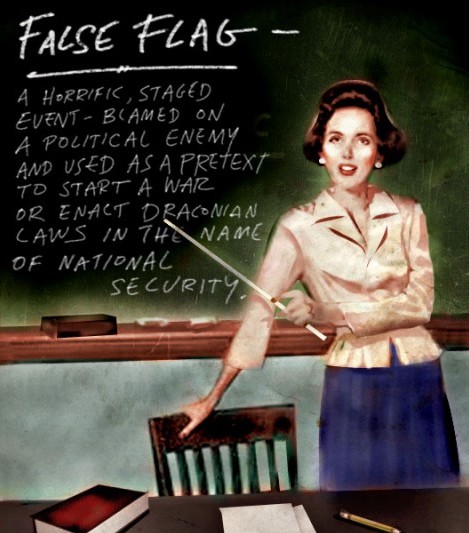
A false flag attack occurs when a government carries out a terror attack against its own population and then falsely blames an enemy to justify a political course of action, such as going to war against the country or countries it blames. While, again, those who question false flag attacks are often denounced by elite propagandists as ‘conspiracy theorists’, in fact the documentation of false flag attacks that have later been admitted is quite long. For one list, see ‘53 Admitted False Flag Attacks’. Of course, plenty of false flag attacks have not been admitted, even when the evidence is overwhelming, as in the case of 9/11 for example.

So Why Do Most People Believe Propaganda?

In an early book on propaganda written in 1928 by Sigmund Freud’s nephew, Edward Bernays, he opened with this paragraph:

The conscious and intelligent manipulation of the organized habits and opinions of the masses is an

important element in democratic society. Those who manipulate this unseen mechanism of society constitute an invisible government which is the true ruling power of our country. See Propaganda.

As Bernays makes clear from the outset, his preoccupation is the manipulation of people to do the bidding of others: clearly, a debased and cynical view of the human individual on which many of humanity’s less morally committed characters have capitalized since Bernays wrote the book.

For example, Joseph Goebbels, Nazi Minister of Propaganda from 1933 to 1945 and an avid reader of Bernays’ work, observed that ‘Propaganda works best when those who are being manipulated are confident they are acting on their own free will.’

But to understand why the approach of Bernays and his disciples such as Goebbels even works, we need to consider why it is that most people are so gullible in the first place. Why don’t more people ask deeper questions about what is taking place rather than simply accepting, without serious question, whatever is presented to them (whether by parents, teachers, religious figures, doctors, propagandists, marketing agents, governments or the corporate media)?

The fundamental problem is simply this: parents, teachers, religious figures and other significant adults in the child’s life require obedience. And obedience means that the child not only behaves as directed by the adult but also that the child believes what the adult believes. This latter point is easily overlooked but is actually the key issue. Why? Because a child who does not believe what the adult believes might think and behave in a way that scares the adult. And demanding obedience is essentially about eliminating beliefs (and their consequent behaviours) that would frighten the parent, teacher or other adult.

Parents require obedience virtually from the moment of birth, doing everything from comforting a child to stop them crying – see ‘Comforting a Baby is Violent’ – to punishing them for acting contrary to parental will once they start moving independently. Of course, once the child starts to think or believe differently, especially if this ‘difference’ is too far from a belief of the child’s parents, teachers or religious leaders (or a widely-accepted belief within their society), the child is quickly pulled back into line with some combination of inducements and/or violence. See ‘Punishment is Violent and Counterproductive’.

Despite legal conventions meaninglessly affirming versions of it – such as the Universal Declaration of Human Rights Article 18 declaring ‘Everyone has the right to freedom of thought…’ – the freedom to think for oneself is not a human right in any meaningful sense of the term and, even if it were, it would really only mean the freedom to think for oneself within certain clearly defined and narrow parameters. And only if you are an adult.

This is why, for example, a child who decides not to go to school does not emerge. Such a possibility would be frightening to virtually every parent, so no child is given that option, let alone allowed the opportunity to come up with, consider and act on that option for themself. Why? Because attendance at school, wherever it exists, is legally compulsory (meaning punishment will be inflicted for failure to comply), and only the rarest parent has the vaguest concept of freedom themselves, let alone the courage to defend their child’s freedom, including the freedom to choose how they spend the bulk of their time for the 8-13 years of ‘school age’.

Consequently, the freedom to think for oneself and act accordingly is strangled at a very young age and certainly by the time a child is compelled to attend a prison for children, also known as ‘school’. As a result the child’s concept of freedom, should they ever come across the notion, can only be a parody of the real thing. And the adult who emerges from this childhood is simply incapable of comprehending what freedom might mean for the obvious reason that to be meaningfully understood, freedom must be experienced.

Of course, is it not just parental authority and school that denies any child the experience of liberty. As Jean-Jacques Rousseau noted in his treatise The Social Contract in 1762, ‘Man is born free; and everywhere he is in chains’. Every institution in society is designed to circumscribe freedom, one way or another. It is just that a childhood spent living under the control of their parents and then teachers and religious figures leaves all children devoid of the experience of freedom and so any subsequent limits are not even noticed. In fact, they are expected and ‘taken for granted’.

So with parents, teachers and religious figures endlessly inflicting ‘visible’, ‘invisible’ and ‘utterly invisible’ violence on the child in the name of ‘socialization’ (which includes requiring obedience under threat of violence for non-compliance), the child progressively and rapidly loses several innate capacities, notably including a sense of their own Self-will, the capacities to think and feel for themselves, as well as conscience. See ‘Why Violence?’ and ‘Fearless Psychology and Fearful Psychology: Principles and Practice’. Anything that is too far from the dominant narrative simply becomes ‘unthinkable’ because the child’s innate capacity to perceive the truth is suppressed along with other mental capacities.

But soon it is not just parents, teachers and religious leaders that are the accepted ‘authority figures’ in the child’s life. No longer able to seriously question the imperatives of parents, teachers and religious figures because they have been terrorized out of doing so, the child has also unconsciously ‘learned’ that virtually any information with which they are presented must be true, even when the source is simply a government or corporate media outlet presenting elite propaganda. For the vast bulk of adult humans, the idea of questioning a dominant narrative does not even occur to them and it is certainly not something they can do with any intelligence, persistent research effort or courage.

So just as Hitler, ably supported by his Propaganda Minister Joseph Goebbels, was able to direct most Germans prior to and into World War II, it is quite straightforward for the global elite to be able to direct the bulk of the human population to believe, for example, that President John F. Kennedy was assassinated by the ‘lone gunman’ Lee Harvey Oswald, that the ‘Gulf of Tonkin incident’ justified the United States war on Vietnam, that a ‘virus’ labeled HIV caused a ‘disease’ labeled AIDS, that the three buildings 1,2 and 7 of the World Trade Center were destroyed by two aircraft flown by novice pilots into the top stories of the Twin Towers and justified the subsequently launched US ‘War on Terror’, that a ‘virus’ labeled SARS-Cov-2 exists and causes a ‘disease’ labeled Covid-19 that has justified the destruction of everything from a range of human rights to the global economy while accelerating four distinct paths to human extinction, that we live in a democracy in which each adult has a say in how they are governed, or even that ongoing effort is being made to bring a greater degree of shared prosperity to the people of the world.

For just a taste of the extensive evidence to debunk each of these propaganda-driven delusions, see these respective analyses of what the evidence actually demonstrates: On the Trail of the Assassins: One Man’s Quest to Solve the Murder of President Kennedy, the Pentagon PapersAIDS Inc.: Scandal of the CenturyArchitects & Engineers for 9/11 Truth‘Unmasking the Lies Around COVID-19: Facts vs Fiction of the Coronavirus Pandemic’‘The Elite’s COVID-19 Coup to Destroy Humanity that is also Fast-Tracking Four Paths to Human Extinction’‘America After the Election: A Few Hard Truths About the Things That Won’t Change’ and ‘The Federal Reserve Cartel: The Eight Families’.

In essence: my point is that is it is not the power of the propaganda, increasingly sophisticated though it has become, that makes people believe it, but a ‘socialization’ model designed to produce submissively obedient ‘individuals’ who gullibly interpret what is happening, and even their own ‘experience’, in terms of the information or scenario (that is, propaganda) with which they are presented. And because of the deeply-seated and unconscious fear of holding a divergent view, most people simply believe the widely-promulgated propaganda narrative with which they become familiar and, hence, comfortable. Moreover, those who challenge the elite-driven narrative frighten them, particularly when elite agents in government and the corporate media label them ‘conspiracy theorists’. For one explanation of why the term ‘conspiracy theorist’ emerged to denigrate those who challenge elite orthodoxy, see ‘In defence of conspiracy theories (and why the term is a misnomer)’.

And so this combination of dysfunctional parenting, education and religious exposure leaves the child devoid of their intuitive ‘truth register’ as well as the other mental faculties that would make them question explanations that obviously lack credibility while investigating and analyzing the evidence for themself. In fact, the idea of doing so never even occurs to them. Hence, a terrorized, gullible and easily manipulated individual enters adulthood. And, as the elite intends, galvanizing an effective response by such people to the truth hidden behind the propaganda is very difficult.

Resisting Propaganda

There is no point hoping that the global elite will discontinue their use of propaganda to shape the course of human events. This is largely because the global elite is insane. See ‘The Global Elite is Insane Revisited’. Moreover, attempts to curb the use of propaganda must inevitably run into the institutions and organizations that the elite controls. And while we can strategically resist these if we choose, the most powerful defence we have against elite propaganda is the human mind that can perceive and critique it. Hence, as a priority, I would profoundly alter our parenting model to achieve this outcome. See ‘My Promise to Children’.

If you are uncertain of your own capacity to critique propaganda, you can expand your capacity to do so by feeling the fear (to release it) that limits your mental faculties. See ‘Putting Feelings First’.

If you are interested in planning or participating in a strategy to achieve a peace, environmental or social justice outcome (particularly in relation to those issues that threaten human extinction), or to resist the elite coup currently taking place under cover of Covid-19, you can read sets of strategic goals for doing so in Campaign Strategic Aims or Coup Strategic Aims.

Moreover, if you wish to tackle the environmental threats to human existence while also strengthening your self-reliant capacity to resist the latest elite onslaught to take (much) greater control of your life, consider participating in ‘The Flame Tree Project to Save Life on Earth’. The greater your dependence on elite systems and processes of any kind, the less power you will have to resist as the noose tightens.

If you are interested in participating in the worldwide effort to resist elite and other violence, you are also welcome to sign the online pledge of ‘The People’s Charter to Create a Nonviolent World’.

More simply, if you like, you might consider committing to:

The Earth Pledge

Out of love for the Earth and all of its creatures, and my respect for their needs, from this day onwards I pledge that:

  1. I will listen deeply to children. See ‘Nisteling: The Art of Deep Listening’.
  2. I will not travel by plane
  3. I will not travel by car
  4. I will not eat meat and fish
  5. I will only eat organically/biodynamically grown food
  6. I will minimize the amount of fresh water I use, including by minimizing my ownership and use of electronic devices
  7. I will not own or use a mobile (cell) phone
  8. I will not buy rainforest timber
  9. I will not buy or use single-use plastic, such as bags, bottles, containers, cups and straws
  10. I will not use banks, superannuation (pension) funds or insurance companies that provide any service to corporations involved in fossil fuels, nuclear power and/or weapons
  11. I will not accept employment from, or invest in, any organization that supports or participates in the exploitation of fellow human beings or profits from killing and/or destruction of the biosphere
  12. I will not get news from the corporate media (mainstream newspapers, television, radio, Google, Facebook, Twitter…)
  13. I will make the effort to learn a skill, such as food gardening or sewing, that makes me more self-reliant
  14. I will gently encourage my family and friends to consider signing this pledge.

Conclusion

The world is complex: it is difficult to understand and requires enormous effort.

Propaganda is designed to give people information that is easy to understand (and sometimes frightening) while distracting them from the truth and offering a simple ‘choice’ (or command) designed to mobilize action in support of an elite-driven narrative.

For example, by telling people they are threatened by a virus, most will be scared into focusing their attention on the ‘virus’. They will pay no attention to the many more complex and dangerous things that are taking place under cover of the ‘virus’: a technocratic/transhumanist coup that is utterly transforming the very essence of human society, economy and even the human individual. See ‘Beware the Transhumanists: How “Being Human” is being Re-engineered by the Elite’s Covid-19 Coup’ and ‘Klaus Schwab and His Great Fascist Reset’.

Only a tiny proportion of the human population has even the vaguest idea of how the world actually works. But not even a tiny proportion of these people recognize that terrorizing children into obedience is the fundamental explanation of why the world works in the way that it does.

Unless we can mobilize greater recognition of our responsibility for giving the global elite the control over us that it has, and tackle this problem at its core – by fundamentally revising existing parenting and education models so that we produce powerful individuals – it will continue to be enormously difficult to mobilize sufficient strategic response to the challenges that confront humanity.

And while we are now fast-tracking four distinct paths to human extinction, there is an urgency about our predicament that accelerates daily.


Biodata: Robert J. Burrowes has a lifetime commitment to understanding and ending human violence. He has done extensive research since 1966 in an effort to understand why human beings are violent and has been a nonviolent activist since 1981. He is the author of ‘Why Violence?’ His email address is flametree@riseup.net and his website is here.

America After the Election: A Few Hard Truths About the Things That Won’t Change

By John W. Whitehead

Source: The Rutherford Institute

“If liberty means anything at all, it means the right to tell people what they do not want to hear.”—George Orwell

The American people remain eager to be persuaded that a new president in the White House can solve the problems that plague us.

Yet no matter who wins this presidential election, you can rest assured that the new boss will be the same as the old boss, and we—the permanent underclass in America—will continue to be forced to march in lockstep with the police state in all matters, public and private.

Indeed, it really doesn’t matter what you call them—the Deep State, the 1%, the elite, the controllers, the masterminds, the shadow government, the police state, the surveillance state, the military industrial complex—so long as you understand that no matter which party occupies the White House in 2021, the unelected bureaucracy that actually calls the shots will continue to do so.

In the interest of liberty and truth, here are a few hard truths about life in the American police state that will persist no matter who wins the 2020 presidential election. Indeed, these issues persisted—and in many cases flourished—under both Republican and Democratic administrations in recent years.

Police militarization will continue. Thanks to federal grant programs allowing the Pentagon to transfer surplus military supplies and weapons to local law enforcement agencies without charge, police forces will continue to be transformed from peace officers to heavily armed extensions of the military, complete with jackboots, helmets, shields, batons, pepper-spray, stun guns, assault rifles, body armor, miniature tanks and weaponized drones. “Today, 17,000 local police forces are equipped with such military equipment as Blackhawk helicopters, machine guns, grenade launchers, battering rams, explosives, chemical sprays, body armor, night vision, rappelling gear and armored vehicles,” stated Paul Craig Roberts, former Assistant Secretary of the Treasury. “Some have tanks.”

Overcriminalization will continue. In the face of a government bureaucracy consumed with churning out laws, statutes, codes and regulations that reinforce its powers and value systems and those of the police state and its corporate allies, we will all continue to be viewed as petty criminals, guilty of violating some minor law. Thanks to an overabundance of 4,500-plus federal crimes and 400,000-plus rules and regulations, it is estimated that the average American actually commits three felonies a day without knowing it. In fact, according to law professor John Baker, “There is no one in the United States over the age of 18 who cannot be indicted for some federal crime.” Consequently, we now find ourselves operating in a strange new world where small farmers who dare to make unpasteurized goat cheese and share it with members of their community are finding their farms raided, while home gardeners face jail time for daring to cultivate their own varieties of orchids without having completed sufficient paperwork. This frightening state of affairs—where a person can actually be arrested and incarcerated for the most innocent and inane activities, including feeding a whale and collecting rainwater on their own property—is due to what law scholars refer to as overcriminalization.

Jailing Americans for profit will continue. At one time, the American penal system operated under the idea that dangerous criminals needed to be put under lock and key in order to protect society. Today, as states attempt to save money by outsourcing prisons to private corporations, imprisoning Americans in private prisons run by mega-corporations has turned into a cash cow for big business. In exchange for corporations buying and managing public prisons across the country at a supposed savings to the states, the states have to agree to maintain a 90% occupancy rate in the privately run prisons for at least 20 years. Such a scheme simply encourages incarceration for the sake of profits, while causing millions of Americans, most of them minor, nonviolent criminals, to be handed over to corporations for lengthy prison sentences which do nothing to protect society or prevent recidivism. Thus, although the number of violent crimes in the country is down substantially, the number of Americans being jailed for nonviolent crimes such as driving with a suspended license is skyrocketing.

Poverty will continue. Despite the fact that we have 46 million Americans living at or below the poverty line16 million children living in households without adequate access to food, and at least 900,000 veterans relying on food stamps (mind you, these are pre-COVID numbers, which have only got worse during this pandemic), enormous sums continue to be doled out for presidential excursions (taxpayers have been forced to pay at least $100 million so that Donald Trump could visit his golf clubs and private properties more than 500 times during his four years in office).

Endless wars that enrich the military industrial complex will continue. Having been co-opted by greedy defense contractors, corrupt politicians and incompetent government officials, America’s expanding military empire is bleeding the country dry at a rate of more than $15 billion a month (or $20 million an hour)—and that’s just what the government spends on foreign wars. That does not include the cost of maintaining and staffing the 1000-plus U.S. military bases spread around the globe. Incredibly, although the U.S. constitutes only 5% of the world’s population, America boasts almost 50% of the world’s total military expenditure, spending more on the military than the next 19 biggest spending nations combined. In fact, the Pentagon spends more on war than all 50 states combined spend on health, education, welfare, and safety. Yet what most Americans fail to recognize is that these ongoing wars have little to do with keeping the country safe and everything to do with enriching the military industrial complex at taxpayer expense. Consider that since 2001, Americans have spent $10.5 million every hour for numerous foreign military occupations, including in Iraq and Afghanistan.

Police shootings of unarmed Americans will continue. No matter what our party politics, race, religion, or any other distinction used to divide us, we all suffer when violence becomes the government’s calling card. Remember, in a police state, you’re either the one with your hand on the trigger or you’re staring down the barrel of a loaded gun. At least 400 to 500 innocent people are killed by police officers every year. Indeed, Americans are now eight times more likely to die in a police confrontation than they are to be killed by a terrorist. Americans are 110 times more likely to die of foodborne illness than in a terrorist attack. Police officers are more likely to be struck by lightning than be made financially liable for their wrongdoing. As a result, Americans are largely powerless in the face of militarized police.

SWAT team raids will continue.  More than 80,000 SWAT team raids are carried out every year on unsuspecting Americans for relatively routine police matters. Nationwide, SWAT teams have been employed to address an astonishingly trivial array of criminal activity or mere community nuisances including angry dogs, domestic disputes, improper paperwork filed by an orchid farmer, and misdemeanor marijuana possession, to give a brief sampling. On an average day in America, over 100 Americans have their homes raided by SWAT teams. There has been a notable buildup in recent years of SWAT teams within non-security-related federal agencies such as the Department of Agriculture, the Railroad Retirement Board, the Tennessee Valley Authority, the Office of Personnel Management, the Consumer Product Safety Commission, the U.S. Fish and Wildlife Service, and the Education Department.

The government’s war on the American people will continue.  “We the people” are no longer shielded by the rule of law. While the First Amendment—which gives us a voice—is being muzzled, the Fourth Amendment—which protects us from being bullied, badgered, beaten, broken and spied on by government agents—is being disemboweled. Consequently, you no longer have to be poor, black or guilty to be treated like a criminal in America. All that is required is that you belong to the suspect class—that is, the citizenry—of the American police state. As a de facto member of this so-called criminal class, every U.S. citizen is now guilty until proven innocent. The oppression and injustice—be it in the form of shootings, surveillance, fines, asset forfeiture, prison terms, roadside searches, and so on—will come to all of us eventually unless we do something to stop it now.

Government corruption will continue.  The government is not our friend. Nor does it work for “we the people.” Americans instinctively understand this. When asked to name the greatest problem facing the nation, Americans of all political stripes ranked the government as the number one concern. In fact, almost eight out of ten Americans believe that government corruption is widespread. Our so-called government representatives do not actually represent us, the citizenry. We are now ruled by an oligarchic elite of governmental and corporate interests whose main interest is in perpetuating power and control. Congress is dominated by a majority of millionaires who are, on average, fourteen times wealthier than the average American.

The rise of the surveillance state will continue. Government eyes are watching you. They see your every move: what you read, how much you spend, where you go, with whom you interact, when you wake up in the morning, what you’re watching on television and reading on the internet. Every move you make is being monitored, mined for data, crunched, and tabulated in order to form a picture of who you are, what makes you tick, and how best to control you when and if it becomes necessary to bring you in line. Police have been outfitted with a litany of surveillance gear, from license plate readers and cell phone tracking devices to biometric data recorders. Technology now makes it possible for the police to scan passersby in order to detect the contents of their pockets, purses, briefcases, etc. Full-body scanners, which perform virtual strip-searches of Americans traveling by plane, have gone mobile, with roving police vans that peer into vehicles and buildings alike—including homes. Coupled with the nation’s growing network of real-time surveillance cameras and facial recognition software, soon there really will be nowhere to run and nowhere to hide.

The erection of a suspect society will continue. Due in large part to rapid advances in technology and a heightened surveillance culture, the burden of proof has been shifted so that the right to be considered innocent until proven guilty has been usurped by a new norm in which all citizens are suspects. This is exemplified by police practices of stopping and frisking people who are merely walking down the street and where there is no evidence of wrongdoing. Making matters worse are Terrorism Liaison Officers (firefighters, police officers, and even corporate employees) who have been trained to spy on their fellow citizens and report “suspicious activity,” which includes taking pictures with no apparent aesthetic value, making measurements and drawings, taking notes, conversing in code, espousing radical beliefs and buying items in bulk. TLOs report back to “fusion centers,” which are a driving force behind the government’s quest to collect, analyze, and disseminate information on American citizens.

Government tyranny under the reign of an Imperial President will continue. The Constitution invests the President with very specific, limited powers: to serve as Commander in Chief of the military, grant pardons, make treaties (with the approval of Congress), appoint ambassadors and federal judges (again with Congress’ blessing), and veto legislation. In recent years, however, American presidents have anointed themselves with the power to wage war, unilaterally kill Americans, torture prisoners, strip citizens of their rights, arrest and detain citizens indefinitely, carry out warrantless spying on Americans, and erect their own secretive, shadow government. The powers amassed by each past president and inherited by each successive president—powers which add up to a toolbox of terror for an imperial ruler—empower whomever occupies the Oval Office to act as a dictator, above the law and beyond any real accountability. The grim reality we must come to terms with is the fact that the government does whatever it wants, freedom be damned. More than terrorism, more than domestic extremism, more than gun violence and organized crime, the U.S. government has become a greater menace to the life, liberty and property of its citizens than any of the so-called dangers from which the government claims to protect us. This state of affairs has become the status quo, no matter which party is in power.

The government’s manipulation of national crises in order to expand its powers will continue. “We the people” have been the subjected to an “emergency state” that justifies all manner of government tyranny and power grabs in the so-called name of national security. Whatever the so-called threat to the nation—whether it’s civil unrest, school shootings, alleged acts of terrorism, or the threat of a global pandemic in the case of COVID-19—the government has a tendency to capitalize on the nation’s heightened emotions, confusion and fear as a means of extending the reach of the police state. Indeed, the government’s answer to every problem continues to be more government—at taxpayer expense—and less individual liberty.

The bottom line is this: nothing taking place on Election Day will alleviate the suffering of the American people. Unless we do something more than vote, the government as we have come to know it—corrupt, bloated and controlled by big-money corporations, lobbyists and special interest groups—will remain unchanged. And “we the people”—overtaxed, overpoliced, overburdened by big government, underrepresented by those who should speak for us and blissfully ignorant of the prison walls closing in on us—will continue to trudge along a path of misery.

As I point out in my book Battlefield America: The War on the American People, these problems will continue to plague our nation unless and until Americans wake up to the fact that we’re the only ones who can change things for the better and then do something about it. If there is to be any hope of restoring our freedoms and reclaiming control over our government, it will rest not with the politicians but with the people themselves.

After all, Indeed, the Constitution opens with those three vital words, “We the people.”

What the founders wanted us to understand is that we are the government.

There is no government without us—our sheer numbers, our muscle, our economy, our physical presence in this land. There can also be no police state—no tyranny—no routine violations of our rights without our complicity and collusion—without our turning a blind eye, shrugging our shoulders, allowing ourselves to be distracted and our civic awareness diluted.

No matter which candidate wins this election, the citizenry and those who represent us need to be held accountable to this powerful truth.


What We Don’t Elect Matters Most: Central Banking and the Permanent Government

By Charles Hugh Smith

Source: Of Two Minds

We’re Number One in wealth, income and power inequality, yea for the Fed and the Empire!

If we avert our eyes from the electoral battle on the blood-soaked sand of the Coliseum and look behind the screen, we find the powers that matter are not elected: our owned by a few big banks Federal Reserve, run by a handful of technocrats, and the immense National Security State, a.k.a. the Permanent Government. These entities operate the Empire which hosts the electoral games for the entertainment and distraction of the public.

The governance machinery controlled by elected representatives is tightly constrained in what it can and cannot do. It can’t do anything to stop the debasement of the nation’s currency, which is totally controlled by the Politburo of the Fed, nor can it do much to limit the Imperial Project, other than feel-good PR bits here and there.

The president wields vast powers but even the president is powerless to stop the debasement of the nation’s currency and the enrichment of bankers, financiers, corporations, etc., who fund the campaigns of the gladiators, oops I mean politicians.

If we set aside the term Deep State and simply call it the unelected machinery of governance (Permanent Government), we get a clear picture of its scope and power. Presidents, senators and representatives come and go, but the machinery of Empire grinds on, decade after decade.

A great many people and places in America don’t matter to the Fed or the Permanent Government, and so they’ve been abandoned to their fates. The darlings of the Fed and Empire are clustered in Silicon Valley and other urban hubs where the technological and financial machinery of global hegemony are fabricated and maintained.

Those far from these centers of banking, finance and Big Tech have little to no stake as owners of meaningful capital. All they have to sell is their labor, and that’s been losing purchasing power for decades as financialization and globalization have stripmined rural America and enriched the bankers, financiers and speculators who serve the Fed and unelected Permanent Government.

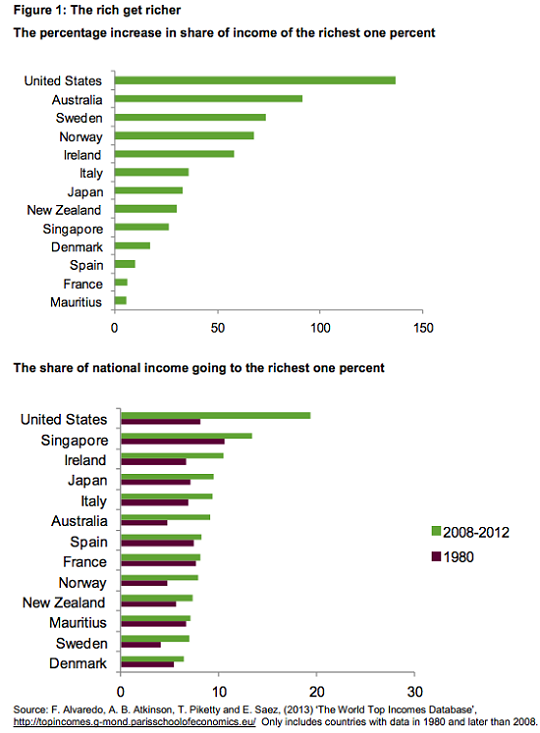
The Fed and the Permanent Government have been very, very good to the few at the expense of the many. Look at the chart below at America’s complete dominance when measured by the soaring wealth of its top 1% power elite: We’re Number One in wealth, income and power inequality, yea for the Fed and the Empire! And we don’t have to elect them–they elect themselves.


American Requiem

However inequitable its bias, capitalist democracy at least offered the possibility of incremental and piecemeal reform. Now it is a corpse.

By Chris Hedges

Source: ScheerPost.com

Well, it’s over. Not the election. The capitalist democracy. However biased it was towards the interests of the rich and however hostile it was to the poor and minorities, the capitalist democracy at least offered the possibility of incremental and piecemeal reform. Now it is a corpse. The iconography and rhetoric remain the same. But it is an elaborate and empty reality show funded by the ruling oligarchs — $1.51 billion for the Biden campaign and $1.57 billion for the Trump campaign — to make us think there are choices. There are not. The empty jousting between a bloviating Trump and a verbally impaired Joe Biden is designed to mask the truth. The oligarchs always win. The people always lose. It does not matter who sits in the White House. America is a failed state.

“The American Dream has run out of gas,” wrote the novelist J.G. Ballard. “The car has stopped. It no longer supplies the world with its images, its dreams, its fantasies. No more. It’s over. It supplies the world with its nightmares now.”

There were many actors that killed America’s open society. The corporate oligarchs who bought the electoral process, the courts and the media, and whose lobbyists write the legislation to impoverish us and allow them to accumulate obscene amounts of wealth and unchecked power. The militarists and war industry that drained the national treasury to mount futile and endless wars that have squandered some $7 trillion and turned us into an international pariah. The CEOs, raking in bonuses and compensation packages in the tens of millions of dollars, that shipped jobs overseas and left our cities in ruins and our workers in misery and despair without a sustainable income or hope for the future. The fossil fuel industry that made war on science and chose profits over the looming extinction of the human species. The press that turned news into mindless entertainment and partisan cheerleading. The intellectuals who retreated into the universities to preach the moral absolutism of identity politics and multiculturalism while turning their backs on the economic warfare being waged on the working class and the unrelenting assault on civil liberties. And, of course, the feckless and hypocritical liberal class that does nothing but talk, talk, talk.

If there is one group that deserves our deepest contempt it is the liberal elites, those who posture as the moral arbiters of society while abandoning every value they purportedly hold the moment they become inconvenient. The liberal class, once again, served as pathetic cheerleaders and censors for a candidate and a political party that in Europe would be considered on the far-right. Even while liberals were being ridiculed and dismissed by Biden and by the Democratic Party hierarchy, which bizarrely invested its political energy in appealing to Republican neocons, liberals were busy marginalizing journalists, including Glenn Greenwald and Matt Taibbi, who called out Biden and the Democrats. The liberals, whether at The Intercept or The New York Times, ignored or discredited information that could hurt the Democratic Party, including the revelations on Hunter Biden’s laptop. It was a stunning display of craven careerism and self-loathing.

The Democrats and their liberal apologists are, the election has illustrated, oblivious to the profound personal and economic despair sweeping through this country. They stand for nothing. They fight for nothing. Restoring the rule of law, universal health care, banning fracking, a Green New Deal, the protection of civil liberties, the building of unions, the preservation and expansion of social welfare programs, a moratorium on evictions and foreclosures, the forgiveness of student debt, stiff environmental controls, a government jobs program and guaranteed income, financial regulation, opposition to endless war and military adventurism were once again forgotten. Championing these issues would have resulted in a Democratic Party landslide. But since the Democratic Party is a wholly owned subsidiary of corporate donors, promoting any policy that might foster the common good, diminish corporate profits and restore democracy, including imposing campaign finance laws, was impossible. Biden’s campaign was utterly bereft of ideas and policy issues, as if he and the Democrats could sweep the elections by promising to save the soul of America. At least the neofascists have the courage of their demented convictions.

The liberal class functions in a traditional democracy as a safety valve. It makes piecemeal and incremental reform possible. It ameliorates the worst excesses of capitalism. It proposes gradual steps towards greater equality. It endows the state and the mechanisms of power with supposed virtues. It also serves as an attack dog that discredits radical social movements. The liberal class is a vital component within the power elite. In short, it offers hope and the possibility, or at least the illusion, of change.

The surrender of the liberal elite to despotism creates a power vacuum that speculators, war profiteers, gangsters and killers, often led by charismatic demagogues, fill. It opens the door to fascist movements that rise to prominence by ridiculing and taunting the absurdities of the liberal class and the values they purport to defend. The promises of the fascists are fantastic and unrealistic, but their critiques of the liberal class are grounded in truth. Once the liberal class ceases to function, it opens a Pandora’s box of evils that are impossible to contain.

The disease of Trumpism, with or without Trump, is, as the election illustrated, deeply embedded in the body politic. It is an expression among huge segments of the population, taunted by liberal elites as “deplorables,” of a legitimate alienation and rage that the Republicans and the Democrats orchestrated and now refuse to address. This Trumpism is also, as the election showed, not limited to white men, whose support for Trump actually declined.

Fyodor Dostoevsky saw the behavior of Russia’s useless liberal class, which he satirized and excoriated at the end of the 19th century, as presaging a period of blood and terror. The failure of liberals to defend the ideals they espoused inevitably led, he wrote, to an age of moral nihilism. In Notes From Underground, he portrayed the sterile, defeated dreamers of the liberal class, those who hold up high ideals but do nothing to defend them. The main character in Notes From Underground carries the bankrupt ideas of liberalism to their logical extreme. He eschews passion and moral purpose. He is rational. He accommodates a corrupt and dying power structure in the name of liberal ideals. The hypocrisy of the Underground Man dooms Russia as it now dooms the United States. It is the fatal disconnect between belief and action.

“I never even managed to become anything: neither wicked nor good, neither a scoundrel nor an honest man, neither a hero nor an insect,” the Underground Man wrote. “And now I am living out my life in my corner, taunting myself with the spiteful and utterly futile consolation that it is even impossible for an intelligent man seriously to become anything, and only fools become something. Yes, sir, an intelligent man of the nineteenth century must be and is morally obliged to be primarily a characterless being; and a man of character, an active figure – primarily a limited being.”

The refusal of the liberal class to acknowledge that power has been wrested from the hands of citizens by corporations, that the Constitution and its guarantees of personal liberty have been revoked by judicial fiat, that elections are nothing more than empty spectacles staged by the ruling elites, that we are on the losing end of the class war, has left it speaking and acting in ways that no longer correspond to reality.

The “idea of the intellectual vocation,” as Irving Howe pointed out in his 1954 essay This Age of Conformity, “the idea of a life dedicated to values that cannot possibly be realized by a commercial civilization — has gradually lost its allure. And, it is this, rather than the abandonment of a particular program, which constitutes our rout.” The belief that capitalism is the unassailable engine of human progress, Howe wrote, “is trumpeted through every medium of communication: official propaganda, institutional advertising and scholarly writings of people who, until a few years ago, were its major opponents.”

“The truly powerless people are those intellectuals — the new realists — who attach themselves to the seats of power, where they surrender their freedom of expression without gaining any significance as political figures,” Howe wrote. “For it is crucial to the history of the American intellectuals in the past few decades — as well as to the relationship between ‘wealth’ and ‘intellect’ — that whenever they become absorbed into the accredited institutions of society they not only lose their traditional rebelliousness but to one extent or another they cease to function as intellectuals.” 

Populations can endure the repression of tyrants, as long as these rulers continue to effectively manage and wield power. But human history has amply demonstrated that once those in positions of power become redundant and impotent, yet retain the trappings and privileges of power, they are brutally discarded. This was true in Weimar Germany. It was true in the former Yugoslavia, a conflict I covered for The New York Times. 

The historian Fritz Stern in The Politics of Cultural Despair, his book on the rise of fascism in Germany, wrote of the consequences of the collapse of liberalism. Stern argued that the spiritually and politically alienated, those cast aside by the society, are prime recruits for a politics centered around violence, cultural hatreds and personal resentments. Much of this rage, justifiably, is directed at a liberal elite that, while speaking the “I-feel-your-pain” language of traditional liberalism, sells us out.

“They attacked liberalism,” Stern writes of the fascists emerging at the time in Germany, “because it seemed to them the principal premise of modern society; everything they dreaded seemed to spring from it; the bourgeois life, Manchesterism, materialism, parliament and the parties, the lack of political leadership. Even more, they sense in liberalism the source of all their inner sufferings. Theirs was a resentment of loneliness; their one desire was for a new faith, a new community of believers, a world with fixed standards and no doubts, a new national religion that would bind all Germans together. All this, liberalism denied. Hence, they hated liberalism, blamed it for making outcasts of them, for uprooting them from their imaginary past, and from their faith.”

We are in for it. The for-profit health care system, designed to make money — not take care of the sick — is unequipped to handle a national health crisis. The health care corporations have spent the last few decades merging and closing hospitals, and cutting access to health care in communities across the nation to increase revenue — this, as nearly half of all front-line workers remain ineligible for sick pay and some 43 million Americans have lost their employee-sponsored health insurance. The pandemic, without universal health care, which Biden and the Democrats have no intention of establishing, will continue to rage out of control. Three hundred thousand Americans dead by December. Four hundred thousand by January. And by the time the pandemic burns out or a vaccine becomes safely available, hundreds of thousands, maybe a few million, will have died.

The economic fallout from the pandemic, the chronic underemployment and unemployment — close to 20 percent when those who have stopped looking for work, those furloughed with no prospect of being rehired and those who work part-time but are still below the poverty line are included in the official statistics — will mean a depression unlike anything we have seen since the 1930s. Hunger in US households has already tripled since last year. The proportion of US children who are not getting enough to eat is 14 times higher than last year. Food banks are overrun. The moratorium on foreclosures and evictions has been lifted while over 30 million destitute Americans face the prospect of being thrown into the street.

There is no check left on corporate power. The inevitable social unrest will see the state, no matter who is in the White House, use its three principle instruments of social control — wholesale surveillance, the prisons and militarized police — buttressed by a legal system that routinely revokes habeas corpus and due process, to ruthlessly crush dissent. People of color, immigrants and Muslims will be blamed and targeted by our native fascists for the nation’s decline. The few who continue in defiance of the Democratic Party to call out the crimes of the corporate state and the empire will be silenced. The sterility of the liberal class, serving the interests of a Democratic Party that disdains and ignores them, fuels the widespread feelings of betrayal that saw nearly half the voters support one of the most vulgar, racist, inept and corrupt presidents in American history. An American tyranny, dressed up with the ideological veneer of a Christianized fascism, will, it appears, define the empire’s epochal descent into irrelevance.

THE RISE OF THE CYBORGIAN CONSUMER

By Elva Thompson

Source: Waking Times

“You don’t take over the world with gaudy displays of violence. Real control is surgical, and invisible.” ~ John Greer – Person of Interest, Season 4, Episode: YHVH

The Posthuman (or Transhuman) Movement was formally established in California in the early 1980s. A central figure within the movement, Nick Bostrom, declared that Posthumanism holds to the belief that human nature is an improvable structure, and all its capacities can be enhanced through the use of ‘applied science’. The proposition is that human beings should use technology to transcend the limits of body and mind. Posthumanists do not see humanity as isolated physical entities but as distributed processes within a system. ‘THE BODY IS OBSOLETE’ is their battle cry, but the Posthuman seems to be defined by a lack of definition.

Stephen Brown, the doyen of marketing and interpretive consumer research, introduced the term apophasis. This is a curious choice of word, as it is a theological term which refers to knowing God through negation, or what God is not. Apophasis is from the ancient Greek, meaning to deny or negate. The problem seems to be that we can happily describe what a human being does or performs, but there is a difficulty when it comes to describing what a human being is. This lays bare the profound incapacity of language to penetrate into the very essence of things. In other words, to fully express Being, (I bet humpback whales don’t have this problem).

I Consume, Therefore I Am

To the Posthumanist technocrats, ‘natural man’ is a failed project that desperately needs to be improved upon. But before this can happen radical changes need to be made to our current conceptions of what it means to be human. Traditional accounts of the state of being human are based upon Cartesian worldviews, which regard external reality as objectively recordable and expressed primarily through mathematical laws.

People, as physically isolated thinking mammals, are viewed as necessary consumers within a society that is imagined to be ever abundant and fruitful. This is the Gaia of Classical thought, an ever-producing cornucopia of unquenchable life. Consuming this bounty is our essential function, and God-given right. Not only that, but the mind, or disembodied consciousness, is now theorized to be nothing more than an information processor. This data collecting ‘machine’, being rational and scientific, is external to the fixed social reality which it continually observes and records.

Posthumanism, conversely, puts the emphasis on socio-cultural and technological contexts, and the individual consciousnesses are but processes within this contextual framework. These are socially constructed “hybrid marketplace matrices” using a variety of social, economic and technological systems to control and manoeuvre the population through their insatiable desire to consume. The boundary between the individual and society is seen as being porous and amorphous. Reality becomes protean, as nothing is stable, and it becomes difficult to draw a clear line between the human, the animal and the machine. This is viewed as a natural societal progression, the next phase of an ever-evolving humanity.

“I would rather be a cyborg than a goddess.” ~ Donna J. Haraway

The rational consumer is now replaced by a bio-technological symbiont, or cyborg. As the “proto-typical posthumanist consumer”, the cyborg is seen as the most popular manifestation of the posthuman. This image contains a dichotomy, though, as it is both liberatory and oppressive. The hope is that it can liberate mankind from organic failures, such as ageing and disease, yet contains the fear of a powerful hierarchical elite of technologized bio-machines lording it over the general unmodified masses.

Yet, the cyborg is a hybrid, a bio-technological chimera, and cannot exist without social, economic and technological systems. It is fundamentally a process (or even a product) rather than a Being, a verb rather than a noun. It has lost its essential individuality and become subsumed in the process itself. A cyborg is a Golem by any other name. The Golem is one of the oldest legends of artificial creation, barring Hermetic tales of Egyptian magic instilling stone statues with the consciousness of their gods or neters.

Similarly, through the power of Jewish cabbalism, a model of stone or metal could be infused with life (the root of the word golem is golmi, meaning ‘unformed limbs’). The modern attempt to create consciousness within digital constructs is no different.

Ironically, Descartes himself was fascinated by the automaton, comparing it favourably with the human body. In the late 1980s Hans Moravec, a faculty member of the Robotics Institute of Carnegie Mellon University, proposed that human identity is essentially an informational pattern. He suggested that this proposition can be demonstrated by downloading human consciousness into a computer, thus proving that machines can become human. He believed that robots will evolve into a new series of artificial species, starting around 2030 – 2040.

Almost 30 years later, a large percent of human communication is mediated by a technology that has become so entwined with the creation of identity that it can no longer be meaningfully separated from the human subject. In other words, we are in the initial stages of becoming cyborgs. We may not be physically augmented by technology, but we are beginning to think in the same manner as machines, or the algorithms that run them. The more we use computers, and spend our valuable time prowling around the internet, the more we embody becoming Posthuman. We are already well on the way to becoming cyborg.

“Beam me up, Scotty.” Captain James T. Kirk, any original Star Trek episode.

In 1948, the mathematician Norbert Weiner published a book entitled ‘Cybernetics: control and communication in the animal and machine’. Here he proposed it was possible to telegraph a human being, imagining that the body can be dematerialised into an informational pattern and rematerialised at a different location. More recently, molecular biology treats information as the essential code the body expresses, what we know as DNA. This is termed the ‘impossible inversion’, where information becomes primary and materiality secondary.

During our present cultural moment the belief is that information can circulate unchanged among different material substrates. “Beam me up, Scotty” has become a cultural icon for the global information age. Information has now come to be conceptualised as an entity in itself, existing separately from the material forms in which it is thought to be embedded.

As such, information can be considered the thoughts of the machine and a biological body is seen as an accident of history rather than an inevitable consequence of material life. In his book ‘The Order of Things’ (1973), the philosopher Michel Foucault suggested that “man” is no more than a historical construct whose era is about to end. The Posthuman view considers consciousness as an epiphenomenon, an evolutionary by-product or secondary effect. The physical body is considered as the original prosthesis we, as a species, learned to manipulate.

Extending or replacing the biological body with artificial prostheses is therefore a continuation of an evolutionary process. This view, in turn, configures the human being to be seamlessly articulated with intelligent machines. In the Posthuman world there is no essential demarcation between bodily existence and computer simulation, cybernetic mechanism and biological organism.

Posthumanism does away with the ‘natural self’, rejecting the arguments that the social philosophers Hobbes and Locke constructed about humans being originally in a ‘state of nature’, and therefore owing nothing to society, as that was an after-effect. Instead, the Posthuman is an amalgamation of diverse components, a material-information entity whose boundaries undergo continuous construction and reconstruction.

Chaos out of Order?

Indeed, the situation just described seems to contradict the oft touted phrase of the elite: Ordo Ab Chao, or order out of chaos. The beliefs of the Posthumanists appear to reverse the above declaration. Instead of an ordered reality complete with clearly defined boundaries and roles for the inhabitants of society, they appear to offer an amalgamated mass of ever-changing variables that resemble the protean, but infinitely fecund, primal Chaos that preceded the manifestation of this physical universe. Is it the intentional creation of a universal Chaos (alchemically merging mineral with vegetable, namely silicon with carbon) from which a new level of Order can be produced?

Addendum: it struck me that posthuman is nearly posthumous, and thus denoting the death-knell of the natural human being.

Saturday Matinee: Sorry We Missed You

“Sorry We Missed You”: Ken Loach Exposes the Holes in the Gig Economy

By Chuck Collins

Source: CounterPunch

Director Ken Loach has done it again.  “Sorry We Missed You” is a family drama infused with a searing look at life in the “gig economy” with a frayed social safety net. Like his previous film, “I, Daniel Blake,” this movie is about working class people maintaining their dignity and humanity in the face of government austerity, privatization, and corporate greed.

“Sorry We Missed You” was just released in the U.S. through affiliated independent theaters, such as our Boston-area Coolidge Corner.  A portion of the ticket price through virtual screenings support these theaters.

In the context of a pandemic, “Sorry” connects us to the frontline workers delivering packages and caring for the elderly and disabled — workers who are grossly underpaid while being at greatest risk.

Set in Newcastle, UK, the film takes its name from the package delivery slip that Ricky, the father in a family of four, leaves when no one is home to sign for a package.

Like most workers in the U.S. and UK, Ricky and his spouse Abbie are still struggling to get out of debt a decade after the 2008 economic meltdown. Abbie works as a home care nurse, hopping buses between visits to up to eight patients a day. Ricky takes a job as a driver with a package delivery service. Both work hard and with integrity. Abbie says she cares for her patients “how she’d like people to treat her own mother.”

Like workers at Uber, DoorDash, and other similar delivery services, Ricky’s employment status is in the limbo between employee and independent contractor.  Maloney, the boss man who manages the package distribution facility, makes it clear: Ricky isn’t an employee, but a “franchisee,” a self-employed delivery driver. This status requires him to take on all the risks, including purchasing a van, leasing a delivery scanner, and toiling unlimited hours. The scanner serves as the symbol of the surveillance economy that enables the company to monitor Ricky’s every turn. Yet the company also fines him for late deliveries and, when robbers smash Ricky’s delivery scanner, they assess him a £1,000 charge.

Ricky and Abbie attempt to mind their two children, Seb and Lisa Jane, often via phone and text. The children absorb the stresses of their parents, who work 12 to 16 hour days to survive.

Director Loach balances a family story while dramatizing the structural forces that drive the gig economy and pit workers against each other. When one delivery driver struggles with family issues, the boss Maloney offers his route up to other drivers. Breaching the thin whisper of solidarity between the drivers, Ricky takes the other driver’s more lucrative route. Meanwhile, one of Abbie’s nursing patients shares photos and stories from her struggles as a labor union activist, a reminder of the past solidarity that existed among workers. “What happened to the eight-hour day?” she asks.

Maloney celebrates his own tough-guy unwillingness to bend to meet Ricky’s need for an emergency day off, saying the “shareholders of the trucking depot should build a [expletive] statue of me here.”  Maloney also blames the customers, saying to Ricky, “do any of them ask you how you are? They just want their package delivered on time for as cheap as possible.” We have met the enemy, and it is in part the consumer who expects to pay less and get it now, with no understanding of the social costs of convenience.

In the midst of the Covid-19 pandemic, we are more dependent than ever on those who drive the delivery trucks, who bring the packages, who stock the shelves, and attend to those in need.

“Sorry We Missed You” dramatizes why we need a system where all workers have universal health insurance, living wages, and paid family leave. And we need stronger protections against employers who restructure their enterprises to extract more wealth, while shifting costs on to workers and the rest of us.

Watch the full film on Kanopy.

Imperial Overstretch Arrives: Americans Do Not Need the American Empire

By Philip Giraldi

Source: Strategic Culture Foundation

This piece is being written as voters are going to the polls on election day in the United States. While it has been useful to consider how things might change, possibly for the worse, one must also recognize that much of what happens in the U.S. and in its far-flung empire operates by virtue of its own internal dynamics and rules, something that is often referred to as the “Deep State” or perhaps more accurately as the Establishment.

Witness for example the occasional possibly sincere but unsuccessful White House attempts over the past four years to withdraw or reduce the numbers of U.S. troops embroiled in various armed conflicts worldwide. All of those initiatives have been frustrated or redirected in one way or another and it is not simply a question of bungling by a politically insensitive Donald Trump versus the result that might have been obtained by a more experienced and responsible Democrat. What drives the empire’s engine is essentially bipartisan, even in its own way, apolitical, existing as it does as a form of leaderless shadow government that functions as a community-of-interest rather than a bureaucracy. It is inclusive and reflective of the real centers of power in the country, namely the national security state and Wall Street.

In a recent article Pepe Escobar dispels any expectation that a kinder, gentler foreign policy might emerge from the election. He describes with some alarm how victory by Biden will mean that the national security “Blob” team that wrecked Syria, Yemen, Ukraine and Libya while also assassinating Americans overseas under President Barack Obama will be back. He cites former CIA presidential briefer Ray McGovern who persuasively describes the “Blob” as the MICIMATT (the Military-Industrial-Congressional-Intelligence-Media-Academia-Think-Tank complex). One might well add the Federal Reserve Bank to that list.

So, the engine keeps chugging on, driven my its own self-interests and completely oblivious to what is going on around it. The irony is that the crisis in confidence that simultaneously is besetting the United States in part reflects a very real, largely self-inflicted decline in America’s place in the world due to insistence that it maintain global hegemony. It comes at a time when the empire is entering into a phase of increasing irrelevancy which many of the key players involved are either unable or unwilling to recognize, no matter what their political affiliation might be. That means that the United States is locked into a pattern of behavior that it is incapable of changing. It is a nation that has become addicted to war for no good reason, and that addiction has brought neither security nor prosperity.

The signs are everywhere. The costs of empire continue to rise while real benefits to be derived from it are elusive. The United States government spends far more on a bloated defense budget than it can afford, adding to an unsustainable national debt that currently exceeds $27 trillion, which is 128% of the country’s entire gross domestic product. The debt will likely increase dramatically if there are any more coronavirus stimulus packages. The nation is becoming hollowed out as a result.

America’s “allies” have inevitably rightly become increasingly disengaged from Washington, reluctant to comply with Washington’s directions and demands, while the developing transition from the dollar as the world’s reserve currency is proceeding and will have catastrophic consequences. When the U.S. Treasury stops being able to print money at will, there will be national insolvency.

In terms of the United States’ interaction with the world, a country that not so long ago was widely respected is now regarded as the principal source of international instability, disliked everywhere but Israel, another rogue nation. And the internal damage inside the U.S. to core values and expectations is also evident, to include increasingly dysfunctional schools that focus on political correctness rather than education, crumbling infrastructure, a broken health care system, and a dying industrial and manufacturing base. Unique among all developed countries, life expectancy among working class Americans is declining.

At the root of it all is what Yale professor Paul Kennedy once described as “imperial overstretch,” which means projection of power in support of global commitments that are not essential to national well-being and bankrupting oneself in the process. The reality is that unless an “imperial” acquisition is done purely for exploitative reasons, as Belgium did in the Congo, having an empire operates at a considerable loss. Napoleon “overstretched” when he invaded Russia and both Russia and Austria-Hungary collapsed as a result of the First World War because the stress of external conflict made their obligations far exceed their resources. Great Britain’s Empire likewise became expendable after World War Two when the costs of maintaining outposts “east of Suez” became much larger than the benefits.

So, there are many good reasons for the United States to retrench and again become a “normal” nation, if that is at all possible, but the fact that no candidate but Tulsi Gabbard and Bernie Sanders even suggested that America’s global interventionism might be reconsidered or even reversed is telling. Both were eliminated by the Democratic party establishment. In the case of Gabbard, the executioner was no less than Hillary Clinton. Whoever is the new president, he will inherit the awful conceit that he is the “leader of the free world.” It is past time for a serious discussion of America’s proper place in the world, but that will require completely overturning the country’s Establishment and challenging the “exceptionalism” view that the U.S. must dominate as a “force for good.” Unfortunately, there is no politician anywhere on the horizon who is able and willing to take the lead on such an endeavor.