

By Kevin Reed
Source: WSWS.org
Multiple media sources reported on Friday that the social media platforms Facebook and YouTube were removing posts that identified by name the CIA whistleblower behind the Congressional impeachment inquiry of President Donald Trump.
In an email statement, Facebook said, “Any mention of the potential whistleblower’s name violates our coordinating harm policy, which prohibits content ‘outing of witness, informant or activist’,” adding, “We are removing any and all mentions of the potential whistleblower’s name and will revisit this decision should their name be widely published in the media or used by public figures in debate.”
CNN also reported that YouTube issued a statement saying that it was using a combination of artificial intelligence software and human monitors to find and delete videos with the name of the “Ukrainegate” whistleblower. “The removals, the spokesperson added, would affect the titles and descriptions of videos as well as the video’s actual content,” the CNN report said.
The World Socialist Web Site has independently confirmed that Facebook is deleting posts containing the name of alleged CIA whistleblower Eric Ciaramella.
Facebook’s claim that any content posted on its platform naming Ciaramella constitutes “outing” the whistleblower is absurd. The alleged identity of the career CIA analyst who filed a complaint regarding the July 25 phone call between President Trump and Ukrainian President Volodymyr Zelensky has been known since October 30 when the pro-Republican Real Clear Politics website published his name.
When his name was published by Real Clear Politics, the whistleblower’s attorneys—in typical CIA fashion—said they could “neither confirm nor deny” that Ciaramella was their client.
Ciaramella is a plausible candidate for being whistleblower, given his background as a registered Democrat and CIA analyst with expertise in Ukraine and Russia. He worked under both Obama National Security Advisor Susan Rice and Trump National Security Advisor H.R. McMaster. In mid-2017 he was sent back to the CIA amid accusations that he was leaking anti-Trump information to the media.
While Ciaramella’s name has been widely circulated by Republican political figures, right-wing news sites and former CIA analyst and Trump aide Fred Fleitz said, “everyone knows who he is,” the Democrats and their allies in the media at the New York Times, Washington Post and major television networks have not made his name public.
Even an article in the New York Times on Friday that reported on Facebook’s censoring of posts by the right-wing website Breitbart did not include Ciaramella’s name. By taking the step of scrubbing posts mentioning allegations that are widely shared and reported, Facebook and YouTube are now joining with these corporate media organizations and blocking the public from having access to important information.
The latest heavy-handed social media censorship—so obviously being carried out in the service of the Democratic Party impeachment inquiry and the CIA—actually helps the Trump administration, the Republican Party and the extreme right-wing political forces defending the White House, allowing them to adopt the false posture of advocating free flow of information, even as Trump continues to demonize the media as the “enemies of the people.”
The mass scrubbing of all social media content by Facebook and YouTube that mentions the name Eric Ciaramella is part of the broader censorship efforts by the technology monopolies, in collaboration with the intelligence state, and sets the stage for even more draconian attacks on freedom of expression.
This must be seen within the context of the drive by a substantial section of the ruling establishment for the social media platforms to “step up to the plate” and, as Hillary Clinton said last week, take down “false, deceptive or deliberately misleading content” or “pay a price.” Leading figures within the Democratic Party, including presidential candidate Elizabeth Warren, Congresswoman Alexandria Ocasio-Cortez and Congresswoman Rashida Tlaib, have been campaigning for social media censorship that will block what they call “untruthful statements.”
As explained on the World Socialist Web Site, the increasing calls for censorship on social media are part of a protracted campaign by the US intelligence apparatus, under conditions of a growing movement of the working class and young people and increasing interest and support for socialism, to suppress left-wing, antiwar and progressive political viewpoints.
Furthermore, the WSWS has pointed out that what is determined as “fake” or “real” is not to be decided by the government or giant tech monopolies: “All the dishonesty of the campaign for internet censorship is contained in the failure to answer, much less consider, one central question: Who is to determine what is true and what is false?”
The publication of the name of the CIA analyst who submitted his complaint memo to the heads of the House and Senate Intelligence Committees in August is not a crime. In fact, his identity is of substantial consequence, given that his complaint became the starting point of an effort to remove a sitting president through impeachment.

By Charles Hugh Smith
Source: Of Two Minds
Even if we don’t measure the erosion of intangible capital, the social and political consequences of this impoverishment are manifesting in all sorts of ways.
The central thesis of my new book Will You Be Richer or Poorer? is the financial “wealth” we’ve supposedly gained (or at least a few of us have gained) in the past 20 years has masked the unraveling of our intangible capital: the resilience of our economy, our social capital, i.e. our ability to find common ground and solve real-world problems, our sense that the playing field, while not entirely level, is not two-tiered, and our sense of economic security–have all been shredded.
The unraveling of everything that actually matters is quickening. While every “news” outlet cheerleads the stock market (“The Dow soared today as investor optimism rose… blah blah blah”), our “leadership” and our media don’t even attempt to measure what’s unraveling, much less address the underlying causes.
The hope is that if we ignore what’s unraveling, it will magically go away. But that’s not how reality works.
The unraveling is gathering momentum because prices have been pushing higher while wages lag, feeding the rising precariousness and inequality of our economy. The connection between people losing ground and social disorder/disunity has been well established by historians such as Peter Turchin Ages of Discord and David Hackett Fischer The Great Wave: Price Revolutions and the Rhythm of History.
In our era, trust in the legitimacy of our institutions is unraveling because the statistics presented as “facts” are so clearly designed to support the status quo narrative that everything’s getting better every day in every way rather than the politically unwelcome reality that the bottom 95% are losing ground and whatever they do earn and own is increasingly at risk from forces outside their control.
Economic decay leads to social and political disorder / disunity. The sudden rise of vast homeless encampments is one manifestation of the social fabric unraveling. In the political realm, the insanity of accusing Democratic candidates of being “Russian agents” matches the hysterical destructiveness of the McCarthy era in the 1950s.
It all starts with economic decay, so let’s look at some charts. Here’s a chart of income inequality which helps drive wealth inequality.
Note that the only group that benefited from the past 20 years of speculative bubbles is the top 1%. The whole idea that inflating bubbles creates a “wealth effect” that “trickles down” is preposterous, as evidenced by the decline of the middle 60% of households while the speculators and owners of bubble-assets skimmed the vast majority of income gains.

Meanwhile, we’re told inflation is less than 2% annually while rising costs have outpaced meager wage increases. What’s a more realistic measure of real-world inflation–the official Consumer Price Index (CPI) at 18% over ten years or rent and healthcare at 34% and 45%?
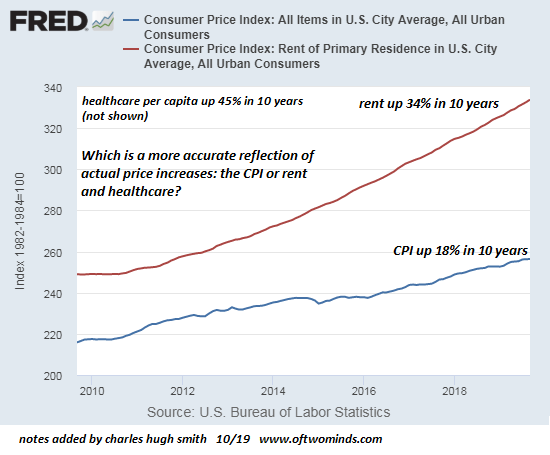
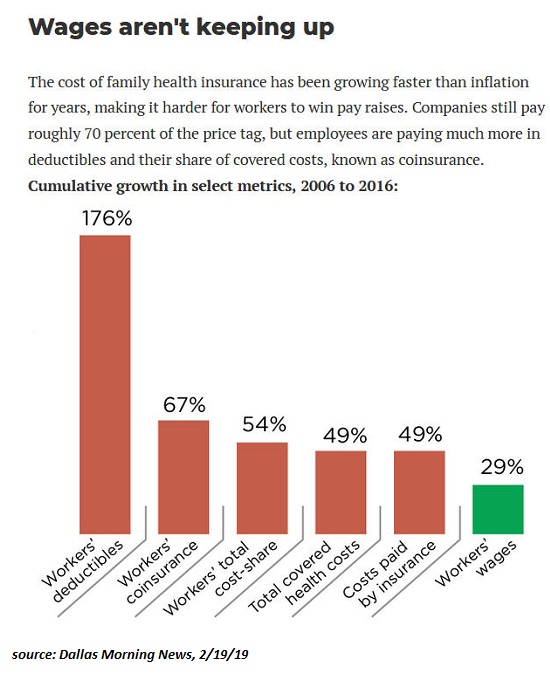
According to the Chapwood Index, real-world inflation in urban America is running 9% to 13% annually. This is more in line with reality than the bogus CPI, as evidenced by this chart of wages and healthcare costs:
Even if we don’t measure the erosion of intangible capital, the social and political consequences of this impoverishment are manifesting in all sorts of ways: large-scale social disorder is breaking out around the globe, and the political middle ground has completely vanished: no matter which way an issue is decided, one camp will refuse to accept the outcome.
The only way forward with any chance of success is to start by acknowledging the decay of our economy due to rampant financialization, legalized looting, the pathologies of “winner take most” speculation and the realities of a two-tiered system in which entrenched elites are “more equal” than the rest of us, economically, socially and politically. We have to accept the limits of technology to reverse the unraveling and assess the damage that’s already been done to our shared capital.
Acting as if the system is working just fine and the problem is perception/optics is accelerating the unraveling.

By Kingsley L. Dennis
Source: Waking Times
ɔːˈtɒmət(ə)n/
noun
a moving mechanical device made in imitation of a human being.
a machine which performs a range of functions according to a predetermined set of coded instructions.
used in similes and comparisons to refer to a person who seems to act in a mechanical or unemotional way.
“Don’t you wish you were free, Lenina?”
“I don’t know what you mean. I am free. Free to have the most wonderful time. Everybody’s happy nowadays.”
He laughed. “Yes, ‘Everybody’s happy nowadays.’ We have been giving the children that at five. But wouldn’t you like to be free to be happy in some other way, Lenina? In your own way, for example; not in everybody else’s way.”
“I don’t know what you mean,” she repeated.
Aldous Huxley, Brave New World
Are we turning into a mass of unaware sleepwalkers? Our eyes are seemingly open and yet we are living as if asleep and the dream becomes our waking lives. It seems that more and more people, in the highly technologized nations at least, are in danger of succumbing to the epidemic of uniformity. People follow cycles of fashions and wear stupid clothes when they think it is the ‘in thing;’ and hyper-budget films take marketing to a whole new level forcing parents to rush out to buy the merchandise because their kids are screaming for it. And if one child in the class doesn’t have the latest toy like all their classmates then they are ostracized for this lack. Which means that poor mummy and daddy have to make sure they get their hands on these gadgets. Put the two items together – zombies and uniformity – and what do you get? Welcome to the phenomenon of Black Fridays, which have become the latest manifestation of national Zombie Days.
Unless you’ve been living in a cave somewhere (or living a normal, peaceful existence) then you will know what this event is – but let me remind you anyway of what a Black Friday is. It is a day when members of the public are infected with the ‘must buy’ and ‘act like an idiot’ virus that turns them into screaming, raging hordes banging on the doors of hyper-market retailers hours before they open. Many of these hordes sleep outside all night to get early entry. Then when the doors are finally opened they go rushing in fighting and screaming as if re-enacting a scene from Games of Thrones. Those that do survive the fisticuffs come away with trolleys full of boxes too big to carry. This display of cultural psychosis, generally named as idiocracy, is also a condition nurtured by societies based on high-consumption with even higher inequalities of wealth distribution. In other words, a culture conditioned to commodity accumulation will buy with fervour when things are cheap. This is because although conditioned to buy, they lack the financial means to satiate this desire. Many people suffer from a condition which psychologists have named as ‘miswanting,’ which means that we desire things we don’t like and like things we don’t desire. What this is really saying is that we tend to ‘want badly’ rather than having genuine need. What we are witnessing in these years is an epidemic of idiocracy and its propagating faster than post-war pregnancies. And yet we are programmed by our democratic societies to not think differently. In this respect, many people also suffer from a condition known as ‘confirmation bias.’
Confirmation bias is our conditioned tendency to pick and choose that information which confirms our pre-existing beliefs or ideas. Two people may be able to look at the same evidence and yet they will interpret it according to how it fits into and validates their own thinking. That’s why so many debates go nowhere as people generally don’t wish to be deviated away from those ideas they have invested so much time and effort in upholding. It’s too much of a shock to realize that what we thought was true, or valid, is not the case. To lose the safety and security of our ideas would be too much for many people. It is now well understood in psychology that we like to confirm our existing beliefs; after all, it makes us feel right!
Many of our online social media platforms are adhering to this principle by picking and choosing those items of news, events, etc that their algorithms have deemed we are most likely to want to see. As convenient as it may seem, it is unlikely to be in our best interests in the long term. The increasing automation of the world around us is set to establish a new ecology in our hyperreality. We will be forced to acknowledge that algorithms and intelligent software will soon, if it isn’t already, be running nearly everything in our daily lives. Historian Yuval Harari believes that ‘the twenty-first century will be dominated by algorithms. “Algorithm” is arguably the single most important concept in our world. If we want to understand our life and our future, we should make every effort to understand what an algorithm is.’1 Algorithms already follow our shopping habits, recommend products for us, pattern recognize our online behavior, help us drive our cars, fly our planes, trade our economies, coordinate our public transport, organize our energy distribution, and a lot, lot more that we are just not really aware of. One of the signs of living in a hyperreality is that we are surrounded by an invisible coded environment, written in languages we don’t understand, making our lives more abstracted from reality.
Modern societies are adapting to universal computing infrastructures that will usher in new arrangements and relations. Of course, these are only the early years, although there is already a lot of uncertainty and unpredictability. As it is said, industrialization didn’t turn us into machines and automation isn’t going to turn us into automatons. Which is more or less correct; after all, being human is not that simple. Yet there will be new dependencies and relations forming as algorithms continue to create and establish what can be called ‘pervasive assistance.’ Again, it is a question of being alert so that we don’t feel compelled just to give ourselves over to our algorithms. The last thing we want is for a bunch of psychologists trying to earn yet more money from a new disease of ‘algorithmic dependency syndrome’ or something similar.
It needs stating that by automating the world we also run the risk of being distanced from our own responsibilities. And this also implies, importantly, the responsibility we have to ourselves – to transcend our own limitations and to develop our human societies for the better. We should not forget that we are here to mature as a species and we should not allow the world of automation to distract us from this. Already literature and film have portrayed such possibilities. Examples are David Brin’s science-fiction novel Kiln People (2002 – also adapted into the film Surrogates, 2009), which clearly showed how automation may provide a smokescreen for people to disappear behind their surrogate substitutes.
Algorithms are the new signals that code an unseen territory all around us. In a world of rapidly increasing automation and digital identities we’ll have to keep our wits about us in order to retain what little of our identities we have left. We want to make sure that we don’t get lost in our emoji messages, our smilies of flirtation; or, even worse, loose our life in the ‘death cult’ of the selfies. Identities by their very nature are constructs; in fact, we can go so far as to call them fake. They are constructed from layers of ongoing conditioning which a person identifies with. This identity functions as a filter to interpret incoming perceptions. The limited degree of perceptions available to us almost guarantees that identities fall into a knowable range of archetypes. We would be wise to remember that who we are is not always the same as what we project. And yet some people on social media are unable to distinguish their public image from their personal identity, which starts to sound a bit scary. Philosopher Jean Baudrillard, not opposed to saying what he thought, stated it in another way:
We are in a social trance: vacant, withdrawn, lacking meaning in our own eyes. Abstracted, irresponsible, enervated. They have left us the optic nerve, but all the others have been disabled…All that is left is the mental screen of indifference, which matches the technical in-difference of the images.2
Baudrillard would probably be the first to agree that breathing is often a disguise to make us think that someone is alive. After all, don’t we breathe automatically without thinking about it?
We must not make the human spirit obsolete just because our technological elites are dreaming of a trans-human future. Speaking of such futures, inventor and futurist Ray Kurzweil predicts that in the 2030s human brains will be able to connect to the cloud and to use it just like we use cloud computing today. That is, we will be able to transfer emails and photos directly from the cloud to our brain as well as backing up our thoughts and memories. How will this futuristic scenario be possible? Well, Kurzweil says that nanobots – tiny robots constructed from DNA strands – will be swimming around in our brains. And the result? According to Kurzweil we’re going to be funnier, sexier, and better at expressing our loving sentiments. Well, that’s okay then – nanobot my brain up! Not only will being connected to the computing cloud make us sexier and funnier humans, it will even take us closer to our gods says Kurzweil – ‘So as we evolve, we become closer to God. Evolution is a spiritual process. There is beauty and love and creativity and intelligence in the world – it all comes from the neocortex. So we’re going to expand the brain’s neocortex and become more godlike.’3 It’s hard to argue with such a bargain – a few nanobots in our brain to become godlike? I can imagine a lot of people will be signing up for this. There may even be a hefty monthly charge for those wanting more than 15GB of back-up headspace. Personally, I prefer the headspace that’s ad infinitum and priceless. I hope I’m not in the minority.
Looking at the choices on offer so far it seems that there is the zombie option, which comes with add-on idiocracy (basic model), and the trans-human nanobot sexy-god upgrade (pricy). But then let’s not forget that in an automated world it may be the sentient robots that come out on top. Now, that would be an almost perfect demonstration of a simulation reality.
There are those who believe that self-awareness is going to be the end game of artificial intelligence – the explosive ‘wow factor’ that really throws everything into high gear. The new trend now is deep machine-learning to the point where machines will program not only themselves but also other machines. Cognitive computer scientists are attempting to recapture the essence of human consciousness in the hope of back-engineering this complexity into machine code. It’s a noble endeavor, if not at least for their persistence. The concern here is that if machines do finally achieve sentience then the next thing that we’ll need to roll out will be machine psychologists. Consciousness, after all, comes at a price. There is no free lunch when it comes to possessing a wide-awake brain. With conscious awareness comes responsibilities, such as values, ethics, morality, compassion, forgiveness, empathy, goodness, and good old-fashioned love. And I personally like the love part (gives me a squishy feeling every time).
It may not actually be the sentient robots we need to worry about; it’s the mindless ones we need to be cautious of (of course, we could say the same thing about ourselves). One of the methods used in training such robots is, in the words of their trainers, to provide them with enough ‘intrinsic motivation.’ Not only will this help the robots to learn their environments, it is also hoped that it will foster attention in them to acquire sufficient situational awareness. If I were to write a science-fiction scenario on this I would make it so that the sentient robots end up being more human than we are, and humans turn into their automated counterparts. Funny, maybe – but more so in the funny-bone hurting sort of way rather than the laugh-out-loud variety. Or perhaps it’s already been done. It appears that we are attempting to imbue our devices with qualities we are also striving to possess for ourselves. Humans are naturally vulnerable; it is part of our organic make-up. Whatever we create may inherit those vulnerabilities. However, this here is not a discussion on the pros and cons of smart machines and artificial intelligence (there are many more qualified discussions on that huge topic).
While we are creating, testing, worrying, or arguing over machines and their like we are taking our attention away from the center – ourselves. The trick of surviving in the ‘unreal machine’ of life is by becoming more human, the very antithesis of the robotic. Technology can assist us in interacting and participating to a better degree with our environments. The question, as always, is the uses to which such tools are put – and by whom. Such tools can help us realize our dreams, or they can entrap us in theirs. Algorithms, smart machines, intelligent infrastructure, and automated processes: these are all going to come about and be a part of our transforming world. And in many respects, they will make life more comfortable for us. Yet within this comfort zone we still need to strive and seek for our betterment. We should not allow an automated environment to deprive us of our responsibility, and need, to find meaning and significance in our world. Our technologies should force us to acknowledge our human qualities and to uplift them, and not to turn us into an imitation of them.
Another metaphor for the simulated ‘robotic’ creature is the golem. The golem legend speaks of a creature fashioned from clay, a Cabbalistic motif which has appeared frequently in literary and cinematic form (such as Frankenstein). The Cabbalistic automaton that is the golem, which means ‘unformed,’ has often been used to show the struggle between mechanical limitation and human feelings. This struggle depicts the tension that combines cogs and consciousness; the entrapment in matter and the spirit of redemption and liberation. This is a myth that speaks of the hubris in humanity fashioning its own creatures and ‘magically’ bestowing life upon them. It is the act of creating a ‘sacred machine’ from the parts and pieces of a material world and then to imbue them with human traits. And through this human likeness they are required to fulfil human chores and work as slaves. Sounds familiar? The Cabbalistic humanoid – the sentient robot – is forever doomed, almost like the divine nature of Man trapped within the confines and limitations of a material reality. They represent the conflict of being torn between a fixed fate and freedom.
Our material reality may be the ultimate unreal machine. We are the cogs, the clay golem, the imperfect creature fashioned by another. Our fears of automation may only be a reflection of our own automation. We struggle to express some form of release whilst unaware that the binds that mechanize us are forever tightening.
We have now shifted through the zombie-idiocracy model (basic), the trans-human nanobot sexy-god model (pricy), to arrive at the realization that it is us – and not our sentient robots – that are likely to be the automaton (tragic). And this is the biblical fall from grace; the disconnection from our god(s). We have come loose from Central Source and we have lost our way.
We are now living in the hyperreal realm where zombies, cyborgs, and golem robots all reside – but it is not the place for the genuine human. Things are going to have to change. Not only do we have to retain our humanity, we also must remain sane. With our continuing modern technologies, our augmented reality and bioengineering, the difference between fiction and reality will blur even further. And this blurring is likely to become more prominent as people increasingly try to reshape reality to fit around their own imaginative fictions. Staying sane, grounded, and balanced is going to be a very, very good option for the days to come.
We are going to be sharing our planetary space with the new smart machines. I am reminded of the Dr. Seuss book Horton Hears a Who! that has the refrain, ‘a person’s a person no matter how small.’ Size doesn’t count – but being human does. And staying human in these years will be the hard task allotted to us.

By Jordan Siron
Source: Deathbed Decameron
PREFACE
“There are too many ideas and things and people. Too many directions to go. I was starting to believe the reason it matters to care passionately about something, is that it whittles the world down to a more manageable size.”
— Susan Orleans, Adaptation (written by Charlie Kaufman)
I’ve wrestled near-tirelessly with this analysis, as Synecdoche, New York is a unique beast. Standard film analysis won’t do, and far more capable minds have already broken down the film’s narrative, thematic, and technical components. This left me a little lost.
Should I discuss the film’s merits on a technical level? Should I address themes and how they are tackled via visual and narrative motifs? How much backstory should I present, or withhold? Should I focus on the unique structure of the film, which plays with our concept of time and how it is perceived as we age?
At the end of the day, I decided to throw my hands in the air and declare, “Fuck it!” What interests me most about the film — what I feel really makes it one of the most important films of modern cinema — is the philosophy at its core. After all, the conceit behind Synecdoche, New York is what endears the film to me over any other. It is as good a subject for analysis as any of the myriad options at my disposal.
I take for granted that you have seen the film prior to reading this. As such, I will not be providing a synopsis. I will be referring to characters as events as if you are already familiar with them. Should you have stumbled upon this and have yet to see the film, you can buy it via iTunes, Amazon.com, and elsewhere. Hell, you can probably torrent it.
I would also like to take a moment to send a shoutout to Mick over at Being Charlie Kaufman for sharing this piece with his audience. I love the site, and it means a lot to me. I cannot thank you enough! Any one looking for a wealth of information on Charlie Kaufman and his work, BCK is your best bet. It’s a veritable treasure trove.
The Philosophy of Synecdoche, New York:
Dethroning Solipsism, and Dispelling The Concept of “The Other”
“I do believe you have a wound too. I do believe it is both specific to you and common to everyone. I do believe it is the thing about you that must be hidden and protected, it is the thing that must be tap danced over five shows a day, it is the thing that won’t be interesting to other people if revealed. It is the thing that makes you weak and pathetic. It is the thing that truly, truly, truly makes loving you impossible. It is your secret, even from yourself. But it is the thing that wants to live.”
— Charlie Kaufman, BAFTA Screenwriters Lecture 2011
Synecdoche, New York is a film that concerns itself with examining solipsism, and in disposing of the harmful concept of “The Other”. Solipsism is the belief that only one’s own mind is certain to exist; that one’s perception of reality and events is the only certainty, the only truth. As a philosophy, it is akin to Objectivism — the belief that the pursuit of one’s own self interest is the only moral obligation to which any human is bound.
Solipsism is a gross philosophy. It does not leave room for the understanding or concern of others. It is diametrically opposed to Altruism, which — while impractical to some extent — at least gives us something worthy to strive for. While one can argue against the practicality of Altruism, it’s hard to rationalize Objectivism and Solipsism as being inherently healthy life philosophies. While they may serve the individual, they do not foster the wellbeing of the human community writ large.
Now, all of that isn’t to say that individuals who prescribe to philosophies that place themselves at the center of their own universe are inherently bad. One can argue that such philosophies drive individuals towards great personal success, and through that success said individuals can turn around and provide aid of which they might not have otherwise been capable. There is a certain benefit to being concerned with one’s own self, but this dissection is not concerned with those few individuals who put their own universes in check before extending their helping hand. So it follows that Synecdoche, New York does not concern itself with such.
The film examines solipsism at its worst, demonstrating the dangers of such a philosophy through its chosen vehicle: Caden Cotard.
As is often the case in Kaufman’s films, Caden is a hard protagonist to like. In fact, the more time we spend with him the harder it is to view him with even a modicum of sympathy. From the word go, we see that Caden is a fairly self-involved person. While his wife, Adele, wears herself ragged trying to support herself, their daughter, Olive, as well as Caden’s mounting insecurities, Caden seems concerned only with what exists within his own private universe.
We are introduced to Caden as he laments, as would a broken record, his impending death. He constantly feels ill, and sees detritus in every newspaper headline or mail order magazine. He even occupies his time by re-staging the Arthur Miller classic Death of a Salesman, a play that concerns itself with an old nobody trying desperately to amount to some pre-conceived notion of success before the chance escapes him. Like Caden, the play’s protagonist, Willy Loman, is revealed to be a pathetic creature who chases self-satisfaction at the expense of his closest loved ones.
Willy Loman is revealed to be an adulterous, distant husband, and Caden is revealed to be something quite similar. While there are suggestions placed throughout the film that Caden is unfaithful to Adele (or at least capable of such infidelity), it is his “why me” woes that bind him to Loman. He is a man who is personally responsible for the deteriorating status of his marriage to Adele, and to his lack of fulfillment as an artist, but he cannot see outside of himself in order to look upon the seeds he has sown. And, as we learn, the crops his selfishness yields are beyond poisoned.
When Sammy jumps to his death after Caden refuses him his right to fall in love with Hazel (mirroring Caden’s early attempt at suicide), Caden reacts shamefully. While every one involved with his production gathers around Sammy’s lifeless body to mourn, Caden screams at the deceased man for “getting it wrong”. After all, Caden did not jump to his death. He doesn’t even see Sammy as a fellow human being by this point, merely as a liability. His suicide was not a loss of life, but a hiccup in the production that created an issue of logistics for Caden.
Even more troubling is Caden’s inability to notice the looming apocalypse that will some day lay waste to New York, perhaps the entire world. As the film progresses, we start to see signs that all is not well in the real world. Army vehicles round up citizens. Gunfire and explosions can be heard in the distance, almost non-stop. Men and women walk the streets wearing gas masks, or leading one another around by leashes as if they were pets.
In one scene Caden leaves his warehouse/theatre for the night with Claire (his second wife/leading lady),and he fails to notice a line of people standing outside. One man stops Caden to ask him when “it” will be finished, as “things are getting bad out here”. Caden assumes the man is anticipating his play; the man is actually referring to the life-sized recreation of New York City Caden is building within the warehouse. The people of New York are hoping to escape the impending calamity by seeking refuge within the safety of the warehouse. Caden, ever the self-important artist, simply assumes they are just anxious to behold his work.
This is very troubling, as it demonstrates Caden’s inability to see the decaying state of life outside of his own mind. He has every opportunity to save the people of New York, but he can’t be bothered to take notice of that fact. And, as the film reaches its conclusion, we see that Caden’s obsession with his own rational self-interest allows for millions of lives to be snuffed out when they might have been spared.
The film never really resolves this plot element, unfortunately. We see Caden accept that he is not unique, but we never see how he dealt with the realization that he could have saved all of those lives — or if he even has that realization at all. This might be my only valid complaint regarding the film, but it is forgivable. It is already quite dense, and I suppose there just wasn’t enough time to tackle that aspect.
As mentioned earlier, Caden does very little in the way of parenting. It is established that Adele tends to the physical and emotional needs to Olive while Caden soaks in self-pity. Caden offers his wife no means of validation, yet weakly begs for all that Adele can spare. He wants her to admire him as an artist, even at the cost of ignoring her own aspirations to be a painter.
For instance: when Adele opts to miss the opening night of his re-staging of Death of a Salesman, so that she can meet her own deadline, Caden sets up shop in the town called Passive Aggression. Add to that, Caden fishes for Adele’s admiration after she does finally attend the play.
When Adele stands by her principles and denies Caden that validation (as she sees no merit in re-staging other people’s plays, which we infer to be Caden’s schtick), he sulks about like a scorned child. And therein lies the ultimate issue between the two: Where Caden should be a partner to Adele, some one who reciprocates the support he receives, he is instead like another child for Adele to raise and nurture. This is a particularly poignant character flaw, as it reflects the all-too-common issue that husbands have with their wives — a difference in the sexes granted not by nature, but by privilege.
Gender becomes a very integral aspect of the film, as it ties so perfectly to Kaufman’s thesis regarding Solipsism. Caden is a man who wants the women in his life to be the driving forces behind his brilliance. They are instruments to him, when they should be people. We might call this affliction the Muse Dilemma — the pathological need to attribute any greatness in ourselves to a woman we place on a pedestal, woefully viewing Her as some divine influence through which we achieve our greatness. The trouble with this view is three pronged:
Taking the above into consideration, it should come as no surprise that the story demands that Caden see existence through the eyes of a woman — an “other”. Kaufman provides this opportunity for Caden’s growth brilliantly, in the form of Ellen Bascomb.
Ellen, we learn, is the cleaning lady who services Adele’s Manhattan loft. Through the machinations of the narrative, Caden finds himself stepping into Ellen’s shoes. While he does so with the surreptitious intention of getting re-connected with Adele (writing letters under Ellen’s identity, even basking in the smell of her bed sheets), there is something much more important taking place beyond his knowledge — as well as our own. There is a subtle transformation taking place. Caden is unwittingly evolving.
The full effects of Caden’s charade are not revealed to him, nor to us, until Millicent takes over as the director of his play. Through her God-like direction (delivered to Caden through an ear piece, serving as a wonderfully, thematically ironic metaphor for divine guidance), Millicent steadily leads Caden to shed his own persona while adopting Ellen’s. What comes to pass is a heartbreaking sequence in which we learn about Ellen who, up until now, has been an unseen “Other” merely used by Caden for his own agenda.
In one of the most beautifully sullen monologues in recent film history, Ellen tells us of her life of woes. She is stuck in an unfulfilling marriage, wed to a husband who looks at her as a burden. We learn that her life-long dream was to have a daughter with whom she could enjoy picnics akin to those Ellen herself enjoyed with her mother. She wanted the warmth of companionship, the fulfillment of a loving family. For whatever reason, Ellen and her husband, Eric, never had that child. So they grow old together, drifting further apart with each passing day.
Caden is moved to tears, feeling some one else’s pain for the first time in the film — perhaps in his entire life. He sees so much of his own woes are shared by Ellen. Where she was the overlooked wife, Caden was the husband doing the overlooking. Where Ellen longs for a daughter she never had, Caden longs for the daughter he felt had been stolen from him. In fact, this tie that binds reveals an interesting twist that can easily be missed.
(This is an especially poignant scene, as Caden — who has lost the ability to cry genuine tears without medical aid, as a side effect of his mysterious illness — is able to cry of his own volition. It isn’t until he feels the very real pain of another person that he can manage this feat.)
During Caden’s visit to a dying Olive, she refuses to forgive him — but for what? Olive claims that Caden betrayed the family by running off to have anal sex with his gay lover, Eric. This is important, as Caden had already been impersonating Ellen well before this point in the film. Eric is, of course, Ellen’s husband.
One might deduce that the reason Ellen never had a daughter was to do with Eric’s insistence on having anal sex with Ellen (potentially because he did not love her enough to participate in a deeper intimacy), and thus never affording the opportunity to conceive a child. Even though this scene takes place long before Caden’s self realization, the line between Ellen and Caden has blurred to the point that they are essentially the same person.
“You have struggled into existence, and are now slipping silently out of it. This is everyone’s experience. Every single one. The specifics hardly matter. Everyone’s everyone.” Millicent Weems, Act III
Herein lies the existential rub of the film: Caden comes to discover that he is Ellen. So, too, is he Adele, and Hazel, and any number of persons who populate this earth. Now, that is not to say that he is physically these people. He is Caden, and they are Adele, or Hazel, or Ellen. They are individuals who, taken on their own, represent the whole of humanity. Kaufman is telling us that individuals are synecdoches of the human race — mere slivers of the greater whole. Caden suffers because others suffer, because that is the nature of a living being. His woes are specific to himself, but they are common of every one.
Every one gets sick. Every person has his/her heart broken, or dreams crushed. And, in the end, every one dies. Caden is not unique, so he should not look at his own circumstances as being as such.
While it may be easy to mistake this moral for cynicism, it is actually quite beautiful. In making this statement, Kaufman is telling us all that we should be as mindful of the problems of others as we are the issues that plague ourselves. It’s enticing to get lost in self pity, and even more attractive to pursue our own self interests, but there is very little good that can come from such behavior. Only by seeing ourselves in the eyes of “the other” can humanity’s redeeming qualities outweigh it’s ills.
Watch the full film here.

Prince Andrew with Jeffrey Epstein
By Matt Agorist
Source: Free Thought Project
One of the largest stories in the news this week was the ABC anchor who was recorded on a hot microphone ranting about how the network suppressed her story on Jeffrey Epstein and his ties to the elite — three years ago. While this admission was certainly noteworthy, it should come as no surprise. Over the past few years, the mainstream media, in general, has refused to report on any of Epstein’s ties to current and past government officials, Hollywood insiders, and even royalty. Now, as the “Epstein didn’t kill himself” memes storm the internet, it has all of the sudden become “cool” to finally talk about this insidious group of power elite predators. However, those of us in the alternative media have been talking about this stuff for years — before it was cool — and we were called conspiracy theorists for doing so.
In 2016, the Pizzagate conspiracy took the internet by storm and created a slew of unprovable theories that never materialized. While the mainstream media was shouting down the Pizzagate crowd, TFTP and others were reporting on the real child sex trafficking conspiracy involving Epstein and his friends like the Clintons. As we reported in 2016, flight logs showed that Bill Clinton allegedly took numerous flights on the “Lolita Express” (Epstein’s private jet) to “orgy island” (Epstein’s private island in the Caribbean) to engage in sex with underage girls.
Epstein is also tied to the current president Donald Trump. Indeed, prior to taking the White House, billionaire Donald Trump dished out praise for Epstein back in 2002, telling New York Magazine for an article, in hindsight, peculiarly titled, “Jeffrey Epstein: International Moneyman of Mystery,”
“I’ve known Jeff for 15 years. Terrific guy. He’s a lot of fun to be with. It is even said that he likes beautiful women as much as I do, and many of them are on the younger side. No doubt about it — Jeffrey enjoys his social life.”
When we were reporting on these provable facts years ago, the mainstream media was suppressing them. Even Prince Andrew was tied to this convicted pedophile. In fact, one piece of evidence submitted during a lawsuit against Epstein last year was a photo of Prince Andrew with his arm around the underage victim, Virginia Roberts who claims that was she was both forced to have sex with Epstein and that she was “loaned out” to perform sex acts on his friends.
The photo resurfaced last year during the trials, yet it was entirely ignored by the mainstream. Coincidentally, any ties to the Royal Family have been ignored by the mainstream despite the evidence.
Why is that?
“The Palace found out that we had her whole allegations about Prince Andrew and threatened us a million different ways,” Amy Robach, ‘Good Morning America’ Co-Host and Breaking News Anchor at ABC was recorded saying on a hot mic in the now viral video.
As ABC was taking marching orders from the Royal family to cover for a convicted pedophile, those of us in the trenches of alternative media were putting out reports left and right. The Miami Herald is arguably one of the largest purveyors and investigators in the Epstein corruption case, putting out bombshell after bombshell over the last few years. Sadly, however, most of it was ignored.
As TFTP has reported, Epstein is a convicted child molester and sexually abused no less than 40 underage girls. Despite this fact, Alexander Acosta protected him while serving as a U.S. Attorney in Florida.
Instead of going to prison for life, as he should’ve considering the evidence against him, Epstein only got 13 months and was allowed to stay in the Palm Beach County Jail in his own private cell where he was allowed to leave the prison six days a week for “work release.”
Instead of being investigated for letting this convicted pedophile off with a wrist slap, Acosta was appointed by Trump to Secretary of Labor. During his appointment hearing in 2017, Acosta defended the way he handled the Epstein case.
“At the end of the day, based on the evidence, professionals within a prosecutor’s office decide that a plea — that guarantees that someone goes to jail, that guarantees that someone register generally and that guarantees other outcomes — is a good thing,” he said.
As the Alternative Media was screaming from the rooftops — literally, we did a podcast on this last year — that this man let a pedophile off with a wrist slap and was then appointed a high position in the government, the mainstream media ignored it once again. Only after Epstein was arrested did Acosta’s role become something the mainstream media would talk about. The coverage almost immediately led to this pedophile helper’s resignation.
When the Hollywood #metoo movement blew up, the mainstream media focused solely on a few people while ignoring Epstein’s ties to any of it. However, pining away with pertinent information were the folks at the Antimedia, showing the connections.
When Epstein was being sued in Federal Court last year, the mainstream was again silent. But TFTP contributor, founder of the Conscience Resistance, and Houston mayoral candidate Derrick Broze was in Florida — standing in front of Epstein’s mansion — trying to get this information out to the public.
Yet again, the algorithms, the “fact checkers” and thought controllers acted almost in unison to silence these platforms. A month after TFTP published Broze’s extensive investigative work, our entire social media network across Facebook and Twitter, consisting of nearly 7 million followers, was surreptitiously wiped off the face of the internet.
None of the information we have put out in regard to Epstein over the past few years has been wrong. Alternative media has had their finger on the pulse of the Epstein corruption for years, yet we have been shoved into the fringes by the mainstream. Coincidence?
Sadly, however, although it appears that they are finally reporting on the Epstein corruption, the mainstream media is still pussyfooting all over it. They are more concerned with Epstein’s death in jail than the actual connections to these elite child traffickers, many of whom are still free.
Whitney Webb with Mint Press News has been following the Epstein case down into the deepest crawls of the establishment and has been asking hard questions, like how the hell is Ghislaine Maxwell — who is alleged to have helped Epstein traffic these children — still walking around a free person? If you want a true glimpse into how deep the rabbit hole goes, you can take a look at their in depth coverage, here.
The sleight of hand tactics employed by the mainstream are becoming more and more apparent as we progress through time. It is no surprise that they have earned the nickname “dinosaur media.” Let’s hope that those who help to protect society’s worst, who victimize and prey on innocent children, will one day find their platforms used for this protection, extinct, just like the dinosaurs.

By Elizabeth Vos
Source: Consortium News
Establishment Democrats and those who amplify them continue to project blame for the public’s doubt in the U.S. election process onto outside influence, despite the clear history of the party’s subversion of election integrity. The total inability of the Democratic Party establishment’s willingness to address even one of these critical failures does not give reason to hope that the nomination process in 2020 will be any less pre-ordained.
The Democratic Party’s bias against Sen. Bernie Sanders during the 2016 presidential nomination, followed by the DNC defense counsel doubling down on its right to rig the race during the fraud lawsuit brought against the DNC, as well as the irregularities in the races between former DNC Chairwoman Debbie Wasserman Schultz and Tim Canova, indicate a fatal breakdown of the U.S. democratic process spearheaded by the Democratic Party establishment. Influences transcending the DNC add to concerns regarding the integrity of the democratic process that have nothing to do with Russia, but which will also likely impact outcomes in 2020.
The content of the DNC and Podesta emails published by WikiLeaks demonstrated that the DNC acted in favor of Hillary Clinton in the lead up to the 2016 Democratic primary. The emails also revealed corporate media reporters acting as surrogates of the DNC and its pro-Clinton agenda, going so far as to promote Donald Trump during the GOP primary process as a preferred “pied-piper candidate.” One cannot assume that similar evidence will be presented to the public in 2020, making it more important than ever to take stock of the unique lessons handed down to us by the 2016 race.
Social Media Meddling
Election meddling via social media did take place in 2016, though in a different guise and for a different cause from that which are best remembered. Twitter would eventually admit to actively suppressing hashtags referencing the DNC and Podesta emails in the run-up to the 2016 presidential election. Additional reports indicated that tech giant Google also showed measurable “pro-Hillary Clinton bias” in search results during 2016, resulting in the alleged swaying of between 2 and 10 millions voters in favor of Clinton.
On the Republican side, a recent episode of CNLive! featured discussion of the Cambridge Analytica scandal, in which undecided voters were micro-targeted with tailored advertising narrowed with the combined use of big data and artificial intelligence known collectively as “dark strategy.” CNLive! Executive Producer Cathy Vogan noted that SCL, Cambridge Analytica’s parent company, provides data, analytics and strategy to governments and military organizations “worldwide,” specializing in behavior modification. Though Cambridge Analytica shut down in 2018, related companies remain.
The Clinton camp was hardly absent from social media during the 2016 race. The barely-legal activities of Clintonite David Brock were previously reported by this author to have included $2 million in funding for the creation of an online “troll army” under the name Shareblue. The LA Times described the project as meant to “to appear to be coming organically from people and their social media networks in a groundswell of activism, when in fact it is highly paid and highly tactical.” In other words, the effort attempted to create a false sense of consensus in support for the Clinton campaign.
In terms of interference in the actual election process, the New York City Board of Elections was shown to have purged over one hundred thousand Democratic voters in Brooklyn from the rolls before the 2016 primary, a move that the Department of Justice found broke federal law. Despite this, no prosecution for the breach was ever attempted.
Though the purge was not explicitly found to have benefitted Clinton, the admission falls in line with allegations across the country that the Democratic primary was interfered with to the benefit of the former secretary of state. These claims were further bolstered by reports indicating that voting results from the 2016 Democratic primary showed evidence of fraud.
DNC Fraud Lawsuit
The proceedings of the DNC fraud lawsuit provide the most damning evidence of the failure of the U.S. election process, especially within the Democratic Party. DNC defense lawyers argued in open court for the party’s right to appoint candidates at its own discretion, while simultaneously denying any “fiduciary duty” to represent the voters who donated to the Democratic Party under the impression that the DNC would act impartially towards the candidates involved.
In 2017, the Observer reported that the DNC’s defense counsel argued against claims that the party defrauded Sanders’ supporters by favoring Clinton, reasoning that Sanders’ supporters knew the process was rigged. Again: instead of arguing that the primary was neutral and unbiased in accordance with its charter, the DNC’s lawyers argued that it was the party’s right to select candidates.
The Observer noted the sentiments of Jared Beck, the attorney representing the plaintiffs of the lawsuit:
…“People paid money in reliance on the understanding that the primary elections for the Democratic nominee —nominating process in 2016 were fair and impartial, and that’s not just a bedrock assumption that we would assume just by virtue of the fact that we live in a democracy, and we assume that our elections are run in a fair and impartial manner. But that’s what the Democratic National Committee’s own charter says. It says it in black and white.”
The DNC defense counsel’s argument throughout the course of the DNC fraud lawsuit doubled down repeatedly in defense of the party’s right to favor one candidate over another, at one point actually claiming that such favoritism was protected by the First Amendment. The DNC’s lawyers wrote:
“To recognize any of the causes of action that Plaintiffs allege would run directly contrary to long-standing Supreme Court precedent recognizing the central and critical First Amendment rights enjoyed by political parties, especially when it comes to selecting the party’s nominee for public office.” [Emphasis added]
The DNC’s shameless defense of its own rigging disemboweled the most fundamental organs of the U.S. body politic. This no indication that the DNC will not resort to the same tactics in the 2020 primary race,
Tim Canova’s Allegations
If Debbie Wasserman Schultz’s role as disgraced chairwoman of the DNC and her forced 2016 resignation wasn’t enough, serious interference was also alleged in the wake of two contests between Wasserman Schultz and professor Tim Canova in Florida’s 23rd congressional district. Canova and Wasserman Schultz first faced off in a 2016 Democratic primary race, followed by a 2018 general congressional election in which Canova ran as an independent.
Debacles followed both contests, including improper vote counts, illegal ballot destruction, improper transportation of ballots, and generally shameless displays of cronyism. After the controversial results of the initial primary race against Wasserman Schultz, Canova sought to have ballots checked for irregularities, as the Sun-Sentinel reported at the time:
“[Canova] sought to look at the paper ballots in March 2017 and took Elections Supervisor Brenda Snipes to court three months later when her office hadn’t fulfilled his request. Snipes approved the destruction of the ballots in September, signing a certification that said no court cases involving the ballots were pending.”
Ultimately, Canova was granted a summary judgment against Snipes, finding that she had committed what amounted to multiple felonies. Nonetheless, Snipes was not prosecuted and remained elections supervisor through to the 2018 midterms.
Republicans appear no more motivated to protect voting integrity than the Democrats, with The Nation reporting that the GOP-controlled Senate blocked a bill this week that would have “mandated paper-ballot backups in case of election machine malfunctions.”
Study of Corporate Power
A 2014 study published by Princeton University found that corporate power had usurped the voting rights of the public: “Economic elites and organized groups representing business interests have substantial independent impacts on U.S. government policy, while average citizens and mass-based interest groups have little or no independent influence.”
In reviewing this sordid history, we see that the Democratic Party establishment has done everything in its power to disrespect voters and outright overrule them in the democratic primary process, defending their right to do so in the DNC fraud lawsuit. We’ve noted that interests transcending the DNC also represent escalating threats to election integrity as demonstrated in 2016.
Despite this, establishment Democrats and those who echo their views in the legacy press continue to deflect from their own wrongdoing and real threats to the election process by suggesting that mere discussion of it represents a campaign by Russia to attempt to malign the perceptionof the legitimacy of the U.S. democratic process.
Hillary Clinton’s recent comments to the effect that Congresswoman Tulsi Gabbard is being “groomed” by Russia, and that the former Green Party Presidential candidate Dr. Jill Stein is a “Russian asset”, were soon echoed by DNC-friendly pundits. These sentiments externalize what Gabbard called the “rot” in the Democratic party outward onto domestic critics and a nation across the planet.
Newsweek provided a particularly glaring example of this phenomenon in a recent op-ed penned by columnist Naveed Jamali, a former FBI double agent whose book capitalizes on Russiagate. In an op-ed titled: “Hillary Clinton Is Right. Tulsi Gabbard Is A Perfect Russian Asset – And Would Be A Perfect Republican Agent,” Jamali argued:
“Moscow will use its skillful propaganda machine to prop up Gabbard and use her as a tool to delegitimize the democratic process.” [Emphasis added]
Jamali surmises that Russia intends to “attack” our democracy by undermining the domestic perception of its legitimacy. This thesis is repeated later in the piece when Jamali opines: “They want to see a retreat of American influence. What better way to accomplish that than to attack our democracy by casting doubt on the legitimacy of our elections.” [Emphasis added]
The only thing worth protecting, according to Jamali and those who amplify his work (including former Clinton aide and establishment Democrat Neera Tanden), is the perception of the democratic process, not the actual functioning vitality of it. Such deflective tactics ensure that Russia will continue to be used as a convenient international pretext for silencing domestic dissent as we move into 2020.
Given all this, how can one expect the outcome of a 2020 Democratic Primary — or even the general election – to be any fairer or transparent than 2016?
Elizabeth Vos is a freelance reporter, co-host of CN Live! and regular contributor to Consortium News.
By James Howard Kunstler
Source: Kunstler.com
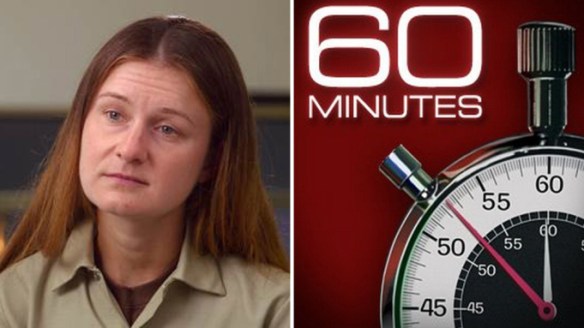
CBS-News carried another bucket of muddy water for the coup team Sunday night with a lead 60 Minutes agit-prop story on Maria Butina, an ambitious Russian cutie who worked the American NRA circuit in the most public manner imaginable to make herself into a sex-bomb celebrity at the exact moment in history when the US Deep State wished to reinforce the fantasy, as Lesley Stahl put it, that “Russia was interfering in our electoral process.”
Of course, Ms. Stahl and her shifty producers left out half the story: how Maria Butina was manipulated by her FBI-handler and sometime-boyfriend, Patrick Byrne, the former Overstock.com CEO who had been employed by the Bureau over the years on other undercover assignments. They didn’t mention him or seek to understand his role in the operation. But they gave plenty of air-time to the DOJ lawyer, John C Demers, who prosecuted Ms. Butina, and never bothered to ask Demers why Butina was not charged with espionage — perhaps because nothing remotely like that occurred.
How media giants like Ms. Stahl can keep mouthing this malarkey designed to stoke a new cold war is one of the great mysteries of our national psychology these days. You’d think they’d learned something from the train wreck of the Mueller Investigation, the Brett Kavanaugh fiasco, and the current debacle of Adam Schiff’s imploding Ukraine whistleblower caper — namely, that spouting lies will eventually get you found-out and disgraced.
But the coup team is now dangerously stuck tripling and quadrupling down on its fairy tale narrative as the reckoning of its dark deeds approaches and its star players await their turns on the witness stand. Half the country has been waiting patiently for authorities-of-standing to put an end to this Hitchcockian campaign of seditious fog that has driven us close to the brink of a second civil war. That half of the country has actually been reading the evidence of this treason and sedition — underwritten by Hillary Clinton and her allies — on the back-channels of the Internet. None of that evidence has been posted through the main media outlets wholly owned by the coup team, gospel to the other half of America, and soon millions of credulous bystanders who got high on three years of CIA-issued RussiaGate Kool-Aid will get the surprise of their lives when they discover how deeply they were played.
The CIA and the FBI are in a fight for their lives now. The evidence shows pretty clearly that these rogue agencies conducted all the election “meddling” of 2016 and that the RussiaGate hysteria was an engineered smokescreen to hide their tracks and cover their asses when the certainty of a Hillary election triumph nauseatingly resolved unfavorably in the cold, gray dawn of 11/8/16. Despite the chatter about an “insurance policy,” they were quite unprepared for the exposure that loomed.
They also badly underestimated the resources of what is now a very sturdy alt.media which has managed to weave the real story of what happened over the past three years into a shocking tapestry of massive subversion and treachery. A big part of the true story is how amazingly incompetent the RussiaGate coupsters were. Did they really believe they could conceal the ties between their agencies and Glenn Simpson’s Fusion GPS operation, and its feckless front man, British ex-spy Christopher Steele, and the whole outfit’s connection to Hillary Clinton and the Democratic National Committee? Did they suppose they could pass off Stephan Halper and Joseph Mifsud as Russian agents when the two have consorted with US and allied intelligence for decades? The US Department of Defense even holds Mr. Halper’s million-dollar pay stubs and Mr. Mifsud appears in photographs of every Western cloak-and-dagger cocktail get-together of spook officialdom for the last twenty years.
The latest, and most desperate gambit is the UkraineGate whistleblower, a CIA employee blatantly playing errand-boy for his mentor John Brennan and deeply tied to 2016 election shenanigans emanating from Ukraine, featuring his former employer, ex-Vice-President Joe Biden. This shadowy figure, pegged as Eric Ciaramella, 33, may shortly find himself in a grand jury chamber answering for his role in this charade. Ciaramella has just been hung out to dry by his sponsor, Rep. Adam Schiff in a desperate attempt to dissociate himself from the huggermugger within his House Intel Committee that preceded the falsely blown whistle.
It’s not an overstatement to say that many of the figures behind this gigantic web of lies and deceit ought to answer charges up to and including treason. The question is whether Messers Barr & Durham have the cojones to cater the banquet of consequences that this huge cast of characters should be made to feast from. Another question is whether these desperate characters and the agencies they represent will go all the way now and attempt to enlist the military brass in an outright overthrow of the executive. There are already intimations of this. It would be answered by the kind of civil violence that has broken out in other parts of world where other Deep States have worn out their welcome — and their legitimacy.
INDIAN COUNTRY NEWS
"It is the duty of every man, as far as his ability extends, to detect and expose delusion and error"..Thomas Paine
Human in Algorithms
From the Roof Top
I See This
blog of the post capitalist transition.. Read or download the novel here + latest relevant posts
अध्ययन-अनुसन्धानको सार
 After the Crash