Mr. Lif (feat. Aesop Rock and El-P)


By Michael Krieger
Source: Liberty Blitzkrieg
Somewhere between the arrest of Jeffrey Epstein and his extremely suspicious death in a Department of Justice operated prison, the public learned that an FBI intelligence bulletin published by the bureau’s Phoenix field office mentioned for the first time that conspiracy theories pose a domestic terrorism threat. This was followed up last week by a Bloomberg article discussing a new project by the U.S. military (DARPA) to identify fake news and disinformation.
We learned:
Fake news and social media posts are such a threat to U.S. security that the Defense Department is launching a project to repel “large-scale, automated disinformation attacks,” as the top Republican in Congress blocks efforts to protect the integrity of elections.
The Defense Advanced Research Projects Agency wants custom software that can unearth fakes hidden among more than 500,000 stories, photos, videos and audio clips. If successful, the system after four years of trials may expand to detect malicious intent and prevent viral fake news from polarizing society.
Recall that after the 2016 election, focus was on social media companies and we saw tremendous pressure placed on these platforms by national security state politicians and distressed Democrats to “do something” about the supposed fake news epidemic. Fast forward three years and it’s now apparently the U.S. military’s job to police human content on the internet. This is the sort of natural regression a society will witness so long as it puts up with incremental censorship and the demonization of any thought which goes against the official narrative.
Before we dissect what’s really going on, allow me to point out the glaringly obvious, which is that politicians, pundits, mass media and the U.S. military don’t actually care about the societal harm of fake news or conspiracy theories. We know this based on how the media sold government lies in order to advocate for the Iraq war, and how many of the biggest proponents of that blatant war crime have gone on to spectacularly lucrative careers in subsequent years. There were zero consequences, proving the point that this has nothing to do with the dangers of fake news or conspiracy theories, and everything to do with protecting the establishment grip on narrative creation and propagation.
The above tweet summarizes what’s really going on. It’s a provable fact that the harm caused by some crazy person reacting to viral “fake news” on social media doesn’t compare with the destruction and criminality perpetrated by oligarchs like Jeffrey Epstein, or governments which destroy entire countries and murder millions without flinching. It’s the extremely wealthy and powerful, as a consequence of their societal status and influence, who are in a position to do the most harm. This isn’t debatable, yet the U.S. military and media don’t seem particularly bothered by this sort of thing. What really keeps them up at night is a realization that the powerless masses of humanity are suddenly talking to one another across borders and coming to their own conclusions about how the world works. You’re supposed to be told what to think, not to think for yourself.
This is what the power structure’s really worried about. It’s terrified that billions of people are now in direct, instantaneous communication with one another and thinking independently about world events. The mass media’s freakout over the election of Donald Trump was never rooted in concerns about the man and his specific policies. What really bothered them was his election proved they no longer matter. Enough people simply ignored the media’s instructions to suck it up and go vote for Hillary Clinton. This repudiation and loss of control was devastating and terrifying for U.S. media personalities and their bosses.
At this point, it’s important to note that what’s happening is exactly what you’d expect after half the people on earth come online and start talking to one another in the midst of an oligarch-fueled epidemic of gangsterism masquerading as democratic government. The advent of the internet created the conditions for cross-border, near instantaneous, peer-to-peer human communication for the first time in history.
We’re still in the very early stages of discovering what it means to live in such a world, but what you’d expect to emerge is precisely what we’ve seen. We see countless streams of diverse narratives emerging to explain what’s happening around us and how power really operates. Humans are no longer accepting the narratives force-fed to them via mass media channels, and are instead talking directly to one another and creating their own narratives. This is exactly how it should be.
Meanwhile, into this increasingly disruptive environment comes the Epstein affair, which I consider another major inflection point in the public’s increased and justified cynicism about the establishment. While the mass media swallows the increasingly clownish official story hook, line and sinker, the public simply isn’t buying it according to recent polls. The most recent one from Emerson College showed that more people think he was murdered than think he committed suicide.
Alternative narratives are openly, and often successfully, competing with the spoon-fed narratives of mass media. Increased numbers are coming to understand that those who craft official narratives (government, mass media, billionaires) have their own interests, and those interests are typically not aligned with the interests of most people. There’s no reason to trust anything mass media or government says, because both groups are dominated by proven liars and war mongers. This obviously doesn’t mean you should believe everything you read online, but we must maintain perspective. Fake news from powerless citizens doesn’t compete with fake news from the government when it comes to disastrous consequences, yet the focus is always centered on the former and never the latter.
There’s a reason the U.S. military is suddenly talking about fighting fake news and disinformation, and the reason is the power structure is terrified of humans talking to each other and coming to their own conclusions. Moreover, this isn’t limited to an interpretation of world events. The emergence and success of Bitcoin represents a global movement of humans propagating an alternative narrative about money, how it could and how it should work. The longer human beings are allowed to freely talk to one another, the more likely they are to reject official narratives and shape society in a more sane manner. This represents an existential threat to the power structure. And they know it.
It’s also why CNN anchor Chris Cuomo instructed his viewers to not pay attention to those who were closest to Jeffrey Epstein.
Now the good news. I think the cat’s already out of the bag. People aren’t going back to simply swallowing official narratives regurgitated by some television mannequin with makeup and an expensive suit who’s being paid by a billionaire. This doesn’t mean there won’t be a fight; in fact, we’re already in it.
Going forward, I suspect the narrative managers will more aggressively label anyone who doesn’t toe the official line as somehow linked to or sympathetic with foreign governments. They won’t offer any proof, but they’ll claim it authoritatively. This will become an increasingly potent weapon as governments begin to more intensely scapegoat foreign nations as the root of all our problems. We’ve already seen this since the 2016 election, but I expect it to increase in frequency and force.
As such, it’s going to be increasingly important for all of us to retain control of our minds and emotions as much as possible. We must never forget the importance of critical thinking, and must adamantly defend the right of humans to talk to one another freely and come to our own conclusions. We must never forget how preposterous it is to assume media giants owned by billionaires have any interest in telling us the truth about anything.
So keep writing, keep talking, keep thinking and never lose sight of the big picture. We have the power to create our own narratives, and with it, a much better future for generations to come.

By Stephen Lendman
Source: StephenLendman.com
On major issues mattering most, especially geopolitical ones, the NYT is a lying machine, a propaganda machine, an anti-truth telling operation, a virtual state-sponsored ministry of deception, masquerading as real news, information and opinion.
Whenever the US wages preemptive wars of aggression on nonbelligerent states threatening no one, or in their run-up, the Times cheerleads high crimes of war and against humanity instead of denouncing them.
It consistently and repeatedly blames victims of US aggression for high crimes committed against them — Syria one of numerous examples of its abandonment of journalism the way it should be for disinformation, Big Lies and fake news.
The Times falsely accused Syrian forces of attacking hospitals numerous times, a Pentagon terror-bombing specialty it ignores.
An earlier report turned truth on its head, claiming Syrian President “Assad attacks medical facilities to break the will of the people — and to destroy evidence of his war crimes” — a bald-faced Big Lie.
The Times calls US aggression on Syria “civil war.” There’s nothing remotely “civil” about it. US-supported cutthroat killer jihadists are referred to as “rebels.”
Most of their fighters are imported from scores of foreign countries, including Western ones — armed, funded and directed by the US and its imperial partners.
In its latest edition, the Times reported on what it called “a journey through shattered Syria” — ignoring mass slaughter, vast destruction, and widespread human misery caused by US-led aggression, along with using ISIS and other terrorists as proxy foot soldiers.
What’s vital to report, the Times consistently suppresses, substituting managed new misinformation and disinformation instead.
Why Assad’s government granted permission to the Times lying machine to visit the war-torn country was unexplained.
In the Damascus countryside, “there were few young men,” it reported.
Most youths are likely involved in defending their country against US-led aggression and jihadists it supports — what the self-styled newspaper of record suppresses.
Instead it claimed they “died in the war, (were) thrown in prison or scattered far beyond Syria’s borders.”
Many indeed died at the hands of US-supported jihadists or Pentagon terror-bombing. Claiming they were thrown in prison is a bald-faced Big Lie, a Times specialty about the war and all others the US wages.
Three Times propagandists visited Syria to see the devastation firsthand. Saying “infrastructure needs rebuilding” failed to explain its destruction by Pentagon-led terror-bombing and attacks by US-supported jihadists.
The Times lied claiming Assad “presided over the destruction.” It complained about not getting permission “to roam freely,” expressed angst as well that most Syrians met and spoken to expressed support for Assad.
In June 2014, he was overwhelmingly reelected president with an 89% majority — independent international monitors calling the process open, free and fair.
The Times and other Western media falsely claimed otherwise. Syrians want no one else leading them. They’re clearly hostile to the US, other Western, and Israeli interests.
The Jewish state is responsible for terror-bombing the country hundreds of times by its own admission — on the phony pretext of combatting an Iranian threat that doesn’t exist.
Syria and its people are struggling for the country’s soul, victimized by US-led aggression.
War in its 9th year continues with no end of it in prospect because both extremist right wings of the US war party oppose restoration of peace and stability to the country.
Instead of reporting accurately on what’s gone on and continues endlessly, including illegal US occupation of northern and southern Syrian territory — the Times falsely blames Assad for US high crimes committed against the country and its people.

Art by Arik Roper
By Michael Grasso
Source: We Are the Mutants
Two months ago, I devoured Erik Davis’s magisterial 2019 book High Weirdness: Drugs, Esoterica, and Visionary Experience in the Seventies the same weekend I got it, despite its 400-plus pages of sometimes dense, specialist prose. And for the past two months I have tried, in fits and starts, to gather together my thoughts on it—failing every single time. Sometimes it’s been for having far too much to say about the astonishing level of detail and philosophical depth contained within. Sometimes it’s been because the book’s presentation of the visionary mysticism of three Americans in the 1970s—ethnobotanist and psychonaut Terence McKenna, parapolitical trickster Robert Anton Wilson, and paranoid storyteller-mystic Philip K. Dick—has hit far too close to home for me personally, living in the late 2010s in a similarly agitated political (and mystical) state. In short, High Weirdness has seemed to me, sitting on my bookshelf, desk, or in my backpack, like some cursed magical grimoire out of Weird fiction—a Necronomicon or The King in Yellow, perhaps—and I became obsessed with its spiraling exploration of the unfathomable universe above and the depthless soul below. It has proven itself incapable of summary in any linear, rationalist way.
So let’s dispense with rationalism for the time being. In the spirit of High Weirdness, this review will try to weave an impressionistic, magical spell exploring the commonalities Davis unveils between the respective life’s work and esoteric, drug-aided explorations of McKenna, Wilson, and Dick: explorations that were an attempt to construct meaning out of a world that to these three men, in the aftermath of the cultural revelations and revolutions of the 1960s that challenged the supposed wisdom and goodness of American hegemony, suddenly offered nothing but nihilism, paranoia, and despair. These three men were all, in their own unique ways, magicians, shamans, and spiritualists who used the tools at their disposal—esoteric traditions from both East and West; the common detritus of 20th century Weird pop culture; technocratic research into the human mind, body, and soul; and, of course, psychedelic drugs—to forge some kind of new and desperately-needed mystical tradition in the midst of the dark triumph of the Western world’s rationalism.
A longtime aficionado of Weird America, Davis writes in the introduction to High Weirdness about his own early encounters with Philip K. Dick’s science fiction, the Church of the SubGenius, and other underground strains of the American esoteric in the aftermath of the ’60s and ’70s. As someone who came late in life to a postgraduate degree program (High Weirdness was Davis’s doctoral dissertation for Rice University’s Religion program, as part of a curriculum focus on Gnosticism, Esotericism, and Mysticism), I find it incredibly easy to identify with Davis’s desire to tug at the edges of his longtime association with and love for the Weird in a scholarly context. This book’s scholarly origins do not make High Weirdness unapproachable to the layperson, however. While Davis does delve deeply into philosophical and spiritual theorists and the context of American mysticism throughout the book, he provides succinct and germane summaries of this long history, translating the work of thinkers as diverse as early 20th century psychologist and student of religious and mystical experience William James to contemporary theorists such as Peter Sloterdijk and Mark Fisher. Davis’s introduction draws forth in great detail the long tradition of admitting the ineffable, the scientifically-inexplicable, into the creation of subjective, individual mystical experiences.
Primary among Davis’s foundational investigations, binding together all three men profiled in the book, is a full and thorough accounting of the question, “Why did these myriad mystical experiences all occur in the first half of the 1970s?” It’s a fairly common historical interpretation to look at the Nixon years in America as a hangover from the cultural revolution of the late 1960s, a retrenchment of Nixon’s “silent majority” of middle- and working-class whites vs. the perceived chaos of a militant student movement and identity-based politics among racial and sexual minorities. Davis admits that the general mystical seeking that went on in the early ’70s is a reaction to this revanchism. And while he quotes Robert Anton Wilson’s seeming affirmation of this idea—“The early 70s were the days when the survivors of the Sixties went a bit nuts”—his interest in the three individuals at the center of his study allows him to delve deeper, offering a more profound explanation of the politics and metaphysics of the era. In the immediate aftermath of the assassinations, the political and social chaos, and the election of Nixon in 1968, there was an increased tendency among the younger generation to seek alternatives to mass consumption culture, to engage in what leftist philosopher Herbert Marcuse would term “the Great Refusal.” All three of the figures Davis focuses on in this book, at some level or another, decided to opt out of what their upbringings and conformist America had planned for them, to various levels of harm to their livelihoods and physical and mental health. This refusal was part of an awareness of what a suburban middle-class life had excised from human experience: a sense of meaning-making, of a more profound spirituality detached from the streams of traditional mainline American religious life.
To find something new, the three men at the center of High Weirdness were forced to become bricoleurs—cobbling together a “bootstrap witchery,” in Davis’s words—from real-world occult traditions (both Eastern and Western); from the world of Cold War technocratic experimentation with cybernetics, neuroscience, psychedelics, and out-and-out parapsychology; and from midcentury American pop culture, including science fiction, fantasy, comic books, and pulp fiction. Davis intriguingly cites Dick’s invention of the term “kipple” in his 1968 novel Do Androids Dream of Electric Sheep? as a key concept in understanding how this detritus can be patched together and brought new life. Given Dick’s overall prescience in predicting our 21st century world of social atomization and disrepair, this seems a conceptual echo worth internalizing a half-century later. If the late 1960s represented a mini-cataclysm that showed a glimpse of what a world without the “Black Iron Prison” might look like, those who graduated to the 1970s—the ones who “went a bit nuts”—needed to figure out how to survive by utilizing the bits and scraps left behind after the sweeping turbulence blew through. In many ways, McKenna, Wilson, and Dick are all post-apocalyptic scavengers.
All three men used drugs extensively, although not necessarily as anthropotechnics specifically designed to achieve enlightenment (Davis notes that Dick in particular had preexisting psychological conditions that, in conjunction with his prodigious use of amphetamines in the 1960s, were likely one explanation for his profound and sudden breaks with consensus reality in the ’70s). But we should also recognize (as Davis does) that McKenna, Wilson, and Dick were also, in many ways, enormously privileged. As well-educated scions of white America, born between the Great Depression and the immediate aftermath of World War II, they had the luxury to experiment with spirituality, psychedelic drugs, and technology to various degrees while holding themselves consciously separate from the mainstream institutions that would eventually co-opt and recuperate many of these strains of spirituality and individual seeking into the larger Spectacle. As Davis cannily notes, “Perhaps no one can let themselves unravel into temporary madness like straight white men.” But these origins also help explain the expressly technocratic bent of many of their hopes (McKenna) and fears (Wilson and Dick). Like their close confederate in Weirdness, Thomas Pynchon (who spent his early adulthood working for defense contractor Boeing, an experience which allowed him a keener avenue to his literary critiques of 20th century America), all three men were adjacent to larger power structures that alternately thrilled and repelled them, and which also helped form their specific esoteric worldviews.
It would be a fool’s errand to try to summarize the seven central chapters of the book, which present in great detail Terence (and brother Dennis) McKenna’s mushroom-fueled experiences contacting a higher intelligence in La Chorrera, Colombia in 1971, Robert Anton Wilson’s LSD-and-sex-magick-induced contact with aliens from the star Sirius in 1973 and ’74 as detailed in his 1977 book Cosmic Trigger: The Final Secret of the Illuminati, and Philip K. Dick’s famous series of mystical transmissions and revelations in February and March of 1974, which influenced not only his fiction output for the final eight years of his life but also his colossal “Exegesis,” which sought to interpret these mystical revelations in a Christian and Gnostic context. Davis’s book is out there and I can only encourage you to buy a copy, read these chapters, and revel in their thrilling detail, exhilarating madness, and occasional absurdity. Time and time again, Davis, like a great composer of music, returns to his greater themes: the environment that created these men gave them the tools and technics to blaze a new trail out of the psychological morass of Cold War American culture. At the very least, I can present some individual anecdotes from each of the three men’s mystical experiences, as described by Davis, that should throw some illumination on how they explored their own psyches and the universe using drugs, preexisting religious/esoteric ritual, and the pop cultural clutter that had helped shape them.
Davis presents a chapter focusing on each man’s life leading up to his respective spiritual experiences, followed by a chapter (in the case of Philip K. Dick, two) on his mystical experience and his reactions to it. For Terence McKenna and his brother Dennis, their research into organic psychedelics such as the DMT-containing yagé (first popularized in the West in the Cold War period by William S. Burroughs), alternately known as oo-koo-hé or ayahuasca, led them to South America to find the source of these natural, indigenous entheogens. But at La Chorrera in Colombia they instead met the plentiful and formidable fungus Psilocybe cubensis. In their experiments with the mushroom, Terence and Dennis tuned into perceived resonances with long-dormant synchronicities within their family histories, their childhood love of science fiction, and with the larger universe. Eventually, Dennis, on a more than week-long trip on both mushrooms and ayahuasca, needed to be evacuated from the jungle, but not before he had acted as a “receiver” for cryptic hyper-verbal transmissions, the hallucinogens inside him a “vegetable television” tuned into an unseen frequency—a profound shamanic state that Terence encouraged. The language of technology, of cybernetics, of science is never far from the McKenna brothers’ paradigm of spirituality; the two boys who had spent their childhoods reading publications like Analog and Fate, who had spent their young adulthoods studying botany and science while deep in the works of Marshall McLuhan (arguably a fellow psychedelic mystic who, like the McKennas and Wilson, was steeped in a Catholic cultural tradition), used the language they knew to explain their outré experiences.
Wilson spent his 20s as an editor for Playboy magazine’s letters page and had thus been exposed to the screaming gamut of American political paranoia (while contributing to it in his own inimitable prankster style). He had used this parapolitical wilderness of mirrors, along with his interest in philosophical and magickal orientations such as libertarianism, Discordianism, and Crowleyian Thelema as fuel for both the Illuminatus! trilogy of books written with Robert Shea (published in 1975), and his more than year-long psychedelic-mystical experience in 1973 and 1974, during which he claimed to act as a receiver on an “interstellar ESP channel,” obtaining transmissions from the star Sirius. His experiences as detailed in Cosmic Trigger involve remaining in a prolonged shamanic state (what Wilson called the “Chapel Perilous,” a term redolent with the same sort of medievalism as the McKenna brothers’ belief that they would manifest the Philosopher’s Stone at La Chorrera), providing Wilson with a constant understanding of the universe’s playfully unnerving tendency towards coincidence and synchronicity. Needless to say, the experiences of one Dr. John C. Lilly, who was also around this precise time tuned into ostensible gnostic communications from a spiritual supercomputer, mesh effortlessly with Wilson’s (and Dick’s) experiences thematically; Wilson even used audiotapes of Lilly’s lectures on cognitive meta-programming to kick off his mystical trances. Ironically, it was UFO researcher and keen observer of California’s 1970s paranormal scene Jacques Vallée who helped to extract Wilson out of the Chapel Perilous—by retriggering his more mundane political paranoia, saying that UFOs and other similar phenomena were instruments of global control. In Davis’s memorable words, “Wilson did not escape the Chapel through psychiatric disenchantment but through an even weirder possibility.”
Philip K. Dick, who was a famous science fiction author at the dawn of the ’70s, had already been through his own drug-induced paranoias, political scrapes, and active Christian mystical seeking. Unlike McKenna and Wilson, Dick was a Protestant who had stayed in close contact with his spiritual side throughout adulthood. In his interpretation of his mystical 2-3-74 experience, Dick uses the language and epistemology of Gnostic mystical traditions two millennia old. Davis also notes that Dick used the plots of his own most overtly political and spiritual ’60s output to help him understand and interpret his transcendent experiences. Before he ever heard voices or received flashes of information from a pink laser beam or envisioned flashes of the Roman Empire overlapping with 1970s Orange County California, Dick’s 1960s novels, specifically The Three Stigmata of Palmer Eldritch (1965) and Ubik (1969), had explored the very nature of reality and admitted the possibility of a Gnostic universe run by unknowable, cruel demiurges. Even in these hostile universes, however, there exists a messenger of hope and mercy who seeks to destroy the illusion of existence and bring relief. These existing pieces of cultural and religious “kipple,” along with the parasocial aspects of Christian belief that were abroad in California at the time, such as the Jesus People movement (the source of the Ichthys fish sign that triggered the 2-3-74 experience), gave Dick the equipment he needed to make sense of the communications he received and the consoling realization that he was not alone, that he was instead part of an underground spiritual movement that acted as a modern-day emanation of the early Christian church.
After learning about these three figures’ shockingly similar experiences with drug-induced contact with beyond, the inevitable question emerges: what were all these messages, these transmissions from beyond, trying to convey? One common aspect of all three experiences is how cryptic they are (and how difficult and time-consuming it was for each of these men to interpret just what the messages were saying). It’s also a little sobering to discover through Davis’s accounts how personal all three experiences were, whether it’s Terence and Dennis’s private fraternal language during the La Chorrera experiment, or mysterious phone calls placed back in time to their mother in childhood, or a lost silver key that Dennis was able to, stage-magician-like, conjure just as they were discussing it, or the message Philip K. Dick received to take his son Christopher to the doctor for an inguinal hernia that could have proven fatal. But alongside these personal epiphanies, there is also always an undeniable larger social and political context, especially as both Wilson and Dick saw their journeys in 1973 and 1974 as a way to confront and deal with the intense paranoia around Watergate and the fall of Richard Nixon (in his chapter setting the scene of the ’70s, Davis calls Watergate “a mytho-poetic perversion of governance”). In every case, the message from beyond requires interpretation, meaning-making, and, in Davis’s terminology, “constructivism.” The reams of words spoken and written by all three men analyzing their respective mystical experiences are an essential part of the experience. And these personal revelations all are attempts by the three men to make sense of the chaos of both their personal lives and their existence in an oppressive 20th century technocratic society: to inject some sense of mystery into daily existence, even if it took the quasi-familiar and, yes, somewhat comforting form of transmissions from a mushroom television network or interstellar artificial intelligence.
Over the past nine months I’ve spent much of my own life completing (and recovering from the process of completing) a Master’s degree. My own academic work, focusing on nostalgia’s uses in binding together individuals and communities with their museums, tapped into my earliest memories of museum visits in the late 1970s, when free education was seemingly everywhere (and actually free), when it was democratic and diverse, when it was an essential component of a rapidly-disappearing belief in social cohesion. In a lot of ways, my work at We Are the Mutants over the past three years is the incantation of a spell meant to conjure something new and hopeful from the “kipple” of a childhood suffused in disposable pop culture, the paranormal and “bootstrap witchery,” and science-as-progress propaganda. At the same time, over the past three years the world has been at the constant, media-enabled beck and call of a figure ten times more Weird and apocalyptic and socially malignant than any of Philip K. Dick’s various Gnostic emanations of Richard Nixon.
Philip K. Dick believed he was living through a recapitulation of the Roman Empire, that time was meaningless when viewed from the perspective of an omniscient entity like VALIS. In the correspondences and synchronicities I have witnessed over the past few months—in the collapse of political order and the revelation of profound, endemic corruption behind the scenes of the ruling class—this sense of recurring history has sent me down a similar set of ecstatic and paranoid corridors as McKenna, Wilson, and Dick. The effort to find meaning in a world that once held some inherent structure in childhood but has become, in adulthood, a hollow facade—a metaphysical Potemkin village—is profoundly unmooring. But meaning is there, even if we need technics such as psychedelic drugs, cybernetics (Davis’s final chapter summarizing how the three men’s mystical explorations fed into the internet as we know it today is absolutely fascinating), and parapolitical activity to interpret it. On this, the 50th anniversary of the summer of 1969, commonly accepted as the moment the Sixties ended, with echoes of moon landings and Manson killings reverberating throughout the cultural theater, is it any wonder that the appeal of broken psychonauts trying to pick up the pieces of a shattered world would appeal to lost souls in 2019? High Weirdness as a mystical tome remains physically and psychically close to me now, and probably will for the remainder of my life; and if the topics detailed in this review intrigue you the way they do me, it will remain close to you as well.
By Brian Thomas
Source: Night Flight
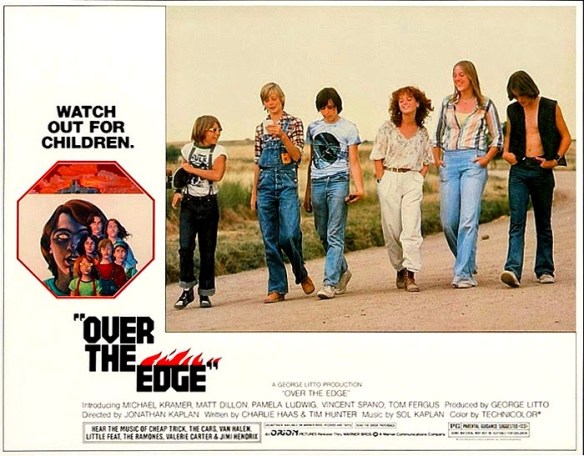
We’ll get to Cheap Trick’s contributions to the soundtrack in a moment, but first let’s take a look back at the film itself. When Over The Edge was released to just a handful of theaters in May 1979, the relatively new Orion movie company’s first poster and marketing campaign for the film — featuring pale kids with empty eyes, looking like zombies — got it very wrong, very wrong, making it look like they were promoting a horror movie.
Orion — the new film finance and production company had been launched in March 1978 — had been formed by five former United Artists film execs, who named their new company after a constellation that contains five clearly visible stars, and despite their confidence, they weren’t too sure-footed as a stand-alone company yet, and like any new movie company, they wanted their first release to be a hit.
Originally, they’d slated another film — director George Roy Hill’s A Little Romance — to be their first release, and Over The Edge was to be their second released in 1979.
Executives at Orion, however, were initially troubled by some of the violence they’d read in the script (there really isn’t much dude-on-dude violence, though) and they wanted the screenwriters to tone it down, and make it into a kind of Romeo & Juliet love story amid a larger story of disenfranchised youth, but the writers held firm to their original concept (originally it was titled On The Edge).
Written by screenwriter Tim Hunter — son of blacklisted screenwriter Ian McClellan Hunter — and Charles Haas, a fellow screenwriter and one of Hunter’s former film history students at UC Santa Cruz, Over The Edge was inspired by a newspaper article about the then-recent uptick in juvenile crime in Foster City, an upper-middle class planned suburb located about halfway between Palo Alto and San Francisco in Northern California, not too far from the San Francisco Airport.
The story — headlined “Mousepacks: Kids on a Crime Spree” — had been published in the November 11, 1973 edition of the San Francisco Examiner, written by reporters Bruce Koon and James Finefrock.
Writer Mike Sacks’s excellent oral history for VICE remains thus far the most definitive essay and oral history about Over The Edge, and we encourage you to check it out, since it contained just about everything you’d want to know about the film itself, and featured interviews with twenty members of the cast and crew.
Sacks quotes from the original newspaper article in his piece for VICE:
“Mousepacks. Gangs of youngsters, some as young as nine, on a rampage through a suburban town. One on a bike pours gasoline from a gallon can and sets it afire. Lead pipe bombs explode in park restrooms. Spray paint and obscenities smear a shopping center wall. Two homes are set ablaze. Antennas by the hundreds are snapped off parked cars in a single night. Liquid cement clogs public sinks and water fountains. Street lights are snuffed out with BB guns so often they are no longer replaced. It sounds like the scenario for an underage Clockwork Orange, a futuristic nightmare fantasy. But all the incidents are true. They happened in Foster City where pre-teenage gangs—mousepacks—constitute one of the city’s major crime problems.”
The original article detailed how teens had gone into a local junior high gymnasium — probably Nathaniel Bowditch Middle School — and destroyed pool tables and ping-pong tables, and the vandalism had led to the cancellation of programs that were sponsored by the Foster City parks department.
This kind of vandalism was directly related to the fact that the city planners who had designed the ideal communities like Foster City had thought of everything for the adults, but they forgot the fact that at least 25% of the population moving into these pre-fab cities were under the age of 25.
They were given pool and ping-pong tables at the gym, and lame recreation centers that closed at 6pm, but everything was so new and fake-looking it inspired the teens to want to destroy it.
And so, the kids of Foster City felt isolated, restless and bored out of their minds, which is what led to them spending their evenings drinking and getting high, breaking and entering, and vandalizing city property.
Hunter’s and Haas’s screenplay reflected this adolescent ennui perfectly, showing how the design and planning of their pre-fab city New Granada (in place of Foster City) actually plays a part, like a character itself, in how these teens felt about where they were living, and what was going on in their lives.
The director of Over The Edge, Jonathan Kaplan, should be and has been given a lot of credit for bringing Hunter’s and Haas’s vision to the screen. The son of film composer Sol Kaplan and actress Frances Heflin, he had gone to NYU film school and where as an undergrad, Martin Scorsese was one of his professors.
He had directed just one major picture, in 1975, White Line Fever, and also directed the infamous Sex Pistols movie called Who Killed Bambi?, prior to getting this job, coming in to replace Russ Meyer for a spell before the film fell apart completely.
Kaplan — just thirty years old at the time — apparently had a real connection with his youthful cast, this despite the stress everyone felt onset, having a 36-day shoot schedule, with most of the film’s night scenes hurriedly going before cameras first, forcing the young cast to sleep days and bond over long hours at night.
The production itself had to be moved from California, due to the state’s rigid child labor laws, to two locations in Colorado — Greeley and Aurora, roughly ten miles from Colombine High.
Before then, however, Kaplan had to find his cast, and due to both budget constraints and wanting to find unknown young actors who were actually fourteen (rather than find experienced 20-year olds who could look 14), he began working on the casting, out of New York, meeting with more professional young actors, while Hunter and Haas began going to schools and asking the principals or drama teachers to recommend students: those kids turned out to be wrong, but they eventually found the right students by meeting kids who had cut class and were found smoking pot behind the school.
One of those students was Matt Dillon, who was found at a middle school in Westchester, New York, cutting class and smoking in the boy’s room. He had a chipped tooth, and he tried to act tough when they began talking to him about his interest in acting.
Kaplan and talent scout Jane Bernstein asked him what his parents did, and Dillon told them his father was “a fucking stockbroker and my mom, she don’t do shit.”
They met with his family and realized he was as middle-class as they come, perfect for the role although he had zero acting experience. After all, Matt Dillon was only 14.
One of the best things about the movie, though, which everyone involved got right — and all credit must be given to the director, and to the young members of his cast — was the film’s soundtrack.
According to what actress Pamela Ludwig told writer Mike Sacks, during filming, the young cast would bring a boombox with them to wherever they were shooting, and they would rock out to whatever they were listening to at the time — including songs by The Cars (“My Best Friend’s Girl” and “Just What I Needed”), Van Halen (“You Really Got Me”), the Ramones (“Teenage Lobotomy”), Joe Walsh, etc. — and she even playing tracks by bands that weren’t quite well known just yet, particularly and most importantly, songs by Rockford, Illinois-based rockers Cheap Trick.
Ludwig is practically credited as a music supervisor because she turned the cast and the crew on to Cheap Trick’s albums (her boyfriend, a roadie, had made her tapes of albums that weren’t yet widely known about, and certainly not being played on the radio), and four of their songs would eventually make their way into the film — “Surrender,” “Speak Now or Forever Hold Your Peace,” “Hello There,” and “Downed” –– and on to the film’s LP soundtrack, which is worth a lot of money today if you can find yourself a copy.
You can get a real sense for how wrong the trailer was for the film (which feels more like a horror movie — more about that in a sec) by watching the first few minutes of the actual film itself, the first image onscreen being a billboard advertising “New Granada: Tomorrow’s city… today” (later, another billboard, this time one that is being dismantled, reads “New Granada: Ideal business environment”), to the churning rock guitars of Cheap Trick’s “Speak Now or Forever Hold Your Peace,” from their self-titled debut.
The lyrics — the song, one of Cheap Trick’s few cover songs, was written and previously recorded by British rocker Terry Reid — are pitch-perfect:
Yesterday feels like running away
Feels like givin’ the child gettin’ lost losin’ my mind
I’m feelin’ low and i got no place to go
Gettin’ all tied up, feelin’ all tied up yeah
The action gets underway as two teens on a highway overpass begin firing on a police car with a BB rifle.
Their nemesis, Sgt. Doberman (Harry Northup), loses the snipers in a chase and instead grabs 14-year-old Carl Willat (Michael Kramer) and his friend Richie White (Matt Dillon) while they’re walking home, but Richie — who is currently on probation for breaking and entering — refuses to cooperate with Doberman’s questions. Carl’s record is clean and his Cadillac salesman father (Andy Romano) wants to keep it that way so his son won’t end up in reform school on “The Hill.”
All Carl wants to do is to listen to Cheap Trick on his headphones, and it’s pretty great to hear their music in this film considering they were a band who were relatively unknown but were just beginning to break in the U.S. at the time the movie was being filmed, in 1978.
By the time of the film’s release, in 1979, Cheap Trick — lead singer Robin Zander, guitarist Rick Nielsen, bassist Tom Petersson and drummer Bun E. Carlos — had released three albums: their 1977 self-titled debut, followed by In Color (also 1977), and Heaven Tonight (1978) — and although all three were critically-acclaimed by the rock media, none of them were selling particularly well at the time and certainly none had cracked the Top 40.
Things were about to change, however, for Cheap Trick, who toured incessantly then as they do now, playing any gig that came their way. Their reputation was that they were a solid opening band — they played shows with Kiss, Queen, Aerosmith, Motley Crüe, and did a co-headlining tour with AC/DC.
Despite still being relatively unknown in America, it turns out that they were huge in Japan in 1978, where all three albums had gone gold. In April 1978, they had even done their first Japanese tour, flying coach and stepping off their plane to find that there were thousands of Japanese fans waiting for them at the airport.
They ended up having to have 24-hour guards posted at their hotel, and decided to record two of their shows, at at Tokyo’s famous Nippon Budokan, for a Japan-only live album, Cheap Trick At Budokan.
However, a funny thing caught their label, Epic Records, off-guard, when import copies of the album (released in Sept. ’78) began flying off the shelves, and radio stations across the country began playing the raucous live versions of “Surrender” and “I Want You to Want Me,” and they very quickly released a domestic version of Cheap Trick At Budokan in the States, which would eventually sell over three million copies and climbing the Billboard album charts to #4.
Of the songs included on the Over The Edge soundtrack, “Surrender” seems to be the one that perhaps captures the best overall vibe of the film’s teen angst, getting the feeling that most teenagers feel about their parents absolutely right: they’re fucking weird.
“Surrender” is the lead-off track on the movie soundtrack, and the unofficial theme song too, accompanying one of the movie’s best scenes, which takes place in an unfinished tract home that the boys have taken to calling “their apartment,” where we see a blissed-out Cory (played by the aforementioned Pamela Ludwig) dancing wildly to the song while waving a gun around, imitating guitarist Rick Nielsen’s onstage antics.
You’ll have to watch the clip (or better yet, the movie) to see what happens.
Another great Cheap Trick tune that makes it into the film, and onto the soundtrack, is “Hello There,” which is the perfect introductory song, kicking off both their In Color album and their live album too. (You can hear some of the song in one of the clips we’ve included here).
“Hello There” lyrically serves many functions as a lead-off song, including as an enticement, a greeting to the audience, and an invitation to join in on the fun (and to perhaps smoke a joint?):
Hello there ladies and gentlemen
Hello there ladies and gents
Are you ready to rock?
Are you ready or not?
Would you like to do a number with me?
However, it’s also interesting to note that it was originally written by the band as a song they could play as the first song in their set (it’s less than two-minutes long, too), effectively serving as a soundcheck when they weren’t given one (many opening acts don’t often get the chance to test the sound systems in most clubs and arenas).
It introduces each instrument, one at a time — drums, guitar, bass, voice — and by the time Zander’s voice kicks in, the band’s sound mix was usually figured out, and they could move quickly into playing the rest of their set.
The last song included on the soundtrack and in the film is “Downed,” and we thought we’d share this write-up by our friend, writer Kim Morgan, who wrote about the song in 2006 for her Sunset Gun blog:
“As of now, I can’t stop listening to one of my favorite songs (of all songs) ‘Downed’ from the brilliant album In Color. It’s such a curiously sad, yet wonderfully fuck-it-all song that, of late it makes my head spin and burn and think and feel and and yearn and feel happy. If you’re going through anything, if you feel a little crazy it’s cathartic beyond reason. This just runs through my brain: “Downed, downed out of my head… I’m going to live in a mountain way down under in Australia. It’s either that or suicide. It’s such a strange strain on you. Oooh, I got a mind.” I got a mind. If a song makes you feel happy and crazy all at once that’s a truly awesome (and awesome, that word, used the correct way). I’m going to listen again because I think it may be one of the top five greatest songs ever recorded. Top three. I got a mind.”
The film was supposed to end with the Who’s “Baba O’Riley” playing as the bus heads off towards the prison, but Kaplan told Sacks that it proved too expensive to license, so the producers went a different direction, replacing the “teenage wasteland” lyrics of the Who with Valerie Carter’s riveting cover of “O-o-h Child,” which had a more optimistic feel to it (“things are going to get easier”).
According to an interview Kaplan did decades later with the Village Voice (August 14, 2001), while the film was still in production, a new L.A. Times article had been published, declaring that the coming trend in motion pictures that year was going to be “gang movies,” and so according to Kaplan, Over The Edge “got lumped in with The Warriors, The Wanderers, Boulevard Nights.”
Kaplan: “The Warriors was a huge hit [it had been released in February 1979], but there was violence in the theaters; two people got killed, and they pulled [the advertisements for] the picture because it was such bad publicity for the studio.”
Indeed, The Warriors was blamed for a shooting death that took place at at a Palm Springs, California drive-in, and for a fatal stabbing that same night in Oxnard, another California city. Three nights later, in Boston, there was another stabbing death by kids who had just seen a screening of the film.
The Orion execs were afraid that the advance press about “another gang movie” was going to hurt their business, and they were also afraid of “copycat violence,” so they screened the film for a few weeks in New York and L.A. and then shelved it.
It did get a nice review in 1979 from Roger Ebert, who describes the film’s setting perfectly:
“The movie’s set on those dry, rolling plains west of Denver, where suburbia creeps toward Boulder, and Boulder creeps back. The name of this suburb is New Granada—an oasis of split-level homes and streets curving gracefully toward their dead-ends at the end of the development. The soft plops of tennis balls tick away the afternoons. Oh, and there are kids here, too. They hang out at a Quonset hut that’s the local youth center, and if you know the right kid you can get a deal on grass, hash, ludes, speed, whatdaya need?”
Over The Edge‘s influence has been very widespread. It first started to show up on cable, on HBO, in the 80s and became a regular featured movie there, rescuing it from relatively obscurity.
Jodie Foster saw Over The Edge and wanted to work with Kaplan, saying “Over The Edge was the only teen movie that made any sense.” She ended up with a starring role in Kaplan’s The Accused, and won an Oscar.
In the early 90s, the music video for Nirvana’s bit hit “Smells Like Teen Spirit,” filmed on a soundstage in Culver City, made to look like the inside the gym at L.A.’s Fairfax High, and it appeared greatly influenced by Over The Edge.
Kurt Cobain had said it was a favorite film, and told writer Michael Azerrad “That movie pretty much defined my whole personality. It was really cool. Total anarchy.” (Come As You Are: The Story of Nirvana).
Watch the full film here.

By John W. Whitehead
Source: The Rutherford Institute
“The most dangerous man to any government is the man who is able to think things out … without regard to the prevailing superstitions and taboos. Almost inevitably he comes to the conclusion that the government he lives under is dishonest, insane, intolerable.” — H. L. Mencken
The U.S. government is working hard to destabilize the nation.
No, this is not another conspiracy theory.
Although it is certainly not far-fetched to suggest that the government might be engaged in nefarious activities that run counter to the best interests of the American people, doing so will likely brand me a domestic terrorist under the FBI’s new classification system.
Observe for yourself what is happening right before our eyes.
Domestic terrorism fueled by government entrapment schemes. Civil unrest stoked to dangerous levels by polarizing political rhetoric. A growing intolerance for dissent that challenges the government’s power grabs. Police brutality tacitly encouraged by the executive branch, conveniently overlooked by the legislatures, and granted qualified immunity by the courts. A weakening economy exacerbated by government schemes that favor none but a select few. An overt embrace of domestic surveillance tactics if Congress goes along with the Trump Administration’s request to permanently re-authorize the NSA’s de-activated call records program. Heightened foreign tensions and blowback due to the military industrial complex’s profit-driven quest to police and occupy the globe.
The seeds of chaos are being sown, and it’s the U.S. government that will reap the harvest.
Mark my words, there’s trouble brewing.
Better yet, take a look at “Megacities: Urban Future, the Emerging Complexity,” a Pentagon training video created by the Army for U.S. Special Operations Command.
The training video is only five minutes long, but it says a lot about the government’s mindset, the way its views the citizenry, and the so-called “problems” that the government must be prepared to address in the near future through the use of martial law.
Even more troubling, however, is what this military video doesn’t say about the Constitution, about the rights of the citizenry, and about the dangers of locking down the nation and using the military to address political and social problems.
The training video anticipates that all hell will break loose by 2030—that’s barely ten short years away—but the future is here ahead of schedule.
We’re already witnessing a breakdown of society on virtually every front.
By waging endless wars abroad, by bringing the instruments of war home, by transforming police into extensions of the military, by turning a free society into a suspect society, by treating American citizens like enemy combatants, by discouraging and criminalizing a free exchange of ideas, by making violence its calling card through SWAT team raids and militarized police, by fomenting division and strife among the citizenry, by acclimating the citizenry to the sights and sounds of war, and by generally making peaceful revolution all but impossible, the government has engineered an environment in which domestic violence is becoming almost inevitable.
The danger signs are screaming out a message
The government is anticipating trouble (read: civil unrest), which is code for anything that challenges the government’s authority, wealth and power.
According to the Pentagon training video created by the Army for U.S. Special Operations Command, the U.S. government is grooming its armed forces to solve future domestic political and social problems.
What they’re really talking about is martial law, packaged as a well-meaning and overriding concern for the nation’s security.
The chilling five-minute training video, obtained by The Intercept through a FOIA request and made available online, paints an ominous picture of the future—a future the military is preparing for—bedeviled by “criminal networks,” “substandard infrastructure,” “religious and ethnic tensions,” “impoverishment, slums,” “open landfills, over-burdened sewers,” a “growing mass of unemployed,” and an urban landscape in which the prosperous economic elite must be protected from the impoverishment of the have nots.
And then comes the kicker.
Three-and-a-half minutes into the Pentagon’s dystopian vision of “a world of Robert Kaplan-esque urban hellscapes — brutal and anarchic supercities filled with gangs of youth-gone-wild, a restive underclass, criminal syndicates, and bands of malicious hackers,” the ominous voice of the narrator speaks of a need to “drain the swamps.”
Drain the swamps.
Surely, we’ve heard that phrase before?
Ah yes.
Emblazoned on t-shirts and signs, shouted at rallies, and used as a rallying cry among Trump supporters, “drain the swamp” became one of Donald Trump’s most-used campaign slogans.
Far from draining the politically corrupt swamps of Washington DC of lobbyists and special interest groups, however, the Trump Administration has further mired us in a sweltering bog of corruption and self-serving tactics.
Funny how the more things change, the more they stay the same.
Now the government has adopted its own plans for swamp-draining, only it wants to use the military to drain the swamps of futuristic urban American cities of “noncombatants and engage the remaining adversaries in high intensity conflict within.”
And who are these noncombatants, a military term that refers to civilians who are not engaged in fighting?
They are, according to the Pentagon, “adversaries.”
They are “threats.”
They are the “enemy.”
They are people who don’t support the government, people who live in fast-growing urban communities, people who may be less well-off economically than the government and corporate elite, people who engage in protests, people who are unemployed, people who engage in crime (in keeping with the government’s fast-growing, overly broad definition of what constitutes a crime).
In other words, in the eyes of the U.S. military, noncombatants are American citizens a.k.a. domestic extremists a.k.a. enemy combatants who must be identified, targeted, detained, contained and, if necessary, eliminated.
In the future imagined by the Pentagon, any walls and prisons that are built will be used to protect the societal elite—the haves—from the have-nots.
If you haven’t figured it out already, we the people are the have-nots.
Suddenly it all begins to make sense.
The events of recent years: the invasive surveillance, the extremism reports, the civil unrest, the protests, the shootings, the bombings, the military exercises and active shooter drills, the color-coded alerts and threat assessments, the fusion centers, the transformation of local police into extensions of the military, the distribution of military equipment and weapons to local police forces, the government databases containing the names of dissidents and potential troublemakers.
The government is systematically locking down the nation and shifting us into martial law.
This is how you prepare a populace to accept a police state willingly, even gratefully.
You don’t scare them by making dramatic changes. Rather, you acclimate them slowly to their prison walls.
Persuade the citizenry that their prison walls are merely intended to keep them safe and danger out. Desensitize them to violence, acclimate them to a military presence in their communities, and persuade them that there is nothing they can do to alter the seemingly hopeless trajectory of the nation.
Before long, no one will even notice the floundering economy, the blowback arising from military occupations abroad, the police shootings, the nation’s deteriorating infrastructure and all of the other mounting concerns.
It’s happening already.
The sight of police clad in body armor and gas masks, wielding semiautomatic rifles and escorting an armored vehicle through a crowded street, a scene likened to “a military patrol through a hostile city,” no longer causes alarm among the general populace.
Few seem to care about the government’s endless wars abroad that leave communities shattered, families devastated and our national security at greater risk of blowback.
The Deep State’s tactics are working.
We’ve allowed ourselves to be acclimated to the occasional lockdown of government buildings, Jade Helm military drills in small towns so that special operations forces can get “realistic military training” in “hostile” territory, and Live Active Shooter Drill training exercises, carried out at schools, in shopping malls, and on public transit, which can and do fool law enforcement officials, students, teachers and bystanders into thinking it’s a real crisis.
Still, you can’t say we weren’t warned about the government’s nefarious schemes to lock down the nation.
Back in 2008, an Army War College report revealed that “widespread civil violence inside the United States would force the defense establishment to reorient priorities in extremis to defend basic domestic order and human security.” The 44-page report went on to warn that potential causes for such civil unrest could include another terrorist attack, “unforeseen economic collapse, loss of functioning political and legal order, purposeful domestic resistance or insurgency, pervasive public health emergencies, and catastrophic natural and human disasters.”
In 2009, reports by the Department of Homeland Security surfaced that labelled right-wing and left-wing activists and military veterans as extremists (a.k.a. terrorists) and called on the government to subject such targeted individuals to full-fledged pre-crime surveillance. Almost a decade later, after spending billions to fight terrorism, the DHS concluded that the greater threat is not ISIS but domestic right-wing extremism.
Meanwhile, the government has been amassing an arsenal of military weapons for use domestically and equipping and training their “troops” for war. Even government agencies with largely administrative functions such as the Food and Drug Administration, Department of Veterans Affairs, and the Smithsonian have been acquiring body armor, riot helmets and shields, cannon launchers and police firearms and ammunition. In fact, there are now at least 120,000 armed federal agents carrying such weapons who possess the power to arrest.
Rounding out this profit-driven campaign to turn American citizens into enemy combatants (and America into a battlefield) is a technology sector that has been colluding with the government to create a Big Brother that is all-knowing, all-seeing and inescapable. It’s not just the drones, fusion centers, license plate readers, stingray devices and the NSA that you have to worry about. You’re also being tracked by the black boxes in your cars, your cell phone, smart devices in your home, grocery loyalty cards, social media accounts, credit cards, streaming services such as Netflix, Amazon, and e-book reader accounts.
All of this has taken place right under our noses, funded with our taxpayer dollars and carried out in broad daylight without so much as a general outcry from the citizenry.
And then you have the government’s Machiavellian schemes for unleashing all manner of dangers on an unsuspecting populace, then demanding additional powers in order to protect “we the people” from the threats.
Seriously, think about it.
The government claims to be protecting us from cyberterrorism, but who is the biggest black market buyer and stockpiler of cyberweapons (weaponized malware that can be used to hack into computer systems, spy on citizens, and destabilize vast computer networks)? The U.S. government.
The government claims to be protecting us from weapons of mass destruction, but what country has one the deadliest arsenals of weapons of mass destruction and has a history of using them on the rest of the world? The U.S. government. Indeed, which country has a history of secretly testing out dangerous weapons and technologies on its own citizens? The U.S. government.
The government claims to be protecting us from foreign armed threats, but who is the largest weapons manufacturer and exporter in the world, such that they are literally arming the world? The U.S. government. For that matter, where did ISIS get many of their deadliest weapons, including assault rifles and tanks to anti-missile defenses? From the U.S. government.
The government claims to be protecting the world from the menace of foreign strongmen, but how did Saddam Hussein build Iraq’s massive arsenal of tanks, planes, missiles, and chemical weapons during the 1980s? With help from the U.S. government. And who gave Osama bin Laden and al-Qaida “access to a fortune in covert funding and top-level combat weaponry”? The U.S. government.
The government claims to be protecting us from terrorist plots, but what country has a pattern and practice of entrapment that involves targeting vulnerable individuals, feeding them with the propaganda, know-how and weapons intended to turn them into terrorists, and then arresting them as part of an elaborately orchestrated counterterrorism sting? The U.S. government.
For that matter, the government claims to be protecting us from nuclear threats, but which is the only country to ever use a nuclear weapon in wartime? The United States.
Are you getting the picture yet?
The U.S. government isn’t protecting us from terrorism.
The U.S. government is creating the terror. It is, in fact, the source of the terror.
Just think about it for a minute: Cyberwarfare. Terrorism. Bio-chemical attacks. The nuclear arms race. Surveillance. The drug wars.
Almost every national security threat that the government has claimed greater powers in order to fight—all the while undermining the liberties of the American citizenry—has been manufactured in one way or another by the government.
Did I say Machiavellian? This is downright evil.
We’re not dealing with a government that exists to serve its people, protect their liberties and ensure their happiness. Rather, these are the diabolical machinations of a make-works program carried out on an epic scale whose only purpose is to keep the powers-that-be permanently (and profitably) employed.
It’s time to wake up and stop being deceived by government propaganda.
Mind you, by “government,” I’m not referring to the highly partisan, two-party bureaucracy of the Republicans and Democrats.
I’m referring to “government” with a capital “G,” the entrenched Deep State that is unaffected by elections, unaltered by populist movements, and has set itself beyond the reach of the law.
I’m referring to the corporatized, militarized, entrenched bureaucracy that is fully operational and staffed by unelected officials who are, in essence, running the country and calling the shots in Washington DC, no matter who sits in the White House.
Be warned: in the future envisioned by the government, we will not be viewed as Republicans or Democrats. Rather, “we the people” will be enemies of the state.
For years, the government has been warning against the dangers of domestic terrorism, erecting surveillance systems to monitor its own citizens, creating classification systems to label any viewpoints that challenge the status quo as extremist, and training law enforcement agencies to equate anyone possessing anti-government views as a domestic terrorist.
What the government failed to explain was that the domestic terrorists would be of the government’s own making, and that “we the people” would become enemy #1.
As I make clear in my book, Battlefield America: The War on the American People, we’re already enemies of the state.
You want to change things? Start by rejecting the political labels and the polarizing rhetoric and the “us vs. them” tactics that reduce the mass power of the populace to puny, powerless factions.
Find common ground with your fellow citizens and push back against the government’s brutality, inhumanity, greed, corruption and power grabs.
Be dangerous in the best way possible: by thinking for yourself, by refusing to be silenced, by choosing sensible solutions over political expediency and bureaucracy.
When all is said and done, the solution to what ails this country is really not that complicated: decency, compassion, common sense, generosity balanced by fiscal responsibility, fairness, a commitment to freedom principles, and a firm rejection of the craven, partisan politics of the Beltway elites who have laid the groundwork for the government’s authoritarian coup d’etat.
Let the revolution begin.

By Elizabeth Vos
Source: Consortium News
The alleged use of sexual blackmail by spy agencies is hardly unique to the case of Jeffrey Epstein. Although the agencies involved as well as their alleged motivations and methods differ with each case, the crime of child trafficking with ties to intelligence agencies or those protected by them has been around for decades.
Some cases include the 1950s -1970s Kincora scandal and the 1981 Peter Hayman affair, both in the U.K.; and the Finders’ cult and the Franklin scandal in the U.S. in the late 1980s. Just as these cases did not end in convictions, the pedophile and accused child-trafficker Jeffrey Epstein remained at arms’ length for years.
“For almost two decades, for some nebulous reason, whether to do with ties to foreign intelligence, his billions of dollars, or his social connections, Epstein, whose alleged sexual sickness and horrific assaults on women without means or ability to protect themselves… remained untouchable,” journalist Vicky Ward wrote in The Daily Beast in July.
The protection of sex traffickers by intelligence agencies is especially interesting in the wake of Epstein’s death. Like others, Epstein had long been purported to have links with spy agencies. Such allegations documented by Whitney Webb in her multi-part series were recently published in Mintpress News.
Webb states that Epstein was the current face of an extensive system of abuse with ties to both organized crime and intelligence interests. She told CNLive! that: “According to Nigel Rosser, a British journalist who wrote in the Evening Standard in 2001, Epstein apparently for much of the 1990s claimed that he used to work for the CIA.”
Vicky Ward, who wrote on Epstein for Vanity Fair before his first arrest, and claimed the magazine killed one of her pieces after Epstein intervened with editor Graydon Carter, said in a Tweet that one of Epstein’s clients was Adnan Khashoggi, an arms dealer who was pivotal in the Iran Contra scandal and was on the Mossad (the Israeli intelligence agency) payroll. This was also noted in a book “By Way of Deception” by former Mossad agent Victor Ostrovsky.
The Times of Israel reported that Epstein was an “active business partner with former prime minister Ehud Barak” until 2015, adding: “Barak formed a limited partnership company in Israel in 2015, called Sum (E.B.) to invest in a high-tech startup…. A large part of the money used by Sum to buy the start-up stock was supplied by Epstein.”
Webb wrote he “was a long-time friend of Barak, who has long-standing and deep ties to Israel’s intelligence community.” On the board of their company sat Pinchas Bukhris, a former commander of the IDF cyber unit 8200.
Epstein’s allegedly protected status was revealed by Alexander Acosta, the former U.S. attorney in Miami who gave Epstein an infamously lenient plea deal in 2007. Acosta, who was forced to resign as President Donald Trump’s labor secretary because of that deal, reportedly said of the case: “I was told Epstein ‘belonged to intelligence’ and to leave it alone.”
Kincora Boy’s Home
Several cases in the unsavory history linking intelligence agencies and sex scandals put the allegations against Epstein in context. Among these was the U.K. Kincora Boy’s Home, where at least 29 boys were reported to have been targeted at the Belfast, Northern Ireland, facility from the mid-1950s until the late 1970s, until it was shut in 1980. It also involved the alleged protection of child sexual abusers at the home and among their clients.
The Irish Times wrote that “destitute boys were systematically sodomised by members of Kincora staff and were supplied for abuse to prominent figures in unionist politics. The abusers – among them MPs, councillors, leading Orangemen and other influential individuals – became potentially important intelligence assets.”
The Belfast Telegraph also quoted former Labour Party MP Ken Livingstone, who said: “MI5 weren’t just aware of child abuse at Kincora Boys’ Home – they were monitoring it. They were getting pictures of a judge in one case, politicians, a lot of the establishment of Northern Ireland going in and abusing these boys.”
Three staff were eventually convicted of sexually abusing minors, which included the housemaster William McGrath, a loyalist “Orangeman” and allegedly an MI5 agent, according to the Belfast Telegraph in July 2014.
Although the U.K.’s Historical Institutional Abuse inquiry ultimately found “no credible evidence” to support the allegations, two former U.K. intelligence officers maintained their claim of MI5’s involvement: Brian Gemmell says he alerted MI5 to the abuse at Kincora and was told to stop his investigation; and a former army intelligence officer, Colin Wallace, “consistently claimed that MI5, RUC special branch and military intelligence knew about the abuse at Kincora and used it to blackmail the pedophile ring to spy on hardline loyalists,” according to The Guardian.
The Irish outlet, An Phoblacht, wrote: “The systematic abuse of young boys in the Home and the part played by the British intelligence organisations to keep the scandal under wraps ensured that one side of the murky world of Unionist paramilitarism and its links to the crown forces was kept out of the public domain for years.”
In the U.S., the New York State Select Committee On Crime in 1982 investigated nationwide networks of trafficking underage sex workers and producing child pornography. Dale Smith, a committee investigator, noted that call services using minors also profited from “sidelines,” besides the income from peddling prostitution. Smith said they sold information “on the sexual proclivities of the clients to agents of foreign intelligence.” Presumably, this information could be used to blackmail those in positions of power. Smith added that one call service sold information to “British and Israeli intelligence.”
The Hayman Affair
Another U.K. scandal included allegations that Sir Peter Hayman, a British diplomat and deputy director of MI6, was a member of the Pedophile Information Exchange (PIE).
Police discovered that two of the roughly dozen pedophiles in his circle had been writing to each other about their interest in “the extreme sexual torture and murder of children,” according to the The Daily Mail.
In 2015, The Guardian reported that former Prime Minister Margaret Thatcher had been “adamant that officials should not publicly name” Hayman, “even after she had been fully briefed on his activities….formerly secret papers released to the National Archives shows.”
Still, Hayman was unmasked as a subscriber to PIE in 1981 by M.P. Geoffrey Dickens, who also reportedly raised the national security risk of Hayman’s proclivities, implying they were a potential source of blackmail sought by intelligence agencies.
The British tabloid The Mirror reported that intelligence agencies, including the KGB and CIA, kept their own dossiers on U.K. establishment figures involved with PIE and the abuse of minors, to blackmail the targets in exchange for information.
Hayman was never charged for his association with PIE: The U.K. attorney general at the time, Sir Michael Havers, defended the decision and denied claims that Heyman was given special treatment.
Labour Party MP Barbara Castle allegedly gave a dossier she compiled on pedophiles in positions of power to U.K. journalist Don Hale in 1984 when he was editor of the Brury Messenger. Hale alleged that soon afterward, police from the “Special Branch, the division responsible for matters of national security,” raided his office and removed the Castle dossier. They then threatened him with a “D-notice,” which prevented him from publishing the story on the threat of up to 10 years in prison.
The Finders Cult
Another group accused of trafficking children, which had links to intelligence agencies, was the “Finders” cult. In 1987, The Washington Post reported that two members were arrested in connection with the alleged abuse of six children. Investigators found materials in Madison County, Virginia, which they said linked to a “commune called the Finders.”
Besides nude photographs of children, a Customs Service memo written by special agent Ramon Martinez refers to files “relating to the activities of the organization in different parts of the world, including “London, Germany, the Bahamas, Japan, Hong Kong, Malaysia, Africa, Costa Rica, and Europe.”
Martinez’s memo notes that a Finders’ telex ordered the purchase of two children in Hong Kong. Another expressed interest in “bank secrecy situations.” The memo also documents high-tech transfers to the U.K., numerous properties under the Finders’ control, the group’s interest in terrorism, explosives, and the evasion of law enforcement.
Martinez describes the swift end to his investigation. He wrote that on April 2, 1987, he arrived at the Metropolitan Police Department and was told that all the data was turned over to the State Department which, in turn, advised MPD that “all travel and use of passports by the holders was within the law and no action would be taken. Then he was told that the investigation into the Finders had become a CIA internal matter. The MPD report was classified, not available for review” and “No further action will be taken.”
Martinez was not the only person with unanswered questions. The U.S.News & World Report wrote that N. Carolina Rep. Charlie Rose (Dem.), chair of the House Administration Committee, and Florida’s Rep. Tom Lewis (Rep.) asked “Could our own government have something to do with this Finders organization and turned their backs on these children? That’s what the evidence points to,” says Lewis, adding that “I can tell you that we’ve got a lot of people scrambling, and that wouldn’t be happening if there was nothing here.”
The leniency shown by the State Department and the fact that the CIA would designate the investigation of the Finders group as “an internal matter” raises serious questions. What motive might have driven the CIA to associate with or protect a child abuse ring?
The Franklin Scandal
The Franklin Scandal erupted in 1988, centering on a child-trafficking ring operating in Omaha, Nebraska, by Lawrence E. King Jr., a former vice chairman of the National Black Republican Council: It was alleged that children were provided to politicians in Washington, D.C., and elsewhere, among other illegal activities.
The late former state Sen. John Decamp alleged in his book “The Franklin Coverup” that a special committee of the Nebraska Legislature launched a probe to investigate the affair, which involved King being indicted for embezzling money from the Franklin Credit Union. The committee hired former Lincoln, Nebraska, police officer Jerry Lowe, whose reports suggested that King was involved in “guns and money transfers to Nicaragua,” and was linked with the CIA.
James Flanery, an investigative reporter at The World Herald who reported on the scandal, told associates that King was “running guns and money into Nicaragua,” and that the CIA was heavily involved.”
Like many scandals before and since, the Franklin case ended with no prosecution of the perpetrators. However, Paul Bonacci, one of the alleged victims, was indicted for perjury. He had alleged that he was sexually abused as a minor in Nebraska and around the country where he was flown by Lawrence King.
In 1999, the Omaha World Herald reported Bonacci was awarded $1 million in damages due to his lawsuit against King and other alleged perpetrators. Decamp, who was Bonacci’s attorney, told the newspaper “Obviously, you don’t award $1 million if you don’t think he (Bonacci) was telling the truth.”
Given the history of child trafficking rings that were allegedly connected with or enjoyed the protection of intelligence services, it is possible that similar claims about Jeffrey Epstein are something the authorities, though unlikely, should investigate.

Asma al-Assad, First Lady of Syria (from released Syrian Presidency Facebook page)
By Rick Sterling
Source: Dissident Voice
It may be a new low in propaganda. National Public Radio (NPR) used the news that Syrian First Lady Asma al-Assad had overcome breast cancer to mock her and continue the information war against Syria. They interviewed a Human Rights Watch staffer named Lama Fakih who is an American from Michigan now based in Beirut.
Do you believe Ms. Fakih in Beirut or do you believe people who live in Syria who say we are being lied to? Lilly Martin is such a person. Although she is American from Fresno California, Lilly has lived in Syria for nearly 25 years. She is married to a Syrian and has two Syrian sons. Dr. Nabil Antaki is another such person. He is a medical doctor in Aleppo, fluent in English and French as well as his native Arabic.
While NPR snorts about Asma al-Assad “sporting a chic blonde pixie cut”, Lilly Martin points out that she was recently bald while fighting for her life.
While Ms. Fakir in Beirut says that there is “quite a lot of anger” because Asma al-Assad has conquered cancer, Dr. Antaki says that Syrians are happy at the news. Asma al-Assad is First Lady, mother to three children, and known for her compassion. Lilly Martin says that even while she battled cancer Mrs. al-Assad continued her charitable work.
While Ms. Fakih says that the “Assad government has been systematically targeting medical facilities and medical personnel”, Dr. Antaki, who has remained in Aleppo throughout the conflict, says this is not true. While there are many western accusations that the Syrian government attacks hospitals, the evidence is remarkably thin. One of the most highly publicized cases was regarding “Al Quds Hospital” in east Aleppo. In April 2016 there was a media blitz about this hospital having been destroyed by the Syrian Army. Following the departure of the “rebels”, it was discovered that “Al Quds Hospital” was an unmarked portion of an apartment building, that it had NOT been bombed and was the LEAST damaged building in the area. It was determined that the nearby Nusra (Al Qaeda) headquarters and ammunition depot was the Syrian army target. Accusations that “Al Quds Hospital” was bombed were false. It was a media stunt.
Ms. Fakih says that “Syrians have not been able to benefit from medical care in Syria since the beginning of the uprising in 2012”. Lilly Martin simply says “This is factually untrue. The Syrian system of national hospitals, free services to the public, are in every area of Syria and have run continuously throughout the war.” Dr. Antaki is an example; he is one of THOUSANDS of doctors working at HUNDREDS of hospitals throughout Syria. But you would never know it from NPR or Ms. Fakih.
It is true that there have been disruption and damage to many hospitals, as demonstrated in this jihadi assault on Al Kindi Hospital. These are the “rebels” supported by Ms. Fakih and Human Rights Watch. They effectively supported them in east Aleppo until they were expelled from the city. Now Ms. Fakih and HRW are supporting the “rebels” in their last redoubt in Idlib. There are countless videos demonstrating the cruelty and fanaticism of the “rebels”. For example, the aftermath of the above assault on Kindi Hospital and the execution of the Syrian soldiers who defended the hospital. Those who are cheerleading for the “rebels” and trying to prevent the Syrians reclaiming Idlib should look at the execution video to see what they are supporting.
The West has provided weapons and other support to the “rebels”. In parallel, there has been a campaign to whitewash the “rebels” and demonize the Syrian government. On top of this, the USA has imposed crushing sanctions on Syria which make it difficult or impossible to get critical medicines and replacement parts for western medical equipment. Dr. Antaki says it took him 1.5 years to obtain a replacement part for a Japanese medical instrument. I had my own experience with the draconian and inhumane sanctions. It took one year and endless hassle to send hearing aid batteries to help a deaf child in Syria.
This is one among hundreds of Syria “regime change” propaganda pieces broadcast on NPR. Behind a facade of authority and objectivity, there is bias and misinformation along with crocodile tears. As Lilly Martin says, “While the Syrian government medical system has tried to meet all the needs of Syrian civilians during 8 years of armed conflict, still there are numerous cases where the needs were not met and Syrians have suffered, and that blame must be shouldered by every person who held a gun against Syria and their foreign supporters who have succeeded in bringing the Syrian people into the depths of destruction and despair.”
As to Asma al-Assad and her integrity, it is best to listen and judge for yourself. At about 5:30 of the interview she speaks of the families of 100 thousand Syrian martyrs who died defending their country. “On a personal level, I am humbled by their determination, by their resilience, and by their love of Syria. They are my biggest source of strength and hope for the future.”
The sneers, misinformation, unverified accusations and de facto defense of Nusra/Al Qaeda by NPR and Lama Fakih stand in stark contrast.
INDIAN COUNTRY NEWS
"It is the duty of every man, as far as his ability extends, to detect and expose delusion and error"..Thomas Paine
Human in Algorithms
From the Roof Top
I See This
blog of the post capitalist transition.. Read or download the novel here + latest relevant posts
अध्ययन-अनुसन्धानको सार
 After the Crash
