
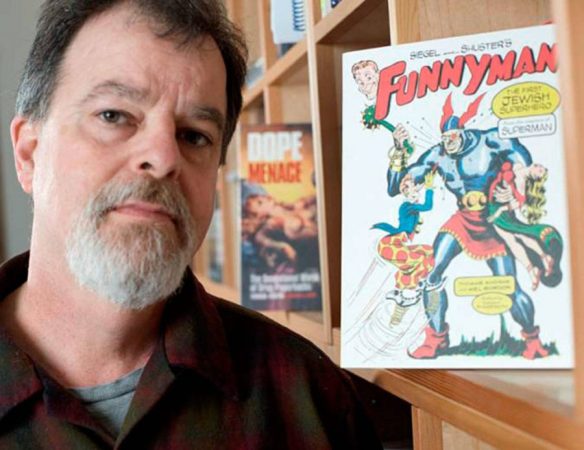
An Interview with the Late Counterculture Publisher Adam Parfrey

By Tamra Lucid

Source: Reality Sandwich

The following interview was originally published on Newtopia Magazine. 

Adam Parfrey has left the building. On May 10, the writer, publisher, and journalist passed away at the age of 61. He was a great curator. His curio shops, Feral House and Process, showcased the most fascinating underground culture and lost history for decades. Finding one of his creations at a Tower Records changed many a life. He found, encouraged and presented a treasure trove of writers on a spectrum of subjects from the absurd to the profound. As Isis Aquarian said, so much would have been lost if not for his efforts. Not just books, but people. Many an odd ball and rogue scholar found a home under Feral House’s wing.

Adam was working on his memoir. What a loss that we won’t have that. There’s no one to compare him to in publishing. He broke new ground, pissed off all the right people, and even managed to keep his business and his community intact as Amazon grew enormous and Tower Records disappeared. And that was just the tip of his iceberg.

I’ll miss his sardonic wit, the hearts he’d place on certain posts (a conversation in itself), his readiness to answer my questions about all sorts of shit having to do with publishing and culture in general, and that feeling that a giant was still standing in the world of independent creativity, a creative force who impacted so many lives, and who gave confidence, inspiration, education and opportunity to many.

Here’s an interview I did with the man a few years ago.


Tamra Lucid: So let me get this straight, you went to Santa Monica High School in the early seventies?

Adam Parfrey: Yes, dear old Samohi. I lived near the Ventura County Line, and the school bus rides were an hour each way. On the way into Santa Monica, the bus picked up a girl with special needs who seemed to always choose to sit next to me. She was an epileptic, and all too often she would have a seizure in which her arms were flailing into my face. Fellow students on the bus shouted at me to stick a pencil into this poor girl’s mouth. I knew nothing about what to do, but it didn’t seem wise to me to stick writing utensils into her mouth.

Then attended UCLA (where you were co-editor of the Arts Section of The Daily Bruin?)  So what was it like? 

This was 1976, and I learned a great deal about writing doing reviews and features. At this time I received a small stipend, too. This was a time when it was quite cheap to attend school. One of my biggest memories of working on this paper was the time when Iranian students were protesting The Shah, and for reasons unknown they decided to not allow us to leave the building while chanting “DOWN WITH THE SHAH!” The good thing about all this was that I was able to purchase from the protesters the earliest Khomeini propaganda that included great political cartoons of Jimmy Carter as Satan himself.

Were you an already macabre fish out of water or did the surfer stoner good vibes inspire you to counter them? Or did you simply party away all the mellow until only the feral remained?

Though I loved living near the beach, and did a lot of fishing, clamming, and body surfing, I was very pale, dark-haired and looked too goth prior to the time that goth even existed. As such, I did not fit the surfer archetype at all. I also didn’t much care for the “Locals Only” xenophobia.

When you were 21 you toured with what you called a “second rate Shakespearean company.” What roles did you play?

This group was called The New Shakespeare Co., and it was run by a Weimar-period German woman named Margit Roma and her man friend. She spoke about Max Reinhardt to me a great deal. We traveled around the country, particularly the deep South, and we were particularly coveted visitors by the girls at women-only Christian colleges down in Georgia and Tennessee. Sometimes we’d crash at locals’ homes. One woman in Arizona imagined that I looked like Elvis Presley, and as such wanted me to fulfill her Elvis fetish. The group was racially mixed, and as a result we were booted from some cafes and motels in some towns in Mississippi and Alabama. It gave me an understanding why so many honkies are particularly venomous about our mulatto President.

I joined this group to see the country, and we did, but mainly from the point of view of the cheapest hotels at the perimeter of various towns. I was hired after Margit Roma saw me in a touring college production of A Midsummer Nights Dream playing Oberon. It was all strange fun.

The hilarious Encyclopaedia of Hell: An Invasion Manual for Demons Concerning the Planet Earth and the Human Race Which Infests It compels me to ask if you were a fan of the original National Lampoon.

That magazine was a great thing for a while in the ‘70s….

How is the evolution (devolution?) of publishing and book selling from brick and mortar to ebooks impacting Feral?

Our office is now in our house, and we try not to have too many expenses so that there are lesser consequences to selling fewer books, as it happens these days. Several chains that sold a lot of Feral House books are now out of business… Tower Books, Virgin Megastore, Borders… also a lot of independents. People have so many distractions today in the form of reading material that I’m amazed that we’re still able to keep going. But we do.

You co-wrote and published Ritual America in 2012, accompanying the stops on your book tour with a slide show.  The book reveals the American fetish for secret societies and shows how even the most apparently innocent can turn out to have dark secrets.  What was the most surprising fact for you personally that you uncovered?

What surprised me the most was that at least half the entire country belonged to some secret society or another from the late nineteenth century through the early twentieth century, how they were literally everywhere and possessed a major role in the structure of the nuclear family.

This year the film you co-produced The Source documentary, directed by Jodi Wille and Maria Demopoulos, played SXSW and other important film festivals. Besides the hot hippie chicks, what drew you to this quirky story of a judo champion who had once robbed a bank who turned into an organic foods pioneer and guru to a small tribe, many of whom still revere him?  What have you learned about the rapidly changing world of documentary filmmaking?

Jodi and I had great interest in “cults” and communes, and how society treated and often mischaracterized them. I was working on a book about The Process Church of the Final Judgment, and one day while browsing Amoeba Records I discovered a student video about The Source Family and showed it to Jodi, who on her own contacted the group, and as a result had a long-lasting connection to many ex-members. First was the book, and then Jodi and Maria’s film, which is really extraordinary. They did a great job with it.

With the white witch of Los Angeles, the glamorous Maja D’Aoust you co-authored the Secret Source in 2004, a revised edition was released this year.  The book shows how the ideas behind the fad of positive thinking unleashed by The Secret are just the latest in a long line of positive thinkers that ultimately reach back to some of the most profound, esoteric, and ancient roots of spiritual culture. It passes what I guess is the Adam acid test: does it muckrake?

There were a few things I discovered and revealed about people involved with The Secret, but the primary reason for the book was unveiling the occult beliefs in American and world history.

But the tone is sincere and frankly metaphysical. Is this the inner Adam?  Or did you adopt neutrality while traveling through yet another intriguing frontier?

It would have been easiest for me to fall back on a skeptical point of view, and disparage all metaphysical ideas as utter hogwash, but that wouldn’t have been true to my personal experiences. For example, before I took Ibogaine I would have never believed that plants had a certain intelligence and connection to human experience. Now I cannot deny that it happens. Now I see Skepticism, the kind with the capital S, as another belief system that provides comfort to many by empowering believers with the illusion that they know all. Why reduce the mystery of the Universe to ideas that can be encompassed in a 6th grade Science class. BTW, I love Science, and have subscriptions to Science magazines.

In 2012 you published Psychic Blues: Confessions of a Conflicted Medium, a book by a three-decade veteran magician from the Magic Castle about his career as a cold reader pretending to be a psychic. It reminds me of the popular documentary Kumare, because both pose the question can someone pretending to have spiritual insight to scam people actually do some good despite themselves?  As the author himself says, no doubt sometimes something is happening, but when you try to make a buck off it consistently it turns into pure entertainment. The Fox Sisters could have told him that a hundred years ago!

Actually the Fox Sisters found their way into Ritual America.  It intrigued me that the author of Psychic Blues didn’t reduce psychic beliefs to a total Nightmare Alley situation, but I’m also interested in the ways of those who conduct those gypsy scams, too.

Still, I’d be surprised if you hadn’t had any uncanny experiences yourself?

I have.

In 1995 in an interview in Cyberpsychos you said you believed you might be on some sort of blacklist. While magazines like Conde Nast would call you for ideas, they wouldn’t entertain the idea of simply publishing your writing. So are you blacker now more than ever?

For a couple years after Apocalypse Culture was first released, it sold well and had certain notoriety, but for some time no one wrote about it or reviewed it. Some of this, I think, had to do with an article called “Aesthetic Terrorism” which tried to draw the blinds on the scammery of Fine Art. It even named names, and you just don’t do that because a lot of people in that world controlled magazines and newspapers. I didn’t say the right things or kiss the right ass to receive media glory.

Has almost two decades of the world wide web changed the way blacklists work?

Absolutely. Prior to the web fewer people and fewer publications controlled a great deal more. Now it’s all everywhere, and even the New York Times does feature articles on Feral House publications, like the other day with a piece on Psychic Blues.

You commissioned and published Snitch Culture: How Citizens are Turned into the Eyes and Ears of the State, before Bush won the 2000 election, before 9/11.  So you’re probably not surprised by how much more privacy and liberty have eroded under Bush and Obama?

We tend to forget what happened under the Clinton Administration, like the so-called Crime Bill, which later ushered in Bush’s Patriot Act. Both Democrats as well as Republicans are interested in building up the police state.

In 2002 you edited Extreme Islam: Anti-American Propaganda of Muslim Fundamentalism.  You took strong stands when you published 50 Reasons Not to Vote for Bush in 2004, and then 35 Articles of Impeachment and the Case for Prosecuting George W. Bush.  It was a courageous choice since you were potentially inviting trouble, again.

Disliking George W. wasn’t a particularly courageous choice. Difficult not to speak out when this douchebag was our figurehead.

Last year you were involved in an interesting problem regarding the Process Media book The Urban Homestead: Your Guide to Self-Sufficient Living in the Heart of the City, published three months before the Dervaes family, one of a handful of urban farming pioneers, decided to trademark “urban homestead.”  On Valentine’s Day you received the cease and desist letter that had been popping up in mail boxes across the nation as the Dervaes tried to sew up their control of the phrase.  Then mentions of the book began disappearing from Facebook, from Process Media’s own page!  Facebook told you they were banning the links until they heard otherwise from the owners of the trademark.  You warned the Dervaes you’d take them to court if they didn’t back down, but they didn’t back down.  Of course, I want to know what’s happened since, but also how did you feel about Facebook deciding to vanish your important book and what it says about the potential and actual pitfalls of digital culture?

The great Electronic Frontier Foundation (EFF) has taken up our cause with Urban Homestead and the patent/trademark office. Hopefully this govt. organization will see that they gave a private party the ability to abuse rights to a generic common term. Thousands of backyard gardeners support our cause here, and even have their own Facebook page.

Five years ago you left Los Angeles for Port Townsend, Washington, like Gertrude Stein leaving Paris for her farmhouse, instead of salons you now entertain stayovers. I know you visit often, but what made you give up on your hometown? And what do you love best about your new hometown?

It may sound strange, but in LA I felt bombarded by issues of traffic and electromagnetic radiation, and felt better getting out to the country, where I can more easily grow food and keep a big dog and chickens. I like to get out of Port Townsend in winters particularly. I do love LA too. My past is all there, and so are many of my friends.

What new projects are you working on that you’re excited about?

I’m glad to say that my excitement level of projects that I’m working on have not receded at all.  One book coming soon is called “Dying for the Truth”… It’s primarily from the Mexican blog called blogdelnarco.com … But the book has other images and information that has not yet appeared on the blog.  The book is called “Dying for the Truth” since the journalists and citizens involved in it have been threatened and killed as a result of revealing the gruesome stark truth of what’s going on just South of the border and throughout Mexico itself.  It’s going to be particularly difficult to publish due to the insanity of the situation down there, the stacking of bodies and limbs and the bizarre dark aesthetic of the murderers. It may be the most gruesome book that’s ever been published. But we need to examine why much of Mexico and its citizens are dying.  We’re also excited about forthcoming films with scripts that I co-wrote. One is a feature film based on Lords of Chaos, and the other is a thriller of sorts based on the weirder aspects of the JFK assassination cover-up called “Dallas in Wonderland.”

You’ve seen society from so many unique and often ignored perspectives through so many changes from the hippie optimism that flourished when you were a kid to today’s rampant pessimism. Looking to the future of our country and our world what is your biggest fear and what is your biggest hope?

This a complex issue. I’m not a fan of mass movements per se; they seem to bury unorthodox thought, but I do see a need for hive-like beliefs if the human race wishes to carry on in the future. What are seven, eight, nine, ten billion humans going to do when the land and water is totally poisoned and exhausted? It may not be pretty.

Social Media Behemoths Sweep Alternative News into the Memory Hole

By Kurt Nimmo

Source: Another Day in the Empire

The squabbling between self-identified progressives and conservatives continues as social media transforms itself into a news, information, and opinion gatekeeper.

All information that contradicts the establishment narrative will either be downgraded into obscurity or excluded outright on social media.

Take for instance ThinkProgress, the Soros-financed news website, a project of the Center for American Progress Action Fund welded to the infrastructure of the Democrat party. On May 2, it complained that a bias study at Facebook will be run by conservatives, that is to say establishment Republicans, notably former Arizona Congress critter Jon Kyl.

ThinkProgress believes there is no such thing as bias aimed at conservatives—it’s the liberals who are routinely downgraded at Facebook while so-called conservatives are free to post what progressives characterize as an evil and poisonous ideology.

According to Libby Watson at Splinter News, conservatives are involved in “grift,” flimflamming poor Mark Zuckerberg with untrue claims of bias against the likes of Breitbart News.

It’s all part of a never ending and hugely counterproductive “culture war” that has raged between the ostensible right and left going on thirty years now. Ms. Watson manages to squeeze identity politics into her screed.

“The conservative movement has done a remarkable job over the last half century to bellow and bully its way into having its most ridiculous and reality-divorced concerns taken seriously,” she writes. “It lies about and distorts everything: about tax cuts, about Benghazi and her emails, about immigration, about healthcare, about Diamond and Silk. The further Facebook descends down the path of letting that screaming white face of faux outrage dictate how they run their platform, the harder it’s going to be for them to get away from them.”

The progressive news website Common Dreams complains it has weathered “significant drops in traffic since Google and Facebook began changing algorithms and talking openly about their new attempts to control the kind of news content users see. According to internal data and Google Analytics, traffic to Common Dreams from Google searches fell by 34 percent after the powerful search giant unveiled its new search protocol in April 2017.”

Meanwhile, on the other side of the yawning divide, Brent Bozell, founder of the Media Research Center, rallied around 60 conservatives and fired off an open letter to the social media giants demanding transparency, clarity on the definition of hate speech, equality for conservatives, and respect for the First Amendment.

“Social media censorship and online restriction of conservatives and their organizations have reached a crisis level,” the open letter states. “Facebook CEO Mark Zuckerberg’s hearings on Capitol Hill only served to draw attention to how widespread this problem has become. Conservative leaders now have banded together to call for equal treatment on tech and social media.”

Both liberals and conservatives are missing the point.

Facebook and Google will continue and enlarge the effort to gatekeep information that does not jive with the establishment narrative, be it from the right or left.

The internet and web upended the establishment’s carefully constructed propaganda machine—the CIA’s “Mighty Wurlitzer” under its Operation Mockingbird beginning in the early 1950s—deeply embedded within corporate media.

Beginning with Friendster, MySpace, and like projects in the early 2000s and eventually morphing into the corporate behemoths Facebook, YouTube, and Twitter, social media platforms have extended the reach of alternative media, much to the displeasure of the establishment. Its preferred propaganda conduits have withered and this has seriously hampered its ability to control the narrative.

Both the right and left need to nurture their own social media platforms and drive traffic there.

Of course, this will not be as effective as plugging into the massive matrix of social connectivity provided by the corporate tech giants, but the alternative is to be marginalized and eventually swept into the memory hole as the context of “extremism” narrows and constricts expression, excluding all but the most token disagreement with the establishment narrative.

However, I’m not sure we’re up to it.

The elite has done a remarkable job of using the time tested divide and conquer concept, endlessly pitting the so-called right against the amorphously defined left and vice versa. Liberals and conservatives continue to fight over frivolous ideological points as the funny money asset-driven economy prepares to implode and the mission of infinity war expands to the point where it endangers life on planet Earth.

The Greatest Spiritual Event of Our Time, According to Rudolf Steiner

By Paul Levy

Source: Reality Sandwich

Almost a hundred years ago, as if peering into a crystal ball and predicting the future, spiritual teacher and clairvoyant Rudolf Steiner[1] prophesied that the most momentous event of modern times was what he referred to as the incarnation of the etheric[2] Christ. By the “etheric Christ,”[3] Steiner is referring to a modern-day version of Christ’s resurrection body, which can be conceived of as being a creative, holy and whole-making spirit that is inspiring human evolution as it operates upon the body of humanity through the collective unconscious of our species. Involving a radically new understanding of a timeless spiritual event, the etheric Christ, instead of incarnating in full-bodied physical form, is approaching via the realm of spirit—as close as this immaterial spirit can get to the threshold of the third-dimensional physical world without incarnating in materialized form. To quote Steiner, “Christ’s life will be felt in the souls of men more and more as a direct personal experience from the twentieth century onwards.”[4]

A spiritual event of the highest order, Steiner felt that the incarnation of the etheric Christ is “the most sublime human experience possible”[5] and “the greatest turning point in human evolution.”[6] In his talks, Steiner refers to the etheric Christ as “Christ in the form of an Angel.”[7] Christ himself can be seen as the primordial revelation of the archetype of the Angel (who, after all, are messengers), what is known as the “Angel Christos.” The Angel Christos is a nonlocal, atemporal spirit, existing outside of space and time, that is simultaneously immersed in, infused with—and expressing itself through—events in our world. Christ as an angel reveals itself for those who have eyes to see and ears to hear as it weaves itself, not only through the warp and woof of the flow of events comprising history, but through our souls as well.

To quote Steiner, “in the future we are not to look on the physical plane for the most important events but outside it, just as we shall have to look for Christ on His return as etheric form in the spiritual world.”[8] The most important spiritual events of any age often remain hidden from the eyes of those who are entranced in a materialistic conception of the world. It greatly behooves us to not sleep through, but rather, to consciously bear witness to what has been up until now taking place mostly unconsciously, subtly hidden beneath the mundane consciousness of our species. If this epochal spiritual event, to quote Steiner, “were to pass unnoticed, humanity would forfeit its most important possibility for evolution, thus sinking into darkness and eventual death.”[9]If the deeper spiritual process of the incarnation of the etheric Christ—“Christ in the form of an Angel”—is not understood, this potentially liberating process transforms into its opposite (into the demonic).

Steiner felt that the advent of the etheric Christ—the Parousia (the Second Coming)—was the greatest mystery of our time. He was of the opinion that the incarnation of the etheric Christ was the deeper spiritual process that is in-forming and giving shape to the current multi-faceted crises (and opportunities) that humanity presently faces. This is to say that the seemingly never-ending wars and conflicts that are taking place all over the globe are the shadows cast by spiritual events from a higher-dimension that are animating earthly happenings. One of the main reasons that these multiple crises are so dangerous is because their deeper spiritual source remains unrecognized.

The veil that formerly concealed the spiritual world from what we call “the real world” has fallen away, now making it possible to bear witness to how physical events are an outer, external reflection of a parallel archetypal process taking place on a spiritual plane. It is as if a spiritual dimension envelops, contains and is expressing itself through material reality. The seemingly mundane physical world and the spiritual world are revealing themselves to be indistinguishable, which is to say that life itself is resuming its revelatory function. More and more of us are beginning to recognize this; our realization is not separate from the increasing emergence of the etheric Christ. Consciousness of the restored unity between matter and spirit is not merely an awareness of this original unity, but is the very act that completes and perfects this unity.

The higher order of light encoded within the etheric Christ is bringing to light the darkness which is seemingly opposed to it, which further helps its light nature to be seen. The true radiance of the light can only be seen and appreciated in contrast to the depth of darkness it illumines. It is as if the revelation of something is through its opposite—just as darkness is known through light, light is known through darkness. A fundamental spiritual principle of creation itself appears to be that when one force—e.g., light—begins to emerge in the universe a counterforce, opposed to the first, arises at that same moment.

Just as shadows belong to light, these light and dark powers are interrelated, reciprocally co-arising, inseparably contained within and expressions of a single deeper unifying process. These opposites belong together precisely insofar as they oppose each other; their seeming antagonism is an expression of their essential oneness. The brightest light and darkest shadow mysteriously evoke each other, as if—behind the scenes—they are secretly related. In essence, spirit is incarnating, and it is revealing itself through the very darkness that it is making visible.

Commenting on the other—and less recognized—half of the Second Coming, Steiner chillingly said, “before the Etheric Christ can be properly understood by people, humanity must have passed through the encounter with the Beast.”[10] By “the Beast” he means the apocalyptic beast,[11] the radically evil. The Beast is the guardian of the threshold through which we must pass in order to meet the lighter, celestial and heavenly part of our nature.

As soon as I read Steiner’s prophecy I felt the truth of his words. I recognized how what Steiner was saying mapped onto—and created context for—what is happening in our current world-gone-crazy. The ever-increasing darkness that has descended like a plague onto humanity and is compelling us to race towards our own self-destruction is hard to face, let alone fathom. The evil of our time has become so gigantic that it has virtually outstripped the symbol and become autonomous, un-representable, beyond comprehension, practically unspeakable.

I also recognized the truth of what Steiner was saying based on my own inner experience. I have noticed that as I get closer to connecting with the light within myself, the forces of darkness seem to become more active and threatening. It is as if there is something in me—and in everyone, which is to say this situation isn’t personal—that desperately doesn’t want us to recognize and step into our light. This internal process is taking place within the subjectivity of countless individual human psyches, which is then reflexively being collectively acted out—in my language, “dreamed up”—en masse in, as and through the outside world. The dialectical tensions of the cosmos (the macrocosm)—the conflict between the opposites of dark and light—are mirrored both in the external collective body politic as well as within the psyche of each individual (the microcosm). It greatly serves us to recognize this.

In his prophecy, Steiner is pointing out that our encounter with the Beast is initiatory, a portal that—potentially—introduces us to the Christ figure. To quote Steiner, “Through the experience of evil it will be possible for the Christ to appear again.”[12] It is noteworthy that the opposites are appearing together: coinciding with the peak of evil is an inner development which makes it possible for the etheric Christ—who is always present and available[13]—to be seen and felt as a guiding presence that can thereby become progressively more embodied in humans, both individually and collectively as a whole species. In the extreme of one of the opposites is the seed for the birth of the other.[14]

This is a Kabbalistic idea – for example, in the Zohar, the key Kabbalistic text, it says, “There is no light except that which issues forth from darkness…and no true good except it proceed from evil.”[15] As I deepen my familiarity with Steiner’s work, it definitely dovetails with the insights of the Kabbalah, which is considered to be one of the most profound spiritual and intellectual movements in human history. Evil, according to both Steiner and the Kabbalah, though by definition diametrically opposed to the good, is—paradoxically—a catalyst for bringing the power of goodness to the fore.

Steiner felt that because Christ was destined to appear in the etheric body, “a kind of mystery of Golgotha is to be experienced anew.”[16] What Steiner means by the “mystery of Golgotha” is Christ’s crucifixion, his descent into the underworld and subsequent resurrection. As a result of the first mystery of Golgotha over two thousand years ago—what Steiner considers an act of divine grace bestowed on humanity from above—Christ has been establishing himself in the unconscious dark depths of humanity’s soul. The “Christ-impulse,” in Steiner’s words, “was to penetrate to the dark depths of man’s inner being … to the deepest part of man’s nature.”[17]

Like an iteration of a deeper fractal, this archetypal, timeless mystery now “is to be experienced anew” in a modern-day version. In no other world than the physical world can we learn the true nature of the mystery of Golgotha. To quote Steiner, “Not in vain has man been placed in the physical world; for it is here we must acquire that which leads us to an understanding of the Christ-Impulse!”[18]

Unlike the first mystery of Golgotha, however, in the culmination of this renewed mystery, humanity becomes engaged as active participants, playing a decisive role in the cosmic drama. This too is a Kabbalistic insight: humanity co-partners with the divine so as to complete the creative act of God’s Incarnation. Instead of the Incarnation being through one man, however, in our current day it is taking place through all of humanity. The modern-day coming of the Messiah is through the transformed and awakened consciousness of humanity as a whole. In a very real sense, we are the very Messiah we have been waiting for. “By a strange paradox,” according to Steiner, it is “through the forces of evil” that “mankind is led to a renewed experience of the Mystery of Golgotha.”[19]

The mystery and drama of the Christ event is now located and consummated in humanity, who become its living carrier. The events that were formulated in dogma are now brought within the range of direct psychological experience and become an essential aspect of the process of individuation. Whether we know it or not, we have become drafted and are being assimilated into a divinely-sponsored process. Not an effortful, intentional straining after imitation, this becomes an involuntary and spontaneous personal experience of the reality symbolized by the sacred legend.

The brightest, most radiant and luminous light simultaneously casts and calls forth the darkest shadows. Through this process of Christ manifesting in the etheric realm, humanity is exposed to evil in a way never before experienced, such that—in potential—we may be able to find the good and the holy in a more real and tangible way than was previously possible. Humanity’s highest virtues and potentialities are activated and called forth when confronted by evil.

It is an archetypal idea that ascending towards the light always necessitates a confrontation with and descent into the darkness; the Kabbalah calls this “a descent on behalf of the ascent.” There are certain points in time when humans—individually and/or collectively—are pulled down, submerged into darker powers, brought below a certain level against their will. This shamanic descent can be envisioned as a test for humanity, so that we may learn, through our own efforts, how to lift ourselves up. But we raise ourselves not without God’s help, however, who, paradoxically, is the very sponsor of our descent in the first place.

Seen symbolically, the process of descent—as universally exemplified in the myth of the hero—reveals that only in the region of danger can we find the alchemical “Treasure Hard to Attain.” Speaking of when someone goes through what he refers to as “the Descent into Hell,” Steiner says, “When this has been experienced, it is as though the black curtain has been rent asunder and he looks into the spiritual world.”[20]

The mystery of humanity’s higher nature is inseparable from the mystery of evil. No realization of the light would ever occur without first getting to know its opposite. Whoever wants to support the sacred must be able to protect it and we can only do so when we know the forces that oppose it. The question is not whether we believe in evil, but whether or not we are able to recognize and discern, in the actual events of life, that dimension of experience that the ancients called evil. Speaking about the evolutionary stage of modern humanity, Steiner said, “now we have to come to terms with evil.”[21] It is beyond debate that in our current age we are called to deal with evil—only those who choose to stay asleep, or are overly identified with the light (and hence, project out and dissociate from their own darkness) are blind to this.

It is of the utmost importance to recognize evil, which involves developing our capability to perceive differences, i.e., to cultivate discernment. Evil has an intense desire to remain incognito, below the radar, as its power to wreak havoc is dependent on not being recognized. If we don’t recognize evil, however, we will surely succumb to it, thereby unconsciously acting it out. We are offered a choice—to come to terms with evil or continue to avoid it (which ineluctably makes us complicit in it). Recognizing and confronting evil means getting to know its operations within ourselves without fully succumbing to it.

Recognizing the evil within us is a moment of great peril, as we don’t want to fall hopelessly into paralyzing despair at seeing the shocking depth of our own darkness. Another danger is to unconsciously identify with the evil we are seeing, thinking we are that. The key is to see these impersonal darker forces within us, recognize that we share them in common with all humanity, and then “distinguish ourselves” from them. This is to see these darker forces as paradoxically both belonging to ourselves while being other than who we are. Becoming conscious of these darker forces takes away their power (which is dependent on not being seen), liberating us from being under their thrall. It is a genuine spiritual event when we confront these darker forces in and through ourselves as if we are meeting a wholly other being.

Without being exposed to and challenged by evil we remain helpless to overcome it. The Beast is a higher-dimensional and supersensible being (beyond our five senses) that reveals itself in and through historical events in our world as well as within the inner landscapes of our psyche. A human body and soul can unwittingly (or consciously) become the vessel for acting out these powerful, darker, destructive archetypal powers in ways that further extend these forces into the world at large. In modern times the centralized, power-based state is the incorporated agency of these darker forces on a collective scale. Any of us, often with the best intentions, can unwittingly become an instrument of evil through our acting out of these darker unconscious impulses.

Encountering, recognizing and experiencing the depth of evil within ourselves helps us to develop the inner capacity to stand free of it, and in so doing, become acquainted with the part of ourselves that is beyond evil’s reach, thus enabling us to establish ourselves as free, sovereign and independent beings. Realizing this, we thereby become inoculated from being one of its carriers. Paradoxically, it is only by knowing the Beast in ourselves that we become truly human. It is to our advantage to know that our worst adversary resides in our own heart, rather than falling for the all-to-common delusion of thinking that our enemy is outside of ourselves.

Withdrawing our shadow projections from the outside world enables us to not only own and come to terms with the darkness within ourselves, but also enables us to withdraw our projections from an outward historical figure and instead discover the living Christ within. This is to recognize that Christ—symbolic of the wholeness of our true nature—has always lived in us, rather than being an external figure separate and different from ourselves. We ourselves bear Christ—the most precious treasure, “The Pearl of Great Price”—within us.

Seeing the etheric Christ necessitates the human acquisition of a newly awakened faculty of perception which enables us to recognize that a spiritual realm permeates—and is revealing itself—through the seemingly mundane physical world. The etheric Christ has an infinitude of ways, a multiplicity of guises in which it can appear. Just like a symbol in a dream, the form of the vision is custom-tailored for each soul, dependent on our state of evolution. As we each see the etheric Christ in the unique form appropriate to our soul, we rise up, lift ourselves—grow and ascend upwards, evolutionarily speaking—towards Christ in his etheric body. To quote Steiner, “those who raise themselves—with Full ego-consciousness—to the etheric vision of Christ in His etheric body, will be ‘God-filled’ or blessed. For this, however, the materialistic mind must be thoroughly overcome.”[22]

Speaking of the power of the etheric Christ, Steiner said, “When this power has permeated the soul, it drives away the soul’s darkness.”[23] As we stabilize our vision of the etheric Christ, we recognize that, as if looking in a mirror, we are seeing our own reflection. Christ himself (in his etheric form) says in the apocryphal Acts of John, “A mirror am I to thee that perceivest me … behold thyself in me who speak.”[24] On the one hand this mirror reflects back our own temporal, limited and subjective consciousness, while on the other hand simultaneously reflecting back the transcendental aspect of ourselves that is already whole, healed and awake. These co-joined reflections invite us to cultivate the ability to differentiate them, and in so doing effects the requisite transformation of consciousness that feeds our individuation.

In these encounters with the etheric Christ, we are not witness to an external, material, objective event that comes from outside of ourselves, but our soul is itself the medium in which the engagement takes place. In its subjective experience of the etheric Christ, it is its own image of itself that the soul rediscovers and meets in its act of reflection. The soul is itself reflected through and reciprocally affected by the vision of the etheric Christ. Inseparable parts of one quantum system, the etheric Christ’s radiance doesn’t shine separate from humanity; its luminous clarity is our own. Humanity invariably becomes transformed when it encounters the etheric Christ, due to our consciousness becoming aware of an essential aspect of itself that was heretofore hidden and relegated to the unconscious.

The part of Steiner that was envisioning the operations of the etheric Christ was the etheric Christ himself seeing through Steiner’s eyes; the same is true for us. When we see the etheric Christ, we begin to assimilate and become the thing we are seeing. In our apperception, the etheric Christ inside of us recognizes itself, which enables us to step into who we’ve always been. Humanity is the vessel through which the etheric Christ—the spirit of Christ—takes on human form and incarnates itself.

We find ourselves playing a key role in a cosmic drama. We are not just passive witnesses, but active participants in a momentous, world-transforming spiritual event. In Steiner’s words, “The human being is not a mere spectator that stands over against the world … he is the active co-creator of the world process.”[25] Steiner’s statement is completely in alignment with the realizations of quantum physics, which points out that we are participating—whether we know it or not—in the creation of our experience of both the world and ourselves. What Steiner is describing in terms of the incarnation of the etheric Christ and the emergence of the apocalyptic Beast is in some mysterious way related to—and reflecting—the current stage of our collective psycho-spiritual development.

The worst illness is the one which goes unrecognized, as it therefore cannot be treated. According to Steiner, awareness of the covert operations of these darker forces is the only means whereby their aims may be counteracted.[26] The etheric Christ’s light can help us to break through our massive inner resistance against seeing to what an overwhelming extent the forces of illness and death have insinuated themselves into our organism and corrupted our soul. The same light that kindles consciousness—i.e., the etheric Christ—also illuminates the deadening and rigidifying forces in humanity’s being. If we can consciously experience the powerlessness that has become allied with the deadening forces in our soul, this sense of our powerlessness—like hitting bottom—can lead us to an experience of the etheric Christ, which itself is the revivifying light of awareness which enabled us to become aware of our powerlessness in the first place. Consciously seeing the withered soul of our time—intellectualized and materialized to death—is a crucial step which initiates the process of resuscitating—and resurrecting—the soul, bringing it to life again.

As if pouring the very essence of his being into the existential abyss, Christ concealed his light by incorporating himself in humanity’s deadened life forces, as if the higher self clothed itself in the evil qualities of humanity. To quote a student of Steiner, Jesaiah Ben-Aharon, “The Christ is seen through the metamorphosed forces of death, and is experienced through the mystery of man’s evil.”[27] The life-enhancing etheric Christ is made out of the devitalizing forces of death that have seemingly imprisoned and obscured the eternal Christ within us. Christ’s “resurrection body” is created and forged through the descent into hell. The very fabric of the darkness are the celestial threads out of which the etheric Christ is woven.[28]

Through his descent into the depths of the underworld, Christ merged and united himself completely with the core of humanity’s evil—becoming one with it—thereby initiating an alchemical process of transformation deep within the universe itself. Steiner’s description of the incarnation of the etheric Christ implies a progressive transmutation of the underlying etheric substructure of our world, i.e., a change in the energetic fabric of space-time itself.[29] In dying livinglyinto the abyss, Christ freely offered his life-giving heart to darkness’s infinite void. The result of Christ’s sacrifice is that his eternal being germinates and grows for humanity from within the core of all evil.

Through his descent into the hell realms, a mutual interpenetration between the lower and higher selves of the universe has taken place. Light has taken on darkness, which has a double meaning: to encounter darkness, as well as to become it. Light has transformed itself into darkness so as to know and illumine the darkness from the inside as well as to reveal itself. Evil—which on one level is obscuring the light—has encoded within itself its very opposite, i.e., it has become the revelation of the very light it seems to be concealing.[30]If we don’t recognize this, however, the darkness will continue to manifest destructively and eventually destroy us.

Being the most problematic element in the life of our species, evil demands our deepest sobriety and most earnest reflection. It behooves us to become conscious of the ways we are unknowingly colluding with darker forces. The etheric Christ illumines not only the existence of evil as a reality in the depth of the soul, but its light also reflects our complicity in this evil to the degree that we turn a blind-eye towards it. Individual self-reflection, which returns us to the deeper, darker ground of our light-filled nature, is the beginning of the cure for the blindness which reigns today. We tend to think of illumination as “seeing the light,” but seeing the darkness is also an important form of illumination.

We fervently avoid investigating whether God might have placed some unrecognized purpose in evil that is crucial for us to know. If we become conscious of the evil within us, in our expansion of consciousness, that evil is promoting our spiritual development. We have then, through our realization, alchemically transmuted evil into a catalyst for our evolution. To quote Steiner, “The task of evil is to promote the ascent of the human being.”[31] Once we realize our collusion with evil—making an unconscious part of us conscious, evil—with our co-operation—has fulfilled its mission of promoting our ascent.

This is once again in alignment with the Kabbalah, which conceives of evil as an essential component of the deity, woven into the very fabric of creation. Evil, according to both Steiner and the Kabbalah, co-emerges with the possibility of humanity’s freedom, as if God could not create true freedom for humanity without providing a choice for evil. To quote Steiner, “In order for human beings to attain to full use of their powers of freedom, it is absolutely necessary that they descend to the low levels in their world conception as well as in their life.”[32] From both Steiner’s and the Kabbalistic point of view, evil is created by and for freedom, and it is only through the conscious exercise of freedom of choice—which evil itself challenges us to develop—by which it can be overcome. To quote Steiner, “This is the great question of the dividing of the ways: either to go down or to go up.”[33]

The question naturally arises: if, as Steiner and the Kabbalah profess, freedom is actualized only through the existence of evil, is evil an expression of a higher intelligence, an aspect of the divine plan designed to bring about a higher form of good that couldn’t be actualized without its existence? In other words, is evil against God, or on a deeper level, serving God?

Answering this question involves a new way of translating our experience to ourselves. This way of seeing can only be attained if we are not stuck in a fixed, polarized viewpoint, caught in binary, dualistic thinking. The price of admission to this new perspective is being open to how the opposites—e.g., good and evil—are not opposed to each other in the way that we’ve been imagining if we’ve been imagining them as being separate. Seeing this involves a deeper integration within ourselves in which we are able to carry—and hold together without splitting—the seeming opposites in a new way. This expansion of our consciousness not only supports the incarnation of the etheric Christ, it is the incarnation itself.

How are we to live in such close proximity to evil? Steiner’s prophecy—expressed in the language of Christianity—is suggesting that a complete spiritual renewal is urgently needed. And as Steiner indicates, no spiritual transformation is possible without coming to terms with the Beast, i.e., with the inescapable factor of evil encountered both within ourselves and in the outside world. No old formulas or techniques can fit the bill; the answer of how to deal with such darkness is only to be found in the depths of the individual human heart.

The main aim of the Beast is to close, harden and seal the human heart with its negative energies. There is no greater protection against the Beast—as well as no better way to invite the approach of the etheric Christ—than to assiduously strive to cultivate a good heart over-flowingly filled with compassion. Genuine compassion is unconditioned; by its nature it is meant to be shared with all beings throughout the whole universe, most especially with the Beast within ourselves. Compassion is the only thing in the world that can vanquish the seemingly infinite black hole of evil, as compassion—due to its boundless nature—has no limits, which means the more we give compassion, the more we have to give. The etheric Christ is all about compassion, which is its true name.

~

A pioneer in the field of spiritual emergence, Paul Levy is a wounded healer in private practice, assisting others who are also awakening to the dreamlike nature of reality. He is the author of The Quantum Revelation: A Radical Synthesis of Science and Spirituality (SelectBooks, May 2018), Awakened by Darkness: When Evil Becomes Your Father (Awaken in the Dream Publishing, 2015), Dispelling Wetiko: Breaking the Curse of Evil (North Atlantic Books, 2013) and The Madness of George W. Bush: A Reflection of Our Collective Psychosis (Authorhouse, 2006). He is the founder of the “Awakening in the Dream Community” in Portland, Oregon. An artist, he is deeply steeped in the work of C. G. Jung, and has been a Tibetan Buddhist practitioner for over thirty years. He was the coordinator for the Portland PadmaSambhava Buddhist Center for over twenty years. Please visit Paul’s website www.awakeninthedream.com. You can contact Paul at paul@awakeninthedream.com; he looks forward to your reflections.


[1] Steiner lived from 1861–1925. This prediction was made in 1924, but wasn’t made known till 1991. The word clairvoyantliterally means “clear-seeing;” a clairvoyant is a “clear-seer.”

[2] The word “etheric” derives from the word “ether,” which is a word that was once widely used in physics (during Steiner’s lifetime) to refer to the medium of space itself. The word etheric thus implied a presence co-extensive with space and is thus something that completely pervades and is fully present in and as the material forms of the world. There is nowhere where space is not, which is to say it is omnipresent and everywhere. As if a higher-dimensional substance-less substance, space is the one element in which all of the other elements in the universe exist and take on their being. The ether’s presence was therefore conceived of as not being explicit like that of material forms, but like space is more hidden and implicit, in that it doesn’t assume any specific form but instead provides the underlying basis and nonphysical context for physical form to arise in the first place.

[3] Other noteworthy examples of the manifestation of the etheric Christ are Paul’s encounter with Christ in his etheric form on the way to Damascus, and the Gnostic document Pistis Sophia (in which Christ appeared to some of his disciples, including Mary Magdalene, in his transfigured, resurrection body, giving them teachings for eleven years).

[4] Rudolf Steiner. Christ at the time of the Mystery of Golgotha and Christ in the twentieth century. 2 May 1913, London. GA 152. In: Occult Science & Occult Development. Rudolf Steiner Press, London 1966.

[5] Rudolf Steiner, The Reappearance of Christ in the Etheric, 43.

[6] Ibid, 91.

[7] Rudolf Steiner. Christ at the time of the Mystery of Golgotha and Christ in the twentieth century. 2 May 1913, London. GA 152. In: Occult Science & Occult Development.

[8] Lecture at Stuttgart on 6 March 1910. In: The Reappearance of Christ in the Etheric.

[9] Rudolf Steiner, The Reappearance of Christ in the Etheric, 45.

[10] From a lecture to the priests of the Christian Community, September 1924, cited by Harold Giersch: Rudolf Steiner uber die Wiederkunft Christi [Concerning the reappearance of Christ], Dornach 1991, p. 110.

[11] Steiner said that an incarnation of the Beast will first arise in 1933, which is when Hitler came to power.

[12] Rudolf Steiner: From Symptom to Reality in Modern History, lecture 4, Rudolf Steiner Press 1976, p. 112.

[13] Speaking about what Paul saw during his Damascus Experience (where Paul had a conversion experience after seeing the etheric Christ), Steiner said, “that Christ is in the Earth-atmosphere and that he is always there!” Rudolf Steiner, The Christ Impulse and Development of the Ego-Consciousness (London: Anthroposophical Publishing Co., 1926, reprinted by Kessinger), 48. In this statement Steiner is making an equivalence between the etheric Christ and the element space.

[14] The yin/yang symbol represents this pictorially.

[15] Zohar II, 184a; Sperling and Simon, The Zohar, Vol. IV, p. 125.

[16] Rudolf Steiner: From Symptom to Reality in Modern History, lecture 4, Rudolf Steiner Press 1976, p. 112.

[17] Steiner, The Christ Impulse and Development of the Ego-Consciousness, 42.

[18] Ibid., 50.

[19] Rudolf Steiner: From Symptom to Reality in Modern History, lecture 4, Rudolf Steiner Press 1976, p. 112.

[20] Quoted from The Essential Steiner, Robert A. McDermott, ed. (San Francisco: Harper & Row, 1984), 264.

[21] GA (which stands for Gesamtausgabe, the collected edition of Rudolf Steiner’s work in the original German), 178, 18/11/17.

[22] Steiner, The Christ Impulse and Development of the Ego-Consciousness, 48.

[23] GA 118, 27/01/10.

[24] M. R. James, ed., The New Testament Apocrypha(Berkeley, CA: Apocryphile Press, 2004), 253-254.

[25] From Steiner’s doctoral dissertation Truth and Science(1892).

[26] GA 178, 13/11/17.

[27] Jesaiah Ben-Aharon, The New Experience of the Supersensible (East Sussex, UK: Temple Lodge Publishing, 2007), 46.

[28] The darkening death forces within us continually persecutes the Christ in us, continually creating opaqueness, deadening and ossification. This process is symbolized in Paul’s Damascus experience when he encountered the etheric Christ and had a conversion experience (symbolized by changing his name from Saul to Paul). To quote from Acts 8:4, “Saul, Saul, why persecutest me?”

[29] Steiner’s notion of the coming of the etheric Christ has striking similarities to V. I. Vernadsky and Teilhard de Chadin’s concept of the noosphere (the mental-etheric envelope that embraces and pervades the living biosphere of our planet, the growth of which supports and catalyzes the evolution of human consciousness).

[30] In medical terminology, evil can be conceived of as being a “cosmic carcinoma.” If seen as a disease, encoded within evil is its own medicine (what I call “participatory medicine,” in that, in true quantum style, how the seeming pathology actually manifests depends upon how we engage with it). Containing not just its own cure, this malevolent disease actually bears hidden within it life-enhancing gifts beyond measure. How this disease manifests—in its cursed or blessed aspect—depends upon if we recognize what it is revealing to us.

[31] GA 95, 29/08/06.

[32] GA 204, 02/04/21.

[33] Steiner, The Christ Impulse and Development of the Ego-Consciousness, 63.

Saturday Matinee: Horns and Halos

Review by Underground Film Journal

Horns and Halos, which opened the 9th New York Underground Film Festival, is a documentary by married filmmakers Suki Hawley and Michael Galinsky about the intrigue surrounding the publication of the controversial book Fortunate Son, a biography of George W. Bush. The book was originally published by St. Martin’s Press in 1999, subsequently pulled off the bookstore shelves by them after controversy arose over a passage accusing Bush of being a convicted drug user and then re-published by a little artsy boutique outfit in New York City called Soft Skull Press.

What makes Horns and Halos a successful documentary is that the filmmakers did an excellent job of remaining amazingly unbiased towards the subject matter. While watching the movie, I got the impression that Bush supporters would dismiss everyone involved in the book’s publication as a complete wacko and reject any criticisms made against the president in the film; and that anti-Bush activists would find the issues brought up by the book to be damning evidence against him. Personally, I think the truth lies, as the saying goes, somewhere in-between.

The author of Fortunate Son is Arkansas author J.H. Hatfield who, despite appearing slightly off-kilter, seems like an intensely earnest man who just wanted to be taken as a serious author. Previous to his infamous work, Hatfield was the writer of unauthorized biographies of Ewan McGregor and Patrick Stewart, as well as guides to TV shows like Star Trek, Lost in Space and The X-Files.

The main focus of the film, however, is Sander Hicks, the garrulous and determined CEO of Soft Skull Press and re-publisher of “Fortunate Son.” It makes sense that Horns and Halos would spotlight Sander over Hatfield, though, since the movie seems like a very low-budget affair and Hawley, Galinsky and Hicks are all NYC residents while Hatfield lived all the way in Arkansas.

But what’s interesting about all four participants — the filmmakers and their subjects — is that they all seem to be people who have stumbled onto a subject that’s bigger than themselves. There’s a lot of information presented in and lurking around the fringes of Horns and Halos that I really think would have been better served by someone with a bigger budget, for example Michael Moore who can afford a team of researchers; travel freely around the country and also possibly have the balls to charge the White House and demand interviews with Bush and Karl Rove, whose name figures prominently in Hatfield’s research but whom the filmmakers don’t go into much detail on.

But that doesn’t mean that this film shouldn’t be seen and that Galinsky and Hawley’s approach isn’t entirely successful. The real winner of the movie, even though he isn’t in the film as much as I would have liked, is Hatfield. I think the film, at the very least, redeems his character, which got so maligned in the public forum that it eventually led him to commit suicide in 2001.

It is true that Hatfield was an ex-felon. He served five years in prison after being convicted of conspiracy to murder in 1988. But he also may have been a victim of a greedy publisher who forced him to include in his book the unsubstantiated rumor that Bush was convicted of cocaine possession in 1972.

The drug charge story is a complicated one and rather than me recount it here, a good overview of it is included in a new preface by Sander Hicks in Fortunate Son, which is also available to read on Soft Skull Press’s website. While the preface is interesting, it does make one or two slips, especially in not footnoting key passages, e.g. the statement, “[Bush] blurted out at a press conference that he hadn’t done drugs since 1974.” Little details like that can bug me and prevent me from agreeing with a story 100%. (Alas, since the writing of this review, Hicks’ preface is no longer available, but there is a new forward by Mark Crispin Miller.)

The same goes for all of Horns and Halos. I do think having a little bit more of Hatfield in the flick would have made things a lot more clearer, especially considering the scope of the subject. After the NYUFF screening of the film, Hicks and Galinsky did a brief Q&A session together (Hawley was absent as she had just given birth to a daughter) and I thought it really sad that Hatfield couldn’t be there to see the finished film and accept the applause from the audience that would have greeted him. I think he would have been the hit of the festival.

Most library system members can watch the full film on Kanopy.

US Collapse – the Spectacle of Our Time

By Finnian Cunningham

Source: Axis of Logic

May you live in interesting times, goes the Chinese proverb. Few can doubt that we are indeed living in such an interesting time. Big changes are afoot in the world, it seems.

None more so than the collapsing of the American Empire.

The US is going through an historic “correction” in the same way that the Soviet Union did some 30 years ago when the latter was confronted with the reality of its unsustainable political and economic system. (That’s not meant to imply, however, that socialism is unviable, because arguably the Soviet Union had fatally strayed from its genuine socialist project into something more akin to unwieldy state capitalism.)

In any case, all empires come to an end eventually. History is littered with the debris of countless empires. Why should the American Empire be any different? It’s not. Only arrogant “American exceptionalism” deludes itself from the reality.

The notable thing is just how in denial the political class and the US news media are about the unfolding American crisis.

This is partly where the whole “Russiagate” narrative comes into play. Blaming Russia for allegedly destabilizing US politics and society is a cover for denial over the internal rot facing the US.

Some may scoff at the very idea of an “American Empire”. That’s something Europeans did, not us, goes the apologist for US power. The quick retort to that view is to point out that the US has over 1,000 military bases in more than 100 countries around the world. If that is not a manifestation of empire then what is?

For seven decades since the Second World War, “Pax Americana” was the grandiose name given to US imperial design for the global order. The period was far from peaceful as the vainglorious name suggests. Dozens of wars, proxy conflicts and violent subversions were carried by the US on every continent in order to maintain its empire. The so-called “global policeman” was more often a “global thug”.

That US empire is now teetering at the cusp of an emerging multipolar world order led by China, Russia and other rising powers.

When US leaders complain about China and Russia “reshaping the global order” to reflect their interests what the American leaders are tacitly admitting is the coming end of Washington’s presumed hegemony.

Rather than accepting the fate of demise, the US is aggressively resisting by denigrating China and Russia’s power as somehow illegitimate. It’s the classic denial reaction of a sore loser.

So, what are the telltale signs that the US is indeed undergoing a seminal “correction” — or collapse?

The heyday of American capitalism is well passed. The once awesome productive system is a skeleton of its former self. The rise of massive social poverty alongside obscene wealth among a tiny elite is a sure sign that the once mighty American economy is chronically moribund. The country’s soaring $20 trillion national debt is another symptom of chronic atrophy.

Recent self-congratulatory whooping by President Trump of “economic recovery” is like the joy felt from looking at a mirage. The roaring stock market is an elite phenomenon which can just as easily slump over night.
What the champagne bubbles can’t disguise is the structural failing of US capitalism to reverse exploding inequality and endemic poverty across America. The national prowess of US capitalism has been superseded by global capitalism where American corporations among others scour the planet for cheap labor and tax havens. There is no going back to a supposed golden age, no matter how much Trump crows about “America First”.

The other side of the coin from historic US economic demise is the concomitant rise in its militarism as a way to compensate for its overall loss of power.

It is no coincidence that since the end of the Cold War following the dissolution of the Soviet Union, US military interventions around the world have erupted with increased frequency and duration. The US is in a veritable permanent state of war actively deploying its forces simultaneously in several countries, particularly in the oil-rich Middle East.

Washington of course gives itself a fig leaf cover by calling its surge in militarism a “war on terror” or “defending allies”. But, increasingly, US war conduct is seen for what it plainly is — violation of international law and the sovereignty of nations for the pursuit of American imperial interests.

In short, the US is patently lashing out as a rogue regime. There’s no disguising that fiendish fact.

In addition to waging wars, bombing countries, sponsoring terrorist proxies and assassinating enemies at will with drones, Washington is increasingly threatening others with military aggression. In recent months, North Korea and Iran have been openly threatened based on spurious claims. Russia and China have also been explicitly warned of American aggression in several strategic documents published by the Trump administration.

The grounds for American belligerence are baseless. As noted, the real motive is to do with compensating for its own inherent political, economic and social crises. That then amounts to American leaders inciting conflicts and wars, which is in itself a grave violation of international law — a crime against peace, according to Nuremberg principles.

The American Empire is failing and flailing. This is the spectacle of our time. The Western mainstream news media are either blind, ignorant or complicit in denying the historic collapse. Such media are indulging reckless fantasies of the US political class to distract from the potential internal implosion. Casting around for scapegoats to “explain” the deep inherent problems, the political class are using Russia and alleged Russian “interference” as a pretext.

World history has reached a foreboding cross-roads due to the collapsing of the American Empire. Can we navigate a safe path forward avoiding catastrophic war that often accompanies the demise of empires?

A lot, it seems, depends on ordinary American people becoming politically organized to challenge their dysfunctional system run by and for the elites. If the American people cannot hold their elites to account and break their corrupt rule, overhauling it with something more equitable and democratic, then the world is in peril of being plunged into total war. We can only but wish our American brothers and sisters solidarity and success.

Agrochemicals and Institutional Corruption: Pleading with the Slave Master Will Not Set You Free

By Colin Todhunter

Source: CounterPunch

Environmental campaigner Dr Rosemary Mason has just written to President of the European Commission Jean-Claude Juncker, Vice President of the European Commission Frans Timmermans and Health Commissioner Vytenis Andruikaitis. As set out below, she asks these top officials some very pertinent questions about the EU’s collusion with the agrochemical corporations.

1) In authorising glyphosate on behalf of the Glyphosate Task Force led by Monsanto, why did President Juncker fail to state the European Chemicals Agency’ (ECHA) risk assessment in full?

2) Why did the EU collude with corporations that made nerve gases in WW2 for chemical warfare and for use in the Nazi concentration camps? These firms continued to use similar chemicals in agriculture to poison ‘pests’, beneficial insects, birds and people.

3) Could it be that is it is because biocides regulations in the EU are merely designed to make corporations money and are ultimately controlled by the agrochemical industry?

4) Why did Monsanto, the European Food Safety Authority (EFSA), the ECHA and the industry-funded UK Science Media Centre suppress the paper by Gilles-Eric Seralini of the two-year rat feeding study of GM crops and Roundup that produced organ damage and tumours at four months?

5) Do the commissioners know that Cancer Research UK was hijacked by the Agrochemical Industry in 2010 with the full knowledge of the UK government? Michael Pragnell, former Chairman of Cancer Research UK (CRUK), was founder of Syngenta and former chairman of industry lobby group CropLife International. The CRUK website says that there is no convincing evidence that pesticides cause cancer. Instead, CRUK links cancer to life style choices and individual behaviour and blames alcohol use, obesity and smoking.

6) Why did the EU regulators and David Cameron, on behalf of the British government, ignore the Letter from America in 2014 from nearly 60 million citizens, warning you not to authorise GM crops and Roundup because of their toxicity to human health and the environment?

7) Where have all the insects and birds gone as a result of intensive chemical agriculture? The UK, Germany, France, Denmark and Canada are rapidly losing biodiversity. US farmland growing GM Roundup Ready crops has become a biological desert.

8) Did Monsanto and President Juncker conceal the ECHA harmonised classification of glyphosate as “toxic to aquatic life with long-lasting effects” because it would explain the accelerating deterioration of coral in the Great Barrier Reef?

Mason concludes her letter by reiterating the damning advisory opinion of the International Monsanto Tribunal delivered in 2017. She also sent the commissioners a recent letter signed by 23 prominent organisations criticising the EU’s decision to renew the license for glyphosate and outlining Monsanto’s undue influence over decision making.

Along with her letter, Mason sent a 22-page document containing detailed information on:

* The European Commission’s flawed renewal of the license for glyphosate

* The causes of decline in coral cover on the Great Barrier Reef

* European legislation existing for the benefit of the agrochemical industry

* Contamination by glyphosate and neonicotinoid insecticides causing dramatic declines in insects and birds

* Glyphosate being present everywhere

* The International Monsanto Tribunal and various alarming reports on pesticides, their use and impacts

To date, there has been no response from the commissioners to Mason.

In 2003, the World Wide Fund for Nature (UK) concluded that every person it tested across the UK was contaminated by a cocktail of highly toxic chemicals, which were banned from use during the 1970s. Over the years, Mason has cited a range of sources to show the harmful impact of pesticides and that the amount and range of pesticide residues on British food is increasing annually. She also notes a massive rise in the use of glyphosate between 2012 and 2014 alone.

In her many detailed documents and letters (which contains her own views on all the questions she poses above to the commissioners) she has sent to officials over the years, Mason offers sufficient evidence to show that the financial and political clout of a group of powerful agrochemical/agribusiness corporations ensure that its interests are privileged ahead of public health and the environment to the detriment of both. Mason has gone to great lengths to describe the political links between industry and various government departments, regulatory agencies and key committees that have effectively ensured that ‘business as usual’ prevails.

The corporations which promote industrial agriculture and the agrochemicals Mason campaigns against have embedded themselves deeply within the policy-making machinery at both national and international levels. From the flawed narrative that industrial agriculture is necessary to feed the world to providing lavish research grants and the capture of important policy-making institutions, global agribusiness has secured a bogus ‘thick legitimacy’ within policymakers’ mindsets and mainstream discourse.

By referring to the Monsanto Tribunal, Mason implies that governments, individuals and civil groups that collude with corporations to facilitate ecocide and human rights abuses resulting from the actions of global agribusiness corporations should be hauled into court. Perhaps it is only when officials and company executives are given lengthy jail sentences for destroying health and the environment that some change will begin to happen.

From Rachel Carson onward, the attempt to roll back the power of these corporations and their massively funded lobby groups has had limited success. Some 34,000 agrochemicals remain on the market in the US, many of which are there due to weak regulatory standards or outright fraud, and from Argentina to Indonesia, the devastating impact of the industrial chemical-dependent model of food and agriculture on health and the environment has been documented by various reports and writers at length.

What is worrying is that these corporations are being facilitated by the World Bank’s ‘enabling the business of agriculture’, duplicitous trade deals like the US-India Knowledge Initiative on Agriculture, the Gates Foundation’s ‘opening up’ of African agriculture and the bypassing of democratic procedures at sovereign state levels to impose seed monopolies and proprietary inputs on farmers and to incorporate them into a global supply chain dominated by these powerful companies.

For the reasons set out in my previous piece, pleading with public officials to roll back the actions and influence of agrochemical/agribusiness corporations may have no more impact than appealing to a slave master to set you free.

Ultimately, the solution relies on people coming together to challenge a system of neoliberal capitalism that by design facilitates the institutionalised corruption that we see along with the destruction of self-sufficiency and traditional food systems. At the same time, alternatives must be promoted based on localisation, the principles of a politically-oriented model of agroecology (outlined here, here and here) and a food system that serves the public good not private greed.


Colin Todhunter is an extensively published independent writer and former social policy researcher based in the UK and India.

Fake News Is Fake Amerika