WikiLeaks and whistleblowers condemn new allegations against Julian Assange

By James Cogan

Source: WSWS.org

WikiLeaks has announced it will sue the British Guardian over the scurrilous allegations it made on May 15 that Julian Assange “hacked” the communication system of the Ecuadorian embassy in London where he has been confined since he sought political asylum in June 2012.

The only and obvious motive behind the unsubstantiated, “anonymous” allegations is to provide the Ecuadorian government with a pretext to renege on Assange’s asylum and force him out of the embassy. Upon doing so, he would be arrested by waiting British police for breaching bail conditions. Once in British custody, the WikiLeaks editor would face the prospect of extradition to the US to stand trial on charges of espionage, which could lead to his protracted imprisonment or, potentially, even his execution (see: “Conspiracy emerges to push Julian Assange into British and US hands”).

In a tweet issued shortly after the publication of the Guardian articles, WikiLeaks denounced the assertions as an “anonymous libel” made on behalf of the “current UK-US government onslaught against Mr Assange’s asylum—while he can’t respond. You’ve gone too far this time. We’re suing.”

Assange cannot respond because on March 28, more than seven weeks ago, the Ecuadorian government of President Lenín Moreno cut off all his communications with the outside world and has blocked him from even receiving visitors. Ample indications exist that Ecuador did so on the demand of Washington, as part of the price for improved relations with the US.

WikiLeaks ended its tweet with a link to the scathing review that Assange wrote of the Guardian-published 2014 book, The Snowden Files: The Inside Story of the World’s Most Wanted Man. The author of the book was Luke Harding, the same Guardian journalist who co-wrote the May 15 attack on Assange and WikiLeaks.

In the first sentence of his review, Assange described Harding’s work as a “hack job in the purest sense of the word” and more than substantiated that characterisation. He condemned the Guardian for having “caved to government pressure” over the publication of leaked material and for leaving Edward Snowden “in the lurch” when the NSA whistleblower fled to Hong Kong in June 2013. It was a representative of WikiLeaks who organised for Snowden to escape to Russia, where he was eventually granted political asylum.

Harding and the Guardian did not have credibility in 2014 and they do not today.

Beside WikiLeaks and the World Socialist Web Site, only a handful of other websites and individuals have stepped forward to denounce the Guardian for serving as the conduit for the anti-Assange vendetta of the US government and intelligence agencies. In the main, there is a complicit silence on the part of the pro-imperialist establishment media and no less pro-imperialist pseudo-left organisations.

Former British whistleblower Craig Murray, who has vocally defended Assange from the outset, wrote on his blog yesterday that the Guardian articles included “outright lies.” Murray exposed, for example, the false claim by the newspaper that Sweden was “unable to question Assange” over allegations he may have committed sexual offences in 2010. The reprehensible attempt to slander Assange as a “rapist” has been relentlessly used to try and undermine the immense international support for WikiLeaks and its editor.

In fact, Assange was questioned before he left Sweden for Britain and a prosecutor deemed he had no case to answer. A second prosecutor, however, reopened the case and pursued it aggressively, gaining an arrest warrant to force Assange to return to Sweden to answer “questions.” The warrant was issued under conditions in which US and allied governments were baying for Assange’s blood because WikiLeaks had published vast amounts of damning evidence of war crimes and intrigues that had been courageously leaked by then Private Bradley [now Chelsea] Manning.

Assange correctly refused to submit to the politically-motivated warrant and challenged it in the British courts. He sought asylum in June 2012 only when his legal avenues ran out to prevent his extradition to Sweden, and likely rendition on to the US.

When Swedish authorities finally agreed to Assange’s longstanding offer to answer any questions, from Britain, he was interviewed by prosecutors and police for two days in November 2016. In May 2017, Sweden completely dropped the case. After more than six years of persecution, Assange was never charged with any crime.

Craig Murray characterised the May 15 Guardian articles as a “new low… in a collaboration between long term MI6 mouthpiece Luke Harding and the CIA financed neo-con propagandists of Focus Ecuador”—the right-wing Spanish-language site which was also provided the “anonymous” information that Assange “hacked” the embassy.

Murray opined: “I would bet any money that these anonymous ‘sources’ are as always Harding’s mates in the British security services.”

The Intercept website featured today an interview conducted by Glenn Greenwald, its editor and former whistleblower, with previous Ecuadorian President Rafael Correa, whose administration granted Assange asylum in 2012.

Correa denounced his protégé and successor Lenín Moreno for cutting off Assange’s communications and visitors, labelling it as “basically torture and “a clear violation of his rights.” He declared the Ecuadorian government “is attacking Julian’s mental health.” He reviewed the closer relations between Moreno’s administration and Washington that had been developed immediately prior to the attack on Assange

Correa stated that the Guardian allegations that Assange hacked the embassy were “absurd” and that it had “presented no evidence for this, just an anonymous source.”

The ex-president stated that if Moreno allowed the WikiLeaks’ editor to be forced out of the London embassy without an iron-clad guarantee he would not be extradited to the US, it would be a “terrible betrayal, a violation of the rules of asylum and a breach of Ecuador’s responsibility to protect the safety and welfare of Julian Assange.”

The almost universal hostility towards Assange and indifference to his fate on the part of the establishment press and self-styled “left” is in stark contrast to mass popular sentiment. On Facebook, Twitter and other social media, every defence of Assange is being responded to with a stream of supportive comments, retweets and shares, and sharp and informed rebuttals of all those who attempt to attack Assange and WikiLeaks with pro-state propaganda and lies.

The social force that must be politically mobilised in defence of democratic rights is the international working class. It must be alerted and educated as to the tremendous dangers posed by the steadily escalating efforts to censor the Internet, suppress free speech and railroad whistleblowers and principled journalists like Julian Assange into prison or worse.


The author also recommends:

Ecuador hints it may hand over Julian Assange to Britain and the US
[12 May 2018]

Freedom for Julian Assange!
[11 January 2018]

The World Will Not Mourn the Decline of U.S. Hegemony

By Paul Street

Source: Consortium News

There are good reasons to bemoan the presence of the childish, racist, sexist and ecocidal, right-wing plutocrat Donald Trump in the White House. One complaint about Trump that should be held at arm’s-length by anyone on the left, however, is the charge that Trump is contributing to the decline of U.S. global power—to the erosion of the United States’ superpower status and the emergence of a more multipolar world.

This criticism of Trump comes from different elite corners. Last October, the leading neoconservative foreign policy intellectual and former George W. Bush administration adviser Eliot Cohen wrote an Atlantic magazine essay titled “How Trump Is Ending the American Era.” Cohen recounted numerous ways in which Trump had reduced “America’s standing and ability to influence global affairs.” He worried that Trump’s presidency would leave “America’s position in the world stunted” and an “America lacking confidence” on the global stage.

But it isn’t just the right wing that writes and speaks in such terms about how Trump is contributing to the decline of U.S. hegemony. A recent Time magazine reflection by the liberal commentator Karl Vick (who wrote in strongly supportive terms about the giant January 2017 Women’s March against Trump) frets that that Trump’s “America First” and authoritarian views have the world “looking for leadership elsewhere.”

“Could this be it?” Vick asks. “Might the American Century actually clock out at just 72 years, from 1945 to 2017? No longer than Louis XIV ruled France? Only 36 months more than the Soviet Union lasted, after all that bother?”

I recently reviewed a manuscript on the rise of Trump written by a left-liberal American sociologist. Near the end of this forthcoming and mostly excellent and instructive volume, the author finds it “worrisome” that other nations see the U.S. “abdicating its role as the world’s leading policeman” under Trump—and that, “given what we have seen so far from the [Trump] administration, U.S. hegemony appears to be on shakier ground than it has been in a long time.”

I’ll leave aside the matter of whether Trump is, in fact, speeding the decline of U.S. global power (he undoubtedly is) and how he’s doing that, to focus instead on a very different question: What would be so awful about the end of “the American Era”—the seven-plus decades of U.S. global economic and related military supremacy between 1945 and the present? Why should the world mourn the “premature” end of the “American Century”?

What Would the Rest of the World Say?

It would be interesting to see a reliable opinion poll on how the politically cognizant portion of the 94 percent of humanity that lives outside the U.S. would feel about the end of U.S. global dominance. My guess is that Uncle Sam’s weakening would be just fine with most Earth residents who pay attention to world events.

According to a global survey of 66,000 people conducted across 68 countries by the Worldwide Independent Network of Market Research (WINMR) and Gallup International at the end of 2013, Earth’s people see the United States as the leading threat to peace on the planet. The U.S. was voted top threat by a wide margin.

There is nothing surprising about that vote for anyone who honestly examines the history of “U.S. foreign affairs,” to use a common elite euphemism for American imperialism. Still, by far and away world history’s most extensive empire, the U.S. has at least 800 military bases spread across more than 80 foreign countries and “troops or other military personnel in about 160

foreign countries and territories.” The U.S. accounts for more than 40 percent of the planet’s military spending and has more than 5,500 strategic nuclear weapons, enough to blow the world up 5 to 50 times over. Last year it increased its “defense” (military empire) spending, which was already three times higher than China’s, and nine times higher than Russia’s.

Think it’s all in place to ensure peace and democracy the world over, in accord with the standard boilerplate rhetoric of U.S. presidents, diplomats and senators?

Do you know any other good jokes?

Pentagon study released last summer laments the emergence of a planet on which the U.S. no longer controls events. Titled “At Our Own Peril: DoD Risk Assessment in a Post-Primary World,” the study warns that competing powers “seek a new distribution of power and authority commensurate with their emergence as legitimate rivals to U.S. dominance” in an increasingly multipolar world. China, Russia and smaller players like Iran and North Korea have dared to “engage,” the Pentagon study reports, “in a deliberate program to demonstrate the limits of U.S. authority, reach influence and impact.” What chutzpah! This is a problem, the report argues, because the endangered U.S.-managed world order was “favorable” to the interests of U.S. and allied U.S. states and U.S.-based transnational corporations.

Any serious efforts to redesign the international status quo so that it favors any other states or people is portrayed in the report as a threat to U.S. interests. To prevent any terrible drifts of the world system away from U.S. control, the report argues, the U.S. and its imperial partners (chiefly its European NATO partners) must maintain and expand “unimpeded access to the air, sea, space, cyberspace, and the electromagnetic spectrum in order to underwrite their security and prosperity.” The report recommends a significant expansion of U.S. military power. The U.S. must maintain “military advantage” over all other states and actors to “preserve maximum freedom of action” and thereby “allow U.S. decision-makers the opportunity to dictate or hold significant sway over outcomes in international disputes,” with the “implied promise of unacceptable consequences” for those who defy U.S. wishes.

“America First” is an understatement here. The underlying premise is that Uncle Sam owns the world and reserves the right to bomb the hell out of anyone who doesn’t agree with that (to quote President George H.W. Bush after the first Gulf War in 1991: “What we say goes.”

Investment Not Democracy

It’s nothing new. From the start, the “American Century” had nothing to do with advancing democracy. As numerous key U.S. planning documents reveal over and over, the goal of that policy was to maintain and, if necessary, install governments that “favor[ed] private investment of domestic and foreign capital, production for export, and the right to bring profits out of the country,” according to Noam Chomsky. Given the United States’ remarkable possession of half the world’s capital after World War II, Washington elites had no doubt that U.S. investors and corporations would profit the most. Internally, the basic selfish national and imperial objectives were openly and candidly discussed. As the “liberal” and “dovish” imperialist, top State Department planner, and key Cold War architect George F. Kennan explained in “Policy Planning Study 23,” a critical 1948 document:

We have about 50% of the world’s wealth, but only 6.3% of its population. … In this situation, we cannot fail to be the object of envy and resentment. Our real task in the coming period is to devise a pattern of relationships which will permit us to maintain this position of disparity. … To do so, we will have to dispense with all sentimentality and day-dreaming; and our attention will have to be concentrated everywhere on our immediate national objectives. … We should cease to talk about vague and … unreal objectives such as human rights, the raising of the living standards, and democratization. The day is not far off when we are going to have to deal in straight power concepts. The less we are then hampered by idealistic slogans, the better.

The harsh necessity of abandoning “human rights” and other “sentimental” and “unreal objectives” was especially pressing in the global South, what used to be known as the Third World. Washington assigned the vast “undeveloped” periphery of the world capitalist system—Africa, Latin America, Southeast Asia and the energy-rich and thus strategically hyper-significant Middle East—a less than flattering role. It was to “fulfill its major function as a source of raw materials and a market” (actual State Department language) for the great industrial (capitalist) nations (excluding socialist Russia and its satellites, and notwithstanding the recent epic racist-fascist rampages of industrial Germany and Japan). It was to be exploited both for the benefit of U.S. corporations/investors and for the reconstruction of Europe and Japan as prosperous U.S. trading and investment partners organized on capitalist principles and hostile to the Soviet bloc.

“Democracy” was fine as a slogan and benevolent, idealistic-sounding mission statement when it came to marketing this imperialist U.S. policy at home and abroad. Since most people in the “third” or “developing” world had no interest in neocolonial subordination to the rich nations and subscribed to what U.S. intelligence officials considered the heretical “idea that government has direct responsibility for the welfare of its people” (what U.S. planners called “communism”), Washington’s real-life commitment to popular governance abroad was strictly qualified, to say the least.

“Democracy” was suitable to the U.S. as long as its outcomes comported with the interests of U.S. investors/corporations and related U.S. geopolitical objectives. Democracy had to be abandoned, undermined and/or crushed when it threatened those investors/corporations and the broader imperatives of business rule to any significant degree. As President Richard Nixon’s coldblooded national security adviser Henry Kissinger explained in June 1970, three years before the U.S. sponsored a bloody fascist coup that overthrew Chile’s democratically elected socialist president, Salvador Allende: “I don’t see why we need to stand by and watch a country go Communist because of the irresponsibility of its own people.”

The U.S.-sponsored coup government that murdered Allende would kill tens of thousands of real and alleged leftists with Washington’s approval. The Yankee superpower sent some of its leading neoliberal economists and policy advisers to help the blood-soaked Pinochet regime turn Chile into a “free market” model and to help Chile write capitalist oligarchy into its national constitution.

“Since 1945, by deed and by example,” the great Australian author, commentator and filmmaker John Pilger wrote nearly nine years ago, “the U.S. has overthrown 50 governments, including democracies, crushed some 30 liberation movements and supported tyrannies from Egypt to Guatemala (see William Blum’s histories). Bombing is apple pie.” Along the way, Washington has crassly interfered in elections in dozens of “sovereign” nations, something curious to note in light of current liberal U.S. outrage over real or alleged Russian interference in “our” supposedly democratic electoral process in 2016. Uncle Sam also has bombed civilians in 30 countries, attempted to assassinate foreign leaders and deployed chemical and biological weapons.

If we “consider only Latin America since the 1950s,” writes the sociologist Howard Waitzkin:

[T]he United States has used direct military invasion or has supported military coups to overthrow elected governments in Guatemala, the Dominican Republic, Chile, Haiti, Grenada, and Panama. In addition, the United States has intervened with military action to suppress revolutionary movements in El Salvador, Nicaragua, and Bolivia. More recently … the United States has spent tax dollars to finance and help organize opposition groups and media in Honduras, Paraguay, and Brazil, leading to congressional impeachments of democratically elected presidents. Hillary Clinton presided over these efforts as Secretary of State in the Obama administration, which pursued the same pattern of destabilization in Venezuela, Ecuador, Argentina, Chile, and Bolivia.

Death Count: In the Millions

The death count resulting from “American Era” U.S. foreign policy runs well into the many millions, including possibly as many as 5 million Indochinese killed by Uncle Sam and his agents and allies between 1962 and 1975. The flat-out barbarism of the American war on Vietnam is widely documented on record. The infamous My Lai massacre of March 16, 1968, when U.S. Army soldiers slaughtered more than 350 unarmed civilians—including terrified women holding babies in their arms—in South Vietnam was no isolated incident in the U.S. “crucifixion of Southeast Asia” (Noam Chomsky’s phrase at the time). U.S. Army Col. Oran Henderson, who was charged with covering up the massacre, candidly told reporters that “every unit of brigade size has its My Lai hidden somewhere.”

It is difficult, sometimes, to wrap one’s mind around the extent of the savagery the U.S. has unleashed on the world to advance and maintain its global supremacy. In the early 1950s, the Harry Truman administration responded to an early challenge to U.S. power in Northern Korea with a practically genocidal three-year bombing campaign that was described in soul-numbing terms by the Washington Post years ago:

The bombing was long, leisurely and merciless, even by the assessment of America’s own leaders. ‘Over a period of three years or so, we killed off—what—20 percent of the population,’ Air Force Gen. Curtis LeMay, head of the Strategic Air Command during the Korean War, told the Office of Air Force History in 1984. Dean Rusk, a supporter of the war and later Secretary of State, said the United States bombed ‘everything that moved in North Korea, every brick standing on top of another.’ After running low on urban targets, U.S. bombers destroyed hydroelectric and irrigation dams in the later stages of the war, flooding farmland and destroying crops … [T]he U.S. dropped 635,000 tons of explosives on North Korea, including 32,557 tons of napalm, an incendiary liquid that can clear forested areas and cause devastating burns to human skin.

Gee, why does North Korea fear and hate us?

This ferocious bombardment, which killed 2 million or more civilians, began five years after Truman arch-criminally and unnecessarily ordered the atom bombing of hundreds of thousands pf civilians in Hiroshima and Nagasaki to warn the Soviet Union to stay out of Japan and Western Europe.

Some benevolent “world policeman.”

The ferocity of U.S. foreign policy in the “America Era” did not always require direct U.S. military intervention. Take Indonesia and Chile, for two examples from the “Golden Age” height of the “American Century.” In Indonesia, the U.S.-backed dictator Suharto killed millions of his subjects, targeting communist sympathizers, ethnic Chinese and alleged leftists. A senior CIA operations officer in the 1960s later described Suharto’s 1965-66 U.S.-assisted coup as s “the model operation” for the U.S.-backed coup that eliminated the democratically elected president of Chile, Salvador Allende, seven years later. “The CIA forged a document purporting to reveal a leftist plot to murder Chilean military leaders,” the officer wrote, “[just like] what happened in Indonesia in 1965.”

As Pilger noted 10 years ago, “the U.S. embassy in Jakarta supplied Suharto with a ‘zap list’ of Indonesian Communist party members and crossed off the names when they were killed or captured. … The deal was that Indonesia under Suharto would offer up what Richard Nixon had called ‘the richest hoard of natural resources, the greatest prize in south-east Asia.’ ”

“No single American action in the period after 1945,” wrote the historian Gabriel Kolko, “was as bloodthirsty as its role in Indonesia, for it tried to initiate [Suharto’s] massacre.”

Two years and three months after the Chilean coup, Suharto received a green light from Kissinger and the Gerald Ford White House to invade the small island nation of East Timor. With Washington’s approval and backing, Indonesia carried out genocidal massacres and mass rapes and killed at least 100,000 of the island’s residents.

Mideast Savagery

Among the countless episodes of mass-murderous U.S. savagery in the oil-rich Middle East over the last generation, few can match for the barbarous ferocity of the “Highway of Death,” where the “global policeman’s” forces massacred tens of thousands of surrendered Iraqi troops retreating from Kuwait on Feb. 26 and 27, 1991. Journalist Joyce Chediac testified that:

U.S. planes trapped the long convoys by disabling vehicles in the front, and at the rear, and then pounded the resulting traffic jams for hours. ‘It was like shooting fish in a barrel,’ said one U.S. pilot. On the sixty miles of coastal highway, Iraqi military units sit in gruesome repose, scorched skeletons of vehicles and men alike, black and awful under the sun … for 60 miles every vehicle was strafed or bombed, every windshield is shattered, every tank is burned, every truck is riddled with shell fragments. No survivors are known or likely. … ‘Even in Vietnam I didn’t see anything like this. It’s pathetic,’ said Major Bob Nugent, an Army intelligence officer. … U.S. pilots took whatever bombs happened to be close to the flight deck, from cluster bombs to 500-pound bombs. … U.S. forces continued to drop bombs on the convoys until all humans were killed. So many jets swarmed over the inland road that it created an aerial traffic jam, and combat air controllers feared midair collisions. … The victims were not offering resistance. … [I]t was simply a one-sided massacre of tens of thousands of people who had no ability to fight back or defend.

The victims’ crime was having been conscripted into an army controlled by a dictator perceived as a threat to U.S. control of Middle Eastern oil. President George H.W. Bush welcomed the so-called Persian Gulf War as an opportunity to demonstrate America’s unrivaled power and new freedom of action in the post-Cold War world, where the Soviet Union could no longer deter Washington. Bush also heralded the “war” (really a one-sided imperial assault) as marking the end of the “Vietnam Syndrome,” the reigning political culture’s curious term for U.S. citizens’ reluctance to commit U.S. troops to murderous imperial mayhem.

As Chomsky observed in 1992, reflecting on U.S. efforts to maximize suffering in Vietnam by blocking economic and humanitarian assistance to the nation it had devastated: “No degree of cruelty is too great for Washington sadists.”

But Uncle Sam was only getting warmed up building his Iraqi body count in early 1991. Five years later, Bill Clinton’s U.S. Secretary of State Madeline Albright told CBS News’ Leslie Stahl that the death of 500,000 Iraqi children due to U.S.-led economic sanctions imposed after the first “Persian Gulf War” (a curious term for a one-sided U.S. assault) was a “price … worth paying” for the advancement of inherently noble U.S. goals.

“The United States,” Secretary Albright explained three years later, “is good. We try to do our best everywhere.”

In the years following the collapse of the counter-hegemonic Soviet empire, however, American neoliberal intellectuals like Thomas Friedman—an advocate of the criminal U.S. bombing of Serbia—felt free to openly state that the real purpose of U.S. foreign policy was to underwrite the profits of U.S.-centered global capitalism. “The hidden hand of the market,” Friedman famously wrote in The New York Times Magazine in March 1999, as U.S. bombs and missiles exploded in Serbia, “will never work without a hidden fist. McDonald’s cannot flourish without McDonnell Douglas, the designer of the F-15. And the hidden fist that keeps the world safe for Silicon Valley’s technologies to flourish is called the U.S. Army, Air Force, Navy and Marine Corps.”

In a foreign policy speech Sen. Barack Obama gave to the Chicago Council of Global Affairs on the eve of announcing his candidacy for the U.S. presidency in the fall of 2006, Obama had the audacity to say the following in support of his claim that U.S. citizens supported “victory” in Iraq: “The American people have been extraordinarily resolved. They have seen their sons and daughters killed or wounded in the streets of Fallujah.”

It was a spine-chilling selection of locales. In 2004, the ill-fated city was the site of colossal U.S. war atrocities, crimes including the indiscriminate murder of thousands of civilians, the targeting even of ambulances and hospitals, and the practical leveling of an entire city by the U.S. military in April and November. By one account, “Incoherent Empire,” Michael Mann wrote:

The U.S. launched two bursts of ferocious assault on the city, in April and November of 2004 … [using] devastating firepower from a distance which minimizes U.S. casualties. In April … military commanders claimed to have precisely targeted … insurgent forces, yet the local hospitals reported that many or most of the casualties were civilians, often women, children, and the elderly… [reflecting an] intention to kill civilians generally. … In November … [U.S.] aerial assault destroyed the only hospital in insurgent territory to ensure that this time no one would be able to document civilian casualties. U.S. forces then went through the city, virtually destroying it. Afterwards, Fallujah looked like the city of Grozny in Chechnya after Putin’s Russian troops had razed it to the ground.

The “global policeman’s” deployment of radioactive ordnance (depleted uranium) in Fallujah created an epidemic of infant mortality, birth defects, leukemia and cancer there.

‘Bug-Splat’

Fallujah was just one especially graphic episode in a broader arch-criminal invasion that led to the premature deaths of at least 1 million Iraqi civilians and left Iraq as what Tom Engelhardt called “a disaster zone on a catastrophic scale hard to match in recent memory.” It reflected the same callous mindset behind the Pentagon’s early computer program name for ordinary Iraqis certain to be killed in the 2003 invasion: “bug-splat.” America’s petro-imperial occupation led to the death of as many as one million Iraqi “bugs” (human beings). According to the respected journalist Nir Rosen in December 2007, “Iraq has been killed. … [T]he American occupation has been more disastrous than that of the Mongols who sacked Baghdad in the thirteenth century.”

As the Senate is poised to confirm an alleged torturer as CIA director it is important to remember that along with death in Iraq came ruthless and racist torture. In an essay titled “I Helped Create ISIS,” Vincent Emanuele, a former U.S. Marine, recalled his enlistment in an operation that gave him nightmares more than a decade later:

I think about the hundreds of prisoners we took captive and tortured in makeshift detention facilities. … I vividly remember the marines telling me about punching, slapping, kicking, elbowing, kneeing and head-butting Iraqis. I remember the tales of sexual torture: forcing Iraqi men to perform sexual acts on each other while marines held knives against their testicles, sometimes sodomizing them with batons. … [T]hose of us in infantry units … round[ed] up Iraqis during night raids, zip-tying their hands, black-bagging their heads and throwing them in the back of HUMVEEs and trucks while their wives and kids collapsed to their knees and wailed. … Some of them would hold hands while marines would butt-stroke the prisoners in the face. … [W]hen they were released, we would drive them from the FOB (Forward Operating Base) to the middle of the desert and release them several miles from their homes. … After we cut their zip-ties and took the black bags off their heads, several of our more deranged marines would fire rounds from their AR-15s into their air or ground, scaring the recently released captives. Always for laughs. Most Iraqis would run, still crying from their long ordeal.

The award-winning journalist Seymour Hersh told the ACLU about the existence of classified Pentagon evidence files containing films of U.S-“global policeman” soldiers sodomizing Iraqi boys in front of their mothers behind the walls of the notorious Abu Ghraib prison. “You haven’t begun to see [all the] … evil, horrible things done [by U.S. soldiers] to children of women prisoners, as the cameras run,” Hersh told an audience in Chicago in the summer of 2014.

It isn’t just Iraq where Washington has wreaked sheer mass murderous havoc in the Middle East, always a region of prime strategic significance to the U.S. thanks to its massive petroleum resources. In a recent Truthdig reflection on Syria, historian Dan Lazare reminds us that:

[Syrian President Assad’s] Baathist crimes pale in comparison to those of the U.S., which since the 1970s has invested trillions in militarizing the Persian Gulf and arming the ultra-reactionary petro-monarchies that are now tearing the region apart. The U.S. has provided Saudi Arabia with crucial assistance in its war on Yemen, it has cheered on the Saudi blockade of Qatar, and it has stood by while the Saudis and United Arab Emirates send in troops to crush democratic protests in neighboring Bahrain. In Syria, Washington has worked hand in glove with Riyadh to organize and finance a Wahhabist holy war that has reduced a once thriving country to ruin.

Chomsky has called Barack Obama’s targeted drone assassination program “the most extensive global terrorism campaign the world has yet seen.” The program “officially is aimed at killing people who the administration believes might someday intend to harm the U.S. and killing anyone else who happens to be nearby.” As Chomsky adds, “It is also a terrorism generating campaign—that is well understood by people in high places. When you murder somebody in a Yemen village, and maybe a couple of other people who are standing there, the chances are pretty high that others will want to take revenge.”

The Last, Best Hope

“We lead the world,” presidential candidate Obama explained, “in battling immediate evils and promoting the ultimate good. … America is the last, best hope of earth.”

Obama elaborated in his first inaugural address. “Our security,” the president said, “emanates from the justness of our cause; the force of our example; the tempering qualities of humility and restraint”—a fascinating commentary on Fallujah, Hiroshima, the U.S. crucifixion of Southeast Asia, the “Highway of Death” and more.

Within less than half a year of his inauguration and his lauded Cairo speech, Obama’s rapidly accumulating record of atrocities in the Muslim world would include the bombing of the Afghan village of Bola Boluk. Ninety-three of the dead villagers torn apart by U.S. explosives in Bola Boluk were children. “In a phone call played on a loudspeaker on Wednesday to outraged members of the Afghan Parliament,” The New York Times reported, “the governor of Farah Province … said that as many as 130 civilians had been killed.” According to one Afghan legislator and eyewitness, “the villagers bought two tractor trailers full of pieces of human bodies to his office to prove the casualties that had occurred. Everyone at the governor’s cried, watching that shocking scene.” The administration refused to issue an apology or to acknowledge the “global policeman’s” responsibility.

By telling and sickening contrast, Obama had just offered a full apology and fired a White House official because that official had scared New Yorkers with an ill-advised Air Force One photo-shoot flyover of Manhattan that reminded people of 9/11. The disparity was extraordinary: Frightening New Yorkers led to a full presidential apology and the discharge of a White House staffer. Killing more than 100 Afghan civilians did not require any apology.

Reflecting on such atrocities the following December, an Afghan villager was moved to comment as follows: “Peace prize? He’s a killer. … Obama has only brought war to our country.” The man spoke from the village of Armal, where a crowd of 100 gathered around the bodies of 12 people, one family from a single home. The 12 were killed, witnesses reported, by U.S. Special Forces during a late-night raid.

Obama was only warming up his “killer” powers. He would join with France and other NATO powers in the imperial decimation of Libya, which killed more than 25,000 civilians and unleashed mass carnage in North Africa. The U.S.-led assault on Libya was a disaster for black Africans and sparked the biggest refugee crisis since World War II.

Two years before the war on Libya, the Obama administration helped install a murderous right-wing coup regime in Honduras. Thousands of civilians and activists have been murdered by that regime.

The clumsy and stupid Trump has taken the imperial baton from the elegant and silver-tongued “imperial grandmaster” Obama, keeping the superpower’s vast global military machine set on kill. As Newsweek reported last fall, in a news item that went far below the national news radar screen in the age of the endless insane Trump clown show:

According to research from the nonprofit monitoring group Airwars … through the first seven months of the Trump administration, coalition air strikes have killed between 2,800 and 4,500 civilians. … Researchers also point to another stunning trend—the ‘frequent killing of entire families in likely coalition airstrikes.’ In May, for example, such actions led to the deaths of at least 57 women and 52 children in Iraq and Syria. … In Afghanistan, the U.N. reports a 67 percent increase in civilian deaths from U.S. airstrikes in the first six months of 2017 compared to the first half of 2016.

That Trump murders with less sophistication, outward moral restraint and credible claim to embody enlightened Western values and multilateral commitment than Obama did is perhaps preferable to some degree. It is better for empire to be exposed in its full and ugly nakedness, to speed its overdue demise.

The U.S. is not just the top menace only to peace on Earth. It is also the leading threat to personal privacy (as was made clearer than ever by the Edward Snowden revelations), to democracy (the U.S. funds and equips repressive regimes around the world) and to a livable global natural environment (thanks in no small part to its role as headquarters of global greenhouse gassing and petro-capitalist climate denial).

The world can be forgiven, perhaps, if it does not join Eliot Cohen and Karl Vick in bemoaning the end of the “American Era,” whatever Trump’s contribution to that decline, which was well underway before he entered the Oval Office.

Ordinary Americans, too, can find reasons to welcome the decline of the American empire. As Chomsky noted in the late 1960s: “The costs of empire are in general distributed over the society as a whole, while its profits revert to a few within.”

The Pentagon system functions as a great form of domestic corporate welfare for high-tech “defense” (empire) firms like Lockheed Martin, Boeing and Raytheon—this while it steals trillions of dollars that might otherwise meet social and environmental needs at home and abroad. It is a significant mode of upward wealth distribution within “the homeland.”

The biggest costs have fallen on the many millions killed and maimed by the U.S. military and allied and proxy forces in the last seven decades and before. The victims include the many U.S. military veterans who have killed themselves, many of them haunted by their own participation in sadistic attacks and torture on defenseless people at the distant command of sociopathic imperial masters determined to enforce U.S. hegemony by any and all means deemed necessary.

“One Long Discomfort”: The Legacy and Future of David Lindsay’s ‘A Voyage to Arcturus’

By Ben Schwartz

Source: We Are the Mutants

Ballantine “Adult Fantasy” edition, 1973, with cover art by Bob Pepper

David Lindsay’s masterpiece A Voyage to Arcturus was first published in London in 1920 by Methuen & Co. It came dressed in a simple red cloth cover; no dust jacket, just the title and author’s name debossed into the front. This first printing sold less than 600 copies, and so Arcturus didn’t come to the US until Macmillan brought it out in 1964. In 1968, Ballantine picked it up after the massive success of the publisher’s Lord of the Rings paperbacks, and, for the first time ever, the cover featured bespoke art, painted by Bob Pepper. The printing predated Ballantine’s influential Adult Fantasy series, edited by Lin Carter, but was eventually given honorary membership, with later printings carrying the unicorn stamp and benefiting from the cachet the series possessed.

With the late-1960s Lord of the Rings phenomenon leading the charge, speculative fiction, and Arcturus with it, rode into the public consciousness on about as high a tide as it has ever had. Lindsay’s biographer Bernard Sellin notes that Ballantine’s edition “[had]… overtaken all the accumulated efforts of forty years” in terms of circulating Lindsay’s first novel. But he’s quick to point out that Lindsay’s audience is still limited, and that “The average, sensual reader is in serious danger of being disappointed in Lindsay.” Sellin wrote this in 1981 and, with a weird choice of words, envisions a “‘superior race’ of readers, anxious to go beyond the plot” of Arcturus and grasp what it’s really about. Today, in 2018, Lindsay’s potential audience, superior or otherwise, struggles against a vanishing text.

In the UK, Gollancz brought out an Arcturus reissue in the ’40s (the “novel… is regarded by some of those who have read it as a work of genius,” the cover read), which was subsequently routed into their “Rare Works of Imaginative Fiction” reissues in the early ’60s. Today, the label keeps it alive in its “Fantasy Masterworks” series as an affordable paperback. A high quality limited edition from Savoy Books was the high point of its publication history, but that small batch is fifteen years gone now.

In the states, the novel languishes in Print on Demand Hell. Most readily available copies are ill-starred editions from nebulous outfits bearing names like CreateSpace and Wilder Publications, featuring non sequitur cover images that look like refugees from a Windows ME screensaver folder: a field of wheat, a macro of autumn leaves, an anonymous, slightly-out-of-focus Roman ruin. Even outside of PoD territory there are some seriously janky efforts, leprous with typos: the first printing of Arcturus from Bison Press misspelled the word “Commemorative” on its own cover, and newer printings still contain fistfuls of errors.

And this is a book that counts Clive Barker, Alan Moore, Michael Moorcock, and Jeff Vandermeer among its admirers. C.S. Lewis called it the “real father” of his Space Trilogy. Pathological anti-genre lit critic Harold Bloom’s sole piece of published fiction—ever—is a pseudo-sequel to Arcturus called A Voyage to Lucifer. Colin Wilson, who became a literary sensation with publication of his The Outsider in 1956, put it in his curriculum while teaching and wrote multiple essays about Lindsay. These and other enthusiasts have tended the flame over the years, keeping the book visible to the small cadre of readers that are likely to respond to it. But will Arcturus ever grow beyond that niche audience?

It may be helpful to explain what readers find when they pick up the novel. On a superficial level, A Voyage to Arcturus is a spacefaring adventure of a strong, competent hero, same as you’d find in any number of time-yellowed pulp paperbacks. After a few strange chapters spent on earth, our hero, Maskull, and his two companions, Nightspore and Krag, journey to Tormance, a planet orbiting Arcturus, which in the book is a binary star with two suns, Branchspell and Alppain. Maskull wakes alone in a fantastical desert on Tormance, and quickly becomes embroiled in this new world. There are rocket ships, tentacle arms, dreamlike landscapes—Tormance is prodigious when it comes to landscapes: like Ifdawn Marest, a place of crags and mountains that are constantly sinking and shooting up in fatal, vertiginous thousand-foot shifts; or Matterplay, a valley so replete with life energy that new beings literally pop into existence, fully formed; or the Sinking Sea, whose water varies in density from place to place and which Maskull navigates by riding a giant, semi-living treelike creature. The evocative names of places and people have a distinctly Amazing Stories vibe: Disscourn, Panawe, Corpang, the Lusion Plain.

Maskull sets out ostensibly looking for Nightspore and Krag. But as he proceeds, it becomes clear that his purpose on Tormance is tied to that of a being called Surtur, who draws Maskull northward with a slow, insistent drumbeat that only he can hear. Every chapter sees Maskull enter a new region of Tormance, each with its own particular landscape and specific philosophical culture—a sort of Gulliver’s Travels recast as a troubling, darkly symbolic dream. Ifdawn Marest lives violently, crudely, simply—its residents engage in contests of mind control to dominate, torture, and kill one another. The land of Sant houses vain ascetics who have renounced all the physical pleasures of the world. In Matterplay, Maskull encounters the last of the phaen, an ancient race composed not of men or women but a third, primordial gender. Names of other supreme beings are revealed: some mention Muspel, but many talk of Crystalman, possibly another god, or maybe just another name for Surtur—the Tormancians’ accounts vary. But when people die on Tormance, their faces twist into a nauseating smile known as Crystalman’s grin. The precise cosmology always remains just out of focus, however, and this refusal to resolve comes to drive Maskull forward more than the thought of finding his companions. And through this driving impetus, Maskull finds each place, each philosophy, exposed as limited, false, incomplete. This falseness usually results in an explosion of ugly violence, and Maskull, often as not, is perpetrating it.

And so the book proceeds, like some dark, cosmic picaresque, until Maskull reaches Surtur’s Ocean, the northernmost ocean of Tormance. He reunites with Krag, who seems to be expecting him. Krag takes the physically failing Maskull on a raft out to sea, on a journey to Muspel, which Maskull learns is the name of the “true world,” the world outside the corruption of illusory things. As they sail along, Maskull, exhausted and spent, dies, which somehow releases Nightspore back into being. Then Krag lets Nightspore off at a lone edifice in the sea. As he ascends through it, Nightspore stops at a succession of windows that show him the nature of reality: there is Muspel, Surtur’s world, the impartial, pure, true world that most are prevented from seeing by the illusory world of Crystalman, who is not an aspect of Surtur but an embodiment of deceit and distraction. Violence, art, love, talk, work, play—all of these are tools Crystalman uses to ensnare the spark of Muspel contained in each living thing, preventing that life from returning to the world it came from. All the inhabitants of Tormance and their multifarious philosophies were blinded to this truth by Crystalman—and that’s why, when they died, their faces contorted into Crystalman’s Grin, the signature of his triumph over their souls.

Arcturus ends with the resurrected/transmogrified/newborn Nightspore descending the tower and meeting up with Krag again, who reveals that he is Surtur, and that his name on earth is Pain. Nightspore steps back onto the raft and the two sail away into the darkness, presumably to continue their struggle against Crystalman, on earth or elsewhere. It’s a powerful, striking, triumphless ending—a metaphysical cliffhanger that opens up long avenues of thought.

Anybody reading with their internal aerial up and receiving would have noticed something going on with Arcturus before the final chapters, but they are only the biggest among many clues that make it clear the novel is more than a weightless adventure yarn. Maskull is an off-putting protagonist. He’s animated less by personality and more by some psychic decree outside of his control (authorial or otherwise). He’s got the wrong proportions for a standard hero: Lindsay describes him as “a kind of giant, but of broader and more robust physique than most giants,” with a full beard, short bristling hair, and features that are “thick and heavy, coarsely modeled, like those of a wooden carving”—and yet with eyes sparkling with “intelligence and audacity.” He’s impulsive, driven, and violent—and key to the dark energy that propels Arcturus away from genre pulp into deeper, thornier territory.

Much early speculative fiction created vistas of longing; they showed better worlds, nobler peoples, purer ways of living. The Lord of the Rings set the standard in this regard but it was hardly alone, and not the first. The Worm Ouroboros, Lud-in-the-Mist, Time and the Gods are others—all committed to beauty and magic and bravery as antidotes to our own world. They didn’t deny their correlation to accepted reality, but they actively opposed aspects of that reality by showing us better versions. Arcturus, rather than look outward over the hills of faerie, turns inward, drills down until it exposes its fundamental vision of existence, and that vision is a searing one. Its aspect is fire, and whereas most speculative fiction is aspirational, Arcturus is agonized; reality is, like the unearthly wound Maskull receives from Krag, “one long discomfort,” a galaxy of damnation:

Millions of grotesque, vulgar, ridiculous, sweetened individuals – once Spirit – were calling out from their degradation and agony for salvation from Muspel…

Arcturus the planet isn’t meant to be “real” like Minas Tirith or Lud-in-the-Mist or Witchland are meant to be real. Instead of creating another world, Lindsay showed us our own; refracted through the alien metaphors of Tormance, yes, but nevertheless recognizable. As anthropologist Loren Eiseley notes in his introduction to the Ballantine edition, Arcturus is really “a long earth journey.” There’s a dystopia in Lindsay’s novel, though the dystopia is not political or societal, but metaphysical. It’s not a nightmare city, but a nightmare world; not a corrupt government, but a corrupt soul. Maskull’s vicious, driving nature allows him to open that final door for readers.

Naturally, this dark, anguished, philosophical heart impacted Arcturus’ initial sales. In 1920, science fiction seemed impossibly far from literary “respectability.” There was a strong undercurrent of literary speculative fiction at the time, but it wasn’t universally popular and certainly not accepted by the establishment. Arcturus came blazing fully-formed into the world, subverting tropes that had barely been established. And you can imagine potential readers either avoiding Arcturus because of those tropes, or dropping it because it didn’t thoroughly conform to nascent genre conventions. Arcturus did itself no commercial favors by tapping SF in the name of art. It made itself a black sheep among black sheep.

Sellin ends his ’81 overview of Linday’s life and work as all essays on Arcturus and Lindsay end: with hope for a wider readership in the future. But I predict Arcturus will continue to be preserved by a small but vocal readership—no more. I think it has already assumed the strange, somewhat sour mantle of an “influential” classic, one whose most visible legacy will always be the way it presaged so much that came after. Once you read Arcturus, you’re always finding chunks of it here and there, like burning fragments of an exploded spaceship smoldering in a field. Its Mariana Trench pessimism turns up in Harlan Ellison and, with a paranoiac twist, in Philip K. Dick. Its deep exploration of reality through violence and sexuality bring to mind A Clockwork Orange, Dhalgren; and Maskull’s surrender into a metaphysical system vaster than himself hits on core conceits in much of Pynchon. And most obviously, science fiction as metaphor for our own world, our own souls, was a shocking and (to some) ugly experiment in Arcturus—but today it’s as common as grass.

I think the novel’s admirers want recognition for Arcturus because Lindsay’s life is always painted as one of frustration, where recognition for his accomplishments was continually withheld. And that’s true. But he also created a masterwork, and it seems weird to quibble with immortality, no matter how it comes. Even today, Lindsay’s first novel stands out in any literary landscape, casting a long shadow: an architecture phased in from a parallel dimension both alien and familiar.

Saturday Matinee: The Selfish Ledger

“The Selfish Ledger” (2016) is a leaked internal Google video by Nick Foster, the head of design at Google’s research-and-development division, X. It draws on theories of evolutionary biology to explain how the collective data history of all devices could be used  by an AI “ledger” similar to how genes shape characteristics of future generations. As explained by Foster:

“User-centered design principles have dominated the world of computing for many decades, but what if we looked at things a little differently? What if the ledger could be given a volition or purpose rather than simply acting as a historical reference? What if we focused on creating a richer ledger by introducing more sources of information? What if we thought of ourselves not as the owners of this information, but as custodians, transient carriers, or caretakers?…By thinking of user data as multigenerational, it becomes possible for emerging users to benefit from the preceding generation’s behaviors and decisions.”

This database of human behavior can be mined for patterns, and “sequenced” like the human genome, making future behaviors and decisions easier to predict and direct. According to Google the video was designed to be provocative and did not relate to any products in development. Watch it yourself and decide.

The Pentagon Budget as Corporate Welfare for Weapons Makers

By William Hartung (with introduction by TomDispatch)

Source: TomDispatch.com

What company gets the most money from the U.S. government? The answer: the weapons maker Lockheed Martin. As the Washington Post recently reported, of its $51 billion in sales in 2017, Lockheed took in $35.2 billion from the government, or close to what the Trump administration is proposing for the 2019 State Department budget. And which company is in second place when it comes to raking in the taxpayer dollars? The answer: Boeing with a mere $26.5 billion. And mind you, that’s before the good times even truly begin to roll, as TomDispatch regular and weapons industry expert William Hartung makes clear today in a deep dive into the (ir)realities of the Pentagon budget.  When it comes to the Department of Defense, though, perhaps we should retire the term “budget” altogether, given its connotation of restraint. Can’t we find another word entirely? Like the Pentagon cornucopia?

Sometimes, it’s hard to believe that perfectly sober reportage about Pentagon funding issues isn’t satire in the style of the New Yorker’s Andy Borowitz.  Take, for instance, a recent report in the Washington Examiner that Army Secretary Mark Esper and other Pentagon officials are now urging Congress to release them from a September 30th deadline for fully dispersing their operation and maintenance funds (about 40% of the department’s budget).  In translation, they’re telling Congress that they have more money than even they can spend in the time allotted.

It’s hard to be forced to spend vast sums in a rush when, for instance, you’re launching a nuclear arms “race” of one by “modernizing” what’s already the most advanced arsenal on the planet over the next 30 years for a mere trillion-plus dollars (a sum that, given the history of Pentagon budgeting, is sure to rise precipitously).  In that context, let Hartung usher you into the wondrous world of what, in the age of The Donald, might be thought of (with alliteration in mind) as the Plutocratic Pentagon. Tom

How the Pentagon Devours the Budget
Normalizing Budgetary Bloat
By William D. Hartung

Imagine for a moment a scheme in which American taxpayers were taken to the cleaners to the tune of hundreds of billions of dollars and there was barely a hint of criticism or outrage.  Imagine as well that the White House and a majority of the politicians in Washington, no matter the party, acquiesced in the arrangement.  In fact, the annual quest to boost Pentagon spending into the stratosphere regularly follows that very scenario, assisted by predictions of imminent doom from industry-funded hawks with a vested interest in increased military outlays.

Most Americans are probably aware that the Pentagon spends a lot of money, but it’s unlikely they grasp just how huge those sums really are.  All too often, astonishingly lavish military budgets are treated as if they were part of the natural order, like death or taxes.

The figures contained in the recent budget deal that kept Congress open, as well as in President Trump’s budget proposal for 2019, are a case in point: $700 billion for the Pentagon and related programs in 2018 and $716 billion the following year.  Remarkably, such numbers far exceeded even the Pentagon’s own expansive expectations.  According to Donald Trump, admittedly not the most reliable source in all cases, Secretary of Defense Jim Mattis reportedly said, “Wow, I can’t believe we got everything we wanted” — a rare admission from the head of an organization whose only response to virtually any budget proposal is to ask for more.

The public reaction to such staggering Pentagon budget hikes was muted, to put it mildly. Unlike last year’s tax giveaway to the rich, throwing near-record amounts of tax dollars at the Department of Defense generated no visible public outrage.  Yet those tax cuts and Pentagon increases are closely related.  The Trump administration’s pairing of the two mimics the failed approach of President Ronald Reagan in the 1980s — only more so.  It’s a phenomenon I’ve termed “Reaganomics on steroids.”  Reagan’s approach yielded oceans of red ink and a severe weakening of the social safety net.  It also provoked such a strong pushback that he later backtracked by raising taxes and set the stage for sharp reductions in nuclear weapons.

Donald Trump’s retrograde policies on immigration, women’s rights, racial justice, LGBT rights, and economic inequality have spawned an impressive and growing resistance.  It remains to be seen whether his generous treatment of the Pentagon at the expense of basic human needs will spur a similar backlash.

Of course, it’s hard to even get a bead on what’s being lavished on the Pentagon when much of the media coverage failed to drive home just how enormous these sums actually are. A rare exception was an Associated Press story headlined “Congress, Trump Give the Pentagon a Budget the Likes of Which It Has Never Seen.” This was certainly far closer to the truth than claims like that of Mackenzie Eaglen of the conservative American Enterprise Institute, which over the years has housed such uber-hawks as Dick Cheney and John Bolton.  She described the new budget as a “modest year-on-year increase.” If that’s the case, one shudders to think what an immodest increase might look like.

The Pentagon Wins Big

So let’s look at the money.

Though the Pentagon’s budget was already through the roof, it will get an extra $165 billion over the next two years, thanks to the congressional budget deal reached earlier this month.  To put that figure in context, it was tens of billions of dollars more than Donald Trump had asked for last spring to  “rebuild” the U.S. military (as he put it).  It even exceeded the figures, already higher than Trump’s, Congress had agreed to last December.  It brings total spending on the Pentagon and related programs for nuclear weapons to levels higher than those reached during the Korean and Vietnam wars in the 1950s and 1960s, or even at the height of Ronald Reagan’s vaunted military buildup of the 1980s. Only in two years of Barack Obama’s presidency, when there were roughly 150,000 U.S. troops in Iraq and Afghanistan, or about seven times current levels of personnel deployed there, was spending higher.

Ben Freeman of the Center for International Policy put the new Pentagon budget numbers in perspective when he pointed out that just the approximately $80 billion annual increase in the department’s top line between 2017 and 2019 will be double the current budget of the State Department; higher than the gross domestic products of more than 100 countries; and larger than the entire military budget of any country in the world, except China’s.

Democrats signed on to that congressional budget as part of a deal to blunt some of the most egregious Trump administration cuts proposed last spring.  The administration, for example, kept the State Department’s budget from being radically slashed and it reauthorized the imperiled Children’s Health Insurance Program (CHIP) for another 10 years.  In the process, however, the Democrats also threw millions of young immigrants under the bus by dropping an insistence that any new budget protect the Deferred Action for Childhood Arrivals, or “Dreamers,” program.  Meanwhile, the majority of Republican fiscal conservatives were thrilled to sign off on a Pentagon increase that, combined with the Trump tax cut for the rich, funds ballooning deficits as far as the eye can see — a total of $7.7 trillion worth of them over the next decade.

While domestic spending fared better in the recent congressional budget deal than it would have if Trump’s draconian plan for 2018 had been enacted, it still lags far behind what Congress is investing in the Pentagon.  And calculations by the National Priorities Project indicate that the Department of Defense is slated to be an even bigger winner in Trump’s 2019 budget blueprint. Its share of the discretionary budget, which includes virtually everything the government does other than programs like Medicare and Social Security, will mushroom to a once-unimaginable 61 cents on the dollar, a hefty boost from the already startling 54 cents on the dollar in the final year of the Obama administration.

The skewed priorities in Trump’s latest budget proposal are fueled in part by the administration’s decision to embrace the Pentagon increases Congress agreed to last month, while tossing that body’s latest decisions on non-military spending out the window.  Although Congress is likely to rein in the administration’s most extreme proposals, the figures are stark indeed — a proposed cut of $120 billion in the domestic spending levels both parties agreed to. The biggest reductions include a 41% cut in funding for diplomacy and foreign aid; a 36% cut in funding for energy and the environment; and a 35% cut in housing and community development.  And that’s just the beginning.  The Trump administration is also preparing to launch full-scale assaults on food stamps, Medicaid, and Medicare.  It’s war on everything except the U.S. military.

Corporate Welfare

The recent budget plans have brought joy to the hearts of one group of needy Americans: the top executives of major weapons contractors like Lockheed Martin, Boeing, Northrop Grumman, Raytheon, and General Dynamics. They expect a bonanza from the skyrocketing Pentagon expenditures. Don’t be surprised if the CEOs of these five firms give themselves nice salary boosts, something to truly justify their work, rather than the paltry $96 million they drew as a group in 2016 (the most recent year for which full statistics are available).

And keep in mind that, like all other U.S.-based corporations, those military-industrial behemoths will benefit richly from the Trump administration’s slashing of the corporate tax rate.  According to one respected industry analyst, a good portion of this windfall will go towards bonuses and increased dividends for company shareholders rather than investments in new and better ways to defend the United States.  In short, in the Trump era, Lockheed Martin and its cohorts are guaranteed to make money coming and going.

Items that snagged billions in new funding in Trump’s proposed 2019 budget included Lockheed Martin’s overpriced, underperforming F-35 aircraft, at $10.6 billion; Boeing’s F-18 “Super Hornet,” which was in the process of being phased out by the Obama administration but is now written in for $2.4 billion; Northrop Grumman’s B-21 nuclear bomber at $2.3 billion; General Dynamics’ Ohio-class ballistic missile submarine at $3.9 billion; and $12 billion for an array of missile-defense programs that will redound to the benefit of… you guessed it: Lockheed Martin, Raytheon, and Boeing, among other companies.  These are just a few of the dozens of weapons programs that will be feeding the bottom lines of such companies in the next two years and beyond.  For programs still in their early stages, like that new bomber and the new ballistic missile submarine, their banner budgetary years are yet to come.

In explaining the flood of funding that enables a company like Lockheed Martin to reap $35 billion per year in government dollars, defense analyst Richard Aboulafia of the Teal Group noted that “diplomacy is out; air strikes are in… In this sort of environment, it’s tough to keep a lid on costs. If demand goes up, prices don’t generally come down. And, of course, it’s virtually impossible to kill stuff. You don’t have to make any kind of tough choices when there’s such a rising tide.”

Pentagon Pork Versus Human Security

Loren Thompson is a consultant to many of those weapons contractors.  His think tank, the Lexington Institute, also gets contributions from the arms industry.  He caught the spirit of the moment when he praised the administration’s puffed-up Pentagon proposal for using the Defense Department budget as a jobs creator in key states, including the crucial swing state of Ohio, which helped propel Donald Trump to victory in 2016.  Thompson was particularly pleased with a plan to ramp up General Dynamics’s production of M-1 tanks in Lima, Ohio, in a factory whose production line the Army had tried to put on hold just a few years ago because it was already drowning in tanks and had no conceivable use for more of them.

Thompson argues that the new tanks are needed to keep up with Russia’s production of armored vehicles, a dubious assertion with a decidedly Cold War flavor to it.  His claim is backed up, of course, by the administration’s new National Security Strategy, which targets Russia and China as the most formidable threats to the United States.  Never mind that the likely challenges posed by these two powers — cyberattacks in the Russian case and economic expansion in the Chinese one — have nothing to do with how many tanks the U.S. Army possesses.

Trump wants to create jobs, jobs, jobs he can point to, and pumping up the military-industrial complex must seem like the path of least resistance to that end in present-day Washington.  Under the circumstances, what does it matter that virtually any other form of spending would create more jobs and not saddle Americans with weaponry we don’t need?

If past performance offers any indication, none of the new money slated to pour into the Pentagon will make anyone safer.  As Todd Harrison of the Center for Strategic and International Studies has noted, there is a danger that the Pentagon will just get “fatter not stronger” as its worst spending habits are reinforced by a new gusher of dollars that relieves its planners of making any reasonably hard choices at all.

The list of wasteful expenditures is already staggeringly long and early projections are that bureaucratic waste at the Pentagon will amount to $125 billion over the next five years.  Among other things, the Defense Department already employs a shadow work force of more than 600,000 private contractors whose responsibilities overlap significantly with work already being done by government employees.  Meanwhile, sloppy buying practices regularly result in stories like the recent ones on the Pentagon’s Defense Logistics Agency losing track of how it spent $800 million and how two American commands were unable to account for $500 million meant for the war on drugs in the Greater Middle East and Africa.

Add to this the $1.5 trillion slated to be spent on F-35s that the nonpartisan Project on Government Oversight has noted may never be ready for combat and the unnecessary “modernization” of the U.S. nuclear arsenal, including a new generation of nuclear-armed bombers, submarines, and missiles at a minimum cost of $1.2 trillion over the next three decades.  In other words, a large part of the Pentagon’s new funding will do much to fuel good times in the military-industrial complex but little to help the troops or defend the country.

Most important of all, this flood of new funding, which could crush a generation of Americans under a mountain of debt, will make it easier to sustain the seemingly endless seven wars that the United States is fighting in Afghanistan, Pakistan, Syria, Iraq, Libya, Somalia, and Yemen.  So call this one of the worst investments in history, ensuring as it does failed wars to the horizon.

It would be a welcome change in twenty-first-century America if the reckless decision to throw yet more unbelievable sums of money at a Pentagon already vastly overfunded sparked a serious discussion about America’s hyper-militarized foreign policy.  A national debate about such matters in the run-up to the 2018 and 2020 elections could determine whether it continues to be business-as-usual at the Pentagon or whether the largest agency in the federal government is finally reined in and relegated to an appropriately defensive posture.


William D. Hartung, a TomDispatch regular, is the director of the Arms and Security Project at the Center for International Policy and the author of Prophets of War: Lockheed Martin and the Making of the Military-Industrial Complex.


How false flag operations are carried out today

By Philip M. Giraldi

Source: Intrepid Report

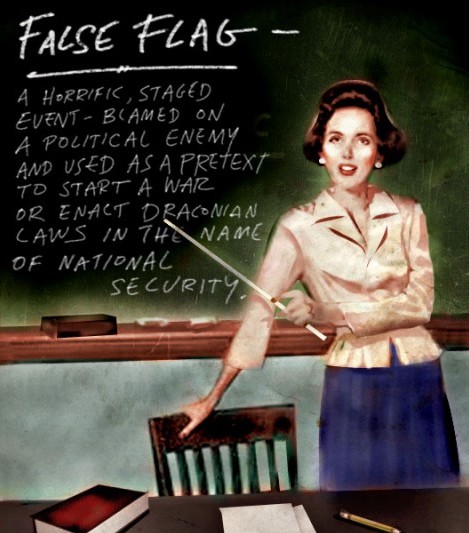
False Flag is a concept that goes back centuries. It was considered to be a legitimate ploy by the Greeks and Romans, where a military force would pretend to be friendly to get close to an enemy before dropping the pretense and raising its banners to reveal its own affiliation just before launching an attack. In the sea battles of the eighteenth century among Spain, France and Britain hoisting an enemy flag instead of one’s own to confuse the opponent was considered to be a legitimate ruse de guerre, but it was only “honorable” if one reverted to one’s own flag before engaging in combat.

Today’s false flag operations are generally carried out by intelligence agencies and non-government actors including terrorist groups, but they are only considered successful if the true attribution of an action remains secret. There is nothing honorable about them as their intention is to blame an innocent party for something that it did not do. There has been a lot of such activity lately and it was interesting to learn by way of a leak that the Central Intelligence Agency (CIA) has developed a capability to mimic the Internet fingerprints of other foreign intelligence services. That means that when the media is trumpeting news reports that the Russians or Chinese hacked into U.S. government websites or the sites of major corporations, it could actually have been the CIA carrying out the intrusion and making it look like it originated in Moscow or Beijing. Given that capability, there has been considerable speculation in the alternative media that it was actually the CIA that interfered in the 2016 national elections in the United States.

False flags can be involved in other sorts of activity as well. The past year’s two major alleged chemical attacks carried out against Syrian civilians that resulted in President Donald Trump and associates launching 160 cruise missiles are pretty clearly false flag operations carried out by the rebels and terrorist groups that controlled the affected areas at the time. The most recent reported attack on April 7 might not have occurred at all, according to doctors and other witnesses who were actually in Douma. Because the rebels succeeded in convincing much of the world that the Syrian government had carried out the attacks, one might consider their false flag efforts to have been extremely successful.

The remedy against false flag operations such as the recent one in Syria is, of course, to avoid taking the bait and instead waiting until a thorough and objective inspection of the evidence has taken place. The United States, Britain and France did not do that, preferring instead to respond to hysterical press reports by “doing something.” If the U.N. investigation of the alleged attack turns up nothing, a distinct possibility, it is unlikely that they will apologize for having committed a war crime.

The other major false flag that has recently surfaced is the poisoning of Sergei Skripal and his daughter Yulia in Salisbury, England, on March 4. Russia had no credible motive to carry out the attack and had, in fact, good reasons not to do so. The allegations made by British Prime Minister Theresa May about the claimed nerve agent being “very likely” Russian in origin have been debunked, in part through examination by the U.K.’s own chemical weapons lab. May, under attack even within her own party, needed a good story and a powerful enemy to solidify her own hold on power so false flagging something to Russia probably appeared to be just the ticket as Moscow would hardly be able to deny the “facts” being invented in London. Unfortunately, May proved wrong and the debate ignited over her actions, which included the expulsion of twenty-three Russian diplomats, has done her severe damage. Few now believe that Russia actually carried out the poisoning and there is a growing body of opinion suggesting that it was actually a false flag executed by the British government or even by the CIA.

The lesson that should be learned from Syria and Skripal is that if “an incident” looks like it has no obvious motive behind it, there is a high probability that it is a false flag. A bit of caution in assigning blame is appropriate given that the alternative would be a precipitate and likely disproportionate response that could easily escalate into a shooting war.

Is the U.S. Government Evil? You Tell Me

By John W. Whitehead

Source: The Rutherford Institute

“The greatest evil is not now done … in concentration camps and labour camps. In those we see its final result. But it is conceived and ordered (moved, seconded, carried, and minuted) in clean, carpeted, warmed and well-lighted offices, by quiet men with white collars and cut fingernails and smooth-shaven cheeks who do not need to raise their voices. Hence, naturally enough, my symbol for Hell is something like the bureaucracy of a police state or the office of a thoroughly nasty business concern.” ― C.S. Lewis, The Screwtape Letters

Is the U.S. government evil?

You tell me.

This is a government that treats its citizens like faceless statistics and economic units to be bought, sold, bartered, traded, tracked, tortured, and eventually eliminated once they’ve outgrown their usefulness.

This is a government that treats human beings like lab rats to be caged, branded, experimented upon, and then discarded and left to suffer from the after-effects.

This is a government that repeatedly lies, cheats, steals, spies, kills, maims, enslaves, breaks the laws, overreaches its authority, and abuses its power at almost every turn.

This is a government that wages wars for profit, jails its own people for profit, and then turns a blind eye and a deaf ear while its henchmen rape and kill and pillage.

No, this is not a government that can be trusted to do what is right or moral or humane or honorable but instead seems to gravitate towards corruption, malevolence, misconduct, greed, cruelty, brutality and injustice.

This is not a government you should trust with your life, your loved ones, your livelihood or your freedoms.

This is the face of evil, disguised as a democracy, sold to the people as an institution that has their best interests at heart.

Don’t fall for the lie.

The government has never had our best interests at heart.

Endless wars. The government didn’t have our best interests at heart when it propelled us into endless oil-fueled wars and military occupations in the Middle East that wreaked havoc on our economy, stretched thin our military resources and subjected us to horrific blowback.

A police state. There is no way the government had our best interests at heart when it passed laws subjecting us to all manner of invasive searches and surveillance, censoring our speech and stifling our expression, rendering us anti-government extremists for daring to disagree with its dictates, locking us up for criticizing government policies on social media, encouraging Americans to spy and snitch on their fellow citizens, and allowing government agents to grope, strip, search, taser, shoot and kill us.

Battlefield America. Certainly the government did not have our best interests at heart when it turned America into a battlefield, transforming law enforcement agencies into extensions of the military, conducting military drills on domestic soil, distributing “free” military equipment and weaponry to local police, and desensitizing Americans to the menace of the police state with active shooter drills, color-coded terror alerts, and randomly conducted security checkpoints at “soft” targets such as shopping malls and sports arenas.

School-to-prison pipeline. It would be a reach to suggest that the government had our best interests at heart when it locked down the schools, installing metal detectors and surveillance cameras, adopting zero tolerance policies that punish childish behavior as harshly as criminal actions, and teaching our young people that they have no rights, that being force-fed facts is education rather than indoctrination, that they are not to question governmental authority, that they must meekly accept a life of censorship, round-the-clock surveillance, roadside blood draws, SWAT team raids and other indignities.

Secret human experimentation. One would also be hard-pressed to suggest that the American government had our best interests at heart when it conducted secret experiments on an unsuspecting populace—citizens and noncitizens alike—making healthy people sick by spraying them with chemicals, injecting them with infectious diseases and exposing them to airborne toxins. The government reasoned that it was legitimate (and cheaper) to experiment on people who did not have full rights in society such as prisoners, mental patients, and poor blacks.

As the Associated Press reports, “The late 1940s and 1950s saw huge growth in the U.S. pharmaceutical and health care industries, accompanied by a boom in prisoner experiments funded by both the government and corporations. By the 1960s, at least half the states allowed prisoners to be used as medical guinea pigs … because they were cheaper than chimpanzees.”

In Alabama, for example, 600 black men with syphilis were allowed to suffer without proper medical treatment so that the government could study the natural progression of untreated syphilis. In California, older prisoners were implanted with testicles from livestock and executed convicts so the government could test their virility.

In Connecticut, mental patients were injected with hepatitis so the government could study the disease. In Maryland, sleeping prisoners had a pandemic flu virus sprayed up their noses so the government could monitor their symptoms. In Georgia, two dozen “volunteering” prison inmates had gonorrhea bacteria pumped directly into their urinary tracts through the penis so the government could work on a cure.

In Michigan, male patients at an insane asylum were exposed to the flu so the government could experiment with a flu vaccine. In Minnesota, 11 public service employee “volunteers” were injected with malaria, then starved for five days, so the government could study the impact.

In New York, prisoners at a reformatory prison were split into two groups to determine how a deadly stomach virus was spread: the first group was made to swallow an unfiltered stool suspension, while the second group merely breathed in germs sprayed into the air. In Staten Island, children with mental retardation were given hepatitis orally and by injection to see if they could then be cured.

Unfortunately, these incidents are just the tip of the iceberg when it comes to the atrocities the government has inflicted on an unsuspecting populace in the name of secret experimentation.

For instance, there was the U.S. military’s secret race-based testing of mustard gas on more than 60,000 enlisted men (African-Americans, Japanese-Americans, Hispanics, etc.). As NPR reports, “All of the World War II experiments with mustard gas were done in secret and weren’t recorded on the subjects’ official military records. Most do not have proof of what they went through. They received no follow-up health care or monitoring of any kind. And they were sworn to secrecy about the tests under threat of dishonorable discharge and military prison time, leaving some unable to receive adequate medical treatment for their injuries, because they couldn’t tell doctors what happened to them.”

And then there was the CIA’s Cold War-era program, MKULTRA, in which the government began secretly experimenting on hundreds of unsuspecting American civilians and military personnel by dosing them with LSD, some having the hallucinogenic drug secretly slipped into their drinks, so that the government could explore its uses in brainwashing and controlling targets. The CIA spent nearly $20 million on its MKULTRA program, reportedly as a means of programming people to carry out assassinations and, to a lesser degree, inducing anxieties and erasing memories, before it was supposedly shut down.

Similarly, the top-secret Montauk Project, the inspiration for the hit Netflix series Stranger Things, allegedly was working to develop mind-control techniques that would then be tested out on locals in a nearby village, triggering crime waves or causing teenagers to congregate.

Sounds like the stuff of conspiracy theorists, I know, but the government’s track record of treating Americans like lab rats has been well-documented, including its attempts to expose whole communities to various toxins as part of its efforts to develop lethal biological weapons and study their impact and delivery methods on unsuspecting populations.

In 1949, for instance, the government sprayed bacteria into the Pentagon’s air handling system, then the world’s largest office building. In 1950, special ops forces sprayed bacteria from Navy ships off the coast of Norfolk and San Francisco, in the latter case exposing all of the city’s 800,000 residents.

In 1953, government operatives staged “mock” anthrax attacks on St. Louis, Minneapolis, and Winnipeg using generators placed on top of cars. Local governments were reportedly told that “‘invisible smokescreen[s]’ were being deployed to mask the city on enemy radar.” Later experiments covered territory as wide-ranging as Ohio to Texas and Michigan to Kansas.

In 1965, the government’s experiments in bioterror took aim at Washington’s National Airport, followed by a 1966 experiment in which army scientists exposed a million subway NYC passengers to airborne bacteria that causes food poisoning.

Now one might argue that this is all ancient history and that the government today is different from the government of yesteryear, but has the U.S. government really changed?

Ask yourself: Has the government become any more humane, any more respectful of the rights of the citizenry? Has it become any more transparent or willing to abide by the rule of law? Has it become any more truthful about its activities? Has it become any more cognizant of its appointed role as a guardian of our rights?

Or, having mastered the Orwellian art of Doublespeak and followed the Huxleyan blueprint for distraction and diversion, has the government simply gotten craftier and more conniving, better able to hide its nefarious acts and dastardly experiments under layers of secrecy, legalism and obfuscations?

Consider this: after revelations about the government’s experiments spanning the 20th century spawned outrage, the government began looking for human guinea pigs in other countries, where “clinical trials could be done more cheaply and with fewer rules.”

In Guatemala, prisoners and patients at a mental hospital were infected with syphilis, “apparently to test whether penicillin could prevent some sexually transmitted disease.” More recently, U.S.-funded doctors “failed to give the AIDS drug AZT to all the HIV-infected pregnant women in a study in Uganda even though it would have protected their newborns.” Meanwhile, in Nigeria, children with meningitis were used to test an antibiotic named Trovan. Eleven children died and many others were left disabled.

What kind of government perpetrates such horrific acts on human beings, whether or not they are American citizens?

Is there any difference between a government mindset that justifies experimenting on prisoners because they’re “cheaper than chimpanzees” and a government that sanctions jailhouse strip searches of individuals charged with minor infractions simply because it’s easier on a jail warden’s workload?

John Lennon was right: “We’re being run by maniacs for maniacal ends.”

Unfortunately, the more things change, the more they stay the same.

Just recently, for example, a Fusion Center in Washington State (a Dept. of Homeland Security-linked data collection clearinghouse that shares information between state, local and federal agencies) inadvertently released records on remote mind control tactics (the use of “psycho-electronic” weapons to control people from a distance or subject them to varying degrees of pain).

Mind you, there is no clear evidence to suggest that these particular documents were created by a government agency. Then again, the government—no stranger to diabolical deeds or shady experiments carried out an unsuspecting populace—has done it before.

After all, this is a government that has become almost indistinguishable from the evil it claims to be fighting, whether that evil takes the form of terrorism, torture, drug traffickingsex trafficking, murder, violence, theft, pornography, scientific experimentations or some other diabolical means of inflicting pain, suffering and servitude on humanity.

For too long now, the American people have been persuaded to barter their freedoms for phantom promises of security and, in the process, have rationalized turning a blind eye to all manner of government wrongdoing—asset forfeiture schemes, corruption, surveillance, endless wars, SWAT team raids, militarized police, profit-driven private prisons, and so on—because they were the so-called lesser of two evils.

No matter how you rationalize it, the lesser of two evils is still evil.

There’s a scene in The Third Man, Carol Reed’s influential 1949 film starring Joseph Cotten and Orson Welles in which a rogue war profiteer (Harry Lime) views human carnage with a callous indifference, unconcerned that the diluted penicillin he’s been trafficking underground has resulted in the tortured deaths of young children.

Challenged by his old friend Holly Martins to consider the consequences of his actions, Lime responds, “In these days, old man, nobody thinks in terms of human beings. Governments don’t, so why should we?”

“Have you ever seen any of your victims?” asks Martins.

“Victims?” responds Lime, as he looks down from the top of a Ferris wheel onto a populace reduced to mere dots on the ground. “Look down there. Tell me. Would you really feel any pity if one of those dots stopped moving forever? If I offered you twenty thousand pounds for every dot that stopped, would you really, old man, tell me to keep my money, or would you calculate how many dots you could afford to spare?”

Lime’s callous indifference is no different from the U.S. government’s calculating cost-benefit analyses.

In the eyes of the government, “we the people” are chump change.

So why do Americans keep believing the government has their best interests at heart?

Why do Americans keep trusting the government?

Why do Americans pretend not to know what is so obvious to anyone with eyes and ears and a conscience?

As Carl Sagan recognized, “If we’ve been bamboozled long enough, we tend to reject any evidence of the bamboozle. We’re no longer interested in finding out the truth. The bamboozle has captured us. It’s simply too painful to acknowledge, even to ourselves, that we’ve been taken. Once you give a charlatan power over you, you almost never get it back.”

We should never have trusted the government in the first place.

That’s why the Founders came up with a Bill of Rights. They recognized that without binding legal protections affirming the rights of the people, the newly instituted American government would be no better than the old British despot.

It was Thomas Jefferson who warned, “In questions of power then, let no more be heard of confidence in man, but bind him down from mischief by the chains of the Constitution.”

Unfortunately, we didn’t heed the warning.

As I make clear in my book Battlefield America: The War on the American Peoplethe government has ripped the Constitution to shreds and left us powerless in the face of its power grabs, greed and brutality.

So how do you fight back?

How do you fight injustice? How do you push back against tyranny? How do you vanquish evil?

You don’t fight it by hiding your head in the sand.

Stop being apathetic. Stop being neutral. Stop being accomplices.

Start recognizing evil and injustice and tyranny for what they are. Demand government transparency. Vote with your feet (i.e., engage in activism, not just politics). Refuse to play politics with your principles. Don’t settle for the lesser of two evils.

As British statesman Edmund Burke warned, “The only thing necessary for the triumph of evil is for good men [and women] to do nothing.”

It’s time for good men and women to do something. And soon.