THE MONOPOLIZATION OF AMERICA: The biggest economic problem you’re hearing almost nothing about

By Robert Reich

Source: Nation of Change

Not long ago I visited some farmers in Missouri whose profits are disappearing. Why? Monsanto alone owns the key genetic traits to more than 90 percent of the soybeans planted by farmers in the United States, and 80 percent of the corn. Which means Monsanto can charge farmers much higher prices.

Farmers are getting squeezed from the other side, too, because the food processors they sell their produce to are also consolidating into mega companies that have so much market power they can cut the prices they pay to farmers.

This doesn’t mean lower food prices to you. It means more profits to the monopolists.

Monopolies all around

America used to have antitrust laws that stopped corporations from monopolizing markets, and often broke up the biggest culprits. No longer. It’s a hidden upward redistribution of money and power from the majority of Americans to corporate executives and wealthy shareholders.

You may think you have lots of choices, but take a closer look:

1. The four largest food companies control 82 percent of beef packing, 85 percent of soybean processing, 63 percent of pork packing, and 53 percent of chicken processing.

2. There are many brands of toothpaste, but 70 percent of all of it comes from just two companies.

3. You may think you have your choice of sunglasses, but they’re almost all from one company: Luxottica – which also owns nearly all the eyeglass retail outlets.

4. Practically every plastic hanger in America is now made by one company, Mainetti.

5. What brand of cat food should you buy? Looks like lots of brands but behind them are basically just two companies.

6. What about your pharmaceuticals? Yes, you can get low-cost generic versions. But drug companies are in effect paying the makers of generic drugs to delay cheaper versions. Such “pay for delay” agreements are illegal in other advanced economies, but antitrust enforcement hasn’t laid a finger on them in America. They cost you and me an estimated $3.5 billion a year.

7. You think your health insurance will cover the costs? Health insurers are consolidating, too. Which is one reason your health insurance premiums, copayments, and deductibles are soaring.

8. You think you have a lot of options for booking discount airline tickets and hotels online? Think again. You have only two. Expedia merged with Orbitz, so that’s one company. And then there’s Priceline.

9. How about your cable and Internet service? Basically just four companies (and two of them just announced they’re going to merge).

Why the monopolization of America is a huge problem

The problem with all this consolidation into a handful of giant firms is they don’t have to compete. Which means they can – and do – jack up your prices.

Such consolidation keeps down wages. Workers with less choice of whom to work for have a harder time getting a raise. When local labor markets are dominated by one major big box retailer, or one grocery chain, for example, those firms essentially set wage rates for the area.

These massive corporations also have a lot of political clout. That’s one reason they’re consolidating: Power.

Antitrust laws were supposed to stop what’s been going on. But today, they’re almost a dead letter. This hurts you.

We’ve forgotten history

The first antitrust law came in 1890 when Senator John Sherman responded to public anger about the economic and political power of the huge railroad, steel, telegraph, and oil cartels – then called “trusts” – that were essentially running America.

A handful of corporate chieftains known as “robber barons” presided over all this – collecting great riches at the expense of workers who toiled long hours often in dangerous conditions for little pay. Corporations gouged consumers and corrupted politics.

Then in 1901, progressive reformer Teddy Roosevelt became president. By this time, the American public was demanding action.

In his first message to Congress in December 1901, only two months after assuming the presidency, Roosevelt warned, “There is a widespread conviction in the minds of the American people that the great corporations known as the trusts are in certain of their features and tendencies hurtful to the general welfare.”

Roosevelt used the Sherman Antitrust Act to go after the Northern Securities Company, a giant railroad trust run by J. P. Morgan, the nation’s most powerful businessman. The U.S. Supreme Court backed Roosevelt and ordered the company dismantled.

In 1911, John D. Rockefeller’s Standard Oil Trust was broken up, too. But in its decision, the Supreme Court effectively altered the Sherman Act, saying that monopolistic restraints of trade were objectionable if they were “unreasonable” – and that determination was to be made by the courts. What was an unreasonable restraint of trade?

In the presidential election of 1912, Roosevelt, running again for president but this time as a third party candidate, said he would allow some concentration of industries where there were economic efficiencies due to large scale. He’d then he’d have experts regulate these large corporations for the public benefit.

Woodrow Wilson, who ended up winning the election, and his adviser Louis Brandeis, took a different view. They didn’t think regulation would work, and thought all monopolies should be broken up.

For the next 65 years, both views dominated. We had strong antitrust enforcement along with regulations that held big corporations in check.

Most big mergers were prohibited. Even large size was thought to be a problem. In 1945, in the case of United States v. Alcoa (1945), the Supreme Court ruled that even though Alcoa hadn’t pursued a monopoly, it had become one by becoming so large that it was guilty of violating the Sherman Act.

What happened to antitrust?

All this changed in the 1980s, after Robert Bork – who, incidentally, I studied antitrust law with at Yale Law School, and then worked for when he became Solicitor General under President Ford – wrote an influential book called The Antitrust Paradox, which argued that the sole purpose of the Sherman Act is consumer welfare.

Bork argued that mergers and large size almost always create efficiencies that bring down prices, and therefore should be legal. Bork’s ideas were consistent with the conservative Chicago School of Economics, and found a ready audience in the Reagan White House.

Bork was wrong. But since then, even under Democratic administrations, antitrust has all but disappeared.

The monopolization of high tech

We’re seeing declining competition even in cutting-edge, high-tech industries.

In the new economy, information and ideas are the most valuable forms of property. This is where the money is.

We haven’t seen concentration on this scale ever before.

Google and Facebook are now the first stops for many Americans seeking news. Meanwhile, Amazon is now the first stop for more than a half of American consumers seeking to buy anything. Talk about power.

Contrary to the conventional view of an American economy bubbling with innovative small companies, the reality is quite different. The rate at which new businesses have formed in the United States has slowed markedly since the late 1970s.

Big Tech’s sweeping patents, standard platforms, fleets of lawyers to litigate against potential rivals, and armies of lobbyists have created formidable barriers to new entrants. Google’s search engine is so dominant, “Google” has become a verb.

The European Union filed formal antitrust charges against Google, accusing it of forcing search engine users into its own shopping platforms. And last June, it fined Google a record $2.7 billion.

But not in America.

It’s time to revive antitrust

Economic and political power cannot be separated because dominant corporations gain political influence over how markets are organized, maintained, and enforced – which enlarges their economic power further.

One of the original goals of the antitrust laws was to prevent this.

Big Tech – along with the drug, insurance, agriculture, and financial giants – is coming to dominate both our economy and our politics.

There’s only one answer: It is time to revive antitrust.

How Interlinked Corporations Rule The World

By Kris Kanthan

Source: Activist Post

Globalism is just like the mafia, but with lot more complexity and respectability. If you have watched mob films such as The Godfather, you can understand how the world works. For example, in Godfather II, a bunch of mobsters get together in Havana, Cuba, to celebrate Hyman Roth’s birthday. As the birthday cake is symbolically cut into pieces and distributed, Roth tells the group how Cuba will be split up amongst the guests. Extrapolate this scene to the world, you can visualize how the world works.

Corporations to Central Banks

The power structure of global elites is like nested Russian dolls made up of corporations. How many people realize that KFC, Taco Bell and Pizza Hut are owned by the same corporation? Or that HBO, CNN, TBS, TNT, Cartoon Network all report to the same boss? Or that whether you drink Budweiser, Corona, Stella, Busch or Michelob (and dozens of others), you end up paying one giant corporation?

Who controls these corporations? It’s not the CEO, as most people believe. The real control lies in the hands of the largest shareholders and/or the Board of Directors. The Board of Directors of all giant corporations are linked to each other by one or two degrees of separation. Some elites even sit on multiple boards at the same time. For example, Rochelle Lazarus sits on the boards of Merck, GE and Blackstone; Jon Huntsman sits on the boards of Hilton, Ford, Caterpillar and Chevron; and Timothy P. Flynn is a director at JP Morgan Chase, Wal-Mart, Alcoa and United Healthcare. Think for a moment how all these corporations would seem totally unrelated to a regular person.

Below is an image that show how the Boards at Netflix and Procter & Gamble are linked to some other popular corporations. (Note: this is a partial list of connections).

The Board of Directors report to the next level of bosses, the financial overlords. All the public corporations in the West – and much of the world now – are controlled by large shareholders, who are giant financial corporations. Thus a study in 2011 showed that fewer than 150 mega corporations pretty much control all the corporations in the world! Some of these have recognizable names such as Barclays or JP Morgan; other names such as State Street or AXA are hardly known outside the financial circles, yet they have incredible influence and wealth.

For these people, it doesn’t matter if you buy Pepsi or Coke; cars from GM or Ford or Toyota; or produce from Walmart or Safeway. It also doesn’t matter to them if you watch ABC or NBC or Fox. Your money goes to the same place.

There are also a few individuals like Carl Icahn or Paul Singer who can borrow billions of dollars at 0%, buy tons of shares of a corporation, change its policies (say, the dividends given out), and make a killing few months later. This is how the financial mafia’s shakedown works.

On the top of the food chain are the central banks who have the amazing ability to create money out of thin air. As Rothschild once said, “Give me control of a nation’s money supply, and I don’t care who makes the laws.” These people are the ultimate Godfathers of globalism. They determine the winners and the losers in capitalism, and thus control all the corporations (including the media), politicians, militaries, and the Deep States around the world.

How to use Corporations

All these corporations are but tools to be used for a higher purpose – controlling people. The financial system is the primary tool used to control nations. Any nation’s debt, wealth, credit rating, stock market, etc. can be manipulated by Wall Street, which is the financial weapon of mass destruction.

There are other corporations that wield power in less obvious ways. GMOs are effective weapons in controlling nations (if a country has to buy seeds and pesticides from foreign corporations every year, that country will stay submissive). Big Pharma and medicines also create dependencies in people and nations.

Above all, globalists strive for the ability to control what people think. This is where media, entertainment and the Internet come into play. Fortunately, all are corporatized, so that Facebook, Twitter, Google, mainstream media, and Hollywood can all work together to form the Ministry of Truth and control what people all over the world feel, think and believe.

The Internet is also a great tool to spy on people and leaders of nations all over the world. This comes in handy when uncooperative leaders have to be blackmailed or overthrown (example: anti-US Brazilian president, Rousseff, was removed by a leaked phone call. The NSA had spied on her and tapped her phone).

When Corporations Need Some Help…

Corporatocracy needs a lot of help in a “free market,” and that’s where military and politics come into play. Globalism demands that all the natural resources around the world be privatized, people of all nations be ready to work for the globalists, and all the economies be open for the corporations to sell their products. When nations resist this trend, they will suddenly face extraordinary problems. (Those who are familiar with John Perkins and his work as an “Economic Hit Man” understand this process.)

An ideal nation will be a vassal nation which will generously share and privatize its natural resources, provide cheap labor, open its markets to multi-national corporations, borrow excessive amounts from the World Bank and IMF, buy a lot of US treasury bonds, host US/NATO military bases, purchase US/EU weapons, and vote in the UN as instructed.

In the mafia movies, people who need to be persuaded may receive a dead fish wrapped in a newspaper or may wake up next to a horse’s head on their beds. In geopolitics, the warnings come in the form of color revolutions (Georgia, Ukraine), attacks by Islamic terrorists (Libya, Syria, Philippines), rise of separatist movements (Kurdistan, Balochistan), hostile attitudes from neighboring countries (Qatar, Iran), etc. If those don’t work, there will be sanctions (Venezuela) and eventually a shock and awe invasion. Unlike the mobster world who can simply carry out a helicopter attack(Godfather II), globalists put in a lot of efforts to justify their overt violence. This task of selling a war is carried out by press, pundits and politicians.

In my book, “Syria – War of Deception,” I explain the geopolitics of proxy wars, Islamic terrorism, and the struggle for global hegemony.

Politicians are also key stakeholders in globalism, and they sell to the public treaties such as NAFTA, WTO and TPP that give corporations power over individual nations. Secretary of State Hillary Clinton said in a speech (exposed by WikiLeaks) that the plan is to create a “hemispheric common market” that would be a union of North, Central and South Americas. There are also political unions that go beyond trade treaties – the creation of EU being an excellent example.

The Beginning of the end? 

People who’re not caught up in the daily drama can see enormous problems with the current system. Globalists have used fake, fiat money to push the U.S. and most nations around the world into colossal debt. The entire global economy is sustained by artificial interest rates, real estate bubbles, stock market bubbles, and fictitious assets such as $500 trillion of derivatives (when the global GDP is only $75 trillion). We live in a real world that’s dependent on a Ponzi system fueled by virtual assets. While globalists keep assuring us how wonderful things are, the uber rich now have more wealth than ever before – just one-fifth of one percent of the world have a net worth of $63 trillion!

Most leaders of countries around the world have bought into this globalist system, either willingly or grudgingly. However, there are a few who are still resisting it to various degrees – North Korea does it belligerently; Syria, Iran, Venezuela and Russia do it defensively; and some such as China, Myanmar and the Philippines do it in more nuanced ways.

There’s also resistance to globalism from the left and the right of the political spectrum, albeit for different reasons.

The next twenty years may be the most significant in modern human history. Entire nations, societies and our way of life may change irrevocably. Will there be a challenge to the current world order either from sovereign nations or grassroots level organizations? Or will we say, “fuggedaboutit” and meekly go along, hoping for the best?


Chris Kanthan is the author of a new book, Syria – War of Deception. It’s available in a condensed as well as a longer version. Chris lives in the San Francisco Bay Area, has traveled to 35 countries, and writes about world affairs, politics, economy and health. His other book is Deconstructing Monsanto.

The Four Pillars of Disaster Shamanism

By Gary Z McGee

Source: The Mind Unleashed

“We need shamans, and if society doesn’t provide them, the universe will.” ~Joe Lewels

In the article The Archetypal Path to Getting Your Shit Together, I wrote about the power of archetypes. A Disaster Shaman is an example of using an archetype to make the world a better place; to become the change we want to see in the world.

The Disaster Shaman recipe combines aspects of The Shadow with aspects of The Hero and then mixes in a little Trickster tomfoolery. The combination of these archetypes creates a particular flavor of nontraditional shamanism that spearheads healthy Cosmic Law through the heart of unhealthy lawfulness.

A Disaster Shaman is a force of nature first, a person second; sowing radical revolution in order to reap progressive evolution. Healthy balance is primary. Even if it comes at the expense of comfort and security. Disaster Shamanism (otherwise known as Apocalyptic Shamanism) is the interdependent shamanic response to apocalyptic times.

The primary tasks of a Disaster Shaman are as follows:

–Heal disaster situations through shamanic cosmology and ecopsychology.

–Listen to Universal Laws to discern the difference between healthy and unhealthy.

–Live moderately so that others may moderately live.

–Diagnose and heal Nature Deprivation.

–Transform weaponry into livingry.

–Bring “water” to the Wasteland.

The sub archetypes of the Disaster Shaman archetype are The New Hero, The Fifth Horseman of the Apocalypse, The Sacred Clown, and The New Oracle. The four pillars of Disaster Shamanism subsume these sub archetypes. Let’s break them down…

Hero-expiation (New Hero or Cosmic Hero):

“Our sole responsibility is to produce something smarter than we are; any problems beyond that are not ours to solve.” ~Ray Kurzweil

The average person is not heroic (courageous). Likewise, the average hero is not prestigious (provident). A New Hero, as opposed to a typical hero, is a hero with prestige. A New Hero has gone Meta with the concept of heroism itself.

The New Hero sub archetype is the first pillar of Disaster Shamanism. New heroism is gained through hero-expiation. Hero-expiation is the voluntary, wise, honorable, moral, and compassionate distribution of power so that power doesn’t get to the point that it corrupts.

It is through the wise distribution of power that a typical hero becomes a New-hero (cosmic hero, next-level hero) with skill, power, honor, and prestige, as opposed to just a typical hero with only skill and power.

Hero expiation is all about getting power over power. Whether one’s own power or the overreaching power of others. It’s about turning the tables on entrenched power by “counting coup” on it.

A Disaster Shaman as New Hero is a social leveling mechanism par excellence. They count coup on power through strategic humiliation (shaming) so that power never has the chance to become absolute.

When a New Hero comes to town, fear-filled blue pills are swapped with wisdom-filled red pills. The Disaster Shaman has come to set the record straight. To recondition the culture that has been conditioned into believing in competition over cooperation and narrow-minded one-upmanship over open-minded compassion. They teach that competition has always been secondary to cooperation; otherwise we wouldn’t have survived as a species (Darwin).

Eco-consciousness (Fifth Horseman of the Apocalypse):

“Extreme positions are not succeeded by moderate ones, but by contrary extreme positions.” ~Friedrich Nietzsche

Eco-consciousness is about uncontrolled order overcoming controlled chaos. Whether the culture (tribe) has become too obese, too greedy, too violent or some other unhealthy excess, the Disaster Shaman arrives to set the record straight; to plant a seed of overt moderation within the covert immoderation.

The Fifth Horseman is the one that cleans up after the original Four Horsemen (the Four Horsemen is a metaphor for anyone caught up (aware or not) in any kind of unsustainable, unhealthy, violent, immoral, or mass-destructive social system). The Fifth Horseman of the Apocalypse is an archetype representing rebirth and renewal in the face of conquest, war, famine, and death.

The Fifth Horseman is ruthless with her healing powers. Her name is Providence, Phoenix-like, she rises up from the ashes of war & decay to spread self-actualized love, open-mindedness, and progressive sustainability by digging up the decay and unsustainable residue of past and present civilizations and then using it all as compost in cultivating and growing a healthier more balanced future.

In that capacity she has devoted herself to planting gardens of eco-centric heroism in the humus of war, hate, close-mindedness and greed, and anything else left behind by the original four horsemen. She is dedicated to, as Buckminster Fuller said, transforming weaponry into livingry.

She subsumes the original four horsemen by teaching them that the new definition of right & wrong must be derived from the universal dictation of healthy & unhealthy rather than the human opinion of good & evil.

The Fifth Horseman is the Goddess of Recompense. She is the Verdant Force. She is the soft hammer of evolution. She has come to blur the false boundaries that have been erected between nature and the human soul.

She is Gaia. She is Lady Justice. She is the return of the Sacred Feminine. She is all of us, men and women, realizing that we are nature first and humans second, that we are soul first and ego second. She is weighing the worth of the human world with the Scales of Justice. With or without us, she will not fail to bring water to the wasteland.

High humor (Sacred Clown):

“What is a tragedy but a misunderstood comedy.” ~Shakespeare

Most of us are familiar with the prototypical clowns: red-nosed clowns, court jesters, and Tarot fools. But sacred clowns take clowning to a whole other level.

Almost all types of sacred clowns combine trickster spirit with shamanic wisdom to create a kind of sacred tomfoolery that keeps the zeitgeist in check. Their methods are unconventional and typically antithetical to the status quo, but extremely effective. They indirectly re-enforce societal customs by directly enforcing their own powerful sense of humor into the social dynamic.

The main function of a sacred clown is to deflate the ego of power by reminding those in power of their own fallibility, while also reminding those who are not in power that power has the potential to become corrupt if it’s not balanced with other forces, namely with humor. But sacred clowns don’t out-rightly derive things. They’re not comedians, per se. Though they can be. They are more like personified trickster gods, poking holes in things that people take too seriously.

Through acts of satire and showy displays of blasphemy, sacred clowns create a cultural dissonance born from their Crazy Wisdom, from which serious anxiety is free to collapse on itself into sincere laughter.

The high humor of Sacred Clowns leads to a higher courage and the audacity to speak truth to power. And they do so with silver-tongued proficiency. There exists no perceived construct of power that’s above their enlightened rebellion. No idol too golden. No high horse too high. No pedestal too revered. No “wizard” too disguised. No God too godly. No title too contrived.

Nothing is immune to the exactness of a Sacred Clown’s rebellion. It’s all merely procrastinating compost. It’s all just well-arranged armor waiting to rust. It’s all an illusion within a delusion. And the Sacred Clown has the enlightened sense of humor to reveal that absolute fact.

Lest we write our lives off to unhealthy stagnation and devolving inertia, we must become something that has the power to perpetually overcome itself. The sacred clown has this power. Paraphrasing William Blake, “If the fool (Sacred Clown) would persist in his folly, he would become wise (New Oracle).”

Self-overcoming (New Oracle):

“To attain knowledge, add things every day. To attain wisdom, remove things every day.” ~Lao Tzu

A Disaster Shaman is a New Oracle who has come to inform the old oracles that they have failed. The self-centered “culture” has been declared a wasteland, and the unhealthy surroundings dubbed unworthy for healthy humans attempting to evolve into a more robust species.

The New Oracle teaches this, above all: Pain should not be avoided at the expense of love. Love should be embraced at the risk of pain.

As such, a master with high humor is needed to resolve the disaster of the self; to usher in an eco-centric, as opposed to an ego-centric, perspective. This master lies dormant inside us all. It can only be found by having the out-of-mind experience of no-mind, in the courageous throes of self-overcoming. There, in the stillness, the master is meditating. The master is connected to the source of all things, his thousand-petalled lotus spinning like a galaxy above his head.

He is radiating inside of you, bursting with wisdom and nth-degree-questions. She pirouettes like Shakti. He foxtrots like Shiva. He/she is the all-dancing, all-laughing oracle of the primordial self, interconnected with all things. And it can only be found there in the silence, between inhale and exhale, between being and non-being, between mind and no-mind, between finitude and infinity.

After disaster, but just before mastery, the Disaster Shaman as New Oracle persistently self-actualizes toward enlightenment.

There, above thought, is the source of human creativity: the place where artists, poets, musicians, and even scientists have discovered the secrets of the universe. Like Leonard Cohen said, “You lose your grip, and then you slip into the masterpiece.”

The mind of Everything holds the heart of Nothingness; the void of Nothingness holds the core of Everything. The masterpiece is the working, self-overcoming, canvas of the New Oracle’s life. The New Oracle is forever in the process of seizing the moment in order to seize the day in order to seize the life.

In the end, the Disaster Shaman is a healthy response to our unhealthy times. Wielding the courage of the New Hero, brandishing the mettle of the Fifth Horseman, harnessing the humor of the Sacred Clown, and channeling the wisdom of the New Oracle, the Disaster Shaman is determined to tonalize an otherwise atonal world.

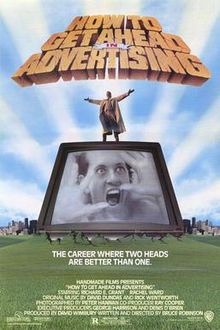
Saturday Matinee: How to Get Ahead in Advertising

“How to Get Ahead in Advertising” (1989) is a British comedy written and directed by Bruce Robinson (Withnail and I) and starring Richard E. Grant and Rachel Ward.  Grant plays Denis Dimbleby Bagley, a cold but effective ad executive who suffers a nervous breakdown due to a crisis of conscience while brainstorming a promotional campaign for acne cream.  His anxiety manifests in a boil which escalates the breakdown as it increases in size. Rachel Ward stars as Julia, Denis’ long-suffering wife who becomes increasingly alarmed by the sudden and drastic changes his personality undergoes.

Watch the full film here.

America’s Dystopian Future

By

Source: CounterPunch

Imagine a privatized America where rugged individualism reigns supreme within a vast network of corporate America, Inc., similar to 19th century wild west lifestyle, no social security, no Medicare, no Medicaid, no public law enforcement as individuals stand their own ground. Read all about it in Scott Erickson’s History of the Decline and Fall of America (Azaria Press, 2018).

Erickson’s newly released semi-fictional satire of American history and subsequent decline into deepening pits of despair is a sure-fire treasure trove of Americana, at its best. It’s a page-turner par excellence, rich in accurate textured American history and jam-packed with imagery of a dystopian future that is simply unavoidable based upon America’s character and development over the past two centuries. The dye was cast long before onset of dystopian existence.

The History of the Decline and Fall of America highlights and exposes inherent limitations of democratic capitalism whilst explaining in full living color a future American dystopia that is fully expected based upon America’s beginnings from the time of Captain John Smith at historic Jamestown (1607). The history lesson therein is superb, not missing a beat of what shaped America up to the final tipping point of neoliberal dogma and beyond into a deep dark world order.

This beautifully written and conceived historical fiction is a witty tour de force of America past, present, and future, weaving together all of the historical elements into one coherent story from the widely accepted version of American “business success ” of the early period, but over time wistfully morphing into abject failure!

That process of failure, the root causes, is what intrigues, for example, “Americans were not only inventing a country but inventing what it meant to be an American.” Indeed, America came into being as a brand new experiment in capitalistic democracy. Within that quest for a new way forward, inclusive of equality and fraternity amongst equals, Erickson discovers and reveals unique American traits that belie that mission, leading to a neoliberal/privatization hellhole that goes horribly wrong.

That fascinating pathway is explained via enchanting quips, for example, de Tocqueville’s remarkably astute comment: “ I know of no country, indeed, where the move of money has taken a stronger hold on the affections of men.” This one isolated statement from the 1830s tells a tale of American character molded by artificiality of wealth creation simply for the sake of possessing it. America’s pursuit of happiness was the “pursuit of affluence” and remained its dominant trait for the “remaining 200-plus years of American history.”

Indeed, those predominant American character traits are flushed-out and analyzed in the context of eventual failure, of a dystopian world order emanating out of America’s clumsy experimentation with empire-building and constantly striving for the pot at the end of the rainbow, meaning economic growth above all else. It was a frontier spirit that fed into elusive goals of preeminence: “The frontier resulted in Americans being doers rather than thinkers….”

Real scenes of real American cocksuredness, as well as the clumsiness associated with raw ignorance, come to life, e.g., during the presidential race between Ike and Adlai Stevenson in 1954: “A revealing incident occurred while Stevenson was campaigning for president. A citizen shouted to Stevenson that he ‘had the vote of every thinking person.’Stevenson replied, ‘That’s not enough. We need a majority!”
This is excellent history, comparable to a textbook, as well as a peek into the future shaped via trends rooted throughout Americana. Erickson’s lessons in American history are genuine and accurate, which gives the book depth and a powerful sense of significance well beyond similar treatises that try to lay the challenging groundwork leading to how a nation turns sour into a dystopian society.

He weaves the path of Manifest Destiny all the way from 1840s to the planting of the American flag on the surface of the moon. Until the 1970s when American pre-eminence tipped downward, humiliated in Vietnam in what future generations came to know as The Vietnam Syndrome,” the psychological attempt to live with the unacceptable reality that it was possible for America to not win.

Not only was America no longer a winner in war, its “unparalleled level of affluence… began to decline.” The 1970s marked the high point, forever downward into a bottomless septic tank, a cloaca of messy foul shit earmarking America’s final destiny, third world status within a realm of excessive, pretense of wealth glistening behind spiked electronic gates.

The signs of decline were easy to spot by the early-mid 2000s: “… the situation had declined dramatically. According to statistics from 2015, among industrialized nations, America was notable for having the highest poverty rate, the lowest score on the UN index of ‘material well-being of children,’ the highest health care expenditures, the highest infant mortality rate, the highest prevalence of mental health problems, the highest obesity rate, the highest consumption of antidepressants per capita, the highest homicide rate, and the largest prison population per capita. By international standards, the rural counties of southern West Virginia and eastern Kentucky qualified as developing countries, as did large sections of American cities such as Detroit, Cleveland, Gary, and many others.” (Pg. 112)

Thereafter, America’s youth no longer embraced the long-standing belief that they would have more than their parents. No, they knew it would be less and less. America entered a “permanent recession” cycle.
By the late 2030s American experienced a series of extreme crises. A number of cities declared bankruptcy. Houston, America’s 4th largest city goes bankrupt. Cleveland goes bankrupt. The head of the Federal Reserve quits and becomes a banjo player in a bluegrass group. America’s banking system collapses under the weight of fishy loans and massive crazed derivatives all permitted by increasingly hands-off regulations. The brutal hand of libertarianism smears a once proud republic.

Regular citizens, entire families carry torches surrounding Wall Street in protest of loss savings, ATMs not functioning, banks closed. An economic death spiral unleashed. The Save America Act followed, consisting of pure right wing neoliberal fix-its to save corporate America, to save Wall Street, turning to America, Inc. as the only answer to all that ails.

And, as the financial markets unravel in the face of nationwide bankruptcies, the government convincingly informs the public: “We need to defy the Constitution in order to preserve it… Americans were so thoroughly confused about the relationship between government and economics that most of them thought that the terms democracy, free-enterprise, and capitalism were the same thing.” (Pg. 165)

As time progresses, America’s Labor Day is changed to Management Day, and the Catholic Church is permitted to re-name the Statue of Liberty as “Our Lady of Perpetual Economic Growth.” America the nation turns into America, Inc. It is the only way the establishment knows to drive the country out of its doldrums. As such, The Star Spangled Banner is changed to The Free Market Ramble.

Privatization of the entire country in harmony with massive tax cuts alongside elimination of Social Security, Medicare, Medicaid, public education, law enforcement, postal service, and maintenance of roads and infrastructure, thereafter, people take care of themselves from birth to the death, alone with family backing. Self-directed medical care becomes a beacon of survival of the fittest of the fittest. Those that participated as y0ungsters in Boy/Girl Scouts have a leg up in a society that increasingly places emphasis on rugged individualism. However, the many, many weaklings stumble in rows after rows of slimy gutters.

In the end, and similar to America’s 2008-09 financial collapse, which was only a warm up for much bigger things to come: “The decisive trigger, the one that pushed America beyond the point of no return, was the total collapse of the economy. It had been something of a miracle that the doomed economy had not collapsed long before. Toward the end it had been sustained by little more than momentum, since according to all economic indicators it should not have been functioning at all. The economic system based on infinite growth had reached the point where it could grow no more. American banks could not pay off previous debt by making further loans to generate more money. The pyramid scheme was over… An eerie calm descended upon all those involved in economics and finance.”

America is Disneyland

By Chris Kanthan

Source: Activist Post

Disneyland is the Happiest Place on Earth! Millions of families visit the theme park every year to enjoy the magical place of rides, spectacular shows and cheerful cartoon figures. Everything is clean, perfect and joyful. Unless … you realize that Cinderella might actually be homeless. That’s right, 10% of Disneyland’s employees are actually homeless, many more are on food stamps, and 75% struggle to make ends meet.

Does this ring familiar? Think of America. Behind the façade of being the greatest country on Earth with the largest GDP and the wealthiest billionaires, there are tens of millions of Americans who are left behind just like Disney’s employees.

This neo-feudalistic model isn’t isolated to Disney or Walmart, it’s systemic. For example, the bus driver at Apple – which has $280 billion in cash – is forced to sleep in a van because he can’t afford the Silicon Valley rent; Facebook’s cafeteria workers live in a garage; and thousands of American Airlines’ employees are forced to depend on food stamps.

America is being eaten alive by corporate greed; and Disneyland has been taken over by Scrooge.

Let’s look at some Disney Inc. statistics.

Total profit per year: $9 billion

Total employees: 200,000

Notice that the profit reflects what’s left after all the expenses, including the salaries, have been paid. So, in a utopian world, the Disney management will do the math ($9 billion / 200,000 = $45,000) and send a check for $45K to every employee, Mickey included. That kind of profit-sharing would really make Disneyland the happiest place on Earth. Does that happen? No way!

Does Cinderella get a check for perhaps $20K, $10K, $5K or even $1K? Nope, nope, nope, nope. Cinderella gets nada, zero, zilch. She should be content with the $12/hour salary and must smile happily for the kids.

In Disneyland, Cinderella never gets to meet her prince.

Disney’s CEO gets paid $46 million a year, which translates to $23,000 an hour. Imagine Disney’s CEO coming to work on Jan 2nd. He wishes a few people “happy new year,” orders coffee, sits on his desk, makes a few phone calls … and he has already made more money than what Ariel would make during the rest of the year.

Of course, the CEO should get paid more, but does he deserve a salary that’s equivalent to 2,000 Disney employees? If the CEO doesn’t show up for work for a day, Disneyland will continue running. If 2,000 employees take a day off, the park would be shut down.

In the 1960s, the CEO-to-worker salary ratio was 25. Today it’s often 600 or more, sometimes even more than 1000 (for example, at Walmart). Much of the executive compensation comes in the form of stock options and bonuses based on stock performance. In a rational and unrigged world, the CEOs would increase their revenues and profits to get bonuses. Not anymore.

Now, the CEOs simply use a no-brainer solution to boost the stock prices – it’s called stock buybacks or share repurchases. This involves a firm using corporate profits (or even borrowed money) to buy its own stocks. BTW, this used to be illegal until the 1980s.

Since 2007, US corporations have spent trillions of dollars on stock buybacks. In 2018 alone, they will spend $800 billion on this financial engineering tool (which has also led to a massive stock market bubble). They won’t use the billions to hire Americans, boost wages or innovate new products. Instead, the CEOs will buy yachts and tell you that Chinese or Mexicans stole your jobs.

Do the low-wage employees of Disneyland get any shares or stock options? A silly question, indeed.

Thus we have a situation where American employers ruthlessly exploit American workers. This isn’t a good model for a country. China and Mexico don’t make us poor; predatory capitalism does.

Paying good wages to hardworking employees is not socialism or communism. Henry Ford understood this when he more than doubled the wages of his workers in 1914.

However, hundred years later, maximizing profit has become a fundamentalist dogma. You can imagine a conversation among the factory-farming executives:

Guy #1: Why the heck are these chickens roaming out in the farms? We would save so much money if we lock them up in cages.

Guy #2: Brilliant idea! Let’s lock up five chickens in a cage. We will save more. More is always better.

Guy #3: I really don’t understand why we feed them expensive salads and healthy stuff. Let’s feed them cheap GMO corn and GMO soy from my friends at Monsanto.

Guy #4: Experts tell me that if we give them caffeine and anti-depressants, the chickens will stay awake longer, eat more, and get fatter.

Guy #5: And when they get sick, load them up with antibiotics and steroids.

Guy #5: These stupid chickens are also so small. Let’s drug them with some growth hormones. I am getting a lot of pressure from the private equity funds about profits per chicken.

Apart from being inhumane and psychopathic, this system forgets or ignores the fact that we have to eat these chickens. Sick chicken = sick people. Call it Karma or “revenge of the chickens.”

Similarly, poor workers = poor country. And you can imagine a similar conversation among corporate executives regarding workers – “cut their wages and benefits”, “make them work overtime”, “hire part-time employees rather than full-time” and so on.

You can’t grow the economy if American workers don’t get paid enough, especially by profitable multi-billion dollar corporations. 2/3rd of our GDP is based on consumer spending. It’s no wonder that in the last ten years, the US economy cumulatively grew only by a dismal 35%. Compare that to China, which grew by an astounding 200% during that same period.

And it’s not a coincidence that China’s average wages have more than doubled in the same period:

The solution for low wages primarily lies in the hands of corporate elites. Labor unions are almost non-existent in the private sector these days; and the government doesn’t have much control over corporate America – in fact, corporations control the U.S. political system. Free market doesn’t have to translate to cancerous greed and extreme exploitation. Free market also means that corporations are free to share their profits with their employees. Finally, free market can and must also incorporate patriotism, responsibility to the society and strategies for sustainable prosperity.


Chris Kanthan is the author of a new book, Deconstructing the Syrian War. Chris lives in the San Francisco Bay Area, has traveled to 35 countries, and writes about world affairs, politics, economy and health. His other book is Deconstructing Monsanto. Follow him on Twitter: @GMOChannel


Convenient Tales About Riches Within Reach

By Sam Pizzigati

Source: OpEdNews.com

The world at large knew virtually nada about Sylvia Bloom for 96 years. Then she died in 2016. Now, just a little too late, Sylvia Bloom is getting her belated — yet richly deserved — 15 minutes of worldwide fame.

The New York Times has just published a heart-warming story of the caring, upright life Sylvia Bloom lived, and the remarkable — and hidden — fortune she quietly accumulated over the course of her 67-year career as a Manhattan legal secretary.

That fortune totaled, in the end, over $9 million. The bulk of that wealth, the Times account reveals, is going — per Bloom’s wishes — to help students from poor families advance their educations.

None of Bloom’s surviving relatives or law firm colleagues or fellow volunteers at the Henry Street Settlement, the social services agency set to get $6.24 million from her bequest, had any idea that their unassuming loved one and friend had saved anything remotely close to multiple millions.

Counting Pennies

Bloom lived frugally all her life in Brooklyn and commuted, by subway, to her job. The “high life” never interested her in the least. She led a simple existence. She counted her pennies. In the end, she put them all to good use.

Stories like Bloom’s have been popping up regularly over recent years. Leonard Gigowski, a Wisconsin shopkeeper, died three years ago at age 90, and left behind a “secret $13 million fortune” that’s currently funding scholarships. Grace Groner passed away in 2010 at age 100. She spent most of her life in a one-bedroom Illinois home, shopped at thrift stores, and left $9 million for her alma mater.

Convenient Tales

Our popular culture can’t seem to get enough of these life-affirming tales of modest multi-millionaire seniors. These stories make us feel good. They also, unfortunately, reinforce a message that our society’s richest — and their cheerleaders — find enormously convenient.

You don’t have to be money-hungry, commit vile acts or have remarkable talents to become wealthy, the tellers of all these stories of hidden millions suggest. You just have to be frugal; almost anybody, in other words, can become rich.

And if you don’t happen to become rich, the media coverage of these stories not so subtly hints, just look in the mirror for the reason why. You, too, could have resisted temptation and counted your pennies.

You, too, could have built a huge personal fortune. Shame on you. You chose not to.

The Millionaire Next Door

A couple of decades ago, two academic researchers — Thomas Stanley and William Danko — made themselves not insignificant personal fortunes by wrapping up that same theme in reams of statistics. Their 1996 book, The Millionaire Next Door, has so far sold over 4 million copies.

That thrifty fellow down the block with a six-year-old Ford, The Millionaire Next Door related, could well be worth millions. And those millions, the book stressed, all begin with frugality.

Conservative pundits have always loved this basic frugality-pays thesis. Stanley and Danko, the argument goes, have served up the ultimate secret to getting rich. “Hardly any” of the self-made rich the pair profiled in The Millionaire Next Door, as one commentator noted a few years ago, “had expensive tastes.” Instead, these millionaires avoided “new homes and expensive clothes” and “often invested 15 to 20 percent of their net income.”

Any of us could follow that lead, this analyst would add, so long as we understand “that building wealth takes discipline, sacrifice, and hard work.”

Reaping Rewards

But if “discipline, sacrifice, and hard work” build wealth, why do so many millions of disciplined, sacrificing, and hard-working Americans today have so little of it? Why is the “millionaire next door” — especially for our millennial generation — becoming a vanishing species?

Sylvia Bloom’s life offers some clues. Yes, Bloom lived frugally, sacrificed, and worked hard. But she also matured in a society — mid-20th century America — that endeavored to help disciplined, sacrificing, and hard-working people.

That help came in many different forms. Sylvia Bloom attended Hunter College, part of a system of free public higher education in New York City. She and her husband, a firefighter and later teacher, lived in a rent-controlled apartment. She commuted, for just a few dimes per day, on the world’s most extensive public transit system.

Sylvia Bloom’s young adult counterparts today? They confront a totally different reality. The sky-high costs of attending college have turned 21st-century young adults into life-long debtors. To find an affordable place to live, they squeeze into tiny apartments close to their jobs or plop themselves in distant exurbs, fighting traffic jams all the way to work — if not paying big bucks daily for scarce transit options.

Austerity Trumps Frugality

These millennials aren’t living the frugal life. They’re living the austere life — and not by choice. Our elected leaders have thrust this austerity upon them, with decades of public policies that have rewarded the rich with tax cuts at every turn and whittled away public services at every opportunity.

If Sylvia Bloom had been born a millennial, she’d be pinching pennies today to pay off her college debts. She’d be looking forward to years of hard work and sacrifice, with no hope of ever saving up enough to become a significant invester.

In her actual life, Sylvia Bloom had the good fortune to live her early adult years in a society much more caring than ours. She cared back — and chose to devote her own financial good fortune to helping others to the same support that so helped her.

Sylvia Bloom’s life does indeed offer up inspiration. Let’s not let our rich turn that life into a rationalization for their riches.