The corporate media cry crocodile tears over the apparent murder of an elite, CIA-connected “dissident,” while papering over US complicity in Saudi war crimes in Yemen.
“The Saudis may kill 50 Yemeni children on a school bus and get only a few mild rebukes, but killing a prominent man is another story entirely.”
The disappearance and presumed murder of Jamal Khashoggiputs the corrupt relationship between Saudi Arabia and the United States in high relief. The two countries have been partners in crime over many years. Together they used jihadist proxies to make wars in Afghanistan, Libya and Syria that furthered U.S. interests. The brutal Saudi attack on neighboring Yemen could not happen without U.S. diplomatic and logistical support. The Donald Trump presidency has brought the two even closer. The relationship is now a true love affair complete with personal dealings between Saudi royals and the Trumps.
Khashoggi was a member of a prominent Saudi family with strong ties to the royal house. His uncle, Adnan Khashoggi, was an arms dealer involved in the Iran-Contra and BCCI scandals. But Jamal Khashoggi had a parting of the ways with crown prince Mohammed Bin Salman, the de facto ruler, and he left Saudi Arabia in 2017. He was a long time Saudi spokesman, CIA asset and a Washington Post journalist. All of those credentials made him an elite insider in the United States too.
“His uncle, Adnan Khashoggi, was an arms dealer involved in the Iran-Contra and BCCI scandals.”
Khashoggi entered a Saudi consulate in Istanbul, Turkey on October 2ndand was never seen again. According to media reports the Turkish government has audio and video proof that he was murdered and that his body was dismembered and disposed of elsewhere. The Saudis may kill 50 Yemeni children on a school bus and get only a few mild rebukes. But killing a prominent man who has all the right political and intelligence agency connections is another story entirely.
Ordinarily compliant American senators are now going through the motions of asking questions and proposing sanctions or other punishments against the kingdom. Corporate media like the New York Times, Financial Times, CNN and CNBC have dropped out of the Future Investment Initiative meeting which is known as Davos in the desert. The plight of starving Yemenis gets little attention, but a hit job committed openly and without fear of recourse is too much. Liberal sensibilities were offended by the crassness of the act and by the position of the victim.
“The plight of starving Yemenis gets little attention, but a hit job committed openly and without fear of recourse is too much.”
The outrage is coming long after the Saudis began their war crime against Yemen. They have been bombing and starving that country since 2014 and are responsible for an estimated 50,000 deaths. They have blockaded ports and denied access to food and medicine. Yemen is in the midst of a cholera outbreak and millions are displaced refugees.
These atrocities were not enough to put Saudi Arabia on the list of infamy where it belongs. Barack Obama, darling of the liberal imperialists, was only slightly less subservient to the kingdom than Trump is today. The Yemen attack began during his term in office. He continued the tradition of $100 billion defense deals with the feudal monarchy and made the relationship a top priority. He cut short a 2015 visit to India in order to meet the newly crowned King Salman and brought along a who’s who entourageincluding Condi Rice, James Baker, John McCain and Nancy Pelosi. Saudi Arabia was and is a key partner in U.S. imperialism.
Trump differs from Obama and other presidents only in his inability to be diplomatic. When first asked about a possible response to Khashoggi’s disappearance he made it clear that he would do nothing to threaten war contractor profits. In defending the crown prince he mentioned Boeing, Raytheon and Lockheedby name as he dismissed any talk of sanctions.
“Barack Obama was only slightly less subservient to the kingdom than Trump is today.”
Of course Trump style politics provides further complications. Presidential son-in-law Jared Kushner has formed a close friendshipwith Mohammed bin Salman. Kushner’s security clearance gave him access to information which he gave to the crown prince. Kushner is the likely source who turned in Saudi royals, also connected to the CIA, who opposed the de facto ruler. These people were imprisoned, at least one was killed, their assets were seized and many now live under house arrest. Trump publicly supported the move in one of his famous twitter messages.
It is easy to find yet another reason to look askance at Trump and his vulgar and incompetent family but Saudi Arabia will be a U.S. partner in wrong doing no matter who is in the White House. Prince Bandar bin Sultan was known as “Bandar Bush” because of his close relationship with two presidents and their confidantes.
The nuances of keeping friends on a short leash are lost on Trump. Media reports say that the Trump administration was aware that Khashoggi was in danger of being detained but didn’t protect a man who had worked with and for past administrations since the 1990s. The Saudis started a near war with Qatar in 2017 and were supported by Trump in the effort. Qatar is a close ally of Turkey, the country where they chose to disappear Khashoggi. They would not have acted so recklessly unless they were certain of U.S. compliance.
“The Saudis would not have acted so recklessly unless they were certain of U.S. compliance.”
Trump again tears away the veneer of U.S. foreign policy. He is not smart enough to hide the dirty dealings. He doesn’t know when to reign in friends and he encourages rash behavior. But that doesn’t really make him worse than his predecessors. He is just less savvy and incapable of behaving within the norms laid down by tradition.
The hypocrisy doesn’t end with Trump and Kushner. It can be seen in the corporate media who cover for a war crime against Yemen. They are easily bought off by a prince who opens movie theaters and allows women to drive. But they also know who funds the think tanks and who has the connections with their bosses. They may despise Trump but it isn’t for the reasons they ought to dislike him. They are a party to the hypocrisy, as much as the foreign despots or their presidential partners. There are no heroes in this story. There is only a missing man and corruption in high places in two nations.
Margaret Kimberley’s Freedom Rider column appears weekly in BAR, and is widely reprinted elsewhere. She maintains a frequently updated blog as well at http://freedomrider.blogspot.com . Ms. Kimberley lives in New York City, and can be reached via e-Mail at Margaret.Kimberley(at)BlackAgendaReport.com.
Society should not do the wrong thing for the right reason, even though it frequently does the right thing for the wrong reason.
History has shown us what happens when you try to make society too civilized, or do too good a job of eliminating undesirable elements. It also shows the tragic fallacy in the belief that the destruction of democratic institutions will cause better ones to arise in their place.
An obscure Texas political consultant named Bill Miller once said “politics is show business for ugly people”. It’s true for the most part, aside from the consequences. This is because the theatrics of politicians result in policies that affect the lives of others; often against the will of the governed. In books and movies, however, the characters are much ado about nothing. Until, that is, life imitates art.
So it is with the futuristic dystopian story of “A Clockwork Orange”. Both the book, by the author Anthony Burgess, and the film by director Stanley Kubrick, serve as moral dilemmas and cautionary tales plumbing such considerations as free will, the duality of mankind, societal anarchy, and the ascendancy of an all-powerful state.
A 1973 review written in Sight and Sound Magazine, stated: “Kubrick has appropriated theme, character, narrative and dialogue from Anthony Burgess’ novel, but the film is more than a literal translation of a construct of language into dramatic-visual form”. Therefore, for that reason, and for others described later, the film will remain this article’s primary focus.
As any perfunctory internet research will show, Stanley Kubrick is known as a visionary artist and director, but also as the subject of multiple conspiracies. In addition to A Clockwork Orange, Kubrick’s oeuvre includes avant-garde films such as Dr. Strangelove, The Shining, 2001 A Space Odyssey, and Eyes Wide Shut; to name a few. Just as these movies demonstrate the inner workings of mankind operating through the disparate threads which bind reality, so do some claim that a larger picture is presented as well. The big picture, of course, is said to include conspiratorial clues and undertones in Kubrick’s films ranging from Freemasonry, to America’s alleged faked moon landing, to an occultist global financial elite, and the terrorist attacks of 911 being planned as a world transformational event.
There exist multiple published writings, both online and in print, describing the secret meanings hidden in Kubrick’s movies. Furthermore, it has been argued that Kubrick’s “somewhat surreal films” appeal to the viewer’s subconscious and, therefore, “lend themselves to this sort of interpretation”.
That is another reason why Kubrick’s film will remain the focus of this essay, as opposed to the novel: Either these alleged conspiracies are imagined in the minds of the viewers, or Kubrick deliberately inserted these elements into his creations. Given Kubrick’s reputation for perfectionism, one can only conclude the symbolism was specifically placed and for exact reasons.
In his other films, like 2001 A Space Odyssey, it has been argued the strategic placement of the sun, or other circular lights, were utilized by Kubrick as symbolic movie projectors of sorts, whereby time and events unwind before the audience like a clock. Additionally, even in movies not directed by Kubrick, there are those who say mirrors are used to demonstrate mind control. It is a fact both of these visualizations are present in A Clockwork Orange.
Once again, and for all of the reasons delineated heretofore, the following presentation will analyze Kubrick’s film as opposed to the novel from which it derived. The story, and Kubrick’s alchemy, will then be analyzed through the lens of three separate realities followed by some concluding comments at the very end.
THE UNWINDING
In Kubrick’s A Clockwork Orange, the viewers witness the tragic life and circumstances of a teenager named Alex DeLarge navigating a decadent post-modern world. In the film, Alex is played by the actor Malcolm McDowell. The story unfolds against the backdrop of a futuristic dystopian society that has descended into anarchy and violence; especially within the younger generation.
The very first scene focuses on the evil-eyed Alex adorned with a black fedora and sunray eyeliner beneath his right eye. As the camera pulls back, the boy is shown with three of his young friends identified in the narrative as “droogs”. The youths are shown sitting in the Korova Milk Bar where they imbibe “Milk Plus”; or milk laced with recreational drugs of various types.
Upon leaving the bar, the boys come across a drunk lying in an alley and singing what Alex calls the songs of the drunk man’s “fathers”. This implies a line of separation between the previous time and the new; between the old and the young. This separation of time is actually confirmed when the drunk tells the young hooligans he no longer wants to live in this “stinking world” because there’s “no law and order anymore”, where the young “get onto the old”, and “it’s no world for an old man any longer”.
The boys commence to beat the old boozer senseless.
In the next scene, Alex and his droogs come across a group of five other boys who, on an abandoned theatrical stage, are attempting to rape a young woman. Seemingly, the stage implies the violence unfolding as melodrama, causing this viewer to question if the descent into societal violence was staged as well? The boys assaulting the woman were wearing military-style camo clothing and adorned with Nazi accoutrements. Alex taunted them in a near Shakespearean manner, and the rival gangs went to war. The battle also appeared as theatrically choreographed and was set in sync to Giaochino Rossini’s La Gazza Ladra overture.
In the next scene, we see Alex and his gang fleeing to the countryside in a red sports car, looking very much like four demons racing towards hell.
Chaos ensued until Alex eventually ended up in prison and, thus, in possession of the state.
In prison, Alex sat before an open Bible and fantasized he was a Roman soldier whipping the back of Jesus Christ. His voiceover narration said he didn’t like the New Testament’s “preachy talking” as much as the Old Testament’s violence and sex. He furthermore envisioned slicing open the throats of ancient enemies and later eating grapes fed to him by the naked wives and handmaidens of his vanquished foes.
In the privacy of the facility’s library, Alex petitioned the prison chaplain regarding a new treatment that could help him secure his freedom. The chaplain informed Alex the new treatment was called the Ludovico Technique and that it was dangerous. The boy then tells the priest that in spite of any potential danger, he wanted “for the rest of his life to be one act of goodness”.
In response, the chaplain tells Alex that “goodness is chosen” and “when a man cannot choose, he ceases to be a man”.
The next scenes showed a group of prisoners walking outside around a circle on the ground. Before the men are lined up for inspection, a cadre of dignitaries exit from a long hallway, and walk before the prisoners. In so doing, one man tells the others that, soon, the “prisons will be full of political prisoners” and that the “petty criminals need faster reconditioning”. Standing in line, Alex speaks up and the man selects Alex from the group. The viewer later discovers the man was actually the new Minister of the Interior who was visiting the prison that day.
Soon, Alex is admitted into the Ludovico Treatment Center and begins his reconditioning. He is strapped to a chair with brackets forcing both of his eyes open so they can’t be closed. He then watches violent videos of which he greatly enjoys at first. When a man begins to bleed on screen, Alex’s bloodlust is quenched, and speaking in the Nadsat lingo (a combination of Cockney English and Russian), he says: “It’s funny how the colors of the real world only seem really real when you viddy them on a screen”.
After the first video, another film is shown where a woman in a red wig is being gang-raped. Due to the drugs being injected into Alex’s bloodstream, he begins to feel ill, but he can’t avert his gaze due to the brackets on his eyes. Even trying to move his eyes away, he says: “I still could not get out of the line of fire of this picture”.
In another scene, Alex views another session which consists of Nazis marching, paratroopers jumping, bombs falling, and all to the light and airy melody of Beethoven’s “Ninth Symphony, Fourth Movement”. When Alex realizes the soundtrack is Beethoven, he begins to scream pitifully, begging the doctors to stop the treatment; because he once enjoyed that music as a free man.
Certainly one of the most challenging and difficult social problems we face today is, how can the State maintain the necessary degree of control over society without becoming repressive, and how can it achieve this in the face of an increasingly impatient electorate who are beginning to regard legal and political solutions as too slow? The State sees the spectre looming ahead of terrorism and anarchy, and this increases the risk of its over-reaction and a reduction in our freedom. As with everything else in life, it is a matter of groping for the right balance, and a certain amount of luck.
His treatment complete, Alex is then presented to a group of onlookers as the Ministry of Interior addresses the audience. The man tells them his political party promised Law and Order and “to make the streets safe for ordinary peace-loving citizens“.
In a demonstration that ensues on a raised dais, or stage, in front of the group, Alex is verbally and physically bullied while remaining unable to fight back. As the bully exits the stage, an overhead spotlight, appearing very much like a film projector, or the sun, follows the man as he bows and waves to the audience.
Next, Alex was presented with a gorgeous, nicely tanned, platinum blonde who stands topless before him wearing only a pair of cotton panties. As Alex, on his knees, reaches upward to touch her breasts, he becomes sick once again. The blonde then exits the stage similar to the bully, waving and bowing in dramatic fashion.
As the minister touts the new and improved Alex, the boy’s old prison chaplain rises up to challenge him, claiming Alex had been deprived of choice, and that his “reformation is insincere” because his conditioning requires “self-interest merely to avoid pain”. The chaplain then says: “He ceases to be a wrongdoer, he ceases also to be a creature capable of moral choice”.
In response, the Minister exclaims: “We’re not concerned with motives, with the higher ethics; we are concerned only with cutting down on crime and with relieving the ghastly congestions within our prisons”. He then added:
“He will be your true Christian, ready to turn the other cheek. Ready to be crucified rather than crucify. Sick to the very heart at the thought of even killing a fly. Reclamation. Joy before the angels of God! The point is that it works!”
The State had set Alex free. Literally. More chaos ensued; but, this time, it is all directed against the boy. As Alex eventually returns to his old self, and the State even apologizes for not knowing any better, it remains clear the government still views Alex as a political pawn to be played in its next theatrical production.
The viewer is left with the impression of the cycle continuing; or merely more of the same as the sun rises and sets over the spinning world.
Alex is characterised not only by his actions against society, but in the actions of the State against Alex. The two are equated in the film, his charm reproduced in its durance, the principal difference – a perhaps considerable one – in the State’s coarsely institutional and indiscriminately committed immoralities that Alex can only practise on a restricted scale.
[A clockwork orange is] an organic entity, full of juice and sweetness and agreeable odor, being turned into an automaton.
– Burgess, Anthony. 1987 prefatory note to “A Clockwork Orange: A Play With Music”
…the attempt to impose upon man, a creature of growth and capable of sweetness, to ooze juicily at the last round the bearded lips of God, to attempt to impose, I say, laws and conditions appropriate to a mechanical creation, against this, I raise my swordpen–”
– Burgess, Anthony. The character F. Alexander, “A Clockwork Orange”, p. 25
Through the Lens of Psychology and Violence, Chemically Enhanced
When I was a young man at college more than three decades ago, I asked one of my friends what he thought of the film A Clockwork Orange. Now, this guy had a high IQ. When younger, he was identified as a gifted child who then became member of Mensa, and later the dean of the psychology department at a large American university. I’ve never forgotten his answer. He said: “The future is sex and violence”.
Obviously, both he and Kubrick were proven correct.
Over the past four decades, global academia has made ignorant the youth in Western Societies. Whereas emphasis was once placed on critical thinking, logic, classic literature, science, and math, today’s schools now prioritize identity politics while the youth, especially boys, fall through society’s cracks mesmerized by television, violent video games, and drugs; prescribed or otherwise.
In A Clockwork Orange, Alex and his gang of droogs demonstrated awareness and cleverness, but simultaneously lacked compassion and empathy in ways that were near reptilian. Moreover, Alex’s parents were goofy enablers; the mother in particular, who had purple hair and seemed blind to her son’s evil. They were, in fact, perfect representations of the modern real-world parents who go on television, after their child murders and maims, to say: “He seemed like such a nice boy. We never saw it coming”.
This has remained true since the Columbine shooters through the most current of events in even the bucolic U.S. Midwestern state of Iowa, where two separate girls were recently brutally assaulted and murdered in as many months. Both the killers of Mollie Tibbets and Celia Barquin Arozamena were young men in their early twenties. In the latter case, the murderer, Collin Daniel Richards, admitted he had “an urge to rape and kill a woman” and the meme for his Facebook cover page said: “Let’s go commit a murder”.
Obviously, we no longer live in a Norman Rockwell world. Even so, we can’t say we weren’t warned by Kubrick in A Clockwork Orange.
The famous psychologist, Sigmund Freud, presented the idea that humans operate by means of a trinity of cognitive processes as follows: The Id (instincts), Ego (reality) and Superego (morality). Freud furthermore speculated these three systems (i.e. tripartite) developed at different stages of life.
In the case of Alex in Kubrick’s film, he was representative of the Id, acting out of his desire for childish satisfaction. It is therefore possible the Ego in the film was represented by the modifying presence of the prison chaplain, and with the State acting as the Superego taming Alex’s Id by means of chemically conditioned censorshipof action.
The Id, Ego, and Superego could also be perceived as manifested in the body (impulse), mind/soul (cognitive) and spirit (conscious /law).
As both the film, A Clockwork Orange, and present reality indicate: When balance is lacking, chaos follows in the form of hell on earth. But, on the other hand, if proper balance can be restored, then both individuals and society are better off.
But what is the proper balance and who decides? The State? Or, is there another way to unify mankind into peace and harmony?
By definition, a human being is endowed with free will. He can use this to choose between good and evil. If he can only perform good or only perform evil, then he is a clockwork orange–meaning he has the appearance of an organism lovely with colour and juice but is in fact only a clockwork toy to be wound up by God or the Devil or (since this is increasingly replacing both) the Almighty State. It is as inhumane to be totally good as it is to be totally evil. The important thing is moral choice. Evil has to exist along with good, in order that moral choice may operate. Life is sustained by the grinding opposition of moral entities.
– Burgess, Anthony. 1986 introduction to “A Clockwork Orange”
I think this suggests the failure of culture to have any morally refining effect on society. Hitler loved good music and many top Nazis were cultured and sophisticated men but it didn’t do them, or anyone else, much good.
Through the Lens of the Occult, Sun Worship, and Ancient Knowledge
Again, a simple internet search of “Stanley Kubrick occult” will yield a number of online links and even a book on the topic entitled “Kubrick’s Code: An Examination of Illuminati & Occult Symbolism in Stanley Kubrick’s Films”. In A Clockwork Orange, specifically, there are those who contend “subliminals”are present therein, including references to MK Ultra/mind control, Freemasonry, Sun/Solar worship, Templar/Iron Cross, Black Sun, the Eye of Horus, and more.
Having personally seen the movie, and recently, I will say these elements are definitely incorporated into the film. I was intrigued by the “Clockwork Orange as Sun” angle but, upon viewing the movie again, it appeared to me the solar aspect was presented (similar to Kubrick’s other films) as more of a film projector of sorts; whereby the viewers could nearly perceive themselves as projections in the screen, along with the fictional characters, as the story unwound.
A Clockwork Orange. Mechanical. Circles. Time.
It is also said the sun can affect people’s moods; as does film.
In the earliest written creation epic, the “Enuma Elish”, claimed by some scholars to have influenced the Bible’s Book of Genesis, Marduk is the Babylonian god who defeats the female water god, Tiamat. Marduk is then awarded fifty other names. In Mesopotamia and Sumeria, Marduk is known as the sun gods Shamash and Anu (Utu), respectively. In Egypt he was worshipped as Ra.
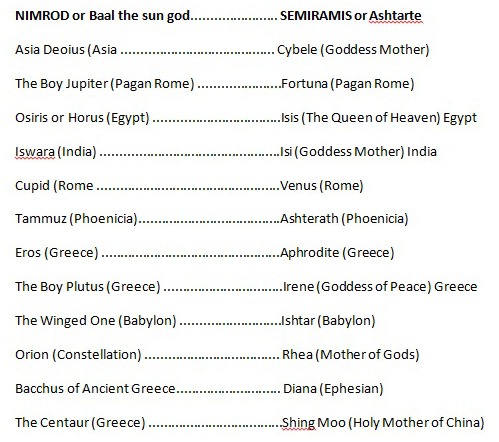
In the scriptures of Judaism and Christianity, Marduk and Tiamat were first identified as the humans Nimrod (In Genesis, chapter 10, called “a mighty hunter before the Lord”) and his wife Semiramis (later known as the mythological Queen of Heaven).
There are those who say it was Nimrod who established the first state religion by unifying mankind and building a tower in the Tigris/Euphrates region of antiquity. However, after he incorporated, and then diversified, he went public:
Did it all start on the plains of Shinar after a great flood, when the malesun overcame femalewater?
In A Clockwork Orange, Alex and his droogs were certainly warlike and sought to ravage the females in their paths. Moreover, perhaps as another clue, one of the songs on the film’s soundtrack is titled “Overture to the Sun”.
In the scene previously described, when the rival gang was in the act of melodramatically wrestling a woman in order to rape her on a stage, it did appear Kubrick incorporated elements of the “Enuma Elish” into his film: namely the expanse of sky above and a winged sun god overlooking acts of sex and violence (Chaos) below.
Within the occult, there are those identifying the Sun as being a symbol of Lucifer the Light Bringer and with the accompanying “illuminating rays of knowledge”; all supposedly essential to the ancient sun worship cult called “The Illuminati”.
Furthermore, others have connected both Freemasonry and the Illuminati as having originated in ancient Egypt:
Popular history texts and encyclopedias generally paint the Illuminati as having its origins in 1776 Bavaria. However, the origins go back much further. The Illuminati are tied directly through masonry to the sun and Isis cults of ancient Egypt.
In truth, Kubrick’s A Clockwork Orange has more occult symbols than even a U.S. dollar bill; along with specific parallels to Freemasonry. All of these visuals, like the Eye of Horus right on the money, are hidden in plain sight:
The checkered pattern is found in Freemason lodges and is known as “Moses Pavement” which symbolizes the duality of man. Of course, the Eye of Horus, snakes, and phalluses, are all symbols of the occult as well.
Why would Kubrick have included these in A Clockwork Orange and, also, in his other films?
Coincidence? Art? Conspiracy?
Let the readers, and viewers, decide.
Additionally, as addressed before, Kubrick’s film does include some peculiar references to Christianity. Complementing Alex’s aforementioned prison fantasy of being a Roman soldier in the act of whipping Christ, there was an earlier scene in his room where he fondles his pet snake before the snake appeared to act as a phallus between the legs of a naked woman pictured on his wall. The buttocks of the woman looked to have been held up by the raised arms of four naked Jesus Christ figurines; complete with crowns of thorns. Then, as a rapturous Alex enjoyed the music of Beethoven in a near masturbatory manner, he envisioned himself a vampire and saw a woman in a white (wedding?) dress being hung by rope, along with fiery explosions and men being crushed by rocks.
These examples, along with the symbols of Alex’s pet snake and the Eye of Horus on his right sleeve and right eye, leave the viewer with the impression the boy’s worldview was nothing short of Luciferian.
Moreover, just as western holidays like Christmas (Sol) and Easter (Ishtar) have their originations in ancient sun worship and female pagan fertility deities, so too, it seems, does A Clockwork Orange. In another example, one of the droogs in the Korova Milk Bar, with sun/projector overhead, drew milk from the breasts of a replica nymph that he called “Lucy”.
Are all of these occult references designed to point the viewer’s attention towards Lucifer? Was Kubrick trying to warn his audience that the future for both individual and state belonged to Satan? Or, is it possible the director was actually advocating for such?
Through the Lens of the Established State, Modern Politics , Time, and the Circular Cycles of Man
There are those who have tied Donald Trump to Kubrick’s A Clockwork Orange:
And, paradoxically, it now appears the Satanists are even threatened by The Orange Jesus as they seek to convert the younger generation.
Founded in 2012, The Satanic Temple (not to be confused with the Church of Satan) is a non-theistic organization that has gained prominence since President Trump’s election. The group reported it gained “thousands of new members” after Trump won the presidential race.
…Since the election, The Satanic Temple has launched multiple campaigns aimed at challenging Christian influence in the political sphere. One example is their After School Satan Clubs.
Obviously those on the Political Left, and some in the middle, view Trump as similar to the right-wing, authoritarian (law and order) party in Kubrick’s film; who brainwashed naive dupes into supporting misguided policies. Yet, to the other half of the audience watching the political theater on their screens, it appears that Trump is more comparable to Alex; who, after creating carnage in the proverbial political swamp, is now undergoing reeducation by the Established State right before their very eyes.
Could Kubrick have foreseen the inevitability of time’s passage delivering an Orange Reality TV Star to the world stage? It’s doubtful, because he didn’t write the book. Even so, is it still possible that Trump is a clockwork man, arriving right on schedule?
Since the times of the first songs, the elite have cynically oppressed the proles while telling them it’s for their own good; for their safety, or for the good of Mankind overall. That is the commonality of gangsters, thugs, neocons, corrupt politicians, fascists, and tyrannical collectivists. They abrogate timeless moral principles for their own benefit and tell us it’s for ours.
In the narrative of A Clockwork Orange, there is a contrarian to the current government, an author, who played dual roles in the film’s plot. Towards the end, he argues on the telephone with an unseen coconspirator that “the common people must not sell liberty for a quieter life”.
Yet, isn’t that what we’ve done today in the once free nations of the western world?
In many ways, A Clockwork Orange is a mirrored representation of modern America. In the movie, a right-wing party is the established power suppressing the rights of commoners in order to sustain its continuity of control; and the media, and opposition party, were fighting on the side of liberty.
Paradoxically, in the real world currently, the media, the Political Left, and lukewarm conservatives, are in singularity with the Established State; as Trump and his Deplorables wreak havoc before the global towers of power.
Based upon raw intuition, instinct, and Tweets, Trump is the political manifestation of Freud’s Id. Therefore, he and his gang of supporters must be reformed via electronic programming and conditioning (punishment and reward) by the state as it seeks to secure its everlasting continuity.
Play ball and society will experience harmony, but only on the state’s terms. Disobey at your own peril. This is one of the themes in A Clockwork Orange. Other undertones of the film speak to secrecy, smoke, mirrors, and mind control, where the state vanquishes the violent urges of its citizens by creating a new reality via cyclical, or looped, feedback. Consensus will be manufactured and contrarian views need not apply. Not acceptable? No problem. The state has a pill for that.
As humans, we have free will, and that is a right that cannot be denied to us. The Ludovico Technique represents the government’s, or any authority figure’s, interference with our personal liberties, and the dangers of these interferences. The battle of good versus evil is presented an innumerable amount of times in literature and cinema–but A Clockwork Orange puts a twist on this common theme. Which is worse, chosen evil or forced good? According to A Clockwork Orange, chosen evil is the lesser evil, because it demonstrates it allows us a choice. If humans lose moral choice, they become machines. Free will to choose between good and evil is the central theme and message in A Clockwork Orange.
Whether or not Trump is real or just an actor, like in Kubrick’s films, he has revealed certainrealities. The fact remains the state does not now endorse free will and it has, instead, resorted to electronic conditioning to form its new reality.
This will work until it doesn’t. Then the process begins again, just has it always has throughout history; as predictable as seasons, or the sun crossing the sky.
Conclusion
In researching this article, and Stanley Kubrick’s life’s work, I discovered many websites that were a strange combination of profoundly perceptive insights, unique observations, and batshit craziness. But one interesting theme presented in Kubrick’s storytelling is the idea of mankind’s Odyssey: Seeking meaning through faith, action, and fortune, upon the world stage; overcoming base instincts, then rising on a tide of reason and rationality, before the cycle rounds another bend and mankind falls again.
When watching A Clockwork Orange, the viewer is forced to consider the ironies of individual and state. In turn, this blogger now questions if both entities are not merely two parallel paths to hell on earth.
The sun rises and sets on individuals and nations alike. Yet, throughout history, Man’s Id was successfully moderated at times by his Ego and Superego thus allowing, for the most part, periods of equilibrium and justice; even if only for a season.
Fate or free will? That is the question. Given the cycles of history, where does hope now reside? Why would anyone have optimism at all?
In A Clockwork Orange, the Ludovico Technique was meant to fix dystopia’s problems. Today, in the real world, it is media narratives that are meant to address what ails us. Unfortunately, however, these are twin movies unspooling separately and all at once. In turn, it means certain worldviews must be reprogrammed, as it were.
This explains why social media companies are purging “incorrect thinkers” on their respective platforms. They are viewed as subversive moles, and petty criminals, damaging the fertile ground of the new world order.
It’s also why a bogus Russian dossier was utilized to derail the Orange Criminal. One wonders if he was wound up as part of a plan to place asunder the old ways; like the tide rolling out before the dawn of a new day.
The lesson learned from A Clockwork Orange is to beware the algorithmic hammers of conformity; always watching, ever ready, and waiting to shine down from on high; ceaselessly smiling, shaking hands, and kissing babies on the way.
Before new experiments and orthodoxies can be tried, there must be good reasons to do so. For out of chaos comes creation. The circle runs like clockwork and always on time.
The Id of Man will be tempered by a new religion; or perhaps an old one by another name.
Joe Lynch’s “Mayhem” feels like a timely film in a way it wouldn’t have a couple years ago. Whatever your political party may be, anger has been a palpable emotion in this country recently—it was anger that got Trump elected, and it’s anger that opposes his administration. But what do we do with that anger? How long can we keep it down before it overwhelms us? With his best film since “Wrong Turn 2,” Lynch channels that national anger into a stylish, smart, propulsive gore-fest set in a corporate America that takes no prisoners. But when did it?
Not only is “Mayhem” a brutal, visceral gut punch at a time of the year when we typically drown in awards bait, but it feels like a movie designed to tap into a vein of frustration and anger at a corrupt system. Hate your boss? Can’t control your road rage? Want to push your co-workers down a stairwell? Thinking mean things about the President and his cronies? “Mayhem” channels rage at an unfair society and the bullshit that trickles down from the Powers That Be into a paean to uncontrolled anger. Much more tonally consistent than the similar “The Belko Experiment,” “Mayhem” isn’t as much about id run rampant as it is two people finally loosed from moral and societal constraints in a way that allows them to enact bloody, vicious vengeance. There are times when the whole thing feels like an extended version of that scene from “Kingsman: The Secret Service,” or, worse, the movie that would be the favorite film of the lunatic followers of Tyler Durden in “Fight Club,” but this weird little genre exercise works way more often than it doesn’t, and actually has something to say in the process.
The premise of “Mayhem” is simple in a way that I think a lot of horror masters would admire. There’s an airborne disease, referred to as “Red Eye” for the single red-eye it gives those who suffer from it, that removes all societal and moral governance. So those infected with it don’t just get mad, they get bloody. And it happens to infect a firm (and not just any firm but the one that set the legal precedent for “Red-Eye Defense” by recently getting off a murderer who was infected with it at the time) filled with the kind of well-tailored monsters who barely control their impulse for cruelty anyway. These are the kind of people who gleefully step on the little man in the pursuit of the almighty dollar, and one of the most interesting aspects of “Mayhem” is the choice Lynch makes not to infect “average Joes” but people who seem to have practice unleashing their inner monsters. When John Towers (Steven Brand), the boss of this loathsome company, says to someone beneath him that “You must protect those above you,” it’s the kind of human shield mentality that CEOs and executives have been using for scapegoats for decades.
However, the protection in this case is literal, and the man that Towers needs it from is Derek Cho (Steven Yeun, going from fighting zombies on “The Walking Dead” to maniacal suits here), a rising star who is about to be fired on the day the infection hits the company. Rather than take his corporate execution the way so many do, he picks up a hammer and a nail gun and goes after the people above him, assisted by a client named Melanie Cross (Samara Weaving), who was in the office that day fighting an immoral foreclosure. Caroline Chikezie, Kerry Fox, and Dallas Roberts co-star as corporate monsters at Derek’s company, but the movie belongs to Yeun and Weaving, who both get exactly what Lynch is going for here. They are fearless and intense in ways that other performers would have missed. Yeun proves himself to be a more engaging leading man than I would have expected and Weaving has the energy of Margot Robbie—captivating and a little scary at the same time. They’re both really good, and it’s their commitment that keeps “Mayhem” humming.
“Mayhem” is at its best when it channels relatable stress into utter genre insanity. It’s like “Office Space” if Michael Bolton went on a murderous spree with a nail gun, playing on workplace stress instead of pure id, and it has a violent momentum that’s hard to deny, well-directed by Lynch (who might use a few too many quick cuts but also stages a brutal scene to Faith No More, so all is forgiven). It can be such a relentless experience that it surely won’t be for everyone, but it works best when considered as a film that’s essentially about people willing to kill, bribe and offer power to anyone to not only save their own skins but also excuse their own horrors. Whether you would levy such accusations at Trump or the candidate he beat a year ago, there’s something about watching a movie about unleashing repressed anger at injustice a year after Election Day 2016 that just feels right.
Facebook’s purge of more than 500 pages and 250 accounts ahead of midterm elections in the United States represents a massive trend to police social media activity in ways that put freedom of expression at risk.
This trend effectively discourages users from engaging in radical politics. It may be viewed as part of a counterinsurgency effort by a powerful social media company to assure a passive majority of Americans that they are properly guarding a widely used platform from alleged threats to democracy.
On October 11, Nathaniel Gleicher, Facebook’s head of cybersecurity policy, and Oscar Rodriguez, the company’s product manager, published a press release about the purge.
“We’re removing 559 pages and 251 accounts that have consistently broken our rules against spam and coordinated inauthentic behavior,” Gleicher and Rodriguez stated. “Many were using fake accounts or multiple accounts with the same names and posted massive amounts of content across a network of groups and pages to drive traffic to their websites.”
According to Gleicher and Rodriguez, these techniques were used by groups and pages to make content “appear more popular” than it truly was on Facebook.
Both suggested some of the pages and accounts were “ad farms” that misled users into believing they were “forums for legitimate political debate.”
Unfortunately, Facebook offered minimal transparency on the action. Administrators with removed pages or accounts were apparently given no specifics other than a notice that they were shut down.
Several of the pages and accounts removed were right-wing and known for boosting President Donald Trump and his administration’s agenda. There were also dozens of progressive or left-wing pages, which were taken down.
Anti-Media, an anti-establishment independent media site with two million followers, had its page removed. Carey Wedler, editor at Anti-Media, did not lose her personal Facebook page with over 100,000 followers, but almost simultaneously, Twitter sent a notice that Wedler’s account was suspended.
The Free Thought Project, Reverb Press, Press For Truth, and Rachel Blevins, an RT America correspondent, had their pages taken down.
Pages that document abuse by police were removed—Police the Police, Filming Cops, Cop Block, and Cop Logic. Both Police the Police and Filming Cops each had over a million followers.
“There are legitimate reasons that accounts and pages coordinate with each other—it’s the bedrock of fundraising campaigns and grassroots organizations,” Gleicher and Rodriguez stated. “But the difference is that these groups are upfront about who they are, and what they’re up to.”
Yet, none of the aforementioned pages, which have protested their removal, hid their missions from followers. They were very upfront about their political motives or agendas for social justice.
Gleicher and Rodriguez concluded, “As we get better at uncovering this kind of abuse, the people behind it—whether economically or politically motivated—will change their tactics to evade detection. It’s why we continue to invest heavily, including in better technology, to prevent this kind of misuse. Because people will only share on Facebook if they feel safe and trust the connections they make here.”
The last sentences of Facebook’s press release make it clear that the company took this action to protect their brand. They were concerned about how these pages or accounts were impacting the experience of more passive, or even apathetic, users.
Administrators also recognize that politicians on Capitol Hill are watching. As Senator Dianne Feinstein told executives during a recent Senate hearing, “You’ve created these platforms, and now they are being misused. And you have to be the ones to do something about it or we will.”
On October 17, Twitter also acknowledged pressure from upcoming midterm elections to guard against alleged “influence operations.” It released a dataset it said was linked to operations during the 2016 election.
“We will continue to proactively combat nefarious attempts to undermine the integrity of Twitter, while partnering with civil society, government, our industry peers, and researchers to improve our collective understanding of coordinated attempts to interfere in the public conversation,” the social media company pledged.”
No executives at any Silicon Valley tech corporation want the government to introduce regulations. With parts of the public, especially those in the liberal establishment clamoring for action, Facebook and other companies are taking steps to supposedly fix the problem.
Cracking Down On “Influence Campaigns”
Facebook’s mass removal of pages and accounts was the company’s most extensive crackdown on “influence campaigns” since it started policing its platform. Most U.S. media outlets described the offending pages and accounts as purveyors of “political spam.”
The New York Times reported on Facebook’s purge with an article that was headlined, “Facebook Tackles Rising Threat: Americans Aping Russian Schemes to Deceive.”
Ironically, this was misinformation. At no point did the Times demonstrate that the removed pages or accounts were inspired or influenced by “Russian schemes,” which may or may not have been employed during the 2016 presidential election.
What the Times did do is conflate Russia-based activity with the operation of these accounts because those users may have wielded similar tactics to extend their reach. This is as disingenuous as suggesting someone who relies on Internet privacy tools is using terrorist tactics because terrorists want to hide their location, too.
The push to impose more control over the exchange of information on Facebook stems from a widespread belief that the Russia-based Internet Research Agency conducted a campaign through more than 400 accounts and pages that relied on ads and false information to “create discord and harm” Hillary Clinton’s presidential campaign. The content was supposedly viewed by as many as 126 million Americans.
But in a paper on the 2016 presidential election by Thomas Ferguson, Paul Jorgensen, and Jie Chen from the Institute for New Economic Thinking, they show that this number is rather paltry. Americans saw at least 33 trillion posts in their news feeds between 2015 and 2017. Facebook even said a quarter of ads may have never been viewed by anyone.
The Senate intelligence committee reported minuscule ad numbers in key battleground states. In Wisconsin, $1,979 was spent. All but $54 were spent during the primary. Pennsylvania absorbed $823 and Michigan $300. “Unless Facebook discloses some vast new trove, the conclusion has to be that this was no full court press,” the report stated.
As the authors note, a few studies labeled sites as “Russian” or “Russian-influenced” simply because they have “politically distasteful” views that perhaps align with the agenda of Russia or run counter to U.S. foreign policy. This inappropriately counted non-mainstream or so-called fringe websites as part of an alleged Russian influence operation.
A far more extensive influence operation was likely perpetrated by networks highly capable of spreading right-wing messages in sophisticated manners.
“Our clearest and most significant observation is that the American political system has seen not a symmetrical polarization of the two sides of the political map, but rather the emergence of a discrete and relatively insular right-wing media ecosystem whose shape and communications practices differ sharply from the rest of the media ecosystem, ranging from the center-right to the left,” a Harvard study [PDF] on the 2016 election concluded.
The infiltrators sowing discord were aligned with Republicans and based in the United States. Like Ferguson, Jorgensen, and Chen contend, “By 2016, the Republican right had developed internet outreach and political advertising into a fine art and on a massive scale quite on its own.”
“Large numbers of conservative websites, including many that tolerated or actively encouraged white supremacy and contempt for immigrants, African-Americans, Hispanics, Jews, or the aspirations of women had been hard at work for years stoking up ‘tensions between groups already wary of one another.’ Breitbart and other organizations were in fact going global, opening offices abroad and establishing contacts with like-minded groups elsewhere.”
“Whatever the Russians were up to, they could hardly hope to add much value to the vast Made in America bombardment already underway. Nobody sows chaos like Breitbart or the Drudge Report, as the New York Times documented in one Idaho town,” the paper added.
Recognizing the influence of right-wing messaging networks during the 2016 election is critical. In fact, a list of removed pages posted by Western Journal suggests the vast majority of pages and accounts removed were right-wing. A minority were cop watch pages or libertarian pages against government abuses. An even smaller minority were liberal or Democratic pages.
Therefore, journalists are wrong to suggest there is some kind of balance between the left-wing and right-wing when it comes to spreading “fake news” or misinformation on social media platforms.
Part Of The Counterrevolution
It is difficult to discern whether police accountability or alternative media pages, which protested their removal, were targeted for the dissenting perspectives on their pages. What is more likely is that these pages were flagged by a Facebook algorithm.
“Bad content” to Facebook includes “false news,” “hate speech,” “spam,” “graphic violence,” “clickbait,” and “links to low quality web experiences (ad farms).” Given the company’s description of an “ad farm,” a page that linked to a website cluttered with ads, which were embedded to ensure server bills were paid, could be construed as an “ad farm.”
As Emma Llansó, the director of the Free Expression Project for the Center for Democracy and Technology, told the Guardian, there are a “lot of people who fervently believe their political views and are trying to drive traffic to their posts and ideas. They’re probably also running ads on their sites to make money off doing so. The line between spammer activity with a financial motive and spammy-looking political advocacy is incredibly hard to draw.”
Facebook’s press release demonstrated indifference to the administrators of political pages, who use “backup” or fake accounts in order defend themselves from political opponents who may campaign to have their real accounts suspended.
Reverb’s page was verified by Facebook. As the Guardian reported, Reverb editor-in-chief Edward Lynn was never contacted by anyone with the company about any violations of standards.
Similarly, Brian Kolfage, who administered the Right Wing News page, which was shut down with three other pages, emailed back and forth with a Facebook executive. There were plans for a meeting so he could better understand how to comply with policies. The company chose not to work with Kolfage.
On October 17, Facebook deleted a video featuring journalist George Monbiot on the brutal colonial legacy of Christopher Columbus. It was up more than a week and had 900,000 views before it was taken down.
Again, the social media company was completely opaque in its decision. It may have been flagged as a result of graphic images in the video, but Facebook did not bother to offer an explanation.
Facebook announced a partnership in May with an influential think tank known as the Atlantic Council to help the company detect “emerging threats” and “disinformation campaigns.” The organization formed after the North Atlantic Treaty was signed in 1949, and it is committed to maintaining America’s global dominance.
When Facebook removed 32 “suspicious pages” that were run by activists in August, it relied on the think tank’s Digital Forensic Research Lab to “point out similarities to fake Russian pages from 2016.” However, one of the pages removed was an event page for a counter-protest against a Unite the Right rally in Washington, D.C.
In Bernard Harcourt’s book, The Counterrevolution: How Our Government Went To War Against Its Own Citizens, he outlines his theory of the current paradigm citizens live under in the United States. Counterinsurgency has been systematically domesticated, even though there is “no real insurgency or active minority.”
“The Counterrevolution” creates this illusion of an “active minority.” When it comes to social media, the “active minority” is fringe political pages that are sowing discord by spreading “fake news” or misinformation. It is remarkable that part of the crackdown involved police accountability pages because law enforcement, which perpetuates this paradigm, benefits greatly from passive Americans believing cop watch pages on Facebook are “political spam.”
Or, more sinisterly, the pages and accounts are seen as employing tactics similar to Russian influence operations, which increases the fear of doing nothing to shut them down and justifies dramatic action—even if wholly innocent pages or users are censored.
Facebook may not be silencing dissenting perspectives deliberately, but in “The Counterrevolution,” it does not have to bother with restoring pages and accounts wrongfully taken down. Those pages and accounts are collateral damage. They were not specifically targeted. The social media company can claim it never intended to crack down on political speech and defend an action that is designed to give consumers and political elites the illusion that they are guarding the internet from perceived threats.
That is not to say there are no threats to democracy in the United States. A few weeks before Election Day, there are countlessreports of votersuppression. But these threats do not manifest themselves in one’s news feed on Facebook. Rather, they come from Republican officials who use state apparatuses to make it harder for citizens to challenge their destructive and discriminatory agendas.
The November 6 midterms are fast approaching, yet much of the media is still looking back to the 2016 elections, and specifically the alleged Russian interference in them.
The New Yorker (10/1/18) published a 7,000-word article headlined “How Russia Helped Swing the Election for Trump.” Considering other explanations for Trump’s victory and Clinton’s loss, such as her tactical campaign errors, gerrymandering, vote suppression, racism and the actions of James Comey for only a paragraph, it quotes one expert claiming, “It stretches credulity to think the Russians didn’t” win it for him.
Meanwhile, the New York Times (9/20/18) released an intensive 10,000-word history and analysis of the Trump/Russia story, explaining to its readers that it was Putin’s “seething” ambivalence towards the West and his “nostalgia for Russia’s lost superpower status” that were the driving forces behind Russia’s nefarious actions.
There is also a great deal of fear about supposed hacking of the upcoming midterms. USA Today (10/9/18) warned, “As Russia and perhaps other foreign governments seek to undermine democratic elections, Congress and states need to get serious about defenses.” The PBSNewsHour (10/11/18) quoted one official who noted, “Given our experiences of 2016 and what we saw the Russians attempt to do across the nation’s election equipment, the election infrastructure, we certainly have a degree of concern of what their capability is.” Meanwhile, the Washington Post(9/26/18) writes, “While Russia is clearly trying to influence the 2018 elections, this time the United States is prepared and taking action to counter it.”
There is little concrete evidence offered in these reports; see Gareth Porter in Consortium News (10/10/18) for a dash of cold water on the New York Times’ narrative. Yet even the lack of evidence is an ominous sign for some. The Daily Beast (10/8/18) published an article headlined, “No Evidence That Russia Is Messing with Campaign 2018—Yet.” Despite that lack of evidence, the article asserted that the US should brace itself: “Russia has an arsenal of disruption capabilities… to sow havoc on election day,” it said, and “everyone is expecting the 2016 shock and awe” again.
The concern of the media over Russian actions has not resonated with the public more generally; a July Gallup poll reported that the number of Americans who considered Russia a top problem for the country was less than 1 percent. On the subject of the midterms and threats to their legitimacy, NPR (9/17/18) found that large majorities feel voter fraud or suppression to be a much greater danger to election integrity than foreign interference. Yet these concerns are not addressed nearly as thoroughly by the media. A search for “Russia” and “election” in the New York Timesdatabase generates 4,489 stories since the start of 2017, as compared to just 234 for “voter suppression” and “election,” 306 “gerrymandering” and “election” and 727 “racism” and “election.”
The question is not whether Russia, like other countries with extensive intelligence apparatuses, seeks to influence the elections of foreign nations. The question is why corporate media are concentrating on foreign interference, and not the other threats to democracy. In a previous article (FAIR.org, 7/27/18), I argued that the Democrats are using Russia to deflect anger and discontent away from their own failings. If Russia is to blame, there is no need for introspection, nor to address the deep race and class divides in the country that are addressed by surging political movements on the left, from Sanders to Black Lives Matter, and exploited by Trump and the alt-right. The focus on Russia as the sole reason for Trump’s victory allows establishment Democrats to continue as normal, without need for radical internal or policy change. As Clinton said, “America is already great.” To deflect pressure from the left, they can construct a narrative to explain why they lost to the most unpopular candidate ever.
For corporate media, the story of Russia covertly influencing the country promotes a climate where they can re-tighten their grip on the means of communication by accusing alternative media on both left and right of being Russian-sponsored “fake news.” As previously reported (FAIR.org, 8/22/18), under the guise of protecting readers, big media companies like Google, YouTube and Bing have changed their algorithms, resulting in devastating drops in traffic for reputable alternative media sites. Alternative media has been deleted, de-ranked, de-listed and de-monetized, effectively sidelining them. In response to ostensible Russian meddling, media giant Facebook announced last week (Washington Post, 10/11/18) it had shut down over 800 US accounts and pages for “inauthentic behavior,” a term even more nebulous than “fake news.” Included in the 800 were several police accountability watchdog groups and other alternative media, adding to its recent (temporary) deleting of TeleSUR English.
However, the best example of fake news and “inauthentic behavior” by media outlets in the modern age remains the manufacture of consent for the Afghanistan and Iraq invasions, with the crucial assistance of corporate outlets like the New York Times, Washington Post and NBC (FAIR.org, 11/1/01; 3/18/03; 10/23/17). Forty-five percent of Americans get their news from Facebook, but it seems doubtful the tech giant will remove accounts belonging to those publications.
While it is clear that Moscow has an interest in who the US elects and doesn’t elect, the media’s focus on Russiagate through the midterm elections has as much to do with its political utility as with the evidence. With President Trump accusing China of midterm interference (CNN, 8/26/18), it appears that both major parties have sown doubt into the process and have a pre-made excuse if they fail on November 6. Both sides undermining trust in the democratic process does not augur well for the future of US politics.
In March, the United States Special Operations Command, the section of the Defense Department supervising the US Special Forces, held a conference on the theme of “Sovereignty in the Information Age.” The conference brought together Special Forces officers with domestic police forces, including officials from the New York Police Department, and representatives from technology companies such as Microsoft.
This meeting of top military, police and corporate representatives went unreported and unpublicized at the time. However, the Atlantic Council recently published a 21-page document summarizing the orientation of the proceedings. It is authored by John T. Watts, a former Australian Army officer and consultant to the US Department of Defense and Department of Homeland Security.
The Atlantic Council, a think tank with close ties to the highest levels of the state, has been a key partner in the social media companies’ censorship of left-wing views. Most notably, Facebook acted on a tip from the Atlantic Council when it shut down the official event page for an anti-fascist demonstration in Washington on the anniversary of last year’s neo-Nazi riot in Charlottesville.
Confident that none of the thousands of journalists in Washington will question, or even report, what he writes, Watts lays out, from the standpoint of the repressive apparatus of the state and the financial oligarchy it defends, why censorship is necessary.
The central theme of the report is “sovereignty,” or the state’s ability to impose its will upon the population. This “sovereignty,” Watts writes, faces “greater challenges now than it ever has in the past,” due to the confluence between growing political opposition to the state and the internet’s ability to quickly spread political dissent.
Watts cites the precedent of the invention of the printing press, which helped overthrow the feudal world order. In the Atlantic Council’s estimation, however, this was an overwhelmingly negative development, ushering in “decades, and arguably centuries, of conflict and disruption” and undermining the “sovereignty” of absolutist states. The “invention of the internet is similarly creating conflict and disruption,” Watts writes.
“Trust in Western society,” he warns, “is experiencing a crisis. The 2018 Edelman Trust Barometer has tracked this erosion, showing a 30 percent drop in trust in government over the last year in the United States.”
Watts notes that this collapse in support for the government cannot be explained merely by the rise of social media. This process began in the early 2000s, “at the dawn of the social media age but before it had become mainstream.” Left out are the major reasons for the collapse of popular support for government institutions: the stolen election of 2000, the Bush administration’s lies about weapons of mass destruction, unending war and the impact of the 2008 financial crisis.
However, while it is “hard to argue that the current loss of trust results solely from the emergence of social media,” Watts writes, there “can be little doubt that it acted as a critical amplifier of broader trends.”
He continues: “Technology has democratized the ability for sub-state groups and individuals to broadcast a narrative with limited resources and virtually unlimited scope.” By contrast, “In the past, the general public had limited sources of information, which were managed by professional gatekeepers.”
In other words, the rise of uncensored social media allowed small groups with ideas that correspond to those of the broader population to challenge the political narrative of vested interests on an equal footing, without the “professional gatekeepers” of the mainstream print and broadcast media, which publicizes only a pro-government narrative.
When “radical and extremist views” and “incorrect ideas” are “broadcast over social media, they can even influence the views of people who would not otherwise be sympathetic to that perspective,” Watts warns. “When forwarded by a close friend or relation, false information carries additional legitimacy; once accepted by an individual, this false information can be difficult to correct.”
People must be isolated, in other words, from the “incorrect” ideas of their friends and family, because such ideas are “difficult to correct” by the state once disseminated.
But how is this to be done? The growth of oppositional sentiment cannot be combatted with “facts” or the “truth,” because “facts themselves are not sufficient to combat disinformation.” The “truth” is “too complex, less interesting, and less meaningful to individuals.”
Nor can the growth of political opposition, for the time being, simply be solved by “eliminating” (i.e., killing or jailing) political dissidents, because this only lends legitimacy to the ideas of the victims. “Eliminating those individuals and organizations will not be sufficient to combat the narrative and may in fact help amplify it.” He adds, “This is also the case for censorship as those behind the narrative can use the attempt to repress the message as proof of its truth, importance, or authenticity.”
Enter the social media companies. The best mechanism for suppressing oppositional viewpoints and promoting pro-government narratives is the private sector, in particular “technology giants, including Facebook, Google, YouTube, and Twitter,” which can “determine what people see and do not see.”
Watts adds, “Fortunately, shifts in the policies of social media platforms such as Facebook have had significant impact on the type and quality of the content that is broadcast.”
The private sector, therefore, must do the dirty work of the government, because government propaganda is viewed with suspicion by the population. “Business and the private sector may not naturally understand the role they play in combating disinformation, but theirs is one of the most important…. In the West at least, they have been thrust into a central role due to the general public’s increased trust in them as institutions.”
But this is only the beginning. Online newspapers should “consider disabling commentary systems—the function of allowing the general public to leave comments beneath a particular media item,” while social media companies should “use a grading system akin to that used to rate the cleanliness of restaurants” to rate their users’ political statements.
Strong-arm tactics still have a role, of course. Citing the example of WikiLeaks editor Julian Assange, Watts declares that “governments need to create consequences” for spreading “disinformation” similar to those meted out for “state espionage” – which can carry the death penalty.
What Watts outlines in his document is a vision of a totalitarian social order, where the government, the media, and technology companies are united in suppressing oppositional viewpoints.
The most striking element of the document, however, is that it is not describing the future, but contemporary reality. Everything is in the present tense. The machinery of mass censorship has already been built.
The Atlantic Council report, based on high-level discussions within the military and state, is a confirmation of everything the World Socialist Web Site has said about the purpose of changes in the algorithms of internet and social media companies over the past year-and-a-half.
On August 25, 2017, the WSWS published an open letter to Google alleging that the company is “manipulating its Internet searches to restrict public awareness of and access to socialist, anti-war and left-wing websites.” It added, “Censorship on this scale is political blacklisting.”
Over the subsequent year, key details of the open letter have been indisputably confirmed. At congressional hearings and in other public statements, leading US technology companies have explained that they reduced the propagation of political views and statements targeted by US intelligence agencies, and did so in secret because they feared a public outcry. At the same time, they have explained the technical means by which they promoted pro-government, pro-war news outlets, such as the New York Times and Washington Post.
But the Atlantic Council document presents the most clear, direct and unvarnished explanation of the regime of state censorship.
The struggle against censorship is the spearhead of the defense of all democratic rights. The most urgent task is to unify the working class, which is engaged in a wave of social struggles all over the world, behind the struggle against censorship as a component of the fight for socialism.
In my September 24 column, “Truth Is Evaporating Before Our Eyes,” https://www.paulcraigroberts.org/2018/09/24/truth-is-evaporating-before-our-eyes/ I used the destruction of the CBS news team that broke the Abu Ghraib story and the story of President George W. Bush’s non-performance of his Texas Air Force National Guard duties to demonstrate how accusations alone could destroy a Peabody Award winning, 26 year veteran producer of CBS News, Mary Mapes, and the established news anchor Dan Rather.
I have many times written that it was President Bill Clinton who destroyed the independent US media when he permitted 90 percent of the US media to be concentrated in six mega-corporations that were in the entertainment and other businesses and not in the news business. This unprecedented concentration of media was against all American tradition and destroyed the reliance that our Founding Fathers placed on a free press to keep government accountable to the people.
Until I read Mary Mapes book, Truth and Duty (St. Martin’s Press, 2005), I was unaware of how this monopolization of the media in violation of the Sherman Anti-trust Act and American tradition had proceeded to destroy honest reporting.
Here is what happened. The Texas Air National Guard was a place the elite placed their sons to avoid the Vietnam War draft. Copies of documents written by Lt. Col. Jerry B. Killian describing George W. Bush’s ability to jump the large waiting list hoping to avoid the war, Bush’s non-compliance with National Guard requirements and Bush’s unauthorized departure to another state were given to CBS. The CBS team worked for many months to confirm or discredit the documents. The information in the documents proved to be consistent with the interviews of people acquainted with George W. Bush’s time in the Texas National Guard.
It was a carefully prepared story, not a rushed one, and it fits all the information we now have of Bush’s non-performance.
The problem for the CBS news team, which might not have been realized at the time, was that the documents were copies, not originals that experts could authenicate as real beyond question. Therefore, although the documents were consistent with the testimony of others, no expert could validate the documents as they could originals.
The Republicans seized on this chink in the armor to turn the issue away from the truthfulness of the CBS 60 Minutes report to whether or not the copies were fakes.
CBS had two other problems. One was that Viacom, its owner, was not in the news business, but in the lobbying business in Washington wanting to enrich the company with legislative perks and regulatory permissions. Truthful news from CBS, exposing US torture in the face of the Bush regime’s denials and showing that Bush was too privileged to be held accountable by the Texas National Guard, was damaging Viacom’s highly paid lobbying effort.
When the right-wing bloggers took after CBS, the Viacom executives saw how to get rid of the troublesome CBS news team. Viacom executives refused to support their reporters and convened a kangeroo count consisting of Republicans to “investigate” the 60 Minutes story of Bush’s failure to comply with his obligations to the Texas National Guard.
Viacom wanted to get rid of the independent news constraint on its lobbying success, but Mary Mapes and her lawyers thought truth meant something and would prevail. Therefore, she subjected herself to the destructive process of watching the orchestrated destruction of her career and her integrity.
CBS’ other problem was that, with or without justification, CBS and Dan Rather were regarded in conservative Republican circles as liberal, a designation equivalent to a communist. For millions of Americans the controversy was about liberal CBS trying to harm George W. Bush and leave us exposed to Muslim Terrorism. In right-wing minds, Bush was trying to protect America from Muslim terrorists who blew up the World Trade Center and the Pentagon, and CBS was trying to smear President Bush.
Mary Mapes, Dan Rather, and the CBS news team were too focused on news to take into account the dangerous situation in which they were operating. Therefore, they walked into a trap that served Dick Cheney’s Middle Eastern wars, which served Halliburton and Israel, and into a trap that served conservative hatred of “liberal” news.
Why didn’t the American media defend CBS’ careful reporting? The answer is that this was a time when TV news media was dying. The Internet was taking over. The rest of the media saw in the demise of CBS a chance to gain that market and have a longer life.
So the rest of the media took up the fake news that 60 Minutes had presented a report based on fake documents. The media did not realize that they were signing their own death warants. Neither did the right-wing bloggers that the Republicans had sicced on CBS. Today, these bloggers are themselves shut off from being able to express any truth.
Truth in America is being exterminated, and the destruction of CBS news was the starting point. As Mary Mapes reports in her book, as soon as Viacom was entirely rid of 60 Minutes with the firing of the entire staff, on the very next day Viacom held a triumphant annual investor meeting. Chairman Sumner Redstone was awarded a a $56 million paycheck for 2004. Chief operating officers, Les Moonves and Tom Freston “each pocketed a whoopping fifty-two million for the year.”
And the CBS news team went without mortgage, car, or health insurance payments.
Mapes writes: “Just a few years ago, this kind of corporate executive largesse was unheard of. Now, these media Masters of the Universe have taken over the public airwares and they have one obligation: making a profit.” Ever a larger one, which requires protecting the government and the corporate advertisers from investigative reporting.
The consequence today is that the American media is totally unreliable. No reader can rely on any report, not even on a New York Times obituary.





 After the Crash
