Blade Runner And The Synthetic Panopticon

Truth Is Always An Open Question

By James Curcio

Source: Modern Mythology

This Is Only A Model

We are living in alternate realities. In one reality people see Trump’s incessant lying, and no one in power seeming to doing anything to stop it. Others see him as battling the deep state. Some see Brexit as a blind idiot kamikaze mission, while others see it as fighting back the evils of globalism. These are not equivalent claims, but they are both claims, narratives that claim to represent the way things are, and that’s what I’d like to examine here.

“All things are subject to interpretation, whichever interpretation prevails is a function of power and not truth.” — Nietzsche

Note that this aphorism doesn’t say “there is no truth,” nor does it question whether we all ultimately inhabit a single reality, only that whichever interpretation of the truth prevails is a function of power. Truth relies on an accurate or corresponding representation of reality. In this sense, we can talk of them singularly. But we only have our narratives and experiences with which to evaluate what that is.

And what is power? That demands at least an article in itself, but a popular 1984 quote lays the heart of what it’s purpose is: more of itself.

We know what no one ever seizes power with the intention of relinquishing it. Power is not a means; it is an end. One does not establish a dictatorship in order to safeguard a revolution; one makes the revolution in order to establish the dictatorship. The object of persecution is persecution. The object of torture is torture. The object of power is power.

This interpretation of social dynamics doesn’t contest the legitimacy of the scientific method, iteratively approaching closer approximations of truth (a model) distilled from reality, through experimentation. In fact, this premise was presented by Stephen Hawking and Leonard Mlodinow in their 2010 book, The Grand Design.

Model-dependent realism is a view of scientific inquiry that focuses on the role of scientific models of phenomena. It claims reality should be interpreted based upon these models, and where several models overlap in describing a particular subject, multiple, equally valid, realities exist. It claims that it is meaningless to talk about the “true reality” of a model as we can never be absolutely certain of anything. The only meaningful thing is the usefulness of the model.

However, social dynamics aren’t exactly like physics, either. Not being able to recognize the difference between the ideal (an appeal for rationality, consistent methodology, and balance), vs. how people actually engage with interpreting it is a serious problem. And got to catch up. Fast.

In other words, the appeal for truth — whether CNN’s recent “this is an apple” advertisement, or Fox New’s old “fair and balanced” — itself enters into the marketplace of ideas. Or perhaps a more apt metaphor is a battlefield, especially when we consider the amount of capital, technology and labor that states, corporations, and billionaires can throw at furthering their personal agendas.

Cognitive biases, innate responses like tribalism, the myopia of fear, etc. are all being leveraged via media, all around us, all the time. This includes all forms of media, since it’s all digital narrative building of a collective sort. Myth making, even. That’s the real point, and it seems to be drowned out across the spectrum. We’re all too familiar now with the ideas of dis/information wars, but all of them are fundamentally a contest over who gets to define the narrative. If we recognize that this is fundamentally about power, do we also recognize that it operates on dynamics that have absolutely nothing to do with our dearly held moral values?

An assumption some may draw from this is that vested interests have distorted reality; therefore there is no reality. However, that obviously isn’t quite right, either. What obscures clear thinking on this is that reality essentially has two meanings: the “state of things as they are”, which makes no assurances of what that state is, and the question of if things exist at all. The first poses an epistemological framework, the latter, an ontological one.

The former we might consider the social-linguistic definition. That shouldn’t be conflated with the absolute existence of a thing. No, it can only speak to the identity and meaning that we apply to what we’re given.


The Hierarchy of Reality

This may seem like a tangent, but consider the Turing test:

The Turing test, developed by Alan Turing in 1950, is a test of a machine’s ability to exhibit intelligent behavior equivalent to, or indistinguishable from, that of a human. Turing proposed that a human evaluator would judge natural language conversations between a human and a machine designed to generate human-like responses. … If the evaluator cannot reliably tell the machine from the human, the machine is said to have passed the test.

In other words, the appearance of sentience is all we ever get. An AI that behaves as if conscious is, from the outside, precisely the same as a conscious agent. If we appear to be having a conversation, then so we are. But does that prove we’re real in some definitive sense? No. Again, we are being presented with the social-linguistic layer of reality, that speaks to perceptions.

The relevance here to society is to be found within Blade Runner, which of course takes a great deal of inspiration in its core mythos from the problems posed by the Turing test. The world presented there is a hierarchy of power based on perceived degree of reality.

There is, within this, the implications of Benthamite Utilitarianism, and Foucault’s later elaboration on those ideas: that we may consider the world based on externalities that are socially determined rather than based on our internal experience. This seems in some sense precisely the opposite of “lived experience,” which seeks to situate our internal experience as the center of our concerns.

This directly enters into Blade Runner 2049, for instance, Joi, who seems the lowest on the hierarchy of reality, is seen as a pure surface, and all but K seem to question whether she has any lived experience at all. Mariette observes to K, “Oh I see, you don’t like real girls,” and later to Joi, “I‘ve been inside you. Not so much there as you think.”

Of course, this question is always open, one must always be judged “sufficiently real.”

Another example of this dilemma can be found in a current medical crisis. As many Americans know, we have something of an opiate epidemic in the United States. Although there is no end of debate over why this is the case, for doctors concerned about liability and patients concerned about being in pain for the rest of their lives, much of the politics boils away.

The problem comes down to the nature of pain itself. We may exhibit external signs of pain, but some patients will present with those more or less, for various cultural, personal, and even biological reasons. So the appearance of pain or lack of it is little use, when trying to determine whether a patient is “drug seeking.” Even if we test the biological response of different patients who are experiencing pain, we find that it is very difficult to tell. This is especially true with those who experience chronic pain. For instance, blood pressure often rises when you’re in pain, but higher blood pressure isn’t proof, and one must also ask what the baseline is. All of this calls to mind the lie-detector style tests used in the first Blade Runner movie to assess the reality of the subject, from the outside in.

Patient reporting was seen as the golden standard for pain level diagnosis during the years that doctors were ostensibly over-prescribing. But this too is no better than asking a Replicant whether they’re “real” or not. What we’re left with is a dependence on trust of people’s own stories about their lived experience, but of course, people can also lie. It comes down to a matter of faith and trust, and those are commonly in short supply.

This outside-in valuation is also the basis for what has recently come to be called — with some contention — neoliberal capitalism.

… it [Utilitarianism] presupposes a very concrete theory of nature as well as human nature: an understanding of human beings not as unique, irreplaceable beings — as neighbors, friends, or members of a community oriented toward justice and fairness — but rather as nameless, faceless, calculating, hedonistic, atomistic units. Alongside of this it understands nature and the natural world of plants, animals, trees, oceans and mountains not as intrinsic goods in themselves, but merely as ‘things’ that have only human use-value.

This gives us a clue to understanding why utilitarianism is so attractive to a modern bureaucratized, consumerist culture that is prepared to uphold profit maximization over human health, environmental safety, clean water and nutritious food. In other words, utilitarianism is widely embraced precisely because it replaces the living, breathing, emotional and experiencing human being with the human as pleasure or profit maximizing machine; it prizes the quick technical fix over the difficult task of understanding the human condition; it valorizes thoughtless calculation over thoughtful ethical discernment and practical wisdom. — CounterPunch

So Blade Runner presents an acceleration of the myths many of us already apply to the world around us, one which is deeply suspicious of our ability to find singular truth, or maybe more aptly, to avoid inflicting our power fantasies, needs and fears upon one another, forever.


The Authority of Authorship

When we engage with narratives online, in the press, in the media, we need to remain constantly aware that it is presenting a view of the world, and it is a view which in many ways is likely to be self-serving. There is, at the same time, an invisible architecture at work underneath the ways the world is re-presented to us, and this composes one of the fundamental anxieties that Baudrillard presented in Simulacra and Simulation. We cannot always discern even our own motives, or the reasons why we feel that one thing is more true than another when truly sufficient evidence has not been provided. Because interpretations of truth are malleable. And there has never been a mass-surveillance, mass-behavioral and linguistic analysis machine like the Internet.

It is easy for us to apply this sort of cynicism towards our presumptive ideological enemies, but will always remain more difficult to apply that same consideration to narratives that immediately go, “ah, this seems true!” Again, truth is always a claim, which must be proven — and never finally.

All authority that seeks to stop this process and say “put no others before me” are plays at power. Even within our own minds and hearts this is true.

We mustn’t forget that.

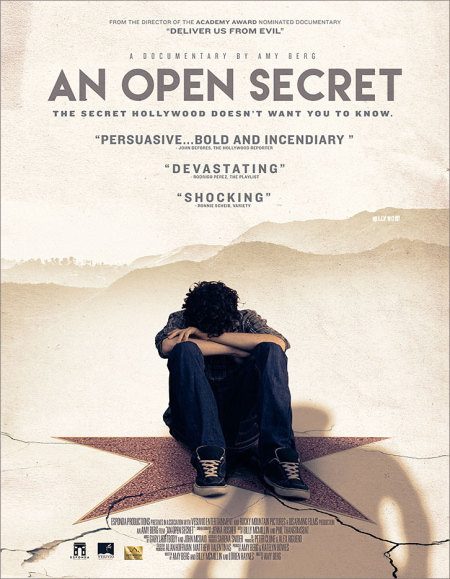
Saturday Matinee: An Open Secret

“An Open Secret” (2014) is a documentary film about Hollywood child sexual abuse directed by Amy Berg (Deliver Us From Evil). The film features interviews with victimized performers, who were targeted when they were young boys (including Corey Feldman and Todd Bridges), as well as industry figures, the predators themselves, and journalists. The documentary originally had a very limited theatrical run and has never had a home video release causing widespread suspicion that there was a campaign to bury the film. Regardless, according to Wikipedia a pirated version was viewed at least 900,000 times. Due to the exposure of Harvey Weinstein and other Hollywood sexual predators, on October 12 2017 the film was made available for free for nine days on Vimeo. Because it went viral, with over 3 million viewings on various social media platforms in two weeks, the free viewing period has been extended until early November.

Watch the full film for free for a limited time here: https://vimeo.com/142444429

Revolutionary Terror: Mark Steven’s ‘Splatter Capital’

By Michael Grasso

Source: We Are the Mutants

Splatter Capital: The Political Economy of Gore Films
By Mark Steven
Repeater Books, 2017

“Splatter confirms and redoubles our very worst fears. It reminds us of what capital is doing to all of us, all of the time—of how predators are consuming our life-substances; of how we are gravely vulnerable against the machinery of production and the matrices of exchange; and of how, as participants of an internecine conflict, our lives are always already precarious.”

—from the Introduction to Splatter Capital

Political readings or interpretations of horror films are nothing new. But in Mark Steven’s 2017 study, Splatter Capital, an explicit connection is made between the bloody gore of what Steven terms “splatter” horror films and the dehumanizing, mutilative forces of global capitalism. Moreover, Steven posits the artistic motivation behind splatter horror as an explicit repudiation of this system: “It is politically committed and its commitment tends toward the anti-capitalist left.” In splatter films, Steven tells us, the images of gory dismemberment do double duty. They both offer a clear metaphor for capitalism’s cruelty, and act as a cathartic revenge in which the bloody legacy of capitalist exploitation is often visited upon its perpetrators and profiteers among the bourgeoisie.

Some definitions are in order here, given that Steven’s schema of genres—“splatter,” “slasher,” “extreme horror”—draws distinctions that might not be apparent even to horror fans. Splatter horror, according to Steven, is all about the violence that can be visited upon the human body and all the abjection that follows. It is machinery tearing apart flesh, blood, and guts: the moment a human body becomes meat. It differs from the personalized and often sexualized “hunt” of the slasher flick. The protagonist in a slasher movie is an individual (often female) resisting violent death at the hands of another individual (often male). In victory against Jason, Freddy, or Michael Myers, this protagonist, in Steven’s words, “restores a social order, which is all too regularly white, middle-class, and suburban.” Splatter horror not only expands the horizons of mutilation and violence allowable in a horror film but systematizes it. The splatter enemy is an implacable, impersonal force, full of shock and awe; its grudge is not personal, but instead overwhelming, inescapable, and, most importantly, class-based.

The language of violence and horror has been with Marxist thought from the beginning. Steven gives us a good précis of Marx’s use of explicitly Gothic (along with bloody and cannibalistic) imagery throughout his works, as well as a splatter-tastic explanation of the exploitation behind surplus value, using an imaginary case study in the manufacturing of chainsaws and knives. The October Revolution in Russia is viewed as a reaction to the inhuman mechanized slaughter of the first World War; Eisenstein’s early filmic paeans to the necessity of revolution such as Strike (1925) demonstrate, thanks to Eisenstein’s pioneering use of montage, capitalism’s role as butcher. Steven also discusses avowed leftist filmmakers from outside the Soviet Union such as Godard, Makavejev, and Pasolini—specifically their use of gore to embody the cruelty of the ruling classes.

As we enter the world of Hollywood film in Chapter Three, Steven examines splatter film as a specifically American reaction to the constant churning crisis of capitalism. Specifically, Steven looks at the two peaks of gore-flecked horror—the mid ’60s through the early ’80s, and the post-Cold War “torture porn” trend of the early ’00s—as expressions of two very important economic and political shifts. The first splatter peak in the ’70s is seen as a clear reaction to the slow, inexorable widening of neoliberal and globalist postindustrial economics and its impact on the American industrial worker. (The aftermath of this trend continues into the 1980s with the evaporation of industry and the establishment of a new information-and-finance-based economy.) The splatter/torture porn trend of the ’00s and beyond is a reaction to the crises of capitalism under a new world order of neocolonialist conflict: the War on Terror, the final disestablishment of the Western industrial base in favor of cheap labor in the developing world, and the new interconnected, networked world’s rulership by speculative capital in the form of the finance sector.

Steven cites too many splatter movies to cover in this review, but central to his thesis is the seminal 1974 Tobe Hooper film, The Texas Chain Saw Massacre. The death of local industry leads Leatherface and family to keep their slaughterhouse traditions alive by carving up and eating young people. These young people, Steven is quick to point out, are only here at all because they were unable to get gas for their car (thanks to the first of two 1970s oil crises). American decline is everywhere; betrayal by global economic forces are central to the trap that’s being laid by the cannibals. (Of course, the carnage of the Vietnam War can’t be overlooked here either, given the visual language of ambush, capture, and torture; Hooper himself has cited this in subsequent interviews.) Steven notes that the victims in The Texas Chain Saw Massacre are representative of a bourgeoisie who don’t know how the sausage is made. It’s important and vital, Steven says, that the cannibalistic side of splatter involves the bourgeoisie being forced to eat members of their own class. It’s Burroughs’s famous “naked lunch“: “the frozen moment when everyone sees what is at the end of every fork.”

As the neoliberal takeover of the world economy begins in earnest in the 1980s, as complex and largely ephemeral systems of mass media and finance take the place of the visceral, grinding monomania of industrial capitalism, splatter horror follows suit. Steven’s analysis of David Cronenberg’s Videodrome (1983) is especially sharp, examining the links between the body horror of the film and the Deleuzian body without organs. Max Renn’s body becomes an endlessly modular media node, able to accommodate video cassettes, to generate and fuse with phallic weapons (used to assassinate and destroy the media forces who’ve made him this way), to mesh and mold and mix with the hard plastic edges of media technology. By the end of the film, Renn is a weapon reprogrammed and re-trained on the very media-industrial complex that made him. More body horror: the cult classic Society (1989) and its shocking conclusion posits the ruling class as a cancerous monster, an amorphous leviathan straight out of a Gilded Age political cartoon, eating and fucking and vomiting, red in tooth and claw and pseudopod. Barriers between bodies break down; the system begins swallowing up all alternate possibilities.

By the time the Cold War is finished, the era of post-9/11 eternal war, of Abu Ghraib and Guantanamo, led to the popular new splatter sub-genre of “torture porn.” Steven identifies the genre’s distinguishing aesthetic feature: the indisputable, systematic, and worldwide victory of capitalism and the hypnotic Spectacle that accompanies it. In this era, there are no longer any alternatives. Everyone, rich and poor, is trapped in the system, and the system reintegrates torture into a worldwide video spectacle. This is embodied in both the global conspiracies of the wealthy in Roth’s Hostel series and in the Jigsaw Killer’s industrially-themed Rube Goldberg devices in the Saw franchise—devices of dismemberment explicitly linked to moral quandaries reminiscent of capitalism’s impossible everyday Hobson’s choices for the working class. The system will go on consuming you, whether you’re unlucky enough to be a splatter film’s victim, or “lucky” enough to wield the power to splatter (for example, Hostel: Part II‘s reversal of fate on the ultra-wealthy hunters, or the Jigsaw Killer’s death from cancer in Saw III—ultimately due to… a lack of health insurance).

Possibly the most intriguing aspect of this already very good book is Steven’s interspersing of personal anecdotes on when and where he discovered some of his favorite horror and genre films. By placing his personal and psychological experience of splatter films front and center, and linking it to his personal growth and increasing political maturity, he demonstrates the personal impact of the political, and the necessity of personal epiphany, mediated by culture, to achieve political awareness. Splatter Capital ultimately is not a book for the already-convinced and committed leftist, the Marxian thinker already well-versed in theory. (Another of Splatter Capital‘s very strong points is how Steven largely eschews jargon and obscurantism for an approachable tone and topic that laypeople can dive into easily.) It is for the fans of these films who’ve always wondered about the ineluctable appeal of visceral, shocking violence on screen, and perhaps why it all feels so strangely familiar.

George W. Bush and Barack Obama: Kings of Pain

Giggling Mass-Murderers

By Cindy Sheehan

Source: Cindy Sheehan’s Soapbox

The facts don’t lie.

Under the regimes of George W. Bush and Barack Obama, millions of civilians in places such as Iraq, Afghanistan, Libya, Syria, and Yemen have been slaughtered, wounded, displaced and made desperately ill with the effects of toxins such as depleted uranium: the “gift” that never ends, literally—it has a half-life of 4.5 billion years.

Now, “because Trump,” the image of George W. Bush has been rehabilitated and (if one can believe polls) now enjoys a 59% approval rating. He left office with ratings in the mid-20’s, which I thought were far too generous, at the time.

Since the imperial agenda of W. Bush murdered my son in Iraq on April 04, 2004, my personal grief has expanded to become global in nature and I can’t stomach any of this Bush-lite just because he has been critical of someone with whom his family has personal issues. Remember when Trump humiliated Jeb? Jeb, whom I believe was the next crown prince of the Bush Crime Family?

This is not a defense of Trump. I am sure given one or two full-terms, his regime will equal that of his predecessors in gore and pain, but he has a way to go if he wants to catch up with them. I also know, that when his term ends, whenever that is, whichever presidents are still alive will laugh it up with him, no matter what political points they seem to be scoring today.
Recently, when The Five Former Presidents™ were on their “hurricane relief” tour (god help those poor people who have already been through so much), Bill Clinton was speaking with George and Barack standing behind him. George Bush apparently said something that “cracked” up Barack Obama. Of course, whenever one killer is making another laugh, the joke is usually on us. However, what disheartens me, is how many are raving about those two mass-murderers giggling just like 7th graders at a school assembly when so many are suffering because of their allegiance to empire.
Of course, the presidencies of Carter, Bush Sr. (perv and self-pro-claimed, “David Cop-a-Feel”) and Clinton (W. Bush destroyed Iraq, but Clinton “softened” it up with regular bombing raids and a decade of crippling sanctions that killed around 2 million) were blood-soaked, but Obama and W. Bush seem to radiate a certain kind of sleazy vibrancy.

To see these killers who have caused so much lingering pain have so much delightful fun (at taxpayer’s expense, by the way), is heartrending.

Even when I am at my happiest with my grandchildren and I feel my heart is filled with joy, it isn’t, quite. There is always a black hole of anguish that can never be filled. At any moment, without warning, I can be plunged back into despair, but, hey, at least The Five Former Presidents™ are still able to yuck it up and garner millions for speeches and public appearances. Who am I to deny all these war criminals a renewed lease on life?

They are not good humans and they ALL (yes even Carter) deserve to be incarcerated for life at The Hague, never to bother anyone again. Just because they all left office unfettered by shackles doesn’t mean they should be able to live long lives of peace and profit.

The people of the United States need to be deprogrammed from their cultish devotion to these mass-murderers: Absent incarceration in The Hague, they should be shunned and ridiculed at every opportunity.

I intend to make it my life’s work to hold them accountable.

The Informant Cometh

By James Howard Kunstler

Source: Kunstler.com

When you consider all the shadowy creatures scuttling around the backstage interstices of the Deep State, it’s a little wondrous that someone like this hasn’t stepped into the light before. Apparently now, a person whose name will soon be plastered across the pixel-verse, has been given clearance by the Justice Department to come forth and sing to the various house and senate committees about a fishy deal involving Russia and the Clinton dynasty.

The broad outlines of Uranium-Gate are already loaded like a platter of nachos grandes with piquant tidbits of suspicious detail. The informant worked for a DC Swamp lobbying firm that was hired by Tenex, a subsidiary of the Russian government-owned company Rosatom, to grease the skids for a deal to buy a Canadian company, Uranium One, which had substantial mining operations in the USA. According to The Hill website, the deal put about 20 percent of US uranium into the hands of the Russian company.

The informant recognized evidence of criminal behavior in the dealings he witnessed and voluntarily went to the FBI with it. The Hill report goes on:

     His work helped the Justice Department secure convictions against Russia’s top commercial nuclear executive in the United States, a Russian financier in New Jersey, and the head of a U.S. uranium trucking company in what prosecutors said was a long-running racketeering scheme involving bribery, kickbacks, extortion and money laundering.

Those charges, based on evidence gathered in 2009, were not taken to court until 2014. And that was supposed to be the end of it.

Now, it also happens that the deal for Tenex to buy Uranium One had to be approved by nine federal agencies and signed off on by Secretary of State Hillary Clinton, which she did shortly after her husband Bill Clinton was paid $500,000 to give a speech in Moscow sponsored by a Russian bank. The Clinton Foundation also received millions of dollars in “charitable” donations from parties with an interest in the Tenex / Uranium One deal. It happened, too, that the CEO of Uranium One at the time of the Tenex sale, Frank Guistra, was one of eleven board members of the Clinton Foundation.

The informant remained undercover for the FBI for five years. None of the Clinton involvement was included in the previously mentioned federal bribery and racketeering prosecutions. Meanwhile, the informant had signed a nondisclosure agreement with the Obama Justice Department, only just lifted last week.

As of this morning, the story is absent from The New York Times, formerly the nation’s newspaper of record. The FBI’s credibility is at stake in this case. Robert Mueller, who was Director of the agency during the Tenex /Uranium One deal, with all its Clintonian-Russian undertones is in the peculiar position now as special prosecutor for the Russian election “meddling” alleged to involve President Trump. Whatever that investigation has turned up is not known publicly yet, but the massive leaking from government employees that turned the story into roughly 80 percent of mainstream legacy news coverage the past year, has ceased — either because Mueller has imposed Draconian restraints on his own staff, or because there is nothing there.

The FBI has a lot to answer for in overlooking the Clinton connection to the Uranium One deal. The informant, soon to be attached to a name and a face, is coming in from the cold, to the warm, wainscoted chambers of the house and senate committees. I wonder if Mr. Trump, or his lawyers, will find grounds to attempt to dismiss Special Prosecutor Mueller, given what looks like Mueller’s compromised position vis-à-vis Trump’s election opponent, HRC. It’s hard to not see this thing going a long way — at the same time that financial markets and geopolitical matters are heading south. Keep your hats on.

Cosmic Pessimism

By Eugene Thacker

Source: continent.

We’re Doomed.
Pessimism is the night-side of thought, a melodrama of the futility of the brain, a poetry written in the graveyard of philosophy. Pessimism is a lyrical failure of philosophical thinking, each attempt at clear and coherent thought, sullen and submerged in the hidden joy of its own futility. The closest pessimism comes to philosophical argument is the droll and laconic “We’ll never make it,” or simply: “We’re doomed.” Every effort doomed to failure, every project doomed to incompletion, every life doomed to be unlived, every thought doomed to be unthought.

Pessimism is the lowest form of philosophy, frequently disparaged and dismissed, merely the symptom of a bad attitude. No one ever needs pessimism, in the way that one needs optimism to inspire one to great heights and to pick oneself up, in the way one needs constructive criticism, advice and feedback, inspirational books or a pat on the back. No one needs pessimism, though I like to imagine the idea of a pessimist activism. No one needs pessimism, and yet everyone—without exception—has, at some point in their lives, had to confront pessimism, if not as a philosophy then as a grievance—against one’s self or others, against one’s surroundings or one’s life, against the state of things or the world in general.

There is little redemption for pessimism, and no consolation prize. Ultimately, pessimism is weary of everything and of itself. Pessimism is the philosophical form of disenchantment—disenchantment as chanting, a chant, a mantra, a solitary, monophonic voice rendered insignificant by the intimate immensity surrounding it.

In pessimism, the first axiom is a long, low, funereal sigh.

~*~

We’re Still Doomed.
No one has time for pessimism. After all, there are only so many hours in a day. Whatever our temperament, happy or sad, engaged or disengaged, we know pessimism when we hear it. The pessimist is usually understood as the complainer, forever pointing out what is wrong with the world without ever once offering a solution. But more often than not pessimists are the quietest of philosophers, submerging their own sighs within the lethargy of discontent. What little sound it makes is of interest to no one—“I’ve heard it all before,” “tell me something I don’t know,” sound and fury, signifying nothing. In raising problems without solutions, in posing questions without answers, in retreating to the hermetic, cavernous abode of complaint, pessimism is guilty of that most inexcusable of Occidental crimes—the crime of not pretending it’s for real. Pessimism fails to live up to the most basic tenet of philosophy—the “as if.” Think as if it will be helpful, act as if it will make a difference, speak as if there is something to say, live as if you are not, in fact, being lived by some murmuring non-entity both shadowy and muddied.

Had it more self-assurance and better social skills, pessimism would turn its disenchantment into a religion, possibly calling itself The Great Refusal. But there is a negation in pessimism that refuses even such a Refusal, an awareness that, from the start, it has already failed, and that the culmination of all that is, is that all is for naught.

Pessimism tries very hard to present itself in the low, sustained tones of a Requiem Mass, or the tectonic rumbling of Tibetan chant. But it frequently lets loose dissonant notes at once plaintive and pathetic. Often, its voice cracks, its weighty words abruptly reduced to mere shards of guttural sound.

~*~

Maybe It’s Not So Bad, After All.
If we know pessimism when we hear it, this is because we’ve heard it all before—and we didn’t need to hear it in the first place. Life is hard enough. What you need is a change of attitude, a new outlook, a shift in perspective… a cup of coffee.

If we have no ears for pessimism, this is because it is always reducible to something as reliably mutable as a voice. If pessimism is so frequently disparaged, it is because it brings everyone down, determined as it is to view each day as a bad day, if only by virtue of the fact that it is not yet a bad day. For pessimism the world is brimming with negative possibility, the collision of a bad mood with an impassive world. In fact, pessimism is the result of a confusion between the world and a statement about the world, a confusion that also prevents it from fully entering the hallowed halls of philosophy. If pessimism is so often dismissed, this is because it is often impossible to separate a “bad mood” from a philosophical proposition (and do not all philosophies stem from a bad mood?)

The very term “pessimism” suggests a school of thought, a movement, even a community. But pessimism always has a membership of one—maybe two. Ideally, of course, it would have a membership of none, with only a scribbled, illegible note left behind by someone long forgotten. But this seems unrealistic, though one can always hope.

~*~

Anatomy of Pessimism.
Though it may locate itself at the margins of philosophy, pessimism is as much subject to philosophical analysis as any other form of thought. Pessimism’s lyricism of failure gives it the structure of music. What time is to the music of sorrow, reason is to a philosophy of the worst. Pessimism’s two major keys are moral and metaphysical pessimism, its subjective and objective poles, an attitude towards the world and a claim about the world. For moral pessimism, it is better not to have been born at all; for metaphysical pessimism, this is the worst of all possible worlds. For moral pessimism the problem is the solipsism of human beings, the world made in our own image, a world-for-us. For metaphysical pessimism, the problem is the solipsism of the world, objected and projected as a world-in-itself. Both moral and metaphysical pessimism are compromised philosophically; moral pessimism by its failure to locate the human within a larger context, and metaphysical pessimism by its failure to recognize the complicity in the very claim of realism.

This is how pessimism makes its music of the worst, a generalized misanthropy without the anthropos. Pessimism crystallizes around this futility—it is its amor fati, rendered as musical form.

~*~

Melancholy of Anatomy.
There is a logic of pessimism that is fundamental to its suspicion of philosophical system. Pessimism involves a statement about a condition. In pessimism each statement boils down to an affirmation or a negation, just as any condition boils down to the best or the worst.

With Schopenhauer, that arch-pessimist, the thinker for whom the philosopher and the curmudgeon perfectly overlap, we see a no-saying to the worst, a no-saying that secretly covets a yes-saying (through asceticism, mysticism, quietism), even if this hidden yes-saying is a horizon at the limits of comprehension. With Nietzsche comes the pronouncement of a Dionysian pessimism, a pessimism of strength or joy, a yes-saying to the worst, a yes-saying to this world as it is. And with Cioran yet another variation, futile yet lyrical, a no-saying to the worst, and a further no-saying to the possibility of any other world, in here or out there. With Cioran one approaches, but never reaches, an absolute no-saying, a studied abandonment of pessimism itself.

The logic of pessimism moves through three refusals: a no-saying to the worst (refusal of the world-for-us, or Schopenhauer’s tears); a yes-saying to the worst (refusal of the world-in-itself, or Nietzsche’s laughter); and a no-saying to the for-us and the in-itself (a double refusal, or Cioran’s sleep).

Crying, laughing, sleeping—what other responses are adequate to a life that is so indifferent?

~*~

Cosmic Pessimism.
Both moral and metaphysical pessimism point to another kind, a pessimism that is neither subjective nor objective, neither for-us nor in-itself, and instead a pessimism of the world-without-us. We could call this a cosmic pessimism… but this sounds too majestic, too full of wonder, too much the bitter aftertaste of the Great Beyond. Words falter. And so do ideas. And so we have a cosmic pessimism, a pessimism that is first and last a pessimism about cosmos, about the necessity and possibility of order. The contours of cosmic pessimism are a drastic scaling-up or scaling-down of the human point of view, the unhuman orientation of deep space and deep time, and all of this shadowed by an impasse, a primordial insignificance, the impossibility of ever adequately accounting for one’s relationship to thought—all that remains of pessimism is the desiderata of affects—agonistic, impassive, defiant, reclusive, filled with sorrow and flailing at that architectonic chess match called philosophy, a flailing that pessimism tries to raise to the level of an art form (though what usually results is slapstick).

~*~

Song of Futility.
An ethics of futility pervades pessimism. Futility, however, is different from fatality, and different again from simple failure (though failure is never simple). Failure is a breakage within the heart of relations, a fissure between cause and effect, a fissure hastily covered over by trying and trying again. With failure, there is always plenty of blame to go around; it’s not my fault, it’s a technical difficulty, it’s a miscommunication. For the pessimist, failure is a question of “when,” not “if”—failure as a metaphysical principle. Everything withers and passes into an obscurity blacker than night, everything from the melodramatic decline of a person’s life to the banal flickering moments that constitute each day. Everything that is done undone, everything said or known destined for a kind of stellar oblivion.

When scaled up in this way, failure becomes fatality. Fatality is the hermeticism of cause and effect. In fatality, everything you do, whatever you do, always leads to a certain end, and ultimately to the end—though that end, or the means to that end, remain shrouded in obscurity. Nothing you do makes a difference because everything you do makes a difference. Hence the effects of your actions are hidden from you, even as you deceive yourself into thinking that, at last, this time you will outwit the order of things. By having a goal, planning ahead, and thinking things through carefully, we attempt, in a daily Prometheanism, to turn fatality to our advantage, to gain a glimpse of an order that seems buried deeper and deeper in the fabric of the universe.

But even fatality has its comforts. The chain of cause and effect may be hidden from us, but that’s just because disorder is the order we don’t yet see; it’s just complex, distributed, and requires advanced mathematics. Fatality still clings to the sufficiency of everything that exists… When fatality relinquishes even this idea, it becomes futility. Futility arises out of the grim suspicion that, behind the shroud of causality we drape over the world, there is only the indifference of what exists or doesn’t exist; whatever you do ultimately leads to no end, an irrevocable chasm between thought and world. Futility transforms the act of thinking into a zero-sum game.

~*~

Song of the Worst.
At the center of pessimism lies the term pessimus, “the worst,” a term as relative as it is absolute. The worst is about as bad as it gets, “the worst” as “the best” in disguise, shrouded by the passage of time or the twists and turns of fortune. For the pessimist, “the worst” is the propensity for suffering that gradually occludes each living moment, until it eclipses it entirely, overlapping perfectly in death… which, for the pessimist, is no longer “the worst.”

Pessimism is marked by an unwillingness to move beyond “the worst,” something only partially attributable to a lack in motivation. In pessimism “the worst” is the ground that gives way beneath every existent—things could be worse, and, things could be better. “The worst” invariably implies a value judgment, one made based on scant evidence and little experience; in this way, pessimism’s greatest nemesis is its moral orientation. Pessimism’s propositions have all the gravitas of a bad joke.

Perhaps this is why the true optimists are the most severe pessimists—they are optimists that have run out of options. They are almost ecstatically inundated by the worst. Such an optimism is the only possible outcome of a prolonged period of suffering, physical or metaphysical, intellectual or spiritual. But does this not also describe all the trials and tribulations of each day—in short, of “life?” It seems that sooner or later we are all doomed to become optimists of this sort (the most depressing of thoughts…)

~*~

Song of Doom.
Rather than serving as a cause for despair, gloom and doom are the forms of consolation for any pessimist philosophy. Neither quite affects nor quite concepts, gloom and doom transform pessimism into a mortification of philosophy.

Doom is not just the sense that all things will turn out badly, but that all things inevitably come to an end, irrespective of whether or not they really do come to an end. What emerges from doom is a sense of the unhuman as an attractor, a horizon towards which the human is fatally drawn. Doom is humanity given over to unhumanity in an act of crystalline self-abnegation.

Gloom is not simply the anxiety that precedes doom. Gloom is literally atmospheric, climate as much as impression, and if people are also gloomy, this is simply the by-product of an anodyne atmosphere that only incidentally involves human beings. Gloom is more climatological than psychological, the stuff of dim, hazy, overcast skies, of ruins and overgrown tombs, of a misty, lethargic fog that moves with the same languorousness as our own crouched and sullen listening to a disinterested world.

In a sense, gloom is the counterpoint to doom—what futility is to the former, fatality is to the latter. Doom is marked by temporality—all things precariously drawn to their end—whereas gloom is the austerity of stillness, all things sad, static, and suspended, a meandering smoke hovering over cold lichen stones and damp fir trees. If doom is the terror of temporality and death, then gloom is the horror of a hovering stasis that is life.

At times I like to imagine that this realization alone is the thread that connects the charnel ground Aghori and the graveyard poets.

~*~

Song of Spite.
There is an intolerance in pessimism that knows no bounds. In pessimism spite begins by fixing on a particular object of spite—someone one hardly knows, or someone one knows too well; a spite for this person or a spite for all of humanity; a spectacular or a banal spite; a spite for a noisy neighbor, a yapping dog, a battalion of strollers, the meandering idiot walking in front of you on their smart phone, large loud celebrations, traumatic injustices anywhere in the world regurgitated as media blitz, spite for the self-absorbed and overly performative people talking way too loud at the table next to you, technical difficulties and troubleshooting, the reduction of everything to branding, spite of the refusal to admit one’s own errors, of self-help books, of people who know absolutely everything and make sure to tell you, of all people, all living beings, all things, the world, the spiteful planet, the inanity of existence…

Spite is the motor of pessimism because it is so egalitarian, so expansive, it runs amok, stumbling across intuitions that can only half-heartedly be called philosophical. Spite lacks the confidence and the clarity of hatred, but it also lacks the almost cordial judgment of dislike. For the pessimist, the smallest detail can be an indication of a metaphysical futility so vast and funereal that it eclipses pessimism itself—a spite that pessimism carefully places beyond the horizon of intelligibility, like the experience of dusk, or like the phrase, “it is raining jewels and daggers.”

~*~

Song of Sleep.
A paraphrase of Schopenhauer: what death is for the organism, sleep is for the individual. Pessimists sleep not because they are depressed, but because for them sleep is a form of ascetic practice. Sleep is the askesis of pessimism. If, while sleeping, we have a bad dream, we abruptly wake up, and suddenly the horrors of the night vanish. There is no reason to think that the same does not happen with the bad dream we call “life.”

~*~

Song of Sorrow.
Nietzsche, commenting on pessimism, once castigated Schopenhauer for taking things too lightly. He writes:

…Schopenhauer, though a pessimist, really—played the flute. Every day, after dinner: one should read his biography on that. And incidentally: a pessimist, one who denies God and the world but comes to a stop before morality—who affirms morality and plays the flute… what? Is that really—a pessimist?

We know that Schopenhauer did possess a collection of instruments, and we also know that Nietzsche himself composed music. There is no reason to think that either of them would ever banish music from the Republic of philosophy.

But Nietzsche’s jibes at Schopenhauer are as much about music as they are about pessimism. For the pessimist who says no to everything and yet finds comfort in music, the no-saying of pessimism can only be a weak way of saying yes—the weightiest statement undercut by the flightiest of replies. The least that Schopenhauer could’ve done is to play the bass.I’m not a big fan of the flute, or, for that matter, wind instruments generally. But what Nietzsche forgets is the role that the flute has historically played in Greek tragedy. In tragedy, the flute (aulos) is not an instrument of levity and joy, but of solitude and sorrow. The Greek aulos not only expresses the grief of tragic loss, but it does so in a way that renders weeping and singing inseparable from each other. The classicist Nicole Loraux calls this the mourning voice. Set apart from the more official civic rituals of funerary mourning, the mourning voice of Greek tragedy constantly threatens to dissolve song into wailing, music into moaning, and the voice into a primordial, disarticulate anti-music. The mourning voice delineates all the forms of suffering—tears, weeping, sobbing, wailing, moaning, and the convulsions of thought reduced to an elemental unintelligibility.

In the collapsed space between the voice that speaks and the voice that sings, pessimism discovers its mourning voice. Pessimism: the failure of sound and sense, the disarticulation of phone and logos.

Have we rescued Schopenhauer from Nietzsche? Probably not. Perhaps Schopenhauer played the flute to remind himself of the real function of the mourning voice—sorrow, sighs, and moaning rendered indistinguishable from music, the crumbling of the human into the unhuman. Failure par excellence of pessimism.

~*~

Song of Nothing.
In Buddhist thought, the First Noble Truth of existence is encapsulated in the Pali term dukkha, conventionally translated as “suffering,” “sorrow,” or “misery.” The Buddhist teachings are clear, however, that this is an objective claim, and not simply one point of view among others. Existence is suffering and sorrow—and yet this is not, the teachings tell us, a pessimistic attitude.

It is likely that Schopenhauer, reading the Buddhist texts available to him, recognized some filiation with the concept of dukkha. But dukkha is a multi-faceted term. There is, certainly, dukkha in the usual sense of the suffering, strife, and loss associated with living a life. But this is, in turn, dependent on the finitude and temporality of dukkha, existence as determined by impermanence and imperfection. And this ultimately points to the way in which both suffering and finitude are grounded by the paradoxical groundlessness of dukkha as a metaphysical principle—the insubstantiality and the emptiness of all that is. Beyond what is worse to me, beyond a world ordered for the worst, there is the emptiness of dukkha as an impersonal suffering… the tears of the cosmos.

In this context, it is easy to see how Schopenhauer’s pessimism attempts to compress all the aspects of dukkha into a nothingness at the core of existence, a Willlessness coursing through the Will. Though one thing for certain is that with Schopenhauer we do not find the “ever-smiling” countenance of Buddhism—or do we?

The texts of the Pali Canon also contain lists of the different types of happiness—including the happiness of renunciation and the strange happiness of detachment. But Buddhism considers even the different types of happiness as part of dukkha, in this final sense of nothingness or emptiness. Perhaps Schopenhauer understood Buddhism better than he is usually given credit for. Thus the experiment of Schopenhauer’s philosophy—the point at which a Western pessimus and an Eastern dukkha overlap or exchange glances. Empty sorrow, a lyricism of indifference. The result is a strange, and ultimately untenable, nocturnal form of Buddhism.

~*~

Cioran once called music a “physics of tears.” If this is true, then perhaps metaphysics is its commentary. Or its apology.

~*~

Pessimism would be more mystical were it not for its defeatism. Mysticism is much too proactive for the pessimist, and pessimism too impassive even for the mystic. At the same time, there is something enviable about mysticism—despite its sufferings. There is a sense in which pessimists are really failed mystics.

~*~

You, the Night, and the Music.
In a suggestive passage, Schopenhauer once noted that, “music is the melody to which the world is the text.”

Given Schopenhauer’s view on life—that life is suffering, that human life is absurd, that the nothingness before my birth is equal to the nothingness after my death—given all this, one wonders what kind of music Schopenhauer had in mind when he described music as the melody to which the world is text—was it opera, a Requiem Mass, a madrigal, or perhaps a drinking song? Or something like Eine kleine Nachtmusik, a little night music for the twilight of thought, a sullen nocturne for the night-side of logic, an era of sad wings sung by a solitary banshee.

Perhaps the music Schopenhauer had in mind is music eliminated to non-music. A whisper would suffice. Perhaps a sigh of fatigue or resignation, perhaps a moan of despair or sorrow. Perhaps a sound just articulate enough that it could be heard to dissipate.

~*~

Teach me to laugh through tears.

~*~

Pessimism always falls short of being philosophical. My back aches, my knees hurt, I couldn’t sleep last night, I’m stressed-out, and I think I’m finally coming down with something. Pessimism abjures all pretenses towards system—towards the purity of analysis and the dignity of critique. We didn’t really think we could figure it out, did we? It was just passing time, taking a piss, something to do, a bold gesture put forth in all its fragility, according to rules that we have agreed to forget that we made up in the first place. Every thought marked by a shadowy incomprehension that precedes it, and a futility that undermines it. That pessimism speaks, in whatever voice, is the singing testimony to this futility and this incomprehension—take a chance and step outside, lose some sleep and say you tried…

~*~

Is there a music of pessimism? And would such a music be audible?

~*~

The impact of music on a person compels them to put their experience into words. When this fails, the result is a faltering of thought and language that is itself a kind of music. Cioran writes: “Music is everything. God himself is nothing more than an acoustic hallucination.”

~*~

If a thinker like Schopenhauer has any redeeming qualities, it is that he identified the great lie of Western culture—the preference for existence over non-existence. As he notes: “If we knocked on the graves and asked the dead whether they would like to rise again, they would shake their heads.”

In Western cultures it is commonly accepted that one celebrates birth and mourns death. But there must be a mistake here. Wouldn’t it make more sense to mourn birth and celebrate death? Strange though, because the mourning of birth would, presumably, last the entirety of that person’s life, so that mourning and living would the be same thing.

~*~

To the musical idea of the harmony of the universe corresponds the philosophical principle of sufficient reason. Like the music of mourning, pessimism gives voice to the inevitable breakdown of word and song. In this way, music is the overtone of thought.

~*~

The Patron Saints of Pessimism.
The patron saints of pessimism watch over suffering. Laconic and sullen, the patron saints of pessimism never seem to do a good job at protecting, interceding, or advocating for those who suffer. Perhaps they need us more than we need them.

Lest we forget, there do exist patron saints of philosophy, but their stories are not happy ones. There is, for instance, the fourth century Saint Catherine of Alexandria, or Catherine of the Wheel, named after the torture device used on her. A precocious fourteen year old scholar, Catherine was subject to continual persecution. After all forms of torture failed—including the “breaking wheel”—the emperor finally settled for her decapitation, a violent yet appropriate reminder of the protector of philosophers.

There are also patron saints of music and musicians, but theirs too are sad stories. In the second century, Saint Cecilia was also subject to persecution and torture. As she knelt to receive the blade that would separate her head from her body, she ardently sang a song to God. It took three attempts before she was fully decapitated, all the while she continued, perhaps miraculously, to sing.

Does pessimism not deserve its own patron saints, even if they are unworthy of martyrdom? But in our search, even the most ardent nay-sayers frequently lapse into brief moments of enthusiasm—Pascal’s love of solitude, Leopardi’s love of poetry, Schopenhauer’s love of music, Nietzsche’s love of Schopenhauer, and so on. Should one then focus on individual works of pessimism? We could include Kierkegaard’s trilogy of horror—Sickness Unto Death, The Concept of Dread, and Fear and Trembling—but all these are undermined by their fabricated and unreliable authors. Besides, how can one separate the pessimist from the optimist in works like Unamuno’s The Tragic Sense of Life, Shestov’s Postetas Clavium, or Edgar Saltus’ under-read The Philosophy of Disenchantment? Even in cases where the entire corpus of an author is pessimistic, the project always seems incomplete—witness Cioran’s trajectory, from his first book, On the Heights of Despair, to the last unpublished notebooks of acrid and taut aphorisms. And this is to say nothing of literary pessimism, from Goethe’s sorrowful Werther, to Dostoevsky’s underground man, to Pessoa’s disquiet scribbler; Baudelaire’s spleen and ennui, the mystical Satanism of Huysmans and Strindberg, the hauntologies of Mário de Sá-Carniero, Izumi Kyoka, H.P. Lovecraft, grumpy old Beckett… even the great pessimist comedians. All that remains are singular, perhaps anomalous statements of pessimism, a litany of quotes and citations crammed into fortune cookies.

Patron saints are traditionally named after a locale, either a place of birth or of a mystical experience. Perhaps the better approach is to focus on the places where pessimists were forced to live out their pessimism—Schopenhauer facing an empty Berlin lecture hall, Nietzsche mute and convalescent at the home of his sister, Wittgenstein the relinquished professor and solitary gardener, Cioran grappling with Alzheimer’s in his tiny writing alcove in the Latin Quarter.

~*~

There’s a ghost that grows inside of me, damaged in the making, and there’s a hunt sprung from necessity, elliptical and drowned. Where the moving quiet of our insomnia offers up each thought, there’s a luminous field of grey inertia, and obsidian dreams burnt all the way down.

~*~

If pessimism has any pedagogical value, it is that the failure of pessimism as a philosophy is inextricably tied to the failure of pessimism as voice. I read the following, from Shestov’s The Apotheosis of Groundlessness:

When a person is young he writes because it seems to him he has discovered a new almighty truth which he must make haste to impart to forlorn humankind. Later, becoming more modest, he begins to doubt his truths: and then he tries to convince himself. A few more years go by, and he knows he was mistaken all round, so there is no need to convince himself. Nevertheless he continues to write, because he is not fit for any other work, and to be accounted a superfluous person is so horrible.

References

A talk given at A Special Form of DarknessArika Episode II, Glasgow, 26 February, 2012.

What Did Hillary Clinton Know?

By Robert Parry

Source: Consortium News

The revelation that Hillary Clinton’s campaign and the Democratic National Committee helped pay for the notorious “Steele Dossier” of hearsay claims about Donald Trump’s relations with Russia is not surprising but is noteworthy given how long the mystery about the funding was allowed to linger.

Another mild surprise is that the Clinton campaign would have had a direct hand in the financing rather than maintaining an arm’s length relationship to the dossier by having some “friend of the campaign” make the payments and giving Clinton more deniability.

Instead, the campaign appears to have relied on its lawyer, Marc E. Elias of Perkins Coie, and a confidentiality agreement to provide some insulation between Clinton and the dossier’s startling claims which presumably helped inform Clinton’s charge in the final presidential debate that Trump was Russian President Vladimir Putin’s “puppet.” Indeed, how much Clinton personally knew about the dossier and its financing remains an intriguing question for investigators.

Ultimately, the facts about who commissioned the dossier were forced out by a congressional Republican subpoena seeking the bank records of Fusion GPS, the opposition research firm that hired former British intelligence operative Christopher Steele to compile the opposition research, known as “oppo,” against Trump.

As part of the legal wrangling over that subpoena, the Clinton/DNC law firm, Perkins Coie, wrote a letter releasing Fusion GPS from its confidentiality agreement.

After that letter, The Washington Post reported on Tuesday night that the Clinton campaign and the DNC had helped fund the Steele effort with attorney Elias retaining Fusion GPS in April 2016 and with Fusion GPS then hiring Steele.

The Post reported that “people familiar with the matter” disclosed that outline of the arrangement but still would not divulge how much the Clinton campaign and the DNC paid to Fusion GPS. One source told me that the total amount came to about $1 million.

‘Trash for Cash’

An irony about Hillary Clinton’s role in funding allegations about Trump’s connection to the Russians, including claims that he cavorted with prostitutes in a five-star Moscow hotel while Russian intelligence operatives secretly filmed him, is that the Clinton camp bristled when Bill Clinton was the subject of Republican “oppo” that surfaced salacious charges against him. The Clintons dismissed such accusations as “cash for trash.”

Nevertheless, just as conspiratorial accusations about the Clintons gave rise to the Whitewater investigation and a rash of other alleged “scandals,” which bedeviled Bill Clinton’s presidency, the Steele Dossier provided a map that investigators have followed for the ongoing Russia-gate investigation into President Trump.

Much like those Clinton allegations, Steele’s accusations have had a dubious track record for accuracy, with U.S. government investigators unable to corroborate some key claims but, I’m told, believing that some are true nonetheless.

In the 1990s, even though the core allegations of wrongdoing about the Clintons and their Whitewater land deal collapsed, the drawn-out investigation eventually unearthed Bill Clinton’s sexual relationship with White House intern Monica Lewinsky and led to his impeachment in the House although he was acquitted in a Senate trial.

Some Democrats have openly hoped for the impeachment of President Trump, too, and they have hitched many of those hopes to the Russia-gate bandwagon.

There is also no doubt about the significance of the Steele Dossier in spurring the Russia-gate scandal forward.

When Rep. Adam Schiff, the ranking Democratic member of the House Intelligence Committee, offered what amounted to a prosecutor’s opening statement in March, his seamless 15-minute narrative of the Trump campaign’s alleged collaboration with Russia followed the trail blazed by Steele, who had worked for Britain’s MI-6 in Russia and tapped into ex-colleagues and unnamed sources inside Russia, including supposedly leadership figures in the Kremlin.

Steele’s Methods

Since Steele could not reenter Russia himself, he based his reports on multiple hearsay from these anonymous Russians who claim to have heard some information from their government contacts before passing it on to Steele’s associates who then gave it to Steele who compiled this mix of rumors and alleged inside dope into “raw” intelligence reports.

Besides the anonymous sourcing and the sources’ financial incentives to dig up dirt, Steele’s reports had other problems, including the inability of FBI investigators to confirm key elements, such as the claim that several years ago Russian intelligence operatives secretly videotaped Trump having prostitutes urinate on him while he lay in the same bed at Moscow’s Ritz-Carlton used by President Obama and First Lady Michelle Obama.

That tantalizing tidbit was included in Steele’s opening report to his new clients, dated June 20, 2016. Apparently, it proved irresistible in whetting the appetite of Clinton insiders. Also in that first report were the basic outlines of Russia-gate.

But Steele’s June report also reflected the telephone-tag aspects of these allegations: “Speaking to a trusted compatriot in June 2016 sources A and B, a senior Russian Foreign Ministry figure and a former top level Russian intelligence officer still active inside the Kremlin respectively, the Russian authorities had been cultivating and supporting US Republican presidential candidate, Donald TRUMP for a least 5 years.

“Source B asserted that the TRUMP operation was both supported and directed by Russian President Vladimir PUTIN. Its aim was to sow discord and disunity both within the US itself, but more especially within the Transatlantic alliance which was viewed as inimical to Russia’s interests. … In terms of specifics, Source A confided that the Kremlin had been feeding TRUMP and his team valuable intelligence on his opponents, including Democratic presidential candidate Hillary CLINTON, for several years. …

“The Kremlin’s cultivation operation on TRUMP also had comprised offering him various lucrative real estate development business deals in Russia, especially in relation to the ongoing 2018 World Cup soccer tournament. However, so far, for reasons unknown, TRUMP had not taken up any of these.”

Besides the anonymous and hearsay quality of the allegations, there are obvious logical problems, especially the point that five years before the 2016 campaign, virtually no one would have thought that Trump had any chance of becoming President of the United States.

There also may have been a more mundane reason why Trump’s hotel deal fell through. A source familiar with those negotiations told me that Trump had hoped to get a half interest in the $2 billion project but that Russian-Israeli investor Mikhail Fridman, a founder of Russia’s Alfa Bank, balked because Trump was unwilling to commit a significant investment beyond the branding value of the Trump name.

Yet, one would assume that if the supposedly all-powerful Putin wanted to give a $1 billion or so payoff to his golden boy, Donald Trump, whom Putin anticipated would become President in five years, the deal would have happened, but it didn’t.

Despite the dubious quality of Steele’s second- and third-hand information, the June 2016 report appears to have impressed Team Clinton. And once the bait was taken, Steele continued to produce his conspiracy-laden reports, totaling at least 17 through Dec. 13, 2016.

Framing the Investigation

The reports not only captivated the Clinton political operatives but influenced the assessments of President Obama’s appointees in the U.S. intelligence community regarding alleged Russian “meddling” in the presidential election.

Still, a careful analysis of Steele’s reports would have discovered not only apparent factual inaccuracies, such as putting Trump lawyer Michael Cohen at a meeting with a Russian official in Prague (when Cohen says he’s never been to Prague), but also the sort of broad conspiracy-mongering that the mainstream U.S. news media usually loves to ridicule.

For instance, Steele’s reports pin a range of U.S. political attitudes on Russian manipulation rather than the notion that Americans can reach reasonable conclusions on their own. In one report dated Sept. 14, 2016, Steele claimed that an unnamed senior official in Putin’s Presidential Administration (or PA) explained how Putin used the alleged Russian influence operation to generate opposition to Obama’s Pacific trade deals.

Steele wrote that Putin’s intention was “pushing candidate CLINTON away from President OBAMA’s policies. The best example of this was that both candidates [Clinton and Trump] now openly opposed the draft trade agreements, TPP and TTIP, which were assessed by Moscow as detrimental to Russian interests.”

In other words, the Russians supposedly intervened in the U.S. presidential campaign to turn the leading candidates against Obama’s trade deals. But how credible is that? Are we to believe that American politicians – running the gamut from Senators Bernie Sanders and Elizabeth Warren through former Secretary of State Hillary Clinton to President Donald Trump – have all been tricked by the Kremlin to oppose those controversial trade deals, which are also broadly unpopular with the American people who are sick and tired of trade agreements that cost them jobs?

Of course, the disclosure that the Clinton campaign and the DNC help pay for Steele’s opposition research doesn’t necessarily discredit the information, but it does suggest a possible financial incentive for Steele and his collaborators to sex-up the reports to keep Clinton’s camp coming back for more.


Investigative reporter Robert Parry broke many of the Iran-Contra stories for The Associated Press and Newsweek in the 1980s. You can buy his latest book, America’s Stolen Narrative, either in print here or as an e-book (from Amazonand barnesandnoble.com).