After the Crash

Dispatches From a Long Recovery (Est. 10/2024)

After the Crash

Headline News: US Congress Member Speaks the Truth on CNN

maxresdefault

In a time when politicians are expected to lie and corporate news networks more often than not self-censor (if/when covering actual news), it’s indeed a headline story when a member of congress speaks the truth on a corporate cable news program. Not surprisingly for those who’ve followed her career, the refreshingly honest words came from Rep. Tulsi Gabbard.

Gabbard was one of the first female combat veterans and became the youngest woman elected to a U.S. state office (as Representative for for Hawaii’s 42nd House District ) at age 21 in 2002. In 2004, Gabbard deployed with her Hawaii Army National Guard unit for a 12-month tour in Iraq where she served in a field medical unit as a specialist with a 29th Support Battalion medical company. Upon her return from Iraq in 2006 Gabbard served as a legislative aide for U.S. Senator Daniel Akaka in Washington, DC. During this time she attended the Accelerated Officer Candidate School at the Alabama Military Academy and finished as the distinguished honor graduate in March 2007  (a first for a woman in the Academy’s 50-year history). From 2011 and 2012 Gabbard served in the Honolulu City Council and in 2012 became the first American Samoan and Hindu member of the US Congress. On October 12, 2015 Captain Gabbard was promoted to Major at a ceremony at the National Memorial Cemetery of the Pacific, the same day she was disinvited by the DNC from the Democratic presidential debate for publicly stating she wanted to see more debates. Gabbard has been politically outspoken as a pro-choice and same-sex marriage supporter and has advocated for alternative energy, Native Hawaiian rights and a return of the Glass-Steagall Act. She has also opposed the use of drones to kill U.S. citizens.

As cynical as most of us should be about politics and government in this day and age, it’s promising when individuals who seem to have the honesty, intelligence and work ethic to be a true leader rise through the ranks. It’s especially hopeful for those who’d like to see more women in positions of power (other than Hillary, Palin, Fiorina, etc), regardless of whether improved leadership does anything significant to fix the current system.

Statements from Gabbard in the CNN segment that may startle those who habitually get news from corporate media include:

“The U.S. and the CIA are working to overthrow the Syrian government of Assad…

…while Russia, a long-time ally of Assad for decades now, is working to defend or uphold the Syrian government of Assad, and this puts us in a position of a possible direct head-to-head conflict with Russia as long as the U.S. and CIA continue down this path.”

(H/T: Truthstream Media)

The Crisis of the Now: Distracted and Diverted from the Ever-Encroaching Police State

corp_media_500

By John W. Whitehead

Source: The Rutherford Institute

“When a population becomes distracted by trivia, when cultural life is redefined as a perpetual round of entertainments, when serious public conversation becomes a form of baby talk, when, in short, a people become an audience and their public business a vaudeville act, then a nation finds itself at risk: culture-death is a clear possibility.”—Author Neil Postman

Caught up in the spectacle of the forthcoming 2016 presidential elections, Americans (never very good when it comes to long-term memory) have not only largely forgotten last year’s hullabaloo over militarized police, police shootings of unarmed citizens, asset forfeiture schemes, and government surveillance but are also generally foggy about everything that has happened since.

Then again, so much is happening on a daily basis that it’s understandable if the average American has a hard time keeping up with and remembering all of the “events,” manufactured or otherwise, which occur like clockwork and keep us distracted, deluded, amused, and insulated from reality while the government continues to amass more power and authority over the citizenry.

In fact, when we’re being bombarded with wall-to-wall news coverage and news cycles that change every few days, it’s difficult to stay focused on one thing—namely, holding the government accountable to abiding by the rule of law—and the powers-that-be understand this. As investigative journalist Mike Adams points out:

This psychological bombardment is waged primarily via the mainstream media which assaults the viewer by the hour with images of violence, war, emotions and conflict. Because the human nervous system is hard wired to focus on immediate threats accompanied by depictions of violence, mainstream media viewers have their attention and mental resources funneled into the never-ending ‘crisis of the NOW’ from which they can never have the mental breathing room to apply logic, reason or historical context.

Consider if you will the regularly scheduled trivia and/or distractions in the past year alone that have kept us tuned into the various breaking news headlines and entertainment spectacles and tuned out to the government’s steady encroachments on our freedoms:

Americans were riveted when the Republican presidential contenders went head-to-head for the second time in a three-hour debate that put Carly Fiorina in a favored position behind Donald Trump; Hillary Clinton presented the softer side of her campaign image during an appearance on The Tonight Show with Jimmy Fallon; scientists announced the discovery of what they believed to be a new pre-human species, Homo naledi, that existed 2.8 million years ago; an 8.3 magnitude earthquake hit Chile; massive wildfires burned through 73,000 acres in California; a district court judge reversed NFL player Tom Brady’s four-game suspension; tennis superstar Serena Williams lost her chance at a calendar grand slam; and President Obama and Facebook mogul Mark Zuckerberg tweeted their support for a Texas student arrested for bringing a homemade clock to school.

That was preceded by the first round of the Republican presidential debates; an immigration crisis in Europe; the relaxing of Cuba-U.S. relations; the first two women soldiers graduating from Army Ranger course; and three Americans being hailed as heroes for thwarting a train attack in France. Before that, there was the removal of the Confederate flag from the South Carolina statehouse; shootings at a military recruiting center in Tennessee and a movie theater in Louisiana; the Boy Scouts’ decision to end its ban on gay adult leaders; the first images sent by the New Horizons spacecraft of Pluto; and the victory over Japan of the U.S. in the Women’s World Cup soccer finals.

No less traumatic and distracting were the preceding months’ newsworthy events, which included a shooting at a Charleston, S.C., church; the trial and sentencing of Boston Marathon bomber suspect Dzhokhar Tsarnaev; the U.S. Supreme Court’s affirmation of same-sex marriage, Obamacare, lethal injection drugs and government censorship of Confederate flag license plates; and an Amtrak train crash in Philadelphia that left more than 200 injured and eight dead.

Also included in the mix of distressing news coverage was the death of 25-year-old Freddie Gray while in police custody and the subsequent riots in Baltimore and city-wide lockdown; the damning report by the Dept. of Justice into discriminatory and abusive practices by the Ferguson police department; the ongoing saga of Hillary Clinton’s use of a private email account while serving as secretary of state; the apparently deliberate crash by a copilot of a German jetliner in the French Alps, killing all 150 passengers and crew; the New England Patriots’ fourth Super Bowl win; a measles outbreak in Disneyland; the escalating tensions between New York police and Mayor Bill de Blasio over his seeming support for anti-police protesters; and a terror attack at the Paris office of satire magazine Charlie Hebdo.

Rounding out the year’s worth of headline-worthy new stories were protests over grand jury refusals to charge police for the deaths of Eric Garner and Michael Brown; the disappearance of an AirAsia flight over the Java Sea; an Ebola outbreak that results in several victims being transported to the U.S. for treatment; reports of domestic violence among NFL players; a security breach at the White House in which a man managed to jump the fence, cross the lawn and enter the main residence; and the reported beheading of American journalist Steven Sotloff by ISIS.

That doesn’t even begin to touch on the spate of entertainment news that tends to win the battle for Americans’ attention: Bruce Jenner’s transgender transformation to Caitlyn Jenner; the death of Whitney Houston’s daughter Bobbi Kristina Brown; Kim Kardashian’s “break the internet” nude derriere photo; sexual assault allegations against Bill Cosby; the suicide of Robin Williams; the cancellation of the comedy The Interview in movie theaters after alleged terror hack threats; the wedding of George Clooney to Amal Alamuddin; the wedding of Angelina Jolie and Brad Pitt; the ALS ice bucket challenge; and the birth of a baby girl to Prince William and Kate.

As I point out in my book Battlefield America: The War on the American People, these sleight-of-hand distractions, diversions and news spectacles are how the corporate elite controls a population by entrapping them in the “crisis of the NOW,” either inadvertently or intentionally, advancing their agenda without much opposition from the citizenry.

Professor Jacques Ellul studied this phenomenon of overwhelming news, short memories and the use of propaganda to advance hidden agendas. “One thought drives away another; old facts are chased by new ones,” wrote Ellul.

“Under these conditions there can be no thought. And, in fact, modern man does not think about current problems; he feels them. He reacts, but he does not understand them any more than he takes responsibility for them. He is even less capable of spotting any inconsistency between successive facts; man’s capacity to forget is unlimited. This is one of the most important and useful points for the propagandists, who can always be sure that a particular propaganda theme, statement, or event will be forgotten within a few weeks.”

But what exactly has the government (aided and abetted by the mainstream media) been doing while we’ve been so cooperatively fixated on whatever current sensation happens to be monopolizing the so-called “news” shows?

If properly disclosed, consistently reported on and properly digested by the citizenry, the sheer volume of the government’s activities, which undermine the Constitution and in many instances are outright illegal, would inevitably give rise to a sea change in how business is conducted in our seats of power.

Surely Americans would be concerned about the Obama administration’s plans to use behavioral science tactics to “nudge” citizens to comply with the government’s public policy and program initiatives? There would be no end to the uproar if Americans understood the ramifications of the government’s plan to train non-medical personnel—teachers, counselors and other lay people—in “mental first aid” in order to train them to screen, identify and report individuals suspected of suffering from mental illness. The problem, of course, arises when these very same mental health screeners misdiagnose opinions or behavior involving lawful First Amendment activities as a mental illness, resulting in involuntary detentions in psychiatric wards for the unfortunate victims.

Parents would be livid if they had any inkling about the school-to-prison pipeline, namely, how the public schools are being transformed from institutions of learning to prison-like factories, complete with armed police and surveillance cameras, aimed at churning out compliant test-takers rather than independent-minded citizens. And once those same young people reach college, they will be indoctrinated into believing that they have a “right” to be free from acts and expressions of intolerance with which they might disagree.

Concerned citizens should be up in arms over the government’s end-run tactics to avoid abiding by the rule of law, whether by outsourcing illegal surveillance activities to defense contractors, outsourcing inhumane torture to foreign countries, causing American citizens to disappear into secret interrogation facilities, or establishing policies that would allow the military to indefinitely detain any citizen—including journalists—considered a belligerent or enemy.

And one would hope American citizens would be incensed about being treated like prisoners in an electronic concentration camp, their every movement monitored, tracked and recorded by a growing government surveillance network that runs the gamut from traffic cameras and police body cameras to facial recognition software. Or outraged that we will be forced to fund a $93 billion drone industry that will be used to spy on our movements and activities, not to mention the fact that private prisons are getting rich (on our taxpayer dollars) by locking up infants, toddlers, children and pregnant women?

Unfortunately, while 71% of American voters are “dissatisfied” with the way things are going in the United States, that discontent has yet to bring about any significant changes in the government, nor has it caused the citizenry to get any more involved in their government beyond the ritualistic election day vote.

Professor Morris Berman suggests that the problems plaguing us as a nation—particularly as they relate to the government—have less to do with our inattention to corruption than our sanctioning, tacit or not, of such activities. “It seems to me,” writes Berman, “that the people do get the government they deserve, and even beyond that, the government who they are, so to speak.”

In other words, if we end up with a militarized police state, it will largely be because we welcomed it with open arms. In fact, according to a recent poll, almost a third of Americans would support a military coup “to take control from a civilian government which is beginning to violate the constitution.”

So where does that leave us?

As legendary television journalist Edward R. Murrow warned, “Unless we get up off our fat surpluses and recognize that television in the main is being used to distract, delude, amuse, and insulate us, then television and those who finance it, those who look at it, and those who work at it, may see a totally different picture too late.”

What Did You Call Me?

Reverend-Billy-3

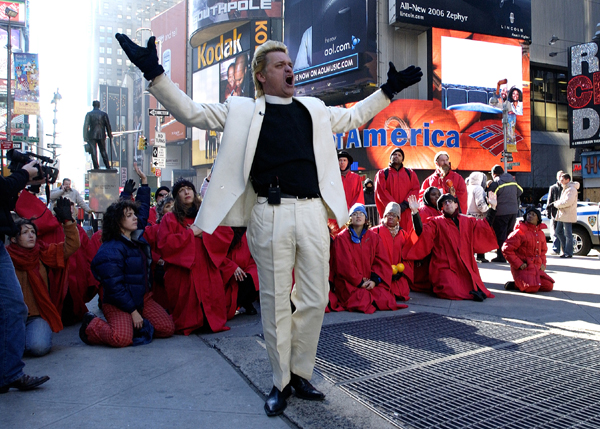
By Reverend Billy

Source: Reality Sandwich

What did you call me? 

That is a traditional last bit of language before the shove, the fist and the bullet.

We have a circus in our benighted city New York, of name-calling, misunderstanding, and yes, murder.   This week we have Quentin Tarantino using the word “murdered” for the victims of police violence, a few hours from the funeral of a cop named Ralph Holder, who was murdered in the line of duty. Police commissioner Bill Bratton lashes out, calling the film-maker “contemptible.” (But the number of unarmed Americans shot and killed by police is approaching a thousand this year.)

This merry-go-round of words is very close to the end of language, the “What Did You Call Me?” of every B-movie western… This has gone on since before 9/11. Rudolf Giuliani took it to a new level. Then Mike Bloomberg, with his commissioner Ray Kelly – pandered to language-destroying emotions of fear every single day of the three terms of that administration.

You have to ask – how could the two sides work together? Is it possible to even begin in this canyon of clichés? The police are so defensive, they act like Scientologists. They are hair-trigger-ready to be disrespected. On the other hand, Black Lives Matter is the first successful social movement in memory, and people like me treasure this historical moment. It proves that a social movement in this age of Consumerism and Militarism is still possible. Black Lives Matter is our daylight.

We ask – how would we heal? One development this week intrigues. Al Sharpton was called to preside at the funeral by the father of the Officer Ralph Holder, and then he backed away as the pack of Irish cops Bratton and the union heads Lynch and Mullins – laid it on thick.

But the choice by the father is fascinating. It showed a moment of healing leadership coming from a not-in-the-media-circus regular citizen. It was daringly hopeful, and probably not realistic. Clearly, though, it was the kind of gesture we need. No politician could’ve done this, though our mayor Bill de Blasio may have tried – really no public figure could ever be this creative.

“Never assume that every critic is a hater, not everyone is hating on you, some people are telling you the truth.”   —Nina Simone

What Tarantino did that really gets to the police is – he claimed the word “murder.” Murder is a crime and crime is the territory of the police.

It didn’t seem to matter to them that so many called out, “Stop killing us!” But if you shout “Stop murdering us.” – the police are incensed. “Murder” is something only they understand. The police own the word “Murder.”

You could say that Tarantino is a player in a very long game of healing. Other public figures may join him in using such language. Murder is murder. More police who murder need to go on trial for murder. That word can no longer be held sacred, with the police the only priests allowed to speak it.

This is one trail of healing, but there must be others. One that I think of, as a many-times arrested and jailed New York activist, is this: How would any non-police person ever criticize the cops openly? How would that be possible? At this point in time – this is how far it’s gone – no public language can criticize cops that is not immediately damned by cops. I used the word “damned” rather than “attacked,” because the police hunt down critics in the manner of a religious cult.

“I love this country more than in any in the world, and exactly for this reason I insist on the right to criticize her perpetually.”   —James Baldwin

Don’t you find yourself grateful and amazed that the children of slaves continue to risk their lives in the act of citizenship? This is a key to possible healing. In New York City, we have a standing army of 35,000 police and they are systematically denied the education of the 1st Amendment, and they are armed. They are led by demagogues in the old style of Mussolini: And yet, African-Americans get out of bed every day and go outside into public space a willful, risky act of citizenship.

The healing that we see is so needed for this divided city will not come from Black Lives Matter backing down, changing language, acquiescing. We are in a long recovery from 9/11, which only strengthened the racism already in us.

The movement for the return to “Peace Officers” is very like the Earth Movement. Entrenched power that believes it is the owner of legalized violence must be faced down in public space. Since citizens cannot exercise their 1st Amendment rights in the privatized parks and streets now, the healing of violent law enforcement will involve some form of trespassing.

It may sound novel to suggest that healing comes from continuing the advancement of one of the antagonists. Yes – Black Lives Matter needs to advance and grow. Safety for black citizens must be normalized and formalized – and this will heal the law enforcement community. Healing in this case mostly means the education of the police.

Black Lives Matter was sparked by young blacks who refused to leave the sidewalk in front of the Ferguson police department for months.  Here in NYC, the bridges and tunnels and Macy’s and Grand Central Station were occupied. The die-ins were always called trespassing. Those die-ins must be the seeds of healing.

“I stand with the murdered.” —Quentin Tarantino

Our Hollywood buddy trespassed on police language. We hope that he continues to use such direct, honest words – and so must we.

RiseUpOctober was criticized for scheduling the “rally” at the same time as Officer Holder’s funeral, but we were going to a funeral too. Throughout the week the police and their media called the Union Square rally a political exercise, as if it were a vested interest group.

This is simply psychological bullying. They don’t think of us as experiencing sorrow. If they showed contrition for the results of their bullets, it might dawn on them that we are gathered with sorrow in our anger. Last year, the number of deaths from police use of deadly force was about 20 times the number of police deaths while on duty. And if you cannot imagine sorrow in another human being, you are more likely to hurt them. Out of this de-humanization, cops kill.

Following Black Lives Matter as our teacher, we must use all the words and all the space with our bodies. The healing is the pulling back, slowly and painfully, of these people from their fearful violence. We must pull them back to a trust of their neighbors that they haven’t enjoyed in so long.


Reverend Billy and the Stop Shopping Choir open their show “The Earth Wants YOU!” at Joes’ Pub at New York’s Public Theater on Sunday November 15. Contact Revbilly.com for show times and ticket info.

Catalyzing the Shamanic Archetype

mushrooms_art2

By Paul Levy

Source: Reality Sandwich

The following is excerpted from Awakened By Darkness: When Evil Becomes Your Father.

Spiritual awakenings oftentimes get precipitated by experiences of wounding, abuse and trauma, which is to say that in a genuine spiritual awakening there is often a co-joining of healthy and pathological factors. The idea is to nourish the healthy aspects of the process so that they become stronger, while allowing the pathological factors to naturally fall away as they become integrated into the wholeness of the newly emerging psyche. To quote the great Hindu saint Ramakrishna, “How to get rid of the lower self? The blossom vanishes of itself as the fruit grows, so will your lower self vanish as the divine grows in you.”

Being wounded almost always initiates and catalyzes the “shamanic archetype” to begin to form-ulate and crystallize itself in the unconscious. Shamanism is the root from which humanity’s various spiritual disciplines have issued; the earliest origins of modern psychotherapy known to history lie in archaic shamanism. When the shamanic archetype is activated, it precipitates a deeper part of the psyche to become mobilized, as people enacting the shamanic archetype journey deep inside themselves, flying on the wings of their creative imagination to become familiar with and address what has gotten activated within them. The shamanic archetype becomes catalyzed in us by a severe emotional and spiritual crisis, oftentimes organically growing out of unresolved abuse issues from childhood—this was certainly true for me.

The shamanic archetype is one of the major processes currently animated in the collective psyche of our species. We’d have to be truly “disturbed” if our emotions aren’t disturbed by the diabolic and dark shadow forces playing out their polarizing, manipulative and exploitive agendas in our world. How we hold what has gotten triggered within us as we both witness and participate in these distressing dramas determines whether the latent shamanic archetype within us manifests in service of our—and our planet’s—healing or not. Just as dreams are the unconscious’s way of balancing a one-sidedness in an individual’s psyche, the shamanic archetype is the dynamically evolving pattern of healing that is being constellated in the collective unconscious as a compensatory response to the trauma and abuse playing itself out on the world stage.

A person would never—if they were in their right mind—choose to be a shaman. It’s not the sort of thing that someone takes a weekend workshop or a class and then becomes a shaman. Becoming a shaman is a vocation, which is to say that it is something one is “called” to do; this calling is typically conceived of as coming from the spirits, i.e., from an autonomous spiritual factor deep within the psyche. Etymologically, the word “calling” has to do with hearing a voice—the voice of the other within ourselves—with which, like a living person, we develop an ongoing and deepening relationship. This inner figure has from time immemorial been referred to by a multiplicity of names—our muse, ally, guiding spirit, angel, genius and daemon, to name but a few. Attracting many names to itself is typical of something numinous; one name doesn’t quite “do it.”

If it is a true calling and we resist, however, we can fall ill, go crazy or even die; the point is that the stakes are high, and being called to shamanize is something to take seriously. It necessarily involves making a descent into the underworld of the unconscious—into the netherworld of the shadow—where we have to confront our own dark side and madness; this is why in a shamanic initiatory experience, the potential shaman looks like they’re having a psychotic break. A Siberian shaman reminds us, “If you find the spirit of madness, you will begin to shamanize.” Becoming a shaman is not for the faint of heart; the initiate typically has to go through a death experience, whose other side, if all goes well, is rebirth. The suffering involved—which is actually a purification—is intense. Speaking of what he calls “shamanic suffering,” Holger Kalweit, author of Dreamtime and Inner Space: The World of the Shaman, writes that the suffering a potential shaman goes through is “a suffering intense enough to kill.” I can totally relate; after the abuse from my father, it was as if the doors of my unconscious opened up, unleashing formidable energies that easily could have killed me.

A key part of the shaman’s initiation is to come to terms with evil. Mircea Eliade refers to shamans as “pre-eminently the antidemonic champions; they combat not only demons [who Eliade refers to as “the true enemies of humanity”] and disease, but also black magicians…. What is fundamental and universal is the shaman’s struggle against what we could call ‘the powers of evil.’” In my life, my encounter with the evil that came through both my father and psychiatry were the forms that my descent into the underworld took; if I hadn’t re-contextualized these experiences as being part of a deeper shamanic initiatory process, I would have been stuck in and personally identified with these experiences in their literal rather than symbolic form, possibly for the rest of my life, which would have been truly tragic. Von Franz wrote, “The symbolic inner experiences which the Shaman lives through during his period of initiation are identical with the symbolic experiences the man of today lives through during the individuation process…curing the soul of individuals and collective states of possession is really the principal task of the Shaman.” The mission of the shaman is to heal—both individually and collectively—the state of possession by unconscious psychic forces of the members of their community, as well as the community as a whole.

In indigenous, shamanic communities, the role of the shaman does not exist in isolation, but as a role that the community collaboratively dreams up for the health and sanity of the wider community. The role of the shaman is relational in nature—only taking on its meaning in relation to others as well as the surrounding environment—not something that exists independent of the field in which the shaman lives. Being a role in the field, in the ideal sense the position of shaman need not be monopolized by or restricted to one person; a shaman is a role that any and everyone can pick up as we become more creative and fluid within ourselves. In a genuinely healthy community, roles are very fluid, which is to say—in a form of “collective shamanism”—the role of the shaman can potentially be played out at various times by each of its members. Because the role is being shared by all of its members, different people can play the shamanic role without necessarily having to descend into the depths of hell; they are required, however, to self-reflectively deal with how their own unconscious darkness is contributing to the collective shadow that is getting dreamed up in and through the community.

We are all potentially “shamans-in-training,” in the sense that we are all being called—both individually and collectively—to deal with the darkness that seems to be ruling our world. The formless archetype of the shaman/healer is thirsting for sentient instruments to express and actualize itself in embodied form. Recognizing, and saying “Yes” to the deeper shamanic calling that is pulsing through our veins inspires us to breathe life into and incarnate the figure of the shaman who lives within us. We are being invited by the universe to step into our shamanic “garments” and consciously participate in our own evolution. Instead of our ritual implements being drums and rattles, however, as “modern-day shamans” our accessories might be something like the keyboard of a computer or the tools of multi-media, as we work to inspire change in the underlying consciousness of the field by a keystroke or the creative use of a video camera or website. Co-operating with our deeper shamanic calling constellates the universe to support us in our endeavor, as the universe itself is the sponsor of our calling. Assenting to our calling gets us “in-phase” with ourselves such that we become our own best ally.

The psyche is easily dissociable; due to trauma it can readily fragment into seemingly separate parts. Being wounded creates a dissociation in us, in the sense that we dis-associate from and lose connection with parts of ourselves. People of shamanic temperament, however, are able to turn the psyche’s natural ability to dissociate to their advantage. They are able to purposely dissociate, which is very different from the unconscious pathology of dissociative disorder. The shaman’s ability to dissociate, and fluidly travel between different reference points within themselves helps them to re-member their dis-membered selves, as well as to retrieve the split-off, and hence unconscious, soul of the community.

A shaman often suffers from the plight of their people. Due to their “standing” at the gateway between the conscious and unconscious aspects of their own mind as well as the community at large, they are able—like a healing enzyme—to act as agents transforming and raising unconscious contents into conscious awareness, making these contents available to the community. I think of Jung—a deeply shamanic personality—who was afflicted with dreams and visions of bloodbaths and catastrophes in Europe which he wasn’t able to understand until soon thereafter the First World War broke out, and he realized that his personal experiences reflected the collective situation that was brewing in the cauldron of humanity’s unconscious.

People going through a spiritual awakening/shamanic initiation find themselves, as if living in an archetypal fairy tale, inhabiting a deeper mythic realm where everything that happens is in-fused with deeper meaning. This deeper meaning doesn’t come from outside of us; we are the arbiters of meaning—“meaning-generators.” Instead of being mute and having no say in things, our world is always speaking to us symbolically, speaking “through” things (so to speak); this can take a little while to interpret, integrate and to learn to navigate. The goal is to bring together the two worlds so that we can fluidly travel between the everyday world of ordinary reality and the deeper mythological, symbolic realm, a dimension which is always having its say—the question is whether we recognize what is being said. This is analogous to having a fluid back and forth, give and take relationship between the conscious and unconscious minds within ourselves.

A key part of the shaman’s vocation is to be able to “see” the spirits, which is to be able to recognize and develop relationship with the forces of the unconscious. Wetiko can be thought of as having its own spirit; this is why I am continually pointing out the importance of “seeing” how this spirit operates—out in the world, through others, via our relationships and within our own mind. Seeing “the spirits,” which von Franz points out is today simply called “the unconscious” takes away their autonomy and seeming power over us, while expanding the light of our consciousness in the service of individuation. The more individuated we become, the wider is our consciousness of the realm of the unconscious which spreads out before us in, as and through the world. To wake up to the dreamlike nature of reality is to realize that we are surrounded on all sides by the unconscious; dreams themselves are the unmediated expression of the unconscious. The process of becoming conscious doesn’t banish the unconscious, but rather, aids us in developing the trust to give ourselves over to it time and again, thereby learning how to receive its gifts of wisdom. When we shed light on the darkness of the unconscious, it’s not that all of its contents become illumined; rather, there becomes a more permeable boundary for the unconscious contents to emerge into consciousness, as well as for consciousness to step into the world of the unconscious.

The shaman is akin to and a kin of the figure of the artist. To quote anthropologist Carlton Coon, “Whatever else he may be, the shaman is a gifted artist.” Mythologist Joseph Campbell draws a parallel between artists and ancient shamans when, speaking about modern artists, he says that “the whole unconscious has opened up and they fall into it.” We continually deepen our individuation only insofar as we don’t cling to our conscious experience, but allow ourselves to submerge into the depths of the unconscious however and wherever it shows up, trusting that we will be able to creatively express—and hence, become conscious of—what is moving us. As Jung points out, “The unconscious no sooner touches us than we are it—we become unconscious of ourselves.” This ongoing dynamic of falling into and giving shape and form to the unconscious, then stepping out of and contemplating what has just come through us—going back and forth between the subjective and objective domains—furthers our realization of the unconscious, both within ourselves and in the world at large. Through this process, the shamanically-oriented person is adding consciousness to and assimilating the unconscious in the field, while simultaneously metabolizing the unconscious parts of themselves that have been activated.

The shamanic personality’s ability to fluidly navigate back and forth between the conscious mind and the deep waters of the unconscious contrasts with people who fall into their unconscious and, unfortunately, become overwhelmed by the experience, losing both the ability to creatively express their experience, as well as their sense of self. The shaman learns to swim, surf and snorkel in the waters of the unconscious while the failed shaman, whatever label we call them by (schizophrenic, bi-polar, etc.), drowns in the depth of its waters. This is why it is profoundly important, as Jung realized, to have a strongly developed sense of ego when we encounter these deeper, more powerful realms, for if we don’t we can easily get swallowed up and lose ourselves. We need a strong sense of self in order to get in relationship with these powerful energies.

As the shaman travels between the worlds of the conscious and the unconscious, the boundary between these two worlds becomes more permeable. There is no clear demarcation point between the conscious and the unconscious; an un-boundaried continuum, one starts where the other leaves off. In their journey, shamans create a bridge so that the conscious mind and the unconscious can more easily pass between, influence and illumine each other, which transfigures everything. Over time these two seemingly opposite realms begin to become indistinguishable from and turn into each other, while at the same time, paradoxically, becoming more distinct from each other. Inseparably and reciprocally co-arising in their interaction, both the conscious and unconscious minds are dynamically contained within the wider totality of psyche.

The psyche is simultaneously “historical”—in the sense that its development can only be understood in the context of its personal and collective past—and “trans-historical,” which is to say that the psyche atemporally abides outside of linear time, yet simultaneously generates events experienced by humans in historical time. Though within its very structure is written the whole history of humanity, the psyche is at the same time teleological, in that it is purposeful, seeking its own actualization. Jung writes, “Anything psychic is Janus-faced: it looks both backwards and forwards.” The psyche is like a pivot through which, both on the individual and collective levels, we choose either to look backwards and re-create the unhealed past, or step into consciously participating in our own creative future evolution in the present. In a spiritual awakening/shamanic initiation, it is as if we are connecting with a healed, whole and awake part of us that, atemporally speaking—outside of linear time—has always existed. We begin to cooperate with and surrender to a deeper impulse within us, as if we are allowing ourselves to be drawn into the strange attractor that is ourselves, a process which can only take place in the present moment. By becoming aware of and stepping into this higher-dimensional part of ourselves, we are attracting this particular part of ourselves, with its corresponding universe, into materialization; this is the sacred power of dreaming.

This seemingly bi-polar process of oscillating between the polarities of the conscious and the unconscious is an apt description of the shaman’s journey between the worlds. As this process unfolds in and over time, a center or mid-point emerges, which contains, embraces and unites the opposites: this is, in Jung’s language, “the Self.” The Self is an expression of the intrinsic wholeness within us, a wholeness which already exists but is paradoxically brought forth into consciousness via this process of collaboration with the unconscious. At points this descent can be experienced as if we are just recursively playing out our unhealed abuse issues (the iteratio stage of alchemy), but is in actuality a deepening descent down a spiral, a circumambulation which ultimately illumines the center point—the Self. Transforming consciousness, the Self acts like a magnet, attracting to itself that which is proper to it. Jung comments, “We can hardly escape the feeling that the unconscious process moves spiral-wise round a center, gradually getting closer, while the characteristics of the center grow more and more distinct. Or perhaps we could put it the other way round and say that the center—itself virtually unknowable—acts like a magnet on the disparate materials and processes of the unconscious and gradually captures them as in a crystal lattice…. Often one has the impression that the personal psyche is running around this central point like a shy animal, at once fascinated and frightened, always in flight, and yet steadily drawing nearer.”

As the shaman’s accomplishment deepens, they are able to tap into and participate in the primordial, timeless source of creativity itself. A person’s ability to heal and facilitate healing for others depends upon their ability to link to the larger world of the “pleroma” (a field of abundant potential, boundless luminosity and creativity, and infinite sentience). Approaching the numinosity of the pleroma is therapeutic at its core—what Jung calls “the real therapy”—as it releases us from what he calls “the curse of pathology.” Connecting with this more expanded perspective within us alchemically transforms what seemed to be pathological into something expressing and leading us closer to the numinosum.

Archetypally, shamans take on and into themselves the illness of those they are working with, falling ill themselves. As a result of the abuse from my father, I feel like I have been sick for years, suffering under the burden of a shamanic sickness. The wetiko bug that used my father to get into me has activated my psychic immune system to go into overdrive to deal with this toxic invader. I have “taken on” my father’s pathology, which carries a double meaning: to “take on” means to confront, as well as to take within myself (so as to suffer with). I’ve been slowly transmuting the virulence of the wetiko germ that I “caught” from my father; this book is my latest attempt to shed light on—and “make light” (of)—what has gotten triggered within me. What makes a shaman an accomplished shaman, however, is that they are somehow able to work with and metabolize the illness, integrating it into the wholeness of their being and subsequently finding their way back to health; this process nonlocally helps the person(s) who were originally ill. In addition, this helps the whole universe, by eliminating that personalized quanta of sickness from the collective field—“lightening” the shadow in the collective unconscious ever so slightly.

I am in no way claiming that I am an accomplished shaman—this is true only in my wildest dreams—but what I am saying is that the archetype of the shaman—which is related to the archetype of the wounded healer—is one of the deeper processes that has shaped and given meaning to the experiences in my life. In addition, the shamanic archetype is one of the fundamental underlying patterns that is informing all of our processes, both individually and collectively, as a species. Humanity as a whole is going through a profound shamanic initiation of epic proportions, writ large on the world stage as well as within each of our hearts and minds. When we realize this, we can connect with each other so as to collaboratively help each other successfully pass through our shared ordeal. What a radical idea!


 

Saturday Matinee: Land of the Dead

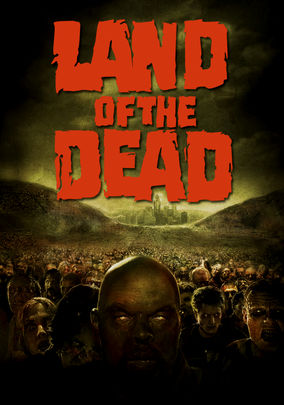
3768363“Land of the Dead” (2005) is writer/director George Romero’s fourth film in his “Night of the Living Dead” series and  is possibly the most underrated installment so far. The film offers a variety of new twists to the series such as the development of basic problem solving skills among zombies and the not-too-subtle symbolism of a walled city ruled by a dictator from the top of a luxury high rise. It continues and heightens the social commentary most apparent in the second film of the series, “Dawn of the Dead” while steering it in surprising directions. While the film is not without it’s share of plot holes, it’s screenplay is satisfying nevertheless, and features good performances from Dennis Hopper, Simon Baker, John Leguizamo, Asia Argento and Eugene Clark (with surprise cameos by Shaun of the Dead’s Simon Pegg and Edgar Wright).

http://www.dailymotion.com/video/x2ja94s

The Role of Dystopian Fiction in a Dystopian World

images

By Luther Blissett and J. F. Sebastian of Arkesoul

A few years ago, Neal Stephenson wrote a widely-shared article called Innovation Starvation for the World Policy Institute. He began the piece lamenting our inability to fulfill the hopes and dreams of mid-20th century mainstream American society. Looking back at the majority of sci-fi visions of the era, it’s clear many thought we’d be living in a utopian golden age and exploring other planets by now. In reality, the speed of technological innovation has seemingly declined compared to the first half of the 20th century which saw the creation of cars, airplanes, electronic computers, etc. Stephenson also mentions the Deepwater Horizon oil spill and Fukushima disasters as examples of how we’ve collectively lost our ability to “execute on the big stuff”.

Stephenson’s explanation for this predicament is two-fold; outdated bureaucratic structures which discourage risk-taking and innovation, and the failure of cultural creatives to provide “big visions” which dispute the notion that we have all the technology we’ll ever need. While there’s much to be said about archaic, inefficient (and corrupt) bureaucracies, there’s also a compelling argument invoked over the cultural importance of storytelling and art and how best to utilize it. One of the solutions offered by Stephenson, in this regard, is Project Hieroglyph which he describes as “an effort to produce an anthology of new SF that will be in some ways a conscious throwback to the practical techno-optimism of the Golden Age.”

While Project Hieroglyph may be a noble endeavor, one could argue that it’s based on a flawed premise. The role of science fiction has never been just about supplying grand visions for a better future, but to make sense of the present. There seems to be an assumption that the optimistic Golden Age had a causal relationship with a perceived technological golden age when it may have simply been a reflection of it— just as dystopian sci-fi reflects and strongly resonates with the world today. Stephenson may be correct in his view that much SF today is written in a “generally darker, more skeptical and ambiguous tone”, but this more nuanced perspective does not necessarily signify the belief that “we have all the technology we’ll ever need”. Rather, it reflects decades of collective experience and knowledge of unforeseen and cumulative effects of technologies. Nor does such fiction focus only on destructive effects of technology, as large a component of the narrative it may be simply because it makes for better drama and the subtext is often intended as a critique rather than celebration. For example, the archetypal hacker protagonists of technocratic cyberpunk dystopias employ technology for more positive ends (though some question whether good SF, as in speculative fiction, needs to involve new technology at all).

A particularly positive function for dystopian sci-fi is its use as rhetorical shorthand. It’s increasingly common in public discourse on major issues of the day to invoke dystopian references. Disastrous social effects of peak oil or post-collapse are often characterized as Mad Max scenarios. Various negative aspects of genetic modification and pharmaceutical development conjure Brave New World. Anxiety over out-of-control AI and resultant devaluing of human life brings to mind films as varied as Blade Runner, The Matrix and Terminator films. The expanding police/surveillance state is reminiscent of 1984 and numerous classics which have followed in its footsteps including V for Vendetta and Brazil. General fears of duplicitous, psychopathic power elites and social manipulation have elevated They Live from relatively obscure b-movie to cult classic. The entry of the term “zombie apocalypse” into the popular lexicon may in part stem from fear (and uncomfortable recognition) of images of viral social disintegration and martial law-enforced containment efforts depicted throughout various media. The burgeoning omnipotence of multinational corporations and hackers in Mr. Robot may have been the stuff of cyberpunk dystopias such as Neuromancer and Max Headroom 30 years ago, yet, it still has much to contribute to the public discourse as contemporary drama. Such visions may not prevent (or have not prevented) the scenarios they warn us of but have provided a vocabulary and framework for understanding such problems, and who’s to say how much worse it could be had such cautionary memes never existed?

The prophetic nature of storytelling, inasmuch as it derives from the minds of authors, artists and commentators that coexist with tensions and contexts particular to their epochs, resonate with the oughts, ifs, and whats inherent to our daily lives. As it were, the cautionary element of narrative is a natural product of the human mind, and the premium of what involves sharing our mental reserves to the world. To creatively dwelve and concoct problems and solutions from experience, is an axiom analogous to that of the categorical imperative—purely, and in abstract terms of what rationality involves. Yet, often times, we find material that is in favor of cultural malaise; of all things pathological in our society, such as censorship, conformity, bureaucracy, authoritarianism, militarism, and capital marketing; things which underpin issues that, if left untouched, can engulf the real brilliance of our spirit.

Stephenson fails to see this point. SF, as any form of intelligent culture, denounces and opposes systems of oppression, and even shows us the how, when, and why—the frameworks, the makings of apparent utopias into dystopias. Dystopian storytelling can serve the efforts of downtrodden creators with utopian ideals as effectively as utopian stories can reframe a societal trajectory led by beneficiaries of real world dystopia (though it may be experienced as utopia for a privileged few). SF does not only conjure visions of better futures. They lend us vocabularies and syntaxes to understand, and impede the fallenness of a confused, and ever increasingly isolated humanity. They are languages that pervade our interiorities, and that allow the exterior to change.

At the core, SF is prophecy through reasoned extrapolation and artistic intuition. This is what SF stands for when properly aligned with the subjectivities of the oppressed, and not with the voices of oppression: true testaments of a space and a time; visions of the future that carefully partake in not committing the mistakes of the past; and tools for our personal and collective flourishing.

Skynet Ascendant

t2skynetbdcap1

By Cory Doctorow

Source: Locus Online

As I’ve written here before, science fiction is terrible at predicting the future, but it’s great at predicting the present. SF writers imagine all the futures they can, and these futures are processed by a huge, dynamic system consisting of editors, booksellers, and readers. The futures that attain popular and commercial success tell us what fears and aspirations for technology and society are bubbling in our collective imaginations.

When you read an era’s popular SF, you don’t learn much about the future, but you sure learn a lot about the past. Fright and hope are the inner and outer boundaries of our imagination, and the stories that appeal to either are the parameters of an era’s political reality.

Pay close attention to the impossibilities. When we find ourselves fascinated by faster than light travel, consciousness uploading, or the silly business from The Matrix of AIs using human beings as batteries, there’s something there that’s chiming with our lived experience of technology and social change.

Postwar SF featured mass-scale, state-level projects, a kind of science fictional New Deal. Americans and their imperial rivals built cities in space, hung skyhooks in orbit, even made Dyson Spheres that treated all the Solar System’s matter as the raw material for the a new, human-optimized megaplanet/space-station that would harvest every photon put out by our sun and put it to work for the human race.

Meanwhile, the people buying these books were living in an era of rapid economic growth, and even more importantly, the fruits of that economic growth were distributed to the middle class as well as to society’s richest. This was thanks to nearly unprecedented policies that protected tenants at the expense of landlords, workers at the expense of employers, and buy­ers at the expense of sellers. How those policies came to be enacted is a question of great interest today, even as most of them have been sunsetted by successive governments across the developed world.

Thomas Piketty’s data-driven economics bestseller Capital in the Twenty-First Century argues that the vast capital destruction of the two World Wars (and the chaos of the interwar years) weakened the grip of the wealthy on the governments of the world’s developed states. The arguments in favor of workplace safety laws, taxes on capital gains, and other policies that undermined the wealthy and benefited the middle class were not new. What was new was the political possibility of these ideas.

As developed nations’ middle classes grew, so did their material wealth, political influence, and expectations that governments would build am­bitious projects like interstate highways and massive civil engineering projects. These were politically popular – because lawmakers could use them to secure pork for their voters – and also lucrative for government contractors, making ‘‘Big Government’’ a rare point of agreement between the rich and middle-income earners.

(A note on poor people: Piketty’s data suggests that the share of the national wealth controlled by the bottom 50% has not changed much for several centuries – eras of prosperity are mostly about redistributing from the top 10-20% to the next 30-40%)

Piketty hypothesizes that the returns on investment are usually greater than the rate of growth in an economy. The best way to get rich is to start with a bunch of money that you turn over to professional managers to invest for you – all things being equal, this will make you richer than you could get by inventing something everyone uses and loves. For example, Piketty contrasts Bill Gates’s fortunes as the founder of Microsoft, once the most profitable company in the world, with Gates’s fortunes as an investor after his retirement from the business. Gates-the-founder made a lot less by creating one of the most successful and profitable products in history than he did when he gave up making stuff and started owning stuff for a living.

By the early 1980s, the share of wealth controlled by the top decile tipped over to the point where they could make their political will felt again – again, Piketty supports this with data showing that nations elect seriously investor-friendly/worker-unfriendly governments when investors gain control over a critical percentage of the national wealth. Leaders like Reagan, Thatcher, Pinochet, and Mulroney enacted legislative reforms that reversed the post-war trend, dis­mantling the rules that had given skilled workers an edge over their employers – and the investors the employers served.

The greed-is-good era was also the cyberpunk era of literary globalized corporate dystopias. Even though Neuromancer and Mirrorshades predated the anti-WTO protests by a decade and a half, they painted similar pictures. Educated, skilled people – people who comprised the mass of SF buyers – became a semi-disposable under­class in world where the hyperrich had literally ascended to the heavens, living in orbital luxury hotels and harvesting wealth from the bulk of humanity like whales straining krill.

Seen in this light, the vicious literary feuds between the cyberpunks and the old guard of space-colonizing stellar engineer writers can be seen as a struggle over our political imagination. If we crank the state’s dials all the way over the right, favoring the industrialist ‘‘job creators’’ to the exclusion of others, will we find our way to the stars by way of trickle-down, or will the overclass graft their way into a decadent New Old Rome, where reality TV and hedge fund raids consume the attention and work we once devoted to exploring our solar system?

Today, wealth disparity consumes the popular imagination and political debates. The front-running science fictional impossibility of the unequal age is rampant artificial intelligence. There were a lot of SF movies produced in the mid-eighties, but few retain the currency of the Termina­tor and its humanity-annihilating AI, Skynet. Everyone seems to thrum when that chord is plucked – even the NSA named one of its illegal mass surveillance programs SKYNET.

It’s been nearly 15 years since the Matrix movies debuted, but the Red Pill/Blue Pill business still gets a lot of play, and young adults who were small children when Neo fought the AIs know exactly what we mean when we talk about the Matrix.

Stephen Hawking, Elon Musk, and other luminaries have issued pan­icked warnings about the coming age of humanity-hating computerized overlords. We dote on the party tricks of modern AIs, sending half-admiring/half-dreading laurels to the Watson team when it manages to win at Jeopardy or randomwalk its way into a new recipe.

The fear of AIs is way out of proportion to their performance. The Big Data-trawling systems that are supposed to find terrorists or figure out what ads to show you have been a consistent flop. Facebook’s new growth model is sending a lot of Web traffic to businesses whose Facebook followers are increasing, waiting for them to shift their major commercial strategies over to Facebook marketing, then turning off the traffic and demanding recurr­ing payments to send it back – a far cry from using all the facts of your life to figure out that you’re about to buy a car before even you know it.

Google’s self-driving cars can only operate on roads that humans have mapped by hand, manually marking every piece of street-furniture. The NSA can’t point to a single terrorist plot that mass-surveillance has disrupted. Ad personalization sucks so hard you can hear it from orbit.

We don’t need artificial intelligences that think like us, after all. We have a lot of human cognition lying around, going spare – so much that we have to create listicles and other cognitive busy-work to absorb it. An AI that thinks like a human is a redundant vanity project – a thinking version of the ornithopter, a useless mechanical novelty that flies like a bird.

We need machines that don’t fly like birds. We need AI that thinks unlike humans. For example, we need AIs that can be vigilant for bomb-parts on airport X-rays. Humans literally can’t do this. If you spend all day looking for bomb-parts but finding water bottles, your brain will rewire your neurons to look for water bottles. You can’t get good at something you never do.

What does the fear of futuristic AI tell us about the parameters of our present-day fears and hopes?

I think it’s corporations.

We haven’t made Skynet, but we have made these autonomous, transhuman, transnational technolo­gies whose bodies are distributed throughout our physical and economic reality. The Internet of Things version of the razorblade business model (sell cheap handles, use them to lock people into buying expensive blades) means that the products we buy treat us as adversaries, checking to see if we’re breaking the business logic of their makers and self-destructing if they sense tampering.

Corporations run on a form of code – financial regulation and accounting practices – and the modern version of this code literally prohibits corporations from treating human beings with empathy. The principle of fiduciary duty to inves­tors means that where there is a chance to make an investor richer while making a worker or customer miserable, management is obliged to side with the investor, so long as the misery doesn’t backfire so much that it harms the investor’s quarterly return.

We humans are the inconvenient gut-flora of the corporation. They aren’t hostile to us. They aren’t sympathetic to us. Just as every human carries a hundred times more non-human cells in her gut than she has in the rest of her body, every corpora­tion is made up of many separate living creatures that it relies upon for its survival, but which are fundamentally interchangeable and disposable for its purposes. Just as you view stray gut-flora that attacks you as a pathogen and fight it off with anti­biotics, corporations attack their human adversaries with an impersonal viciousness that is all the more terrifying for its lack of any emotional heat.

The age of automation gave us stories like Chap­lan’s Modern Times, and the age of multinational hedge-fund capitalism made The Matrix into an enduring parable. We’ve gone from being cogs to being a reproductive agar within which new cor­porations can breed. As Mitt Romney reminded us, ‘‘Corporations are people.’’

Lara Trace Hentz

INDIAN COUNTRY NEWS

In Saner Thought

"It is the duty of every man, as far as his ability extends, to detect and expose delusion and error"..Thomas Paine

ZEDJournAI

Human in Algorithms

Rooster Crows

From the Roof Top

Aisle C

I See This

The Free

blog of the post capitalist transition.. Read or download the novel here + latest relevant posts

अध्ययन-अनुसन्धान(Essential Knowledge of the Overall Subject)

अध्ययन-अनुसन्धानको सार