Beyond Palliative Care

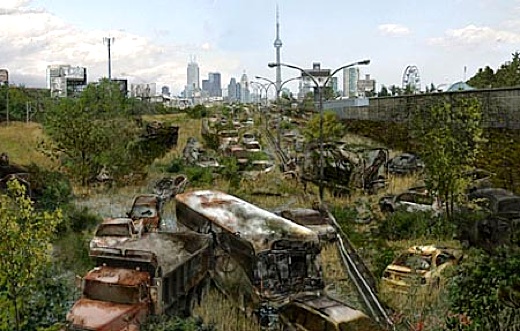
130517cntower

By arranjames

Source: Synthetic Zero

Not all that long ago the curators of this blog started talking about the possibility of the palliative care of the Earth. Recently dmf posted up a podcast dealing with the same topic. I haven’t listened to it yet so won’t be drawing on it in this post. I wanted to take a few minutes to experiment with the senses of the phrase “palliative care of the Earth”.

First of all, what is palliative care? Like all attempts at sense it is a contested battleground rife with bullet holes and no-man’s lands with various armies massed and pressing on it. One such army is the global institutional Roman legion that is the World Health Organisation. The WHO loves definitions. One could almost assume it employed nothing but glossophiliacs who spent their days and night writing endless variations on definitions who, in their frenzied madness, ended up trying to murder the words they were seeking to play midwife to. The WHO definition is long. And vague. You can read it here. Operationalising a little we can extract the fundamentals: palliative care seeks to make life as liveable as possible for the dying body and for the bodies who will mourn it.

The Earth as a system of ecosystems, an ecological metasystem, is considered as a body composed of bodies that play habitat and inhabitant, catalyst and anticatalyst, metabolism and metabolite, and so on, to one another [1]. Not all of these bodies are living but as with any machinic assemblage this Earth emerges as a necessarily heterogenetic improvisation (the imposition of unpredictability) that depends on both organic and machinic kinds [2]. A cyborg of a different order than Robocop the Earth is more akin to the Half-Faced Man, a machine that wants to be human. This isn’t to say the Earth wants to be human, or that it wants anything in any way we’d recognise as desire, although interspecies sexuality clearly indicates a queer promiscuity among nonhuman organisms, but that the Earth has assembled in such a way that the organic has come out of the inorganic. From a certain perspective: so what? It’s all just interlocking mechanism. Well, fine. But its dying is what.

But the Earth won’t die. Not yet. Far more likely- and if we stop being so anthropophobic- we’re talking about ourselves. It is us that is dying. It is the palliative care of the human that we should really consider. We open with a discussion of the dying Earth because it is this dying that is killing us: a vicarious species-suicide? These are dark thoughts that imply a loathing so great in our species that we’d take out everything else just to slit our own throats once and for all. But we’re not that grand, we’re all too limited, all too human still. Like smokers in the 1950s we didn’t know what we were doing, then we did and did nothing about it, then everyone said it was too late. We’re not quite sure of the periodicity. We don’t know if it is too late. What we do know is that we’ve had a mass terminal diagnosis and there is no consensus on the prognosis. What are we dying of then, if not some anthropathology [3]?

Does the species have a body? Or is the species also a hallucination? Hallucinations can die too- ask a “schizophrenic” on Clozapine. The WHO is an ensemble of equipment and technique in the same way Guattari once spoke of the unconscious. It is almost as if the WHO invented health (“a total state”) and must administer it. What is it that the WHO wants to say about palliative care? It has things to say about the reduction of suffering; the affirmation of life and death; it seeks neither the hastening nor the postponing of death; it looks to psychology and spirituality; produces support systems; is multidisciplinary; is life enhancing; it’s never too early to start.

How does this map onto humanity? We’re just scale in a sense, where “humanity” stands in for “person”. So it is the reduction of the suffering of species and the enhancement of its existence. This follows nicely from Lacanian ideas that we live both by the reality-principle and jouissance, by both aversion and hedonics. We’re also not talking about killing ourselves off, so no reproductions of Zapffe’s conclusion to ‘The Last Messiah’- we aren’t about to go forth to be fruitless and let the Earth be silent after us (as if it would be). I think it’s safe to say fuck Messiahs, especially last ones.

We’re also looking to the psychology and spirituality of humanity? Doesn’t this translate quite well to looking at the cognitive biases and metacognitive illusions and the affects and emotions in their normativity and pragmatics? Support systems like what? New technologies and alternative energy sources? Sure. But it can’t be limited to that- what if extinction is much closer than this than we think? Well think about it for a second. The process has already begun. And I’m not just talking about Tim Morton’s plutonium, or irreversible glacial melting, or any other particular doomsday protocol. If we’ve been paying attention to the three ecologies then we should have spotted multiple extinctions have been in process for a long time now. Systems of systems have been disintegrating within whatever it is- or was- that we called the human for decades. By 2050 or so even the strange hominid form will have been eradicated, recorded in images that no creature surviving us will care much about.

So palliative care is about easing our way into dying off. It is about quietly doing our best to assemble societies in which we can humanely coexist with wild being until our time’s really up. That was certainly my feeling two years ago when I wrote a post on extinction. Back in 2012 I declared that

Any post-nihilistic pragmatics will require that we operate consciously within catastrophic time and that we surrender the impossible task of removing precariousness from the human condition. These are the same project in fact, given that the former reveals to us the anthropocentrism of the latter…the benign revelation that precariousness is the condition of all things. IF this garners the accusation of privelging the perspective of extinction and heat death then this is a necessary part of the pragmatic ethics of a self-management of extinction. As I have said before, the task now is to think the ethics of palliative care for the species. The dream of species-being is realised at last.

Today I wonder at the sadness of that post. At the time I’d thought of it as realistic, hard-headed, unsentimental. All that. But ultimately, I think it was a depressive position. If 2050 is the time limit then maybe it is too late, and maybe we should be looking at harm-reduction and palliation. But for me this could lead us to a politics of the worst in which we try to stave off the ‘least of all possible evils’, a mode of thought that Eyal Weizman has convincingly shown to be at work in some of the worst atrocities in modern history. In trying to create the conditions of the least possible harm the scale of the species we might actually end up with a resigned sigh in the face of forces we might be able to do something about. As such, the only way to “self-manage our extinction” has to be truly palliative in that it doesn’t just avoid suffering but also seeks jouissance. In fact, I’d concretise the program into what David Roden has been talking about in terms of a speculative posthumanism in which posthuman beings that emerge out of the human bear as much intuitive relation to us as we do to our ancestral forebears. The jouissance of this is less Lacanian and more about a sweeping mutative recombinatory innovation in the normativity of posthumanity.

In fact the pessimist and transhumanist programs belong together when we view harm reduction without the depressive targeting system, when in fact we dare to accelerate palliative philosophy into a praxis of assisted dying. What is born from the uneven unity of these programs is what I’m (stupidly; deliriously; in a state of panic) calling transpessimism: the speculative conviction that humanity must become extinct by becoming something else.

[1] From wikipedia:

System of systems is a collection of task-oriented or dedicated systems that pool their resources and capabilities together to create a new, more complex system which offers more functionality and performance than simply the sum of the constituent systems. Currently, systems of systems is a critical research discipline for which frames of reference, thought processes, quantitative analysis, tools, and design methods are incomplete.[1] The methodology for defining, abstracting, modeling, and analyzing system of systems problems is typically referred to as system of systems engineering.

[2] I’ve stolen the term “heterogenetic improvisation” from David Malvinni’s study of Roma music: “heterogenic improvisation…the divided interval where improvisation orginates out of otherness while identifying with itself…grows out of a desire for a purely involved performance, a symbiosis of listener and sound, via an identification of the same with its unpredictable mutation” (p. 47-48).

[3] The term “anthropathology”, a neologism of the “anthro” pertaining to the human and “pathology” pertaining to disease, was coined in 2007 by a practicing counselor and counselling theorist, Colin Feltham, turned pessimist philosopher. Feltham defines the condition of anthropathology at length in his book treatment of the “condition”- as valid as most psychopathological categories- but also presents a condensed definition as follows:

‘the marked, universal tendency of human beings individually and collectively towards suffering deceptiveness, irrationality, destructiveness and dysfunction,including an extreme difficulty in perceiving and freeing ourselves from this state’ (What’s Wrong With Us? The anthropathology thesis. 2007. p.256).

The Commencement Controversy and the Real Mumia

n00000875-b

By Kevin Price

Source: TruthThroughStruggle

Three weeks ago I visited imprisoned journalist, Mumia Abu-Jamal, at SCI-Mahanoy in Pennsylvania. I’ve been visiting with Mumia, sometimes regularly, for the last decade. Despite the polarizing rhetoric from those who’ve fought for three decades for Mumia’s state sanctioned murder, the man I met is one of the kindest, funniest, and most intelligent people I’ve had the pleasure to know. The first time I visited with Mumia, on death row at SCI-Greene in 2004, the conversation was so engaging that the visit was halfway over before I realized his hands had been shackled the whole time. After years of organizing around his case I knew he was a brilliant thinker, but I was pleasantly surprised by his sense of humor and silliness.

I learned of Mumia’s case as a teenager in 1997, when my world was rocked by reading his gripping book documenting death row life, “Live From Death Row.” The same week I purchased his newly released collection of musings, essays, and poems, “Death Blossoms.” I stayed up all night reading it, inspired by the empathy and insight coming through the pages. At that point I was a freshmen in high school and had begun to get politicized by an active punk scene in Norfolk, VA. Mumia’s writing opened my eyes to worlds I had never even considered. I started organizing heavily for a new trial for Mumia as well as working on many other causes and movements. After over 15 years studying this case I know that his trial was a travesty of justice (as does Amnesty International and many international governing bodies) and I believe that he is innocent.

In person and in his writings Mumia rarely focuses on his own case, instead focusing on broad international struggles for justice. On our most recent visit we talked about books we’re reading, world events, and mutual friends. For a few years he’s been studying musical composition and when I told him that I didn’t know how to read music he spent an hour passionately explaining the basics to me. I learned a lot. These visits have been some of the most educational hours of my life. It’s easy, absorbed in conversation, to forget that we are in a prison. It’s hard to comprehend that this man was nearly put to death on two separate occasions and that the mere mention of his name will send many into a fit of rage. If they actually met Mumia they wouldn’t recognize him next to the violent cop-killer straw man the media built in his image. Mumia has been characterized by much of the mainstream media as an unrepentant murderer. When word got out that an audio recording by Mumia would be the commencement address at Goddard College this Sunday, Fox News and other media pundits manufactured a media controversy.

Over the years I’ve seen a lot of backlash by the Fraternal Order of Police and others who want Mumia dead. When Rage Against the Machine and the Beastie Boys organized a massive benefit show in his defense there was media uproar and pressure to shut down the show. When Mumia was made the first honorary citizen of Paris, France since Pablo Picasso, and Saint-Denis, France named a street after him, the US House of Representatives passed HR 1082 condemning Mumia and Saint-Denis, France. The hysteria over having Mumia as the commencement speaker at Goddard is just the most recent in a long series of similar media spectacles. This one hits a bit closer to home for me because I graduated from Goddard College in 2012 and have friends who will be graduating this Sunday. I love Goddard and am very protective of it. Conversations with Mumia were part of the catalyst for my enrolling in Goddard. He attended Goddard in the 70s and finished his degree there in 1995, knowing he might be executed before graduation.

It’s difficult to watch a person that you love and respect routinely slandered in the media. Goddard College and their graduating students have been condemned for their decision and attacked as well. I’m impressed with the way the school and the graduating students are defending their decision. There are a number of symbolic reasons it’s valuable to have Mumia speak at commencement. The United States is the largest jailer in the world history, with over 2,000,000 people in the prison system. Racism plays a key role in deciding who will be convicted and the sentence they will receive, and as a result black men are incarcerated at vastly disproportionate numbers. The lack of educational opportunities and diminishing job options are a huge factor in our sky rocketing rates of imprisonment. If we seek to change these conditions I can think of no better speaker than Mumia Abu-Jamal, an accomplished academic, and brilliant black man who is wrongfully convicted. With the rampant police murders of black people, notably Eric Garner and Mike Brown, it’s important to publicly assert that black lives matter and that the victims of police brutality and judicial misconduct must be defended.

These are wonderful symbolic reasons to celebrate the choice of Mumia as a commencement speaker. However, Mumia is not a symbol. He is a man who was wrongfully held in solitary confinement on death row for nearly 30 years and is now being wrongfully held in general population with no legal possibility for parole. He has children who have had children in the years he’s been away. He is a man with a brilliant mind and an unstoppable pen. Those who oppose him have been fighting for decades to silence his voice. Yet every week, often twice a week, Mumia continues work as a journalist, writing and recording audio commentaries over the prison phone calls. With so much at stake it only seems right that we listen.

_______________________________________________________________________________________________
To hear Mumia’s commentaries go to http://www.prisonradio.org

For more information on who Mumia is, his case and his writings go to http://www.freemumia.com

It’s Time for Some Anti-Science Fiction

nature-spaceships_00374723

Source: The Hipcrime Vocab

It’s Time for Some Anti-Science Fiction
Why must positive depictions of the future always be dependent upon some sort of new technology?

Neal Stephenson is a very successful and well-known science fiction writer. He’s also very upset that the pace of technological innovation has seemingly slowed down and we seem to be unable to come up with truly transformative  “big ideas” anymore. He believes this is the reason why we are so glum and pessimistic nowadays. Indeed, the science fiction genre, once identified with space exploration and utopias of post-scarcity and abundant leisure time, has come to be dominated by depictions of the future as a hellhole of extreme inequality, toxic environmental pollution, overcrowded cities, oppressive totalitarian governments, and overall political and social breakdown. Think of movies like The Hunger Games, Elysium, The Giver, and Snowpiercer.

This pessimism is destructive and corrosive, believes Stephenson. According to the BBC:

Acclaimed science-fiction writer Neal Stephenson saw this bleak trend in his own work, but didn’t give it much thought until he attended a conference on the future a couple years ago. At the time, Stephenson said that science fiction guides innovation because young readers later grow up to be scientists and engineers.

But fellow attendee Michael Crow, president of Arizona State University (ASU), “took a more sort of provocative stance, that science fiction actually needed to supply ideas that scientists and engineers could actually implement”, Stephenson says. “[He] basically told me that I needed to get off my duff and start writing science fiction in a more constructive and optimistic vein.”

“We want to create a more open, optimistic, ambitious and engaged conversation about the future,” project director Ed Finn says. According to his argument, negative visions of the future as perpetuated in pop culture are limiting people’s abilities to dream big or think outside the box. Science fiction, he says, should do more. “A good science fiction story can be very powerful,” Finn says. “It can inspire hundreds, thousands, millions of people to rally around something that they want to do.”

Basically, Stephenson wants to bring back the kind of science fiction that made us actually long for the future rather than dread it. Stephenson means to counter this techno-pessimism by inviting a number of well-known science fiction writers to come up with more positive, even utopian, visions of the future, where we once again come up with “big ideas” that inspire the scientists and engineers in their white labcoats. He apparently believes that it is the duty of science fiction authors to act as, in the words of one commentator, “the first draft of the future. ” Indeed, much of modern technology and space exploration was presaged by authors like H.G. Wells and Jules Verne. From the BBC article above, here are some of the positive future scenarios depicted in the book:

  •     Environmentalists fight to stop entrepreneurs from building the first extreme tourism destination hotel in Antarctica.
  •     People vie for citizenship on a near-zero-gravity moon of Mars, which has become a hub for innovation.
  •     Animal activists use drones to track elephant poachers.
  •     A crew crowd-funds a mission to the Moon to set up an autonomous 3D printing robot to create new building materials.
  •     A 20km tall tower spurs the US steel industry, sparks new methods of generating renewable energy and houses The First Bar in Space.

The whole idea behind Project Hieroglyph, as I understand it, is to depict more positive futures than the ones being depicted in current science fiction and media. That seems like a good idea. But my question is – why must these positive futures always involve more intensive application of technology? Why are we unable to envision a better future in any other way besides more technology, more machines, more inventions, more people, more economic growth, etc. Haven’t we already been down that road?

Or to put it another way, why must science fiction writers assume that more technological innovation will produce a better society when our modern society is the result of previous technological innovations, and is seen by many people as a dystopia (with many non-scientifically-minded people actually longing for a collapse of some sort)? Perhaps, to paraphrase former president Reagan, in the context of our current crisis, technology is not the solution to the problem, technology is the problem.

***

It’s worth pointing out that many of the increasingly dystopian elements of our present circumstances have been brought about by the application of technology.

Economists have pinpointed technology as a key driver of inequality thanks to the hollowing out of the middle class due to the automation of routine tasks that underpinned the  industrial/service economy leaving only high-end and low-end jobs remaining, as well as the “superstar effect” where a few well-paid superstars capture all the gains because technology allows them to everywhere at once. Fast supercomputers have allowed the rich to game the stock market casino where the average stock is now held for just fractions of a second, while global telecommunications has led to reassigning jobs anywhere in the world where the very cheapest workers can be found. America’s manufacturing  jobs are now done by Chinese workers and its service jobs by Indian workers half a world away even as the old Industrial heartland looks suspiciously like what is depicted in The Hunger Games. Rather than a world of abundant leisure, stressed out workers take their laptops to the beach, fearful of losing their jobs if they don’t, while millions have given up even looking for work anymore. A permanently underemployed underclass distracts itself with Netflix, smartphones and computer games, and takes expensive drugs promoted by pharmaceutical companies to deal with their depression.

Global supply chains, supertankers, the “warehouse and wheels,” and online shopping have hollowed out local main street economies and led to monopolies in every industry across the board. Small family farmers have been kicked off the land worldwide and replaced by gargantuan, fossil-fuel powered agricultural factories owned by agribusinesses churning out  bland processed food based around wheat, corn and soy causing soaring obesity rates worldwide and runaway population growth.

Banks have merged into just a handful of entities that are “too-big-to-fail” and send trillions around the world at the speed of light. Gains are privatized while loses and risk are socialized, and the public sphere is sold off to profiteers at fire sale prices. A small financial aristocracy controls the system and hamstrings the world with debt. Just eighty people control as much wealth as half of the planet’s population, and in the world’s biggest economy just three people gain as much income as half the workforce. There are now more prisoners in America than farmers.

A now global trans-national elite of owner-oligarchs criss-crosses the world in Gulfsteam jets and million-dollar yachts and  hides their money in offshore accounts beyond the reach of increasingly impotent national governments, while smaller local governments can’t keep potholes filled, streets plowed and streetlights on for ordinary citizens. Many of the world’s great cities have become “elite citadels” making it impossible for regular citizens to live there. This elite controls bond markets, funds political campaigns and owns and controls a monopolized media that normalizes this state of affairs using sophisticated propaganda tools enhanced by cutting-edge psychological research enabled by MRI scanners. The media is controlled by a small handful of corporations and panders to the lowest common demonstrator while keeping people in a constant state of fear and panic. Advertising preys on our insecurities and desire for status to make us buy more, enabled by abundant credit. The Internet, once the hope for a more democratic future, has ended up as shopping mall, entertainment delivery system and spying/tracking system rather than a force for democracy and revolution.

Security cameras peer at us from every streetcorner and store counter and shocking revelations about the power and reach of the national security state that are as fantastic as anything dreamed up by dystopian science fiction writers have become so commonplace that people hardly notice anymore. Anonymous people in gridded glass office towers read our every email, listen to our every phone call and track our every move using our cell phones. New technology promises “facial recognition” and “smart” technology promoted by corporations promises to track and permanently record literally every move you make.

Remote-control drones patrol the skies of global conflict zones and vaporize people half a world away without their pilots ever seeing their faces. High-tech fighter jets allow us to “cleanly” drop bombs without the messiness of a real war. Private mercenaries are a burgeoning industry and global arms sales continue to increase even in a stagnant global economy with arms companies often selling to both sides. By some accounts one in ten Americans is employed in some sort of “guard labor,” that is, keeping their fellow citizens in line. The number of failed states continues to increase in the Middle East and Africa and citizens in democracies are marching in the streets.

Not that there’s nothing for the national security state to fear after all – technology has enabled individual terrorists and non-state actors to produce devastating weapons capable of destroying economies and killing thousands as 9-11 demonstrated. A single “superempowered” individual can kill millions with a nuclear bomb the size of a suitcase or an engineered virus or other bioterrorism weapon. The latest concern is “cyberwarfare” which could destroy the technological infrastructure we are now utterly dependent upon and kill millions. “Non-state actors” can wreak as much havoc as armies thanks to modern technology, and there are a lot of disgruntled people out there.

And then there is the environmental devastation, of which climate change is the most overwhelming, but includes everything from burned down Amazonian rainforest, to polluted mangroves in Thailand, to collapased fish stocks, dissolving coral reefs and oceans full of jellyfish. Half the  world’s terrestrial biodiversity has been eliminated in the past fifty years and we’ve lost so much polar ice that earth’s gravity is measurably affected. In China, the world’s economic success story, the haze is so thick that people can’t see the tops of the skyscrapers they already have and there are “cancer villages.” The skies may be a bit clearer in America thanks to deindustrialization, but things like drought in the Southwest and increasinginly powerful hurricanes are reminders that no one is immune. Entire countries and major cities look to be submerged under rising oceans and the first climate refugees are already on the move from places like Africa and Southeast Asia leading to anti-immigrant backlash in developed countries.

This is not some future dystopia, by the way, this is where technology has us led right now. Today. Current headlines. Maybe the reason that dystopias are so popular is because that seems to be where technology had led us here in the first decade of the twenty-first century. I’m skeptical that Project Hieroglyph and it’s fostering of “big ideas” will do much to change that.

Thus my fundamental question is, given the above, why is it always assumed that the path to utopia goes through a widespread deployment of even more innovation and technology? Is it realistic to believe that colonies on Mars, drones, intelligent robots, skyscrapers and space elevators will solve any of this?

I’ve written before about the fact that the technology we already have in our possession today was expected to deliver a utopia by numerous writers and thinkers of the past. “The coming of the wireless era will make war impossible, because it will make war ridiculous,” declared Marconi in 1912. HG Wells, a committed socialist who lived during perhaps the greatest period of invention before or since (railroads, harnessing of electricity, radio communication, internal combustion engines, powered flight, antibiotics),  very frequently depicted utopian societies brought about through the applications of greater technology. Science fiction authors still seem to conceive utopias as being exclusively brought about by “technological progress.” But given hindsight, is that realistic anymore?

Maybe it’s time for some anti-science fiction.

***

The classic example of this is William Morris’ utopian novel News From Nowhere.

Morris was a key figure in the Arts and Crafts movement, which was a reaction to the factory-based mass production and subsequent deskilling of the workforce. People no longer collectively made the world of goods and buildings around them, rather they were now made by a small amount of people using deskilled, alienated labor in giant factories with the profits accruing to a tiny handful of capitalist owners. Morris wanted another way.

In Morris’ future London there are very little in the way of centralized institutions.  People work when they want to and do what they want to. Money is not used. Life is lived leisurely pace. Writing during the transformative changes of the Industrial Revolution, Morris’ London looks less like a World’s Fair and more like a lost bucolic pastoral London that had long since vanished under the smoke of factories. Technology plays a very small role yet people are much happier.

Morris’ work was written partially in response to a book entitled Looking Backward by Edward Bellamy, which was extraordinarily popular in the late nineteenth century, but almost forgotten today. Bellamy’s year 2000 utopia had the means of production brought under centralized control, with people serving time in an “industrial army” for twenty years and then retiring to a life of leisure and  material abundance brought about by production for use rather than capitalist profit.

Morris still felt that this subordinated workers to machines rather than depicting a society for the maximization of human well-being, including work. Here is Morris in a speech:

“Before I leave this matter of the surroundings of life, I wish to meet a possible objection. I have spoken of machinery being used freely for releasing people from the more mechanical and repulsive part of necessary labour; it is the allowing of machines to be our masters and not our servants that so injures the beauty of life nowadays. And, again, that leads me to my last claim, which is that the material surroundings of my life should be pleasant, generous, and beautiful; that I know is a large claim, but this I will say about it, that if it cannot be satisfied, if every civilised community cannot provide such surroundings for all its members, I do not want the world to go on.”

Morris’ book shows that utopias need not be high-tech. It also shows that real utopias are brought about by the underlying philosophy of a society and its corresponding social relations. It seems to me like Stephenson’s utopias are all predicated on the continuation of the philosophy and social relations of our current society – more growth, more technology, faster innovation, more debt, corporate control, trickle-down economics, private property, absentee ownership, anarchic markets, autonomous utility-maximizing consumers, etc. It is yoked to our ideas of “progress” as simply an application of more and faster technology.

By contrast, Morris’ utopia has the technological level we would  associate with a “dystopian” post collapse society, yet everyone seems a whole lot happier.

***

Now I don’t mean to suggest that any utopia should necessarily be a place where we have reverted to some sort pre-industrial level of technology. We don’t need to depict utopias as living like the Amish (although that would be an interesting avenue of exploration). I merely wish to point out that a future utopia need not be exclusively the domain of science fiction authors, and need not be predicated by some sort of new wonder technology or space exploration. For example, in an article entitled Is It Possible to Imagine Utopia Anymore? the author writes:

Recently, though, we may have finally hit Peak Dystopia…All of which suggests there might be an opening for a return to Utopian novels — if such a thing as “Utopian novels” actually existed anymore…In college, as part of a history class, I read Edward Bellamy’s Looking Backwards, a Utopian science-fiction novel published in 1888. The book — an enormous success in its time, nearly as big as Uncle Tom’s Cabin — is interesting now less as literature than as a historical document, and it’s certainly telling that, in the midst of the industrial revolution, a novel promising a future socialist landscape of increased equality and reduced labor so gripped the popular imagination. We might compare Bellamy’s book to current visions of Utopia if I could recall even a single Utopian novel or film from the past five years. Or ten years. Or 20. Wikipedia lists dozens of contemporary dystopian films and novels, yet the most recent entry in its rather sparse “List of Utopian Novels” is Island by Aldous Huxley, published in 1962*. The closest thing to a recent Utopian film I can think of is Spike Jonze’s Her, though that vision of the future — one in which human attachment to sentient computers might become something close to meaningful — hardly seems like a fate we should collectively strive for, but rather one we might all be resigned to placidly accept

Many serious contemporary authors have tackled dystopia: David Foster Wallace’s Infinite Jest, Gary Shteyngart’s Super Sad True Love Story, Cormac McCarthy’s The Road, and so on. But the closest thing we have to a contemporary Utopian novel is what we could call the retropia: books like Michael Chabon’s Telegraph Avenue (about a funky throwback Oakland record store) or Jonathan Lethem’s Fortress of Solitude (about 1970s Brooklyn) that fondly recall a bygone era, by way of illustrating what we’ve lost since —  “the lost glories of a vanished world,” as Chabon puts it. Lethem’s more recent Dissident Gardens is also concerned with utopia, but mostly in so far as it gently needles the revolutionaries of yesteryear.

Indeed, the closest things we have to utopias on TV today are shows like Mad Men which take place during the era when Star Trek was on TV rather than a utopia inspired by Star Trek itself. For many Americans, their version of utopia is not in the future but in the past – the 1950’s era of widespread prosperity, full employment, single-earner households, more leisure, guaranteed pensions, social mobility, inexpensive housing, wide open roads and spaces, and increasing living standards. As this article points out:

When I first heard about the project, my cynical heart responded skeptically. After all, much of the Golden Age science fiction Stephenson fondly remembers was written in an era when, for all its substantial problems, the U.S. enjoyed a greater degree of democratic consensus. Today, Congress can barely pass a budget, let alone agree on collective investments.

If someone asked me to depict a more positive future than the one we have, deploying more technology is just about the last thing I would do to bring it about. In fact, the future I would depict would almost certainly include less technology, or rather technology playing a smaller role in our lives. I would focus more on social relations that would make us be happy to be alive, where we eat good food, spend time doing what we want instead of what we’re forced to, and don’t have to be medicated just to make it through another day in our high-pressure classrooms and cubicles. I might even depict a future with no television inspired by Jerry Mander’s 1978 treatise Four Arguments for the Elimination of Television (hey, remember this is fiction after all!)

Rather it would depict different political, economic and social relations first, with new technology playing only a supporting, not a starring role. Organizing society around the needs of productive enterprise, growth and profits (and nothing else) is the reason, I believe, why we are feeling so depressed about the future that dystopias resonate more with a demoralized general public who rolls their collective eyes at the exhortations of science fiction writers with an agenda**. The problem of science fiction is it’s single-minded conflagration of technology with progress.

Personally my utopia would be something more like life on the Greek island of Ikaria*** according to this article from The New York Times (which reads an awful lot like News from Nowhere):

Seeking to learn more about the island’s reputation for long-lived residents, I called on Dr. Ilias Leriadis, one of Ikaria’s few physicians, in 2009. On an outdoor patio at his weekend house, he set a table with Kalamata olives, hummus, heavy Ikarian bread and wine. “People stay up late here,” Leriadis said. “We wake up late and always take naps. I don’t even open my office until 11 a.m. because no one comes before then.” He took a sip of his wine. “Have you noticed that no one wears a watch here? No clock is working correctly. When you invite someone to lunch, they might come at 10 a.m. or 6 p.m. We simply don’t care about the clock here.”

Pointing across the Aegean toward the neighboring island of Samos, he said: “Just 15 kilometers over there is a completely different world. There they are much more developed. There are high-rises and resorts and homes worth a million euros. In Samos, they care about money. Here, we don’t. For the many religious and cultural holidays, people pool their money and buy food and wine. If there is money left over, they give it to the poor. It’s not a ‘me’ place. It’s an ‘us’ place.”

Ikaria’s unusual past may explain its communal inclinations. The strong winds that buffet the island — mentioned in the “Iliad” — and the lack of natural harbors kept it outside the main shipping lanes for most of its history. This forced Ikaria to be self-sufficient. Then in the late 1940s, after the Greek Civil War, the government exiled thousands of Communists and radicals to the island. Nearly 40 percent of adults, many of them disillusioned with the high unemployment rate and the dwindling trickle of resources from Athens, still vote for the local Communist Party. About 75 percent of the population on Ikaria is under 65. The youngest adults, many of whom come home after college, often live in their parents’ home. They typically have to cobble together a living through small jobs and family support.

Leriadis also talked about local “mountain tea,” made from dried herbs endemic to the island, which is enjoyed as an end-of-the-day cocktail. He mentioned wild marjoram, sage (flaskomilia), a type of mint tea (fliskouni), rosemary and a drink made from boiling dandelion leaves and adding a little lemon. “People here think they’re drinking a comforting beverage, but they all double as medicine,” Leriadis said. Honey, too, is treated as a panacea. “They have types of honey here you won’t see anyplace else in the world,” he said. “They use it for everything from treating wounds to curing hangovers, or for treating influenza. Old people here will start their day with a spoonful of honey. They take it like medicine.”

Over the span of the next three days, I met some of Leriadis’s patients. In the area known as Raches, I met 20 people over 90 and one who claimed to be 104. I spoke to a 95-year-old man who still played the violin and a 98-year-old woman who ran a small hotel and played poker for money on the weekend.

On a trip the year before, I visited a slate-roofed house built into the slope at the top of a hill. I had come here after hearing of a couple who had been married for more than 75 years. Thanasis and Eirini Karimalis both came to the door, clapped their hands at the thrill of having a visitor and waved me in. They each stood maybe five feet tall. He wore a shapeless cotton shirt and a battered baseball cap, and she wore a housedress with her hair in a bun. Inside, there was a table, a medieval-looking fireplace heating a blackened pot, a nook of a closet that held one woolen suit coat, and fading black-and-white photographs of forebears on a soot-stained wall. The place was warm and cozy. “Sit down,” Eirini commanded. She hadn’t even asked my name or business but was already setting out teacups and a plate of cookies. Meanwhile, Thanasis scooted back and forth across the house with nervous energy, tidying up.

The couple were born in a nearby village, they told me. They married in their early 20s and raised five children on Thanasis’s pay as a lumberjack. Like that of almost all of Ikaria’s traditional folk, their daily routine unfolded much the way Leriadis had described it: Wake naturally, work in the garden, have a late lunch, take a nap. At sunset, they either visited neighbors or neighbors visited them. Their diet was also typical: a breakfast of goat’s milk, wine, sage tea or coffee, honey and bread. Lunch was almost always beans (lentils, garbanzos), potatoes, greens (fennel, dandelion or a spinachlike green called horta) and whatever seasonal vegetables their garden produced; dinner was bread and goat’s milk. At Christmas and Easter, they would slaughter the family pig and enjoy small portions of larded pork for the next several months.

During a tour of their property, Thanasis and Eirini introduced their pigs to me by name. Just after sunset, after we returned to their home to have some tea, another old couple walked in, carrying a glass amphora of homemade wine. The four nonagenarians cheek-kissed one another heartily and settled in around the table. They gossiped, drank wine and occasionally erupted into laughter.

No robot babysitters or mile-high skyscrapers required.

* No mention of Ernest Callenbach’s Ecotopia published in 1975?

** ASU is steeped in Department of Defense funding and DARPA (The Defense Research Projects Agency) was present at a conference about the book entitled “Can We Imagine Our Way to a Better Future?” held in Washington D.C. I’m guessing the event did not take place in the more run-down parts of the city. Cui Bono?

***Ironically, Icaria was used as the name of a utopian science fiction novel, Voyage to Icaria, and inspired an actual utopian community.

Dancing with The Bride of Dracula at the Ebola Debutante’s Ball

By Les Visible

Source: Reflections in a Petri Dish

Dog Poet Transmitting…….

May your noses always be cold and wet.

What Really Happened has got a s-load of Ebola news up at the beginning of the articles list today, from yesterday and that might change in a few hours but you can find them. Yes, the government invented it and the government is disseminating it and if their usual policies hold true they will soon be taxing you for the privilege of catching it. However, if you are rich you will not have to pay for hosting Ebola in your system because the rich don’t pay taxes. That’s why God made so many poor people, so that they could finance the system, which is designed to make things go real smooth for the rich. In fact, the gears that turn the mechanical assemblies that pump out financial profit for the rich are designed to run on human blood. Not only is human blood the fuel that runs the machinery but human blood is also what lubricates the gears. You would have to say it is seriously multipurpose, especially considering that people (people?) like Little Georgie Sorrows, David Rockefeller, Lloyd Blankfein, Michael Bloomfield and many others also drink it as a cordial, aperitif, general cocktail and food supplement served up in smoothies. This is as it should be because they are smoothies. They slide through existence, like a lizard on a greased, inclined mesa.

A short while ago, the government propaganda agency, also known as the Crass Media, was mentioning how Ebola was created by the Russians but… since the completely Zionist owned American government owns the patent on Ebola and since GKS and the CDC and others are blockading all natural means for treating Ebola, it is to be presumed that this is a multifaceted assault on the public. On one hand they want to kill off as many useless eaters as they can in Africa and they’ve been killing Africans for profit and sport for decades now, while also testing whatever toxic diseases they can think of on them so that they can screw them over with pharmaceutical vaccines and, of course, they tested AIDS on them and of course they test all their jungle warfare weapons on them too.

After awhile, depending on when they need access to whatever resources they intend to steal, from whatever country their professional thieves, lawyers, bean counters and Zionist overlords decide on, they jump right in and do what they do. They are joined at the hip with the IMF (Bride of Dracula Christine Lagarde country) and the most powerful Satanic family bloodline in the world, The Rothschilds. How bad are these last? The matron of the family once said if her sons didn’t want war there wouldn’t be any war. Familiar with war are you? War is when people get blown up into small pieces, women and children get gang-raped by two legged animals. Mass graves get filled with hundreds of bodies that were first tortured. All this takes place under orders from BANKERS. Bankers own the governments because they print the money. In any case, you are not dealing with human beings here. You are dealing with hollow shells inhabited by real demons. This is why and how they can do what they do and have no regrets, remorse, or twinge of conscience whatsoever. The nastier the enterprise, the more tumescent they get. The screams of the defenseless work upon their libido like Viagra.

These seemingly civilized men and women in expensive suits provide nothing of any value whatsoever. They are a plague upon existence. They don’t care who they hurt and they don’t care how many they hurt. I am incapable of finding an adjective that accurately describes them. The toxicity of a soul like Binliner WackoffYahoo, Skull Olmert, 9-11 Barack and the rest of these mass murdering crocodile swine, is as vile and poisonous as any poison or virus on the planet. There is no if and or but about these characters. For thousands of years these contemptible densities of darkness have been adding (life after life) to the black marks upon what might have once been their souls. They are so far past the boundaries of the ring pass not, of what composes anything human that it is only the costume they are wearing that conveys the impression that they are human. They ARE NOT human. Human beings do not behave as they do. These fiends just announced that their next assault on Gaza will be worse that the last one. Think about that. They intend to wipe The Palestinians from the face of the Earth because the Palestinians ARE the people that they are fraudulently pretending to be. The Palestinians are Semitic. They are not.

Take heart in the fact that everything going on these days is all part of an extended and complex demonstration of the good, the bad, the ugly and the beautiful. How are YOU carrying yourself in these times? WHAT are you up to? What do you say? What do you think? What do you do? What are you? The quality or lack of quality expressed in these actions defines you. Every moment of your life you are defining yourself. If you want to know what you are, look back the way you came and you will at least see what you thought you were. Look within and do it with the proper degree of intensity and perpetuating determination and you will see what you really are and there will be no concern about in what manner it gets expressed because it expresses itself without the need for thought or action, yet is bleeds through every single one.

I have screwed up any number of times. For a long while my judgment and level of self control were not what they should have been; in the ideal sense that is but… I have never stopped trying. I have never sugar coated my own behavior, in my own mind, so as to locate justification for anything. It is what it was but we are fluid creatures, unless we allow ourselves to become so stratified that change has become more difficult than we were capable of. That’s Curmudgeon Country. You don’t want to live there. Nothing has to be the way it is. Either we are stronger than our patterns or they are stronger than we are and that is singularly dependent on the degree to which we have surrendered to Material Nature.

The problem is that so many things passed off as spiritual behavior these days, are simply just another permutation of Material Nature. This can be determined by whether one operates according to self interest or not. Unless you have developed a sophisticated infrastructure of lies by which you have convinced yourself of what is not, in place of what is, you should be able to see through yourself. Self deprecation and humility are powerful tools. Don’t leave home without them.

If too much of your focus is outward it can’t help but impact on your inward view. Just because the mass of humanity is marching toward perdition does not mean you have to, nor does the mass create any kind of a measure for your own being. Simplicity is a killer app. It automatically engages as a continuing feature of an ‘uncluttered mind’, We’ve already discussed how you come into possession of one.

I am not here to tell you not to live in a city. I have no idea of the condition and direction of your personal Karma. There are countless tales of men in combat who moved completely unscathed through terrible circumstance, while everyone around them bought it. I will say that generally… generally, that is the location where the worst of what is coming will hit and you are remarkably dependent on the heat and other utilities; the trucks and trains that bring in the food and water. If you are resident in the pressure cooker of countless lives all compressed into a small space, the odds are… the odds are you had better be able to think on your feet.

It takes a very, very short period of time for formerly civilized, seemingly civilized people, to revert to ‘beast mode’. I submit that you will be stunned at the velocity at which this happens. For most people, the patina of civilization is very thin. It is a kind of Formica that is extremely heat sensitive. This laminated surface can burn off in no time and leave something truly terrifying. When it expresses itself in mob behavior well… good luck with that. I have been in several mob scenes and seen what happens. It ain’t pretty. You can forget reasoning with anyone. You have to go directly into toreador mode. There are things a person needs in times of great uncertainty and it is a certainty that you will experience the reality of whatever it is that you rely on so… make absolutely sure you trust whatever that is. You need both courage and restraint. These two have have a deep relationship with each other. Those who study the nature of desirable qualities, soon learn that there are all kinds of symbiotic relationships that exist between one quality and another. Raw courage is more of a liability than anything else if it isn’t tempered by other qualities.

My friends; Push and Shove are on the marquee and Howling Chaos is in the orchestra pit. Our job is and always has been to weave harmonics out of discord, to refine our Love to its most comprehensive and efficient expression and to understand that often enough, simple and sustained endurance is all you need. Before I go off on yet another tangent, let me go off altogether. Have a wonderful day!

End Transmission…….

Saturday Matinee: The Saragossa Manuscript

936full-the-saragossa-manuscript-poster

“The Saragossa Manuscript” (1965) is a Polish film directed by Wojciech Has and based on the novel “The Manuscript Found in Saragossa” (1815) by Jan Potocki. It is a long and complex film but endlessly fascinating for its humor and uniquely dreamlike narrative connecting numerous interrelated stories within stories. The film starts off in Spain during the Napoleonic Wars when soldiers from opposing armies find a manuscript in a deserted house which happens to tell the story of the Spanish officer’s grandfather. The film was a success in Poland in the 60s, is said to be a favorite of surrealist director Luis Bunuel, and was restored in the 90s with financial backing from Francis Ford Coppola, Martin Scorsese and Jerry Garcia. The original US release of The Saragossa Manuscript had nearly an hour cut from the film but the version posted below is the full three hour director’s cut.

To activate English subtitles, click on the “cc” button on the bottom right corner of the video window, click on the field that reads “French”, click “Translate Captions”, scroll down and click “English” and “OK”.

Ebola Outbreak: The Latest U.S. Government Lies. The Risk of Airborne Contagion?

_76476153_76475767

By Prof. Jason Kissner

Source: Global Research

We begin with the Public Health Agency of Canada, which once (as recently as August 6) stated on its website that:

“In the laboratory, infection through small-particle aerosols has been demonstrated in primates, and airborne spread among humans is strongly suspected, although it has not yet been conclusively demonstrated (1613). The importance of this route of transmission is not clear. Poor hygienic conditions can aid the spread of the virus.”

No more; the “airborne spread among humans is strongly suspected” language has been cleansed:

“In laboratory settings, non-human primates exposed to aerosolized ebolavirus from pigs have become infected, however, airborne transmission has not been demonstrated between non-human primates

Footnote1 Footnote10 Footnote15 Footnote44 Footnote45.

Viral shedding has been observed in nasopharyngeal secretions and rectal swabs of pigs following experimental inoculation.”

Are we to suppose that very recent and ground-breaking research was conducted that indicated there is no longer reason to “strongly suspect” that airborne Ebola contagion occurs? Surely, the research was done three weeks ago, and we only need to wait another couple of days until the study is released for public consumption. Feel better now?

If not, perhaps the 9/30 words of the Centers for Disease Control accompanying the Dallas Ebola case will provide some solace. Or, perhaps those words just contain another pack of U.S. Government lies. Let’s investigate.

Before addressing the CDC’s Statement, we should articulate some pivotal Ebola Outbreak facts we’re apparently not supposed to mention or even think about, since they’ve been buried by the Government/MSM complex. So, consider this from an earlier Global Research contribution by this author, drawn from a 2014 New England Journal of Medicine article:

“Phylogenetic analysis of the full-length sequences established a separate clade for the Guinean EBOV strain in sister relationship with other known EBOV strains. This suggests that the EBOV strain from Guinea has evolved in parallel with the strains from the Democratic Republic of Congo and Gabon from a recent ancestor and has not been introduced from the latter countries into Guinea. Potential reservoirs of EBOV, fruit bats of the species Hypsignathusmonstrosus, Epomopsfranqueti, & Myonycteristorquata, are present in large parts of West Africa.18 It is possible that EBOV has circulated undetected in this region for some time. The emergence of the virus in Guinea highlights the risk of EBOV outbreaks in the whole West African subregion…

The high degree of similarity among the 15 partial L gene sequences, along with the three full-length sequences and the epidemiologic links between the cases, suggest a single introduction of the virus into the human population. This introduction seems to have happened in early December 2013 or even before.”

The take-home message is that we now confront a brand spanking new genetic variant of Ebola. Furthermore, we still have no idea at all how the “single introduction of the virus in the human population” of West Africa occurred. And, the current Ebola outbreak appears to be orders of magnitude more contagious than previous outbreaks. It also presents with a fatality count that far exceeds all previous outbreaks combined. But it’s certainly not airborne, so who cares about nit-picking details such as these!

In spite of the above facts, we are supposed to believe that all questions regarding the current Ebola outbreak can be answered with exclusive reference to what has occurred in connection with previously encountered—in terms of genetic composition—and known—in terms of initial outbreak source—Ebola episodes.

Here are a couple of questions. When was the last time an Ebola outbreak coincided with instructions to U.S. funeral homes on how to “handle the remains of Ebola patients”? Not to worry, since Alysia English, Executive Director of the Georgia Funeral Homes Association, is quoted (click preceding link) as saying “If you were in the middle of a flood or gas leak, that’s not the time to figure out how to turn it off. You want to know all of that in advance. This is no different.” So it’s just about being prepared, you see. Of course, nothing resembling this sort of preparation has ever transpired alongside any other Ebola outbreak in world history, so what gives now?

“Oh, it’s because we now have that Ebola case in Dallas.” True, but this response suffers from two fatal defects. First, we’re not supposed to worry about one tiny case as long as it’s in America, right, since according to the CDC on 9/30:

…there’s all the difference in the world between the U.S. and parts of Africa where Ebola is spreading. The United States has a strong health care system and public health professionals who will make sure this case does not threaten our communities,” said CDC Director, Dr. Tom Frieden, M.D., M.P.H. “While it is not impossible that there could be additional cases associated with this patient in the coming weeks, I have no doubt that we will contain this.”

If the U.S.’ strong health care system (which is apparently far superior to hazmat suits) is so effective at containment, what explains the funeral home preparations again? If U.S. containment procedures are so superb and the virus is no more contagious than before, what difference does it make whether the case is in Dallas, Texas or Sierra Leone? To be sure, maybe the answers to these questions are simple, and it’s just about corrupt money and the like.

However, the corrupted money explanation isn’t very plausible (at least on its own) either, for the very simple, and extremely disturbing, reason that the “funeral home preparations” article was first published on 9/29 at 3:36 PM PST—a day before the Dallas case was confirmed positive. Of course, this makes the following language at the very head of the article all the more eerie:

“CBS46 News has confirmed the Centers for Disease Control has issued guidelines to U.S. funeral homes on how to handle the remains of Ebola patients. If the outbreak of the potentially deadly virus is in West Africa, why are funeral homes in America being given guidelines?”

If the rejoinder is that “well, people thought the Dallas case might turn out positive”, the reply must be that there were several other cases, in places like Sacramento and New York, that might have turned out positive, but resulted in neither funeral home preparations nor a rash of CDC “Ebola Prevention” tips (wash those hands, since they’re running low on hazmat suits!)

Hopefully, you are in the mood for two more big CDC lies, because they really are quite important. From the 9/30 CDC statement: “People are not contagious after exposure unless they develop symptoms.” This is a lie for three basic reasons. First, the studies that inform the CDC’s professed certainty on this issue relied upon analyses of previous outbreaks of then-known known Ebola variants. The current strain, as stated here early on, is novel—genetically as well as geographically. Second, the distinction between “incubation” and “visible symptoms” is a continuum, not discrete in nature; a few droplets might not be rain, but they’re not indicative of fully clear skies either—so the boundary drawn by the CDC is, like nearly everything else the U.S. government does, arbitrary. Third, as even rank amateurs at statistics know, previous outbreaks have consisted of too few cases to confidently rule out small but consequential probabilities of asymptomatic transmission—completely leaving aside the fact that we have a new genetic variant of Ebola to deal with.

The last major CDC lie mentioned in this article is the claim, repeated ad nauseam, that “infrastructure shortcomings” and the like is wholly sufficient to explain the exponential increase in the number of cases presented by the current outbreak. We should believe that only when presented with well-designed multivariate contagion models that properly incorporate information about Ebola outbreaks and generate findings that socioeconomic differences as between West Africa and other regions of Africa (such as Zaire) alone can fully explain observed differences associated with the current outbreak. It seems to this author that we should strongly doubt that the current contagion can be fully explained without at some point invoking features of the novel genetic strain.

Dr. Jason Kissner is Associate Professor of Criminology at California State University. Dr. Kissner’s research on gangs and self-control has appeared in academic journals. His current empirical research interests include active shootings. You can reach him at crimprof2010[at]hotmail.com   


Ready Or Not… The unsustainable status quo is ending

images

By Chris Martenson

Source: Peak Prosperity

I have to confess, it’s getting more and more difficult to find ways of writing about everything going on in the world.

Not because there’s a shortage of things to write about — wars, propaganda, fraud, Ebola — but because most of the negative news and major world events we see around us are symptoms of the disease, not the disease itself.

There are only so many times you can describe the disease, before it all becomes repetitive for both the writer and the reader. It’s far more interesting to get to the root cause, because then real solutions offering real progress can be explored.

Equally troubling, in a world where the central banks have distorted, if not utterly flattened, the all important relationship between prices, risk, and reality, what good does it do to seek some sort of meaning in the new temporary arrangement of things?

When the price of money itself is distorted, then all prices are merely derivative works of that primary distortion. Some prices will be too high, some far too low, but none accurately determined by the intersection of true demand and supply.

If risk has been taken from where it belongs and instead shuffled onto central bank balance sheets, or allowed to be hidden by new and accommodating accounting tricks, has it really disappeared? In my world, risk is like energy: it can neither be created nor destroyed, only transformed or transferred.

If reality no longer has a place at the table — such as when policy makers act as if the all-too-temporary shale oil bonanza is now a new permanent constant — then the discussions happening around that table are only accidentally useful, if ever, and always delusional.

Through all of this, the big picture as described in the Crash Course grows ever more obviously clear: we are on an unsustainable course; economically, ecologically, and — most immediately worryingly  — in our use of energy.

So let’s start there, with a simple grounding in the facts.

By The Numbers

Humans now number 7.1 billion on the planet and that number is on track to rise to 8 or 9 billion by 2050. Already ‘energy per capita’ is stagnant across the world and has been for a few decades. If the human population indeed grows by 15-25% over the next three and a half decades, then net energy production will have to grow by the same amount simply to remain constant on a per capita basis.

But can it? Specifically, can the net energy we derive from oil grow by another 15% to 25% from here?

Consider that, according to the EIA, the US shale oil miracle will be thirty years in the rear-view mirror by 2050 (currently projected to peak in 2020). And beyond just shale, all of the currently-operating conventional oil reservoirs will be far past peak and well into their decline. That means that the energy-rich oil from the giant fields of yesteryear will have to be replaced by an even larger volume of new oil from the energetically weaker unconventional plays just to hold things steady.

To advance oil net energy on a per capita basis between now and 2050, we’ll have to fight all of the forces of depletion with one hand, and somehow generate even more energy output from energetically parsimonious unconventional sources such as shale and tar sands with the other hand.

These new finds…they just aren’t the same as the old ones. They are deeper, require more effort per well to get oil out, and return far less per well than those of yesteryear. Those are just the facts as we now know them to be.

In 2013, total worldwide oil discoveries were just 20 billion barrels. That’s against a backdrop of 32 billion barrels of oil production and consumption. Since 1984, consuming more oil than we’re discovering has been a yearly ritual. To use an analogy: it’s as if we’re spending from a trust fund at a faster rate than the interest and dividends are accruing. Eventually, you eat through the principal balance and then it’s game over.

Meanwhile, even as the total net energy we receive from oil slips and our consumption wildly surpasses discoveries, the collective debt of the developed economies has surpassed the $100 trillion mark — which is a colossal bet that the future economy will not only be larger than it is currently, but exponentially larger.

These debts are showing no signs of slowing down. Indeed, the world’s central banks are doing everything in their considerable monetary power to goose them higher, even if this means printing money out of thin air and buying the debt themselves.

Along with this, the demographics of most developed economies will be drawing upon badly-underfunded pension and entitlement accounts — most of which are literally nothing more substantial than empty political promises made many years ago.

These trends in oil, debt and demographics are stark facts all on their own. But when we tie these to the obvious ecological strains of meeting the needs of just the world’s current 7.1 billion, any adherence to the status quo seems worse than merely delusional.

Here’s just one example from the ecological sphere. All over the globe we see regions in which ancient groundwater, in the form of underground aquifers, is being tapped to meet the local demand.

Many of these reservoirs have natural recharge rates that are measured in thousands, or even tens of thousands, of years.

Virtually all of them are being over-pumped. The ground water is being removed at a far faster rate than it naturally replenishes.

This math is simple. Each time an aquifer is over-pumped, the length of time left for that aquifer to serve human needs diminishes. Easy, simple math. Very direct.

And yet, we see cultures all over the globe continuing to build populations and living centers – very expensive investments, both economically and energetically – that are dependent for their food and water on these same over-pumped aquifers.

In most cases, you can calculate with excellent precision when those aquifers will be entirely gone and how many millions of people will be drastically impacted.

And yet, in virtually every case, the local ‘plan’ (if that’s the correct word to use here) is to use the underground water to foster additional economic/population growth today without any clear idea of what to do later on.

The ‘plan’ such as it is, seems to be to let the people of the future deal with the consequences of today’s decisions.

So if human organizations all over the globe seem unable to grasp the urgent significance of drawing down their water supplies to the point that they someday run out, what are the odds we’ll successfully address the more complex and less direct impacts like slowly falling net energy from oil, or steadily rising levels of debt? Pretty low, in my estimation.

Conclusion

Look, it’s really this simple: Anything that can’t go on forever, won’t.  We know, financially speaking, that a great number of nations are utterly insolvent no matter how much the accounting is distorted. Said another way: there’s really no point in worrying about the combined $100 trillion shortfall in Social Security and Medicare, because it simply won’t be paid.

Why? It can’t, so it won’t. The promised entitlements dwarf our ability to fund them many times over. There’s really not much more to say there.

But the biggest predicament we face is that steadily-eroding net energy from oil, which will someday be married to steadily-falling output as well, can’t support billions more people and our steadily growing pile of debt.

Just as there’s no plan at all for what to do when the groundwater runs out besides ‘Let the folks in the future figure that one out,’ there’s no plan at all for reconciling the forced continuation of borrowing at a faster rate than the economy can (or likely will be able to) grow.

The phrase that comes to mind is ‘winging it.’

The wonder of it all is that people still turn to the same trusted sources for guidance and as a place to put their trust. For myself, I have absolutely no faith that the mix of DC career politicians and academic wonks in the Fed have any clue at all about such things as energy or ecological realities.  Their lens only concerns itself with money, and the only tradeoff concessions they make are between various forms of economic vs. political power.

If the captains supposed to be guiding this ship are using charts that ignore what lies beneath the waterline, then you can be sure that sooner or later the ship is going to strike something hard and founder.

I’m pretty sure the Fed’s (and ECB’s and BoJ’s and BoE’s) charts resemble those of medieval times, with “Here be dragons” scrawled in the margins next to a series of charts of falling stock prices and unwinding consumer debt.

So there we are. The globe is heading from 7.1 billion to 8 or 9 billion souls, during a period of time when literally every known oil find will be well past its peak. Perhaps additional shale finds will come along on other continents to smooth things out for a bit (which is not looking likely), but it’s well past time to square up to the notion that cheap oil is gone. And with it, our prospects for the robust and widespread prosperity of times past.