Quantum Physics And Buddhism – Carlo Rovelli Encounters Nāgārjuna

By David Edwards

Source: Media Lens

Carlo Rovelli is a renowned Italian theoretical physicist and writer who has made important contributions to the physics of space and time. He is currently a Distinguished Visiting Research Chair at the Perimeter Institute, and a core member of Canada’s Rotman Institute of Philosophy of Western University, working mainly in the field of quantum gravity. His short book, Seven Brief Lessons on Physics (2014), has been translated into 41 languages and has sold over one million copies worldwide.

In his 2021 book, Helgoland – The Strange and Beautiful Story of Quantum Physics, Rovelli describes a surprising epiphany in his efforts to understand the mysteries of quantum physics:

‘In my own attempts to make sense of quanta for myself, I have wandered among the texts of philosophers in search of a conceptual basis for understanding the strange picture of the world provided by this incredible theory. In doing so, I have found many fine suggestions and acute criticisms, but nothing wholly convincing.

‘Until one day I came across a work that left me amazed.’ (Rovelli, Penguin, e-book version, 2021, p.72)

Remarkably, the book in question is a key 3rd century text of Buddhist metaphysics, The Fundamental Verses of the Middle Way, by the enlightened mystic Nāgārjuna. Rovelli writes:

‘The central thesis of Nāgārjuna’s book is simply that there is nothing that exists in itself, independently from something else. The resonance with quantum physics is immediate. Obviously, Nāgārjuna knew nothing, and could not have imagined anything, about quanta – that is not the point. The point is that philosophers offer original ways of rethinking the world…’. (p.73)

Rovelli is wrong to describe Nāgārjuna as a ‘philosopher’; he was a mystic. Philosophers seek solutions through thought; mystics seek solutions by transcending thought. If Nāgārjuna was engaged in ‘rethinking the world’, it was in the cause of a truth that can be experienced only when thinking is paused. Rovelli writes:

‘The illusoriness of the world, its samsara, is a general theme of Buddhism; to recognise this is to reach nirvana, liberation and beatitude.’

Here Rovelli is placing the cart before the horse: ‘liberation and beatitude’ are not reached by recognising ‘the illusoriness of the world’; rather, the illusoriness of the way we see the world is recognised as the endpoint of a process of liberation and beatitude.

This process is meditation. The fact that Rovelli does not mention the words ‘meditation’, ‘meditator’, or ‘meditate’ in his book, indicates he is currently limited to an intellectual understanding of nirvana and of the path (which is no-path) by which it is attained. In Buddhism, the ‘wisdom’ aspect of ‘the path’ – intellectually exploring the illusoriness of phenomena – is supported by the ‘method’ aspect of meditation. Together, these are the two ‘wings’ on which the bird of enlightenment takes flight.

In fact, the Buddha did not say the world is an ‘illusion’; he said that the world does not exist in the way it appears to exist to us; that our deep-seated belief that the world is made up of independently existing objects is an illusion. There are many Zen and other stories in which masters tweak students’ noses, or hit them over the head, asking: ‘Is that an illusion?’

Rovelli does a good job of explaining how apparently concrete objects vanish on close inspection. We naturally imagine that a chair, for example, exists as a single object, a unit. In fact, what we call ‘a chair’ is made up of a seat, legs, a back rest and so on. None of the legs is ‘a chair’; nor is the seat; nor is the back rest. None of the parts that make up a chair is ‘the chair’. It turns out that the unitary chair, which seemed so solid, is a mere label applied to a set of parts.

But to say the chair is made of parts is also misleading, because it suggests that the parts, at least, are solid, unitary objects. Alas, the parts also disappear on close inspection. Thus, the seat might be made up of a wooden frame with a cushion in the middle – neither of these are ‘a seat’. And, of course, all such objects are made of atoms. An ‘atom’ is also a collection: of neutrons, protons, electrons and sub-atomic particles. None of these is ‘an atom’. An ‘atom’ is also a mere label applied to a collection. Everywhere we reach out for solid ‘things’ that disappear into thin air that is also just a label.

Why should any of this concern me as an obviously solid, unitary self? If someone shouts abuse at me – it’s happened once or twice on twitter.com – I feel as if I’ve been impacted by an insulting barb. Apparently a solid entity, ‘me’, has been hit. Otherwise, why would I feel pain?  

But when I search for a dart board-like entity that has been struck, I find that none of my body parts, none of my thoughts and none of my emotions are a unitary self called ‘me’. This presumed unit is also a mere label. But how can an insulting barb wound a label, a mere idea? Shouldn’t it pass right through? The answer is that it hurts because we believe deeply in a solid self that doesn’t actually exist. We are therefore co-authors of the insult, the pain.

So, is everything really just a collection of mental labels? Is nothing real? Consider dreams: on one level, they are clearly illusions. But they are real as illusions. To be more precise, the awareness that perceives an illusion or dream is real – awareness is required for the dream to be experienced.

Indeed, even if the whole world is a dream, the awareness that perceives the dream is real. And, as discussed, nirvana is not reached merely by intellectually recognising ‘the illusoriness of the world’; it is discovered when the true nature of this awareness, of being, is experienced. But how might that happen?

Nothingness’ Is Not Empty

Just as physical objects – chairs, planets, stars – appear in external space, sense perceptions, thoughts and emotions appear in the internal space of awareness. The thoughts, ideas and memories that make up our idea of ‘me’ are all ‘objects’ in this inner space. We think we’re ‘the voice in our head’, but we’re actually the ‘space’, the witness of ‘the voice’.

What is the fundamental nature of this awareness? We know from experience that when angry thoughts and emotions appear in awareness, we suffer. Likewise, when fearful, anxious and jealous thoughts appear. Many of us imagine that awareness without any thoughts, like external space, would be a blank, empty nothingness.

According to the Upanishads, the ancient scriptures of Hinduism dating back to 800 years BC, this is not the case at all. The Upanishads argue that both the internal space of awareness and external space are manifestations of Brahman, the formless, changeless source of all material forms:

‘We should consider that in the inner world Brahman is consciousness; and we should consider that in the outer world Brahman is space.’ (Juan Mascaró trans., The Upanishads, Penguin, 1965, p.115)

This is significant and, in fact, testable, because Brahman is said to be in the nature of awareness and bliss. In other words, consciousness – even the consciousness waiting at a rainy bus stop on a chilly winter’s morning – is in the nature of bliss. But if that’s true, why are we conscious beings so miserable at the bus stop and in so many other situations? The answer is that man and woman were born free but are everywhere in chains of thought.

What we in the West mis-label ‘meditation’ (which actually suggests its exact opposite, thinking) is the art of uncovering the fundamental nature of awareness by reducing and eventually dropping the thought by which it is obscured.

Anyone can relax in a comfortable chair for an hour paying attention to whatever feelings are present in the heart area and lower belly. Naturally, thoughts will blaze away. This is exactly as it should be and is not in any way wrong. Instead of following these chains of thought as usual: ‘He was so patronising… and she didn’t defend me at all… What I should have said is…’ Instead of riding this train of thought, we try to notice the thoughts and return to feeling.

This goes on and on: we’re managing to focus attention on feeling, we suddenly start riding thought, suddenly realise what we’re doing and return to feeling. If we do this consistently, on a daily basis, one day, after about 40-45 minutes, the mind grows weary of generating thoughts that aren’t being properly appreciated and starts to lose momentum.

Less thoughts are now appearing, and we may have a subtle sense that we are sailing in calmer waters. Following this, actual gaps can start to appear in the thought stream allowing us to focus with clarity on feelings in the heart and lower belly. These gaps – moments of awareness unclouded by thought – are experienced as tiny, golden sparks of love, bliss and peace. This is a revolutionary moment – it is quite astonishing that, having been half-asleep and chaotically distracted, we are suddenly happier sitting doing nothing than we have been in years and decades.

The arising of these sparks is often heralded by unusually generous thoughts; we suddenly have an impulse to be kind to someone in some way, even to an enemy. This is a sure sign that something odd is happening. These sparks then deepen and intensify and may endure for hours or days. Initially, though, they are vulnerable to intense mental activity – a post-meditation Twitterspat will rapidly extinguish them. Enlightened mystics, by contrast, live in a state of permanent ecstasy and love. Lao Tzu, author of the Tao Te Ching, said:

‘The Tao [love and bliss] doesn’t come and go.

It is always present everywhere,

just like the sky.

If your mind is clouded,

you won’t see it,

but that doesn’t mean

it isn’t there.

All misery is created

by the activity of the mind.

Can you let go of words and ideas,

attitudes, and expectations?

If so, then the Tao will loom into view.

Can you be still and look inside?

If so, then you will see that the truth

is always available, always responsive.’ (Lao Tzu, Brian Browne Walker trans., Hua Hu Ching – The Unknown Teachings of Lao Tzu, e-book, St Martin’s Press, 2012, p.39)

Be still and look inside – it is as simple as that. But it is advice that has been ignored by most people for millennia.

Rovelli concludes:

‘But Nāgārjuna’s emptiness also nourishes an ethical stance that clears the sky of the endless disquietude: to understand that we do not exist as autonomous entities helps us free ourselves from attachments and suffering. Precisely because of its impermanence, because of the absence of any absolute, the now has meaning and is precious.’

Yes, intellectually reflecting on our lack of solidity and impermanence can help dissolve the perceived importance of our attachments. But what reduces our attachments and self-importance to nothing, if only temporarily at first, is the dazzling love and bliss that arise in meditation. The ‘now’ isn’t just precious because it is impermanent; it is precious because the experience of the ‘now’ unobscured by thought is overflowing with ecstasy and love that make all worldly attachments seem trivial. The Indian mystic Osho said:

‘When ego [thought] is not, love comes as a perfume – as a flowering of your heart… With this attitude, when the mind is completely unmoving, something of the divine will lure you; you will have glimpses.

‘Once you know the bliss of such glimpses, you will know the nonsense, the absurdity, and the absolutely unnecessary misery of ambition. Then the mind stops by itself. It becomes completely still, silent, nonachieving.’

The American mystic Robert Adams said:

‘I felt a love, a compassion, a humility, all at the same time. That was truly indescribable. It wasn’t a love that you’re aware of. Think of something that you really love, or someone that you really love with all your heart. Multiply this by a jillion million trillion, and you’ll understand what I’m talking about.’ (Adams, Silence of the Heart – Dialogues With Robert Adams, Acropolis Books, 1999, pp.9-10)

Rovelli continues:

‘For me as a human being, Nāgārjuna teaches the serenity, the lightness and the shining beauty of the world: we are nothing but images of reality. Reality, including ourselves, is nothing but a thin and fragile veil, beyond which… there is nothing.’ (p.75)

One can sense the anxiety in these words. Rovelli perceives ‘the shining beauty of the world’, but it is a cold, austere beauty because it appears to him to be a ‘thin and fragile veil’, beyond which lies ‘nothing’. But we have already agreed that ‘there is nothing that exists in itself, independently from something else everything is interdependent’. Indeed so, we are there as the witness of ‘nothing’. (p.73). Osho explained:

‘In English there is no word to translate the Buddhist word shunyata. In that “nothingness” … it is not empty, it is full of your witness, full of your witnessing, full of the light of your witness.’

We are not brains in jars or ivory towers. This paradoxically full ‘nothing’ is not a mere concept for Rovelli to ponder intellectually; it is an existential challenge for him to face and feel. Jiddu Krishnamurti put it well:

‘We have all had the experience of tremendous loneliness, where books, religion, everything is gone and we are tremendously, inwardly, lonely, empty. Most of us can’t face that emptiness, that loneliness, and we run away from it. Dependence is one of the things we run to, depend on, because we can’t stand being alone with ourselves. We must have the radio or books or talking, incessant chatter about this and that, about art and culture. So we come to that point when we know there is this extraordinary sense of self-isolation.

‘We may have a very good job, work furiously, write books, but inwardly there is this tremendous vacuum. We want to fill that and dependence is one of the ways. We use dependence, amusement, church work, religions, drink, women [or men], a dozen things to fill it up, cover it up. If we see that it is absolutely futile to try to cover it up, completely futile, not verbally, not with conviction and therefore agreement and determination, but if we see the total absurdity of it, then we are faced with a fact…. Why don’t I face the fact and see what happens?

‘The problem now arises of the observer and the observed. The observer says, “I am empty; I don’t like it” and runs away from it. The observer says, “I am different from the emptiness.” But the observer is the emptiness; it is not emptiness seen by an observer. The observer is the observed. There is a tremendous revolution in thinking, in feeling, when that takes place.’ (Krishnamurti, The Book of Life, HarperSanFrancisco, 1995, p.84)

The crucial point about this ‘nothingness’, then, is that we are standing here as witnesses; it is a witnessed nothing. The witness is not a thing – it is no-thing – but it is existent, real. And it is anything but ‘thin and fragile’. It turns out that the observer is the observed: it is the fundamental nature of the universe and it is in the nature of consciousness, love and bliss.

How remarkable: the next step for quantum physics, for Rovelli himself, is to recognise the ‘nothingness’ within; to see how we stuff it with knowledge; and to experiment in dropping that knowledge, in dropping all thought, in the cause of facing that abyss.

Such a confrontation could herald a revolution in human consciousness: a union of physics and mysticism, of science and love.

To experience Zen-like awakening, try going the headless way

By Brentyn J. Ramm

Source: Psyche

A prominent theme in Asian religious traditions such as the Advaita Vedanta and Zen Buddhism is that our everyday human experience is like a dream. The dream is that you are merely a person – a thing in the world bounded by your skin, a self that is separate from things and other people. But you are not separate from things and other people. And when you see through the illusion of separation, you become ‘awakened’.

In Chinese Zen Buddhism (Ch’an), a significant form of awakening experience is known as ‘Kensho’. This literally translates as ‘seeing one’s true nature’. In Zen, one’s true nature is often described as ‘empty’ – and at the same time identical with the given world. Kensho isn’t the end point of practice. It isn’t some supreme final state such as ‘enlightenment’ or ‘nirvana’ (if these states are even possible). Rather, it is the beginning, for awakening is in fact a life-long practice, never truly completed. This is the type of awakening experience that I am interested in here.

Hui Hai, an 8th-century Zen Master renowned for establishing a monastery and insisting on the importance of manual work, said that your true nature should not be sought externally. He described your true nature as follows:

Mind has no colour, such as green or yellow, red or white; it is not long or short; it does not vanish or appear; it is free from purity and impurity alike; and its duration is eternal. It is utter stillness. Such then is the form and shape of our original mind, which is also our original body.

Our true nature, then, is like a void. It lacks all objective qualities. It is shapeless, colourless, limitless, motionless. So how exactly does one see one’s own true nature, if it is so shorn of discernible features? The traditional method is to sit for many years in an intense meditation practice under the guidance of an experienced teacher. Unfortunately, most practitioners never experience ‘the void’. There is however a tradition in Zen of spontaneous awakening even in the absence of any meditation practice. This suggests that there is a far quicker and more direct means of awakening.

Early Chinese Zen masters referred to the need to ‘chop off one’s head’

Let’s look at a method of self-enquiry called ‘the headless way’, which provides a modern method of approaching awakening. These first-person experiments were developed by the English philosopher and mystic Douglas Harding in his influential book On Having No Head: Zen and the Rediscovery of the Obvious (1961). Harding grew up in a fundamentalist Christian sect in which he wasn’t allowed to go to the cinema and the only book he was permitted to read was the Bible. When he left the sect at 21, he was determined to seek the truth for himself and to be his own authority. The approach he developed was unconventional and can be considered a form of radical empiricism.

The key to his method is noticing that you cannot see your own head. Rather than looking out of a head, visually speaking, there is just a gap here. Indeed, early Chinese Zen masters referred to the need to ‘chop off one’s head’. Hui Hai claimed that he could teach nothing as he had no tongue to teach with. The heart sutra, which distils the essence of Zen teaching, states that ‘in emptiness there is no form, no eye, no ear, no nose, no tongue, no body, no mind.’ Zen masters also urge practitioners to recognise their ‘original face’ – another name for one’s true nature.

How does one see their true nature according to Zen? One of the best places to start is with the mysterious figure Bodhidharma, the First Patriarch of Zen, who reputedly brought Buddhism to China from India around the 5th century. A legend about him tells us that he attained enlightenment after sitting for nine years facing a cave wall, and also that he cut off his own eyelids to stop himself from falling asleep. Bodhidharma is attributed with the following verse, which is often thought to express the core of Zen teaching:

A special transmission outside the scriptures,
Not founded upon words and letters;
By pointing directly to one’s mind
It lets one see into one’s own true nature and thus attain Buddhahood.

How exactly does one directly point to one’s mind or true nature? Harding’s ‘pointing experiment’ assists in turning one’s attention within, starting with the exercise of pointing a finger literally to the spot from which you are looking. Note that if these exercises are not carried out, or if they are merely thought about, this article will make no sense. So please do the following:

Point at a distant thing, such as a wall. Notice its shape and colour. It is a thing that is extended in space. It is also opaque. You cannot see through it. Point to the floor. Again, notice the coloured expanse and its textures. Point to your foot. Again, it is a shaped and coloured thing. Point to your chest and notice its colours and shape and the movement from your breathing. Now point to where you are looking from. In your present experience, is there any colour here? Any shape? Any texture? Any movement? Are there any eyes, mouth or cheeks here? Are there any features of a person? Notice that this spot is totally lacking in any personally identifying characteristics. Is there anything at all here? Or is it just a transparent opening?

When I look within, when I turn my attention 180 degrees from objects over there to where I am, I find that I am not a coloured, limited thing in the world, but rather a colourless, unchanging capacity for the world, exactly as described by Zen. Is this the much sought-after ‘void’ that is referred to by contemplative traditions across times and cultures?

When you were an infant, you did not recognise that face in the mirror as your own. It was just a baby behind some glass

A well-known story in Zen is of Tung-Shan’s awakening, in the 9th century, which also shows intriguing parallels with Harding’s observations. Once, as a child, Tung-Shan was reading the heart sutra with his tutor when he came upon the passage ‘no eye, no ear, no nose, no tongue, no body, no mind’. He was confused. He used his hands to feel his face and then asked his tutor why the sutra said they didn’t exist. His tutor told Tung-Shan that he could not help him, so Tung-Shan spent many years searching for a worthy master to explain this and other mysteries of the Dharma to him. One day he was crossing a river and saw his face reflected in the water. He saw where his face was in his lived experience, and he instantly had a great awakening.

Zen goes beyond words and letters, so merely thinking about this story would be against the spirit of Zen. To test this out directly in your own experience, please carry out the ‘mirror experiment’:

Look into a mirror. You can now see your human face. Notice where it is. In my experience, it is over there, a couple of feet away, not on my shoulders. Is this true for you? It is also facing the wrong way. It is looking in, rather than outwards. How many faces do you see? Two, or just one? Notice the shapes, textures and colours of that little face trapped behind the glass. By contrast, notice the lack of shapes, textures, colours and indeed boundaries to the spot you are looking from.

That face over there is your acquired face. When you were an infant, you did not recognise it as your own. It was just a baby behind some glass. It took many months to learn to identify with that face. You learnt to marry that visual thing over there with the ‘facial’ sensations you feel here, and hence you became boxed in (at least apparently so). Isn’t how you are for yourself – that is, your ‘original face’ – in total contrast to that little face in the mirror? In fact, as lacking any characteristics of its own, isn’t this ‘gap’ seamlessly united with the world? Couldn’t you equally say that your ‘original face’ is the given world itself?

All this might sound a little esoteric, so let’s look at one potential practical benefit of the ‘headless’ practice in the case of personal relationships. We think that we meet each other face-to-face, thing-to-thing. Of course, this is how it looks to others from the outside. But you relate to others from your first-person perspective, not from over there. The lived experience of being with others isn’t in fact of being face-to-face, but rather face-to-no-face. My face never gets in the way of the faces of others – including those you dislike. The ‘space’ you are looking out of has no preferences. It takes on everyone completely, no matter who they are, without judgement. Noticing this is a rather simple and concrete way to see that you are not, in fact, separate from others. In theory, this could provide a basis for true compassion towards others.

One can meditate for many years without seeing their own true nature. Most never do. The precision and apparent reliability of these experiments open up a form of Zen-like awakening to empirical investigation. Yet these techniques have so far received little attention from philosophers and scientists. (I describe these experiments and discuss their relation to Zen more fully in my recent article ‘The Technology of Awakening’.) The results of the experiments suggest that it doesn’t require a lifetime or many lifetimes to see your true nature. You can do so right now. It is simply to see who or what you are at this very moment – that which is seeing these very words.

Zen In The Trenches

By Gary Z Mcee

Source: Waking Times

“You ask, ‘what is Zen?’ I answer, ‘Zen is that which makes you ask the question.’ Because the answer is where the question arises. The answer is the questioner himself.” ~Daisetz Suzuki

Zen is ultimately undefinable. It’s paradoxical. It’s a feeling; a meditation on opposites and interconnectedness intermittently. It’s a bridge between the unanswerable question and the unknowable answer. Even more cryptic: it’s No-mind meditating the mind into mindfulness.

No matter what Zen really is, the meditator attempting Zen is Zen. Or perhaps they are Zenning and Zen is actually a verb disguised as a noun—like God.

Either way, Zen practice is never more important than when we are in the trenches, down and out, at the bottom of the rollercoaster ride, experiencing a Dark Night of the Soul. In such a state, Zen is the great equalizer, an individuating leveling mechanism. An excuse to climb out of Hell and into Heaven. Or at least back to level ground.

Transforming shadows into sharpness:

“By accepting the inevitability of our shadow, we recognize that we are also what we are not. This humbling recognition restrains us from the madness of trying to eliminate those we hate or fear in the world. Self-mastery, maturity, and wisdom, are defined by our ability to hold the tension between opposites.” ~Louis G. Herman

Zen is the essence of holding the tension between opposites. It’s a proactive meditation on the paradoxical state of the human condition. It acts like a bridge between the unconscious shadow and the darkness made conscious.
When our shadow is hidden from us or repressed—either subconsciously or through willful ignorance—we feel dull, insecure, fragmented, confused, unaware, and less than whole. But when our darkness is made conscious, we fell whole, aware, open, and sharper in mind, body, and soul.

Zen teaches us how to reconcile our dark side. Deep in the trenches of our shadow, Zen plants a question mark seed made of light. Through daily cultivation and practice (attention, awareness, focus), the light brightens the darkness, and the shadow becomes a vital self-aware aspect of the overall condition. Light magnifies shadow out of repression and into self-actualization.

Transforming certainty into curiosity:

“I ask you: what are you? You don’t know; there is only ‘I don’t know.’ Always keep this don’t-know mind. When this don’t-know mind becomes clear, then you will understand. Keep don’t-know mind always and everywhere. This is the true practice of Zen.” ~Seung Sahn Sunim

The most deceptive of all “trenches” is being stuck in the box of certainty. Believing that one certainly knows is the ultimate delusion. Whereas thinking that one possibly knows, but probably doesn’t, is the ultimate escape from delusion. Flexibility and open-mindedness are key. Zen can help us with both.

Zen helps us get in touch with the primordial coordinates of the interconnected cosmos. It helps us recognize the probability spectrum. When Socrates said, “The only thing I know is that I know nothing,” he was speaking in probabilities. He recognized that his was a single perception dwarfed by an unfathomably large universe. He realized that what he thought he knew was incomparably less to what he didn’t know and wisely swallowed his pride.

Better to use Zen to keep us in flow. When we are fluid and dynamic in our thinking, we are less likely to be seduced by dogmatic belief. Zen keeps us questioning to the nth degree. It keeps is open to the vital transformations the universe goes through. Zen is the art of adapting to the ebbs and flows of constant change. Being aware of this deep flow is being curious. Curiosity is the wave of change crashing over the fragile structure of our certainty. We would be wise to ride that wave straight over and learn from the destruction. The debris of which holds gold tantamount to transformative ambrosia.

Transforming anxiety into artistry:

“Who among you can at the same time laugh and be exalted? He who climbs upon the highest mountains laughs at all the tragedies, real or imagined.” ~Nietzsche

Anxiety is like an open wound of the psyche. And when you are down in the tranches, it can be a crippling experience. When we transform anxiety into art, we are using the stress as fuel for the fire of our imagination. The anxiety becomes a kind of eu-stress, which can be quite cathartic. Tension becomes a bridge between ‘stress’ and ‘creative outlet,’ where anxious state meets flow state.

Whether it’s transforming wounds into wisdom, demons into diamonds, or setbacks into steppingstones, the cathartic release of worry and pain can become the active components of a beautiful work of art. Pain is transformed into paint, misery into music, psychosis into poetry. And with enough practice, a kind of existential masochism can arise from the spiritual and psychological plasticity—robustness becomes antifragility.

Insofar as this existential masochism can be applied to a life well-lived, a Zen-full humor arises where all tragedies are laughable aspects of the overall cosmic joke. Life itself becomes a work of art.

Transforming hypocrisy into humor:

“No one ever grows up. They may look grown up, but it’s a disguise. It’s just the clay of time. Men and women are still children deep in their hearts. They still would like to jump and play, but that heavy clay won’t let them.” ~Robert McCammon

Governing the precept that life is a cosmic joke, it stands to reason that we get better at laughing at the joke rather than crying over the spilled milk of being the butt-end of it. The humbling effect of Beginner’s Mind can help with this. It reminds us that we are all merely fallible creatures at the mercy of the cosmic joke. Anything else is mere hypocrisy. Especially the title of “grown up.”

The Zen of Beginner’s Mind is the art of tapping into that playful innocence which refuses to be serious but is always sincere. It counters the hypocrisy of the human condition with a sense of playfulness. From which a creative adaptation and improvisation arises. We are fallible creatures? So be it. We are hypocritical naked apes? Might as well have a sense of humor about it. It’s all laughable in the grand scheme of things? We might as well have a laugh.

Adopting a good sense of humor is the best tool we can utilize while in the tranches. It can get us through just about anything. And even if it doesn’t, at least we’re laughing. Our inner child teaches us how to laugh and play through the misery, rather than just be miserable.

Transforming Hell into Heaven:

“Morality doesn’t mean ‘follow divine commandments.’ It means ‘reduce suffering.’” ~Yuval Noah Harari

Even in the trenches, we have a choice to be healthy or not. Even in the gutter, we can either drown in our own tears or flip over, take a deep breath, and regard the stars their aesthetic splendor. Yes. Even beauty itself can be healing. And beauty combined with a good sense of humor can be transcendent… Skipping through Hell with bells on. Laughing into the abyss. Mocking all devils, demons, angels, and gods. Using it all as a sharpening stone.

That’s Zen in the trenches.

We either play the victim and wallow in self-pity, or we rise up with a ‘humor of the most high’ and dare to become healthier. In the alchemical transformation of the human condition, Hell is the forge folding the blade of the soul into a sharper instrument.

Our comfort zone just isn’t hot enough. Heaven is too soft. Purgatory is too comfortable. Hell is just right, as long as we don’t make the mistake of losing ourselves there and burning ourselves out. We must remember to kill the devil first, and then make our way back to the “tribe” to inform them that there’s nothing to be afraid of anymore.

Zen in the trenches is no walk in the park. It takes daring and flexibility. It takes moxie and mettle. It takes a good sense of humor despite a meaningless universe. It takes emotional alchemy and existential masochism to deal with the pain and suffering.

Practicing Zen in the trenches is whistling, “Always look on the bright side of life” while nailed to a cross (The Life of Brian). It’s creating meaning out of nothingness, building bridges out of bandages, birthing a Phoenix out of ashes. It’s laughing and playing and dancing despite the slings and arrows and in spite of the ever-tightening mortal coil. Indeed.

As Rabelais said, “For all your ills, I give you laughter.”

Spaciousness: How to Free Your Mind and Stop Living Reactively

By Jordan Bates

Source: High Existence

“Between stimulus and response there is a space. In that space is our power to choose our response. In our response lies our growth and our freedom.”

— Viktor Frankl

‘Spaciousness’ is a Buddhist concept that has been profoundly useful and liberating for me.

Perhaps it will prove nourishing for you as well.

Spaciousness feels like having more space in your mind. 

It feels like widening the space between stimulus and response, such that you can stop living in reaction and begin responding skillfully to reality.


David Chapman on Spacious Freedom

A couple years ago while perusing David Chapman’s remarkable work, I happened upon an intriguing post on ‘Spacious Freedom.’ [1]

Reading it, I was struck by the clarity and conciseness with which David articulated the powerfully liberating Buddhist concept of ‘spaciousness.’

The post was one of the most concentrated doses of wisdom I’ve ever absorbed, and I’d like to share its essence with you.

I’ll let David take over:

“‘Spaciousness’ is freedom from fixed meanings. Spaciousness liberates you from automatic interpretations, and from habitual responses.

Lacking spaciousness, here is the pattern of life:

  1. Something happens
  2. You perceive the event
  3. You immediately interpret it, based on some familiar framework of meaning-making
  4. An emotion arises in response to the meaning you have given
  5. The energy of the emotion demands action
  6. You do something that seems mandatory based on the emotional interpretation

This is unnecessarily limited at steps 3 and 6:

  • There may be other ways to interpret the event. And it may not be helpful to interpret it at all.
  • There may be other ways to react to the emotional energy. And it may not be helpful to react at all.

Spaciousness is an attitude: the willingness to suspend the process of meaning-making. Spaciousness is the willingness to allow unknowing, uncertainty, confusion, ambiguity, meaninglessness.

Spaciousness values astonishment, perplexity, and groundlessness. Spaciousness gives experience a quality of freshness: every situation appears unique, not merely as another instance of a familiar category.”

Spaciousness is closely related to cultivating a Beginner’s Mind: a mind that is wide open, non-rigid, non-dogmatic, ready to receive the raw, vivid reality of each moment without immediately judging, filtering, and categorizing it based on preexisting beliefs.

Non-reactive spacious awareness is freedom. The experience of gaining spaciousness is the experience of increasingly feeling that you can choose how to interpret events and choose how to respond to emotional energy, rather than being a slave to habitual patterns.

It is not easy to attain a state of wide-open spaciousness, but it is easy to begin walking the path of cultivating more spaciousness.

You can do this simply by beginning to observe yourself closely. Observe how your automatic reactions and habitual interpretations create your reality. Observe how it would be possible to create a different reality by loosening your grip on your default reactions.

A Story: Flat Tire

Let’s say a person’s car suddenly gets a flat tire.

A person deep in self-pity and resentment will reactively start telling themselves a story like: “God dammit, why does this shit always happen to me? I swear this universe just fucking hates me. Everything is out to get me. Fuck, fuck, fuck. Nothing goes my way.” 

This will reinforce their habitual response to reality—that of viewing themselves as a pitiable victim and scanning their environment for evidence to confirm this story.

A spacious, awakened, deeply peaceful person, on the other hand, might respond internally like this: “Ah, I see that this is happening now. Okay. I’ll have to change the tire and will be running a bit later than expected. This could be a fine chance to get some fresh air, appreciate the setting sun, maybe meditate a little. Perhaps this change of timing will have some happy results; we never know what things are good for, after all.”

This simple example illustrates how our state of being and mode of perception create our reality. The very same situation can be experienced as night-and-day different by two people in dramatically different states of being.

This points to the possibility of liberation; it suggests the massive quantity of suffering we can transcend by cultivating a spacious way of being.


Stop Creating “Good” and “Bad”

“… the very search for pleasure is the cause of pain.”

— Sri Nisargadatta Maharaj, I Am That

A wise woman told me that the root of all our problems is the mental process of judging some experiences as “good” and others as “bad,” some as desirable and others as undesirable.

This dichotomy becomes a torture chamber.

To cultivate spaciousness, I find it useful to practice not judging events, experiences, emotions as ‘good’ or ‘bad,’ desirable or undesirable. 

Practice seeing whatever is happening as simply ‘what is happening now,’ and trust that whatever is happening is workable, manageable, and likely contains hidden lessons or gemstones.

“Accept — then act. Whatever the present moment contains, accept it as if you had chosen it. Always work with it, not against it. Make it your friend and ally, not your enemy. This will miraculously transform your whole life.”

— Eckhart Tolle, The Power of Now

As you begin to practice this, you’ll find that it’s very difficult, as we’re heavily conditioned to dichotomize the content of our reality into that which is desirable and that which is undesirable.

When we do this, though, we suffer. A lot. If one feels anger, fear, or guilt, yet remains neutral about these things and simply experiences them, they wouldn’t be so difficult. They may even be useful; they may teach us about ourselves. There is nothing wrong with experiencing negativity; this is a universal aspect of the human experience.

But when we experience such things and immediately condemn ourselves for experiencing them, grit our teeth and resist them, and concoct a self-judging story about them that we keep replaying in our minds, we pour kerosene on the fire and make everything feel exponentially worse.

A spacious person will still experience pain in life, as this is unavoidable; but they will suffer far less by responding more skillfully to their pain. 


Stop Thinking and End Your Problems

Nothing is inherently a problem; the mind makes it so. 

This is why, 2,500 years ago, Lao Tzu wrote in the Tao Te Ching“Stop thinking and end your problems.” 

To be sure, we need to think sometimes, but the vast majority of humanity’s mental activity is not helpful; it’s often downright insidious.

When you begin to watch closely, you increasingly notice how the mind is the source of all “problems.”

When you drop your narratives about reality and focus on the sensory data of this moment, “problems” dissolve.

The essence of meditation is to come into a state of deep presence and see clearly the traps of the monkey mind by observing its neurotic movements with openness, gentleness, non-judgment, compassion, and humor. This practice increases spaciousness.

One can do this through forms of sitting meditation, such as focus meditation: Dropping one’s mental stories about reality and simply following the breath, or repeating a mantra, or focusing on the energy of aliveness coursing through the body. The mind will doubtlessly try to pull you away; this is perfectly okay; this is how you learn to see its funny tricks; you simply smile at it then return to the breath, mantra, the aliveness of the body, or another object of focus.

Or, you can practice choiceless awareness: Simply sitting in open awareness, watching thoughts, feelings, phenomena arise but not clinging to them, not choosing one thing over another, allowing all things to drift past like leaves on the breeze. This becomes easier when you begin to see that you are not your thoughts.

One can also practice cultivating spaciousness at any time in day to day life, by observing closely how your conditioned mental-emotional system reacts to reality, conjures up over-dramatic stories about it, and gets you in trouble by ‘hooking’ you into this drama.

You can then practice dropping your stories and simply feeling the energy in your body, allowing it to be just what it is without judging it, and watching it gradually run its course and dissolve. Through this process you begin to un-learn your automatic interpretations/reactions. A lighter way of being becomes possible. 


Parting Words: Spacious Flow

“Flow with whatever may happen, and let your mind be free: Stay centered by accepting whatever you are doing. This is the ultimate.”

— Chuang Tzu

Much more could be said about spaciousness, but hopefully this introduction has been useful and curiosity-inducing for you.

Meditation—gently observing the mind and non-judgmentally feeling whatever you are feeling—is the key to unlocking ever greater degrees of spaciousness.

If you feel drawn to dive deeper into meditation, I highly recommend reading The Power of Now by Eckhart Tolle; Letting Go by David Hawkins; and taking our self-liberation course, 30 Challenges to Enlightenment

I’ll leave you with one of my favorite Zen stories. I have a tattoo on my arm that says “we’ll see,” a reference to this story. Ponder how the protagonist in this story embodies spaciousness:

A farmer had only one horse. One day, his horse ran away.

His neighbors said, “I’m so sorry. This is such bad news. You must be so upset.”

The man just said, “We’ll see.”

A few days later, his horse came back with twenty wild horses following. The man and his son corralled all twenty-one horses.

His neighbors said, “Congratulations! This is such good news. You must be so happy!”

The man just said, “We’ll see.”

One of the wild horses kicked the man’s only son, breaking both his legs.

His neighbors said, “I’m so sorry. This is such bad news. You must be so upset.”

The man just said, “We’ll see.”

The country went to war, and every able-bodied young man was drafted to fight. The war was terrible and killed every young man, but the farmer’s son was spared, since his broken legs prevented him from being drafted.

His neighbors said, “Congratulations! This is such good news. You must be so happy!”

The man just said, “We’ll see.”

Cheers to non-reactive spacious awareness.

Cheers to freedom.

Cheers to flow.

Cheers to peace.

Go forth and be spacious.

Why you might consider the Buddha’s proposal

By Jack Balkwill

Source: Intrepid Report

The Buddha was said to have predicted the day he would die. When that day approached, his followers, weeping, asked him to stay with them. “I’ve told you that life is about suffering,” he reminded them, “would you have me continue suffering?” With that, his followers let go and allowed their beloved teacher to die in peace.

A thousand years after the Buddha’s death, a monk known as Bodhidharma is said to have brought a version of the Buddha’s philosophy from India to China, where it became known as Ch-an. There is no scientific evidence that Bodhidharma ever existed, but I believe he did, the evidence being the existence of Ch-an, which spread to Korea as Sen, and later to Japan as Zen.

Bodhidharma emphasized the Buddhist opposition to what they call the three poisons—hatred, greed and delusion—defining in three words everything which holds mankind back from constructing a heaven on earth. Understanding this enables adherents to define the causes of suffering and address them.

The Buddha had set out as a young man to discover the cause of suffering, and how to end it. Decades of failed attempts did not deter him. He tried to bring about suffering on himself, but told followers this did not work. Finally, he discovered that intense meditation was the answer to that which he was seeking.

Buddhism is said to have a hundred-thousand sects, but Bodhidharma’s philosophy is one of “Northern School” Buddhism, or “Mahayana” Buddhism, and is about living one’s life to make a better world by opposing hatred, greed and delusion with the goal of ending the suffering of others.

The Buddha was said to have laughed when a follower asked him if he were a god or prophet come to teach them, admitting only that “I am awake.” His Mahayana followers believe he was an enlightened person, with no supernatural powers. The Buddha said that anyone may become so enlightened, primarily through deep meditation, in which one comes in contact with the inherent wisdom of the universe.

Within this philosophy of opposing hatred, greed and delusion to perfect one’s world, there is a teaching that all of us have a role to play should we become aware (the first spark of enlightenment). The belief is that if one meditates long enough, one will discover that role. There is no perfect purpose, nor one better than another, so one person realizes a need to feed the hungry, another furthering the cause of world peace—there are countless ways to relieve suffering in the world.

In this philosophy one recognizes that we are here to make a better world in some way, not to accumulate wealth, or power, or fame, which are seen as delusions by Buddhists.

And so it is that we live in a world where there are thousands of heroes who go unrecognized, driven by a need to make this world a better place. Many may be unaware that they are practicing this engaged form of Zen. They are in the shadows, away from the spotlight of mainstream media. Much of what they do is anathema to the teachings of the establishment.

War, for example, is glorified by the establishment’s mainstream media, because the powers behind mainstream media—its owners, board members and advertisers—make a lot of money from war (through their expanded financial portfolios), and wealth is all that concerns our ruling plutocrats. Guests invited on the cable news networks to discuss wars are often retired generals, many of them on the boards of “defense” companies which profit from war. One does not see peace activists giving the other side, only one side is allowed on all of the TV networks, the side promoting war, guiding the beliefs of the masses.

Watching cable news channels for months one is not likely to see a story about world hunger, a daily problem around the globe. The hungry do not buy products, so are of no interest to the TV “news” networks, existing as they do to profit from the sale of products.

There is a massive amount of work to do in easing suffering that lies outside of mainstream media’s viewpoint.

In my meditation classes I finish my basic course with a discussion about “engaged meditation,” said by many meditation masters of the East to be the highest form of meditation. One meditates on one’s chosen role, sometimes for months, until one discovers one’s chosen role in contributing toward making a better world—free of hatred, greed and delusion.

One student asked me if her work at a battered women’s shelter was a good choice. I replied, of course, if that is what you need to do. Another asked if working at an animal shelter was worthwhile, it seemed to her that it might somehow be a lesser cause than working to end human rights [abuses] or some of the other causes. I replied that of course it is a worthy cause—anything that eases suffering in the world.

We live in a laissez faire capitalist empire in which hatred, greed and delusion are emphasized as ideals. One is told by one’s TV news to hate the Russians, Chinese, Iranians, Venezuelans and North Koreans. One is told that to be successful, all that matters is that one acquires large sums of money at any cost to the public interest. One is told that one’s taxes should go to supporting a worldwide empire which serves the plutocrats against the interests of the masses.

The Buddha would have laughed at all of this, pointing out that following the messages of the mainstream press is delusional. Instead, he would tell you that you have a purpose, and you can find it by meditating deeply on what your role should be in making a better world. Imagine the world we could have if more people did this, united in making a civilization dedicated to ending suffering.

A Zen Master Explains the Art of ‘Letting Go’, And It Isn’t What You Think

By Christina Sarich

Source: Waking Times

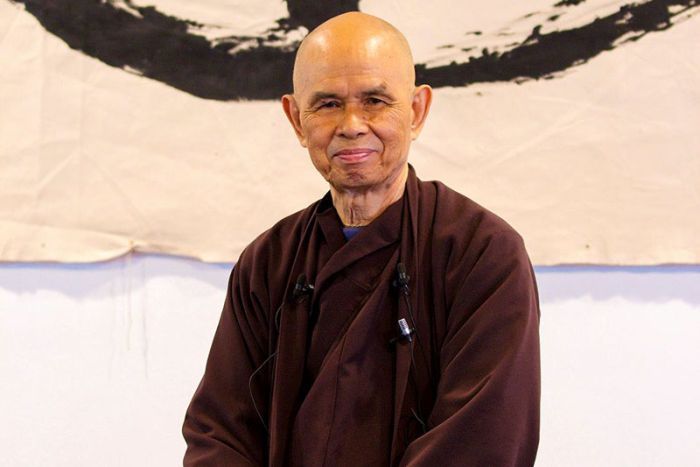
Thich Naht Hanh, the Zen Buddhist master, has some interesting advice about what it means to truly let go. Many people mistake detachment or non-clinging to be a form of aloofness, or emotional disconnect from others, but as Hanh explains, truly letting go often means loving someone more than you have ever loved them before.

The Buddha taught that detachment, one of the disciplines on the Noble Path, also called ariyasaavaka, is not a physical act of withdrawal or even a form of austerity. Though the Buddha teaches of a “non-action which is an integral part of the Right Way,” if it is taken out of context it can give the impression that we should develop a lack of concern for others, and that we should live without truly feeling or expressing our emotions – cutting ourselves off from life.

These type of misinterpretations are sadly common, since there are not always direct translations from the Paali language into English.

This form of “detachment” is an erroneous understanding of the Buddha’s message. Master Hanh states that to truly let go we must learn to love more completely. Non-attachment only happens when our love for another extends beyond our own personal expectations of gain, or our anticipation of a specific, desired outcome.

Hanh describes four forms of complete detachment, which surprisingly, aren’t about holing yourself up in a cave and ignoring everyone who has broken your heart, or ignoring your lust or desire for a romantic interest. This is not detachment. Letting go, means diving in. For example:

Maitri (Not the Love You Know)

Hanh describes the importance of Maitri, not love as we normally understand in a Westernized use of the word. He states,

“The first aspect of true love is maitri (metta, in Pali), the intention and capacity to offer joy and happiness. To develop that capacity, we have to practice looking and listening deeply so that we know what to do and what not to do to make others happy. If you offer your beloved something she does not need, that is not maitri. You have to see her real situation or what you offer might bring her unhappiness.”

In other words, your detachment may come in accepting that certain things you would normally do to make another person feel loved and appreciated may not be what the person you are actively loving now, needs. Instead of forcing that behavior on another person, with an egoic intent to “please” them, you simply detach from that need in yourself, and truly observe what makes another person feel comfortable, safe, and happy.

Hanh further explains,

We have to use language more carefully. “Love” is a beautiful word; we have to restore its meaning. The word “maitri” has roots in the word mitra which means friend. In Buddhism, the primary meaning of love is friendship.”

Karuna (Compassion)

The next form of true detachment is compassion. When we let go, we don’t stop offering a compassionate touch, word, or deed to help someone who is in pain. We also don’t expect to take their hurt or pain away. Compassion contains deep concern, though. It is not aloofness It is not isolation from others.

The Buddha smiles because he understands why pain and suffering exist, and because he also knows how to transform it. You become more deeply involved in life when you become detached form the outcome, but this does not mean you don’t participate fully – even in others’ pain.

Gratitude and Joy

In truly letting go you practice gratitude. Mudita, or joy arises when we are overcome with gratitude for all that we have, such that we no longer cling to some other longed-for result. The Buddha’s definition of joy is more like “Unselfish joy.” It means that we don’t only find happiness when something good happens to us, but when others find happiness.

If you’ve ever had to say goodbye to a love or friend so that they could continue on their life’s path – one that may not have continued to intertwine with your own – you may have felt pain when they found someone new to love, or made a new friend that seemed to take your place. This is not true detachment. Joy arises when you find happiness even when others find joy – and it has little or nothing to do with you.

Upeksha (Equanimity)

Master Hanh describes the final quality of true love which sheds inordinate light on the true process of letting go.

He states,

The fourth element of true love is upeksha, which means equanimity, non-attachment, nondiscrimination, even-mindedness, or letting go. Upa means “over,” and iksha means “to look.” You climb the mountain to be able to look over the whole situation, not bound by one side or the other. If your love has attachment, discrimination, prejudice, or clinging in it, it is not true love.


People who do not understand Buddhism sometimes think upeksha means indifference, but true equanimity is neither cold nor indifferent. If you have more than one child, they are all your children. Upeksha does not mean that you don’t love. You love in a way that all your children receive your love, without discrimination.”

Hanh explains that without this quality our love tends to become possessive – a stomping ground of the ego. We try to put our beloved in our pocket and carry them with us, when they are more like the wind, or a butterfly, or a stream, needing to move and flow, or risk dying. This is not love, this is destruction.

For love to be true love, it must have elements of compassion, joy, and equanimity – and this is truly letting go.

The Art of Letting Go is Artless

The real secret is that letting go is not an art, it is an allowing, a being. A non-attached relationship is healthy, strong and filled with effortless love, kindness and compassion. It is completely selfless because your sense of ‘self’ is no longer asserted in every situation. If you want to truly let go, you’ve got to love more, not less. This is the most common misunderstanding about this priceless teaching of the Buddha.