The glorification of Antonin Scalia

supreme_corporate_justice_180

By Tom Carter

Source: WSWS.org

The sickening tributes across the official US political and media spectrum to Supreme Court Justice Antonin Scalia, who died suddenly on Saturday at the age of 79, are a barometer of the putrefaction of American democracy.

The universal deference towards Scalia from what passes for the “liberal” faction of the establishment is particularly repulsive. The statements of the Democratic presidential candidates, the supposed “socialist” Bernie Sanders no less than Hillary Clinton—echoing similarly sycophantic drivel from the likes of the New York Times—are monuments to political cowardice.

One would say these people lack the courage of their convictions if they had any convictions to lack!

They have sprung into action to join their Republican counterparts in hailing Scalia as a towering figure in American jurisprudence. Virtually every description of the deceased justice includes the words “brilliant” and “intellectual.” One is reminded of the programmed acclamation of Sergeant Raymond Shaw recited by his brainwashed fellow soldiers in the film The Manchurian Candidate: “Raymond Shaw is the kindest, bravest, warmest, most wonderful human being I’ve ever known in my life.”

Sanders took time off from his hollow calls for a “political revolution” to demonstrate his political obeisance to the ruling class, declaring, “While I differed with Justice Scalia’s views and jurisprudence, he was a brilliant, colorful and outspoken member of the Supreme Court.”

Clinton praised Scalia as “a dedicated public servant who brought energy and passion to the bench.”

President Obama called Scalia a “towering legal figure.” The New York Times’ Ross Douthat hailed Scalia for “putting originalist principle above a partisan conservatism,” and for his “combination of brilliance, eloquence, and good timing.”

No one dares say what needs to be said. The object of their veneration was a black-robed thug and sadist who used his position on the bench to attack the basic civil liberties laid down in the US Constitution and Bill of Rights—separation of church and state; due process; protection from arbitrary arrest, search and seizure; the right to trial by jury; protection from cruel and unusual punishment; the right to vote.

His supposed juridical brilliance boiled down to starting with the political outcome he desired (invariably reactionary) and then cobbling together pseudo-legal arguments to justify his ruling—often with flagrant disregard for legal precedent and the unambiguous language of statutes and constitutional provisions.

In one case last year, Scalia argued that a police officer did not use “deadly force” when he climbed onto an overpass and used an assault rifle to kill an unarmed man fleeing in a car. According to Scalia’s reasoning, it was not deadly force because the officer claimed to have been aiming at the car, not the person in the car.

Perhaps the most infamous example of this method—absurdly described in the media as “constitutional originalism”—was the 2000 Supreme Court decision Scalia engineered to halt the counting of votes in Florida and hand the White House to the loser of the election, Republican candidate George W. Bush.

The 5-4 decision to steal the election all but acknowledged its own speciousness when it declared that the justifications it advanced could not be applied to any future cases. In his separate concurring opinion, Scalia declared that the Constitution did not give the people the right to elect the president.

At the time of the theft of the 2000 elections, the World Socialist Web Site wrote that the Supreme Court’s decision to stop the counting of votes, and the acceptance of that ruling by the Democrats and the entire political establishment, demonstrated that there was no longer any significant constituency for democratic rights within the American ruling class. The reaction to Scalia’s death is a measure of the further erosion of democratic sentiment in the ruling elite.

Scalia personified the decay of bourgeois democracy in the United States over a protracted period of time. Appointed to the bench by Ronald Reagan, he flourished and exerted increasing influence in the decades of political reaction, militarism and Wall Street criminality that ensued, continuing without a hitch under Obama. Not only in the anti-democratic substance of his rulings, but also in his methods and bearing, he embodied the promotion by the ruling elite of backwardness, prejudice and outright cruelty.

He was corrupt and made no bones about his corruption, proudly voting to remove limits on corporate bribes in elections and flaunting his private outings with Vice President Dick Cheney while the latter was a party in a case before the court. He was a bully, making a practice of baiting and harassing lawyers who came before him.

Throughout his career, Scalia consistently advocated positions that can only be described as barbarous and fascistic. Fittingly, his last judicial act was to deny a stay of execution. He was a figure who relished the power and trappings of the state, openly defending torture and internment camps.

Scalia worked tirelessly to break down constitutional and democratic limits on state power, infiltrating fascistic doctrines into Supreme Court jurisprudence. His theory of executive power, according to which the American president has unlimited and unreviewable powers for the duration of the “war on terror,” resurrects Nazi jurist Carl Schmitt’s “state of exception” doctrine in all but name.

Scalia’s mere presence on the court testified to the advanced decay of American democracy. That decay is linked, on the one hand, to the extreme growth of social inequality, accompanied by the rampant parasitism and criminality of the ruling class, and on the other hand to unending war, which has its domestic reflection in the build up of the repressive state apparatus that Scalia championed.

The bitterness of the disputes over his replacement is a reflection of the importance of his role in American politics over three decades during which the political establishment shifted violently to the right.

The deference shown to such a figure from all quarters of the political establishment should be taken as a warning by the working class. The ruling elite fears above all the growth of social opposition and class struggle. It exalts the legacy of Scalia because it is preparing police state methods to defend its power and property against an insurgent working class.


Related Article: Scalia’s Black Beemer by Greg Palast

The Popular Myth of Democracy in America

Fascism_Corporate_Fascist_America

By Stephen Lendman

Source: SteveLendmanBlog

No nation in world history promised more and delivered less to its citizens and people worldwide. None more greatly threatens world peace – putting humanity’s survival up for grabs like never before.

None did more harm to more people globally over a longer duration. None matches the menace it represents – a presstitute media supported fascist gangster state willing to risk destroying planet earth to own it, run by a bipartisan criminal class.

From inception, America was always run by the people who own it, as first Supreme Court Chief Justice John Jay explained.

John Adams believed power belonged exclusively to the rich, well-born and able. Today it’s about monied interests in charge – deciding who holds all top positions in government, elected and appointed.

People have no say whatever. Ignore electoral politics, intended solely to deceive – manipulating people to believe new bums are more worthy than current ones.

Voting is a waste of time, accomplishing nothing. Duopoly power rules.

America is a one-party state with two wings, indistinguishable from each other on issues mattering most – militantly pro-war, pro-business, anti-populist no matter what names and faces hold top positions.

Police state laws enforced by powerful security forces at the federal, state and local levels assure wealth and privilege interests are exclusively served at the expense of public welfare.

Elections are farcical, exercises in theater, not democracy. Candidates for the nation’s top offices are cardboard cutouts of each other, distinguishable only by their disingenuous rhetoric – promises made, forgotten and broken once in office.

The public interest be damned. People are used, not served, deceived to believe politicians represent them.

Embedded power runs America, politicians serving entrenched interests exclusively, chosen for that reason. Ordinary people thinking their enfranchisement matters are living in a fantasy world.

Government of, by and for the people is the grandest of grand hoaxes. Media scoundrels perpetuate the myth with all the familiar slogans and high-minded posturing.

Jimmy Carter was right last summer calling America an “oligarchy with unlimited political bribery…a complete subversion of our political system as a payoff to major contributors.”

Republicans and Democrats operate by the same corrupted standards. “(U)nlimited) money” serves their interests at the expense of constituents they represent.

America’s system is too debauched to fix. It’s too late for tinkering around the edges.

A complete makeover is needed – a popular revolution, replacing oligarchy with grassroots democracy for the first time in the nation’s history, freed from money control.

Today is the most perilous time in world history. We have a choice.

Accept the status quo, its endless wars, oligarch control over the greater good, unprecedented wealth disparity between rich and all others, along with harsh crackdowns on nonbelievers and risk of potential humanity destroying nuclear war – or refuse any longer to tolerate a system responsible for so much harm and misery to so many people worldwide.

Survival depends on choosing wisely. What kind of world do you want to live in? What kind do you want your children to inherit?


Stephen Lendman lives in Chicago. He can be reached at lendmanstephen@sbcglobal.net. 

His new book as editor and contributor is titled “Flashpoint in Ukraine: US Drive for Hegemony Risks WW III.”

http://www.claritypress.com/LendmanIII.html

Visit his blog site at sjlendman.blogspot.com. 

A Critical Update on the Failing Global Economy

stock-footage-hd-spinning-currency-globe-no-background-alpha-matte-at-seconds

By Phillip J. Watt

Source: The Mind Unleashed

The matrix-media will have us believe that the global economy is only experiencing a temporary glitch and that everything will be fine, however that is simply an outright lie. After several decades of saturating the world with unbacked currency and mountains of debt, the can we’ve been kicking has finally run out of road.

As you would know, stocks are plummeting across the globe and since their peak in around mid 2015, individual regions have lost 10-40% in stock value. In total, on the 20th of January the MSCI global stock market index reflected that the world’s markets had officially entered a bear market, which is 20% or more. This is just the beginning, too.

The exceptionally poor start to stocks in 2016 has somewhat been driven by ‘fears’ about China’s economic troubles, but really it is because many of the fundamentals of the global economy are extremely weak. For example, oil, which sustains the financial health of many countries and industries, has crashed over 70% in the last 2 years, whilst the Baltic Dry Index, which measures the amount of raw materials being shipped around the planet, is at a record low of 298 (to put this into context, just before the great recession of 2008 is was over 11,000).

More examples are that in early 2016, North Atlantic cargo shipping almost came to a halt and the U.S. orders in the trucking industry “for Class 8 trucks – the big rigs that haul freight on North American highways – plunged 48% from a year ago”. Furthermore, the retail sector is falling apart, with tens of thousands of job cuts and shop doors closing at an alarming rate.

For a deeper analysis of the data which scream that we’re steam-rolling towards a long over-due debt reset, which might even end in a sustained global depression such as that of the 1930′s, read “22 Signs That The Global Economic Turmoil We Have Seen So Far In 2016 Is Just The Beginning”.

OFFICIAL REPORTING IS FALSE

Given the ‘faith’ that stakeholders need to have in this economic system to keep it from imploding, the governmental data and the mainstream media cannot be truthful in what they report to the world, otherwise news of doom would be a self-fulfilling prophecy. It’s ridiculous to design an economic model in this way, yet regardless of the epic failure of Keynesian economics and the Wall Street casino, any investor who doesn’t recognize this by now is unfortunately in line for some serious financial loss.

To solidify the point, all official numbers in the U.S. and elsewhere are manipulated; shadow stats have made that abundantly clear. For example, real unemployment in the U.S. is above 20% and many of those who are actually working are in low-paying, part-time jobs.

Further to the true state of the labor market in America, many university graduates are working in hospitality or an unrelated field. Something like half of all under 25 yr olds still live with their parents or grandparents. Labor participation rates are at the lowest level in 38 years. Over 45 million people are on food subsidies and poverty and homelessness is increasing not just in America, but all around the globe.

Brazil, Canada, Russia and other countries are already in recession, amplified by the collapse of oil and commodity prices. Unofficial figures suggest the US is too. Canada in particular has seen massive inflation in food and other necessities, so it is likely that we can expect that to emerge in other countries as well.

This shit is really getting serious.

WHO IS AT FAULT?

Unfortunately, the masses don’t yet understand that most central banks around the world are private companies owned by private families i.e. the oligarchs. Essentially, this and the other banking organisations that they own is a century-old scam that robs the people of their riches.

Simply, the U.S. Government has effectively been taken over by an oligarchy, as evidenced by this Princeton University study in 2014. It’s no surprise then that this small group of so-called elites benefited from the largest transfer of wealth in human history, which happened in the 2008 GFC.

The 1%, particularly the 0.1%, economically prospered from the illegal, unethical and unprecedented bank bailouts, whilst the 99% suffered with losses in superannuation, savings, homes and employment. Many also lost their lives due to overdose, suicide and other self-abuse, which was due to their loss of livelihood and economic independence brought about by the global monetary scam.

WHAT HAPPENS NEXT?

The recovery from the GFC of 2008 never occurred, particularly for the main street economy (the real economy, not the Wall street economy). It’s happening all over again because unlike Iceland, there were no incarcerations for the fraudulent bankers and no serious revolution to the banking and finance sector.

This time though, it appears the shadow order (who have monopolized the banking and corporate sectors and effectively control western foreign and domestic policy) are not quite ready for another recessionary/depressionary round because they don’t yet have all their mechanisms in place to offer ‘the solution’ (i.e. global currency, trade agreements and governance).

They’ve got processes such as High Frequency Trading that prop up stocks by buying them back with the money they manifest from nothing (Plunge Protection Teams). They’ve been in overdrive trying to keep it afloat, but to no avail, because the real economy is drying up. As mentioned, global trade is tanking and many businesses are either going into liquidation or laying off thousands of workers each, so it’s easy to imagine that we’re going to hear about a major corporation going bust any day now.

This might just be the black swan event that ‘officially’ triggers the next crisis.

History indicates what will likely happen next: war. When a superpower and their economic hegemony is in collapse (such as the end of petrodollar and the U.S. Dollar as the world’s reserve currency), going to war can distract the populace from the true reasons of an economic crash and the associated suffering that emerges as a result. Essentially, the blame can be shifted to foreign entities.

This is why a high probability exists for a massive false flag to occur over the coming weeks/months to convince the masses to go to war with Russia, China and/or Iran. Saudi Arabia and Iran’s tensions are high right now so they might use that platform; it may in fact be orchestrated for this aim.

In the very short term, however, expect more dramatic policy measures, such as more mass money creation (QE) and even negative interest rates by the Federal Reserve (just like they’ve recently done at Japan’s central bank). They might even attempt widespread bank bail-ins, as already implemented in Italy, Portugal and Cyprus.

As explained in this Reuters article:

“so-called bail-ins typically mean wiping out creditors’ investments, slashing their value or converting them into shares in the bank. Uninsured depositors could get caught along with professional investors”.

In other words, they’re once again planning to steal the hard-earned cash of the little guy, but instead of doing it via tax-funded bail-outs as they did in 2008, they’re going to do it directly by commandeering the financial assets that people house in banks.

Yet, no matter what they do in the short term, they cannot stop the massive bubbles in debt, derivatives (over 1.5 quadrillion dollars), real estate, stocks, and bonds from inevitably popping. It might happen tomorrow or it might hold off for another year, yet regardless of the exact timing, any one of these or other triggers could easily send the global economy into a severe and sustained global depression.

Preparing accordingly, therefore, is nothing short of wise.

WHAT TO DO NEXT?

The potential for it to get seriously ugly over the coming months and years is very real, so both individually and collectively, we should be taking this very seriously.

Whatever does happen though, I do feel it will be in our collective favor. Their matrix of control is crashing; so many more people are now aware of the agenda to create a global governance, as well as the propaganda narratives they convey through the mainstream media that they either own or control.

In other words, we need to accept that all ‘official truths’ are a farce and they’ve been unarguably exposed and documented for the world to see as clear as day. Excitingly, the mainstream ‘truths’ are even beginning to be viewed by the masses as the bullshit of a pathological liar.

To prepare financially, many alternative economists recommend to exit all high risk investments such as stocks. For example, do you know where your superannuation is invested? There will no doubt be massive swings in stocks in the coming weeks, but the risk is high that they will continue to decrease at the least, and dramatically crash at the worst.

Also, to prepare physically, have you secured food and water insurance? Just like we get insurance for our health, car, home contents etc., in these times we should do the same with our basic necessities. I’m sure those in Canada are wishing they stocked up on essential goods because now they’re spending all their hard earned cash on just surviving.

For a deeper discussion on how to prepare, read “70 Tips That Will Help You Survive What Is About To Happen To America”.

FINAL THOUGHTS

These are exciting times because the western world is waking up to the lies and deceptions they’ve been force-fed (much of it is of course common knowledge in places like Russia and parts of Europe etc.). The mainstream narrative in every way you could possibly imagine is a complete fabrication to elicit your consent, especially for war. Yet, even though all of this is driving the awakening needed for humanity’s evolution, there are real risks for all of us.

Organizing our lives in as many self-sufficient ways as possible is simply being street smart. Arming ourselves with the right information is not just for the benefit of ourselves, but our family, friends and community as a whole. And of course, don’t feed the fear machine; we’re electro-magnetic beings in an electro-magnetic universe and how we think and feel does ripple out into the waters.

Make sure it’s worthy energy.

And remember, the banking sector is the head of the snake. This is the fundamental control mechanism of the powers-that-will-no-longer-be that we need to disassemble, because everything else of importance will naturally follow suit. For further information on how to create a better world for our personal future, as well as the future of humanity, see the articles linked below.

ABOUT THE AUTHOR

Phillip J. Watt lives in Australia. His written work deals with topics from ideology to society, as well as self-development. Follow him on Facebook or visit his website.

FURTHER READING

http://themindunleashed.org/2015/08/we-are-the-people-weve-been-waiting-for.html

http://themindunleashed.org/2015/08/this-is-how-to-create-true-freedom-for-humanity.html

http://themindunleashed.org/2015/10/whilst-the-old-system-crashes-a-new-one-is-being-built.html

http://themindunleashed.org/2016/01/how-to-say-no-to-war-with-ken-okeefe-2.html

http://themindunleashed.org/2016/01/12-methods-to-unplug-from-the-matrix.html

http://themindunleashed.org/2015/12/the-risks-for-2016-economic-collapse-more-false-flags-and-wwiii.html

http://themindunleashed.org/2015/12/information-that-society-needs-to-wake-the-fuk-up.html

http://themindunleashed.org/2015/09/the-dirty-secret-about-money-that-is-finally-being-exposed-to-the-masses.html

http://themindunleashed.org/2015/11/why-do-we-allow-private-families-to-control-the-worlds-money.html

War fraud: The great lies behind imperial warfare in the 21st century

By Mark Taliano

Source: Intrepid Report

The “War On Terror” and “The War On Drugs” are both fraudulent, and they are both related. In a classic example of “reverse projection”, ”the War on Terror” is literally a “War for Terror,” and the “War on Drugs” is literally a “War for Drugs.”

Terror, coupled with the illegal trade in narcotics, particularly heroin, is enabling the orchestration, and funding, of illegal warfare which serves the interests of an international oligarch class as it destroys humanity.

The barbarity of the military operations conducted by the West is beyond the imagination of most domestic audiences, even when details are publicized.

Broadly speaking, we can decode the 9/11 terror wars using a simple formula:

  • Problem
  • Reaction
  • Solution

NATO imperialists engineer or exploit problems to create reactions, with a view to creating previously planned solutions. Typically, problems (i.e, 9/11 crimes) serve to engineer public consent (reaction) for illegal invasions (solution).

The “end-game” also contradicts publically stated goals. Evidence demonstrates that the invasions of Afghanistan, Iraq, Libya, and Syria, as well as the war in Ukraine, were launched and prosecuted with a view to destroy each country through invasion, occupation, plunder, and to establish military footholds. The popular notion that the wars are being prosecuted for humanitarian purposes is absolutely ridiculous.

Afghanistan

In Afghanistan, for example, drug-trafficking warlords such as Gulbuddin Hekmatyar were used to create extremist “jihadist” armies (mujahideen) to destroy the Soviet-protected socialist republic. The long-standing CIA-terror group alliance, which pre-dates Afghanistan, continues to be empowered by profits from illegal drug trafficking: According to U.S sources, the production of opium (which is eventually processed into heroin) has increased “40-fold” since the initial invasion of Afghanistan.

So, the invasion destroyed a secular, socialist government and filled the vacuum with extremist drug-trafficking terrorist warlords. But imperialists gained a military foothold in the country.

Iraq

We all know now that the fraudulent “Weapons Of Mass Destruction” pretext was used for the criminal invasion of Iraq. The engineered problem was followed by mixed reactions from a less gullible public, but the invasion (solution), was launched (on the heels of genocidal sanctions) anyway.

Joe Quinn reports that in this invasion, US Death Squads manufactured a civil war to divert attention from the real culprits: the occupiers. A 10,000 strong “Shia militia” under US command is used to terrorize the population and to destroy Iraqi grassroots resistance. Often, the terrorists bomb civilian targets and falsely blame innocent groups—false flag tactics—which in turn create engineered friction and retaliation. Black propaganda operations are a CIA specialty. Consequently, Iraq is now an unstable terrorist quagmire, whereas before the invasion it was a modern, well-developed country free of any identifiable terror groups.

Libya

The NATO invasion of Libya, previously the wealthiest country in Africa, was also a product of repeated Western lies, and now, it too, is a hotbed of terrorism, vice, and drug trafficking. Erin Banco reports in “Drug And Human Trafficking In ‘Lawless’ Libya Is Funding ISIS” that the West’s “lack of foresight has enabled different groups of fighters to traffic a continuous supply of arms, drugs and people across Libya’s borders, helping to bankroll some of the world’s most violent terrorists.”

Syria

The invasion of Syria is following predictable patterns as well. A constellation of extremist, mercenary terror groups, including ISIS—all supported by the West—are trying to destroy Syria. Drug trafficking, stolen oil and artifacts are being used to finance the mass murder, and death squads, often under the cover of the Free Syrian Army (FSA) are being used to create a “civil war,” and to destroy President Assad’s government. The terror and mass murder are primarily orchestrated externally with a view to making Syria safe for Wahhabism, barbarity, and a NATO military presence.

A Wikileaks cable indicates that since 2011, more than 230,000 people have died and a million have been injured. But despite the so-far-successful alliance of Syria, Iran, and Russia in destroying the mercenary terrorists and in saving Syria, the West can take some consolation: the US already has a military foothold in the country. Only time will tell if the West succeeds in creating and sustaining yet another unstable, terrorist-infested vassal state.

Despite what naysayers might think, the NATO-perpetrated holocaust is in many respects a neocon success story: a succession of previously independent countries have been destroyed, and a NATO presence has been installed. In fact, the wars for Terror and Drugs are winning, despite ostensible setbacks.

The whole process of death and destruction is not rational or moral, and the degeneracy is beyond evil. Commentators call it imperialism.


The Militarization of the Superhero

quitely_all_star_superman

Editor’s note: In honor of Grant Morrison’s 56th birthday, enjoy Dan Sanchez’s excellent analysis of the humanist anti-militarist messages of Morrison’s body of work.

By Dan Sanchez

Source: Voices of Liberty

Grant Morrison Vs. the Super-Soldiers

At this year’s Comic-Con (a huge event in the worlds of comics and superhero blockbusters), celebrated writer Grant Morrison:

“…told a crowd of 2,600 that he’s done all he can with traditional superheroes. He’s sick of the ‘military entertainment complex,’ in which today’s characters always seem to be working for the government…” [Rolling Stone]

The creative industry’s booming superhero sector would be wise to take this criticism to heart, as Morrison is the preeminent genius of the genre. He wrote the most commercially successful graphic novel ever, his 1989 Batman: Arkham Asylum, as well as the comic series All-Star Superman (2005–2008), widely acclaimed as one of the all-time best stories about that archetypal superhero.

The Scottish scribe is not only a master practitioner of the genre, but is even its foremost philosopher, having written the definitive book on the superhero, the national bestselling Supergods: What Masked Vigilantes, Miraculous Mutants, and a Sun God from Smallville Can Teach Us About Being Human, which the Memphis Flyer aptly described as:

“…at once a well-researched history, an entertaining memoir, intriguing cosmological analysis, and a surprising personal revelation…”

Morrison’s disdain for the militarization of his art form is in line with his upbringing. As he relates in Supergods, his father was:

“…a working-class World War II veteran who’d swapped his bayonet for a Campaign for Nuclear Disarmament badge and became a pacifist “Spy for Peace” in the Committee of 100.”

As Morrison has explained in interviews, his father did not suffer from “shell shock” so much as from a “political shock.” His dad remembered first believing that he was going to war to “fight fascism,” and then realizing that “we were just as bad as they were,” after witnessing atrocity after atrocity.

Raised by both parents according to “pacifist principles,” young Morrison once told a Boy Scouts recruiter:

“I refuse to be part of any paramilitary organization, and that includes the Boy Scouts.”

In the sixties, his father was arrested protesting the American nuclear missile bases then located in Scotland. Morrison tells of growing up in the terrifying shadow of:

“…the Bomb, always the Bomb, a grim and looming, raincoated lodger, liable to go off at any minute, killing everybody and everything. (…)

Accompanying imagery was provided by the radical antiwar samizdat zines my dad brought home from political bookstores on High Street. Typically, the passionate pacifist manifestoes within were illustrated with gruesome hand-drawn images of how the world might look after a spirited thermonuclear missile exchange.”

In his childhood home, these horrific images contested with the “shiny futurity” of the covers of his “mum’s beloved science fiction paperbacks.” This struggle played out on his TV screen as well, until victory was claimed for optimism by the dramatic arrival of superheroes into his life:

“On television, images of pioneering astronauts vied with bleak scenes from Hiroshima and Vietnam: It was an all-or-nothing choice between the A-Bomb and the Spaceship. I had already picked sides, but the Cold War tension between Apocalypse and Utopia was becoming almost unbearable. And then the superheroes rained down across the Atlantic, in a dazzling prism-light of heraldic jumpsuits, bringing new ways to see and hear and think about everything.”

Ironically, these saving superheroes entered Scotland in the duffle bags of the very same American soldiers who also delivered the Bomb. As Morrison put it in an interview, they brought with them both the disease and the cure.

The sunny, scifi superheroes of the “Silver Age” of comics flew and swung into Morrison’s psyche, saving him from the debilitating existential terror of the Bomb. For the Hulk, having a Gamma Bomb blow up in his face was only the beginning of his career. The Flash could outrun a nuclear blast wave without breaking a sweat. And Superman could stroll out of ground zero without so much as a sun tan.

“Before it was a Bomb, the Bomb was an Idea. Superman, however, was a Faster, Stronger, Better Idea. It’s not that I needed Superman to be “real,” I just needed him to be more real than the Idea of the Bomb that ravaged my dreams. I needn’t have worried; Superman is so indefatigable a product of the human imagination, such a perfectly designed emblem of our highest, kindest, wisest, toughest selves, that my Idea of the Bomb had no defense against him.”

For Morrison, the superheroes were a hopeful, defiant answer to nuclear nihilism, because they were:

“…the best current representation of something we all might become, if we allow ourselves to feel worthy of a tomorrow where our best qualities are strong enough to overcome the destructive impulses that seek to undo the human project…”

Since childhood, the superhero represented to Morrison the antithesis of the ultimate form of warfare. It is no wonder that he would now speak out against its military conscription.

Morrison later turned his love for superheroes into a career as comic book writer. Early in that career, Alan Moore, a fellow Brit, revolutionized the genre, starting in 1982 with his dark, deconstructionist Marvelman (later retitled Miracleman for fear of Marvel Comics’ lawyers). In this revised origin story, Moore recast Britain’s classic Superman-type character as having been engineered as a living weapon by the Royal Air Force.

Moore inaugurated what Morrison calls the “Dark Age” of superhero comics. Realism, political analogy, dystopia, mass carnage, graphic violence, and antiheroes characterized this new age, as well as higher literary standards.

Moore’s first American title was Watchmen (published in 1986–87 and made into a Hollywood movie in 2009). Written during the heightened nuclear tensions of the Reagan years, Moore’s Watchmen was also haunted by the Bomb. Morrison described it as a:

“…murder mystery set against a familiar backdrop of Cold War nuclear paranoia, but located in an alternate history where the appearance of one single American superhuman in 1959 had deformed and destabilized global politics, economies, and culture itself.”

That single superhuman was Doctor Manhattan, who placed his godlike powers in the service of the US government, swinging the Cold War’s balance of power in America’s favor, and making the Vietnam War a cakewalk instead of a quagmire.

Watchmen launched the comic world’s analog to pop music’s “British Invasion” of American culture, an invasion that also included writers such as Neil Gaiman and Morrison himself.

America’s answer to the British “Dark Age” Invasion was Frank Miller: especially his hardboiled 1986 Batman story The Dark Knight Returns. The story also features Superman, and in Hollywood influenced both The Dark Knight Rises and the upcoming Superman v Batman: Dawn of Justice. Morrison wrote:

“The thoroughly modern Batman of The Dark Knight Returns was an antiestablishment rebel and ruthless pragmatist, but Miller’s Superman was an idealistic government stooge in the pay of an all but mummified Ronald Reagan, president forever and ever, amen. A memorable sequence of panels introducing Superman to the story depicted a visual dissolve of the flag on the White House roof, where the rippling stripes of Old Glory morphed into an abstract close-up detail of the famous S shield.”

Morrison further characterized Miller’s Batman as:

“…no bleeding-heart liberal but a rugged libertarian.”

…and his Superman, in contrast, as a:

“…compromised champion of the powers that be, serving the letter of the law, no matter how corrupt its administration became.”

Miller’s story, like Moore’s, also featured the threat of nuclear war and such themes as superhero registration/regulation. And both Watchmen and The Dark Knight Returns are often assigned reading in university courses.

The Cold War, Reagan-era superhero could sometimes be a government stooge, like Moore’s Doctor Manhattan and Miller’s Superman. But in such instances, he was recognized as a stooge.

This has often not been the case for the post-Cold War super-stooge. Starting in the “humanitarian interventionist” Clinton era, the western superhero began celebrating what Charles Krauthammer called America’s “unipolar moment” by strutting the globe, not as government lackeys, but as government badasses.

This was especially the case in the title Stormwatch under the authorship of Warren Ellis, yet another Brit, starting in 1996. Ellis’s heroes were, as Morrison put it:

“…UN-sanctioned operatives with a mandate to monitor superhuman activity and to police violations of the various protocols and sanctions governing the use of extranormal abilities. Costumes became functional field outfits, designed for espionage and black-ops work. Ellis suggested a new take on the T.H.U.N.D.E.R. Agents–S.H.I.E.L.D. model, combining spy thrills with grimy, violent superheroics in a world of genetic manipulation, weaponized flesh, and budget restrictions.”

In 1999, Ellis went even further in this vein with The Authority. Ellis’s new superteam was an updated “Justice League,” with its own parallels of Superman and Batman. The powers and costumes were alike, but the similarities ended there. As Morrison wrote:

“The Justice League never resorted to lethal force, but Ellis’s heroes would happily cut off your head and beat you to death with it if that’s what it took to stop you from being a dictator or a “bastard.” These hombres meant business, and the bad guys could no longer rely on that handy code against killing, which had kept superheroes in check for so long.”

The “heroes” of the Authority decapitated, dismembered, and impaled with abandon. In Marvelman, Alan Moore graphically showed what would happen in the “real world” when supervillains got their hands on frail mortals. Now superheroes too were gleefully exploring the myriad ways to disrupt human anatomy.

The Authority was as ambitious as it was severe. As Morrison wrote:

“The opening page of The Authority no. 1 showed Earth as seen from space accompanied by a single caption. ‘They think there’s no one left to save the world.’”

But the classic superhero trope of “saving the world” had a distinctly imperial ring with this team of, in Morrison’s words, “strutting imperial warrior superhumans.”

“Unlike Alan Moore’s troubled heroes, the members of the Authority were comfortable with their powers, using them sensibly to fight “bastards” and improve the lot of everyone on planet Earth. It was the utopian vision of [Superman creators] Siegel and Shuster strained through British cynicism and delivered on the end of a spiked leather glove. It… suggested a new kind of superfascist, one who was on our side.”

Also unlike the superheroes of yesteryear, these “friendly” imperial superfascists did not shy away from incurring extensive “collateral damage,” if that’s what it took to terminate the superhuman dictators, terrorists, and other “bastards” plaguing the planet.

In one storyline, to defeat an enemy empire on a parallel Earth, the Authority wages total war on the planet. In the last battle, the team’s shaman, called the Doctor, floods the entire Italian peninsula with a move of two fingers, killing everyone on it, man, woman, and child.

The team leader then issues a triumphal global broadcast, announcing the regime change:

“This is Jenny Sparks for the Authority. Albion is free of the Blue. Sicily and the Italian capital infrastructure are gone. If needed, we can annihilate the Hanseatic regions within the hour. If we’re asked to, we will go into China and Japan. If we have to, we will personally expunge the royal blood and military rape culture from the face of the planet. We’re here to give you a second chance. Make a world worth living in. We are the Authority. Behave.”

Morrison liked both Stormwatch and The Authority, and was even creatively involved in the latter. But in hindsight, he now sees that their spirit presaged dark things to come, both in superhero fiction and global superpower reality.

“For a while, it was exciting. In The Authority, the no-nonsense army toughs were on our side for a change, but it was a particular kind of power fantasy: that of impotent liberals, who feared deep down that it was really only force and violence that got things done and not patient diplomacy, and that only soldiers and very rich people had the world figured out. Gifted Irish writer Garth Ennis had occupied this territory for years; his soldier-hardman heroes influenced the new generation of supermen and women. These books were a capitulation to a kind of thinking that would come to dominate the approaching first decade of the new millennium. Soon the no-compromise bomb and ‘cripple what you don’t agree with’ approach of the Authority would be put to practice in the real world with horrific results. And it wouldn’t be liberals doing the damage”

Throughout the 90s, Morrison’s own career was taking off as well, but in a decidedly non-militaristic direction. After the smash hit of his 1989 Arkham Asylum, he was a hot commodity in the comics industry. But his subsequent explorations of the superhero were worlds away from the “grim ‘n’ gritty” comics of the 80s and 90s.

In his titles Animal Man, Doom Patrol, and The Invisibles, Morrison preferred to explore the intersection of the cosmic, the quirky, and the counter-cultural. Morrison’s gonzo inventiveness and bubbling-over genius quickly made a splash. With obscure superheroes, he felt free to take the genre in radically experimental directions, infusing it with such elements as transcendentalism, surrealism, and even dadaism, making his books cult classics among more discerning and literary comic readers.

But sometimes quirkiness just isn’t called for, so in 1997, when he got a crack at the Justice League itself and its all-star roster (Superman, Batman, Wonder Woman, the Flash, etc) in the title JLA, he gave these iconic characters the iconic (yet still boldly and brilliantly inventive) treatment they deserved.

“There would be no obtrusive postmodern meta-tricks in JLA, just unadulterated, gee-whiz, unadorned sci-fi myths in comic form, giving back to the superheroes the respect and dignity a decade of ‘realism’ and harsh critique had stripped away.”

Morrison had no interest joining a paramilitary organization as a boy, and he had no interest writing one as an adult. And so Morrison’s Justice League members were not “operatives” or “imperial warrior superhumans,” but genuine superheroes.

In the first storyline, the Justice League repelled an alien invasion: and unlike the Authority, did so without harming innocents. In this story, it was the villains and not the heroes who promised to “make the world a better place” by taking it over and remaking it. Morrison ends the adventure with an exchange that cautions against interventionism:

Wonder Woman: “When does intervention become domination?”

Superman: “I can only tell you what I believe, Diana. Humankind has to be allowed to climb to its own destiny. We can’t carry them there.”

In another storyline, the League takes on the “Ultramarines,” who, like Marvelman, were bio-engineered, duped, and exploited by the military.

And in his final story, “World War III,” the great menace is not a person, but a psychic weapon on auto-pilot called Mageddon, which causes its victims to destroy each other by instilling in them “war fever.” Ages ago it destroyed its godlike creators, and now it threatens to destroy humanity by pitting it against itself.

The Justice League manages to temporarily confer superpowers to all the people of Earth, who then together vanquish Mageddon. For his finale, Morrison has an embodiment of war itself as the villain, and regular people rising up and becoming superheroes to defeat it. Thus, a decade before he wrote Supergods, Morrison had already manifested his vision of the superhero as:

“…the best current representation of something we all might become [represented by the population of Earth becoming superheroes], if we allow ourselves to feel worthy of a tomorrow where our best qualities are strong enough to overcome the destructive impulses [represented by Mageddon] that seek to undo the human project…”

Morrison returned to the Justice League in his 2000 graphic novel, JLA: Earth 2. The villains of that tale, the Crime Syndicate of America, are basically the Authority taken to its logical conclusion: a team of JLA-doppelgänger super-tyrants ruling an alternate Earth with an iron fist.

In a scene that will warm the hearts of hard money advocates and fans of George Orwell, paper money is seen raining down on the alternate-Earth city of Metropolis, causing brawls to break out as the impoverished subjects scramble for it. Next we see that the bills are being cast from an overhead satellite by Ultraman, the evil-twin version of Superman, who tells his robotic servant Brainiac:

“By the time they realize the notes are fake, the economy will be in ruins again.”

Down below, one of the citizens reaches his breaking point, a la Orwell’s Winston Smith.

“…not real! It’s crap! It’s just more crap from the sky! From Ultraman! I can’t take any more of them looking down at us as though we’re-”

A red light is seen penetrating the clouds, and “Winston” is incinerated mid-sentence. Ultraman, his eyes still glowing from his use of heat vision, says:

“They insult me within earshot. They know what to expect. Big Brother is watching you.”

He might have just as well echoed Ellis’s Jenny Sparks and said, “We are the Authority. Behave.”

Of course unlike in The Authority, the swaggering imperialists of the Crime Syndicate are obviously villains. And it is gratifying to see Morrison’s Justice League show them what real superheroes are made of. A similar feeling can also be had reading Morrison’s JLA/WildC.A.T.S. inter-series crossover, in which the League tackles (though later teams up with) another obnoxious paramilitary (C.A.T.S stands for Covert Action Teams) super-group of the “grim ‘n’ gritty” tradition.

Then 9/11 happened, and the militarization of the superhero, like the concurrent militarization of the police, went into overdrive.

What must have been particularly grating for Morrison, was that it was spearheaded by his own protege Mark Millar, a fellow Scot who had made his name after he was selected to take over writing The Authority on Morrison’s recommendation.

In his hugely influential The Ultimates, Millar gave the Avengers (Marvel Comics’ chief super-team) an Authority makeover. Captain America cut villains in half with his shield while shouting jingoistic catchphrases. The Hulk ate innocent people while rampaging, causing little more trouble for the team than a PR headache. And the whole team was a government project.

Morrison’s analysis of his friend’s title was as withering as it was perceptive and eloquent.

“The Ultimates, re-created with Mark Millar’s gleefully right-leaning heroes, gave a voice to Bush’s America’s posturing, superheroic fantasies of global law enforcement in a posttraumatic world. (…)

President George W. Bush himself turned up to welcome Captain America to the new millennium with the words “WELL, WHAT’S YOUR VERDICT ON THE 21ST CENTURY, CAPTAIN AMERICA? COOL OR UNCOOL?,” to which the Captain replied, “COOL, MISTER PRESIDENT. DEFINITELY COOL.” With photorealistic renderings of George W. Bush embracing an equally believable Captain America, there could be no mistaking the dizzying, stifling collapse of fact into fantasy. (…)

The fear of a sinister military-industrial underworld that haunted Moore’s Marvelman was inverted to become a joyous embrace of Republican America’s undeniable access to the best guns, the best soldiers, and the best superheroes in the world. For Mark Millar, it was a given that any real-world superhero would be co-opted by the powers that be and recruited as a soldier. The Moore-Miller Superman of the eighties, that helpless, unreconstructed tool of the ruling class, became the template for a new generation of reengineered characters. In The Ultimates, everyone worked for the government, but it was all cool. In the first decade of the twenty-first century, superheroes strove to preserve and embody the values of a defiant military-industrial corporate complex or they didn’t work at all. The brief era of The Authority had passed and left the “bastards” in charge as usual.”

For Morrison, all of this had a bleak upshot:

“The last pirate art form had swapped its Jolly Roger for the Stars and Stripes once again, and this time it looked as if there was no turning back.”

This is the key background to Morrison’s Comic-Con pronouncement discussed at the beginning. At that conference, he told ComicBook.com:

“…for the last fifteen years at least — certainly since 9/11 — I think America’s been processing the horror of those images through their art, through their popular art in particular.

That’s why I think superheroes became from ordinary people who went out at night to make the world a better place, they’ve become I think agents of the military-entertainment complex. The Avengers work for the government, and it’s been like that since Mark [Millar] did The Ultimates. Batman as seen by Christopher Nolan and subsequently is a soldier. He wears military gear with his ordinance and his machines. For me, it became quite reductive. It was an interesting way to look at it for a while, but it’s persisted for so long that I’m quite bored with the idea that the best superheroes can represent is some aggressive version of the military.”

Millar’s Ultimates seem to have been a major influence on the phenomenally successful Marvel Cinematic Universe films. Not all of that influence has been bad; two great characterizations — Tony Stark as a cocky billionaire playboy genius, played so perfectly by Robert Downey, Jr., and even the casting of Samuel L. Jackson as Nick Fury — both came straight from the pages of Ultimates. But the tight integration between the Avengers and the SHIELD government agency did too.

Thankfully, the Avengers of the films are not nearly as fascist as the Ultimates. In fact, to a large extent they take a marvelously anti-authoritarian and anti-militarist stance. See for example my articles on Captain America: Winter Soldier and Avengers: Age of Ultron.

Yet, the militarization of the Avengers is bleeding into its merchandise, even targeting its most impressionable audiences. For example, the title of an Avengers sticker book for children, “Top Agents & Most Wanted,” seems to recast the Avengers as some sort of super-FBI.

Fortunately, even after Ultimates, Morrison had not given up trying to remind people what a true superhero is. Superman and friends had saved Morrison’s psyche from the Bomb. Now Morrison would return the favor by saving Superman from possibly imminent militarization by writing All-Star Superman. Morrison wrote of how doing so brought his life full circle.

“I wrote my personal best story of the world’s greatest superhero, for my favorite artist to draw, overlooking a loch where Trident submarines still sailed in all their stately satanic splendor, with black bellies full of hellfire sufficient to blind and vaporize me in a fraction of a heartbeat, even as it liquefied the ancient stones of my walls, cracked Scotland in half, and turned the world into a refrigerated postnuclear litter tray. I wrote it scant miles from the former American navy base, where my parents had protested, where Dad had been arrested, and where American comics had arrived in Scotland with the sailors and submariners. It felt like ground zero, the center of a web of coincidence and personal mythology…”

All-Star Superman was Morrison’s defiant response to post-9/11 culture and what it was doing to the genre. In it, he even outdid his own work on JLA in beautifully distilling the essence of the superhero.

“As the first few years of the twenty-first century wore on, I wondered just how badly people, especially young people, were being affected by the overwhelmingly alarmist, frightening, and nihilistic mass media narratives that seemed to boil with images of death, horror, war, humiliation, and pain to the exclusion of almost everything else, on the presumed grounds that these are the kinds of stories that excite the jaded sensibilities of the mindless drones who consume mass entertainment. Cozy at our screens in the all-consuming glare of Odin’s eye, I wondered why we’ve chosen to develop in our children a taste for mediated prepackaged rape, degradation, violence, and “bad-ass” mass-murdering heroes.

And so All-Star Superman: our attempt at an antidote to all that, which dramatized some of the ideas in Supergods by positioning Superman as the Enlightenment ideal paragon of human physical, intellectual, and moral development that Siegel and Shuster had originally imagined. A Vitruvian Man in a cape, our restorative Superman would attempt to distill the pure essence of pop culture’s finest creation: baring the soul of an indestructible hero so strong, so noble, so clever and resourceful, he had no need to kill to make his point. There was no problem Superman could not solve or overcome. He could not lose. He would never let us down because we made him that way. He dressed like Clark Kent and took the world’s abuse to remind us that underneath our shirts, waiting, there is an always familiar blaze of color, a stylized lighting bolt, a burning heart.”

One scene bottles the lightning that is the superhero concept most elegantly of all. In a fleeting interlude between mega-crises, Superman’s super-hearing picks up the voice of a therapist stuck on a train, desperately trying to keep a suicidal patient on the phone until he can reach her. The troubled girl, with purple hair and facial piercings, drops her phone off the ledge of a skyscraper. She closes her tear-streaked eyes and prepares to jump. Suddenly Superman is standing behind her with his hand on her shoulder.

“Your doctor really did get held up, Regan. It’s never as bad as it seems.”

As she turns wide-eyed to face him, he says:

“You’re much stronger than you think you are. Trust me.”

Regan collapses into Superman’s arms, and he hugs her in silence as his cape billows in the wind.

These five panels and two dozen words have literally saved lives. At Comic-Con, Morrison spoke of how moved he was to meet actual kids who decided against committing suicide after reading this scene. It made him more convinced than ever that superheroes, when written as superheroes, can make a real and positive difference in people’s lives.

The Grant Morrison superhero is no souped-up super-soldier taking twisted pleasure in the hunting of men, like an American Sniper or an American Cop, using “saving people” as a mere excuse. He is not some semi-sadistic adolescent power fantasy.

The superhero according to Morrison takes what’s best in us, personifies it in a sigil-draped figure, and shows it springing into action, inspiring us to emulation.

The superhero according to Morrison takes what’s best in us, personifies it in a sigil-draped figure, and shows it springing into action, inspiring us to emulation. It imparts that not even the sky is the limit if we choose to bring out in ourselves those noble qualities which the superhero personifies.

Like Superman with the suicidal girl, the superhero reminds us that we’re stronger than we think we are. Stronger than despair. Stronger than hate. Strong enough to someday achieve scifi marvels. To even be stronger than the Bomb. Stronger than War.


Grim New Year tidings

father-time-in-space_thumb

By Stephen Lendman

Source: Intrepid Report

The new year traditionally is a time for hope and change, a new beginning, a shift from policies causing so much harm to many millions worldwide—nameless, faceless victims of imperial ruthlessness.

New Year’s day and each successive ones assure more of the same, business as usual—a continued menu of endless imperial wars, neoliberal harshness, government serving elitist interests exclusively, and harsh crackdowns on nonbelievers, America heading toward full-blown tyranny in the name of combating terrorism—the greatest hoax in modern times.

The larger issue is whether humanity can survive the ravages of US-led pure evil—the greatest threat it ever faced in world history, power-crazed lunatics in Washington willing to risk destroying Planet Earth to own it.

Instead of sounding the alarm and urging a call to action, presstitutes masquerading as journalists support what demands condemnation.

Ordinary people are manipulated by bread, circuses, and daily misinformation—mindless of the dangers they face, indifferent to the risk of ending life on Earth, ignorant of the pure evil Washington represents, complicit with its rogue partners.

Each new year begins with the threat of US-launched nuclear war, the unthinkable possibility able to kill us all. Power-crazed lunatics make ruthless choices.

Witness them in one war theater after another—endless mass slaughter and destruction, making the world safe for monied interests.

Madness defines US policies. Its criminal class is bipartisan. Whoever succeeds Obama in January 2017 will exceed the worst of his homeland and geopolitical agenda.

America already is third-worldized, on a fast track toward a ruler-serf society, unfit and unsafe to live in, fundamental freedoms eliminated in plain sight, run by a gangster class serving its own interests exclusively.

It devotes more resources to homeland and foreign militarism, belligerence and confrontational policies than the rest of the world combined.

Expect more of the same in the new year, likely more than ever before, maybe looked back on as the year WW III began—if anyone survives the onslaught, a long shot at best.

Another holiday season brings no joy to the vast majority of people worldwide. Human suffering remains extreme.

US policymakers consider it a small price to pay, nothing too outlandish in serving their interests.

The horrors of their maniacal agenda are airbrushed from official and scoundrel media reports—on New Year’s and every other day.


Stephen Lendman lives in Chicago. He can be reached at lendmanstephen@sbcglobal.net. His new book as editor and contributor is “Flashpoint in Ukraine: US Drive for Hegemony Risks WW III.” Visit his blog at sjlendman.blogspot.com . Listen to cutting-edge discussions with distinguished guests on the Progressive Radio News Hour on the Progressive Radio Network. It airs three times weekly: live on Sundays at 1PM Central time plus two prerecorded archived programs.

It’s a $cam! The American Way of War in the Twenty-First Century

war-is-money

By Tom Engelhardt

Source: TomDispatch.com

Let’s begin with the $12 billion in shrink-wrapped $100 bills, Iraqi oil money held in the U.S.  The Bush administration began flying it into Baghdad on C-130s soon after U.S. troops entered that city in April 2003.  Essentially dumped into the void that had once been the Iraqi state, at least $1.2 to $1.6 billion of it was stolen and ended up years later in a mysterious bunker in Lebanon.  And that’s just what happened as the starting gun went off.

It’s never ended.  In 2011, the final report of the congressionally mandated Commission on Wartime Contracting estimated that somewhere between $31 billion and $60 billion taxpayer dollars had been lost to fraud and waste in the American “reconstruction” of Iraq and Afghanistan.  In Iraq, for instance, there was that $75 million police academy, initially hailed “as crucial to U.S. efforts to prepare Iraqis to take control of the country’s security.”  It was, however, so poorly constructed that it proved a health hazard.  In 2006, “feces and urine rained from the ceilings in [its] student barracks” and that was only the beginning of its problems.

When the bad press started, Parsons Corporation, the private contractor that built it, agreed to fix it for nothing more than the princely sum already paid.  A year later, a New York Timesreporter visited and found that “the ceilings are still stained with excrement, parts of the structures are crumbling, and sections of the buildings are unusable because the toilets are filthy and nonfunctioning.”  This seems to have been par for the course.  Typically enough, the Khan Bani Saad Correctional Facility, a $40 million prison Parsons also contracted to build, was never even finished.

And these were hardly isolated cases or problems specific to Iraq.  Consider, for instance, those police stations in Afghanistan believed to be crucial to “standing up” a new security force in that country.  Despite the money poured into them and endless cost overruns, many were either never completed or never built, leaving new Afghan police recruits camping out.  And the police were hardly alone.  Take the $3.4 million unfinished teacher-training center in Sheberghan, Afghanistan, that an Iraqi company was contracted to build (using, of course, American dollars) and from which it walked away, money in hand.

And why stick to buildings, when there were those Iraqi roads to nowhere paid for by American dollars? At least one of them did at least prove useful to insurgent groups moving their guerrillas around (like the $37 million bridge the U.S. Army Corps of Engineers built between Afghanistan and Tajikistan that helped facilitate the region’s booming drug trade in opium and heroin).  In Afghanistan, Highway 1 between the capital Kabul and the southern city of Kandahar, unofficially dubbed the “highway to nowhere,” was so poorly constructed that it began crumbling in its first Afghan winter.

And don’t think that this was an aberration.  The U.S. Agency for International Development (USAID) hired an American nonprofit, International Relief and Development (IRD), to oversee an ambitious road-building program meant to gain the support of rural villagers.  Almost $300 million later, it could point to “less than 100 miles of gravel road completed.” Each mile of road had, by then, cost U.S. taxpayers $2.8 million, instead of the expected $290,000, while a quarter of the road-building funds reportedly went directly to IRD for administrative and staff costs.  Needless to say, as the road program failed, USAID hired IRD to oversee other non-transportation projects.

In these years, the cost of reconstruction never stopped growing.  In 2011, McClatchy Newsreported that “U.S. government funding for at least 15 large-scale programs and projects grew from just over $1 billion to nearly $3 billion despite the government’s questions about their effectiveness or cost.”

The Gas Station to Nowhere

So much construction and reconstruction — and so many failures.  There was the chicken-processing plant built in Iraq for $2.58 million that, except in a few Potemkin-Village-like moments, never plucked a chicken and sent it to market.  There was the sparkling new, 64,000-square-foot, state-of-the-art, $25 million headquarters for the U.S. military in Helmand Province, Afghanistan, that doubled in cost as it was being built and that three generals tried to stop.  They were overruled because Congress had already allotted the money for it, so why not spend it, even though it would never be used?  And don’t forget the $20 million that went into constructing roads and utilities for the base that was to hold it, or the$8.4 billion that went into Afghan opium-poppy-suppression and anti-drug programs and resulted in… bumper poppy crops and record opium yields, or the aid funds that somehow made their way directly into the hands of the Taliban (reputedly its second-largest funding source after those poppies).

There were the billions of dollars in aid that no one could account for, and a significant percentage of the 465,000 small arms (rifles, machine guns, grenade launchers, and the like) that the U.S. shipped to Afghanistan and simply lost track of.  Most recently, there was the Task Force for Business Stability Operations, an $800-million Pentagon project to help jump-start the Afghan economy.  It was shut down only six months ago and yet, in response to requests from the Special Inspector General for Afghanistan Reconstruction, the Pentagon swears that there are “no Defense Department personnel who can answer questions about” what the task force did with its money.  As ProPublica’s Megan McCloskey writes, “The Pentagon’s claims are particularly surprising since Joseph Catalino, the former acting director of the task force who was with the program for two years, is still employed by the Pentagon as Senior Advisor for Special Operations and Combating Terrorism.”

Still, from that pile of unaccountable taxpayer dollars, one nearly $43 million chunk did prove traceable to a single project: the building of a compressed natural gas station.  (The cost of constructing a similar gas station in neighboring Pakistan: $300,000.)  Located in an area that seems to have had no infrastructure for delivering natural gas and no cars converted for the use of such fuel, it represented the only example on record in those years of a gas station to nowhere.

All of this just scratches the surface when it comes to the piles of money that were poured into an increasingly privatized version of the American way of war and, in the form ofovercharges and abuses of every sort, often simply disappeared into the pockets of the warrior corporations that entered America’s war zones.  In a sense, a surprising amount of the money that the Pentagon and U.S. civilian agencies “invested” in Iraq and Afghanistan never left the United States, since it went directly into the coffers of those companies.

Clearly, Washington had gone to war like a drunk on a bender, while the domestic infrastructure began to fray.  At $109 billion by 2014, the American reconstruction program in Afghanistan was already, in today’s dollars, larger than the Marshall Plan (which helped put all of devastated Western Europe back on its feet after World War II) and still the country was a shambles. In Iraq, a mere $60 billion was squandered on the failed rebuilding of the country.  Keep in mind that none of this takes into account the staggering billions spent by the Pentagon in both countries to build strings of bases, ranging in size from American towns (with all the amenities of home) to tiny outposts.  There would be 505 of them in Iraq and at least 550 in Afghanistan.  Most were, in the end, abandoned, dismantled, or sometimes simply looted.  And don’t forget the vast quantities of fuel imported into Afghanistan to run the U.S. military machine in those years, some of which was siphoned off by American soldiers, to the tune of at least $15 million, and sold to local Afghans on the sly.

In other words, in the post-9/11 years, “reconstruction” and “war” have really been euphemisms for what, in other countries, we would recognize as a massive system of corruption.

And let’s not forget another kind of “reconstruction” then underway. In both countries, the U.S. was creating enormous militaries and police forces essentially from scratch to the tune of at least $25 billion in Iraq and $65 billion in Afghanistan.  What’s striking about both of these security forces, once constructed, is how similar they turned out to be to those police academies, the unfinished schools, and that natural gas station.  It can’t be purely coincidental that both of the forces Americans proudly “stood up” have turned out to be the definition of corrupt: that is, they were filled not just with genuine recruits but with serried ranks of “ghost personnel.”

In June 2014, after whole divisions of the Iraqi army collapsed and fled before modest numbers of Islamic State militants, abandoning much of their weaponry and equipment, it became clear that they had been significantly smaller in reality than on paper.  And no wonder, as that army had enlisted 50,000 “ghost soldiers” (who existed only on paper and whose salaries were lining the pockets of commanders and others).  In Afghanistan, the U.S. is still evidently helping to pay for similarly stunning numbers of phantom personnel, though no specific figures are available.  (In 2009, an estimated more than 25% of the police force consisted of such ghosts.)  As John Sopko, the U.S. inspector general for Afghanistan,warned last June: “We are paying a lot of money for ghosts in Afghanistan… whether they are ghost teachers, ghost doctors or ghost policeman or ghost soldiers.”

And lest you imagine that the U.S. military has learned its lesson, rest assured that it’s still quite capable of producing nonexistent proxy forces.  Take the Pentagon-CIA program to train thousands of carefully vetted “moderate” Syrian rebels, equip them, arm them, and put them in the field to fight the Islamic State.  Congress ponied up $500 million for it, $384 million of which was spent before that project was shut down as an abject failure.  By then, less than 200 American-backed rebels had been trained and even less put into the field in Syria — and they were almost instantly kidnapped or killed, or they simply handed over their equipment to the al-Qaeda-linked al-Nusra Front.  At one point, according to the congressional testimony of the top American commander in the Middle East, only four or five American-produced rebels were left “in the field.”  The cost-per-rebel sent into Syria, by the way, is now estimated at approximately $2 million.

A final footnote: the general who oversaw this program is, according to the New York Times, still a “rising star” in the Pentagon and in line for a promotion.

Profli-gate

You’ve just revisited the privatized, twenty-first-century version of the American way of war, which proved to be a smorgasbord of scandal, mismanagement, and corruption as far as the eye could see.  In the tradition of Watergate, perhaps the whole system could be dubbed Profli-gate, since American war making across the Greater Middle East has represented perhaps the most profligate and least effective use of funds in the history of modern warfare.  In fact, here’s a word not usually associated with the U.S. military: the war system of this era seems to function remarkably like a monumental scam, a swindle, a fraud.

The evidence is in: the U.S. military can win battles, but not a war, not even against minimally armed minority insurgencies; it can “stand up” foreign militaries, but only if they are filled with phantom feet and if the forces themselves are as hollow as tombs; it can pour funds into the reconstruction of countries, a process guaranteed to leave them more prostrate than before; it can bomb, missile, and drone-kill significant numbers of terrorists and other enemies, even as their terror outfits and insurgent movements continue to grow stronger under the shadow of American air power.  Fourteen years and five failed states later in the Greater Middle East, all of that seems irrefutable.

And here’s something else irrefutable: amid the defeats, corruption, and disappointments, there lurks a kind of success.  After all, every disaster in which the U.S. military takes part only brings more bounty to the Pentagon.  Domestically, every failure results in calls for yet more military interventions around the world.  As a result, the military is so much bigger and better funded than it was on September 10, 2001.  The commanders who led our forces into such failures have repeatedly been rewarded and much of the top brass, civilian and military, though they should have retired in shame, have taken ever more golden parachutes into the lucrative worlds of defense contractors, lobbyists, and consultancies.

All of this couldn’t be more obvious, though it’s seldom said.  In short, there turns out to be much good fortune in the disaster business, a fact which gives the whole process the look of a classic swindle in which the patsies lose their shirts but the scam artists make out like bandits.

Add in one more thing: these days, the only part of the state held in great esteem by conservatives and the present batch of Republican presidential candidates is the U.S. military.  All of them, with the exception of Rand Paul, swear that on entering the Oval Office they will let that military loose, sending in more troops, or special ops forces, or air power, and funding the various services even more lavishly; all of this despite overwhelming evidence that the U.S. military is incapable of spending a dollar responsibly or effectively monitoring what it’s done with the taxpayer funds in its possession.  (If you don’t believe me, forget everything in this piece and just check out the finances of the most expensive weapons system in history, the F-35 Lightning II, which should really be redubbed the F-35 Overrun for its madly spiraling costs.)

But no matter. If a system works (particularly for those in it), why change it?  And by the way, in case you’re looking for a genuine steal, I have a fabulous gas station in Afghanistan to sell you…


Tom Engelhardt is a co-founder of the American Empire Project and the author of The United States of Fear as well as a history of the Cold War, The End of Victory Culture. He is a fellow of the Nation Institute and runs TomDispatch.com. His latest book is Shadow Government: Surveillance, Secret Wars, and a Global Security State in a Single-Superpower World.

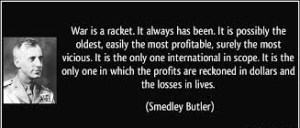
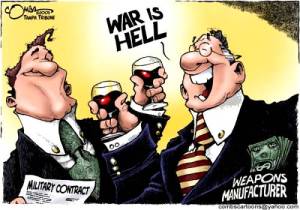
The Business of War is the Cause of War

war-is-money

By Sergey Baranov & Ethan Indigo Smith

Source: Waking Times

If you objectively and consistently observe the mainstream media and its interpretation of global events, its omissive and deceptive character soon becomes abundantly clear. This could hardly be called incompetence. The coverage, which is popularly called “news,” is in fact nothing but a propaganda mechanism, designed to persistently shape public opinion in favor of war.

Who benefits from war?

Certainly not the people on the warring sides. People always suffer in war; their futures ruined and their lives destroyed. In fear, they look to their government to protect them, the very same government that is invested in war. War is a dirty business that profits off death and destruction while generating blood money for the profiteers. The people are told to look the other way, outside of their country – where the ‘enemy’ supposedly resides.

But what if the real enemy is inside the country, and wears expensive suits, not turbans? What if he speaks your language while living in luxury and sending his children to study at Princeton, Yale and Harvard? While your kids are sent off to fight in fraudulent wars for corporate interests masquerading as ‘patriotism’.

This is in fact jingoism – a nationalized fervor of aggression, based on the notion of supremacy, and usually founded in a lust for power and riches. This mindset, of course, isn’t new and is no different from Adolf Hitler’s extreme nationalism, or fascism.

Today we are living under the rule of oligarchical, trans-humanist, eugenicist elites that continuously consolidate power in order to control and confine humanity while methodically stripping us of the power to govern ourselves. One of the best ways to achieve this is to keep the people in constant fear of wars and threats of terrorism, that, in reality governments themselves typically create or sponsor. For example, we can look at the current threat of ISIS which is in fact a remodel of Al Qaeda, a group the CIA created in the 1970’s to fight the Russians in Afghanistan.

Constant mainstream promotion of ISIS with newly released videos of beheadings and other types of inhuman cruelty is used to scare the American people into the further submission, and ever-greater losses of rights and personal freedoms. The growing surveillance and domestic police state, and the passage of laws including the recent renewal of the Patriot Act, wouldn’t be possible without always frightening the general public. This policy ensures the constant funding of the military industrial complex, which unfortunately has taken over the government, as Dwight D. Eisenhower, the 34th President of the United States had foreseen and warned us about on Jan. 17th, 1961.

READ: Former Presidents Warn About the “Invisible Government” Running the United States

How can we stop the war machine?

Well, certainly not by fighting against it using its means. That’s what the machine is designed for, and an armed resistance will only be playing into its hands. After all, they’ve got the nukes and they will use them as they have already done in Hiroshima and Nagasaki. There must be another way to shut down this engine of death.

What is the way to a global peace? Certainly it isn’t paved with war… how absurd! Nor is it threats and rhetoric of war.

Furthermore, the nuclear threat means that the situation today is dire. The wars most of us have known in our lifetimes have not been nuclear which is why you need to wake up and get involved before it happens. There are no survivors under mushroom clouds – everybody dies.

There is no defense in the case of a nuclear war being unleashed – unless you were to commit yourself to living underground in a bunker for the rest of your life, without ever again seeing and feeling the sunshine. It is a death by a thousand cuts if you remain on the surface. There is no technology to clean up radiation and take it out of the air, water and land. The half-life of nuclear radiation is 4.5 billion years, equal to the age of our planet. That means that during this time, the radioactive particles will remain as deadly as they are today. This could be the end of all of us if nuclear war were to be released on a massive scale – a probability that is as high today as it has ever been, and growing proportionally with the insanity of politics.

The cold war between the Soviet Union and USA never ended, only slowly heated up. And even though the nuclear arms race developed through paranoia, the threat of nuclear war today, is in fact a very present and real one.

Realizing that war is an instrument to have us kill and be killed on behalf of corporate interests, we should be refusing the very notion of war, no matter how much we are lied to and instigated to do otherwise. War defeats individuals and empowers institutions. Wars do not happen naturally. They are orchestrated for political and economic advantage by corporate entities for which human life is only a means to a greater enrichment. The United States of America is not the only country in which the military industrial complex has taken over. The same can be seen in many modern nations.‘’War is good for the economy,’’ is a slogan often heard on the news in Israel.

But for which economy? For the economy of peace, or for the economy of war? Is it good for the people or is it good for those who are in the business of bullets and bombs?

Traveling the world and observing ordinary people, one will inevitably come to the conclusion that no one actually wants war. Regardless of the geographical location, nationality, skin color, social status etc., people want peace, and to see their children grow. Wars, although they may appear, are not fought between people. They are fought between military industrial factions and alliances warring for domination and control.

READ: All Wars Are Well Planned Banker Wars, Including World War 3

Banks financing the governments of warring sides are even more heavily involved than the war materials industries. They fund the entire game by lending money to the governments, further sinking nations in debt, while they use this money to kill each other off. Federal spending surges as the military is mobilized. Outlays for troops, weapons and munitions increases as conflicts escalate. Thee fraudulent and never-ending war in Iraq has already cost over 3 trillion dollars and counting – a steady flow of income for all those who are employed and benefiting from war.

While the average person wants to be left alone to live his or her life in peace on either side of an orchestrated conflict, government, corporations and institutions drag us into conflict time and again. The world has become a place where corporate interests, backed by corrupt governments, all funded by evil banks, violate human rights, freedom and dignity beyond measure. This poses an existential threat to the survival of our species that will not abate as long as the military industrial complex maintains its grip on our society and our culture.


About the Authors

Sergey Baranov is the author of Path: Seeking Truth in a World of Lies. Follow him on Facebook here. Follow Sergey on Facebook here https://www.facebook.com/sergey.baranov.path

Activist, author and Tai Chi teacher, Ethan Indigo Smith was born on a farm in Maine and lived in Manhattan for a number of years before migrating west to Mendocino, California. Guided by a keen sense of integrity and humanity, Ethan’s work is both deeply connected and extremely insightful, blending philosophy, politics, activism, spirituality, meditation and a unique sense of humour. Follow Ethan on Facebook here: https://www.facebook.com/pages/Ethan-Indigo-Smith/423549761069857?fref=ts