
Human Extinction Now Imminent and Inevitable? A Report on the State of Planet Earth

By Robert J. Burrowes

There is a significant body of evidence that human extinction is now imminent; that is, it will occur within the next few years and possibly this year: 2020. There is also a significant body of evidence that human extinction is now inevitable; that is, it cannot be prevented no matter what we do.

There are at least four distinct paths to imminent (that is, within five years) human extinction: nuclear war (possibly started regionally), biodiversity collapse (already well advanced and teetering on the brink), the deployment of 5G (commenced recently) and the climate catastrophe. Needless to say, each of these four paths might unfold in a variety of ways.

In addition, it should be noted, there are other possible paths to extinction in the near term, particularly when considered in conjunction with the four threats just mentioned. These include the cascading impacts triggered by destruction of the Amazon rainforest (which is now imminent) particularly given its critical role in the global hydrological cycle, the rapidly spreading radioactive contamination of Earth, and geoengineering for military purposes (which has been going on for decades and continues).

Far worse, however, is the path to extinction that looms before us when we consider the impact of all seven of these paths in combination with the vast range of other threats noted below.

These interrelated threats have generated a shocking series of ‘points of no return’ (‘tipping points’) that we have already crossed, the mutually reinforcing set of negative feedback loops that we have already triggered (and which we will continue to trigger) which cannot be reversed in the short-term, as well as the ongoing synergistic impact of the various ‘extinction drivers’ (such as ongoing extinctions because dependent species have lost their resource species) we have set in motion and which cannot be halted irrespective of any remedial action we might take. Hence, taking into account all of the above factors, the prospects of averting human extinction are now remote, at best.

Why has this happened?

Because long-standing dysfunctional human behavior, which we have not even begun to recognize as the fundamental driver of this extinction crisis, let alone address, has now trapped us between a rock and a hard place.

On the one hand, we are trapped by our grotesquely dysfunctional parenting and education models that mass produce individuals who are terrified, self-hating and powerless (leaving them submissively obedient while unable to seek out and consider the evidence for themselves and take powerful action in response) and who, as a result of being terrorized during childhood, are now addicted to chronic over-consumption to suppress their awareness of their deep (and unconscious) emotional pain. See ‘Love Denied: The Psychology of Materialism, Violence and War’ and ‘Do We Want School or Education?’ with more detailed evidence in ‘Why Violence?’ and Fearless Psychology and Fearful Psychology: Principles and Practice’.

On the other hand, also as an outcome of our dysfunctional parenting and education models (as well as the political and economic systems these generate), we keep reproducing and remain trapped by the global elite, and its compliant international organizations (such as the United Nations), national governments and corporations, including its corporate media. This global elite is utterly insane (and, hence, devoid of such qualities as conscience, empathy, compassion and love) and intent on exploiting our desire to suppress awareness of our emotional pain by over-consuming in order to feed their insatiable desire for profit, power and privilege no matter the cost to humanity and Earth’s biosphere. See ‘The Global Elite is Insane Revisited’.

Hence, this article does two things.

First, in the hope of generating greater consideration of these two issues – imminence and inevitability of human extinction – I have presented in straightforward language and point form, a reasonable summary of the nature and extent of our predicament (which clearly indicates that we are on track for human extinction between now – January 2020 – and 2025), as well as citing the relevant scientific and/or other evidence that explains each problem in more detail.

And second, the article outlines a powerful series of actions and strategies that individuals as well as community groups, neighborhoods and action groups can take as part of a global effort to fight to avert human extinction even if, as mentioned above, it is now inevitable. See, for example, ‘Extinction Foretold, Extinction Ignored’ in which the ‘McPherson Paradox’, which explains one key reason why we are doomed to extinction, is explained.

The obvious question, which you might well ask me, is this: ‘If the overwhelming evidence that human extinction is now imminent and inevitable is incontrovertible, why are you suggesting that we “fight to avert human extinction”?’ And my answer is simply this: Because, as I have done for several decades, I am committed to trying to do this one key thing that feels worth doing. Moreover, I am also hopeful that a miracle or two might just occur if we humans commit ourselves fully to the effort. I am only too well aware that anything less than a full effort, as outlined below, will certainly fail. And we will virtually certainly fail anyway. But I would rather try, than give up. And you?

So, in noting the points below, each of which identifies one key way (or a set of related key ways) in which the Earth and its inhabitants were subjected to greater violence in 2019, it is painful to reflect that, as forecast this time last year and based on a clear understanding of the primary driver of human behavior – fear – that is generating this multifaceted crisis, 2019 was another year of vital opportunities lost when so much is at stake.

Because, in essence, whether psychologically, socially, politically, militarily, economically, financially, ecologically or in other ways, in 2019 humanity took more giant strides backwards while passing up endless opportunities to make a positive difference in our world.

Moreover, to highlight the dramatic nature of our failure, by the end of 2019, a substantial number of countries and regions of the world – notably including the Amazon basin, Australia, several countries in Central Africa, many European countries, Indonesia, Siberia and North America – had each experienced (and/or were still experiencing) a huge series of wildfires (or fires that were deliberately lit), many of them ‘out of wildfire season’ and breaking records for their ‘unprecedented’ destructive impact, demonstrating that the Earth is literally burning up. For just an overview, see NASA’s ‘Fire Information for Resource Management System’.

But this very visible symptom of our crisis masks a vast quantity of evidence, in many domains, that is virtually unknown but far more damaging.

One acknowledgment of this crisis in Earth’s biosphere was the fact that the Doomsday Clock of the Bulletin of the Atomic Scientists remains poised at just two minutes to midnight, the closest it has ever been to ‘doomsday’ (and equal to 1953 when the Soviet Union first exploded a thermonuclear weapon matching the US capacity and raising the spectre of nuclear war). See ‘It is now two minutes to midnight’.

This status reflects the perilous state of our world, particularly given the renewed threat of nuclear war and the ongoing climate catastrophe. It didn’t even mention the massive and unrelenting assault on the biosphere (apart from the climate) and the rapidly accelerating biodiversity crisis nor, of course, the ongoing monumental atrocities against fellow human beings.

So let me identify, very briefly, some of the more crucial backward steps humanity took during 2019 and, far too easily, unfortunately, forecast what will happen in 2020.

Some Key Lowlights of 2019

  1. The global elite, using key elite fora such as the Group of 30, the Trilateral Commission, the Bilderberg Group and the World Economic Forum, and despite much rhetoric to the contrary, continued to plan, generate and exacerbate the many ongoing wars, deepening exploitation within the global economy, climate and environmental destruction, and the killing and exploitation of fellow human beings in a multitude of contexts, in pursuit of greater elite profit, power and privilege. See, for example, ‘Who Is Really in Control of US Foreign Policy?’, Giants: The Global Power Elite and ‘The Global Elite is Insane Revisited’.
  2. International organizations (such as the United Nations, the World Bank and International Monetary Fund) and national governments and corporations used military forces, legal systems, police forces and prison systems – see ‘The Rule of Law: Unjust and Violent’ – around the world to serve the global elite by defending its interests against the bulk of the human population, including those individuals and organizations courageous enough to challenge elite profit, power and privilege who are being killed in record numbers. (See more in point 35 below.)
  3. $US1.8 trillion was officially spent worldwide on military weapons to kill fellow human beings and other lifeforms, and to destroy the biosphere. This is the highest official (because the figures are taken from ‘open sources’) annual military expenditure ever recorded and the second consecutive year in which an increase occurred. Apart from military spending, weapons transfers worldwide remained high and both the USA and Russia were ‘on a path of strategic nuclear renewal’. See ‘SIPRI Yearbook 2019: Armaments, Disarmament and International Security; Summary’.

However, as noted last year, so out-of-control is this spending that the United States government has now spent $US21trillion on its military in the past 20 years for which it cannot even account! That’s right, $US1trillion each year above the official US national budget for killing is ‘lost’. See Army General Fund Adjustments Not Adequately Documented or Supported, ‘Has Our Government Spent $21 Trillion Of Our Money Without Telling Us?’ and ‘The Pentagon Can’t Account for $21 Trillion (That’s Not a Typo)’.

There has been no progress reported in accounting for this ‘lost’ expenditure during the past year.

  1. Under the direction of the global elite (as explained above), the United States government and its NATO allies continued their perpetual war across the planet wreaking devastation on many countries and regions, particularly in the Middle East and Africa. See, for example, Towards a World War III Scenario: The Dangers of Nuclear War, Dirty Wars: The World is a Battlefield and ‘Understanding NATO, Ending War’.

As a result, whether in the US-sponsored and supplied Saudi Arabian war against Yemen which the UNHCR characterizes as the worst humanitarian disaster in the world – see ‘The Cost of Feeding Yemen as War Rages On’ – the result of the US use of depleted uranium on top of its other extraordinary military destruction of Iraq over the past 29 years – see ‘Depleted Uranium and Radioactive Contamination in Iraq: An Overview’ – or the complete dismemberment of Libya as a result of NATO’s bombing of that country and the subsequent assassination of its leader Muammar Gaddafi in 2011 – see ‘Endless War and Chaos in Libya’ – the United States and its NATO allies have continued their efforts to destroy entire countries (also including Afghanistan, among others), at staggering cost to their populations and environments, not because these countries posed a threat to security anywhere but in order to maintain geopolitical control and to facilitate the theft of their resources (mainly oil) at great profit to the global elite. See, for example, ‘Hillary Emails Reveal NATO Killed Gaddafi to Stop Libyan Creation of Gold-Backed Currency’.

Moreover, of course, the perpetually-profitable perpetual war, by definition, has no end. But it still isn’t quite acceptable to say, too publicly and loudly, that ‘The global elite has again used the United States military and its NATO allies to destroy Iraq/Afghanistan/Syria/… (or, as is now the case, to attack Iran) to make a profit’ so what can be passed off as an excuse must be manufactured and promulgated by the compliant corporate media. And, with a gullibly terrified human population disinclined to question authority, this isn’t a problem. The same unconvincing formula invariably works each time. For a fuller and insightful explanation of this point, see Edward Curtin’s article ‘The war hoax redux’.

Of course, Iran has long been in the crosshairs of the global elite because of its prodigious (and thus hugely profitable) oil reserves as well as the clear inclination of its leaders (both before and after the US-installed Shah) to make decisions in the interests of Iranians, including foreign policy decisions such as those related to defense and the role of nuclear weapons. Thus, the global elite ensured that the US Congress, via removal by the Senate of a provision ‘explicitly not authorizing the Pentagon to wage war against Iran or assassinate its officials’ in the recently passed National Defense Authorization Act, effectively ‘authorized’ President Trump to order the assassination of General Qassem Soleimani. See ‘America Escalates its “Democratic” Oil War in the Near East’. Soleimani was the head of Iran’s Quds Force, the foreign arm of the Islamic Revolution Guard Corps (IRGC), Iran’s elite military force. He was the key figure in the fight against terrorism in the Middle East, and his assassination was carried out in clear contempt of international law. See ‘Trump’s assassination of Soleimani: Five things to know’, ‘With Suleimani Assassination, Trump Is Doing the Bidding of Washington’s Most Vile Cabal’, ‘Why US assassinated General Qassem Soleimani’ and ‘US killing of Iran’s Qassem Soleimani “an act of war”’.

This assassination, of course, raises a heightened possibility of war – essentially, from the elite perspective, to achieve ‘regime change’ and capture control of Iran’s oil – in one or more guises possibly involving, as explained by Professor Michel Chossudovsky, the use of ‘tactical’ nuclear weapons, acts of political destabilization, confiscation of financial assets, extensive economic sanctions, electromagnetic and climatic warfare, environmental modification techniques, cyberwarfare as well as chemical and biological warfare. See ‘A Major Conventional War Against Iran Is an Impossibility. Crisis within the US Command Structure’ and ‘America, An Empire on its Last Leg: To be Kicked Out from the Middle East?’

Hence, much will depend on the Iranian response to the insanity of those attacking it, which will unfold as this article is being published. For further thoughtful analyses of this crisis, see ‘War With Iran’, ‘Iran vs. US – The Murder of General Qassem Suleimani’ and ‘On the Brink of War?’

  1. Not content with the devastating impact of the military violence it is inflicting already, during 2019 the global elite continued to plan how to cause more destruction in future. Key initiatives included ongoing work to employ advances in autonomous systems and artificial intelligence technologies that will undermine nuclear deterrence and increase the likelihood of nuclear escalation – see ‘A Stable Nuclear Future? The Impact of Autonomous Systems and Artificial Intelligence’ – and the decision in the United States to create a Space Force, a sixth branch of the US military forces, just two manifestations of this. See ‘The Very Bad Space Force Deal’ and ‘US Making Outer Space the Next Battle Zone – Karl Grossman’.

In its turn, the Russian government has developed and just deployed a hypersonic weapon that travels at Mach 27 and which makes the US missile defense installations in Europe ‘obsolete’. See ‘Avangard changes everything: What Russia’s hypersonic warhead deployment means for the global arms race’.

But other initiatives receiving renewed attention – ‘hypervelocity guns, particle beams and laser weapons onboard orbiting battle platforms with onboard nuclear reactors or “super” plutonium systems providing the power for the weapons’ – also enhance the threat that ‘Modern society would go dark’ in the words of Apollo astronaut Edgar Mitchell. Why? Because ‘any war in space would be the one and only. By destroying satellites in space massive amounts of space debris would be created that would cause a cascading effect and even the billion-dollar International Space Station would likely be broken into tiny bits. So much space junk would be created… that we’d never be able to get a rocket off the planet again because of the minefield of debris orbiting the Earth at 15,000 mph’. See ‘Trump Signs Measure Enabling Establishment of a U.S. Space Force’.

Of course, technological ‘advances’ in weaponry reflect retrograde steps in policy with the US Air Force Global Strike Command (AFGSC) – which includes 20 B-2 stealth bombers, 76 B-52 bombers and 450 Minuteman III intercontinental ballistic missiles together capable of delivering thousands of nuclear warheads – along with the U.S. Navy’s submarine-launched Trident ballistic missiles, are now ‘capable of extinguishing essentially all life on Earth within a matter of hours.’ See ‘The Air Force’s Global Strike Command Is Preparing For A Delivery Of New Nuclear Weapons’.

  1. Following the US withdrawal from the Anti-Ballistic Missile (ABM) treaty in 2002 and after withdrawing from the Joint Comprehensive Plan of Action (the ‘Iran nuclear deal’) and the Intermediate Nuclear Forces (INF) Treaty (which limited the deployment of intermediate range nuclear weapons) in 2018, the US government further and unilaterally signaled its intention to dismantle the little that remained of attempts during the Cold War and since that time to contain the threat of nuclear war by further acting in violation of the Outer Space Treaty of 1967 – see ‘Treaty on Principles Governing the Activities of States in the Exploration and Use of Outer Space, including the Moon and Other Celestial Bodies’ and ‘US Weaponizing Space in Bid to Launch Arms Race’ – as explained in the point above, and demonstrating its disinterest in extending New START: the sole remaining restraint on U.S.-Russian nuclear arsenals that caps deployed offensive strategic nuclear weapons to no more than 1,550 each. See ‘Russia says it’s already too late to replace new START treaty’ and ‘Global Zero Urges Trump to Accept Putin’s Offer on Nuclear Treaty’.

If you are in any doubt regarding the devastating consequences of nuclear war, you will find Professor Steven Starr’s thoughts – see ‘Nuclear Darkness, Global Climate Change and Nuclear Famine: The Deadly Consequences of Nuclear War’ – illuminating. In addition, the description by Lynn Eden in ‘City on Fire’ (based on her book Whole World on Fire: Organizations, Knowledge, and Nuclear Weapons Devastation) is compelling.

  1. Another substantial proportion of global private financial wealth – conservatively estimated by the Tax Justice Network in 2010 to already total between $US21 and $US32 trillion – has been invested virtually tax-free through the world’s still-expanding black hole of more than 80 ‘offshore’ tax havens (such as the City of London Corporation, Jersey, Guernsey, the Isle of Man, Bermuda, the Cayman Islands, Hong Kong, Nauru, St. Kitts, Antigua, Tortola, Switzerland, the Channel Islands, Monaco, Cyprus, Gibraltar and Liechtenstein). This is just financial wealth. Additionally, a large share of the real estate, yachts, racehorses, gold bricks and many other assets that count as non-financial wealth are also owned via offshore structures that make it impossible to identify their owners. See Tax Justice Network.

Tax havens are locations around the world where wealthy individuals, criminals and terrorists, as well as governments and government agencies (such as the CIA), banks, corporations, hedge funds, international organizations (such as the Vatican) and crime syndicates (such as the Mafia), can stash their money so that they can avoid laws, regulation and oversight and, very often, evade tax. See ‘Elite Banking at Your Expense: How Secretive Tax Havens are Used to Steal Your Money’.

Controlled by the global elite, Wall Street and other major banks manage this monstrous diversion of wealth under Government protection. ‘Their business is fraud and grand theft.’ Tax haven locations offer more than tax avoidance. ‘Almost anything goes on.’ It includes ‘bribery, illegal gambling, money laundering, human and sex trafficking, arms dealing, toxic waste dumping, conflict diamonds and endangered species trafficking, bootlegged software, and endless other lawless practices.’ See ‘Trillions Stashed in Offshore Tax Havens’.

  1. The world’s major corporations continued to inflict enormous ongoing violence (in a myriad of ways) in their pursuit of endless profit at the expense of living beings (human and otherwise) and Earth’s biosphere by producing and marketing a wide range of life-destroying products ranging from nuclear weapons and nuclear power to fossil fuels, junk food, pharmaceutical drugs (including health-destroying and sometimes life-destroying vaccinations: see, for example, ‘Vaxxed-Unvaxxed – The Science’), synthetic poisons and genetically mutilated organisms (GMOs).

These corporations include the following: weapons manufacturers, major banks and their ‘industry groups’ like the International Monetary Conference, asset management firms, investment companies, financial services companies, fossil fuel (coal, oil and gas) corporations, technology corporations, media corporations, major marketing and public relations corporations, agrochemical (pesticides, seeds, fertilizers) giants, pharmaceutical corporations (with their handmaidens in the medical and psychiatric industries: see ‘Defeating the Violence in Our Food and Medicine’ and ‘Defeating the Violence of Psychiatry’), biotechnology (genetic mutilation) corporations, mining corporations, nuclear power corporations, food multinationals and water corporations. You can see a list of the major corporations in this article: ‘The Global Elite is Insane Revisited’.

  1. More than two billion people continued to live under occupation, dictatorship or threat of genocidal assault often with the global elite sponsoring an oppressive national government or simply a local elite that exercises power irrespective of the government in office. See, for example, ‘500 Years is Long Enough! Human Depravity in the Congo’.
  2. 36,500,000 human beings (mainly in Africa, Asia and Central/South America) were starved to death in 2019.

Are we serious about ending these totally unnecessary deaths? Not even remotely, as thoughtfully explained by Professor George Kent in his article ‘Are We Serious About Ending Hunger?’

As Professor Kent notes: currently, around the world, ‘around 800 million people suffer from hunger’ and that ‘global efforts to end hunger have not been serious’: There has been ‘no substantial commitment of resources, no management group to control the process, no realistic timeline, and no means for mid-course corrections on the way to the goal. There [have been] no contracts with agencies that would work toward achievement of the goal…. hoping for the end of hunger won’t work. Hope is not a strategy.’ Moreover, ‘The UN system offers little more than vague aspirations.’

  1. 18,250,000 children were killed by adults in wars, by starving them to death, by denying them clean drinking water, and in a large variety of other ways.
  2. 8,000,000 children were trafficked into sexual slavery; executed in sacrificial killings after being kidnapped; bred to be sold as a ‘cash crop’ for sexual violation, to produce child pornography (‘kiddie porn’) and ‘snuff’ movies (in which children are killed during the filming); ritually tortured and murdered as well as raped by dogs trained for the purpose. See ‘Humanity’s “Dirty Little Secret”: Starving, Enslaving, Raping, Torturing and Killing our Children’.
  3. Hundreds of thousands of individuals were kidnapped or tricked into slavery, which now denies 46,000,000 human beings (more than at any time in human history) the right to live the life of their choice, condemning many individuals – especially women and children – to lives of sexual slavery, forced labor or as child soldiers. Needless to say, the global elite continues to expand this highly profitable business while its compliant governments do no more than mouth an occasional objection to the practice while doing nothing effective to actually end it, as was patently evident following disclosures about high-profile public figures during the year. See ‘The Global Slavery Index’. For one recent account of the life of a modern slave, see ‘My Family’s Slave’. And for an account of the involvement of public figures in sex slavery, see ‘Prince Andrew and Jeffrey Epstein: what you need to know’ and the other articles listed at the end of this one.
  4. Well over 100,000 people (particularly Falun Gong practitioners) in China, where an extensive state-controlled program is conducted, were subjected to forced organ removal for the trade in human organs. See Bloody Harvest and The Slaughter.
  5. 15,768,000 people were displaced by war, persecution or famine. There are now 70,800,000 people, more that half of whom are children and approximately 10,000,000 of whom are stateless, who have been forcibly displaced worldwide and remain precariously unsettled, usually in adverse circumstances. One person in the world is forcibly displaced every two seconds. See ‘Figures at a Glance’.
  6. Millions of people were made homeless in their own country as a result of war, persecution, ‘natural’ disasters (many of which, including hurricanes/cyclones and wildfires, were actually generated by dysfunctional human behavior rather than nature), internal conflict, poverty or as a result of elite-driven national economic policies. The last time a global survey was attempted – by the United Nations back in 2005 – an estimated 100 million people were homeless worldwide. In addition, as many as 1.6 billion people lack adequate housing (living in slums, for example). See ‘Global Homelessness Statistics’.
  7. Highlighting the unheralded biodiversity crisis on Earth, as a result of habitat destruction and degradation as well as a multitude of other threats, 73,000 species of life (plants, birds, animals, fish, amphibians, insects, reptiles and microbes) on Earth were driven to extinction with the worldwide loss of many of these species – and certainly including insects, birds, animals and fish – now at catastrophic levels. Tragically, many additional species are now trapped in a feedback loop which will inevitably precipitate their extinction as well because of the way in which ‘co-extinctions’, ‘localized extinctions’ and ‘extinction cascades’ work once initiated and as has already occurred in almost all ecosystem contexts. See the (so far) five-part series ‘Our Vanishing World’. Have you seen a flock of birds of any size recently? A butterfly?
  8. Separately from global species extinctions, Earth continued to experience ‘a huge episode of population declines and extirpations, which will have negative cascading consequences on ecosystem functioning and services vital to sustaining civilization. We describe this as a “biological annihilation” to highlight the current magnitude of Earth’s ongoing sixth major extinction event.’ Moreover, local population extinctions ‘are orders of magnitude more frequent than species extinctions. Population extinctions, however, are a prelude to species extinctions, so Earth’s sixth mass extinction episode has proceeded further than most assume.’ See ‘Biological annihilation via the ongoing sixth mass extinction signaled by vertebrate population losses and declines’ and ‘Our Vanishing World: Wildlife’.
  9. Wildlife trafficking, worth up to $20 billion in 2019, is pushing many endangered species to the brink of extinction. Illegal wildlife products include jewelry, traditional medicine, clothing, furniture, and souvenirs, as well as some exotic pets, most of which are sold to unaware/unconcerned consumers in the West although China is heavily implicated too. See, for example, Stop Wildlife Trafficking.
  10. 16,000,000 acres of pristine rainforest were cut or burnt down for purposes such as the following: acquiring timbers used in construction, clearing land to establish cattle farms so that many people can eat cheap hamburgers, clearing land to establish palm oil plantations so that many people can eat processed (including junk) foods based on this oil, clearing land to establish palm oil and soybean plantations so that some people can delude themselves that they are using a ‘green biofuel’ in their car (when, in fact, these fuels generate a far greater carbon footprint than fossil fuels), mining (much of it illegal) for a variety of minerals (such as gold, silver, copper, coltan, cassiterite and diamonds), and logging to produce woodchips so that some people can buy cheap paper, including cheap toilet paper. One outcome of this destruction is that 40,000 tropical tree species are now threatened with extinction. See ‘Our Vanishing World: Rainforests’, ‘Measuring the Daily Destruction of the World’s Rainforests’, ‘Estimating the global conservation status of more than 15,000 Amazonian tree species’ and ‘Half of Amazon Tree Species Face Extinction’.

Another outcome is that ‘the precious Amazon is teetering on the edge of functional destruction and, with it, so are we’. How long do we have? ‘The tipping point is here, it is now.’ Professor Thomas E. Lovejoy and his fellow researcher Carlos Nobre elaborate this point: ‘Bluntly put, the Amazon not only cannot withstand further deforestation but also now requires rebuilding as the underpinning base of the hydrological cycle if the Amazon is to continue to serve as a flywheel of continental climate for the planet and an essential part of the global carbon cycle.’ See ‘Amazon Tipping Point: Last Chance for Action’.

  1. Vast quantities of soil were washed away as we destroyed the rainforests, and enormous quantities of both inorganic constituents (such as heavy metals like cadmium, chromium, lead, mercury, nickel and zinc) and organic pollutants (particularly synthetic chemicals in the form of fertilizers, pesticides and herbicides) were dumped into the soil as well, thus reducing its nutrients and killing the microbes and earthworms within it. We also contaminated enormous quantities of soil with radioactive waste. See Soil-net, ‘Glyphosate effects on soil rhizosphere-associated bacterial communities’ and ‘Disposing of Nuclear Waste is a Challenge for Humanity’.

To briefly elaborate the evidence in relation to earthworms: Given ‘recent reports of critical declines of microbes, plants, insects and other invertebrates, birds and other vertebrates, the situation pertaining to neglected earthworms’ was evaluated in an extensive investigation recently undertaken by Robert J. Blakemore. His research demonstrated an 83.3 percent decline in earthworms in agrichemical farms – that is, those that use pesticides, herbicides and synthetic fertilizers – compared with farms utilizing organic methods. Why? Because ‘it is impossible to replace or artificially engineer the myriad beneficial processes and services freely provided by earthworms’ which includes extensive burrows in pastures enriched with soil organic matter that allow ingress of air & water and provide living space for other soil organisms. Moreover, given that ecological services overall have been given a median value of US$135 trillion per year, which is almost double the global economic GDP of around $75 trillion – see ‘Changes in the global value of ecosystem services’ and ‘Valuing nature and the hidden costs of biodiversity loss’ – Blakemore reaches an obvious conclusion: ‘Persistence with failing chemical agriculture makes neither ecological nor economic sense.’ See ‘Critical Decline of Earthworms from Organic Origins under Intensive, Humic SOM-Depleting Agriculture’.

Given that this multifaceted destruction of the soil fundamentally threatens the global grain supply, when the ability to grow, store and distribute grains at scale is a defining element of civilization, as Professor Guy McPherson eloquently explains it: ‘A significant decline in grain harvest will surely drive this version of civilization to the abyss and beyond.’ See ‘Seven Distinct Paths to Loss of Habitat for Humans’.

  1. Despite an extensive and ongoing coverup by the Japanese government and nuclear corporations, as well as the International Atomic Energy Agency (IAEA), vast amounts of radioactive waste were dumped into the biosphere from the TEPCO nuclear power plant at Fukushima in Japan including by discharge into the Pacific Ocean killing an incalculable number of fish and other marine organisms and indefinitely contaminating expanding areas of that ocean. See ‘Fukushima: A Nuclear War without a War: The Unspoken Crisis of Worldwide Nuclear Radiation’, ‘2019 Annual Report – Fukushima 8th Anniversary’, ‘Eight years after triple nuclear meltdown, Fukushima No. 1’s water woes show no signs of ebbing’ and ‘Fukushima’s Three Nuclear Meltdowns Are “Under Control” – That’s a Lie’.

But the challenges to be overcome in safely handling and, ultimately, safely storing the radiation hazards (such as the three melted nuclear reactors and the spent fuel rods) and the radioactive waste from the Fukushima disaster are monumental, as touched on in this article outlining the 40-year plan that the Japanese government hopes will delude us into believing will deal with the many components of this perpetual radioactive nightmare. See ‘Japan revises Fukushima cleanup plan, delays key steps’.

In addition, one critical legacy of the US military’s 67 secretive and lethal nuclear weapons tests on the Marshall Islands between 1946 and 1958 is the ‘eternally’ radioactive garbage left behind and now leaking into the Pacific Ocean. See ‘The Pentagon’s Disastrous Radioactive Waste Dump in the Drowning Marshall Islands is Leaking into the Pacific Ocean’.

Is other nuclear waste safely stored? Of course not! See, for example, ‘NRC admits San Onofre Holtec nuclear waste canisters are all damaged’, ‘USA’s Hanford nuclear site could suffer the same fate as Russia’s Mayak – or worse’ and, for a more comprehensive report, ‘The World Nuclear Waste Report 2019: Focus Europe’.

Of course, the Chernobyl nuclear catastrophe in 1986 continues to inflict extensive damage on the biosphere which you can learn more about from the research by Professor Kate Brown, author of Manual for Survival: A Chernobyl Guide to the Future‘Chernobyl Radiation Cover-Ups & Deadly Truth’, ‘UN and Western countries covered up the facts on the huge health toll of Chernobyl radiation’ and ‘Unreported Deaths, Child Cancer & Radioactive Meat: The Untold Story of Chernobyl’ – as well as the investigatory work of Alison Katz of Independent WHO: ‘Chernobyl Health Cover-Up, Lies by UN/WHO Exposed’.

  1. Human use of fossil fuels to power aircraft, shipping and vehicles as well as for industrial production and to generate electricity (among other purposes) released 10 billion metric tons (10 gigatons) of carbon dioxide into Earth’s biosphere, a 0.6% increase over 2018, with China’s monstrous CO2 emissions for 2019 totaling 2.6% greater than the previous year. See ‘Global Carbon Budget 2019’.

As one measure of their contempt for the utterly inadequate goals of the Paris climate agreement, and with government approval, ‘over 400 of the 746 companies on the Global Coal Exit List are still planning to expand their coal operations’. If built, these projects in 60 countries would add over 579 GW to the global coal plant fleet, an increase of almost 29%. See ‘Companies Driving the World’s Coal Expansion Revealed: NGOs Release New Global Coal Exit List for Finance Industry’ and ‘Proposed Coal Plants by Country’.

  1. 72 billion land animals (mainly chickens, ducks, pigs, rabbits, geese, turkeys, sheep, goats and beef cattle) were killed for food. In addition, between 37 and 120 billion fish were killed on commercial farms with another 2.7 trillion fish caught and killed in the wild. See ‘How Many Animals Are Killed for Food Every Day?’

Apart from that, more than 100 million animals were killed for laboratory purposes in the United States alone and there were other animal deaths in shelters, zoos and in blood sports. See ‘How Many Animals Are Killed Each Year?’

In addition, according to Humane Society International, about 100 million animals (particularly mink, foxes, raccoon dogs and rabbits) were bred and slaughtered in fur farms geared to supplying the fashion industry. In addition to farming, millions of wild animals were trapped and killed for fur, as were hundreds of thousands of seals. See ‘How Many Animals are Killed Each Year?’

  1. Farming of animals for human consumption released 7.1 gigatons of CO2-equivalent into Earth’s atmosphere; this represented 14.5 percent of all anthropogenic greenhouse gas emissions. About 44% of livestock emissions were in the form of methane (which was 44% of anthropogenic CH4 emissions), 29% as Nitrous Oxide (which was 53% of anthropogenic N2O emissions) and 27% as Carbon Dioxide (which was 5% of anthropogenic CO2 emissions). See ‘GHG Emissions by Livestock’.
  2. Human use of fossil fuels and farming of animals released more than 3.2 million metric tons of (CO2 equivalent) nitrous oxide (N2O) into Earth’s atmosphere. See ‘Nitrous oxide emissions’.
  3. Despite largely successful efforts by the elite-controlled IPCC to delude people into believing that the global mean temperature has increased by only 1.0 degree celsius, in fact, since the pre-industrial era (prior to 1750) greenhouse gas (GHG) emissions have already caused the global temperature to rise by about 1.73 degrees celsius. See ‘How much warmer is it now?’

Among a lengthy list of adverse outcomes, this has caused the melting of Arctic permafrost and undersea methane ice clathrates resulting in an incalculable quantity of methane being uncontrollably released into the atmosphere, including during 2019, with the quantity being released getting ever closer to ‘exploding’. See ‘Anomalies of methane in the atmosphere over the East Siberian shelf: Is there any sign of methane leakage from shallow shelf hydrates?’, ‘7,000 underground gas bubbles poised to “explode” in Arctic’, ‘Release of Arctic Methane “May Be Apocalyptic,” Study Warns’ and ‘Understanding the Permafrost-Hydrate System and Associated Methane Releases in the East Siberian Arctic Shelf’.

In fact, the methane threat is already so extreme that the forecast El Niño event for 2020 could be the catalyst to trigger huge methane releases from the Arctic Ocean precipitating human extinction this year. See ‘Very early warning signal for El Niño in 2020 with a 4 in 5 likelihood’ and ‘Extinction in 2020?’

  1. Glaciers and mountain ice fields – whether located in Greenland or other regions of the far north, the Himalaya, at the Equator, in southern latitudes or Antarctica – are all melting at unprecedented and accelerating rates, losing billions of tonnes of ice in 2019. For a discussion of the details and the implications of this, see ‘Our Vanishing World: Glaciers’.
  2. The ongoing destruction of Earth’s oceans continued unabated and accelerated in key areas.

An incalculable amount of agricultural poisons, fossil fuels and other wastes was discharged into the ocean, adversely impacting life at all ocean depths – see ‘Staggering level of toxic chemicals found in creatures at the bottom of the sea, scientists say’ – and generating ocean ‘dead zones’: regions that have too little oxygen to support marine organisms. See ‘Our Planet Is Exploding With Marine “Dead Zones”’.

In addition, however, another problem that has been getting insufficient attention is the result of the expanding impacts of the rapidly increasing levels of ocean acidification, ocean warming, ocean carbon flows and ocean plastics. Taken in isolation each of these changes clearly has negative consequences for the ocean. All these shifts taken together, however, result in a rapid and serious decline in ocean health and this, in turn, adversely impacts all species dependent on the ocean including fish, mammals and seabirds. Moreover, on top of these problems is the issue of oxygen availability given that oxygen in the air or water is of paramount importance to most living organisms. As the recently released report ‘Ocean deoxygenation: Everyone’s problem. Causes, impacts, consequences and solutions’ describes in some detail, oxygen levels are currently declining across the ocean, not just in ‘dead zones’.

And to elaborate the plastics problem briefly: at least 8 million metric tons of plastic, of which 236,000 tons were microplastics, was discharged into the ocean. So severe is the problem that there are now five massive patches of plastic in the oceans around the world covering large swaths of the ocean; the plastic patch between California and Hawaii is the size of the state of Texas. See ‘Plastic waste inputs from land into the ocean’ and ‘Plastics in the Ocean’.

  1. Earth’s fresh water and ground water was further depleted and contaminated.

The depletion is a primary outcome of the ongoing deforestation of the planet and is manifesting in several ways including as localized droughts, which are becoming increasingly common as a number of cities and regions around the world can attest. According to the World Resources Institute, half of the surface water in some countries – mainly in Central Asia and the Middle East – was depleted between 1984 and 2015, with agriculture using an average of 70% of the water. 36 countries are ‘extremely water-stressed’ and water is now a major factor in conflict in at least 45 countries. See ‘7 Graphics Explain the State of the World’s Water’.

Separately from depletion, fresh water was contaminated by bacteria, viruses and household chemicals from faulty septic systems; hazardous wastes from abandoned and uncontrolled hazardous waste sites (of which there are over 20,000 in the USA alone); leaks from landfill items such as car battery acid, paint and household cleaners; the pesticides, herbicides and other poisons used on farms and home gardens; radioactive waste from nuclear tests (some of it stored in glaciers that are now melting); and the chemical contamination caused by hydraulic fracturing (fracking) in search of shale gas, for which about 750 chemicals and components, some extremely toxic and carcinogenic like lead and benzene, have been used. See ‘Groundwater contamination’, ‘Groundwater drunk by BILLIONS of people may be contaminated by radioactive material spread across the world by nuclear testing in the 1950s’ and ‘Fracking chemicals’.

  1. The longstanding covert military use of geoengineering – spraying tens of millions of tons of highly toxic metals (including aluminium, barium and strontium) and toxic coal fly ash nanoparticulates (containing arsenic, chromium, thallium, chlorine, bromine, fluorine, iodine, mercury and radioactive elements) into the atmosphere from jet aircraft to weaponize the atmosphere and weather – in order to enhance elite control of human populations, continued unchecked. Geoengineering is systematically destroying Earth’s ozone layer – which blocks the deadly portion of solar radiation, UV-C and most UV-B, from reaching Earth’s surface – as well as adversely altering Earth’s weather patterns and polluting its air, water and soil at incredible cost to the health and well-being of living organisms and the biosphere. See ‘Geoengineering Watch’, including ‘Engineered Climate Cataclysm: Hurricane Harvey’.

For a discussion of the military implications of geoengineering, see ‘The Ultimate Weapon of Mass Destruction: “Owning the Weather” for Military Use’.

And for discussions of the research, and implications of it, by Dr. Dietrich Klinghardt and Dr. Stephenie Seneff (Senior Research Scientist at MIT), which considers damage to the biosphere and human health caused by the geoengineering release of a synthesized compound of nanonized aluminium and the poison glyphosate that creates a ‘supertoxin’ that is generating ‘a crisis of neurological diseases’, see ‘World-Renowned Doctor Addresses Climate Engineering Dangers’, Dr Stephenie Seneff, ‘Autism Explained: Synergistic Poisoning from Aluminum and Glyphosate’ and ‘Extinction is Stalking Humanity: The Threats to Human Survival Accumulate’.

  1. The incredibly destructive 5G technology, which a vast number of scientists (currently totaling more than 188,000 individuals and organizations from 203 nations and territories: see ‘International Appeal to Stop 5G on Earth and in Space’) are warning will have catastrophic consequences for life on Earth, is now being rapidly introduced without informed public consultation and despite ongoing protests around the world.

The following articles and videos will give you a solid understanding of key issues from the viewpoint of human and planetary well-being. See ‘5G Satellites: A Threat to all Life’, ‘5G Danger: 13 Reasons 5G Wireless Technology Will Be a Catastrophe for Humanity’, ‘5G Technology is Coming – Linked to Cancer, Heart Disease, Diabetes, Alzheimer’s, and Death’, ‘20,000 Satellites for 5G to be Launched Sending Focused Beams of Intense Microwave Radiation Over Entire Earth’, ‘Will 5G Cell Phone Technology Lead To Dramatic Population Reduction As Large Numbers Of Men Become Sterile?’, ‘The 5G Revolution: Millions of “Human Guinea Pigs” in Big Telecom’s Global Experiment’ and ‘5G Apocalypse – The Extinction Event’.

  1. As one outcome of our dysfunctional parenting model and political systems, fascism continued to rise around the world. See ‘The Psychology of Fascism’.
  2. Despite the belief that we have ‘the right to privacy’, privacy (in any sense of the word) was ongoingly eroded in 2019 and is now effectively non-existent, particularly thanks to Alphabet (owner of Google). Taken together, ‘Uber, Amazon, Facebook, eBay, Tinder, Apple, Lyft, Foursquare, Airbnb, Spotify, Instagram, Twitter, Angry Birds… have turned our computers and phones into bugs that are plugged in to a vast corporate-owned surveillance network. Where we go, what we do, what we talk about, who we talk to, and who we see – everything is recorded and, at some point, leveraged for value.’ Moreover, given Google’s integrated relationship with the US government, the US military, the CIA, and major US weapons manufacturers, there isn’t really anything you can do that isn’t known by those who want to know it. In essence, Google is ‘a powerful global corporation with its own political agenda and a mission to maximise profits for shareholders’ and it partly achieves this by expanding the surveillance programs of the national security state at the direction of the global elite. But Google isn’t alone and it isn’t just happening in the USA. See ‘Everybody’s Watching You: The Intercept’s 2019 Technology Coverage’, ‘Google’s Earth: How the Tech Giant Is Helping the State Spy on Us’, the articles by John W. Whitehead on ‘Surveillance’ and the documentary ‘The Modern Surveillance State’.
  3. The right to free speech, accurate information and conscience-based nonviolent activism was ongoingly eroded in 2019 as efforts, by governments and corporations particularly, to control speech, information and political action accelerated. Whether this took the form of censorship, restrictions on access or violent acts directed against those whose views or actions were seen as dangerous or wrong, Global Witness, Human Rights Watch and other organizations documented an endless series of setbacks for free speech and political activity in a wide variety of countries around the world with individuals and journalists imprisoned for telling the truth, nonviolent activists assaulted and killed, critics silenced by defamation laws or ‘disappearance’, and the closure of newspapers, television stations and the internet to prevent rapid promulgation of information, among other infringements. See, for example, ‘Free Speech’, ‘The supply chain of violence’, ‘Environmental activist murders double in 15 years’ and ‘Enemies of the State? How governments and businesses silence land and environmental defenders’.
  4. Believing that we know better than evolution, and following the birth in 2018 of the first gene-edited babies in China – see ‘Why we are not ready for genetically designed babies’ and ‘China’s Golem Babies: There is Another Agenda’ – in 2019, further human gene-editing was done as well as gene-editing experiments intended to explore possibilities for more complex gene-editing of humans. Why? According to the authors of one report: ‘To extend the frontier of genome editing and enable the radical redesign of mammalian genomes’ (emphasis added). This experiment allowed ‘for the simultaneous editing of >10,000 loci in human cells’. See ‘Enabling large-scale genome editing by reducing DNA nicking’.

Needless to say, at least some responsible scientists are well aware of the possibly horrific consequences of this technology in the hands of those without ethics and are calling for a moratorium of at least five years on heritable human gene editing to allow time ‘to engage in proactive, rather than reactive, discussions about the future of such technology’. Of course, despite the calls for caution, ‘some researchers are forging ahead’. See ‘NIH Director on Human Gene Editing: “We Must Never Allow Our Technology to Eclipse Our Humanity”’.

  1. Incalculable amounts of waste of every conceivable kind – including antibiotic waste, military waste, nuclear waste, nanowaste and genetically engineered organisms, including ‘gene drives’ (or ‘mutagenic chain reactions’) – were released into Earth’s biosphere, with an endless series of adverse consequences for life. See ‘Junk Planet: Is Earth the Largest Garbage Dump in the Universe?’

Not content to dump our junk on Earth, an incalculable amount of junk was also dumped in Space which already contains 100 trillion items of orbiting junk. See ‘Junk Planet: Is Earth the Largest Garbage Dump in the Universe?’ and ‘Space Junk: Tracking & Removing Orbital Debris’.

  1. Ongoing ‘visible’, ‘invisible’ and ‘utterly invisible’ violence against children – see Why Violence?’ and Fearless Psychology and Fearful Psychology: Principles and Practice’ – ensured that more people will grow up accepting (and quite powerless to challenge) our dysfunctional and violent world, as described above.
  2. The global elite’s corporate media, schooling and film/television industries continued to distract vast numbers of people from reality with an endless barrage of propaganda respectively labeled, depending on the context, ‘news’, ‘education’ and ‘entertainment’ ensuring that most people remain oblivious to our predicament, devoid of the capacities to investigate, comprehend and analyze this predicament as well as their own role in it, and to respond to this predicament powerfully. See, for example, ‘Media’s Deafening Silence on Latest from WikiLeaks about the Organisation for the Prohibition of Chemical Weapons Fake Douma Report Blaming Syria’, ‘Do We Want School or Education?’ and ‘The Most Important Free Press Stories of 2019’.
  3. Finally, as a direct outcome of these last two points but most tragically of all, virtually all of the individuals who self-identify as ‘activists’ continued to waste their time begging the global elite (or their agents) to fix one or other of our crises – starkly illustrated by those thousands of climate ‘activists’ who traveled to Madrid, mostly using fossil fuels, and then complained when the outcome was, predictably, pitiful: see the powerless civil society ‘Statement on COP25’ – despite the overwhelming evidence that the global elite will not take action to ‘fix’ any of these crises. See ‘Why Activists Fail’. And, for more detail in two key contexts, see ‘The Global Climate Movement is Failing: Why?’ and ‘The War to End War 100 Years On: An Evaluation and Reorientation of our Resistance to War’.

Moreover, even if it was inclined, the elite is now powerless to avert extinction given that, if we are to have any chance given the advanced nature of the crisis and the incredibly short timeframe, we must plan intelligently to mobilize a substantial proportion of the human population in a strategically-focused effort. Nothing else can work.

Highlights of 2019

But so that the picture is clear and ‘balanced’: were there any gains made against the onslaught outlined above, particularly given we were driven inexorably closer to extinction?

Considering the elite and its agents: Zero gains were made of which I am aware. I have found no record of official efforts during the year to plan for the development and implementation of a comprehensive, just and sustainable peace although there was plenty of rhetoric in some quarters, often by those without any actual power to make a difference.

Separately from this, there have been some minor activist gains: for example, some western banks and insurance companies are no longer financially supporting the expansion of the western weapons industry and the western coal industry, some superannuation (pension) funds have divested from weapons and fossil fuels, some rainforest groups have managed to save portions of Earth’s rainforest heritage, and activist groups continue to work on a variety of issues sometimes making modest gains.

In essence however, as you probably realize, many of the issues above are not even being tackled and, even when they are, activist efforts have been hampered by inadequate analysis of the forces driving conflicts and problems, limited vision (particularly unambitious aims such as those in relation to ending war and the climate catastrophe), and unsophisticated strategy (necessary to have profound impact against a deeply entrenched, highly organized and well-resourced opponent), with the endless lobbying of elite institutions, such as governments and corporations, despite this effort simply allowing the absorption and dissipation of our dissent, as is intended. As Mark Twain once noted: ‘If voting made a difference, they wouldn’t let us do it.’ Another problem was the failure to make the difficult decisions to model and promote necessary solutions that are ‘unpopular’.

Fundamentally, these ‘difficult decisions’ include the vital need to campaign for the human population, particularly in industrialized countries, to substantially reduce their consumption – by 80% – involving both energy and resources of every kind, while increasing our individual and community self-reliance, as the central feature of any strategy to curtail destruction of the environment and climate, to undermine capitalism and to eliminate the primary driver of war: violent resource acquisition from Middle Eastern and developing nations for the production of consumer goods for consumers in industrialized countries.

So here we stand at the brink of human extinction (with 200 species of life on Earth being driven to extinction daily) and most humans utterly oblivious to (or in denial of: see ‘The Psychology of Denial’) the desperate nature and timeframe of our plight. And the fundamental reason why this is the case is simple to identify: unconscious fear is making people, including activists, incapable of behaving sensibly in the crisis. Instead, people are doing what they were terrorized into doing as a child: obeying their parents, teachers, religious figures and, ultimately, the elite. Why? Because when the choice is between obedience on the one hand and punishment on the other, obedience almost invariably wins. And so now we obediently ask the elite, perhaps by lobbying one of their governments, to ‘fix’ things for us – to save the climate, to end war… – and meekly accept it when they ignore us or refuse. After all, that is what most parents and teachers do – ignore us or refuse us – and we have fearfully learned to ‘accept it’. Which is why the idea of behaving powerfully ourselves never really occurs to most people.

‘But I am not afraid’ you (or someone else) might say. Aren’t you? Your unconscious mind has had years to learn the tricks it needed when you were a child to survive the onslaught of the violent parenting and schooling you suffered – see Why Violence?’, Fearless Psychology and Fearful Psychology: Principles and Practice’ and ‘Do We Want School or Education?’ – among the many other possibilities of violence, including those of a structural nature, that you will have also suffered.

But your mind only learned these ‘tricks’ – such as the trick of suppressing awareness of your fear and hiding it behind the permitted and encouraged overconsumption: see ‘Love Denied: The Psychology of Materialism, Violence and War’ – at great cost to your functionality and it now diverts the attention from reality of most people so effectively that they cannot even pay attention to the obvious and imminent threats to human survival.

In any case, there is a simple test of whether or not you are afraid.

Responding Powerfully

If you feel able to act powerfully in response to this complex and multifaceted crisis, in a way that will have strategic impact, you are invited to join (but now using a substantially accelerated timeframe) those participating in ‘The Flame Tree Project to Save Life on Earth’, which outlines a simple plan for you to systematically reduce your consumption, by at least 80%, involving both energy and resources of every kind – water, household energy, transport fuels, metals, meat, paper and plastic – while dramatically expanding your individual and community self-reliance in 16 areas, so that all threats to the biosphere are effectively addressed.

If you are also interested in conducting or participating in a campaign to systematically address one of the issues identified above, you are welcome to consider acting strategically in the way that Mohandas K. Gandhi did. Whether you are engaged in a peace, climate, environment or social justice campaign, the 12-point strategic framework and principles are the same. See Nonviolent Campaign Strategy. And, for example, you can see a basic list of the strategic goals necessary to end war and halt the climate catastrophe in ‘Strategic Aims’.

If you want to know how to nonviolently defend against a foreign invading power or a political/military coup, to liberate your country from a dictatorship or a foreign occupation, or to defeat a genocidal assault, you will learn how to do so in ‘Nonviolent Defense/Liberation Strategy’.

If you are interested in nurturing children to live by their conscience and to gain the courage necessary to resist elite violence fearlessly, while living sustainably despite the entreaties of capitalism to over-consume, then you are welcome to make ‘My Promise to Children’.

To reiterate: capitalism, war and destruction of the biosphere are, fundamentally, outcomes of our dysfunctional parenting and education of children which distorts their intellectual and emotional capacities, destroys their conscience and courage, and actively teaches them to over-consume as compensation for having vital emotional needs denied. See ‘Love Denied: The Psychology of Materialism, Violence and War’.

This explains why Gandhi’s example, set more than 100 years ago, to minimize his own possessions and consumption as symbolized by his wearing of khadi, together with his observation ‘Earth provides enough for every person’s need, but not for every person’s greed.’ have never had the widespread impact that was needed to achieve some level of sustainability about the human presence on Earth. The dysfunctional emotional attachment to possessions and consumption is overwhelming for most people.

If your own intellectual and/or emotional functionality is the issue and you have the self-awareness to perceive that, and wish to access the conscience and courage that would enable you to act powerfully, try ‘Putting Feelings First’.

And if you want to be part of the worldwide movement committed to ending all of the violence identified above, consider signing the online pledge of ‘The People’s Charter to Create a Nonviolent World’.

In summary: if we do not rapidly, systematically and substantially reduce our consumption in several key areas and radically alter our parenting model, while resisting elite violence strategically on several fronts, Homo sapiens will enter Earth’s fossil record in 2020 or soon after. Given the fear, self-hatred and powerlessness that paralyses most humans, your choices in these regards are even more vital than you realize.

Or, if the options above seem too complicated, consider committing to:

The Earth Pledge

Out of love for the Earth and all of its creatures, and my respect for their needs, from this day onwards I pledge that:

  1. I will listen deeply to children (see explanation above)
  2. I will not travel by plane
  3. I will not travel by car
  4. I will not eat meat and fish
  5. I will only eat organically/biodynamically grown food
  6. I will minimize the amount of fresh water I use, including by minimizing my ownership and use of electronic devices
  7. I will not buy rainforest timber
  8. I will not buy or use single-use plastic, such as bags, bottles, containers, cups and straws
  9. I will not use banks, superannuation (pension) funds or insurance companies that provide any service to corporations involved in fossil fuels, nuclear power and/or weapons
  10. I will not accept employment from, or invest in, any organization that supports or participates in the exploitation of fellow human beings or profits from killing and/or destruction of the biosphere
  11. I will not get news from the corporate media (mainstream newspapers, television, radio, Google, Facebook, Twitter…)
  12. I will make the effort to learn a skill, such as food gardening or sewing, that makes me more self-reliant
  13. I will gently encourage my family and friends to consider signing this pledge.

Conclusion

Very soon now, the overwhelming evidence is that Homo sapiens will join other species that only exist as part of the fossil record. For other summaries of our predicament, see ‘Human Extinction by 2026? A Last Ditch Strategy to Fight for Human Survival’, ‘Doomsday by 2021?’ and ‘Extinction in 2020?’

Our chance of escaping this fate is now remote.

Which is why I am compelled to forecast the following: As is overwhelmingly demonstrated by any consideration of the historical evidence in relation to human behavior, fear will prevent the vast bulk of human beings considering the evidence offered above as well as that cited. Moreover, even among those who do consider it, few will have the capacity to act sensibly and powerfully in response, particularly given the comprehensive range of strategies in so many different contexts that are now necessary.

Hence, absent the intellectual and emotional capacities necessary to respond strategically to this complex and multifaceted crisis, human extinction will occur imminently.

Obviously, I hope I am wrong (and I will be doing everything I can to make it so).


Biodata: Robert J. Burrowes has a lifetime commitment to understanding and ending human violence. He has done extensive research since 1966 in an effort to understand why human beings are violent and has been a nonviolent activist since 1981. He is the author of ‘Why Violence?’ His email address is flametree@riseup.net and his website is here.
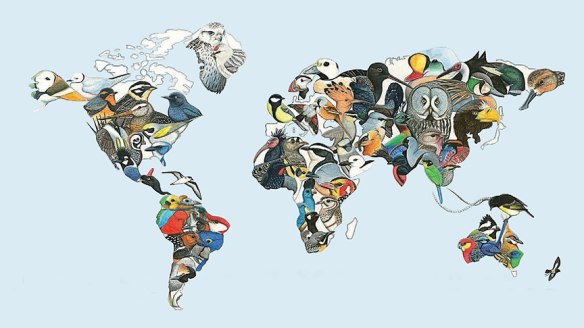
Our Vanishing World: Birds

Illustration by Luke Seitz

By Robert J. Burrowes

At the beginning of the nineteenth century, it is estimated that the total number of passenger pigeons in the United States was about three billion birds. The bird was immensely abundant, as illustrated by this passage written by the famous ornithologist, naturalist and painter John James Audubon:

‘I dismounted, seated myself on an eminence, and began to mark with my pencil, making a dot for every flock that passed. In a short time finding the task which I had undertaken impracticable, as the birds poured in countless multitudes, I rose, and counting the dots then put down, found that 163 had been made in twenty-one minutes. I traveled on, and still met more the farther I proceeded. The air was literally filled with Pigeons; the light of noon-day was obscured as by an eclipse, the dung fell in spots, not unlike melting flakes of snow; and the continued buzz of wings had a tendency to lull my senses to repose… Before sunset I reached Louisville, distance from Hardensburgh fifty-five miles. The Pigeons were still passing in undiminished numbers, and continued to do so for three days in succession.’ See ‘Passenger Pigeon’.

So numerous was this bird that, in the nineteenth century, the passenger pigeon was one of the most abundant birds on Earth.

In 1914 it was extinct.

While new settlements kept reducing the bird’s habitat, more importantly, it was literally hunted from the sky. Shot for its meat.

So I have two questions for you? When is the last time that you saw a flock of birds so vast that ‘the light of noon-day was obscured as by an eclipse’? And when did you last see a flock of just 20 birds?

Sobering to ponder, isn’t it?

The origin of birds

Birds evolved from small carnivorous dinosaurs of the Late Jurassic and in the 65 million years since the extinction of the rest of the dinosaurs, this ancestral lineage diversified into the major groups of birds alive today. See ‘The origin of birds’.

Because they did not exist during the first five mass extinction events on Earth, birds have been spared the widespread extinctions suffered by those species that did exist in earlier eras.

Extinctions of birds in prehistory and history

Nevertheless, the fossil record tells us of the existence of prehistoric birds that became extinct before the Late Quaternary (that is, the past half to one million years) and thus occurred in the absence of significant human interference – see ‘List of fossil bird genera’ – while various sources tell us of both prehistoric and historic bird species, including flightless megafauna birds, that became extinct between 40,000 BCE and 1500 AD and ‘was coincident with the expansion of Homo sapiens beyond Africa and Eurasia, and in most cases, anthropogenic factors played a crucial part in their extinction, be it through hunting, introduced predators or habitat alteration’. See ‘List of Late Quaternary prehistoric bird species’.

Of course, there is an even wider range of evidence of bird extinctions since 1500. See ‘List of recently extinct bird species’. Most notably perhaps, given the symbolism it has since acquired, the dodo, a flightless bird of Mauritius, was driven to extinction by 1681 but not before it was carefully drawn. See ‘Dodo’.

How many bird species are there on Earth now?

While one recent estimate – see ‘Scaling laws predict global microbial diversity’ – indicates that Earth may be the home to one trillion species (the vast bulk of which are microorganisms such as bacteria, archaea and microscopic fungi), of which only an estimated 8.7 million species fall into the usual and simpler categories of plants, birds, animals, fish, amphibians, insects and reptiles, the most recent research conducted by George F. Barrowclough, Joel Cracraft, John Klicka and Robert M. Zink and published in 2016 indicated that there are just 18,043 species of birds worldwide. See ‘How Many Kinds of Birds Are There and Why Does It Matter?’

Somewhat controversially – see ‘New Study Doubles the World’s Number of Bird Species By Redefining “Species”’ – this figure is nearly twice as many as previously thought because the study focused on ‘hidden’ avian diversity: birds that look similar to one another or were thought to interbreed but are actually different species. In any case, whether there are just 10,000 species of birds, 11,000+ as estimated by the recognized international authority BirdLife International – see ‘Introducing the IUCN Red List’ – or even18,000, just like other species of life on Earth, birds are now under siege in a way they have never been before.

Killing birds in the late twentieth and early twenty-first centuries

More than 100 years have passed since the passenger pigeon became extinct. However, while one might have hoped that humans had become more adept at nurturing populations of birds, the reality is that we are continuing to drive bird populations to extinction. Moreover, we are now doing this with breathtaking efficiency, slaughtering birds by the millions in ever-shortening timeframes.

As a result, the fate of the passenger pigeon has been replicated many times over with a vast number of bird species passing through the International Union for Conservation of Nature’s eight preliminary categories – Not Evaluated, Data Deficient, Least Concern, Near Threatened, Vulnerable, Endangered, Critically Endangered, Extinct in the Wild – before reaching the ninth and final category: Extinct. See ‘IUCN Red List Categories and Criteria’. At the moment, the ‘IUCN Red List of Threatened Species’ identifies 14% of remaining bird species as ‘threatened with extinction’. Also see ‘Introducing the IUCN Red List’.

Of course, this ongoing assault on birds is well documented in the scientific literature, along with descriptions of long-standing causes as well as those that are more recent.

In recently published research on the status of birds in North America, Dr. Kenneth V. Rosenberg led an international team of scientists from seven institutions in analyzing the population trends of 529 bird species on the North American continent. Their study quantified, for the first time, the total decline in bird populations in the continental U.S. and Canada: a loss of 2.9 billion breeding adult birds, with devastating losses among birds in every biome, since 1970. Moreover, their research revealed that ‘declines are not restricted to rare and threatened species – those once considered common and widespread are also diminished’. See ‘Decline of the North American avifauna’ and ‘Vanishing: More Than 1 in 4 Birds Has Disappeared in the Last 50 Years’.

Like scholars researching dramatic declines and extinctions of other species, such as insects, Rosenberg and his colleagues stress that their results have ‘major implications for ecosystem integrity, the conservation of wildlife more broadly, and policies associated with the protection of birds and native ecosystems on which they depend’. While species extinctions ‘have defined the global biodiversity crisis’, extinction ‘begins with loss in abundance of individuals that can result in compositional and functional changes of ecosystems’. Hence, the staggering loss of bird abundance ‘signals an urgent need to address threats to avert future avifaunal collapse and associated loss of ecosystem integrity, function, and services’. See ‘Decline of the North American avifauna’.

In more blunt language ‘the most comprehensive inventory ever done for North American birds, points to ecosystems in disarray because of habitat loss and other factors that have yet to be pinned down’. See ‘Billions of North American birds have vanished’. And, yet more bluntly: ‘The scale of loss portrayed in the [Rosenberg et.al.] study is unlike anything recorded in modern natural history.’ See ‘Vanishing: More Than 1 in 4 Birds Has Disappeared in the Last 50 Years’.

Even more importantly, however, pointing out that the study results ‘transcend the world of birds’, Rosenberg explained that ‘These bird losses are a strong signal that our human-altered landscapes are losing their ability to support birdlife’ and ‘that is an indicator of a coming collapse of the overall environment.’ See ‘Vanishing: More Than 1 in 4 Birds Has Disappeared in the Last 50 Years’.

Is North America alone in its decimation of bird populations? Far from it. Other research and data have revealed that ‘farmland birds in Europe have declined by over 50 per cent collectively in the last 30 or 40 years’ according to Professor Richard Gregory, head of species monitoring and research at the Royal Society for the Protection of Birds (RSPB) in the UK where, according to Martin Harper, director of conservation at the RSPB, ‘Our beleaguered farmland birds have declined by 56 per cent between 1970 and 2015 along with declines in other wildlife linked to changes in agricultural practices, including the use of pesticides’.

And, Professor Romain Julliard, a conservation biologist at France’s National Museum of Natural History, confessed his ‘shock’ when the latest research revealed that France has lost one-third of its birds in the past 15 years in what is being labeled a ‘dramatic collapse’ and ‘ecological catastrophe’ particularly because the decline has accelerated dramatically in recent years. See ‘“Shocking” decline in birds across Europe due to pesticide use, say scientists’.

In Germany, bird populations are vanishing with scientists using words like ‘decimated’ and ‘collapse’ to describe the enormity of the problem. In a recent study of government data, the German environmental organization Nature And Biodiversity Conservation Union (NABU) estimated ‘that more than 25 million birds [15% of the country’s total bird population] disappeared from Germany over the past 12 years’. See ‘Über zwölf Millionen Vogelbrutpaare weniger in Deutschland’, ‘Insect and bird populations declining dramatically in Germany’ and ‘“Decimated”: Germany’s birds disappear as insect abundance plummets 76%’. But why?

While habitat destruction and other factors played roles, scientists have also long linked pesticide use to insect decline – a reasonable assumption given that killing insects is the purpose of pesticides – and research clearly demonstrates that pesticides are killing more than target insects. For instance, a 2008 study demonstrated low but persistent levels of a common neonicotinoid pesticide in aquatic ecosystems can kill off or reduce the growth of insects (such as mosquitoes) that have an acquatic phase. See ‘Acute and Chronic Toxicity of Imidacloprid to the Aquatic Invertebrates Chironomus tentans and Hyalella azteca under Constant- and Pulse-Exposure Conditions’ and ‘“Decimated”: Germany’s birds disappear as insect abundance plummets 76%’.

In essence, the problem is that killing the insects is tantamount to killing the birds that feed on them.

Another recent study came to the same conclusion. The study, conducted in the Lake Constance area in southern Germany, found that the population of six of the most common birds had ‘declined massively’. According to Hans-Guenther Bauer of the Max Planck Institute for Behavioral Biology: ‘These are truly shocking figures, especially when you consider that the decline in birds began decades before our first data collection in 1980.’ Why is it happening? According to Bauer, a key reason for the decline is the loss of food. ‘This confirms what we have long suspected. The death of insects caused by humans has a massive impact on our birds.’ To stem the tide of losses, scientists are calling for a rethink in agricultural and forestry policy including ‘drastic restrictions on insecticides and herbicides in agriculture, forestry, public areas and private gardens’ and significantly less fertilization. See ‘Scientists fear “collapse” of bird populations in Germany’.

As is the case elsewhere around the world, birds in Africa also face a wide variety of threats, the most significant of which are habitat fragmentation, degradation and destruction as well as direct impacts including hunting and trapping (mainly for meat and trafficking). See ‘Multiple threats are driving threatened birds towards extinction in Africa’.

But nowhere is safe with the killing of migratory birds in China – see Market trade is fuelling the killing of migratory birds in Northern China – and various factors adversely impacting penguins in Antarctica – see ‘Climate-driven reductions in krill abundance have caused Adélie penguin declines’ – just two more of many examples that could be cited.

Illegal hunting and trapping of birds

According to Birdlife International, the organization responsible for monitoring the welfare of birds for the IUCN’s Red List, ‘The illegal killing and taking of wild birds remains a major threat on a global scale’ with recent examples including the illegal poisoning of vultures in Sub-Saharan Africa, the illegal shooting of raptors in Europe and North America, the illegal trapping of passerines (perching birds) in Asia and the illegal capture for the bird trade in South America.

For example, based on extensive research over many years in relation to bird killing during migratory flights across the Mediterranean and through Northern and Central Europe and the Caucasus, BirdLife International has compiled a series of reports. These reports document massive illegal killing of birds, often in ways that constitute torture, and totaling in excess of 25 million birds annually, including birds of species that are threatened with extinction. For recent reports, see ‘The Killing 2.0: A View to a Kill’, ‘Assessing the scope and scale of illegal killing and taking of birds in the Mediterranean, and establishing a basis for systematic monitoring’ and ‘Review of illegal killing and taking of birds in Northern and Central Europe and the Caucasus’. For a more detailed scientific report on this issue, see ‘Preliminary assessment of the scope and scale of illegal killing and taking of birds in the Mediterranean’.

But if you would simply prefer to be revolted, then watch BirdLife’s one minute video: Help us STOP illegal #birdkilling’. Or read a straightforward account of how ‘innocent’ human behaviours can be deadly for birds, in this case by ‘vacuuming’ millions of sleeping birds into oblivion each year during olive harvesting at night. See ‘Millions of Birds Killed by Nighttime Harvesting in Mediterranean’.

Unfortunately, if you think the descriptions and video of birdkilling above are bad, you won’t be impressed with the sheer insanity that militarized humans can display: ‘The Farmagusta area of Cyprus comes out as the worst place for illegally killing birds in the Mediterranean, while the British Territory in Cyprus is also affected, with the Dhekelia UK military base seeing hundreds of thousands of birds killed each autumn. The Ministry of Defence has started a programme to remove illegally planted trees and shrubs in the area, which trappers use for cover and to lure birds in.’ See ‘Millions of Birds Killed in the Mediterranean’. So, instead of ordering soldiers to stop shooting birds while using a combination of education and law enforcement measures to prevent civilians doing so, they removed ‘illegally planted trees and shrubs’!

Wild Bird trafficking

Another major killer of birds is the wildlife trade. Birds are often killed as a ‘byproduct’ of the trade in exotic birds, most of which is illegal, but which is a multi-billion dollar a year industry along with human, weapons, currency and drug trafficking. Equally importantly, however, once traded, birds no longer form part of their original habitat and hence they are lost as contributing and breeding members of that ecosystem. According to the Convention on International Trade in Endangered Species of Wild Fauna and Flora (CITES), species listed in Appendix I of the Convention are considered to be threatened with extinction and are not allowed to be traded commercially. There are currently 161 bird species on Appendix I. However, birds included on Appendix II are allowed to enter international trade ‘under specific controlled circumstances’; there are 1,300 bird species on this appendix. See ‘Wild Bird Trade and CITES’ and ‘CITES Appendices I, II and III’.

In theory, state parties are obliged to develop national legislation effectively implementing the obligations of the Convention including setting sustainable quotas for Appendix II species. But I am sure that you can imagine how well this regime works given the incredibly profitable wildlife trafficking industry, in which birds are a crucial component. In fact, ‘one third (3,337) of living bird species [that is, 2,000 species more than those that are “legal”] have been recorded as traded internationally for the pet trade and other purposes’. Of these species, 266 (that is, 8% of those internationally traded) are considered globally threatened. See ‘The Red List Index for internationally traded bird species shows their deterioration in status’.

And if the domestic trade in birds is taken into account as well, then ‘Nearly 4,000 bird species involving several million individuals annually are subject to domestic or international trade with finches, weavers, parrots and raptors being some of the most heavily affected groups.’ See ‘Wild Bird Trade and CITES’.

For a candid account of bird trafficking at its origin which describes the fate of macaw chicks being stolen from their forest nests in Ecuador, see ‘Wildlife Trafficking’.

Seabirds

In relation to seabirds, one recent study found that the global population of these birds declined by 70% between 1950 and 2010 as a result of a multiplicity of threats. These threats included ‘entanglement in fishing gear, overfishing of food sources, climate change, pollution, disturbance, direct exploitation, development, energy production, and introduced species (predators such as rats and cats introduced to breeding islands that were historically free of land-based predators)’. See ‘Population Trend of the World’s Monitored Seabirds, 1950-2010’.

Another study concluded just recently, was ‘the first objective quantitative assessment of the threats to all 359 species of seabirds’ and identified the main threats to their survival while outlining priority actions for their conservation. Using the standardized ‘Threats Classification Scheme’ developed for the IUCN Red List to objectively assess threats to each species, a team of ten scientists identified the top three threats to seabirds – in terms of number of species affected and average impact – to be as follows: invasive alien species (particularly rats and cats) which affected 165 species across all of the most threatened groups; bycatch in fisheries which ‘only’ affected 100 species but with the greatest average impact; and the climate catastrophe which affected 96 species. ‘Overfishing, hunting/trapping and disturbance were also identified as major threats to seabirds.’ The study emphasized that 70% of seabirds, especially those that are globally threatened, face multiple threats. For the three most threatened groups of seabirds – albatrosses, petrels and penguins – it is essential to tackle both terrestrial and marine threats to reverse declines. See ‘Threats to seabirds: A global assessment’.

In addition, however, another problem that has been getting insufficient attention is the result of the expanding impacts of the rapidly increasing levels of ocean acidification, ocean warming, ocean carbon flows and ocean plastics. Taken in isolation each of these changes clearly has negative consequences for the ocean. All these shifts taken together, however, result in a rapid and serious decline in ocean health and this, in turn, adversely impacts all species dependent on the ocean, including seabirds. Moreover, on top of these problems is the issue of oxygen availability given that oxygen in the air or water is of paramount importance to most living organisms. As the recently released report ‘Ocean deoxygenation: Everyone’s problem. Causes, impacts, consequences and solutions’ describes in some detail, oxygen levels are currently declining across the ocean.

But to graphically illustrate just one of the threats to seabirds, consider the impact of our chronic overfishing which is depleting the oceans of fish. In November 2019, thousands of short-tailed shearwater birds migrating from Alaska were washed up dead on Sydney’s iconic beaches in Australia. Moreover, thousands more shearwaters died out at sea in clear confirmation of the incredible fish shortages in the Pacific Ocean. After spending the summer in Alaska, the shearwaters were migrating back to southern Australia to breed: a 14,000km trip over the Pacific that requires the birds to be at full strength.

Unfortunately, vast numbers died due to lack of food because the krill and other fish they feed on have vanished. But if you think the problem only occurred along or at the end of their journey, in fact there had been ‘a series of catastrophic die-offs’ before and shortly after the birds departed to head south with thousands of shearwaters (along with puffins, murres and auklets too) lying dead from starvation on the beaches of Alaska and on Russia’s Chukotka Peninsula back in mid-year as well. The overall ‘large die-off’ pattern has been repeating since 2015 with little knowledge of the full extent of the crisis because millions of the birds ‘die at sea’. See ‘Fish all gone!… Millions of small sea birds died since 2015’.

Tragically though, as touched on above, an ocean emptied of fish is not the only hazard that seabirds have no choice but to attempt to navigate. An ocean full of plastic – with concentrations up to 580,000 pieces per square kilometer – is also deceiving many seabirds into attempting to eat pieces of plastic and this only complicates efforts by seabirds to get adequate nutrition. See ‘Threat of plastic pollution to seabirds is global, pervasive, and increasing’ and ‘Nearly Every Seabird on Earth Is Eating Plastic’. This is graphically illustrated in this photo of a dead albatross – see ‘Laysan Albatrosses’ Plastic Problem’ – although, tragically, plastic is not the only non-food item that is consumed by and is killing these majestic birds, with an abandoned US military base on Midway Atoll – where 65% of the global albatross population breeds – playing a vital role too. See ‘Study shows lead-based paint is poisoning albatross chicks at Midway Atoll National Wildlife Refuge’.

But why do seabirds eat plastic instead of correctly identifying food? Well, one recent research project provided ‘the first evidence that, in addition to looking like food, plastic debris may also confuse seabirds that hunt by smell’. See ‘Marine plastic debris emits a keystone infochemical for olfactory foraging seabirds’ and ‘The oceans are full of plastic, but why do seabirds eat it?’

Other threats to birds

Another threat faced by birds in the nuclear age is the outcome of the radioactive contamination of the Earth in many places. For example, while there are ‘severe reductions in species richness and density’ in the regions surrounding the sites of the Chernobyl and Fukushima nuclear catastrophes, surviving birds display a wide range of deformities and dysfunctionalities, notably including impaired brain development as reflected by head volume with its negative implications for cognitive ability and hence viability. See Chernobyl Birds Have Smaller Brains’ and ‘Bird populations near Fukushima are more diminished than expected’.

Yet another threat to birds is posed by the deployment of 5G. ‘Typical effects of radiation from cellular communication antennas on resident, breeding, and migratory birds [include] site abandonment, feather deformation, locomotion problems, weight loss, weakness, reduced survivorship and death.’ Moreover, it can ‘blot out a bird’s perception of the earth’s field, causing the bird to fly in the wrong direction, and also disrupt a bird’s internal clock based on the sun’s changing position’. See ‘5G to Kill the Birds, Bees and Your Loved Ones?’ and ‘Western Insanity and 5G Electromagnetic Radiation’.

Finally, without elaboration, vast numbers of birds are also killed each year by warfare and other military activities – see, for example, ‘The impact of the 1991 Gulf War oil spill on bird populations in the northern Arabian Gulf – a review’ – by industrial activity and accidents – see, for example, ‘Effects of the Exxon Valdez Oil Spill on Birds: Comparisons of Pre- and Post-spill Surveys in Prince William Sound, Alaska’ – by road and air traffic, the spread of certain avian diseases to previously unaffected species – see ‘Avian diseases are spreading to impact hitherto unaffected populations’ – wind turbines, cats, windows and communication towers, with 7 million birds losing their lives each year in the United States alone to the ‘web-like traps of wire and metal’ used for communication. See ‘Communication Towers Are Death Traps for Threatened Bird Species’. Other birds are now being killed in response to conflict generated between birds. See ‘Climate Change Leading to Fatal Bird Conflicts’. And, of course, ‘domesticated’ birds such as chickens and turkeys are farmed and consumed in prodigiously huge quantities, including for Christmas.

Sadly, too, millions of birds of many species are imprisoned in cages as ‘pets’ denied the freedom that all humans crave for themselves.

So, in essence, if you were a bird, here is a survival strategy that should work. Only live in a habitat that will not be impacted, in any way, by human beings and their activities. That is, don’t live on Earth.

Saving the birds

Given the vast range of threats posed to birdlife by humans – see a straightforward summary of ‘The greatest threats facing Important Bird & Biodiversity Areas today’ which doesn’t mention all threats and those that are emerging – it is clearly going to take a monumental effort on many fronts to contain the killing of birds and avert the ongoing extinction of bird species on Earth.

And, unless you are naive enough to believe that elite-controlled governments or international organizations and processes are going to do something that is actually effective – see ‘The Global Elite is Insane Revisited’ – then it is up to us to make the difference. Of course, we can do a few things that are specific to saving birds but the bulk of what must happen is really about saving the biosphere (which includes birds) generally. The biosphere is, after all, one deeply-interconnected living entity.

This is why, according to some biologists, laws that focus on the protection of rare species miss the big picture. Joel Cracraft, for example, argues that ‘We’re losing the battle because we’re fighting over single endangered species’. Species protection tends to focus on charismatic species – beautiful birds and mammals – and doesn’t value rare ecosystems or collections of species. See ‘New Study Doubles the World’s Number of Bird Species By Redefining “Species”’. Nor does it value the biosphere as a whole.

Still, some superlative efforts have been made on behalf of birds. For example, you can read some inspirational success stories by BirdLife International: ‘10 vital bird habitats saved through conservation action’.

And for one man’s initiative 120 years ago that is having ongoing impact, see ‘How one man changed a Christmas tradition forever – to save birds’.

So you can, of course, support the efforts of Birdlife International and the local, national and other organizations like it. See Welcome to BirdLife’s Globally Threatened Bird Forums’ and, for example, ‘Stop Wildlife Trafficking’.

Separately from initiatives that focus specifically on birds, if you wish to fight powerfully to save Earth’s biosphere consider joining those participating in The Flame Tree Project to Save Life on Earth which outlines a simple program to systematically reduce your consumption and increase your local self-reliance over a period of years. Among many other beneficial environmental outcomes, this will reduce the ongoing destruction of bird habitat to produce the products we all consume.

But given the fear-driven violent parenting and education models that drive all violence in our world and which, among a multitude of other adverse outcomes, generates the addiction of most people in industrialized countries to the over-consumption that is destroying Earth’s biosphere – see ‘Love Denied: The Psychology of Materialism, Violence and War’ – then consider addressing this directly starting with yourself – see ‘Putting Feelings First’ – and by reviewing your relationship with children. See ‘My Promise to Children’ and ‘Nisteling: The Art of Deep Listening’. For fuller explanations, see Why Violence?’ and Fearless Psychology and Fearful Psychology: Principles and Practice.

If you wish to campaign strategically to defend birds against particular threats, such as the climate catastrophe, military violence or the deployment of 5G, for example, consider joining those campaigning to halt these and other threats as well. See Nonviolent Campaign Strategy which already includes a comprehensive list of strategic goals necessary to achieve these outcomes in two key contexts in ‘Strategic Aims’.

But, whatever you do, don’t fall into the trap of fearfully begging elites to act on your behalf as, for example, the antiwar and climate movements are doing (with climate ‘activists’ marginalized at the latest COP25 gathering in Madrid). If we do not focus our efforts on engaging all people who are powerful enough to do so to respond strategically, then we will fail. And our failure will not only be the result of the elite refusing to take the requisite action despite your entreaties but also because the elite, as a group, is powerless to make sufficient difference: only a massive response from the wider population can produce the outcome we now need. For explanations of this, see ‘Why Activists Fail’, ‘The Global Climate Movement is Failing: Why?’ and ‘The War to End War 100 Years On: An Evaluation and Reorientation of our Resistance to War’.

Moreover, in those cases where corrupt or even electorally unresponsive governments are leading the destruction of the biosphere – by supporting, sponsoring and/or engaging in environmentally destructive practices – it might be necessary to remove these governments as part of the effort. See Nonviolent Defense/Liberation Strategy.

You might also consider joining the global network of people resisting violence in all contexts, including against the biosphere, by signing the online pledge of The Peoples Charter to Create a Nonviolent World.

Or, if none of the above options appeal or they seem too complicated, consider committing to:

The Earth Pledge

Out of love for the Earth and all of its creatures, and my respect for their needs, from this day onwards I pledge that:

  1. I will listen deeply to children (see explanation above)
  2. I will not travel by plane
  3. I will not travel by car
  4. I will not eat meat and fish
  5. I will only eat organically/biodynamically grown food
  6. I will minimize the amount of fresh water I use, including by minimizing my ownership and use of electronic devices
  7. I will not buy rainforest timber
  8. I will not buy or use single-use plastic, such as bags, bottles, containers, cups and straws
  9. I will not use banks, superannuation (pension) funds or insurance companies that provide any service to corporations involved in fossil fuels, nuclear power and/or weapons
  10. I will not accept employment from, or invest in, any organization that supports or participates in the exploitation of fellow human beings or profits from killing and/or destruction of the biosphere
  11. I will not get news from the corporate media (mainstream newspapers, television, radio, Google, Facebook, Twitter…)
  12. I will make the effort to learn a skill, such as food gardening or sewing, that makes me more self-reliant
  13. I will gently encourage my family and friends to consider signing this pledge.

Do all these options sound unpalatable? Prefer something requiring less commitment? You can, if you like, do as most sources suggest: nothing (or its many tokenistic equivalents). I admit that the options I offer are for those powerful enough to comprehend and act on the truth. Why? Because there is so little time left and I have no interest in deceiving people or treating them as unintelligent and powerless. See ‘Human Extinction by 2026? A Last Ditch Strategy to Fight for Human Survival’ and ‘Doomsday by 2021?’

Conclusion

Birds are being killed with ruthless efficiency by human beings and their activities all over the world. Obviously, this is an unmitigated tragedy for Earth’s birds, the biosphere as a whole and those humans who love life generally. But what are the practical implications of this ongoing bird killing for us?

Well just as the death of one canary in a coal mine warned miners about their dangerous environment, the mass death of birds is yet another warning that we are destroying the planetary biosphere.

However, in this case, we are not treating the canary’s death as a warning and, even if we were, it does not mean that we can escape because there is nowhere else to go.

In short, if we don’t save the birds, we won’t save ourselves.


Biodata: Robert J. Burrowes has a lifetime commitment to understanding and ending human violence. He has done extensive research since 1966 in an effort to understand why human beings are violent and has been a nonviolent activist since 1981. He is the author of Why Violence? His email address is flametree@riseup.net and his website is here.

Our Vanishing World: Wildlife

By Robert J. Burrowes

Throughout its history, Earth has experienced five mass extinction events. See, for example, ‘Timeline Of Mass Extinction Events On Earth’. It is now experiencing the sixth.

  1. The Ordovician-Silurian Extinction, which occurred about 439 million years ago, wiped out 86% of life on Earth at the time. Most scientists believe that this mass extinction was precipitated by glaciation and falling sea levels (possibly a result of the Appalachian mountain range forming), catastrophically impacting animal life which lived largely in the ocean at the time.
  2. The Late Devonian Extinction happened about 364 million years ago and destroyed 75% of species on Earth. Possibly spread over hundreds of thousands of years, a sequence of events that depleted the oceans of oxygen and volcanic ash that cooled the Earth’s surface are believed to have driven the extinctions. It was to be 10 million years before vertebrates again appeared on land. ‘If the late Devonian extinction had not occurred, humans might not exist today.’
  3. The Permian-Triassic extinction, which occurred 251 million years ago, is considered the worst in all history because around 96% of species were lost. ‘The Great Dying’ was precipitated by an enormous volcanic eruption ‘that filled the air with carbon dioxide which fed different kinds of bacteria that began emitting large amounts of methane. The Earth warmed, and the oceans became acidic.’ Life today descended from the 4% of surviving species.
  4. The Triassic-Jurassic extinction happened between 214 million and 199 million years ago and, as in other mass extinctions, it is believed there were several phases of species loss. The blame has been placed on an asteroid impact, climate disruption and flood basalt eruptions. This extinction laid the path that allowed for the evolution of dinosaurs which later survived for about 135 million years.
  5. The Cretaceous-Paleogene extinction, best known of ‘the Big 5’ mass extinctions, occurred 65 million years ago, ending 76% of life on Earth including the dinosaurs. A combination of volcanic activity, asteroid impact, and climate disruption are blamed. This extinction period allowed for the evolution of mammals on land and sharks in the sea.
  6. The sixth mass extinction event in Earth’s history is the one that is being experienced now. Unlike earlier mass extinctions, which helped to pave the way for the evolution of Homo sapiens, the precipitating cause of this extinction event is Homo sapiens itself and, moreover, Homo sapiens is slated to be one of the species that becomes extinct.

Let me explain why this is so by touching on the diverse range of forces driving the extinctions, concepts such as ‘co-extinction’, ‘localized extinctions’ and ‘extinction cascades’, the ways in which extinction impacts are often ‘hidden’ in the short term, thus masking the true extent of the destruction, and the implications of all this for life on Earth, including Homo sapiens, in the near term.

But before I do this, consider this excerpt from the book Sapiens: A Brief History of Humankind written by Yuval Noah Harari, commenting on the expansion of ancient humans out of Africa:

‘If we combine the mass extinctions in Australia and America, and add the smaller-scale extinctions that took place as Homo sapiens spread over Afro-Asia – such as the extinction of all other human species – and the extinctions that occurred when ancient foragers settled remote islands such as Cuba, the inevitable conclusion is that the first wave of Sapiens colonisation was one of the biggest and swiftest ecological disasters to befall the animal kingdom. Hardest hit were the large furry creatures. At the time of the Cognitive Revolution [which Harari argues occurred during the period between 70,000 and 30,000 years ago and probably involved an internal restructuring of the Sapiens brain to facilitate learning, remembering, imagining and communicating while also, in the case of the earlier date, coinciding with the time when Sapiens bands started leaving Africa for the second time], the planet was home to about 200 genera of large terrestrial mammals weighing over fifty kilograms. At the time of the Agricultural Revolution [about 12,000 years ago], only about a hundred remained. Homo sapiens drove to extinction about half of the planet’s big beasts long before humans invented the wheel, writing or iron tools.

‘This ecological tragedy was restaged in miniature countless times after the Agricultural Revolution’ with mammoths, for example, vanishing from the Eurasian and North American landmasses by 10,000 years ago as Homo sapiens spread. Despite this, mammoths thrived until just 4,000 years ago on a few remote Arctic islands, most conspicuously Wrangel, then suddenly disappeared with the arrival of humans.

While there has been some debate about the full extent of the human impact compared to, say, climate and environmental changes including ice age peaks – see, for example, ‘What killed off the giant beasts – climate change or man?’ and ‘What Killed the Great Beasts of North America?’ – the archeological record provides compelling evidence of the role of Homo sapiens as, in Harari’s words, ‘an ecological serial killer’. There is further well-documented evidence in Professor Tim Flannery’s The Future Eaters: An Ecological History of the Australasian Lands and People an excerpt of which in relation to New Zealand, where the megafauna survived until Maoris arrived just 800 years ago and then rapidly vanished, can be read here: ‘The Future Eaters’.

And the onslaught has never ended as the inexorable encroachment of Homo sapiens to the remotest corners of the Earth (including virtually all of the thousands of islands of the Atlantic, Indian and Pacific Oceans) has inevitably led to the extinction of myriad local species including birds, insects and snails. In fact, following the Industrial Revolution about 270 years ago which enabled the development of killing technologies on a scale unheard of previously, the human assault on life on Earth has accelerated so effectively that 200 species of life are now driven to extinction daily.

Whatever other claims they might make about themselves, human beings are truly the masters of death.

So where do we stand today?

According to one recent report, the Earth is experiencing what could be described as ‘just the tip of an enormous extinction iceberg’. See ‘Co-extinctions annihilate planetary life during extreme environmental change’. ‘Just the tip?’, you might ask.

Extinction-causing Behaviours

The primary human behaviours that are modifying Earth’s biosphere, with catastrophic outcomes for many species, are readily apparent and well-described in the scientific literature: destruction of habitat (such as oceans, rainforests, grasslands, wetlands, mangroves, lakes and coral reefs) whether through military violence, radioactive contamination, industrial activities (including ecosystem destruction to build cities, roads and railroads but a vast range of other activities besides), chemical poisoning or other means; over-exploitation; biotic invasion and the effects of environmental modification, including climatic conditions, leading to temperature rise, more frequent droughts, ocean acidification and other impacts which so alter a locality’s environmental conditions that tolerance limits for inhabiting species are breached causing localized extinctions. Unfortunately, however, there are other, more complicated, mechanisms that can exacerbate species loss.

‘In particular, it is becoming increasingly evident how biotic interactions, in addition to permitting the emergence and maintenance of diversity, also build up complex networks through which the loss of one species can make more species disappear (a process known as ‘co-extinction’), and possibly bring entire systems to an unexpected, sudden regime shift, or even total collapse.’ In simple language, a species cannot survive without the resources (the other species) on which it depends for survival and the accelerating loss of species now threatens ‘total collapse’ of ‘entire systems’.

This is because resource and consumer interactions in natural systems (such as food webs) are organized in various hierarchical levels of complexity (including trophic levels), so the removal of resources can result in the cascading (bottom-up) extinction of several higher-level consumers.

Summarizing the findings of several studies based on simulated or real-world data, Dr. Giovanni Strona and Professor Corey J. A. Bradshaw explain why ‘we should expect most events of species loss to cause co-extinctions, as corroborated by the worrisome, unnatural rate at which populations and species are now disappearing, and which goes far beyond what one expects as a simple consequence of human endeavour. In fact, even the most resilient species will inevitably fall victim to the synergies among extinction drivers as extreme stresses drive biological communities to collapse. Furthermore, co-extinctions are often triggered well before the complete loss of an entire species, so that even oscillations in the population size of a species could result in the local disappearance of other species depending on the first. This makes it difficult to be optimistic about the future of species diversity in the ongoing trajectory of global change, let alone in the case of additional external, planetary-scale catastrophes.’

In an attempt to emphasize the importance of this phenomenon, Strona and Bradshaw note that ‘As our understanding of the importance of ecological interactions in shaping ecosystem identity advances, it is becoming clearer how the disappearance of consumers following the depletion of their resources – a process known as “co-extinction” – is more likely the major driver of biodiversity loss’ [emphasis added] and that ‘ecological dependencies amplify the direct effects of environmental change on the collapse of planetary diversity by up to ten times.’ See ‘Co-extinctions annihilate planetary life during extreme environmental change’.

In their own recently published scientific study ‘Biological annihilation via the ongoing sixth mass extinction signaled by vertebrate population losses and declines’ the authors Professors Gerardo Ceballos, Paul R. Ehrlich and Rodolfo Dirzo document another frequently ignored element in understanding the accelerating nature of species extinctions.

‘Earth’s sixth mass extinction is more severe than perceived when looking exclusively at species extinctions…. That conclusion is based on analyses of the numbers and degrees of range contraction … using a sample of 27,600 vertebrate species, and on a more detailed analysis documenting the population extinctions between 1900 and 2015 in 177 mammal species.’ Their research found that the rate of population loss in terrestrial vertebrates is ‘extremely high’, even in ‘species of low concern’.

In their sample, comprising nearly half of known vertebrate species, 32% (8,851 out of 27,600) are decreasing; that is, they have decreased in population size and range. In the 177 mammals for which they had detailed data, all had lost 30% or more of their geographic ranges and more than 40% of the species had experienced severe population declines. Their data revealed that ‘beyond global species extinctions Earth is experiencing a huge episode of population declines and extirpations, which will have negative cascading consequences on ecosystem functioning and services vital to sustaining civilization. We describe this as a “biological annihilation” to highlight the current magnitude of Earth’s ongoing sixth major extinction event.’

Illustrating the damage done by dramatically reducing the historic geographic range of a species, consider the lion. Panthera leo ‘was historically distributed over most of Africa, southern Europe, and the Middle East, all the way to northwestern India. It is now confined to scattered populations in sub-Saharan Africa and a remnant population in the Gir forest of India. The vast majority of lion populations are gone.’

Why is this happening? Ceballos, Ehrlich and Dirzo tell us: ‘In the last few decades, habitat loss, overexploitation, invasive organisms, pollution, toxification, and more recently climate disruption, as well as the interactions among these factors, have led to the catastrophic declines in both the numbers and sizes of populations of both common and rare vertebrate species.’

Further, however, the authors warn ‘But the true extent of this mass extinction has been underestimated, because of the emphasis on species extinction.’ This underestimate can be traced to overlooking the accelerating extinction of local populations of a species.

‘Population extinctions today are orders of magnitude more frequent than species extinctions. Population extinctions, however, are a prelude to species extinctions, so Earth’s sixth mass extinction episode has proceeded further than most assume.’ Moreover, and importantly from a narrow human perspective, the massive loss of local populations is already damaging the services ecosystems provide to civilization (which, of course, are given no value by government and corporate economists and accountants).

As Ceballos, Ehrlich and Dirzo remind us: ‘When considering this frightening assault on the foundations of human civilization, one must never forget that Earth’s capacity to support life, including human life, has been shaped by life itself.’ When public mention is made of the extinction crisis, it usually focuses on a few (probably iconic) animal species known to have gone extinct, while projecting many more in future. However, a glance at their maps presents a much more realistic picture: as much as 50% of the number of animal individuals that once shared Earth with us are already gone, as are billions of local populations.

Furthermore, they claim that their analysis is conservative given the increasing trajectories of those factors that drive extinction together with their synergistic impacts. ‘Future losses easily may amount to a further rapid defaunation of the globe and comparable losses in the diversity of plants, including the local (and eventually global) defaunation-driven coextinction of plants.’

They conclude with the chilling observation: ‘Thus, we emphasize that the sixth mass extinction is already here and the window for effective action is very short.’

Another recent study examined ‘Experimental Evidence for the Population-Dynamic Mechanisms Underlying Extinction Cascades of Carnivores’, and was undertaken by Dr. Dirk Sanders, Rachel Kehoe & Professor F.J. Frank van Veen who sought to understand ‘extinction cascades’. Noting that ‘Species extinction rates due to human activities are high’, they investigated and documented how ‘initial extinctions can trigger cascades of secondary extinctions, leading to further erosion of biodiversity.’ This occurs because the diversity of consumer species is maintained due to the positive indirect effects that these species have on each other by reducing competition among their respective resource species. That is, the loss of one carnivore species can lead to increased competition among prey, leading to extinctions of those carnivore species dependent on prey that loses this competition.

Another way of explaining this was offered by Dr. Jose M. Montoya: ‘Species do not go extinct one at a time. Instead… ecosystems change in a kind of chain reaction, just like in bowling. The impact of the ball knocks down one or two pins, but they hit other pins and this ultimately determines your score. Likewise, when in an ecosystem one species goes extinct many others may follow even if they are not directly affected by the initial disturbance. The complex combination of direct and indirect effects resulting from species interactions determines the fate of the remaining species. To predict the conditions under which extinctions beget further extinctions is a major scientific and societal challenge under the current biodiversity crisis…. Sanders and colleagues… show how and why initial extinctions of predators trigger cascades of secondary extinctions of the remaining predators.’ See ‘Ecology: Dynamics of Indirect Extinction’.

To fully grasp the extent of the crisis in our biosphere, we must look well beyond Earth’s climate: There are a great many variables adversely impacting life on Earth, many of which individually pose the threat of human extinction and which, synergistically, now virtually guarantee it absent an immediate and profound response. As reported in the recent Global Assessment Report on Biodiversity and Ecosystem Services researched and published by the Intergovernmental Science-Policy Platform on Biodiversity and Ecosystem Services (IPBES) – the scientific body which assesses the state of biodiversity and the ecosystem services this provides to society – ‘Nature is declining globally at rates unprecedented in human history. The IPBES Global Assessment ranks, for the first time at this scale, the 5 direct drivers of change in nature with the largest global impact. So what are the culprits behind nature’s destruction?’ Number 1. on the IPBES list is ‘Changes in land and sea use, like turning intact tropical forests into agricultural land’ but, as noted, there are four others. According to this report: one million species of life on Earth are threatened with extinction.

And in their latest assessment of 100,000 species, the International Union for the Conservation of Nature (IUCN) concluded that not one species had improved prospects of averting extinction since their previous ‘Red List’ report. See ‘News Release’ and ‘From over 100,000 species assessments in IUCN update, zero improvements.

Of course, separately from the systemic extinction drivers noted above, including the unmentioned destruction of Earth’s oceans through its absorption of carbon dioxide, pollution with everything from pesticides to plastic, and chronic overfishing which is pushing many ocean species to, or over, the brink of extinction as well, humans also engage in yet other activities that drive the rush to extinction. Hunting wildlife to kill it for trophies or pet food – see ‘Killing Elephants “for Pet Food” Condemned’ – and trafficking wildlife: a $10-20 billion-a-year industry involving illegal wildlife products such as jewelry, traditional ‘medicine’, clothing, furniture, and souvenirs, as well as exotic pets – see ‘Stop Wildlife Trafficking’ and ‘China must lead global effort against tiger trade’ – play vital roles as well.

In summary, the tragedy of human existence is that the Cognitive Revolution gave Homo sapiens the capacity to plan, organize and conduct an endless sequence of systematic massacres all over the planet but, assuming that we have the genetic capacity to do so, our parenting and education models since that time have ensured that we have been denied the emotional and intellectual capacities to fight, strategically, for our own survival. And the time we have left is now incredibly short.

So what can we do?

Given that the ongoing, systematic industrial-scale destruction of Earth’s wildlife has its origin in evolutionary events that took place some 70,000 years ago but which probably had psychological origins prior to this, it is clearly a crisis that is not about to be resolved quickly or easily.

‘Why the mention of psychology here?’ you might ask. Well, while many other factors have obviously played a part – for example, abundance of a species in a particular context might mean that the issue of killing its individual members for food does not even arise, at least initially – it is clear that, given the well-documented multifaceted crisis in which human beings now find themselves, only a grotesquely insufficient effort is being put into averting the now imminent extinction of our own species which critically requires us to dramatically stem (and soon halt) the tide of wildlife extinctions, among many other necessary responses. See, for example, ‘Human Extinction by 2026? A Last Ditch Strategy to Fight for Human Survival’ and ‘Doomsday by 2021?’

It is psychologically dysfunctional, to put it mildly, to participate in or condone by our silence and inaction, activities that will precipitate our own extinction, whether these are driven by the insane global elite – see ‘The Global Elite is Insane Revisited’ – or by our own dysfunctional overconsumption. See ‘Love Denied: The Psychology of Materialism, Violence and War’.

For that reason, after 70,000 years, we must finally ask ‘Why?’ so that we can address the fundamental drivers of our extinction-threatening behaviour as well the several vital symptoms that arise from those drivers. Let me explain what I mean.

The fundamental question is this: Why are humans behaving in a way that will precipitate our own extinction in the near term? Surely, this is neither sensible nor even sane. And anyone capable of emotional engagement and rational thinking who seriously considers this behaviour must realize this. So why is it happening?

Fundamentally it is because our parenting and education models since the Cognitive Revolution 70,000 years ago have failed utterly to produce people of conscience, people who are emotionally functional and capable of critical analysis, people who care and who can plan and respond to crises (or even problems) strategically. Despite this profound social shortcoming, some individuals have nevertheless emerged who have one or more of these qualities and they are inevitably ‘condemned’ to sound the alarm, in one way or another, and to try to mobilize an appropriate response to whatever crisis or problem confronts them at the time.

But, as is utterly obvious from the state of our world, those with these capacities have been rare and, more to the point, they have had few people with whom to work. This is graphically illustrated by the current failure to respond strategically to the ongoing climate catastrophe (with most effort focused on lobbying elite-controlled governments and international organizations), the elite-driven perpetual (and ongoing threat of nuclear) war as well as the other issues, such as the use of geoengineering and the deployment of 5G, that threaten human survival. See ‘The Global Climate Movement is Failing: Why?’, ‘The War to End War 100 Years On: An Evaluation and Reorientation of our Resistance to War’ and ‘Why Activists Fail’.

Given the preoccupation of modern society with producing submissively obedient students, workers, soldiers, citizens (that is, taxpayers and voters) and consumers, the last thing society wants is powerful individuals who are each capable of searching their conscience, feeling their emotional response to events, thinking critically and behaving strategically in response. Hence our parenting and education models use a ruthless combination of visible, ‘invisible’ and ‘utterly invisible’ violence to ensure that our children become terrified, self-hating and powerless individuals like virtually all of the adults around them.

This multifaceted violence ensures that the adult who emerges from childhood and adolescence is suppressing awareness of an enormous amount of fear, pain and anger (among many other feelings) and must live in delusion to remain unaware of these suppressed feelings. This, in turn, ensures that, as part of their delusion, people develop a strong sense that what they are doing already is functional and working (no matter how dysfunctional and ineffective it may actually be) while unconsciously suppressing awareness of any evidence that contradicts their delusion. See Why Violence?, Fearless Psychology and Fearful Psychology: Principles and Practice, ‘Do We Want School or Education?’ and ‘Love Denied: The Psychology of Materialism, Violence and War’.

So if we are going to address the fundamental driver of both the destruction of Earth’s wildlife and the biosphere generally, we must address this cause. For those adults powerful enough to do this, there is an explanation in Putting Feelings First’. And for those adults committed to facilitating children’s efforts to realize their potential and become self-aware (rather than delusional), see ‘My Promise to Children’ and ‘Nisteling: The Art of Deep Listening’.

Beyond this cause, however, we must also resist, strategically, the insane elite-controlled governments and corporations that are a key symptom of this crisis – see ‘The Global Elite is Insane Revisited’ – by manufacturing and marketing a vast range of wildlife (and life)-destroying products ranging from weapons (conventional and nuclear) and fossil fuels to products made by the destruction of habitat (including oceans, rainforests, grasslands, wetlands, mangroves, lakes and coral reefs) and the chemical poisoning of agricultural land (to grow the food that most people eat) while also using geoengineering and deploying 5G technology worldwide. See Nonviolent Campaign Strategy.

But we can also undermine this destruction, for example, by refusing to buy the products provided by the elite’s corporations (with the complicity of governments) that fight wars (to enrich weapons corporations) to steal fossil fuels (to enrich energy, aircraft and vehicle-manufacturing corporations) or those corporations that make profits by destroying habitats or producing poisoned food, for example. We can do this by systematically reducing and altering our consumption pattern and becoming more locally self-reliant as outlined in The Flame Tree Project to Save Life on Earth or, even more simply, by committing to The Earth Pledge (below).

In a nutshell, for example, if we do not travel by car or aircraft, NATO governments will have much less incentive to invade and occupy resource-rich countries to steal their resources and corporations will gain zero profit from destroying wildlife habitat as they endlessly seek to extract the resources necessary to manufacture and fuel these commodities thus saving vast numbers of animals (and many other life forms besides) and easing pressure on the biosphere generally.

You can also consider joining those working to end violence in all contexts by signing the online pledge of The Peoples Charter to Create a Nonviolent World.

The Earth Pledge

Out of love for the Earth and all of its creatures, and my respect for their needs, from this day onwards I pledge that:

  1. I will listen deeply to children (see explanation above)
  2. I will not travel by plane
  3. I will not travel by car
  4. I will not eat meat and fish
  5. I will only eat organically/biodynamically grown food
  6. I will minimize the amount of fresh water I use, including by minimizing my ownership and use of electronic devices
  7. I will not buy rainforest timber
  8. I will not buy or use single-use plastic, such as bags, bottles, containers, cups and straws
  9. I will not use banks, superannuation (pension) funds or insurance companies that provide any service to corporations involved in fossil fuels, nuclear power and/or weapons
  10. I will not accept employment from, or invest in, any organization that supports or participates in the exploitation of fellow human beings or profits from killing and/or destruction of the biosphere
  11. I will not get news from the corporate media (mainstream newspapers, television, radio, Google, Facebook, Twitter…)
  12. I will make the effort to learn a skill, such as food gardening or sewing, that makes me more self-reliant
  13. I will gently encourage my family and friends to consider signing this pledge.

Conclusion

Perhaps the key point to be learned from the evidence cited above is that just as we have triggered a series of self-reinforcing feedback loops that ‘lock in’ an ongoing deterioration of Earth’s climate which we are now virtually powerless to halt (if we were even trying to do so), we have also precipitated a biodiversity crisis that is self-reinforcing because the loss of each and every species has an impact on those species that are dependent on it, precipitating chains of events that make further extinctions inevitable. This is one of the ‘negative synergies’, for example, contributing to the Amazon rainforest’s rapid approach to the tipping point at which it will collapse. See ‘Amazon Tipping Point’.

Hence, we are approaching the final act of a tragedy that had its origins in the Cognitive Revolution some 70,000 years ago and which we have not been able to contain in any way. The earlier acts of this tragedy were the countless species of plants, birds, animals, fish, amphibians, insects and reptiles that Homo sapiens has driven to extinction.

Now, in the final act, we will drive to extinction 200 species today. 200 species tomorrow. 200 species the day after….

Until, one day very soon now, unless you and those you know are willing to commit yourselves wholly to the effort to avert this outcome, the human assault on life on Earth will reach its inevitable conclusion: the extinction of Homo sapiens.


Biodata: Robert J. Burrowes has a lifetime commitment to understanding and ending human violence. He has done extensive research since 1966 in an effort to understand why human beings are violent and has been a nonviolent activist since 1981. He is the author of Why Violence? His email address is flametree@riseup.net and his website is here.

Human Violence: Pervasive, Multi-dimensional and Extinction-threatening

By Robert J. Burrowes

Violence is pervasive throughout human society and it has a vast range of manifestations. Moreover, some of these manifestations – particularly the threat of nuclear war (which might start regionally), the climate catastrophe and the ongoing ecological devastation, as well as geoengineering and the deployment of 5G – threaten imminent human extinction if not contained. Separately from these extinction-threatening manifestations, however, violence occurs in a huge range of other contexts denying many people the freedom, human rights and opportunities necessary for a meaningful life. Moreover, human violence is now driving 200 species of life on Earth to extinction daily with another 1,000,000 species under threat.

For just a sample of the evidence in relation to the threats noted above see, for example, ‘Rapidly expanding nuclear arsenals in Pakistan and India portend regional and global catastrophe’, ‘Plan A’, ‘City on Fire’, ‘Human Extinction by 2026? A Last Ditch Strategy to Fight for Human Survival’, Geoengineering Watch, ‘International Appeal: Stop 5G on Earth and in Space’ and ‘5G and the Wireless Revolution: When Progress Becomes a Death Sentence’.

Given the expanding range of threats to human survival that require a strategic response if they are to be contained, is that possible?

Well, any candid assessment of the relevant scientific literature coupled with an understanding of the psychological, sociological, political, economic and military factors driving the violence, clearly indicates that the answer is ‘highly unlikely’. Particularly because so many people are so (unconsciously) terrified and incapable of responding powerfully.

However, this does not mean that many people are not trying and some of these people perceive the interrelated and synergistic nature of these threats and know that we must be addressing each of them strategically if humanity and an enormous number of other species are to have any meaningful chance of survival in a viable biosphere. These people range from ‘ordinary’ activists, who work passionately to end violence in one context or another, to globally prominent individuals doing the same. Let me tell you about some of them.

Ramesh Agrawal is a prominent social and environmental activist in India who has devoted many years to educating and organizing local village people, including adivasi communities, to defend their homes and lands from those corporations and governments that would deprive them of their rights, livelihoods, health and a clean environment for the sake of mining the abundant coal in the state of Chhattisgarh. However, because his ongoing efforts to access and share key information and his organization of Gandhian-inspired grassroots satyagrahas (nonviolent campaigns) have been so effective, he has also paid a high price for his activism, having been attacked on many occasions. In 2011, for example, he was arrested despite ill-health at the time and chained to a hospital bed. A year later he was shot in the leg, which required multiple operations. He still has difficulty walking with six metal rods inserted through his thigh.

The Jan Chetna (‘peoples’ awareness’) movement started by Ramesh has spread to several parts of Chhattisgarh as well as other states of India. For the latest account of his efforts including the recent ‘coal satyagrapha’ focused on coal blocks owned by state power companies but being developed and operated by Adani Enterprises, see ‘Thousands Hold “Coal Satyagraha”, Allege Manufacturing of Consent at Public Hearing’. For his nonviolent activism, Ramesh was awarded the Goldman Environmental Prize in 2014. See ‘Ramesh Agrawal: 2014 Goldman Prize Recipient Asia’ and ‘Chhattisgarh activist, Ramesh Agrawal, bags Goldman prize’.

In Ghana, the Women’s International League for Peace and Freedom (WILPF) continues its work under the leadership of President Dr. Ayo Ayoola-Amale, a certified mediator and peacebuilder. One recent activity was a two weeks training course on negotiation and mediation as a tool for conflict resolution for women in the Upper West region of Ghana, particularly three districts: Lawra, Nadowli and Lambussie. The training was aimed at providing local NGOs, community elders, administrators and others with the skills and knowledge to further improve their capacity in the work they do. In such courses, Ayo emphasizes the importance of trust, identity and relationship building issues, quoting Dr. Martin Luther King Jr.: ‘Life and history give eloquent testimony to the fact that conflicts are never resolved without trustful give and take on both sides.’

But Ayo has also conducted other courses, such as a three day workshop on peacemaking and mediation skills for the teachers and students at Okyereko Methodist Junior High School which taught skills such as communication (listening, speaking, silence), cooperation, trusting, empathy, responsibility, reconciliation and problem solving. Ayo also used her storytelling skills to convey an understanding of what it means to be a responsible person and how that puts us in charge of our lives. Through the storytelling she reveals some of the personal benefits that come from being honest, reliable, trustworthy and principled and how treating people with respect helps us get along with each other, avoid and resolve conflicts, and create a positive social climate. She told workshop participants that every choice they make helps define the kind of person they are choosing to be and their character is defined by what they do, not what they say or believe.

Professor René Wadlow, President of the Association of World Citizens headquartered in France, has been involved for decades in efforts to engage people in world events rather than leave these events to be mismanaged by elites with a vested interest in a particular outcome. In this article, for example, he reflects thoughtfully on the ‘Iran Crisis: Dangers and Opportunities’ by drawing attention to opportunities for citizen engagement through NGOs to influence how the conflict plays out. As he notes: ‘The dangers are real. We must make the most of the opportunities.’ René also continues to examine issues and throw light on subjects well outside the spotlight of the corporate media, such as conflicts in Africa. See, for example, his article ‘Sahel Instability Spreads’.

Since 2017 Dr Marthie Momberg in South Africa has been working with international colleagues to address Zionism amongst Christians. Along with a colleague from Kairos USA, Marthie offered, for example, a seminar entitled ‘Christianity and the Shifting of Perceptions on Zionism’ at Stellenbosch University’s Beyers Naudé Centre. ‘With some other colleagues we are also in the midst of a research project at this Centre to understand how to sensitise Christians on the nature of Zionism and how it serves as an important lens on so many other struggles in our world. I am also in the process of writing a number of scholarly articles on ethics and religion in the context of Israel and the Palestinian struggle.’

And while on Palestine, US activist journalist Abby Martin recently completed her debut feature film Gaza Fights for Freedom. Directed, written and narrated by Abby, the film had its origins while Abby was reporting in Palestine, where she was denied entry into Gaza by the Israeli government on the accusation she was a ‘propagandist’. Connecting with a team of journalists in Gaza to produce the film through the blockaded border, this collaboration shows you Gaza’s protest movement ‘like you’ve never seen it before’. Filmed during the height of the Great March Of Return protests, it features riveting footage of demonstrations ‘where 200 unarmed civilians have been killed by Israeli snipers since March 30, 2018’ and is a thorough indictment of the Israeli military for war crimes, and a stunning cinematic portrayal of the heroic resistance by Palestinians. You can watch a preview of the film here: Gaza Fights for Freedom (preview). And if you would like to buy or rent the film (and support Abby’s work) you can do so here: Gaza Fights for Freedom.

In Guatemala, Daniel Dalai continues his visionary work providing opportunities for girls to develop their leadership capacities at Earthgardens. If you haven’t previously been aware of their work, including in Bolivia and Nicaragua, you will find it fascinating to read how girls – including Carmen, Angelica, Reyna, Katiela, Yapanepet, Zenobia, Deysi, Rosalba, Charro, Katarina and Marleni – in this community each changed their society, often by forming ‘Eco-Teams’, with a remarkable variety of initiatives.

The Asia Institute ‘is the first truly pan-Asian think tank. A research institution that addresses global issues with a focus on Asia, The Asia Institute is committed to presenting a balanced perspective that takes into account the concerns of the entire region. The Asia Institute provides an objective space wherein a significant discussion on current trends in technology, international relations, the economy and the environment can be carried out.’ Focused on research, analysis and dialogue, and headed by president Emanuel Yi Pastreich, the Institute was originally founded in 2007 while Emanuel was working in Daejeon, Republic of (South) Korea. Emanuel writes extensively on culture, technology, the environment and international relations with a focus on Northeast Asia. He also serves as president of the Earth Management Institute, a global think tank dedicated to developing original approaches to global governance in this dangerous age. But for more on The Asia Institute, see the website above.

While the individuals and organizations mentioned above are just a sample of those directly involved, they are part of an expanding worldwide network in 105 countries committed to working to end human violence in all of its manifestations. Whatever the odds against it, they refuse to accept that violence cannot be ended, and each has chosen to focus on working to end one or more manifestations of violence, according to their particular circumstances and interests. If you would like to join these people, you are welcome to sign the online pledge of The Peoples Charter to Create a Nonviolent World.

If your own interest is campaigning on a peace, climate, environment or social justice issue, consider doing it strategically. See Nonviolent Campaign Strategy.

If your focus is a defense or liberation struggle being undertaken by a national group, consider enhancing its strategic impact. See Nonviolent Defense/Liberation Strategy.

If your preference is addressing the climate and environmental catastrophes systematically while working locally, consider participating in (and inviting others to participate in) The Flame Tree Project to Save Life on Earth.

If you would like to tackle violence at its source, consider revising your parenting in accordance with ‘My Promise to Children’. If you want the evidence to understand why this is so crucial, see Why Violence?’ and Fearless Psychology and Fearful Psychology: Principles and Practice.

If you are self aware enough to know that you are not dealing effectively with our deepening, multifaceted crisis, consider doing the personal healing necessary to do so. See ‘Putting Feelings First’.

Perhaps ending human violence is impossible. If that is true, then human extinction is inevitable and it will occur as a result of one cause or another. Moreover, it will happen in the near term. But every person who believes that human violence can be ended, and then takes strategic action to end it, is participating in the most important undertaking in human history: a last ditch strategy to fight for human survival.


Biodata: Robert J. Burrowes has a lifetime commitment to understanding and ending human violence. He has done extensive research since 1966 in an effort to understand why human beings are violent and has been a nonviolent activist since 1981. He is the author of Why Violence? His email address is flametree@riseup.net and his website is here.


The Global Climate Movement is Failing: Why?

By Robert J. Burrowes

It has been satisfying to note the significant response to two recent climate campaigns: the actions, including the recent Global Climate Strike, initiated by school students inspired by Greta Thunberg and the climate actions organized by Extinction Rebellion.

While delighted that these campaigns have finally managed to mobilize significant numbers of people around the existential threat the climate catastrophe poses to life on Earth, I would like to briefly raise some issues for consideration by each of those involved in the climate movement as well as those considering involvement.

I do this because history provides clearcut and compelling lessons on how to make such movements have the impact we need and, so far, the climate movement is not doing several vital things if we are to indeed be successful. And I would like to be successful.

So here are five key issues that I would address as soon as possible.

  1. Analyze the climate catastrophe within the context of the ongoing and broader environmental disaster that is currently taking place.
  2. Analyze the climate catastrophe and environmental disaster to better understand the political, economic and social systems and structures, as well as the individual behaviours, that are driving them.
  3. Based on these analyses, reorient the movement’s strategic focus: that is, who and what is the movement trying to change?
  4. And then identify the nature of the behavioural changes we are asking of people and their organizations, and how these will be achieved.
  5. In what timeframe?

Let me briefly elaborate why I believe these issues are so important.

  1. Earth’s biosphere is under siege, not just the climate.

There is no point mobilizing action to halt ongoing destruction of the climate while paying insufficient attention to the vast range of other threats to key ecosystems that make life on Earth possible. I understand that most movements, whether concerned with peace, the environment or social justice, for example, tend to confine their concern to one issue. Unfortunately, however, we no longer have the luxury of doing that given the multifaceted existential threats to life on Earth.

The biosphere is under siege on many fronts with military violence, radioactive contamination (from nuclear weapons testing, nuclear waste from power plants including Fukushima and Chernobyl, depleted uranium weapons…), destruction of the rainforests and oceans, contamination and depletion of Earth’s fresh water supply, geoengineering, 5G and many other assaults inflicting ongoing and uncontained damage on Earth and its species. See, for example, ‘5G and the Wireless Revolution: When Progress Becomes a Death Sentence’.

This has critical implications for the strategic goals we set ourselves in our struggle to save not only the climate but the many vital ecosystems of Earth’s biosphere. In short, if we ‘save the climate’ but rainforests are destroyed or nuclear war takes place, then saving the climate will have been a pyrrhic victory.

  1. Politicians are a ‘sideshow’ with negligible power.

Hence, it is a waste of time lobbying them to do such things as ‘declare a climate emergency’, ‘phase out all fossil fuel extraction and transform our economy to 100% renewable energy by 2030’, ‘recognize indigenous sovereignty’ and ‘implement a Green New Deal’.

The global elite, which is insane, is ‘running the show’, including the key political, economic, military and social structures and the bulk of the politicians we supposedly elect. This means that the global elite holds the levers of power over the world capitalist system, national military forces and the major international political and economic organizations such as the United Nations, the World Bank and the International Monetary Fund. For brief explanations of this, with references to many more elaborate accounts, see the section headed ‘How the World Works: A Brief History’ in ‘Why Activists Fail’, as well as ‘Exposing the Giants: The Global Power Elite’ and ‘The Global Elite is Insane Revisited’.

But separately from the role of the global elite in managing the major political, economic and social systems and structures in order to extract maximum corporate profit, individual behaviours, particularly the consumption patterns of people in industrialized countries, are also driving the destruction of Earth’s biosphere. Why? Because our parenting and teaching models are extraordinarily violent and leave the typical human living in an unconsciously terrified, self-hating and powerless state and addicted to using consumption as a key means to suppress awareness of how they feel. See ‘Love Denied: The Psychology of Materialism, Violence and War’ and ‘Do We Want School or Education?’ and, for more detail, ‘Why Violence?’ and ‘Fearless Psychology and Fearful Psychology: Principles and Practice’.

3 & 4. If we understand the above two points, we can reorient our efforts.

This means that instead of powerlessly lobbying politicians, we can change our strategic focus to maximize our strategic impact. So, on the one hand for example, we can tackle corporations profiting from the manufacture, sale and use of military weapons, the extraction and sale of fossil fuels or the manufacture and sale of the poison glyphosate (‘Roundup’), by designing and implementing thoughtful strategies of nonviolent action to end their manufacture and sale of these life-destroying products. For comprehensive guidance on campaigning strategically, see Nonviolent Campaign Strategy. For a list of the strategic goals necessary to effectively tackle the climate catastrophe or end war, for example, see ‘Strategic Aims’. And for a brief explanation of how to make a nonviolent action have maximum impact, see ‘Nonviolent Action: Why and How it Works’.

On the other hand, we can encourage responsible and systematic reductions of consumption in all key areas – water, household energy, transport fuels, metals, meat, paper and plastic – while dramatically expanding individual and community self-reliance in 16 areas in industrialized countries as outlined in ‘The Flame Tree Project to Save Life on Earth’. Or, more simply, we can encourage people to make the Earth Pledge (below).

Once enough people commit to one or the other of these two approaches (to substantially reduce consumption and increase local self-reliance), then three vital outcomes will be achieved:

  1. it will progressively reduce resource extraction from, and pollution of, Earth’s biosphere,
  2. it will functionally undermine capitalism and the ongoing industrialization process, and
  3. it will remove the fundamental driver of the global elite’s perpetual war: our collective demand for the goods and services made available by the elite’s theft of resources from countries they invade and exploit on our behalf.

I am well aware of the captivating power of turning up in a shared space with a vast bunch of other people with whom we agree. Unfortunately, while it might be a lot of fun, it is usually a waste of time strategically. Even the largest worldwide mobilization in human history (against the imminent US-led war on Iraq) on 15 February 2003, in which 30,000,000 people participated in more than 600 cities around the world, was ineffective. See ‘Why Activists Fail’.

Of course, if you still want a large public action, then you need to make sure the gathering has strategic focus. For example, instead of using it to powerlessly beg politicians to fix things for us, make it an occasion where participants can publicly commit to taking powerful action themselves by signing the Earth Pledge.

The Earth Pledge

Out of love for the Earth and all of its creatures, and my respect for their needs, from this day onwards I pledge that:

  1. I will listen deeply to children (see explanation below)
  2. I will not travel by plane
  3. I will not travel by car
  4. I will not eat meat and fish
  5. I will only eat organically/biodynamically grown food
  6. I will minimize the amount of fresh water I use, including by minimizing my ownership and use of electronic devices
  7. I will not buy rainforest timber
  8. I will not buy or use single-use plastic, such as bags, bottles, containers, cups and straws
  9. I will not use banks, superannuation (pension) funds or insurance companies that provide any service to corporations involved in fossil fuels, nuclear power and/or weapons
  10. I will not accept employment from, or invest in, any organization that supports or participates in the exploitation of fellow human beings or profits from killing and/or destruction of the biosphere
  11. I will not get news from the corporate media (mainstream newspapers, television, radio, Google, Facebook, Twitter…)
  12. I will make the effort to learn a skill, such as food gardening or sewing, that makes me more self-reliant
  13. I will gently encourage my family and friends to consider signing this pledge.

To reiterate: It is delusional to believe that we can sustain the existing levels of consumption and preserve Earth’s biosphere. Because, in the end, it is our over-consumption that is driving the destruction. As an aside, this is also why the various Green New Deal proposals being put forward are misconceived: each of the versions that I have checked is essentially a wish-list of desirable changes ‘demanded’ of governments while missing the fundamental point that if people still want to fly, drive, eat meat and fish, or food that is poisoned, use electronic devices…, they are paying the elite to maintain existing structures of violence and exploitation, to continue killing people (to steal their resources) and to destroy the biosphere. And this, of course, means that we are directly complicit in the violence, exploitation and destruction. After all, why should the elite listen to our demands for change when we spend our money supporting their existing profit-maximizing, people-killing and biosphere-destroying behaviours?

If this all seems too challenging, then I invite you to consider doing the emotional healing necessary so that you can act powerfully in response to this crisis. See ‘Putting Feelings First’. If you want to help children to do so, consider making ‘My Promise to Children’ which will require capacity in ‘Nisteling: The Art of Deep Listening’.

  1. The timeframe to which we are working is vital.

Given the ever-increasing body of evidence that suggests human extinction will occur by 2026, there is no point working to the elite-sponsored IPCC timeframe, designed to maximize corporate profits-as-usual for as long as possible. We do not have, for example, until 2030 to contain the temperature increase to 1.5 degrees celsius above the pre-industrial level or, say, mid-century to fully reign in carbon, methane and nitrous oxide emissions. We have nothing like this much time. Moreover, anyone paying attention to the state and ongoing destruction of the world’s rainforests and oceans, the ‘insect apocalypse’ and the accelerating rate of species extinctions (with one million species now under threat) should perceive this intuitively unless (unconsciously) terrified and hence delusional.

But for a fuller elaboration of the short timeframe we have left, if we take into account the synergistic psychological, sociological, political, economic, climate, ecological, military and nuclear considerations that each play a part in shaping this timeframe, see ‘Human Extinction by 2026? A Last Ditch Strategy to Fight for Human Survival’.

Conclusion

By now, of course, many people will be overwhelmed by what they have read above (if they got this far). So this is why those who feel able to grapple with the evidence presented are also the ones most likely to have the courage to join me in taking the action outlined and gently encouraging others in the movement to reconsider and reorient movement strategy too.

It also means that the climate movement and those with whom we must work, such as those in the labour, women’s, antiwar, indigenous rights and environment movements, have considerably more work to do if we are to achieve the outcomes we all want.

Unless enough of us are able to embrace the path outlined above, human extinction in the near term is inevitable because our efforts will be wasted on actions that cannot have the necessary impact given the full dimensions of the crisis.


Biodata: Robert J. Burrowes has a lifetime commitment to understanding and ending human violence. He has done extensive research since 1966 in an effort to understand why human beings are violent and has been a nonviolent activist since 1981. He is the author of ‘Why Violence?’ His email address is flametree@riseup.net and his website is here.

The Struggle for Peace in Afghanistan: Is Community Engagement the Key?

By Robert J. Burrowes

I have just read a superb book by Mark Isaacs, an Australian who has documented several years of effort by a group of incredibly committed young people in Afghanistan to build peace in that war-torn country the only way it can be built: by learning, living and sharing peace.

The book, titled The Kabul Peace House: How a Group of Young Afghans are Daring to Dream in a Land of War, records in considerable detail the struggle, both internal and external, to generate a peaceful future in Afghanistan. Some might consider this vision naive, others courageous, but few would doubt the simple reality: it is slow, daunting, incredibly difficult, often saddening, frightening, infuriating or painful, sometimes uplifting or hilarious and, just occasionally, utterly rewarding.

This is a human story written by a person who knows how to listen and to observe. And because the subject is about a group of ordinary Afghans and their mentor doing their best in the struggle to end one of the longest wars in human history, it is a story that is well worth reading.

This story is embedded in a combination of (brief) historical background on Afghanistan’s longstanding and central role in imperial geopolitics (including during ‘The Great Game’ of the 19th century) and more recent history on the progressive modernity of Afghanistan prior to the Soviet invasion in 1979 which was followed by an ongoing and multifaceted war in which the United States has played the most damaging role since its invasion of the country in 2001. But the background also includes a description of the ethnic diversity throughout the country, the role of religion and gender relations (and the challenges these social parameters present), as well as commentary on the social, economic and political regression as a result of the war’s many adverse impacts. So the book weaves a lot of strands into a compelling story of nonviolent resistance and regeneration against almost overwhelming odds.

However, that is not all. Given that all of the Afghans in this visionary community have each been traumatized by their unique experience of war, the book doesn’t shy away from describing the challenges this presents both to them personally and to the community, including its mentor and even some of the community’s many international visitors.

Most of the community members – whether Pashtun, Hazara, Uzbek, Turkmen, Tajik, Sayyid, Pashai… – have suffered serious loss during the war, especially those members who have had family and other relatives killed, or worse. Worse? you might ask. What is worse than death? Well, after reading this book, you will better understand that the context and the manner of death mean a great deal psychologically. None of the victims of this war died peacefully in their sleep after long and meaningful lives and this is just one part of the psychological trauma suffered by so many in this particular community but also in wider Afghan society.

So what does this community in Kabul do? Well, throughout its evolution and many manifestations, the community has done many things including run a variety of projects intended to foster understanding, cooperation and learning: nurture mutual respect among the diversity of people that constitute its membership, teach some of its members to read and write and facilitate learning opportunities in other contexts, teach the meaning and practice of nonviolence, give street kids the chance to learn skills that will make them employable, make duvets to give to people who go cold in Afghanistan’s freezing winters, teach and practice permaculture, organize protests against the war (including by flying kites instead of drones), and generally working to create a world that is green, equal and nonviolent.

If you think this sounds all good and straightforward, given slowly spreading acceptance of such ideas elsewhere (in some circles at least), then you might have underestimated their radical nature in a society in which ideas about nonviolence, equality and sustainability have, for the most part, not been previously encountered and have certainly not taken root. Isaacs records the observations of the group’s mentor on these subjects: ‘Over the years I have seen how the volunteers have changed within their personal lives, even if it means distancing themselves from the traditions of their own family…. But on a public level it’s much slower.’

This is understandable. As Isaacs notes, even in ordinary conversation and group discussions, ‘the weight of resistance, the taboos and the self-censorship’ made an impact on him. In a culture in which, in 2015, a woman in her twenties was stoned, her body run over by a car and then dumped in a river and set on fire because a mullah falsely accused her of burning the Quran, there is a long way to go.

One of the things that I found most compelling about the book is the occasional ‘biography’ of one of the community’s main characters. Given pseudonyms to avoid possible adverse repercussions, these stories provide real insight into the lives of certain community members and their struggle to leave home (in some cases), to join the community, to find their place within it and gain acceptance by the other members.

Some, like Hojar, are more outspoken and this, for a woman, is unusual in itself. Hojar is deeply aware of the gender inequality and violence against women in Afghanistan and will talk about it. This inspires other women, like Tara, who have not experienced this outspokenness before.

But Hojar’s life had started differently, in the mountains where, as a teenager, she was getting up at 3am to start baking bread for her four snoring brothers before milking the goats and sheep. ‘I am not a woman’, she thought, ‘I am a slave’. Fortunately and unusually, Hojar’s parents supported her desire to not marry at 13 or 15, but to continue her education and follow her dreams. It’s a long, painful, terrifying and fascinating journey but Hojar ended up in this novel community experiment in Kabul where her now college-educated talent was highly valued and put to wonderful use. She has my utmost admiration.

Unlike Hojar, other community members, like Horse, originally a shepherd in the mountains, are more circumspect on gender equality and other issues. But this doesn’t mean that Horse is not active, at times playing roles in the networking team, the accounts team and, particularly, as coordinator of the food cooperative which provided monthly gifts of food to the impoverished families of one hundred children who studied at the community’s street kids school. If you think raising donations to pay for this food was easy, particularly given the community decision to avoid the international aid sector to try to encourage Afghans to help their fellow Afghans, when more than half of the population lived below the poverty line and unemployment was at 40%, you will find it compelling to read how the teenaged Horse struggled with the monumental range of challenges he faced in that particular role. He has my admiration too.

Insaan, a doctor who mentors the community, provides a compelling story as well. Originally from another country, in 2002 a consultation with a patient at his successful medical practice inspired him to depart some time later. After spending more than two years in Pakistan, working with refugees from Afghanistan, he went to Afghanistan in 2004 to work for an international NGO in public health education in its central mountainous region.

His ongoing experience in this role, however, taught him that every problem the villagers faced had its origins in the war. And this underpinned his gradual transformation from health professional to peace activist. He discovered Thoreau, Gandhi and King, among others, and ‘became convinced of the power of love’. By 2008, Insaan had initiated his first multi-ethnic live-in community (although he did not live in it himself) in the mountains but in 2011, when his house was deliberately burned down, he departed for Kabul determined to restart the peace work he had begun in the mountains.

Starting with three young people who accompanied him from the mountains, the first manifestation of a live-in peace community in Kabul was soon underway. Endlessly paying attention, trying to provide guidance, reconcile those in conflict, and even withstanding threats of violence, Insaan’s love has undoubtedly been the glue that has held the growing and evolving community together. But not without cost. At times, Insaan has struggled, emotionally and otherwise, to survive in this perpetual war zone as the key figure holding this loving experiment together. He is a truly remarkable human being.

And it is because of the trauma that he and each of the other community members has suffered, that I hope that, in future, they can somehow dedicate time to their own personal, emotional healing. See ‘Putting Feelings First’ and ‘Nisteling: The Art of Deep Listening’. There is no better investment for any human being than to spend time consciously focusing on feeling the fear, pain, anger and sadness that we are taught and terrorized into suppressing during childhood (so that we become the obedient slaves that our society wants). Given the extraordinary violence that the people of Afghanistan have suffered and are still suffering, the value of making this investment would be even greater.

Anyway, if you want to read an account of the deeply personal human costs of war, and what one community is doing about it, read this book. It isn’t all pretty but, somehow, this remarkable community, through all of its manifestations over many years, its successes and failures, manages to inspire one with the sense that while those insane humans who spend their time planning, justifying, fighting and profiting from wars against people in other countries, those people on the receiving end of their violence are capable of visioning a better tomorrow and working to achieve it. No matter how difficult or how long it takes. Moreover, we can help too. See Nonviolent Campaign Strategy.

So allow yourself to be inspired by a group of young people, each of whom has lived their entire life in a country at war both with itself and with foreign countries, but has refused to submit to the predominant delusion that violence is the way out.


Biodata: Robert J. Burrowes has a lifetime commitment to understanding and ending human violence. He has done extensive research since 1966 in an effort to understand why human beings are violent and has been a nonviolent activist since 1981. He is the author of Why Violence? His email address is flametree@riseup.net and his website is here.

Comparative Political Leadership: Gandhi vs. Contemporary Leaders

By Robert J. Burrowes

On 2 October 2019, it will be the 150th anniversary of the birth of Mohandas K. Gandhi in Gujarat, India. I would like to reflect on the visionary leadership that Gandhi offered the world, briefly comparing it with some national leaders of today, and to invite you to emulate Gandhi’s leadership.

While Gandhi is best remembered for being the mastermind and leader of the decades-long nonviolent struggle to liberate colonial India from British occupation, his extraordinary political, economic, social, ecological, religious and moral leadership are virtually unknown, despite the enormous legacy he left subsequent generations who choose to learn from what he taught. This legacy is available online in the 98-volume Collected Works of Mahatma Gandhi.

While touching on Gandhi’s legacy in each of these regards, I would particularly like to highlight Gandhi’s staggering legacy in four of these fields by briefly comparing his approach to politics, economics, society and the environment with the approach of contemporary political leaders such as Jair Bolsonaro (Brazil), Xi Jinping (China), Emmanuel Macron (France), Viktor Orbán (Hungary), Narendra Modi (India), Binjamin Netanyahu (Israel), Shinzo Abe (Japan), Vladimir Putin (Russia), Mohammad bin Salman (Saudi Arabia), Boris Johnson (UK) and Donald Trump (USA).

Before doing so, let me offer a little basic background on Gandhi so that the foundational framework he was using to guide his thinking and behaviour is clear.

Gandhi in Brief

In order to develop his understanding of the human individual and human society, as well as his approach to conflict, Gandhi engaged in ongoing research throughout his life. He read avidly and widely, as well as keenly observing the behaviour of those around him in many social contexts in three different countries (India, England and South Africa). Shaped also by the influence of his mother and his Hindu religion, this led to Gandhi’s unique understanding of the human individual and his approach to the world at large.

For a fuller elaboration of the points about Gandhi discussed below and the precise references, see relevant chapters and sections on Gandhi in The Strategy of Nonviolent Defense: A Gandhian Approach.

Gandhi’s conception of the human individual and human nature

In order to understand Gandhi generally, it is imperative to comprehend his conceptions of the human individual and human nature simply because these are the foundation of his entire philosophy.

Gandhi attached enormous importance to individual responsibility. He also had a very positive view of human nature. Gandhi believed that humans could respond to ‘the call of the spirit’ and rise above selfishness and violence. Moreover, this was necessary in their quest for self-realization. Self-realization, as the Gandhian scholar Professor Arne Naess explains it, ‘involves realizing oneself as an autonomous, fully responsible person’.

In Gandhi’s view, this quest is an individual one that relies on nonviolence, self-reliance, and the search for truth. ‘To find Truth completely is to realize oneself and one’s destiny.’ But what should guide this search? According to Gandhi, it can only be the individual conscience: The ‘inner voice’ must always be ‘the final arbiter when there is a conflict of duty’. And in his view, ‘the voice of God, of Conscience, of Truth or the Inner Voice or “the still small Voice” mean one and the same thing.’

This point is centrally important, because the usual descriptions of Gandhian nonviolence stress its morality, humility and sacrifice while neglecting the fundamental norm ‘that you should follow your inner voice whatever the consequences’ and ‘even at the risk of being misunderstood’.

The point, of course, is that creation of the nonviolent society which Gandhi envisioned required the reconstruction of the personal, social, economic and political life of each individual. ‘We shall get nothing by asking; we shall have to take what we want, and we need the requisite strength for the effort.’ Consequently, the individual required increased power-from-within through the development of personal identity, self-reliance and fearlessness.

So what is fearlessness? For Gandhi, it means freedom from all external fear, including the fear of dispossession, ridicule, disease, bodily injury and death. In his view, progress toward the goal of fearlessness requires ‘determined and constant endeavour’. But why is fearlessness so important? Because a person who is fearless is unbowed by the punitive power of others and that makes them powerful agents of change.

Gandhi’s approach to society and political economy

Gandhi’s conception of society is based on a rejection of both capitalism and socialism.

In relation to capitalism, he rejected the competitive market and private property, with their emphasis on individual competitiveness and material progress and their consequent greed and exploitation of the weak. He also rejected the major institutions of capitalism, including its parliamentary system of democracy (which denied sovereignty to the people), its judicial system (which exacerbated conflict and perpetuated elite power), and its educational system (which divorced education from life and work).

In relation to socialism, he rejected its conception of conflict in terms of class war, its claim that state ownership and centralization are conducive to the common welfare, its emphasis on material progress, and its reliance on violent means.

The Gandhian vision of future society is based on a decentralized network of self-reliant and self-governing communities using property held in trust, with a weak central apparatus to perform residual functions. His vision stresses the importance of individuals being able to satisfy their personal needs through their own efforts – including ‘bread labor’ – in cooperation with others and in harmony with nature.

For Gandhi, this horizontal framework is necessary in order to liberate the exploiter and exploited alike from the shackles of exploitative structures. This is vitally important because, in his view, ‘exploitation is the essence of violence.’ Self-reliance and interdependence must be built into the structure in order to enhance the capacity for self-regeneration and self defense and to eliminate the potential for structural violence inherent in any dependency relationship.

This social vision was clearly evident in Gandhi’s ‘constructive program’, which was intended to restructure the moral, political, social and economic life of those participating in it. The constructive program was designed to satisfy the needs of each individual member of society and was centrally concerned with the needs for self-esteem, security, and justice. The program entailed many elements, some of which are outlined below in order to illustrate this point.

A crucial feature of the constructive program was the campaign for communal unity. This was intended to encourage reciprocal recognition of the identity of Hindus, Muslims, Christians, Jews and those of other religions. According to Gandhi, all people should have the same regard for other faiths as they have for their own.

The campaign to liberate women was intended to secure self esteem, security, and justice for those most systematically oppressed by India’s patriarchal society. ‘Woman has been suppressed under custom and law for which man was responsible… In a plan of life based on nonviolence, woman has as much right to shape her own destiny as man.’

The campaign for the removal of untouchability was meant to restore self-esteem, dignity, and justice to the Harijans (Gandhi’s term for those without caste) in Hindu society. Similarly, the constructive program was concerned with recognizing the needs of indigenous peoples and lepers throughout India. ‘Our country is so vast… one realizes how difficult it is to make good our claim to be one nation, unless every unit has a living consciousness of being one with every other.’

The khadi (handspun/handwoven cloth) and village industries programs were intended to make the villages largely self-reliant and Indians proud of their identity after centuries of oppression and exploitation under British imperial rule. Khadi, Gandhi argued, ‘is the symbol of unity of Indian humanity, of its economic freedom and equality.’ The struggle for economic equality was aimed at securing distributive justice for all. It meant ‘leveling down’ the rich, who owned the bulk of the nation’s wealth, while raising the living standards of ‘the semi-starved’ peasant millions.

Thus, Gandhi stressed the centrality of the individual and the importance of creating a society that satisfied individual human needs. ‘The individual is the one supreme consideration’; individuals are superior to the system they propound. In fact: ‘If the individual ceases to count, what is left of society?… No society can possibly be built on a denial of individual freedom.’

According to Gandhi then, the foundation of this nonviolent society can only be the nonviolent individual: No one need wait for anyone else before adopting the nonviolent way of life. Hesitating to act because the whole vision might not be achieved, or because others do not yet share it, is an attitude that only hinders progress.

So how is this nonviolent society to come into being? For Gandhi, the aim is not to destroy the old society now with the hope of building the new one later. In his view, it requires a complete and ongoing restructuring of the existing social order using nonviolent means. And while it might not be possible to achieve it, ‘we must bear it in mind and work unceasingly to near it’.

The political means for achieving this societal outcome entailed three essential elements: personal nonviolence as a way of life, constructive work to create new sets of political, social, economic and ecological relationships, and nonviolent resistance to direct and structural violence.

Gandhi the nonviolent conflict strategist

So what did nonviolence mean to Gandhi?

According to Gandhi: ‘Ahimsa [nonviolence] means not to hurt any living creature by thought, word or deed.’ The individual, humanity, and other life forms are one: ‘I believe in the essential unity of [humanity] and for that matter of all that lives.’

Given Gandhi’s understanding that conflict is built into structures and not into people, and that violence could not resolve conflict (although it could destroy the people in conflict and/or the issues at stake) his religious/moral belief in the sanctity of all life compelled him to seek a way to address conflict without the use of violence. Moreover, despite his original training as a lawyer in England and his subsequent practice as a lawyer in South Africa, Gandhi soon rejected the law as a means of dealing with conflict too, preferring to mediate between conflicting parties in search of a mutually acceptable outcome.

According to Gandhi, British imperialism and the Indian caste system were both examples of structures that were perpetuated, in large part, as a result of people performing particular roles within them. The essence of Gandhi’s approach was to identify approaches to conflict that preserved the people while systematically demolishing the evil structure. Moreover, because he saw conflict as a perennial condition, his discussions about future society are particularly concerned with how to manage conflict and how to create new social arrangements free of structural violence.

More importantly, according to Gandhi conflict is both positive and desirable. It is an important means to greater human unity. Professor Johan Galtung explains this point: ‘far from separating two parties, a conflict should unite them, precisely because they have their incompatibility in common.’ More fundamentally, Gandhi believed that conflict should remind antagonists of the deeper, perhaps transcendental, unity of life, because in his view humans are related by a bond that is deeper and more profound than the bonds of social relationship.

So how is conflict to be resolved? In essence, the Gandhian approach to conflict recognizes the importance of resolving all three corners of what Galtung calls the ‘conflict triangle’: the attitude, the behavior, and the goal incompatibility itself. The Gandhian method of conflict resolution is called ‘satyagraha’, which means ‘a relentless search for truth and a determination to reach truth’, it is somewhat simplistically but more widely known (and practiced) in English as ‘nonviolent action’ (or equivalent names). While the perpetrator of violence assumes knowledge of the truth and makes a life-or-death judgment on that basis, satyagraha, according to Gandhi, excludes the use of violence precisely because no one is capable of knowing the absolute truth. Satyagraha, then, was Gandhi’s attempt to evolve a theory of politics and conflict resolution that could accommodate his moral system.

It is for this reason then that ‘Satyagraha is not a set of techniques’. This is because the actions cannot be detached from the norms of nonviolence that govern attitudes and behavior. Therefore, an action or campaign that avoids the use of physical violence but that ignores the attitudinal and behavioral norms characteristic of satyagraha cannot be classified as Gandhian nonviolence. Moreover, the lack of success of many actions and campaigns is often directly attributable to a failure to apply these fundamental norms to their practice of ‘nonviolent action’ (by whatever name it is given locally). To reiterate: ‘Satyagraha is not a set of techniques’.

But Gandhi was not just committed to nonviolence; he was committed to strategy as well. Because he was a shrewd political analyst and not naive enough to believe that such qualities as truth, conviction and courage, nor factors such as numbers mobilized, would yield the necessary outcomes in conflict, he knew that strategy, too, was imperative.

Consequently, for example, he set out to develop a framework for applying nonviolence in such a way that desirable outcomes were built into the means of struggle. ‘They say “Means are after all means”. I would say “means are after all everything”. As the means so the end.’

Gandhi the ecologist

According to Karl Marx, the crisis of civilization was created by the production relations of capitalism; for Gandhi, it was created by the process of industrialization itself. This process both stimulated and was fueled by the unrestrained growth of individual wants. The remedy, according to Gandhi, lay in individuals transforming themselves and, through this transformation, founding a just social order.

He argued that social transformation, no matter how profound, would be neither adequate nor lasting if individuals themselves were not transformed. A part of this strategy was ‘the deliberate and voluntary reduction of wants’. Gandhi did not begrudge people a reasonable degree of physical well-being, but he made a clear distinction between needs and wants. ‘Earth provides enough to satisfy every [person’s] need but not for every [person’s] greed.’

But, as with everything else in Gandhi’s worldview, he did not just advocate this simple material lifestyle; he lived it, making and wearing his own khadi, and progressively reducing his personal possessions.

Contemporary Political Leaders

While contemporary national leaders obviously display a wide variety of styles, it is immediately evident that individuals such as Jair Bolsonaro (Brazil), Xi Jinping (China), Emmanuel Macron (France), Viktor Orbán (Hungary), Narendra Modi (India), Binjamin Netanyahu (Israel), Shinzo Abe (Japan), Vladimir Putin (Russia), Mohammad bin Salman (Saudi Arabia), Boris Johnson (UK) and Donald Trump (USA) might be readily identified as representative of virtually all of them.

And whatever one might say about each of these leaders, it is clear from both their words and behaviour that none of them regards the human individual and their conscience as the foundation on which their national societies or even global society should be built. On the contrary, individuals are destroyed, one way or another, so that society is not inconvenienced more than minimally by any semblance of ‘individuality’ or individual conscience.

Moreover, while in some countries there are clearly articulated doctrines about reducing inequality and, in a few cases, some effort to achieve this, there is little or no concerted effort to restructure their national societies and economies so that inequality is eliminated; on the contrary, the wealth of the few is celebrated and defended by law. None of these leaders wears a local equivalent of khadi to express their solidarity with those less privileged and model a lifestyle that all can (sustainably) share.

The oppression of certain social groups, such as women, indigenous peoples, racial and religious minorities, particular castes or classes, those of particular sexual and identity orientations or with disabilities, remains widespread, if not endemic, in each of these societies with considerably less than full effort put into redressing these forms of discrimination.

Not one of these leaders could profess an ecological worldview (and national policies that reflected a deep commitment to environmental sustainability) or the simplicity of material lifestyle that Gandhi lived (and invited others to emulate).

And not one of them could pretend that killing fellow human beings was abhorrent to them with each of these countries and their leaders content to spend vast national resources on military violence rather than even explore the possibility of adopting the strategically superior (when properly understood and implemented) strategy of nonviolent defense that Gandhi advocated. ‘I have always advised and insisted on nonviolent defence. But I recognize that it has to be learnt like violent defence. It requires a different training.’ See The Strategy of Nonviolent Defense: A Gandhian Approach or, more simply, Nonviolent Defense/Liberation Strategy.

For just a taste of the discriminatory, destructive and violent policies of contemporary political leaders, see ‘Equality Reserved: Saudi Arabia and the Convention to End All Discrimination against Women’, ‘156 Fourth World Nations suffered Genocide since 1945: The Indigenous Uyghurs Case’, ‘Weaponizing Space Is the New Bad Idea Coming From Washington D.C.’ and ‘Report Shows Corporations and Bolsonaro Teaming Up to Destroy the Amazon’. But for further evidence of the support of contemporary political leaders for violence and exploitation in all of their forms, just consult any progressive news outlet.

As an aside, it is important to acknowledge that the world has had or still does have some national leaders with at least some of Gandhi’s credentials. It also has many community leaders who display at least some of these credentials too, which is why there are so many social movements working to end violence, inequality, exploitation and ecological destruction in their many forms.

Was Gandhi realistic? Was he right?

But even if you concede that Gandhi was a visionary, you might still ask ‘Was Gandhi realistic?’ Surely it is asking too much for modern political leaders to live simply and nurture ecological sustainability, to work energetically against all forms of inequality and discrimination, and to deal with conflicts without violence, for example. Especially in a world where corporations are so powerful and drive so much of the inequality, violence and ecological destruction that takes place.

Of course, ‘Was Gandhi realistic?’ is the wrong question. With human beings now on the brink of precipitating our own extinction – see ‘Human Extinction by 2026? A Last Ditch Strategy to Fight for Human Survival’ – the more appropriate question is ‘Was Gandhi right?’

And if he was, then we should be attempting to emulate him, however imperfect our attempts may be. Moreover, we should be endeavouring to improve on his efforts because no-one could credibly suggest that Gandhi’s legacy has had the impact that India, or the world, needs.

Can we improve on Gandhi?

Of course we can. As Gandhi himself would want us to do: ‘If we are to make progress, we must not repeat history but make new history. We must add to the inheritance left by our ancestors.’

One key area in which I would improve on Gandhi is an outcome of doing decades of research to understand the fundamental cause of violence in human society: the dysfunctional parenting and teaching models we are using which inflict virtually endless ‘visible’, ‘invisible’ and ‘utterly invisible’ violence on children and adolescents. See Why Violence?’, Fearless Psychology and Fearful Psychology: Principles and Practice and ‘Do We Want School or Education?’

This cause must be addressed if we are to have any chance of eliminating the staggering and unending violence, in all of its forms, from our families, communities and societies while empowering all individuals to deal fearlessly and nonviolently with conflict.

Hence, I would encourage people to consider making ‘My Promise to Children’ which will require them to learn the art of nisteling. See ‘Nisteling: The Art of Deep Listening’.

For those who need to heal emotionally themselves in order to be able to engage with children in this way, see ‘Putting Feelings First’.

There are several vitally important reasons why a radical reorientation of our parenting and teaching models is necessary as part of any strategy to end human violence. One reason is that the emotional damage inflicted on children leaves them unconsciously terrified and virtually powerless to deal with reality; that is, to respond powerfully to (rather than retreat into delusion about) political, military, economic, social and ecological circumstances. As casual observation confirms, most individuals in industrialized societies become little more than mindlessly obedient consumers under the existing parenting and teaching models. See ‘Love Denied: The Psychology of Materialism, Violence and War’. This is as far as it can get from Gandhi’s aspiration to generate individuals who are fearless.

Moreover, at their worst, these parenting and teaching models generate vast numbers of people who are literally insane: an accurate description of most of the political leaders mentioned earlier but particularly those who pull the strings of these leaders. See ‘The Global Elite is Insane Revisited’.

Another reason that a radical reorientation of our parenting and teaching models is necessary is so that we produce a far greater number of people of conscience who can think, plan and act strategically in response to our interrelated existential crises. Too few people have these capacities. See, for example, ‘Why Activists Fail’ and ‘Nonviolent Action: Why and How it Works’. Consequently, most activism, and certainly that activism on issues vital to human survival, lacks the necessary strategic orientation, which is explained in Nonviolent Campaign Strategy.

A fourth reason that transformed parenting and teaching approaches are necessary is that it will open up a corner of the ‘conflict square’ that Gandhi (and Galtung) do not discuss: the feelings, particularly fear, that shape all conflicts (that is, the other three corners of the ‘conflict square’: attitude, behaviour and goal incompatibility) and then hold them in place. Fear and other suppressed feelings are central to any conflict and these must be heard if conflict is to be resolved completely. But, more fundamentally, conflict is much less likely to emerge (and then become ‘frozen’) if fear and other feelings are not present at the beginning. Imagine how much easier it would be to deal with any situation or conflict if the various parties involved just weren’t scared (whether of the process and/or certain possible outcomes). See ‘Challenges for Resolving Complex Conflicts’.

Anyway, separately from the above, if you share Gandhi’s understanding that the Earth cannot sustain the massive overconsumption that is now destroying our biosphere, consider participating in a project that he inspired: The Flame Tree Project to Save Life on Earth.

And consider signing the online pledge of The Peoples Charter to Create a Nonviolent World.

Or, if none of the above options appeal or they seem too complicated, consider committing to:

The Earth Pledge

Out of love for the Earth and all of its creatures, and my respect for their needs, from this day onwards I pledge that:

  1. I will listen deeply to children (see explanation above)
  2. I will not travel by plane
  3. I will not travel by car
  4. I will not eat meat and fish
  5. I will only eat organically/biodynamically grown food
  6. I will minimize the amount of fresh water I use, including by minimizing my ownership and use of electronic devices
  7. I will not buy rainforest timber
  8. I will not buy or use single-use plastic, such as bags, bottles, containers, cups and straws
  9. I will not use banks, superannuation (pension) funds or insurance companies that provide any service to corporations involved in fossil fuels, nuclear power and/or weapons
  10. I will not accept employment from, or invest in, any organization that supports or participates in the exploitation of fellow human beings or profits from killing and/or destruction of the biosphere
  11. I will not get news from the corporate media (mainstream newspapers, television, radio, Google, Facebook, Twitter…)
  12. I will make the effort to learn a skill, such as food gardening or sewing, that makes me more self-reliant
  13. I will gently encourage my family and friends to consider signing this pledge.

Despite the now overwhelming odds against human survival, can we get humanity back on track? Gandhi would still be optimistic: ‘A small body of determined spirits fired by an unquenchable faith in their mission can alter the course of history.’

Are you one of those ‘determined spirits’?


Biodata: Robert J. Burrowes has a lifetime commitment to understanding and ending human violence. He has done extensive research since 1966 in an effort to understand why human beings are violent and has been a nonviolent activist since 1981. He is the author of Why Violence? His email address is flametree@riseup.net and his website is here.

Extinction is Stalking Humanity: The Threats to Human Survival Accumulate

By Robert J. Burrowes

I have previously written a summary of the interrelated psychological, sociological, political-economic, military, nuclear, ecological and climate threats to human survival on Earth which threaten human extinction by 2026. See ‘Human Extinction by 2026? A Last Ditch Strategy to Fight for Human Survival’.

Rather than reiterate the evidence in the above article, I would like to add to it by focusing attention on three additional threats – geoengineering, medical vaccinations and electromagnetic radiation – that are less well-known (largely because the evidence is officially suppressed and only made available by conscientious investigative activists) and which, either separately or in combination with other threats, significantly increase the prospect of extinction for humans and most (and possibly all) life on Earth by the above date, particularly given the failure to respond strategically to these interrelated threats.

Before doing this, however, let me emphasize, yet again, that it is (unconscious) fear that is driving all of these crises in the first place and fear that underpins our collective failure to strategically address each of these interrelated threats in turn. And, as I have explained elsewhere and reiterate now, if we do not address this fear as a central feature of any overall strategy for survival, then extinction in the near term is certain. See, for example, ‘The Limited Mind: Why Fear is Driving Humanity to Extinction’.

So, beyond the usual issues that are considered imminent threats to human survival – particularly nuclear war, ecological collapse and climate catastrophe based on dysfunctional political, economic, legal and social institutions – let me briefly outline some of these other threats and, once again, invite a strategic response to each and all of these threats so that we give ourselves some chance of surviving.

In the ‘‘Human Extinction by 2026?’ article I cited above, I referred to the use of geoengineering to wage war on Earth’s climate, environment and ultimately ourselves. See, for example, ‘Engineered Climate Cataclysm: Hurricane Harvey’ and ‘The Ultimate Weapon of Mass Destruction: “Owning the Weather” for Military Use’.

But if you are unfamiliar with the evidence of how Earth is being geoengineered for catastrophe, by inflicting enormous damage on the biosphere, try watching this recent interview by Dane Wigington of Dr. Dietrich Klinghardt on the subject. Dr. Klinghardt carefully explains why geoengineering (simply: the high altitude aerial introduction of particulates – especially a synthesized compound of nanonized aluminium and the poison glyphosate in this case – into Earth’s atmosphere to manipulate the climate) creates a ‘supertoxin’ that is generating ‘a crisis of neurological diseases’ and, for example, crosses the blood-brain barrier causing diseases on the Autism spectrum (a spectrum of diseases virtually unknown prior to 1975 and now at epidemic proportions in countries, like the USA, where geoengineering is conducted extensively). See ‘World-Renowned Doctor Addresses Climate Engineering Dangers’.

While careful to distinguish the offending toxic compounds of aluminium and making the point that these adversely impact all lifeforms on the planet, Dr. Klinghardt nevertheless maintains that ‘Aluminium could be isolated as the single factor that is right now creating the mass extinction on the planet including our own’.

Because Dr. Klinghardt cites the corroborating research on glyophosate and aluminium by Dr Stephenie Seneff, Senior Research Scientist at MIT, who investigates ‘the impact of nutritional deficiencies and environmental toxins on human health’, you might like to consult relevant documentation from her research too – see Dr Stephenie Seneff – or watch one of her lectures on the subject. See ‘Autism Explained: Synergistic Poisoning from Aluminum and Glyphosate’.

Given the role of vaccination in precipitating autism, among a great many other disorders, by introducing into the body contaminants such as aluminium and glyphosate as well, you might also like to check out Sayer Ji’s 326 page bibliography with a vast number of references to the literature explaining the exceptional range of shocking dangers from vaccination. See ‘Vaccination’.

Or, if you wish to just read straightforward accounts of the history of vaccine damage and the ongoing dangers, see these articles by Gary G. Kohls MD: ‘A Comprehensive List of Vaccine-Associated Toxic Reactions’ and ‘Identifying the Vaccinology-Illiterate among Us’.

Before proceeding, it is worth mentioning that given his commitment to understanding the causes of, and healing, disorders on the autism spectrum but many others besides, Dr Klinghardt offers treatment protocols for many (now) chronic illnesses, including those on the autism spectrum, on his website: Klinghardt Academy or Institut für Neurobiologie.

But worse than these already horrible impacts, Dr Klinghardt also explains how the nanonized aluminium becomes embedded in our body, including the mitochondria (thus ‘jamming’ the body’s energy production ‘machinery’). More importantly, the metal reacts extremely negatively to electromagnetic radiation (such as wifi, which will get enormously worse as 5G is progressively introduced) and this destroys the mitochondria in the DNA very rapidly thus spelling ‘the end of higher evolution in the next six to eight years’. Why so soon? Dr Klinghardt carefully explains the exponential nature, a poorly understood concept, of what is taking place. See ‘World-Renowned Doctor Addresses Climate Engineering Dangers’.

Moreover, he explains, because geoengineering is not confined to what is sprayed over land masses but includes what is sprayed over the ocean as well, the world’s oceans effectively have a layer of microplastic and metal covering their surfaces creating the effect of confining the Earth’s oceans in a gigantic sealed plastic bag. As Dr Klinghardt explains: This has reduced the water content of the atmosphere by 40% in the past two decades, causing droughts and desertification throughout Europe and the Middle East, for example, and substantially reduced the capacity of algae in the ocean to produce oxygen.

Having mentioned 5G above, if you are not aware of the monumental hazards of this technology, which is already being introduced without informed public consultation, the following articles and videos will give you a solid understanding of key issues from the viewpoint of human and planetary well-being. See ‘5G Technology is Coming – Linked to Cancer, Heart Disease, Diabetes, Alzheimer’s, and Death’, ‘20,000 Satellites for 5G to be Launched Sending Focused Beams of Intense Microwave Radiation Over Entire Earth’, ‘Will 5G Cell Phone Technology Lead To Dramatic Population Reduction As Large Numbers Of Men Become Sterile?’, ‘The 5G Revolution: Millions of “Human Guinea Pigs” in Big Telecom’s Global Experiment’ and ‘5G Apocalypse – The Extinction Event’.

In essence then, there is enormous evidence that geoengineering, vaccinations and 5G technology pose a monumental (and, in key ways, interrelated) threat to human and planetary health and threaten near term extinction for humans and a vast number of other species. Of course, as mentioned above, these are not the only paths to extinction that we face.

How have these threats come about? Essentially because the insane global elite, over the past thousand years, has progressively secured control over world affairs in order to maximize its privilege, profit and power, at any cost to the Earth and its populations (and now, ultimately, even its own members), successfully co-opting all major political, economic, corporate, legal and social institutions and those who work in these institutions – see ‘The Global Elite is Insane Revisited’ – while the bulk of the human population has been terrorized and disempowered to such as extent that our resistance has been tokenistic and misdirected (almost invariably at governments). See, for example, ‘Why Activists Fail’.

And this is why, even now, as humanity stands at the brink of extinction, most people’s unconscious fear will prevent them from seeking out or considering the type of evidence offered in this article or, if they do read it, to dismiss it from their mind. That is how unconscious fear works: it eliminates unpalatable truths from awareness.

Fear and Extinction

So here we stand. We are on the brink of human extinction (with 200 species of life on Earth being driven to extinction daily) and most humans utterly oblivious to (or in denial of) the desperate nature and timeframe of our plight.

Why? Because the first three capacities that fear shuts down are awareness (of what is happening around us), faculties such as conscience and feelings (particularly the anger that gives us the courage to act) and intelligence (to analyze and strategize our response). Which is why I go to some pains to emphasize that our unconscious fear is the primary driver of our accelerating rush to extinction and I encourage you to seriously consider incorporating strategies to address this fear into any effort you make to defend ourselves from extinction.

‘But I am not afraid’ you (or someone else) might say. Aren’t you? Your unconscious mind has had years to learn the tricks it needed when you were a child to survive the onslaught of the violent parenting and schooling you suffered – see ‘Why Violence?’, ‘Fearless Psychology and Fearful Psychology: Principles and Practice’ and ‘Do We Want School or Education?’ – among the many other possibilities of violence, including those of a structural nature, that you will have also suffered.

But your mind only learned these ‘tricks’ – such as the trick of hiding your fear behind chronic overconsumption: see ‘Love Denied: The Psychology of Materialism, Violence and War’ – at great cost to your functionality and it now diverts the attention from reality of most people so effectively that they cannot even pay attention to the obvious and imminent threats to human survival, such as the threats of nuclear war, ecological collapse and climate catastrophe, let alone the many other issues including the more ‘obscure’ ones (if your attention has been successfully diverted) I touched on above.

The reality is that fear induces most people to live in delusion and to believe such garbage as ‘The Earth is bountiful’ (and can sustain endless economic growth) or that the ‘end of century’ is our timeframe for survival. But the fear works in a great many ways, only a few of which I have touched on in ‘The Limited Mind: Why Fear is Driving Humanity to Extinction’, for example.

Defending Ourselves from Extinction

So how do we defend ourselves from extinction, particularly when there is an insane global elite endlessly impeding our efforts to do so?

For most people, this will include starting with yourself. See ‘Putting Feelings First’.

For virtually all adults, it will include reviewing your relationship with children and, ideally, making ‘My Promise to Children’. Critically, this will include learning the skill of nisteling. See ‘Nisteling: The Art of Deep Listening’.

For those who feel courageous enough, consider campaigning strategically to achieve the outcomes we need, whether it is to end violence against children or end war (and the threat of nuclear war), halt geoengineering, stop the destruction of Earth’s climate, stop the deployment of 5G or end the destruction of Earth’s rainforests. See Nonviolent Campaign Strategy or Nonviolent Defense/Liberation Strategy. A lot of people doing a bit here and there, or lobbying governments, is not going to get us out of this mess.

The global elite is deeply entrenched – fighting its wars, upgrading its nuclear arsenal, exploiting people, geoengineering the destruction of the biosphere, destroying the climate, invading/occupying resource-rich countries – and not about to give way without a concerted effort by many of us campaigning strategically on several key fronts. So strategy is imperative if we are to successfully deal with all of the issues that confront us in the time we have left.

If you recognize the pervasiveness of the fear-driven violence in our world, consider joining the global network of people resisting it by signing the online pledge of ‘The People’s Charter to Create a Nonviolent World’.

But if you do nothing else while understanding the simple point that Earth’s biosphere cannot sustain a human population of this magnitude of whom more than half endlessly over-consume, then consider accelerated participation in the strategy outlined in ‘The Flame Tree Project to Save Life on Earth’.

Or, if this feels too complicated, consider committing to:

The Earth Pledge

Out of love for the Earth and all of its creatures, and my respect for their needs, from this day onwards I pledge that:

  1. I will listen deeply to children (see explanation above)
  2. I will not travel by plane
  3. I will not travel by car
  4. I will not eat meat and fish
  5. I will only eat organically/biodynamically grown food
  6. I will minimize the amount of fresh water I use, including by minimizing my ownership and use of electronic devices
  7. I will not buy rainforest timber
  8. I will not buy or use single-use plastic, such as bags, bottles, containers, cups and straws
  9. I will not use banks, superannuation (pension) funds or insurance companies that provide any service to corporations involved in fossil fuels, nuclear power and/or weapons
  10. I will not accept employment from, or invest in, any organization that supports or participates in the exploitation of fellow human beings or profits from killing and/or destruction of the biosphere
  11. I will not get news from the corporate media (mainstream newspapers, television, radio, Google, Facebook, Twitter…)
  12. I will make the effort to learn a skill, such as food gardening or sewing, that makes me more self-reliant
  13. I will gently encourage my family and friends to consider signing this pledge.

Sometime in the next few years, the overwhelming evidence is that homo sapiens will join other species that only exist as part of the fossil record.

Therefore, you have two vital choices to make: Will you fight for survival? And will you do it strategically?

If you do not make both choices consciously, your unconscious fear will make them for you.


Biodata: Robert J. Burrowes has a lifetime commitment to understanding and ending human violence. He has done extensive research since 1966 in an effort to understand why human beings are violent and has been a nonviolent activist since 1981. He is the author of ‘Why Violence?’ His email address is flametree@riseup.net and his website is here.