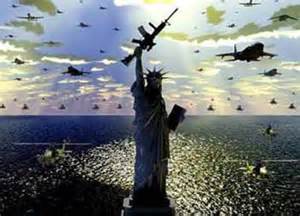
The War to End War 100 Years On: An Evaluation and Reorientation of our Resistance to War


By Robert J. Burrowes

British author and social commentator H.G. Wells may have coined the expression that originally popularized World War I as The War that Will End War, as his book, based on articles written during that vast military conflict, was titled. In any case, in one version or another, the expression was one of the most common catchphrases of the Great War of 1914-1918 and has survived as an expression, often used with a grimace of sarcasm, ever since.

As we commemorate the passing of the 100th anniversary of the armistice ending ‘the war to end war’, one can only marvel at how wrong humans can be sometimes. Not content with the violence inflicted during World War I, humans used the twentieth century to systematically decimate human and other life as violence and war raged across the planet with an increasingly massive and sophisticated armory. In fact, by mid-century, in a tribute to their technological ingenuity and psychological dysfunctionality, humans had invented a weapon that could destroy life on Earth.

And by the beginning of the 21st century, humans were living in the era of perpetual war against life – see ‘Humanity has wiped out 60% of animal populations since 1970, report finds’ and Living Planet Report 2018: Aiming Higher’ – with war also the largest contributor to the climate catastrophe: ‘Not only is the Pentagon the single largest industrial consumer of fossil fuels, but fighter jets, destroyers, tanks and other weapons systems emit highly toxic, carbon-intensive emissions, not to mention the greenhouse gases that are released from the detonation of bombs. How quickly the world forgot the toxic legacy of Saddam Hussein’s oil fires!’ See War and Climate Change: Time to Connect the Dots’.

So advanced is our war against life that human extinction is now imminent. See ‘Human Extinction by 2026? A Last Ditch Strategy to Fight for Human Survival’.


Resisting war historically

Of course, the failure to end war has not been the outcome of lack of effort. And while there have been many efforts focused on ending a particular war, efforts directed at ending a particular aspect of war (such as the use of a type of weapon), and efforts aimed at preventing a type of war (such as ‘aggressive war’ or nuclear war), there have also been ongoing efforts to achieve ‘the holy grail’: to end war itself.

These attempts have included ongoing grassroots mobilization by anti-war organizations spawned by World War I (such as the Women’s International League for Peace and Freedom founded in 1915 and War Resisters’ International founded in 1921) and many equivalents since that time, official attempts to outlaw war such as the Kellogg-Briand Pact that outlawed war in 1928 but has been ignored ever since – see League of Nations ‘Treaty Series’ vol. XCIV, 1929, p. 63 – and institutional efforts to prevent it, particularly by establishment of the League of Nations in 1920 and its successor the United Nations in 1945, both also readily ignored or manipulated.

Separately from the above, however, there has been a long history of nonviolent activism to end wars and this has been conducted by individuals and groups all over the world. Undoubtedly the most effective anti-war movement in history was that undertaken in response to the US war against Vietnam, Cambodia and Laos. Inspired and supported by the nonviolent resistance of the civilian population, and building on the long history of resistance to war within the military – see, for example, The Soldiers’ Strikes of 1919 – there was widespread nonviolent resistance undertaken by US troops and conscripts to end the US war against Vietnam, Cambodia and Laos from 1968 until it ended in 1975.

If you like, you can read detailed descriptions of the systematic and ongoing resistance (nonviolent and otherwise) within the US military, in many forms, which progressively incapacitated the US Army, Marine Corps, Navy and Air Force during the last years of the war, forcing the US out of Vietnam, Cambodia and Laos. See Soldiers in Revolt: GI Resistance During the Vietnam War and Self-Destruction: The Disintegration and Decay of the United States Army during the Vietnam Era with a summary of the first book in ‘Antiwar Resistance Within the Military During the Vietnam War’ and a review of it in ‘The soldiers’ revolt in Vietnam: Rebellion in the ranks’.

For a documentary account of the conscientious objection by more than half a million US conscripts to military service in South East Asia during this period, which overwhelmed the legal system making prosecutions beyond a token few impossible and, combined with soldier resistance and civilian efforts, forced Presidents Johnson and Nixon to curtail plans to escalate the war and make plans to end it, see the forthcoming film The Boys Who Said NO!


Reanalysing the Cause of War to Reorient our Resistance

So, if we are to use this 100th anniversary to renew our struggle to end war and to work effectively to achieve that purpose, then clearly we need to reassess our analysis of the cause(s) of war so that we understand the problem more precisely, and then use this revised analysis to guide the development and implementation of a strategy that addresses the cause(s). Of course, I am not suggesting that ending war will be easy, even with a sound analysis and a comprehensive strategy. But at least it will be feasible.

Before proceeding, I would like to record my own passion for this subject. I lost two great uncles to World War I: Tom Farrell was killed in action at Gallipoli and Les Burrowes was a victim of ‘shell shock’ – later labeled post-traumatic stress disorder – after being wounded in action three times at Gallipoli and then dying prematurely some years after the war.

My father served in World War II as a coastwatcher and both of his brothers, including his twin, were killed. I am named after my father’s older brother. Bob died when the Japanese POW ship Montevideo Maru was torpedoed by the USS Sturgeon on 1 July 1942. 1,053 Australian POWs died that night. And my father’s twin, Tom, died when his Beaufort Bomber was shot down on 14 December 1943 killing the entire crew.

So my childhood is dotted with memories of occasional commemorations of war which, for me, always ended with the same question: Why? But not just ‘why war?’ Given other manifestations of violence I observed around the world during my childhood, including exploitation of peoples in Africa, Asia and Central/South America as well as destruction of the environment, the deeper question was always my focus: ‘Why violence?’

Well, despite considerable research over three decades, I was never content with any version of the answer to this question that I found. Consequently, 14 years in seclusion with Anita McKone ‘taking our own minds apart’ finally gave me the answer I wanted. In ugly detail. If you would like to read this answer, which explains the unrelenting ‘visible’, ‘invisible’ and ‘utterly invisible’ violence that adults inflict on children and the enormous lifetime damage (including the legacy of unconscious fear, self hatred and powerlessness) that this causes, you can do so in Why Violence?’ with our process described in Fearless Psychology and Fearful Psychology: Principles and Practice.

Needless to say, understanding a problem makes developing a strategy to address it far easier (which does not mean that the problem is easy to resolve). However, it is also the case that violence has many manifestations – notably including war, violence against huge sectors of the human population in various contexts (ranging from violence against women and indigenous peoples to military occupations and dictatorships), economic exploitation and destruction of the biosphere – and tackling each of these effectively requires its own sophisticated nonviolent strategy.

This is partly because certain manifestations of violence are structural – see ‘Violence, Peace, and Peace Research’ – or cultural – see ‘Cultural Violence’ – as Professor Johan Galtung describes these terms, and they originated long ago and have been recreated and ‘built-in’ over successive centuries.

However, it is important to understand that the nature of any given structure or cultural symbol/process reflects the psychology of those who create and/or maintain it. That is, it is dysfunctionalized human beings who create and maintain dysfunctional (that is, violent and/or exploitative) structures and cultures.

So, for example, while the origin of capitalism can be explained in terms of the development of economic structures and processes that took place over preceding centuries (in a particular socio-political-legal setting), fundamentally the exploitative nature of capitalism is a direct outcome of the badly damaged psychology of those men who progressively created it and now those men (and some women) who maintain it, expand it and primarily benefit from the manner in which it exploits most others.

And if those men and women were not psychologically damaged by the violence they suffered during childhood, then they would devote their efforts to creating egalitarian economic structures and processes that benefited everyone equally and nurtured the biosphere. In short, a human being who is psychologically whole regards the idea of killing or exploiting a fellow human being as deplorable. This is not a moral stance. It is a psychological outcome for the child who is parented lovingly: such parenting produces compassionate identification with others (and, in fact, everything that lives and the biosphere as a whole).

The same reasoning applies to the institution of war particularly as it has evolved and is now conducted by western nations, led by the US, and their allies such as Israel. War is a method of conducting conflict. It has a great many components including elites who promote war-for-profit by using various channels such as ‘think tanks’, the corporate media, government propaganda and education systems to call for and ‘justify’ it, political processes to order it, legal processes to defend it (including against those who take nonviolent action against it), military command, control and communication structures to plan and implement it, corporations employing a labor force to manufacture weapons and other hardware to be used in it, military personnel to deploy and fire the weapons, and citizens willing to pay taxes (or too scared to resist doing so) to finance it.

But at every level of the institution of war, and despite vast advances in peace, conflict and nonviolence theory and practice during the past 60 years, it requires individuals who were terrorized during their childhood into believing that killing fellow human beings is an appropriate way to deal with conflict (or, a variation, that killing human beings is a reasonable way to earn a wage or make a profit). And because they are so psychologically damaged and now deeply embedded within the institution of war, consideration of alternatives to violence is only tokenistically contemplated, if at all (with occasional exceptions by those whose conscience survived the childhood violence they suffered). If you like, you can read a little more about how childhood violence creates insane individuals who perpetuate violence and war in articles such as ‘The Global Elite is Insane Revisited’ but there is plenty more on that website.

In essence, if most human beings were not so psychologically damaged by the violence inflicted on them during childhood (leaving them unconsciously terrified, self-hating and powerless), there would be a mass uprising against the barbarity of war: the large-scale industrial slaughter of people like you.


So what are we to do?

Well, if we consider war as an outcome not of political and economic differences manifesting as military violence but, fundamentally, as an outcome of psychological dysfunctionality preventing intelligent resolution of conflict, then our strategy for ending war can acquire a sophistication it must otherwise lack. Put simply, by understanding the psychological roots of violence we can develop and implement a strategy that intelligently addresses these, both in the short and medium terms.

So how do we tackle, strategically, the interrelated set of problems that constitute the institution of war?

If your primary interest is focusing on war itself, check out the Nonviolent Strategy Wheel which simply illustrates the 12-point strategic framework necessary to conduct an effective nonviolent campaign and then consider the basic list of 35 strategic goals necessary to end war. Choose one or a few goals appropriate to your circumstances and conduct a strategically-oriented nonviolent campaign, as explained on the same website, to achieve those goals.

If you are concerned that you need some form of military defense against those who might attack your country, it is actually strategically superior to use a strategy of nonviolent defense, which is explained in detail in The Strategy of Nonviolent Defense: A Gandhian Approach and presented more simply in Nonviolent Defense/Liberation Strategy. In fact, this strategic framework can be used to plan and implement a nonviolent strategy to defend against a foreign invading power or a political/military coup, to liberate your country from a dictatorship or a foreign occupation, or to defeat a genocidal assault.

As an aside, if your preferred focus is the climate catastrophe, some other assault on the biosphere or a social justice campaign of any kind, the Nonviolent Strategy website will assist you to develop a comprehensive and focused strategy.

When conducting any campaign, keep in mind a clear understanding of ‘Nonviolent Action: Why and How it Works’ and remember the distinction between The Political Objective and Strategic Goal of Nonviolent Actions’. By keeping these points in mind, your campaign (including each of your tactics) will be focused for strategic impact.

If your interest in ending war is more focused on undermining it at its source, consider making ‘My Promise to Children’ and nisteling, whenever appropriate, to children too. See ‘Nisteling: The Art of Deep Listening’.

This will mean that any children in your life are supported, at least by you, to become self-loving and powerful individuals who are immune to the seductions and indoctrination of those who advocate and make war while developing the capacity to pursue life-enhancing behavioral options when dealing with conflict.

If parenting children in this manner feels beyond you, consider allowing yourself the time to heal from the violence that you have suffered throughout your life. See Putting Feelings First’.

And don’t forget: while depending on our psychological dysfunctionality to accept, finance and conduct war as a means of dealing with conflict, at its most mundane level, war is a conflict over resources, particularly fossil fuels, strategic minerals and fresh water, and it is our consumption of these, in all of those products (such as meat and cars) and services (like airline flights) that we buy, that fuels the wars conducted in our name while also destroying the biosphere in various other ways. (If you want to understand the psychological origin of this obsession with material goods, see ‘Love Denied: The Psychology of Materialism, Violence and War’.) In short, there is no point deluding ourselves that we can subvert this violent world order without substantially reducing our consumption on all fronts.

So another way you can have strategic impact in undermining the institution of war (and capitalism), while slowing destruction of the biosphere, is to join those participating in ‘The Flame Tree Project to Save Life on Earth’. The Flame Tree Project outlines a simple plan for people to progressively reduce their consumption, by at least 80%, involving both energy and resources of every kind – water, household energy, transport fuels, metals, meat, paper and plastic – while dramatically expanding their individual and community self-reliance in 16 areas.

You might also be interested in signing the online pledge of ‘The People’s Charter to Create a Nonviolent World’ where the names of many people who are working to end war (and other violence) are already listed.

Ending war is not impossible. Far from it, in fact. But it is going to take a phenomenal amount of intelligent strategic effort, courage and commitment.


Biodata: Robert J. Burrowes has a lifetime commitment to understanding and ending human violence. He has done extensive research since 1966 in an effort to understand why human beings are violent and has been a nonviolent activist since 1981. He is the author of ‘Why Violence?’ http://tinyurl.com/whyviolence His email address is flametree@riseup.net and his website is here. http://robertjburrowes.wordpress.com

Robert J. Burrowes
P.O. Box 68
Daylesford, Victoria 3460
Australia

Email: flametree@riseup.net

Websites:
Nonviolence Charter
Flame Tree Project to Save Life on Earth
‘Why Violence?’
Feelings First
Nonviolent Campaign Strategy
Nonviolent Defense/Liberation Strategy
Anita: Songs of Nonviolence
Robert Burrowes
Global Nonviolence Network

Humanity’s ‘Dirty Little Secret’: Starving, Enslaving, Raping, Torturing and Killing our Children

© UNICEF/UN0126672/Brown
A drawing by a Rohingya boy reveals the horrific experiences he endured while fleeing from Myanmar to Bangladesh, October 2017.

By Robert J. Burrowes

In a recent article titled ‘Challenges for Resolving Complex Conflicts’, I pointed out four conflict configurations that are paid little attention by conflict theorists.

In this article, I would like to discuss a fifth conflict configuration that is effectively ignored by conflict theorists (and virtually everyone else). This conflict is undoubtedly the most fundamental conflict in human society, because it generates all of the violence humans perpetrate and experience, and yet it is utterly invisible to almost everyone.

I have previously described this conflict as ‘the adult war on children’. It is indeed humanity’s ‘dirty little secret’.

Let me illustrate and explain the nature and extent of this secret war. And what we can do about it.

Every day, according to some estimates, human adults kill 50,000 of our children. The true figure is probably significantly higher. We kill children in wars. See, for example, ‘Scourging Yemen’. We kill them with drones. We kill them in our homes and on the street. We shoot them at school.

We also kill children in vast numbers by starving them to death, depriving them of clean drinking water, denying them medicines – see, for example, ‘Malaria is alive and well and killing more than 3000 African children every day’ – or forcing them to live in a polluted environment, particularly in parts of Africa, Asia and Central/South America. Why? Because we use military violence to maintain an ‘economic’ system that allocates resources for military weapons, as well as corporate profits for the wealthy, instead of resources for living.

We also execute children in sacrificial killings after kidnapping them. We even breed children to sell as a ‘cash crop’ for sexual violation, child pornography (‘kiddie porn’) and the filming of ‘snuff’ movies (in which children are killed during the filming), torture and satanic sacrifice. And these are just some of the manifestations of the violence against children that have been happening for centuries or, in some cases, millennia. On these points, see the video evidence presented at the recent Judicial Commission of Inquiry into Human Trafficking and Child Sex Abuse organized by the International Tribunal for Natural Justice.

The opening statement by Chief Counsel Robert David Steele refers to an estimated eight million children trafficked annually – with 600,000-800,000 of these children (excluding both those bred within the USA without birth certificates and those imported without documentation) in the United States alone – and mentions such practices as ritual torture and ritual murder as well as training dogs to rape children and toddlers. He mentions the range of organizations involved from Oxfam and the Boy Scouts of America to ‘child-service’ agencies and police forces as well as various United Nations organizations, where pedophiles (those who prey on children) rise through the ranks to exercise enormous control. He also points out that many of the children bred or kidnapped into this system usually last about two years before dying (often after being raped several times each hour for some of that time) or being killed outright. He also mentions (with evidence provided in other video presentations) the forced removal of body organs from children of Falun Gong practitioners in China.

Steele, who is a former CIA operations officer, also points out that the 1,000 US military bases around the world are ‘not there for national defense; they are there to serve as lilypads for the smuggling of guns, gold, cash, drugs and small children’. The obvious and clear inference to be drawn from his statement is that the US military is heavily involved in child trafficking (as well as its well-known involvement in drug and weapons trafficking, for example), which means that vast numbers of US military personnel know about it too. And do nothing.

The compelling testimony at the Commission of Inquiry of survivor/perpetrator Ronald Bernard will give you a clear sense of the deep elite engagement (that is, the 8,000-8,500 ‘elite’ individuals running central banks, governments, secret service agencies, multinational corporations, terrorist organizations and churches) in the extraordinary violence inflicted on children, with children illegally trafficked internationally along with women, weapons, drugs, currencies, gold and wildlife.

In a particularly poignant series of moments during the interview, after he has revealed some of the staggering violence he suffered as a child at the hands of his father and the Church, Bernard specifically refers to the fact that the people engaged in these practices are terrified (and ‘serving the monster of greed’) and that, during his time as a financial entrepreneur, he was working with people who understood him as he understood them: individuals who were suffering enormously from the violence they had suffered as children themselves and who are now so full of hatred that they want to destroy life, human and otherwise. In short: they enjoy and celebrate killing people and destroying the Earth as a direct response to the violence they each suffered as a child.

There are more video testimonies by survivors, expert witnesses, research scholars in the field and others on the International Tribunal for Natural Justice website and if you want to read scholarly books documenting aspects of this staggering violence against children then see, for example, ‘Childhunters: Requiem of a Child-killer’ and ‘Epidemic: America’s Trade in Child Rape’.

For further accounts of the systematic exploitation, rape, torture and murder of children over a lengthy period, which focuses on Canada’s indigenous peoples, Rev. Kevin Annett’s evocative report ‘Hidden from History: The Canadian Holocaust – The Untold Story of the Genocide of Aboriginal Peoples by Church and State in Canada’, and his books ‘Unrelenting’ and ‘Murder by Decree: The Crime of Genocide in Canada’ use eyewitness testimonies and archival documentation to provide ‘an uncensored record of the planned extermination of indigenous children in Canada’s murderous “Indian residential schools”’ from 1889 to 1996.

Apart from what happened in the Indian Residential Schools during this period, however, the books also offer extensive evidence documenting the ongoing perpetration of genocide, including child rape, torture and killing, against Canada’s indigenous peoples by its government, the Royal Canadian Mounted Police and the Catholic, Anglican and United Churches since the 19th century. Sadly, there is plenty more in Kevin’s various books and on the website of the International Tribunal into Crimes of Church and State which also explain the long-standing involvement of the Vatican in these genocidal crimes against children.

Of course, Canada is not alone in its unrelenting violence against indigenous children (and indigenous peoples generally). The United States and Australia, among many others, also have long records of savagery in destroying the lives of indigenous children, fundamentally by taking their land and destroying their culture, traditional livelihoods and spirituality. And when indigenous people do not simply abandon their traditional way of being and adopt the dominant model, they are blamed and persecuted even more savagely, as the record clearly demonstrates.

Moreover, institutional violence against children is not limited to the contexts and settings mentioned above. In the recently conducted Royal Commission into Institutional Responses to Child Sexual Abuse undertaken in Australia, childcare services, schools, health and allied services, youth detention, residential care and contemporary out-of-home services, religious activities, family and youth support services, supported accommodation, sporting, recreational and club activities, youth employment, and the military forces were all identified as providing contexts for perpetrating violence against children.

Over half of the survivors suffered sexual violation in an institution managed by a religious organization such as places of worship and for religious instruction, missions, religious schools, orphanages, residential homes, recreational clubs, youth groups, and welfare services. Another one-third of survivors suffered the violence in an institution under government management such as a school, an out-of-home care service, a youth detention centre or at a health service centre. The remaining 10% suffered violence in a private organization such as a child care centre, a medical practice or clinic, a music or dance school, an independent school, a yoga ashram or a sports club, a non-government or not-for-profit organization.

Needless to say, the failure to respond to any of this violence for the past century by any of the institutions ‘responsible’ for monitoring, oversight and criminal justice, such as the police, law enforcement and agencies responsible for public prosecution, clearly demonstrates that mechanisms theoretically designed to protect children (and adults) do not function when those same institutions are complicit in the violence and are, in any case, designed to defend elite interests (not ‘ordinary’ people and children). Hence, of course, this issue was not even investigated by the Commission because it was excluded from the terms of reference!

Separately from those children we kill or violate every day in the ways briefly described above, we traffic many others into sexual slavery – such as those trafficked (sometimes by their parents) into prostitution to service the sex tourism industry in countries such as Thailand, Cambodia, the Dominican Republic, the Philippines and India – we kidnap others to terrorize them into becoming child soldiers with 46 countries using them according to Child Soldiers International, we force others to work as slave laborers, in horrific conditions, in fields, factories and mines (and buy the cheap products of their exploited labor as our latest ‘bargain’) with Human Rights Watch reporting over 70,000,000 children, including many who aren’t even, technically-speaking, slaves, working in ‘hazardous conditions’ – see ‘Child Labor’ – and we condemn millions to live in poverty, homelessness and misery because national governments, despite rhetoric to the contrary, place either negligible or no value on children apart from, in some cases, as future wage slaves in the workforce.

We also condemn millions of children, such as those in Palestine, Tibet, Western Sahara and West Papua, to live under military occupation, where many are routinely imprisoned, shot or killed.

In addition, while fighting wars we cause many children to be born with grotesque genetic deformities because we use horrific weapons, like those with depleted uranium, on their parents. See ‘“Falluja Babies” and Depleted Uranium: America’s Toxic Legacy in Iraq’ and ‘Depleted uranium used by US forces blamed for birth defects and cancer in Iraq’.

In other cases, we cause children shockingly debilitating injuries, if they are not killed outright, by using conventional, biological and chemical weapons on them directly. See ‘Summary of historical attacks using chemical or biological weapons’.

But war also destroys housing and other infrastructure forcing millions of children to become internally displaced or refugees in another country (often without a living parent), causing ongoing trauma. Worldwide, one child out of every 200 is a refugee, whether through war or poverty, environmental or climate disruption. See ‘50mn children displaced by war & poverty worldwide’.

We also inflict violence on children in many other forms, ranging from ‘ordinary’ domestic violence to genital mutilation, with UNICEF calculating that 200 million girls and young women in 30 countries on three continents have been mutilated. See ‘Female genital mutilation/cutting’.

And we deny children a free choice (even those who supposedly live in a ‘democracy’) and imprison vast numbers of them in school in the delusional belief that this is good for them. See ‘Do We Want School or Education?’ Whatever other damage that school does, it certainly helps to create the next generation of child-destroyers. And, in many countries, we just imprison children in our jails. After all, the legal system is no more than an elite tool to control ‘ordinary’ people while shielding the elite from accountability for their grotesque violence against us all. See ‘The Rule of Law: Unjust and Violent’.

While almost trivial by comparison with the violence identified above, the perversity of many multinational corporations in destroying our children’s health is graphically illustrated in the film ‘Global Junk Food’. In Europe, food manufacturers have signed up to ‘responsibility pledges’, promising not to add sugar, preservatives, artificial colours or flavours to their products and to not target children.

However, the developing world is not in Europe so these ‘responsibility pledges’ obviously do not apply and corporations such as Coca-Cola, McDonald’s, Kentucky Fried Chicken and Domino’s Pizza sell their junk food in developing countries (with the video above showcasing Brazil and India) loaded with excess oil, salt and sugar and even using fake cheese.

The well-documented report reveals corporations like these to be nothing more than drug dealers, selling toxic food to ill-informed victims that deliver a lifetime of diabetes and obesity to huge numbers of children. So, just as weapons corporations derive their profits from killing children (and adults), junk food corporations derive their profits from destroying the health of children (and adults). Of course, the medical industry, rather than campaigning vigorously against this outrage, prefers to profit from it too by offering ‘treatments’, including the surgical removal of fat, which offer nothing more than temporary but very profitable ‘relief’.

But this is far from representing the only active involvement of the medical industry in the extraordinary violence we inflict on children. For example, western children and many others are rarely spared a plethora of vaccinations which systematically destroy a child’s immune system, thus making their health ongoingly vulnerable to later assaults on their well-being. For a taste of the vast literature on this subject, see ‘Clinical features in patients with long-lasting macrophagic myofasciitis’, ‘Vaccines: Who’s Allergic To Thimerosal (Mercury), Raise Your Hand’ and ‘Vaccine Free Health’.

And before we leave the subject of food too far behind, it should be noted that just because the junk food sold in Europe and some other western countries has less fat, salt, sugar, preservatives and artificial colors and flavours in it, this does not mean that it is healthy. It still has various combinations of added fat, salt, sugar, preservatives and artificial colors and flavours in it.

Separately from this: don’t forget that virtually all parents are systematically poisoning their children by feeding them food grown by the corporate agribusiness giants which is heavily depleted of nutrients and laced with poisons such as glyphosate. For a taste of the vast literature, see ‘The hidden truth about glyphosate EXPOSED, according to undeniable scientific evidence’. Of course, in many countries we are also forcing our children to drink fluoridated water to the detriment of their health too. See Research Exposes How our Water is Making us Depressed, Sick: Fluoridated water is much to blame’.

Obviously, organically/biodynamically grown food, healthily prepared, and unfluoridated water are not health priorities for their children, according to most parents.

As our ultimate act of violence against all children, we are destroying their future. See ‘Killing the Biosphere to Fast-track Human Extinction’.

So how do we do all of this?

Very easily, actually. It works like this.

Perpetrators of violence learn their craft in childhood. If you inflict violence on a child, they learn to inflict violence on others. The child rapist and ritual child killer suffered violence as a child. The terrorist suffered violence as a child. The political leader who wages war suffered violence as a child. The man who inflicts violence on women suffered violence as a child. The corporate executive who exploits working class people and/or those who live in Africa, Asia or Central/South America suffered violence as a child. The racist and religious bigot suffered violence as a child. The soldier who kills in war suffered violence as a child. The individual who perpetrates violence in the home, in the schoolyard or on the street suffered violence as a child. The parent who inflicts violence on their own children suffered violence as a child.

So if we want to end violence, exploitation, ecological destruction and war, then we must finally admit our ‘dirty little secret’ and end our longest and greatest war: the adult war on children. And here is an incentive: if we do not tackle the fundamental cause of violence, then our combined and unrelenting efforts to tackle all of its other symptoms must ultimately fail. And extinction at our own hand is inevitable.

How can I claim that violence against children is the fundamental cause of all other violence? Consider this. There is universal acceptance that behavior is shaped by childhood experience. If it was not, we would not put such effort into education and other efforts to ‘socialize’ children to fit into society. And this is why many psychologists have argued that exposure to war toys and violent video games shapes attitudes and behaviors in relation to violence.

But it is far more complex than these trivialities suggest and, strange though it may seem, it is not just the ‘visible’ violence (such as hitting, screaming at and sexually abusing) that we normally label ‘violence’ that causes the main damage, although this is extremely damaging. The largest component of damage arises from the ‘invisible’ and ‘utterly invisible’ violence that we adults unconsciously inflict on children during the ordinary course of the day. Tragically, the bulk of this violence occurs in the family home and at school. See Why Violence? and Fearless Psychology and Fearful Psychology: Principles and Practice.

So what is ‘invisible’ violence? It is the ‘little things’ we do every day, partly because we are just ‘too busy’. For example, when we do not allow time to listen to, and value, a child’s thoughts and feelings, the child learns to not listen to themSelf thus destroying their internal communication system. When we do not let a child say what they want (or ignore them when they do), the child develops communication and behavioral dysfunctionalities as they keep trying to meet their own needs (which, as a basic survival strategy, they are genetically programmed to do).

When we blame, condemn, insult, mock, embarrass, shame, humiliate, taunt, goad, guilt-trip, deceive, lie to, bribe, blackmail, moralize with and/or judge a child, we both undermine their sense of Self-worth and teach them to blame, condemn, insult, mock, embarrass, shame, humiliate, taunt, goad, guilt-trip, deceive, lie, bribe, blackmail, moralize and/or judge.

The fundamental outcome of being bombarded throughout their childhood by this ‘invisible’ violence is that the child is utterly overwhelmed by feelings of fear, pain, anger and sadness (among many others). However, mothers, fathers, teachers, religious figures and other adults also actively interfere with the expression of these feelings and the behavioral responses that are naturally generated by them and it is this ‘utterly invisible’ violence that explains why the dysfunctional behavioral outcomes actually occur.

For example, by ignoring a child when they express their feelings, by comforting, reassuring or distracting a child when they express their feelings, by laughing at or ridiculing their feelings, by terrorizing a child into not expressing their feelings (e.g. by screaming at them when they cry or get angry), and/or by violently controlling a behavior that is generated by their feelings (e.g. by hitting them, restraining them or locking them into a room), the child has no choice but to unconsciously suppress their awareness of these feelings.

However, once a child has been terrorized into suppressing their awareness of their feelings (rather than being allowed to have their feelings and to act on them) the child has also unconsciously suppressed their awareness of the reality that caused these feelings. This has many outcomes that are disastrous for the individual, for society and for nature because the individual will now easily suppress their awareness of the feelings that would tell them how to act most functionally in any given circumstance and they will progressively acquire a phenomenal variety of dysfunctional behaviors, including some that are violent towards themself, others and/or the Earth.

From the above, it should also now be apparent that punishment should never be used. ‘Punishment’, of course, is one of the words we use to obscure our awareness of the fact that we are using violence. Violence, even when we label it ‘punishment’, scares children and adults alike and cannot elicit a functional behavioural response. See ‘Punishment is Violent and Counterproductive’.

If someone behaves dysfunctionally, they need to be listened to, deeply, so that they can start to become consciously aware of the feelings (which will always include fear and, often, terror) that drove the dysfunctional behavior in the first place. They then need to feel and express these feelings (including any anger) in a safe way. Only then will behavioral change in the direction of functionality be possible. See ‘Nisteling: The Art of Deep Listening’.

‘But these adult behaviors you have described don’t seem that bad. Can the outcome be as disastrous as you claim?’ you might ask. The problem is that there are hundreds of these ‘ordinary’, everyday behaviors that destroy the Selfhood of the child. It is ‘death by a thousand cuts’ and most children simply do not survive as Self-aware individuals. And why do we do this? We do it so that each child will fit into our model of ‘the perfect citizen’: that is, obedient and hardworking student, reliable and pliant employee/soldier, and submissive law-abiding citizen. In other words: a slave.

Of course, once we destroy the Selfhood of a child, it has many flow-on effects. For example, once you terrorize a child into accepting certain information about themself, other people or the state of the world, the child becomes unconsciously fearful of dealing with new information, especially if this information is contradictory to what they have been terrorized into believing. As a result, the child will unconsciously dismiss new information out of hand.

In short, the child has been terrorized in such a way that they are no longer capable of thinking critically or even learning (or their learning capacity is seriously diminished by excluding any information that is not a simple extension of what they already ‘know’). If you imagine any of the bigots you know, you are imagining someone who is utterly terrified. But it’s not just the bigots; virtually all people are affected in this manner making them incapable of responding adequately to new (or even important) information. This is one explanation why many people are ‘climate deniers’ and most others do nothing in response to the climate catastrophe.

Of course, each person’s experience of violence during childhood is unique and this is why each perpetrator becomes violent in their own particular combination of ways.

But if you want to understand the core psychology of all perpetrators of violence, it is important to understand that, as a result of the extraordinary violence they each suffered during childhood, they are now (unconsciously) utterly terrified, full of self-hatred and personally powerless, among another 20 psychological characteristics. You can read a brief outline of these characteristics and how they are acquired on pages 12-16 of Why Violence?’

As should now be clear, the central point in understanding violence is that it is psychological in origin and hence any effective response must enable both the perpetrator’s and the victim’s suppressed feelings (which will include enormous fear about, and rage at, the violence they have suffered) to be safely expressed. As mentioned above, for an explanation of what is required, see ‘Nisteling: The Art of Deep Listening’.

Unfortunately, this nisteling cannot be provided by a psychiatrist or psychologist whose training is based on a delusionary understanding of how the human mind functions. See ‘Defeating the Violence of Psychiatry’ and ‘Psychiatry: Science or Fraud? The professor’s trick that exposed the ongoing Psychiatry racket…’ Nisteling will enable those who have suffered from psychological trauma to heal fully and completely, but it will take time.

So if we want to end violence (including the starvation, trafficking, rape, torture and killing of children), exploitation, ecological destruction and war, then we must tackle the fundamental cause. Primarily, this means giving everyone, child and adult alike, all of the space they need to feel, deeply, what they want to do, and to then let them do it (or to have the feelings they naturally have if they are prevented from doing so). See ‘Putting Feelings First’. In the short term, this will have some dysfunctional outcomes. But it will lead to an infinitely better overall outcome than the system of emotional suppression, control and punishment which has generated the incredibly violent world in which we now find ourselves.

This all sounds pretty unpalatable doesn’t it? So each of us has a choice. We can suppress our awareness of what is unpalatable, as we have been terrorized into doing as a child, or we can feel the various feelings that we have in response to this information and then ponder (personal and collective) ways forward.

If feelings are felt and expressed then our responses can be shaped by the conscious and integrated functioning of thoughts and feelings, as evolution intended, and we can plan intelligently. The alternative is to have our unconscious fear controlling our thinking and deluding us that we are acting rationally.

It is time to end the most fundamental conflict that is destroying human society from within – the adult war on children – so that we can more effectively tackle all of the other violence that emerges from this cause too.

So what do we do?

Let me briefly reiterate.

If you are willing, you can make the commitment outlined in ‘My Promise to Children’. If you need to do some healing of your own to be able to nurture children in this way, then consider the information provided in the article ‘Putting Feelings First’.

In addition, you are also welcome to consider participating in ‘The Flame Tree Project to Save Life on Earth’ which maps out a fifteen-year strategy for creating a peaceful, just and sustainable world community so that all children (and everyone else) has an ecologically viable planet on which to live.

You might also consider supporting or even working with organizations like Destiny Rescue, which works to rescue children trafficked into prostitution, or any of the many advocacy organizations associated with the network of End Child Prostitution and Trafficking.

But for the plethora of other manifestations of violence against children identified above, you might consider using Gandhian nonviolent strategy in any context of particular concern to you. See Nonviolent Campaign Strategy or Nonviolent Defense/Liberation Strategy. And, if you like, you can join the worldwide movement to end all violence by signing online ‘The People’s Charter to Create a Nonviolent World’.

In summary: Each one of us has an important choice. We can acknowledge the painful truth that we inflict enormous violence on our children (which then manifests in a myriad complex ways) and respond powerfully to that truth. Or we can keep deluding ourselves and continue to observe, powerlessly, as the violence in our world proliferates until human beings are extinct.

If you want a child who is nonviolent, truthful, compassionate, considerate, patient, thoughtful, respectful, generous, loving of themself and others, trustworthy, honest, dignified, determined, courageous, powerful and who lives out their own unique destiny, then the child must be treated with – and experience – nonviolence, truth, compassion, consideration, patience, thoughtfulness, respect, generosity, love, trust, honesty, dignity, determination, courage, power and, ideally, live in a world that prioritizes nurturing the unique destiny of each child.

Alternatively, if you want a child to turn out like the perpetrators of violence described above, to be powerless to respond effectively to the crises in our world, or to even just turn out to be an appalling parent, then inflict violence – visible, ‘invisible’ and ‘utterly invisible’ – on them during their childhood.

Tragically, with only the rarest of exceptions, human adults are too terrified to truly love, nurture and defend our children from the avalanche of violence that is unleashed on them at the moment of birth.


Biodata: Robert J. Burrowes has a lifetime commitment to understanding and ending human violence. He has done extensive research since 1966 in an effort to understand why human beings are violent and has been a nonviolent activist since 1981. He is the author of Why Violence? His email address is flametree@riseup.net and his website is here.

Robert J. Burrowes
P.O. Box 68
Daylesford, Victoria 3460
Australia

Email: flametree@riseup.net

Websites:
Nonviolence Charter
Flame Tree Project to Save Life on Earth
‘Why Violence?’
Feelings First
Nonviolent Campaign Strategy
Nonviolent Defense/Liberation Strategy
Anita: Songs of Nonviolence
Robert Burrowes
Global Nonviolence Network

U.S. WARS AND HOSTILE ACTIONS: A LIST

By David Swanson

Source: Let’s Try Democracy

There is a reason that most countries polled in December 2013 by Gallup called the United States the greatest threat to peace in the world, and why Pew found that viewpoint increased in 2017.

But it is a reason that eludes that strain of U.S. academia that first defines war as something that nations and groups other than the United States do, and then concludes that war has nearly vanished from the earth.

Since World War II, during a supposed golden age of peace, the United States military has killed some 20 million people, overthrown at least 36 governments, interfered in at least 82 foreign elections, attempted to assassinate over 50 foreign leaders, and dropped bombs on people in over 30 countries. The United States is responsible for the deaths of 5 million people in Vietnam, Laos, and Cambodia, and over 1 million just since 2003 in Iraq.

For the past almost 16 years, the United States has been systematically destroying a region of the globe, bombing Afghanistan, Iraq, Pakistan, Libya, Somalia, Yemen, and Syria, not to mention the Philippines. The United States has “special forces” operating in two-thirds of the world’s countries and non-special forces in three-quarters of them.

In an attempt to quantify U.S. warmaking, I’ve copied below lists from these sources:

>> William Blum: America’s Deadliest Export: Democracy
>> Dr. Zoltan Grossman: A Century of U.S. Military Interventions
>> 
James Lucas: U.S. Has Killed More Than 20 Million People

The supreme international crime according to 2017 U.S. media reporting is interferring nonviolently in a democratic election — at least if Russia does it. William Blum, in his book Rogue State, lists over 30 times that the United States has done that. Another study, however, says 81 elections in 47 countries. France 2017 makes that total at least 82.

In a reality-based assessment of U.S. crimes, the serious offenses begin beyond that threshold. Here’s Blum’s list of over 50 foreign leaders whom the United States has attempted to assassinate:

  • 1949 – Kim Koo, Korean opposition leader
  • 1950s – CIA/Neo-Nazi hit list of more than 200 political figures in West Germany to be “put out of the way” in the event of a Soviet invasion
  • 1950s – Chou En-lai, Prime minister of China, several attempts on his life
  • 1950s, 1962 – Sukarno, President of Indonesia
  • 1951 – Kim Il Sung, Premier of North Korea
  • 1953 – Mohammed Mossadegh, Prime Minister of Iran
  • 1950s (mid) – Claro M. Recto, Philippines opposition leader
  • 1955 – Jawaharlal Nehru, Prime Minister of India
  • 1957 – Gamal Abdul Nasser, President of Egypt
  • 1959, 1963, 1969 – Norodom Sihanouk, leader of Cambodia
  • 1960 – Brig. Gen. Abdul Karim Kassem, leader of Iraq
  • 1950s-70s – José Figueres, President of Costa Rica, two attempts on his life
  • 1961 – Francois “Papa Doc” Duvalier, leader of Haiti
  • 1961 – Patrice Lumumba, Prime Minister of the Congo (Zaire)
  • 1961 – Gen. Rafael Trujillo, leader of Dominican Republic
  • 1963 – Ngo Dinh Diem, President of South Vietnam
  • 1960s-70s – Fidel Castro, President of Cuba, many attempts on his life
  • 1960s – Raúl Castro, high official in government of Cuba
  • 1965 – Francisco Caamaño, Dominican Republic opposition leader
  • 1965-6 – Charles de Gaulle, President of France
  • 1967 – Che Guevara, Cuban leader
  • 1970 – Salvador Allende, President of Chile
  • 1970 – Gen. Rene Schneider, Commander-in-Chief of Army, Chile
  • 1970s, 1981 – General Omar Torrijos, leader of Panama
  • 1972 – General Manuel Noriega, Chief of Panama Intelligence
  • 1975 – Mobutu Sese Seko, President of Zaire
  • 1976 – Michael Manley, Prime Minister of Jamaica
  • 1980-1986 – Muammar Qaddafi, leader of Libya, several plots and attempts upon his life
  • 1982 – Ayatollah Khomeini, leader of Iran
  • 1983 – Gen. Ahmed Dlimi, Moroccan Army commander
  • 1983 – Miguel d’Escoto, Foreign Minister of Nicaragua
  • 1984 – The nine comandantes of the Sandinista National Directorate
  • 1985 – Sheikh Mohammed Hussein Fadlallah, Lebanese Shiite leader (80 people killed in the attempt)
  • 1991 – Saddam Hussein, leader of Iraq
  • 1993 – Mohamed Farah Aideed, prominent clan leader of Somalia
  • 1998, 2001-2 – Osama bin Laden, leading Islamic militant
  • 1999 – Slobodan Milosevic, President of Yugoslavia
  • 2002 – Gulbuddin Hekmatyar, Afghan Islamic leader and warlord
  • 2003 – Saddam Hussein and his two sons
  • 2011 – Muammar Qaddafi, leader of Libya

Let me know of any updates or corrections, and I’ll add them.
Thanks to Said Zulficar for pointing out the need to add Jaime Roldos, President of Ecuador, assassinated May 1981.

Here is Blum’s list of U.S. attempts to overthrow governments (* indicates success):

  • China 1949 to early 1960s
  • Albania 1949-53
  • East Germany 1950s
  • Iran 1953 *
  • Guatemala 1954 *
  • Costa Rica mid-1950s
  • Syria 1956-7
  • Egypt 1957
  • Indonesia 1957-8
  • British Guiana 1953-64 *
  • Iraq 1963 *
  • North Vietnam 1945-73
  • Cambodia 1955-70 *
  • Laos 1958 *, 1959 *, 1960 *
  • Ecuador 1960-63 *
  • Congo 1960 *
  • France 1965
  • Brazil 1962-64 *
  • Dominican Republic 1963 *
  • Cuba 1959 to present
  • Bolivia 1964 *
  • Indonesia 1965 *
  • Ghana 1966 *
  • Chile 1964-73 *
  • Greece 1967 *
  • Costa Rica 1970-71
  • Bolivia 1971 *
  • Australia 1973-75 *
  • Angola 1975, 1980s
  • Zaire 1975
  • Portugal 1974-76 *
  • Jamaica 1976-80 *
  • Seychelles 1979-81
  • Chad 1981-82 *
  • Grenada 1983 *
  • South Yemen 1982-84
  • Suriname 1982-84
  • Fiji 1987 *
  • Libya 1980s
  • Nicaragua 1981-90 *
  • Panama 1989 *
  • Bulgaria 1990 *
  • Albania 1991 *
  • Iraq 1991
  • Afghanistan 1980s *
  • Somalia 1993
  • Yugoslavia 1999-2000 *
  • Ecuador 2000 *
  • Afghanistan 2001 *
  • Venezuela 2002 *
  • Iraq 2003 *
  • Haiti 2004 *
  • Somalia 2007 to present
  • Honduras 2009
  • Libya 2011 *
  • Syria 2012
  • Ukraine 2014 *
    [arguably, Syria 1949 needs to be added to this list. –DS]

The above list does not include numerous coups by U.S.-trained fighters, such as (other than Honduras) those discussed here: “from Isaac Zida of Burkina Faso, Haiti’s Philippe Biamby, and Yahya Jammeh of The Gambia to Egypt’s Abdel-Fattah el-Sisi, Mohammad Zia-ul-Haq of Pakistan, and the IMET-educated leaders of the 2009 coup in Honduras, not to mention Mali’s Amadou Sanogo.” These are just in very recent years, by no means a complete list, though the Haiti coup referenced here was earlier than the one included in the list above.

Here is Blum’s list of nations bombed by the United States:

  • Korea and China 1950-53 (Korean War)
  • Guatemala 1954
  • Indonesia 1958
  • Cuba 1959-1961
  • Guatemala 1960
  • Congo 1964
  • Laos 1964-73
  • Vietnam 1961-73
  • Cambodia 1969-70
  • Guatemala 1967-69
  • Grenada 1983
  • Lebanon 1983, 1984 (both Lebanese and Syrian targets)
  • Libya 1986
  • El Salvador 1980s
  • Nicaragua 1980s
  • Iran 1987
  • Panama 1989
  • Iraq 1991 (Persian Gulf War)
  • Kuwait 1991
  • Somalia 1993
  • Bosnia 1994, 1995
  • Sudan 1998
  • Afghanistan 1998
  • Yugoslavia 1999
  • Yemen 2002
  • Iraq 1991-2003 (US/UK on regular basis)
  • Iraq 2003-2015
  • Afghanistan 2001-2015
  • Pakistan 2007-2015
  • Somalia 2007-8, 2011
  • Yemen 2009, 2011
  • Libya 2011, 2015
  • Syria 2014-2016

[Drone strikes in the Philippines should be added to this list. As perhaps should be all the islands and territories destroyed by test bombings. –DS]

Blum adds these further bombings:

Iran, April 2003 – hit by US missiles during bombing of Iraq, killing at least one person

Pakistan, 2002-03 – bombed by US planes several times as part of combat against the Taliban and other opponents of the US occupation of Afghanistan

China, 1999 – its heavily bombed embassy in Belgrade is legally Chinese territory, and it appears rather certain that the bombing was no accident (see chapter 25 of Rogue State)

France, 1986 – After the French government refused the use of its air space to US warplanes headed for a bombing raid on Libya, the planes were forced to take another, longer route; when they reached Libya they bombed so close to the French embassy that the building was damaged and all communication links knocked out.

Philadelphia, Pennsylvania, May 13, 1985 – A bomb dropped by a police helicopter burned down an entire block, some 60 homes destroyed, 11 dead, including several small children. The police, the mayor’s office, and the FBI were all involved in this effort to evict a black organization called MOVE from the house they lived in.

If we add in other missing instances and go back to and prior to WWII the list starts to look like this:

Dominican Republic 1915 – 1935
Haiti 1915 – 1934
Logan County, West Virginia 1921
Tulsa, Oklahoma 1921
Honduras 1924, 1925
Nicaragua 1927 – 1933
Algeria, Austria, Belgium, Bulgaria, China, Crete, Czechoslovakia, France, Germany, Greece, Guam, Hungary, Indonesia, Italy, Japan, Libya, Luxembourg, Morocco, Myanmar (Burma), Netherlands, New Guinea and the Solomon Islands, Okinawa, Philippines, Poland, Romania, Saipan, Taiwan (Formosa), Thailand, Tinian, Tunisia, Vietnam (French Indochina), Yugoslavia 1941 – 1945
Marshall Islands, Republic of Kiribati, Alaska, Nevada, Colorado, Mississippi, New Mexico nuclear testing 1945 – 1962
Korea and China 1950 – 1953
Guatemala 1954
Indonesia 1958
Cuba 1959 – 1961
Guatemala 1960
Congo 1964
Laos 1964 – 1973
Vietnam 1961 – 1973
Cambodia 1969 – 1970
Guatemala 1967 – 1969
El Salvador 1980s
Nicaragua 1980s
Grenada 1983
Lebanon 1983, 1984
Libya 1986
Philadelphia, Pennsylvania 1985
Iran 1987
Panama 1989
Kuwait 1991
Iraq 1991 – 2017
Somalia 1993
Bosnia 1994, 1995
Sudan 1998
Afghanistan 1998
Yugoslavia 1999
Afghanistan 2001 – 2017
Yemen 2002
Pakistan 2002 – 2003
Iran 2003
Pakistan 2007 – 2017
Somalia 2007 – 2008, 2011
Yemen 2009, 2011, 2016-2017
Libya 2011, 2015 – 2017
Philippines 2012
Syria 2014 – 2017

Then there’s Blum’s list of instances of the United States attempting to suppress a populist or nationalist movement (* indicates success):

  • China – 1945-49
  • France – 1947 *
  • Italy – 1947-1970s *
  • Greece – 1947-49 *
  • Philippines – 1945-53 *
  • Korea – 1945-53 *
  • Haiti – 1959 *
  • Laos – 1957-73
  • Vietnam – 1961-73
  • Thailand – 1965-73 *
  • Peru – 1965 *
  • Dominican Republic – 1965 *
  • Uruguay – 1969-72 *
  • South Africa – 1960s-1980s
  • East Timor – 1975-1999 *
  • Philippines – 1970s-1990s *
  • El Salvador – 1980-92 *
  • Colombia – 1990s to early 2000s *
  • Peru – 1997 *
  • Iraq – 2003 to present *

Zoltan Grossman provides the following list of all variety of hostile actions:

IRAN 1946, Nuclear threat, Soviet troops told to leave north.
YUGOSLAVIA 1946, Nuclear threat, naval Response to shoot-down of U.S. plane.
URUGUAY 1947, Nuclear threat, Bombers deployed as show of strength.
GREECE 1947-49, Command operation, U.S. directs extreme-right in civil war.
GERMANY 1948, Nuclear Threat, Atomic-capable bombers guard Berlin Airlift.
CHINA 1948-49, Troops/Marines evacuate Americans before Communist victory.
PHILIPPINES 1948-54, Command operation, CIA directs war against Huk Rebellion.
PUERTO RICO 1950, Command operation, Independence rebellion crushed in Ponce.
KOREA 1951-53 (-?), Troops, naval, bombing , nuclear threats, U.S./So. Korea fights China/No. Korea to stalemate; A-bomb threat in 1950, and against China in 1953. Still have bases.
IRAN 1953, Command Operation, CIA overthrows democracy, installs Shah.
VIETNAM 1954, Nuclear threat, French offered bombs to use against seige.
GUATEMALA 1954, Command operation, bombing, nuclear threat CIA directs exile invasion after new gov’t nationalized U.S. company lands; bombers based in Nicaragua.
EGYPT 1956, Nuclear threat, troops Soviets told to keep out of Suez crisis; Marines evacuate foreigners.
LEBANON l958, Troops, naval Army & Marine occupation against rebels.
IRAQ 1958, Nuclear threat, Iraq warned against invading Kuwait.
CHINA l958 Nuclear threat, China told not to move on Taiwan isles.
PANAMA 1958 Troops, Flag protests erupt into confrontation.
VIETNAM l960-75 Troops, naval, bombing, nuclear threats Fought South Vietnam revolt & North Vietnam, one million killed in longest U.S. war; atomic bomb threats in l968 and l969.
CUBA l961 Command operation, CIA-directed exile invasion fails.
GERMANY l961 Nuclear threat, Alert during Berlin Wall crisis.
LAOS 1962 Command operation, Military buildup during guerrilla war.
CUBA l962 Nuclear threat, naval Blockade during missile crisis; near-war with Soviet Union.
IRAQ 1963 Command operation, CIA organizes coup that killed president, brings Ba’ath Party to power, and Saddam Hussein back from exile to be head of the secret service.
PANAMA l964, Troops Panamanians shot for urging canal’s return.
INDONESIA l965, Command operation, Million killed in CIA-assisted army coup.
DOMINICAN REPUBLIC 1965-66, Troops, bombing Army & Marines land during election campaign.
GUATEMALA l966-67, Command operation, Green Berets intervene against rebels.
DETROIT l967, Troops, Army battles African Americans, 43 killed.
UNITED STATES l968 Troops After King is shot; over 21,000 soldiers in cities.
CAMBODIA l969-75, Bombing, troops, naval Up to 2 million killed in decade of bombing, starvation, and political chaos.
OMAN l970, Command operation, U.S. directs Iranian marine invasion.
LAOS l971-73, Command operation, bombing U.S. directs South Vietnamese invasion; “carpet-bombs” countryside.
SOUTH DAKOTA,  l973 Command operation, Army directs Wounded Knee siege of Lakotas.
MIDEAST 1973, Nuclear threat, World-wide alert during Mideast War.
CHILE 1973, Command operation, CIA-backed coup ousts elected marxist president.
CAMBODIA l975, Troops, bombing Gassing of captured ship Mayagüez, 28 troops die when copter shot down.
ANGOLA l976-9,2 Command operation, CIA assists South African-backed rebels.
IRAN l980 Troops, nuclear threat, aborted bombing Raid to rescue Embassy hostages; 8 troops die in copter-plane crash. Soviets warned not to get involved in revolution.
LIBYA l981, Naval jets Two Libyan jets shot down in maneuvers.
EL SALVADOR l981-92 , Command operation, troops Advisors, overflights aid anti-rebel war, soldiers briefly involved in hostage clash.
NICARAGUA l981-90, Command operation, naval CIA directs exile (Contra) invasions, plants harbor mines against revolution.
LEBANON l982-84, Naval, bombing, troops Marines expel PLO and back Phalangists, Navy bombs and shells Muslim positions. 241 Marines killed when Shi’a rebel bombs barracks.
GRENADA l983-84, Troops, bombing Invasion four years after revolution.
HONDURAS, l983-89, Troops, Maneuvers help build bases near borders.
IRAN, l984 Jets, Two Iranian jets shot down over Persian Gulf.
LIBYA l986 Bombing, naval Air strikes to topple Qaddafi gov’t.
BOLIVIA 1986 Troops, Army assists raids on cocaine region.
IRAN l987-88 Naval bombing, US intervenes on side of Iraq in war, defending reflagged tankers and shooting down civilian jet.
LIBYA 1989, Naval jets, Two Libyan jets shot down.
VIRGIN ISLANDS 1989, Troops, St. Croix Black unrest after storm.
PHILIPPINES 1989, Jets Air, cover provided for government against coup.
PANAMA 1989, Troops, bombing,  Nationalist government ousted by 27,000 soldiers, leaders arrested, 2000+ killed.
LIBERIA 1990, Troops, Foreigners evacuated during civil war.
SAUDI ARABIA, 1990-91, Troops, jets Iraq countered after invading Kuwait. 540,000 troops also stationed in Oman, Qatar, Bahrain, UAE, Israel.
IRAQ 1990-91 Bombing, troops, naval Blockade of Iraqi and Jordanian ports, air strikes; 200,000+ killed in invasion of Iraq and Kuwait; large-scale destruction of Iraqi military.
KUWAIT 1991 Naval, bombing, troops Kuwait royal family returned to throne.
IRAQ 1991-2003 Bombing, naval No-fly zone over Kurdish north, Shiite south; constant air strikes and naval-enforced economic sanctions
LOS ANGELES 1992 Troops Army, Marines deployed against anti-police uprising.
SOMALIA 1992-94 Troops, naval, bombing U.S.-led United Nations occupation during civil war; raids against one Mogadishu faction.
YUGOSLAVIA 1992-94 Naval NATO blockade of Serbia and Montenegro.
BOSNIA 1993-? Jets, bombing No-fly zone patrolled in civil war; downed jets, bombed Serbs.
HAITI 1994 Troops, naval Blockade against military government; troops restore President Aristide to office three years after coup.
ZAIRE (CONGO) 1996-97 Troops Troops at Rwandan Hutu refugee camps, in area where Congo revolution begins.
LIBERIA 1997 Troops Soldiers under fire during evacuation of foreigners.
ALBANIA 1997 Troops Soldiers under fire during evacuation of foreigners.
SUDAN 1998 Missiles Attack on pharmaceutical plant alleged to be “terrorist” nerve gas plant.
AFGHANISTAN 1998 Missiles Attack on former CIA training camps used by Islamic fundamentalist groups alleged to have attacked embassies.
IRAQ 1998 Bombing, Missiles Four days of intensive air strikes after weapons inspectors allege Iraqi obstructions.
YUGOSLAVIA 1999 Bombing, Missiles Heavy NATO air strikes after Serbia declines to withdraw from Kosovo. NATO occupation of Kosovo.
YEMEN 2000 Naval USS Cole, docked in Aden, bombed.
MACEDONIA 2001 Troops NATO forces deployed to move and disarm Albanian rebels.
UNITED STATES 2001 Jets, naval Reaction to hijacker attacks on New York, DC
AFGHANISTAN 2001-? Troops, bombing, missiles Massive U.S. mobilization to overthrow Taliban, hunt Al Qaeda fighters, install Karzai regime, and battle Taliban insurgency. More than 30,000 U.S. troops and numerous private security contractors carry our occupation.
YEMEN 2002 Missiles Predator drone missile attack on Al Qaeda, including a US citizen.
PHILIPPINES 2002-? Troops, naval Training mission for Philippine military fighting Abu Sayyaf rebels evolves into combat missions in Sulu Archipelago, west of Mindanao.
COLOMBIA 2003-? Troops US special forces sent to rebel zone to back up Colombian military protecting oil pipeline.
IRAQ 2003-11 Troops, naval, bombing, missiles Saddam regime toppled in Baghdad. More than 250,000 U.S. personnel participate in invasion. US and UK forces occupy country and battle Sunni and Shi’ite insurgencies. More than 160,000 troops and numerous private contractors carry out occupation and build large permanent bases.
LIBERIA 2003 Troops Brief involvement in peacekeeping force as rebels drove out leader.
HAITI 2004-05 Troops, naval Marines & Army land after right-wing rebels oust elected President Aristide, who was advised to leave by Washington.
PAKISTAN 2005-? Missiles, bombing, covert operation CIA missile and air strikes and Special Forces raids on alleged Al Qaeda and Taliban refuge villages kill multiple civilians. Drone attacks also on Pakistani Mehsud network.
SOMALIA 2006-? Missiles, naval, troops, command operation Special Forces advise Ethiopian invasion that topples Islamist government; AC-130 strikes, Cruise missile attacks and helicopter raids against Islamist rebels; naval blockade against “pirates” and insurgents.
SYRIA 2008 Troops Special Forces in helicopter raid 5 miles from Iraq kill 8 Syrian civilians
YEMEN 2009-? Missiles, command operation Cruise missile attack on Al Qaeda kills 49 civilians; Yemeni military assaults on rebels
LIBYA 2011-? Bombing, missiles, troops, command operation NATO coordinates air strikes and missile attacks against Qaddafi government during uprising by rebel army. Periodic Special Forces raids against Islamist insurgents.
IRAQ 2014-? Bombing, missiles, troops, command operation

Air strikes and Special Forces intervene against Islamic State insurgents; training Iraqi and Kurdish troops.
SYRIA 2014-? Bombing, missiles, troops, command operation

Air strikes and Special Forces intervene against Islamic State insurgents; training other Syrian insurgents. Missile strikes against Syrian military begin April 2017.


Now, here’s James Lucas’ list of victims of U.S. wars
(His footnotes are here.)

37 VICTIM NATIONS

Afghanistan

The U.S. is responsible for between 1 and 1.8 million deaths during the war between the Soviet Union and Afghanistan, by luring the Soviet Union into invading that nation. (1,2,3,4)

The Soviet Union had friendly relations its neighbor, Afghanistan, which had a secular government. The Soviets feared that if that government became fundamentalist this change could spill over into the Soviet Union.

In 1998, in an interview with the Parisian publication Le Novel Observateur, Zbigniew Brzezinski, adviser to President Carter, admitted that he had been responsible for instigating aid to the Mujahadeen in Afghanistan which caused the Soviets to invade. In his own words:

According to the official version of history, CIA aid to the Mujahadeen began during 1980, that is to say, after the Soviet army invaded Afghanistan on 24 December 1979. But the reality, secretly guarded until now, is completely otherwise. Indeed, it was July 3, 1979 that President Carter signed the first directive for secret aid to the opponents of the pro-Soviet regime in Kabul. And that very day, I wrote a note to the President in which I explained to him that in my opinion this aid was going to induce a Soviet military intervention. (5,1,6)

Brzezinski justified laying this trap, since he said it gave the Soviet Union its Vietnam and caused the breakup of the Soviet Union. “Regret what?” he said. “That secret operation was an excellent idea. It had the effect of drawing the Russians into the Afghan trap and you want me to regret it?” (7)

The CIA spent 5 to 6 billion dollars on its operation in Afghanistan in order to bleed the Soviet Union. (1,2,3) When that 10-year war ended over a million people were dead and Afghan heroin had captured 60% of the U.S. market. (4)

The U.S. has been responsible directly for about 12,000 deaths in Afghanistan many of which resulted from bombing in retaliation for the attacks on U.S. property on September 11, 2001. Subsequently U.S. troops invaded that country. (4)

Angola

An indigenous armed struggle against Portuguese rule in Angola began in 1961. In 1977 an Angolan government was recognized by the U.N., although the U.S. was one of the few nations that opposed this action. In 1986 Uncle Sam approved material assistance to UNITA, a group that was trying to overthrow the government. Even today this struggle, which has involved many nations at times, continues.

U.S. intervention was justified to the U.S. public as a reaction to the intervention of 50,000 Cuban troops in Angola. However, according to Piero Gleijeses, a history professor at Johns Hopkins University the reverse was true. The Cuban intervention came as a result of a CIA – financed covert invasion via neighboring Zaire and a drive on the Angolan capital by the U.S. ally, South Africa1,2,3). (Three estimates of deaths range from 300,000 to 750,000 (4,5,6)

Argentina: See South America: Operation Condor

Bangladesh: See Pakistan

Bolivia

Hugo Banzer was the leader of a repressive regime in Bolivia in the 1970s. The U.S. had been disturbed when a previous leader nationalized the tin mines and distributed land to Indian peasants. Later that action to benefit the poor was reversed.

Banzer, who was trained at the U.S.-operated School of the Americas in Panama and later at Fort Hood, Texas, came back from exile frequently to confer with U.S. Air Force Major Robert Lundin. In 1971 he staged a successful coup with the help of the U.S. Air Force radio system. In the first years of his dictatorship he received twice as military assistance from the U.S. as in the previous dozen years together.

A few years later the Catholic Church denounced an army massacre of striking tin workers in 1975, Banzer, assisted by information provided by the CIA, was able to target and locate leftist priests and nuns. His anti-clergy strategy, known as the Banzer Plan, was adopted by nine other Latin American dictatorships in 1977. (2) He has been accused of being responsible for 400 deaths during his tenure. (1)

Also see: See South America: Operation Condor

Brazil: See South America: Operation Condor

Cambodia

U.S. bombing of Cambodia had already been underway for several years in secret under the Johnson and Nixon administrations, but when President Nixon openly began bombing in preparation for a land assault on Cambodia it caused major protests in the U.S. against the Vietnam War.

There is little awareness today of the scope of these bombings and the human suffering involved.

Immense damage was done to the villages and cities of Cambodia, causing refugees and internal displacement of the population. This unstable situation enabled the Khmer Rouge, a small political party led by Pol Pot, to assume power. Over the years we have repeatedly heard about the Khmer Rouge’s role in the deaths of millions in Cambodia without any acknowledgement being made this mass killing was made possible by the the U.S. bombing of that nation which destabilized it by death , injuries, hunger and dislocation of its people.

So the U.S. bears responsibility not only for the deaths from the bombings but also for those resulting from the activities of the Khmer Rouge – a total of about 2.5 million people. Even when Vietnam latrer invaded Cambodia in 1979 the CIA was still supporting the Khmer Rouge. (1,2,3)

Also see Vietnam

Chad

An estimated 40,000 people in Chad were killed and as many as 200,000 tortured by a government, headed by Hissen Habre who was brought to power in June, 1982 with the help of CIA money and arms. He remained in power for eight years. (1,2)

Human Rights Watch claimed that Habre was responsible for thousands of killings. In 2001, while living in Senegal, he was almost tried for crimes committed by him in Chad. However, a court there blocked these proceedings. Then human rights people decided to pursue the case in Belgium, because some of Habre’s torture victims lived there. The U.S., in June 2003, told Belgium that it risked losing its status as host to NATO’s headquarters if it allowed such a legal proceeding to happen. So the result was that the law that allowed victims to file complaints in Belgium for atrocities committed abroad was repealed. However, two months later a new law was passed which made special provision for the continuation of the case against Habre.

Chile

The CIA intervened in Chile’s 1958 and 1964 elections. In 1970 a socialist candidate, Salvador Allende, was elected president. The CIA wanted to incite a military coup to prevent his inauguration, but the Chilean army’s chief of staff, General Rene Schneider, opposed this action. The CIA then planned, along with some people in the Chilean military, to assassinate Schneider. This plot failed and Allende took office. President Nixon was not to be dissuaded and he ordered the CIA to create a coup climate: “Make the economy scream,” he said.

What followed were guerilla warfare, arson, bombing, sabotage and terror. ITT and other U.S. corporations with Chilean holdings sponsored demonstrations and strikes. Finally, on September 11, 1973 Allende died either by suicide or by assassination. At that time Henry Kissinger, U.S. Secretary of State, said the following regarding Chile: “I don’t see why we need to stand by and watch a country go communist because of the irresponsibility of its own people.” (1)

During 17 years of terror under Allende’s successor, General Augusto Pinochet, an estimated 3,000 Chileans were killed and many others were tortured or “disappeared.” (2,3,4,5)

Also see South America: Operation Condor

China An estimated 900,000 Chinese died during the Korean War.

For more information, See: Korea.

Colombia

One estimate is that 67,000 deaths have occurred from the 1960s to recent years due to support by the U.S. of Colombian state terrorism. (1)

According to a 1994 Amnesty International report, more than 20,000 people were killed for political reasons in Colombia since 1986, mainly by the military and its paramilitary allies. Amnesty alleged that “U.S.- supplied military equipment, ostensibly delivered for use against narcotics traffickers, was being used by the Colombian military to commit abuses in the name of “counter-insurgency.” (2) In 2002 another estimate was made that 3,500 people die each year in a U.S. funded civilian war in Colombia. (3)

In 1996 Human Rights Watch issued a report “Assassination Squads in Colombia” which revealed that CIA agents went to Colombia in 1991 to help the military to train undercover agents in anti-subversive activity. (4,5)

In recent years the U.S. government has provided assistance under Plan Colombia. The Colombian government has been charged with using most of the funds for destruction of crops and support of the paramilitary group.

Cuba

In the Bay of Pigs invasion of Cuba on April 18, 1961 which ended after 3 days, 114 of the invading force were killed, 1,189 were taken prisoners and a few escaped to waiting U.S. ships. (1) The captured exiles were quickly tried, a few executed and the rest sentenced to thirty years in prison for treason. These exiles were released after 20 months in exchange for $53 million in food and medicine.

Some people estimate that the number of Cuban forces killed range from 2,000, to 4,000. Another estimate is that 1,800 Cuban forces were killed on an open highway by napalm. This appears to have been a precursor of the Highway of Death in Iraq in 1991 when U.S. forces mercilessly annihilated large numbers of Iraqis on a highway. (2)

Democratic Republic of Congo (formerly Zaire)

The beginning of massive violence was instigated in this country in 1879 by its colonizer King Leopold of Belgium. The Congo’s population was reduced by 10 million people over a period of 20 years which some have referred to as “Leopold’s Genocide.” (1) The U.S. has been responsible for about a third of that many deaths in that nation in the more recent past. (2)

In 1960 the Congo became an independent state with Patrice Lumumba being its first prime minister. He was assassinated with the CIA being implicated, although some say that his murder was actually the responsibility of Belgium. (3) But nevertheless, the CIA was planning to kill him. (4) Before his assassination the CIA sent one of its scientists, Dr. Sidney Gottlieb, to the Congo carrying “lethal biological material” intended for use in Lumumba’s assassination. This virus would have been able to produce a fatal disease indigenous to the Congo area of Africa and was transported in a diplomatic pouch.

Much of the time in recent years there has been a civil war within the Democratic Republic of Congo, fomented often by the U.S. and other nations, including neighboring nations. (5)

In April 1977, Newsday reported that the CIA was secretly supporting efforts to recruit several hundred mercenaries in the U.S. and Great Britain to serve alongside Zaire’s army. In that same year the U.S. provided $15 million of military supplies to the Zairian President Mobutu to fend off an invasion by a rival group operating in Angola. (6)

In May 1979, the U.S. sent several million dollars of aid to Mobutu who had been condemned 3 months earlier by the U.S. State Department for human rights violations. (7) During the Cold War the U.S. funneled over 300 million dollars in weapons into Zaire (8,9) $100 million in military training was provided to him. (2) In 2001 it was reported to a U.S. congressional committee that American companies, including one linked to former President George Bush Sr., were stoking the Congo for monetary gains. There is an international battle over resources in that country with over 125 companies and individuals being implicated. One of these substances is coltan, which is used in the manufacture of cell phones. (2)

Dominican Republic

In 1962, Juan Bosch became president of the Dominican Republic. He advocated such programs as land reform and public works programs. This did not bode well for his future relationship with the U.S., and after only 7 months in office, he was deposed by a CIA coup. In 1965 when a group was trying to reinstall him to his office President Johnson said, “This Bosch is no good.” Assistant Secretary of State Thomas Mann replied “He’s no good at all. If we don’t get a decent government in there, Mr. President, we get another Bosch. It’s just going to be another sinkhole.” Two days later a U.S. invasion started and 22,000 soldiers and marines entered the Dominican Republic and about 3,000 Dominicans died during the fighting. The cover excuse for doing this was that this was done to protect foreigners there. (1,2,3,4)

East Timor

In December 1975, Indonesia invaded East Timor. This incursion was launched the day after U.S. President Gerald Ford and Secretary of State Henry Kissinger had left Indonesia where they had given President Suharto permission to use American arms, which under U.S. law, could not be used for aggression. Daniel Moynihan, U.S. ambassador to the UN. said that the U.S. wanted “things to turn out as they did.” (1,2) The result was an estimated 200,000 dead out of a population of 700,000. (1,2)

Sixteen years later, on November 12, 1991, two hundred and seventeen East Timorese protesters in Dili, many of them children, marching from a memorial service, were gunned down by Indonesian Kopassus shock troops who were headed by U.S.- trained commanders Prabowo Subianto (son in law of General Suharto) and Kiki Syahnakri. Trucks were seen dumping bodies into the sea. (5)

El Salvador

The civil war from 1981 to1992 in El Salvador was financed by $6 billion in U.S. aid given to support the government in its efforts to crush a movement to bring social justice to the people in that nation of about 8 million people. (1)
During that time U.S. military advisers demonstrated methods of torture on teenage prisoners, according to an interview with a deserter from the Salvadoran army published in the New York Times. This former member of the Salvadoran National Guard testified that he was a member of a squad of twelve who found people who they were told were guerillas and tortured them. Part of the training he received was in torture at a U.S. location somewhere in Panama. (2)

About 900 villagers were massacred in the village of El Mozote in 1981. Ten of the twelve El Salvadoran government soldiers cited as participating in this act were graduates of the School of the Americas operated by the U.S. (2) They were only a small part of about 75,000 people killed during that civil war. (1)

According to a 1993 United Nations’ Truth Commission report, over 96 % of the human rights violations carried out during the war were committed by the Salvadoran army or the paramilitary deaths squads associated with the Salvadoran army. (3)

That commission linked graduates of the School of the Americas to many notorious killings. The New York Times and the Washington Post followed with scathing articles. In 1996, the White House Oversight Board issued a report that supported many of the charges against that school made by Rev. Roy Bourgeois, head of the School of the Americas Watch. That same year the Pentagon released formerly classified reports indicating that graduates were trained in killing, extortion, and physical abuse for interrogations, false imprisonment and other methods of control. (4)

Grenada

The CIA began to destabilize Grenada in 1979 after Maurice Bishop became president, partially because he refused to join the quarantine of Cuba. The campaign against him resulted in his overthrow and the invasion by the U.S. of Grenada on October 25, 1983, with about 277 people dying. (1,2) It was fallaciously charged that an airport was being built in Grenada that could be used to attack the U.S. and it was also erroneously claimed that the lives of American medical students on that island were in danger.

Guatemala

In 1951 Jacobo Arbenz was elected president of Guatemala. He appropriated some unused land operated by the United Fruit Company and compensated the company. (1,2) That company then started a campaign to paint Arbenz as a tool of an international conspiracy and hired about 300 mercenaries who sabotaged oil supplies and trains. (3) In 1954 a CIA-orchestrated coup put him out of office and he left the country. During the next 40 years various regimes killed thousands of people.

In 1999 the Washington Post reported that an Historical Clarification Commission concluded that over 200,000 people had been killed during the civil war and that there had been 42,000 individual human rights violations, 29,000 of them fatal, 92% of which were committed by the army. The commission further reported that the U.S. government and the CIA had pressured the Guatemalan government into suppressing the guerilla movement by ruthless means. (4,5)

According to the Commission between 1981 and 1983 the military government of Guatemala – financed and supported by the U.S. government – destroyed some four hundred Mayan villages in a campaign of genocide. (4)
One of the documents made available to the commission was a 1966 memo from a U.S. State Department official, which described how a “safe house” was set up in the palace for use by Guatemalan security agents and their U.S. contacts. This was the headquarters for the Guatemalan “dirty war” against leftist insurgents and suspected allies. (2)

Haiti

From 1957 to 1986 Haiti was ruled by Papa Doc Duvalier and later by his son. During that time their private terrorist force killed between 30,000 and 100,000 people. (1) Millions of dollars in CIA subsidies flowed into Haiti during that time, mainly to suppress popular movements, (2) although most American military aid to the country, according to William Blum, was covertly channeled through Israel.

Reportedly, governments after the second Duvalier reign were responsible for an even larger number of fatalities, and the influence on Haiti by the U.S., particularly through the CIA, has continued. The U.S. later forced out of the presidential office a black Catholic priest, Jean Bertrand Aristide, even though he was elected with 67% of the vote in the early 1990s. The wealthy white class in Haiti opposed him in this predominantly black nation, because of his social programs designed to help the poor and end corruption. (3) Later he returned to office, but that did not last long. He was forced by the U.S. to leave office and now lives in South Africa.

Honduras

In the 1980s the CIA supported Battalion 316 in Honduras, which kidnapped, tortured and killed hundreds of its citizens. Torture equipment and manuals were provided by CIA Argentinean personnel who worked with U.S. agents in the training of the Hondurans. Approximately 400 people lost their lives. (1,2) This is another instance of torture in the world sponsored by the U.S. (3)

Battalion 316 used shock and suffocation devices in interrogations in the 1980s. Prisoners often were kept naked and, when no longer useful, killed and buried in unmarked graves. Declassified documents and other sources show that the CIA and the U.S. Embassy knew of numerous crimes, including murder and torture, yet continued to support Battalion 316 and collaborate with its leaders.” (4)

Honduras was a staging ground in the early 1980s for the Contras who were trying to overthrow the socialist Sandinista government in Nicaragua. John D. Negroponte, currently Deputy Secretary of State, was our embassador when our military aid to Honduras rose from $4 million to $77.4 million per year. Negroponte denies having had any knowledge of these atrocities during his tenure. However, his predecessor in that position, Jack R. Binns, had reported in 1981 that he was deeply concerned at increasing evidence of officially sponsored/sanctioned assassinations. (5)

Hungary

In 1956 Hungary, a Soviet satellite nation, revolted against the Soviet Union. During the uprising broadcasts by the U.S. Radio Free Europe into Hungary sometimes took on an aggressive tone, encouraging the rebels to believe that Western support was imminent, and even giving tactical advice on how to fight the Soviets. Their hopes were raised then dashed by these broadcasts which cast an even darker shadow over the Hungarian tragedy.“ (1) The Hungarian and Soviet death toll was about 3,000 and the revolution was crushed. (2)

Indonesia

In 1965, in Indonesia, a coup replaced General Sukarno with General Suharto as leader. The U.S. played a role in that change of government. Robert Martens,a former officer in the U.S. embassy in Indonesia, described how U.S. diplomats and CIA officers provided up to 5,000 names to Indonesian Army death squads in 1965 and checked them off as they were killed or captured. Martens admitted that “I probably have a lot of blood on my hands, but that’s not all bad. There’s a time when you have to strike hard at a decisive moment.” (1,2,3) Estimates of the number of deaths range from 500,000 to 3 million. (4,5,6)
From 1993 to 1997 the U.S. provided Jakarta with almost $400 million in economic aid and sold tens of million of dollars of weaponry to that nation. U.S. Green Berets provided training for the Indonesia’s elite force which was responsible for many of atrocities in East Timor. (3)

Iran

Iran lost about 262,000 people in the war against Iraq from 1980 to 1988. (1) See Iraq for more information about that war.

On July 3, 1988 the U.S. Navy ship, the Vincennes, was operating withing Iranian waters providing military support for Iraq during the Iran-Iraq war. During a battle against Iranian gunboats it fired two missiles at an Iranian Airbus, which was on a routine civilian flight. All 290 civilian on board were killed. (2,3)

Iraq

A. The Iraq-Iran War lasted from 1980 to 1988 and during that time there were about 105,000 Iraqi deaths according to the Washington Post. (1,2)

According to Howard Teicher, a former National Security Council official, the U.S. provided the Iraqis with billions of dollars in credits and helped Iraq in other ways such as making sure that Iraq had military equipment including biological agents This surge of help for Iraq came as Iran seemed to be winning the war and was close to Basra. (1) The U.S. was not adverse to both countries weakening themselves as a result of the war, but it did not appear to want either side to win.

B: The U.S.-Iraq War and the Sanctions Against Iraq extended from 1990 to 2003.

Iraq invaded Kuwait on August 2, 1990 and the U.S. responded by demanding that Iraq withdraw, and four days later the U.N. levied international sanctions.

Iraq had reason to believe that the U.S. would not object to its invasion of Kuwait, since U.S. Ambassador to Iraq, April Glaspie, had told Saddam Hussein that the U.S. had no position on the dispute that his country had with Kuwait. So the green light was given, but it seemed to be more of a trap.

As a part of the public relations strategy to energize the American public into supporting an attack against Iraq the daughter of the Kuwaiti ambassador to the U.S. falsely testified before Congress that Iraqi troops were pulling the plugs on incubators in Iraqi hospitals. (1) This contributed to a war frenzy in the U.S.

The U.S. air assault started on January 17, 1991 and it lasted for 42 days. On February 23 President H.W. Bush ordered the U.S. ground assault to begin. The invasion took place with much needless killing of Iraqi military personnel. Only about 150 American military personnel died compared to about 200,000 Iraqis. Some of the Iraqis were mercilessly killed on the Highway of Death and about 400 tons of depleted uranium were left in that nation by the U.S. (2,3)

Other deaths later were from delayed deaths due to wounds, civilians killed, those killed by effects of damage of the Iraqi water treatment facilities and other aspects of its damaged infrastructure and by the sanctions.

In 1995 the Food and Agriculture Organization of the U.N. reported that U.N sanctions against on Iraq had been responsible for the deaths of more than 560,000 children since 1990. (5)

Leslie Stahl on the TV Program 60 Minutes in 1996 mentioned to Madeleine Albright, U.S. Ambassador to the U.N. “We have heard that a half million children have died. I mean, that’s more children than died in Hiroshima. And – and you know, is the price worth it?” Albright replied “I think this is a very hard choice, but the price – we think is worth it.” (4)

In 1999 UNICEF reported that 5,000 children died each month as a result of the sanction and the War with the U.S. (6)

Richard Garfield later estimated that the more likely number of excess deaths among children under five years of age from 1990 through March 1998 to be 227,000 – double those of the previous decade. Garfield estimated that the numbers to be 350,000 through 2000 (based in part on result of another study). (7)

However, there are limitations to his study. His figures were not updated for the remaining three years of the sanctions. Also, two other somewhat vulnerable age groups were not studied: young children above the age of five and the elderly.

All of these reports were considerable indicators of massive numbers of deaths which the U.S. was aware of and which was a part of its strategy to cause enough pain and terror among Iraqis to cause them to revolt against their government.

C: Iraq-U.S. War started in 2003 and has not been concluded

Just as the end of the Cold War emboldened the U.S. to attack Iraq in 1991 so the attacks of September 11, 2001 laid the groundwork for the U.S. to launch the current war against Iraq. While in some other wars we learned much later about the lies that were used to deceive us, some of the deceptions that were used to get us into this war became known almost as soon as they were uttered. There were no weapons of mass destruction, we were not trying to promote democracy, we were not trying to save the Iraqi people from a dictator.

The total number of Iraqi deaths that are a result of our current Iraq against Iraq War is 654,000, of which 600,000 are attributed to acts of violence, according to Johns Hopkins researchers. (1,2)

Since these deaths are a result of the U.S. invasion, our leaders must accept responsibility for them.

[For a more up-to-date look at studies of deaths in Iraq, see http://davidswanson.org/iraq      –DS]

Israeli-Palestinian War

About 100,000 to 200,000 Israelis and Palestinians, but mostly the latter, have been killed in the struggle between those two groups. The U.S. has been a strong supporter of Israel, providing billions of dollars in aid and supporting its possession of nuclear weapons. (1,2)

Korea, North and South

The Korean War started in 1950 when, according to the Truman administration, North Korea invaded South Korea on June 25th. However, since then another explanation has emerged which maintains that the attack by North Korea came during a time of many border incursions by both sides. South Korea initiated most of the border clashes with North Korea beginning in 1948. The North Korea government claimed that by 1949 the South Korean army committed 2,617 armed incursions. It was a myth that the Soviet Union ordered North Korea to attack South Korea. (1,2)

The U.S. started its attack before a U.N. resolution was passed supporting our nation’s intervention, and our military forces added to the mayhem in the war by introducing the use of napalm. (1)

During the war the bulk of the deaths were South Koreans, North Koreans and Chinese. Four sources give deaths counts ranging from 1.8 to 4.5 million. (3,4,5,6) Another source gives a total of 4 million but does not identify to which nation they belonged. (7)

John H. Kim, a U.S. Army veteran and the Chair of the Korea Committee of Veterans for Peace, stated in an article that during the Korean War “the U.S. Army, Air Force and Navy were directly involved in the killing of about three million civilians – both South and North Koreans – at many locations throughout Korea…It is reported that the U.S. dropped some 650,000 tons of bombs, including 43,000 tons of napalm bombs, during the Korean War.” It is presumed that this total does not include Chinese casualties.

Another source states a total of about 500,000 who were Koreans and presumably only military. (8,9)

Laos

From 1965 to 1973 during the Vietnam War the U.S. dropped over two million tons of bombs on Laos – more than was dropped in WWII by both sides. Over a quarter of the population became refugees. This was later called a “secret war,” since it occurred at the same time as the Vietnam War, but got little press. Hundreds of thousands were killed. Branfman make the only estimate that I am aware of , stating that hundreds of thousands died. This can be interpeted to mean that at least 200,000 died. (1,2,3)

U.S. military intervention in Laos actually began much earlier. A civil war started in the 1950s when the U.S. recruited a force of 40,000 Laotians to oppose the Pathet Lao, a leftist political party that ultimately took power in 1975.

Also See Vietnam

Nepal

Between 8,000 and 12,000 Nepalese have died since a civil war broke out in 1996. The death rate, according to Foreign Policy in Focus, sharply increased with the arrival of almost 8,400 American M-16 submachine guns (950 rpm) and U.S. advisers. Nepal is 85 percent rural and badly in need of land reform. Not surprisingly 42 % of its people live below the poverty level. (1,2)

In 2002, after another civil war erupted, President George W. Bush pushed a bill through Congress authorizing $20 million in military aid to the Nepalese government. (3)

Nicaragua

In 1981 the Sandinistas overthrew the Somoza government in Nicaragua, (1) and until 1990 about 25,000 Nicaraguans were killed in an armed struggle between the Sandinista government and Contra rebels who were formed from the remnants of Somoza’s national government. The use of assassination manuals by the Contras surfaced in 1984. (2,3)

The U.S. supported the victorious government regime by providing covert military aid to the Contras (anti-communist guerillas) starting in November, 1981. But when Congress discovered that the CIA had supervised acts of sabotage in Nicaragua without notifying Congress, it passed the Boland Amendment in 1983 which prohibited the CIA, Defense Department and any other government agency from providing any further covert military assistance. (4)

But ways were found to get around this prohibition. The National Security Council, which was not explicitly covered by the law, raised private and foreign funds for the Contras. In addition, arms were sold to Iran and the proceeds were diverted from those sales to the Contras engaged in the insurgency against the Sandinista government. (5) Finally, the Sandinistas were voted out of office in 1990 by voters who thought that a change in leadership would placate the U.S., which was causing misery to Nicaragua’s citizenry by it support of the Contras.

Pakistan

In 1971 West Pakistan, an authoritarian state supported by the U.S., brutally invaded East Pakistan. The war ended after India, whose economy was staggering after admitting about 10 million refugees, invaded East Pakistan (now Bangladesh) and defeated the West Pakistani forces. (1)

Millions of people died during that brutal struggle, referred to by some as genocide committed by West Pakistan. That country had long been an ally of the U.S., starting with $411 million provided to establish its armed forces which spent 80% of its budget on its military. $15 million in arms flowed into W. Pakistan during the war. (2,3,4)

Three sources estimate that 3 million people died and (5,2,6) one source estimates 1.5 million. (3)

Panama

In December, 1989 U.S. troops invaded Panama, ostensibly to arrest Manuel Noriega, that nation’s president. This was an example of the U.S. view that it is the master of the world and can arrest anyone it wants to. For a number of years before that he had worked for the CIA, but fell out of favor partially because he was not an opponent of the Sandinistas in Nicaragua. (1) It has been estimated that between 500 and 4,000 people died. (2,3,4)

Paraguay: See South America: Operation Condor

Philippines

The Philippines were under the control of the U.S. for over a hundred years. In about the last 50 to 60 years the U.S. has funded and otherwise helped various Philippine governments which sought to suppress the activities of groups working for the welfare of its people. In 1969 the Symington Committee in the U.S. Congress revealed how war material was sent there for a counter-insurgency campaign. U.S. Special Forces and Marines were active in some combat operations. The estimated number of persons that were executed and disappeared under President Fernando Marcos was over 100,000. (1,2)

South America: Operation Condor

This was a joint operation of 6 despotic South American governments (Argentina, Bolivia, Brazil, Chile, Paraguay and Uruguay) to share information about their political opponents. An estimated 13,000 people were killed under this plan. (1)

It was established on November 25, 1975 in Chile by an act of the Interamerican Reunion on Military Intelligence. According to U.S. embassy political officer, John Tipton, the CIA and the Chilean Secret Police were working together, although the CIA did not set up the operation to make this collaboration work. Reportedly, it ended in 1983. (2)

On March 6, 2001 the New York Times reported the existence of a recently declassified State Department document revealing that the United States facilitated communications for Operation Condor. (3)

Sudan

Since 1955, when it gained its independence, Sudan has been involved most of the time in a civil war. Until about 2003 approximately 2 million people had been killed. It not known if the death toll in Darfur is part of that total.

Human rights groups have complained that U.S. policies have helped to prolong the Sudanese civil war by supporting efforts to overthrow the central government in Khartoum. In 1999 U.S. Secretary of State Madeleine Albright met with the leader of the Sudan People’s Liberation Army (SPLA) who said that she offered him food supplies if he would reject a peace plan sponsored by Egypt and Libya.

In 1978 the vastness of Sudan’s oil reservers was discovered and within two years it became the sixth largest recipient of U.S, military aid. It’s reasonable to assume that if the U.S. aid a government to come to power it will feel obligated to give the U.S. part of the oil pie.

A British group, Christian Aid, has accused foreign oil companies of complicity in the depopulation of villages. These companies – not American – receive government protection and in turn allow the government use of its airstrips and roads.

In August 1998 the U.S. bombed Khartoum, Sudan with 75 cruise míssiles. Our government said that the target was a chemical weapons factory owned by Osama bin Laden. Actually, bin Laden was no longer the owner, and the plant had been the sole supplier of pharmaceutical supplies for that poor nation. As a result of the bombing tens of thousands may have died because of the lack of medicines to treat malaria, tuberculosis and other diseases. The U.S. settled a lawsuit filed by the factory’s owner. (1,2)

Uruguay: See South America: Operation Condor

Vietnam

In Vietnam, under an agreement several decades ago, there was supposed to be an election for a unified North and South Vietnam. The U.S. opposed this and supported the Diem government in South Vietnam. In August, 1964 the CIA and others helped fabricate a phony Vietnamese attack on a U.S. ship in the Gulf of Tonkin and this was used as a pretext for greater U.S. involvement in Vietnam. (1)

During that war an American assassination operation,called Operation Phoenix, terrorized the South Vietnamese people, and during the war American troops were responsible in 1968 for the mass slaughter of the people in the village of My Lai.

According to a Vietnamese government statement in 1995 the number of deaths of civilians and military personnel during the Vietnam War was 5.1 million. (2)

Since deaths in Cambodia and Laos were about 2.7 million (See Cambodia and Laos) the estimated total for the Vietnam War is 7.8 million.

The Virtual Truth Commission provides a total for the war of 5 million, (3) and Robert McNamara, former Secretary Defense, according to the New York Times Magazine says that the number of Vietnamese dead is 3.4 million. (4,5)

[I would add that the latest study from Harvard puts deaths in Vietnam at 3.8 million, which Nick Turse argues in Kill Anything That Movesis a significant understatement. –DS]

Yugoslavia

Yugoslavia was a socialist federation of several republics. Since it refused to be closely tied to the Soviet Union during the Cold War, it gained some suport from the U.S. But when the Soviet Union dissolved, Yugoslavia’s usefulness to the U.S. ended, and the U.S and Germany worked to convert its socialist economy to a capitalist one by a process primarily of dividing and conquering. There were ethnic and religious differences between various parts of Yugoslavia which were manipulated by the U.S. to cause several wars which resulted in the dissolution of that country.

From the early 1990s until now Yugoslavia split into several independent nations whose lowered income, along with CIA connivance, has made it a pawn in the hands of capitalist countries. (1) The dissolution of Yugoslavia was caused primarily by the U.S. (2)

Here are estimates of some, if not all, of the internal wars in Yugoslavia. All wars: 107,000; (3,4)

Bosnia and Krajina: 250,000; (5) Bosnia: 20,000 to 30,000; (5) Croatia: 15,000; (6) and

Kosovo: 500 to 5,000. (7)

##

Thanks to David Vine’s book and other sources, I’ve started making a list of instances of the United States conquering territory:

During World War II the U.S. Navy seized the small Hawaiian island of Koho’alawe for a weapons testing range and ordered its inhabitants to leave. The island has been devastated. In 1942, the U.S. Navy displaced Aleutian Islanders. Those practices did not end in 1928 or in 1945. President Harry Truman made up his mind that the 170 native inhabitants of Bikini Atoll had no right to their island in 1946. He had them evicted in February and March of 1946, and dumped as refugees on other islands without means of support or a social structure in place. In the coming years, the United States would remove 147 people from Enewetak Atoll and all the people on Lib Island. U.S. atomic and hydrogen bomb testing rendered various depopulated and still-populated islands uninhabitable, leading to further displacements. Up through the 1960s, the U.S. military displaced hundreds of people from Kwajalein Atoll. A super-densely populated ghetto was created on Ebeye.

On Vieques, off Puerto Rico, the U.S. Navy displaced thousands of inhabitants between 1941 and 1947, announced plans to evict the remaining 8,000 in 1961, but was forced to back off and — in 2003 — to stop bombing the island. On nearby Culebra, the Navy displaced thousands between 1948 and 1950 and attempted to remove those remaining up through the 1970s. The Navy is right now looking at the island of Pagan as a possible replacement for Vieques, the population already having been removed by a volcanic eruption. Of course, any possibility of return would be greatly diminished.

Beginning during World War II but continuing right through the 1950s, the U.S. military displaced a quarter million Okinawans, or half the population, from their land, forcing people into refugee camps and shipping thousands of them off to Bolivia — where land and money were promised but not delivered.

In 1953, the United States made a deal with Denmark to remove 150 Inughuit people from Thule, Greenland, giving them four days to get out or face bulldozers. They are being denied the right to return.

Between 1968 and 1973, the United States and Great Britain exiled all 1,500 to 2,000 inhabitants of Diego Garcia, rounding people up and forcing them onto boats while killing their dogs in a gas chamber and seizing possession of their entire homeland for the use of the U.S. military.

The South Korean government, which evicted people for U.S. base expansion on the mainland in 2006, has, at the behest of the U.S. Navy, in recent years been devastating a village, its coast, and 130 acres of farmland on Jeju Island in order to provide the United States with another massive military base.


Use of U.S. Military Within U.S.

See “Internal Military Intervention in the United States,” by David Adams in Journal of Peace Research, Vol. 32, No. 2 (May, 1995), pp. 197-211, Published by: Sage Publications, Ltd.


One final list.

Here is a complete list of those actions compiled from all the lists above that have been successful and made the world a better place:


##

We Have Met the Alien and He Is Us

73e633dab43437b78c926c0403c06bcc

By William Astore

Source: TomDispatch.com

We Are The Empire
Of U.S. Military Interventions, Alien Disaster Movies, and Star Wars
By William J. Astore

Perhaps you’ve heard the expression: “We have met the enemy and he is us.” Cartoonist Walt Kelly’s famed possum, Pogo, first uttered that cry. In light of alien disaster movies like the recent sequel Independence Day: Resurgence and America’s disastrous wars of the twenty-first century, I’d like to suggest a slight change in that classic phrase: we have met the alien and he is us.

Allow me to explain. I grew up reading and watching science fiction with a fascination that bordered on passion. In my youth, I also felt great admiration for the high-tech, futuristic nature of the U.S. military. When it came time for college, I majored in mechanical engineering and joined the U.S. Air Force. On graduating, I would immediately be assigned to one of the more high-tech, sci-fi-like (not to say apocalyptic) military settings possible: Air Force Space Command’s Cheyenne Mountain.

For those of you who don’t remember the looming, end-of-everything atmosphere of the Cold War era, Cheyenne Mountain was a nuclear missile command center tunneled out of solid granite inside an actual mountain in Colorado. In those days, I saw myself as one of the good guys, protecting America from “alien” invasions and the potential nuclear obliteration of the country at the hands of godless communists from the Soviet Union. The year was 1985 and back then my idea of an “alien” invasion movie was Red Dawn, a film in which the Soviets and their Cuban allies invade the U.S., only to be turned back by a group of wolverine-like all-American teen rebels. (Think: the Vietcong, American-style, since the Vietnam War was then just a decade past.)

Strange to say, though, as I progressed through the military, I found myself growing increasingly uneasy about my good-guy stature and about who exactly was doing what to whom. Why, for example, did we invade Iraq in 2003 when that country had nothing to do with the attacks of 9/11? Why were we so focused on dominating the Earth’s resources, especially its oil? Why, after declaring total victory over the “alien” commies in 1991 and putting the Cold War to bed for forever (or so it seemed then), did our military continue to strive for “global reach, global power” and what, with no sense of overreach or irony, it liked to call “full-spectrum dominance”?

Still, whatever was simmering away inside me, only when I retired from the Air Force in 2005 did I fully face what had been staring back at me all those years: I had met the alien, and he was me.

The Alien Nature of U.S. Military Interventions

The latest Independence Day movie, despite earning disastrous reviews, is probably still rumbling its way through a multiplex near you. The basic plot hasn’t changed: ruthless aliens from afar (yet again) invade, seeking to exploit our precious planet while annihilating humanity (something that, to the best of our knowledge, only we are actually capable of). But we humans, in such movies as in reality, are a resilient lot. Enough of the plucky and the lucky emerge from the rubble to organize a counterattack. Despite being outclassed by the aliens’ shockingly superior technology and awe-inspiring arsenal of firepower, humanity finds a way to save the Earth while — you won’t be surprised to know — thoroughly thrashing said aliens.

Remember the original Independence Day from two decades ago? Derivative and predictable it may have been, but it was also a campy spectacle — with Will Smith’s cigar-chomping military pilot, Bill Pullman’s kickass president in a cockpit, and the White House being blown to smithereens by those aliens. That was 1996. The Soviet Union was half-a-decade gone and the U.S. was the planet’s “sole superpower.” Still, who knew that seven years later, on the deck of an aircraft carrier, an all-too-real American president would climb out of a similar cockpit in a flight suit, having essentially just blown part of the Middle East to smithereens, and declare his very own “mission accomplished” moment?

In the aftermath of the invasion of Afghanistan and the “shock and awe” assault on Iraq, the never-ending destructiveness of the wars that followed, coupled with the U.S. government’s deployment of deadly robotic drones and special ops units across the globe, alien invasion movies aren’t — at least for me — the campy fun they once were, and not just because the latest of them is louder, dumber, and more cliché-ridden than ever. I suspect that there’s something else at work as well, something that’s barely risen to consciousness here: in these years, we’ve morphed into the planet’s invading aliens.

Think about it. Over the last half-century, whenever and wherever the U.S. military “deploys,” often to underdeveloped towns and villages in places like Vietnam, Afghanistan, or Iraq, it arrives very much in the spirit of those sci-fi aliens. After all, it brings with it dazzlingly destructive futuristic weaponry and high-tech gadgetry of all sorts (known in the military as “force-multipliers”). It then proceeds to build mothership-style bases that are often like American small towns plopped down in a new environment. Nowadays in such lands, American drones patrol the skies (think: the Terminator films), blast walls accented with razor wire and klieg lights provide “force protection” on the ground, and the usual attack helicopters, combat jets, and gunships hover overhead like so many alien craft. To designate targets to wipe out, U.S. forces even use lasers!

In the field, American military officers emerge from high-tech vehicles to bark out commands in a harsh “alien” tongue. (You know: English.) Even as American leaders offer reassuring words to the natives (and to the public in “the homeland”) about the U.S. military being a force for human liberation, the message couldn’t be more unmistakable if you happen to be living in such countries: the “aliens” are here, and they’re planning to take control, weapons loaded and ready to fire.

Other U.S. military officers have noticed this dynamic. In 2004, near Samarra in Iraq’s Salahuddin province, for instance, then-Major Guy Parmeter recalled asking a farmer if he’d “seen any foreign fighters” about. The farmer’s reply was as simple as it was telling: “Yes, you.” Parmeter noted, “You have a bunch of epiphanies over the course of your experience here [in Iraq], and it made me think: How are we perceived, who are we to them?”

Americans may see themselves as liberators, but to the Iraqis and so many other peoples Washington has targeted with its drones, jets, and high-tech weaponry, we are the invaders.

Do you recall what the aliens were after in the first Independence Day movie? Resources. In that film, they were compared to locusts, traveling from planet to planet, stripping them of their valuables while killing their inhabitants. These days, that narrative should sound a lot less alien to us. After all, would Washington have committed itself quite so fully to the Greater Middle East if it hadn’t possessed all that oil so vital to our consumption-driven way of life? That’s what the Carter Doctrine of 1980 was about: it defined the Persian Gulf as a U.S. “vital interest” precisely because, to quote former Deputy Secretary of Defense Paul Wolfowitz’s apt description of Iraq, it “floats on a sea of oil.”

Of Cold War Memories and Imperial Storm Troopers

Whether anyone notices or not, alien invasion flicks offer a telling analogy when it comes to the destructive reality of Washington’s global ambitions; so, too, do “space operas” like Star Wars. I’m a fan of George Lucas’s original trilogy, which appeared in my formative years. When I saw them in the midst of the Cold War, I never doubted that Darth Vader’s authoritarian Empire in a galaxy far, far away was the Soviet Union. Weren’t the Soviets, whom President Ronald Reagan would dub “the evil empire,” bent on imperial domination? Didn’t they have the equivalent of storm troopers, and wasn’t it our job to “contain” that threat?

Like most young Americans then, I saw myself as a plucky rebel, a mixture of the free-wheeling, wisecracking Han Solo and the fresh-faced, idealistic Luke Skywalker. Of course, George Lucas had a darker, more complex vision in mind, one in which President Richard Nixon, not some sclerotic Soviet premier, provided a model for the power-mad emperor, while the lovable Ewoks in The Return of the Jedi — with their simple if effective weaponry and their anti-imperial insurgent tactics — were clearly meant to evoke Vietnamese resistance forces in an American war that Lucas had loathed. But few enough Americans of the Cold War-era thought in such terms. (I didn’t.) It went without question that we weren’t the heartless evil empire. We were the Jedi! And metaphorically speaking, weren’t we the ones who, in the end, blew up the Soviet Death Star and won the Cold War?

How, then, did an increasingly gargantuan Pentagon become the Death Star of our moment? We even had our own Darth Vader in Dick Cheney, a vice president who actually took pride in the comparison.

Think for a moment, dear reader, about the optics of a typical twenty-first-century U.S. military intervention. As our troops deploy to places that for most Americans might as well be in a galaxy far, far away, with all their depersonalizing body armor and high-tech weaponry, they certainly have the look of imperial storm troopers.

I’m hardly the first person to notice this. As Iraq war veteran Roy Scranton recently wrote in the New York Times, “I was the faceless storm trooper, and the scrappy rebels were the Iraqis.” Ouch.

American troops in that country often moved about in huge MRAPs (mine-resistant, ambush-protected vehicles) described to me by an Army battalion commander as “ungainly” and “un-soldier like.” Along with M1 Abrams tanks and Bradley fighting vehicles, those MRAPs were the American equivalents of the Imperial Walkers in Star Wars. Such vehicles, my battalion commander friend noted drolly, were “not conducive to social engagements with Iraqis.”

It’s not the fault of the individual American soldier that, in these years, he’s been outfitted like a Star Wars storm trooper. His equipment is designed to be rugged and redundant, meaning difficult to break, but it comes at a cost. In Iraq, U.S. troops were often encased in 80 to 100 pounds of equipment, including a rifle, body armor, helmet, ammunition, water, radio, batteries, and night-vision goggles. And, light as they are, let’s not forget the ominous dark sunglasses meant to dim the glare of Iraq’s foreign sun.

Now, think how that soldier appeared to ordinary Iraqis — or Afghans, Yemenis, Libyans, or almost any other non-Western people. Wouldn’t he or she seem both intimidating and foreign, indeed, hostile and “alien,” especially while pointing a rifle at you and jabbering away in a foreign tongue? Of course, in Star Wars terms, it went both ways in Iraq. A colleague told me that during her time there, she heard American troops refer to Iraqis as “sand people,” the vicious desert raiders and scavengers of Star Wars. If “they” seem like vicious aliens to us, should we be surprised that we just might seem that way to them?

Meanwhile, consider the American enemy, whether the Taliban, al-Qaeda, or any of our other opponents of this era. Typically unburdened by heavy armor and loads of equipment, they move around in small bands, improvising as they go. Such “terrorists” — or “freedom fighters,” take your pick — more closely resemble (optically, at least) the plucky human survivors of Independence Day or the ragtag yet determined rebels of Star Wars than heavy patrols of U.S. troops do.

Now, think of the typical U.S. military response to the nimbleness and speed of such “rebels.” It usually involves deploying yet more and bigger technologies. The U.S. has even sent its version of Imperial Star Destroyers (we call them B-52s) to Syria and Iraq to take out “rebels” riding their version of Star Wars “speeders” (i.e. Toyota trucks).

To navigate and negotiate the complex “human terrain” (actual U.S. Army term) of “planets” like Iraq and Afghanistan, U.S. troops call on a range of space-age technologies, including direction-finding equipment, signal intercept, terrain modeling, and satellite navigation using GPS. The enemy, being part of that “human terrain,” has little need for such technology to “master” it. Since understanding alien cultures and their peculiar “human terrains” is not its forte, the U.S. military has been known to hire anthropologists to help it try to grasp the strange behaviors of the peoples of Planet Iraq and Planet Afghanistan.

Yet unlike the evil empire of Star Wars or the ruthless aliens of Independence Day, the U.S. military never claimed to be seeking total control (or destruction) of the lands it invaded, nor did it claim to desire the total annihilation of their populations (unless you count the “carpet bombing” fantasies of wannabe Sith Lord Ted Cruz). Instead, it promised to leave quickly once its liberating mission was accomplished, taking its troops, attack craft, and motherships with it.

After 15 years and counting on Planet Afghanistan and 13 on Planet Iraq, tell me again how those promises have played out.

In a Galaxy Far, Far Away

Consider it an irony of alien disaster movies that they manage to critique U.S. military ambitions vis-à-vis the “primitive” natives of far-off lands (even if none of us and few of the filmmakers know it). Like it or not, as the world’s sole superpower, dependent on advanced technology to implement its global ambitions, the U.S. provides a remarkably good model for the imperial and imperious aliens of our screen life.

We Americans, proud denizens of the land of the gun and of the only superpower left standing, don’t, of course, want to think of ourselves as aliens. Who does? We go to movies like Independence Day or Star Wars to identify with the outgunned rebels. Evidence to the contrary, we still think of ourselves as the underdogs, the rebels, the liberators. And so — I still believe — we once were, a long time ago in a galaxy far, far away.

We need to get back to that time and that galaxy. But we don’t need a high-tech time machine or sci-fi wormhole to do so. Instead, we need to take a long hard look at ourselves. Like Pogo, we need to be willing to see the evidence of our own invasive nature. Only then can we begin to become the kind of land we say we want to be.


A TomDispatch regular, William Astore is a retired lieutenant colonel (USAF) and history professor. He blogs at Bracing Views.

Washington’s Military Addiction

bloody_us_flag_sized__large

And The Ruins Still to Come

By Tom Engelhardt

Source: TomDispatch.com

There are the news stories that genuinely surprise you, and then there are the ones that you could write in your sleep before they happen. Let me concoct an example for you:

“Top American and European military leaders are weighing options to step up the fight against the Islamic State in the Mideast, including possibly sending more U.S. forces into Iraq, Syria, and Libya, just as Washington confirmed the second American combat casualty in Iraq in as many months.”

Oh wait, that was actually the lead sentence in a May 3rd Washington Times piece by Carlo Muñoz.  Honestly, though, it could have been written anytime in the last few months by just about anyone paying any attention whatsoever, and it surely will prove reusable in the months to come (with casualty figures altered, of course).  The sad truth is that across the Greater Middle East and expanding parts of Africa, a similar set of lines could be written ahead of time about the use of Special Operations forces, drones, advisers, whatever, as could the sorry results of making such moves in [add the name of your country of choice here].

Put another way, in a Washington that seems incapable of doing anything but worshiping at the temple of the U.S. military, global policymaking has become a remarkably mindless military-first process of repetition.  It’s as if, as problems built up in your life, you looked in the closet marked “solutions” and the only thing you could ever see was one hulking, over-armed soldier, whom you obsessively let loose, causing yet more damage.

How Much, How Many, How Often, and How Destructively 

In Iraq and Syria, it’s been mission creep all the way.  The B-52s barely made it to the battle zone for the first time and were almost instantaneously in the air, attacking Islamic State militants.  U.S. firebases are built ever closer to the front lines.  The number of special ops forces continues to edge up.  American weapons flow in (ending up in god knows whose hands).  American trainers and advisers follow in ever increasing numbers, and those numbers are repeatedly fiddled with to deemphasize how many of them are actually there.  The private contractors begin to arrive in numbers never to be counted.  The local forces being trained or retrained have their usual problems in battle.  American troops and advisers who were never, never going to be “in combat” or “boots on the ground” themselves now have their boots distinctly on the ground in combat situations.  The first American casualties are dribbling in.  Meanwhile, conditions in tottering Iraq and the former nation of Syria grow ever murkier, more chaotic, and less amenable by the week to any solution American officials might care for.

And the response to all this in present-day Washington?

You know perfectly well what the sole imaginable response can be: sending in yet more weapons, boots, air power, special ops types, trainers, advisers, private contractors, drones, and funds to increasingly chaotic conflict zones across significant swaths of the planet.  Above all, there can be no serious thought, discussion, or debate about how such a militarized approach to our world might have contributed to, and continues to contribute to, the very problems it was meant to solve. Not in our nation’s capital, anyway.

The only questions to be argued about are how much, how many, how often, and how destructively.  In other words, the only “antiwar” position imaginable in Washington, where accusations of weakness or wimpishness are a dime a dozen and considered lethal to a political career, is how much less of more we can afford, militarily speaking, or how much more of somewhat less we can settle for when it comes to militarized death and destruction.  Never, of course, is a genuine version of less or a none-at-all option really on that “table” where, it’s said, all policy options are kept.

Think of this as Washington’s military addiction in action.  We’ve been watching it for almost 15 years without drawing any of the obvious conclusions.  And lest you imagine that “addiction” is just a figure of speech, it isn’t.  Washington’s attachment — financial, tactical, and strategic — to the U.S. military and its supposed solutions to more or less all problems in what used to be called “foreign policy” should by now be categorized as addictive.  Otherwise, how can you explain the last decade and a half in which no military action from Afghanistan to Iraq, Yemen to Libya worked out half-well in the long run (or even, often enough, in the short run), and yet the U.S. military remains the option of first, not last, resort in just about any imaginable situation?  All this in a vast region in which failed states are piling up, nations are disintegrating, terror insurgencies are spreading, humongous population upheavals are becoming the norm, and there are refugee flows of a sort not seen since significant parts of the planet were destroyed during World War II.

Either we’re talking addictive behavior or failure is the new success.

Keep in mind, for instance, that the president who came into office swearing he would end a disastrous war and occupation in Iraq is now overseeing a new war in an even wider region that includes Iraq, a country that is no longer quite a country, and Syria, a country that is now officially kaput.  Meanwhile, in the other war he inherited, Barack Obama almost immediately launched a military-backed “surge” of U.S. forces, the only real argument being over whether 40,000 (or even as many as 80,000) new U.S. troops would be sent into Afghanistan or, as the “antiwar” president finally decided, a mere 30,000 (which made him an absolute wimp to his opponents).  That was 2009.  Part of that surge involved an announcement that the withdrawal of American combat forces would begin in 2011.  Seven years later, that withdrawal has once again been halted in favor of what the military has taken to privately calling a “generational approach” — that is, U.S. forces remaining in Afghanistan into at least the 2020s.

The military term “withdrawal” may, however, still be appropriate even if the troops are staying in place.  After all, as with addicts of any sort, the military ones in Washington can’t go cold turkey without experiencing painful symptoms of withdrawal.  In American political culture, these manifest themselves in charges of “weakness” when it comes to “national security” that could prove devastating in the next election.  That’s why those running for office compete with one another in over-the-top descriptions of what they will do to enemies and terrorists (from acts of torture to carpet-bombing) and in even more over-the-top promises of “rebuilding” or “strengthening” what’s already the largest, most expensive military on the planet, a force better funded at present than those of at least the next seven nations combined.

Such promises, the bigger the better, are now a necessity if you happen to be a Republican candidate for president.  The Democrats have a lesser but similar set of options available, which is why even Bernie Sanders only calls for holding the Pentagon budget at its present staggering level or for the most modest of cuts, not for reducing it significantly.  And even when, for instance, the urge to rein in military expenses did sweep Washington as part of an overall urge to cut back government expenses, it only resulted in a half-secret slush fund or “war budget” that kept the goodies flowing in.

These should all be taken as symptoms of Washington’s military addiction and of what happens when the slightest signs of withdrawal set in.  The U.S. military is visibly the drug of choice in the American political arena and, as is only appropriate for the force that has, since 2002, funded, armed, and propped up the planet’s largest supplier of opium, once you’re hooked, there’s no shaking it.

Hawkish Washington

Recently, in the New York Times Magazine, journalist Mark Landler offered a political portrait entitled “How Hillary Clinton Became a Hawk.”  He laid out just how the senator and later secretary of state remade herself as, essentially, a military groupie, fawning over commanders or former commanders ranging from then-General David Petraeus to Fox analyst and retired general Jack Keane; how, that is, she became a figure, even on the present political landscape, notable for her “appetite for military engagement abroad” (and as a consequence, well-defended against Republican charges of “weakness”).

There’s no reason, however, to pin the war-lover or “last true hawk” label on her alone, not in present-day Washington.  After all, just about everyone there wants a piece of the action.  During their primary season debates, for instance, a number of the Republican candidates spoke repeatedly about building up the U.S. Sixth Fleet in the Mediterranean, while making that already growing force sound like a set of decrepit barges.

To offer another example, no presidential candidate these days could afford to reject the White House-run drone assassination program.  To be assassin-in-chief is now considered as much a part of the presidential job description as commander-in-chief, even though the drone program, like so many other militarized foreign policy operations these days, shows little sign of reining in terrorism despite the number of “bad guys” and terror “leaders” it kills (along with significant numbers of civilian bystanders).  To take Bernie Sanders as an example — because he’s as close to an antiwar candidate as you’ll find in the present election season — he recently put something like his stamp of approval on the White House drone assassination project and the “kill list” that goes with it.

Mind you, there is simply no compelling evidence that the usual military solutions have worked or are likely to work in any imaginable sense in the present conflicts across the Greater Middle East and Africa.  They have clearly, in fact, played a major role in the creation of the present disaster, and yet there is no place at all in our political system for genuinely antiwar figures (as there was in the Vietnam era, when a massive antiwar movement created space for such politics).  Antiwar opinions and activities have now been driven to the peripheries of the political system along with a word like, say, “peace,” which you will be hard-pressed to find, even rhetorically, in the language of “wartime” Washington.

The Look of “Victory”

If a history were to be written of how the U.S. military became Washington’s drug of choice, it would undoubtedly have to begin in the Cold War era.  It was, however, in the prolonged moment of triumphalism that followed the Soviet Union’s implosion in 1991 that the military gained its present position of unquestioned dominance.

In those days, people were still speculating about whether the country would reap a “peace dividend” from the end of the Cold War. If there was ever a moment when the diversion of money from the U.S. military and the national security state to domestic concerns might have seemed like a no-brainer, that was it.  After all, except for a couple of rickety “rogue states” like North Korea or Saddam Hussein’s Iraq, where exactly were this country’s enemies to be found?  And why should such a muscle-bound military continue to gobble up tax dollars at such a staggering rate in a reasonably peaceable world?

In the decade or so that followed, however, Washington’s dreams turned out to run in a very different direction — toward a “war dividend” at a moment when the U.S. had, by more or less universal agreement, become the planet’s “sole superpower.”  The crew who entered the White House with George W. Bush in a deeply contested election in 2000 had already been mainlining the military drug for years.  To them, this seemed a planet ripe for the taking.  When 9/11 hit, it loosed their dreams of conquest and control, and their faith in a military that they believed to be unstoppable.  Of course, given the previous century of successful anti-imperial and national independence movements, anyone should have known that, no matter the armaments at hand, resistance was an inescapable reality on Planet Earth.

Thanks to such predictable resistance, the drug-induced imperial dreamscape of the Busheviks would prove a fantasy of the first order, even if, in that post-9/11 moment, it passed for bedrock (neo)realism.  If you remember, the U.S. was to “take the gloves off” and release a military machine so beyond compare that nothing would be capable of standing in its path.  So the dream went, so the drug spoke.  Don’t forget that the greatest military blunder (and crime) of this century, the invasion of Iraq, wasn’t supposed to be the end of something, but merely its beginning.  With Iraq in hand and garrisoned, Washington was to take down Iran and sweep up what Russian property from the Cold War era still remained in the Middle East.  (Think: Syria.)

A decade and a half later, those dreams have been shattered, and yet the drug still courses through the bloodstream, the military bands play on, and the march to… well, who knows where… continues.  In a way, of course, we do know where (to the extent that we humans, with our limited sense of the future, can know anything).  In a way, we’ve already been shown a spectacle of what “victory” might look like once the Greater Middle East is finally “liberated” from the Islamic State.

The descriptions of one widely hailed victory over that brutal crew in Iraq — the liberation of the city of Ramadi by a U.S.-trained elite Iraqi counterterrorism force backed by artillery and American air power — are devastating.  Aided and abetted by Islamic State militants igniting or demolishing whole neighborhoods of that city, the look of Ramadi retaken should give us a grim sense of where the region is heading. Here’s how the Associated Press recently described the scene, four months after the city fell:

“This is what victory looks like…: in the once thriving Haji Ziad Square, not a single structure still stands. Turning in every direction yields a picture of devastation. A building that housed a pool hall and ice cream shops — reduced to rubble. A row of money changers and motorcycle repair garages — obliterated, a giant bomb crater in its place. The square’s Haji Ziad Restaurant, beloved for years by Ramadi residents for its grilled meats — flattened. The restaurant was so popular its owner built a larger, fancier branch across the street three years ago. That, too, is now a pile of concrete and twisted iron rods.

“The destruction extends to nearly every part of Ramadi, once home to 1 million people and now virtually empty.”

Keep in mind that, with oil prices still deeply depressed, Iraq essentially has no money to rebuild Ramadi or anyplace else. Now imagine, as such “victories” multiply, versions of similar devastation spreading across the region.

In other words, one likely end result of the thoroughly militarized process that began with the invasion of Iraq (if not of Afghanistan) is already visible: a region shattered and in ruins, filled with uprooted and impoverished people.  In such circumstances, it may not even matter if the Islamic State is defeated.  Just imagine what Mosul, Iraq’s second largest city and still in the Islamic State’s hands, will be like if, someday, the long-promised offensive to liberate it is ever truly launched.  Now, try to imagine that movement itself destroyed, with its “capital,” Raqqa, turned into another set of ruins, and remind me: What exactly is likely to emerge from such a future nightmare?  Nothing, I suspect, that is likely to cheer up anyone in Washington.

And what should be done about all this?  You already know Washington’s solution — more of the same — and breaking such a cycle of addiction is difficult even under the best of circumstances.  Unfortunately, at the moment there is no force, no movement on the American scene that could open up space for such a possibility.  No matter who is elected president, you already know more or less what American “policy” is going to be.

But don’t bother to blame the politicians and national security nabobs in Washington for this.  They’re addicts.  They can’t help themselves.  What they need is rehab.  Instead, they continue to run our world.  Be suitably scared for the ruins still to come.


Tom Engelhardt is a co-founder of the American Empire Project and the author of The United States of Fear as well as a history of the Cold War, The End of Victory Culture. He is a fellow of the Nation Institute and runs TomDispatch.com. His latest book is Shadow Government: Surveillance, Secret Wars, and a Global Security State in a Single-Superpower World.