

Reality Tunnels: How to Control & Re-Program Your Mind

By Jack Fox-Williams

Source: Waking Times

When I was in secondary school, a teacher showed me an animated optical illusion in which a dancer appears to be spinning in one direction. I was adamant that the dancer was spinning clockwise, while my teacher insisted it was spinning counterclockwise. She then told me that you could change the direction of the dancer by focusing on the feet. I gazed with meditative fixation, and suddenly, to my amazement, the dancer started spinning counterclockwise! My teacher explained that since there are no visual cues for three-dimensional depth, your mind can determine what direction the dancer spins.

At that moment, I realised that reality is a construct of the mind, and we all potentially see the same world differently. I may have put it in less eloquent terms than that (considering I was only a teenager), but there was a fundamental shift in my understanding. The illusion made me realise that the notion of ‘objective truth’ was essentially arbitrary since our subjective beliefs mediate sensory experience.

My teacher and I could have argued for hours, days or weeks as to which direction the dancer was spinning; science couldn’t have proven either of us correct since it was a matter of perception rather than ‘truth’. In ‘reality’, the dancer was spinning in both directions, but since the brain has a natural tendency to classify, categorise and catalogue information in binary terms (up/down, left/right, black/white, clockwise/counterclockwise), the animated optical illusion appears monodirectional.

There are numerous examples of this in our day-to-day lives, like when we fail to appreciate other people’s viewpoints because we perceive the world differently. We believe we are right despite the multiple (if not infinite) interpretations about the nature of reality.

What are Reality Tunnels?

The countercultural guru Timothy Leary coined the term ‘reality-tunnel’ to describe our filtered perceptions of the world. Robert Anton Wilson later developed the concept to describe “pre-composed patterns of thinking which limit and distort the perception of reality by reducing complexity and options.”1 According to Wilson, reality-tunnels shape our phenomenological sense of self, editing out experiences that do not support our beliefs while focusing on those which do.2

An advocate for capitalism, for example, will gather facts to support the view that capitalism is the most effective socioeconomic model, discarding any information that runs contrary to this viewpoint. Similarly, a Marxist will construct arguments based on select information to support the view that communism is the best system, often neglecting evidence that contradicts their position.

As the psychedelic scholar Ido Hartogsohn states, “all of us harbour established ideas about minorities, religions, nationalities, the sexes, the right ways to think, act, feel govern, eat, drink, and what not. Reality tunnels act to help us fortify these ideas against challenging information.”3 In this sense, there is a crossover between the concept of reality-tunnels and confirmation bias, the latter described as the “human tendency to notice and assign significance to observations that confirm existing beliefs while filtering out or rationalising away observations that do not fit with prior beliefs and expectations.”4 The phenomenon of confirmation bias helps explain why people who ascribe to a reality-tunnel are oblivious. Most people believe their worldview corresponds to the “one true objective reality,” however, Wilson emphasises that many reality tunnels are artistic creations, a culmination of biological, cultural and environmental inputs.5

The notion that reality is shaped by the conditions of the human mind is not new. The 18th-century German philosopher Immanuel Kant proposed in his Critique of Pure Reason that experience is based “on the perception of external objects and a priori knowledge.”6 We receive information about the external world through our five senses, which is then processed by the brain, allowing us to conceptualise its contents. When I look at an object, such as a chair or a table, I have no understanding of its external nature. The qualities that enable me to denote the meaning of the object, such as shape, colour, size etc., have no objective existence; they are merely by-products of the brain.

The French psychoanalyst and psychiatrist Jacques Lacan proposed his theory distinguishing between ‘The Real’ and the ‘Symbolic’. Lacan argued that ‘The Real’ is the “imminent unified reality which is mediated through symbols that allow it to be parsed into intelligible and differentiated segments.”7 However, the ‘Symbolic’, which is primarily subconscious, is “further abstracted into the imaginary (our actual beliefs and understandings of reality). These two orders ultimately shape how we come to understand reality.”8

The Harvard sociologist, Talcott Parsons, uses the word gloss to describe how our minds come to perceive reality. According to Parsons, we are taught how to “put the world” together by others who subscribe to a consensus reality based on shared beliefs, norms and associations.9 A gloss constitutes a total system of language and/or perception. For example, the word ‘house’ is a gloss since we lump together a series of isolated phenomena – floor, ceiling, window, lights, rugs, etc. – and turn it into a totality of meaning.

The author and anthropologist Carlos Castaneda commented on this notion, stating, “we have to be taught to put the world together in this way. A child reconnoitres the world with few preconceptions until he is taught to see things in a way that corresponds to the descriptions everybody agrees on. The world is an agreement. The system of glossing seems to be somewhat like walking… we learn we are subject to the syntax of language and the mode of perception it contains.”10

The French philosopher Jacques Derrida stated that our understanding of objects (and the words which denote them) are only understood in relation to how they are contextually related to other objects (and denotive words).11

We can break free from prescribed reality-tunnels by using objects and language in unusual or disjointed ways, thereby creating new discursive meanings, associations and connotations. This was the aim and outcome of certain art movements such as Dadaism and Surrealism, as well as Brion Gysin and William Burroughs’ cut-up method.12

The famous ethnobotanist and psychonaut, Terence McKenna, argued that ideology and culture are tools “which give other people control over one’s experience and identity since they lead individuals to shape their identity according to pre-conceived forms. If a person identifies with commercial brands or with popular ideas of what is beautiful, true or important, they give away their power to other people.”13 McKenna once said that you should not see “culture and ideology as your friends,” implying that you should understand reality on your own terms rather than buying into “pre-packaged ideological and cultural ideals” such as communism, capitalism, democracy or some form of totalitarianism.14 Belief in itself, argued McKenna, was “limiting to the individual, because every time you believe in something you are automatically precluded from believing its opposite. By believing something, you are virtually shutting yourself from all contradictory information, thus once again performing the sin of imposing a rigid simplified structure upon an infinitely complex reality.”15

Much like McKenna, Wilson recommends that a “fully functioning human ought to be aware of their reality tunnel and be able to keep it flexible enough to accommodate and, to some degree, empathise with different ‘game rules’, different cultures.”16 According to Wilson, constructivist thinking, which considers how social and cultural processes determine our perception of the world, constitutes an exercise in metacognition, enabling us to become aware of how reality tunnels are never truly objective, thereby decreasing the “chance that we will confuse our map of the world with the actual world.”17

How Your Reality Tunnel Is Formed

The constraints of human biology partially limit our models of reality. As Wilson states, our DNA “evolved from standard primate DNA and still has a 98% similarity to chimpanzee (and 85% similarity to the DNA of the South American Spider Monkey). We have the same gross anatomy as other primates, the same nervous system and the same sense organs. While our highly developed pre-frontal cortex enables us to perform ‘higher’, more complex mental tasks than other primates, our perceptions remain largely within the primate norm.”18

The neural apparatus produced by our genetic coding helps create what ethologists call the umwelt, or “world-field.” Birds, reptiles and insects occupy a separate umwelt or reality-tunnel to primates (ourselves, included). For example, bees are able to perceive floral patterns in ultraviolet light, which we cannot (unless certain technologies are utilised). Canine, feline and primate reality-tunnels remain similar enough that friendship and communication can occur between these different species, however, a snake (for example) occupies such a different reality tunnel that their behaviour appears entirely alien.

As Wilson argues, the belief that human umwelt reveals “reality” or “deep-reality” is as “naïve as the notion that a yardstick shows more reality than a voltmeter or that ‘my religion is better than your religion’. Neurogenetic chauvinism has no more scientific justification than national or sexual chauvinisms.”19 He goes so far as to suggest that “no animal, including the domesticated primate, can smugly assume the world created by its senses and brain equal in all respects the ‘real world’ or the ‘only real world’.”20

Reality-tunnels are also influenced by “imprint vulnerability,” periods in our lives when early childhood/adolescent experiences “bond neurons into reflex networks which remain for life.”21 The psychological researchers, Lorenz and Tinbergen, won a Nobel Prize in 1973 for their research into imprinting, which demonstrated that “the statistically normal snow-goose imprints its mother, as distinct from any other goose, shortly after birth. This imprint creates a ‘bond’ and the gosling attaches itself to the mother in every possible way.”22 These imprints can be imposed onto literally anything. Lorenz observed a case in which a gosling, in the absence of its mother, imprinted a ping-pong ball. It followed the ping-pong ball around and, on reaching adulthood, “attempted to mount the ball sexually.”23

Wilson estimates that the age at which we are imprinted with language determines lifelong programs of “cleverness” (verbal intelligence) and “dumbness” (verbal unintelligence), since linguistic models enable us to articulate mental processing, evaluate complex ideas and communicate with those around us.24 Furthermore, how and when our first sexual experiences are imprinted can “determine lifelong programs of heterosexuality, brash promiscuity or monogamy etc.”25 In more obscure imprints, such as celibacy, foot-fetishism and sadomasochism, the “bounded brain circuitry seems quite as mechanical as the imprint which bounded the gosling to the ping-pong ball.”26

These examples suggest that experiences during childhood, when the brain exhibits optimal ‘neuroplasticity’ (a term used to refer to malleability of neural networks in the brain), can shape our reality tunnels far into adulthood. As Sigmund Freud proposed, many “rational” thoughts and behaviours are typically the result of “repressed” memories, impulses and desires, which dwell in the murky depths of the unconscious mind.27

Furthermore, reality-tunnels are shaped by social conditioning, the “sociological process of training in a society to respond in a manner generally approved by the society in general and peer groups within society.”28 Manifestations of social conditioning are multifarious but include nationalism, education, employment, entertainment, popular culture, spirituality and family life. Unlike imprinting, which usually requires only one powerful experience to set permanently into the neural networks of the brain, conditioning requires “many repetitions of the same experience and does not set permanently.”29

The processes of social conditioning vary greatly, depending on the cultural environment to which one is exposed. For example, an individual born in a Muslim country (such as Saudi Arabia) will likely believe in the teachings of the Quran and adhere to certain religious norms, customs and traditions. However, individuals born in a Western capitalist/consumerist country, or an Eastern country with Hindu or Buddhist traditions, will adhere to different cultural and behavioural codes.

Reality-tunnels are also formed through the process of learning. Much like conditioning, learning requires repetition, but it also requires motivation. Therefore, it plays “less of a role in human perception and belief than genetics and imprinting and even less than conditioning does.”30 Learning marks a major difference between how mammals, reptiles, insects and birds perceive the world. For example, snakes share the same reality tunnel since they merely act on biologically determined reflexes, with only minor imprinted differences. Mammals show “more conditioned and learned differences in their reality tunnels.”31

Humans demonstrate a higher aptitude for learning due to our highly developed cortex and frontal lobes as well as our prolonged infancy. This variability functions as “the greatest evolutionary strength of the human race” since it enables us to pass down knowledge from one generation to the next. But it also means that we can become brainwashed and label other people who do not share our beliefs as “mad,” “anti-social,” or “blasphemous.” In fact, it could be said that the majority of all wars are the result of two (or more) opposing reality tunnels fighting for supremacy. This is particularly evident in the case of religious conflict, where people kill each other in the name of “God.”

Tunnel Vision: The Politicisation of Reality

The rise of “identity politics” in the 21st century perfectly demonstrates how reality-tunnels prevent us from considering alternative perspectives and viewpoints. During the last decade, the political domain has become increasingly polarised as the left and right engage in a battle for cultural supremacy. Such polarisation was apparent in the Brexit referendum of 2016, in which 51.9% of the British public voted to leave the European Union while 48.1% voted to remain.32 The marginal success of the ‘leave’ campaign highlighted the strong division between both sides of the political spectrum. The former stressed the importance of the Union in promoting social and economic stability, while the latter emphasised the importance of national identity, sovereignty and independence.

The rhetoric employed by both the ‘leave’ and ‘remain’ campaign was so binary in its articulation that neither side engaged in meaningful dialogue; instead, the referendum became a series of baseless slogans, mottos and catchphrases – an advertising campaign designed to appeal to target demographics. The referendum was more about two separate reality-tunnels competing for ideological supremacy than a balanced analysis of benefits and risks.

The US presidential election of 2016 was a similar drama of competing reality-tunnels, shaped by masterful spin doctors and hidden persuaders who exploited modern advertising techniques to capture specific demographics based on class, age, sex, religion, geographical location and other criteria.

Donald Trump was well-known for his campaign slogan ‘Make America Great Again’ and other catchphrases that employed a lexicon of patriotism, populism and protectionism to appeal to those on the right. On the other hand, Hillary Clinton used the slogan ‘Stronger Together’ to evoke feelings of unity, compassion, and solidarity. The election became a battle between two contrasting reality-tunnels, grounded in meaningless rhetoric and hyperbole.

Another example of politicisation is the Covid-19 crisis, with the public divided into two camps – those who supported measures such as lockdowns versus the other side that rejected many of these same measures. Political polarisation demolished a sane balanced approach to the crisis, exacerbated and intensified by the ongoing political divide across the media landscape.

‘Echo Chambers’ & Identity Politics

Social media has fuelled identity politics by enabling groups and movements to generate an online presence and have real-world impacts. According to independent scholar and author Ilaria Bifarini, this results in the emergence of ‘echo chambers’ in which internet users “find information that validates their pre-existing opinions and activates confirmation bias.”33 This mechanism, says Bifarini, “strengthens one’s beliefs and radicalises them, without adding anything to information and knowledge. The result is the ideological extremism that we are observing today and in which we are taking part, where political debates have been replaced by supporters and verbal violence.”34

Another way this happens, for example, is how Google’s online video sharing and social media platform YouTube utilises algorithmic data to show users similar content to their prior engagements – content they are likely to engage with in the future, thus creating a feedback loop in which they are exposed to media reinforcing their political preferences.35 As media scholars Brooke E. Auxier and Jessica Vitak state, “many social media platforms structure their content-feeds based on what an algorithm determines to be the ‘top’ or most ‘relevant’ stories. While these tools may help users control their information and news environments – making consumption more manageable and mitigating information overload – it is possible that these tailoring tools will expose users to redundant information and singular viewpoints.”36

Both sides of the political spectrum fail to engage in meaningful discussion when they are entrapped in a single reality-tunnel, the stability of which is threatened by competing narratives. Instead, political dialogue becomes characterised by inflammatory insults, name-calling and defamation.

Loaded language – such as ‘virtue signallers’, ‘snowflakes’, ‘racist’, ‘transphobic’, ‘Islamophobic’, ‘hetero-normative’, ‘privileged’ – enables identity groups to protect the integrity of their reality-tunnel by excluding those who hold a different opinion. In the same way that religious cult leaders isolate their members from the outside world, so too do identity groups orientate themselves around a closed belief system, which is immune to criticism, contention or challenge.

In order to facilitate a more meaningful discussion, it is important that both sides learn to break free from the constraints of their reality-tunnel.

Rising Above the Fray

In his book Prometheus Rising, Robert Anton Wilson provides various techniques for challenging dominant reality tunnels. Writing in the early 1980s, Wilson suggested that “if you are a liberal, subscribe to the [conservative magazine] National Review… Each month try to enter their reality-tunnel for a few hours while reading their articles. If you are a conservative, subscribe to New York Review of Books for a year and try to get into their headspace for a few hours a month. If you are a rationalist, subscribe to Fate Magazine for a year. If you are an occultist, join the Committee for the Scientific Investigation of Claims of the Paranormal and read their journal, The Sceptical Inquirer, for a year.”37

To put a modern ‘spin’ on this exercise, if you follow conservative thinkers online such as Jordan Peterson or Ben Shapiro, expose yourself to leftist thinkers such as Slavoj Zizek or Noam Chomsky, and do the opposite if you are on the left. Subscribe to internet channels that do not align with your reality-tunnel. By performing this exercise, you will find that you can think about political issues in a more balanced, neutral and multidimensional way, free from the constraints of ideological dogma.

You can use the same technique with religion. In one exercise, Wilson says, “become a pious Roman Catholic. Explain in three pages why the Church is still infallible and holy despite Popes like Alexander VI (the Borgia Pope), Pious XII (ally of Hitler), etc.”38 Then explain why the Church is an immoral and outdated institution; also write three pages detailing why you believe this to be the case. If you have the time, you can perform the same exercise with other religions such as Hinduism, Buddhism, and even Satanism. Explain why these religions hold the key to the ‘true’ nature of ‘reality’ and then refute yourself by providing a counterargument.

You can use the same technique to become more conspiratorial in your thinking. In one exercise, Wilson says, “start collecting evidence that your phone is bugged. Everyone gets a letter occasionally that is slightly damaged. Assume that somebody is opening your mail and clumsily revealing it. Look around for evidence that your co-workers or neighbours think you’re a bit queer and are planning to have you committed to a mental hospital.”39 Observe how these assumptions influence your perception of other people and their behaviour – it won’t be long before you find evidence to support your paranoid thinking!

Once you have sufficiently experimented with this reality-tunnel, “try living a whole week with the program, ‘Everybody likes me and tries to help me achieve all of my goals’.”40 Then try living a whole month with the program, “I have chosen to be aware of this particular reality.”41 Then try living a day with the program, “I am God playing at being a human being. I created every reality I notice.”42 Then try living forever with the metaprogram, “Everything works out more perfectly than I plan it.”43 By adopting these different reality-tunnels, you will notice how malleable your perceptual faculties really are – the world can become a place of conspiracy and collusion or a place of benevolence and positivity, depending on how you view it.

Wilson provides another interesting exercise to expand the boundaries of consciousness, in which you “list at least 15 similarities between New York (or any large city) and an insect colony, such as a bee-hive or termite hill. Contemplate the information in the DNA loop, which created both of these enclaves of high coherence and organisation, in primate and insect societies.”44 Then, “Read the Upanishads and every time you see the word ‘Atman’ or ‘World Soul’, translate it as DNA blueprint. See if it makes sense to you that way.”45 According to Wilson, “Contemplating these issues usually triggers Jungian synchronicities. See how long after reading this chapter you encounter an amazing coincidence – e.g., seeing DNA on a license plate, having a copy of the Upanishads given to you unexpectedly…”46

Experimenting with different reality tunnels is a necessary practice if one wishes to challenge dominant narratives, perspectives and viewpoints and expand the boundaries of human consciousness. As we find ourselves in a post-modern ‘information age’, where an increasing number of political factions compete for informational authority, we are exposed to the hidden forces of propaganda more than ever before.

Every time we log into Facebook, Twitter, Instagram and YouTube, we allow ourselves to be manipulated by a complex system of algorithms that generates content based on our likes, dislikes, and even our differences. In order to escape the trappings of ideological dogma, we must become conscious of our biological, social and environmental conditioning and adopt a more multidimensional way of thinking.

Understanding about ‘reality-tunnels’ becomes instrumental in achieving true inner liberation since it enables us to think about the mind as a form of technological software that can be continually updated and reorganised. We achieve a state of metacognition, an awareness of one’s thought processes and an understanding of the patterns behind them. It is what the pioneering mind explorer John Lilly called our capacity for “metaprogramming,” the creation, revision, and reorganisation of mental programs.47

Although we are constrained by the limitations of biological programming (to a certain extent), the creativity of human consciousness is infinite, a maze of endless possibilities and potentialities waiting to be explored. As the Buddha said, “All that we are is the result of all that we have thought. It is founded on thought. It is based on thought.”48
Footnotes

1. Hartogsohn, I. (2015). The Psychedelic Society Revisited: On Reducing Valves, Reality Tunnels and the Question of Psychedelic Culture, Psychedelic Press, 3
2. ultrafeel.tv/reality-tunnel-how-beliefs-and-expectations-create-what-you-experience-in-life
3. Op cit., Hartogsohn, I. (2015), 4
4. en.wikipedia.org/wiki/Confirmation_bias 
5. Anton Wilson, R. (1983). Prometheus Rising, Tempe, Arizona: New Falcon
6. en.wikipedia.org/wiki/Immanuel_Kant
7. en.wikipedia.org/wiki/Reality_tunnel
8. Ibid
9. Parsons, T. (1951). The Social System, Glencoe, Illinois: The Free Press, 1951
10. Sam Keen, Castaneda interview, Psychology Today, December 1972
11. Derrida, J. (1978). ‘Genesis’ and ‘Structure’ and Phenomenology, in Writing and Difference, Routledge.
12. en.wikipedia.org/wiki/Dada
13. Op cit., Hartogsohn, I. (2015), 1
14. Ibid, 2
15. Anton Wilson, R. (1990). Quantum Psychology: How Brain Software Programs You & Your World, New Falcon Publications
16. en.wikipedia.org/wiki/Reality_tunnel 
17. Quantum Psychology, 74
18. Ibid, 74
19. Ibid, 75
20-24. Ibid, 76
25-26. Ibid, 76-77
27. Wollheim, R. (1971). Freud, Fontana Press
28. en.wikipedia.org/wiki/Social_conditioning 
29. Quantum Psychology, 77
30. Ibid
32. Ibid
33. Bifarini, I. Cognitive bias and echo chambers: The social media trap, www.academia.edu/40650380/Cognitive_bias_and_echo_chambers_The_social_media_trap
34. Ibid
35. Nguyen, C. Echo Chamber and Epistemic Bubbles, www.academia.edu/36634677/Echo_Chambers_and_Epistemic_Bubbles 
36. Auxier, B. and Vitak (2019). Factors Motivating Customization and Echo Chamber Creation Within Digital News Environments. Social Media and Society, April-June 2019
37. Prometheus Rising, 83
38. Ibid, 159
39. Ibid, 241
40-43. Ibid, 242
44-46. Ibid, 190
47. Lilly, John C. Programming & Metaprogramming in the Human Biocomputer, New York: The Julian Press, Inc., 1967
48. The Dhammapada

Saturday Matinee: How to Operate Your Brain

Source: Open Culture

Speaking at the Human Be-In in January 1967, Timothy Leary uttered the famous phrase borrowed from Marshall McLuhan, “Turn on, tune in, drop out.” It was shorthand for saying experiment with psychedelics and achieve new levels of consciousness.

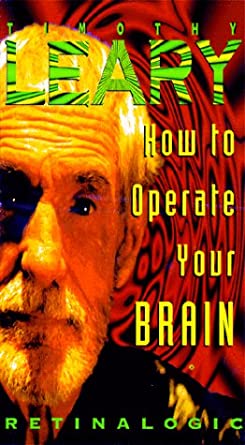
Almost 30 years later, Leary hadn’t lost his missionary zeal. In 1993 (and only a few years before his death), the former Harvard psychology professor recorded “a public service video” called How to Operate Your Brain. Here, Leary narrates an almost epileptic seizure-inducing video, providing what some consider “a guided meditation” of sorts. I’d prefer to call it an unorthodox “user manual” that tries to impart Leary’s unique sense of enlightenment:

The aim of human life is to know thyself. Think for yourself. Question authority. Think with your friends. Create, create new realities. Philosophy is a team sport. Philosophy is the ultimate, the ultimate aphrodisiac pleasure. Learning how to operate your brain, learning how to operate your mind, learning how to redesign chaos.

As you get deeper into the meditation, you’ll realize one thing. Three decades may have passed since Leary popularized the catchphrase of the counterculture. But he’s still getting his ideas from McLuhan. If you follow the video (or transcript) to the end, you’ll discover that ones and zeros have basically taken the place of LSD. Leary says:

Now we have digital communication. We can create our fantasies. We can create our rhythms, design on screen…. Anyone in any culture watching this screen will get the general picture. It’s one global village. It’s one global human spirit, one global human race. As we link up through screens, linked by electrons and photons, we will create for the first time a global humanity, not separated by words or minds or nationalities or religious biases.

You can find McLuhan meditating on the concept of an Electronic Global Village in another vintage clip.

“The Cost Of Sanity, In This Society, Is A Certain Level Of Alienation”

By Caitlin Johnstone

Source: CaitlinJohnstone.com

The late psychonaut/philosopher Terence McKenna once said “The cost of sanity, in this society, is a certain level of alienation,” and I think my regular readers will immediately and experientially understand exactly what he was talking about.

It’s not always easy to be on the outside of consensus reality. Our entire society, after all, has been built upon consensus–upon a shared agreement about what specific mouth sounds mean, on what money is and how it works, on how we should all behave toward each other in public spaces, and on what normal human behavior in general looks like.

We all share a learned agreement that we picked up from our culture in early childhood that it’s normal and acceptable to stand around with your hands in your pockets and babble about the weather to anyone who gets too close to you, for example, whereas it would be considered weird and disruptive to stand around slathered in Cheese Whiz shrieking the word “Poop!” But we could just as easily reverse that consensus on behavioral norms tomorrow, and as long as we all agreed to it we could do it without missing a beat.

In exactly the same way, there exists a general consensus about what’s going on in our world at the moment. There’s a general consensus that we live in the kind of society we were taught about in school: a free and democratic nation which maybe did some not so great things in the past, but is now a supremely virtuous beacon of light on this earth that kicked Hitler’s ass and then surfed into the present day on a wave of truth and sensible fiscal policy. There’s a general consensus that the news reporters on our screens paint us a more or less accurate picture of world affairs, that there are a lot of Bad Guys in our world with whom the Good Guys in our government are fighting, and that most of our nation’s problems are caused by the people in the other political party.

This consensus is grounded in delusion. It is insanity.

In reality, of course, we live in a world where our understanding of the world is constantly being deceitfully manipulated by oligarchic media propaganda and the utterances of oligarch-owned politicians. Where elections are mostly just a live action role-playing game which allows the rabble to pretend that they have some degree of influence over the things that their government does. Where our government routinely forms alliances with the worst Bad Guys on the planet while manufacturing consent to topple governments whose downfall would be utterly disastrous. Where our nation’s problems have almost nothing to do with half its population disagreeing with our personal ideology, and practically everything to do with the loose international alliance of plutocrats and government agencies who actually run things behind the facade of the comings and goings of official elected governments.

Sanity means seeing this as it is, rather than subscribing to the mass delusion of the consensus worldview. Which, as you probably already know, can make it difficult to relate to others in some ways. Conversations about politics often either get heated very rapidly when you challenge a tightly-held orthodoxy or dead-end in awkwardness. Friendships can end. Family relationships can be ruined. Collective narratives about you can be woven and circulated within your social circle which have nothing to do with how you actually see things.

And that’s just if you talk about your worldview. If you keep your views to yourself, as many do, that’s just another kind of alienation. It’s to stand outside of public political discourse completely, unable to participate out of fear of the backlash you’d receive from your friends, loved ones and acquaintances if you started talking about Trump as a symptom rather than the disease, or said that Corbyn is being targeted by a transparently bogus smear campaign, or said that Russia’s interventions in world affairs are clearly dwarfed by America’s by orders of magnitude. The specific heresies will vary depending upon the social circle, but the inability to voice them necessarily comes with the same sense of alienation.

But the alternative to that sense of alienation is to live a lie. It’s to climb back inside the distorted funhouse-mirror reality tunnel of the establishment narrative control matrix and plug yourself back into the same delusions that everyone else is living. Most of us couldn’t even do that if we wanted to. Even if we could the intense mental gymnastics we’d have to perform just to avoid the discomfort of cognitive dissonance would make it not worth the effort.

We close ourselves off from a full sense of participation in our society when we depart from the consensus worldview, but in closing that door we open so many more. Because, as it turns out, all that effort that people pour into staying on the same wavelength as everyone else closes them off to a vast spectrum of potential human experience. The allure of the mass delusion is that you need to devote yourself to being plugged into it in order to achieve what the mass delusion defines as “success”, but in so doing you lose the ability to leap down psychological and experiential rabbit holes of consciousness that those still jacked into the matrix can’t even imagine. And in so doing you open up the possibility for an immensely more fulfilling and enjoyable life that has really deeply explored the more intimate questions about what it means to be a human being on this planet.

Jiddu Krishnamurti once said, “It is no measure of health to be well-adjusted to a profoundly sick society.” And a profoundly sick society is indeed what we have here. The alienation which we experience is an alienation from something that isn’t worth belonging to anyway.

I began this essay with a quote from one of the celebrated thought leaders of the psychedelic movement, and I think the question of what we can do to cope with the alienation McKenna spoke of is best answered by ending with a quote from another such leader, Timothy Leary:

“Admit it. You aren’t like them. You’re not even close. You may occasionally dress yourself up as one of them, watch the same mindless television shows as they do, maybe even eat the same fast food sometimes. But it seems that the more you try to fit in, the more you feel like an outsider, watching the ‘normal people’ as they go about their automatic existences. For every time you say club passwords like ‘Have a nice day’ and ‘Weather’s awful today, eh?’, you yearn inside to say forbidden things like ‘Tell me something that makes you cry’ or ‘What do you think deja vu is for?’. Face it, you even want to talk to that girl in the elevator. But what if that girl in the elevator (and the balding man who walks past your cubicle at work) are thinking the same thing? Who knows what you might learn from taking a chance on conversation with a stranger? Everyone carries a piece of the puzzle. Nobody comes into your life by mere coincidence. Trust your instincts. Do the unexpected. Find the others.”

Disarming the Weapons of Mass Distraction

By Madeleine Bunting

Source: Rise Up Times

“Are you paying attention?” The phrase still resonates with a particular sharpness in my mind. It takes me straight back to my boarding school, aged thirteen, when my eyes would drift out the window to the woods beyond the classroom. The voice was that of the math teacher, the very dedicated but dull Miss Ploughman, whose furrowed grimace I can still picture.

We’re taught early that attention is a currency—we “pay” attention—and much of the discipline of the classroom is aimed at marshaling the attention of children, with very mixed results. We all have a history here, of how we did or did not learn to pay attention and all the praise or blame that came with that. It used to be that such patterns of childhood experience faded into irrelevance. As we reached adulthood, how we paid attention, and to what, was a personal matter and akin to breathing—as if it were automatic.

Today, though, as we grapple with a pervasive new digital culture, attention has become an issue of pressing social concern. Technology provides us with new tools to grab people’s attention. These innovations are dismantling traditional boundaries of private and public, home and office, work and leisure. Emails and tweets can reach us almost anywhere, anytime. There are no cracks left in which the mind can idle, rest, and recuperate. A taxi ad offers free wifi so that you can remain “productive” on a cab journey.

Even those spare moments of time in our day—waiting for a bus, standing in a queue at the supermarket—can now be “harvested,” says the writer Tim Wu in his book The Attention Merchants. In this quest to pursue “those slivers of our unharvested awareness,” digital technology has provided consumer capitalism with its most powerful tools yet. And our attention fuels it. As Matthew Crawford notes in The World Beyond Your Head, “when some people treat the minds of other people as a resource, this is not ‘creating wealth,’ it is transferring it.”

There’s a whiff of panic around the subject: the story that our attention spans are now shorter than a goldfish’s attracted millions of readers on the web; it’s still frequently cited, despite its questionable veracity. Rates of diagnosis attention deficit hyperactivity disorder in children have soared, creating an $11 billion global market for pharmaceutical companies. Every glance of our eyes is now tracked for commercial gain as ever more ingenious ways are devised to capture our attention, if only momentarily. Our eyeballs are now described as capitalism’s most valuable real estate. Both our attention and its deficits are turned into lucrative markets.

There is also a domestic economy of attention; within every family, some get it and some give it. We’re all born needing the attention of others—our parents’, especially—and from the outset, our social skills are honed to attract the attention we need for our care. Attention is woven into all forms of human encounter from the most brief and transitory to the most intimate. It also becomes deeply political: who pays attention to whom?

Social psychologists have researched how the powerful tend to tune out the less powerful. One study with college students showed that even in five minutes of friendly chat, wealthier students showed fewer signs of engagement when in conversation with their less wealthy counterparts: less eye contact, fewer nods, and more checking the time, doodling, and fidgeting. Discrimination of race and gender, too, plays out through attention. Anyone who’s spent any time in an organization will be aware of how attention is at the heart of office politics. A suggestion is ignored in a meeting, but is then seized upon as a brilliant solution when repeated by another person.

What is political is also ethical. Matthew Crawford argues that this is the essential characteristic of urban living: a basic recognition of others.

And then there’s an even more fundamental dimension to the politics of attention. At a primary level, all interactions in public space require a very minimal form of attention, an awareness of the presence and movement of others. Without it, we would bump into each other, frequently.

I had a vivid demonstration of this point on a recent commute: I live in East London and regularly use the narrow canal paths for cycling. It was the canal rush hour—lots of walkers with dogs, families with children, joggers as well as cyclists heading home. We were all sharing the towpath with the usual mixture of give and take, slowing to allow passing, swerving around and between each other. Only this time, a woman was walking down the center of the path with her eyes glued to her phone, impervious to all around her. This went well beyond a moment of distraction. Everyone had to duck and weave to avoid her. She’d abandoned the unspoken contract that avoiding collision is a mutual obligation.

This scene is now a daily occurrence for many of us, in shopping centers, station concourses, or on busy streets. Attention is the essential lubricant of urban life, and without it, we’re denying our co-existence in that moment and place. The novelist and philosopher, Iris Murdoch, writes that the most basic requirement for being good is that a person “must know certain things about his surroundings, most obviously the existence of other people and their claims.”

Attention is what draws us out of ourselves to experience and engage in the world. The word is often accompanied by a verb—attention needs to be grabbed, captured, mobilized, attracted, or galvanized. Reflected in such language is an acknowledgement of how attention is the essential precursor to action. The founding father of psychology William James provided what is still one of the best working definitions:

It is the taking possession by the mind, in clear and vivid form, of one out of what seem several simultaneously possible objects or trains of thought. Focalization, concentration, of consciousness are of its essence. It implies withdrawal from some things in order to deal effectively with others.

Attention is a limited resource and has to be allocated: to pay attention to one thing requires us to withdraw it from others. There are two well-known dimensions to attention, explains Willem Kuyken, a professor of psychology at Oxford. The first is “alerting”— an automatic form of attention, hardwired into our brains, that warns us of threats to our survival. Think of when you’re driving a car in a busy city: you’re aware of the movement of other cars, pedestrians, cyclists, and road signs, while advertising tries to grab any spare morsel of your attention. Notice how quickly you can swerve or brake when you spot a car suddenly emerging from a side street. There’s no time for a complicated cognitive process of decision making. This attention is beyond voluntary control.

The second form of attention is known as “executive”—the process by which our brain selects what to foreground and focus on, so that there can be other information in the background—such as music when you’re cooking—but one can still accomplish a complex task. Crucially, our capacity for executive attention is limited. Contrary to what some people claim, none of us can multitask complex activities effectively. The next time you write an email while talking on the phone, notice how many typing mistakes you make or how much you remember from the call. Executive attention can be trained, and needs to be for any complex activity. This was the point James made when he wrote: “there is no such thing as voluntary attention sustained for more than a few seconds at a time… what is called sustained voluntary attention is a repetition of successive efforts which bring back the topic to the mind.”

Attention is a complex interaction between memory and perception, in which we continually select what to notice, thus finding the material which correlates in some way with past experience. In this way, patterns develop in the mind. We are always making meaning from the overwhelming raw data. As James put it, “my experience is what I agree to attend to. Only those items which I notice shape my mind—without selective interest, experience is an utter chaos.”

And we are constantly engaged in organizing that chaos, as we interpret our experience. This is clear in the famous Gorilla Experiment in which viewers were told to watch a video of two teams of students passing a ball between them. They had to count the number of passes made by the team in white shirts and ignore those of the team in black shirts. The experiment is deceptively complex because it involves three forms of attention: first, scanning the whole group; second, ignoring the black T-shirt team to keep focus on the white T-shirt team (a form of inhibiting attention); and third, remembering to count. In the middle of the experiment, someone in a gorilla suit ambles through the group. Afterward, half the viewers when asked hadn’t spotted the gorilla and couldn’t even believe it had been there. We can be blind not only to the obvious, but to our blindness.

There is another point in this experiment which is less often emphasized. Ignoring something—such as the black T-shirt team in this experiment—requires a form of attention. It costs us attention to ignore something. Many of us live and work in environments that require us to ignore a huge amount of information—that flashing advert, a bouncing icon or pop-up.

In another famous psychology experiment, Walter Mischel’s Marshmallow Test, four-year-olds had a choice of eating a marshmallow immediately or two in fifteen minutes. While filmed, each child was put in a room alone in front of the plate with a marshmallow. They squirmed and fidgeted, poked the marshmallow and stared at the ceiling. A third of the children couldn’t resist the marshmallow and gobbled it up, a third nibbled cautiously, but the last third figured out how to distract themselves. They looked under the table, sang… did anything but look at the sweet. It’s a demonstration of the capacity to reallocate attention. In a follow-up study some years later, those who’d been able to wait for the second marshmallow had better life outcomes, such as academic achievement and health. One New Zealand study of 1,000 children found that this form of self-regulation was a more reliable predictor of future success and wellbeing than even a good IQ or comfortable economic status.

What, then, are the implications of how digital technologies are transforming our patterns of attention? In the current political anxiety about social mobility and inequality, more weight needs to be put on this most crucial and basic skill: sustaining attention.

*

I learned to concentrate as a child. Being a bookworm helped. I’d be completely absorbed in my reading as the noise of my busy family swirled around me. It was good training for working in newsrooms; when I started as a journalist, they were very noisy places with the clatter of keyboards, telephones ringing and fascinating conversations on every side. What has proved much harder to block out is email and text messages.

The digital tech companies know a lot about this widespread habit; many of them have built a business model around it. They’ve drawn on the work of the psychologist B.F. Skinner who identified back in the Thirties how, in animal behavior, an action can be encouraged with a positive consequence and discouraged by a negative one. In one experiment, he gave a pigeon a food pellet whenever it pecked at a button and the result, as predicted, was that the pigeon kept pecking. Subsequent research established that the most effective way to keep the pigeon pecking was “variable-ratio reinforcement.” Give the pigeon a food pellet sometimes, and you have it well and truly hooked.

We’re just like the pigeon pecking at the button when we check our email or phone. It’s a humiliating thought. Variable reinforcement ensures that the customer will keep coming back. It’s the principle behind one of the most lucrative US industries: slot machines, which generate more profit than baseball, films, and theme parks combined. Gambling was once tightly restricted for its addictive potential, but most of us now have the attentional equivalent of a slot machine in our pocket, beside our plate at mealtimes, and by our pillow at night. Even during a meal out, a play at the theater, a film, or a tennis match. Almost nothing is now experienced uninterrupted.

Anxiety about the exponential rise of our gadget addiction and how it is fragmenting our attention is sometimes dismissed as a Luddite reaction to a technological revolution. But that misses the point. The problem is not the technology per se, but the commercial imperatives that drive the new technologies and, unrestrained, colonize our attention by fundamentally changing our experience of time and space, saturating both in information.

In much public space, wherever your eye lands—from the back of the toilet door, to the handrail on the escalator, or the hotel key card—an ad is trying to grab your attention, and does so by triggering the oldest instincts of the human mind: fear, sex, and food. Public places become dominated by people trying to sell you something. In his tirade against this commercialization, Crawford cites advertisements on the backs of school report cards and on debit machines where you swipe your card. Before you enter your PIN, that gap of a few seconds is now used to show adverts. He describes silence and ad-free experience as “luxury goods” that only the wealthy can afford. Crawford has invented the concept of the “attentional commons,” free public spaces that allow us to choose where to place our attention. He draws the analogy with environmental goods that belong to all of us, such as clean air or clean water.

Some legal theorists are beginning to conceive of our own attention as a human right. One former Google employee warned that “there are a thousand people on the other side of the screen whose job it is to break down the self-regulation you have.” They use the insights into human behavior derived from social psychology—the need for approval, the need to reciprocate others’ gestures, the fear of missing out. Your attention ceases to be your own, pulled and pushed by algorithms. Attention is referred to as the real currency of the future.

*

In 2013, I embarked on a risky experiment in attention: I left my job. In the previous two years, it had crept up on me. I could no longer read beyond a few paragraphs. My eyes would glaze over and, even more disastrously for someone who had spent their career writing, I seemed unable to string together my thoughts, let alone write anything longer than a few sentences. When I try to explain the impact, I can only offer a metaphor: it felt like my imagination and use of language were vacuum packed, like a slab of meat coated in plastic. I had lost the ability to turn ideas around, see them from different perspectives. I could no longer draw connections between disparate ideas.

At the time, I was working in media strategy. It was a culture of back-to-back meetings from 8:30 AM to 6 PM, and there were plenty of advantages to be gained from continuing late into the evening if you had the stamina. Commitment was measured by emails with a pertinent weblink. Meetings were sometimes as brief as thirty minutes and frequently ran through lunch. Meanwhile, everyone was sneaking time to battle with the constant emails, eyes flickering to their phone screens in every conversation. The result was a kind of crazy fog, a mishmash of inconclusive discussions.

At first, it was exhilarating, like being on those crazy rides in a theme park. By the end, the effect was disastrous. I was almost continuously ill, battling migraines and unidentifiable viruses. When I finally made the drastic decision to leave, my income collapsed to a fraction of its previous level and my family’s lifestyle had to change accordingly. I had no idea what I was going to do; I had lost all faith in my ability to write. I told friends I would have to return the advance I’d received to write a book. I had to try to get back to the skills of reflection and focus that had once been ingrained in me.

The first step was to teach myself to read again. I sometimes went to a café, leaving my phone and computer behind. I had to slow down the racing incoherence of my mind so that it could settle on the text and its gradual development of an argument or narrative thread. The turning point in my recovery was a five weeks’ research trip to the Scottish Outer Hebrides. On the journey north of Glasgow, my mobile phone lost its Internet connection. I had cut myself loose with only the occasional text or call to family back home. Somewhere on the long Atlantic beaches of these wild and dramatic islands, I rediscovered my ability to write.

I attribute that in part to a stunning exhibition I came across in the small harbor town of Lochboisdale, on the island of South Uist. Vija Celmins is an acclaimed Latvian-American artist whose work is famous for its astonishing patience. She can take a year or more to make a woodcut that portrays in minute detail the surface of the sea. A postcard of her work now sits above my desk, a reminder of the power of slow thinking.

Just as we’ve had a slow eating movement, we need a slow thinking campaign. Its manifesto could be the German poet Rainer Maria Rilke’s beautiful “Letters to a Young Poet”:

To let every impression and the germ of every feeling come to completion inside, in the dark, in the unsayable, the unconscious, in what is unattainable to one’s own intellect, and to wait with deep humility and patience for the hour when a new clarity is delivered.

Many great thinkers attest that they have their best insights in moments of relaxation, the proverbial brainwave in the bath. We actually need what we most fear: boredom.

When I left my job (and I was lucky that I could), friends and colleagues were bewildered. Why give up a good job? But I felt that here was an experiment worth trying. Crawford frames it well as “intellectual biodiversity.” At a time of crisis, we need people thinking in different ways. If we all jump to the tune of Facebook or Instagram and allow ourselves to be primed by Twitter, the danger is that we lose the “trained powers of concentration” that allow us, in Crawford’s words, “to recognize that independence of thought and feeling is a fragile thing, and requires certain conditions.”

I also took to heart the insights of the historian Timothy Snyder, who concluded from his studies of twentieth-century European totalitarianism that the way to fend off tyranny is to read books, make an effort to separate yourself from the Internet, and “be kind to our language… Think up your own way of speaking.” Dropping out and going offline enabled me to get back to reading, voraciously, and to writing; beyond that, it’s too early to announce the results of my experiment with attention. As Rilke said, “These things cannot be measured by time, a year has no meaning, and ten years are nothing.”

*

A recent column in The New Yorker cheekily suggests that all the fuss about the impact of digital technologies on our attention is nothing more than writers’ worrying about their own working habits. Is all this anxiety about our fragmenting minds a moral panic akin to those that swept Victorian Britain about sexual behavior? Patterns of attention are changing, but perhaps it doesn’t much matter?

My teenage children read much less than I did. One son used to play chess online with a friend, text on his phone, and do his homework all at the same time. I was horrified, but he got a place at Oxford. At his interview, he met a third-year history undergraduate who told him he hadn’t yet read any books in his time at university. But my kids are considerably more knowledgeable about a vast range of subjects than I was at their age. There’s a small voice suggesting that the forms of attention I was brought up with could be a thing of the past; the sustained concentration required to read a whole book will become an obscure niche hobby.

And yet, I’m haunted by a reflection: the magnificent illuminations of the eighth-century Book of Kells has intricate patterning that no one has ever been able to copy, such is the fineness of the tight spirals. Lines are a millimeter apart. They indicate a steadiness of hand and mind—a capability most of us have long since lost. Could we be trading in capacities for focus in exchange for a breadth of reference? Some might argue that’s not a bad trade. But we would lose depth: artist Paul Klee wrote that he would spend a day in silent contemplation of something before he painted it. Paul Cézanne was similarly known for his trance like attention on his subject. Madame Cézanne recollected how her husband would gaze at the landscape, and told her, “The landscape thinks itself in me, and I am its consciousness.” The philosopher Maurice Merleau-Ponty describes a contemplative attention in which one steps outside of oneself and immerses oneself in the object of attention.

It’s not just artists who require such depth of attention. Nearly two decades ago, a doctor teaching medical students at Yale was frustrated at their inability to distinguish between types of skin lesions. Their gaze seemed restless and careless. He took his students to an art gallery and told them to look at a picture for fifteen minutes. The program is now used in dozens of US medical schools.

Some argue that losing the capacity for deep attention presages catastrophe. It is the building block of “intimacy, wisdom, and cultural progress,” argues Maggie Jackson in her book Distracted, in which she warns that “as our attentional skills are squandered, we are plunging into a culture of mistrust, skimming, and a dehumanizing merging between man and machine.” Significantly, her research began with a curiosity about why so many Americans were deeply dissatisfied with life. She argues that losing the capacity for deep attention makes it harder to make sense of experience and to find meaning—from which comes wonder and fulfillment. She fears a new “dark age” in which we forget what makes us truly happy.

Strikingly, the epicenter of this wave of anxiety over our attention is the US. All the authors I’ve cited are American. It’s been argued that this debate represents an existential crisis for America because it exposes the flawed nature of its greatest ideal, individual freedom. The commonly accepted notion is that to be free is to make choices, and no one can challenge that expression of autonomy. But if our choices are actually engineered by thousands of very clever, well-paid digital developers, are we free? The former Google employee Tristan Harris confessed in an article in 2016 that technology “gives people the illusion of free choice while architecting the menu so that [tech giants] win, no matter what you choose.”

Despite my children’s multitasking, I maintain that vital human capacities—depth of insight, emotional connection, and creativity—are at risk. I’m intrigued as to what the resistance might look like. There are stirrings of protest with the recent establishment of initiatives such as the Time Well Spent movement, founded by tech industry insiders who have become alarmed at the efforts invested in keeping people hooked. But collective action is elusive; the emphasis is repeatedly on the individual to develop the necessary self-regulation, but if that is precisely what is being eroded, we could be caught in a self-reinforcing loop.

One of the most interesting responses to our distraction epidemic is mindfulness. Its popularity is evidence that people are trying to find a way to protect and nourish their minds. Jon Kabat-Zinn, who pioneered the development of secular mindfulness, draws an analogy with jogging: just as keeping your body fit is now well understood, people will come to realize the importance of looking after their minds.

I’ve meditated regularly for twenty years, but curious as to how this is becoming mainstream, I went to an event in the heart of high-tech Shoreditch in London. In a hipster workspaces with funky architecture, excellent coffee, and an impressive range of beards, a soft-spoken retired Oxford professor of psychology, Mark Williams, was talking about how multitasking has a switching cost in focus and concentration. Our unique human ability to remember the past and to think ahead brings a cost; we lose the present. To counter this, he advocated a daily practice of mindfulness: bringing attention back to the body—the physical sensations of the breath, the hands, the feet. Williams explained how fear and anxiety inhibit creativity. In time, the practice of mindfulness enables you to acknowledge fear calmly and even to investigate it with curiosity. You learn to place your attention in the moment, noticing details such as the sunlight or the taste of the coffee.

On a recent retreat, I was beside a river early one morning and a rower passed. I watched the boat slip by and enjoyed the beauty in a radically new way. The moment was sufficient; there was nothing I wanted to add or take away—no thought of how I wanted to do this every day, or how I wanted to learn to row, or how I wished I was in the boat. Nothing but the pleasure of witnessing it. The busy-ness of the mind had stilled. Mindfulness can be a remarkable bid to reclaim our attention and to claim real freedom, the freedom from our habitual reactivity that makes us easy prey for manipulation.

But I worry that the integrity of mindfulness is fragile, vulnerable both to commercialization by employers who see it as a form of mental performance enhancement and to consumer commodification, rather than contributing to the formation of ethical character. Mindfulness as a meditation practice originates in Buddhism, and without that tradition’s ethics, there is a high risk of it being hijacked and misrepresented.

Back in the Sixties, the countercultural psychologist Timothy Leary rebelled against the conformity of the new mass media age and called for, in Crawford’s words, an “attentional revolution.” Leary urged people to take control of the media they consumed as a crucial act of self-determination; pay attention to where you place your attention, he declared. The social critic Herbert Marcuse believed Leary was fighting the struggle for the ultimate form of freedom, which Marcuse defined as the ability “to live without anxiety.” These were radical prophets whose words have an uncanny resonance today. Distraction has become a commercial and political strategy, and it amounts to a form of emotional violence that cripples people, leaving them unable to gather their thoughts and overwhelmed by a sense of inadequacy. It’s a powerful form of oppression dressed up in the language of individual choice.

The stakes could hardly be higher, as William James knew a century ago: “The faculty of voluntarily bringing back a wandering attention, over and over again, is the very root of judgment, character, and will.” And what are we humans without these three?

Pulling the Cosmic Trigger: The Contact Experiences of Philip K Dick & Robert Anton Wilson

philip-k-dick1

Editor’s note: On this 87th anniversary of the birth of Philip K. Dick (December 16, 1928March 2, 1982), enjoy a deep dive into some of the more paranormal aspects of his life and how they relate to experiences of other visionaries.

By By AK WILKS

Source: Steamshovel Press

This article will look at some of the similarities between the contact experiences of two American writers, Philip K Dick and Robert Anton Wilson. In the 1973-1974 time frame, both would have unusual experiences that they thought could be contact with an extraterrestrial civilization. Or some undefinable something that wanted them to think it was extraterrestrial. And as incredible as it sounds, some of their experiences are confirmed by other people, and include verified transmission of knowledge that it seems they could not have obtained from any human source. We will also look very briefly at some other possibly related contact experiences involving musician and cultural icon John Lennon, researcher into human-dolphin communication and consciousness Dr. John Lilly and the Swiss scientist and inventor of LSD Dr. Albert Hofmann.

NOTE: William Burroughs first told Robert Anton Wilson about the “23 Enigma”.  Wilson and Kerry Thornley incorporated it into their ideas and created the related concept of the Discordian Law of Fives (2+3=5).  The number 23 and the numbers 2 & 3 & 5 recur at multiple points in this article.  In most cases I do not note them but the interested reader may wish to note how many times they recur and if it is more than expected by chance.

PHILIP K DICK

Philip K Dick was a science fiction writer with a prolific output from 1953 to 1981 of 121 short stories and 44 novels. Since his death in l982 he has become even better known. His stories have been made into major films like “Blade Runner”, “A Scanner Darkly,” and “Minority Report”. He has also been acknowledged as a major influence on other films, including “The Matrix”. The recent indie film “Radio Free Albemuth” is an excellent adaptation of Phil’s novel of the same name, dealing with Phil’s fictional version of the true events dealt with in this article.

PKD had themes that recur over and over again throughout his stories – What is real? What is human? How do we know that what we think of as reality is actually real? What defines humanity? Will humans be replaced by machines? PKD also had political themes and religious themes. Though he turned 40 in l968, he identified with the youth counterculture of the l960’s. He was against the Vietnam War and the Nixon administration. He refused to pay federal taxes in protest of the war, and his name appeared in published ads of writers and artists involved in the protest. The federal government confiscated his car for back taxes.

A typical PKD hero was a writer, small businessman, a TV repairman and/or a backyard inventor. He finds his life turned upside down when he discovers that reality is not what it seemed. He wages a fight against vast evil empires of heartless corporations, fascist governments, robots posing as humans, and alien invaders. He is often assisted by a beautiful and intelligent dark haired girl.

Starting in 1971, Phil was no longer just writing about government conspiracies, alternative realities, and struggles against an empire. He started living it. His home was broken in to. Things were damaged, papers were taken, but little of value was stolen. It did not seem like a traditional burglary. Strangely, part of Phil was actually relieved. He thought, “See! I’m not some crazy paranoid. They really are after me.” But he was also horrified and scared of what they would do next. It also validated him however. He must be getting through and having an impact if he was enough of a threat to have this done to him.

His wife Tessa confirms that in 1969 Phil got a phone call from a fan, Dr. Timothy Leary. She wonders if that call was wiretapped by Feds trailing Leary, and if Phil came on their radar screen then, if he had not before. When Leary escaped from Folsom prison, she wonders if Phil got attention because of the Leary connection. Phil claimed that he also talked to John Lennon as part of this same phone call. The connection was probably Rolling Stone writer Paul Williams, who knew PKD well and wrote about him in Rolling Stone magazine, and Williams was with Lennon and Leary in Canada.

President Nixon had called Leary “the most dangerous man in America”, a label he only used for one other person, Pentagon Papers leaker Daniel Ellsberg. Nixon had authorized a break in at Ellsberg’s psychiatrist’s office. The FBI, BNDD(DEA) and the CIA were involved in the hunt and recapture of Leary. Did one of those agencies do the break in looking for clues to where Leary was hiding? Nixon was also using the pretext of a marijuana conviction to try to get Lennon deported. The real reason was his anger over Lennon’s support of the anti-war movement, both lyrically and financially.

Aside from the Leary/Lennon connection, Phil had also attracted government attention on his own, as he had in the Ramparts magazine anti-war tax protest. He later found out that letters he had sent to Soviet scientists had been intercepted by the CIA.   His books appeared on a list compiled by the government of works that promoted the drug culture. (This was ironic as Phil later became very anti-hard drugs, because he felt they robbed people of their humanity and led to tragic results). In between marriages, Phil opened his home to and hung out with drug users, small time criminals, political radicals, teenage runaways and street people.   An Orange County cop told Phil “They don’t need crusaders here.” Phil says he was afraid to ask the cop who or what he thought he was crusading for.

Phil obsessed over who did the break in – the FBI? CIA? KGB? Local police? A right wing group like the Neo-Nazis? A criminal gang? But eventually something else even bigger would come along to obsess over.

In February and March of l974, Phil had amazing contact experiences that changed his life. He would spend the rest of his life trying to figure out what exactly happened, and who or what was responsible. His theories included mental illness at one end, to direct contact with God at the other end. In between were the theories of contact with an alien race, time travelers, an AI (Artificial Intelligence) computer from the future, a government agency or a secret society.

Eventually he came to call what contacted him VALIS, for Vast Active Living Intelligence System. Phil would have different ideas on what VALIS was – a satellite beaming information to him from an alien world or just a manifestation of God? He came to think VALIS was a satellite from advanced entities perhaps from the Sirius double star system. One of the missions of VALIS was to fight the Empire,(“The Empire never ended”) the continuation of the Roman Empire in the evil power elites in the East and West, who were secretly connected in their desire to keep their populations enslaved. The second mission of VALIS was to enlighten people with information and knowledge, to spark creativity, invention, art and innovation. This was also partially done through the true hidden and suppressed gospels of Jesus Christ which were revealed to the world in the Gnostic Gospels found at Nag Hammadi in 1945. This information is a living plasmate that comes alive in every person who reads the gospels or who reads about VALIS in the stories of Philip K Dick. The final mission of VALIS was to show Phil that this is a fake world, a “Black Iron Prison”, a “criminal virus” that occludes people from seeing that the world is alive. In fact the world that we see is fake, and we may be living in a computer simulation or a hologram. Now you can see why the creators of “The Matrix” acknowledge PKD as a major influence.

He would write what he called his Exegesis to investigate and explain what he came to call the “2-3-74” experience, meaning February and March of 1974. His Exegesis would grow to over 8,000 pages. Recently a 900 page version was published. Phil increasingly came to favor theological interpretations of VALIS, but at one point, after reading Arthur C. Clarke’s novel “Childhood’s End”, he expressed his experience in Clarke language and classic Sci-Fi terms:

(1)We are not only being watched; we are being controlled, but don’t know it; they remain beyond our threshold of vision.

(2) They work for a higher purpose, one we can’t understand but which fits our concepts of spiritual, moral purposes.

(3) We are instruments, therefore, of an invisible spiritual force which causes us to grow and develop in certain arranged directions.

(4) Some of us are either part of their race or can be elevated to their level, as they work through these individuals.

(5) The probable reason for their concealment is our evil qualities. We cannot be trusted, individually or collectively (man qua beast).

(6) A critical moment has approached or is approaching; this is a unique period in their work, therefore in our use-purpose.

(7) The extent of camouflage and delusion induced in us is extraordinary in amount and degree

Understand that the above formulation was not Phil’s favorite. As I stated he increasingly came to favor a more theological interpretation, bringing in elements from Buddha, Dionysus, and mysticism, but primarily Gnostic Christianity as revealed in the Nag Hammadi scriptures uncovered in 1945. But I like the formulation above because it is clear and concise and perhaps fits best with some of the other experiences we will look at later.  Section #5 about concealment deals with a subject Phil talked a lot about, which was the fate of men like Socrates, Christ, Bruno, JFK , MLK and his friend Bishop Jim Pike. Given that history, VALIS must conceal itself most of the time, and rather than announce itself on the lawn of the White House, and be sent to federal prison or worse, it would reveal itself gradually in scattered trash, pulp magazines, rock music songs, comic books, B movies, episodes of “Star Trek”, sci-fi paperbacks and through an imperfect odd California science fiction writer.

In part of the 2-3-74 experience Phil saw a cartoon cat that appeared in the pink light of a rectangle that reflected the “Golden Ratio.” The Golden Ratio of 1.618 occurs throughout nature, and is seen in everything from galaxies to sea shells to flowers to the human face. Phil’s cat had just died and he said the cartoon cat came over to him and put his paw on his shoulder, as if to console him and tell him it will be all right.

In another part of the2- 3-74 experience, Phil said he experienced hundreds of abstract and expressionist art paintings.   They were as vivid and colorful and real as anything he had ever seen in his life. He mentioned Kandinsky and Klee as the type of art that he saw.

Then throughout 1974 he experienced strange events, some seemingly “good”, and some seemingly “bad”. Strange synchronicities, “coincidences” that seemed to have underlying connections. If VALIS was a positive moral force aiding Phil and humanity, there were also other dark forces wanting to keep humanity enslaved and blind, and Phil feared these dark forces. He gave his son Christopher an improvised Christening with chocolate milk and a bit of hot dog bun, as a way to protect him from these dark forces.

Phil had multiple marriages and divorces and a documented history of mental illness; and of course, he had a vivid imagination, as seen in his stories. Add in that he had a reputation as a drug user, and it is tempting to write off these interesting but unverifiable experiences as hallucinations, insanity, and/or hoaxes.

It’s true that Phil had mental health issues, but they mostly revolved around depression. In this period, living with his wife Tessa and young son Christopher, he was happy most of the time. Phil did take legal uppers, and he experimented with LSD, but only twice. His reputation as a wild man drug user was exaggerated in the press. One time Phil was eating dinner at a sci-fi convention, and a fan snatched a pill beside his plate and swallowed it. “What’s going to happen to me?” the fan asked. Phil explained, “Well, if you have a sore throat it will feel better.”

First of all, it is doubtful that Phil would have been moved to devote the time and energy of an 8,000 page exegesis if all these events were just hoaxes or misperceptions. Secondly, a few key incidents have been verified either by outside facts and/or his wife at the time, Tessa.

Tessa B. Dick has written her own book called “Remembering Firebright: My Life with Philip K. Dick”. In a few instances she explains how she thinks Phil misconstrued ordinary facts into something fantastic. One senses she is honestly recounting things as best she can remember, and that like Phil, she has struggled over the years to understand these events. But on several key incidents, she largely confirms Phil’s account of events. She says that unusual and unexplainable things did happen.

One of these is the “Firebright” of the book’s title. Phil said this was a small baseball size sphere of blue light. He said he thought it facilitated communication between him and an alien satellite that was in orbit around the earth. This satellite explained mysteries of the universe to him, sometimes by historical figures he admired (or simulations thereof), like Francis Bacon and Thomas Aquinas. Tessa did not experience that aspect, but she states she did see Firebright, that she and Phil could see it together, and each correctly describe what it was doing. Was it a shared hallucination? Was it a shared reality?

Another incident described by Phil was when his radio kept playing, even after he turned it off and even after he unplugged it. He said the radio was saying messages attacking him. Tessa does confirm the radio kept playing even after being unplugged, and it was not the type that had batteries. She did not hear personal attacks on Phil, but normal pop songs. However, she can’t explain how or why it kept playing. She did note at the time that the neighbor’s apartment was mostly vacant, as if nobody actually lived there, but they had a lot of electronic equipment, so there may be a natural earth-bound explanation for the strange radio incident. She felt then and now that they were spying on someone, be it Phil or someone else. But that would not explain the mystery of “Firebirght”, nor would it explain the following mystery.

Sometime in the late summer of 1974, Phil reported drifting between sleep and waking while listening to the Beatles song “Strawberry Fields Forever,” sung by John Lennon. At the point in the song where it says “Living is easy with eyes closed,” Phil opened his eyes. He cried out to Tessa to “Call the doctor and tell him that Christopher has an inguinal hernia and he could die if it strangulated”. Tessa says Phil looked as if he were in a trance and she confirms what he said, and that he stated the medical terms correctly. She took their 14 month old son Christopher to a doctor, and the doctor confirmed Phil’s diagnosis, and the doctor scheduled and eventually did the potentially life-saving surgery as soon as Christopher was old enough, which was a couple of months later. In the meantime they were instructed to be careful not to let him cry for any prolonged period.

In subsequent conversations with the “normal” Phil, Tessa says he went back to not understanding the medical terms and was mispronouncing them. Who or what intervened and gave Phil the information that saved his son’s life? Was it VALIS?

I was able to recently ask Phil’s last wife Tessa about this incident. She again confirmed most of the elements of Phil’s story as correct. She said the doctor told her that if Christopher had been left to cry throughout the night for an extended period, the hernia could have strangulated and cut off blood flow, causing serious injury or even death. She does not remember the stereo being on, so unless Phil had the small radio on, she wondered if Phil heard “Strawberry Fields Forever” in his dream. I asked her how was Phil able to correctly diagnose the hernia? Was it VALIS, a religious miracle, just really good intuition or simply unexplainable? She stated:

I have no earthly explanation for how Phil could have known that our son had a hernia.  He did not change diapers, and he had little medical knowledge.  I knew that something was wrong with our baby, but I had not yet discussed it with Phil.”

Phil felt that it was VALIS, and that it also intervened in his life in other positive ways. He says it prompted him to ask his agent for back royalties on books sold overseas, and he subsequently received substantial checks. He also had a sense of renewed creativity and in addition to the non-fiction Exegesis, the strange events in his life gave inspiration to several excellent novels, including “Radio Free Albemuth”, “VALIS”, “The Divine Invasion”, and others. His income from book sales greatly increased, and his novel “Do Androids Dream of Electric Sheep” was made into the movie “Blade Runner” (the title came from William Burroughs). He saw parts of the film before it was released and was greatly impressed. He told the makers of the film that it validated his entire career and even his life.

Tragically, he never got to see the entire film and the world got no more PKD stories. He had a series of strokes leading to a heart attack , which caused his death on March 2, 1982. Before he died and when he was in seemingly good health, he may have had a premonition about his death, as he told Tessa, whom he had divorced but was seeing again, “You will remember, and you will tell them”.

ROBERT ANTON WILSON

Robert Anton Wilson was an editor at Playboy magazine — a very good, interesting and well paid job. But he left the magazine in 1971 to pursue his other interests. These interests included sex, drugs, higher states of consciousness, libertarian economics, anarchist politics, Constitutional rights, philosophy, quantum physics, history, psychology and the occult.

Along with Robert Shea he wrote the “Illuminatus!” trilogy, the most complex exposure of the conspiracies running the world and/or satire of such theories. He wrote many successful books, and he approached all topics with his trademark agnosticism and maybe logic. This avoided the traps of dogmatism and guruism. He wrote about serious subjects with a sense of humor, but treated even seemingly crazy ideas seriously.

Within weeks of meeting Timothy Leary in 1964, he and his family saw their first UFO. Timothy Leary, who was kicked out of Harvard for his LSD experiments, would become a good friend, mentor, frequent teacher, major influence, sometime student, co-author, and partner in “thought crime”.

Philip K. Dick met several times with RAW, and they became correspondents. PKD famously said that “Wilson managed to reverse every mental polarity in me, as if I had been pulled through infinity.” PKD mentions RAW in his Exegesis, and RAW mentions PKD in his books. Just as PKD’s fiction seemingly came to life in his contact experiences, RAW’s fiction also escaped from the page into his life.

RAW embarked on a course of what he called “deliberately induced brain change.” From July 23, 1973 until October, 1974, he entered a belief system in which he was (perhaps) receiving telepathic messages from advanced entities on a planet near the double star Sirius.

Were these entities real? To him, at the time, they “seemed real enough”, though “not as real as the IRS”, but “easier to get rid of.”

In keeping with his model agnosticism and desire not to get trapped in any one reality tunnel, RAW undertook a multiple-paths-all-at-once approach to making contact with higher intelligence. He used incantations and rites by Aleister Crowley to invoke the Holy Guardian Angel. Wilson says that if you look at Crowley’s words on the page, they mostly seem like “pretentious rubbish”, but when read out loud, it “vibrates, moans and sings with eerie power.” He also used a hypnosis tape called “Beliefs Unlimited” by Dr. John Lilly, the pioneer in inter-species communication and consciousness research. At first he also used Mescaline and LSD. He later achieved similar results without any drugs. He also tried tantric sex with his wife with the goal of breaking through to new levels of consciousness (and having fun, which RAW always liked to do).

In a dream on July 23, 1973, he got the message “Sirius is very important.” He did not know what it meant. He found out that Sirius was a double star system about 8.6 light years away from Earth. Further research showed him that Sirius (maybe) played an important role in the belief systems of Crowley, the Freemasons, and various occult groups. He then found out that in the ancient Egyptian tradition, the dog star Sirius was celebrated from July 23 to September 8.  This was the period when contact between Sirius and Earth was said to be strongest.

He wrote about his experiences in his book “Cosmic Trigger.” You don’t just read this book, you go along on his intellectual, spiritual and physical adventure with him. The topics he writes about start happening in his life. In similar and different ways to what happened to PKD, strange things, unexplained events and seeming “coincidences” linked by underlying synchronicity start to occur.

In this book he mentions Philip K. Dick and his novel “VALIS” based on real events. He notes some of the similarities and differences in their experiences. He also mentions a book by Robert KG Temple called “The Sirius Mystery”.

In reading Temple’s book, he learned that there was evidence (maybe) that Egypt, Sumeria and other ancient civilizations told legends of contact with advanced men who came down from the sky to teach them engineering, science and arts, and that these men came from the Sirius system. He learned that the Dogon tribe in West Africa also had legends of contact with entities from Sirius, and knew that Sirius had a companion star which was not visible to the naked eye. How did they know it existed? Because they really were visited long ago by entities from Sirius who told then about it? Well maybe. But maybe they learned about it from more recent European visitors. But if so why did they claim it was a long standing part of their belief system? What about all the other evidence of “Ancient Astronauts” and many peoples who tell legends of men from the sky, including stories from the Bible?

Wilson quotes this key part by Robert KG Temple from his book “The Sirius Mystery”:

“I would even venture that we may be under observation or surveillance at this very moment, with an extraterrestrial civilization based at the Sirius system, monitoring our development to see when we will be ready ourselves for their contacting us . . .Would they think that (this book) was their cue? If what I propose in this book really is true, then am I pulling a cosmic trigger?”

Most of the experiences Wilson describes are fascinating, but subjective and unverifiable. He himself comes to no definite conclusion about them. But one in particular stands out as unexplainable, and like the incident with Philip K. Dick and his son, it involves a child in danger. On April 26, 1974, Wilson was with a group of self-proclaimed witches in a new version of the Golden Dawn occult group. He had a vision of his son Graham lying on the ground with police walking toward him. He was afraid this indicated that Graham had been in an accident or some kind of trouble.

He invoked a cone of protection around his son and tried to send a message to call him in the morning. The next morning Graham did call and he explained that he and his friends had been illegally sleeping in a field. Police spotted their car, and walked towards them with their flashlights. They were certain they would be seen and then arrested, but amazingly, the cops did not see them and just walked away. This happened a few minutes before midnight, which was the same time that Wilson had his vision of Graham lying in a field with police walking towards him.

Wilson would later have another vision that a member of his family was in danger, and thought again it was Graham. Tragically, it turned out to be his daughter Luna, killed in a violent and senseless robbery. He writes movingly of her life and death. A lifelong opponent of the death penalty, even in his grief and anger, he does not want her killer to die, because he believes more than ever in the value of life over death.

Wilson comes to no final conclusions about his experiences. He suspects that the Holy Guardian Angel and the extraterrestrials from Sirius probably do not exist outside of our imaginations. But even if they are not literally real, RAW thinks that a belief in them was a tool to open up access to a previously untapped area of his brain.

On the other hand, remembering Arthur C. Clarke’s idea that any sufficiently advanced technology may be indistinguishable from magic, RAW wondered “what if Temple’s book was true?” What if PSI powers like ESP and telepathy are true? Stars can last 9 billion years. We are only half way through the life cycle of our star. That means there could be civilizations from Sirius or elsewhere that are one billion years more advanced than us. RAW asks what would be the technological capabilities and PSI powers of a civilization 100 million years, 500 million years, two billion years more advanced than we are now?   RAW wonders if they will use psychic powers and/or technologically advanced communication methods to aid our evolution. Which sounds a lot like VALIS.

In his book “The Illuminati Papers”, Wilson quotes Dr. Ronald Bracewell from Stanford and Dr. Frank Drake of Cornell as saying that advanced aliens may have immortality and may be “trying to communicate with us right now.”   Dr. Brian O’Leary, a Berkeley PHD and former NASA employee, states that aliens, be they extraterrestrial or inter-dimensional, may be on Earth now and have “technologies of consciousness.” Did an advanced race use “technologies of consciousness” to contact PKD and RAW?

Wilson in “Cosmic Trigger” also noted that the genius Tesla reported getting whole detailed descriptions and blue prints for inventions into his mind from an unknown source and sometimes had conversations with unseen entities. He reported that Dr. Jacques Valle told him that over 100 scientists had similar experiences of transmission of ideas but most are afraid to go public for fear of ridicule. Dr. Jack Sarfatti is one of the few who have gone public.

The discoverer of DNA, Nobel Prize winner Dr. Francis Crick, was a regular user of marijuana and may have first perceived the double helix shape of DNA while on LSD. Dr. Kary Mullis says taking LSD was one of the most important things he ever did and that he would not have won the Nobel prize for perfecting the PCR DNA method if he had not done it. He also had a strange UFO or Mothman Prophecies type encounter with an entity. Steve Jobs said taking LSD was one of the most important things he had done and convinced him that the goal of life was not just to make money but to invent and design things that would go into the stream of history and affect consciousness. Both the DNA and computer internet revolutions owe something to the (VALIS directed?) discovery of LSD Dr. Hofmann which we will examine. Is DMT or LSD a pathway to communication with higher intelligence? Or is it a pathway to open up previously untapped parts of our brain? Maybe. But this is a reason for LSD and other drugs to be legal, so they can be correctly manufactured and taken in safe doses at facilities with medical and psychological professionals. Both RAW and PKD strongly warned people not to take street drugs, they each saw the bad consequences that can result.

JOHN LENNON, DR JOHN LILLY, DR ALBERT HOFMANN

Finally I want to mention very briefly some other experiences that may have some similarities to the PKD and RAW experiences. John Lennon, as part of the Beatles and on his own, was a huge catalyst for the Sixties counter-culture revolution. Not only a force in music and the arts, he affected politics through his support of the anti-war movement and giving money to radical groups. He even gave money to Dr. Timothy Leary when he was on the run.   John had a life-long interest in the subject of UFO’s, including subscribing to British journals on the subject. In a period when he separated from Yoko Ono and was living with May Pang, he actually saw a UFO from the balcony of his NY apartment. It was on August 23, 1974. John actually cried out for the UFO to take him. They took pictures but they did not come out. They called all their friends. One of their friends called the police and newspapers and was told others had seen it as well.

May Pang later said that Lennon told her “if the masses started to accept UFO’s, it would profoundly affect their attitudes toward life, politics, everything. It would threaten the status quo.” Pang also said that 1974 was not his first sighting. He told her more than once he suspected he had been abducted as a child and that this experience made him different from other people the rest of his life. Abducted by aliens? “Yes, but John didn’t go into detail about it”. Pang said.

Dr. John Lilly, MD, was a genius who pioneered human – dolphin communication and researched communication among whales and gorillas. He also researched human consciousness with himself as a test subject. He did experiments with LSD, Ketamine and other substances, sometimes in conjunction with an isolation tank he developed. His work with dolphins inspired the film “Day of the Dolphin” and his research on consciousness inspired the film “Altered States”.

Adam Gorightly wrote an article called “John Lilly, Ketamine and the Entities from ECCO”. He describes two incidents that have some similarities to the experiences discussed here. Adam told me he got the information from a book by Lilly called “John Lilly, So Far”. The first incident seems to have taken place in the summer of 1973, the summer of the RAW Sirius experience. Lilly took Ketamine and got into his hot tub. His body could not support itself and he sank under. He was drowning. His friend Phil Halecki had a sudden urge to call him. He called him at that moment. He got John’s wife Toni who said John was fine he was in the hot tub. Phil insisted she get him right now. She did and saw John face down and drowning. She saved him and performed CPR, which she had just learned the day before from a magazine article.

John felt he was saved by the work of what he playfully called the Earth Coincidence Control Office, or ECCO. He first encountered these entities of light and love as a child and given his religious upbringing he thought of them as angels. He came to believe that they arrange “coincidences” on Earth to assist in the growth of knowledge and for the greater good. ECCO sounds very similar to what PKD called VALIS, the Vast Active Living Intelligence System, which he felt intervened in his life to save his son, impart knowledge and fight the Empire. Both ECCO and VALIS also sound similar to the Carl Jung concepts of synchronicity, the collective unconscious and archetypes. They also resonate with what quantum physicist David Bohm called the “implicate order” and Celtic legends call Fairyland.

While ECCO works on the side of aiding humans, an entity Dr. Lilly called Solid State Intelligence (SSI) works to achieve dominance for computers and machines over all biological forms, in particular intelligent mammals like humans, dolphins and whales. Think of the machines in “The Matrix” or the mega computer Skynet in “The Terminator”. Dr. Lilly used computers and technology for good purposes but feared there use for bad purposes, by evil men of the military-industrial corporate state or even self-aware AI computers on their own.

The other incident is said by the book to have happened in the fall of 1974, but as the book is loose with dates and even years, I have reason to think it was probably 1973. John and Toni were on a flight to Los Angeles. Dr. Lilly took Ketamine on the flight and then looked at the Comet Kahoutek and it greatly increased in brightness. He then received a message that said SSI was going to shut down all systems at LAX. He told this to Toni, who disapproved of John’s increasing drug experiments and thought ECCO was nonsense. But minutes later, the pilot announced they could not land at LAX because a plane had crashed into power lines causing a black out. The plane landed safely elsewhere. Terence Kahoutek was not visible to the naked eye in 1974 but it was visible in 1973. There was a plane that hit power lines on November 17, 1973.

John later felt that the message was from ECCO about the dangers of SSI. Had the pilot attempted to land at LAX when the power and lights went out, he might have crashed. Did ECCO/VALIS send Dr. Lilly a warning? As it had sent to his friend when he was drowning? As ECCO/VALIS had sent to PKD and RAW about their sons? Dr. Lilly later got warning messages of nuclear devastation from ECCO in 1974.

Dr. Albert Hofmann was the Swiss chemist who had many great patents and discoveries, but his greatest was discovering LSD. He said that he had planned a career in the humanities or arts but that “Mystical experiences in childhood, in which nature was altered in magical ways” caused him to want to understand the world and he choose chemistry.   At the website for the Albert Hofmann Foundation writer John Beresford notes that the first major step in the creation of the atom bomb happened on December 2, 1942, in Chicago.   Enrico Fermi as part of the Manhattan Project caused the first nuclear chain reaction.

About 131 or 132 days later Dr. Hofmann had what he called in German a “Vorgefuhl”, which roughly translates as a presentiment, about LSD-25. He actually first discovered that 5 years ago, on November 16, 1938, but he had discarded it on the useless pile, no doubt with hundreds of other failures. Dr. Hofmann would not say if the Vorgefuhl happened when he was asleep or awake. But it was strong enough that it caused him to go back to this formula from 5 years ago, and on April 16, 1943 he (re) discovered LSD – 25, and changed the history of the world. World War II was raging and the stakes got even higher some 132 days before with the Chicago nuclear chain reaction.

Beresford writes:

One is free to speculate that the “instruction” to re-synthesize LSD came from a spiritual power which intervenes in the affairs of man to restore order when the danger of disorder has become too great. The reckless act of science in Chicago in December, 1942 was remedied in Basel four months later with Albert Hofmann chosen as the instrument to perform the cure.”

What he describes sounds very much like VALIS. Along these lines one should also consider that the first detonation of an atom bomb occurred on July 16, 1945 (7/16=23?) at the Trinity Site at White Sands Missile Range, New Mexico.  About two years later, around June 16, 1947, the “flying saucer” enters American culture with the reality (or myth) of a saucer crash at Roswell, New Mexico, just 114 miles to the east of the Trinity Site at White Sands Missile Range, New Mexico. On June 21, 1947 the Maury Island UFO is sighted in Puget Sound, Washington. On June 24, 1947 pilot Kenneth Arnold sees nine shining discs near Mt. Rainer in Washington. Others pilots also see them and a man photographs these discs.

Terence McKenna believed that the reality (or myth) of UFO’s were a confounding of the close minded scientific, corporate and government establishments, in the same way that the reality (or myth) of the resurrection of Jesus was a confounding of Greek empiricism and Roman Imperialism. McKenna felt that what he called the “Overmind” of the planet can create UFO’s, miracles and other events when technology and power out run ethics.  His “Overmind” also sounds a lot like PKD’s VALIS, except it is probably not extraterrestrial in origin. But then again VALIS may not actually be extraterrestrial either, even if it wanted to appear to be so at times.

Carl Jung felt the massive wave post war UFO sightings indicated “changes in the constellation of psychic dominants, of the archetypes, or “gods” as they used to be called, which bring about, or accompany, long-lasting transformations of the collective psyche.” He compared them to the “signs and wonders” that accompanied the transition from paganism to Christianity. Constantine seeing a cross in the sky and the spinning disc and lights seen at Fatima in 1917 might also fit in here.

This entity, let us call it VALIS, is not necessarily always pro-Christianity, or pro or anti-technology, or UFO. As Dr. Jacques Vallee states it is a cultural thermostat. In the summer the thermostat cools your house, in the winter it warms it. At the time of the brutal Roman Empire the Christian idea of universal love was needed. When Christianity became a Roman Empire of its own, a new confounding was needed. (PKD=”The Empire never ended”) VALIS acted to spur science and technology when needed and to counter it when needed. Dr. Vallee felt these things have been with us a long time but ancient man called them gods from the sky, later man called them angels or demons, the Celts called them fairies.

Jung felt that some UFO’s were real in the sense that they are picked up on radar screens and in some cases can be photographed, and McKenna felt that they were “real” in every sense of the word, though most or all were probably not nuts and bolts craft and most or all were not probably not extraterrestrial in origin. It presents another way to think about unexplained things. These alternative ideas are explored best in “Passport to Magonia” by Dr. Jacques Vallee , “The Mothman Prophecies” and “Our Haunted Planet” by John Keel, “The Archaic Revival” by Terence McKenna and “Flying Saucers: A Modern Myth of Things Seen in the Skies” by Carl Jung.

We can perhaps tie the presentiment about LSD and the start of the UFO sightings to the end of WWII and the start of the nuclear era. Why did the experiences of PKD, RAW, Lennon and Lilly happen in the 1973/1974 era? Was it related to the Nixon drive for war abroad and a police state at home? Was there a higher danger for nuclear war or other calamity in this time frame? General Alexander Haig, in the waning days of the Nixon regime which ended on August 9, 1974, issued instructions to the military not to follow orders from the President, reportedly out of fears revolving around his drinking and mental state, and concerns he might start a nuclear war or use troops to refuse to cede power if impeached.

Philip K Dick felt VALIS had a political dimension. He had received the message “The Empire never ended”. He took this to mean the Roman Empire continued through Nazi Germany, through totalitarian communism in the East and the military-industrial complex ruling elite in the West. PKD felt The Nixon regime in particular had come to power through the murders of JFK, RFK and MLK, and now posed the threat of outright fascist dictatorship and a police state through the pretext of the War on Drugs and the criminalization of dissent and free thought. PKD thought VALIS helped to defeat Nixon in this crucial 1973/1974 period. In his novels the character President Ferris F Fremont was an even more McCarthyite and fascistic version of Nixon. “The Empire never ended.” That was the message PKD got from VALIS. The true Gnostic Christian rebels helped by VALIS defeated Nixon in August 1974.

Or was the 1973/1974 era also the time for a need for a change in culture and the arts, in ways that we cannot understand or explain? Was there, as Carl Jung would put it, a need for a change in the collective psyche?


CONCLUSION

RAW was excited when Ken Campbell did a stage play in Liverpool of “Illuminatus!” in 1986. In 2014 Ken’s daughter, Daisy Eris Campbell did a stage play of “Cosmic Trigger”. Graphic novelist Alan Moore has often talked about the influence RAW had on him. Moore has also stated that he has read and admired PKD. Moore supported the new play and provided the voice for an off stage character. Moore wrote the magnificent graphic novel “V for Vendetta” which was the basis for the film of the same name. RAW was quite happy when a German youth named Karl Koch adopted the name of his “Illuminatus!” anarchist hero Hagbard Celine as his computer hacker name and became (in)famous.

PKD, through the films “Blade Runner” and “The Matrix” as well as his many novels, stories and non-fiction, influenced modern science fiction, art, film, the Cyberpunk movement and the computer hacker culture. Influenced by PKD, RAW and Moore, the cyberpunks, white knight computer hackers and hacktivists try to turn the technology of the modern corporate police state against itself. The RAW influenced Alan Moore was very pleased when members of autonomous groups like the pro-democracy activists in Eastern Europe and the Middle East, Occupy and Anonymous started using the stylized Guy Fawkes masks used by his hero V from “V for Vendetta” in real life protests.   Moore stated that when he wrote “V for Vendetta” he would have thought “wouldn’t it be great if these ideas actually made an impact? So when you start to see that idle fantasy intrude on the regular world…It’s peculiar. It feels like a character I created 30 years ago has somehow escaped from the realm of fiction.”

The change we want will not come from over optimism and simply waiting for God, the New Age , the UFO or LSD or any other one thing alone to rescue us. Nor will it come from over pessimism and thinking the Rockefellers and Bushes and their plutocratic ilk control the world and we are totally helpless to affect change. As RAW said those guys may think they run the world, “but I prefer to think me and my friends run the world”. He believed time would judge whether the power of money or the power of ideas would win in the long run. He felt the power of ideas would. If VALIS or something like it is actually real then it should be studied further, to find ways to connect to it, to enable it (or even just the untapped powerful parts of our brain) to assist us. But in the end it is up to us. Wilson said that any single act of love or hope could be the grain of sand that tips the scales towards utopia, while any single act of cruelty or injustice may be the grain of sand that tips the scales the other way, toward oblivion. It is up to all of us.

As Alan Moore said in 2014 in a promotion for the “Cosmic Trigger” play, “It is time to take the safety off and pull the Cosmic Trigger.”

Is VALIS real? Most seem to quickly write off the experiences of Philip K Dick and Robert Anton Wilson as products of their over active imaginations. Yet parts of their stories are verified by others and resist such easy explanations. Who or what gave Phil the information that probably saved his son Christopher’s life? What caused the accurate vision of Wilson? What caused Dr. Hofmann to ‘remember” a useless formula from years ago, which led to the (re) invention of LSD? Indeed what is the seemingly intelligent force behind evolution, that has taken us from amphibian to ape, from ape to caveman, and from caveman to Einstein, Shakespeare and Beethoven? And from there to what a 1,000 years from now? Philip K Dick said the Vast Active Living Intelligence System exists to 1) Fight the Empire in all its manifestations and 2) Exult, inspire and direct man to higher intelligence, creativity and achievement.

Whatever we are talking about, it seems unlikely it involves entities from across the galaxy – unless such distances can be traveled instantly. And it is not clear why entities light years away would take such an interest in us. So rather than ET’s the evidence is more supportive of Inter Dimensional entities. As some quantum physicists postulate, there may be multiple dimensions coexisting with us here on Earth. They have some capacity to communicate with us. At different times in history we have called these entities Gods, men from the sky, fairies, angels or aliens. They seem to communicate to certain individuals at certain critical times in our history. They may be part of the active intelligent force that has created our planet, the life on it and has directed our evolution.

Consider the words of Nobel Prize winning physicist Max Planck, think about the perfect rotation of our Earth around the sun, and reflect on how closely Planck’s description matches PKD’s concept of a Vast Active Living Intelligence System: “[As a hard headed physicist I tell you that] there is no such thing as matter as such. All matter originates and exists only by virtue of a force which brings the particle of an atom to vibration and holds this most minute solar system of the atom together. We must assume behind this force the existence of a conscious and intelligent mind. This mind is the matrix of all matter.”

Max Planck, The nature of Matter Speech, 1944

RAW-Quote-Corrected

AK WILKS AUTHOR BIO

AK Wilks has a BA in Political Philosophy and a Juris Doctor in Law. He has worked as an attorney, researcher and writer. He is also a screenwriter. He is continuing his research into the subjects of PKD, RAW, LSD, HP Lovecraft, Crowley, the UFO enigma, contacts with higher intelligence and related subjects for a book and/or film.

He can be reached at akwilks2002@yahoo.com .

Related video: