Don’t Bow Down to a Dictatorial Government. America Is a Prison Disguised as Paradise

By John & Nisha Whitehead

Source: The Rutherford Institute

“If all that Americans want is security, they can go to prison. They’ll have enough to eat, a bed and a roof over their heads. But if an American wants to preserve his dignity and his equality as a human being, he must not bow his neck to any dictatorial government.”— President Dwight D. Eisenhower

The government wants us to bow down to its dictates.

It wants us to buy into the fantasy that we are living the dream, when in fact, we are trapped in an endless nightmare of servitude and oppression.

Indeed, with every passing day, life in the American Police State increasingly resembles life in the dystopian television series The Prisoner.

First broadcast 55 years ago in the U.S., The Prisonerdescribed as “James Bond meets George Orwell filtered through Franz Kafka”—confronted societal themes that are still relevant today: the rise of a police state, the loss of freedom, round-the-clock surveillance, the corruption of government, totalitarianism, weaponization, group think, mass marketing, and the tendency of human beings to meekly accept their lot in life as prisoners in a prison of their own making.

Perhaps the best visual debate ever on individuality and freedom, The Prisoner centers around a British secret agent who abruptly resigns only to find himself imprisoned in a virtual prison disguised as a seaside paradise with parks and green fields, recreational activities and even a butler.

While luxurious, the Village’s inhabitants have no true freedom, they cannot leave the Village, they are under constant surveillance, all of their movements tracked by militarized drones, and stripped of their individuality so that they are identified only by numbers.

“I am not a number. I am a free man,” is the mantra chanted in each episode of The Prisoner, which was largely written and directed by Patrick McGoohan, who also played the title role of Number Six, the imprisoned government agent.

Throughout the series, Number Six is subjected to interrogation tactics, torture, hallucinogenic drugs, identity theft, mind control, dream manipulation, and various forms of social indoctrination and physical coercion in order to “persuade” him to comply, give up, give in and subjugate himself to the will of the powers-that-be.

Number Six refuses to comply.

In every episode, Number Six resists the Village’s indoctrination methods, struggles to maintain his own identity, and attempts to escape his captors. “I will not make any deals with you,” he pointedly remarks to Number Two, the Village administrator a.k.a. prison warden. “I’ve resigned. I will not be pushed, filed, stamped, indexed, debriefed or numbered. My life is my own.”

Yet no matter how far Number Six manages to get in his efforts to escape, it’s never far enough.

Watched by surveillance cameras and other devices, Number Six’s attempts to escape are continuously thwarted by ominous white balloon-like spheres known as “rovers.”

Still, he refuses to give up.

“Unlike me,” he says to his fellow prisoners, “many of you have accepted the situation of your imprisonment, and will die here like rotten cabbages.”

Number Six’s escapes become a surreal exercise in futility, each episode an unfunny, unsettling Groundhog’s Day that builds to the same frustrating denouement: there is no escape.

As journalist Scott Thill concludes for Wired, “Rebellion always comes at a price. During the acclaimed run of The Prisoner, Number Six is tortured, battered and even body-snatched: In the episode ‘Do Not Forsake Me Oh My Darling,’ his mind is transplanted to another man’s body. Number Six repeatedly escapes The Village only to be returned to it in the end, trapped like an animal, overcome by a restless energy he cannot expend, and betrayed by nearly everyone around him.”

The series is a chilling lesson about how difficult it is to gain one’s freedom in a society in which prison walls are disguised within the seemingly benevolent trappings of technological and scientific progress, national security and the need to guard against terrorists, pandemics, civil unrest, etc.

As Thill noted, “The Prisoner was an allegory of the individual, aiming to find peace and freedom in a dystopia masquerading as a utopia.”

The Prisoner’s Village is also an apt allegory for the American Police State, which is rapidly transitioning into a full-fledged Surveillance State: it gives the illusion of freedom while functioning all the while like a prison: controlled, watchful, inflexible, punitive, deadly and inescapable.

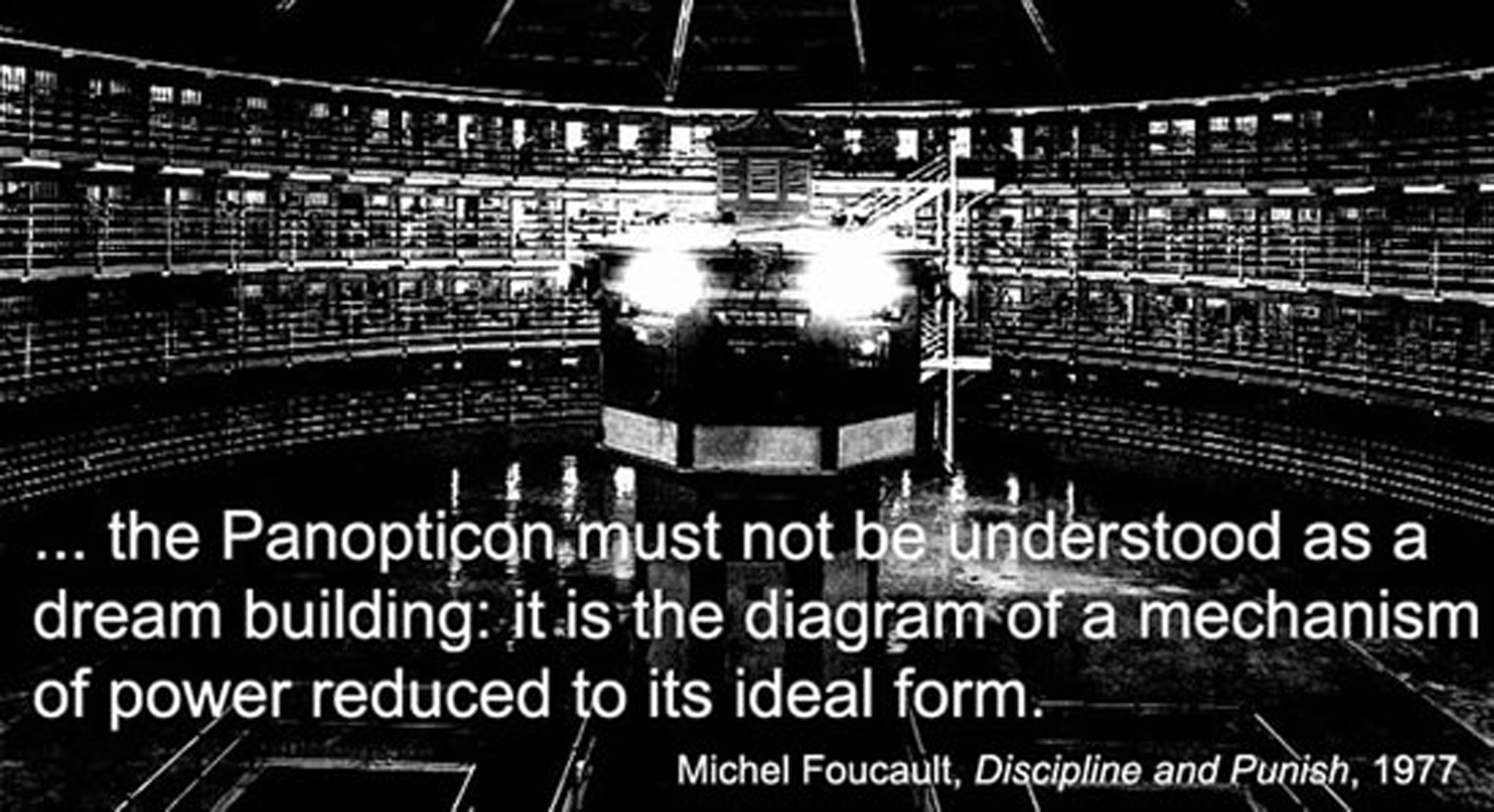
The American Surveillance State, much like The Prisoner’s Village, is a metaphorical panopticon, a circular prison in which the inmates are monitored by a single watchman situated in a central tower. Because the inmates cannot see the watchman, they are unable to tell whether or not they are being watched at any given time and must proceed under the assumption that they are always being watched.

Eighteenth century social theorist Jeremy Bentham envisioned the panopticon prison to be a cheaper and more effective means of “obtaining power of mind over mind, in a quantity hitherto without example.”

Bentham’s panopticon, in which the prisoners are used as a source of cheap, menial labor, has become a model for the modern surveillance state in which the populace is constantly being watched, controlled and managed by the powers-that-be while funding its existence.

Nowhere to run and nowhere to hide: this is the mantra of the architects of the Surveillance State and their corporate collaborators.

Government eyes are watching you.

They see your every move: what you read, how much you spend, where you go, with whom you interact, when you wake up in the morning, what you’re watching on television and reading on the internet.

Every move you make is being monitored, mined for data, crunched, and tabulated in order to amass a profile of who you are, what makes you tick, and how best to control you when and if it becomes necessary to bring you in line.

When the government sees all and knows all and has an abundance of laws to render even the most seemingly upstanding citizen a criminal and lawbreaker, then the old adage that you’ve got nothing to worry about if you’ve got nothing to hide no longer applies.

Apart from the obvious dangers posed by a government that feels justified and empowered to spy on its people and use its ever-expanding arsenal of weapons and technology to monitor and control them, we’re approaching a time in which we will be forced to choose between bowing down in obedience to the dictates of the government—i.e., the law, or whatever a government official deems the law to be—and maintaining our individuality, integrity and independence.

When people talk about privacy, they mistakenly assume it protects only that which is hidden behind a wall or under one’s clothing. The courts have fostered this misunderstanding with their constantly shifting delineation of what constitutes an “expectation of privacy.” And technology has furthered muddied the waters.

However, privacy is so much more than what you do or say behind locked doors. It is a way of living one’s life firm in the belief that you are the master of your life, and barring any immediate danger to another person (which is far different from the carefully crafted threats to national security the government uses to justify its actions), it’s no one’s business what you read, what you say, where you go, whom you spend your time with, and how you spend your money.

Unfortunately, George Orwell’s 1984—where “you had to live—did live, from habit that became instinct—in the assumption that every sound you made was overheard, and, except in darkness, every movement scrutinized”—has now become our reality.

We now find ourselves in the unenviable position of being monitored, managed, corralled and controlled by technologies that answer to government and corporate rulers.

Consider that on any given day, the average American going about his daily business will be monitored, surveilled, spied on and tracked in more than 20 different ways, by both government and corporate eyes and ears.

A byproduct of this new age in which we live, whether you’re walking through a store, driving your car, checking email, or talking to friends and family on the phone, you can be sure that some government agency is listening in and tracking your behavior.

This doesn’t even begin to touch on the corporate trackers that monitor your purchases, web browsing, Facebook posts and other activities taking place in the cyber sphere.

Stingray devices mounted on police cars to warrantlessly track cell phones, Doppler radar devices that can detect human breathing and movement within in a home, license plate readers that can record up to 1800 license plates per minutesidewalk and “public space” cameras coupled with facial recognition and behavior-sensing technology that lay the groundwork for police “pre-crime” programspolice body cameras that turn police officers into roving surveillance cameras, the internet of things: all of these technologies (and more) add up to a society in which there’s little room for indiscretions, imperfections, or acts of independence—especially not when the government can listen in on your phone calls, read your emails, monitor your driving habits, track your movements, scrutinize your purchases and peer through the walls of your home.

As French philosopher Michel Foucault concluded in his 1975 book Discipline and Punish, “Visibility is a trap.”

This is the electronic concentration camp—the panopticon prison—the Village—in which we are now caged.

It is a prison from which there will be no escape. Certainly not if the government and its corporate allies have anything to say about it.

As Glenn Greenwald notes:

“The way things are supposed to work is that we’re supposed to know virtually everything about what [government officials] do: that’s why they’re called public servants. They’re supposed to know virtually nothing about what we do: that’s why we’re called private individuals. This dynamic – the hallmark of a healthy and free society – has been radically reversed. Now, they know everything about what we do, and are constantly building systems to know more. Meanwhile, we know less and less about what they do, as they build walls of secrecy behind which they function. That’s the imbalance that needs to come to an end. No democracy can be healthy and functional if the most consequential acts of those who wield political power are completely unknown to those to whom they are supposed to be accountable.”

None of this will change, no matter which party controls Congress or the White House, because despite all of the work being done to help us buy into the fantasy that things will change if we just elect the right candidate, we’ll still be prisoners of the Village.

So how do you escape? For starters, resist the urge to conform to a group mind and the tyranny of mob-think as controlled by the Deep State.

Think for yourself. Be an individual.

As McGoohan commented in 1968, “At this moment individuals are being drained of their personalities and being brainwashed into slaves… As long as people feel something, that’s the great thing. It’s when they are walking around not thinking and not feeling, that’s tough. When you get a mob like that, you can turn them into the sort of gang that Hitler had.”

You want to be free? Remove the blindfold that blinds you to the Deep State’s con game, stop doping yourself with government propaganda, and break free of the political chokehold that has got you marching in lockstep with tyrants and dictators.

As I make clear in my book Battlefield America: The War on the American People and in its fictional counterpart The Erik Blair Diaries, until you come to terms with the fact that the government is the problem (no matter which party dominates), you’ll never stop being prisoners.

Dystopia Disguised as Democracy: All the Ways in Which Freedom Is an Illusion

By John W. Whitehead & Nisha Whitehead

Source: The Rutherford Institute

“The illusion of freedom will continue as long as it’s profitable to continue the illusion. At the point where the illusion becomes too expensive to maintain, they will just take down the scenery, they will pull back the curtains, they will move the tables and chairs out of the way and you will see the brick wall at the back of the theater.”—Frank Zappa

We are no longer free.

We are living in a world carefully crafted to resemble a representative democracy, but it’s an illusion.

We think we have the freedom to elect our leaders, but we’re only allowed to participate in the reassurance ritual of voting. There can be no true electoral choice or real representation when we’re limited in our options to one of two candidates culled from two parties that both march in lockstep with the Deep State and answer to an oligarchic elite.

We think we have freedom of speech, but we’re only as free to speak as the government and its corporate partners allow.

We think we have the right to freely exercise our religious beliefs, but those rights are quickly overruled if and when they conflict with the government’s priorities, whether it’s COVID-19 mandates or societal values about gender equality, sex and marriage.

We think we have the freedom to go where we want and move about freely, but at every turn, we’re hemmed in by laws, fines and penalties that regulate and restrict our autonomy, and surveillance cameras that monitor our movements. Punitive programs strip citizens of their passports and right to travel over unpaid taxes.

We think we have property interests in our homes and our bodies, but there can be no such freedom when the government can seize your property, raid your home, and dictate what you do with your bodies.

We think we have the freedom to defend ourselves against outside threats, but there is no right to self-defense against militarized police who are authorized to probe, poke, pinch, taser, search, seize, strip and generally manhandle anyone they see fit in almost any circumstance, and granted immunity from accountability with the general blessing of the courts. Certainly, there can be no right to gun ownership in the face of red flag gun laws which allow the police to remove guns from people merely suspected of being threats.

We think we have the right to an assumption of innocence until we are proven guilty, but that burden of proof has been turned on its head by a surveillance state that renders us all suspects and overcriminalization which renders us all lawbreakers. Police-run facial recognition software that mistakenly labels law-abiding citizens as criminals. A social credit system (similar to China’s) that rewards behavior deemed “acceptable” and punishes behavior the government and its corporate allies find offensive, illegal or inappropriate.

We think we have the right to due process, but that assurance of justice has been stripped of its power by a judicial system hardwired to act as judge, jury and jailer, leaving us with little recourse for appeal. A perfect example of this rush to judgment can be found in the proliferation of profit-driven speed and red light cameras that do little for safety while padding the pockets of government agencies.

We have been saddled with a government that pays lip service to the nation’s freedom principles while working overtime to shred the Constitution.

By gradually whittling away at our freedoms—free speech, assembly, due process, privacy, etc.—the government has, in effect, liberated itself from its contractual agreement to respect the constitutional rights of the citizenry while resetting the calendar back to a time when we had no Bill of Rights to protect us from the long arm of the government.

Aided and abetted by the legislatures, the courts and Corporate America, the government has been busily rewriting the contract (a.k.a. the Constitution) that establishes the citizenry as the masters and agents of the government as the servants.

We are now only as good as we are useful, and our usefulness is calculated on an economic scale by how much we are worth—in terms of profit and resale value—to our “owners.”

Under the new terms of this revised, one-sided agreement, the government and its many operatives have all the privileges and rights and “we the people” have none.

Only in our case, sold on the idea that safety, security and material comforts are preferable to freedom, we’ve allowed the government to pave over the Constitution in order to erect a concentration camp.

The problem with these devil’s bargains, however, is that there is always a catch, always a price to pay for whatever it is we valued so highly as to barter away our most precious possessions.

We’ve bartered away our right to self-governance, self-defense, privacy, autonomy and that most important right of all: the right to tell the government to “leave me the hell alone.” In exchange for the promise of safe streets, safe schools, blight-free neighborhoods, lower taxes, lower crime rates, and readily accessible technology, health care, water, food and power, we’ve opened the door to militarized police, government surveillance, asset forfeiture, school zero tolerance policies, license plate readers, red light cameras, SWAT team raids, health care mandates, overcriminalization and government corruption.

In the end, such bargains always turn sour.

We asked our lawmakers to be tough on crime, and we’ve been saddled with an abundance of laws that criminalize almost every aspect of our lives. So far, we’re up to 4500 criminal laws and 300,000 criminal regulations that result in average Americans unknowingly engaging in criminal acts at least three times a day. For instance, the family of an 11-year-old girl was issued a $535 fine for violating the Federal Migratory Bird Act after the young girl rescued a baby woodpecker from predatory cats.

We wanted criminals taken off the streets, and we didn’t want to have to pay for their incarceration. What we’ve gotten is a nation that boasts the highest incarceration rate in the world, with more than 2.3 million people locked up, many of them doing time for relatively minor, nonviolent crimes, and a private prison industry fueling the drive for more inmates, who are forced to provide corporations with cheap labor.

We wanted law enforcement agencies to have the necessary resources to fight the nation’s wars on terror, crime and drugs. What we got instead were militarized police decked out with M-16 rifles, grenade launchers, silencers, battle tanks and hollow point bullets—gear designed for the battlefield, more than 80,000 SWAT team raids carried out every year (many for routine police tasks, resulting in losses of life and property), and profit-driven schemes that add to the government’s largesse such as asset forfeiture, where police seize property from “suspected criminals.”

We fell for the government’s promise of safer roads, only to find ourselves caught in a tangle of profit-driven red-light cameras, which ticket unsuspecting drivers in the so-called name of road safety while ostensibly fattening the coffers of local and state governments. Despite widespread public opposition, corruption and systemic malfunctions, these cameras are particularly popular with municipalities, which look to them as an easy means of extra cash. Building on the profit-incentive schemes, the cameras’ manufacturers are also pushing speed cameras and school bus cameras, both of which result in hefty fines for violators who speed or try to go around school buses.

We’re being subjected to the oldest con game in the books, the magician’s sleight of hand that keeps you focused on the shell game in front of you while your wallet is being picked clean by ruffians in your midst.

This is how tyranny rises and freedom falls.

With every new law enacted by federal and state legislatures, every new ruling handed down by government courts, and every new military weapon, invasive tactic and egregious protocol employed by government agents, “we the people” are being reminded that we possess no rights except for that which the government grants on an as-needed basis.

Indeed, there are chilling parallels between the authoritarian prison that is life in the American police state and The Prisoner, a dystopian television series that first broadcast in Great Britain more than 50 years ago.

The series centers around a British secret agent (played by Patrick McGoohan) who finds himself imprisoned, monitored by militarized drones, and interrogated in a mysterious, self-contained, cosmopolitan, seemingly idyllic retirement community known only as The Village. While luxurious and resort-like, the Village is a virtual prison disguised as a seaside paradise: its inhabitants have no true freedom, they cannot leave the Village, they are under constant surveillance, their movements are tracked by surveillance drones, and they are stripped of their individuality and identified only by numbers.

Much like the American Police State, The Prisoner’s Village gives the illusion of freedom while functioning all the while like a prison: controlled, watchful, inflexible, punitive, deadly and inescapable.

Described as “an allegory of the individual, aiming to find peace and freedom in a dystopia masquerading as a utopia,” The Prisoner is a chilling lesson about how difficult it is to gain one’s freedom in a society in which prison walls are disguised within the trappings of technological and scientific progress, national security and so-called democracy.

Perhaps the best visual debate ever on individuality and freedom, The Prisoner confronted societal themes that are still relevant today: the rise of a police state, the freedom of the individual, round-the-clock surveillance, the corruption of government, totalitarianism, weaponization, group think, mass marketing, and the tendency of mankind to meekly accept his lot in life as a prisoner in a prison of his own making.

The Prisoner is an operations manual for how you condition a populace to life as prisoners in a police state: by brainwashing them into believing they are free so that they will march in lockstep with the state and be incapable of recognizing the prison walls that surround them.

We can no longer maintain the illusion of freedom.

As I make clear in my book Battlefield America: The War on the American People and in its fictional counterpart The Erik Blair Diaries, “we the people” have become “we the prisoners.”

Saturday Matinee: The Prisoner: Arrival

Perfect Pilots: The Prisoner “Arrival”

By John Bernardy

Source: 25 Years Later

A man resigns from his previous post. He is followed and taken captive into a surreal resort town. He tries his best to escape over and over but the location proves inescapable. But the man never backs down from the challenge. He will not conform to his prison. He will escape it.

This is The Prisoner. And this is its pilot.

The adversaries in the Village want the main character to answer this question: “Why did you resign?” They’re not interested in facts and statistics because they have plenty of those. They’re interested in the reasons behind the events—the hard-to-quantify process an individual goes through as they make decisions.

We learn the main character—most often referred to as Number Six—draws this line in the sand: “I will not be pushed, filed, stamped, indexed, briefed, debriefed, or numbered. My life is my own.”

That, ladies and gentleman, is The Prisoner’s main conflict. Six thinks in terms of conformity versus individualism. The Village thinks in terms of security and power at all cost versus breach of security.

In this pilot episode we are introduced to the Village—its physical boundaries and its social ecosystem—and we learn how long Six could be trapped in it. We meet some of the people who run it and why they’re interested in keeping Number Six under their thumb. We see an escape plan and we see that the main villain, Number Two, is easily replaceable with different actors. We also see how the other villagers are pawns for whatever the Village wants of them. There is a lot of world-building necessary to understand The Prisoner’s high-concept premise yet it does so organically, with minimal words, and all within 49 minutes.

By the end of this pilot episode, it’s hard to decide if Number Six should trust anyone. It’s even difficult to know for sure if Number Six deserves our trust, but compared to how inhumanely the Village treats people with its ends-justify-the-means methods, Six sure behaves like one of the good guys. The one thing that you do understand, however, is Six’s situation. Fight at all costs and escape. Remain an individual. The Prisoner is a moody show about big ideas such as privacy and surveillance, and you understand this struggle well after just one episode.

That is an achievement all by itself, yet the camera work is worthy of its own discussion. It is visually stunning and surreal. When Six is disconcerted and making his first escape, we see rapid camera cuts between him moving through a “garden” and statues turning as Six moves past them.

There’s similar frantic camera work as Six looks around the #6 apartment for the source of the omnipresent classical music filling his room. You could tell how necessary it was for Six to have the option to turn that radio on and off himself. The show regularly makes the viewer feel the interior space of its characters without saying a word.

The show is purposely quiet. We don’t get a word of dialogue (counting the opening credits sequence) until four minutes in. Every chance it gets, The Prisoner shows rather than tells. Its ethos is baked into every stage of the show, and I’m glad that holds true with its dialogue.

I’ll show you with my subheadings how organically information is revealed to us over the course of this episode.

The Main Character Resigns

Each week, the show opens with the main character—played by auteur show-creator Patrick McGoohan—driving his Lotus into a parking garage. He walks down a hallway and announces something to a man behind a desk. There are no words in this sequence but the character is grandstanding—emphatic and demanding. Then he storms out and drives away while a file with his picture is being typed over with “X”s. The word “resigned” is shown. The main character heads home and begins to pack quickly, but a man in a top hat has been following him and gasses the main character’s apartment. The next thing we see is McGoohan’s character waking up in the new location.

The Village Gets Its Name

The room looks identical to the flat in London, except the view outside the window is of the eccentric buildings found in Portmeirion, Wales. Not that we knew that at the time; the resort town was not listed by name until The Prisoner’s final episode. Not even viewers knew where this location was.

We get a minute and a half of the disoriented main character searching for people he’d seen off in the distance. We finally get dialogue when he comes across a woman setting up an outdoor café. After being rebuffed a few times for his question, “where is this place?” she finally tells him, “the Village.”   

Local Service Only For This Multinational Operation

The café worker tells the main character where to find a phone but he can’t use the service without a number. He takes a taxi, which is basically a golf cart, and the driver speaks to the main character in English and French, proving they deal with multiple nationalities there. She also tells him that she only does local service inside the Village, just like the phone system. She takes him to a general store where he tries to buy a map. The small map looks like this:

The larger map is the same image, only bigger and in color. There is no way to pinpoint where The Village is in relation to the rest of the known world.

An Announcement System Tells You How to Feel about the Day and Doors Tell You to Enter Them

The main character leaves the store and a nearby speaker broadcasts (in Fenella Fielding’s voice, as always) about how today is another beautiful day. He returns to the room he woke up in. There is a “6” on its sign and the door opens automatically for him, beckoning him to enter.

The main character looks out his window and sees a maid walking away from the place. Absolutely nothing is left to the individual’s responsibility in the Village, and this is told to us with action rather than exposition.

Six Gets His Title and Number Two Is the Adversary

The phone rings and a man’s voice declares him “Number Six” and that he should stop by to get acquainted. “Number Two, Green Dome,” the man says.

“Pop Goes the Weasel” is a musical cue referenced in the soundtrack as the main character heads to the Green Dome. This cue will be referenced regularly and, in my interpretation, seems to be related to the logical conclusion of the Village’s method of ruling.

When the main character arrives, the unnamed butler (Angelo Muscat) opens the door and takes him into Number Two’s chamber.

Intimidation by Breakfast: The Village Knows Everything about Their Prisoners

Number Two asks Six what he’d like for breakfast. As Six answers him, the butler immediately uncovers the exact choices as asked for. The Village keeps track of the most normal behaviors and shows that they know how predictable people are.

Yet Number Two does not know why Six resigned. The information inside Six’s head makes him a valuable commodity to many different parties. This tells us that Six knows important secrets. The Village needs to protect these secrets from falling into the wrong hands. We do not, however, learn the Village’s allegiances.

This is the entire crux of the show’s conflict. If Six reveals his motives, the Village will get what they want. If Six does not reveal his secrets and escapes, he maintains his individuality and achieves his goal.

Over the course of Six and Two’s battle of words and wills, we are shown that the Village has multiple pictures of Six’s littlest decisions from before his capture. They surveyed every part of his life before he was captured.

A Helicopter Tour Reveals the Time Frame of a Sentence

In addition to Six revealing why he resigned, Number Two wants him to conform to the Village’s rule. It will help them break him. To that end, they take a helicopter tour of the Village grounds. It serves as exposition for viewers, but it’s organic and there’s a bite to it. There’s a council building where villagers put on amateur theatrics, implying that the villagers are expected to be there a while—but how long? Number Two points out that they have their own graveyard. It sounds like a standard town detail, but the threat is clear.

People Make the Choice to Conform or Face Rover

After the characters land, Six walks around the village and notices how extremely happy everyone appears. He has a conversation with Number Two, even though Two is across the square from Six using a bullhorn and everyone is listening. Yet the villagers appear completely oblivious until Two says “be still!”

Everyone freezes in place except for one man who freaks out. He is then chased by a creepy white bubble. We learn later that its name is Rover but when Six asks, “what’s that?” Number Two only says, “That would be telling.” The Village thinks it holds all the cards. They need not reveal anything, but they must know everything.

These people in the village square had a choice to come around to Number Two’s way of thinking: the choice to survive through conformity or die as a free thinker.

Six Refuses to Conform and First Speaks of Escape

Two takes Six to the labor exchange where they test Six to conform him to a role within the community. Inside we see creepy signs on the wall such as this one: “Questions are burdens to others. Answers a prison to oneself.”

True to form, Six refuses to answer the overly invasive questions asked of him. Therefore, he is not assigned a job; instead, he goes home.

He kicks the maid out because he doesn’t want the Village doing anything for him. He also searches everywhere for the music filling his house. He did not turn it on himself, therefore it must go. An announcement call for radio repair happens just as Six destroyed his radio speaker, showing the extent to which he is under surveillance.

The maid then returns and Six begins to grill her about whether anyone has ever escaped the Village. She is visibly uncomfortable with this. She also pleads with Six to tell her his secrets so she can get what she wants in return. It’s official: all the villagers work for the Village on all levels. It’s also official that Six is always being watched. This scene is being broadcast on a giant screen in the creepy camera room where both the unnamed director and Number Two are watching it play out.

This reinforces that Six is an important person with particularly special information in his head. Only necessary force is sanctioned, nothing extreme.

The Hospital Reveals the Extent of the Village’s Methods for Conforming

Six leaves his apartment and sneaks through the garden with the unnerving statues I described earlier. He sneaks past Rover, but the director is calling Station 14 to collect Number Six before his escape is finalized. Two men catch up with him on the beach and Six wins a round of fisticuffs. It takes Rover to stop him.

Six wakes up in a hospital with a creepily pleasant woman watching over him. When she leaves to get the doctor, Six notices an old colleague, Cobb, a few beds down. Then men exchange a few sentences and it’s revealed that Cobb is in the same boat as Six. But before anything else can be said, the doctor collects Six for his physical.

On the way, Six witnesses what group therapy looks like in the Village:

We hear Number Two conversing on the phone with an unknown party about Six’s progress, and we also learn that Six’s old clothes have been burned. The only clothes he has now are from the Village. Also, Cobb is declared dead after having jumped out a window, taking away an avenue of answers for Six.

The first thing Six does as he leaves the hospital is ditch the hat and his number badge. Then he makes an abrupt visit to the Green Dome.

The First New Number Two

Six wants answers from Number Two, but instead all he learns is that a different man wears the badge and sits in the office now. He announces himself as the new Number Two.

In the first episode, we learn that the power of the office is more important than the power of the individual in that office. You have to applaud the Village for message consistency.

The face may change, but the goal remains the same. The new Number Two is all business and matter-of-factly says, “I need facts.”

Six’s First Escape Plan

Back at his apartment, Six sees Cobb’s funeral procession and meets a villager woman who appears conflicted about the whole thing. They talk about Cobb, and how she and Cobb had a plan to escape but the Village got to him before they could enact it. In the episode’s final 12 minutes, she decides to help Six escape in the same manner.

Six sees her leave the Green Dome later on but he doesn’t know he wasn’t her assignment before then. She wants to help him anyway and tells Six they’re onto him so they have to move fast. He trusts her enough to try the plan. She gives him the device that will activate a helicopter. He moves past a suspicious Rover, gets in the helicopter, and takes off.

It looks like it’s going to work—at first—but then a villager tells the woman that she should learn to play chess, “because we’re all pawns, m’dear.” It looks like the woman was trustworthy after all. She was just playing a game rigged against her.

At that moment, the Director uses a remote control to bring Six’s helicopter right back to where it started.

Escape Is Predetermined to Fail

It turns out that Cobb was part of a plan to manipulate Six into revealing his secret. Send in someone he trusts from outside. Make Six feel that they’re in the same situation. Let them commiserate. What are you in for? Same thing you are, what secret are you holding onto?

But it didn’t work, and Cobb is not surprised by this. He says as much to the new Number Two, declaring Six a challenge for the Village. Not only do we know Six is seen as important, now we know he is seen as a formidable opponent.

Yet the episode still ends with the face of Six coming towards the screen, before prison bars slam shut on him before he can get to us. He did not escape, but they did not break him. Stalemate. This is the kind of victory we get in The Prisoner.

Who Is Number Six?

There are clues to this question’s answer: McGoohan played spy John Drake on his previous show, Danger Man. Most people think this is that character continuing into a new story. Another clue: when Six tells Number Two his birthday, the shot is of Patrick McGoohan right in front of the camera, telling us his own birthday. Is this show that meta? I would believe it.

We don’t know what occupation Six held in his previous life. He could be a spy, a politician, a scientist. He could have some other kind of job entirely, maybe in the military. We understand well the world he is in now, but we don’t know who he is or, for that matter, who his captors are. As Cobb—the only person with a spoken name—left the show for other masters, there’s a distinct feeling that names don’t belong on this show and they get ushered out the second we learn one.

Even though we may never know the names of characters, we understand the high concept and dynamic of Six’s struggle fairly well. This is a major victory of The Prisoner’s pilot, especially considering how out-there this concept was when it debuted in 1967.

What is the pilot’s other victory? It makes you need to watch the other 16 episodes. Get on it!

The 2020 Election Bamboozle: We Are All Victims of the Deep State’s Con Game

By John W. Whitehead

Source: The Rutherford Institute

“We’re run by the Pentagon, we’re run by Madison Avenue, we’re run by television, and as long as we accept those things and don’t revolt we’ll have to go along with the stream to the eventual avalanche…. As long as we go out and buy stuff, we’re at their mercy… We all live in a little Village. Your Village may be different from other people’s Villages, but we are all prisoners.”— Patrick McGoohan

This is not an election.

This is a con game, a scam, a grift, a hustle, a bunko, a swindle, a flimflam, a gaffle, and a bamboozle.

In this carefully choreographed scheme to strip the American citizenry of our power and our rights, “we the people” are nothing more than marks, suckers, stooges, mugs, rubes, or gulls.

We are victims of the Deep State’s confidence game.

Every confidence game has six essential stages: 1) the foundation to lay the groundwork for the illusion; 2) the approach whereby the victim is contacted; 3) the build-up to make the victim feel like they’ve got a vested interest in the outcome; 4) the corroboration (aided by third-party conspirators) to legitimize that the scammers are, in fact, on the up-and-up; 5) the pay-off, in which the victim gets to experience some small early “wins”; and 6) the “hurrah”— a sudden manufactured crisis or change of events that creates a sense of urgency.  

In this particular con game, every candidate dangled before us as some form of political savior—including Donald Trump and Joe Biden—is part of a long-running, elaborate scam intended to persuade us that, despite all appearances to the contrary, we live in a constitutional republic.

In this way, the voters are the dupes, the candidates are the shills, and as usual, it’s the Deep State rigging the outcome.

Terrorist attacks, pandemics, civil unrest: these are all manipulated crises that add to the sense of urgency and help us feel invested in the outcome of the various elections, but it doesn’t change much in the long term.

No matter who wins this election, we’ll all still be prisoners of the Deep State.

We just haven’t learned to recognize our prison walls as such.

It’s like that old British television series The Prisoner, which takes place in a mysterious, self-contained, cosmopolitan, seemingly idyllic retirement community known only as The Village.

Perhaps the best visual debate ever on individuality and freedom, The Prisoner (17 episodes in all) centers around a British secret agent who abruptly resigns only to find himself imprisoned, monitored by militarized drones, and interrogated in The Village, a beautiful resort with parks and green fields, recreational activities and even a butler.

While luxurious, the Village is a virtual prison disguised as a seaside paradise: its inhabitants have no true freedom, they cannot leave the Village, they are under constant surveillance, all of their movements tracked. Residents of the Village are stripped of their individuality and identified only by numbers.

First broadcast in Great Britain 50-some years ago, The Prisoner dystopian television series —described as “James Bond meets George Orwell filtered through Franz Kafka”—confronted societal themes that are still relevant today: the rise of a police state, the loss of freedom, round-the-clock surveillance, the corruption of government, totalitarianism, weaponization, group think, mass marketing, and the tendency of human beings to meekly accept their lot in life as prisoners in a prison of their own making.

The series’ protagonist, played by Patrick McGoohan is Number Six.

Number Two, the Village administrator, acts as an agent for the unseen and all-powerful Number One, whose identity is not revealed until the final episode.

“I am not a number. I am a free man,” was the mantra chanted on each episode of The Prisoner, which was largely written and directed by Patrick McGoohan, who also played the title role.

In the opening episode (“The Arrival”), Number Six meets Number Two, who explains to him that he is in The Village because information stored “inside” his head has made him too valuable to be allowed to roam free “outside.”

Throughout the series, Number Six is subjected to interrogation tactics, torture, hallucinogenic drugs, identity theft, mind control, dream manipulation, and various forms of social indoctrination and physical coercion in order to “persuade” him to comply, give up, give in and subjugate himself to the will of the powers-that-be.

Number Six refuses to comply.

In every episode, Number Six resists the Village’s indoctrination methods, struggles to maintain his own identity, and attempts to escape his captors. “I will not make any deals with you,” he pointedly remarks to Number Two. “I’ve resigned. I will not be pushed, filed, stamped, indexed, debriefed or numbered. My life is my own.”

Yet no matter how far Number Six manages to get in his efforts to escape, it’s never far enough.

Watched by surveillance cameras and other devices, Number Six’s attempts to escape are continuously thwarted by ominous white balloon-like spheres known as “rovers.” Still, he refuses to give up. “Unlike me,” he says to his fellow prisoners, “many of you have accepted the situation of your imprisonment, and will die here like rotten cabbages.”

Number Six’s escapes become a surreal exercise in futility, each episode an unfunny, unsettling Groundhog’s Day that builds to the same frustrating denouement: there is no escape.

As journalist Scott Thill concludes for Wired, “Rebellion always comes at a price. During the acclaimed run of The Prisoner, Number Six is tortured, battered and even body-snatched: In the episode ‘Do Not Forsake Me Oh My Darling,’ his mind is transplanted to another man’s body. Number Six repeatedly escapes The Village only to be returned to it in the end, trapped like an animal, overcome by a restless energy he cannot expend, and betrayed by nearly everyone around him.”

The series is a chilling lesson about how difficult it is to gain one’s freedom in a society in which prison walls are disguised within the seemingly benevolent trappings of technological and scientific progress, national security and the need to guard against terrorists, pandemics, civil unrest, etc.

As Thill noted, “The Prisoner was an allegory of the individual, aiming to find peace and freedom in a dystopia masquerading as a utopia.”

The Prisoner’s Village is also an apt allegory for the American Police State: it gives the illusion of freedom while functioning all the while like a prison: controlled, watchful, inflexible, punitive, deadly and inescapable.

The American Police State, much like The Prisoner’s Village, is a metaphorical panopticon, a circular prison in which the inmates are monitored by a single watchman situated in a central tower. Because the inmates cannot see the watchman, they are unable to tell whether or not they are being watched at any given time and must proceed under the assumption that they are always being watched.

Eighteenth century social theorist Jeremy Bentham envisioned the panopticon prison to be a cheaper and more effective means of “obtaining power of mind over mind, in a quantity hitherto without example.”

Bentham’s panopticon, in which the prisoners are used as a source of cheap, menial labor, has become a model for the modern surveillance state in which the populace is constantly being watched, controlled and managed by the powers-that-be while funding its existence.

Nowhere to run and nowhere to hide: this is the new mantra of the architects of the Deep State and their corporate collaborators (Facebook, Amazon, Netflix, Google, Instagram, etc.).

Government eyes are watching you.

They see your every move: what you read, how much you spend, where you go, with whom you interact, when you wake up in the morning, what you’re watching on television and reading on the internet.

Every move you make is being monitored, mined for data, crunched, and tabulated in order to amass a profile of who you are, what makes you tick, and how best to control you when and if it becomes necessary to bring you in line.

When the government sees all and knows all and has an abundance of laws to render even the most seemingly upstanding citizen a criminal and lawbreaker, then the old adage that you’ve got nothing to worry about if you’ve got nothing to hide no longer applies.

Apart from the obvious dangers posed by a government that feels justified and empowered to spy on its people and use its ever-expanding arsenal of weapons and technology to monitor and control them, we’re approaching a time in which we will be forced to choose between obeying the dictates of the government—i.e., the law, or whatever a government official deems the law to be—and maintaining our individuality, integrity and independence.

When people talk about privacy, they mistakenly assume it protects only that which is hidden behind a wall or under one’s clothing. The courts have fostered this misunderstanding with their constantly shifting delineation of what constitutes an “expectation of privacy.” And technology has furthered muddied the waters.

However, privacy is so much more than what you do or say behind locked doors. It is a way of living one’s life firm in the belief that you are the master of your life, and barring any immediate danger to another person (which is far different from the carefully crafted threats to national security the government uses to justify its actions), it’s no one’s business what you read, what you say, where you go, whom you spend your time with, and how you spend your money.

Unfortunately, George Orwell’s 1984—where “you had to live—did live, from habit that became instinct—in the assumption that every sound you made was overheard, and, except in darkness, every movement scrutinized”—has now become our reality.

We now find ourselves in the unenviable position of being monitored, managed, corralled and controlled by technologies that answer to government and corporate rulers.

Consider that on any given day, the average American going about his daily business will be monitored, surveilled, spied on and tracked in more than 20 different ways, by both government and corporate eyes and ears.

A byproduct of this new age in which we live, whether you’re walking through a store, driving your car, checking email, or talking to friends and family on the phone, you can be sure that some government agency, whether the NSA or some other entity, is listening in and tracking your behavior.

This doesn’t even begin to touch on the corporate trackers that monitor your purchases, web browsing, Facebook posts and other activities taking place in the cyber sphere.

Stingray devices mounted on police cars to warrantlessly track cell phones, Doppler radar devices that can detect human breathing and movement within in a home, license plate readers that can record up to 1800 license plates per minutesidewalk and “public space” cameras coupled with facial recognition and behavior-sensing technology that lay the groundwork for police “pre-crime” programspolice body cameras that turn police officers into roving surveillance cameras, the internet of things: all of these technologies (and more) add up to a society in which there’s little room for indiscretions, imperfections, or acts of independence—especially not when the government can listen in on your phone calls, read your emails, monitor your driving habits, track your movements, scrutinize your purchases and peer through the walls of your home.

As French philosopher Michel Foucault concluded in his 1975 book Discipline and Punish, “Visibility is a trap.”

This is the electronic concentration camp—the panopticon prison—the Village—in which we are now caged.

It is a prison from which there will be no escape. Certainly not if the government and its corporate allies have anything to say about it.

As Glenn Greenwald notes:

“The way things are supposed to work is that we’re supposed to know virtually everything about what [government officials] do: that’s why they’re called public servants. They’re supposed to know virtually nothing about what we do: that’s why we’re called private individuals. This dynamic – the hallmark of a healthy and free society – has been radically reversed. Now, they know everything about what we do, and are constantly building systems to know more. Meanwhile, we know less and less about what they do, as they build walls of secrecy behind which they function. That’s the imbalance that needs to come to an end. No democracy can be healthy and functional if the most consequential acts of those who wield political power are completely unknown to those to whom they are supposed to be accountable.”

None of this will change, no matter who wins this upcoming presidential election.

And that’s the hustle, you see: because despite all of the work being done to help us buy into the fantasy that things will change if we just elect the right candidate, the day after a new president is sworn in, we’ll still find ourselves prisoners of the Village.

This should come as no surprise to those who haven’t been taking the escapist blue pill, who haven’t fallen for the Deep State’s phony rhetoric, who haven’t been lured in by the promise of a political savior: we never stopped being prisoners.

So how do you escape? For starters, resist the urge to conform to a group mind and the tyranny of mob-think as controlled by the Deep State.

Think for yourself. Be an individual. As McGoohan commented in 1968, “At this moment individuals are being drained of their personalities and being brainwashed into slaves… As long as people feel something, that’s the great thing. It’s when they are walking around not thinking and not feeling, that’s tough. When you get a mob like that, you can turn them into the sort of gang that Hitler had.”

You want to be free? Remove the blindfold that blinds you to the Deep State’s con game, stop doping yourself with government propaganda, and break free of the political chokehold that has got you marching in lockstep with tyrants and dictators.

As I make clear in my book Battlefield America: The War on the American People, until you come to terms with the fact that the government is the problem (no matter which party dominates), you’ll never be free.

Saturday Matinee: The Laughing Prisoner

“The Laughing Prisoner” (1987) is a parody of the 60’s cult programme The Prisoner, starring Jools Holland and Stephen Fry. This was shown as part of The Tube programme in 1987, and was repeated on 1st January 1993 as a stand-alone feature. John Peel appeared in the original version introducing a performance from a band. However the 1993 version cut him out for unknown reasons. Features appearances by Hugh Laurie, Siouxsie and the Banshees, Magnum and XTC.

Watch the original version of “The Laughing Prisoner” here.

Freedom Is a Myth: We Are All Prisoners of the Police State’s Panopticon Village

“We’re run by the Pentagon, we’re run by Madison Avenue, we’re run by television, and as long as we accept those things and don’t revolt we’ll have to go along with the stream to the eventual avalanche…. As long as we go out and buy stuff, we’re at their mercy… We all live in a little Village. Your Village may be different from other people’s Villages, but we are all prisoners.”— Patrick McGoohan

By John W. Whitehead

Source: The Rutherford Institute

First broadcast in Great Britain 50 years ago, The Prisoner—a dystopian television series described as “James Bond meets George Orwell filtered through Franz Kafka”—confronted societal themes that are still relevant today: the rise of a police state, the freedom of the individual, round-the-clock surveillance, the corruption of government, totalitarianism, weaponization, group think, mass marketing, and the tendency of humankind to meekly accept their lot in life as a prisoner in a prison of their own making.

Perhaps the best visual debate ever on individuality and freedom, The Prisoner (17 episodes in all) centers around a British secret agent who abruptly resigns only to find himself imprisoned, monitored by militarized drones, and interrogated in a mysterious, self-contained, cosmopolitan, seemingly tranquil retirement community known only as the Village. The Village is an idyllic setting with parks and green fields, recreational activities and even a butler.

While luxurious and resort-like, the Village is a virtual prison disguised as a seaside paradise: its inhabitants have no true freedom, they cannot leave the Village, they are under constant surveillance, their movements are tracked by surveillance drones, and they are stripped of their individuality and identified only by numbers.

The series’ protagonist, played by Patrick McGoohan, is Number Six.

Number Two, the Village administrator, acts as an agent for the unseen and all-powerful Number One, whose identity is not revealed until the final episode.

“I am not a number. I am a free man,” was the mantra chanted on each episode of The Prisoner, which was largely written and directed by McGoohan.

In the opening episode (“The Arrival”), Number Six meets Number Two, who explains to him that he is in The Village because information stored “inside” his head has made him too valuable to be allowed to roam free “outside.”

Throughout the series, Number Six is subjected to interrogation tactics, torture, hallucinogenic drugs, identity theft, mind control, dream manipulation, and various forms of social indoctrination and physical coercion in order to “persuade” him to comply, give up, give in and subjugate himself to the will of the powers-that-be.

Number Six refuses to comply.

In every episode, Number Six resists the Village’s indoctrination methods, struggles to maintain his own identity, and attempts to escape his captors. “I will not make any deals with you,” he pointedly remarks to Number Two. “I’ve resigned. I will not be pushed, filed, stamped, indexed, debriefed or numbered. My life is my own.”

Yet no matter how far Number Six manages to get in his efforts to escape, it’s never far enough.

Watched by surveillance cameras and other devices, Number Six’s getaways are continuously thwarted by ominous white balloon-like spheres known as “rovers.” Still, he refuses to give up. “Unlike me,” he says to his fellow prisoners, “many of you have accepted the situation of your imprisonment, and will die here like rotten cabbages.”

Number Six’s escapes become a surreal exercise in futility, each episode an unfunny, unsettling Groundhog’s Day that builds to the same frustrating denouement: there is no escape.

As journalist Scott Thill concludes for Wired, “Rebellion always comes at a price. During the acclaimed run of The Prisoner, Number Six is tortured, battered and even body-snatched: In the episode ‘Do Not Forsake Me Oh My Darling,’ his mind is transplanted to another man’s body. Number Six repeatedly escapes The Village only to be returned to it in the end, trapped like an animal, overcome by a restless energy he cannot expend, and betrayed by nearly everyone around him.”

The series is a chilling lesson about how difficult it is to gain one’s freedom in a society in which prison walls are disguised within the trappings of technological and scientific progress, national security and so-called democracy.

As Thill noted when McGoohan died in 2009, “The Prisoner was an allegory of the individual, aiming to find peace and freedom in a dystopia masquerading as a utopia.”

The Prisoner’s Village is also an apt allegory for the American Police State: it gives the illusion of freedom while functioning all the while like a prison: controlled, watchful, inflexible, punitive, deadly and inescapable.

The American Police State, much like The Prisoner’s Village, is a metaphorical panopticon, a circular prison in which the inmates are monitored by a single watchman situated in a central tower. Because the inmates cannot see the watchman, they are unable to tell whether or not they are being watched at any given time and must proceed under the assumption that they are always being watched.

Eighteenth century social theorist Jeremy Bentham envisioned the panopticon prison to be a cheaper and more effective means of “obtaining power of mind over mind, in a quantity hitherto without example.”

Bentham’s panopticon, in which the prisoners are used as a source of cheap, menial labor, has become a model for the modern surveillance state in which the populace is constantly being watched, controlled and managed by the powers-that-be and funding its existence.

Nowhere to run and nowhere to hide: this is the new mantra of the architects of the police state and their corporate collaborators (Facebook, Amazon, Netflix, Google, Instagram, etc.).

Government eyes are watching you.

They see your every move: what you read, how much you spend, where you go, with whom you interact, when you wake up in the morning, what you’re watching on television and reading on the internet.

Every move you make is being monitored, mined for data, crunched, and tabulated in order to form a picture of who you are, what makes you tick, and how best to control you when and if it becomes necessary to bring you in line.

When the government sees all and knows all and has an abundance of laws to render even the most seemingly upstanding citizen a criminal and lawbreaker, then the old adage that you’ve got nothing to worry about if you’ve got nothing to hide no longer applies.

Apart from the obvious dangers posed by a government that feels justified and empowered to spy on its people and use its ever-expanding arsenal of weapons and technology to monitor and control them, we’re approaching a time in which we will be forced to choose between obeying the dictates of the government—i.e., the law, or whatever a government official deems the law to be—and maintaining our individuality, integrity and independence.

When people talk about privacy, they mistakenly assume it protects only that which is hidden behind a wall or under one’s clothing. The courts have fostered this misunderstanding with their constantly shifting delineation of what constitutes an “expectation of privacy.” And technology has furthered muddied the waters.

However, privacy is so much more than what you do or say behind locked doors. It is a way of living one’s life firm in the belief that you are the master of your life, and barring any immediate danger to another person (which is far different from the carefully crafted threats to national security the government uses to justify its actions), it’s no one’s business what you read, what you say, where you go, whom you spend your time with, and how you spend your money.

Unfortunately, George Orwell’s 1984—where “you had to live—did live, from habit that became instinct—in the assumption that every sound you made was overheard, and, except in darkness, every movement scrutinized”—has now become our reality.

We now find ourselves in the unenviable position of being monitored, managed and controlled by our technology, which answers not to us but to our government and corporate rulers.

Consider that on any given day, the average American going about his daily business will be monitored, surveilled, spied on and tracked in more than 20 different ways, by both government and corporate eyes and ears.

A byproduct of this new age in which we live, whether you’re walking through a store, driving your car, checking email, or talking to friends and family on the phone, you can be sure that some government agency, whether the NSA or some other entity, is listening in and tracking your behavior.

This doesn’t even begin to touch on the corporate trackers that monitor your purchases, web browsing, Facebook posts and other activities taking place in the cyber sphere.

Stingray devices mounted on police cars to warrantlessly track cell phones, Doppler radar devices that can detect human breathing and movement within in a home, license plate readers that can record up to 1800 license plates per minute, sidewalk and “public space” cameras coupled with facial recognition and behavior-sensing technology that lay the groundwork for police “pre-crime” programs, police body cameras that turn police officers into roving surveillance cameras, the internet of things: all of these technologies add up to a society in which there’s little room for indiscretions, imperfections, or acts of independence—especially not when the government can listen in on your phone calls, monitor your driving habits, track your movements, scrutinize your purchases and peer through the walls of your home.

As French philosopher Michel Foucault concluded in his 1975 book Discipline and Punish, “Visibility is a trap.”

This is the electronic concentration camp—the panopticon prison—the Village—in which we are now caged.

It is a prison from which there will be no escape if the government gets it way.

As Glenn Greenwald notes:

“The way things are supposed to work is that we’re supposed to know virtually everything about what [government officials] do: that’s why they’re called public servants. They’re supposed to know virtually nothing about what we do: that’s why we’re called private individuals. This dynamic – the hallmark of a healthy and free society – has been radically reversed. Now, they know everything about what we do, and are constantly building systems to know more. Meanwhile, we know less and less about what they do, as they build walls of secrecy behind which they function. That’s the imbalance that needs to come to an end. No democracy can be healthy and functional if the most consequential acts of those who wield political power are completely unknown to those to whom they are supposed to be accountable.”

Even now, the Trump Administration is working to make some of the National Security Agency’s vast spying powers permanent.

In fact, Attorney General Jeff Sessions is pushing for Congress to permanently renew Section 702 of the Foreign Intelligence Surveillance Act, which allows government snoops to warrantlessly comb through and harvest vast quantities of our communications.

And just like that, we’re back in the Village, our escape plans foiled, our future bleak.

Except this is no surprise ending: for those who haven’t been taking the escapist blue pill, who haven’t fallen for the Deep State’s phony rhetoric, who haven’t been lured in by the promise of a political savior, we never stopped being prisoners.

So how do we break out?

For starters, wake up. Resist the urge to comply.

The struggle to remain “oneself in a society increasingly obsessed with conformity to mass consumerism,” writes Steven Paul Davies, means that superficiality and image trump truth and the individual. The result is the group mind and the tyranny of mob-think.

Think for yourself. Be an individual. As McGoohan commented in 1968, “At this moment individuals are being drained of their personalities and being brainwashed into slaves… As long as people feel something, that’s the great thing. It’s when they are walking around not thinking and not feeling, that’s tough. When you get a mob like that, you can turn them into the sort of gang that Hitler had.”

In a media-dominated age in which the lines between entertainment, politics and news reporting are blurred, it is extremely difficult to distinguish fact from fiction. We are so bombarded with images, dictates, rules and punishments and stamped with numbers from the day we are born that it is a wonder we ever ponder a concept such as freedom. As McGoohan declared, “Freedom is a myth.”

In the end, as I make clear in my book Battlefield America: The War on the American People, we are all prisoners of our own mind.

In fact, it is in the mind that prisons are created for us. And in the lockdown of political correctness, it becomes extremely difficult to speak or act individually without being ostracized. Thus, so often we are forced to retreat inwardly into our minds, a prison without bars from which we cannot escape, and into the world of video games and television and the Internet.

We have come full circle from Bentham’s Panopticon to McGoohan’s Village to Huxley’s Brave New World.

As cultural theorist Neil Postman observed:

What Orwell feared were those who would ban books. What Huxley feared was that there would be no reason to ban a book, for there would be no one who wanted to read one. Orwell feared those who would deprive us of information. Huxley feared those who would give us so much that we would be reduced to passivity and egoism. Orwell feared we would become a captive audience. Huxley feared the truth would be drowned in a sea of irrelevance. Orwell feared that we would become a captive culture. Huxley feared we would become a trivial culture, preoccupied with some equivalent of the feelies, the orgy porgy, and the centrifugal bumblepuppy. As Huxley remarked in Brave New World Revisited, the civil libertarians and rationalists who are ever on the alert to oppose tyranny “failed to take into account man’s almost infinite appetite for distractions.” In Brave New World, they are controlled by inflicting pleasure. In short, Orwell feared that what we hate would ruin us. Huxley feared that what we love will ruin us.

You want to be free? Break out of the circle.

Numbered Man – An Analysis of The Prisoner (1967)

index

An excellent analysis from Jay Dyer of one of the best television series created so far, imho.

Podcast Roundup

12/2: On The Progressive Commentary Hour host Gary Null has an in-depth conversation with Peter Levenda on the Nazi legacy, its survival and influence in world events, and its continuation to this day:

Show link: http://s35.podbean.com/pb/1448aab68f3651499d84a256f2ad4c14/54820c63/data1/blogs18/371244/uploads/PCH_120214.mp3


12/3: Host KMO and partner Olga have a wide-ranging discussion with podcaster Duncan Crary, and entrepreneur Vic Christopher on localism, architecture and regenerating community among other topics on the C-Realm podcast:

Show link: http://www.c-realm.com/wp-content/uploads/443_Troy.mp3


12/3:  On the latest episode of Guns and Butter, host Bonnie Faulker interviews Judyth Vary Baker (an ex-girlfriend of Lee Harvey Oswald) on the connection between cancer causing bioweapons research and the JFK assassination:

Show link: http://archives.kpfa.org/data/20141203-Wed1300.mp3


12/4: Freeman and author Jamie Hanshaw discuss propagandistic and ritualistic aspects of the American Music Awards on The Free Zone:

Show link: http://freeman.theanomalieschannel.com/amas-american-mind-control-awards.mp3


12/5:  On the Corbett Report, Lionel of LionelMedia.com joins James Corbett for an epic discussion on fake stories in the media, manipulation of the historical record, the fake Syria sniper boy video, the Corbett/Lionel law, and the importance of self-correction.

http://www.corbettreport.com/mp3/2014-12-04%20Lionel.mp3


Miguel Conner and author Valarie Ziegler discuss the Gnostic subtext of Patrick McGoohan’s The Prisoner, one of the greatest television programs of the 60s: