Conspiracy Theory

By Paul Craig Roberte

Source: PaulCraigRoberts.org

In the United States “conspiracy theory” is the name given to explanations that differ from those that serve the ruling oligarchy, the establishment or whatever we want to call those who set and control the agendas and the explanations that support the agendas.

The explanations imposed on us by the ruling class are themselves conspiracy theories. Moreover, they are conspiracy theories designed to hide the real conspiracy that our rulers are operating.

For example, the official explanation of 9/11 is a conspiracy theory. Some Muslims, mainly Saudi Arabians, delivered the greatest humiliation to a superpower since David slew Goliath. They outsmarted all 17 US intelligence agencies and those of NATO and Israel, the National Security Council, the Transportation Safety Administration, Air Traffic Control, and Dick Cheney, hijacked four US airliners on one morning, brought down three World Trade Center skyscrapers, destroyed that part of the Pentagon where research was underway into the missing $2.3 trillion, and caused the morons in Washington to blame Afghanistan instead of Saudi Arabia.

Clearly, the Saudia Arabians who humiliated Ameria were involved in a conspiracy to do so.

Is it a believable conspiracy?

The ability of a few young Muslim men to pull off such a feat is unbelievable. Such total failure of the US National Security State means that America was blindly vulnerable throughout the decades of Cold War with the Soviet Union. If such total failure of the National Security State had really occurred, the White House and Congress would have been screaming for an investigation. People would have been held accountable for the long chain of security failures that allowed the plot to succeed. Instead, no one was even reprimanded, and the White House resisted all efforts for an investigation for a year. Finally, to shut up the 9/11 families, a 9/11 Commission was convened. The commission duly wrote down the government’s story and that was the “investigation.”

Moreover, there is no evidence to support the official conspiracy theory of 9/11. Indeed, all known evidence contradicts the official conspiracy theory.

For example, it is a proven fact that Building 7 came down at freefall acceleration, which means it was wired for demolition. Why was it wired for demolition? There is no official answer to this question.

It is the known evidence provided by scientists, architects, engineers, pilots, and the first responders who were in the twin towers and personally experienced the numerous explosions that brought down the towers that is described as a conspiracy theory.

The CIA introduced the term “conspiracy theory” into public discourse as part of its action plan to discredit skeptics of the Warren Commission report on the assassination of President John F. Kennedy. Any explanation other than the one handed down, which is contradicted by all known evidence, was debunked as a conspiracy theory.

Conspiracy theories are the backbone of US foreign policy. For example, the George W. Bush regime was active in a conspiracy against Iraq and Saddam Hussein. The Bush regime created fake evidence of Iraqi “weapons of mass destruction,” sold the false story to a gullible world and used it to destroy Iraq and murder its leader. Similarly, Gaddafi was a victim of an Obama/Hillary conspiracy to destroy Libya and murder Gaddafi. Assad of Syria and Iran were slated for the same treatment until the Russians intervened.

Currently, Washington is engaged in conspiracies against Russia, China, and Venezuela. Proclaiming a non-existent “Iranian threat,” Washington put US missiles on Russia’s border and used the “North Korean threat” to put missiles on China’s border. The democratically elected leader of Venezuela is said by Washington to be a dictator, and sanctions have been put on Venezuela to help the small Spanish elite through whom Washington has traditionally ruled South American countries pull off a coup and reestablish US control over Venezuela.

Everyone is a threat: Venezuela, Yemen, Syria, Iran, Iraq, Afghanistan, tribes in Pakistan, Libya, Russia, China, North Korea, but never Washington. The greatest conspiracy theory of our time is that Americans are surrounded by foreign threats. We are not even safe from Venezuela.

The New York Times, the Washington Post, CNN, NPR, and the rest of the presstitutes are quick to debunk as conspiracy theories all explanations that differ from the explanations of the ruling interests that the presstitutes serve.

Yet, as I write and for some nine months to date, the presstitute media has itself been promoting the conspiracy theory that Donald Trump was involved in a conspiracy with the president of Russia and Russian intelligence services to hack the US presidential election and place Trump, a Russian agent, in the White House.

This conspiracy theory has no evidence whatsoever. It doesn’t need evidence, because it serves the interests of the military/security complex, the Democratic Party, the neoconservatives, and permits the presstitutes to show lavish devotion to their masters. By endless repetition a lie becomes truth.

There is a conspiracy, and it is against the American people. Their jobs have been offshored in order to enrich the already rich. They have been forced into debt in a futile effort to maintain their living standards. Their effort to stem their decline by electing a president who spoke for them is being subverted before their eyes by an utterly corrupt media and ruling class.

Sooner or later it will dawn on them that there is nothing they can do but violently revolt. Most likely, by the time they reach this conclusion it will be too late. Americans are very slow to escape from the false reality in which they live. Americans are a thoroughly brainwashed people who hold tightly to their false life within The Matrix.

For the gullible and naive who have been brainwashed into believing that any explanation that differs from the officially-blessed one is a conspiracy theory, there are available online long lists of government conspiracies that succeeded in deceiving the people in order that the governments could achieve agendas that the people would have rejected.

If liberty continues to exist on earth, it will not be in the Western world. It will be in Russia and China, countries that emerged out of the opposite and know the value of liberty, and it will be in those South American countries, such as Venezuela, Ecuador, and Bolivia that fight for their sovereignty against American oppression.

Indeed, as historians unconcerned with their careers are beginning to write, the primary lesson in history is that governments deceive their peoples.

Everywhere in the Western world, government is a conspiracy against the people.

A Nonviolent Strategy to Defeat Genocide

Rohingya protesters gather in front of a United Nations regional office building to call for an end to the ongoing unrest and violence in Myanmar’s Rakhine State in Bangkok on June 11, 2012. AFP PHOTO/ Nicolas ASFOURI


By Robert J. Burrowes

It is a tragic measure of the depravity of human existence that genocide is a continuing and prevalent manifestation of violence in the international system, despite the effort following World War II to abolish it through negotiation, and then adoption and ratification of the 1948 ‘Genocide Convention‘.

According to the Genocide Convention, genocide is any act committed with the intent to destroy, in whole or in part, a national, ethnic, racial or religious group by killing members of the group, causing serious bodily or mental harm to members of the group, deliberately inflicting on the group conditions of life calculated to bring about its physical destruction in whole or in part, imposing measures intended to prevent births within the group and/or forcibly transferring children of the group to another group.

While this definition is contested because, for example, it excludes killing of political groups, and words such as ‘democide’ (the murder or intentionally reckless and depraved disregard for the life of any person or people by their government,) and ‘politicide’ (the murder of any person or people because of their political or ideological beliefs) have been suggested as complementary terms, in fact atrocities that have been characterized as ‘genocide’ by various authors include mass killings, mass deportations, politicides, democides, withholding of food and/or other necessities of life, death by deliberate exposure to invasive infectious disease agents or combinations of these. See ‘Genocides in history‘.

While genocide and attempts at genocide were prevalent enough both before World War II (just ask the world’s indigenous peoples) and then during World War II itself, which is why the issue attracted serious international attention in the war’s aftermath, it cannot be claimed that the outlawing of genocide did much to end the practice, as the record clearly demonstrates.

Moreover, given that the United Nations and national governments, out of supposed ‘deference’ to ‘state sovereignty’, have been notoriously unwilling and slow to meaningfully respond to genocides, as was the case in Rwanda in 1994 and has been the case with the Rohingya in Myanmar (Burma) for four decades – as carefully documented in ‘The Slow-Burning Genocide of Myanmar’s Rohingya‘ – there is little evidence to suggest that major actors in the international system have any significant commitment to ending the practice, either in individual cases or in general. For example, as official bodies of the world watch, solicit reports and debate whether or not the Rohingya are actually victims of genocide, this minority Muslim population clearly suffers from what many organizations and any decent human being have long labeled as such. For a sample of the vast literature on this subject, see ‘The 8 Stages of Genocide Against Burma’s Rohingya‘ and ‘Countdown to Annihilation: Genocide in Myanmar‘.

Of course, it is not difficult to understand institutional inaction. Despite its fine rhetoric and even legal provisions, the United Nations, acting in response to the political and corporate elites that control it, routinely fails to act to prevent or halt wars (despite a UN Charter and treaties, such as the Kellogg-Briand Pact, that empower and require it to do so), routinely fails to defend refugees, routinely fails to act decisively on issues (such as nuclear weapons and the climate catastrophe) that constitute global imperatives for human survival, and turns the other way when peoples under military occupation (such as those of Tibet, West Papua, Western Sahara and Palestine) seek their support.

Why then should those under genocidal assault expect supportive action from the UN or international community in general? The factors which drive these manifestations of violence serve a diverse range of geopolitical interests in each case, and are usually highly profitable into the bargain. What hope justice or even decency in such circumstances?

Moreover, the deep psychological imperatives that drive the phenomenal violence in the international system are readily nominated: in essence, phenomenal fear, self-hatred and powerlessness. These psychological characteristics, together with the others that drive the behaviour of perpetrators of violence, have been identified and explained – see ‘Why Violence?‘ and ‘Fearless Psychology and Fearful Psychology: Principles and Practice‘ – but it is the way these (unconsciously and deeply-suppressed) emotions are projected that is critical to understanding the violent (and insane) behavioural outcomes in our world. For brief explanations see, for example, ‘Understanding Self-Hatred in World Affairs‘ and ‘The Global Elite is Insane‘.

Given the deep psychological imperatives that drive the violence of global geopolitics and corporate exploitation (as well as national, subnational and individual acts of violence), we cannot expect a compassionate and effective institutional response to genocide in the prevailing institutional order, as the record demonstrates. So, is there anything a targeted population can do to resist a genocidal assault?

Fortunately, there is a great deal that a targeted population can do. The most effective response is to develop and implement a comprehensive nonviolent strategy to either prevent a genocidal assault in the first place or to halt it once it has begun. This is done most effectively by using a sound strategic framework that guides the comprehensive planning of the strategy. Obviously, there is no point designing a strategy that is incomplete or cannot be successful.

A sound strategic framework enables us to think and plan strategically so that once our strategy has been elaborated, it can be widely shared and clearly understood by everyone involved. It also means that nonviolent actions can then be implemented because they are known to have strategic utility and that precise utility is understood in advance.

There is little point taking action at random, especially if our opponent is powerful and committed (even if that ‘commitment’ is insane which, as briefly noted above, is invariably the case). There is a simple diagram presenting a 12-point strategic framework illustrated here in the form of the ‘Nonviolent Strategy Wheel‘.

In order to think strategically about nonviolently defending against a genocidal assault, a clearly defined political purpose is needed; that is, a simple summary statement of ‘what you want’. In general terms, this might be stated thus: To defend the [nominated group] against the genocidal assault and establish the conditions for the group to live in peace, free of violence and exploitation.

Once the political purpose has been defined, the two strategic aims (‘how you get what you want’) of the strategy acquire their meaning. These two strategic aims (which are always the same whatever the political purpose) are as follows: 1. To increase support for the struggle to defeat the genocidal assault by developing a network of groups who can assist you. 2. To alter the will and undermine the power of those groups inciting, facilitating, organizing and conducting the genocide.

While the two strategic aims are always the same, they are achieved via a series of intermediate strategic goals which are always specific to each struggle. I have identified a generalized set of 48 strategic goals that would be appropriate in the context of ending any genocide here. These strategic goals can be readily modified to the circumstances of each particular instance of genocide.

Many of these strategic goals would usually be tackled by action groups working in solidarity with the affected population campaigning in third-party countries. Of course, individual activist groups would usually accept responsibility for focusing their work on achieving just one or a few of the strategic goals (which is why any single campaign within the overall strategy is readily manageable).

As I hope is apparent, the two strategic aims are achieved via a series of intermediate strategic goals.

Not all of the strategic goals will need to be achieved for the strategy to be successful but each goal is focused in such a way that its achievement will functionally undermine the power of those conducting the genocide.

It is the responsibility of the struggle’s strategic leadership to ensure that each of the strategic goals, which should be identified and prioritized according to their precise understanding of the circumstances in the country where the genocide is occurring, is being addressed (or to prioritize if resource limitations require this).

I wish to emphasize that I have only briefly discussed two aspects of a comprehensive strategy for ending a genocide: its political purpose and its two strategic aims (with its many subsidiary strategic goals). For the strategy to be effective, all twelve components of the strategy should be planned (and then implemented). See Nonviolent Defense/Liberation Strategy.

This will require, for example, that tactics that will achieve the strategic goals must be carefully chosen and implemented bearing in mind the vital distinction between the political objective and strategic goal of any such tactic. See ‘The Political Objective and Strategic Goal of Nonviolent Actions‘.

It is not difficult to nonviolently defend a targeted population against genocide. Vitally, however, it requires a leadership that can develop a sound strategy so that people are mobilized and deployed effectively.


Biodata: Robert J. Burrowes has a lifetime commitment to understanding
and ending human violence. He has done extensive research since 1966 in
an effort to understand why human beings are violent and has been a
nonviolent activist since 1981. He is the author of ‘Why Violence?
His email address is flametree@riseup.net
and his website is at http://robertjburrowes.wordpress.com


Robert J. Burrowes
P.O. Box 68
Daylesford
Victoria 3460
Australia
Email: flametree@riseup.net

Websites:
Nonviolence Charter
Flame Tree Project to Save Life on Earth
‘Why Violence?’
Nonviolent Campaign Strategy
Nonviolent Defense/Liberation Strategy
Anita: Songs of Nonviolence
Robert Burrowes
Global Nonviolence Network

US Gov’t Proves Love for ISIS as Bill to “Stop Arming Terrorists” Gets Only 13 Supporters

By Matt Agorist

Source: Activist Post

For the last several decades, the US government has openly funded, supported, and armed various terrorist networks throughout the world to forward an agenda of destabilization and proxy war. It is not a secret, nor a conspiracy theory, America arms bad guys.

Given the insidious history of the American empire and its creation and fostering of terrorist regimes across the globe, it should come as no surprise that the overwhelming majority of politicians would refuse to sign on to a law that requires them to ‘Stop Arming Terrorists.’ And, that is exactly what’s happened.

H.R.608 – Stop Arming Terrorists Act was introduced by Rep. Gabbard, Tulsi [D-HI] on January 23 of this year. The bill doesn’t have any crazy strings attached and its original cosponsors are a mix of Republicans and Democrats — highlighting that it transcends party lines.

“For years, our government has been providing both direct and indirect support to these armed militant groups, who are working directly with or under the command of terrorist groups like Al-Qaeda and ISIS, all in their effort and fight to overthrow the Syrian government,” Gabbard said in an interview earlier this year.

The text of the bill is simple. It merely states that it prohibits the use of federal agency funds to provide covered assistance to: (1) Al Qaeda, Jabhat Fateh al-Sham, the Islamic State of Iraq and the Levant (ISIL), or any individual or group that is affiliated with, associated with, cooperating with, or adherents to such groups; or (2) the government of any country that the Office of the Director of National Intelligence (ODNI) determines has, within the most recent 12 months, provided covered assistance to such a group or individual.

The only thing this bill does is prohibit the US government from giving money and weapons to people who want to murder Americans and who do murder innocent men, women, and children across the globe. It is quite possibly the simplest and most rational bill ever proposed by Congress. Given its rational and humanitarian nature, one would think that representatives would be lining up to show their support. However, one would be wrong.

After nearly 5 months since its introduction, only 13 of the 535 members of Congress have signed on as co-sponsors. What this lack of support for the bill shows is that the federal government is addicted to funding terror and has no intention of ever stopping it.

To add insult to treason and murder, Senator Rand Paul [R-KY] introduced this same legislation in the Senate. He currently has zero cosponsors.

Given the overwhelming lack of support for a bill that simply asks the government to stop giving money to people who behead children and video it, it should come as no surprise that Donald Trump signed hundreds of billions of dollars in weapons deals with other countries who also fund these people.

As Americans bicker over Trump’s bogus and non-existent Russian scandal, he’s signing a deal worth hundreds of billions of dollars with the largest state sponsor of terror in the world — ensuring decades of future wars and the continuation of the cycle of terrorism.

What’s more is the fact that less than one week after publicly reprimanding Qatar for terrorism, President Trump signed off on the sale of $12 billion in weapons to the country he referred to as a “funder of terrorism.” This move, in Trump’s own stance, makes him a de facto funder of terrorism now.

What this lack of support for the bills and the recent moves to arm the terrorist regimes illustrates is the fact that the US has no intention of ever stopping terrorism. Trump, just like Obama and Bush before him, will continue to foster the growth of terrorism to enrich those who profit from war.

Terrorism is necessary for the State. War, is the health of the State.

Without the constant fear mongering about an enemy who ‘hates our freedom’, Americans begin questioning things. They challenge the status quo and inevitably desire more freedom. However, when they are told that bogeymen want to kill them, they become immediately complacent and blinded by their fear.

While these bogeymen were once mostly mythical, since 9/11, they have been funded and supported by the US to the point that they now pose a very real threat to innocent people everywhere. As the recent attacks in the UK illustrate, ISIS is organizing and spreading. Even the terrorists in the UK had ties to the British government who allowed them to freely travel and train with ISIS-linked groups because those groups were in opposition to Muammar Gaddafi, who the West wanted to snub out.

It’s a vicious cycle of creating terrorists, killing innocence, and stoking war. And, unless something radical happens, it shows no signs of ever reversing.

The radical change that is necessary to shift this paradigm back to peace is for people to wake up to the reality that no matter which puppet is in the White House, the status quo remains unchanged.

Trump is proving that he can lie to get into power and his supporters ignore it. If you doubt this fact, look at what Trump did by calling out Saudi Arabia for their role in 9/11 and their support for terror worldwide prior to getting elected. He now supports these terrorists and his constituency couldn’t care less.

This madness has to stop. Humanity has to stop being fooled by rhetoric read from teleprompters by puppets doing the bidding of their masters.

Please share this article with your friends and family to show them how their supposed ‘leaders’ — except for a few good ones — are content with funding the enemy, laying waste to rights, and condone the murder of innocence.

Corbyn Teaches Us to Embrace the Change We Need

By Kevin Zeese and Margaret Flowers

Source: The Unz Review

The shocking election result in the United Kingdom – the Conservatives losing their majority and the creation of a hung Parliament; and Jeremy Corbyn being more successful than any recent Labor candidate – cutting a 20 point Theresa May lead down to a near tie – gives hope to many that the global shift to the right, fueled by the failures of governments to meet the basic needs of their population and growing economic insecurity, may be ending.

Corbyn is a lifelong activist whose message and actions have been consistent. He presented a platform directed at ending austerity and the wealth divide and was openly anti-war. There are a lot of lessons for the Labor Party in the UK from this election but there are also lessons for people in the United States. We review what happened and consider the possibilities for creating transformative change in the United States.

The Corbyn Campaign Results

The Corbyn campaign showed that a political leader urging a radical progressive transformative agenda can succeed. Many in his own party, the neo-liberal pro-war Blairites, claimed Corbyn could not win, tried to remove him from leadership, and sabotaged and refused to assist his campaign.

Corbyn showed he could win the leadership of the UK in the future, maybe sooner than later. While Theresa May is in the process of forming a minority government with a small radical conservative party from Northern Ireland, there has already been a backlash, mass petitions and protests against it and UK history has shown in similar circumstances that the second place finisher, may, in the end form the government. Corbyn is taking bold and radical actions. He is preparing to present a Queen’s speech in which he will say that he and his party are “ready to serve” and will continue to push his program through Parliament. He is calling on other parties to defeat the government in Parliament.

Corbyn did better than any recent Labor leader. Jonathan Cook, a British political commentator, writes in “The Facts Proving Corbyn’s Election Triumph” that Corbyn received 41 percent of the vote against May’s 44 percent. This was a big improvement in Labor’s share of seats, the largest increase since 1945. Cook points out that Corbyn won more votes than “Ed Miliband, Gordon Brown and Neil Kinnock, who were among those that, sometimes noisily, opposed his leadership of the party.” Even Tony Blair does not look all that good compared to Corbyn, Cook recounts:

“Here are the figures for Blair’s three wins. He got a 36 per cent share of the vote in 2005 – much less than Corbyn. He received a 41 per cent of the vote – about the same as Corbyn – in 2001. And Blair’s landslide victory in 1997 was secured on 43 per cent of the vote, just two percentage points ahead of Corbyn last night.

“In short, Corbyn has proved himself the most popular Labour leader with the electorate in more than 40 years, apart from Blair’s landslide victory in 1997.”

Bhaskar Sunkara, the founding editor of Jacobin, writes that Corbyn was not only campaigning against the Tories and Theresa May, but battling his own party – yet he still “won”:

“This is the first election Labour has won seats in since 1997, and the party got its largest share of the vote since 2005 — all while closing a twenty-four point deficit. Since Corbyn assumed leadership in late 2015, he has survived attack after attack from his own party, culminating in a failed coup attempt against him. As Labour leader he was unable to rely on his parliamentary colleagues or his party staff. The small team around him was bombarded with hostile internal leaks and misinformation, and an unprecedented media smear campaign.

“Every elite interest in the United Kingdom tried to knock down Jeremy Corbyn, but still he stands.”

The Blairites were taught a lesson by Corbyn. Many of his harshest critics are now changing their tune and embracing Corbyn. Hopefully they will join in creating a party in Corbyn’s image – a party for the many, not the few. Corbyn has rebuilt the mass base of Labor. The party is now the largest in Europe with half a million members. It is time for the “leaders” of Labor to follow the lead of the people and of Jeremy Corbyn.

What can we learn regarding US politics?

Sunkara argues Corbyn demonstrated that a winning campaign strategy is “to offer hopes and dreams to people, not just fear and diminished expectations.” In current US terms that means it is insufficient just to oppose Trump, a positive vision for the future that shows what a candidate and party stand for is needed, e.g. it is not just enough to defend the failing Affordable Care Act and oppose the Republican’s American Health Care Act, you must stand for something positive: National Improved Medicare for All. This is one example of many.

Sunkara provides more detail:

“Labour’s surge confirms what the Left has long argued: people like an honest defense of public goods. Labour’s manifesto was sweeping — its most socialist in decades. It was a straightforward document, calling for nationalization of key utilities, access to education, housing, and health services for all, and measures to redistribute income from corporations and the rich to ordinary people.

“£6.3 billion into primary schools, the protection of pensions, free tuition, public housing construction — it was clear what Labour would do for British workers. The plan was attacked in the press for its old-fashioned simplicity — “for the many, not the few” — but it resonated with popular desires, with a view of fairness that seemed elementary to millions.

“The Labour left remembered that you don’t win by tacking to an imaginary center — you win by letting people know you feel their anger and giving them a constructive end to channel it towards. ‘We demand the full fruits of our labor,’ the party’s election video said it all.”

Corbyn showed how important it is to have the correct analysis on foreign policy. Twice during the campaign, the UK was hit by a terrorist attack. Corbyn responded by telling the truth: part of the reason for terrorism is the UK foreign policy, especially in Libya. He also opposed the use of nuclear weapons. The Conservatives thought these anti-war positions would hurt Corbyn, instead they helped.

This is even more true in the United States with the never ending wars the country is fighting. But, the unspeakable in the United States, as Paul Street calls it, is acknowledging that terrorism is conducted by the US. This taboo subject makes it hard for people to understand that the US is constantly committing acts of terrorism around the world, which lead to predictable blow back from US militarism, regime change and war. No elected official will tell these obvious truths, which the people of the United States would instinctively understand if they were voiced.

Although the U.S. is often portrayed as a ‘center-right’ nation and progressives are called extremists, the reality is that there is majority support for a progressive agenda. There is a developing national consensus in the United States for transformational change, and Bernie Sanders articulated some of that consensus, at least on domestic issues, in his run for president, but the problem is that U.S. elections are manipulated by the elites in power who make sure that their interests are represented by the winner

Sunkara ends his article on Corbyn saying “Also, Bernie Sanders would have won.” We do not know what would have happened in a Trump-Sanders election. The closest example may be McGovern’s 1972 campaign against Nixon which he lost in a landslide. In that campaign, the Democrats deserted their candidate, even the AFL-CIO and big unions did not support McGovern and Nixon demonized him in the media. Would Clinton-Democrats have stood with Sanders or would they have sabotaged him like the party did to McGovern?

A key to Corbyn’s success was retail politics. The population of the UK is 65 million, compared to the US population of 321 million. Retail politics can work in the UK, while in the US paid media advertising drives the campaign, which means money often determines the outcome. This gives great power to big business interests, and while it can be overcome, it is a steep hill to climb.

Despite their significant losses, the Democrats are still controlled by Clinton-Obama Wall Street and war neo-liberals as we saw in the recent DNC chair election where Clinton protégé, Tom Perez, was elected. We are not optimistic that the US can apply the Corbyn model within the Democratic Party because it has been a party representing the oligarchs from its origins as the party of plantation slave-owners.

The duopoly parties that represent Wall Street, war and empire will not allow voices that represent “the many, not the few” to participate in US elections. They shut them out whether they run as an insurgent inside a party, as people learned from the mistreatment of Bernie Sanders by the DNC, or if they run outside of the two parties. The bi-partisans make independent party runs nearly impossible with unfair ballot access laws, barriers to voter registration, secret vote counting on unverifiable election machines, exclusion from the debates and exclusion by the corporate media, who are in cahoots with the bi-partisans.

It Comes Down to Building An Independent Mass Political Movement

We live in a mirage democracy with managed elections, as we describe in the article “Fighting for A Legitimate Democracy By and For the People,” on the long history of wealth dominating politics in the U.S.

Historically, transformations have occurred because of mass social movements demanding change and participating in elections through independent parties that have grown out of a movement with candidates from the movement (Corbyn has been involved in every anti-war movement, anti-apartheid, anti-austerity, pro-peace and human rights movements among others). Showing mass electoral support, even without winning, has resulted in significant changes – union rights, women’s voting rights, the eight-hour workday – indeed the New Deal came out of third party platforms. It is important to resist the duopoly parties in order to get to the root of the problems we face; as Patrick Walker explains, the “grassroots resistance must oppose Democrats as well as Trump.”

A broad and diverse social movement whose demands are articulated by an independent party platform has forced one of the two parties to capitulate to the movement or disappear. That still seems to be the most likely path to real change for the US.

Corbyn teaches that we should embrace the radical transformational change that is needed, whether in elections or as a movement, to inspire people to take action and shift the realm of the possible. The people thirst for change as their economic situation becomes more insecure. There needs to be a movement that addresses that insecurity through a human rights lens, or else the insecurity will be channeled towards hatred and violence.

The key first step is to show the many, we are with them; that we are listening and acting consistent with their beliefs. Taking this correct first step, lights the path ahead of us.


Kevin Zeese and Margaret Flowers co-direct Popular Resistance.


Related Article: The Breaking of the Corporate Media Monopoly

3 Questions You’re Never Supposed to Ask After a Terrorist Attack

By Isaac Davis

Source: Waking Times

In a world where defense budgets are astronomical and wars of occupation and destabilization never end, political leaders in the UK and in Europe want you accept street level terror as the new everyday normal. The attacks are unstoppable, they say, and the world must embrace this hopelessness with faith that the government is doing all it can to create a better, safer world. Run, hide, and call the authorities, for you are helpless in this reality, so they say. But who creates and sustains this reality?

Terrorism is defined as the use of violence in the pursuit of political aims, and as politicians respond to terrorism by holding news conferences, posing, grandstanding, eulogizing, weeping for the cameras, applauding first responders and proposing legislation, so many of the important questions which can help guide us out of such a gloomy future are going unasked and unanswered. And these questions are always the same for any of these attacks, be it the London attacks, Manchester, Orlando, the Boston marathon, 7/7 or 9/11.

Here are three things we should be always ask about when Islamic terror , all of which are fair questions for any of the major terror attacks happening in Western nations.

1. In what ways do Western governments contribute to the problem of Islamic terror?

The media wants you to believe that this type of terror is unrelated to government policies and actions, thus attempting to divorce them from the greater context of geopolitics and the decades long push toward globalist world government. But how do Western governments contribute to the problem of terrorism?

Do never-ending occupations of Middle Eastern conditions and the wrecking of stable nations contribute to terrorism? Does supplying arms and financial support to known terrorist organizations make attacks in Western nations more likely? Does bombing infrastructure, hospitals and civilians in foreign nations play a role? Does promoting and supporting the massive influx of Middle Eastern and African migrants into Western nations have an effect? Does permitting known radicals and others on terror watch lists to operate freely in the West make it more likely that events like the London Bridge attack will occur? Does preventing and punishing people for speaking out in defense of their own nations and customs contribute to the situation?

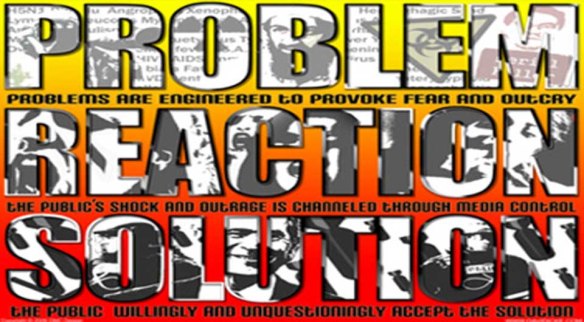
2. How does government benefit from the reaction to the problem?

Terror creates fear, insecurity, panic, uncertainty, chaos, anger, hate and irrationality, and none are more easily lorded over than those living in terror. Historically, governments make exceptional gains in power and authority when their citizens are psychologically abused.

3. What is the pre-packaged government solution to the problem?

In the case of the London Bridge attacks, the very next day, UK Prime Minister Theresa May called for government regulation of the internet, a demand which is now being echoed by wise politicians and pundits. But this measure was already being floated, it just a dramatic push for it to gain popularity.

Whether it is the Patriot Act, the pre-planned invasion of Afghanistan, calls to restrict the 2nd Amendment, greater government surveillance, increased spending on war and police state security measures, the detainment of innocent people or torture of detainees, the government always has a solution in place before an attack happens.

Final Thoughts

Accepting terror as the norm is absolutely unacceptable and must be totally rejected by people who wish to live in peace and prosperity, which will forever remain impossible while government is allowed to contribute and benefit from terror.

War on Terror: Greatest Covert Op

(Editor’s Note: The following commentary is drawn from a speech delivered by Douglas Valentine at a 2010 peace conference. In expanded version is included as the final chapter of his book “The CIA as Organized Crime: How Illegal Operations Corrupt America and the World”.)

By Douglas Valentine

Source: Consortium News

The politics of terror are the greatest covert operation ever.

In explaining why, I’ll begin by defining some terms, because, when discussing the covert op called “the politics of terror,” words and their management are all important.

How are politics and terror actually defined: how are these meanings manipulated; for what purposes, and by whom?

Terrorism is defined as “violence against civilians intended to obtain a political purpose.”

This is an ambiguous phrase, which begs the questions: what are politics and violence?

Politics is defined as “the process by which groups of people make collective decisions.” And violence in this context is the use of force to compel a person or group to do or think something against their will. That includes the violence of words – of threatening to hurt – and of social structures, as well as the violence of deeds.

So, by definition, terrorism is political violence – hurting people, or threatening to hurt them, in order to make them govern themselves (or acquiesce to an external force) against their will.

In America, terrorism is always condemned by the government, and, accordingly, America is never a perpetrator of terrorism, but always the victims of it.

The U.S. war on terror is the ultimate expression of this principle: it is a military response to terrorism; violence in self-defense, not (ostensibly) violence for a political purpose.

That’s the official story – the assumption. But I’m going to show that America does engage in terrorism – violence against civilians for political purposes. This “state” terrorism, however, is covert, in so far as it is equated with national security, and thanks to that built-in ambiguity, it has both stated and unstated purpose.

The State and Unstated Policy in America 

Politics is a process by which groups of people make collective decisions. But who really makes the overarching political decisions in America? Who governs us?

The two political parties represent the people and they compete for control of the government. Historically, Republicans have generally favored business and Democrats have favored labor. The political division is, generally, class based.

Now, the government can be controlled by either political party; but the state endures –  “the state” being the nation’s indispensable industries and infrastructure (banking, auto industry, insurance, Microsoft), and the institutions which defend the nation’s enduring interests: the military, law enforcement, the intelligence and security services.

In Europe they often, cynically, refer to the state as “industry” or Big Business. In America we tend to call “the state” the Establishment – an ambiguous word that needs to be defined.

The dictionary defines Establishment as, “An exclusive group of powerful people who rule a government or society by means of private agreements and decisions.”

I would venture to say that the interests of the state and the Establishment are the same, and that the definition of Establishment with a capital E is the pivotal phrase in discussing “state” terrorism.

Consider this: there is the politics of the two parties vying for control of the government, and there is the Establishment, the state, making the covert (ostensibly non-political) decisions that effectively govern America.

Many of those covert decisions concern national security: they are unstated policy.

Moreover, these covert policy decisions about national security are made by people who control the military, law enforcement, and intelligence and security services. These guardians of “the state” are collectively called the National Security Establishment.

Like the Establishment that secretly rules the “state,” the National Security Establishment is an exclusive group that is not accountable to the political whims of the people.

These professional guardians of the state – the Establishment – are assumed to be above partisan politics. Their loyalty is assumed to be to the law or national security. And that assumption is the Big Lie upon which state terrorism is based.

Yes, it is true that the National Security Establishment is not accountable to the people: and, in fact, it has built a series of ever-larger, concentric moats around itself called the National Security State, precisely to keep the people out of its business.

The National Security Establishment rules the National Security State, with an iron fist, but it is pure propaganda that the National Security Establishment and State are not political.

In order to get inside the National Security Establishment, and rise to a position of authority within it, one must be born there (like Bush or make billions like Bill Gates), or submit to years of right-wing political indoctrination calibrated to a series of increasingly restrictive security clearances.

Political indoctrination – adopting the correct right-wing ideology – and security clearances represent the drawbridge across the moats.

The National Security State is the covert social structure of the Establishment, and it has as its job not just defending the Establishment from foreign enemies, but also expanding the Establishment’s economic and military influence abroad, while preserving its class prerogatives at home.

By “class prerogatives,” I mean the National Security State is designed to keep the lower class from exerting any political control over the state; especially, redistributing the Establishment’s private wealth.

To these unstated ends – imperialism abroad and repression at home – the National Security State engages in terrorism – i.e. political violence – on behalf of the Establishment.

Indeed, the National Security State is political violence, terrorism, in its purest form.

The Establishment and its National Security State as Terrorism

The lower classes in America have little voice in making government or state policy. Some members of the lower classes have given up hope, others are content: but in either case, voter turnout is a mere 54 percent.

Whether hopeless or content, they know they cannot fight conventional thinking. For example, when the Establishment exerts its influence, it is not considered politics; it is simply the status quo. The rich create jobs and must be accommodated with trillion-dollar bailouts, paid for by workers taking furloughs.

That’s just the way it is. Politicians in the service of the Establishment, for over-arching reasons of national security, have to keep the capitalist financial system afloat.

It is the same thing with the National Security Establishment: America invaded Iraq, and there was nothing the people could do about it. The decision was made for them. Peace activists, least of all, had no voice in the decision, because they are assumed to have no stake in national security.

You will not find peace activists in the National Security Establishment; and that political repression is part of covert state terrorism.

Likewise, if labor seeks to exercise influence, its efforts are described as exploiting the state for more than it deserves, because it does not have an enduring stake in the state.

It is a fact: only Establishment wealth – ownership – is equated with national security.

Consider the immortal words of Leona Helmsley: “Only the little people pay taxes.”

That injustice in the tax code is political repression and, in so far as it makes the people fearful, it is state terrorism. The Establishment fears losing its loopholes, while workers and the poor fear losing their homes: two types of fear, one for each class, one stated, one unstated.

The Establishment engages imperialism and political repression through propaganda (word management violence) and social structures. This state terrorism also is unstated, covert.

Only when the people rebel and challenge the Establishment is the word terrorism applied.

Likewise, the military, police or intelligence actions that provoke rebellion, or the responses to rebellion, are never called terrorism: they are national security.

And that’s how the management of words helps to repress the lower classes.

Language and the Psychology of State Terror

America’s industrial-sized war machine was never said to terrorize Iraq; the invasion was not political because the war machine is owned by the Establishment.

The Establishment profiting from war is not politics; it is ideological neutral “profits.”

In fact, America exerts its unwanted political influence overseas, through the state terror of aircraft carrier fleets, bombers, nuclear subs, shock and awe invasions, pacification programs, the overthrow of governments, and support of repressive puppet regimes.

This state terrorism, which you never hear about, is the biggest covert psychological warfare operation of all time.

This psywar operation depends on narrowly defining terrorism as a suicide bomber, a hijacked plane, the decapitated body of a collaborator: the “selective terrorism” of rebels and nationalists who, outgunned and outlawed in their own country, have no other options, other than submission.

The purpose of this “selective terrorism” by rebels is psychological: to isolate collaborators, while demonstrating to the people the ability of the rebels to strike at their oppressors. Brutal pacification cam­paigns – state terrorism – prevent people from making a living. Selective terrorism does not.

That’s a big, meaningful “class” difference.

The National Security Establishment understands that selective terror achieves political and psychological goals that state terror does not – that it rallies people to revolutionary ideals.  So the National Security Establishment engages in selective terror, too, by targeting the rebel, his family and friends in their homes.

This is the selective terror con­ducted by counter-terrorists. But don’t be confused: it is terrorism. All terrorism is psychological and political; state terror seeks to immobilize people and make them submissive, apathetic and/or ostensibly “content.”

The National Security Establishment fully understands that once people have been terrorized, they have been politically defeated, without necessarily receiving bullets.

As former Director of Central Intelligence William Colby once said: “The implication or latent threat of terror was sufficient to insure that the people would comply.”

This principle of the psychological use of “the implication or latent threat of terror” is what brings us back to America and the business of terror.

The Business of Terror

State terror – colonization abroad and political repression at home – is a key means of extracting profits and maintaining ownership of property. Ask the American Indian.

In its colonies abroad, the U.S. engages in state terrorism by removing all legal protections for rebels; detention, torture, and summary execution are the price for rebellion against U.S. policy.

State terrorism overseas, imperialism, is never acknowledged by the U.S. media, because the media is a big business closely affiliated with the National Security Establishment; indeed, two of the major networks are owned by defense contractors.

And state terrorism applied domestically to ensure “internal” security is never acknowledged. But the National Security State is well thought out, by professionals in language management, and political and psychological warfare, aimed at you.

“Personal violence is for the amateur in dominance,” says Johan Galtung, a founder of the disciipline of peace and conflict studies. But he adds “structural violence is the tool of the professional. The amateur who wants to dominate uses guns; the professional uses social structure. The legal criminality of the social system and its institutions, of government…is tacit violence. Structural violence is a structure of exploitation and social injustice.”

As Colby said:The implication or latent threat is enough to insure people will comply.”

The war on terror and its domestic version “homeland security” are the law of the land – America’s new legally criminal social structure based on administrative detention, enshrined in The Patriot Act and a number of executive orders, some secret.

This lack of due process comes on top of a justice system already skewed to protect the propertied elite and pack the prisons with the poor, through “structural violence,” mainly the drug wars.

The Establishment’s new anti-terror and anti-drug laws make the National Security State the most fearsome covert political and psywar machine the world has ever seen. And the National Security State is growing: the “Top Secret America” series in the Washington Post put it at 750,000 cadres.

This secret state within a state extends into the homeland’s critical infrastructure and beyond. For example, the arms industry provides good jobs, making American imperial aggression seem a positive value.

And this is how the psyched-out people become one of the moats.

As it is modeled on the totalitarian corporate paradigm, the National Security State in all its manifestations fits the classic definition of a fascist dictatorship. And we know what its intentions are. They have been stated.

In the days after 9/11, right-wing Republican stalwart Kenneth W. Starr, the Clinton inquisitor, said the danger of terrorism requires “deference to the judgments of the political branches with respect to matters of national security.”

But is there an on-going emergency that requires deference to the political branches, meaning the right-wing ideologues who rule the National Security State? And what does it mean for Establishment opponents if due process is completely abandoned at home, and subjected to politics?

Michael Ledeen, a former counter-terror expert on Reagan’s National Security Council, blamed 9/11 on President Bill Clinton “for failing to properly organize our nation’s security apparatus.”

Ledeen’s solution to the problem of those who sneered at security was “to stamp out” the “corrupt habits of mind.” By which he means Liberalism.

In other words, the reactionary right-wing that owns the National Security State wants to impose its total rule on the people in order to create a security conscious, uniform citizenry – marching in lock step, flags waving – that is necessary to win the war on terror.

This is how the National Security professionals are incrementally creating the requisite fascist social structure – through terror, the best organizing principle ever.

“This is time for the old motto, ‘kill them all, let God sort ’em out.’ New times require new people with new standards,” Ledeen asserted. “The entire political world will understand it and applaud it. And it will give us a chance to prevail.”

When Ledeen says “political” world he means the “owners of the business” of state terror, the right-wing ideologues who pack the National Security State and the capitalist Establishment they serve.

And they have won the propaganda war, folks.

Forbidden Questions? 24 Key Issues That Neither the Washington Elite Nor the Media Consider Worth Their Bother

By Andrew J. Bacevich

Source: TomDispatch.com

Donald Trump’s election has elicited impassioned affirmations of a renewed commitment to unvarnished truth-telling from the prestige media.  The common theme:  you know you can’t trust him, but trust us to keep dogging him on your behalf.  The New York Times has even unveiled a portentous new promotional slogan: “The truth is now more important than ever.” For its part, the Washington Post grimly warns that “democracy dies in darkness,” and is offering itself as a source of illumination now that the rotund figure of the 45th president has produced the political equivalent of a total eclipse of the sun. Meanwhile, National Public Radio fundraising campaigns are sounding an increasingly panicky note: give, listener, lest you be personally responsible for the demise of the Republic that we are bravely fighting to save from extinction.

If only it were so.  How wonderful it would be if President Trump’s ascendancy had coincided with a revival of hard-hitting, deep-dive, no-holds-barred American journalism.  Alas, that’s hardly the case.  True, the big media outlets are demonstrating both energy and enterprise in exposing the ineptitude, inconsistency, and dubious ethical standards, as well as outright lies and fake news, that are already emerging as Trump era signatures.  That said, pointing out that the president has (again) uttered a falsehood, claimed credit for a nonexistent achievement, or abandoned some position to which he had previously sworn fealty requires something less than the sleuthing talents of a Sherlock Holmes.  As for beating up on poor Sean Spicer for his latest sequence of gaffes — well, that’s more akin to sadism than reporting.

Apart from a commendable determination to discomfit Trump and members of his inner circle (select military figures excepted, at least for now), journalism remains pretty much what it was prior to November 8th of last year: personalities built up only to be torn down; fads and novelties discovered, celebrated, then mocked; “extraordinary” stories of ordinary people granted 15 seconds of fame only to once again be consigned to oblivion — all served with a side dish of that day’s quota of suffering, devastation, and carnage.  These remain journalism’s stock-in-trade.  As practiced in the United States, with certain honorable (and hence unprofitable) exceptions, journalism remains superficial, voyeuristic, and governed by the attention span of a two year old.

As a result, all those editors, reporters, columnists, and talking heads who characterize their labors as “now more important than ever” ill-serve the public they profess to inform and enlighten.  Rather than clearing the air, they befog it further.  If anything, the media’s current obsession with Donald Trump — his every utterance or tweet treated as “breaking news!” — just provides one additional excuse for highlighting trivia, while slighting issues that deserve far more attention than they currently receive.

To illustrate the point, let me cite some examples of national security issues that presently receive short shrift or are ignored altogether by those parts of the Fourth Estate said to help set the nation’s political agenda. To put it another way: Hey, Big Media, here are two dozen matters to which you’re not giving faintly adequate thought and attention.

1. Accomplishing the “mission”: Since the immediate aftermath of World War II, the United States has been committed to defending key allies in Europe and East Asia.  Not long thereafter, U.S. security guarantees were extended to the Middle East as well.  Under what circumstances can Americans expect nations in these regions to assume responsibility for managing their own affairs?  To put it another way, when (if ever) might U.S. forces actually come home?  And if it is incumbent upon the United States to police vast swaths of the planet in perpetuity, how should momentous changes in the international order — the rise of China, for example, or accelerating climate change — affect the U.S. approach to doing so?

2. American military supremacy: The United States military is undoubtedly the world’s finest.  It’s also far and away the most generously funded, with policymakers offering U.S. troops no shortage of opportunities to practice their craft.  So why doesn’t this great military ever win anything?  Or put another way, why in recent decades have those forces been unable to accomplish Washington’s stated wartime objectives?  Why has the now 15-year-old war on terror failed to result in even a single real success anywhere in the Greater Middle East?  Could it be that we’ve taken the wrong approach?  What should we be doing differently?

3. America’s empire of bases: The U.S. military today garrisons the planet in a fashion without historical precedent.  Successive administrations, regardless of party, justify and perpetuate this policy by insisting that positioning U.S. forces in distant lands fosters peace, stability, and security.  In the present century, however, perpetuating this practice has visibly had the opposite effect.  In the eyes of many of those called upon to “host” American bases, the permanent presence of such forces smacks of occupation.  They resist.  Why should U.S. policymakers expect otherwise?

4. Supporting the troops: In present-day America, expressing reverence for those who serve in uniform is something akin to a religious obligation.  Everyone professes to cherish America’s “warriors.”  Yet such bountiful, if superficial, expressions of regard camouflage a growing gap between those who serve and those who applaud from the sidelines. Our present-day military system, based on the misnamed All-Volunteer Force, is neither democratic nor effective.  Why has discussion and debate about its deficiencies not found a place among the nation’s political priorities? 

5. Prerogatives of the commander-in-chief: Are there any military actions that the president of the United States may not order on his own authority?  If so, what are they?  Bit by bit, decade by decade, Congress has abdicated its assigned role in authorizing war. Today, it merely rubberstamps what presidents decide to do (or simply stays mum).  Who does this deference to an imperial presidency benefit?  Have U.S. policies thereby become more prudent, enlightened, and successful?

6. Assassin-in-chief: A policy of assassination, secretly implemented under the aegis of the CIA during the early Cold War, yielded few substantive successes.  When the secrets were revealed, however, the U.S. government suffered considerable embarrassment, so much so that presidents foreswore politically motivated murder. After 9/11, however, Washington returned to the assassination business in a big way and on a global scale, using drones.  Today, the only secret is the sequence of names on the current presidential hit list, euphemistically known as the White House “disposition matrix.” But does assassination actually advance U.S. interests (or does it merely recruit replacements for the terrorists it liquidates)?  How can we measure its costs, whether direct or indirect?  What dangers and vulnerabilities does this practice invite?

7. The war formerly known as the “Global War on Terrorism”: What precisely is Washington’s present strategy for defeating violent jihadism?  What sequence of planned actions or steps is expected to yield success? If no such strategy exists, why is that the case?  How is it that the absence of strategy — not to mention an agreed upon definition of “success” — doesn’t even qualify for discussion here?

8. The campaign formerly known as Operation Enduring Freedom: The conflict commonly referred to as the Afghanistan War is now the longest in U.S. history — having lasted longer than the Civil War, World War I, and World War II combined. What is the Pentagon’s plan for concluding that conflict?  When might Americans expect it to end?  On what terms?

9. The Gulf: Americans once believed that their prosperity and way of life depended on having assured access to Persian Gulf oil.  Today, that is no longer the case.  The United States is once more an oil exporter. Available and accessible reserves of oil and natural gas in North America are far greater than was once believed. Yet the assumption that the Persian Gulf still qualifies as crucial to American national security persists in Washington. Why?

10. Hyping terrorism: Each year terrorist attacks kill far fewer Americans than do auto accidents, drug overdoses, or even lightning strikes.  Yet in the allocation of government resources, preventing terrorist attacks takes precedence over preventing all three of the others combined. Why is that?

11. Deaths that matter and deaths that don’t: Why do terrorist attacks that kill a handful of Europeans command infinitely more American attention than do terrorist attacks that kill far larger numbers of Arabs? A terrorist attack that kills citizens of France or Belgium elicits from the United States heartfelt expressions of sympathy and solidarity.  A terrorist attack that kills Egyptians or Iraqis elicits shrugs.  Why the difference?  To what extent does race provide the answer to that question?

12. Israeli nukes: What purpose is served by indulging the pretense that Israel does not have nuclear weapons?

13. Peace in the Holy Land: What purpose is served by indulging illusions that a “two-state solution” offers a plausible resolution to the Israeli-Palestinian conflict?  As remorselessly as white settlers once encroached upon territory inhabited by Native American tribes, Israeli settlers expand their presence in the occupied territories year by year.  As they do, the likelihood of creating a viable Palestinian state becomes ever more improbable. To pretend otherwise is the equivalent of thinking that one day President Trump might prefer the rusticity of Camp David to the glitz of Mar-a-Lago.

14. Merchandizing death: When it comes to arms sales, there is no need to Make America Great Again.  The U.S. ranks number one by a comfortable margin, with long-time allies Saudi Arabia and Israel leading recipients of those arms.  Each year, the Saudis (per capita gross domestic product $20,000) purchase hundreds of millions of dollars of U.S. weapons.  Israel (per capita gross domestic product $38,000) gets several billion dollars worth of such weaponry annually courtesy of the American taxpayer.  If the Saudis pay for U.S. arms, why shouldn’t the Israelis? They can certainly afford to do so.

15. Our friends the Saudis (I): Fifteen of the 19 hijackers on September 11, 2001, were Saudis.  What does that fact signify?

16. Our friends the Saudis (II): If indeed Saudi Arabia and Iran are competing to determine which nation will enjoy the upper hand in the Persian Gulf, why should the United States favor Saudi Arabia?  In what sense do Saudi values align more closely with American values than do Iranian ones?

17. Our friends the Pakistanis: Pakistan behaves like a rogue state.  It is a nuclear weapons proliferator.  It supports the Taliban.  For years, it provided sanctuary to Osama bin Laden.  Yet U.S. policymakers treat Pakistan as if it were an ally.  Why?  In what ways do U.S. and Pakistani interests or values coincide?  If there are none, why not say so?

18. Free-loading Europeans: Why can’t Europe, “whole and free,” its population and economy considerably larger than Russia’s, defend itself?  It’s altogether commendable that U.S. policymakers should express support for Polish independence and root for the Baltic republics.  But how does it make sense for the United States to care more about the wellbeing of people living in Eastern Europe than do people living in Western Europe?

19. The mother of all “special relationships”: The United States and the United Kingdom have a “special relationship” dating from the days of Franklin Roosevelt and Winston Churchill.  Apart from keeping the Public Broadcasting Service supplied with costume dramas and stories featuring eccentric detectives, what is the rationale for that partnership today?  Why should U.S. relations with Great Britain, a fading power, be any more “special” than its relations with a rising power like India?  Why should the bonds connecting Americans and Britons be any more intimate than those connecting Americans and Mexicans?  Why does a republic now approaching the 241st anniversary of its independence still need a “mother country”?

20. The old nuclear disarmament razzmatazz: American presidents routinely cite their hope for the worldwide elimination of nuclear weapons.  Yet the U.S. maintains nuclear strike forces on full alert, has embarked on a costly and comprehensive trillion-dollar modernization of its nuclear arsenal, and even refuses to adopt a no-first-use posture when it comes to nuclear war.  The truth is that the United States will consider surrendering its nukes only after every other nation on the planet has done so first.  How does American nuclear hypocrisy affect the prospects for global nuclear disarmament or even simply for the non-proliferation of such weaponry?

21. Double standards (I): American policymakers take it for granted that their country’s sphere of influence is global, which, in turn, provides the rationale for the deployment of U.S. military forces to scores of countries.  Yet when it comes to nations like China, Russia, or Iran, Washington takes the position that spheres of influence are obsolete and a concept that should no longer be applicable to the practice of statecraft.  So Chinese, Russian, and Iranian forces should remain where they belong — in China, Russia, and Iran.  To stray beyond that constitutes a provocation, as well as a threat to global peace and order.  Why should these other nations play by American rules?  Why shouldn’t similar rules apply to the United States?

22. Double standards (II): Washington claims that it supports and upholds international law.  Yet when international law gets in the way of what American policymakers want to do, they disregard it.  They start wars, violate the sovereignty of other nations, and authorize agents of the United States to kidnap, imprison, torture, and kill.  They do these things with impunity, only forced to reverse their actions on the rare occasions when U.S. courts find them illegal.  Why should other powers treat international norms as sacrosanct since the United States does so only when convenient? 

23. Double standards (III): The United States condemns the indiscriminate killing of civilians in wartime.  Yet over the last three-quarters of a century, it killed civilians regularly and often on a massive scale.  By what logic, since the 1940s, has the killing of Germans, Japanese, Koreans, Vietnamese, Laotians, Cambodians, Afghans, and others by U.S. air power been any less reprehensible than the Syrian government’s use of “barrel bombs” to kill Syrians today?  On what basis should Americans accept Pentagon claims that, when civilians are killed these days by U.S. forces, the acts are invariably accidental, whereas Syrian forces kill civilians intentionally and out of malice?  Why exclude incompetence or the fog of war as explanations?  And why, for instance, does the United States regularly gloss over or ignore altogether the noncombatants that Saudi forces (with U.S. assistance) are routinely killing in Yemen?

24. Moral obligations: When confronted with some egregious violation of human rights, members of the chattering classes frequently express an urge for the United States to “do something.”  Holocaust analogies sprout like dandelions.  Newspaper columnists recycle copy first used when Cambodians were slaughtering other Cambodians en masse or whenever Hutus and Tutsis went at it.  Proponents of action — typically advocating military intervention — argue that the United States has a moral obligation to aid those victimized by injustice or cruelty anywhere on Earth.  But what determines the pecking order of such moral obligations?  Which comes first, a responsibility to redress the crimes of others or a responsibility to redress crimes committed by Americans?  Who has a greater claim to U.S. assistance, Syrians suffering today under the boot of Bashar al-Assad or Iraqis, their country shattered by the U.S. invasion of 2003?  Where do the Vietnamese fit into the queue?  How about the Filipinos, brutally denied independence and forcibly incorporated into an American empire as the nineteenth century ended?  Or African-Americans, whose ancestors were imported as slaves?  Or, for that matter, dispossessed and disinherited Native Americans?  Is there a statute of limitations that applies to moral obligations?  And if not, shouldn’t those who have waited longest for justice or reparations receive priority attention?

Let me suggest that any one of these two dozen issues — none seriously covered, discussed, or debated in the American media or in the political mainstream — bears more directly on the wellbeing of the United States and our prospects for avoiding global conflict than anything Donald Trump may have said or done during his first 100 days as president.  Collectively, they define the core of the national security challenges that presently confront this country, even as they languish on the periphery of American politics.

How much damage Donald Trump’s presidency wreaks before it ends remains to be seen.  Yet he himself is a transient phenomenon.  To allow his pratfalls and shenanigans to divert attention from matters sure to persist when he finally departs the stage is to make a grievous error.  It may well be that, as the Times insists, the truth is now more important than ever.  If so, finding the truth requires looking in the right places and asking the right questions.


Andrew J. Bacevich, a TomDispatch regular, is the author of America’s War for the Greater Middle East: A Military History, now out in paperback. His next book will be an interpretive history of the United States from the end of the Cold War to the election of Donald Trump.

Hastening the Downfall of the Neocons

By L’Ordre

Source: Dissident Voice

Neocons, whose name fits almost every mainstream politician and commentator, say America is destined to rule the world through violence, intimidation and the belief in its own moral superiority. Unfortunately, despite losing wars, their variant of fascism evades condemnation and trial thus far.

It is saddening to see politicians responsible for maintaining our catastrophic, failed foreign policies in the United States and the United Kingdom continue to evade justice since their illegal invasion of Iraq in 2003. Such neocons, including Tony Blair in Britain, have even been taken back from the sewer and polished by the press for us, almost as if they had not committed war crimes and bathed in the blood of innocent people.

For the press to present Tony Blair’s face to us, let alone allow him to assert his judgments and advise us, after he lied to us all and bloodied his hands with the children of Iraq, is an assault on human intelligence and dignity. For any journalist to present George W. Bush in a fond way because he isn’t Donald Trump is a disgusting attack on the memory of the women he massacred and the welfare of the children he orphaned.

A madness driven by the bizarre US Presidential Election of 2016 has overtaken much of the political left, who are realigning themselves to be primarily anti-Donald Trump and generally favorable towards anyone else. This has driven them into openly siding with Hillary Clinton and even George Soros, proclaiming that the CIA, the billionaire world elite and the reactionary warmongers of 2003 are now heroes of progressivism because of their opposition to Donald Trump.

What the strange theater of the Election has succeeded in doing was to twist minds and fragment the political left, not only in the United States but across the West. Many on the so-called center left are convinced the only thing to do with left wing activism over the next decade is to oppose Donald Trump, and that means they want to even support nationalist, neoliberal and neoconservative authority figures and even deep state thugs who might want to assassinate and overthrow the foolish President.

In truth, what Donald Trump represents is the same for the world as Hillary Clinton, Tony Blair and George W. Bush. Anyone freshly aligned against Donald Trump and the “alt right”, who now looks back in adoration at the murderers Barack Obama and George W. Bush, has been deceived and led on like a donkey. These war criminals are all identical, as far as world human welfare is concerned. They have no goal other than to position the United States as the moral chieftain over humanity, held up by the chauvinists on one side and the cowards terrified of America’s military strength on the other. According to one approach, people in either category must be named and shamed endlessly until their evil views are exposed and met with as much revulsion as Nazism.

The troubling reality, something few American readers are likely to accept here, is that the United States cannot be fixed. The same can be declared about the Western political system in its entirety, meaning all the other supposedly “exceptional” countries bragging at the top of all the lists of free and democratic states.

When modern democratic republics were new, their purity was thwarted by acts of betrayal. We were told the values of the French Revolution, the American Revolution and the transition away from absolute monarchy in Britain had prevailed. In fact, such attempts to form true republics were all corrupted, sabotaged and kept from completion by reactionaries within years of taking place, and only the ideals remained alive in desperate hearts. What was intended in the French Revolution, in taking the ax to the root of power, was kept from completion by the Thermidorian Reaction. In the centuries following such betrayals, we inherited this parody we see, a hollow shape of splendor cut from the vilest corruption, lies and moral sewage. This shape is what people are today mistaking for “democracy”, while it is used as an excuse to wage crusades and massacre other nations when we are told they are inferior.

One might strike back against the arguments made here by accusing me of being too forceful in deciding what is best for Americans without being one of them, but not one shred of any argument here is concerned with the future of the American people. The American people have shown too little regard for anyone else in their short but violent history to be the concern of the rest of the world. The only thing that should matter to us is neutering this destructive regime and ending the unprecedented evil it now embodies. As the only country to have used nuclear weapons, no crime is too great for Americans to commit. No injury to America’s interests could mean anything other than saving civilians from the regime’s endless war of terror.

What happens in the United States is not the concern of Americans foremost, but the concern of others. The US has committed global crimes and invaded the lives of everybody in the world, leaving the entire world with a supreme responsibility to stop the destructive aggressor. The fate of the United States must be decided by non-Americans first and by Americans second, because it has imposed itself so egregiously on the rest of the world. If the rest of humanity were to choose that this destructive regime should be destroyed, no attempt by Americans to appeal against justice can be allowed.

Mass murder will be the hobby of every Western government until there is a punishment for the neocon mentality. Since the neocons are invaders, they should be punished according to whatever laws exist in the land they helped invade. Neocons should be subjected to native justice, because to use our Western laws in punishing those of us who invaded oppressed nations would only be another arrogant policy against the oppressed.

The future contains great peril for the neocons. America’s behavior has proven it will never voluntarily give up its criminal designs, and will have to be physically defeated or rendered much weaker before it can be brought to justice. Until that day arrives, everything that immobilizes the American political system, confounds their deranged politics further, or leaves America vulnerable to foreign threats will be part of the regime’s collapse. For those who doubt this collapse, see the history of prior empires, and be aware that surviving longer only increases the horror and violence to descend on them in the end. It means less suffering to collapse now than later