10 Promising Signs That The Insidious Mind Control Matrix The Elite Have Created Is Starting To Crumble

By Michael Snyder

Source: Activist Post

Are we witnessing the start of some sort of a mass awakening in the Western world? For years, I have been writing about the extremely complex systems that are designed to shape and control what we think. Today, the vast majority of the “news” and “entertainment” that most of us consume is controlled by just a very small handful of immensely powerful corporations. And of course those corporations are ultimately owned and controlled by the elite of the world. To a very large degree, the elite have been able to determine what we focus on, what we think about current events, and how we feel about the world around us. For such a long time, most of the population would take whatever narratives that were pushed upon them by their corporate overlords as the gospel truth, and that always greatly frustrated me. Fortunately, there are indications that times are changing.

In order for any society to function effectively, there must be a high level of trust.

Unfortunately for the elite, we simply do not trust them anymore.

Trust in our politicians has fallen to an all-time low.

Trust in the media has fallen to an all-time low.

Trust in our corporations has fallen to an all-time low.

Trust in our health care system has fallen to an all-time low.

Trust in our education system has fallen to an all-time low.

Trust in the tech industry has fallen to an all-time low.

We no longer are buying into the crap that they keep shoveling our way.

And that is a really, really good thing.

It is morally wrong for them to try to control what we think.  It is absolutely imperative that we all learn to think for ourselves, because that is the only way that we will ever be truly free.

I have been writing about this stuff for years and years, and a number of recent trends have given me hope that people are starting to wake up on a widespread basis.  The following are 10 promising signs that the insidious mind control matrix the elite have created is starting to crumble…

#1 According to a recent Gallup survey, only 16 percent of U.S. adults have “a great deal” or “quite a lot” of confidence in newspapers and only 11 percent of U.S. adults have “a great deal” or “quite a lot” of confidence in television news.

#2 All over the Internet I am seeing article after article speaking out against the World Economic Forum.  That is an incredibly hopeful sign.

#3 In the Netherlands, a new government plan would “cut fertilizer use and reduce livestock numbers so drastically that it will force many farms out of business”.  This plan is deeply evil, but the massive farmer protests that have been sparked as a result are a really beautiful thing.

#4 After being arrested, a British man was told this: “Someone has been caused anxiety based on your social media post. And that is why you’re being arrested”.  But the good news is that there has been a tremendous backlash on social media and so far the video of his arrest has already been viewed more than 2 million times.

#5 As more people on the West Coast wake up, the exodus out of the state of California is rapidly becoming a stampede.

#6 Despite all of the spin from the Biden administration, 66 percent of Americans say that they believe that we are either in a recession or a depression right now.

#7 Joe Biden’s overall approval rating has fallen to an all-time low of 36 percent.

#8 Joe Biden’s economic approval rating has fallen to an all-time low of 30 percent.

#9 A recent CNN poll discovered that a whopping 75 percent of Democratic and Democratic-leaning voters actually want their party to nominate someone other than Biden in 2024.

#10 According to a recent Pew Research survey, only 24 percent of U.S. adults are satisfied with the current state of the country.

Almost all of us can see that our society is on the wrong track, and that is the first step in getting back on the right track.

As time rolls along, I believe that more and more of us will wake up.

And in the end I believe that the current “world order” that the Western elite have tried so hard to establish will fall.

That process will be incredibly chaotic, but the end result will be worth it.

Before I end this article, there is one more thing that I wanted to mention.

According to scientists, we just experienced the shortest day ever recorded

The shortest day on record has been broken by the planet Earth. On June 29, 2022, the planet completed its entire rotation in just 1.59 milliseconds, or slightly more than one thousandth of a second, less time than it typically takes for a 24-hour rotation.

Recently, the Earth has been moving quicker. Since the 1960s, 2020 marked the shortest month on record for the planet. On July 19 of that year, 1.47 milliseconds shorter than a typical 24-hour day, scientists recorded the shortest day so far.

Are the days being shortened?

I often tell people that it feels like the days are going by faster than ever, but I thought that it was just my imagination.

I have been told that as we get older it can seem like time is passing more quickly, and without a doubt 2022 seems like it is the fastest year yet.

It is hard to believe that the beginning of August is already here.

2023 will arrive before we know it, and I believe that 2023 will be a year that changes everything.

I know that there are a lot of bad things that are happening right now, and a lot of my articles tend to focus on those bad things.

But the truth is that there are a lot of good things happening too.

In fact, there is no other time in all of human history that I would have rather lived than right now.

It is when times are the darkest that the greatest heroes are needed, and the years ahead will provide plenty of opportunities for you to be the kind of hero that you were always meant to be.

Pop Culture Has Become an Oligopoly

By Adam Mastroianni

Source: Experimental History

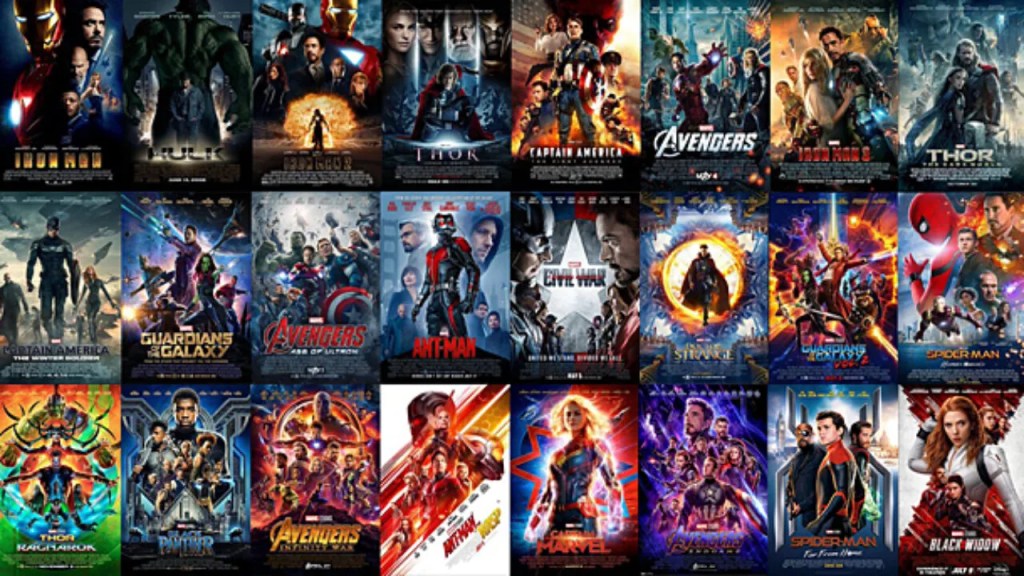
You may have noticed that every popular movie these days is a remake, reboot, sequel, spinoff, or cinematic universe expansion. In 2021, only one of the ten top-grossing films––the Ryan Reynolds vehicle Free Guy––was an original. There were only two originals in 2020’s top 10, and none at all in 2019.

People blame this trend on greedy movie studios or dumb moviegoers or competition from Netflix or humanity running out of ideas. Some say it’s a sign of the end of movies. Others claim there’s nothing new about this at all.

Some of these explanations are flat-out wrong; others may contain a nugget of truth. But all of them are incomplete, because this isn’t just happening in movies. In every corner of pop culture––movies, TV, music, books, and video games––a smaller and smaller cartel of superstars is claiming a larger and larger share of the market. What used to be winners-take-some has grown into winners-take-most and is now verging on winners-take-all. The (very silly) word for this oligopoly, like a monopoly but with a few players instead of just one.

I’m inherently skeptical of big claims about historical shifts. I recently published a paper showing that people overestimate how much public opinion has changed over the past 50 years, so naturally I’m on the lookout for similar biases here. But this shift is not an illusion. It’s big, it’s been going on for decades, and it’s happening everywhere you look. So let’s get to the bottom of it.

(Data and code available here.)

Movies 

At the top of the box office charts, original films have gone extinct. 

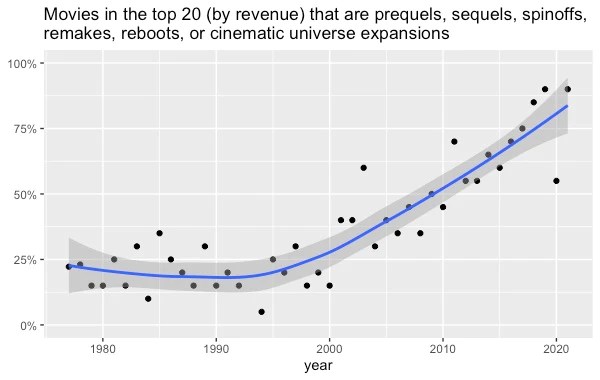
I looked at the 20 top-grossing movies going all the way back to 1977 (source), and I coded whether each was part of what film scholars call a “multiplicity”—sequels, prequels, franchises, spin-offs, cinematic universe expansions, etc. This required some judgment calls. Lots of movies are based on books and TV shows, but I only counted them as multiplicities if they were related to a previous movie. So 1990’s Teenage Mutant Ninja Turtles doesn’t get coded as a multiplicity, but 1991’s Teenage Mutant Ninja Turtles II: The Secret of the Ooze does, and so does the 2014 Teenage Mutant Ninja Turtles remake. I also probably missed a few multiplicities, especially in earlier decades, since sometimes it’s not obvious that a movie has some connection to an earlier movie.

Regardless, the shift is gigantic. Until the year 2000, about 25% of top-grossing movies were prequels, sequels, spinoffs, remakes, reboots, or cinematic universe expansions. Since 2010, it’s been over 50% ever year. In recent years, it’s been close to 100%.

Original movies just aren’t popular anymore, if they even get made in the first place.

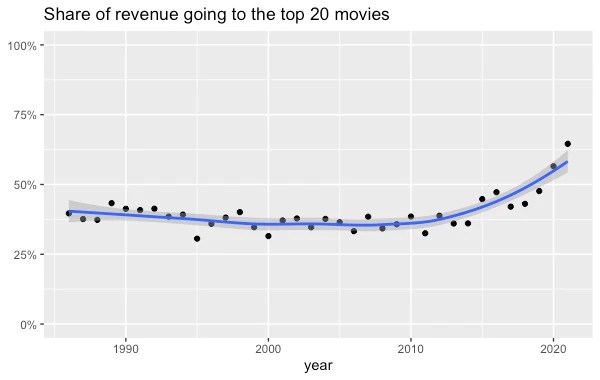
Top movies have also recently started taking a larger chunk of the market. I extracted the revenue of the top 20 movies and divided it by the total revenue of the top 200 movies, going all the way back to 1986 (source). The top 20 movies captured about 40% of all revenue until 2015, when they started gobbling up even more.

Television

Thanks to cable and streaming, there’s way more stuff on TV today than there was 50 years ago. So it would make sense if a few shows ruled the early decades of TV, and now new shows constantly displace each other at the top of the viewership charts.

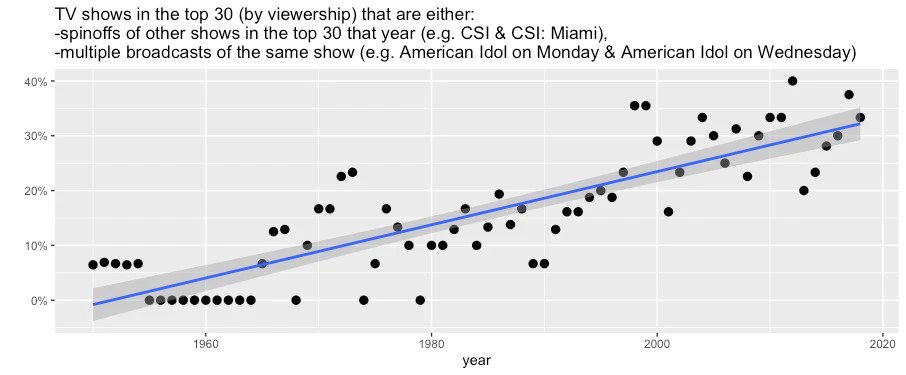
Instead, the opposite has happened. I pulled the top 30 most-viewed TV shows from 1950 to 2019 (source) and found that fewer and fewer franchises rule a larger and larger share of the airwaves. In fact, since 2000, about a third of the top 30 most-viewed shows are either spinoffs of other shows in the top 30 (e.g., CSI and CSI: Miami) or multiple broadcasts of the same show (e.g., American Idol on Monday and American Idol on Wednesday). 

Two caveats to this data. First, I’m probably slightly undercounting multiplicities from earlier decades, where the connections between shows might be harder for a modern viewer like me to understand––maybe one guy hosted multiple different shows, for example. And second, the Nielsen ratings I’m using only recently started accurately measuring viewership on streaming platforms. But even in 2019, only 14% of viewing time was spent on streaming, so this data isn’t missing much.

Music

It used to be that a few hitmakers ruled the charts––The Beatles, The Eagles, Michael Jackson––while today it’s a free-for-all, right?

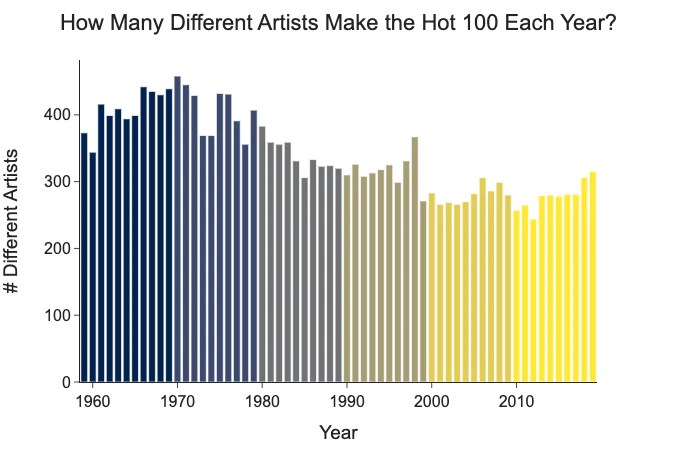
Nope. A data scientist named Azhad Syed has done the analysis, and he finds that the number of artists on the Billboard Hot 100 has been decreasing for decades.

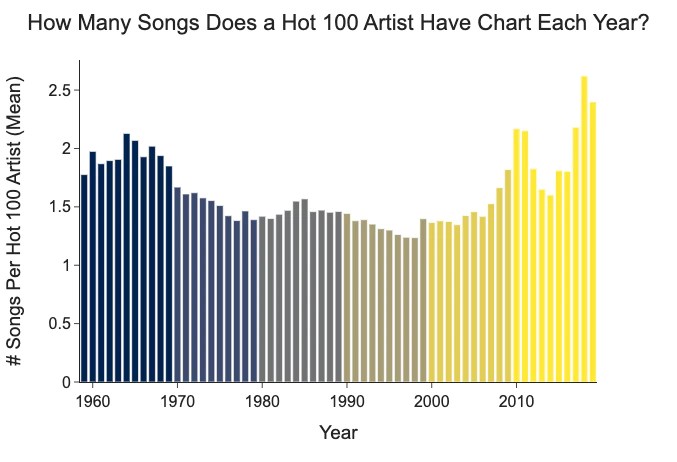
And since 2000, the number of hits per artist on the Hot 100 has been increasing. 

(Azhad says he’s looking for a job––you should hire him!)

A smaller group of artists tops the charts, and they produce more of the chart-toppers. Music, too, has become an oligopoly.

Books

Literature feels like a different world than movies, TV, and music, and yet the trend is the same.

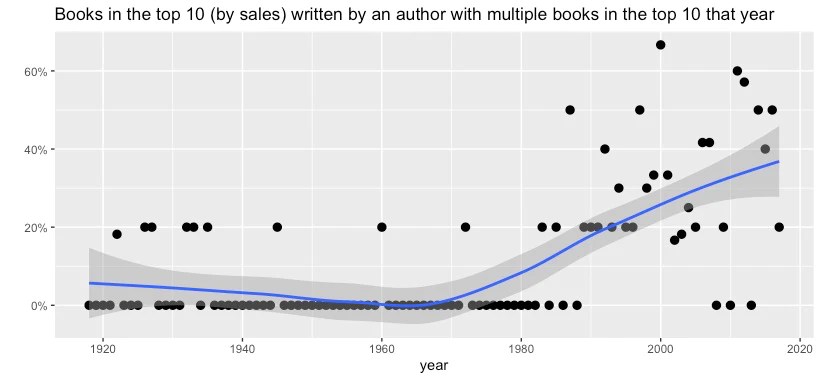
Using LiteraryHub’s list of the top 10 bestselling books for every year from 1919 to 2017, I found that the oligopoly has come to book publishing as well. There are a couple ways we can look at this. First, we can look at the percentage of repeat authors in the top 10––that is, the number of books in the top 10 that were written by an author with another book in the top 10.

It used to be pretty rare for one author to have multiple books in the top 10 in the same year. Since 1990, it’s happened almost every year. No author ever had three top 10 books in one year until Danielle Steel did it 1998. In 2011, John Grisham, Kathryn Stockett, and Stieg Larsson all had two chart-topping books each.

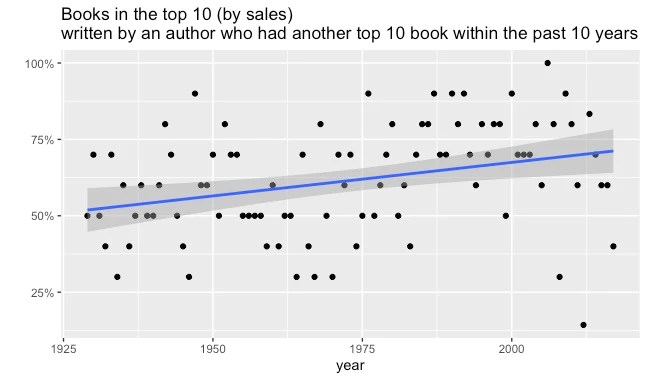
We can also look at the percentage of authors in the top 10 were already famous––say, they had a top 10 book within the past 10 years. That has increased over time, too. 

In the 1950s, a little over half of the authors in the top 10 had been there before. These days, it’s closer to 75%.

Video games

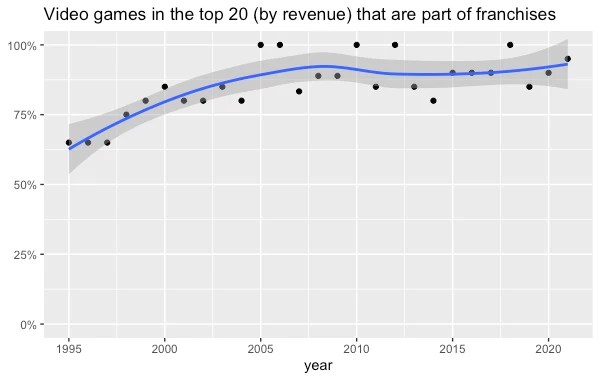
I tracked down the top 20 bestselling video games for each year from 1995 to 2021 (sources: 1234567) and coded whether each belongs to a preexisting video game franchise. (Some games, like Harry Potter and the Sorcerer’s Stone, belong to franchises outside of video games. For these, I coded the first installment as originals and any subsequent installments as franchise games.)

The oligopoly rules video games too:

In the late 1990s, 75% or less of bestselling video games were franchise installments. Since 2005, it’s been above 75% every year, and sometimes it’s 100%. At the top of the charts, it’s all Mario, Zelda, Call of Duty, and Grand Theft Auto.

Why is this happening?

Any explanation for the rise of the pop oligopoly has to answer two questions: why have producers started producing more of the same thing, and why are consumers consuming it? I think the answers to the first question are invasionconsolidation, and innovation. I think the answer to the second question is proliferation.

Invasion

Software and the internet have made it easier than ever to create and publish content. Most of the stuff that random amateurs make is crap and nobody looks at it, but a tiny proportion gets really successful. This might make media giants choose to produce and promote stuff that independent weirdos never could, like an Avengers movie. This can’t explain why oligopolization started decades ago––YouTube only launched in 2005, for example, and most Americans didn’t have broadband until 2007––but it might explain why it’s accelerated and stuck around.

Consolidation

Big things like to eat, defeat, and outcompete smaller things. So over time, big things should get bigger and small things should die off. Indeed, movie studiosmusic labelsTV stations, and publishers of books and video games have all consolidated. Maybe it’s inevitable that major producers of culture will suck up or destroy everybody else, leaving nothing but superstars and blockbusters. Indeed, maybe cultural oligopoly is merely a transition state before we reach cultural monopoly.

Innovation

You may think there’s nothing left to discover in art forms as old as literature and music, and that they simply iterate as fashions change. But it took humans thousands of years to figure out how to create the illusion of depth in paintings. Novelists used to think that sentences had to be long and complicated until Hemingway came along, wrote some snappy prose, and changed everything. Even very old art forms, then, may have secrets left to discover. Maybe the biggest players in culture discovered some innovations that won them a permanent, first-mover chunk of market share. I can think of a few:

  • In books: lightning-quick plots and chapter-ending cliffhangers. Nobody thinks The Da Vinci Code is high literature, but it’s a book that really really wants you to read it. And a lot of people did!
  • In music: sampling. Musicians seem to sample more often these days. Now we not only remake songs; we franchise them too.
  • In movies, TV, and video games: cinematic universes. Studios have finally figured out that once audiences fall in love with fictional worlds, they want to spend lots of time in them. Marvel, DC, and Star Wars are the most famous, but there are also smaller universe expansions like Better Call Saul and El Camino from Breaking Bad and The Many Saints of Newark from The Sopranos. Video game developers have understood this for even longer, which is why Mario does everything from playing tennis to driving go-karts to, you know, being a piece of paper.

Proliferation

Invasion, consolidation, and innovation can, I think, explain the pop oligopoly from the supply side. But all three require a willing audience. So why might people be more open to experiencing the same thing over and over again?

As options multiply, choosing gets harder. You can’t possibly evaluate everything, so you start relying on cues like “this movie has Tom Hanks in it” or “I liked Red Dead Redemption, so I’ll probably like Red Dead Redemption II,” which makes you less and less likely to pick something unfamiliar. 

Another way to think about it: more opportunities means higher opportunity costs, which could lead to lower risk tolerance. When the only way to watch a movie is to go pick one of the seven playing at your local AMC, you might take a chance on something new. But when you’ve got a million movies to pick from, picking a safe, familiar option seems more sensible than gambling on an original.

This could be happening across all of culture at once. Movies don’t just compete with other movies. They compete with every other way of spending your time, and those ways are both infinite and increasing. There are now 60,000 free books on Project Gutenberg, Spotify says it has 78 million songs and 4 million podcast episodes, and humanity uploads 500 hours of video to YouTube every minute. So uh, yeah, the Tom Hanks movie sounds good.

What do we do about it?

Some may think that the rise of the pop oligopoly means the decline of quality. But the oligopoly can still make art: Red Dead Redemption II is a terrific game, “Blinding Lights” is a great song, and Toy Story 4 is a pretty good movie. And when you look back at popular stuff from a generation ago, there was plenty of dreck. We’ve forgotten the pulpy Westerns and insipid romances that made the bestseller lists while books like The Great GatsbyBrave New World, and Animal Farm did not. American Idol is not so different from the televised talent shows of the 1950s. Popular culture has always been a mix of the brilliant and the banal, and nothing I’ve shown you suggests that the ratio has changed.

The problem isn’t that the mean has decreased. It’s that the variance has shrunk. Movies, TV, music, books, and video games should expand our consciousness, jumpstart our imaginations, and introduce us to new worlds and stories and feelings. They should alienate us sometimes, or make us mad, or make us think. But they can’t do any of that if they only feed us sequels and spinoffs. It’s like eating macaroni and cheese every single night forever: it may be comfortable, but eventually you’re going to get scurvy. 

We haven’t fully reckoned with what the cultural oligopoly might be doing to us. How much does it stunt our imaginations to play the same video games we were playing 30 years ago? What message does it send that one of the most popular songs in the 2010s was about how a 1970s rock star was really cool? How much does it dull our ambitions to watch 2021’s The Matrix: Resurrections, where the most interesting scene is just Neo watching the original Matrix from 1999? How inspiring is it to watch tiny variations on the same police procedurals and reality shows year after year? My parents grew up with the first Star Wars movie, which had the audacity to create an entire universe. My niece and nephews are growing up with the ninth Star Wars movie, which aspires to move merchandise. Subsisting entirely on cultural comfort food cannot make us thoughtful, creative, or courageous.

Fortunately, there’s a cure for our cultural anemia. While the top of the charts has been oligopolized, the bottom remains a vibrant anarchy. There are weird books and funky movies and bangers from across the sea. Two of the most interesting video games of the past decade put you in the role of an immigration officer and an insurance claims adjuster. Every strange thing, wonderful and terrible, is available to you, but they’ll die out if you don’t nourish them with your attention. Finding them takes some foraging and digging, and then you’ll have to stomach some very odd, unfamiliar flavors. That’s good. Learning to like unfamiliar things is one of the noblest human pursuits; it builds our empathy for unfamiliar people. And it kindles that delicate, precious fire inside us––without it, we might as well be algorithms. Humankind does not live on bread alone, nor can our spirits long survive on a diet of reruns.

HOW HYPNOTISTS (AND MASS MEDIA) HACK YOUR MIND TO CONTROL YOUR BEHAVIOR

By Dylan Charles

Source: Waking Times

I’m a committed advocate of freedom, personal liberty, pharmaceutical free health, bodily autonomy, and free-thinking, which, apparently, puts me at odds with the majority. As shocking as it is, these basic standards of a good life, which have governed humans for centuries, are suddenly being portrayed as selfish and even dangerous.

How does an individual come to view personal sovereignty as a detriment to themselves and to society, especially when that society is so obviously sick and dysfunctional? How does one come to see their own body as a threat to the world at large, and a playground for experimental science?

People ask me these questions all the time, and the best way to explain what’s happening is to look at how mind control, social engineering, propaganda, and hypnosis affect the mind and steer the individual away from individualistic and self-governing behavior. The hysteria so prevalent today only makes sense when you recognize that most people are truly not thinking for themselves, but are instead programmed to run scripts and programs that have been prepared for mass consumption.

By looking at how hypnotism works, for example, you can begin to understand what’s really happening today, and more importantly you can begin to understand how your own life is affected by the environment we’re in.

Here’s a look at how hypnosis (and mass media) hack your mind to control your behavior.

First of all, let’s acknowledge the power of hypnosis. Therapeutic hypnosis is widely used clinically for the management of pain, depression, anxiety, stress, phobias, and habit disorders, such as smoking.

Stage hypnotists are well-known for inducing some extraordinarily illogical and ridiculous behavior in their subjects. In a matter of minutes, an accomplished stage hypnotists can get complete strangers to do absurd things like believe their hands are glued together, forget their own name, lose the ability to drink water, to be unable to see a person or object right in front of their face, to jump up and yell something bizarre when they hear a code word, and on and on.

Hypnotism is real, and anyone is susceptible to it, in varying degrees. In the following clip, hypontist Keith Barry explains what it takes to hypnotize a person… any person. He explains that a subject needs to be intelligent, as a key requirement for hypnotism is the ability to focus on the imagery, speech and commands of the hypnotist. He gives us a simple exercise to show that certain people can be more or less susceptible to hypnosis.

YouTuber Derek Banas explains the process of how to hypnotize someone. Firstly, you must hold the belief that hypnosis is real and that it will work, then you must build a rapport with the subject, have them place their full attention on you, completely focusing at all levels on one thing. When their attention is completely focused, the subject is ready to be led into trance, which involves giving repeated simple commands and suggestions, until they are told to close their eyes and fully relax.

There are variations of this, including different techniques, although the process is essentially uniform.

You act with authority and confidence. You direct all of their attention on to one thing, You repeatedly tell the subject that they are being hypnotized. You lead them into trance with repetitive language and directives, while directing the movements of their eyes.

As the subject undergoes this process they are making a series of micro-agreements along the way, essentially giving the hypnotist deeper access to consent. The attention is focused along with repetitive and downwards inflecting suggestions while their eyes are trained on a specific object, like a swinging watch, for example. Doing this brings the subjects brainwaves closer and closer to an alpha state, the most hypnotic brainwave state.

The confidence and rapport of the hypnotist serves to bypass what is known as the critical factor, which is considered the gateway between the conscious and subconscious mind. It is believed that 95+% of our behavior is governed by the subconscious mind, and bypassing the critical factor moves the subject from analytical thinking toward emotional and unconscious thinking, forgoing logic and reason. Essentially, the subject’s nervous system is either overloaded, or made to completely relax, and high emotions such as lust or fear are the most effective emotional energies to bypass the critical factor. A hypnotist does this by presenting with authority and certainty, thereby giving the subject the freedom to relax into a subconscious or automatic mode of behavior.

The physical signs of hypnosis include dilated pupils, relaxed breathing, eyes wanting to close, skin flushes and other subtle physiological signs. When a person is deep in an alpha brainwave state, a hypnotic state, their conscious, rational mind is effectively switched off, and they become incredibly open to suggestion, making it possible to implant ideas and behaviors into them, which the subject will adopt without critical thinking.

Hypnotherapist Marc Marshall explains this in more detail and in the context of our global situation, discussing how the amygdala is also hijacked to bypass the critical factor, taking over a person’s fight or flight responses.

“Let me pull back the curtain a bit on how this process works and show you what has happened and is continuing to happen in this current emergency. Many of you have witnessed what hypnotists call an instant or shock induction. These are the dramatic inductions that many stage and street hypnotists use to induce a trance state (hypnosis) in their volunteers. It literally takes just a few seconds for this to happen. What the hypnotist typically does is cause a firing of that portion of the brain known as the amygdala. We literally hijack the amygdala which is responsible for the “fight/flight/freeze” mechanism of our bodies. It is in this split second of time, that the subconscious mind is looking for a program that will provide an appropriate response. Nancy Moyer, MD., describes it as When stress makes you feel strong anger, aggression, or fear, the fight-or-flight response is activated. … It happens when a situation causes your amygdala to hijack control of your response to stress. The amygdala disables the frontal lobes and activates the fight-or-flight response.” It is this most basic of instinctual responses that is responsible for our survival as a species. It is caused by the release of cortisol, a powerful stress hormone.

There are several extremely critical parts of this phenomena of amygdala hijack that are the essence of what I am seeing and which concerns me. As stated above, the amygdala disables the frontal lobe of our brains. The frontal lobe is the part of the brain that controls important cognitive skills in humans, such as emotional expression, problem solving, memory, language, judgment, and sexual behaviors. It is, in essence, the “control panel” of our personality and our ability to communicate. We lose our ability to make rational judgements, our stress increases and dramatic physical changes take place in our bodies. Most importantly, we become and remain highly suggestible in this highly aroused state. Our subconscious minds are seeking to find that “program” that will free us from this threat and we take that cue from the perceived leaders.” ~Marc Marshall

That’s a short synopsis of how a hypnotist brings someone into a suggestive trance, and here’s an excellent video of this process, and a demonstration of what a hypnotist can influence a person to unconsciously do.

The keys to the process of inducing hypnosis are the projection of confidence and authority, capturing the full attention of the subject, using repeated trance inducing language and repeated suggestions, bypassing the critical factor, and inducing an alpha brainwave trance.

Confidence, authority, repetition, suggestion and trance induction.

Now, back to how mass media uses this very skillset to induce mass hypnosis and generate widespread unconscious and controllable behavior.

Firstly, the primary medium for blasting non-stop cable news into your brain is TV. Television itself is well-known to rapidly induce alpha brain wave states in the viewer, bringing them into a hypnotic trance automatically, typically affecting the function of the frontal lobe within an astonishing 90 seconds, and bypassing critical thinking.

“If you’ve ever experienced a mind fog after watching television, you’re not alone.

The brain has four modes that it operates in, and four brain wave patterns. Delta is when you’re deep asleep, Theta is when you’re in light sleep, Alpha is awake but relaxed, it’s the mode of thinking that you are in when you’re in the most heightened state of suggestibility, and then there’s Beta, the highest functioning mode like when you’re reading a book or you’re having a very stimulating conversation.” ~Pseudology: The Art of Lying

This presentation explains this in greater detail.

Furthermore, the graphic design elements commonly used in news presentations serves the purpose of capturing one’s full attention and jarring the nervous system into an overloaded state. Think about the various moving parts and messages the screen at any given moment during a regular broadcast. While the anchor is speaking about one thing, you’ll see side-scrolling text at the bottom talking about an entirely different issue, with evolving background graphics, typically emphasizing the colors red and blue, which are subconsciously regarded as the colors of authority and trust.

Also, they commonly use swirling spheres and circles, graphics are used much in the same way that hypnotist uses a watch or a pen as a point of eye fixation to capture the full attention of the viewer.

Here’s a perfect example:

Now, if you look at marketing in general, it is a confidence game. That is, marketers will attempt to sell you anything at all while pretending it is the most amazing and life-changing thing ever. TV infomercials come to mind.

Mass media is a confidence game (con-game), meaning that the anchors, reporters, experts and pundits are adept at presenting any information with absolute and total confidence. Colin Powell did this when he showed up at the UN with a vial of white powder and told everyone in the room that Saddam Hussein was going to kill everyone. It’s difficult to disbelieve someone who presents with such confidence, and psychopaths are the best at this, and know to exploit their victims’ trust by over exaggerating confidence.

The top news anchors will never let their confidence down, and they’re marketed in such a way as to manufacture rapport with the audience. They’re seen in heart-warming town hall segments relating to the common man, out in nature celebrating life, and out on the town kissing babies. Here’s everyone’s favorite, Anderson Cooper, being portrayed as a humanitarian. Such a likable guy!

Finally there is the detail of suggesting and commanding the viewer to believe or to do certain things. In hypnosis, when the critical factor is bypassed, it allows access to the subconscious mind where what are known as ‘pillars of belief’ are implanted. Below the rational, critical thinking part of the mind is a deep sea of beliefs which govern most behavior. Once a subject is in an induced trance, the news repeats ideas, suggestions and beliefs, ad nauseam until the viewer basically becomes a parrot and information repeater. You see these people everywhere today.

Final Thoughts

More than ever before, those of you who believe in freedom, as I do, are called to gather your strength, sovereignty and power to stand up for these timeless moral values. It is of critical importance to recognize that the world has been deliberately lulled into a hypnotic state and fed beliefs and ideas about how things should be or how we should address crisis.

If you understand what is happening, and if you understand how all of this plays a role in shaping your own life, beliefs, and behaviors, you’r better equipped to take back control of your life.

Elite television news rescued by COVID

By Jon Rappoport

Source: NoMoreFakeNews.com

Yet another consequence of the fake pandemic is the propping up of that doddering old fool, elite television news.

The COVID story doesn’t need Walter Cronkite. It only needs wall to wall. From 5AM to midnight, pandemic updates (mixed now with riot coverage), and the network ratings get well. The ratings jump out of the dumpster and rumble on the studio set and do cartwheels.

I’ve written a number of articles about network television news. Here are excerpts—


NEWS ABOUT THE NEWS.

The elite anchor is not a person filled with passion or curiosity. Therefore, the audience doesn’t have to be passionate or filled with curiosity, either.

The anchor is not a demanding voice on the air; therefore, the audience doesn’t have to be demanding.

The anchor isn’t hell-bent on uncovering the truth. For this he substitutes a false dignity. Therefore, the audience can surrender its need to wrestle with the truth and replace that with a false dignity of its own.

The anchor takes propriety to an extreme: it’s unmannerly to look below the surface of things. Therefore, the audience adopts those manners.

On air, the anchor is neutral, a castratus, a eunuch.

This is a time-honored ancient tradition. The eunuch, by his diminished condition, has the trust of the ruler. He guards the emperor’s inner sanctum. He acts as a buffer between his master and the people. He applies the royal seal to official documents.

Essentially, the television anchor is saying, “See, I’m ascetic in the service of truth. Why would I hamstring myself this way unless my mission is sincere objectivity?”

All expressed shades of emotion occur and are managed within that persona of the dependable court eunuch. The anchor who can move the closest to the line of being human without actually arriving there is the champion. In recent times, it was Brian Williams—until his “conflations” and “misremembrances” surfaced, and he was exiled to the wasteland of MSNBC.

The vibrating string between eunuch and human is the frequency that makes an anchor “great.” Think Cronkite, Chet Huntley, Edward R Murrow. Huntley was just a touch too masculine, so they teamed him up with David Brinkley, a medium-boiled egg. Brinkley supplied twinkles of comic relief.

The cable news networks don’t have anyone who qualifies as an elite anchor. Wolf Blitzer of CNN made his bones during the first Iraq war only because his name fit the bombing action so well. Brit Hume of FOX has more anchor authority than anyone now working in network television, but he’s semi-retired, content to play the role of contributor, because he knows the news is a scam on wheels.

There are other reasons for “voice-neutrality” of the anchor. Neutrality conveys a sense of science. “We did the experiment in the lab and this is how it turned out.”

Neutrality implies: we, the news division, don’t have to make money (a lie); we’re not like the cop shows; we’re on a higher plane; we’re performing a public service; we’re a responsible charity.


From the early days of television, there has been a parade of anchors/actors with know-how—intonation, edge of authority, parental feel, the ability to execute seamless blends from one piece of deception to the next:

John Daly, Douglas Edwards, Ed Murrow, Chet Huntley, David Brinkley, Harry Reasoner, Walter Cronkite, Dan Rather, and more recently, second-stringers—Brian Williams, Diane Sawyer, Scott Pelley.

They’re all gone.

Now we have Lester Holt, David Muir, and the newly appointed Norah O’Donnell. They couldn’t sell water in the desert.

Lester Holt is a cadaverous presence on-air, whose major journalistic achievement thus far is interrupting Donald Trump 41 times during a presidential debate; David Muir has the gravitas of a Sears underwear model; Norah O’Donnell, long-term, will have the energy needed to illuminate a miniature Xmas-tree light bulb.

The networks have no authoritative anchor-fathers waiting in the wings. They don’t breed them and bring them up through the minor leagues anymore.

Instead, armies of little Globalists, and ideologues who don’t realize they’re working for Globalists, have been infiltrating the news business. At best, they’re incompetent.

Thus, news-production techniques that enable an ongoing illusion of oceanic authority collapse like magnetic fields that have been suddenly switched off.

The selective mood lighting, the restful blue colors on the set, the inter-cutting of graphics and B-roll footage, the flawless shifts to reporters in far-flung places…it’s as if all these supporting features have suddenly been overcome by actors in a stage play who are abruptly stepping out of character. The spell is broken.

Elite mainstream news, in a fatuous attempt to save itself, is trying a democratic approach. Anchors are sharing more on-air minutes with gaggles of other reporters. But this is counter-productive in the extreme. The News has always meant one face and one authority and one voice and one tying-together of all broadcast elements. It’s as if, in a hypnotherapist’s office, the therapist decides to bring in colleagues to help render the patient into an alpha-state.

If by some miracle, the news bosses could raise Walter Cronkite, “the father of our country,” from the dead and put him back in the chair… but too many years have gone by; years of unaccomplished anchors. The horse is out of the barn, the cat is out of the bag.

This is why major news outlets have been appealing to social media/big tech for help, AKA censorship of independent voices.

One veteran news director told me several years ago, “We don’t have the stars [elite anchors] anymore. The star system is dead. You could comb all the local news outlets in America, and you wouldn’t find one face and voice who could really carry the freight. They’ve vanished. The up and coming people are lame. We’ve made them that way. It’s some cockeyed standard of equality we’ve internalized. And now we’re paying the price.”


The news is all about manipulating the context of stories. The thinner the context, the thinner the mind must become to accept it.

Imagine a rectangular solid. The news covers the top surface. Therefore, the viewer’s mind is trained to work in only two dimensions. Then it can’t fathom depth, and it certainly can’t appreciate the fact that the whole rectangular solid moves through time, the fourth dimension.

First, we have the studio image itself, the colors in foreground and background, the blend of restful and charged hues. The anchor and his/her smooth style.

Then we have the shifting of venue from the studio to reporters in the field, demonstrating the reach of coverage: the planet. As if this equals authenticity.

Actually, those reporters in the field rarely dig up information on location. A correspondent standing on a rooftop in Cairo could just as easily be positioned in a bathroom in a Las Vegas McDonald’s. His report would be identical.

The managing editor, usually the elite news anchor, chooses the stories to cover and has the final word on their sequence.

The anchor goes on the air: “Our top story tonight, more signs of gridlock today on Capitol Hill, as legislators walked out of a session on federal budget negotiations…”

The viewer fills in the context for the story: “Oh yes, the government. Gridlock is bad. Just like traffic on the I-5. We want the government to get something done, but they won’t.”

The anchor: “The Chinese government reports the new flu epidemic has spread to three provinces. Forty-two people have already died, and nearly a hundred are hospitalized…”

The viewer again supplies context, such as: “Flu. Dangerous. Epidemic. Get my flu shot.”

The anchor: “A new university study states that gun owners often stock up on weapons and ammunition…”

The viewer: “People with guns. Why do they need a dozen weapons? I don’t need a gun. The police have guns. Could I kill somebody if he broke into the house?”

The anchor: “Doctors at Yale University have made a discovery that could lead to new treatments in the battle against autism…”

Viewer: “Good. More research. Laboratory. The brain.”

If, at the end of the newscast, the viewer bothered to review the stories and his own reactions to them, he would realize he’d learned nothing. But reflection is not the game.

In fact, the flow of the news stories has washed over him and created very little except a sense of (false) continuity.

Therefore, every story on the news broadcast achieves the goal of keeping the context thin—night after night, year after year. The overall effect of this staging is: small viewer’s mind, small viewer’s understanding.

Next we come to words and pictures. More and more, news broadcasts are using the rudimentary film technique of a voice narrating what the viewer is seeing on the screen.

People are shouting and running and falling in a street. The anchor or a field reporter says: “The country is in turmoil. Parliament has suspended sessions for the third day in a row, as the government decides what to do about uprisings aimed at forcing democratic elections…”

Well, the voice must be right, because we’re seeing the pictures. If the voice said the riots were due to garbage-pickup cancellations, the viewer would believe that, too.

We see Building #7 of the WTC collapse. Must have been the result of a fire. The anchor tells us so. Words give meaning to pictures.

Staged news.

Since the dawn of time, untold billions of people have been urging a “television anchor” to “explain the pictures.”

The news gives them that precise solution, every night.

“Well, Mr. Jones,” the doctor says, as he pins X-rays to a screen in his office. “See this? Right here? We’ll need to start chemo immediately, and then we may have to remove most of your brain, and as a follow-up, take out one eye.”

Sure, why not? The patient saw the pictures and the anchor explained them.

Eventually, people get the idea and do it for themselves. They see things, they invent one-liners to explain them.

They’re their own anchors. They short-cut and undermine their own experience with vapid summaries of what it all means.

For “intelligent” viewers, there is a sober mainstream choice in America, a safety valve: PBS. That newscast tends to show more pictures from foreign lands.

“Yes, I watch PBS because they understand the planet is interconnected. It isn’t just about America. That’s good.”

Sure it’s good, if you want the same thin-context or false-context reports on events in other countries. Instead of the two minutes NBC might give you about momentous happenings in Syria, PBS will give you four minutes.

PBS experts seem kinder and gentler. “They’re nice and they’re more relaxed. I like that.”

Yes, the PBS experts are taking Valium, and they’re not drinking as much coffee as the CBS experts.


When network television news was created in the late 1940s, no one in charge knew how to do it. It was a new creature.

Sponsors? Yes. A studio with a desk and an anchor? Yes. A list of top stories? Yes. Important information for the public? Yes.

Of course, “important information” could have several definitions—and the CIA already had a few claws into news, so there would be boundaries and fake stories within those boundaries.

The producers knew the anchor was the main event; his voice, his manner, his face. He was the actor in a one-man show. But what should he project to the audience at home?

The first few anchors were dry sandpaper. John Cameron Swayze at NBC, and Douglas Edwards at CBS. But Swayze, also a quiz show host, broke out of the mold and imparted a bit of “cheery” to his broadcasts. A no-no. So he was eventually dumped.

In came a duo. Chet Huntley and David Brinkley. NBC co-anchors from 1956 to 1970. Chet was the heavy, with a somber baritone, and David was “twinkly,” as he was called by network insiders. He lightened the mood with a touch of sarcasm and an occasional grin. It worked. Ratings climbed. Television news as show biz started to take off. At the end of every broadcast, there was: “Good night, Chet.” “Good night, David.” The audience ate it up. They loved that tag.

However, rival CBS wasn’t standing still. They offloaded their anchor, Douglas Edwards, a bland egg, and brought in Walter Cronkite, who would go on to do 19 years in the chair (1962-1981). Walter was Chet Huntley with a difference. As he grew older, he emerged as a father, a favorite uncle, with an authoritative hills-and-valleys baritone that created instant trust. Magic. A news god was born.

Despite many efforts at the three major networks, no anchor over the past 40 years has been able to pull off the full Cronkite effect.

The closest recent competitor—until he was fired for lying and exiled to the waste dump at MSNBC—was Brian Williams. Williams artfully executed a reversal of tradition. He portrayed the youthful prodigy, a gradually maturing version of a newsboy who once bicycled along country roads, threw folded up papers on front porches, and knew all his customers by name. A good boy. A local boy. Your neighbor under the maple trees of an idyllic town. Cue the memories.

By the time Williams took over the helm at NBC, television news was decidedly a team operation. There were reporters in the field. The technology enabled the anchor to go live to these bit players, who tried to exude the impression they were actually running down leads and interviewing key sources on the spot—when in fact they could just as easily be doing their stand-ups from a hot dog cart outside 30 Rockefeller Plaza, the home studio of the network—because most of their information was really coming from inside that studio.

Nevertheless, the team was everything. The anchor was a manager, and his job was to impart an authentic feel to every look-in, from the White House to Paris to Berlin to Jerusalem to Beijing to a polar bear on an iceberg.

And local television news was blowing up to gargantuan proportions. Every city and town and village and hamlet seemed to have its own gaggle of hearty faces delivering vital info of interest to the citizenry. Branding and shaping this local phenomenon evolved into: FAMILY. Yes, that was the ticket. These bubbly, blown-dry, enthused, manic news and weather and sports hawks were really “part of the community.” Local News was no longer shoveled high and deep with an air of objectivity. “Aloof” was out. Share and care was in. What that had to do with actual news was anyone’s guess, but there it was. “Hi, we’re your team at KX6, and we feel what you feel and we live here with you and we know when the roads are icy and the wrecks pile up on the I-15 and the cops arrest someone for cocaine possession and when the charity bake sale is coming up to pay for [toxic] meds for seniors and when your cousin Judy passes away we mourn as you do…”

News for and by a fictional collective.

Disney news.

A caricature of a simulacrum of an imitation.

The discovery was: the viewing audience wanted news as a cartoon.

The problem is: this model deteriorates. The descending IQ of the news producers and anchors and reporters undergoes a grotesque revolution. Year by year, broadcasts make less sense. Even on the national scene, NBC hands its prime anchor spot to Lester Holt, who plays the old Addams Family living corpse, Lurch.

ABC, always looking for a new face, goes all in with David Muir, a Sears underwear-model type.

CBS counters with a youngish cipher, Jeff Glor, after ridding itself of Scott Pelley, who, true to his on-camera persona, might show up on The Young and the Restless as a lunatic surgeon doing operations without anesthetic.

The networks are losing it.

It’s a sight to behold.

Cable news is even worse. The longest surviving anchor is Wolf Blitzer at CNN. Wolf’s energy level tops out as a man in a tattered bathrobe, in his kitchen, chatting with his cousin while they play checkers.


When professionals broadcast one absurdity after another, they begin to see the effects are actually strengthening their own position of authority.

It’s a revelation. It’s also a continuation of the tradition of the Trickster archetype. For example, with just a few minor adjustments, Brian Williams can be seen as the sly Reynard the Fox…

From the viewpoint of elite television news, controlling the minds of its audience depends on what’s politely called “cognitive dissonance”:

As the anchor recites a news story, the viewer sees an obvious hole through which he could drive a truck.

The story makes no sense, yet it’s being presented as bland fact. The trusted anchor clearly has no problem with it.

What’s the viewer to do? He experiences a contradiction, a “dissonance.”

For example, this year’s flu vaccine. The US government has admitted the vaccine is geared to a flu virus that isn’t circulating in the population. Therefore, even by conventional standards, the vaccine is useless. But the kicker is, the CDC says people should take the vaccine anyway.

The anchor relays all this information—and never seriously questions the situation, never torpedoes the government for recommending the vaccine.

The average viewer feels a tug, a pulse of discomfort, a push-pull. The vaccine story is idiocy (side one), but the trusted anchor accepts it (side two).

Dissonance.

The top chiefs of news—and top propaganda operatives—anticipate cognitive dissonance. In a real sense, they want it to happen. They make it happen. Over and over.

Why?

Because it throws the viewer into a tailspin. And in that mental state, in his effort to resolve the contradiction, he will normally choose to…give in. Surrender. Believe in the anchor. It’s the easier path.

The viewer will even doubt his own perception. “I see no good reason for Building 7 to collapse, but the news doesn’t bring that up, so…it must be me.”

This is the power of the news. It presents absurdities and then moves right along, as if nothing has happened.

The introduction of contradiction, dissonance, and absurdity parading as ordinary reality is an intentional feature of brainwashing.

On the nightly news, the anchor reports that US government debt has risen by another three trillion dollars. He then cuts to a statement from a Federal Reserve spokesman: the new debt level isn’t a problem; in fact, it’s sound monetary policy; it strengthens the economy.

The viewer, caught up in this absurdity, tries to make sense of it, then gives up and passively accepts it. Brainwashing.

Smoothly transitioning from this story, the anchor relays information from the CDC: vaccination rates must achieve 90% in the population, in order to protect people from dangerous viruses. The viewer thinks, “Well, my daughter is already vaccinated, so if she comes into contact with a child who isn’t vaccinated, why would there be a problem? Why does 90% of the population have to be vaccinated to keep her safe? She’s already vaccinated.”

The viewer wrestles with this craziness for a moment, then gives in and accepts what the CDC and the anchor are saying. More passivity. More brainwashing.

The anchor moves right along to the next story: “The US is experiencing one of the coldest winters in history, further evidence of the effects of global warming, according to scientists at the United Nations.”

The viewer shakes his head, tries to deal with this dissonance, surrenders, and accepts what he is hearing. Deeper passivity is the result. Deeper brainwashing.

On and on it goes, day after day, month after month, year after year, on the news.

Contradiction, absurdity, dissonance; acceptance, surrender, passivity.

The same general formula is used in interrogations and formal mind control. It adds up to disorientation of the target.

Most disoriented people opt for the lowest- common-denominator solution: give in; accept the power of the person of authority.

Among the many supporters of conventional news is the education system. Most teachers never learn logic, and they don’t teach it. The result? Their students never gain the ability or the courage to reject the news and its dissonances.

What little these students gain from 12 or 16 years of schooling they eventually sacrifice on the altar of consensus reality—as broadcast every night on the screen before them.


Salvador Dali, surrealist, was one of the most reviled painters of the 20th century.

He disturbed Conventional Folk who just wanted to see an apple in a bowl on a table.

Dali’s apples and bowls were executed with a technical skill few artists could match—except the apples were coming out of a woman’s nose while she was ironing the back of a giraffe, who was on fire.

“It doesn’t go together! It doesn’t make sense! He’s Satan!”

Yet, these same Folk sit in front of the television screen every night and watch the entirely surreal network news. Elite anchors seamlessly and quickly move from blood running in the streets of a distant land to a hairdryer product-recall to an unseasonal hail storm in Michigan to a debate about public policy on pedophiles to genetically engineered mosquitoes in Florida to a possible breakthrough in storing computer simulations of human brains for later recapture to squirrels gathering nuts in New Jersey.

Nothing surreal about this??

When the elite anchor goes on air and digs in, he’s paid to be seamless. He could be transitioning from mass killings in East Asia to sub-standard air conditioners, and he makes the audience track through the absurd curve in the road.

The elite anchor should have a voice that soothes just a bit but brooks no resistance. It’s authoritative but not demanding.

Scott Pelley (CBS) was careful to watch himself on this count, because his tendency was to shove the message down the viewer’s throat like a surgeon making an incision with an icepick. Pelley was a high-IQ android who was training himself to be human.

Diane Sawyer wandered into sloppiness, like a housewife who’s still wearing her bathrobe at 4 in the afternoon. She exuded sympathetic syrup, as if she’d had a few cocktails for lunch. And she affected a pose of “caring too much.”

Brian Williams was head and shoulders above his two competitors. You had to look and listen hard to spot a speck of confusion in his delivery. He knew how to believe his act was real. He could also flick a little aw-shucks apple-pie at the viewer. Country boy who moved to the big city.

Segues, blends are absolutely vital. These are the transitions between one story and another. “Earlier today, in Boston.” “Meanwhile, in New York, the police are reporting.” “But on the Hill, the news was somewhat disappointing for supporters of the president.”

Doing excellent blends can earn an anchor millions of dollars. The audience doesn’t wobble or falter or make distinctions between what went before and what’s coming now. It’s all one script. It’s one winding weirdness of story every night.


And NOW, we have COVID, and we have riots. The current stories— the lies are egregious and relentless, the editorializing is cheesy. The omissions are Grand Canyons.

Surreal, cognitively dissonant, smoothly blended, outrageous:

The News Business. As Usual.

But with the junior varsity anchors, and their lack of skill, the networks need overwhelming stories to sell their act. They need COVID and riots. They have to have government manufacturing chaos and destruction and tighter control, in order to keep viewers coming back night after night.

You’ve got elite Globalists and elite government on one edge, and elite news on the other edge. They feed into each other. They bolster each other.

So why must they spend so much time censoring dissent?

Because freedom exists.

Because, no matter what, it always will.

And underestimating its power, time and time again, has proven to be a colossal mistake.

Saturday Matinee: EXP TV

EXP-TV: FREAKTASTIC NEW VIDEO CHANNEL WILL RIP YOUR FACE OFF AND EAT YOUR BRAIN

By Richard Metzger

Source: Dangerous Minds

There are certain things you don’t know you’re missing in life until you’re exposed to them, right? EXP TV just might be one of those things. It’s got an aesthetic that hovers around the same territory as Everything is Terrible! and Vic Berger, it even reminds me of Mike Kelley’s stuff, but that’s only going to get you in the ballpark. Which is good enough, but you just have to click on the link and see for yourself. It’s a barrage of strange imagery and is really quite an inspired—not to say elaborate and work intensive—art project. And just in time for a pandemic. Bored with Netflix? Have enough Amazon Prime? Maxed out on HBO Max? You need to tune in, turn on and drop your jaw to the floor at what’s screening on EXP TV.

EXP TV the brainchild of Tom Fitzgerald, Marcus Herring, Taylor C. Rowley.  I asked them a few questions via email.

What is EXP TV? What should someone expect to see when they get there?

EXP TV is a live TV channel broadcasting an endless stream of obscure media and video ephemera from our site at exptv.org.  We stream 24/7.

The daytime programming is called “Video Breaks”—a video collage series featuring wild, rare, unpredictable, and ever-changing archival clips touching on every subject imaginable. Similar to how golden era MTV played music videos all day, daytime EXP TV streams non-stop, deep cut video clips filtered through our own distinct POV.

What treasures would reward the loyal Video Breaks viewer?  Ventriloquist dummy sales demos, Filipino Pinocchios, LSD trip-induced talking hot dogs, Liberace’s recipe tips, French synth punk, primal scream therapy seminars, Deadhead parking lots, empty parking lots, Israeli sci-fi, scary animatronics, teenage girls’ homemade art films, Belgian hard techno dance instructions, Czech children’s films about UFOs, even Danzig reading from his book collection. And that’s all in just one hour!

We’ve been collecting obscure media for decades, but we’ve sorted through it all and cherry-picked the funny, the bizarre, the relevant, the irrelevant, the visually stunning, the interesting, the infamous, the good, the bad and the fugly.  We’ve done all that so the viewers don’t have to.  They get to kick back and experience the sweet spot without having to dig for rare stuff themselves or sit through an entire movie waiting for the cool part.

Our Nite Owl programming block features specialty themed video mixes and deep dives on everything under the sun: Bigfoot, underground 80s culture, Italo disco, cults, Halloween hijinks, pre-revolutionary Iranian pop culture, midnight movies, ‘ye ye’ promo films, Soviet sci-fi, reggae rarities, psychedelic animation and local news calamities. On any given night you could watch something like our Incredibly Strange Metal show followed by a conceptual video essay like Pixel Power—our exploration of early CGI art.

Aside from our unique tone and deep crate of video materials, one thing that really sets us apart in 2020 is our format.  We are *not* on demand, we are *not* interactive—just like old TV!  You can tune in anytime and something cool will be on.

That’s EXP TV in a nutshell.  It’s funny, it’s art, it’s music, it’s infotainment, it’s free and it’s 24/7.

It’s 24/7?

Yes.

What does EXP stand for?

EXP stands for…experimental, expanded, experiential, expert, exploration, expressive, expounded, exposed, explained, expeditionary, unexpected, exponents, expatriot, expedited, expectorant, exposure, expelled, expendable, expensive, express, exploded, expired…EXP TV!

We have a little bumper on our Instagram @exp.tv that illustrates this

How much material did you have in the can, ready to go at launch?

We had been quietly working on the channel for over a year so we had quite a bit of material.  When the pandemic hit, we decided to launch early as a beta so people could have an alternative to the big streaming channels – something totally different.

In this modern world of all these different streaming platforms, it feels like you spend more time deciding what to watch than you do actually watching something.  We wanted to make something you could just turn on and leave on for hours—days even—and you’d be guaranteed to catch something interesting.  We basically just made the channel we wanted to watch.

Right now, we have about 60 hours in rotation and we are regularly adding new material—new Video Breaks, new episodes of our ongoing series, and hatching entirely new concepts for shows. Stay tuned for Kung Fu Wizards coming soon!

Do you have themes? What are some of your more elaborate productions on the channel?
Our Nite Owl block has a roster of shows centered around specific themes.  A few examples include…

Pixel Power –  an homage to the early days of computer graphics.
Witches Brew – a tour through the history of witches on film.
Total News – a completely gonzo take on nightly news past and present.
Bollyweird – a huge compilation of the most “out there” Bollywood musical numbers.
Pomegranates – a survey of pre-revolutionary Iranian cinema, set to Persian psych music.
Underground USA – a continuing series archiving 80s alt culture.
Cosmonaut – our tribute to Soviet sci-fi.
Incredibly Strange Metal – exactly what it sounds like.
They Call Him Bigfoot – a search for Sasquatch in cinema.
Jamaica, No Problem – a crash course in Jamaican music culture.
The David Bowie Mixtape – The Thin White Duke’s glory years captured on film and video.
Our Star Wars Mixtape – Star Wars gone wild, gone weird, and gone wrong.
Cats – an exploration of cats in cinema and beyond.
Wow – a survey of psychedelic animation from around the world.
Mosaic – meditative compilation of short films from the world of fine art.
La Videotheque – French yeye music promo compilation.
Disco Odyssey – our series exploring the wild world of Italo disco and other dance music mutations.
And there’s so much more…

Where do you mostly find stuff? Or maybe, how do you search for it?

We have been collecting video materials for decades. Years of VHS tape-trading, pouring through mom and pop video stores (RIP), even the internet!  It makes our day to stumble upon a Bulgarian sci-fi animation title we never heard of.  We love our work! Like a hip hop dj/producer is looking for the perfect beat, we’re always searching for that perfect “clip”, that magic moment, that video gem.

What are some of your future plans for EXP TV?

The first priority is continuing to add more cool stuff to the site.  We’re looking forward to the time when there’s hundreds of hours of free entertainment.

An unexpected but welcome side effect of our offbeat media expertise is that we’ve been getting work as creative consultants to dig up obscure clips and offer fresh takes on commercials and live events.  Last year EXP TV was hired to program the Red Bull Music Film Festival in LA, and we brought in cool guests like Sun Ra Arkestra, Man Parrish, Lady Bunny, and Earth.  Our mixtapes were the throughline of the fest. Some of our shows made it down to Austin Film Society and Music Box in Chicago. Having met as programmers at Cinefamily, our background is in public exhibition, but we’re interested in exploring new ways to subject the world to our perspective. We’ve been running the stream on Twitch and Periscope. Someday we want to take a bunch of old CRT TVs and use Raspberry Pi’s to make terrestrial TVs that you flip on and they only play EXP TV.  We think that would be a fun gift for local galleries and bars.

We’re currently working on the EXP TV Apple TV app, but we wanna see EXP TV everywhere…we can see opportunities for our particular style of obscure video mixtapes as an HBO series or maybe even its own section on Netflix!

Tune in to EXP TV at http://exptv.org/

THE IMPORTANCE OF ALTERNATIVE MEDIA

By John Scales Avery

Source: Blacklisted News

The superficiality of today’s television

Social critic Neil Postman contrasted the futures predicted in Nineteen Eighty-Four and Brave New World in the foreword of his 1985 book “Amusing Ourselves to Death”.

He wrote:

“What Orwell feared were those who would ban books. What Huxley feared was that there would be no reason to ban a book, for there would be no one who wanted to read one. Orwell feared those who would deprive us of information. Huxley feared those who would give us so much that we would be reduced to passivity and egotism. Orwell feared that the truth would be concealed from us. Huxley feared the truth would be drowned in a sea of irrelevance.”

Neil Postman’s book, “Amusing Ourselves To Death; or Public Discourse in an Age of Show Business” (1985), had its origins at the Frankfurt Book Fair, where Postman was invited to join a panel discussing George Orwell’s “Nineteen Eighty-Four”. Postman said that our present situation was better predicted by Huxley’s “Brave New World”. Today, he maintained it is not fear that bars us from truth. Instead, truth is drowned in distractions and the pursuit of pleasure, by the public’s addiction to amusement.

Postman sees television as the modern equivalent of Huxley’s pleasure-inducing drug, soma, and he maintains that that television, as a medium, is intrinsically superficial and unable to discuss serious issues. Looking at television as it is today, one must agree with him.

The wealth and power of the establishment

The media are a battleground where reformers struggle for attention, but are defeated with great regularity by the wealth and power of the establishment. This is a tragedy because today there is an urgent need to make public opinion aware of the serious problems facing civilization, and the steps that are needed to solve these problems. The mass media could potentially be a great force for public education, but in general their role is not only unhelpful – it is often negative. War and conflict are blatantly advertised by television and newspapers.

Newspapers and war

There is a true story about the powerful newspaper owner William Randolph Hearst that illustrates the relationship between the mass media and the institution of war: When an explosion sank the American warship USS Maine in the harbor of Havana, Hearst anticipated (and desired) that the incident would lead to war between the United States and Spain. He therefore sent his best illustrator, Fredrick Remington, to Havana to produce drawings of the scene. After a few days in Havana, Remington cabled to Hearst, “All’s quiet here. There will be no war.” Hearst cabled back, “You supply the pictures. I’ll supply the war.” Hearst was true to his words. His newspapers inflamed American public opinion to such an extent that the Spanish-American War became inevitable. During the course of the war, Hearst sold many newspapers, and Remington many drawings. From this story one might almost conclude that newspapers thrive on war, while war thrives on newspapers.

Before the advent of widely-read newspapers, European wars tended to be fought by mercenary soldiers, recruited from the lowest ranks of society, and motivated by financial considerations. The emotions of the population were not aroused by such limited and decorous wars. However, the French Revolution and the power of newspapers changed this situation, and war became a total phenomenon that involved emotions. The media were able to mobilize on a huge scale the communal defense mechanism that Konrad Lorenz called “militant enthusiasm” – self-sacrifice for the defense of the tribe. It did not escape the notice of politicians that control of the media is the key to political power in the modern world. For example, Hitler was extremely conscious of the force of propaganda, and it became one of his favorite instruments for exerting power.

With the advent of radio and television, the influence of the mass media became still greater. Today, state-controlled or money-controlled newspapers, radio and television are widely used by the power elite to manipulate public opinion. This is true in most countries of the world, even in those that pride themselves on allowing freedom of speech. For example, during the US-led invasion of Iraq in 2003, the official version of events was broadcast by CNN, and criticism of the invasion was almost absent from their transmissions.

The mass media and our present crisis

Today we are faced with the task of creating a new global ethic in which loyalty to family, religion and nation will be supplemented by a higher loyalty to humanity as a whole. In case of conflicts, loyalty to humanity as a whole must take precedence. In addition, our present culture of violence must be replaced by a culture of peace. To achieve these essential goals, we urgently need the cooperation of the mass media.

The predicament of humanity today has been called “a race between education and catastrophe”: Human emotions have not changed much during the last 40,000 years. Human nature still contains an element of tribalism to which nationalistic politicians successfully appeal. The completely sovereign nation-state is still the basis of our global political system. The danger in this situation is due to the fact that modern science has given the human race incredibly destructive weapons. Because of these weapons, the tribal tendencies in human nature and the politically fragmented structure of our world have both become dangerous anachronisms.

After the tragedies of Hiroshima and Nagasaki, Albert Einstein said, “The unleashed power of the atom has changed everything except our way of thinking, and thus we drift towards unparalleled catastrophes.” We have to learn to think in a new way. Will we learn this in time to prevent disaster? When we consider the almost miraculous power of our modern electronic media, we can be optimistic. Cannot our marvelous global communication network be used to change anachronistic ways of thought and anachronistic social and political institutions in time, so that the system will not self-destruct as science and technology revolutionize our world? If they were properly used, our instantaneous global communications could give us hope.

The success of our species is built on cultural evolution, the central element of which is cooperation. Thus human nature has two sides, tribal emotions are present, but they are balanced by the human genius for cooperation. The case of Scandinavia – once war-torn, now cooperative – shows that education is able to bring out either the kind and cooperative side of human nature, or the xenophobic and violent side. Which of these shall it be? It is up to our educational systems to decide, and the mass media are an extremely important part of education. Hence the great responsibility that is now in the hands of the media.

How do the mass media fulfill this life-or-death responsibility? Do they give us insight? No, they give us pop music. Do they give us an understanding of the sweep of evolution and history? No, they give us sport. Do they give us an understanding of need for strengthening the United Nations, and the ways that it could be strengthened? No, they give us sitcoms and soap operas. Do they give us unbiased news? No, they give us news that has been edited to conform with the interests of the military-industrial complex and other powerful lobbies. Do they present us with the need for a just system of international law that acts on individuals? On the whole, the subject is neglected. Do they tell of of the essentially genocidal nature of nuclear weapons, and the urgent need for their complete abolition? No, they give us programs about gardening and making food.

A consumer who subscribes to the “package” of broadcasts sold by a cable company can often search through all 100 or so channels without finding a single program that offers insight into the various problems that are facing the world today. What the viewer finds instead is a mixture of pro-establishment propaganda and entertainment. Meanwhile the neglected global problems are becoming progressively more severe. In general, the mass media behave as though their role is to prevent the peoples of the world from joining hands and working to change the world and to save it from thermonuclear and environmental catastrophes. The television viewer sits slumped in a chair, passive, isolated, disempowered and stupefied. The future of the world hangs in the balance, the fate of children and grandchildren hang in the balance, but the television viewer feels no impulse to work actively to change the world or to save it. The Roman emperors gave their people bread and circuses to numb them into political inactivity. The modern mass media seem to be playing a similar role.

Our duty to future generations

The future of human civilization is endangered both by the threat of thermonuclear war and by the threat of catastrophic climate change. It is not only humans that are threatened, but also the other organisms with which we share the gift of life. We must also consider the threat of a global famine of extremely large proportions, when the end of the fossil fuel era, combined with the effects of climate change, reduce our ability to support a growing global population.

We live at a critical moment of history. Our duty to future generations is clear: We must achieve a steady-state economic system. We must restore democracy in our own countries when it has been replaced by oligarchy. We must decrease economic inequality both between nations and within nations. We must break the power of corporate greed. We must leave fossil fuels in the ground. We must stabilize and ultimately reduce the global population. We must eliminate the institution of war; and we must develop new ethics to match our advanced technology, ethics in which narrow selfishness, short-sightedness and nationalism will be replaced by loyalty to humanity as a whole, combined with respect for nature.

Inaction is not an option. We have to act with courage and dedication, even if the odds are against success, because the stakes are so high.

The mass media could mobilize us to action, but they have failed in their duty.

Our educational systems could also wake us up and make us act, but they too has failed us. The battle to save the earth from human greed and folly has to be fought in the alternative media.

The alternative media, and all who work with them deserve both our gratitude and our financial support. They alone, can correct the distorted and incomplete picture of the world that we obtain from the mass media. They alone can show us the path to a future in which our children, grandchildren, and all future generations can survive.


A book discussing the importance of alternative media can be freely downloaded and circulated from this address:

http://eacpe.org/app/wp-content/uploads/2018/10/Searching-for-truth-by-John-Scales-Avery.pdf

More freely downloadable books and articles on  other global problems can be found on the following link:

http://eacpe.org/about-john-scales-avery/

Saturday Matinee: Evidence

Evidence, Godfrey Reggio’s Short Film on What TV Does to Kids’ Brains

By DC

Source: Open Culture

Between 1982 and 2002, director Godfrey Reggio shot his well known Qatsi trilogy – Koyaanisqatsi, Powaqqatsi, and Naqoyqatsi. Somewhere between the 2nd and 3rd installment, Reggio took a little detour and directed a short eight minute film called Evidence. The main characters? Kids watching cartoons (Dumbo, actually) and looking “drugged,” “like the patients of a mental hospital,” he writes on his web site.

The villain? “Television technology,” which “is eating the subjects who sit before its gaze.” The weapon? Television again. That “radiation gun aimed at the viewer” “holds its subjects in total control.” A little house of horrors, to be sure. We have added Koyaanisqatsi (featuring the music of Philip Glass) and Evidence to our collection of Free Movies Online.