DATAcide: The Total Annihilation of Life as We Know It

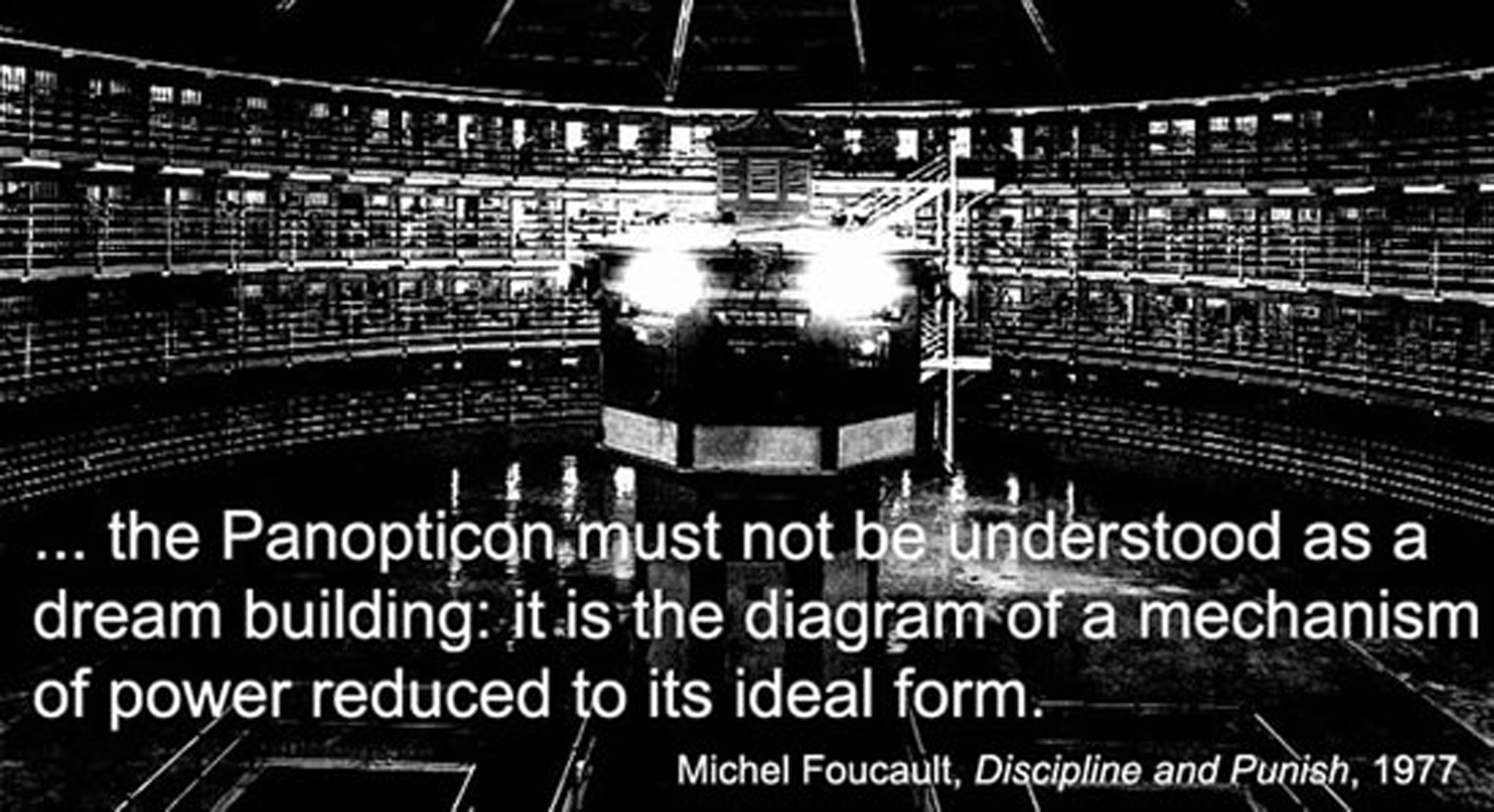
panopticon-image

By Douglas Haddow

Source: Adbusters

“So tell me, why did you leave your last job?” he asks.

The first thing I remember about the internet was the noise. That screeching howl of static blips signifying that you were, at last, online. I first heard it in the summer of ’93. We were huddled around my friend’s brand new Macintosh, palms sweaty, one of us on lookout for his mom, the others transfixed as our Webcrawler search bore fruit. An image came chugging down, inch by inch. You could hear the modem wince as it loaded, and like a hammer banging out raw pixels from the darkness beyond the screen, a grainy, low-res jpeg came into view. It was a woman and a horse.

Since then, I’ve had a complicated relationship with the internet. We all have. The noise is gone now, and its reach has grown from a network of isolated weirdos into a silent and invisible membrane that connects everything we do and say.

“I needed a bigger challenge,” I say. This is a lie.

The brewpub we’re in has freshly painted white walls and a polished concrete floor, 20 ft ceilings and dangling lightbulbs. It could double as a minimalist porn set, or perhaps a rendition chamber. Concrete is easy to clean. The table we’re at is long and communal. Whenever someone’s smartphone vibrates we all feel it through the wood, and we’re feeling it every second minute — a look of misery slicing across my face when I realize it’s not mine.

“Tell me about your ideal process,” the guy sitting down the table from us says. My eyes strain sideways. He looks to be about thirty; we all do. Like a young Jeff Bezos, his skin is the color of fresh milk. He’s dressed like a Stasi agent trying to blend in at a disco. Textbook Zuckercore: a collared blue-green plaid shirt unbuttoned with a subdued grey-on-grey graphic tee, blue jeans and sneakers. Functional sneakers. Tech sneakers. This is a tech bar. Frequented by tech people who do tech things. The park down the street is now a tech park. That’s where the tech types gather to broadcast their whimsy and play inclusive non-sports like Quidditch, which, I’m told, is something actual people actually do. It’s a nerd paradise where the only problems that exist are the ones that you’re inspired to solve. And I want in on it, because I want to believe.

“I’m a big fan of social,” I blurt out as an aside. He replies with a calm and ministerial nod. Nobody says “social media” anymore, it’s just “social” now.

My atoms are sitting here drinking a beer, being interviewed for a position at a firm that specializes in online brand management systems. Which is a euphemism for a human centipede of marketers selling marketing to marketers for marketing. The firm is worth a billion dollars. You’ve never heard of it. It’s the type of place where they force you to play ping-pong if you come in looking depressed. Meet the new boss, same as the old boss, except this one is very concerned that you see him as a positive force in the universe.

I’m here, bringing the cold beer to my dry lips and bobbing my head in my best impersonation of someone who doesn’t feel ill when he hears the words “key metrics,” “familiarity,” “control groups” and “variant groups.” It’s the dawn of the new creative economy, and I can dig it. I’m here, but I’m also spread across the internet in a series of containers. I’m in Facebook, I’m in Instagram, I’m in Google, I’m in Twitter and a thousand other places I never knew existed. Depending how my body is disposed of, it will either become dirt or atmosphere. But the digital atoms will live forever, or at least until civilization is incinerated by whatever means we choose to off ourselves.

“What about this position interests you?” he asks.

When the TechCrunchers preach the gospel of disruption, it’s from an industrial perspective that sees life on Earth as a series of business models to be upended. Disrupt or die is the motto, but they never mention the disruptees — the travel agents, the cab drivers, the bellhops. The journalists. The meat in the box before the box is crushed by the anvil of innovation.

“People have ideas about things but it’s a bunch of things. Sign up flow for example, high level things, but sometimes I think — let’s table this for now and put together some idea maps. I feel so empowered because we’re aligned,” someone else says. I look around but can’t trace the source.

It’s hard to focus on his questions when all the conversations occurring parallel to ours combine in a cacophony of sameness, as if we’re all Tedtalking a mantra of ancient buzzwords: Engagement. Intuitive. Connection. User base. Revolutionary. It’s like coke talk gone sour, not words that are meant to say things, but stale semiotics that signify you belong. This is the the new language of business. This is where Wall Street goes to find itself.

“I traded in my suit for khakis and sunglasses,” one of them says. But he’s wearing neither. “That’s the best decision you’ve ever made bro,” his colleague replies.

These are the most boring people on the planet. And it’s their world now, we’re just supplying the data for it. The game is simple: dump venture capital into a concept, get the eyeballs, take the data and profit. But the implications of this crude scheme are profound. Beyond all the hype, something weird is happening.

I can’t eat without instagramming my food. I can’t shit without playing Candy Crush. I can’t even remember who half the people are on my Facebook feed, but I’ll still mindlessly scroll through their tedious status updates and wince at their tacky wedding photos. Out of these aimless swipes, clicks and likes, a new world is being born. A world where everything we do, no matter how inane, is tracked, recorded, sorted and analyzed. Yahoo CEO Marissa Mayer has said the whole process is “like watching the planet develop a nervous system.” And through this system, every human action has become a potential source of profit for our data lords, a signal for them to identify and exploit.

“We are about to enter a world that is half digital and half physical, and without properly noticing, we’ve become half bits and half atoms. These bits are now an integral part of our identity, and we don’t own them,” says Hannes Grassegger.

Grassegger is a German economics journalist who was raised in front of his mom’s Macintosh, and later, on a Commodore 64 he got for his sixth birthday. He recently wrote “Das Kapital bin ich” (I am Capital), a book that has been criticized by the European left for being too capitalist, and by the right for being the communist manifesto of the digital era. In it he tries to answer a deceptively simple question: if our data is the oil of the 21st century, then why aren’t we all sheikhs?

“We’ve all been sharing. But the smart ones have been collecting — and they’ve packed us into their clouds,” he says. “Privacy. Transparency. Surveillance. Security gap. I don’t want to hear about it. These are sloppy downplayings of a radical new condition: We don’t own ourselves any more. We are digital serfs.”

Like Grassegger, and like everybody else, I was lured into this radical new condition with the feel-good promises of connection, friendship and self-expression. Apps, sites and services that allowed us to share what we loved, and do what we wanted. For Grassegger, these platforms were merely fresh lots ready to be ploughed, and in turn they kept the harvest: our feelings, thoughts, experiences and emotions, encoded in letters and numbers. Now they’re putting it all to work, exploiting these assets with algorithms and sentiment analysis, and our virtual souls are toiling even while we sleep.

His solution to this dilemma is practical and pragmatic, siding with a lesser evil of establishing a personalized free data market, which would allow us to exploit our information before others do it for us, arguing that “We must carry into the new space those rights and freedoms we eked out in the physical world centuries ago. The ownership over ourselves and the freedom to employ this property for our own benefit. Only this will help us leave behind our self-imposed digital immaturity.”

“KRRAAAAASHH!”

A waitress lets a pint glass slip from her hand and shatter on the floor, but no one bothers to look over; they’re too engaged. Then I notice something eerie about the vibe in this place. There’s no sneering, no sarcasm, and no self-deprecation. Everyone is just sort of floating along in an earnest tranquility. As if each anecdote about “that cool loft I found on Airbnb” contained some deep spiritual significance beyond my grasp.

My interrogator goes for a piss and I load up Facebook in the interim, hoping to find a shard of inspiration in my feed that will provide a topical talking point. Instead I find a listicle. A curiosity gap headline. An ad. A solicitation. Another ad. Another listicle. Oh dear, someone has lost their phone. And finally, an ad in the form of a listicle. Or is it a listicle in the form of an ad?

We were told to surf the web, but in the end, the web serf’d us. Yet there’s a worse fate than digital serfdom, as Snowden’s ongoing NSA revelations suggest. This isn’t simply about the commodification of all human kinesis, it’s the psychological colonialism that makes the commodification possible.

The nature of this bad trip was hinted at in June when we learned that Facebook manipulated the emotional states of nearly 700,000 of its users. Half of those chosen for the study were fed positivity, the others, despair. “The results show emotional contagion,” the Facebook scientists told us, meaning that they had discovered that alternating between positive and negative stimulus does indeed affect our behaviour. Or perhaps rediscovered. There’s a precedent for this. We’ve been here before.

Burrhus Frederic Skinner, known simply as B.F. to his BFFs, is best known as the psychologist with the painfully large forehead who tried to convince the world that free will was an illusion. But he wasn’t always so dire. He was once a young man with hopes and dreams who wrote poems and sonnets and wanted to become a stream-of-consciousness novelist like his idol, Marcel Proust. He failed miserably and it led him to conclude that he wasn’t capable of writing anything of interest because he had nothing to say. Frustrated and bitter, he resolved that literature was irrelevant and it should be destroyed, and that psychology was the true art form of the 20th century. So he went to Harvard and developed the concept of operant conditioning by putting a rat in a cage and manipulating its behaviour by alternating positive and negative stimulus. Now we’re the rats in the cage, only we don’t know where the cage ends and where it begins.

“What’s your five year vision for social?” he asks.

There’s a right way and a wrong way to answer this question. The wrong way is to be critical and cast scepticism on the internet’s role in our lives. For instance, you could draw a parallel between Facebook’s probing of emotional contagion and the Pentagon’s ongoing research into how to quash dissent and manage social unrest. Or you could mention how the Internet of Things will inevitably consolidate corporate power over our personal liberty unless we implement strict regulations on what part of ourselves can and cannot be quantified. But if you did that, you’d upset the prevailing good vibes and come off like a sickly paranoiac in desperate need of some likes.

The right way is to turn off, buy in and cash out. Reinforce the grand narrative and talk about how social is going to bring people together, not just online, but in the real world. How it will augment our interactions and make us more open. How in five years you’ll be able to meet your true love through an algorithm that correlates your iTunes activity to your medical history and how that algorithm will be worth a billion fucking dollars. And it’s through that magical cloud of squandered human potential that Skinner emerges once again and starts poking his finger into your brain.

After establishing himself as a household name, Skinner was finally able to live out his dream of writing a novel. That novel was Walden Two, a story about a utopian commune where people live a creative and harmonious life in accordance to the principles of radical behaviourism. In contrast to 1984 and Brave New World, it was meant to be a positive portrayal of a technologically-enabled utopian ideal. In it he writes, “The majority of people don’t want to plan. They want to be free of the responsibility of planning. What they ask for is merely some assurance that they will be decently provided for. The rest is a day-to-day enjoyment of life.”

In the late 60s, Walden Two directly inspired a series of attempts to create real world versions of the fictional community it described. These were just a few of the thousands of communes that were being established across America at that time. Some thrived, but the majority fell apart within a couple short years. They failed for a number of reasons: latrines overflowed, the tofu supply ran out, the livestock starved to death and so forth. But what many of them had in common was a cascading systems failure of their foundational hypothesis — that social change could be achieved through self-transformation and the problems of power could be solved simply by ignoring them. There was always a Machiavellian in the transformational mist, though, and a refusal to acknowledge outright how power creates invisible structures that undermine the potential for cooperative action ultimately led to their implosion. It’s in this stale pub, with its complimentary WiFi and overpriced organic popcorn, that those invisible power structures continue to thrive.

“There has to be incentive. There has to be. You can’t force people to use it,” a woman in the corner mutters. She’s among a cluster of people who for some reason are all carrying the same cheap, ugly backpack. Her hand gestures become more aggressive as the conversation progresses and she looks to be caught in a moment midway between panic and ecstasy. Her expression would make the perfect emoji for the inertia of our time. It looks sort of like this: (&’Z)

“Our notions of digital utopianism are deeply rooted in a communal wing of American counter-culture from the 1960s. That group of people have had an enormous impact on how we do technology. Many of the leading figures in technology come from that wing, Steve Jobs would be one,” says Fred Turner, a communications professor at Stanford University who researches and writes about how counterculture and technology interact.

“Their ideas of what a person is and what a community should be has suffused our idealized understanding of what a virtual community can be and what a digital citizen should be. That group believed that what you had to do to save the world was to build communities of consciousness — places where you would step outside mainstream America and turn away from politics and democracy, turn away from the state, and turn instead to people like yourself and to sharing your feelings, your ideas and your information, as a way of making a new world.”

There’s a fault line that runs underneath the recycling bins of America’s abandoned hippy communes all the way to my cracked iPhone 5 screen. And if there is one man who epitomizes the breadth of this fault, it’s Stewart Brand.

In 1968, Brand published the Whole Earth Catalog, an internet before the internet that provided a directory of products for sustainable, alternative and creative lifestyles, and helped connect those who pursued them. When the Whole Earth Catalog went out of business in 1971, Brand threw a “demise party” wherein the audience got to choose who would receive the magazine’s remaining twenty grand. They chose to give it to Fred Moore, an activist moonlighting as a dishwasher, who would go on to found the Homebrew Computer Club — the birthplace of Apple and the PC. In the 80s Brand launched The Whole Earth ’Lectronic Link, one of the world’s first virtual communities. Following its success, he started the Global Business Network — a think tank to shape the future of the world. They’ve worked on “navigating social uncertainty” with corporations like Shell Oil & AT&T, among others. In 2000, GBN was bought by Monitor Group, a consultancy firm that made headlines in 2011 by earning millions of dollars from the Libyan Government to manage and enhance the global profile of Muammar Gaddafi.

Brand’s most enduring legacy will likely come from coining the phrase “information wants to be free,” which serves as the business model for the Actually Existing Internet and the Big Data dream.

Looking around the brewpub, listening to the chatter, and staring into the bright blue eyes of my would-be employer, you can almost hear the words of Google CEO Eric Schmidt echo against the minimalist decor: “We know where you are. We know where you’ve been. We can more or less guess what you’re thinking about.”

In San Francisco, my fellow disruptees have taken to the streets and kicked off a proper bricks & bottle backlash against this sort of dictator-grade hubris that has come to define the Internet of Kings. Crude graffiti reading “DIE TECHIE SCUM” is scrawled on the sidewalk next to Googlebus blockades. TECH = DEATH signs are held up at protests. Tires are slashed, windows are smashed and #techhatecrimes is a hashtag that is being passed around Silicon Valley without a hint of irony.

Just down the street from where I’m sitting, a more passive form of protest has manifested in the form of a new café that promises an escape from the incessant blips and bleeps of the internet and its accoutrements.The tables there are also long and communal, but they’re wrapped inside an aluminum metal mesh designed to interrupt and restrain wireless signals and WiFi.

We are not going to escape this crisis by putting ourselves in a cage. There is no opt-out anymore. You can draw the blinds, deadlock your door, smash your smartphone, and only carry cash, but you’ll still get caught up in their all-seeing algorithmic gaze. They’ve datafied your car, your city and even your snail mail. This is not a conspiracy, it’s the status quo, and we’ve been too busy displacing our anxiety into their tidy little containers to realize what’s going on.

“Do you have any questions for me?” he finally asks, abruptly. My beer is empty, I’m thirsty for another, and the interview hasn’t gone well. I’ve failed to put on a brave face and the only questions that I have concern how much money I’m going to make. Will it be enough to pay for my escalating rent now that the datarazzi have moved into the neighborhood? Or will I have to drive an Über in my spare time to make ends meet?

The internet is a failed utopia. And we’re all trapped inside of it. But I’m not willing to give up on it yet. It’s where I first discovered punk rock and anarchism. Where I learned about the I Ching and Albert Camus while downloading “Holiday in Cambodia” at 15kbps. It’s where I first perved out on the photos of a girl I would eventually fall in love with. It’s home to me, you and everybody we know.

No, the appropriate question to ask is: “What is the purpose of my life?”

I’ve seen the best minds of my generation sucked dry by the economics of the infinite scroll. Amidst the innovation fatigue inherent to a world with more phones than people, we’ve experienced a spectacular failure of the imagination and turned the internet, likely the only thing between us and a very dark future, into little more than a glorified counting machine.

Am I data, or am I human? The truth is somewhere in between. Next time you click I AGREE on some purposefully confusing terms and conditions form, pause for a moment to interrogate the power that lies behind the code. The dream of the internet may have proven difficult to maintain, but the solution is not to dream less, but to dream harder.

What’s Wrong With TED Talks?

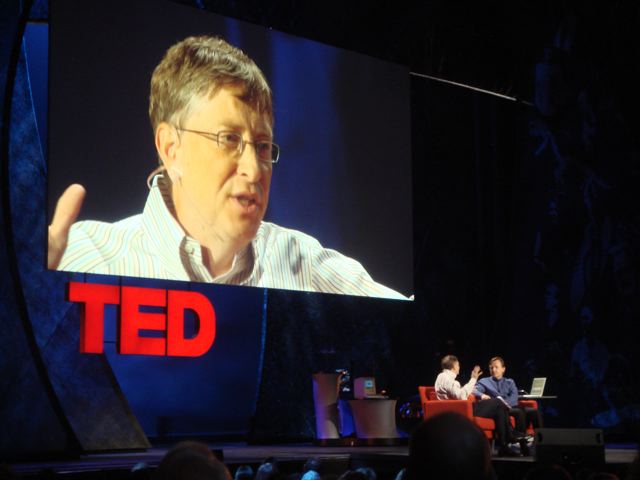
2009-02-04-DSC05656

Though it was released late last year, I just recently found this provocative speech from Benjamin Bratton which addresses problems of the TED talks format ironically delivered as a TED talk (hat tip to 21st Century Wire).

Many of the issues brought up by Bratton have previously been addressed through satire in various Onion Talks.

Despite its problems, in defense of TED it is to their credit that they allowed a forum for an anti-TED presentation. There have also been a few thought provoking TED talks that I felt did not fall into the trap of over-simplification and yet conveyed ideas elegantly and efficiently. Unfortunately, some of those have been censored for ideological reasons, including this must-see talk by Nick Hanauer about economic inequality:

Facing Death

Cemetery_PanoramaSharpweb

Jasun Horsley at Omni Reboot recently shared a number of intriguing insights on the topic of death and how it relates to science fiction, culture and transhumanism. He outlines how science fiction, whether utopia or dystopia, are scientific versions of a belief in a spiritual afterlife since they can soothe awareness of mortality and make us feel better about the present.

Horsley cites the work of Sheldon Solomon which shows how culture is a means of denying death via the manufacturing of extensions of the self and the body, including values which are carried by artifacts we create (ie. books, IPods, spaceships, etc.). The technology we create is meant to improve our lives and bring us closer to the utopia of sci-fi fantasies, but more often than not contributes to a dystopian reality. In his opinion, this happens because we’re unconscious of whatever it is within us causing the problems we’re trying to solve. We’re making things worse the more we try and improve them. A classic metaphor for this is Shelley’s Frankenstein which describes how the inability to accept death and the drive to “play God” creates a tragic monster.

According to Horsley, transhumanism is the religion of the (imagined) future, which most of us are already followers of, whether aware of it or not. For those not familiar with transhumanism (also known as extropianism), he provides an accurate and succinct definition in the following excerpt:

Transhumanism is a scientistic movement based on the belief that who (and what) we are can be divorced from biology. In its more extreme camps, Transhumanism divorces human existence from the psyche by suggesting that:

• At least some of the elements of consciousness can be converted to digital information.

• This data will be self-aware.

• It will be a continuation of the biologically-based awareness which it copied.

Horsley is skeptical of this view because it ignores the importance of the unconscious. In his words:

“Who we are” is not a mind-body system but a psyche-body system. We aren’t meat vessels with an internal stream of mental data running through them and animating them. The vast majority of our total “psychosoma” system functions at an unconscious level.

What he sees as a potentially more productive and fulfilling approach is the acceptance of death. Because it’s such an uncharted path (for the majority of us) it’s difficult to imagine the social impact such a paradigm shift would have, but he asks the following speculative questions which encourages further exploration:

Time is supposed to bestow wisdom on human beings. But can there be wisdom without acceptance of death?

How would both our fantasies and our culture be transformed if, instead of conquering death, we learned to accept it?

If death anxiety fuels human progress, maybe accepting death would not only be the end of fantasy, but the end of the fantasy we call “history”?

What it would be the beginning of, however, is anybody’s guess.

On a related note, rest in peace Nelson Mandela.

“Death is something inevitable. When a man has done what he considers to be his duty to his people and his country, he can rest in peace. I believe I have made that effort and that is, therefore, why I will sleep for the eternity.” – Mandela (1996)

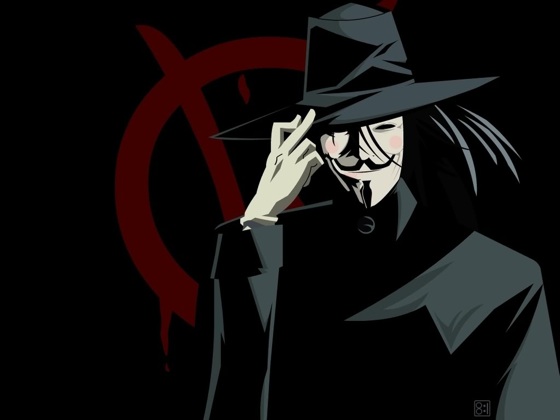
Remember, Remember, the 5th of November

v-for-vendetta-5-11-10-kc

In honor of Guy Fawkes Day I’d like to bring attention to a few intriguing statements from Alan Moore (writer of the graphic novel V for Vendetta) on the connections between his fictions and reality from an interview he did shortly after the start of the Occupy Movement.

Via The Guardian:

I suppose I’ve gotten used to the fact that some of my fictions percolate out into the material world.

…I suppose when I was writing V for Vendetta I would in my secret heart of hearts have thought: wouldn’t it be great if these ideas actually made an impact? So when you start to see that idle fantasy intrude on the regular world… It’s peculiar. It feels like a character I created 30 years ago has somehow escaped the realm of fiction.

…And when you’ve got a sea of V masks, I suppose it makes the protesters appear to be almost a single organism – this “99%” we hear so much about. That in itself is formidable. I can see why the protesters have taken to it. It turns protests into performances.

The mask is very operatic; it creates a sense of romance and drama. I mean, protesting, protest marches, they can be very demanding, very grueling. They can be quite dismal. They’re things that have to be done, but that doesn’t necessarily mean that they’re tremendously enjoyable – whereas actually, they should be.

I think it’s appropriate that this generation of protesters have made their rebellion into something the public at large can engage with more readily than with half-hearted chants, with that traditional, downtrodden sort of British protest. These people look like they’re having a good time. And that sends out a tremendous message.

The reason V’s fictional crusade against the state is ultimately successful is that the state, in V for Vendetta, relies upon a centralised computer network which he has been able to hack. Not an obvious idea in 1981, but it struck me as the sort of thing that might be down the line. This was just something I made up because I thought it would make an interesting adventure story. Thirty years go by and you find yourself living it.

I have no particular connection or claim to what [the protesters] are doing, nor am I suggesting that these people are fans of mine, or of V for Vendetta…So there’s always… Now I didn’t feel responsible, but…at the moment, the demonstrators seem to me to be making clearly moral moves, protesting against the ridiculous state that our banks and corporations and political leaders have brought us to.

…It would probably be better if the authorities accepted this is a new situation, that this is history happening. History is a thing that happens in waves. Generally it is best to go with these waves, not try to make them turn back – the Canute option. I’m hoping that the world’s leaders will realise this.

Vox populi, Voice of the people. And I think that if the mask stands for anything, in the current context, that is what it stands for. This is the people. That mysterious entity that is evoked so often – this is the people.

Read the full article here: http://www.theguardian.com/books/2011/nov/27/alan-moore-v-vendetta-mask-protest

Last July Moore was interviewed by Salon.com to talk about his new Kickstarter project, Jimmy’s End, but he also shared the following relevant observations about emerging NSA revelations, the surveillance state and technology:

There seems to be something going on, even from the briefest appraisal of the news, with the amount of events transpiring. This is such a connected world, it’s useless to isolate any part of it as a discrete phenomenon. You can’t really talk about the problems in Syria, because its problems are global. The waves of discontent and outrage — whether in the Arab countries, or in Brazil, or in America and Europe over the degrees to which its citizens are being monitored — are not separate phenomena. They are phenomena of an emergent world, and the existence of the Internet is one of its major drivers. We have got no idea how it’s going to turn out, because the nature of our society is such that if anything can be invented, then we will invent it. Sooner or later, if it is possible.

So the Internet is changing everything, but I wouldn’t yet want to say for good or ill. I suspect, as ever, that it will be an admixture of both. But we are all along for the ride, even those people like me who do not have Internet connections, mobile phones or even functioning televisions. I’m slowly disconnecting myself. Basically, it’s a feeling that if we are going to subject our entire culture to what is an unpredictable experiment, then I’d like to try to remain outside the petri dish. [Laughs] It’s only sensible to have somebody as a control.

To me, one of the biggest surprises of these recent surveillance revelations is how surprised people are. The level of surveillance we’ve had over here for the past 20 years now is ridiculous — and useless, I would add. Eerily enough, the security cameras on every street corner of Britain was instigated by the incoming Blair government in 1997, which was when I decided, back in 1982 or so, to set the first episode of “V for Vendetta,” which had cameras on every street corner. So yeah, we’ve had those for awhile; they’ve proliferated and multiplied for decades. More recently, there have been troops of police who have said that all these things are useful for is alienating the public. [Laughs] They are not actually useful in the prevention of crimes, or even actually apprehending their suspects.

Here’s the thing: If you’re monitoring every single thing that goes on in a given culture, if you have all the information that is there to be had, then that is the equivalent of having none of it. [Laughs] How are you going to process that amount of information? That’s when you get all these wonderful emerging paradoxes. Recently over here, there was a case where it was suspected that the people who monitor security screens were taking unnecessary toilet breaks and gossiping when they should be watching us. So it was decided that the only sensible thing to do was to put a security camera in the monitor room. [Laughs] This is answering the question that Juvenal asked so succinctly all those years ago: Who watches the watchmen? The answer is more watchmen! And yet more watchmen watch them, and of course it will eventually occur to them to ask: Can those people who are watching the people doing the watching really be trusted? Much better if they were under surveillance.

That’s the level of absurdity these Orwellian solutions bring to our increasingly complex world. George Orwell’s vision was 1947. Yes, the world was more complex than it had been, but nowhere near as complex as it was going to get. We currently have in Northampton — and I think we might be the first to have it — security cameras in some places that actually talk to you. “Pick that cigarette end up! Yes, you!” [Laughs] Which is so much like Patrick McGoohan’s vision for the Village in “The Prisoner,” all those years ago.

…Technology is always a two-edged sword. It will bring in many benefits, but also many disasters. Because of the complexity of our situation, we cannot predict what things will be until they happen. It’s just part of our responsibility as people in the modern world to do our very, very best to deal with them, and think them through, as they occur. While I’m remote from most technology to the point that I’m kind of Amish, I have played a couple of computer games — until I realized I was being bloodied with adrenalin over something that wasn’t real. At the end of a couple of hours of very addictive play, I may have procured the necessary amount of mushrooms to save a princess, but I also wasted hours of my life that I’ll never be able to get back. This is the reason I am not on the Internet. I am aware of its power as a distraction, and I don’t have the time for that.

Despite the constant clamor for attention from the modern world, I do believe we need to procure a psychological space for ourselves. I apparently know some people who try to achieve this by logging off, or going without their Twitter or Facebook for a limited period. Which I suppose is encouraging, although it doesn’t seem that remarkable from my perspective. I think that people need to establish their own psychological territory in face of the encroaching world.

Read the full interview here: http://www.salon.com/2013/07/07/alan_moore_the_revolution_will_be_crowd_funded/

Despite the fact that Moore said he disowned all Hollywood adaptations of his works, in my opinion the quality of his writing can transcend limitations inherent in such attempts, retaining power and resonance even in “watered down” form. Though I was disappointed by the film version of V for Vendetta overall, many who would not have otherwise been exposed to Moore’s work were able to absorb important aspects of his message through it and viral clips such as this:

On Ourselves in the Othernets

52-psychedelic-art-300x289

Though a month old, this piece by Chris Arkenberg of URBEINGRECORDED was one I found to be nonetheless thought provoking (I’ve added my own commentary in italics following the original paragraphs):

Ourselves in the Othernets

So dig: in about 20 years we went from knowing rather little about the world beyond what we directly experienced and what we gleaned through books and pictures and the occasional documentary or foreign movie, to having immediate on-demand insight into any facet of the globe you could imagine.

True, though I miss the sense of community and unique curation of some of the old physical media brick and mortar establishments.

And many you couldn’t imagine. The sheer amount of visibility into humanity is simply astonishing. And it’s this informational shift, this too-much-bloody-perspective that is really amplifying the change and disruption and anxiety through which we grapple with the unfolding narrative of our species.

I would argue that the disruption is amplified not just from too many perspectives, but from the cognitive dissonance caused by conflicting data and the struggle to discern which has a closer correlation to reality.

You see, humans are still basically tribal animals. We like what we know and we fear what we do not. Geography, bloodlines, race, and class are among the sociocultural elements that bind us when we share them and separate us from those who fall onto a different end of the spectrum. We cast the differences and the things we do not understand into the Other. The Other becomes the boogeyman, the shadow, the unknown that is presumed to be a threat (because it’s safest to first assume that things are threats and then let information persuade us otherwise).

Good description of unfortunate xenophobic and threat response tendencies that are all too easy for manipulative leaders to exploit.

This innate fear of the Other makes it easier to wage economics and wars on those folks over the mountain or beyond the sea. You can much more easily demonize or dehumanize people who have no discernible face, casting them into the Other without further regard. They’re different from us. They don’t like the things we do or worship the same gods. It’s our right as better, more civilized beings to have their oil/water/food/women/etc. In general, this made it easier to get down to business without the impediment of worrying about our impact on the savages. [Insert any relevant aside about colonialism or how the prosperity of the West has been built on the backs of cheap resources and labor in the Third World.]

At the same time, fear of the Other can blind us from seeing psychopaths and sociopaths who may look no different from ourselves. In fact, since they tend to be more adept at blending in, manipulating others, and seeking personal gain at expense of others, it’s no surprise many such people end up in positions of power.

And then the steady march of trade made it incrementally easier and easier to see bits of the Other. Radio emerged, then the telephone and television. But even those were mostly local or regional. Globalization reinforced shipping lanes and supply chains and people started engaging the overseas Other to figure out how Toyota managed to bust the asses of US automakers or how the Chinese could subsidize western luxury with cheaper manufacturing. And meanwhile, creeping along the copper lines, the internet was starting to form.

Depictions of the Other in media doesn’t necessarily help when society is exposed to predominantly negative images of certain groups. And early forms of globalization have been around at least since the colonial era previously mentioned and the global slave trade of the 17th century. It seems government and big business have always welcomed the Other…as cheap labor.

The early adopters really started to engage the web around 1993-1995. A few years later you could buy a cell phone that wasn’t the size of a brick but still a lot of folks who needed mobile connectivity just used a more affordable pager – a one-way ping that sent you running for a pay phone to respond. But by 2000 a lot of people were online and within another 5 years many of them had cell phones. Apple landed the smart phone revolutions and now, as of 2013, it’s not hyperbole to say that *most* people in the world have cell phones and sms. Many of them have internet access – at least enough to fill add hubs to regions still mostly lacking. And this penetration of digital eyes is especially high amongst the western nations so adept at justifying imperialism by demonizing and dehumanizing the Other. Ahem.

It’s amazing how fast these changes occurred. Penetration of “digital eyes” may be high among imperialist nations yet demonization of the Other continues largely thanks to corporate/government influence of mass media. Fortunately independent/foreign news and media offer a counterbalance to increasing audiences as corporate media declines.

Any analysis of the contemporary context we live in must therefore consider this fundamental reframing of such a core psychological construct. [IMHO.] The Other is collapsing into the known. We now see so much of the people, cultures, and races and interests and classes and… and basically the Other looks a lot like us, doesn’t it? Consider for a moment what it means for borders and national identity when our affinities are inherently borderless; when we make Facebook friends with people scattered all across the globe; when the streets of Bagdad (pre-post-Saddam) surprisingly looked a lot like the streets of Northridge or Minneapolis; and when the art and music and writings and media blend more and more across frictionless digital channels, reconfiguring to speak about the shared lives of humanity more than any isms or schisms. Well, call me a global-mind liberal tree-hugging old softy but it actually makes me feel better to see the barriers of culture and nationalism crumble a bit under the weight of the innate human need to connect and share and collaborate and remix. We’re still tribal, sure, and culture is valuable but the tribes are getting bigger and more distributed, and at the same time there are more and more niches in the Long Tail waking up to assert their *own* culture, however deep it may be in the sub-genre taxonomy.

From my perspective it’s a little simplistic to say the Other looks like us. In some cases they may, but the internet can also expose the extremes of different cultures and subcultures as well. It’s often a positive trend to be able to relate more with the Other, but it’s also important to acknowledge differences. And even though the Other may look like us, they may not think like us. Case in point are political/economic elites and the top 1%, who more people used to identify more with. Whether because they’re more corrupt than ever because of greater political/economic power or because of greater awareness of their harmful policies revealed mostly through the internet and independent media, they’re increasingly recognized as a new type of Other.

The impact of this shift and the crazy pace at which it’s happened has injected a tremendous amount of instability into the global system. And it’s all been carried along the sudden Cambrian explosion of computation and connectivity spreading into every nook and cranny it can find, wiring it all up and transforming the layers above. The sense of rapid change and the exponentiation of technological progress is probably not going to be a temporary or transitional event. It’s looking more likely that we’re steaming up a steep curve that’s elevating change from a passage to a condition. It’s the new normal within which we live our lives.

Can’t argue with that.

This is why I’m a bit sanguine on fears of NSA totalitarianism or rumors of grand conspiracies slowly wrapping us all up for the impending boot on our necks. I don’t believe in monoliths. There’s too much instability in the system for any one controller to reign it all in. Instead we live in a world of too many competitors – governments, transnationals, corporate multinationals, NGO’s, ideological blocks, cartels, super-empowered individuals. Even within organizations it’s all Game of Thrones and balkanized silos. They’re all vying for control but the outcome will not be any single winner. It will be a dynamic patchwork of power structures that, like any good ecosystem, will mostly keep each other in check. Mostly. Sometimes some of them align around a goal, other times they break apart and fragment.

This is where I do disagree. The scenario described would be an improvement over our current situation and may be where we end up eventually, but we’re not there yet. There might seem to be many conflicting factions but a closer examination reveals them to be different cards held by a relatively small number of players, and why wouldn’t these players cheat or conspire to retain their positions of power? A couple years ago a study from the Swiss Federal Institute of Technology in Zurich did a comprehensive analysis of 37 million companies, 43,060 transnational corporations and share ownerships linking them. They discovered that global corporate control has a dominant core of 147 firms with interlocking stakes. Together they control 40% of the wealth in the network. A total of 737 control 80% of it all.

The dystopic (realist?) balance to this sanguinity moves among the machines and the algorithmic mycelium wending its way through our networks and our devices and more and more of our lives. The opportunities for embedded governance when we all have a chip and an IP and a personal node on the net are indeed considerable. A geofenced life is a fenced life nevertheless, even if the prison is invisible. We humans may overcome our prejudices just in time to unite against the emerging Other of machine intelligence. There may yet be a Matrix scenario ahead of us though I suspect it won’t be possible for quite some time. Humans are fallible and, for now, we fallibly program the machines, lending de-rezed bits of our slippery minds to their cognitive computation. But what is the logic, the perspective, when the machines wise up and suddenly our dissent is regarded as a malfunctioning program throwing up a little flag on the network that can then be dispatched without ever requiring that humanly-fallible oversight? Perhaps then they just crawl into your mindtank and intermediate your pathetic shreds of freewill.

Among the emerging “True Other” I would include along with machine intelligence psychopathic government and corporate systems and the individuals who flourish within such systems.

But, you know, this is why we write programs to protect us. And why there are teenagers who are better at cracking things open than any would-be monolith will ever be at keeping them closed. This is the generational dance of evolution. The young are always one step ahead. It’s like a failsafe built-in to the species. Some inchoate balancer that makes sure nature maintains the upper hand lest we slip up and give it all away to fascists and imperialists and corporations and algorithms. And I suppose this is my faith, after all. That there is a failsafe. That we won’t let it all slip into ruin. Or at least, if we do, it will be the ruin of nature asserting its claim on us all, consuming civilization back into the womb of the Mother to be reconsidered and redrawn for the next momentous round of parthenogenesis. Maybe a little better and a little more suited to this world. Hopefully the music will be as good.

I must admit I have no idea how the future will turn out, but this proposed possibility is more hopeful than a number of likely outcomes.

Crossed Cloned Cow Cripples Creator in Korea

Prof. Park Se-pill of Jeju National University poses with attacker in 2009. Photo: Korea Times file

Prof. Park Se-pill of Jeju National University poses with his attacker in 2009. Photo: Korea Times

Via Slate:

In an event ripped straight of the gothic horror novel Frankenstein, a renowned embryologist was reportedly attacked by one of his cloned creations recently. The beast in this case, though, wasn’t a monster pieced together from the bodies of other animals—no, it was an 800-kilogram, black cow.

“Prof. Park Se-pill at Jeju National University had five of his ribs broken and injured his spine in the Sept. 15 attack,” reports the Korea Times. “Park was video-recording a black cow, which he cloned from species indigenous to Jeju four years ago, and all of a sudden, it charged and attacked him for 15 minutes,” a school official said. The embryologist will need eight weeks of medical treatment for his injuries.

The bovine made headlines in 2009 when Park successfully cloned it using a frozen cell taken from a deceased animal. This means the black cow is, in a sense, a “revival” of the cow that the cell was harvested from. Like a phoenix reborn after it dies—but rather than emerging from ashes, the cow originated from a test-tube.

While Park’s incident is unfortunate, it’s hard not to think of the real life allusions between the attack and Frankenstein. Perhaps if the cow could talk it would have quoted a famous line from the novel in which the monster exclaims to Dr. Frankenstein: “You are my creator, but I am your master—obey!”

Prof. Park is recovering at at Jeju National University and said he wishes to continue his study even if he has to be in a wheelchair. He reported the cow is now in a barn and no special measure will be taken despite the incident. This is some background of Park and his research from the Korea Times article that was cited:

Park has been recognized as one of the world’s leading cloning scientists since 2000 when he successfully took out human stem cell lines from embryos for the third time in history.

In particular, his team developed technologies using frozen eggs for cloning experiments _ the procedure that created the four-year-old cloned cow that gave him global recognition.

Taking advantage of his expertise, Park hoped to become the first scientist to establish stem cell batches from cloned human embryos by 2015 to help cure such degenerative diseases as diabetes and Alzheimer’s.

What Park vies to achieve is the same as what former Seoul National University Prof. Hwang Woo-suk claimed to have done in 2004 and 2005 ㅡ his feats later proved to have been falsified.

The Hwang case prompted the government to ban research with fresh human eggs in response to the ethical debate in the aftermath.

Instead, scientists have had to depend on a roundabout way of thawing frozen ova, typically leftovers after artificial insemination.

The government is unlikely to lift the restriction on the use of fresh eggs, which are deemed most suitable for therapeutic cloning research, in the near future.

Against this backdrop, Park and his team relied on their knowhow of the freeze-and-thaw process to extract stem cell lines from cloned human embryos.

C-Realm Opening Speech

Words of wisdom from KMO, creator of the C-Realm podcast, reading the opening presentation for his “Manifesting In Meat Space” couch-surfing tour:

http://c-realm.com/podcasts/crealm/377-manifesting-in-meat-space/

Among the topics covered: KMO’s intro to podcasting, peak oil, epochalism, technology, critical junctures, industrial society, Fight Club, the Unabomber, activism and conscious revolution.