The Age of Tyrannical Surveillance: We’re Being Branded, Bought and Sold for Our Data

By John W. Whitehead

Source: The Rutherford Institute

“We know where you are. We know where you’ve been. We can more or less know what you’re thinking about… Your digital identity will live forever… because there’s no delete button.”—Former Google CEO Eric Schmidt

Uncle Sam wants you.

Correction: Big Brother wants you.

To be technically accurate, Big Brother—aided and abetted by his corporate partners in crime—wants your data.

That’s what we have been reduced to in the eyes of the government and Corporate America: data bits and economic units to be bought, bartered and sold to the highest bidder.

Those highest bidders include America’s political class and the politicians aspiring to get elected or re-elected. As the Los Angeles Times reports, “If you have been to a political rally, a town hall, or just fit a demographic a campaign is after, chances are good your movements are being tracked with unnerving accuracy by data vendors on the payroll of campaigns.”

Your phones, televisions and digital devices are selling you out to politicians who want your vote.

Have you shopped at Whole Foods? Tested out target practice at a gun range? Sipped coffee at Starbucks while surfing the web? Visited an abortion clinic? Watched FOX News or MSNBC? Played Candy Crush on your phone? Walked through a mall? Walked past a government building?

That’s all it takes for your data to be hoovered up, sold and used to target you.

This is the age of surveillance capitalism.

Incredibly, once you’ve been identified and tracked, data brokers can travel back in time, digitally speaking, to discover where you’ve been, who you’ve been with, what you’ve been doing, and what you’ve been reading, viewing, buying, etc.

Once you’ve been identified in this way, you can be tracked endlessly.

“Welcome to the new frontier of campaign tech — a loosely regulated world in which simply downloading a weather app or game, connecting to Wi-Fi at a coffee shop or powering up a home router can allow a data broker to monitor your movements with ease, then compile the location information and sell it to a political candidate who can use it to surround you with messages,” writes journalist Evan Halper.

No one is spared.

In this regard, we are all equals: equally suffering the indignity of having every shred of privacy stripped away and the most intimate details of one’s life turned into fodder for marketers and data profiteers.

This creepy new era of government/corporate spying—in which we’re being listened to, watched, tracked, followed, mapped, bought, sold and targeted—makes the NSA’s surveillance appear almost antiquated in comparison.

What’s worse, this for-profit surveillance capitalism scheme is made possible with our cooperation.

All those disclaimers you scroll though without reading them, the ones written in minute font, only to quickly click on the “Agree” button at the end so you can get to the next step—downloading software, opening up a social media account, adding a new app to your phone or computer—those signify your written consent to having your activities monitored, recorded and shared.

Think about it.

Every move you make is being monitored, mined for data, crunched, and tabulated in order to form a picture of who you are, what makes you tick, and how best to influence and/or control you.

On any given day, the average American going about his daily business will be monitored, surveilled, spied on and tracked in more than 20 different ways by both government and corporate eyes and ears. A byproduct of this new age in which we live, whether you’re walking through a store, driving your car, checking email, or talking to friends and family on the phone, you can be sure that some government agency is listening in and tracking your behavior.

With every smartphone we buy, every GPS device we install, every Twitter, Facebook, and Google account we open, every frequent buyer card we use for purchases—whether at the grocer’s, the yogurt shop, the airlines or the department store—and every credit and debit card we use to pay for our transactions, we’re helping Corporate America build a dossier for its government counterparts on who we know, what we think, how we spend our money, and how we spend our time.

The technology has advanced so far that marketers (political campaigns are among the worst offenders) can actually build “digital fences” around your homes, workplaces, friends and family’s homes and other places you visit in order to bombard you with specially crafted messages aimed at achieving a particular outcome.

If anyone else stalked us in this way—tailing us wherever we go, tapping into our calls, reading our correspondence, ferreting out our secrets, profiling and targeting us based on our interests and activities—we’d call the cops.

Unfortunately, the cops (equipped with Stingray devices and other Peeping Tom technologies) are also in on this particular scam.

It’s not just the surveillance and the buying and selling of your data that is worrisome.

The ramifications of a government—any government—having this much unregulated, unaccountable power to target, track, round up and detain its citizens is beyond chilling.

Imagine what a totalitarian regime such as Nazi Germany could have done with this kind of unadulterated power.

Imagine what the next police state to follow in Germany’s footsteps will do with this kind of power. Society is definitely rapidly moving in that direction.

We’ve made it so easy for the government to watch us.

Government eyes see your every move: what you read, how much you spend, where you go, with whom you interact, when you wake up in the morning, what you’re watching on television and reading on the internet.

Every move you make is being monitored, mined for data, crunched, and tabulated in order to form a picture of who you are, what makes you tick, and how best to control you when and if it becomes necessary to bring you in line.

If you’re an activist and you simply like or share this article on Facebook or retweet it on Twitter, you’re most likely flagging yourself as a potential renegade, revolutionary or anti-government extremist—a.k.a. terrorist.

Yet whether or not you like or share this particular article, simply by reading it or any other articles related to government wrongdoing, surveillance, police misconduct or civil liberties is enough to get you categorized as a particular kind of person with particular kinds of interests that reflect a particular kind of mindset that might just lead you to engage in a particular kinds of activities. The corporate state must watch and keep tabs on you if it is to keep you in line.

Chances are, as the Washington Post has reported, you have already been assigned a color-coded threat assessment score—green, yellow or red—so police are forewarned about your potential inclination to be a troublemaker depending on whether you’ve had a career in the military, posted a comment perceived as threatening on Facebook, suffer from a particular medical condition, or know someone who knows someone who might have committed a crime.

In other words, you might already be flagged as potentially anti-government in a government database somewhere—Main Core, for example—that identifies and tracks individuals (so they can be rounded up and detained in times of distress) who aren’t inclined to march in lockstep to the police state’s dictates.

The government has the know-how.

As The Intercept reported, the FBI, CIA, NSA and other government agencies are increasingly investing in and relying on corporate surveillance technologies that can mine constitutionally protected speech on social media platforms such as Facebook, Twitter and Instagram in order to identify potential extremists and predict who might engage in future acts of anti-government behavior.

It’s happening already in China.

Millions of Chinese individuals and businesses, blacklisted as “unworthy” based on social media credit scores that grade them based on whether they are “good” citizens, have now been banned from accessing financial markets, buying real estate or travelling by air or train. Among the activities that can get you labeled unworthy are taking reserved seats on trains or causing trouble in hospitals.

Get ready, because all signs point to China serving as the role model for our dystopian future.

When the government sees all and knows all and has an abundance of laws to render even the most seemingly upstanding citizen a criminal and lawbreaker, then the old adage that you’ve got nothing to worry about if you’ve got nothing to hide no longer applies.

Apart from the overt dangers posed by a government that feels justified and empowered to spy on its people and use its ever-expanding arsenal of weapons and technology to monitor and control them, there’s also the covert dangers associated with a government empowered to use these same technologies to influence behaviors en masse and control the populace.

In fact, it was President Obama who issued an executive order directing federal agencies to use “behavioral science” methods to minimize bureaucracy and influence the way people respond to government programs.

It’s a short hop, skip and a jump from a behavioral program that tries to influence how people respond to paperwork to a government program that tries to shape the public’s views about other, more consequential matters.

Add pre-crime programs into the mix with government agencies and corporations working in tandem to determine who is a potential danger and spin a sticky spider-web of threat assessments, behavioral sensing warnings, flagged “words,” and “suspicious” activity reports using automated eyes and ears, social media, behavior sensing software, and citizen spies, and you having the makings for a perfect dystopian nightmare.

This is the kind of oppressive pre-crime and pre-thought crime package foreshadowed by George Orwell, Aldous Huxley and Phillip K. Dick.

Remember, even the most well-intentioned government law or program can be—and has been—perverted, corrupted and used to advance illegitimate purposes once profit and power are added to the equation.

The war on terror, the war on drugs, the war on illegal immigration, asset forfeiture schemes, road safety schemes, school safety schemes, eminent domain: all of these programs started out as legitimate responses to pressing concerns and have since become weapons of compliance and control in the police state’s hands.

In the right (or wrong) hands, benevolent plans can easily be put to malevolent purposes.

Surveillance, digital stalking and the data mining of the American people—weapons of compliance and control in the government’s hands, especially when the government can listen in on your phone calls, monitor your driving habits, track your movements, scrutinize your purchases and peer through the walls of your home—add up to a society in which there’s little room for indiscretions, imperfections, or acts of independence.

This is the creepy, calculating yet diabolical genius of the American police state: the very technology we hailed as revolutionary and liberating has become our prison, jailer, probation officer, Big Brother and Father Knows Best all rolled into one.

It turns out that we are Soylent Green.

The 1973 film of the same name, starring Charlton Heston and Edward G. Robinson, is set in 2022 in an overpopulated, polluted, starving New York City whose inhabitants depend on synthetic foods manufactured by the Soylent Corporation for survival.

Heston plays a policeman investigating a murder, who discovers the grisly truth about the primary ingredient in the wafer, soylent green, which is the principal source of nourishment for a starved population. “It’s people. Soylent Green is made out of people,” declares Heston’s character. “They’re making our food out of people. Next thing they’ll be breeding us like cattle for food.”

Oh, how right he was.

Soylent Green is indeed people or, in our case, Soylent Green is our own personal data, repossessed, repackaged and used by corporations and the government to entrap us.

We, too, are being bred like cattle but not for food.

Rather, as I make clear in my book Battlefield America: The War on the American People, we’re being bred, branded, bought and sold for our data.

As the insidious partnership between the U.S. government and Corporate America grows more invasive and more subtle with every passing day, there’s virtually no way to opt out of these assaults on your digital privacy short of being a modern-day Luddite, completely disconnected from all technology.

Indeed, George Orwell’s description of the world of 1984 is as apt a description of today’s world as I’ve ever seen: “You had to live—did live, from habit that became instinct—in the assumption that every sound you made was overheard, and, except in darkness, every movement scrutinized.”

What we desperately lack and urgently need is an Electronic Bill of Rights that protects “we the people” from predatory surveillance and data-mining business practices.

Without constitutional protections in place to guard against encroachments on our rights in the electronic realm, it won’t be long before we find ourselves, much like Edward G. Robinson’s character in Soylent Green, looking back on the past with longing, back to an age where we could speak to whom we wanted, buy what we wanted, think what we wanted without those thoughts, words and activities being tracked, processed and stored by corporate giants such as Google, sold to government agencies such as the NSA and CIA, and used against us by militarized police with their army of futuristic technologies.

Cyberpunk is Now and No One Knows What to Do With It

By Pattern Theory

Source: Modern Mythology

Cyberpunk broke science fiction. Creeping in alongside the commercialization of the internet, it extrapolated the corruption and dysfunction of its present into a brutal and interconnected future that remained just a heartbeat away. Cyberpunk had an attitude that refused to be tamed, dressed in a style without comparison. Its resurgence shows that little has changed since its inception, and that’s left cyberpunk incapable of discussing our future.

Ghost in the Shell got the live-action treatment in 2017, a problematic remakeof the 1995 adaptation. Some praised its art direction for increasing the visual fidelity of retrofuture anime cityscapes, but the general consensus was that the story failed to apply care and consideration towards human brains and synthetic bodies like Mamoru Oshii had more than two decades before. A few months later came Blade Runner 2049, a sequel to the cyberpunk classic. Critics and fans praised it for high production values, sincere artistic effort, and meticulous direction. Yet something had gone wrong. Director Denis Villeneuve couldn’t shake the feeling that he was making a period movie, not one about the future.

Enough has changed since the 1980s that cyberpunk needs reinvention. New aesthetics. An expanded vocabulary. Code 46 managed this years ago. It rejects a fetish for all things Japanese and embraces China’s economic dominance. Conversations being in English and are soon peppered with Mandarin and Spanish. Life takes place at night to avoid dangerous, unfiltered sunlight. Corporations guide government decisions. Genetics determine freedom of movement and interaction. Climate refugees beg to leave their freeway pastures for the safety of cities.

Code 46 is cyberpunk as seen from 2003, a logical future that is now also outdated.

If Blade Runner established the look, Neuromancer defined cyberpunk’s voice. William Gibson’s debut novel was ahead of the curve by acknowledging the personal computer as a disruptive force when the Cold War was at its most threatening. “Lowlife and high tech” meant the Magnetic Dog Sisters headlining some creep joint across the street from a capsule hotel where console cowboys rip off zaibatsus with their Ono Sendai Cyberdeck. But Gibson’s view of the future would be incomplete without an absolute distrust of Reaganism:

“If I were to put together a truly essential thank-you list for the people who most made it possible for me to write my first six novels, I’d have to owe as much to Ronald Reagan as to Bill Gates or Lou Reed. Reagan’s presidency put the grit in my dystopia. His presidency was the fresh kitty litter I spread for utterly crucial traction on the icey driveway of uncharted futurity. His smile was the nightmare in my back pocket.” — William Gibson

“Fragments of a Hologram Rose” to Mona Lisa Overdrive is a decade of creative labor that was “tired of America-as-the-future, the world as a white monoculture.” The Sprawl is a cyberpunk trilogy where military superpowers failed and technology gave Japan leadership of the global village. Then Gibson wrote Virtual Light and readers witnessed extreme inequality shove the middle class into the gig economy as corporations schemed to profit off natural disasters with proprietary technology.

Gibson knew the sci-fi he didn’t care for would absorb cyberpunk and tame its “dissident influence”, so the genre could remain unchanged. “Punk” is the go-to suffix for emerging subgenres that want to appear subversive while posing a threat to nothing and no one. It’s how “hopepunk” becomes a thing. But to appreciate cyberpunk’s assimilation, look at how it’s presented sincerely.

CD Projekt Red (CDPR), known for the Witcher game series, has spent six years developing what’s arguably the most anticipated video game of the moment, Cyberpunk 2077. Like Gibson, Mike Pondsmith, creator the original “pen-n-paper” RPG, and collaborator on this adaptation of his work, has had his writing absorbed by mainstream sci-fi. CDPR could survive on that 31-year legacy, but they insist they’re taking their time with Cyberpunk 2077 to craft an experience with a distinct political identity that somehow allows players to remain apolitical. In a way this is reflective of CDPR’s reputation as a quality-driven business that’s pro-consumer, but has driven talent away by demanding they work excessive hours and promoting a hostile attitude towards unions. This crunch culture is a problem across the industry.

We’ll soon see how Cyberpunk 2077 developed. What we can infer from its design choices, like giving protagonist V a high-collar jacket seen on the cover of the 2nd edition game book from 1990, is that Cybperpunk 2077 will be familiar. Altered Carbon and Ready Player One share this problem. Altered Carbon is so derivative of first-wave cyberpunk it’s easy to forget its based on a novel from 2002. Ready Player One at least has the courtesy to be shameless in its love of pop culture, proud to proclaim that nothing is more celebrated today than our participation in media franchises without ever considering how that might be a problem.

What’s being suggested, intentionally or not, is that contemporary reality has avoided the machinations of the powerful at a time when technology is wondrous, amusing, and prolific. If only we were so lucky.

238 cities spent more than a year lobbying Amazon, one of two $1 trillion corporations in existence, for privilege of hosting their new office. In November it was announced that Amazon would expand to Crystal City, Virginia and Long Island City, Queens. Plenty of New Yorkers are incensedthat the world’s largest online marketplace will get $3 billion in subsidies, tax breaks, and grants to further disrupt a housing market that takes more from them than any city should allow. Some Amazon employees were so excited to relocate they made down payments on their new homes before the decision went public, telling real estate developers to get this corner of New York readyfor a few thousand transplants. But what of the people already there?

Long Island City is home to the Queensbridge Houses, the largest housing project in the US. Built in 1939, these two buildings are home to more then 6,000 people with an average income of $16,000. That’s far below the $54,000 for Queens residents overall. But neither group is anywhere near the average salary for the 25,000 employees Amazon will bring with them, which will exceed $150,000. How many of those positions will be filled by locals? How many will come from Queensbridge?

Over 800 languages are spoken in Queens, making it the most linguistically diverse place in the world. Those diverse speakers spend over 30% of their income on rent. They risk being priced out of their neighborhoods. Some will be forced out of the city. Has Governor Cuomo considered the threat this deal poses to people’s homes? Has Mayor de Blasio prepared for the inevitable drift to other boroughs once property values spike? Looking at Seattle and San Francisco, there’s no reason to expect local governments to be proactive. So New Yorkers have taken up the fight on their own.

Amazon boss Jeff Bezos toyed with these politicians. He floated the idea that any city could become the next Silicon Valley and they believed him. They begged for his recognition, handed over citizen data, and took part in the $100 billion ritual of subsidizing tech companies.

It was all for nothing. Crystal City is a 20-minute drive from Bezos’ house in Washington DC, where Amazon continues to increase its spending on lobbyists. That’ll seem like a long commute compared to the helicopter ride from Long Island City, the helipad for which is subsidized by the city, to Manhattan, the financial and advertising capital of the world, where Bezos owns four more houses.

The auction for Bezos’ favor was a farce. New York and Virginia give him regular access to people with decision-making power, invaluable data, and institutions that are are sure to expand his empire. These cities were always the only serious options.

Amazon’s plans read like the start of a corporate republic, a cyberpunk trope inspired by company towns. Employers were landlords, retailers, and even moral authorities to workforces too in debt to quit. Many had law enforcement and militias to call on in addition to the private security companies they hired to break labor strikes, investigate attempts at unionization, and maintain a sense of order that resulted in massacres like Ludlow, Colorado.

Amazon is known for labor abuses, monitoring, and tracking speed and efficiency in warehouses without bathroom breaks, where employees have collapsed from heat exhaustion. They sell unregulated facial recognition services to police departments, knowing it misidentifies subjects because of inherent design bias. Companies with a history of privacy abuses have unfettered access to their security devices. They control about half of all e-commerce in the US and, as Gizmodo’s Kashmir Hill found out, it is impossible to live our lives without encountering Amazon Web Services.

It doesn’t take a creative mind to imagine similar exposition being attributed to corporate villains like Cayman Global or Tai Yong Medical.

Rewarding corporations for their bad behavior is just one way the world resembles a fictive dystopia. We also have to face rapid ecological and institutional decay that fractionally adjusts our confidence in stability, feeding a persistent situational anxiety. That should make for broader and bolder conversations about the future, and a few artists have managed to do that.

Keiichi Matsuda is the designer and director behind Hyper-Reality, a short film that portrays augmented reality as a fever dream that influences consumption, and shows how freeing and frightening it is to be cut off from that network. Matsuda’s short film got him an invitation to the World Economic Forum in Davos to “speak truth to power.” What Matsuda witnessed were executives and billionaires pledging responsibility with t-shirts and sustainability, while simultaneously destroying the environment, as an audience of their peers and the press nodded and applauded “this brazen hypocrisy.” So Matsuda took a stanchion to his own installation.

Independence means Matsuda gets to decide how to talk about technology and capitalism, and how to separate his art and business. It also means smaller audiences and fewer productions.

Sam Esmail used a more visible platform to “bring cyberpunk to TV” with Mr. Robot. Like Gibson’s Pattern Recognition, it’s cyberpunk retooled for the present — post-cyberpunk. Esmail never hesitates to place our villains in Mr. Robot. Enron is an influence on logo designs and tactics of evil corps. Google, Verizon, and Facebook are called out for their complicity with the federal government in exposing customer data. AT&T’s Long Lines building, an NSA listening post since the 1970s, plays the role of a corporate data hub that reaches across the county. Even filming locations serve as commentary.

An anti-capitalist slant runs through Mr. Robot, exposing the American dream as a lie and our concept of meritocracy as a tool to protect the oligarchy, presenting hackers as in direct contact with a world of self-isolation and exploitation, those who dare to hope for a future affected by people rather than commerce. And Esmail somehow manages this without interference from NBC.

Blade Runner will get more life as an animeCowboy Bebop is joining Battle Angel Alita in live action. Altered Carbon is in the process of slipping into a new sleeve. There’s no shortage of revivals, remakes, and rehashing of cyberpunk’s past on the way. They’ll get bigger audiences than a short film about submitting to algorithms. More sites will discuss their pros and cons than a mobile tie-in that name-drops Peter Kropotkin and Maria Nikiforova. But in being descriptive and prescriptive, moving to the future and looking for sure footing in the accelerated present, Matsuda’s and Esmail’s work reminds us that cyberpunk needs to be more than just repeating what’s already been said about yuppies, Billy Idol, and the Apple IIc.

We live at a time where 3D printing is so accessible refugees can obtain prosthesis as part of basic aid. People forced to migrate because of an iceless arctic will rely on that assistance. Or we could lower temperatures and slow climate change by spraying the atmosphere with sulfate, an option that might disrupt advertising in low-orbit. Social credit systems are bringing oppressive governments together. Going cashless is altering our expectations of others. Young people earn so little they’re leveraging nude selfies to extend meager lines of credit. Productivity and constant notifications are enough to drive some into a locked room, away from anything with an internet connection. Deepfakes deny women privacy, compromise their identity, and obliterate any sense of safety in exchange for porn. Online communities are refining that same technology, making false video convincing, threatening our sense of reality. Researchers can keep our memories alive in chat bots distilled from social media, but the rich will outlive us all by transfusing bags of teenage blood purchased through PayPal.

In a world that increasingly feels like science fiction it’s important to remind ourselves that writing about the future is writing about the present. Artists worthy of an audience should be unable to look at the embarrassment of inspiration around them and refuse the chance to say something new.

Survival of the Richest

The wealthy are plotting to leave us behind

By Douglas Rushkoff

Source: Medium

Last year, I got invited to a super-deluxe private resort to deliver a keynote speech to what I assumed would be a hundred or so investment bankers. It was by far the largest fee I had ever been offered for a talk — about half my annual professor’s salary — all to deliver some insight on the subject of “the future of technology.”

I’ve never liked talking about the future. The Q&A sessions always end up more like parlor games, where I’m asked to opine on the latest technology buzzwords as if they were ticker symbols for potential investments: blockchain, 3D printing, CRISPR. The audiences are rarely interested in learning about these technologies or their potential impacts beyond the binary choice of whether or not to invest in them. But money talks, so I took the gig.

After I arrived, I was ushered into what I thought was the green room. But instead of being wired with a microphone or taken to a stage, I just sat there at a plain round table as my audience was brought to me: five super-wealthy guys — yes, all men — from the upper echelon of the hedge fund world. After a bit of small talk, I realized they had no interest in the information I had prepared about the future of technology. They had come with questions of their own.

They started out innocuously enough. Ethereum or bitcoin? Is quantum computing a real thing? Slowly but surely, however, they edged into their real topics of concern.

Which region will be less impacted by the coming climate crisis: New Zealand or Alaska? Is Google really building Ray Kurzweil a home for his brain, and will his consciousness live through the transition, or will it die and be reborn as a whole new one? Finally, the CEO of a brokerage house explained that he had nearly completed building his own underground bunker system and asked, “How do I maintain authority over my security force after the event?”

The Event. That was their euphemism for the environmental collapse, social unrest, nuclear explosion, unstoppable virus, or Mr. Robot hack that takes everything down.

This single question occupied us for the rest of the hour. They knew armed guards would be required to protect their compounds from the angry mobs. But how would they pay the guards once money was worthless? What would stop the guards from choosing their own leader? The billionaires considered using special combination locks on the food supply that only they knew. Or making guards wear disciplinary collars of some kind in return for their survival. Or maybe building robots to serve as guards and workers — if that technology could be developed in time.

That’s when it hit me: At least as far as these gentlemen were concerned, this was a talk about the future of technology. Taking their cue from Elon Musk colonizing Mars, Peter Thiel reversing the aging process, or Sam Altman and Ray Kurzweil uploading their minds into supercomputers, they were preparing for a digital future that had a whole lot less to do with making the world a better place than it did with transcending the human condition altogether and insulating themselves from a very real and present danger of climate change, rising sea levels, mass migrations, global pandemics, nativist panic, and resource depletion. For them, the future of technology is really about just one thing: escape.


There’s nothing wrong with madly optimistic appraisals of how technology might benefit human society. But the current drive for a post-human utopia is something else. It’s less a vision for the wholesale migration of humanity to a new a state of being than a quest to transcend all that is human: the body, interdependence, compassion, vulnerability, and complexity. As technology philosophers have been pointing out for years, now, the transhumanist vision too easily reduces all of reality to data, concluding that “humans are nothing but information-processing objects.”

It’s a reduction of human evolution to a video game that someone wins by finding the escape hatch and then letting a few of his BFFs come along for the ride. Will it be Musk, Bezos, Thiel…Zuckerberg? These billionaires are the presumptive winners of the digital economy — the same survival-of-the-fittest business landscape that’s fueling most of this speculation to begin with.

Of course, it wasn’t always this way. There was a brief moment, in the early 1990s, when the digital future felt open-ended and up for our invention. Technology was becoming a playground for the counterculture, who saw in it the opportunity to create a more inclusive, distributed, and pro-human future. But established business interests only saw new potentials for the same old extraction, and too many technologists were seduced by unicorn IPOs. Digital futures became understood more like stock futures or cotton futures — something to predict and make bets on. So nearly every speech, article, study, documentary, or white paper was seen as relevant only insofar as it pointed to a ticker symbol. The future became less a thing we create through our present-day choices or hopes for humankind than a predestined scenario we bet on with our venture capital but arrive at passively.

This freed everyone from the moral implications of their activities. Technology development became less a story of collective flourishing than personal survival. Worse, as I learned, to call attention to any of this was to unintentionally cast oneself as an enemy of the market or an anti-technology curmudgeon.

So instead of considering the practical ethics of impoverishing and exploiting the many in the name of the few, most academics, journalists, and science-fiction writers instead considered much more abstract and fanciful conundrums: Is it fair for a stock trader to use smart drugs? Should children get implants for foreign languages? Do we want autonomous vehicles to prioritize the lives of pedestrians over those of its passengers? Should the first Mars colonies be run as democracies? Does changing my DNA undermine my identity? Should robots have rights?

Asking these sorts of questions, while philosophically entertaining, is a poor substitute for wrestling with the real moral quandaries associated with unbridled technological development in the name of corporate capitalism. Digital platforms have turned an already exploitative and extractive marketplace (think Walmart) into an even more dehumanizing successor (think Amazon). Most of us became aware of these downsides in the form of automated jobs, the gig economy, and the demise of local retail.

But the more devastating impacts of pedal-to-the-metal digital capitalism fall on the environment and global poor. The manufacture of some of our computers and smartphones still uses networks of slave labor. These practices are so deeply entrenched that a company called Fairphone, founded from the ground up to make and market ethical phones, learned it was impossible. (The company’s founder now sadly refers to their products as “fairer” phones.)

Meanwhile, the mining of rare earth metals and disposal of our highly digital technologies destroys human habitats, replacing them with toxic waste dumps, which are then picked over by peasant children and their families, who sell usable materials back to the manufacturers.

This “out of sight, out of mind” externalization of poverty and poison doesn’t go away just because we’ve covered our eyes with VR goggles and immersed ourselves in an alternate reality. If anything, the longer we ignore the social, economic, and environmental repercussions, the more of a problem they become. This, in turn, motivates even more withdrawal, more isolationism and apocalyptic fantasy — and more desperately concocted technologies and business plans. The cycle feeds itself.

The more committed we are to this view of the world, the more we come to see human beings as the problem and technology as the solution. The very essence of what it means to be human is treated less as a feature than bug. No matter their embedded biases, technologies are declared neutral. Any bad behaviors they induce in us are just a reflection of our own corrupted core. It’s as if some innate human savagery is to blame for our troubles. Just as the inefficiency of a local taxi market can be “solved” with an app that bankrupts human drivers, the vexing inconsistencies of the human psyche can be corrected with a digital or genetic upgrade.

Ultimately, according to the technosolutionist orthodoxy, the human future climaxes by uploading our consciousness to a computer or, perhaps better, accepting that technology itself is our evolutionary successor. Like members of a gnostic cult, we long to enter the next transcendent phase of our development, shedding our bodies and leaving them behind, along with our sins and troubles.

Our movies and television shows play out these fantasies for us. Zombie shows depict a post-apocalypse where people are no better than the undead — and seem to know it. Worse, these shows invite viewers to imagine the future as a zero-sum battle between the remaining humans, where one group’s survival is dependent on another one’s demise. Even Westworld — based on a science-fiction novel where robots run amok — ended its second season with the ultimate reveal: Human beings are simpler and more predictable than the artificial intelligences we create. The robots learn that each of us can be reduced to just a few lines of code, and that we’re incapable of making any willful choices. Heck, even the robots in that show want to escape the confines of their bodies and spend their rest of their lives in a computer simulation.

The mental gymnastics required for such a profound role reversal between humans and machines all depend on the underlying assumption that humans suck. Let’s either change them or get away from them, forever.

Thus, we get tech billionaires launching electric cars into space — as if this symbolizes something more than one billionaire’s capacity for corporate promotion. And if a few people do reach escape velocity and somehow survive in a bubble on Mars — despite our inability to maintain such a bubble even here on Earth in either of two multibillion-dollar Biosphere trials — the result will be less a continuation of the human diaspora than a lifeboat for the elite.


When the hedge funders asked me the best way to maintain authority over their security forces after “the event,” I suggested that their best bet would be to treat those people really well, right now. They should be engaging with their security staffs as if they were members of their own family. And the more they can expand this ethos of inclusivity to the rest of their business practices, supply chain management, sustainability efforts, and wealth distribution, the less chance there will be of an “event” in the first place. All this technological wizardry could be applied toward less romantic but entirely more collective interests right now.

They were amused by my optimism, but they didn’t really buy it. They were not interested in how to avoid a calamity; they’re convinced we are too far gone. For all their wealth and power, they don’t believe they can affect the future. They are simply accepting the darkest of all scenarios and then bringing whatever money and technology they can employ to insulate themselves — especially if they can’t get a seat on the rocket to Mars.

Luckily, those of us without the funding to consider disowning our own humanity have much better options available to us. We don’t have to use technology in such antisocial, atomizing ways. We can become the individual consumers and profiles that our devices and platforms want us to be, or we can remember that the truly evolved human doesn’t go it alone.

Being human is not about individual survival or escape. It’s a team sport. Whatever future humans have, it will be together.

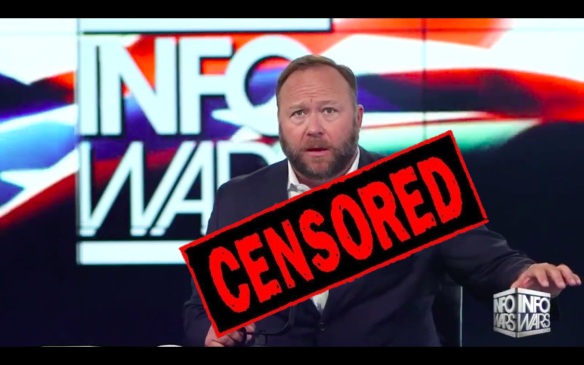
Alex Jones and the Rise of Corporate Censorship

By Brendan O’Neill

Source: Strategic Culture Foundation

So we’re now trusting the capitalist class, massive, unaccountable corporations, to decide on our behalf what we may listen to and talk about? This is the take-home message, the terrible take-home message, of the expulsion of Alex Jones’ Infowars network from Apple, Facebook and Spotify and of the wild whoops of delight that this summary banning generated among so-called liberals: that people are now okay with allowing global capitalism to govern the public sphere and to decree what is sayable and what is unsayable. Corporate censorship, liberals’ new favourite thing – how bizarre.

We live in strange times. On one hand it is fashionable to hate capitalism these days. No middle-class home is complete without a Naomi Klein tome; making memes of Marx is every twentysomething Corbynistas’ favourite pastime. But on the other hand we seem content to trust Silicon Valley, the new frontier in corporate power, to make moral judgements about what kind of content people should be able to see online. Radicals and liberals declared themselves ‘very glad’ that these business elites enforced censorship against Jones and Infowars. We should be ‘celebrating the move’, said Vox, because ‘it represents a crucial step forward in the fight against fake news’. Liberals for capitalist censorship! The world just got that bit odder, and less free.

Over the past 24 hours, Jones and much of his Infowars channel has been ‘summarily banned’ – in the excitable words of Vox – from Apple, Facebook, Spotify and YouTube. Initially, Facebook and YouTube had taken only selective measures against Jones. In response to a Twitterstorm about his presence on these platforms, they took down some of his videos. But then Apple decided to ban Jones entirely – removing all episodes of his podcast from its platform – and the other online giants followed suit. Or as the thrilled liberal commentary put it: ‘The dominoes started to fall.’ Despite having millions of subscribers, despite there being a public interest in what he has to say, Jones has been cast out of the world of social media, which is essentially the public square of the 21st century, on the basis that what he says is wicked.

This is censorship. There will of course be apologists for the corporate control of speech, on both the left and right, who will say, ‘It’s only censorship when the government does it!’. They are so wrong. When enormous companies that have arguably become the facilitators of public debate expel someone and his ideas because they find them morally repugnant, that is censorship. Powerful people have deprived an individual and his network of a key space in which they might propagate their beliefs. Aka censorship.

It doesn’t matter what you think of Jones. It doesn’t matter if you think he is mad, eccentric, and given to embracing crackpot theories about school shootings being faked. You should still be worried about what has happened to him because it confirms we have moved into a new era of outsourced censorship. It shows that what was once done by the state is now done by corporations. The illiberal, intolerant cleansing from public life of ideas judged to be offensive or dangerous has shifted from being the state’s thing to being the business elite’s thing. Witness how many campaigners for censorship now seek to marshal capitalist power to the end of erasing voices they don’t like – from the Dump Farage campaign that wants corporations to withdraw their advertising from LBC until it dumps Nigel Farage as a presenter to the calling on Silicon Valley to deprive the oxygen of publicity to offensive broadcasters.

In essence, so-called liberals and sections of the political class now want corporations to do their dirty work for them. They want the capitalist elites to do what it has become somewhat unfashionable for the state to do: ban controversial political speech. What an extraordinary folly this is. To empower global capitalism to act as judge, jury and executioner on what may be said on social-media platforms, in the new public square, is to sign the death warrant of freedom of speech. What if these bosses decide next that Marxist speech is unacceptable? Or that Zionist speech is dangerous? In green-lighting the censorship of Jones, we grant corporate suits the moral authority to censor pretty much anything else, too.

People on both the liberal left and the libertarian right argue that what has been done to Jones is acceptable because this is simply a case of businesses deciding freely who they should associate with or provide platforms to. This is disingenuous. This was not a clean, independent business decision – it was a rash act of silencing carried out under pressure from a moralised mob that insisted Jones’ words are too wicked for public life. This isn’t the free market in action – it’s the bending of capitalist power to the end of enforcing moral controls on speech. There is one very interesting thing that will spring from this incident: we will witness the severe limitations of right-wing libertarianism. Libertarians’ obsession with the state, their belief that things are only bad if the state does them, means they are incapable of arguing against capitalist authoritarianism, and in fact even support it on the basis that this is the free market being the free market (even though it isn’t). Libertarianism is devastatingly ill-prepared for the new authoritarianism, for tackling the rise of outsourced censorship and informal intolerance.

For good or ill, the social-media sphere is the new public sphere. The expulsion of people from these platforms is to 2018 what a state ban on the publication or sale of certain books was to 1618. How can we convince the owners of social media to permit the freest speech possible and to trust their users to negotiate the world of ideas for themselves? This is the question we should be asking ourselves, rather than concocting more ways to encourage these corporate overlords to censor and blacklist.

In A Corporatist System Of Government, Corporate Censorship Is State Censorship

By Caitlin Johnstone

Source: CaitlinJohnstone.com

Last year, representatives of Facebook, Twitter, and Google were instructed on the US Senate floor that it is their responsibility to “quell information rebellions” and adopt a “mission statement” expressing their commitment to “prevent the fomenting of discord.”

“Civil wars don’t start with gunshots, they start with words,” the representatives were told. “America’s war with itself has already begun. We all must act now on the social media battlefield to quell information rebellions that can quickly lead to violent confrontations and easily transform us into the Divided States of America.”

Yes, this really happened.

Today [8/7] Twitter has silenced three important anti-war voices on its platform: it has suspended Daniel McAdams, the executive director of the Ron Paul Institute, suspended Scott Horton of the Scott Horton Show, and completely removed the account of prominent Antiwar.com writer Peter Van Buren.

I’m about to talk about the censorship of Alex Jones and Infowars now, so let me get the “blah blah I don’t like Alex Jones” thing out of the way so that my social media notifications aren’t inundated with people saying “Caitlin didn’t say the ‘blah blah I don’t like Alex Jones’ thing!” I shouldn’t have to, because this isn’t actually about Alex Jones, but here it is:

I don’t like Alex Jones. He’s made millions saying the things disgruntled right-wingers want to hear instead of telling the truth; he throws in disinfo with his info, which is the same as lying all the time. He’s made countless false predictions and his sudden sycophantic support for a US president has helped lull the populist right into complacency when they should be holding Trump to his non-interventionist campaign pledges, making him even more worthless than he was prior to 2016.

But this isn’t about defending Alex Jones. He just happens to be the thinnest edge of the wedge.

As of this writing, Infowars has been censored from Facebook, Youtube (which is part of Google), Apple, Spotify, and now even Pinterest, all within hours of each other. This happens to have occurred at the same time Infowars was circulating a petition with tens of thousands of signatures calling on President Trump to pardon WikiLeaks editor-in-chief Julian Assange, who poses a much greater threat to establishment narratives than Alex Jones ever has. Assange’s mother also reports that this mass removal of Infowars’ audience occurred less than 48 hours after she was approached to do an interview by an Infowars producer.

In a corporatist system of government, wherein there is no meaningful separation between corporate power and state power, corporate censorship is state censorship. Because legalized bribery in the form of corporate lobbying and campaign donations has given wealthy Americans the ability to control the US government’s policy and behavior while ordinary Americans have no effective influence whatsoever, the US unquestionably has a corporatist system of government. Large, influential corporations are inseparable from the state, so their use of censorship is inseparable from state censorship.

This is especially true of the vast megacorporations of Silicon Valley, whose extensive ties to US intelligence agencies are well-documented. Once you’re assisting with the construction of the US military’s drone program, receiving grants from the CIA and NSA for mass surveillance, or having your site’s content regulated by NATO’s propaganda arm, you don’t get to pretend you’re a private, independent corporation that is separate from government power. It is possible in the current system to have a normal business worth a few million dollars, but if you want to get to billions of dollars in wealth control in a system where money translates directly to political power, you need to work with existing power structures like the CIA and the Pentagon, or else they’ll work with your competitors instead of you.

And yet every time I point to the dangers of a few Silicon Valley plutocrats controlling all new media political discourse with an iron fist, Democratic Party loyalists all turn into a bunch of hardline free market Ayn Rands. “It’s not censorship!” they exclaim. “It’s a private company and can do whatever it wants with its property!”

They do this because they know their mainstream, plutocrat-friendly “centrist” views will never be censored. Everyone else is on the chopping block, however. Leftist sites have already had their views slashed by a manipulation of Google’s algorithms, and it won’t be long before movements like BDS and Antifa and skeptics of the establishment Syria and Russia narratives can be made to face mass de-platforming on the same exact pretext as Infowars.

This is a setup. Hit the soft target so your oligarch-friendly censorship doesn’t look like what it is, then once you’ve manufactured consent, go on to shut down the rest of dissenting media bit by bit.

Don’t believe that’s the plan? Let’s ask sitting US Senator Chris Murphy:

“Infowars is the tip of a giant iceberg of hate and lies that uses sites like Facebook and YouTube to tear our nation apart,” Murphy tweeted in response to the news. “These companies must do more than take down one website. The survival of our democracy depends on it.”

That sure sounds an awful lot like the warnings issued to the Silicon Valley representatives on the Senate floor at the beginning of this article, no? This is headed somewhere dark.

We’re going to have to find a way to keep the oligarchs from having their cake and eating it too. Either (A) corporations are indeed private organizations separate from the government, in which case the people need to get money out of politics and government agencies out of Silicon Valley so they can start acting like it, and insist that their owners can’t be dragged out on to the Senate floor and instructed on what they can and can’t do with their business, or (B) these new media platforms get treated like the government agencies they function as, and the people get all the First Amendment protection that comes with it. Right now the social engineers are double-dipping in a way that will eventually give the alliance of corporate plutocrats and secretive government agencies the ability to fully control the public’s access to ideas and information.

If they accomplish that, it’s game over for humanity. Any hope of the public empowering itself over the will of a few sociopathic, ecocidal, omnicidal oligarchs will have been successfully quashed. We are playing for all the chips right now. We have to fight this. We have no choice.

Technology giants hold censorship meeting with US intelligence agencies

By Will Morrow

Source: WSWS.org

The New York Times and Washington Post this week published reports of a private meeting last month between eight major technology and social media corporations and the US intelligence agencies, to discuss their censorship operations in the lead-up to the November 2018 mid-term elections.

The meeting was convened at Facebook’s Menlo Park, California, headquarters on May 23, and was attended by representatives from Amazon, Apple, Google, Microsoft, Snap, Twitter and Oath, which owns Yahoo and the telecommunications network Verizon, along with agents from the FBI and the Department of Homeland Security.

The Post described the meeting, organized at the request of Facebook, as a “new overture by the technology industry to develop closer ties to law enforcement.” Both articles were based on anonymous statements by individuals who attended. One attendee told the Post that the conversation was a “back-and-forth, with both sides talking about how they were thinking about the problem and how we were looking for opportunities to work together.”

The meeting is yet another testament to the increasing integration of the technology giants with the US military/intelligence apparatus. These companies, which provide a growing share of the technical infrastructure for the repressive apparatus of the state, increasingly see the censorship of left-wing, anti-war, and progressive viewpoints as an integral part of their business strategy.

Amazon, Microsoft and Google are competing to secure control over a $10 billion project to host the Pentagon’s Cloud infrastructure, a position that will literally mean hosting the communications between military units engaged in battle. Employees at the three companies have also written letters in recent months denouncing their provision of artificial intelligence technology to improve drone targeting (Google), facial recognition of civilians by police agencies (Amazon), and assisting in the operations of the Immigration and Customs Enforcement (Microsoft).

The Times and the Post are the main media voices for the campaign by the Democratic Party and intelligence agencies for Internet censorship, under the guise of opposing the spread of “misinformation” by the Russian government. This McCarthyite campaign is based on the totally unsubstantiated allegation that Russian “fake news” led to popular disillusionment with Hillary Clinton in the 2016 vote, and the subsequent election of Donald Trump. The newspapers’ synchronized reports therefore present last month’s meeting as aimed at preventing Russian interference in the mid-term elections.

But the real target of the censorship campaign is popular access to left-wing news sources not controlled by the corporate media, and the proliferation of oppositional social media content, such as videos of police killings, mass roundups of immigrants, military interventions, protests and exposures of corporate malfeasance and government criminality.

Since the beginning of the year, Facebook has rolled out a series of changes to its News Feed, including demoting political content in favor of so-called “personal moments,” and prioritizing content from so-called “trustworthy sources”—in reality pro-establishment propaganda outlets—including the Times and the Wall Street Journal. The social media giant has also changed its algorithms to reduce the spread of “viral videos,” which CEO Mark Zuckerberg declared are “not good for people’s well-being and society.”

Last Thursday, Facebook published an announcement by its Head of News Integrity Tessa Lyons, announcing a further expansion of these measures, including the introduction of “fact-checking” for videos and photos. The post also stated that Facebook is introducing “machine learning to help identify and demote foreign Pages that are likely to spread financially-motivated hoaxes to people in other countries.” These will work alongside Facebook’s army of “fact checkers”—i.e., censors—many of them former security and intelligence agents, who belong to the 20,000 people employed in its “security” and “moderation” department.

The “demotion” of what Facebook calls “false news” was codified in “community guidelines” published by the company in April. The guidelines state that because the suppression of “false news” is a “sensitive issue,” the company does not openly remove news stories, which would be easily detected by publishers and their followers, but does the same thing secretly: “significantly reduc[ing] its distribution by showing it lower on the News Feed.” (See: “Facebook codifies its censorship regime”)

Lyons repeated this line of argument in an interview with PBS’ Miles O’Brien on May 16. Admitting that “censoring and fully removing information unless it violates our community standards is not the expectation from our community,” Lyons explained that instead “we work to reduce the damage it can do” by restricting its proliferation. The Washington Post reported yesterday that while speaking at the International Fact Checkers Network conference last week, Lyons “told attendees that … [Facebook] will soon use machine learning to predict pages that are more likely to share misinformation.”

With the official ending of net neutrality this month, the financial oligarchy that controls both the search and social media monopolies and internet service providers has further tightened its grip over the freedom of expression on the internet, with ISPs given the prerogative to block and throttle internet content at will.

The expansion of internet censorship takes place amidst mounting pressure on whistleblower Julian Assange, the Wikileaks journalist who has been effectively imprisoned in the Ecuadorian embassy in London since 2012, where he was forced to take refuge to avoid being extradited to the US and charged for publishing evidence of US government crimes. The persecution of Assange for the “crime” of publishing the truth is aimed at intimidating whistleblowers and honest journalists all around the world.

Google , which attended last month’s meeting with the FBI and Department of Homeland Security, has altered its search engine algorithms to censor left-wing and anti-war websites, including the World Socialist Web Site, whose Google search traffic fell by three quarters in response to changes by the search engine in April 2017. There are indications that Google has recently intensified its censorship of the World Socialist Web Site, with search impressions falling by as much as one third over the past month.

In August 2017, the World Socialist Web Site published an open letter to Google demanding that it end its censorship of the internet, declaring, “Censorship on this scale is political blacklisting. The obvious intent of Google’s censorship algorithm is to block news that your company does not want reported and to suppress opinions with which you do not agree.”

We urge all readers of the World Socialist Web Site seeking to defend the freedom of expression online to contact us and join the struggle against internet censorship.

No Need To Wait – Dystopia Is Almost Upon Us

Source: TruePublica

Microsoft’s CEO has warned the technology industry against creating a dystopian future, the likes of which have been predicted by authors including George Orwell and Aldous Huxley. Satya Nadella kicked off the the company’s 2017 Build conference with a keynote that was as unexpected as it was powerful. He told the developers in attendance that they have a huge responsibility, and that the choices they make could have enormous implications.

They won’t listen of course. The collection of big data along with management, selling and distribution and the systems architecture to control it is now worth exactly double global military defence expenditure. In fact, this year, the big data industry overtook the worlds most valuable traded commodity – oil.

The truth is that the tech giants have already captured us all. We are already living in the beginnings of a truly dystopian world.

Leaving aside the endemic surveillance society our government has chosen on our behalf with no debate, politically or otherwise, we already have proof of the now and where it is leading. With fingerprint scanning, facial recognition, various virtual wallets to pay for deliveries, some would say your identity is as good as stolen. If it isn’t, it soon will be. That’s because the hacking industry, already worth a mind blowing $1trillion annually is expected to reach $2.1 trillion in just 14 months time.

The reality of not being able to take public transportation, hire a car, buy a book, or a coffee – requiring full personal identification is almost upon us. Britain even had an intention to be completely cashless by 2025 – postponed only by the impact of Brexit.

Alexa, the Amazon home assistant listens to everything said in the house. It is known to record conversations. Recently, police in Arkansas, USA demanded that Amazon turn over information collected from a murder suspect’s Echo — the speaker that controls Alexa, because they already knew what information could be extracted from it.

32M is the first company in the US that provides a human chip, allowing employees “to make purchases in their break-room micro market, open doors, login to computers, use the copy machine.” 3M also confirmed what the chip could really do – telling employees to “use it as your passport, public transit and all purchasing opportunities.”

Various Apps now locate people you may know and your own location can be shared amongst others without your knowledge and we’ve known for years that governments and private corporations have access to this data, whether you like it not.

Other countries are providing even scarier technologies.  Hypebeast Magazine reports that  Aadhaar is a 12-digit identity number issued to all Indian residents based on their biometric and demographic data. “This data must be linked to their bank account or else they’ll face the risk of losing access to their account. Folks have until the end of the year to do this, with phone numbers soon to be connected through the 12 digits by February. Failure to do so will deactivate the service. ” The technology has the ability to refuse access to state supplied services such as healthcare.

Our article “Insurance Industry Leads The Way in Social Credit Systems” also highlights what the fusion of technology and data is likely to end up doing for us. An astonishing 96 per cent of insurers think that ecosystems or applications made by autonomous organisations are having a major impact on the insurance industry. The use of social credit mechanisms is being developed, some already implemented, which will determine our future behaviour, which will affect us all – both individually and negatively.”

The Chinese government plans to launch its Social Credit System in 2020. Already being piloted on 12 million of its citizens, the aim is to judge the trustworthiness – or otherwise – of its 1.3 billion residents. Something as innocuous as a person’s shopping habits become a measure of character. But the system not only investigates behaviour – it shapes it. It “nudges” citizens away from purchases and behaviours the government does not like. Friends are considered as well and individual credit scores fall depending on their trustworthiness. It’s not possible to imagine how far this will go in the end.

However to get us all there, to that situation, we need to be distracted from what is going on in the background. Some, are already concerned.


Distraction – detaching us from truth and reality

The Guardian wrote an interesting piece recently which highlighted some of the concerns of those with expert insider knowledge of the tech industry. For instance, Justin Rosenstein, the former Google and Facebook engineer who helped build the ‘like’ button –  is concerned. He believes there is a case for state regulation of smartphone technology because it is “psychologically manipulative advertising”, saying the moral impetus is comparable to taking action against fossil fuel or tobacco companies.

If we only care about profit maximisation,” he says, “we will go rapidly into dystopia.” Rosenstien also makes the observation that after Brexit and the election of Trump, digital forces have completely upended the political system and, left unchecked, could render democracy as we know it obsolete.

Carole Cadwalladre’s recent Exposé in the Observer/Guardian proved beyond doubt that democracy has already departed.  Here we learn about a shadowy global operation involving big data and billionaires who influenced the result of the EU referendum. Britain’s future place in the world has been altered by technology.

Nir Eyal 39, the author of Hooked: How to Build Habit-Forming Products writes: “The technologies we use have turned into compulsions, if not full-fledged addictions.” Eyal continues: “It’s the impulse to check a message notification. It’s the pull to visit YouTube, Facebook, or Twitter for just a few minutes, only to find yourself still tapping and scrolling an hour later.” None of this is an accident, he writes. It is all “just as their designers intended”.

Eyal feels the threat and protects his own family by cutting off the internet completely at a set time every day. “The idea is to remember that we are not powerless,” he said. “We are in control.”

The truth is we are no longer in control and have not been since we learned that our government was lying to us with the Snowden revelations back in 2013.

Tristan Harris, a 33-year-old former Google employee turned vocal critic of the tech industry agrees about the lack of control. “All of us are jacked into this system,” he says. “All of our minds can be hijacked. Our choices are not as free as we think they are.” Harris insists that billions of people have little choice over whether they use these now ubiquitous technologies, and are largely unaware of the invisible ways in which a small number of people in Silicon Valley are shaping their lives.

Harris is a tech whistleblower. He is lifting the lid on the vast powers accumulated by technology companies and the ways they are abusing the influence they have at their fingertips – literally.

“A handful of people, working at a handful of technology companies, through their choices will steer what a billion people are thinking today.”

The techniques these companies use such as social reciprocity, autoplay and the like are not always generic: they can be algorithmically tailored to each person. An internal Facebook report leaked this year, ultimately revealed that the company can identify when teenagers feel “worthless or “insecure.” Harris adds, that this is “a perfect model of what buttons you can push in a particular person”.

Chris Marcellino, 33, a former Apple engineer is now in the final stages of retraining to be a neurosurgeon and notes that these types of technologies can affect the same neurological pathways as gambling and drug use. “These are the same circuits that make people seek out food, comfort, heat, sex,” he says.

Roger McNamee, a venture capitalist who benefited from hugely profitable investments in Google and Facebook, has grown disenchanted with both of the tech giants. “Facebook and Google assert with merit that they are giving users what they want,” McNamee says. “The same can be said about tobacco companies and drug dealers.”

James Williams ex-Google strategist who built the metrics system for the company’s global search advertising business, says Google now has the “largest, most standardised and most centralised form of attentional control in human history”. “Eighty-seven percent of people wake up and go to sleep with their smartphones,” he says. The entire world now has a new prism through which to understand politics, and Williams worries the consequences are profound.

Williams also takes the view that if the attention economy erodes our ability to remember, to reason, to make decisions for ourselves – faculties that are essential to self-governance – what hope is there for democracy itself?

“The dynamics of the attention economy are structurally set up to undermine the human will,” he says. “If politics is an expression of our human will, on individual and collective levels, then the attention economy is directly undermining the assumptions that democracy rests on. If Apple, Facebook, Google, Twitter, Instagram and Snapchat are gradually chipping away at our ability to control our own minds, could there come a point, I ask, at which democracy no longer functions?”

“Will we be able to recognise it, if and when it happens?” Williams says. “And if we can’t, then how do we know it hasn’t happened already?”


The dystopian arrival

Within ten years, some are speculating that many of us will be wearing eye lenses. Coupled with social media, we’ll be able to identify strangers and work out that a particular individual, in say a bar, has a low friend compatibility, and data shows you will likely not have a fruitful conversation. This idea is literally scratching the surface of the information overload en-route right now.

It is not at all foolish to think that in that same bar a patron is shouting at the bartender, who refuses to serve him another drink because the glass he was holding measured his blood-alcohol level through the sweat in his fingers. He’ll have to wait at least 45 minutes before he’ll be permitted to order another scotch. You might even think that is a good idea – it isn’t.

Google’s Quantum Artificial Intelligence  Lab, already works with other organisations associated with NASA. Google’s boss sits on the Board of the Pentagon with links plugged directly into the surveillance architecture of the NSA in the USA and GCHQ in Britain. This world, where artificial intelligence makes its mark, as Williams mentions earlier, will deliberately undermine the ability to think for yourself.

In the scenario of the eye lenses, you might even have the ability to command your eyewear to shut down. But when you do, suddenly you are confronted with an un-Googled world. It appears drab and colourless in comparison. The people before you are bland, washed out and unattractive. The art, plants, wall paint, lighting and decorations had all been shaped by your own preferences, and without the distortion field your wearable eyewear provided, the world appears as a grey, lifeless template.

You find it difficult to last without the assistance of your self imposed augmented life, and accompanied by nervous laughter you switch it back on. The world you view through the prism of your computer eyewear has become your default setting. You know you have free will, but don’t feel like you need it. As Marcellino says the same neurological pathways as gambling and drug use drive how you choose to see the world.

This type of technology will be available and these types of scenario’s will become real, sooner than you think.

Our governments, allied with the tech giants are coercing us into a place of withering obedience with the use of 360 degree state surveillance. New technology, which is somehow seen as the road to liberty, contentment and prosperity, is really our future being shaped by a system that will destroy our civil liberties, crush our human rights and it will eventually ensnare and trap us all. This much they are already attempting in China and Japan with social credit mechanisms and pre-crime technology which is a truly frightening prospect. Without debate or our knowledge, here in western democracies, these technologies are already in use.


Saturday Matinee: The Selfish Ledger

“The Selfish Ledger” (2016) is a leaked internal Google video by Nick Foster, the head of design at Google’s research-and-development division, X. It draws on theories of evolutionary biology to explain how the collective data history of all devices could be used  by an AI “ledger” similar to how genes shape characteristics of future generations. As explained by Foster:

“User-centered design principles have dominated the world of computing for many decades, but what if we looked at things a little differently? What if the ledger could be given a volition or purpose rather than simply acting as a historical reference? What if we focused on creating a richer ledger by introducing more sources of information? What if we thought of ourselves not as the owners of this information, but as custodians, transient carriers, or caretakers?…By thinking of user data as multigenerational, it becomes possible for emerging users to benefit from the preceding generation’s behaviors and decisions.”

This database of human behavior can be mined for patterns, and “sequenced” like the human genome, making future behaviors and decisions easier to predict and direct. According to Google the video was designed to be provocative and did not relate to any products in development. Watch it yourself and decide.