Jesus Was Born in a Police State

By John W. Whitehead

Source: The Rutherford Institute

“Jesus is too much for us. The church’s later treatment of the gospels is one long effort to rescue Jesus from ‘extremism.’”—author Gary Wills, What Jesus Meant

The Christmas narrative of a baby born in a manger is a familiar one.

The Roman Empire, a police state in its own right, had ordered that a census be conducted. Joseph and his pregnant wife Mary traveled to the little town of Bethlehem so that they could be counted. There being no room for the couple at any of the inns, they stayed in a stable, where Mary gave birth to a baby boy, Jesus.

Unfortunately, Jesus was born into a police state not unlike the growing menace of the American police state. When he grew up, he had powerful, profound things to say—things that would change how we view people, alter government policies and change the world. “Blessed are the merciful,” “Blessed are the peacemakers,” and “Love your enemies” are just a few examples of his most profound and revolutionary teachings.

When confronted by those in authority, Jesus did not shy away from speaking truth to power. Indeed, his teachings undermined the political and religious establishment of his day. It cost him his life. He was eventually crucified as a warning to others not to challenge the powers-that-be.

Yet what if Jesus, the revered preacher, teacher, radical and prophet, had been born 2,000 years later? What if, instead of being born into the Roman police state, he had been born and raised in the American police state?

Consider the following if you will.

Had Jesus been born in the era of the America police state, rather than traveling to Bethlehem for a census, Jesus’ parents would have been mailed a 28-page American Community Survey, a mandatory government questionnaire documenting their habits, household inhabitants, work schedule, how many toilets were in their home, etc. The penalty for not responding to this invasive survey can go as high as $5,000.

Instead of being born in a manger, Jesus might have been born at home. Rather than wise men and shepherds bringing gifts, however, the baby’s parents might have been forced to ward off visits from state social workers intent on prosecuting them for the home birth. One couple in Washington had all three of their children removed after social services objected to the two youngest being birthed in an unassisted home delivery.

Had Jesus been born in a hospital, his blood and DNA would have been taken without his parents’ knowledge or consent and entered into a government biobank. While most states require newborn screening, a growing number are holding onto that genetic material long-term for research, analysis and purposes yet to be disclosed.

Then again, had Jesus’ parents been undocumented immigrants, they and the newborn baby might have been shuffled to a profit-driven, private prison for illegals where they would have been turned into cheap, forced laborers for corporations such as Starbucks, Microsoft, Walmart, and Victoria’s Secret. There’s quite a lot of money to be made from imprisoning immigrants, especially when taxpayers are footing the bill.

From the time he was old enough to attend school, Jesus would have been drilled in lessons of compliance and obedience to government authorities, while learning little about his own rights. Had he been daring enough to speak out against injustice while still in school, he might have found himself tasered or beaten by a school resource officer, or at the very least suspended under a school zero tolerance policy that punishes minor infractions as harshly as more serious offenses.

Had Jesus disappeared for a few hours let alone days as a 12-year-old, his parents would have been handcuffed, arrested and jailed for parental negligence. Parents across the country have been arrested for far less “offenses” such as allowing their children to walk to the park unaccompanied and play in their front yard alone.

Rather than disappearing from the history books from his early teenaged years to adulthood, Jesus’ movements and personal data—including his biometrics—would have been documented, tracked, monitored and filed by governmental agencies and corporations such as Google and Microsoft. Incredibly, 95 percent of school districts share their student records with outside companies that are contracted to manage data, which they then use to market products to us.

From the moment Jesus made contact with an “extremist” such as John the Baptist, he would have been flagged for surveillance because of his association with a prominent activist, peaceful or otherwise. Since 9/11, the FBI has actively carried out surveillance and intelligence-gathering operations on a broad range of activist groups, from animal rights groups to poverty relief, anti-war groups and other such “extremist” organizations.

Jesus’ anti-government views would certainly have resulted in him being labeled a domestic extremist. Law enforcement agencies are being trained to recognize signs of anti-government extremism during interactions with potential extremists who share a “belief in the approaching collapse of government and the economy.”

While traveling from community to community, Jesus might have been reported to government officials as “suspicious” under the Department of Homeland Security’s “See Something, Say Something” programs. Many states, including New York, are providing individuals with phone apps that allow them to take photos of suspicious activity and report them to their state Intelligence Center, where they are reviewed and forwarded to law-enforcement agencies.

Rather than being permitted to live as an itinerant preacher, Jesus might have found himself threatened with arrest for daring to live off the grid or sleeping outside. In fact, the number of cities that have resorted to criminalizing homelessness by enacting bans on camping, sleeping in vehicles, loitering and begging in public has doubled.

Viewed by the government as a dissident and a potential threat to its power, Jesus might have had government spies planted among his followers to monitor his activities, report on his movements, and entrap him into breaking the law. Such Judases today—called informants—often receive hefty paychecks from the government for their treachery.

Had Jesus used the internet to spread his radical message of peace and love, he might have found his blog posts infiltrated by government spies attempting to undermine his integrity, discredit him or plant incriminating information online about him. At the very least, he would have had his website hacked and his email monitored.

Had Jesus attempted to feed large crowds of people, he would have been threatened with arrest for violating various ordinances prohibiting the distribution of food without a permit. Florida officials arrested a 90-year-old man for feeding the homeless on a public beach.

Had Jesus spoken publicly about his 40 days in the desert and his conversations with the devil, he might have been labeled mentally ill and detained in a psych ward against his will for a mandatory involuntary psychiatric hold with no access to family or friends. One Virginia man was arrested, strip searched, handcuffed to a table, diagnosed as having “mental health issues,” and locked up for five days in a mental health facility against his will apparently because of his slurred speech and unsteady gait.

Without a doubt, had Jesus attempted to overturn tables in a Jewish temple and rage against the materialism of religious institutions, he would have been charged with a hate crime. Currently, 45 states and the federal government have hate crime laws on the books.

Had anyone reported Jesus to the police as being potentially dangerous, he might have found himself confronted—and killed—by police officers for whom any perceived act of non-compliance (a twitch, a question, a frown) can result in them shooting first and asking questions later. Daniel Shaver, 26 years old, was crawling on the floor, sobbing and begging for his life, and had just reached down to pull up his shorts when a police officer opened fire on him with an AR-15 rifle. “If you move, we’re going to consider that a threat and we are going to deal with it and you may not survive it,” the cop shouted at Shaver before his partner started shooting.

Rather than having armed guards capture Jesus in a public place, government officials would have ordered that a SWAT team carry out a raid on Jesus and his followers, complete with flash-bang grenades and military equipment. There are upwards of 80,000 such SWAT team raids carried out every year, many on unsuspecting Americans who have no defense against such government invaders, even when such raids are done in error.

Instead of being detained by Roman guards, Jesus might have been made to “disappear” into a secret government detention center where he would have been interrogated, tortured and subjected to all manner of abuses. Chicago police “disappeared” more than 7,000 people into a secret, off-the-books interrogation warehouse at Homan Square.

Charged with treason and labeled a domestic terrorist, Jesus might have been sentenced to a life-term in a private prison where he would have been forced to provide slave labor for corporations or put to death by way of the electric chair or a lethal mixture of drugs.

Either way, whether Jesus had been born in our modern age or his own, he still would have died at the hands of a police state.

Indeed, as I show in my book Battlefield America: The War on the American People, what Jesus and other activists suffered in their day is happening to those who choose to speak truth to power today.

For those who celebrate Christmas as a season of miracles, it is indeed a time for joy and thanksgiving. Yet it should also be a time of reckoning, re-awakening and re-commitment to making this world a better place for all humanity.

Remember, what happened on that starry night in Bethlehem is only part of the story. That baby in the manger grew up to be a man who did not turn away from evil but instead spoke out against it, and we must do no less.

Thus, we are faced with a choice: remain silent in the face of evil or speak out against it. As Nobel Prize-winning author Albert Camus proclaimed:

What the world expects of Christians is that Christians should speak out, loud and clear, and that they should voice their condemnation in such a way that never a doubt, never the slightest doubt, could rise in the heart of the simplest man. That they should get away from abstraction and confront the blood-stained face history has taken on today. The grouping we need is a grouping of men resolved to speak out clearly and to pay up personally.

Censorship in the Digital Age

By Jason Hirthler

Source: CounterPunch

The grand experiment with western democracy, badly listing thanks to broadsides from profiteering oligarchs, may finally run ashore on the rocks of thought crime. In the uneven Steven Spielberg project Minority Report, starring excitable scientologist Tom Cruise, Cruise plays a futuristic policeman who investigates pre-crimes and stops them before they happen. The police owe their ability to see the criminal plots developing to characters called pre-cognitives, or pre-cogs, kind of autistic prophets who see the future and lie sleeping in sterile pools of water inside the police department. Of course, it turns out that precogs can pre-visualize different futures, a hastily hidden flaw that threatens to jeopardize the profits of the pre-crime project. Here is the crux of the story: thought control is driven by a profit motive at bottom. As it turns out, just like real life.

Now, the British government has decided to prosecute pre-crime but has done away with the clunky plot device of the pre-cogs, opting rather to rely on a hazy sense of higher probability to justify surveilling, nabbing, convicting, and imprisoning British citizens. The crime? Looking at radical content on the Internet. What is considered radical will naturally be defined by the state police who will doubtless be personally incentivized by pre-crime quotas, and institutionally shaped to criminalize trains of thought that threaten to destabilize a criminal status quo. You know, the unregulated monopoly capitalist regime that cuts wages, costs, and all other forms of overhead with psychopathic glee. Even a Grenfell Towers disaster is regarded more as a question of how to remove the story from public consciousness than rectify its wrongs.

The Triple Evils

Martin Luther King, Jr. famously, or infamously, depending on whether you are a penthouse mandarin or garden-variety prole, linked the triple evils of poverty, racism, and militarism. These evils are as yet unaddressed in our society, as we are daily shown on the media mouthpieces of imperial capitalism. Wars must be waged. Victims of social injustice must be incarcerated. Society itself must be made poor to ensure higher profits.

Yet there is another set of evils that are primarily used to mask the original trifecta outlined by King. In fact, the connection between propaganda, surveillance, and censorship is clear and inseparable. Take as your initial premise that imperial capitalists want to control the world. Not an unjustified claim. As an imperial capitalist, you are part of a privileged minority whose objective is to further exploit the disenfranchised whose only recourse is the resources you are pillaging. War, be it with bombs or sanctions or special forces or proxies, is immensely profitable to the capitalists. Arms makers make money. Chemical companies make money. Energy companies make money. Media companies make money. Presidents not only make money, they also make history. But the workers, the poor, and the downtrodden pay the price. That’s why they won’t be happy to hear of your plans. Therefore, they must be lied to, lied to so convincingly and comprehensively that they accept, without a second thought, the plans you have laid out before them.

This convincing requires three decisive actions: propaganda, surveillance, and censorship. The first is the official lie you craft to convince them to believe you. The second is the dragnet of digital observation by which you assess whether or not they do believe you. The third is the coercive methods by which you punish those that don’t believe you (justified by the imperial tale you first wove).

The official interpretation of reality is already in place: western civilization is beset on all sides by maniacs that want to take away our freedoms. The surveillance is already in place through programs like the Five Eyes alliance and ECHELON, PRISM, Boundless Informant, FISA, Stellar Wind, and many others. What remains is to tighten the noose of censorship around the neck of our open western societies.

Idiots Abroad

To that end, British Home Secretary Amber Rudd recently announced that citizens that view too much extremist material online could face up to 15 years in jail. Rudd related,

“I want to make sure those who view despicable terrorist content online, including jihadi websites, far-right propaganda and bomb-making instructions, face the full force of the law.”

This flaxen cipher of totalitarian control opened by tabulating some 67,000 tweets by ISIS, along with 44,000 links to ISIS propaganda, had been generated in the last year. Already, Section 58 of the Terrorist Act 2000 criminalized the possession of information that might be useful to a terrorist. But this is not enough for 10 Downing Street. Rudd is taking that law of possession and expanding it into a law of perception. It is now enough to simply watch extremist content. You needn’t download it, distribute it, or otherwise act on it. You need only see it more than once. At that point, by Rudd’s surely flawlessly calculated probabilities, you have become an existential threat to the state, or rather, to national security. You are more likely to commit acts of terror than those who have not seen the extremist content. Pre-crime without the pre-cogs.

But Rudd’s was another step in a long line of encroachments peddled by fascist-minded western governments. Theresa May, the reviled Thatcherite epigone, wants to play a paternal role in preventing citizens from even having the chance to view extremist content. The Tory manifesto tells us, “Some people say that it is not for government to regulate when it comes to technology and the internet. We disagree.” Britain plans, quite proudly it seems, to become the “global leader” in the regulation of the Internet. Just before these announcements were made, Britain had passed the Investigatory Powers Act, which lets the government sweep up user browsing histories. So the surveillance data authorities would use to implement Rudd’s plan is already there. Want to read that eloquent jeremiad against the Tories? Sorry, that was just labeled hate speech. Want to visit your favorite leftist forum? Apologies, mate, but that was deemed a “safe space” for extremist speech and shut down. Want to watch some attractive young people copulate? No problem. Just submit a request to your local minister outlining your precise reasons for wanting access to such nominally proscribed content. Otherwise, forget it.

The Germans aren’t far behind. The so-called Network Enforcement Act is said to create a framework for managing Internet activity, particularly in social media. The act is part of the country’s fake fight against fake news and hate speech, or rather its quite real fight against progressive, leftist, or communist thought and expression. This law demands, on pain of a fifty million euro penalty, that companies with two million or more web visitors must, on receipt of complaint, remove “unlawful content” from their sites. Facebook has opened a new data center in Germany to deal with removal requests, sure to be flooding in from the Bundestag. As the World Socialist Web Sitemakes clear, if your fake news promotes war (Iraq 2003), mischaracterizes coup d’états (Ukraine 2014), or spreads anti-immigrant hysteria (Cologne 2015), then you’ve got nothing to fear. Of course, it falls to the government itself to decide what is and what isn’t extremist content, no doubt a comforting thought for myriad Der Spiegel loyalists. And, of course, the erstwhile European Commission, destroyer of Greece and perpetrator of other ills, has published guidelines to help member states remove “illegal” content. Even the Russians have joined in, promoting legislation designed to curtail digital freedoms.

Stateside Schlemiels

None of this would be news to Barack Obama, whose own legacy of crumpled writs of habeas corpus, worthless privacy platitudes, and high-altitude wetwork, sits like a canker on the body politic. On his way out the door, through the turnstile of public weal into private gain, he provided the deep state with millions of dollars when he added the Countering Disinformation and Propaganda Act to the annual National Defense Authorization Act (NDAA), which consecrates black budgets, cost overruns, price gouging, and all other manner of insecurity practiced by the Pentagon and its parasitic defense contractor community. The CDPA, if that’s how it will eventually be known, will effectively pay people to generate officially sanctioned narratives. The U.S. government is fighting fact by calling it propaganda and then producing its own propaganda and calling it fact.

Thanks in part to pressure from Congressional Senate Intelligence Committee that, and the indefatigable efforts of Democrats Adam Schiff and Mark Warner, major brands have been hopping on the clanging tumbrel of Russiagate, as it wheels unsteadily through the digital space, collecting the corpses of freethinkers. Facebook is now blocking “fake news” from its ads. YouTube has begun to fetter content producers with a more restrictive ad network and murky review policies. Google has tweaked its algorithm to keep “fake news” from surfacing high in Search Engine Results Pages, or SERPS. What precisely constitutes fake news is evidently up to the Zuckerbergs and Schmidts of the world. For Google, it has decidedly meant suppressing progressive and left-wing content, as plummeting traffic numbers have indicated. Of course, it won’t mean suppressing the fake news produced by the CIA or Mi5 or the standard state-fluffing smorgasbord of lies, deceits and hit jobs offered up by the so-called mainstream media.

The always sharp Glen Ford at Black Agenda Report writes that the FBI has created a fresh construct to deal with African-American unrest, called, “Black Identity Extremism,” already truncated into another mind-murdering acronym, BIE. (As though an acronym adds just the note of tenability required to pass off a fatuity on a mal-educated populace.) Foreign Policy, in an otherwise surprisingly liberal-minded story, suggests the construct risks reviving the racism the agency has worked so hard to overcome. Ford drily notes the overlooked matter of J. Edgar Hoover targeting blacks since the 1920s, not to mention COINTELPRO and attacks on the Black Panthers. Regardless, in the eyes of the FBI, blacks angry about police abuses, persistent economic inequalities, and the New Jim Crow, are little more than “identity extremists,” a danger to national security, notably the security of the white plutocracy which it serves.

(Fore) Closing Thoughts

Remember that much of this apparatus of thought control has been applied beneath the banner of the fake Russia hacking story. That story, created by the Clinton camp to distract from the DNC email revelations provided by WikiLeaks, at first blamed Russia for hacking into “our democracy”, then suggested Donald Trump had colluded with Russia to swing the election, and then emphasized that Russia had launched an “influence campaign” designed to swing the election, with the focus subtly shifting from hacking to collusion to influence. At each turn, the evidence proves paltry, the claims absurd, and the virtue signaling nauseating. The bar is being progressively lowered until it meets a threshold of credibility by which the Senate Intel Committee can prosecute Donald Trump or justify some sort of punitive measures against Russia.

The story is so transparently false, from the technical detail to the geopolitical motive, that it is only sustained by the permanent—or deep state—elements of the foreign policy community that need a means by which to control and direct the Trump administration. Russia collusion served as an ideal pretext to force Trump away from campaign-trail odes to conciliation and toward a continuation of the hostile foreign policies glibly enabled and advanced by Barack Obama. The comedy of it all is that Facebook found ‘incriminating’ ads that amounted to less than one percent of the Facebook total ad buys. Congress would like to ban RT, which has ratings that are 0.3 percent of Judge Judy’s. And the infamous hack has been shown to be a leak. What are we left with? A grandiose deceit based on a need to sustain a brutal ideology of oppression, austerity, and war.

But this is how the imperialists do it. They organize globally to oppress locally. That’s why they’ve been rightly rebranded as ‘the globalists’. The workers always trail behind, left to cope with recently discovered alliances of institutional powers collaborating to fence in the prospects for economic equality, social justice, and the fair distribution of a nation’s wealth. We find ourselves beneath the a pregnant cloud of metastasizing repression, conceived and constructed beneath our own gaze. In his recent novel Purity, one of author Jonathan Franzen’s characters, a famous East German exile and whistleblower extraordinaire (a more charismatic Assange), finds himself a global celebrity, the subject of countless interviews wherein,

“…he’d taken to dropping the word totalitarian. Younger interviewers, to whom the word meant total surveillance, total mind control, gray armies in parade with medium-range missiles, had understood him to be saying something unfair about the Internet. In fact, he simply meant a system that was impossible to opt out of.”

Whether it is too late for a world of working class people and the ubiquitous poor to opt out of the globalized imperium dreamed up by our post-war planners, is hard to say. But if you think there’s still time, be extremely careful, since the pre-crime police are nearly omnipresent, and they might overhear you quoting Marx or see you scrawling ideas about redistribution on the walls of some abandoned underpass. Just imagine some future advertisement for the pre-crime program, a glistening LCD ad floating between skyscrapers, a smiling family at play, a nation secure, and an omniscient narrator softly reminding you, “Don’t forget—it’s the thought that counts.”

Globalisation: Hyperstition, Surveillance, and the Empire of Reason

By S.C. Hickman

Source: Techno Occulture

Edmund Berger in his essay Underground Streams speaking of various tactics used by the Situationists, Autonomia, and the Carnivalesque:

“Like the Situationists the Autonomia would engage with the tradition of the Carnivalesque alongside a Marxist political analysis. Bakhtin had described the carnival as “political drama without footlights,” where the dividing line between “symbol and reality” was extremely vague, and the Autonomia had embodied this approach through their media-oriented tactics of detournement. But under a regime of emergency laws a great portion of the Autonomia was sent to prison or into exile, leaving its legacy through an extensive network of radical punk and anarchist squats and social centers.”

One of the things we notice is that the Autonomia movement actually struck a nerve at the heart of Power and forced their hand, which obligingly reacted and used their power over and dominion of the Security System to screen out, lock up, and exclude this threat. That’s the actual problem that will have to be faced by any emancipatory movement in the present and future: How to create a movement that can be subversive of the system, and yet chameleon like not rouse the reactionary forces to the point of invoking annihilation or exclusionary measures?

A movement toward bottom-up world building, hyperstition, and exit from this Statist system will have to do it on the sly utilizing a mirror world strategy that can counter the State and Public Security and Surveillance strategies.  Such Counter-Worlds of Exit and Hyperstitional instigation will need to work the shadow climes of the energetic unconscious, triggering a global movement from the shadows rather than in direct opposition.

In many ways as I think we need a politics of distortion, allure, and sincerity, one that invents a hyperstitional hyperobject among the various multidimensional levels of our socio-cultural systems, calling forth the energetic forces at the heart of human desire and intellect, bypassing the State and Corporate filters and Security Systems of power and control. Such a path will entail knowing more about the deep State’s secret Security apparatus and Surveillance methodologies, technologies, and tactics than most thinkers are willing to acknowledge or even apprehend. Like the Hacker movements of the 90’s up to Anonymous one will need to build shadow worlds that mimic the stealth weapons of the State and Corporate Global apparatus and assemblages; but with one caveat – these weapons are non-violent “weapons of the mind”, and go unseen and unrecognized by the State Security Systems at Local and Global levels.

A global system of mass, warrantless, government surveillance now imperils privacy and other civil liberties essential to sustaining the free world. This project to unilaterally, totally control information flow is a product of complex, ongoing interplay between technological, political, legal, corporate, economic, and social factors, including research and development of advanced, digital technologies; an unremitting “war on terror”; relaxed surveillance laws; government alliances with information technology companies; mass media manipulation; and corporate globalism. One might say it as the Googling of the World.

The United Stats internally hosts 17 intelligence agencies under the umbrella known as the Security Industrial Complex. They are also known for redundancy, complexities, mismanagement and waste. This “secret state” occupies 10,000 facilities across the U.S. Over the past five years the total funding budget exceeded half a trillion dollars. The notion of globalization which has its roots in the so called universalist discourses of the Enlightenment had as its goal one thing: to impose a transparent and manageable design over unruly and uncontrollable chaos: to bring the world of humans, hitherto vexingly opaque, bafflingly unpredictable and infuriatingly disobedient and oblivious to human wishes and objectives, into order: a complete, incontestable and unchallenged order. Order under the indomitable rule of Reason.1

This Empire of Reason spreads its tentacles across the known world through networks and statecraft, markets and tradecraft, war and secrecy, drugs and pharmakon.  The rise of the shadow state during Truman’s era began a process that had already been a part of the Corporate worldview for decades. The monopoly and regulation of a mass consumption society was and always will be the goal of capitalist market economies. In our time the slow and methodical spread of the American surveillance state and apparatus has shaped the globalist agenda. Because of it the reactionary forces of other state based control systems such as Russia and China are exerting their own power and surveillance systems as counters to Euro-American hegemony.

Surveillance is a growing feature of daily news, reflecting its rapid rise to prominence in many life spheres. But in fact surveillance has been expanding quietly for many decades and is a basic feature of the modern world. As that world has transformed itself through successive generations, so surveillance takes on an ever changing character. Today, modern societies seem so fluid that it makes sense to think of them being in what Bauman terms a ‘liquid’ phase. Always on the move, but often lacking certainty and lasting bonds, today’s citizens, workers, consumers and travelers also find that their movements are monitored, tracked and traced. Surveillance slips into a liquid state.

As Bauman relates it liquid surveillance helps us grasp what is happening in the world of monitoring, tracking, tracing, sorting, checking and systematic watching that we call surveillance. Such a state of affairs engages with both historical debates over the panopticon design for surveillance as well as contemporary developments in a globalized gaze that seems to leave nowhere to hide, and simultaneously is welcomed as such. But it also stretches outwards to touch large questions sometimes unreached by debates over surveillance. It is a conversation in which each participant contributes more or less equally to the whole. (Bauman)

Our network society has installed its own “superpanopticon” (Mark Poster). Such a system is ubiquitous and invisible to the mass of users. As Poster states it “The unwanted surveillance of one’s personal choice becomes a discursive reality through the willing participation of the surveilled individual. In this instance the play of power and discourse is uniquely configured. The one being surveilled provides the information necessary.” For Poster, this supply of self-surveillance is provided through consumer transactions stored and immediately retrievable via databases in their constitution of the subject as a “sum of the information in the fields of the record that applies to that name.” The database compiles the subject as a composite of his or her online choices and activities as tracked by IFS. This compilation is fixed on media objects (images, text, MP3s, Web pages, IPs, URLs) across the deluge of code that can be intercepted through keyword pattern recognition and private lists of “threatening” URLs.2

Our so called neoliberal society has erased the Public Sphere for the atomized world of total competition in a self-regulated market economy devoid of politics except as stage-craft. As authors in the Italian autonomist movements have argued for the past fifty and more years, this “total subsumption” of capital upon the life-sphere has been accomplished through “material” and “immaterial” means.  According to these authors, capital in late capitalism and neoliberalism has attempted to progressively colonize the entire life-sphere. Resistance, they argue, comes through the “reserves” to capital that remain as the social and intellectual foundation from which capital draws, including through “immaterial labor” using digital means. Gradually during modernity, such theorists have argued, life itself has been taken as a target for capitalist subsumption, through the cooptation of communication, sexual and familial relationships (Fortunati 1995), education, and every other sphere of human activity, with economic exchange and survival as the ultimate justification for all relationships.3

Capital’s “apparatus of capture” has become increasingly efficient and broad in its appropriation of selves as subjects of its political economy through the combination of appropriating governmental functions such as: buying off political actors and agencies, cutting public funding to modernist institutions and infrastructures, redefining the agenda of education and other cultural institutions toward capitalist values, owning and narrowing the focus of the media, forcing family structures and individuals to adapt to scarcity economies, and using government police and surveillance forces and economic pressures to crush resistance. In short, it is said that neoliberalism has advanced by the totalitarian institutionalization of national and international capitalism, one nation after another, using domestic means to force compliance in domestic markets and using international pressures (economic, military, cultural) to do the same to other countries, cultures, and peoples. (Day, pp. 126-127)

The increased accuracy (or believed accuracy) of increased surveillance and feedback targeting through the collection of social big data and its analyses and social and political uses (ranging from drone predators to state surveillance in both democratic and communist/ authoritarian governments to consumer targeting— for example, the targeting done by Target Corporation, as described in a 2012 New York Times article [Duhigg 2012])— belong to a conjoined mechanism of cybernetic and neoliberal governmentality, which crosses governmental and corporate databases and organizations. Social big data seeks to demarcate trends, which then directly or indirectly act as norms, which further consolidate individual and group action within market-determined norms (Rouvroy 2013). People are forced into competition, into a “freedom” that is monitored and checked within systems of feedback control. As Norbert Weiner suggested in the Cold War period (Wiener 1954, 1961), communicative control can be used toward a discourse of “rationality”; a rationality that is seen as proper to a given political economy. The documentary indexing of the subject provides the codes for the subject’s social positioning and expressions by others and by itself. Thanks to networked, mobile devices, the subject can attempt to continuously propose him- or herself to the world as the subject of documentary representation. (Day, pp. 132-133)

Those of us in the West who use mobile devices are becoming hooked into an elaborate datasociety in which every aspect of our lives is conditioned to enforce a self-regulatory system of choices and taboos. The surveillance is done at the level of individuals, who are monitored and whose actions are predicted throughout key moments of their consumption or production, marking changes in trends and phase states, and recalculating the trajectory of entities according to these new parameters and relationships. Our algorithmic society is splicing us all into a grid of total control systems from which it will become increasingly difficult to extricate ourselves.

As Douglas Rushkoff said recently digital technology is programmed. This makes it biased toward those with the capacity to write the code. In a digital age, we must learn how to make the software, or risk becoming the software. It is not too difficult or too late to learn the code behind the things we use—or at least to understand that there is code behind their interfaces. Otherwise, we are at the mercy of those who do the programming, the people paying them, or even the technology itself.4 More and more our mass society is being programmed through an immaterial grid of datafied compliance and surveillance that captures our desires and regulates our choices. In some ways we’ve become the mindless generation, unable to stand back from the immersive worlds of our technosphere in which we live and breath. We’ve become enamored with our Mediatainment Industrial Complex that encompasses us to the point that those being born now will not know there ever was a word without gadgets. In fact we’ve all become gadgets in a market world of science fiction, our desires captured by the very gadgets we once thought would free us from the drudgery of time. Instead we’ve been locked within a world without time, a timeless realm in which the very truth of history has been sucked out of it and instead we live in a mythic time of no time, prisoners of a cartoon world of endless entertainment and false desires. In such a world the virtual has become actual, we wander through life caught in the mesh of a fake world of commodity cartoons, citizens of a dreamland turned nightmare. Shall we ever wake up?

Modern radical thought has always seen subjectivation as an energetic process: mobilization, social desire and political activism, expression, participation have been the modes of conscious collective subjectivation in the age of the revolutions. But in our age, energy is running out and desire, which has given modern social dynamics their soul, is absorbed in the black hole of virtualization and financial games, as Jean Baudrillard argues in his 1976 book, Symbolic Exchange and Death. In this book, Baudrillard analyzes the hyperrealistic stage of capitalism, and the instauration of the logic of simulation.

The end of the spectacle brings with it the collapse of reality into hyperrealism, the meticulous reduplication of the real, preferably through another reproductive medium such as advertising or photography. Through reproduction from one medium into another the real becomes volatile, it becomes the allegory of death, but it also draws strength from its own destruction, becoming the real for its own sake, a fetishism of the lost object which is no longer the object of representation, but the ecstasy of denegation and its own ritual extermination: the hyperreal. […]

The reality principle corresponds to a certain stage of the law of value. Today the whole system is swamped by indeterminacy, and every reality is absorbed by the hyperreality of the code and simulation. The principle of simulation governs us now, rather that the outdated reality principle. We feed on those forms whose finalities have disappeared. No more ideology, only simulacra. We must therefore reconstruct the entire genealogy of the law of value and its simulacra in order to grasp the hegemony and the enchantment of the current system. A structural revolution of value. This genealogy must cover political economy, where it will appear as a second-order simulacrum, just like all those that stake everything on the real: the real of production, the real of signification, whether conscious or unconscious.

Capital no longer belongs to the order of political economy: it operates with political economy as its simulated model. The entire apparatus of the commodity law of value is absorbed and recycled in the larger apparatus of the structural law of value, this becoming part of the third order of simulacra. Political economy is thus assured a second life, an eternity, within the confines of an apparatus in which it has lost all its strict determinacy, but maintains an effective presence as a system of reference for simulation. (Baudrillard 1993a: 71-72, 2).5

We’ve all become simulations now. It’s not our bodies that matter in this digital universe of data, but rather the dividual traces we leave across the virtualized world that can be manipulated to produce profit. In the sphere of semiocapitalism, financial signs are not only signifiers pointing to particular referents. The distinction between sign and referent is over. The sign is the thing, the product, the process. The “real” economy and financial expectations are no longer distinct spheres. In the past, when riches were created in the sphere of industrial production, when finance was only a tool for the mobilization of capital investment in the field of material production, recovery could not be limited to the financial sphere. It also took employment and demand. Industrial capitalism could not grow if society did not grow. Nowadays, we must accept the idea that financial capitalism can recover and thrive without social recovery. Social life has become residual, redundant, irrelevant. (Bifo)

Those of us of an older generation still remember what existed the other side of the virtual screen, but the mass of young being born now will not have that luxury and their minds will be completely immersed in this new virtual actuality with no sense of the Outside.

While those on the Left still ponder outmoded political worlds the world of capital has abandoned both the political and the social. It’s time to wake up … I wanted to say, “before it’s too late”. My problem, my despair is that it is already too late. And, yet, I continue throwing out my little posts in hopes that someone is listening, that someone will awaken from their dogmatic slumber and act… is that you?


  1. Bauman, Zygmunt; Lyon, David. Liquid Surveillance: A Conversation (PCVS-Polity Conversations Series) (pp. 79-80). Wiley. Kindle Edition.
  2. Raiford Guins. Edited Clean Version: Technology and the Culture of Control (Kindle Locations 1304-1308). Kindle Edition.
  3. Day, Ronald E.. Indexing It All: The Subject in the Age of Documentation, Information, and Data (History and Foundations of Information Science) (p. 126). The MIT Press. Kindle Edition.
  4. Douglas Rushkoff. Program or Be Programmed (Kindle Locations 1363-1367). Kindle Edition.
  5. Berardi, Franco Bifo. After the Future (Kindle Locations 2276-2294). AK Press. Kindle Edition.

The Titanic Sails at Dawn: Warning Signs Point to Danger Ahead in 2017

rearrange-deckchairs-and-ignore-sinking-1

By John W. Whitehead

Source: A Government of Wolves

“When did the future switch from being a promise to being a threat?” ― Chuck Palahniuk, Invisible Monsters

Despite our best efforts, we in the American police state seem to be stuck on repeat, reliving the same set of circumstances over and over and over again: egregious surveillance, strip searches, police shootings of unarmed citizens, government spying, censorship, retaliatory arrests, the criminalization of lawful activities, warmongering, indefinite detentions, SWAT team raids, asset forfeiture, etc.

Unfortunately, as a nation we’ve become so desensitized to the government’s acts of violence, so accustomed to reports of government corruption, and so anesthetized to the sights and sounds of Corporate America marching in lockstep with the police state that few seem to pay heed to the warning signs blaring out the message: Danger Ahead.

Remember, the Titanic received at least four warnings from other ships about the presence of icebergs in its path, with the last warning issued an hour before disaster struck. All four warnings were ignored.

Like the Titanic, we’re plowing full steam ahead into a future riddled with hidden and not-so-hidden dangers. We too have been given ample warnings, only to have them drowned out by a carefully choreographed cacophony of political noise, cultural distractions and entertainment news—what the Romans termed “bread and circuses”—aimed at keeping the American people polarized, pacified and easily manipulated.

However, there is still danger ahead. The peril to our republic remains the same.

As long as a permanent, unelected bureaucracy—a.k.a. the shadow government— continues to call the shots in the halls of power and the reach of the police state continues to expand, the crisis has not been averted.

Here’s a glimpse of some of the nefarious government programs we’ll be encountering on our journey through the treacherous waters of 2017.

Mandatory quarantines without due process or informed consent: Under a new rule proposed by the Centers for Disease Control and Prevention, government agents will be empowered to indefinitely detain any traveler they suspect of posing a medical risk to others without providing an explanation, subject them to medical tests without their consent, and carry out such detentions and quarantines without any kind of due process or judicial review.

Mental health assessments by non-medical personnel: As a result of a nationwide push to train a broad spectrum of so-called gatekeepers such as pastors, teachers, hair stylists, bartenders, police officers and EMTs in mental health first-aid training, more Americans are going to run the risk of being reported by non-medical personnel and detained for having mental health issues.

Tracking chips for citizens: Momentum is building for the government to be able to track citizens, whether through the use of RFID chips embedded in a national ID card or through microscopic chips embedded in one’s skin. In December 2016, the House of Representatives overwhelmingly approved legislation allowing police to track individuals suffering from some form of mental disability such as Alzheimer’s or autism by way of implanted chips.

Military training to deal with anti-establishment movements in megacities: The future, according to a Pentagon training video, will be militaristic, dystopian and far from friendly to freedom. Indeed, if this government propaganda-piece that is being used to train special forces is to be believed, the only thing that can save the world from outright anarchy—in the eyes of the government, at least—is the military working in conjunction with local police. The video confirms what I’ve been warning about for so long: in the eyes of the U.S. government and its henchmen, the battlefield of the future is the American home front.

Government censorship of anything it classifies as disinformation: This year’s National Defense Authorization Act, which allocates $619 billion for war and military spending, not only allows the military to indefinitely detain American citizens by placing them beyond the reach of the Constitution, but it also directs the State Department to establish a national anti-propaganda center to “counter disinformation and propaganda.” Translation: the government plans to crack down on anyone attempting to exercise their First Amendment rights by exposing government wrongdoing, while persisting in peddling its own brand of fake news.

Threat assessments: Government agents—with the help of automated eyes and ears, a growing arsenal of high-tech software, hardware and techniques, government propaganda urging Americans to turn into spies and snitches, as well as social media and behavior sensing software—are spinning a sticky spider-web of threat assessments, behavioral sensing warnings, flagged “words,” and “suspicious” activity reports aimed at snaring potential enemies of the state. It’s the American police state rolled up into one oppressive pre-crime and pre-thought crime package.

War on cash: The government and its corporate partners are engaged in a concerted campaign to do away with large bills such as $20s, $50s, $100s and shift consumers towards a digital mode of commerce that can easily be monitored, tracked, tabulated, mined for data, hacked, hijacked and confiscated when convenient. As economist Steve Forbes concludes, “The real reason for this war on cash—start with the big bills and then work your way down—is an ugly power grab by Big Government. People will have less privacy: Electronic commerce makes it easier for Big Brother to see what we’re doing, thereby making it simpler to bar activities it doesn’t like, such as purchasing salt, sugar, big bottles of soda and Big Macs.”

Expansive surveillance: Whether you’re walking through a store, driving your car, checking email, or talking to friends and family on the phone, you can be sure that some government agency, whether the NSA or some other entity, will still be listening in and tracking your behavior. This doesn’t even begin to touch on the corporate trackers who work with the government to monitor your purchases, web browsing, Facebook posts and other activities taking place in the cyber sphere. In such an environment, we are all suspects to be spied on, searched, scanned, frisked, monitored, tracked and treated as if we’re potentially guilty of some wrongdoing or other.

Militarized police: Americans are finding their once-peaceful communities transformed into military outposts, complete with tanks, weaponry, and other equipment designed for the battlefield. Now, the Department of Homeland Security, the Justice Department and the FBI are preparing to turn the nation’s police officers into techno-warriors, complete with iris scanners, body scanners, thermal imaging Doppler radar devices, facial recognition programs, license plate readers, cell phone extraction software, Stingray devices and so much more.

Police shootings of unarmed citizens: Owing in large part to the militarization of local law enforcement agencies, not a week goes by without more reports of hair-raising incidents by police imbued with a take-no-prisoners attitude and a battlefield approach to the communities in which they serve. Indeed, as a special report by The Washington Post reveals, despite heightened awareness of police misconduct, the number of fatal shootings by officers in 2016 remained virtually unchanged from the year before.

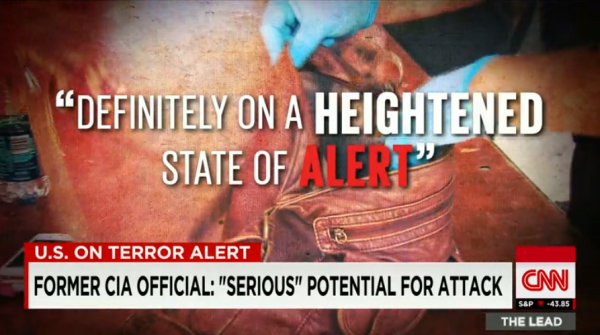
False flags and terrorist attacks: Despite the government’s endless propaganda about the threat of terrorism, statistics show that you are 17,600 times more likely to die from heart disease than from a terrorist attack. You are 11,000 times more likely to die from an airplane accident than from a terrorist plot involving an airplane. You are 1,048 times more likely to die from a car accident than a terrorist attack. You are 404 times more likely to die in a fall than from a terrorist attack. And you are 8 times more likely to be killed by a police officer than by a terrorist.

Endless wars to keep America’s military’s empire employed: The military industrial complex that has advocated that the U.S. remain at war, year after year, is the very entity that will continue to profit the most from America’s expanding military empire. The U.S. Department of Defense is the world’s largest employer, with more than 3.2 million employees. Thus far, the U.S. taxpayer has been made to shell out more than $1.6 trillion to wage wars in Afghanistan and Iraq. When you add in military efforts in Pakistan, as well as the lifetime price of health care for disabled veterans and interest on the national debt, that cost rises to $4.4 trillion.

Attempts by the government to identify, target and punish so-called domestic “extremists”: The government’s anti-extremism program will, in many cases, be utilized to render otherwise lawful, nonviolent activities as potentially extremist. To this end, police will identify, monitor and deter individuals who exhibit, express or engage in anything that could be construed as extremist before they can become actual threats. This is pre-crime on an ideological scale.

SWAT team raids: More than 80% of American communities have their own SWAT teams, with more than 80,000 of these paramilitary raids are carried out every year. That translates to more than 200 SWAT team raids every day in which police crash through doors, damage private property, kill citizens, terrorize adults and children alike, kill family pets, assault or shoot anyone that is perceived as threatening—and most often in the pursuit of someone merely suspected of a crime, usually some small amount of drugs.

Erosions of private property: Private property means little at a time when SWAT teams and other government agents can invade your home, break down your doors, kill your dog, wound or kill you, damage your furnishings and terrorize your family. Likewise, if government officials can fine and arrest you for growing vegetables in your front yard, praying with friends in your living room, installing solar panels on your roof, and raising chickens in your backyard, you’re no longer the owner of your property.

Overcriminalization: The government’s tendency towards militarization and overcriminalization, in which routine, everyday behaviors become targets of regulation and prohibition, has resulted in Americans getting arrested for making and selling unpasteurized goat cheese, cultivating certain types of orchids, feeding a whale, holding Bible studies in their homes, and picking their kids up from school.

Strip searches and the denigration of bodily integrity: Court rulings undermining the Fourth Amendment and justifying invasive strip searches have left us powerless against police empowered to forcefully draw our blood, forcibly take our DNA, strip search us, and probe us intimately. Accounts are on the rise of individuals—men and women alike—being subjected to what is essentially government-sanctioned rape by police in the course of “routine” traffic stops.

Drones: As corporations and government agencies alike prepare for their part in the coming drone invasion—it is expected that at least 30,000 drones will occupy U.S. airspace by 2020, ushering in a $30 billion per year industry—it won’t be long before American citizens find themselves to be the target of these devices. Drones—unmanned aerial vehicles—will come in all shapes and sizes, from nano-sized drones as small as a grain of sand that can do everything from conducting surveillance to detonating explosive charges, to middle-sized copter drones that can deliver pizzas to massive “hunter/killer” Predator warships that unleash firepower from on high.

Prisons: America’s prisons, housing the largest number of inmates in the world and still growing, have become money-making enterprises for private corporations that manage the prisons in exchange for the states agreeing to maintain a 90% occupancy rate for at least 20 years. And how do you keep the prisons full? By passing laws aimed at increasing the prison population, including the imposition of life sentences on people who commit minor or nonviolent crimes such as siphoning gasoline.

Censorship: First Amendment activities are being pummeled, punched, kicked, choked, chained and generally gagged all across the country. Free speech zones, bubble zones, trespass zones, anti-bullying legislation, zero tolerance policies, hate crime laws and a host of other legalistic maladies dreamed up by politicians and prosecutors have conspired to corrode our core freedoms. The reasons for such censorship vary widely from political correctness, safety concerns and bullying to national security and hate crimes but the end result remains the same: the complete eradication of what Benjamin Franklin referred to as the “principal pillar of a free government.”

Fascism: As a Princeton University survey indicates, our elected officials, especially those in the nation’s capital, represent the interests of the rich and powerful rather than the average citizen. We are no longer a representative republic. With Big Business and Big Government having fused into a corporate state, the president and his state counterparts—the governors—have become little more than CEOs of the Corporate State, which day by day is assuming more government control over our lives. Never before have average Americans had so little say in the workings of their government and even less access to their so-called representatives.

James Madison, the father of the Constitution, put it best when he warned: “Take alarm at the first experiment with liberties.” Anyone with even a casual knowledge about current events knows that the first experiment on our freedoms happened long ago.

We are fast moving past the point of no return when it comes to restoring our freedoms. Worse, as I make clear in my book Battlefield America: The War on the American People, we can barely see the old America with its revolutionary principles and value for independence in the rear view mirror. The only reality emerging generations will know is the one constructed for them by the powers-that-be, and you can rest assured that it will not be a reality that favors individuality, liberty or anything or anyone who challenges the status quo.

As a senior advisor to George W. Bush observed, “We’re an empire now, and when we act, we create our own reality. And while you’re studying that reality—judiciously, as you will—we’ll act again, creating other new realities, which you can study too, and that’s how things will sort out. We’re history’s actors . . . and you, all of you, will be left to just study what we do.”

In other words, the government has been operating ten steps ahead for quite some time now, and we have yet to catch up, let alone catch our breath as the tides of change swirl around us.

You’d better tighten your seatbelts, folks, because we could be in for a rough ride in 2017.


ABOUT JOHN W. WHITEHEAD

Constitutional attorney and author John W. Whitehead is founder and president of The Rutherford Institute. His new book Battlefield America: The War on the American People (SelectBooks, 2015) is available online at http://www.amazon.com. Whitehead can be contacted at johnw@rutherford.org.

Fascism, American style

fascism1

By John W. Whitehead

Source: Intrepid Report

“If we define an American fascist as one who in case of conflict puts money and power ahead of human beings, then there are undoubtedly several million fascists in the United States.”―Henry A. Wallace, 33rd Vice President of the United States

This is an indictment of every politician who has ever sold us out for the sake of money and power, it is a condemnation of every politician who has ever lied to us in order to advance their careers, and it is a denunciation of every political shill who has sacrificed our freedoms on the altar of Corporate America.

They’re all fascists.

If Donald Trump is a fascist—as nearly half of Americans surveyed believe—then so is every other politician in office or running for office in America who has ever prioritized money and power over human beings.

Truly, apart from Trump’s virulently bombastic comments and his metaphorical willingness to spit in the wind in order to garner media coverage and notoriety, how is he any more of a fascist than Hillary Clinton and the millions she has amassed from the financial sector?

How is Trump any more of a fascist than Barack Obama, whose willingness to march in lockstep with the military industrial complex has resulted in endless wars, covert drone strikes that have killed hundreds of civilians abroad, and militarized police who have killed thousands of American citizens here at home?

How is Trump any more of a fascist than Congress, the majority of whom are millionaires and who are more inclined to do the bidding of their corporate sponsors and benefactors, all the while remaining deaf to their less affluent constituents?

For that matter, how is Trump any more of a fascist than the Supreme Court whose decisions in recent years have been characterized most often by an abject deference to government authority, military and corporate interests?

Writing for the New York Times in 1944, Vice President Henry A. Wallace noted that “American fascists are most easily recognized by their deliberate perversion of truth and fact. Their newspapers and propaganda carefully cultivate every fissure of disunity, every crack in the common front against fascism. They use every opportunity to impugn democracy. They use isolationism as a slogan to conceal their own selfish imperialism. They cultivate hate and distrust . . .”

As Wallace concluded, American fascists are not pro-Constitution:

They are patriotic in time of war because it is to their interest to be so, but in time of peace they follow power and the dollar wherever they may lead . . . They claim to be super-patriots, but they would destroy every liberty guaranteed by the Constitution. They demand free enterprise, but are the spokesmen for monopoly and vested interest. Their final objective toward which all their deceit is directed is to capture political power so that, using the power of the state and the power of the market simultaneously, they may keep the common man in eternal subjection.

We are being played for fools. Again.

The United States of America, that dream of what a democratic republic ought to be, has become the Fascist States of America. We have moved beyond the era of representative government and entered a new age. You can call it the age of authoritarianism. Or fascism. Or oligarchy. Or the American police state.

Whatever label you want to put on it, the end result is the same.

Driven by our fears, we have entered into a corporate-controlled, militaristic state where all citizens are suspects, security trumps freedom, and the U.S. government does not represent the majority of American citizens but instead is ruled by the rich and powerful.

Any semblance of constitutional government that we might still enjoy today is a mere shadow, a mockery of what the founders envisioned. Constitutional government today—much like the farcical circus that purports to be the presidential election—is a sham, a hoax, an elaborate ruse maintained by the powers-that-be to mollify us into believing that we still have a say in the workings of our government. We do not.

Shortly after World War II, historian William L. Shirer predicted that America may be the first country in which fascism comes to power through democratic elections.

Former presidential advisor Bertram Gross also warned that we would not recognize fascism when it took over:

Anyone looking for black shirts, mass parties, or men on horseback will miss the telltale clues of creeping fascism . . . In America, it would be supermodern and multi-ethnic—as American as Madison Avenue, executive luncheons, credit cards, and apple pie. It would be fascism with a smile. As a warning against its cosmetic facade, subtle manipulation, and velvet gloves, I call it friendly fascism. What scares me most is its subtle appeal.

They were both right.

However, what we failed to realize is that the fascist coup took place long ago. It was that subtle and that incremental.

We are now ruled by the velvet-gloved, technologically savvy, militarized iron fist of what Gross termed “friendly fascism” or fascism with a smile. Having studied Shirer and Gross, tracked the rise of fascism in past regimes, and assimilated the necessary ingredients for a fascist state, I can attest to the fact—as I document in my book Battlefield America: The War on the American People—that the parallels to modern America are impossible to ignore.

Under fascism, the government:

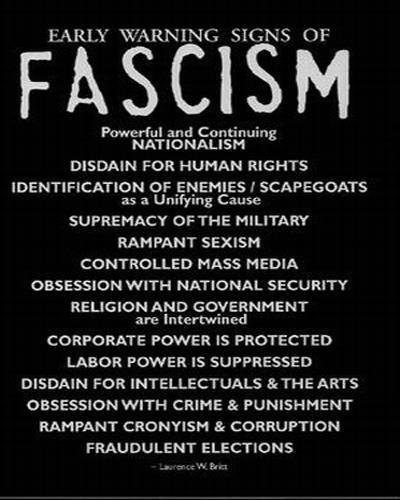
  • is managed by a powerful leader (even if he or she assumes office by way of the electoral process)
  • assumes it is not restrained in its power (this is authoritarianism, which eventually evolves into totalitarianism)
  • ostensibly operates under a capitalist system while being undergirded by an immense bureaucracy
  • emits powerful and continuing expressions of nationalism through its politicians
  • has an obsession with national security while constantly invoking terrifying internal and external enemies
  • establishes a domestic and invasive surveillance system and develops a paramilitary force that is not answerable to the citizenry
  • and its various agencies (federal, state, and local) develop an obsession with crime and punishment (this is overcriminalization)
  • becomes increasingly centralized while aligning closely with corporate powers to control all aspects of the country’s social, economic, military, and governmental structures
  • uses militarism as a center point of its economic and taxing structure
  • and is increasingly imperialistic in order to maintain the military-industrial corporate forces.

Compare that to America today where, as economist Jeffrey Tucker rightly observes, “every industry is regulated. Every profession is classified and organized. Every good or service is taxed. Endless debt accumulation is preserved. Immense doesn’t begin to describe the bureaucracy. Military preparedness never stops, and war with some evil foreign foe, remains a daily prospect.”

Fascism thrives by hiding behind the entertainment spectacle that is partisan politics. As Tucker points out, “It’s incorrect to call fascism either right wing or left wing. It is both and neither . . . fascism does not seek to overthrow institutions like commercial establishments, family, religious centers, and civic traditions. It seeks to control them . . . it preserves most of what people hold dear but promises to improve economic, social, and cultural life through unifying their operations under government control.”

In this way, American-style fascism is deceptively appealing.

It appears friendly.

The news media covers the entertainment and political trivia. The basic forms of government remain intact. The legislators remain in session. There are elections.

Consent of the governed, however, no longer applies. Actual control has finally passed to the oligarchic elite controlling the government behind the scenes.

Yet the most crucial ingredient for fascism to succeed in America is that the majority of the people would have to agree that it’s not only expedient but necessary for the government to assume greater powers in order to keep them safe and secure, whether it’s by militarizing the police, stripping them of basic constitutional rights, criminalizing virtually every form of behavior, or spying on their communications, movements and transactions.

Sound familiar?

When you really drill down to what the various presidential candidates believe about the issues that will impact the future of our freedoms long-term—war, surveillance, civil liberties—you’ll find that most of them support the government’s position, which, conveniently enough, profits the corporate sector.

This is not freedom.

It is despotism, which Gross refers to as “faceless oligarchs [who] sit at command posts of a corporate-government complex that has been slowly evolving over many decades.” Gross explains:

In efforts to enlarge their own powers and privileges, they are willing to have others suffer the intended or unintended consequences of their institutional or personal greed. For Americans, these consequences include chronic inflation, recurring recession, open and hidden unemployment, the poisoning of air, water, soil and bodies, and, more important, the subversion of our constitution. More broadly, consequences include widespread intervention in international politics through economic manipulation, covert action, or military invasion . . .

It is, in Gross’ words, “pretended patriots who desecrate the American flag by waving it while waiving the law”:

I see at present members of the Establishment or people on its fringes who, in the name of Americanism, betray the interests of most Americans by fomenting militarism, applauding rat-race individualism, protecting undeserved privilege, or stirring up nationalistic and ethnic hatreds.

It is, concludes Gross, Big Business and Big Government in bed together:

In this present, many highly intelligent people look with but one eye and see only one part of the emerging Leviathan. From the right, we are warned against the danger of state capitalism or state socialism, in which Big Business is dominated by Big Government. From the left, we hear that the future danger (or present reality) is monopoly capitalism, with finance capitalists dominating the state. I am prepared to offer a cheer and a half for each view; together, they make enough sense for a full three cheers.Big Business and Big Government have been learning how to live in bed together and despite arguments between them, enjoy the cohabitation. Who may be on top at any particular moment is a minor matter—and in any case can be determined only by those with privileged access to a well-positioned keyhole.

When the votes have all been counted, “we the people” will be the losers.

The joke will be on us. Whether we ever realize it not, the enemy is not across party lines, as they would have us believe. It has us surrounded on all sides.

Even so, we’re not yet defeated.

We could still overcome our oppressors if we cared enough to join forces and launch a militant nonviolent revolution—a people’s revolution that starts locally and trickles upwards—but that will take some doing.

It will mean turning our backs on the political jousting contests taking place on the national stage and rejecting their appointed jesters as false prophets. It will mean not allowing ourselves to be corralled like cattle and branded with political labels that have no meaning anymore. It will mean recognizing that all the evils that surround us today—endless wars, drone strikes, invasive surveillance, militarized police, poverty, asset forfeiture schemes, overcriminalization, etc.—were not of our making but came about as a way to control and profit from us.

It will mean “voting with our feet” through sustained, mass civil disobedience. As journalist Chris Hedges points out, “There were once radicals in America, people who held fast to moral imperatives. They fought for the oppressed because it was right, not because it was easy or practical. They were willing to accept the state persecution that comes with open defiance. They had the courage of their convictions. They were not afraid.”

Ultimately, it will mean refusing to be divided, one against each other, as Democrats versus Republicans, and instead uniting behind the only distinction that has ever mattered: “we the people” against tyranny.


Constitutional attorney and author John W. Whitehead is founder and president of The Rutherford Institute. His new book “The Freedom Wars” (TRI Press) is available online at www.amazon.com. Whitehead can be contacted at johnw@rutherford.org. Information about The Rutherford Institute is available at www.rutherford.org.


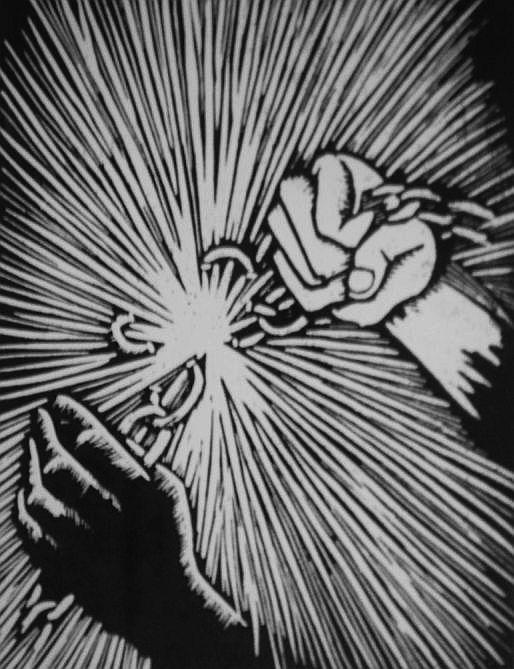
Breaking the chains: precarity in the Age of Anxiety

breaking-the-chainsBy Joseph Todd

Source: RoarMag.org

In our Age of Anxiety, society assaults us from every possible angle with an avalanche of uncertainty. How do we fight back under conditions of precarity?

­An Age of Anxiety is upon us, one where society assaults us from every possible angle with an avalanche of uncertainty, fear and alienation. We live with neither liberty nor security but instead precariousness. Our housing, our income and our play are temporary and contingent, forever at the whim of the landlord, policeman, bureaucrat or market. The only constant is that of insecurity itself. We are gifted the guarantee of perpetual flux, the knowledge that we will forever be flailing from one abyss to another, that true relaxation is a bourgeois luxury beyond our means.

Our very beings come to absorb this anxiety. We internalize society’s cruelty and contradiction and transform them into a problem of brain chemistry, one that is diagnosed and medicated away instead of being obliterated at root. All hope is blotted out. Authentic experience, unmediated conversation, distraction-free affection and truly relaxed association feel like relics of a bygone era, a sepia dream that perhaps never existed.

Instead we have the frenetic social arenas of late capitalism: the commodified hedonism of clubs and festivals, express lunches, binge culture and the escapist, dislocating experience of online video games, all underlined by either our desperate need to numb our anxieties or to create effective, time-efficient units of fun so we are available for work and worry.

This is assuming we have work, of course. Many of us are unemployed, or are instead held in constant precarity. Stuck on zero-hour contracts or wading through as jobbing freelancers in industries that used to employ but don’t anymore, we are unable to plan our lives any further than next week’s rota, unable to ever switch off as the search for work is sprawling and continuous.

And if we do have traditional employment, what then? We are imprisoned and surveilled in the office, coffee shop or back room, subject to constant assessment, re-assessment and self-assessment, tracked, monitored and looped in a perpetual performance review, one which even our managers think is worthless, but has to be done anyway because, hey, company policy.

Continuous is the effective probationary period and we are forever teetering on the edge of unemployment. We internalize the implications of our constant assessment, the knowledge that we’re always potentially being surveilled. We censor ourselves. We second-guess ourselves. We quash ourselves.

And thanks to the effective abolition of the traditional working day, work becomes unbearable and endless. The security of having delineated time — at work and then at play — has been eradicated. Often this is because individuals have to supplement their atrocious wages with work on the side. But it is also because traditional 9-to-5 jobs have suffered a continuous extension of working hours into out-of-office time, enabled and mediated by our laptops and smartphones. These gadgets demand immediacy and, when coupled with the knowledge that you are always reachable and thus available, they instill in us a frantic need to forever reply in the now.

And with this expectation comes obligation. Hyper-networked technologies gift our bosses the ability to demand action from us at any moment. Things that had to wait before become doable — and thus are done — in the now. If you are unwilling, then someone is ready to take your place. You must always be at their beck and call. From this, our only refuge is sleep, perhaps the last bastion of delineated time against frenetic capitalism, and one that is being gradually eroded and replaced.

For those that are out of work the situation is no better. They face the cruel bureaucracy of the Job Centre or the Atos assessment, institutions that have no interest in linking up job seekers with fulfilling employment but instead attempt only to lower the benefits bill through punitive, arbitrary sanctions and forcing the sick back to work. Insider accounts of these programs betray the mix of anxiety inducing micro-assessment and surveillance they employ.

Disabled claimants — always claimants, never patients, insists Atos — are assessed from the moment they enter the waiting room, noted as to whether they arrive alone, whether they can stand unassisted and whether they can hear their name when called. Compounding this is the hegemonic demonization of those that society has failed: if you are out of work, you are a scrounger, a benefit cheat and a liar. Utterly guilty of your failure, a situation individualized in its totality and attributable to no system, institution or individual but yourself.

We are surveilled, monitored and assessed from cradle to grave, fashioned by the demand that we must be empirical, computable and trackable, our souls transformed into a series of ones and zeros. This happens in the workplace, on the street and in various government institutions. But its ideological groundwork is laid in the nursery and the school.

These institutions bracket our imaginations while still in formation, normalizing a regime of continuous surveillance and assessment that is to last for the rest of our lives. Staff are increasingly taken away from educating and nurturing and instead are made to roam nurseries taking pictures and recording quotes, all to be computed and amalgamated so authorities can track, assess and predict a child’s trajectory.

It is true that this does not trouble the child in the same way traditional high intensity rote examination does. But what it instead achieves is the internalization of the surveillance/assessment nexus in our minds; laying the groundwork for an acquiescence to panoptical monitoring, a resignation to a private-less life and a buckling to regimes of continuous assessment.

Britain is particularly bad in this respect. Not only does our government have a fetish for closed-circuit television like no other, but also, GCHQ was at the heart of the Snowden revelations. Revelation, however, is slightly misleading — as what was most telling about the leaks wasn’t the brazen overstep by government institutions, but that few people were surprised. Although we didn’t know the details, we suspected such activity was going on. We acted as if we were being watched, tracked and monitored anyhow.

In this we see the paranoid fugitive of countless films, books and television dramas extrapolated to society writ large. We are all, to some extent, that person. Our growing distrust of governments, the knowledge that our technologically-integrated lives leave a heavy trace and the collection of “big” data for both commercial and authoritarian purposes contributes to our destabilized, anxious existence. An existence that impels us towards self-policing and control. One where we do the authority’s job for them.

Many individuals offer the amount of choice we have, or the amount of knowledge we can access at the click of a button, as the glorious consequences of late capitalist society. But our rampant choice society, one where we have to make an overwhelming number of choices — about the cereal we eat, the beer we drink, or the clothes we wear — is entirely one sided. While we have an incredible amount of choice over issues of little importance, we are utterly excluded from any choice about the things that matter; what we do with the majority of our time, how we relate to others or how society functions as a whole. Nearly always these choices are constricted by the market, the necessity of work, cultures of overwork and neoliberal ideology.

Again we find this ideology laid down in primary education. Over the years more and more “continuous” learning has been introduced whereby children, over a two week period or so, have to complete a set of tasks for which they can choose the order. This is an almost perfect example of how choice functions in our society, ubiquitous when insignificant but absent when important. The children can choose when they do an activity, which matters little as they will have to do it at some point anyway, but cannot choose not to do it, or to substitute one kind of activity with another.

Why does this matter? Because meaningful choices about our lives give us a sense of certainty and control. Avalanches of bullshit choices that still have to be made, as study after study has shown, make us incredibly anxious. Each of them takes mental effort. Each contains, implicitly, the multitude of choices that we didn’t make; all those denied experiences for every actual experience. This is fine if there are only one or two. But if there are hundreds, every act is riddled with disappointment, every decision shot with anxiety.

Compounding this orgy of choice, and in itself another root cause of anxiety, is the staggering amount of information that assaults us every day. Social media, 24-hour news, the encroachment of advertising into every crack — both spatially and temporally — and our cultures of efficiency that advocate consuming or working at every possible moment all combine to cause intense sensory overload. This world, for many, is just too much.

Although we’ve talked mostly about work, surveillance, assessment and choice, there are a multitude of factors one could add. The desolation of community due to the geographical dislocation of work, the increased transiency of populations and the growing privatization of previously public acts — drinking, eating and consuming entertainment are increasingly consigned to the home — shrinks our world to just our immediate families.

Camaraderie, extended community and solidarity are eroded in favor of mistrust, suspicion and competition. Outside of work our lives become little more than a series of privatized moments, tending to our property and ourselves rather than each other, flitting between the television shows, video games, home DIY and an incredible fetish for gardening with no hint towards the thought that perhaps these experiences would be better if they were held in common, if they appealed to the social and looked outward rather than in.

In the same way we could mention the ubiquity of debt — be it the mortgage, the credit card or the student loans — and the implicit moral judgment suffered by the debtor coupled with the anxiety-inducing knowledge that they could lose everything at any moment. Or we could consider the near-existential crises humanity faces, be it climate change, ISIS or the death throes of capitalism; all too abstract and total to comprehend, all contributing to a sense that there is no future, only a grainy, distant image of lawless brutality, flickering resolutely in our heads.

But the crux, and the reason anxiety could become a revolutionary battleground, is that neoliberal ideology has individualized our suffering, attributing it to imbalances in our brain chemistry, constructing it as a problem of the self, rather than an understandable human reaction to a myriad of cruel systemic causes. Instead of changing society the problem is medicalized and we change ourselves, popping pills to mold our subjectivities to late-capitalist structures, accepting the primacy of capitalism over humanity.

This is why “We Are All Very Anxious”, a pamphlet released by the Institute of Precarious Consciousness, is so explosively brilliant. Not only does it narrate the systemic causes of anxiety, but it situates the struggle within a revolutionary strategy, constructing a theory that is at once broad and personal, incorporating one’s own subjective experience into an explanatory framework, positing anxiety as a novel, contemporary revolutionary battleground, ripe for occupation.

It is, they claim, one of three eras spanning the last two-hundred years where we have progressed between different dominant societal affects. Until the postwar settlement we suffered from misery. The dominant narrative was that capitalism benefited everybody; while at the same time overcrowding, malnourishment and slum dwelling were rife. In response to this appropriate tactics such as strikes, mutual aid, cooperatives and formal political organization were adopted.

After the postwar settlement, until around the 1980s, a period of Fordist boredom ensued. Compared to the last era, most people had stable jobs, guaranteed welfare and access to mass consumerism and culture. But much of the work was boring, simple and repetitive. Life in the suburbs was beige and predictable. Capitalism, as they put it, “gave everything needed for survival, but no opportunities for life.” Again movements arose in opposition, positioned specifically against the boredom of the age. The Situationists and radical feminism can be mentioned, but also the counter-culture surrounding the anti-war movement in America and the flourishing DIY punk scene in the UK.

This period is now finished. Capitalism has co-opted the demand for excitement and stimulation both by appropriating formerly subversive avenues of entertainment — the festival, club and rave — while dramatically increasing both the amount and intensity of distractions and amusements.

In one sense we live in an age of sprawling consumerism that avoids superficial conformity by allowing you to ornament and construct your identity via hyper-customized, but still mass-produced products. But technological development also mean that entertainment is now more total, immersive and interactive; be it the video game or the full-color film watched on a widescreen, high-definition television.

Key to this linear conception is the idea of the public secret, the notion that anxiety, misery or boredom in these periods are ubiquitous but also hidden, excluded from public discourse, individualized and transformed into something unmentionable, a condition believed to be isolated and few because nobody really talked about it. Thus to even broach the subject in a public, systematic manner becomes not just an individual revelation but also a collective revolutionary act.

I’ve seen this first-hand when running workshops on the topic. Sessions, which were often argumentative and confrontational, became, when the subject was capitalism and anxiety, genuinely inquisitive and exploratory. Groups endeavored to broaden their knowledge of the subject, make theoretical links and root out its kernel rather than manning their usual academic ramparts and launching argument after rebuttal back and forth across the battlefield.

But more than this, there was a distinct edge of excitement, the feeling that we were onto something, a theory ripe with explosive newness, one that managed to combine our subjective experiences and situate them in a coherent theoretical framework.

However, we must be critical. To posit anxiety as a specifically modern affect, unique to our age, is contentious. What about the 1950s housewife, someone mentioned in one of the sessions, with her subjectivity rigidly dictated by the misogyny and overbearing cultural norms of the time? Didn’t this make her feel anxious?

Well, perhaps. But if we take anxiety to mean a general feeling of nervousness or unease about an uncertain outcome — with chronic anxiety being an actively debilitating form — then we can draw distinct differences. Although the housewife was oppressed, her oppression was codified and linear, her life depressingly mapped out with little room for choice or maneuver. Similarly with the slave — surely the universal symbol of oppression — hierarchies aren’t nebulous but explicit, domination is ensured by the whip and the gun, the master individualized and present.

This is in stark contrast to the current moment. While it is obvious that oppressions are distinct and incomparable, we can nevertheless see that the fug of the 21st century youth is of a different nature. Our only certainty is that of uncertainty. Our oppressor is not an individual but a diffuse and multiplicitous network of bureaucrats, institutions and global capital, hidden in its omnipotence and impossible to grasp.

We aren’t depressed by the inevitability of our oppression, but instead are baffled by its apparent (but unreal) absence, forever teetering on the brink, not knowing why, nor knowing who we should blame.

Similarly it is bold to claim that anxiety is the dominant affect of Western capitalism, tantamount to pitching it as the revolutionary issue of our age. Yet if we analyze the popular struggles of our time — housing, wages, work/life balance and welfare — they are often geared, in one way or another, towards promoting security over anxiety.

Housing for many is not about having a roof over their heads, but about security of tenure, be it via longer fixed-term tenancies or the guarantee that they won’t be priced out by rent rises that their precarious employment can’t possibly cover. In the same way struggles over welfare are often about material conditions, but what particularly strikes a chord is the cruel insecurity of a life on benefits, forever at the whim of sanction-wielding bureaucrats who are mandated to use any possible excuse to remove your only means of support.

Anxiety is also a struggle that unites diverse social strata, emanating from institutions such as the job center, loan shark, university, job market, landlord and mortgage lender, affecting the unemployed, precariously employed, office worker, indebted student and even the comparatively well-off. Again we find this unification in the near-universal adoption of the smartphone and other hyper-networked technologies. All of us, and especially our children, are beholden to a myriad of glowing screens, flitting between one identity and another, alienated and disconnected from our surroundings and each other.

This is not to say a movement against anxiety itself will ever arise. Such a rallying cry would be too abstract and fail to inspire. Instead, anxiety must be conceptualized both as an affect which underlies various different struggles, and a schema within which they can be assembled into a revolutionary strategy.

So, what is our tangible aim here? In part it must be to reduce the level of general anxiety so as to increase quality of life. Yet if we are to take a revolutionary rather than a mere humanitarian approach, this drop in anxiety must in some way translate into a rise in revolutionary disposition. In certain ways it obviously will. If there is a public realization that large swathes of the mentally ill are not as such because of their unfortunate brain chemistry but instead because of a misconfiguration of society, people are already thinking on an inherently challenging, systemic level.

Similarly, conflict with the state or capital — be it on the street, in the workplace or inside one’s own head — tends to be high-impact and anxiety-inducing. A drop in general anxiety will make it more likely that individuals will engage in such moments of conflict and, crucially, experience the intense radicalization and realization of hegemonic power that can only be achieved through such visceral moments. But a second part to this, hinted at already and integral to giving the struggle a revolutionary edge, is to emphasize that there is a public secret to be aired. As well as combating the sources of anxiety, we must say we are doing so; we must situate these struggles within larger frameworks and provide education on its systemic nature.

Thus, any strategy would need to be both abstract and practical. On one hand we must explode the public secret by raising consciousness. This would require a general onslaught of education, including, but not limited to, consciousness-raising sessions, participatory workshops, articles, books, pamphlets, leaflets, posters, YouTube videos and “subvertised” adverts. The emphasis would be to educate but also to listen, to intermingle theoretical understanding with subjective experience.

The second part would be to strategically support campaigns and make demands of politicians that specifically combat anxiety in its various different guises. When it comes to work, the abolition of zero-hour contracts, the raising of the minimum wage in line with the actual cost of living, and the tightening of laws on overwork as part of a broader campaign to assert the primacy of life over work, of love over pay, would be a good start.

For those out of work, underpaid or precarious, the introduction of a basic citizen’s income would represent a revolutionizing of the job market. In one move it would alleviate the cultural and practical anxieties of worklessness — ending the bureaucratic cruelty of the job center while removing the anxiety-inducing stigma associated with claiming benefits — while simultaneously allowing individuals to pursue culturally important and revolutionary activities such as art, music, writing or (dare I say it?) activism, without the crushing impossibility of trying to make them pay. When we look to housing obvious solutions include mandatory, secured five-year tenancies, capped rent increases and a guarantee of stable, suitable social housing for those who need it.

There are many more reforms I could list. You will notice, however, that these are indeed reforms; bread and butter social democracy. Does that mean such a program is counter-revolutionary? A mere placatory settlement between capital and the working class? No, it does not. Revolution does not emerge from the systematic subjection of individuals to increased misery, anxiety and hardship as accelerationist logic demands. Instead it flourishes when populations become aware of their chains, are given radical visions for the future and the means to achieve them. It is when leftists critique but also offer hope. It is when the population writ large are included in and are masters of their own liberation; not when they are viewed as a lumpen, otherly mass, of only instrumental importance in achieving the glorious revolution.

Look at the practicalities and this becomes obvious. How can we expect individuals to launch themselves into high-tension anxiety-inducing conflicts if the mere thought of such a situation causes them to have a panic attack? How can individuals, in the face of near panoptical surveillance and monitoring, combat the overwhelming desire to conform if they aren’t awarded some freedom from the practical anxieties of life? How are we to think and act in a revolutionary, and often abstract, manner if the very real and immediate anxieties of work, home and play fog our minds so totally?

This is not to say freedom will be given to us. It must always be taken, and we must not rely on electoral politics to hand us the revolution down from above. Nor will true struggle ever be an anxiety-free leisure pursuit. Genuine conflict with the state and capital will always entail danger, stress and the possibility of intensified precariousness.

Nevertheless, the dismissal of electoral politics in its totality represents abysmal revolutionary theory. The pursuit of reforms by progressive governments being bitten at the heels by sharp, vibrant social movements can produce real, tangible change.

It was what should have happened with Syriza, and it is what will hopefully happen with the new Labour leadership in the UK. And if, as individuals and communities, we are to puncture the distress, precariousness and general sense of cruel unknowing so particular to the moment in which we live, if we are to overcome the avalanche of bullshit and reclaim our confidence, if we to construct and disseminate a distinctly communal, hopeful revolutionary fervor, such changes are imminently needed.


Joseph Todd is a writer and an activist. Find more of his writings here or follow him on twitter.

Jade Helm, Terrorist Attacks, Surveillance and Other Fairy Tales for a Gullible Nation

TerrorAlert

By John W. Whitehead

Source: The Rutherford Institute

“Strange how paranoia can link up with reality now and then.” ― Philip K. Dick, A Scanner Darkly

Once upon a time, there was a nation of people who believed everything they were told by their government.

When terrorists attacked the country, and government officials claimed to have been caught by surprise, the people believed them. And when the government passed massive laws aimed at locking down the nation and opening the door to total government surveillance, the people believed it was done merely to keep them safe. The few who disagreed were labeled traitors.

When the government waged costly preemptive wars on foreign countries, insisting it was necessary to protect the nation, the citizens believed it. And when the government brought the weapons and tactics of war home to use against the populace, claiming it was just a way to recycle old equipment, the people believed that too. The few who disagreed were labeled unpatriotic.

When the government spied on its own citizens, claiming they were looking for terrorists hiding among them, the people believed it. And when the government began tracking the citizenry’s movements, monitoring their spending, snooping on their social media, and surveying their habits—supposedly in an effort to make their lives more efficient—the people believed that, too. The few who disagreed were labeled paranoid.

When the government let private companies take over the prison industry and agreed to keep the jails full, justifying it as a cost-saving measure, the people believed them. And when the government started arresting and jailing people for minor infractions, claiming the only way to keep communities safe was to be tough on crime, the people believed that too. The few who disagreed were labeled soft on crime.

When the government hired crisis actors to take part in disaster drills, never alerting the public to which “disasters” were staged, the people genuinely believed they were under attack. And when the government insisted it needed greater powers to prevent such attacks from happening again, the people believed that too. The few who disagreed were told to shut up or leave the country.

Finally, the government started carrying out covert military drills around the country, insisting they were necessary to train the troops for foreign combat, and most of the people believed them. The few who disagreed, warning that perhaps all was not what it seemed, were dismissed as conspiracy theorists and quacks.

By the time the government locked down the nation, using local police and the military to impose martial law, there was no one left in doubt of the government’s true motives—total control and domination—but there was also no one left to fight back.

Now every fable has a moral, and the moral of this story is to beware of anyone who urges you to ignore your better instincts and trust the government.

In other words, if it looks like trouble and it smells like trouble, you can bet there’s trouble afoot.

For instance, while there is certainly no shortage of foul-smelling government activities taking place right now, the one giving off the greatest stench is Jade Helm 15. This covert, multi-agency, multi-state, eight-week military training exercise is set to take place from July 15 through Sept. 15 in states across the American Southwest.

According to official government sources, “Jade Helm: Mastering the Human Domain” is a planned military exercise that will test and practice unconventional warfare including, but not limited to, guerrilla warfare, subversion, sabotage, intelligence activities, and unconventional assisted recovery. The training exercise will take place in seven different southwestern states: California, New Mexico, Colorado, Arizona, Texas, Utah and Nevada.

U.S. Army Special Operations Command will primarily lead this interagency training program but the Navy Seals, Air Force Special Operations, Marine Special Operations Command, Marine Expeditionary Units, 82nd Airborne Division, and other interagency partners will also be involved. Approximately 1,200 troops are expected to participate in these exercises.

The training is known as Realistic Military Training because it will be conducted outside of federal property. The exercises are going to be carried out on both public and private land, with the military reportedly asking permission of local authorities and landowners prior to land usage. The military map listing the locations that will host the exercise shows Texas, Utah, and the southern part of California as “hostile territory.” According to U.S. officials, these three areas are marked as hostile to simulate environments where American troops are viewed as the enemy. The other areas on the map are marked as permissive, uncertain (leaning friendly), or uncertain (leaning hostile).

Military officials claim that the southwestern states were chosen because this exercise requires large areas of undeveloped land as well as access to towns and population hubs. These states purportedly also provide a climate and terrain that is similar to that of potential areas of combat for the United States, particularly Iraq, Iran and Syria.

Now the mainstream media has happily regurgitated the government’s official explanation about Jade Helm. However, there is a growing concern among those who are not overly worried about being labeled conspiratorialists or paranoid that the government is using Jade Helm as a cover to institute martial law, bring about total population control, or carry out greater surveillance on the citizenry.

In the first camp are those who fear that Jade Helm will usher in martial law. These individuals believe that by designating the two traditionally conservative and Republican-dominated states, Utah and Texas, as hostile territory, while more Democratic states like Colorado and California are marked as friendly, the military plans to infiltrate the states with large numbers of gun owners and attempt to disarm them.

Adding fuel to the fire is the mysterious and sudden temporary closures of five Walmart stores in Texas, California, Oklahoma and Florida, two of which are located near Jade Helm training sites. Those in this camp contend that the military is planning to use the Walmart stores as processing facilities for Americans once martial law is enacted.

Pointing to the mission’s official title, “Jade Helm: Mastering the Human Domain,” there is a second camp that fears that the military exercises are merely a means to an end—namely total population control—by allowing the military to discern between friendly civilians and hostiles. This concern is reinforced by military documents stating that a major portion of Jade Helm training will be about blending in with civilians, understanding how to work with civilians, using these civilians to find enemy combatants, and then neutralizing the target.

In this way, the United States military is effectively using psychological warfare to learn how people function and how to control them.

As a study written by military personnel states, mastering the human domain, also known as identity processes, means “use of enhanced capabilities to identify and classify the human domain; to determine whether they are adversarial, friendly, neutral, or unknown.” The study later states that identity processes can be used to “manage local populations during major combat, stability, and humanitarian assistance and/or disaster relief operations.”

While the military has promised that the work they are doing is aimed for use overseas, we have seen first-hand how quickly the military’s weapons and tactics used overseas are brought home to be used against the populace. In fact, some of the nation’s evolutionary psychologists, demographers, sociologists, historians and anthropologists have been working with the Department of Defense’s Minerva Initiative to master the human domain. This security research includes “Understanding the Origin, Characteristics, and Implications of Mass Political Movements” at the University of Washington and “Who Does Not Become a Terrorist and Why?” at the Naval Academy Post Graduate School. Both studies focus on Americans and the different movements and patterns that the government can track to ensure “safety and security.”

The Department of Homeland Security (DHS) is also working to infiltrate churches across the country to establish a Christian Emergency Network, carry out emergency training exercises to prevent and prepare for disasters (active shooter drills and natural disaster preparedness), and foster two-way information sharing, while at the same time instituting a media blackout of their activities. As the DHS continues to establish itself within churches, a growing number of churches are adopting facial recognition systems to survey their congregations, identify and track who attends their events, and target individuals for financial contributions or further monitoring. As the partnership between churches and the DHS grows, their facial recognition databases may be shared with the federal government, if that is not already happening.

Finally, there is the third camp which fears that Jade Helm is merely the first of many exercises to be incorporated into regular American life so that the government can watch, study, and better understand how to control the masses. Certainly, psychological control techniques could be used in the future to halt protests and ensure that the nation runs “smoothly.”

It remains to be seen whether Jade Helm 15 proves to be a thinly veiled military plot to take over the country (one lifted straight out of director John Frankenheimer’s 1964 political thriller Seven Days in May), turn the population into automatons and psychological experiments, or is merely a “routine” exercise for troops, albeit a blatantly intimidating flexing of the military’s muscles.

However, as I point out in my book Battlefield America: The War on the American People, the problem arises when you add Jade Helm to the list of other troubling developments that have taken place over the past 30 years or more: the expansion of the military industrial complex and its influence in Washington DC, the rampant surveillance, the corporate-funded elections and revolving door between lobbyists and elected officials, the militarized police, the loss of our freedoms, the injustice of the courts, the privatized prisons, the school lockdowns, the roadside strip searches, the military drills on domestic soil, the fusion centers and the simultaneous fusing of every branch of law enforcement (federal, state and local), the stockpiling of ammunition by various government agencies, the active shooter drills that are indistinguishable from actual crises, the economy flirting with near collapse, the growing social unrest, the socio-psychological experiments being carried out by government agencies, etc.

Suddenly, the overall picture seems that much more sinister. Clearly, there’s a larger agenda at work here, and it’s one the American people had better clue into before it’s too late to do anything about it.

Call me paranoid, but I think we’d better take James Madison’s advice and “take alarm at the first experiment on our liberties.”