
Vault 7: CIA Hacking Tools Revealed

Source: WikiLeaks

Press Release

Today, Tuesday 7 March 2017, WikiLeaks begins its new series of leaks on the U.S. Central Intelligence Agency. Code-named “Vault 7” by WikiLeaks, it is the largest ever publication of confidential documents on the agency.

The first full part of the series, “Year Zero”, comprises 8,761 documents and files from an isolated, high-security network situated inside the CIA’s Center for Cyber Intelligence in Langley, Virgina. It follows an introductory disclosure last month of CIA targeting French political parties and candidates in the lead up to the 2012 presidential election.

Recently, the CIA lost control of the majority of its hacking arsenal including malware, viruses, trojans, weaponized “zero day” exploits, malware remote control systems and associated documentation. This extraordinary collection, which amounts to more than several hundred million lines of code, gives its possessor the entire hacking capacity of the CIA. The archive appears to have been circulated among former U.S. government hackers and contractors in an unauthorized manner, one of whom has provided WikiLeaks with portions of the archive.

“Year Zero” introduces the scope and direction of the CIA’s global covert hacking program, its malware arsenal and dozens of “zero day” weaponized exploits against a wide range of U.S. and European company products, include Apple’s iPhone, Google’s Android and Microsoft’s Windows and even Samsung TVs, which are turned into covert microphones.

Since 2001 the CIA has gained political and budgetary preeminence over the U.S. National Security Agency (NSA). The CIA found itself building not just its now infamous drone fleet, but a very different type of covert, globe-spanning force — its own substantial fleet of hackers. The agency’s hacking division freed it from having to disclose its often controversial operations to the NSA (its primary bureaucratic rival) in order to draw on the NSA’s hacking capacities.

By the end of 2016, the CIA’s hacking division, which formally falls under the agency’s Center for Cyber Intelligence (CCI), had over 5000 registered users and had produced more than a thousand hacking systems, trojans, viruses, and other “weaponized” malware. Such is the scale of the CIA’s undertaking that by 2016, its hackers had utilized more code than that used to run Facebook. The CIA had created, in effect, its “own NSA” with even less accountability and without publicly answering the question as to whether such a massive budgetary spend on duplicating the capacities of a rival agency could be justified.

In a statement to WikiLeaks the source details policy questions that they say urgently need to be debated in public, including whether the CIA’s hacking capabilities exceed its mandated powers and the problem of public oversight of the agency. The source wishes to initiate a public debate about the security, creation, use, proliferation and democratic control of cyberweapons.

Once a single cyber ‘weapon’ is ‘loose’ it can spread around the world in seconds, to be used by rival states, cyber mafia and teenage hackers alike.

Julian Assange, WikiLeaks editor stated that “There is an extreme proliferation risk in the development of cyber ‘weapons’. Comparisons can be drawn between the uncontrolled proliferation of such ‘weapons’, which results from the inability to contain them combined with their high market value, and the global arms trade. But the significance of “Year Zero” goes well beyond the choice between cyberwar and cyberpeace. The disclosure is also exceptional from a political, legal and forensic perspective.”

Wikileaks has carefully reviewed the “Year Zero” disclosure and published substantive CIA documentation while avoiding the distribution of ‘armed’ cyberweapons until a consensus emerges on the technical and political nature of the CIA’s program and how such ‘weapons’ should analyzed, disarmed and published.

Wikileaks has also decided to redact and anonymise some identifying information in “Year Zero” for in depth analysis. These redactions include ten of thousands of CIA targets and attack machines throughout Latin America, Europe and the United States. While we are aware of the imperfect results of any approach chosen, we remain committed to our publishing model and note that the quantity of published pages in “Vault 7” part one (“Year Zero”) already eclipses the total number of pages published over the first three years of the Edward Snowden NSA leaks.


Analysis

CIA malware targets iPhone, Android, smart TVs

CIA malware and hacking tools are built by EDG (Engineering Development Group), a software development group within CCI (Center for Cyber Intelligence), a department belonging to the CIA’s DDI (Directorate for Digital Innovation). The DDI is one of the five major directorates of the CIA (see this organizational chart of the CIA for more details).

The EDG is responsible for the development, testing and operational support of all backdoors, exploits, malicious payloads, trojans, viruses and any other kind of malware used by the CIA in its covert operations world-wide.

The increasing sophistication of surveillance techniques has drawn comparisons with George Orwell’s 1984, but “Weeping Angel”, developed by the CIA’s Embedded Devices Branch (EDB), which infests smart TVs, transforming them into covert microphones, is surely its most emblematic realization.

The attack against Samsung smart TVs was developed in cooperation with the United Kingdom’s MI5/BTSS. After infestation, Weeping Angel places the target TV in a ‘Fake-Off’ mode, so that the owner falsely believes the TV is off when it is on. In ‘Fake-Off’ mode the TV operates as a bug, recording conversations in the room and sending them over the Internet to a covert CIA server.

As of October 2014 the CIA was also looking at infecting the vehicle control systems used by modern cars and trucks. The purpose of such control is not specified, but it would permit the CIA to engage in nearly undetectable assassinations.

The CIA’s Mobile Devices Branch (MDB) developed numerous attacks to remotely hack and control popular smart phones. Infected phones can be instructed to send the CIA the user’s geolocation, audio and text communications as well as covertly activate the phone’s camera and microphone.

Despite iPhone’s minority share (14.5%) of the global smart phone market in 2016, a specialized unit in the CIA’s Mobile Development Branch produces malware to infest, control and exfiltrate data from iPhones and other Apple products running iOS, such as iPads. CIA’s arsenal includes numerous local and remote “zero days” developed by CIA or obtained from GCHQ, NSA, FBI or purchased from cyber arms contractors such as Baitshop. The disproportionate focus on iOS may be explained by the popularity of the iPhone among social, political, diplomatic and business elites.

A similar unit targets Google’s Android which is used to run the majority of the world’s smart phones (~85%) including Samsung, HTC and Sony. 1.15 billion Android powered phones were sold last year. “Year Zero” shows that as of 2016 the CIA had 24 “weaponized” Android “zero days” which it has developed itself and obtained from GCHQ, NSA and cyber arms contractors.

These techniques permit the CIA to bypass the encryption of WhatsApp, Signal, Telegram, Wiebo, Confide and Cloackman by hacking the “smart” phones that they run on and collecting audio and message traffic before encryption is applied.


CIA malware targets Windows, OSx, Linux, routers

The CIA also runs a very substantial effort to infect and control Microsoft Windows users with its malware. This includes multiple local and remote weaponized “zero days”, air gap jumping viruses such as “Hammer Drill” which infects software distributed on CD/DVDs, infectors for removable media such as USBs, systems to hide data in images or in covert disk areas ( “Brutal Kangaroo”) and to keep its malware infestations going.

Many of these infection efforts are pulled together by the CIA’s Automated Implant Branch (AIB), which has developed several attack systems for automated infestation and control of CIA malware, such as “Assassin” and “Medusa”.

Attacks against Internet infrastructure and webservers are developed by the CIA’s Network Devices Branch (NDB).

The CIA has developed automated multi-platform malware attack and control systems covering Windows, Mac OS X, Solaris, Linux and more, such as EDB’s “HIVE” and the related “Cutthroat” and “Swindle” tools, which are described in the examples section below.


CIA ‘hoarded’ vulnerabilities (“zero days”)

In the wake of Edward Snowden’s leaks about the NSA, the U.S. technology industry secured a commitment from the Obama administration that the executive would disclose on an ongoing basis — rather than hoard — serious vulnerabilities, exploits, bugs or “zero days” to Apple, Google, Microsoft, and other US-based manufacturers.

Serious vulnerabilities not disclosed to the manufacturers places huge swathes of the population and critical infrastructure at risk to foreign intelligence or cyber criminals who independently discover or hear rumors of the vulnerability. If the CIA can discover such vulnerabilities so can others.

The U.S. government’s commitment to the Vulnerabilities Equities Process came after significant lobbying by US technology companies, who risk losing their share of the global market over real and perceived hidden vulnerabilities. The government stated that it would disclose all pervasive vulnerabilities discovered after 2010 on an ongoing basis.

“Year Zero” documents show that the CIA breached the Obama administration’s commitments. Many of the vulnerabilities used in the CIA’s cyber arsenal are pervasive and some may already have been found by rival intelligence agencies or cyber criminals.

As an example, specific CIA malware revealed in “Year Zero” is able to penetrate, infest and control both the Android phone and iPhone software that runs or has run presidential Twitter accounts. The CIA attacks this software by using undisclosed security vulnerabilities (“zero days”) possessed by the CIA but if the CIA can hack these phones then so can everyone else who has obtained or discovered the vulnerability. As long as the CIA keeps these vulnerabilities concealed from Apple and Google (who make the phones) they will not be fixed, and the phones will remain hackable.

The same vulnerabilities exist for the population at large, including the U.S. Cabinet, Congress, top CEOs, system administrators, security officers and engineers. By hiding these security flaws from manufacturers like Apple and Google the CIA ensures that it can hack everyone &mdsh; at the expense of leaving everyone hackable.


‘Cyberwar’ programs are a serious proliferation risk

Cyber ‘weapons’ are not possible to keep under effective control.

While nuclear proliferation has been restrained by the enormous costs and visible infrastructure involved in assembling enough fissile material to produce a critical nuclear mass, cyber ‘weapons’, once developed, are very hard to retain.

Cyber ‘weapons’ are in fact just computer programs which can be pirated like any other. Since they are entirely comprised of information they can be copied quickly with no marginal cost.

Securing such ‘weapons’ is particularly difficult since the same people who develop and use them have the skills to exfiltrate copies without leaving traces — sometimes by using the very same ‘weapons’ against the organizations that contain them. There are substantial price incentives for government hackers and consultants to obtain copies since there is a global “vulnerability market” that will pay hundreds of thousands to millions of dollars for copies of such ‘weapons’. Similarly, contractors and companies who obtain such ‘weapons’ sometimes use them for their own purposes, obtaining advantage over their competitors in selling ‘hacking’ services.

Over the last three years the United States intelligence sector, which consists of government agencies such as the CIA and NSA and their contractors, such as Booz Allan Hamilton, has been subject to unprecedented series of data exfiltrations by its own workers.

A number of intelligence community members not yet publicly named have been arrested or subject to federal criminal investigations in separate incidents.

Most visibly, on February 8, 2017 a U.S. federal grand jury indicted Harold T. Martin III with 20 counts of mishandling classified information. The Department of Justice alleged that it seized some 50,000 gigabytes of information from Harold T. Martin III that he had obtained from classified programs at NSA and CIA, including the source code for numerous hacking tools.

Once a single cyber ‘weapon’ is ‘loose’ it can spread around the world in seconds, to be used by peer states, cyber mafia and teenage hackers alike.


U.S. Consulate in Frankfurt is a covert CIA hacker base

In addition to its operations in Langley, Virginia the CIA also uses the U.S. consulate in Frankfurt as a covert base for its hackers covering Europe, the Middle East and Africa.

CIA hackers operating out of the Frankfurt consulate ( “Center for Cyber Intelligence Europe” or CCIE) are given diplomatic (“black”) passports and State Department cover. The instructions for incoming CIA hackers make Germany’s counter-intelligence efforts appear inconsequential: “Breeze through German Customs because you have your cover-for-action story down pat, and all they did was stamp your passport”

Your Cover Story (for this trip)
Q: Why are you here?
A: Supporting technical consultations at the Consulate.

Two earlier WikiLeaks publications give further detail on CIA approaches to customs and secondary screening procedures.

Once in Frankfurt CIA hackers can travel without further border checks to the 25 European countries that are part of the Shengen open border area — including France, Italy and Switzerland.

A number of the CIA’s electronic attack methods are designed for physical proximity. These attack methods are able to penetrate high security networks that are disconnected from the internet, such as police record database. In these cases, a CIA officer, agent or allied intelligence officer acting under instructions, physically infiltrates the targeted workplace. The attacker is provided with a USB containing malware developed for the CIA for this purpose, which is inserted into the targeted computer. The attacker then infects and exfiltrates data to removable media. For example, the CIA attack system Fine Dining, provides 24 decoy applications for CIA spies to use. To witnesses, the spy appears to be running a program showing videos (e.g VLC), presenting slides (Prezi), playing a computer game (Breakout2, 2048) or even running a fake virus scanner (Kaspersky, McAfee, Sophos). But while the decoy application is on the screen, the underlaying system is automatically infected and ransacked.


How the CIA dramatically increased proliferation risks

In what is surely one of the most astounding intelligence own goals in living memory, the CIA structured its classification regime such that for the most market valuable part of “Vault 7” — the CIA’s weaponized malware (implants + zero days), Listening Posts (LP), and Command and Control (C2) systems — the agency has little legal recourse.

The CIA made these systems unclassified.

Why the CIA chose to make its cyberarsenal unclassified reveals how concepts developed for military use do not easily crossover to the ‘battlefield’ of cyber ‘war’.

To attack its targets, the CIA usually requires that its implants communicate with their control programs over the internet. If CIA implants, Command & Control and Listening Post software were classified, then CIA officers could be prosecuted or dismissed for violating rules that prohibit placing classified information onto the Internet. Consequently the CIA has secretly made most of its cyber spying/war code unclassified. The U.S. government is not able to assert copyright either, due to restrictions in the U.S. Constitution. This means that cyber ‘arms’ manufactures and computer hackers can freely “pirate” these ‘weapons’ if they are obtained. The CIA has primarily had to rely on obfuscation to protect its malware secrets.

Conventional weapons such as missiles may be fired at the enemy (i.e into an unsecured area). Proximity to or impact with the target detonates the ordnance including its classified parts. Hence military personnel do not violate classification rules by firing ordnance with classified parts. Ordnance will likely explode. If it does not, that is not the operator’s intent.

Over the last decade U.S. hacking operations have been increasingly dressed up in military jargon to tap into Department of Defense funding streams. For instance, attempted “malware injections” (commercial jargon) or “implant drops” (NSA jargon) are being called “fires” as if a weapon was being fired. However the analogy is questionable.

Unlike bullets, bombs or missiles, most CIA malware is designed to live for days or even years after it has reached its ‘target’. CIA malware does not “explode on impact” but rather permanently infests its target. In order to infect target’s device, copies of the malware must be placed on the target’s devices, giving physical possession of the malware to the target. To exfiltrate data back to the CIA or to await further instructions the malware must communicate with CIA Command & Control (C2) systems placed on internet connected servers. But such servers are typically not approved to hold classified information, so CIA command and control systems are also made unclassified.

A successful ‘attack’ on a target’s computer system is more like a series of complex stock maneuvers in a hostile take-over bid or the careful planting of rumors in order to gain control over an organization’s leadership rather than the firing of a weapons system. If there is a military analogy to be made, the infestation of a target is perhaps akin to the execution of a whole series of military maneuvers against the target’s territory including observation, infiltration, occupation and exploitation.


Evading forensics and anti-virus

A series of standards lay out CIA malware infestation patterns which are likely to assist forensic crime scene investigators as well as Apple, Microsoft, Google, Samsung, Nokia, Blackberry, Siemens and anti-virus companies attribute and defend against attacks.

“Tradecraft DO’s and DON’Ts” contains CIA rules on how its malware should be written to avoid fingerprints implicating the “CIA, US government, or its witting partner companies” in “forensic review”. Similar secret standards cover the use of encryption to hide CIA hacker and malware communication (pdf), describing targets & exfiltrated data (pdf) as well as executing payloads (pdf) and persisting (pdf) in the target’s machines over time.

CIA hackers developed successful attacks against most well known anti-virus programs. These are documented in AV defeats, Personal Security Products, Detecting and defeating PSPs and PSP/Debugger/RE Avoidance. For example, Comodo was defeated by CIA malware placing itself in the Window’s “Recycle Bin”. While Comodo 6.x has a “Gaping Hole of DOOM”.

CIA hackers discussed what the NSA’s “Equation Group” hackers did wrong and how the CIA’s malware makers could avoid similar exposure.

Examples

The CIA’s Engineering Development Group (EDG) management system contains around 500 different projects (only some of which are documented by “Year Zero”) each with their own sub-projects, malware and hacker tools.

The majority of these projects relate to tools that are used for penetration, infestation (“implanting”), control, and exfiltration.

Another branch of development focuses on the development and operation of Listening Posts (LP) and Command and Control (C2) systems used to communicate with and control CIA implants; special projects are used to target specific hardware from routers to smart TVs.

Some example projects are described below, but see the table of contents for the full list of projects described by WikiLeaks’ “Year Zero”.


UMBRAGE

The CIA’s hand crafted hacking techniques pose a problem for the agency. Each technique it has created forms a “fingerprint” that can be used by forensic investigators to attribute multiple different attacks to the same entity.

This is analogous to finding the same distinctive knife wound on multiple separate murder victims. The unique wounding style creates suspicion that a single murderer is responsible. As soon one murder in the set is solved then the other murders also find likely attribution.

The CIA’s Remote Devices Branch‘s UMBRAGE group collects and maintains a substantial library of attack techniques ‘stolen’ from malware produced in other states including the Russian Federation.

With UMBRAGE and related projects the CIA cannot only increase its total number of attack types but also misdirect attribution by leaving behind the “fingerprints” of the groups that the attack techniques were stolen from.

UMBRAGE components cover keyloggers, password collection, webcam capture, data destruction, persistence, privilege escalation, stealth, anti-virus (PSP) avoidance and survey techniques.


Fine Dining

Fine Dining comes with a standardized questionnaire i.e menu that CIA case officers fill out. The questionnaire is used by the agency’s OSB (Operational Support Branch) to transform the requests of case officers into technical requirements for hacking attacks (typically “exfiltrating” information from computer systems) for specific operations. The questionnaire allows the OSB to identify how to adapt existing tools for the operation, and communicate this to CIA malware configuration staff. The OSB functions as the interface between CIA operational staff and the relevant technical support staff.

Among the list of possible targets of the collection are ‘Asset’, ‘Liason Asset’, ‘System Administrator’, ‘Foreign Information Operations’, ‘Foreign Intelligence Agencies’ and ‘Foreign Government Entities’. Notably absent is any reference to extremists or transnational criminals. The ‘Case Officer’ is also asked to specify the environment of the target like the type of computer, operating system used, Internet connectivity and installed anti-virus utilities (PSPs) as well as a list of file types to be exfiltrated like Office documents, audio, video, images or custom file types. The ‘menu’ also asks for information if recurring access to the target is possible and how long unobserved access to the computer can be maintained. This information is used by the CIA’s ‘JQJIMPROVISE’ software (see below) to configure a set of CIA malware suited to the specific needs of an operation.


Improvise (JQJIMPROVISE)

‘Improvise’ is a toolset for configuration, post-processing, payload setup and execution vector selection for survey/exfiltration tools supporting all major operating systems like Windows (Bartender), MacOS (JukeBox) and Linux (DanceFloor). Its configuration utilities like Margarita allows the NOC (Network Operation Center) to customize tools based on requirements from ‘Fine Dining’ questionairies.

HIVE

HIVE is a multi-platform CIA malware suite and its associated control software. The project provides customizable implants for Windows, Solaris, MikroTik (used in internet routers) and Linux platforms and a Listening Post (LP)/Command and Control (C2) infrastructure to communicate with these implants.

The implants are configured to communicate via HTTPS with the webserver of a cover domain; each operation utilizing these implants has a separate cover domain and the infrastructure can handle any number of cover domains.

Each cover domain resolves to an IP address that is located at a commercial VPS (Virtual Private Server) provider. The public-facing server forwards all incoming traffic via a VPN to a ‘Blot’ server that handles actual connection requests from clients. It is setup for optional SSL client authentication: if a client sends a valid client certificate (only implants can do that), the connection is forwarded to the ‘Honeycomb’ toolserver that communicates with the implant; if a valid certificate is missing (which is the case if someone tries to open the cover domain website by accident), the traffic is forwarded to a cover server that delivers an unsuspicious looking website.

The Honeycomb toolserver receives exfiltrated information from the implant; an operator can also task the implant to execute jobs on the target computer, so the toolserver acts as a C2 (command and control) server for the implant.

Similar functionality (though limited to Windows) is provided by the RickBobby project.

See the classified user and developer guides for HIVE.

Frequently Asked Questions

Why now?

WikiLeaks published as soon as its verification and analysis were ready.

In Febuary the Trump administration has issued an Executive Order calling for a “Cyberwar” review to be prepared within 30 days.

While the review increases the timeliness and relevance of the publication it did not play a role in setting the publication date.

Redactions

Names, email addresses and external IP addresses have been redacted in the released pages (70,875 redactions in total) until further analysis is complete.

  1. Over-redaction: Some items may have been redacted that are not employees, contractors, targets or otherwise related to the agency, but are, for example, authors of documentation for otherwise public projects that are used by the agency.
  2. Identity vs. person: the redacted names are replaced by user IDs (numbers) to allow readers to assign multiple pages to a single author. Given the redaction process used a single person may be represented by more than one assigned identifier but no identifier refers to more than one real person.
  3. Archive attachments (zip, tar.gz, …) are replaced with a PDF listing all the file names in the archive. As the archive content is assessed it may be made available; until then the archive is redacted.
  4. Attachments with other binary content are replaced by a hex dump of the content to prevent accidental invocation of binaries that may have been infected with weaponized CIA malware. As the content is assessed it may be made available; until then the content is redacted.
  5. The tens of thousands of routable IP addresses references (including more than 22 thousand within the United States) that correspond to possible targets, CIA covert listening post servers, intermediary and test systems, are redacted for further exclusive investigation.
  6. Binary files of non-public origin are only available as dumps to prevent accidental invocation of CIA malware infected binaries.

Organizational Chart

The organizational chart corresponds to the material published by WikiLeaks so far.

Since the organizational structure of the CIA below the level of Directorates is not public, the placement of the EDG and its branches within the org chart of the agency is reconstructed from information contained in the documents released so far. It is intended to be used as a rough outline of the internal organization; please be aware that the reconstructed org chart is incomplete and that internal reorganizations occur frequently.

Wiki pages

“Year Zero” contains 7818 web pages with 943 attachments from the internal development groupware. The software used for this purpose is called Confluence, a proprietary software from Atlassian. Webpages in this system (like in Wikipedia) have a version history that can provide interesting insights on how a document evolved over time; the 7818 documents include these page histories for 1136 latest versions.

The order of named pages within each level is determined by date (oldest first). Page content is not present if it was originally dynamically created by the Confluence software (as indicated on the re-constructed page).

What time period is covered?

The years 2013 to 2016. The sort order of the pages within each level is determined by date (oldest first).

WikiLeaks has obtained the CIA’s creation/last modification date for each page but these do not yet appear for technical reasons. Usually the date can be discerned or approximated from the content and the page order. If it is critical to know the exact time/date contact WikiLeaks.

What is “Vault 7”

“Vault 7” is a substantial collection of material about CIA activities obtained by WikiLeaks.

When was each part of “Vault 7” obtained?

Part one was obtained recently and covers through 2016. Details on the other parts will be available at the time of publication.

Is each part of “Vault 7” from a different source?

Details on the other parts will be available at the time of publication.

What is the total size of “Vault 7”?

The series is the largest intelligence publication in history.

How did WikiLeaks obtain each part of “Vault 7”?

Sources trust WikiLeaks to not reveal information that might help identify them.

Isn’t WikiLeaks worried that the CIA will act against its staff to stop the series?

No. That would be certainly counter-productive.

Has WikiLeaks already ‘mined’ all the best stories?

No. WikiLeaks has intentionally not written up hundreds of impactful stories to encourage others to find them and so create expertise in the area for subsequent parts in the series. They’re there. Look. Those who demonstrate journalistic excellence may be considered for early access to future parts.

Won’t other journalists find all the best stories before me?

Unlikely. There are very considerably more stories than there are journalists or academics who are in a position to write them.
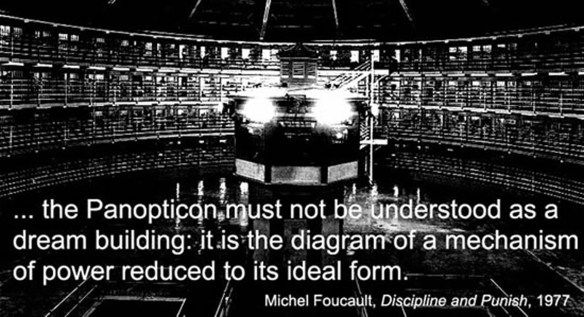
Media, Mind-Control, & Meditation: Plato’s E-Cave Panopticon and Beyond

panopticon-image

By Mankh (Walter E. Harris III)

Source: Axis of Logic

“Relax,” said the night man,
”We are programmed to receive.
You can check-out any time you like, 
But you can never leave!”

 – The Eagles, from “Hotel California”

In Plato’s Allegory of the Cave, people saw a shadow play on the wall and perceived it as reality. Today that Cave has morphed to provide umpteen TV channels and mini-screen gadgets; and the once sanctified living room cave has expanded into a free-range bubble of consciousness – heads bowed before an electronic altar, seemingly oblivious to the outside world.

“The “panopticon” refers to an experimental laboratory of power in which behaviour could be modified, and Foucault viewed the panopticon as a symbol of the disciplinary society of surveillance.”[1]

In Plato’s E-Cave, not only are the people watching a shadow play, they, and the shadows they watch, are being watched.

HyperNormalization
With a veneer of calm aplomb, the masses communicate 24-7, often in a frenetic urgency of the mundane, hence one interpretation of HyperNormalization. In all the years of overhearing cell-phone conversations in public, I can’t recall one snippet of philosophy or practical advice, rather stuff like, ‘yeah OMG I’ll get the chips!’ and ‘I’ll be there in like 30 seconds!’; if you’re old enough, you’d remember the days when, you got there when you got there! That said, a cell-phone can be a helpful even life-saving device.

The USEmpire election appears to have both proven and disproven the main theory of Adam Curtis’ fascinating new documentary “HyperNormalization.”

“Curtis argues that since the 1970s, governments, financiers, and technological utopians have given up on the complex “real world” and built a simple “fake world” that is run by corporations and kept stable by politicians.”[2]

The California cyber-tech-boom was a love-child of LSD-consciousness that found refuge in E-wizardy all the while looking to escape repressive politics. In his book “2030” Pepe Escobar describes it as: “Digital network capitalism would then shape post-modern globalization, from the New Economy before the end of the millennium to every digital wall to be broken beyond. California cosmology forged our world.”

According to Wikipedia:

“The term “hypernormalisation” is taken from Alexei Yurchak’s 2006 book Everything was Forever, Until it was No More: The Last Soviet Generation, about the paradoxes of life in the Soviet Union during the 20 years before it collapsed. A professor of anthropology at the University of California, Berkeley, he argues that everyone knew the system was failing, but as no one could imagine any alternative to the status quo, politicians and citizens were resigned to maintaining a pretence of a functioning society. Over time, this delusion became a self-fulfilling prophecy and the “fakeness” was accepted by everyone as real, an effect which Yurchak termed “hypernormalisation”.”[3]

First off, I see HyperNormalization as a half-truth because while the self-referential, gossipy world is fake, it is a veneer for a very real world of resource extraction and the violence perpetrated to maintain the status quo – and that is what the fakers ignore. As far as the election, many expected the Clinton dynasty to prevail as the corrupt, business as usual lesser of two evils. Breaking snooze: Where’s  the headline news that Melania Trump plans to focus on helping women and children?; I saw that mentioned on CNN’s Anderson Cooper 360, such a perfect antidote for Hillary’s loss and The Donald’s anti-feminist track record.

Even though WikiLeaks revealed the DNC (Democratic National Convention) was rigged against Sanders and leaks of Podesta/Clinton e-mails may have been proverbial straws for Hillary’s campaign camel, the prevailing media sentiment was that she would win – despite the fact that the day before the election some polls indicated a shrinking 3-4 point lead, thus with the typical margin of error, it was, in effect, tied. Yet the mass hyper-surprise!; and all that after the corporate media and comedy shows had simultaneously bashed Trump and given him more air-time than a kite on a windy day – both disdaining and elevating him, a media-mindfuck if ever there was one.

And there was little uproar when Gary Johnson and Jill Stein were excluded from debates and virtually banned from all corporate news, thus proving (if you didn’t know already) that it’s not a truly democratic election. Yet carry on we must and do the best we can with what we got, was the general sentiment, in other words, “the “fakeness” was accepted by everyone as real” aka HyperNormalization.

Yet the non-coastal, poor and middle America White working class (with sides of KKK and minorities!), which reportedly was the key demographic for The Don’s victory, was voting out of bare-bones needs; in effect they were not HyperNormalized. Then again, if Trump, who promises to challenge the status quo, caves-in to Deep State pressure, we will have an answer to an interesting article’s titular question: “President Trump: big liar going to Washington or Tribune of the People?”[4] And if that answer is the former, then the mostly White working poor will also have been duped/HyperNormalized.

You see, it’s hard to know what’s what; which all seems to prove HyperNormalization as the dominant societal charade; which screen is real, if any?

What you perceive is what you get
Another key phrase in Curtis’ documentary is “managed perception” – akin to Chomsky and Herman’s  “Manufacturing Consent: The Political Economy of the Mass Media” (1988) which showed how opinions and desensitized agreement to the status quo became a product to be mined and marketed. Witness CBS Chairman Les Moonves’ comment from February 2016:

“Man, who would have expected the ride we’re all having right now? … The money’s rolling in and this is fun. I’ve never seen anything like this, and this [is] going to be a very good year for us. Sorry. It’s a terrible thing to say. But, bring it on, Donald. Keep going.” [5] And, if i might satirically add, like an orangey topped Duracell battery, The Don does seem to have a lot of energy.

HyperNormalization is also akin to Sheldon Wolin’s theory  of “inverted totalitarianism,” where the faceless corporate machine wields so much entertainment and bureaucratic power that the people barely notice they are being played hook, line, and sinking feelings.

Some of Curtis’ info, however, is inaccurate or questionable. For examples, he blames the demise of the Occupy Movement on lack of vision and planning yet neglects to mention the FBI coordinated systemic crackdown on the ‘camps’ across the country. [6]

About Syria he says that President Bashar al-Assad retaliated with a “vengeful fury,” whereas Assad has defended his actions as self-defense for his people; numerous journalists back the Syrian President’s claim.

Post-election, I wonder: Why were so many liberals, lefties, and women more surprised that Trump won than that the DNC/HRC rigged it against Sanders? Were they simply feeling impotent due to HyperNormalized shadow play? Whatever the case, his victory revealed a crack in the smooth screen of HyperNormalization.

According to Patrick Caddell’s survey before the election, the populace seems to be hip to what’s happening:

“Powerful interests from Wall Street banks to corporations, unions and political interest groups have used campaign and lobbying money to rig the system for them. They are looting the national treasury of billions of dollars at the expense of every man, woman and child. AGREE = 81%; DISAGREE = 13%…

“The country is run by an alliance of incumbent politicians, media pundits, lobbyists and other powerful money interests for their own gain at the expense of the American people. AGREE = 87%; DISAGREE = 10%

The real struggle for America is not between Democrats and Republicans but between mainstream American and the ruling political elites. AGREE = 67%; DISAGREE = 24%.” [7]

This makes it seem it is the ‘how-to bring about change’ that is the deeper conundrum of the HyperNormalized world. Then again, people too often seem to have only their own best interests at heart. Approximately 90% of Americans want their food labeled so as to know if they contain GMOs etc. or not, yet hardly a peep out of anyone that climate change or the “environment” aka Mother Earth & Nature-beings were deliberately excluded as a main topic of the presidential debates. This makes it seem that, in general, Americans want clean food for themselves, they want a clean environment so they can go ‘play in the park’ by themselves. And that brings us to the Great Disconnect and Standing Rock.

Flow like water, be steady as a rock
Part of HyperNormalization is a disconnect from Nature and from being self- and community-guided, and therefore disconnected from the Original Peoples of Turtle Island. While many people are certainly aware of what’s happening with Standing Rock, the corporate media’s lack of attention, let alone empathy, fosters lack of concern for the outcome, lack of being outraged by the violent and racist treatment of those in prayer and peacefully protecting the main source of water for the Standing Rock Sioux and other Natives as well as approximately 17-million people downstream. The real-fake outrage is over the outcome of a fake election.

For many Native reservations where poverty and PTSD are prevalent, the people are anything but HyperNormalized; they are struggling to survive – as with Standing Rock, they are not asking for much: clean water and the space to live their lives with ancient traditions timelessly connected with the land, the water, the stones…

Plato, imagining a prisoner getting outside of the Cave, wrote: “Slowly, his eyes adjust to the light of the sun. First he can only see shadows. Gradually he can see the reflections of people and things in water and then later see the people and things themselves. Eventually, he is able to look at the stars and moon at night until finally he can look upon the sun itself .” [8]

Standing Rock is bringing people together, raising consciousness at many levels. As one example from a little over a week ago:

“In a “historic” show of interfaith solidarity, 500 clergy members prayed along the banks of North Dakota’s Cannonball River on Thursday where they “bore witness with the Standing Rock Sioux Nation,” which has faced intimidation, violence, and arrests for protecting their sacred land and water supply from the threats of a massive oil pipeline. According to the Episcopal News Service, “The interfaith group spent more than five hours on site, marching, singing hymns, sharing testimony, and calling others to join them in standing with the more than [300] tribes who have committed their support to the Sioux Nation as they protest the route of the Dakota Access Pipeline (DAPL).” [9]

This solidarity is in stark contrast with the election where a typically 51/49 system determines an outcome for a society literally programmed for exciting close-call winners – think sporting events,
reality shows, awards ceremonies.

Outside in and inside out
There are many ways to get outside the Cave. One of those is by going within. When I first started to meditate, as is common, I became aware of the constant chatter in my head and soon realized that the mind left unattended will rattle on endlessly. Meditation then showed me that once the chatter quiets, one then has access to other frequencies, other ‘channels’ – what happens then is a very personal matter yet also impersonal because one becomes connected with another source of thinking-seeing-feeling. Chatter, like cell-phones, has it’s usefulness, say, if you forgot to turn the stove off. My point to the personal anecdote is that the corporate media is too much chatter, endlessly looping itself. The gadgets, too, though useful, seem hard-wired for HyperNormalization.

Some of the chatter we must live with, yet by learning to follow our intuitions, listening to and connecting with Nature, talking with elders and little children we can better tune-out from the shadow-play, we can find new and ancient ways for more people – and that includes trees, rivers, etc. –  “to look at the stars and moon at night” and “look upon the sun itself.”

“Sin filo ya y derrotada se quejó: Soy más fuerte que ella, pero no le puedo hacer daño y ella a mi, sin pelear. me ha vencido.’”

“Without sharpness and defeated, it [the sword] complained: ‘I am stronger than the water, but I cannot harm her. And the water, without fighting, has conquered me.’” [10]

NOTES:
1.    Panopticism here and here.
2.    Ibid.
3.    HyperNormalization
4.    See here.
5.    “Les Moonves: Trump’s run is ‘damn good for CBS’”. See here.
6.    “Revealed: how the FBI coordinated the crackdown on Occupy
7.    “Patrick Caddell; The Pollster Who ‘Got it Right’
8.    “Allegory of the Cave
9.    “A Prayer for People and Planet: 500 Clergy Hold ‘Historic’ Mass Gathering for Standing Rock
10.    “Questions & Swords: Folktales of the Zapatista Revolution” as told by Subcomandante Marcos, Cino Puntos Press, El Paso, Texas, 2001, p.82.

To watch “HyperNormalization”, click here.

Mankh (Walter E. Harris III) is an essayist and resident poet on Axis of Logic. In addition to his work as a writer, he is a small press publisher and Turtle Islander. His new book of genre-bending poetic-nonfiction is “Musings With The Golden Sparrow.” You can contact him via his literary website.


Depicting Perpetual Crimes committed by Corporate Culture and its Mainstream Media

index-1-229x300

Russian Novels Combating Global Capitalist Nightmare

By Andre Vltchek

Source: Dissident Voice

Imagine Moscow being taken over by some international corporate cartel. By a monster which has its own factories and office buildings, security services, private prisons, re-education (‘training’) centers, and its obedient mass media outlets. Imagine that it also has detailed databases on almost everyone who really matters in the capital.

Imagine that human lives suddenly don’t matter. People are only expected to produce and consume; they become fully disposable.

Imagine that the once greatly educated Russia with its legendary artists and philosophers is gradually getting reduced to an unimaginably primitive level. Suddenly, there is US pop trash flying about everywhere, and the greatest entertainment for the masses comes from watching countless television ‘reality shows’, including those that graphically depict, candidly, how both men and women are shitting and pissing in the capital’s public toilets.

That’s what you get when reading a witty, provocative and thoroughly outrageous novel by Sergei Minaev, called R.A.B.; 521 pages of it!

In all his novels, including Soulless, The Telki, Media Sapiens and R.A.B., Minaev masterfully depicts the perpetual crimes committed by corporate culture and its mainstream media. Brutally and candidly he describes an apocalyptic society constructed on the soulless, merciless and murderous principles of the modern Western-style capitalist system.

In such a world, nothing is sacred anymore. The ‘elites’ are having great fun hunting on the outskirts of the city, not for some animals, but for homeless people living in abandoned pipelines (R.A.B.). A US mainstream television news channel, together with its local counterpart, manage to trigger a military conflict between Georgia and Russia, after hiring several combat helicopters and retired soldiers, killing real people, just in order to increase their ratings. And several terrorist attacks in Moscow are being paid for and staged by other big media conglomerates (Media Sapiens).

Minaev is not crying; he is definitely far from being a ‘bleeding heart’. He is tough and cynical. His characters are mostly ruthless super-yuppies from Moscow, go-getters, living a fast life, taking drugs, partying in luxury clubs, having sex literally with everything that moves (Soulless).

But they get burned, destroyed, brought to near suicide.

They have no ideology, no political views. They laugh at, they insult everything and everybody, but deep inside they are actually suffering from a horrible void, from emptiness. In those rare moments of honesty, they admit to each other and to themselves, that they are actually still longing for at least ‘something pure and decent’, uncorrupted by the global market-fundamentalist regime and its ‘values’ and ‘culture’.

*****

In R.A.B. Minaev goes much further. His yuppies (paradoxically, the mid and upper-level managers) start a rebellion against the system. They go on strike, march through the streets, and build barricades. They begin demanding social justice. They burn down their own offices.

They do it after their Russian toy-producing company (and other companies all over the city) gets swallowed by a US-based multi-national corporation, which immediately begins dismantling all social benefits, while injecting uncertainty and fear into the workplace. A multi-national also opens a horrid toy factory on the outskirts of Moscow, which then employs desperate immigrants from the Central Asian republics.

The privately-owned mass media outlets first confront the protesters, and then follow up with pro-corporate propaganda and in the end the corporate security services and the army. Many people disappear. Others are locked up in the offices and secret prisons of the corporations, and tortured. Those who survive become ‘unemployable’, their names permanently on the blacklist.

But what does Minaev really call for? Is it a true revolution?

Yes and no. He does not believe that in the countries that have been conquered by market fundamentalism and by unbridled consumerism, a ‘real revolution’ is possible. He does not think that the people there have any ideals or any zeal left. At the same time, at least some of his characters are clearly unwilling to surrender.

It is chilling to read R.A.B. while at the same time those ‘rebellions’ in Greece, France, Spain and the U.K. are taking place.

One of the main characters of R.A.B. confronts the demonstrators: It is not a revolution! You are all parts of the system. You just want a better deal for yourself. Through this rebellion, you are actually negotiating with the cartel of the corporations. If you get what you are asking for, you’ll happily remain where you are and carry on as if nothing happened.

*****

Then Minaev does exactly what no Western writer would dare to do. He begins to argue that to destroy the system, there has to be an armed struggle. Otherwise no real change could ever be achieved.

The suppressed rebellion of the yuppies eventually triggers much a wider movement, and soon there are real battles raging in several provincial capitals.

The end of the novel is open. The main character of R.A.B. is destroyed. He loses the love of his life (in desperation she commits suicide); he has no job, no money and no place to go. But he is still alive. Russia is still alive. It is obvious that no matter what, it will never accept this monstrous system that was forced on it by the West.

*****

It all may sound like an insane fantasy, but. in fact, what Minaev writes about is not too far from the nightmares that Russia was descending into right after Gorbachev allowed the country (USSR) to fall apart, and then Yeltsin introduced unbridled privatization and gave unprecedented concessions to foreign corporations. During that period, Russia went through something that could be easily described as a social genocide. Life expectancy dropped to the levels of war-torn countries in Africa. Lawlessness ruled. All ideals were ridiculed and spat at. A big number of Russian intellectuals were bought and organized by the West into countless NGO’s. The lowest grade of Western pop and entertainment torpedoed Russian culture. During those dark days, the West finally succeeded in bringing Russia to its knees.

Not even two decades later, a new Russia is once again proud, strong and confident.

It rose to its feet, it began successfully producing again, and it underwent a tremendous and positive social transformation.

Just one week ago I returned from the Russian Far East, from the cities of Vladivostok, Khabarovsk and Petropavlovsk Kamchatski. Wherever I went, I witnessed new and impressive infrastructure. I encountered a confident, hard working nation, which was working hard to restore at least some of the socialist structures and benefits that it used to enjoy in the past.

The new, present-day Russia is much closer to China; much more impressed by the Chinese system, than by what it was forced to adopt in the past; during the “pro-Western era” which is now generally considered to be synonymous to a national disaster.

Russian writers played an important role in describing the horrors of the Gorbachev/Yeltsin years, and of the brutal global economic, political and ‘cultural’ regime injected by the West to all the corners of the Planet. From an outrageous Eduard Limonov’s novel It’s Me, Eddie to Minaev’s R.A.B., Russian literature has been daring, insulting, direct and brutally honest.

While Limonov and Minaev sell millions of copies of their books at home, their work is virtually unknown in the West. I found no English translations when searching on Amazon.com, and elsewhere.

In his New York-based Eddie, Limonov is calling openly for terrorist acts against the Western regime, while some of Minaev’s characters also believe in an armed struggle, although of a more conventional type.

Nothing is spared. When the US toy-producing corporation demands a special tax from its employees in Russia, for “helping out those poor children in the Third World”, the main character of R.A.B. thinks: “well, they can now use that money to buy coffins for children they employ and kill in Indonesia or Thailand”. When the tax goes slightly up, he comments: “now they will have enough funds to dig at least a few mass graves”.

All this is simply too outrageous for Western readers. Or more precisely, the ‘book business’ most likely ‘thinks’ that it is.

The fact remains that despite what is constantly repeated by Western propaganda, those who read Russian can clearly see and appreciate that Russian literature is actually much more free, daring and rebellious than its counterpart in the West.

When several Russian bestselling novelists are calling openly for combat against the global regime (the same regime which is, until now, at least partially, controlling the economy of their country), one has no choice but to be impressed by the level of freedom in the country which allows such work to be published and then promoted.

But in the West, you would never know all this, unless you spoke Russian. It is because in the West (and in its ‘client’ states and colonies) you are being extremely well ‘protected’ from such uncomfortable (and the regime would even say ‘dangerous’) thoughts!


André Vltchek is a novelist, filmmaker, and investigative journalist. He has covered wars and conflicts in dozens of countries. His latest book is Exposing Lies of the Empire.

The Imperial President’s Toolbox of Terror: A Dictatorship Waiting to Happen


pimps-inc-improved_presidential_seal_by_sharpwriter-d486y6m_zps3hnflawe

By John W. Whitehead

Source: Waking Times

“When the President does it, that means that it is not illegal.”~Richard Nixon

Presidents don’t give up power.

Executive orders don’t expire at the end of each presidential term.

And every successive occupant of the Oval Office since George Washington, who issued the first executive order, has expanded the reach and power of the presidency.

The Constitution invests the President with very specific, limited powers: to serve as Commander-in-Chief of the military, grant pardons, make treaties (with the approval of Congress), appoint ambassadors and federal judges (again with Congress’ blessing), and veto legislation.

In recent years, however, American presidents have anointed themselves with the power to wage war, unilaterally kill Americans, torture prisoners, strip citizens of their rights, arrest and detain citizens indefinitely, carry out warrantless spying on Americans, and erect their own secretive, shadow government.

These are the powers that will be inherited by the next heir to the throne, and it won’t make a difference whether it’s a President Trump or a President Clinton occupying the Oval Office.

The powers amassed by each successive president through the negligence of Congress and the courts—powers which add up to a toolbox of terror for an imperial ruler—empower whomever occupies the Oval Office to act as a dictator, above the law and beyond any real accountability.

Consider some of the presidential powers—which have been acquired through the use of executive orders, decrees, memorandums, proclamations, national security directives and legislative signing statements and can be activated by any sitting president—that have allowed past presidents to operate above the law and beyond the reach of the Constitution.

The power to kill. As the New York Times concluded, “President Obama, who came to office promising transparency and adherence to the rule of law, has become the first president to claim the legal authority to order an American citizen killed without judicial involvement, real oversight or public accountability.” Obama’s kill lists—signature drone strikes handpicked by the president—have been justified by the Justice Department as lawful because they are subject to internal deliberations by the executive branch. “In other words,” writes Amy Davidson for the New Yorker, “it’s due process if the President thinks about it.”

The power to wage war. Ever since Congress granted George W. Bush the authorization to use military force in the wake of 9/11, the United States has been in a state of endless war without Congress ever having declared one. Having pledged to end Bush’s wars, Barack Obama has extended them. As the New York Times notes, “He has now been at war longer than Mr. Bush, or any other American president… he will leave behind an improbable legacy as the only president in American history to serve two complete terms with the nation at war.” More than that, as the Atlantic makes clear, “Obama is inaugurating an era of unbridled war-making by the commander in chief, without any of the checks and balances contemplated by the American constitutional system.”

The power to torture. Despite the fact that the Bush Administration’s use of waterboarding as a torture tactic was soundly criticized by Obama, the Obama Administration refused to hold anyone accountable for participating in the rendition and torture programs. In the absence of any finding of criminality, the authorization of such torture tactics remain part of the president’s domain—should he or she ever choose to revive it.

The power to spy on American citizens. In the wake of the 9/11 terror attacks, President Bush secretly authorized the National Security Agency to carry out surveillance on Americans’ phone calls and emails. The Bush Administration claimed that the Constitution gives the president inherent powers to protect national security. The covert surveillance has continued under Obama.

The power to indefinitely detain American citizens. In 1942, President Franklin D. Roosevelt issued an executive order requiring that all Japanese-Americans be held in internment camps. While that order was later rescinded, the U.S. Supreme Court declared it to be constitutional. The ruling has never been overturned. Pointing out that such blatantly illegal detentions could happen again—with the blessing of the courts—Justice Scalia warned, “In times of war, the laws fall silent.” In fact, each National Defense Authorization Act enacted since 2012 has included a provision that permits the military to detain individuals—including Americans citizens—indefinitely without trial.

The power to strip American citizens of their constitutional rights. The Bush Administration claimed it could strip American citizens of their constitutional rights, imprison them indefinitely, and deny them legal representation simply by labeling them as enemy combatants. While the Obama Administration jettisoned the use of the term “enemy combatant,” it has persisted in defending the president’s unilateral and global right to detain anyone suspected of supporting terrorist activities.

The power to secretly rewrite or sidestep the laws of the country. Secret courts, secret orders, and secret budgets have become standard operating procedure for presidential administrations in recent years. A good case in point is Presidential Policy Directive 20, a secret order signed by President Obama as a means of thwarting cyberattacks. Based on what little information was leaked to the press about the clandestine directive, it appears that the president essentially put the military in charge of warding off a possible cyberattack. A FOIA request by the Electronic Privacy Information Center (EPIC) seeking more details on the directive was allegedly denied because doing so could cause “exceptionally grave damage to the national security.” However, EPIC believes the order allows for military deployment within the United States, including the ability to shut off communications with the outside world if the military believes it is necessary.

The power to transform the police into extensions of the military and indirectly institute martial law. What began in the 1960s as a war on drugs transitioned into an all-out campaign to transform America’s police forces into extensions of the military. Every successive president since Nixon has added to the police’s arsenal, tactics and authority. In fact, the Obama Administration has accelerated police militarization by distributing military weapons and equipment to police and incentivizing SWAT team raids and heavy-handed police tactics through the use of federal grants and asset forfeiture schemes.

The power to command the largest military and intelligence capabilities in the world and, in turn, “wag the dog.”As law professor William P. Marshall points out:

In his roles as Commander-in-Chief and head of the Executive Branch, the President directly controls the most powerful military in the world and directs clandestine agencies such as the Central Intelligence Agency and National Security Agency. That control provides the President with immensely effective, non-transparent capabilities to further his political agenda and/or diminish the political abilities of his opponents. Whether a President would cynically use such power solely for his political advantage has, of course, been the subject of political thrillers and the occasional political attack. President Clinton, for one, was accused of ordering the bombing of terrorist bases in Afghanistan to distract the nation from the Lewinsky scandal, and President Nixon purportedly used the Federal Bureau of Investigation to investigate his political enemies. But regardless whether such abuses actually occurred, there is no doubt that control of covert agencies provides ample opportunity for political mischief, particularly since the inherently secretive nature of these agencies means their actions often are hidden from public view. And as the capabilities of these agencies increase through technological advances in surveillance and other methods of investigation, so does the power of the President.

Thus, it doesn’t matter what the pundits predict, the candidates promise, and the people decree.

It doesn’t even matter whether the people elect Trump or Clinton. After all, politicians sing a different tune once elected. For instance, the Chicago Tribune editorial board observed that although Barack Obama opposed the imperial tendencies of George W. Bush, once in office, Obama “wound up behaving as if he had a scepter and throne.”

What matters is that the damage has already been done.

As Professor Marshall explains, “every extraordinary use of power by one President expands the availability of executive branch power for use by future Presidents.” Moreover, it doesn’t even matter whether other presidents have chosen not to take advantage of any particular power, because “it is a President’s action in using power, rather than forsaking its use, that has the precedential significance.”

In other words, each successive president continues to add to his office’s list of extraordinary orders and directives, granting him- or herself near dictatorial powers.

So let’s not have any more talk of which candidate would be more dangerous with these powers.

The fact that any individual—or branch of government—is empowered to act like a dictator is danger enough.

This abuse of presidential powers has been going on for so long that it has become the norm and it will continue no matter which corporate puppet wins the election. The Constitution be damned.

The government of laws idealized by John Adams has fallen prey to a government of men.

As a result, we no longer have a system of checks and balances.

“The system of checks and balances that the Framers envisioned now lacks effective checks and is no longer in balance,”concludes Marshall. “The implications of this are serious. The Framers designed a system of separation of powers to combat government excess and abuse and to curb incompetence. They also believed that, in the absence of an effective separation-of-powers structure, such ills would inevitably follow. Unfortunately, however, power once taken is not easily surrendered.”

The solution is far from simple but it’s time, as Marshall suggests, to recalibrate the balance of power. This will mean putting an end to the use of executive orders, decrees, memorandums, proclamations, national security directives and legislative signing statements as a means of getting around Congress and the courts. It will mean that Americans will have to stop letting their politics blind them to government wrongdoing. And it will mean holding all three branches of government accountable to the Constitution (i.e., if they abuse their powers, vote them out of office).

Thus far, Congress, with little spine, less integrity and too busy running for re-election, has offered little attempt at oversight, enabling the president to ride roughshod over the Constitution. The media—the perfect accomplice in this stealthy, bloodless coup—continues to inundate us with the latest celebrity scandal, says virtually nothing about these burgeoning powers. All the while, most Americans continue to operate in blissful near-ignorance, unaware or uncaring that the republic is about to fall.

Yet as I point out in my book Battlefield America: The War on the American People, it will be “we the people”—not the president, the politicians, the corporate elite or the media—who will suffer the consequences when freedom falls and tyranny rises. They may justify violating our freedoms in the name of whatever phantom menace-of-the-month threatens “national security,” but we will always be the ones to pay the price.


‘What It Takes to Be President of the American Police State: Anti-Big Money, Anti-War, Pro-Constitution, Freedom-Loving Candidates Need Not Apply’

imageedit_4850_9701377216

By John W. Whitehead

Source: A Government of Wolves

“The qualifications for president seem to be that one is willing to commit mass murder one minute and hand presidential medals of freedom to other war criminals in the next. One need only apply if one has very loose, flexible, or non-existent morality.”—Author and activist Cindy Sheehan

Long gone are the days when the path to the White House was open to anyone who met the Constitution’s bare minimum requirements of being a natural born citizen, a resident of the United States for 14 years, and 35 years of age or older.

Today’s presidential hopefuls must jump through a series of hoops aimed at selecting the candidates best suited to serve the interests of the American police state. Candidates who are anti-war, anti-militarization, anti-Big Money, pro-Constitution, pro-individual freedom and unabashed advocates for the citizenry need not apply.

The carefully crafted spectacle of the presidential election with its nail-biting primaries, mud-slinging debates, caucuses, super-delegates, popular votes and electoral colleges has become a fool-proof exercise in how to persuade a gullible citizenry into believing that their votes matter.

Yet no matter how many Americans go to the polls on November 8, “we the people” will not be selecting the nation’s next president.

While voters might care about where a candidate stands on healthcare, Social Security, abortion and immigration—hot-button issues that are guaranteed to stir up the masses, secure campaign contributions and turn any election into a circus free-for-all—those aren’t the issues that will decide the outcome of this presidential election.

What decides elections are money and power.

We’ve been hoodwinked into believing that our votes count, that we live in a democracy, that elections make a difference, that it matters whether we vote Republican or Democrat, and that our elected officials are looking out for our best interests. Truth be told, we live in an oligarchy, and politicians represent only the profit motives of the corporate state, whose leaders know all too well that there is no discernible difference between red and blue politics, because there is only one color that matters in politics—green.

As much as the Republicans and Democrats like to act as if there’s a huge difference between them and their policies, they are part of the same big, brawling, noisy, semi-incestuous clan. Watch them interact at social events—hugging and kissing and nudging and joking and hobnobbing with each other—and it quickly becomes clear that they are not sworn enemies but partners in crime, united in a common goal, which is to maintain the status quo.

The powers-that-be will not allow anyone to be elected to the White House who does not answer to them.

Who are the powers-that-be, you might ask?

As I point out in my book Battlefield America: The War on the American People, the powers-that-be are the individuals and corporations who profit from America’s endless wars abroad and make their fortunes many times over by turning America’s homeland into a war zone. They are the agents and employees of the military-industrial complex, the security-industrial complex, and the surveillance-industrial complex. They are the fat cats on Wall Street who view the American citizenry as economic units to be bought, sold and traded on a moment’s notice. They are the monied elite from the defense and technology sectors, Hollywood, and Corporate America who believe their money makes them better suited to decide the nation’s future. They are the foreign nationals to whom America is trillions of dollars in debt.

One thing is for certain: the powers-that-be are not you and me.

In this way, the presidential race is just an exaggerated farce of political theater intended to dazzle, distract and divide us, all the while the police state marches steadily forward.

It’s a straight-forward equation: the candidate who wins the White House will be the one who can do the best job of ensuring that the powers-that-be keep raking in the money and acquiring ever greater powers. In other words, for any viable presidential candidate to get elected today that person must be willing to kill, lie, cheat, steal, be bought and sold and made to dance to the tune of his or her corporate overlords.

The following are just some of the necessary qualifications for anyone hoping to be appointed president of the American police state. Candidates must:

Help grow the militaryindustrial complex: Fifty-five years after President Dwight D. Eisenhower warned about the growth of the “military-industrial complex” in his farewell address, the partnership between the government, the military and private corporations has resulted in the permanent militarization of America. From militarized police and the explosive growth of SWAT teams to endless wars abroad, the expansion of private sector contractors, and never-ending blowback from our foreign occupations, we have become a nation permanently at war. As the New York Times pointed out, “themilitary is the true ‘third rail’ of American politics.” The military-industrial complex understands the value of buying the presidency, and has profited from the incessant warmongering of Obama and his predecessors. If money is any indicator of who the defense industry expects to win this November, thus far, Hillary Clinton is winning the money race, having collected more campaign contributions from employees with the 50 largest military contractors.

Police the rest of the world using U.S. troops: The U.S. military empire’s determination to police the rest of the world has resulted in more than 1.3 million U.S. troops being stationed at roughly 1000 military bases in over 150 countriesaround the world, including 48,000 in Japan, 37,000 in Germany, 27,000 in South Korea and 9800 in Afghanistan. That doesn’t include the number of private contractors pulling in hefty salaries at taxpayer expense. In Afghanistan, for example, private contractors outnumber U.S. troops three to one. Now comes the news that the U.S. is preparing to sendtroops to Libya on a long-term mission to fight ISIS.

Sow seeds of discord and foment wars among other nations under the guise of democracy: It’s not enough for the commander-in-chief to lead the United States into endless wars abroad. Any successful presidential candidate also needs to be adept at stirring up strife within other nations under the guise of spreading democracy. The real motive, of course, is creating new markets for the nation’s #1 export: weapons. In this way, the U.S. is constantly arming so-called “allies” with deadly weapons, only to later wage war against these same nations for possessing weapons of mass destruction. It happened in Iraq when the U.S. sold Saddam Hussein weapons to build his war machine. It happened in Syria when the U.S. provided rebel fighters with military equipment and munitions, only to have them seized by ISIS and used against us. Now comes the news that President Obama has agreed to sell weapons to Vietnam, lifting a decades-long embargo against the nation whose civil war claimed the lives of more than 90,000 Americans.

Speak of peace while slaughtering innocent civilians: Barack Obama’s campaign and subsequent presidency illustrates this principle perfectly. The first black American to become president, Obama was awarded the Nobel Peace Prize long before he had done anything to truly deserve it. He has rewarded the Nobel committee’s faith in him by becoming one of the most hawkish war presidents to lead the nation, overseeing a targeted-killing drone campaign that has resulted in thousands of civilian casualties and deaths. Ironically, while Obama has made no significant effort to de-escalate government-inflicted violence or de-weaponize militarized police, he has gone to great lengths to denounce and derail private gun ownership by American citizens.

Prioritize surveillance in the name of security over privacy: Since 9/11, the Surveillance State has undergone a dramatic boom, thanks largely to the passage of the USA Patriot Act and so-called “secret” interpretations of the mammoth law allowing the NSA and other government agencies to spy on Americans’ electronic communications. What began as a government-driven program under George W. Bush has grown under Obama into a mass surveillance private sector that makes its money by spying on American citizens. As Fortune reports, “In response to security concerns after 9/11, Americans witnessed the growth of a massive domestic security apparatus, fueled by federal largesse.” That profit-incentive has opened up a multi-billion dollar video surveillance industry that is blanketing the country with surveillance cameras—both governmental and private—which can be accessed by law enforcement at a moment’s notice.

Promote the interests of Corporate America and Big Money over the rights of the citizenry: Almost every major government program hailed as benefiting Americans—affordable healthcare, the war on terror, airport security, police-worn body cameras—has proven to be a Trojan Horse aimed at enriching Corporate America while leaving Americans poorer, less secure and less free. For instance, the so-called “affordable” health care mandated by Congress has become yet another costly line item in already strained household budgets for millions of Americans.

Expand the powers of the imperial president while repeatedly undermining the rule of law: George W. Bush assumed near-absolute power soon after the September 11, 2001, attacks. Unfettered by Congress or the Constitution, Bush led the “war on terror” abroad and championed both the USA Patriot Act and Homeland Security Department domestically. This, of course, led to the Bush Administration’s demand that presidential wartime powers permit the President to assume complete control over any and all aspects of an international war on terrorism. Such control included establishing military tribunals and eliminating basic rights long recognized under American law.

When Barack Obama ascended to the presidency in 2008, there was a sense, at least among those who voted for him, that the country might change for the better. Those who watched in awe as President Bush chipped away at our civil liberties over the course of his two terms as president thought that perhaps the young, charismatic Senator from Illinois would reverse course and put an end to some of the Bush administration’s worst transgressions—the indefinite detention of suspected terrorists, the torture, the black site prisons, and the never-ending wars that have drained our resources, to name just a few. As we near the end of Obama’s two terms in office, that fantasy has proven to be just that: a fantasy. Indeed, President Obama has not only carried on the Bush legacy, but has taken it to its logical conclusion. Obama has gone beyond Guantanamo Bay, gone beyond spying on Americans’ emails and phone calls, and gone beyond bombing countries without Congressional authorization. As journalist Amy Goodman warned, “the recent excesses of U.S. presidential power are not transient aberrations, but the creation of a frightening new normal, where drone strikes, warrantless surveillance, assassination and indefinite detention are conducted with arrogance and impunity, shielded by secrecy and beyond the reach of law.”

Act as if the work of the presidency is a hardship while enjoying all the perks: The race for the White House is an expensive, grueling horse race: candidates must have at a minimum $200 or $300 million or more just to get to the starting line. The total cost for this year’s election is estimated to exceed $5 billion and could go as high as $10 billion. However, for the winner, life in the White House is an endless series of star-studded dinner parties, lavish vacations and perks the likes of which the average American will never enjoy. The grand prize winner will rake in a $400,000 annual salary (not including $100,000 a year for travel expenses, $19,000 for entertaining, $50,000 for “general” expenses and last but not least, $1,000,000 for “unanticipated” expenses), live rent-free in a deluxe, 6-storey, 55,000 square foot mansion that comes complete with its own movie theater and bowling alley, round-the-clock staff, florists, valets and butlers. Upon leaving the White House, presidents are gifted with hefty pensions, paid staff and office space, travel allowances and lifetime medical care. Ex-presidents can also expand upon their largesse by writing books and giving speeches (Bill Clinton was given a $15 million advance for his memoir and routinely makes upwards of $100,000 per speech).

Clearly, it doesn’t matter where a candidate claims to stand on an issue as long as he or she is prepared to obey the dictates of the architects, movers and shakers, and shareholders of the police state once in office.

So here we are once again, preparing to embark upon yet another delusional, reassurance ritual of voting in order to sustain the illusion that we have a democratic republic when, in fact, what we have is a dictatorship without tears. Once again, we are left feeling helpless in the face of a well-funded, heavily armed propaganda machine that is busily spinning political webs with which the candidates can lure voters. And once again we are being urged to vote for the lesser of two evils.

Railing against a political choice that offers no real choice, gonzo journalist Hunter S. Thompson snarled, “How many more of these stinking, double-downer sideshows will we have to go through before we can get ourselves straight enough to put together some kind of national election that will give me and the at least 20 million people I tend to agree with a chance to vote for something, instead of always being faced with that old familiar choice between the lesser of two evils?”

Remember, the lesser of two evils is still evil.

Evidence points to another Snowden at the NSA

NSA-CIA-Edward-Snowden

By James Bamford

Source: Reuters

In the summer of 1972, state-of-the-art campaign spying consisted of amateur burglars, armed with duct tape and microphones, penetrating the headquarters of the Democratic National Committee. Today, amateur burglars have been replaced by cyberspies, who penetrated the DNC armed with computers and sophisticated hacking tools.

Where the Watergate burglars came away empty-handed and in handcuffs, the modern- day cyber thieves walked away with tens of thousands of sensitive political documents and are still unidentified.

Now, in the latest twist, hacking tools themselves, likely stolen from the National Security Agency, are on the digital auction block. Once again, the usual suspects start with Russia – though there seems little evidence backing up the accusation.

In addition, if Russia had stolen the hacking tools, it would be senseless to publicize the theft, let alone put them up for sale. It would be like a safecracker stealing the combination to a bank vault and putting it on Facebook. Once revealed, companies and governments would patch their firewalls, just as the bank would change its combination.

A more logical explanation could also be insider theft. If that’s the case, it’s one more reason to question the usefulness of an agency that secretly collects private information on millions of Americans but can’t keep its most valuable data from being stolen, or as it appears in this case, being used against us.

In what appeared more like a Saturday Night Live skit than an act of cybercrime, a group calling itself the Shadow Brokers put up for bid on the Internet what it called a “full state-sponsored toolset” of “cyberweapons.” “!!! Attention government sponsors of cyberwarfare and those who profit from it !!!! How much would you pay for enemies cyberweapons?” said the announcement.

The group said it was releasing some NSA files for “free” and promised “better” ones to the highest bidder. However, those with loosing bids “Lose Lose,” it said, because they would not receive their money back. And should the total sum of the bids, in bitcoins, reach the equivalent of half a billion dollars, the group would make the whole lot public.

While the “auction” seemed tongue in cheek, more like hacktivists than Russian high command, the sample documents were almost certainly real. The draft of a top-secret NSA manual for implanting offensive malware, released by Edward Snowden, contains code for a program codenamed SECONDDATE. That same 16-character string of numbers and characters is in the code released by the Shadow Brokers. The details from the manual were first released by The Intercept last Friday.

The authenticity of the NSA hacking tools were also confirmed by several ex-NSA officials who spoke to the media, including former members of the agency’s Tailored Access Operations (TAO) unit, the home of hacking specialists.

“Without a doubt, they’re the keys to the kingdom,” one former TAO employee told the Washington Post. “The stuff you’re talking about would undermine the security of a lot of major government and corporate networks both here and abroad.” Another added, “From what I saw, there was no doubt in my mind that it was legitimate.”

Like a bank robber’s tool kit for breaking into a vault, cyber exploitation tools, with codenames like EPICBANANA and BUZZDIRECTION, are designed to break into computer systems and networks. Just as the bank robber hopes to find a crack in the vault that has never been discovered, hackers search for digital cracks, or “exploits,” in computer programs like Windows.

The most valuable are “zero day” exploits, meaning there have been zero days since Windows has discovered the “crack” in their programs. Through this crack, the hacker would be able to get into a system and exploit it, by stealing information, until the breach is eventually discovered and patched. According to the former NSA officials who viewed the Shadow Broker files, they contained a number of exploits, including zero-day exploits that the NSA often pays thousands of dollars for to private hacking groups.

The reasons given for laying the blame on Russia appear less convincing, however. “This is probably some Russian mind game, down to the bogus accent,” James A. Lewis, a computer expert at the Center for Strategic and International Studies, a Washington think tank, told the New York Times. Why the Russians would engage in such a mind game, he never explained.

Rather than the NSA hacking tools being snatched as a result of a sophisticated cyber operation by Russia or some other nation, it seems more likely that an employee stole them. Experts who have analyzed the files suspect that they date to October 2013, five months after Edward Snowden left his contractor position with the NSA and fled to Hong Kong carrying flash drives containing hundreds of thousands of pages of NSA documents.

So, if Snowden could not have stolen the hacking tools, there are indications that after he departed in May 2013, someone else did, possibly someone assigned to the agency’s highly sensitive Tailored Access Operations.

In December 2013, another highly secret NSA document quietly became public. It was a top secret TAO catalog of NSA hacking tools. Known as the Advanced Network Technology (ANT) catalog, it consisted of 50 pages of extensive pictures, diagrams and descriptions of tools for every kind of hack, mostly targeted at devices manufactured by U.S. companies, including Apple, Cisco, Dell and many others.

Like the hacking tools, the catalog used similar codenames. Among the tools targeting Apple was one codenamed DROPOUTJEEP, which gives NSA total control of iPhones. “A software implant for the Apple iPhone,” says the ANT catalog, “includes the ability to remotely push/pull files from the device. SMS retrieval, contact-list retrieval, voicemail, geolocation, hot mic, camera capture, cell-tower location, etc.”

Another, codenamed IRATEMONK, is, “Technology that can infiltrate the firmware of hard drives manufactured by Maxtor, Samsung, Seagate and Western Digital.”

In 2014, I spent three days in Moscow with Snowden for a magazine assignment and a PBS documentary. During our on-the-record conversations, he would not talk about the ANT catalog, perhaps not wanting to bring attention to another possible NSA whistleblower.

I was, however, given unrestricted access to his cache of documents. These included both the entire British, or GCHQ, files and the entire NSA files.

But going through this archive using a sophisticated digital search tool, I could not find a single reference to the ANT catalog. This confirmed for me that it had likely been released by a second leaker. And if that person could have downloaded and removed the catalog of hacking tools, it’s also likely he or she could have also downloaded and removed the digital tools now being leaked.

In fact, a number of the same hacking implants and tools released by the Shadow Brokers are also in the ANT catalog, including those with codenames BANANAGLEE and JETPLOW. These can be used to create “a persistent back-door capability” into widely used Cisco firewalls, says the catalog.

Consisting of about 300 megabytes of code, the tools could easily and quickly be transferred to a flash drive. But unlike the catalog, the tools themselves – thousands of ones and zeros – would have been useless if leaked to a publication. This could be one reason why they have not emerged until now.

Enter WikiLeaks. Just two days after the first Shadow Brokers message, Julian Assange, the founder of WikiLeaks, sent out a Twitter message. “We had already obtained the archive of NSA cyberweapons released earlier today,” Assange wrote, “and will release our own pristine copy in due course.”

The month before, Assange was responsible for releasing the tens of thousands of hacked DNC emails that led to the resignation of the four top committee officials.

There also seems to be a link between Assange and the leaker who stole the ANT catalog, and the possible hacking tools. Among Assange’s close associates is Jacob Appelbaum, a celebrated hacktivist and the only publicly known WikiLeaks staffer in the United States – until he moved to Berlin in 2013 in what he called a “political exile” because of what he said was repeated harassment by U.S. law enforcement personnel. In 2010, a Rolling Stone magazine profile labeled him “the most dangerous man in cyberspace.”

In December 2013, Appelbaum was the first person to reveal the existence of the ANT catalog, at a conference in Berlin, without identifying the source. That same month he said he suspected the U.S. government of breaking into his Berlin apartment. He also co-wrote an article about the catalog in Der Spiegel. But again, he never named a source, which led many to assume, mistakenly, that it was Snowden.

In addition to WikiLeaks, for years Appelbaum worked for Tor, an organization focused on providing its customers anonymity on the Internet. But last May, he stepped down as a result of “serious, public allegations of sexual mistreatment” made by unnamed victims, according to a statement put out by Tor. Appelbaum has denied the charges.

Shortly thereafter, he turned his attention to Hillary Clinton. At a screening of a documentary about Assange in Cannes, France, Appelbaum accused her of having a grudge against him and Assange, and that if she were elected president, she would make their lives difficult. “It’s a situation that will possibly get worse” if she is elected to the White House, he said, according to Yahoo News.

It was only a few months later that Assange released the 20,000 DNC emails. Intelligence agencies have again pointed the finger at Russia for hacking into these emails.

Yet there has been no explanation as to how Assange obtained them. He told NBC News, “There is no proof whatsoever” that he obtained the emails from Russian intelligence. Moscow has also denied involvement.

There are, of course, many sophisticated hackers in Russia, some with close government ties and some without. And planting false and misleading indicators in messages is an old trick. Now Assange has promised to release many more emails before the election, while apparently ignoring email involving Trump. (Trump opposition research was also stolen.)

In hacktivist style, and in what appears to be phony broken English, this new release of cyberweapons also seems to be targeting Clinton. It ends with a long and angry “final message” against “Wealthy Elites . . . breaking laws” but “Elites top friends announce, no law broken, no crime commit[ed]. . . Then Elites run for president. Why run for president when already control country like dictatorship?”

Then after what they call the “fun Cyber Weapons Auction” comes the real message, a serious threat. “We want make sure Wealthy Elite recognizes the danger [of] cyberweapons. Let us spell out for Elites. Your wealth and control depends on electronic data.” Now, they warned, they have control of the NSA’s cyber hacking tools that can take that wealth away. “You see attacks on banks and SWIFT [a worldwide network for financial services] in news. If electronic data go bye-bye where leave Wealthy Elites? Maybe with dumb cattle?”

Snowden’s leaks served a public good. He alerted Americans to illegal eavesdropping on their telephone records and other privacy violations, and Congress changed the law as a result. The DNC leaks exposed corrupt policies within the Democratic Party.

But we now have entered a period many have warned about, when NSA’s cyber weapons could be stolen like loose nukes and used against us. It opens the door to criminal hackers, cyber anarchists and hostile foreign governments that can use the tools to gain access to thousands of computers in order to steal data, plant malware and cause chaos.

It’s one more reason why NSA may prove to be one of Washington’s greatest liabilities rather than assets.


About the Author

James Bamford is the author of The Shadow Factory: The Ultra-Secret NSA From 9/11 to the Eavesdropping on America. He is a columnist for Foreign Policy magazine.


The Mad Violence of Casino Capitalism

AmericanRoulette

By

Source: Counterpunch

American society is morally bankrupt and politically broken, and its vision of the future appears utterly dystopian. As the United States descends into the dark abyss of an updated form of totalitarianism, the unimaginable has become imaginable in that it has become possible not only to foresee the death of the essential principles of constitutional democracy, but also the birth of what Hannah Arendt once called the horror of dark times. The politics of terror, a culture of fear, and the spectacle of violence dominate America’s cultural apparatuses and legitimate the ongoing militarization of public life and American society.

Unchecked corporate power and a massive commodification, infantilization, and depoliticization of the polity have become the totalitarian benchmarks defining American society. In part, this is due to the emergence of a brutal modern-day capitalism, or what some might call neoliberalism. This form of neoliberal capitalism is a particularly savage, cruel, and exploitative regime of oppression in which not only are the social contract, civil liberties and the commons under siege, but also the very notion of the political, if not the planet itself. The dystopian moment facing the United States, if not most of the globe, can be summed up in Fred Jameson’s contention “that it is easier to imagine the end of the world than to imagine the end of capitalism.” He goes on to say that “We can now revise that and witness the attempt to imagine capitalism by way of imagining the end of the world.”1

One way of understanding Jameson’s comment is through the ideological and affective spaces in which the neoliberal subject is produced and market-driven ideologies are normalized. Capitalism has made a virtue out of self-interest and the pursuit of material wealth and in doing so has created a culture of shattered dreams and a landscape filled with “Broken highways, bankrupt cities, collapsing bridges, failed schools, the unemployed, the underpaid and the uninsured: all suggest a collective failure of will. These shortcomings are so endemic that we no longer know how to talk about what is wrong, much less set about repairing it.”[i]

Yet, there is a growing recognition that casino capitalism is driven by a kind of mad violence and form of self-sabotage and that if it does not come to an end what we will experience in all probability is the destruction of human life and the planet itself. Certainly, more recent scientific reports on the threat of ecological disaster from researchers at the University of Washington, NASA, and the Intergovernmental Panel on Climate Change reinforce this dystopian possibility.2 The undermining of public trust and public values has now given way to a market-driven discourse that produces a society that has lost any sense of democratic vision and social purpose and in doing so resorts to state terrorism, the criminalization of social problems, and culture of cruelty. Institutions that were once defined to protect and enhance human life now function largely to punish and maim.

As Michael Yates points out throughout this book, capitalism is devoid of any sense of social responsibility and is driven by an unchecked desire to accumulate capital at all costs. As power becomes global and politics remains local, ruling elites no longer make political concessions to workers or any other group that they either exploit or consider disposable.

Security and crisis have become the new passwords for imposing a culture of fear and for imposing what Giorgio Agamben has called a permanent state of exception and a technology of government repression.[ii] A constant appeal to a state of crisis becomes the new normal for arming the police, curtailing civil liberties, expanding the punishing state, criminalizing everyday behavior, and supressing dissent. Fear now drives the major narratives that define the United States and give rise to dominant forms of power free from any sense of moral and political conviction, if not accountability.

In the midst of this dystopian nightmare, there is the deepening abyss of inequality, one that not only separates the rich from the poor, but also increasingly relegates the middle and working classes to the ranks of the precariat. Concentrations of wealth and income generate power for the financial elite and unchecked misery for most people, a fear/insecurity industry, and a growing number of social pathologies.

Michael Yates in The Great Inequality provides a road map for both understanding the registers that produce inequality as well as the magnitude of the problems it poses across a range of commanding spheres extending from health care and the political realm to the environment and education. At the same time, he exposes the myths that buttress the ideology of inequality. These include an unchecked belief in boundless economic growth, the notion that inequality is chosen freely by individuals in the market place, and the assumption that consumption is the road to happiness. Unlike a range of recent books on inequality, Yates goes beyond exposing the mechanisms that drive inequality and the panoply of commanding institutions that support it. He also provides a number of strategies that challenge the deep concentrations of wealth and power while delivering a number of formative proposals that are crucial for nurturing a radical imagination and the social movements necessary to struggle for a society that no longer equates capitalism with democracy.

As Yates makes clear throughout this book, money now engulfs everything in this new age of disposability. Moreover, when coupled with a weakening of movements to counter the generated power of capitalists, the result has been a startling increase in the influence of predatory capitalism, along with inequities in wealth, income, power, and opportunity. Such power breeds more than anti-democratic tendencies, it also imposes constraints, rules, and prohibitions on the 99 percent whose choices are increasingly limited to merely trying to survive. Capitalists are no longer willing to compromise and have expanded their use of power to dominate economic, political, and social life. For Yates, it is all the more crucial to understand how power works under the reign of global capitalism in order to grasp the magnitude of inequality, the myriad of factors that produce it, and what might be done to change it.

Accompanying the rise of a savage form of capitalism and the ever-expanding security state is the emergence of new technologies and spaces of control. One consequence is that labor power is increasing produced by machines and robotic technologies which serve to create “a large pool of more or less unemployed people.” Moreover, as new technologies produce massive pools of unused labor, it also is being used as a repressive tool for collecting “unlimited biometric and genetic information of all of its citizens.”[iii]

The ongoing attack on the working class is matched by new measures of repression and surveillance. This new weaponized face of capitalism is particularly ominous given the rise of the punishing state and the transformation of the United States from a democracy in progress to a fully developed authoritarian society.   Every act of protest is now tainted, labeled by the government and mainstream media as either treasonous or viewed as a potential act of terrorism. For example, animal rights activists are put on the terrorist list. Whistleblowers such as Edward Snowden are painted as traitors. Members of the Black Lives Matter movement are put under surveillance,[iv] all electronic communication is now subject to government spying, and academics who criticize government policy are denied tenure or worse.

Under neoliberalism, public space is increasingly converted into private space undermining those sphere necessary for developing a viable sense of social responsibility, while also serving to transform citizenship into mostly an act of consumption. Under such circumstances, the notion of crisis is used both to legitimate a system of economic terrorism as well as to accentuate an increasing process of depoliticization. Within this fog of market induced paralysis, language is subject to the laws of capitalism, reduced to a commodity, and subject to the “tyranny of the moment….emaciated, impoverished, vulgarized and squeezed out of the meanings it was resumed to carry.”[v]

As the latest stage of predatory capitalism, neoliberalism is part of a broader economic and political project of restoring class power and consolidating the rapid concentration of capital, particularly financial capital.[vi] As a political project it includes “the deregulation of finance, privatization of public services, elimination and curtailment of social welfare programs, open attacks on unions, and routine violations of labor laws.”[vii] As an ideology, it casts all dimensions of life in terms of market rationality, construes profit making as the arbiter and essence of democracy, consuming as the only operable form of citizenship, and upholds the irrational belief that the market can both solve all problems and serve as a model for structuring all social relations. As a mode of governance, it produces identities, subjects, and ways of life driven by a survival-of-the fittest-ethic, grounded in the idea of the free, possessive individual, and committed to the right of ruling groups and institutions to exercise power removed from matters of ethics and social costs. As a policy and political project, it is wedded to the privatization of public services, the dismantling of the connection of private issues and public problems, the selling off of state functions, liberalization of trade in goods and capital investment, the eradication of government regulation of financial institutions and corporations, the destruction of the welfare state and unions, and the endless marketization and commodification of society.

Nothing engenders the wrath of conservatives more than the existence of the government providing a universal safety net, especially one that works, such as either Medicare or Social Security. As Yates points out, government is viewed by capitalists as an institution that gets in the way of capital. One result is a weakening of social programs and provisions. As Paul Krugman observes regarding the ongoing conservative attacks on Medicare, “The real reason conservatives want to do away with Medicare has always been political: It’s the very idea of the government providing a universal safety net that they hate, and they hate it even more when such programs are successful.”[viii] In opposition to Krugman and other liberal economists, Michael Yates argues rightly in this book that the issue is not simply preserving Medicare but eliminating the predatory system that disavows equality of wealth, power, opportunity, and health care for everyone.

Neoliberalism has put an enormous effort into creating a commanding cultural apparatus and public pedagogy in which individuals can only view themselves as consumers, embrace freedom as the right to participate in the market, and supplant issues of social responsibility for an unchecked embrace of individualism and the belief that all social relation be judged according to how they further one’s individual needs and self-interests. Matters of mutual caring, respect, and compassion for the other have given way to the limiting orbits of privatization and unrestrained self-interest, just as it is has become increasingly difficult to translate private troubles into larger social, economic, and political considerations. One consequence is that it has become more difficult for people to debate and question neoliberal hegemony and the widespread misery it produces for young people, the poor, middle class, workers, and other segments of society– now considered disposable under neoliberal regimes which are governed by a survival-of-the fittest ethos, largely imposed by the ruling economic and political elite. Unable to make their voices heard and lacking any viable representation in the process makes clear the degree to which the American public, in particular, are suffering under a democratic deficit producing a profound dissatisfaction that does not always translate into an understanding of how neoliberal capitalism has destroyed democracy or what it might mean to understand and challenge its diverse apparatuses of persuasion and power. Clearly, the surge of popularity behind the presidential candidacy of a buffoon such as Donald Trump testifies to both a deep seated desire for change and the forms it can take when emotion replaces reason and any viable analysis of capitalism and its effects seem to be absent from a popular sensibility.

What Michael Yates makes clear in this incisive book on inequality is that democratic values, commitments, integrity, and struggles are under assault from a wide range of sites in an age of intensified violence and disposability. Throughout the book he weaves a set of narratives and critiques in which he lays bare the anti-democratic tendencies that are on display in a growing age of lawlessness and disposability. He not only makes clear that inequality is not good for the economy, social bonds, the environment, politics, and democracy, Yates also argues that capitalism in the current historical moment is marked by an age that thrives on racism, xenophobia, the purported existence of an alleged culture of criminality, and a massive system of inequality that affects all aspects of society. Worth repeating is that at the center of this book, unlike so many others tackling inequality, is an attempt to map a number of modalities that give shape and purpose to widespread disparities in wealth and income, including the underlying forces behind inequality, how it works to secure class power, how it undermines almost every viable foundation needed for a sustainable democracy, and what it might mean to develop a plan of action to produce the radical imagination and corresponding modes of agency and practice that can think and act outside of the reformist politics of capitalism.

Unlike so many other economists such as Paul Krugman and Joseph Stiglitz who address the issue of inequality, Yates refuses the argument that the system is simply out of whack and can be fixed. Nor does he believe that capitalism can be described only in terms of economic structures. Capitalism is both a symbolic pathological economy that produces particular dispositions, values, and identities as well as oppressive institutional apparatuses and economic structures. Yates goes even further arguing that capitalism is not only about authoritarian ideologies and structures, it is also about the crisis of ideas, agency, and the failure of people to react to the suffering of others and to the conditions of their own oppression. Neoliberal capitalism has no language for human suffering, moral evaluation, and social responsibility. Instead, it creates a survival-of-the fittest ethos buttressed by a discourse that is morally insensitive, sadistic, cannibalistic, and displays a hatred of those whose labor cannot be exploited, do not buy into the consumerist ethic, or are considered other by virtue of their race, class, and ethnicity. Neoliberalism is the discourse of shadow games, committed to highlighting corporate power and making invisible the suffering of others, all the while leaving those considered disposable in the dark to fend for themselves.

Yates makes visible not only the economic constraints that bear down on the poor and disposable in the neoliberal age of precarity, he also narrates the voices, conditions, hardships and suffering workers have to endure in a variety of occupations ranging from automobile workers and cruise ship workers to those who work in restaurants and as harvester on farms. He provides a number of invaluable statistics that chart the injuries of class and race under capitalism but rather than tell a story with only statistics and mind boggling data, he also provides stories that give flesh to the statistics that mark a new historical conjuncture and a wide range of hardships that render work for most people hell and produce what has been called the hidden injuries of class. Much of what he writes is informed by a decade long research trip across the United States in which he attempted to see first-hand what the effects of capitalism have been on peoples’ lives, the environment, work, unions, and other crucial spheres that inform everyday life. His keen eye is particularly riveting as he describes his teaming up with Cesar Chavez and the United Farm Workers in the 1970s and his growing disappointment with a union that increasingly betrayed its own principles.

For Yates, the capitalist system is corrupt, malicious, and needs to be replaced. Capitalism leaves no room for the language of justice, the social, or, for that matter, democracy itself. In fact, one of its major attributes is to hide its effects of power, racial injustice, militarized state violence, domestic terrorism, and new forms of disposability, especially regarding those marginalized by class and race. The grotesque inequalities produced by capitalism are too powerful, deeply rooted in the social and economic fabric, and unamenable to liberal reforms.  Class disparities constitute a machinery of social death, a kind of zombie-like machine that drains life out of most of the population poisoning both existing and future generations.

The politics of disposability has gone mainstream as more and more individuals and groups are now considered surplus and vulnerable, consigned to zones of abandonment, surveillance, and incarceration. At one level, the expansive politics of disposability can be seen in the rising numbers of homeless, the growing army of debt-ridden students, the increasingly harsh treatment of immigrants, the racism that fuels the school-to-prison pipeline, and the growing attack on public servants. On another level, the politics of disposability has produced a culture of lawlessness and cruelty evident by the increasing rollback of voting rights, the war waged against women’s reproductive rights, laws that discriminate against gays, the rise of the surveillance state, and the growing militarization of local police forces. Yates argues convincingly that there is a desperate need for a new language for politics, solidarity, shared responsibilities, and democracy itself. Yates sees in the now largely departed Occupy Movement an example of a movement that used a new discourse and set of slogans to highlight inequality, make class inequities visible, and to showcase the workings of power in the hands of the financial elite. For Yates, Occupy provided a strategy that can be and is being emulated by a number of groups, especially those emerging in the black community in opposition to police violence. Such a strategy begins by asking what a real democracy looks like and how does it compare to the current society in which we live. One precondition for individual and social agency is that the horizons for change must transcend the parameters of the existing society, and the future must be configured in such a way as to not mimic the present.

What is remarkable about The Great Inequality is that Yates does not simply provide a critique of capitalism in its old and new forms, he also provides a discourse of possibility developed around a number of suggested policies and practices designed to not reform capitalism but to abolish it. This is a book that follows in the manner of Dr. Martin Luther King’s call to break the silence. In it Yates functions as a moral witness in reporting on the hardships and suffering produced by grotesque forms of inequality. As such, he reveals the dark threats that capitalism in its ruthlessly updated versions poses to the planet. Yet, his narrative is never far from either hope or a sense that there is a larger public for whom his testimony matters and that such a public is capable of collective resistance. The Great Inequality also serves to enliven the ethical imagination, and speak out for those populations now considered outcast and voiceless. Yates provides a furious reading of inequality and the larger structure of capitalism. In doing so he exhibits a keen and incisive intellect along with a welcomed sense of righteous fury.

Notes.

[i] Tony Judt, Ill Fares the Land, (New York, N.Y.: The Penguin Press, 2010), p. 12.

[ii] Giorgio Agamben, “The Security State and a theory of destituent power,” Philosophers for Change, (February 25, 2014). Online:

The security state and a theory of destituent power

[iii] Ibid., Agamben, “The Security State and a theory of destituent power,”

[iv] George Joseph, “Exclusive: feds regularly monitored black lives matter since ferguson,” Intercept (July 24, 2015). Online: https://firstlook.org/theintercept/2015/07/24/documents-show-department-homeland-security-monitoring-black-lives-matter-since-ferguson/; Deirdre Fulton, “Exposed: Big Brother Targets Black Lives:Government spying can be an ‘effective way to chill protest movements,’ warns Center for Constitutional Rights,” CommonDreams (July 24, 2015). Online: http://www.commondreams.org/news/2015/07/24/exposed-big-brother-targets-black-lives

[v] Zygmunt Bauman and Leonidas Donskis, Moral Blindness: The loss of Sensitivity in Liquid Modernity, (Cambridge, UK: Polity Press, 2013), p. 46.

[vi] I have taken up the issue of neoliberalism extensively in Henry A. Giroux, Against the Terror of Neoliberalism (Boulder: Paradigm, 2008) . See also, David Harvey, A Brief History of Neoliberalism (New York: Oxford University Press, 2007); Manfred B. Steger and Ravi K. Roy, Neoliberalism: A Very Short Introduction (New York: Oxford University Press, 2010); Gerad Dumenil and Dominique Levy, The Crisis of Neoliberalism (Cambridge: Harvard University Press, 2011). Henry A. Giroux, Twilight of the Social (Boulder: Paradigm, 2013); Henry A. Giroux, and in Against the Violence of Organized Forgetting: Beyond America’s Disimagination Machine (San Francisco: City Lights, 2014);

Wendy Brown, Undoing the Demos: Neoliberalism’s Stealth Revolution (Cambridge: Zone Books 2015).

[vii] Michael D. Yates, “Occupy Wall Street and the Significance of Political Slogans,” Counterpunch, (February 27, 2013). Online:http://www.counterpunch.org/2013/02/27/occupy-wall-street-and-the-significance-of-political-slogans/

[viii] Paul Krugman, “Zombies Against Medicare,” New York Times (July 27, 2015). Online: http://www.nytimes.com/2015/07/27/opinion/zombies-against-medicare.html?_r=0

This essay is excerpted from the introduction to The Great Inequality by Michael D. Yates.

Henry A. Giroux currently holds the McMaster University Chair for Scholarship in the Public Interest in the English and Cultural Studies Department and a Distinguished Visiting Professorship at Ryerson University. His most recent books are America’s Education Deficit and the War on Youth (Monthly Review Press, 2013) and Neoliberalism’s War on Higher Education (Haymarket Press, 2014). His web site is www.henryagiroux.com.

Keeping The Portal Open: Erik Davis on TechGnosis and the Blurring “Real” & “Virtual”

51klnRMeb8L

By Michael Garfield

Source: Reality Sandwich

Erik Davis is the author of TechGnosis: Myth, Magic, & Mysticism in the Age of Information (recently reissued by North Atlantic Books with a new afterword).  An investigation into how our transcendental urges play out in the realm of high technology, it is a rare treat – both an exemplary work of scholarship and also a delightful read – a florid, fun, and virtuosic play of language.  Even more impressive is that in our metamorphic times, this book has aged considerably well.  TechGnosis is in ways more relevant today than it was in the rosy dawn of 1998, before The Matrix and the iPhone, Facebook, and Edward Snowden.  We’re living in the future.  Read this book and learn the territory.

Over a glitchy Google Hangout (you can watch both parts on YouTube), Erik and I discussed our culture’s highest hopes and darkest dreams for our collective future, and how they’ve both become more complicated since the turn of the Millennium.

If you imagine browser windows as a kind of portal in between dimensions – if you wonder when the apes and whales will open social media accounts – if you believe that we can find a way to surf the turbulence of our connected century with grace and humor – then read on…

(Thanks to Terra Celeste and Ivan Marko for transcribing this!  This is about one-third of the full conversation.  You can also read the transcript in its raw entirety here.)

Erik: I apologize for our developing-world level of internet connectivity. Here in San Francisco! That’s right, folks, you heard it right: I live in the city of San Francisco, the absolute white hot center of the technological creative mutation, and yet my internet’s kind of crappy.

Michael: Well, you know, San Francisco was where Skynet was headquartered in the last Terminator film, so it may just be that your home is becoming ever-more inimical to human existence.

Erik: And the Federation, too! In a way those were the two models, right? On the one hand, you have the Federation from Star Trek, where it’s a liberal, UN, kind of globalist model – we’re no longer fighting nation states, we’re still human beings, we have desires, we get to drink tea and explore the universe. That sounds pretty cool from a humanist point of view, and yet on the other side we have Skynet, which is of course a whole other ball of wax. In a way, isn’t that it? It’s the struggle between the Federation and Skynet.

Michael:  It’s funny, ‘cause most of what I wanted to talk to you about today was about how your book -– which is a brilliant piece of writing – has aged since 1998. The new volume includes a new afterword from the 2004 edition, as well as a new afterword from the 2015 edition. One of the things that you discuss is the way that the expectation that we had of boundary dissolution and transcendence at the turn of the millennium has become more complex. Now, it’s more of just a general shifting and metamorphosis of the construction of new boundaries. And so, like in the most recent Star Trek films and Terminator films, we now have good Terminators that believe they are people and are willing to donate their heart to the dying members of the human resistance. You know, the actual human heart that these Terminators possess, in order spoof human security systems. And then, in the latest Star Trek film, the threat comes from within the Federation, from a black box military program. Our culture seems to be getting more and more comfortable with these liminal zones and these ethical complexities. Less naïve with respect to that kind of simple dyadic distinction.

Erik: Techgnosis first came out in ’98. I talk a lot about gnosticism in the book and about these ancient Christian heresies about the spark in us that can escape from this prison that’s run by evil demons who are fabricating reality. That ancient model of mysticism and theology just fits like a hand and glove in our digital era. And then the Matrix films come along and I was like, “Oh my God, so beautiful.” It was just a perfect expression, and I wrote about that in the afterword for the 2004 edition. Nowadays a lot of the topics that I wrote about are even more available and perceivable through popular culture because popular culture has gotten weirder, more full of occultism, more intense, even as, in some ways, it’s become more ordinary. A lot of these sort of topics were very fringe in the ’80s or even the ’90s, in the sense that you had to kinda dig for occultism, for Satanism, for people who believed that they were channeling deities. All this stuff was part of a subculture, an outsider culture. Whether we believed it or not doesn’t matter. In a way, it’s not that there are necessarily more people who believe in these things. It’s just that they’re more available, because of the way that popular culture introduces these ideas. We become fans of shows. Fantasy and science fiction have become the norm.

Michael:  I’m sure you remember when James Cameron’s Avatar came out, and the Avatar world immediately took off within the LARPing community. And so you started to see this foreshadowing of a new dysphrenia, a psychological disorder of the possible fragmentation of worldspaces that we seem kind of doomed to experience with the advent of the true landing of virtual reality. These people were so just morose and desperate because they became so immersed in the Pandora world that they couldn’t readjust to their life as human beings. It’s sort of akin to my generation’s wave of acid burnouts, maybe. As we invest more and more of ourselves into this increasingly popular and available and sexy because it’s not just animated by our religious impulses, but it’s actively being advertised, and commercialized and sold to us. We’re really being encouraged to throw ourselves into these alternative worldspaces. And then there isn’t a landing pad for when we get back. So I feel like one of the lasting lessons of your book, one of the reasons that I feel its resonance remains, is because it allows a person to integrate those experiences. In a way, it functions as a manual for understanding our drives and the larger emotional matrix in which we play with new freedoms to explore occult realities.

Erik: That’s very well said, actually, because in conventional society, even very recently, these things have largely been shuttered out. My generation grew up in the shadow of the hippies, and those things were around, but they were very much part of the counterculture. They were either mocked or ignored in the New York Times reality, which is still kind of a good symbol for consensus reality. I’m not even sure if we have a consensus reality anymore, or if it’s not some crazy topological knot, but in the old days, it had a little bit more stability to it, and you would never see these things acknowledged. Or if they were, they were pathologized – it was crazy, it was absurd, it was narcissistic and navel-gazing. This was true for a whole range of things – meditation, esotericism, UFOs, psychedelics, the whole range of extraordinary experience that people wanted to seek and experience.

As someone who basically keeps my feet on the ground, I’m largely skeptical in temperament. I’m very anthropological in my approach, which means I like to go into environments and participate as I observe, that classic stance of participant-observation. And what’s come from that is a realization that you can plunge very deeply into very interesting, rich otherworlds that are full of magic and enchantment and bizarre synchronicities and wonderful downloads, but at the same time you can also trust the ability to return to the body, to the ordinary, to the conditions of human experience in an everyday way, and that those don’t have to be in conflict so much.

I think that these experiences are not only really valuable, but they’re absolutely necessary to understand what’s actually happening. Whether people acknowledge it or not, a lot of the time we are driven by desires to be in dreamworlds, to achieve unusual-states-of-consciousness, to find them inside ourselves and see the way that they’re driving us. There’s a strong kind of rationalist technologized way of thinking about experience that’s very pervasive now, that’s actually carried like a philosophical virus through the widespread notions of tweaking and controlling your experience, of making yourself more efficient or powerful. So for me it’s really important to keep portals open to the unknown, to the mystery, to the bizarre, because it’s precisely in those encounters that we see beyond the rationalistic frame, which often is, in my opinion, benighted. Instead, we can adopt a more open-ended, but not necessarily mystical, attitude to the whole range of otherworldly experiences.

Michael: There’s a through-line here in one of the last chapters of Coming into Being: Artifacts and Texts in the Evolution of Consciousness by William Irwin Thompson, someone whom I know that has inspired us both immensely. That books last chapter a chapter is about how the Ramayana tells how humans and animals allied to expel the demons from what we now take as take as mundane, everyday reality. Bill Thompson’s view was that the Electrical Imaginary descending back into our networked global civilization is opening a portal, and that the screen is literally a shamanic window through which these spirits are granted fresh access to our world. And then in your latest afterword you talk about how the irony of these ultra-hyper-realist-skeptic-atheist-revenge-of-the-enlightenment types is that you can’t actually create a complete model of the mundane world. You can’t perfectly map the enlightened cosmos without getting into all of the weird stuff, the out-of-body experiences, the UFO abductions. These things have to be explained in order to cast out all of the shadows, but the naïve attempt to cast them out is really just an invocation. It’s like the topological knot you mentioned earlier, where merely addressing them makes them a more vivid part of our reality.

Erik: Absolutely. I think that that’s part of the deeper logic behind the renaissance of psychedelics. In many ways, “psychedelics” as a topic is a key site in understanding how modern technological scientific people recover, rediscover, and repackage, if you will, these kinds of liminal states and otherworldly encounters, with their potential sources of meaning and spiritual experiences. I also think that one of the reasons we have seen such an incredible renaissance emerge so quickly is because it was an inevitable part of scientific logic. Science has to take the brain seriously, it has to take the experiences in the brain seriously. Psychedelics are clearly physical, material agents that produce somewhat regular phenomenological effects. We have to understand that if we’re going to understand the brain. Any reasonable scientist is going to say that. And, whoa, lo and behold, it actually seems to do some good. So the genie is out of the bottle, and the genie doesn’t mean that we’re going to return to some kind of mystical worldview. I don’t believe we are. I think we’re in a state of tremendous mixing, of a multidimensional view where we have to learn how to move between different kinds of frameworks, including occult and animist frameworks, including mystical or religious frameworks, but also including secular, critical, analytic frameworks – scientific in that classic sense as well. How to do that I don’t know. But I do know that it’s a multidimensional field and I think that that’s why we see this turn towards the very multidimensional psychedelics.

Michael: Yeah, definitely. That is, in the sense of the original articulation of TechGnosis. You’ve got that chapter, “The Path is a Network”. There is something about the way the network allows for this manifold, multifaceted appraisal of reality, that really breeds and encourages and nourishes multiperspectivism. And so, in a way, I think the inherently psychedelic nature of our age, and what’s become really just like much more imminently and vividly obvious and easy to spot about the mainstream culture in general, is that we don’t all agree. It’s a much deeper revelation of the same kind of cultural relativism that we started to experience through the global interchange and commerce a couple hundred years ago, but now it’s to the point where culture has splintered to such an extraordinary degree due to the fact that everyone at the dinner table is occupying their own iPhone reality portal, that the main yoga of at least the first half of the twentieth century seems to be the psychedelic yoga, of being able to take our ontological conclusions lightly, and to be able to juggle them and to adopt them when they’re appropriate but to treat them with the kind of middle-way balance of skepticism and sympathy that you have modeled for your readers.

Erik: Yeah, that’s a really important thing for me. Also, itIt also plays an important role in a lot of the stuff that we haven’t been talking about, which is the dark side of the tale. Probably my proudest thing about TechGnosis is that it first came out in 1998, so the book was written during the first internet bubble. This was the time when a truly millennialist set of ideas were held by many people working in technology, the new rules of the economy of abundance. That kind of utopian thinking.was partly legitimately believed. I knew a lot of these people, I was kinda part of that world, of people who were imagining the potential of virtual reality, of new kinds of political formations, people drawn together in new forms of community, etc. At the same time those ideas were also ruthlessly exploited by capitalist forces, which created essentially a kind of ponzi scheme of IPOs. And so, the sense that something new and different was actually happening was simultaneously exploited.

When I was writing TechGnosis, it would have been easy for someone to write a much more happy, fluffy vision of the connections between spirituality and technology. “Here we are, just around the corner, just about to break through!” But for me, that sense of transformation was always accompanied by a shadow. If you open the portal and you accept the existence of these half-fantastic beings, there are demons there as well. In our future visions now we feel the presence apocalyptic energies. There’s the sense of mass breakdown, of ecological collapse, or the rise of a fascist surveillance state. On some intimate level we know that every time we’re using a device we’re moving through a shadow realm where we don’t know what sorts of agents – entities, algorithms, human beings – are perceiving and making meaning out of our operations. That is an unnerving, uncanny situation, and it’s one that we have to live with.

We have to acknowledge that we do have these fears and terrors, and apocalyptic presumptions inside of us, inside our imaginations, inside our hearts, inside our stories, inside our cultural traditions. And so we have to be very careful about where and how we mix the apocalyptic templates that we carry in our imaginations with the actual real conditions that we find ourselves in. It’s very tricky, but I suspect it takes that same sort of balance of skepticism and sympathy into the shadow realm as well as the utopian, or at least poetic possibility. And in a lot of ways I feel that’s where we’re at. That’s part of why I do what I do, is to try to kind of map that ginger, open, but questioning space, because it seems like one of the places to try to navigate these very difficult issues.

Michael: So many people worship the idea of the return to nature, or Terence McKenna’s idea of an archaic revival, this sort of forward-escape atavism where we go all the way around and end up back where we started, transformed. But we’re also naïve to the lived reality of not being on the top of the food chain, and that’s absolutely part of this that comes back, it can’t be divorced from the rest of it. We long for the community of the tribal life that we left behind, for the openness, the permeability of the self that we experience. The last experiment of civilization was profoundly dissociative, isolated, and lonely, and as consequence, we have a totally pathological relationship to the natural world. But in restoring that, in the humility of science recognizing its ultimate ignorance, we move back into an age where we’re no longer able to kid ourselves quite so successfully about the dragons that we have swept under the map. They’re still there, and they’re in a way even more alive for us now.

In your interview with Vice, you said a god is just a fiction that everyone believes in. So in a way – and this is kind of Information Warfare 101 – even if the NSA did not have supercomputers inside that Utah data complex, the fact that they built it, and that it can be observed on Google Maps, holds this profound power over the human imagination, and so we’re all having to catch up really quickly to these magical concepts. Even if they’re not clothed in the language and trappings of magical traditions, we’re being reacquainted with the power of the symbol and the power of ritual, and the sway that an idea has over the population when it becomes harder and harder to verify things beyond the shadow of a doubt.

Erik: You could call it conspiracy thinking, although that gets defined in all sorts of ways, some of which I think are themselves forms of mind-gaming. Either way, we’re in a realm of mind-games, where perception is reality, and where the crafting of perception takes place on multiple levels through multiple agendas. Multiple agents are crafting reality in a more and more overt way, even as we’re technically learning to craft subjective experience more and more. Here we’re getting into the edge of Virtual Reality 2.0.  I think that, again, familiarity with these occult or even animist liminal zones will help us navigate through the jungle that we’re in. I mean, I can totally understand why people want to drop out of this thing. Like, fully drop out – whether into criminal underworlds, into darknet trafficking, or whether they go off the grid, or try to monkey-wrench the show. Those desires makes a lot of sense to me. It’s not who I am, it’s not where I am, but I can resonate with that. So, as long as I’m still participating in this network world that we’re sharing, that we’re fabricating, that the machines are fabricating, that we’re sharing with the machines, we have to develop that kind of light step.

You also mentioned a sense of the larger ecological framework that we’re in. As we look at what’s happening with technology, as we try to understand what’s happening with communication and human civilization, it’s impossible to extricate it from this larger ecological condition of crisis and no-going-back. It really feels like what we’re being asked to do, ethically and imaginatively, is to extend our ability to sympathize, to engage with, and even just to leave a space open for that which is outside of us, outside of the human frame, outside of the human story. That Outside may be technology, in the sense of the algorithmic intelligences that are already beginning to swamp our world, as well as the complex institutions and networks that are distributing these things. But that Outside also supports a more ecological and even cosmic view. We’re on a planet, the planet’s changing rapidly, spinning in space. All of those larger views, I think, are what we’re called upon to connect with.

I think one of my greater fears or concerns – I mean, I have so many, but just talking specifically about technology, and how people use it – is that it’s very easy to stay within a kind of human narcissistic world through media, especially social media, and the internet. I see people putting their energy into virtual or technological information circuitry, getting absorbed into a mass-cybernetic web of media, with its transmission of human stories and human perceptions and human egos and identification and projection. The whole game is so absorbing, so seductive, so fascinating, so enervating, that it can drown out our ability to wrestle with the non-human – whether it’s technology, geology, animals, capital flows. We need to become better post-humans, not narcissistic post-humans seeking our pleasure buttons, figuring out the best way to design some kind of crazy experience. That’s great, it’s part of the whole picture, but we have to also really think about what does it mean to live in a profoundly interwoven cosmos that necessarily draws us out of our narrow human egoic frame.

Michael: I totally agree. So, in light of that, I’m really fascinated by what you might have to say on recent developments on the interspecies internet – have you heard much about this? There was a TED talk about it a year or two ago.

Erik: I think I know what you mean. Why don’t you set it up?

Michael: A couple of years ago, Vint Cerf, Peter Gabriel, and a couple other people – dolphin researchers, bonobo researchers, and technologists – came forward at a TED conference to launch the idea that we can get into the sensorium of other animals and understand the way they experience things well enough to create computer interfaces for them that perform something like “Babel Fish” or Google Translate, so that we can communicate – whether it’s through music, symbols, or something else – with some of these other animals that we know have high intelligence and a sense of self.

I was really excited about being a part of this in some way, just throwing my bid into this process, and then I started thinking about how it got more complex. Because, what’s really going on here is that we can scarcely recognize a world beyond ourselves without immediately attempting to colonize it with our technological bid for control. To reference George Dvorsky of io9, there’s something really beautiful in his fascination with animal uplift, and his vision of our ethical responsibility to involve non-human species in the fate of the planet – which is currently being decided by human parliamentary action. The dolphins should get a vote. The gorillas should get a vote. And the only way that they can get a vote is to involve them in the technological infrastructure that we’re creating that is allows us the hope and the opportunity for that Star Trek world government. At the same time, it enfolds them into our own personal and transpersonal nightmare that we just discussed, and ultimately they may not want to participate in our uniquely human breed of insanity.

Erik: Yeah, that’s very well put. You know, we keep stumbling onto this Faustian bargain. It increasingly seems to describe these kinds of situations. There are people who believe that we can design a good enough system where, even despite its flaws, we’re drawing in others to decisions about the best and most ethical thing to do. And at the same time you’re going to have people who are just, like, gagging in their throats.  It’s like, after all of the violence we have exerted on the animal world, to do this is the final, most nihilistic violence – to draw them into this madness! And you could have the same discussion about the desire to colonize planets. How could we not get excited about the idea of human beings on Mars or even robots landing on asteroids? It’s just totally fascinating and wonderful, and yet it’s pretty easy to see what that would look like as an industry, and the kinds of problems that would arise in the way that seems stitched into the nature of human beings. Sometime you can almost be Christian about it. It’s a kind of original sin, a way of, like, always fighting and competing and outmaneuvering and exploiting and trying to create elites. All these things that civilization has been doing since the get-go, since we stepped outside of the Paleolithic life and made a pact with writing and social organization, with pyramidical structures. It’s an old, old, old pact, and it’s deeply religious. Our religion is fundamentally bound up with the mythology of the state.

And so, where I stumble now is…where is the state? Is it everywhere? Is it nowhere? Are we at a point where that whole relationship is shifting? Is it worth extending hope into these things, or is it reasonable to say, “Look, we just keep doing the same horrible thing over and over again, so let’s just tear it down.”

Getting back to the specific question about animals, though. I really buy that radical democratic notion in a lot of ways. Turning to the Outside, whether it’s animals or elements of technology or geological forces, is part of what democracy means. Part of the constitution in Ecuador recognizes the rights of nature. Not just nature, but “Pachamama” – and, as people who are interested in medicine work and indigenous worldviews know, Pachamama is a goddess. It’s a way of understanding and relating to the fecund, beneficent giving quality of the earth, in a spiritual light, or a personhood light, or an animist light, whatever you want to call it. And that’s part of the constitution, part of a legal document. The thinking behind that document is, “Look, it’s just extending the idea of rights, which is a modern construct. The notion of inalienable rights emerges at a certain point in Western history, it gets installed into governmental and legal forms. Initially it’s just for white men with property, then it’s just for men, then women get it, then people of color, whatever – you have this spreading of the notion of rights, so that now we are called upon to spread it into the environment as well.” Very tricky, very complicated, very confusing. What does it mean, to give nature a voice? Is “nature”, or Pachamama, even the right word? And at the same time, that seems like a very vital and significant mutation in the operating system of the state. You’ve got to factor in these others, even though exactly how that happens is so difficult to understand. So again, here we go! Plunging into the Faustian bargain!

Michael: It’s very much related to a book that I feel stands in a fun balance with yours. It came out this last year by Christian Schwägerl. It’s called The Anthropocene, and if you haven’t read it I highly recommend the read (editor’s note: Shwägerl has a number of excerpts published on Reality Sandwich). It ignores the mystical dimensions of things. Schwägerl lives in Berlin, and he’s very much operating from a secular, European Union, modern global ecological sensibility.  But the whole idea of his book is that the last remaining wild places are, in a sense, artifacts, because they only exist due to the determination of the human hand to preserve them. That there is no real wilderness anymore on our planet, at least in the natural world. Everything is indoors, and we have to find a way to first recognize that the so-called “Human Age” is actually tilting us into this much more profound, complex, and difficult relationship with the non-human world.

But we do have to find a way to express that world in our own language and our own systems – for example, by honoring what he calls “ecosystem services” in our economy, not factoring out that the water cycle, the carbon cycle, and all of these supporting systems that have an order of magnitude greater economic value than anything we’re trading on the stock market. They must be preserved at literally all costs. But he is ethically divided by the question, “Do we have to talk about the rainforest in terms of its monetary value in order to save it?”

Erik: That’s the crux. I’m glad you brought up this topic of wilderness, because I think it’s a good way to reflect on one of the problems we face. On the one hand, we have the wild – what the wild represents, what it means to be wild, what it means to stumble across the wild in your life, We are talking the unknown, the mystery, the chaos, a kind of Dionysian encounter, an intensity that takes you beyond reason, whether it’s experienced in a natural environment or in your head, or in the city. There’s something about wildness that’s profound to human beings. It has a lot to do with what people seek when they’re spiritual seekers, when they’re religious, when they are plumbing the depths. When people question the autonomy or imperial demands of reason, it’s often in the name of some kind of wild – whether it’s the sacred or the archaic or the nonhuman.

At the same time, you can sit down and go, “But this whole idea of wilderness, of natural wilderness, well, it’s a construct, it’s part of the European imagination, and that imagination is over. It’s not doing anyone any good anymore.” Some very serious environmentalists will argue that ideas of wilderness or even “nature” are actually in the way. The argument is that the religious and spiritual ideas about nature that were such an important part of twentieth century environmentalism actually get in the way of the process of introducing these non-human factors into the system in a way that would actually force the system to recognize and negotiate with them, rather than pretending in this abstract, insidious way that they don’t exist. And I don’t know what to do with that tension between these two “wildernesses”. All I know is that it’s incredibly vital in whatever way that we keep a portal open to the wild.

In that sense I’m very different than rationalist people who think we just need to introduce everything into the system – that it has to be drawn into the logic of capital, it has to be commodified, it has to be seen.  That the way to deal with pollution is to create carbon debt and to introduce it into the financial system. But that solution is a house of cards. I have a slightly, perhaps darker view that whatever tumult lies ahead, whatever sorts of forms of chaos we confront, whether they’re through a highly developed technological society that manages to keep things going, or whether society is forced to reorganize in the face of a major hiccups and breakdowns, whatever the thing is, the more that we are actually able to handle the wild, the chaos, the unknown, the mystery, the others, the whispers on the edge of our vision, the better we’ll be able to actually navigate that situation on an individual and a cultural level. There is a problem with the rational, reasonable, incorporate-everything logic, with its call to squeeze everything for its monetary value, to quantify everything, to quantify the self. All of that may be fine and well, but only as long as it keeps a space open for those kinds of encounters, for that kind of imagination, for that kind of risk and vulnerability.

But that’s often what doesn’t happen. So, in a way, my work, not just in TechGnosis, but in all the writing and conversations that I’ve done and continue to do is about riding these edges. I just want to keep those portals open, to keep the spaces open, so that people don’t feel like they have to be fools in order to engage these broader ways of seeing the world. That’s why it’s really important to keep those portals, those edges open.


Read more by Erik Davis here.

Read more by Michael Garfield here.