
Uncle Sam, the Human Rights Hypocrite

By Paul Street

Source: TruthDig

This year marks the 70th anniversary of the Universal Declaration of Human Rights. Signed by the United States and adopted by the United Nations General Assembly on Dec. 10, 1948, the document was a great and shining step forward in the articulation of how human beings might organize their social and political systems in accord with democratic and civilized ideals.

The U.S. has long wielded the Universal Declaration (UD) as a weapon to brandish selectively against officially designated enemies. But seven decades after its signing (and trumpeting) the document, American society stands in rarely noted gross violation of the declaration’s key principles.

Take the UD’s first’s article: “All human beings are born free and equal in dignity and rights. They are endowed with reason and conscience and should act towards one another in a spirit of brotherhood.”

The United States falls far short here. Someone born into one of the 57 percent of U.S. households with less than $1,000 in savings will not enjoy remotely the same amount of “dignity and rights” as those enjoyed by someone born into the top 1 percent of households, which together possess as much wealth as the bottom 90 percent of U.S. citizens. Access to basic means of comfort, dignity and freedom—like quality housing, quality education, strong legal representation, leisure, travel, health care, quality food and recreation—is filtered by the militantly disparate distribution of wealth and income in the U.S., the most savagely unequal nation among all Western “capitalist democracies.” Like the polarized and nasty political culture to which it is merged, the nation’s extreme socioeconomic imbalance is inconsistent with calls for conscience and brotherhood.

Article 2 of the UD proclaims, among other things, that everyone is entitled to human rights and freedoms without distinctions of “race, color” and “national or social origin.” Here again, the U.S. stands in stark contravention.

Median white wealth is 12 times higher than median black wealth in the U.S.—a reflection of persistent anti-black discrimination and segregation built into the nation’s social structures and institutions. Reflecting stark racial disparities in arrest, prosecution, legal representation and sentencing, black and Latinos make up 56 percent of the nation’s 2.2 million incarcerated people though they comprise roughly 32 percent of the U.S. population. One in three adult black males is saddled with the crippling lifelong mark of a felony record—a critical barrier to opportunity and full citizenship (even the right to vote in many U.S. states) on numerous levels. Thanks to the racially disparate waging of the so-called war on drugs, one of every 10 U.S. black men in their 30s is in jail or prison on any given day. African-Americans and whites use drugs at similar rates, but the imprisonment rate of African-Americans for drug charges is almost six times that of whites.

Millions of undocumented immigrant workers and residents are unwilling to fight for their “universal human rights” in the U.S. because they reasonably fear arrest and deportation.

The UD’s fourth article declares, “No one shall be held in slavery or servitude.” Hundreds of thousands of U.S. prisoners—the modern-day and very disproportionately nonwhite human chattel that provides the essential raw material for the self-declared “Land of Freedom’s” curiously gigantic prison-industrial complex—perform labor tasks for tiny levels of compensation and often for no payment at all. The Global Slavery Index estimates that 57,000 people are victims of human trafficking, the modern form of slavery, with illegal smuggling and trading of people, for forced labor or sexual exploitation, in the United States.

Hundreds of millions of nominally free Americans are de facto slaves and servants to employers (upon whom a shocking number of Americans absurdly depend for health coverage), financial institutions, insurance corporations, retail corporations, credit agencies, property associations, government tax collectors, gambling agencies (including state lottery systems), health care providers, lawyers and drug dealers.

The UD’s fifth article says, “No one shall be subjected to torture or to cruel, inhuman or degrading treatment or punishment.” Torture and such treatment is endemic across the United States’ vast prison system, the largest in world history. One particularly widespread and egregious form of cruel and inhuman treatment inside that system is solitary confinement—a punishment well known to cause grave damage to its victims’ mental and physical health. The American Civil Liberties Union reports that:

Over the last two decades, the use of solitary confinement in U.S. correctional facilities has surged … 44 states and the federal government have supermax units, where prisoners are held in extreme isolation, often for years or even decades. On any given day in this country, it’s estimated that over 80,000 prisoners are held in isolated confinement. This massive increase in the use of solitary has happened despite criticism from legal and medical professionals, who have deemed the practice unconstitutional and inhumane.

Other forms of torture and cruel and inhumane treatment that are common in the nation’s vast archipelago of racially disparate mass incarceration include widespread beatings, rape, ignoring cries for help, overcrowding, underfunding, forcing inmates to fight, dehydration, starvation, denial of medical care, executions (including botched executions) and forced scalding showers.

Article 7 of the UD proclaims, “All are equal before the law and are entitled without any discrimination to equal protection of the law.”

This principle, too, is brazenly violated in the purported homeland and headquarters of global freedom and democracy. Many Americans are familiar with the old working-class aphorism that “money talks and bullshit walks”—meaning that the wealthy few hire high-priced lawyers to enhance their chances and power in the courts while everyday people do far less well with fewer resources to pay for legal representation. It’s no joke. As the Georgia gubernatorial candidate and former Georgia House Minority Leader Stacey Abrams noted last February, people with money “artfully navigate the criminal justice system and maybe even avoid it altogether,” but those who are poor are overwhelmed.

Wall Street chieftains who threw millions of Americans out of work and destroyed billions of dollars in lost savings through their reckless and often criminal practices have escaped prosecution while the nation’s jails and prisons are loaded with disproportionately black, Latino and poor people serving long terms for comparative small-time drug offenses. Hundreds of thousands of Americans rot in jail prior to conviction for the simple reason that they lack the financial resources to “make bail.” Abrams reports, “The majority of Georgians incarcerated in local jails have never been convicted of crime. They are simply too poor to pay their bail.”

The UD’s ninth and 10th articles say that “[n]o one shall be subjected to arbitrary arrest, detention or exile” and “Everyone is entitled in full equality to a fair and public hearing by an independent and impartial tribunal, in the determination of his rights and obligations and of any criminal charge against him.”

The 11th article says, “Everyone charged with a penal offence has the right to be presumed innocent until proved guilty according to law in a public trial at which he has had all the guarantees necessary for his defence.”

The “land of freedom” contravenes these core civil-libertarian principles without the slightest hint of embarrassment. The U.S. National Defense Authorization Act (NDAA) authorizes the indefinite military detention, without charge or trial, of any person labeled a “belligerent”—including an American citizen. The legislation overrides habeas corpus, the critical legal procedure that prevents the government from detaining you indefinitely without showing just cause.

In addition, the federal government has used the post 9/11 Authorization to Use Military Force (AUMF) law to justify the direct killing (without a trial or verdict) of anyone proclaimed an “enemy combatant” in the global war on terrorism. The AUMF is unbound by geographic or time limitations. U.S. citizens are not exempted, nor is U.S. territory.

Meanwhile, The Washington Post reported last January, “For the third year in a row, [U.S. local and state] police nationwide shot and killed nearly 1,000 people. …” Police killings, disproportionately inflicted against poor people and people of color, amount to executions, without trial or verdict.

The presumption of innocence does not prevent hundreds of thousands of American from experiencing the torture of incarceration simply because they cannot pay bail while awaiting trial.

The UD’s 12th article proclaims, “No one shall be subjected to arbitrary interference with his privacy, family, home or correspondence.” So what? Americans are subject to a vast private and public surveillance apparatus that has essentially abolished privacy in the name of “national security.” As the ACLU reports:

Numerous government agencies—including the National Security Agency, the Federal Bureau of Investigation, the Department of Homeland Security, and state and local law enforcement agencies—intrude upon the private communications of innocent citizens, amass vast databases of who we call and when, and catalog “suspicious activities” based on the vaguest standards. … Innocuous data is fed into bloated watchlists, with severe consequences—innocent individuals have found themselves unable to board planes, barred from certain types of jobs, shut out of their bank accounts, and repeatedly questioned by authorities. Once information is in the government’s hands, it can be shared widely and retained for years, and the rules about access and use can be changed entirely in secret without the public ever knowing.

Article 15 of the UD says, “Everyone has the right to a nationality” and “No one shall be deprived of the right to change his nationality.” Millions of “illegal” immigrants in flight from impoverished and repressive regimes supported by the United States are stateless people, too afraid of deportation to declare their foreign citizenship or to fight for decent conditions inside the U.S. They are not free to change their nationality by becoming U.S. citizens.

The UD’s 19th article declares, “Everyone has the right to freedom of opinion and expression; this right includes freedom to hold opinions without interference.” That’s nice. Millions of U.S. citizen-subjects know very well that they cannot write or say (or sing or post or march on behalf of) what they believe without putting their livelihoods at risk by offending or otherwise concerning their employers and other authorities. And in the United States, where health insurance is strongly and absurdly tied to place of employment, putting one’s job at risk also endangers a person’s and his or her family’s access to health care.

Freedom of expression is strictly qualified, to say the least, in the hidden and despotic abode of the capitalist workplace, where most working-age Americans spend most of their waking hours under managerial supervision.

Even tenured academics can be fired for expressing their opinions. The University of Illinois at Urbana-Champaign fired tenured professor Steven Salaita over his personal tweets criticizing Israel’s mass-murderous 2014 assault on Gaza. The prolific radical Native American author Ward Churchill was stripped of his tenured professorship on trumped-up grounds because of political comments he made on the 9/11 terror attacks.

Article 20 of the UD says, “Everyone has the right to freedom of peaceful assembly and association.”

These rights are strictly qualified in the U.S., where public assembly is controlled by onerous permitting processes and fees and peaceful protest gatherings commonly face militarized police forces that make random arrests, infiltrate marches and meetings, target organizers, give protesters petty charges (and deadly criminal records) and rough-up protesters. Numerous Republican-controlled states have passed bills that increase penalties for public protest in the wake of the many protests that accompanied Donald Trump’s election and inauguration.

Workers are fired for trying to organize unions in the U.S., where once union-friendly labor laws have been eviscerated.

The UD’s 21st article proclaims that “Everyone has the right to take part in the government of his country, directly or through freely chosen representatives. The will of the people shall be the basis of the authority of government; this shall be expressed in periodic and genuine elections which shall be by universal and equal suffrage and shall be held by secret vote or by equivalent free voting procedures.”

The reality of U.S. politics and policy stands in brazen defiance of this universal human right. As the distinguished liberal political scientists Benjamin Page (Northwestern) and Marin Gilens (Princeton) showed in their expertly researched book, “Democracy in America?” last year:

[T]he best evidence indicates that the wishes of ordinary Americans actually have little or no impact on the making of federal government policy. Wealthy individuals and organized interest groups—especially business corporations—have had much more political clout. When they are taken into account, it becomes apparent that the general public has been virtually powerless. … The will of majorities is often thwarted by the affluent and the well-organized, who block popular policy proposals and enact special favors for themselves. … Majorities of Americans favor … programs to help provide jobs, increase wages, help the unemployed, provide universal medical insurance, ensure decent retirement pensions, and pay for such programs with progressive taxes. Most Americans also want to cut “corporate welfare.” Yet the wealthy, business groups, and structural gridlock have mostly blocked such new policies [and programs].

“Elections alone,” Page and Gilens note, “do not guarantee democracy.” Majority U.S. opinion is regularly trumped by a deadly complex of forces in the nation’s politics, including:

    • The campaign finance, candidate-selection, lobbying and policy agenda-setting power of wealthy individuals, corporations and interest groups
    • The special primary election influence of full-time party activists
    • The disproportionately affluent, white and older composition of the active (voting) electorate
    • The manipulation and restriction of voter turnout
    • The widespread dissemination of distracting, confusing, misleading and just plain false information
    • Absurdly and explicitly unrepresentative political institutions like the Electoral College, the unelected Supreme Court, the over-representation of the predominantly white rural population in the U.S. Senate and the one-party rule in the House of “Representatives”
    • The fragmentation of authority in government
    • Corporate ownership of the reigning media, which frames current events in accord with the wishes and world view of the nation’s real owners—its “unelected dictatorship or money”
    • Americans get to vote but mammon reigns nonetheless in the United States, where, Page and Gilens find, “government policy … reflects the wishes of those with money, not the wishes of the millions of ordinary citizens who turn out every two years to choose among the preapproved, money-vetted candidates for federal office.

You wouldn’t know a thing about these and other brazen violations of the UD (you can find supplemental text on U.S. “homeland” violations of UD articles 22, 23, 24, 25, 27 and 28 on my website) by reading the U.S. State Department’s recently released annual “Country Reports on Human Rights Abuses.” Beyond two disturbing novelties—the deletion of most prior reporting on women’s rights and reproductive rights and the redaction of the term “Occupied Territories” from the report’s description of Israel and its, well, occupied territories—the Trump-era rendering of the annual State Department document (this year’s is the first put together entirely by the Trump State Department) runs in four familiar grooves. Consistent with previous versions, it fails to acknowledge the United States’ longstanding political, economic and military backing of governments whose human rights abuses it mentions—as if Washington had nothing to do with them.

We learn, for example, that Saudi Arabia kills civilians in Yemen and carries out “unlawful killings, including execution for other than the most serious offenses and without requisite due process; torture; arbitrary arrest and detention, including of lawyers” in its own territory. The report says nothing about how Washington considers the Saudi regime one of its most prized allies. Or that it equips the absolutist Saudi state (whose crown prince was recently hosted by Donald Trump, who boasted during the royal’s visit of U.S. arms sales to Saudi Arabia) with tens of billions worth of lethal military equipment. Nor does it say anything about the United States’ own direct egregious abrogation of human rights through things like its horrific torture camp at Guantanamo Bay and its ongoing arch-criminal drone war program of “targeted assassination” (execution without trial) Noam Chomsky has called “the most extensive global terrorism campaign the world has yet seen.”

The world has every reason to respond to the State Department’s report with another old maxim: “Don’t piss on my boots and tell me it’s raining.”

The Country Reports document continues the United States’ longstanding practice of selective criticism, playing up violations in rival and enemy nations over those in allied nations. Relying on just the document’s country-level write-ups, one would think that human rights are no better in Iran and Cuba than they are in Saudi Arabia and Honduras. You’d never know that the Saudis make Iran look like a bastion of civil liberties, women’s rights and democracy by comparison. Or that ordinary Cubans enjoy remarkable guaranteed incomes and access to educational resources and health care services that are unrivaled across Latin America and especially in right-wing Latin American states like Honduras, where a vicious right-wing regime was installed with no small help from the U.S. nine years ago.

The State Department report vastly understates the scale of the Saudis’ U.S.-backed and U.S.-equipped crimes in Yemen. It gives no sense that the U.S.-Saudi war on that small nation has created there one of the worst humanitarian catastrophes (replete with a mass outbreak of deadly cholera) in recent history.

In rolling out the report, John Sullivan, Trump’s then-acting secretary of state, singled out Russia and China as leading “threats to global stability,” claiming that their poor human rights records put them in the same dastardly club as evil Iran and North Korea. Where, one might well ask, should we rank U.S. allies like Saudi Arabia, Honduras, Egypt and Israel? The last country has recently and openly slaughtered unarmed Palestinians who were peacefully protesting along its border with Gaza, which is essentially an open-air Palestinian prison subjected to a vicious blockade by Israel and Egypt since 2007. What about other U.S.-allied states like the Philippines, whose strongman president Rodrigo Duterte has ordered the death-squad killings of drug dealers and drug users and been praised by Trump for doing “an unbelievable job on the drug problem”?

It has not been lost on properly critical observers that that the Trump administration has curiously designated the American Empire’s top strategic rivals—China, Russia, Iran and North Korea—as the world’s worst human rights violators.

As per usual, the latest State Department global human rights report ignores positive human rights accomplishments of states on the wrong side of Uncle Sam’s division of the world into friend and enemy. It has nothing to say, for example, about Cuba’s remarkable achievements in reducing poverty, providing health care, educating its citizens and developing its economy and society with a low-carbon footprint that reduces its contribution to the greatest problem of our times, one whose advance is being led by the United States: anthropogenic climate change.

Last, but not least, this year’s version of the report has, as usual, absolutely nothing to say against or about egregious and endemic human rights abuses carried out by (both at home and abroad) and inside the United States—the supposed “beacon to the world of the way life should be,” to quote former U.S. Sen. Kay Bailey Hutchinson (currently Trump’s permanent representative to NATO) in a fall 2002 speech in support of Congress authorizing George W. Bush to criminally invade Iraq if he wanted to (he did). The State Department’s “Country Reports on Human Rights Abuses” covers every country on the planet but one: The most powerful nation on earth, the headquarters of a historically unparalleled global empire that most of the world’s politically cognizant populace has long and with good reason identified as the leading threat to peace and stability on earth. Fully 194 countries are covered in the reports, just not the world’s only superpower, itself home to 4.4 percent of the world’s population but 22 percent of the world’s prisoners—quite an accomplishment for the self-declared homeland and headquarters of global freedom and democracy.

As far as the State Department, Washington and the nation’s reigning corporate, financial, and imperial power elite is concerned, the violations of the UD outlined at the outset of this article (and in my linked supplemental text) belong down George Orwell’s memory hole, consistent with the principle that history is written by and for the winners and Big Bother’s maxim: “He who controls the past controls the future. He who controls the present controls the past.”

It’s nothing remotely new or distinctive to the Trump era. The United States sees itself as an inherently splendid and humanitarian City on a Hill, fit to judge other nations, particularly those it deems as rivals and enemies, while giving itself an “exceptionalist” free pass because, as Bill Clinton’s Secretary State Madeleine Albright once explained, “The United States is good.” That’s no way to get its human rights reports taken seriously by world citizens familiar with the timeworn adage that “people who live in glass houses shouldn’t throw stones.”

No Need To Wait – Dystopia Is Almost Upon Us

Source: TruePublica

Microsoft’s CEO has warned the technology industry against creating a dystopian future, the likes of which have been predicted by authors including George Orwell and Aldous Huxley. Satya Nadella kicked off the the company’s 2017 Build conference with a keynote that was as unexpected as it was powerful. He told the developers in attendance that they have a huge responsibility, and that the choices they make could have enormous implications.

They won’t listen of course. The collection of big data along with management, selling and distribution and the systems architecture to control it is now worth exactly double global military defence expenditure. In fact, this year, the big data industry overtook the worlds most valuable traded commodity – oil.

The truth is that the tech giants have already captured us all. We are already living in the beginnings of a truly dystopian world.

Leaving aside the endemic surveillance society our government has chosen on our behalf with no debate, politically or otherwise, we already have proof of the now and where it is leading. With fingerprint scanning, facial recognition, various virtual wallets to pay for deliveries, some would say your identity is as good as stolen. If it isn’t, it soon will be. That’s because the hacking industry, already worth a mind blowing $1trillion annually is expected to reach $2.1 trillion in just 14 months time.

The reality of not being able to take public transportation, hire a car, buy a book, or a coffee – requiring full personal identification is almost upon us. Britain even had an intention to be completely cashless by 2025 – postponed only by the impact of Brexit.

Alexa, the Amazon home assistant listens to everything said in the house. It is known to record conversations. Recently, police in Arkansas, USA demanded that Amazon turn over information collected from a murder suspect’s Echo — the speaker that controls Alexa, because they already knew what information could be extracted from it.

32M is the first company in the US that provides a human chip, allowing employees “to make purchases in their break-room micro market, open doors, login to computers, use the copy machine.” 3M also confirmed what the chip could really do – telling employees to “use it as your passport, public transit and all purchasing opportunities.”

Various Apps now locate people you may know and your own location can be shared amongst others without your knowledge and we’ve known for years that governments and private corporations have access to this data, whether you like it not.

Other countries are providing even scarier technologies.  Hypebeast Magazine reports that  Aadhaar is a 12-digit identity number issued to all Indian residents based on their biometric and demographic data. “This data must be linked to their bank account or else they’ll face the risk of losing access to their account. Folks have until the end of the year to do this, with phone numbers soon to be connected through the 12 digits by February. Failure to do so will deactivate the service. ” The technology has the ability to refuse access to state supplied services such as healthcare.

Our article “Insurance Industry Leads The Way in Social Credit Systems” also highlights what the fusion of technology and data is likely to end up doing for us. An astonishing 96 per cent of insurers think that ecosystems or applications made by autonomous organisations are having a major impact on the insurance industry. The use of social credit mechanisms is being developed, some already implemented, which will determine our future behaviour, which will affect us all – both individually and negatively.”

The Chinese government plans to launch its Social Credit System in 2020. Already being piloted on 12 million of its citizens, the aim is to judge the trustworthiness – or otherwise – of its 1.3 billion residents. Something as innocuous as a person’s shopping habits become a measure of character. But the system not only investigates behaviour – it shapes it. It “nudges” citizens away from purchases and behaviours the government does not like. Friends are considered as well and individual credit scores fall depending on their trustworthiness. It’s not possible to imagine how far this will go in the end.

However to get us all there, to that situation, we need to be distracted from what is going on in the background. Some, are already concerned.


Distraction – detaching us from truth and reality

The Guardian wrote an interesting piece recently which highlighted some of the concerns of those with expert insider knowledge of the tech industry. For instance, Justin Rosenstein, the former Google and Facebook engineer who helped build the ‘like’ button –  is concerned. He believes there is a case for state regulation of smartphone technology because it is “psychologically manipulative advertising”, saying the moral impetus is comparable to taking action against fossil fuel or tobacco companies.

If we only care about profit maximisation,” he says, “we will go rapidly into dystopia.” Rosenstien also makes the observation that after Brexit and the election of Trump, digital forces have completely upended the political system and, left unchecked, could render democracy as we know it obsolete.

Carole Cadwalladre’s recent Exposé in the Observer/Guardian proved beyond doubt that democracy has already departed.  Here we learn about a shadowy global operation involving big data and billionaires who influenced the result of the EU referendum. Britain’s future place in the world has been altered by technology.

Nir Eyal 39, the author of Hooked: How to Build Habit-Forming Products writes: “The technologies we use have turned into compulsions, if not full-fledged addictions.” Eyal continues: “It’s the impulse to check a message notification. It’s the pull to visit YouTube, Facebook, or Twitter for just a few minutes, only to find yourself still tapping and scrolling an hour later.” None of this is an accident, he writes. It is all “just as their designers intended”.

Eyal feels the threat and protects his own family by cutting off the internet completely at a set time every day. “The idea is to remember that we are not powerless,” he said. “We are in control.”

The truth is we are no longer in control and have not been since we learned that our government was lying to us with the Snowden revelations back in 2013.

Tristan Harris, a 33-year-old former Google employee turned vocal critic of the tech industry agrees about the lack of control. “All of us are jacked into this system,” he says. “All of our minds can be hijacked. Our choices are not as free as we think they are.” Harris insists that billions of people have little choice over whether they use these now ubiquitous technologies, and are largely unaware of the invisible ways in which a small number of people in Silicon Valley are shaping their lives.

Harris is a tech whistleblower. He is lifting the lid on the vast powers accumulated by technology companies and the ways they are abusing the influence they have at their fingertips – literally.

“A handful of people, working at a handful of technology companies, through their choices will steer what a billion people are thinking today.”

The techniques these companies use such as social reciprocity, autoplay and the like are not always generic: they can be algorithmically tailored to each person. An internal Facebook report leaked this year, ultimately revealed that the company can identify when teenagers feel “worthless or “insecure.” Harris adds, that this is “a perfect model of what buttons you can push in a particular person”.

Chris Marcellino, 33, a former Apple engineer is now in the final stages of retraining to be a neurosurgeon and notes that these types of technologies can affect the same neurological pathways as gambling and drug use. “These are the same circuits that make people seek out food, comfort, heat, sex,” he says.

Roger McNamee, a venture capitalist who benefited from hugely profitable investments in Google and Facebook, has grown disenchanted with both of the tech giants. “Facebook and Google assert with merit that they are giving users what they want,” McNamee says. “The same can be said about tobacco companies and drug dealers.”

James Williams ex-Google strategist who built the metrics system for the company’s global search advertising business, says Google now has the “largest, most standardised and most centralised form of attentional control in human history”. “Eighty-seven percent of people wake up and go to sleep with their smartphones,” he says. The entire world now has a new prism through which to understand politics, and Williams worries the consequences are profound.

Williams also takes the view that if the attention economy erodes our ability to remember, to reason, to make decisions for ourselves – faculties that are essential to self-governance – what hope is there for democracy itself?

“The dynamics of the attention economy are structurally set up to undermine the human will,” he says. “If politics is an expression of our human will, on individual and collective levels, then the attention economy is directly undermining the assumptions that democracy rests on. If Apple, Facebook, Google, Twitter, Instagram and Snapchat are gradually chipping away at our ability to control our own minds, could there come a point, I ask, at which democracy no longer functions?”

“Will we be able to recognise it, if and when it happens?” Williams says. “And if we can’t, then how do we know it hasn’t happened already?”


The dystopian arrival

Within ten years, some are speculating that many of us will be wearing eye lenses. Coupled with social media, we’ll be able to identify strangers and work out that a particular individual, in say a bar, has a low friend compatibility, and data shows you will likely not have a fruitful conversation. This idea is literally scratching the surface of the information overload en-route right now.

It is not at all foolish to think that in that same bar a patron is shouting at the bartender, who refuses to serve him another drink because the glass he was holding measured his blood-alcohol level through the sweat in his fingers. He’ll have to wait at least 45 minutes before he’ll be permitted to order another scotch. You might even think that is a good idea – it isn’t.

Google’s Quantum Artificial Intelligence  Lab, already works with other organisations associated with NASA. Google’s boss sits on the Board of the Pentagon with links plugged directly into the surveillance architecture of the NSA in the USA and GCHQ in Britain. This world, where artificial intelligence makes its mark, as Williams mentions earlier, will deliberately undermine the ability to think for yourself.

In the scenario of the eye lenses, you might even have the ability to command your eyewear to shut down. But when you do, suddenly you are confronted with an un-Googled world. It appears drab and colourless in comparison. The people before you are bland, washed out and unattractive. The art, plants, wall paint, lighting and decorations had all been shaped by your own preferences, and without the distortion field your wearable eyewear provided, the world appears as a grey, lifeless template.

You find it difficult to last without the assistance of your self imposed augmented life, and accompanied by nervous laughter you switch it back on. The world you view through the prism of your computer eyewear has become your default setting. You know you have free will, but don’t feel like you need it. As Marcellino says the same neurological pathways as gambling and drug use drive how you choose to see the world.

This type of technology will be available and these types of scenario’s will become real, sooner than you think.

Our governments, allied with the tech giants are coercing us into a place of withering obedience with the use of 360 degree state surveillance. New technology, which is somehow seen as the road to liberty, contentment and prosperity, is really our future being shaped by a system that will destroy our civil liberties, crush our human rights and it will eventually ensnare and trap us all. This much they are already attempting in China and Japan with social credit mechanisms and pre-crime technology which is a truly frightening prospect. Without debate or our knowledge, here in western democracies, these technologies are already in use.


American Public Troubled by ‘Deep State’

By John V. Walsh

Source: ConsortiumNews.com

“Public Troubled by Deep State” is the headline that the Monmouth University Polling Institute tags to its recent poll.  Acknowledging that polling about the term “Deep State” is problematic because “few Americans (13%) are very familiar with the term ‘Deep State,’” the pollsters at Monmouth defined the term as follows for their interviewees: “The term Deep State refers to the possible existence of a group of unelected government and military officials who secretly manipulate or direct national policy.”

Then they asked whether such a group exists.

Monmouth reports the results as follows: “Nearly 3-in-4 (74%) say they believe this type of apparatus exists in Washington. This includes 27% who say it definitely exists and 47% who say it probably exists. Only 1-in-5 say it does not exist (16% probably not and 5% definitely not).”

These opinions do not follow a partisan divide. The report explains that belief in the Deep State’s existence “comes from more than 7-in-10 Americans in each partisan group, although Republicans (31%) and independents (33%) are somewhat more likely than Democrats (19%) to say that the Deep State definitely exists.”

This leads the director of the independent Monmouth University Polling Institute, Patrick Murray, to volunteer: “We usually expect opinions on the operation of government to shift depending on which party is in charge. But there’s an ominous feeling by Democrats and Republicans alike that a ‘Deep State’ of unelected operatives are pulling the levers of power.”

In addition, there are some significant but not drastic racial and ethnic differences on this question. Says the report, “Americans of black, Latino and Asian backgrounds (35%) are more likely than non-Hispanic whites (23%) to say that the Deep State definitely exists.”

The report also asked about government surveillance of the citizenry and here again there is widespread concern: Fully 8-in-10 believe that the U.S. government currently monitors or spies on the activities of American citizens, including a majority (53%) who say this activity is widespread and another 29% who say such monitoring happens but is not widespread. Just 14% say this monitoring does not happen at all. There are no substantial partisan differences in these results.

This too causes the director of the Institute to be concerned.  “This is a worrisome finding. The strength of our government relies on public faith in protecting our freedoms, which is not particularly robust. And it’s not a Democratic or Republican issue. These concerns span the political spectrum,” says director Murray.

We can add to the concern about a manipulative unelected apparatus at work in the government the widespread distrust of the press summarized in this recent Gallup/Knight poll:

“*Today, 66% of Americans say most news media do not do a good job of separating fact from opinion. In 1984, 42% held this view.

“*Less than half of Americans, 44%, say they can think of a news source that reports the news objectively.

“*On a multiple-item media trust scale with scores ranging from a low of zero to a high of 100, the average American scores a 37.”

This paints a pretty grim picture of trust in both our government and our media.  Perhaps “Deep Media” should be a term added to “Deep State.”

But perhaps it is cause for optimism. It seems that people are waking up and thinking for themselves. This is, perhaps, good news for those who are trying to end U.S. wars being ginned up by the Deep State.


John V. Walsh can be reached at john.endwar@gmail.com

The Military Industrial Complex Strikes Again: War Spending Will Bankrupt America

By John W. Whitehead

Source: The Rutherford Institute

Why throw money at defense when everything is falling down around us? Do we need to spend more money on our military (about $600 billion this year) than the next seven countries combined? Do we need 1.4 million active military personnel and 850,000 reserves when the enemy at the moment — ISIS — numbers in the low tens of thousands? If so, it seems there’s something radically wrong with our strategy. Should 55% of the federal government’s discretionary spending go to the military and only 3% to transportation when the toll in American lives is far greater from failing infrastructure than from terrorism? Does California need nearly as many active military bases (31, according to militarybases.com) as it has UC and state university campuses (33)? And does the state need more active duty military personnel (168,000, according to Governing magazine) than public elementary school teachers (139,000)?”— Steve Lopez, Los Angeles Times

Mark my words, America’s war spending will bankrupt the nation.

For that matter, America’s war spending has already bankrupted the nation to the tune of more than $20 trillion dollars.

Now the Trump Administration is pushing for a $4.4 trillion budget for fiscal year 2019 that would add $7 trillion to the already unsustainable federal deficit in order to sustain America’s military empire abroad and dramatically expand the police state here at home. Trump also wants American taxpayers to cover the cost of building that infamous border wall.

Truly, Trump may turn out to be, as policy analyst Stan Collender warned, “the biggest deficit- and debt-increasing president of all time.”

For those in need of a quick reminder: “A budget deficit is the difference between what the federal government spends and what it takes in. The national debt, also known as the public debt, is the result of the federal government borrowing money to cover years and years of budget deficits.”

Right now, the U.S. government is operating in the negative on every front: it’s spending far more than what it makes (and takes from the American taxpayers) and it is borrowing heavily (from foreign governments and Social Security) to keep the government operating and keep funding its endless wars abroad.

This is how military empires fall and fail: by spreading themselves too thin and spending themselves to death.

It happened in Rome. It’s happening again.

Not content to merely police the globe, in recent decades, America has gradually transformed its homeland into a battlefield with militarized police and weapons better suited to a war zone.

Since taking office, President Trump—much like his predecessors—has marched in lockstep with the military. Now Trump wants $716 billion to expand America’s military empire abroad and billions more to hire cops, build more prisons and wage more profit-driven war-on-drugs/war-on-terrorism/war-on-crime programs that eat away at the Fourth Amendment while failing to make the country any safer.

Even the funds requested for infrastructure will do little to shore up the nation’s crumbling roads, bridges, railways, highways, power grids and dams.

No matter how your break it down, this is not a budget aimed at perfecting the Union, establishing justice, insuring domestic tranquility, providing for the common defense, promoting general welfare, or securing the blessings of liberty for the American people.

No, this is a budget aimed at pandering to the powerful money interests (military, corporate and security) that run the Deep State and hold the government in its clutches.

So much for Trump’s campaign promises to balance the budget and drain the swamps of corruption.

The glaring economic truth is that at the end of the day, it’s the military industrial complex—and not the sick, the elderly or the poor—that is pushing America towards bankruptcy.

As investigative journalist Uri Friedman puts it, for more than 15 years now, the United States has been fighting terrorism with a credit card, “essentially bankrolling the wars with debt, in the form of purchases of U.S. Treasury bonds by U.S.-based entities like pension funds and state and local governments, and by countries like China and Japan.”

The illicit merger of the armaments industry and the Pentagon that President Dwight D. Eisenhower warned us against more than 50 years ago has come to represent perhaps the greatest threat to the nation’s fragile infrastructure today.

Having been co-opted by greedy defense contractors, corrupt politicians and incompetent government officials, America’s expanding military empire is bleeding the country dry at a rate of more than $15 billion a month (or $20 million an hour)—and that’s just what the government spends on foreign wars.

That does not include the cost of maintaining and staffing the 1000-plus U.S. military bases spread around the globe.

Incredibly, although the U.S. constitutes only 5% of the world’s population, America boasts almost 50% of the world’s total military expenditure,  spending more on the military than the next 19 biggest spending nations combined.

In fact, the Pentagon spends more on war than all 50 states combined spend on health, education, welfare, and safety.

War is not cheap.

Although the federal government obscures so much about its defense spending that accurate figures are difficult to procure, we do know that since 2001, the U.S. government has spent more than $1.8 trillion in the wars in Afghanistan and Iraq (that’s $8.3 million per hour).

That doesn’t include wars and military exercises waged around the globe, which are expected to push the total bill upwards of $12 trillion by 2053.

Mind you, these ongoing wars—riddled by corruption, graft and bumbling incompetence—have done little to keep the country safe while enriching the military industrial complex—and private defense contractors—at taxpayer expense.

Just recently, for example, a leading accounting firm concluded that one of the Pentagon’s largest agencies “can’t account for hundreds of millions of dollars’ worth of spending.”

Just consider the fact that it costs American taxpayers $2.1 million per year for each soldier deployed in Afghanistan.

Imagine what you could do with that money if it were spent on domestic needs here at home.

Unfortunately, that’s not going to happen anytime soon, not as long as the money interests in Washington keep calling the shots and profiting from the spoils of war.

War has become a huge money-making venture, and America, with its vast military empire, is one of its best buyers and sellers. Not only does the U.S. have the largest defense budget, it also ranks highest as the world’s largest arms exporter.

The American military-industrial complex has erected an empire unsurpassed in history in its breadth and scope, one dedicated to conducting perpetual warfare throughout the earth.

For example, while erecting a security surveillance state in the U.S., the military-industrial complex has perpetuated a worldwide military empire with American troops stationed in 177 countries (over 70% of the countries worldwide).

In the process, billions have been spent erecting luxury military installations throughout the world.

For example, the U.S. Embassy built in Iraq, dubbed “Fortress Baghdad,” covers 104 acres and boasts a “city within a city” that includes six apartment buildings, a Marine barracks, swimming pool, shops and 15-foot-thick walls. Camp Anaconda in Iraq, like many U.S. military bases scattered across the globe, was structured to resemble a mini-city with pools, fast food restaurants, miniature golf courses and movie theaters.

While most Americans can scarcely afford the cost of heating and cooling their own homes, the American government spends $20 billion annually just to provide air conditioning for military installations in Iraq and Afghanistan.

In essence, what we’re doing is “we’re air conditioning the desert over there in Afghanistan, Iraq, and other places,” noted retired brigadier general Steven Anderson, a former chief logistician for Gen. David Petraeus in Iraq.

Think about that for a minute.

There’s a good reason why “bloated,” “corrupt” and “inefficient” are among the words most commonly applied to the government, especially the Department of Defense and its contractors.

For instance, a study by the Government Accountability Office found that $70 billion worth of cost overruns by the Pentagon were caused by management failures. To put that in perspective, that equates to one and a half times the State Department’s entire $47 billion annual budget.

Fraud is rampant.

A government audit, for example, found that defense contractor Boeing has been massively overcharging taxpayers for mundane parts, resulting in tens of millions of dollars in overspending. As the report noted, the American taxpayer paid:

$71 for a metal pin that should cost just 4 cents; $644.75 for a small gear smaller than a dime that sells for $12.51: more than a 5,100 percent increase in price. $1,678.61 for another tiny part, also smaller than a dime, that could have been bought within DoD for $7.71: a 21,000 percent increase. $71.01 for a straight, thin metal pin that DoD had on hand, unused by the tens of thousands, for 4 cents: an increase of over 177,000 percent.

Price gouging has become an accepted form of corruption within the American military empire.

And if you think gas prices at home can get high, just consider what the American taxpayer is being forced to shell out overseas: once all the expenses of delivering gas to troops in the field are factored in, we’re paying between $18-30 per gallon for gas in Iraq and Afghanistan.

Incredibly, despite reports of corruption, abuse and waste, the mega-corporations behind much of this ineptitude and corruption continue to be awarded military contracts worth billions of dollars.

The rationale may keep changing for why American military forces are in Afghanistan, Iraq and elsewhere, but the one that remains constant is that those who run the government are feeding the appetite of the military industrial complex.

What began in 2001 as part of an alleged effort to root out al Qaeda has turned into a goldmine for the military industrial complex and its army of private contractors.

Just consider: the Pentagon in 2008 spent more money every five seconds in Iraq than the average American earned in a year.

Yet Congress and the White House want taxpayers to accept that the only way to reduce the nation’s ballooning deficit is by cutting “entitlement” programs such as Social Security and Medicare?

As Martin Luther King Jr. recognized, under a military empire, war and its profiteering will always take precedence over the people’s basic human needs.

Simply put, we cannot afford to maintain our over-extended military empire.

Money is the new 800-pound gorilla,” remarked a senior administration official involved in Afghanistan. “It shifts the debate from ‘Is the strategy working?’ to ‘Can we afford this?’ And when you view it that way, the scope of the mission that we have now is far, far less defensible.”

Or as one commentator noted, “Foreclosing the future of our country should not be confused with defending it.”

Inevitably, military empires collapse.

As Cullen Murphy, author of Are We Rome? and editor-at-large of Vanity Fair writes:

A millennium hence America will be hard to recognize. It may not exist as a nation-state in the form it does now—or even exist at all. Will the transitions ahead be gradual and peaceful or abrupt and catastrophic? Will our descendants be living productive lives in a society better than the one we inhabit now? Whatever happens, will valuable aspects of America’s legacy weave through the fabric of civilizations to come? Will historians someday have reason to ask, Did America really fall?

The problem we wrestle with is none other than a distorted American empire, complete with mega-corporations, security-industrial complexes and a burgeoning military. And it has its sights set on absolute domination.

Eventually, however, all military empires fail.

At the height of its power, even the mighty Roman Empire could not stare down a collapsing economy and a burgeoning military. Prolonged periods of war and false economic prosperity largely led to its demise. As historian Chalmers Johnson predicts:

The fate of previous democratic empires suggests that such a conflict is unsustainable and will be resolved in one of two ways. Rome attempted to keep its empire and lost its democracy. Britain chose to remain democratic and in the process let go its empire. Intentionally or not, the people of the United States already are well embarked upon the course of non-democratic empire.

I would suggest that what we have is a confluence of factors and influences that go beyond mere comparisons to Rome.

It is a union of Orwell’s 1984 with its shadowy, totalitarian government—i.e., fascism, the union of government and corporate powers—and a total surveillance state with a military empire extended throughout the world.

As we have seen with the militarizing of the police, the growth of and reliance on militarism as the solution for our problems both domestically and abroad affects the basic principles upon which American society should operate.

We must keep in mind that a military empire will be ruled not by lofty ideals of equality and justice but by the power of the sword. Those in the military are primarily trained to conduct warfare, not preserve the peace.

Here’s the kicker, though: if the American empire falls and the American economy collapses—and with it the last vestiges of our constitutional republic—it will be the government and its trillion-dollar war budgets that are to blame.

Of course, the government has already anticipated this breakdown.

That’s why the government has transformed America into a war zone, turned the nation into a surveillance state, and labelled “we the people” as enemy combatants.

For years now, the government has worked with the military to prepare for widespread civil unrest brought about by “economic collapse, loss of functioning political and legal order, purposeful domestic resistance or insurgency, pervasive public health emergencies, and catastrophic natural and human disasters.”

Having spent more than half a century exporting war to foreign lands, profiting from war, and creating a national economy seemingly dependent on the spoils of war, the war hawks long ago turned their profit-driven appetites on us, bringing home the spoils of war—the military tanks, grenade launchers, Kevlar helmets, assault rifles, gas masks, ammunition, battering rams, night vision binoculars, etc.—and handing them over to local police, thereby turning America into a battlefield.

As I make clear in my book Battlefield America: The War on the American People, this is how the police state wins and “we the people” lose.

More than 50 years ago, President Dwight Eisenhower warned us not to let the profit-driven war machine endanger our liberties or democratic processes.

We failed to heed his warning.

As Eisenhower recognized in a speech given to the American Society of Newspaper Editors, on Apr. 16, 1953, the consequences of allowing the military-industrial complex to wage war, exhaust our resources and dictate our national priorities are beyond grave:

“Every gun that is made, every warship launched, every rocket fired signifies, in the final sense, a theft from those who hunger and are not fed, those who are cold and are not clothed. This world in arms is not spending money alone. It is spending the sweat of its laborers, the genius of its scientists, the hopes of its children. The cost of one modern heavy bomber is this: a modern brick school in more than 30 cities. It is two electric power plants, each serving a town of 60,000 population. It is two fine, fully equipped hospitals. It is some fifty miles of concrete pavement. We pay for a single fighter plane with a half million bushels of wheat. We pay for a single destroyer with new homes that could have housed more than 8,000 people… This is not a way of life at all, in any true sense. Under the cloud of threatening war, it is humanity hanging from a cross of iron.”

Freedom Rider: Russiagate and the surveillance duopoly

By Margaret Kimberley

Source: Intrepid Report

Republican and Democratic Party dueling over Russiagate provides us with a teachable moment. It should teach us to disrespect and discredit the law enforcement system as it exists in this country. We must oppose the surveillance state altogether and we should not be tricked by duopoly theatrics into thinking that either of the evil twins are acting in our interests.

Local cops plant drugs and weapons in order to arrest and convict anyone they want. They kill an average of three people every single day. Cash bail keeps the poor in jail not because they are necessarily dangerous, but because they are poor. Those are just some facts in the litany of oppression used by law enforcement against mostly poor, black people. But there is another order of wrong doing that engulfs the whole world.

The Foreign Intelligence Surveillance Act (FISA) created a system which determines when the federal government may spy on anyone suspected of acting on behalf of a foreign agent. FISA set up a rubber stamp kangaroo court with only a handful of warrants being rejected in the forty year history of this law.

FISA authority was used to keep Donald Trump campaign adviser Carter Page under surveillance in 2016. Republicans claim that the warrant was granted as a result of the Christopher Steele opposition research dossier that was paid for by Hillary Clinton’s campaign. No one knows if this assertion is true, but the fight over declassifying the memo predictably turned into political theater. Republicans said the memo would end the suspicion of Trump collusion with the Russian government and Democrats asserted that the system would fall apart if the memo was ever declassified and released.

If Republicans are correct the FISA warrant was problematic and the case for collusion is tainted. Democrats now make the case for declassifying their own memo and continuing the foolish spectacle of irrelevance. Despite the drama, both assertions are beside the point. The larger and more important issue is that the American justice system is decidedly unjust.

Prosecutors are among the worst criminals in this country. From small towns to federal courthouses they wield power that few can circumvent. Rich people need not worry because they exist in a bubble with laws of their own making. Public officials bow down to them and happily violate statutes in order to keep them happy. It is all rotten and the case for and against Trump is an opportunity to discuss how few rights we have and how the system is rigged against all but the apex predators at the top of the food chain.

Instead of making the case for tearing up this monstrosity, otherwise intelligent people are pointing fingers and choosing one disreputable side over the other. Every Republican voted to extend the FISA program. They were joined by Democrats like Congressman Adam Schiff, who leads the case for collusion, and who has made a name for himself by stoking the Russiagate fire. Schiff cried the loudest against releasing the Republican memo and claimed that declassification would pose a threat to the nation. When he had the chance to do something for the judicial system he joined with the people he allegedly opposes and supported continuing the FISA travesty. Our individual rights are obviously of little concern to Schiff. Then again he is a former prosecutor so little can be expected of him in this regard.

Russiagate is a sinkhole of political confusion and that is precisely why it was created. It began with Hillary Clinton’s campaign, a lackluster effort meant to continue the neo-liberal agenda, make war, and do little else. She had nothing to offer voters and hung her hat on making Trump look like “Putin’s puppet.” Had she done a minimal effort there would have been no need for pay offs to British spies or whipped up Russophobia. The entire Democratic Party was complicit in the debacle and they welcomed a tale of collusion in order to deflect the blame they so richly deserved.

The sorry spectacle continues as Republicans are equally determined to keep Trump in office and make their dreams of kleptocracy and diminished governmental authority a reality. Democrats are looking to explain away a string of electoral failures and maintain the illusion of being the inclusive party when they are merely shadows of the hard right Republicans.

Let all the memos be released. There should be no sanctity bestowed upon government secrets. They are a ruse meant to cover up for worldwide gangsterism. Defending the FBI, CIA, NSA or any of the other “intelligence community” agencies is to be a dupe of the highest order. Police in Baltimore and other cities may plant drugs and weapons on suspects, but the mega-killers lie about weapons in entire nations and cause death and suffering on a mass scale.

Sooner or later Russiagate will play out. Whatever the result, this country will still be the one that locks up more of its people than any other. It will still be a threat to world peace. When the wheels of injustice grind on, only fools will have chosen between the two corrupt parties.


Margaret Kimberley’s Freedom Rider column appears weekly in BAR, and is widely reprinted elsewhere. She maintains a frequently updated blog as well as at freedomrider.blogspot.com. Ms. Kimberley lives in New York City, and can be reached via e-Mail at Margaret.Kimberley(at)BlackAgendaReport.com.

Freedom Is a Myth: We Are All Prisoners of the Police State’s Panopticon Village

“We’re run by the Pentagon, we’re run by Madison Avenue, we’re run by television, and as long as we accept those things and don’t revolt we’ll have to go along with the stream to the eventual avalanche…. As long as we go out and buy stuff, we’re at their mercy… We all live in a little Village. Your Village may be different from other people’s Villages, but we are all prisoners.”— Patrick McGoohan

By John W. Whitehead

Source: The Rutherford Institute

First broadcast in Great Britain 50 years ago, The Prisoner—a dystopian television series described as “James Bond meets George Orwell filtered through Franz Kafka”—confronted societal themes that are still relevant today: the rise of a police state, the freedom of the individual, round-the-clock surveillance, the corruption of government, totalitarianism, weaponization, group think, mass marketing, and the tendency of humankind to meekly accept their lot in life as a prisoner in a prison of their own making.

Perhaps the best visual debate ever on individuality and freedom, The Prisoner (17 episodes in all) centers around a British secret agent who abruptly resigns only to find himself imprisoned, monitored by militarized drones, and interrogated in a mysterious, self-contained, cosmopolitan, seemingly tranquil retirement community known only as the Village. The Village is an idyllic setting with parks and green fields, recreational activities and even a butler.

While luxurious and resort-like, the Village is a virtual prison disguised as a seaside paradise: its inhabitants have no true freedom, they cannot leave the Village, they are under constant surveillance, their movements are tracked by surveillance drones, and they are stripped of their individuality and identified only by numbers.

The series’ protagonist, played by Patrick McGoohan, is Number Six.

Number Two, the Village administrator, acts as an agent for the unseen and all-powerful Number One, whose identity is not revealed until the final episode.

“I am not a number. I am a free man,” was the mantra chanted on each episode of The Prisoner, which was largely written and directed by McGoohan.

In the opening episode (“The Arrival”), Number Six meets Number Two, who explains to him that he is in The Village because information stored “inside” his head has made him too valuable to be allowed to roam free “outside.”

Throughout the series, Number Six is subjected to interrogation tactics, torture, hallucinogenic drugs, identity theft, mind control, dream manipulation, and various forms of social indoctrination and physical coercion in order to “persuade” him to comply, give up, give in and subjugate himself to the will of the powers-that-be.

Number Six refuses to comply.

In every episode, Number Six resists the Village’s indoctrination methods, struggles to maintain his own identity, and attempts to escape his captors. “I will not make any deals with you,” he pointedly remarks to Number Two. “I’ve resigned. I will not be pushed, filed, stamped, indexed, debriefed or numbered. My life is my own.”

Yet no matter how far Number Six manages to get in his efforts to escape, it’s never far enough.

Watched by surveillance cameras and other devices, Number Six’s getaways are continuously thwarted by ominous white balloon-like spheres known as “rovers.” Still, he refuses to give up. “Unlike me,” he says to his fellow prisoners, “many of you have accepted the situation of your imprisonment, and will die here like rotten cabbages.”

Number Six’s escapes become a surreal exercise in futility, each episode an unfunny, unsettling Groundhog’s Day that builds to the same frustrating denouement: there is no escape.

As journalist Scott Thill concludes for Wired, “Rebellion always comes at a price. During the acclaimed run of The Prisoner, Number Six is tortured, battered and even body-snatched: In the episode ‘Do Not Forsake Me Oh My Darling,’ his mind is transplanted to another man’s body. Number Six repeatedly escapes The Village only to be returned to it in the end, trapped like an animal, overcome by a restless energy he cannot expend, and betrayed by nearly everyone around him.”

The series is a chilling lesson about how difficult it is to gain one’s freedom in a society in which prison walls are disguised within the trappings of technological and scientific progress, national security and so-called democracy.

As Thill noted when McGoohan died in 2009, “The Prisoner was an allegory of the individual, aiming to find peace and freedom in a dystopia masquerading as a utopia.”

The Prisoner’s Village is also an apt allegory for the American Police State: it gives the illusion of freedom while functioning all the while like a prison: controlled, watchful, inflexible, punitive, deadly and inescapable.

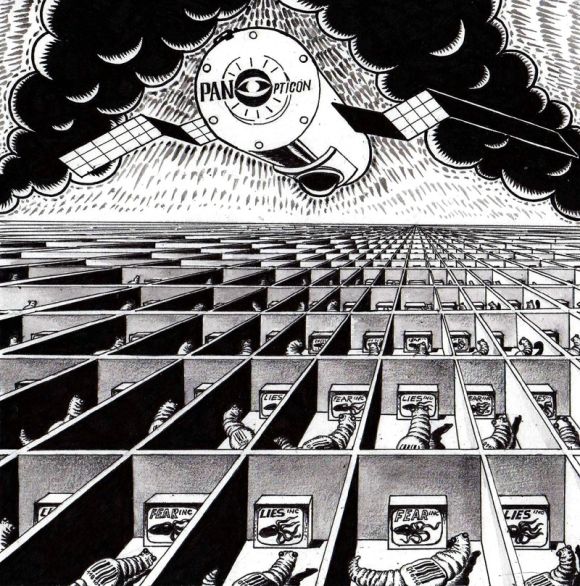
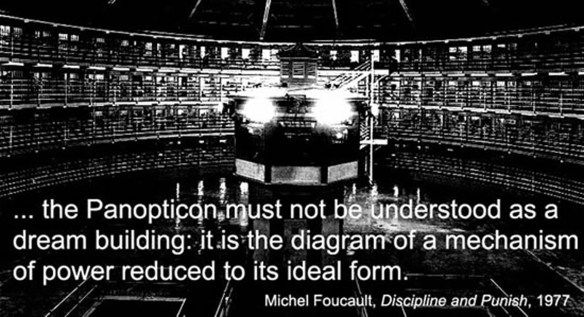
The American Police State, much like The Prisoner’s Village, is a metaphorical panopticon, a circular prison in which the inmates are monitored by a single watchman situated in a central tower. Because the inmates cannot see the watchman, they are unable to tell whether or not they are being watched at any given time and must proceed under the assumption that they are always being watched.

Eighteenth century social theorist Jeremy Bentham envisioned the panopticon prison to be a cheaper and more effective means of “obtaining power of mind over mind, in a quantity hitherto without example.”

Bentham’s panopticon, in which the prisoners are used as a source of cheap, menial labor, has become a model for the modern surveillance state in which the populace is constantly being watched, controlled and managed by the powers-that-be and funding its existence.

Nowhere to run and nowhere to hide: this is the new mantra of the architects of the police state and their corporate collaborators (Facebook, Amazon, Netflix, Google, Instagram, etc.).

Government eyes are watching you.

They see your every move: what you read, how much you spend, where you go, with whom you interact, when you wake up in the morning, what you’re watching on television and reading on the internet.

Every move you make is being monitored, mined for data, crunched, and tabulated in order to form a picture of who you are, what makes you tick, and how best to control you when and if it becomes necessary to bring you in line.

When the government sees all and knows all and has an abundance of laws to render even the most seemingly upstanding citizen a criminal and lawbreaker, then the old adage that you’ve got nothing to worry about if you’ve got nothing to hide no longer applies.

Apart from the obvious dangers posed by a government that feels justified and empowered to spy on its people and use its ever-expanding arsenal of weapons and technology to monitor and control them, we’re approaching a time in which we will be forced to choose between obeying the dictates of the government—i.e., the law, or whatever a government official deems the law to be—and maintaining our individuality, integrity and independence.

When people talk about privacy, they mistakenly assume it protects only that which is hidden behind a wall or under one’s clothing. The courts have fostered this misunderstanding with their constantly shifting delineation of what constitutes an “expectation of privacy.” And technology has furthered muddied the waters.

However, privacy is so much more than what you do or say behind locked doors. It is a way of living one’s life firm in the belief that you are the master of your life, and barring any immediate danger to another person (which is far different from the carefully crafted threats to national security the government uses to justify its actions), it’s no one’s business what you read, what you say, where you go, whom you spend your time with, and how you spend your money.

Unfortunately, George Orwell’s 1984—where “you had to live—did live, from habit that became instinct—in the assumption that every sound you made was overheard, and, except in darkness, every movement scrutinized”—has now become our reality.

We now find ourselves in the unenviable position of being monitored, managed and controlled by our technology, which answers not to us but to our government and corporate rulers.

Consider that on any given day, the average American going about his daily business will be monitored, surveilled, spied on and tracked in more than 20 different ways, by both government and corporate eyes and ears.

A byproduct of this new age in which we live, whether you’re walking through a store, driving your car, checking email, or talking to friends and family on the phone, you can be sure that some government agency, whether the NSA or some other entity, is listening in and tracking your behavior.

This doesn’t even begin to touch on the corporate trackers that monitor your purchases, web browsing, Facebook posts and other activities taking place in the cyber sphere.

Stingray devices mounted on police cars to warrantlessly track cell phones, Doppler radar devices that can detect human breathing and movement within in a home, license plate readers that can record up to 1800 license plates per minute, sidewalk and “public space” cameras coupled with facial recognition and behavior-sensing technology that lay the groundwork for police “pre-crime” programs, police body cameras that turn police officers into roving surveillance cameras, the internet of things: all of these technologies add up to a society in which there’s little room for indiscretions, imperfections, or acts of independence—especially not when the government can listen in on your phone calls, monitor your driving habits, track your movements, scrutinize your purchases and peer through the walls of your home.

As French philosopher Michel Foucault concluded in his 1975 book Discipline and Punish, “Visibility is a trap.”

This is the electronic concentration camp—the panopticon prison—the Village—in which we are now caged.

It is a prison from which there will be no escape if the government gets it way.

As Glenn Greenwald notes:

“The way things are supposed to work is that we’re supposed to know virtually everything about what [government officials] do: that’s why they’re called public servants. They’re supposed to know virtually nothing about what we do: that’s why we’re called private individuals. This dynamic – the hallmark of a healthy and free society – has been radically reversed. Now, they know everything about what we do, and are constantly building systems to know more. Meanwhile, we know less and less about what they do, as they build walls of secrecy behind which they function. That’s the imbalance that needs to come to an end. No democracy can be healthy and functional if the most consequential acts of those who wield political power are completely unknown to those to whom they are supposed to be accountable.”

Even now, the Trump Administration is working to make some of the National Security Agency’s vast spying powers permanent.

In fact, Attorney General Jeff Sessions is pushing for Congress to permanently renew Section 702 of the Foreign Intelligence Surveillance Act, which allows government snoops to warrantlessly comb through and harvest vast quantities of our communications.

And just like that, we’re back in the Village, our escape plans foiled, our future bleak.

Except this is no surprise ending: for those who haven’t been taking the escapist blue pill, who haven’t fallen for the Deep State’s phony rhetoric, who haven’t been lured in by the promise of a political savior, we never stopped being prisoners.

So how do we break out?

For starters, wake up. Resist the urge to comply.

The struggle to remain “oneself in a society increasingly obsessed with conformity to mass consumerism,” writes Steven Paul Davies, means that superficiality and image trump truth and the individual. The result is the group mind and the tyranny of mob-think.

Think for yourself. Be an individual. As McGoohan commented in 1968, “At this moment individuals are being drained of their personalities and being brainwashed into slaves… As long as people feel something, that’s the great thing. It’s when they are walking around not thinking and not feeling, that’s tough. When you get a mob like that, you can turn them into the sort of gang that Hitler had.”

In a media-dominated age in which the lines between entertainment, politics and news reporting are blurred, it is extremely difficult to distinguish fact from fiction. We are so bombarded with images, dictates, rules and punishments and stamped with numbers from the day we are born that it is a wonder we ever ponder a concept such as freedom. As McGoohan declared, “Freedom is a myth.”

In the end, as I make clear in my book Battlefield America: The War on the American People, we are all prisoners of our own mind.

In fact, it is in the mind that prisons are created for us. And in the lockdown of political correctness, it becomes extremely difficult to speak or act individually without being ostracized. Thus, so often we are forced to retreat inwardly into our minds, a prison without bars from which we cannot escape, and into the world of video games and television and the Internet.

We have come full circle from Bentham’s Panopticon to McGoohan’s Village to Huxley’s Brave New World.

As cultural theorist Neil Postman observed:

What Orwell feared were those who would ban books. What Huxley feared was that there would be no reason to ban a book, for there would be no one who wanted to read one. Orwell feared those who would deprive us of information. Huxley feared those who would give us so much that we would be reduced to passivity and egoism. Orwell feared we would become a captive audience. Huxley feared the truth would be drowned in a sea of irrelevance. Orwell feared that we would become a captive culture. Huxley feared we would become a trivial culture, preoccupied with some equivalent of the feelies, the orgy porgy, and the centrifugal bumblepuppy. As Huxley remarked in Brave New World Revisited, the civil libertarians and rationalists who are ever on the alert to oppose tyranny “failed to take into account man’s almost infinite appetite for distractions.” In Brave New World, they are controlled by inflicting pleasure. In short, Orwell feared that what we hate would ruin us. Huxley feared that what we love will ruin us.

You want to be free? Break out of the circle.

The Nunes Memo Only Partially “Vindicates” Trump, But it Fully Indicts the FBI and the FISA Court

By Thomas L. Knapp

Source: The Fifth Column

On February 2, US president Donald Trump approved public release of a memo from the US House Intelligence Committee concerning FBI malfeasance in its applications for warrants to surveil Carter Page, a former member of his campaign team.

The following day, Trump triumphantly tweeted that the memo “totally vindicates” him in the ongoing “Russiagate” probe. It doesn’t really do that — proving a negative is always difficult — but it does add a great deal of credibility to his charge that the probe is a politically driven witch hunt rather than a serious criminal investigation.

According to the memo, the FBI based the probable cause claim in its multiple surveillance applications to Foreign Intelligence Surveillance Court judge on two pieces of “evidence”:

1) A “minimally corroborated” (the FBI’s own words) dossier of political opposition research on Donald Trump, compiled by a British former spy in the pay of Trump’s political opponents; and

2) A Yahoo! News article based — although the FBI denied it — on leaks from that same foreign operative.

The memo also claims that at no point did the FBI apprise the judge of the political origins or “minimal corroboration” of the memo.

If these claims are true, then what happened was the equivalent of crazy Uncle J. Edgar going before a judge and using a picture of me with a Frisbee [TM] in the air behind me, taken by my angry ex-wife, as probable cause to believe that I’m from Mars, then asking for a warrant to search my garage for flying saucers.

As you may recall, this is the same FBI which (and the same FBI director who) amassed mountains of evidence that Trump’s opponent in the 2016 presidential election had committed multiple felonies in her grossly negligent handling of classified information as Secretary of State, yet recommended against prosecuting her because, well, she’s Hillary Clinton.

And as you may also recall, this is the same FISA court that, between 1979 and 2013 approved 35,434 warrant requests and denied 12.

How many of those 35,434 requests were backed by evidence no more substantial than that described in the Nunes memo?

How much more dumb and evidenceless did those 12 denied requests have to be to not get a pass?

And why did the same Republican Congress which just released this memo recently vote to renew Section 702 of the Foreign Intelligence Surveillance Act, giving even more expansive powers to organizations which have clearly used those powers abusively and without regard to even minimal standards of evidence?

Inquiring minds want to know.

Did Trump and/or his campaign team “collude” with the Russian government to manipulate the 2016 presidential election? I don’t know. But I do know that disguising a circus as an investigation isn’t likely  to shed real light on the matter.


Thomas L. Knapp (Twitter: @thomaslknapp) is director and senior news analyst at the William Lloyd Garrison Center for Libertarian Advocacy Journalism (thegarrisoncenter.org). He lives and works in north central Florida.

Freedom Rider: Oligarch Jeff Bezos

By Margaret Kimberley

Source: Intrepid Report

Amazon CEO Jeff Bezos has a net worth of $105 billion and is the richest man in the world. But he is not just the richest man at this moment in history. He is the richest person who has ever lived. As of 2017 he and seven other billionaires had a collective net worth equal to that of the poorest 3.6 billion people on earth.

These figures have been in the news of late but without much useful analysis. The corporate media refuse to state what is obvious. Namely that inequality is worse around the world precisely because these super rich people demand it.

While pundits and politicians go on breathlessly about oligarchs in Russia, they seldom take a look at the wealthiest in their own backyard and the control they exert over the lives of millions of people. When Amazon announced it would choose a site for its new headquarters, cities across the country began a furious race to the bottom. Amazon is not alone in the thievery department. Major corporations like Walmart always request and receive public property and public funds in order to do business.

Some 235 cities have put themselves in the running for this dubious venture. Chicago is willing to give Amazon $1.3 billion in payroll taxes that prospective employees would ordinarily pay that city. If Chicago wins this booby prize, Amazon employees would pay taxes to their employer and not to the government. This is truly cutting out the middle man and makes real the rule of, by, and for the wealthiest.

The potential for public outrage isn’t lost on unprincipled politicians. Some cities now refuse to reveal how much they plan to give away. But the news to date is disheartening with Boston offering $75 million while Houston is willing to part with $268 million. Amazon says it will hire 50,000 people but their business model already pays employees so little that many of them qualify for public assistance, despite being employed.

The United States is as much of an oligarchy as countries it usually disparages but it is far more dishonest about its true nature. All talk of democracy is a lie as the rich get richer, by an additional $1 trillion in 2017, and wield more and more power over the lives of everyone else.

The Bezos juggernaut is not restricted to theft of public money. He is also the sole owner of the Washington Post, one of the most influential newspapers in the country. Bezos owns a newspaper that is an organ of the ruling elite and he also has a $600 million contract to provide the Central Intelligence Agency with cloud computing services.

The Washington Post was the force behind Propaganda or Not, an effort to destroy left wing voices like those at Black Agenda Report. Under the guise of fighting Russia and so-called fake news, the Bezos owned Post began the censorship campaign that has put the left’s presence on the Internet in such jeopardy.

Politicians outdo one another giving away public resources to the richest man on the planet who also owns a major newspaper and services the surveillance state. If it can be said that any one person rules the world, Bezos would be obvious choice. No one in Chicago, Boston, Houston or any of the other cities giving away the store ever voted for Jeff Bezos. All talk of democracy is a sham as long as the richest people take from the rest of humanity.

The effort to make government an irrelevance is thoroughly bipartisan. Republicans and Democrats alike are willing to turn over government coffers to Bezos and his ilk and the rights of the people be damned.

Whoever wins this tarnished brass ring ought to be consigned to political defeat. The mayor, aldermen, city council members or whoever else brings disaster to their locality should be punished for aiding and abetting the theft. If these cities can give to the richest man who ever lived, they can surely use public money to help their residents right now. But they will never do that because they are all bought off and compromised. They are either cynical or afraid to go against the real rulers of the country.

Bezos may look like the villain in a James Bond movie but there is nothing funny about him. He is deadly serious and so are his intentions. In a Bezos run world, every worker will be impoverished, every level of government will subsidize corporations, and anyone who speaks out will be discredited and under surveillance.

The last thing any city needs is a new Amazon headquarters. We need an end to billionaire rule in this country and around the world. That will be the salvation of the people, not more sweatshops run by wealthy people who steal from everyone else.


Margaret Kimberley’s Freedom Rider column appears weekly in BAR, and is widely reprinted elsewhere. She maintains a frequently updated blog as well as at freedomrider.blogspot.com. Ms. Kimberley lives in New York City, and can be reached via e-Mail at Margaret.Kimberley(at)BlackAgendaReport.com.