Is the United States a Failed Society?

The facts have become too dire to ignore any longer.

By Chad Mulligan

Source: Hipcrime Vocab

I’d like to pose a question I’ve been dancing around for the last couple of postsIs the United States a failed society?

That may seem overly dramatic, but please hear me out.

Recently, it has once again come to the attention of the news media that Americans are an order of magnitude more likely to die at every age than citizens of other advanced, wealthy, industrialized nations.

This was most recently expounded by a Financial Times correspondent named John Burn-Murdoch. The article itself is paywalled, but this Twitter thread contains all the relevant information:

https://threadreaderapp.com/thread/1641799698058035200.html

It makes for sobering reading. A lot of times the discussion just focuses on total life expectancy, that is, the number on the death certificate. That’s fallen too, but not as dramatically. But life expectancy differs at various ages. Yet, what the numbers invariably show is that, at every single age Americans are more likely to die than their counterparts in other wealthy industrialized nations.

For example, one in 25 five-year-olds in the United States will not live to see their fortieth birthday. That means a lot of parents are going to have to bury their children. But at every age, whether you’re twenty-five or fifty, your chances of dying are much higher in the United States than anywhere else. By age 29, the average American is four times more likely to die than a 29 year-old in another country. I’ve heard plenty of stories from people in their twenties and thirties talking about their high-school years like military veterans recounting their service during wartime (“fifteen in my class didn’t make it out.”). And those are just ordinary citizens!

In other words, growing up in the United States is extraordinarily deadly.

In fact, the social outcomes for the average American are worse than the most socially deprived areas of the United Kingdom like Blackpool—an area synonymous with industrial decline. At every single point along the income distribution, Americans are more likely to be hurt, injured, or killed than their peers in other wealthy, developed nations.

Furthermore, these trends are exclusively confined to the United States. Even Cuba, a relatively poor country under continuous sanctions by the United States since the nineteen-sixties, now has better health outcomes (e.g. life expectancy, infant mortality, chronic diseases). So, too, does China, which has overtaken the U.S. in a number of health metrics despite being the largest country in terms of total population.

The Atlantic’s Derek Thompson has called the United States “The Rich World’s Death Trap.” He interviews John Burn-Murdock here:

The bottom line is this: in many ways, your life chances are much, much lower in the United States than in any other wealthy, industrialized nation in the world. This is simply undeniable.

Which leads me to pose the question I asked above.

Peer Countries

Because this is such a fraught topic, it’s worthwhile to get some things out of the way. Certainly your life chances in the United States are better than many other parts of the world at the moment.

Some places are run by military dictatorships like North Korea or Myanmar. Some places are in outright civil war like Syria, Libya or Sudan. Some areas are in an active shooting war like Ukraine and Russia. Some countries have huge areas of absolute deprivation like sub-Saharan Africa, India, the Philippines or Afghanistan. Some countries have lost control over parts of their territory to drug gangs like Mexico, El Salvador, Peru and Ecuador. You’re certainly better off here than in many of those other countries.

So let’s just acknowledge that right off the bat. Of course, this raises questions about just how supposedly wonderful the current state of our world actually is, but that’s a topic for another time.

But I think it’s absolutely invalid to invoke those countries as a justification for the abysmal statistics listed above. Here’s why: the United States is at the absolute apex of the global economy, and has been since World War Two. We issue the world’s reserve currency. We have more billionaires than anywhere else. We are home to the largest and most powerful corporations in the world. No country in the world is more wealthy or powerful than the United States at the present moment.

This is the concept of peer nations. Those are the ones we should be judging ourselves against. You can use a number of indicators for this. The United States is a member of both the OECD and the G-7. In fact, it is the key member of these organizations. It is at peacetime. It is an electoral democracy. It has the world’s largest GDP. It is surrounded by the world’s two largest oceans and has benign neighbors to the north and the south. It has not had a war on its home soil since the 1860s.

Simply put, the United States has more resources at its disposal and more wherewithal to tackle social problems than anywhere else in the world.

So, unlike many other countries around the world, the United States has no excuse whatsoever for the sorry state of its citizenry, and comparing the United States to non-peer countries is no more than pathetic excuse-making in the face of damning evidence that the U.S. government simply chooses to ignore burgeoning social problems and leaves the majority of its citizens to fend for themselves.

What Else Is New?

Reading these facts, I’m wondering why any of this this is news to people. As far back as 2013 I noted the following:

Americans die younger and experience more injury and illness than people in other rich nations, despite spending almost twice as much per person on health care.

That was the startling conclusion of a major report released earlier this year by the U.S. National Research Council and the Institute of Medicine. It received widespread attention. The New York Times concluded: “It is now shockingly clear that poor health is a much broader and deeper problem than past studies have suggested.”

Why Is the United States So Sick? The director of a massive new study says: “It’s almost everything.” (Slate)

Also from 2013: The Surprising Reason Americans Are Far Less Healthy Than Others in Developed Nations (Alternet)

It received widespread attention all right, and then was promptly forgotten. But even earlier, in 2012, there was this report from The Lancet:

American teenagers have the highest rates of drug and alcohol abuse in the developed world. And they are far more likely to be killed by violence than peers in Europe. This lost generation, whose unemployment rate is 20 percent, leads the modern world in some of the most dangerous and irresponsible behaviors, according to a new study released by the Lancet medical journal.

U.S. teens worst in western world for binge-drinking, drugs and violent deaths (Daily Mail)

In 2019, husband-and-wife economists Angus Deaton and Anne Case coined the term “deaths of despair,” and noted that these were exclusively confined to the United States. In 2020, they published a book chronicling their grim studies with that same title. It, too, received a brief burst of attention in the media and then promptly disappeared down the memory hole just like everything else.

So this is old news. As Burn-Murdock’s article notes, the divergence between the U.S. and its peers has been continuously growing since around 1990, and has been getting even more acute in recent years.

The above podcast touts how “rich” we are compared with other nations using metrics like dollar income. But what does a high salary even mean when you are less likely to survive than other places? What are you supposed to do with that money, anyway—fill your oversized house with crap? As the saying goes, “you can’t take it with you.” This also belies the insanely high cost of everything in America, especially housing, which leads to 70 percent of Americans feeling financially stressed according to CNBC, despite how “rich” we supposedly are. According to Brookings, 44 percent of Americans earn low wages in this allegedly “rich” country.

And, as economist Dean Baker has noted, people in many other countries choose to take their additional “income” as leisure time, which may be another reason why they are so much healthier than we are. Americans work longer hours than anyone else, and at unusual times. The United States has a lousy work culture, with much less vacation or family leave time than other countries. Americans also take less vacation, work longer days, and retire later. Citizens of other countries also don’t have to pay for as many things out of their own pocket—from transportation, to retirement, to health care—due to a misguided fear of “socialism,” making income comparisons misleading. What sense does it make to earn a lot of money if you are lonely and isolated and have no time off to enjoy it? And much of that extra income is dedicated to cushioning ourselves from the fallout of a society decaying around us and positional goods to compete with everyone else.

My question is this: if the United States is not a failed society, then by what criteria should we judge success? Are context-free income statistics, GDP, and the number of billionaires really the appropriate measure for a good society rather than the well-being of the average citizen? People like to tout America’s so-called “innovation,” but one area we don’t seem to be innovating very much in is keeping our citizens healthy and alive.

The symptoms versus the disease

The reasons given for the above statistics are the usual ones: gun violence, drug overdoses, suicides, car crashes, metabolic diseases, and lack of access to basic and preventative health care compared to other nations.

But I want to distinguish the symptoms from the disease.

In medicine, doctors are taught to separate the symptoms from the disease. If a patient is suffering from a fever, jaundice, and swelling, for example; the fever, jaundice, and swelling aren’t what is making them ill. Instead, these are all symptoms caused by the disease which the patient is afflicted with, and it is the doctor’s job to determine what the disease is from the symptoms and try to cure it.

If that is the case, then what is the disease we are suffering from in this instance? In my opinion, it is this: American society is fundamentally rotten to the core.

We have effectively restructured our entire society as a lottery. Under this system, you’re entitled to precisely nothing except what you can claw free from the impersonal market casino rigged in favor the House. American society been transformed into a brutal winner-take-all tournament in the name of “meritocracy,” and most Americans seem to be okay with that.

At every point on their hierarchy, from the highest perch to the lowest, everyone is desperately trying to maintain their current position, hyperattuned to status, fearful of falling into the abyss, clawing each other’s eyes out to hold onto their small piece of the pie in a crabs-in-a-bucket scenario. “There is no such thing as society” has been elevated from a political statement to a a central guiding tenet where it’s every man for himself and the devil take the hindmost.

While other nations at least try to look after the welfare of all of their citizens, in America if you are not rich, successful or an entrepreneur, then your life is worth nothing. If you aren’t good enough, or don’t measure up, then you deserve to suffer. We actively hate the poor and think they should die. We talk about them like animalsAverage is over. The rich get richer. Winners take all.

Cutthroat capitalism is the order of the day. Your only task when you get up every morning is to get as much of the other guy’s money as possible into your own bank account by any means necessary for the next twenty-four hours and do it all over again the next day. There is no higher purpose. “Freedom” is defined as the ability for the rich to do whatever they like to the rest of us without consequence or sanction. It’s a world of predator and prey where you can either be one or the other—there is no other option.

Unlike in other countries, in the United States the government does not exist to help its citizens; rather, its primary role is to funnel money to a series of well-connected insiders feeding at various troughs. The rest of us are on our own. No one is on your side.

In every country, you need to educate your citizenry and keep them safe and healthy. That is the most basic task of any government, anywhere. In the United States, these tasks are delegated to predatory institutions designed to extract as much money as possible so that sticky-fingered middlemen can siphon off as vast amounts to feather their nests. A small sliver of executives in finance, education and health care get obscenely rich while the rest of the population struggles and is mired in debt, assuming they can even access those services at all. As a result, Americans pay wildly inflated prices for just about everything, from health care, to education, to energy, to entertainment and telecommunications. And the system cannot be changed because those insiders and middlemen fund the political campaigns and spend billions on highly effective propaganda. The rich people at the apex cynically strip-mine society for their benefit, while there are fewer paths than ever to a middle class lifestyle for the average person.

“Everything for myself and my immediate offspring; nothing for other people,” is the pervasive ethos: “I dont want pay for someone else’s (health care, education, fill-in-the blank).” But once that attitude becomes endemic, you no longer have anything even resembling a society anymore; you have only collection of individuals fending for themselves. As the title of a post from a few years back put it“I don’t know how to explain to you that you should care about other people.”

It is a nation of sociopaths where fellow citizens are seen as either enemies or competitors. The simple warmth of human kindness has been abolished. Americans walk around in a constant state of fear and high alertness like the prey animals they have become. Or else they have the thousand-yard-stare grazing in the aisles at Walmart. I’ve mentioned before how many Americans seem to be crazed and deranged, or zonked out on drugs, and don’t know how to behave around other people or show basic decency. People seem more and more desperate. I personally have witnessed many more acts of erratic behavior and dangerous driving lately, and have heard similar stories from other people. American society seems to be under more pressure than ever before, and people are cracking up left and right. It feels like a lot of people—even the supposedly “successful” ones—have basically checked out and are simply going through the motions.

The United States is a plantation society to the core. At a basic, fundamental level, American society is not set up not to deliver a good quality of life to it citizens, but rather for a small segment of hard, hard men to get unfathomably rich beyond the dreams of avarice, with the rest of us no more than insects to be stepped on in pursuit of that goal. And if some people happen to enjoy good lives anyway under that system, well, it’s more of an unintentional side-effect than a deliberate outcome. Perhaps you’re one of those hard men (or women), or hope to be. Good for you, I guess.

So I think that’s the fundamental reason for all of the above. That’s the disease, and everything else is merely a symptom—our refusal to properly fund universal health care; our built environment designed exclusively around cars and lack of public transportation; our fat and sugar-laden diets; our overcrowded prisons; our opioid-addicted homeless; our frayed social safety nets; our violent, trigger-happy cops; our extortionate education costs; our predatory financial institutions; our refusal to build affordable housing; and our propensity to shoot one another. American society is rotten to the core.

For example, even though our weekly mass shootings make international headlines, they don’t really have that much of an impact on life expectancy when you compare them against the size of the world’s third most populous nation, despite troubling statistics like these:

Last year (2022), two people died from gun violence in the United States every hour. In 2023, there have been at least 160 mass shootings across the US so far this year. There are 120 guns for every 100 Americans. No other nation has more civilian guns than people. About 44% of US adults live in a household with a gun, and about one-third personally own one.

How US gun culture stacks up with the world (CNN)

How many US mass shootings have there been in 2023? (BBC)

But that’s not the question we should be asking. The question we should be asking is this: what does this level of gun massacres and homicidal mania say about the nature of American society itself?

What does it say about American society that so many people have to turn to alcohol, opioids and other addictive drugs just to cope?

What does it say about America that it produces so many mentally-ill and broken people?

What does it say that Americans are so much fatter and sicker than people in other countries?

What does it say that we lock up more of our citizens than anywhere else in the world?

What does it say that our Surgeon General has described an epidemic of loneliness and isolation?

Americans are prickly and thin-skinned. They can’t bear any criticism of their nation, and will absolutely lose their minds at even the implication that they do not live in the best country on earth, despite mountains of evidence to the contrary (unless you are very wealthy). They will rationalize away all of the statistics listed above. Or else they will resort to immigrants as a way to shore up their fragile egos: “Everyone wants to move here!!!” Interestingly, according to the podcast above (-14:39), U.S. immigrants seem to live about as long as anyone else in the world. Perhaps it’s because immigrant communities tend to look after each other and manage to keep the toxic, every-man-for-himself individualism of mainstream American culture at arm’s length. Too bad for the rest of us, though.

In the end, the facts speak for themselves: By the standards that actually matter for the average individual, compared to peer nations, the United States is an objective failure.

Why is it like this? Some pessimists say that it’s been like this from day one and there’s nothing we can do about it. Perhaps they’re right. But the facts tell a different story. According to the data, it’s really only since 1990 that this yawning chasm in social outcomes has opened up in between the United States and the rest of the world. During the New Deal era, for instance, these gaps didn’t exist or actually favored Americans. The United States was able to accomplish big things like building the Hoover Dam and putting a man on the moon, and people didn’t hate and fear their own government. The U.S. was perceived very differently abroad.

Here’s what I think happened. Starting in the 1970s a small group of sociopathic men at the top of the hierarchy acquired the means and the tools to reshape the United States in their own image. They founded think-tanks. They funded economics departments and political campaigns. They bought up the media. They started television networks to promote their agenda. They packed the courts. They used the latest cutting-edge psychological research and techniques that had been developed in the service of advertising to remold the society like putty in their hands. Throughout the decade of the 1980s under Reagan, their plans ultimately came to fruition, and the transformation was compete by 1990 which is why the changes became apparent after then. Ever since, we’ve been living in the society that they have created. I’m skeptical that Americans were always inherently more sociopathic and antisocial than people everywhere else—I think to a large extent we’ve been made to be this way.

So we’re all living in the end result of that. And now that it has been accomplished, we see the ugly results everywhere around us, including increasing political radicalization and strife as the failure of this vision of society is becoming increasingly apparent but we seem to be incapable of envisioning an alternative or are too fearful of change. Instead, we seem to be doubling down. I fear it’s already too late to turn things around, and this is just the way American society will be forever now and things will just continue to get worse and worse for the vast majority of us. We will remain the (not so) rich world’s death trap, permanently.

I’ll conclude with this passage which I read years ago:

If I could paint the country in one broad stroke, I would say it’s a place where one concept of freedom – used to lobby for private interests and free markets – is at odds with another kind: the ability to lead a life you enjoy. Fewer and fewer seem privileged with this second kind. Not Trayvon Martin, who was a victim of a certain kind of racism which had, as its root, private property anxiety. Not the natural gas employee who has consigned himself to a life of doing something that he feels ought not to be done. Even I – who have managed to escape from time to time – always find, upon return, a cordial invitation to fall in line.

What I learned about freedom from hitchhiking around America (The Guardian)

As the above statistics show, not only are many of us not living lives we enjoy, but increasingly more and more of us aren’t living at all.


THE BATTLE AGAINST BEWITCHMENT: UPSETTING SETTLED MINDS

By Gary Z McGee

Source: Waking Times

“Philosophical thinking that doesn’t do violence to one’s settled mind is no philosophical thinking at all.” ~Rebecca Goldstein

Comfort zones are a curious thing. So warm and secure. So safe and reassuring. So satisfying and certain. Beliefs have a similar effect on us. Especially the core beliefs that we take for granted. But beliefs are comfort zones with reinforced invulnerability; or, at least, the illusion of it.

Such reinforcements are like prison bars that most of us are not even aware of. We’re so completely indoctrinated, so utterly pre-programmed, that we don’t even know that we don’t know that we’ve been conditioned to blindly believe in something simply because enough people convinced us it was true.

The problem with reinforced comfort zones is that there is no growth. A regular comfort zone, you can stretch. A reinforced comfort zone, you’re usually not even aware it needs to be stretched. A regular comfort zone allows for trial and error, it allows for questioning, and so there is at least potential for self-improvement and self-overcoming. But a reinforced comfort zone does not allow for trial and error. It doesn’t allow for “blasphemous” questioning, because it is taken for granted as already perfect or “simply the way it is.”

Regular comfort zones can be healthy, giving us a safe haven, a place where we can heal and lick our wounds. But reinforced comfort zones are unnecessary safety nets based upon fear (of God, the Unknown, Death) placation, and self-pity. It’s a place where cognitive dissonance rules and any notion of attempting to think outside the box is met with: You simply need to have faith in the “box”.

The Battle Against Bewitchment:

Philosophy is a battle against the bewitchment of our intelligence by means of language.” ~Ludwig Wittgenstein

Self-Inflicted Philosophy is at the forefront of the battle against bewitchment. Self-inflicted philosophy is about upsetting settled minds. It’s about toppling the reinforced comfort zones of blind belief. It’s about flattening the “box” that everyone talks a big game about thinking outside of but when it really comes down to it, they cling to the “box” out of fear of the unknown or out of faith in what they believe they know.

Foremost, self-inflicted philosophy is about questioning the self to the nth degree through self-interrogation. But you can only get so far in such questioning before you are met with the reinforced comfort zone of a blind belief. So, self-inflicted philosophy is also about questioning the layer-upon-layer of cultural, political, and religious indoctrination that led to that reinforced comfort zone to begin with.

When you don the cloak of a self-inflicted philosopher, no belief, no matter how true it may seem, is off the hook for being questioned with ruthless skepticism and unwavering circumspection. In the battle against bewitchment, the destruction of a belief, no matter how powerful, is mere collateral damage to the Occam’s razor of universal truth. Hell, even “universal truth” is not beyond questioning.

When you don the cloak of a self-inflicted philosopher, the concept of belief is nixed from your interpretation of the universe. There is no place for belief here, only thought, only deep inquiry, only imaginative curiosity. You replace all usage of “belief” or “believe” with “thought” or “think”. You don’t believe that you certainly exist, you “think” that you “probably” exist. But you could be wrong. So you remain circumspect, for even your interpretation of your own existence could be an illusion, no matter how “true” it may feel.

There will be those who will say, “You are merely believing that you don’t believe.” But that is patently false, because you are not “believing” in non-belief, you are “thinking/inquiring/imagining” through non-belief, with the understanding, the flexibility that your thinking “could” be wrong. And that’s the rub: it is much easier to alter a thought than a belief. It is almost impossible to alter a belief. You are more likely to question a thought than you are a belief. And so, rather than get trapped in a reinforced comfort zone, you stay ahead of the curve by thinking rather than believing, and then by questioning what you think so that you don’t accidentally begin to believe it.

In the spirit of upsetting settled minds, you don’t believe in having an unsettled mind, you think that having an unsettled mind is more productive, more progressive, and more open-minded than having a settled mind (an unquestioning belief). You realize that belief in general is counterproductive, because you understand that the human mind is a delusion-generator rather than a truth-generator. It pumps out delusions like a spider pumps out webs. But, unlike the spider, it tends to get caught in them. Thereby, you understand that the only window to truth is through a questioning, circumspect, and a skeptical mindset, rather than through an unquestioning, dogmatic, and certain mindset.

The only solution to a delusion-generator is a question-generator. Luckily, the human brain is both. As a self-inflicted philosopher, you don’t believe that this is certainly true; rather, you think that this is probably true. And you’re willing to question everything to “prove” it. Indeed, you’ve transformed Descartes’ “I think therefore I am” into I think, therefore I question.

Tapping into the question-generator:

“It is far better to grasp the universe as it really is than to persist in delusion, however satisfying and reassuring.” ~Carl Sagan

The problem with the human brain is that is never knows when it has been duped by a delusion, so it is almost always better to not believe anything just in case it’s a delusion. A kind of reverse Pascal’s Wager. It’s almost always better to, as Aristotle suggested, “entertain a thought without accepting it.” Just take it all into consideration and let it pass through the sieve of probability. Then, whatever doesn’t insult your soul, think about it, dissect it, inquire about it. Be curious about it. Just don’t make the mistake of believing it.

You are more likely to grasp the universe “as it really is” by questioning it than by believing it. You don’t believe the universe is certainly a certain way; rather, you think the universe may be a certain way, but you’re willing to question further so as to get you closer to the way the universe “really is”. If you cling to a particular belief of how the universe is, then you block yourself from ever getting closer to the universe “as it really is.” Better to simply not have a belief in the first place. Better to simply think and keep the motor running on the question-generator so as to keep the delusion-generator in check.

The opposite of belief is neither disbelief nor doubt, but clarity of a thought. Without beliefs reinforcing the comfort zone, you are liberated to stretch it. You are clear enough to think outside it, you are courageous enough to question it. When the reinforcements fall away, the comfort zone becomes a sacred rather than stagnant place. It is free to grow through self-improvement rather than remain stuck in self-reassurance. Indeed, without beliefs cluttering the mindset, you’re finally able to drop the “set” and move into “mind.”

Free of the “mindset” of a settled mind, you move into the mindfulness of a questioning mind. You become a walking, talking, question-generator, able to consistently counter-balance the delusion-generator of the human condition. You’re ahead of the curve, surfing Aslam’s Infinite Circle on the surfboard of Occam’s razor. In absolute awe over the beautiful unfolding of an ultimately unknowable universe. On the edge of your own curiosity, questioning all “answers” countering all beliefs, elusive of all delusions. You’re a self-inflicted philosopher, and not even God is safe from your ruthless inquiry.

Democracy Rising 28: AI, Gossip, and Our Epistemological Crisis

By Tom Prugh

Source: resilience

The other day I joined the rush to explore ChatGPT, signing up at the OpenAI website. I gave it my full legal name and correct birth date, and asked it to pretend I had died and to write my obituary. The result was 300 words describing a somewhat boring paragon of a man.

Except maybe for the boring part, I am not that man, much less that paragon.

The obit wasn’t completely wrong, but it did nothing to undermine ChatGPT’s reputation for “uneven factual accuracy.” It said I was born in Ohio (true), but in Cleveland (false) in 1957 (false). It said I was a “committed environmentalist” (true; I worked for the late lamented Worldwatch Institute for the best part of my career), and that I was an active member of “several environmental organizations” (somewhat true, off and on). It described me as an “avid cyclist” (kind of true, but the last time I did a century ride was 1987).

So much for the hits. The misses include accounts of me as:

  • A “devoted husband” to my wife of 40 years, Mary (my marriage, to a fine woman not named Mary, lasted 26 years) and a “loving father” to two children (one, in fact)
  • A “brilliant engineer” with a degree in electrical engineering from Ohio State University who worked for Boeing, General Electric, and SpaceX (wrong on all counts)
  • Someone who “was instrumental in the development of several renewable energy projects” (my wife and I put a few solar panels on our garage roof, but that’s it)
  • An “active member” of a church who spent “many hours volunteering at the food bank” (I am neither very religious nor, it shames me to admit, very generous with my personal time)

The obituary proclaimed that my “death” had “left a deep void in the lives of his family, friends, and colleagues” and that I would be “deeply missed by all who knew him.” Well, that would be gratifying—if there is a me to be gratified—but I’ll settle for a drunken wake where somebody plays “Won’t Get Fooled Again.”

Maybe everyone should try this. You too might be amused and/or appalled by the plausible distortions and lies a quasi-intelligent computer program can gin up by accessing the petabytes of data (“data”?) on the Internet—accounts of people and events that are bogus but increasingly, and seamlessly, hard to tell  from reality.

I am not a tech nerd and my grasp of what ChatGPT does is rudimentary. But I find it disturbing that this expression of artificial intelligence will instantly fabricate a profile and populate it with—not questions, or blanks to be filled in—but invented factoids tailored to fit a particular format. And this reservation isn’t just me being PO’d about my obit (I’m actually grateful my Internet footprint isn’t bigger); prominent tech geeks also have misgivings. Here’s Farhad Manjoo, for instance:

ChatGPT and other chatbots are known to make stuff up or otherwise spew out incorrect information. They’re also black boxes. Not even ChatGPT’s creators fully know why it suggests some ideas over others, or which way its biases run, or the myriad other ways it may screw up.  …[T]hink of ChatGPT as a semi-reliable source.

Likewise Twitter and other social media, whose flaws and dangers are well known by now, and feared by some of the experts who know them best. The most recent book from revered tech guru and virtual reality pioneer Jaron Lanier is called Ten Arguments for Deleting Your Social Media Accounts Right Now. Chapter titles include “Quitting Social Media Is the Most Finely Targeted Way to Resist the Insanity of Our Time,” “Social Media Is Making You into an Asshole,” “Social Media Is Undermining Truth,” and “Social Media Is Making Politics Impossible.”

About those politics: ChatGPT and its successors and rivals, whatever their virtues, are the latest agents in the corruption of the public sphere by digital technology, threatening to extend and deepen the misinformation, fabulism, and division stoked by Twitter and other digital media. Once again, a powerful new technology is out the door and running wild while society and regulators struggle to understand and tame it.

It’s hard to see how this can end well.

An earlier post in this series (DR5) looked at recent archaeological evidence suggesting that humans have explored lots of different means of governing ourselves over the last several thousand years. Eventually, for several reasons, we seem to have ended up with large, top-down, hierarchical organizations. These have lots of problems that won’t be reviewed here, but neuroscientist and philosopher Eric Hoel argues that at least they freed us from the “gossip trap.”

Hoel thinks the main reason small prehistoric human groups didn’t evolve hierarchical governing systems is because of “raw social power,” i.e., gossip:

[Y]ou don’t need a formal chief, nor an official council, nor laws or judges. You just need popular people and unpopular people.

After all, who sits with who is something that comes incredibly naturally to humans—it is our point of greatest anxiety and subject to our constant management. This is extremely similar to the grooming hierarchies of primates, and, presumably, our hominid ancestors.

“So,” Hoel says, “50,000 BC might be a little more like a high school than anything else.”

Hoel believes that raw social power was a major obstacle to cultural development for tens of thousands of years. When civilization did finally arise, it created “a superstructure that levels leveling mechanisms, freeing us from the gossip trap.”

But now, Hoel says, the explosion of digital media and their functions have resurrected it:

[I]f we lived in a gossip trap for the majority of our existence as humans, then what would it be, mentally, to atavistically return to that gossip trap?

Well, it sure would look a lot like Twitter.

I’m serious. It would look a lot like Twitter. For it’s on social media that gossip and social manipulation are unbounded, infinitely transmittable.

…Of course we gravitate to cancel culture—it’s our innate evolved form of government.

Allowing the gossip trap to resume its influence on human affairs—and turbocharging it the way digital media are doing—seems like a terrible way to run a PTA or a garden club, let alone a community or a nation.

The industrialization of made-to-order opinions, “facts,” and “data” via AI and social media, despite efforts to harness them for constructive ends, is plunging us into an epistemological crisis: “How do you know?” is becoming the most fraught question of our time. T.S. Eliot said that “humankind cannot bear very much reality,” but now we are well into an era when we can’t even tell what it is—or in which we simply make it up to please ourselves. The more convincing these applications become, the less anchored we are to the “fact-based” world.

We’ve struggled with this for centuries. Deception is built into nature as an evolutionary strategy, and humans are pretty good at it, both individually and at scale by means of propaganda, advertising, public relations, and spin. These all prey on human social and cognitive vulnerabilities (see DR4).

Humans can only perceive the world partially and indirectly. It starts with our senses, which ignore all but a tiny fraction of the vast amount of data that’s out there. (Sight, for instance, captures only a sliver of the electromagnetic spectrum.) In addition, we’re social creatures and our perceptions of what’s real are powerfully shaped by other people. And now comes the digital mediation of inputs, in which information and data come from the ether via often faceless and anonymous sources and are cloaked or manipulated in ways we may never detect or suspect.

Digital media curate our information about reality, like all media do. But things have changed in the last few decades, and especially in the last few years. It’s been only a generation or so since the old days when Walter, or Chet and David, or any of hundreds of daily newspapers told us what was going on in the world. In those days the curation was handled by a relatively small number of individuals with high profiles. We knew, or could learn, something about who they were and where their biases lay. They were professionals, which also counted for something. There’s no perfect system and this one wasn’t either, but its chain of information custody was a far cry from the distant, anonymized, chat-botted, and algorithm-driven inputs flooding the public sphere now.

One liberal pundit recently noted that the increasing ideological specialization of media outlets “compels customers who care about getting a full and nuanced picture not to buy from just one merchant … .” That’s good advice. But you don’t have to force yourself, teeth clenched, to watch Fox News or MSNBC to get a different point of view; just sit down with your neighbors for a civil chat. In fact, getting away from our TVs and into a room with other people now and then would be good for all of us.

This being a blog about deliberative democracy, I default to deliberation in response to many of our political ills. Deliberation can’t fix everything, and no doubt we will get fooled again—but the tools of democratic deliberation can be used to mitigate the seemingly ubiquitous attempts at manipulation and deceit that surround us. Humans have struggled for a long time to build institutions to check our worst tendencies and have had some success. Digitally mediated information poses a fresh threat and we need institutions to meet these new circumstances.

Deliberative settings built for shaping community action should be among those new institutions. At the very least, they will outperform the social processes seen in high school cafeterias. The methods and structures of deliberative democracy can shorten the chain of information custody as well as restore and nurture the direct human presence of neighbors and fellow citizens: they’re sitting around the same table, and you will see them later at the local school or grocery store. Like them or not (or vice versa), they remain a potent element of our daily lives—a source of influence that can work for good or ill. Deliberation channels normal human interactions in ways that can benefit the community, help check the kinds of fantasist catastrophes so prevalent in digital media, and ground our perceptions of reality in the shared concerns of a community of people who may be less than friends but far more than strangers.

Earth’s Ultimate War: A Battle to Control the Noosphere

By Phil Butler

Source: New Eastern Outlook

You feel it, don’t you? There’s something deeply wrong with our world. And I don’t refer to the planet’s geosphere. I mean, there’s something deadly wrong with society overall, and the ways in which we interact and react. Something is coming, and many understand what it is.

“We are like people under [a] sentence of death, waiting for the date to be set. We sense that something is about to happen. We know that things cannot go on as they are. History has reached an impasse. We are now on a collision course. Something is about to give.” – Reverend Billy Graham

A few years ago, I wrote a report on NEO entitled “Vladimir Putin’s Third Way: As Seen Through the Nooscope.” The piece covered Mr. Putin’s “Third Way” of governance, and a stunning invention by his now chief of staff Anton Vaino. The invention, the Nooscope was reportedly a device capable of measuring the noosphere, or the highest stage of biospheric development, that of humankind’s rational activities. And through the measurement of humanity’s activities, along with the use of advanced artificial intelligence (AI), the Russian leadership seemed to be seeking a new order not simply of which countries have a say so, but a system that could elevate humanity to its next logical level.

At first, the western academic and journalistic communities exhibited acute curiosity mixed with tongue in cheek skepticism such as is always leveled at Russian ideas. Then, of course, a maze of misinterpretations and distractive propaganda campaigns buried Putin’s ideas, and the probability that our collective conscious and energy can be measured for good. Sure, Google, Amazon, and a hundred other entities powered by Big and Minute data operate such measurements for profit, day in and day out. But those pesky Russians using advanced thinking and algorithms to fix humanity’s woes! This kind of idea had to be branded ridiculous propaganda. But is it?

Let’s remember that it was Plato who predicted that Noocracy was humanity’s future political system. The philosopher also claimed that Democracy (“the authority of the crowd”) and other forms of governance would eventually be replaced by a system such as that Vladimir Putin has suggested. So-called “Russia experts” scoff at the noosphere as a part of Russian Cosmism. However, a Rand Corporation report in 2020 acknowledge the developing noosphere, and made recommendations for the United States to considered adapting U.S. grand strategy to the information age—noopolitik, which favors the use of “soft power”—as a successor to realpolitik, with its emphasis on “hard power.” So, the bastardization of Mr. Putin’s “Third Way” concepts by the likes of the Brookings Institute and authors Clifford G. Gaddy and Barry W. Ickes (2009),

The theories of Pierre Teilhard de Chardin and Édouard Le Roy, who were the practical co-founders of the noosphere, in the early 1900s dealt with a noosphere wrapping Earth as a progression of the teleological character of evolution. Or, for lack of a better description, a result of an overarching “goal-directed evolution.”

Another report I completed that was never published deals with what I believe Putin has been working on. His “Third Way” and nooscope experiments having been put on hold by a new Cold War these days, is for purpose, I believe. There are those in the west who would welcome a new and more successful way of governance. And, there are those who are terrified that the Nooscope/Noosphere project will put an end to their engine of power. The latter group are certainly not attempting to halt the development of the noosphere, but they are trying to ensure it is the west that harnesses it for their purposes. This is one reason you see the western tech giants “all in” to try and censor the opposing side. Anyone who disagrees with the liberal order now, is an enemy of “the state.” As evidence, consider, that NASA and Cisco are currently collaborating on something called the Planetary Skin Insitute, a cousin or competitor to the Nooscope.

Putin’s “Third Way,” what an intriguing and potentially game changing thing! After having written about Russia’s emergence for a decade now, I continually recall what a speech V.V. Putin wrote an editorial for a German newspaper concerning his much-maligned Lisbon to Vladivostok proposed unified market. The quote below is from Putin’s editorial:

“We propose the creation of a harmonious economic community stretching from Lisbon to Vladivostok. In the future, we could even consider a free trade zone or even more advanced forms of economic integration. The result would be a unified continental market with a capacity worth trillions of euros.”

This was 2010, and the notion scared the hell out of everybody at the World Economic Forum, including the janitor. It was at about this time that the hierarchy decided that Putin and Russia as the boy from Leningrad envisioned it, must go. And here we are, witnessing a proxy war with one purpose, to tear a deep crevice in between Europe and Asia. The situation is a bit like the space race back in the late 1950s and early 1960s. Washington and the old gang in London cannot have the Russians controlling this evolved human potential. If anyone is going to take advantage of this noosphere, it’s going to be the same elites who dumbed our schoolchildren down to iPhone troglodytes.

Read the chapter Getting Back on Track Through Noopolitik, in the Rand report. It’s not a recommendation for the planet, but one for the deep state that currently has a former US president on trial to keep him out of office. You see, the liberal order is already manipulating the noosphere through owned media, academia, and government. To these people the sphere of human consciousness hugging our globe needs to be seeded with the “right” ideas. They seek to transform us, to evolve earth into the same slave planet it’s always been, only more efficient. It’s evil. A modern version of the worst parts of the Bible. The Matrix movie or 1984, take your pick.

We have to stop them. Or, wait until Jesus comes back.

America’s empire is bankrupt

The dollar is finally being dethroned

Credit: JOEL PETT

By John Michael Greer

Source: UnHerd

Let’s start with the basics. Roughly 5% of the human race currently live in the United States of America. That very small fraction of humanity, until quite recently, enjoyed about a third of the world’s energy resources and manufactured products and about a quarter of its raw materials. This didn’t happen because nobody else wanted these things, or because the US manufactured and sold something so enticing that the rest of the world eagerly handed over its wealth in exchange. It happened because, as the dominant nation, the US imposed unbalanced patterns of exchange on the rest of the world, and these funnelled a disproportionate share of the planet’s wealth to itself.

There’s nothing new about this sort of arrangement. In its day, the British Empire controlled an even larger share of the planet’s wealth, and the Spanish Empire played a comparable role further back. Before then, there were other empires, though limits to transport technologies meant that their reach wasn’t as large. Nor, by the way, was any of this an invention of people with light-coloured skin. Mighty empires flourished in Asia and Africa when the peoples of Europe lived in thatched-roofed mud huts. Empires rise whenever a nation becomes powerful enough to dominate other nations and drain them of wealth. They’ve thrived as far back as records go and they’ll doubtless thrive for as long as human civilisations exist.

America’s empire came into being in the wake of the collapse of the British Empire, during the fratricidal European wars of the early 20th century. Throughout those bitter years, the role of global hegemon was up for grabs, and by 1930 or so it was pretty clear that Germany, the Soviet Union or the US would end up taking the prize. In the usual way, two contenders joined forces to squeeze out the third, and then the victors went at each other, carving out competing spheres of influence until one collapsed. When the Soviet Union imploded in 1991, the US emerged as the last empire standing.

Francis Fukuyama insisted in a 1989 essay that having won the top slot, the US was destined to stay there forever. He was, of course, wrong, but then he was a Hegelian and couldn’t help it. (If a follower of Hegel tells you the sky is blue, go look.) The ascendancy of one empire guarantees that other aspirants for the same status will begin sharpening their knives. They’ll get to use them, too, because empires invariably wreck themselves: over time, the economic and social consequences of empire destroy the conditions that make empire possible. That can happen quickly or slowly, depending on the mechanism that each empire uses to extract wealth from its subject nations.

The mechanism the US used for this latter purpose was ingenious but even more short-term than most. In simple terms, the US imposed a series of arrangements on most other nations that guaranteed the lion’s share of international trade would use US dollars as the medium of exchange, and saw to it that an ever-expanding share of world economic activity required international trade. (That’s what all that gabble about “globalisation” meant in practice.) This allowed the US government to manufacture dollars out of thin air by way of gargantuan budget deficits, so that US interests could use those dollars to buy up vast amounts of the world’s wealth. Since the excess dollars got scooped up by overseas central banks and business firms, which needed them for their own foreign trade, inflation stayed under control while the wealthy classes in the US profited mightily.

The problem with this scheme is the same difficulty faced by all Ponzi schemes, which is that, sooner or later, you run out of suckers to draw in. This happened not long after the turn of the millennium, and along with other factors — notably the peaking of global conventional petroleum production — it led to the financial crisis of 2008-2010. Since 2010 the US has been lurching from one crisis to another. This is not accidental. The wealth pump that kept the US at the top of the global pyramid has been sputtering as a growing number of nations have found ways to keep a larger share of their own wealth by expanding their domestic markets and raising the kind of trade barriers the US used before 1945 to build its own economy. The one question left is how soon the pump will start to fail altogether.

When Russia launched its invasion of Ukraine in February 2022, the US and its allies responded not with military force but with punitive economic sanctions, which were expected to cripple the Russian economy and force Russia to its knees. Apparently, nobody in Washington considered the possibility that other nations with an interest in undercutting the US empire might have something to say about that. Of course, that’s what happened. China, which has the largest economy on Earth in purchasing-power terms, extended a middle finger in the direction of Washington and upped its imports of Russian oil, gas, grain and other products. So did India, currently the third-largest economy on Earth in the same terms; as did more than 100 other countries.

Then there’s Iran, which most Americans are impressively stupid about. Iran is the 17th largest nation in the world, more than twice the size of Texas and even more richly stocked with oil and natural gas. It’s also a booming industrial power. It has a thriving automobile industry, for example, and builds and launches its own orbital satellites. It’s been dealing with severe US sanctions since not long after the Shah fell in 1978, so it’s a safe bet that the Iranian government and industrial sector know every imaginable trick for getting around those sanctions.

Right after the start of the Ukraine war, Russia and Iran suddenly started inking trade deals to Iran’s great benefit. Clearly, one part of the quid pro quo was that the Iranians passed on their hard-earned knowledge about how to dodge sanctions to an attentive audience of Russian officials. With a little help from China, India and most of the rest of humanity, the total failure of the sanctions followed in short order. Today, the sanctions are hurting the US and Europe, not Russia, but the US leadership has wedged itself into a position from which it can’t back down. This may go a long way towards explaining why the Russian campaign in Ukraine has been so leisurely. The Russians have no reason to hurry. They know that time is not on the side of the US.

For many decades now, the threat of being cut out of international trade by US sanctions was the big stick Washington used to threaten unruly nations that weren’t small enough for a US invasion or fragile enough for a CIA-backed regime-change operation. Over the last year, that big stick turned out to be made of balsa wood and snapped off in Joe Biden’s hand. As a result, all over the world, nations that thought they had no choice but to use dollars in their foreign trade are switching over to their own currencies, or to the currencies of rising powers. The US dollar’s day as the global medium of exchange is thus ending.

It’s been interesting to watch economic pundits reacting to this. As you might expect, quite a few of them simply deny that it’s happening — after all, economic statistics from previous years don’t show it yet, Some others have pointed out that no other currency is ready to take on the dollar’s role; this is true, but irrelevant. When the British pound lost a similar role in the early years of the Great Depression, no other currency was ready to take on its role either. It wasn’t until 1970 or so that the US dollar finished settling into place as the currency of global trade. In the interval, international trade lurched along awkwardly using whatever currencies or commodity swaps the trading partners could settle on: that is to say, the same situation that’s taking shape around us in the free-for-all of global trade that will define the post-dollar era.

One of the interesting consequences of the shift now under way is a reversion to the mean of global wealth distribution. Until the era of European global empire, the economic heart of the world was in east and south Asia. India and China were the richest countries on the planet, and a glittering necklace of other wealthy states from Iran to Japan filled in the picture. To this day, most of the human population is found in the same part of the world. The great age of European conquest temporarily diverted much of that wealth to Europe, impoverishing Asia in the process. That condition began to break down with the collapse of European colonial empires in the decade following the Second World War, but some of the same arrangements were propped up by the US thereafter. Now those are coming apart, and Asia is rising. By next year, four of the five largest economies on the planet in terms of purchasing power parity will be Asian. The fifth is the US, and it may not be in that list for much longer.

In short, America is bankrupt. Our governments from the federal level down, our big corporations and a very large number of our well-off citizens have run up gargantuan debts, which can only be serviced given direct or indirect access to the flows of unearned wealth the US extracted from the rest of the planet. Those debts cannot be paid off, and many of them can’t even be serviced for much longer. The only options are defaulting on them or inflating them out of existence, and in either case, arrangements based on familiar levels of expenditure will no longer be possible. Since the arrangements in question include most of what counts as an ordinary lifestyle in today’s US, the impact of their dissolution will be severe.

In effect, the 5% of us in this country are going to have to go back to living the way we did before 1945. If we still had the factories, the trained workforce, the abundant natural resources and the thrifty habits we had back then, that would have been a wrenching transition but not a debacle. The difficulty, of course, is that we don’t have those things anymore. The factories were shut down in the offshoring craze of the Seventies and Eighties, when the imperial economy slammed into overdrive, and the trained workforce was handed over to malign neglect.

We’ve still got some of the natural resources, but nothing like what we once had. The thrifty habits? Those went whistling down the wind a long time ago. In the late stages of an empire, exploiting flows of unearned wealth from abroad is far more profitable than trying to produce wealth at home, and most people direct their efforts accordingly. That’s how you end up with the typical late-imperial economy, with a governing class that flaunts fantastic levels of paper wealth, a parasite class of hangers-on that thrive by catering to the very rich or staffing the baroque bureaucratic systems that permeate public and private life, and the vast majority of the population impoverished, sullen, and unwilling to lift a finger to save their soi-disant betters from the consequences of their own actions.

The good news is that there’s a solution to all this. The bad news is that it’s going to take a couple of decades of serious turmoil to get there. The solution is that the US economy will retool itself to produce earned wealth in the form of real goods and non-financial services. That’ll happen inevitably as the flows of unearned wealth falter, foreign goods become unaffordable to most Americans, and it becomes profitable to produce things here in the US again. The difficulty, of course, is that most of a century of economic and political choices meant to support our former imperial project are going to have to be undone.

The most obvious example? The metastatic bloat of government, corporate and non-profit managerial jobs in American life. That’s a sensible move in an age of empire, as it funnels money into the consumer economy, which provides what jobs exist for the impoverished classes. Public and private offices alike teem with legions of office workers whose labour contributes nothing to national prosperity but whose pay cheques prop up the consumer sector. That bubble is already losing air. It’s indicative that Elon Musk, after his takeover of Twitter, fired some 80% of that company’s staff; other huge internet combines are pruning their workforce in the same way, though not yet to the same degree.

The recent hullaballoo about artificial intelligence is helping to amplify the same trend. Behind the chatbots are programs called large language models (LLMs), which are very good at imitating the more predictable uses of human language. A very large number of office jobs these days spend most of their time producing texts that fall into that category: contracts, legal briefs, press releases, media stories and so on. Those jobs are going away. Computer coding is even more amenable to LLM production, so you can kiss a great many software jobs goodbye as well. Any other form of economic activity that involves assembling predictable sequences of symbols is facing the same crunch. A recent paper by Goldman Sachs estimates that something like 300 million jobs across the industrial world will be wholly or partly replaced by LLMs in the years immediately ahead.

Another technology with similar results is CGI image creation. Levi’s announced not long ago that all its future catalogues and advertising will use CGI images instead of highly-paid models and photographers. Expect the same thing to spread generally. Oh, and Hollywood’s next. We’re not too far from the point at which a program can harvest all the footage of Marilyn Monroe from her films, and use that to generate new Marilyn Monroe movies for a tiny fraction of what it costs to hire living actors, camera crews and the rest. The result will be a drastic decrease in high-paying jobs across a broad swathe of the economy.

The outcome of all this? Well, one lot of pundits will insist at the top of their lungs that nothing will change in any way that matters, and another lot will start shrieking that the apocalypse is upon us. Those are the only two options our collective imagination can process these days. Of course, neither of those things will actually happen.

What will happen instead is that the middle and upper-middle classes in the US, and in many other countries, will face the same kind of slow demolition that swept over the working classes of those same countries in the late 20th century. Layoffs, corporate bankruptcies, declining salaries and benefits, and the latest high-tech version of NO HELP WANTED signs will follow one another at irregular intervals. All the businesses that make money catering to these same classes will lose their incomes as well, a piece at a time. Communities will hollow out the way the factory towns of America’s Rust Belt and the English Midlands did half a century ago, but this time it will be the turn of upscale suburbs and fashionable urban neighbourhoods to collapse as the income streams that supported them disappear.

This is not going to be a fast process. The US dollar is losing its place as the universal medium of foreign trade, but it will still be used by some countries for years to come. The unravelling of the arrangements that direct unearned wealth to the US will go a little faster, but that will still take time. The collapse of the cubicle class and the gutting of the suburbs will unfold over decades. That’s the way changes of this kind play out.

As for what people can do in response this late in the game, I refer to a post I made on The Archdruid Report in 2012 titled “Collapse Now and Avoid the Rush”. In that post I pointed out that the unravelling of the American economy, and the broader project of industrial civilisation, was picking up speed around us, and those who wanted to get ready for it needed to start preparing soon by cutting their expenses, getting out of debt, and picking up the skills needed to produce goods and services for people rather than the corporate machine. I’m glad to say that some people did these things, but a great many others rolled their eyes, or made earnest resolutions to do something as soon as things were more convenient, which they never were.

Over the years that followed I repeated that warning and then moved on to other themes, since there really wasn’t much point to harping on about the approaching mess when the time to act had slipped away. Those who made preparations in time will weather the approaching mess as well as anyone can. Those who didn’t? The rush is here. I’m sorry to say that whatever you try, it’s likely that there’ll be plenty of other frantic people trying to do the same thing. You might still get lucky, but it’s going to be a hard row to hoe.

Mind you, I expect some people to take a different tack. In the months before a prediction of mine comes true, I reliably field a flurry of comments insisting that I’m too rigid and dogmatic in my views about the future, that I need to be more open-minded about alternative possibilities, that wonderful futures are still in reach, and so on. I got that in 2008 just before the real estate bubble started to go bust, as I’d predicted, and I also got it in 2010 just before the price of oil peaked and started to slide, as I’d also predicted, taking the peak oil movement with it. I’ve started to field the same sort of criticism once again.

We are dancing on the brink of a long slippery slope into an unwelcome new reality. I’d encourage readers in America and its close allies to brace themselves for a couple of decades of wrenching economic, social, and political turmoil. Those elsewhere will have an easier time of it, but it’s still going to be a wild ride before the rubble stops bouncing, and new social, economic, and political arrangements get patched together out of the wreckage.

Being a Radical Has Led Me to Sometimes Live a Double Life

Is that a good thing?

By Mickey Z.

Source: Dissident Voice

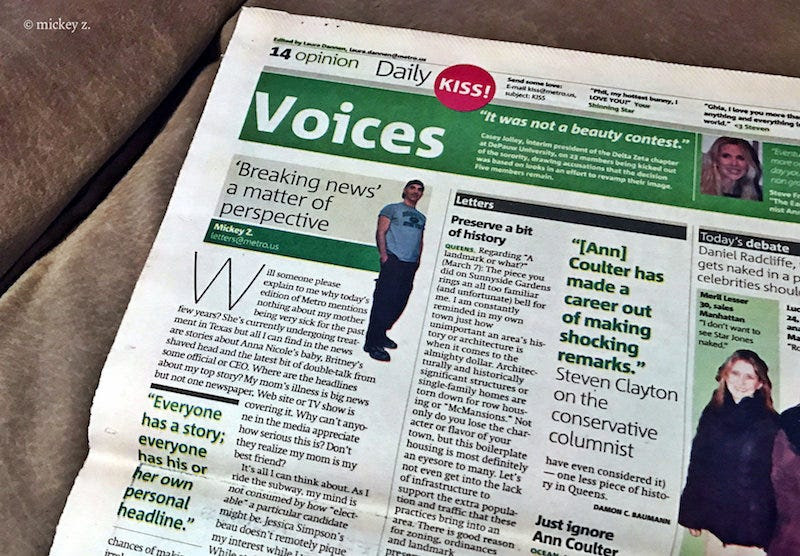
Throughout the 2000s, you’d find me regularly riding NYC’s subways during the very early morning hours — specifically from Queens into Manhattan — to work with personal training clients in gyms. In fact, right up to the plandemic, I was still training a couple of clients in their homes.

On those subway rides, I’d sometimes grab a copy of Metro — one of NYC’s free newspapers delivering a daily dose of corporate media propaganda. However, there was a brief period of time when Metro would allow some subversive voices into the mix. That included yours truly.

From about 2004 to 2007, Metro went through a phase of paying edgy freelancers so I jumped in with both feet. This even included an author photo shoot!

Thus, for a couple of years, my decidedly non-mainstream perspective — and my decidedly non-mainstream photo (wearing a “dumpster diving team” t-shirt, no less) — were on display for millions of New Yorkers to peruse during their morning ride to work or school (see image up top).

As someone who can remember when newspaper columnists held sway in my hometown, let me tell you, it was pretty cool to be jammed into a crowded subway car next to someone reading my latest article.

I’ll never know how many New Yorkers read my Metro columns. To the best of my knowledge, none of my affluent clients saw my column or photo (probably because none of them would ever ride the subway).

Over the years, I did make a select few clients aware of my double life (a couple have even bought my books and attended my talks). But, since many of them were wealthy and mainstream, I typically chose not to divulge anything about my radical writing.

As a result, I sometimes found myself making up elaborate fabrications to account for why I wouldn’t be around for a day or two when, for example, I just so happened to be heading up to MIT to lecture on US foreign policy in 2003.

Yep, this high school grad addressed a huge audience there on the topic of Henry Kissinger and the 1973 Chilean coup on a Monday night… and by Wednesday morning, was back in the gym — working with dumbbells (insert rimshot here).

Looking back now, I ponder my strategy of keeping a big part of myself a secret in the name of maintaining personal trainer income. Why was I so sure that wealthy capitalists would shun me and maybe fire me as their trainer if they encountered my radical mindset?

Perhaps a better question: What did it do to me emotionally to hide something that’s always been very important to me?

I contemplate questions like this now because, well… it’s never too late. I may not have affluent gym clients anymore. But, in Covid-era NYC, I have plenty of others around whom I could start speaking far more openly.

After all, it’s not like I can’t point to cases from the 2000s when my double life was exposed and things went well.

For example, I trained three high-powered lawyers at their high-powered law firm’s gym. This arrangement required me to check in with the doorman — or was he a concierge? (It’s funny to me that I might insult a concierge by calling him a doorman.) Anyway, doormen display one of three basic behavior patterns towards personal trainers.

The first and most common is indifference (we’re used to that). Secondly, they relate to us as fellow blue-collar common people saddled with the same fate: serving the well-heeled. Lastly, in a futile attempt to align themselves with a winner, some doormen openly look down their noses at us.

This was definitely the case at the law firm until a certain concierge saw my handsome face staring back at him from the pages of Metro.

The guy was completely flabbergasted when he read a little something of mine called “Re-Examining Rumsfeld’s Ratio” (which talked about, among other things, the United States unselfconsciously using “Apache” helicopters to quell “ethnic cleansing”).

A political junkie, the concierge now saw me as an “expert” and fell all over himself to shake my hand and introduce himself.

My new best friend could not get enough of me and it became the new norm for him to quiz me about current events before and after my training sessions.

One morning, as I was passing through the lobby, he called me over and pulled out a legal pad. Believe it or not, he had written a page or two of notes to remember all the things he wanted to ask me!

Yeah, just another tricky day in the life of a muscular militant… 

In 2001-2, I worked evenings in a corporate gym (cue the shame and self-loathing) in midtown Manhattan. One night, I was wearing a Yankees t-shirt with the name “Justice” emblazoned on the back (for former Yank David Justice).

A woman named Mary, probably in her late 60s, asked me if I was a Yankee fan. I told her my real reason for wearing the shirt was all about the word “justice.” She smiled and declared that justice was a “noble idea.”

I braced myself for the inevitable “we need to show those towel heads some justice,” (remember, this was early post-9/11 NYC) but instead, Mary told me — albeit in a stage whisper — she was soon going to DC to march against the impending US invasion of Iraq.

After this confession, Mary looked genuinely nervous. Her facial expression seemed to ask: Have I gone too far? In my best French Resistance voice, I reassured her: “Don’t worry, I’m with you.”

After that, we’d talk each and every time she’d come to work out. The corporation eventually phased out its gym facility but just before my last day, I saw Mary and complimented her on how hard she’d been training.

She leaned close to me and whispered: “When the revolution comes, I’ll be ready.”

As for me, my next revolution is to be even more open and transparent about my “controversial” stances. No more hiding.

After all, “a truthful witness saves lives.”

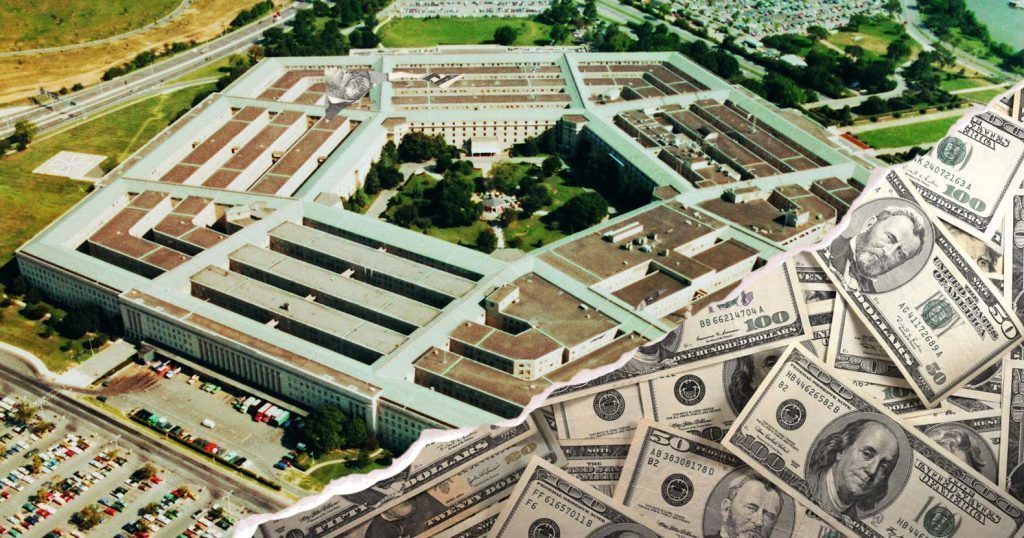
Where the $1.3 Trillion Per Year U.S. Military Budget Goes

By Eric Zuesse

Source: The Duran

Nobody can give a precise dollar-number to U.S. ‘Defense’ spending because the U.S. ‘Defense’ Department has never been able to pass an audit, and is by far the most corrupt of all federal Departments (and is the ONLY Department that has never passed an audit), and also because much of America’s military spending is being paid out from other federal Departments in order to keep down the published annual U.S. Government ‘Defense’ expenditure numbers (which come from ONLY the “U.S. ‘Defense’ Department). Those are expenditures for America’s privatized and overwhelmingly profit-driven Military-Industrial Complex. (By contrast: Russia and China require, by law, that their armaments-firms be majority-owned by the Government itself.)

According to the best available estimates, the U.S. Government has been spending, in total, for over a decade now, around $1.3T to $1.5T annually on ‘defense’, and this is around half of all military spending worldwide by all 200-or-so nations, and is more than half (around 53%) of all of the U.S. federal Government’s ‘discretionary’ (or congressionally voted for) annual expenditures.

Unlike regular manufacturers, which sell entirely or mainly to consumers and to businesses, not to their Government, armament-firms need to control their Government in order to control their markets (which are their Government and its ‘allied’ Governments — including NATO), and so they (in purely capitalist countries such as the U.S.) do control their Government. This is why the armaments-business (except in countries whose armaments-sector is socialized) is infamously corrupt. In order to hide the extent of that corruption (and to promote ever-higher military spending), the ‘news’-media need — in those countries — to be likewise effectively controlled by the investors in those firms.

Consequently, America, which has no national-security threat from any country (so, these astronomical ‘defense’-expenditures are blatantly inappropriate), spends annually around half of all of the money that the entire world spends on the military. And most of that money gets paid to its armaments-firms. Or, as Stephen Semler, an expert on these matters, put it regarding last year’s numbers, “How much of the $858 billion authorized by the FY2023 NDAA will be transferred to military contractors? I estimate $452 billion.” That is 52% of the 53% of the federal Government’s discretionary spending that is being allocated to ‘Defense’. Thus, 26% of the money that Congress authorizes the U.S. federal Government to pay each year, goes to military contractors. Thus: if $452B is going to armaments-firms, and if $1.356T is going to ‘defense’ (both of which are reasonable estimates), then one-third of ‘defense’ spending goes to armaments-firms, and that is around 17% of the money that the U.S. Government pays each year for everything (including non-discretionary).

If this had not been happening each year after the end of the Soviet Union in 1991, then the current U.S. federal debt would be far less, if any at all — but, in any case, that expense (which went, and is going, to exceptionally rich individuals) will be paid by future generations of Americans, by means of both increased taxes and reduced services from the U.S. Government. What pays for bombs (and funds the purchase of yachts) today will be taken from everyone’s infants tomorrow. And it is taking millions of lives in the targeted lands, and has been doing so for decades now. A psychopathic U.S. Government is producing these results.

America’s ‘Defense’ Department is so corrupt that when I happened recently to be re-reading my 14 January 2020 article about its corruptness, “US Military Spending: TRILLIONS of Dollars Unaccounted For”, yet a new detail of this corruptness, which I had not previously noticed, struck me. It happened in this passage:

——

Mick West, who blogs as metabunk, is a propagandist for the “Establishment” or the billionaires’ preferences of what the public should believe; and, on 16 May 2018, he headlined “Debunked: Missing $21 Trillion / $6.5 Trillion / $2.3 Trillion – Journal Vouchers”.

He presented a representative of America’s Military-Industrial Complex (MIC) asserting, to US House members, that “this is not a new story, it dates back to 2001 and before,”.

And, West noted:

“All these things are accounting things that, as Norquist says ‘occur after the money is spent’. They are things that you want to get right in your accounting, but if you get the values wrong then it does not mean you’ve lost the money. It means you’ve got some estimate wrong, and you’ll put to little or to much [West meant “too much or too little”] in one fund or another.”

Referring, then, to the $21 trillion, he wrote:

“This is just more of the same though, still not missing money, still just unsupported accounting information transfers.”

However, only a sucker would take that casual attitude to the enormous amount of money in the ‘defense’ budget that is “unsupported” as to who received it, and whether or not those payments were in accord with what Congress had actually authorized.

Furthermore, such a casual attitude toward US ‘defense’-expenditures — the expenditures which constitute actually over half of the US federal Government’s discretionary expenditures, and even around half of the total world’s military expenditures — is an invitation to corruption in over half of this Government’s annually authorized spending; and any intelligent person would expect that such an invitation would be taken advantage of by insiders who are in a position to benefit from it.

West quotes from only one alleged authority, the “Defense Department Comptroller, David L. Norquist,” a person who is largely responsible for the problem, who said “it’s an accounting problem that does need to be solved because it can help hide other underlying issues,” but (at 1:43 in the accompanying video) “it’s not the same thing as not being able to account for money that Congress has given you to spend, but it’s still a problem that needs to be fixed.”

Mick West simply trusted this statement, by Norquist — though Norquist is one of the officials responsible for the problem — but Norquist failed to prove (and wasn’t even asked to prove) it, by the Representatives whom he was there addressing, who didn’t seem to be alarmed about where that $21T actually went) his key assertion, that “it’s not the same thing as not being able to account for money that Congress has given you to spend.”

Even if that assertion is true (which should not be assumed, and which even seems ludicrous on its very face), the problem is unquestionably an invitation to corruption in ‘defense’-expenditures, and those are precisely the type of federal expenditures that overwhelmingly dominate the income to the federal Government’s contractors, the corporations that make all or most of their profits from sales to the federal Government and to its allied governments (such as to the Saud family).

Therefore, casually allowing — and not even investigating as being possibly treasonous — these expenditures, is, itself, enormously scandalous, but the Representatives there were treating it so casually.

In fact, at the very opening of the hearing, which was held on 10 January 2018 (at 02:12 in the video of the 1:41:33-long hearing, above) the Chairman of the Committee emphasized the “We must spend more” on the military, even though we already spend around half of the entire world’s military expenditures. Manifestly, this hearing was a charade.

In the full video, the passage that Mick West quoted from is at 18:00-22:00, and the Representatives were clearly on the side of the charade, not on the side of the American people. Clearly, all members of that Committee, the House Armed Services Committee, behave as if they are in the pockets of firms such as Lockheed Martin.

On 15 November 2018, Reuters headlined “Pentagon fails its first-ever audit, official says”, and reported that: “‘We failed the audit, but we never expected to pass it,’ Deputy Secretary of Defense Patrick Shanahan told reporters.”

On 27 November 2018, The Nation headlined “Exclusive: The Pentagon’s Massive Accounting Fraud Exposed” and David Lindorff opened:

“On November 15, Ernst & Young and other private firms that were hired to audit the Pentagon announced that they could not complete the job. Congress had ordered an independent audit of the Department of Defense, the government’s largest discretionary cost center — the Pentagon receives 54 cents out of every dollar in federal appropriations — after the Pentagon failed for decades to audit itself. The firms concluded, however, that the DoD’s financial records were riddled with so many bookkeeping deficiencies, irregularities, and errors that a reliable audit was simply impossible.”

So, that was the result of the latest version of this charade, which is virtual treason by the Federal Government.

In short: Congress is satisfied for this situation to continue, and the members of Congress evidently have no fear that the voters back home will vote against them if a challenger makes this issue a major issue in that Senator’s or Representative’s next Party primary.

The presumption is that the voters don’t care, and that the ‘news’-media won’t enlighten the voters about this matter, and about how it impacts, for example, which nations the US will categorize as being an “ally,” to sell weapons to, and which nations it will categorize as being an “enemy,” to target for conquest.

——

So, what now struck me now was the name there, “David Norquist.” Maybe you remember the famous libertarian phrase about spending by the U.S. federal Government, that the libertarian goal is to “shrink it down to the size where we can drown it in the bathtub.” Here is one of the many articles that were published about that:

——

https://www.ussc.edu.au/analysis/grover-norquists-no-tax-call-a-wedge-for-republicans

10 December 2012

GROVER NORQUIST’S NO-TAX CALL A WEDGE FOR REPUBLICANS


  • By 
    Dr Nicole Hemmer, Honorary Associate, United States Studies Centre

“Who the hell is Grover Norquist, anyway?”

The question came from former US president George HW Bush this northern summer, but in the past few weeks many Americans have been asking the same thing.

Norquist, an anti-tax activist, now dominates discussion of the fiscal cliff. His “no-new-taxes” pledge has been signed by nearly every Republican in congress. The problem? To avoid going off that fiscal cliff, congress must make a “grand bargain” by January 1. If it doesn’t include tax rate increases, President Barack Obama won’t sign it into law.

Republicans are in a bind. They could agree to tax-rate increases on Americans making more than $US250,000 a year in return for cuts to programs such as Medicare. That, however, would mean breaking Norquist’s pledge. And Norquist has made it clear that any Republican who does so will face a primary challenge in the next election.

So, to echo Bush: “Who the hell is Grover Norquist, anyway?”

Norquist runs Americans for Tax Reform, an anti-tax organisation he founded in 1986.

His opposition to taxation is an expression of his deep disdain for government. “I don’t want to abolish government,” he famously quipped. “I just want to shrink it down to the size where we can drown it in the bathtub.”

This “starve the beast” mentality has long been a conservative strategy for reducing the size of government. A strict diet of diminishing revenues, anti-tax advocates argue, will naturally lead to a smaller federal state.

——

As it turns out, David Norquist and Grover Norquist are brothers. So: while David Norquist makes money by fronting for the billionaires who control firms such as Lockheed Martin Corporation, Grover Norquist makes money by fronting for the billionaires who control firms such as Lockheed Martin Corporation. David does it by rationalizing away those peoples’ corruptness as being a concern for U.S. taxpayers; and Grover does it by leading the Republican argument against the Government’s non-‘defense’ spending. (While Republicans want to reduce non-‘defense’-spending, they want to increase ‘defense’-spending. Democrats want to increase all federal spending, but ESPECIALLY for ‘defense’.)

The standard libertarian claim that “shrinking the government” is at all an issue or what motivates their wealthiest donors whom they are actually fronting for, is a lie. The only real issue that is involved here is: Who is, and who isn’t, getting the Government’s money.

All of federal politicians’ talk about the need to eliminate “waste, fraud and abuse” is also lies, because they themselves — those federal office-holders — got there and stay there by participating in it. If they’re not corrupt, they’re not in office, because this system is built upon corruption.

Whereas Republican billionaires demand that all federal expenditures except for ‘defense’ get slashed, Democratic billionaires demand that all federal expenditures get slashed but that ‘defense’ spending must never be reduced. So: what’s the real difference (except for the hypocritical rhetoric on the Democratic or “liberal” side)? The billionaires who control those arms-contracting companies control also which contenders for federal offices will become elected.

And here is how one of the billionaires’ ‘news’-media (in this case, the “Fact Check” columnist at the New York Times), on 3 December 2018, cited uncritically David Norquist’s fraudulent argument that nothing more was involved here than an accounting-problem — as-if those congressional and ‘Defense’ Department officials were upholding their obligations to THEIR “stockholders,” who are all U.S. citizens — by continuing to tolerate unauditable financial books at the largest federal Department: “The Misleading Claim That $21 Trillion in Misspent Pentagon Funds Could Pay for ‘Medicare for All’: Representative-elect Alexandria Ocasio-Cortez, the rising liberal star, cited a figure that refers to nearly two decades of internal financial adjustments, not actual spending.” And even the grandstanding ‘progressives’ in Congress did not take to task that lying ‘news’-medium for attacking them on a mere sub-allegation to the real issue here, which was the enormous corruptness that inevitably stands behind all of this.

The only way for an authentic progressive political candidate to deal with this is to declare publicly (and to document it by means of linked-to-evidence news-reports online, like the present one) that ‘our’ Government and media are controlled by the organized mega-crooks, who are this nation’s wealthiest individuals — the only group of individuals who benefit from it — who are this nation’s actual enemies: its corrupters. But, of course, no billionaire will fund such a campaign, and any news-medium that reports on it (except by lying against it) will likewise get no investors.

That is how bad that the situation really is. People need to be discussing this, in public, here and elsewhere. Because that is the problem. It is the problem that needs to be fixed. But how can it be done? And THAT is the question.

PS: Preliminary reports suggest that on account of this Government’s dual World War III against both Russia and China, the ‘Defense’ budget for next year will probably soar perhaps more than by 10%. The Congress now is well over 95% neoconservatives, in both houses. They’ve virtually all been bought.

Austerity, War & Dictatorship… the Charade of Western Democracy Is Over. Can We Lose Those Chains?

By Finian Cunningham

Source: Strategic Culture Foundation

Western liberal democracy and its ubiquitous “austerity economics” is a euphemism for fascism. And the charade is finally coming to an end.

Western liberal democracy and its ubiquitous “austerity economics” is a euphemism for fascism. And the charade is finally coming to an end.

Austerity is not some recent policy under neoliberal capitalism. It was born out of the historic crisis in the Western system following the First World War and during the 1930s when fascism became a way to curtail any democratic challenge to the prevailing capitalist system.

That political instrument of repression is wielded today across all Western states. Quite amazingly, for a long time, few people recognized their captive, repressive state as fascism. We generally lived under the illusion that we were free citizens in “liberal democracies”.

In this interview, Clara E Mattei explains how the technocratic-sounding “austerity” is used to hide the brutal reality of dictatorship and repression against the vast majority of citizen workers in Western states.

Clara Mattei is an Assistant Professor in the Economics Department of The New School for Social Research, New York. She is the author of The Capital Order: How Economists Invented Austerity and Paved the Way to Fascism.

Her book investigates the origins of austerity as an economic policy after the crisis of World War One. Crucially, she argues that austerity is not merely about governments balancing financial budgets. Professor Mattei contends that austerity policy implemented by all Western governments is a political instrument of mass repression to prevent any challenge to the prevailing capitalist order.

Austerity forces the vast majority to accept unacceptable conditions that are otherwise shockingly anti-democratic. The precariousness and insecurity of employment, the widespread denial of social services, deprivation and poverty, and the relentless abuse of taxes and resources that are fueling insane militarism and war.

If we really did live in free, democratic societies why are such deformities enforced without any alternative? Austerity is used to crush the political imagination for any reasonable, more humane, more peaceful alternative.

However, as Clara Mattei points out in this interview, the extreme anti-democratic conditions in Western societies are inevitably forcing greater numbers of people to question the injustices and hideous anomalies of the prevailing capitalist order.

People are realizing that Western governments are in reality regimes of repression in service for the enrichment of a minority. That fundamental deformity is why Western societies are collapsing and why the United States and its Western lackeys are driven to increasing conflict against Russia and China.

The charade of “Western democracy” is coming to an end. The rulers and their pantomime political parties are losing the moral authority to hold power over the masses.

As people necessarily seek ways to reinvent societies that are fit for meeting their democratic needs, socialist solutions are beckoning. We have to throw off the mental shackles imposed by our dictators, and realize, as Karl Marx once eloquently said, that we have got nothing to lose except our chains.