Cyberpunk: The Human Condition amid High-tech Alienation and Urban Dystopia

By Raymond Lam

Source: BuddhistDoor.net

I love the seashore and the countryside, but I have spent most of my life in cities, with little to no time spent in the country. I grew up in Brisbane, Australia (which, despite its beauty and vibrant coffee culture, is hardly a skyscraper metropolis) and have spent a good deal of time in Hong Kong. Over the years I have visited Shanghai, Tokyo, and Seoul—cities that have long inspired novelists and artists in cyberpunk circles.

Cyberpunk features “technologized” cities with endless skyscrapers shimmering in an ocean of neon lights and elevated railways. These cityscapes are often bathed in darkness, shadow, and rain. More often than not, the protagonists of these stories are lone-wolf types, running through grungy alleys and estranged from wider society. As a genre of writing, film, and animation, the dystopian cyberpunk imagination has been immensely influential in both Asian and Western pop culture, exemplified by the Blade Runner movies, The Matrix franchise, and the Japanese anime Ghost in the Shell.

To many social commentators, cyberpunk carries eerie reminders of certain characteristics of urban living today—an endless feed of information, insecurity, and distractions through the Internet and social media, the press and media serving as distractions or brainwashing rather than useful information, and social alienation and unfulfilling work. In these activities is an almost gleeful dismissiveness of the need to reflect on human nature and what it means to be a human being: a key concern of religions and philosophical schools through the ages.

As Buddhistdoor Global columnist Paola Di Maio notes about our headlong trajectory into developing communication between human beings and AI: “Excited at the prospect of scientific advances, researchers seem to ignore that enhanced cognition comes with enhanced responsibility, maturity, and responsible decision-making abilities.” This is the key concern and, as it happens, the idea of human interface with computers or “mind technologies” is about as cyberpunk as it gets.

There are far more informed writers who have unpacked the themes of cyberpunk exhaustively, but I find this description particularly useful for grasping the general aesthetic and spirit. This is from an essay by Lawrence Person: “Classic cyberpunk characters were marginalized, alienated loners who lived on the edge of society in generally dystopic futures where daily life was impacted by rapid technological change, an ubiquitous datasphere of computerized information, and invasive modification of the human body.” (Slashdot.org) Surely many of these themes sound familiar?

The eminent science fiction writer J. G. Ballard (1930–2009) defied assumptions about traditional storytelling and sought to upend the archetypes that were assumed to be universal, saying that he wanted a storytelling style that possessed “more psycho-literary ideas, more meta-biological and meta-chemical concepts, private time systems, synthetic psychologies and space-times, more of the sombre half-worlds one glimpses in the paintings of schizophrenics.” (Ballard 2017, 103) Most interestingly, Ballard criticized the “external” emphasis of so much science fiction of his day (such as on space travel), declaring: “The biggest developments of the immediate future will take place, not on the Moon or Mars, but on Earth, and it is inner space, not outer, that needs to be explored. The only truly alien planet is Earth.” (Ballard 2017, 103)

My opinion is that good cyberpunk is itself a kind of literary expression of contemporary inner preoccupations and concerns. Take the notion of loneliness, for example. Some good research has been done about urban life and its correlation with loneliness, but the results are ambiguous. One study found that urban life is undoubtedly more stressful than rural life (and has been so since the Industrial Revolution), yet how lonely one feels is a very difficult thing to measure. If we are to take seriously Ballard’s notion that the best kind of science fiction is about inner space, then perhaps we have also been distracted by the neon cityscapes of gritty cyberpunk metropolises.

The interesting stuff is not happening in an action-packed helipad gunfight with a hypersonic jet on top of a tower owned by a futuristic robotics corporation. It is happening in the neurotic mind of one of that corporation’s low-level office workers, humiliated in public through a thoughtless social media post by her supervisor, who himself seeks distraction from his instantly replaceable managerial role by interfacing his brain with a computer’s pornographic VR program. It is not just about cybernetics and the development of androids, but how society changes as a result of them.

I like to think that, perhaps one day in the future, when meditation practice centers are hidden away in glass and metal skyscrapers—some of them already are in the worlds biggest cities—and temples of traditional Asian design are surrounded by looming corporate structures, these loci of spiritual meaning and truly human work will have helped to fortify the inner worlds of these cities’ denizens against the darker side of cyberpunk. Ballard was right. The true struggle for meaning and dignity is more often on the inside, even in a society dominated by neon, nightfall, and neuro-computers.

References

Ballard, J. G. 2017. “Which way to inner space?” In Science Fiction Criticism: An Anthology of Essential Writings. Edited by Rob Latham. London and New York: Bloomsbury.

Poor Folks

By Peter Van Buren

Source: We Meant Well

A guy on Facebook I don’t know wrote a version of what has become a kind of set-piece article in today’s America. Here’s a portion:

Losing The War of Attrition or How To Turn Any Normal Person Into A Broken, Angry Radical

You are one of the millions who are employed at minimum wage. Or you are one of the millions who are euphemistically called underemployed, or you are one of the millions with no job and no prospects. You are retired- how did that happen?- or disabled- why did that happen?- and trying to survive on Social Security.

You reach a point when you realize that getting ahead is no longer possible. After that you reach a point when you realize that holding on to what you have is no longer possible. Then you reach a point when you realize that replacing what has been lost or depleted is no longer possible.

I wrote a book about this five years ago called The Ghosts of Tom Joad. No one read it. Publishers in the process of turning me down mocked me for writing about “poor people” and seemed surprised there were poor people in America who weren’t black and living in ghettos. Well, hell, then Trump happened. Because people watching a way of life — a middle class existence where the rich have more but we had some — fall away are easy targets for demagogues. Always have been. Because before we dismissed things as whataboutism we used to study them as lessons from history. Other people’s’ mistakes. History shows very clearly this economic game we’re playing ends with everyone but a small handful at the top losing badly.

I concluded five years ago the game was already decided. Our society was already then like those photos of railroad tracks, where in the distance it seems like the two rails come together in a single point. That point is essentially feudalism, where a tiny minority owns almost everything and everyone else lives off whatever scraps they let us have. Like in the Middle Ages, where everyone farmed for the king as serfs. It’s worse than slavery, because slaves at least know they’re slaves and have the possibility, however small, of freedom. Maybe for their kids if not for themselves.

We are not at the singularity, but we are inexorably headed toward it. Five additional years of data has only made that clearer; five years ago we spoke of the 1%. That number no longer matters. The new figure is .1%, an even smaller group who owns even more.

And no, none of this is new Because Trump. Since 1980, the incomes of the very rich (the .1%) have grown faster than the economy, for about a 400% cumulative increase in wealth. The upper middle class (the 9.9%) has kept pace with the economy, while the other 90% of us, the middle class and the poor have fallen behind.

By the way, it is these numbers which sent Barack Obama and Hillary Clinton during the 2008 campaign to both use $250,000 as the upper limit of the middle class. They sounded misguided, but it was sort of true. They just were still lumping what we’re calling here the “Upper Middle Class” and the “Middle Class” together. Just words. At present in the U.S. we have three-and-a-half classes: The .1%%, the 9.9%, everyone else hanging on, plus some people way at the bottom with basically nothing.

But bad news for the 9.9% Since the they the most (the most the .1% does not yet have) they have the most to lose. At their peak, in the mid-1980s, people in this group held 35% of the nation’s wealth. Three decades later that had fallen 12%, exactly as much as the wealth of the 0.1% rose. And do understand the people at the top are constructing walls and throwing nails off the back of the truck to make sure no one can catch up with them. The goal of .1% is to eliminate the competition, the 9.9% below them. They’ll only effectively have it all when the ratio is down to two classes, the .1% and the 99.9%

We are kept in place via shiny objects (500 channels, more movies and Apple watches and drugs!) and curated divisions. The ever-increasingly sharp lines between say blacks and whites are a perfect tool. Keep the groups fighting left and right and they’ll never notice the real discrimination is up and down. Some groups just found down earlier and harder, but as long as a poor white man in south Kentucky thinks he has nothing in common with a poor black man in the South Bronx they will never work together, never even see the massive economic forces consuming both equally. Forces are even now hard at work to tell us the Republican party is for whites, POC head Democrat, and any third party is a Russian shill in place to hurt the candidate you favor.

Whether your housing is subsidized via a mortgage and that tax deduction or Section 8, you’re still on the spectrum of depending on the people really in charge to allow you a place to live. I do not see a way out of this, only maybe steps that can slow it down or cause it to speed up.

Very short version summary: People like you and I fell through the cracks; we weren’t supposed to end up here but the .1% hadn’t worked out the details so they got as much as they do now and we basically ended up with bigger crumbs than we should have, especially me lucking into a “career” with no real skills.

Our own kids may do OK with what we leave for them, but only if your son is a medical doctor will he have a decent shot at our lifestyle and only because of the “cartelization” of the profession by the AMA. The rest of our kids are unlikely to have any shot at what we ended up with.

Sorry, I’m not a more cheerful guy but these conclusions are based on a fair amount of honest study.

The ‘Hidden Mechanisms’ That Help Those Born Rich to Excel in Elite Jobs

When two sociologists interviewed highly paid architects, TV producers, actors, and accountants, they encountered work cultures that favor the already affluent.

By Joe Pinsker

Source: The Atlantic

Over the past five years, the sociologists Daniel Laurison and Sam Friedman have uncovered a striking, consistent pattern in data about England’s workforce: Not only are people born into working-class families far less likely than those born wealthy to get an elite job—but they also, on average, earn 16 percent less in the same fields of work.

Laurison and Friedman dug further into the data, but statistical analyses could only get them so far. So they immersed themselves in the cultures of modern workplaces, speaking with workers—around 175 in all—in four prestigious professional settings: a TV-broadcasting company, a multinational accounting firm, an architecture firm, and the world of self-employed actors.

The result of this research is Laurison and Friedman’s new book, The Class Ceiling: Why It Pays to Be Privileged, which shows how the customs of elite workplaces can favor those who grew up wealthier. The authors describe a series of “hidden mechanisms”—such as unwritten codes of office behavior and informal systems of professional advancement—that benefit the already affluent while disadvantaging those with working-class backgrounds.

In January, shortly before the book’s U.K. release, I interviewed Laurison, a professor at Swarthmore College, who told me that while England’s class politics do differ from those of the U.S., his and Friedman’s findings about “money, connections, and culture” broadly apply to Americans as well. This conversation has been edited for length and clarity.

Joe Pinsker: In the book, you write about a financial cushion available to certain college graduates that you refer to as “the bank of mom and dad.” How does this work, and what are its consequences for who gets a chance at certain jobs?

Daniel Laurison: I think the image that we have—or the ideology, if you want to be political about it—is once you’re 18 or so, you make your own way and your class origin is not an important part of how your career goes from there. But what my co-author Sam and I found was, that’s not at all true.

In the book, we talked about people pursuing acting, which is a very contingent, hard path to pursue. Most people, when they start, aren’t making most of their money from acting, and so people who are able to rely on their parents to help them are much more able to pursue acting fully, because they don’t have to worry about maintaining a regular, full-time job just to eat and live.

That’s the starkest example in the book, but there are lots of other ways that having money from your parents can make a difference in your career. In the U.K., if you work in London, you’re likely to earn a lot more, and you’re more likely to be at the center of your field. And living in London is very expensive. So a lot of people who are living in London got some help from their parents to make a down payment on a house or some help with the rent, which was the case in fields other than acting, too. And the other place I think parents’ help makes a big difference is in who can take unpaid or very low-paid internships, which are the entry points for lots of high-status, high-paid careers.

Pinsker: And once people get these sorts of jobs, you write about the importance of “sponsorship”—basically, when some senior employee informally takes someone younger under their wing and helps them advance through the company. What did you notice about how those systems of sponsorship worked?

Laurison: I think that a lot of people, on some level what they think they’re doing when they sponsor young co-workers is spotting talent—they called it “talent-mapping” in the accounting firm we studied. But a lot of people we talked to were also able to reflect and say, “Part of why I was excited about that person, probably, is because they reminded me of a younger version of myself.” The word we use in sociology is homophily—people like people who are like themselves.

One of the big ideas of the book, for me, is it’s really hard for any given individual in any given situation to fully parse what’s actual talent or intelligence or merit, and what’s, Gosh, that person reminds me of me, or I feel an affinity for them because we can talk about skiing or our trips to the Bahamas. Part of it is also that what your criteria are for a good worker often comes from what you think makes you a good worker.

Pinsker: In the workplaces you studied, who tended to lose out in these systems of sponsorship?

Laurison: In three of the four fields we studied, it was poor and working-class people, and also women and people of color. There are lots of axes along which homophily can cloud senior people’s judgment about who’s meritorious.

Pinsker: You also talk a lot about the unwritten codes of behavior that can shape who advances and who doesn’t at certain workplaces. What’s an example of how that played out?

Laurison: Probably the best example of this is the television-production firm we studied. The name that we gave to the culture there was “studied informality”—nobody wore suits and ties, nobody even wore standard business casual. People were wearing sneakers and all kinds of casual, fashionable clothes. There was a sort of “right” way to do it and a “wrong” way to do it: A number of people talked about this one man—who was black and from a working-class background—who just stood out. He worked there for a while and eventually left. He wore tracksuits, and the ways he chose to be casual and fashionable were not the ways that everybody else did.

There were all kinds of things, like who puts their feet up on the table and when they do it, when they swear—things that don’t seem like what you might expect from a place full of high-prestige, powerful television producers. But that was in some ways, I think, more off-putting and harder to navigate for some of our working-class respondents than hearing “just wear a suit and tie every day” might have been. The rules weren’t obvious, but everybody else seemed to know them.

Pinsker: And trying to figure that out comes at an emotional and psychological cost, no?

Laurison: For a lot of people from poor and working-class or lower-middle-class backgrounds, being in these environments felt like you had to put on a performance all day. They didn’t feel at home and comfortable in their work environment—even people who had been quite successful, who had gotten toward the top of their occupations.

Part of that is because folks are comfortable in the culture, the class, the location, the people who they grew up with. And working in an occupation or professional culture that is radically different in some ways than what your family knows and does is challenging. But one way to address this is to change workplace cultures to be closer to what poor and working-class people—and women, racial and ethnic minorities, and other historically excluded groups—bring rather than just trying to teach those “others” how to adapt.

Pinsker: In the book, it was jarring to see over and over how invisible all of these processes tend to be, and how this obscures the way that people actually get and then excel in elite jobs. Some people you talked to clearly downplayed the help they’d gotten—what do you think was behind that?

Laurison: In both the U.S. and the U.K., there’s a really strong, widely shared implicit belief—in the U.S., it’s the American dream—that success and worth are nearly identical, that if you are really rich, you must be really smart and hardworking, and if you are poor, you must have messed up in some really big way. People want to believe that they got where they are because they’re smart and talented. And that’s often true to some extent, but it’s also true that there’s any number of people who are probably equally smart and talented who are not in their positions, because of the barriers that are erected. It’s hard to sit with the idea that maybe somebody else deserves to be where they are more than they do, and I think almost everybody wants to be able to tell a story of making it on their own.

A lot of the book is about the barriers that exist, but you can take that argument too far. I wouldn’t say that most of the really successful people we interviewed were bad at their jobs. But I think, for a lot of people, examining the ways that privileges you have are unearned is the same thing as saying “You are bad” or “You don’t deserve anything,” because we’ve got this deep connection between ideas of worth and ideas of success.

Pinsker: Having finished a research project like this, what do you think needs to change about the way these workplaces function? Do you think there are things that companies could do better?

Laurison: On one level, as long as access to education and jobs is unequal in terms of race, in terms of class, you’re not going to have equal representation of all the parts of society in many prestigious or exclusive occupations. So in a way, it’s about much bigger questions than a single company can deal with.

At the same time, I think there really are things that companies can do. You can affirmatively try to hire the people who don’t look like the people who are already there in terms of their race, gender, class origin, and other statuses. And you can try to think about what expectations or cultures at your firm are not really about the outcomes your firm needs to pay the most attention to.

To give an example from my own work, I know that in colleges and universities, students from poor and working-class backgrounds are much less likely to feel comfortable going to office hours than everybody else. So I require everybody, of any class background, to come talk to me, in an effort to make office hours open to everybody. I think there are analogies in other fields—there are unwritten rules where we can figure out what the norms are and then be explicit about them.

But still, there’s this larger question of how much inequality there is in the first place. If it wasn’t possible for somebody to make 10 times, 15 times what someone else does at the same organization, then it would matter a lot less how far people got in different organizations in terms of their earnings. And the broader context of the book is that part of what legitimizes big inequalities is the belief that outcomes are meritocratic.

Surgical Totalitarianism

By Dan Corjescu

Source: Dissident Voice

You don’t have to control everything to be in total control.

In the modern world this seeming paradox is a systemic reality.

In the past, classic totalitarian governments sought to literally control every aspect of biopower.

As it turned out, this was a very inefficient and self-defeating way to maintain and increase scientific knowledge and technology, capital accumulation, and total effective power over the long term.

Modern totalitarian arrangements are far more culturally efficacious, superficially unobtrusive, stylistically democratic, and, most importantly, surgically precise.

In addition, modern totalitarian elites not only demand de facto control over society as such, but they also desire, as part of their inner ideological ethos, the exercise of that power to reproduce itself under maximum conditions of ease, pleasure, and comfort. Thus, the creation and maintenance of a consumerist society both materially and ideologically aids in the reproduction of neo-totalitarian power.

A consumerist society is to a large extent a self regulating mechanism for the constant pursuit of public spectacle and private stimulation. The senses and general life instincts are caught in a web of the pursuance of small pleasures. In this way, pleasure itself becomes an insidiously saccharine form of domination. Yet, from time to time, consumerist relations must be guided, reinforced, and given new goals and reflationary impetus from above.

The political structure in modern, surgical totalitarianism is set up in such a way as to give the appearance of active participation, psychological inclusion, and periodic mass mobilization. However, all consequential decision-making takes place behind this fraudulent structure and represents the true “commanding heights” of power. The political superstructure serves, at best, as perennial decoy and public delusion.

The modern “commanding heights” of power require massive amounts of data. It is through the acquisition, manipulation, and active forward interpretation of information that surgical totalitarianism is able to pick and choose its battles. At its most extreme, new “realities” are creatively and cynically constructed from its daily catch of strategic knowledge. The goal is always the same: distract, delude, deflate any possible challenge to the system through active suppression, co-optation (the preferred method), and, or, complete elimination.

In this way, any possible threats can be foreseen relatively far in advance and organizational strategies can be conceived for either their containment and/or elimination. The surgical nature of these methods allows for the relative negative freedom of civil society to generally evolve and reproduce itself in partial self-awareness in so far as it continues to demonstrate no substantive subversive tendencies to liquidate either the material reality and/or ideological superstructure of its own dependency on neo-totalitarian forms of power.

In the end, the system presents itself as perversely elegant, efficient, self-perpetuating, and, even, on a physical level, pleasant.

All bodily pleasures are on offer. Entertainment becomes incarceration. All is seemingly permitted while nothing is truly allowed. Power is diaphanous as it is all consuming. Critical dissent is tolerated because the mechanisms of mass blindness are secure.

It would be and has been a crucial mistake for Marxists of all kinds to think that capitalism is the root cause of the modern day pursuit of total power. On the contrary, surgical totalitarianism utilizes capitalism as just another source of power but not its ultimate ground. Power precedes capitalism. Hierarchy encodes the means and forces of production no matter what they are just as hierarchy projects a self-sustaining superstructure to deceive and deflect its potential challengers. Capitalism is but a modern day tool of hierarchical power. The real enemy is not capital but surreptitious hierarchy.

The true source of this state of affairs is the lust for control under any societal forms. Its origins are without doubt evolutionary. Aristotle famously defined human beings as “Zoon Politikon” or “social animal”. Yes, we are indeed social. But the “Zoon” or animal part of that equation warps that sociality into the insatiable desire to control and to dominate others. Ultimately, the Hobbesian origins of mankind from an age long state of “nastiness and brutishness” is, in part, to blame that man persists in being as a wolf to other men: Homo homini lupus est.

Capitalism, Empire, and the Infernal Gloom Machine

By Jason Holland

Source: Dissident Voice

Depression is built into this machine and the evidence is plastered on the morose faces of people caught in the clutches of its business as usual activities. Depression is found in the insurmountable debts we owe for spending a lifetime of preparation and labor to serve the machine. In addition to debt, the machine awards us for our servitude with trinkets, gadgets, doodads and gizmos that provide a moment of hollow amusement and then sit on shelves in garages and decay. They represent the planned obsolescence of the human heart. The sacrifice paid for our fetish with materialism is the actual quality of our lives.

The gloom machine tells us the quality of our lives is defined by the machine in the driveway, and the machine that flushes away our excrement, and the machine that chills the tortured slaughtered animal flesh for later consumption, and the machine that flashes pornographic images and supplies numbers detailing how much we are liked by our so called friends. But to us humans it seems that quality of life is more appropriately measured in the amount of disposable time we have to pursue that which we want, and the quality of the community around us, and living without being chronically stressed with threats of being displaced from the land upon which we live for not working hard enough for the machine.

Depression is waking up at 6 in the morning in darkness to sit in traffic for an hour to arrive at a job that we don’t want to be at, only to serve the machinations of people with nothing but greed in their overstuffed bellies. And we go to these jobs so that we can pay rents that are unaffordable, and to service debt we’ll never escape, and we go home in darkness to our lonely lives in places where community is absent with a view of an equally lonely tree or a man-made retention pond which is an upgrade over the view of staring directly at your neighbor’s domicile. Depression is the realization there is no vacation on the horizon, no respite, just more of the same. Depression is knowing that such a life is better than many others have it.

Depression is recognizing the cynics were right about this society, that Cohen spoke truth when he sullenly moaned:

Everybody knows that the dice are loaded
Everybody rolls with their fingers crossed
Everybody knows the war is over
Everybody knows the good guys lost
Everybody knows the fight was fixed
The poor stay poor, the rich get rich
That’s how it goes
Everybody knows

Depression is watching art die. The surrealist, the bohemian, the rock ’n roll, and the anti-authoritarian soul has lain down and pledged fealty to the dollar. For money, they’re now all willing to become ready made predictable cubes to be packaged and sold in plastic wrap placed in cleverly designed boxes which deliver to the depressed public what they want, more of something that’s pretty on the outside and vacant within. We are left with monthly subscriptions of more tales of self aggrandizement for the throngs of temporarily embarrassed millionaires.

Depression is watching the worst of us rise to legitimacy and awarded iniquitous riches for it. The popular is depressive, musical hack Cardi B sings about her money money money and she is loved. Jordan Peterson sells cheap self help stolen from better written material decades ago amalgamated with misogyny and dictates of hierarchal subjugation and becomes wildly popular. Trump purveys hatred of people of color and a love of authoritarianism and the depressive people, oh do they eat it up. This is sickness, depressive sickness.

Depression is acceptance of the violent now. The grossly unhappy men with their armaments spread their gloom and horror across the planet and claim righteousness for doing so. Depression is watching society applaud murderous hearts for their crimes who don badges and camouflage and have holidays to celebrate their violent history, while villains are made of those who simply don’t want to stand up for songs of oppression. Thank you for your service to the machine.

Depression is watching notions of resistance and revolution take form in slightly altered subservience. The great reformation desired now is for a “green new deal” that doesn’t come close to mitigating the impending culling of humanity from soon to be ecological catastrophes. Their plans offer only more endless work at the behest of the gloom machine while promising healthcare that will never happen, less debt it will also never deliver, and affordable housing that still won’t solve homelessness. They don’t want to break the machine, just tweak it, and they lack the ability to do that even. Never have I borne witness to such eager slaves and such depressive aspirations. The people seem to adore their cubicle lives, their environmental destruction, their corporations, their debts, their corrupt leaders, their prisons, their banks, and their taxes.

They want to continue to be put to work under the thumb of the status quo western civilization authoritarian mind and this is all the depressed mentally dominated masses can think of as a possible improvement. Instead of wanting to taste real liberty and be actual equals, their dreams are limited to being better treated servants. The gloom machine chugs along fueled with dimwitted ideas sold by boxed-in thinkers without any possibility of escaping the darkness, rather simply offering a more cushy seat for viewing the end of everything.

The machine bellows out demanding more, more, you owe me more, and somehow those wearing red, white, and blue agree and celebrate the demands of the machine. These debts we owe are servitude. The numbers held in digital machines are immoral which demand one must wake up to a dreary existence to do more of what is killing our souls along with the flora and fauna around us.

Depression is the downtrodden plebs who celebrate their corrupt democracy, which is in reality a thinly veiled oligarchy that should be obvious to all. They prop up a system of voting that allows the election of the presidency, a position that shouldn’t exist in the first place in an egalitarian society, to be awarded to candidates who don’t capture the most votes. What little democracy there is in a representative system is lost in totality when the winner of elections need not win the majority of votes. The gloom machine is straight up tyranny.

A non-depressed society would reject being served faux democracy. They’d reject a system absent of reason or compassion and disdain would be for ideas of continuing to support such a destructive way of being. But instead, within the gloom machine shame is reserved for those who don’t want to take part in the busted system, and it venerates those who cast votes for imperialist conquerers and planet destroyers, and those voters are lauded as doing their civic duty for taking part in open public corruption.

Depression is the insincere know it all crowd who are incapable of honest debate and have rarely endeavored to open a book of substance or engage in critical thought, but they know trivialities which they mistake as facts and wisdom. They know arrogance well and emanate it with aplomb. They know how to believe all they see in the corporatized media, but thinking without boundaries or limitations is beyond their capacity. This is not even depression, this is tragedy.

Depression is watching the trees be plowed down for more tract housing, a portion of which will sit empty for years because no one can afford to move there, and even if they could it’s a heinous boring life that awaits which is only significantly better compared to being homeless. Depression is knowing this is the reason why we are rapidly destroying our habitable environment and commencing a 6th mass extinction event which is now accelerating.

Depression is to know there is nothing we can do to stop the country we live in from mercilessly killing innocent people all over the world for no reason other than more economic expansion and our sadistic ideas of exceptionalism that entail spreading pain and hardship so a few elites can have more of what they already have more than enough of.

Depression is the powerlessness to change anything of significance. There is no other way they say other than the desolate gloom machine, they say this is how it must be. And so we remain here waiting for the horror that is soon to approach us all as the gloom descends in ever quickening waves.

A zombified indoctrinated populace can see no other way than capitalism and beating each other over the heads to satiate egos in needless competition that is unnecessary for survival and deleterious to the common good. Capitalism is the primary tool of empire, and a word that should be synonymous with depression. It’s the accumulation of resources in an effort to gain more power in man-made markets to leverage that power over other people and get them to do what the person with the most power desires. Capitalism’s depressing ideology is defined by the lecherous desire for more for the sake of it so the winner can pound their simian chest in victorious celebration of the devastation they’ve created.

Capitalism is inherently unsustainable due the way it allows power to coalesce via the leveraging abilities given to money to buy land, the means of production, elections, and advertising. It allows the whims of the few to overrun the needs of the many where those with the worst intentions aspire to gain more than others because they will attempt to fill the void in their hearts with self importance expressed via power over others. This is why it cannot be used.

If there is no central currency or advantage to collecting huge amounts of resources then the motivation to hoard would evaporate, as those resources would simply rot or become a burden to maintain. There’s no fun in that kind of hoarding. The “fun” comes to the simpleton power seeker when they acquire power to make others do what they want and thus gain the ephemeral validation they so desperately seek.

If one runs the math on players competing for money at different rates of gain over a certain amount of time, there will be a doubling effect which becomes exponential. And this effect will accelerate as it plunders along due to gains in leverage which allows for ever greater amounts of money to be made at faster rates. Eventually it always ends the way a game of monopoly ends, someone has all the power and everyone else is subservient to that entity/person.

These dour thoughts manifest from the recognition of the stranglehold empire has over our lives. The depression is the result of the myriad of expectations I can’t let go of that wants to see a kinder more egalitarian and sustainable world emerge while knowing how unlikely it is. Our collective depression is rooted in the foundations of social hierarchy and its economic tools of control, and understanding what a perfect trap it is, and so it goes, and everyone doesn’t know, but they feel it, though.

GIVE AMERICA’S ‘HELICOPTER PARENTS’ A BREAK

Hovering parents don’t need lectures. They need a more equal nation.

By Sam Pizzigati

Source: OtherWords

A good many of us aging baby boomers are having trouble relating to the “helicopter parents” of our modern age — those moms and pops constantly hovering over their kids, filling their schedules with enrichment activities of every sort, worrying nonstop about their futures.

Back in the middle of the 20th century, baby boomers didn’t grow up like that. We lived much more “free-range” childhoods. We pedaled our bikes far from hearth and home. We organized our own pick-up games. We spent — wasted! — entire summers doing little bits of nothing.

We survived. So did our parents. So why do parents today have to hover so much?

The standard explanation: Times have changed. Yes, today’s parents take a more intense approach to parenting. But they have no choice. The pressures of modernity make them do it.

Economists Matthias Doepke of Northwestern University and Fabrizio Zilibotti of Yale have followed all the debate over helicopter parenting, and they’re not jumping on this blame-modernity bandwagon. If the pace and pressures of our dangerous digital times are driving parents to hover, the pair points out, then we ought to see parents helicoptering across the developed world.

We’re not.

In fact, researchers have found significant differences in parenting styles from one modern industrial nation to another. Parents in some nations today have parenting styles as relaxed as anything aging baby boomers experienced back in the 1950s. In other nations, by contrast, parents seem as intense as today’s helicoptering norm in the United States.

How can we account for these differences?

Doepke and Zilibotti have a compelling explanation. Levels of helicopter parenting, they note, track with levels of economic inequality. The wider a society’s income gaps, the more parents hover.

The two countries most notorious for their helicopter parenting, China and the United States, just happen to sport two of the world’s deepest economic divides. And those more relaxed parenting days of mid-20th century America? They came at a time when the United States shared income and wealth much more equally than the United States does today.

What’s going on here? Why should economic inequality have any impact on parenting styles?

In severely unequal nations, the evidence suggests, childhoods have become high-stakes competitions. Only the “winners” go on to enjoy comfortable lives when they grow up. You either make it into the ranks of your nation’s elite or you risk struggling on a treadmill that never ends.

In more equal societies, you don’t have to matriculate at the “best” schools or score a high-status internship to live a dignified life. In societies with income and wealth more evenly distributed, broad swatches of people — not just elites — live comfortably. That leaves parents, as Doepke puts it, “more room to relax and let the kids just enjoy themselves.”

Parents in highly unequal nations can’t afford to relax. They have too much to do. They have to shape their kids into winners. But the competition their children face will always be rigged, because the already affluent in deeply unequal societies have more time and money to invest in that shaping.

Researchers Doepke and Zilibotti call for greater public investments in social services — like quality child care — to narrow the competitive advantage that wealth bestows upon affluent American families.

The investments they recommend would certainly help ease the pressure on working households. Would they be enough to get our parents more relaxed? Not likely, not so long as rewards keep concentrating in the pockets of the few at the expense of the many.

Our helicopter parents, in short, don’t need fixing. Our economic system does.

Art and Dreaming: Realizing our Power to Co-Create Reality

By Ruth Gordon

Source: Reality Sandwich

“True creativity doesn’t just make things; it feeds what feeds life. In modern culture where people are no longer initiated, the spirit goes unfed. To be seen, the uninitiated create insane things, some destructive to life, to feel visible and powerful. These creations are touted as the real world. They are actually forms of untutored grief signaling a longing for the true reality of village togetherness.”

Martín Prechtel, Secrets of the Talking Jaguar, p.232

These words, from a book detailing Martín Prechtel’s initiation as a Mayan Shaman, accurately sum up our modern world. In the humanitarian, ecological, and political crises we are facing, we are witnessing the effects of a severe spiritual hunger.

We in the Western world are a deeply wounded culture; our Indigenous traditions long destroyed, our common land stolen by the rich and powerful, we often now desperately seek comfort by any means possible – over-consumption of food, of social media, of drugs and alcohol, of our natural resources.

This way of being is known among North American Indigenous people by the name of “wetiko,” or the “disease of the white man.” In the traditional Algonquin myth, the “wetiko” is a rapacious spirit who lives in the dark forest and possesses people, filling them with an insane compulsion to consume and destroy. This spirit makes monsters out of humans, filling them with an insatiable drive to devour everything that crosses their path.

Today, we see wetiko everywhere – in our cruel systems of governance that refuse sanctuary to refugees fleeing conflict, while at the same time escalating those very conflicts, mostly for the single purpose of the highest possible short-term profit, in the disintegration of human community through separating and atomizing social structures and the corresponding upsurge of loneliness and despair, and in the continued addiction to economic growth despite clear and repeated warnings that this kind of globalized industry is killing our planet.

Wetiko functions like a virus – it’s highly contagious and most of us are infected with it to some degree. It’s at the root of the human conflicts that often derail attempts to create alternative ways of life. It’s not enough to simply wish for a better world, it’s not even enough to work hard at creating one. We need to be ready to transform our entire mode of perception, to boil down our ways of thinking and being and reconstruct ourselves from scratch, with consciousness of the wetiko-ized habits we often fall into.

In Dispelling Wetiko: Breaking the Curse of Evil, Paul Levy writes:

“The evil that is incarnating in our world simultaneously beckons and potentially actualizes an expansion of consciousness, all depending on our recognition of what is being revealed. It is as if hidden in the darkness is a spark of light that has descended into its depths, and when recognized in the darkness, this light returns to its source.”

(Levy, 2013, p. 145)

Levy’s idea, that hidden in the poison of wetiko lies its own antidote, offers a healing reference for how to approach what Prechtel calls “untutored grief”: the fecund raw material that, if not used to grow something new, becomes destructive. However, when we are educated, or “initiated” into ways of transforming our grief, of understanding what the darkness in us wants to bring to light, we often find we have stumbled upon a store of incredible potentiality – an almost boundless source of energy and power that we can refocus towards healing, if we choose to do so. Our collective shadows are potential treasure, showing us wounds that need healing, the deep behavioral structures that create conflict, and pushing us to grow beyond our self-limiting patterns. We find the light by going through the dark, not by avoiding it. We can only unfold our full potential for love, beauty, and creativity by recognizing the life-force that’s bound up in our trauma. It’s releasing that closed-off and separated aspect of ourselves that will make us whole.

There’s an interesting symbolic parallel in the human compulsion to dig, mine and extract precious metal. If we instead dug into the fertile ground of our consciousness and our imagination rather than into the physical Earth, would we then finally be able to create a sustainable form of the “treasure” we long for – the “true reality of village togetherness,” so overcoming our addiction to exploiting the Earth?

Consciousness and Creativity: We are the Universe Observing Itself

In Quantum Revelation: A Radical Synthesis of Science and Spirituality, Paul Levy describes how the science of quantum mechanics, although yet to really inform our everyday mode of being, could be a gateway for us: enabling us to understand the dreamlike nature of the world, to reconnect with the divine and infinitely creative aspects of existence. The central insight of quantum mechanics is that quantum particles respond differently depending on whether we are observing them or not. They are waves when we do not observe them and become particles when we do. This implies that quantum matter somehow knows when it is being observed, and subsequently changes both its form and behavior. This points to an astounding idea: that the world we perceive not only perceives us, but also manifests itself depending on our very mode of perception. Or, to put it another way, that the world we encounter depends on how we dream it up. It seems as if there are infinite possibilities of reality. The one that is activated depends only on our capacity to envision it, on the expansiveness and daring of our imagination.

Levy goes even further, asserting that we are living in a world that consciously responds to our consciousness, that, in fact, has created us for the purpose of understanding itself:

“[T]hrough us, the universe questions itself and tries out various answers on itself in an effort parallel to our own to decipher its own being. In the process of observing and reflecting upon our universe we are actually changing the universe’s idea of itself.”

(Chapter 5, “Cosmogenesis,” 2018)

If Levy is right, we are part of a cosmos that is self-creating and self-understanding. It is as if, through consciousness, the universe is craning its neck around to look at itself. We are its eyes, and its senses.

If we want to escape the hold of wetiko, to transition to a way of life that serves all beings, we need to value the power of our own creativity, and to understand that we are always creating the reality we experience, whether we are aware of it or not. The more conscious we are of our creative power, the more we can use it to dream up a world we want to live in; to orchestrate our lives with the same skill and precision as a highly trained conductor.

For this, we need to build a network of communities, (as in Tamera’s Healing Biotopes Plan), where we can study the raw matter of our cultural grief, where we can learn to compost it, and use it to grow new life, where we can discover how to create the “village togetherness” we all long for. We need spaces where we can experiment with and test out our powers of dreaming, encountering, understanding and interacting with the dreamlike nature of reality. We need spaces where we can build the self-confidence and courage that a “life artist” needs. We need public forums where our “life-art” is seen and honored. And all this needs to happen in a large enough group of people for our actions to hold weight, gather momentum and give courage to others.

As Paul Levy writes:

“The universe is a collectively shared dream that is too seemingly dense and solidified for any one person’s change in perspective to transform, but when a critical mass of people get into alignment and consciously put together what I call our “sacred power of dreaming” (our innate power to dream the universe into materialization), we can, literally, change the (waking) dream we are having.”

(Levy, Chapter 5: “Self-Excited Circuit,” 2018)

This is why it is so vital to build communities of trust – we will not be able to change the reality we are currently experiencing alone. However, by cooperating with others we will find the power to co-create paradise on Earth: a reality in which war and violence will be completely unthinkable, where we honor and respect the Earth as the sacred life giver it is, where we are able to fully use the creative potential that lies coiled within each of us. The field-creating power of a group of people can both activate our imaginative potential and provide the vessel in which to create the life we long for.

Waking Up to the Dreamlike Nature of Reality

Paying attention to our powers of dreaming is a simple first step towards comprehending the dreamlike nature of reality, as even those of us who believe that we are “not artistic” still dream each and every night, effortlessly creating symbols and stories that resonate through and inform us, if we take the time to remember and listen to them.

In the Tzutujil culture that Prechtel describes, families gathered each morning to share their dreams, which they saw as being the other half of waking life – just as real, and just as important:

“To a shaman a dream is not a creation of the mind, psyche or soul. It is the remembered fragment of the experience of one’s natural spirit in the twin world, the dreamworld … Although the landscape of dreams may seem different than the landscape of the awake world, it is actually the balanced opposite, reversed version, where our souls live out our bodies’ lives reenacted as if in a complex kind of mirror. Like the two opposing wings of a butterfly, the dreamworld is one wing and the awake world is the other wing. The butterfly must have both wings connected at the Heart in order to fly and function. Neither wing – dreams or waking – contains all of life. Real life occurs as a result of the interaction between the two. The life is the butterfly’s heart, and both dreaming and awake life are necessary to keep the heart alive.”

(Secrets of the Talking Jaguar, pp. 169–170)

As Prechtel goes on to say, “dreams read life back to us like a storyteller” and as such, can be excellent and often uncanny guides in life. I’m sure all of us have had the experience of a dream that seems wiser than we are, a dream that gives an answer to a problem, or that seems to foretell future events.

I’ve experienced personally how dreams can come into creative play with waking life. I once had a powerful dream in which a man, who in my waking life I was on the brink of falling in love with, guided me as I climbed down a building. He was agile, he knew the structure well, as it was his parent’s house, and he helped me down, showing me where to put my hands and feet. After I had this dream, I felt a deep certainty that I could trust this man. I understood that his role in my life right now was to accompany and guide me so that I could move forward, leaving behind the old structures of thought and being that no longer served me (structures he knew well, that he’d also “climbed down from” before). In my waking life, I had very little basis for such a deep trust at that point. I’d known this man a few months. And yet the indication of this dream turned out to be true. It encouraged me to trust him as a guide, and in turn, this faith allowed him (perhaps even prompted him) to actually play out this role in my waking life.

Was this dream reality not only informing but actually creating waking life? I think so. By believing in the certainty this dream instilled in me, I was able to act with faith and courage, which then allowed trust and intimacy to develop in waking reality.

For me, this is an example of those twin butterfly wings of the dreamworld and the waking world meeting at the heart’s center. Both dreamworld and waking life kept my heart alive at that time, nourishing and feeding it. These dual realities prompted me to be an artist: to act on my desires and impulses, to paint the world as I wished it to be.

Consciously Shaping Reality

The consequence of accepting our own creative powers and the dreamlike logic of existence are that we can begin to consciously shape reality. This is a deep responsibility – not anything we can take lightly.

Wetiko disrupts our natural experience of unity with all life. But in truth, we are inextricably interrelated with all other living beings, in the same way that a whirlpool is both identifiably different and part of the river it forms in. This knowledge comes with an immense duty to everything else that exists.

Our every thought, our every action, has an effect on the whole, unavoidably altering everything else in some way, however subtle. We do not need to become megalomaniacs about this – we are no more and no less important than any other human, plant or animal being. But we must understand, if we are to overcome wetiko’s hold on us, that all life, and all activity, constantly shifts the pattern of the whole.

Once we realize this, our everyday lives become imbued with a new sense of purpose and responsibility. Knowing that what we think, say and do alters the whole, guiding a new form of reality into being in each and every moment, means considering carefully how we want to exist in this world. It’s much easier to believe that we are powerless; then we can escape any sense of responsibility. Victimhood is much more comfortable than agency. But if we want to realize the role human beings can play in global transformation, we must be willing to step into agency. We must understand that our inherent creative powers are a divine gift. We’ve been given the capacity to make drastic alterations to the world – in the natural environment, in human society, perhaps even to outer space. Now we must choose whether we want to use these gifts in service of life or continue using them against it—and so push ourselves off the brink of abyss.

Let’s choose to use the wetiko virus rampaging through our human system to actualize an expansion of consciousness, to shine a light deep into the roots of our “untutored grief,” and begin to dream into our potential as deeply creative beings with the ability to create the reality of togetherness that we all long for.

Cyberpunk is Now and No One Knows What to Do With It

By Pattern Theory

Source: Modern Mythology

Cyberpunk broke science fiction. Creeping in alongside the commercialization of the internet, it extrapolated the corruption and dysfunction of its present into a brutal and interconnected future that remained just a heartbeat away. Cyberpunk had an attitude that refused to be tamed, dressed in a style without comparison. Its resurgence shows that little has changed since its inception, and that’s left cyberpunk incapable of discussing our future.

Ghost in the Shell got the live-action treatment in 2017, a problematic remakeof the 1995 adaptation. Some praised its art direction for increasing the visual fidelity of retrofuture anime cityscapes, but the general consensus was that the story failed to apply care and consideration towards human brains and synthetic bodies like Mamoru Oshii had more than two decades before. A few months later came Blade Runner 2049, a sequel to the cyberpunk classic. Critics and fans praised it for high production values, sincere artistic effort, and meticulous direction. Yet something had gone wrong. Director Denis Villeneuve couldn’t shake the feeling that he was making a period movie, not one about the future.

Enough has changed since the 1980s that cyberpunk needs reinvention. New aesthetics. An expanded vocabulary. Code 46 managed this years ago. It rejects a fetish for all things Japanese and embraces China’s economic dominance. Conversations being in English and are soon peppered with Mandarin and Spanish. Life takes place at night to avoid dangerous, unfiltered sunlight. Corporations guide government decisions. Genetics determine freedom of movement and interaction. Climate refugees beg to leave their freeway pastures for the safety of cities.

Code 46 is cyberpunk as seen from 2003, a logical future that is now also outdated.

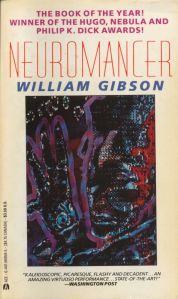
If Blade Runner established the look, Neuromancer defined cyberpunk’s voice. William Gibson’s debut novel was ahead of the curve by acknowledging the personal computer as a disruptive force when the Cold War was at its most threatening. “Lowlife and high tech” meant the Magnetic Dog Sisters headlining some creep joint across the street from a capsule hotel where console cowboys rip off zaibatsus with their Ono Sendai Cyberdeck. But Gibson’s view of the future would be incomplete without an absolute distrust of Reaganism:

“If I were to put together a truly essential thank-you list for the people who most made it possible for me to write my first six novels, I’d have to owe as much to Ronald Reagan as to Bill Gates or Lou Reed. Reagan’s presidency put the grit in my dystopia. His presidency was the fresh kitty litter I spread for utterly crucial traction on the icey driveway of uncharted futurity. His smile was the nightmare in my back pocket.” — William Gibson

“Fragments of a Hologram Rose” to Mona Lisa Overdrive is a decade of creative labor that was “tired of America-as-the-future, the world as a white monoculture.” The Sprawl is a cyberpunk trilogy where military superpowers failed and technology gave Japan leadership of the global village. Then Gibson wrote Virtual Light and readers witnessed extreme inequality shove the middle class into the gig economy as corporations schemed to profit off natural disasters with proprietary technology.

Gibson knew the sci-fi he didn’t care for would absorb cyberpunk and tame its “dissident influence”, so the genre could remain unchanged. “Punk” is the go-to suffix for emerging subgenres that want to appear subversive while posing a threat to nothing and no one. It’s how “hopepunk” becomes a thing. But to appreciate cyberpunk’s assimilation, look at how it’s presented sincerely.

CD Projekt Red (CDPR), known for the Witcher game series, has spent six years developing what’s arguably the most anticipated video game of the moment, Cyberpunk 2077. Like Gibson, Mike Pondsmith, creator the original “pen-n-paper” RPG, and collaborator on this adaptation of his work, has had his writing absorbed by mainstream sci-fi. CDPR could survive on that 31-year legacy, but they insist they’re taking their time with Cyberpunk 2077 to craft an experience with a distinct political identity that somehow allows players to remain apolitical. In a way this is reflective of CDPR’s reputation as a quality-driven business that’s pro-consumer, but has driven talent away by demanding they work excessive hours and promoting a hostile attitude towards unions. This crunch culture is a problem across the industry.

We’ll soon see how Cyberpunk 2077 developed. What we can infer from its design choices, like giving protagonist V a high-collar jacket seen on the cover of the 2nd edition game book from 1990, is that Cybperpunk 2077 will be familiar. Altered Carbon and Ready Player One share this problem. Altered Carbon is so derivative of first-wave cyberpunk it’s easy to forget its based on a novel from 2002. Ready Player One at least has the courtesy to be shameless in its love of pop culture, proud to proclaim that nothing is more celebrated today than our participation in media franchises without ever considering how that might be a problem.

What’s being suggested, intentionally or not, is that contemporary reality has avoided the machinations of the powerful at a time when technology is wondrous, amusing, and prolific. If only we were so lucky.

238 cities spent more than a year lobbying Amazon, one of two $1 trillion corporations in existence, for privilege of hosting their new office. In November it was announced that Amazon would expand to Crystal City, Virginia and Long Island City, Queens. Plenty of New Yorkers are incensedthat the world’s largest online marketplace will get $3 billion in subsidies, tax breaks, and grants to further disrupt a housing market that takes more from them than any city should allow. Some Amazon employees were so excited to relocate they made down payments on their new homes before the decision went public, telling real estate developers to get this corner of New York readyfor a few thousand transplants. But what of the people already there?

Long Island City is home to the Queensbridge Houses, the largest housing project in the US. Built in 1939, these two buildings are home to more then 6,000 people with an average income of $16,000. That’s far below the $54,000 for Queens residents overall. But neither group is anywhere near the average salary for the 25,000 employees Amazon will bring with them, which will exceed $150,000. How many of those positions will be filled by locals? How many will come from Queensbridge?

Over 800 languages are spoken in Queens, making it the most linguistically diverse place in the world. Those diverse speakers spend over 30% of their income on rent. They risk being priced out of their neighborhoods. Some will be forced out of the city. Has Governor Cuomo considered the threat this deal poses to people’s homes? Has Mayor de Blasio prepared for the inevitable drift to other boroughs once property values spike? Looking at Seattle and San Francisco, there’s no reason to expect local governments to be proactive. So New Yorkers have taken up the fight on their own.

Amazon boss Jeff Bezos toyed with these politicians. He floated the idea that any city could become the next Silicon Valley and they believed him. They begged for his recognition, handed over citizen data, and took part in the $100 billion ritual of subsidizing tech companies.

It was all for nothing. Crystal City is a 20-minute drive from Bezos’ house in Washington DC, where Amazon continues to increase its spending on lobbyists. That’ll seem like a long commute compared to the helicopter ride from Long Island City, the helipad for which is subsidized by the city, to Manhattan, the financial and advertising capital of the world, where Bezos owns four more houses.

The auction for Bezos’ favor was a farce. New York and Virginia give him regular access to people with decision-making power, invaluable data, and institutions that are are sure to expand his empire. These cities were always the only serious options.

Amazon’s plans read like the start of a corporate republic, a cyberpunk trope inspired by company towns. Employers were landlords, retailers, and even moral authorities to workforces too in debt to quit. Many had law enforcement and militias to call on in addition to the private security companies they hired to break labor strikes, investigate attempts at unionization, and maintain a sense of order that resulted in massacres like Ludlow, Colorado.

Amazon is known for labor abuses, monitoring, and tracking speed and efficiency in warehouses without bathroom breaks, where employees have collapsed from heat exhaustion. They sell unregulated facial recognition services to police departments, knowing it misidentifies subjects because of inherent design bias. Companies with a history of privacy abuses have unfettered access to their security devices. They control about half of all e-commerce in the US and, as Gizmodo’s Kashmir Hill found out, it is impossible to live our lives without encountering Amazon Web Services.

It doesn’t take a creative mind to imagine similar exposition being attributed to corporate villains like Cayman Global or Tai Yong Medical.

Rewarding corporations for their bad behavior is just one way the world resembles a fictive dystopia. We also have to face rapid ecological and institutional decay that fractionally adjusts our confidence in stability, feeding a persistent situational anxiety. That should make for broader and bolder conversations about the future, and a few artists have managed to do that.

Keiichi Matsuda is the designer and director behind Hyper-Reality, a short film that portrays augmented reality as a fever dream that influences consumption, and shows how freeing and frightening it is to be cut off from that network. Matsuda’s short film got him an invitation to the World Economic Forum in Davos to “speak truth to power.” What Matsuda witnessed were executives and billionaires pledging responsibility with t-shirts and sustainability, while simultaneously destroying the environment, as an audience of their peers and the press nodded and applauded “this brazen hypocrisy.” So Matsuda took a stanchion to his own installation.

Independence means Matsuda gets to decide how to talk about technology and capitalism, and how to separate his art and business. It also means smaller audiences and fewer productions.

Sam Esmail used a more visible platform to “bring cyberpunk to TV” with Mr. Robot. Like Gibson’s Pattern Recognition, it’s cyberpunk retooled for the present — post-cyberpunk. Esmail never hesitates to place our villains in Mr. Robot. Enron is an influence on logo designs and tactics of evil corps. Google, Verizon, and Facebook are called out for their complicity with the federal government in exposing customer data. AT&T’s Long Lines building, an NSA listening post since the 1970s, plays the role of a corporate data hub that reaches across the county. Even filming locations serve as commentary.

An anti-capitalist slant runs through Mr. Robot, exposing the American dream as a lie and our concept of meritocracy as a tool to protect the oligarchy, presenting hackers as in direct contact with a world of self-isolation and exploitation, those who dare to hope for a future affected by people rather than commerce. And Esmail somehow manages this without interference from NBC.

Blade Runner will get more life as an animeCowboy Bebop is joining Battle Angel Alita in live action. Altered Carbon is in the process of slipping into a new sleeve. There’s no shortage of revivals, remakes, and rehashing of cyberpunk’s past on the way. They’ll get bigger audiences than a short film about submitting to algorithms. More sites will discuss their pros and cons than a mobile tie-in that name-drops Peter Kropotkin and Maria Nikiforova. But in being descriptive and prescriptive, moving to the future and looking for sure footing in the accelerated present, Matsuda’s and Esmail’s work reminds us that cyberpunk needs to be more than just repeating what’s already been said about yuppies, Billy Idol, and the Apple IIc.

We live at a time where 3D printing is so accessible refugees can obtain prosthesis as part of basic aid. People forced to migrate because of an iceless arctic will rely on that assistance. Or we could lower temperatures and slow climate change by spraying the atmosphere with sulfate, an option that might disrupt advertising in low-orbit. Social credit systems are bringing oppressive governments together. Going cashless is altering our expectations of others. Young people earn so little they’re leveraging nude selfies to extend meager lines of credit. Productivity and constant notifications are enough to drive some into a locked room, away from anything with an internet connection. Deepfakes deny women privacy, compromise their identity, and obliterate any sense of safety in exchange for porn. Online communities are refining that same technology, making false video convincing, threatening our sense of reality. Researchers can keep our memories alive in chat bots distilled from social media, but the rich will outlive us all by transfusing bags of teenage blood purchased through PayPal.

In a world that increasingly feels like science fiction it’s important to remind ourselves that writing about the future is writing about the present. Artists worthy of an audience should be unable to look at the embarrassment of inspiration around them and refuse the chance to say something new.