COMMUNITY VERSUS COMMODITY: THE HIDDEN BATTLE THAT AFFECTS US ALL

By Gary Z McGee

Source: Waking Times

“We abuse the land because we see it as a commodity belonging to is. When we see the land as a community to which we belong, we may begin to use it with love and respect.” ~Aldo Leopold

If, as Krishnamurti said, “It’s no measure of health to be well adjusted to a profoundly sick society,” then it stands to reason that remaining “well adjusted” has kept us in a perpetual state of ecocide.

Our society poisons the air it breathes, the water it drinks, and the food it eats. And then it has the audacity to poison the minds of its citizens by convincing them that this is somehow “progress”.

The problem is that we don’t have a healthy sense of community. What little sense of community we do have is wrapped up in the unhealthy society that we were born into. It’s caught up in the nine-to-five daily grind and the rat-in-a-cage drudgery of a fear-based lifestyle that’s codependent upon a corrupt state. And this is happening on a global scale. You would be hard-pressed to find a healthy society: that is, a society that does not poison its air, water, food, and minds.

It all comes down to perspective—or the lack thereof. We have been conditioned by a sick society to perceive the world as a commodity that belongs to us. In order to cure ourselves, in order to no longer be sick, we must find a way to flip our perspective into perceiving the world as a community to which we belong.

It will require unlearning what we have learned from the profoundly sick society. It will require unwashing the brainwash and reconditioning the cultural conditioning. It will require living a courage-based lifestyle despite the fear-based lifestyle that surrounds us. It will require becoming interdependent from, rather than codependent on, the profoundly sick society. It will require obtaining an eco-centric perspective while rejecting the egocentric perspective that got us into this mess.

This will be an arduously Herculean task. But no battle is more important for the continued survival of our species.

World as Commodity:

“Do not become one of those who only has the courage of other people’s convictions.” ~A. Bartlett Giamatti

What makes it so difficult to flip our perspective? It’s the fact that the sick society keeps us comfortable, safe, and secure while at the same time that it keeps us unhealthy and codependent. The other reason is that it is so much easier to use the world as a commodity.

And that’s the rub. Nobody wants to take responsibility. Nobody wants to be uncomfortable, unsafe, or insecure. Everybody wants to take the easy road. And so the profoundly sick society just keeps on getting sicker.

It’s all too easy to simply rely upon unsustainable corporations that pollute the air and poison the water. In order to keep up with the rat race and keep food on the table, we are forced to rely on corrupt corporations and bureaucratic governments that are dead set on using the world as a commodity while calling it progress. After all, even unhealthy food is better than no food at all. Right?

And even when we do try to become independent and grow our own food or catch our own rainwater, we have overreaching governments with the monopoly on violence coming down on us and slapping us with fines or threatening us with jail time.

The ‘world as commodity’ is an unhealthy snake eating its own tail. Even worse, it gives birth to citizens that are codependent sheep grazing on the unhealthy snake shit and somehow managing to convince themselves it’s food. “Hell! If it’s cheap and easy and keeps me comfortable and safe from government oppression, I might as well eat it. Ignorance is bliss, right?” Right.

And that’s the real kicker. Any awareness of living in a sick society is easily pushed to the side and repressed through the psychosocial convenience of cognitive dissonance. Which usually sounds a little something like this: “It’s uncomfortable for me to believe that I live in a profoundly sick society, even though the evidence is overwhelming. So, rather than think about it, I’ll simply ignore it. After all, there are bills to pay. My kids need to eat (probably McDonald’s or Roundup-laced vegetables). Who do you think I am? Captain Fantastic?”

Satire aside, comfort and convenience are the front lines in the battle against the world as a commodity. If we have any chance of winning this battle, every single one of us will have to win that war at the front line. Which will mean a lot of discomfort and inconvenience.

World as Community:

“We are what we repeatedly do. Excellence, then, is not an act, but a habit.” ~Aristotle

The solution to winning the war against perceiving the world as a commodity is flipping our perspective and perceiving it as a community. Unfortunately, this will require discomfort and inconvenience.

This will require peeling away layer upon layer of cultural conditioning. The first layer is fear of the unknown. It’s the fear of trying something new, of making a healthy lifestyle change. It’s the fear of being ostracized or left out. It’s the fear of some arbitrary authority coming in with some arbitrary power and fining us with some arbitrary law.

So, the first thing we’ll need is courage. But not just any kind of courage. We’ll need a particular flavor of courage that is willing to be “the bad guy,” the maverick, the martyr. It will require the kind of courage that can stand up to codependent peer pressure and take independent leaps of courage, despite goodie-two-shoe conformists and weak-kneed milquetoasts.

The kind of courage that will make the sick society hate you for being healthy; when, really, it just hates itself for remaining sick. It’s the kind of courage that eco-centrically crushes out into healthy interdependence with cosmos, despite the sick society that egocentrically flushes everything away in codependent excess and greed.

The second thing we’ll need is the ability to question the sick society to the nth degree. But not just any kind of questioning. No. We need a particular flavor of questioning that is ruthless, penetrating, interrogating—no-holds-barred.

The kind of questioning that puts unsustainable corporations on blast. The kind of questioning that’s civilly disobedient. The kind of questioning that tears apart the outdated, xenophobic reasoning of the sick society; that reveals the chain-of-command as nothing more than an up-jumped human centipede, blind and poisonous to reason. Indeed. The kind of questioning that has shock value; that won’t allow the sick society to fall back into pretending it’s asleep.

Most of all, it will require us all to practice self-interrogation, self-improvement, and self-overcoming—all of which are exceedingly uncomfortable and inconvenient. Oh well.

When it comes down to it, things will probably get worse before they get better. Transitioning from a sick society that treats the world as a commodity to a healthy society that treats the world as a community will not be an easy task. Things may even slip into anarchy (no masters, no rulers). But even uncomfortable anarchy is healthier than comfortable tyranny, or convenient sickness. Especially when the tyranny and the sickness are ecocidal. Without a healthy planet there can be no healthy people. It really is that critical. Indeed. We may need to sow a little strategic disorder to reap a higher order.

The world can be a community to which we belong, full of compassion, respect, love, and tolerance. But only if we let it. And not if we continue to treat the world like a commodity that belongs to us.

Our tolerance of a ‘profoundly sick society’ can only go so far. Lest we inadvertently end up on the side of the executioners, we must draw the line somewhere. It must be drawn at sickness, at excess, at violence, at greed, and at ecocide. And only free, healthy, courageous individuals will have the wherewithal to draw it.
Falsehood Rules

By James Howard Kunstler

Source: Kunstler.com

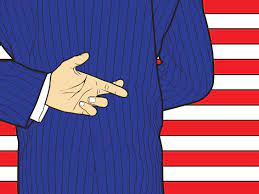
Who knew that reality could become such a squishy thing in the USA? But such are the agonies of a collapsing society that it becomes ever harder to know what’s real, especially with factions in power intent on gaslighting, manipulating, obfuscating, and coercing the raw material of public opinion, which is: what has actually happened in the past and what is happening now.

When I wrote The Long Emergency, I expected we would be living through a period of confusion and disorder, but I didn’t know what it would feel like to go through it: a nauseating existential disorientation, like being seasick on dry land… like living in a German expressionist horror movie of the 1920s (and we know what that led to)… like being held prisoner inside Franz Kafka’s castle: an immersion in totalizing falsehood.

The collapse of authority is especially striking and disturbing now because ground zero for it is the US Department of Justice (DOJ), the very place that is charged with determining what is true and what is false, what is real and what is unreal, and especially what is okay, and what is not okay.

The collapse of authority at DOJ got sickening traction after the election of 2016, when FBI Director James Comey and his underlings, along with many high officials at its parent agency, DOJ, undertook a campaign to disable and expel the winner of that election, starting before his inauguration. The Russia Collusion operation was the epitome of falsehood concocted in bad faith, and the actions taken in it were never adjudicated — though an ectoplasm named John Durham is floating somewhere out in the national ether still delegated to make cases. Leaving all that hanging this long has been a grievous injury to the country’s identity as a place on this earth where fair play was supposed to be normal.

The Mueller Investigation was another insult to the public interest, devised to distract and cover up the all the previous seditious bad faith of Comey & Company, and the C-suite at DOJ — and, of course, the Special Counsel came up with absolutely nothing actionable, which was stunning considering the resources behind it, and the time spent. At a Senate hearing about it in 2018, Robert Mueller himself claimed to be unacquainted with key characters in his own investigation and key pieces of evidence. His performance was worse than not reassuring — he appeared to be lying or incompetent, or pretending to be incompetent, and since that moment he has gone-to-ground… untouchable.

Impeachment No. 1 was supposedly about a phone call that the President made to his counterpart in Ukraine, Mr. Zelensky, regarding suspicious activity of one Hunter Biden receiving large sums of money from a gas company there while his father was Vice-president. At the time, the FBI (and the DOJ) did not disclose their possession of a laptop computer owned by Hunter Biden containing hundreds of memoranda and emails detailing the Biden family’s lucrative business dealings in Ukraine and several other foreign countries, involving sums of money far greater than the Burisma Company of Ukraine was paying Joe Biden’s son, and how the income was split between the family members. In other words, evidence that then-Vice-president Joe Biden himself was on the take from foreign countries, including companies linked directly with the communist party of China. Not important, you think? Not germane to the impeachment?

Why was that information not turned over to the president’s lawyers during the initial hearings and then the impeachment trial itself? That has never been adequately addressed, not even a little, and largely because the mainstream media does not want to know, and didn’t ask, while the alt.media does not have access to ask the officials who might know — and Congress, under Mrs. Pelosi and Chuck Schumer certainly didn’t want to ask or know. Do you appreciate how damaging this act of institutional dishonesty was.

Then there was the election of 2020, held under the Covid-19 emergency, with new rules about mail-in voting that lent themselves to fraud — or so declared former President Jimmy Carter and former Secretary of State James Baker, who ran a commission on election reform in 2005 — and that appears to be exactly what happened. The specious and dishonest claim is made by the putative winners that the matter was completely settled in the courts post-election. That is simply not true. The actual evidence was not entertained, most particularly not by the Supreme Court, which declined on the basis of “standing,” a mere point of procedure.

Now there is one official forensic audit of the 2020 election underway in Maricopa County, Arizona, (the Phoenix metro area), ordered by the State Senate, and some conclusions from phase one, involving the paper ballots, are due to be released this week, with additional phases to come concerning the Dominion voting machines. Many other state legislatures sent delegations to Arizona to learn the ins-and-outs of conducting a forensic audit, and they are making noises about actually doing it.

So, in stepped Attorney General Merrick Garland. At the start of the Arizona audit, he sent a letter to the Arizona State Senate threatening to use the Civil Rights Division of the DOJ to halt the audit on the basis of depriving voters of their civil rights. Arizona responded by promising to jail any federal officials who laid their hands on any ballots. That was the end of that gambit for now — they may try it again in phase two.

In the meantime, a county judge in Georgia (one Brian Amero) has ruled that 147,000-odd ballots alleged to have chain-of-custody problems must be made available for inspection, and also that five members of the Fulton County (Atlanta Metro Area) Board of Elections are now individually parties to the lawsuit brought by nine Georgia voters, and may be subject to deposition (being questioned under oath). That is believed to be the beginning of an effort to conduct a full audit in Georgia.

So, again, in steps Attorney General Merrick Garland with his Civil Rights Division, led by political activist Kristen Clarke, bringing a lawsuit against the Georgia election reform act passed earlier this year — a shot over Georgia’s bow, shall we say. Ms. Clarke happens to be a colleague of Georgia activist Stacey Abrams, a former Democratic candidate for governor. Ms. Abrams is also a part-owner of a company, NOWAccount, that does payroll for a private company called Happy Faces, which furnished dozens of poll workers to tally the 2020 election in Georgia, as well as the 2021 US Senate runoff election that put two Democrats, Jon Ossoff and Raphael Warnock, in office.

Elections are supposed to be conducted by public officials, not by private entities. Supposedly, the Georgia election officials turned to Happy Faces because it was a way to avoid hiring workers for less than 30 hours-a-week, which would have otherwise required providing them with health care under ObamaCare, the ACA Act. Was that legal? It has not been adjudicated.

Nor has the much bigger scandal of a private Chicago-based non-profit called the Center for Tech and Civic Life, which received $350-million from Facebook’s CEO Mark Zuckerberg to arrange grants targeted at swing districts in Democratic strongholds such as Milwaukee, Detroit, Philadelphia, and Atlanta, for the purpose of hiring ballot harvesters, among other activities. Mr. Zuckerberg met with Kristen Clarke, Stacey Abrams, Al Sharpton, and other Democratic activists at a dinner in 2019, at which he promised to help. Did his help cross any legal boundaries? It has not been investigated, nor has the use of the company he runs, Facebook, in its campaign to influence public opinion by blocking news and deleting accounts of non-Democrats exclusively.

Assistant AG Kristen Clarke’s DOJ lawsuit against Georgia’s election reform act alleges that it “imposes substantial fines on third-party organizations, churches, and advocacy groups that send follow up absentee ballot applications, and requires new and unnecessarily stringent identification requirements to obtain an absentee ballot.”  In other words, the Georgia law seeks to restrict the activities of private, non-official entities — such as the Center for Tech and Civic Life — sprinkling gargantuan sums of money over key election districts to influence the outcome. Or for companies such as Happy Faces to supply activists for counting votes. That is how disingenuous Merrick Garland’s DOJ is, now a strictly political operation.

We haven’t nearly seen the end to any of this, nor the reaction that it is liable to provoke among citizens who have had enough of being played by their own government. Think about all  that while you make plans to celebrate the Fourth of July, a holiday that commemorates an earlier time when the people of this land had enough of being played by their rulers.

The Etymological Animal Must Slip Out of the Cage of Habit to Grasp Truth

Etymology – from Greek, etymos, true, real, actual (the study of roots)

By Edward Curtin

Source: Behind the Curtain

Life is full of slips.

Words slip out of our mouths to surprise us.  Thoughts slip into our minds to shock us.  Dreams slip into our nights to sometimes slip into our waking thoughts to startle us.  And, as the wonderful singer/songwriter Paul Simon, sings, we are always “slip sliding away,” a reminder that can be a spur to courage and freedom or an inducement to fear and shut-upness.

Slips are double-edged.

It is obvious that since September 11, 2001, and more so since the corona virus lockdowns and the World Economic Forum’s push for a Fourth Industrial Revolution that will lead to the marriage of artificial intelligence, cyborgs, digital technology, and biology, that the USA and other countries have been slipping into a new form of fascist control.  Or at least it should be obvious, especially since this push has been accompanied by massive censorship by technology companies of dissenting voices and government crackdowns on what they term “domestic terrorists.”  Dissent has become unpatriotic and worse – treasonous.

Unless people wake up and rebel in greater numbers, the gates of this electronic iron cage will quietly be shut.

In the name of teleological efficiency and reason, as Max Weber noted more than a century ago in The Protestant Ethic and the Spirit of Capitalismcapitalist elites, operating from within the shadows of bureaucratic castles such as The World Economic Forum (WEF), the World Health Organization WHO), the International Monetary Fund (IMF), The World Bank (WBG), The US Centers for Disease Control and Prevention (CDC), Google, Facebook, the National Security Agency (NSA), the CIA, etc., – run by people whose faces are always well hidden – have been using digital technology to exert increasing control over the thoughts and actions of people worldwide.  They have been doing this not only by diktats but by manufacturing social habits – customary usages – through which they exert their social power over populations.  This linguistic and ideational propaganda is continually slipped into the daily “news” by their mainstream media partners in crime. They become social habits that occupy people’s minds and lead to certain forms of behavior.  Ideas have consequences but also histories because humans are etymological animals – that is, their ideas, beliefs, and behaviors have histories.  It is not just words that have etymologies.

When Weber said “a polar night of icy darkness” was coming in the future, he was referring to what is happening today.  Fascism usually comes on slowly as history has shown.  It slips in when people are asleep.

John Berger, commenting on the ghostly life of our received ideas whose etymology is so often lost on us, aptly said:

Our totalitarianism begins with our teleology.

And the teleology in use today is digital technology controlled by wealthy elites and governments for social control.  For years they have been creating certain dispositions in the general public, as Jacques Ellul has said, “by working spells upon them and exercising a kind of fascination” that makes the public receptive to the digital life.  This is accomplished slowly in increments, as permanent dispositions are established by slipping in regular reminders of how wonderful the new technology is and how its magical possibilities will make life so free and easy. Efficient. Happiness machines.  A close study of the past twenty-five years would no doubt reveal the specifics of this campaign.  In The Technological Society, Ellul writes:

… the use of certain propaganda techniques is not meant to entail immediate and definite adhesion to a given formula, but rather to bring about a long-range vacuity of the individual.  The individual, his soul massaged, emptied of his natural tendencies, and thoroughly assimilated to the group, is ready for anything.  Propaganda’s chief requirement is not so much to be rational, well-grounded, and powerful as it is to produce individuals especially open to suggestion who can easily be set into motion.

Once this softening up has made people “available,” the stage is set to get them to act impulsively.  Ellul again:

It operates by simple pressure and is often contradictory (since contradictory mass movements are sometimes necessary).  Of course, this dissociation can be effective only after the propaganda technique has been fused with the popular mores and has become indispensable to the population. This stage may be reached quickly, as, for example, in Germany in 1942, after only ten years of psychic manipulation.

The end result, he argues, is the establishment of an abstract universe, in which reality is completely recreated in people’s minds.  This fake reality is truer than reality as the news is faked and people are formed rather than informed.

In today’s computer driven world, one thing that people have been told for decades is to be vigilant that their computers do not become infected with viruses.  This meme was slipped regularly into popular consciousness.  To avoid infection, everyone was advised to make sure to have virus protection by downloading protection or using that provided by their operating systems, despite all the back doors built in which most have been unaware of.

Now that other incredible “machine” – the human body – can get virus “protection” by getting what the vaccine maker Moderna says is its messenger RNA (mRNA) non-vaccine “vaccine” that functions “like an operating system on a computer.”  First people must be softened up and made available and then “set in motion” to accept the solution to the fearful problem built in from the start by the same people creating the problem.  A slippery slope indeed.

But slipping is also good, especially when repetition and conventional thought rules people’s lives as it does today in a digital screen life world where algorithms often prevent creative breakthroughs, and the checking of hourly weather reports from cells is a commonplace fix to ease the anxiety of being trapped in a seemingly uncontrollable nightmare.  It seems you now do need computer generated weather reports to know which way the wind blows.

In our culture of the copy, new thoughts are difficult and so the problems that plague society persist and get rehashed ad infinitum.  I think most people realize at some level of feeling if not articulation that they are caught in a repetitive cycle of social stasis that is akin to addiction, one that has been imposed on them by elite forces they sense but don’t fully comprehend since they have bought into this circular trap that they love and hate simultaneously.  The cell phone is its symbol and the world-wide lockdowns its reality.  Even right now as the authorities grant a tactical reprieve from their cruel lockdowns if you obey and get experimentally shot with a non-vaccine vaccine, there is an anxious sense that another shoe will drop when we least expect it.  And it will.  But don’t say this out loud.

So repetition and constant change, seemingly opposites, suffuse society these days. The sagacious John Steppling captures this brilliantly in a recent article:

So ubiquitous are the metaphors and myths of AI, post humanism, transhumanism, et al. that they infuse daily discourse and pass barely noticed. And there is a quality of incoherence in a lot of this post humanist discourse, a kind of default setting for obfuscation….The techno and cyber vocabulary now meets the language of World Banking. Bourgeois economics provides the structural underpinning for enormous amounts of political rhetoric, and increasingly of cultural expression….This new incoherence is both intentional, and unintentional. The so called ‘Great Reset’ is operationally effective, and it is happening before our eyes, and yet it is also a testament to just how far basic logic has been eroded….Advanced social atomization and a radical absence of social change. Today, I might argue, at least in the U.S. (and likely much of Europe) there is a profound sense of repetitiveness to daily life. No matter one’s occupation, and quite possibly no matter one’s class. Certainly the repetitiveness of the high-net-worth one percent is of a different quality than that of an Uber driver. And yet, the experience of life is an experience of repetition.

A kind of flaccid grimness accompanies this sensibility.  Humor is absent, and the only kind of laughter allowed is the mocking kind that hides a nihilistic spirit of resignation – a sense of inevitability that mocks the spirit of rebellion.  Everything is solipsistic and even jokes are taken as revelations of one’s personal life.

The other day I was going grocery shopping.  My wife had written on the list: “heavy cream or whipping cream.”  Not knowing if there were a difference, I asked her which she preferred.  “I prefer whipping,” she said.

I replied, “But I don’t have a whip nor do they sell them at the supermarket.”

We both laughed, although I found it funnier than she.  She slipped, and I found humor in that.  Because it was an innocent slip of the tongue with no significance and she had done the slipping, there was also a slippage between our senses of humor.

But when I told this to a few people, they hesitated to laugh as if I might be revealing some sado-masochistic personal reality, and they didn’t know whether to laugh or not.

It’s harder to laugh at yourself because we get uptight and are afraid to say the “wrong” things.  Many people come to the end of their lives hearing the tolling for their tongues that never spoke freely because of the pale cast of thought that has infected them.  Not their own thoughts, but thoughts that have been placed into their minds by their controllers in the mass media.

Freud famously wrote about slips of the tongue and tried to pin them down.  In this he was a bit similar to a lepidopterist who pins butterflies.  We are left with the eponymous Freudian slips that sometimes do and sometimes don’t signify some revelation that the speaker does not consciously intend to utter.

It seems to me that in order to understand anything about ourselves and our present historical condition – which no doubt seems very confusing to many people as propagandists and liars spew out disinformation daily – we need to develop a way to cut through the enervating miasma of fear that grips so many.  A fear created by elites to cower regular people into submission, as another doctor named Anthony Fauci has said: “Now is the time to just do what you are told.”

But obviously words do matter, but what they matter is open to interpretation and sometimes debate.  To be told to shut up and do what you’re told, to censor differences of opinion, to impose authoritarian restrictions on free speech as is happening now, speech that can involve slips of the tongue, is a slippery slope in an allegedly democratic society.  Jim Garrison of JFK fame said that we live in a doll’s house of propaganda where the population is treated as children and fantasies have replaced reality. He was right.

So how can we break out of this deeply imbedded impasse?

This is the hard part, for digital addiction has penetrated deep into our lives.

I believe we need to disrupt our routines, break free from our habits, in order to clearly see what is happening today.

We need to slip away for a while. Leave our cells.  Let their doors clang shut behind. Abandon television.  Close the computer.  Step out without any mask, not just the paper kind but the ones used to hide from others.  Disburden our minds of its old rubbish. Become another as you go walking away.  Find a park or some natural enclave where the hum and buzz quiets down and you can breathe.  Recall that in Orwell’s Nineteen Eighty-Four the only place Winston Smith can escape the prying eyes and spies of Big Brother, the only place he can grasp the truth, was not in analyzing Doublethink or Crimestop, but “in a natural clearing, a tiny grass knoll surrounded by tall saplings that shut it in completely” and bluebells bloomed and a thrush sang madly.  Here he meets his lover and they affirm their humanity and feel free and alive for a brief respite.  Here in the green wood, the green chaos, new thoughts have a chance to grow.  It is an old story and old remedy, transitory of course, but as vital as breathing.  In his profound meditation on this phenomenon, The Tree, John Fowles, another Englishman, writes:

It is not necessarily too little knowledge that causes ignorance; possessing too much, or wanting to gain too much, can produce the same thing.

I am not proposing that such a retreat is a permanent answer to the propaganda that engulfs us.  But without it we are lost.  Without it, we cannot break free from received opinions and the constant mental noise the digital media have substituted for thought.  Without it, we cannot distinguish our own thoughts from those slyly suggested to us to make us “available.”  Without it, we will always feel ourselves lost, “shipwrecked upon things,” in the words of the Spanish philosopher Ortega Y Gasset.  If we are to take a stand against the endless lies and a world-wide war waged against regular people by the world’s elites, we must first take “a stand within the self, ensimismamiento,” by slipping away into contemplation.  Only then, once we have clarified what we really believe and don’t believe, can we take meaningful action.

There’s an old saying about falling or slipping between the cracks.  It’s meant to be a bad thing and to refer to a place where no one is taking care of you. The saying doesn’t make sense. For if you end up between the cracks, you are on the same ground where habits hold you in learned helplessness.  Better to slip into the cracks where, as Leonard Cohen sings, “the light gets in.”

It may feel like you are slipping away, but you may be exploring your roots.

THE ART OF SHADOWING YOURSELF

By Gary Z McGee

Source: Waking Times

“Look at every path closely and deliberately, then ask yourself this crucial question, does this path have heart? If it does, then the path is good. If it doesn’t, then it is of no use.” ~Carlos Castaneda

The art of shadowing yourself is a ruthless form of self-overcoming made popular by the writings of Carlos Castaneda (he called it stalking the self), who was inspired by the Yacqui Shaman Don Juan.

The shadower needs four essential qualities: ruthlessness, cunning, patience, and humor. The fundamentals of the art of shadowing yourself are three-fold: shadowing the self, shadowing the world, and shadowing the unknown. Let’s break it down…

Shadowing the Self:

“Be melting snow. Wash yourself of yourself.” –Rumi

Shadowers are seekers. They are ruthless explorers. When shadowers shadow themselves, they are shadowing inner knowledge, sacred wisdom, and hidden information. They are in search of the golden shadow, where latent creativity is hidden beneath layer upon layer of cultural conditioning, religious indoctrination, and political brainwashing.

When a shadower shadows him/herself, he is a hunter mercilessly routing out codependence, weakness, and cowardice. He uses self-interrogation like Occam’s Razor, shaving away the superfluous, cutting away years and years of false knowledge, unlearning what was learned, un-washing the brainwash, and reconditioning the conditioning that came before.

A shadower audaciously digs a hole right into the center of his own comfort zone. He digs deep. He keeps digging, hungry for something more, for something he knows not what. He digs until there is nothing more than a snarling abyss, a soul-shattering existential darkness that presses in on him, that smashes his fragile ego into a million little pieces.

It is at the bottom of the abyss, deep in the throes of a Dark night of the soul, with his shattered ego reassembled into an individuated tool for further exploration, that the shadower discovers the diamond hidden in the rough of his soul: shadow’s gold.

Shadow’s gold is our sacred wound glowing like nothing else can glow. It is the accumulation of all the repressed pain, failure, setbacks, and loss experienced in a lifetime pressurized into a powerful force of darkness made conscious. It is our repressed shadow married with our inner light.

Having discovered the inner darkness of his soul’s abyss, the shadower takes his shadow’s gold and uses it to climb out of fearful codependence and into courageous independence. Now it’s time to use this newfound independence—this unity of abyss and summit, of shadow and light—to stretch his tiny comfort zone into the world.

Shadowing the World:

“The shamans say that being a medicine man begins by falling into the power of the demons. The one who pulls out of the dark place becomes the medicine man, and the one who stays in it is the sick person. You can take every psychological illness as an initiation. Even the worst things you fall into are an effort of initiation, for you are in something that belongs to you.” ~Marie-Louise von Franz

Now that the self has been thoroughly interrogated, shadow’s gold discovered, abyss and summit united, it’s time for the shadower to shadow the world. It’s time for the shadower to rise up out of the ashes of his codependence and break down the walls of his tiny comfort zone. It’s time to piece back together his shattered ego into an individuated ego. The shadower uses the knowledge of his individuation to take a leap of courage out of his comfort zone. He finally has the ears to hear the call to adventure. He is ready to take the next step into his hero’s journey.

But the world is dangerous. Living a life well-lived is full of risks. Adventure is at hand, yet when a shadower stretches his comfort zone, he understands that he is stretching into risky adventure. Hence the need for courage.

Shadowing the world is not for the faint of heart. It requires questioning all institutions to the Nth degree. It requires getting in the face of all so-called authorities. It requires ruthless civil disobedience that puts the powers that be in check. It requires David-like courage challenging any and all Goliath-like power structures. Sometimes, it even requires amoral agency to balance out the extremes of the overly moral goodie-two-shoes and immoral psychopaths of the world.

A shadower shadows the world with the same ruthlessness in which he shadowed himself, mercilessly interrogating everything the culture has taken for granted. He holds outdated world views against the hot iron of universal law and tosses out what cannot withstand the heat. He counts coup on power. He deflates egos and animates souls. He cuts the strings that once bound him to a profoundly sick society like a mere puppet and turns those strings into a lasso with which he lassos truth.

The shadower acts as a mirror to the world, revealing the shadows of others. People fear their own shadows and so they tend to fear the ruthless honesty of the shadower. They cringe. They balk. They reel inside the slow simmer of their own cognitive dissonance. Nevertheless, the shadower relentlessly injects wakefulness into an otherwise somnambulant world.

When a shadower shadows the world, he becomes the world. He stretches his tiny comfort zone into a mighty horizon, subsuming the world. And the shadow of the world is a mighty thing indeed. He is now ready for the difficult task of shadowing the unknown.

Shadowing the Unknown:

“The need for mystery is greater than the need for an answer.” ~Ken Kesey

When a shadower shadows the unknown, he goes Meta. He shadows the infinite. He shadows God. He cunningly interrogates mental paradigms. He lives between worlds, bridging gaps. To a shadower, the unknown is merely procrastinating knowledge just waiting to be known.

If, as Einstein said, “Imagination is more powerful than knowledge,” then the shadower turns the power of his imagination on the universe itself, flexing on Infinity, despite his own finitude.

It is in this sense that a shadower becomes a cosmic hero. Having risen up out of his codependent comfort zone, having leveraged a life well lived through shadow’s gold, having embraced the interconnectedness of all things through the union of summit and abyss, the shadower becomes an interdependent self-actualizer projecting the prism of his shadow’s glow into the Great Mystery. He has left behind the fear-based lifestyle and embraced a courage-based lifestyle that manifests the provident-based lifestyle of cosmic heroism.

Shadowing the unknown almost always leads to high art. Cathartic art. The kind of art that changes the world, full of myth and metaphor and existential leitmotifs. The kind of art that becomes the magic elixir that wakes up entire “tribes,” that animates an otherwise inanimate world. A shadower shadows the unknown in order to give birth to the sacred known.

Shadowing the unknown is the art of living life to the Nth degree. It’s inflicting oneself with a life well-lived through a courage of the most high, with a humor of the most high, with honor of the most high. It’s grabbing God by the throat and forcing him to cough up all his secrets, blasphemy be damned. It’s being ruthlessly determined to live life well, as a shining example to those living life ill.

Ultimately, shadowing the unknown is shadowing death. It’s being on the hunt for a good death that balances out a good life. As Castaneda said, “Death is the only wise advisor we have. Whenever you feel like everything is going wrong and you’re about to be annihilated, turn to your death and ask if that is so. Your death will tell you that you are wrong; that nothing matters outside its touch. Your death will tell you, “I haven’t touched you yet.”

On the Duty of Civil Disobedience

By Stephen Parato

Source: Waking Times

“If the injustice is part of the necessary friction of the machine of government, let it go, let it go: perchance it will wear smooth–certainly the machine will wear out… but if it is of such a nature that it requires you to be the agent of injustice to another, then I say, break the law. Let your life be a counter-friction to stop the machine. What I have to do is to see, at any rate, that I do not lend myself to the wrong which I condemn.” ~Henry David Thoreau

Obedience is the connective tissue of oppression.

In other words, any form of control on a collective level can only be carried out through obedience. A dictator can’t arrest or kill an entire population himself; he needs mindless minions to do the dirty work. This principle applies across all forms and degrees of systematic control, even the most subtle.

The desires of any wannabe controller can only come to fruition through the compliance of others. And that’s been the case throughout recorded history (his-story). The desire for control becomes a virus, driven by fear and infecting more and more people, until there are enough drones to oppress an entire population.

This phenomenon isn’t just the case with large-scale atrocities; it applies to anything which is an impediment to freedom or love; be it a person, group, system or idea.

Everything is held up by belief. Laws are merely words written on paper, only legitimized by collective acquiescence. Laws need people to enforce them. And if laws are unjust (as most are), those who carry them out must unquestioningly submit to authority and go against their own inner knowing.

The only way control or oppression works on any scale is through compliance. Too many people do the work of ‘the man’ for ‘the man.’ That’s the problem. The solution lies in civil disobedience.

Freedom Cannot Be Granted

“Freedom cannot be granted. It must be taken.” ~Max Stirner

Asking for freedom is oxy-moronic. If you have to ask for freedom, you’re already a slave.

How is freedom taken? The simple decision to be the master of your own body and mind.

It really is as simple as that, though difficult to apply. It’s easy to blame problems on others, it’s easy to neglect our health and think “the doctor can fix me.” We’ve been conditioned to externalize our power since childhood. We’ve been taught to not trust ourselves. We’ve been taught to submit to authority without question.

This is a recipe for a control system to stealthily and slowly permeate society (the totalitarian tiptoe).

When you attain a degree of self-mastery, you do not acquiesce to the will of destructive people or disharmonious institutions. Which leads to the next point…

Fear-Based Programming

“The pioneers of a warless world are the youth who refuse military service.” ~Albert Einstein

The covert means by which oppression takes over is through fear-based programming.

If you have people in fear, you can easily control them. Fear activates the part of the brain known as the amygdala (the center for emotional behavior/motivation) and inhibits neocortex function (our “thinking brain”). This means that rationality and intellect are thrown out the window, the perfect storm for brainwashing. There’s even a term for this fear response; amygdala hijack.

The media is one big amygdala hijack, perpetually programming the population with which boogeyman to fear next. This is a massive ritual of fear-based programming that insidiously shifts entire populations into thinking and acting irrationally out of fear. Television is called programming for a reason.

Remember the whole weapons of mass destruction fiasco with Iraq in 2003? US military action in Iraq and massive destabilization of the middle east (which continues to this day) was predicated on that lie. There were no weapons of mass destruction. But lingering fear from 9/11 resulted in a string of irrational behavior and many people blindly believing the hype.

The holocaust took place because German soldiers were thoroughly conditioned to carry out orders. They didn’t carry out orders because they liked doing it, but because they feared the wrath of their higher ranking officers, or even because they were conditioned to fear jewish people. These abominations only occur when fear is the driving force.

Fear is hard to pin down. It’s slippery, and ultimately illusory (False Evidence Appearing Real). Yet it’s the undercurrent of all “negative” emotions. Fear is what stops us from saying no to evil. Fear might actually distort our perceptions to support evil. That’s why it’s so dangerous.

When you cultivate self-mastery, you’re able to break the cycle. The spread of fear stops before you and is transmuted by the omnipotent force of unyielding love.

Love Over Fear

“There are two basic motivating forces: fear and love. When we are afraid, we pull back from life. When we are in love, we open to all that life has to offer with passion, excitement, and acceptance. We need to learn to love ourselves first, in all our glory and our imperfections. If we cannot love ourselves, we cannot fully open to our ability to love others or our potential to create. Evolution and all hopes for a better world rest in the fearlessness and open-hearted vision of people who embrace life.” ~John Lennon

Strive to choose love over fear in every situation. You can never go wrong if you act from a place of compassion. This is the fulcrum of change, and it starts within you.

The change we all yearn to see in the world will only happen in the wake of a fundamental change in consciousness. Everything we see in this world starts in the realms of imagination before coming into manifestation.

The change begins within and ripples outward. Embodying the change is the first step, the prerequisite. Without inner transformation, humanity will be stuck on the same merry-go-round of madness.

When a critical mass of people create positive inner changes, it will open up doors we never could’ve imagined before and will provide possibilities far beyond our current limited perspective. Solutions will spontaneously emerge.

Go within and stop the momentum of fear. Learn to listen to and trust your intuition. Have the courage to follow your heart instead of cowardly bowing to fear.

“Courage is a heart word. The root of the word courage is cor – the Latin word for heart. In one of its earliest forms, the word courage meant ‘To speak one’s mind by telling all one’s heart.’” ~Brene Brown

Compliance with destruction, hatred, oppression, violence and fear is cowardice, while noncompliance is courageous. In the depths of your being, in your heart of hearts, you know what is right.

Choose love over fear.

Have the courage of heart and freedom of mind to disobey oppressive forces.

Be the change.

Culture, Self and Law

By Darren Allen

Source: Off-Guardian

This is an extract from Self and Unself, Darren Allen’s new ‘philosophy of all and everything’. Some of the terms herein — consciousness, self, ego, etc — may appear somewhat mysterious or abstract as they are explained in earlier sections of the book.

Self produces manifest culture, and then that culture shapes self. First, self is externalised as an expression — some kind of act or presentation. The expression appears as an object, a thing in the world, which is related to other objects, which are then reappropriated by man back into the self.

A band releases an album, a building company constructs a block of flats, an advertising agency puts up hoardings around town, an individual recounts a few anecdotes. The songs, the dwellings, the signs and the stories become part of a world which then shapes those within that world.

If self is unselfish this process ultimately begins “beyond” culture, with consciousness, to which the reappropriated modifications are subject to some kind of evaluation — I can reject the bullshit music, the ugly council estate, the advertising lies and the witless jibber-jabber.

If, however, self is fundamentally egoic, consciousness is given no freedom to operate, and the caddis case is formed almost entirely from without, walling up inner quality, and with it, genuine individuality.

First self speaks, then the words get set in stone, then the stone speaks to the self, writing its words back into the human heart, which speaks again.[1] If there is freedom to speak, and to be heard, and to walk away, this dialogue (or dialectic) is fruitful and serves man.

But, just as if one person screws another down and forces words into her head it is no longer a conversation, so if society (culture plus self, or selves) fills its schools and lines its streets with messages that all say the same thing, with no way of escape, then we are no longer individuals participating in a society, but stackable storage units for whomever or whatever is filling us with the things we are forced to feel, eat, look at, think about and energetically engage with; in short, build our selves with.

Culture was once built from nature, and, more intimately, from the unselfish origin of that which nature and culture have in common. This is why pre-civilised man considered nature and culture to be identical. The more culture came to be built from itself, the less it served the essence of man, until it came to compel man to accept its objective validity or suffer the consequences. Not in an overt tyrannical sense, but in the unalterable fact of its existence.

You can think away culture or pretend it doesn’t matter — ignore, say, the rules of language or pretend that they are dispensable, but you will be punished, mocked, excluded, brought back into line or killed. Likewise, if your social self is at odds with your individual self, then all kinds of problems are on their way. This does not mean that I must be something other than my social self, but that I am continually compelled to harmonise the two, and if I can’t — if I cannot be in the world who I feel I really am—then I will suffer in the world, as everyone who is honest does.

Ego keeps this suffering at bay by endlessly affirming its social self. As that most unreal and egoic of sources, the average Teevee-American has it, ‘I am a cop, it’s what I do…’ ‘I am a mother, it’s what I do…’ Or, alternatively, ‘This is my town, these are my people’.

Such a ‘self’ is not something which is invented, it is there, ‘inside me’. I look inside and see that I am the cop or mother that society takes me to be (or, for the fake outsider, that I wish society to take me to be). And I have no desire to be anything else. Not that there is anything wrong with inhabiting a role, nor with identifying with a community, nor that there aren’t always elements of self that do not fit into what is required by the social world; rather that ego hides from itself in its social representation.

Man may be psychologically and spiritually deformed by his activity within the egoic group or institution, he may work in a mechanical manner, in mediated environments, in order to produce or manage things which have no recognisable human meaning, and he may be forced to conceal his horror and disgust behind an upbeat mask of emotional management, but if there is no truth beyond a self-constructed from the group, he will defend his deformity, and consequent duplicity and misery, as truth.

All criticisms of the group are taken to be criticisms of the self — ‘I am mortally offended by your prejudice’ — and all criticisms of the self are taken to be prejudice against the group — ‘It’s not because you are repulsed by my moral deformity, it’s because you are racist/homophobic/anti-white/anti-American etc’.

The seamless unity of self and society in the egoic mind explains man’s total blindness to systemic constraints, and to the fundamental paradigms of the system. They are one with his ego, which is why, today for example, man spends so much time thinking and talking about voting, about reforming teaching, about having fairer laws, about creating cleaner motorways and so on and so forth; but not a word on how disabling democracy is, or education, or law, or transport, or the encompassing system, which is as invisible to him as water is to a fish, or anger is to a van driver.

*

The social self and its inner component, the personality, are maintained through communication, through constant confirmation (either explicit or implied) of who I am to others. When there is nobody to validate my personality, it dies, which is why solitude is so necessary to people with character — who need to periodically let their personality wither away in winter so that spring life might grow—and so terrifying to people without character, who must exist in a constant stress of forced blooming for the world.

Likewise, if a critical avenue of personality-confirming communication is permanently disrupted—if a lover leaves, or a mother dies, or self is forced to live in another country, cut off from its culture—the whole world crumbles. The egoic self, forged through the shared reality created with a partner, a family or a society, is ripped out.

This is why people stay in abusive relations and in abusive societies. Leaving the objective world of the known is to be plunged into chaos, a fate worse than death for ego, which may even choose death in preference.

Loss of self-reinforcing dialogue is not just a threat to the individual self, but to the social body, which provides all kinds of ritualised means by which the disrupted self is expected to deal with its disarray and return soothed and placated to the ‘normal’ world. A spouse torn apart by the death of a partner is fine, we can accept and sympathise; but if the grief is too noisy or outstays its welcome, then the social world will take measures to exclude it, quarantine the infection as it were, and remove conspicuous misery from the scene, so that production and consumption can smoothly proceed.[2]

For the same reason, madness, bizarre dreams and visions, psychotropic intoxication, spiritual extremism and all other exits from the system—including literally leaving it to gad off into the forest—are to be bricked up, or, if that’s not possible, managed by society, which deals with the void by projecting a screen of rationalisations onto it.[3] Your visionary dream was a message from Satan, or a repressed desire, or a random brain signal, your glorious experience of the fundamental oneness of creation was a message from Allah, or a crazed illusion, or confirmation of your status as our Mystic Cham.

All of these validations are gratefully taken up by the ego, which cannot bear to be cut off, alone (or alone with unself), and prefers to masochistically submit itself to The Worldview — or, on behalf of that world, to sadistically control others — rather than have to face any kind of reality beyond the boundaries of the social known.

Just as society is threatened by loss of face and loss of reason, so it must also deal with the danger of men and women rebelling against their internalised role; finding, for example, that being a nice obedient little wife, or the upwardly-mobile manager of a car-rental firm, is something of a burden, and that they’d rather be members of a non-stop erotic cabaret or hunting-and-gathering in Botswana.

It’s fine for a man to masturbate to high-budget porn, or for a woman to spend a month on safari, but to actually do something about their dreams, particularly the genuinely wild ones, is out of the question, and again, if substitutes are not functioning, the machinery of social meaning must step in to make sure such desires are suppressed or channelled into something ‘productive’, or at least that the dreamer is reminded that if they are not, he can expect to pay an horrendously high price to realise them.

*

The most potent and pervasive threat to selfish society is not in this or that criticism, loss or disruption, but in consciousness itself; which is everywhere and at all times. Consciousness must therefore be continually suppressed, and man’s relation to it, to ever-present unselfish quality, continually managed.

This is largely done, on a social level, through laws, legitimations, taboos and totems. These are the rules of society — the ‘walls’ of cliched thought, feeling, sensation and activity — which range from everyday non-verbal norms of behaviour (we greet in such and such a way, we react to bad news in such and such a way), through more explicit linguistic formulations of what is right and proper (the shared ethics of society, encoded in its wisdom, its maxims, its proverbs and even its jokes), through the art, myths and folk tales of a culture (by which we learn what is appropriate or tasteful, and what is to be condemned), through the explicit legal codes of a civilisation or of its various institutions, up to, finally, the various sacred justifications or secular theories which explain, in the most abstract sense, why things are as they are.

Although all these legitimations are constantly in conflict, they work as a whole to order men and women’s responses to their own conscious impulses and the context they find themselves in. In a selfless society, these ‘orders’ are soft guidelines (or, if you prefer, flexible human laws) — useful and necessary, but fluid, and at the service of the individual.

In an egoic society, the individual must serve the laws, legitimations and taboos. If he breaks them — if he smiles when he should frown, does what the gods say never to do, questions evolution, utters the magical ‘n’ word or sends a magnet in the post — he’ll be punished.

Note that men and women must be continually reminded of these justifications and continually enjoined to affirm their commitment to them, just as communities of belief must be continually reinforced and protected. Human beings are never far away from their original nature, and easily forget what has been programmed into them from without.

This is why ritualised laws of defilement, containment of outsiders (physical or ideological), and, above all, walling off experiences of unreality (dream, madness, apostatic transcendence, death and love; even taking a shit puts one outside the bounds of history and religion and must be legitimately dealt with) play such an important, ongoing role in all ideological systems.

Today, in the West, continual reinforcement takes the form of constant affirmations of the goodness and rightness of a highly invasive, technocratic, global market-economy and of constant reminders that without the various ideological totems required to engage in it—tolerance, respect, pacifistic acceptance, keeping two meters apart from one’s fellows and keeping your trousers on in the supermarket—everything would fall apart and we’d all drown in a flood of anarcho-fascism, or die of a medieval lurgy, or be overwhelmed by the Beast.

If it looks like these reminders aren’t taking hold, then their intensity is stepped up and penalties for contravention escalate and intensify until you get your mind right.

Laws, legitimations, taboos and totems, being self-justifying and self-created, are entirely causal. The notion of law is coterminous with the notion of causality; a non-causal law is a contradiction in terms. In reality there are, ultimately, no laws in nature, in consciousness or in human affairs, because there is, ultimately, no causality in them; the world today was no more caused by the world yesterday than the morning was caused by the night before.

The laws we find in history (e.g. Hegel’s or Marx’s), or in nature (e.g. Aristotle’s or Newton’s), or in society (e.g. Confucius’ or Comte’s), or in consciousness (e.g. Leibniz’s or Freud’s), are products of self, and therefore only applicable to self; occasionally useful, as facts and causes are, but with zero qualitative truth.

The truth of an individual or society moving through ‘time’, like that of a tree, like the meaning of an act or the essence of reality, are invisible to causal consideration, which can only perceive a tumult of interrelated bits and pieces, slices and sections, and shrink-wrapped events, never the whole; which means it can never give an appropriate response to the whole (except by accident) which becomes impossible as soon as laws are set, and [directly or indirectly] enforced.

This is why people without direct experience of reality, isolated from it by money, power, fame, technology or drugs, rely on laws and legitimations, and give them the same existential status as experience. When it comes to right or wrong, for example, they cannot trust their experience, because they do not have experience, and so they cleave to factual-casual calculation.

Property is inviolable, therefore stealing is wrong; a man steals an apple, therefore he must be punished, no matter how wealthy the supermarket he steals from. Context — the history of the supermarket, the functioning of the market, the state of society — and consciousness — compassion for the man, empathic understanding of his life — cannot be allowed into consideration. To do so would disrupt one’s entire life.

The brutal inflexibility of the law-abider is sometimes seen as a ‘lack of imagination’, but imagination is part of the abstract schema that the law-maker appeals to, the series of ideas codified as The Law; it is wrong to lie, it is wrong to kill, it is wrong to steal.

When these ideas harden into eternal truths — when, in the management phase of civilisation, they are codified or written down, in holy texts or in statute books, or in the consciences of men and women — they serve, and can only serve, that which is incapable of abandoning facticity and causality, the inherently dishonest, selfish and violent ego. This is why you can’t trust a law-abider.

Self and Unself is available in the usual places, and on Darren Allen’s bookshop.

Notes:-

[1] Peter Berger and Thomas Luckman, The Social Construction of Reality.[back]

[2] Ernest Goffman, The Presentation of Self in Everyday Life.[back]

[3] Peter Berger, The Sacred Canopy.[back]

The Future is Hawaii

By Peter Van Buren

Source: We Meant Well

I have seen the future. It looks a lot like Hawaii. What I saw there (absent the beautiful beaches, confused tourists, and incredible nature) was a glimpse of the future for much of America.

COVID paved the way for internal travel restrictions — Americans moving around inside their own country — never before thought possible, or even constitutional. Hawaii, an American state, had to decide if they accepted American me, much as a foreign country controls its borders and decides which outsiders may enter.

Hawaii required a very specific COVID test, from a “trusted partner” company they contract with, at the cost of $119 (no insurance accepted.) To drive home the Orwellian aspects of this all, after receiving the test kit I had to spit into the test tube during a Zoom call, some large head onscreen peeping into my bedroom watching to ensure it was indeed my spit. And now of course, after clicking Accept several times, my DNA information is in Hawaiian government hands along with whoever else’s name was buried in pages of Terms of Service. I was rewarded with the Scooby snack of an QR code on my phone.

Hawaii used to offer the option of skipping the test and doing quarantine on-island. However, they now pre-screen at major airports and so no QR code, no boarding. And for those who don’t think good, today it’s a COVID test, tomorrow other criteria may be applied. Aloha!

I will add that all the extra health screening at the airport made me a little nostalgic when I finally got to the bombs and weapons detecting set up by TSA. Just like the good old days when we worried about Muslim terrorists instead of each other turning our planes into flying death tubes, I was checked to make sure I was not carrying more than 3 ounces of shampoo. It felt… quaint to remove my shoes alongside everyone else, millions of pairs a day, all because some knucklehead failed to explode his shoe bomb and was subdued by other passengers 12 freaking years ago. For old times’ sake I prepared mentally to subdue my fellow cabin mates. The nostalgia was driven home as the TSA screener made everyone remove their mask for a moment to verify the face matched the ID picture except Muslim women, ensuring every non-Muslim woman passenger got to exhale a couple of COVID-era breaths into the crowd. Viva!

The future in Hawaii strikes you as soon as you clear the airport into that beautiful Pacific air. It smells good in patches, but in fact there are growing masses of homeless people everywhere; the unsheltered homeless population is up 12 percent on Oahu. Coming from NYC I am certainly not surprised by the zombie armies, but these people live outside. You can’t escape them by surrendering control of the subway system, or by creating shelters in someone else’s neighborhood. The homeless here live in tents, some in gleefully third world shacks made of found materials, others in government-paid shanties creatively called “tiny houses.”

Some make solo camp sites alone on the sidewalk, some create mini-Burning Man encampments in public parks. I’d like to say the latter resemble the migratory camps in Grapes of Wrath, but the Joad family could still afford an old jalopy and these people cannot. The Joads were also headed to find work; these people have burrowed in, with laundry hanging out, dogs running among the trash, rats and bugs happily exploring the host-parasite relationship. These folks stake out areas once full of tourists on Waikiki, and in public spaces once enjoyed more by locals. Drugs are a major problem and whether a homeless person will hassle you depends on which drug he favors, the kind that makes him aggressive or the kind that makes him sleep standing up at the bus stop.

The future is built around the homeless, literally. My business was in the Kakaako area, once a warehouse district between Waikiki and downtown Honolulu, now home to a dozen or more 40 story condos. They are all built like fortresses against the homeless. Each tower sits on a pedestal with parking inside, such that the street view of most places is a four story wall. There is an entrance (with security) but in fact the “first floor” for us is already four floors above ground. Once you’re up there, the top of the pedestal usually features a pool, a garden, BBQ, kiddie play area, dog walking space, all safely out of reach from whatever ugly is going on down below.

If you look out the windows from the upper, most expensive floors, you can see the ocean and sand but not the now tiny homeless people. They become invisible if you’re rich enough. Don’t be offended or shocked — what did you think runaway economic inequality was gonna end up doing to us? Macroeconomics isn’t a morality play. But for most of the wealthy the issue isn’t confronting the reality of inequality, it is navigating the society it has created. Never mind stuff like those bars on park benches that make it impossible to lay down. The architects in Kakaako have stepped it up.

These heavily defended apartments can run lots of millions of dollars, with most owners either coming from the mainland U.S. or Asia. They will live a nice life. Most of them work elsewhere, or own businesses elsewhere, which is good, because the future in Hawaii does not look good for the 99 percent below. It’s inevitable in a society that is constantly adding to its homeless population while simultaneously lacking any comprehensive way to provide medical treatment, all the while smoothing over the bumps on the street with plentiful supplies of alcohol and opioids.

Hawaii’s economy may be the future. Very little is made here. As making steel and cars left the Midwest in the late 2oth century, so did Hawaii’s old economy based on agriculture. It was cheaper to grow food elsewhere and import it to the mainland. The bulk of pineapple consumed in the United States now comes from Mexican, Central and South American growers same as steel now comes from China, and the few pineapple fields in Hawaii are for tourists. Hawaii now depends on two industries: tourism and defense spending. And both are controlled by government.

Tourism accounts directly for 24 percent of the state’s economy, more if one factors in secondary spending. The industry currently does not exist in viable form, with arrivals down some 75 percent. Unemployment Hawaii-wide is 24 percent, much more if you add in those who long ago gave up looking or are underemployed frying burgers. Much is driven by COVID. Will those ever recede? No one knows. When might things get better? No one knows. The decisions which control lives are made largely in secret, by the governor or “scientists,” and are not subject to public debate or a state congressional vote. One imagines a Dickensonian kid in hula skirt asking “Please sir, may we have jobs?”

Everyone knows Pearl Harbor, not only once a major tourist destination but also a part of direct Pentagon spending which pumps $7.2 billion into Hawaii’s economy, about 7.7 percent of the state’s GDP. Hawaii is second in the United States for the highest defense spending as a share of state GDP, and that’s just the overt stuff. Rumor has it the NSA has multiple facilities strewn around western Oahu with thousands of employees. All those government personnel, uniformed or covert, do a lot of personal spending in the local economy, much as they do in the shanty towns which ring American bases abroad. Everyone relies on local utilities like water, power, and sewers, and those bases need engineers, plumbers, electricians and others. Many are local residents either directly employed by DoD or working through contracts with private companies. The point is even more then tourism, this large sector of the economy is controlled by the government. At least they’re still working.

Another important sector of the Hawaiian economy is also government controlled, those who live entirely on public benefits. Benefits in Hawaii are the highest in the nation, an average of $49,175 and untaxed. For the last 9 years Hawaii spent more on public welfare benefits, about 20 percent of the state budget, then it did on education. More than one out ten people in Hawaii get food stamps (SNAP), though the number is higher if you include free lunches at school and for the elderly. Fewer working people means fewer tax paying people, so this is unsustainable into the future.

Who owns the future? The government in Hawaii owns the land. The Federal government owns about 20 percent of everything, and the state of Hawaii owns some 50 percent of the rest. Do Not Enter – U.S. Government Property signs are everywhere if you take a drive out of town. There are also plenty of private roads and gated communities to separate the rich from the poor, but the prize goes to Oracle owner Larry Ellison who owns almost the entire island of Lanai, serving as a gatekeeper inside another gatekeeper’s turf. For the rest of the people, homeownership rates in Hawaii are some of the lowest in the nation.

The good news (for some…) is in the future whites will be a minority race in all of America. They already are in Hawaii. Asians not including Native Hawaiians make up 37 percent of the population, with whites tagging in at 25 percent. Local government, some 55 percent of the jobs, is dominated by people of Japanese heritage. Japanese heritage people also have the highest percentage of homeownership, 70 percent. Almost all have a high school diploma, and about a third have a four-year college degree.

The well-loved mainland concept of “people of color” fades quickly in Hawaii, where Japanese color people are a majority over everyone else. And unlike in some minds, people in Hawaii are very aware that the concept of “Asian” is racist as hell, and know the differences among Japanese, Korean, Chinese, and Vietnamese. Things are such that local Caucasian and Hawaii Democratic Congressman Ed Case said he was an “Asian trapped in a white body” and meant it as, and was understood in Hawaii as, a good thing and was echoed by Case’s Japanese-American wife.

White supremacy has clearly been defeated here, though I am not sure BLM would be happy with how that actually worked out without them. On a personal note, I will say as a white-identifying minority I was well-treated by the police and others. I was not forced to wear one of those goofy shirts or add an apostrophe to words while in Hawai’i against my cultural mores, so there may be hope yet in the future I saw.

Zen In The Trenches

By Gary Z Mcee

Source: Waking Times

“You ask, ‘what is Zen?’ I answer, ‘Zen is that which makes you ask the question.’ Because the answer is where the question arises. The answer is the questioner himself.” ~Daisetz Suzuki

Zen is ultimately undefinable. It’s paradoxical. It’s a feeling; a meditation on opposites and interconnectedness intermittently. It’s a bridge between the unanswerable question and the unknowable answer. Even more cryptic: it’s No-mind meditating the mind into mindfulness.

No matter what Zen really is, the meditator attempting Zen is Zen. Or perhaps they are Zenning and Zen is actually a verb disguised as a noun—like God.

Either way, Zen practice is never more important than when we are in the trenches, down and out, at the bottom of the rollercoaster ride, experiencing a Dark Night of the Soul. In such a state, Zen is the great equalizer, an individuating leveling mechanism. An excuse to climb out of Hell and into Heaven. Or at least back to level ground.

Transforming shadows into sharpness:

“By accepting the inevitability of our shadow, we recognize that we are also what we are not. This humbling recognition restrains us from the madness of trying to eliminate those we hate or fear in the world. Self-mastery, maturity, and wisdom, are defined by our ability to hold the tension between opposites.” ~Louis G. Herman

Zen is the essence of holding the tension between opposites. It’s a proactive meditation on the paradoxical state of the human condition. It acts like a bridge between the unconscious shadow and the darkness made conscious.
When our shadow is hidden from us or repressed—either subconsciously or through willful ignorance—we feel dull, insecure, fragmented, confused, unaware, and less than whole. But when our darkness is made conscious, we fell whole, aware, open, and sharper in mind, body, and soul.

Zen teaches us how to reconcile our dark side. Deep in the trenches of our shadow, Zen plants a question mark seed made of light. Through daily cultivation and practice (attention, awareness, focus), the light brightens the darkness, and the shadow becomes a vital self-aware aspect of the overall condition. Light magnifies shadow out of repression and into self-actualization.

Transforming certainty into curiosity:

“I ask you: what are you? You don’t know; there is only ‘I don’t know.’ Always keep this don’t-know mind. When this don’t-know mind becomes clear, then you will understand. Keep don’t-know mind always and everywhere. This is the true practice of Zen.” ~Seung Sahn Sunim

The most deceptive of all “trenches” is being stuck in the box of certainty. Believing that one certainly knows is the ultimate delusion. Whereas thinking that one possibly knows, but probably doesn’t, is the ultimate escape from delusion. Flexibility and open-mindedness are key. Zen can help us with both.

Zen helps us get in touch with the primordial coordinates of the interconnected cosmos. It helps us recognize the probability spectrum. When Socrates said, “The only thing I know is that I know nothing,” he was speaking in probabilities. He recognized that his was a single perception dwarfed by an unfathomably large universe. He realized that what he thought he knew was incomparably less to what he didn’t know and wisely swallowed his pride.

Better to use Zen to keep us in flow. When we are fluid and dynamic in our thinking, we are less likely to be seduced by dogmatic belief. Zen keeps us questioning to the nth degree. It keeps is open to the vital transformations the universe goes through. Zen is the art of adapting to the ebbs and flows of constant change. Being aware of this deep flow is being curious. Curiosity is the wave of change crashing over the fragile structure of our certainty. We would be wise to ride that wave straight over and learn from the destruction. The debris of which holds gold tantamount to transformative ambrosia.

Transforming anxiety into artistry:

“Who among you can at the same time laugh and be exalted? He who climbs upon the highest mountains laughs at all the tragedies, real or imagined.” ~Nietzsche

Anxiety is like an open wound of the psyche. And when you are down in the tranches, it can be a crippling experience. When we transform anxiety into art, we are using the stress as fuel for the fire of our imagination. The anxiety becomes a kind of eu-stress, which can be quite cathartic. Tension becomes a bridge between ‘stress’ and ‘creative outlet,’ where anxious state meets flow state.

Whether it’s transforming wounds into wisdom, demons into diamonds, or setbacks into steppingstones, the cathartic release of worry and pain can become the active components of a beautiful work of art. Pain is transformed into paint, misery into music, psychosis into poetry. And with enough practice, a kind of existential masochism can arise from the spiritual and psychological plasticity—robustness becomes antifragility.

Insofar as this existential masochism can be applied to a life well-lived, a Zen-full humor arises where all tragedies are laughable aspects of the overall cosmic joke. Life itself becomes a work of art.

Transforming hypocrisy into humor:

“No one ever grows up. They may look grown up, but it’s a disguise. It’s just the clay of time. Men and women are still children deep in their hearts. They still would like to jump and play, but that heavy clay won’t let them.” ~Robert McCammon

Governing the precept that life is a cosmic joke, it stands to reason that we get better at laughing at the joke rather than crying over the spilled milk of being the butt-end of it. The humbling effect of Beginner’s Mind can help with this. It reminds us that we are all merely fallible creatures at the mercy of the cosmic joke. Anything else is mere hypocrisy. Especially the title of “grown up.”

The Zen of Beginner’s Mind is the art of tapping into that playful innocence which refuses to be serious but is always sincere. It counters the hypocrisy of the human condition with a sense of playfulness. From which a creative adaptation and improvisation arises. We are fallible creatures? So be it. We are hypocritical naked apes? Might as well have a sense of humor about it. It’s all laughable in the grand scheme of things? We might as well have a laugh.

Adopting a good sense of humor is the best tool we can utilize while in the tranches. It can get us through just about anything. And even if it doesn’t, at least we’re laughing. Our inner child teaches us how to laugh and play through the misery, rather than just be miserable.

Transforming Hell into Heaven:

“Morality doesn’t mean ‘follow divine commandments.’ It means ‘reduce suffering.’” ~Yuval Noah Harari

Even in the trenches, we have a choice to be healthy or not. Even in the gutter, we can either drown in our own tears or flip over, take a deep breath, and regard the stars their aesthetic splendor. Yes. Even beauty itself can be healing. And beauty combined with a good sense of humor can be transcendent… Skipping through Hell with bells on. Laughing into the abyss. Mocking all devils, demons, angels, and gods. Using it all as a sharpening stone.

That’s Zen in the trenches.

We either play the victim and wallow in self-pity, or we rise up with a ‘humor of the most high’ and dare to become healthier. In the alchemical transformation of the human condition, Hell is the forge folding the blade of the soul into a sharper instrument.

Our comfort zone just isn’t hot enough. Heaven is too soft. Purgatory is too comfortable. Hell is just right, as long as we don’t make the mistake of losing ourselves there and burning ourselves out. We must remember to kill the devil first, and then make our way back to the “tribe” to inform them that there’s nothing to be afraid of anymore.

Zen in the trenches is no walk in the park. It takes daring and flexibility. It takes moxie and mettle. It takes a good sense of humor despite a meaningless universe. It takes emotional alchemy and existential masochism to deal with the pain and suffering.

Practicing Zen in the trenches is whistling, “Always look on the bright side of life” while nailed to a cross (The Life of Brian). It’s creating meaning out of nothingness, building bridges out of bandages, birthing a Phoenix out of ashes. It’s laughing and playing and dancing despite the slings and arrows and in spite of the ever-tightening mortal coil. Indeed.

As Rabelais said, “For all your ills, I give you laughter.”