Saturday Matinee: A Boy and His Dog

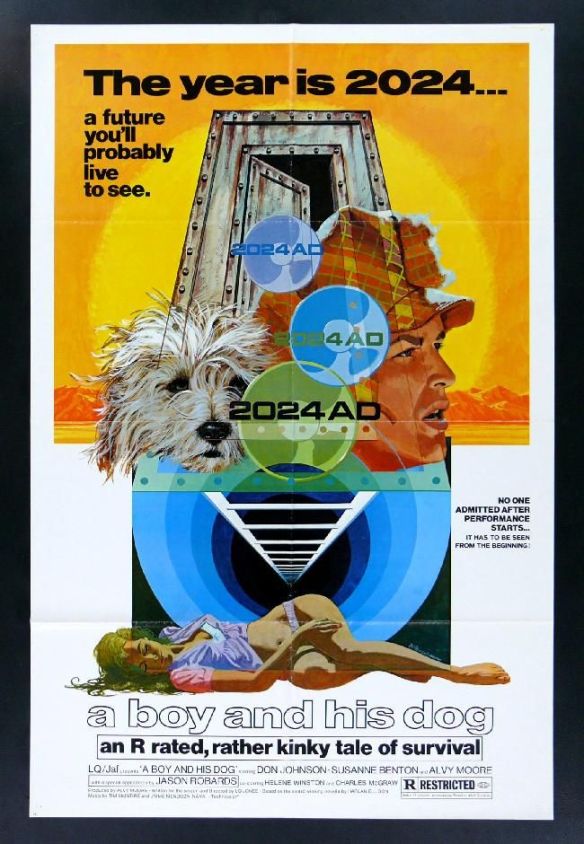
The great science fiction writer Harlan Ellison recently passed away on June 27. Whether or not one is familiar with his large body of work (the majority of which are short stories), “A Boy and His Dog” (1975), is definitely worth watching. It’s the first and best feature film adaptation of one of Ellison’s stories and features Don Johnson as Vic who, with his dog Blood, struggles to survive the post-apocalyptic wasteland that the southwestern U.S. has become in 2024.

Superpowers and Concrete Towers: Katsuhiro Otomo’s ‘Domu: A Child’s Dream’

By Patrick Haddad

Source: We Are the Mutants

In 1989, almost a year after it was released in Japan, the Western world was given its first cinematic taste of anime with the sci-fi epic Akira. Acclaimed writer Katsuhiro Otomo’s vision of a post-apocalyptic Neo-Tokyo, a sea of concrete edifices laid waste by war, was adapted from the manga of the same name, serialized in Japan from 1982 to 1990. Religious fanatics, biker gangs, and shadowy government figures all vie for control of children with superhuman powers, while the truth behind World War III teases just out of reach. But before Akira, Otomo penned and illustrated a shorter piece of raw, dystopian horror: Domu: A Child’s Dream. Set in a government housing complex where a series of inexplicable deaths are taking place, Domu (serialized between 1980-1981) is resolved through a conflict between an old man and a young girl, both of whom secretly possess extrasensory powers.

While Domu foreshadowed Akira in many ways, it is a much more intimate story with fewer characters and just one location, the Tsutsumi Housing Complex. The residents of Tsutsumi are a forgotten, surplus community. Dreams left unfulfilled, private sufferings gone unchecked, and the struggle for identity in the monotonous wash of concrete go some way to explain the rash of suicides plaguing the complex, yet the police are at a loss to explain exactly how many of these deaths occurred. From the beginning, Otomo sets out to introduce the overwhelming, modernist structure as a character in and of itself. Full panel shots of the building in high detail and high contrast are found throughout, and are often employed as bookends to each chapter. Its circular layout insists upon dreary introspection for half of the residents it houses: there is no looking out to the city, to a potentially brighter future. Many prisons, schools, and hospitals also follow a similar template. The circular design—reminiscent of the Panopticon—allows for both greater visibility and fewer places to hide, and is often accompanied by a raised central observation point. Tsutsumi is monotonous in its aspect as well as its makeup: hard concrete, hard lines; no facade, no flair. Behind this impassive exterior lie grimy, cramped apartments hidden among a labyrinth of iron and concrete hallways. It isn’t much of a stretch to imagine Tsutsumi as the backdrop to one of Freddy Krueger’s nightmarish rampages, and Otomo almost certainly drew upon similar feelings of unease regarding the homogeneous modernization of postwar Japan as did Shinya Tsukamoto, who created the shocking cult horror film Tetsuo: The Iron Man (1989).

As the story progresses, it becomes clear—to the reader at least—that the mysterious deaths can be traced back to Old Cho, an apparently senile old man who is in fact using his telekinetic powers to cause fatal accidents or, as in the iconic scene featuring a depressed young man with a craft knife, forcing residents to commit suicide. Old Cho frequently kills from the background, unseen by his victims, his twisted revelry seeming to come from the building itself. Old Cho is not the only resident with special gifts. He finds an adversary in the form of a young girl called Etsuko. They clash the very moment Etsuko and her family move into the tower block, when she uses her abilities to catch the plummeting baby Cho, using his psychic powers, had snatched and dropped from the balcony.

As the story progresses, Cho’s and Etsuko’s confrontations escalate, as the tally of innocent victims climbs. The final act of Domu marks a stark departure from earlier passages, as the static panels showing the impassive monolith and its cowed inhabitants are replaced by dynamic and violent scenes, splashed with blood and fueled by emotion. By the end of the book, it is hard to tell who really won or what a victory would even mean, but it is clear that most of the violence was down to random malice, or misguided fear and rage. It is ironic, then, that the reduction of human beings to just pure function results in senseless, unproductive violence.

Many modernist, and particularly Brutalist, social housing structures were built after World War II in order to show that “A dwelling can be standardized to meet the needs of men whose lives are standardized,” according to urban design pioneer Le Corbusier. Projects such as Les Damiers in Paris, Robin Hood Gardens in London, Habitat 67 in Montreal, and the Unité d’habitation in Berlin are iconic examples of an architectural style that would dominate social housing well into the 1970s. However, the utopian vision set out by modernist architects—to create socially progressive and egalitarian housing—became twisted by time and by the reality of the project’s application. Affordable social housing turned into isolated ghettos, while the idea of social progress became just a gear, an empty promise, in the great Soviet machine. The modular, repetitive nature allowed for quick and cheap rebuilding, but, perhaps in part due to its success, it also aided in the dissolution of identity. Each building, each home, was just a copy of the last, with nothing substantial to distinguish each from each: an existence stripped of form, each building nothing but raw function. And so too its occupants.

In contrast to the urbanization implied by modernist housing, America saw large numbers of people, many of them returning veterans, flee the cities after World War II in favor of suburban living. Combining the power of assembly-line mass production with the G.I. Bill’s loan assistance saw entire communities of cookie-cutter homes spring up in a remarkably short space of time. Spreading out in a grid, rather than towering above, suburbia very often entailed a similar rationalization of living spaces. The mass produced sprawl, built to the same specifications and filled with the same stylish appliances, fits nicely into Le Corbusier’s definition of homes as “machines for living in.”

Things were much grimmer in Japan, of course. Suffering atomic bomb strikes that wiped two of its cities clean off the map, as well as the death of an Empire, caused a national crisis of identity. The country was then occupied by and rebuilt in the image of its conquerors: centuries of culture burned to the ground or consumed by industry and replaced with bloodless, uniform architecture. Tower blocks went up where pagodas once stood, no longer hewn from stone and wood but erected with concrete and rebar. British author Theodore Dalrymple describes modernist architecture as “inherently totalitarian… [it] delights to overwhelm and humiliate what went before it by its size and prepotency.” The seeds of modernism in Japan were planted before their defeat during World War II, however. Le Corbusier worked with two prominent Japanese architects during the 1930s, Kunio Maekawa and Junzo Sakakura. During this time, a synergy was found between Le Corbusier’s visions for flexible, open plan buildings filled with natural light and the traditional Japanese house, called Sukiya-zukuri. This synergy would be expanded upon in the later Metabolism movement, which sought to bring inspiration from organic, biological structures to modernist architecture during the 1960s.

In Domu, we find a manifestation of this dehumanizing monolith in the form of the Tsutsumi Housing Complex and it’s magpie avatar, Old Cho. For each of his victims, Cho claims a glittering prize, a personal token: a badge, a hat, a gun. Before being forced over the precipice of their hopelessness, literally and figuratively, a piece of their identity is stolen before being secreted away somewhere in the bowels of the building.

While it is unlikely that Otomo wrote Domu as an explicit attack on modernism in Japan, the influence of the displacement and anxiety it caused is clear in his work. In Domu, we see Otomo start to develop two of the principle themes that went on to make Akira a timeless classic: young people with exceptional, inherent power, and a dystopian vision of Neo-Tokyo as a failed totalitarianism, an endless landscape of monstrous and towering concrete. These themes went on to define an era of storytelling in manga and anime characterized by pervasively bleak visions of the future.

The loss of privacy and individualism caused by massive modernist social housing estates is also explored in J.G. Ballard’s High Rise (1975), in which tenants of a self-contained tower block in London degenerate into primal tribes, warring over territory and resources while normal city life continues outside. In High Rise, the dehumanizing power of Brutalism leads people to lose their “civilized” behavior and let base urges drive their lives, while in Domu we get a greater sense of the despondency that comes from being a lifeless industrial worker in a lifeless industrial landscape. It is as though living in this monochromatic, function-centric environment leaves us with only two potential identities: the animal, or the machine.

Regardless of whether you read Domu for its gripping and pioneering storytelling, for what it tells us about the role played by modernist architecture in postwar Japan, or purely for its wonderful aesthetic, it is a work that easily stands on its own two legs, despite often being overlooked as some sort of practice run for the Akira epic. Rather than the abstract, existentialist sprawl that is the latter, in Domu we have a more concise and personal tale, with a sense of looming oppression that bleeds from every page. The bare honesty found in some of Cho’s victims shines a light on the real lives lived quietly the world over, their deep fatigue resonating in profound echoes. The next time your morning commute takes you past some austere, concrete tower block, remember: somewhere inside may be a young girl who blows things up with her mind.


Read Domu for free here.

Saturday Matinee: High Rise

“High Rise” (2015) is a British dystopian film directed by Ben Wheatley and based on a novel of the same name by J.G. Ballard. The film is set in luxury tower in a 1970s version of the future. The building houses all the conveniences of modern life, giving inhabitants the delusion of self-sufficiency as they become increasingly insular and detached from the outside world. Unfortunately the building is faulty and as the the infrastructure gradually collapses, social pressures among residents approach a breaking point. Truly a metaphor for our times.

Watch the full film here.

Whose Dystopia Is It Anyway?

Reason writers debate which fictional dystopia best predicted our current moment.

By Mike Riggs, Katherine Mangu-Ward, Todd Krainin, Nick Gillespie, Jesse Walker, Robby Soave, Eric Boehm, Christian Britschgi, Peter Suderman & Brian Doherty

Source: Reason

With social media platforms seemingly unable to distinguish Russian trolls from red-blooded Americans, the last two years have felt like a Deckardian purgatory. The frequency with which intellectual elites accuse their detractors of laboring on behalf of an always-approaching-never-arriving foreign power, meanwhile, smacks of Orwell. And if the proliferation of opioids in the American heartland doesn’t sound like “delicious soma,” what does? (Marijuana? Alcohol? Twitter?)

“We live in Philip K. Dick’s future, not George Orwell’s or Aldous Huxley’s,” George Washington University’s Henry Farrell recently argued in the Boston Review. Despite being a poor prognosticator of what future technologies would look like and do, Dick, Farrell writes, “captured with genius the ontological unease of a world in which the human and the abhuman, the real and the fake, blur together.”

But the universe of possibilities is much larger than just Orwell, Huxley, or Dick. Below, Reason‘s editorial staffers make the case for nearly a dozen other Nostradamii of the right now, ranging from Edgar Allan Poe to Monty Python’s Terry Gilliam. As for why we’re debating dystopias, and not utopias: Because there is no bad in a utopia, and because no dystopia could persist for long without at least a little good, it’s safe to assume that if you’re living in an imperfect world—and you very much are—it’s a dystopian one.

Dick wasn’t wrong, but Edgar Allan Poe got there first, writes Nick Gillespie:

At the core of Philip K. Dick’s work is a profound anxiety about whether we are autonomous individuals or being programmed by someone or something else. In Do Androids Dream of Electric Sheep?, are the characters human or Nexus-6 androids? In The Three Stigmata of Palmer Eldritch and A Scanner Darkly, you’re never quite sure what’s real and what’s the product of too much “Chew-Z” and “Substance D,” hallucinogenic, mind-bending drugs that erode the already-thin line between reality and insanity.

Which is to say that Dick’s alternately funny and terrifying galaxy is a subset of the universe created by Edgar Allan Poe a century earlier. Poe’s protagonists—not really the right word for them, but close enough—are constantly struggling with basic questions of what is real and what is the product of their own demented minds.

This dilemma is front and center in Poe’s only novel, The Narrative of Arthur Gordon Pym (1838), which tells the story of a stowaway who ships out on the Grampus and endures mutiny, shipwreck, cannibalism, and worse. It becomes harder and harder for Pym to trust his senses about the most basic facts, such as what side of a piece of paper has writing on it. The conclusion—not really the right word for the book’s end, but close enough—dumps Pym’s epistemological problem into the reader’s lap in violent and hysterical fashion. A friend told me he threw the book across the room in disbelief when he read its final page, which anticipates the frustration so many of us feel while following the news these days. Just when you think reality can’t get any stranger or less believable, it does exactly that, in both Poe’s fictional world and our real one.

2018’s turn toward hamfisted authoritarianism echoes Terry Gilliam’s Brazil, says Christian Britschgi:

No-knock raids by masked, militarized, police officers. A ludicrously inefficient bureaucracy. Crackdowns on unlicensed repairmen. If all this sounds eerily familiar, you may have seen it coming in 1985’s Brazil.

Set in a repressive near-future Britain, the film tells the story of lowly civil servant Samuel Lowry, who wants nothing more than to hide in the comically inefficient bureaucratic machine that employs him, all while doing his level best to quietly resist both a narcissistic culture demanding he rise higher, and a brutish security apparatus looking to punish anyone who steps out of line.

Directed by Monty Python alum Terry Gilliam, Brazil is surreal, ridiculous, and often just plain silly. Yet there is something chilling about the film’s depiction of the state as a bumbling, byzantine bureaucracy that can’t help but convert every aspect of life into an endless series of permission slips, reinforced by a system of surveillance, disappearance, and torture.

Evil and inefficiency are intimately intertwined in Brazil—with the whole plot set in motion by a literal bug in the system that sends jackbooted thugs to raid the wrong house and arrest the wrong man. While the regime in Brazil lacks a central, dictatorial figure at the top of the pyramid, there is definitely something distinctly current about the world it depicts, with every application of force complemented by an equal element of farce. Trump’s first crack at imposing a travel ban, for instance, proved incredibly draconian and cruel precisely because of how rushed, sloppy, and incoherent the actual policy was.

Fortunately, our own world does manage to be far less authoritarian than the one depicted in Brazil and has mercifully better functioning technology as well. The parallels can still give one pause, however, when you consider what direction we might be headed in.

The current moment definitely tilts toward Ray Bradbury’s Fahrenheit 451, says Eric Boehm:

We are not living in a world where government agents raid homes to set books ablaze, but “there is more than one way to burn a book, and the world is full of people running about with lit matches,” as Ray Bradbury warned in a coda appended to post-1979 editions of his 1953 classic.

Specifically, Bradbury was warning about the dangers of authoritarian political correctness. In that coda, he relates anecdotes about an undergrad at Vassar College asking if he’d consider revising The Martian Chronicles to include more female characters, and a publishing house asking him to remove references to the Christian god in a short story they sought to reprint.

More generally, though, Bradbury was commenting on the common misunderstanding of Fahrenheit 451 as a story about an authoritarian government burning books. It is that, of course, but it’s really about how cultural decay allows authoritarianism to flourish. It was only after people had decided for themselves that books were dangerous that the government stepped in to enforce the consensus, Guy Montag’s boss tells him in one of the novel’s best scenes. “Technology, mass exploitation, and minority pressure carried the trick,” Captain Beatty explains. “Politics? One column, two sentences, a headline! Whirl man’s mind around so fast…that the centrifuge flings off all unnecessary, time-wasting thought!”

In place of literature and high culture, Bradbury’s dystopia has an eerily accurate portrayal of reality television. Montag’s wife is obsessed with the “parlor family” who inhabit the wall-sized television screens in the living room, and clearly has a closer attachment to them than to her husband. The ubiquity of those screens—and how the government exploits them—is on full display near the end of the story, when Montag is on the lam for revolting against orders to burn books, and messages are flashed across every parlor screen in the city telling people to look for the dangerous runaway fireman.

We might not live in Montag’s specific version of Bradbury’s dystopia, but we exist somewhere on the timeline that leads there—which is exactly what Bradbury, and Captain Beatty, are trying to tell us.

Wrong book! We’re really living in Neal Stephenson’s Snow Crash, says Katherine Mangu-Ward:

It’s 1992. Computers are running Windows 3.1. Mobile phones are rare and must be carried in a suitcase. A few nerds in Illinois are getting pretty close to inventing the first web browser, but they’re not quite there yet.

This is the year Neal Stephenson publishes Snow Crash, a novel whose action centers around a global fiber optic network, which can be accessed wirelessly via tiny computers and wearables. On this network, users are identifiable by their avatars, a Sanskrit word that Stephenson’s novel popularized; those avatars may or may not be reliable indications of what they are like in real life. Many of the characters work as freelancers, coding, delivering goods, or collecting information piecemeal. They are compensated in frictionless micropayments, some of which take place in encrypted online digital currency. Intellectual property is the most valuable kind of property, but knowledge is stored in vast digital libraries that function as fully searchable encyclopedias and compendia. Plus there’s this really cool digital map where you can zoom in and see anywhere on the planet.

Basically what I’m saying here is that every other entry in the feature is baloney. We are living in the world Neal Stephenson hallucinated after spending too much time in the library in the early 1990s. End of story.

Is it a dystopia? Sure, if you want to get technical about it: Our antihero, Hiro Protagonist (!), is beset by all manner of typical Blade Runner–esque future deprivations, including sub-optimal housing, sinister corporate villains, and a runaway virus that threatens to destroy all of humanity.

But in addition to the this-guy-must-have-a-secret-time-machine prescience of the tech, the book offers a gritty/pretty vision of anarcho-capitalism that’s supremely compelling—when they’re in meatspace, characters pop in and out of interestingly diverse autonomous quasi-state entities, and the remnants of the U.S. government is just one of the governance options.

Stephenson’s semi-stateless cyberpunk vision is no utopia, that’s for darn sure. But the ways in which it anticipated our technological world is astonishing, and I wouldn’t mind if our political reality inched a little closer to Snow Crash‘s imagined future as well.

Katherine is off by three years. 1989’s Back to the Future: Part II is actually the key to understanding 2018, says Robby Soave:

Back to the Future: Part II has always been the least-appreciated entry in the series: It’s the most confusing and kid-unfriendly, lacking both the originality of the first film and the emotional beats of the third. But almost 30 years after its release, the middle installment of Robert Zemeckis’s timeless time-travel epic is newly relevant: not for accurately depicting the future, but for warning us what life would be like with a buffoonish, bullying billionaire in charge.

2015, the furthest point in the future visited by Marty McFly and “Doc” Emmett Brown has come and gone, and we still don’t have flying cars, hover boards, or jackets that dry themselves. But we do have a president who seems ripped from the film’s alternate, hellish version of Hill Valley in 1985, where the loathsome Biff Tannen has become a powerful mogul after traveling into the past and using his knowledge of the future to rig a series of events in his favor.

The similarities between Trump and alternate-reality Biff are so numerous that Back to the Future writer Bob Gale has retroactively (and spuriously) claimed the 45th president as inspiration for the character. Biff buys Hill Valley’s courthouse and turns it into a casino hotel. Biff is a crony capitalist who weaponizes patriotism for personal enrichment (“I just want to say one thing: God bless America”). Biff is a paunchy playboy with two supermodel ex-wives, a bad temper, and even worse hair. There’s no escaping Biff: He’s a media figure, a businessman, a civic leader, and even a member of the family.

“Biff is corrupt, and powerful, and married to your mother!” Doc Brown laments to Marty. Millions of Americans no doubt feel the same way about a man who similarly possesses the uncanny ability to commandeer our attention and insert himself into every facet of modern life. Sometimes it’s hard to avoid the feeling that we’re simply living through the wrong timeline—thanks, McFly.

We may not have hoverboards, but America is teeming with the legal “Orb” from Woody Allen’s Sleeper, observes Todd Krainin:

The world never recovered after Albert Shanker, president of the United Federation of Teachers, acquired a nuclear warhead. Two hundred years later, in the year 2173, the territory once known as the United States is ruled by The Leader, the avuncular figurehead of a police state that brainwashes, surveils, and pacifies every citizen.

Every citizen except for our hero, Miles Monroe. Cryogenically frozen in the late 20th century, Monroe is thawed out in the 22nd. As the only person alive with no biometric record, Monroe is essentially an undocumented immigrant from the past, making him the ideal secret weapon for an underground revolutionary movement.

“What kind of government you guys got here?” asks a bewildered Monroe, after learning the state will restructure his brain. “This is worse than California!”

Monroe’s quest to take down the worse-than-Sacramento government takes him through a world that’s amazingly prescient for a film that aims for slapstick comedy. He gets high on the orb (space age marijuana), crunches on a 15-foot long stalk of techno-celery produced on an artificial farm (GMOs), impersonates a domestic assistant (Alexa), and joins a crunchy underground (#Resist), in order to defeat The Leader (guess who).

Sleeper‘s most memorable invention is the Orgasmatron, a computerized safe space that provides instant climaxes for a frigid and frightened populace. It’s basically the internet porn and sex robot for today’s intimacy-averse millennials.

In the highpoint of the film, Monroe attempts to clone The Leader from his nose. This in a film released 23 years before real doctors cloned Dolly the sheep from the cell of a mammary gland.

By the film’s end, Monroe is faced with the prospect of replacing The Leader with a revolutionary band of eco-Marxists. But some things never change.

“Political solutions don’t work,” he prophesies. “It doesn’t matter who’s up there. They’re all terrible.”

For a journalism outlet, we’ve been embarrassingly slow to recognize that Orson Scott Card’s Ender’s Game explains the media world we live in, argues Peter Suderman:

In a 2004 feature for Time, Lev Grossman explored of a new form of web-based journalism that was then radically reshaping both the political and media landscapes: blogs. Grossman profiled several bloggers, most of whom were young and relatively unknown, with little experience in or connection to mainstream journalism. Yet “blogs showcase some of the smartest, sharpest writing being published,” Grossman wrote. In particular, bloggers were influencing some pretty big national conversations about U.S. military actions and politics.

From the vantage of 2018, all this might seem like old news: The mainstream media has adopted and amplified many blogging practices. But even in 2004, the idea of user-produced, semi-anonymous journalism, posted directly to the net with no editorial filter, had been in circulation for years as a sci-fi conceit—perhaps most prominently in Orson Scott Card’s 1985 novel, Ender’s Game.

In the book, a child genius named Ender Wiggin is sent to an orbiting military academy to prepare for a military invasion. While he’s away, his adolescent siblings—themselves unusually gifted—hatch a plan to manipulate world politics by posting psuedononymous political arguments on “the nets.” These essays are read by citizens and politicians alike, and both siblings develop powerful followings. Eventually, they help prevent the world from exploding into planetary war, and pave the way for mankind’s colonial expansion into space.

Card’s narrative was too compact, its assumptions about the influence of online writing too simplistic. But it previewed the ways in which the internet would expand the reach and influence of little-known writers—especially political pundits—who lack conventional journalistic training or credentials. Today’s internet-based media landscape is neither a utopia nor a dystopia, but a lively, raucous, fascinating, and occasionally frustrating extrapolation of what Scott Card imagined before any of it existed in the real world.

This year is definitely one of Heinlein’s “crazy years,” says Brian Doherty:

Robert Heinlein was one of the first science fiction writers to create a fictional structure that seemed to privilege prediction, with his “Future History” sequence, collected in the volume The Past Through Tomorrow.

Prediction was not Heinlein’s purpose—storytelling was. But his “Future History” chart started off with the “Crazy Years”: “Considerable technical advance during this period, accompanied by a gradual deterioration of mores, orientation, and social institutions, terminating in mass psychoses in the sixth decade, and the interregnum.” Heinlein made this prediction in 1941, so the “sixth decade” meant the 1950s.

Did he really predict the Trump era? Heinlein fans have seen in wild ideological excesses on both left and right a clear sign that we are, collectively, losing our minds. Instapundit‘s Glenn Reynolds thinks we are certainly in Heinlein’s Crazy Years, noting it’s become a cliché among Heinlein fans to notice. He sees as evidence totemic but useless responses to policy crisis, and a social networking age that allows for tighter epistemic bubbles for information consumers and producers. Factually, the internet makes it stunningly easier for anyone to have opinions about politics and policy far better informed by accurate facts and trends than in any previous era. That so many might choose not to do so shows why predictions of “crazy years” can seem so eternally prescient: People can just be crazy (colloquially).

A lot of the “crazy” news these days that might lead to the never-witty declaration that it’s “not The Onion” come from unusual personal qualities of our president; some come from excesses of the desire to control others’ thought and expression. But if “crazy” means dangerous, then recent trends in crime domestically and wealth and health worldwide indicate we are mucking along well enough.

Indeed, as per the title of Heinlein’s anthology, the past is tomorrow and probably always will be. That times of technologic advance will be followed by “gradual deterioration” (read: changes) in mores, orientation, and social institutions is the kind of golden prediction of the dystopia we eternally are moving in (and always moving through) with which it’s hard to lose.

Loing before the 2016 Flyover Takeover, Walker Percy predicted a frayed nation would disassemble itself, writes Mike Riggs:

It’s the 1980s, and liberals have taken “In God We Trust” off the penny, while “knotheads”—conservatives—have mired the U.S. in a 15-year war with Ecuador. Liberals love “dirty movies from Sweden,” knotheads gravitate toward “clean” films, like The Sound of Music, Flubber, and Ice Capades of 1981. America’s big cities, meanwhile, are shells of themselves. “Wolves have been seen in downtown Cleveland, like Rome during the black plague.” Political polarization has even led to a change in international relations: “Some southern states have established diplomatic ties with Rhodesia. Minnesota and Oregon have their own consulates in Sweden.”

Our guide through the social hellscape of Love in the Ruins is Thomas More, a descendant of Sir Thomas More (author of 1516’s Utopia) and a lecherous Catholic psychiatrist with an albumin allergy who nevertheless chugs egg-white gin fizzes like water. A stand-in for Percy, More is a keen social taxonomist and a neutral party in the culture war. He notes that liberals tend to favor science and secularism; conservatives, business and God. But “though the two make much of their differences, I do not notice a great deal of difference between the two.” In the bustling Louisiana town of Paradise, wealthy knotheads and wealthy leftists live side by side, in nice houses, with new cars parked in their driveways, just as they currently do in Manhattan, Georgetown, and Palm Beach. One group may go to church on Sundays, the other bird watching, but they are more like each other than they are the “dropouts from, castoffs of, and rebels against our society” who live in the swamp on the edge of town.

Yet even the wealthy must bear the brunt of social frisson. A local golf course magnate alternates between depression and indignation as the poor of Paradise challenge his decision to automate the jobs at his country club.

Love in the Ruins is the most radical timeline extending from the King assassination, Kent State, and the Tate Murders, three historical moments that helped undo the World War II–era fantasy—ever more childish in hindsight—of America as a cohesive unit. We were not one then, and are not now. Percy saw 2018 coming from a four-decade mile.

You are all wrong, says Jesse Walker:

Identity has never been as fluid, fungible, and multiple as it is today. That guy you’re arguing with on Twitter might actually be a crowd of people. That crowd of people you’re arguing with might actually be just one guy. Trolls try on a persona for an hour, then discard it for something new. Bots adopt a persona and stick with it, but without an actual mind in command. Your identity might be stolen altogether, leaving you to learn that an entity that looks like you has been spending money, sending messages, or otherwise borrowing your life. You might even wake one day to discover that someone has inserted your head onto someone else’s body, all so a stranger can live out a fantasy.

You can decide for yourself how much of that is a utopia and how much is a dystopia. All I know is that at some point we started living in Being John Malkovich.

Saturday Matinee: The Lathe of Heaven

“The Lathe of Heaven” (1980)  PBS television adaptation of the 1971 science fiction novel The Lathe of Heaven by Ursula K. Le Guin. It’s directed by David Loxton and Fred Barzyk (Between Time and Timbuktu)  and stars Bruce Davison as protagonist George Orr, Kevin Conway as Dr. William Haber, and Margaret Avery as lawyer Heather LeLache. In Portland sometime in the near future, George Orr is charged as a drug offender for taking medications which he needs to prevent dreaming since he fears that his dreams affect reality. Under the care of William Haber, it’s discovered that Orr is not delusional and attempts to make use of the dreams to solve an array of social problems with results that are provocatively pessimistic.

Annihilation: Alex Garland’s Bad Trip Through Dis-ease and Over-Reproduction

By Kim Nicolini

Source: CounterPunch

If you go see Alex Garland’s Annihilation (2018) – and I highly recommend you see this film in an actual movie theater with a big screen and big sound –, you are in for a trip. Not a road trip. Not a good trip. But a bad trip. You may ask why I am urging you to see a film that will pull the ground out from under you, defy delivering a tidy narrative, refuse to answer your questions, and leave you in a state of discombobulated horror as if you just experienced a 115 minute very bad trip. There are a lot of reasons to join Garland’s journey into a shaky world where reproduction leads to destruction and where the further you go into the film the further you will find yourself separated from any known reality (just as the further the main characters delve into the ominous and alien Shimmer, the further they come unglued). At one point in the film, female scientist Dr. Ventress (Jennifer Jason Leigh) questions whether all the women who reside at the film’s center have lost their minds. After watching the film, you may very well ask yourself the same thing. But that is the power of the film. By provoking the audience to lose their minds, toss all rational thought to the wind, and deconstruct the most primal notions of stability, this sci-fi horror film unveils the fears that seep through collective humanity like a terminal illness and show the unnatural and terrifying impact of human intervention with the natural world.

The movie is built on the basic sci-fi premise of a team of scientists sent on an expedition to explore an alien anomaly – in this case, the Shimmer. This mysterious form sprouted from an occurrence at a lighthouse and is rapidly devouring a national park and its surroundings, and it is hell bent on eating up all humankind and the earth it occupies (emphasis on the term occupation). Annihilation is astoundingly beautiful while also being exceptionally terrifying. It will take you into an alluring yet unnerving world that reflects our own world through myriad lenses. The Shimmer takes the very substance of all life – DNA – and refracts it into a kaleidoscopic array of mutant variations. Most of them are terrifying, even when they are beautiful, and the realm of this film is one of absolute instability.

Like the characters in the film, we presently occupy an environment of fear, where every day we are confronted with new terrors and new monsters bombarding the airwaves and the internet, a world which is being ripped from the core, where they natural landscape is threatened to be mutated by monster drills, where borders are pushed at us as if they are threats, and where females are both the source of growing power and the source of tremendous social anxiety. These and so many other things are delivered in Garland’s surreal portrait of four women on a scientific expedition into the unknown realm of the Shimmer which is rapidly consuming the southern gulf coast and mutating or killing everyone who enters it.

The film is based on Jeff VanderMeer’s 2014 novel, and your first question may be how well Garland has adapted the book for screen. Well, the book is the first thing he annihilates, so don’t attempt to compare. The material of the book inspired the film, but Garland acts not unlike the Shimmer. He has refracted the DNA of the book into its own species, something that none of us has ever seen before. In the film, the central Scientist Lena (Natalie Portman) discovers that all mutated plant species within the Shimmer are connected to one shared root system. VanderMeer’s book is like the movie’s root system from which Garland has conceived his own lusciously nightmarish film species, growing a whole forest of ideas and visions that multiply in glorious weirdness.

Garland outwardly states that he engages in an anarchistic approach to filmmaking. He resists leadership and debunks the idea of the auteur and refuses to be one (though both films he directed – Ex Machina (2014) and Annihilation bear striking similarities in aesthetics, production, and themes). An Alex Garland film is firmly and concretely an Alex Garland film. There is no way to mistake Garland’s use of glass and reflections (sliding doors as eerie otherworldly portals/prisons) or his cinematic obsession with reproduction (girl-bots and genetic engineering) for the films of anyone else. I commend Garland for his cooperative approach to filmmaking and for stepping back and letting people do what they are good at, trusting the experts he employs to do their job and refusing to interfere with their work. For example, when he partnered with Director of Photography Rob Hardy (also DP in Ex Machina), Garland didn’t dictate what lens or camera to use. He respects his DP as a collaborative artist within a team of collaborative artists, and he trusts that together they will produce uniquely beautiful and unsettling films. Likewise, Garland gives free reign to his actors to improvise, reinvent characters, and add their own unique dimensionality. His anarchistic approach to filmmaking shines through every surface of his films, and the surfaces in Annihilation indeed are magically shiny, slick with water, glistening with reflections, and refracted through glowing prisms.

Perhaps, Garland’s filmmaking anarchy also leads the audience to the sense that we are entering a world that never existed before because it only exists as a result of a distinct collaborative artistic process. It is a movie that can only result from a very specific mutation of elements. Just as the film relies on the image of cellular reproduction to create unique species that did not preexist, the cellular interaction of human creative DNA in Garland’s films creates a new species of movie, and for many, that is unsettling.

People are comfortable with what is familiar, and Annihilation is not like anything we have seen before, though we may recognize elements of its underlying DNA. The initial reference to the lighthouse as the locus for obliterating norms and a destination for the film’s team of women to reach echoes Virginia Woolfe’s desperate plea for female autonomy, creative freedom, and liberation in her 1927 novel To the Lighthouse. The four female protagonists are headed to the source of the reproductive anomaly (representing a breach in the traditional female role as birther and caregiver), and they are mirroring an early work of feminist fiction through the lens of sci-fi horror (because reproduction and all its ramifications both intrigue and terrifify men who want to understand and control something they can’t entirely understand and control). To reach the lighthouse, the women have to trek through Area X, a former national park which has now become a mutated kill zone that bears an eerie resemblance to the infamous Zone in Andrei Tarkovsky’s cinematic masterpiece Stalker (Сталкер, 1979). As in the Zone, Area X jumbles time, seems to be plagued with the aftermath of an environmental catastrophe, seeps water from every surface, glows with a haze of timeless loss, and destabilizes all sense of location (compasses fail), communication (technology signals drop), and unravels logic and reason. It also evokes the sense of some kind of radioactive disaster.  To follow through on the film’s exploration of cancer as an act of self-destruction, radiation can cure (cancer) or kill (bombs). Finally, staying rooted in 1979, the film’s hazy dream/nighmarescape recalls the directorial style of Ridley Scott, and the Shimmer’s central root system – a seething undulating network of organs that combined look like a horrifically alien birth canal – harken back to H.R. Geiger renditions of a monster-breeding alien reproduction system in Scott’s Alien (1979). In other words, though Annihilation is its own cinematic species, it possesses the DNA of its cinematic and literary ancestors, which gives the audience a thread of familiarity even as we are being thrown into a psychedelic whirlwind of confusion and terror.

Both Annihilation and Ex Machina have very solid aesthetic and thematic grounding – the conjoining of the organic and the artificial which creates another dimension of being. Both films obsessively dissect, interrogate, and reconstruct ideas of reproduction and the murky, often shifting, line between reproduction and self-destruction.

Ex Machina explores the traditional horror film approach to reproduction by showing what happens when men try to take on the female role of reproducing through technological and/or scientific intervention. In this film, not only is the man the one reproducing, but he reproduces women as objects of male consumption – porno objects who can cook dinner, suck your dick, and kick up some dust on the dance floor. But in the end, man can’t outdo woman as the great reproducer. The girl-bots win, playing on man’s weak spots – all-consuming lust and ego – the man cancer that causes him to eat himself in an act of selfish self-desctruction. The robo-girls beat both their inventor, who thinks his brains can buy him a pussy (on all fronts), and the nerdy tech geek who likes to believe he’s above fetishizing women when actually his attraction to a girl is ruled more by his hard-on than intellectual intrigue. The only one either of these men is kidding is themselves. And they lose, and . . . they kind of get off on it, which flips us back into that loop that never seems to close.

Annihilation, on the other hand, puts women front and center. Female bodies invade a male genre – a troop of scientists and/or military guys sent on a mission to learn the secrets of and destroy a mysterious alien force – the Shimmer.  We are not accustomed to seeing women in these roles, so the film annihilates traditional male-dominated sci-fi horror narratives. With another nod to Alien and a tribute to Sigourney Weaver’s Ripley, these women righteously bear automatic weapons to fend off the alien forces that threaten them. Remember how adept Ripley was at wielding a blow torch? In one scene Portman’s Lena obliterates a gigantic mutated crocodile without batting an eye. She literally never blinks! Unlike its predecessor Ex Machina which is fixated on male-reproduction of female bodies, Annihilation focuses on a group of women who have somehow failed to reproduce. The central character Lena has destroyed her marriage and therefore snuffed her possible future as a mother. Anya (Gina Rodriguez) has infiltrated her body with drugs and booze instead of babies. Radek (Tessa Thompson) has actually “felt” life through self-destruction (cutting herself to the extent that her arms are mapped with scars) rather than giving life through reproduction. Finally, Ventress has no connections to anyone, projects as if she is an ether trace of a rapidly vanishing body. Ventress is, it turns out, dying of cancer – the film’s stand-in metaphor for toxic reproduction, since cancer is the reproduction of cells to the point of biological annihilation.

The film opens with a close-up of cells multiplying under a microscope. We learn very quickly that they are cancerous cells from a female cervix – the gateway (or gatekeeper) to reproduction. From the film’s onset, reproduction is under attack (being annihilated). As we enter deeper into the Shimmer with the four women, we learn that cellular reproduction can be both beautiful and toxic. As Dr. Ventress states: “It is the source of all life, and of all death.” Therein lies the great conundrum, and the underlying horror of the movie (because this is a Sci-Fi horror film). By vividly exploring multiple angles of Reproduction Gone Wrong – from the Shimmer’s mutated plants and creatures to lethal cancer –, Annihilation taps into some of the most prevalent collective social fears. Over-population (one of the greatest threats to the planet) is shown as both beautiful (“Look at all those gorgeous and strange flowers!”) and as claustrophobic and strangulating (“Look how that mutated corpse is sprouting from a tapestry of flowers!”). Fear of scientific intervention in human creation and the potential horrors of genetic engineering confront us full-body through abominable mutated creatures, some of which literally open their mouths and swallow us. A rampaging bear howls with the voice of a dead woman. A female scientist sprouts stems and leaves and morphs into a cross-species plant.

At its core, the film confronts one of the biggest social fears that has been planted so deeply in the collective unconscious that many people are unaware of it.  Even at this point in the 21st century when you would think people would “know better,” the large majority of the population – both male and female – rely on the traditional role of women as mother caregivers for a sense of stability. This film destabilizes patriarchal order by refusing to put its lead female characters in maternal roles and instead putting them in the traditional male shoes of scientists, and in Lena’s case – Scientist Soldier.

Unlike the women’s bodies, the land in the Shimmer has no problem reproducing. It reproduces itself crazy. It reproduces itself to annihilation, one of the great conundrums of the film – that reproduction (as in cancer) leads to complete destruction. Still, the women push through the Shimmer as it refracts all DNA, reproducing mutant and sometimes terrifying life forms. Climbing through overgrown plants, encountering hybrid animals, and camping out in abandoned houses and military encampments, the women make their way through an iridescent beautifully toxic world. Shimmering wet rainbows resemble the iridescence of a biologically disastrous oil spill. Though terrified and with the very ground of their minds unraveling, the women keep pushing, even as their numbers dwindle, and they confront such images as a live autopsy and its resulting mutation; a psychotic rampaging monster bear; tree-humans/human-trees; alligator-shark hybrids; and myriad other grotesque surprises.

In the end, however, the most terrifying image is the one of reproduction and destruction when Lena confronts herself and births her mutated, alien replicant via a seething, pulsing psychedelic vagina. At once curiously alluring and beautifully horrific, the magnum opus of the film occurs in a scene that defies description but must be experienced on the big screen as the vagina swirls in fleshy prismatic colors, its form both bulging and opening. In the climatic act of self-reproduction and destruction, the screen/vagina opens into a bottomless black birth canal and swallows the audience. There are fewer things more terrifying than a psychedelic vagina the size of a theater screen opening its black hole to swallow you alive while giving birth to your mutated duplicate self.

One of the many reasons this film is so unsettling and delivers such an overwhelming sense of dread is that it refuses to offer any middle ground. Everything is turned on its head. Actions and environments are extreme. Women bear arms instead of children. Interior landscapes are eerily sterile, filled with plastic zippered rooms, stainless steel furniture, and windows reflecting windows reflecting more windows. Not one organic thing lives in the lab, except the women (and one dying man and a few men in hazmat suits). Outside, the landscape is abominably fertile. Creatures are like beautifully terrifying genetic experiments. The land is so pregnant, you could practically barf looking at it. It is both bulging with life and seething with decay. Seemingly lovely flowers evoke feminist fiber art run amok. Humans and nature blend not into a vision of utopian bliss, but into an unnerving psychedelic bad trip. While reproduction is supposed to be the act of life, in this world it is a death sentence where living things reproduce themselves to annihilation, echoing the metaphor of cancer – a disease in which the body actually consumes itself with its own cellular reproduction. The film itself is an act of reproduction, reproducing itself in movie theaters while audiences succumb to, absorb, and are mutated by its toxic beauty. This is the kind of movie you don’t easily forget. It will infiltrate your dreams. Next time you take a hike through a densely wooded forest, you may think twice before exploring that abandoned cabin.

The mismatch between humans and nature and its potential for disastrous consequences leads to some excellent moments of sci-fi horror (you will be terrified) while also questioning the nightmarish impact and consequences of human exploitation of the environment/natural world. Let’s close those national parks and drill! But remember, if you keep on drilling, you may give birth to a monster. Throughout the film, music is critical to the movie’s unsettling hallucinatory delivery. With a soundtrack composed by Portishead’s Geoff Barrow and long-time composer Ben Salisbury, the music is as large and imposing of a character as the mutant bear. Alternating between soft acoustic guitar from another era, full orchestral strings, assaultive horns and bombastically creepy synths, the music doesn’t tell us how to feel, it immerses us in feeling. Complementing the film with orchestral moans and sonic decay, the music tips the scales of this movie toward outright Very Bad Trip. But it’s an entertaining trip!

Annihilation may be the most mind-boggling movie of the century. As it builds and breeds and breathes and opens its mouth and swallows us whole, the movie oozes questions and refuses answers. Told from the single POV of the unreliable narrator Lena, we don’t know what to believe and not believe, what is happening, what is a demented hallucination, what is past, present, or future. In one scene, Anya screams over and over: “Lena is a liar! Lena is a liar!” And maybe she is. We never know. Since the story is strictly told from Lena’s perspective, we don’t know if she is lying to us. When asked to recount what happened in the Shimmer, her most common reply is: “I don’t know.” She doesn’t know, and neither do we, just like in the world outside the Shimmer where we are bombarded with “fake news,” false alarms, and paranoid manufactured distractions to prevent us from getting to answers.

At this point, you may be asking, “But what about Oscar Isaak and his character Kane?” He exists in ghost form, in memory, propped up by life support, leaking blood from mutated organs, or as a reconstituted alien being. In other words, he has been stripped of solidity. The central conjoining entities in the film are Lena and Kane, but Lena destroyed their marriage in an act of self-destruction. Lena, who introduces the cancer cells in the beginning of the film, is a cancer herself, and oddly the lone survivor, perhaps because she is the mutant cell that consumes everything in an act of self-destruction that ironically keeps her alive. I know – what a lot of confusing hogwash.

But the world is confusing hogwash! We live in a time of questions not answers, a time of abstract fear that permeates everything and saturates our very souls with instability. The earth is dying; the System is lying; our hearts and land are crying; and there are no fucking answers.

Launching a cast of women in traditional male roles and playing on the trope of cancer as the ultimate method of lethal reproduction, Annihilation blows a hole through just about everything known and turns it in an unknown. It annihilates preconceptions about conception; rational thought; traditional gender roles; cinematic genre; social expectations; definitions of species; fundamental biology, earth science; the possibility of future; application of human thought to unanswerable questions; and the idea of self itself. And the annihilation is both beautiful and horrific. The movie screen seems to actually breathe with mutated life as it sucks us into its tantalizing bad trip. And I loved every minute of it. Personally, I’d rather be on a bad trip that explores socio-political fears and anxiety through a hallucinatory cinematic lens rather than succumb to the excessively toxic reproduction and biased distortion of an unreal reality.

Philip K. Dick and the Fake Humans

(Editor’s note: on this 36th anniversary of the passing of Philip K. Dick, it seems an appropriate time to note the relevance of his work to our current dystopia as Henry Farrell does in the following essay. Unfortunately the author is less astute regarding the ways in which the dystopias of Orwell and Huxley are equally relevant to our current milieu.)

By Henry Farrell

Source: Boston Review

This is not the dystopia we were promised. We are not learning to love Big Brother, who lives, if he lives at all, on a cluster of server farms, cooled by environmentally friendly technologies. Nor have we been lulled by Soma and subliminal brain programming into a hazy acquiescence to pervasive social hierarchies.

Dystopias tend toward fantasies of absolute control, in which the system sees all, knows all, and controls all. And our world is indeed one of ubiquitous surveillance. Phones and household devices produce trails of data, like particles in a cloud chamber, indicating our wants and behaviors to companies such as Facebook, Amazon, and Google. Yet the information thus produced is imperfect and classified by machine-learning algorithms that themselves make mistakes. The efforts of these businesses to manipulate our wants leads to further complexity. It is becoming ever harder for companies to distinguish the behavior which they want to analyze from their own and others’ manipulations.

This does not look like totalitarianism unless you squint very hard indeed. As the sociologist Kieran Healy has suggested, sweeping political critiques of new technology often bear a strong family resemblance to the arguments of Silicon Valley boosters. Both assume that the technology works as advertised, which is not necessarily true at all.

Standard utopias and standard dystopias are each perfect after their own particular fashion. We live somewhere queasier—a world in which technology is developing in ways that make it increasingly hard to distinguish human beings from artificial things. The world that the Internet and social media have created is less a system than an ecology, a proliferation of unexpected niches, and entities created and adapted to exploit them in deceptive ways. Vast commercial architectures are being colonized by quasi-autonomous parasites. Scammers have built algorithms to write fake books from scratch to sell on Amazon, compiling and modifying text from other books and online sources such as Wikipedia, to fool buyers or to take advantage of loopholes in Amazon’s compensation structure. Much of the world’s financial system is made out of bots—automated systems designed to continually probe markets for fleeting arbitrage opportunities. Less sophisticated programs plague online commerce systems such as eBay and Amazon, occasionally with extraordinary consequences, as when two warring bots bid the price of a biology book up to $23,698,655.93 (plus $3.99 shipping).

In other words, we live in Philip K. Dick’s future, not George Orwell’s or Aldous Huxley’s. Dick was no better a prophet of technology than any science fiction writer, and was arguably worse than most. His imagined worlds jam together odd bits of fifties’ and sixties’ California with rocket ships, drugs, and social speculation. Dick usually wrote in a hurry and for money, and sometimes under the influence of drugs or a recent and urgent personal religious revelation.

Still, what he captured with genius was the ontological unease of a world in which the human and the abhuman, the real and the fake, blur together. As Dick described his work (in the opening essay to his 1985 collection, I Hope I Shall Arrive Soon):

The two basic topics which fascinate me are “What is reality?” and “What constitutes the authentic human being?” Over the twenty-seven years in which I have published novels and stories I have investigated these two interrelated topics over and over again.

These obsessions had some of their roots in Dick’s complex and ever-evolving personal mythology (in which it was perfectly plausible that the “real” world was a fake, and that we were all living in Palestine sometime in the first century AD). Yet they were also based on a keen interest in the processes through which reality is socially constructed. Dick believed that we all live in a world where “spurious realities are manufactured by the media, by governments, by big corporations, by religious groups, political groups—and the electronic hardware exists by which to deliver these pseudo-worlds right into heads of the reader.” He argued:

the bombardment of pseudo-realities begins to produce inauthentic humans very quickly, spurious humans—as fake as the data pressing at them from all sides. My two topics are really one topic; they unite at this point. Fake realities will create fake humans. Or, fake humans will generate fake realities and then sell them to other humans, turning them, eventually, into forgeries of themselves. So we wind up with fake humans inventing fake realities and then peddling them to other fake humans.

In Dick’s books, the real and the unreal infect each other, so that it becomes increasingly impossible to tell the difference between them. The worlds of the dead and the living merge in Ubik (1969), the experiences of a disturbed child infect the world around him in Martian Time-Slip (1964), and consensual drug-based hallucinations become the vector for an invasive alien intelligence in The Three Stigmata of Palmer Eldritch (1965). Humans are impersonated by malign androids in Do Androids Dream of Electric Sheep? (1968) and “Second Variety” (1953); by aliens in “The Hanging Stranger” (1953) and “The Father-Thing” (1954); and by mutants in “The Golden Man” (1954).

This concern with unreal worlds and unreal people led to a consequent worry about an increasing difficulty of distinguishing between them. Factories pump out fake Americana in The Man in the High Castle (1962), mirroring the problem of living in a world that is not, in fact, the real one. Entrepreneurs build increasingly human-like androids in Do Androids Dream of Electric Sheep?, reasoning that if they do not, then their competitors will. Figuring out what is real and what is not is not easy. Scientific tools such as the famous Voight-Kampff test in Do Androids Dream of Electric Sheep? (and Blade Runner, Ridley Scott’s 1982 movie based loosely on it) do not work very well, leaving us with little more than hope in some mystical force—the I Ching, God in a spray can, a Martian water-witch—to guide us back toward the real.

We live in Dick’s world—but with little hope of divine intervention or invasion. The world where we communicate and interact at a distance is increasingly filled with algorithms that appear human, but are not—fake people generated by fake realities. When Ashley Madison, a dating site for people who want to cheat on their spouses, was hacked, it turned out that tens of thousands of the women on the site were fake “fembots” programmed to send millions of chatty messages to male customers, so as to delude them into thinking that they were surrounded by vast numbers of potential sexual partners.

These problems are only likely to get worse as the physical world and the world of information become increasingly interpenetrated in an Internet of (badly functioning) Things. Many of the aspects of Joe Chip’s future world in Ubik look horrendously dated to modern eyes: the archaic role of women, the assumption that nearly everyone smokes. Yet the door to Joe’s apartment—which argues with him and refuses to open because he has not paid it the obligatory tip—sounds ominously plausible. Someone, somewhere, is pitching this as a viable business plan to Y Combinator or the venture capitalists in Menlo Park.

This invasion of the real by the unreal has had consequences for politics. The hallucinatory realities in Dick’s worlds—the empathetic religion of Do Androids Dream of Electric Sheep?, the drug-produced worlds of The Three Stigmata of Palmer Eldritch, the quasi–Tibetan Buddhist death realm of Ubik—are usually experienced by many people, like the television shows of Dick’s America. But as network television has given way to the Internet, it has become easy for people to create their own idiosyncratic mix of sources. The imposed media consensus that Dick detested has shattered into a myriad of different realities, each with its own partially shared assumptions and facts. Sometimes this creates tragedy or near-tragedy. The deluded gunman who stormed into Washington, D.C.’s Comet Ping Pong pizzeria had been convinced by online conspiracy sites that it was the coordinating center for Hillary Clinton’s child–sex trafficking ring [likewise, the masses may have been convinced by mainstream media that a real child-sex trafficking ring never existed].

Such fractured worlds are more vulnerable to invasion by the non-human. Many Twitter accounts are bots, often with the names and stolen photographs of implausibly beautiful young women, looking to pitch this or that product (one recent academic study found that between 9 and 15 percent of all Twitter accounts are likely fake). Twitterbots vary in sophistication from automated accounts that do no more than retweet what other bots have said, to sophisticated algorithms deploying so-called “Sybil attacks,” creating fake identities in peer-to-peer networks to invade specific organizations or degrade particular kinds of conversation.

Twitter has failed to become a true mass medium, but remains extraordinarily important to politics, since it is where many politicians, journalists, and other elites turn to get their news. One research project suggests that around 20 percent of the measurable political discussion around the last presidential election came from bots. Humans appear to be no better at detecting bots than we are, in Dick’s novel, at detecting replicant androids: people are about as likely to retweet a bot’s message as the message of another human being. Most notoriously, the current U.S. president recently retweeted a flattering message that appears to have come from a bot densely connected to a network of other bots, which some believe to be controlled by the Russian government and used for propaganda purposes.

In his novels Dick was interested in seeing how people react when their reality starts to break down. A world in which the real commingles with the fake, so that no one can tell where the one ends and the other begins, is ripe for paranoia. The most toxic consequence of social media manipulation, whether by the Russian government or others, may have nothing to do with its success as propaganda. Instead, it is that it sows an existential distrust. People simply do not know what or who to believe anymore. Rumors that are spread by Twitterbots merge into other rumors about the ubiquity of Twitterbots, and whether this or that trend is being driven by malign algorithms rather than real human beings.

Such widespread falsehood is especially explosive when combined with our fragmented politics. Liberals’ favorite term for the right-wing propaganda machine, “fake news,” has been turned back on them by conservatives, who treat conventional news as propaganda, and hence ignore it. On the obverse, it may be easier for many people on the liberal left to blame Russian propaganda for the last presidential election than to accept that many voters had a very different understanding of America than they do.

Dick had other obsessions—most notably the politics of Richard Nixon and the Cold War. It is not hard to imagine him writing a novel combining an immature and predatory tycoon (half Arnie Kott, half Jory Miller) who becomes the president of the United States, secret Russian political manipulation, an invasion of empathy-free robotic intelligences masquerading as human beings, and a breakdown in our shared understanding of what is real and what is fake.

These different elements probably would not cohere particularly well, but as in Dick’s best novels, the whole might still work, somehow. Indeed, it is in the incongruities of Dick’s novels that salvation is to be found (even at his battiest, he retains a sense of humor). Obviously, it is less easy to see the joke when one is living through it. Dystopias may sometimes be grimly funny—but rarely from the inside.

Saturday Matinee: There Will Come Soft Rains

“If Mankind Perished Utterly”: Nazim Tulyahodzhaev’s ‘There Will Come Soft Rains’, 1984

Source: We Are the Mutants

Object NameThere Will Come Soft Rains
Maker and Year: Nazim Tulyahodzhaev (Director), UzbekFilm, 1984
Object Type: Film
Description: (Steve Toyoshima)

There Will Come Soft Rains (Будет ласковый дождь) is an animated film produced in the former Soviet Union, based on the Ray Bradbury short story of the same name. Though obscure in the rest of the world during the Cold War, it has gained a cult following in recent years. A VHS-quality copy of the film has been uploaded to YouTube, and appears to be the only version available at this time.

Originally printed in 1950, Bradbury’s story follows the last day of an automated house in the wake of a nuclear apocalypse. The title is from a poem by Sarah Teasdale, written after she witnessed the horrors of the First World War. It described a world that nature reclaims after humanity has ceased to be. Bradbury adopts this poem’s tone and features it in his story.

Written just a few years after the bombings of Hiroshima and Nagasaki, and a few months before the start of the Korean War, There Will Come Soft Rains and the UzbekFilm adaptation reflect the fears of their respective eras. During the years between the original story and the 1984 version, the Cold War had broadened, touching off violence around the world as the two superpowers supported smaller proxy conflicts. In 1983, Soviet jets shot down a Korean airliner that they believed was on an espionage mission, provoking condemnation from the United States. The militant stance of new American President Ronald Reagan, his announcement of a US Strategic Defense Initiative (SDI, nicknamed “Star Wars” by the media), and plans to install missiles in Europe set nuclear tensions at an all-time high. In fact, much of the world felt that a nuclear war was inevitable. The invasion of Grenada and NATO war games exercises that simulated pre-nuclear attack communications put Soviet leadership at high alert for a first strike by their Western foes; the Kremlin wanted to avoid making the same mistake that Stalin had in 1941—ignoring Hitler’s aggression until it was nearly too late.

It was in this tense political environment that UzbekFilm‘s There Will Come Soft Rains was released. A studio in current day Uzbekistan that was originally founded in the 1920s, UzbekFilm expanded from art cinema to producing children’s fantasy films and animated features in the 1980s. There is a marionette show-like sense of playfulness and movement to the cartoons they produced, with a heavy emphasis on colors and textures. There Will Come Soft Rains was directed by Nazim Tulyahodzhaev, a prolific director and actor who had graduated from the Moscow State Institute of the Theatrical Arts in the 1970s and is still working today.

Tulyahodzhaev adapted Bradbury’s story for the 1980s, creating the character of the robot caretaker of the house, which didn’t exist in Bradbury’s original story. (The unsettling design of Robot was based on Lou Cameron’s Classics Illustrated cover for H.G. Wells’ War of the Worlds.) Where the automated house in the original story gradually fell apart after its owners were vaporized while playing outside, it’s the paranoia of Robot that leads to the destruction of the home in Tulyahodzhaev’s version.

When the film opens, it’s December 31st, 2026, in Allendale, California. It’s not entirely clear how long ago the nuclear war happened, or how long the McClellan family lived in a post-apocalyptic world. The McClellan home has been fortified for a nuclear war, with radiation suits hiding behind sliding cabinet doors for daily use by the family. Everything in the home is automated. The preparation of food, movement through the house, even religion is administered by the omnipresent Robot. During the time of prayer, a small crucifix slides out of a small door on the wall of the elder Mrs. McClellan’s room as a somber organ tune plays.

The McClellans themselves can no longer benefit from any of these conveniences, as we find out they were vaporized sometime before the events of the film. Somehow, the nuclear attack was able to breach the windows of the bunker, and the family has been reduced to ash. In a horrifying scene, Robot attempts to wake his charges by swiveling their beds upwards, spilling the remains of the family to the floor. Likely this is meant to invoke the neutron bomb, an atomic weapon designed to maximize radiation damage to humans caught within the radius and minimize damage to nearby structures. Its development became a focal point of the anti-nuke movement in the United States, with President Jimmy Carter only finding out about the program in the newspaper. Though Carter shelved the project, Reagan would become its champion. As he said in the late 1970s:

Very simply, it is the dreamed of death ray weapon of science fiction. It kills enemy soldiers but doesn’t blow up the surrounding countryside or destroy villages, towns and cities…..Here is a deterrent weapon available to us at much lower cost than trying to match the enemy gun for gun, tank for tank, plane for plane.

The fate of the McClellans is a visceral reminder of what it would mean to use such a weapon. Though they have been destroyed, their possessions are intact, with even small toys in the children’s room still walking around on battery power.

In the end, it is the intrusion of a curious bird through one of the broken windows of the home that sends Robot into a frenzy. The robotic arm sprouts sharp steel talons and attempts to smash the bird, which it sees as an intruder and danger to the family. The furniture, Mrs. McClellan’s wheelchair, and the crucifix are demolished during the rampage. Blinded after colliding with a wall, the final target of Robot is its own power source. It destroys itself and the house in a final blow.

The machine created to protect humans was engineered too well, a fear that has only become closer to reality in our modern age of militarized robotic drones. Though intended for peaceful purposes, Robot loses control after its owners are gone and only bits are left behind. The film closes with the poignant moment of the bird, unharmed, trying to fly into a peaceful scene on a video screen while one of Mrs. McClellan’s songs plays on the phonograph. Over the ending, Sarah Teasdale’s haunting poem is read.

This somber short and several more, including the light-hearted Contact (directed by Vladimir Tarasov), represent a wealth of animated films from the former Soviet Union that show the world through a lens that many of us who grew up in the West haven’t yet seen, but whose universal appeal carries the message past the boundaries of culture and language.