The political logic of the junk food revolution

By Jonathan Cook

Source: TruePublica

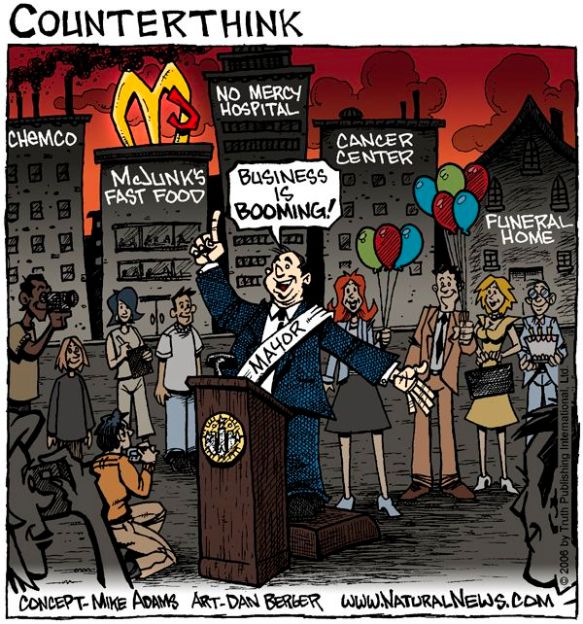
Here is an article on food whose political implications are really worth considering. We already know that people in western societies, particularly the US and UK, are eating far too much junk food, and that this leads to an epidemic of obesity, heart disease and cancer.

But the latest research not only reveals the extent that “ultra-processed” foods have come to dominate our diets in Europe – now comprising more than half of what Britons eat, for example – but raises the question of what effects the consumption of this much junk food will have on our behaviours.

The nutritionists here are reluctant to offer even well-informed speculation, which always seems to be the case with publicly funded scientists until things have moved beyond a critical point. Think of smoking and climate change: we usually learn much later that the corporations’ own pet-scientists had done the research decades earlier proving or predicting exactly what was coming.

But there are hints from the nutritionists to the Guardian of what might be going on:

“People are missing out not only on vitamins and minerals but also bioactive compounds found in natural foods such as phytoestrogens and fibre.

And then you get salt and starch and sugar and fat and all these additives. We are consuming every day an amount of new substances that are these flavours and colours and emulsifiers and we don’t have any idea as to what will be the problem of these items,” [Professor Carlos Monteiro from the University of Sao Paulo in Brazil, who led the research team] said. …

Other cumulative effects of eating these industrially-made substances are not yet known. “The honest answer is we don’t know what is going on,” said Monteiro.’

Here is an educated guess, based in part on experience and in part on the economic and political logic of our current junk food revolution. (Those of us who eat these industrial substances rarely enough that they do not dominate our diets still have a sense of what happens to us on the occasions we do.)

These lab-created, nutritionally empty substances that our bodies have not evolved to digest not only make us physically sick, but emotionally and mentally sick too: addicted, depressed, lazy, sluggish, docile and anxious.

In fact, a mess of emotions that transforms us into the perfect consumers, buying more of this cheap, harmful “food”. That boosts both the profits of food and other corporations and the electoral fortunes of crowd-pleasing, money-grubbing, vacuous politicians who wish to serve those corporations.

That is how an advanced capitalist system – premised on a psychopathic drive by the strongest to maximise profits by exploiting the weakest – will naturally evolve. It needs to make us as dependent, as passive and docile, as possible.

Alex Schlegel on Imagination, the Brain and ‘the Mental Workspace’

By Rob Hopkins

Source: Resilience

What happens in the brain when we’re being imaginative?  Neuroscientists are moving away from the idea of what’s called ‘localisationism’ (the idea that each capacity of the brain is linked to a particular ‘area’ of the brain) towards the idea that what’s more important is to identify the networks that fire in order to enable particular activities or insights.  Alex Schlegel is a cognitive neuroscientist, which he describes as being about “trying to understand how the structure and function of the brain creates the mind and the consciousness we experience and everything that makes us human, like imagination”.

He recently co-published fascinating research entitled “Network structure and dynamics of the mental workspace” which appeared in Proceedings of the National Academy of Sciences, which identified what the authors called “the mental workspace”, the network that fires in the brain when we are being imaginative.  I spoke to Alex via Skype, and started by asking him to explain what the mental workspace is [here is the podcast of our full conversation, an edited transcript appears below].

This is maybe just a product of the historical moment we’re in with cognitive neuroscience researching, that most of neuroscience research, I think I would say even now, is still focused on finding where is the neuro correlate of some function?  Where does language happen?  Where does vision happen?  Where does memory happen?  Those kinds of things.

It was very easy to ask those questions when fRMI came around, because we could stick someone in the scanner and have them do one task, and do a control test, and then do the real test, and see what part of the brain lights up, in one case rather than the other.  Those very well controlled reductionist kinds of paradigms behind these very clean blobs where something happens in one case versus the other.  I think that led a lot to the story of one place in the brain for every function and we just have to map out those places.

But in reality, the brain is a complex system.  It works in a real world which is a complex environment, and in any kind of real behaviour that we engage in, the entire brain is going to be involved in one way or the other.  Especially when you start to get into these more complex abilities that are very hard to reduce to this highly controlled A versus B kind of thing.

To really understand the behaviour itself, like imagination, it’s not that surprising that it’s going to be a complex, multi-network kind of phenomenon. I think why we were able to show that is maybe primarily because the techniques are advancing in the field and we’re starting to figure out how to look at these behaviours in a more realistic way. One of the big limitations of cognitive neuroscience research right now, because of fMRI, because of the techniques we’ve had, is that we tend of think of behaviour as activating, or not activating the brain.

When we’re doing analyses of brain activity, we’re looking for areas that become more active than another. This is changing a lot in the last few years, but at least for the first fifteen, twenty years, that was one of the only ways we would look at brain activity. So it simplistically thinks of the brain as of some other organ where it’s either buzzing, or it’s not buzzing, or it’s buzzing, or it’s not buzzing, or if it buzzes, the language happens. But really the brain is a complex computational system.

It’s doing complex computations and information processing and that’s not something you’re really going to see if you’re just looking for, in a large area, increased versus decreased activity. When we start to be able to look at the brain more in terms of the information that is processing, and where we can see information, how we can see communication between different areas, then you can start to look at things like imagination, or mental workspace, in a more complex light.

So how does that idea sit alongside the ideas firstly of the ‘Default Network’, which is often linked to creativity and imagination as well, and also to the idea that the hippocampus is the area that is essential to a healthy, functioning imagination?  Do those three ideas just fit seamlessly together, or are they heading off in different directions?

I can give you my opinion, that’s not very well founded in any kind of data, but this is something that we’ve talked about a lot in the lab.  I have a suspicion that actually we had been thinking about how to test for a while.  So the Default Mode Network was first seen as this network that would become more active in between tasks.  So when we’re doing an fRMI experiment what we’ll usually do is you’ll have some period where you’re doing the task, and then there’s a period where you’re just resting, so you can get the baseline brain activity when you’re not doing anything.  And this was a surprising result, is that actually during rest periods, some areas of the brain become more active.  And, you know, “Oh wow, it’s a surprise, the person’s not just sitting there blankly doing nothing.”  The brain doesn’t just totally deactivate.  They’re doing other stuff during those blank periods where there’s no stimulus on the screen.

From my personal experience, what you do in those rest periods is you daydream.  Your mind wanders.  You think about what you’re going to do afterwards, or stuff that’s happened during the day.  There’s a lot of research since then to back that up.  It seems to be this kind of network that’s highly involved in daydreaming like behaviour, or social imagination, those kinds of things.

My opinion, or my suspicion, is that this is illustrating how our term ‘imagination’ really encompasses a lot of different things.  When you try to lump it under this one term, this one mega term, you’re going to be missing out on a lot of the complexity, or subtlety.  So what I suspect is going on is that there’s this more like daydreaming mode of control over your inner space, where you’re not really consciously, volitionally, directing yourself to have certain experiences.  There’s a default control network that’s more taking over the daydreaming.

When I daydream I’m not trying to think about anything, it’s just letting the thoughts come.  That’s maybe part of what imagination is, but a very important part of imagination is you trying to imagine things, trying to direct yourself, thinking, “Well, what is the relationship between these two things?  Or “how can I build community?””  Or something like that.  In that case you’re taking active volitional control over these systems.  So that would be my suspicion of what’s going on.

How the results we found would differ from default mode network is that in our study we would show people some stimulus (see below) and we would say, “Rotate this 90 degrees clockwise”, so they had this fairly difficult task that they had to do and it was effortful.  This more frontal parietal network probably took over then.  And you see that a lot in other studies.  Our frontal parietal, I think they sometimes call it like an Executive Attention Network, that directs when you’re consciously trying to engage in some tests, that takes over, and if you’re not doing anything, the default mode network takes over.

So they’re both different manifestations of the imagination?  Like an active and a more passive, less conscious version?  They’re two versions of the same thing, in a sense?

Yeah, I would think that.  It fits well with what I’ve seen.  There have been studies that show that they’re in some ways antagonistic or mutually inhibiting, the default mode network and this executive attention network…

It’s like oil or water, it’s one or the other?  Or Ying and Yang, as I’ve read in some papers?

Right, but a simple way of describing these that people often resort to is that the Executive Attention Network is designed for attention to the outside world, and the Default Mode Network is attention to the inner space.  Where I would disagree with that, or suggest that that’s not the case, is that I think a better way to classify it would be that executive attention is more of this volitionally driven attention, which is usually associated with attention to the outside world.  And default mode network is more – I don’t know how to describe it exactly, but it’s more of this daydreaming network.  But the point is that your executive volitional attention can be driven to the inner space just as much as it can be driven to the outside world.

Is the mental space network the same kind of network that would be firing in people as when they’re thinking about the future and trying to be imaginative about how the future could be?

Yeah, I would think so.  I think an important difference, or an important additional part that you might start to see if you’re thinking about imagining the future, is that practically most of the time when you’re imagining the future, you’re thinking about people, and social groups, and how to navigate those kinds of dynamics.

So I would guess that then you would get added into the mix all the social processing networks that we have.  That’s actually another thing that we’re thinking about how to look at, is that practically a big chunk of human cognition is spent thinking about your relationship with other people, and how to navigate that.  There’s a good argument to be made that that kind of complex processing space was one of the main drivers of us becoming who we are.  Because social cognition is some of the most complex cognition we do, trying to imagine what somebody’s thinking by looking at their facial expression, or imagine how do I resolve a conflict between these two people who are fighting.  Things like that.

We do have very specialised regions and networks in the brain that have evolved to do that kind of processing.  So yeah, it’s a very interesting question.  That how would these other mental workspace areas, at least that we looked at, that had nothing to do with it, you know, it’s like, “Here’s this abstract shape.  What does it look like if you flip it horizontally here”, things like that.  How would they interact with these socially evolved areas?  It’s a very interesting question.

A lot of the research that I’ve been looking at is about how when people are in states of trauma, or when people grow up in states of fear, that the hippocampus visibly shrinks and that cells are burnt out in the hippocampus, and that people become less able to imagine the future.  People get stuck in the present, and it’s one of the indicators, particularly with post-traumatic stress, is that inability to look forward, and inability to imagine a future.  Do you have any knowledge of, or any speculation about, what happens to the mental workspace when people are in states of trauma or when people are in states of fear?

Definitely no data, only speculation.  As with anything real and interesting involving humans, it’s going to be incredibly complex.  So it would be very difficult, and may be impossible to distil it down to simple understandable things that are happening in the brain, but what I would guess is that, in people that are in stressful situations, and experiencing trauma, you tend to focus – like you were hinting at – you tend to focus on present.  What’s there immediately?  How do I survive this day?

You don’t tend to think much about planning for the future.  Synthesising everything that’s happened to you in the past, you just react in the moment because you don’t know what the next moments are going to be like.  It’s no more cognitive load that you can deal with because of all the stress you have.  So I would guess that for one you’re not really synthesising or processing your experiences into something brought to bear on decisions in the future as much.

And you’re not exercising those muscles of planning far into the future.  So just like any other muscle in the body, if you don’t practice the skills, and you don’t use various parts of your brain, they’re going to atrophy.  They’re not going to develop in the way that they would if you did use them.  In that sense it seems perfectly understandable and not that surprising that these areas and these networks that we found associated with these kinds of activities of projecting oneself in the future, or imaging that things don’t exist, in people for whatever reason aren’t doing that kind of thing regularly in their lives, they’re not going to be developed as much as they would from people that were happy and healthy and imaginative.

The paper that Kyung Hee Kim published in 2010, ‘The Creativity Crisis’ suggested that we might be seeing a decline in our collective imagination.  Do you have any thoughts on why that might be, or what might be some of the processes at work here?

I could speculate a couple of things.  The first thing that pops to mind obviously is education.  How we think about the educational system, how we train children.  And I don’t know about 1990 in particular but definitely starting in 1999 when we became test-crazed, that would be a very obvious culprit.

One thing to think about with the Torrance test and pretty much all tests, these standardised tests of creativity that we use, is that one of the major components that determines the outcome on the test is this divergent thinking idea.  How many ideas can you come up with?  So this has, I think, fairly detrimentally become one of the working definitions we have in psychology research of creativity, is “how much?”  And not really focusing on quality so much, and just using how many ideas you can think of as a stand in for how creative someone is.

The Torrance Test is better because it does get into other dimensions as well, but still some of the major dimensions determining the score are fluency, when you’re doing these drawings, how many components are there in the drawing?  That kind of thing.  So for instance if there were educational trends starting in the 1990s and continuing to now that were leading people to try to converge rather than diverge – you know, “What’s the one right answer?” versus, “What are lots of possible answers?” – then that could definitely lead to these changes we’ve been seeing in the tests.

Even if that were the case though, is that really a problem? Obviously we want people to be able to think of lots of possibilities but if it’s just, for instance, people who have been brought up in an educational system where they’ve been taking standardised tests all the time, and they’re trying to figure out which of the four bubbles is the right one to fill in, then that could just be a habit they’ve developed that carries over to these tests.  I don’t know exactly.

Another idea that maybe would be related to this is we’re definitely much less idle than we were in the past.  I guess we lament all the time how overscheduled kids are.  They go from soccer practice to band practice to art class, to blah, blah, blah, blah, trying to fill up their resume for college or whatever.  So if somebody is just constantly buzzing, busy, not really just stopping and daydreaming, and throwing rocks in creeks or whatever, then that’s again, it’s a habit they’re not going to have developed and they’re not going to be able to use as well.

This idleness, or giving up control to the Default Mode Network maybe, if you will, letting those ideas come in, exploring possibilities, those are things that I think often come out of boredom. And if you’re never bored, you’re never really letting those processes happen.  So that would be another thing to think about.

So if somebody is less imaginative, is that because that when the mental workspace fires, it’s including less places, or that it’s joining them up less vigorously? I don’t have all the terminology.  It all fires, but it fires to less places?  Or it fires less strongly to all those different places?

I think it would be basically everything, to give you a terrible answer.  For instance, this is where we’re really getting at how imagination is a very, very complex process that we’re distilling to a single word, and it’s really thousands of parts to come together.

For instance, if you can imagine visual experiences more or less vividly, then that’s going to play a role.  Somebody who can have very vivid mental images of things is going to probably have an easier time recombining things than somebody who really struggles to form a visual image.  Or on the flip side, there’s a lot of circumstantial evidence that people tend to go to one end or another of being very visual people, and I consider myself on those…  When I think, I tend to think a lot in terms of visual representations.  So it’s very easy for me to do the kinds of tasks that I ask subjects to do, where you know, “Here’s this weird random shape, what would it look like if it was rotated 90 degrees?”

Some people have a really hard time doing that kind of stuff though.  They’ve very smart people, but they’re just terrible at mentally manipulating images.  But if you have them think about other things, like more verbal kinds of verbal logical representations, they’re really good at that.  So even trying to talk about the mental workspace network as one static network of areas in the brain is probably not true, or probably not accurate because different people will have different connections, or different parts of it will be more active than others.

When I’m trying to mentally imagine things, for some people like me, that might involve mental or visual images, and that’s the way I think about it, but for other people it might involve much more the language areas of the brain, exercising that language network in a more mental way.  And that might lead to strengths for some people versus others, and vice versa, depending on what kinds of tests you’re trying to do, or whether you’re a verbal person that’s being forced to try to do something visual, or vice versa.

So given that these networks are involved are these complex information processing systems, there’s any number of ways where they can differ or fail, or become strengthened or become atrophied.

One of the questions I’ve asked everybody that I’ve interviewed has been if you had been elected last year as the President on a platform of ‘Make America Imaginative Again’, if you had thought actually one of the most important things we need is to have young people have a society that really cherishes the imagination, an education system where people come out really fired up and passionate, what might be some of the things you would do in your first 100 days in office?

First 100 days?  Well I think the real solutions are things that are more like 20 year solutions.  So you can start at a 100 days I guess but you definitely won’t solve it in 100 days.  For me it all comes down to how we choose to educate people.  I come at this all from a perspective of the US education system, so one thing is that we don’t view a teacher as a profession really, in the same way that we do as a medical doctor, or a lawyer.

I would say we need the equivalent training and residencies and professional degrees for teachers that we would have with anything else that’s as important a profession as teaching is.  Obviously we shouldn’t be focused on tests in the way that we are.  If you teach tests, and you teach to the kind of competencies a child should achieve by fifth grade, you’re going to be ignoring all the things that are hard to measure, for one thing, like imagination, creativity, curiosity.  How do you evaluate whether a kid’s curious?  I don’t know.

One of the changes I would want to see is that we trust more that the outcomes that we want will come rather than need to see them happen, because if you need to see a result, then you’ll only focus the things that you can see.   And for a lot of what education really does, it’s very hard to measure it in any reliable way.  If your goal is create a society of people that are civically engaged, that are curious, that are creative, compassionate, that’s all stuff that you just have to set up a system to do that, and hope that the outcome you measure will be the society you create, basically.  So that it frees you to focus on those things, and not focus on maths skills, reading skills, that kind of thing.

So in the first 100 days, what do you do? I don’t know. One concrete thing you could do is try to reorganise the teacher training system to make it more professionally aligned.

Like they have in Finland, where teachers are basically trained to Masters level, and then there’s no testing in schools of teachers.  They are then just empowered to teach, and they have the most amount of play and the shortest school hours of any country in Europe, and they constantly gain the best results and the brightest students.

Maybe that would be the first thing we could do, just copy Scandinavia.

What Science Isn’t

The Cult of Lay-Positivism

By Equanimous Rex

Source: Modern Mythology

Science. Does the word bring images of space ships and high-tech equipment doing miraculous things? Wonder drugs and new solutions to old problems? Good, because this article isn’t a declaration that science is evil, or dead. Keep that shining gaze on the things that amaze you, and buckle up.

Never before has it been so easy as in the modern era to find something to fill a person’s God-Hole with. What’s a God-Hole, you ask? Well, put simply its a metaphor for the part of our psyche where religious surety and faithful fanaticism would have been reserved for Yahweh and his earthly cohorts, as was the case with generations and generations of many of our ancestors. These days you can’t walk three steps without crushing some cult or dealing with apologists for yet another embryonic subculture, and one of the most wide-spread and pervasive modern cults is that of the materialistpositivists.

You might not be familiar with the names but you’re definitely familiar with the faces, the words, the general attitudes of the MP’s. They tend to identify themselves by their atheism though their atheism is the least descriptive part of their belief system. Erroneously, MP’s have been in the spotlight for so long that nowadays people assume that if you are an atheist, you must fall in line and along trends of attitudes of this group, despite the fact that an atheist could be a Buddhist, LaVeyan Satanist, religious naturalist, believe in the supernatural, ghosts, psychic powers, or what have you, (since none of these things are theoi, or gods). MP’s on the other hand are intrinsically opposed to the study of or contemplation of seemingly paranormal or preternatural phenomena.

Likewise they have taken hold of the term “skeptic” and have become its face in mainstream discourse. These days all you have to do to be thought of as a skeptic is to, firstly, tell everyone quite loudly that you are one, and secondly, start engaging in specified, surgical doubt of only the belief systems and ideologies you are already antagonistic towards, while neglecting to perform the same upon anything you tacitly presume to be true. Engage in rampant polemics against your opponents and frequently craft apologetics for your own beliefs, use your inquisitiveness and doubt like a blade with which to carve out the proverbial flesh of those whom you despise ideologically. This is far from philosophical skepticism as it was originally intended, but as long as you tell people often enough you are a skeptic, you must be one.

The combination of a certain brand of materialism (philosophical monism, in which they deem all things that exist are material) and positivism (belief that everything that exists can be verified scientifically and anything that can’t be verified scientifically doesn’t exist) forms a unique cocktail, an anti-belief based upon a sense of superiority against all other beliefs. “You have beliefs. We have facts.” It is a potentially useful worldview, which many people use as a metric with which to quantify worthiness, but use is only the same as truth to the strictest of pragmatists.

Most proponents of MP eschew philosophy as navel-gazing aphorisms and platitudes, seeing the field as the decrepit grandfather of science. Given that they are mostly unaware of philosophy — due to their aversion — they don’t usually know that their beliefs fall squarely under philosophy, and they don’t usually seem to know that there are still to this day debates about the validity of their philosophical presuppositions.

Again, being critical of the philosophies of positivism and materialism is not being anti-science, though such a claim is inevitable should you question the sacrosanct nature of anything tangentially related to science or adjacent to science. Karl Popper — the guy who came up with the concept of falsifiability  — was a major opponent to positivism, for example. They’d probably say he was anti-science as well, though that is entirely inaccurate.

This isn’t a condemnation of (most) scientists. I’ve had the pleasure to meet a few over the years and I’ve always found them quite humble in terms of facing the mysterious of the universe. They were the least likely to make outrageous claims or swerve outside of their proverbial lanes. The problem lies mostly with what I’ve come to think of as “positivist laity”.

The “lay-person” is a concept found generally from religion, and refers to someone who is not a part of the clergy, who are not ordained or educated on the ‘inner mysteries’ of the religious order. They are deferential to the priests and clerics and put great faith in them but do not themselves have the same information, education or knowledge.

The materialist-positivist laity seems to consist of people who have no formal or informal education dealing with the scientific method(s) or in the fields of science. They often come from a Post-Christian background (at least in the United States) and are angry that they believed the literalism their parents or geographical region shoved down their throats. They end up seeing a few debunking videos, or those in which someone who is self-identified with atheism points out the inconsistencies of the Christian cosmological mythos. They start to notice that the explanations and descriptions of the world that scientists and science educators give are more functional, and are trusted to be provable, even though the concept of ‘proof’ is mathematical, not scientific.

Either way, for whatever reason, they come to replace Yahweh and his priests for their conception of Science and it’s own educated, inner-circle experts. Once again, not a critique of science nor atheism. Not even really a critique of materialist-positivism. We must focus on the issue at hand. Large swathes of lay-positivists are turning the concept of science into a cargo-cult religion, using it to fill in their empty God-Hole and clutching to their conception of a cohesive and explanatory world-story.

It was the jobs of priests for thousands upon thousands of years to give the simple folk a world-story, without such as story anxieties rise and existential doubt creeps in. The crafting and dissemination of a world-story has since been split up from between priests to spread into other areas and specialists such as philosophers, academics and of course, scientists.

Science isn’t a religion. Science isn’t a good many things. For example, science isn’t technology, which would probably shock quite a few lay-positivists. Humanity used and invented technology since as far back as we can find evidence for humans at all. We created aqueducts, agricultural technology, wartime technology, shipbuilding and navigational technology, calendars and time keeping technology, architectural technology, psychological techniques and so on and so forth, well before science was a twinkle in the eye of natural philosophy. People with no education on science or without any formal training to this day still invent new technology. So, next time someone points to a piece of technology and tries to conflate it with science, keep this in mind. One cannot simply anachronistically and retroactively claim for ‘science’ everything which works or is useful, though this does not prevent some from attempting such a thing.

Science is also not ethics. Nor can science tell you what to do with the information you glean from the universe via science. I’m sure people will disagree, but I’m also sure most of them are not scientists and/or do not have a clear understanding of the scientific method(s). Not every moment of clear-thinking and rationality is science, not every free-thought is evidence of science in the works. By trying to make it appear as though everything which makes sense and works is science, lay-positivists have before-the-fact designated everything that is not science as nonsensical and nonexistent.

Intuition and introspection are cast aside by positivism because they are not scientific, and I agree wholeheartedly that intuition can be flawed, rife with bias and misconceptions. But it’s a ‘don’t throw the baby out with the bathwater’ scenario. Don’t forget that most of us get up every day and manage to navigate this world without using the slightest bit of the scientific method. For instance, we’ve got inductive, deductive and abductive reasoning, none of which are isolated to scientific methods. You’ve got examples of people thought to be great scientists in bygone eras who never used an ounce of empiricism to figure out their great contributions. (Galileo, for example, used rational but non-empirical means to infer a heliocentric model).

Science isn’t a cult, a religion, or anything of the sort. But lay-positivism stands to become just that. People seeking to fill a God-Hole, to give their life a sense of meaning and to provide a cohesive world-story so that they do not feel they exist in a state of uncertainty and chaos. Nietzsche, Freud, Feuerbach, and many others have recognized this fact: the need for Gods is not so easily replaced as the Gods themselves are. If scientific findings are used with an ideological agenda to offer fragile humanity a security blanket against the cold, unpredictable unknown, misrepresented and misunderstood by those who have never even bothered to Google “scientific method” who are merely disenfranchised with their old Church, it very well stands that the word “science” will be appropriated akin to the terms “skepticism” and “atheism” to refer to specified, pigeon-holed belief systems, made sacred and subject to no criticism.

“Meet the old laity, same as the new laity.”

Played by the Ruling Elite’s Control System, It’s Time for a New Paradigm

By Paul A. Philips

Source: Waking Times

People are waking up in droves, but the majority continue to be played by the ruling elite’s control system, unaware that almost every subject under the sun is rigged: In effect we are confined to living in a false or limiting paradigm. Against the ‘insurmountable odds,’ will there ever be a new paradigm experience? Having seen through the grand deception, will the awakened ever change the control system? Can we somehow go on to cultivate new theories and practices for a humane new paradigm experience, one that will create a world that truly makes a difference for everyone?

Before answering, here are just some of the ways in which the majority people in their ignorance are played by the ruling elite’s control system in the current false or limiting paradigm.

1. Fake science

Corporate/Banker sponsored pseudo-science has had a grip on humanity for quite some time, headed by highly dogmatic fake guru scientists. Try telling some followers in the church of scientism that these so-called Gurus are fake and wrong; they may look at you as if you have 3 heads, no matter how knowledgeable you are or good at communicating the real science.

(Hint:  Why were we taught very little or nothing about Nikola Tesla in school..?)

2. Fake Political Parties

Indeed, the awakened know that regardless of who’s in power all the major political party leaders are only puppets to the ruling elite puppet masters. Thus, the ruling elite make all the major political decisions regardless of who’s in power, making the parties and their leaders irrelevant. The masses are distracted from waking up to the realization of this: For instance, one of the latest tricks used to con the masses into giving their support has been to make the leader of a political party look like an ‘outsider’ who will not walk the dictated political white line.

As in the case of Trump during his presidential election campaign, he came across as an ‘outsider,’ telling the masses what they wanted to hear. He came across as anti-establishment. But in the end, his long lists of anti-establishment promises did not get fulfilled: The false promises were nothing more than gimmicks to win votes, while the same old same old still continues…

3. Fake Wars

Sadly, the majority are still falling for the fake wars narratives with their related psyops; false flags or divide and rule tactics, pushed on us for the ulterior motives of power, profit and political gains. The warmongers, aided and abetted by the mainstream media (real fake news) threaten the existence of not only every man, woman and child, but all life forms on this planet if nuclear war breaks out.

To find out what those war-hungry leaders don’t want you to know about go HERE.

4. Played by the ‘Beneficial’ Deception

As part of the deception, to get approval, the ruling elite present their agendas as ‘beneficial’ when, in fact, they are actually harmful or enslaving to the masses. The greater the difference between something that is perceived by the masses as ‘beneficial’ compared to the opposite of what it really is, the easier the elite can advance their agendas.

Agenda 2030 (Agenda 21 on speed), is a classic example. To take a look at how the perceived ‘benefits’ are presented, but, are in truth, extremely damaging, go HERE.

5. Played by ‘Confusion’

One of the tricks used to cover-up information and allow hidden crooked agendas to continue is to put the masses into a state of confusion or neutrality.

For example, through Big Pharma shills with their disinformation and/or the cover-up of scientific evidence in the elite’s owned and controlled mainstream media, the masses have been duped into confusion, not knowing what to do regarding choices on life-saving alternative health practices…

6. Played into Being Comfortably Numb

Are you comfortably numb or a truth-seeking activist?

Ruled and divided, wilfully ignorant and apathetic to the woes of the world, some people love their comfort zone so much they will do all they can to remain there. To avoid confrontation, they go into agreement with the general consensus of the masses while blindly accepting the rule of authority without ever questioning.

Labelled as Stockholm syndrome, some people even love their servitude under the rule of authority. Such individuals affected grovel away their lives in victimhood without ever realizing they’ve been ensnared in a web of deceit, while their cognitive dissonance and denial plays a major part in maintaining the status quo…

Many folks have been played into mindless habituation. For example, many spend endless hours languishing away, watching the T.V (moron box) brainwashed by mainstream media broadcasts…

 In effect, consistent with the Pink Floyd song these people have become “Comfortably numb…”

-Indeed the list goes on where so many are played by the ruling elite’s control system

Creating the New Paradigm

A major response to the imprisoning control system is to disconnect. Here are just a few examples:

Disconnect from giving your support to those power-drunk, dishonest, egomaniacal puppet politicians. All Western World government is a myth because it has been designed to give the illusion of choice or change. It’s the puppet masters we really need to get at not so much the puppeteered politicians. We need to expose their inhumane criminal activities to the world…

Disconnect from the increasingly health-threatening wireless technology and the internet of things. Stop using ‘smart’ technology (dumb technology). Stop using the electronic appliances: No longer giving these appliances to kids would be a good start. Stop using credit cards… Find alternative ways of bypassing the system…

Disconnect from consuming disease-causing food and water poisoned with GMO technology, toxic ingredients and additives, irradiated by nutrient-nuking manufacturing processes… Refuse toxic medicines such as vaccines. Foods and medicines are killing us. The select few belonging to the related establishments manufacturing the medicines are making trillions on us as a consequence of our increasing disease…

Disconnect from the greed-driven mega-corporations swallowing up small businesses while depriving the freedom of their owners in the monopolies. Support the small business man.

Reconnecting with our True Self

Humans have now reached unprecedented levels of selfishness. We are running amok with narcissism, materialistic greed and consumerism while the rich get even richer: It’s now been reported that 5 people nearly have as much wealth as half the world’s population. Around 90% of the world’s population lives in poverty. Mega-corporations are getting even fatter. Consider the case of Jeff Bezos and Amazon as an example…

-In effect we have been pushed to the limits. All this only adds up to the realization that change has to happen. The control system’s imprisoning status quo has to end as it continues to be an ever widening mismatch compared to our ongoing awakening.

Besides making the effort to disconnect from the ruling Elite’s control system, to stop us from being dictated, we also need to change our ways by reconnecting with our true self.

Reconnecting with the true self means changing our inner world to make intended changes manifest in our outer world. We need to be a stand for truth, honesty, integrity, kindness, caring and compassion for governing ourselves in a new paradigm experience.

So many people eek away their daily existences in dissatisfaction, frustration and servitude: It’s time that we felt good about ourselves again; make the shift from victim to victor… A monumental task, of course, but for our survival we need an open mindedness and open heartedness to build the multiple layers needed for complete change so that the new system is solid enough to bring lasting peace. Peace for ourselves, our children and their children to be.

Magic Never Died: The Sacred is Still Alive

By Kingsley L. Dennis

Source: Reality Sandwich

God is alive, magic is afoot
God is afoot, magic is alive
Alive is afoot, magic never died
Leonard Cohen


The sense of the sacred does not require any image of the gods. There will be no more gothic cathedrals built to exalt humankind to the heavens; no more prophets to lead humankind to the divine; and no more Holy Grails to entice humankind upon the Quest – we now have the sacred suffusing us en masse, manifesting as both the tangible and intangible. Our cultures are being finely renewed from the inside-out by a subtle vibration that has come to us through a myriad of emanations in different forms. Look at the conversations we are having today with each other; look at how many creative projects around the world are being instigated and led by young people. The generations before us were not discussing transcendence or the technologies of the soul so openly and publicly. Our era has brought the inner world out into the open world and into focus. The sacred is not a concept but an experiential understanding, of life beyond our limited selves – of transcendence and immersion simultaneously. Only two or three generations before us there was no inner world to explore publicly. Before the rise of the psychological sciences there was no cultural language to explore the subconscious. The inner landscape of the human being was quietly explored and navigated by the mystics, seers, adepts, shamans, and initiates that kept their traditions away from the masses – away from persecution.

For millennia the sacred arts were defiled, harassed, and discriminated against. The magical arts also fell into this tarnished category. And yet magic and alchemy are found worldwide, in all traditional cultures, in remarkably similar manifestations. Spiritual realization has never been a mass pursuit; usually pursued by those few individuals often classed as outsiders. And so the presence of the sacred in our societies has always been unperceived, operating unseen and under the radar. It has always been present and operating, only not in ways suspected by humankind. Magic too has always been present in its various guises – magic is afoot, magic is alive, magic never died. Magic, in its original form, is that which concentrates and radiates the mind; it is a deep penetrating force-field of compassion and communion. Our reality-matrix is composed of energy; everything within it is a form of energy in various states. Those states can be modified, like the fine tuning of an instrument to create a more harmonious sound. The wisdom traditions, the perennial philosophy, speak of how a human being, by their own spiritual ascent, is able to also animate and raise up the world around them. The emanation of the sacred energies furthers the spiritual realization within material reality.

Most of what is today labeled as supernatural is but the residue of the sacred which is inherent in humankind and the world, no matter how we ignore or discard it. Unbeknown to us we recreate this sense of the sacred through our pursuits and pastimes. Magic may shock the profane, yet it has existed as a core experience long before we had any sense of what it actually was. As historian and scholar Arthur Versluis notes,

The reason that magic is not in good standing in the West is that it is based upon the fundamental unity of man and cosmos and so is in conflict with the inherent dualism of the modern outlook. But magic will be in existence long after the modern era has disappeared: it cannot be otherwise, for magic is the physical expression of the eternal, inner, spiritual transmutation. 1

When it comes to the ‘eternal, inner, spiritual transmutation’ there are no absolute laws, just the continual unfolding. As human beings we each interact with the world differently because we perceive the world differently. In interacting differently we each contribute to creating a different world. The sacred reality understands that we exist as part of a participatory cosmos. It is this sacredness without a name that infuses the human condition. To be a human being is to be inherently imbued with a spiritual force that animates us in ways we are largely unaware of. And yet through this animated force we see the world around us – it cultivates our worldview, our values, and is the source of our quest for meaning. And a civilization’s worldview is its most precious possession.

Everything proceeds from this primary perception – a collective gaze of wonder…or of limitation.  The basic, fundamental understanding is that we cannot observe the world without changing it. And the presence of the sacred is so crucial in our lives that without it our human status itself is in question. The sacred order of the past existed at a time when the world was different, when its needs were different. At each moment we articulate the human condition in the context of our times. The sacred energies, the spiritual impulses, are a medium – and a means – through which we come to learn of and express the human condition. And these expressions are in response to a shifting and unfolding understanding of the cosmos and of our reality-matrix. Before the emergence of structured religions the human condition articulated itself in ‘pre-religious forms’ of spirituality. Whatever the times, the sacred impulse attempts to be known. For great periods the sacred impulse was almost invisible within human societies, as we struggled with the raw energies of brute materiality ‘red in tooth and claw,’ and cloaked in mechanical rationalism. Yet now the sacred impulse is raising its head again in new cultural forms, expressions, and mediums.

Magic has a role in helping to give shape and substance to our meanings. Magic teaches us that the way forward, the way to heal the rift in our reality-matrix, is by the uniting of the spiritual and the profane, the celestial and the mundane. In our reality, each day lived is an expression of the spiritual and the sacred existing through us, invisible as a silent breath. And yet the magic never died; magic is still alive, magic is afoot (to paraphrase Leonard Cohen). For us now, ‘the greatest danger to us shall arise, not because of “magic,” but rather if true magic, true transmutation, should disappear.’2 The world is becoming an exciting, magical, and mysterious domain once again. And within this domain technology is likewise moving from its position as a brute, mechanistic hardware to a fluid, almost seamless, magical part of our augmented reality. The world is reviving its sense of being a Misterium Tremendes, a sacred place to dwell in. To live as part of the sacred is about living that which comes through us – as beacons we must pass it on as well as lighting up the way for each traveler upon the path. The truth is a spiritualizing force that actualizes through us. The sacred impulse is also the creative and dynamic force of transcendence. And yet it must be a sacred energy for our times. It must be alive and relevant, otherwise it becomes another relic to be idolized and venerated rather than lived. The sense of the sacred is of a living work.

Our physical global body – our systems and structures – are responding to this need by shifting from top-down structures to decentralized networks. As this unfolds we need to meet this transformation by changing the ways we think; by altering the ways we do things; by allowing consciousness and the sacred energies to flow into the world – to flow through us. That is, to manifest the qualities, attitudes, and our presence in the world that will most effectively receive, hold, and transmit this consciousness. This responsibility is also a part of our living work right now. The days of working in seclusion are over – the new sacred energy does not support monasticism. The sacred strives to connect fluidly between our inner and outer worlds; it is not a monastic endeavor but exists within the active avenues and marketplaces of life. High castles, priestly enclaves, guru sanctuaries, etc, are edifices of the past where a different energy was contained. The sacred revival of today is a nurturing, feminine energy that comes alive through people. The sacred revival stands as comfortable with the spandex superhero mutants on our screens as it does with the appreciative touch, the supportive word, the reassuring glance that we each can weave into our lives. This is the sacred impulse for our times – that which is a part of the living substance that comes through us. It is a living soul that holds within it the species body. As Meister Eckhart said – ‘The soul is not in the body; the body is in the soul.’

The sacred is already affecting us, infecting our thinking patterns and consciousness whether we are aware of it or not. Our perspectives on the world and the cosmos have been changing dramatically over recent years. Most of us who have thought deeply about life and the cosmos have come to the realization that we do not exist as part of a dead universe. Even our sciences, our telescopes, have begun to point their attention toward intelligent life in the cosmos. We are unfolding – slowly metamorphosing out of our cocoon of cosmic quarantine. The human being too is forced to transcend beyond the conditioned cocoon we sleep within – to continually transcend every station we reach. A part of our transformation is the recognition that the human being is a sacred particle in a sacred universe.

Enchantment has been humanity’s natural state for aeons. The innate state of humanity is to feel integral to all life. This continuity has only been disrupted for a number of centuries, whereas our state of enchantment has been with us for millennia. It is time we return to that enchantment, and to a re-connection with a source of meaning. Those streams of significance, those waters of wisdom, have always been with us. It only depended upon whether we wished to get our feet wet or not. As the poet Rainer Maria Rilke says, ‘we are the bees of the invisible’ and our task as individuals is for each of us to be a channel for the transmutation of the familiar things of this world into the transcendent. The sacred impulse works through the planet, the living species, and also each individual. As we come together, increasingly so through the medium of our technologies, we each can bring a spark into the burning flame of the living workof our transmutation. As Sri Aurobindo understood, our sacred revival (what he considered as a spiritual age) must ‘be preceded by the appearance of an increasing number of individuals who are no longer satisfied with the normal intellectual, vital and physical existence of man, but perceive that a greater evolution is the real goal of humanity and attempt to effect it in themselves, to lead others to it and to make it the recognised goal of the race.’3 The antithesis of the sacred revival, those whom attempt the reverse of leading others toward transition, seek their power in the sorcery of psychological control and manipulation, also now on a mass scale. Yet the call of the sacred impulse beats within each one of us – yet for some it is louder than others.

The sacred presence is a reflection of the individual soul as well as the world soul. The integral communion of the soul is between the inner world of the individual (the individual soul), and the physical world outside of us. It is a synthesis which gives us meaning. If we do not renew our task daily – reflect upon the soul – we do an injustice to ourselves. And yet this is no easy task. No other relationship can be achieved that is higher than the one you have with the sacred essence within yourself. Life must have meaning for us before we can bring authentic meaning into the lives of others. Maybe Pierre Teilhard de Chardin said it best when he said that sacred human becoming is not only ‘open to a few of the privileged nor to one chosen people to the exclusion of all others’ but rather is ‘in a direction in which all together can join and find completion in a spiritual regeneration of the earth.’4

Our ancestors were aware that they lived in a sacred cosmos, where the physical world existed in communion with the unseen dimension which ensouled and sanctified it. There was no rigid line drawn between what was the inner world and what was external reality, because both domains were in correspondence. The individual human soul was a part of the greater sacred reality. And just as the sacred is an instrument of the human, so the human is an instrument of the sacred. The sacred worldview is one that accepts not only the metaphysical but also the magical and the mysterious – the magnificent wonder in everything and all. As the Greek Orphic Mysteries of 2,500 years ago spoke: ‘I am a child of earth and starry heaven, but my race is of heaven alone.’


References

1 Versluis, Arthur (1986) The Philosophy of Magic. London, Arkana, p129

2 Versluis, Arthur (1986) The Philosophy of Magic. London, Arkana, p125

3 Aurobindo, Sri (1999/1950) The Human Cycle: The Psychology of Social Development. Twin Lakes, WI, Lotus Light Publications, p263

4 Cited in Davis, Erik (1998) Techgnosis: myth, magic and mysticism in the age of information. New York, Three Rivers Press, p317


Adapted from Kingsley L. Dennis’s forthcoming book, The Sacred Revival: Magic, Mind & Meaning in a Technological Age, to be published October 24th, 2017.

Escaping the iron cage of hopelessness

By Edward Curtin

Source: Intrepid Report

“Specialists without spirit, sensualists without heart; this nullity imagines that it has attained a level of civilization never before achieved”—Max Weber, The Protestant Ethic and the Spirit of Capitalism

“In this frightful round of unchecked means, nobody knows any longer where they are going, purposes are forgotten, and ends are overtaken. Human beings have set off at astronomically high speeds toward nowhere.”—Jacques Ellul, Presence in the Modern World

In a previous article, I argued that those who think science can solve our major social problems—in particular, world destruction with nuclear weapons and the poisoning of the earth’s ecology and atmosphere—were delusional and in the grip of the myth of science and technology. These problems were created by science when it became untethered from any sense of limits in its embrace of instrumental rationality. Once it became wedded to usefulness and the efficiency of technical means, it lost its original aim: the search for truth. (Obviously this doesn’t include all scientists.) In embracing means as ends, it produced an endless loop of means justifying means that has resulted in what Weber called an “iron cage.” Concomitantly, the ideology of pure objectivity and impartial innocence was joined to elite state power and the capitalist profit motive where it was supported and instantaneously and completely applied to technical applications, including nuclear, biological, chemical and “conventional” weapons; bio-engineering; GMO foods and people; eugenics and cloning; and chemical/oil production, etc. It is indisputable that if our planet is incinerated or slowly destroyed through toxic pollution that modern science with its Faustian “prohibition to prohibit” will stand indicted, if anyone is left to make the case.

Albert Camus warned us long ago:

And even though we do it in diverse ways, we extol one thing and one alone: a future world in which reason will reign supreme. In our madness, we push back the eternal limits, and at once dark Furies swoop down upon us to destroy. Nemesis, goddess of moderation, not of vengeance, is watching. She chastises, ruthlessly, all those who go beyond the limit.

Ostensibly rational, the illogical logic of modern science has resulted in a mystifying double-bind that denies human freedom and leads to widespread despair and hopelessness. Many people feel trapped by this deterministic ethos, while others fail to see that the cause of our problems can’t be their solutions.

In this essay, I will explore the possibility of a path out of the seeming impossibility of escaping the cul-de-sac of our spiritually disinherited and disenchanted condition.

Max Weber argued that modern rational capitalism was informed by a religious impetus of inner-directed worldly asceticism derived from Protestant Christianity. In essence, modern capitalism was a religion. Likewise, modern mainstream science, despite the discoveries of quantum physics, rests upon a materialistic presupposition that is a self-contradictory act of faith that it denies to others. Committed to determinism, this materialistic scientific world view offers no basis for its truth claim since what is determined cannot be disputed when it wasn’t freely chosen. To espouse a position that was predetermined is to choose nothing. In essence, such science is also a religion that, like capitalism, serves no end but its own regeneration.

Is it any wonder that so many people feel trapped on an endless merry-go-round that contradicts their felt experience and their hopes for a better world? They look around and see a mad world of war and lies and science run amok. The physical scientists tell them that everything started with a bang and will end with a bang or a whimper of one sort or another and that’s how it goes since when did people so puny think they were anything but specks in a vast cosmos of meaningless gas that will devour them in a few billion years, give or take a year or so. The psych folks tell them they are the products of their brain chemicals and neurotransmitters and must submit “freely” to chemical treatment if they know what’s good for them and want to be happy. The social scientists insist that all knowledge is socially conditioned and relative and therefore everything they think and feel is also relative and so they are lost souls forever wandering in a world of relativity where true wisdom is impossible and the difference between right and wrong is a relative choice that has no basis in any “reality.” And of course the power elites and media play with their minds in endless games of mind control as they insist the only real truth comes through screens that they control. Mind and body warped, so many people stumble through their days like the living dead in search of some exit from their pain and confusion.

Or to say it differently. Science—both physical and social—has resulted in the systemization of doubt and the embrace of the relativity of thought and knowledge. The modern predicament is such that whereas in former times people felt that their knowledge was fact or truth and that it was grounded in a physically palpable reality, we have been exposed to systematic doubt and the suspicion has grown that all the various standpoints are limited and “relative.” While not consciously espoused by the majority of people, this doubting worldview permeates social life as a vague insecurity and uncertainty. It may be left to intellectuals to circulate such relativizing ideas, but they have become part of the cultural air we breathe. For people today in a scientifically based society, faced with the relativizing of all knowledge and every eternal verity, the question of how to understand their deaths, and thus their lives, has become acutely problematic. Uncertainty has undermined people’s wills as they have forgotten they are free.

The question that modernity forces us to ask is this: once knowledge is seen to be relative; old cosmologies are transformed by science; symbol systems and religions are seen as the products of humans’ own creativity; reality is understood to be socially constructed; once these developments take place consciously and unconsciously, how then can people understand their lives and deaths and find the confidence to live in peace and harmony with the earth and all living creatures?

Tolstoy put it this way:

Science is meaningless because it gives no answer to our question, the only question important for us: ‘What shall we do and how shall we live?’

In order to make our way out of this maze, we might contemplate the underlying presupposition that “everything is relative.” That, of course is an absurd position. Everything can’t be relative when the statement “everything is relative” is an absolute statement. Joined to that, one can muse on the self-contradiction of materialistic determinism and perhaps glimpse an escape from the iron cage, the prison, the closed room, the garbage pail, or the no-exit—so many terms that our best writers have used to describe the modern condition.

Rudolf Steiner did that as follows in The Philosophy of Freedom:

Materialism can never offer a satisfactory explanation of the world. For every attempt at an explanation must begin with the formation of thoughts about the phenomena of the world. Materialism, thus, begins with the thought of Matter or material processes. But, in doing so, it is ipso facto confronted by two different sets of facts, viz., the material world and the thought about it. The materialist seeks to make these latter intelligible by regarding them as purely material processes. He believe that thinking takes place in the brain, much in the same way that digestion takes place in the animal organs. Just as he ascribes mechanical, chemical, and organic processes to Nature, so he credits her in certain circumstances with the capacity to think. He overlooks that, in doing so, he is merely shifting the problem from one place to another. Instead of to himself he ascribes the power of thought to Matter. And thus he is back again at his starting-point. How does Matter come to think of its own nature?

But these are intellectual exercises and are therefore probably not very helpful to the average person.

Tolstoy maintained that for the modern person death had no meaning because civilization was based on progress—an ‘infinite’ progress—which according to its own internal logic should never come to an end.

On this road of progressiveness everything is provisional and indefinite and so individual death seems like a failure and meaningless because it marks an end. But what then, asked Tolstoy, is the meaning to our lives? Are they meaningless means to meaningless ends?

Materialistic science can only answer in the affirmative. A negative affirmative. But for most people this doesn’t satisfy. They sense the truth that we live by faith—scientists do, religious believers do, atheists do, agnostics do, everyone does—faith is the water we swim in; it is our element. It is what impels us to get out of bed in the morning. But getting out of bed in the morning is a choice, a judgment. It is not inevitable. We do it in faith that the day will be meaningful and worth meeting. We encounter others in good faith and hope they do the same with us. This awareness of the faith dimension of life is a daily human experience that points beyond itself and is a source of hope, even when confusion reigns. While modern science and philosophy have largely attempted to treat all things, including people, as objects to be controlled by subjects, most people encounter others in daily life not as Its, as in Buber’s I-It, but as Thous, as in I-Thou.

Where have I come from? Why am I here? Where am I going? These are life’s basic questions that science answers with nowhere, no reason, and nowhere in that order. Such answers are attestations of a faith in nothing, what is usually called nihilism.

The psychiatrist R.D. Laing maintained that the key to a sane world is for people to truly regain experiencing their experience and not to make-believe. He felt that most people had become estranged from the roots of their being. He put it thus:

The condition of alienation, of being asleep, of being unconscious, of being out of one’s mind, is the condition of the normal man. Society highly values its normal man. It educates children to lose themselves and to become absurd, and thus to be normal. Normal men have killed perhaps 100,000,000 of their fellow normal men in the last fifty years. Our behavior is a function of our experience. We act according to the way we see things. If our experience is destroyed, our behavior will be destructive. If our experience is destroyed, we have lost our own selves. . . . There is everything to suggest that man experienced God. Faith was never a matter of believing. He existed, but of trusting, in the presence that was experienced and known to exist as a self-validating datum. It seems likely that far more people in our time experience neither the presence of God, nor the presence of his absence, but the absence of his presence. . . . The fountain has not played itself out, the frame still shines, the river still flows, the spring still bubbles forth, the light has not faded. But between us and IT, there is a veil which is more like fifty feet of solid concrete. Deus absconditus. Or we have absconded.

So what can we do to break through this mystification of experience that has resulted in a double-bind that has trapped us?

I say nothing, at first. We are so busy doing and thinking our doing is the solution to our problems. We must stop the world we know by first not doing and by simply being in the presence of Being. We must develop a contemplative discipline of allowing the awareness of our egocentric thinking to reveal to us the arrogance of our confused belief that we can coerce others and the natural world to do our bidding and that every problem has a solution. The grotesqueness of nuclear weapons is the physical manifestation of that willfulness. For the magician, the applied scientist, and the technologist all wish to conquer reality with techniques from the outside rather than being open to the truths that Reality (that we are in and is us and that goes by different names—Being, the Tao, Logos—all names for the unnameable) might reveal to us.

“To ‘know’ reality,” writes Alan Watts, “you cannot stand outside it and define it; you must enter into it, be it, feel it.” So the first thing we must “do” is to do nothing so we may heal our divided minds; otherwise we are spinning in a vicious circle, “like everything else which the divided mind attempts.”

This seems self-evident to me and “doing” this should be our first “act” of dissent—our break-out (by breaking in)—from the reigning consensus that underlies the violent and sick condition of the world today. James Douglass, author of the ground-breaking book, JFK and the Unspeakable, says this perfectly in Lightning East to West: Jesus, Gandhi, and the Nuclear Age:

What we know ‘out there’ as the most resistant evil reality to be transformed, is in reality “in here” in its primary being. The precise nature of that correspondence, or identity, between inner and outer worlds is the mystery which Jung was attempting to describe with his theory of Synchronicity, whereby outer events can be increasingly recognized as unifying correlations of a profoundly traveled inner way. Once we begin to see this profound interpenetration of inner and outer worlds in a oneness of reality, the insoluble enigma of the world of evil gives way to the edge of the unifying mystery of Oneness, or of Love, a mystery that we cannot fully understand but which we can in fact move into with our lives and participate in to the extent of experiencing an ever-more-united world in Reality.

I think if we can see the big picture by “doing nothing,” we will have taken a major step toward a solution, or at the least an insight into how we can act to resist the evil that is occurring in the world.

“Seeing through” is to diagnose—dia, through + gignoskein, to know, perceive—which can allow us to see through to the roots of world problems. Without a deep comprehension of the causes of these problems, and how so many of our solutions have failed because they are based on false premises, we will get nowhere.

“The way one sees through the situation changes the situation,” writes Laing. Then, “as soon as we convey in any way . . . what we see or think we see, some change is occurring even in the most rigid situation.”

I think we can agree that we are in a “most rigid situation” as the nuclear weapons await discharge, countries and people are destroyed by U. S. war-making, the environment is poisoned, elite capitalist crooks line their pockets at the expense of everyone else, etc. Many of us convey this again and again, seemingly to no avail. Perhaps this is because we are missing the forest for the trees in our understandable haste to remedy it all. I suspect this is so and scatter these thoughts like breadcrumbs in the hope they may suggest a way home. “Conveying” my thought experiments in the hope “some” change occurs in the process. First, in me.

The word spiritual has acquired a bad name with its embrace by New-Agers et al. with its association with magic and out of the world mumbo-jumbo. So I use it reservedly. But if we look to those so many hold in such high regard for their fight against violence and injustice—e.g. Gandhi and Martin Luther King Jr., to name but two—it is apparent that their “truth-force” and “non-violent resistance” were rooted in a spiritual understanding of the human condition. We don’t need to get caught up in words, for they have a way of missing the truth. Gandhi said God was truth and truth was God. King equated God with love. Truth, God, Love—do the words matter? Did not these men grasp the deepest dimensions of our problems? Didn’t they understand the root causes of hate and violence? Didn’t they see the Tao? Didn’t they see that the way we conceive existence through our deterministic and instrumental sciences is a reflection of our violent world? Didn’t they realize that we can’t force change on anyone from the outside without doing violence and that the only way forward is to move the world through love and truthful resistance? Didn’t they tell us that freedom is our birthright and is indivisible, and when you deny existential freedom you are lost in despair?

Despite the question marks, these are rhetorical questions. Don’t our deepest experiences confirm their truth?

Let me end with James Douglass’s words, for it seems to me they ring true, despite being far outside the reigning scientific paradigm and “common sense.”

Is there a spiritual reality, inconceivable to us today, which corresponds in history to the physical reality which Einstein discovered and which led to the atomic bomb? Einstein discovered a law of physical change: the way to convert a single particle of matter into enormous physical energy. Might there not be, as Gandhi suggested, an equally incredible and undiscovered law of spiritual change, whereby a single person or small community of persons could be converted into an enormous spiritual energy capable of transforming a society and a world? I believe that there is, that there must be, a spiritual reality corresponding to E=mc2 because, from the standpoint of creative harmony, the universe is incomplete without it, and because, from the standpoint of moral freedom, humankind is sentenced to extinction without it. I believe that the human imperative of our end-time is that we discover the spiritual equation corresponding to Einstein’s physical equation, and that we then begin to experiment seriously in its world-transforming reality while there is time.

We must experiment in truth, for time is running out.


Edward Curtin is a writer whose work has appeared widely. He teaches sociology at Massachusetts College of Liberal Arts. His website is edwardcurtin.com.

Saturday Matinee: Obsolete

Source: Truthstream Media

The Future Doesn’t Need Us… Or So We’ve Been Told. With the rise of technology and the real-time pressures of an online, global economy, humans will have to be very clever – and very careful – not to be left behind by the future. From the perspective of those in charge, human labor is losing its value, and people are becoming a liability. This documentary reveals the real motivation behind the secretive effort to reduce the population and bring resource use into strict, centralized control. Could it be that the biggest threat we face isn’t just automation and robots destroying jobs, but the larger sense that humans could become obsolete altogether? *Please watch and share!* Link to film: http://amzn.to/2f69Ocr

Return of the Divine

maxresdefault

By rahkyt

Source: Sacred Space in Time

The skies have always given us our Gods, gods and goddesses, powers and principalities. All peoples, all places, have watched the skies. The stars, the planets, the clouds, the storms, the winds, hail, snow, rain and other things that have fallen from the heavens to earth. Nature has provided us with a bounty of environmental effects that we have anthropomorphized, given character, personality, intentionality.

Who is to say that celestial events of the past, witnessed the world across, did not conspire in essence to form the major and minor religions? That staggering immensities of planetary proportions – great arcs of lightning, waters in brobdingnagian amounts, comets and meteors in impossible numbers, falling to earth, from the skies – did not happen, cowing oceanic humanity, awakening abject fear and humbling terror, awing them into prostrate proselytization of an improbable yet undeniable extraterrestrial consciousness that made it or themselves undeniably known and unavoidably apparent to our distant ancestors, to their everlasting dismay and chagrin?

And who is to say, that these events do not occur cyclically? That collective terror has not resulted in a collective forgetting and mythologizing; that some events, are, indeed, too terrible to admit are true? That the Gods, gods and goddesses, existence – in all of their material and immaterial awesomeness – are too horrific in essence and action to admit are real and extant, somewhere, out there?

At what point, is rationality trumped by practicality? Scientists have recently admitted that we have not even identified 1% of all of the creatures living on this planet. They’ve “discovered” a new moon that circle this earth, new planets in this ancient solar system, new particles at the quantum level, new forms of matter, new energies posited, all indicative of our lack of knowledge and our shared and overwhelming, human insistence that our mere belief in a comprehensive science and its findings is instead the Totality of all that Was, Is, and Ever Shall Be. And that nothing outside of that belief – bolstered by a fledgling science barely a millennium in the formulation – is worthy of formal acknowledgement.

Hubris. Ignorance by definition. Ignoring the Wisdom of the Ages. In the public sphere, at least. The collected oral traditions of the world’s Indigenous peoples. The facts provided by the study of metaphysics and their implications to material science. The discounting of a full half of the human capacity to experience; the subjective, mental realm in favor of the surface, objective reality, alone.  Even when the scientifically-minded among us do give some credence to at least the potentiality of worth being implicit in these other forms of knowing, that acknowledgement is cavalier and pompous, obviously condescending and over-confident of its right to judge, appropriate and dismiss other knowings by sheer force of self-righteousness and arrogance.

Where do you fall along this spectrum? Do you presume to know? Or do you just believe? Can you admit as much, even to yourself? Let alone, others? Perhaps we have a long way to go, collectively.

As civilization cycles along predictable lines of social and material evolution tacit admittance that it is, in fact, a continuing spiral, should be cultivated. Just as our solar system cycles around the sun it spirals as well, the sun leading us thru time and space in the cyclical, galactic dance around the Milky Way’s central Spiritual/Black Sun/Hole. As Above, So Below. And that is where we are now, where other civilizations potentially have already been. At a certain space in an eternal cycle, spaced evenly along an infinite spiral.

What we individually think, has already been thought. What we say, has already been said. There is indeed, nothing new under the sun and even our attitudes of knowing and general sense of cultural – or other superiority complexes – ascendancy is an affectation of awareness, a perhaps unavoidable side-effect of life in the echo-chamber of human arrogance.

Perhaps we should pray that the more rational and less intuitive and “spiritual” among us are correct and the Multiverse is empty of all intelligence of the non-human variety. That our ancestors were indeed simple and dull-witted – despite all evidence to the contrary – and prone to fanciful ramblings and that nothing had come out of the sky or happened in the heavens except those things and types of events we are well familiar with.

Because if they were correct and terrific events did indeed traumatized humanity collectively at some point in Gaia-Sophia’s archaic past, the procession of the cycle and turn of the spiral is here and such events may be  scheduled to happen again, at a higher and more rarified level.

Ignorance is bliss. Do you choose belief? Or knowing? And are you willing to do what it takes, to truly know? Or are you confident enough in you beliefs to continue on, without seeking further information? If not, you may return, now, to your regularly scheduled programming. If you so choose.