The fundamental crisis of the West

By Veniamin Popov

Source: New Eastern Outlook

A growing number of media outlets in America and in Europe have recently reached the conclusion that “rules-based international order” long espoused by the West has failed.

In essence, this means that the position of the Western powers in the world has weakened: they have failed to destroy the Russian economy by imposing sanctions, and the war in Gaza has demonstrated that the US and the Western European countries are far from all-powerful.

The media frequently claim that Russia’s special military operation in Ukraine has changed the international situation, in that it has made clear the limited capabilities of the West and deepened the rift between the West and the Global South.

The Ukrainian conflict and the war in Gaza have demonstrated to the whole world, and above all to ordinary people in the West, that their ruling elites are unable to grasp this reality, lack strategic vision and are generally guided by their own personal interests.

The ruling elites in the West have demonized Russia in every possible way and have come to believe the myth that Russia can be strategically defeated. This is a huge miscalculation and this conclusion will become obvious to all in the very near future. The present author is reminded of the junker Grushnitsky, in Lermontov’s “A Hero of Our Time,” a fantasist who plays the role of an unworldly romantic for so long that he begins to believe it himself.

As Vladimir Putin has aptly put it, “Russophobia, like any other ideology based on racism, national superiority and exclusivity, blinds the person who subscribes to it and deprives them of reason.”

The state of the “rules-based international order” is becoming increasingly alarming for many Western powers. According to an article published in the weekly journal the Economist on February 15, so-called national conservatives, who “suspect free markets of being rigged by the elites,” are gaining in influence in the US and Europe. They are also hostile to migration, despise pluralism, especially multiculturalism, and are obsessed with dismantling institutions they see as tainted by globalism.

Despite their differences, these national conservatives are united by their hostility to shared enemies, including migrants, especially Muslims, globalists and all their perceived enablers. Donald Trump is leading in the polls in America. The far right is expected to make gains in the European Parliament elections in June. In Germany last December, support for the far-right Alternative for Germany party (AFD) reached a record high of 23 percent, according to polls. Anticipating Rishi Sunak’s loss in the elections, the right wing of Britain’s Conservative Party are hoping to grab power in the party. In 2027, Marine Le Pen may well become president of France.

According to the Economist, the current authorities need to take people’s legitimate concerns seriously: the public in many Western countries see illegal migration as a source of unrest and a drain on the public purse. They worry that their children will grow up poorer than they are. They are concerned about losing their jobs to new technologies. They believe that institutions such as universities and the press have been hijacked by hostile, illiberal, left-wing elites. They view the globalists who have flourished over the last few decades as members of a self-serving, arrogant caste.

These complaints have real merit and mocking them only confirms how detached from reality the elites have become.

The position of Washington and its hangers-on in Europe in relation to Israel’s war crimes against the Palestinians in Gaza has added significantly to the public’s distrust of the West’s ruling elites. By openly supporting the actions of the Netanyahu government, the governments of the Western powers are convincing everyone, including their own populations, of their own policy of double standards: only the lives of Israelis are valued and massacres of Arabs are allowed.

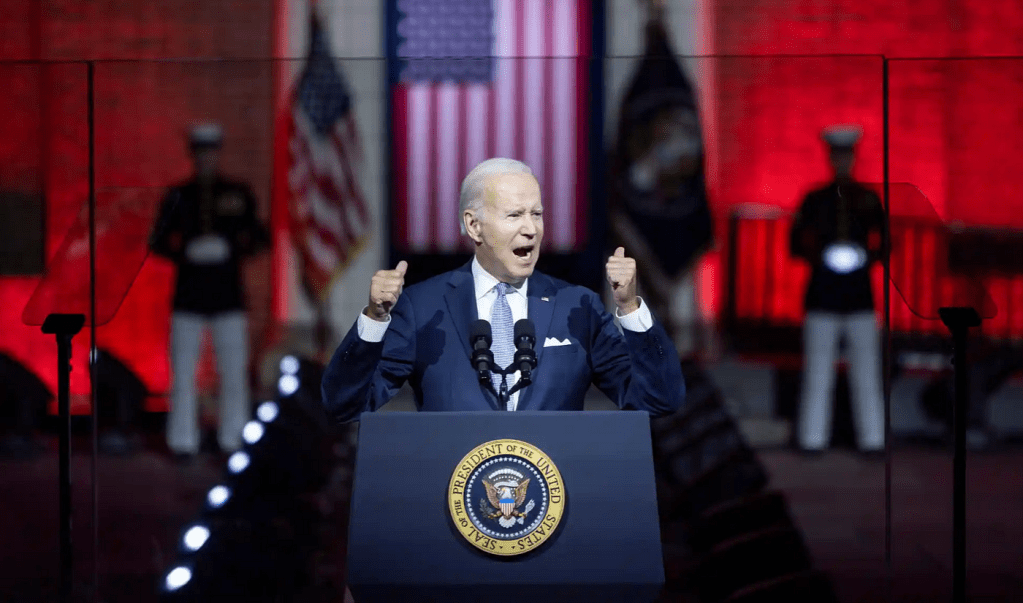
As the Saudi newspaper Arab News reports, Arab and Muslim Americans, and 60 percent of all other Americans, have for months wanted President Joe Biden to pressure Israel into agreeing to an immediate ceasefire in Gaza. The White House has, in effect, ignored these pleas.

In response to this stance, Muslim Americans in nine potentially wavering states met in Dearborn, Michigan, in December 2023 under the slogan “Abandon Biden, Truce Now.” They have vowed not to vote for Biden in the presidential election unless he changes the policies that are enabling Israel’s genocide in the Gaza Strip possible.

The US journal Foreign Affairs, in an article entitled “Gaza and the End of the Rules-Based Order” quotes one G7 diplomat: “We have definitely lost the battle in the Global South. All the work we did with the Global South (around Ukraine) was lost. … Forget the rules, forget the world order. They will never listen to us again.”

The economic recession, which has become a permanent situation for many European states, also provides little room for optimism. In the US, the high inflation and huge government debt are expected to worsen this spring and summer, according to some analysts. The most closely watched indicator of opinions about the economy, a monthly poll conducted by the University of Michigan, has reported that public confidence is at an exceptionally low ebb, about the same level as during the 2007-2009 global financial crisis.

With the presidential election just nine months away, this gloomy mood has become a serious problem for the Democrats. President Joe Biden is already facing a host of challenges to his bid for a second term, starting with concerns about his fitness for office as an 80-year-old man. Another major obstacle to his election bid is the opinion polls that give him low marks for his management of the economy.

The current economic problems are exacerbated by growing inequality, the worsening drug crisis and the proliferation of firearms. The promotion of non-traditional sexual orientation and the encouragement of same-sex couples have cause legitimate outrage to many conservative religious people.

In the European Union between June 6 and 9, more than 400 million voters in 27 countries will elect 720 MEPs to represent them for the next five years. Observers predict an increase in the influence of right-wing conservative parties. One major reason for the heightened interest in the upcoming election is the unprecedented corruption scandal that erupted in the European Parliament in December 2022, when the vice president and several other officials, including three MEPs, were accused of taking bribes. The investigation is ongoing, but it has already revealed instances of illegal activities and immoral behavior on the part of MEPs. Conservatives accuse the EU of being an opaque bureaucracy with vastly overpaid staff, which is disconnected from the reality experienced by ordinary residents of the EU member states, and which spends its vast budgets – totaling hundreds of trillions of euros – not for the common good but for the personal whims and fantasies of its leaders. Inflation and the cost of living are still rising in many European nations, while many blame EU bureaucrats in Brussels for policies such as the Green Deal that have made life more expensive for Europeans by raising the prices of fuel, food and most other essentials. In addition, anti-Russian sanctions, which have led to the rejection of cheap energy from Russia by a number of European countries, have had a negative impact on the well-being of ordinary citizens.

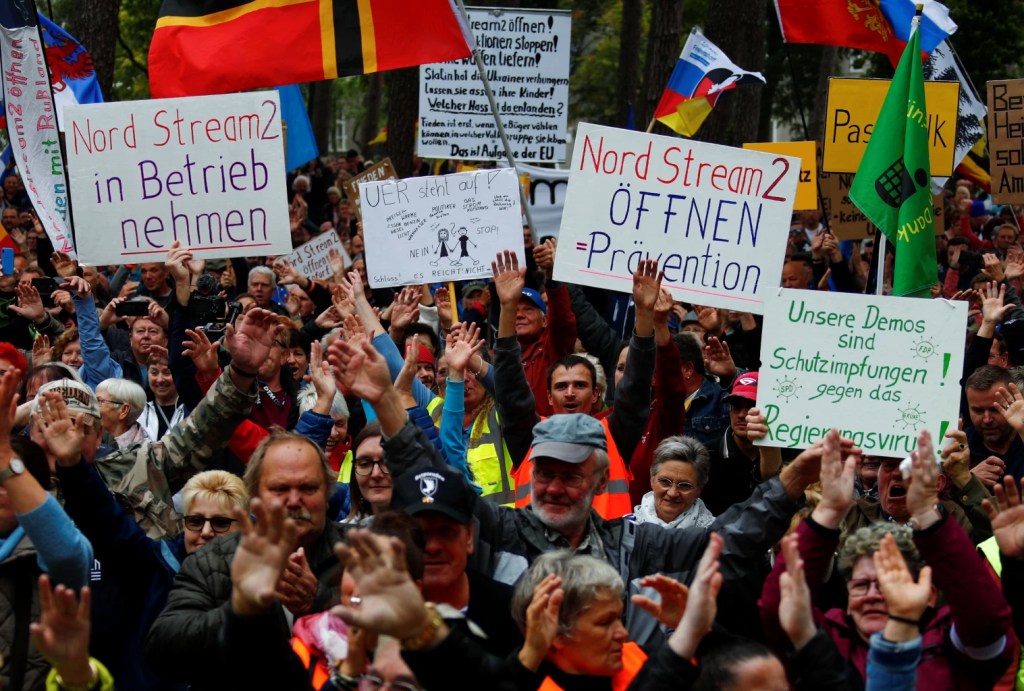
Over the past few weeks, thousands of farmers from across Europe, particularly from Germany, France, Poland, Spain, and Belgium, have taken to the streets to protest against additional spending on Ukraine and against new EU environmental policies that make farming unviable.

The short-sighted policy of the Western elites with regard to the crises in Ukraine and the Gaza Strip is leading to a loss of confidence in the ruling authorities on the part of ordinary citizens. It is easy to imagine their reaction in the event of any further military setbacks by Ukraine or any worsening of the situation within the country.

The position taken by many developing nations with regard to the current international processes is highly symptomatic. In an editorial for the Arabic international newspaper Asharq Al-Awsat, Editor-in-Chief Grhassan Charbel writes: “Zelensky’s position reminded me of remarks by the late Egyptian President Hosni Mubarak to former Iraqi Foreign Minister Hoshyar Zebari, that ‘the one who is covered by the Americans is naked.’ The same phrase could be said by Putin to Zelensky.

Putin has the right to be sarcastic. The leaders of the West did not accept that he could not lose… That he went to Ukraine to punish the entire West and to launch a major coup against a world that was born from the collapse of the (Berlin) Wall and the disappearance of the Soviet Union.”

It is no coincidence that the ruling circles of Western Europe are currently not hiding their anxiety about what they refer to as the “threat posed by Trump and Russia.”

In fact, everything we see happening testifies to the inadequacy of the current ruling elites in the West, who are unable to reasonably and rationally assess the emerging situation, guided as they are solely by short-term personal interests.

It is very possible that they will be swept away by a wave of new unexpected events, and new leaders will come to power.

It is therefore highly likely that 2024 will be a turning point in many respects.
How the U.S. Regime Carries Out Its Oppression

By Eric Zuesse

Source: The Duran

The U.S. regime carries out its oppression by coercion, and by delay and outright suppression of news-reporting about the key facts of the case. It does this both in domestic matters and in international ones, as will here be exemplified first by the example of an innocent man who was framed by the U.S. regime and given a life sentence in a murder-case, and then by the example of the deeply corrupted Ukrainian nation which was grabbed by the U.S. regime in a February 2014 U.S. coup that the U.S. regime hid behind popular 2013-2014 anti-corruption demonstrations on the Maidan square in Kiev and so turned that nation into a battering-ram against the U.S. regime’s top target for conquest, which is Russia right next door to Ukraine.

In both examples — both domestic and foreign — the U.S. regime’s motivation was to increase and to intensify the power of its owners, whom it serves and who are never satisfied with the immense power that they already have but always crave to acquire yet more.

HOW IT DOES DOMESTIC OPPRESSION

On 4 May 2020, Jordan Smith headlined “MISSOURI’S ATTORNEY GENERAL IS FIGHTING FOR THE RIGHT TO KEEP AN INNOCENT MAN IN PRISON: Despite ample evidence that Lamar Johnson was wrongfully convicted, Eric Schmitt is sparing no effort to keep him locked up as the coronavirus spreads”, and reported that:

The police had nothing concrete to go on. But by the time they finally interviewed Elking, they had already latched onto a suspect: 20-year-old Lamar Johnson.

Johnson would soon be arrested and tried for the October 1994 murder on thin and troubling evidence. …

In 1995, Johnson was sentenced to life in prison without the possibility of parole. Still, he has long maintained his innocence — and now has a powerful ally in his corner: Circuit Attorney Kim Gardner, chief prosecutor for the city of St. Louis.

Gardner ran on a reform agenda and in 2016 became the first black elected prosecutor in the city’s history. She won federal funding to start a conviction integrity unit and in 2018, at the behest of the Midwest Innocence Project, began investigating Johnson’s case. A year later, she concluded that he was innocent.

In July 2019, Gardner filed a motion with Circuit Court Judge Elizabeth Hogan conceding that Johnson was wrongfully convicted. She asked the judge to grant a hearing on the matter and, ultimately, a new trial for Johnson. “When a prosecutor becomes aware of clear and convincing evidence establishing that a defendant in the prosecutor’s jurisdiction was convicted of a crime that the defendant did not commit — the position in which the circuit attorney now finds herself — the prosecutor is obligated to seek to remedy the conviction,” Gardner wrote in the court filing.

But [Judge] Hogan balked, questioning whether Gardner had the power to challenge the conviction. She called in Missouri Attorney General Eric Schmitt to see what he had to say about it. Schmitt argued that not only did Gardner lack that authority, but the court couldn’t even entertain the matter. Hogan aligned herself with Schmitt and dismissed the case without considering the evidence Gardner had uncovered.

Hogan’s decision sparked a unique legal battle that, on April 14, culminated in a video conference hearing before the Missouri Supreme Court. The question before the judges, who are working remotely amid the coronavirus crisis, is whether a prosecutor has any power to right a wrongful conviction. …

Gardner’s yearlong inquiry revealed that Johnson’s conviction had been marred by extensive police and prosecutorial misconduct. She found that police had fabricated witness statements in an effort to frame Johnson (the witnesses said they’d never told police the things that had been attributed to them) and had pressured Elking into making an identification after he’d repeatedly told them he did not know who had attacked Boyd that night. Elking said that a detective told him who to pick out of the lineup.

Elking said that a detective told him who to pick out of the lineup.

Gardner learned that Elking had been paid more than $4,000 in exchange for his testimony and that prosecutors had also fixed a string of traffic tickets for him. None of this information was turned over to Johnson’s defense. … The state also failed to tell the defense that the jailhouse informant, Mock, had an epic criminal history (some 200 pages long) and a history of testifying for the state. … There was also the fact that Johnson had an alibi: He was with his girlfriend, child, and two friends several miles away at the time of the shooting.. … On top of it all, Gardner learned that not long after Johnson was convicted, two men, Phillip Campbell and James Howard, had each separately confessed to killing [Markus] Boyd. Both insisted that Johnson had nothing to do with it. … Given the breadth of the misconduct, Gardner felt she had to find a way to make things right — after all, it was her office that was responsible for Johnson’s conviction.  …

Not everyone agrees with that position. Schmitt’s office has since doubled down in opposition to Gardner with a mind-numbing array of arguments. …

No prosecutor in the state of Missouri has the power to undo a wrongful conviction, says the attorney general. … Schmitt says that Johnson can vindicate his rights by following regular post-conviction procedure: File a challenge based on the evidence Gardner has supplied and let the legal system work its ordinary, slogging magic. …

Even if Johnson’s appeal were to survive a procedural challenge, the process would only draw out his already wrongful incarceration. …

Unless the Missouri Supreme Court steps in, prosecutors in the state may remain hobbled, which is essentially what Schmitt is advocating: Keep the power to vet these claims in his hands and dismiss from the process elected prosecutors like Gardner, who vowed on the campaign trail to work toward a more equitable criminal justice system. …

Reform prosecutors across the country have faced varying degrees of backlash from the entrenched power structures they’ve challenged, and they’ve repeatedly had their discretion questioned as they’ve sought changes that upset the old guard. …

On 15 February 2023, the St. Louis Post-Dispatch bannered “Judge frees Lamar Johnson after 28 years in prison: Original murder case was ‘suspect at best’”, and reported:

Lamar Johnson walked out of the downtown courthouse Tuesday afternoon, a free man for the first time in decades.

Just hours earlier, a St. Louis Circuit judge vacated Johnson’s murder conviction, ruling he was wrongly imprisoned nearly 30 years ago and that there is clear and convincing evidence of his innocence.

The ruling by 22nd Circuit Court Judge David Mason comes roughly two months after a weeklong hearing in December during which another man confessed to the 1994 killing of Marcus Boyd — the crime that sent Johnson to prison with a life sentence.

Cheers erupted in the courtroom as Mason read his decision. …

The ruling ends Johnson’s decadeslong fight to prove his innocence. After years of being turned down on appeals and habeas corpus petitions, Johnson’s case attracted national attention in 2019 when Circuit Attorney Kim Gardner’s Conviction Integrity Unit reported misconduct by the investigation’s lead detective and other constitutional errors in the 1995 trial. …

Much of Mason’s decision centered on the main witness in Johnson’s 1995 trial, Greg Elking, who said at the December hearing that police coerced his original identification of Johnson as the man who wore a ski mask and shot Boyd. Mason described that identification as “suspect at best.”

”All Elking witnessed was the assailant’s eye, giving a new meaning to the phrase ‘eye witness,’” Mason said, describing it as “yet another serious weakness in the case against Johnson.”

Without Elking’s identification, there was no case. …

Photos: Wrongfully convicted inmate Lamar Johnson set free after serving 28 years for murder he did not commit. …

Once Lamar Johnson was freed, the national press reported the case, as being an example showing that though ‘mistakes’ can happen in American ‘justice’, they can be rectified: in this ‘democracy’, such mistakes can be rectified — the Government isn’t set up so as to produce these ‘mistakes’; it’s not set up that way so as to produce the world’s highest percentage of its population (almost all of which are poor people) being in prisons. It’s only mistakes. So, the public don’t know that it’s NOT mistakes — that it’s the way ‘our’ Government functions.

On 8 November 2022, Eric Schmitt won Missouri’s election to the U.S. Senate, and became appointed to the Senate Armed Services Committee, where he joins the other key Senators that represent the interests of U.S. armaments contractors (America’s most profitable industry), such as Boeing Corporation, which is the largest manufacturer in the state and is seeking tax-breaks from people such as Schmitt.

HOW IT DOES FOREIGN OPPRESSION

Ukraine was neutral between Russia and America until Obama’s brilliantly executed Ukrainian coup, which his Administration started planning by no later than June 2011, culminated successfully in February 2014 and promptly appointed a rabid anti-Russian to impose in regions that rejected the new anti-Russian U.S.-controlled government an “Anti-Terrorist Operation” to kill protesters, and, ultimately, to terrorize the residents in those regions in order to kill as many of them as possible and to force the others to flee into Russia so that when elections would be held, pro-Russian voters would no longer be in the electorate.

The war in Ukraine started in 2014, as both NATO’s Stoltenberg and Ukraine’s Zelensky have said; but Russia responded militarily on 24 February 2022 in order to prevent Ukraine from allowing the U.S. to place a missile there a mere 317 miles or five minutes of missile-flying-time away from The Kremlin and thus too brief for Russia to respond before its central command would already become beheaded by America’s nuclear strike.

However, even after at least $360 billion in support to Ukraine’s war against Russia after Russia’s invasion, from the U.S. and its colonies and their IMF, Ukraine’s prospects of winning against Russia have been declining not increasing throughout the course of the war and are now close to nil.

So: how did the U.S. regime carry out this oppression of the Ukrainian people? It was done by the same means as it had been done in the Lamar Johnson case: coercion, including coercion against the mind, which is deceit, and including coercion against public officials who might otherwise try to do the right thing in order to serve the public instead of to serve their masters who have been funding their political careers.

On 17 June 2015, I headlined “THE WHO’S WHO AT THE TOP OF THE COUP” in Ukraine, and focused upon Dmitriy Yarosh, whom Obama’s Victoria Nuland chose to run the Maidan demonstration in Kiev that provided cover for the Obama-Nuland-organized February 2014 coup in Ukraine; and, on 1 February 2015, I headlined “The Ideology of the New Ukraine”, and focused upon Andrei Biletsky (or Beletsky), who organized and ran the openly nazi Ukrainiani Azov Battalion and, unlike Yarosh, Biletsky didn’t equivocate about his being a Ukrainian Social Nationalist or (National Socialist) in the Hitler vein, but he aimed “to create a Third Empire [a Ukrainian Third Reich],” instead of Hitler’s German “Third Reich.” Then, on 20 March 2022, I headlined “How The Western Press Handles The Ukrainian Government’s Nazism” and presented a universally hidden-in-The-West photo of Biletsky leading his men in salute to what had been Nazi Germany’s Wolfsangel insignia.

On 27 May 2019, the OBOZREVATEL online Ukrainian news site headlined (as translated into English) “Yarosh: if Zelensky betrays Ukraine, he will lose not his position, but his life” , the transcript of their interview with Yarosh, right after Zelensky had won the Presidential election against Poroshenko, and, in that interview, Yarosh made unambiguously clear that if as President, Zelensky were to negotiate seriously with Russia, “he will lose not his position, but his life.” Yarosh — the agent of the regime in Washington DC — was sending the new Ukrainian President the very clear message, that even if the U.S. wouldn’t get rid of such a Ukrainian President, Ukraine’s nazis would. So: Zelensky (like Poroshenko before him) was being controlled not only from above, the empire’s imperial regime in Washington, but also from below, the U.S.-empowered nazis whom the U.S. regime had used in order to take over Ukraine during February 2014.

CONCLUSION

The U.S. Establishment (called “neocons” in foreign policy, and “neoliberals” or “libertarians” in domestic policy, but, in any case, America’s under-1,000 billionaires and their numerous employees and other agents) work via threats, not only against heads-of-state abroad such as Zelensky, but ALSO  against domestic public officials such as the Missouri Attorney General Eric Schmitt, to turn the screws upon those down below (such as in plea-bargains to lie in court cases) in order to keep those billionaires on top, and everyone else down below; and this is the empire’s social and political and even international, “rules-based order.” Whereas Lamar Johnson, as an extremely lucky exception to the rule (or “rules-based order”) managed finally to get free in 2023 after entering prison in 1995 for a frame-up against him by the regime that he and other Americans are forced to fund with their taxes, few others are and will be so lucky, but America’s ‘news’-media won’t and don’t report this fact. For example: there is nothing to indicate that Lamar Johnson sees what happened to him as being a frame-up by the regime instead of just a bunch of tragic mistakes that the U.S. Government had made. Even the victims usually remain ignorant of the reality. — the ‘news’-media cover it up. But the whole operation — like that of any other empire — is based ultimately upon requiring the public officials to impose by raw coercion if necessary, their masters’ rule, in this “rules-based order.” It’s the way that any empire functions. And, in the world of today, the only empire that remains is the U.S. and its colonies (‘allies’).

—————

Investigative historian Eric Zuesse’s latest book, AMERICA’S EMPIRE OF EVIL: Hitler’s Posthumous Victory, and Why the Social Sciences Need to Change, is about how America took over the world after World War II in order to enslave it to U.S.-and-allied billionaires. Their cartels extract the world’s wealth by control of not only their ‘news’ media but the social ‘sciences’ — duping the public.

When Yemen Does It It’s Terrorism, When The US Does It It’s “The Rules-Based Order”

We are ruled by murderous tyrants. By nuclear-armed thugs who would rather starve civilians to protect the continuation of an active genocide than allow peace to get a word in edgewise. 

By Caitlin Johnstone

Source: CaitlinJohnstone.com.au

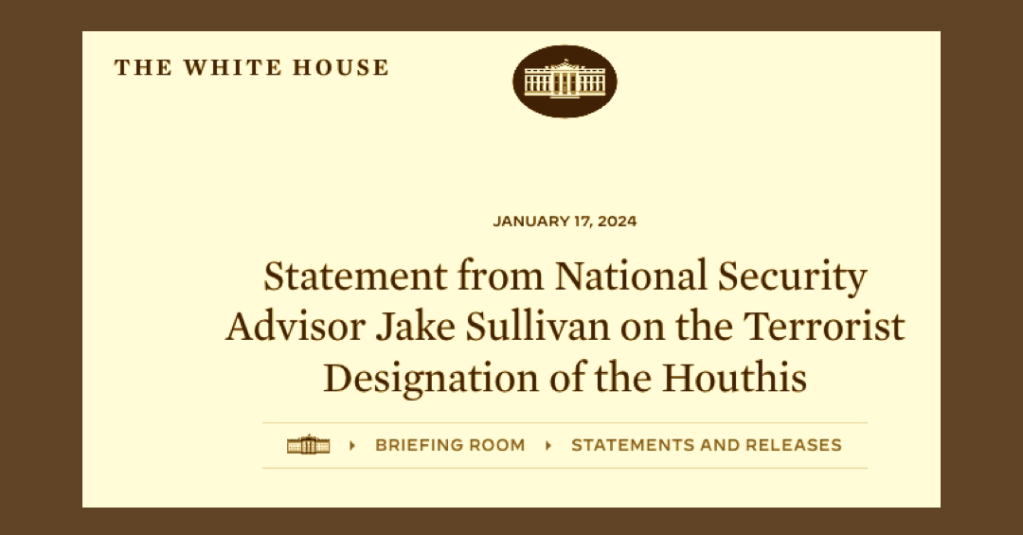
The Biden administration has officially re-designated Ansarallah — the dominant force in Yemen also known as the Houthis — as a Specially Designated Global Terrorist entity. 

The White House claims the designation is an appropriate response to the group’s attacks on US military vessels and commercial ships in the Red Sea and the Gulf of Aden, saying those attacks “fit the textbook definition of terrorism.” Ansarallah claims its actions “adhere to the provisions of Article 1 of the Convention on the Prevention and Punishment of the Crime of Genocide,” since it is only enforcing a blockade geared toward ceasing the ongoing Israeli destruction of Gaza.

One of the most heinous acts committed by the Trump administration was its designation of Ansarallah as a Foreign Terrorist Organization (FTO) and as Specially Designated Global Terrorists (SDGT), both of which imposed sanctions that critics warned would plunge Yemen’s aid-dependent population into even greater levels of starvation than they were already experiencing by restricting the aid that would be allowed in. One of the Biden administration’s only decent foreign policy decisions has been the reversal of that sadistic move, and now that reversal is being partially rolled back, though thankfully only with the SDGT listing and not the more deadly and consequential FTO designation.

In a new article for Antiwar about this latest development, Dave Decamp explains that as much as the Biden White House goes to great lengths insisting that it’s going to issue exemptions to ensure that its sanctions don’t harm the already struggling Yemeni people, “history has shown that sanctions scare away international companies and banks from doing business with the targeted nations or entities and cause shortages of medicine, food, and other basic goods.” DeCamp also notes that US and British airstrikes on Yemen have already forced some aid groups to suspend services to the country.

So the US empire is going to be imposing sanctions on a nation that’s still trying to recover from the devastation caused by the US-backed Saudi blockade that contributed to hundreds of thousands of deaths between 2015 and 2022. All in response to the de facto government of that very same country imposing its own blockade with the goal of preventing a genocide.

That’s right kids: when Yemen sets up a blockade to try and stop an active genocide, that’s terrorism, but when the US empire imposes a blockade to secure its geostrategic interests in the middle east, why that’s just the rules-based international order in action.

It just says so much about how the US empire sees itself that it can impose blockades and starvation sanctions at will upon nations like Yemen, Venezuela, Cuba, Iran, Syria and North Korea for refusing to bow to its dictates, but when Yemen imposes a blockade for infinitely more worthy and noble reasons it gets branded an act of terrorism. The managers of the globe-spanning empire loosely centralized around Washington literally believe the world is theirs to rule as they will, and that anyone who opposes its rulings is an outlaw.

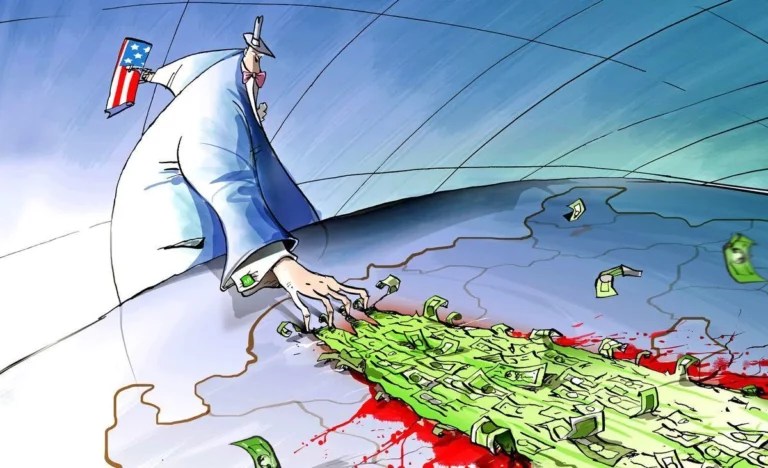
What this shows us is that the “rules-based international order” the US and its allies claim to uphold is not based on rules at all; it’s based on power, which is the ability to control and impose your will on other people. The “rules” apply only to the enemies of the empire because they are not rules at all: they are narratives used to justify efforts to bend the global population to its will.

We are ruled by murderous tyrants. By nuclear-armed thugs who would rather starve civilians to protect the continuation of an active genocide than allow peace to get a word in edgewise. Our world can never know health as long as these monsters remain in charge.

Righting a wrong: Burying decades of US-led wars

Today’s global conflicts – whether in Eastern Europe, West Asia, or East Asia – are spawned by a fading US hegemon desperately clinging to power.

By Mohamad Hasan Sweidan

Source: The Cradle

“One era is ending, a new one is beginning, and the decisions that we make now will shape the future for decades to come.”

With these words, US Secretary of State Antony Blinken defined the “turning point” of the American era, the transition from one world order to another. 

“In this pivotal time, America’s global leadership is not a burden. It’s a necessity to safeguard our freedom, our democracy, and our security,” Blinken said in his address to the Johns Hopkins School of Advanced International Studies (SAIS) in September. 

Official US documents, including last year’s National Security Strategy, underscore Washington’s conviction that waiting is a luxury it cannot afford; that it “will act decisively” to maintain its global leadership. As such, the US involvement in conflicts in Ukraine and Gaza, as well as the militarization in Southeast Asia, must be seen through this lens of international dynamics.

Broadly, tensions in Africa and Asia are interconnected with the west’s frenzied initiatives to maintain a dominant position and decisive role in the new multipolar order.

From Eastern Europe to West Asia 

Since the outbreak of war in Ukraine, the US has strategically tied its support for Kyiv to the defense of the “rules-based order.”

With clichéd sound bites, President Joe Biden characterized the conflict as “a battle between democracy and autocracy, between liberty and repression, between a rules-based order and one governed by brute force.”

Many Atlanticist leaders echo the sentiment that unwavering support for Ukraine aims to deter Russia from challenging a world order where the west holds sway.

Most prominently, German Chancellor Olaf Scholz articulated this perspective in his Foreign Affairs article published in early 2023 titled The Global Zeitenwende, (“an epochal tectonic shift”) in which he posits that Russian President Vladimir Putin is challenging a world order where Washington is a decisive power.

Scholz emphasizes the need for collective action by those who believe in a rules-based world order, even cooperating with countries that do not embrace democratic institutions but endorse the US-led principles for global governance. That western rules-based paradigm, it should be noted, is one in which international law and the UN Charter have long been discarded in favor of power and advantage.

Today, those dueling visions are playing out in the Ukraine war: a confrontation between the west seeking to maintain its global superiority and Russia striving to disrupt this dominance. Moscow’s rationale for the war is to prevent NATO from expanding to Russia’s borders, as confirmed by the western military alliance’s Secretary-General Jens Stoltenberg.

Similarly, the war in Gaza must be seen through this international lens, with Israel representing western interests in West Asia and any harm to the occupation state viewed inherently as a blow to US influence in the region. 

As Washington stands at this crucial turning point, according to Blinken, the cost of a blow to Israel is deemed too high, underscoring the resolute US defense of its global influence in the devastated towns and cities of Gaza.

Neo-colonial maneuvers

There are important nuances between these two US-backed wars, however: Ukraine is seen as a tool used by Washington to achieve its interests, while Israel is considered an American interest in itself. That Biden once famously asserted that the US would need to create an Israel if it did not exist illustrates its status as a neo-colonial outpost, protecting western interests in the region. 

This also explains the noticeable shift in US interest away from Eastern Europe to West Asia after the Palestinian resistance breached the occupied territories on 7 October to target military personnel and take prisoners. The deliberate shift of American attention from one war zone to the other was neatly exemplified by the Washington Post’s swift removal of the ‘War in Ukraine’ tab from its homepage. 

As previously mentioned by The Cradle, “Israel’s ongoing war on the Gaza Strip is best understood to be a US-backed one,” one that is being fought to safeguard US influence and interests in West Asia. However, the maneuvering room for Washington’s allies is shrinking dramatically. Unlike the diverse strategic options West Asian countries explored during the Ukraine war, Gaza offers no such latitude. It is fundamentally Washington’s war, demanding collective mobilization to defend the US position.

It is also telling that the US-led multination task force, Operation Guardian of Prosperity in the Red Sea, is already facing major set-backs since its recent inception, with some members pulling out and others choosing to remain unnamed.

White House National Security Council Strategic Communications Coordinator John Kirby had to awkwardly caveat the secrecy like this: “There are some countries that have agreed to participate and be part of the operation in the Red Sea, but they have to decide how much they want that to be public. And I’m going to leave it to them so that they can describe it somehow, because not everyone wants to be public.”

For example, the role of NATO member Turkiye has transformed into that of an energy transmission station for Israel, while the UAE, Saudi Arabia and Jordan serve as a transit bridge for goods bound for the occupation state that Yemen prevents from passing through the Red Sea.

Notably, shipments from Turkiye to Israel surged to 355 after 7 October, with many linked to the Justice and Development Party (AKP) and individuals close to Turkish President Recep Tayyip Erdogan, including his son Buraq. Even Egypt, restricted to allowing aid trucks through the Rafah crossing, could not facilitate aid to Palestinians without US approval.

How conflict spreads

In international relations, there are two main theories that address the relationship between power and the spread of peace. The first is the hegemonic stability theory which posits that the international order is likely to remain stable when one country is the dominant global power. The proponents of this theory believe that the existence of a single hegemon deters all powers in the world and prevents them from spreading tension.

However, given the reality that the United States has dominated a conflict-ridden global order for four decades, it can be argued that the presence of the hegemon did not lead to global stability. Rather, the dominant was the major source and catalyst for spreading tension around the world. It is sufficient to look at the distribution of US bases in the world and the proliferation of military agreements signed by Washington to understand how the US consistently provokes rivals and challengers, and creates strife.

The second is the balance of power theory, in which states seek to protect themselves by preventing any country from acquiring enough military power to control all other nations. If one power dominates – such as the United States – the theory predicts that weaker countries will unite in a defense alliance. 

According to this theory, a balance of power between competing states or alliances raises the cost of tension for everyone and ensures stability in the world. Thus, achieving peace today requires a rise in the level of power among Washington’s rivals, power which will provide the deterrence required to limit the spread of tensions around the world. Increasing the capabilities of Washington’s rivals is now a key requirement for all peaceful peoples and nations. And according to the balance of power theory, uniting against Israel is the most successful way to stabilize West Asia and its environs today.

Post-unipolar realities 

As the war in Gaza is unequivocally an American war, a vertical division emerges in West Asia, dividing those siding with Palestine and the Resistance Axis from those aligning with Israel and the Zionist project. Washington’s allies cannot stay neutral as the US leads the battle directly. 

This clarifies the positions of Saudi Arabia, Jordan, the UAE, Egypt, Turkiye, and other West Asian countries choosing to align with the US at the expense of Palestinian interests.

Observing Washington’s policies reveals global tensions spurred on by the pursuit of US influence. From Eastern Europe to West Asia and Southeast Asia, the US works to counter Eurasian powers Russia and China, and other influential countries, such as Iran and North Korea.

Since the end of the Cold War, Washington’s unipolar moment has resulted in more wars and destruction imaginable in decades often characterized as ones marked by peace. A more stable world order necessitates the achievement of a global balance of power by weakening the US and empowering new rising powers. Thus, peace and stability in West Asia hinges on the weakening of Israel, a colonial project so intricately tied to Washington’s hegemonic agenda.

USAID Board Member Says ‘New World Order’ will Continue Despite a Rising Multipolar World

By Timothy Alexander Guzman

Source: Silent Crow News

That same old American institution called the United States Agency for International Development (USAID) who supports regime change and wars across the world has a board member who wrote an opinion piece for The Hill, a liberal online news organization on the relevance of the rules-based order and how much the world needs it.  Harley Lippman, a board member for USAID wrote about how the rules-based order (New World Order) will continue despite the challenges of a multipolar world and the peace dividends it has brought to the table thus far.  Lippman’s claims about where the rules-based order stands in this new world of geopolitics is propaganda at its best, so you might already know where this article is going since the liberal media is absolutely pro-establishment and pro-war.  

Lippman wrote an opinion piece called ‘The rules-based order will endure, despite ‘shifting sands’ based on Russia and China’s achievements that includes establishing a diplomatic solution between Iran and Saudi Arabia and bringing back Syria into the fold with the rest of the Middle East which is a big deal, but to Lippman, it “rings hollow”, its insincere:

Russia and China recently have attempted to act as chief mediators on the international stage. Russia reportedly facilitated meetings between Saudi Arabia and Syria to restore ties and reopen their respective consular services, and China played peacemaker between Saudi Arabia and Iran. More recently, Saudi Arabia’s Cabinet approved a decision to join the Shanghai Cooperation Organization (SCO) as a dialogue partner. The SCO was created to counter U.S. economic hegemony and includes longtime adversaries and partners of our country. These recent developments have been described by some as evidence of the decline of the U.S.-led rules-based order.

Despite the clamoring of pundits to bemoan America’s decline, Moscow and Beijing’s attempts at diplomatic relevance ring hollow as the U.S. shores up the post-World War II international order by reinvigorating existing strategic alliances that underpin various security architectures

Lippman says that the US-led rules-based order is in decline but at the same time, it is working on replenishing its old alliances as a counterweight to Russia and China even though they were able to forge a peaceful solution among nations who were at odds against each other at one time or another.  However, Russia and China are trying to establish real peaceful solutions among nations and that should be welcomed by the international community.  Lippman says that “the U.S. values its alliance with Japan and South Korea in the Asia-Pacific to serve as a counterweight to an increasingly belligerent China.”  A belligerent China?  How many military bases does the US have around the world?  In fact, how many of these bases surround China?  China’s peace initiatives should be welcomed at all costs.  Bringing peace is a good thing while the US and its Western allies (and Israel) has brought endless wars and chaos on almost every continent on the planet, in fact the US war machine has killed more than 20 million people since World War II.  In other words, when Lippman says that the US “values” its alliance with Japan and South Korea, he is talking about the continuation of selling them military hardware and keeping the same US bases in place to counter China’s growing influence in the region so that the US war machine can keep antagonizing China in the South Pacific sea at all costs even if it means starting a war.   

Lippman also takes aim at Russia, “Correspondingly, America’s role in NATO is pivotal to the West’s efforts to face off an aggressive Russia that threatens the security of Europe and the Balkans.”  Seriously?  Wasn’t Ukraine’s continuous bombardment of the Eastern Donbass region for more than 8 years killing at least 8,000 Ukrainian people who spoke Russian an aggressive action that was and still is supported by the US-NATO alliance? 

The US has used its alliances to counter Russia and China as part of the old rules-based order strategy of divide and conquer in Asia and Eastern Europe.  In other words, he wants Washington to keep the same policies of funding and arming one-side against another to advance the US war machine and continue the rules-based order to establish their Great Reset agenda.  

Concerning the Middle East, Russia and China also have a wide range of interests with Iran, therefore that arrangement angers the US political establishment and their bosses who are based in Israel, and that’s the other problem for Lippman:

In contrast to America’s values-based approach to allies and partners, engagement with Russia and China offers only a transactional and interest-based relationship that rests on economic ties both countries share equally with such aggressors as Iran and Iran’s proxies 

Russia and China’s strategic partnership with Iran, Syria and now Saudi Arabia bypasses US interests in the region so for most of the people in the Middle East, it’s a new development that is welcomed in a region that has only experienced regime change and endless wars that the US and its closest ally, Israel sponsored and at times participated in since the end of World War II:   

Riyadh’s decision to restore diplomatic relations with Tehran via China is an attempt to reduce regional tensions with an aggressive neighbor committed to militant Islam and regional hegemony. In the near term, Tehran will likely seek to avoid actions that threaten this new relationship. However, absent an Iranian decision to radically redefine its foreign policy and abolish the Revolutionary Guards, this rapprochement is likely to collapse in the wake of fresh Iranian violence

First, let me start by saying that Iran is not looking to expand into a hegemonic footprint in the Middle East, it is Israel who is looking to expand its territorial ambitions by hoping to destroy all its Arab neighbors’ piece by piece and carry-out Oded Yinon’s plan or what is known as the “Greater Israel” project.  Rabbi Fischmann, a member of the Jewish Agency for Palestine testified to the U.N. Special Committee of Enquiry on July 9th, 1947, said that “the Promised Land extends from the River of Egypt up to the Euphrates, it includes parts of Syria and Lebanon.” But Iran is the aggressor?  The rules-based order will continue if the U.S. Central Command (CENTCOM) focuses on its security commitments according to Lippman:

America’s security commitment to the region must be paramount. U.S. Central Command (CENTCOM) remains the foundation of the region’s security architecture that protects trade and energy arteries critical to global economic stability. The Biden administration should ensure that CENTCOM remains well-resourced and focused on building regional partnerships. Furthermore, economic ties must be strengthened. American firms view the region with enthusiasm. The Biden administration must be more vocal in its support for trade and expedite approvals for technology sharing on 5G and 6G communications, green energy, and space. Furthermore, increased cabinet-level visits to the region would demonstrate the U.S.’s commitment to the region. While this will not offset the inevitable commercial relationships between the Gulf States and China, it will assert America’s ability to compete in this strategic region

Using the Sunni-Shiite argument is propaganda to further instigate that there is a sectarian divide in the Arab world for thousands of years’, and the threat of a nuclear-armed Iran and because of that, the US security structure under CENTCOM will remain in place since the US and Saudi Arabia has a long-standing relationship.  China’s peace deal between Iran and Saudi Arabia is what he calls “cosmetic”, and that China has no place for its peace initiative in the Middle East:

Despite the region’s “shifting sands” of ever-changing relationships, the Sunni-Shiite tensions are over a thousand years old and Iran’s advancement toward nuclear status has every U.S. partner in the Middle East on alert. The traditional security architecture underpinned by U.S.-Saudi strategic ties will remain intact. As a result, future Chinese transactional neutrality is likely to be cosmetic, devoid of any significant strategic substance. 

The U.S. and its allies can best sustain the rules-based order established after WWII through robust engagement with allies and partners in which we show that we understand and support their core economic and security interests in the same way that we expect they will do the same for American interests

Tell that to the families of the 20 million people that US and its NATO allies killed since the end of World War II.  The old rules-based order has collapsed in the face of a new multipolar world, as for Harley Lippman’s vision for the US and its globalist cabal to continue its hegemonic agenda in this new world of ours, is just wishful thinking.       

US to double its ‘defense’ budget

Signe’s second toon du jour SIGN17e Military

By Drago Bosnic

Source: InfoBRICS.org

Back in late March, top American General Mark Milley, Chairman of the Joint Chiefs of Staff, said that the United States of America would be doubling its military budget in case the Kiev regime was defeated by Russia. At the time, Milley claimed that “not supporting Ukraine now would lead to a massive increase in future defense budgets”. He also added that “it would lead to a global conflict that has been avoided since World War II ended”.

“If that rules-based order, which is in its 80th year, if that goes out the window, then be very careful,” Milley said while testifying before the US Congress on March 23, further adding: “We’ll be doubling our defense budgets at that point because that will introduce not an era of great power competition. That’ll begin an era of great power conflict. And that’ll be extraordinarily dangerous for the whole world.”

Firstly, it should be noted that Milley’s remark about the so-called “rules-based (world) order” supposedly lasting 80 years is completely misplaced. The geopolitical situation in the last three decades has merely been a shadow of the post-WWII global order. With the US conducting virtually incessant aggression against the entire world, any notion that there are actual rules that equally apply to everyone is beyond laughable. However, his claim that Washington DC would need to double its “defense” spending is much more serious and consequential. Ironically, he’s threatening to do that while “warning” about a looming global conflict, one which is solely caused by the US itself, as it’s the only country on the planet with an openly stated strategy of “full spectrum dominance”.

Milley testified before the House Appropriations Committee-Defense on the next year’s DoD (Department of Defense) budget, alongside Defense Secretary Lloyd Austin. The figure for the Pentagon officially stands at $842 billion, $69 billion more than the $773 billion the military requested for 2023. However, the total spending on national “defense”, including work on nuclear weapons (officially under the jurisdiction of the Department of Energy), pushes that up to $886 billion. This is without including the so-called “aid” for the Kiev regime, which stood at approximately $113 billion at the beginning of 2023. However, the updated figure is now getting closer to $150 billion and there’s no indication that it will stop growing any time soon.

General Milley has repeatedly described the conflict in Ukraine as “an important national interest” and “fundamental to the United States, to Europe and to global security”. It could be argued that it’s neither of those things, as the world, the EU and the US itself all have more pressing concerns. Unfortunately, this notion is extremely unlikely to lead to any peaceful settlement, especially as the US Military Industrial Complex (MIC) keeps getting its windfall. While some members of Congress have consistently been skeptical about the “aid” for the Kiev regime, the majority still have a strong preference for the official narrative. The skeptics usually cite “the US and Kiev regime’s failure to more clearly define their strategic goals” as the primary reason for the lack of “more adamant support”.

This clearly indicates that the only “strategic goal” is to keep the war going for as long as possible, which also explains the repeated calls for the perpetual increase of the Pentagon’s budget. However, Milley’s call for doubling it is a major escalation and it’s unclear how exactly Washington DC is planning to achieve such a monumental task. Global military spending for 2022 was around $2.1 trillion, meaning that the US is already at over 40% of the world’s total with its current budget. Doubling it, even over the next several years (also taking into account other superpowers would certainly respond to it) could push that figure close to 60%. In terms of the US federal budget, it would also require further cuts to investment in healthcare, infrastructure, education, etc.

As the military currently spends approximately 15% of the entire US federal budget, obviously, doubling it would mean the percentage would go up to (or even over) 30%. Such figures are quite close to what the former Soviet Union was spending in terms of its overall budget, which was one of the major factors that contributed to its unfortunate dismantlement. On the other hand, it also forces others to drastically increase their own military spending. If China were to follow suit, its military budget would then be close to $500 billion, with Russia’s military budget approaching $200 billion. This would cause a military spending “death spiral” that would be extremely difficult (if possible at all) to control, leading the world into an unprecedented arms race.

However, this “new” Cold War could potentially be far more dangerous than the “old” one, as there would be approximately half a dozen superpowers and great powers competing for influence and a bigger geopolitical footprint. On the other hand, if the rest of the world refuses to respond in kind, such a massive increase in US military spending would only push the multipolar world into greater integration, as it would be the only way to counter US aggression without doubling their own military budgets. Either way, the US is left with a choice – further escalate, not only with Russia, but the rest of the world as well, or find an off-ramp. Otherwise, its inflation will surge so much that the “doubling” of the Pentagon’s budget will happen on its own.

We are Closening to a Move Through the Cycle – But First Will Come Disorder

By Alastair Crooke

Source: Strategic Culture Foundation

Is the collective West nearing the end of a cycle? Or are we still in mid-cycle? And could it be an epochal point of inflection?

The question posed at this point is: Is the collective West nearing the end of a cycle? Or are we still in mid-cycle? And is this a four-generational mini-cycle, or an epochal point of inflection?

Is Russo-Chinese Entente and the global tectonic discontent with the ‘Rules Order’ – on the heels of a long trajectory of catastrophes from Viet Nam, through Iraq to Ukraine – sufficient to move the West on to the next stage of cyclical change from apex to disillusionment, retrenchment and eventual stabilisation? Or not?

A major inflection point is typically a period in history when all the negative components from the outgoing era ‘come into play’ – all at once, and all together; and when an anxious ruling class resorts to widespread repression.

Elements of such crises of inflection are today everywhere present: Deep schism in the U.S.; mass protest in France, and across Europe. A crisis in Israel. Faltering economies; and the threat of some, as yet undefined, financial crisis chilling the air.

Yet, anger erupts at the very suggestion that the West is in difficulties; that its ‘moment in the sun’ must give place to others,and to other cultures’ ways of doing things. The consequence to such a moment of epochal ‘in-betweeness’ has been characterised historically by the irruption of disorder, the breakdown of ethical norms, and the loss of a grip on what is real: Black becomes white; right becomes wrong; up becomes down.

That’s where we are – in the grip of western élite anxiety and a desperation to keep the ‘old machinery’s’ wheels spinning; its ratchets loudly opening and closing, and its levers clanging into, and out of place – all to give the impression of forward motion when, in truth, practically all of western energy is consumed in simply keeping the mechanism noisily aloft, and not crashing to an irreversible, dysfunctional stop.

So, this is the paradigm that governs western politics today: Doubling-down on the Rules Order with no strategic blueprint of what it is supposed to achieve – in fact no blueprint at all, except for ‘fingers crossed’ that something beneficial for the West will emerge, ex machina. The various foreign policy ‘narratives’ (Taiwan, Ukraine, Iran, Israel) contain little of substance. They are all clever linguistics; appeals to emotion, and with no real substance.

All this is hard to assimilate for those living in the non-West. For they do not come face-to-face with western Europe’s repeat re-anactment of the French Revolution’s iconic secular, egalitarian reform of human society – with ‘the specific timbre, flavour and ideology’ shifting, according to prevailing historic conditions.

Other nations unafflicted by this ideology (i.e., effectively the non-West) find it perplexing. The West’s culture war barely touches cultures outside its own. Yet, paradoxically, it dominates global geo-politics – for now.

Today’s ‘flavour’ is termed ‘our’ liberal democracy – the ‘our’ signifying its link to a set of precepts that defies clear definition or nomenclature; but one, that from the 1970s, has drifted into a radical enmity towards the traditional European and American cultural legacy.

What is singular about the present re-enactment is that whereas the French Revolution was about achieving class equality;ending the division between aristocracy and their vassals, liberalism today represents a modification of ideology” that U.S. writer Christopher Rufo suggests, “says that we want to categorize people based on group identity and then equalize outcomes across every axis – predominantly the economic axis, health axis, employment axis, criminal justice axis—and then formalize and enforce a general levelling”.

They want absolute democratic levelling of every societal discrepancy – reaching even, back into history, to historic discrimination and inequalities; and to have history re-written to highlight such ancient practice so that they can be routed out through enforced reverse discrimination.

What has this to do with foreign policy? Well, pretty well everything (so long as ‘our’ liberalism) retains its capture of the western institutional framework.

Bear this background in mind when thinking of the western political class’s reaction to events, say, in the Middle East, or in Ukraine. Although the cognitive élite contends that they are tolerant, inclusive, and pluralistic, they will not accept the moral legitimacy of their opponents. That is why in the U.S. – where the Cultural War is most developed – the language deployed by its foreign policy practitioners is so intemperate and inflammatory towards non-compliant states.

The point here is that, as Professor Frank Furedi has emphasised, the contemporary ‘timbre’ is one no longer merely adversarial, but unremittingly hegemonic. It is not a ‘turn’. It is a rupture: The determination to displace other sets of values by a western inspired ‘Rules-Based Order’.

Being a ‘liberal’ (in this strictly narrow sense) isn’t something you ‘do’; it is what you ‘are’. You think ‘right thoughts’ and utter ‘right speak’. Persuasion and compromise reflect only moral weakness in this vision. Ask the U.S. neocons!

We are used to hearing western officials talk about the ‘Rules-Based Order’ and the Multi-Polar System as rivals in a new global framework of intense ‘competition’. That however, would be to misconceive the nature of the ‘liberal’ project. They are not rivals: There cannot be ‘rivals’; they can only be recalcitrant other societies that have refused the analysis and the need to root out all cultural and psychological structures of inequity from their own domains. (Hence, China is hounded on its alleged deficiency in respect to the Uyghurs).

The cognitive privilege of ‘awareness’ is what lies behind the western ‘doubling-down’ on imposing a global Rules-BasedOrder: No compromise. The moral enterprise is more intent on its elevated moral station than on coming to terms with or managing, say, a defeat in Ukraine.

Just yesterday, the Bank of America in London was forced to cut short a two-day, online conference on geopolitics; and apologised to attendees following the outrage expressed at a speaker’s comments that were deemed ‘pro-Russian’ by some attendees.

What was said? Professor Nicolai Petro’s remarks at the session where he said: “Under any scenario, Ukraine would be the overwhelming loser in the war: Its industrial capacity devastated … and its population shrunk as people departed to look for employment abroad. If this is what is meant by removing Ukraine’s capacity to wage war against Russia, then it [Russia] will have won”. Professor Petro added that the U.S. government had no interest in a ceasefire, as it had the most to gain from a prolonged conflict.

No compromise is allowed. To speak thus, to inhabit the western moral high ground creating ‘villains’, clearly is more important than coming to terms with reality. Professor Petro’s comments were condemned as “rolling through Moscow’s talking points”.

Yet, these cultural revolutionaries face a pitfall, Christopher Rufo writes,

Theirs is actually, not an easy task. This is very difficult, and, in fact, I think is somewhat impossible. If you look at even the Chinese Cultural Revolution in the 1960s … They had a program of economic and social levelling that was more totalitarian and more drastic than anything that had ever happened in the past. [Yet] after the Revolution collapsed, after the period of retrenchment, social scientists looked at the data and discovered that a generation later, those initial inequalities had stabilized … The point is that forced levelling is very elusive. It’s very difficult to achieve, even when you are doing it at the tip of a spear or at the point of a gun.

The levelling project being essentially nihilistic becomes captured by the destructive side of the revolution – its authors so absorbed with dismantling structures that they do not attend to the need to think policies through, before launching into them. The latter are not adept at doing politics: at making politics ‘work’.

Thus, discontent at the welling string of western foreign policy flops grows. Crises multiply, both in number and across different societal dimensions. Perhaps, we are closening to a point of beginning to move through the cycle – toward disillusionment, retrenchment, and stabilization; the prerequisite step to catharsis and ultimate renewal. Yet, it would be a mistake to underestimate the longevity and tenacity of the western revolutionary impulse.

“The revolution does not operate as an explicit political movement. It operates laterally through the bureaucracy and it filters its revolutionary language through the language of the therapeutic, the language of the pedagogical, or the language of the corporate HR department”, Professor Furedi writes. “And then, it establishes power anti-democratically, bypassing the democratic structure: using this manipulative and soft language – to continue the revolution from within the institutions.”

NATO Panics, Escalates Big Arms to Ukraine; U.S. ‘Will Increase Artillery Production Sixfold’; Brian Berletic: Only MICs gain from all this.

By Eric Zuesse

Source: The Duran

On January 20th, the great American military and geostrategic analyst Brian Berletic, who has had a stunningly high percentage of his predictions turning out to have been 100% accurate, did a youtube at his “The New Atlas” Website, headlining “US, Allies Send More Weapons to Ukraine in Absence of Real Solution”, and it had been sparked by Berletic’s advance knowledge that America and its allies would probably decide to send to Ukraine some of the German-manufactured Leopard tanks and some of the U.S.-manufactured Abrams tanks. Near the end of his video, at 25:24 in it, he summarized what the prior portion had already documented to be the case: that these tanks will be useless to turning the tide of this war away from a Russian victory, and into a U.S.-and-allied victory.

Then, on January 25th, came the announcements that America, Germany, and Poland, had, in fact, decided to do this (send those tanks to Ukraine), and the BBC reported that, “Germans endured months of political debate about concerns that sending tanks would escalate the conflict and make Nato a direct party to the war with Russia.” The reason why Germany’s leaders ultimately decided to go along with these supplies to Ukraine isn’t that they had concluded that doing so wouldn’t “escalate the conflict and make Nato a direct party to the war with Russia” (and that’s oblique terminology for “globalize the war in Ukraine and turn it into a very hot WW III between NATO (the U.S.) and Russia”) but was instead that “The US and Germany had resisted internal and external pressure to send their tanks to Ukraine for some time.” The BBC, being an extension of Britain’s own military contractors — such as the world’s 7th-largest weapons-manufacturer, BAE Systems — many of which had been lobbying heavily for this decision, refused to define, or to say anything about, what stood behind that amorphous phrase “external pressure”; and, so, as usual, what was causing what was happening here was being ignored; only the result was being reported. Its cause (source) was banned from being even discussed in the ‘news’-media. However, on Tuesday, January 24th, Politico bannered “U.S. closer to approving ‘significant number’ of Abrams tanks to Ukraine”, and reported that, “On Tuesday, shortly after news broke of the possible U.S. move, POLITICO reported that German Chancellor Olaf Scholz also plans to announce that German Leopards are heading to Ukraine. Last week, Scholz told U.S. lawmakers [in Switzerland, at the pro-imperialist WEF in Davos, where many billionaires and U.S.-and-allied Governments meet privately each year and which has increasingly come to replace the United Nations that the anti-imperialist FDR had initiated to serve as the basis for international laws, and for these imperialists to come to replace those international laws, by imposing America’s “rules-based international order”] that Berlin would approve the transfer only if the U.S. donated its own tanks first.” But, still, the key individuals who stood behind this supposedly crucial international agreement, to possibly start what could quickly become a nuclear World War Three, wasn’t, at all, being indicated; it was, instead, hidden, and that question wasn’t mentioned, at all — as-if it didn’t ‘really’ matter who, or how, and why, this decision to “escalate the conflict and make Nato a direct party to the war with Russia” had been made — what had caused it to be made.

Sending these additional armaments to Ukraine runs exactly opposite to public opinion in at least the imperial country itself.

The news-report on January 18th by the American polling organization Quinnipiac was headlined “Americans On Biden’s Handling Of Classified Documents: Inappropriate & Serious, But Shouldn’t Face Charges, Quinnipiac University National Poll Finds; Biden Handling Of The Mexican Border Hits Record Low While Majority Back His New Immigration Plan”. Buried deep in it was “U.S. AID TO UKRAINE”, reporting that

As Russia’s war against Ukraine approaches its one-year mark, 33 percent of Americans think the United States is doing too much to help Ukraine, 21 percent think the U.S. is doing too little, and 38 percent think the U.S. is doing about the right amount to help Ukraine. This compares to a Quinnipiac University poll on February 28, 2022 after the war started, when 7 percent of Americans thought the U.S. was doing too much to help Ukraine, 45 percent thought the U.S. was doing too little, and 37 percent thought the U.S. was doing about the right amount to help Ukraine.

Buried yet deeper in it was “16. In your opinion, what is the most urgent issue facing the country today: Russia’s invasion of Ukraine, COVID-19, inflation, climate change, health care, racial inequality, immigration, election laws, abortion, gun violence, or crime?”

Here were the findings on that:

#1. Inflation 35%; #2. Immigration 10%; #3. Gun violence 8%; #4. Climate change 7%; #5. Something else than these named items 7%; #6. Health care 6%; #7. Crime 6%; #8. Election laws 5%; #9. Racial inequality 4%; #10. Abortion 4%; #11. DK/NA or Don’t know or not applicable 3%; #12. Russia/Ukraine 3%; #13. Covid-19 1%.

So: not only did more Americans want “U.S. AID TO UKRAINE” to be decreased than wanted it to be increased, and not only did Americans rank the issue itself as being # 12 out of 13 options for the U.S. Government to be focusing on, but the U.S. Government is and has been focusing on it more than on any other, and that focus and those expenditures are now soaring — despite what the public wants. This is normal, not unusual in America, because its Government is perhaps the most corrupt on the planet.. And there is lots of other evidence that it is profoundly corrupt and does not represent the American public. Furthermore, new evidence supporting this is coming in all the time. In fact: a higher percentage of Americans are living in prisons than is the case in any other nation on the planet. Is that consistent with America’s being a democracy?

So: Why is America’s NATO driving its members to shovel yet more weaponry into Ukraine? Is it because these countries are “democracies”? Brian Berletic has a different answer — and, unlike the propagandized one, it recognizes that that is a pure scam excuse (like the invasion and occupation of Iraq used in 2003). The “MIC” Military-Industrial Complex (and that’s controlled by the leading stockholders in the top-100 ‘Defense’ firms) is behind it. NATO is the trade-organization for those international corporations, and it (especially in the U.S. and UK) runs their Governments. That’s why this is being done.

Now that Ukraine’s government will be receiving those tanks, Ukraine is expecting ultimately to receive American jet fighters and missiles that will enable Ukraine to invade Russia at least as far as Moscow — which is only 300 miles away from Ukraine. On the afternoon of January 25th, Reuters headlined “Ukraine sets sights on fighter jets after securing tank supplies”, and reported that Yuriy Sak, who advises Ukraine’s Defence Minister Oleksiy Reznikov, told Reuters, “They didn’t want to give us heavy artillery, then they did. They didn’t want to give us Himars systems, then they did. They didn’t want to give us tanks, now they’re giving us tanks. Apart from nuclear weapons, there is nothing left that we will not get.” If they get nuclear weapons, those will certainly be operated by Americans. And, of course, that has been the U.S. goal ever since Obama started by no later than June of 2011 to plan his coup to take Ukraine.

Investigative historian Eric Zuesse’s new book, AMERICA’S EMPIRE OF EVIL: Hitler’s Posthumous Victory, and Why the Social Sciences Need to Change, is about how America took over the world after World War II in order to enslave it to U.S.-and-allied billionaires. Their cartels extract the world’s wealth by control of not only their ‘news’ media but the social ‘sciences’ — duping the public.