A dystopia in real time

By Dave Lefcourt

Source: OpEdNews.com

Let’s come straight out with it, to the US government, We the People are the enemy.

If you’ve read John W. Whitehead [1] regularly you’re already aware of that.

The tell-tale sign: surveillance camera’s seemingly everywhere. On most street intersections, photo enforced streets, roads by all schools, airports, railway stations, toll roads and all commercial stores.

Then there’s the ubiquitous, “If you see something, say something” heard in Metro subway stations, airports and railway stations. It’s portrayed as a necessary given for our “safety and protection” make us fearful of would be terrorists and other bad guys out to harm us.

But really ALL meant for the authorities to keep close tabs on us everywhere. Combined with electronic surveillance of our cell phones and computers-whether on or off-and the NSA pretty much has us under its constant surveillance.

Of course it’s all against the 4th Amendments strictures against “unreasonable searches and seizures” and without “probable cause” making it all illegal. Yet most Americans apparently don’t care taking the foolish “I haven’t done anything wrong so why worry about it” mantra.

It appears the public has been so propagandized and indoctrinated, they’ve accepted these illegal surveillance intrusions into their everyday lives.

But think about it: If the public absolutely objected to their governments spying on them these illegal intrusions could be severely curtailed, limited only to court ordered warrants for specific instances of suspected criminal activities-as legally specified in the Constitution.

The reason the government has become so paranoid of the people? They know we’re the many and they’re the few and if our police and military realized they were protecting and defending the indefensible, against the Constitution they’ve sworn to uphold, against all enemies, foreign and domestic, the party would all be over.

And that necessary “revolution” returning the government to and for the people could soon be realized.

Then all our illegal wars and occupations ended, the military downsized to defend only against an imminent attack, the billions spent on unnecessary defense industry weaponry eliminated, nuclear weapons eliminated and peace in the world realized.

So our government knows its biggest enemy is its own people, not terrorists, Russia, China, Iran or North Korea.

It’s us, you and me they’re really afraid of. That’s why they take the measures they do. Why they infiltrate peaceful protests and demonstrations with agent provocateurs who initiate violence giving the authorities the pretext to interfere and shut it down. It’s how “Occupy” was shut down in 2011 with government authorities acting in coordination nationwide.

It’s why the National Guard was called out to intervene in the summer of 2014 after police shot an unarmed Michael Brown in the streets of Ferguson, MO. when citizen protests erupted.

Now protests at political conventions are cordoned off far from the convention sites fearing a repeat of the protests and demonstrations at the 1968 Democratic convention.

It’s also why the military draft was eliminated specifically to get a compliant, all volunteer army of draft age men and women who were a significant part of those 1968 protests.

All governments propagandize and indoctrinate its people. In the US it starts with standing to recite the “Pledge of Allegiance” in our schools, the standing for the “Star Spangled Banner”, saluting the flag, belief in our “supposed” free elections, extolling the military as our “heroes”, the Navy a “force for good”, military flyovers at professional athletic events, spotlighting service men and women in the stands eliciting a standing ovation, playing “America the Beautiful” during the 7th inning stretch.

It’s all part of the indoctrination process.

When this past season professional quarterback Colin Kaepernick was ostracized refusing to stand for the national anthem before an NFL game he was condemned in the MSM as un-American, ungrateful and a traitor to his country. Though what he did was not illegal and protected under the Constitution.

Standing for and singing the national anthem is voluntary and not required. But long standing tradition has made it “appear” as required behavior.

It’s hard to know whether Americans are the most propagandized people ever. We certainly are obedient and compliant people accepting illegal government intrusions and generally accepting the governments explanations (propaganda?) of all significant national and international incidents.

It’s almost certain the government knows with a population generally compliant to its strictures it can and will do anything with impunity knowing it will not be held accountable for its actions.

That’s why “official” Washington represents the most dangerous, rogue state entity in the world and seen by most people worldwide as the primary threat to peace in the world.

Yet to most Americans we’re the beacon on the hill embracing freedom and democracy.

In America “official” lies have been taken on a whole new meaning, become the natural order of things; a dystopia in real time.

[1] John W. Whitehead, “Battlefield America: The War on the American People” and “A Government of Wolves: The Emerging American Police State”

Jiddu Krishnamurti, the Inner Revolution, and Why We Don’t Really Love Our Children

(Editor’s note: on this anniversary of the birthday of Jiddu Krishnamurti [born May 11, 1895] please read and share this excellent overview of some of the key principles of his philosophy.)

By Matt Karamazov

Source: High Existence

“The mind must be utterly silent. Not asking, not hoping for experience. It must be completely still. Only then is there a possibility of that light which will dispel our darkness.”

— Jiddu Krishnamurti

IS FUNDAMENTAL CHANGE POSSIBLE?

In a collection of talks given throughout the 1950’s and gathered together in the book, The Revolution From Within, Jiddu Krishnamurti stressed the urgency of staging a revolution in our thinking.

Our habitual ways of thinking have led us to where we are now, he says, and nothing less than radical, fundamental change has any hope of remaking our thoughts, attitudes, and ultimately the societies in which we live. Anything less than fundamental change is a mere modification of what has come before, and key aspects of what has come before has in turn failed a large proportion of our population.

The paradox that Krishnamurti relentlessly demands us to consider, however, is that nothing we can DO can bring about this change. We can only observe the operations of our own mind, and ask questions about everything that we think we know.

Consider the question, “Is fundamental change possible?”, the jumping-off point leading to the multitudinous questions that Krishnamurti is asking us to examine deeply.

It’s where we have to begin if we want to observe the functioning of our own minds on a level that will have real significance with respect to the outside world, and how we live our lives.

So let’s go into this question, friends, with an open mind, a mind that is open to revelation.

If we go into it with the idea that we already know the answer, then we won’t turn up anything worthwhile. This is a question with real consequences for the way we organize our societies, parent our children, and direct our lives.

We must pursue the idea of fundamental change in the same way that Jiddu Krishnamurti relentlessly posed questions to his listeners.

You’ll notice, if you read the transcripts of some of his greatest talks, that Krishnamurti asks multiple questions for every single ‘answer’ that he gives. He might answer one, only to pose three others that each attempt to get at the original question in a more nuanced way.

Krishnamurti does this because life’s biggest questions have no final answers.

Given the asymptotic nature of perfect Truth, we can only approach it by negation; by discarding what isn’t true or helpful, in an effort to move past our conditioned thinking and to achieve radical, fundamental change.

But is such a change indeed possible?

This is something that must be gone into, and not just accepted because someone has said it. It has no meaning if you just merely accept it. Arguments from authority, that common logical fallacy, have no essential relationship to perfect Truth.

Truth needs no defenders or justification.

Rather, you must ceaselessly question what you think you know, and approach life’s biggest questions from the viewpoint of someone who knows nothing. And it really is clear that we do know nothing, in an absolute sense, as we will discuss later in more depth.

If I were to ask you who you are, where you came from, where you’ll ultimately end up, and where you are right now, you would have no satisfactory answers to any of these questions. There would always be a deeper level of Truth that you could never penetrate with your limited, conscious mind.

So let’s start from the beginning…

WHAT IS FUNDAMENTAL CHANGE?

What exactly is it that we can point to as evidence that a revolution in the mind has taken place that is not simply a modification of what was there before?

It’s clear that anything that can be incrementally added  is not fundamental change. It’s a modification, and it’s improvement, but it is not the fundamental change that we are seeking.

This “adding to” the mind, such as one can achieve by reading books or watching documentaries or listening to talks is simply an incremental increase of knowledge. No matter how compelling or insightful, this newfound knowledge will always be an addition to what was there before.

While learning is important, and proper education is never a waste of time, it’s merely representative of change on the surface, and change on the surface can never lead to radical, fundamental change. What we’re really after is meaningful change.

What kind of change IS meaningful? Is only fundamental change meaningful? How do we get closer to understanding what it might look like?

Let’s first take a look at a few examples of surface change, or simple modifications, in order to get an idea of what radical change is NOT. Thereby, we can approach the idea of fundamental change via negation.

For example:

If you are unhappy, and you are trying to BECOME happy, then you have instantaneously DEFINED YOURSELF as an unhappy person struggling to overcome his or her unhappiness.

You can become MORE happy, sure, but you will always be an unhappy person, always in the process of becoming slightly more happy, adding to your happiness, instead of experiencing the radical, fundamental change that brings with it a revolution in the mind.

Happiness will always be somewhere ‘over there’ and you will always be struggling to arrive there.

That can never be said to be true happiness and fulfillment, and it is certainly not what we mean by fundamental change.

In the same way, trying to become virtuous, we never acquire virtue, but rather expand our Self in the ‘guise’ of virtue.

Simply, a man who cultivates virtue ceases to be completely virtuous, because there is a part of him that is not, a part of him that is increasing his virtue. Likewise, a man who practices humility is no longer completely humble.

And further:

When violent, the mind has an ideal of non-violence which is ‘over there’ in the distance. It will take time to achieve that state, and in the meantime, the mind can continue to be violent.

This, too, is not the radical, fundamental change which we are seeking to illuminate.

So now that we know what fundamental change is not, do we know any more about what it is?

Is it not instantaneous, unconditional freedom in the here and now? Is it not timeless, in that we don’t have to wait for it to appear?

Are there any preconditions that have to be met?

I think that we can conclude, provisionally, that we have the freedom to drop our resentments and sadness at any time we so choose.

Easy for me to type, extremely difficult for you to do. I get that.

But from our current position, we can see that it is our mind, this thing that we call the self, that is preventing fundamental change from occurring. As we get further into our discussion, we’ll have a better handle on whether or not we can discard the restraints of the self, and realize radical, fundamental change.

THE NECESSITY OF FUNDAMENTAL CHANGE

Assuming that we can become radically different than we are today, we must ask ourselves:

Is this a pursuit that’s worthwhile?

Is it necessary?

Do we need to change at all?

I think it would be obvious to many people that we DO need to see fundamental change in our societies and our patterns of social interaction.

A world in which billions of people currently live on less than $2.00/day is crying out for change.

And to be clear, that figure is, shockingly, adjusted for purchasing power. It’s not what $2.00 would buy you in a developing country, although that would be bad enough; rather, billions of people are living on what you could buy for $2.00 a day in a country like Canada or the US.

Aside: There is commendable, although insufficient, progress being made by extremely committed individuals and organizations all over the world. In fact, the World Bank recently predicted that global extreme poverty will soon fall to under 10%. To make matters more complicated, there is an ongoing debate concerning what exactly constitutes “extreme poverty.”

To say that fundamental change isn’t necessary in a world like ours is akin to being in a sinking ship and saying: “I’m sure glad the hole isn’t in OUR end!”

However, we can state rather confidently that trying to change society, while leaving the individuals who constitute that society unchanged, is a dangerous error.

Simply put, we cannot afford to be “ordinary” any longer; the challenge of the world is too great.

We are the world; we are not on the sidelines. What we are, of that we make the world, and everywhere we face real problems that demand our urgent attention.

Thus, we return to the question at hand: Is fundamental change necessary?

I think it’s clear that it is necessary, if by fundamental change within our societies we mean implementing societal structures that would do better in meeting the needs of all our world’s inhabitants.

Obviously, this is a vastly more complex problem than it even may seem at first. It has many moving parts, but we can only begin where we are. A total revolution of the mind has to start from within. Society is comprised of individuals, and radical societal change starts at the level of the individual.

Yet, most of us are so eager to reform others and so little concerned with the transformation of ourselves.

Can we not see that this whole attitude is very confused?

We often look up to those who can help us or who can do something for us, and look down on those who cannot. So we are always looking up or looking down. Cannot the mind be free from this state of contempt and false respect?

Is it even possible to look through the lens of our own confusion and get a clear picture of the idea of radical, fundamental change?

It is to this question that we now turn.

WE ARE ALL CONFUSED

“There is a path to the known, but not to the unknowable. Thus every system of finding truth breaks down.”

— Jiddu Krishnamurti

Before going further in our discussion, I think it’s helpful to take a look at our own confusion when confronted with the problem and necessity of fundamental change.

We’ve asserted that it’s both possible and necessary, but what are the impediments to action? Why are we not all enlightened already? If it’s supposed to be instantaneous, why is it so difficult for us?

The answer has to lie somewhere within our own confusion.

It’s very difficult to admit to yourself that you are confused, but clearly, we are all confused.

And, truth be told, those who say they aren’t confused, are the most confused of all.

In order to be free from confusion, we would have to know that which it is impossible to know. We’d need to know where the universe in its totality is headed, we’d need to know our precise place within it, who we are fundamentally, and what we need to do with our lives.

Philosophers are good at coming up with “-isms” that seek to explain the world and its direction. We can look for answers in logical positivism, consequentialism, possibilianism, dialectical materialism, populism, liberalism, empiricism, and every other kind of ‘-ism’ that we can conceive of, but we are still going to remain confused. Every book and every teacher is only going to add to this confusion that prevents us from knowing what life is all about.

It may be that we do not know what living is about at all, and that is why death seems to be such a terrible thing. Obviously, everyone is confused about death, and many more things besides.

The whole totality of the mind is confused, and there simply isn’t a higher part of the mind which isn’t.

So how are we supposed to make sense out of all this confusion?

Is it possible to bring clarity to our naturally disordered minds?

Is there a method we can follow, or a path we can take towards clarity?

Krishnamurti explains that whenever one is confused, one must stop all activity, psychologically. Otherwise, anything new is just translated according to our own confusion.

If I’m confused, then I may read, or look, or ask, but my search, my asking, is the outcome of my confusion, and therefore it can only lead to further confusion.

We know this, but is there anything we can do about it?

The problem is not the real issue; rather, it is the mind which approaches the problem.

So, again we return to the necessity of radical, fundamental change.

We can’t keep incrementally increasing our store of knowledge and, at some distant point, realize fundamental change. So we have to drop down to the level of the mind, and see if we can’t somehow bypass the problem of incremental change altogether.

So, you see how our desire for the resolution of our confusion can never lead to fundamental change.

All solutions are based on desire, and the problem exists BECAUSE of desire.

Basically, thought is not the way out. All of our thought is conditioned, and a confused mind cannot resolve its own confusion.

You have chosen your political leaders, your religious leaders, out of your confusion.

You have chosen your career, your friends, your daily activities out of your confusion.

The books you’ve read, the experiences you’ve had, the lessons you’ve learned, have all been assimilated according to the confusion that already exists in your mind.

Collectively, we’ve established our social order based on our confusion. Our efforts to help the poor are based on our confusion. Our educational institutions are based on our confusion.

We don’t even know what we don’t know.

But…

When you realize that you don’t know, then you are beginning to find out.

THE FUTILITY OF SEEKING

“If we take this journey together, and simply observe as we go along the extraordinary width and depth and beauty of life, then out of this observation may come a love…which is a state of being free of all demand…and we may perhaps be awakened to something far more significant than the boredom and frustration, the emptiness and despair of our daily lives.”

— Jiddu Krishnamurti

How do we escape our confusion?

How can we even tell when we’re not confused any more?

Is there an end to our confusion while we are still alive?

Krishnamurti’s prescription is as follows:

“Observe the activities of the mind without trying to change them or put a stop to them, because the moment you seek an end, you are back in the ‘me, not-me’ duality.

It’s the mind that is unaware of its own activities that sets up as the authority someone or something external to which we go for help, and we therefore become slaves.”

He is saying that we can bring about a transformation in ourselves only when we understand the process of our own thinking.

What is important is to understand the whole field of thought, and see if the mind can go beyond all that.

He asks, “Is thought somehow different than the mind?”

This in turn leads us to the question of, “What is the ‘self’, the center of the ‘me’ from which all activity seems to spring?”

The self for most people is a center of desires, manifesting itself through various forms of continuity.

We ceaselessly desire to perpetuate ourselves, to satisfy our cravings, and to set ourselves up as an object of specialness in a world of meaning.

None of these desires are permanent except in the memory of what we have been and would like to be, although we try to make them permanent through clinging to various ideas, perceptions, and relationships.

For those who want more, more, more, life is an everlasting struggle.

Life is one thing, and what we want is another. We get what we want, only to discover that it’s not ultimately what we wanted at all. We wanted some other thing, tantalizingly just a little further up the road.

Can we live in this world without any effort to be or become something, without trying to achieve, to reject, to acquire?

I mean, of course, without trying to become something other than your authentic self?

Can the mind cease to think in terms of continuing, of the “me”?

The concern to become something more, to become something others want you to be, is the constant preoccupation of the mind and the primary cause of its superficiality.

That much is clear. Which leads Krishnamurti to say:

“It is my mind that creates the problem, my mind being the result of time, of memory, the seat of the ‘me’, which is everlastingly craving for the ‘more’, for immortality, for continuity, for permanency here and in the hereafter. It is this uncertainty within ourselves that leads to the outward manifestations of personal ambition, the desire to be somebody, the aggressive attitude towards life.”

What we are, of that we make the world. So in order to avoid superficiality and meaninglessness, there must be ceaseless questioning.

Any conscious effort on my part to become something other than what I am, or other than what I consciously want to become, only produces still further suffering, sorrow, and pain.

A man like Jiddu Krishnamurti would never tell his listeners that education was a waste of time. However, we must never believe that our education is over, or that we have somehow reached the end of our confusion.

Everything around us tells us what to think, books and teachers included, and we must continually renew our freedom from traditional and historical thinking in every moment.

Linear thinking and the all-too-human propensity to settle for easy answers has failed the bottom 40%. It even plagues those in the so-called ‘developed’ nations who are today stricken by existential anxiety.

At bottom, acquisitiveness and greed have destroyed our potential for gratitude.

Nationalism and eschatological certitude have crippled our capacity for understanding and reconciliation.

A radical, fundamental revolution from within can restore the unrestrained lust for life that gives us our reason for being. We can revive our capacity to greedily enjoy our friends, instead of our possessions.

But so long as there is the idea of the “me” or the “I”, then there must necessarily be loneliness.

And you can’t seek the immeasurable because you don’t know what it is; hence the futility of seeking.

But, can we give up seeking? Just like that?

Can we overcome our self-directed focus and do what is just and fair? Can we live with uprightness in a world often bereft of such character?

Or, even more basically, can we love our children?

JIDDU KRISHNAMURTI SAYS WE DON’T REALLY LOVE OUR CHILDREN

“If we did love our children, we would stop all wars tomorrow, obviously. We would not condition our children. They would not be English children or American children, they would just be children.”

— Jiddu Krishnamurti

If you have been following what has been discussed so far, you will see that fundamental change is absolutely critical to the dissolution of the threats to our continued existence.

Violence and suffering on a global scale can be reduced to the individual. It is the mind of the individual that approaches the problem that needs to change, and the world is made up of individuals.

Society is based on violence and comparisons, and as long as it is so, there will always be struggle within that society, not to mention all the struggles, pains, and difficulties that naturally accompany human existence. That is what Krishnamurti is driving at here.

Everything that we do is based on striving, ambition, success, achievement; but none of it is the abandonment of the self.

Granting that everyone is doing the best that they can, the best that they know how to do, how can it be otherwise that our toxic thoughts and undisciplined habits are being passed down to our children?

Our own confusion, with which we are now hopefully becoming intimately aware, cascades downward to future generations.

Parents want their children to conform to meet the demands of their insane societies, but is that education?

Since our society is not yet what it should be, why encourage our children to stay within its destructive pattern?

We are currently dependent on this pattern, but can we live without this dependence?

The insistence on one’s nationality, on race, on religious belief or any other idea, obviously separates. All of it represents the activities of the self, and its insistence on continuity and self-perpetuation. That much is clear.

We submit to authority because all of us have this inward demand to be safe, to feel secure. We have enough to think about with respect to our survival and to the “success” of our children, that we can easily settle into the acceptance of easy answers handed down to us from above. Whether that means from the state or from some religious authority.

This safety, so it seems to many, must be defended at all costs, because we have so much invested in it.

So much of our identities and our feelings of assurance of our continued survival rest on the perceived strengths of our existing institutions.

It’s here that Krishnamurti steps in with the bold and incendiary claim that we don’t really love our children.

You don’t really love your children, he says, so you sacrifice them to protect your property, to defend your State, or the church, or some other organization which demands of you certain things.

Organized religions don’t really insist that you step out of greed, envy, ruthless ambition, and cruelty. They are far more concerned with what you believe, with rituals and the rest of the confusion.

In contrast, righteousness of behavior is not something to be gained, to be arrived at, but must be understood from moment to moment in the actuality of daily living.

It requires a fundamental change in our approach to life, and constant awareness of how our actions impact others.

Krishnamurti’s own phrasing is as such:

“The man who is ceaselessly questioning, who has no authority, who does not follow any tradition, any book or teacher, becomes a light unto himself.”

Perhaps it’s radical, fundamental change that’s required to shake us out of our collective stupor and restore to us our humanity.

THE REVOLUTION

“Sirs, life is something extraordinary, if you observe it. Life is not merely this stupid little quarreling among ourselves, this dividing up of mankind into nations, races, classes; it is not just the contradiction and misery of our daily existence. Life is wide, limitless, it is that state of love which is beauty; life is sorrow and this tremendous sense of joy. But our joys and sorrows are so small, and from that shallowness of mind we ask questions and find answers.”

— Jiddu Krishnamurti

If there can be any conclusion at all, it’s that freedom is not at the end; it is at the very beginning, the now.

The end is at the beginning, which lies outside of time.

Radical, fundamental change does not come at the end. Rather, it’s our starting point. If we’re not happy now, then we never will be. If we don’t remake our societies now, then we never will.

Fundamental change doesn’t occur across time, but rather it is available to us at every moment.

Revolutions of the mind occur instantaneously, at the very moment when we cease our anguished searching.

And that is what our lives often are, correct?

We say: “I am ‘this’, and I would like to be ‘that,’” but the struggle to be something different is still within the pattern of our desire.

All suffering comes from desire, and so any incremental change that we pursue throughout our lives is not only going to be fraught with confusion, but will carry with it all the attendant suffering and anguish which it necessarily implies.

So where can we find relief for this condition of the mind?

Where can we go for some form of final answer to our continued searching and relentless questioning?

In the end, we must realize that life’s biggest questions have no definite answers. Indeed, the right question has no answer.

We must also conclude that a mind that seeks peace will never find it, and thought is not the way out.

When you see that fundamental change is instantaneous, and is a function of observing the workings of your own mind, you can break free of your past at any moment, and start to unravel your own conditioning.

It’s simple: The mind can never free itself through some system or method. Anything that your mind DOES can never bring about this kind of radical, fundamental change that we are discussing.

Anything that can be KNOWN is not what we’re looking for.

All that can be left to us is to observe the functioning of our own minds.

When we realize this, we also realize the truth of Krishnamurti’s words when he says:

“To have that inward fullness of life, which includes death, the mind must free itself from the known. The known must cease for the unknown to be.”

When you don’t know what it is that you’re looking for, and you don’t know what it’ll look like when you find it, all that remains to you is to examine the operations of your own mind.

Naturally, this leads to the falling away of every answer that has been and could be given concerning happiness and fulfillment, and concerning how we should govern our societies.

Since we see that the ideas of happiness and fulfillment are constantly changing, we must ask ourselves if there really is such a thing.

We’ve been discussing the necessity and possibility of fundamental change for some time now, and if you have been following the logical progression of our discussion, you can see that observing the function and operation of your own mind without judgement is the only way out of our collective confusion.

I can also assume that you WANT to love your children, that you WANT to overcome the destructive patterns of society, and that you WANT to affirm the meaningfulness of daily life.

So what’s stopping you?

What’s holding you back from experiencing this revolution of the mind?

In the final analysis, there is nothing to do, and nothing to attain.

“When you realize there is nothing lacking, the whole world belongs to you”

— Lao Tzu

There is no set of rules or precepts that you are required to follow, nothing that you are being asked to believe.

Rather, fundamental change is ready and waiting.

What are YOUR answers to these questions that we have been discussing? How will they impact you on the concrete level of your daily existence? Will you change?

If you don’t change now, then you never will.

All the best,

Matt Karamazov



Something Is Happening

collapse-era

By William Hawes

Source: Gods & Radicals

SOMETHING IS HAPPENING HERE, but you don’t know what it is: Do you? No one knows, really, as this something is still evolving. As we look back to 2016, though, it is abundantly clear that history has awoken from its slumber. We’ve had a couple events in the West last year: Brexit and Trump.

Politically-charged, dynamic events (as Alain Badiou might define them) have been rare in the West since the fall of the Berlin Wall and the disintegration of the USSR. Capitalism made it seem as if neoliberalism was winning in the 1990s, even as the US wantonly murdered in Iraq and took perverse pleasure in helping to dismember Yugoslavia, among other things.

In fact, one could argue there have only been four notable Western political events in the post-Cold War era: the 9/11 attacks, the 2003 protests against the Iraq War, the 2008 banking crisis and following protest movements of 2011 (Occupy and 15-M Movement), and the populist, anger-driven aforementioned events of 2016.

You see, authentic, spontaneous political events (in the form of uprisings or popular revolts against the elite) are a no-no in the West. History is supposed to have ended, remember? Max Weber called this the Iron Cage, and for good reason.

Now, though, the meaninglessness and rootlessness of our lives trapped inside the cage have become too obvious to ignore, for most of us. As each day passes, our political discourse glosses over how lazy, ignorant, mean-spirited, and numb our society has become. We import luxuries from all over the globe, but can’t be bothered to cook or grow our own food, assemble our own electronics, expand renewable energy projects, provide clean water to inner cities, organize high-speed transport, or educate our youth without drowning them in debt, etc.

So, many have lashed out against the system, and our more vulnerable members of society, in anger, defiance, out of sheer ignorance. Could it be because, deep down, we know how helpless, sheltered, and out-of-touch our society is, compared to the rest of the world? What are the root causes of this disintegration of public discourse?

One cause is our utter dependency on the capitalist system to clothe, feed, and shelter us. What we used to inherit from our mothers and fathers, important agricultural knowledge, artisanal and cultural wisdom, a sense of place and belonging, have all been traded in for money, the privilege to be exploited by capitalism, toiling in jobs that alienate us from ourselves, families, the Earth. Paper bills and electronic bank accounts are a pitiful substitute for self-reliance. This loss, this grief, isn’t allowed to be expressed in public. Logical positivism tells us that progress will prevail, the future will be better than the past, and anyone who thinks otherwise must be some sort of Luddite.

Since real income has fallen and social services have been slashed in the last 40-plus years, many have seen their loved ones’ lives cut short (lack of access to health care and quality food and produce, air and water pollution), their dreams defiled (steady jobs gone, factories shuttered), their entertainment homogenized and dangerous (sports mania has become normalized, “Go Team!”, alcohol, painkiller, and opiate addiction is rampant), their hopes for the future shattered (community and public space swallowed by corporations).

There are those, as well, still too plugged into the system (both Trump and Clinton voters), too attached to their gadgets, to the hum of their slave-labor appliances, to the glow emanating from their screens. They will cry incessantly about the turning away of Muslims from flights, but there is only silence for the millions killed abroad by the US war machine. Mainstream liberals are just as likely as the meanest, most selfish conservatives to fall prey to emotional pleas, demagoguery, and pathetic attempts to see themselves as victims in this Age of Anger.

The urge to resort to the myth of a righteous, homogenous, “pure” social group, to denigrate the other, is strong in such dire, despondent situations. In America, though, material poverty cannot be said to be the only, or even the main causal factor, behind this return of nativism and tribalism. Rather, it is undoubtedly a spiritual malaise that has swept over the West. Ever since the rise of the Industrial Revolution, it has been technology which has provided the underlying weltanschauung for our culture. Sprouting from this, an inhuman and Earth-destroying morality has formed. Jacques Ellul explains:

“A principal characteristic of technique … is its refusal to tolerate moral judgments. It is absolutely independent of them and eliminates them from its domain. Technique never observes the distinction between moral and immoral use. It tends on the contrary, to create a completely independent technical morality.” (1)

Thus, Western society, through the use of mass-produced electronics and disseminated in what some call our “Information Age”, has now seemingly accelerated the pace of change and ecological destruction beyond the scope of any group or nation which could possibly control it. We are then confronted with the thought that only an economic collapse or series of natural disasters could possibly provide the impetus for revolutionary change to occur. This only leaves us feeling helpless, depressed, and passive in the face of government oppression and capitalist exploitation.

Not only that, but capitalism has quite literally dulled our senses and disconnected us from our source of being, planet Earth. Don’t believe me? Read this amazing paper on how Polynesian wayfinders discovered islands thousands of miles apart without any modern technology. This is part of what Morris Berman means by Coming to our Senses. To re-establish our unity with nature, the Western notion of an ego-driven, domineering and reductionist search for truth, meaning, and creativity must be thrown out. Here, Berman invokes Simone Weil:

“‘decreate’ yourself in order to create the work, as God (Weil says) diminished Himself in order to create the world. It would be more accurate to say that you don’t create the work, but rather you step out of the way and let it happen.” (2)

This isn’t really discussed among wide swaths of leftists, the social-justice crowd, or with mainstream liberals. It’s anathema to a materialistic, dead world where freedom has been traded for comforting lies, money has been substituted for the ability to provide for ourselves and our communities, and the abundance and resiliency (truly a miracle!) of the Earth is taken for granted as we chase our next fix for consumer goods, our next chance for drugs or gadgets to dim our perception.

What you’re not supposed to say in public, of course, is that our world is falling apart, and we are doing nothing to stop it. The reactions are too raw, the reality too grim, even as we know, for example, that 10% or more of the total species on Earth will be gone by 2050.

Yet we can do something: there is an opening now in political discourse which has been previously denied to us. The Republican and Democratic parties have thoroughly delegitimized themselves by offering up Trump and Clinton as their figureheads: these were widely considered the most widely disliked candidates in recent memory, if not the history of our republic. There is room for Libertarians, Greens, and Socialists to gain power: yet only if they avoid their own regrettable sectarianism, organize, and promote an inclusive, broad-based platform.

To do so, citizens will have to gain some perspective on their lives. A slow pace of life needs to be seen as a virtue, not a sin: many on the right and left are quick to denounce the hedonism of the jet-setting, parasitic globalists, the Davos men; yet refuse to see their own lifestyles and actions as smaller examples of such outlandish consumption.

If we are open to life and our environment as part of a greater whole, an unfathomable mystery, we can refuse our culture’s siren songs of death, misery, and destruction. While modern technology can be useful if reined in by an Earth-conscious, responsible morality, some things are better left unknown, undiscovered, if it risks destroying the Earth in order to find the answer. Rather than running a cost/benefit analysis to determine the land’s worth, some aspects of the planet and the universe are better Left Sacred.

Also, acknowledging our mortality, and accepting the basic fact that death could come for you at any moment, can liberate our souls and propel them to unimaginable heights. Joe Crookston explains this quite well:

“And then when I turn dry and brown
I’ll lay me down to rest
I’ll turn myself around again
As part of an eagle’s nest
And when that eagle learns to fly
I’ll flutter from that tree
I’ll turn myself around again
As part of the mystery”


Notes:
1.) Ellul, Jacques. The Technological Society. Vintage Books, 1964. p. 97.
2.) Berman, Morris. Coming to Our Senses: Body and Spirit in the Hidden History of the West. Simon & Schuster, 1989. p. 337


William Hawes is a writer specializing in politics and environmental issues. His articles have appeared online at Global Research, Countercurrents, Dissident Voice, The World Financial Review, Gods & Radicals, and Counterpunch. He is author of the ebook Planetary Vision: Essays on Freedom and Empire. You can reach him at wilhawes@gmail.com

Goose-stepping Our Way Toward Pink Revolution

7158ef9ad95b21ae22abe271cdefd349

By CJ Hopkins

Source: CounterPunch

So the global capitalist ruling classes’ neutralization of the Trumpian uprising seems to be off to a pretty good start. It’s barely been a month since his inauguration, and the corporate media, liberal celebrities, and their millions of faithful fans and followers are already shrieking for his summary impeachment, or his removal by … well, whatever means necessary, including some sort of “deep state” coup. Words like “treason” are being bandied about, treason being grounds for impeachment (not to mention being punishable by death), which appears to be where we’re headed at this point.

In any event, the nation is now officially in a state of “crisis.” The editors of The New York Times are demanding congressional investigations to root out the Russian infiltrators who have assumed control of the executive branch. According to prize-winning economist Paul Krugman, “a foreign dictator intervened on behalf of a US presidential candidate” … “we are being governed by people who take their cues from Moscow,” or some such nonsense. The Washington Post, CNN, MSNBC, The Guardian, The New Yorker, Politico, Mother Jones, et al. (in other words virtually every organ of the Western neoliberal media) are robotically repeating this propaganda like the Project Mayhem cultists in Fight Club.

The fact that there is not one shred of actual evidence to support these claims makes absolutely no difference whatsoever. As I wrote about in these pages previously, such official propaganda is not designed to be credible; it is designed to bludgeon people into submission through sheer relentless repetition and fear of social ostracization … which, once again, is working perfectly. Like the “Iraq has WMDs” narrative before it, the “Putin Hacked the Election” narrative has now become official “reality,” an unchallengeable axiomatic “fact” that can be cited as background to pretend to bolster additional ridiculous propaganda.

This “Russia Hacked the Election” narrative, let’s remember, was generated by a series of stories that it turned out were either completely fabricated or based on “anonymous intelligence sources” that could provide no evidence “for reasons of security.” Who could forget The Washington Post‘s “Russian Propagandist Blacklist” story (which was based on the claims of some anonymous’ blog and a third rate neo-McCarthyite think tank), or their “Russians Hacked the Vermont Power Grid” story (which, it turned out later, was totally made up), or CNN’s “Golden Showers Dossier” story (which was the work of some ex-MI6 spook-for-hire the Never Trump folks had on their payroll), or Slate‘s “Trump’s Russian Server” story (a half-assed smear piece by Franklin Foer, who is now pretending to have been vindicated by the hysteria over the Flynn resignation), or (and this is my personal favorite) The Washington Post‘s “Clinton Poisoned by Putin” story? Who could possibly forget these examples of courageous journalists speaking truth to power?

Well, OK, a lot of people, apparently, because there’s been a new twist in the official narrative. It seems the capitalist ruling classes now need us to defend the corporate media from the tyrannical criticism of Donald Trump, or else, well, you know, end of democracy. Which millions of people are actually doing. Seriously, absurd as it obviously is, millions of Americans are now rushing to defend the most fearsome propaganda machine in the history of fearsome propaganda machines from one inarticulate, populist boogeyman who can’t maintain his train of thought for more than fifteen or twenty seconds.

All joking aside, the prevailing mindset of the ruling classes, and those aspiring thereto, is more frightening than at any time I can remember. “The Resistance” is exhibiting precisely the type of mindlessly fascistic, herd-like behavior it purports to be trying to save us from. Yes, the mood in Resistance quarters has turned quite openly authoritarian. William Kristol captured it succinctly: “Obviously strongly prefer normal democratic and constitutional politics. But if it comes to it, [I] prefer the deep state to the Trump state.” Neoliberal Rob Reiner put it this way: “The incompetent lying narcissistic fool is going down. Intelligence community will not let DT destroy democracy.” Subcommandante Micheal Moore went to the caps lock to drive the point home: “It doesn’t take a rocket scientist to figure out what was going on: TRUMP COLLUDING WITH THE RUSSIANS TO THROW THE ELECTION TO HIM,” and demanded that Trump be immediately detained and renditioned to a secure facility: “Let’s be VERY clear: Flynn DID NOT make that Russian call on his own. He was INSTRUCTED to do so. He was TOLD to reassure them. Arrest Trump.”

These a just a few of the more sickening examples. The point is, millions of American citizens (as well as citizens of other countries) are prepared to support a deep state coup to remove the elected president from office … and it doesn’t get much more fascistic than that.

Now I want to be clear about this “deep state” thing, as the mainstream media is already labeling anyone who uses the term a hopelessly paranoid conspiracy theorist. The deep state, of course, is not a conspiracy. It is simply the interdependent network of structures where actual power resides (i.e., the military-industrial complex, multinational corporations, Wall Street, the corporate media, and so on). Its purpose is to maintain the stability of the system regardless of which party controls the government. These are the folks, when a president takes office, who show up and brief him on what is and isn’t “possible” given economic and political “realities.” Despite what Alex Jones may tell you, it is not George Soros and roomful of Jews. It is a collection of military and intelligence officers, CEOs, corporate lobbyists, lawyers, bankers, politicians, power brokers, aides, advisers, and assorted other permanent members of the government and the corporate and financial classes. Just as presidents come and go, so do the individuals comprising the deep state, albeit on a longer rotation schedule. And, thus, it is not a monolithic entity. Like any other decentralized network, it contains contradictions, conflicts of interest. However, what remains a constant is the deep state’s commitment to preserving the system … which, in our case, that system is global Capitalism.

I’m going to repeat and italicize that to hopefully avoid any misunderstanding. The system the deep state primarily serves is not the United States of America, i.e., the country most Americans believe they live in; the system it serves is globalized Capitalism. The United States, the nation state itself, while obviously a crucial element of the system, is not the deep state’s primary concern. If it were, Americans would all have healthcare, affordable education, and a right to basic housing, like more or less every other developed nation.

And this is the essence of the present conflict. The Trump regime (whether they’re sincere or not) has capitalized on people’s discontent with globalized neoliberal Capitalism, which is doing away with outmoded concepts like the nation state and national sovereignty and restructuring the world into one big marketplace where “Chinese” investors own “American” companies that manufacture goods for “European” markets by paying “Thai” workers three dollars a day to enrich “American” hedge fund crooks whose “British” bankers stash their loot in numbered accounts in the Cayman Islands while “American” workers pay their taxes so that the “United States” can give billions of dollars to “Israelis” and assorted terrorist outfits that are destabilizing the Middle East to open up markets for the capitalist ruling classes, who have no allegiance to any country, and who couldn’t possibly care any less about the common people who have to live there. Trump supporters, rubes that they are, don’t quite follow the logic of all that, or see how it benefits them or their families.

But whatever … they’re all just fascists, right? And we’re in a state of crisis, aren’t we? This is not the time to sit around and analyze political and historical dynamics. No, this is a time for all loyal Americans to set aside their critical thinking and support democracy, the corporate media, and the NSA, and CIA, and the rest of the deep state (which doesn’t exist) as they take whatever measures are necessary to defend us from Putin’s diabolical plot to Nazify the United States and reenact the Holocaust for no discernible reason. The way things are going, it’s just a matter of time until they either impeach his puppet, Trump, or, you know, remove him by other means. I imagine, once we get to that point, Official State Satirist Stephen Colbert will cover the proceedings live on the “Late Show,” whipping his studio audience up into a frenzy of mindless patriotic merriment, as he did in the wake of the Flynn fiasco (accusing the ruling classes’ enemies of treason being the essence of satire, of course). After he’s convicted and dying in jail, triumphant Americans will pour out onto the lawn of Lafayette Square again, waving huge flags and hooting vuvuzelas, like they did when Obama killed Osama bin Laden. I hope you’ll forgive me if I don’t attend. Flying home may be a little complicated, as according to The Washington Post, I’m some kind of Russian propagandist now. And, also, I have this problem with authority, which I don’t imagine will go over very well with whatever provisional government is installed to oversee the Restoration of Normality, and Love, of course, throughout the nation.

We Still Want Everything: The Politicisation of Anti-work

balestrini-we-want-everything-650

By Hans Rollman

Source: PopMatters

If there is such a thing as a ‘revolutionary novel,’ Nanni Balestrini’s We Want Everything is as good an example as any. The novel, first published in Italy in 1971, recounts in dramatic narrative form actual events that occurred in late 1969 in Italy: a massive mobilization and strike against Italian auto-maker Fiat that erupted into civil violence and came close to political revolution.

Balestrini—a poet, visual artist and writer—was himself personally involved in these struggles. In 1979, explains Rachel Kushner in an introductory essay, he had to flee the country on skis through the Alps in order to avoid arrest on charges of insurrection and terrorism, later dropped. But more than offering a dramatic recount of the events of 1969, the book offers a potent political analysis of today’s ‘mass worker’ and the struggles they face, couched in everyday language and dramatic action.

The novel offers a fast-paced first-person narrative. The language is blunt, unadorned and honest; the action sticks to key points and races along without detours from the main theme. The narrator comes from southern Italy, and like others from the region, he is lured north by the promise of easy quick cash in the newly modernising factory towns.

The context of this historical moment of capitalist development in Italy is important. For centuries Italians, particularly in the south, had lived an essentially feudal subsistence lifestyle. They eked out a living working the fields and farms of petty landlords, meeting their needs with relative ease but living in a constant state of abject poverty. They could gather food from the forests and fields around them; they could live in fairly basic housing and even sleep comfortably outdoors for much of the year. They wore simple clothing, handed down and patched up.

But then the factories arrived, luring young people off the land with the promise of cash and all that it offered: things their families had never even dreamed of. Stylish clothes, cars, modern homes of their own. At first the lure seemed attractive. But once they left their traditional lifestyles, they discovered they had new needs as well that they had never had before: the need to pay for housing, for food, for clothes for their families. To meet these needs, they had to work, and work hard; they no longer had the right to take a day off whenever they wanted to sit at the beach. To obtain the consumer goods they wanted and needed, they had to surrender to the tyranny of bosses and to the tyranny of work itself.

But they didn’t go without a fight, and that fight is the subject of Balestrini’s classic novel.

Kushner makes an important point in her introduction: the struggle depicted in the novel is predominantly depicted as a masculinist struggle. Women have very little presence in the novel and are objectified when they are. This is an ironic oversight, as Kushner notes, because women more than anyone had call to demand everything. It’s an unfortunate oversight too, she observes, since “it’s accurate to say that feminism had the most lasting and successful impact among the demands made in the revolts of 1970s Italy.”

The narrator—based loosely on a real figure, Alfonso Natella, to whom the author dedicates his work—is a happy-go-lucky southerner who comes north looking for easy cash. He gets it, drifting through a series of jobs, filling his wallet and then quitting jobs just as quickly as he gets them in order to enjoy the cash he’s earned. Then he finds new jobs, and becomes quite adept at scamming employers, as well.

The point of his continuous lies and scams is this: work is not something to be respected. He wants to have a good time, a natural human inclination, and so wants money, but sees no reason to respect the principle of work. At first his hatred of work is primal and intuitive; he has no real political analysis, just knows he wants to enjoy life and is happy to take the quickest route to get there. He’s willing to work for money—and only as long and as hard as it takes to get some—but understands there is nothing intrinsically worthy or noble about work. His views crystallize after he obtains one of the coveted jobs at Fiat, the Italian automaker. There, he eagerly joins in with students, union organizers and other activists who are vying with each other to gain adherents among the Fiat workers.

So I started stirring things up at the gates. Comrades, today we must stop work. Because we’ve fucking had it up to here with work. You’ve seen how tough work is. You’ve seen how heavy it is. You’ve seen that it’s bad for you. They’d made you believe that Fiat was the promised land, California, that we’re saved.

I’ve done all kinds of work, bricklayer, dishwasher, loading and unloading. I’ve done it all, but the most disgusting is Fiat. When I came to Fiat I believed I’d be saved. This myth of Fiat, of work at Fiat. In reality it’s shit, like all work, in fact it’s worse. Every day here they speed up the line. A lot of work and not much money. Here, little by little, you die without noticing. Which means that it is work that is shit, all jobs are shit. There’s no work that is OK, it is work itself that is shit. Here, today, if we want to get ahead, we can’t get ahead by working more. Only by the struggle, not by working more, that’s the only way we can make things better. Kick back, today we’re having a holiday.

The Politicisation of Anti-work

Gradually he comes to develop a political analysis as well. It’s not just that work is bad and pointless: it’s hypocritical as well, with arbitrary determinations of whose work is valued over others, and who gets paid what.

But organizing the workers and inciting them to go on strike is challenging at first. One of the barriers is what the narrator refers to as workers’ ‘neurosis’.

What is this neurosis? Every Fiat worker has a gate number, a corridor number, a locker room number, a locker number, a workshop number, a line number, a number for the tasks they have to do, a number for the parts of the car they have to make. In other words, it’s all numbers, your day at Fiat is divided up, organised by this series of numbers that you see and by others that you don’t see. By a series of numbered and obligatory things. Being inside there means that as you enter the gate you have to go like this with a numbered ID card, then you have to take that numbered staircase turning to the right, then that numbered corridor. And so on.

In the cafeteria for example. The workers automatically choose a place to sit, and those remain their places for ever. It’s not as if the cafeteria is organised so that everyone has to sit in the same place all the time. But in fact you always end up sitting in the same place. It’s like, this is a scientific fact, it’s strange. I always ate in the same seat, at the same table, with the same people, without anyone ever having put us together. Well this signifies neurosis, according to me. I don’t know if you can say neurosis for this, if that is the exact word. But to be inside there you have to do this, because if you don’t you can’t stay.

The narrator’s point is clear: the regimentation and routinization of work tasks generates a tendency to accept the routinization of daily life—a hesitation to question or challenge norms; an inclination toward accepting the status quo, even when there is no rule saying they have to.

We Challenge Everything

Two aspects of the workers’ struggle are impressively articulated and conveyed in We Want Everything. The first is an abject hatred of work—a clear indictment of the pointlessness and myth of work. Work is not noble, work does not contribute to the self or society; it is oppression and exploitation, pure and simple.

“Workers don’t like work, workers are forced to work. I’m not here at Fiat because I like Fiat, because there isn’t a single fucking thing about Fiat that I like, I don’t like the cars that we make, I don’t like the foremen, I don’t like you. I’m here at Fiat because I need money.”

The narrator is careful to emphasize that it’s not just manual labour, it’s not just certain kinds of work that are useless and disgusting—it’s all work. The narrator knows from the beginning, with an instinctive honesty, that he doesn’t like work, but it’s only as the novel progresses that he understands the oppressive and exploitative nature of all work, realizes the political and social nature of the demand—“Less work!”

The other refreshing dimension of We Want Everything is the perceptive critique of unions. Yes, this is a workers’ struggle, but it’s not a union struggle. The unions are portrayed as the enemy of the working class. They’re exposed as serving a mediating role for the company bosses; it’s a critique that is still appropriate to level at many unions today. The unions, in their efforts to retain their control over the workers’ movement, to ensure that they control the workers and members, connive and conspire to undermine autonomous and spontaneous workers’ struggles. They fear loss of control as much as the company bosses do. The bosses want to control the factory, and the union leaders want to control the movement.

What both fear is a spontaneous, grassroots, autonomous and democratic movement self-organized by workers themselves. Example: when the struggle starts, there are various categories of workers, each of which earns different salaries. Because the workers are demanding more money, the union and bosses negotiate the creation of new categories, to provide more pay scales. The workers reject this: they want the elimination of all the different pay scales, so that all the workers earn the same amount, and that it’s an acceptable amount for all. The narrator’s lesson is this: the unions want tangible victories to wave in the air; but the workers want a powerful united movement capable of taking on the bosses.

The Outcome of the Struggle Has Yet to Be Written

“The unions try to start the struggles one at a time, one finishing and another starting, to avoid the struggle widening and to stop the workers organising themselves in the factories from expressing their will autonomously. But the working-class struggle won’t be controlled this way. Almost every day a new struggle starts, and it’s the workers who start it. This is a big test of the working class’s strength… If workers end up divided and disorganised after the struggle, this is a defeat, even if something has been gained. If workers come out of the struggle more united and organised, this is a victory, even if some demands remain unmet.”

The narrator does a superb job of chronicling the gradual evolution of the unions’ role in the struggle: at first encouraging strikes and actions, but as the workers start organizing autonomously and making their own—often more radical—decisions, the unions begin to panic and escalate their own efforts to suppress the autonomous workers’ struggle. Eventually, they even cooperate with the bosses in this effort, each of them terrified that a system which benefits them both might actually be overthrown.

“Unionists, PCI bureaucrats, fake Marxist-Leninists, cops and fascists all have one characteristic in common. They have a total fear of the workers’ struggle, of the workers’ ability to tell the bosses and the bosses’ servants to go to hell and to organise their struggle autonomously, in the factory and outside the factory. We made them a leaflet that finished like this: Someone once said that even whales have lice. The class struggle is a whale, and cops, Party and union bureaucrats, fascists and fake revolutionaries are its lice.”

The Assembly

The varied themes come together in a workers’ assembly that takes place toward the end of the novel. Workers denounce the fact that the union, instead of fighting for equal wages for everyone, has settled for an even more convoluted hierarchy of pay. Workers point out that even though the bosses have conceded a pay increase, the price of consumer goods and housing is rising accordingly. What good is a pay increase, then? Others demand a guaranteed wage for all, regardless of whether they’re employed or unemployed.

The unions warn them against radical demands, since they could upset the country’s economic system. But the workers counter that’s precisely what they want: the destruction of an economic system that perpetually exploits them. Union reforms only strengthen that system. “We say no to the reforms that the unions and the party want us to fight for. Because we understand that those reforms only improve the system that the bosses exploit us with. Why should we care about being exploited more, with a few more apartments, a few more medicines and a few more kids at school. All of this only advances the State…”

But communism is no solution either, observe other workers—the communists are just as obsessed as the capitalists with making people work hard for no reward. What the workers want is an end to work. “Comrades, I’m from Salerno, and I have done every kind of work in the south as well as the north and I have learned one thing. That a worker has only two choices: a grueling job when things are going well or unemployment and hunger when they go badly. I don’t know which of the two is worse.”

“We started this great struggle by demanding more money and less work. Now we know that this is a call that turns everything upside-down, that sends all the bosses’ projects, capital’s entire plan, up in smoke. And now we must move from the struggle for wages to the struggle for power. Comrades, let us refuse work. We want all the power, we want all the wealth.”

The Struggle Continues

The struggle against work portrayed in the novel was sparked by a particular type of worker. Earlier in the century, Italian workers’ struggles (like elsewhere) were defined by skilled workers who could more effectively demand more wealth because of their highly specialised skills. And it was that type of worker around which left-leaning political parties and labour unions organised their strategies. But in the ‘60s a new type of worker appeared: “adept at a thousand trades because he has no trade, without a single professional quality even when he possesses a diploma, lacking a steady job and often unemployed or forced into casual service, who can’t find work and so seeks it in Turin, in Milan, in Switzerland, in Germany, anywhere in Europe. Who finds the hardest, most exhausting, most inhuman jobs, those that no one else is prepared to do.” It is on this worker, Balestrini points out, that the postwar economies of the West were built.

What is significantly different about this worker is that unlike the skilled worker of the past, who could often take pride in their sought-after technical skills, the new worker is defined by “his ideological estrangement from work and from any professional ethic, the inability to present himself as the bearer of a trade and to identify himself in it. His single obsession is the search for a source of income to be able to consume and survive… For him work and development are understood solely as money, immediately transformable into goods to consume.”

As Balestrini notes in his afterword, this worker is in many ways still the worker of today. In the ‘60s and ‘70s the state and the capitalist system hastily responded to the workers’ challenge with a series of measures which suppressed that struggle for a time—automation and robotisation of factories, outsourcing of production to the third world, co-optation of unions and where none of these strategies worked, brutal police repression. But the workers, the issues, and the struggle continues today.

It was because of this new and unpredictable type of worker—who wasn’t fooled by the notion of a ‘work ethic’ and was uninterested in the elitist machinations of unions and political parties—that unprecedented revolts broke out across Italy (and elsewhere) during this period. The novel ends with a dramatic street battle between workers and police, the end of which is left hanging. Throughout that dramatically depicted battle, which rages throughout the city, it becomes clear that the workers’ strength comes from the self-empowered, self-organised movement they have been building in the weeks and months previous.

These weren’t workers following union instructions, or students playing at textbook revolutionary. These were workers who had challenged their bosses face-to-face in the factory; who had walked off the assembly lines in solidarity when one of their fellows was fired. It was their unity that was their strength—not their union or their political ideology. And as the battle rages, they realize that this unity can bring them real power.

“People kept coming from all around. You could hear a hollow noise, continuous, the drumbeat of stones rhythmically striking the electricity pylons. They made this sound, hollow, striking, continuous. The police couldn’t surround and search the whole area, full of building sites, workshops, public housing, fields. People kept attacking, the whole population was fighting. Groups reorganised themselves, attacked at one point, came back to attack somewhere else. But now the thing that moved them more than rage was joy. The joy of finally being strong. Of discovering that your needs, your struggle, were everyone’s needs, everyone’s struggle.”

The aftermath of the battle is left hanging, uncertain. Balestrini’s message is clear: the outcome of the struggle has yet to be written. “Capital only appeared to have won a victory; it has triggered a process that leads unavoidably to a confrontation with the underlying issue, expressed clearly 30 years ago in the struggles of the mass worker with the slogan ‘refusal of work’,” writes Balestrini in his afterword.

More and more the automation of production, and also the possibility in general of trusting almost every type of work and activity to machines and computers, requires a laughably small quantity of human labour power. Therefore why shouldn’t everyone profit from the wealth produced by machines and from the time freed from labour? Today, absurdly, work that is no longer necessary continues to be imposed because only through this is it possible to conceive of the distribution of money, allowing the continuation of the cycle of production and consumption and the accumulation of capital.

It’s surely no coincidence that Balestrini’s novel is undergoing a renewed popularity, at a time of mass mobilizations by a public whose ideological estrangement from work echoes so strongly with that of the characters in his 45-year old book. As demands arise again that echo the demands of the period—less work, more pay, more leisure, guaranteed income—We Want Everything sends a stirring reminder that these are not new demands, and that although it is a new generation rising to the challenge, it is the same fundamental struggle that continues.

“A new era is waiting for humanity, when it will be freed from the blackmail and the suffering of a forced labour that is already unnecessary and the enslavement to money, which prevent the free conduct of activity according to the aptitudes and desires of each and steal and degrade from the rhythm of life, at the same time that there is the real possibility of widespread and general wellbeing. This was the meaning, and could again be the meaning today and in the future, of that old rallying cry: Vogliamo tutto!” We want everything!

And the Beat Goes On: Mega-rich get richer. Society Crumbles

FollowTheMoney-Bank-Pyramid

By Robert De Filippis

(OpEdNews.com)

While most of us have been taking our kids to Little League games, betting on the Super Bowl, taking an occasional vacation and waiting for the American Dream to become a reality, we haven’t noticed something important happening all around us. Society has been crumbling at the edges for the last several decades.

This is not to say that lots of human beings haven’t already experienced the early stages of this societal disintegration. But they tend to be the people at the margins. People without a voice. People whose interests are not understood, let alone represented in the great debates of our times.

Think of the Mideast. Think ISIS here. Think of terrorism. Terrorists don’t attack us because of our freedoms. They attack out of desperation. Out of a frustration that comes with no future, and a feeling of impotence in the face of the continued economic violence committed in the name of corporate profits and greed. Corporations protected by the most powerful military in the history of the world. Ours!

Is it any mystery why we have over six hundred military installations in other countries around the world? We’re not under threat from anyone, but our corporation’s interests in those countries must be protected while they rape them of their labor and natural resources.

History is written by the victors and the popular public narratives are circumscribed by those whose interests they serve and not those who suffer. At the core of this phenomenon is complicity. A subconscious complicity made up of an ultra-resistant trifecta of human thinking — greed, ignorance, and certainty.

Greed now normalized has made the great American dream indistinguishable from having basic financial security to making everyone a billionaire-in-waiting. An inability to distinguish fact from opinion leads the wave of ignorance that engulfs us. Our arrogance disguised as fervent patriotism defends our ignorance and allows us to reject the knowledge we need to save ourselves.

Our generalized confusion of what constitutes a fact allows an individual’s certainty to form a resistance similar to the bacterial infections that threaten to make modern antibiotics useless. It continues to evolve. “If I can’t figure out who’s lying, I’ll believe the one who confirms my point of view. Of that I’m certain.”

Until we learn that having our beliefs validated by a media being paid to manipulate us for political gain, society will continue to disintegrate for larger and larger groups of people.

Seems like a stretch, I know. But think about how we’ve become polarized. How we are so sure of our positions that we just can’t have a conversation with those from the other side. The very conversation we need to have to figure out how we’re being duped. Then think about how our politicians use the greed, ignorance and certainty on both sides to work us up into an emotional lather. And finally, how they ignore our interests while they do the bidding of their owners keeping us distracted with our petty differences with each other.

This will come to an end. There will either be a major social revolution at the least or outright raw violence at the worst. As the authority structures lose the willing conformance of the masses, all that’s left to police them is force. And at some point – like is beginning now — the response will be violence in return. Think of the proliferation of guns in America. Think of people shooting police.

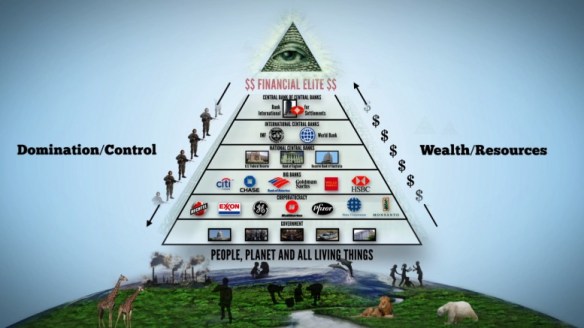
It doesn’t take much discernment to see that corporate structures are highly sophisticated mechanisms for funneling money upwards. That government collusion protects the interests of the owners of capital at the expense of the employees, customers, the general public. And the military protects their international interests.

The largest wealth producer in the world is the financial industry that simply makes money from money and produces nothing. It serves no interests but its own. Yes, some of us fortunate to have salvaged what’s left of our life savings after repeated financial crashes still enjoy the crumbs from the tables of the elite. I do mean crumbs.

Do the math. At the current rate of the upward movement of wealth, there is no other outcome but final disaster. The top 1/10th of 1 percent — not 1 percent — but 1/10th of 1 percent in America owns almost as much wealth as the bottom 90 percent in America, and it gets worse as you leave our shores.

At this rate, the world will eventually consist of gated enclaves of the mega-wealthy guarded by elite corps of paid mercenaries surrounded by billions of impoverished people.

This trajectory has increased dramatically for the last several decades. More and more of the world’s wealth is pouring into the coffers of the mega-rich. This is a zero sum game. When the masses have no wealth left, the game will be over. No matter how powerful the wealthy are, no matter how much wealth they possess, the game will be over.

Depicting Perpetual Crimes committed by Corporate Culture and its Mainstream Media

index-1-229x300

Russian Novels Combating Global Capitalist Nightmare

By Andre Vltchek

Source: Dissident Voice

Imagine Moscow being taken over by some international corporate cartel. By a monster which has its own factories and office buildings, security services, private prisons, re-education (‘training’) centers, and its obedient mass media outlets. Imagine that it also has detailed databases on almost everyone who really matters in the capital.

Imagine that human lives suddenly don’t matter. People are only expected to produce and consume; they become fully disposable.

Imagine that the once greatly educated Russia with its legendary artists and philosophers is gradually getting reduced to an unimaginably primitive level. Suddenly, there is US pop trash flying about everywhere, and the greatest entertainment for the masses comes from watching countless television ‘reality shows’, including those that graphically depict, candidly, how both men and women are shitting and pissing in the capital’s public toilets.

That’s what you get when reading a witty, provocative and thoroughly outrageous novel by Sergei Minaev, called R.A.B.; 521 pages of it!

In all his novels, including Soulless, The Telki, Media Sapiens and R.A.B., Minaev masterfully depicts the perpetual crimes committed by corporate culture and its mainstream media. Brutally and candidly he describes an apocalyptic society constructed on the soulless, merciless and murderous principles of the modern Western-style capitalist system.

In such a world, nothing is sacred anymore. The ‘elites’ are having great fun hunting on the outskirts of the city, not for some animals, but for homeless people living in abandoned pipelines (R.A.B.). A US mainstream television news channel, together with its local counterpart, manage to trigger a military conflict between Georgia and Russia, after hiring several combat helicopters and retired soldiers, killing real people, just in order to increase their ratings. And several terrorist attacks in Moscow are being paid for and staged by other big media conglomerates (Media Sapiens).

Minaev is not crying; he is definitely far from being a ‘bleeding heart’. He is tough and cynical. His characters are mostly ruthless super-yuppies from Moscow, go-getters, living a fast life, taking drugs, partying in luxury clubs, having sex literally with everything that moves (Soulless).

But they get burned, destroyed, brought to near suicide.

They have no ideology, no political views. They laugh at, they insult everything and everybody, but deep inside they are actually suffering from a horrible void, from emptiness. In those rare moments of honesty, they admit to each other and to themselves, that they are actually still longing for at least ‘something pure and decent’, uncorrupted by the global market-fundamentalist regime and its ‘values’ and ‘culture’.

*****

In R.A.B. Minaev goes much further. His yuppies (paradoxically, the mid and upper-level managers) start a rebellion against the system. They go on strike, march through the streets, and build barricades. They begin demanding social justice. They burn down their own offices.

They do it after their Russian toy-producing company (and other companies all over the city) gets swallowed by a US-based multi-national corporation, which immediately begins dismantling all social benefits, while injecting uncertainty and fear into the workplace. A multi-national also opens a horrid toy factory on the outskirts of Moscow, which then employs desperate immigrants from the Central Asian republics.

The privately-owned mass media outlets first confront the protesters, and then follow up with pro-corporate propaganda and in the end the corporate security services and the army. Many people disappear. Others are locked up in the offices and secret prisons of the corporations, and tortured. Those who survive become ‘unemployable’, their names permanently on the blacklist.

But what does Minaev really call for? Is it a true revolution?

Yes and no. He does not believe that in the countries that have been conquered by market fundamentalism and by unbridled consumerism, a ‘real revolution’ is possible. He does not think that the people there have any ideals or any zeal left. At the same time, at least some of his characters are clearly unwilling to surrender.

It is chilling to read R.A.B. while at the same time those ‘rebellions’ in Greece, France, Spain and the U.K. are taking place.

One of the main characters of R.A.B. confronts the demonstrators: It is not a revolution! You are all parts of the system. You just want a better deal for yourself. Through this rebellion, you are actually negotiating with the cartel of the corporations. If you get what you are asking for, you’ll happily remain where you are and carry on as if nothing happened.

*****

Then Minaev does exactly what no Western writer would dare to do. He begins to argue that to destroy the system, there has to be an armed struggle. Otherwise no real change could ever be achieved.

The suppressed rebellion of the yuppies eventually triggers much a wider movement, and soon there are real battles raging in several provincial capitals.

The end of the novel is open. The main character of R.A.B. is destroyed. He loses the love of his life (in desperation she commits suicide); he has no job, no money and no place to go. But he is still alive. Russia is still alive. It is obvious that no matter what, it will never accept this monstrous system that was forced on it by the West.

*****

It all may sound like an insane fantasy, but. in fact, what Minaev writes about is not too far from the nightmares that Russia was descending into right after Gorbachev allowed the country (USSR) to fall apart, and then Yeltsin introduced unbridled privatization and gave unprecedented concessions to foreign corporations. During that period, Russia went through something that could be easily described as a social genocide. Life expectancy dropped to the levels of war-torn countries in Africa. Lawlessness ruled. All ideals were ridiculed and spat at. A big number of Russian intellectuals were bought and organized by the West into countless NGO’s. The lowest grade of Western pop and entertainment torpedoed Russian culture. During those dark days, the West finally succeeded in bringing Russia to its knees.

Not even two decades later, a new Russia is once again proud, strong and confident.

It rose to its feet, it began successfully producing again, and it underwent a tremendous and positive social transformation.

Just one week ago I returned from the Russian Far East, from the cities of Vladivostok, Khabarovsk and Petropavlovsk Kamchatski. Wherever I went, I witnessed new and impressive infrastructure. I encountered a confident, hard working nation, which was working hard to restore at least some of the socialist structures and benefits that it used to enjoy in the past.

The new, present-day Russia is much closer to China; much more impressed by the Chinese system, than by what it was forced to adopt in the past; during the “pro-Western era” which is now generally considered to be synonymous to a national disaster.

Russian writers played an important role in describing the horrors of the Gorbachev/Yeltsin years, and of the brutal global economic, political and ‘cultural’ regime injected by the West to all the corners of the Planet. From an outrageous Eduard Limonov’s novel It’s Me, Eddie to Minaev’s R.A.B., Russian literature has been daring, insulting, direct and brutally honest.

While Limonov and Minaev sell millions of copies of their books at home, their work is virtually unknown in the West. I found no English translations when searching on Amazon.com, and elsewhere.

In his New York-based Eddie, Limonov is calling openly for terrorist acts against the Western regime, while some of Minaev’s characters also believe in an armed struggle, although of a more conventional type.

Nothing is spared. When the US toy-producing corporation demands a special tax from its employees in Russia, for “helping out those poor children in the Third World”, the main character of R.A.B. thinks: “well, they can now use that money to buy coffins for children they employ and kill in Indonesia or Thailand”. When the tax goes slightly up, he comments: “now they will have enough funds to dig at least a few mass graves”.

All this is simply too outrageous for Western readers. Or more precisely, the ‘book business’ most likely ‘thinks’ that it is.

The fact remains that despite what is constantly repeated by Western propaganda, those who read Russian can clearly see and appreciate that Russian literature is actually much more free, daring and rebellious than its counterpart in the West.

When several Russian bestselling novelists are calling openly for combat against the global regime (the same regime which is, until now, at least partially, controlling the economy of their country), one has no choice but to be impressed by the level of freedom in the country which allows such work to be published and then promoted.

But in the West, you would never know all this, unless you spoke Russian. It is because in the West (and in its ‘client’ states and colonies) you are being extremely well ‘protected’ from such uncomfortable (and the regime would even say ‘dangerous’) thoughts!


André Vltchek is a novelist, filmmaker, and investigative journalist. He has covered wars and conflicts in dozens of countries. His latest book is Exposing Lies of the Empire.

A Nonviolent Strategy to Liberate Syria

_74590478_00e0aa73-8303-4224-89de-0029b5e5eae1

Editor’s note: While we do not completely agree with the author’s analysis of factors leading to the strife in Syria, we share his desire for greater peace, freedom and stability in the region.

By Robert J. Burrowes

In early 2011, as the Arab Spring was moving across North Africa and the
Middle East, small groups of nonviolent activists in Syria, which has
been under martial law since 1963, started protesting against the brutal
dictatorship of Bashar al-Assad and demanding democratic reforms, the
release of political prisoners, an increase in freedoms, abolition of
the emergency law and an end to corruption.

By mid-March these protests, particularly in cities such as Damascus,
Aleppo and Daraa, had escalated and the ‘Day of Rage’ protest on 15
March 2011 is considered by many to mark the start of the nationwide
uprising against the Assad dictatorship. The dictatorship’s reaction to
the protests became violent on 16 March and on 18 March, after Friday
prayers, activists gathered at the al-Omari Mosque in Daraa were
attacked by security forces with water cannons and tear gas, followed by
live fire; four nonviolent activists were killed.

Within months, as the nonviolent protests expanded and spread, the
regime had killed hundreds of activists and arbitrarily arrested
thousands, subjecting many of them to brutal torture in detention. This
pattern has continued unchecked. For the earliest of a succession of
reports that document this regime violence against nonviolent activists,
see the Human Rights Watch report ‘”We’ve Never Seen Such Horror” Crimes
against Humanity by Syrian Security Forces‘.

For the most recent report, see the UN Human Rights Council report ‘Out
of Sight, Out of Mind: Deaths in Detention in the Syrian Arab Republic‘.

In recent commentaries on the war in Syria, both long-time solidarity
activist Terry Burke – see ‘U.S. Peace Activists Should Start Listening
to Progressive Syrian Voices
– and long-term Middle East scholar Professor Stephen Zunes have
encouraged the anti-war movement to listen to Syrian voices in framing
their response, particularly given the tendency within some sections of
it to support ‘the extraordinarily brutal Assad regime – a family
dictatorship rooted in the anti-leftist military wing of the Baath
Party’. See ‘Anti-war movement must listen to voices within Syria’s
civil war’.

One such Syrian voice is that of scholar and nonviolent activist
Professor Mohja Kahf. In her account of the Syrian uprising against the
Assad dictatorship – see ‘Then and Now: The Syrian Revolution to Date. A
young nonviolent resistance and the ensuing armed struggle
– Professor Kahf offers the following introductory paragraphs:

‘The Syrian uprising sprang from the country’s grassroots, especially
from youth in their teens, and adults in their twenties and thirties.
They, not seasoned oppositionists, began the uprising, and are its core
population. They share, rather than a particular ideology, a
generational experience of disenfranchisement and brutalization by a
corrupt, repressive, and massively armed ruling elite in Syria.

‘The uprising began nonviolently and the vast majority of its populace
maintained nonviolence as its path to pursue regime change and a
democratic Syria, until an armed flank emerged in August 2011.

‘The Syrian Revolution has morphed. From midsummer to autumn 2011, armed
resistance developed, political bodies formed to represent the
revolution outside Syria, and political Islamists of various sorts
entered the uprising scene. Since then, armed resistance has
overshadowed nonviolent resistance in Syria.

‘…political bodies and support groups for the revolution’s militarized
wing, have become venues for internal power struggles among opposition
factions and individuals, and entry-points for foreign powers attempting
to push their own agendas into a revolution sprung from Syrian
grievances, grown from the spilling of Syrian blood on Syrian soil.

‘Many in the global peace community can no longer discern the Syrian
uprising’s grassroots population through the smoke of armed conflict and
the troubling new actors on the scene. Further, some in the global left
or anti-imperialist camp understand the Syrian revolution only through
the endgame of geopolitics. In such a narrative, the uprising population
is nothing but the proxy of U.S. imperialism.

‘Such critics may acknowledge that the Assad regime is brutal, but
maintain from their armchairs that Syrians must bear this cost, because
this regime has its finger in the dike of U.S. imperialism, Zionism, and
Islamism. Or, perhaps they agree that a revolution against a brutal
dictator is not a bad idea, but wish for a nicer revolution, with better
players. Eyes riveted to their pencils and rulers and idées fixés, such
critics abandon a grassroots population of disenfranchised human beings
demanding basic human freedoms in Syria. This is a stunning and cruel
failure of vision.

‘The voices of the original grassroots revolution of Syria are
nonviolent, nonsectarian, noninterventionist, for the fall of the Assad
regime, and for the rise of a democratic, human rights upholding Syria
that is bound by the rule of law. They are still present in this
revolution. Who will hear them now, after so much dear blood has been
spilled, so much tender flesh crushed under blasted blocks of cement, so
much rightful anger unleashed?’

Other Syrian voices offer a similar account. See, for example, the
recent book by Robin Yassin-Kassab and Leila al-Shami titled ‘Burning
Country: Syrians in Revolution and War’
reviewed in ‘Book Review: Burning Country‘.

If Syrians and their solidarity allies are to develop and implement a
successful nonviolent grassroots strategy to end the war in/on Syria and
remove the Assad dictatorship, then we need a sound strategic framework
that guides the comprehensive planning of our strategy. Obviously, there
is no point designing a strategy that is incomplete or cannot be
successful.

A sound strategic framework simply enables us to think and plan
strategically so that once our strategy has been elaborated, it can be
widely shared and clearly understood by everyone involved. It also means
that nonviolent actions can then be implemented because they are known
to have strategic utility and that precise utility is understood in
advance. There is little point taking action at random, especially if
our opponent is powerful and committed (even if that ‘commitment’ is
insane, which is frequently the case).

There is a simple diagram presenting a 12-point strategic framework
illustrated here in the form of the ‘Nonviolent Strategy Wheel‘.

In order to think strategically about nonviolently resolving a violent
conflict, a clearly defined political purpose is needed; that is, a
simple summary statement of ‘what you want’. However, given the
complexity of the multifaceted conflict in the case of Syria, it is
strategically simpler to identify two political purposes. These might be
stated thus: 1. To end the war in/on Syria, and 2. To establish a
democratic form of government in Syria (which, obviously, requires
removal of the dictatorship).

Once the political purpose has been defined, the two strategic aims
(‘how you get what you want’) of the strategy acquire their meaning.
These two strategic aims (which are always the same whatever the
political purpose) are as follows: 1. To increase support for your
campaign by developing a network of groups who can assist you. 2. To
alter the will and undermine the power of those groups who support the
war/dictatorship.

While the two strategic aims are always the same, they are achieved via
a series of intermediate strategic goals which are always specific to
each struggle. To keep this article reasonably straightforward, I have
only identified a set of strategic goals that would be appropriate in
the context of ending the war in/on Syria below. For a basic set of
strategic goals appropriate for ending the dictatorship, see ‘Strategic
Aims‘.

Before listing the strategic goals for ending the war, I wish to
emphasize that I have only briefly discussed two aspects of a
comprehensive strategy to end the war in/on Syria: its political purpose
and its two strategic aims (with its many subsidiary strategic goals).
For the strategy to be effective, all twelve components of the strategic
framework should be planned (and then implemented). See Nonviolent
Defense/Liberation Strategy.
This will require, for example, that tactics that will achieve the
strategic goals must be carefully chosen and implemented bearing in mind
the vital distinction between the political objective and strategic goal
of any such tactic. See ‘The Political Objective and Strategic Goal of
Nonviolent Actions‘.

Strategic goals to end the war in/on Syria

I have outlined a basic list of strategic goals below although, it
should be noted, the list would be considerably longer as individual
organizations should be specified separately.

Many of these strategic goals would usually be tackled by action groups
working in solidarity with Syria campaigning within their own country.
Ideally they would be undertaken by activist groups with existing
expertise in the relevant area (for example, experience in campaigning
against a weapons corporation) but this is not essential.

Of course, individual activist groups would usually accept
responsibility for focusing their work on achieving just one or a few of
the strategic goals (which is why any single campaign within the overall
strategy is readily manageable).

It is the responsibility of the struggle’s strategic leadership to
ensure that each of the strategic goals, which should be identified and
prioritized according to their precise understanding of the
circumstances in Syria, (so, not necessarily precisely as identified
below) is being addressed (or to prioritize if resource limitations
require this).

So here is a set of strategic goals to end the war in/on Syria:

(1) To cause the women in [women’s organizations WO1, WO2, WO…] in Syria
to join the liberation strategy by participating in [your nominated
nonviolent action(s)/campaign(s) and/or constructive program
activities]. For example, simple nonviolent actions would be to wear a
national symbol (such as a badge of the Syrian revolutionary flag and/or
ribbons in the national colors) and/or to boycott all media outlets
supporting the war. For this item and many items hereafter, see the list
of possible actions that can be taken here: ‘198 Tactics of Nonviolent Action‘.

(2) To cause the workers in [trade unions T1, T2, T…] in Syria to join
the liberation strategy by participating in [your nominated nonviolent
action(s)/campaign(s) and/or constructive program activities]. For
example, this might include withdrawing their labor from occupations
that support the Syrian military forces.

(3) To cause young people in Syria to resist conscription into the
Syrian military forces.

(4) To cause young people in Syria to refuse recruitment into the Free
Syrian Army, al-Qaeda and its affiliates/allies, the Islamic State
(Daesh) and its allies.

(5) To cause the members of [religious denominations R1, R2, R…] in
Syria to join the liberation strategy by participating in [your
nominated nonviolent action(s)/campaign(s) and/or constructive program
activities].

(6) To cause the members of [ethnic communities EC1, EC2, EC…] in Syria
to join the liberation strategy by participating in [your nominated
nonviolent action(s)/campaign(s) and/or constructive program
activities].

(7) To cause the activists, artists, musicians, intellectuals and other
key social groups in [organizations O1, O2, O…] in Syria to join the
liberation strategy by participating in [your nominated nonviolent
action(s)/campaign(s) and/or constructive program activities].

(8) To cause the students in [student organizations S1, S2, S…] in Syria
to join the liberation strategy by participating in [your nominated
nonviolent action(s)/campaign(s) and/or constructive program
activities].

(9) To cause the soldiers in [military units M1, M2, M…] to refuse to
obey orders from the dictatorship to arrest, assault, torture and shoot
nonviolent activists and the other citizens of Syria.

(10) To cause the police in [police units P1, P2, P…] to refuse to obey
orders from the dictatorship to arrest, assault, torture and shoot
nonviolent activists and the other citizens of Syria.

(11) To cause young people in [the US, NATO countries, Russia and other
countries fighting in Syria] to refuse recruitment into their respective
military forces.

(12) To cause conscripts into the military forces of [NATO countries,
Russia and other countries fighting in Syria] that still use
conscription to conscientiously refuse to perform military duties.

(13) To cause military personnel in the military forces of [the US, NATO
countries, Russia and other countries fighting in Syria] to refuse
deployment to the war in/on Syria.

(14) To cause young people in [your country] to refuse recruitment into
the Free Syrian Army, al-Qaeda and its affiliates/allies, the Islamic
State (Daesh) and its allies.

(15) To cause former soldiers in [your country] to refuse recruitment as
mercenaries by corporations that supply ‘military contractors’ to fight
in Syria.

(16) To cause the activists in [peace groups P1, P2, P…] in [your
town/city/country] to resist the war on Syria by encouraging their
members to boycott [all/specified nonmilitary products] of [weapons
corporations W1, W2, W…]. For example, this might include boycotting all
commercial flights that use Boeing and Airbus passenger aircraft given
the heavy involvement of these corporations in the production of
military aircraft.

(17) To cause the activists in [environment groups E1, E2, E…] in [your
town/city/country] to resist the war on Syria by encouraging their
members to boycott [all/specified nonmilitary products] of [weapons
corporations W1, W2, W…]. For example, this might including boycotting
all commercial products of General Electric given the heavy involvement
of this corporation in the production of military engines, systems and
services.

(18) To cause the workers in [trade unions or labor organizations T1,
T2, T….] in [your town/city/country] to resist the war on Syria by
encouraging their members to boycott [all/specified nonmilitary
products] of [weapons corporations W1, W2, W…].

(19) To cause the women in [women’s organizations WO1, WO2, WO…] in
[your town/city/country] to resist the war on Syria by encouraging their
members to boycott [all/specified nonmilitary products] of [weapons
corporations W1, W2, W…].

(20) To cause the members of [religious denominations R1, R2, R…] in
[your town/city/country] to resist the war on Syria by encouraging their
members to boycott [all/specified nonmilitary products] of [weapons
corporations W1, W2, W…].

(21) To cause the members of [ethnic communities EC4, EC5, EC…] in [your
town/city/country] to resist the war on Syria by encouraging their
members to boycott [all/specified nonmilitary products] of [weapons
corporations W1, W2, W…].

(22) To cause the artists, musicians, intellectuals and other key social
groups in [organizations O4, O5, O…] in [your town/city/country] to
resist the war on Syria by encouraging their members to boycott
[all/specified nonmilitary products] of [weapons corporations W1, W2,
W…].

(23) To cause the students in [student organizations S1, S2, S…] in
[your town/city/country] to resist the war on Syria by encouraging their
members to boycott [all/specified nonmilitary products] of [weapons
corporations W1, W2, W…].

(24) To cause the consumers in [your town/city/country] to resist the
war on Syria by boycotting [all/specified nonmilitary products] of
[weapons corporations W1, W2, W…].

(25) To cause more individuals in [your town/city/country] to resist the
war on Syria by conscientiously resisting paying [part/all] of their
taxes for war.

(26) To cause more organizations in [your town/city/country] to resist
the war on Syria by conscientiously resisting paying [part/all] of their
taxes for war.

(27) To cause [weapons corporations W4, W5, W…] to convert from the
manufacture of military weapons to [the specified/negotiated
socially/environmentally beneficial products].

(28) To cause [banks B1, B2, B…] to cease financing the weapons
industry.

(29) To cause bank customers to shift their deposits to ethical banks
and credit unions that do not finance (or are otherwise involved in) the
weapons industry.

(30) To cause [religious organizations R4, R5, R…] to divest from the
weapons industry.

(31) To cause [superannuation funds S1, S2, S…] to divest from the
weapons industry.

(32) To cause superannuation fund customers to shift their money to
ethical funds that do not finance (or are otherwise involved in) the
weapons industry.

(33) To cause [insurance companies I1, I2, I…] to divest from the
weapons industry.

(34) To cause insurance customers to shift their policies to ethical
insurance companies that do not finance (or are otherwise involved in)
the weapons industry.

(35) To cause [corporations C1, C2, C…] that provide
[services/components] for [weapons corporations W1, W2, W…] to cease
doing so.

(36) To cause the workers in [trade unions or labor organizations T4,
T5, T…] to withdraw their labor from [weapons corporations W1, W2, W…]
[partially/wholly], [temporarily/permanently].

(37) To cause the workers in [trade unions or labor organizations T7,
T8, T…] to withdraw their labor from [corporations C1, C2, C…]
[partially/wholly], [temporarily/permanently].

(38) To cause [corporations C4, C5, C…] that provides
[services/supplies] to [military bases MB1, MB2, MB…] to cease doing so.

(39) To cause the workers in [trade unions or labor organizations T10,
T11, T…] who work in/supply [military bases MB1, MB2, MB…] to withdraw
their labor [partially/wholly], [temporarily/permanently].

(40) To cause the workers in [trade unions or labor organizations T13,
T14, T…] to withdraw their labor from [corporations C4, C5, C…]
[partially/wholly], [temporarily/permanently].

(41) To cause [corporations C7, C8, C…] that manufacture and supply spy
satellites for military purposes to cease doing so.

(42) To cause the workers in [trade unions or labor organizations T16,
T17, T…] to withdraw their labor from [corporations C7, C8, C…]
[partially/wholly], [temporarily/permanently].

(43) To cause [corporations C10, C11, C…] that provide
[services/components] for the militarization of space to cease doing so.

(44) To cause the workers in [trade unions or labor organizations T19,
T20, T…] to withdraw their labor from [corporations C10, C11, C…]
[partially/wholly], [temporarily/permanently].

(45) To cause [corporations C13, C14, C…] that provide private military
contractors (mercenaries) to fight in wars to cease doing so.

(46) To cause the private military contractors (mercenaries) who fight
in wars to withdraw their labor from [corporations C13, C14, C…].

(47) To cause the soldiers in [military units M1, M2, M…] in [your
town/city/country] to refuse to obey orders to [arrest, assault, torture
and shoot, depending on your local circumstances] nonviolent activists
campaigning against the war.

(48) To cause the police in [police units P1, P2, P…] in [your
town/city/country] to refuse to obey orders to [arrest, assault, torture
and shoot, depending on your local circumstances] nonviolent activists
campaigning against the war.

(49) To cause individual members of the military forces at [Military
Base MB1/Drone Base DB1/Navy Ship NS1/Air Force Base AFB1/Army unit
AU1/Marines unit MU1] in [your town/city/country] to resign.

(50) To cause individual members of those corporations that
employ/supply private military contractors (mercenaries) to resign.

As you can see, the two strategic aims are achieved via a series of
intermediate strategic goals.

Not all of the strategic goals will need to be achieved for the strategy
to be successful but each goal is focused in such a way that its
achievement functionally undermines the power of those conducting the
war.

The difference between success and failure in any struggle is the
soundness of the strategy.


Biodata: Robert J. Burrowes has a lifetime commitment to understanding and ending human violence. He has done extensive research since 1966 in an effort to understand why human beings are violent and has been a nonviolent activist since 1981. He is the author of ‘Why Violence?‘ His email address is flametree@riseup.netand his website is at http://robertjburrowes.wordpress.com

Robert J. Burrowes
P.O. Box 68
Daylesford
Victoria 3460
Australia
Email: flametree@riseup.net

Websites:
Nonviolence Charter
Flame Tree Project to Save Life on Earth
‘Why Violence?’
Nonviolent Campaign Strategy
Nonviolent Defense/Liberation Strategy
Anita: Songs of Nonviolence
Robert Burrowes
Global Nonviolence Network