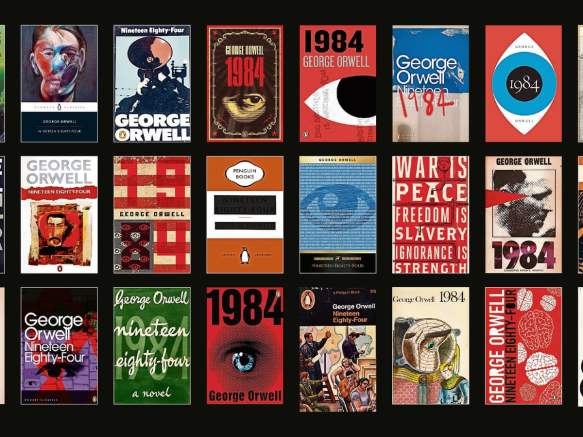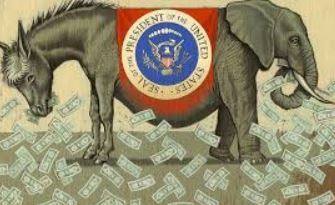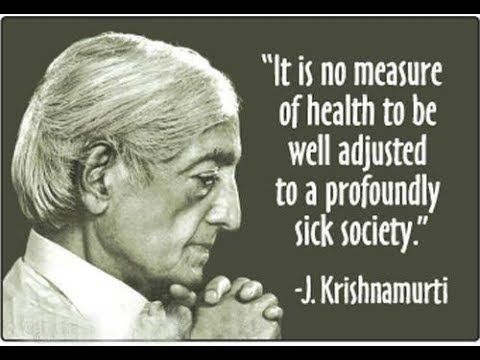
Newspeak in the 21st Century: How to Become a Model Citizen in the New Era of Domestic Warfare

By Cynthia Chung

Source: Strategic Culture Foundation

With President Biden’s inauguration many feel that they can finally breathe a deep sigh of relief. At last sanity has been restored and we can all go back to our predictable lives knowing that the future can only get better during these next four years.

Well…not quite.

There still remains the problem that everybody may not be on board with the progressive changes that Biden’s Administration plans to push through. This, of course, is wholly unacceptable.

Disagreement has become an extremely sensitive issue lately; it was once thought that debate was an essential component to a strong and healthy democracy, however, we are now told that it is extremely dangerous, in fact, it may soon be categorised as a form of domestic terrorism.

As early as mid-Nov 2020, Biden was already discussing the need to pass further laws against domestic terrorism. This is interesting since under the 2001 Patriot Act (which was meant to be a temporary enforcement in reaction to 9/11, however, is still in place 19 years later), domestic terrorism is already defined as;

“activities that (A) involve acts dangerous to human life that are a violation of the criminal laws of the U.S. or of any state; (B) appear to be intended (i) to intimidate or coerce a civilian population; (ii) to influence the policy of government by intimidation or coercion; or (iii) to affect the conduct of a government by mass destruction, assassination, or kidnapping; and (C) occur primarily within the territorial jurisdiction of the U.S.”

So, the question begs, what else needs to be added to the Patriot Act, which was recognised at the time of its enforcement as something that should only be temporary since it was understood that it infringed upon civil liberties? Come to think of it, why is the Patriot Act still in place, which allows for the indefinite continuation of human rights violations such as warrantless wiretapping; illegal torture, kidnapping, and detention; mass surveillance; government secrecy; Real ID; no-fly list; political spying; abuse of material witness statutes; and attacks on academic freedom?

As Glenn Greenwald wrote in his formidable paper The New Domestic War on Terror is Coming, “what needs to be criminalized that is not already a crime?”, keeping in mind that as of June 2020, the United States has the highest prisoner rate in the world, followed by El Salvador, Turkmenistan, Thailand and Palau.

Well, the answer is apparently simple and as always for our own good. We have come to a point in time where the enemy is not some radicalized ideology, it is not some foreign despot, it is not even the threat of war (whether it be economic, cyber or nuclear), but rather it is ourselves. We, the people, are the new enemies of the State.

You may protest “Not I! I am a model citizen! I pay my taxes on time, I am never late or call in sick for work, I make sure to be up-to-date with the newest ‘woke’ revelations and I don’t engage with anything outside of the mainstream matrix during my free-time.” People such as yourself think, that when the Biden Administration is calling for tougher laws against domestic terrorism, that it is obviously meant for the ‘other guy,’ those uneducated bigots who are screaming at the top of their lungs “Treason!” and inciting what we are told to be forms of ‘insurrection,’ all in the name of the archaic ideas of ‘patriotism’ and the ‘U.S. Constitution.’

You, unlike so many others, have no problem recognising that the U.S. Constitution is actually part of the problem, that by the standards used today, the U.S. Constitution is itself responsible for ‘inciting violence’ and thus guilty of domestic terrorism, and thus needs to be revoked.

But you see… that’s just not good enough.

Though you are well on your way to becoming a model citizen in the 21st century, you still have a little ways to go. It is for this reason that a guide to 21st century Newspeak has been recently released to make sure that well-intentioned citizens like yourself are fully informed of what is required of you in terms of appropriate behaviour, as well as appropriate thoughts, and though this will take a little more time, appropriate instincts.

21st Century Newspeak

The first alteration that will need to take place is freedom of thought. It has been shown through peer-review studies that individual thoughts are susceptible to forming erroneous beliefs and can lead to dangerous behaviours such as refusal to integrate into a community standard.

Once an individual refuses to integrate into its designated community, it is only a matter of time before this individual shows opposition and even antagonism towards said community. Thus failure to integrate is one of the first signs that an individual is on the path to becoming a domestic terrorist.

Because the individual mind is flawed, it can no longer be trusted to be the standard of its own judgement of what is right and wrong. It is for this reason that we are introducing groupthink. This concept is not new, however, the difference is from now on the individual’s environment will only be allowed to reciprocate the values of groupthink, and all other thoughts outside of groupthink are to be banned and punishable under the new laws.

Even if thoughts outside of groupthink appear as harmless to the collective, they are not, for any thought that is not groupthink threatens to lead to a different outcome than that intended by groupthink and thus is a threat to the security of the collective.

In order to ensure commitment to groupthink, it will be mandatory that every individual engage in at least 2 minutes of Hate every hour throughout the day, every day. This can be achieved either by watching 2 minutes of Hate news, or by engaging in a public 2 minutes of Hate with a colleague, a friend or family member via social media.

It is imperative that an individual watch the 15 minute morning and evening “What to Hate” news provided by the Ministry of Truth (or Minitrue), in order to be the most up-to-date with what are the ongoing and new subjects of Hate, and what were previous subjects of Hate which are no longer deemed to be subjects of Hate.

It is most important that an individual never refer to a former subject of Hate as such. Any present subject of Hate must be seen as having always been a subject of Hate and any former subject of Hate must be seen as having never been a subject of Hate.

This may appear as an impossible task, but we assure you it is entirely possible with the use of doublethink, which many of you have already been practising. Doublethink requires that one be both conscious and unconscious of the fact that they are telling deliberate lies while genuinely believing them; to deny the existence of objective reality and all the while to take account of the reality which one denies. This makes up a part of our new Party slogan: FREEDOM IS SLAVERY.

Those who excel the most in doublethink will receive the highest stations within our newly organised community, as safe-guards against the renegade, the domestic terrorist.

Another alteration that will need to occur is how we think and refer to the past and the future. With the newly enforced groupthink, the present is what groupthink dictates it to be, which is subject to change, however, must be regarded as having always been.

The past is what the present dictates it to be, if it were not, it could challenge the basis for the present. Thus to preserve the present, the past must serve the present, only justifying why we Hate what we presently Hate and why we Love what we presently Love and can do nothing to contradict these Party lines. There will be permitted no records of an alternative past, there will be no way to prove that the past was ever different from what the present dictates it to be, the only threat to this narrative is the record of the individual mind, and once this ceases to be there will only be the Minitrue record as the recorder of past Truth.

In effect, the model citizen will perceive the past as dead and the future as unimaginable. The future is unimaginable because it is impossible to think of an alternative to the present, in fact, the mere act of thinking of an alternative to the present is considered a challenge to the status quo of the present, and thus is a challenge to groupthink, and thus is a form of domestic terrorism, which we will call from now on thoughtcrime.

Thoughtcrime is essentially any thought pertaining to memory, judgement of right and wrong, thoughts of an alternative reality, and self-reflection, which are now all deemed forms of thoughtcrime. If an individual is to engage in any of these sorts of thoughts, it is only a matter of time before they will come into conflict with groupthink and the Party line, thus private thoughts are banned and punished under the new laws.

It may seem an impossible task at first not to engage in private thoughts, but again, we assure you it is entirely possible using crimestopCrimestop is the practice of not grasping analogies, failing to perceive logical errors, misunderstanding the simplest arguments, of being bored or repelled by any train of thought which is capable of leading in a heretical direction. Crimestop is essentially, protective stupidity.

It is imperative that one practice crimestop during any interaction with another individual, however, it is also imperative that one practice crimestop within their own inner-dialogue, such that even from your own conscience you will be protected from committing a thoughtcrime.

Newspeak will also help dissuade from thoughtcrimeNewspeak is to be the new acceptable vocabulary, anything that references words outside of the most-up-to-date edition of the Newspeak dictionary will be considered Oldspeak and something to be construed as counter to groupthink. It is understood that by reducing the vocabulary to revolve around a few words such as good; which for example can be used as plusgood, doubleplusgood, ungood etc, it will serve to narrow the range of thought an individual is capable of, and thus reduce the capability of committing a thoughtcrime. How wonderful! That in the future we will be unable to commit crime for we will be incapable of its thought! This makes up another part of our new Party slogan: IGNORANCE IS STRENGTH.

In terms of the new laws, in effect, nothing will change. Unacceptable behaviours and thoughts will not be designated as illegal per se; one reason for this is because we do not plan on having any public trials. Anyone who is in violation of conduct will simply be removed either temporarily into a “re-education facility” or will be vaporised. Any subject that has been vaporised will be removed from the collective memory records and can never be referred to as having ever existed.

The reason why no public trials will be held from now on is because, as we have seen, dissent is infectious. Thus, holding public trials risk further encouragement towards dissent. It is for this reason that dissenters must be removed swiftly and quietly in the middle of the night. Such disappearances will occur relatively regularly and will eventually become the new normal, however, it will not be traumatic for the collective. The subject will simply cease to exist as if it were all just a dream, the structure of our daily routine unaffected.

In order to ensure utmost compliance, the collective will be employing the use of children spies, this has already been occurring abroad, and proves to be very effective.

Purges and vaporizations will be a necessary part of the government mechanics and will become the new normal. We have already discussed the necessity for vaporizations, as for the necessity of purges, it is because the community will be built so as to remain in stasis, however, this can only be accomplished through artificial means, for it is not natural that a thing remain the same but rather that it either improves or deteriorates.

However, in order for the Party to maintain absolute control, there can be no change to the present except for that chosen by the Party, thus any change is a challenge to the Party. In order to facilitate an artificial environment of no change, resources must artificially be kept low, and purges need to occur so that this environment of scarcity is tightly controlled and maintained.

In order for us to achieve this, our economy will have to go through stagnation, we will need to decrease the amount of land used for cultivation, we will no longer add capital equipment needed for industrial growth and great blocks of the population will be prevented from working and will be kept half alive by State charity. The wheels of industry cannot be allowed to turn so as to increase the real wealth of the world. Goods must be produced, but they must not be distributed, and in practice the only way of achieving this is by continuous warfare.

War will continue under the Old Cold War doctrine. War will always be present, and yet will never be seen by the majority of our citizens, the reason for this being that war will not be about a real threat to security nor about real conquests but rather will be about maintaining the present status quo by exhausting the surplus of consumable goods, while also helping to preserve the special mental atmosphere that a hierarchical society needs.

However, real war will be purely an internal affair, the war waged by the ruling group against its own subjects, with the object of the war as to keep the structure of society intact and unchanging.

A peace that is truly permanent under this new ideology is no different than an invisible permanent war. For peace in our new era will equate to stability through no change. This makes up our first Party slogan: WAR IS PEACE.

Conclusion

All of these means are necessary if we are to realise that the only secure basis for oligarchy is collectivism, and that oligarchy is the only means to achieving peace, freedom and strength for the collective.

However, we are still very far from this ideal and there is much that threatens its becoming, namely, the masses, or what we call the proles. So long as the masses believe that they are entitled to freedom of thought, our endeavours cannot succeed.

The individual must voluntarily relinquish this. It cannot be taken from them no matter the degree of control and no matter the threat of physical harm. An individual’s mind is theirs and cannot be taken, instead, the individual must be led to believe that it is in their best interest to relinquish their mind.

Let us do our best then to convince the individual that they are no longer fit to use their mind and let us pray that we are successful, for if we fail, our entire system of control fails with it.


“You would not make the act of submission which is the price of sanity…Reality exists only in the human mind, nowhere else. Not in the individual mind, which can make mistakes, and in any case soon perishes: only in the mind of the Party, which is collective and immortal. Whatever the Party holds to be truth, is truth. It is impossible to see reality except by looking through the eyes of the Party.”

– O’Brien in George Orwell’s “1984”
Raskolnikov’s Dream Come True

By Edward Curtin

Source: Behind the Curtain

“Something is happening here,
But you don’t know what it is,
Do you, Mr. Jones?”
— 
Bob Dylan, Ballad of A Thin Man

It’s hard.

Life today seems like a dream, doesn’t it?  Surreal to the point where everything seems haunted and betwixt and between, or this against that, or that and this against us.

Something.

Or a Luis Buñuel film.  The logic of the irrational. Surrealistic.  A film made to draw us into an ongoing nightmare.  Hitchcock with no resolution. Total weirdness, as Hunter Thompson said was coming before he blew his brains out.  A life movie made to hypnotize in this darkening world where reality is created on screens, as Buñuel said of watching movies:

This kind of cinematographic hypnosis is no doubt due to the darkness of the theatre and to the rapidly changing scenes, lights, and camera movements, which weaken the spectator’s critical intelligence and exercise over him a kind of fascination.

Here we are in Weirdsville, USA where most people, whether of the left, right, or center, are hypnotized by the flickering screens.

That’s what movies do.

That’s what long planned psychological operations do.

That’s what digital technology allows corrupt rulers and the national security state with its Silicon Valley partners in crime to do.

We now live in a screen world where written words and logic are beside the point. Facts don’t matter. Personal physical experience doesn’t matter.  Clear thinking doesn’t matter. Hysterical reactions are what matter.  Manipulated emotions are what matter.  Saying “Fuck You” is now de rigueur, as if that were the answer to an argument.

It’s all a movie now with the latest theatrical performance having been the January 6, 2021 stage show filmed at the U.S. Capital.  A performance so obvious that it isn’t obvious for those hypnotized by propaganda, even when the movie clearly shows that the producers arranged for the “domestic terrorists” to be ushered into the Capital.  They let the “Nazis” in on Dr. Goebbels orders.  Thank God Almighty they were beaten back before they seized power in their Halloween costumes.

Now who could have given that order to the Capital and D.C. police, Secret Service, National Guard, and the vast array of militarized Homeland Security forces that knew well in advance of the January 6 demonstration?

Who gave the stand-down orders on September 11, 2001, events that were clearly anticipated and afterwards were described by so many as if they were a movie?  Surreal. Dreamlike.

As with the events of September 11, 2001 and the subsequent anthrax attacks, the recently staged show at the Capital that the mainstream media laughingly call an attempted coup d’état will result in a new “Patriot Act” aimed at the new terrorists – domestic ones – i.e. anyone who dissents from the authoritarian crackdown long planned and underway; anyone who questions the vast new censorship and the assault on the First Amendment; anyone who questions the official narrative of Covid-19 and the lockdowns; anyone who suggests that there are linkages between these events, etc.

Who, after all, introduced the Omnibus Counterterrorism Act in 1995 that became the template for the Patriot Act in 2001 that was passed into law after September 11, 2001?  None other than former Senator Joseph Biden. Remember Joe?  He has a new plan.

Of course, the massive Patriot Act had been written well before that fateful September day and was ready to be implemented by a Senate vote of 98-1, the sole holdout being Democratic Senator Russ Feingold of Wisconsin.  In the House of Representatives the vote was 357-66.

For those familiar (or unfamiliar)  with history and fabricated false flags, they might want also to meditate on the Gulf of Tonkin Resolution in 1964 that gave Lyndon Johnson his seal of approval to escalate the war against Vietnam that killed so many millions. The vote for that fake crisis was 416-0 in the House and 88-2 in the Senate.

In the words of Mark Twain:

Suppose you were an idiot, and suppose you were a member of Congress; but I repeat myself.

Harry Houdini, the magical performer who was able to escape from any trap, any nightmarish enclosure, any lockdown, once said, “It’s still an open question, however, as to what extent exposure really hurts a performer.”

The question has been answered.  It doesn’t hurt at all, for phony events still mesmerize millions who are eager to suspend their disbelief for the sake of a sad strand of hope that their chosen leaders – whether Biden or Trump – are levelling with them and are not playing them for fools. To accept that Trump and Biden are scripted actors in a highly sophisticated reality TV movie is a bit of “reality” too hard to bear.  Exposing them and their minions doesn’t hurt at all.  There’s no business but show business.

Houdini knew well the tricks used to deceive a gullible audience hypnotized by theatrics. “A magician is only an actor,” he said, “an actor pretending to be a magician.”  This is a perfect description of the charlatans who serve as presidents of the United States.

Life today seems like a dream, doesn’t it?

“Will wonders ever cease,” said Houdini, as he closed his shows.

When I was a child I had a repetitive dream that I was trapped in a maze.  Trying to escape, all I could hear as I tried desperately to find an exit was a droning sound.  Droning without end.  The only way I could escape the maze was to wake up – literally.  But this dream would repeat for many years to the point where I realized my dreams were connected to my actual family and life in the U.S.A.

Then, when I was later in the Marines and felt imprisoned and was attempting to get out as a conscientious objector, the dream changed to being trapped in the Marines, or the prison I was expecting if they didn’t let me go. Even when I got out of the Marines and was not in prison, the dreams that I was continued.

It took me years to learn how to escape.

I mention such dreams since they seem to encapsulate the feelings so many people have today. A sense of being trapped in a senseless social nightmare. Prisoners. Lost in a horror movie like Kafka’s novel The Castle in which the protagonist K futilely seeks to gain access to the rulers who control the world from their castle but can never reach his goal.

But these are dreams and The Castle is fiction.

On a conscious level, however, many people continue to rationalize their grasp of what is going on in the United States as if what they take to be reality is not fiction. Trump supporters –despite what are seen by them as his betrayals when he said on January 7 that “The demonstrators who infiltrated the Capitol have defiled the seat of American democracy….My focus now turns to ensuring a smooth, orderly and seamless transition of power. This moment calls for healing and reconciliation.” – still cling to the belief that he is the man they believe in and was going to “clean the swamp” but was sabotaged by the “deep state.” Biden supporters, driven by their obsessive hatred for Trump and the ongoing delusions that the Democratic Party, like the Republican, is not thoroughly corrupt, look forward to the Biden presidency and the new normal when he can “build back better.”  For both groups true faith never dies. It’s very touching.

As I have written before, if the Democrats and the Republicans are at war as is often claimed, it is only over who gets the larger share of the spoils. Trump and Biden work for the same bosses, those I call the Umbrella People (those who own and run the country through their intelligence/military/media operatives), who produce and direct the movie that keeps so many Americans on the edge of their seats in the hope that their chosen good guy wins in the end.

It might seem as if I am wrong and that because the Democrats and their accomplices have spent years attempting to oust Trump through Russia-gate, impeachment, etc. that what seems true is true and Trump is simply a crazy aberration who somehow slipped through the net of establishment control to rule for four years.  A Neo-Nazi billionaire who emerged from a TV screen and a golden tower high above the streets of New York.

This seems self-evident to the Democrats and the supporters of Joseph Biden, and even to many Republicans.

For Trump’s supporters, he seems to be a true Godsend, a real patriot who emerged out of political nowhere to restore America to its former greatness and deliver economic justice to the forgotten middle-Americans whose livelihoods have been devastated by neo-liberal economic policies and the outsourcing of jobs.

Two diametrically opposed perspectives.

But if that is so, why, despite Trump and Biden’s superficial differences – and Obama’s, Hillary Clinton’s and George W. Bush’s for that matter – have the super-rich gotten richer and richer over the decades and the war on terror continued as the military budget has increased each year and the armament industries and the Wall Street crooks continued to rake in the money at the expense of everyone else?  These are a few facts that can’t be disputed. There are many more. So what’s changed under Trump?  We are talking about nuances, small changes.  A clown with a big mouth versus traditional, “dignified” con men.

Trump’s followers were betrayed the day he was sworn in, as Biden’s will be shortly unless they support a crackdown on civil rights, the squelching of the First Amendment, and laws against dissent under the aegis of a war against domestic terrorism.

I’m afraid that is so.  Censorship of dissent that is happening now will increase dramatically under the Biden administration.

Now we have the “insurrection,” also known as an attempted “coup d’état,” with barbarians breaching the gates of the sacred abode of the politicians of both parties who have supported bloody U.S. coups throughout the world for the past seventy plus years. Here is another example of history beginning as tragedy and ending as farce.

But who is laughing?

If you were writing this script as part of long-term planning, and average people were getting disgusted from decades of being screwed and were sick of politicians and their lying ways, wouldn’t you stop the reruns and create a new show?

Come on, this is Hollywood where creative showmen can dazzle our minds with plots so twisted that when you leave the theater you keep wondering what it was all about and arguing with your friends about the ending. So create a throwback film where the good guy versus the bad guy was seemingly very clear, and while the system ground on, people would be at each other’s throats over the obvious differences, even while they were fabricated or were minor. This being the simple and successful age-old strategy of divide and conquer

I realize that it is very hard for many to entertain the thought that Trump and Biden are not arch-enemies but are players in a spectacle created to confound at the deepest psychological levels.  I am not arguing that the Democrats didn’t want Hillary Clinton to win in 2016.  I am saying they knew Trump was a better opponent, not only because they could probably defeat him and garner more of the spoils, but because if he possibly won he was easily controlled because he was compromised.  By whom?  Not the Democrats, but the “Deep State” forces that control Hillary Clinton and all the presidents.  A compromised and corrupt lot.

The Democrats and Republicans were not in charge in 2016 or in 2020.  Their bosses were.  The Umbrella people.  Biden will carry out their orders, and while everyone will conveniently forget what actually happened during Trump’s tenure, as I previously mentioned, they will only remember how the Democrats “tried” to oust this man in the black hat, while Biden will carry on Trump’s legacy with minor changes and a lot of PR. He will seem like a breath of fresh air as he continues and expands the toxic policies of all presidents.  So it goes.

Throughout these recent days that the corporate mainstream media have devoted to this Trump/Biden saga, Julian Assange, a truth teller if ever there were one, remains tortured and locked up in an English high-security prison cell.  His plight has been a minor note at best for the corporate media that is focused on the American “coup d’état.” The spectacle rolls on as an innocent journalist who exposed the vast murderous crimes of the American government is left to slowly die in a horrible prison cell. A man who, if free, could report the truth of this current charade and expose the bloody underside of this magic show.

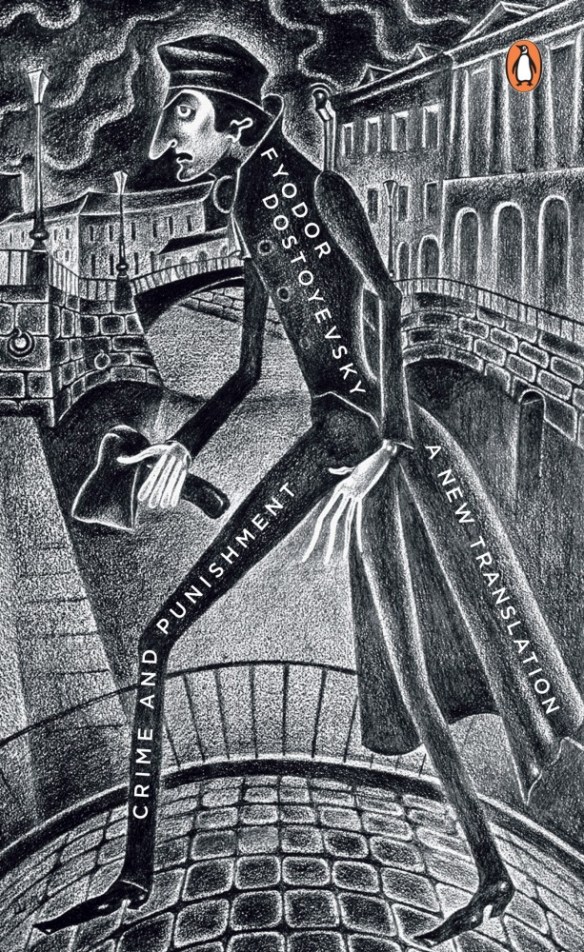
Long ago in Russia, another dissident, Fyodor Dostoevsky, was also sentenced on trumped up charges to prison and exile in Siberia for being “freethinking” and a socialist enemy of the state. When he was finally released, he wrote a novel that was published in 1866.  It was Crime and Punishment, a masterpiece about a man named Rodian Romanovich Raskolnikov who, like Dostoevsky, is sentenced to exile and imprisonment in Siberia.  In Raskolnikov’s case, it was for killing an old woman pawnbroker to see if he was “above the common ruck.” The story explores Raskolnikov’s dual consciousness and the right to murder; prideful intellect versus compassion; rationalism versus spiritual values; freedom versus determinism; the individual versus the state.

Like Nietzsche twenty years later, Dostoevsky sent out a warning long ago about the terrifying consequences that would follow in the wake of certain forms of thinking that would result in nihilism. To be “above the common ruck” and murder at will; to play with people as though they were what Raskolnikov calls the woman he murders – “louses”; to create divided minds in a game of social schizophrenia through antitheses that conceal the magician’s devious truths.

At the end of Crime and Punishment, Raskolnikov, while still in Siberian prison exile, feels that he, like Lazarus, has been raised from the dead.  He realizes that there is a solution to his split mind and that he has found it as he transitions “from one world into another…his initiation into a new, unknown life.”

But such a resolution that I will not divulge is preceded by a very strange dream, one that rings a bell today when life seems like a dream with something happening here but you don’t know what it is, do you, Mr. Jones?

When he [Raskolnikov] was better, he remembered the dreams he had had while he was feverish and delirious.  He dreamt that the whole world was condemned to a terrible strange new plague that had come to Europe from the depths of Asia.  Everyone was to be destroyed except a few chosen ones.  Some sort of new microbe was attacking people’s bodies, but these microbes were endowed with intelligence and will.  Men attacked by them became instantly furious and mad.  But never had men considered themselves so intellectual and so completely in possession of the truth as these sufferers, never had they considered their decisions, their scientific conclusions, their moral convictions so infallible.  Whole villages, whole towns and peoples were driven mad by the infection.  Everyone was excited and did not understand one another.  Each thought that he alone had the truth and was wretched looking at the others, beat himself on the breast, wept, and wrung his hands.  They did not know how to judge and could not agree what to consider evil and what good; they did not know who to blame, who to justify….The alarm bells kept ringing all day long in the towns; men rushed together, but why they were summoned and who was summoning them no one knew….The plague spread and moved further and further.  Only a few men could be saved in the whole world.  They were a pure chosen people, destined to found a new race and a new life, to renew and purify the earth, but no one had seen these men, no one had heard their words and their voices.

Have you?

Mainstream media goes full Orwell telling readers they’re using the word ‘Orwellian’ wrong

By Helen Buyniski

Source: RT.com

Complaining about authoritarian government intrusion into one’s life or surreptitious rewriting of history no longer qualify as “Orwellian,” according to an article that ironically embodies the concept in trying to redefine it.

News outlet USA Today has managed to personify the term ‘Orwellian’ in its profoundly condescending writeup scolding readers for “using the term ‘Orwellian’ wrong.” Published on Monday, the piece goes to great lengths to shame those insecure about their vocabulary by suggesting the term “Orwellian” can only be used correctly by liberals.

Chances are, you’ve seen George Orwell’s name thrown around a lot in the past week on social media, either by conservatives invoking his name with sincerity or by liberals poking fun at conservatives for its misuse,” the article starts, smirkingly laying the groundwork for canceling out all usage of the term by those on the Right.

But the examples it holds up to mock – presidential scion Donald Trump Jr.’s complaint about the disappearance of his father’s Twitter account and Missouri Senator Josh Hawley’s blaming the “woke mob” for the cancellation of his book contract – are not as wide of the mark as the thought police at USA Today would have us believe.

Hawley’s book denouncing the “tyranny of Big Tech,” for example, isn’t just “a publisher drop[ping] your book because your brand has become toxic” – it’s a disturbing example of what are supposed to be separate industries (social media, book publishing) marching in ideological lockstep with the prevailing political ideology.

Nor is the younger Trump’s complaint about Twitter deleting his father’s account ‘just’ an example of “an internet platform enforcing its terms of service.” For better or worse, Trump’s Twitter feed was a historical document, his primary means of addressing the American public throughout his presidency. Suspending it permanently is the equivalent of throwing four years of official proclamations down the memory hole, never to be seen again, as 1984’s protagonist Winston Smith did with inconvenient historical documents as a loyal Party member.

USA Today brings in a scholar who wrote his dissertation on Orwell to connect the iconic “Two Minutes Hate” to the “social media mob mentality” and the QAnon conspiracy theory, perhaps missing the forest (four years of “Orange Man Bad!” ritualistically shouted at the top of one’s digital lungs) for the trees.

The article notes that Orwell fought fascism in Spain, strongly implying today’s conservatives are the ideological descendants of Franco’s fascists – a conclusion it doesn’t try to support with facts, but merely guilt by association. Which dovetails perfectly with the writer’s efforts to narrow the definition of “Orwellian” by the use of “the manipulation of language” to conceal reality.

After all, even this heavy-handed propaganda piece acknowledges that Orwell discovered “the failures of Soviet communism,” finding it one of “two sides of the same totalitarian coin” with fascism and disowning both extremes.

And as much as 21st century liberal revisionists would like to lay claim to the term “Orwellian” just for themselves, the dystopian future-Britain of 1984 was crafted in the image of the Soviet Union, not fascist Spain or Germany. “INGSOC,” the name of the Party’s totalitarian ideology, is short for “English Socialism.” Attempting to dismantle the author’s own intent to sell the ideological flavor-of-the-month is pretty, well, Orwellian.

How Billionaires Transfer Blame to Others

By Eric Zuesse

Source: Strategic Culture Foundation

In a two-Party dictatorship, the important truths are kept away from being publicized on either side, Eric Zuesse writes.

Throughout history, aristocrats, and their flaks such as their ‘news’-media, cast blame downward, away from themselves who collectively control the government, and onto, instead, some minority or other mass group, who can’t even plan or function together so as to be able to control the government.

The U.S. has a two-Party aristocracy, as is clear from the “Open Secrets” list of the 100 biggest political donors in the 2020 U.S. Presidential and congressional campaigns, the “2020 Top Donors to Outside Spending Groups”. Those are only these individuals’ publicly acknowledged expenditures, none of the dark political money, which, of course, is donated secretly. At the top there, of the donors’ lists, is Sheldon Adelson (who just died, on January 11th in California, and was buried in Israel), who spent far more than anyone in all of U.S. history had ever spent in any campaign cycle, $215 million, which amount far exceeded even the $82 million that he had spent in 2016, which in 2016 was second only to Thomas Steyer’s $92 million (the previous all-time highest amount donated in any campaign year). Adelson gave exclusively to Republicans, whereas Steyer gave exclusively to Democrats. Steyer in 2020 gave $67 million, which — though he was running for President in 2020, and hadn’t been running in 2016 — was only 73% of his 2016 donations, in that year, when he had been the nation’s top political donor. He was only the 5th-biggest donor in 2020, instead of #1.

The second-biggest donor in 2020 was the liberal Republican Michael Bloomberg, who ran in the Democratic Presidential primaries in order to defeat the only progressive in that contest, who was Bernie Sanders. Bloomberg spent $151 million of his own funds for that purpose. In 2016, he had spent $24 million in order to help Hillary Clinton beat Bernie Sanders, and then try to beat Donald Trump.

The third-biggest in 2020 was Timothy Mellon, the son of Paul Mellon and grandson of Andrew Mellon. Timothy Mellon gave $70 million, all to Republicans.

In 2020, the top ten donors, collectively, spent $776 million to own their chunk of the U.S. Government. The second group of ten (#s 11-20) donated only $187 million; and, so, the top twenty together donated $963 million, just shy of $1 trillion. All 80 of the other top-100 donors, together, gave around $370 million, so that the total from all 100 was around one-and-a-third trillion dollars. 47 gave to Republicans; 53 gave to Democrats.

The smallest publicly acknowledged donor among the top 100, Foster Friess, gave $2.4 million, all to Republicans.

Most of these 100 donors are among America’s approximately 700 billionaires; and, even the ones who aren’t are serving and doing business with the billionaires, and therefore are to some extent dependent upon having good relations with them, not being enemies of any billionaire. All of these 100 are, obviously, also dependent upon the governmental decisions that the public officials whom they have purchased will be making, not only regarding regulations and laws, but also regarding foreign policies. For example, Friess merged his company into Affiliated Management Group, which “is a global asset management firm” that “has grown to approximately $730 billion.” Virtually all of the top 100 political donors are internationally invested, and their personal wealth is therefore affected by American foreign policies, in ways that the personal wealth of the rest of the population is not.

When the U.S. invades a foreign country, or issues sanctions against a foreign country, it benefits some American investors, not only in corporations such as Lockheed Martin and ExxonMobil, but even in some foreign-headquartered corporations. America’s spending around half of the entire world’s military expenses gives an enormous competitive boost to America’s billionaires, which is paid for by all U.S. taxpayers. It takes away money that would otherwise go toward the rest of the U.S. population — people who might even become crippled or killed by their military service for the benefit of America’s billionaires. Marketing this military service to the public, as “national defense” — even at a time when no nation has invaded or even threatened to invade America after 1945 — is good PR for America’s wealthiest families, regardless of whether it’s of any benefit whatsoever to other Americans. Because of the success of this PR for the military, Americans consider the U.S. military to be America’s best institution — far higher than any other part of the U.S. Government or any non-governmental institution, such as churches, the press, or the medical system. The U.S. Department of Defense is, also, by far, the most corrupt of all Departments of the U.S. federal Government. This fact is carefully hidden from the U.S. public, so as to keep the public admiring the military.

Billionaires use their media, and their scholars, to point the finger of blame, for the problems that the public does know about, anywhere else than against themselves; and, though the billionaires have political differences amongst themselves, they are unified against the public, so as to continue the gravy train that they all are on.

In order for the aristocracy not to be blamed for the many problems that they cause upon the public, their first trick is to blame some minority or some other vulnerable mass within the public. Or else to blame some ‘enemy’ country. But if and when such a strategy fails, then, they and their media blame the middle class or “bourgeoisie,” in order to fool the leftists, and also they blame the “communists” and the poor, in order to fool the rightists. That’s a two-pronged PR strategy — one to the left, and the other to the right. Since the aristocracy is always, itself, fundamentally conservative, they would naturally rather blame the leftists as being “communists,” than to blame the middle class and poor, because to do the latter would place the public’s ideological focus on economic class, which then would threaten to expose the billionaires themselves as being the actual economic “elite” who are the public’s real enemy (and as being the elite against which the propaganda should instead be focused). Blaming the middle class and poor might work amongst their fellow-aristocrats, but if tried amongst the public, it would present the danger of backfiring. Consequently, there is a return to the days of Joseph R. McCarthy, but this time without communism. Thus, here is how the White House correspondent for a Democratic Party ‘news’-site, CNN, closed his ‘news’-analysis, on January 14th, under the headline “Washington’s agony is a win for autocrats and strongmen”:

Mission accomplished

Nice work, Mr. Putin.

According to a US intelligence community report, Russia’s chief goal in interfering in the 2016 election in support of Trump against Democrat Hillary Clinton was to “undermine public faith in the US democratic process.” Four years on, there have been two impeachments and an insurrection against the US legislature. Millions believe Trump’s lies that he was illegally ejected from power, and doubt Biden’s legitimacy.

Conspiracy theorists have seats in Congress. There are serious questions about whether one of the country’s great political parties is now anti-democratic. The Covid-19 pandemic exposed weaknesses in a federal system that grants vast power to the states. And America’s self-appointed role as an exceptional nation and beacon of democracy is in the gutter.

Most of the disorienting events of the last few years can be blamed directly on Trump and his particular skill at tearing at the social, racial and political divides that are just below the nation’s surface. So the ex-KGB man in the Kremlin hardly deserves all the credit. But Russia, China and other autocratic nations are gaining much from Washington’s agony. They’re already using it to promote their own closed and totalitarian societies as models of comparative order and efficiency — and to beat back brave local voices calling for democracy and human rights.

In an effective declaration of victory for Russia’s espionage offensive against the US more than four years ago, Vyacheslav Volodin, the speaker of the lower house of the Russian Parliament, slid home the knife. “Following the events that unfolded after the presidential elections, it is meaningless to refer to America as the example of democracy,” he said.

“We are on the verge of reevaluating the standards that are being promoted by the United States of America, that is exporting its vision of democracy and political systems around the world. Those in our country who love to cite their example as leading will also have to reconsider their views.”

That’s propaganda from “leftist” (i.e., Democratic Party) billionaires. A good example of an independent American journalist who has been fooled by Republican Party billionaires to blame some amorphous mass of “leftists” is Sara A. Carter’s 12 January 2021 youtube “Rudy Giuliani talks big tech censorship”, blaming America’s problems on “the government,” or “the bureacracy,” and, of course, especially on Democrats. At 10:15 there, she said “My mother fled from Cuba.” Carter, as a conservative, is so obsessed with her visceral hatred of “communism,” that she interpreted America’s dictatorship as being communists, instead of as being billionaires — of both Parties: actually, fascists. In a two-Party fascist dictatorship, she fears the leftists. This is typical of propagandists on the conservative side. But propagandists on the liberal side (such as the CNN correspondent exemplified) are no better, just different.

Both propaganda-operations cast blame away from the real culprits.

In a two-Party dictatorship, the important truths are kept away from being publicized on either side. What the public sees and hears, instead, is political theater, merely tailored to different audiences.

Government propaganda: deflecting public attention from the most serious crimes of the oligarchy

By Carla Binion

Source: Intrepid Report

People of the U.S. often fail to notice the methods their own government uses to do what amounts to brainwashing them. The book Manufacturing Consent by Edward S. Hermann and Noam Chomsky details how U.S. corporate-controlled mainstream media outlets (today that includes mainstream TV “news” networks, most mainstream magazines, newspapers, etc.) act as propagandists. Another excellent source on U. S. media propaganda is Michael Parenti’s book, Inventing Reality.

When mainstream TV, magazines, newspapers and mainstream Internet sites all repeat the same false talking points over and over, they’re often deliberately attempting to brainwash, rather than inform, the public. Their motive is usually to gain mass public support for something that brings dishonest politicians and the oligarchy money and power. For example, they often propagandize the public to support illicit war for profit.

Today’s political propagandists pretend only the right wing criticizes them, but many on the left oppose misleading propaganda as well. I’m politically progressive, don’t like Biden or Trump because they are both far too right wing in my view. However, I think the extremist push to “get Trump” and paint him as inciting the January 6 protest are obvious efforts to manipulate the public’s thinking. Trump encouraged the protesters to “fight”, but to “fight” politically has traditionally been used to simply mean to battle verbally, to argue, or to boycott or strike. He didn’t specify or urge physical violence.

This opinion piece has nothing to do with minimizing the harm done by any actual violence on January 6. Violence should never be condoned and is a separate issue from protests in general. Instead this is about being aware of ways the U.S. government is now employing methods long used to promote propaganda, to discourage even peaceful protests, and to influence the public mind. The current government manipulation is a way of manufacturing consent, or as Michael Parenti called it, inventing reality.

What is the U.S. government likely to gain by manipulating the public into dropping their critical thinking skills and becoming lost in emotional rage, and by turning the public against protest and implying that all forms of dissent are possibly “insurrection” or sedition?  (1) The focus on Trump and January 6 turns the public’s attention away from the country’s many other problems, including the fact that we’re the world’s only advanced nation without an adequate healthcare system. It also distracts us from the urgent need for environmental reform. (2) If the powers that be can get most Americans to focus on only Trump, there will be no focus on the U.S. politicians responsible for turning the U.S. into an oligarchy, with much money funneled away from the middle class to the wealthiest one percent. [Source]    (3) If the powerful corrupt politicians can increase penalties for even peaceful protests, they’ll frighten and shame innocent people and prevent them from needed legitimate protesting, (4) If the public can be manipulated into believing that only right-wing racists and fascists refuse to accept government propaganda and authoritarianism, the left can be intimidated through guilt by association and through fear of being identified with the right wing.

People should walk the fine line between too much skepticism and not enough. Excessive suspicion is doubt not supported by evidence. Healthy skepticism is based on reality, including the U. S. government’s characteristic way of using disinformation to control public opinion throughout history. The thing that should give people pause and keep them aiming toward a balance of skepticism is the fact that the U.S. government has a long and well documented legacy of using widely-known propaganda techniques on the U.S. public. For anyone who doubts the U.S. government routinely propagandizes the public, at least read the two books mentioned above, which provide many additional reference sources and essentially prove this is true beyond any doubt. If the U.S. population likes to be maneuvered and more or less brainwashed by their own government, they’re free to do that. However, thoughtful skepticism, independent research and honest scrutiny are preferable.

Big Tech, Nostalgia, and Control: Grafton Tanner’s ‘The Circle of the Snake’

By Michael Grasso

Source: We Are the Mutants

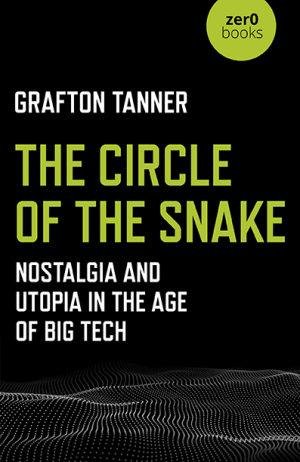
The Circle of the Snake: Nostalgia and Utopia in the Age of Big Tech
By Grafton Tanner
Zero Books, 2020

I’m sure many members of Generation X have taken a moment to look around the pop culture landscape over the past decade and a half and had a sudden moment of realization: there are certainly a whole lot of people trying to sell me things using the media of my youth. Ultimately, this is nothing new. I remember when every pop culture moment, from sitcoms to TV commercials, seemed to be using the Baby Boomers’ favorite songs to sell them cars and sneakers. But in 2020, the dominance of these re-treaded properties is even more nakedly cynical, whether its the endless sequels of the Star Wars and Marvel cinematic universes, or the easy-to-consume, signifier-filled pastiches of the worlds of Stranger Things and Ready Player One. The cultural marketplace, as dominated by bloated media and tech empires, no longer sees any need to admit the novel, the fresh, the unusual.

Both the “why” and the “how” of this cultural and technological tendency are explored by author Grafton Tanner in his new book, The Circle of the Snake: Nostalgia and Utopia in the Age of Big Tech. (Disclosure: Tanner is an occasional contributor to We Are The Mutants.) Tanner explores not only the pop culture properties that utilize nostalgia in an effort to assuage the anxieties of contemporary life in the aftermath of the 2008 financial rupture; he also explains how tech companies use the feedback from algorithmic analysis to keep consumers locked into a never-ending cycle—an ouroboros—of digital satisfaction of their subconscious desires for an older, more secure time. This nostalgic digital utopia, in turn, keeps consumers constantly “on,” working through endless “quests” that approximate proactivity but in the end keep people locked into pointless and unproductive cycles of feedback, emotional satisfaction, and control. “Recommender systems and predictive analytics—the very tools that allow our contemporary media to function—zero in on quick reactions, such as a flash of anger or a swell of nostalgia,” says Tanner in his Introduction. “These reactions are noted by algorithms, which then make recommendations based on them… The result is a nostalgic feedback loop wherein old ideas travel round.”

Tanner examines how the Big Tech tendency towards technolibertarianism and monopoly over the past 20 years has created the material conditions for this self-reinforcing system of psychic feedback. With an increasing belief in culture as disposable and “just for fun,” the material and political implications of this system of control are obfuscated. The way that these cultural narratives award Big Tech further and deeper power over all of us is merely part of the game. And we are enlisted as active players, not merely passive viewers, as in the era of television’s height. The online world, Tanner notes, demands a keen eye for analysis and a deep capacity for paying attention. The technolibertarian and neoliberal alike view our tech-suffused world—everyone is plugged in, 24/7—as a kind of utopia-in-waiting, or indeed a permanent utopia, where the idealized past can be endlessly revisited and basked in, while the present never changes from its current state of cultural and political stasis. This virtual plaza of commerce, emotional satisfaction, the illusion of proactivity, and control and surveillance describe the boundaries of Big Tech’s dominance of both our material and psychic space at the beginning of the 2020s.

The interview below was conducted in November and December 2020 via email and has been lightly edited for clarity.

***

GRASSO: Given the topic of your first book for Zero, Babbling Corpse: Vaporwave and the Commodification of Ghosts, the topic for The Circle of the Snake seems like a natural outgrowth. But from reading the book it also seems like there were a lot of specific events and observations about the world of Online and Big Tech over the past few years that led to the book’s development. What are the origins of The Circle of the Snake, and what kinds of specific cultural developments led you to propose and write the book?

TANNER: I can pinpoint the exact moment I knew I was going to write a book on Big Tech. I was living in a kind of exile in 2016, in this small town in Georgia, trying to piece my life back together after a series of false starts after college. I was sitting in a Barnes & Noble reading the 2016 Tech Issue of The Atlantic, and there was a story by Bianca Bosker about former Google employee Tristan Harris, who left the Valley and started an advocacy group called Time Well Spent because he thought Big Tech was eroding mental health. He was on a mission to fix Big Tech by making it work for us, not against us. But the piece didn’t make me feel better about tech. In fact, it was terrifying: here is an ex-Valley technocrat, mournful that he had invented habit-forming technology with severe public side effects, asking us to not only forgive him, but believe in him to create newer, better tech. I was incensed.

Shortly thereafter, we learned that Cambridge Analytica sharpened their psychographic modeling techniques by harvesting Facebook data from millions of users without their permission, all to aid in the election of Donald Trump. There was suddenly this huge backlash against Big Tech. I was supportive of it, but I also understood it came a little too late. Tech critics had been sounding the alarm for years and years. It took the election of a fascist for the left to wake up to the tech nightmare, only to realize the ones promising to end the nightmare were former technocrats themselves.

And yet, as many were loudly critiquing Big Tech for its role in throwing elections, spreading fascism, and worsening mental health, the culture industry was churning out politically retrograde nostalgia-bait. Was it really that the techlash had made everyone even more nostalgic for the pre-digital past? Or was there some kind of connection between nostalgia and Big Tech? These were the questions I had in mind when I started writing.

GRASSO: I think one of the things I like best about the book is your fusion of theory, philosophy, and epistemology with the material and economic realities of 21st century Big Tech and Big Media. Throughout the book you explore concepts such as surveillance, sublimity, nostalgia (of course), and virtuality with concrete examples from the online plaza. Essentially, if I’m not mistaken, you’re saying that the people who created the feedback loops that keep us hooked on technology and the internet and mine our data for still more ways to sell to us have themselves studied their philosophy, economic history, and techniques of mass psychology and persuasion with great attention?

TANNER: Persuasion techniques, yes, but I wouldn’t go so far as to say the technocrats have studied much else beyond their limited worldview, which is scientistic. Yes, technocrats like James Williams and Tristan Harris like to cite philosophers, but they usually do it to support their self-help solutions to the attention economy. Wake up with a little philosophy, they say, because reading Socrates is better for the mind than scrolling through Twitter. It’s a very neckbeard way of thinking about cultural consumption.

Make no mistake: these technocrats are uninterested in anything other than making a lot of money. If that means learning psychological techniques of persuasion with Stanford psychologist B.J. Fogg, then so be it. They weren’t and aren’t trying to make the world a better place or something. Like the banks before the Great Recession, the technocrats are out to make a quick buck by any means necessary, and they would have kept on doing what they were doing if the bubble hadn’t burst. People were disgruntled with Facebook for years before Cambridge Analytica, and tech critique was already a robust genre by 2016. But it took a kind of implosion, a Great Recession-style reckoning with Big Tech, to change the public opinion. Honestly, the technocrats would probably benefit from studying a little history and philosophy, instead of cloistering themselves in the ideological fortress of STEM.

GRASSO: I think one of the “oh shit” moments in the text for me was finding out that the Black Mirror special choose-your-own-adventure episode “Bandersnatch,” which I quite liked mostly for its material and inspirational signifiers (early ’80s computing, references to Philip K. Dick) was also used to mine viewers’ data in a delightfully dark real-life Dickean stroke. It’s not merely that nostalgia offers us a safe place from the dangerous present, but that those who create these nostalgic visions are working hand-in-hand with the very media empires that make us crave the past: another ouroboros.

TANNER: “Bandersnatch” not only exploits viewers’ nostalgia for its own gain, but it further normalizes the feeling of being controlled. Everyone today knows we’re being controlled from afar: by Twitter, Instagram, Amazon, insurance companies, think tanks, banks, and so forth. We are part of this giant social experiment called consumer capitalism. The purpose is to find out what we’ll buy. But we aren’t being controlled by future gamers or, as much as Elon Musk would like to believe, programmers in this computer simulation we call life. “Bandersnatch” is a work of fiction masquerading a horrible fact—that Netflix is the one controlling us, that we are not as in control as we think. The irony, of course, is that we relinquish our control via the technology we use every day, but we ultimately have very little choice in the matter. Students use devices at school, and jobs often require employees to have smartphones. We aren’t puppets, but we’re by no means totally free either.

GRASSO: So that leads me to asking you about your critique of specific media franchises: Stranger Things and the endless array of sequels and especially reboots we’ve seen since the end of the aughts. You very cannily explore Stranger Things‘ reliance on physical signifiers of commodities and objects that are no longer extant but remind us of the shackles of our technology-laden present (the old landline telephone, the shopping mall) as a key to its appeal to both Gen-Xers who were there and Zoomers who weren’t. Likewise the cinematic reboot is a way to cheaply create product and content that will connect with multiple generations. This element of “spot the Easter egg, aren’t you smart?” for older generations melds with the offer of a trip to a now-alien time for younger generations. These franchises seem to simultaneously reward passive immersion in nostalgia with an illusion of proactivity.

TANNER: Well, the spot-the-Easter-egg activities are very often nostalgic exercises themselves. Viewers are invited to find the nostalgic signifiers, even if they don’t know what they are. That’s the brilliance of Easter egg marketing for advertisers: you might not know what the hidden clue means, but you know it’s a clue and so you make note of it. Of course, the “real” fans will be able to cite all the references, but regular viewers can sometimes recognize a clue, like a corded phone or a VCR or a reference to an older movie, when they see it.

Easter egg marketing is the advertising tactic of choice in the prosumer age. It turns watching into a game. And it’s very heuristic. The films with the most Easter eggs inspire the most “count them all” YouTube videos or Buzzfeed listicles. The problem here isn’t that movies and series reference a bunch of older media; the problem is that Easter eggs reference certain things and leave others out, thus establishing these unnecessary pop culture canons. I don’t care that the Halloween franchise makes reference to itself. It’s an extended universe at this point—of course it’s going to do that. What I find questionable is its constant updating in an attempt to recapture the magic of the original film. I’m always signaling my love of Halloween III: Season of the Witch, but that film is too wacky to be included in the Halloween universe, because the franchise is desperately trying to give us the original again, as if it were the first time, without all the messy parts of the sequels. The Halloween filmmakers want to keep the bloodline of the first film pure, which means anything standing in the way must be excised.

GRASSO: You mark the period between 9/11 and the financial crisis of 2008 (and its aftermath) as the final foreclosure of any alternative to our current future and one of the dividing lines between an idealized past depicted in our nostalgic media and the forever Now. Unsurprisingly, so many of the elements of online life we now recognize as irredeemably toxic (social media, ranking and rating apps, tentpole cinematic universes full of identical sequels) began around the end of the Bush years as well.

TANNER: One of these days, I’m going to write a history-critique of the 2000s. I find the decade fascinating. It was probably the nadir of contemporary culture. Mark Fisher called it “the worst period for (popular) culture since the 1950s.”

It’s true: there was no breaking point at which contemporary nostalgia ramped up. It was a gradual shift between 9/11 and the Great Recession. Directly after 9/11, the U.S. was reeling from shock. Before nostalgia set in later in the decade, there was a feeling of futurelessness, as Robert Jay Lifton wrote—a feeling that there can be no future after 9/11, that the fear of another terrorist attack foreclosed the future altogether, that if people could fly planes into buildings on a regular weekday morning, then anything horrific is possible. During these years, we saw the birth of cinematic universes with the Star Wars prequels and the first megabudget superhero films. Of course, there were Batman, Superman, and Star Wars films before the twenty-first century, but it was after 9/11 that we saw the avalanche of these movies, several of which could not have been made without post-9/11 Pentagon support, with its bloated influence and near-endless supply of capital. You cannot downplay the reach these films have. They’re seen all over the world. And they aren’t just pro-military propaganda, they are engines of nostalgia.

After the Great Recession, nostalgia calcified. People were moving back in with their parents, revisiting old memories to soothe the anxiety of joblessness. Financial recessions are progressive only for the bankers, if they’re bailed out. For workers, they’re regressive. They set people back and invite the sufferers to hide away from it all. There is nothing wrong with this reaction. We cannot blame people who were hit by the Recession for their nostalgia. But we can blame the ones who caused it. And austerity measures only increase the desire to escape into nostalgic feelings. In short, financial meltdowns are crises that affect the future because they erase the plausibility of surviving the present.

GRASSO: You state that nostalgia is not only an emotion used to track us and to trigger specific emotional responses (which themselves are often assuaged by consumption), but also, possibly most importantly, to control us. And that control is not only physical/material but also social/aesthetic, limiting our options to wander away from the digital plaza. How do nostalgia and nostalgic media help this attempt by the market to quantify, objectify, and commodify us, the consumer?

TANNER: Content creators—a sickening term that reduces art and culture to commodities—understand the value of nostalgia. Consumer scientists have known for years that nostalgia sells. If anger draws your attention to the screen, then nostalgia triggers you to buy what will soothe the anger. That’s the cycle we’re dealing with in the present century.

And the worse things get, the more that nostalgia will naturally rise to the surface for many people. It’s not that media companies force-feed nostalgia to us. Many people are already feeling the emotion. It’s inescapable because nostalgia is a modern condition. Corporations merely go the extra mile by locking nostalgia into these feedback loops. The more you feed nostalgia into the cultural industry, the more of it you will consume because entire companies depend on you to want it. We live in a world of disruption, and every modern displacement is accompanied by nostalgia. Corporate capital knows this and depends on it.

GRASSO: Two of the specific technologies you talk about, Instagram and virtual reality, have undergone mutations in their appeals to our desire to escape the modern world. Instagram started off as a fairly disposable nostalgic evocation of the Polaroid camera aesthetic and has become a playground for big-money influencers and exhibitionists; virtual reality has evolved into just another facet of the internet’s control apparatus, despite its conceptual origins in early ’80s cyberpunk and its promised potential to give people the ability to create their own worlds. Why do these technologies seem to always mutate in the direction of greater commercialization and/or control, despite their initial apparent harmlessness or revolutionary promise?

TANNER: In the case of Instagram, its nostalgia factor was mainly due to the horrible photo quality of early smartphone cameras. With some Wi-Fi, a phone, and an app, you could take photos anywhere and upload them on the spot, which was enticing enough for many people to do just that, but you couldn’t deny the photo quality was very poor. So one way to deal with this poor quality was to saturate photos in a kind of analog haze, which could be done by applying one of several different stock filters. I can’t emphasize this enough: so much of our nostalgic appetite in the early 2010s was whetted by the inability to take and post a decent looking digital photo.

Whether it’s Instagram or virtual reality, digital technology is never totally harmless. It’s like when Tristan Harris and the Center for Humane Tech guys tell us we can have our digital cake and eat it too. You can’t have “humane tech” because tech is driven by the profit motive, which itself is often powered by another force: the military. Have you seen this new recruiting ad for the Marine Corps? It’s basically telling young people that joining the military will be an escape from the overwhelming anxieties of the digital age. The scariest thing about the ad is that it conceals the long relationship between tech and the military. Which is to say, the “tech” presented in the ad couldn’t exist without the military-industrial complex. At this point, any new, possibly revolutionary digital technology will either be bought out by a Big Tech monopoly or put to use on the battlefield.

GRASSO: As far as solutions and escapes from this predicament go, you talk a little bit about the ineffectual attempts of former technocrats to try to ameliorate our enslavement to the internet and social media with apps that limit time on websites or “safety labels,” and find them all wholly wanting. Likewise, you mention attempts to make nostalgia something constructive, playful, reflective (in the schema of Svetlana Boym). And yet the very structure of the internet and Big Media as it stands now denies all alternatives to the current control stasis. What does a constructivist nostalgia look like? Where could it exist in the cracks of the current marketplace? Is there a place for nostalgia as a political instrument of the left outside of the usual avenue of Left Melancholy?

TANNER: I’m currently writing a history of nostalgia, out fall 2021 with Repeater Books, called The Hours Have Lost Their Clock: A Recent History of Nostalgia. In it, I put forth a theory of radical nostalgia, drawing on the work of Alastair Bonnett and Svetlana Boym. Radical nostalgia is the third “R” beyond reflective and restorative nostalgia, which Boym coined. She was right about nostalgia, but over the first two decades of the present century, restorative nostalgia ballooned while the reflective strains were edged to the margins. But there needs to be this third form, radical nostalgia, because the melancholic disposition of reflective nostalgia just hasn’t been working for the left and the restorative tint has proven to be destructive.

Radical nostalgia is the act of looking back to those moments when collective action stood up to capital. It yearns for the social movements of the past. It aches for them. It isn’t interested in “getting back there,” in restoring what’s been lost, but in learning from those who came before: the struggle for indigenous rights, the staunch anti-capitalism of Martin Luther King Jr., Stonewall, the Battle of Seattle. When Richard Branson signals his support for LGBTQ+ communities, that isn’t radical nostalgia. There’s nothing radical about it; it’s mere nostalgia. Radical nostalgia looks to these and other movements to continue the fight for a more egalitarian future. It is inherently anti-fascist.

Radical nostalgia takes the action step of restorative and the aching heart of reflective nostalgia and fuses them together. It knows that the past isn’t perfect, which means what we yearn for shouldn’t be either. Restorative nostalgia is too clean, too high-definition. Reflective nostalgia kicks the can around, although reflectors might recognize the problems of the past long before the restorers do. But radical nostalgia knows that everything is imbued with horror, the past especially. Many revolutionary movements of the past suffered from machismo and intolerance, even in their own collectives. Radical nostalgia knows this and endeavors to leave it in the past. Some things must remain buried.

And radical nostalgia is one perspective we can take to resist the utopian thinking of tech. At this point, Big Tech is about the only entity that circulates visions of the future, but those visions are falling out of favor thanks to the techlash. Get ready, because they will absolutely be replaced with a different utopian vision: the humane tech movement. We’re going to be dealing with the technocrats for years. It’s going to seem like we should trust Tristan Harris and the Center for Humane Tech guys. They’re going to be pushing their vision of the future for years to come. But they are the new boss, same as the old. Only collective action, informed by the decolonial and anti-fascist movements of history, can resist what’s coming in the next decade and beyond.

In An Insane World, Revolution Is The Moderate Position

By Caitlin Johnstone

Source: CaitlinJohnstone.com

It should not be considered radical or extremist to oppose mass murder for profit and power.

It should not be considered radical or extremist to oppose the globe-spanning power alliance that is perpetrating most of that mass murder on the world stage today.

It should not be considered radical or extremist to oppose the existence of secretive government agencies which have extensive histories of committing horrific crimes.

It should not be considered radical or extremist to say that everyone ought to have a basic standard of living instead of being deprived of food, shelter and medicine if they have the wrong imaginary numbers in their bank account.

It should not be considered radical or extremist to oppose the existence of a small class of elites who use their vast fortunes to manipulate our entire society toward their advantage.

It should not be considered radical or extremist to want plutocrats and government agencies to stop deliberately manipulating people’s minds using mass media propaganda.

It should not be considered radical or extremist to want everyone to have an equal chance of getting their voice heard in our information ecosystem instead of a few select power-serving lackeys.

It should not be considered radical or extremist to want a society that is ruled by the many for the benefit of the many instead of one that is run by the few for the benefit of the few.

It is very normal, sane and healthy to want a world where everyone has what they need to live, where everyone is free to do, say and think whatever they like as long as it isn’t hurting anyone else, and where nobody is being murdered by powerful governments. This is a very basic, intuitive, common sense desire to have for yourself and for your fellow human beings; it’s wanting for your society what you want for yourself.

Yet people who promote policies which are aimed at creating this kind of world are consistently marginalized and dismissed as radicals and extremists. It’s okay to say you oppose war in principle, but if you oppose any specific acts of warmongering being perpetrated by your government you’ll get labeled a Russian asset, a dictator apologist and all sorts of other pejorative labels which exist solely to justify keeping you off of mainstream platforms. It’s okay to think we should live in peaceful collaboration with each other and our ecosystem, but if you promote specific policies to make that happen you’re an evil commie, a class warrior and a moonbat in the same way.

Simply advocating sanity over insanity gets you shoved out of sight and out of mind by the narrative managers responsible for preserving a world order that is stark raving insane from top to bottom. If you oppose the systems exploited by the ruling power establishment which murders, exploits and oppresses people at home and abroad all day every day while destroying the very ecosystem we depend on for survival, then you are branded a lunatic and your wrongthink quarantined so as not to infect the mainstream herd.

This dynamic is made possible by the fact that the powerful are constantly pouring their wealth and influence into manufacturing the collective delusion that madness is sanity and sickness is health. The plutocrat-controlled political class and the plutocrat-owned media class feed the public an unceasing stream of propaganda aimed at convincing them that capitalism is totally working, that western imperialism is a kooky conspiracy theory, and that the military, police and politicians are our friends. This is what’s constantly being done by mainstream news media, and with varying degrees of subtlety it’s what is being done by every show on television and every movie churned out by Hollywood as well.

But that’s all it is: a collective propaganda-induced delusion. In reality it is the mainstream promoters of the establishment-authorized status quo who are the violent extremists, and it is those who desire health and sanity who are the moderates.

The madness of our world will necessarily continue for as long as we are unable to collectively find our way out of it, and we will be unable to collectively find our way out of it for as long as they are able to keep us collectively confused about what is madness and what is sanity. About what is normal and what is abnormal. About what is moderate and what is extreme.

If you oppose the madness of our world, don’t make an identity out of being a “radical”. Don’t build an egoic structure around life on the fringe. You are not radical, and your ideas should not be fringe. To live a revolutionary life, you should insist on the normality and mundaneness of your own position. Sanity should not be special and unusual, and we should not participate in the delusion that it is.

Let your life be an expression of the common sense ordinariness of revolution.

Big Media: Selling the Narrative and Crushing Dissent for Fun and Profit

By Charles Hugh Smith

Source: Of Two Minds

The profit-maximizing Big Tech / Big Media Totalitarian regime hasn’t just strangled free speech and civil liberties; it’s also strangled democracy.

The U.S. has entered an extremely dangerous time, and the danger has nothing to do with the Covid virus. Indeed, the danger long preceded the pandemic, which has served to highlight how far down the road to ruin we have come.

The danger we are ill-prepared to deal with is the consolidation of the private-sector media and its unification of content into one Approved Narrative which is for sale to the highest bidders. This is the perfection of for-profit Totalitarianism in which dissent is crushed, dissenters punished and billions of dollars are reaped in managing the data and content flow of the one Approved Narrative.

So don’t post content containing the words (censored), (censored) or (censored), or you’ll be banned, shadow-banned, demonetized, demonized and marginalized. Your voice will be erased from public access via the Big Media platforms and you will effectively be disappeared but without any visible mess or evidence–or recourse in the courts.

That’s the competitive advantage of for-profit Totalitarianism–no legal recourse against the suppression of free speech and dissent. And if you’re shadow-banned as I was, you won’t even know just how severely your free speech has been suppressed because the Big Tech platforms are black boxesno one outside the profit-maximizing corporation knows what its algorithms and filters actually do or exactly what happens to the disappeared / shadow-banned.

Shadow-banning is an invisible toxin to free speech: if you’re shadow-banned, you won’t even know that the audience for your posts, tweets, etc. has plummeted to near-zero and others can no longer retweet your content. You only see your post is online as usual, because this is the whole point of shadow-banning: you assume your speech is still free even as its been strangled to death by Big Tech black box platforms.

Since Andy Grove’s dictum only the paranoid survive is my Prime Directive, I’ve paid a bit more to have access to server traffic data. So I can pinpoint precisely when I was shadow-banned: my overall traffic fell off a cliff and the number of readers visiting from links on Big Tech platforms fell from thousands to near-zero.

The new consolidated Big Media Totalitarians play an interesting game of circular sources: in the traditional, now-obsolete / suppressed form of journalism, a reporter would be required to identify a minimum of three different sources for the story, and make at least a desultory effort to present two sides of the issue.

That model is out the window in the USSA’s Big Media Totalitarian regime. Now reporters only have to use a completely bogus, fabricated source in another Big Media story. Just being in another Big Media platform / publication is now “proof” that the source is legitimate.

In other words, investigative journalism is nothing but a Potemkin Village of circular sources conjured out of thin air by Big Media. Here’s an example from my own experience of being shadow-banned.

1. A completely bogus organization pops up out of nowhere and doesn’t bother identifying its owners, managers or sources.

2. This complete travesty of a mockery of a sham fabrication then issues a list of websites which it claims, with zero evidence, are stooges / outlets of Russian propaganda.

3. With zero investigation of this slanderous, evidence-free “source,” the venerable Washington Post (owned by Jeff Bezos) publishes an evidence-free hit piece glorifying this fabrication on Page One.

4. The other Big Media giants then amplify the bogus slander because it came from a “legitimate source,” the Washington Post.

Do you understand how circular sourcing works now? Once a flagrantly bogus bit of propaganda is embraced by one Big Media giant as part of the Approved Narrative, then every other Big Media / Big Tech corporation promotes the fabrication as “real news” even as it is obviously the acme of “fake news”, a complete fabrication.

The fake “source” was called PropOrNot, and the list included dozens of well-respected independent websites, all slandered with a completely fake accusation for one reason: each site had published some content that cast a skeptical eye on the crowning of Hillary Clinton in 2016 and the crushing of Bernie Sanders’ campaign by Big Media’s Approved Narrative.

As long as you post videos of kittens and kids dancing, you’re OK because your content (owned and controlled by the platform you posted it on–read the terms of Service) is free to the platforms and they use your content to “engage” users which generates billions in profits.

But if you question the Approved Narrative, you put a big day-glo target on your back. Now if you’re a multi-millionaire, you know, a top 0.1% per-center, you can afford to keep posting dissenting views even after you’ve been demonetized and your income falls to near-zero.

The rest of us aren’t quite so privileged. This is another of the toxic elements in Big Media / Big Tech’s consolidated control of what was once known as free speech: They don’t have to ban your content outright, which might cause a few ripples of tame protest; all they have to do is starve you into submission by strangling your source of income.

Thanks to watertight terms of service, even a multi-millionaire is legally powerless against the USSA’s Big Media Totalitarian regime. By posting content, you already gave away all your rights. So you can go solo and post content on some obscure corner of the web that no one knows exist, but that’s the functional equivalent of being banned and demonetized.

So go right ahead and enter a sound-proof box and scream your head off; nobody can hear you. Welcome to the totally privately owned, legally untouchable Big Tech / Big Media Totalitarian regime that will let you know what’s in the Approved Narrative because that’s all you’re allowed to see.

Gordon Long and I cover these topics and many more in our latest video Buying the Narrative (35:41) Since I’d like the video to actually be viewed more than 11 times, I avoided using the terms (censored), (censored) or (censored), and that’s the final fatal poison delivered by our profit-maximizing Big Tech / Big Media Totalitarian regime: self censorship. You know what you can’t say, so don’t say it. Stick with the kitten videos and you’ll be just fine.

You’ll be just fine but you no longer live in a functioning democracy. The profit-maximizing Big Tech / Big Media Totalitarian regime hasn’t just strangled free speech and civil liberties; it’s also strangled democracy.

It’s all fun and games until the pendulum of Totalitarian Consolidation and its Approved Narrative reaches an extreme (like, say, right now) and the pendulum swings back to an equal extreme at the other end of the spectrum. Keep in mind that hubris and money are no match for history: the more powerful you claim to be, the greater your fall. The way of the Tao is reversal.

Welcome to the U.S.S.A.’s Banquet of Consequences (December 8, 2020)