Overcoming the Myth of Authority

By Gary Z McGee

Source: The Mind Unleashed

“For thousands hacking at the branches there is one striking the root.” ~Henry David Thoreau

If, as Albert Einstein said, “unthinking respect for authority is the greatest enemy of truth,” then it stands to reason that we should think critically toward, rather than blindly believe in, authority. No matter who or what that authority might be.

Whether it’s an eccentric physicist with wild hair or an authoritarian president demanding respect without giving it. Whether it’s a flat-earther challenging the very foundations of physics, or an overreaching cop high on false power. Belief in authority is a huge psychological hang-up for our species. It’s an evolutionary impediment of monumental proportions.

Even as we daily self-overcome, so too should we daily overcome the myth of authority. It’s a myth because it’s foremost a story. It’s a story we’ve all fallen for –hook, line, and sinker. It’s a story that most of us were culturally conditioned to believe in. It’s a story that most of us take as a given, but certainly should not. For, ultimately, “it’s just the way things are” is a cowardly copout.

Rather than cowardice, rather than willful ignorance, complacency, and intellectual laziness, we should challenge the myth of authority –across the board. We should be ruthless with our skepticism, like a scientist regarding his own hypothesis, like peer-reviewed interrogators keeping the science of others honest.

Because the art of life, especially an examined life that’s well-lived, is scientific, logical, and reasonable. It strikes at the heart of the orthodoxy, whatever that may be. It undermines the Powers That Be, whoever they may be. And that’s likely to upset more than a few blind worshippers, myopic rule-followers, and willfully ignorant law-abiding citizens. So be it. Upset their precious apple-cart anyway. Especially if that apple-cart is outdated, violent, and based upon parochial reasoning and fear. As Oscar Wilde stated, “Disobedience was man’s original virtue.”

Overcoming authoritarianism:

“As soon as the generals and the politicos can predict the motions of your mind, lose it. Leave it as a sign to mark the false trail, the way you didn’t go. Be like the fox who makes more tracks than necessary, some in the wrong direction. Practice resurrection.” ~Wendell Berry

The problem with belief in authority is that it leads to the idea that we need to give a group of people permission to control us. And, as Lord Byron taught us, power given to an authority tends to become corrupt.

The problem with power is not the intent behind it. The problem with power is that it tends to corrupt the one wielding it regardless of their intent. So, since we all know that power tends to corrupt whether one has good or bad intentions, and since we know that we will all seek power anyway, it behooves us to be mercilessly circumspect both with our own power and against the power of others.

It stands to reason that we should not ignorantly give power to an authority by blindly believing it. We should instead challenge authority first, and trust it second, if at all. The best way to use our power is to use it against authority by ruthlessly questioning it. It’s a social leveling mechanism par excellence. As a wise, young sixth grader once said, “Question authority, including the authority that told you to question authority.”

Otherwise, people will fight and murder and commit genocide and ecocide for the so-called authority that they “believe” in. But they might not have fought so violently and thoughtlessly had they simply taken the power dynamic into deep consideration, nonviolently challenged that perceived dynamic, and then moved on smartly with their lives.

The best way to maintain a healthy skepticism, and not devolve into an ignorant, sycophantic, violent mess, is to take things into consideration and question them rather than blindly believe in them.

Overcoming tribalism:

“To be modern is to let imagination and invention do a lot of the work once done by tradition and ritual.” ~Adam Gopnik

By becoming worldly patriots instead of patriotic nationalists, we turn the tables on xenophobia, apathy, and blind nationalism, and we become more compassionate and empathetic towards other cultures. When we celebrate diversity instead of trying to cram the square peg of cultural affiliation into the round hole of colonialism, we turn the tables on the monkey-mind’s one-dimensional moral tribalism and we usher in Joshua Greene’s multi-dimensional concept of metamorality.

By reinforcing global citizenry rather than nationalism, we turn the tables on both our lizard brains and the Powers That Be. Like Joshua Greene says in Moral Tribes, “We need a kind of thinking that enables groups with conflicting moralities to live together and prosper. In other words, we need a metamorality. We need a moral system that resolves disagreements among groups with different moral ideals, just as ordinary first-order morality resolves disagreements among individuals with different selfish interests.”

Going Meta with morality launches us into a big-picture perspective. We’re shot out of the box of outdated tribal thinking and into a realm of higher consciousness, where our inherent tribalism gets countered by an updated logic and reasoning. We gain the holistic vision of “over eyes” (like the astronaut Overview Effect), where societal delusions and cultural abstractions dissolve into interconnectedness and interdependence.

Overcoming magical thinking:

“Every fact of science was once damned. Every invention was considered impossible. Every discovery was a nervous shock to some orthodoxy. Every artistic innovation was denounced as fraud and folly. The entire web of culture and ‘progress,’ everything on earth that is man-made and not given to us by nature, is the concrete manifestation of some man’s refusal to bow to Authority. We would own no more, know no more, and be no more than the first apelike hominids if it were not for the rebellious, the recalcitrant, and the intransigent.” ~Robert Anton Wilson

Overcoming magical thinking is vital for the healthy and progressive evolution of our species. Healthy progress depends upon courageous individuals capable of challenging authority. Especially authorities that are based in magical thinking.

If we don’t have the courage to challenge an authority that preaches magical thinking, then we are doomed to become a victim to their magical thinking. It’s for this reason, above all, that authority should be challenged.

Refusing to bow to an authority is not without its consequences. But upsetting an authority should not be avoided at the expense of progress. Progress should be embraced at the risk of upsetting an authority.

Otherwise, there would be no progress. We would remain stuck in parochial, magical thinking. We would become a stagnant –or worse, devolving– species. To avoid unhealthy stagnation and entropic devolution, we need courageous individuals who refuse to bow to authority and instead choose to ruthlessly question and nonviolently challenge that authority.

Without those who are willing to disobey, we are lost. Without them, we are left with cowardly conformists, xenophobic nationalists, complacent pacifists, dogmatic believers relying upon blind faith, and tyrannical powermongers using their power to control others. In short: we are left with magical thinking over logic and reasoning.

So, I implore you, if you would be courageous, reasonable, healthy, progressive human beings: challenge Authority. Strategically disobey. Nonviolently revolt. Lovingly crush out. Tenderly recondition the cultural conditioning of others lest they collapse in upon their own cognitive dissonance. Dare to pull the blindfold from your brother’s eyes lest they unwittingly force the blindfold back upon you.

Above all, practice self-overcoming. Otherwise, power –either yours or someone else’s– will overcome you. Be just as circumspect with your own power as you are toward the power of others.

Authorities will come and go. As they should. Your own authority will wax and wane. As it should. The balance of power within the human condition is vital for the healthy and progressive evolution of our species. And nothing balances out power better than the courage to challenge authority. The biblical courage of David pales in comparison to the individual who bravely challenges the modern-day Goliath of entrenched authority.

The Four Pillars of Disaster Shamanism

By Gary Z McGee

Source: The Mind Unleashed

“We need shamans, and if society doesn’t provide them, the universe will.” ~Joe Lewels

In the article The Archetypal Path to Getting Your Shit Together, I wrote about the power of archetypes. A Disaster Shaman is an example of using an archetype to make the world a better place; to become the change we want to see in the world.

The Disaster Shaman recipe combines aspects of The Shadow with aspects of The Hero and then mixes in a little Trickster tomfoolery. The combination of these archetypes creates a particular flavor of nontraditional shamanism that spearheads healthy Cosmic Law through the heart of unhealthy lawfulness.

A Disaster Shaman is a force of nature first, a person second; sowing radical revolution in order to reap progressive evolution. Healthy balance is primary. Even if it comes at the expense of comfort and security. Disaster Shamanism (otherwise known as Apocalyptic Shamanism) is the interdependent shamanic response to apocalyptic times.

The primary tasks of a Disaster Shaman are as follows:

–Heal disaster situations through shamanic cosmology and ecopsychology.

–Listen to Universal Laws to discern the difference between healthy and unhealthy.

–Live moderately so that others may moderately live.

–Diagnose and heal Nature Deprivation.

–Transform weaponry into livingry.

–Bring “water” to the Wasteland.

The sub archetypes of the Disaster Shaman archetype are The New Hero, The Fifth Horseman of the Apocalypse, The Sacred Clown, and The New Oracle. The four pillars of Disaster Shamanism subsume these sub archetypes. Let’s break them down…

Hero-expiation (New Hero or Cosmic Hero):

“Our sole responsibility is to produce something smarter than we are; any problems beyond that are not ours to solve.” ~Ray Kurzweil

The average person is not heroic (courageous). Likewise, the average hero is not prestigious (provident). A New Hero, as opposed to a typical hero, is a hero with prestige. A New Hero has gone Meta with the concept of heroism itself.

The New Hero sub archetype is the first pillar of Disaster Shamanism. New heroism is gained through hero-expiation. Hero-expiation is the voluntary, wise, honorable, moral, and compassionate distribution of power so that power doesn’t get to the point that it corrupts.

It is through the wise distribution of power that a typical hero becomes a New-hero (cosmic hero, next-level hero) with skill, power, honor, and prestige, as opposed to just a typical hero with only skill and power.

Hero expiation is all about getting power over power. Whether one’s own power or the overreaching power of others. It’s about turning the tables on entrenched power by “counting coup” on it.

A Disaster Shaman as New Hero is a social leveling mechanism par excellence. They count coup on power through strategic humiliation (shaming) so that power never has the chance to become absolute.

When a New Hero comes to town, fear-filled blue pills are swapped with wisdom-filled red pills. The Disaster Shaman has come to set the record straight. To recondition the culture that has been conditioned into believing in competition over cooperation and narrow-minded one-upmanship over open-minded compassion. They teach that competition has always been secondary to cooperation; otherwise we wouldn’t have survived as a species (Darwin).

Eco-consciousness (Fifth Horseman of the Apocalypse):

“Extreme positions are not succeeded by moderate ones, but by contrary extreme positions.” ~Friedrich Nietzsche

Eco-consciousness is about uncontrolled order overcoming controlled chaos. Whether the culture (tribe) has become too obese, too greedy, too violent or some other unhealthy excess, the Disaster Shaman arrives to set the record straight; to plant a seed of overt moderation within the covert immoderation.

The Fifth Horseman is the one that cleans up after the original Four Horsemen (the Four Horsemen is a metaphor for anyone caught up (aware or not) in any kind of unsustainable, unhealthy, violent, immoral, or mass-destructive social system). The Fifth Horseman of the Apocalypse is an archetype representing rebirth and renewal in the face of conquest, war, famine, and death.

The Fifth Horseman is ruthless with her healing powers. Her name is Providence, Phoenix-like, she rises up from the ashes of war & decay to spread self-actualized love, open-mindedness, and progressive sustainability by digging up the decay and unsustainable residue of past and present civilizations and then using it all as compost in cultivating and growing a healthier more balanced future.

In that capacity she has devoted herself to planting gardens of eco-centric heroism in the humus of war, hate, close-mindedness and greed, and anything else left behind by the original four horsemen. She is dedicated to, as Buckminster Fuller said, transforming weaponry into livingry.

She subsumes the original four horsemen by teaching them that the new definition of right & wrong must be derived from the universal dictation of healthy & unhealthy rather than the human opinion of good & evil.

The Fifth Horseman is the Goddess of Recompense. She is the Verdant Force. She is the soft hammer of evolution. She has come to blur the false boundaries that have been erected between nature and the human soul.

She is Gaia. She is Lady Justice. She is the return of the Sacred Feminine. She is all of us, men and women, realizing that we are nature first and humans second, that we are soul first and ego second. She is weighing the worth of the human world with the Scales of Justice. With or without us, she will not fail to bring water to the wasteland.

High humor (Sacred Clown):

“What is a tragedy but a misunderstood comedy.” ~Shakespeare

Most of us are familiar with the prototypical clowns: red-nosed clowns, court jesters, and Tarot fools. But sacred clowns take clowning to a whole other level.

Almost all types of sacred clowns combine trickster spirit with shamanic wisdom to create a kind of sacred tomfoolery that keeps the zeitgeist in check. Their methods are unconventional and typically antithetical to the status quo, but extremely effective. They indirectly re-enforce societal customs by directly enforcing their own powerful sense of humor into the social dynamic.

The main function of a sacred clown is to deflate the ego of power by reminding those in power of their own fallibility, while also reminding those who are not in power that power has the potential to become corrupt if it’s not balanced with other forces, namely with humor. But sacred clowns don’t out-rightly derive things. They’re not comedians, per se. Though they can be. They are more like personified trickster gods, poking holes in things that people take too seriously.

Through acts of satire and showy displays of blasphemy, sacred clowns create a cultural dissonance born from their Crazy Wisdom, from which serious anxiety is free to collapse on itself into sincere laughter.

The high humor of Sacred Clowns leads to a higher courage and the audacity to speak truth to power. And they do so with silver-tongued proficiency. There exists no perceived construct of power that’s above their enlightened rebellion. No idol too golden. No high horse too high. No pedestal too revered. No “wizard” too disguised. No God too godly. No title too contrived.

Nothing is immune to the exactness of a Sacred Clown’s rebellion. It’s all merely procrastinating compost. It’s all just well-arranged armor waiting to rust. It’s all an illusion within a delusion. And the Sacred Clown has the enlightened sense of humor to reveal that absolute fact.

Lest we write our lives off to unhealthy stagnation and devolving inertia, we must become something that has the power to perpetually overcome itself. The sacred clown has this power. Paraphrasing William Blake, “If the fool (Sacred Clown) would persist in his folly, he would become wise (New Oracle).”

Self-overcoming (New Oracle):

“To attain knowledge, add things every day. To attain wisdom, remove things every day.” ~Lao Tzu

A Disaster Shaman is a New Oracle who has come to inform the old oracles that they have failed. The self-centered “culture” has been declared a wasteland, and the unhealthy surroundings dubbed unworthy for healthy humans attempting to evolve into a more robust species.

The New Oracle teaches this, above all: Pain should not be avoided at the expense of love. Love should be embraced at the risk of pain.

As such, a master with high humor is needed to resolve the disaster of the self; to usher in an eco-centric, as opposed to an ego-centric, perspective. This master lies dormant inside us all. It can only be found by having the out-of-mind experience of no-mind, in the courageous throes of self-overcoming. There, in the stillness, the master is meditating. The master is connected to the source of all things, his thousand-petalled lotus spinning like a galaxy above his head.

He is radiating inside of you, bursting with wisdom and nth-degree-questions. She pirouettes like Shakti. He foxtrots like Shiva. He/she is the all-dancing, all-laughing oracle of the primordial self, interconnected with all things. And it can only be found there in the silence, between inhale and exhale, between being and non-being, between mind and no-mind, between finitude and infinity.

After disaster, but just before mastery, the Disaster Shaman as New Oracle persistently self-actualizes toward enlightenment.

There, above thought, is the source of human creativity: the place where artists, poets, musicians, and even scientists have discovered the secrets of the universe. Like Leonard Cohen said, “You lose your grip, and then you slip into the masterpiece.”

The mind of Everything holds the heart of Nothingness; the void of Nothingness holds the core of Everything. The masterpiece is the working, self-overcoming, canvas of the New Oracle’s life. The New Oracle is forever in the process of seizing the moment in order to seize the day in order to seize the life.

In the end, the Disaster Shaman is a healthy response to our unhealthy times. Wielding the courage of the New Hero, brandishing the mettle of the Fifth Horseman, harnessing the humor of the Sacred Clown, and channeling the wisdom of the New Oracle, the Disaster Shaman is determined to tonalize an otherwise atonal world.

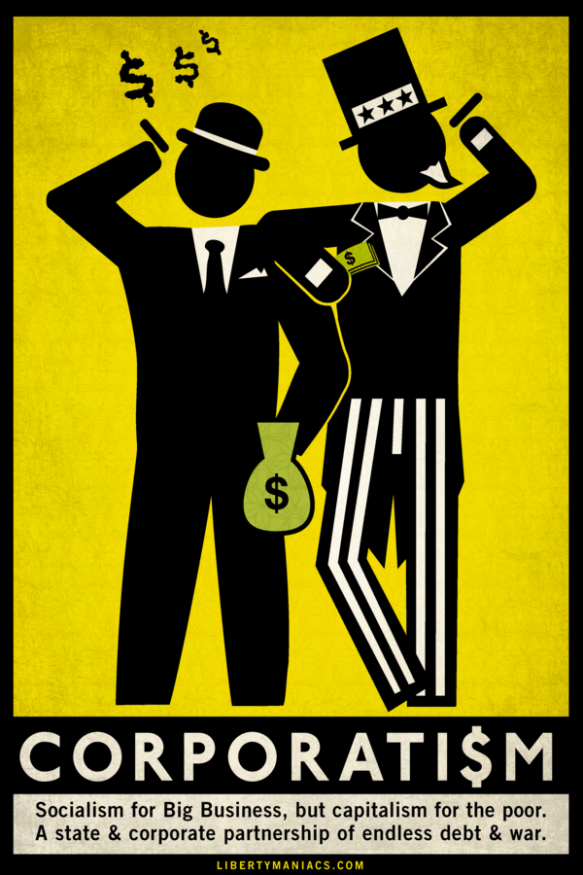
What Lies Beyond Capitalism and Socialism?

By Charles Hugh Smith

Source: Of Two Minds

The status quo, in all its various forms, is dominated by incentives that strengthen the centralization of wealth and power.

As longtime readers know, my work aims to 1) explain why the status quo — the socio-economic-political system we inhabit — is unsustainable, divisive, and doomed to collapse under its own weight and 2) sketch out an alternative Mode of Production/way of living that is sustainable, consumes far less resources while providing for the needs of the human populace — not just for our material daily bread but for positive social roles, purpose, hope, meaning and opportunity, needs that are by and large ignored or marginalized in the current system.

One cognitive/emotional roadblock I encounter is the nearly universal assumption that there are only two systems: the State (government) or the Market (free trade/ free enterprise). This divide plays out politically as the Right (capitalism, favoring markets) and the Left (socialism, favoring the state). Everything from Communism to Libertarianism can be placed on this spectrum.

But what if the State and the Market are the sources of our unsustainability? What if they are intrinsically incapable of fixing what’s broken?

The roadblock here is adherents to one camp or the other are emotionally attached to their ideological choice, to the point that these ideological attachments have a quasi-religious character.

Believers in the market as the solution to virtually any problem refuse to accept any limits on the market’s efficacy, and believers in greater state power/control refuse to accept any limits on the state’s efficacy.

I often feel like I’ve been transported back to the 30 Years War between Catholics and Protestants in the 1600s.

I’ve written numerous books that (in part) cover the inherent limits of markets and the state, so I’ll keep this brief. Markets are based on two premises: 1) profits are the key motivator of human activity and 2) whatever is scarce can be replaced by something that is abundant (for example, when we’ve wiped out all the wild Bluefin tuna, we can substitute farmed catfish.)

But what about work that creates value but isn’t profitable? This simply doesn’t compute in the market mentality. Neither does the fact that wiping out the wild fisheries disrupts an ecosystem that is essentially impossible to value in terms that markets understand: in a market, the supply and the demand in this moment set the price and thus the value of everything.

But ecosystems simply cannot be valued by the price set in the moment by current supply and demand.

As for the state, its ontological imperative is to concentrate power, and since wealth is power, this means concentrating political and financial power. Once bureaucracies have concentrated power, insiders focus on securing budgets and benefits, and limiting transparency and accountability, as these endanger the insiders’ power, security and perquisites.

Both of these systems share a single quasi-religious ideology: a belief that endless economic growth is an intrinsic good, for it is the ultimate foundation of all human prosperity. In other words, we can only prosper and become more secure if we’re consuming more of everything: resources, credit, energy, and so on.

The second shared ideological faith is that centralizing wealth and power are not just inevitable but good. In other words, Left and Right share a single quasi-religious belief that centralization is not just inevitable but positive; the only difference is in who should hold the concentrated wealth/power, private owners or the state.

This ideology assumes a winner take most structure of winners and losers, with the winnings being concentrated in the hands of a few at the top of the Winners. Thus rising inequality and divisiveness are assumed to be the natural state of any economy.

This ideology underpins the entire status quo spectrum. The “growth at any cost is good” part of the single ideology underpinning the status quo is captured by the 1960 Soviet-era film Letter Never Sent; in its haunting, surreal final scene, a character envisions a grand wilderness untouched by human hands transformed into an industrial wasteland of belching chimneys and sprawling factories. This was not a nightmare–this was the Soviet dream, and indeed, the dream of the “growth at any cost is good” West.

Simply put, the status quo of markets and states is incapable of DeGrowth, i.e. consuming less of everything, including credit, “money”, profits, taxes—everything that fuels both the state and the market. As I have taken pains to explain, it doesn’t matter if a factory is owned by private owners or the state: the mandate of capital is to grow. If capital doesn’t grow, the resulting losses will sink the enterprise—including the state itself.

What lies beyond “growth at any cost” capitalism and socialism? My answer is the self-funded community economy, a system that is self-funded (i.e. no need for a central bank or Treasury) with a digital currency that is created and distributed for the sole purpose of funding work that addresses scarcities in local communities.

I outline this system in my book A Radiocally Beneficial World: Automation, Technology and Creating Jobs for All.

Rather than concentrate power in the hands of state insiders, this system distributes power to communities are participants. Rather than concentrate the power to create currency for the benefit of banks and the state, this system distributes the power to create currency for the sole benefit of those working on behalf of the community, on projects prioritized by the community.

This community economy recognizes that some work is valuable but not profitable. The profit-driven market will never do this work, and the central state is (to use Peter Drucker’s term) the wrong unit size to ascertain each community’s needs and scarcities.

Clearly, we need a socio-economic-political system that has the structure to not just grasp the necessity of DeGrowth and positive social roles (work benefiting the greater community) but to embrace these goals as its raison d’etre (reason to exist).

Human activity is largely guided by incentives, both chemical incentives in our brains and incentives presented by the society/economy we inhabit. In the current system, concentrating power and wealth in the hands of the few at the expense of the many and wasting resources / destroying ecosystems are incentivized if the activity is profitable to some enterprise or deemed necessary by the state.

In the current system, the state incentivizes protecting its wealth and power and the security/benefits of its insiders, and markets incentivize maximizing profits by any means available.

As I have explained many times in the blog and my books, we inhabit a state-cartel economy: the most profitable form of enterprise is the quasi-monopoly or cartel that limits supply and competition in order to extract the maximum profit from its customers.

Monopolies (or quasi-monopolies such as Google, which holds a majority share of global search revenues, excluding China) and cartels quickly amass profits which they then use to secure protection of their cartel from the state via lobbying, campaign contributions, etc. The elites controlling the state benefit from this arrangement, and so the system inevitably becomes a state-cartel system dominated by the state and private sector cartels and incentives that benefit the wealth and power of these institutions.

Once we understand the inevitability of this marriage of state and cartel, we understand socialism and capitalism–the State and Markets–are the yin and yang of one system. Reformers may recognize some of the inherent limits of the state and the market, but they believe these problems can be solved by tweaking policies–in systems-speak, modifying the parameters of the existing subsystems of lawmaking, the judiciary, regulatory agencies, and so on.

But as Donella Meadows explained in her classic paper, Leverage Points: Places to Intervene in a System tweaking the parameters doesn’t actually change the system. For that, we must add a new feedback loop.

The status quo, in all its various forms, is dominated by incentives that strengthen the centralization of wealth and power, increase inequality and divisiveness and the permanent expansion of consumption and credit. That this path leads to implosion / collapse does not compute because the status quo is constructed on the fundamental assumption that permanent growth/expansion of consumption, credit, wealth and state power is not just possible but necessary.

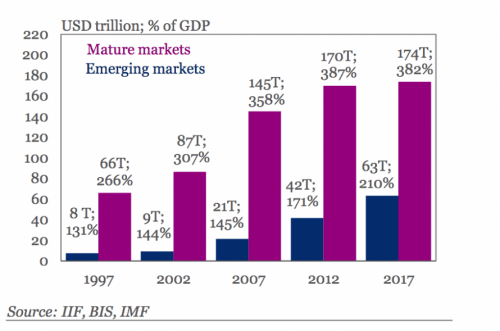
As many of us have labored to show, the financial system has been pushed to unprecedented extremes to maintain the illusion that rapid growth of consumption and credit can be maintained essentially forever.

We need an alternative system that’s built on sustainable incentives and feedback loops so we have a new blueprint to follow as the current arrangement unravels in the next decade or two.

Security and prosperity are worthy goals, but the means to achieve them, as well as the definition of security / prosperity, must be reworked from the ground up. We need to include positive social roles and meaningful work as essential components of security/prosperity.

My conception of a Third / Community Economy does not replace either the state or the free-enterprise market; rather, it does what neither of the existing structures can do. It adds opportunity, purpose, positive social roles and earned income for those left out of the state/cartel/market economy.

American Public Troubled by ‘Deep State’

By John V. Walsh

Source: ConsortiumNews.com

“Public Troubled by Deep State” is the headline that the Monmouth University Polling Institute tags to its recent poll.  Acknowledging that polling about the term “Deep State” is problematic because “few Americans (13%) are very familiar with the term ‘Deep State,’” the pollsters at Monmouth defined the term as follows for their interviewees: “The term Deep State refers to the possible existence of a group of unelected government and military officials who secretly manipulate or direct national policy.”

Then they asked whether such a group exists.

Monmouth reports the results as follows: “Nearly 3-in-4 (74%) say they believe this type of apparatus exists in Washington. This includes 27% who say it definitely exists and 47% who say it probably exists. Only 1-in-5 say it does not exist (16% probably not and 5% definitely not).”

These opinions do not follow a partisan divide. The report explains that belief in the Deep State’s existence “comes from more than 7-in-10 Americans in each partisan group, although Republicans (31%) and independents (33%) are somewhat more likely than Democrats (19%) to say that the Deep State definitely exists.”

This leads the director of the independent Monmouth University Polling Institute, Patrick Murray, to volunteer: “We usually expect opinions on the operation of government to shift depending on which party is in charge. But there’s an ominous feeling by Democrats and Republicans alike that a ‘Deep State’ of unelected operatives are pulling the levers of power.”

In addition, there are some significant but not drastic racial and ethnic differences on this question. Says the report, “Americans of black, Latino and Asian backgrounds (35%) are more likely than non-Hispanic whites (23%) to say that the Deep State definitely exists.”

The report also asked about government surveillance of the citizenry and here again there is widespread concern: Fully 8-in-10 believe that the U.S. government currently monitors or spies on the activities of American citizens, including a majority (53%) who say this activity is widespread and another 29% who say such monitoring happens but is not widespread. Just 14% say this monitoring does not happen at all. There are no substantial partisan differences in these results.

This too causes the director of the Institute to be concerned.  “This is a worrisome finding. The strength of our government relies on public faith in protecting our freedoms, which is not particularly robust. And it’s not a Democratic or Republican issue. These concerns span the political spectrum,” says director Murray.

We can add to the concern about a manipulative unelected apparatus at work in the government the widespread distrust of the press summarized in this recent Gallup/Knight poll:

“*Today, 66% of Americans say most news media do not do a good job of separating fact from opinion. In 1984, 42% held this view.

“*Less than half of Americans, 44%, say they can think of a news source that reports the news objectively.

“*On a multiple-item media trust scale with scores ranging from a low of zero to a high of 100, the average American scores a 37.”

This paints a pretty grim picture of trust in both our government and our media.  Perhaps “Deep Media” should be a term added to “Deep State.”

But perhaps it is cause for optimism. It seems that people are waking up and thinking for themselves. This is, perhaps, good news for those who are trying to end U.S. wars being ginned up by the Deep State.


John V. Walsh can be reached at john.endwar@gmail.com

Power Corrupts: A Culture of Compliance Breeds Despots and Predators

President Bill Clinton and Miramax Chief, Harvey Weinstein at Hillary Clinton’s Birthday Party at the Hudson Hotel in New York City. October 25, 2000 (Photo: Nick Elgar/ImageDirect)

By John W. Whitehead

Source: The Rutherford Institute

“All governments suffer a recurring problem: Power attracts pathological personalities. It is not that power corrupts but that it is magnetic to the corruptible.”― Frank Herbert

Power corrupts.

Worse, as 19th-century historian Lord Acton concluded, absolute power corrupts absolutely.

It doesn’t matter whether you’re talking about a politician, an entertainment mogul, a corporate CEO or a police officer: give any one person (or government agency) too much power and allow him or her or it to believe that they are entitled, untouchable and will not be held accountable for their actions, and those powers will eventually be abused.

We’re seeing this dynamic play out every day in communities across America.

A cop shoots an unarmed citizen for no credible reason and gets away with it. A president employs executive orders to sidestep the Constitution and gets away with it. A government agency spies on its citizens’ communications and gets away with it. An entertainment mogul sexually harasses aspiring actresses and gets away with it. The U.S. military bombs a civilian hospital and a school and gets away with it.

Abuse of power—and the ambition-fueled hypocrisy and deliberate disregard for misconduct that make those abuses possible—works the same whether you’re talking about sexual harassment, government corruption, or the rule of law.

For instance, 20 years ago, I took up a sexual harassment lawsuit on behalf of a young woman—a state employee—who claimed that her boss, a politically powerful man, had arranged for her to meet him in a hotel room, where he then allegedly dropped his pants, propositioned her and invited her to perform oral sex on him.

Despite the fact that this man had a well-known reputation for womanizing and this woman was merely one in a long line of women who had accused the man of groping, propositioning, and pressuring them for sexual favors in the workplace, she was denounced as white trash and subjected to a massive smear campaign by the man’s wife, friends and colleagues (including the leading women’s rights organizations of the day), while he was given lucrative book deals and paid lavish sums for speaking engagements.

William Jefferson Clinton eventually agreed to settle the case and pay Paula Jones $850,000.

Here we are 20 years later and not much has changed.

We’re still shocked by sexual harassment in the workplace, the victims of these sexual predators are still being harassed and smeared, and those who stand to gain the most by overlooking wrongdoing (all across the political spectrum) are still turning a blind eye to misconduct when it’s politically expedient to do so.

This time, it’s Hollywood producer Harvey Weinsteinlongtime Clinton associate and a powerhouse when it comes to raising money for Democrats—who is being accused of decades of sexual assaults, aggressively sexual overtures and harassment.

I won’t go into the nauseating details here. You can read them for yourself at the New York Times and the New Yorker.

Suffice it to say that it’s the same old story all over again: man rises to power, man abuses power abominably, man intimidates and threatens anyone who challenges him with retaliation or worse, and man gets away with it because of a culture of compliance in which no one speaks up because they don’t want to lose their job or their money or their place among the elite.

From what I’ve read, this was Hollywood’s worst-kept secret.

In other words, everyone who was anyone knew about it. They were either complicit in allowing the abuses to take place, turning a blind eye to them, or helping to cover them up.

It’s not just happening in Hollywood, however.

And it’s not just sexual predators that we have to worry about.

For every Harvey Weinstein (or Roger Ailes or Bill Cosby or Donald Trump) who eventually gets called out for his sexual misbehavior, there are hundreds—thousands—of others in the American police state who are getting away with murder—in many cases, literally—simply because they can.

The cop who shoots the unarmed citizen first and asks questions later might get put on paid leave for a while or take a job with another police department, but that’s just a slap on the wrist. The shootings and SWAT team raids and excessive use of force will continue, because the police unions and the politicians and the courts won’t do a thing to stop it. Case in point: The Justice Department will no longer attempt to police the police when it comes to official misconduct. Instead, it plans to give police agencies more money and authority to “fight” crime.

The war hawks who are making a profit by waging endless wars abroad, killing innocent civilians in hospitals and schools, and turning the American homeland into a domestic battlefield will continue to do so because neither the president nor the politicians will dare to challenge the military industrial complex. Case in point: Rather than scaling back on America’s endless wars, President Trump—like his predecessors—has continued to expand America’s military empire and its attempts to police the globe.

The National Security Agency that carries out warrantless surveillance on Americans’ internet and phone communications will continue to do so, because the government doesn’t want to relinquish any of its ill-gotten powers. Case in point: The USA Liberty Act, proposed as a way to “fix” all that’s wrong with domestic surveillance, will instead legitimize the government’s snooping powers.

Unless something changes in the way we deal with these ongoing, egregious abuses of power, the predators of the police state will continue to wreak havoc on our freedoms, our communities, and our lives.

Police officers will continue to shoot and kill unarmed citizens. Government agents—including local police—will continue to dress and act like soldiers on a battlefield.

Bloated government agencies will continue to fleece taxpayers while eroding our liberties. Government technicians will continue to spy on our emails and phone calls. Government contractors will continue to make a killing by waging endless wars abroad.

And powerful men (and women) will continue to abuse the powers of their office by treating those around them as underlings and second-class citizens who are unworthy of dignity and respect and undeserving of the legal rights and protections that should be afforded to all Americans.

As Dacher Keltner, professor of psychology at the at the University of California, Berkeley, observed in the Harvard Business Review, “While people usually gain power through traits and actions that advance the interests of others, such as empathy, collaboration, openness, fairness, and sharing; when they start to feel powerful or enjoy a position of privilege, those qualities begin to fade. The powerful are more likely than other people to engage in rude, selfish, and unethical behavior.”

After conducting a series of experiments into the phenomenon of how power corrupts, Keltner concluded: “Just the random assignment of power, and all kinds of mischief ensues, and people will become impulsive. They eat more resources than is their fair share. They take more money. People become more unethical. They think unethical behavior is okay if they engage in it. People are more likely to stereotype. They’re more likely to stop attending to other people carefully.”

Power corrupts.

And absolute power corrupts absolutely.

However, it takes a culture of entitlement and a nation of compliant, willfully ignorant, politically divided citizens to provide the foundations of tyranny.

As researchers Joris Lammers and Adam Galinsky found, those in power not only tend to abuse that power but they also feel entitled to abuse it: “People with power that they think is justified break rules not only because they can get away with it, but also because they feel at some intuitive level that they are entitled to take what they want.”

That sense of entitlement and immunity from charges of wrongdoing dovetails with Richard Nixon’s belief that “when the President does it, that means that it is not illegal.”

For too long now, America has played politics with its principles and allowed the president and his colleagues to act in violation of the rule of law.

“We the people” are paying the price for it now.

Americans have allowed Congress, the White House and the Judiciary to wreak havoc with our freedoms. They have tolerated an oligarchy in which a powerful, elite group of wealthy donors is calling the shots. They have paid homage to patriotism while allowing the military industrial complex to spread death and destruction abroad. And they have turned a blind eye to all manner of wrongdoing when it was politically expedient.

This culture of compliance must stop.

The empowerment of petty tyrants and political gods must end.

For starters, let’s go back to the basics: the Declaration of Independence, the U.S. Constitution and the Bill of Rights.

Let’s recommit to abiding by the rule of law.

Here’s what the rule of law means in a nutshell: it means that everyone is treated the same under the law, everyone is held equally accountable to abiding by the law, and no one is given a free pass based on their politics, their connections, their wealth, their status or any other bright line test used to confer special treatment on the elite.

Let’s demand scrutiny and transparency at all levels of government, which in turn will lead to accountability.

We need to stop being victimized by these predators.

As I point out in my book Battlefield America: The War on the American People, I’m not just talking about the political predators in office, but the ones who are running the show behind the scenes—the shadow government—comprised of unelected government bureaucrats whose powers are unaffected by elections, unaltered by populist movements, and beyond the reach of the law.

There is no way to erase the scars left by the government’s greed for money and power, its disregard for human life, its corruption and graft, its pollution of the environment, its reliance on excessive force in order to ensure compliance, its covert activities, its illegal surveillance, and its blatant disdain for the rule of law.

“We the people”—men and women alike— have been victims of the police state for so long that not many Americans even remember what it is to be truly free anymore. Worse, few want to shoulder the responsibility that goes along with maintaining freedom.

Still, we must try.

Kafka Warned Us

By

Source: CounterPunch

Kafka’s The Trial can be read in retrospect as a prelude to the Twentieth/Twenty-First century. Although probably not written as prophecy, Kafka’s short unfinished book nevertheless provides a road map to the terrors of the current Surveillance State.

As readers of CounterPunch are all too familiar, modern man, as a single individual, is at the mercy of the modern state and those who, lurking in semi-secrecy, direct it.

Kafka’s The Trial superbly conveys the unease of our current existential situation.

Early one morning, The Trial’s main protagonist, Joseph K, awakes to find that, totally unexpectedly, he has been arrested. Throughout the book he endeavors to find the reason for his arrest without any definite success.

However, what he does discover is a vast semi-secret bureaucracy/organizaton whose inner workings and outward displays of power and decision making remain opaque at best.

Initally, Joseph K, believes that he lives in a “Rechtsstaat” (a state where the rule of law is respected) and thus where it is expected that all civilized norms and laws are upheld.

Yet, he soon comes to see that he has lived in a state of fundamental error and illusion about the true nature of his existence.

What appeared to him as a well ordered and just state is, all of a sudden, revealed to be a capricious omnipotent octopus capable of strangling (in this case literally) anyone deemed to be, for whatever reason, expendable.

All law is suspended or, at least, made a mockery of. All that remains are the inner, turgid demands of power.

Joseph K. is convinced of his innocence. But his conviction is no match for the monolithic power that stands against him. He is eventually crushed, if not by his enemy’s repetitive legal machinations, then by his fatalistic far-reaching administrative power.

In the end, the “Organization” which Joseph K has confronted is almighty and can be controlled by neither appeals to law, logic, or custom. In this, modern man is in a similar situation.

He stands, at any moment, beneath the mercy of a gigantic machinery that, if it wills, can almost casually set into motion his utter annihilation. The devastation and erasure of ones past, present, and future self is an ever-present possible function of the modern state. Advances in technology and organization make such a function all the more easier.

How to combat this greatest threat to humankind’s liberty will make the difference of whether or not future generations live in a world of securely grounded freedom or if they will succumb “like a dog” to the increasingly totalitarian powers of what we call today: the Surveillance State.

THE MADNESS OF WAR

By Julian Rose

Source: Waking Times

It is essential to constantly remind ourselves, that war, apart from a very few exceptions, is a symptom of madness. Yet war is a disease which is largely taken for granted; considered ‘normal’ and unless it involves a large swathe of humanity, ignored. How did we allow ourselves to be trapped by such insanity?

In 2017, wars are as prevalent as ever. They are being manifest in the Middle East, in Africa, in South America, and in a lesser form, in almost all countries of the World. They are the result of a failure to recognize that killing another is actually killing one’s self. A failure to grasp that humanity is a collective made up of millions of individuals, all of whom share a common ancestry and, on a subconscious plain, a common aspiration and destiny.

There is no victory in war. War is an admission of defeat. When humans resort to mass killing of each other we see an expression of failure, never success. Not so long ago war was glorified and, for the victor, held up as an expression of supreme national pride. In fact, such an attitude was predominant in the species for thousands of years.

However two World Wars put an end to the hubris. The levels of destruction were so great and so many millions died brutal and ugly deaths, that a kind of ‘war weariness’ set-in amongst the survivors, and a new sense of the futility of it all became integrated into societies which had undergone the experience. The world looked like it might have learned its lesson; people had pounded each other, and the natural environment, into a sickening pulp, and there was no glorious aftermath. Just a sense of what ‘peace’ could actually mean.

There were, and are, still some who find war ‘exciting’, whose own lives are too dull and routine to find any thrill in the act of daily living. They look-on at wars in foreign territories as extensions of their own angst and frustrations. Such individuals find temporary comfort in watching others die.

This condition is more prevalent than many might realize; it is symptomatic of a world crushed by meaningless routine and managed by those lacking any manifest vision of something more deeply fulfilling to awaken starved imaginations.

Of course, a history of war will reveal that whole civilizations were born and dissolved via victory and defeat on the battlefield. It was believed that these blood baths were a price worth paying for the great accumulation of national wealth which followed them, if one was on the winning side. It is sobering to reflect that much of the fine architecture of old Europe is a result of plundered wealth.

War is made no less destructive by the fact that it can now be carried out by people sitting in air-conditioned ‘cockpits’ in Houston. People trained to kill ‘at a distance’. People whose chance of being themselves attacked by those they target, being pretty much nil. This type of killing is one step away from the ‘robotic soldier’, the envisioned battle field of the future and a direct of extension of the war games kids (and adults) play on their electronic gizmos.

But look, it’s still the same underlying disease. It’s still the fascination with the idea of somehow ‘coming out on top’ and having it over ‘an inferior’. It’s still reveling in destruction, on all planes of planetary life.

Children play war games. I used to play ‘Cowboys and Indians’. I was indoctrinated into ‘war thinking’ from a very early age. It was just after World War Two, and life in Britain was steeped in stories of heroism carried out by ‘our boys’ against the Nazis. Toy soldier armies ranged against each other across the sitting room floor as parents looked on with quiet acceptance. We soon graduated on to ‘cap guns’ and staged mock battles around the garden bushes and trees.

But nobody got killed in these ‘war games’ and the ground wasn’t turned into a sea of craters and toxic mud by our childhood antics. Other matters eventually attracted our curiosity and interest, and the guns and bows and arrows were dumped, unlikely to be seen again.

If mankind would only grow up, the same situation would repeat around the world. Adult individuals, blessed with a little responsibility and the slimmest glimmer of wisdom, would ‘move on’ to areas of interest that expressed an eagerness to support the planet, and not destroy it. A wish to explore new horizons of consciousness, and not to regress into thoughtless thuggery. A desire to meet and enjoy the company of other races and nationalities, and not to put a gun to their heads.

How can this madness have gone on so long? How can war still ‘be taken for granted’ in 2017?

Even those who argue vociferously for cutting back excessive CO2 emissions on the planet, don’t call for an end to war and ‘war games’ that are responsible for a large part of these emissions. They fail to realize that here is to be found the single largest transmission of toxic CO2 when set against any other global activity. I’m including a brief summary of the US position in 2013, just to illustrate the point:

“According to its own study, in 2013 the Pentagon consumed fuel equivalent to 90,000,000 barrels of crude oil. This amounts to 80% of the total fuel usage by the federal government. If burned as jet fuel it produces about 38,700,000 metric tons of CO2. And the Pentagon’s figures do not include carbon produced by the thousands of bombs dropped in 2013, or the fires that burned after the jets and drones departed. ” (Counter Punch).

Most environmentalists and climate change campaigners also ‘take war for granted’, it seems. It has been etched into our bones by an endless indoctrination process. A process whose symptoms can also be found in the way we are urged to be ‘aggressive’ and ‘competitive’ in order to make progress within the demands of the status quo. How much of what is called ‘education’ is about bringing out our creative potential instead of our aggressive potential? And how much is about cramming us with the means to ‘succeed’ in the mostly cut throat world of business and indeed, almost all professions?

We see the symptoms of aggression in daily life, and fail to question it. Is it any wonder that we fail to question war?

War is the most favored tool of the controlling powers. It supplies the coffers of the military industrial complex with an endless demand for production of weapons. The state then gets the pay-off and looks for another war to keep the cycle of death going. It is also a valuable diversionary tool for distracting the general public, while unpopular and controversial issues are pushed through the system, with only a few noticing.

Of course a great prize for warmongers in general, is anticipation of the breaking out of mother of all wars. And indeed, the ever looming threat of genocide never seems far off at the hands of those who play with power the way children play with their toy guns and swords, but without any of the child’s creativity. Today, in the USA in particular, megalomania has become wedded with a sort of Russian Roulette approach to who might present the next useful target for a bombing run or drone attack.

Witness how high the stakes get set in this fiendish game. Witness the Russian Federation and President Putin being ever further provoked by the West to take an aggressive step that could trigger a mega war scenario. The vicious taunting, without a shred of evidence to give it credence, is a mark of the madness which all too often grips those in power. Those who are determined to diminish all of life to a poisoned arrow of fabricated fear, which, if ever launched, would take all of humanity with it.

Let us be sure to keep a close eye on those whom we elect to administer our countries. The intoxication which comes with power is a very dangerous addiction, particularly when the play things at such people’s disposal are weapons of mass destruction. We need, more than ever, to be able to recognize the symptoms of megalomania and not confuse it with ‘strong leadership’. It is a major weakness in the delivery of what is called democracy, that so many people are still so easily fooled by those ‘standing for election’.

We are being pushed by ‘anti-life’ forces, some of whose origins are less than human, to see the planet and its people as expendable. To accept lies, deception and crude power-play as something akin to ‘normal’. To feel that it is not in our powers to bring deep change to a washed-out and degraded status quo. To believe that war is an ‘acceptable’ way of shifting around the totems of power.

It’s time we not only woke up, but got out of bed too. The hour is late, and this should add a significant degree of urgency to our endeavors. Mankind is blessed with deep powers of positive potential and these powers are far greater than the force which drives the war mongering anti-life minority. We are close to a tipping point in the growth of conscious awareness amongst caring human beings.

The key will be to channel this awareness into taking measures to regain control of our destinies.

To rid this world of those who hold its fate in their numb, insensitive hands. To act in unison and to defy all efforts to divide and conquer our growing sense of purpose and endeavor.

We can and we will, put an end to the madness of war. We must not wait for war to put an end to us.


Julian Rose is an early pioneer of UK Organic farming, a writer, actor, social entrepreneur and international activist. During the 1970’s he worked in experimental theatre as actor and assistant director, co-founding the The Institute for Creative Development, in Belgium, teaching holistic thinking and dramatic art. In the 1980’s he returned to the UK to take over the family farm and convert it to an organic system. His experience as a leader in reviving rural economies throughout the 1990’s, led him to be invited to join the advisory board of the South East of England Development Agency, and the Country Land Owners Association. He also served on the Oxfordshire Economic Partnership and was founder-chairman of The Association of Rural Businesses in Oxfordshire. In 2,000 he led an innovative project to revive regionally important market towns as centres of vibrant local activity and hubs for rejuvenated local food initiatives.

Julian is a prolific writer and broadcaster, his articles appear in a wide diversity of journals and on-line sites. Visit www.julianrose.info to find out about Julian’s highly diverse life and acclaimed books ‘Changing Course for Life’ and ‘In Defence of Life’.

Do Psychopaths Run the World?

what-people-think-psychopaths-are-streetdemocracy

By Nick Parkins

Source: Waking Times

“Our society is run by insane people for insane objectives. I think we’re being run by maniacs for maniacal ends and I think I’m liable to be put away as insane for expressing that. That’s what’s insane about it.” ~John Lennon (1940-1980), English singer and songwriter

Lennon and others externalise the apparent paranoia that wells up inside us. “The world has gone mad!” More often than not we partition this voice off, content to view the world as others prescribe it. But who are these others, and what do they want?

The term psychopath is often criminally misjudged, thanks largely to unhelpful portrayals of sick, twisted and violent psycho-character types in the popular media. This has led, by way of public ignorance, to the common belief that the psychopath has no function, role or place in open society. A swift offload that allows us, the apparent sane majority, to circumvent our worst fears.

Any notion that the psychopath is incapable of functioning in open society is, according to M.E. Thomas1 – a self-confessed sociopath – flawed. The question is not the capacity to function, but rather what capacity or form that function takes. As Thomas says, psychopaths and sociopaths share an intertwined clinical history; both can function, they just do so differently. And though we are left to muse on what mask that function may take, in many social situations they excel.

Competition Wins Out

Jean-Baptiste de Lamarck was a French biologist who advocated a theory of evolution widely rebuked in establishment circles. Lamarck’s major work was published in the same year Charles Darwin was born – who would go on to supplant Lamarck’s theory 50 years later. In Lamarck’s world cooperation prevailed over Darwinian competition as the driving mechanism of evolution.

According to authors G. Greenberg and M.M. Haraway,2 it was Darwin’s view that served to reflect and sustain a Victorian society tied to free market, capitalist and imperial values. His model supported a dog-eat-dog, life is hard, code of practice; the scientific valediction of the natural world as played out on a brutal, cold and insensitive landscape. Arguably the perfect environment for the aspiring modern day psychopath, and a prevailing view that the poet Tennyson described as nature, red in tooth and claw.

Snakes & Ladders

Although diagnosing definitive psychopathy in individuals remains somewhat of a grey area, attempts have been made to categorise psychological traits that set psychopathic personalities apart. Most prominent is the diagnostic check-list devised by renowned Canadian psychologist Robert Hare that is used to determine a categorical diagnosis of clinical psychopathy, or at best a category score.

According to Hare’s list, psychopaths display superficial charm, unbridled ego, and pathological lying and cold, calculated cunning to entrance their prey. They are often impulsive and irresponsible, and exhibit an absence of empathy and remorseless lack of guilt. These and other attributes, such as criminal versatility and a marked capacity to manipulate, deceive and control, mark them out as dangerous. These are traits that enable psychopaths to move into high-ranking positions of power and influence.

“We know much less about corporate psychopathy and its implications,” explains New York psychologist Paul Babiak, “in large part because of the difficulty in obtaining the active cooperation of business organisations for our research.”3 A dilemma that Hare disclosed to Jon Ronson, author of The Psychopath Test. “Prisoners are easy,” states Hare. “They like meeting researchers. It breaks up the monotony of their day. But CEOs, politicians…”4 According to Hare, these sharks are a different kettle of fish.

A rare study on psychopathy in the workplace conducted by Babiak, Neumann and Hare5 suggests that 1 in 25, or 4 per cent, of corporate executives display significant personality traits typical of psychopathy – an incidence four times that estimated in the general population. The study supports the claim that psychopaths can and in fact do achieve high ranking corporate status. We are left to speculate, but Hare concedes Wall Street may harbour 1 in 10 attracted to lucrative watering holes that are poorly regulated.6Factor this in and it’s not hard to see how the very lifeblood and identity of corporations and financial institutions can often run cold.

Arguably most startling, the study indicates that despite being classed as substandard managers, team players and attracting poor performance appraisals, executives that met the clinical threshold of psychopath were valued by their immediate superiors as creative and innovative, as good communicators and strategic thinkers.

In short, they may not always fly under the radar. Despite the blips, it is clear to American psychiatrist Hervey Cleckley7 that psychopaths possess the communication, persuasion and interpersonal skills to override any negative impacts on their career. A finding supported by the Babiak study: “some companies viewed psychopathic executives as having leadership potential, despite negative performance reviews and low ratings on leadership and management by subordinates.”8 According to the authors, this shows a proficiency to manipulate decision makers, a point made by psychologist Dennis Doren who observed in institutions the psychopath’s unerring ability to seek out and foster relationships with those of highest authority and demonstrate tremendous skill at influencing them.9

In many instances the chameleon-like ability of the psychopath to mimic its surroundings by reading and influencing colleagues through the art of deception, be it through self promotion or subtle persuasion, allows the snake charmer to hide his true skin and pass unchecked through social customs. Studies suggest psychopathy, in body or by proxy, can entrench itself at the top, but is this phenomenon relatively isolated, or has this scenario over the course of human history always prevailed?

As Above, So Below

As vice president and director of Governance Studies at the Brookings Institution, Darrell West analyses business and law school curricula, specifically, according to West “because business and law schools train the leaders of tomorrow.”10 In the course of his research West reviews course syllabi and conducts interviews with faculty members. He has also surveyed data on business and law school student perceptions. What he found was troubling.

“The social responsibility of business is to increase its profits,” states West, taking his lead from the title of a 1970 New York Times magazine article written by the highly-influential American economist and statistician, Milton Friedman. The article was unequivocal: according to Friedman, maximising shareholder value was a company’s sole responsibility.11

“Many schools do not require stand alone courses that provide broad conceptions on the purpose of the corporation in society,” says West. Of those that do, “many focus on the purpose of the corporation, with emphasis on how to maximise shareholder value, especially in law schools.”12 Instruction therefore is key, notes West, and will colour a student’s view of the world. In fact, West concludes, “business school surveys show that after completing school, students are more likely to see shareholder value as the most important goal of the corporation.”13

It was not that Friedman was a prophet. In hindsight, according to West, he helped shape the outlook of numerous business leaders, academics, and thought-leaders that ultimately served to affect America’s modern sense of purpose of the corporation. An inherent identity that helps shape the way business and law school students view their, often times, lack of responsibility to society even today.

In the real world, inevitable coldly-calculated equations play out on the one side to maximise profit and on the other to minimise loss. And like most mathematical equations they make little or no sense to the layman.

“Can you buy what you already own?” This was the equation facing all concerned when Canadian-based Nautilus Minerals Inc. purchased the licence in 2011 from the “Independent State of Papua New Guinea” (PNG) to mine deep-sea vent fields in sovereign waters off the country’s coastline. The answer, morally, of course, is no.

According to Sir Julias Chan, current Governor of New Ireland province in PNG, ethics are an intangible commodity, and unlike cold hard currency rarely stack up. “First, the state cedes exploration and production rights to foreign companies for next to nothing,” says Chan. In the case of PNG 10,000 kina, equivalent to US$4,000. “For this pittance, the foreign developer gets full control of all the wealth that can be taken from the ground.”14

“The next step is for the state to seek equity in the project, usually 30 percent in a mining project and 22.5 per cent in an oil or gas project,” explains Chan. “The state has ‘given away’ the entire resource to a foreign company, and now returns to buy what was already legally its own property, for a 30 percent interest in the project.” To PNG this meant 300 million kina, or US$118 million. “And, to do so, the state usually takes out a commercial loan rate that puts the country further into debt at high interest.”15 Today a common event whereby the state acts to castrate itself and its people to high finance.

Joel Bakan is a professor of law at the University of British Columbia, Canada. While those that run corporations are for the most part, good, moral people, says Bakan, the duty of the corporate executive is to the corporation’s business interests first and foremost. “The money they manage is not theirs,” explains Bakan. “They can no sooner use it to heal the sick… or buy a villa in Tuscany.” In the corporate world, good people are encouraged to behave badly. In fact, the sum of corporate parts are “singularly self interested and unable to feel genuine concern for others in any context. The corporation, like the psychopathic personality it resembles, is programmed to exploit others for profit.”16

Under such terms it is not difficult to envisage how a system can soon come to value and mimic its most deviant parts. Equally, how the parts over time can come to be shaped by the whole.

It’s Behind You

According to philosopher and author Aaron James, while the psychopath feigns moral action as a tool to manipulate others, the arsehole could well be a butt of equal contention. Unlike the prototypical psychopath, says James, the arsehole “traffics in and is moved by moral justification,” which leads to an “entrenched sense of special entitlement.”17

The perfect example, according to James, is Apple founder Steve Jobs who saw his sole obligation to society as implicitly tied to producing the products his consumers desired. James notes what Jobs’s best friend, Jony Ive, once told Business Insider: “when he’s frustrated… his way to achieve catharsis is to hurt somebody. And I think he feels he has a liberty and license to do that,” said Ive. “The normal rules of social engagement, he feels, don’t apply to him.”18

Worryingly, James says, “the arsehole’s reasoning is shaped by the moral justification his surrounding culture makes available to him.”19 For instance, according to Hare, many white-collar criminals are psychopaths. “They flourish because the characteristics that define the disorder are actually valued,” asserts Hare. “When they get caught, what happens? A slap on the wrist, a six-month ban from trading, [oh] and don’t give us the $100 million back.”20

Accordingly, not only does corporate culture control net arsehole production, but the quality of butt-heads produced. And, depending on the culture, says James, “an arsehole can be better or worse behaved than a psychopath.”21 A consoling thought.

Arguably it is no more comforting to know that the psychopath you had fingered all along is really an arsehole nurtured by a system that is, by way of inherent nature, socially deviant. If the reasoning of a typical arsehole is moved by moral justification, taken from his surrounding environment, then the ability of a psychopathic culture and/or system to shape its own governing class is implied.

They Gave Us Their Mind

The enduring strength of psychopathy lies in its ability to manipulate how others perceive it. But the innate ability of the psychopath or the system to shape our perceptions is not, in itself, entirely the reserve of the clinical psychopath.

We all play our part in the masquerade. Many of us partake in cosmetic enhancements and props that support our ego’s waltz through this porcelain world. Whatever the score, the Hare check-list has a number picked out for us all. In its pursuit of ultimate control, this is the greatest achievement of psychopathy; after all, what better way to predict by response a person or group, than to give them your mind?

The competitor’s urge to win at all cost is certainly pervasive. So, too, the trend of irresponsibility, most evident in the compensation culture that has crept into the social mindset, thanks to laws that restrict a person’s capacity to develop by way of ethics and moral concepts of right and wrong. How can you take responsibility for thoughts and concepts that are not your own? In the broad, rules and regulations teach us to hand over our power, a transaction that re-enforces itself in society according to Thomas. She says that given the choice between having power and giving it up to a ‘trusted’ entity, people often choose to give it up rather than take the responsibility that comes with it.22

In its apparent, endless quest to reinvent society in its own image, psychopathy perhaps has more than one expression. Recent research into social media habits throws up disturbing correlations between heavy Facebook use and socially aggressive narcissism. In one study users that scored highly on a Narcissistic Personality Inventory questionnaire, reports Damien Pearse, “had more friends on Facebook, tagged themselves more often and updated their news-feeds more regularly.” The research, the report states, “comes amid mounting evidence that young people are becoming increasingly narcissistic, and obsessed with self-image and shallow friendships.”23

In the same breath the media have ‘jokingly’ jumped on those abstaining from Facebook as highly suspicious and suspect – they could have something to hide. Facebook use is, of course, prevalent and ‘normal’.

An infinite number of media streams exist that entice us to see our reflection, drawing us into powerful undercurrents, and buffeting us from one bank to the next. We surface only to take breath, disorientated and confused, disconnected from our natural cues. But perhaps that’s the idea. Certainly it is the innate need to control and the power to wield it, at whatever cost, and without care, that fractures the pathological mind from the rest of us.

The God Complex

“Those who rise to power in the corporatocracy, are control freaks, addicted to the buzz of power over other human beings.” ~Bruce Levine, social critic & psychologist

In a competitive world there will always be those who actively seek out, justify or embrace traits of psychopathy as a route to success. For a surgeon, a cold detachment and cool head has its place. But glorifying the psychopath is a perilous path to tread. According to psychologist Linda Mealey, competition only serves to increase the use of antisocial and Machiavellian strategies and counteracts any increase in pro-social behaviour after success.

Spiralling societal separation, and re-enforcing detachment, sets a dangerous precedent, what James refers to as a sense of “entitlement born of cosmic grandiosity.”24 He cites oil baron John D. Rockefeller who viewed his wealth not in some Wild West American capitalist context that gave him free rein, but unapologetically, by divine right: “God gave me my money,”25 said Rockefeller.

This sense of divine entitlement, being chosen, as apart from society, has deeply disturbing parallels to contemporary wealth.

Jeff Greene is a multi-billionaire property investor and entrepreneur, and owns reportedly America’s most expensive home. Greene, who made his fortune betting on sub-prime mortgages, says Americans need to have “less things”: “America’s lifestyle expectations are far too high and need to be adjusted, so we have less things and a smaller, better existence,” lectured the 60-year old, who lets out the $195 million palatial estate in Beverly Hills to royal families and international dignitaries for hundreds of thousands of dollars a month.26

At its heart, assuming it had one, departments within the system, be they political, corporate or financial, select by lineage this mind; one willing to create, support and maintain it. “Figures such as J.P. Morgan, Randolph Hearst, and Mayer Rothschild,” argues author Stefan Verstappen, “are professional psychopaths that reach the pinnacle of the financial stage where they cause no less misery and destruction as their political counterparts.”27

As a result, examples of psychopathic conduct in high office are commonplace. Robert Kirkconnell is a decorated US Air Force combat veteran of 27 years, and an outspoken critic of the US government MK-ULTRA program that conducted a battery of callous psychological or ‘mind control’ tests on its own citizens. In American Heart of Darkness, Kirkconnell charges the presidential Rockefeller Commission, set up to investigate the CIA’s activities, which he says funded the program. Kirkconnell no longer sees his home as a constitutional republic, but as a pathocracy run by psychopaths.

Contagious Psychopathic Worldviews?

“I had to win at all costs, sometimes allowing the costs to flow unchecked, just to see the volume of my power.” ~M.E. Thomas

“Power is all I have ever really cared about in my life,” states Thomas. “Physical power, the power of being desired or admired, destructive power, knowledge, invisible influence. I like people enough that I want to touch them, mould them, ruin them,” says Thomas. “I want to exercise my power.”28 It’s nothing personal. It’s dietary. The idea of ruining people, she says, is simply delicious.

Thomas is not unique. The psychopath invariably plays with its food. In the process actively seeking to visit misfortune or suffering on others. Thomas regards herself as a white tiger – a beautiful and exotic pet but inherently dangerous. And whilst in her own words she considers herself tamed, inside she continues to grapple with a primal urge to destroy.

This mindset is not lost on society. In fact, it is a worldview captured succinctly in Michael Ellner’s personal state of the world address: “Just look at us,” he asks. “Everything is backwards, everything is upside down. Doctors destroy health, lawyers destroy justice, psychiatrists destroy minds, scientists destroy truth, major media destroys information, religions destroy spirituality and governments destroy freedom.” You can see his point. But to what extent does this world talked of by Ellner stem solely from blind pursuit of power and profit?

Is there a hidden systemic malevolence that creates fear and uncertainty; the chaos to warrant this chase? Is the malevolent mist, that evil intent we ascribe to heinous acts and misdeeds, illusory, an epiphenomena, a by-product of the psychopath brain? Or is it real, autonomous, and guiding the program? And does this distinction matter? Does it help us interpret, say, the rise in chronic illness, its origins and how the healing profession has become, as critics claim, a public relations buzz-term; managing symptoms for profit?

The world of Kirkconnell swings into focus. Are we all victims of systemic programming; of disorientation; an imbalance the predator incites in us to maintain and enforce its position and status?

Like a god, so much of what psychopathy is and does hides in plain sight. The psychopath appeals to its prey’s sense of empathy and faith in humanity. He is the blank slate onto which people project their hopes and ideals.

This realisation must dawn if we are to expose systemic psychopathy and confront wildly sinister possibilities, not least the darker identities and underlying motives upon which it is based.

Darwin Dorr is the director of research into psychopathology at Wichita State University, Kansas. “The majority of paedophiles are psychopathic,” says Dorr, “or at least manifest to a significant degree the psychological characteristics of psychopathy.”29

Such ties that bind power to its perversions are historic, endemic and persist to this day. Investigations surrounding an elite Sydney paedophile ring are only the tip of a cold and callous iceberg that threatens to sink a titanic raft of untruths. In the UK, the reputation of once respected DJ, television presenter, and establishment confidante, Jimmy Savile, sank when his penchant for children, dead bodies, and satanic rituals and foreplay was disclosed to a shocked population.

Questions are now being asked outside UK Home Office circles and its curious taste for celebrity trash cans. All of a sudden the term psychopath seems no longer sufficient. Are such people, the system they represent, and the entities they mimic and worship, beyond a check-list? Certainly UK and wider establishment attempts to stymie the truth only serve to disclose further the covert means and amoral control by which psychopathy operates as an integral part of the system.


Nick Parkins has a master’s degree in philosophy of the mind and likes to live outside the box. To read his work, or if you have a strange or unexplained experience you would like him to cover visit www.nickparkins.co.uk.

The above article appeared in New Dawn 152 (Sept-Oct 2015).

If you appreciate this article, please consider a digital subscription to New Dawn.

Footnotes

  1. M.E. Thomas, Confessions of a Sociopath: A Life Spent Hiding In Plain Sight, Crown Publishing Group, 2013
  2. G. Greenberg, M.M. Haraway, Comparative Psychology: A Handbook, Garland Reference Library of Social Science, Routledge, 1998
  3. P. Babiak, C.S. Neumann, R.D. Hare, “Corporate psychopathy: Talking the walk,” Behavioural Sciences and the Law, at http://web.natur.cuni.cz/~houdek3/papers/Babiak et al 2010.pdf
  4. J. Ronson, The Psychopath Test: A Journey Through the Madness Industry, Picador, 2011
  5. P. Babiak, C.S. Neumann, R.D. Hare, op. cit.
  6. R. Hare, www.hare.org/comments/comment2.html
  7. H.M. Cleckley, The Mask of Sanity: An Attempt to Clarify Some Issues About the So Called Psychopathic Personality, Mosby, 1976
  8. P. Babiak, C.S. Neumann, R.D. Hare, op. cit.
  9. B.J. Board, K. Fritzon, “Disordered personalities at work,” Psychology, Crime and Law, Vol. 11(1), 17-32, with reference to D. Doren, Understanding and Treating the Psychopath, Wile, 1987
  10. D. West, “The purpose of the corporation in business and law school curricula,” Governance Studies at Brookings, www.brookings.edu/~/media/research/files/papers/2011/7/19 corporation west/0719_corporation_west.pdf
  11. M. Friedman, “The Social Responsibility of Business is to Increase its Profits,” New York Times Magazine, 13 September 1970
  12. D. West, op. cit.
  13. D. West, op. cit.
  14. “PNG Leadership has been poor steward of resources,” The National, 20 April 2011, www.roland-seib.de/05/Seib-Pressespiegel-1.5.11.pdf
  15. Ibid.
  16. J. Bakan, The Corporation: The Pathological Pursuit of Profit and Power, Free Press, 2004
  17. A. James, “Ass-holes: a theory,” Nicholas Brealey Publishing, 2013
  18. D. Love, “16 Examples of Steve Jobs being a jerk,” Business Insider, 25 October 2011, www.businessinsider.com/steve-jobs-jerk-2011-10
  19. A. James, op. cit.
  20. R. Hercz, “Psychopaths among us,” www.hare.org/links/saturday.html
  21. A. James, op. cit.
  22. M.E. Thomas, op. cit.
  23. D. Pearse, “Facebook’s dark side: study finds link to socially aggressive narcissism,” The Guardian, 17 March 2012, www.theguardian.com/technology/2012/mar/17/facebook-dark-side-study-aggressive-narcissism
  24. A. James, op. cit.
  25. www.bartleby.com/73/1207.html
  26. J. Christie, “Multi-billionaire who gave a lecture about American’s ‘needing to have less things and live a smaller existence’ owns a staggering FIVE mansions…”, Daily Mail, 24 January 2015
  27. S. Verstappen, Defense Against the Psychopath: A Brief Introduction to Human Predators, Woodbridge Press, 2011
  28. M.E. Thomas, op. cit.
  29. D. Dorr, “The pedophile as psychopath,” 1998, in T. Millon, E. Simonsen, & M. Birket-Smith (Eds.), Psychopathy: Antisocial, Violent, and Criminal Behavior, 304-320, Guilford Press
  30. P. Gilbert, “An introduction to the theory and practice of compassion-focused therapy and compassionate mind training for shame based difficulties,” The Compassionate Mind Foundation, www.compassionatemind.co.uk/downloads/training_materials/1.Workbook_2010.pdf
  31. P. Gilbert, op. cit.