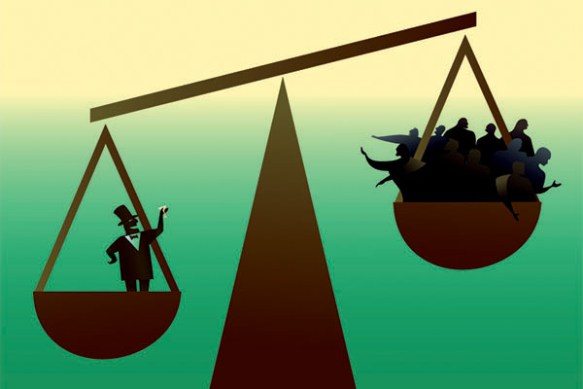
What You May Not Know About Today’s Economic War

By Phil Butler

Source: New Eastern Outlook

Many people believe the world is spiraling in a downward freefall toward Armageddon. At the same time billions on Earth feel the sting of crippling poverty, sanctions, and austerity imposed by the elites – the numbers of billionaires have risen geometrically. And so have those billionaire’s profits. It’s time we took a closer look at where we stand as of 2018, if we are to be left anything at all to cling to. From the steppes of Russia to the ancient lands of the Minoans, economic terror now reigns.

When I left Germany for Greece several months ago, the common belief there was that the “lazy Greeks” were part of the cause of Deutsche banker discomfort. My neighbors in Germany’s oldest city of Trier honestly believe the bailout of Greece is because Greeks unwilling to work hard. The bitter irony of this believe lies in the fact the average German would melt under the workload of the average citizen here in Heraklion on Crete. As an American what I witnessed in Germany can only be considered a “part-time” employment state. But here in Greece the average person works seven days a week, and usually at more than one job. This microeconomic perception is one that has been implanted by state and corporate controlled media in Germany. There’s a very good reason for this, which I will now explain.

A New Secret Economic Weapon – Organized Failures

The International Monetary Fund, the German and American bankers, the globalist elites who control financial systems in the so-called “west” – they’ve been on a mission since 2008. The “meltdown” of markets when Barack Obama first took office as American president was not some random and chaotic economic mistake. Wall Street and the global markets were turned upside down on purpose. In his book “Secret Weapon”, the CEO of Freeman Global Holdings and a New York Times bestselling author Kevin Freeman presents a persuasive chain of evidence pointing to the fact the crash of September 2008 was the result of a deliberate and well-prepared act of sabotage. Even though the author blames competing governments like China and Iran for what he terms “economic terrorism”, his proofs and theories are correct in so far as the “meltdown” being on purpose. The fact Freeman is founder and chairman of the NSIC Institute, and a Senior Fellow of the Center for Security Policy suggests his work may be a double dealing by the financial community to obscure the real perpetrators. But for my report it’s more important to follow the trail of financial chaos to our financial reality.

Freeman is not alone in his suggestion the economic crisis was a conspiracy. The financial disaster of 2008 costs Americans nearly $20 trillion dollars, as framed in this Forbes piece by investment banker and former Forbes editor, Robert Lenzner. In the report the financial guru inadvertently points the finger at Goldman Sachs and Citigroup, claiming the Greenspan Treasury allowed them to “master their own appetite for profits,” which in turn led to the various collapses that forced the American people to bail out the banks. Lenzner, to his great credit, goes on to describe the lurking dangers for total collapse we still face. But what about Greece, the rest of Eastern Europe, the Germans and the rest of the indebted world? Who can we blame for destroying the futures of a billion people? When I’m done your come to realize the Nazis never lost World War II. Read on.

Win-Win or Lose-Lose for Ukraine

Ukraine was turned into a “scorched Earth” when Hitler’s operation Barbarossa threatened Russia. When the armies commanded by Joseph Stalin during the German Army’s invasion of the Soviet Union in the Second World War destroyed crops and goods in their path, the invaders found nothing to fuel their advance. Today Ukraine is laid waste by an economic Barbarossa where the Russians had no opportunity to defend the steppes. Some will remember Vice President Joe Biden’s son taking a position to reap Ukrainian energy benefits. Other readers may recall when a Franklin Templton investment fund, one controlled by the Rothschild bankers, bought up 20% of Ukraine’s debts at junk bond prices. You see, the US orchestrated situation in Ukraine is not simply about events on the Maidan and the ongoing war in the Donbass as a byproduct of the geopolitics of the United States seeking to cut off Ukraine from Russia. Agri-giant Monsanto and other GMO companies had targeted Ukraine long before the events on Maidan Square, and the fact Ukraine is a Central hub in the supply of Russian gas to Europe cannot be under-stressed. Where foreign profiteering in Ukraine is concerned, this story on my blog tells of an Oakland Institute report where more than 1.6 million hectares of land in Ukraine went under the control of foreign-based corporations. This quote from the report makes my case for economic terrorism by the west for me:

“International financial institutions swooped in on the heels of the political upheaval in Ukraine to deregulate and throw open the nation’s vast agricultural sector to foreign corporations….Monsanto, Cargill, and DuPont, and how corporations are taking over all aspects of Ukraine’s agricultural system.”

These stories were more than two years ago. Today we see the catastrophic effects of the Euromaidan far from the battle front and the Donbass region’s pro-Russian separatists.

When I first learned that the forests in the Ukrainian Carpathians were being chopped to the ground back in 2016, the impending ecological disaster perpetrated by these globalist blood suckers hit home hard. This Counterpunch story tells the tale of a brand of liberty and democracy no Ukrainian can afford. Despite the aerial photos and other proofs Ukraine’s forests were being stolen from under the people, the Lviv Regional Forestry and Hunting Agency denied all such reports in customary Eastern European mafia form. The fact is, the Petro Poroshenko assisted in selling out Carpathian forests. Ecologists now predict an ecological Armageddon for western Ukraine. These photos from Censor.net prove the disaster in progress. This RT story on the firesale by the Poroshenko regime of 22 out of 34 state assets being put up for sale at a 60 percent discount leads us into the Greece situation, where the legacy of a people is up for grabs.

Those lazy Greeks! Funny, I just walked around the corner to the bakery here in Heraklion to get a coffee from the same lady I get coffee from every day. She was there Christmas, and I am sure she’ll be there behind the counter New Year’s Eve and New Year’s Day. The shopkeeper across the street, he sees Alexis Tsipras on TV and shoves an open hand toward Greece’s Prime Minister shouting; “Malaka!”, which can only be translated coldly as “jerk-off”. Also in the hotel lobby, at the donut house in the city center, and at each-and-every shop along Heraklion’s many retail districts, Greece officials are all Malakas (in ancient Greek – mentally ill) or worse. I’ll bet most Germans don’t know or care to know that the VAT in Greece is now 24%, and that the average shopkeeper pays 37% – 45% in income tax on top of the VAT for the goods they purchase. As crazy as it sounds though, Cretans are still especially friendly toward foreigners like me. If they only know what the German and American bankers did to them.

The Greece Fire Sale – A Tsipras Sellout

I just made a report about the great Greek sellout of privatization on my travel news site Argophilia Travel News this morning. Researching it prompted me to do this piece for NEO. The long and short of the Greek economic crash that was assisted by none other than Goldman Sachs, is that the same privatization the globalists had in store for Russia during the Yeltsin years is being exacted on Greeks. The latest sellout by Tsipras, who swore he’d end privatization, the Germans and Americans snapping up the Thessaloniki Port and the future of LNG shipments to Europe through Greece. I found it interesting that one of the principals in this sale, South Europe Gateway Thessaloniki (SEFT) Limited Director, Alexander von Mellenthin Has a distinguished German name. I’m not certain, but I believe he is a close relative of both General of the artillery, Horst Alexander, Alfred Paul von Mellenthin, and his brother, Major General Friedrich Wilhelm von Mellenthin, who served as Hitler’s chief of staff of the XXXXVIII Panzer Corps in the occupied Soviet Union, including the Battle of Kursk, the Battle of Kiev, and the spring 1944 retreat through the western Ukraine. The term “irony” will simply not do if Mellenthin is the son or grandson of a key Nazi general. Financial Blitzkrieg, Financial Armageddon, and the Fourth Reich finalizing the rape of Greece! Wow.

Regardless of whether or not the kin of old Nazis are expanding the Fourth Reich or not, the fact the European Commission, the International Monetary Fund and the European Central Bank have insisted on Greek and other privatization schemes as a condition for much-needed loans for bailouts is a smoking gun held by the same elites who always fuel wars. The fallacy of the “lazy Greek” lives on because of those who would reap the vast financial rewards of yet another deconstructed economy. It’s no coincidence that the Greek privatization plan’s administrator — the Hellenic Republic Asset Development Fund (TAIPED) — so closely resembles Germany’s Treuhandanstalt, or the agency charged with the privatization of East Germany’s state-owned enterprises following unification. Few readers will recall Treuhandanstalt being accused of turning over to West German big business hundreds of billions of Deutsche Marks in national property for little or nothing. And, though a number of Treuhandanstalt managers were ultimately indicted for corruption and embezzlement, this brand of pillaging has escalated in the Greece situation. There was even a plan back in 2014 to convert much of Greece’s protected coastal areas into “composite tourist villages,” a move which would essentially privatize every inch of valuable Greek seaside. Former Greek Finance Minister, Yanis Varoufakis called the Treuhandanstalt-like plan for Greece “an abomination” in this Huff Post piece. Varoufakis, who resigned on principle from the Tsipras administration, goes on to frame the Greek debt debauchery, describing the real IMF scheme:

“The plan is politically toxic, because the fund, though domiciled in Greece, will effectively be managed by the troika. It is also financially noxious, because the proceeds will go toward servicing what even the IMF now admits is an unpayable debt. And it fails economically, because it wastes a wonderful opportunity to create homegrown investments to help counter the recessionary impact…”

Yanis Varoufakis proposed to the Germans and the Rothschild bankers of Luxembourg and Frankfurt a Greek plan for repayment of the staggering debt the Goldman Sachs bankers helped usher into Greece. But the IMF and the new Reich refused, of course. His plan was for Greece to cooperate via its own newly formed central holding company for some Greek assets. The IMF and the banksters would have nothing of it, they needed complete control of what, and for how much Greece was to be auctioned off. Tsipras betrayed his country, and the only decent politician the Greeks have had in decades stepped down.

A Tale of Two Americas: Where the Rich Get Richer and the Poor Go to Jail

By John W. Whitehead

Source: The Rutherford Institute

“It is said that no one truly knows a nation until one has been inside its jails. A nation should not be judged by how it treats its highest citizens, but its lowest ones.” ― Nelson Mandela

This is the tale of two Americas, where the rich get richer and the poor go to jail.

Aided and abetted by the likes of Attorney General Jeff Sessions—a man who wouldn’t recognize the Constitution if it smacked him in the face—the American dream has become the American scheme: the rich are getting richer and more powerful, while anyone who doesn’t belong to the power elite gets poorer and more powerless to do anything about the nation’s steady slide towards fascism, authoritarianism and a profit-driven police state.

Not content to merely pander to law enforcement and add to its military largesse with weaponry and equipment designed for war, Sessions has made a concerted effort to expand the police state’s power to search, strip, seize, raid, steal from, arrest and jail Americans for any infraction, no matter how insignificant.

Now Sessions has given state courts the green light to resume their practice of jailing individuals who are unable to pay the hefty fines imposed by the American police state. In doing so, Sessions has once again shown himself to be not only a shill for the Deep State but an enemy of the people.

First, some background on debtors’ prisons, which jail people who cannot afford to pay the exorbitant fines imposed on them by courts and other government agencies.

Congress banned debtors’ prisons in 1833.

In 1983, the U.S. Supreme Court ruled the practice to be unconstitutional under the Fourteenth Amendment’s Equal Protection clause.

“Despite prior attempts on the federal level and across the country to prevent the profound injustice of locking people in cages because they are too poor to pay a debt,” concludes The Atlantic, “the practice persists every day.”

Where things began to change, according to The Marshall Project, was with the rise of “mass incarceration.” As attorney Alec Karakatsanis stated, “In the 1970s and 1980s, we started to imprison more people for lesser crimes. In the process, we were lowering our standards for what constituted an offense deserving of imprisonment, and, more broadly, we were losing our sense of how serious, how truly serious, it is to incarcerate. If we can imprison for possession of marijuana, why can’t we imprison for not paying back a loan?”

By the late 1980s and early 90s, “there was a dramatic increase in the number of statutes listing a prison term as a possible sentence for failure to repay criminal-justice debt.” During the 2000s, the courts started cashing in big-time “by using the threat of jail time – established in those statutes – to squeeze cash out of small-time debtors.”

Fast-forward to the present day which finds us saddled with not only profit-driven private prisons and a prison-industrial complex but also, as investigative reporter Eli Hager notes, “the birth of a new brand of ‘offender-funded’ justice [which] has created a market for private probation companies. Purporting to save taxpayer dollars, these outfits force the offenders themselves to foot the bill for parole, reentry, drug rehab, electronic monitoring, and other services (some of which are not even assigned by a judge). When the offenders can’t pay for all of this, they may be jailed – even if they have already served their time for the offense.”

Follow the money trail. It always points the way.

Whether you’re talking about the government’s war on terrorism, the war on drugs, or some other phantom danger dreamed up by enterprising bureaucrats, there is always a profit-incentive involved.

The same goes for the war on crime.

At one time, the American penal system operated under the idea that dangerous criminals needed to be put under lock and key in order to protect society. Today, the flawed yet retributive American “system of justice” is being replaced by an even more flawed and insidious form of mass punishment based upon profit and expediency.

Sessions’ latest gambit plays right into the hands of those who make a profit by jailing Americans.

Sharnalle Mitchell was one such victim of a system for whom the plight of the average American is measured in dollars and cents. As the Harvard Law Review recounts:

On January 26, 2014, Sharnalle Mitchell was with her children in Montgomery, Alabama when police showed up at her home to arrest her. Mitchell was not accused of a crime. Instead, the police came to her home because she had not fully paid a traffic ticket from 2010. The single mother was handcuffed in front of her children (aged one and four) and taken to jail. She was ordered to either pay $2,800 or sit her debt out in jail at a rate of fifty dollars a day for fifty-nine days. Unable to pay, Mitchell wrote out the numbers one to fifty-eight on the back of her court documents and began counting days.

This is not justice.

This is yet another example of how greed and profit-incentives have not only perverted policing in America but have corrupted the entire criminal justice system.

As the Harvard Law Review concludes:

[A]s policing becomes a way to generate revenue, police start to “see the people they’re supposed to be serving not as citizens with rights, but as potential sources of revenue, as lawbreakers to be caught.” This approach creates a fugitive underclass on the run from police not to hide illicit activity but to avoid arrest for debt or seizure of their purportedly suspicious assets… In turn, communities … begin to see police not as trusted partners but as an occupying army constantly harassing them to raise money to pay their salaries and buy new weapons. This needs to end.

Unfortunately, the criminal justice system has been operating as a for-profit enterprise for years now, covertly padding its pockets through penalty-riddled programs aimed at maximizing revenue rather than ensuring public safety.

All of those seemingly hard-working police officers and code-enforcement officers and truancy officers and traffic cops handing out ticket after ticket after ticket: they’re not working to make your communities safer—they’ve got quotas to fill.

Same goes for the courts, which have come to rely on fines, fees and exorbitant late penalties as a means of increased revenue. The power of these courts, magnified in recent years through the introduction of specialty courts beyond your run-of-the-mill traffic court (drug court, homeless court, veterans court, mental health court, criminal court, teen court, gambling court, prostitution court, community court, domestic violence court, truancy court), is “reshaping the American legal system—with little oversight,” concludes the Boston Globe.

And for those who can’t afford to pay the court fines heaped on top of the penalties ($302 for jaywalking, $531 for an overgrown yard, or $120 for arriving a few minutes late to court), there’s probation (managed by profit-run companies that tack on their own fees, which are often more than double the original fine) or jail time (run by profit-run companies that charge inmates for everything from food and housing to phone calls at outrageous markups), which only adds to the financial burdens of those already unable to navigate a costly carceral state.

“When bail is set unreasonably high, people are behind bars only because they are poor,” stated former Attorney General Loretta Lynch. “Not because they’re a danger or a flight risk — only because they are poor. They don’t have money to get out of jail, and they certainly don’t have money to flee anywhere. Other people who do have the means can avoid the system, setting inequality in place from the beginning.”

In “Policing and Profit,” the Harvard Law Review documents in chilling detail the criminal justice system’s efforts to turn a profit at the expense of those who can least afford to pay, thereby entrapping them in a cycle of debt that starts with one minor infraction:

In the late 1980s, Missouri became one of the first states to let private companies purchase the probation systems of local governments. In these arrangements, municipalities impose debt on individuals through criminal proceedings and then sell this debt to private businesses, which pad the debt with fees and interest. This debt can stem from fines for offenses as minor as rolling through a stop sign or failing to enroll in the right trash collection service. In Ferguson, residents who fall behind on fines and don’t appear in court after a warrant is issued for their arrest (or arrive in court after the courtroom doors close, which often happens just five minutes after the session is set to start for the day) are charged an additional $120 to $130 fine, along with a $50 fee for a new arrest warrant and 56 cents for each mile that police drive to serve it. Once arrested, everyone who can’t pay their fines or post bail (which is usually set to equal the amount of their total debt) is imprisoned until the next court session (which happens three days a month). Anyone who is imprisoned is charged $30 to $60 a night by the jail. If an arrestee owes fines in more than one of St. Louis County’s eighty-one municipal courts, they are passed from one jail to another to await hearings in each town.

Ask yourself this: at a time when crime rates across the country remain at historic lows (despite Sessions’ inaccurate claims to the contrary), why does the prison population continue to grow?

The prison population continues to grow because of a glut of laws that criminalize activities that should certainly not be outlawed, let alone result in jail time. Overcriminalization continues to plague the country because of legislators who work hand-in-hand with corporations to adopt laws that favor the corporate balance sheet. And when it comes to incarceration, the corporate balance sheet weighs heavily in favor of locking up more individuals in government-run and private prisons.

As Time reports, “The companies that build and run private prisons have a financial interest in the continued growth of mass incarceration. That is why the two major players in this game—the Corrections Corporation of America and the GEO Group—invest heavily in lobbying for punitive criminal justice policies and make hefty contributions to political campaigns that will increase reliance on prisons.”

It’s a vicious cycle that grows more vicious by the day.

According to The Atlantic, “America spends $80 billion a year incarcerating 2.4 million people.” But the costs don’t end there. “When someone goes to prison, nearly 65 percent of families are suddenly unable to pay for basic needs such as food and housing… About 70 percent of those families are caring for children under the age of 18.”

Then there are the marked-up costs levied against the inmate by private companies that provide services and products to government prisons. Cereal and soup for five times the market price. $15 for a short phone call.

The Center for Public Integrity found that “prison bankers collect tens of millions of dollars every year from inmates’ families in fees for basic financial services. To make payments, some forego medical care, skip utility bills and limit contact with their imprisoned relatives… Inmates earn as little as 12 cents per hour in many places, wages that have not increased for decades. The prices they pay for goods to meet their basic needs continue to increase.”

Worse, as human rights attorney Jessica Jackson points out, “the fines and fees system has turned local governments into the equivalent of predatory lenders.” For instance, Jackson cites:

Washington state charges a 12% interest rate on all its criminal debt. Florida adds a 40% fee that goes into the pockets of a private collections agency. In California, penalties can raise a $100 fine to $490, or $815 if the initial deadline is missed. A $500 traffic ticket can actually cost $1,953, even if it is paid on time. And so we are left with countless tales of lives ruined—people living paycheck to paycheck who cannot afford a minor fine, and so face ballooning penalties, increasing amounts owed, a suspended license, jail time, and being fired from their jobs or unable to find work.

This isn’t the American Dream I grew up believing in.

This certainly isn’t the American Dream my parents and grandparents and those before them worked and fought and sacrificed to achieve.

This is a cold, calculated system of profit and losses.

Now you can shrug all of this away as a consequence of committing a crime, but that just doesn’t cut it. Especially not when average Americans are being jailed for such so-called crimes as eating SpaghettiOs (police mistook them for methamphetamine), not wearing a seatbelt, littering, jaywalking, having homemade soap (police mistook the soap for cocaine), profanity, spitting on the ground, farting, loitering and twerking.

There is no room in the American police state for self-righteousness. Not when we are all guilty until proven innocent.

As I make clear in my book Battlefield America: The War on the American People, this is no longer a government “of the people, by the people, for the people.”

It is fast becoming a government “of the rich, by the elite, for the corporations,” and its rise to power is predicated on shackling the American taxpayer to a debtors’ prison guarded by a phalanx of politicians, bureaucrats and militarized police with no hope of parole and no chance for escape.

“The Richest Nation On Earth” Why Are Many Americans Broke?

By Timothy Gatto

Source: OpEdNews.com

I’m going to talk about some things that many people take for granted and that most writers not will write about. I’m going to throw a lot of information and figures out in this article and I really hope that people start to think about what these facts and figures really mean.

I want to preface this that I am not a mathematician nor am I an economist. I am however, someone who can read and the figures on going to give you come directly from the government. I didn’t make these numbers up.

Many people have read some of my articles know that I detest the fact that 55% of our national budget is comprised of our so-called “defense budget”. Many Americans have written and talked about the fact that this nation is involved “in endless war”. What most people don’t realize is how much of our national treasure is devoted to our military.

Let me start by telling how much this nation spends on our so-called “defense budget”. This money that we spend isn’t to defend people of the United States, these funds go to enrich the defense contractors and the people who fund our politicians in Congress.

This is the part where I throw the amounts that fund our so-called “defense budget”:

$2,988,083.00 is the total amount for the US budget. Out of this almost $3 trillion, $582 billion dollars go to the Department of Defense. This doesn’t include all the money that goes to the defense investigative agency the DIA, or to the CIA, or to the NSA, or to the FBI or any other intelligence agencies.

The number of people in the United States in 2017 is 326,474,083. If Congress cut the defense budget for 25% by closing overseas bases and cutting the number military that serve in our endless war machine, we would save $145 billion dollars. If you divide that number by the number of people living in the United States, every man woman and child, it would come out to almost $485,260,952. If Congress only returned 5% of that money “as a dividend” to the American people that would mean a windfall of almost $25,000. A family of four would receive hundred thousand dollars.

I’m not supposing that the government would do anything of the sort, I’m just throwing some numbers around to make people think. We always hear the United States is the richest nation on earth, and this just illustrates where all our wealth is going. Many people explain that the defense industry and shore up our economy and we stop producing arms and having a large military it would hurt the United States economically. What I’m saying is that if we cut the military spending by 25% we would not only give a windfall to the American people, but we could also rebuild our infrastructure and pay down our national debt.

If people honestly looked at those numbers, it should make them angry. How many aircraft carriers do we need to defend the people of the United States? How many cruise missiles do we need to protect the people of the United States? How many spy agencies do we need to protect us from our so-called enemies? We have an ocean on each side of the United States. We have enemies across the world that we ourselves have created. One only must look at the demonization of Russia to understand how United States makes an enemy. The United States needs an enemy to justify the amount of money spent on the military. We are all being sold a giant bill of goods that is unjustifiable and really is criminal when you look at how much money we spend.

I am not isolationist nor my pacifist, I’m just someone who holds citizenship in a country that has lost its perspective.

I would also like to point out that the recent fires in California should be looked at by every citizen in the United States. There are anomalies about these fires vaporizing brick, melting glass and vaporizing steel. There also anomalies where houses were demolished by this fire, yet trees next to these houses were not touched by fire. There also videos on YouTube that showed a tree burning from the inside out. What disturbs me is that many of the videos I looked at looked much like the anomalies that happened at the World Trade Center. I’m not explaining the fires, but I would like people to look at these videos and judge for yourself. I wasn’t going to write about this, but I felt an obligation to at least mention it.

Instead of just accepting the way America puts its money into our war Department, we should demand accountability and justification for all that they do. As a retired servicemember with over 20 years in the United States Army I feel that the military is out of control. Never in my lifetime have I seen military spending on the scale with no discernible enemy creeping up on our shores. As citizens I believe that every American should hold count Congress accountable for this wasteful military spending that should really go to rebuilding United States infrastructure and creating an economy that consumes things instead of just treading water to stay alive. “As the richest nation on earth” we should be helping our citizens instead of interfering in the affairs of other nations. As an American citizen I am angry as hell and I believe that every citizen should feel the same anger that I feel.


Tim Gatto is Ret. US Army and has been writing against the Duopoly for the last decade. He has two books on Amazon, “Kimchee Days, or Stoned-Cold Warriors” and “Complicity to Contempt”.

Censorship in the Digital Age

By Jason Hirthler

Source: CounterPunch

The grand experiment with western democracy, badly listing thanks to broadsides from profiteering oligarchs, may finally run ashore on the rocks of thought crime. In the uneven Steven Spielberg project Minority Report, starring excitable scientologist Tom Cruise, Cruise plays a futuristic policeman who investigates pre-crimes and stops them before they happen. The police owe their ability to see the criminal plots developing to characters called pre-cognitives, or pre-cogs, kind of autistic prophets who see the future and lie sleeping in sterile pools of water inside the police department. Of course, it turns out that precogs can pre-visualize different futures, a hastily hidden flaw that threatens to jeopardize the profits of the pre-crime project. Here is the crux of the story: thought control is driven by a profit motive at bottom. As it turns out, just like real life.

Now, the British government has decided to prosecute pre-crime but has done away with the clunky plot device of the pre-cogs, opting rather to rely on a hazy sense of higher probability to justify surveilling, nabbing, convicting, and imprisoning British citizens. The crime? Looking at radical content on the Internet. What is considered radical will naturally be defined by the state police who will doubtless be personally incentivized by pre-crime quotas, and institutionally shaped to criminalize trains of thought that threaten to destabilize a criminal status quo. You know, the unregulated monopoly capitalist regime that cuts wages, costs, and all other forms of overhead with psychopathic glee. Even a Grenfell Towers disaster is regarded more as a question of how to remove the story from public consciousness than rectify its wrongs.

The Triple Evils

Martin Luther King, Jr. famously, or infamously, depending on whether you are a penthouse mandarin or garden-variety prole, linked the triple evils of poverty, racism, and militarism. These evils are as yet unaddressed in our society, as we are daily shown on the media mouthpieces of imperial capitalism. Wars must be waged. Victims of social injustice must be incarcerated. Society itself must be made poor to ensure higher profits.

Yet there is another set of evils that are primarily used to mask the original trifecta outlined by King. In fact, the connection between propaganda, surveillance, and censorship is clear and inseparable. Take as your initial premise that imperial capitalists want to control the world. Not an unjustified claim. As an imperial capitalist, you are part of a privileged minority whose objective is to further exploit the disenfranchised whose only recourse is the resources you are pillaging. War, be it with bombs or sanctions or special forces or proxies, is immensely profitable to the capitalists. Arms makers make money. Chemical companies make money. Energy companies make money. Media companies make money. Presidents not only make money, they also make history. But the workers, the poor, and the downtrodden pay the price. That’s why they won’t be happy to hear of your plans. Therefore, they must be lied to, lied to so convincingly and comprehensively that they accept, without a second thought, the plans you have laid out before them.

This convincing requires three decisive actions: propaganda, surveillance, and censorship. The first is the official lie you craft to convince them to believe you. The second is the dragnet of digital observation by which you assess whether or not they do believe you. The third is the coercive methods by which you punish those that don’t believe you (justified by the imperial tale you first wove).

The official interpretation of reality is already in place: western civilization is beset on all sides by maniacs that want to take away our freedoms. The surveillance is already in place through programs like the Five Eyes alliance and ECHELON, PRISM, Boundless Informant, FISA, Stellar Wind, and many others. What remains is to tighten the noose of censorship around the neck of our open western societies.

Idiots Abroad

To that end, British Home Secretary Amber Rudd recently announced that citizens that view too much extremist material online could face up to 15 years in jail. Rudd related,

“I want to make sure those who view despicable terrorist content online, including jihadi websites, far-right propaganda and bomb-making instructions, face the full force of the law.”

This flaxen cipher of totalitarian control opened by tabulating some 67,000 tweets by ISIS, along with 44,000 links to ISIS propaganda, had been generated in the last year. Already, Section 58 of the Terrorist Act 2000 criminalized the possession of information that might be useful to a terrorist. But this is not enough for 10 Downing Street. Rudd is taking that law of possession and expanding it into a law of perception. It is now enough to simply watch extremist content. You needn’t download it, distribute it, or otherwise act on it. You need only see it more than once. At that point, by Rudd’s surely flawlessly calculated probabilities, you have become an existential threat to the state, or rather, to national security. You are more likely to commit acts of terror than those who have not seen the extremist content. Pre-crime without the pre-cogs.

But Rudd’s was another step in a long line of encroachments peddled by fascist-minded western governments. Theresa May, the reviled Thatcherite epigone, wants to play a paternal role in preventing citizens from even having the chance to view extremist content. The Tory manifesto tells us, “Some people say that it is not for government to regulate when it comes to technology and the internet. We disagree.” Britain plans, quite proudly it seems, to become the “global leader” in the regulation of the Internet. Just before these announcements were made, Britain had passed the Investigatory Powers Act, which lets the government sweep up user browsing histories. So the surveillance data authorities would use to implement Rudd’s plan is already there. Want to read that eloquent jeremiad against the Tories? Sorry, that was just labeled hate speech. Want to visit your favorite leftist forum? Apologies, mate, but that was deemed a “safe space” for extremist speech and shut down. Want to watch some attractive young people copulate? No problem. Just submit a request to your local minister outlining your precise reasons for wanting access to such nominally proscribed content. Otherwise, forget it.

The Germans aren’t far behind. The so-called Network Enforcement Act is said to create a framework for managing Internet activity, particularly in social media. The act is part of the country’s fake fight against fake news and hate speech, or rather its quite real fight against progressive, leftist, or communist thought and expression. This law demands, on pain of a fifty million euro penalty, that companies with two million or more web visitors must, on receipt of complaint, remove “unlawful content” from their sites. Facebook has opened a new data center in Germany to deal with removal requests, sure to be flooding in from the Bundestag. As the World Socialist Web Sitemakes clear, if your fake news promotes war (Iraq 2003), mischaracterizes coup d’états (Ukraine 2014), or spreads anti-immigrant hysteria (Cologne 2015), then you’ve got nothing to fear. Of course, it falls to the government itself to decide what is and what isn’t extremist content, no doubt a comforting thought for myriad Der Spiegel loyalists. And, of course, the erstwhile European Commission, destroyer of Greece and perpetrator of other ills, has published guidelines to help member states remove “illegal” content. Even the Russians have joined in, promoting legislation designed to curtail digital freedoms.

Stateside Schlemiels

None of this would be news to Barack Obama, whose own legacy of crumpled writs of habeas corpus, worthless privacy platitudes, and high-altitude wetwork, sits like a canker on the body politic. On his way out the door, through the turnstile of public weal into private gain, he provided the deep state with millions of dollars when he added the Countering Disinformation and Propaganda Act to the annual National Defense Authorization Act (NDAA), which consecrates black budgets, cost overruns, price gouging, and all other manner of insecurity practiced by the Pentagon and its parasitic defense contractor community. The CDPA, if that’s how it will eventually be known, will effectively pay people to generate officially sanctioned narratives. The U.S. government is fighting fact by calling it propaganda and then producing its own propaganda and calling it fact.

Thanks in part to pressure from Congressional Senate Intelligence Committee that, and the indefatigable efforts of Democrats Adam Schiff and Mark Warner, major brands have been hopping on the clanging tumbrel of Russiagate, as it wheels unsteadily through the digital space, collecting the corpses of freethinkers. Facebook is now blocking “fake news” from its ads. YouTube has begun to fetter content producers with a more restrictive ad network and murky review policies. Google has tweaked its algorithm to keep “fake news” from surfacing high in Search Engine Results Pages, or SERPS. What precisely constitutes fake news is evidently up to the Zuckerbergs and Schmidts of the world. For Google, it has decidedly meant suppressing progressive and left-wing content, as plummeting traffic numbers have indicated. Of course, it won’t mean suppressing the fake news produced by the CIA or Mi5 or the standard state-fluffing smorgasbord of lies, deceits and hit jobs offered up by the so-called mainstream media.

The always sharp Glen Ford at Black Agenda Report writes that the FBI has created a fresh construct to deal with African-American unrest, called, “Black Identity Extremism,” already truncated into another mind-murdering acronym, BIE. (As though an acronym adds just the note of tenability required to pass off a fatuity on a mal-educated populace.) Foreign Policy, in an otherwise surprisingly liberal-minded story, suggests the construct risks reviving the racism the agency has worked so hard to overcome. Ford drily notes the overlooked matter of J. Edgar Hoover targeting blacks since the 1920s, not to mention COINTELPRO and attacks on the Black Panthers. Regardless, in the eyes of the FBI, blacks angry about police abuses, persistent economic inequalities, and the New Jim Crow, are little more than “identity extremists,” a danger to national security, notably the security of the white plutocracy which it serves.

(Fore) Closing Thoughts

Remember that much of this apparatus of thought control has been applied beneath the banner of the fake Russia hacking story. That story, created by the Clinton camp to distract from the DNC email revelations provided by WikiLeaks, at first blamed Russia for hacking into “our democracy”, then suggested Donald Trump had colluded with Russia to swing the election, and then emphasized that Russia had launched an “influence campaign” designed to swing the election, with the focus subtly shifting from hacking to collusion to influence. At each turn, the evidence proves paltry, the claims absurd, and the virtue signaling nauseating. The bar is being progressively lowered until it meets a threshold of credibility by which the Senate Intel Committee can prosecute Donald Trump or justify some sort of punitive measures against Russia.

The story is so transparently false, from the technical detail to the geopolitical motive, that it is only sustained by the permanent—or deep state—elements of the foreign policy community that need a means by which to control and direct the Trump administration. Russia collusion served as an ideal pretext to force Trump away from campaign-trail odes to conciliation and toward a continuation of the hostile foreign policies glibly enabled and advanced by Barack Obama. The comedy of it all is that Facebook found ‘incriminating’ ads that amounted to less than one percent of the Facebook total ad buys. Congress would like to ban RT, which has ratings that are 0.3 percent of Judge Judy’s. And the infamous hack has been shown to be a leak. What are we left with? A grandiose deceit based on a need to sustain a brutal ideology of oppression, austerity, and war.

But this is how the imperialists do it. They organize globally to oppress locally. That’s why they’ve been rightly rebranded as ‘the globalists’. The workers always trail behind, left to cope with recently discovered alliances of institutional powers collaborating to fence in the prospects for economic equality, social justice, and the fair distribution of a nation’s wealth. We find ourselves beneath the a pregnant cloud of metastasizing repression, conceived and constructed beneath our own gaze. In his recent novel Purity, one of author Jonathan Franzen’s characters, a famous East German exile and whistleblower extraordinaire (a more charismatic Assange), finds himself a global celebrity, the subject of countless interviews wherein,

“…he’d taken to dropping the word totalitarian. Younger interviewers, to whom the word meant total surveillance, total mind control, gray armies in parade with medium-range missiles, had understood him to be saying something unfair about the Internet. In fact, he simply meant a system that was impossible to opt out of.”

Whether it is too late for a world of working class people and the ubiquitous poor to opt out of the globalized imperium dreamed up by our post-war planners, is hard to say. But if you think there’s still time, be extremely careful, since the pre-crime police are nearly omnipresent, and they might overhear you quoting Marx or see you scrawling ideas about redistribution on the walls of some abandoned underpass. Just imagine some future advertisement for the pre-crime program, a glistening LCD ad floating between skyscrapers, a smiling family at play, a nation secure, and an omniscient narrator softly reminding you, “Don’t forget—it’s the thought that counts.”

The social and economic roots of the attack on democratic rights

Inequality and the American oligarchy

By Eric London

Source: WSWS.org

A report published September 27 by the US Federal Reserve, the Survey of Consumer Finances, shows that the top 10 percent of Americans now own 77 percent of all wealth. The top 1 percent increased its share of wealth from 35.5 percent in 2013 to 38.5 in 2016. The share of the bottom 90 percent declined from 25 percent to 22.9 percent over the same period.

These percentages show a transfer of trillions of dollars from the working class to the rich and affluent in just three years.

The bottom three quarters of the population, some 240 million people, now own less than 10 percent of the wealth. That is, if the United States were a 10-storey apartment building with 100 people, the richest person would be living on the top four floors, the nine next wealthiest people on the next four floors, fifteen on the second floor, and 75 people cramped at the bottom level.

Wealth share by wealth decile, Credit: People’s Policy Project

The Federal Reserve data demonstrates, in empirical terms, profound changes in social relations that affect hundreds of millions of people, touching all aspects of political, cultural and intellectual life. The US is an oligarchy in which the government, trade unions, media, universities, and major political parties are instruments used by the ruling class to manipulate the population, mask its own wealth, and crush social opposition from below.

The figures expose the material basis for the emergence of a campaign in the ruling class to block access to the World Socialist Web Site and other left-wing sites in the guise of combatting “Russian aggression.”

In an oligarchy, social inequality is incompatible with democratic rights. Incapable of and unwilling to address the social needs of the masses of people, the government turns to censorship, surveillance, blacklisting, and violence as its preferred methods for defending unprecedented levels of wealth monopolized by the ruling class.

The data shows that the main dividing line is between the top 10 percent and the bottom 90 percent that comprise the working class. The Federal Reserve figures expose as lies the claims by politicians and media pundits that the bulk of the US population belongs to the “middle class.”

Below the aristocracy and the affluent—concentrated in certain neighborhoods of major centers like New York, the San Francisco Bay Area, Los Angeles, Chicago, Houston, and other cities—the United States is a country dominated by tremendous economic hardship. The data shows that while different strata of the population face economic insecurity at different levels of urgency, decades of social counterrevolutionary policies by both parties are bringing them closer together, marking all with the same scars of class exploitation.

The poorest ten percent of the population, some 32 million people, possess negative wealth. They include the homeless and the hopelessly in debt. For this section of the population, roughly equal to the populations of Texas and New York combined, life expectancy, disease rates, and living standards resemble third world conditions.

The next poorest ten percent have no wealth, between $0 and $5,000 per family, less than the value of a 10-year-old used car. The combined wealth possessed by this layer is not significant as a proportion of overall wealth.

Roughly the lower-middle third of the population, from the 20th to 50th percentile, control just 1.6 percent of total wealth. A family of four with two parents working full-time at the minimum wage with one average-priced vehicle and no other assets would fall in the middle of this broad category of workers.

The 64 million people in the 50 to 70 percent range control just 5.1 percent of the wealth. A family with a below average-priced home worth $150,000, plus a vehicle and $0 in savings would be above the 60th percentile in wealth. A family with two working adults making between $40,000 and $50,000 each would find itself in the 70 to 80 percentile, perhaps possessing two cars, a home valued just above the national average of $175,000, a life insurance policy and $10,000 in savings.

The 80 to 90th percentile owns 11.2 percent of the wealth. Two skilled workers with incomes of $60,000 to $80,000 each, one pension, a $300,000 home, and two vehicles would find themselves in this decile. This section is slightly more comfortable, but by no means financially secure.

The chasm separating the top 10 percent from the working class has widened in recent years. From 2004 to 2016, the working class saw its wealth decline precipitously across all strata. The median family in the poorest fifth lost 29.5 percent of its wealth over this period, followed by 24.7 percent for the median family in the 20th-39th percentile, 10.8 percent in the 40th-59th percentile, 17.3 percent in the 60th-79th percentile, and 1.3 percent in the 80th-89th percentile. This wealth went to the top 10 percent, where median family wealth rose by 38.7 percent over the same period.

As a result of this massive transfer of wealth, median family wealth in the top 10 percent is nearly triple that of the 80 to 90 percent, 20 times greater than a family in the 50th percentile, and 254 times more than the median family net worth in the poorest 20 percent.

The political establishment that has overseen this transfer systematically ignores and aggravates the urgent social problems confronting the vast majority of the population.

Footage of Trump flipping paper towel rolls to victims of the storm in Puerto Rico epitomizes the callous and insulting response of the oligarchy to the problems of the working class. But sanctimonious claims by Democrats that Trump’s actions were “insensitive” ignore the fact that the entire ruling class is responsible for the social catastrophe. After all, it was Barack Obama who travelled to Flint, Michigan and told a crowd of people to “drink the water.” Nobody in the Democratic or Republican parties has made any real effort to address the opioid crisis, homelessness, declining life expectancy, storm protection and disaster infrastructure, skyrocketing student debt and the health care crisis.

The three branches of government, largely comprised of millionaires and billionaires, focus exclusively on the interests and social demands of the top 1, and, more broadly, the top 10 percent of society. A key concern of the affluent 10 percent is blocking the growth of social opposition and protecting their own wealth and privileges. In recent years, the American ruling class has become more aware of the growth of social opposition within the population to war, inequality and poverty.

Fearful that the technological advances of the Internet and social media platforms can increase access to alternative political viewpoints, the oligarchy has initiated a campaign to censor left-wing websites and crack down on social media platforms in the name of blocking “Russian interference” in the US political system. Without a shred of credible evidence to back their claims, newspaper editors, TV talking heads, Senate and House committee members, corporate executives, trade union leaders and academics are engaged in a mad rush to censor the Internet and protect the population from “fake news.”

The anti-fake news censorship and blacklisting initiative is an escalation of a years-long campaign by the ruling class to create the framework for police state methods of rule. At the same time, the growth of social inequality revealed in the Federal Reserve figures points to the inexorable intensification of social and class conflict in the United States, the objective foundation for socialist revolution.

5 Reasons why donations to the poor may bring bad results!

By John Hawthorne

Source: Business Connect

Does donating to poor countries actually help? Keep in mind there is a big difference between disaster response and longer term, more effective and sustainable development.  Much of the time outside assistance and donations do not have much impact and in the long term, can be harmful.

When people see images of impoverished countries and situation, our first thought is, I should donate something.

This is noble  and shouldn’t be dismissed. However, many people fail to realize that donating to the poor often makes them more poor. It creates a vicious, unintended cycle.

This isn’t an anecdotal argument either. More and more research is showing that donations have long term consequences that end up hurting more than helping.

In this post, we’re going to lay out five reasons why donating to the poor often hurts more than it helps, and then pose a possible solution. Our goal is to convince you that there is a better way.

Reason #1: The Communities Can’t Sustain The Things Donated To Them

It’s an idea that sounds great on paper and makes for ovation-garnering speeches. Go into an impoverished community, help them create life-giving resources (like a well), and then let the community reap the benefits.

It sounds so noble. Enlightened. The wealthy westerners coming into rescue the poor and the impoverished who can’t survive on their own. Knights in shining armor delivering those imprisoned by their own poverty.

This mentality is incredibly shortsighted and even insulting to the recipients of that charity.

It’s shortsighted because it fails to consider one massive problem: how will impoverished communities continue to support and maintain the created resources? A drilled well may function effectively for several years, but it won’t be long before it starts to break down.

Where will they get the parts to repair it? Will they have the necessary technical expertise to maintain the well? These aren’t hypothetical questions.

This does not mean you should do nothing. But it does mean that any solution must involve, at the minimum, the following components: time, education, partnership, a champion, and accountability.

As Jamie Skinner comments:

There is no point an external agency coming in, putting in a drill-hole and then passing it over to the local community if they can’t afford to maintain it over the next 10 or 20 years. There needs to be a proper assessment of just how much local people are able to finance these water points. It’s not enough to just drill and walk away.

What happens if this kind of support is not offered? Annie Kelly notes:

In 2007, before the African Medical and Research Foundation and Farm-Africa began their development work in Katine, worms were found in the polluted water supply at the village of Abia, next to the Emuru swamp. A badly constructed and poorly maintained shallow well, dug by a charity, was full of soil and animal faeces and was making local people sick.

That well that you helped dig on your church mission trip? How are they going to maintain that? Are you going back every three months to fix it? Are you going to stay in constant contact to make sure they always have the supplies they need? Those parts are probably only available in other countries, so how in the world are you going to get them to those who need them?

It’s easy to feel good about yourself but you probably just made things worse.

Reason #2: It’s Misguided And Doesn’t Solve The Problem

Too often, remedies and relief are donated without considering whether they solve the problem. Take water disinfection treatments. Many organizations and donors assume that supplying water treatments is an effective solution for polluted water.

And so they distribute water disinfectants in great number, feeling good about how they are fixing the problem.

But they’re NOT necessarily fixing the problem. In fact, there is debate over whether some of (not all) these disinfectants actually produce real, lasting change.

As microbiologist Paul Hunter notes:

Disinfection household water treatments don’t seem to have any public health benefit. I’d be more than happy to change my mind if someone comes up with some good evidence, but it would have to be a large double-blinded study.

In other words, a solution that is taken as gospel by many organizations may not add much benefit at all to impoverished communities.

Don’t assume that every solution is equally good. Sure, you paid for some malaria nets to be given to a village. Is that what they need? Will that solve the most pressing problems they have? It’s easy to feel good about yourself for donating something, but you may be trying to solve the wrong problem.

Reason #3: The Solutions Aren’t Fully Developed

More and more, tech companies are trying to step into underdeveloped countries and offer solutions that will “solve” all their problems. They distribute tablets and apps and internet kiosks, believing that these will help people elevate themselves out of poverty.

And while this is a noble notion, it fails the majority of the time. Why? Because the tech companies haven’t fully developed the solutions in conjunction with local governments and businesses. If the underlying infrastructure isn’t in place, these tech solutions are like a band aid on a cannon ball wound. They may stop the bleeding for a few minutes, but they don’t solve the problem.

One of the very first learnings a donor agency or new volunteer learns is that poverty issues are never in isolation. Everything is connected, integrated, and often, complex.  For example, lack of adequate income is tied to lack of education, poor infrastructure, public policy, access to capital, inferior quality water which means poor health, community loyalties, and on and on. Every initiative needs to be evaluated in terms of the multiple relationships between other issues.

Speaking of tech companies attempting to “upgrade” India, Eric Bellman writes:

A $40 tablet that was supposed to revolutionize education has not been getting the government orders it expected. The national networks of Internet kiosks that were supposed to empower farmers have largely shut down. The $2,000 Tata Nano minicar that was supposed to allow millions of people upgrade from the dangerous family motorcycle was not popular and anti-rape apps which were supposed to use mapping and automatic SMS to protect women were never connected to the country’s police force.

You simply can’t put high-tech equipment into a country that doesn’t have the infrastructure for it. It would be like giving the Pilgrims automatic machine guns or airplanes. All chaos would break loose.

Tech nonprofits are big these days. You donate some money and they import computers into impoverished countries. But can those computers even be used, or are they going to collect dust in a warehouse? Can the country even handle this type of computer? Can it be hooked up to the internet? This is a ready, fire, aim strategy that usually hits the wrong target.

Reason #4: Donors Don’t Have A Sustainable Plan

Too often, donors come into help without any real plan for how to sustain things after they’ve left. They assume that their work is done once they’ve implemented the initial solution, not realizing that without a plan for the future things will quickly fall apart.

Too often the support structures for success are not even considered whether it be government policies, ongoing encouragement, mentoring, or something as simple as adequate financial support.  Many of us live in the fantasy world that people who have lived their entire life surviving the harsh reality of poverty, doing what it takes to live with so little, suddenly can embrace and understand the values and resources that make the new intervention possible.

A prime example of this is World Bank’s billion dollar effort to bring improved water access to the country of Tanzania. While it was certainly a noble goal, it generated a stunning lack of success.

The Global Post reports:

In 2007 [before the project], only 54 percent of Tanzanians had access to what is called an improved water source — a water point, like a well or water pump, that is protected from contamination. By 2012, that figure had actually decreased to 53 percent, according to the latest available World Bank Data. Coupled with Tanzania’s rising population, 3.5 million more Tanzanians lacked access to improved water than did before the project began.

The problem? The lack of a sustainable plan. Over time, the water sources begin to fail and become polluted, and the local communities didn’t have the finances or resources to fix them. Suddenly, the communities are worse off than when they started.

Herbert Kashililah makes this damning statement: “If I am from the World Bank, it is easier to count new projects than try to ensure people are running their own systems.”

A problem is not a problem to be addressed by good hearted outsiders unless identified and owned by the local population, and there are champions, local people who are committed, to work and address it.

To put it into practical terms, maybe you financed a cow for a family through a charity. That’s great, but what will that cow actually do for the family? Do they even have the land necessary to pasture it? How will they afford the food? Do the people even know what’s required to raise a cow?

Reason #5: It Kills Local Economies

Several years ago, Jason Sadler had the idea to collect and donate 1 million t-shirts to Africa. Now, besides obvious questions like, “Is that what they really need?” Sadler failed to consider one enormous factor: the impact on the local economy.

What so many donors fail to realize is that their giving can actually kill a local business.

Disaster response efforts especially must be careful about destroying local businesses.  It would be so much wiser to further develop the capacity of local entrepreneurs to meet the local needs. This is also true when hunger is prevalent. Buy local food first, create initiatives to produce more, purchase relief supplies locally. Organizations need to deeply consider the economic impact of their actions. Will this help or hurt the economy? Will it create or kill jobs? Will it ultimately provide self-generated income for the residents? A failure to weigh these things results in the poor becoming poorer.

Let’s say an individual had a thriving t-shirt business. He makes his livelihood and supports his family by making and selling t-shirts. What happens when a million shirts are suddenly dropped into his country? No one will buy from him. Why would they? They can get shirts for free. Suddenly the t-shirt economy is destroyed and the business goes under.  What happens when the donated t-shirts wear out?  There is no local business to fill the void and another donation is needed; dependency is created.  All this because of the well-intentioned efforts of a donor.

The Solution?

Business Connect embraces the concept that self-sustaining business solutions will have more longer lasting impact for the alleviation of poverty than a thousand give away products. Every donation we receive or facilitate goes through a local entrepreneur, who then gets a commission of the sale. That entrepreneur is then there to support the product for its lifespan, including maintenance and parts.

By empowering entrepreneurs, we are lifting an entire economy and helping build strong local businesses where green, life-improving products can be purchased.  In the process we pay duties and the fees so that the entire economy is boosted.

This is our mission. We’re passionate about helping local communities thrive, rather than simply dropping supplies on them. It’s simply a better way.


8 Critical Factors Behind Every Food Crisis

FILE – In this Monday, Aug. 15, 2011 file photo, children from southern Somalia hold their pots as they line up to receive cooked food in Mogadishu, Somalia. A report by two U.S. government-funded famine and food agencies gives the highest death toll yet, estimating that 260,000 people died – more than double previous estimates. (AP Photo/Farah Abdi Warsameh, File)

By John Hawthorne

Source: Business Connect

From the beginning of time, their have been food crises in one form or another. Ancient books such as the Bible have records of various famines devastating portions of the world.

And while it’s easy to attribute these crises to a single cause, such as war or drought, the causes are usually much deeper and much more complex.

Nelson Mandela said, “Overcoming poverty is not an act of charity, it is an act of justice.”

In order for us to achieve the kind of justice envisioned by Mandela, it’s essential that we first understand the underlying causes of food crises. Only after we have understood can we then begin creating meaningful solutions.

With that in mind, here are 8 primary factors behind almost every global food crisis. While not all 8 of these will be present at a time, you will almost always find several of these at work.

Factor #1 – Poverty

One of the greatest factors in every food crisis is stark and abject poverty. This isn’t surprising. With enough money, anyone can ensure they have enough food. But with many developing nations sitting well below the poverty line, the population simply can’t afford the food they so desperately need.

Additionally, poverty has a distinct effect on food output. In Africa, for example, many farmers can’t afford proper irrigation and fertilizer. This, in turn, leads to lower yields, which then reduces the overall amount of food available to the population.

The population of the Sub-Saharan region of Africa is expected to grow at an astronomical rate, topping out at 2.4 billion by 2050. This will continue to exacerbate the poverty issue, which will then continue to drive the lack of sufficient food in the area.

Factor #2 – Drought and Desertification

Widespread droughts, leading to the desertification of particular locations also causes huge disruptions to food production. For example, leading up to and during the global food crisis of 2008, 110 countries experienced significant droughts. This caused even the most well-irrigated, fertile areas to become arid deserts, making it impossible to grow crops.

As Mark Hughes noted:

Australia is normally the second largest exporter of grain, after the U.S. The continent, though, is experiencing an ongoing drought that has been described as the worst in a century. Grain yields have shrunk and many silos remain empty. Australia’s drought is a major factor in global wheat stocks being at their lowest since 1979. In fact, many wheat and rice farmers are switching to crops that demand less water, such as wine grapes.

Additionally, farmers often let animals over-graze on their land, reducing the amount of vegetation and increasing desertification. If the soil becomes dry enough, it is ruined and unable to support any crops at all.

Finally, as populations grow, deforestation occurs at an increased rate, which then leads to less vegetation and more desertification.

Factor #3 – Political Pressure

In the past, the International Monetary Fund has pressured small farmers, particularly in impoverished African countries, to abandon agricultural farming in favor of industrial work. The money generated from this practice would be used to pay off debt and import food.

While it may sound like a working strategy, it has created catastrophic results.

As Eric Holt-Giménez noted:

The urban population increased seven-fold, swelling from 18% to 33% of the population. Millions of poor and unemployed workers have swelled the cities—with two-thirds of them living in slums. The manufacturing and industrial sector did not “take off” in African countries; the percent of the GDP coming from industry was 30% in 1961 and 32% in 2000. In the countryside, as plantations for agro-exports expanded, food production plummeted and poverty grew. Though the rural population, density increased by 180% as more farmers were crowded onto smaller plots.

Factor #4 – Increased Consumption of Meat and Dairy

Many countries have begun adopting a more Western diet, which includes eating significantly more meat and dairy. To make this happen, farmers have been forced to raise more cattle, and more cattle means more grain being consumed.

The problem, however, is that this causes a significant deficiency in terms of calories consumed versus calories available. A cow consumes approximately 700 calories worth of grain to produce a piece of meat containing only 100 calories. When this happens on a massive scale, an enormous shortage of food is the end result. The longer this deficit continues, the greater the imbalance will become.

Factor #5 – Increased Oil and Transportation Costs

When the price of oil goes up, the energy cost for planting and transporting foods goes through the roof. When food costs more to grow, it then costs more to sell. These rising costs then make it more difficult for the local population to purchase crops as well as for farmers to export their crops to industrialized nations.

Additionally, increased oil costs has led many countries to invest heavily in the development of agro-fuels. More agro-fuels always means less food available.

As Esther Vivas helpfully puts it:

The increase in the price of oil, which doubled in 2007 and 2008 and caused a big rise in the price of fertilizers and transport related to the food system, has resulted in increasing investment in the production of alternative fuels such as those of plant origin. Governments in the United States, the European Union, Brazil and others have subsidized production of agro-fuels in response to the scarcity of oil and global warming. But this green fuel production comes into direct competition with the production of food. To give just one example, in 2007 in the United States 20% of the total cereal harvest was used to produce ethanol and it is calculated in the next decade that this figure will reach 33%. We can imagine the situation in the countries of the South.

Factor #6 – Falling World Aid

At the peak of the 2007-2008 food crisis, food aid was at it’s lowest point since 1961. This is one of the oddities about the national food market. When cereal prices are low, countries look to sell their food through international aid. However, when food prices are high, they prefer to sell them on the open market for increased profits.

In other words, during food crises, when food is scarcest and at it’s highest prices, it isn’t available for international aid. When the bottom falls out of world aid, food crises grow in magnitude.

Factor #7 – International Conflicts

International conflicts are a particularly visible factor behind many food crises. During conflicts, it’s common for one country to restrict exports to another country, which then reduces the amount of food available to the general population.

Or, even worse, dictators will intentionally isolate their countries, refusing foreign aid that is desperately needed. Aid workers may be blocked from entering the country, making it difficult for the citizens to receive needed help. If foreign aid does come, they seize it for themselves, depriving the population of desperately needed sustenance.

Factor #8 – Disease

If a country experiences a particularly violent outbreak of a disease, it can completely disrupt the overall food supply. For example, the HIV/AIDS crisis in Africa has killed farmers, which in turn pushes families deep into poverty.

When a population is undernourished, drugs become less effective and can at times create intense hunger pains. These two factors combined create a vicious cycle of death, poverty, and hunger.

Additionally, certain highly contagious diseases can restrict the amount of aid available to a country. For example, during the 2014 Ebola epidemic in West Africa, aid workers were restricted from traveling to the region due to fear of spreading the disease.

Perfect Storms

Most food crises aren’t the result of a single factor. Rather, they are caused by a perfect storm of events that coalesce into a deadly storm.

For example, in 2011, Somalia was devastated by a drought that caused widespread crop failure. The food crisis was made even worse by a non-functioning government as well as a national conflict. All these forces combined to make it difficult for aid workers to reach those who so desperately needed help.

The result was that approximately 260,000 people died.

Because the problems are almost always complex and multi-layered, the solutions must be equally multi-faceted. Simple solutions typically exacerbate the problem at the expense of the local population.

The best solutions are those that involve numerous parties working together to create a tangible, workable solution.

There will always be food crises to one degree or another. But as we grow in our understanding of what causes them, we can also grow in our ability to bring them to an end.

Media’s Grim Addiction to Perseverance Porn

By Adam Johnson

Source: FAIR

You’ve seen or heard or read the personal interest story a thousand times: An enterprising seven-year-old collects cans to save for college (ABC72/8/17), a man with unmatched moxie walks 15 miles to his job (Today2/20/17), a low-wage worker buys shoes for a kid whose mother can’t afford them (Fox512/14/16), an “inspiring teen” goes right back to work after being injured in a car accident (CBS News12/16/16). All heartwarming tales of perseverance in the face of impossible odds—and all ideological agitprop meant to obscure and decontextualize the harsh reality of dog-eat-dog capitalism.

Man walks eight miles in the snow to get to work every day (ABC 273/14/17). Or was it a teen walking 10 miles in freezing weather to a job interview (New York Daily News2/26/13)? Or was it 10 miles to work every day (Times Herald Record3/17/17)? Or was it 12 (ABC News2/22/17) or 15 (Today2/20/17) or 18 (Evening Standard, 2/9/09) or 21 (Detroit Free Press1/20/15)? Who cares—their humanity is irrelevant. They’re clickbait, stand-in bootstrap archetypes meant to validate the bourgeois morality of click-happy media consumers.

These stories are typically shared for the purposes of poor-shaming, typically under the guise of inspirational life advice. “This man is proof we all just need to keep walking, no matter what life throws at us,” insisted Denver ABC7 anchor Anne Trujillo, after sharing one of those stories of a poor person forced to walk thousands of miles a year to survive.

A healthy press would take these anecdotes of “can do” spirit and ask bigger questions, like why are these people forced into such absurd hardship? Who benefits from skyrocketing college costs? Why does the public transit in this person’s city not have subsidies for the poor? Why aren’t employers forced to offer time off for catastrophic accidents? But time and again, the media mindlessly tells the bootstrap human interest story, never questioning the underlying system at work.

One particularly vulgar example was CBS News(12/16/16) referring to an “inspiring” African-American kid who had to work at his fast food job with an arm sling and a neck brace after a car accident. To compound the perseverance porn, he was, at least in part, doing so to help donate to a local homeless charity. Here we have a story highlighting how society has colossally failed its most vulnerable populations—the poor, ethnic minorities, children and the homeless—and the take-home point is, “Ah gee, look at that scrappy kid.”

Journalism is as much—if not more—about what isn’t reported as what is. Here a local reporter is faced with a cruel example of people falling through the cracks of the richest country on Earth, and their only contribution is to cherry-pick one guy who managed—just barely—to cling on to the edge.

Perseverance porn goes hand in hand with the rise of a GoFundMe economy that relies on personal narrative over collective policy, emotional appeals over baseline human rights. $930 million out of the $2 billion raised on GoFundMe since its inception in 2010 was for healthcare expenses, while an estimated 45,000 people a year die a year due to a lack of medical treatment. Meanwhile, anchors across cable news insist that single-payer healthcare is “unaffordable,” browbeating guests who support it, while populating their broadcasts with these one-off tales of people heroically scraping by.

It’s part of a broader media culture of anecdotes in lieu of the macro, moralizing “success” rather than questioning systemic problems. Perseverance porn may seem harmless, but in highlighting handpicked cases of people overcoming hardship without showing the thousands that didn’t—much less asking broader questions as to what created these conditions—the media traffics in decidedly right-wing tropes. After all, if they can do it, so can you—right?