The War on Reality

By CJ Hopkins

Source: Consent Factory, Inc.

So, the War on Reality is going splendidly. Societies all across the world have been split into opposing, irreconcilable realities. Neighbors, friends, and even family members are bitterly divided into two hostile camps, each regarding the other as paranoid psychotics, delusional fanatics, dangerous idiots, and, in any event, as mortal enemies.

In the UK, Germany, and many other countries, and in numerous states throughout the US, a “state of emergency” remains in effect. An apocalyptic virus is on the loose. Mutant variants are spreading like wildfire. Most of society is still shut down or subject to emergency health restrictions. People are still walking around in public with plastic face shields and medical-looking masks. The police are showing up at people’s homes to arrest them for “illegally gathering outdoors.” Any deviation from official reality is being censored by the Internet corporations. Constitutional rights are still suspended. Entire populations are being coerced into being injected with experimental “vaccines.” Pseudo-medical segregation systems are being brought online. And so on … you’re familiar with the details.

Meanwhile, in Sweden, and a few other countries, and in various other states throughout the US, there is no apocalyptic pandemic. People are just going about their lives as normal. OK, sure, there is a nasty virus going around, so people are taking common sense precautions, as people typically do for any nasty virus, but there is no “state of emergency” in effect, and no reason to radically transform society into a paranoid, pathologized-totalitarian dystopia.

This state of affairs, in which two contradictory, mutually-exclusive realities exist, is … well, it’s impossible, and so it cannot continue. Either there exists a devastating global pandemic that justifies a global “state of emergency,” the suspension of constitutional rights, and the other totalitarian “emergency measures” we have been subjected to since March of 2020 or there doesn’t. It really is as simple as that.

Except that it isn’t as simple as that. It is easy to forget, given the last 16 months, that people have been bitterly divided, and inhabiting mutually-exclusive realities, and regarding people who don’t conform to their realities as enemies for the last five years. I’m not talking about political disagreements, or even socio-cultural differences. I’m talking about contradictory realities. Things that actually happened, or didn’t happen. Things that exist, or do not exist.

I’m not going rehash the whole War on Populism — I covered it extensively at the time — but that’s when the current global-capitalist War on Reality was officially launched. It wasn’t just the usual lies and propaganda. It was a full-scale ideological assault. By the end of it, people actually believed that (a) Donald Trump was a Russian agent, (b) that he was literally Hitler, and so was going to stage some sort of “coup,” declare himself American Führer, and launch the “Trumpian-White-Supremacist Fourth Reich,” and (c) that he had actually attempted this by sending a few hundred unarmed protesters — violent domestic extremist grandmothersfather-and-son kill squads, and bison hat loonies — to “storm the Capitol” and overthrow the government during the so-called “January 6 Insurrection.”

So, when GloboCap rolled out the “New Normal” reality, they weren’t exactly starting from scratch. Millions of people — not just Americans, because the War on Populism was a global campaign — were already living in a new reality in which facts no longer mattered at all, where things that never happened officially happened, and other things that obviously happened never happened, not officially, or were “far-right extremist conspiracy theories,” “fake news,” or “disinformation,” or whatever, despite the fact that people knew that they weren’t.

But the goal of GloboCap’s War on Reality isn’t simply to deceive the masses and divide them into opposing camps. Rulers have been deceiving the masses and dividing them into opposing camps since the dawn of human civilization. This time, it’s a bit more complicated than that.

OK, bear with me now, because this gets kind of heady.

The War on Reality is not an attempt to replace reality with a fake reality. Or it is that, but that is only one part of it. Its real goal is to render reality arbitrary, to strip it of its epistemological authority, to turn it into a “floating signifier,” a word that has no objective referent, which, of course, technically, it already is. You cannot take a picture of reality. It is a concept. It is not a physical object that exists somewhere in time and space.

But let’s leave that last point for a later discussion. This is not the time to get lost in semiotics. For most people, for most practical purposes, reality is … well, reality. It’s objective. Material. It actually exists. It exists independent of our beliefs. It isn’t just an arbitrary, empty signifier that doesn’t actually refer to anything, but which we use, strategically, to assert authority, or to impose ideology on society. If that were the case, there would be no reality. Nothing would be true, everything would be permitted … which is a bunch of postmodern Marxist nonsense.

But just imagine, for a moment, if that were the case … if what determined reality was actually just a question of power rather than facts. Imagine that reality was just a concept that we used to mark the current limits of our knowledge and ideological beliefs. Our doctors — oncologists and virologists, for example, but they could be any kind of doctors or scientists — would be not all that different from medieval alchemists, who totally believed in their reality at the time, as did the patients they were treating, but which we know now was not reality at all, because our reality is the real reality. I mean, it’s not as if people, five hundred years from now, are going to look back at our medical practices and scientific knowledge, and laugh, like we do at those medieval alchemists, right?

Sorry, I got a little off track there. I was trying to explain the ultimate purpose of this global-capitalist War on Reality, and I wandered off into an ontological swamp, which isn’t going to get us anywhere. So, let’s get back to imagining reality, not as what we all know it is (i.e., an actual, material thing that exists), but as a construct people use to validate certain officially-sanctioned beliefs and perceptions and invalidate other beliefs and perceptions, more or less like a system of morals, except instead of dividing things into to “good” and “evil,” it divides things into “real” and “fake.”

Now imagine that you were an immensely powerful, globally hegemonic ideological system, and you wanted to impose your ideology on as much of the entire world as possible, but you didn’t have an ideology per se, or any actual values at all, because exchange value was your only real value, and so your mission was to erase all ideologies, and values, and truths, and belief systems, and so on, and transform everything and everyone in existence into de facto commodities that you could manipulate any way you wanted, because they had no inherent value whatsoever, because their only real value was assigned by the market.

How would you go about doing that, erasing all existing values, religious, cultural, and social values, and rendering everything a valueless commodity?

Well, you wouldn’t want to destroy reality completely, because people wouldn’t stand for that. They would freak right out. Things would get ugly. So, instead, you might want to go the other way, and generate a lot of contradictory realities, not just contradictory ideologies, but actual mutually-exclusive realities, which could not possibly simultaneously exist … which would still freak people out pretty badly.

Naturally, there would be one official reality that you would force everyone to rigidly conform to at any given moment in time, but you would change the official reality frequently, and force everyone to conform to the new one (and pretend that they’d never conformed to the old one), and then, once they had settled into that one, you would change the official reality again, until people’s brains just shut down completely, and they gave up trying to make sense of anything, and just tried to figure out what you wanted them to believe on any given day.

If you repeated that process long enough, eventually, nothing would mean anything anymore, because everything could potentially mean anything … at which point, you could basically tell people anything you wanted and they would go along with it, because what the hell difference would it make? A narcissistic billionaire ass-clown could be a Russian agent and literally Hitler. A half-assed riot could be an “insurrection.” Children could be born “systemically racist.” Men could menstruate. But wait … it’s gets better.

You could stage an apocalyptic global pandemic that only happened in certain countries, or in certain parts of certain countries, and that more or less mirrored natural mortality, and that didn’t drastically increase historical death rates, but was nonetheless totally apocalyptic.

Perfectly healthy people could become “medical cases.” You could count anyone who died of anything as having died of your apocalyptic virus. You could tell people in no uncertain terms that medical-looking masks will not protect them from viruses, and then turn around and tell them that they will, and then, later, publicly admit you were lying in order to manipulate them, and then deny you ever said that, and tell them to wear masks.

You could experimentally “vaccinate” millions of people whose risk of becoming seriously ill or dying from your apocalyptic virus was minuscule or non-existent, and kill tens or hundreds of thousands in the process, and the people whose brains you had methodically broken would thank you for murdering their friends and neighbors, and then rush out to their local discount drugstore to experimentally “vaccinate” their own kids and post pictures of it on the Internet.

At that point, you wouldn’t really have to worry about “populist uprisings,” or “terrorism,” or any other type of insurgent activity, because the vast majority of the global population would be scramble-headed automatons who were totally incapable of independent thought, and who had no idea what was real and what wasn’t, so just repeated whatever new script you fed them like customer-service representatives on Haldol.

It doesn’t get much better than that for globally hegemonic ideological systems!

OK, sorry, I think I got lost there again. I’m not sure what I was trying to say. I’ve been a little foggy lately. I’m not sleeping so well. It’s probably Long Covid. Or maybe it’s just that time of month. Whatever. It’s not like it matters anyway. Still, I think I’ll go down to my former local bookshop and get myself tested.

Have a nice day in … you know, reality!
What’s the future of U.S. democracy? More inequality, polarization and violence

It might have been irrelevant whether Biden or Trump won this election. Yes, the problems are that bad

By Ramzy Baroud

Source: Information Clearing House

In January 2017, the Economist Intelligence Unit’s Democracy Index downgraded the state of democracy in the United States from “full democracy” to “flawed democracy.”

The demotion of a country that has constantly prided itself, not only on being democratic but also on championing democracy throughout the world, took many by surprise. Some U.S. pundits challenged the findings altogether.

However, judging by events that have transpired since, the accuracy of the EIU Index continues to demonstrate itself in the everyday reality of American politics: extreme political and cultural polarization; growing influence of armed militias and police violence; the mistreatment of undocumented immigrants, including children; the marginalization of the country’s minorities in mainstream politics, and so on.

The EIU’s Democracy Index has, finally, exposed the deteriorating state of democracy in the U.S. because it is based on 60 different indicators which, aside from traditional categories — i.e., the function of government — also include other indicators such as gender equality, civil liberties and political culture.

Judging by the number, diversity and depth of the above indicators, it is safe to assume that the outcome of the U.S. general elections this month will not have an immediate bearing on the state of American democracy. On the contrary, the outcome is likely to further fragment an already divided society and continue to turn the country’s state-run institutions — including the U.S. Supreme Court — into battlegrounds for political and ideological alliances.

While the buzzword throughout the election campaigns has been “saving American democracy,” the state of democracy in the U.S. is likely to worsen in the foreseeable future. This is because America’s ruling elites, whether Republicans or Democrats, refuse to acknowledge the actual ailments that have afflicted American political culture for many years.

Sadly, when the campaign of Sen. Bernie Sanders, former Democratic presidential candidate, insisted that massive structural adjustments were necessary at every level of government, he was dismissed by the Democratic establishment as unrealistic, and altogether “unelectable.”

Sanders was, of course, right, because the crisis in American democracy was not initiated by the election of Donald Trump in 2016. The latter event was a mere symptom of a larger, protracted problem.

These are some of the major issues that are unlikely to be effortlessly resolved by the outcome of the elections, and thus will continue to downgrade the state of democracy in the U.S.

The inequality gap: Income inequality, which is the source of socio-political strife, is one of the United States’ major challenges, spanning over 50 years. Inequality, now compounded with the COVID-19 pandemic, is worsening, affecting certain racial groups — African Americans, in particular — and women, more than others.

According to a study conducted by the Pew Research Center in February 2020, “income inequality in the US is the highest of all the G7 nations,” a major concern for 78 percent of Democrats and 41 percent of Republicans.

Political polarization: The large gap between the wealthy few and the impoverished many is not the only schism creating a wedge in American society. Political polarization — although, interestingly, it does not always express itself based on rational class demarcation — is a major problem in the U.S.

Both Republicans and Democrats have succeeded in making their case to enlist the support of certain strata of American society, while doing very little to fulfill the many promises the ruling establishments of these two camps often make during election campaigns.

For example, Republicans use a populist political discourse to reach out to working-class white Americans, promising them economic prosperity. Yet there is no evidence that the lot of working-class white American families has improved under the Trump Administration.

The same is true with Democrats, who have, falsely, long situated themselves as the champions of racial justice and fairer treatment of undocumented immigrants.

Militarization of society: With socio-economic inequality and political polarization at their worst, trust in democracy and the role of the state to fix a deeply flawed system is waning. This lack of trust in the central government spans hundreds of years, thus, the constant emphasis on the Second Amendment of the U.S. Constitution regarding “the right of the people to keep and bear arms.”

Indeed, U.S. society is one of the most militarized in the world. According to the FBI, two-thirds of all local terrorism in the US is carried out by right-wing militias, who are now more emboldened and angrier than ever before. According to an October Southern Poverty Law Center report, there are about 180 active anti-government paramilitary groups in the U.S.

For the first time in many years, talks of another “American Civil War” have become a daily discussion point in mainstream media.

It would be entirely unrealistic to imagine that democracy in the U.S. will be restored as a result of any given election. Without a fundamental shift in U.S. politics that confronts the underlying problems behind the socio-economic inequality and political polarization, the future carries yet more fragmentation and, quite possibly, worsening violence.

The coming weeks and months are critical in determining the future direction of American society. Alas, the current indicators are hardly promising.

What Are You Gonna Do About It?

By Michael Krieger

Source: Liberty Blitzkrieg

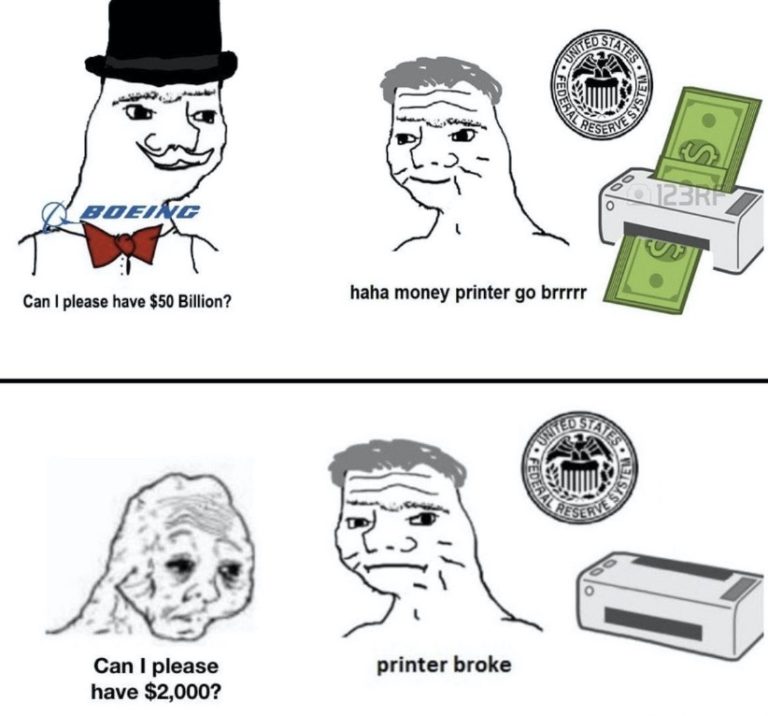
Tucked into the recent recovery bill was a provision granting the Federal Reserve the right to set up a $450 billion bailout plan without following key provisions of the federal open meetings law, including announcing its meetings or keeping most records about them, according to a POLITICO review of the legislation.

The provision further calls into question the transparency and oversight for the biggest bailout law ever passed by Congress. President Donald Trump has indicated he does not plan to comply with another part of the new law intended to boost Congress’ oversight powers of the bailout funds. And earlier this week, Trump dismissed the government official chosen as the chief watchdog for the stimulus package.

The changes at the central bank – which appear to have been inserted into the 880-page bill by sympathetic senators during the scramble to get it approved — would address a complaint that the Fed faced during the 2008 financial crisis, when board members couldn’t easily hold group conversations to address the fast-moving economic turmoil.

The provision dispenses with a longstanding accountability rule that the board has to give at least one day’s notice before holding a meeting. Experts say the change could lead to key information about the $450 billion bailout fund, such as which firms might benefit from the program, remaining inaccessible long after the bailout is over.

The new law would absolve the board of the requirement to keep minutes to closed-door meetings as it deliberates on how to set up the $450 billion loan program. That would severely limit the amount of information potentially available to the public on what influenced the board’s decision-making. The board would only have to keep a record of its votes, though they wouldn’t have to be made public during the coronavirus crisis.

A Fed spokesperson did not comment on the changes in the law or whether the Fed would continue keeping records of its meetings.

– PoliticoRecovery Law Allows Fed to Rope off Public as It Spends Billions

An era can be said to end when its basic illusions are exhausted.

– Arthur Miller

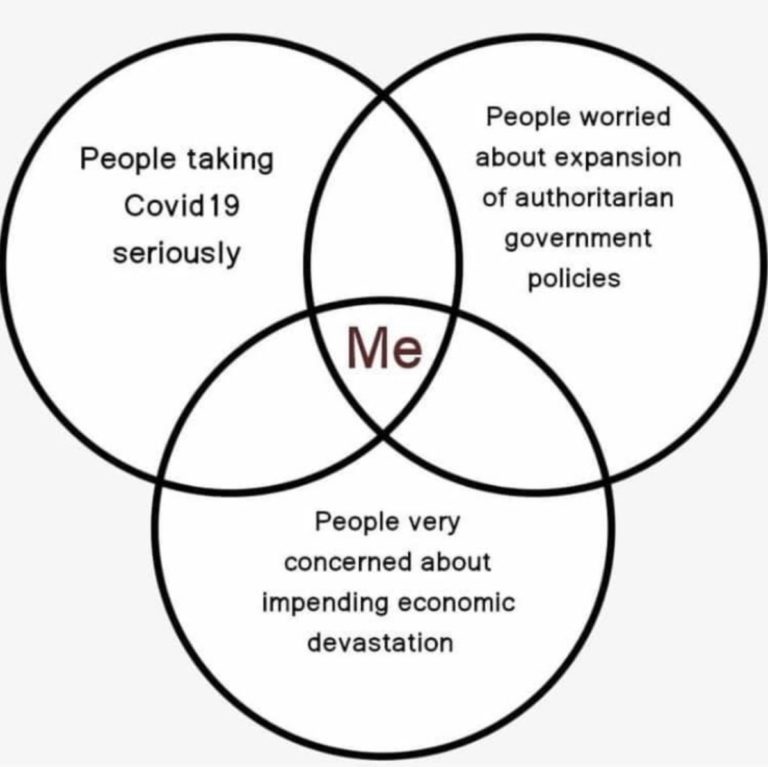
Before going any further, I want to share a graphic that accurately summarizes my position on the current pandemic affecting the world.

Unfortunately, it’s quite common for many to latch on to one of these conclusions and singularly obsess about it to the detriment of the others, when we need to be thinking about all three simultaneously.

It’s absolutely critical we understand governments throughout the world are rapidly mobilizing to use the crisis as an excuse to extract more wealth from society and condition the public to relinquish more precious civil liberties. The response in my own imperial oligarchy masquerading as a country has been particularly grotesque. A government that told us masks don’t work and couldn’t roll out testing for weeks, is now responding with the worst of both post-9/11 and post-financial crisis responses. The idea of representative government or democracy in America is a complete myth. The interests and desires of the people are irrelevant, and our economic system can be best described as financial feudalism.

We’ve seen this movie before. The U.S. government and Federal Reserve used major crises to consolidate wealth and power twice before this century, and it’s happening again. They got away with it before — and they’re getting away with it now — because the public accepts it. I hate to write that, but it’s true. People will tell me the public has no way to fight back, but that’s not accurate. The public hasn’t even tried historical methods like mass strikes and boycotts, instead they’ve been successfully neutered by phony red/blue team mainstream politics, through bickering about marginal issues like pronouns and bathrooms, and by endless entertainment and debt-based consumption. This is why the oligarchy keeps winning. Americans aren’t a serious people yet.

Witnessing the massive theft and power consolidation during the financial crisis a decade ago shook me to my core. I learned so much about how the world really works I simply couldn’t go on in the same way, so I quit my finance job and moved out of NYC. I was convinced such in your face theft would lead to effective popular movements and that the people would discover their power and take direct action, but I was wrong. Rather than economic populism transcending other differences to become ascendant and potent, most Americans were successfully shoved back into convenient political boxes easily managed by oligarchy. The rest is history.

Is the above wishful thinking? It might be. I had similar thoughts a decade ago and nothing truly meaningful happened. That said, I’ve learned some valuable life lessons over the past decade and will share some of them today.

The title of today’s piece is “what are you gonna do about it?”, but let me start by telling you what I’m not going to do. I am not going to vote in the 2020 presidential election. In previous cycles, I went out and voted third party as a protest, but I won’t even do that this time. I refuse to give such a farcical system the satisfaction of even a protest vote. I’m over it. Done. 

Choosing to refrain from participation in a clearly rigged and sham presidential election process may feel like giving up, but it’s the exact opposite. It’s actually quite liberating to give up on the fantasy that voting for one of two sociopaths will materially improve your life or the direction of the country. Once you stop believing in the lazy fairytale version of politics you can get down to real action. If you accept that voting is largely a charade, you can either sit back and take it while playing video games, or you can get motivated. I see two avenues for action that can actually change things.

The first consists of mass organized movements that unite as many disparate factions as possible to focus on a single issue. This can take the form of a workers strike, a targeted boycott or something similar. The key thing that’s prevented this from happening is Americans have been so successfully divided and conquered. “Activist leaders” often demand those who constitute a movement see eye to eye on virtually everything, yet oligarchy knows to unite whenever their core interests are even slightly threatened. A hopelessly splintered public is one reason the people always lose.

Although I’m confident in the success of such a strategy if implemented by enough people, this doesn’t mean it will materialize. I was hopeful it could happen last decade, but it never did. Americans proved to be as divided, conquered and distracted as ever, and it’s possible things will continue along this path in the years ahead. As such, waiting for mass movements that may never occur to materialize is not a sufficient strategy. You need a primary strategy, and that strategy starts with you. 

The only thing you truly have control over is your mindset and your actions. Think about what angers you most about the system as it stands and turn that anger into something productive. What can you do as an individual to protest or reject that system? What can you do to become more resilient? Can you repurpose your skillset or profession in a way where you become more of a solution than part of the problem? Some of us can do more than others, but virtually everyone can take some action. If you can’t think of anything, think harder.

Reflecting on the past decade, every moment I spent taking control of my life and improving as an individual was worthwhile and rewarding, while every moment I spent hoping others around me would change was a gigantic disappointment.

This doesn’t mean we should give up on mass movements, it means you cannot rely on other people to get to the point you’re at as quickly as you’d like. Think about what’s actually in your control and go for it. And good luck.

Censoring Alex Jones

By Dmitry Orlov

Source: Club Orlov

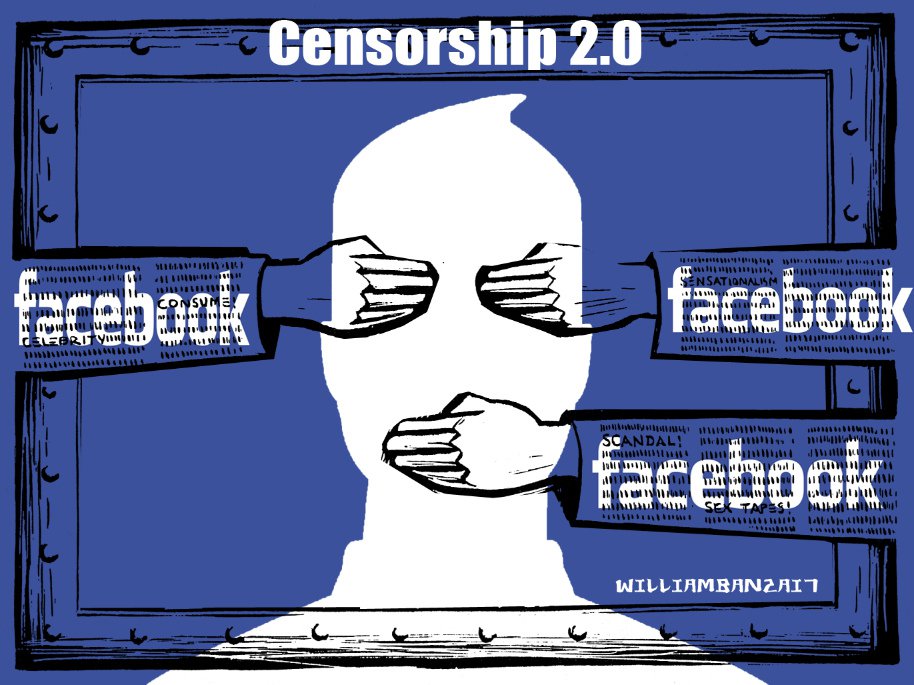
Something happened recently that made me feel like a bit of an endangered species. A set of transnational internet companies, including Google, Facebook, Apple and several others, all synchronously removed content belonging to infowars.com, which is run by Alex Jones. Such synchronicity is a sure sign of conspiracy—something that Alex Jones harps on a lot.

I once appeared on a radio show run by Alex Jones, and he did manage to boil down what I had to say to “the USA is going to collapse like the USSR did,” which is pretty good, considering how poorly we managed to connect, having so little in common. He is a conservative and a libertarian whereas I think that conservatives don’t exist in the US. What have they “conserved” lately—other than the right to bear small arms? As far as libertarianism, I consider proper historical libertarianism as a strain of socialism while its American cooptation is just plain funny: these ones remain libertarian only until they need the services of an ambulance or a fire engine, at which point they turn socialist. To boot, American libertarians like Ayn Rand, who to me was a relentlessly bad writer full of faulty thinking. However, I find her useful as a litmus test for mediocre minds.

Moreover, Jones is political while I remain convinced that national politics in the US is a waste of time. It has been statistically proven that the US is not a democracy: popular will has precisely zero effect on public policy. It doesn’t matter who is president; the difference is a matter of style. Trump is a bull in a China shop while Clinton would have been a deer in the headlights. The result is the same: the US is bankrupt and its empire is over.

There is also the mismatch of genre between Jones and me. I am first of all an experimenter and an essayist, and to me personal experience and literary form are vitally important, while Jones is light on research and happy to work with hearsay, and is rather hackneyed and repetitive, but has the right instincts for a rabble-rouser. He harkens from a long American tradition of itinerant preachers spouting jeremiads, thumping the bible and hurling fire and brimstone. His content is secular, but his rhetorical techniques are revivalist. He is preachy, screechy and emotional. There is some carnival cryer in his cultural makeup as well, and he is not above peddling some survivalist/prepper snake oil

That said, we share certain important similarities. Neither of us is part of the official narrative that is endlessly being hammered home by US mass media with increasingly poor results. Thinking Americans are just not gullible enough any more. Jones has exploited this gullibility shortfall in the general public for all it’s worth by going after every conspiracy theory out there, while I am just like you—gullible. Sure, a few Arab tourists armed with box cutters destroyed three steel skyscrapers by flying two aluminum planes into them. Do your own math, but that’s just 2/3 of a plane per skyscraper—ought to be enough, right? Jet fuel, which burns at 800° to 1500°F, melted steel columns. (Steel melts at 2750°F.) Two aluminum cans packed with kerosene, meat and luggage destroyed three steel structures. I find this explanation perfectly satisfactory; do you? If you need to know more, it’s easy to find out, but don’t wait on me because, being so gullible, I am perfectly satisfied.

Jones and I are also different in that he is hugely popular whereas I am popular enough for me and generally lacking in worldly ambition. I enjoy writing, my readers enjoy what I write, and everyone is happy except the kids, because while I am writing I am not playing with them. But Jones is becoming huge—popular enough to displace mass media, which is continuously losing mind share. In part, that is its own fault: how long do they think they can they go on flogging the dead horses of “Russian collusion” and “Russian meddling” before people start shaking their heads and walking away? In part, the verbal diarrhea that we hear on CNN or read on nytimes.com is intended as a smokescreen because the truth has become toxic to the interests of those who are in charge mass media in the US. I will delve into this subject further on Thursday. The political decision to censor Jones was a sign of desperation: the verbal diarrhea is not working, and so it’s time for Plan B, which is simply to scream “Shut up!” as loudly as possible.

Due to his huge and burgeoning popularity (which these latest attacks on him have actually served to enhance) Jones is a huge target, whereas I am but a tiny one. Still, first they came for Alex Jones, and then they may very well come for me, and so the time to start paying attention and pushing back is now. These internet entities—Google, Facebook, Apple, Google Podcast, Spotify, iHeartRadio, MailChimp, Disqus, LinkedIn, Flickr, Pinterest and several others—have no more right to censor him than does your phone company to screen your calls for you or to determine whose number you should be allowed to dial. What was done to Jones was blatantly illegal under both US and international law, and while these companies don’t have much to fear in the US, where they are politically protected, they have a great deal more to fear internationally.

Jones did not, as far as anyone can tell, violate the terms of use of any of these internet services, yet they shut him down. In the public discussions that preceded this event, including in the US Congress, terms such as “hate speech” and “inciting violence” were thrown about. These terms are defined sufficiently vaguely to make them useful for arbitrarily throwing at one’s enemies while one’s friends are granted full immunity, all in an entirely context-free, fact-free manner. For example, two years ago on PBS the following exchange took place between the former acting CIA director Michael Morell and Charlie Rose:

Morell: “We need to make the Russians pay a price in Syria.”
Rose: “We make them pay the price by killing Russians?”
Morell: “Yeah.”

The context and the facts are: the Russians were in Syria by official invitation from the internationally recognized Syrian government to defeat terrorists and foreign mercenaries and to reestablish Syria’s control over its sovereign territory. The US forces weren’t doing much of anything helpful in Syria, but whatever it was, it was illegal: they were an invading force. And here is Morrell proposing that we kill Russian troops who are fighting terrorists, just to send a message. If that’s not “inciting violence,” it is really difficult to imagine what would be. And yet a full two years after this outrage PBS remains on the air; what gives?

Spurious claims of “hate speech” and “inciting violence” aside, what happened is that an order to shut down Jones was issued from Washington, DC. In response an impressively large group of transnational internet companies saluted and marched off to carry out the order, thereby making it perfectly obvious who they work for. And that is likely to become a big problem for them.

First, these transnational companies are allowed to provide services around the world based on international law. Article 19 of the Universal Declaration of Human Rights defends the right to freedom of opinion and expression: “Everyone has the right to freedom of opinion and expression; this right includes freedom to hold opinions without interference and to seek, receive and impart information and ideas through any media and regardless of frontiers.” Jones should sue the US and the companies that censored him in the European Court of Human rights in Strasbourg, France and seek redress both against entities within the US government which issued the illegal order (to be ferreted out in the course of discovery) and against the transnational companies that carried it out.

Second, these transnational companies operate around the world based on local law which in many cases prevents them from acting as agents of foreign governments without first registering as such. If Google and Facebook execute orders issued by the US government, then they are acting not as businesses but as clandestine representatives of a foreign power. Being recognized as such would significantly curtail these companies’ international reach, growth potential and valuations.

And since Google, Facebook and Apple are public companies committed to the pursuit of shareholder value, it would be time for their shareholders to get involved and replace the management teams. After all, what would be more profitable for them: illegally conspiring with the US government while becoming pariahs and losing the world market, or scrupulously maintaining arm’s-length relationships with all governments while working to uphold international law? There is still the opportunity for them to defuse the whole situation: call it a mistake, restore the services, compensate Jones for lost revenue and promise to never do it again.

Western Elites Decrying ‘Populism’ Betrays Fear of Democracy

By Finian Cunningham

Source: Strategic Culture Foundation

A new dreaded word has entered into official Western media speak: “Populism”. Political parties and governments which are deemed to be illegitimate are invariably labeled with the prefix “populist”. There is a vague implication that “populist” parties are imbued with disreputable politics of xenophobia, racism, nationalism and even fascism.

But who is doing the “deeming” here? It is establishment political parties and politicians who have the advantage of establishment news media organizations conveying their words and terminology.

Take French President Emmanuel Macron. He may have coined a new political party, En Marche, but he is nevertheless a politician very much of the prevailing Western establishment. He is pro-European Union as it currently operates, albeit with reforming tweaks; he is pro-NATO, pro-Atlanticist; and pro-neoliberal economic policies.

Recently, Macron decried the rise of “populist” parties across Europe. He compared them to the spread of “leprosy” and claimed they were posing a morbid threat to the conventional order of politics. Macron was referring in particular to the new coalition government in Italy, comprising the anti-establishment Five Star Movement and the League.

The French leader could also have been referring to any number of governments as seen in Austria, Hungary and other Central European states which, like the new Italian government, have challenged the EU’s official stance overEU irregular migration into the bloc.

In this context, the word “populist” as used by Macron and other establishment politicians has the connotation of “racist” or “inhumane” owing to the opposition towards the uncontrolled influx of people from outside Europe.

The “populist” prefix is often used alongside the term “far-right”. Again, the implication is that somehow the largely newcomer parties are something that should be abhorred because they are tarnished with alleged proclivities towards fascism and authoritarianism.

To reinforce that implied demonization, it is often cited by Western establishment politicians and media that the “populist” parties in Europe are aligned with Russian President Vladimir Putin, if not stealthily bankrolled by the Kremlin.

American President Donald Trump also qualifies as “populist” according to the US political and media establishment. Again, the word is loaded to infer a uniquely noxious quality in the Trump presidency and his supporters, in the same way that Democrat presidential rival Hillary Clinton once haughtily denigrated Trump and his voter base as “deplorable”. It’s a way of sanitizing the establishment from any past, and far greater, sins.

The P-word does not always mean “rightwing nationalism”. The recent elected Mexican President, Andrés Manuel Lopez Obrador, has been described in Western media as a “leftwing populist”.

In Italy, the main ruling coalition party, the Five Star Movement, headed by Luigi Di Maio, is associated with leftwing social policy.

Parties and politicians deemed to be “populist” are eclectic and defy an easy categorization, as their detractors would perhaps like to assign them. Certainly, there is a strong common stance of being opposed to uncontrolled immigration. But it is too simplistic to explain such a stance as merely xenophobic or racist.

There are legitimate and reasonable concerns that the issue of large-scale immigration has been exploited by ruling establishments and their ideological backers as a way to undermine national sovereignty and workers’ rights, from the consequent lowering of wages and employment conditions.

There is also the legitimate concern in Europe that the migration phenomenon has been largely created by illegal wars pursued by the US and its European NATO allies. Why should European member states and ordinary taxpayers have to incur financial and cultural integration problems that have been largely manufactured by ruling elites who have never been held to account for their criminal wars?

So-called populist parties are also opposed to the seemingly slavish adherence by the European political establishment to neoliberal capitalism. There is a legitimate popular backlash to economic policies which are oppressive and destructive, and whose sole priority seems to be satisfying the profits of Big Business and transnational capital. Why should European governments be held in hock to fiscal rules and debt limitations set arbitrarily by institutions seemingly under the diktat of private banks?

There are several fundamental issues that form a groundswell of popular opposition towards the conventional ways of governance, both in Europe and the US. The failings of neoliberal capitalism and its rich-get-richer racket is surely top of the grievance list. So too is relentless, irrational militarism by Western governments, unleashing illegal wars and massive refugee problems, as well as stoking unnecessary hostility towards other powers like Russia, China, Iran and North Korea.

The conventional politics, that is, the ruling establishments and their dutiful news media, are increasingly seen as incompetent, if not bankrupt. The establishment across Western countries has lost legitimacy and “moral authority” in the eyes of masses of people. That dwindling authority of the ruling class in Western states is the real, morbid concern.

One factor for this is the growth of global communications and “alternative” media sources, which Western publics are availing of to inform themselves independently from the old information monopolies that served the established order. That is why the “problem” of alleged “Russian influence” has been invented. In a desperate gambit to distract the masses from noticing the real problem, which is the crumbling of legitimacy for the Western establishment and its obedient political parties.

The looming fear among the ruling order is the ever-growing dissent among the populace. It is a fear of their own inherent failing and impending doom in the face of democratic challenge to power.

It is not so much that Trump or the new Italian government or Hungarian leader Viktor Orban, and so on, represent a vanguard for renewed democracy. These changes are merely symptoms of a deeper popular opposition to the established way of conducting politics – the order that has prevailed for most of the seven-decade period following the Second World War.

There has always been a wariness among ruling elites on both sides of the Atlantic towards a genuine democratic order breaking out, as Noam Chomsky discusses in his book ‘Deterring Democracy’. Western elites have typically viewed the masses as “rabble rousers” who are deemed to be “incapable” of governing society in the “proper way” that benefits the elites, protects their profits and property, and safeguards their imperial war-making overseas.

This underlying tension about the control of political power in Western societies encapsulates the present historical juncture where the word “populist” is being increasingly deployed. It is a term of disparagement by a failing Western establishment. What the failed order is trying to do is divert genuine popular challenge by painting it as something uncouth, vulgar, noxious, or manipulated by foreign enemies like Russia.

As American political analyst Randy Martin notes: “Populism is a convenient term for those in power who seek to isolate those who would want to share, or worse, take that power.”

When you think of the original meaning of the word – “the people” – it is starkly revealing what is really at stake for those elites who wield the “populist” term as a disparagement.

#Brexit confirms: the neoliberal center cannot hold

eu-broken1-701x351

By Jerome Roos

Source: ROAR Magazine

The post-Brexit pandemonium has less to do with Britain’s relationship to Europe than it has with elites losing control over the monsters they have created.

Britain finds itself in a general state of pandemonium. The UK is in the midst of a full-blown constitutional crisis, Prime Minister David Cameron has resigned, and both the country’s governing party and the opposition are in the throngs of a fierce internal power struggle.

As the cheerleaders of the leave campaign dither with no clear plan on how to move forward, the financial consequences continue to ripple through the City: within days, the pound collapsed to its lowest level since 1985, the government’s credit rating was slashed by two full points, and world markets were sent into a tailspin, with a record $3 trillion shaved off stock values on Friday and Monday alone. As if things could not get any worse, recent days have also seen reports of an epidemic of hate crimes spreading across the UK.

Reading the headlines, one could easily be forgiven for experiencing the creeping sensation of living through the postmodern equivalent of the apocalypse: the financial press is providing minute-to-minute coverage of the “battering” of world markets; liberal establishment columnists repeatedly declare this to be Britain’s and Europe’s “worst crisis” since the Second World War; and the New York Times has already held Brexit up as the telltale sign of a world order that is slowly falling apart.

To top it all off, a hysterical Tony Blair took to the same pages last weekend to make a desperate plea in defense of globalization and for more of his failed Third Way recipe, proclaiming in characteristic platitudes that “the center must hold” ­— as if Yeats’ “blood-dimmed tide” and “mere anarchy” were about to be loosed upon the world once more.

The immediate cause for all the commotion is clear: Cameron’s risky bet to hold a referendum on Britain’s EU membership has backfired disastrously. The unexpected victory for the leave camp has shaken both Unions to their very core, dividing left and right on either side of the Channel and burning all bridges between them. There is no denying the historic nature of these developments; the world is a different place after last Thursday, and it is clear that Europe and Britain now find themselves in uncharted territory.

Yet the unspeakable truth is that, at a deeper level, the financial fallout and political pandemonium of recent days has less to do with Britain’s place in Europe than it has with the widening gulf between political elites and European citizens more generally. While racism and anti-immigrant sentiment have been central to the leave campaign from the very start, it is difficult to believe that all 52 percent of Britons who voted leave are committed fascists. Many of these people are ordinary working class folks who are simply fed up with the erosion of their living standards, the disintegration of their communities, and the lack of responsiveness of their political representatives and the unaccountable technocracy that has “taken control” over their lives. Brexit was first and foremost a political statement by the dispossessed and disempowered.

The reason this statement has proven so explosive is because the referendum happened to sit on the convergence point of a number of profoundly unstable social and political fault-lines, all of which were shaking well before Brexit, all of which would have trembled even in the absence of Brexit, and all of which will continue to quake and thunder for a very long time after Brexit. It is highly unlikely that a victory for remain would have produced a very different outcome in the long run — it would certainly not have stemmed any of the discontent, pacified any of the social tensions, or resolved any of the political conflicts that underlie the referendum’s shock outcome.

While Brexit clearly hands victory to the bigots of UKIP and the Tory right, a victory for remain would simply have perpetuated the anti-democratic neoliberal masochism that produced the motivation for people to align themselves with these bigots in the first place. In this light, we have to stop seeing the rabid nationalism of the far-right and the neoliberal cosmopolitanism of the pro-EU camp as polar opposites — in reality, the former is the logical outgrowth of the latter; its deformed Siamese twin in flesh and blood. The only thing the pro-EU camp was able to offer British voters was a continuation of the structural conditions that led to Brexit, combined with fanatical fear-mongering over the consequences of that outcome.

Ultimately, the British vote to leave the EU, whether it eventually materializes or not (and there is no guarantee that it will), is symptomatic of a much deeper and much more debilitating crisis: a structural crisis of democratic capitalism that has in recent years evolved from a global financial crisis into a deepening legitimation crisis of the political establishment, which is now in turn exploding into a full-blown crisis of governability of the existing social and political order. The fault-lines currently opening up in British and European politics would have eventually laid waste to the stability of the continent’s postwar order regardless of the outcome of this particular referendum. Brexit will simply speed up that ongoing process of political decomposition.

It is important to remember in this respect that David Cameron did not call this referendum because he truly cared about the opinion of ordinary people on the EU. Like Alexis Tsipras last year, he called the referendum in a risky and desperate gambit to keep his flailing party together — to silence the Tories’ eurosceptic right wing, disarm the constant backbencher challenges to his leadership, and inoculate the government against future defections to UKIP. This vote was never really about the EU; it was about one of the figureheads of Europe’s crumbling neoliberal center trying to reassert his hold over a party that was once the stable bedrock of the UK’s landed aristocracy and its metropolitan bourgeoisie, but that is now rapidly disintegrating in the face of a resurgent reactionary right.

The ongoing coup against Jeremy Corbyn similarly has little to do with Europe. As an article in the Telegraph from June 13 confirms, Labour MPs and the Blairite wing of the party have been plotting an anti-Corbyn revolt for weeks, if not months, aiming to bring down their leftist leader in “a 24-hour blitz” after the referendum, regardless of its outcome. Again, this is not about the EU; it is about the incompetent lackeys of a crumbling neoliberal center trying to reclaim their hold over a party that was once Europe’s most enthusiastic cheerleader of neoliberalism, financialization and overseas military intervention, but that is now rapidly disintegrating — or realigning itself — in the face of an insurgent “hard” left.

In this respect, Blair’s apocalyptic reference to Yeats in his New York Times opinion piece was awkwardly on point: things are falling apart; the center cannot hold. This is the crux of the matter, and it helps explain the hysterical doomsday discourse of the centrist establishment: their globalized post-democratic fantasy world is crumbling before their very eyes, as their once-passive voter-cum-consumer base is suddenly gobbled up and mobilized by a motley crew of “angry populists” who thrive on the electoral spoils of a crippling legitimation crisis and feast on the popular discontent sowed by years of austerity and decades of neoliberal restructuring.

The answer to the steady disintegration of the established political order clearly cannot be more of the same. Against Blair’s hopeless cries that “the center must hold”, and against the thinly-veiled conspiracies of his neoliberal acolytes in Parliament — who are now closing in on Jeremy Corbyn in a last-ditch attempt to reclaim the Labour Party and destroy from within, once and for all, the only political force that could possibly pose an electoral counterweight to the far-right in this defining moment in British history — against all of these turncoats, the left must stand firm and insist: the center will fall.

But to avoid ceding the resulting void to the racists and reactionaries, the weakened and dispersed forces of the left will need to rally in face of the historic battles now coming their way. Despair as one may, this means the choice is now fairly straightforward: it’s Corbyn or nothing. Not because the embattled Labour leader will bring democratic socialism or fully automated luxury communism to a newly independent Britain, but because this decent, principled leftist is now the only bulwark still standing between ordinary working people of all colors, and the monsters that are about to be unleashed on them.

About the author:

Jerome Roos is the founder and editor of ROAR Magazine, and a researcher in International Political Economy at the European University Institute. For more on his research and writings, visit jeromeroos.com.

A ‘Brexit’ Blow to the Establishment

Brexit_Run_620x350

By Robert Parry

Source: Consortium News

The United Kingdom’s “Brexit” vote may cause short-term economic pain and present long-term geopolitical risks, but it is a splash of ice water in the face of the West’s Establishment, which has grown more and more insular, elitist and unaccountable over recent decades.

The West’s powers-that-be, in both the United States and the European Union, too often display contempt for real democracy, maintaining only the façade of respecting the popular will, manipulating voters at election time with red-meat politics and empty promises – before getting back to the business of comforting the comfortable and letting the comfortable afflict the afflicted.

That has been the grim and tiresome reality with America’s two parties and with the E.U.’s bureaucrats. The average American and the average European have every reason to see themselves as a lesser concern to the politicians and the pundits than the special interests which pay the money and call the tune.

In the stunning “Brexit” vote – with 52 percent wanting to abandon the 28-nation European Union – U.K. voters rejected the West’s politics-as-usual despite dire warnings about the downsides of leaving. They voted, in effect, to assert their own nationalistic needs and aspirations over a commitment to continental unity and its more universal goals.

But, in the vote, there was also a recognition that the West’s Establishment has grown corrupt and arrogant, routinely imposing on the people “experts” who claim to be neutral technocrats or objective scholars but whose pockets are lined with fat pay checks from “prestigious” think tanks funded by the Military-Industrial Complex or by lucrative revolving-door trips to investment banks on Wall Street or The City.

Despite the Establishment’s self-image as a “meritocracy,” its corrupted experts and haughty bureaucrats don’t even demonstrate basic competence anymore. They have led Europe and the United States into catastrophe after catastrophe, both economically and geopolitically. And, there is another troubling feature of this Establishment: its lack of accountability.

In the United States, the rewards and punishments have been turned upside-down, with the benighted politicians and pundits who pushed for the Iraq War in 2003 still dominating the government and the media, from Hillary Clinton’s impending Democratic presidential nomination to the editorial pages of The New York Times and The Washington Post.

And, the Iraq War disaster was not a one-off affair. The neocons and their liberal interventionist sidekicks have their fingerprints on other “regime change” messes, from Libya to Ukraine to Syria (still in the works), with their predictable recommendations for more violence and more belligerence. Yet, they have impunity for their crimes and incompetence. They fail up.

Establishment Doesn’t Know Best

So, the West’s Establishment can’t even argue that it knows best anymore, which always had been its ace in the hole. The various insurgents could be painted as the dangerous option – and that is sometimes true as we’ve seen with Donald Trump – but it is arguably a toss-up as to whether Clinton or Trump would be the bigger risk to the world’s future.

Trump may be a blustering buffoon but he challenges the neocon “group thinks” about the wisdom of expanding the West’s war in Syria and launching a costly and existentially risky New Cold War against nuclear-armed Russia and China. Clinton surrounds herself with neocons and liberal hawks and shares their obsession with overthrowing the government of Syria and provoking Russia and China with military operations near their borders.

Trump and “Brexit” advocates also reject the Establishment’s neoliberal consensus on “free trade,” which has depressed (or eliminated) the wages of American and European workers while the benefits accrue mostly to financial and political elites. The Establishment’s embrace of the “winners” and its disdain for the “losers” have further enflamed today’s populism.

Yet, there are undeniably ugly features in the populist sentiment sweeping the U.S. and Europe. Some of it is driven by bigotry toward non-whites, especially immigrants. Some is inspired by wild conspiracy theories from a population that has understandably lost all faith in what it hears from Washington, Brussels and other capitals. Trump has espoused the scary know-nothing notion that the scientific evidence of global warming is “a hoax.”

There is always something unsettling when an incipient revolution takes shape and starts tearing down the old order. What follows is not always better.

In the end, the American election – like the “Brexit” referendum – may come down to whether voters feel more comfortable sticking with the status quo at least for a while longer or whether they want to blow up the Establishment and gamble on the consequences.

Right now, Clinton and the Democrats are carrying the banner of the Establishment, while Trump and his Republican insurgents fly the Jolly Roger. In a political year when the anti-establishment wave seems to be cresting, the Democrats may regret their choice of a legacy, status-quo candidate.


[For more on this topic, see Consortiumnews.com’s “Two Corrupt Establishments”; “Democrats – Too Clever by Half on Clinton”; “The Coming Democratic Crack-up”; “Neocons and Neolibs: How Dead Ideas Kill“; and “The State Department’s Collective Madness.”]

Investigative reporter Robert Parry broke many of the Iran-Contra stories for The Associated Press and Newsweek in the 1980s. You can buy his latest book, America’s Stolen Narrative, either in print here or as an e-book (from Amazon and barnesandnoble.com).

Related Articles:

¡Basta Ya, Brussels! British Voters Reject EU Corporate Slavestate

Global Elite Makes Good on Threats to “Make All of You Poorer” After Britain Independence

Where is the UK Heading Now Due to Cameron’s Policies?

Related Videos:

https://www.youtube.com/watch?v=z62YbkpzL2g


How America Became an Oligarchy

OLIGARCHY

By Ellen Brown

Source: Counterpunch

“The politicians are put there to give you the idea that you have freedom of choice. You don’t. . . . You have owners.”

— George Carlin, The American Dream

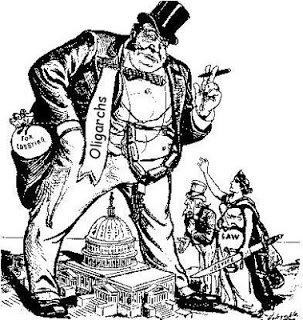
According to a new study from Princeton University, American democracy no longer exists. Using data from over 1,800 policy initiatives from 1981 to 2002, researchers Martin Gilens and Benjamin Page concluded that rich, well-connected individuals on the political scene now steer the direction of the country, regardless of – or even against – the will of the majority of voters. America’s political system has transformed from a democracy into an oligarchy, where power is wielded by wealthy elites.

“Making the world safe for democracy” was President Woodrow Wilson’s rationale for World War I, and it has been used to justify American military intervention ever since. Can we justify sending troops into other countries to spread a political system we cannot maintain at home?

The Magna Carta, considered the first Bill of Rights in the Western world, established the rights of nobles as against the king. But the doctrine that “all men are created equal” – that all people have “certain inalienable rights,” including “life, liberty and the pursuit of happiness” – is an American original. And those rights, supposedly insured by the Bill of Rights, have the right to vote at their core. We have the right to vote but the voters’ collective will no longer prevails.

In Greece, the left-wing populist Syriza Party came out of nowhere to take the presidential election by storm; and in Spain, the populist Podemos Party appears poised to do the same. But for over a century, no third-party candidate has had any chance of winning a US presidential election. We have a two-party winner-take-all system, in which our choice is between two candidates, both of whom necessarily cater to big money. It takes big money just to put on the mass media campaigns required to win an election involving 240 million people of voting age.

In state and local elections, third party candidates have sometimes won. In a modest-sized city, candidates can actually influence the vote by going door to door, passing out flyers and bumper stickers, giving local presentations, and getting on local radio and TV. But in a national election, those efforts are easily trumped by the mass media. And local governments too are beholden to big money.

When governments of any size need to borrow money, the megabanks in a position to supply it can generally dictate the terms. Even in Greece, where the populist Syriza Party managed to prevail in January, the anti-austerity platform of the new government is being throttled by the moneylenders who have the government in a chokehold.

How did we lose our democracy? Were the Founding Fathers remiss in leaving something out of the Constitution? Or have we simply gotten too big to be governed by majority vote?

Democracy’s Rise and Fall

The stages of the capture of democracy by big money are traced in a paper called “The Collapse of Democratic Nation States” by theologian and environmentalist Dr. John Cobb. Going back several centuries, he points to the rise of private banking, which usurped the power to create money from governments:

The influence of money was greatly enhanced by the emergence of private banking. The banks are able to create money and so to lend amounts far in excess of their actual wealth. This control of money-creation . . . has given banks overwhelming control over human affairs. In the United States, Wall Street makes most of the truly important decisions that are directly attributed to Washington.

Today the vast majority of the money supply in Western countries is created by private bankers. That tradition goes back to the 17th century, when the privately-owned Bank of England, the mother of all central banks, negotiated the right to print England’s money after Parliament stripped that power from the Crown. When King William needed money to fight a war, he had to borrow. The government as borrower then became servant of the lender.

In America, however, the colonists defied the Bank of England and issued their own paper scrip; and they thrived. When King George forbade that practice, the colonists rebelled.

They won the Revolution but lost the power to create their own money supply, when they opted for gold rather than paper money as their official means of exchange. Gold was in limited supply and was controlled by the bankers, who surreptitiously expanded the money supply by issuing multiple banknotes against a limited supply of gold.

This was the system euphemistically called “fractional reserve” banking, meaning only a fraction of the gold necessary to back the banks’ privately-issued notes was actually held in their vaults. These notes were lent at interest, putting citizens and the government in debt to bankers who created the notes with a printing press. It was something the government could have done itself debt-free, and the American colonies had done with great success until England went to war to stop them.

President Abraham Lincoln revived the colonists’ paper money system when he issued the Treasury notes called “Greenbacks” that helped the Union win the Civil War. But Lincoln was assassinated, and the Greenback issues were discontinued.

In every presidential election between 1872 and 1896, there was a third national party running on a platform of financial reform. Typically organized under the auspices of labor or farmer organizations, these were parties of the people rather than the banks. They included the Populist Party, the Greenback and Greenback Labor Parties, the Labor Reform Party, the Antimonopolist Party, and the Union Labor Party. They advocated expanding the national currency to meet the needs of trade, reform of the banking system, and democratic control of the financial system.

The Populist movement of the 1890s represented the last serious challenge to the bankers’ monopoly over the right to create the nation’s money. According to monetary historian Murray Rothbard, politics after the turn of the century became a struggle between two competing banking giants, the Morgans and the Rockefellers. The parties sometimes changed hands, but the puppeteers pulling the strings were always one of these two big-money players.

In All the Presidents’ Bankers, Nomi Prins names six banking giants and associated banking families that have dominated politics for over a century. No popular third party candidates have a real chance of prevailing, because they have to compete with two entrenched parties funded by these massively powerful Wall Street banks.

Democracy Succumbs to Globalization

In an earlier era, notes Dr. Cobb, wealthy landowners were able to control democracies by restricting government participation to the propertied class. When those restrictions were removed, big money controlled elections by other means:

First, running for office became expensive, so that those who seek office require wealthy sponsors to whom they are then beholden. Second, the great majority of voters have little independent knowledge of those for whom they vote or of the issues to be dealt with. Their judgments are, accordingly, dependent on what they learn from the mass media. These media, in turn, are controlled by moneyed interests.

Control of the media and financial leverage over elected officials then enabled those other curbs on democracy we know today, including high barriers to ballot placement for third parties and their elimination from presidential debates, vote suppression, registration restrictions, identification laws, voter roll purges, gerrymandering, computer voting, and secrecy in government.

The final blow to democracy, says Dr. Cobb, was “globalization” – an expanding global market that overrides national interests:

[T]oday’s global economy is fully transnational. The money power is not much interested in boundaries between states and generally works to reduce their influence on markets and investments. . . . Thus transnational corporations inherently work to undermine nation states, whether they are democratic or not.

The most glaring example today is the secret twelve-country trade agreement called the Trans-Pacific Partnership. If it goes through, the TPP will dramatically expand the power of multinational corporations to use closed-door tribunals to challenge and supersede domestic laws, including environmental, labor, health and other protections.

Looking at Alternatives

Some critics ask whether our system of making decisions by a mass popular vote easily manipulated by the paid-for media is the most effective way of governing on behalf of the people. In an interesting Ted Talk, political scientist Eric Li makes a compelling case for the system of “meritocracy” that has been quite successful in China.

In America Beyond Capitalism, Prof. Gar Alperovitz argues that the US is simply too big to operate as a democracy at the national level. Excluding Canada and Australia, which have large empty landmasses, the United States is larger geographically than all the other advanced industrial countries of the OECD (Organization for Economic Cooperation and Development) combined. He proposes what he calls “The Pluralist Commonwealth”: a system anchored in the reconstruction of communities and the democratization of wealth. It involves plural forms of cooperative and common ownership beginning with decentralization and moving to higher levels of regional and national coordination when necessary.

Dr. Alperovitz is co-founder of an initiative called The Next System Project, aimed at defining the issues in a national political debate as a first step to realizing the possible. He quotes Prof. Donald Livingston, who asked in 2002:

What value is there in continuing to prop up a union of this monstrous size? . . . [T]here are ample resources in the American federal tradition to justify states’ and local communities’ recalling, out of their own sovereignty, powers they have allowed the central government to usurp.

Taking Back Our Power

If governments are recalling their sovereign powers, they might start with the power to create money, which was usurped by private interests while the people were asleep at the wheel. State and local governments are not allowed to print their own currencies; but they can own banks, and all depository banks create money when they make loans, as the Bank of England recently acknowledged.

The federal government could take back the power to create the national money supply by issuing its own Treasury notes as Abraham Lincoln did. Alternatively, it could issue some very large denomination coins as authorized in the Constitution; or it could nationalize the central bank and use quantitative easing to fund infrastructure, education, job creation, and social services, responding to the needs of the people rather than the banks.

The freedom to vote carries little weight without economic freedom – the freedom to work and to have food, shelter, education, medical care and a decent retirement. President Franklin Roosevelt maintained that we need an Economic Bill of Rights. If our elected representatives were not beholden to the moneylenders, they might be able both to pass such a bill and to come up with the money to fund it.

Ellen Brown is an attorney, founder of the Public Banking Institute, and author of twelve books including the best-selling Web of Debt. Her latest book, The Public Bank Solution, explores successful public banking models historically and globally. Her 300+ blog articles are at EllenBrown.com. Listen to “It’s Our Money with Ellen Brown” on PRN.fm.