
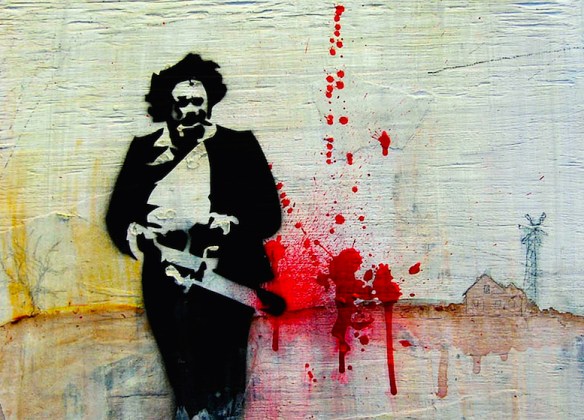
Revolutionary Terror: Mark Steven’s ‘Splatter Capital’

By Michael Grasso

Source: We Are the Mutants

Splatter Capital: The Political Economy of Gore Films
By Mark Steven
Repeater Books, 2017

“Splatter confirms and redoubles our very worst fears. It reminds us of what capital is doing to all of us, all of the time—of how predators are consuming our life-substances; of how we are gravely vulnerable against the machinery of production and the matrices of exchange; and of how, as participants of an internecine conflict, our lives are always already precarious.”

—from the Introduction to Splatter Capital

Political readings or interpretations of horror films are nothing new. But in Mark Steven’s 2017 study, Splatter Capital, an explicit connection is made between the bloody gore of what Steven terms “splatter” horror films and the dehumanizing, mutilative forces of global capitalism. Moreover, Steven posits the artistic motivation behind splatter horror as an explicit repudiation of this system: “It is politically committed and its commitment tends toward the anti-capitalist left.” In splatter films, Steven tells us, the images of gory dismemberment do double duty. They both offer a clear metaphor for capitalism’s cruelty, and act as a cathartic revenge in which the bloody legacy of capitalist exploitation is often visited upon its perpetrators and profiteers among the bourgeoisie.

Some definitions are in order here, given that Steven’s schema of genres—“splatter,” “slasher,” “extreme horror”—draws distinctions that might not be apparent even to horror fans. Splatter horror, according to Steven, is all about the violence that can be visited upon the human body and all the abjection that follows. It is machinery tearing apart flesh, blood, and guts: the moment a human body becomes meat. It differs from the personalized and often sexualized “hunt” of the slasher flick. The protagonist in a slasher movie is an individual (often female) resisting violent death at the hands of another individual (often male). In victory against Jason, Freddy, or Michael Myers, this protagonist, in Steven’s words, “restores a social order, which is all too regularly white, middle-class, and suburban.” Splatter horror not only expands the horizons of mutilation and violence allowable in a horror film but systematizes it. The splatter enemy is an implacable, impersonal force, full of shock and awe; its grudge is not personal, but instead overwhelming, inescapable, and, most importantly, class-based.

The language of violence and horror has been with Marxist thought from the beginning. Steven gives us a good précis of Marx’s use of explicitly Gothic (along with bloody and cannibalistic) imagery throughout his works, as well as a splatter-tastic explanation of the exploitation behind surplus value, using an imaginary case study in the manufacturing of chainsaws and knives. The October Revolution in Russia is viewed as a reaction to the inhuman mechanized slaughter of the first World War; Eisenstein’s early filmic paeans to the necessity of revolution such as Strike (1925) demonstrate, thanks to Eisenstein’s pioneering use of montage, capitalism’s role as butcher. Steven also discusses avowed leftist filmmakers from outside the Soviet Union such as Godard, Makavejev, and Pasolini—specifically their use of gore to embody the cruelty of the ruling classes.

As we enter the world of Hollywood film in Chapter Three, Steven examines splatter film as a specifically American reaction to the constant churning crisis of capitalism. Specifically, Steven looks at the two peaks of gore-flecked horror—the mid ’60s through the early ’80s, and the post-Cold War “torture porn” trend of the early ’00s—as expressions of two very important economic and political shifts. The first splatter peak in the ’70s is seen as a clear reaction to the slow, inexorable widening of neoliberal and globalist postindustrial economics and its impact on the American industrial worker. (The aftermath of this trend continues into the 1980s with the evaporation of industry and the establishment of a new information-and-finance-based economy.) The splatter/torture porn trend of the ’00s and beyond is a reaction to the crises of capitalism under a new world order of neocolonialist conflict: the War on Terror, the final disestablishment of the Western industrial base in favor of cheap labor in the developing world, and the new interconnected, networked world’s rulership by speculative capital in the form of the finance sector.

Steven cites too many splatter movies to cover in this review, but central to his thesis is the seminal 1974 Tobe Hooper film, The Texas Chain Saw Massacre. The death of local industry leads Leatherface and family to keep their slaughterhouse traditions alive by carving up and eating young people. These young people, Steven is quick to point out, are only here at all because they were unable to get gas for their car (thanks to the first of two 1970s oil crises). American decline is everywhere; betrayal by global economic forces are central to the trap that’s being laid by the cannibals. (Of course, the carnage of the Vietnam War can’t be overlooked here either, given the visual language of ambush, capture, and torture; Hooper himself has cited this in subsequent interviews.) Steven notes that the victims in The Texas Chain Saw Massacre are representative of a bourgeoisie who don’t know how the sausage is made. It’s important and vital, Steven says, that the cannibalistic side of splatter involves the bourgeoisie being forced to eat members of their own class. It’s Burroughs’s famous “naked lunch“: “the frozen moment when everyone sees what is at the end of every fork.”

As the neoliberal takeover of the world economy begins in earnest in the 1980s, as complex and largely ephemeral systems of mass media and finance take the place of the visceral, grinding monomania of industrial capitalism, splatter horror follows suit. Steven’s analysis of David Cronenberg’s Videodrome (1983) is especially sharp, examining the links between the body horror of the film and the Deleuzian body without organs. Max Renn’s body becomes an endlessly modular media node, able to accommodate video cassettes, to generate and fuse with phallic weapons (used to assassinate and destroy the media forces who’ve made him this way), to mesh and mold and mix with the hard plastic edges of media technology. By the end of the film, Renn is a weapon reprogrammed and re-trained on the very media-industrial complex that made him. More body horror: the cult classic Society (1989) and its shocking conclusion posits the ruling class as a cancerous monster, an amorphous leviathan straight out of a Gilded Age political cartoon, eating and fucking and vomiting, red in tooth and claw and pseudopod. Barriers between bodies break down; the system begins swallowing up all alternate possibilities.

By the time the Cold War is finished, the era of post-9/11 eternal war, of Abu Ghraib and Guantanamo, led to the popular new splatter sub-genre of “torture porn.” Steven identifies the genre’s distinguishing aesthetic feature: the indisputable, systematic, and worldwide victory of capitalism and the hypnotic Spectacle that accompanies it. In this era, there are no longer any alternatives. Everyone, rich and poor, is trapped in the system, and the system reintegrates torture into a worldwide video spectacle. This is embodied in both the global conspiracies of the wealthy in Roth’s Hostel series and in the Jigsaw Killer’s industrially-themed Rube Goldberg devices in the Saw franchise—devices of dismemberment explicitly linked to moral quandaries reminiscent of capitalism’s impossible everyday Hobson’s choices for the working class. The system will go on consuming you, whether you’re unlucky enough to be a splatter film’s victim, or “lucky” enough to wield the power to splatter (for example, Hostel: Part II‘s reversal of fate on the ultra-wealthy hunters, or the Jigsaw Killer’s death from cancer in Saw III—ultimately due to… a lack of health insurance).

Possibly the most intriguing aspect of this already very good book is Steven’s interspersing of personal anecdotes on when and where he discovered some of his favorite horror and genre films. By placing his personal and psychological experience of splatter films front and center, and linking it to his personal growth and increasing political maturity, he demonstrates the personal impact of the political, and the necessity of personal epiphany, mediated by culture, to achieve political awareness. Splatter Capital ultimately is not a book for the already-convinced and committed leftist, the Marxian thinker already well-versed in theory. (Another of Splatter Capital‘s very strong points is how Steven largely eschews jargon and obscurantism for an approachable tone and topic that laypeople can dive into easily.) It is for the fans of these films who’ve always wondered about the ineluctable appeal of visceral, shocking violence on screen, and perhaps why it all feels so strangely familiar.

Decoding a Fake Reality

By Rosanne Lindsay

Source: Waking Times

Reality is a program of beliefs we decode:

Disease equals Health
Fake news equals Truth
Wars equal Peace
Uniformity equals Unity
State-granted rights equal human rights
Slavery equals Freedom.

All is illusion.

As our world unfolds in multiple dimensions, we are focused in a time-space continuum (linear construct) with limited perception. Our “perception deception” in this reality timeline means that no matter what happened in the past, or what might happen in the future, we are always pondering it and creating it in the Now.

The power to restructure reality is only possible with the clarity of the cosmic mind. Unfortunately, as humans, we are easily programmed to believe that what we see, feel, taste, hear, and smell is all there is.

“The outer world is a reflection of the inner world. Other people’s perception of you is a reflection of them; your response to them is an awareness of you.” ~Roy T. Bennett, The Light in the Heart

Our beliefs guide our perception about who we are and what we can create. Believe we are sick and tired and we are. The body responds to core beliefs. The cells hear what we say, they hear limitations and feel fear. If we love our cells, the body will support our beliefs. What we do in our bodies is pivotal to our multidimensional selves, as well as to other timelines.

The Structure of Reality

Reality is constructed in time and space in this Third Dimension. Time and space are frequencies which cycle in a looped timeline, which our brains decode so that we can experience life as humans. Everything cycles, from the seasons to the economy, just as history tends to repeat itself.

We live in a Matrix system that can be described as a grid, a hologram, or a game composed of electromagnetic (EM) frequencies. The hologram is information as light that is distributed non-locally. Our brains decode this information based on perception; how things appear to us. And as we know, appearances can be deceiving.

Indeed, all is not as it seems. We create a collective reality with electromagnetic frequencies where everyone and everything is connected, in similar fashion to how the internet works. However, in the space we occupy we see only a small visible light spectrum, a narrow band of information that represents only 0.0001% of the whole electromagnetic spectrum.

Spirit First

We perceive that the brain is the central processing unit of the body, the body is a computer, and our DNA is nature’s hard drive. Yet we must also accept that we are receivers and transmitters of information – we are also the energy that runs the body. We are Spirit first. We are consciousness having a physical experience in a holographic constructed reality for our soul’s growth and evolution. Consciousness creates reality.

“You are a creator. You of humanity… Science has a fixation on knowledge, particularly that which is compatible with sense perception. Despite instruments which far exceed man’s sensory capacity, all knowledge gained in translated back to a sense perception before it can be coded as information. If it cannot be seen, heard, touched, smelled or tasted, it is not received by physical man. The five senses of man. The four walls and the lid of your prison. Discard them. Touch will not determine subtle shapes. Eye will not perceive reality. Ears do not hear the song of the universe. You cannot taste the food of angels or smell the fragrance of a higher truth. We rejoice as you begin to unshackle the self-imposed chains of limitation. Use your physical senses, enjoy them, but never for one moment believe in them as complete reality. Your heart knows – experience. Believe. Believe. Whatever you believe is so.” ―  Jade Plant, Talking with Nature by Michael J. Roads

If we understand the construction of an atom, then we appreciate that we are not solid at all. We are pure awareness in a cosmos we cannot measure. We are not our bodies or our names. We are not our emotions. We are limitless. Through our limited perception and core beliefs this may sound impossible.

However, we are not impossible but everything that is possible. All possibility means we are everything and no-thing. We are matter and energy, sound and silence. Life is a continuum, between physical and non-physical. Without beginning and without end.

In this game of illusion, we are a projection of our True Selves. In this reality, we are a hologram in a holographic universe. A hologram: a three-dimensional projection written on a two dimensional surface (i.e., piece of paper).

We are here to remember that we are more than words on paper just as we are more than base pairs of our DNA. Our DNA is a projection of a greater force. We are wave and particle at the same time. We are not complex. We are multiplex.

In this game of illusion, humans are caught in a time loop distortion where we have lost our power to those who control the program in the hologram. Not only are minds controlled (via social engineering and frequencies), but human genetics have been manipulated to perceive through five physical senses, resulting in the suppression of our true selves and our true potential.

The Freedom To Choose

In navigating All That We Are, we have a choice. We can choose to become bees in a Hive Mind on a colony of control and draconian laws, or we can choose freedom.

“Liberty lies in the hearts of men and women. When it dies there, no constitution, no law and no court, can save it.” ― Judge Learned Hand

When we talk about freedom, we perceive only a fraction of what is possible based on what we have been programmed and conditioned to believe through the limits of the five senses. The moment we perceive differently to use all of our senses, and to embody freedom, we reclaim our freedom. We no longer have to conform to colony control.

Decoding a Fake Reality

The mind controls beliefs in a reality that conforms to core beliefs. When we do not see beyond the page and open to all that is possible, we decode a fake reality and perpetuate it. We become distracted by the limitations set up to suppress our inherent power instead of creating the reality that best serves all of humanity and the planet.

“Morpheus: The Matrix is everywhere. It is all around us. Even now, in this very room. You can see it when you look out your window or when you turn on your television. You can feel it when you go to work… when you go to church… when you pay your taxes. It is the world that has been pulled over your eyes to blind you from the truth.


Neo: What truth?


Morpheus: That you are a slave, Neo. Like everyone else you were born into bondage. Into a prison that you cannot taste or see or touch. A prison for your mind.” ~The Matrix

The Matrix is a system into which humans incarnate and reincarnate for the purpose of soul evolution, and to wake up. While this construct may not be able to be “fixed” it can be conditioned by the way we respond to it.

A Reality of Now in Three Steps

Step 1: Free the mind from the program of beliefs.

Unlearn Core Beliefs:
Schools are there to enlighten us to the truth of the world.
Governments grant rights to protect us.
Big Pharma cures us.
The mainstream media tells the truth about what is happening in the world.
Politicians stand for hope and change.
Terrorists (false flag events) necessitate less freedom though more controls and surveillance.
GMO foods feed the world.
RFID microchips make life more convenient and efficient.
Chemtrails and geoengineering control “global warming” to protect the planet.

Step 2: Expand what we think is possible. Choose to become conscious of the Matrix system or to choose to remain unconscious. If we are in denial we cannot change anything. Accept what is so that we can change what is.

Step 3: Move from thinking and talking about it to doing something about it. Start with the body. Change emotions to lighten the body burden. Love the Self. See the body respond and heal and watch it ripple out to change reality.

The Complexity of Cultural Evolution

By Joe Brewer

Source: Resilience

What does the ecological crisis have in common with global poverty? How does politics relate to economics? The study of history? The changing landscape of technology, arts, and culture? Why is there not a coherent School of Social Sciences that brings themes like these together in one place? Answers can only be found by synthesizing two of the most important areas of scientific work in the last 150 years — in the fields of evolutionary studies and complexity science.

All of the most interesting and important topics of concern in the world today (How does consciousness work? What is the human mind? Is it possible to restore health to deteriorated ecosystems? Can we create political systems that promote widespread health and well-being?) involve vast networks of relationships interacting with each other — what are called complex adaptive systems in the lingo of complexity science.

Familiar examples include things like the weather with its inherent unpredictability or a market economy that has no central locus of control. The thing that makes a system “complex” is that patterns arise through the interactions that are not reducible to its constituent parts. You cannot explain the weather simply by describing what water molecules or solar radiation on their own are capable of doing. Neither can you explain an economy by describing how individuals engage in barter or exchange if they happen to be in a market-based society.

Importantly, complex adaptive systems are always far from equilibrium. They are not static. And the only way to make sense of their behavior is to computationally model how the various parts interact with each other dynamically — which leads to the importance of evolution. Emphasis on the word adaptive in complex adaptive systems gives an inkling of Charles Darwin’s Theory of Natural Selection, where the biological traits of an organism that happen to be adaptive in its environment tend to occur more frequently than traits that are not adaptive.

Over time (since living systems are also dynamic), the evolutionary pathway for biology is traced by the intersections of adaptive fitness in environments that might be changing quickly or slowly. All biological systems are complex (they have many interacting parts with emergent phenomena that are not reducible) and they are adaptive (as natural selection plays out in changing environments).

So what does this say about cultural evolution? How can we apply this basic finding from biology to the study of history and economics, politics, and environmental management? Well it turns out that researchers who study cultural evolution — and there are now nearly 2,000 of them in the newly formed Cultural Evolution Society that I was tasked to help create — have brought the mathematical toolkit used in complexity science to the study of cultural change in human and non-human species.

The earliest inklings of this synthesis go back to a debate a century ago when foundations were being laid for the study of population genetics. At that time, statisticians were actively grappling with questions about how to account for genetic variation in biological organisms without the use of digital computers. They developed accounting systems for biological traits that matured continuously through the early-to-mid 20th Century.

In the late 1970’s and early 80’s, there was a group of cultural evolution researchers who translated these statistical tools for the distinct mechanisms of “selection” that play out for behavioral repertoires and other cultural phenomena in human and non-human cultures. Among them were Luigi Cavalli-Sforza and Marcus Feldman at Stanford, Peter J. Richerson at UC-Davis, and Robert Boyd of Arizona State University. These efforts culminated in the publishing of Cultural Transmission and Evolution: A Quantitative Approach in 1981 and Culture and the Evolutionary Process in 1988.

It was during this same time period that the field of complexity research was getting underway — with the multidisciplinary Santa Fe Institute being established in 1984 to explore the mathematical patterns of complex adaptive systems across many domains of study. They organized workshops and symposia on economics, ecology, urban studies, epidemiology, and more to discover how complex systems evolve and change using the mathematical tools of fractal geometry, network science, differential equations, and computational methods.

As I have written elsewhere, the time is urgently upon us to synthesize and apply what is known about complexity and evolution. The fate of humanity literally depends on our ability to do this. In a time of unprecedented exponential change, we must learn to manage complex systems as they evolve in real time.

We need to firstly understand that cultural systems evolve according to Darwinian principles. The interested reader can find many books explaining why this is the case. Here are a few to get you started:

This is a mere sampling — there are now hundreds of books on cultural evolutionary studies that one can dive into. Important for this article is to note that (i) the field of cultural evolution is quite mature at this point in time; (ii) it has advanced rapidly since incorporating mathematical tools used in the study of complexity; and (iii)the world is in flux with tremendous need for this body of knowledge to be brought to bear on our global challenges in the 21st Century.

This is the work of culture design.

The most pressing challenges in the world have foundational cultural components. Global warming arose from the false illusions of human separation from nature and the perception of endless bounty for natural resources at the beginning of the industrial era. Terrorism is cultivated in landscapes where people feel deep-seated anxiety and economic desperation — which arise from particular models of colonial (or post-colonial) exploitation that have unique cultural histories.

Similarly, the spread of rugged individualism as a cultural construct treats human beings as if they are separate from their communities, inherently selfish, and venerable for engaging in psychopathic behaviors like wealth hoarding. In each case, the real state of power is culture and the only viable solutions involve the intentional management of cultural evolutionary change.

But we cannot even start to think this way if we don’t recognize how human cultures operate as complex systems. Only by learning to see that emergent patterns arise through the interactions of constituent parts will we begin to discern how evolutionary change is taking us closer to planetary-scale collapse — and that design practices will be needed that make use of what is now known from cultural evolutionary studies.

Onward, fellow humans.

Played by the Ruling Elite’s Control System, It’s Time for a New Paradigm

By Paul A. Philips

Source: Waking Times

People are waking up in droves, but the majority continue to be played by the ruling elite’s control system, unaware that almost every subject under the sun is rigged: In effect we are confined to living in a false or limiting paradigm. Against the ‘insurmountable odds,’ will there ever be a new paradigm experience? Having seen through the grand deception, will the awakened ever change the control system? Can we somehow go on to cultivate new theories and practices for a humane new paradigm experience, one that will create a world that truly makes a difference for everyone?

Before answering, here are just some of the ways in which the majority people in their ignorance are played by the ruling elite’s control system in the current false or limiting paradigm.

1. Fake science

Corporate/Banker sponsored pseudo-science has had a grip on humanity for quite some time, headed by highly dogmatic fake guru scientists. Try telling some followers in the church of scientism that these so-called Gurus are fake and wrong; they may look at you as if you have 3 heads, no matter how knowledgeable you are or good at communicating the real science.

(Hint:  Why were we taught very little or nothing about Nikola Tesla in school..?)

2. Fake Political Parties

Indeed, the awakened know that regardless of who’s in power all the major political party leaders are only puppets to the ruling elite puppet masters. Thus, the ruling elite make all the major political decisions regardless of who’s in power, making the parties and their leaders irrelevant. The masses are distracted from waking up to the realization of this: For instance, one of the latest tricks used to con the masses into giving their support has been to make the leader of a political party look like an ‘outsider’ who will not walk the dictated political white line.

As in the case of Trump during his presidential election campaign, he came across as an ‘outsider,’ telling the masses what they wanted to hear. He came across as anti-establishment. But in the end, his long lists of anti-establishment promises did not get fulfilled: The false promises were nothing more than gimmicks to win votes, while the same old same old still continues…

3. Fake Wars

Sadly, the majority are still falling for the fake wars narratives with their related psyops; false flags or divide and rule tactics, pushed on us for the ulterior motives of power, profit and political gains. The warmongers, aided and abetted by the mainstream media (real fake news) threaten the existence of not only every man, woman and child, but all life forms on this planet if nuclear war breaks out.

To find out what those war-hungry leaders don’t want you to know about go HERE.

4. Played by the ‘Beneficial’ Deception

As part of the deception, to get approval, the ruling elite present their agendas as ‘beneficial’ when, in fact, they are actually harmful or enslaving to the masses. The greater the difference between something that is perceived by the masses as ‘beneficial’ compared to the opposite of what it really is, the easier the elite can advance their agendas.

Agenda 2030 (Agenda 21 on speed), is a classic example. To take a look at how the perceived ‘benefits’ are presented, but, are in truth, extremely damaging, go HERE.

5. Played by ‘Confusion’

One of the tricks used to cover-up information and allow hidden crooked agendas to continue is to put the masses into a state of confusion or neutrality.

For example, through Big Pharma shills with their disinformation and/or the cover-up of scientific evidence in the elite’s owned and controlled mainstream media, the masses have been duped into confusion, not knowing what to do regarding choices on life-saving alternative health practices…

6. Played into Being Comfortably Numb

Are you comfortably numb or a truth-seeking activist?

Ruled and divided, wilfully ignorant and apathetic to the woes of the world, some people love their comfort zone so much they will do all they can to remain there. To avoid confrontation, they go into agreement with the general consensus of the masses while blindly accepting the rule of authority without ever questioning.

Labelled as Stockholm syndrome, some people even love their servitude under the rule of authority. Such individuals affected grovel away their lives in victimhood without ever realizing they’ve been ensnared in a web of deceit, while their cognitive dissonance and denial plays a major part in maintaining the status quo…

Many folks have been played into mindless habituation. For example, many spend endless hours languishing away, watching the T.V (moron box) brainwashed by mainstream media broadcasts…

 In effect, consistent with the Pink Floyd song these people have become “Comfortably numb…”

-Indeed the list goes on where so many are played by the ruling elite’s control system

Creating the New Paradigm

A major response to the imprisoning control system is to disconnect. Here are just a few examples:

Disconnect from giving your support to those power-drunk, dishonest, egomaniacal puppet politicians. All Western World government is a myth because it has been designed to give the illusion of choice or change. It’s the puppet masters we really need to get at not so much the puppeteered politicians. We need to expose their inhumane criminal activities to the world…

Disconnect from the increasingly health-threatening wireless technology and the internet of things. Stop using ‘smart’ technology (dumb technology). Stop using the electronic appliances: No longer giving these appliances to kids would be a good start. Stop using credit cards… Find alternative ways of bypassing the system…

Disconnect from consuming disease-causing food and water poisoned with GMO technology, toxic ingredients and additives, irradiated by nutrient-nuking manufacturing processes… Refuse toxic medicines such as vaccines. Foods and medicines are killing us. The select few belonging to the related establishments manufacturing the medicines are making trillions on us as a consequence of our increasing disease…

Disconnect from the greed-driven mega-corporations swallowing up small businesses while depriving the freedom of their owners in the monopolies. Support the small business man.

Reconnecting with our True Self

Humans have now reached unprecedented levels of selfishness. We are running amok with narcissism, materialistic greed and consumerism while the rich get even richer: It’s now been reported that 5 people nearly have as much wealth as half the world’s population. Around 90% of the world’s population lives in poverty. Mega-corporations are getting even fatter. Consider the case of Jeff Bezos and Amazon as an example…

-In effect we have been pushed to the limits. All this only adds up to the realization that change has to happen. The control system’s imprisoning status quo has to end as it continues to be an ever widening mismatch compared to our ongoing awakening.

Besides making the effort to disconnect from the ruling Elite’s control system, to stop us from being dictated, we also need to change our ways by reconnecting with our true self.

Reconnecting with the true self means changing our inner world to make intended changes manifest in our outer world. We need to be a stand for truth, honesty, integrity, kindness, caring and compassion for governing ourselves in a new paradigm experience.

So many people eek away their daily existences in dissatisfaction, frustration and servitude: It’s time that we felt good about ourselves again; make the shift from victim to victor… A monumental task, of course, but for our survival we need an open mindedness and open heartedness to build the multiple layers needed for complete change so that the new system is solid enough to bring lasting peace. Peace for ourselves, our children and their children to be.

Globalisation: Hyperstition, Surveillance, and the Empire of Reason

By S.C. Hickman

Source: Techno Occulture

Edmund Berger in his essay Underground Streams speaking of various tactics used by the Situationists, Autonomia, and the Carnivalesque:

“Like the Situationists the Autonomia would engage with the tradition of the Carnivalesque alongside a Marxist political analysis. Bakhtin had described the carnival as “political drama without footlights,” where the dividing line between “symbol and reality” was extremely vague, and the Autonomia had embodied this approach through their media-oriented tactics of detournement. But under a regime of emergency laws a great portion of the Autonomia was sent to prison or into exile, leaving its legacy through an extensive network of radical punk and anarchist squats and social centers.”

One of the things we notice is that the Autonomia movement actually struck a nerve at the heart of Power and forced their hand, which obligingly reacted and used their power over and dominion of the Security System to screen out, lock up, and exclude this threat. That’s the actual problem that will have to be faced by any emancipatory movement in the present and future: How to create a movement that can be subversive of the system, and yet chameleon like not rouse the reactionary forces to the point of invoking annihilation or exclusionary measures?

A movement toward bottom-up world building, hyperstition, and exit from this Statist system will have to do it on the sly utilizing a mirror world strategy that can counter the State and Public Security and Surveillance strategies.  Such Counter-Worlds of Exit and Hyperstitional instigation will need to work the shadow climes of the energetic unconscious, triggering a global movement from the shadows rather than in direct opposition.

In many ways as I think we need a politics of distortion, allure, and sincerity, one that invents a hyperstitional hyperobject among the various multidimensional levels of our socio-cultural systems, calling forth the energetic forces at the heart of human desire and intellect, bypassing the State and Corporate filters and Security Systems of power and control. Such a path will entail knowing more about the deep State’s secret Security apparatus and Surveillance methodologies, technologies, and tactics than most thinkers are willing to acknowledge or even apprehend. Like the Hacker movements of the 90’s up to Anonymous one will need to build shadow worlds that mimic the stealth weapons of the State and Corporate Global apparatus and assemblages; but with one caveat – these weapons are non-violent “weapons of the mind”, and go unseen and unrecognized by the State Security Systems at Local and Global levels.

A global system of mass, warrantless, government surveillance now imperils privacy and other civil liberties essential to sustaining the free world. This project to unilaterally, totally control information flow is a product of complex, ongoing interplay between technological, political, legal, corporate, economic, and social factors, including research and development of advanced, digital technologies; an unremitting “war on terror”; relaxed surveillance laws; government alliances with information technology companies; mass media manipulation; and corporate globalism. One might say it as the Googling of the World.

The United Stats internally hosts 17 intelligence agencies under the umbrella known as the Security Industrial Complex. They are also known for redundancy, complexities, mismanagement and waste. This “secret state” occupies 10,000 facilities across the U.S. Over the past five years the total funding budget exceeded half a trillion dollars. The notion of globalization which has its roots in the so called universalist discourses of the Enlightenment had as its goal one thing: to impose a transparent and manageable design over unruly and uncontrollable chaos: to bring the world of humans, hitherto vexingly opaque, bafflingly unpredictable and infuriatingly disobedient and oblivious to human wishes and objectives, into order: a complete, incontestable and unchallenged order. Order under the indomitable rule of Reason.1

This Empire of Reason spreads its tentacles across the known world through networks and statecraft, markets and tradecraft, war and secrecy, drugs and pharmakon.  The rise of the shadow state during Truman’s era began a process that had already been a part of the Corporate worldview for decades. The monopoly and regulation of a mass consumption society was and always will be the goal of capitalist market economies. In our time the slow and methodical spread of the American surveillance state and apparatus has shaped the globalist agenda. Because of it the reactionary forces of other state based control systems such as Russia and China are exerting their own power and surveillance systems as counters to Euro-American hegemony.

Surveillance is a growing feature of daily news, reflecting its rapid rise to prominence in many life spheres. But in fact surveillance has been expanding quietly for many decades and is a basic feature of the modern world. As that world has transformed itself through successive generations, so surveillance takes on an ever changing character. Today, modern societies seem so fluid that it makes sense to think of them being in what Bauman terms a ‘liquid’ phase. Always on the move, but often lacking certainty and lasting bonds, today’s citizens, workers, consumers and travelers also find that their movements are monitored, tracked and traced. Surveillance slips into a liquid state.

As Bauman relates it liquid surveillance helps us grasp what is happening in the world of monitoring, tracking, tracing, sorting, checking and systematic watching that we call surveillance. Such a state of affairs engages with both historical debates over the panopticon design for surveillance as well as contemporary developments in a globalized gaze that seems to leave nowhere to hide, and simultaneously is welcomed as such. But it also stretches outwards to touch large questions sometimes unreached by debates over surveillance. It is a conversation in which each participant contributes more or less equally to the whole. (Bauman)

Our network society has installed its own “superpanopticon” (Mark Poster). Such a system is ubiquitous and invisible to the mass of users. As Poster states it “The unwanted surveillance of one’s personal choice becomes a discursive reality through the willing participation of the surveilled individual. In this instance the play of power and discourse is uniquely configured. The one being surveilled provides the information necessary.” For Poster, this supply of self-surveillance is provided through consumer transactions stored and immediately retrievable via databases in their constitution of the subject as a “sum of the information in the fields of the record that applies to that name.” The database compiles the subject as a composite of his or her online choices and activities as tracked by IFS. This compilation is fixed on media objects (images, text, MP3s, Web pages, IPs, URLs) across the deluge of code that can be intercepted through keyword pattern recognition and private lists of “threatening” URLs.2

Our so called neoliberal society has erased the Public Sphere for the atomized world of total competition in a self-regulated market economy devoid of politics except as stage-craft. As authors in the Italian autonomist movements have argued for the past fifty and more years, this “total subsumption” of capital upon the life-sphere has been accomplished through “material” and “immaterial” means.  According to these authors, capital in late capitalism and neoliberalism has attempted to progressively colonize the entire life-sphere. Resistance, they argue, comes through the “reserves” to capital that remain as the social and intellectual foundation from which capital draws, including through “immaterial labor” using digital means. Gradually during modernity, such theorists have argued, life itself has been taken as a target for capitalist subsumption, through the cooptation of communication, sexual and familial relationships (Fortunati 1995), education, and every other sphere of human activity, with economic exchange and survival as the ultimate justification for all relationships.3

Capital’s “apparatus of capture” has become increasingly efficient and broad in its appropriation of selves as subjects of its political economy through the combination of appropriating governmental functions such as: buying off political actors and agencies, cutting public funding to modernist institutions and infrastructures, redefining the agenda of education and other cultural institutions toward capitalist values, owning and narrowing the focus of the media, forcing family structures and individuals to adapt to scarcity economies, and using government police and surveillance forces and economic pressures to crush resistance. In short, it is said that neoliberalism has advanced by the totalitarian institutionalization of national and international capitalism, one nation after another, using domestic means to force compliance in domestic markets and using international pressures (economic, military, cultural) to do the same to other countries, cultures, and peoples. (Day, pp. 126-127)

The increased accuracy (or believed accuracy) of increased surveillance and feedback targeting through the collection of social big data and its analyses and social and political uses (ranging from drone predators to state surveillance in both democratic and communist/ authoritarian governments to consumer targeting— for example, the targeting done by Target Corporation, as described in a 2012 New York Times article [Duhigg 2012])— belong to a conjoined mechanism of cybernetic and neoliberal governmentality, which crosses governmental and corporate databases and organizations. Social big data seeks to demarcate trends, which then directly or indirectly act as norms, which further consolidate individual and group action within market-determined norms (Rouvroy 2013). People are forced into competition, into a “freedom” that is monitored and checked within systems of feedback control. As Norbert Weiner suggested in the Cold War period (Wiener 1954, 1961), communicative control can be used toward a discourse of “rationality”; a rationality that is seen as proper to a given political economy. The documentary indexing of the subject provides the codes for the subject’s social positioning and expressions by others and by itself. Thanks to networked, mobile devices, the subject can attempt to continuously propose him- or herself to the world as the subject of documentary representation. (Day, pp. 132-133)

Those of us in the West who use mobile devices are becoming hooked into an elaborate datasociety in which every aspect of our lives is conditioned to enforce a self-regulatory system of choices and taboos. The surveillance is done at the level of individuals, who are monitored and whose actions are predicted throughout key moments of their consumption or production, marking changes in trends and phase states, and recalculating the trajectory of entities according to these new parameters and relationships. Our algorithmic society is splicing us all into a grid of total control systems from which it will become increasingly difficult to extricate ourselves.

As Douglas Rushkoff said recently digital technology is programmed. This makes it biased toward those with the capacity to write the code. In a digital age, we must learn how to make the software, or risk becoming the software. It is not too difficult or too late to learn the code behind the things we use—or at least to understand that there is code behind their interfaces. Otherwise, we are at the mercy of those who do the programming, the people paying them, or even the technology itself.4 More and more our mass society is being programmed through an immaterial grid of datafied compliance and surveillance that captures our desires and regulates our choices. In some ways we’ve become the mindless generation, unable to stand back from the immersive worlds of our technosphere in which we live and breath. We’ve become enamored with our Mediatainment Industrial Complex that encompasses us to the point that those being born now will not know there ever was a word without gadgets. In fact we’ve all become gadgets in a market world of science fiction, our desires captured by the very gadgets we once thought would free us from the drudgery of time. Instead we’ve been locked within a world without time, a timeless realm in which the very truth of history has been sucked out of it and instead we live in a mythic time of no time, prisoners of a cartoon world of endless entertainment and false desires. In such a world the virtual has become actual, we wander through life caught in the mesh of a fake world of commodity cartoons, citizens of a dreamland turned nightmare. Shall we ever wake up?

Modern radical thought has always seen subjectivation as an energetic process: mobilization, social desire and political activism, expression, participation have been the modes of conscious collective subjectivation in the age of the revolutions. But in our age, energy is running out and desire, which has given modern social dynamics their soul, is absorbed in the black hole of virtualization and financial games, as Jean Baudrillard argues in his 1976 book, Symbolic Exchange and Death. In this book, Baudrillard analyzes the hyperrealistic stage of capitalism, and the instauration of the logic of simulation.

The end of the spectacle brings with it the collapse of reality into hyperrealism, the meticulous reduplication of the real, preferably through another reproductive medium such as advertising or photography. Through reproduction from one medium into another the real becomes volatile, it becomes the allegory of death, but it also draws strength from its own destruction, becoming the real for its own sake, a fetishism of the lost object which is no longer the object of representation, but the ecstasy of denegation and its own ritual extermination: the hyperreal. […]

The reality principle corresponds to a certain stage of the law of value. Today the whole system is swamped by indeterminacy, and every reality is absorbed by the hyperreality of the code and simulation. The principle of simulation governs us now, rather that the outdated reality principle. We feed on those forms whose finalities have disappeared. No more ideology, only simulacra. We must therefore reconstruct the entire genealogy of the law of value and its simulacra in order to grasp the hegemony and the enchantment of the current system. A structural revolution of value. This genealogy must cover political economy, where it will appear as a second-order simulacrum, just like all those that stake everything on the real: the real of production, the real of signification, whether conscious or unconscious.

Capital no longer belongs to the order of political economy: it operates with political economy as its simulated model. The entire apparatus of the commodity law of value is absorbed and recycled in the larger apparatus of the structural law of value, this becoming part of the third order of simulacra. Political economy is thus assured a second life, an eternity, within the confines of an apparatus in which it has lost all its strict determinacy, but maintains an effective presence as a system of reference for simulation. (Baudrillard 1993a: 71-72, 2).5

We’ve all become simulations now. It’s not our bodies that matter in this digital universe of data, but rather the dividual traces we leave across the virtualized world that can be manipulated to produce profit. In the sphere of semiocapitalism, financial signs are not only signifiers pointing to particular referents. The distinction between sign and referent is over. The sign is the thing, the product, the process. The “real” economy and financial expectations are no longer distinct spheres. In the past, when riches were created in the sphere of industrial production, when finance was only a tool for the mobilization of capital investment in the field of material production, recovery could not be limited to the financial sphere. It also took employment and demand. Industrial capitalism could not grow if society did not grow. Nowadays, we must accept the idea that financial capitalism can recover and thrive without social recovery. Social life has become residual, redundant, irrelevant. (Bifo)

Those of us of an older generation still remember what existed the other side of the virtual screen, but the mass of young being born now will not have that luxury and their minds will be completely immersed in this new virtual actuality with no sense of the Outside.

While those on the Left still ponder outmoded political worlds the world of capital has abandoned both the political and the social. It’s time to wake up … I wanted to say, “before it’s too late”. My problem, my despair is that it is already too late. And, yet, I continue throwing out my little posts in hopes that someone is listening, that someone will awaken from their dogmatic slumber and act… is that you?


  1. Bauman, Zygmunt; Lyon, David. Liquid Surveillance: A Conversation (PCVS-Polity Conversations Series) (pp. 79-80). Wiley. Kindle Edition.
  2. Raiford Guins. Edited Clean Version: Technology and the Culture of Control (Kindle Locations 1304-1308). Kindle Edition.
  3. Day, Ronald E.. Indexing It All: The Subject in the Age of Documentation, Information, and Data (History and Foundations of Information Science) (p. 126). The MIT Press. Kindle Edition.
  4. Douglas Rushkoff. Program or Be Programmed (Kindle Locations 1363-1367). Kindle Edition.
  5. Berardi, Franco Bifo. After the Future (Kindle Locations 2276-2294). AK Press. Kindle Edition.

Radicle and Rhizomati: Notes from a Folk Herbalist

By Lisa Fazio

Source: Resilience

Hierarchy

Power structures establish various systems to ensure the organisation of interrelationships and the distribution of resources throughout a group, community, or ecosystem. In human terms, these systems become our tribes, societies, and civilisations. The dominant power structure in the Western world at this time is capitalist, colonial, and hierarchical, with resources being distributed (or, more accurately, hoarded) from the top down.

Before capitalism, many of us who have descended from the nations of Europe have a cultural history of feudalism or some other social-ranking hierarchy. Feudal society is the rootstock of capitalism. One of the primary differences subsumed from this medieval power structure by early capitalism was the waged exchange of labour. The feudal peasants were non-waged, that is, not paid in monetary currency for their labourInstead, they were paid by an exchange of resources such as land, shelter, and farming rights. Both capitalist and feudal hierarchies were architected to direct and control the circulation of currency from those at the top, who are the elite and few, down to those at the bottom, who are the poor and many.

Capitalism depends on unrestrained growth and production, the manufacturing of material goods, and the extraction of resources to meet these ends. Colonisation, the imperious expansion of geographic, cultural, and political boundaries becomes requisite — with all its cruelty and overconsumption — as a result of this excessive and continuous reach to sustain the unsustainable.

When contemplating the quagmire of obstacles and institutions within our capitalist society that interfere with the equitable and just interchange of currency and access to resources, I find myself motivated to explore less oppressive economic, social, and political human relationships.

In doing so, I have become aligned with that ever-gallant and hopeful group of folks dismissed as unrealistic dreamers. We ‘dreamers’ always hold fast to the truth that the wilful designation of creation and power can be delineated into a network of horizontal or lateral functions that make greed, conquest, and competition unnecessary and invalid, except in extreme conditions.

In the words of Larry Wall, creator of Perl, the open-sourced computer programming language: ‘There is more than one way to do it.’ Perl, and Wall’s band of merry hackers, revolutionised the internet with a coding script that encourages other programmers to interject or hack, as they say in the business, their own design style and innovations that contribute to improvements and success for everyone using the network.¹ These internet wizards built the bridge between those of us who simply want to use the internet and those who actually understand it.

I personally am not remotely skilled in the exotic language of programming or the strange tongue of capitalist economics. As one called to the path along the hedges, in the woods, the fields, the gardens, and all the green, untamed and untrailed places, I have found another way to do things in learning the ways of the world beneath the dark shadows of treetops and in the soils with the rooted ones.

As a folk herbalist practising in the foothills of the Adirondack Mountains of New York State, I live remotely, keeping a distant participation to some degree (perhaps never enough?), in the mainstream rush and panic of daily life in the ‘real’ world of productivity, competition and corporate time sheets. My work with others, however, brings me into direct contact with the consequent ills, both physical and emotional, of life within the overworked, overstimulated and ‘red in tooth and claw’ system. My long hours and days gathering and growing the herbs to share with my clients, family, neighbours and friends feels like a different world or alternate reality in contrast to the interface I must make with the civilised world of offices, fluorescent lights and concrete. While I truly love all parts of my work, this polar interchange always clearly elucidates for me the distinct difference between the world of unruly winds and wild waters, and the tame and burning filaments of electricity enslaved within the lightbulb.

Much of my herbal work is spent with a shovel, basket and clippers as I dig and gather roots, leaves, flowers, bark and berries that are prepared into teas and other herbal formulations. I make every practical effort to harvest from local sources. This requires me to be tuned into to the seasonal cycles and growing patterns of wild plants. I also grow a variety of herbs in my own garden, and have become acutely tuned into conservation and ethical harvesting techniques that ensure the long-term survival and proliferation of our wild medicine plants.

This art and practice of traditional herbalism has deep roots into the history of every culture on earth. These roots have twisted, turned and intertwined throughout thousands of years of human civilisation, often being lost and forgotten as the quality of our communal engagements and our narrative with the world has placed humans on top of a hierarchy that centralises power into an above-ground, rootless, disembodied, hegemony.

That said, I think it’s important here to acknowledge that hierarchies occur naturally in wild communities, especially in herd animals, and that hierarchy is not always played out as an oppressive power structure. It can be an excellent tool for ensuring survival, protection and the health of a herd or community when based on consensus, synergy and cooperative principles.

Becoming radicle

Radicle: a rootlike subdivision, the portion of the embryo that gives rise to the root system of the plant
— biology-online.org 

Radicle describes the first part of the seed to emerge after germination that subsequently becomes the primary root. Radicles and the roots they become are a most powerful natural force that, as every city sidewalk knows, will crack and divide concrete. The soil depends upon these mighty revolutionaries to deeply move, turn and aerate the surface of the planet so that life can ascend from it. Plants ‘know’ that in order for productive growth to be sustained, they must first set their roots and begin to make contact with the vast and nutritious field of minerals and essential microbes within the substratum.

Plant roots have many different and effective growing styles, but my favourite are those that are rhizomatic. A rhizome is actually an underground stem that is rootlike; it spreads horizontally, sending out shoots and creating a lateral chain of connection where new sprouts can emerge.

Rhizomes are non-hierarchical and extremely resilient because even if you dig up one part, the other sections will continue to grow and proliferate. Rhizomes have no top or bottom, any point can be connected to any other. They can be broken off at any point and will always be able to start up again. Their network can be entered at any point; there is no central origin. And because there is no central regulatory force, rhizomes function as open systems where connections can emerge regardless of similarities or differences. Freedom of expression exists within a rhizome.

Rhizomes, therefore, are heterogeneous and can create multiplicities, or many different roots, that are sovereign but still in contact and communication with all other parts of the system. This is in contrast to, for instance, a tree, which has a central origin or trunk from which all of its roots and branches emerge. Disconnected from that source, they are no longer in direct contact with their growing system.

As author and storyteller Martin Shaw writes about ‘the rhizomatic universe’ in his book A Branch From the Lightening Tree:

The rhizome is a plant root system that grows by accretion rather than by separate or oppositional means. There is no defined center to its structure, and it doesn’t relate to any generative model. Each part remains in contact with the other by way of roots that become shoots and underground stems. We see that the rhizome is de-territorial, that it stands apart from the tree structure that fixes an order, based on radiancy and binary opposition.

Learning methods and cultural philosophies have been inspired and developed from the patterns observed within rhizomatic root systems. One such concept was introduced by philosopher Guilles Deleuze and psychoanalyst Felix Guattari. From their book on the subject, A Thousand Plateaus: Capitalism and Schizophrenia:

As a model for culture, the rhizome resists the organizational structure of the root-tree system, which charts causality along chronological lines and looks for the original source of ‘things’ and looks towards the pinnacle or conclusion of those ‘things.’ A rhizome, on the other hand, is characterized by ‘ceaselessly established connections between semiotic chains, organizations of power, and circumstances relative to the arts, sciences, and social struggles.’ Rather than narrativize history and culture, the rhizome presents history and culture as a map or wide array of attractions and influences with no specific origin or genesis, for a ‘rhizome has no beginning or end; it is always in the middle, between things, interbeing, intermezzo.’ The planar movement of the rhizome resists chronology and organization, instead favoring a nomadic system of growth and propagation.

In this model, culture spreads like the surface of a body of water, spreading towards available spaces or trickling downwards towards new spaces through fissures and gaps, eroding what is in its way. The surface can be interrupted and moved, but these disturbances leave no trace, as the water is charged with pressure and potential to always seek its equilibrium, and thereby establish smooth space.

Examples of rhizomatic patterns exist throughout the living world and include plants such as ginger, crabgrass, violets and, my favourite, wild sarsaparilla (Aralia nudicalis). In human terms we can see many examples of rhizomatic systems, such as we discussed above about Larry Wall and the internet, even amid the context of complex societal hierarchy. New economic and environmental models of power such as permaculture, bioregionalism, and re-localisation are designed to work as horizontal, cooperative, synergistic, and non-competitive systems.

The Rhizomati

Rhizome: A continuously growing horizontal underground stem that puts out lateral shoots and adventitious roots at intervals.
— Oxford English Dictionary online

Herbal medicines are, and always have been, a rhizomatic source of the equitable and lateral distribution of basic needs that seeks not to hoard, commercialise, and capitalise on healthcare or to dole it out only to those with access to the necessary currency. Herbs themselves have not escaped the thralls of patriarchal conquest. All of our modern medicine was founded on the insight gained from the common people and their unwritten relationship with the medicine of the plants. Many of the early European physicians gathered their knowledge from village herbalists, often women who could not read or write (as the patriarchy forbade them). These women are rarely even mentioned in the published literature of medical history. An example can be found in the book written by Dr William Withering (1774-1799), the man who is said to have ‘discovered’ the medicinal use of foxglove. The very first page of his book makes a short mention of a village wise woman who used it in a formula for dropsy: ‘I was told that it had been a long-kept secret by an old woman in Shropshire, who had sometimes made cures after the more regular practitioners had failed.’

The village healers were not elite or favoured by the ruling classes, and in fact were historically perceived as a threat. Their healing work was focused on the direct and intimate needs of their local community, which they frequently sought to empower and support. Traditional herbal medicine was not motivated by profit nor was it sanctioned by the overculture.

In our current times, herbal medicine and plant-based culture has re-emerged in many forms and I perceive it is in a major cycle of transformation. Many call it the ‘herbal renaissance’ and it’s not clear yet what the trajectory will be, as the world seemingly changes at the speed of light. However, the core values remain inextricably connected to the interdependent place-based character of the village healer and his or her reciprocal conversation with the wild and green world.

Our ancestors in healing, the long-ago plant people, were in service to their human community as well as the medicine allies they harvested from the hedges. These plant people often lived on the edge of town and worked as not only healers of physical sickness, but also practitioners of spirit, shamans of the village soul, and knowers of, or in old English ‘cunners’ of, the ‘wort’, or herb. Some were called wortcunners. Some were called magicians. Some were called witches. There are many different types of herbalists now and in the past. In ancient times — interestingly! — they were called the rhizomati, or by some sources, rhizotomoki, meaning ‘root gatherers’ or ‘root cutters’.

The rhizomati were rhizomatic practitioners of underground and lateral energy patternsas found in the plant kingdom. According to Christian tsch, ‘the rhizotomoki still spoke with the plant spirits…’ He adds: ‘These root-gatherers observed the gods sacred to the respective plant. They made use of the moon’s energy and knew the particular oath formulas for each plant. Witchcraft medicine belongs to the spiritual and cultural legacy of the rhizotomoki.’

tsch asserts, therefore, that ‘witchcraft medicine is wild medicine. It is uncontrollable, it surpasses the ruling order, it is anarchy. It belongs to the wilderness.’² Anarchy and wildness, in this sense, are not instances of chaos, mayhem, or lack of a system; rather, it is a system that is self-organised, organic, self-regulated, and impervious to oppressive external control mechanisms.

The rhizomati were carriers of traditional healing knowledge and have emerged at various points in time. In fact, as would a rhizome — going underground for a time andsprouting their legacy up to the surface in another place or time. Renowned modern-day herbalist David Hoffman has compared herbalists of our time to the Greek ‘rhizotomoi’ who held a very special place in the hierarchy of health-care practitioners during ancient times. He asserts that, now as then, herbal healers ‘breach so many realms.’

It is important to understand that the rhizotomoi were not merely the garden labourers that grew the plants, nor did they have the status of academic physicians who dispensed already prepared pills and formulas. Hoffman says: ‘They were people who knew the plants, knew where they grew, knew how to cultivate them, knew how to collect them appropriately, knew how to make the medicine, but then also knew how to use the medicine in the context of the people’s needs… they were herbalists.’

The legacy of these herbalists has carried their medicine bags into the vernacular, or kitchen, gardens of the past few hundred years in Europe and North America. Such gardens belonged to people of any class, and provided subsistence food and medicine to individuals and families. These communal plots were stewarded by the rhizomati and provided a local source of plants and seeds, were designed to meet the natural rhythms of the seasons, and were small enough to adapt to changing local conditions. They were places ‘in which “herb women” and rhizomati, root gatherers, are a key source of plant materials and seeds, and garden innovations are shared among peers—family, neighbors, friends—rather than distributed by a central authority.’³

Today’s root cutters, root gatherers, folk herbalists, plant charmers, and the like, face unknown challenges as the trail leads into the future of a global, capitalist economy. Herbal medicine has become increasingly mainstream and, will no doubt, continue to be commodified and profiteered at some level.

The overculture has made many recent bids to commercialise, exploit and restrict the use of plants by the people. There have been recent regulations enacted that limit the ability of herbalists to maintain home-based businesses, thereby restricting access to local products and serving the burgeoning corporate herbal industry.4

That is not to say that there is not a place in our health-care system for phyto-physicians that work with herbs allopathically. Plant-based preparations have already found a place in mainstream bio-medicine as a complementary modality, a method of prevention, and as a tool of synergy to potentise pharmaceutical protocols. However, this does not concede the necessity of the decentralised, community focused, and client-centred practice of folk herbalists. The modern rhizomati are a source of resilience and empowerment for our society and world, thanks to their interface with plants and people. This resilience will come not only at our resistance to capitalist exploits, but in our ability to establish rhizomatic, horizontal and local systems of vital sustenance, imagination, and community.

Change and dissent are enacted on even the simplest, most humane level when we just become aware of equitable alternatives to our dominant power structure. This I believe to be true well beyond the realms of herbal medicine practice. It has implications for our homes, businesses, communities local and beyond, schools, food production, the arts, and developing technologies. The key to the door of social justice and change is the knowledge that there are other ways to do it — as well as in the courage and innovation of those that are willing to imagine more than one possibility.

May the rhizomati live again and may we all rise rooted!

Footnotes
1. Silberman, Steve, Neurotribes, New York: Avery, 2015
2. Müller-Ebeling, Claudia, Christian Rätsch, and Wolf-Dieter Storl, Witchcraft Medicine: Healing Arts, Shamanic Practices, and Forbidden Plants, Rochester, Vermont Inner Traditions, 2003
3. ‘Vernacular Gardens’, Wyrtig.com, For gardeners with a sense of history, 2015. Accessed February 18, 2017
4. For more on these regulations or the cGMP laws: A Radicle blogspot. FDA cGMP compliance open source project. aradicle.blogspot.com, 2015. Accessed February 18, 2017

War on Terror: Greatest Covert Op

(Editor’s Note: The following commentary is drawn from a speech delivered by Douglas Valentine at a 2010 peace conference. In expanded version is included as the final chapter of his book “The CIA as Organized Crime: How Illegal Operations Corrupt America and the World”.)

By Douglas Valentine

Source: Consortium News

The politics of terror are the greatest covert operation ever.

In explaining why, I’ll begin by defining some terms, because, when discussing the covert op called “the politics of terror,” words and their management are all important.

How are politics and terror actually defined: how are these meanings manipulated; for what purposes, and by whom?

Terrorism is defined as “violence against civilians intended to obtain a political purpose.”

This is an ambiguous phrase, which begs the questions: what are politics and violence?

Politics is defined as “the process by which groups of people make collective decisions.” And violence in this context is the use of force to compel a person or group to do or think something against their will. That includes the violence of words – of threatening to hurt – and of social structures, as well as the violence of deeds.

So, by definition, terrorism is political violence – hurting people, or threatening to hurt them, in order to make them govern themselves (or acquiesce to an external force) against their will.

In America, terrorism is always condemned by the government, and, accordingly, America is never a perpetrator of terrorism, but always the victims of it.

The U.S. war on terror is the ultimate expression of this principle: it is a military response to terrorism; violence in self-defense, not (ostensibly) violence for a political purpose.

That’s the official story – the assumption. But I’m going to show that America does engage in terrorism – violence against civilians for political purposes. This “state” terrorism, however, is covert, in so far as it is equated with national security, and thanks to that built-in ambiguity, it has both stated and unstated purpose.

The State and Unstated Policy in America 

Politics is a process by which groups of people make collective decisions. But who really makes the overarching political decisions in America? Who governs us?

The two political parties represent the people and they compete for control of the government. Historically, Republicans have generally favored business and Democrats have favored labor. The political division is, generally, class based.

Now, the government can be controlled by either political party; but the state endures –  “the state” being the nation’s indispensable industries and infrastructure (banking, auto industry, insurance, Microsoft), and the institutions which defend the nation’s enduring interests: the military, law enforcement, the intelligence and security services.

In Europe they often, cynically, refer to the state as “industry” or Big Business. In America we tend to call “the state” the Establishment – an ambiguous word that needs to be defined.

The dictionary defines Establishment as, “An exclusive group of powerful people who rule a government or society by means of private agreements and decisions.”

I would venture to say that the interests of the state and the Establishment are the same, and that the definition of Establishment with a capital E is the pivotal phrase in discussing “state” terrorism.

Consider this: there is the politics of the two parties vying for control of the government, and there is the Establishment, the state, making the covert (ostensibly non-political) decisions that effectively govern America.

Many of those covert decisions concern national security: they are unstated policy.

Moreover, these covert policy decisions about national security are made by people who control the military, law enforcement, and intelligence and security services. These guardians of “the state” are collectively called the National Security Establishment.

Like the Establishment that secretly rules the “state,” the National Security Establishment is an exclusive group that is not accountable to the political whims of the people.

These professional guardians of the state – the Establishment – are assumed to be above partisan politics. Their loyalty is assumed to be to the law or national security. And that assumption is the Big Lie upon which state terrorism is based.

Yes, it is true that the National Security Establishment is not accountable to the people: and, in fact, it has built a series of ever-larger, concentric moats around itself called the National Security State, precisely to keep the people out of its business.

The National Security Establishment rules the National Security State, with an iron fist, but it is pure propaganda that the National Security Establishment and State are not political.

In order to get inside the National Security Establishment, and rise to a position of authority within it, one must be born there (like Bush or make billions like Bill Gates), or submit to years of right-wing political indoctrination calibrated to a series of increasingly restrictive security clearances.

Political indoctrination – adopting the correct right-wing ideology – and security clearances represent the drawbridge across the moats.

The National Security State is the covert social structure of the Establishment, and it has as its job not just defending the Establishment from foreign enemies, but also expanding the Establishment’s economic and military influence abroad, while preserving its class prerogatives at home.

By “class prerogatives,” I mean the National Security State is designed to keep the lower class from exerting any political control over the state; especially, redistributing the Establishment’s private wealth.

To these unstated ends – imperialism abroad and repression at home – the National Security State engages in terrorism – i.e. political violence – on behalf of the Establishment.

Indeed, the National Security State is political violence, terrorism, in its purest form.

The Establishment and its National Security State as Terrorism

The lower classes in America have little voice in making government or state policy. Some members of the lower classes have given up hope, others are content: but in either case, voter turnout is a mere 54 percent.

Whether hopeless or content, they know they cannot fight conventional thinking. For example, when the Establishment exerts its influence, it is not considered politics; it is simply the status quo. The rich create jobs and must be accommodated with trillion-dollar bailouts, paid for by workers taking furloughs.

That’s just the way it is. Politicians in the service of the Establishment, for over-arching reasons of national security, have to keep the capitalist financial system afloat.

It is the same thing with the National Security Establishment: America invaded Iraq, and there was nothing the people could do about it. The decision was made for them. Peace activists, least of all, had no voice in the decision, because they are assumed to have no stake in national security.

You will not find peace activists in the National Security Establishment; and that political repression is part of covert state terrorism.

Likewise, if labor seeks to exercise influence, its efforts are described as exploiting the state for more than it deserves, because it does not have an enduring stake in the state.

It is a fact: only Establishment wealth – ownership – is equated with national security.

Consider the immortal words of Leona Helmsley: “Only the little people pay taxes.”

That injustice in the tax code is political repression and, in so far as it makes the people fearful, it is state terrorism. The Establishment fears losing its loopholes, while workers and the poor fear losing their homes: two types of fear, one for each class, one stated, one unstated.

The Establishment engages imperialism and political repression through propaganda (word management violence) and social structures. This state terrorism also is unstated, covert.

Only when the people rebel and challenge the Establishment is the word terrorism applied.

Likewise, the military, police or intelligence actions that provoke rebellion, or the responses to rebellion, are never called terrorism: they are national security.

And that’s how the management of words helps to repress the lower classes.

Language and the Psychology of State Terror

America’s industrial-sized war machine was never said to terrorize Iraq; the invasion was not political because the war machine is owned by the Establishment.

The Establishment profiting from war is not politics; it is ideological neutral “profits.”

In fact, America exerts its unwanted political influence overseas, through the state terror of aircraft carrier fleets, bombers, nuclear subs, shock and awe invasions, pacification programs, the overthrow of governments, and support of repressive puppet regimes.

This state terrorism, which you never hear about, is the biggest covert psychological warfare operation of all time.

This psywar operation depends on narrowly defining terrorism as a suicide bomber, a hijacked plane, the decapitated body of a collaborator: the “selective terrorism” of rebels and nationalists who, outgunned and outlawed in their own country, have no other options, other than submission.

The purpose of this “selective terrorism” by rebels is psychological: to isolate collaborators, while demonstrating to the people the ability of the rebels to strike at their oppressors. Brutal pacification cam­paigns – state terrorism – prevent people from making a living. Selective terrorism does not.

That’s a big, meaningful “class” difference.

The National Security Establishment understands that selective terror achieves political and psychological goals that state terror does not – that it rallies people to revolutionary ideals.  So the National Security Establishment engages in selective terror, too, by targeting the rebel, his family and friends in their homes.

This is the selective terror con­ducted by counter-terrorists. But don’t be confused: it is terrorism. All terrorism is psychological and political; state terror seeks to immobilize people and make them submissive, apathetic and/or ostensibly “content.”

The National Security Establishment fully understands that once people have been terrorized, they have been politically defeated, without necessarily receiving bullets.

As former Director of Central Intelligence William Colby once said: “The implication or latent threat of terror was sufficient to insure that the people would comply.”

This principle of the psychological use of “the implication or latent threat of terror” is what brings us back to America and the business of terror.

The Business of Terror

State terror – colonization abroad and political repression at home – is a key means of extracting profits and maintaining ownership of property. Ask the American Indian.

In its colonies abroad, the U.S. engages in state terrorism by removing all legal protections for rebels; detention, torture, and summary execution are the price for rebellion against U.S. policy.

State terrorism overseas, imperialism, is never acknowledged by the U.S. media, because the media is a big business closely affiliated with the National Security Establishment; indeed, two of the major networks are owned by defense contractors.

And state terrorism applied domestically to ensure “internal” security is never acknowledged. But the National Security State is well thought out, by professionals in language management, and political and psychological warfare, aimed at you.

“Personal violence is for the amateur in dominance,” says Johan Galtung, a founder of the disciipline of peace and conflict studies. But he adds “structural violence is the tool of the professional. The amateur who wants to dominate uses guns; the professional uses social structure. The legal criminality of the social system and its institutions, of government…is tacit violence. Structural violence is a structure of exploitation and social injustice.”

As Colby said:The implication or latent threat is enough to insure people will comply.”

The war on terror and its domestic version “homeland security” are the law of the land – America’s new legally criminal social structure based on administrative detention, enshrined in The Patriot Act and a number of executive orders, some secret.

This lack of due process comes on top of a justice system already skewed to protect the propertied elite and pack the prisons with the poor, through “structural violence,” mainly the drug wars.

The Establishment’s new anti-terror and anti-drug laws make the National Security State the most fearsome covert political and psywar machine the world has ever seen. And the National Security State is growing: the “Top Secret America” series in the Washington Post put it at 750,000 cadres.

This secret state within a state extends into the homeland’s critical infrastructure and beyond. For example, the arms industry provides good jobs, making American imperial aggression seem a positive value.

And this is how the psyched-out people become one of the moats.

As it is modeled on the totalitarian corporate paradigm, the National Security State in all its manifestations fits the classic definition of a fascist dictatorship. And we know what its intentions are. They have been stated.

In the days after 9/11, right-wing Republican stalwart Kenneth W. Starr, the Clinton inquisitor, said the danger of terrorism requires “deference to the judgments of the political branches with respect to matters of national security.”

But is there an on-going emergency that requires deference to the political branches, meaning the right-wing ideologues who rule the National Security State? And what does it mean for Establishment opponents if due process is completely abandoned at home, and subjected to politics?

Michael Ledeen, a former counter-terror expert on Reagan’s National Security Council, blamed 9/11 on President Bill Clinton “for failing to properly organize our nation’s security apparatus.”

Ledeen’s solution to the problem of those who sneered at security was “to stamp out” the “corrupt habits of mind.” By which he means Liberalism.

In other words, the reactionary right-wing that owns the National Security State wants to impose its total rule on the people in order to create a security conscious, uniform citizenry – marching in lock step, flags waving – that is necessary to win the war on terror.

This is how the National Security professionals are incrementally creating the requisite fascist social structure – through terror, the best organizing principle ever.

“This is time for the old motto, ‘kill them all, let God sort ’em out.’ New times require new people with new standards,” Ledeen asserted. “The entire political world will understand it and applaud it. And it will give us a chance to prevail.”

When Ledeen says “political” world he means the “owners of the business” of state terror, the right-wing ideologues who pack the National Security State and the capitalist Establishment they serve.

And they have won the propaganda war, folks.

4 Theses on Depression and Radical Praxis

wip-draft-of-the-prison-of-the-mind-by-blacksmiley

By Sophie Monk and Joni Cohen

Source: The Fifth Column

Depression is political. As mental health service funding is steadily cut and suicide and substance abuse statistics rise, it is becoming increasingly obvious that depression is a condition of the political situation under which we live. In a UK context, austerity has mobilised a technique of responsibilisation functioning at every level of society to justify the catastrophic fallout of the regime, from healthcare to unemployment. Mark Fisher has written resonantly in his essay Good for Nothing about how as a generation we suffer from a kind of collective imposter syndrome, convinced simultaneously of our complete lack of worth and that any recognition of our worth is mistakenly given. And yet the message constantly reinforced by the ruling classes is that the class system our parents were born into and lived through has dissolved, making way for a world of frictionless social mobility, where the only blockages to success are from within ourselves. We are stuck in a tragic cycle of unfulfillable desires produced by capital; we are “a population that has all its life been sent the message that it is good for nothing [and] is simultaneously told that it can do anything it wants to do.”

And so we find ourselves in a situation where a huge majority of the people we know and love are engaged in fraught attempts to cope with chronic and severe depression. This community to which we refer also tends to understand itself as engaged in an antagonistic relationship with capital, the state, and other forms of social power. Taking Fisher’s key propositions on both how it feels to be depressed and where depression comes from as our reference points, we want to formulate an understanding of the relationship between depression and radical praxis that can be directly applied within our organising communities.

1. Depression can and does affect our capacities to give to struggle and each other.

For those of us who suffer from depression, organising can be hard. It is also inevitable that once struggle reaches a certain fever pitch, violence and traumatic backlash follows, and we become painfully aware of the manifold ways in which we are policed, surveilled and disciplined. At this point, continuing to fulfil one’s action points, attend regular meetings, and put oneself through further confrontations with the state can feel as impossible as going to the job centre, or turning up at your 9 to 5. It’s a basic point, but the important thing to acknowledge here is that depression is incapacitating, and that we must learn to live within our capacities or risk worsening our conditions.

2. Medication has the potential to both pacify and galvanise us.

According to a report by the Health and Social Care Information Centre, the number of anti-depressants prescribed to people in England doubled between 2006 and 2016. While so many of us share this experience of medicating with prescription drugs, it is astonishing how little we actually talk about the ways in which this chemical intervention affects our bodies, emotions, and even our struggle.

There exists a dogma on the left that anti-depressants form part of a technique of politico-pharmacological control invested in the mass suppression of the negative and antagonistic affect necessary for struggle or revolution. In other words, psychiatry is thought to play a role in pacifying the masses, chemically inducing consent and tolerance of our conditions.

We believe this approach fundamentally ignores many important aspects of being on anti-depressant medication, and also misinterprets the affects required by anti-capitalist struggle. Certainly, the experiences of chronic fatigue and a general restricting of the range and intensity of emotional experience can lead us to invest less of ourselves in revolutionary politics. But the demand for radicals to always be immediately and fully emotionally present in anti-capitalist struggle is strangely purist and misses the key point that, at times, a reprieve from the highs and lows of depression can actually provide us with the emotional distance required to participate at all. To share from our own personal experiences: while physical confrontation with the police has in the past quickly become unbearably traumatic and overwhelming, the dulling of the senses by SSRIs has in actual fact proved advantageous to dealing strategically with situations as they escalate. This represents a possibility of a weaponisation of the collective depression that we suffer; using the medication that we require because of our conditions, to in fact enable us to struggle against those conditions. We should develop a more nuanced thinking of pharmaceuticals and resist conflating them entirely with the grimy fingers of corporate power.

3. Mental illness is a relation between individual pathology and social conditions.

This article is first and foremost a set of propositions for how to approach radical anti-capitalist praxis in an age of mass depression. And yet, these notes are not the first of their kind, but emerge from and in response to a long melancholic tradition of understanding mental illness. This Adornoian approach, which Rosi Braidotti has attributed to the “melancholy brigade”, forecloses the possibility of joy in struggle, arguing instead for the nobility of depression, figuring depression as a state of enlightenment akin to accessing the radical truth of one’s lived conditions, rather than a state that is induced by them, with the possibility of amelioration.

We want to move away from this anti-psychiatric position and instead embrace a paradigm of mental illness that acknowledges the relation between individual pathology and social conditions. Depression often feels like a terrible, unmoveable weight, pushing down, crushing the air out of us – a literally depressing sensation. But this is not to say that there are not different techniques for coping and managing its effects, nor that we shouldn’t endeavour to find them. To take this point a step further, we want to argue that it is the responsibility of radical communities to foster ecologies of care in which both the dictates of formal psychiatry and the anti-psychiatric melancholy brigade are circumvented. In practice this may look like the setting up of medication cooperatives and voluntary crisis teams, as well as collectively enjoying social activities and downtime, which is fundamental to the reproduction of our struggle.

4. We need to re-structure our organising practices to not only accommodate but deal therapeutically with mental illness.

Mental illness accessibility strategies in political organising, insofar as they are implemented at all, follow a logic of an add-on, as opposed to a fundamental restructuring of the way we organise. We drop out of organising for periods of time, take breaks to heal, and this is finally being accepted as valid and needed. But nonetheless it is expected that the activism machine will keep on ticking along without us and its progress must remain unhindered by the mental illness that its participants suffer. This logic fundamentally misunderstands the role that depression can and should play in our radical praxis. We need to recognise that mental illness is not simply the state that prevents us from struggling effectively, but rather is the position and condition from which we collectively struggle. Struggle doesn’t happen in a stratum of health that we intermittently drop out of into a nether world and eventually (hopefully) return to, but struggle must be located within the realm of illness. We must transform our organising to be such that it aims at therapeutic goals simultaneous to and embedded in its more traditionally political goals. Organising must be self-sustaining and as such must be a life-producing and therapeutic praxis that incorporates depression rather than abjecting it.