
What Country Is This? Forced Blood Draws, Cavity Searches and Colonoscopies

By John W. Whitehead

Source: The Rutherford Institute

“The Fourth Amendment was designed to stand between us and arbitrary governmental authority. For all practical purposes, that shield has been shattered, leaving our liberty and personal integrity subject to the whim of every cop on the beat, trooper on the highway and jail official.”—Herman Schwartz, The Nation

Our freedoms—especially the Fourth Amendment—are being choked out by a prevailing view among government bureaucrats that they have the right to search, seize, strip, scan, shoot, spy on, probe, pat down, taser, and arrest any individual at any time and for the slightest provocation.

Forced cavity searches, forced colonoscopies, forced blood draws, forced breath-alcohol tests, forced DNA extractions, forced eye scans, forced inclusion in biometric databases: these are just a few ways in which Americans are being forced to accept that we have no control over our bodies, our lives and our property, especially when it comes to interactions with the government.

Worse, on a daily basis, Americans are being made to relinquish the most intimate details of who we are—our biological makeup, our genetic blueprints, and our biometrics (facial characteristics and structure, fingerprints, iris scans, etc.)—in order to clear the nearly insurmountable hurdle that increasingly defines life in the United States: we are now guilty until proven innocent.

Such is life in America today that individuals are being threatened with arrest and carted off to jail for the least hint of noncompliance, homes are being raided by police under the slightest pretext, property is being seized on the slightest hint of suspicious activity, and roadside police stops have devolved into government-sanctioned exercises in humiliation and degradation with a complete disregard for privacy and human dignity.

Consider, for example, what happened to Utah nurse Alex Wubbels after a police detective demanded to take blood from a badly injured, unconscious patient without a warrant.

Wubbels refused, citing hospital policy that requires police to either have a warrant or permission from the patient in order to draw blood. The detective had neither. Irate, the detective threatened to have Wubbels arrested if she didn’t comply. Backed up by her supervisors, Wubbels respectfully stood her ground only to be roughly grabbed, shoved out of the hospital, handcuffed and forced into an unmarked car while hospital police looked on and failed to intervene (take a look at the police body camera footage, which has gone viral, and see for yourself).

Michael Chorosky didn’t have an advocate like Wubbels to stand guard over his Fourth Amendment rights. Chorosky was surrounded by police, strapped to a gurney and then had his blood forcibly drawn after refusing to submit to a breathalyzer test. “What country is this? What country is this?” cried Chorosky during the forced blood draw.

What country is this indeed?

Unfortunately, forced blood draws are just the tip of the iceberg when it comes to the indignities and abuses being heaped on Americans in the so-called name of “national security.”

Forced cavity searches, forced colonoscopies and forced roadside strip searches are also becoming par for the course in an age in which police are taught to have no respect for the citizenry’s bodily integrity whether or not a person has done anything wrong.

For example, 21-year-old Charnesia Corley was allegedly being pulled over by Texas police in 2015 for “rolling” through a stop sign. Claiming they smelled marijuana, police handcuffed Corley, placed her in the back of the police cruiser, and then searched her car for almost an hour. No drugs were found in the car.

As the Houston Chronicle reported:

Returning to his car where Corley was held, the deputy again said he smelled marijuana and called in a female deputy to conduct a cavity search. When the female deputy arrived, she told Corley to pull her pants down, but Corley protested because she was cuffed and had no underwear on. The deputy ordered Corley to bend over, pulled down her pants and began to search her. Then…Corley stood up and protested, so the deputy threw her to the ground and restrained her while another female was called in to assist. When backup arrived, each deputy held one of Corley’s legs apart to conduct the probe.

The cavity search lasted 11 minutes. This practice is referred to as “rape by cop.”

Although Corley was charged with resisting arrest and with possession of 0.2 grams of marijuana, those charges were subsequently dropped.

David Eckert was forced to undergo an anal cavity search, three enemas, and a colonoscopy after allegedly failing to yield to a stop sign at a Wal-Mart parking lot. Cops justified the searches on the grounds that they suspected Eckert was carrying drugs because his “posture [was] erect” and “he kept his legs together.” No drugs were found.

During a routine traffic stop, Leila Tarantino was subjected to two roadside strip searches in plain view of passing traffic, while her two children—ages 1 and 4—waited inside her car. During the second strip search, presumably in an effort to ferret out drugs, a female officer “forcibly removed” a tampon from Tarantino. No contraband or anything illegal was found.

Thirty-eight-year-old Angel Dobbs and her 24-year-old niece, Ashley, were pulled over by a Texas state trooper on July 13, 2012, allegedly for flicking cigarette butts out of the car window. Insisting that he smelled marijuana, the trooper proceeded to interrogate them and search the car. Despite the fact that both women denied smoking or possessing any marijuana, the police officer then called in a female trooper, who carried out a roadside cavity search, sticking her fingers into the older woman’s anus and vagina, then performing the same procedure on the younger woman, wearing the same pair of gloves. No marijuana was found.

Sixty-nine-year-old Gerald Dickson was handcuffed and taken into custody (although not arrested or charged with any crime) after giving a ride to a neighbor’s son, whom police suspected of being a drug dealer. Despite Dickson’s insistence that the bulge under his shirt was the result of a botched hernia surgery, police ordered Dickson to “strip off his clothes, bend over and expose all of his private parts. No drugs or contraband were found.”

Meanwhile, four Milwaukee police officers were charged with carrying out rectal searches of suspects on the street and in police district stations over the course of several years. One of the officers was accused of conducting searches of men’s anal and scrotal areas, often inserting his fingers into their rectums and leaving some of his victims with bleeding rectums.

It’s gotten so bad that you don’t even have to be suspected of possessing drugs to be subjected to a strip search.

A North Carolina public school allegedly strip-searched a 10-year-old boy in search of a $20 bill lost by another student, despite the fact that the boy, J.C., twice told school officials he did not have the missing money. The assistant principal reportedly ordered the fifth grader to disrobe down to his underwear and subjected him to an aggressive strip-search that included rimming the edge of his underwear. The missing money was later found in the school cafeteria.

Suspecting that Georgia Tech alum Mary Clayton might have been attempting to smuggle a Chick-Fil-A sandwich into the football stadium, a Georgia Tech police officer allegedly subjected the season ticket-holder to a strip search that included a close examination of her underwear and bra. No contraband chicken was found.

What these incidents show is that while forced searches may span a broad spectrum of methods and scenarios, the common denominator remains the same: a complete disregard for the rights of the citizenry.

In fact, in the wake of the U.S. Supreme Court’s ruling in Florence v. Burlison, any person who is arrested and processed at a jail house, regardless of the severity of his or her offense (i.e., they can be guilty of nothing more than a minor traffic offense), can be subjected to a strip search by police or jail officials without reasonable suspicion that the arrestee is carrying a weapon or contraband.

Examples of minor infractions which have resulted in strip searches include: individuals arrested for driving with a noisy muffler, driving with an inoperable headlight, failing to use a turn signal, riding a bicycle without an audible bell, making an improper left turn, and engaging in an antiwar demonstration (the individual searched was a nun, a Sister of Divine Providence for 50 years).

Police have also carried out strip searches for passing a bad check, dog leash violations, filing a false police report, failing to produce a driver’s license after making an illegal left turn, having outstanding parking tickets, and public intoxication. A failure to pay child support can also result in a strip search.

As technology advances, these searches are becoming more invasive on a cellular level, as well.

For instance, close to 600 motorists leaving Penn State University one Friday night were stopped by police and, without their knowledge or consent, subjected to a breathalyzer test using flashlights that can detect the presence of alcohol on a person’s breath. These passive alcohol sensors are being hailed as a new weapon in the fight against DUIs. (Those who refuse to knowingly submit to a breathalyzer test are being subjected to forced blood draws. Thirty states presently allow police to do forced blood draws on drivers as part of a nationwide “No Refusal” initiative funded by the federal government. Not even court rulings declaring such practices to be unconstitutional in the absence of a warrant have slowed down the process. Now police simply keep a magistrate on call to rubber stamp the procedure over the phone.)

The National Highway Safety Administration, the same government agency that funds the “No Refusal” DUI checkpoints and forcible blood draws, is also funding nationwide roadblocks aimed at getting drivers to “voluntarily” provide police with DNA derived from saliva and blood samples, reportedly to study inebriation patterns. In at least 28 states, there’s nothing voluntary about having one’s DNA collected by police in instances where you’ve been arrested, whether or not you’re actually convicted of a crime. All of this DNA data is being fed to the federal government.

Airline passengers, already subjected to virtual strip searches, are now being scrutinized even more closely, with the Customs and Border Protection agency tasking airport officials with monitoring the bowel movements of passengers suspected of ingesting drugs. They even have a special hi-tech toilet designed to filter through a person’s fecal waste.

Iris scans, an essential part of the U.S. military’s boots-on-the-ground approach to keeping track of civilians in Iraq and Afghanistan, are becoming a de facto method of building the government’s already mammoth biometrics database. Funded by the Dept. of Justice, along with other federal agencies, the iris scan technology is being incorporated into police precincts, jails, immigration checkpoints, airports and even schools. School officials—from elementary to college—have begun using iris scans in place of traditional ID cards. In some parts of the country, parents wanting to pick their kids up from school have to first submit to an iris scan.

As for those endless pictures everyone so cheerfully uploads to Facebook (which has the largest facial recognition database in the world) or anywhere else on the internet, they’re all being accessed by the police, filtered with facial recognition software, uploaded into the government’s mammoth biometrics database and cross-checked against its criminal files. With good reason, civil libertarians fear these databases could “someday be used for monitoring political rallies, sporting events or even busy downtown areas.”

While the Fourth Amendment was created to prevent government officials from searching an individual’s person or property without a warrant and probable cause—evidence that some kind of criminal activity was afoot—the founders could scarcely have imagined a world in which we needed protection against widespread government breaches of our privacy, including on a cellular level.

Yet that’s exactly what we are lacking and what we so desperately need.

Unfortunately, the indignities being heaped upon us by the architects and agents of the American police state—whether or not we’ve done anything wrong—are just a foretaste of what is to come.

As I make clear in my book Battlefield America: The War on the American People, the government doesn’t need to tie you to a gurney and forcibly take your blood or strip you naked by the side of the road in order to render you helpless. It has other methods—less subtle perhaps but equally humiliating, devastating and mind-altering—of stripping you of your independence, robbing you of your dignity, and undermining your rights.

With every court ruling that allows the government to operate above the rule of law, every piece of legislation that limits our freedoms, and every act of government wrongdoing that goes unpunished, we’re slowly being conditioned to a society in which we have little real control over our bodies or our lives.
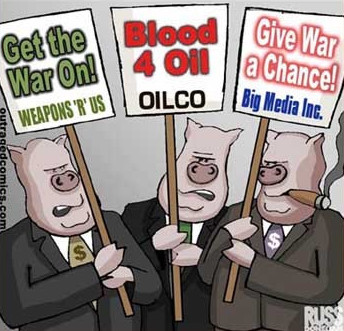
Profit Maximization is Easy: Invest in Violence

By Robert J. Burrowes

For those of us committed to systematically reducing and, one day, ending human violence, it is vital to understand what is causing and driving it so that effective strategies can be developed for dealing with violence in its myriad contexts. For an understanding of the fundamental cause of violence, see ‘Why Violence?’

However, while we can tackle violence at its source by each of us making and implementing ‘My Promise to Children’, the widespread violence in our world is driven by just one factor: fear or, more accurately, terror. And I am not talking about jihadist terror or even the terror caused by US warmaking. Let me explain, starting from the beginning.

The person who is fearless has no use for violence and has no trouble achieving their goals, including their own defence, without it. But fearlessness is a state that few humans would claim. Hence violence is rampant.

Moreover, once someone is afraid, they will be less likely to perceive the truth behind the delusions with which they are presented. They will also be less able to access and rely on other mental functions, such as conscience and intelligence, to decide their course of action in any context. Worse still, the range of their possible responses to perceived threats will be extremely limited. And they will be more easily mobilised to support or even participate in violence, in the delusional belief that this will make them safe.

For reasons such as these, it is useful for political and corporate elites to keep us in a state of fear: social control is much easier in this context. But so is profit maximization. And the most profitable enterprise on the planet is violence. In essence then: more violence leads to more fear making it easier to gain greater social control to inflict more violence…. And starting early, by terrorizing children, is the most efficient way to initiate and maintain this cycle. See ‘Why Violence?’ and ‘Fearless Psychology and Fearful Psychology: Principles and Practice’.

So, for example, if you think the massive number of police killings of innocent civilians in the United States – see ‘Killed by Police’ and ‘The Counted: People killed by police in the US’ – is a problem, you are not considering it from the perspective of maintaining elite social control and maximizing corporate profit. Police killings of innocent civilians is just one (necessary) part of the formula for maintaining control and maximising profit.

This is because if you want to make a lot of money in this world, then killing or exploiting fellow human beings and destroying the natural world are the three most lucrative business enterprises on the planet. And we are now very good at it, as the record shows, with the planetary death toll from violence and exploitation now well over 100,000 human beings each day, 200 species driven to extinction each day and ecological destruction so advanced that the end of all life (not just human life) on Earth is postulated to occur within decades, if not sooner, depending on the scenario. See, for example, ‘The End of Being: Abrupt Climate Change One of Many Ecological Crises Threatening to Collapse the Biosphere’.

So what forms does this violence take? Here is a daily accounting.

Corporate capitalist control of national economies, held in place by military violence, kills vast numbers of people (nearly one million each week) by starving them to death in Africa, Asia and Central/South America. This is because this ‘economic’ system is designed and managed to allocate resources for military weapons and corporate profits for the wealthy, instead of resources for living.

Wars kill, wound and incapacitate a substantial number of civilians, mostly women and children, as do genocidal assaults, on a daily basis, in countries all over the planet. Wars also kill some soldiers and mercenaries.

Apart from those people we kill every day, we sell many women and children into sexual slavery, we kidnap children to terrorise them into becoming child soldiers and force men, women and children to work as slave labourers, in horrific conditions, in fields and factories (and buy the cheap products of their exploited labour as our latest ‘bargain’).

We condemn millions of people to live in poverty, homelessness and misery, even in industrialized countries where the refugees of western-instigated wars and climate-destroying policies are often treated with contempt. We cause many children to be born with grotesque genetic deformities because we use horrific weapons, like those with depleted uranium, on their parents. We also inflict violence on women and children in many other forms, ranging from ‘ordinary’ domestic violence to genital mutilation.

We ensnare and imprison vast numbers of people in the police-legal-prison complex. See ‘The Rule of Law: Unjust and Violent’. We pay the pharmaceutical industry and its handmaiden, psychiatry, to destroy our minds with drugs and electro-shocking. See ‘Defeating the Violence of Psychiatry’. We imprison vast numbers of children in school in the delusional belief that this is good for them. See ‘Do We Want School or Education?’ And we kill or otherwise exploit animals, mostly for human consumption, in numbers so vast the death toll is probably beyond calculation.

We also engage in an endless assault on the Earth’s biosphere. Apart from the phenomenal damage done to the environment and climate by military violence: we emit gases and pollutants to heat and destroy the atmosphere and destroy its oxygen content. We cut down and burn rainforests. We cut down mangroves and woodlands and pave grasslands. We poison the soil with herbicides and pesticides. We pollute the waterways and oceans with everything from carbon and nitrogenous fertilizers to plastic, as well as the radioactive contamination from Fukushima. And delude ourselves that our token gestures to remedy this destruction constitutes ‘conservation’.

So if you are seeking work, whether as a recent graduate or long-term unemployed person, then the most readily available form of work, where you will undoubtedly be exploited as well, is a government bureaucracy or large corporation that inflicts violence on life itself. Whether it is the military, the police, legal or prison system, a weapons, fossil fuel, banking, pharmaceutical, media, mining, agricultural, logging, food or water corporation, a farm that exploits animals or even a retail outlet that sells poisonous, processed and often genetically-mutilated substances under the label ‘food’ – see ‘Defeating the Violence in Our Food and Medicine’ – you will have many options to help add to the profits of those corporations and government ‘services’ that exist to inflict violence on you, your family and every other living being that shares this biosphere.

Tragically, genuinely ethical employment is a rarity because most industries, even those that seem benign like the education, finance, information technology and electronics industries, usually end up providing skilled personnel, finance, services or components that are used to inflict violence. And other industries such as those in insurance and superannuation, like the corporate banks, usually invest in violence (such as the military and fossil fuel industries): it is the most profitable.

So while many government bureaucracies and corporate industries exist to inflict violence, in one form or another, they can only do so because we are too scared to insist on seeking out ethical employment. In the end, we will take a job as a teacher, corporate journalist or pharmaceutical drug pusher, serve junk food, work in a bank, join the police or military, work in the legal system, assemble a weapons component… rather than ask ourselves the frightening questions ‘Is this nonviolent? Is this ethical? Does it enhance life?’

And yes, I know about structural violence and the way it limits options and opportunities for those of particular classes, races, genders…. But if ordinary people like us don’t consider moral issues and make moral choices, why should governments and corporations?

Moral choices? you might ask in confusion. In this day and age? Well, it might seem old-fashioned but, in fact, while most of us have been drawn along by the events in our life to make choices based on such considerations as self-interest, personal gain and ‘financial security’, there is a deeper path. Remember Gandhi? ‘True morality consists not in following the beaten track, but in finding the true path for ourselves, and fearlessly following it.’

Strange words they no doubt sound in this world where our attention is endlessly taken by all of those high-tech devices. But Gandhi’s words remind us that there is something deeper in life that the violence we have suffered throughout our lives has taken from us. The courage to be ourselves and to seek our own unique destiny.

Do you have this courage? To be yourself, rather than a cog in someone else’s machine? To refuse to submit to the violence that surrounds and overwhelms us on a daily basis?

If you are inclined to ponder these questions, you might also consider making moral choices that work systematically to end the violence in our world: consider participating in ‘The Flame Tree Project to Save Life on Earth’, signing the online pledge of ‘The People’s Charter to Create a Nonviolent World’ and/or helping to develop and implement an effective strategy to resist one or the other of the many threats to our survival using the strategic framework explained in Nonviolent Campaign Strategy.

Of course, these choices aren’t for everyone. As Gandhi observed: ‘Cowards can never be moral.’


Biodata: Robert J. Burrowes has a lifetime commitment to understanding and ending human violence. He has done extensive research since 1966 in an effort to understand why human beings are violent and has been a nonviolent activist since 1981. He is the author of ‘Why Violence?’ His email address is flametree@riseup.net and his website is here.

Robert J. Burrowes P.O. Box 68 Daylesford Victoria 3460 Australia

Email: flametree@riseup.net

Websites:
http://thepeoplesnonviolencecharter.wordpress.com (Nonviolence Charter)
http://tinyurl.com/flametree (Flame Tree Project to Save Life on Earth)
http://tinyurl.com/whyviolence (‘Why Violence?’)
https://nonviolentstrategy.wordpress.com/ (Nonviolent Campaign Strategy)
https://nonviolentliberationstrategy.wordpress.com/ (Nonviolent Defense/Liberation Strategy)
http://anitamckone.wordpress.com (Anita: Songs of Nonviolence)
http://robertjburrowes.wordpress.com (Robert)
https://globalnonviolencenetwork.wordpress.com/ (Global Nonviolence Network)

You Want a Picture of the Future? Imagine a Boot Stamping on Your Face

By John W. Whitehead

Source: The Rutherford Institute

“The Internet is watching us now. If they want to. They can see what sites you visit. In the future, television will be watching us, and customizing itself to what it knows about us. The thrilling thing is, that will make us feel we’re part of the medium. The scary thing is, we’ll lose our right to privacy. An ad will appear in the air around us, talking directly to us.”—Director Steven Spielberg, Minority Report

We have arrived, way ahead of schedule, into the dystopian future dreamed up by such science fiction writers as George Orwell, Aldous Huxley, Margaret Atwood and Philip K. Dick.

Much like Orwell’s Big Brother in 1984, the government and its corporate spies now watch our every move.

Much like Huxley’s A Brave New World, we are churning out a society of watchers who “have their liberties taken away from them, but … rather enjoy it, because they [are] distracted from any desire to rebel by propaganda or brainwashing.”

Much like Atwood’s The Handmaid’s Tale, the populace is now taught to “know their place and their duties, to understand that they have no real rights but will be protected up to a point if they conform, and to think so poorly of themselves that they will accept their assigned fate and not rebel or run away.”

And in keeping with Philip K. Dick’s darkly prophetic vision of a dystopian police state—which became the basis for Steven Spielberg’s futuristic thriller Minority Report which was released 15 years ago—we are now trapped into a world in which the government is all-seeing, all-knowing and all-powerful, and if you dare to step out of line, dark-clad police SWAT teams and pre-crime units will crack a few skulls to bring the populace under control.

Minority Report is set in the year 2054, but it could just as well have taken place in 2017.

Seemingly taking its cue from science fiction, technology has moved so fast in the short time since Minority Report premiered in 2002 that what once seemed futuristic no longer occupies the realm of science fiction.

Incredibly, as the various nascent technologies employed and shared by the government and corporations alike—facial recognition, iris scanners, massive databases, behavior prediction software, and so on—are incorporated into a complex, interwoven cyber network aimed at tracking our movements, predicting our thoughts and controlling our behavior, Spielberg’s unnerving vision of the future is fast becoming our reality.

Both worlds—our present-day reality and Spielberg’s celluloid vision of the future—are characterized by widespread surveillance, behavior prediction technologies, data mining, fusion centers, driverless cars, voice-controlled homes, facial recognition systems, cybugs and drones, and predictive policing (pre-crime) aimed at capturing would-be criminals before they can do any damage.

Surveillance cameras are everywhere. Government agents listen in on our telephone calls and read our emails. Political correctness—a philosophy that discourages diversity—has become a guiding principle of modern society.

The courts have shredded the Fourth Amendment’s protections against unreasonable searches and seizures. In fact, SWAT teams battering down doors without search warrants and FBI agents acting as a secret police that investigate dissenting citizens are common occurrences in contemporary America.

We are increasingly ruled by multi-corporations wedded to the police state. Much of the population is either hooked on illegal drugs or ones prescribed by doctors. And bodily privacy and integrity has been utterly eviscerated by a prevailing view that Americans have no rights over what happens to their bodies during an encounter with government officials, who are allowed to search, seize, strip, scan, spy on, probe, pat down, taser, and arrest any individual at any time and for the slightest provocation.

All of this has come about with little more than a whimper from a clueless American populace largely comprised of nonreaders and television and internet zombies. But we have been warned about such an ominous future in novels and movies for years.

The following 15 films may be the best representation of what we now face as a society.

Fahrenheit 451 (1966). Adapted from Ray Bradbury’s novel and directed by Francois Truffaut, this film depicts a futuristic society in which books are banned, and firemen ironically are called on to burn contraband books—451 Fahrenheit being the temperature at which books burn. Montag is a fireman who develops a conscience and begins to question his book burning. This film is an adept metaphor for our obsessively politically correct society where virtually everyone now pre-censors speech. Here, a brainwashed people addicted to television and drugs do little to resist governmental oppressors.

2001: A Space Odyssey (1968). The plot of Stanley Kubrick’s masterpiece, as based on an Arthur C. Clarke short story, revolves around a space voyage to Jupiter. The astronauts soon learn, however, that the fully automated ship is orchestrated by a computer system—known as HAL 9000—which has become an autonomous thinking being that will even murder to retain control. The idea is that at some point in human evolution, technology in the form of artificial intelligence will become autonomous and that human beings will become mere appendages of technology. In fact, at present, we are seeing this development with massive databases generated and controlled by the government that are administered by such secretive agencies as the National Security Agency and sweep all websites and other information devices collecting information on average citizens. We are being watched from cradle to grave.

Planet of the Apes (1968). Based on Pierre Boulle’s novel, astronauts crash on a planet where apes are the masters and humans are treated as brutes and slaves. While fleeing from gorillas on horseback, astronaut Taylor is shot in the throat, captured and housed in a cage. From there, Taylor begins a journey wherein the truth revealed is that the planet was once controlled by technologically advanced humans who destroyed civilization. Taylor’s trek to the ominous Forbidden Zone reveals the startling fact that he was on planet earth all along. Descending into a fit of rage at what he sees in the final scene, Taylor screams: “We finally really did it. You maniacs! You blew it up! Damn you.” The lesson is obvious here, but will we listen? The script, although rewritten, was initially drafted by Rod Serling and retains Serling’s Twilight Zone-ish ending.

THX 1138 (1970). George Lucas’ directorial debut, this is a somber view of a dehumanized society totally controlled by a police state. The people are force-fed drugs to keep them passive, and they no longer have names but only letter/number combinations such as THX 1138. Any citizen who steps out of line is quickly brought into compliance by robotic police equipped with “pain prods”—electro-shock batons. Sound like tasers?

A Clockwork Orange (1971). Director Stanley Kubrick presents a future ruled by sadistic punk gangs and a chaotic government that cracks down on its citizens sporadically. Alex is a violent punk who finds himself in the grinding, crushing wheels of injustice. This film may accurately portray the future of western society that grinds to a halt as oil supplies diminish, environmental crises increase, chaos rules, and the only thing left is brute force.

Soylent Green (1973). Set in a futuristic overpopulated New York City, the people depend on synthetic foods manufactured by the Soylent Corporation. A policeman investigating a murder discovers the grisly truth about what soylent green is really made of. The theme is chaos where the world is ruled by ruthless corporations whose only goal is greed and profit. Sound familiar?

Blade Runner (1982). In a 21st century Los Angeles, a world-weary cop tracks down a handful of renegade “replicants” (synthetically produced human slaves). Life is now dominated by mega-corporations, and people sleepwalk along rain-drenched streets. This is a world where human life is cheap, and where anyone can be exterminated at will by the police (or blade runners). Based upon a Philip K. Dick novel, this exquisite Ridley Scott film questions what it means to be human in an inhuman world.

Nineteen Eighty-Four (1984). The best adaptation of Orwell’s dark tale, this film visualizes the total loss of freedom in a world dominated by technology and its misuse, and the crushing inhumanity of an omniscient state. The government controls the masses by controlling their thoughts, altering history and changing the meaning of words. Winston Smith is a doubter who turns to self-expression through his diary and then begins questioning the ways and methods of Big Brother before being re-educated in a most brutal fashion.

Brazil (1985). Sharing a similar vision of the near future as 1984 and Franz Kafka’s novel The Trial, this is arguably director Terry Gilliam’s best work, one replete with a merging of the fantastic and stark reality. Here, a mother-dominated, hapless clerk takes refuge in flights of fantasy to escape the ordinary drabness of life. Caught within the chaotic tentacles of a police state, the longing for more innocent, free times lies behind the vicious surface of this film.

They Live (1988). John Carpenter’s bizarre sci-fi social satire action film assumes the future has already arrived. John Nada is a homeless person who stumbles across a resistance movement and finds a pair of sunglasses that enables him to see the real world around him. What he discovers is a world controlled by ominous beings who bombard the citizens with subliminal messages such as “obey” and “conform.” Carpenter manages to make an effective political point about the underclass—that is, everyone except those in power. The point: we, the prisoners of our devices, are too busy sucking up the entertainment trivia beamed into our brains and attacking each other up to start an effective resistance movement.

The Matrix (1999). The story centers on a computer programmer Thomas A. Anderson, secretly a hacker known by the alias “Neo,” who begins a relentless quest to learn the meaning of “The Matrix”—cryptic references that appear on his computer. Neo’s search leads him to Morpheus who reveals the truth that the present reality is not what it seems and that Anderson is actually living in the future—2199. Humanity is at war against technology which has taken the form of intelligent beings, and Neo is actually living in The Matrix, an illusionary world that appears to be set in the present in order to keep the humans docile and under control. Neo soon joins Morpheus and his cohorts in a rebellion against the machines that use SWAT team tactics to keep things under control.

Minority Report (2002). Based on a short story by Philip K. Dick and directed by Steven Spielberg, the setting is 2054 where PreCrime, a specialized police unit, apprehends criminals before they can commit the crime. Captain Anderton is the chief of the Washington, DC, PreCrime force which uses future visions generated by “pre-cogs” (mutated humans with precognitive abilities) to stop murders. Soon Anderton becomes the focus of an investigation when the precogs predict he will commit a murder. But the system can be manipulated. This film raises the issue of the danger of technology operating autonomously—which will happen eventually if it has not already occurred. To a hammer, all the world looks like a nail. In the same way, to a police state computer, we all look like suspects. In fact, before long, we all may be mere extensions or appendages of the police state—all suspects in a world commandeered by machines.

V for Vendetta (2006). This film depicts a society ruled by a corrupt and totalitarian government where everything is run by an abusive secret police. A vigilante named V dons a mask and leads a rebellion against the state. The subtext here is that authoritarian regimes through repression create their own enemies—that is, terrorists—forcing government agents and terrorists into a recurring cycle of violence. And who is caught in the middle? The citizens, of course. This film has a cult following among various underground political groups such as Anonymous, whose members wear the same Guy Fawkes mask as that worn by V.

Children of Men (2006). This film portrays a futuristic world without hope since humankind has lost its ability to procreate. Civilization has descended into chaos and is held together by a military state and a government that attempts to keep its totalitarian stronghold on the population. Most governments have collapsed, leaving Great Britain as one of the few remaining intact societies. As a result, millions of refugees seek asylum only to be rounded up and detained by the police. Suicide is a viable option as a suicide kit called Quietus is promoted on billboards and on television and newspapers. But hope for a new day comes when a woman becomes inexplicably pregnant.

Land of the Blind (2006). This dark political satire is based on several historical incidents in which tyrannical rulers were overthrown by new leaders who proved just as evil as their predecessors. Maximilian II is a demented fascist ruler of a troubled land named Everycountry who has two main interests: tormenting his underlings and running his country’s movie industry. Citizens who are perceived as questioning the state are sent to “re-education camps” where the state’s concept of reality is drummed into their heads. Joe, a prison guard, is emotionally moved by the prisoner and renowned author Thorne and eventually joins a coup to remove the sadistic Maximilian, replacing him with Thorne. But soon Joe finds himself the target of the new government.

All of these films—and the writers who inspired them—understood what many Americans, caught up in their partisan, flag-waving, zombified states, are still struggling to come to terms with: that there is no such thing as a government organized for the good of the people. Even the best intentions among those in government inevitably give way to the desire to maintain power and control at all costs.

Eventually, as I point out in my book Battlefield America: The War on the American People, even the sleepwalking masses (who remain convinced that all of the bad things happening in the police state—the police shootings, the police beatings, the raids, the roadside strip searches—are happening to other people) will have to wake up.

Sooner or later, the things happening to other people will start happening to us and our loved ones.

When that painful reality sinks in, it will hit with the force of a SWAT team crashing through your door, a taser being aimed at your stomach, and a gun pointed at your head. And there will be no channel to change, no reality to alter, and no manufactured farce to hide behind.

As George Orwell warned, “If you want a picture of the future, imagine a boot stamping on a human face forever.”

Policing for Profit: Jeff Sessions & Co.’s Thinly Veiled Plot to Rob Us Blind

By John W. Whitehead

Source: The Rutherford Institute

“Laws are no longer made by a rational process of public discussion; they are made by a process of blackmail and intimidation, and they are executed in the same manner. The typical lawmaker of today is a man wholly devoid of principle — a mere counter in a grotesque and knavish game. If the right pressure could be applied to him, he would be cheerfully in favor of polygamy, astrology or cannibalism. It is the aim of the Bill of Rights, if it has any remaining aim at all, to curb such prehensile gentry. Its function is to set a limitation upon their power to harry and oppress us to their own private profit.”— H.L. Mencken

Let’s not mince words.

Jeff Sessions, the nation’s top law enforcement official, would not recognize the Constitution if he ran right smack into it.

Whether the head of the Trump Administration’s Justice Department enjoys being the architect of a police state or is just painfully, criminally clueless, Sessions has done a great job thus far of sidestepping the Constitution at every turn.

Most recently, under the guise of “fighting crime,” Sessions gave police the green light to rob, pilfer, steal, thieve, swipe, purloin, filch and liberate American taxpayers of even more of their hard-earned valuables (especially if it happens to be significant amounts of cash) using any means, fair or foul.

In this case, the foul method favored by Sessions & Co. is civil asset forfeiture, which allows police and prosecutors to “seize your car or other property, sell it and use the proceeds to fund agency budgets—all without so much as charging you with a crime.”

Under a federal equitable sharing program, police turn asset forfeiture cases over to federal agents who process seizures and then return 80% of the proceeds to the police. (In Michigan, police actually get to keep up to 100% of forfeited property.)

This incentive-driven excuse for stealing from the citizenry is more accurately referred to as “policing for profit” or “theft by cop.”

Despite the fact that 80 percent of these asset forfeiture cases result in no charge against the property owner, challenging these “takings” in court can cost the owner more than the value of the confiscated property itself. As a result, most property owners either give up the fight or chalk the confiscation up to government corruption, leaving the police and other government officials to reap the benefits.

And boy, do they reap the benefits.

Police agencies have used their ill-gotten gains “to buy guns, armored cars and electronic surveillance gear,” reports The Washington Post. “They have also spent money on luxury vehicles, travel and a clown named Sparkles.”

Incredibly, these asset forfeiture scams have become so profitable for the government that, according to The Washington Post, “in 2014, law enforcement took more stuff from people than burglars did.” As the Post notes, “the Treasury and Justice departments deposited more than $5 billion into their respective asset forfeiture funds. That same year, the FBI reports that burglary losses topped out at $3.5 billion.”

In 2015, the federal government seized nearly $2.6 billion worth of airplanes, houses, cash, jewelry, cars and other items under the guise of civil asset forfeiture.

According to USA Today, “Anecdotal evidence suggests that allowing departments to keep forfeiture proceeds may tempt them to use the funds unwisely. For example, consider a 2015 scandal in Romulus, Michigan, where police officers used funds forfeited from illicit drug and prostitution stings to pay for …  illicit drugs and prostitutes.”

Memo to the rest of my fellow indentured servants who are living through this dark era of government corruption, incompetence and general ineptitude: this is not how justice in America is supposed to work.

We are now ruled by a government so consumed with squeezing every last penny out of the population that they are completely unconcerned if essential freedoms are trampled in the process.

Our freedoms aren’t just being trampled, however. They’re being eviscerated.

At every turn, “We the People” are getting swindled, cheated, conned, robbed, raided, pickpocketed, mugged, deceived, defrauded, double-crossed and fleeced by governmental and corporate shareholders of the American police state out to make a profit at taxpayer expense.

Americans no longer have to be guilty to be stripped of their property, rights and liberties. All you have to be is in possession of something the government wants. And if you happen to have something the government wants badly enough, trust me, their agents will go to any lengths to get it.

If the government can arbitrarily freeze, seize or lay claim to your property (money, land or possessions) under government asset forfeiture schemes, you have no true rights.

Here’s how the whole ugly business works in a nutshell.

First, government agents (usually the police) use a broad array of tactics to profile, identify, target and arrange to encounter (in a traffic stop, on a train, in an airport, in public, or on private property) those  individuals who might be traveling with a significant amount of cash or possess property of value. Second, these government agents—empowered by the courts and the legislatures—seize private property (cash, jewelry, cars, homes and other valuables) they “suspect” may be connected to criminal activity.

Then—and here’s the kicker—whether or not any crime is actually proven to have taken place, without any charges being levied against the property owner, or any real due process afforded the unlucky victim, the property is seized by the government, which often divvies it up with the local police who helped with the initial seizure.

In a Kafkaesque turn of the screw, the burden of proof falls on the unfortunate citizenry who must mount a long, complicated, expensive legal campaign to prove their innocence in order to persuade the government that it should return the funds they stole. Not surprisingly, very few funds ever get returned.

It’s a new, twisted form of guilt by association, only it’s not the citizenry being accused of wrongdoing, just their money.

Motorists have been particularly vulnerable to this modern-day form of highway robbery.

For instance, police stole $201,000 in cash from Lisa Leonard because the money—which Leonard planned to use to buy a house for her son—was being transported on a public highway also used by drug traffickers. Despite the fact that Leonard was innocent of wrongdoing, the U.S. Supreme Court upheld the theft on a technicality.

Police stole $50,000 in cash from Amanee Busbee—which she planned to use to complete the purchase of a restaurant—and threatened to hand her child over to CPS if she resisted. She’s one of the few to win most of her money back in court.

Police stole $22,000 in cash from Jerome Chennault—which he planned to use as the down payment on a home—simply because a drug dog had alerted police to its presence in his car. After challenging the seizure in court, Chennault eventually succeeded in having most of his money returned, although the state refused to compensate him for his legal and travel expenses.

Police stole $8,500 in cash and jewelry from Roderick Daniels—which he planned to use to purchase a new car—and threatened him with jail and money-laundering charges if he didn’t sign a waiver forfeiting his property.

Police stole $6,000 in cash from Jennifer Boatright and Ron Henderson and threatened to turn their young children over to Child Protective Services if they resisted.

Tenaha, Texas, is a particular hotbed of highway forfeiture activity, so much so that police officers keep pre-signed, pre-notarized documents on hand so they can fill in what property they are seizing.

As the Huffington Post explains, these police forfeiture operations have become little more than criminal shakedowns:

Police in some jurisdictions have run forfeiture operations that would be difficult to distinguish from criminal shakedowns. Police can pull motorists over, find some amount of cash or other property of value, claim some vague connection to illegal drug activity and then present the motorists with a choice: If they hand over the property, they can be on their way. Otherwise, they face arrest, seizure of property, a drug charge, a probable night in jail, the hassle of multiple return trips to the state or city where they were pulled over, and the cost of hiring a lawyer to fight both the seizure and the criminal charge. It isn’t hard to see why even an innocent motorist would opt to simply hand over the cash and move on.

Unsurprisingly, these asset forfeiture scams have become so profitable for the government that they have expanded their reach beyond the nation’s highways.

According to USA Today, the U.S. Department of Justice received $2.01 billion in forfeited items in 2013, and since 2008 local and state law enforcement nationwide has raked in some $3 billion in forfeitures through the federal “equitable sharing” program.

So now it’s not just drivers who have to worry about getting the shakedown.

Any American unwise enough to travel with cash is fair game for the government pickpockets.

In fact, the Drug Enforcement Administration (DEA) has been colluding with the Transportation Security Administration (TSA) and local police departments to seize a small fortune in cash from American travelers using the very tools—scanners, spies and surveillance devices—they claimed were necessary to catch terrorists.

Mind you, TSA agents already have a reputation for stealing from travelers, but clearly the government is not concerned about protecting the citizenry from its own wolfish tendencies.

No, the government bureaucrats aren’t looking to catch criminals. (If so, they should be arresting themselves.)

They’re just out to rob you of your cold, hard cash.

Think about it for a moment. You pay a hefty fee just to be able to walk free. It’s called income tax. As former presidential candidate Ron Paul recognizes, “The Founding Fathers never intended a nation where citizens would pay nearly half of everything they earn to the government.” And if you refuse to pay any of that so-called income tax, you’ll be severely fined and/or arrested and put in jail.

One more thing: you don’t really own your property. That is, your house or your land. Even when you pay off the mortgage, if you fail to pay your property taxes, government agents will evict you and take your home.

This is not freedom.

There was a time in our history when our forebears said “enough is enough” and stopped paying taxes (a pittance compared to what we are forced to shell out in taxes today) to what they considered an illegitimate government. They stood their ground and refused to support a system that was slowly choking out any attempts at self-governance, and which refused to be held accountable for its crimes against the people. Their resistance sowed the seeds for the revolution that would follow.

Unfortunately, in the 200-plus years since we established our own government, we’ve let the corporate elite and number-crunching bureaucrats pilfer our bank accounts to such an extent that we’re back where we started.

Once again, we’ve got a despotic regime with an imperial ruler doing as it pleases.

But what if we didn’t just pull out our pocketbooks and pony up to the federal government’s outrageous demands for more money? What if we didn’t just line up to drop our hard-earned dollars into the corporate collection bucket, no questions asked about how it will be spent? What if, instead of meekly tolerating the government’s ongoing efforts to rob us blind, we did something about it?

As I make clear in my book Battlefield America: The War on the American People, if the government can just take from you what they want, when they want, and then use it however they want, you can’t claim to be anything more than a serf in a land they think of as theirs.

It’s up to “We the People” to demand reform.

These injustices will continue as long as we remain silent.

As American journalist H.L. Mencken observed:

The American of today, in fact, probably enjoys less personal liberty than any other man of Christendom, and even his political liberty is fast succumbing to the new dogma that certain theories of government are virtuous and lawful, and others abhorrent and felonious. Laws limiting the radius of his free activity multiply year by year: It is now practically impossible for him to exhibit anything describable as genuine individuality, either in action or in thought, without running afoul of some harsh and unintelligible penalty. It would surprise no impartial observer if … the goddess of liberty were taken off the silver dollars to make room for a bas-relief of a policeman in a spiked helmet. Moreover, this gradual (and, of late, rapidly progressive) decay of freedom goes almost without challenge; the American has grown so accustomed to the denial of his constitutional rights and to the minute regulation of his conduct by swarms of spies, letter-openers, informers and agents provocateurs that he no longer makes any serious protest.

In other words, make them hear you.

And if they won’t listen, then I suggest it’s time for what Martin Luther King Jr. called for when government doesn’t listen: “militant nonviolent resistance.”

The Over-Criminalization of American Life

By Charles Hugh Smith

Source: Of Two Minds

The over-criminalization of America has undermined justice, the rule of law and legal egalitarianism.

While the corporate media devotes itself to sports, entertainment, dining out and the latest political kerfuffle, America has become the Over-Criminalization Capital of the World. The proliferation of laws and administrative regulations, federal, state and local, that carry criminal penalties has swollen into the tens of thousands.

The number of incarcerated Americans exceeds 2.3 million, with the majority being non-violent offenders–often for War on Drugs offenses.

Holly Harris has written an important summary of this profoundly destabilizing trend: The Prisoner Dilemma: Ending America’s Incarceration Epidemic (Foreign Affairs, registration required).

The over-criminalization of America is a relatively recent trend. As Harris notes:

It wasn’t always like this. In 1972, for every 100,000 U.S. residents, 161 were incarcerated. By 2015, that rate had more than quadrupled, with nearly 670 out of every 100,000 Americans behind bars.

The over-criminalization of America is rooted in federal laws and regulations, and state and local governments have followed suite. here is Harris’s account:

The burgeoning U.S. prison population reflects a federal criminal code that has spiraled out of control. No one—not even the government itself—has ever been able to specify with any certainty the precise number of federal crimes defined by the 54 sections contained in the 27,000 or so pages of the U.S. Code. In the 1980s, lawyers at the Department of Justice attempted to tabulate the figure “for the express purpose of exposing the idiocy” of the criminal code, as one of them later put it. The best they were able to come up with was an educated guess of 3,000 crimes. Today, the conservative Heritage Foundation estimates that federal laws currently enumerate nearly 5,000 crimes, a number that grows every year.

Overcriminalization extends beyond the law books, partly because regulations are often backed by criminal penalties. That is the case for rules that govern matters as trivial as the sale of grated cheese, the precise composition of chicken Kiev dishes, and the washing of cars at the headquarters of the National Institutes of Health. State laws add tens of thousands more such crimes. Taken together, they push the total number of criminally punishable offenses in the United States into the hundreds of thousands. The long arm of the law reaches into nearly every aspect of American life. The legal scholar Harvey Silverglate has concluded that the typical American commits at least three federal felonies a day, simply by going through his or her normal routine.

Federal policies reward states for building prisons and mandating harsher sentences:

…federal incentives for states that safely decrease their prison populations and reconsider ineffective sentencing regimes…would represent a stark reversal of legislation signed into law by President Bill Clinton in 1994, which did just the opposite, offering federal dollars to states that imposed harsher criminal penalties and built more prisons, which contributed to the explosion of incarceration rates during the past two decades.

How did we become a Gulag Nation of tens of thousands of laws and regulations and mandatory harsh sentences for non-violent crimes–a society imprisoned for administrative crimes that aren’t even tried in our judiciary system? I would suggest two primary sources:

1. The relentless expansion of central-state power over every aspect of life. As I describe in my book Resistance, Revolution, Liberation: A Model for Positive Change, the state has only one ontological imperative: to expand its power and control. There are no equivalent mechanisms for reducing the legal/regulatory burdens imposed by the state; various reforms aimed at reducing the quantity of laws and regulations have not even made a dent in the over-criminalization of America.

The second dynamic is the political reality that the easiest way for politicos to be seen as “doing something” is to pass more laws and regulations criminalizing an additional aspect of life. The state and its elites justify the state’s relentless expansion of power and control by claiming problems can only be solved by centralizing power further and increasing the number and severity of penalties.

Criminalization is the ultimate expansion of the state’s monopoly on coercive violence. As the state expands its power to imprison or punish its citizens for an ever-wider range of often petty infractions, increasingly via a bureaucratic administrative process that strips the citizens of due process, another pernicious dynamic emerges: the informal application and enforcement of formal laws and regulations.

In other words, the laws and regulations are enforced at the discretion of the state’s officials. This is the systemic source of driving while black: a defective tail-light gets an African-American driver pulled over, while drivers of other ethnic origin get a pass.

This is also the source of America’s systemic blind eye on white-collar crimes while the War on Drugs mandates harsh sentences with a cruel vengeance. When there are so many laws and regulations to choose from, government officials have immense discretion over which laws and regulations to enforce.

Prosecutors seeking to increase their body count will use harsh drug laws to force innocents to accept plea bargains, while federal prosecutors don’t even pursue white-collar corporate fraud on a vast scale.

The over-criminalization of America has undermined justice, the rule of law and the bedrock notion that everyone is equal under the law, i.e. legal egalitarianism.

The over-criminalization of America breeds corruption as the wealthy and powerful evade the crushing burden of over-regulation by either buying political favors in our pay-to-play “democracy” (money votes, money wins) or by hiring teams of attorneys, CPAs, etc. to seek loopholes or construct a courtroom defense.

Meanwhile, the peasantry are offered a harsh plea bargain.

The over-criminalization of America is one core reason why the status quo has failed and cannot be reformed. That is the title of one of my short works, Why Our Status Quo Failed and Is Beyond Reform, which explains why the ceaseless expansion of centralized power leads to failure and collapse.


Beyond Violence and Nonviolence

By Ben Case

Source: ROAR Magazine

The argument over violence and nonviolence — one of the oldest and most divisive on the left — is back. Broken windows, mass arrests and one well-timed punch marked Donald Trump’s inauguration alongside massive nonviolent marches. In the weeks since, demonstrators converged on international airports, adding weight to a heated judicial fight over a sweeping ban on refugees and immigrants from seven countries, and fiery protests outside a famed hate-monger’s talk at Berkeley cancelled the event and forced the speaker to flee under police escort.

Against the backdrop of a renascent fascist menace, the mix of tactical approaches has brought renewed fervor to the violence-vs-nonviolence debate. The dispute has been calcified into fixed positions, where it becomes less about persuading others to a strategic position and more about winning a point for one’s team.

Despite claims to the contrary, the current arguments over violence and nonviolence are based more in personal belief than in strategy. It is perfectly reasonable for an individual to dislike, be frightened of, or not want to participate in violent actions. To others, violent resistance on the part of the oppressed is inherently virtuous — and given social realities, the desire to break and burn things is understandable. But these personal positions should not be confused with strategic logic. In this debate, it does immense harm to the movement to represent personal sentiments as empirical fact.

Lucid strategic thinking is crucial in the present moment, and this type of quarrel is extremely destructive. It is time for movements to update frameworks for understanding disruptive actions, and that means thinking beyond the archaic violence-nonviolence dichotomy.

Nonviolence and Civil Resistance

The violence-nonviolence framework as we know it emerged from a twentieth-century context in which the paradigm for political revolution was armed struggle. Whether drawing inspiration from ideologically Maoist and Guevarist guerrilla strategies or theories of decolonization, revolutionaries took up arms and went to war with the state.

Original adherents to the doctrine of nonviolence, mostly pacifists, objected to acts of violence on a moral and historically religious basis. Gandhi’s philosophy of satyagraha, often translated as “adherence to Truth” or “truth force,” which means social change through and as the practice of nonviolence, was deeply influential for pacifists as an alternative to the dominant model of guerrilla warfare. In this view, nonviolence is valued over political victory, since enacting violence in order to achieve a material goal would not be victory at all.

The field of civil resistance studies changed the approach of “nonviolentism.” Gene Sharp, the founder of the field, separated Gandhi’s theory of nonviolent organizing from his theory of nonviolent spirituality. This new approach of “strategic nonviolence” argues for the use of nonviolent action as a political tool based on its superior strategic efficacy. Strategic nonviolentists distinguish themselves from “moral” or “principled” nonviolentists, who argue for nonviolence based on its inherent virtue. Here the value is placed on political victory, with nonviolent action understood to be the most effective method of achieving it.

Civil resistance studies has identified social and political dynamics that mass movements use to create material leverage in wildly lopsided power struggles with authoritarian regimes. The idea is to locate the “pillars of support” — the systemically loadbearing institutions — for a regime and to strategically dismantle them, focusing on the importance of mass noncooperation, polarizing populations through dramatic actions, and the backfiring effect of police repression.

In a moment when strategic thinking is desperately needed, the civil resistance framework is a powerful one. But the strategic nonviolent approach lags behind contemporary realities. The twentieth-century image of a revolutionary was the guerrilla unit facing off against the army; today it is the crowd facing off against lines of riot police. Of course, leftist armed struggle still exists, but it is increasingly framed as armed self-defense rather than armed conquest of the state, as in the Rojava Revolution and the Zapatista movement.

When guerrilla war was the prevailing method of revolutionary struggle, broadly distinguishing between violent and nonviolent strategy made more sense, because the strategic orientation of street protests was so dissimilar from that of warfare. In the emerging paradigm of revolutionary mass protest movements, whether or not any property is destroyed in a specific action is an entirely different issue, and far less consequential.

By Any Means Necessary

The use of low-level violent actions such as rioting and property destruction is often termed “diversity of tactics.” Like nonviolence, the defense of violent tactics can have both strategic and moral sides to it, and they can be equally difficult to separate.

Despite the objection that nonviolence depends on morality, arguments for the use of diversity of tactics frequently center on moral claims as well. For example, a common refrain is that the violence of breaking windows pales in comparison to the violence perpetrated by the state. While this is manifestly true, it does not constitute a strategic argument. A violent action being morally justifiable as a reaction to or defense from institutional violence does not mean that that type of action most effectively counters the institutional violence.

Malcolm X’s famous statement that “we want freedom by any means necessary” is frequently referenced to defend the use of diversity of tactics, classically juxtaposed to King’s nonviolence. However, the last word in Malcolm X’s sentence receives less attention than it should. The word “necessary” implies a strategic logic — by whichever means are required to achieve a particular goal — but in and of itself this approach does not point to a strategy. (It is worth noting that Malcolm X did not engage in any political violence himself.) Arguments for diversity of tactics might convince an activist that violence can be necessary, but questions of how and when those actions are strategically applied remain.

On the other hand, the study of civil resistance has focused on how and when certain tactics are most effective, but the field’s vestigial attachment to a totalizing concept of nonviolence limits its usefulness. Nonviolence is marketed as not only the most effective but the only viable method of political struggle. This position demands strict adherence to nonviolent discipline, as any act that can be reasonably perceived as violent is understood to help the enemy. Since violent actions nearly always occur at some point in large-scale social movements, a great deal of energy is wasted on hand-wringing over how these actions are hurting nonviolent efforts.

Focusing on What Works

The single most important study in civil resistance is published in Erica Chenoweth and Maria Stephan’s 2011 book Why Civil Resistance Works: The Strategic Logic of Nonviolent Conflict. Their claim is striking: nonviolent movements are almost twice as likely as violent ones to achieve “maximalist” political goals (overthrowing a leader, ousting a foreign occupation or seceding from a territory). This work has become the centerpiece of the assertion that nonviolence is more effective than violence.

Chenoweth and Stephan’s argument is based on a global dataset, Nonviolent and Violent Conflicts and Outcomes (NAVCO), which catalogues and compares uprisings between 1900 and 2006 based on whether or not the primary method was violent or nonviolent. The problem is that this study ignores riots and property destruction.

In fact, Chenoweth and Stephan’s study does not compare violence with nonviolence in the way those terms are used in movements today — it compares warfare to mass protests. According to the authors, NAVCO’s “violent” category comprises civil wars, while the nonviolent category is composed of campaigns that do not harm or threaten to harm opponents. Movements are ultimately categorized based on a campaign’s primary method of struggle, and the data contains no variables for any type of violent action that falls below the threshold for war.

NAVCO does include a variable for the “radical flank effect,” which in this case means an armed struggle being waged in the same country as a civilian protest movement. For example, during the civilian anti-Marcos protests in the Philippines in the 1980s, there was a separate armed insurgency going on at the same time elsewhere in the country — that is a radical flank in NAVCO data. This has nothing to do with the effect of protesters breaking windows or scuffling with police.

Indeed, campaigns in NAVCO’s nonviolent category contain prominent acts of violence. For example, the First Palestinian Intifada, iconically associated with people throwing rocks at soldiers, is listed as nonviolent because the movement was primarily nonviolent. The “Bulldozer Revolution” in Serbia, so named because activists used a bulldozer to break through police barricades at a crucial moment during climactic protests, allowing crowds to storm and burn government buildings, is also classified as nonviolent.

For the most part, activists today do not seriously discuss taking up arms and going to the mountains to wage guerrilla warfare. Instead, contemporary arguments over nonviolent discipline center around activities like smashing windows, throwing projectiles at police and punching neo-Nazis. To date, Chenoweth’s research does not address these actions whatsoever. Unfortunately, it is misrepresented as being directly relevant to the diversity of tactics debate, including by the researchers themselves, and has become the go-to reference for advocates of strict nonviolent discipline.

The gap between Chenoweth and Stephan’s findings and how they are presented is symptomatic of structural problems in the civil resistance field at large. The prevailing trend has been to ignore the types of actions that do not fit the theory. When violent actions occur, they are not investigated with the balanced, systematic analysis given to nonviolent actions, but are brushed off as random or unfortunate breaks from nonviolent discipline.

Between “Strategic” and “Nonviolence”

Though civil resistance studies claims to investigate which strategies are most effective for achieving a movement’s objectives, its conceptual framework ultimately emerged from a Gandhian view of political struggle. Sharp explained Gandhi’s movement in terms of its strategic approach and eventually abandoned the moral pacifism, but the foundational core of the field is still based on a theory of change constructed around the practice of spiritual nonviolence.

The term “strategic nonviolence” contains the contradiction within itself. A strategy that begins by assuming that a certain approach is correct is not actually a strategy but a belief. Civil resistance theorists claim to be motivated purely by the effectiveness of their approach, but if effectiveness is truly the goal, then one must be open to all possibilities that might prove to be effective in a given circumstance. If one rejects a priori all possibilities that are not nonviolence, then what is called strategy is actually selective evidence to support a preexisting conclusion.

While pacifism was never fully purged from strategic nonviolence, the attempt to abandon the moral foundation of nonviolence has had troubling consequences. Without a guiding ideology, that which is deemed to be most strategic can come to stand in for that which is just and correct. In other words, focusing exclusively on how movements win the next battle can obscure the meaning of the war. Ironically, moral nonviolentists like Gandhi and King were far more sympathetic to violent actions that were understood to be on the side of justice than strategic nonviolentists are to a broken bank window.

Rather than taking cues from Gandhi and King, who humanized and allied themselves with all resistance to oppression even when they disagreed with the methods, today’s strategic nonviolentists are quick to deride, abandon and even incriminate activists engaging in property destruction or self-defense. The loss of principle may have allowed strategic nonviolentists to pursue valuable research on effective tactics, but it has also led to a callous attitude towards fellow activists — one that is distinctly un-strategic in its approach to polarizing public opinion around systemic oppression.

Strategic Thinking Beyond Violence and Nonviolence

Like Chenoweth’s research, the field of civil resistance claims to do a lot more than it does — but what it does do is significant. The articulation of simple, user-friendly approaches for dismantling institutional targets using creative nonviolent disruption is important and needed. Research that illuminates how social movements effectively create widespread social and political change is one of the best uses of academic resources.

Unsurprisingly, there is evidence that violent actions generate greater police repression. At least one study suggests that mainstream tolerance for police repression of protests, especially violent ones, is quite high. These are important factors for activists to anticipate and strategize around, but this type of backlash does not necessarily undermine movements. In fact, state repression and polarizing public opinions are part of the cycle of disruption that is required for radical social change.

There are also many reasons to believe that use of limited violence, especially property destruction and community self-defense, might enhance a movement’s power. In addition to sometimes being strategic tools, acts of violence as collective resistance can be important components of consciousness-building and radicalization for many people, an effect that is sometimes overlooked by more clinical studies based on political outcomes. And far from being insulated from one another, there are often fluid interactions between more and less violent elements of movements — and those who participate in them.

Any tactic, whether or not it involves violence, has potential benefits and costs. Just as a riot might damage some people’s perception of a movement, it might galvanize others. A permitted demonstration led by liberal figureheads could play well on TV, but might also suck resources without challenging power. And of course there are differences in tactical impact between shorter term and broader strategic goals. The point is, violence is not necessarily the deciding factor in whether or not an action is strategic.

It is not about which team wins symbolic points in the violence-nonviolence debate; it is about how different groups’ tactical approaches can work in harmony to build power. In the context of today’s movements, the broad argument over violence and nonviolence is at best a distraction. At worst, it promotes a good protester/bad protester narrative that helps the state divide and conquer movements. We need a fresh approach.

Key principles of civil resistance such as noncooperation, mass participation, polarization and the backfiring effect are important and useful. If the blanket exclusion of all violent action is left aside, these principles are theoretically open to a much broader range of strategies and tactics than strict nonviolence currently admits.

Movement strategist Frances Fox Piven sees riots as a form of noncooperation in the routines of civic life. Riots can also dramatize and bring mass attention to serious issues in precisely the way civil resistance advocates. And it might turn out that the backfiring effect has more to do with disproportionate repression than the complete lack of violence on the part of protesters. For example, riots in Ferguson brought police militarization into national focus.

Importantly, these possibilities do not imply an inversion of nonviolent discipline, like some kind of violent discipline. Certainly there are many circumstances in which nonviolent actions are appropriate and effective. Contrary to what some diversity of tactics advocates claim, more violence does not necessarily indicate a more successful movement. But neither necessarily does less violence. We need dynamic strategic models — rooted in principles of solidarity, autonomy and equity — that can accommodate a spectrum of disruptive and prefigurative action.

The rhetoric and meanings of violence can and should be debated, but those meanings are no longer attached to distinct forms of political struggle. It does not make analytical sense to categorize movements or actions into two artificial, opposing categories based on whether or not activists do anything that can be called violence. The civil resistance playbook says that when there is protester violence, nonviolent groups should try to enforce nonviolent discipline or distance themselves. But this response is based less in strategic logic than in a stubborn and unfounded belief that any violence at all is necessarily a movement-stopper.

The moment is urgent. In terms of strategy, the violence-nonviolence dichotomy has outlived its usefulness. Organizers should not evaluate actions based on whether or not there is anything that could be interpreted as violence, but rather based on the potential of those actions to disrupt oppressive systems, build power and win short-term goals that can lead to long-term victory.

Recordings Reveal FBI Gave Man a Rifle, Urged Him to Carry Out Mass Shooting to ‘Defend Islam’

By Matt Agorist

Source: The Free Thought Project

It’s become a near-weekly occurrence. Somewhere in some state, the FBI will announce that they’ve foiled yet another terrorist plot and saved lives. However, as the data shows, the majority of these cases involve psychologically diminished patsies who’ve been entirely groomed, armed, and entrapped by FBI agents. Simply put, the FBI manufactures terror threats and then takes credit for stopping them.

But what happens when they take it too far? What happens if the FBI actually tells someone to conduct a mass shooting? Well, in Milwaukee, WI, we are seeing this unfold first hand.

A little over two years ago, Samy Mohamed Hamzeh, 25, found himself in the midst of an FBI sting. Little did he know that he was being groomed for terrorism by the same government who claims to fight terrorism.

Hamzeh was born in the U.S. but lived much of his childhood in Jordan before moving to Milwaukee when he was 19. For four years, Hamzeh lived an entirely normal life, until one day, he was contacted by people who wanted to radicalize him and give him weapons.

The group, entirely controlled by the FBI was plotting to shoot up the Humphrey Scottish Rite Masonic Center during an event.

In February of 2016, the FBI announced they had foiled a terror plot by a man who was planning to kill at least 30 people to “defend Islam.” Americans cheered, and everyone felt safer — the FBI had saved us from extremists once again.

However, that’s not how things actually happened.

For months, two corrupt FBI informants goaded Hamzeh into obtaining weapons. According to his attorneys, hundreds of hours of recorded conversations show the FBI pressed Hamzeh into getting these weapons and eventually began pushing him to carry out a mass shooting.

Despite the intense peer pressure from people pretending that they were mass murderers, Hamzeh resisted. He didn’t even want the guns. Now, his attorneys have filed a motion to get him released on bond because they say he’s been set up.

The informants, the motion states, “frequently lobbied Hamzeh to get a machine gun despite his repeated protests that all he wanted was a legal handgun to protect himself.”

In spite of the FBI claiming Hamzeh was going to carry out a mass shooting — they were attempting to force him to do — the recordings, according to his attorneys, show he resisted and adamantly refused to ever participate in violence.

Even after the FBI announced their foiled terror plot, they were unable to charge Hamzeh with anything other than possessing a machine gun and a silencer. And even these items had been essentially shoved into his lap by the FBI.

As the Journal-Sentinel reports, a psychiatrist who evaluated Hamzeh in jail concluded he does not fit a profile of someone who would kill strangers and “has a strong moral code with a very prominent conscience and empathy.”

“There is also no evidence that Hamzeh ever made any plans or was doing anything other than making empty boasts to express his resentment about Israel or to gain attention,” reads their brief in support of the bond motion.

Hamzeh has now been in jail for a year and a half because the FBI tried to make him carry out a mass shooting that he didn’t want to do. And, he could be there much longer as each of the charges for the weapons — that he also did not want — carry 10 years a piece.

If Hamzeh never had any intention of carrying out a terror attack and the weapons were forced on him by the FBI, why on Earth would this be on the news and touted as some foiled plot?

Well, the answer to that is simple.

Former FBI assistant director Thomas Fuentes actually reveals the answer as he defends the tactics used by the FBI to set up poverty-stricken men by offering them large sums of money and weapons to commit crimes.

After he defended the FBI’s role in bribing poor, mentally diminished people to get them to commit crimes, he let out a bombshell statement, confirming what many of us already know.

“If you’re submitting budget proposals for a law enforcement agency, for an intelligence agency, you’re not going to submit the proposal that ‘We won the war on terror and everything’s great,’ cause the first thing that’s gonna happen is your budget’s gonna be cut in half,” states Fuentes. “You know, it’s my opposite of Jesse Jackson’s ‘Keep Hope Alive’—it’s ‘Keep Fear Alive.’ Keep it alive.”

There you have it. The FBI puts Americans in danger by grooming otherwise entirely innocent people into doing harm — so they can keep fear alive.

But what would’ve happened if Hamzeh would’ve actually carried out this shooting that the FBI was trying to force on him? Would the FBI still claim they had informants attempting to groom him? Would they admit to forcing him to accept weapons?

David Steele, a 20-year Marine Corps intelligence officer, the second-highest-ranking civilian in the U.S. Marine Corps Intelligence, and former CIA clandestine services case officer, had this to say about these most unscrupulous operations:

“Most terrorists are false flag terrorists, or are created by our own security services. In the United States, every single terrorist incident we have had has been a false flag, or has been an informant pushed on by the FBI. In fact, we now have citizens taking out restraining orders against FBI informants that are trying to incite terrorism. We’ve become a lunatic asylum.”

Indeed, we’ve become a lunatic asylum.