Of Course Billionaires Shouldn’t Exist

By HipCrime Vocab

There’s apparently a row over whether billionaires should exist. That is, whether or not billionaires should be a thing in our society.

What a stupid question. Of course billionaires shouldn’t exist! But the reason has nothing to do with Socialism.

Rather, under a properly-functioning free-market capitalist system, billionaires shouldn’t exist. And that would have also been the opinion of the “Classical Liberals” so favored by the Right these days: Adam Smith, David Ricardo. Thomas Malthus, John Stuart Mill, and so on.

Billionaires are a sign of market failure.

Let me say that again: billionaires are a form of market failure! You cannot simultaneously be both pro-Market and pro-billionaire.

I’m amazed at how few people get this!

In a truly competitive market, excess profits would be competed away. Someone would come along and undercut outsize profits. That’s exactly how the Classical Liberals assumed free markets would work. In this, they saw markets as instruments of greater equality, not inequality, and certainly not as a way to construct a new and improved aristocracy even more powerful than the old one.

The Classical Liberals wrote in opposition to the main power centers of their day: aristocratic government and chartered monopolies like the East India Company. They didn’t see the purpose of their writings as defending privilege and power. One can dispute the end results, but that was not their goal. Quite the contrary. The idea that a single, solitary individuals would possess more wealth than the kings and pharaohs of old under a functioning free market system would have been unthinkable to them.

In their time, much of the national wealth was monopolized by a landed aristocracy who gained their wealth through disproportionate ownership of the country’s productive land. The other major source of wealth came from large joint-stock companies that were granted royal monopolies due to their political connections. Yet another source of unearned wealth came from the holders of bonds (gilts)—essentially loaning money to the state and getting the government’s tax revenues funneled to them via interest payments.

Classical English Liberals felt that competitive markets would do away with a good portion of the unearned and unproductive wealth common in Great Britain at the time. They believed that “free and open” markets would channel wealth and activity to more productive ends. That is, they would break up large pools of wealth and unproductive money. The kind of obscene fortunes that they saw in their day would no longer be possible thanks to competition, they assumed, and that British society would become more equal than it was under landed aristocracy, not less. We can dispute their logic (and I have issues with it), but I think we can safely say that this is what they believed, rightly or wrongly.

An inherent part of their conception of free markets is the possibility of failure. Unproductive or inefficient businesses would be competed away, they assumed, and the fortunes earned through such activities would disappear. But that is not the case today. Billionaires have so much money they can literally never lose it! That’s not capitalism, that’s aristocracy. I read recently that someone like Bill Gates literally cannot give away money to his pet causes fast enough to reduce his fortune even if he tried. In fact, he’s grown wealthier even while giving away billions.

The important point about [Adam] Smith’s system, on the other hand, is that it precluded steep inequalities not out of a normative concern with equality but by virtue of the design that aimed to maximize wealth. Once we put the building blocks of his system together, concentration of wealth simply cannot emerge.

In Smith, profits should be low and labor wages high, legislation in favor of the worker is “always just and equitable,” land should be distributed widely and evenly, inheritance laws should partition fortunes, taxation can be high if it is equitable, and the science of the legislator is necessary to thwart rentiers and manipulators.

Political theorists and economists have highlighted some of these points, but the counterfactual “what would the distribution of wealth be if all the building blocks were ever in place?” has not been posed. Doing so encourages us to question why steep inequality is accepted as a fact, instead of a pathology that the market economy was not supposed to generate in the first place.

Contrary to popular and academic belief, Adam Smith did not accept inequality as a necessary trade-off for a more prosperous economy (LSE Blogs)

Yet today the people who call themselves the heirs to “Classical English Liberals” emphatically defend the existence of billionaires and extreme inequality at every turn. Such people are not pro-market or pro-capitalism as they like to portray themselves; they are simply pro-wealth, or—to use a less complementary term—bootlickers. They are not defending capitalism or Markets; what they really are defending is oligarchy, power, privilege, and hierarchy. As Corey Robin opined, “The priority of conservative political argument has been the maintenance of private regimes of power,” with all the soaring rhetoric about markets and freedom being just a smokescreen and a cover for defending hierarchies and power imbalances. Their defense of billionaires is proof positive of this. This is true of presidential candidates as well.

The existence of obscene fortunes and extreme inequality are not a sign of capitalism’s success; they are a sign of capitalism’s failure.

This is pointed out by Chris Dillow:

“I don’t think anyone in this country should be a billionaire” said Labour’s Lloyd Russell-Moyle yesterday, at which the BBC’s Emma Barnett took umbrage. The exchange is curious, because from one perspective it should be conservative supporters of a free market who don’t want there to be billionaires.

I say so because in a healthy market economy there should be almost no extremely wealthy people simply because profits should be bid away by competition. In the textbook case of perfect competition there are no super-normal profits, and in the more realistic case of Schumpeterian creative destruction, high profits should be competed away quickly.

From this perspective, every billionaire is a market failure – a sign that competition has failed. The Duke of Westminster is rich because there’s a monopoly of prime land in central London. Would Ineos’ Jim Ratcliffe be so rich if pollution were properly priced, or if his firm faced more competition?

The Right’s Mega-Rich Problem (Stumbling and Mumbling)

How is this rectified? How do they square their supposed love of fair competition and free and open markets with the presence of outsize fortunes?

They don’t.

And the sad thing is how many people buy into their nonsense. Everyone seems to think that a defense of billionaires is a defense of capitalism.

It’s not. It’s the opposite.

What is a billionaire?

Billionaires are only made possible through monopolies and tollbooths. Period. And such monopolies are more possible than ever before thanks to technology.

This is argued by Matt Stoller, an expert on monopolies, in a post entitled, What Is A Billionaire?:

Most people think a billionaire is someone with a lot of money, a sort of Scrooge McDuck who goes swimming in a pool of gold coins. And why wouldn’t we? The name billionaire has the word billion contained within it, so clearly it means having a net worth of at least ten figures. And in a sense, that is technically true. But if you look at the top ranks of the Bloomberg billionaire index, you’ll notice that nearly all of the leaders are people who own a corporation with substantial amounts of market power in one or more markets.

Billionaires use market power to extract revenue the way that a tollbooth operator does.
 If you want to drive on a road, you have to pay for the privilege. It costs the tollbooth operator nothing, he/she just has a strategic chokepoint for extraction. Billionaire Warren Buffett, for instance, has such a ‘tollbooth’ strategy for investing, though he uses the term ‘moat’ because it sounds charming and quirky rather than rapacious.

Put another way, the Bloomberg billionaire index isn’t a list of the most important Scrooge McDuck’s, it’s a list of the biggest tollbooth operators in the world.

What he’s saying is that one becomes a billionaire only by short-circuiting the competitive market economy. Then their profits cannot be competed away. Only by gaming the system can one “earn” over a billion dollars. No one person is that valuable.

Stoller goes on to elucidate the operational tactics used by both Bill Gates and by his predecessor John D. Rockefeller, and finds that even though the industries are radically different, the techniques of short-circuiting and circumventing market competition are the same. Whether it’s horizontal and vertical integration, or using market influence to price out rivals, or exclusive contracts, the techniques are the same regardless of industry or time period:

In 1976 and 1980, Congress allowed the copyrighting of software. IBM had been under aggressive antitrust investigation and litigation since 1967, so when it built a personal computer, it outsourced the operating system – MS-DOS – to Gates’s company and allowed Gates to license it to other equipment makers. (Gates’s upbringing didn’t hurt; the CEO of IBM at the the time knew his mother.) Such a relationship with a vendor was a shocking change for IBM, which had traditionally made everything in-house or tightly controlled its suppliers. But IBM treated Microsoft differently, transferring large amounts of programming knowledge to the small corporation. IBM also did this with the microprocessor company Intel, which IBM protected from Japanese competition.

And yet, in 1982, the Department of Justice dropped the antitrust suit against IBM, signaling a new pro-concentration framework. Bill Baxter, Reagan’s antitrust chief, did not want to bring monopolization suits, and did not. The new fast-growing technology space of personal computers would be a monopolized industry. But it would not be monopolized by IBM, which had kept control of the computing industry since the 1950s, because IBM’s corporate structure was now skittish about the raw use of power. And it would not be monopolized by AT&T, which was kept out of the computing industry by a 1956 consent decree that lasted until 1984. Gates, in many ways, had a greenfield, an environment friendly to monopoly but one in which all the old monopolists had been cleared out by antitrust actions.

In the case of Amazon, even though it theoretically has competition, through vertical and horizontal integration it can effectively control online e-commerce to a large degree. The result is a fortune greater than that of entire nation-states controlled by a single individual. One hardly imagines that Adam Smith would approve.

I read an interesting concept, and I forget where it came from. It was that networks are natural monopolies. This explains things like Facebook, Apple, Amazon, etc. It’s entirely possible that the online world, due to features inherent in the technology, simply cannot be regulated by normal competition the way the market for goods and services can. Yet all our theories pretend that it can. It’s delusional.

Under these scenarios,’ profits’ are really a form of tribute (or perhaps plunder). In fact, we really shouldn’t even use the word ‘profits’ to describe them (just like we shouldn’t use ‘trade’ to describe global wage arbitrage).

And there are many more examples of competition being limited by deliberate legal policy. Much of Microsoft’s profits come from the fact that other people can’t copy their software—which they’ve arbitrarily labeled “piracy”—without facing legal repercussions enforced by the state and its legal system. In that sense, outsized fortunes are a consequence of laws, and not a feature inherent to technology:

…inequality is not in fact driven by technology, it is driven by our policy on technology, specifically patent and copyright monopolies. These forms of protection do not stem from the technology, they are policies created by a Congress which is disproportionately controlled by billionaires.

If the importance of these government granted monopolies is not clear, ask yourself how rich Bill Gates would be if any start-up computer manufacturer could produce millions of computers with Windows and other Microsoft software and not send the company a penny. The same story holds true with most other types of technology. The billionaires get rich from it, not because of the technology but because the government will arrest people who use it without the patent or copyright holder’s permission.

This point is central to the debate on the value of billionaires. If we could get the same or better technological progress without making some people ridiculously rich, then we certainly don’t need billionaires. But in any discussion of the merits of billionaires, it is important to understand that they got their wealth because we wrote rules that allowed it. Their immense wealth was not a natural result of the development of technology.

Farhad Manjoo promotes billionaire ideology in proposal to get rid of billionaires (Dean Baker, Real World Economic Review)

Baker has also pointed out that outsized salaries in many fields are determined by limiting competition though things like wildly expensive education and licensing requirements, which are ultimately determined by the government. Doctors and lawyers do not have compete against the wage rates in India or China thanks to the legal system, for example. Everyone else, however, is required to compete against the entire world for jobs.

On a global level, most billionaires are not the result of “hard work” or doing things beneficial for their society:

The vast majority of the world’s billionaires have not become rich through anything approaching ‘productive’ investment. Oxfam has showed that, approximately one third of global billionaire wealth comes from inheritance, whilst another third comes from ‘crony connections to government and monopoly’.

Why on Earth Shouldn’t People Be Able to Be Billionaires? (Novara Media)

And the monopolies that allow billionaires to exist are not good for the economy as a whole. In fact, they are highly detrimental, as Chris Dillow further points out:

What’s more, monopoly pricing is a form of tax – a tax which often falls upon other, smaller businesses…In this sense, not only are billionaires a symptom of an absence of a healthy competitive economy, but they are also a cause of it: their taxes on other firms restrict growth and entrepreneurship…

Tories are wrong, therefore, to portray attacks on the mega-rich as the politics of envy. It’s not. The existence of billionaires is a sign and cause of a dysfunctional economy…

In fact, logically, it is rightists who should be most concerned by the concentration of wealth. We lefties can point to it as evidence that the system is rigged. But Tories should worry that it undermines the legitimacy of the existing order not only because people don’t like inequality, but because it slows down economic growth and so encourages demands for change.

Furthermore, their existence is detrimental politically:

Controlling society’s wealth effectively gives the wealthy the right to plan economic activity. Billionaires – and the people who manage their money – determine which governments can access borrowing, which companies deserve to grow, and which ideas should be researched. This gives them an immense amount of political, as well as economic, power – allowing billionaires to provide favours to those politicians who helped them get rich in the first place.

Ultimately, the monopolisation of society’s resources by a tiny, closed-off elite means that most of society’s resources are used for dirty, unsustainable and unproductive speculation.

Why on Earth Shouldn’t People Be Able to Be Billionaires? (Novara Media)

In fact, the proliferation of billionaires in the developed world has accompanied a period of slow growth and stagnation, not rapid growth. As has been pointed out ad nauseum, yet still fails to sink in, America’s fastest period of growth came when there were fewer billionaires and tax rates ranged from 50 to 90 percent. There is no evidence that the proliferation of billionaires has benefited society as whole. And now, billionaires are attempting to buy political offices outright, making a joke of democracy.

People defending billionaires are only defending raw power, not capitalism, not democracy, and certainly not free markets.

Stoller concludes:

[Billionaires] are not people with a bunch of dollar bills stacked to the moon, they are (largely) men with a strategic position of power protected by public laws and rules. They aren’t better or smarter than anyone else, they are simply politically adept and in the right place at the right time. There’s no reason we have to enable such people to run our culture. At the end of the day, tollbooths are nothing but bottlenecks on a road on which we would otherwise travel faster and more freely.

What is a Billionaire? (Matt Stoller)

So, should there be billionaires? The answer is no. And you should believe that if you consider yourself a libertarian free marketeer or a democratic socialist. Anyone asserting anything else is just a bootlicker or a toady.

Addendum:

Here’s a good piece explaining how billionaires are basically mad kings:

…one of civilization’s great challenges stems from millionaire rhyming with billionaire. In holding them in the same linguistic corner of our minds, we conflate them, yet they’re so mathematically distinct as to be unrelated. A millionaire can, with some dedicated carelessness, lose those millions. Billionaires can be as profligate and eccentric as they wish, can acquire, without making a dent, all the homes and jets and islands and causes and thoroughbreds and Van Goghs and submarines and weird Beatles memorabilia they please. Unless they’re engaging in fraud or making extremely large and risky investments, they’re simply no match for the mathematical and economic forces—the compounding of interest, the long-term imperatives of markets—that make money beget more money. They can do pretty much whatever they want in this life, and therein lies the distinction. A millionaire enjoys a profoundly lucky economic condition. A billionaire is an existential state.

This helps explain the cosmic reverence draped over so many billionaires, their most banal notions about innovation and vision repackaged as inspirational memes, their insights on markets and customers spun into best sellers. Their extravagances are so over the top as to inspire legend more often than revolution…

The Gospel of Wealth According to Marc Benioff (Wired)

One of the most potent demonstrations that the modern-day rich are mad kings, comes form the story of Adam Neumann of WeWork. This is the impression I got from the Behind the Bastards podcast on Neumann: The Idiot Who Made, and Destoryed, WeWork (Podtail)
The Dem Establishment Successfully Cinched a Biden Super Tuesday Victory

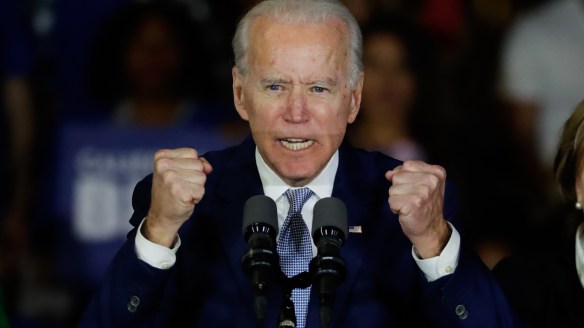
Democratic presidential candidate former Vice President Joe Biden speaks at a primary election night campaign rally Tuesday, March 3, 2020, in Los Angeles. (AP Photo/Chris Carlson)

Super Tuesday has raised the stakes and set the stage for a battle for the Democratic Party’s soul; one that will decide if it stays the course with neoliberalism with Biden or moves towards a progressive social-democratic model with Sanders.

By Alan Macleod

Source: Mint Press News

Former Vice-President Joe Biden built on his victory in South Carolina last week to emerge as the only credible “stop Bernie” candidate after Super Tuesday – where voters in 14 states decided on their nominations for president. While results are still not official, it is clear that the former Delaware senator won the popular vote in at least nine states yesterday, including in Texas, Massachusetts and North Carolina, amassing at least 433 delegates. Sanders has currently secured 388, although that number is likely to rise after all of California is counted.

In one of the most remarkable and drastic political turnarounds in American history, Biden – thought of by many as a yesterday’s man – secured a stunning upset victory after a series of key endorsements. His campaign had been flagging, virtually out of money and without organization or many activists on the ground. As of Monday, he had spent just $1.5 million on TV ads in Super Tuesday states, with aides admitting to CNN their goal was merely to “remain competitive;” a remarkable admission for a presidential campaign.

But facing a Sanders nomination, the establishment wing of the party went into overdrive to find a viable alternative to the Vermont senator. Both Pete Buttigieg and Amy Klobuchar dropped out and immediately endorsed him, as did other figures like former Texas congressman Beto O’Rourke. In a matter of mere hours, the Democratic Party higher-ups managed to coalesce around him in a way the Republicans were unable to in 2016 to stop Trump, proving to the world that the party is certainly not incompetent and can organize and carry out operations with military precision when they perceive it is in their interest to do so.

While the establishment pooled its resources (and delegates) in favor of Biden, Massachusetts senator Elizabeth Warren has refrained from dropping out, let alone endorsing Sanders, thus splitting the progressive vote. Warren finished a distant third in her home state and secured only 28 delegates yesterday. In a defeatist message, her campaign managers said they would hold a meeting to “assess the path forward.”

Biden declared victory in Los Angeles last night, presenting himself as an opponent of the wealthy and a champion of the people: “Let’s get something straight. Wall Street didn’t build this country. You built this country. The middle class built this country. And unions built the middle class,” he told the crowd. But his speech was upstaged by anti-dairy industry protestors who stormed the stage. Earlier in the speech he also confused his wife for his sister.

https://twitter.com/Breaking911/status/1235044512918941698

While it is clear that he will now be the establishment’s candidate for better or worse, the former vice-president has a long history of making egregious errors in speaking. Earlier this week at a rally he tried and failed to recite the preamble of the Declaration of Independence. “We hold these truths to be self evident. All men and women created by the…you know, the thing” he stuttered. And while he promises the working-class “cures for cancer, Alzheimer’s and diabetes” under his presidency, he also told his billionaire backers that he believes they are being “demonized” and that “nothing would change” about America if he were chosen. “I need you very badly,” he told a group of extremely wealthy donors last year.

His policy history and positions, too, might be cause for concern for many voters in the presidential election. These include advocating for cuts to social services, fighting against abortion rights, and supporting NAFTA, the PATRIOT Act and the attacks on Iraq and Libya. And while he retains strong support among Southern black voters, he helped write the 1994 Crime Bill and the Anti-Drug Abuse Bill that exploded the prison population, and fought for segregation and against integration. President Trump has already nicknamed him “Handsy Joe” in reference to his inappropriate touching of women and girls.

While Sanders supporters will be disappointed with the results, other candidates had even worse nights. Chief among them was Michael Bloomberg, who spent more than half a billion dollars on his campaign, picking up just 12 delegates, a third of them in American Samoa. Given his poor performance, that works out to nearly $50 million per delegate. The former Mayor of New York dropped out today, endorsing Biden for the nomination. If he is willing to financially aid Biden anything like how he lavishly spent on himself, Sanders will be fighting a seriously uphill battle.

“It really is a class war we’re up against,” said author and progressive journalist Naomi Klein, who has been traveling with the Sanders team.

The vast majority of this campaign are working class people who are daring to hope for the barest decent things in life. It is this amazing process of raising people’s expectations…What we’re seeing with this establishment pushback, this is not against Bernie Sanders, it is against them. It is against people saying ‘I have a right to healthcare. I have a right to a living wage,’ and it is really sad to see.”

Biden has strong support among the wealthy, the elderly and among Southern black voters. But if he is to win outright and beat Trump in November, he will need to address the age gap in voting. Even in Alabama, where he fared worst, Sanders still comfortably won the vote of those under 30. While there is much work to be done, yesterday was a good day for the establishment wing of the Democratic Party.

Next week will see six more states as well as the Democrats Abroad primaries decided. But Super Tuesday has raised the stakes and set the stage for a battle for the Democratic Party’s soul; one that will decide if it stays the course with neoliberalism with Biden or moves towards a progressive social-democratic model with Sanders.

The Looming Financial Nightmare: So Much for Living the American Dream

By John W. Whitehead

Source: The Rutherford Institute

“When plunder becomes a way of life for a group of men in a society, over the course of time they create for themselves a legal system that authorizes it and a moral code that glorifies it.” ― Frédéric Bastiat, French economist

Let’s talk numbers, shall we?

The national debt (the amount the federal government has borrowed over the years and must pay back) is $23 trillion and growing.

The amount this country owes is now greater than its gross national product (all the products and services produced in one year by labor and property supplied by the citizens). We’re paying more than $270 billion just in interest on that public debt annually. And the top two foreign countries who “own” our debt are China and Japan.

The national deficit (the difference between what the government spends and the revenue it takes in) is projected to surpass $1 trillion every year for the next 10 years.

The United States spends more on foreign aid than any other nation ($50 billion in 2017 alone). More than 150 countries around the world receive U.S. taxpayer-funded assistance, with most of the funds going to the Middle East, Africa and Asia.

Meanwhile, almost 60% of Americans are so financially strapped that they don’t have even $500 in savings and nothing whatsoever put away for retirement, and yet they are being forced to pay for government programs that do little to enhance or advance their lives.

Folks, if you haven’t figured it out yet, we’re not living the American dream.

We’re living a financial nightmare.

The U.S. government—and that includes the current administration—is spending money it doesn’t have on programs it can’t afford, and “we the taxpayers” are the ones who will pay for it.

As financial analyst Kristin Tate explains, “When the government has its debt bill come due, all of us will be on the hook.” It’s happened before: during the European debt crisis, Cypress seized private funds from its citizens’ bank accounts to cover its debts, with those who had been careful to save their pennies forced to relinquish between 40% to 60% of their assets.

Could it happen here? Could the government actually seize private funds for its own gain?

Look around you. It’s already happening.

In the eyes of the government, “we the people, the voters, the consumers, and the taxpayers” are little more than pocketbooks waiting to be picked.

Consider: The government can seize your home and your car (which you’ve bought and paid for) over nonpayment of taxes. Government agents can freeze and seize your bank accounts and other valuables if they merely “suspect” wrongdoing. And the IRS insists on getting the first cut of your salary to pay for government programs over which you have no say.

We have no real say in how the government runs, or how our taxpayer funds are used, but we’re being forced to pay through the nose, anyhow.

We have no real say, but that doesn’t prevent the government from fleecing us at every turn and forcing us to pay for endless wars that do more to fund the military industrial complex than protect us, pork barrel projects that produce little to nothing, and a police state that serves only to imprison us within its walls.

If you have no choice, no voice, and no real options when it comes to the government’s claims on your property and your money, you’re not free.

It wasn’t always this way, of course.

Early Americans went to war over the inalienable rights described by philosopher John Locke as the natural rights of life, liberty and property.

It didn’t take long, however—a hundred years, in fact—before the American government was laying claim to the citizenry’s property by levying taxes to pay for the Civil War. As the New York Times reports, “Widespread resistance led to its repeal in 1872.”

Determined to claim some of the citizenry’s wealth for its own uses, the government reinstituted the income tax in 1894. Charles Pollock challenged the tax as unconstitutional, and the U.S. Supreme Court ruled in his favor. Pollock’s victory was relatively short-lived. Members of Congress—united in their determination to tax the American people’s income—worked together to adopt a constitutional amendment to overrule the Pollock decision.

On the eve of World War I, in 1913, Congress instituted a permanent income tax by way of the 16th Amendment to the Constitution and the Revenue Act of 1913. Under the Revenue Act, individuals with income exceeding $3,000 could be taxed starting at 1% up to 7% for incomes exceeding $500,000.

It’s all gone downhill from there.

Unsurprisingly, the government has used its tax powers to advance its own imperialistic agendas and the courts have repeatedly upheld the government’s power to penalize or jail those who refused to pay their taxes.

Irwin A. Schiff was one of the nation’s most vocal tax protesters. He spent a good portion of his life arguing that the income tax was unconstitutional, and he put his wallet where his conscience was: Schiff stopped paying federal taxes in 1974.

Schiff paid the price for his resistance, too: he served three separate prison terms (more than 10 years in all) over his refusal to pay taxes. He died at the age of 87 serving a 14-year prison term. As constitutional activist Robert L. Schulz noted in Schiff’s obituary, “In a society where there is so much fear of government, and in particular of the I.R.S., [Schiff] was probably the most influential educator regarding the illegal and unconstitutional operation and enforcement of the Internal Revenue Code. It’s very hard to speak to power, but he did, and he paid a very heavy price.”

It’s still hard to speak to power, and those who do are still paying a very heavy price.

All the while the government continues to do whatever it likes—levy taxes, rack up debt, spend outrageously and irresponsibly—with little thought for the plight of its citizens.

To top it all off, all of those wars the U.S. is so eager to fight abroad are being waged with borrowed funds. As The Atlantic reports, “For 15 years now, the United States has been putting these wars on a credit card… U.S. leaders are essentially bankrolling the wars with debt, in the form of purchases of U.S. Treasury bonds by U.S.-based entities like pension funds and state and local governments, and by countries like China and Japan.”

If Americans managed their personal finances the way the government mismanages the nation’s finances, we’d all be in debtors’ prison by now.

Still, the government remains unrepentant, unfazed and undeterred in its money grabs.

While we’re struggling to get by, and making tough decisions about how to spend what little money actually makes it into our pockets after the federal, state and local governments take their share (this doesn’t include the stealth taxes imposed through tolls, fines and other fiscal penalties), the police state is spending our hard-earned tax dollars to further entrench its powers and entrap its citizens.

For instance, American taxpayers have been forced to shell out more than $5.6 trillion since 9/11 for the military industrial complex’s costly, endless so-called “war on terrorism.”

That translates to roughly $23,000 per taxpayer to wage wars abroad, occupy foreign countries, provide financial aid to foreign allies, and fill the pockets of defense contractors and grease the hands of corrupt foreign dignitaries.

Mind you, that staggering $6 trillion is only a portion of what the Pentagon spends on America’s military empire.

That price tag keeps growing, too.

In this way, the military industrial complex will get even richer, and the American taxpayer will be forced to shell out even more funds for programs that do little to enhance our lives, ensure our happiness and well-being, or secure our freedoms.

As Dwight D. Eisenhower warned in a 1953 speech:

Every gun that is made, every warship launched, every rocket fired signifies, in the final sense, a theft from those who hunger and are not fed, those who are cold and are not clothed. This world in arms is not spending money alone. It is spending the sweat of its laborers, the genius of its scientists, the hopes of its children. The cost of one modern heavy bomber is this: a modern brick school in more than 30 cities. It is two electric power plants, each serving a town of 60,000 population. It is two fine, fully equipped hospitals. It is some fifty miles of concrete pavement. We pay for a single fighter plane with a half million bushels of wheat. We pay for a single destroyer with new homes that could have housed more than 8,000 people. This is, I repeat, the best way of life to be found on the road the world has been taking. This is not a way of life at all, in any true sense. Under the cloud of threatening war, it is humanity hanging from a cross of iron. […] Is there no other way the world may live?

This is still no way of life.

Yet it’s not just the government’s endless wars that are bleeding us dry.

We’re also being forced to shell out money for surveillance systems to track our movements, money to further militarize our already militarized police, money to allow the government to raid our homes and bank accounts, money to fund schools where our kids learn nothing about freedom and everything about how to comply, and on and on.

Are you getting the picture yet?

The government isn’t taking our money to make our lives better. Just take a look at the nation’s failing infrastructure, and you’ll see how little is being spent on programs that advance the common good.

We’re being robbed blind so the governmental elite can get richer.

This is nothing less than financial tyranny.

“We the people” have become the new, permanent underclass in America.

It’s tempting to say that there’s little we can do about it, except that’s not quite accurate.

There are a few things we can do (demand transparency, reject cronyism and graft, insist on fair pricing and honest accounting methods, call a halt to incentive-driven government programs that prioritize profits over people), but it will require that “we the people” stop playing politics and stand united against the politicians and corporate interests who have turned our government and economy into a pay-to-play exercise in fascism.

We’ve become so invested in identity politics that label us based on our political leanings that we’ve lost sight of the one label that unites us: we’re all Americans.

The powers-that-be want to pit us against one another. They want us to adopt an “us versus them” mindset that keeps us powerless and divided.

Trust me, the only “us versus them” that matters anymore is “we the people” against the police state.

We’re all in the same boat, folks, and there’s only one real life preserver: that’s the Constitution and the Bill of Rights.

The Constitution starts with those three powerful words: “We the people.”

The message is this: there is power in our numbers.

That remains our greatest strength in the face of a governmental elite that continues to ride roughshod over the populace. It remains our greatest defense against a government that has claimed for itself unlimited power over the purse (taxpayer funds) and the sword (military might).

This holds true whether you’re talking about health care, war spending, or the American police state.

While we’re on the subject, do me a favor and don’t let yourself be fooled into believing that the next crop of political saviors will be any different from their predecessors. They all talk big when they’re running for office, and when they get elected, they spend big at our expense.

As I make clear in my book Battlefield America: The War on the American People, this is how the middle classes, who fuel the nation’s economy and fund the government’s programs, get screwed repeatedly.

George Harrison, who would have been 77 this year, summed up this outrageous state of affairs in his song Taxman:

If you drive a car, I’ll tax the street,

If you try to sit, I’ll tax your seat.

If you get too cold I’ll tax the heat,

If you take a walk, I’ll tax your feet.

Don’t ask me what I want it for

If you don’t want to pay some more

‘Cause I’m the taxman, yeah, I’m the taxman.

Now my advice for those who die

Declare the pennies on your eyes

‘Cause I’m the taxman, yeah, I’m the taxman

And you’re working for no one but me.

Subcomandante Bloomberg

By CJ Hopkins

Source: Consent Factory, Inc.

Break out the pussyhats and vuvuzelas, folks, because the neoliberal Resistance is back, and this time they’re not playing around. No more impeachments and investigations. It’s time to go mano-a-mano with Trump, and they’ve finally got just the bad hombre to do it. No, not Bernie Sanders, you commies. A battle-hardened Resistance fighter. El Caballo Pequeño! El Jefe Mínimo! Subcomandante Michael Bloomberg!

Yes, that’s right, Michael Bloomberg, multi-billionaire Republicrat oligarch, has mobilized a guerilla army of overpaid PR professionals, Wall Street sociopaths, liberal racists, and anti-outdoor-smoking fanatics, and is steamrolling toward the Democratic convention to buy a brokered nomination and save America from “Putinism.” He’s had it with you sugary-soft-drink-drinking, chain-smoking, gun-toting, Oxy-gobbling, Hitler-loving, Putinist peasants and your infatuation with Donald Trump. So he’s decided to transform the entire country into a sterile, upscale, fascist themepark where you can rent a studio for $3,000 a month and the cops keep “the darkies” in their place, like he successfully did to New York City.

Although his campaign seemed to come out of nowhere (and sort of resembles a desperate attempt to prevent a Bernie Sanders nomination), the Resistance have been planning this corporatist Tet Offensive for quite some time. Apparently, Subcomandante Bloomberg and his inner circle of sub-subcomandantes have been hiding out deep in the mountainous jungles of Manhattan’s affluent Upper East Side (or in the Hamptons, or London, or in one of El Jefe’s other multi-million-dollar homes) since Trump and the Russians invaded the country, waiting for the perfect moment to start inundating the American people with television commercials and social media posts informing them of his “electability.”

Clearly, that moment has now arrived.

Bloomberg has spent over $400 million on TV, radio, and digital ads, and it isn’t even Super Tuesday yet. He bought the Democratic National Committee and had them change the rules so he could join the debates (which, based on his poor performance in Las Vegas, might not have been the most brilliant strategy). He has been buying politicians, community organizers, journalists, pundits, his opponents’ campaign staff, Instagram and Facebook influencers, and everyone else he can possibly buy to support his campaign to buy the presidency … which is totally legal, and the American way, and is our only hope of overthrowing the Putin-Nazi Occupation Government and regaining our God-given capitalist freedom!

Sure, to some folks, it looks … well, unseemly (not to mention decidedly undemocratic), this Wall Street oligarch attempting to bribe and bully his way into the White House, but, given the stakes, what choice do we have? As the corporate media and intelligence agencies have been telling us for the last three years, the country is under occupation by an evil conspiracy of Russian-backed Nazis personally controlled by Vladimir Putin! More or less any moment now, Putin is going to order Trump to nullify the U.S. Constitution, declare martial law, appoint himself Führer, and start rounding up and murdering the Jews … or investigating Hunter Biden, or the spooks who have been trying to force him out of office.

This Putin-Nazism cannot continue! Trump must be deposed, no matter the cost. As Robert Reich put it in this piece in The Guardian:

“If the only way we can get rid of the sociopathic tyrant named Trump is with an oligarch named Bloomberg, we will have to choose the oligarch.”

There you have it, folks. We’ll have to choose Bloomberg, or else his golf buddy, Literal Hitler, will destroy the fabric of democracy, or whatever.

Another op-ed in The Washington PostIt Might Be Time to Take Bloomberg Seriously, wondered, if it comes down to Bloomberg versus Bernie:

“Do you choose socialism or capitalism? An ideologue or an executive? Are you really going to ask Americans to trade one extreme for the other, or do you want to offer them a certified, electable moderate?”

Vox, in its “Case for Michael Bloomberg — Mike Bloomberg and His Billions Are What Democrats Need to Beat Trump,” observes that, sure, Bloomberg has drawbacks, like his history of racist remarks and policies, abusing women, oppressing the poor, and just generally being an arrogant little authoritarian corporatist creep, but hey, he’s apologized for all that stuff, and he’ll probably never do it again.

Plus, according to this piece in …uh, Bloomberg Opinion (which “does not necessarily reflect the views and opinions of Bloomberg LP and its owners”), The 2020 Election Is a Choice Between Democracy and Putinism! At the end of the day, once the dust has settled:

“It will come down to rule of law. In November, Americans will decide whether they will fight for the foundation of liberal democracy and democratic capitalism or whether they will accede to Putinism.”

You’ll be hearing variations of this message over and over, and over again, as we approach election day in November … that is, assuming Bloomberg and the rest of the Resistance can buy, bribe, badger, and bamboozle enough Democratic voters into nominating him. First, they need to deal with Bernie Sanders and his swarm of kill-crazy commie terrorists (who rumor has it are also being remotely controlled by Vladimir Putin). To do this, all they will need to do is deny Sanders a first ballot win in Milwaukee, which shouldn’t be too hard to accomplish. Sure, a brokered convention will be ugly, but, as Robert Reich said, they’ll have to do it, or else … well, you know, end of democracy.

Yes, I’m aware that Subcomandante Bloomberg blew his first debate (prompting Twitter pundits to pronounce him DOA) and that millions of “progressive” Democrats hate him, and that the corporate media are running a lot of “Bloomberg’s Nasty Past” pieces now (in order to maintain the appearance of journalism), but, make no mistake, if he secures the nomination, they’ll be lining up to “reluctantly” endorse him, because the alternative will be Russian Hitler!

Look, it’s easy to get distracted by the day-to-day ups and downs of the horse race (which is the primary purpose of the horse race, after all) and forget that we are in the middle of a global capitalist War on Populism … a war that GloboCap intends to win. Sure, they will survive another four years of Trump (or even four years of Sanders if they have to), but, at some point, in order to restore “normality,” or “democratic capitalism,” or whatever, they are probably going to need to stop dicking around and install a bona fide global capitalist oligarch in the Oval Office. They are going to need to do this in order to crush the hopes of the populist insurgency that erupted in the Spring of 2016, and led to the rise of Donald Trump, Bernie Sanders, Jeremy Corbyn, the Brexit, the ongoing protests in France, the downfall of Angela Merkel, etc.

Another Obama is not going to cut it … people aren’t buying that con anymore. No, if the empire is going to reestablish control, it is going to need to take its liberal mask off, and shove a blatant corporatist oligarch like Bloomberg down the public’s throat in order to remind everyone who’s boss. It may not be Michael Bloomberg this time, but it is going to be someone like Bloomberg eventually. Someone powerful, and extremely unpleasant, who will be sold to us as the only one who can save the world from the “Nazis” and the “Russians” … which will necessitate taking some very extreme measures, like the ones we took during the War on Terror. You remember the measures we took back then, don’t you?

Or what, you think that GloboCap has been manufacturing all this mass hysteria over “Russian election interference” and “Nazi terrorism” for their own amusement? Yeah, that’s probably all it is. It’s probably not a prelude to anything.

Financial Feudalism

By Michael Krieger

Source: Liberty Blitzkrieg

“Happy 18th Birthday! Meet your new Daddy,” read one website advertisement. “Do you have strong oral skills? We’ve got a job for you!” cooed another.

A message on another billboard directed at the “daddies” was more blunt: “The alternative to escorts. Desperate women will do anything”…

SeekingArrangement was founded by Las Vegas tech tycoon Brandon Wade. Wade is apparently worth somewhere in the neighborhood of $40 million. His motto is, “Love is a concept invented by poor people”…

SA also markets itself as an antidote to student debt. In the U.S. and elsewhere, college students are enduring financial instability and hardship. Because of rising college fees and rent, and the lack of time available for work during studies, many women are extremely vulnerable to exploitation. “SeekingArrangement.com has helped facilitate hundreds of thousands, if not millions, of arrangements that have helped students graduate debt-free,” Wade boasts on the website. Promotional videos show young, beautiful women enrolled in “Sugar Baby University” — in classrooms, holding wads of cash, driving luxury cars, and discussing the pleasure and ease of being a sugar baby.

When signing up for an account, potential sugar babies are told, “Tip: Using a .edu email address earns you a free upgrade!”

TruthDig: Sugar-Coated Pimping

Watching politics unfold in the post-financial crisis era has been extraordinarily frustrating. While it’s been refreshing to observe the emergence of grassroots populism over the last few years, there’s a problematic lack of depth and clarity embedded in these burgeoning mass movements. Tens if not hundreds of millions of Americans now acknowledge that something’s deeply broken within the current paradigm, but we remain focused on identifying symptoms as opposed to understanding and rectifying the systemic nature of the problem.

Of course, there are numerous complexities when it comes to the administration of an imperial oligarchy, and our system didn’t emerge overnight. Perhaps the most fundamental mutation of the post WW2 era came in 1971 when the international convertibility of U.S. dollars into gold was severed. This is when the country began its long transformation from a largely industrial empire to a financial one. I’ve often highlighted how the purely fiat USD reserve currency is the most powerful weapon ever invented, and how the U.S. control of the global financial system is the true backbone of empire, but it’s equally important to understand how the predatory financial system is also used to subjugate Americans in their own country.

In order to understand how this works we need to dig into the most fundamentally important four letter word in any modern economy: Debt.

When most people consider the debilitating societal effects of excessive debt they tend to see it from one basic level. How the bottom half of the population essentially has no choice but to borrow in order to participate in the economy as constructed. This is because the cost of so many things has been inflated way beyond the capacity of most people to purchase them outright. Specifically, wage growth has failed to keep up with the soaring costs of fundamental things such as shelter, healthcare and higher education.

For instance, home prices have been rising faster than wages in 80% of U.S. markets, which means the higher cost tends to offset historically low mortgage rates. Low interest rates don’t really help such people, it just lets them maybe, barely purchase an intentionally inflated asset to live in by taking on a huge chunk of debt. An asset that could quickly become completely unaffordable should the economy turn down as it did a decade ago.

As such, you have multitudes taking on debt defensively just to keep going and avoid falling further down the socioeconomic scale. Debt doesn’t empower such people, rather, it turns them into modern day indentured servants endlessly stuck on a hamster wheel with little to no hope of getting off. This is not an accident, it’s a tried and tested tool which, when combined with incessant mass media propaganda, is an effective way of creating a submissive, confused and desperate underclass.

Many people understand this by now, but what’s far less understood, yet potentially more significant, is how the wealthy use debt.

When you own your primary home outright and you’ve got enough savings that healthcare premiums and paying for your kids college in cash doesn’t make a dent, debt becomes something else entirely. Debt’s no longer an albatross around your neck, instead it becomes a tool to increase wealth. Debt becomes leverage.

Much of the explosion in wealth inequality over the past several decades can be traced back to this systemic interclass weaponization of debt. If you’re very wealthy and connected, access to extremely cheap debt is virtually unlimited, and this access is used to make leveraged bets on all sorts of stuff, but primarily real estate and financial assets such as stocks and bonds. Hasn’t this always been the case you ask? Aren’t those with capital always extremely advantaged over those without it? Isn’t that the history of capitalism and America since the beginning? My answer would be yes and no.

The main difference between prior periods of history and, let’s say the 21st century, has been the vast increase in power of the financial services sector thanks to the Federal Reserve’s willingness to encourage and enable the insatiable reckless behavior of the speculator class. It’s no secret the Fed has been intentionally boosting assets across the FIRE sector such as real estate, stocks and bonds since the crisis. Those with the capital to ride the coattails of this irresponsible and undemocratic central planning rushed out to take on debt to buy these assets, thus multiplying the return on investment.

While the white-collar cubicle worker with enough extra income to diligently add to their retirement account over the past decade has done fine, bankers or hedge fund managers who took on massive leverage to amplify such bets made generational fortunes while creating nothing of value. It’s the way debt works for the financial services sector versus how it works for the average person in a world dominated by big finance and the central bankers who provide them unlimited welfare.

The same thing occurs within the corporate suite, as executives across industries have used access to extremely cheap debt to buyback stock and reward themselves handsomely despite creating nothing of societal value while doing so. It’s pure financial engineering. Nobody should become generationally wealthy this way, but it’s exactly what’s been happening. So you see, debt’s not just a means to subjugate a desperate bottom half of the population, it’s concurrently an effective tool to expand wealth and power at the top. 

Then there’s this.

When was the last time the bond market paid you to make an acquisition? As Max Keiser so eloquently puts it, this is interest rate apartheid.

But it’s even more pernicious than that. It’s still possible for regular wealthy people to take on too much leverage, make a mistake, and lose their fortunes — unless of course you’re an executive at major financial services firm. In that case you simply can’t lose, which was the primary lesson learned from the response to the financial crisis.

Not only were the titans of this industry not jailed, they walked away with their fortunes intact. The Federal Reserve and the U.S. government made this happen. It wasn’t an accident and it wasn’t to “save the economy;” that’s just nonsense talk for the confused masses. The entire point was to consolidate and further entrench the unaccountable power of those at the very top of the finance feudalism paradigm and signal they’ll also be bailed out for any future catastrophe they create.

Significantly, financial feudalism isn’t just interclass, it’s also intergenerational. The stock market and real estate crash of a decade ago was the market’s attempt to reset those assets more in line with median incomes, but central banks would have none of that. They determined asset prices needed to be re-inflated as much as possible as fast as possible, and these unelected banker stooges went about implementing this major policy decision of central economic planning with zero public debate. Young people entering the workforce had no savings and poor wage growth, so a generation was quickly priced out of homeownership while simultaneously stuck with an enormous pile of student debt. The results of all this are unsurprising.

The crisis facing this country is simmering and metastasizing under the surface of misleading aggregate economic data and record stock markets. While it’s tempting to focus on the symptoms, we’ll never confront and tackle any of this properly unless we understand the structure and how the game is really played. The system you’re living in isn’t capitalism or socialism, it’s financial feudalism. 

Bloomberg Was Stopped, Frisked and Bruised at Debate

Democratic Debate February 19, 2020 (Left to Right: Michael Bloomberg, Senator Elizabeth Warren, Senator Bernie Sanders, former Vice President Joe Biden, Pete Buttigieg, Senator Amy Klobuchar.)

By Pam Martens and Russ Martens

Source: Wall Street on Parade

Michael Bloomberg reaffirmed for those who have turned off the news since January 20, 2017 that no one, not even his own mock debate team, dares to tell a powerful billionaire what he doesn’t want to hear. And that’s one of the key reasons that billionaires are so dangerous to high public office – they hear only their own voice.

Bloomberg’s performance on the Democratic Debate stage last night was painfully embarrassing. It was like watching an overly-hyped downhill skier, in his first appearance at the U.S. Olympics, trip on his skies getting off the chair lift and slide down the mountain on his belly – making a few awkward groans on the way down.

Voters across the country who had been inundated with Bloomberg’s $409 million in advertisements (ten times what Senator Bernie Sanders has spent) were likely shaking their heads in amazement that such an amateur had made it onto the debate stage with three U.S. Senators and a former Vice President.

To give you a broader assessment of just how lacking in charisma and oratory skills the former Mayor of New York City was last night, Politico Magazine asked 14 political experts for their views on the debate. This is a sampling of what they had to say about Bloomberg:

Alan Schroeder, Professor, School of Journalism at Northeastern University in Boston: “In his ubiquitous TV ads, Bloomberg depicts himself as an Obama-like progressive with the passion and know-how to set the country on a correction course. But in his first debate, Bloomberg came off as something quite different: a bland, clueless billionaire with feet of clay. Despite extensive preparation, Bloomberg was totally unready for the rough-and-tumble of a presidential primary debate, unready even for issues he must certainly have known would come up. Democratic voters hoping that Bloomberg might swoop in and grab the nomination on the basis of charisma and superior performance skills instead ended up with one more name to cross off their list.”

Michelle Bernard, political analyst, lawyer, author, president and CEO of the Bernard Center for Women, Politics & Public Policy: “After 10 weeks of hype, millions of dollars spent on ads, endorsements from highly respected members of the African American community and a double-digit surge in the polls, we learned that Bloomberg does not deserve any of the African American support he has received to date. From stop and frisk to overt and unapologetic sexism, the former mayor appears to be nothing more than Trump bathed in blue.”

Larry J. Sabato, founder and Director of the University of Virginia’s Center for Politics and contributing editor at Politico Magazine. “Bloomberg was the foremost loser. To be blunt, he was terrible. It’s been about a dozen years since his last debate, so I didn’t suppose he’d shine. But I never expected him to look timid and act nervous….”

John Neffinger, speaker coach, lecturer on political communication at Georgetown University and Columbia Business School, and former communications director of the Democratic National Committee: “Bloomberg, who had a case to make but was not prepared to take incoming fire, didn’t make a strong case for his progressive credentials and showed no charisma or spark—suggesting that it might be a dreary four years with him on our screens and radios every day.”

Jennifer Lawless, Professor of Politics at the University of Virginia: “To say that Bloomberg underperformed is to understate how poor the former mayor’s performance really was. He was disengaged, ill-prepared to respond to questions he was sure to be asked—from allegations of sexism to racism to classism—and seemingly unaware that he needed to convince Democrats that he could defeat Trump. He exhibited neither the fiery energy embodied in his recent tweets nor the acumen of a politician who needs to seal a deal.”

Read the full analysis at Politico here.

The worst moment of the night for Bloomberg came from Senator Elizabeth Warren who stunned the audience with this:

“I’d like to talk about who we’re running against: a billionaire who calls women ‘fat broads’ and ‘horse-faced lesbians.’ And, no, I’m not talking about Donald Trump. I’m talking about Mayor Bloomberg. Democrats are not going to win if we have a nominee who has a history of hiding his tax returns, of harassing women and of supporting racist policies like redlining and stop and frisk. Look, I’ll support whoever the Democratic nominee is, but understand this, Democrats take a huge risk if we just substitute one arrogant billionaire for another. This country has worked for the rich for a long time and left everyone else in the dirt. It is time to have a President who will be on the side of working families and be willing to get out there and fight for them. That is why I am in this race and that is how I will beat Donald Trump.”

Bloomberg has, without exaggeration, been attempting to buy his seat in the Oval Office by funding his own campaign out of his $61.5 billion net worth – the bulk of which came from leasing data terminals to Wall Street banks’ trading floors around the globe. (Curiously, the chat rooms on those Bloomberg terminals were the venue of choice for Wall Street traders engaged in rigging markets.) On Monday we reported on the questionable ways that Bloomberg is using his cash to tip the scales in his favor. (See Bloomberg Has Built a Star Wars Machine to Try to Steal the Democratic Nomination.) On Wednesday, the Wall Street Journal reported that Bloomberg was paying hundreds of social-media influencers $2500 per month to “post regularly on their personal social-media accounts in support of the candidate and send text messages to their friends about him.”

After last’s night performance, it has become quite clear why Bloomberg needs to pay people to “like” him and call him cool.

The War in Questions

Making Sense of the Age of Carnage

By Tom Engelhardt

Source: TomDispatch.com

My first question is simple enough: After 18-plus years of our forever wars, where are all the questions?

Almost two decades of failing American wars across a startlingly large part of the planet and I’d like to know, for instance, who’s been fired for them? Who’s been impeached? Who’s even paying attention?

I mean, if another great power had been so fruitlessly fighting a largely undeclared set of conflicts under the label of “the war on terror” for so long, if it had wasted trillions of taxpayer dollars with no end in sight and next to no one in that land was spending much time debating or discussing the matter, what would you think? If nothing else, you’d have a few questions about that, right?

Well, so many years later, I do have a few that continue to haunt me, even if I see them asked practically nowhere and, to my frustration, can’t really answer them myself, not to my satisfaction anyway. In fact, since 2001 — with the exception of the months leading up to the invasion of Iraq when America’s streets suddenly filled with hundreds of thousands of demonstrators asking a range of questions (“How did USA’s oil get under Iraq’s sand?” was a typical protest sign of that moment) — our never-ending wars have seldom been questioned in this country. So think of what follows not as my thoughts on the war in question but on the war in questions.

The Age of Carnage

In October 2001, in response to the 9/11 attacks, the administration of President George W. Bush launched a bombing campaign not just against al-Qaeda, a relatively small group partially holed up in Afghanistan, but the Taliban, an Islamist outfit that controlled much of the country. It was a radical decision not just to target the modest-sized organization whose 19 hijackers, most of them Saudis, had taken out almost 3,000 Americans with a borrowed “air force” of commercial jets, but in the phrase of the moment to “liberate” Afghanistan. These days, who even remembers that, by then, Washington had already fought a CIA-directed, Saudi-backed (and partially financed) war against the Soviet Union in that country for a full decade (1979-1989). To take on the Red Army then, Washington funded, armed, and supported extremist Islamist groups, some of which would still be fighting in Afghanistan (against us) in the twenty-first century.

In the context of that all-American war, a rich young Saudi, Osama bin Laden, would, of course, form al-Qaeda, or “the base.” In 1989, Washington watched as the mighty Red Army limped out of Afghanistan, the “bleeding wound” as its leader then called it. (Afghanistan wasn’t known as “the graveyard of empires” for nothing.) In less than two years, that second great power of the Cold War era would implode, an event that would be considered history’s ultimate victory by many in Washington. President Jimmy Carter’s national security adviser Zbigniew Brzezinski, the man who first committed the U.S. to its Afghan Wars, would, as last century ended, sum things up this way: “What is more important in world history? The Taliban or the collapse of the Soviet empire? Some agitated Moslems or the liberation of Central Europe and the end of the Cold War?”

Afghanistan itself would be left in ruins as Washington turned its attention elsewhere, while various local warlords fought it out and, in response, the extremist Taliban rose to power.

Now, let me jump ahead a few years. In 2019, U.S. air power expended more munitions (bombs and missiles) on that country than at any time since figures began to be kept in 2006. Despite that, during the last months of 2019, the Taliban (and other militant groups) launched more attacks on U.S.-and-NATO-trained-and-financed Afghan security forces than at any time since 2010 when (again) records began to be kept. And it tells you something about our American world that, though you could have found both those stories in the news if you were looking carefully, neither was considered worthy of major coverage, front-page headlines, or real attention. All these years later, it won’t surprise you to know that such ho-hum reporting is just par for the course. And when it comes to either of those two on-the-record realities, you certainly would be hard-pressed to find a serious editorial expression of outrage or much of anything else about them in the media.

At 18-plus years or, if you prefer to combine Washington’s two Afghan wars, 28-plus years, we’re talking about the longest American war in history. The Civil War lasted four years. The American part of World War II, another four. The Korean War less than four (though it never officially ended). The Vietnam War, from the moment the first significant contingent of U.S. advisors arrived, 14, and from the moment the first major U.S. troop contingents arrived, perhaps a decade. In the Trump era, as those air strikes rise, there has been a great deal of talk about possible “peace” and an American withdrawal from that country.  Peace, however, has now seemingly come to be defined in Washington as a reduction of American forces from approximately 12,000 to about 8,500 (and that’s without counting either private military contractors or CIA personnel there).

Meanwhile, of course, the war on terror that began in Afghanistan now stretches from the Philippines across the Greater Middle East and deep into the heart of Africa. Worse yet, it still threatens to expand into a war of some sort with Iran — and that, mind you, is under the ministrations of an officially “antiwar” president who has nonetheless upped American military personnel in the Middle East to record levels in recent years.

Of course, this is a story that you undoubtedly know fairly well. Who, in a sense, doesn’t? But it’s also a story that, so many years and so much — to use a word once-favored by our president — “carnage” later, should raise an endless series of disturbing and unnerving questions here. And that it doesn’t, should raise questions in itself, shouldn’t it?

Still, in a country where opposition to endless war seems constantly to falter or fade out amid a media universe in which Donald Trump’s latest tweet can top any war news, it seems potentially useful to raise some of those questions — at least the ones that occur to me — and perhaps for you to do the same. Isn’t it time, after all, for Americans to ask a few questions about war, American-style, in what might be thought of as the post-9/11 age of carnage?

In any case, here are six of mine to which, as I said, I don’t really have the answers. Maybe you do.

Here goes:

  1. When the Bush administration launched that invasion and occupation of Afghanistan in 2001 and followed it up with an invasion and occupation of Iraq in 2003, did we, in some curious fashion, really invade and occupy ourselves? Of course, in these years, across the Greater Middle East and Africa, the U.S. played a remarkable role in creating chaos in country after country, leading to failed states, displaced people in staggering numbers, economic disarray, and the spread of terror groups. But the question is: Did the self-proclaimed most exceptional and indispensable nation on the planet do a version of the same thing to itself in the process? After all, by 2016, the disarray in this country was striking enough and had spread far enough, amid historic economic inequality, social division, partisan divides, and growing anger, that Americans elected as president (if not quite by a majority) a man who had run not on American greatness but on American decline. He promised to make this country great again. (His declinist credentials were not much noted at the time, except among the heartland Americans who voted for him.) So, ask yourself: Would President Donald Trump have been possible if the Bush administration had simply gone after al-Qaeda on September 12, 2001, and left it at that? Since January 2017, under the tutelage of that “very stable genius,” the U.S. political (and possibly global economic) system has, of course, begun to crack open. Is there any connection to those forever wars?
  2. Has there ever been a truly great power in history, still at or near the height of its militarily prowess, that couldn’t win a war? Sure, great imperial powers from the Romans to the Chinese to the British sometimes didn’t win specific wars despite their seeming military dominance, but not a single one? Could that be historically unprecedented and, if so, what does it tell us about our moment? How has the country proclaimed by its leaders to have the finest fighting force the world has ever known won nothing in more than 18 years of unceasing global battle?
  3. How and why did the “hearts and minds” factor move from the nationalist left in the twentieth century to the Islamist right in the twenty-first? The anti-colonial struggles against imperial powers that culminated in America’s first great losing war in Vietnam (think of Korea as kind of a tie) were invariably fought by leftist and communist groups. And whatever the military force arrayed against them, they regularly captured — in that classic Vietnam-era phrase — “the hearts and minds” of what were then called “Third World” peoples and repeatedly outlasted far better armed powers, including, in the case of Vietnam, the United States. In a word, they had the moxie in such conflicts and it didn’t matter that, by the most obvious measures of military power, they were at a vast disadvantage. In the twenty-first century, similar wars are still being fought in a remarkably comparable fashion, Afghanistan being the most obvious.  Again, the weaponry, the money, everything that might seem to pass for the works has been the property of Washington and yet that ability to win local “hearts and minds” has remained in the hands of the rebels. But what I wonder about is how exactly that moxie passed from the nationalist left to the extremist religious right in this century and what exactly was our role, intended or not, in all this?
  4. When it comes to preparations for war, why can’t we ever stop? After all, when the Soviet Union collapsed and the Cold War ended in 1991, the United States essentially had no enemies left on the planet. Yet Washington continued essentially an arms race of one with a finish line so distant — the bomber of 2018, Earth-spanning weapons systems, and weaponry for the heavens of perhaps 2050 — as to imply eternity. The Pentagon and the military-industrial complex surrounding it, including mega-arms manufacturers, advanced weapons labs, university science centers, and the official or semi-official think tanks that churned out strategies for future military domination, went right on without an enemy in sight. In fact, in late 2002, preparing for his coming invasion of Iraq, George W. Bush had to cook up an “axis of evil” — Iran, Iraq, and North Korea, two of which were mortal enemies and the third unrelated in any significant way to either of them — as a justification for what was to come, militarily speaking. Almost 20 years later, investing as much in its military as the next seven countries combined, updating and upgrading its nuclear arsenal to the tune of $1.7 trillion in the coming decades (and having just deployed a new “low-yield” nuclear weapon), and still investing staggering sums in its planes, tanks, aircraft carriers, and the like, the U.S. military now seems intent (without leaving its forever wars) on returning to the era of the Cold War as well. Face-offs against Russia and China are now the military order of the day in what seems like a déjà-vu-all-over-again situation. I’m just curious, but isn’t it ever all over?
  5.  How can Washington’s war system and the military-industrial complex across the country continue to turn failure in war into success and endless dollars at home? Honestly, the one thing in America that clearly works right now is the U.S. military (putting aside those wars abroad). We may no longer invest in domestic infrastructure, but in that military and the giant corporate weapons makers that go with it? You bet! They are the true success stories of the twenty-first century if you’re talking about dollars invested, weaponry bought, and revolving doors greased. On the face of it, failure is the new success and few in this country seem to blink when it comes to any of that. How come?
  6. Why doesn’t the reality of those wars of ours ever really seem to sink in here?  This, to my mind, is at least partially a question about media coverage. Yes, every now and then (as with the Washington Post’s Afghanistan Papers last December), America’s forever wars briefly break through and get some attention. And yes, if you’re a war-coverage news jockey, you can find plenty of daily reports on aspects of our wars in the media. But isn’t it surprising how much of that coverage is essentially a kind of background hum, like Muzak in an elevator? Unless the president personally decides to drone assassinate an Iranian major general and prospective future leader of that country, our wars simply drone on, barely attended to (unless, of course, you happen to be in the U.S. military or a military spouse or child). Eighteen years of failed wars and so many trillions of dollars later, wouldn’t you have expected something else?

So those are my six questions, the most obvious things that puzzle me about what may be the strangest aspect of this American world of ours, those never-ending wars and the system that goes with them. To begin to answer them, however, would mean beginning to think about ourselves and this country in a different way.

Perhaps much of this would only make sense if we were to start imagining ourselves or at least much of the leadership crew, that infamous “Blob,” in Washington, as so many war addicts. War — the failing variety — is evidently their drug of choice and not even our “antiwar” president can get off it. Think of forever war, then, as the opioid not of the masses but of the ruling classes.


Tom Engelhardt is a co-founder of the American Empire Project and the author of a history of the Cold War, The End of Victory Culture. He runs TomDispatch.com and is a fellow of the Type Media Center. His sixth and latest book is A Nation Unmade by War.

The Corporate Debt Bubble Is A Train Wreck In Slow Motion

By Brandon Smith

Source: Alt-Market.com

There are two subjects that the mainstream media seems specifically determined to avoid discussing these days when it comes to the economy – the first is the problem of falling global demand for goods and services; they absolutely refuse to acknowledge the fact that demand is going stagnant and will conjure all kinds of rationalizations to distract from the issue. The other subject is the debt bubble, the corporate debt bubble in particular.

These two factors alone guarantee a massive shock to the global economy and the US economy are built into the system, but I believe corporate debt is the key pillar of the false economy.  It has been utilized time and time again to keep the Everything Bubble from completely deflating, however, the fundamentals are starting to catch up to the fantasy.

For example, in terms of stock markets, which are now meaningless as an indicator of the health of the real economy, corporate stock buybacks have been the single most vital mechanism for inflation. Corporations buy their own stocks, often using cash borrowed from each other and from the Federal Reserve, in order to reduce the number of shares on the market and artificially boost the value of the remaining shares. This process is essentially legal manipulation of equities, and to be sure, it has been effective so far at keeping markets elevated.

The problem is that these same corporations are taking on more and more debt through interest payments in order to maintain the facade. Over the period of a decade, corporate debt has skyrocketed back to levels not seen since 2007, just before the credit crisis. The official corporate debt load now stands at over $10 trillion, and that’s not even counting derivatives exposure.  According to the Bank for International Settlements, the amount of derivatives still held by corporations stands at around $544 trillion in notional value (theoretical value), while the current market value is only around $10 trillion.  This is a massive discrepancy that can only lead to disaster.

In terms of debt-to-GDP, the credit cycle peak has spiked beyond any other peak in the past 40 years. This amount of borrowing always has consequences. Even if central banks were to intervene on a level similar to TARP, which saturated markets with $16 trillion in liquidity, the amount of cash needed is so immense and the economic returns so muted that such measures are ultimately a waste of time. The Federal Reserve fueled this bubble, and now there is no stopping it’s demise. Though, they’re behavior and minimal response to the problem suggests that they have no intention of stopping it anyway.

Currently, stock buybacks are set to decline this year, and I don’t think this is because corporations have decided they want to quit the tactic. They have to quit, because the amount of debt they are accumulating is is now outpacing their falling profits. Corporate profits peaked in the 3rd Quarter of 2018 and have been in decline ever since.  The Price-to-Earnings ratio as well as the Price-to-Sales ratio are now well above their historic peak during the dot-com bubble, meaning, stocks have never been more overvalued compared to the profits that corporations are actually bringing in.

As I warned back in 2018, Trump’s tax cuts were a gift to corporations, not average people, and that gift was designed to be squandered as there was no doubt that companies would pour all extra cash into stock buybacks instead of innovation and new jobs. This is exactly what happened.

While corporations, the Fed and Trump have been putting some effort into keeping stock markets from imploding, the real economy has been evaporating. Global import/exports are crashing, US manufacturing is in recession territory, US GDP is in decline (even according to rigged official numbers), US retail outlets are closing by the thousands, the poverty rate jumped in 30% of US counties in the past year, and high paying jobs are disappearing and being replaced with minimum wage service sector jobs.

To be sure, this process did not start under Trump, it’s been a slow motion train wreck for over a decade. But, it’s important to point out that Trump has done nothing to mitigate the crash and his obsession with the fraudulent stock market shows that he has no plans to try. The amount of time the tax cuts and debt increase bought was a couple of years. That’s it. With buybacks in decline, the question is what will keep the bubble afloat now? The Fed? That’s doubtful…

Global corporations with the most VISIBLE debt include:

AT&T with $180 billion

SoftBank with $154 billion

Apple with $136 billion

Verizon with $114 billion

Comcast with $112 billion

AbInbev with $110 billion

General Electric with $115 billion

Shell with $77 billion

Microsoft with $67 billion

Some companies, like Apple and Warren Buffet’s Berkshire Hathaway are holding extensive cash reserves, but most do not. Also, the level of cash reserves held by certain top corporations suggests they know something is on the horizon. Why hold piles of cash when the stock market is a “sure thing”? Unless, the debt bubble is about to collapse and cash will be needed to absorb the damage?

Stock buybacks, I believe, are the litmus test for how long the corporate world can hold out against the weight of the debt bubble. 2020 appears to be the year in which buybacks are set to crumble. Corporate profits degraded over 2019 and the slide is set to continue this year. This means profits are not going to come to the rescue and stave off the explosion of the debt structure (once again, the problems of demand and debt intertwine). All that is left is the Fed, as the “buyer of last resort” becomes the buyer of only import.

The list above, of course, does not include financial companies like JP Morgan and other banks that are suspected of harboring an extensive debt load and borrowing cash frantically through the Fed’s overnight repo markets.

These loans are now coming due, and the Fed has indicated it plans to tighten liquidity once again next month while returning to balance sheet cuts. Interest rates remain well above zero, which means the more companies borrow through repo markets, the more interest they will accrue. The Fed will have to institute a full QE program on the level of the TARP bailouts and cut interest rates to zero in order to end the constant repo liquidity threat and kick the can for a couple more years, and they’ve given no indication that they plan to do this in time to stop the current crash.

For now, Fed repo intervention has achieved little except keeping stocks at all-time highs. The rest of the economy is in disarray.

The real economy will start to drag down the establishment’s favorite distraction – The Dow, as this process continues. The big question is always one of timing. How long can the delusional euphoria keep the system levitated?

The situation is one of complacency and condition. If people are suddenly confronted with an enormous forest fire surrounding their city, they will ask “What can we do to save ourselves?” But what if people are surrounded by a forest fire for ten years and it hasn’t quite reached them yet? You warn them that the winds have finally changed and it is about to expand and take their homes and they will say “What forest fire?”

It’s hard to imagine a scenario in which there are no major shocks to the financial structure for the rest of the year. With the corporate system tapped out and no longer able to act as a support for the bubble, the fundamentals will start to take over again. Geopolitical events will also have a more visible effect. A whole year without escalation with Iran?  Without escalation with North Korea? Without a pandemic threat like the coronavirus going global? Without threats of a liquidity crisis as banks starve for more and more repo loans? I think not…

It’s important not to let complacency interfere with vigilance.  A slow motion train wreck is still ultimately a train wreck.  The damage can only be mitigated by removing one’s self from the train, and preparing for the fallout.  Do not think that simply because the system has been able to drag its nearly lifeless body along for ten years that this means all is well.  All bubbles collapse, and corporate debt has already sealed the fate of the Everything Bubble.