Slaves and Bulldozers, Plutocrats and Widgets

By Kristine Mattis

Source: CounterPunch

There is not an industrial company on earth, not an institution of any kind – not mine, not yours, not anyone’s – that is sustainable. I stand convicted by me, myself alone, not by anyone else, as a plunderer of the earth. But not by our civilization’s definition. By our civilization’s definition, I’m a captain of industry and in the eyes of many, a kind of modern-day hero.

— Ray Anderson, (1934-2011) CEO of Interface, Inc.

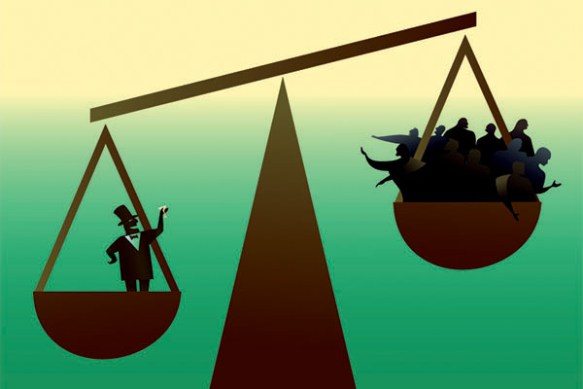
We are living a collective illusion known as the civilized world. We feign concern for our horrendous conditions of poverty, socioeconomic inequality, deteriorating public health, and severe environmental degradation (to which climate change is merely one factor), but everything we do belies that distress. These issues comprise the largest risks to the survival of the human species, as well as the most significant amoral atrocities on the planet. Both individually and as a species, our health, safety, and ability the live a decent, dignified life have always been imperiled by these predicaments. Yet, we continue along with complete cognitive dissonance in that the crux of our lives – our jobs, our consumer culture – all contribute to, perpetuate, and exacerbate the unsustainable and morally reprehensible conditions of our existence. But while we are all marginally responsible for the multitude of calamities befalling us, the one group who bears the brunt of the blame for our social and ecological decay is the wealthy.

Have you looked around and seen just what humanity has done to our stunning Earth? We’ve bulldozed the beauty for bucks. Far too much of what was once a glorious paradise is now a complete disaster of unfathomable proportions. A disaster wholly of our own making. In America, and in most places around the world, from the moment we are born we are preparing for a future career, and  more specifically, for the lifelong goal of making money. But on the whole, most of the jobs we do end up being more detrimental than beneficial to society and the environment. We characterize work through measures of productivity, but producing more and more unnecessary, meaningless, and often useless products compromises our physical environment, which in turn, compromises the health of humans, other beings, and our entire planetary ecosystem.

So many of the things that form the basis of our civilization should not, and perhaps cannot, exist in a just and sustainable world. Items like arms and artillery, synthetic chemicalsconcentrated animal feeding operationsplasticsmartphones and other electronic gadgetrydo not feed a sustainable and equitable world but create more needless havoc. The irony, though, is that the very people who run the systems that incessantly construct and promulgate these harmful, redundant, or unnecessary products are the richest and most successful people on earth.

We define success in our society almost exclusively in terms of wealth, with its attendant power and sometimes, fame. Rich people are the recipients of adulation and reverence for nothing more than their accumulation of wealth and material products. We like to think that riches come by way of great intellect, talent, skill, and a strong work ethic, but in reality, monetary success is more a matter of inherited socioeconomic status, ambition, and determination, rather than ability and aptitude. Most of all, to achieve wealth means to have a myopic resolve, not only to look away from how the sausage is made, but to not care how the sausage is made.

The wealthy in our society then become the people with the most power and influence. While ironically, they are the people least deserving of our respect. They are the exact people whom we should look upon with the utmost skepticism and even disdain. They should not be in the position to make decisions about our collective lives and the workings of our society, because their financial success is completely antithetical to societal justice and sustainability.

It doesn’t take great acumen or diligence to make a lot of money; it takes a narrow-minded, insular, immoral, sometimes psychopathic view of life, in which personal pleasure and profit are the primary variables. It’s quite easy to do well financially and find personal satisfaction if the exploitation of humans, other animals, and the entire biosphere is left outside of the realm of your career consciousness. As Ray Anderson, CEO of Interface Carpet admitted,“For 21 yearsI never gave a thought to what we were taking from the earth or doing to the earth in the making of our products.” He built his fortune without consideration to the effects of his enterprise until someone brought the deleterious consequences to his attention.

We like to believe the cream rises to the top, but the truth is that the top is actually full of scum. We have seen in recent weeks, if we did not know already, that entertainment, politics, and indeed, all of the wealthiest industries are cesspools of moral depravity, especially at the apex.

There may be some exceptions, but scum is the rule. Some might call these people ambitious, some might call them razor-focused, others would call them sociopathic. It takes a careful regimen of willful  ignorance and/or denial to not consider all the harms that directly and indirectly result from avenues toward career achievements in the process of our normal lives – harms such as exploitation of labor, torture of animals, and toxic contamination and of food, water, and natural resources.

Material success requires rape and pillage, figuratively and literally. Donald Trump bragged that when you have the kind of wealth he has, you can treat women as objects and just “grab ’em by the pussy.” You can also exploit resources, exploit labor, befoul the environment, and endanger public health with few or no consequences. On a purely moral basis, only scum could have the hubris to consider others as mere playthings for their own enjoyment, to feel superior enough to warrant their extreme wealth which they did not earn but stole from the commons, and to believe that they deserve obscene riches when the majority of others do not even have basic life necessities.

How often have you heard the phrases “not that there is anything wrong with being rich,” or “I don’t begrudge him his wealth”? Wealth should be considered reprehensible. Wealth has always been in the hands of the few to the detriment of the many, and one’s access to it has always been almost wholly correlated with one’s socioeconomic status at birth. Yet we rationalize this immoral situation and pretend that the proverbial “pie,” of which we all need a slice, is infinite in size and that wealth is accessible to anyone. We assume that being rich is not only acceptable but aspirational. It is neither in a just and sustainable world.

On a finite planet every excess dollar, every excess material good, every extra home, car, garment, trinket, piece of food, or beverage that one person possesses essentially correlates to an item that another person does not have. When we normalize one person having more than he/she needs in a world where billions have far less than the bare minimum required to meet their basic needs, then we are obliged to rethink our morality. When a simple handbag can cost between $12K and $300K and we as a society see nothing wrong with that kind of excess in the face of poverty, hunger, homelessness, and disease, we are not only completely socially corrupt, we are spelling our own doom. Poverty only exists because excessive wealth exists and neither is compatible with a sustainable and humane civilization.

To achieve a sustainable world, we must relinquish our use of non-renewable resources, we must utilize renewable resources at a level in which they have the time and ability to replenish, and we must leave no waste that is not regenerative. To achieve an equitable world, we must relinquish our greed and desire for opulence, excess, and disproportionate influence. In fact, sustainability is also a function of equity. However, our current society is predicated on the antithesis of all such requirements.

Wealthy people gain their successes because they have tunnel vision. They are singularly focused on themselves, their careers, and/or on money. They do not take into consideration the externalities involved in their actions. They pay little mind to the exploitation involved in their pursuits. Ethics never supersedes ambition. Therefore, these are the exact people who should not be in charge of making policies for the benefit of society and should not be in charge of civic ventures. To be able to be so wealthy without shame, guilt, or acknowledgement that your own wealth impedes the lives of others is to be either ignorant or indifferent. We are facing global ecological and economic collapse. Who made this happen? The wealthiest people of the world. If you are rich you do not have the solution. You are the problem.

The world is run on slave labor, indentured servitude, animal and natural resource exploitation, and endless generation of waste and contamination. Material success comes with adopting a shortsighted view of the world – closing yourself off to your own connection to global anthropogenic climate change, toxification, and inequality.

So many of the wealthy who consider themselves socially and environmentally aware perceive no connection between their own wealth accumulation and the causes they claim to champion. Instead of curtailing their materialism, they rationalize it. Instead of acknowledging that their consumerism intensifies global resource extraction, they produce more products (often erroneously labeled “green”) to sustain their riches. When the wealthy are not hawking products for their for-profit activities, they have the audacity to solicit for charitable organizations that are only necessitated by the economic system that produces poverty and environmental devastation in the wake of their extravagant wealth. They ask donations from the majority of citizens who are barely making ends meet, when they themselves could surrender probably 90% of their accumulated wealth and not notice a marked change in their material status whatsoever. The elites who are not in denial about the problems we face want scientific and technological solutions – solutions that they can throw their money at and have others solve so they do not have to think about their own contribution to the problems.

But there are no silver bullets to end inequality and environmental destruction, while continuing with business as usual in civilized society. Science cannot save us. Scientific research itself relies on the same unsustainable production, consumption, use of resources, and waste as every other industry.

Technology mavens always tout the great social or biological service that their new technology will provide. Their innovations comes under the guise of helping the world, but the majority of the time, their creations are frivolous and do not do much more than use natural resources, create waste, and earn them exorbitant profit. At the university where I earned my doctoral degree there is a masters program in biotechnology and there’s a reason why their curriculum extends beyond just science, containing at least two required business courses. Of course, business is fundamental to their instruction because the principle purpose of our education, of our careers, is profit.

All of the harmful products and practices in our civilization – military arms, sweatshops, low wages, pesticides, plastics, throw-away items, excess of products, animal cruelty, overuse of medicine and surgery – only exist to increase revenue for the rich. None are fair or just or equitable or sustainable. Our societal justification of the above items just marks our collective delusion. These products and practices persist in the name of profit, and we rationalize their continuation just as we rationalize extravagant wealth.

When Senator Bernie Sanders was on TV decrying President Barack Obama’s half-million dollar speaking engagements on Wall Street, the anchors of the program said to him, “Wouldn’t you do it if you could?” Bernie replied, “I wouldn’t be asked.” Rather, he should have explained that anyone with integrity would not accept money they do not need for some sort of quid pro quo from a destructive and corrupt institution. The hosts of the show surmised that everyone would jump at the opportunity to earn money if they had the chance. It is precisely that sort of mindset that enables these broadcasters to inhabit their influential positions on a national television program and to earn millions of dollars. They demonstrate what unethical opportunists they, and most of the rich, actually are. Their lack of ethics is internalized and taken for granted by not only them, but most of the rest of our society. They are more than willing to be bought at whatever price for whatever service. “Just doing my job” does not serve as an excuse for immorality.

Nevertheless, there are people who have chosen lives based on conviction rather than money. Former Uruguayan President Jose Mujica and Seattle City Council member Kashama Sawant chose to earn the local average income for their official positions and donate the remainder of their salaries toward social justice work. Biologist and writer Sandra Steingraber donated a portion of her $100K Heinz Award prize toward the fight against hydraulic fracturing (fracking) rather than spend it on personal treats. Likewise, teacher Jesse Hagopian donated his $100K settlement for being unjustly attacked with pepper-spray by Seattle police toward social justice action. Not everyone is looking to cash in, and not everyone is seeking the next, biggest profit-making endeavor.

Living with integrity and simplicity is difficult. People do not choose to live this way because their personal sacrifice will change the world. They do so because it is the right thing to do. They do so because having too much means others don’t have enough. They do so because living by example allows others who care to see that a life of wealth and consumerism augments inequality and unsustainability; it is not the only way to live and need not be. They live this way because only by walking the walk rather than talking the talk will we ever start to achieve justice and sustainability to help preserve the future of our species.

In recent years there have been waves and wave of protests throughout the country and the world in response to myriad societal maladies. The best protest we can do in America now is to reject the bourgeois life – reject excessive wealth and the material components that come with it, reject profligate consumption, reject consumerism, reject wasteful holidays, reject wasteful trinkets,  reject all that is incompatible with what we purport to champion. For example, retired talk-show host David Letterman appears sincere in his dedication toward helping combat climate change, while at the same time, he remains co-owner of an auto racing team. In the world in which we currently live, auto racing is completely incongruent with climate change mitigation. We can’t pretend to value matters like justice and sustainability unless the way we live upholds those values. We can’t decouple our livelihoods from our lives.

The rich tend to ensconce themselves in their well-manicured communities, shop with abandon, and disregard the abject poverty, environmental degradation, and injustices all around them. They are in the process of spending small portions of their vast fortunes building survival bunkers to withstand either the revolutionary upheaval that may soon come as a result of immeasurable socioeconomic inequality, or the catastrophic ecological collapse that may result from reckless resource extraction and expenditure. How misguided or cynical are they to not realize that by renouncing their extreme wealth, they would need no such provisions and could play a large part in salvaging our civilization?

Need I even explain how the current tax scam pending on Capitol Hill will serve to enhance all of the socioeconomic, environmental, and public health calamities that are arising ever more rapidly and in quick succession? Need I elaborate on how our escalating climate-related weather catastrophes only reach the cataclysmic proportions they do because of the wealth disparities involved and because of the high-risk industrial components therein, that exist mainly to enrich the elite? Would these natural disasters be so disastrous if more people had the economic resilience that they deserve and if society took more precaution against the hazards of multibillion-dollar industries that manufacture products of questionable value while generating tremendous wealth to a select few?

We live n a time of unprecedented social disarray, ecological disrepair, public health decay, and moral depravity. Nearly every aspect of the way we live in modern industrial societies is completely unsustainable. Even if we were to transition to 100% solar energy tomorrow throughout the planet, the worst effects of climate change might be averted, but the plastic pollution that permeates the most far-reaching depths of the oceans would still remain, the persistent organic pollutants (POPs) and endocrine disrupting compounds (EDCs) that harm our own health and the health of the entire global ecosystem remain. Not only do they remain, but they continue to be produced, not out of necessity, but for the financial profit of the privileged few. The production of, consumption of, and waste stream from our global industrial society continues unabated. This is the system that forms the foundation of all of our lives in the civilized world, and this is the system that bestows excessive wealth to some while leaving others fighting for survival.

While it is indeed the system of capitalism that generates and sustains our societal injustice and ecological degradation, the system is comprised of people – people who could abdicate their fictional obligation to happiness via indefinitely-increasing earnings, people who can choose better, Without a preponderance of such people, no countervailing just and sustainable system can ever compete.

In 1964, Uruguayan journalist Eduardo Galeano interviewed the famous Argentinean hero of the Cuban revolution Ernesto “Che” Guevara. In the midst of a comprehensive conversation, Che stated to Galeano, ” I don’t want every Cuban to wish he were a Rockefeller.” To be sure, if we are remotely interested in a sustainable and equitable world, the attainment of wealth must be transformed from admirable to contemptible. With regard to the multitude of obstacles we face, Ralph Nader once wrote “only the super-rich can save us.” He’s right. They can save us by not existing.

The End of Empire

The brutality abroad is matched by a growing brutality at home.

By

The American empire is coming to an end. The U.S. economy is being drained by wars in the Middle East and vast military expansion around the globe. It is burdened by growing deficits, along with the devastating effects of deindustrialization and global trade agreements. Our democracy has been captured and destroyed by corporations that steadily demand more tax cuts, more deregulation and impunity from prosecution for massive acts of financial fraud, all the while looting trillions from the U.S. treasury in the form of bailouts. The nation has lost the power and respect needed to induce allies in Europe, Latin America, Asia and Africa to do its bidding. Add to this the mounting destruction caused by climate change and you have a recipe for an emerging dystopia. Overseeing this descent at the highest levels of the federal and state governments is a motley collection of imbeciles, con artists, thieves, opportunists and warmongering generals. And to be clear, I am speaking about Democrats, too.

The empire will limp along, steadily losing influence until the dollar is dropped as the world’s reserve currency, plunging the United States into a crippling depression and instantly forcing a massive contraction of its military machine.

Short of a sudden and widespread popular revolt, which does not seem likely, the death spiral appears unstoppable, meaning the United States as we know it will no longer exist within a decade or, at most, two. The global vacuum we leave behind will be filled by China, already establishing itself as an economic and military juggernaut, or perhaps there will be a multipolar world carved up among Russia, China, India, Brazil, Turkey, South Africa and a few other states. Or maybe the void will be filled, as the historian Alfred W. McCoy writes in his book “In the Shadows of the American Century: The Rise and Decline of US Global Power,” by “a coalition of transnational corporations, multilateral military forces like NATO, and an international financial leadership self-selected at Davos and Bilderberg” that will “forge a supranational nexus to supersede any nation or empire.”

Under every measurement, from financial growth and infrastructure investment to advanced technology, including supercomputers, space weaponry and cyberwarfare, we are being rapidly overtaken by the Chinese. “In April 2015 the U.S. Department of Agriculture suggested that the American economy would grow by nearly 50 percent over the next 15 years, while China’s would triple and come close to surpassing America’s in 2030,” McCoy noted. China became the world’s second largest economy in 2010, the same year it became the world’s leading manufacturing nation, pushing aside a United States that had dominated the world’s manufacturing for a century. The Department of Defense issued a sober report titled “At Our Own Peril: DoD Risk Assessment in a Post-Primacy World.” It found that the U.S. military “no longer enjoys an unassailable position versus state competitors,” and “it no longer can … automatically generate consistent and sustained local military superiority at range.” McCoy predicts the collapse will come by 2030.

Empires in decay embrace an almost willful suicide. Blinded by their hubris and unable to face the reality of their diminishing power, they retreat into a fantasy world where hard and unpleasant facts no longer intrude. They replace diplomacy, multilateralism and politics with unilateral threats and the blunt instrument of war.

This collective self-delusion saw the United States make the greatest strategic blunder in its history, one that sounded the death knell of the empire—the invasion of Afghanistan and Iraq. The architects of the war in the George W. Bush White House, and the array of useful idiots in the press and academia who were cheerleaders for it, knew very little about the countries being invaded, were stunningly naive about the effects of industrial warfare and were blindsided by the ferocious blowback. They stated, and probably believed, that Saddam Hussein had weapons of mass destruction, although they had no valid evidence to support this claim. They insisted that democracy would be implanted in Baghdad and spread across the Middle East. They assured the public that U.S. troops would be greeted by grateful Iraqis and Afghans as liberators. They promised that oil revenues would cover the cost of reconstruction. They insisted that the bold and quick military strike—“shock and awe”—would restore American hegemony in the region and dominance in the world. It did the opposite. As Zbigniew Brzezinski noted, this “unilateral war of choice against Iraq precipitated a widespread delegitimation of U.S. foreign policy.”

Historians of empire call these military fiascos, a feature of all late empires, examples of “micro-militarism.” The Athenians engaged in micro-militarism when during the Peloponnesian War (431-404 B.C.) they invaded Sicily, suffering the loss of 200 ships and thousands of soldiers and triggering revolts throughout the empire. Britain did so in 1956 when it attacked Egypt in a dispute over the nationalization of the Suez Canal and then quickly had to withdraw in humiliation, empowering a string of Arab nationalist leaders such as Egypt’s Gamal Abdel Nasser and dooming British rule over the nation’s few remaining colonies. Neither of these empires recovered.

“While rising empires are often judicious, even rational in their application of armed force for conquest and control of overseas dominions, fading empires are inclined to ill-considered displays of power, dreaming of bold military masterstrokes that would somehow recoup lost prestige and power,” McCoy writes. “Often irrational even from an imperial point of view, these micromilitary operations can yield hemorrhaging expenditures or humiliating defeats that only accelerate the process already under way.”

Empires need more than force to dominate other nations. They need a mystique. This mystique—a mask for imperial plunder, repression and exploitation—seduces some native elites, who become willing to do the bidding of the imperial power or at least remain passive. And it provides a patina of civility and even nobility to justify to those at home the costs in blood and money needed to maintain empire. The parliamentary system of government that Britain replicated in appearance in the colonies, and the introduction of British sports such as polo, cricket and horse racing, along with elaborately uniformed viceroys and the pageantry of royalty, were buttressed by what the colonialists said was the invincibility of their navy and army. England was able to hold its empire together from 1815 to 1914 before being forced into a steady retreat. America’s high-blown rhetoric about democracy, liberty and equality, along with basketball, baseball and Hollywood, as well as our own deification of the military, entranced and cowed much of the globe in the wake of World War II. Behind the scenes, of course, the CIA used its bag of dirty tricks to orchestrate coups, fix elections and carry out assassinations, black propaganda campaigns, bribery, blackmail, intimidation and torture. But none of this works anymore.

The loss of the mystique is crippling. It makes it hard to find pliant surrogates to administer the empire, as we have seen in Iraq and Afghanistan. The photographs of physical abuse and sexual humiliation imposed on Arab prisoners at Abu Ghraib inflamed the Muslim world and fed al-Qaida and later Islamic State with new recruits. The assassination of Osama bin Laden and a host of other jihadist leaders, including the U.S. citizen Anwar al-Awlaki, openly mocked the concept of the rule of law. The hundreds of thousands of dead and millions of refugees fleeing our debacles in the Middle East, along with the near-constant threat from militarized aerial drones, exposed us as state terrorists. We have exercised in the Middle East the U.S. military’s penchant for widespread atrocities, indiscriminate violence, lies and blundering miscalculations, actions that led to our defeat in Vietnam.

The brutality abroad is matched by a growing brutality at home. Militarized police gun down mostly unarmed, poor people of color and fill a system of penitentiaries and jails that hold a staggering 25 percent of the world’s prisoners although Americans represent only 5 percent of global population. Many of our cities are in ruins. Our public transportation system is a shambles. Our educational system is in steep decline and being privatized. Opioid addiction, suicide, mass shootings, depression and morbid obesity plague a population that has fallen into profound despair. The deep disillusionment and anger that led to Donald Trump’s election—a reaction to the corporate coup d’état and the poverty afflicting at least half of the country—have destroyed the myth of a functioning democracy. Presidential tweets and rhetoric celebrate hate, racism and bigotry and taunt the weak and the vulnerable. The president in an address before the United Nations threatened to obliterate another nation in an act of genocide. We are worldwide objects of ridicule and hatred. The foreboding for the future is expressed in the rash of dystopian films, motion pictures that no longer perpetuate American virtue and exceptionalism or the myth of human progress.

“The demise of the United States as the preeminent global power could come far more quickly than anyone imagines,” McCoy writes. “Despite the aura of omnipotence empires often project, most are surprisingly fragile, lacking the inherent strength of even a modest nation-state. Indeed, a glance at their history should remind us that the greatest of them are susceptible to collapse from diverse causes, with fiscal pressures usually a prime factor. For the better part of two centuries, the security and prosperity of the homeland has been the main objective for most stable states, making foreign or imperial adventures an expendable option, usually allocated no more than 5 percent of the domestic budget. Without the financing that arises almost organically inside a sovereign nation, empires are famously predatory in their relentless hunt for plunder or profit—witness the Atlantic slave trade, Belgium’s rubber lust in the Congo, British India’s opium commerce, the Third Reich’s rape of Europe, or the Soviet exploitation of Eastern Europe.”

When revenues shrink or collapse, McCoy points out, “empires become brittle.”

“So delicate is their ecology of power that, when things start to go truly wrong, empires regularly unravel with unholy speed: just a year for Portugal, two years for the Soviet Union, eight years for France, eleven years for the Ottomans, seventeen for Great Britain, and, in all likelihood, just twenty-seven years for the United States, counting from the crucial year 2003 [when the U.S. invaded Iraq],” he writes.

Many of the estimated 69 empires that have existed throughout history lacked competent leadership in their decline, having ceded power to monstrosities such as the Roman emperors Caligula and Nero. In the United States, the reins of authority may be in the grasp of the first in a line of depraved demagogues.

“For the majority of Americans, the 2020s will likely be remembered as a demoralizing decade of rising prices, stagnant wages, and fading international competitiveness,” McCoy writes. The loss of the dollar as the global reserve currency will see the U.S. unable to pay for its huge deficits by selling Treasury bonds, which will be drastically devalued at that point. There will be a massive rise in the cost of imports. Unemployment will explode. Domestic clashes over what McCoy calls “insubstantial issues” will fuel a dangerous hypernationalism that could morph into an American fascism.

A discredited elite, suspicious and even paranoid in an age of decline, will see enemies everywhere. The array of instruments created for global dominance—wholesale surveillance, the evisceration of civil liberties, sophisticated torture techniques, militarized police, the massive prison system, the thousands of militarized drones and satellites—will be employed in the homeland. The empire will collapse and the nation will consume itself within our lifetimes if we do not wrest power from those who rule the corporate state.

Zucktown, USA

Facebook, Amazon, and Google are reviving the ill-fated “company towns” of the Gilded Age

By Julianne Tveten

Source: The Baffler

EARLIER THIS YEAR IN SILICON VALLEY, a phalanx of six-figure-earning Facebook engineers confronted Mark Zuckerberg about subsidizing their extortionate rents. Meanwhile, the contract laborers who serve them bacon kimchi dogs and duck confit found themselves cordoned off from the affordable housing market—where salaries approaching $74,000 qualify—and began converting their garages into homes. Still, if these events point to a dire situation, they’re but the latest stirrings of the hulking leviathan that is the region’s housing crisis—an issue that has peppered the headlines of news outlets great and small for nearly a decade.

Thanks in part to this accretion of bad press, Zuckerberg and his fellow cyborgian billionaires have sprung into action as property developers. In July, Facebook announced plans to create “Willow Campus,” an aggressively rectilinear, Rem Koolhaas-designed rebrand of a Menlo Park office complex it purchased in 2015. The expansion of its headquarters will boast fifteen hundred units of housing, 15 percent of which it claims will be “offered at below-market rates.” If that isn’t sufficiently microcosmic, the company promises to dedicate 125,000 square feet to commercial space, promising a grocery store, pharmacy, and the cryptically worded “additional community-facing retail.”

Equally if not more responsible for crafting California’s bloodsucking geometric crapscape is Google, whose newfangled parent company Alphabet has vowed to provide temporary housing, in the form of modular dwellings, for three hundred of its employees in its home city of Mountain View. For years, Google has been seeking to wrest control of the city from its government; last year, it gained over 370,000 square feet of office space along with the right to develop 1.4 million square feet in the North Bayshore neighborhood after vying with LinkedIn to furnish the territory with a new police station, road improvements, and college scholarships. (The modular homes will be constructed on a former NASA air base, which the company signed an agreement to lease for sixty years.)


We’re witnessing, in these schemes, a revival of the company town. An oft-recurring feature of the Western capitalist imaginary, the company town’s American variety dates back to the nineteenth century; railroad industrialist George Pullman’s eponymous city in Illinois provides one of the more illustrative examples. Pullman characterized his town, completed in 1884, as a lucrative, pro-business utopia filled with satisfied participants, employee and investor alike. Its veneer was indeed shiny: the amenities it promised—yards, indoor plumbing, gas, trash removal—were rare for industrial workers of the time, and its ultra-formal gardens and shopping center, which equipped them with a barbershop, dentist’s offices, a bank, and a slew of overpriced retail, offered a vanguard capitalist’s dabbling in luxury.

There was a catch: paternalistic and omnipresent capitalism. Immaculately manicured trees were merely curtains obscuring a panopticon, one that kept workers behaviorally economized. (White workers, that is—the town expressly excluded black people.) “[Pullman] wanted to create a company town where everybody would be . . . content with their place in the capitalist system,” Jane Eva Baxter explained to Paleofuture. Workers were forced to rent—with no option to buy—the uniform row houses that corralled them, and from which they worried over persistent inspection and imminent eviction. Their employers likewise controlled which books filled their libraries and which performances took place in their theaters, and a ban precluded them from congregating at saloons or holding town meetings unless sanctioned by the Pullman Company, lest they entertain the notion of unionizing.

The forced exchange not just of labor, but of personal autonomy, for the tenuous ability to buy bread or light one’s stove is, in a word, inhumane, and in three, cause for revolt. Pullman workers had organized several strikes throughout the 1880s, but none were so monumental as the one in 1894. In response to the prior year’s economic depression, Pullman opted to slash workers’ wages; rents, however, remained steadfastly fixed, enriching the company’s reported worth of $62 million while leaving workers with as little as two cents (after paying for housing costs). In partnership with the American Railway Union, four thousand Pullman workers, galvanized and desperate, withheld their labor, and legions of workers throughout the nation would soon join them. Yet the strike collapsed when the Cleveland administration, in a violent display of authoritarianism, deployed federal troops and imprisoned labor leaders. Not long after, by Illinois Supreme Court order, the town was forced to sell everything not used expressly for “industry.”

Still, Pullman’s fiasco didn’t discourage other magnates. In 1900, chocolatier Milton Hershey began construction on a factory complex near a collection of dairy farms in rural Pennsylvania, where he declared there’d be “no poverty, no nuisances, no evil”—a Delphic precursor to Google’s now infamous and defunct slogan, “Don’t be evil.” To attract workers, Hershey reclaimed many of Pullman’s gilded comforts: indoor plumbing, pristine lawns, central heating, garbage pickup, and eventually, the theaters and sports venues any company town worth its salt would host.

What was designed as a wholesome advertisement for the company quickly morphed into a miserly surveillance state. Hershey, who served as the town’s mayor, constable, and fire chief, patrolled neighborhoods to survey the maintenance of houses and hired private detectives to monitor employees’ after-hours alcohol consumption. While the town managed to stage a sort of idyllic capitalist performance for onlookers, by the 1930s its employees resented their binding environs and the Depression-era layoffs they endured from a company earning ten times its annual payroll in after-tax profits. A crippled attempt to unionize with the Congress of Industrial Organizations (CIO) bred a 1937 sit-down strike; days later, farmers and company cheerleaders armed with rocks and pitchforks bloodied and ejected the dissidents, destabilizing for good another corporate-civic lark. Hershey’s vast estate, however, remains unscathed to this day.


If Facebook and Google have begun to revive the company town, Amazon has already given it a futuristic luster. California’s inchoate company towns pale in comparison to their northern counterpart, which occupies 19 percent of Seattle’s office space and a farcical 8.1 million square feet. (Its CEO and founder, Jeff Bezos, has vowed to acquire four million more over the next five years, a muscular move meant to complement his midlife-crisis physique.) Touting its sponsorship of local engineering and sustainability programs, Amazon crows about such “investments” as its dog park, playing fields, art installations, and Buckyball-reminiscent domical gardens. Of course, with Bezos’s colonizing aspirations comes yet another bellicose rental market—the very conditions Facebook and Google claim to be combatting. When considered alongside its recent purchase of Whole Foods, Amazon’s dream of tethering its employees to their jobs—by way of homogenized cubes for rent and lightly discounted quinoa chips—is fast becoming a reality.

Like George Pullman and Milton Hershey, the tech industry’s elites take all prisoners in their respective campaigns to expand, absorb, and dominate. The tech company town, that most contemporary of neofeudalist wangles, is the next step in West Coast corporate behemoths’ quest to lure employees into a twenty-four-hour working existence—the totalizing successor to bottomless Indian food spreads, on-site bike-repair shops, and Frank Gehrized habitats. Its premise deviates not at all from that of its antecedents: a genial, painstakingly aestheticized service to workers, where beneficent corporate hands take the reins of the public good  for the well-being of the community. This time around, though, that community will be bridled with unionbusting and data-harvesting apparatuses sure to make even the most paranoid techno-tyrant salivate.

Certainly, the megalomaniacs who aim to populate municipal fixtures with registered-trademark logos will expect cities to genuflect at every turn. Bezos has exemplified this in Seattle, whose recent measure to “tax the rich” drove him to seek another location in which to build Amazon’s second headquarters. While residents of its hometown grapple with a commandeering leech that “suck[s] up our resources and refus[es] to participate in daily upkeep,” Amazon will soon attempt to prime another city to be sapped. Meanwhile, the smooth-faced metallic vampires of California have just begun to cosplay as frontiersmen, raring to follow Bezos’s lead. Drunk on glib TED Talk propagandizing, and accustomed to dismissing the civic inconveniences of corporate regulations and poor neighborhoods, our technosettlers feel little need to heed the lessons of the past when their chief interest is to monopolize the future. Taxing the techie billionaires is a start, but only when cities refuse to be their hosts will they cease to be their parasites.


Julianne Tveten writes about the technology industry’s relationship with socioeconomics and culture. Her work has appeared in Current Affairs, Hazlitt, In These Times, The Outline, and elsewhere.

Why We’re Doomed: Our Economy’s Toxic Inequality

By Charles Hugh Smith

Source: Of Two Minds

Anyone who thinks our toxic financial system is stable is delusional.

Why are we doomed? Those consuming over-amped “news” feeds may be tempted to answer the culture wars, nuclear war with North Korea or the Trump Presidency.

The one guaranteed source of doom is our broken financial system, which is visible in this chart of income inequality from the New York Times: Our Broken Economy, in One Simple Chart.

While the essay’s title is our broken economy, the source of this toxic concentration of income, wealth and power in the top 1/10th of 1% is more specifically our broken financial system.

What few observers understand is rapidly accelerating inequality is the only possible output of a fully financialized economy. Various do-gooders on the left and right propose schemes to cap this extraordinary rise in the concentration of income, wealth and power, for example, increasing taxes on the super-rich and lowering taxes on the working poor and middle class, but these are band-aids applied to a metastasizing tumor: financialization, which commoditizes labor, goods, services and financial instruments and funnels the income and wealth to the very apex of the wealth-power pyramid.

Take a moment to ponder what this chart is telling us about our financial system and economy. 35+ years ago, lower income households enjoyed the highest rates of income growth; the higher the income, the lower the rate of income growth.

This trend hasn’t just reversed; virtually all the income gains are now concentrated in the top 1/100th of 1%, which has pulled away from the top 1%, the top 5% and the top 10%, as well as from the bottom 90%.

The fundamental driver of this profoundly destabilizing dynamic is the disconnect of finance from the real-world economy.

The roots of this disconnect are debt: when we borrow from future earnings and energy production to fund consumption today, we are using finance to ramp up our consumption of real-world goods and services.

In small doses, this use of finance to increase consumption of real-world goods and services is beneficial: economies with access to credit can rapidly boost expansion in ways that economies with little credit cannot.

But the process of financialization is not benign. Financialization turns everything into a commodity that can be traded and leveraged as a financial entity that is no longer firmly connected to the real world.

The process of financialization requires expertise in the financial game, and it places a premium on immense flows of capital and opaque processes: for example, the bundling of debt such as mortgages or student loans into instruments that can be sold and traded.

These instruments can then become the foundation of an entirely new layer of instruments that can be sold and traded. This pyramiding of debt-based “assets” spreads risk throughout the economy while aggregating the gains into the hands of the very few with access to the capital and expertise needed to pass the risk and assets off onto others while keeping the gains.

Profit flows to what’s scarce, and in a financialized economy, goods and services have become commodities, i.e. they are rarely scarce, because somewhere in the global economy new supplies can be brought online.

What’s scarce in a financialized economy is specialized knowledge of financial games such as tax avoidance, arbitrage, packaging collateralized debt obligations and so on.

Though the billionaires who have actually launched real-world businesses get the media attention–Bill Gates, Jeff Bezos, Steve Jobs, et al.–relatively few of the top 1/10th of 1% actually created a real-world business; most are owners of capital with annual incomes of $10 million to $100 million that are finance-generated.

This is only possible in a financialized economy in which finance has become increasingly detached from the real-world economy.

Those with the capital and skills to reap billions in profits from servicing and packaging student loan debt have no interest in whether the education being purchased with the loans has any utility to the indebted students, as their profits flow not from the real world but from the debt itself.

This is how we’ve ended up with an economy characterized by profound dysfunction in the real world of higher education, healthcare, etc., and immense fortunes being earned by a few at the top of the pyramid from the financialized games that have little to no connection to the real-world economy.

Anyone who thinks our toxic financial system is stable is delusional. If history is any guide (and recall that Human Nature hasn’t changed in the 5,000 uears of recorded history), this sort of accelerating income/wealth/ power inequality is profoundly destabilizing–economically, politically and socially.

All the domestic headline crises–culture wars, opioid epidemic, etc.–are not causes of discord: they are symptoms of the inevitable consequences of a toxic financial system that has broken our economy, our system of governance and our society.

I’ve Been Banned From Facebook For Sharing An Article About False Flags

By Caitlin Johnstone

Source: OpEdNews.com

My personal Facebook account, which has the maximum 5,000 friends and an additional 5,000+ followers, has been blocked from posting for three days. My page hasn’t been blocked yet, but we’ll see; I shared the article there, too.

The reason given for this ban by the little pop-up boxes when I logged on just now was that a couple months ago I had shared an article about admitted false flag operations perpetrated by governments around the world. I don’t know what happened that made Facebook’s system decide to crack down on me now all of a sudden, but I do know I’ve been a bit naughtier than usual in my last couple of articles.

The article I got the banhammer for sharing is titled For Those Who Don’t ‘Believe’ In ‘Conspiracies’ Here Are 58 Admitted False Flag Attacks. According to the site’s ticker it has 50,667 shares as of this writing. It’s laden with hyperlinks for further reading, and lists only instances of false flag operations that insiders are on the record as having admitted to themselves. It’s a good compilation of important information. People should be allowed to share it.

The notifications say I can be permanently banned if I continue posting that sort of material. I’ve had that account since 2007.

So. Who wants to see my Barbra Streisand impression?

(Image by Caitlin Johnstone)

(Image by Caitlin Johnstone)

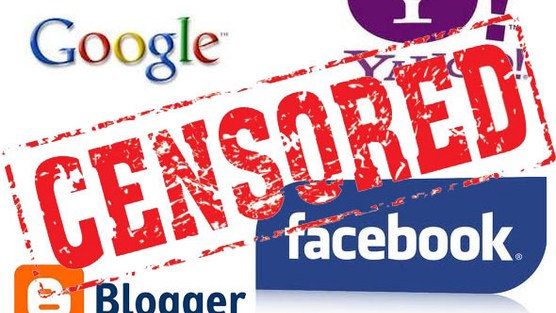
In a corporatist system of government, corporate censorship is state censorship. When there’s no meaningful space between corporate power and government power, it doesn’t make much difference whether the guy silencing your dissent is Mark Zuckerberg or Jeff Sessions. America most definitely has such a system.

If they’re going to get us locked down and propagandized into their vapid brain boxes, this will be how they’ll do it. Not by government censorship, but by corporate censorship. Government can’t make an overt attempt to stop a dissenting voice from speaking, but the corporations who own the venue of their speech can.

In a recent Senate Judiciary Committee hearing, plutocrat-sponsored senators spoke with top legal and security officials for Facebook, Twitter and Google in a very disturbing way about the need to silence dissenting voices.

Democratic Senator Mazie Hirono of Hawaii demanded that the companies adopt a “mission statement” declaring their commitment “to prevent the fomenting of discord.”

A former FBI agent Clint Watts kicked it up even further, saying, “Civil wars don’t start with gunshots, they start with words. America’s war with itself has already begun. We all must act now on the social media battlefield to quell information rebellions that can quickly lead to violent confrontations and easily transform us into the Divided States of America.”

“Stopping the false information artillery barrage landing on social media users comes only when those outlets distributing bogus stories are silenced”—“-silence the guns and the barrage will end,” he added.

This was on the Senate floor. Officials were speaking about the need to censor social media to prevent people from sharing dissenting ideas on the Senate floor.

World Socialist Web Site said of the hearing,

That such a statement could be made in a congressional hearing, entirely without objection, is an expression of the terminal decay of American democracy. There is no faction of the ruling class that maintains any commitment to basic democratic rights.

None of the Democrats in the committee raised any of the constitutional issues involved in asking massive technology companies to censor political speech on the Internet. Only one Republican raised concerns over censorship, but only to allege that Google had a liberal bias.

Former FBI agent says tech companies must “silence” sources of “rebellion”
US Congressional hearing: By Andre Damon 1 November 2017 Top legal and security officials for Facebook, Twitter and” www.wsws.org

I’ll admit right now that this really scares me. Ever the optimist, I’ve been reassuring my readers that the corporatocracy would never risk taking off the black hole sun mask of corporate cheerfulness and move into regular, overt totalitarianism. I’ve contended that they must remain covert in order to keep successfully manufacture consent.

But, here we are. Through a studious application of psy-ops they have their censorship and they have their consent. Remember, in the book “Fahrenheit 451” the public wasn’t unhappy about the book burnings. They cheered them on, and that’s what we have now. The herd is mindlessly clapping their approval at censorship and even volunteering to report naughty behavior like good little hall monitors for the oligarchy. I’m sure that even some of my close friends and family will silently approve of my banning and will meet my distress with the pursed lips of a church lady secretly pleased at my comeuppance.

I tried joining Gab when I saw this coming, but it’s really alt-righty there and the energy there is just gross. Finding a new social media outlet might not even matter anyway, since these creeps just target any place people gather in large numbers.

I don’t know. I always freak out a bit when the eye of corporate censorship focuses on me. I’ve recently been told by a number of people that they’ve been banned for sharing my articles, and now it’s hitting me.

I’m babbling. This is weird. I just really, really don’t want humanity to become what these people are trying to turn it into, you know? Help me make some noise about this stuff, please. Manipulators can’t do their job when there’s a big spotlight pointed at them.

______

Hey you, thanks for reading! My work is entirely reader-funded so if you enjoyed this piece please consider sharing it around, liking me on Facebook, following me on Twitter, and maybe throwing some money into my hat on Patreon or Paypal.

The social and economic roots of the attack on democratic rights

Inequality and the American oligarchy

By Eric London

Source: WSWS.org

A report published September 27 by the US Federal Reserve, the Survey of Consumer Finances, shows that the top 10 percent of Americans now own 77 percent of all wealth. The top 1 percent increased its share of wealth from 35.5 percent in 2013 to 38.5 in 2016. The share of the bottom 90 percent declined from 25 percent to 22.9 percent over the same period.

These percentages show a transfer of trillions of dollars from the working class to the rich and affluent in just three years.

The bottom three quarters of the population, some 240 million people, now own less than 10 percent of the wealth. That is, if the United States were a 10-storey apartment building with 100 people, the richest person would be living on the top four floors, the nine next wealthiest people on the next four floors, fifteen on the second floor, and 75 people cramped at the bottom level.

Wealth share by wealth decile, Credit: People’s Policy Project

The Federal Reserve data demonstrates, in empirical terms, profound changes in social relations that affect hundreds of millions of people, touching all aspects of political, cultural and intellectual life. The US is an oligarchy in which the government, trade unions, media, universities, and major political parties are instruments used by the ruling class to manipulate the population, mask its own wealth, and crush social opposition from below.

The figures expose the material basis for the emergence of a campaign in the ruling class to block access to the World Socialist Web Site and other left-wing sites in the guise of combatting “Russian aggression.”

In an oligarchy, social inequality is incompatible with democratic rights. Incapable of and unwilling to address the social needs of the masses of people, the government turns to censorship, surveillance, blacklisting, and violence as its preferred methods for defending unprecedented levels of wealth monopolized by the ruling class.

The data shows that the main dividing line is between the top 10 percent and the bottom 90 percent that comprise the working class. The Federal Reserve figures expose as lies the claims by politicians and media pundits that the bulk of the US population belongs to the “middle class.”

Below the aristocracy and the affluent—concentrated in certain neighborhoods of major centers like New York, the San Francisco Bay Area, Los Angeles, Chicago, Houston, and other cities—the United States is a country dominated by tremendous economic hardship. The data shows that while different strata of the population face economic insecurity at different levels of urgency, decades of social counterrevolutionary policies by both parties are bringing them closer together, marking all with the same scars of class exploitation.

The poorest ten percent of the population, some 32 million people, possess negative wealth. They include the homeless and the hopelessly in debt. For this section of the population, roughly equal to the populations of Texas and New York combined, life expectancy, disease rates, and living standards resemble third world conditions.

The next poorest ten percent have no wealth, between $0 and $5,000 per family, less than the value of a 10-year-old used car. The combined wealth possessed by this layer is not significant as a proportion of overall wealth.

Roughly the lower-middle third of the population, from the 20th to 50th percentile, control just 1.6 percent of total wealth. A family of four with two parents working full-time at the minimum wage with one average-priced vehicle and no other assets would fall in the middle of this broad category of workers.

The 64 million people in the 50 to 70 percent range control just 5.1 percent of the wealth. A family with a below average-priced home worth $150,000, plus a vehicle and $0 in savings would be above the 60th percentile in wealth. A family with two working adults making between $40,000 and $50,000 each would find itself in the 70 to 80 percentile, perhaps possessing two cars, a home valued just above the national average of $175,000, a life insurance policy and $10,000 in savings.

The 80 to 90th percentile owns 11.2 percent of the wealth. Two skilled workers with incomes of $60,000 to $80,000 each, one pension, a $300,000 home, and two vehicles would find themselves in this decile. This section is slightly more comfortable, but by no means financially secure.

The chasm separating the top 10 percent from the working class has widened in recent years. From 2004 to 2016, the working class saw its wealth decline precipitously across all strata. The median family in the poorest fifth lost 29.5 percent of its wealth over this period, followed by 24.7 percent for the median family in the 20th-39th percentile, 10.8 percent in the 40th-59th percentile, 17.3 percent in the 60th-79th percentile, and 1.3 percent in the 80th-89th percentile. This wealth went to the top 10 percent, where median family wealth rose by 38.7 percent over the same period.

As a result of this massive transfer of wealth, median family wealth in the top 10 percent is nearly triple that of the 80 to 90 percent, 20 times greater than a family in the 50th percentile, and 254 times more than the median family net worth in the poorest 20 percent.

The political establishment that has overseen this transfer systematically ignores and aggravates the urgent social problems confronting the vast majority of the population.

Footage of Trump flipping paper towel rolls to victims of the storm in Puerto Rico epitomizes the callous and insulting response of the oligarchy to the problems of the working class. But sanctimonious claims by Democrats that Trump’s actions were “insensitive” ignore the fact that the entire ruling class is responsible for the social catastrophe. After all, it was Barack Obama who travelled to Flint, Michigan and told a crowd of people to “drink the water.” Nobody in the Democratic or Republican parties has made any real effort to address the opioid crisis, homelessness, declining life expectancy, storm protection and disaster infrastructure, skyrocketing student debt and the health care crisis.

The three branches of government, largely comprised of millionaires and billionaires, focus exclusively on the interests and social demands of the top 1, and, more broadly, the top 10 percent of society. A key concern of the affluent 10 percent is blocking the growth of social opposition and protecting their own wealth and privileges. In recent years, the American ruling class has become more aware of the growth of social opposition within the population to war, inequality and poverty.

Fearful that the technological advances of the Internet and social media platforms can increase access to alternative political viewpoints, the oligarchy has initiated a campaign to censor left-wing websites and crack down on social media platforms in the name of blocking “Russian interference” in the US political system. Without a shred of credible evidence to back their claims, newspaper editors, TV talking heads, Senate and House committee members, corporate executives, trade union leaders and academics are engaged in a mad rush to censor the Internet and protect the population from “fake news.”

The anti-fake news censorship and blacklisting initiative is an escalation of a years-long campaign by the ruling class to create the framework for police state methods of rule. At the same time, the growth of social inequality revealed in the Federal Reserve figures points to the inexorable intensification of social and class conflict in the United States, the objective foundation for socialist revolution.

The conspiracy to censor the Internet

By Andre Damon and Joseph Kishore

Source: WSWS.org

The political representatives of the American ruling class are engaged in a conspiracy to suppress free speech. Under the guise of combating “trolls” and “fake news” supposedly controlled by Russia, the most basic constitutional rights enumerated in the First Amendment are under direct attack.

The leading political force in this campaign is the Democratic Party, working in collaboration with sections of the Republican Party, the mass media and the military-intelligence establishment.

The Trump administration is threatening nuclear war against North Korea, escalating the assault on health care, demanding new tax cuts for the rich, waging war on immigrant workers, and eviscerating corporate and environmental regulations. This reactionary agenda is not, however, the focus of the Democratic Party. It is concentrating instead on increasingly hysterical claims that Russia is “sowing divisions” within the United States.

In the media, one report follows another, each more ludicrous than the last. The claim that Russia shifted the US election by means of $100,000 in advertisements on Facebook and Twitter has been followed by breathless reports of the Putin government’s manipulation of other forms of communication.

An “exclusive” report from CNN last week proclaimed that one organization, “Don’t Shoot Us,” which it alleges without substantiation is connected to Russia, sought to “exploit racial tensions and sow discord” on Instagram, Twitter, YouTube, Tumblr and even Pokémon Go, a reality game played on cell phones.

Another report from CNN on Monday asserted that a Russian “troll factory” was involved in posting comments critical of Hillary Clinton as “part of President Vladimir Putin’s campaign to influence the 2016 election.” All of the negative commentary in news media and other publications directed at Clinton, it implied, were the product of Russian agents or people duped by Russian agents.

As during the period of Cold War McCarthyism, the absurdity of the charges goes unchallenged. They are picked up and repeated by other media outlets and by politicians to demonstrate just how far-reaching the actions of the nefarious “foreign enemy” really are.

While one aim has been to continue and escalate an anti-Russia foreign policy, the more basic purpose is emerging ever more clearly: to criminalize political dissent within the United States.

The most direct expression to date of this conspiracy against free speech was given by the anticommunist ideologue Anne Applebaum in a column published Monday in the Washington Post, “If Russia can create fake ‘Black Lives Matter’ accounts, who will next?”

Her answer: the American people. “I can imagine multiple groups, many of them proudly American, who might well want to manipulate a range of fake accounts during a riot or disaster to increase anxiety or fear,” she writes. She warns that “political groups—on the left, the right, you name it—will quickly figure out” how to use social media to spread “disinformation” and “demoralization.”

Applebaum rails against all those who seek to hide their identity online. “There is a better case than ever against anonymity, at least against anonymity in the public forums of social media and comment sections,” she writes. She continues: “The right to free speech is something that is granted to humans, not bits of computer code.” Her target, however, is not “bots” operating “fake accounts,” but anyone who seeks, fearing state repression or unjust punishment by his or her employer, to make an anonymous statement online. And that is only the opening shot in a drive to silence political dissent.

Applebaum is closely connected to the highest echelons of the capitalist state. She is a member of key foreign policy think tanks and sits on the board of directors of the CIA-linked National Endowment for Democracy. Married to the former foreign minister of Poland, she is a ferocious war hawk. Following the Russian annexation of Crimea, she authored a column in the Washington Post in which she called for “total war” against nuclear-armed Russia. She embodies the connection between militarism and political repression.

The implications of Applebaum’s arguments are made clear in an extraordinary article published on the front page of Tuesday’s New York Times, “As US Confronts Internet’s Disruptions, China Feels Vindicated,” which takes a favorable view of China’s aggressive censorship of the Internet and implies that the United States is moving toward just such a regime.

“For years, the United States and others saw” China’s “heavy-handed censorship as a sign of political vulnerability and a barrier to China’s economic development,” the Times writes. “But as countries in the West discuss potential Internet restrictions and wring their hands over fake news, hacking and foreign meddling, some in China see a powerful affirmation of the country’s vision for the internet.”

The article goes on to assert that while “few would argue that China’s Internet control serves as a model for democratic societies… At the same time, China anticipated many of the questions now flummoxing governments from the United States to Germany to Indonesia.”

Glaringly absent from the Times article, Applebaum’s commentary and all of the endless demands for a crackdown on social media is any reference to democratic rights, free speech or the First Amendment.

The First Amendment, which asserts that “Congress shall make no law… abridging the freedom of speech,” is the broadest amendment in the US Constitution. Contrary to Applebaum, there is no caveat exempting anonymous speech from Constitutional protection. It is a historical fact that leaders of the American Revolution and drafters of the Constitution wrote articles under pseudonyms to avoid repression by the British authorities.

The Constitution does not give the government or powerful corporations the right to proclaim what is “fake” and what is not, what is a “conspiracy theory” and what is “authoritative.” The same arguments now being employed to crack down on social media could just as well have been used to suppress books and mass circulation newspapers that emerged with the development of the printing press.

The drive toward Internet censorship in the United States is already far advanced. Since Google announced plans to bury “alternative viewpoints” in search results earlier this year, leading left-wing sites have seen their search traffic plunge by more than 50 percent. The World Socialist Web Site’s search traffic from Google has fallen by 75 percent.

Facebook, Twitter and other social media platforms have introduced similar measures. The campaign being whipped up over Russian online activity will be used to justify even more far-reaching measures.

This is taking place as universities implement policies to give police the authority to vet campus events. There are ongoing efforts to abolish “net neutrality” so as to give giant corporations the ability to regulate Internet traffic. The intelligence agencies have demanded the ability to circumvent encryption after having been exposed for illegally monitoring the phone communications and Internet activity of the entire population.

In one “democratic” country after another governments are turning to police-state forms of rule, from France, with its permanent state of emergency, to Germany, which last month shut down a subsidiary of the left-wing political site Indymedia, to Spain, with its violent crackdown on the separatist referendum in Catalonia and arrest of separatist leaders.

The destruction of democratic rights is the political response of the corporate and financial aristocracy to the growth of working class discontent bound up with record levels of social inequality. It is intimately linked to preparations for a major escalation of imperialist violence around the world. The greatest concern of the ruling elite is the emergence of an independent movement of the working class, and the state is taking actions to prevent it.

Cause of USA Meltdown and Collapse of Civil Rights

By Denis Rancourt

Source: Dissident Voice

SUMMARY: Societies of social animals, including humans, are dominance hierarchies. Civil rights are codified in law to protect mechanisms of essential counter measures against excessive exploitation of the hierarchy by elite classes, which destabilizes the entire society. Systemic pathology arises when elite classes can change the regulatory codes themselves, including civil rights protections, with impunity. Laws that quash civil rights are pathological in that they impede the system-repair mechanisms that are: free expression, free association, class opposition, and negotiated structural adjustments (otherwise known as democracy). Present anti-speech laws are extreme examples of pathological laws, the application of which is a measure of the degree of totalitarianism in the society. The history of the USA of recent decades is an eminent illustration of the concepts.

*****

The USA meltdown has been decades in the making and is the collateral result of an elite predation that has degraded structural elements needed for a healthy and resilient nation.

The aftermath is “too much regulation at the bottom, not enough at the top”: a pathological legislative and institutional structure in which elite interests have too much freedom to challenge and exploit democratic nation states, whereas middle, working and professional class actors, including small and medium-size private business, are economically, ideologically and politically constrained and suppressed to an excessive degree.

It has been a class war in which the predatory classes have barricaded themselves while inflicting humiliating defeat and loss of power, purpose and identity on the lower-stratum classes, which are incited to fight among themselves within the confines of new rules and the guarded illusion that these rules are an actuation of natural order.

In this way, personal and community motivation and inventiveness are sapped. The very motor of a vibrant modern society is jammed and the entire system becomes a system of debt-ransom extraction and management of globalized exploitation for the benefit of a secluded elite.

In this emergent system of excessive class exploitation, civil rights that protect critics and organizers become a threat against the exploiters rather than needed protections of personal and community emancipation that sustains economic production and innovation.

Allow me to explain, starting from fundamental considerations.

Arguably, the most fundamental statement that a social scientist can make is that humans interact by both violent and non-violent means, both individually and as groups, to establish and maintain societal dominance hierarchies. Call it by any name (tribalism, capitalism, socialism, totalitarianism…) humans always establish, maintain and grow dominance hierarchies, using whatever technology of the day.

The political end-point concept of “anarchy” is the theoretical absence of dominance hierarchy, which has never been ideally achieved and which is evidently unstable against growth of and replacement by dominance hierarchy. The reality of social animals is dominance hierarchy, which spontaneously adapts itself to environmental conditions and to the population size, while integrating accumulated knowledge and technological advances.

Within a dominance hierarchy (within a society), the essential counter against destabilizing excesses of dominance is push-back from individuals and groups — engendered by the individual desire for life, freedom and local influence — which acts in every stratum of the hierarchy.

In historically recent human societies, essential push-back is formalized with written laws that protect the individual against dominance encroachments that would be so severe that they would threaten hierarchical stability by increasing the potential for rebellion. These laws were at times deemed to be God-given and are now referred to as “civil rights”. They include both: (1) protections of the individual and of the nuclear and extended family against arbitrary attacks by the state or by rogue elements, and (2) protections for the individual and groups to seek redress and express grievances.

All laws are evolving codes to organise, stabilize and enforce an ever changing (often growing and complexifying) dominance hierarchy. “Good” laws find a “balance” between the graded benefits of hierarchy and the stratified oppressions against individuals and groups, a balance which stabilizes the whole system against deterioration (“injustice”), complete overhaul (“revolution”), or extinction (“downfall”).

Predictably, the codes themselves are often “hacked” by upper-strata groups that are overly ambitious in seeking additional relative advantages. The hacking upper-strata groups will recklessly change the laws for their own advantage in ways that materially threaten overall stability. This produces “pathological” laws that destabilize the overall hierarchy by driving society towards an intolerable degree of totalitarianism.

A now recognized on-going example is the decades-long elite attack, by taxation and global-finance reforms, against the USA middle class, which has prematurely destabilized the USA-centered global empire and its domestic internal society. The blowback from and defences against the USA’s practice of aggressive global dominance has also contributed, where the latter practice is similarly enabled by hacked foreign-policy and global governance laws.

When law-makers themselves can be bought by selfish elites self-segregated from the broad or domestic society, it is a recipe for disaster. In the USA and Canada law-enactment errors are multiplying, and there are no substantial Senatorial safeguards. Law-makers are formed or trained into compliance by career-enabling elites, rather than informed, principled and concerned about public service. Political parties are systematically controlled and constrained by the highest hierarchical echelons, which control the economy and the media.

When the backbone structure of the dominance hierarchy is thus degraded, as with the present crisis of the middle class, there is an impulse for both societal groups and lawmakers to become frantic and for the barricaded elite to exploit and ride out the storm rather than participate in repair. Every new manifestation of rebellion is interpreted as a fire to be extinguished rather than as necessary pushback needing to be allowed to play out. Decades of built-up fuel in the underbrush and extended drought are conditions for a devastating inferno but our “representatives” are successfully goaded into superficially addressing every new spark and violently suppressing every outbreak rather than dealing with the fundamentals.

Over decades, a complete restructuring of the relation between the state and the economy has been engineered, which, in its oppressive excesses, has led to the present crisis. The assault was accompanied by massive propaganda campaigns regarding the security benefits of government control and the welfare benefits of corporate rule. For example, predatory corporate take-over “investment” in public-service infrastructure is now presented as a good thing that should be actively sought using public funds.

The restructuring included: rolling back taxation of the wealthy while maintaining taxation of the middle and working classes, reducing or eliminating corporate taxation, increasing capital mobility, allowing investment flight, allowing infiltration of government-oversight and regulatory agencies (especially in the finance sector), gutting corporate regulatory agencies while transferring to self-regulatory models, unprecedented ideological control of professional workers in the public service (teachers, police, scientists, public servants, judges…), unrestrained lobby and think-tank influence, and unprecedented limitations (regulatory burdens) imposed on small and medium-size private businesses.

Top-level elite desires and machinations have become embedded into the very institutional structure of the economy and of the “deep state” more than ever previously. This is the result of decadal erosion of democracy and continuous increase of integration of government itself into the hierarchical power structure. The global-scale project is enabled by owned military, surveillance, communication, transportation and resource-extraction technologies; and surveillance and projection-of-power capabilities are unprecedented in history.

The resulting decadal overhaul of Western nations — in the march towards USA-centered globalism and the neutralization of Western middle and professional classes — has built-in deleterious structural features, as follows.

Mega corporations and financiers and their deep-state partners have not only militarily and covertly occupied the exploitable globe, they have also installed predation against the Western middle classes and Western public infrastructures. They have gutted mass education and maintained only elite schools for their managers and engineers. And they have gutted the Western middle and professional class mind and ethos and replaced these with canned concepts devoid of emancipating political thrust. More importantly, the educational and societal-maintenance institutions themselves have been transformed by removing professional independence and responsibility and replacing them with ideological obedience and observance of dictated think-tank-produced mantras.

The consequential suicidal pathology of the system’s operational code is twofold.

First, the new freedom and power of the USA-centered mega entities are used to eviscerate the very nation state whose structure evolved to optimally stabilize the nation-based dominance hierarchy. Even the world structures of international relations are hijacked and eviscerated to a higher degree.

Second, the middle and professional classes palpably lose many of the benefits accrued from accepting hierarchical domination, including loss of influence, and consequently suffer a crisis of identity, meaning and outlook… driven by real economic threat (loss or degradation of job and home).

Macro-economic data reveal the decadal transformation since 1980 but do not explain its source or describe its cultural, psychological and class impact. The data are generally cast as the result of an accident that can be fixed by more of the same from one of the two front parties.1

In the real circumstances of the worsening middle-class crisis, it is natural that grievances are aired and solutions are sought to recover lost status. But at the same time, advocacy and the potential for an organized response are threats to the top-layer elites and embedded deep-state managers who have intentionally driven the system towards greater hierarchical control and increased upper-stratum gain.

That is why the system reacts by removing civil rights and sabotaging any technology or application venture that would enable communication and free association.

Whereas expression and grass-roots political response would repair the edifice, the needed remedy is aggressively quashed by those at the top who judge that the crisis is not one that can truly threaten them, is one that will dissipate with time or can be fixed synthetically, and that the distributed spontaneous solution is unacceptably risky in its potential to expose them.

There results the paradox that the system delays self-repair, builds up the pressure for repair, and creates worsening societal conditions rather than allow the proven natural remedy: free expression, free association, class opposition (based on the actual grievances rather than surrogates), and negotiated structural adjustments.

The pathology of the system in rejecting self-repair can be understood as follows.

Dominance hierarchies are both stable and evolutionarily advantageous only if effective balancing forces against creeping or runaway totalitarianism are admitted. A dominance hierarchy is doomed when its highest codes allow an elite class to have disproportionate power, including the power to modify the highest codes without restraint. In particular, in a society in which the state — controlled by an elite class — effectively has a technological monopoly on lethal force, the balancing mechanism of free expression, free association, and real influence — otherwise known as “democracy” — must be allowed.

It follows that any code that prevents free expression and free association is itself pathological. If all expression and all association are allowed, then the optimal conditions for self-repair are realized and a stable and resilient hierarchical structure will result. Since it is grounded in free expression and free association, then it will be optimally just. Justice is a thus self-organized and maintained hierarchy, not elite-given “equity” within a totalitarian matrix.

For free expression and free association to be meaningful many necessary conditions are implied: access to information, actual institutional transparency, access to the travel and communication infrastructures, absence of imposed barriers to association, absence of controls over personal choices, real opportunity for decent economic conditions that allow significant democratic participation, and the very novel concept of uniform application of just laws… Any rule that in-effect bars a necessary condition is also itself pathological.

I end this essay with a consideration of the special features that make anti-expression laws pathological, in the above sense of preventing self-repair of the societal dominance hierarchy.

The anti-speech laws, whether cast as “hate speech” criminal code provisions, or civil defamation law, or civility “codes of conduct” on campuses, have been manipulatively introduced by the elite because the elite are those most threatened by free speech and free association.

Speech is the means by which individuals use non-violent persuasion to acquire influence in society. It is the means that enables politics. In the USA, where citizens have a beneficial right even to bear arms for any required overthrow of the government2,3, freedom of expression was meant to be absolute, in that the USA constitution does not have a “balancing” clause as is common in other Western jurisdictions.4

Laws that enforce punishment for individual speech allegedly “causing” negative personal reactions in society at large are antithetical to democracy, and are immeasurably harmful to human emancipation and personal development. The above-mentioned examples are such anti-speech laws, notably including defamation law.5 They enforce punishments against individual speech that is alleged to “cause” an emotional or persuasive effect in others, which is deemed an unacceptable effect that must be targeted for elimination by state intervention against the presumed “cause”.

The said “emotional or persuasive effect” alleged to arise from the spoken words, in different laws, includes:

  • being induced to feel “hate” (anger, hostility, animosity) against a group in society
  • being induced to have a negative overall opinion about a specific person
  • being induced to adopt an ideology or political stance deemed impermissible (“hateful”)
  • being induced to commit suicide
  • being induced to participate in actuating a genocide
  • being induced to commit crimes of physical aggression or property damage

The underlying principle of these laws is that the person speaking words carries a punishable liability for what those words might induce in unspecified others, irrespective whether any actual physical crime occurs and irrespective of whether the words determinatively “cause” an actual physical crime. To be clear, under these laws, a judge arbitrarily (without needing evidence beyond the impugned words themselves and their method of delivery) decides whether the words induce deemed undesirable thoughts, opinions and attitudes in unspecified persons at large. Nothing else is required to establish liability or guilt, and by design it is impossible to disprove the charge, nor is an attempt to disprove admitted in court.

No matter how it may be masked with legalese or scholarly rationalization, this is precisely the nature of the anti-speech codes that are: “hate speech” criminal code provisions, anti-blasphemy laws, anti-historical-revisionism laws, anti-obscenity laws, the common law of civil defamation, and campus codes of conduct. One could add any “norms of expressive conduct” law.

For example, in defamation law, the impugned words are presumed to “cause” a low opinion of the plaintiff in the minds of unspecified others at large. In legalese: “general damage to reputation is presumed”. No causation proof is required of the claimant. Intent to harm is irrelevant (malice is presumed). No actual damage (loss of job, etc.) need be established. The words themselves as perceived by the judge are sufficient evidence. The judge must only opine, not on the intended meaning of the words, but on the meaning of the words in the mind of an imaginary listener. Such is civil defamation law, and there is no legal limit on the quantum of damages or the duration of gag orders that may be ordered under penalty of jail.5

These anti-speech laws, of course, are distinguished from laws that address harassment and intimidation of a specific target person (actual victim) or that address chain-of-command orders to commit crimes. They are also distinguished from the tort (law) of injurious falsehood, which “consists of the malicious publication of a falsehood concerning the plaintiff that leads other persons to act in a manner that causes actual loss, damage, or expense to the plaintiff,” irrespective of any effect on “reputation”.6

Thus, the anti-expression laws are eminently pathological from a systemic perspective. They directly impede repair of the dominance hierarchy, without providing any systemic benefit. They achieve this by suppressing the individual impulse to influence by communication, which is the elemental foundation of democracy.

As such, a study of the development of and pervasive use of anti-speech laws informs us both of the intensity of harmful elite efforts to protect illegitimate advantages and of the degree of totalitarianism in society. The present USA (civil) war on “hate expression” and its condoning by large swaths of society is a measure of a high degree of totalitarianism and a concomitant high degree of manipulation of public sentiment. It is an indicator of fundamental internal instability of the kind that accompanies the collapse of an empire.

  1. Our Broken Economy, in One Simple Chart”, by David Leonhardt, The New York Times, 2017-08-07. []
  2. Negroes with Guns”, by Robert F. Williams, 1962 (Martino Publishing, CT, 2013). []
  3. How Nonviolence Protects the State”, by Peter Gelderloos, 2007 (South End Press). []
  4. Towards a Rational Legal Philosophy of Individual Rights”, by Denis Rancourt, Dissident Voice, 2016-11-15. []
  5. Canadian defamation law is noncompliant with international law”, by Denis Rancourt, Ontario Civil Liberties Association, 2016-02-01. (And published in Dissident VoicePart-1Part-2). [] []
  6. Injurious Falsehood”, mcconchie law corporation (legal encyclopedia), accessed on 2017-09-06. []